IV THE STEAM LOCOMOTIVE
Reading edition
MODERN railroads are the outcome of the invention of the locomotive; yet the invention of the practical locomotive was the outcome of iron railroads which had been in existence for half a century. These iron railroads were a development from wooden predecessors, which were the direct descendants of the smooth roadways of the Greeks and Romans. Indeed it is quite reasonable to suppose that the ancients may have been familiar with the use of parallel rails with grooved or flanged wheels to fit them; but if so there seems to be no definite record of the fact, and our knowledge of true railroads goes back only to the seventeenth century.
As early as 1630, it is recorded that a road built of parallel rails of wood upon which cars were run was used in a coal-mine near Newcastle, England; and there is no reason to suppose that this road was a novelty at the time. Half a century later there was a railroad in operation near the river Tyne which has been described by Roger North as being made of "rails of timber placed end to end and exactly straight, and in two parallel lines to each other. On these rails bulky cars were made to run on four rollers fitting the rails, whereby the carriage was made so easy that one horse would draw four or five chaldrons of coal to a load."
At this time the use of iron rails had not been thought of, or at least had not been tried, probably from the fact that iron was then very expensive. Even the wooden rails in use, and the wheels that ran upon them, were of no fixed pattern. Some of these rails were in the form of depressed grooves into which an ordinary wheel fitted. But these were very unsatisfactory because they became filled so easily with dirt and other obstructions, and a more common type was a rail raised a few inches above the ground like a molding, a grooved wheel running on the surface.
Such rails were short lived, splitting and wearing away quickly, and being easily injured by other vehicles. But they were, on the whole, more satisfactory than the depressed rails, and were the type adopted when iron rails first came into use, about 1767. Ten years later the idea of the single flange was conceived, not placed on the wheels of the cars as at present, but cast on the rails themselves. These flanges were first made on the outside of the rails, and later placed on the inside, the wheels of the cars used on such rails being of the ordinary pattern with flat tires.
But, in 1789, William Jessop, of Leicestershire, began building cars with wheels having single flanges on the inside like modern car wheels, to run upon an elevated molding-shaped iron rail; and the many points of superiority of this type of wheel soon led to its general adoption. So that aside from some minor changes, the type of rails and wheels in use at the close of the eighteenth century was practically the same as at present.
It is probable that if the first inventors had attempted to make locomotives to run upon the railroads then in existence they would have been successful many years before they were, but the advantages of railroads was not as evident then as now, and the inventors' efforts were confined to attempts to produce locomotive wagons—automobiles—to operate upon any road where horses and carts could be used.
Some of their creations were of the most fanciful and impractical design, although quite a number of them were "locomotives" in the sense that they could be propelled over the ground by their own energy, but only at a snail's pace, and by the expenditure of a great amount of power. Several inventors tried combining the principle of the steamboat and the locomotive in the same vehicle, and in 1803 a Philadelphian by the name of Evans made a steam dredge and land-wagon combined which was fairly successful in both capacities of boat and wagon. He called his machine the "Oruktor Amphibious," and upon one occasion made a trip through the streets of Philadelphia, and then plunged into the Schuylkill River and continued his journey on the water. But as he was unable to arouse anything but curiosity, the financiers refusing to take his machine seriously, he finally gave up his attempts to solve the problem of steam locomotion.
The year before this, in 1802, Richard Trevithick, in England, had been more successful in his attempts at producing a locomotive. He produced a steam locomotive that operated on the streets of London and the public highways, hauling a wagonload of people. But the unevenness of the roads proved disastrous to his engine, and as it could make no better time than a slow horse, it was soon abandoned. But Trevithick had learned from this failure that a good roadbed was quite as essential to the success of a locomotive as the machine itself, and two years later he produced what is usually regarded as the first railway locomotive. This was built for the Merthyr-Tydvil Railway in South Wales, and on several occasions hauled loads of ten tons of iron at a fair rate of speed. It was not considered a success financially, however, and was finally abandoned.
At this time a curious belief had become current among the inventors to the effect that if a smooth-surface rail and a smooth-surface wheel were used, there would not be sufficient friction between the two to make it possible to haul loads, or more than barely move the locomotive itself. Learned mathematicians proved conclusively on paper by endless hair-splitting calculations that the thing was impossible,—that any locomotive strong enough to propel itself along a smooth iron rail would be heavy enough to break the strongest rail, and smash the roadbed. In the face of these arguments the idea of smooth rails and smooth wheels was abandoned for the time. Trevithick himself was convinced, and turned his attention to the perfecting of an engine with toothed drive-wheels running on a track with rack-rails. But this engine soon jolted itself and its track into the junk-heap without doing anything to solve the problem of locomotion.
Shortly after this, a man named Chapman, of Newcastle, built a road and stretched a chain from one end to the other, this chain being arranged to pass around a barrel-wheel on the locomotive, which thus pulled itself along, just as some of the boats on the Rhine do at the present time. But the machinery for operating this engine was clumsy and unsatisfactory, and the road proved a complete failure.
Perhaps the most remarkable locomotive ever conceived and constructed was one built by Brunton, of Derbyshire, in 1813. This machine was designed to go upon legs like a horse, and was a combination of steam wagon and mechanical horse. The wagon part of the combination ran upon a track like an ordinary car, while the mechanical legs were designed to trot behind and "kick the wagon along." "The legs or propellers, imitated the legs of a man or the fore-legs of a horse, with joints, and when worked by the machine alternately lifted and pressed against the ground or road, propelling the engine forward, as a man shoves a boat ahead by pressing with a pole against the bottom of a river." This machine was able to travel at a rate somewhat slower than that at which a man usually walks; and its tractive force was that of four horses. But after it had demonstrated its impotency by crawling along for a few miles, it terminated its career by "blowing up in disgust," killing and injuring several by-standers.
The much disputed point as to whether a smooth-wheeled locomotive would be practical on smooth rails was not settled until 1813. An inventor named Blackett, of Wylam, who with his engineer, William Hedley, had built several steam locomotives which only managed to crawl along the tracks under the most favorable conditions, wishing to determine if it were the fault of locomotives or the system on which they worked that accounted for his failures, constructed a car which was propelled by six men working levers geared to the wheels, like the modern hand-car.
In this way he determined that there was sufficient adhesion between smooth rails and smooth wheels for locomotives to haul heavy loads behind them, even on grades of considerable incline. The experiments of Blackett settled this question beyond the possibility of controversy, and removed a very important obstacle from the path of future inventors. Among these inventors was young George Stephenson, who was rapidly making a reputation for himself as a practical engineer.
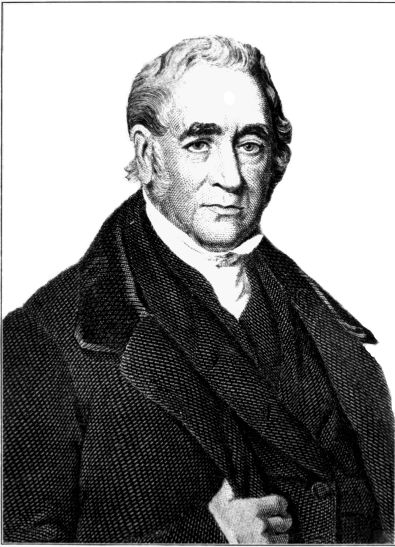
GEORGE STEPHENSON
STEPHENSON SOLVES THE PROBLEM
Stephenson was born on June 9, 1781, in the small colliery village of Wylam, on the river Tyne. His parents were extremely poor, and as the boy was sent to work as soon as he was large enough to find employment of any kind, he was given no education, even to the extent of learning the alphabet. It was only after he had spent many years in the colliery, and had finally worked himself up from the position of "picker" at three pence a day to that of fireman, that he was able to spend the necessary time and pennies to acquire something of an education. Then he attended a night school, learned his alphabet, was able to scrawl his name at eighteen years of age, and a little later could read, write, and do sums in arithmetic.
But if deficient in letters, there was one field in which he had no superior,—that was in the practical handling of a steam-engine. His position in the mine gave him a chance to study the workings of the engines then in use, and at every opportunity, on holidays and after working-hours, he was in the habit of dismantling his engine, and carefully studying every detail of its construction. Thus by the time he had reached his majority he was a skillful engineer, besides having many new ideas that had developed during his examinations of the machinery. But besides his knowledge of engineering, he was an accomplished workman in other fields. He was a good shoemaker, watch-and clock-repairer, and tailors' cutter, at all of which trades he worked at odd times to increase his income. Thus he was a veritable jack-of-all-trades; with the unusual qualification, that he was master of one.
By the time he was twenty-six years old he was holding the position of engineer to a coal-mining company, and had acquired the confidence of his employers to such an extent that he was permitted to build a locomotive for them—a thing that had been his ambition for several years. This was in 1807, the same year that Robert Fulton demonstrated the possibilities of steam navigation.
In the construction of this engine Stephenson introduced several novel features of his own inventing, although on the whole no new principles were involved; and in practice this engine showed several points of superiority over its predecessors. It would draw eight loaded wagons of thirty tons' weight at the rate of four miles an hour on an ascending grade of one in four hundred and fifty feet. But it had two very radical defects—it would not keep up steam and the noise of the steam-pipe exhausting into the open air frightened the horses of the neighborhood to such a degree that the authorities ordered the inventor either to stop running his engine, or suppress its noise. As an experiment, therefore, Stephenson arranged the exhaust pipes so that they opened into the smokestack, where the sound would be muffled. But when the engine was now tried he found to his surprise that this single expedient had solved both difficulties, the exhausting steam causing such an improvement in the draught of his furnace that double the quantity of steam was generated. This discovery helped to simplify later experiments, for the difficulty of keeping up steam had been one of the great obstacles encountered by the inventors.
Stephenson's second locomotive was an improvement over his first in many ways, but it was still far from being the practical machine that was to supplant horse-power. It could haul heavier loads than teams of horses, and was more convenient for certain purposes; but it was no more economical.
As yet the only use to which locomotives had been put was that of hauling cars in coal-mines. Indeed, the only railroads then constructed were those used in mines, the idea of utilizing such roads for passenger and freight traffic not having occurred to anyone until about 1820. Then the Englishman, Thomas Gray, suggested the construction of such a road between Liverpool and Manchester, advocating steam as the motive power. His idea was looked upon as visionary, and as he persisted in his efforts to interest prominent people in the scheme, he came to be very generally regarded as an enthusiastic but somewhat crackbrained fanatic.
But meanwhile the coal railroads were being extended to such lengths that they were assuming the proportions of modern railroads. The motive power on most of the roads was horses, although here and there a traction engine using chain or cable, was employed for certain purposes. In 1825, however, Stephenson began the construction of an improved locomotive, this time at his own modest establishment; and a little later this engine made the trial that really demonstrated the possibilities of steam locomotion, although this was not universally recognized until the success of the Rocket a few years later.
A great deal of excitement and speculation arose throughout the country when the trial day approached. Great crowds assembled from every direction to witness the trial; some, more sanguine, came to witness the success, but far the greater portion came to see the bubble burst. The proceedings began at Busselton incline, where the stationary engine drew a train up the incline on one side and let it down on the other. The wagons were then loaded.
"At the foot of this plane a locomotive, driven by Mr. Stephenson himself, was attached to the train. It consisted of six wagons loaded with coal and flour, next a passenger coach (the first ever run upon a railroad) filled with the directors and their friends, then twenty wagons fitted up with temporary seats for passengers, and lastly came six wagons loaded with coal, making in all twenty-eight vehicles. The word being given that all was ready, the engine began to move, gradually at first, but afterward, in part of the road, attaining a speed of twelve miles an hour. At that time the number of passengers amounted to four hundred and fifty, which would, with the remainder of the load, amount to upwards of ninety tons. The train arrived at Darlington, eight and three-quarter miles, in sixty-five minutes. Here it was stopped and a fresh supply of water obtained, the six coal-cars for Darlington detached, and the word given to go ahead. The engine started, and arrived at Stockton, twelve miles, in three hours and seven minutes including stoppages. By the time the train reached Stockton the number of passengers amounted to over six hundred."
From this description it will be seen that the coal roads had been extended to form interurban railways. In this connection it is interesting to note the increase of traffic that developed on this particular road in the years immediately following the invention of the practical locomotive. When the road was projected it was estimated that its maximum carrying capacity would not exceed 10,000 tons of coal yearly. A few years later, when locomotives had come into use, the regular yearly carriage amounted to 500,000 tons.
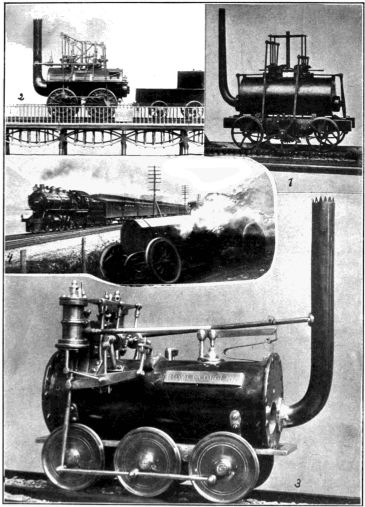
A CENTURY'S PROGRESS IN LOCOMOTIVE BUILDING.
Fig. 1.—The Blenkinsop locomotive, built in 1812–13 to work on the rack Railway between Leeds and the Middleton colliery, a distance of 3.5 miles. This was the first commercially successful enterprise in which steam locomotives were employed. Fig. 2.—Model of locomotive engine No. 1 of the Stockton and Darlington Railway, England, built by Messrs R. Stevenson & Company in 1825. This engine ran successfully for 21 years. Fig. 3.—The locomotive "Royal George" which worked on the Stockton and Darlington Railway 1827–1842. It will be observed that each of these engines antedated Stevenson's famous "Rocket." Fig. 4.—Shows, by way of contrast with these earliest types of locomotive, the "Twentieth Century Limited" train of the New York Central Railroad, and a racing automobile, either of which can easily make better time than a mile a minute, as against the two or three miles per hour of their prototypes.
The passenger coach on this first train, the first of its kind ever constructed for the special purpose of carrying passengers, was remarkable for its simplicity. One writer described it as "a modest and uncouth-looking affair, made more for strength than for beauty. A row of seats ran along each side of the interior, and a long table was fixed in the centre, the access being by the doorway behind, like an omnibus. This vehicle was named the Experiment, and was the only carriage for passengers upon the road for some time."
About this time the now famous Liverpool and Manchester Railway was projected. It was elaborately planned and carried out at an enormous expense. The construction of the road-bed was given special attention, although as yet the question of what motive power should be used had not been decided. Most of the directors and engineers favored the use of horses. The few that were in favor of steam did not favor the use of locomotives, but a system that would now be called a relay-cable system. According to this plan the road of about thirty miles was to be divided into nineteen sections, over each of which a stationary steam-engine was to work a chain or cable. But when the board of engineers appointed to investigate the possibilities of this system reported on the matter, it was found that there were several vital defects in such a system. For example, should any one of the sections of cable break or become inoperative, the entire line would have to stand idle; and furthermore, the cost of building and maintaining these nineteen stations offered serious financial obstacles.
It is an interesting fact that until the report of this board was made "not a single professional man of eminence could be found who preferred the locomotive over the fixed engine, George Stephenson only excepted." But with the glaring defects of the cable road, and the enormous cost of maintenance impressed upon the directors, the idea of the locomotive became at once more attractive, and the performance of Stephenson's locomotive was more carefully investigated. The upshot of these investigations was the offer of a prize of £500 for a locomotive that, on a certain day would perform certain duties named under the eight following headings:—
1. The engine must effectually consume its own smoke.
2. The engine, if of six tons' weight, must be able to draw, day by day, twenty tons' weight, including the tender, and water-tank, at ten miles an hour, with a pressure of steam upon the boiler not exceeding fifty pounds to the square inch.
3. The boiler must have two safety-valves, neither of which must be fastened down, and one of them completely out of the control of the engineer.
4. The engine and boiler must be supported upon springs and rest on six wheels, the height of the whole not exceeding fifteen feet to the top of the chimney.
5. The engine with water must not weigh more than six tons, but an engine of less weight would be preferred although drawing a proportionately less load behind it; if of only four and one-half tons it might be put on four wheels.
6. A mercurial gauge must be affixed to the machine, showing the steam pressure about forty-five pounds to the square inch.
7. The engine must be delivered, complete and ready for trial, at the Liverpool end of the railway, not later than October 1, 1829.
8. The price of the engine must not exceed £550.
What strikes one as most peculiar in this set of requirements and specifications is the first clause—that of the engine consuming its own smoke; for even at the present time this is considered a difficult problem. But this was not so considered by the inventors of that time, their great stumbling-block being the high speed required. Ten miles an hour struck most of them as absurd and out of the question.
One eminent person, who was to become later one of England's leading engineers, stated publicly that "if it proved to be possible to make a locomotive go ten miles an hour, he would undertake to eat a stewed engine-wheel for his breakfast." It is not recorded whether or not this terrible threat was carried out.
But there was more than one engineer and engine-builder who took a more sanguine view of the prize offer. The firm of Braithwait & Ericsson signified its intention of competing, with a locomotive that they named the Novelty. Another firm entered the contest with an engine called the Sans-pareil; still another firm entered the Perseverance; and George Stephenson was on hand with the now-famous Rocket.
In the series of trials that followed, the Sans-pareil and the Perseverance were so clearly outclassed by the other two competing locomotives that they need not be considered here; but the Novelty and the Rocket were close competitors. The Novelty, indeed, made such a good showing, and afterwards proved to be such a good locomotive, that although it lost the contest, many competent judges have since regarded it as equal to the Rocket, if not superior, in principle. Be that as it may, later experiments proved conclusively that the cause of failure on the final day of the prize contest was due to defects in workmanship rather than to defective principle of construction.
The Novelty has been described as having the appearance of "a milk-can set in the rear end of a wagon, with a little smokestack in front looking like a high dashboard." It carried its supply of fuel and water in the "wagon-box" part of the engine frame, in front of the boiler, so that it required no tender. On its first trial, running without any load, it reached a speed of twenty-four miles an hour—a speed more than double the "stewed engine-wheel" limit. But at each subsequent trial, although it hauled loads for short distances, some part of its machinery became disabled, so that it was necessarily regarded as inferior to its more stable rival, the Rocket.
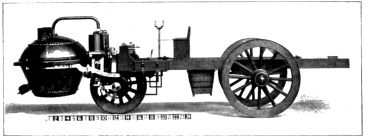
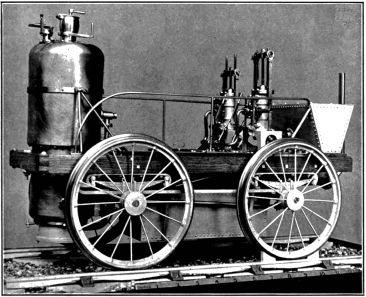
CUGNOT'S TRACTION ENGINE AND THE "NOVELTY" LOCOMOTIVE.
These vehicles are shown together here because of their similarity of plan of construction. Cugnot's original engine (upper figure) was built in France in 1769. The vehicle shown above was made in 1770, after Cugnot's designs, for the French Government. It was intended for the transportation of artillery, and the specifications called for a carrying capacity of about 4-1/2 tons and a speed of 2-1/4 miles per hour on level ground. Cugnot's original engine had attained this speed on a common road while carrying four persons; notwithstanding which fact the machine above shown was for some reason never given a trial. It is now preserved in the Conservatoire des Arts et Metiers, in Paris. It is particularly noteworthy that the successful road engine of Cugnot was constructed in 1769, the year in which James Watt took out the first patents on his steam engine. Just 60 years elapsed before Stephenson's "Rocket" convinced the world of the feasibility of transportation by steam-power.
The locomotive shown in the lower figure competed in the famous tests of 1829 against the "Rocket" and the "Sans Pareil." It excited much interest, attaining a speed of almost 32 miles per hour when running light, but owing to breakdowns was unable to fulfill the required tests and was therefore withdrawn from the competition. It was afterwards used commercially.
The Sans-pareil was considerably over the maximum weight and according to a strict interpretation of the stipulations, should not have been allowed to contest; but although this question of over-weight was waived by the judges, and the engine given a fair trial, it showed such a capacity for consuming fuel without any corresponding ability to perform work, that it was decided inferior to the Novelty and the Rocket. The Perseverance was clearly outclassed by all the other competing engines, as its maximum speed was only five or six miles an hour.
The most consistent performer, and the final prize-winner, as everyone knows, was Stephenson's Rocket, the direct ancestor of all modern locomotives. The boiler of this locomotive was horizontal, as in modern locomotives, cylindrical, and had flat ends. It was six feet in length and a little over three feet in diameter. The upper half of the boiler was used as a reservoir for steam, the lower half being filled with water and having copper pipes running through it. The fire-box, two feet wide and three feet high, was placed immediately behind the boiler. Just above this, and on each side, were the cylinders, two in number, acting obliquely downward on the two front wheels of the engine, the piston-rod connecting with the driver by a bar pinned to the outside of the wheel, as in modern American locomotives.
The engine with its load of water weighed a trifle over four tons—seemingly little more than a toy-locomotive, as compared with the modern monsters more than thirty times that weight. But for its size the little Rocket was a marvelous performer, even as judged by recent standards. On the first day of the contests over the two miles of trial tracks, it covered twelve miles in considerably less than an hour, shuttling back and forth over the road. The next day, as none of the other engines was in condition to exhibit, Stephenson offered to satisfy the curiosity of the great crowd that had gathered—a crowd that contained representatives from all over the world—by an unofficial trial of the Rocket. He coupled the little engine to a car, loaded on thirty-six passengers, and took them for a spin over the road at the rate of from twenty-six to thirty miles an hour.
The following day some of the competing locomotives were still unable to exhibit, and again the Rocket was given a semi-official trial. Hauling a car loaded with thirteen tons' weight, it ran back and forth over the two-mile road, covering thirty-five miles in one hour and forty-eight minutes including stoppages. The maximum velocity attained was about twenty-nine miles an hour. As this performance was duplicated on the day of the official trial, the Rocket was declared the winner, and awarded the prize.
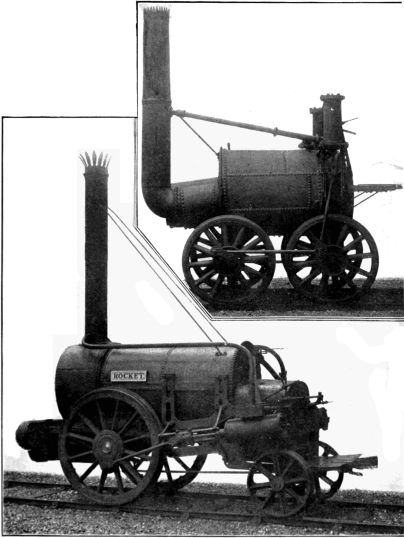
THE FAMOUS LOCOMOTIVES "ROCKET" AND "SANS PAREIL."
Stevenson's celebrated "Rocket" is known to everyone as the winner of the competition for the prize of 500 pounds offered in 1829 by the Directors of the Liverpool and Manchester Railway. The "Sans Pareil," which, like the "Rocket," is still preserved at the South Kensington Museum in London, competed unsuccessfully for the prize. Though not equal to the "Rocket" it was in many respects a well-made locomotive. It was purchased by the Liverpool and Manchester Railway Company and saw many years of active service.
Naturally there were many minor defects in the construction of this first locomotive, although most of them were too trivial and unimportant to affect the excellence of the machine as a whole. But it had one serious defect: the inclination of the cylinders caused the entire machine to rise and fall on its springs at every double stroke, producing great unsteadiness when running at any considerable speed. This was corrected a few months later by the suggestion of Timothy Hackworth, who drew plans for a locomotive having horizontal cylinders to be used on the Stockton & Darlington Railway. His plans were submitted to Stephenson, who constructed an engine from them called the Globe, which differed from the Rocket in having the cylinders not only horizontal, but placed on the inside of the wheels. A little later Stephenson built the Planet on much the same lines as the Globe, and this engine became the model for engine builders the world over. It is an interesting fact that American engineers adopted, and still cling to, Stephenson's original plan of having the cylinders act on rods attached to the outside of the wheels as in the Rocket, while English engineers have always built their locomotives with the cylinders on the inside, as arranged on the Planet.
Since the time of the Planet the general shape and arrangement of most locomotives has remained unchanged. In America the inclemencies of the climate compelled the invention of the cab; and it was here also that the bell, whistle, pilot, and sand-box were first introduced. But by 1850 the present type of locomotive had been produced; and although constant modifications are being introduced, the general appearance of the locomotive remains the same, the difference being mostly in the bulk.
IMPROVEMENTS IN LOCOMOTIVES IN RECENT YEARS
During the closing years of the nineteenth century the general improvements in the rolling-stock of railroads, and the constantly increasing demand for faster passenger service, stimulated manufacturers to attempt numerous improvements as well as many changes in the size of the more recent types of locomotives. In a general way these changes may be summarized as follows: A great increase in the size and weight, with increased speed and tractive power; the use of larger boilers with thicker shells; the substitution of steel for cast-iron in certain parts of the locomotive, thereby greatly increasing the strength; and finally, the economizing of steam by compounding.
There is no way of determining the exact amount of increase in the weight of engines during the last decade, but the figures of some of the great manufacturing establishments will give a fair idea of this increase in a general way. In one of these establishments the average weight of a locomotive turned out ten years ago was 92,000 pounds for the engine alone, without the tender. At the present time the engines being manufactured by the same firm average 129,000 pounds, an increase of 37,000 pounds, or something over forty per cent. This average weight, however, gives but an inadequate conception of the size of the largest locomotives now being manufactured. The "hundred-ton" engine has become a commonplace. In 1909 a locomotive weighing, with its tenders, 300 tons was manufactured for passenger traffic on the Santa Fé lines.
In America there seems to be no limit to the sizes that may be reached; or at least up to the present time this limit has not been attained. In England and several of the Continental countries a great difficulty has been found to exist in the unlimited size of locomotives, in the fact that the bridges and tunnels of these railroads are, almost without exception, so low that any very great vertical increase in the size of the engine is out of the question without reconstructing many miles of bridges and tunnels at an enormous cost.
The increased demand for greater speed has also caused a marked increase in the amount of steam pressure per square inch in the boilers. In 1870 the average was about 130 pounds; by 1890 this had been increased to about 160 pounds; while at the present time steam is used frequently at a pressure of 225 pounds. Naturally this increase in pressure compels the use of heavier steel boiler plates. In 1890 the usual thickness of the steel sheets was one-half inch; but at the present time it is no unusual thing to use plates seven-eighths of an inch in thickness.
But probably the most important improvement in locomotive construction in recent years is the introduction of the compounding principle in the use of steam—a system whereby practically the entire energy of the steam is utilized, instead of a considerable portion of it being a dead loss, as in the older type of engine. As every one knows, the passage of the steam through a single cylinder of an engine does not exhaust its entire energy. In the compounding system this exhausted steam is made to pass through one or more cylinders after coming from the first, the energy of all these cylinders being utilized for the production of power.
The application of this principle of compounding is not new even in the field of locomotive construction. As early as 1846 patents for a compound locomotive were taken out in the United States, and such an engine built in 1867; but it is only since 1890 that compound locomotives have become popular in this country. In these compound locomotives the two cylinders are of unequal diameter, so proportioned "that the steam at high pressure in the smaller cylinder exerts upon the piston approximately the same force that is exerted by steam at a lower pressure in the larger cylinder. Steam is admitted first into the smaller cylinder, where it expends a portion of its initial energy, and then passes into the larger cylinder, where it performs an equal amount of work by exerting a diminished pressure upon a larger surface. This is the principle of compounding, the relative sizes and positions of the cylinders being varied according to the conditions to be met by the engine, or the ideas of the designer or builder, or of the purchaser. While in the marine and stationary engine the compound principle has been carried with success and economy to three and four stages of expansion in the use of steam, it has not been found practicable to go beyond two stages in compound locomotives."
In a pamphlet issued recently by one of the leading locomotive works of the country, some points of interest concerning the compound locomotive were stated concisely as follows:
"In stationary-engine practice the chief measure of the boiler efficiency is the economical consumption of coal. In most stationary engines the boilers are fired independently, and the draft is formed from causes entirely separate and beyond the control of the escape of steam from the cylinders. Hence any economy shown by the boilers must of necessity be separate and distinct from that which may be effected by the engine itself. In a locomotive, however, the amount of work depends entirely upon the weight on the driving wheels, the cylinder dimensions being proportioned to this weight, and, whether the locomotive is compound or single expansion, no larger boiler can be provided, after allowing for the wheels, frame and mechanism, than the total limit of weight permits. The heating surface and grate areas in both compound and single-expansion locomotives of the same class are practically the same, and the evaporative efficiency of both locomotives is chiefly determined by the action of the exhaust, which must be of sufficient intensity in both cases to generate the amount of steam necessary for utilizing to the best advantage the weight on the driving wheels. This is a feature that does not appear in any stationary engine, so that the compound locomotive cannot be judged by stationary standards, and the only true comparison to be made is between locomotives of similar construction and weight, equipped in one case with compound and in the other with single-expansion cylinders.
"No locomotive, compound or single-expansion, will haul more than its adhesion will allow. The weight on driving wheels is the limiting factor in the problem which confronts the locomotive engineer. Power can, of course, be increased by building a larger engine and augmenting this weight but in the present construction of tracks and bridges the limit of driving wheel load has almost been reached. Hence in modern locomotive practice the goal before the designer and engineer is to obtain maximum efficiency for the minimum weight admissible.
"It is not claimed for compound locomotives that a heavier train can be hauled at a given speed than with a single-expansion locomotive of similar weight and class; but the compound will, at very slow speed, on heavy grades, keep a train moving where a single-expansion will slip and stall. This is due to the pressure on the crank-pins of the compound being more uniform throughout the stroke than in the case of the single-expansion locomotive, and also to the fact that, when needed, live steam can be admitted to the low-pressure cylinders."
Of course, the principal reason for compounding the locomotive is to economize steam, and this is unquestionably accomplished; but nevertheless the comparative economy of compound and single-expansion locomotives was for some time a mooted question. Numerous tests have been made with these two classes of engines, and the widest ranges of differences were shown in many instances. In some cases the compounds seem to show a saving of some forty per cent. in fuel; but this is by no means a determinative factor in the daily use of an engine. It is found that repairs on the compound are more difficult to make, and consequently more expensive than on the single-expansion engines; but on the whole it is very generally conceded that the compound saves its owners from ten to twenty-five per cent. over the older type.
The rapid increase of the size, and consequent coal-consuming capacity, of the modern locomotive has added another problem to engineering—that of keeping the yawning maw of the fire-box supplied with coal. There is a limit to the amount of work that the fireman can do, and the great engines in use at present tax even the strongest fireman to the utmost. If the size or speed of locomotives is increased very materially in the future it will be necessary to have two men, instead of one, as firemen, or to use mechanical stokers, or to find some other kind of fuel. In point of fact the mechanical stoker has been recently tried with success, and this will probably help in solving the problem. But there is also the strong probability that the use of liquid fuel will become more and more popular. At the present time many locomotives in the West and Southwest, as well as in Europe and in Asia, have been equipped with burners for the consumption of crude petroleum. No modification in the construction of the locomotive is required for this change of fuel except some slight alteration in the arrangement of the brickwork of the fire-box, and the introduction of the burners. These, however, are simple arrangements that throw into the fire-box, a spray of steam and vaporized oil, which burns freely and generates an intense and steady heat. With this kind of fuel the fireman need not be considered, as the largest engine thus equipped may be "fired" with far less labor than is required on the smallest coal-burning, narrow-gauge locomotive.
THE WESTINGHOUSE AIR BRAKE
The application of steam as a motive power for running trains of cars solved one great problem; but it created another. The second one was the problem of how to stop the trains once they had started. On short trains made up of the light cars used at first, the hand brakes were sufficiently effective for practical purposes. But as trains were increased in length and weight and were run at high speeds, it became imperative to find some means of stopping such trains quickly and with certainty.
With a hand brake working on each pair of trucks, as on passenger coaches, it was possible to make reasonably quick stops when there were enough members of the train crew to work all the brakes simultaneously. But in practice it was found impossible to maintain this ideal condition. For emergency stops the brakemen were summoned by signals of the whistle given by the engineer, and there was necessarily some little interval of time after this signal before the most alert crew could begin the relatively slow process of applying the brakes.
The engineer himself could give valuable aid in stopping the train by reversing his engine, the locomotive acting as a brake to check the oncoming cars. But this check acted only at the forward part of the train, and being applied suddenly, caused the rear cars to rush against the forward cars with terrific force, sometimes driving in the bumpers and wrecking the train. Obviously an ideal system of brakes must be one that acted upon all the cars of the train simultaneously and under control of the engineer; and presently such a system was invented by Mr. George Westinghouse.
Other inventors had tried to produce a practical system of brakes, such as those using steam as a working force, or systems of hand-wound springs; but Mr. Westinghouse utilized compressed air, and from the first his brakes proved effective.
His first air brake, operated successfully in 1869, was the "straight air brake" type—one that has now been replaced almost universally by the automatic. In this brake system there was an air reservoir on the locomotive, and steam was used for making the compression. From this reservoir a line of gas pipe ran through the cab of the engine beneath the tender and under each car, the space between the cars being bridged by rubber tubes and easily-adjusted couplings. This line of pipe, called the train pipe, was connected near the centre of each car with a cylinder which contained a piston with a stem which acted upon the brake shoes by means of a series of levers and connecting rods.
In the cab, placed conveniently for the engineer, was a valve by means of which he could cause the compressed air to flow into the train pipe and thus act upon the brake cylinders of the cars. This could be done gradually for making a slow stop, or with full force as the case required, and the brakes could be released by turning the valve to a point which opened a vent and allowed the air to escape.
The effect of this invention was revolutionary. Stopping the train was no longer dependent upon manual labor applied intermittently at different points, but was placed entirely in the hands of the engineer who applied the required power almost simultaneously at all points along his line of cars. Thus the brakeman was relieved of one of his perilous tasks, which on freight trains took a heavy toll in loss of lives.
This relatively simple, and usually effective, system had two grave defects. The first of these lay in the fact that if there was a leak—even a very small one—anywhere along the line of the train pipe or the brake cylinders, the brakes would not work, the compressed air being exhausted into the atmosphere instead of acting on the brake cylinders. The common accident of having his train "break in two" rendered the engineer powerless to stop the cars, and disastrous "runaways" sometimes resulted. The second defect, which became more and more apparent as the length of trains was increased, was the impossibility of applying the air to the brakes of the rear cars as quickly as to those near the engine, since the compressed air could not travel the length of the train pipe instantaneously, on account of the frictional resistance.
These defects were quickly recognized by Mr. Westinghouse, and in 1876, seven years after he applied his first invention, he produced his automatic air brake which overcame them effectually. In this brake the train pipe and the air reservoir were retained as in the straight air brake system, but in addition each car was equipped with a storage reservoir of sufficient size to supply the brake cylinder. In place of the older arrangement in which the train pipe simply retained air at atmospheric pressure when not in use, the new system kept the air in the train pipe under a considerable pressure at all times when the brake was not in use. And, reversing the conditions of the straight air brake, the engineer in order to apply the brakes let out the air in the train pipe instead of forcing air into it, a "triple valve" on each car performing the work of operating the brake cylinder automatically.
The advantage of this system over the older one is obvious. Whereas the detachment of a portion of the train, or a leak in any part of the air brake system heretofore had left the engineer helpless, exactly the reverse condition was produced in the new system. Any leakage of air, either from a break or a defect, caused every brake on the entire train to be applied to the wheels and brought the train to a stop. Moreover, with the new system it was now possible to equip each car with a valve which would lessen the pressure of air in the train pipe so that the train could be brought to a stop by the trainmen in the rear or intermediate coaches as readily as by the engineer.
This system worked perfectly on passenger trains; but on long freight trains the resistance to the passage of the escaping air through the train tube was so great that if an emergency required the full force of the brake to be applied suddenly, the brakes of the rear cars did not come into use until several seconds after those of the forward cars. The result was that the momentum of the rear cars caused them to strike the forward cars with great violence. But Mr. Westinghouse overcame this defect by an ingenious use of the triple valve mechanism of each car, whereby the application of the emergency brake by the engineer caused the air in the train pipe on each car to be discharged simultaneously into the brake cylinder. In this manner the discharge of air not only allowed the brakes to act, but assisted them in doing so. This was only the case, however, when the emergency application of the brake was made, this system of venting on each car into the brake cylinder not being brought into play when ordinary stops were made. Thus the engineer in this quick-action automatic air brake has really two brakes at his command, one for making ordinary stops, the other for emergencies.
In 1891 a so-called high-speed air brake was perfected, this brake being really a modified quick-action automatic brake. This modification consists of the addition of an automatic pressure-reducing valve connected with each brake cylinder. In the high-speed air brake as applied when the train is running rapidly, the highest possible pressure is applied at once to the wheels, but this pressure is lessened by the automatic pressure-reducing valves as the speed diminishes. This method of applying the brakes is the most effective way of getting the full benefit of their stopping power. This high-speed brake, therefore, represents the highest perfection in train-stopping devices.
We have referred here specifically to the air brake as used on steam railroads. In another chapter the subject has been touched upon in connection with electric railroads. In such brakes the compression of the air is accomplished by electricity instead of steam, but the general principles involved are the same as those just described.
It should not be understood that the Westinghouse air brake was the only one, or the only type of brake, devised and brought to practical perfection. For a time a vacuum brake, which utilized atmospheric pressure, offered keen rivalry. But eventually the type of brake perfected by Mr. Westinghouse, modified in certain details in the various countries of Europe and America, gained precedence, which it still retains.
AUTOMATIC COUPLINGS
The perfection of the air brake removed one great source of danger that menaced the crews of freight trains. There still remained another almost as great, particularly in the matter of maiming its victims, when not actually killing them. This was the old method of coupling freight cars as practiced in America. There were few old-time trainmen, indeed, who could show a complete set of full length digits, the buffers of the old-fashioned couplings being responsible for the lost and shortened members.
The freight brakeman has to make scores of couplings on every trip. And he literally took his life in his hands upon each and every occasion of making a coupling by the old method.
This old form of couplings consisted of two buffers—one on each car—joined together by an iron link about fifteen inches long, a movable pin inserted at either end holding the link in place and thus joining the cars. When a coupling was to be made the brakeman raised the pin in the buffer of the stationary car and tilted it at an angle in the pin-hole at the top of the buffer so that, while it remained raised, the jar of the striking buffers at the moment of coupling caused it to fall into place and complete the coupling. The link was left hanging in the moving car which was being shunted in to be coupled; but in this position the projecting end was so low that it would miss the hole in the opposite buffer, and thus fail to make the coupling, unless raised and inserted just at the moment before the buffers came together.
This raising and inserting of the link was the dangerous part of making a coupling. It could only be done by the brakeman while standing between the cars. And he must raise the link, insert it, and remove his hand in a fraction of a second if the car was moving at a fair rate of speed, otherwise his fingers or hand would be caught between the buffers and crushed. And a crushed hand or arm meant subsequent amputation, for the force of the collision between the buffers crushed the bones beyond repair.
There was a way in which the coupling could be made whereby the hand was not endangered. This was by using a stick for raising and guiding the link into the buffer. Some railroads at first furnished sticks for this purpose. But no brakeman would stoop to use them. Had he done so he would have been hooted and jeered off the road by his train mates. And so his pride made him risk his limbs and his life, and fostered the recklessness of the old-time brakeman.
But in 1879 Mr. Eli Janney, of Pittsburg, patented an automatic car-coupler that was both simple and effective; and in 1887 the Master Car Builders' Association accepted this type of coupler. A little later the U. S. Government, influenced by the appalling loss of life among the brakemen, passed laws compelling all cars to be equipped with some form of automatic coupling device, and naturally the Janney coupling was the one adopted. In using this coupling the brakeman did not have to step into the dangerous position between the cars, either for making the coupling, or disconnecting the car. The act of coupling was done automatically, while the uncoupling was effected by the use of a lever operated from the side of the car.
A somewhat technical description of this coupling is as follows:
"The Janney coupling consists of a steel jaw fitted on one side with a knuckle or L-shaped lever turning on a vertical pin; this knuckle when being swung inward lifts a locking pin which subsequently drops and so prevents the return of the knuckle. An identical coupler is fitted to the end of the adjacent vehicle, and, so long as both or either of the knuckles are open when the vehicles come into contact, coupling will be effected; to uncouple, it is only necessary to raise either of the locking pins, by means of a chain or lever at the side of the vehicle. The knuckles have each a hole in them to permit of the use of the old link and pin coupler, when such a fitting is met with. At first, this coupling gave some trouble through the locking pins occasionally creeping upward, but in the larger model, which represents the later form, there is an automatic locking pawl that prevents this motion; owing, however, to the pawl being attached to the lifting shackle, it in no way interferes with the pin being raised when disconnecting."
Even before the invention of the Janney coupling a semi-automatic coupling device had been used extensively on passenger cars. But this device which in effect was that of two crooked fingers hooked together, allowed the ends of the coaches to swing and roll in a manner most disagreeable to many passengers. The Janney couplings corrected this, since these couplings in their improved form hold the ends of the cars as in a vice.
A COMPARISON—THE OLD AND THE NEW
Stephenson's locomotive and its tender, when loaded to full capacity with fuel and water, weighed seven and three-quarter tons. The locomotive itself was a trifle over seven feet long. In 1909 the Southern Pacific Railway purchased a Mallet Compound locomotive which, with its tender, weighs three hundred tons, or approximately forty times the weight of the little Rocket. This great locomotive is over sixty-seven feet long, or some nine times the length of the Rocket, and will haul more than twelve hundred tons back of the tender.
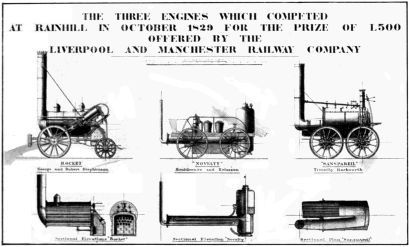
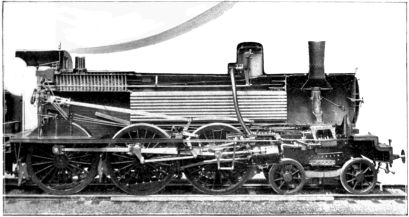
THE DEVELOPMENT OF THE LOCOMOTIVE.
The lower figure represents a longitudinal section of a modern French locomotive, for comparison with the sections of the famous engines of 1829. The weight of the "Rocket," with its four-wheel tender which carried 264 gallons of water and 450 pounds of coke was 4-1/4 tons. The French locomotive with its tender in working order, carrying 3300 gallons of water and five tons of coal, weighs 99 tons, and the length of the engine and tender is 56.3 feet.
The cylinders of the Rocket were eight inches in diameter, with a seventeen inch stroke; the high-pressure cylinders of this Mallet locomotive are twenty-six inches in diameter, and the low-pressure cylinders are forty inches. But curiously enough the driving wheels of the two engines show little discrepancy, those of the Rocket being fifty-six inches in diameter, as against fifty-seven for those of the larger engine. The total heating surface of the Rocket was one hundred and thirty-eight square feet, that of the new locomotive 6,393 square feet. To heat this great surface oil is used for fuel, so that the task for the fireman is lighter than on many locomotives less than one-half the size.
On this locomotive there are two sets of cylinders driving two sets of driving wheels on each side, making a total of sixteen drivers in all. From the size of these drivers it is evident that the engine is designed for strength rather than speed, although of course relatively high speed can be attained if desired. On the section of road over which it operates there is a maximum grade of one hundred and sixteen feet per mile, and it was for negotiating such grades with full loads that the locomotive was designed.