V FROM CART TO AUTOMOBILE
Reading edition
THE use of the wheel as a means of reducing friction dates from prehistoric times. The introduction of this device must have marked a veritable revolution in transportation, but unfortunately we have no means of knowing in what age or country the innovation was effected. We only know that the Chinese have used wheelbarrows and carts from time immemorial, and that sundry very ancient pictures and sculptures of the Egyptians and Babylonians prove that these peoples were entirely familiar with wheeled vehicles.
The earliest form of wheel was doubtless a solid disk, and such a wheel is still in use in many places in the East; but the wheels of the Assyrian chariot were spoked after the modern fashion, and provided with rims of metal. The introduction of the wagon spring, however, was a comparatively modern innovation. The use of springs very considerably reduces the resistance, thus adding to the efficiency of wheeled vehicles; but the reduction is not very obvious unless the roads are tolerably good, nor is it probable that the ancient nations could readily have measured the effect even had the idea of springs suggested itself.
As regards good roads, these are, to be sure, no modern invention, since the Romans had carried the art of road-building to a very high degree of perfection. The integrity of the Roman Empire depended very largely upon the highways that linked all parts of its circumference with the Imperial centre; and in a perfectly literal sense all its roads led to Rome. The Roman roadbed was constructed of several layers of stone, and it was one of the most resistant and permanent structures ever devised. As late as the sixteenth century of our era there were no roads worthy of the name in England except the remains of those constructed many centuries before by the Roman occupants. It was not until well toward the close of the eighteenth century that Macadam and Telford devised methods of road-making whereby broken stone and gravel, pounded to form a smooth surface, gave the modern world roadbeds that were in any way comparable to those early ones of the Romans.
This development of road-building corresponded, naturally enough, with an advance in the art of carriage building, and the increased popularity of stage coaches. We are told that about 1650 the average rate of speed of the stage wagons in England was only four miles an hour; whereas the stage coaches moved over the improved roadbeds of the nineteenth century at an average speed of about eight miles an hour, which was sometimes increased to eleven miles. After about the year 1836, however, the stage coach was rapidly displaced by the steam railway, and the interest in roadbeds somewhat abated until brought again prominently to public attention by the users of bicycles and automobiles.
THE DEVELOPMENT OF THE BICYCLE
It is rather surprising to learn that in point of time the automobile antedates the bicycle. Yet such, as we shall see in a moment, is the fact. Every one is aware, however, that the bicycle came into popularity at a time when the very existence of the automobile had been practically forgotten, and that subsequently it lost its popularity almost over night when the automobile came to its own. Viewing the subject retrospectively, perhaps the most singular thing is that both vehicles were so long delayed in making their way to public favor. There were, however, sundry very practical obstacles placed in the way of the larger vehicle; and the bicycle was not at first a device calculated to prove attractive to the average wayfarer.
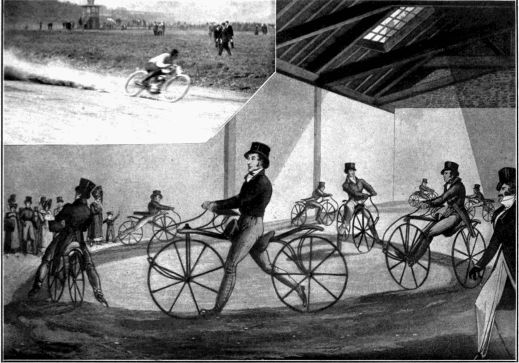
THE HOBBY-HORSE OF 1820 CONTRASTED WITH THE MOTOR CYCLE OF TO-DAY.
For a brief period about 1820 the hobby horse was very popular with English dandies. Our illustration reproduces a contemporary print. The (1909) motor cycle shown in the small picture is compassing a mile in 40 seconds.
The very earliest bicycle appears to have been the so-called hobby horse or dandy horse introduced about the year 1818 by Baron von Drais in France. It was a primitive vehicle, the user of which half rode and half ran, propulsion being effected simply by thrusting the feet against the ground. In effect the rider of the hobby horse ran with a stride greatly lengthened through the partial support afforded by the saddle, and with correspondingly increased speed. He could, of course, on occasion coast down hill or on a level surface when considerable momentum had been acquired, and supports for his feet were provided to facilitate this end. At first the machine promised to become popular, but it was soon ridiculed out of court.
Something like twenty years later—that is to say about the year 1840—a treadle-bicycle was invented by Kirkpatrick MacMillan, an English blacksmith. The machine did not become popular, however, and it was not until simple cranks were fitted to the front wheel of the bicycle that this form of vehicle came into anything like general use. This very simple expedient was first suggested, seemingly, by Pierre Lallament, a Frenchman, in 1866. His machine came to be known in England as the bone shaker, and doubtless it deserved its name, for as yet neither the wire suspension wheel nor the rubber tire had been invented. Both these improvements were quickly introduced, however; the suspension wheel by Mr. E. A. Cowper, in 1868. The first rubber tires, used about 1870, were solid, and it was not until 1888 that the Irishman, Mr. J. B. Dunlap, introduced the pneumatic tire. Meantime the geared bicycle, with which every one is nowadays familiar, had been introduced in 1879 by Mr. H. J. Lawson and brought to the familiar form of the "safety" in 1885 by Mr. Starley. The combination of low wheels geared to any desired speed with pneumatic tires was the finishing stroke.
The problem of making the bicycle a relatively speedy vehicle had indeed been solved by the use of a large wheel—sometimes sixty inches in diameter—operated by a simple crank after the manner of the early machine of Lallament; but while bicycles of this type attained a considerable measure of popularity, the danger of taking a "header" on encountering any obstacle in the road was one that seemed to the average person to out-measure the pleasure or benefit to be derived from rapid transit thus attained. The safety bicycle, however, practically eliminated this danger. It was, moreover, comparatively easy to balance; and not long after its introduction in perfected form, with pneumatic tires, it had made an appeal to which all the world responded. For a few years the safety bicycle was the most conspicuous of vehicles on every country road, and partisans of outdoor life believed that the health and stamina of the generation were to be increased immensely by the new vehicle.
Nor were these anticipations altogether visionary, as undoubtedly the bicycle did do much to improve the average health of nearly all classes of citizens. But its popularity was too suddenly acquired to be permanent, and at the very moment when it was most used, another vehicle was suddenly developed which was to lead to its practical abandonment by the great mass of people for whom it might have been supposed to afford a means of permanent recreation.
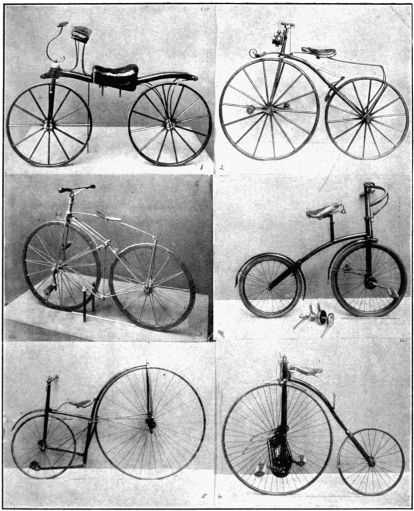
THE EVOLUTION OF THE BICYCLE.
Fig. 1.—The hobby horse or dandy horse, the forerunner of the bicycle, which was patented in France in 1818 by Charles, Baron von Drais. Fig. 2.—The so-called "Bone Shaker" invented about 1865 by Pierre Lallement. Fig. 3.—"Phantom" bicycle introduced in England about 1869, its most important improvement consisting of wire spokes in tension in place of rigid spokes. Fig. 4.—"Bantam" bicycle introduced in 1893. Its peculiarity is an epicyclic gearing through which the wheel is made to revolve more rapidly than the cranks. Fig. 5.—An early safety bicycle introduced in 1876. The crank and lever driving apparatus is similar to that of a machine made by Kirkpatrick MacMillan in 1839. Fig. 6.—"Kangaroo" bicycle patented in England by W. Hillman in 1884. The peculiarity consists in the use of a chain gearing to increase the speed of the wheel. The principle is precisely that of the modern bicycle, though the application of the chain to the front wheel made a cumbersome apparatus.
THE COMING OF THE AUTOMOBILE
The vehicle that effected this sudden eclipse of the bicycle is, as everyone knows, that form of power-driven carriage known in England as the motor car, and in France and America as the automobile. The first form of this vehicle to gain popularity was a tricycle driven by a small steam motor. But almost immediately the recently devised gas engine was called into requisition, and after that the development of the automobile was only a matter of detail. But, as so often happens with practical inventions, there are disputed questions of priority regarding the application of the gasoline engine to this particular use. The engine itself was perfected, as we have elsewhere seen, about 1876, by the German, Dr. Otto.
It appears that in 1879 an American, Mr. George B. Selden, applied for a patent designed to cover the use of the internal combustion engine as a motor for road vehicles. Owing to technical complications the patent was not actually issued until the year 1895. Meantime at least as early as 1885 Herr Daimler in Germany had used the gasoline motor for the practical propulsion of a tricycle; and not long after that date the right to use his patents had been acquired in France by Messrs. Panhard and Levassor. These men soon applied the Daimler motor to four-wheeled vehicles of various types, and almost at a bound the automobile as we know it was developed. Early in the '90's the custom of having annual road races was introduced, and before the century had closed the automobile was everywhere a familiar object on the roads of Europe and America.
While the introduction of the automobile is thus a comparatively recent event, it should be known that the idea of using mechanical power to propel a road vehicle is by no means peculiar to our generation. Practical working automobiles were constructed long before any person now living was born. The very first person to construct such a vehicle was probably the Frenchman, Cugnot, who manufactured a steam-driven wagon, using the old Newcomen type of engine, in the very year—by a curious coincidence—in which James Watt took out his first patent for a perfected steam engine; that is to say, in the year 1769.
Cugnot's automobile was a heavy four-wheeled affair intended for military service. It actually progressed along the road at the rate of three or four miles an hour. But the problem of carrying fuel and water had not been solved, and either for that reason or because the authorities in charge lacked imagination and did not regard the device as offering advantages over traction by horses, nothing came of Cugnot's effort except the scientific demonstration that the idea of a self-propelled vehicle was not merely the dream of a visionary. A second automobile truck of similar design, made by Cugnot a year or two later, may be seen to this day in the Museum of Arts and Measures in Paris.
A few years later—namely in 1785—an Englishman, William Murdoch by name, whose interest in steam engines is evidenced by the fact that he was in the employ of Bolton and Watt, manufactured a small tricycle driven by a Watt engine. This vehicle, running under its own power, developed a good degree of speed; and had not Murdoch's employers forbidden him to continue his experiments, the practical automobile might perhaps have gained popularity an entire century earlier than it did.
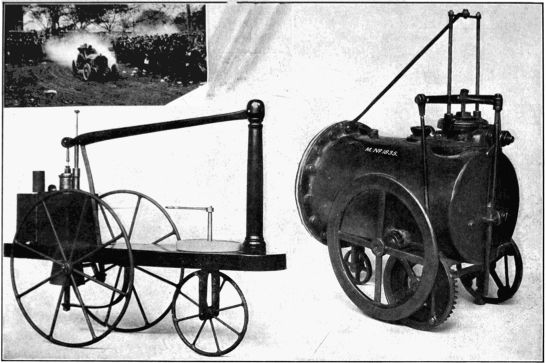
THE EXTREMES OF AUTOMOBILE DEVELOPMENT.
At the left, William Murdock's automobile of about the year 1781. Murdock made several experimental models which worked successfully, but strangely enough Bolton and Watt, his employers, discouraged his efforts and induced him ultimately to abandon the invention, which nevertheless had demonstrated the possibility of propelling a vehicle by steam power. At the right, the original model of Richard Trevethick's road locomotive, constructed in 1797. The success of this model led Trevethick to construct a steam carriage which was successfully tried on the roads in England in 1801. The small picture in the upper corner shows the modern craft that is the outgrowth of these crude vehicles—the winning automobile in the Vanderbilt race on Long Island in 1909.
As the case stands, however, the automobile of Murdoch failed as signally as had that of Cugnot to gain general recognition. But it is quite possible that a knowledge of the device had come to the attention of another Englishman, Richard Trevithick by name, who was at once a practical experimenter of great skill and a man of fertile imagination. Trevithick, himself the inventor of a high-pressure steam engine, adjusted his engine to a large road vehicle, and in the year 1804 exhibited this automobile on the roads of Cornwall, and subsequently in London, where it would probably have made its way had not the inventor been an extremely erratic genius, who presently shut up his coach and turned his attention to another form of vehicle. This, it will be observed, was full twenty-five years before that memorable date on which Stephenson launched his famous Rocket. Nothing came of Trevithick's experiment at the moment, beyond the demonstration of a principle—which indeed was much; but it was not long before various other inventors took up the idea, and as early as 1824 a number of automobiles, some of them weighing as much as three or four tons, were in successful operation on the highways of England. Some of these even gave regular passenger service, and attained the unprecedented speed of twelve or fourteen miles an hour. All this, it will be observed, was before the first locomotive running on rails had attracted any attention. Stephenson had indeed begun his experiments, but up to this time they had been confined exclusively to tramways in connection with collieries.
In the year 1829 Stephenson made his famous demonstrations with the Rocket, a locomotive running on rails, which attained a speed of thirty miles an hour, contrary to all the predictions of the wiseacres, who had declared the inventor a lunatic for hoping to attain even ten miles. We have already noted that the railway on which the test was made was not built with the expectation of utilizing steam power, that being regarded as a dreamer's vision. Lord Darlington prevented the construction of the road for a time because it chanced to run near his fox covers; and legislative permission was finally secured only with the proviso that the railway was to avoid the region of the preserves. Stephenson with difficulty secured permission to make an experiment on the railway with his engine, in competition with other would-be inventors; and it was his unexpected success that turned the scale in favor of steam power. But even the startling success of the Rocket did not make a great impression upon the British public, the incident being given but slight notice in the periodicals of the day, and no mention being made of it in the Annual Register.
All this is of interest as showing the attitude of a conservative public toward the steam locomotive running on a railway, and as partially explaining the antagonism to self-propelled road vehicles which found, most unfortunately, an exponent in no less a personage than the Duke of Wellington, then prime minister. The opinion and attitude of the duke were made evident in 1829, in connection with a steam automobile invented by a Mr. Gurney, which was capable of running on an ordinary road at a rate of at least ten miles an hour. The duke was old, and age had strengthened his inherent conservatism. He lent a ready ear to the claims—largely instigated, no doubt, by persons interested in horse traffic—that the automobile on an ordinary road was a menace to public safety, and no doubt his influence had a large share in helping on the unfavorable public opinion and the adverse legislation which were presently to block the further progress of the motor car.
Doubtless also the amazing success of the railway locomotive tended to attract the attention of the public away from the automobile, and thus made possible the passage of restrictive laws. In any event, the motor car, notwithstanding its demonstrated possibilities, virtually passed from the scene at about the time when the railway locomotive made its spectacular entrance. That public interest in the matter did not subside immediately, however, is evidenced by the fact that such a book as Gordon's Treatise on Elementary Locomotion by Means of Steam Carriages on Common Roads passed through three editions between the years 1832 and 1836.
AN EXTRAORDINARY PIECE OF LEGISLATION
Indeed, notwithstanding legislative rebuffs, here and there an inventor kept up his experiments, and in 1861 the automobile had attained so much prominence as to be given parliamentary attention. Four years later, in 1865, an extraordinary law was passed which deserves to be remembered as one of the greatest monuments of legislative folly ever recorded in connection with an economic question. This law provided that, in the case of any locomotive moving on a public highway, the number of persons required to drive the engine should be increased to three, and that the vehicle should be preceded by a man with a red flag.
The latter provision suggests at first sight that the British legislator had here been moved to curiously un-British facetiousness; but there was really no such intent, as another provision of the law, limiting the maximum speed to four miles an hour, sufficiently testifies.
Other laws of similar tenor supported this one, and the validity of these decrees was finally sustained through an appeal to the Court of Queen's Bench, which brought forth the decision that the law applied to every type of self-propelled vehicle from the traction engine to the Bateman steam tricycle. Naturally this decision gave the quietus to automobile—or, to use the more English word, motor car—progress in Great Britain.
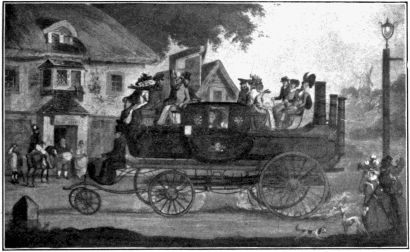
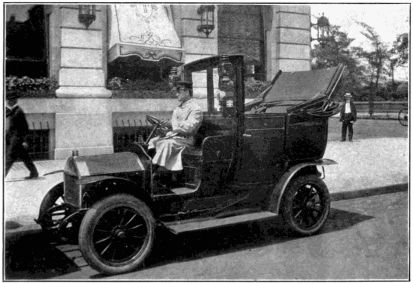
AN ENGLISH STEAM COACH OF 1827 AND A NEW YORK TAXICAB OF 1909.
The steam coach constructed in 1827 by Sir Goldsworthy Gurney was the prototype of several others which entered upon regular and successful service between various English cities, and which are said to have maintained an average speed of about 12 miles and a maximum speed of a little over 20 miles an hour. The above figure reproduced from a contemporary lithograph shows the carriage that operated between London and Bath. It weighed about 2 tons and carried six inside and 12 outside passengers.
It appears, then, that the idea of an automobile travelling on an ordinary highway preceded that of the locomotive railway. It was, indeed, by far the more natural idea of the two, since tramways were at that time but little used outside of collieries. And it seems scarcely open to doubt that the repressive legislation was directly responsible for deflecting the progress of mechanical invention away from what seemed the more natural direction of development. It is always hazardous in such a case to attempt to guess what might-have-been under different circumstances; but considering the practical results already achieved as early as 1824, one can scarcely avoid the conviction that had legislation favored, instead of opposing, the inventor, the automobile might have been developed in Great Britain as rapidly as railway traffic; in which event the middle of the nineteenth century would have seen the world at least as near the horseless age as we are in reality at the close of the first decade of the twentieth century. What this would have meant in its economic bearings on civilization during the past fifty years, the least imaginative reader can in some measure picture for himself.
In opposition to this view it might be urged that the real progress of the automobile has taken place since 1885, when the Daimler oil engine was substituted for the steam engine in connection with motor vehicles. But in reply to this it must be remembered that the workable gas engine had been invented as early as 1860, and that the Otto engine, of which the Daimler is a modification, was patented as early as 1876. These developments, it will be noted, took place at just about the time when the new interest in the automobile had been aroused, as evidenced by the repressive British legislation just referred to. It can be but little in question that had the early interest in the British automobile been maintained, inventive genius would long since have provided a suitable motor. There was no incentive for the English inventor during those long years when the automobile was under legislative ban; and in the meantime the idea of the highway automobile seems not to have taken possession of other nations.
When that idea did make its way, it was very soon put into tangible operation, as everybody knows. And the fact that England made no progress whatever in this line until the repressive laws were repealed in 1896, whereas France, Germany, and America had leaped far ahead in the meantime, is in itself demonstrative. Moreover, as regards the question of a motor for the automobile, it should not be forgotten that the steam-engine is by no means obsolete. The victories of Mr. Ross' machine at Ormonde in 1905, and of the Stanley steamer in 1906 (a mile in 28-1/5 seconds), show that steam is distinctly a factor, notwithstanding the popularity of the gasoline engine. The steam motor might have served an admirable purpose until such time as a better power had been developed.
However, it is futile to dwell on might-have-beens. Let us rather consider for a moment the spectacular development of the automobile with particular reference to its striking capacities as an eliminator of space.
SCIENTIFIC ASPECTS OF AUTOMOBILE RACING
A mile in 34-1/5 seconds. That is the automobile record established at Ormonde Beach in January, 1905. The record mile was made by Mr. H. L. Bowden, of Boston, with a machine of peculiar construction. It consisted essentially of two four-cylinder motors adjusted to one machine, giving an engine of 120 horse-power. The machine weighed 2,650 pounds, exceeding thus by more than four hundred pounds the usually prescribed limits of weight. The record, therefore, stood as a performance in a class by itself. But that is something that interests only the specialist. For the general public it suffices that an automobile propelled by a gasoline engine covered a mile in 34-1/5 seconds, or at the rate of one hundred and five miles an hour.
This record was made on Wednesday, January 25, 1905. A little earlier on the same day the previous automobile record of a mile in thirty-nine seconds—made at Ormonde by Mr. William K. Vanderbilt, Jr., in 1904—had been twice broken; first by Mr. Louis Ross, who made the mile in his 40 horse-power steam auto of "freak" construction in thirty-eight seconds; and by Mr. Arthur McDonald, driving a 90 horse-power car belonging to Mr. S. F. Edge. Mr. McDonald's record was a mile in 34-2/5 seconds, and this stood for a time as the new record for cars of regulation weight.
It thus appears that Mr. Vanderbilt's record was reduced first by one second, then by 4-1/5 seconds, and finally by 4-2/5 seconds on the same day. Obviously the conditions were peculiarly favorable on that day, or else a very marked improvement in the construction of racing automobiles had taken place within a single year. The latter is doubtless the true explanation, since, according to all reports, the conditions at Ormonde Beach that year were not peculiarly favorable, but rather the reverse. The fact, too, that the five mile record was reduced to the low figure of three minutes seventeen seconds—this also by Mr. Arthur McDonald—on the day preceding that on which the mile record was so completely smashed, corroborates the idea of improved mechanism rather than improved conditions. In any event, the jump from 39 to 34-1/5 seconds is a notable one; as will be evident from a simple computation which shows that the record holders of 1905 would have run away from the champion of 1904 at the rate of no less than nineteen feet for each second of the mile.
Let us pass at once—omitting transition stages—from these records to the new mark set on March 16th, 1910, at Ormonde Beach by Mr. Barney Oldfield. Driving a Benz automobile of two hundred horse-power, he compassed the mile in 27.33 seconds. The new record has a peculiar interest, not merely because it is the fastest mile ever made by an automobile, but because it is in all probability the fastest mile ever travelled by a human being who lived to tell the tale. A few unfortunates, falling from balloons, or from mountain cliffs, may have passed through space at a yet more appalling speed; but they lost consciousness, never to regain it, long before the mile was compassed. The automobile driver retains his senses throughout his breakneck mile—they are keenly on the alert indeed—and comes away unscathed to tell the story of what must be a truly thrilling experience.
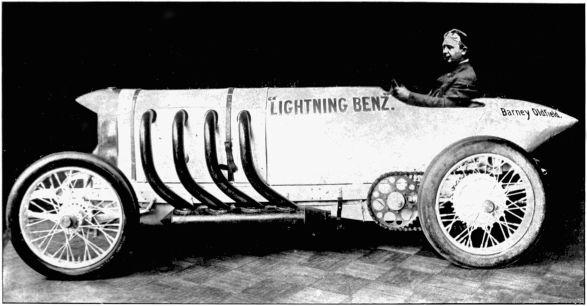
A RACING AUTOMOBILE.
In this 200-horse-power Benz car Barney Oldfield reduced the world's mile record to 27. 33 seconds—a speed of 131.72 miles an hour—and the two-mile record to 55.87 seconds. The mile record was made at Ormonde Beach, Florida, March 16, 1910; the two-mile record at the same place a few days later.
Nor is it merely in contrast with other human experiences that the new performance takes on "record" proportions. It is at least doubtful whether any member of the animal kingdom ever passed through a mile of space at such a speed as that attained by Mr. Oldfield. The fastest quadruped on the globe is almost unquestionably the thoroughbred horse. But the fastest mile ever compassed by a horse—Salvator's straightway dash in 1:35-1/2—is a snail's pace in comparison with Mr. Oldfield's speed. Salvator covered a little over fifty-five feet per second; the racing motor covered a trifle over 193 feet—thus gaining 138 feet in each second.
The trotting horse at its best—a mile in 1:58-1/2—is of course much slower still; Lou Dillon's record mile being made at the rate of 44-1/2 feet per second. Dan Patch, the swiftest pacer, in his mile in 1:56 made just one foot per second more than the trotter. Both pacer and trotter, it should be added, made their records with the aid of a wind-shield, without which their best performances are some seconds slower.
If we make comparisons with different varieties of man-made records, we find that the swiftest human runner covers his mile at the rate of about twenty-one feet per second; the skater brings this up to about thirty-four feet; and the bicyclist attains the acme of muscle-motor speed with his eighty feet per second. In the case of the bicyclist, the wind-shield pace-maker on the auto-cycle plays an important part. But even so the cyclist would be left behind one hundred and thirteen feet each second by the flying automobile.
All these types of record maker, therefore, are quite outclassed. If we could not find any real competition for the automobile in the animate world, we must seek it in bird-land. Here, it might be supposed, the space devourer would find a match. But it is not quite certain that such is the case. The old-time books on natural history tell us, to be sure, of flight speeds that make the new records seem slow. They credited the European swift, for example, with two hundred and fifty miles an hour. But more recent observers, made cautious by the scientific spirit of our age, are disposed to discredit such estimates, which confessedly are little better than guesses.
The only officially timed bird flights are the flights of homing pigeons; and here the record credits the homing bird with only one hundred miles an hour. This means 124 feet a second, as against the motor's 193. According to these figures, the automobile could give the pigeon a start of almost two thousand feet and yet sweep forward and overtake it in its flight, before it passed the mile-post. Perhaps the comparison is not quite fair, since no doubt the pigeon may perform some individual miles of its journey at more than the average speed; but it may well be doubted whether its maximum ever reaches the mile-rate of 27.33 seconds.
It is within the possibilities, however, that some other birds have even surpassed this speed. The falcon, for example, is probably a swifter bird than the pigeon, at least for short distances. Some one indeed has credited the hawks with a speed of one hundred and fifty miles an hour. But this, I feel sure, is a great exaggeration. I once saw a hen harrier pursue a prairie-chicken, without seeming to gain appreciably for a long distance; yet the prairie-chicken is by no means among the speediest of birds. Many of our ducks, for example, quite outclass it; indeed I should be disposed to admit that the teal or the canvasback at full speed might give the automobile a race.
There is, to be sure, one way in which the bird might get the better of a machine, thanks to its capacity to rise to a height. This would be by taking a sloping course downward. The little shore-lark often gives an exhibition of the possibilities open to the bird in this direction. After rising to a cloudlike height it soars about for a time singing, then suddenly sweeps downward, and, closing its wings, launches itself directly toward the earth, falling with meteoric speed till it almost reaches the surface, when it makes a parachute of its wings and swoops away in safety. During this performance the little lark is, I veritably believe, the swiftest-moving animate thing in all the world. But there is a reason why the bird could not increase its speed indefinitely by imitating the lark's feat in a modified form, and this is the obstacle of atmospheric pressure. Air moving at the rate of sixty feet a second constitutes a serious storm; at ninety feet it becomes a tornado, and at one hundred and fifty feet it is a tornado at its worst—a storm that tears up trees and overthrows houses, and against which no man can stand any more than that he could breast the current of Niagara. Now, of course, it is all one whether the air moves at this rate against you or whether you move at a corresponding rate against the air—action and reaction being equal. Therefore a very serious check is put upon the bird's flight; and it is this consideration which makes it seem doubtful whether any bird, except when aided by a strong wind, can attain such speeds as have been suggested.
Of course, atmospheric pressure affects the automobile no less than the bird. In record-breaking speed tests of the automobile, machine and driver are in effect subjected to the influence of a veritable tornado. Theoretically it seems almost incredible that any power could drive a ton of metal against the air at such a speed; practically we see the feat accomplished. But the automobilist has tales to tell of the power of the wind against his face that are easily credible. Even at ordinary speed in a touring-car, as most of us can testify, the wind blows a gale, veritably forcing tears from the eyes of the novice and blowing them back over his ears. To modify the antagonism of the wind, the constructors of racing motor cars adopt a model suggested originally by the body of a bird or of a fish, and long since made familiar by the shipbuilder.
A MIRACULOUS TRANSFORMATION OF ENERGY
Most of the automobiles, as everybody is aware, are propelled by gasoline engines. This is not their least wonderful feature. To the ordinary observer it seems quite incredible that a little whiff of air mixed with the fumes of a few drops of gasoline should produce a power that can drive pistons with such force as to throw forward what is virtually a bullet weighing more than a ton.
The power that propels this amazing projectile consisted in the aggregate of a few cubic feet of gaseous vapors. The forward motion of the piston sucked a whiff of the gasoline vapor and air into the cylinder; the backward motion of the piston compressed this gas; an electric spark ignited it; the heat of the electric spark enabled the gasoline molecules to unite with the oxygen molecules with explosive suddenness; the conflagration thus started spread instantly to other parts of the compressed gas; the myriad particles of the gas rebounding from one another at inconceivable speed, pressed with the aggregate power of multitudes upon the cylinder, and drove it back with terrific force; then an escape valve opened; the return thrust of the piston drove out the exploded gas, and one revolution of the engine was complete.
Over and over again this cycle was repeated; each revolution requiring for its performance but a bare fraction of the time required to describe it. The thing is simple enough in practice, but it is a marvelous mechanism when you stop to think of it. That such power should be latent in a seemingly harmless whiff of gas is one of Nature's miracles. And that man should have constructed an engine so nicely adjusted in all its parts as to utilize this power is little less than a miracle of mechanics.
A word should be said about another interesting mechanism that pertains not indeed to the speed of the automobile, but to an accurate record of that speed. That is an electrical timing-device with which absolute accuracy of timing is assured. A moment's reflection will show that it would be quite impossible to time the automobile moving at record speed by the old stop-watch method. The nervous impulse through which the mandate of the brain is conveyed to the hand, and thus made to operate on the stop-watch, travels along the nerve of the arm at the rate of not much more than a hundred feet a second. The delay thus involved, added to the time required for the brain itself to act on the message from the eye, is distinctly appreciable, and every one is aware that individuals differ as to their reaction time.
The practical result, therefore, is that timers are often at variance to the extent of as much as two-fifths of a second. Now in two-fifths of a second, as we have seen, the record motor car covers a distance of over 77 feet. Obviously such latitude in measurement could not be permitted. Hence an electric device has been elaborated which tests the speed with absolute accuracy, recording it automatically on a strip of tape. Therefore the fractional seconds are now stated in hundredths instead of in mere quarters or fifths, and we may be confident—as we could not always be regarding the old-time records—that the different fractions of a second represent an actual difference of speed.
It may be of interest to make a further comparison between the speed of the record automobile and the fastest speed ever attained by a railway locomotive—namely, a mile in thirty seconds. The gap is by no means an insignificant one. A mile in thirty seconds means 176 feet a second. This would allow the champion automobile a lead of over seventeen feet each second; and at the end of a mile the locomotive would be distanced by 1040 feet. It is interesting to visualize the procession that the automobile would leave behind if placed in competition with the various kinds of champions whose feats have been mentioned. As the automobile crossed the line the locomotive would be almost one-fifth of a mile in the rear; 1,900 feet farther back would come the homing pigeon; after a long gap Salvator, the first runner, would come straggling along, having covered little more than one-fourth of a mile; Lou Dillon would be just beyond her first fifth of a mile; the fastest cyclist would be placed between the racer and the trotter; while Hutchins, the swiftest runner at the distance, would have gone only 240 yards from the tape.
For distances greater than two miles, the locomotive record has not as yet been surpassed by the automobile. A locomotive on the Plant system, for example, is credited with a run of five miles in two and one-half minutes (in 1901). But, of course, there is nothing except the mere matter of speed that makes the locomotive engineer's performance comparable to that of the chauffeur. The engineer is driving a machine that runs on a fixed track. He has to do little more than keep up steam and open the throttle. The chauffeur must pick his course, for at any moment a soft spot in the sand may tend to deflect him. How appalling may be the result of a slight deflection with a machine going at great speed has been illustrated by the tragic accidents that have marred the success of many important racing-events, and have led to the oft-repeated question as to whether, after all, such speed tests are worth while. It is a question that everyone must answer for himself. The dangers are obvious; but, on the other hand, most athletic competitions have an element of danger; and enthusiasts may well contend that speed tests make for progress, and are largely responsible for the great mechanical improvement that is in evidence.