III SUBMARINE VESSELS
Reading edition
THE development of submarine vessels has been one of the slowest in the history of modern inventions. Submarine boats, using submarine torpedoes, were able to destroy ships a hundred years ago; and a little less than half a century ago naval vessels were destroyed in actual warfare by these boats. But curiously enough no vessel has ever been destroyed in actual warfare by a submarine boat since that time. Yet these boats are essentially war-vessels, and, with the exception of boats of the Lake type, of no use whatever for commercial purposes.
Perhaps the explanation for this tardy development lies in the fact that until recent years naval men have not looked with favor upon this style of fighting craft. In Admiral Porter's book, written in 1878, he makes the statement that one of the reasons why they did not show more enthusiasm about the submarine made by Robert Fulton early in the nineteenth century, was that such boats "menaced the position of the naval men, whose calling would be gone did the little submarine boat supplant the battle-ship." We need not, however, depend upon this statement, made as it was three-quarters of a century after the demonstrations by Fulton, for there are many similar statements made at the time to be had at first hand. Thus Admiral Earl St. Vincent, when opposing the views of William Pitt, who had become enthusiastic over the possibilities of Fulton's submarines, is on record as having opposed such craft on the ground that by encouraging such development "he was laying the foundation which would do away with the navy." In 1802, M. St. Aubin wrote in this connection, "What will become of the navies, and where will sailors be found to man ships of war, when it is a physical certainty that they may at any time be blown into the air by diving boats, against which no human foresight can guard them?"
Such opposition has undoubtedly tended to retard the progress of submarine navigation; but be the cause what it may, it has made slow and laborious work of it; and we are only now approaching a solution of the question that seemed almost within grasp a hundred years ago—before the days of steam or electricity.
THE FIRST SUBMARINE
As early as the sixteenth century the possibilities of submarine navigation was the dream of the mariner, and tentative attempts at submarine boats are said to have been made even at an earlier period than this; but the first practical submarine boat capable of navigation entirely submerged for any length of time was made by David Bushnell, of Westbrook (then Saybrook), Maine, U. S. A., in 1775. Details as to the construction of the remarkable craft, are recorded in a letter written by the inventor to Thomas Jefferson in 1789, and recorded in the Transactions of the American Philosophical Society. In this letter Bushnell says:—
"The external shape of the submarine vessel bore some resemblance to the upper tortoise shells of equal size, joined together, the place of entrance into the vessel being represented by the opening made by the swell of the shells at the head of the animal. The inside was capable of containing the operator and air sufficient to support him thirty minutes without receiving fresh air. At the bottom, opposite to the entrance, was fixed a quantity of lead for ballast. At one edge, which was directly before the operator, who sat upright, was an oar for rowing forward and backward. At the other edge was a rudder for steering. An aperture at the bottom, with its valves, was designed to admit water for the purpose of descending, and two brass forcing-pumps served to eject the water within when necessary for ascending. At the top there was likewise an oar for ascending or descending, or continuing at any particular depth. A water-gauge or barometer determined the depth of descent, a compass directed the course, and a ventilator within supplied the vessel with fresh air when on the surface.
"The vessel was chiefly ballasted with lead fixed to its bottom; when this was not sufficient a quantity was placed within, more or less according to the weight of the operator; its ballast made it so stiff that there was no danger of oversetting. The vessel, with all its appendages and the operator, was of sufficient weight to settle it very low in the water. About two hundred pounds of lead at the bottom for ballast could be let down forty or fifty feet below the vessel; this enabled the operator to rise instantly to the surface of the water in case of accident.
"When the operator would descend, he placed his foot upon the top of a brass valve, depressing it, by which he opened a large aperture in the bottom of the vessel, through which the water entered at his pleasure; when he had admitted a sufficient quantity he descended very gradually; if he admitted too much he ejected as much as was necessary to obtain an equilibrium by the two brass forcing-pumps which were placed at each hand. Whenever the vessel leaked, or he would ascend to the surface, he also made use of these forcing-pumps. When the skillful operator had obtained an equilibrium he would row upward or downward, or continue at any particular depth, with an oar placed near the top of the vessel, formed upon the principle of the screw, the axis of the oar entering the vessel; by turning the oar one way he raised the vessel, by turning it the other he depressed it.
"An oar, formed upon the principle of a screw, was fixed in the fore part of the vessel; its axis entered the vessel, and being turned one way, rowed the vessel forward, but being turned the other way rowed it backward; it was made to be turned by the hand or foot.
"Behind the submarine vessel was a place above the rudder for carrying a large powder magazine. This was made of two pieces of oak timber, large enough when hollowed out to contain one hundred and fifty pounds of powder, with the apparatus used in firing it, and was secured in its place by a screw turned by the operator. A strong piece of rope extended from the magazine to the wood screw above mentioned, and was fastened to both. When the wood screw was fixed to be cast off from its tube, the magazine was to be cast off likewise by unscrewing it, leaving it hanging to the wood screw; it was lighter than the water, that it might rise up against the object to which the wood screw and itself were fastened.
"Within the magazine was an apparatus constructed to run any proposed length of time under twelve hours; when it had run its time it unpinioned a strong lock resembling a gun-lock, which gave fire to the powder. This apparatus was so pinioned that it could not possibly move till, by casting off the magazine from the vessel, it was set in motion.
"The skillful operator could swim so low on the surface of the water as to approach very near a ship in the night without fear of being discovered, and might, if he chose, approach the stem or stem above the water with very little danger. He could sink very quickly, keep at any depth he pleased, and row a great distance in any direction he desired without coming to the surface, and when he rose to the surface he could soon obtain a fresh supply of air. If necessary, he might descend again and pursue his course.
"After various attempts to find an operator to my wish, I sent one who appeared more expert than the rest from New York to a fifty-gun ship lying not far from Governor's Island. He went under the ship and attempted to fix the wooden screw in her bottom, but struck, as he supposed, a bar of iron which passes from the rudder hinge, and is spiked under the ship's quarter. Had he moved a few inches, which he might have done without rowing, I have no doubt but that he would have found wood where he might have fixed the screw, or if the ship were sheathed with copper he might easily have pierced it; but not being well skilled in the management of the vessel, in attempting to move to another place he lost the ship. After seeking her in vain for some time he rowed some distance and rose to the surface of the water, but found daylight had advanced too far that he durst not renew the attempt. He says that he could easily have fastened the magazine under the stem of the ship above the water, as he rowed up to the stern and touched it before he descended. Had he fastened it there the explosion of one hundred and fifty pounds of powder (the quantity contained in the magazine) must have been fatal to the ship. In his return from the ship to New York he passed near Governor's Island, and thought he was discovered by the enemy on the island. Being in haste to avoid the danger he feared, he cast off the magazine, as he imagined it retarded him in the swell, which was very considerable. After the magazine had been cast off one hour, the time the infernal apparatus was set to run, it blew up with great violence."
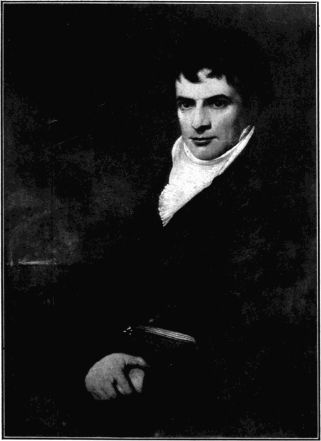
ROBERT FULTON.
ROBERT FULTON'S EXPERIMENTS
The work begun by Bushnell in 1775 was taken up ten years later by Robert Fulton whose diving-boats so nearly fulfilled the conditions necessary for practical submarine navigation. As America was at peace at this time, and as her financial condition was at the lowest ebb, Fulton transferred his skill and energy to Europe which was then involved in the Napoleonic wars. Several attempts were made to interest the French government in his invention, but although certain commissions reported favorably on his ideas, nothing came of them for a time. In 1800, however, Fulton succeeded in interesting Napoleon in his scheme, and the following year he was given the opportunity of building his first submarine boat, the Nautilus. This boat was cigar shaped, about twenty-one feet long and seven feet in diameter, and made of copper supported by iron ribs. When operating at the surface this boat used a peculiarly shaped sail; but when submerged it was propelled by a screw actuated by machinery turned by hand. In this boat, Fulton, with three companions, descended to a depth of twenty-three feet and remained submerged for twenty minutes; and at a depth of five or six feet they are said to have remained submerged for six hours, air being supplied by a copper vessel, probably containing oxygen or compressed air.
The first experiment made in attempting actually to destroy a vessel with the Nautilus, was successful, a small vessel being sunk. Encouraged by this success Fulton proposed to build larger boats of this same type capable of destroying the largest battle-ships. In return he asked that a reward be paid him for each vessel destroyed, the price of his diving boat reimbursed, and a patent be given himself and the members of his crew, so that in case of capture they would be treated as prisoners of war and not hanged as pirates. Strangely enough this latter clause was the greatest stumbling-block, as the proposed methods of destroying battle-ships by torpedoes was held in such disrepute that the French government would not grant a patent rating the crew of torpedo boats or submarine boats as legitimate belligerents. In effect, their attitude was, that while a person was at liberty to destroy an empire from the surface of the water, he would be hanged as a criminal if he dived beneath the surface and destroyed a boat.
Discouraged by this stand of the French government, Fulton removed to England, where he succeeded in interesting the prime-minister, William Pitt, in his novel boat. A commission was appointed consisting of a number of prominent men, including Mr. Pitt, and Fulton was requested to demonstrate what could be done in actual practice by his submarine. On October 15, 1805, an old brig detailed for the purpose was destroyed by Fulton by the explosion of a torpedo containing one hundred and seventy pounds of powder. Yet in the face of this remarkable demonstration the commission remained unfavorable to Fulton's scheme, although Mr. Pitt to the last retained his faith in the possibilities of such boats.
Recognizing that further attempts in England would be fruitless, Fulton returned to the United States. Here, in 1810, Congress became sufficiently interested to appropriate five thousand dollars to assist him in his work, and as a final test of the boat he had built, the naval authorities prepared the brig Argus to resist an attack by the submarine. This preparation consisted in surrounding her with protecting booms of logs, supporting strong netting, and held a distance from the hull by spars. In fact all possible means short of actually building a wall about the Argus were taken to defeat the attack. It is probable that the brig, when her preparations for defense were completed, would have been invulnerable even to a modern torpedo, and it is not surprising, therefore, that Fulton's attack upon her utterly failed.
Commenting upon this failure and the means taken by the authorities to protect the Argus, Fulton significantly remarked that the very fact that a war vessel was obliged to make use of such means to protect herself against a system of attack then in its infancy, spoke volumes for the possibilities of this method of attacking when it should be more fully developed.
But although this failure to destroy the Argus caused Congress to withdraw its aid for future experiments in submarine warfare, Fulton himself never lost faith in the importance of his work. Even after his successful invention of the steamboat, for surface navigation, he is said to have remarked that, while this invention was important, it could in no wise compare with the revolutionary effects upon navigation that would eventually be produced by submarine boats. And despite his failure to convince the government of the possibilities of his diving boats, he continued his experiments with them. How nearly he succeeded in making a practical submarine was shown in the second war with England that followed soon after.
In this war a "diving boat," supposed to have been one of Fulton's submarines, made several attacks upon the British man-of-war Ramillies off New London, in the summer of 1813. In the first two attempts the approach of the submarine was detected by the crew of the man-of-war, who cut their cables, and stood out of the harbor as quickly as possible. In the third attempt, the diving boat succeeded in coming up in a position directly under the Ramillies, fastened itself to the keel and made a hole in the planking large enough to receive the screw which was to fasten the torpedo in place. In the act of fastening it, however, this screw was broken off, and the attempt had to be abandoned for the moment.
This attack created such a panic aboard the British boat, that she did not return to the inner harbor but kept constantly in motion outside. Not satisfied with this protection against such "dishonorable attempts," the British commander took on board his vessel a hundred prisoners, apprising the Americans of the fact, and assuring them that a similar action would be taken by all the ships of the British fleet, so that in case a vessel was torpedoed the American prisoners would be blown up with her crew. This effectually frustrated Fulton's plans; for when the fact became known in the United States, the Americans were naturally as vigorous as the British in protesting against Fulton and his boats.
Obviously the rule that "everything is fair in war" was not accepted in practice a hundred years ago. Fulton's attempts were regarded as the acts of a pirate, those of the British commander as perfectly legitimate and honorable methods.
A SUCCESSFUL DIVING BOAT
From the time of Fulton to the outbreak of the American Civil War there were few attempts at submarine navigation. On the opening of this war, however, efforts were made to perfect diving boats; and these efforts were so well directed that eventually one of these boats succeeded in destroying the Federal boat Housatonic in Charleston Harbor on the night of February 17, 1864.
The submarine that accomplished this was one of the most remarkable boats ever constructed. It was cigar shaped, about sixty feet long, and carried a crew of nine men. It was submerged partly by means of ballast tanks and partly by lateral fins. As a weapon it carried a spar torpedo fastened to its blunt nose. It was propelled by hand-power, eight of the nine members of the crew working on a crank which actuated the propeller. The ninth man, crouching in the bow, steered the boat. No reserve air was carried, and consequently the length of time the boat could remain submerged was limited to a very few minutes. On account of this, and because of its unfortunate career, it was aptly called the "peripatetic coffin"; and it justified this name by sinking five different times, drowning thirty-five out of forty of the members of its different crews. Nevertheless it succeeded in destroying an American war vessel, thus demonstrating that this feat is possible under condition of actual warfare.
The submarines of the Civil War came to be known by the general name of "Davids," and several of them of different types were built. The only successful attack of any of these Davids, however, was the one which destroyed the Housatonic. In his book, The Naval History of the Civil War, Admiral Porter described this attack upon the Housatonic as follows:—
"At about 8.45 P.M. the officer of the deck on board the unfortunate vessel discovered something about one hundred yards away, moving along the water. It came directly toward the ship, and within two minutes of the time it was first sighted was alongside. The cable was slipped, the engines backed, and all hands called to quarters. But it was too late—the torpedo struck the Housatonic just forward of the mainmast, on the starboard side, in a line with the magazine. The man who steered her knew where the vulnerable spots of the steamer were, and he did his work well. When the explosion took place the ship trembled all over as if by the shock of an earthquake, and seemed to be lifted out of the water, and then sunk foremost, heeling to port as she went down.
"Her captain, Pickering, was stunned and somewhat bruised by the concussion, and the order of the day was 'Sauve qui peut.' A boat was despatched to the Canandaigua, not far off, and that vessel at once responded to the request for help, and succeeded in rescuing the greater part of the crew.
"Strange to say the David was not seen after the explosion, and was supposed to have slipped away in the confusion; but when the Housatonic was inspected by divers, the torpedo-boat was found sticking in the hole she had made, and all her crew were dead in her. It was a reckless adventure these men had engaged in, and one in which they could scarcely have hoped to succeed. They had tried it once before inside the harbor, and some of the crew had been blown overboard. How could they hope to succeed on the outside, where the sea might be rough, when the speed of the David was not over five knots, and when they might be driven out to sea! Reckless as it might be, it was the most sublime patriotism, and showed the length to which men could be urged on behalf of a cause for which they were willing to give up their lives and all they held most dear."
RECENT SUBMARINES AND SUBMERSIBLES
After the Civil War several nations interested themselves in the subject of submarines, and during the Franco-Prussian war in 1870–71, France attempted the construction of such vessels, but without success. Yet the possibility of producing these boats was becoming more apparent every year by the improvements in electrical motors, gasoline engines, compressed-air motors, and the automobile- or fish-torpedo—itself a miniature submarine boat.
In America the progress made in submarine-boat construction has been fully as great, if not greater, than in any other country. Undoubtedly the foremost figure in this progress has been Mr. P. Holland; and his efforts and successes are largely responsible for the present fleet of submarine boats built already, or in the process of construction, as well as for those of several foreign countries. Indeed, in the matter of submarine inventions, only one country can be considered as rivaling America, that nation being France, whose enthusiasm for submarine navigation has been much greater than that of any other nation, although in the matter of results she has not outstripped the United States.
Mr. Holland's first submarine boat was built in 1875. It was called a "diving canoe," being only sixteen feet in length and wide enough to hold one man clothed in a diving-suit. Four years later, however, Holland built a larger boat called the Holland No. 3 constructed along similar lines to the most recent submarines. This was the first buoyant submarine to be steered up and down by horizontal rudders alone, and may be said to mark an epoch in submarine navigation. But the No. 3 had many defects, and Mr. Holland continued to build and improve new boats, until finally his ninth boat, which is the one familiarly known as the Holland, represented a practical form of submarine vessel. This boat was 53 feet 10 inches long, 10 feet 3 inches in diameter, had a displacement of 75 tons, and carried 10 tons of water ballast. The gasoline engine which it used when running at the surface propelled the boat at the rate of seven knots an hour, and it could travel a distance of fifteen hundred miles at this rate of speed with the amount of fuel carried. When submerged it could run a distance of about fifty knots without coming to the surface.
In diving, the Holland type of boat takes in sufficient water ballast to lower it to the surface of the water. The horizontal rudders are then brought into use causing it to descend to the desired depth, and keeping it at an approximately uniform distance from the surface while running submerged. By this arrangement the boat can dive very quickly, requiring only a matter of eight or ten seconds for reaching a depth of thirty feet. Record plunges have been made in less time than this.
The armament of the Holland boat was originally designed to consist of three tubes, two of which were for throwing aërial torpedoes and shells, and the third for discharging Whitehead torpedoes. One of these aërial guns was placed in the bow, and one in the stem; but later the stern tube was abandoned. The bow gun was designed to discharge projectiles a distance of about one mile, such projectiles weighing something over two hundred pounds and carrying one hundred pounds of gun-cotton. The tube for discharging the Whitehead torpedo was practically the same as the submerged tubes in use at present on battle-ships.
Although this Holland is now the type of diving boat most familiar to the majority of people, and the one in use in several navies, it should not be understood that the Holland boats were the only successful submarines constructed up to this time. France and Russia had produced successful diving boats; and in America those invented by Simon Lake, some of which are used for wrecking and salvage work as well as for war purposes, have proved quite as practical as the Hollands. In recent tests of these two types by the United States Government the Holland boats showed themselves to be slightly superior to the Lake boats in certain particulars, but the margin of superiority was a very narrow one.
The boats of the "Octopus" type are strictly speaking "diving boats," while the Lake boats are of the "even-keel" type. These terms refer to the method of submergence, the diving boats changing their horizontal trim when submerging, while the even-keel boats retain their horizontal trim, or nearly so.
The Lake boats have some features not usually embodied in other submarines, since some of the boats are designed for purposes other than warfare. Thus, they are equipped with wheels, or buffers, on which they can roll along the bottom of the ocean or bay. In the bow is an air-tight compartment with an opening in the bottom through which a diver can emerge and work on wreckage, or laying and disconnecting mines. These boats have also a safety device in the form of a detachable keel weighing several tons. In case of accident, when it might otherwise be impossible to rise to the surface, this keel can be detached simply by pulling a lever, thus giving the boat sufficient buoyancy to rise to the surface. This particular feature of the detachable keel is not peculiar to the Lake boats alone, some of the foreign submarines using a similar arrangement as a safeguard.
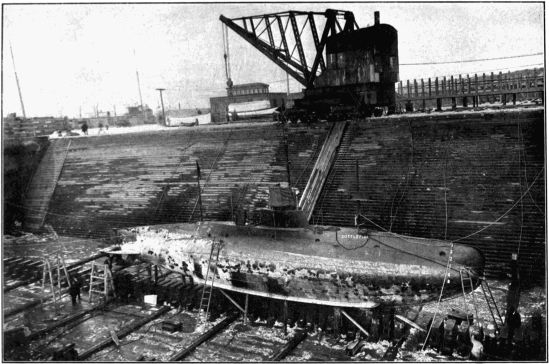
THE AMERICAN SUB-MARINE BOAT "CUTTLEFISH" IN DRY DOCK AT THE BROOKLYN NAVY YARD.
Technically speaking the name "submarine" is now used only as applying to those boats that are operated solely by electric power, have little buoyancy, and do very little running at the surface. The term "submersible" is applied to a submarine boat, actuated by electricity while submerged, but using gasoline motors for motive power while running at the surface. These gasoline engines are used at the same time for charging the storage batteries; so that the submersible is a much more practical boat than the submarine, and at the same time is quite as good a diver. Indeed, although many naval writers are very careful to make a distinction in the use of these terms, there seems little need of doing so, since only one type of boat—the submersible—is now considered practical. But as the word submarine is the older and more popular, it is used here to cover both classes except in specific cases.
For several years there were two classes of submarines under observation—those possessing no floatability when submerged, and those having some reserve buoyancy. The advantage claimed for the no-floatability class of boats is that, having no buoyancy, they are kept more easily at a certain depth below the surface of the water instead of tending to come to the surface constantly as in the case of boats of the other type.
But in actual practice the theoretical possibilities of such boats have not come up to the expectations of their advocates. For keeping the boat at a uniform depth, the most universally accepted method is by the use of horizontal rudders. The fact that the vertical direction of a boat may be controlled by horizontal rudders, when her buoyancy is small, has long since been established in submarine navigation; and the simplicity of this method naturally helps its popularity. If there were no shifting of weight in a submarine, or no wave disturbance, it would not be difficult to set the rudders at such an angle that the boat would travel for long distances at an approximately uniform submergence, the depth of submergence being indicated by gauges acted upon by the water pressure on the surface of the boat. And in actual practice it is possible to do this at the present time, part of the problem having been solved by automatic and other devices.
It should be remembered that many things enter into the disturbance of the submarine's equilibrium. The movement of a member of the crew from one point to another shifts the ballast; a certain amount of leakage of water cannot be avoided, and the sudden discharge of a torpedo weighing several hundred pounds from her bow tends to bring the boat quickly to the surface if this lost weight is not compensated for quickly. By various ingenious devices all these difficulties have been practically overcome, most of them automatically.
But the great unsolved problem of submarine navigation—practically the only one that now opposes a question mark to its great utility in warfare—is that of steering with certainty of direction when submerged. Once the submarine is under water it is in utter darkness as far as seeing to steer is concerned; and what adds to the difficulty is the fact that the compass cannot be relied upon, because of the surrounding electrical apparatus. It would be possible, perhaps, to construct a powerful electric lamp to throw a light some distance ahead of the boat, but this would defeat the primary object of submarine attack, as such a light would be seen by an enemy.
In still water, when the boat is running within a distance of ten or fifteen feet of the surface, it is possible to steer with great precision by the use of an optical tube or "periscope." This periscope is a straight, hollow tube, connected with the steering compartment in the submarine, and protruding above the water. In the upper end are a mirror and lenses so arranged that the surrounding objects are reflected downward through the tube, and show on a screen, or some other device, so that the helmsman sees things of exactly the same size that they would appear to the naked eye. The periscope is also fitted with a telescope attachment which magnifies objects like the binoculars used in surface navigation. On some recent submarines there are two periscopes, a movable one for use of the commanding officer, and one that looks straight ahead for the helmsman's use.
In still water the periscope works admirably, but it is seriously interfered with even by small waves. It is so small and inconspicuous, however, that it might enable a submarine to creep within torpedo range even in daylight, and launch the torpedo with accuracy, as was proved in 1908 when a fleet of submarines actually accomplished this feat in an experimental test.
PRESENT STATUS OF SUBMARINE BOATS
To most people, one of the most surprising things in the Russo-Japanese war was the fact that submarine boats played no part in it whatever. There is only one possible conclusion to be drawn from this: the day of the submarine as a determining factor in naval battles on the high seas had not arrived.
The reason for the surprise of the generality of people in finding the submarine was not as yet an entirely practical war engine, is due to the enthusiastic misrepresentations of the daily press and magazines, whose readers have been led to infer that the modern submarine boat is so far perfected that it can do things under water almost as well as boats on the surface. Nothing is farther from the truth. Under ideal (and consequently unusual) conditions, the submarines, and submersibles, have done, and can do, some remarkable things, such as staying submerged for hours, diving to a depth of two hundred feet, and running long distances. But these are only the first requisites of the under-water fighting boat—simply the "creeping stage" of development. The common impression that the submarine boat, such as the ones of the Holland and Lake types, can go cruising about, fish-like, for hours, watching for its prey in some mysterious manner without coming near the surface, is a dream not yet realized.
If one will pause to consider that light is necessary to sight and that one hundred feet of sea water makes almost as efficient an obstacle to vision as a stone wall, it will be easy to understand why the submarine is still struggling with difficulties that oppose its perfection. The fanciful illustration seen so often of a submarine diving hundreds of feet deep in the water, swimming about and finally coming up under the keel of a battle ship and destroying it, are as yet the creations of vivid imaginations. For submarine marksmen, like all others, require a fairly clear view of the target—even such a huge target as a battle-ship—to direct their shots with any degree of certainty.
The greatest problem now confronting the submarine navigator, therefore, is that of seeing without being seen. At night, and at long ranges, this is not difficult, as the little conning-tower, or tiny periscope tube protruding above the waves, is not easily detected even by strong searchlights, sharp eyes, and marine glasses. But long ranges are of little use to the submarine; and there is always another difficulty—the leviathan battle-ship does not lie still waiting to be stabbed by its sword-fish enemy, but keeps moving about, twisting and turning, at a rate of from fourteen to eighteen knots an hour, while the submarine can only make about eleven knots when submerged. In a stern chase, therefore, the submarine is one of the most harmless of sea-monsters, in the open ocean. For harbor work, however, the case is different. In some recent tests the submarine boats made eighty per cent. in hits while attacking moving vessels in a harbor at night—a far higher percentage than is usually made by surface torpedo boats under the same circumstances.
At present the best solution of the problem of steering the partly submerged submarine is offered by the use of a conning-tower elevated five or six feet above the body of the submarine, which can be kept just above the waves, and present an inconspicuous target. The early Holland boats did not have this, although the American Lake boats have had it from the first; but at the present time all boats are being so made. At first these towers were made circular in form; but it was found that towers of this shape made sufficient splash in passing through the water to attract attention at a considerable distance on a still night. This shape was abandoned, therefore, and a boat-shaped one adopted.
With such a noiseless conning-tower the submersible can cruise about on foggy nights, or when the waves are just high enough to make a disturbance on the surface, running with the top of the conning-tower open so as to secure good ventilation as long as possible, until the enemy is nearly within striking distance. As the target is approached the conning-tower must be closed, the protruding top sunk lower and lower in the water, and finally completely submerged, nothing appearing at the surface but the periscope tube just above the waves. With the aid of this instrument the target may still be seen distinctly, but the arc of vision is limited, and guessing the distance or rate of speed of the target is very difficult. Nevertheless, by estimating the distance before submerging, and knowing the rate of speed of his little craft, the submarine gunner may still get his range and find his target. If the waves are at all high, this is very difficult, as the water, slopping over the periscope, obscures the vision for several seconds at a time and is very distracting. But some experiments carried on during the summer of 1908 show that, even in broad daylight, it is no easy matter for a battle-ship to detect the approach of submarines until well within torpedo range, even when an attack is expected.
In these experiments the United States cruiser "Yankee" in Buzzard's Bay was attacked by five submarines of the most recent type. The "Yankee" remained stationary expecting the attack, but to offset this disadvantage the crew was fully aware of the exact time that the attack was to be made. Indeed the officers of the cruiser had watched the submarines steam away until they disappeared. When twenty miles from the "Yankee" the five submarines submerged and headed for the cruiser, making observations at intervals by means of the periscope.
The day was perfectly clear, and all on board the "Yankee" were keenly watching for the expected submarines. Yet the first intimation they had of the proximity of the diving boats was the striking of five torpedoes against the cruiser's hull. Each submarine had scored a bull's-eye. Not content with this success, the submarines repeated the attack from a nearer point, again scoring five hits before their presence was detected.
One great obstacle to successful submarine navigation on an extended scale is the difficulty of keeping a supply of air not only for the use of the crew, but for the engines. Any really powerful engine, either steam or gas, consumes an enormous amount of air. This is not true, of course, of the storage batteries which furnish the power for running while submerged, but these, at best, are but feeble generators of energy, although Edison's recent improvements may materially improve their power. If gasoline engines could be used during submergence a far greater speed would be acquired; but this is out of the question, as such engines would consume the air supply of the little boat far too rapidly. The compromise, now adopted universally, is to use gasoline motors while running at the surface or partly submerged, when the conning-tower is open, utilizing part of their energy meanwhile to charge the storage batteries.
It is evident, therefore, that no great speed can be expected of the submarine in its present state; and in point of fact the largest type is able to develop only about ten or eleven knots when submerged, and fifteen while at the surface—far below the speed of any other type of war vessel. But the experimental attacks upon the "Yankee" prove that they are dangerous fighting craft, and a recent voyage by a flotilla of Italian submersibles shows that such boats are no longer harbor-locked vessels. In 1908 the Italian flotilla in question made a voyage from Venice to Spezia, a distance of thirteen hundred miles, without assistance from auxiliary boats. About the same time a British submarine flotilla, on a three-hundred mile trip, remained submerged for forty consecutive hours. The depth of the submergence in this case was only a few feet, but great depths may be reached with relative safety. In one test a Lake boat carrying her crew sank to a depth of one hundred and thirty-eight feet, returning to the surface in a few minutes. At another time the "Octopus," without her crew, was lowered to a depth of two hundred and five feet, sustaining a pressure of fifteen thousand tons, without injury.
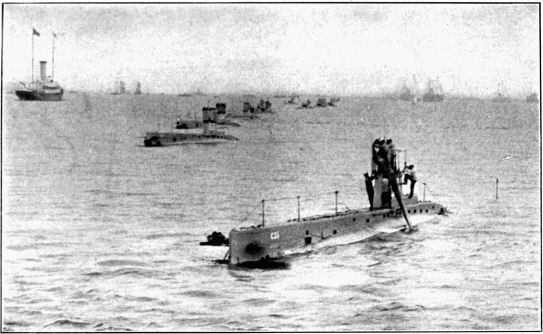
A FLEET OF BRITISH SUB-MARINES MANŒUVERING AT THE SURFACE.
Such performances as these are thought-provocative, to say the least. Submarine boats that can hit the target without being detected, go on cruises unattended for more than a thousand miles, and remain submerged for more than a day and a half, must be classed as efficient engines of warfare.
Since the submersible is designed to spend most of its time on the surface of the water like an ordinary boat, it must have considerable buoyancy, but it must also have some means of getting rid of this buoyancy quickly when submergence is necessary. The submarine proper has only from five to eight per cent. buoyancy, while some of the submersibles have twenty-five per cent. or more. With such boats of the ordinary size some fifty tons of water must be admitted before bringing them to a condition in which they can be submerged; but this can be done very quickly. One of the submarines of the U. S. fleet in an actual test filled her ballast tanks and dived to a depth of twenty feet in four minutes and twenty seconds.
It is not impossible that the recent triumphs in aërial navigation may have an important bearing on the use of submarines in future wars. It is well known that large objects when submerged even to a considerable depth are discernible from a height in the air directly above them. It is quite possible, therefore, that swift aeroplanes circling about a fleet of war vessels might be able to detect submarine boats when these boats were near enough the surface to use their periscopes. If so it might be possible for the aeroplanes to drop torpedoes upon the submerged boats without danger to themselves. Or if the aeroplanes carried no effective weapons, they could at least act in the capacity of scouts and warn their battleship consorts of the presence of the submarine. Of course, this would be possible only in daylight, the airships giving no protection against night attacks.