PART III. INFLUENCE OF COMETS AND PLANETS UPON ONE ANOTHER.
Reading edition
I. Although the foregoing investigations of the Elements of a Comet’s orbit are founded on the strictest mathematical principles, and truly represent the track of the Comet during the time of observation, yet it is found that they do not hold good for every return to the perihelion, or even in some cases for a single revolution. In those investigations we have proceeded all along on the supposition, that the Comet is subjected in its course to no power except the attraction of the Sun. But it must be remembered, that the law of gravitation is universal; that a like power of attraction resides in all the heavenly bodies, varying only in its intensity; and that whenever a comet has entered within the sphere of their influence, its movements are liable to be disturbed. The highly attenuated nature of comets renders them peculiarly liable to such perturbations;—perturbations, by which the progress of the Comet may be accelerated or retarded, the place of its nodes changed, its perihelion distance diminished or increased, and the inclination as well as eccentricity of the orbit, altered. And the effect of these changes even during one revolution, are sometimes so considerable, as to render the identity of a comet at its successive returns to the sun very problematical.
Halley’s Comet was the first which drew the attention of astronomers to these perturbations, and suggested the true method of calculating correctly the periodical return of comets. After having ascertained its approaches to the sun in the years 1531, 1607 and 1682, Halley was surprised to find that the period of its first revolution was longer by thirteen months than the period of the one following. It occurred to him that this difference might possibly have arisen from the disturbing action of the planets, particularly Jupiter and Saturn, the two largest bodies of our system; and after a rough estimate of the amount of their attractions, during the revolution then about to be completed, he ventured to announce, that the Comet would again become visible about the end of 1758 or the beginning of 1759. The prediction was one of too much importance in itself, and moreover too intimately connected with the theory of gravitation, which was then only recently given to the world, not to excite the curiosity of all who were interested in the progress of science; and, accordingly, the predicted period was looked forward to with the utmost anxiety. About this time, the well known problem of the Three Bodies had been solved, and Clairault, an eminent mathematician, who was one of the first to give a solution, applied it to determine exactly the alterations which the Comet’s orbit might have sustained, by the united influence of Jupiter and Saturn. His labours shewed that its regular period was lengthened 100 days by the action of Saturn, and no less than 518 days by the action of Jupiter; so that instead of the revolution being accomplished as usual in 74 years 323 days, it would take 76 years 211 days. Since, therefore, the Comet passed its last perihelion on the 14th September 1682, he judged it very probable that the time of its next perihelion passage would be the 13th April 1759. The Comet did actually appear about the end of December 1758, as Halley had announced, and reached its perihelion on the 13th March 1759. Clairault, on revising his calculations, lessened the error of the prediction to 19 days; and the slight discrepancy which still remained, is fairly attributable to the attractions of Saturn and of Uranus: For La Place has shewn, that if the mass of Saturn had been ascertained then as exactly as it now is, the error might have been farther reduced to 13 days. The planet Uranus was not even known to exist until many years after86.
The Comet which appeared in 1770 between the months of June and October, exhibited still more remarkable changes in its orbit. Astronomers had in vain endeavoured to represent its observed course by a parabola. But at length Lexell discovered its real orbit to be an ellipse, not so elongated as to approximate to a parabola, but much shorter, and requiring for each revolution a period of only 5 years. This result seemed very extraordinary, since the Comet, which ought to have been so often visible, on account of the shortness of its period and perihelion distance, yet had been never seen on any previous occasion: and the circumstance was still more unaccountable, when it was found that the comet made no subsequent return to the sun. The French Institute, desirous, as it always has shewn itself, to promote the interests of science, and deeming the phenomenon a fit subject of curious mathematical and astronomical inquiry, offered a prize for the most complete investigation of the elements of this comet, taking into account every circumstance which could possibly have produced an alteration in its course: But the result served only to confirm the correctness of Lexell’s calculations. At length, Burckhardt, aided by certain analytic processes, which had been communicated to him by La Place, was enabled to solve the mystery; and the discovery may certainly be looked upon as having brought to light one of the most astonishing facts in the whole history of astronomy.
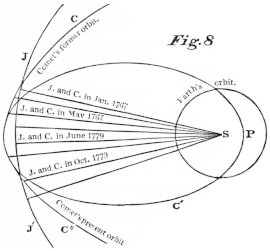
Fig. 8
By tracing back the movements of this Comet in its orbit, for some years previous to 1770, Burckhardt found, that, at the beginning of 1767, it had entered considerably within the sphere of Jupiter’s attraction. Calculating the amount of this attraction, from the known mutual proximity of the two bodies, he was next enabled to determine the orbit which the Comet must have had previously; and the result showed it to have then moved in an ellipse of greater extent, having a period of 50 years, and in which the Comet, even when nearest the sun, was still as far distant as Jupiter. It was therefore very evident, why, as long as the Comet continued to circulate in this orbit so far from the centre of the system, it never became visible from the Earth; and equally manifest, that the cause of its apparition in 1770, was the disturbing action of Jupiter, which had constrained it to move in a shorter ellipse, and at a smaller distance from the sun. To render this exposition the more intelligible, let S be the Sun (Fig. 8.), and J J′ a portion of Jupiter’s orbit; C is a branch of the orbit which the Comet moved in before the perturbation of its motions by Jupiter. In January 1767, Jupiter and the Comet happened to be very near one another, as shewn in the figure, and as both were moving in the same direction, and nearly in the same plane, the proximity continued during a period of several months; the consequence of this was, that the Comet’s orbit was changed into the much smaller ellipse C′P, in which each revolution was accomplished in the space of 5 years. In conformity to the period of revolution in this new orbit, the Comet would again have been seen at its perihelion P in March 1776, had it not then, with respect to the Earth, been exactly behind the body of the sun, and rendered invisible by his rays, during the whole time, when only it could have been observed. In the course of the subsequent revolution, as it was approaching the sun in 1779, it happened again to fall in with Jupiter. It was in the month of June that the attraction of the planet began to have a sensible effect, and it was not until the month of October following that they were finally separated. At the time of their nearest approach, in August, Jupiter was distant from the Comet only of its distance from the sun, and hence exerted upon it a force 225 times greater87. By reason of this powerful attraction, the line of the comet’s route was again shifted into a more extensive ellipse C″, which, even at the perihelion, comes no nearer to the Sun than the planet Ceres. In this third orbit, which is the one at present followed, the comet requires about 20 years to accomplish a revolution; but now it is situated at so great a distance from the Earth, that it will always remain invisible to us, unless in the lapse of time it shall again undergo other perturbations, similar to those which have so often forced it to deviate from its regular course88.
Other instances might be adduced, to prove the extensive changes to which the orbits of Comets are exposed, were not a bare reflection upon their physical constitution sufficient for this purpose. The planets, whose orbits are nearly circular, affect one another only by producing certain inequalities too trivial and temporary to be detected, except by the most minute and protracted observations. But the Comets, following as they do paths extremely eccentric, and wandering into the most distant regions of the system, are subject to the disturbing influence not only of the known planets, whose orbits they intersect, but of any other heavenly body yet undiscovered, circulating beyond the planetary limits.
Seeing, then, that, from various causes peculiar to Comets, they are so liable to be deflected out of their own path, by other bodies in the system, it has been asked, whether a comet may not be so powerfully acted on by a planet as to be retained by its attraction and forced to circulate round it as a satellite? This question has been instituted chiefly in reference to our own Moon, which Maupertuis conceived to have been originally a Comet, retained in this manner by the Earth; and a similar inquiry might, in like manner, be extended to the satellites of the other planets.
M. Du Sejour, in his “Traité analytique” has devoted a chapter to the consideration of this question. I may mention in passing, that the great object of Du Sejour’s two quarto volumes was, if possible, to show the groundlessness of the fears which were entertained respecting the approach of Comets: and having set out with this fixed purpose, it is generally allowed, that, in his examination of the opinions advanced by Maupertuis, La Lande, and various others, he has been rather too forward and too hasty in drawing the conclusions which were necessary to refute them. With respect to the present inquiry, whether a Comet, entering within the sphere of the Earth’s attraction, might not be forced to circulate round it, he first examines the case of parabolic and hyperbolic comets, and then proceeds to the consideration of those whose orbits are elliptic. With respect to the former, he deems it quite impossible that any such Comet could become a satellite of the earth. It is unnecessary to enter into the reasoning which he employs in support of this conclusion; because he has supposed a case, with respect to the nature of the orbits, which, as we have already shewn, can hardly be admitted to exist. Nor does his reasoning seem to rest upon grounds wholly unimpeachable, when he takes for granted that the earth’s power of attraction reaches only to about twice the distance of the moon. At all events, in the case of Comets whose orbits are elliptic, Du Sejour is obliged to admit the possibility of their being so retained as satellites of our planet; though he is still unwilling to think that the occurrence of such an event is attended with any degree of probability. “Il nous est donc impossible,” says he, “de prononcer definitivement, si une Comète elliptique, ayant tourné primitivement autour du Soleil, ne pourrait pas devenir Satellite de la Terre. Ce qu’il y a de sûr, c’est que dans le cas même, où géométriquement parlant, l’impossibilité n’en paroîtroit pas démontrée, la réunion des circonstances qui devroient concourir pour que cela eût lieu, est telle que l’évenement est contre toute probabilité.” Whether or not our Moon has been a Comet thus arrested by the earth, is a question to which it seems very difficult to afford an answer. Some have, however, been led to such a conjecture, on account of the vitrified and cinerary appearance which the lunar disc presents, as also from the traditionary legend of the Arcadians, who dated the origin of their nation previous to the existence of the moon. But, whoever has considered the theory of La Place, by which he accounts for the formation both of planets and satellites out of a solar atmosphere, must be convinced that it furnishes the true explanation of all the peculiarities of the system, and totally excludes the idea of our Moon having once been a Comet89.
When we reflect upon the prodigious number of comets which are wandering in every direction through space, approaching exceedingly near, as they sometimes do, to the other bodies of the system, whose attraction so materially affects their motions, it is natural to inquire, in the next place, whether Comets be capable of reacting on the Planets, so as to produce any perturbations in their course. It is well known that comets have approached exceedingly near to planets; and from the effects which on these occasions have taken place, astronomers have been enabled to form some estimate of their density, that quality on which their power of perturbation depends. We have already noticed the close approaches made by the comet of 1770 to Jupiter: In fact, it traversed on the two occasions above mentioned, the whole system of his satellites, and at each time required four months to free itself from the sphere of the planet’s attraction. Notwithstanding this, the slightest alteration could not be observed to have taken place in the motions of these small bodies; though from its brilliant aspect, this comet must have been one of considerable magnitude, and was even computed by some to have a diameter nearly thirteen times greater than the Moon90. The same comet approached likewise very near the Earth; so near, indeed, as to have its own sidereal revolution shortened, by this cause alone, 2.046 days91. What, however, was the amount of its reaction upon the earth? La Place has shewn92, that, supposing the comet’s mass to have been equal to the earth’s, it ought to have lengthened our sidereal year by 2h 47′: But, calculations for constructing the tables of the sun, performed with great accuracy and minuteness, prove, that, in the length of that year, no alteration could have taken place exceeding 2″; and hence it followed, since 10027″ : 2″ :: mass of earth : mass of comet, that the Comet’s mass could not have amounted to th part of the mass of the Earth. From these circumstances, then, it is manifest that the highly attenuated nature of comets, though it renders them extremely liable to be deflected from their own orbits by the other bodies in the system, effectually prevents them from reacting in a similar manner upon the movements of the planets.
After these remarks, it will not be difficult to see the improbability of the supposition93, that either the Earth, or our Moon, or any of the other planetary bodies, can be carried altogether out of its course by the attraction of a comet. Du Sejour has shewn, that were a comet, having a mass equal to that of the Earth, to approach us within 13,000 leagues, the only effect would be to increase the length of the year by 22 days; and when we consider the diminutive size of these bodies in general, it is abundantly evident that none of the planets are exposed to any very great risk of having their orbits materially altered by their attraction.
II. But, though the changes which Comets may effect in a planet’s movements are too minute to be appreciated, the most extraordinary notions have been entertained respecting their influence upon the order of things on a planet’s surface. It has been already noticed, that in times of ignorance and superstition, the apparition of a Comet was thought to betoken, with regard to human affairs, the most awful and inevitable disasters. Convulsions, not so much in the physical, as in the moral and political world, were among the fancied calamities which it foreboded, and each comet, according to the form of its tail and the direction of its course, threatened destruction to some particular nation. The comet of 1454, seen at Constantinople, seemed there to be moving in the firmament from west to east, and to present the aspect of a flaming sword; from its great magnitude, it is said even to have eclipsed the Moon, and created among the Turks the utmost consternation, as it was thought to prognosticate nothing less than a crusade from all the kingdoms of Christendom, and forebode the certain overthrow of the Crescent94. Only two years afterwards, when, notwithstanding these direful omens, the Turkish arms had proved eminently victorious, and were spreading dismay over all Europe, Halley’s Comet, in 1456, with a long tail turned towards the east, created reciprocal and still greater alarms on the part of the Christians. Pope Calixtus believed it to be at once the sign and instrument of divine wrath; he ordered public prayers to be offered up, and decreed that in every town the bells should be tolled at mid-day, to warn the people to supplicate the mercy and forgiveness of Heaven95; “ut omnes de precibus contra Turcarum tyrannidem fundendis admonerentur.”
These fears concerning the moral influence of Comets, the production of a weak and debasing superstition, have long since been rooted out from the faith of enlightened Europe: But they have disappeared only to be succeeded by others, respecting their physical influence, which have sprung up even from the researches of science.
It was apprehended by many astronomers, that if a comet were to approach the Earth, within a short distance of its surface, the attraction of the comet might be sufficient to elevate the ocean to a prodigious height, and thus occasion all the horrors of a deluge. La Lande computed, that were a Comet of the size of the Earth to come within 13,000 leagues, or about five or six times nearer than the Moon, the waters of the Earth would be raised “2000 toises above their ordinary level, and thus inundate all the continents of the world96.” Such would undoubtedly be the effect of the mere proximity of the Comet; but, as Du Sejour very justly remarks, this result is materially modified by several circumstances. La Lande’s calculation is founded on the supposition, that the Comet remains vertical over the same part of the Earth, till the full effect of its attraction is produced. Now Du Sejour shows, in the most satisfactory manner, that, supposing the ocean to have a uniform depth of a league, nearly 11 hours must elapse before the inertia of the waters could be overcome; if the depth be supposed two leagues, hours would be necessary. But, 1st, The Comet cannot remain beyond a very short period over the same spot, on account both of its own progressive motion and the rotation of the Earth. 2d, The Comet would soon have removed to so great a distance as to lose all its power of attraction97. 3d, The waters of the ocean are not spread uniformly over the surface of the globe; and this is a circumstance which, as in the Mediterranean and other inland seas, diminishes very considerably the elevation of the tides. But, along with these considerations, it is essential also to remember the small mass which characterises the generality of Comets. La Place, as was already stated, shewed that the mass of the Comet of 1770, one of the largest ever observed, could not have amounted to th part of the mass of the Earth: but, assuming that its mass was even equal to this, what is the actual effect which its attraction could have produced on the ocean, in comparison with the moon’s influence. The power of attraction, it is well known, is proportional to the mass; so that if we assume the Comet of 1770 to have had a power of attraction equal to th part of the moon’s, and modify this according to the law established by Newton, that the effect increases in the inverse triplicate ratio of the distance, we find, that, in order to produce only the same elevation of the tides as the moon does, the Comet must be , or about four times nearer to the Earth than the moon: But, at so short a distance, and possessing, therefore, so great an angular velocity, the Comet would have passed by, long before any such effects could have taken place.
Another opinion respecting the influence of Comets of a more singular nature, which has sometimes prevailed both in this country and on the Continent, is, that these bodies are capable of generating atmospherical changes, so as to affect the state of the weather. Thus, the Comet of 1769, whose tail exceeded 40 millions of miles in length, was thought to have occasioned the very rainy season which immediately followed its apparition98. A like notion was entertained still more strongly a few years afterwards, which was not confined to the creed of the “profanum vulgus,” but found a place in the belief even of men of science. “It is an error,” says Olbers99 (and with some truth), “of those philosophers who have attributed the fogs and clouds which, in the summer of 1783, covered Europe, Asia, and the north of Africa, for nearly two months, to the mixture of our atmosphere with that of a Comet100.” Nay, what is still more astonishing, similar prejudices existed even in England so recently as 1811: It may be remembered, that the summer and autumn of 1811 were, over the whole of Europe, remarkable for long continued heat, and the cause was generally ascribed to the great comet which appeared during the course of that year. Hence connoisseurs in wines are still in the habit of distinguishing the claret made from the vintage of that year, by the appellation of the Comet Wine, on account of the effect which this comet was supposed to have had in maturing the vintage.
But the most remarkable account of the agency of this comet occurs in a periodical publication of considerable notoriety101, from which the following statement is extracted. After premising the opinion of Bacon, that “Comets have some power and effect over the gross and mass of things,” the author goes on to observe, that “the Comet, which appeared in 1811, seems a proof of the justness of this remark;” and he then proceeds to state “some singular changes and circumstances” which its influence occasioned. “The winter,” says he, “was very mild; the spring was wet, the summer cool, and very little appearance of the sun to ripen the produce of the earth; yet the harvest was not deficient; and some fruits, not only abundant, but were deliciously ripe; such as figs, melons, and wall-fruit. Very few wasps appeared, and the flies became blind, and disappeared early in the season. No violent storms of thunder and lightning; and little or no frost and snow the ensuing winter. Venison, which has been supposed to be indebted for its flavour to a dry and parched summer, was by no means deficient in fat or in flavour. But what is very remarkable,” continues this sage observer, “in the metropolis, and about it, was the number of females who produced twins; some had more; and a shoemaker’s wife, in Whitechapel, produced four at one birth, all of whom,” &c. &c. But enough of so deplorable an example of astrological faith, more worthy of the darker ages, than of a country and times so enlightened as ours. It would be a mockery of common sense to enter into any formal refutation of such monstrous absurdities102. Yet, let us, for a moment, consider how they could possibly have originated. The only attempt which I can discover that has been made to account for these strange effects, consists in the notion that, in the one case, the Earth, by being enveloped in the Comet’s vapoury tail, will thereby receive a great accession of moisture; and, in the other, that the Comet in its return from the sun, and passing very near the Earth, may communicate a portion of its recently acquired heat. But such an opinion will hardly stand the test of the slightest reflection. All that we have already discovered respecting the nature of a comet’s tail, induces us to believe that it does not consist of a vapoury medium, capable of rendering our atmosphere more humid; and whether we suppose the heat of comets to be derived from the sun’s rays, or from a native and internal source, it must be equally inadequate to produce any appreciable influence on the large and distant mass of the Earth.
But it would be as difficult to discover any presumptive evidence for this strange opinion, respecting these opposite effects of a comet upon the Earth, as it would be idle to say one word more on the subject;—were it not that Whiston an astronomer very celebrated in his day, proceeding on the two hypotheses just mentioned, framed a theory, which aimed at nothing less than to disclose the past, and prophesy the whole future history of our planet.
Whiston imagined that he had discovered the cause of the Deluge recorded in Scripture, by means of the Comet of 1680, which he conceived to have come to its perihelion about the supposed period of that event. The demonstration of this point seems to have been the grand object of his Theory; but besides this, it also embraced more extended views: he sought not only to explain the occurrence of the Deluge, but also to account for the formation of the Earth, and even to anticipate the disasters which are still to befall our globe. With this view, Whiston finds it necessary to assume the existence of three comets. The first of these is the Earth itself; for, according to him, the whole system originally was composed of comets. This terrestrial comet he supposes to have had at first no rotation about its axis, consequently no alternation of day and night; and was not yet capable of supporting living creatures on its surface. After a period, however, of some thousand years, there came booming forth from the regions of space another comet, which jostled with the Earth while quietly pursuing its course, and thus caused it instantly to spin round an axis of its own. Henceforward, life and organization commenced upon its surface, in all their various forms. Plants and animals were engendered by the warmth every where diffused, and at length man himself started into existence, to enjoy the grateful vicissitude of day and night. This first condition of things upon our globe, comprehending its primeval chaos, the formation of its widely diversified inhabitants, the supreme delights of paradise, and the blissful innocence of the human race, are all described by Whiston in the most glowing colours: till at length, as if satiated with the happiness which his fancy had drawn, he shows us the reverse of the picture,—representing the extreme iniquity of the human race, and the awful punishment to which they were to be justly consigned. For this purpose, Whiston again brings into the drama the Comet of 1680, which he causes, not to come in contact with the Earth, and thus at once sweep away its guilty inhabitants, but only to approach so close to our planet, as to wrap it in its prodigious tail, and drown all living things with the waters of which he conceived the tail to be composed. What more natural, or more sublime expedient, (he exclaims, enraptured with the idea), can be imagined, to account for that universal Deluge, which was employed by heaven to purge the world of its sins, and to convey to all future generations, by the proofs every where left of its occurrence, an awful and indelible impression of the Creator’s power! Not satisfied, however, with having thus sought to explain, with the primitive formation of the Earth and its inhabitants, and the direful catastrophe which had befallen both, Whiston spurs on his imagination to traverse the regions of futurity, and reveal the destinies which our world is doomed yet to undergo. It is perhaps hardly necessary to mention, that another Comet is likewise made subservient to this end; one, however, which, producing neither the collision of the first nor the inundation of the second, but being heated to an excessive degree by its vicinity to the Sun, envelopes the world in flames, and scatters the ashes of its dissolved elements through the regions of heaven103.—It is almost incredible, though nevertheless true, that, at the time when this Theory of Whiston’s was promulgated, it was regarded as the noblest production of genius and science which had ever been given to the world. But it has long ago been consigned to the oblivion which the extravagance of its views deserves; or if it be yet noticed at all, it is chiefly as a warning to those who investigate the phenomena of Nature, not to desert the safe and open path of induction, for the darkness and uncertainty of vague conjecture104.
III. Upon the whole, then, we may be assured, that, by proximity alone, Comets are almost wholly incapable of affecting either the movements of the Planets, or the system of things upon their surface. But the case is very different, on the supposition of actual contact: for one of those circumstances, which would be the chief means of counteracting a comet’s influence in approaching a planet, viz. the rapidity of its motion, would serve, by the momentum, to give great effect to a collision. Still it must be observed, that, though this occurrence will necessarily be attended with far more alarming consequences, it is one of which the risk is infinitely less, than a mere approach. For, in order that the collision should happen, it is requisite, first, that the radius vector of the Comet be exactly equal to the Planet’s distance from the Sun; secondly, that the Comet be in the plane of the Planet’s orbit; and, thirdly, that the longitude of its ascending or descending node be the heliocentric longitude of the Planet. When, therefore, we consider the improbability that all these conditions should be simultaneously fulfilled; and add to this circumstance, the immensity of the celestial spaces through which the orbits of comets extend; it will at once appear how unlikely it is, that such an occurrence should take place in the succession of many ages105.
But though the probability of such a collision is extremely small, we see that it is perfectly possible in itself; whilst the amount of that probability may be greatly increased by lapse of time. Let us now, therefore, shortly attend to the consequences which might ensue from such an event. It is evident that much will depend on the direction of the Comet’s course at the time of its encountering a Planet. If both be moving towards the same quarter of the heavens, each will glide off from the surface of the other, and no very material changes will be produced, either on their movements or on their physical constitution. But should the directions of their respective courses be exactly opposite, when the concurrence takes place, (a case, however, which it is easy to see can happen only with retrograde comets), the consequences would necessarily be far more serious and permanent. It is true, that, in general, comets are of very inconsiderable magnitude; but the deficiency of mass is amply compensated by the prodigious momentum, by means of which a planet might be impeded or even altogether arrested, in its orbit. If, for instance, a retrograde Comet, moving at the rate of 1,734,000 feet per second106, should in this manner meet the Earth, assuming the earth’s velocity at the time to be 102,000 feet per second, the shock would have the effect of at once destroying the progressive motion of both bodies and causing them to fall to the Sun, were the Comet’s mass only about th of the Earth’s, or 4 times that of the Moon107. It is true, we have no very authentic records of many comets of such a size having been observed; though, even if there were none at all, the fact would afford an illustration of our limited knowledge, rather than a proof of the non-existence of such bodies in the system. But even in our own times, a Comet has appeared, whose nucleus, if Herschel’s estimate be correct, exceeded the Moon in diameter; and which, if it had chanced to strike this body in a particular direction, would most infallibly have caused it to descend to the Earth’s surface.
Seeing, then, that the collision of a Comet and Planet is an event lying within the verge of possibility, have we any reason to suppose that it is one which has ever happened? This question we can answer, only by examining the movements and constitution of the Planets as they at present exist, and tracing back the circumstances now characterizing both to those causes by which they seem to have been produced.
With regard to any derangement in the planetary motions caused by the collision of a comet, I must, in the first place, take notice of a Theory proposed some years ago by Dr Brewster, which attempted to account for two phenomena, that in some respects appeared to form anomalous facts in the planetary system, viz. The total disappearance of the Comet of 1770, and, more especially, the prodigious size of the atmospheres of Ceres and Pallas. We have already observed, that, if nothing had occurred to derange the orbit of this Comet, whose period was only 5 years, it ought, since it was last seen, to have reached its perihelion ten times. From this circumstance, Dr Brewster thinks that “we are therefore entitled to conclude that the Comet of 1770 is lost; which,” says he, “could happen only from its uniting with one of the planets whose orbit it crossed.” Let us attend to the mode of reasoning which he employs to establish this position. “If such an union took place, two consequences would obviously flow from it. The planet would suffer a sensible derangement in its motions, and its atmosphere would receive a vast accession of nebulous matter, of which the comets are often wholly composed. Now, as no such changes have been sustained by Venus, the Earth, Mars, or Jupiter, each of whose orbits was intersected by the Comet’s path, we must look,” says Dr Brewster, “to the four new planets, for some indication of the presence of a comet; and if they exhibit any phenomena that are unequivocally of this description, we must consider such a coincidence as a strong proof of the theory, or as one of the most wonderful facts in the history of science. Two of the new planets, Ceres and Pallas, exhibit, in the form and position of their orbits, evident marks of some great derangement; but as this may have arisen from that explosive force, by which they seem to have been separated from a larger planet, we are not entitled to regard it as a proof of the present Theory108.” Dr Brewster then comes to apply his second criterion, viz. the height of their atmospheres; which are found to be much more considerable than those of the other planets: and out of this single circumstance, he puts forth an inference, which can scarcely be deemed a legitimate one, that there must necessarily have been an addition of nebulous matter to the quantity originally possessed; and he thinks that this addition can have been derived only from the “lost” Comet of 1770. “If,” says he, “the new planets are the fragments of a larger body endowed with an extensive atmosphere, each fragment would obviously carry off a portion of atmosphere proportional to its magnitude.” Let us therefore see what is the bulk and extent of atmosphere which each of these planets has been found to possess. If it appear that the quantity of atmosphere is in exact proportion to the planet’s bulk, then the coincidence may undoubtedly be looked on as a fact strongly corroborative of Olbers’ theory, that they are the fragments of a larger planetary body, which possessed an extensive atmosphere: but in order to give any plausibility to the notion of Dr Brewster, that two of the fragments since this explosion have received an accession of nebulous matter from the Comet of 1770, it is manifestly necessary, that, in these fragments, as compared with the other two, there shall be a great disproportion between the size of the planet and the extent of atmosphere. What, then, are the measurements of both of these, as deduced by the best observers? According to Herschel, the diameter of Ceres is 163 miles, and the diameter of Pallas, 80109 miles; of the other two, Vesta is the smallest, having a diameter of only 49 miles110. Now, what has been ascertained as to their atmospheres? Schröter makes the atmosphere of Ceres 675 miles in height, and the atmosphere of Pallas 468 miles; each nearly corresponding with the bulk of the fragment. With respect to Juno, which is the next less in size: “Though there is no nebulous appearance around the planet Juno,” says Dr Brewster, “yet it appears, from the observations made by Schröter, that it must have an atmosphere more dense than that of any of the old planets of the system.” And with regard to Vesta, which is so very small a body, if it has any atmosphere at all, it is of too limited extent to be yet observable. Thus, then, we perceive, that the only condition which could afford any degree of plausibility to Dr Brewster’s theory, is directly contradicted by facts. If it had appeared that Vesta or Juno, the two smallest fragments, were possessed of atmospheres much larger than those belonging to Pallas or Ceres, then there would have been a shadow of presumption thrown upon Dr Brewster’s theory, because this disproportion would have indicated some accession of nebulous matter since the period of the explosion; but seeing that the extent of atmosphere belonging to each planet bears a fair proportion to the size of its solid part, the only ground on which his theory can rest is entirely destroyed. Even if the few observations which have yet been made of those telescopic bodies, could warrant any inference less contradictory of the theory, it would be more consistent in those who imagine that they are fragments of a larger planet “endowed with an extensive atmosphere,” to ascribe the quantity of atmosphere now surrounding each rather to the manner of the rupture itself, than to the subsequent acquirement of nebulous matter by the collision of a comet. But at all events, it is not requisite to have recourse to any such hypothesis, in itself extremely fanciful, to account for the disappearance of the Comet of 1770; that Comet is not lost, as Dr Brewster imagines. The result of the most profound and unimpeachable investigations, has proved, beyond a doubt, that its elements have only undergone such an alteration, through the disturbing influence of Jupiter, as to render the Comet now no longer discernible from the Earth; and this explanation has been deemed so adequate by philosophers, that it is recorded in the annals of human knowledge as one of the noblest efforts which Astronomy has achieved, in unravelling the mysteries of Nature111.
La Place, to whose opinions the highest respect is due, has given more satisfactory and more comprehensive views, on this part of our subject,—which render it extremely improbable that any of the planets have ever been struck by a comet, so as to sustain any very material perturbations in the movements by which it was originally characterized. Assuming that all the circumstances of the planetary phenomena may be referred to certain general causes, which have operated in the arrangement of the system, La Place infers, that either no comets have ever come in contact at all with the planets, or such comets only, as, from the smallness of their mass, were not capable of deranging the primitive elements of their orbits. “It cannot be doubted,” says this great philosopher, “that if one of those comets supposed to have struck our moon or a satellite of Jupiter, had a mass equal to that of the moon, it would have made their orbits extremely eccentric.”—“The shock of a comet,” he adds, “whose mass should be no greater than the th part of the moon, would have been sufficient to give very sensible values to the real libration both of our moon, and of Jupiter’s satellites112.”
IV. From these statements, therefore, it appears highly probable that none of the planetary bodies have sustained any alterations in their orbits by the collision of a comet. But on this account we are not to suppose that a contact has never taken place; because, though it may not have been sufficiently violent to have altered the planet’s orbit, it may nevertheless have materially affected its physical organization, by impinging on its surface; nor, least of all, are we to conclude, from the experience of the past, that the collision of a comet with any of the planetary bodies, will never happen in the course of time. Even though it were demonstrated that such a catastrophe has never yet been fulfilled, this circumstance could afford no assurance that it may not occur at some future period; and therefore, it behoves us shortly to consider what would be the nature and amount of the physical changes which the collision of a comet would produce on the surface of a planet.
It is very true, as was formerly remarked, that the masses of comets are usually small; and for this reason we might be disposed to imagine, that the result of a collision would be trivial. But if a comet, moving with the prodigious velocity which it acquires near its perihelion, should chance to strike a planet, as for instance the Earth, then coming in an opposite direction, the consequences would be truly disastrous. In the opinion of La Place, the axis of the Earth would be immediately changed, and the situation of the poles made to occupy or approximate the equatorial line. The waters of the ocean, now attracted by the close approach and next driven from their ancient bed by the contact of the comet, would sweep over the face of the globe, covering even the highest mountains in their impetuous course, and involving all things in undistinguishable ruin. Whole species of plants and animals, existing in different quarters of the Earth, would, by this cataclysm, be at once overwhelmed and annihilated: whilst the few among the human race, who should happily be saved amid this shipwreck of Nature, would soon relapse into a state of pristine ignorance and barbarism. After such an event, by which all the monuments of art, and all the records of learning, would be destroyed, mankind would necessarily for many centuries be occupied with providing for their bare subsistence; and a long succession of ages would elapse, before those stores of knowledge could be retrieved, which their ancestors had been able to attain. When, however, posterity, in the progress of time, had again become so far enlightened, as to observe and speculate on the striking physical appearances, which in all parts of the world would meet their attention, they could not fail to consider them as the records of some great and sudden catastrophe, which at one period must have befallen their globe. If such be the probable effects of a collision between our Earth and a Comet, was there not some reason for the ejaculation of Halley—“Collisionem vero vel contactum, tantorum corporum ac tanta vi motorum (quod quidem manifestum est, minime est impossibile), avertat Deus Optimus Maximus!”
V. But, in surveying the surface of our Earth, even at the present period of its history, are we able to discover no indications of any such event as that whose effects we have just described? When we contemplate the broken and lacerated appearance which the map of the world exhibits; when we consider the irregularity and confusion characterizing the constitution of its crust; when we reflect upon the discovery of numerous plants and animals, in every different climate and situation, buried under the surface;—we can hardly entertain a doubt that tremendous convulsions have taken place upon the Earth, attributable to sudden inundations from the ocean; and that event, of whose occurrence, geography, geology and natural history combine to furnish evidence, the universal tradition of every people, however barbarous, serves to confirm. It has been supposed, that the deluges, which are said to have taken place at different periods in the history of the world, may have been occasioned by the collision of comets; and it cannot be denied, that, on reflecting with attention upon the various circumstances by which these deluges are still recorded, the supposition does not seem destitute of foundation. It is impossible, however, to enter here into all the details of this inquiry, opening up so wide a field of speculation and curious research, little connected, in other respects, with the main object of this Essay: but I cannot forbear to advert to a few leading facts, which render it highly probable that a comet has at some former period impinged on the surface of the Earth, and thus occasioned many of the convulsions which our globe appears to have undergone.
De Luc, Cuvier, and many other celebrated philosophers concur in thinking that our globe has originally existed in a fluid state; and, in consequence of the attraction of its parts, that its crust at a former period was composed of strata nearly horizontal, and equally distributed over the two hemispheres113. But when we contemplate the present aspect and constitution of our planet, we are able to discover little indication of this pristine arrangement, either on its surface or in its interior. On glancing our eye over a map of the world, we behold nearly five times the quantity of dry land in the one hemisphere that there exists in the other; and portions of land, which have at one time been united and continuous, are now disjoined or intersected by arms of the ocean. If we explore, next, the recesses of the Earth, we find still less indication of that regularity which originally characterized its structure: the strata no longer continuous and horizontal, but broken asunder and heaped on one another, in the most perplexing disorder; at one place, parallel, and gently inclined; at another place not very remote from the former, bent and distorted into fantastic shapes, or rising up and running for a considerable distance, even in a perpendicular direction. Such is the picture of changes, which the geography and geology of our Earth present; and the more attentively we examine it, the more convinced must we become of the occurrence of convulsions on its surface, equally violent and extensive.
By what physical agent, then, can we conceive those convulsions to have been produced? Every circumstance leads to the belief, that the agent whose gigantic power we now contemplate in its effects, can have been no other than a deluge from the ocean. For, what other cause could have broken the surface of the Earth into so many distinct and unequal portions, disorganized the whole system of arrangement once characterizing its internal structure, or created that picture of ruin and desolation which meets the eye of the observer in every quarter of the globe?
But if such an event ever took place, as that which these facts so strikingly suggest, it is natural to suppose that there ought to exist yet more numerous marks of its occurrence. Sweeping with resistless force over the face of the Earth; tearing asunder huge fragments of rocks, which it would carry along to a great distance; burying whole genera of plants and animals in the general chaos; and leaving upon the dry land, even on the highest mountains, deposits of the native inhabitants of the deep; we should now be able to trace by such infallible characters as these, the effects of a deluge, if it ever happened. And, accordingly, the multifarious facts which have been brought to light, by the united researches of the geologist and naturalist, afford all the evidence which the case seems to require. The large round masses of rock, termed Boulders, which lie scattered over every country in Europe, must be regarded as direct and unequivocal proofs of this deluge. These masses, judging only from their outward appearance, bear all the marks of having been rolled along an uneven surface,—and this supposition is fully confirmed by an internal examination; for they are generally found to consist of species of rocks which occur only at a great distance from the place where they are situated. Thus, “the granite of Mont Blanc has been found on the sides of Jura, and even on that side of it farthest from the Alps. But in the present state of the Earth’s surface, between the central chain of the Alps, from which these species of granite must have come, and the ridge of Mont Jura, besides many smaller valleys, there is the great valley of the Rhone, from the bottom of which to the place where they now lie, is a height of not less than 3000 feet114.” Immense fragments of a similar nature are found in the plains of Lombardy, which have been transported from a distant part of the country; “and the ruins of the Carpathian Mountains lie scattered over the shores of the Baltic115.” Now, what are all these facts, we would ask, but the natural effects, and the indubitable records, of an ocean upturned from its bed, and impelled by some foreign and powerful agent over the continents of the Earth? The consideration of fossil remains, leads us still more conclusively to the same result. It is well known, that the bones of great numbers of animals have been found buried in the present crust of the earth. Many species of these animals seem to have been altogether annihilated, by the catastrophe whose occurrence their remains attest; for they are wholly unlike any of the races which now subsist upon the earth116. It is, moreover, a curious fact, and one whose bearing upon this subject will be at once perceived, that animals are frequently found lying together, whose habits and instincts are of the most opposite kind. In the caverns recently discovered in various parts of Europe, filled with prodigious quantities of fossil remains, the bones of carnivorous animals are found mingled with those of the herbivorous races; and those whose natures are the most alien and averse to one another, are lying promiscuously in the same common heap. Thus, in the caverns opened at Montpellier117 lions and tigers are seen by the side of deer and oxen, bears and hyænas by the side of the rat and roebuck, wolves and dogs by the side of sheep and rabbits118. It is also said, that, in some places, even human bones have been found deposited with those of the horse and the rhinoceros119. What a spectacle is here exhibited, of the desolation which has taken place, perhaps more than once, upon the surface of our planet! and how strongly these facts corroborate the general tradition existing among all nations, of some great catastrophe, in which the whole human race has been involved! If any additional evidence be required to establish still more clearly, that this catastrophe could have been no other than a deluge from the ocean, we need only refer to the remains of marine plants and animals which have been found even in the most elevated portions of the dry land. De Luc found ammonites and pectenites among the Alps, nearly 8000 feet above the present level of the sea. Ulloa, in like manner, discovered various species of shell-fish in Peru, at a height of more than 14,000 feet120; and very recently bones of horses and deer have been met with among the Hymalaya Mountains 16,200 feet above the sea.121.
There seems, then, to be no fact better authenticated in the physical history of our globe, than that there have taken place the most violent and extensive inundations from the ocean: The only question of doubt or difficulty, is to fix upon the causes which could thus have impelled the ocean from its natural bed; and I have been somewhat particular in detailing the various phenomena, in order that we may possess some data for estimating the character of the agent to which these striking physical convulsions must be attributed. Now, it is quite evident, that there exists no agent on the earth itself, at all capable of creating such vast effects as those which have been here described; seeing that there are no physical causes of change on the surface of our planet, but what are so local and so gradual in their operation, as to be totally inconsistent with the sudden and extensive convulsions which we seek to explain. Since, then, this deluge cannot be referred to any agent residing in the Earth itself, the only foreign cause to which it can be ascribed, is either the near approach, or the actual contact, of a Comet. But it is not difficult to see which of those two hypotheses is, in this case, the one to be adopted. For when we consider the astonishing violence by which this deluge was characterised; huge fragments of rocks rent asunder and transported over ridges and valleys; whole species of animals overwhelmed, and even the highest mountains overtopped; the surface of the globe broken into isolated or disjointed groups, and even a large portion of the materials of the southern hemisphere driven beyond the equator,—it is impossible to conceive that these tremendous effects could have been occasioned by any other agency, not wholly miraculous, than the collision of a Comet.
I am aware that this idea respecting the collision of a Comet with the Earth, to those who have been accustomed to consider it, only under the extravagant form of Whiston’s Theory, may seem to go beyond the bounds of a safe philosophy, or even to bear on its mere annunciation somewhat of the air of romance. But it is with the utmost deference, and not without a due share of reflection, that I have ventured to submit this opinion as a legitimate inference, from acknowledged facts; and an opinion farther supported by numerous other considerations, geological and organic, into which, however, it is quite impossible for us here to enter.
I may farther remark, that geologists have attempted to ascertain the direction in which the deluge has swept over the face of the earth; a circumstance leading to an important conclusion in the present inquiry. It was the opinion of Kirwan, founded solely on the external appearance of the earth, that its surface must formerly have been assailed by a mighty flood or rush of water from the southward, which, by its overwhelming force, carried the looser materials of the one hemisphere into the other, and impressed upon all the great continents of the world, their peculiar geographical forms122. And to this fact, noticed by Kirwan, I would add another equally pertinent to our subject, that in almost all countries, the mountains generally exhibit on their south-western sides a bold and rugged aspect, but towards the north-east an accumulation of loose alluvial matters, by which they are there rendered more gentle in their acclivity, and better clothed with vegetation123. It would certainly be absurd, in the existing state of our knowledge, to search for the particular spot on the Earth’s surface where this collision occurred; but, if the foregoing speculations are sufficient to warrant any probable conjecture, we would be inclined to suppose that the collision of the Comet, by means of which these physical changes were effected, must have taken place somewhere in the southern hemisphere.
VI. The same propensity which leads men to search into the history of the past, awakens into the mind a still stronger desire of knowing the secrets of futurity: And, accordingly, astronomers, not content with the endeavour to learn the physical revolutions which the earth has already sustained by the contact of a Comet, have sought to discover the period when it may be again exposed to a similar catastrophe. This they have attempted to accomplish, by computing for a multitude of successive revolutions the motions of those Comets, whose orbits are exactly computed, and ascertaining the time of their greatest proximity to the earth. But, before we detail the result of these curious investigations, it may be proper to give some account of the Comets, whose calculated orbits and periods of revolution have been verified by observation.
We have already taken notice of Halley’s Comet, whose period of revolution was reckoned about 75 years. Its last return to the perihelion was predicted, as has already been mentioned, within 19 days of its actual arrival, at a time when astronomical science was yet in its infancy. It may therefore be reasonably expected, that the announcement of its next approach towards the centre of the system, will be found to be still much nearer the truth. Damoiseau has already computed the effect of the planetary perturbations upon the movements of this Comet, and announced the time of its perihelion passage to be the 16th March 1835. But Halley’s Comet cannot approach so near to any of the planets, as to have the elements of its orbit very essentially altered, far less to produce any disorder in the planetary system. In 1818, Pons discovered a small Comet, whose period of revolution was ascertained by Encke to be no more than 1208 days: This remarkable result, deduced from most accurate and laborious investigation, was farther confirmed by the fact, that this Comet had already been observed in its successive approaches to the sun, in 1786, 1795, and 1805, as appeared from the similarity of their elements. Encke, in computing the elements of this Comet during the revolution succeeding its perihelion passage in 1819, found that its period would be altered by planetary perturbations to 1203 days; and foretold, that, at its next return, in 1822, it would not be visible in Europe, but might be observed in 34° of South latitude about the beginning of June, elevated 24° above the horizon, and having the brilliancy of a star of the fourth magnitude; it was actually discovered at Paramatta in South latitude 33° 49′, on the 2d day of the predicted month. Its appearance was again announced by Encke, for August 1825; in which month it was accordingly discovered; and from the observations then made, it appeared that the error of Encke’s calculations did not amount to a single minute124.
Besides these two Comets, whose movements, as shown by calculation, have been fully verified by their actual return to the sun, various others might be mentioned, whose orbits are as accurately known, although, from the great length of their periods, there has not yet been time to show that they are correct by a completed revolution. Thus, the Comet discovered by Olbers in 1815, which requires 75 years to perform each revolution, though never observed more than once at its perihelion, may yet be as closely followed in its course, and as certainly looked for at its next approach to the centre of the system in 1890, as the Comets of Halley and Encke. It is needless to describe here the various other Comets, whose extensive periods of revolution require the succession of many years or centuries, before they can again become visible from the earth. I may merely notice one other small Comet, discovered by Gambart in 1826, and computed to have a period of no more than 6 years. M. Clausen of Altona has satisfactorily shewn, that this Comet is identical with those of 1772 and 1805; and that the inequality of its periods, occurring between its three observed returns, has arisen from the disturbing influence of Jupiter in the years 1782 and 1794125.
But, of all the Comets whose orbits have been ascertained, none is found to approach so near to the planets as the Comet of Encke. Never removing from the sun to a greater distance than Pallas, and crossing the track of the Earth, as well as that of every other planet below Pallas, more than sixty times in a century, it is from this Comet chiefly that we have to apprehend the risk of a collision. It is found to be particularly liable to suffer perturbation from the attraction of Mercury, which it sometimes approaches so near as 360,000 miles. This circumstance has led some to apprehend, that, at a future period, a collision may take place between this Comet and Mercury; at all events, their frequent proximity will afford to astronomers the means of determining that planet’s mass, which is not yet very accurately known126. Concerning its approach to our own planet, Olbers has computed, that, in the course of 88,000 years, this Comet will come as near to us as the moon: That, in four millions of years, it will pass at the distance of about 7,700 geographical miles, when, if its attraction should equal that of the earth, the waters of the ocean will be elevated 13,000 feet, that is, above all the European mountains, except Mont Blanc: The inhabitants of the Andes and the Hymalaya mountains, therefore, would alone be able to escape such a deluge, which would probably leave upon our globe records of its occurrence, similar to those discoverable at the present day. After a lapse of 219 millions of years, according to the calculations of the same astronomer, an actual collision will take place between this Comet and the Earth, severe enough to shatter its external crust, alter the elements of its orbit, and annihilate the various species of animated beings dwelling on its surface127.
These computations may perhaps, to some minds, appear chimerical, merely on account of the immensity of the period over which they are extended. Nevertheless, they are grounded on the basis of demonstration. The following is the reasoning by which Olbers has arrived at these striking results. He first supposes a sphere to be described round the sun, and, coalescing with the earth’s orbit, here assumed as circular. Upon this sphere he next draws a small circle at the distance a, with the earth as a pole. It is evident that the probability of a Comet coming nearer to the Earth than a, among those comets whose perihelion lie within the earth’s orbit, will be in the ratio of double the contents of the small circle on the sphere128 to the surface of the whole sphere. But, on account of the movements of the earth and comet, it is evidently possible that a comet may intersect the sphere without the small circle, and yet pass nearer to the earth than : we must therefore modify the terms according to the laws of parabolic motion, and Olbers shews, that, instead of a circle with a radius , we must assume an ellipse, whose transverse axis = and conjugate axis = . The contents of this ellipse = , and the surface of the sphere calling its radius : we have therefore for the ratio of the two quantities, and the probability that a Comet will not approach the Earth nearer than In order that a Comet should collide with our globe, it is manifest that must be less than the sum of the radii of the Earth and Comet; let us suppose the average diameter of Comets to be th of the Earth’s, and assuming R to be 23405 times the Earth’s radius, we have , which expresses, that if there were 439 millions of Comets entering at the same time the sphere whose radius = R, the Earth would be struck by one of them: or that, if once every year a Comet should approach the sun, whose perihelion distance is less than R, ere 439 millions of years had elapsed, the earth would be struck. Now, of the Comets observed to pass the earth during the course of a year, there is generally one whose perihelion distance is less than R, and therefore, when it is considered how many pass unseen, we may suppose that in reality there are at least two on an average; hence we may conclude, that, in the course of 219 millions of years, our globe will certainly be smashed by a Comet. I have remarked, that Encke’s Comet approaches nearer the earth’s orbit than any other yet discovered; and hence the probability is, that the fate which is thus demonstrated to be reserved for our globe, will be fulfilled by means of this particular Comet129.
But such speculations, however striking the results, conduce to no practical advantage, and contribute little to the advancement of science. They afford astonishing proofs of the energy of man’s intellectual power, by which he extends his vision to the horizon of the most distant futurity, and looks forward, it may be, with a feeling of complacent assurance, to those momentous events, which, from his knowledge of nature, he is enabled to foresee. But let him not rest too confidently on the verity of such anticipations. Astronomers have prophesied, it is true, the collision of a Comet with the earth; an event that will at once destroy the greater part of the human species: but any slight attraction, which, in calculating the movements of this comet, they have chanced to overlook, must invalidate all their conclusions, and render the prediction at once vain and futile; while, perhaps, some other comet, among the many thousands traversing the system, and following an orbit to us unknown, may, in the mean while, come in contact with our globe, and thus, without any warning of its approach, produce the same terrible effects, long before the expected period has arrived.