PART I. PHYSICAL CONSTITUTION OF COMETS.
Reading edition
Comets differ so widely in their external aspect from all the other heavenly bodies, that this circumstance alone might be sufficient to distinguish them. They do not generally present a disc like the planets, shining with a brilliant light, and at the same time well defined in form. Their light is faint and scattered, whilst they have the appearance of a mass of vapours gathered about a nucleus, which is itself not always visible. But the phenomenon most strikingly characterising comets, is a long train of light called a Tail, stretching out on one side of them. These several peculiarities in the physical constitution of Comets will, however, be better understood by a distinct and separate description of the several parts. We shall describe them in the following order: 1. The Nucleus or solid body of the comet: 2. The Envelope, which surrounds the nucleus; and, 3. The Tail of the comet.
I. The Nucleus of the Comet, is generally to be distinguished by its forming a comparatively bright point in the centre of the head. In most instances it has the appearance of a solid body, and frequently subtends an angle capable of telescopic measurement. It is usually enveloped in a dense nebulous stratum, which is supposed to consist of matter raised from the surface of the comet by the action of the sun’s heat. This stratum so frequently renders the edge of the nucleus indistinct, that it is extremely difficult to ascertain its diameter with any precision.
But though in general Comets possess this nucleus or solid body, there are many of them in which it seems to be entirely wanting, and which present only a nebulous mass having a gradual condensation towards the centre. And accordingly, the result of modern discoveries has shown that there is a regular gradation of Comets, from such as are composed merely of a gaseous or vapoury medium, to those which, by the mutual attraction and consolidation of their nebulous particles, have at length acquired a consistent nucleus. In the small comet of 1804, for example, no solid body could be discovered: it seemed to consist entirely of vapours. Olbers mentions that he was able to distinguish a star of the sixth magnitude through the very centre of the comet of 17961; and Herschel asserts a similar fact with respect to the comet of 1795. Olbers says, that he observed through the comet of 1802 a star of the tenth magnitude, with hardly any diminution of its light2. The second Comet which appeared in 1798 was estimated by Schröter to have a nucleus or solid part 27 miles in diameter. The nucleus of the comet seen in December 1805 was computed to be 30 miles in diameter3. The one which appeared in 1799 had a nucleus 373 miles in diameter; that of the first which appeared in 1811 was computed to be 428 miles in diameter. The comet of 1807 had a nucleus the diameter of which, according to the last-mentioned observer, amounted to 538 miles. The second comet of 1811 was observed to possess a nucleus of prodigious size: from Herschel’s calculations, it was no less than 2637 miles in diameter, or one-third of the earth’s.
It has been already mentioned, that there is always much difficulty in making correct observations of this nature; and accordingly, astronomers differ widely in their estimations of the magnitudes of some comets. The two last which have just been noticed are remarkable instances of this fact. Herschel deduced from his observations of the Comet of 1807, and in which he resorted to various methods of measurement for the sake of greater accuracy, that the nucleus was 538 miles in diameter4; but Schröter computed it at 997 miles. With respect to the second Comet of 1811, the magnitude of whose nucleus Herschel computed to be no less than 2,637 miles in diameter5, Schröter differs still more widely; he reckoned it only 570 miles. Which of these two observers is the most correct, belongs not to our determination; but judging from the well known excellence of Herschel’s instruments, and his great attention to the subject, astronomers seem disposed to give the preference to the measurements which he deduced. From what has been remarked, it is evident that little faith can be reposed in those ancient accounts which are handed down to us by historians concerning the size of several comets. For instance, we are told of some of these bodies having been seen whose magnitude approached that of the moon6; and hence some have attempted to attribute the occurrence of eclipses recorded in history, and inexplicable from the known positions of the sun and moon, to the interposition of large comets. Such are those mentioned by Herodotus7, as well as the eclipse said to have happened shortly before the death of Augustus; and to this cause has also been referred the darkness which took place at the crucifixion of our Saviour. But the relations which are given of comets possessing so extraordinary a size are not considered sufficiently authentic, as to form a proper groundwork for any such speculations.
II. In all Comets there is an envelope of light, which in some cases seems to be united with the nucleus, but which, in general, is situated from it at a greater or less distance. This envelope almost never surrounds the nucleus, but forms a sort of hemispherical cap on the side next the sun, and then diverges into two brilliant streams on the opposite side, giving rise to the singular and well known phenomenon of the comet’s tail. Some Comets, however, have been observed, as the second of 1811, with hardly any tail at all; and in these cases the whole nucleus presents only a globular mass of nebulosity. This shining envelope is supposed to be of the same nature as the stratum immediately contiguous to the nucleus, viz. matter raised from the surface by the action of the sun’s heat, and converted into a state of high attenuation. It is found to vary considerably, as well in its own thickness as in its distance from the nucleus. In the Comet of 1811, for example, the depth of the envelope at one time amounted to no less than 25,000 miles, and its distance from the centre of the nucleus to about 30,000 miles. In the Comet of 1807, the depth was found to be 30,000 miles. The depth of this envelope in the comet of 1799 was estimated to be 20,000 miles: the small comet of 1804, and which, as already mentioned, seemed to have no solid part at all, presented a mass of nebulosity about 5,000 miles in diameter.
It is natural to inquire how this envelope is constituted, and in what way its distance from the nucleus is determined. All astronomers seem to agree in the opinion, that this globular medium consists of the matter of the nucleus itself, partly volatilized by the violent action of the solar heat. But as to the manner in which it rises from the surface of the Comet, and preserves its spherical shape round the side of the head next the sun, philosophers are not agreed. Olbers, with several other astronomers on the continent, conceives that there exists in the comet’s nucleus a certain power of repulsion sufficient to produce this effect, which is overcome on the side next the sun by a like power emanating from the sun; while on the opposite side, where the supposed repulsive power of the comet is not counteracted, but rather assisted by the analogous force in the sun, the envelope will there be pushed into the form of the tail. With regard to this theory, I may remark, that, in the first place, two violent assumptions are made, of there being a repulsive power in the Comet, and another repulsive power in the sun, for whose existence not the shadow of a proof is offered, nor of which is there any probability, from all that we know of the planetary system; and that, in the second place, this theory does not accord with observation: for it would follow, that, when the Comet removes to a distance from the sun, its own inherent power of repulsion being then less opposed by the sun’s repulsive power, would naturally have the effect of driving the envelope still farther from the nucleus; whereas it is observed, that in this case the envelope uniformly sinks down upon the surface.
A much better explanation has been given by Herschel, and one, moreover, which has the advantage of resting on accurate observations, not upon vague hypotheses. According to Herschel, there is a transparent and very elastic medium surrounding Comets like an atmosphere, in which, when the cometic matter has become sufficiently rarefied by the solar heat, it rises to a certain elevation, and remains there suspended. The reality of this atmospherical medium Herschel seems to have ascertained beyond the possibility of doubt, in the case of the two Comets of 18118. And its existence in many other Comets, which exhibited phenomena exactly similar to those of this year (1811), seems also to be highly probable. That the atmosphere of Comets must be of very considerable extent, is evident, both from the great depth which the envelope possesses, and from the not unfrequent occurrence of several of these nebulous envelopes one above another, all of which must necessarily be suspended in the same buoyant medium. As any matters which are suspended in such a medium must have a density inversely proportional to their height, it would follow that the outermost of these envelopes should not be so bright as those nearer to the nucleus; and this corollary from Herschel’s theory is fully verified by observation.
It may be here proper to explain how these nebulous envelopes are formed. When the Comet is approaching its perihelion, the nebulous matters suspended in its atmosphere will evidently be made to rise higher by the increasing energy of the sun’s heat. For the same reason, after one envelope has risen to a considerable height, so much matter may subsequently be detached from the nucleus as to constitute a second, which, from being more dense than the first, will occupy a lower situation in the atmosphere. And in like manner a third or fourth envelope, if this volatilization continue, may be successively formed. Thus, the Comet of 1744, which at its perihelion approached exceedingly near the sun (only within one-fifth of the earth’s distance), was observed about three weeks previous to its perihelion passage to have a double envelope, and on the seventh and eighth day after the passage (when the effect of the sun’s heat upon it was the greatest) to have acquired a third9. So we also find, from Herschel’s observations of the great Comet of 1811, that in receding from the sun, the envelope, losing its high degree of attenuation, from the gradual diminution of the solar heat, at length subsided altogether upon the nucleus, which previously it had surrounded at a considerable distance.
III. We come now to describe the tails of Comets, which form generally the most conspicuous and remarkable part of them; exhibiting phenomena totally different from any appearances presented by the other bodies in the firmament. The tail, as has been noticed, is only a continuation of the nebulous envelope, which after nearly encompassing the hemisphere of the nucleus of the Comet next the sun, diverges to a greater or less extent in the opposite direction. The lengths of the tails of Comets are very various. The small Comet of 1804, which I have mentioned as one possessing no visible nucleus, could not be observed to have any tail at all, but presented only a globular nebulous aggregation. The second Comet of 1811 was accompanied with a very short and faint tail. But the Comet of 1744, which, as we have just stated, approached so near to the sun, had a tail above seven millions of miles in length; the Comet of 1769 which came still nearer the sun, a tail of forty millions; and the tail of the great Comet of 1680, which of all Comets that have been observed, approached the closest to the sun, was computed to be no less than one hundred millions of miles in length10. The tail is always found to have a conical shape, the apex being the hemispherical envelope, and the base generally ten or twelve times broader than the diameter of the nucleus. The tail is likewise characterized by the extraordinary circumstance of its being hollow; and for this obvious reason, that, as the whole envelope surrounding the nucleus is equally exposed to the action of the sun (which, as will immediately be seen, produces the tail) all the parts are caused by the force of impulsion to assume the shape of a conoid. It is from this cause, that the sides or edges of the tail have usually the appearance of two brilliant streams, and the space between them of being filled with a much less quantity of nebulous matter: Because, as there is a greater number of luminous particles traversed by the line of vision at the sides (where that line is a tangent to the cone) than towards the middle, (where the line of vision is more perpendicular to the envelope), there is necessarily a much greater quantity of light at the sides, than at any other point11. Another fact proves at once the hollowness as well as conical form of the tail; that, in whatever position Comets are placed, (and they are frequently observed during a course of 180° round the sun), they constantly present the same appearance, both with regard to the shape of the tail, and the superior brilliancy of its lateral edges.
I have said that the direction of the Comet’s tail is opposite to the sun, being, therefore, in a line with the prolongation of the radius vector. It is true that this is the usual direction, both in approaching and receding from the sun. But when the Comet is near its perihelion, there is a considerable variation from this rule. The tail is then somewhat inclined from the line of exact opposition to the sun, being turned towards that part of the heavens just traversed by the Comet; and, at its extremity, a curvature is visible, which, shortly after the perihelion passage, occasionally amounts to even 70° or 80°12. There are, therefore, two important phenomena to be explained, respecting the tails of Comets; first, their ordinary direction of opposition to the sun; and, secondly, their bending at the extremity, when near the perihelion.
1. Among all the phenomena exhibited by Comets, there is none so perplexing as that of their tails. The difficulty seems chiefly to arise from the circumstance, that we see nothing analogous to this remarkable appearance, in the case of the planets; nor have we any direct or unequivocal evidence for the existence of a physical power, adequate to produce such an effect. Astronomers accordingly differ widely in their opinions on this subject; there being few who have not advanced some theory of their own, which appears to them more plausible than all the rest. One maintains, that the rays of light streaming from the sun are capable of driving away the nebulous envelope of the Comet, into the shape and direction which the tail generally presents: Another will not allow that the solar light possesses any such power; but argues, nevertheless, for a certain unknown power of repulsion in the sun, which is followed precisely by the same effect: Some again maintain, that the tails of Comets are formed solely by the attraction of the sun, and affirm, that it produces these phenomena in the same manner, as the attraction of the moon creates the tides of the ocean: Others assume the existence of a dense atmosphere about the sun, in which the rarer medium attached to the nucleus of Comets strives to rise up, as smoke does in the atmosphere of the earth. A German astronomer, besides assuming the reality of this solar atmosphere, as well as of a repelling power in the sun itself, maintains that there is something in the Comet’s tail, which he calls a negative gravity (eine negative Schwere), giving it a propensity to remove from the nucleus; without seeming to be aware that, by the united operation of these three forces, a Comet’s tail would infallibly be dispersed altogether: Whilst others, again, displaying a like fondness for conjecture, and no less boldness of conception, try to explain these phenomena upon electrical principles; and hold, that, just as bodies charged with one kind of electricity repel each other, so the tails of Comets have a natural tendency to avoid or fly from the sun.
The strange variety of these conflicting opinions, each of which can claim for its support the names of very distinguished astronomers, serves to shew how little is known with certainty on this subject: whilst the extraordinary nature, and equally unphilosophical application of the principles assumed, may at once convince us of the difficulty of the subject we have to consider. The truth is, that, with regard to these phenomena in particular, our data are as yet too scanty, to afford any very satisfactory explanation; and, for this reason, though each of the theories advanced, may perhaps embrace the greater part of the phenomena at present ascertained, every one of them must be empirical, and may be overthrown by future observation. In the mean while, however, it is by no means useless to generalize the data which we possess, by the aid of some theory founded upon the physical laws that are already known. For it is only in this manner that we can hope to arrive at some general principle, by which the observed phenomena are to be linked together and explained; and which may lead us to seek for certain other facts, whose discovery will completely develope the true nature of the tails of Comets.
Many of the opinions on this subject, held even at the present day, are so totally discordant with the most obvious phenomena, that they scarcely merit consideration. But in such an inquiry as this, in which so little of certainty prevails, we are bound to examine any hypothesis advanced, with attention and impartiality. With respect, then, to that theory which would explain the formation of a Comet’s tail, by the gravitation of the nebulous particles towards the sun, in like manner as the moon’s attraction affects the ocean, very few words will be sufficient to point out its absurdity. For, since the effect of this solar attraction would be, to draw out the Comet’s envelope, equally on the side next to the sun, as on the other side, two tails would thus always be formed, diametrically opposite to one another. The only circumstance, which in the smallest degree seems to favour this hypothesis, is the remarkable phenomenon exhibited by a Comet seen in January 1824, which had two tails on opposite sides of the nucleus. The tail turned towards the sun was greatly less luminous and less extensive than the ordinary tail turned away from the sun. At first they were diametrically opposite, but soon began to form a visible angle. On the last day that both tails were seen, the angle between them was 130°. The phenomenon remained visible for eight or ten days13. But this single unprecedented fact cannot be adduced to support a hypothesis, which is intended to apply to comets in general: Because, first, this is the only instance in which a comet ever presented this extraordinary appearance; secondly, the two tails of this comet did not remain diametrically opposite to one another; and, in the third place, according to the hypothesis, not only should there be in all comets a tail on opposite sides, but the tail next the sun, ought not certainly to be smaller than the other; whereas in this instance, it was hardly one-third of the size of the ordinary tail. This hypothesis, therefore, with regard to the formation of the Comet’s tail, by means of the sun’s attraction, may on these grounds be set aside. Were it requisite to find more detailed objections, Herschel’s remarks on the several parts of the Comets of 1807 and 1811 would readily suggest them14.
The theory which assumes the existence of an atmosphere round the sun, in whose buoyant medium the tails of Comets rise up like smoke, appears to have had, in addition to other celebrated names, in some measure the countenance of Newton. It is true, that several of the phenomena presented by the tails of Comets, are explained very satisfactorily by this theory; but there are many more, with which it is totally irreconcilable. In the first place, if it be true that the light of the tail is derived from the reflection of the solar rays, why do we not also perceive the atmospherical medium, through which the Comet moves, seeing that its density (according to the theory), is so much greater than that of the tail itself? In the second place, if any such solar atmosphere in which the tails of Comets acquire a buoyant force, does exist, its extent must be quite incredible: since the distance of the comet of 1729 from the sun, even at its perihelion, was above four times that of the earth. This medium, then, in which Jupiter himself, and probably the more remote planets likewise, must be supposed to circulate, would certainly have produced some derangement in the planetary movements, which long ere this, had it existed, astronomers would have been able to discover.
The electric theory also claims shortly our attention. It seems to have been framed, chiefly to account for certain appearances in the tails of Comets, compared by Dr Hamilton (who first broached the theory), as well as by Shroeter, to the phenomena of the Aurora Borealis. Frequently, a shooting or streaming of light, is observed through the whole extent of the tail, which moves with a rapidity of many millions of miles in a second. This light, on account of its resemblance to the above phenomena, has been referred to electricity. Now, many circumstances militate strongly against such a supposition. In the first place, it is extremely improbable, from what we already know of electricity, that its velocity, in so attenuated a medium as that of a Comet’s tail, would at all approximate the rate at which this light is observed to move. In the second place, on account of the frequent obliquity of the Comet’s tail to the line of vision from the earth, a much longer interval of time ought to elapse, before these luminous streams can reach the extremity of the tail, than what is found to be the case. If, for instance, the extremity of the tail be no more than one million of miles farther distant from the earth, than the head of the Comet, the rays of light leaving the former point cannot, from the known velocity of light, reach the earth till 25″ after the arrival of the light from the nucleus. But this calculation supposes, that the rays of light set off at the same instant, both from the nucleus, and from the farther extremity of the tail; so that when we take into account, the additional time necessary for the transmission of those rays, from the one point to the other (a distance in some Comets amounting to eighty or one hundred millions of miles), we shall, on the whole, obtain an interval of time, for the transmission through the tail, infinitely greater than what observation warrants us to admit. To what causes, then, are these luminous appearances to be referred? It does not seem improbable that they originate in our own atmosphere: light vapours floating in the higher regions, as they pass between the comet and the eye of the observer, deprive successive portions of the tail of some of their light, and thus give rise to the shooting or streaming appearances in question. It is in like manner, owing to the varying state of our atmosphere, that the tails of Comets have been observed to undergo considerable alterations in a short interval of time, and likewise to vary in brilliancy and extent in different quarters of the globe15.
Passing over several other hypotheses, too absurd now to be countenanced, as, for instance, that of Appian and Tycho Brahe, who both imagined the tails to be nothing more, than the sun’s rays transmitted through the Comet, as through a lens of glass,—we proceed to examine a theory, first proposed by Euler, and far more probable than any of these, that the tails of Comets are formed by the impulsion of the sun’s rays. It is quite evident, I think, and it is a fact which all the theories concur in admitting (except the theory already noticed, which supports the principle of smoke), that there must reside in the sun, the body whose regulating and vivifying influence pervades the whole system, some power which occasions the general phenomena of the tail. When a comet approaches the sun, we find that its light receives a gradual augmentation; that nebulous matter rises up in abundance from the nucleus; and, in particular, that the tail rapidly augments both in brilliancy and extent; whilst, as the comet recedes from the sun, a contrary but conformable series of changes takes place. It was extremely natural, therefore, to attribute these corresponding phenomena to the same cause, viz. the illuminating and impelling action of the sun’s rays. Every circumstance with regard both to the form and the direction of the tail, leads directly to this principle; and accordingly the most celebrated astronomers of modern times have acknowledged its operation. Herschel, in his valuable remarks on the first Comet of 1811, relates several circumstances, as “proofs of the continued action of the sun, upon the luminous matter already in a high state of rarefaction; and,” he continues, “if we suppose the attenuation and decomposition of this matter to be carried on, till its particles are sufficiently minute, to receive a slow motion from the impulse of the solar beams, then will they gradually recede from the hemisphere opposed to the sun, and ascend in a very moderate diverging direction, towards the regions of the fixed stars.”
But though, in a general view, the impulsion of the sun’s rays may seem adequate to push the nebulous envelope of a Comet into the form of a tail, on a nearer examination of the matter, a difficulty occurs, which it requires some modification of this theory to overcome. The curvature or bending usually observed at the extremity of the tail, and causing it to deviate from the line of exact opposition to the sun, can be referred to no other cause, as we shall immediately see, than the resistance of an ethereal medium diffused through the planetary regions. How, then, it may be asked, if the solar beams are able to push away the nebulous matter suspended in a Comet’s atmosphere, into a prodigious tail behind the nucleus, will they not also disperse this ethereal medium, whose tenuity must be so much greater than that of the tail? This is the chief objection, which may be advanced against Euler’s theory. The force of the objection is undeniable, and, therefore, before this theory can be received, as affording a satisfactory explanation of the phenomena, some modification of it is requisite.
In hazarding the following remarks on this intricate question, on which so many eminent astronomers have vainly endeavoured to throw light, I do not pretend to offer a theory or system, which claims the merit of affording a complete explication of all the phenomena, which have been hitherto ascertained and may yet be observed. What I would at present attempt, and in fact no more can yet be done with any prospect of success, is merely to reconcile the known phenomena, with some physical law, whose existence in nature has been already established on independent and undoubted evidence.
There prevail two opinions, it is well known, among philosophers, respecting the propagation of light; the one, that it consists of minute particles, which are projected from all bodies by an inherent repulsive force; the other, that it is produced by the excitement of vibrating or undulatory motions, in an elastic medium, analogous to the motions constituting sound16. The first of these opinions, or the system of emanation, as it is called, is liable to many objections, which its advocates have never yet been able to remove; whilst the latter accounts in the most satisfactory manner, for a variety of phenomena, which it is impossible on any other hypothesis to explain, and is daily receiving confirmation by the advances of science. Other objections, however, may be stated to the former, or Newtonian system, more connected with our present subject. In the first place, if light were a material substance, as that system supposes, ought it not, after a series of some thousands of years or ages, to have gathered round the planets and satellites, so as in some way to become discoverable? Secondly, the objection above mentioned to Euler’s theory, that if the sun’s rays have a sufficient impulsive force to push the nebulous matter of a Comet into the form of a tail, they ought also to disperse the minuter particles of the etherial medium, can apply to that theory, only on the supposition, that the solar rays are material particles, propelled from the body of the sun. But by the Huygenian hypothesis, this ethereal medium is supposed to be the medium itself, through which the vibrations are conveyed; and therefore its existence is absolutely indispensable for the propagation of light. Upon the grounds, however, on which this theory rests, countenanced as it is by the ablest chemists and philosophers of the present day, I am not here to enter farther. But it will be admitted, that if, by its means, we can afford an explanation of the formation of a Comet’s tail, more satisfactory than on any other hypothesis, this theory, probable as it is from various considerations, will thus obtain new and powerful support.
Our inquiry, therefore, hinges upon this simple question, Whether or not these vibrations are capable of giving any impulse, to the nebulous matter composing the tails of Comets. Now, when we consider the effect of vibrations excited among the particles of any medium, it is obvious that a series of changes takes place, by which each particle exerts upon the next to it an impulsion, that is conveyed successively through the whole. When, for instance, we place our ear at one end of a log of wood, which is struck by a hammer at the other end, the effect is conveyed by means of vibrations excited among the particles of the wood; these vibrations transmit to the tympanum, the impulsive action of the hammer; and the delicate membrane of the tympanum, being struck upon, acts in its turn upon the nerve in such a manner, as to cause the sensation of hearing. The remarkable influence of pendulums suspended from the same beam, upon one another’s rate of going, however far separate they may be,—together with the various and striking phenomena of sympathetic sounds17, too well known to be here detailed,—serve likewise to illustrate the principle, that vibrations excited among the particles of a body, will be able to act upon any other body in contact with it: and it is by reason of the same law, that the tolling of a bell, according to the experiments of Sir H. Inglefield, is found to produce a sensible effect even upon the barometer18. It is true that these examples of impulsion produced by vibratory motion, are derived from the analogous phenomena of sound; but if it be admitted, on the Huygenian hypothesis, that light is likewise transmitted by vibrations or undulations, and that therefore, in fact, the only essential difference between light and sound consists in the velocity and peculiar nature of their respective vibrations19, the same conclusion is fairly applicable to both. It has been asserted by persons who possessed the means of making the experiment, that light substances, when placed in the focus of a large burning glass, are made to acquire a motion, by the concentrated impulsion of the solar rays20. If this be a fact well ascertained, it is unnecessary to resort to arguments drawn from analogy21.
If it appears, then, that, in the ethereal medium, there is a continual excitement of vibratory motions, causing the propagation of light, and capable, like all vibrations, of producing a certain degree of impulsion, there is little difficulty in conceiving, how the attenuated matter appertaining to Comets, may by them be pushed into the form of a tail. But what is the nature of that nebulous matter, which we thus suppose to be so sensibly acted on, by the vibratory motions excited in the ethereal medium? for, in order to render such an effect possible, the tenuity of that nebulous matter must be prodigious. Observation is found completely to accord with this condition. The circumstance before mentioned, that even the twinkling of the smallest stars, can be distinctly seen through the substance of the tail, is a fact sufficient to establish its highly attenuated nature. We are able sometimes to discern the heavenly bodies, through a light cloud floating in the atmosphere; but when this cloud removes to a somewhat greater distance from the observer, we find that we are no longer, or at all events are less able, to distinguish through it; the effect of the removal being the same, as if the vapoury particles had been brought closer together, and thus the cloud rendered less transparent than before. If, then, according to the distance of a medium, its density must proportionally decrease, in order to preserve a uniform transparency, some idea may be formed of the amazing tenuity of a Comet’s tail, which, though at so great a distance from the earth, hardly intercepts the twinkling of stars of the smallest magnitude. Newton calculated, that if all the matter constituting the largest tail of a Comet, were to be compressed to the same density with our atmosphere, it would occupy no more than a cubic inch22.
From these considerations we may conclude, that the general direction of the tails of comets, which is opposite to the sun, both in their approach to the perihelion, and in their regress, is caused by the impulsive influence of the solar rays: and, moreover, that this impulsion is produced, by means of those vibratory motions necessary for the propagation of light, which are excited by some quality in the sun, and transmitted through the ethereal medium.
2. But I have likewise mentioned that the tails of Comets, when near the perihelion, suffer a considerable change from the direction which they ought to assume, by the mere impulsion of the solar rays; and, in particular, that they present a curvature at their extremity. The reason of this fact will become apparent, if we attend to the circumstances of a Comet’s motion in this part of its orbit. Hitherto the particles of the tail are at no very great distance from the nucleus, and for this reason, as also from the circumstance of the Comet’s direction, readily conform to its movements. But when, by the closer proximity to the sun, a higher degree of attenuation in the nebulous matter is produced, as well as a greater amount of centrifugal force arising from the increased velocity, the particles of the Comet’s tail become gradually more detached from the head, and move along simultaneously in paths of their own.
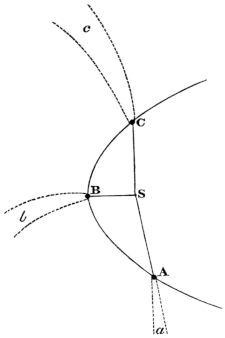
In order to determine the nature of these paths, let us consider the forces which act upon the particles of the tail. One is, the attraction of these particles to the nucleus itself, by which they are made to conform to the motion of the Comet; and another is, the power of repulsion residing in the sun, whatever be the mode of its operation, which causes the tail to extend in an opposite direction. Besides these two forces, there may possibly be another, viz. the resistance of the ethereal medium, by which their combined effect must be in some degree modified. But without at present regarding this third force, for whose existence we have not the same a priori evidence, let us now consider the direction which the tail will assume by the influence of the two former forces alone. Let S be the sun, and A B C the part of the comet’s orbit near the perihelion, and let A be the comet in its approach, with its tail A a in opposition to the sun. Were there no other circumstance to interfere, the power of the sun’s impulsion on the nebulous particles, ought still to produce the same direction at B. The gravitation of these particles to the nucleus, which remains constantly the same, will in no case affect the operation of this impulsive power. But it must be recollected, that the motion of the tail is not governed like that of the comet in its orbit, by the sun’s attraction; the nebulous particles are guided only by the attraction of the nucleus; so that when the comet’s velocity at B has become greatly accelerated, the speed of the tail will not instantly be increased in a corresponding ratio. In consequence of this, the tail will be left somewhat behind the line of exact opposition to the sun: and hence, as this variation of the several particles will be in proportion to their distance from the nucleus, a curve will be formed as B b, and C c, to which the radius vector S B and S C will be a tangent.
Such is the shape and direction which the tail ought to assume by the combined influence of the two forces above mentioned. But, in comparing these theoretical results with actual observations, we find a considerable discrepancy. So far from the radius vector forming a tangent to the curvilineal tail, or making only a small angle, it is invariably found that the angle is much greater than what the foregoing considerations will allow; and, moreover, that there is no curvature, except near the extremity of the tail, the intermediate parts forming a straight line. In order to account for these phenomena, we are obliged to have recourse to the third force formerly noticed, the resistance of the ethereal medium, which introduces such a modification in the foregoing results, as observation requires.
However great may be the tenuity of the ethereal medium, it is natural to suppose that its resistance must be able to produce some effect, upon the particles which compose the tails of comets. The highly attenuated nature of the nebulous matter, in this part of the orbit, has been already noticed; and when we likewise consider the perpendicular direction in which the resistance is here made to act, its influence upon the form of the tail becomes still more evident. From the powerful action of the sun’s heat upon the nucleus, at this part of the orbit, supplies of nebulous matter are continually detached; and as this effect must continue for a considerable time after the perihelion passage, it is evident that the tail will then be the most extensive. For the same reason it will then also present the greatest deviation, as the resistance of the ethereal medium will be rendered more effective on account of the increased attenuation. Another consequence of this resistance to the tail, will be to flatten its curvilineal shape, in that part of it next to the nucleus, where the resistance acts in a perpendicular direction; whilst the original curvature towards the extremity, not being opposed in the same manner, will remain exempt from any alteration.
IV. Having thus pointed out the most prominent features in a comet’s appearance, and endeavoured, by known established principles, to explain the constitution of its parts, this will perhaps be the most proper place to take notice of another very important subject, viz. the Light of comets. Besides the criteria already mentioned, which distinguish these bodies from the planets, it affords another characteristic mark, that the former shine with a much paler and more scattered light. This point was accurately ascertained by Shroeter, with regard to the Comets of 1798, 1799, 1805, and 1811; in most of which, by comparisons with Mars, the light was found to be only one-half or one-third as bright.
To account for this difference, two theories have been proposed: the one that Comets shine by a native light, of a phosphorescent nature; the other, that they shine only by the reflected light of the sun, which is weakened by their highly attenuated constitution. As the Comet approaches the sun, it is conceived by those who advocate the former opinion, that self-luminous matter is detached from the surface, which, rising in the Comet’s atmosphere, and yielding to the influence of the sun’s power, in the manner already described, produces the phenomena of the envelope and tail. In support of this opinion, they seem to insist chiefly upon the circumstance, that when Comets have come into a position between the Earth and the Sun, no phases have ever been observed on their surface; and no partial obscurations of the sun, by the transit of a Comet across his disc. But it is by no means a fact so well established, that such phases or obscurations have never been seen. On the contrary, Cassini, in observing the Comet of 1744, remarked an appearance upon the nucleus, “which,” he says, “would have formed phases, completely resembling those of the Moon, or of Venus, if its disc had been as distinct as that of these two planets23.” The edge and surface of the nucleus were concealed by the nebulous matter raised by the sun’s heat: and let it be remarked, that the position of the Comet at the time, with respect to the sun and earth, seems to have been extremely favourable for such an observation. The Comet was then considerably within the orbit of Mercury; it was also between the earth and the sun, and its elongation or angular distance from the sun, amounted only to a few degrees. In the Comet of 1769 likewise, when it was about midway between the earth and the sun, an observer in England mentions that he saw it distinctly exhibit phases, from the crescent to the full, in approaching its perihelion24. As a third instance, I may adduce the comet of 1682, whose phases are taken notice of by De Lambre25, as well as by La Place26. But an instance still more recent and more remarkable than any of these, is the comet of 1819. This comet, according to Olbers’ calculations, made a transit across the sun’s disc, on the 26th June 1819, the commencement of the transit being at 6 o’clock A. M. At 8 o’clock on the same morning, Mr Pastorf, in looking at the sun, happened to discover this comet in its transit, which he describes as then presenting the appearance of a nebulous spot upon the sun’s disc27; and other astronomers agree in the observation28. Now, it seems to be infinitely more probable that such a spot was formed by a body naturally opaque, rather than by one which shone with a light independent of the sun. With respect to the same comet, a fact still more decisive of the point was remarked by Cacciatori, the director of the observatory at Palermo, who says, that he “observed very distinctly phases in the nucleus of the comet of 1819, and hence concludes, that comets are not luminous per se, but that their nucleus, their coma, and their tail, shine only by reflected light29.”
But even though every one of the accounts which are given of comets exhibiting phases, or causing a partial obscuration of the sun, were proved to be totally incorrect and fabulous, still the absence of these facts would not be inconsistent with the theory of a reflected light. For how is it, that the small nucleus of the comet, (the only part which can exhibit phases), is illuminated by the sun’s rays? It is surrounded, as we have seen, by a nebulous envelope of prodigious depth, which, besides rendering the nucleus very indistinct, prevents the sun’s rays from reaching the surface, in any other way than by refraction; so that the parts, even behind the nucleus with respect to the sun, must, on account of this refraction, receive a considerable quantity of light. If, however, there be a nucleus on which, by reason of its own magnitude, in comparison with the small depth of the envelope, some spot still remains unenlightened, this spot can only be between the streams of the tail; whose diffused and scattered light, in addition to the luminousness of the envelope, will render it exceedingly difficult to observe the spot. When, besides this, we reflect that it is only in those comets whose perihelia lie nearer to the sun than the earth30, and only in certain positions of these Comets not likely often to occur, that either phases or partial obscurations can possibly be observed, we may easily understand why they have so very seldom occurred, and need not be surprised if they had even never been noticed at all. Nevertheless, the supporters of a native light in Comets, are obliged to allow that at least some Comets are opaque bodies, enlightened by the sun’s rays. Herschel himself, who most ably advocates the theory, distinctly admits that the second Comet of 1811 must have shone by the reflected light of the sun; though he had been induced to form a different opinion, regarding the first Comet of that year.31
On the whole, it seems more philosophical, considering the facts which have been obtained, and the analogy which the light of the other heavenly bodies suggests, to suppose, that Comets shine by the reflected rays of the sun; and to ascribe the faintness of their light, to the attenuated nature of their nebulous medium. At the same time, it must be observed, that the most eminent philosophers are at issue on this subject: and the point can only be decided, by the results of more extended observation.
V. Such being the physical constitution, and such the causes giving rise to the phenomena of comets, we shall now be better able to account for the various changes which their several parts are found to undergo, during their progress round the sun. I shall here, therefore, give a succinct account of the most general appearances presented by comets, from the period of their first being seen, till they have removed too far from the sun to be longer visible; explaining, likewise, as they occur, the more remarkable phenomena, which have not already been described.
The following observations of the Comet of 1769, are extracted from Messier’s account of its motions32. This comet passed its perihelion on the 7th October. “8th Aug.—I discerned,” says he, “a little above the horizon, something resembling a small nebula; it turned out to be a comet. 15th Aug.—I observed the comet again: It had acquired a tail about 6° in length; and the brightest part of its nucleus had a diameter of 1′ 26″; but its edge was indistinct. The diameter of the envelope was about 4′ 30″. 27th Aug.—The tail now had a length of 15°. A dark shade was observable through the middle parts of it, which did not extend far from the nucleus.33 The nucleus likewise had become brighter, though its edge was still ill-defined. 30th Aug.—The diameter of the nucleus seemed34 to be 2′ 9″; but its circumference was indiscernible, from the abundance of nebulous matter. The tail was now 24° in length: It still retained the darkish appearance along the middle. But in addition to the principal tail, there was a smaller one accompanying it, which showed itself by two short streams of light, forming angles of a few degrees, with the larger streams35. These angles were not of equal magnitudes; the angle made by the lower stream was about twice the size of the angle on the uppermost side. 2d Sept.—The diameter of the nucleus was 2′ 53″. The nebulous matter round it seemed to have increased in quantity. The length of the tail was 36°. It had the same appearance as on the 30th August, with respect to the darkness along its middle parts; and the occurrence of a smaller tail round it. But the larger of the angles formed by the two small streams with the principal tail, was now observed to be, not, as before, on the lower side, but on the uppermost side36. The streams also had approached closer to the principal tail. 3d Sept.—The diameter of the nucleus 3′ 15″, but its disc still very indistinct, on account of the increasing quantity of nebulous matter. The tail now measured 40° in length. The two streams appertaining to the short tail had disappeared37. The light of the envelope was more brilliant than the light of the tail: the latter somewhat resembled smoke. 4th Sept.—The diameter of the nucleus 3′ 40″. The length of the tail was now 43°. Towards its extremity a bending or curvature was observable. On each side of the tail there again appeared a stream, forming in this manner another small tail as before. The sides of both tails were nearly parallel to one another38; and between them could be distinguished a darkish space, through which telescopic stars were discerned, considerably deprived of their light. That part of the nebulous envelope which was next the sun, seemed as if compressed against the nucleus, its depth there being less than elsewhere. 5th Sept.—The tail now measured about 49° in length; it showed a deviation from the direction of exact opposition to the sun. The nucleus, though much increased in size and brilliancy, was not very distinct; it subtended an angle of 4′. At this period the diameter of the head was altogether about a degree; (on the 15th August, as we have seen, its diameter was only . 8th Sept.—The tail now amounted to 55°. Every thing else remained the same. 9th Sept.—The tail was now 60° in length. 13th Sept.—The nucleus appeared much brighter and larger than before. No farther observations could be made of this comet before the perihelion passage, owing to its immersion in the sun’s rays; but those now given are quite sufficient, I think, to illustrate the formation and developement of the several parts.”
It is at the time when the Comet has approached nearest to the sun, that the effect of the solar action upon its physical constitution naturally becomes most conspicuous. Newton remarks with respect to the Comet of 1680, that, in the month of December, (its perihelion passage being on the 18th December), its tail was much more extensive and effulgent than in November previous; and that, during the two days following the perihelion passage, as much matter was detached, as would have formed the whole tail, which the Comet possessed on the 10th December39. “Et universalitur,” he adds, “caudæ omnes maximæ fulgentissimæ cometis oriuntur, statim post transitum eorum per regionem solis.” It is on the nucleus that the action of the sun’s heat produces the most remarkable effects; bringing about physical changes, as sudden in their occurrence as they are often difficult of explanation. Of this nature were the phenomena observed by Schröter, in the Comet of 1799, during the month of its greatest proximity to the sun. From the 30th August to the 14th September, this Comet presented nothing unusual in its appearance; but upon the 16th September the diameter of its nucleus seemed suddenly reduced to two-thirds of its former size; whilst between the 20th and 21st the surrounding nebulous matter had also lessened one-fourth part. On the 21st the nucleus still remained indistinct; but on the 22d it shone with greater splendour than on the former days, and continued to do so until the 25th, when it again relapsed into a state of extreme faintness. No alteration occurred till the 25th Oct., when the nucleus appeared suddenly to burst forth from its vapoury covering, and resumed its former brilliancy. Observations, very similar to these, were also made by Schröter, respecting the Comet of 1807. There was the same series of changes, in the apparent magnitude of its nucleus; as well as continual transitions, from one degree of density or obscurity to another, throughout the whole nebulous envelope, but particularly in those parts contiguous to the surface of the nucleus40.
There can be very little doubt, I think, that the sun’s heat acting on the substance of the nucleus, was the main cause of those extraordinary appearances. But astronomers are by no means agreed as to the manner in which this agent operates. Schröter imagines, that the solid part of the Comet remains quite unaltered; and ascribes the varying appearances exhibited, in so rapid succession, to a dense stratum of vapours, contiguous to the nucleus. Many others, considering the nucleus of a Comet as only nebulous matter, more or less consolidated, attribute these appearances to great physical changes on the surface of the nucleus itself, produced by the powerful agency of the solar heat. This latter opinion is the most probable, as more consistent with observation. For, if it be recollected that many comets have been seen, some with exceedingly small nuclei, and others, which seemed to consist entirely of a mass of vapours, having a slight condensation towards the centre, we shall readily admit, that the sun’s heat may be sometimes sufficiently powerful to detach from the more solid parts of Comets, considerable quantities of their nebulous substance. It is very evident, from Schröter’s own account of the Comet of 1799, that, to the envelope, there must have been frequent additions of nebulous matter, by which the edge or surface of the nucleus occasionally became obscured, its brilliancy impaired, and its apparent diameter lessened; nor is it possible to conceive whence those supplies could have been derived, if the looser and more recently consolidated materials, on the surface of the nucleus, were not capable of being volatilized and elevated by the solar heat. When, in this manner, dense clouds or exhalations of nebulous matter, rise up in abundance in the atmosphere of the Comet, the nucleus must necessarily for a time be shorn of its splendour; and when the nebulous matter, by the continued action of the sun, has become so much expanded as to detach itself completely from the surface, the nucleus shines again with its wonted lustre41.
I have remarked, with regard to the deviation of the Comet’s tail from its ordinary direction, that this continually increases, till shortly after the perihelion passage, when it reaches its maximum. The causes have already been explained; it remains only to produce an illustration of the remark. Any Comet, on which correct observations of this nature have been made, will supply illustration; but the following facts, with respect to the first Comet of 1811, may suffice. Two days before the perihelion passage, which happened on the 12th September, a straight line, joining the nucleus, with a point in the tail, distant ·21 from the nucleus, (the earth’s distance from the sun being = 1), made an angle with the prolongation of the Comet’s radius vector, equal to 7° 51′. Now, if the tail had extended in the direction of exact opposition to the sun, this angle would have been zero, so that its magnitude affords a just measure of the actual deviation. On the 18th Sept., or six days after the perihelion passage, this angle formed, by a line drawn to a point ·10 distant from the nucleus, only 8°. On the 19th Sept., this angle, at the former distance of ·21, was 9°. On the 21st Sept., this angle, at the same distance, was 10° 33′. About this period the deviation seems to have been greatest; for whilst, on the 21st Nov., the above angle at the distance of ·121, was 7°, on the 6th Dec. at the greater distance of ·158, it was no more than 4° 18′.
As a Comet recedes from the sun, a series of changes begins to take place, analogous to those which are observed before the perihelion passage. But they necessarily occur in a contrary order; for, by the gradual diminution of the solar energy, the nebulous envelope draws nearer to the nucleus, the tail becomes less extensive, and all the parts soon lose their distinctness and brilliancy. The Comet of 1807, and the great Comet of 1811, afford good illustrations of these appearances. A very few particulars may be sufficient. I shall notice first the changes that were observed in the Comet of 1807, in its regress from the sun. “4th Oct.—The diameter of the nucleus was, at this time, diminished to 3″. On the 5th it measured only 2″·77. 18th Oct.—The length of the tail amounted to 3°. 19th Oct.—The diameter of the nucleus was less than 2″·47; that of the nebulous envelope about 6′. 28th Oct.—The preceding side of the tail, in all its length, except towards the end, was well defined; but the following side was everywhere hazy and irregular, especially towards the end. 31st Oct.—The tail continued better defined on the preceding side, than on the following side. 20th Nov.—The nucleus had now become extremely small, being little more than a mere point; the tail also was no more than 2° long. 6th Dec.—By this time the diameter of the envelope had lessened to 4′·45; and the length of the tail to 23′. 2d Feb.—The comet was reduced to the appearance of a mere nebula; having a faint diffused nebulosity, projecting from the side opposite to the sun, being the vanishing remains of the comet’s tail.”
These appearances unequivocally attest the influence of the sun’s heat, corresponding exactly with the Comet’s increasing distance. The only circumstance, which here seems to require any comment, is the observation of the 28th October, that the following side of the tail was hazy and irregular, while the preceding side appeared distinct and well defined. What is the cause of this difference, when both sides of the tail are composed of matter, in the same state of rarefaction? It is an appearance generally observed in all Comets; but I have met with no explanation of the fact. Astronomers are silent on the subject, except when they merely notice its occurrence. It is on account of this general silence, that I venture to offer a conjecture. When we reflect upon the immense velocity of the tail at this part of the Comet’s orbit, it is evident that the resistance which it suffers from the ethereal medium must be very considerable. On this account, there will necessarily be a partial condensation of the luminous particles, upon the preceding side, which will have the effect of imparting a greater degree of brilliancy to it, than in those parts less subject to the same resistance. Whilst, on the following side of the tail, there will likewise, on account of the velocity, be at the same time a slight rarefaction of the ethereal medium, and consequently of the nebulous matter: in this manner, there is produced a sort of eddy on the following side of the tail, which breaks the regularity of its outline, and diminishes the general brilliancy of these parts.
The following were the appearances which the great Comet of 1811 exhibited whilst receding from the sun. “4th November.—The envelope had subsided in the Comet’s atmosphere, which was, in consequence, much filled with scattered light. Its distance from the centre was 7′ 10″. The envelope, moreover, had become double towards the sun, and divided itself at each side, into three streams; those on the outside being very faint, and of no great length. A darkness, also near the tail, had grown conspicuous; the middle parts being less filled with scattered light. 5th Nov.—On the preceding side the envelope was very faintly accompanied by an outer one, but not on the following side. The tail had lately become much reduced; its utmost length not exceeding 12°. 9th Nov.—The cometic atmosphere was now nearly covered with scattered light, on account of the close approximation of the envelope to the nucleus. Its distance was only 5′ 43″. The tail, also, was but 10° long. 10th Nov.—The envelope could be distinguished from the nucleus only by a small remaining darkish space, in which the atmosphere might still be seen. The distance of the envelope 4′ 46″. A considerable darkness prevailed between the streams of the tail. 19th Nov.—The envelope was now so sunk down and scattered, as to leave no room for discerning the atmosphere. The comet seemed to be fast returning to the appearance of a mere nebula. The tail was no more than 6° 10′ in length. The darkness between the two streams was increased. 24th Nov.—The envelope was turned into haziness; and, on the side towards the sun, the Comet had already the appearance of a globular nebula, with a faint hazy border. 2d Dec.—The tail was hardly 5° long, and had a very feeble light.”
These phenomena, the account of which now given has been extracted from Herschel’s interesting observations, clearly illustrate the agency of the principles which were formerly laid down. The gradual approach of the envelope to the nucleus, lessening the apparent diameter of the latter, together with the ultimate subsidence of the envelope on the nucleus, indicate a continual decrease of that attenuation, by means of which, the envelope had been before suspended in the cometic atmosphere; and this decrease of attenuation, could arise from no other cause than the diminished agency of the solar heat, occasioned by the retrocession of the Comet. To the same cause, must be ascribed the shortening of the tail, as well as the conspicuous darkness about the middle of it, which seemed to be greater near the nucleus, on account of its proximity to stronger light: For, as the matter composing the tail subsided on the surface of the nucleus, the conical shell would necessarily become thinner, and thus shine with a fainter light. Whilst this condensation of the nebulous matter was advancing, all of which might not be exactly of a homogeneous nature, some portions were able to retain a little longer than others their attenuated condition, and thus formed another envelope, and other streams round the tail, more faint as they were more rarefied, than the principal envelope and tail. It is for the same reason, undoubtedly, viz. some physical difference in the nebulous matter, that, on the outside of the two brilliant streams forming the tail, there occasionally appeared other streamlets, but very hazy and imperfect.
The only other circumstance, respecting the changes observable in a Comet’s appearance, of which it may be proper to give some example, is the direction of the tail, in the comet’s regress from the sun. We have seen, that, in approaching the perihelion, the tail presents a considerable deviation from the prolongation of the radius vector, and that the point where the angle of deviation is greatest occurs shortly after the perihelion passage; at this point, the tail begins again to assume its ordinary direction, and at length the deflection becomes no longer perceptible. Whether it be that observers are not sufficiently attentive to this fact, and have thus overlooked the appearances connected with it, or whether there be great difficulty in making observations of this nature, when the Comet is so near the sun, I am ignorant; but in the descriptions of the successive appearances exhibited by comets, there is no example which of itself affords a good illustration of the phenomenon. However, the two following cases will serve to attest the general fact42: The Comet of 1664 passed its perihelion on the 4th December; on the 17th, the average deviation of its tail from the radius vector was 43°; on the 18th it was 35°; on the 22d only 20°; on the 24th 19°; on the 26th 18° 40′; on the 30th 10° 5′; and on the 2d January, after which date no farther observations could be made, 6° 20′. The Comet of 1652 passed its perihelion on the 12th November; on the 20th December the deviation of its tail was 17°; on the 23d it was 13°; on the 26th only 7°; on the 27th 5°; and on the 30th 4°. We have already explained how this deviation of the tail is caused, which increases until after the perihelion passage; the same principles apply to the present phenomenon. If, in the first part of the orbit, it be owing to the greater centrifugal force and higher rarefaction of the tail, that it is made to decline from exact opposition to the sun; so it is by the diminution of both these causes that, after the comet passes its perihelion, the tail gradually resumes its ordinary direction.
Such is the amount of our present knowledge respecting the physical constitution of Comets. This knowledge is the fruit of but recent experience; and certainly, considering the shortness of the period, during which accurate and philosophical observations of those bodies have been conducted, it seems remarkable how little there is among the complicated phenomena they exhibit, of which we cannot offer some satisfactory explanation. No hypothesis has been resorted to for this purpose, which can be said to be inconsistent with sound philosophy. All the principles on which the several parts in the constitution of these bodies have been shewn to depend, accord with the acknowledged laws of nature; and in tracing a comet in its course round the sun, from the first moment of its appearance, till it has receded too far to be longer visible, we have explained the mode in which those principles operate, and found them in perfect conformity with observation.
VI. It is curious to contrast the extensive and scientific information, which we now possess on this interesting branch of astronomy, with the vague and fanciful notions that prevailed in former times. Such views regarding the history of knowledge are equally curious and beneficial. They illustrate most strikingly the powers of moral advancement, possessed by the human understanding; they demonstrate the slow and progressive manner, which always marks the discovery of truth, and at the same time furnish to astronomers a lesson, useful in every department of philosophy, not to seek from imagination and conjecture, the results which observation and experience only should supply.
It is not my intention, however, to enter into any detailed account of the various opinions entertained by the ancients respecting Comets; such a subject opens far too wide a field of investigation, and would lead to details, of little practical utility. A few remarks may be sufficient to convey a general idea of the notions which prevailed on this subject in earlier ages of the world.
The opinions of the Greek philosophers are first entitled to our consideration, as it was by their agency that mankind were induced to turn their attention to intellectual pursuits, and a basis of inquiry prepared for the superstructure of knowledge. Their ethical disquisitions are replete with manifestations of an acute and inventive genius; whilst, in those speculative views respecting the constitution of the universe, to which they were so prone, they displayed a boldness and originality of conception, which the character of no people has exhibited in the same degree. But, in all their researches, whether moral or physical, they never could submit to the guidance of induction, nor patiently await the certain results of experience. From the resources of their own creative mind, they drew the materials, on which to form their judgment, forgetting that our knowledge of nature is dependent solely on observation; and hence their doctrines with respect to the heavenly bodies rather evince fertility of imagination than depth in philosophy. One opinion, for example, concerning Comets, taught in the Grecian schools, was, that these bodies are formed by the fortuitous concourse of small planets, moving through the system by no determinate law: these planets, before invisible, from their diminutive size, were supposed capable, by this conjunction, of transmitting so much light, as at length to become distinguishable, and thus generated comets. Hippocrates, and others of the Pythagorean school, considered comets to be real planetary bodies, like Venus or Mercury, which wander about the heavens without any fixed course, and occasionally approach near enough the earth to be discernible. Many philosophers, dissatisfied with these and similar equally absurd opinions (which it would be very unprofitable to detail), advanced a different explanation, and which they deemed far more satisfactory than any,—that Comets are not material bodies at all, but only optical illusions, arising from refraction, such as the parhelion or the rainbow. Aristotle’s conclusion, however, seems to have been the one most generally adopted, not because it was perhaps less absurd than any of the others, but because it came forth under the patronage of a name, which stood highest in every province of philosophy. According to the doctrines maintained by his sect, the atmosphere surrounding the earth is divided into three regions. The lower region contiguous to the surface is the air we breathe, and is motionless: whilst the upper region participates in the diurnal revolution of the heavens round the earth; it is of a warm temperature, from being near the region of flame, and receives continual supplies of exhalations from the earth’s surface. The exhalations, on account of the rapid motion to which they are subjected in rising into this second region, become condensed; and then, from their vicinity to the region of flame, as well as the influence of the sun, they take fire, and thus produce comets. These exhalations continue visible as long as the inflammable matters exist, till at length the combustion ceases by the whole being consumed, and then the comet disappears. This notion it is probable that Aristotle adopted, in consequence of his favourite doctrine respecting the solidity of the planetary spheres,—a doctrine which, he could plainly see, was wholly irreconcileable with the supposition, that comets traverse freely through the system.
But, though the doctrines respecting comets generally taught by philosophers in those earlier ages, resting as they did upon mere conjecture, were only remarkable for their extravagance, there were some few who possessed juster conceptions: Nor need it excite our surprise, if, among the numberless attempts to reach the truth, some approximation should occasionally have been made, to the great and important discoveries of more modern times. It was supposed by the Chaldeans, a people who, among the most ancient in the history of mankind, yet seem to have advanced the farthest in astronomy and the other arts of high civilization, that Comets are situated among the heavenly bodies; having regular periods of revolution like the planets, but moving in orbits far more extended: And hence they explained why comets are seen only for a short period, when they advance to that portion of their orbit nearest the earth43. These opinions transplanted into Greece, with other branches of knowledge, received countenance in the Italic and Pythagorean Schools: for Pythagoras himself, the founder of the sect, looked upon comets as partaking so much of the nature of planetary bodies, as to have their periodical times of appearing in the same quarter of the heavens. But these happy surmises, which have been so fully confirmed by modern discoveries, not being founded on observation, were soon compelled to give way to other opinions, bearing on them the stamp of higher authority. The opinion of Aristotle was universally adopted; and, though his philosophy, as well as all the arts characteristic of an enlightened people, soon disappeared from Greece, when that country lost her liberties, his doctrines and influence were afterwards revived in Rome.
The Romans, with all their known boldness of character, possessed little of the inventive and speculative genius which so eminently distinguished the people, from whom their knowledge was derived. Constrained by the warlike tendency of their form of government, which, from its original institution, was designed only for empire, the Romans seem to have been always unable or unwilling to proceed far in philosophical researches; and thus they were rendered more exposed to the influence of those superstitious ideas, which a limited or partial knowledge of nature is so apt to inspire. Accordingly, the views which the Romans formed with respect to Comets, were uniformly tinctured with apprehensions concerning the moral and malignant influence of these bodies over human affairs; believing them to be the causes of the most terrible disasters which can afflict mankind. And though, in cherishing these ideas, they may have been warranted by the proverb, common among the Greeks themselves, “Ουδεις κομητης όστις οὐ κακον φεϱει;” yet such superstitious feelings seem to have altogether absorbed their attention, and thus prevented them from making much progress in philosophical inquiries. Pliny states, that “the shortest time during which comets are seen, is seven days, and the longest, eighty days. Some follow a course like the planets, whilst others are altogether motionless. Almost all make their appearance towards the north, and chiefly in that part of the firmament which is termed the Milky Way. These portend storms and excessive heat. But a comet is never situated in the west. It is a body particularly frightful, and not easily propitiated, as was the case during the civil commotions in the consulship of Octavius, and again in the war between Cæsar and Pompey. Even in our own time, its cruel and powerful agency shewed itself in the poisoning of Claudius and the tyranny of Nero, his successor. It is of consequence to note the parts towards which it is shooting, the constellations whose influence it receives, and the particular aspects which it assumes. If the comet have the form of flageolets (tibiarum), then it portends something to musicians: woe betide those who are in love, if it be seen below the Girdle: it refers to artists and learned men, if it resemble a triangular or foursided figure with equal angles in the situation of any of the fixed stars: and if it be situated in the head of the Dragon either north or south, it sprinkles poisonous matter44.” The evil of which comets were thus reckoned the occasion, was little fixed or specific in its nature. It may be said to have comprehended almost every calamity which could befall nations or individuals; though, in regarding these bodies as “prænuntiæ futurarum rerum,” it was natural that men should deem them the precursors of those disasters chiefly, which their own particular interests led them most to apprehend:
“Gladii mortalibus index Et famis, et mortis, præclarorumque virorum Atque ducum interitus,” &c.
This universal superstition respecting Comets once established, it was not difficult, whenever they were seen in the firmament, “rubescentes ferali crine,” to discover some dire misfortune which had followed their appearance; and which, it was therefore believed, they had certainly foretold. This superstition we find every where recorded by the historians of those times, who never fail to mention among the various prognostications of political events, the frightful apparition of a comet. Tacitus, when enumerating, on one occasion, “prodigia imminentium malorum nuntia,” says, “Inter quæ et sidus Cometes effulsit; de quo vulgi opinio est, tanquam mutationem regnis portendat.”45 This was one of the omens which, according to the same historian, was “sanguine inlustri semper Neroni expiatum46;” for the tyrant had been informed, that it was a prodigy, “quæ summis potestatibus exitium portendere vulgo putatur;” and, therefore, in order to avert the foreboded mischief from his own head, “he resolved upon the destruction of the chief nobility in Rome47.” Cicero himself, with all his philosophy, seems not to have been exempt from the universal prejudice; for, in describing the phenomena of the natural world, by means of which men are enabled to interpret the will of the gods, and to ascertain the occurrence of future events, he particularly mentions, “Stellis iis, quas Græci cometas, nostri cincinnatas vocant, quæ nuper bello Octaviano, magnarum fuerunt calamitatum prænuntiæ.” In farther evidence of the superstitious notions which existed among the Romans respecting comets, I might refer to the numberless glowing descriptions of the poets: “Regnorum eversor lethale Cometes,”—“exitiale micans,”—“fax dira Cometæ,”—“nunquam terris spectatum impune Cometam,” are expressions continually employed in their relation of some dread-impending calamity: and, in resorting to this imagery, it was not a mere fable, or an idle dream, which was thus introduced for occasional embellishment; but an opinion cherished even by philosophers, and consonant to the prevailing temper and belief of the age.
“Flagranti crine Cometæ, Bella canunt, rapidosque ignes, subitosque tumultus, Et clandestinis surgentia fraudibus arma48.” “Præceps sanguineo delabitur igna Cometes, Prodigiale rubens: non illum navita tuto, Non impune vident populi; sed crine minaci, Nuntiat aut ratibus ventos, aut urbibus hostes49.”
Although, in general, Comets were thus looked on as the precursors of evil, there is one which seems to have escaped this ill-omened character. It was that which appeared at the games celebrated by Augustus, to honour the memory of Julius Cæsar. It was observed for seven days consecutively, rising about 5 o’clock in the evening, and shining with uncommon brightness. The Emperor ingeniously gave out, that it was the blessed soul of the murdered Dictator, now admitted into heaven; and, in commemoration of the prodigy, he placed a star on the head of Cæsar’s statue, which he dedicated in the Forum50. But the fact is certain, that, with this single exception, Comets were invariably looked upon, in all ages of the world, as the peculiar heralds of evil; and it would afford a subject of curious inquiry, to explain this propensity of the human mind, which, in judging of the moral influence of comets on mundane affairs, led mankind to consider that influence, to be baneful, rather than benignant.
The only individual who seems to have risen above the prejudices of his age and country, was Seneca:—Nor was he superior merely to superstitious associations; he entered into the most profound and philosophical views respecting the nature and motions of Comets, and was even able to form such opinions, with regard to both, as the discoveries of modern Astronomers have served fully to confirm. “I cannot persuade myself,” says Seneca, in allusion to the doctrines of Aristotle, “that a comet is merely a fire suddenly kindled: it is rather one of the eternal works of nature. The ordinary meteors, which we observe in the atmosphere, never vary in their course, from a straight line. A circular motion is a property characterising the heavenly bodies alone. Whether the course of former comets was of this kind, I know not; but that of the two which appeared in our time, certainly was circular.” Besides, every thing which owes its production to transient causes, quickly perishes. The meteors in the firmament disappear almost as soon as kindled; the stars which are called falling stars, become extinguished in shooting through the air. What alterations would we not observe in comets, if they were only a mass of flame lighted by some accidental cause? Their size would vary continually with the quantity of inflammable matter which nourished them. Comets are situated among the heavenly bodies, and hence they do not disappear almost immediately after becoming visible; they follow an orbit of their own, and are never extinguished, they only remove out of our sight.—“If, moreover,” he says “we reflect upon their motion, their rising and setting, their light and brilliancy, we are struck with the analogy existing between them and the heavenly bodies. But it is requisite to have an exact account of the comets which have been formerly seen; for, from the infrequency of their appearance, we cannot yet ascertain if their movements through the heavens are regular; we are still ignorant whether describing some constant orbit, they reappear at intervals periodical and determinate.”—“It is reserved,” he adds, “for some person, one day to point out the place, to which comets withdraw themselves; why their orbits differ so much from those of the planets; what is their physical nature, and their number in the system51.”
Notwithstanding these arguments, directed with so much force against the prevailing notion, that Comets are only igneous exhalations in the earth’s atmosphere, and those sounder views respecting their nature and movements, mankind were unwilling to alter the belief, which time and superstition had united to strengthen: and Aristotle’s opinion continued to be held in reverence. For a long period after this, the cause of science and philosophy remained totally neglected. Men were incapable of the least effort to rouse themselves from that state of lethargy and ignorance, into which they had relapsed; and the sixteenth century found them perhaps even less advanced in the knowledge of astronomy, than they were in the days of Seneca or Pythagoras. During the period of the middle ages, when Europe presented a melancholy scene of Gothic barbarism, and when the human understanding seemed paralysed with the dread of imaginary evils, comets were more than ever considered as influencing the tide of human affairs; sowing dissensions among nations; foreboding the dethronement of kings; causing the death of illustrious men; and scattering pestilence and famine among the people. In the almanacks published by one Leonard Digges, in the fourteenth century, we find the following summary description given of Comets. “They signifie,” says this learned astronomer, “corruption of the ayre; they are signes of earthquake, of warres, chaunging of kyngdomes, great dearth of corne, yea a common death of man and beast.” Another author, who wrote about the same period, gives the following reasons why Comets produce wars and civil commotions:—“Quia corpora fiunt biliosiora, ideo et ad iram prona, hinc subito moliuntur seditiones; principes aliis principibus vicinis bella inferunt.” And, in like manner, he endeavours to explain the influence, which Comets were supposed to exercise over the destiny of princes:—“Quia principes habent corpora teneriora aliis, ideo præ aliis ab infecto exhalationibus aere magis afficiuntur, et a morbis qui tum grassantur interimuntur.” Nor perhaps will either of these statements appear very unphilosophical, if we reflect on the physical effects of the anxiety and terror which Comets were in those days capable of inspiring.
Various were the speculations, regarding the source from which these strange and terrible portents in the firmament, could be derived. Claud Comirs believed that they issue from the body of the sun, and float through the planetary regions, as soap-bubbles in the air. The Spanish monk Valderama, proposed a theory more allied to his profession, and maintained that Comets must assuredly be sent by some infernal demon, as a just retribution for the impieties of mankind; nor indeed were they ill suited to be the instruments of divine wrath, if we believe these most unmusical lines, where a Cracovian astrologer relates the evils, which comets were held to occasion:
“Octo mala fulgens Cometa per aëra signat, Ventus, sterilitas, aqua, pestis, dominatus Rixa fit et tremor, moritur dux, mutatio regni.”
John Bodin, a French lawyer, published his opinion of Comets, in a work entitled Universæ Naturæ Theatrum, 1575, which assigns to them a new character. “I have reflected,” says he, “upon the opinion of Democritus, and with him am induced to think that comets are spirits, which, having lived on the earth innumerable ages, and having at last completed their term of existence, celebrate their last triumphs, or are recalled to heaven, in the form of shining stars!” A more extraordinary fancy was entertained by Kepler, who, though in some measure the father of modern astronomy, yet had very incorrect notions respecting the system of nature in general. The planets he imagined to be animals swimming round the sun by means of fins acting upon the ethereal fluid; and, agreeably to this strange belief, he held Comets to be also huge uncommon creatures, generated in the celestial spaces, and that they “were made to the end, the ethereal fluid might not be more void of monsters, than the ocean is of whales, and other great thieving fishes; and that a gross fatness being thus gathered together, as excrements into an apostume, the ethereal medium might thereby be purged, lest the sun should be obscured, as he was for a year together, when Julius Cæsar was slain; when being weakened by a bloody colour, he cast but a dim and disdainful light!” He even supposes that the faculty of the earth, which he fancied to be animated like all the other planets, is so terrified at the approach of a comet, that it “sweats out a great quantity of vapour through terror, and that hence arise great rains and floods52.”
In the following harmonious strains, Du Bartas labours to describe minutely a Comet’s physical appearance; and it will not be denied, that the author has succeeded marvellously in upholding the reputation of those bodies, as the dreaded messengers of evil.
“Here in the night appears a flaming spire, There a fierce dragon folded all in fire; Here, with long bloody hairs, a blazing star Threatens the world with famine, plague, and war; To princes death, to kingdoms many crosses, To all estates inevitable losses; To herdsmen rot, to ploughmen hapless seasons, To sailors storms, to cities civil treasons53.”
We need not, then, be surprised to find the descriptions given by the historians and professed astronomers, so deeply tinged with the superstition by which the age was characterised, and often so highly coloured or caricatured, as to render it even difficult to recognise the thing described to be a comet. When, for instance, we read of comets which resembled flaming swords and glittering spears, or one which (as Lubienitz54 relates), came out from an opening in the heavens, like to a dragon with blue feet, and a head covered with snakes; we only pity the degradation of the human mind, which either could invent or could tolerate such monstrous absurdities. The following remarkable description is taken from the “Exempla Cometarum” of Rossenburgh. “In the year 1527, about 4 in the morning, not only in the Palatine of the Rhine, but nearly over all Europe, appeared for an hour and a quarter, a most horrible Comet, in this sort. In its length it was of a bloody colour, inclining to saffron. From the top of its train appeared a bended arm, in the hand whereof was a huge sword, in the instant posture of striking. At the point of the sword was a star. From the star proceeded dusky rays, like a hairy tail; on the side of them, other rays, like javelins or lesser swords, as if imbrued in blood, between which appeared human faces, of the colour of blackish clouds, with rough hair and beards. All these moved with such terrible sparkling and brightness, that many spectators swooned with fear!”