Publisher's Preface (continued 5)
Reading edition
, one, three times a day.
554. Astringent
Mix sixteen grains of acetate of lead (
sugar of lead
) with four grains of opium, and make into a mass with extract of dandelion, so as to make eight pills.
Dose
, from one to two. Use as an astringent in obstinate diarrhœa, dysentery, and spitting of blood.
555. Mixtures
556. Fever, Simple
Add three ounces of spirit of mindererus (
Liquor ammonia acetatis
), three drachms of spirits of sweet nitre, four drachms of antimonial wine, and a drachm of syrup of saffron, to four ounces of water, or medicated water, such as cinnamon, aniseed, &c.
Dose
, for an adult, one or two tablespoonfuls every three hours. Use as a diaphoretic.
557. Aromatic
Mix two drachms of aromatic confection with two drachms of compound tincture of cardamoms, and eight ounces of peppermint water.
Dose
, from one ounce to one and a half. Use in flatulent colic and spasms of the bowels.
558. Cathartic
Dissolve two ounces of Epsom salts in six ounces of compound infusion of senna, then add two ounces of peppermint water.
Dose
, from one and a half to two ounces. Use as a warm and active cathartic.
559. Diuretic
Dissolve one drachm of powdered nitre in three ounces of camphor mixture; add five ounces of the decoction of broom, with six drachms of sweet spirits of nitre, and three drachms of tincture of squills; mix.
Dose
, one teaspoonful every two hours, or two tablespoonfuls every three hours. Use, excellent in dropsies
560. Cough
Dissolve three grains of tartar emetic and fifteen grains of opium in one pint of boiling water, then add four ounces of treacle, two ounces of vinegar, and one pint more of boiling water.
Dose
, from two teaspoonfuls to two tablespoonfuls, according to circumstances, every three hours, or three times a day. Use in common catarrh, bronchitis, and irritable cough.
561. Cough (for Children)
Mix three drachms of ipecacuanha wine with half an ounce of oxymel of squills, the same quantity of spirits of tolu, one ounce of mucilage, and two ounces of water.
Dose
, one teaspoonful for children under one year, two teaspoonfuls from one to five years, and a tablespoonful from five years, every time the cough is troublesome.
562. Antispasmodic
Dissolve fifty grains of camphor in two drachms of chloroform, and then add two drachms of compound tincture of lavender, six drachms of mucilage of gum arabic, eight ounces of aniseed, cinnamon, or some other aromatic water, and two ounces of distilled water; mix well.
Dose
, one tablespoonful every half hour if necessary. Use in cholera in the cold stage, when cramps are severe, or exhaustion very great; and as a general antispasmodic in doses of one dessert spoonful when the spasms are severe.
563. Tonic and Stimulant
Dissolve one drachm of extract of bark, and half a drachm of powdered gum arabic, in six ounces of water, and then add one ounce of syrup of marshmallow, and the same quantity of syrup of tolu.
Dose
, one tablespoonful every three hours. Use after fevers and catarrhs.
564. Stomachic
Take twenty grains of powdered rhubarb, and rub it down in three ounces and a half of peppermint water, then add sal volatile and compound tincture of gentian, each one drachm and a half; mix.
Dose
, from one to one ounce and a half. Use this mixture as a tonic, stimulant, and stomachic.
565. Drinks
566. Tamarind (1)
Boil two ounces of the pulp of tamarinds in two pints of milk, then strain. Use as cooling drink.
567. Tamarind (2)
Boil two ounces of the pulp in two pints of warm water, and allow it to get cold, then strain. Use as cooling drink.
568. Powders
569. Compound Soda
Mix twenty-four grains of calomel, thirty-six grains of sesquicarbonate of soda, and one drachm of compound chalk powder, together. Divide into twelve powders. One of the powders to be given for a dose when required. Use as a mild purgative for children during teething.
570. Tonic
Mix one drachm of powdered rhubarb with the same quantity of dried carbonate of soda, then add two drachms of powdered calumba root.
Dose
, from ten to twenty grains as a tonic after fevers, in all cases of debility, and dyspepsia attended with acidity.
571. Rhubarb and Magnesia
Mix one drachm of powdered rhubarb with two drachms of carbonate of magnesia, and half a drachm of ginger.
Dose
, from fifteen grains to one drachm. Use as a purgative for children.
572. Sulphur and Potash
Mix one drachm of sulphur with four scruples of bicarbonate of potash, and two scruples of nitre.
Dose
, from half a drachm to one drachm. Use as a purgative, diuretic, and refrigerant.
573. Anti-Diarrhœal
Mix one grain of powdered ipecacuanha, and one grain of powdered opium, with the same quantity of camphor.
Dose
, one of these powders to be given in jam, treacle, &c., once or twice a day; but to adults only.
574. Antispasmodic
Mix four grains of subnitrate of bismuth, forty-eight grains of carbonate of magnesia, and the same quantity of white sugar, and then divide in four equal parts.
Dose
, one-fourth part. Use in obstinate pain in the stomach with cramps, unattended by inflammation.
575. Antipertussal, or against Whooping-Cough
Mix one drachm of powdered belladonna root, and two ounces of white sugar, together.
Dose
, six grains morning and evening for children under one year; nine grains for those under two and three years of age; fifteen grains for those between five and ten; and thirty grains for adults.
Caution
, this should be prepared by a chemist, as the belladonna is a poison, and occasional doses of castor oil should be given while it is being taken.
576. Purgative (Common)
Mix ten grains of calomel, with one drachm of powdered jalap, and twenty grains of sugar.
Dose
, one-half of the whole for adults.
577. Sudorific
Mix six grains of compound antimonial powder, two grains of ipecacuanha, and two grains of sugar together.
Dose
, as mixed, to be taken at bed-time. Use in catarrh and fever.
578. Miscellaneous
579. Anthelmintic, or Vermifuge
For ridding the bowels of tape-worms, an excellent medicine exists in the male fern—
Aspidium felix mas
. A decoction may be made of the fresh roots, or the root may be dried and powdered.
Dose
, of the powdered root, from ten to thirty grains; of the decoction, from a tablespoonful to a wineglassful, according to age. Use to kill tape-worm.
580. Another Anthelmintic
For thread-worms, which infest the rectum and especially the lower portion, near the orifice of the body, an injection of salt and water, in the proportion of one ounce and a half of salt to a pint, or twenty ounces of water, or of quassia chips, will generally prove effectual, and obviate the necessity of administering medicine.
581. Emulsion, Laxative
Rub down an ounce of castor oil in two drachms of mucilage of gum arabic, add three ounces of dill water, and a drachm of tincture of jalap, gradually.
Dose
, as prepared, the whole to be taken while fasting in the morning.
582. Emulsion, Purgative
Rub down six grains of scammony with six drachms of white sugar in a mortar, and gradually add four ounces of almond emulsion, and two drops of oil of cloves.
Dose
, as prepared, early in the morning.
583. To Prevent Pitting after Small Pox
Spread a sheet of thin leather with the ointment of ammoniacum with mercury, and cut out a place for the mouth, eyes, and nostrils. This forms what is called a mask, and, after anointing the eyelids with a little blue ointment, it should be applied to the face, and allowed to remain for three days for the distinct kind, and four days for the running variety.
Apply before
the spots fill with matter, although it will answer sometimes even after they have become pustulous. It may be applied to any part in the same way.
584. Another Method
Another method, and one more reliable, is that of touching every pustule, or poc, on the face or bosom with a camel-hair pencil dipped in a weak solution of lunar caustic (
nitrate of silver
), made in the proportion of two grains of nitrate of silver to one ounce of distilled water. The time for application is about the seventh day, while each pustule is filled with a limpid fluid, or before suppuration takes place, the lotion arresting that action, and by preventing the formation of matter, saving the skin from being pitted; a result that follows from the conversion of the adipose tissue into pus.
585. A Third Method
of effecting the same purpose is by passing a fine needle through each poc, when fully distended with lymph; the escape of the fluid averting, as in the other mode, the suppuration which would otherwise ensue.
A Fool or a Physician at Forty.
586. Another Method (4)
A fourth and much more simple method of preventing pitting from small-pox is to lightly touch every part of the face with a feather dipped in sweet oil. It also tends to prevent this disfigurement to cause the light in the patient's apartment by day to assume a yellow tinge or colour, which may be easily managed by fitting the room with yellow or brownish yellow linen blinds.
587. Mucilage of Gum Arabic
Rub one ounce of gum arabic in a mortar, with four ounces of warm water. Use for coughs, &c.
588. Mucilage of Starch
Rub one drachm of starch with a little water, and gradually add five ounces of water, then boil until it forms a mucilage. Use for enemas, topical applications, and demulcents.
589. Diseases
For the proper Remedies and their Doses see "Prescriptions" (par.
650
).
590. Seek Medical Advice
It should be clearly understood, that in all cases of disease, the advice of a skilful physician is of the first importance. It is not, therefore, intended by the following information to supersede the important and necessary practice of the medical man; but rather, by exhibiting the treatment required, to show in what degree his aid is imperative. In cases, however, where the disorder may be simple and transient, or in which remote residence, or other circumstances, may deny the privilege of medical attendance, the following particulars will be found of the utmost value. Moreover, the hints given upon what should be
avoided
will be of great service to the patient, since the
physiological
is no less important than the
medical
treatment of disease.
591. Apoplexy
Immediate and large bleeding from the arm, cupping at the back of the neck, leeches to the temples, aperients Nos.
1
and
7
, one or two drops of croton oil rubbed or dropped on the tongue. Avoid excesses, intemperance, animal food.
592. Bile, Bilious, or Liver Complaints
Abstinence from malt liquors, cool homœopathic cocoa for drink, no tea or coffee, few vegetables, no broths or soups; lean juicy meat not over-cooked for dinner, with stale bread occasionally and a slice of toasted bacon for breakfast. Nos.
44
and
45
.
593. Chicken Pox
Mild aperients, No.
4
, succeeded by No.
7
, and No.
8
, if much fever accompany the eruption.
594. Chilblains
Warm, dry woollen clothing to exposed parts in cold weather, as a preventive. In the first stage, friction with No.
48
, used cold. When ulcers form they should be poulticed with bread and water for a day or two, and then dressed with calamine cerate. Or, chilblains in every stage, whether of simple inflammation or open ulcer, may always he successfully treated by Goulard's extract, used pure or applied on lint twice a day.
595. Common Continued Fever
Aperients in the commencement, No.
1
, followed by No.
7
, then diaphoretics, No.
8
, and afterwards tonics, No.
13
, in the stage of weakness. Avoid all excesses.
596. Common Cough
The linctus, No.
42
or No.
43
, abstinence from malt liquor, and protection from cold damp air. Avoid cold, damp, and draughts.
597. Constipation
The observance of a regular period of evacuating the bowels, which is most proper in the morning after breakfast. The use of mild aperients, No.
47
, and brown bread instead of white. There should be an entire change in the dietary for a few days while taking opening medicine.
598. Consumption
The disease may be complicated with various morbid conditions of the lungs and heart, which require appropriate treatment. To allay the cough, No.
42
is an admirable remedy. Avoid cold, damp, excitement, and over exertion.
599. Convulsions (Children)
If during teething, free lancing of the gums, the warm bath, cold applications to the head, leeches to the temples, an emetic, and a laxative clyster, No.
20
.
600. Croup
Leeches to the throat, with hot fomentations as long as the attack lasts; the emetic, No.
16
, afterwards the aperient, No.
5
. Avoid cold and damp.
Despise School and Remain a Fool.
601. Dropsy
Evacuate the water by means of No.
10
, and by rubbing camphorated oil into the body night and morning.
602. Epilepsy
If accompanied or produced by fulness of the vessels of the head, leeches to the temples, blisters, and No.
1
and No.
7
. If from debility or confirmed epilepsy, the mixture, No.
18
. Avoid drinking and excitement.
603. Eruptions on the Face
The powder, No.
30
, internally, sponging the face with the lotion, No.
31
. Avoid excesses in diet.
604. Erysipelas
Aperients, if the patient be strong, No.
1
, followed by No.
7
, then tonics, No.
27
. No. 27 may be used from the commencement for weak subjects.
605. Faintness
Effusion of cold water on the face, stimulants to the nostrils, pure air, and the recumbent position; afterwards, avoidance of the exciting cause. Avoid excitement.
606. Frost-Bite and Frozen Limbs
No heating or stimulating liquors must be given. Rub the parts affected with ice, cold, or snow water, and lay the patient on a cold bed.
607. Gout
The aperients No.
1
, followed by No.
24
, bathing the parts with gin-and-water; for drink, weak tea or coffee. Warmth by flannels. Abstain from wines, spirits, and animal food.
608. Gravel
No.
5
, followed by No.
7
, the free use of magnesia as an aperient. The pill No.
22
. Abstain from fermented drinks and hard water. Another form of gravel must be treated by mineral acids, given three times a day.
609. Whooping Cough
Whooping cough may be complicated with congestion or inflammation of the lungs, or convulsions, and then becomes a serious disease. If uncomplicated, No.
43
.
610. Hysterics
The fit may be prevented by the administration of thirty drops of laudanum, and as many of ether. When it has taken place open the windows, loosen the tight parts of the dress, sprinkle cold water on the face, &c. A glass of wine or cold water when the patient can swallow. Avoid excitement and tight lacing.
611. Indigestion
The pills No.
2
, with the mixture No.
18
, at the same time abstinence from veal, pork, mackerel, salmon, pastry, and beer; for drink, homœopathic cocoa, a glass of cold spring water the first thing every morning. Avoid excesses.
612. Inflammation of the Bladder
Bleeding, aperients No.
5
and No.
7
, the warm bath, afterwards opium; the pill No.
11
, three times a day till relieved. Avoid fermented liquors, &c.
613. Inflammation of the Bowels
Leeches, blisters, fomentations, hot baths, iced drinks, the pills No.
19
; move the bowels with clysters, if necessary, No.
20
. Avoid cold, indigestible food, &c.
614. Inflammation of the Brain
Application of cold to the head, bleeding from the temples or back of the neck by leeches or cupping; aperients No.
1
, followed by No.
7
; mercury to salivation, No.
15
. Avoid excitement, study, intemperance.
615. Inflammation of the Kidneys
Bleeding from the arm, leeches over the seat of pain, aperients No.
5
, followed by No.
49
, the warm bath. Avoid violent exercise, rich living.
616. Inflammation of the Liver
Leeches over the right side, the seat of pain, blisters, aperients No.
1
, followed by No.
7
, afterwards the pills No.
19
, till the gums are slightly tender. Avoid cold, damp, intemperance, and anxiety.
617. Inflammation of the Lungs
Bleeding from the arm or over the painful part of the chest by leeches, succeeded by a blister; the demulcent mixture, No.
14
, to allay the cough, with the powders No.
15
. Avoid cold, damp, and draughts.
618. Inflammation of the Stomach
Leeches to the pit of the stomach, followed by fomentations, cold iced water for drink, bowels to be evacuated by clysters; abstinence from all food except cold gruel, milk and water, or tea. Avoid excesses, and condiments.
619. Inflammatory Sore Throat
Leeches and blisters externally, aperients No.
1
, followed by No.
7
, gargle to clear the throat, No.
17
. Avoid cold, damp, and draughts.
620. Inflamed Eyes
The bowels to be regulated by No.
5
, a small blister behind the ear or on the nape of the neck—the eye to be bathed with No.
35
.
621. Influenza
No
4
as an aperient and diaphoretic. No.
14
to allay fever and cough. No.
27
as a tonic, when weakness only remains. Avoid cold and damp, use clothing suited to the change of temperature.
622. Intermittent Fever, or Ague
Take No.
13
during the intermission of the paroxysm of the fever; keeping the bowels free with a wine-glass of No.
7
. Avoid bad air, stagnant pools, &c.
623. Itch
The ointment of No.
28
, or lotion No.
29
.
624. Jaundice
The pills No.
1
, afterwards the mixture No.
7
, drinking freely of dandelion tea.
625. Looseness of the Bowels (English Cholera)
One pill No.
19
, repeated if necessary; afterwards the mixture No.
21
. Avoid unripe fruits, acid drinks, ginger beer; wrap flannel around the abdomen.
626. Measles
A well-ventilated room, aperients No.
4
, with No.
14
to allay the cough and fever.
627. Menstruation (Excessive)
No.
40
during the attack, with rest in the recumbent position; in the intervals, No.
39
.
628. Menstruation (Scanty)
In strong patients, cupping the loins, exercise in the open air, No.
40
, the feet in warm water before the expected period, the pills No.
38
; in weak subjects, No.
39
. Gentle and regular exercise. Avoid hot rooms, and too much sleep. In cases of this description it is desirable to apply to a medical man for advice. It may be useful to many to point out that pennyroyal tea is a simple and useful medicine for inducing the desired result.
629. Menstruation (Painful)
No.
41
during the attack; in the intervals, No.
38
twice a week, with No.
39
. Avoid cold, mental excitement, &c.
630. Mumps
Fomentation with a decoction of camomiles and poppy heads; No.
4
as an aperient, and No.
9
during the stage of fever. Avoid cold and attend to the regularity of the bowels.
631. Nervousness
Cheerful society, early rising, exercise in the open air, particularly on horseback, and No.
12
. Avoid excitement, study, and late meals.
632. Palpitation of the Heart
The pills No
2
, with, the mixture No.
12
.
633. Piles
The paste No.
34
, at the same time a regulated diet. When the piles are external, or can be reached, one or two applications of Goulard's extract, with an occasional dose of lenitive electuary, will generally succeed in curing them.
634. Quinsey
A blister applied all round the throat: an emetic, No.
16
, commonly succeeds in breaking the abscess; afterwards the gargle No.
17
. Avoid cold and damp.
635. Rheumatism
Bathe the affected parts with No.
23
, and take internally No.
24
, with No.
25
at bedtime, to ease pain, &c. Avoid damp and cold, wear flannel.
636. Rickets
The powder No.
33
, a dry, pure atmosphere, a nourishing diet.
637. Ringworm
The lotion No.
32
, with the occasional use of the powder No.
5
. Fresh air and cleanliness.
638. Scarlet Fever
Well-ventilated room, sponging the body when hot with cold or tepid vinegar, or spirit and water; aperients, No
4
; diaphoretics No.
8
. If dropsy succeed the disappearance of the eruption, frequent purging with No.
5
, succeeded by No.
7
.
639. Scrofula
Pure air, light but warm clothing, diet of fresh animal food; bowels to be regulated by No.
6
and No.
26
, taken regularly for a considerable time.
640. Scurvy
Fresh animal and vegetable food, and the free use of ripe fruits and lemon juice. Avoid cold and damp.
641. Small Pox
A well-ventilated apartment, mild aperients; if fever be present, No.
7
, succeeded by diaphoretics No.
8
, and tonics No.
13
in the stage of debility, or decline of the eruption.
642. St. Vitus's Dance
The occasional use, in the commencement, of No.
5
, followed by No.
7
, afterwards No.
46
.
643. Thrush
One of the powders No.
6
every other night; in the intervals a dessertspoonful of the mixture No.
18
three times a day; white spots to be dressed with the honey of borax.
644. Tic Doloreux
Regulate the bowels with No.
3
, and take in the intervals of pain, No.
27
. Avoid cold, damp, and mental anxiety.
645. Toothache
Continue the use of No.
3
for a few alternate days. Apply liquor ammoniæ to reduce the pain, and when that is accomplished, fill the decayed spots with silver succedaneum without delay, or the pain will return. A drop of creosote, or a few drops of chloroform on cotton, applied to the tooth, or a few grains of camphor placed in the decayed opening, or camphor moistened with turpentine, will often afford instant relief.
646. Typhus Fever
Sponging the body with cold or tepid water, a well-ventilated apartment, cold applications to the head and temples. Aperients No.
4
, with refrigerants No.
9
, tonics No.
13
in the stage of debility.
647. Water on the Brain
Local bleeding by means of leeches, blisters, aperients No.
5
, and mercurial medicines, No.
15
.
648. Whites
The mixture No.
36
, with the injection No.
37
. Clothing light but warm, moderate exercise in the open air, country residence.
649. Worms in the Intestines
The aperient No.
5
, followed by No.
7
, afterwards the free use of lime water and milk in equal parts, a pint daily. Avoid unwholesome food.
650. Prescriptions
To be used in the Cases enumerated under the head "Diseases" (page 112).
651. List of Prescriptions
The following prescriptions, originally derived from various prescribers' Pharmacopœias, embody the favourite remedies employed by the most eminent physicians:
652. Medicines, Aperient
Take of powdered aloes, nine grains; extract of colocynth, compound, eighteen grains; calomel, nine grains; tartrate of antimony, two grains; mucilage, sufficient to make a mass, which is to be divided into six pills; two to be taken every twenty-four hours, till they act thoroughly on the bowels: in cases of inflammation, apoplexy, &c.
Powdered rhubarb, Socotrine aloes, and gum mastic, each one scruple; make into twelve pills: one before and one after dinner.
Compound extract of colocynth, extract of jalap, and Castile soap, of each one scruple; make into twelve pills.
James's powder, five grains; calomel, three grains: in fevers, for adults. For children, the following:—Powdered camphor, one scruple; calomel and powdered scammony, of each nine grains; James's powder, six grains; mix, and divide into six powders. Half of one powder twice a day for an infant a year old; a whole powder for two years: and for four years, the same three times a day.
James's powder, six grains; powdered jalap, ten grains; mix, and divide into three or four powders, according to the child's age: in one powder if for an adult.
Powdered rhubarb, four grains; mercury and chalk, three grains; ginger in powder, one grain: an alterative aperient for children.
Dried sulphate of magnesia, six drachms; sulphate of soda, three drachms; infusion of senna, seven ounces; tincture of jalap, and compound tincture of cardamoms, each half an ounce: in acute diseases generally; take two tablespoonfuls every four hours till it operates freely.
Nitrate of potass, one drachm and a half; spirits of nitric ether, half an ounce; camphor mixture, and the spirit of mindererus, each four ounces: in fevers, &c.; two tablespoonfuls, three times a day, and for children a dessertspoonful every four hours.
Spirit of nitric ether, three drachms; dilute nitric acid, two drachms; syrup, three drachms; camphor mixture, seven ounces; in fevers, &c., with debility; dose as in preceding prescription.
Decoction of broom, half a pint; cream of tartar, one ounce, tincture of squills, two drachms: in dropsies; a third part three times a day.
Pills of soap and opium, five grains for a dose, as directed.
Ammoniated tincture of valerian, six drachms; camphor mixture, seven ounces; a fourth part three times a day; in spasmodic and hysterical disorders.
Disulphate of quina, half a drachm; dilute sulphuric acid, twenty drops; compound infusion of roses, eight ounces: two tablespoonfuls every four hours, in intermittent and other fevers, during the absence of the paroxysm.
Almond mixture seven ounces and a half; wine of antimony and ipecacuanha, of each one drachm and a half: a tablespoonful every four hours; in cough with fever, &c.
Calomel, one grain; powdered white sugar, two grains; to make a powder to be placed on the tongue every two or three hours. Should the calomel act on the bowels, powdered kino is to be substituted for the sugar.
Antimony and ipecacuanha wines, of each an ounce; a teaspoonful every ten minutes for a child till vomiting is produced; but for an adult a large tablespoonful should be taken.
Compound infusion of roses, seven ounces; tincture of myrrh, one ounce.
Infusion of orange peel, seven ounces; tincture of hops, half an ounce; and a drachm of carbonate of soda: two tablespoonfuls twice a day. Or, infusion of valerian, seven ounces; carbonate of ammonia, two scruples; compound tincture of bark, six drachms; spirits of ether, two drachms: one tablespoonful every twenty-four hours.
Blue pill, four grains; opium, half a grain: to be taken three times a day.
For a Clyster.—A pint and a half of gruel or fat broth, a tablespoonful of castor oil, one of common salt, and a lump of butter; mix, to be injected slowly. A third of this quantity is enough for an infant.
Chalk mixture, seven ounces; aromatic and opiate confection, of each one drachm; tincture of catechu, six drachms: two tablespoonfuls every two hours.
Carbonate of soda, powdered rhubarb, and Castile soap, each one drachm; make thirty-six pills; three twice a day.
Lotion.—Common salt, one ounce, distilled water, seven ounces; spirit of wine, one ounce: mix.
Dried sulphate of magnesia, six drachms; heavy carbonate of magnesia, two drachms; wine of colchicum, two drachms; water, eight ounces: take two tablespoonfuls every four hours.
Compound powder of ipecacuanha, ten grains; powdered guaiacum, four grains: in a powder at bedtime.
Brandish's solution of potash; thirty drops twice a day in a wineglass of beer.
Disulphate of quina, half a drachm; dilute sulphuric acid, ten drops; compound infusion of roses, eight ounces: two tablespoonfuls every four hours, and as a tonic in the stage of weakness succeeding fever.
Flowers of sulphur, two ounces; hog's lard, four ounces; white hellebore powder, half an ounce: oil of lavender, sixty drops.
Hydriodate of potass, two drachms; distilled water, eight ounces.
Flowers of sulphur, half a drachm; carbonate of soda, a scruple; tartarized antimony, one-eighth of a grain: one powder, night and morning, in eruptions of the skin or face.
Milk of bitter almonds, seven ounces; bichloride of mercury, four grains; spirits of rosemary, one ounce: bathe the eruption with this lotion three times a day.
Sulphate of zinc, two scruples; sugar of lead, fifteen grains; distilled water, six ounces: the parts to be washed with the lotion two or three times a day.
Carbonate of iron, six grains; powdered rhubarb, four grains: one powder night and morning.
Elecampane powder, two ounces; sweet fennel-seed powder, three ounces; black pepper powder, one ounce; purified honey, and brown sugar, of each two ounces; the size of a nutmeg, two or three times a day.
Sulphate of zinc, twelve grains; wine of opium, one drachm; rose water, six ounces.
Sulphate of magnesia, six drachms; sulphate of iron, ten grains; diluted sulphuric acid, forty drops; tincture of cardamoms (compound), half an ounce; water, seven ounces: a fourth part night and morning.
Decoction of oak bark, a pint; dried alum, half an ounce: for an injection, a syringeful to be used night and morning.
Compound gamboge pill, and a pill of assafœtida and aloes, of each half a drachm: make twelve pills; two twice or three times a week.
Griffiths' mixture—one tablespoonful three times a day.
Ergot of rye, five grains; in a powder, to be taken every four hours. This should only be taken under medical advice and sanction.
Powdered opium, half a grain; camphor, two grains in a pill; to be taken every three or four hours whilst in pain.
Syrup of balsam of tolu, two ounces; the muriate of morphia, two grains; muriatic acid, twenty drops: a teaspoonful twice a day.
Salts of tartar, two scruples, twenty grains of powdered cochineal; 1/4 lb. of honey; water, half a pint; boil, and give a tablespoonful three times a day.
Calomel, ten grains; Castile soap, extract of jalap, extract of colocynth, of each one scruple; oil of juniper, five drops: make into fifteen pills; one three times a day.
Infusion of orange peel, eight ounces; carbonate of soda, one drachm; and compound tincture of cardamoms, half an ounce: take a tablespoonful three times a day, succeeding the pills.
Carbonate of iron, three ounces; syrup of ginger, sufficient to make an electuary: a teaspoonful three times a day.
Take of Castile soap, compound extract of colocynth, compound rhubarb pill, and the extract of jalap, each one scruple; oil of caraway, ten drops; make into twenty pills, and take one after dinner every day whilst necessary.
Spirit of rosemary, five parts; spirit of wine, or spirit of turpentine, one part.
Take of thick mucilage, one ounce; castor oil, twelve drachms; make into an emulsion: add mint water, four ounces; spirit of nitre, three drachms; laudanum, one drachm; mixture of squills, one drachm; and syrup, seven drachms; mix; two tablespoonfuls every six hours.
652. Medicines (Aperient)
In the spring time of the year, the judicious use of aperient medicines is much to be commended.
653. Spring Aperients
For children, an excellent medicine is
Brimstone and treacle, prepared by mixing an ounce and a half of sulphur, and half an ounce of cream of tartar, with eight ounces of treacle; and, according to the age of the child, giving from a small teaspoonful to a dessertspoonful, early in the morning, two or three times a week.
As this sometimes produces sickness, the following may be used:
Take of powdered Rochelle salts one drachm and a half, powdered jalap and powdered rhubarb each fifteen grains, ginger two grains, mix. Dose, for a child above five years, one small teaspoonful; above ten years, a large teaspoonful; above fifteen, half the whole, or two teaspoonfuls: and for a person above twenty, three teaspoonfuls, or the whole, as may be required by the habit of the person.
This medicine may be dissolved in warm water, mint, or common tea. The powder can be kept for use in a wide-mouthed bottle, and be in readiness for any emergency. The druggist may be directed to treble or quadruple the quantities, as convenient.
654. Aperient Pills.
To some adults all liquid medicines produce such nausea that pills are the only form in which aperients can be exhibited; the following is a useful formula:
Take of compound rhubarb pill a drachm and one scruple, of powdered ipecacuanha ten grains, and of extract of hyoscyamus one scruple; mix, and beat into a mass, and divide into twenty-four pills; take one or two, or if of a very costive habit, three at bedtime.
For persons requiring a more powerful aperient, the same formula, with twenty grains of compound extract of colocynth, will form a good purgative pill. The mass receiving this addition must be divided into thirty, instead of twenty-four pills.
655. Black Draught
The common aperient medicine known as black draught is made in the following manner:
Take of senna leaves six drachms, bruised ginger half a drachm, sliced liquorice root four drachms, Epsom salts two and a half ounces, boiling water half an imperial pint. Keep this standing on the hob or near the fire for three hours, then strain, and after allowing it to grow cool, add of sal volatile one drachm and a half, of tincture of senna, and of tincture of cardamoms, each half an ounce. This mixture will keep a long time in a cool place. Dose, a wineglassful for an adult; and two tablespoonfuls for young persons about fifteen years of age. It is not a suitable medicine for children.
656. Tonic Aperient
The following will be found a useful medicine for persons of all ages.
Take of Epsom salts one ounce, diluted sulphuric acid one drachm, infusion of quassia chips half an imperial pint, compound tincture of rhubarb two drachms. Dose, half a wineglassful twice a day.
657. Infants' Aperient
The following may be used with safety for young children.
Take of rhubarb five grains, magnesia three grains, white sugar a scruple, grey powder five grains; mix. Dose, for an infant from twelve to eighteen months of age, from one-third to one-half of the whole.
A useful laxative for children is composed of calomel five grains, and sugar a scruple, made into five powders. Dose, half of one of these for a child from birth to one year, and a whole one from that age to three years.
658. Flour of Brimstone
Flour of brimstone is a mild aperient in doses of about a quarter of an ounce; it is best taken in milk. Flour of brimstone, which is also called sublimed sulphur, is generally put up in ounce packets at 7d.; its wholesale price is 4d. per pound.
A Spark may Raise an Awful Blaze.
659. Medicines
Preparations of them.—The following directions are of the utmost value in connection with the
Domestic Pharmacopœia
,
Diseases
,
Prescriptions
, and
Poisons
.
They will be found most important to emigrants, attendants upon the sick, and persons who reside out of the reach of medical aid, sailors, &c., &c. They contain instructions not only for the compounding of medicines, but most useful hints and cautions upon the application of leeches, blisters, poultices, &c.
660. Articles Required for Mixing Medicines
Three glass measures, one to measure ounces, another to measure drachms, and a measure for minims, drops, or small doses.
A pestle and mortar, both of glass and Wedgwood-ware.
A glass funnel.
Glass stirring rods.
A spatula, or flexible knife, for spreading ointments, making pills, &c.
A set of scales and weights.
A small slab of marble, or porcelain, for making pills upon, mixing ointments, &c.
661. Medicine Weights and Measures.—Weights
When you open your box containing the scales and weights, you will observe that there are several square pieces of brass, of different sizes and thicknesses, and stamped with a variety of characters. These are the weights, which may now be explained.
662. Troy Weight
Medicines are made up by
troy
weight, although drugs are bought by
avoirdupois
weight. There are twelve ounces to the pound troy, which is marked
lb
.; the ounce, which contains eight drachms, is marked

i
; the drachm, containing three scruples, is marked

i
; and the scruple of twenty grains is marked

i
. The grain weights are marked by little circles, thus:
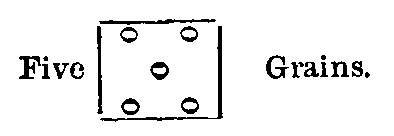
Each of the grain weights, in addition to the circles denoting their several weights, bears also the stamp of a crown. Care must be taken not to mistake this for one of the numerals. Besides these weights there are others marked
ss, which means half a scruple;
ss, meaning half a drachm; and
ss, meaning half an ounce. When there are ounces, drachms, or scruples, the number of them is shown by Roman figures, thus:—i. ii. iii. iv. v., &c., and prescriptions are written in this style.
663. Measures—Liquid
Liquid medicines are always measured by the following table:
60 minims are contained in 1 fluid drachm
8 fluid drachms are contained in 1 fluid ounce
20 fluid ounces are contained in a pint
8 pints are contained in 1 gallon
And the signs which distinguish each are as follows:
c a gallon
o a pint
fl. a fluid ounce
fl. a fluid drachm
m a minim, or drop
Formerly drops used to be ordered, but as the size of a drop must necessarily vary, minims are always directed to be employed now for any particular medicine, although for such medicines as oil of cloves, essence of ginger, &c., drops are frequently ordered.
664. Specific Measuring Vessels
In order that medicines may be measured accurately, there are graduated glass vessels for measuring ounces, drachms, and minims.
665. Approximate Measures
When proper measures are not at hand, it is necessary to adopt some other method of determining the quantities required, and therefore the following table has been drawn up for that purpose:
A tumbler usually contains about 10 ounces
A cup usually contains about 6 ounces
A wineglass usually contains about 2 ounces
A tablespoon usually contains about 4 drachms
A dessertspoon usually contains about 2 drachms
A teaspoon usually contains about 1 drachm
These quantities refer to ordinary sized spoons and vessels. Some cups hold half as much more, and some tablespoons contain six drachms. A medicine glass, which is graduated so as to show the number of spoonfuls it contains, should be kept in every family.
To-day, Man Lives in Pleasure, Wealth and Pride.
666. Process of Making Medicines
To powder substances
.—Place the substance in the mortar, and strike it
gently
with direct perpendicular blows of the pestle, until it separates into several pieces, then remove all but a small portion, which bruise gently at first, and rub the pestle round and round the mortar, observing that the circles described by the pestle should gradually decrease in diameter, and then increase again, because by this means every part of the powder is subjected to the process of pulverization. In powdering substances, making emulsions, and whenever using a mortar, the pestle should always travel
from the right to the left
.
667. Preparation and Assistance
Some substances require to be prepared in a particular manner before they can be powdered, or to be assisted by adding some other body. For example, camphor powders more easily when a few drops of spirits of wine are added to it; mace, nutmegs, and such oily aromatic substances are better for the addition of a little white sugar; resins and gum-resins should be powdered in a cold place, and if they are intended to be dissolved, a little fine well-washed white sand mixed with them assists the process of powdering. Tough roots, like gentian and calumba, should be cut into thin slices; and fibrous roots, like ginger, cut slanting, otherwise the powder will be full of small fibres. Vegetable matter, such as peppermint, loosestrife, senna, &c., requires to be dried before it is powdered.
668. Care of the Mortar
Be careful not to pound too hard in glass, porcelain, or Wedgwood-ware mortar; they are intended only for substances that pulverize easily, and for the purpose of mixing or incorporating medicines. Never use acids in a marble mortar, and be sure that you do not powder galls or any other astringent substances in any but a brass mortar.
669. Sifting
Sifting is frequently required for powdered substances, and this is usually done by employing a fine sieve, or tying the powder up in a piece of muslin, and striking it against the left hand over a piece of paper.
670. Filtering
Filtering is frequently required for the purpose of obtaining clear fluids, such as infusions, eye-washes, and other medicines; and it is, therefore, highly important to know how to perform this simple operation. First of all take a square piece of white blotting paper, and double it over so as to form an angular cup. Open out this filter paper very carefully, and having placed it in a funnel, moisten it with a little water. Then place the funnel in the neck of the bottle, and pour the liquid gently down the side of the paper, otherwise the fluid is apt to burst the paper.
671. Maceration
Maceration is another process that is frequently required to be performed in making up medicines, and consists simply in immersing the medicines in
cold water
or spirits for a certain time.
672. Digestion
Digestion resembles maceration, except that the process is assisted by a gentle heat. The ingredients are placed in a flask, such as salad oil is sold in, which should be fitted with a plug of tow or wood, and have a piece of wire twisted round the neck. The flask is held by means of the wire over the flame of a spirit lamp, or else placed in some sand warmed in an old iron saucepan over the fire, care being taken not to place more of the flask below the sand than the portion occupied by the ingredients.
673. Infusion
Infusion is one of the most frequent operations required in making up medicines, its object being to extract the aromatic and volatile principles of substances, that would be lost by decoction, or digestion; and to extract the soluble from the insoluble parts of bodies. Infusions may be made with cold water, in which case they are weaker, but more pleasant. The general method employed consists in slicing, bruising, or rasping the ingredients first, then placing them in a common jug (which should be as globular as possible), and pouring boiling water over them. Cover the jug with a cloth folded six or eight times, but if there be a lid to the jug so much the better. When the infusion has stood the time directed, hold a piece of
very coarse
linen over the spout, and pour the liquid through it into another jug.
To-morrow, Poor—or Life Itself Denied.
674. Decoction
Decoction, or boiling, is employed to extract the mucilaginous or gummy parts of substances, their bitter, astringent, or other qualities, and is nothing more than boiling the ingredients in a saucepan with the lid slightly raised. Be sure never to use an iron saucepan for astringent decoctions, such as oak-bark, galls, &c., as they will turn the saucepan black, and spoil the decoction. The enamelled saucepans are very useful for decoctions, but an excellent plan is to put the ingredients into a jar and boil the jar, thus preparing it by a water bath, as it is technically termed; or by using a common pipkin, which answers still better. No decoction should be allowed to boil for more than ten minutes.
675. Extracts
Extracts are made by evaporating the liquors obtained by infusion or decoction, but these can be bought much cheaper and better of chemists and druggists, and so can tinctures, confections, cerates and plasters, and syrups: but as every one is not always in the neighbourhood of druggists, we shall give recipes for those most generally useful, and the method of making them.
676. Precautions to be Observed in Giving Medicines.
677. Sex
Medicines for females should not be so strong as those for males, therefore it is advisable to reduce the doses about one-third.
678. Temperament
Persons of a phlegmatic temperament bear stimulants and purgatives better than those of a sanguine temperament, therefore the latter require smaller doses.
679. Habits
Purgatives never act so well upon persons accustomed to take them as upon those who are not, therefore it is better to change the form of purgative from pill to potion, powder to draught, or aromatic to saline. Purgatives should never be given when there is an irritable state of the bowels.
680. Use of Alcohol
Stimulants and narcotics never act so quickly upon persons accustomed to use spirits freely as upon those who live abstemiously.
681. Climate
The action of medicines is modified by climate and seasons. In summer, certain medicines act more powerfully than in winter, and the same person cannot bear the dose in July that he could in December.
682. General Health
Persons whose general health is good bear stronger doses than the debilitated and those who have suffered for a long time.
683. Idiosyncrasy
By this is meant a peculiar temperament or disposition not common to people generally. For example, some persons cannot take calomel in the smallest dose without being salivated, or rhubarb without having convulsions; others cannot take squills, opium, senna, &c.; and this peculiarity is called the patient's idiosyncrasy, therefore it is wrong to
insist
upon their taking these medicines.
684. Forms best suited for Administration
Fluids act quicker than solids, and powders sooner than pills.
685. Best Method of Preventing the Nauseous Taste of Medicines
Castor oil may be taken in milk, coffee, or spirit, such as brandy; but the best method of covering the nauseous flavour is to put a tablespoonful of strained orange juice in a wineglass, pour the castor oil into the centre of the juice, and then squeeze a few drops of lemon juice upon the top of the oil. The wineglass should first be dipped, rim downwards, into water, so that the interior may be wetted. Cod liver oil may be taken, like castor oil, in orange juice. Peppermint water neutralizes, to a great extent, the nauseous taste of Epsom salts; a strong solution of extract of liquorice, that of aloes; milk, that of cinchona bark; and cloves that of senna.
To-day, Lays Plans for Many Years to Come.
686. An Excellent Way to Prevent the Taste of Medicines
An excellent way to prevent the taste of medicines is to have the medicine in a glass, as usual, and a tumbler of water by the side of it; take the medicine, and retain it in the mouth, which should be kept closed, and if drinking the water be then commenced, the taste of the medicine is washed away. Even the bitterness of quinine and aloes may be prevented by this means. If the nostrils are firmly compressed by the thumb and finger of the left hand, while taking a nauseous draught, and so retained till the mouth has been washed out with water, the disagreeable taste of the medicine will be almost imperceptible.
687. Giving Medicines to Persons
Medicines should be given in such a manner that the effect of the first dose shall not have ceased when the next dose is given, therefore the intervals between the doses should be regulated accordingly.
688. Doses of Medicine for Different Ages
It must be plain to every one that children do not require such powerful medicine as adults or old people, and therefore it is desirable to have some fixed method of determining or regulating the administration of doses of medicine. Now let it be supposed that the dose for a full-grown person is
one drachm
, then the following proportions will be suitable for the various ages given; keeping in view other circumstances, such as sex, temperament, habits, climate, state of
general health
, and idiosyncrasy.
Age Proportion Proportionate Dose
7 weeks one-fifteenth or grains 4
7 months one-twelfth or grains 5
under 2 years one-eighth or grains 7.5
under 3 years one-sixth or grains 10
under 4 years one-fourth or grains 15
under 7 years one-third or scruple 1
under 14 years one-half or drachm 1/2
under 20 years two-fifths or scruples 2
above 21 years the full dose
above 65 years the inverse gradation
689. Drugs, with their Properties and Doses
The various drugs have been arranged according to their properties, and the doses of each have been given. Many, however, have been necessarily omitted from each class, because they cannot be employed except by a medical man. The
doses
are meant for adults.
690. Classes of Drugs
Medicines have been divided into four grand classes
General stimulants;
Local stimulants;
Chemical remedies;
Mechanical remedies.
691. General Stimulants
General stimulants are subdivided into two classes, diffusible and permanent stimulants: the first comprising narcotics and antispasmodics, and the second tonics and astringents.
692. Narcotics
Narcotics are medicines which stupefy and diminish the activity of the nervous system. Given in small doses, they generally act as stimulants, but an increased dose produces a sedative effect. Under this head are included alcohol, camphor, ether, the hop, and opium.
693. Alcohol
Alcohol, or rectified spirit, is a very powerful stimulant, and is never used as a remedy without being diluted to the degree called proof spirit; and even then it is seldom used internally. It is
used externally
in restraining bleeding, when there is not any vessel of importance wounded. It is also used as a lotion to burns, and is applied by dipping a piece of lint into the spirit, and laying it over the part. Freely diluted (one part to eighteen) with water, it forms a useful eye-wash in the last stage of ophthalmia.
Used internally
, it acts as a very useful stimulant when diluted and taken moderately, increasing the general excitement, and giving energy to the muscular fibres; hence it becomes very useful in certain cases of debility, especially in habits disposed to create acidity; and in the low stage of typhus fevers.
Dose
.—It is impossible to fix anything like a dose for this remedy, as much will depend upon the individual; but diluted with water and sweetened with sugar, from half an ounce to two ounces may be given three or four times a day. In cases of extreme debility, however, much will depend upon the disease.
Caution
.—Remember that alcohol is an irritant
poison
, and that daily indulgence in its use originates dyspepsia, or indigestion, and many other serious complaints. Of all kinds of spirits the best as a tonic and stomachic is
brandy
.
To-morrow, Sinks into the Silent Tomb.
694. Camphor
Camphor is not a very steady stimulant, as its effect is transitory; but in large doses it acts as a narcotic, abating pain and inducing sleep. In moderate doses it operates as a diaphoretic, diuretic, antispasmodic, increasing the heat of the body, allaying irritation and spasm.
It is
used externally
as a liniment when dissolved in oil, alcohol, or acetic acid, being employed to allay rheumatic pains; and it is also useful as an embrocation in sprains, bruises, chilblains, and, when combined with opium, it has been advantageously employed in flatulent colic, and severe diarrhœa, being rubbed over the bowels.
When reduced to a fine powder
, by the addition of a little spirit of wine and friction, it is very useful as a local stimulant to indolent ulcers, especially when they discharge a foul kind of matter; a pinch is taken between the finger and thumb, and sprinkled into the ulcer, which is then dressed as usual.
When dissolved in oil of turpentine
, a few drops placed in a hollow tooth and covered with jeweller's wool, or scraped lint, give almost instant relief to toothache.
Used internally
, it is apt to excite nausea, and even vomiting, especially when given in the solid form.
As a stimulant
it is of great service in all low fevers, malignant measles, malignant sore throat, and confluent small-pox; and when combined with opium and bark, it is extremely useful in checking the progress of malignant ulcers, and gangrene.
As a narcotic
it is very useful, because it allays pain and irritation, without increasing the pulse very much.
When powdered and sprinkled
upon the surface of a blister, it prevents the cantharides acting in a peculiar and painful manner upon the bladder.
Combined with senna
, it increases its purgative properties; and it is also used to correct the nausea produced by squills, and the irritating effects of drastic purgatives and mezereon.
Dose
, from four grains to half a scruple, repeated at short intervals when used in small doses, and long intervals when employed in large doses.
Doses of the various preparations
.—Camphor mixture, from half an ounce to three ounces; compound tincture of camphor (
paregoric elixir
), from fifteen minims to two drachms.
Caution
.—When given in an overdose it acts as a poison, producing vomiting, giddiness, delirium, convulsions, and sometimes death. Opium is the best antidote for camphor, whether in excess or taken as a poison.
Mode of exhibition
.—It may be rubbed up with almond emulsion, or mucilage, or the yolk of eggs, and by this means suspended in water, or combined with chloroform as a mixture, in which form it is a valuable stimulant in cholera and other diseases. (
See
Mixtures,
556
-
564
).
695. Ether
Ether is a diffusible stimulant, narcotic and antispasmodic.
696. Sulphuric Ether
Sulphuric Ether is used
externally
both as a stimulant and a refrigerant. In the former case its evaporation is prevented by covering a rag moistened with it with oiled silk, in order to relieve headache; and in the latter case it is allowed to evaporate, and thus produce coldness: hence it is applied over scalded surfaces by means of rags dipped in it.
As a local application
, it has been found to afford almost instant relief in earache, when combined with almond oil, and dropped into the ear.
It is used
internally
as a stimulant and narcotic in low fevers and cases of great exhaustion.
Dose
, from fifteen minims to half a drachm, repeated at short intervals, as its effects soon pass off. Give in a little camphor julep, or water.
697. Nitric Ether
Nitric Ether is a refrigerant, diuretic, and antispasmodic, well known as "
sweet spirit of nitre
."
Used externally
, its evaporation relieves headache, and it is sometimes applied to burns. It is used
internally
to relieve nausea, flatulence, and thirst in fevers; also as a diuretic.
Dose
, from ten minims to one drachm. The smaller dose taken in a little warm water or gruel is useful as a sudorific in cases of cold and chill, to induce and promote the proper action of the skin which has been checked. If a larger dose be taken, it acts as a diuretic and not as a sudorific, and so fails to produce the desired effect.
To-day, His Food is Dressed in Dainty Forms.
698. Compound Spirit of Sulphuric Ether
Compound Spirit of Sulphuric Ether is a very useful stimulant, narcotic, and antispasmodic.
Used internally
in cases of great exhaustion, attended with irritability.
Dose
, from half a drachm to two drachms, in camphor julep. When combined with laudanum, it prevents the nauseating effects of the opium, and acts more beneficially as a narcotic.
699. The Hop
The Hop is a narcotic, tonic, and diuretic; it reduces the frequency of the pulse, and does not affect the head, like most anodynes.
Used externally
, it acts as an anodyne and discutient, and is useful as a fomentation for painful tumours, rheumatic pains in the joints, and severe contusions. A pillow stuffed with hops acts as a narcotic. When the powder is mixed with lard, it acts as an anodyne dressing in painful ulcers.
Dose
, of the
extract
, from five grains to one scruple; of the
tincture
, from half a drachm to two drachms; of the
powder
, from three! grains to one scruple; of the
infusion
, half an ounce to one and a half ounce.
700. Opium
Opium is a stimulant, narcotic, and anodyne.
Used externally
it acts almost as well as when taken into the stomach, and without affecting the head or causing nausea. Applied to irritable ulcers in the form of tincture, it promotes their cure, and allays pain. Cloths dipped in a strong solution, and applied over painful bruises, tumours, or inflamed joints, allay pain. A small piece of solid opium stuffed into a hollow tooth relieves toothache. A weak solution of opium forms a valuable collyrium in ophthalmia. Two drops of the wine of opium dropped into the eye acts as an excellent stimulant in bloodshot eye; or after long-continued inflammation, it is useful in strengthening the eye. Applied as a liniment, in combination with ammonia and oil, or with camphorated spirit, it relieves muscular pain. When combined with oil of turpentine, it is useful as a liniment in spasmodic colic.
Used internally
, it acts as a very powerful stimulant: then as a sedative, and finally as an anodyne and narcotic, allaying pain in the most extraordinary manner, by acting directly upon the nervous system. In acute rheumatism it is a most excellent medicine when combined with calomel and tartrate of antimony; but its exhibition requires the judicious care of a medical man.
Doses of the various preparations.
—.
Confection of opium
, from five grains to half a drachm;
extract of opium
, from one to five grains (this is a valuable form, as it does not produce so much after derangement of the nervous system as solid opium);
pills of soap and opium
, from five to ten grains;
compound ipecacuanha powder
("Dover's Powder"), from ten to fifteen grains;
compound kino powder
, from five to fifteen grains;
wine of opium
, from ten minims to one drachm.
Caution
.—Opium is a powerful
poison
when taken in too large a quantity (
See
Poisons
,
pars
.
1340
-
1367
), and thus should be used with extreme caution. It is on this account that we have omitted some of its preparations. The best antidote for opium is camphor.
701. Antispasmodics
Antispasmodics are medicines which possess the power of overcoming the spasms of the muscles, or allaying any severe pain which is not attended by inflammation. The class includes a great many, but the most safe and serviceable are ammonia, assafœtida, galbanum, valerian, bark, ether, camphor, opium, and chloroform; with the minerals, oxide of zinc and calomel.
702. Ammonia
Ammonia, or Sal Volatile, is an antispasmodic antacid, stimulant and diaphoretic.
Used externally
, combined with oil, it forms a cheap and useful liniment, but it should be dissolved in
proof
spirit before the oil is added. One part of this salt, and three parts of extract of belladonna, mixed and spread upon leather, makes an excellent plaster for relieving rheumatic pains. As a local stimulant it is well known, as regards its effects in hysterics, faintness, and lassitude, when applied to the nose, as common smelling salts.
It is used
internally
as an adjunct to infusion of gentian in dyspepsia or indigestion, and in moderate doses in gout.
Dose
, from five to fifteen grains.
Caution
.—Overdoses act as a narcotic and irritant poison.
To-morrow, is Himself a Feast for Worms.
703. Bicarbonate of Ammonia
Bicarbonate of Ammonia is used internally the same as
sal volatile
.
Dose
, from six to twelve grains. It is frequently combined with Epsom salts.
704. Solution of Sesquicarbonate of Ammonia
Solution of Sesquicarbonate of Ammonia, used the same as
sal volatile
.
Dose
, from half a drachm to one drachm, combined with some milky fluid, like almond emulsion.
705. Asafœtida
Asafœtida is an antispasmodic, expectorant, excitant, and anthelmintic.
Used internally
, it is extremely useful in dyspepsia, flatulent colic, hysteria, and nervous diseases; and where there are no inflammatory symptoms, it is an excellent remedy in hooping cough and asthma.
Used locally
as an enema, it is useful in flatulent colic, and convulsions that come on through teething.
Doses of various preparations
.—
Solid gum
, from five to ten grains as pills;
mixture
, from half an ounce to one ounce;
tincture
, from fifteen minims to one drachm;
ammoniated tincture
, from twenty minims to one drachm.
Caution
. —Never give this drug when inflammation exists.
706. Galbanum
Galbanum is stimulant, antispasmodic, expectorant, and deobstruent.
Used externally
, it assists in dispelling tumours when spread upon indolent leather as a plaster, and is useful in weakness of the legs from rickets, being applied as a plaster to the loins.
Employed internally
, it is useful in chronic or old-standing rheumatism and hysteria.
Doses of preparations
.—Of the
gum
, from ten to fifteen grains as pills;
tincture
, from fifteen minims to one drachm. It may be made into an emulsion with mucilage and water.
707. Valerian
Valerian is a powerful antispasmodic, tonic, and excitant, acting chiefly on the nervous centres.
Used internally
, it is employed in hysteria, nervous languors, and spasmodic complaints generally. It is useful in low fevers.
Doses of various preparations
. —
Powder
, from ten grains to half a drachm, three or four times a day;
tincture
, from two to four drachms;
ammoniated tincture
, from one to two drachms;
infusion
, from two to three ounces, or more.
708. Peruvian Bark
Bark, or, as it is commonly called, Peruvian bark, is an antispasmodic, tonic, astringent, and stomachic.
Used externally
, it is an excellent detergent for foul ulcers, and those that heal slowly.
Used internally
, it is particularly valuable in intermittent fever or ague, malignant measles, dysentery, diarrhœa, intermittent rheumatism, St. Vitus's dance, indigestion, nervous affections, malignant sore throat, and erysipelas; its use being indicated in all cases of debility.
Doses of its preparations
.—
Powder
, from five grains to two drachms, mixed in wine, water, milk, syrup, or solution of liquorice;
infusion
, from one to three ounces;
decoction
, from one to three ounces;
tincture
and
compound tincture
, each from one to three drachms.
Caution
.—If it causes oppression at the stomach, combine it with an aromatic; if it causes vomiting, give it in wine or soda water; if it purges, give opium; and if it constipates give rhubarb.
709. Sulphuric Ether
Sulphuric Ether is given internally as an antispasmodic in difficult breathing and spasmodic asthma; also in hysteria, cramp of the stomach, hiccough, locked jaw, and cholera. It is useful in checking sea-sickness.
Dose
, from twenty minims to one drachm.
Caution
.—An overdose produces apoplectic symptoms.
To-day He's Clad in Gaudy, Rich Array
710. Camphor (2)
Camphor is given internally as an antispasmodic in hysteria, cramp in the stomach, flatulent colic, and St. Vitus's dance.
Dose
, from two to twenty grains.
711. Opium (2)
Opium is employed internally in spasmodic affections, such as cholera, spasmodic asthma, whooping cough, flatulent colic, and St. Vitus's dance.
Dose
, from one-sixth of a grain to two grains of the solid opium, according to the disease.
712. Oxide of Zinc
Oxide of Zinc is an antispasmodic, astringent, and tonic.
Used externally
, as an ointment, it forms an excellent astringent in affections of the eyelids, arising from relaxation; or as a powder, it is an excellent detergent for unhealthy ulcers.
Used internally
, it has proved efficacious in St. Vitus's dance, and some other spasmodic affections.
Dose
, from one to six grains twice a day.
713. Calomel
Calomel is an antispasmodic, alterative deobstruent, purgative, and errhine.
Used internally
, combined with opium, it acts as an antispasmodic in locked jaw, cholera, and many other spasmodic affections. As an alterative and deobstruent, it has been found useful in leprosy and itch, when combined with antimonials and guaiacum, and in enlargement of the liver and glandular affections. It acts beneficially in dropsies, by producing watery motions. In typhus it is of great benefit when combined with antimonials; and it may be given as a purgative in almost any disease, provided there is not any inflammation of the bowels, irritability of the system, or great debility.
Dose
, as a deobstruent and alterative, from one to five grains, daily; as a cathartic, from five to fifteen grains; to produce ptyalism, or salivation, from one to two grains, in a pill, with a quarter of a grain of opium, night and morning.
Caution
.—When taking calomel, exposure to cold or dampness should be guarded against, as such an imprudence would bring out an eruption of the skin, attended with fever. When this does occur, leave off the calomel, and give bark, wine, and purgatives; take a warm bath twice a day, and powder the surface of the body with powdered starch.
714. Tonics
Tonics are given to improve the tone of the system, and restore the natural energies and general strength of the body. They consist of bark, quassia, gentian, camomile, wormwood, and angostura bark.
715. Quassia
Quassia is a simple tonic, and can be used with safety by any one, as it does not increase the animal heat, or quicken the circulation.
Used internally
, in the form of infusion, it has been found of great benefit in indigestion and nervous irritability, and is useful after bilious fevers and diarrhœa.
Dose
, of the
infusion
, from one and a half to two ounces, three times a day.
716. Gentian
Gentian is an excellent tonic and stomachic; but when given in large doses, it acts as an aperient.
It is
used internally
in all cases of general debility, and when combined with bark is used in intermittent fevers. It has also been employed in indigestion, and it is sometimes used, combined with sal volatile, in that disease; but, at other times alone, in the form of infusion. After diarrhœa, it proves a useful tonic. Its infusion is sometimes applied
externally
to foul ulcers.
Dose
, of the
infusion
, one and a half to two ounces; of the
tincture
, one to four drachms; of the
extract
, from ten to thirty grains.
717. Camomile
The flowers of the camomile are tonic, slightly anodyne, antispasmodic, and emetic.
They are
used externally
as fomentations, in colic, faceache, and tumours, and to unhealthy ulcers.
They are
used internally
in the form of infusion, with carbonate of soda, ginger, and other stomachic remedies, in dyspepsia, flatulent colic, debility following dysentery and gout. Warm infusion of the flowers acts as an emetic; and the powdered flowers are sometimes combined with opium or kino, and given in intermittent fevers.
Dose
, of the
powdered
flowers, from ten grains to one drachm, twice or thrice a day; of the
infusion
, from one to two ounces, as a tonic, three times a day: and from six ounces to one pint as an emetic; of the
extract
, from five to twenty grains.
To-morrow, Shrouded for a Bed of Clay.
718. Wormwood
Wormwood is a tonic and anthelmintic.
It is
used externally
as a discutient and antiseptic.
It is used
internally
in long-standing cases of dyspepsia, in the form of infusion, with or without aromatics. It has also been used in intermittents.
Dose
, of the
infusion
, from one to two ounces, three times a day; of the
powder
, from one to two scruples.
719. Angostura Bark
Angostura Bark, or Cusparia, is a tonic and stimulant. It expels flatulence, increases the appetite, and produces a grateful warmth in the stomach.
It is
used internally
in intermittent fevers, dyspepsia, hysteria, and all cases of debility, where a stimulating tonic is desirable, particularly after bilious diarrhœa.
Dose
, of the
powder
, from ten to fifteen grains, combined with cinnamon powder, magnesia, or rhubarb; of the
extract
, from three to ten grains; of the
infusion
, from one to two ounces.
Caution
. —This drug should never be given in inflammatory diseases or hectic fever.
720. Astringents
Astringents are medicines given for the purpose of diminishing excessive discharges, and to act indirectly as tonics. This class includes catechu, kino, oak bark, log wood, rose leaves, chalk, and white vitriol.
721. Catechu
Catechu is a most valuable astringent.
It is
used externally
, when powdered, to promote the contraction of flabby ulcers. As a local astringent it is useful in relaxed uvula, a small piece being dissolved in the mouth; small, spotty ulcerations of the mouth and throat, and bleeding gums, and for these two affections it is used in the form of infusion to wash the parts.
It is
given internally
in diarrhœa, dysentery, and hemorrhage from the bowels.
Dose
, of the
infusion
, from one to three ounces; of the
tincture
, from one to four drachms; of the
powder
, from ten to thirty grains.
Caution
.—It must not be given with soda or any alkali; nor metallic salts, albumen, or gelatine, as its property is destroyed by this combination.
722. Kino
Kino is a powerful astringent.
It is
used externally
to ulcers, to give tone to them when flabby, and discharging foul and thin matter.
It is
used internally
in the same diseases as catechu.
Dose
, of the powder, from ten to fifteen grains; of the
tincture
, from one to two drachms; of the
compound powder
, from ten to twenty grains; of the
infusion
, from a half to one and a half ounce.
Caution
.—Kino is used in combination with calomel, when salivation is intended, to prevent, by its astringency, the action of the calomel on the bowels, and thereby insure its affecting the constitution.— (See
Catechu
).
723. Oak Bark
Oak Bark is an astringent and tonic.
It is
used externally
in the form of decoction, to restrain bleeding from lacerated surfaces. As a local astringent, it is used in the form of decoction, as a gargle in sore throat and relaxed uvula.
It is
used internally
in the same diseases as catechu, and when combined with aromatics and bitters, in intermittent fevers.
Dose
of the
powder
, from fifteen to thirty grains; of the
decoction
, from two to eight drachms.
724. Logwood
Logwood is not a very satisfactory astringent.
It is
used internally
in diarrhœa, the last stage of dysentery, and a lax state of the intestines.
Dose
, of the
extract
, from ten grains to one drachm; of the
decoction
from one to three ounces, three or four times a day.
725. Rose Leaves
Rose Leaves are stringent and tonic.
They are
used internally
in spitting of blood, hemorrhage from the stomach, intestines, &c., as a gargle for sore throat, and for the night sweats of consumption. The infusion is frequently used as a tonic with diluted sulphuric acid (oil of vitriol), after low fevers, or in combination with Epsom salts and sulphuric acid in certain states of the bowels.
Dose
of
infusion
, from two to four ounces.
To-day, Enjoys his Halls, Built to his Mind.
726. Chalk
Chalk, when prepared by washing, becomes an astringent as well as antacid.
It is
used internally
in diarrhœa, in the form of mixture, and
externally
as an application to burns, scalds, and excoriations.
Dose
of the
mixture
, from one to two ounces.
727. White Vitriol
White Vitriol, or Sulphate of Zinc, is an astringent, tonic, and emetic.
It is
used externally
as a collyrium for ophthalmia (See
Domestic Pharmacopœia,
), and as a detergent for scrofulous ulcers, in the proportion of three grains of the salt to one ounce of water.
It is
used internally
in indigestion, and many other diseases;
but it should not be given unless ordered by a medical man, as it is a poison.
728. Local Stimulants
Local stimulants comprise emetics, cathartics, diuretics, diaphoretics, expectorants, sialogogues, errhines, and epispastics.
729. Emetics
Emetics are medicines given for the purpose of causing vomiting, as in cases of poisoning. They consist of ipecacuanha, camomile, antimony, copper, zinc, and several others.
730. Ipecacuanha
Ipecacuanha is an emetic, diaphoretic, and expectorant.
It is
used internally
to excite vomiting, in doses of from ten to twenty grains of the powder, or one to one and a half ounce of the infusion, every half hour until vomiting takes place. To make it act well and easily, the patient should drink half pints of warm water after each dose of the infusion. As a diaphoretic, it should be given in doses of three grains, mixed with some soft substance, such as crumbs of bread, and repeated every four hours.
Dose
of the
wine,
from twenty minims to one drachm as a diaphoretic, and from one drachm to one and a half ounces as an emetic.
Caution.
—Do not give more than the doses named above, because, although a safe emetic, yet it is an acrid narcotic poison.
731. Mustard
Mustard is too well known to require describing. It is an emetic, diuretic, stimulant, and rubefacient.
It is
used externally
as a poultice. Mustard poultices are made of the powder, bread crumbs, and water; or of one part of mustard to two of flour; or, especially for children, of linseed meal, mixed with a little of the powder, or having some of the powder slightly sprinkled on the surface. Sometimes a little vinegar is added under the idea that it increases the strength of the poultice, but this is not necessary. In all cases where a stimulant is required, such as sore throats, rheumatic pains in the joints, cholera, cramps in the extremities, diarrhœa, and many other diseases. When applied it should not he left on too long, as it is apt to cause ulceration of the part. From ten to thirty minutes is quite long enough.
When
used internally
as an emetic, a large teaspoonful mixed with a tumbler of warm water generally operates quickly and safely, frequently when other emetics have failed. In dropsy it is sometimes given in the form of whey, which is made by boiling half an ounce of the bruised seeds in a pint of milk, and straining off the curd.
From three to four ounces of this is to be taken for a dose three times a day.
732. Cathartics
Cathartics are divided into laxatives and purgatives. Manna, tamarinds, castor oil, sulphur, and magnesia are
laxatives
; senna, rhubarb, jalap, colocynth, buckthorn, aloes, cream of tartar, scammony, calomel, Epsom salts, Glauber's salts, sulphate of potash, and Venice turpentine are
purgatives
.
733. Manna
Manna is a very gentle laxative, and therefore used for children and delicate persons.
Dose for children
, from one to two drachms; and for
adults
, from one to two ounces, combined with rhubarb and cinnamon water.
734. Tamarinds
Tamarinds are generally laxative and refrigerant. As it is agreeable, this medicine will generally be eaten by children when they will not take other medicines.
Dose
, from half to one ounce. As a refrigerant beverage in fevers it is extremely grateful.
To-morrow, in a Coffin is Confined.
735. Castor Oil
Castor Oil is a most valuable medicine, as it generally operates quickly and mildly.
It is
used externally,
combined with citron ointment, as a topical application in common leprosy.
It is
used internally
as an ordinary purgative for infants, as a laxative for adults, and in diarrhœa and dysentery. In colic it is very useful and safe; and also after delivery.
Dose
for
infants,
from forty drops to two drachms; for
adults,
from half an ounce to one and a half ounces.
736. Sulphur
Sublimed sulphur is laxative and diaphoretic.
It is
used externally
in skin diseases, especially itch, both in the form of ointment and as a vapour bath.
It is
used internally
in hemorrhoids, combined with magnesia, as a laxative for children, and as a diaphoretic in rheumatism.
Dose,
from one scruple to two drachms, mixed in milk or with treacle. When combined with an equal proportion of cream of tartar, it acts as a purgative.
737. Magnesia
Calcined magnesia
possesses the same properties as the carbonate.
Dose,
from ten to thirty grains, in milk or water.
Carbonate of magnesia
is an antacid and laxative, and is very useful for children when teething, and for heartburn in adults.
Dose,
from a half to two drachms, in water or milk.
Fluid Magnesia
is a useful preparation by whose use is avoided the grittiness that is inseparable from magnesia when taken in the form of powder.
738. Senna
Senna is a purgative, but is apt to gripe when given alone; therefore it is combined with some aromatic, such as cloves or ginger, and the infusion should be made with
cold
instead of hot water. It usually acts in about four hours, but its action should be assisted by drinking warm fluids.
Dose,
of the
confection,
commonly called
"lenitive electuary,"
from one to three or four drachma at bedtime; of the
infusion,
from one to two ounces; of the
tincture,
from one to two drachms; of the
syrup
(used for children), from one drachm to one ounce.
Caution.
—Do not give senna, in any form except confection, in hæmorrhoids, and never in irritability of the intestines.
739. Rhubarb
Rhubarb is a purgative, astringent and stomachic.
It is
used externally
in the form of powder to ulcers, to promote a healthy action.
It is given
internally
in diarrhœa, dyspepsia, and a debilitated state of the bowels. Combined with a mild preparation of calomel, it forms an excellent purgative for children.
Dose,
of the
infusion,
from one to two ounces; of the
powder
, from one scruple to half a drachm as a purgative, and from six to ten grains as a stomachic; of the
tincture
and
compound tincture,
from one to four drachms; of the
compound pill,
from ten to twenty grains.
740. Jalap
Jalap is a powerful cathartic and hydrogogue, and is therefore apt to gripe.
Dose,
of the
powder,
from ten to thirty grains, combined with a drop or two of aromatic oil; of the
compound powder,
from fifteen to forty grains; of the
tincture,
from one to three drachms; of the
extract,
from ten to twenty grains. The watery extract is better than the alcoholic.
741. Colocynth
Colocynth is a powerful drastic cathartic, and should never be given alone, unless ordered by a medical man, as its action is too violent for some constitutions.
Dose,
of the
extract,
from five to fifteen grains; of the
compound extract,
from five to fifteen grains; of the
compound colocynth pill,
the best of all its preparations, from ten to twenty grains.
742. Buckthorn
Buckthorn is a brisk purgative for children in the form of syrup.
Dose
of the
syrup
, from one to six drachms.
743. Aloes
Aloes is a purgative and cathartic in large, and tonic in smaller doses.
Dose,
of
powder,
from two to ten grains, combined with soap, bitter extracts, or other purgative medicines, and given in the form of pills; of the
compound pill,
from five to twenty grains; of the
pill of aloes
and
myrrh
from five to twenty grains; of the
tincture
, from four drachms to one ounce; of the
compound tincture
, from one to four drachms; of the
extract
, from six to ten grains; of the
compound decoction
, from four drachms to two ounces.
To-day, He Floats on Honour's Lofty Wave.
744. Cream of Tartar
Cream of Tartar is a purgative and refrigerant. It is
used internally
in dropsy, especially of the belly, in doses of from one scruple to one drachm. As a refrigerant drink it is dissolved in hot water, and sweetened with sugar, and is used in febrile diseases, care being taken not to allow it to rest too much upon the bowels.
Dose
, as a
purgative
, from two to four drachms, as a
hydrogogue
, from four to six drachms, mixed with honey or treacle.
Caution.
—Its use should be followed by tonics, especially gentian and angostura.
745. Scammony
Scammony is a drastic purgative, generally acting quickly and powerfully; sometimes producing nausea, and even vomiting, and being very apt to gripe.
It is
used internally
, to produce watery evacuations in dropsy, to remove intestinal worms, and correct the slimy motions of children.
Dose
, of the
powder
, from five to sixteen grains, given in liquorice water, treacle, or honey; of the
confection
, from twenty to thirty grains.
Caution.
—Do not give it in an irritable or inflamed state of the bowels.
746. Epsom Salts
Epsom Salts is a purgative and diuretic. This medicine generally operates quickly, and therefore is extremely useful in acute diseases. It is found to be beneficial in dyspepsia when combined with infusion of gentian and a little ginger. It forms an excellent enema with olive oil.
Dose
, from a half to two ounces, dissolved in warm tea or water. Infusion of roses partially covers its taste and assists its action.
Note
, that with regard to Epsom salts, the
larger in reason
is the amount of water in which they are taken, the
smaller
the dose of salts required: thus, half an ounce properly dissolved may be made a strong dose. The action and efficacy of Epsom salts may be greatly increased by adding one grain of tartar emetic to a dose of salts.
747. Glauber's Salt
Glauber's Salt is a very good purgative.
Dose
, from a half to two ounces, dissolved in warm water
748. Sulphate of Potash
Sulphate of Potash is a cathartic and deobstruent. It is
used internally
, combined with aloes or rhubarb, in obstructions of the bowels, and is an excellent saline purgative in dyspepsia and jaundice.
Dose
, from ten grains to one drachm.
749. Venice Turpentine
Venice Turpentine is cathartic, diuretic, stimulant, and anthelmintic.
It is
used externally
as a rubefacient, and is given
internally
in flatulent colic, in tapeworm, rheumatism, and other diseases.
Dose
, as a
diuretic
, from ten grains to one drachm; as a
cathartic
, from ten to twelve drachms; as an
anthelmintic
, from one to two ounces every eight hours, till the worm be ejected.
750. Diuretics
Diuretics are medicines which promote an increased secretion of urine. They consist of nitre, acetate of potassa, squills, juniper, oil of turpentine, and others, vegetable and mineral.
751. Nitre
Nitre is a diuretic and refrigerant.
It is
used externally
as a detergent when dissolved in water, and as a lotion to inflamed and painful rheumatic joints.
It is given
internally
in doses of from ten grains to half a drachm, or even one drachm; in spitting blood it is given in one drachm doses with great benefit. It is beneficial in sore throat, a few grains being allowed to dissolve in the mouth.
752. Acetate of Potassa
Acetate of Potassa is diuretic and cathartic.
It is given
internally
as a diuretic, in combination with infusion of quassia; in dropsy, in doses of from one scruple to one drachm, every three or four hours.
Dose
, as a
cathartic
, from two to three drachms.
753. Squills
Squills is diuretic and expectorant when given in small doses; and emetic and purgative when given in large doses.
It is
used internally
in dropsy, in combination with calomel and opium; in asthma, with ammoniacum; in catarrh, in the form of oxymel.
Dose
, of the
dried bulb powdered
, from one to two grains every six hours; of the
compound pill
, from ten to fifteen grains; of the
tincture
, from ten minims to half a drachm; of the
oxymel
, from a half to two drachms; of the
vinegar
, from twenty minims to two drachms.
To-morrow, Leaves his Title for a Grave.
754. Juniper
Juniper is diuretic and stomachic.
It is given
internally
in dropsy.
Dose
, of the
infusion
, from two to three ounces every four hours, of the
oil
, from one to five minims.
755. Oil of Turpentine
Oil of Turpentine is a diuretic, anthelmintic, and rubefacient.
It is
used externally
in flatulent colic, sprinkled over flannels dipped in hot water and wrung out dry.
It is
used internally
in the same diseases as
Venice turpentine
.
Dose
, from five minims to two drachms.
756. Diaphoretics
Diaphoretics are medicines given to increase the secretion from the skin by sweating. They comprise acetate of ammonia, calomel, antimony, opium, camphor, sarsaparilla.
757. Solution of Acetate of Ammonia
Solution of Acetate of Ammonia is a most useful diaphoretic.
It is
used externally
as a discutient, as a lotion to inflamed milk-breasts, as an eye-wash, and a lotion in scald head.
It is given
internally
to promote perspiration in febrile diseases, which it does most effectually, especially when combined with camphor mixture. This is the article so frequently met with in prescriptions, and called spirits of mindercrus.
Dose
, from a half to one and a half ounces every three or four hours.
758. Antimony.—Tartar emetic
Tartar emetic
is diaphoretic, emetic, expectorant, alterative, and rubefacient.
It is
used externally
as an irritant in white swellings and deep-seated inflammations, in the form of an ointment.
It is given
internally
in pleurisy, bilious fevers, and many other diseases, but its exhibition requires the skill of a medical man, to watch its effects.
Dose
, from one-sixth of a grain to four grains.
Caution
. —It is a
poison
, and therefore requires great care in its administration.
759. Antimonial Powder
Antimonial Powder is a diaphoretic, emetic, and alterative.
It is given
internally
, in febrile diseases, to produce determination to the skin, and is useful in rheumatism, when combined with opium or calomel.
Dose
, from three to ten grains every four hours, taking plenty of warm fluids between each dose.
760. Sarsiparilla
Sarsiparilla is diaphoretic, alterative, diuretic, and tonic.
It is given
internally
in cutaneous diseases, old-standing rheumatism, scrofula, and debility.
Dose
, of the
decoction
, from four to eight ounces; of the
compound decoction
, from four to eight ounces; of the
extract
, from five grains to one drachm.
761. Expectorants
Expectorants are medicines given to promote the secretion from the windpipe, &c. They consist of antimony, ipecacuanha, squills, ammoniacum, and tolu.
762. Ammoniacum
Ammoniacum is an expectorant, antispasmodic, diuretic, and deobstruent.
It is
used externally
as a discutient, and is given
internally
, with great benefit in asthma, hysteria, and chronic catarrh.
Dose
, from ten to twenty grains.
763. Tolu
Tolu is an excellent expectorant, when there are no inflammatory symptoms.
It is given
internally
in asthma and chronic catarrh.
Dose
, of the
balsam
, from five to thirty grains, combined with mucilage and suspended in water; of the
tincture
, from a half to one drachm; of the
syrup
, from a half to four drachms.
764. Sialogogues
These are given to increase the flow of saliva or spittle. They consist of ginger and calomel, pellitory of Spain, tobacco, the acids, and some others.
765. Ginger
Ginger ia a sialogogue, carminative, and stimulant.
It is
used internally
in flatulent colic, dyspepsia, and to prevent the griping of medicines. When chewed, it acts as a sialogogue, and is therefore useful in relaxed uvula.
Dose
, from ten to twenty grains of the
powder
; of the
tincture
, from ten minims to one drachm.
To-day, his Beauteous Visage we Extol.
766. Epispastics and Rubefacients
These are remedies which are applied to blister and cause redness of the surface. They consist of cantharides, ammonia, Burgundy pitch, and mustard.
767. Cantharides, or Spanish flies
Cantharides, or Spanish flies, when used internally, are diuretic and stimulant; and epispastic and rubefacient when applied externally.
Mode of application.
—A portion of the blistering plaster is spread with the thumb upon brown paper, linen, or leather, to the size required; its surface then
slightly
moistened with olive oil and sprinkled with camphor, and the plaster applied by a
light
bandage: or it is spread on adhesive plaster, and attached to the skin by the adhesive margin of the plaster.
Caution.
—If a blister is to be applied to the head, shave it at least ten hours before it is put on; it is better to place a thin piece of gauze, wetted with vinegar, between the skin and the blister. If a distressing feeling be experienced about the bladder, give warm and copious draughts of linseed tea, milk, or decoction of quince seeds, and apply warm fomentations of milk and water to the blistered surface. The
period required
for a
blister
to remain on varies from eight to ten hours for adults, and from twenty minutes to two hours for children: as soon as it is removed, if the blister is not raised, apply a "spongio-piline" poultice, and it will then rise properly. When it is required to act as a rubefacient, the blister should remain on from one to three hours for adults, and from fifteen to forty minutes for children.
To dress a blister.
—Cut the bag of cuticle containing the scrum at the lowest part, by snipping it with the scissors, so as to form an opening like this—
V
; and then apply a piece of calico, spread with spermaceti or some other dressing. Such is the ordinary method; but a much better and more expeditious plan, and one that prevents all pain and inconvenience in the healing, is, after cutting the blister as directed above, to immediately cover it with a warm bread and water poultice for about an hour and a half, and on the removal of the poultice to dust the raw surface with violet powder; apply a handkerchief to retain the powder, and lastly dust the part every two hours. It will be healed in twelve hours.
Caution.
—Never attempt to take cantharides internally, except under the advice of a medical man, as it is a poison, and requires extreme caution in its use.
768. Burgundy Pitch
Burgundy Pitch is warmed and spread upon linen or leather, and applied over the chest in cases of catarrh, difficult breathing, and hooping cough; over the loins in debility or lumbago; and over any part that it is desirable to excite a mild degree of inflammation in.
769. Chemical Remedies
These comprise refrigerants, antacids, antalkalies, and escharotics.
770. Refrigerants
These are medicines given for the purpose of suppressing an unnatural heat of the body. They are Seville oranges, lemons, tamarinds, nitre, and cream of tartar.
771. Seville Oranges
Seville Oranges and sweet oranges are formed into a refrigerant beverage, which is extremely grateful in febrile diseases.
The
rind
is an agreeable mild tonic, carminative, and stomachic.
Dose
, of the
tincture
, from one to four drachms; of the
infusion
, from one to two ounces.
To-morrow, Loathsome in the Sight of All.
772. Lemons
Lemons are used to form a refrigerant beverage, which is given to quench thirst in febrile and inflammatory diseases,
Lemon
juice
given with carbonate of potash (half an ounce of the juice to twenty grains of the salt), and taken while effervescing, allays vomiting; a tablespoonful, taken occasionally, allays hysterical palpitations of the heart, it is useful in scurvy caused by eating too much salt food, but requires to be taken with sugar.
The
rind
forms a nice mild tonic and stomachic in certain forms of dyspepsia.
Dose
of the
infusion
(made the same as orange peel), from one to two ounces.
773. Antacids
These are given to correct acidity in the system. They are soda, ammonia, chalk, and magnesia.
774. Soda, Carbonate of, and Sesquicarbonate of Soda
Soda, Carbonate of, and Sesquicarbonate of Soda, are antacids and deobstruents.
They are
used internally
in acidity of the stomach and dyspepsia.
Dose
of both preparations, from 10 grains to half a drachm.
775. Antalkalies
These are given to neutralize an alkaline state of the system. They are citric acid, lemon juice, and tartaric acid.
776. Citric Acid
Citric Acid is used to check profuse sweating, and as a substitute for lemon juice when it cannot be procured.
Dose
, from ten to thirty grains.
777. Tartaric Acid
Tartaric Acid, when largely diluted, forms an excellent refrigerant beverage and antalkali. It enters into the composition of extemporaneous soda and Seidlitz waters.
Dose
, from ten to thirty grains.
778. Escharotics
These are remedies used to destroy the vitality of a part. They comprise lunar caustic, bluestone, and solution of chloride of zinc.
779. Bluestone, or Sulphate of Copper
Bluestone, or Sulphate of Copper, is used in a solution of from four to fifteen grains to the ounce of water, and applied to foul and indolent ulcers, by means of rag dipped in it. It is rubbed in substance on fungous growths, warts, &c., to destroy them.
Caution
.—It is a poison.
780. Lunar Caustic; or Nitrate of Silver
Lunar Caustic; or Nitrate of Silver, is an excellent remedy in erysipelas when applied in solution (one drachm of the salt to one ounce of water), which should be brushed all over the inflamed part, and for an inch beyond it. This blackens the skin, but it soon peels off. To destroy warts, proud flesh, and unhealthy edges of ulcers, &c., it is invaluable; and as an application to bed sores, pencilled over with a solution of the same strength, and in the same manner as for erysipelas.
Caution
.—It is a poison.
781. Solution of Chloride of Zinc
Solution of Chloride of Zinc, more commonly known as Sir William Burnett's "Disinfecting Fluid," is a valuable escharotic in destroying the parts of poisoned wounds, such as the bite of a mad dog. It is also very useful in restoring the hair after the scalp has been attacked with ringworm; but its use requires extreme caution, as it is a powerful escharotic. In itch, diluted (one part to thirty-two) with water, it appears to answer very well.
Caution
.—It is a most powerful poison.
782. Mechanical Remedies
These comprise anthelmintics, demulcents, diluents, and emollients.
783. Anthelmintics
These are medicines given for the purpose of expelling or destroying worms. They are cowhage, scammony, male fern root, calomel, gamboge, tin, and turpentine.
784. Cowhage
Cowhage is used to expel the round worm, which it does by wounding it with the fine prickles.
Dose
of the confection, for a child three or four years old, a teaspoonful early, for three mornings, followed by a dose of castor oil. (
See par
491
.)
The mechanical anthelmintics are strictly confined to those agents which kill the worm in the body by piercing its cuticle with the sharp darts or spiculae of the cowhage hairs, or the fine metallic points of powdered tin (
pulvis stanni
). When these drops are employed, they should be given in honey or treacle for ten or fifteen days, and an aperient powder every fourth morning, to expel the killed worms.
785. Male Fern Root
Male Fern Root is a powerful anthelmintic, and an astringent. It is used to kill tapeworm.
Dose
, three drachms of the powdered root mixed in a teacupful of water, to be taken in the morning while in bed, and followed by a brisk purgative two hours afterwards; or from a tablespoonful to a wineglassful, according to age, to be taken early in the morning. (
See par 569
).
786. Gamboge
Gamboge is a powerful drastic and anthelmintic.
It is
used internally
in dropsy, and for the expulsion of tapeworm; but its use requires caution, as it is an irritant poison.
Dose
, from two to six grains, in the form of pills, combined with colocynth, soap, rhubarb, or bread-crumbs.
787. Demulcents
These are used to diminish irritation, and soften parts by protecting them with a viscid matter. They are tragacanth, linseed, marsh-mallow, mallow, liquorice, arrowroot, isinglass, suet, wax, and almonds.
788. Tragacanth
Tragacanth is used to allay tickling cough, and lubricate abraded parts. It is usually given in the form of mucilage.