Publisher's Preface (continued 2)
Reading edition
83. Five-Card Cribbage.
In this the sixty-one points or holes on the cribbage-board mark the game. The player cutting the lowest card deals; after which, each player lays out two of the five cards for the crib, which belongs to the dealer. The adversary cuts the remainder of the pack, and the dealer turns up and lays upon the crib the uppermost card, the turn-up. If it be a knave, he marks two points. The card turned up is reckoned by both in counting their hands or crib. After laying out, the eldest hand plays a card, which the other should endeavour to pair, or find one, the pips of which, reckoned with the first, will make fifteen; then the non-dealer plays another card, and so on alternately, until the pips on the cards played make thirty-one, or the nearest possible number under that.
84. Counting for Game in Cribbage.
When he whose turn it is to play cannot produce a card that makes thirty-one, or comes under that number, he says, "Go," and his antagonist scores one, or plays any card or cards he may have that will make thirty-one, or under. If he can make exactly thirty-one, he takes two points; if not, one. Such cards as remain after this are not played, but each player then counts and scores his hand, the non-dealer first. The dealer then marks the points for his hand, and also for his crib, each reckoning the cards every way they can possibly be varied, and always including the turned-up card.
cards points
For every fifteen 2
Pair, or two of a sort 2
Pair-royal, or three of a sort 6
Double pair-royal, or four ditto 12
Knave of the turned-up suit 1
Sequences and flushes whatever their number.
85. Examples of Hands in Cribbage
cards count
Two sevens, two eights, and a nine 24
Two eights, a seven, and two nines 20
Two nines, a six, seven, and eight 16
Two sixes, two fives, and a four 24
Two sixes, two fours, and a five 24
Two fives, two fours, and a six 24
Two threes, two twos, and an ace 16
Two aces, two twos, and a three 16
Three fives and a tenth card 14
Three fours and a seven 12
Three twos and a nine 8
Six, seven, eight, and two aces the ragged 13
6 + 1 and 8 15-2
6 + 1 and 8 16-4
6 + 1 + 1 + 7 15-6
7 + 8 15-8
the pair of aces and the sequence 5 13
Three sixes and a nine 12
Three sevens and an eight 12
Three eights and a seven 12
Three nines and a six 12
Three threes and a nine 12
Three sixes and a three 12
Three sevens and an ace 12
Two tens (pair) and two fives 12
Two tenth cards (not a pair) and two fives 10
Two nines and two sixes 12
Two eights and two sevens 12
Two sixes and two threes 8
Two fives, a four, and a six 12
Two fours, a five, and a six 12
Two sixes, a four, and a five 12
Two threes and two nines 8
Two nines, a seven, and an eight 10
Two eights, a seven, and a nine 12
Two sevens, an eight, and a nine 12
Two sixes, a seven, and an eight 10
Two sixes, a three, and a nine 8
A seven, eight, nine, ten, and knave 7
A six, seven, eight, nine, and ten 9
A six, seven, eight, and nine 8
A six, five, and two sevens 8
Any double sequence of three cards and a pair (as knave, queen, and two kings). 6
Any sequence of three cards and a fifteen 5
Any sequence of four cards and a fifteen (as seven, eight, nine and ten) 6
Any sequence of six cards 6
Any sequence of four cards and a flush 8
Any flush of four cards and a fifteen 6
Any flush of four cards and a pair 6
The highest number that can be counted from five cards is 29—made from four fives and a knave; that is, three fives and a knave of the suit turned up, and a five on the pack—for the combinations of the four fives, 16; for the double pair-royal, 12; his nob, 1-29.
Rustle is not Industry.
86. Maxims for laying out the Crib Cards.
In laying out cards for the crib, the player should consider not only his own hand, but also to whom the crib belongs, as well as the state of the game; for what might be right in one situation would be wrong in another. Possessing a pair-royal, it is generally advisable to lay out the other cards for crib, unless it belongs to the adversary. Avoid giving him two fives, a deuce and a trois, five and six, seven and eight, five and any other tenth card. When he does not thereby materially injure his hand, the player should for his own crib lay out close cards, in hope of making a sequence; or two of a suit, in expectation of a flush; or cards that of themselves reckoned with others will count fifteen. When the antagonist be nearly up, and it may be expedient to keep such cards as may prevent him from gaining at play. The rule is to baulk your adversary's crib by laying out cards not likely to prove of advantage to him, and to lay out favourably for your own crib. This applies to a stage of the game when it may be of consequence to keep in hand cards likely to tell in play, or when the non-dealer would be either out by his hand, or has reason for thinking the crib of little moment. A king and a nine is the best baulk, as none can form a sequence beyond it; king or queen, with an ace, six, seven, eight, or nine, are good ones to put out. Low cards are generally the most likely to gain at play; the flushes and sequences, particularly if the latter be also flushes, are eligible hands, as thereby the player will often be enabled either to assist his own crib, or baulk that of the opponent; a knave should never be put out for his crib, if it can be retained in hand.
87. Three or Four-Hand Cribbage
differs little from the preceding. They put out but one card each to the crib, and when thirty-one, or the nearest to that has been made, the next eldest hand leads, and the players go on again in rotation, with the remaining cards, till all are played out, before they proceed to show hands and crib. For three-handed cribbage triangular boards are used.
88. Three-Hand Cribbage
is sometimes played, wherein one person sits out, not each game, but each deal in rotation. In this the first dealer generally wins.
89. Six-Card Cribbage
The two players commence on an equality, without scoring any points for the last, retain four cards in hand, and throw out two for crib. At this game it is of advantage to the last player to keep as close as possible, in hope of coming in for fifteen, a sequence, or pair, besides the end hole, or thirty-one. The first dealer is thought to have some trifling advantage, and each player may, on the average, expect to make twenty-five points in every two deals. The first non-dealer is considered to have the preference, when he gains ten or more the first hand, the dealer not making more than his average number.
90. Eight-Card Cribbage
is sometimes played. Six are retained in hand, and the game is conducted on the same plan as before.
91. All Fours
is usually played by two persons; not unfrequently by four. Its name is derived from the four chances, called
high, low, Jack, game
, each making a point. It is played with a complete pack of cards, six of which are to be dealt to each player, three at a time; and the next card, the thirteenth, is turned up for the trump by the dealer, who, if it prove a knave, scores one point. The highest card cut deals first. The cards rank the same as at whist—the first to score ten points, wins.
92. Laws of All-Fours
A new deal can be demanded for an exposed card, too few or too many cards dealt; in the latter case, a new deal is optional, provided it be done before a card has been played, but not after, to draw from the opposing hand the extra card.
iNo person can beg more than once in each hand, except by mutual agreement.
Each player must trump or follow suit on penalty of the adversary scoring one point.
If either player score wrongly it must be taken down, and the adversary either scores four points or one, as may have previously been agreed.
When a trump is played, it is allowable to ask your adversary if it be either high or low.
One card may count all-fours; for example, the eldest hand holds the knave and stands his game, the dealer has neither trump, ten, ace, nor court-card; it will follow that the knave will be both high, low, Jack, and game, as explained by:
93. Terms used in All-Fours
High.—For the highest trump out, the holder scores one point.
Low.—For the lowest trump out, the original holder scores one point, even if it be taken by the adversary.
Jack.—For the knave of trumps the holder scores one. If it be won by the adversary, the winner scores the point.
Game.—The greatest number that, in the tricks gained, are shown by either player, reckoning:
Four for an ace
Three for a king
Two for a queen
One for a knave
Ten for a ten
The other cards do not count: thus it may happen that a deal may be played without having any to reckon for game.
Begging is when the eldest hand, disliking his cards, uses his privilege, and says, "I beg;" in which case the dealer either suffers his adversary to score one point, saying, "Take one," or gives each player three cards more from the pack, and then turns up the next card, the seventh for trumps. If, however, the trump turned up to be of the same suit as the first, the dealer must go on, giving each three cards more, and turning up the seventh, until a change of suit for trumps shall take place.
94. Maxims for All-Fours
Make your knave as soon as you can.
Secure your tens by playing any small cards, by which you may throw the lead into you adversary's hand.
Win your adversary's best cards when you can, either by trumping or with superior cards.
If, being eldest hand, you hold either ace, king, or queen of trumps, without the knave or ten, play them immediately, as, by this means, you may chance to win the knave or ten.
95. Loo
This game is played both Limited and Unlimited Loo; it is played two ways, both with five and three cards. Several may play, but five or seven make the better game.
96. Three-Card Loo
This game is played by any number of persons, from three, but five or seven make the best game.
The cards are cut for deal, the holder of the lowest card being dealer; after which the deal goes round, from left to right. In case of a tie, the players cut again. Ace is lowest, and the court-cards and tens are reckoned of the same value,—namely, ten.
The left-hand adversary shuffles or makes the pack, and the player to the right of the dealer cuts previous to the deal.
The cards take their usual value, ace highest; then king, queen, knave, ten, and so on, down to deuce. The dealer then gives three cards, one at a time, face downwards, to each player; and also dealing an extra hand, or "miss," which may be thrown on the table either as the first or last card of each round.
A card too many or too few is a misdeal.
The stakes being settled beforehand, the dealer puts into the pool his three halfpence, pence, or sixpences, and the game proceeds:
The first player on the left of the dealer looks at his hand, and declares whether he will play or take the miss. If he decide to play, he says, "I play," or "I take the miss;" but he may elect to do neither; in which case he places his cards on the pack, and has nothing further to do with that round. The next player looks at his hand, and says whether he will play or not; and so on, till the turn comes to the dealer, who, if only one player stand the chance of the loo, may either play or give up the stakes.
In the first round it is usual either to deal a single; that is, a round without a miss, when all the players must play; or each player puts into the pool a sum equal to that staked by the dealer in which latter case a miss is dealt.
Never Open the Door to a Little Vice.
97. Laws of Loo.
For a misdeal the dealer is looed.
For playing out of turn or looking at the miss without taking it, the player is looed.
If the first player possess two or three trumps, he must play the highest, or be looed.
With ace of trumps only, the first player must lead it, or be looed.
The player who looks at his own cards, or the miss out of his turn, is looed.
The player who looks at his neighbour's hand, either during the play or when they lie on the table, is looed.
The player who informs another what cards he possesses, or gives any intimation that he knows such or such cards to be in the hand or the miss, is looed.
The player who throws up his cards after the leading card is played, is looed.
Each player who follows the elder hand must head the trick if he can, or be looed.
Each player must follow suit if he can, or be looed.
The player who is looed pays into the pool the sum agreed.
98. Mode of Play
When it is seen how many players stand in the round, the elder hand plays a card—his highest trump if he has two or more; if not, any card he chooses. The next plays, and, if he can, follows suit or heads the trick with a trump. If he can do neither, he throws away any card.
And so the round goes on; the highest card of the suit, or the highest trump, winning the trick. The winner of the trick then leads another card.
The game consists of three tricks, and the pool is divided equally among the players possessing them. Thus, if there be three pence, shillings, or half-crowns, in the pool, the tricks are a penny, sixpence, or half-a-crown each. The three tricks may of course be won by a single player, or they may be divided between two or three. Each player who fails to win a trick is looed, and pays into the next pool the amount determined on as the loo.
When played for a determinate stake, as a penny for the deal and three pence for the loo, the game is called Limited Loo. When each player is looed for the sum in the pool, it is Unlimited Loo.
Caution is necessary in playing this game to win. As a general rule, the first player should not take the miss, as the dealer's stake is necessarily to be added to the loo. Nor the miss be taken after two players have "struck in" (declared to play), for the chances are that they possess good leading cards.
99. Club Law
Another way
of playing Loo is for all the parties to play whenever a club is turned up as trumps. It is merely another mode of increasing the pool.
100. Five-Card Loo.
In principle it is the same as the other game Loo, only instead of three, the dealer (having paid his own stake into the pool) gives five cards to each player, one by one, face downwards.
After five cards have been dealt to each player, another is turned up for trump; the knave of clubs generally, or sometimes the knave of the trump suit, as agreed upon, is the highest card, and is styled Pam; the ace of trumps is next in value, and the rest on succession, as at Whist. Each player can change all or any of the five cards dealt, or throw up his hand, and escape being looed. Those who play their cards, either with or without changing, and do not gain a trick, are looed. This is also the case with all who have stood the game, when a flush or flushes occur; and each, except a player holding pam, of an inferior flush, must pay a stake, to be given to him who sweeps the board, or divided among the winners at the ensuing deal, according to the tricks made. For instance, if every one at dealing stakes half-a-crown, the tricks are entitled to sixpence a-piece, and whoever is looed must put down half-a-crown, exclusive of the deal; sometimes it is settled that each person looed shall pay a sum equal to what happens to be on the table at the time. Five cards of a suit, or four with pam, make a flush which sweeps the board, and yields only to a superior flush, or the elder hand. When the ace of trumps is led, it is usual to say, "Pam be civil;" the holder of which last-mentioned card must then let the ace pass.
Any player with five cards of a suit (a flush) looes all the players who stand in the game.
The rules in this game are the same as in Three Card Loo.
101. Put
The game of Put is played with an entire pack of cards, generally by two, but sometimes by four persons. At Put the cards have a value distinct from that in other games. The best card in the pack is a
trois
, or three; the next a
deuce
, or two; then the ace, king, queen, knave, ten in rotation. The dealer distributes three cards to each player, by one at a time; whoever cuts the lowest card has the deal, and five points make the game, except when both parties say, "
I put
"—for then the score is at an end, and the contest is determined in favour of the player who may win two tricks out of three. When it happens that each player has won a trick, and the third is a tie—that is, covered by a card of equal value—the whole goes for nothing, and the game must begin anew.
102. Two-Handed Put
The eldest hand plays a card; and whether the adversary pass it, win it, or tie it, has a right to say, "
I put
," or place his cards on the pack. If you accept the first and your opponent decline the challenge, you score one; if you prefer the latter, your adversary gains a point; but if, before he play, your opponent says, "
I put
," and you do not choose to see him, he is entitled to add one to his score. It is sometimes good play to say, "
I put
," before you play a card: this depends on the nature of your hand.
103. Four-Handed Put.
Each party has a partner, and when three cards are dealt to each, one of the players gives his partner his best card, and throws the other two face downwards on the table: the dealer is at liberty to do the same to his partner, and
vice versa
. The two who have received their partners' cards play the game, previously discarding their worst card for the one received from their partners. The game then proceeds as at two-handed Put.
104. Laws of Put
When the dealer accidentally discovers any of his adversary's cards, the adversary may demand a new deal.
When the dealer discovers any of his own cards in dealing, he must abide by the deal.
When a faced card is discovered during the deal, the cards must be reshuffled, and dealt again.
If the dealer give his adversary more cards than are necessary, the adversary may call a fresh deal, or suffer the dealer to draw the extra cards from his hand.
If the dealer give himself more cards than are his due, the adversary may add a point to his game, and call a fresh deal, or draw the extra cards from the dealer's hand.
No bystander must interfere, under penalty of paying the stakes.
Either party saying, "I put"—that is, "I play"—cannot retract, but must abide the event of the game, or pay the stakes.
Knowledge Makes Humble.
105. Speculation
is a lively round game, at which several may play, with a complete pack of cards, bearing the same value as at whist. A pool is made with fish or counters, on which such a value is fixed as the company may agree. The highest trump in each deal wins the pool; and should it happen that not one trump be dealt, then the company pool again, and the event is decided by the succeeding deal. After determining the deal, &c, the dealer pools six fish, and every other player four; then three cards are given to each, by one at a time, and another turned up for trump. The cards are not to be looked at, except in this manner: The eldest hand shows the uppermost card, which, if a trump, the company may speculate on, or bid for—the highest bidder buying and paying for it, provided the price offered be approved of by the seller. After this is settled, if the first card does not prove a trump, then the next eldest is to show the uppermost card, and so on—the company speculating as they please, till all are discovered, when the possessor of the highest trump, whether by purchase or otherwise, gains the pool. To play at speculation well, recollection is requisite of what superior cards of that particular suit have appeared in the preceding deals, and calculation of the probability of the trump offered proving the highest in the deal then undetermined.
106. Connexions
Three or four persons may play at this game. If the former number, ten cards each are to be given; but if the latter, only eight are dealt, which bear the same value as at whist, except that diamonds are always trumps. The connexions are formed as follows:
By the two black aces.
The ace of spades and king of hearts.
The ace of clubs and king of hearts.
107. For the First Connexion
2s. are drawn from the pool; for the second, 1s.; for the third, and by the winner of the majority in tricks, 6d. each is taken. These sums are supposing gold staked: when only silver is pooled, then pence are drawn. A trump played in any round where there is a connexion wins the trick, otherwise it is gained by the player of the first card of connexions; and, after a connexion, any following player may trump without incurring a revoke: and also, whatever suit may be led, the person holding a card of connexion is at liberty to play the same; but the others must, if possible, follow suit, unless one of them can answer the connexion, which should be done in preference. No money can be drawn till the hands are finished; then the possessors of the connexions are to take first, according to precedence, and those having the majority of tricks take last.
108. Matrimony
This game is played with an entire pack of cards, by any number of persons from five to fourteen. It consists of five chances, usually marked on a board, or sheet of paper, as follows:
Best The Ace of Diamonds turned up.
Confederacy King and Knave INTRIGUE; OR QUEEN AND KNAVE Matrimony King and Queen.
Pairs The Highest.
Matrimony is generally played with counters, and the dealer puts what he pleases on each or any chance, the other players depositing each the same quantity, less one—that is, when the dealer stakes twelve, the rest of the company lay down eleven each. After this, two cards are dealt round to every one, beginning on the left; then to each person one other card, which is turned up, and he who so happens to get the ace of diamonds sweeps all.
If it be not turned up, then each player shows his hand; and any of them having matrimony, intrigue, &c, takes the counters on that point; and when two or more people happen to have a similar combination, the oldest hand has the preference; and, should any chance not be gained, it stands over to the next deal.—
Observe
: The ace of diamonds turned up takes the whole pool, but when in hand ranks only as any other ace; and if not turned up, nor any ace in hand, then the king, or next superior card, wins the chance styled best.
Ignorance Makes Proud.
109. Pope Joan.
A game somewhat similar to Matrimony. It is played by any number, with an ordinary pack of cards, and a marking or pool board, to be had of most fancy stationers. The eight of diamonds must first be taken from the pack. After settling the deal, shuffling, &c, the dealer dresses the board. This he does by putting the counters into its several compartments—one counter or other stake to Ace, one each to King, Queen, Knave, and Game; two to Matrimony, two to Intrigue, and six to the nine of diamonds, styled the Pope. This dressing is, in some companies, at the individual expense of the dealer, though, the players usually contribute two stakes each towards the pool.
The cards are then dealt round equally to every player, one turned up for trump, and about six or eight left in the stock to form stops. For example, if the ten of spades be turned up, the nine becomes a stop. The four kings, and the seven of diamonds, are always fixed stops, and the dealer is the only person permitted, in the course of the game, to refer occasionally to the stock for information what other cards are stops in their respective deals. If either ace, king, queen, or knave happen to be the turned-up-trump, the dealer may take whatever is deposited on that head; but when Pope be turned up, the dealer is entitled both to that and the game, besides a stake for every card dealt to each player.
Unless the game be determined by Pope being turned up, the eldest hand begins by playing out as many cards as possible; first the stops, then Pope, if he have it, and afterwards the lowest card of his longest suit—particularly an ace, for that never can be led through. The other players follow, when they can, in sequence of the same suit, till a stop occurs. The player having the stop becomes eldest hand, and leads accordingly; and so on, until some player parts with all his cards, by which he wins the pool (game), and becomes entitled besides to a stake for every card not played by the others, except from any one holding Pope, which excuses him from paying.
If Pope has been played, then the player having held it is not excused. King and Queen form what is called matrimony; queen and knave, when in the same hand, make intrigue; but neither these nor ace, king, queen, knave, or pope, entitle the holder to the stakes deposited thereon, unless played out; and no claim can be allowed after the board be dressed for the succeeding deal. In all such cases the stakes remain for future determination. Pope Joan needs only a little attention to recollect what stops have been made in the course of the play. For instance, if a player begin by laying down the eight of clubs, then the seven in another hand forms a stop, whenever that suit be led from any lower card; or the holder, when eldest, may safely lay it down, in order to clear his hand.
Knowledge Talks Lowly.
110. Cassino
The game of cassino is played with an entire pack of cards, generally by four persons, but sometimes by three, and often by two.
111. Terms used in Cassino
Great Cassino, the ten of diamonds, which reckons for two points.
Little Cassino, the two of spades, which reckons for one point.
The Cards is when you have a greater share than your adversary, and reckons for three points.
The Spades is when you have the majority of that suit, and reckons for one point.
The Aces: each of which reckons for one point.
Lurched is when your adversary has won the game before you have gained six points.
In some deals at this game it may so happen that neither party win anything, as the points are not set up according to the tricks, &c, obtained, but the smaller number is constantly subtracted from the larger, both in cards and points; and if they both prove equal, the game commences again, and the deal goes on in rotation. When three persons play at this game, the two lowest add their points together, and subtract from the highest; but when their two numbers together either amount to or exceed the highest, then neither party scores.
112. Laws of Cassino.
The deal and partners are determined by cutting, as at whist, and the dealer gives four cards, one at a time, to each player, and either regularly as he deals, or by one, two, three, or four at a time, lays four more, face upwards, upon the board, and, after the first cards are played, four others are dealt to each person, until the pack be concluded; but it is only in the first deal that any cards are to be turned up.
The deal is not lost when a card is faced by the dealer, unless in the first round, before any of the four cards are turned up upon the table; but if a card happen to be faced in the pack, before any of the said four be turned up, then the deal begins again.
Any person playing with less than four cards must abide by the loss; and should a card be found under the table, the player whose number is deficient takes the same.
Each person plays one card at a time, with which he may not only take at once every card of the same denomination upon the table, but likewise all that will combine therewith; as, for instance, a ten takes not only every ten, but also nine and ace, eight and deuce, seven and three, six and four, or two fives; and if he clear the board before the conclusion of the game, he is to score a point; and whenever any player cannot pair or combine, then he is to put down a card.
The tricks are not to be counted before all the cards are played; nor may any trick but that last won be looked at, as every mistake must be challenged immediately.
After all the pack is dealt out, the player who obtains the last trick sweeps all the cards then remaining unmatched upon the table and wins the game.
113. Vingt-un
Description of the Game.—The game of
Vingt-un
, or twenty-one, may be played by two or more persons; and, as the deal is advantageous, and often continues long with the same person, it is usual to determine it at the commencement by turning up the first ace, or knave.
114. Method of Playing Vingt-un
The cards must all be dealt out in succession, unless a natural Vingt-un occur, and in the meantime the pone, or youngest hand, should collect those that have been played, and shuffle them together, ready for the dealer, against the period when he shall have distributed the whole pack. The dealer first gives two cards, one at a time, to each player, including himself; then he asks each player in rotation, beginning with the eldest hand on the left, whether he stands or chooses another card. If he need another card, it must be given from off the top of the pack, and afterwards another, or more, if desired, till the points of the additional card or cards, added to those dealt, exceed or make twenty-one exactly, or such a number less than twenty-one as the player thinks fit to stand upon.
When the points on the player's cards exceed twenty-one, he throws the cards on the table, face downwards, and pays the stake. The dealer is, in turn, entitled to draw additional cards; and, on taking a Vingt-un, receives double stakes from all who stand the game, except such other players, likewise having twenty-one, between whom it is thereby a drawn game. When any adversary has a Vingt-un, and the dealer not, then the opponent so having twenty-one, wins double stakes from him. In other cases, except a natural Vingt-un happen, the dealer pays single stakes to all whose numbers under twenty-one are higher than his own, and receives from those who have lower numbers; but nothing is paid or received by such players as have similar numbers to the dealer. When the dealer draws more than twenty-one, he pays to all who have not thrown up. In some companies ties pays the dealer.
Ignorance Talks Loud.
115. Natural Vingt-un
Twenty-one, when dealt in a player's first two cards, is styled a
Natural
. It should be declared at once, and entitles the holder to double stakes from the dealer, and to the deal, except it be agreed to pass the deal round. If the dealer turns up a natural he takes double stakes from all the players and retains the deal. If there be more than one natural, all after the first receive single stakes only. Aces count either eleven or one; court cards, ten; the rest according to their points.
116. The Odds of natural Vingt-un
depend upon the average number of cards likely to come under or exceed twenty-one; for example, if those in hand make fourteen exactly, it is seven to six that the one next drawn does not make the number of points above twenty-one; but if the points be fifteen, it is seven to six against that hand; yet it would not, therefore, always be prudent to stand at fifteen, for as the ace may be calculated both ways, it is rather above an even bet that the adversary's first two cards amount to more than fourteen. A natural Vingt-un may be expected once in seven coups when two, and twice in seven when four, people play, and so on, according to the number of players.
117. Quadrille
This game, formerly very popular, has been superseded by Whist. Quadrille, the game referred to by Pope in his "Rape of the Lock," is now obsolete.
118. Ecarté
This game, which has lately revived in popularity, is played by two persons with a pack of cards from which the twos, threes, fours, fives, and sixes have been discarded. In the clubs it is usual to play with two packs, used alternately. The players cut for deal, the highest card deals. The pack is shuffled and the non-dealer cuts. The dealer then from the united pack gives five cards to each, beginning with his adversary, by twos and threes, or threes and twos; and always dealing in the same way throughout the game. The eleventh card is turned up for trump. If the turn-up be a king, the dealer marks one point; five points being game. The non-dealer looks at his cards, and if he be dissatisfied with them, he may propose—that is, change any or all of them for others from the stock, or remainder of the pack on the table. Should he propose, he says, "I propose," or "cards," and it is in the option of the dealer to give or refuse cards. When he decides to give, he says, "I accept," or "How many?" Should he refuse to change he says, "I decline," or "Play." The dealer may, if he accept the proposal, change any or all the cards in his own hand.
Sometimes a second discard is allowed, but that must be by previous agreement. Of course the non-dealer may play without discarding, in which case the dealer must play his own hand without changing any of his cards. When the hands are arranged the non-dealer plays a card, which is won or lost by the playing of a superior card of the suit led. The second must follow suit, or win the trick if he can; otherwise he may throw any card he chooses. The order in value of the cards is—king, queen, knave, ace, ten, nine, eight, seven. The winner of the trick leads for the next trick, and so on, till the five cards on each side are played. The winner of three tricks scores one point; if he win the whole five tricks—the
rôle
—he scores two points; if he hold the king, he names it before playing his first card—"I mark king." Should the non-dealer play without proposing, and fail to make three tricks, his adversary marks two points; should the dealer refuse to accept and fail to win three tricks, his opponent scores two. The game is five up; that is, the player who first marks five points, wins. The score is marked by two cards, a three and a two, or by counters. The deal is taken alternately; but when the play is for rubbers it is usual to cut for deal at the end of each rubber.
Knowledge is Modest, Cautious, and Pure.
119. Rules of Ecarté
Each player has right to shuffle the cards above the table.
The cut must not be fewer than two cards off the pack, and at least two cards must be left on the table.
When more than one card is exposed in cutting, there must be a new deal.
The highest ecarté card cut secures the deal, which holds good even though the pack be imperfect.
The dealer must give five cards to each by three and two, or by two and three, at a time, which plan must not be changed, during the game.
An incorrect deal, playing out of turn, or a faced card, necessitates a new deal.
The eleventh card must be turned up for trumps; and the remaining cards placed, face downwards, on the table.
The king turned up must be marked by the dealer before the trump of the next deal is turned up.
A king of trumps held in hand must be announced and marked before the player lays down his first card, or he loses his right to mark it. If played in the first trick, it must be announced before it is played to.
A proposal or acceptance cannot be retracted or altered.
Before taking cards, the player must place his discarded cards, face downwards, on the table, and neither look at or touch them till the round be over.
The player holding king marks one point; making three tricks, one point; five tricks, two points.
The non-dealer playing without proposing and failing to win the point, gives two tricks to his opponent.
The dealer who refuses the first proposal and fails to win the point (three tricks), gives his opponent two points.
An admitted overscore or underscore may be amended without penalty before the cards are dealt for the following round.
120. Euchre
which is founded on Ecarté, and is the national game of the United States, is played with a pack of cards from which the twos, threes, fours, fives, and sixes have been withdrawn. In the Euchre pack the cards rank as at Whist, with this exception—the knave of trumps, called the Right Bower, and the other knave of the same colour, known as the Left Bower take precedence over the rest of the trumps. Thus, when hearts are trumps, the cards rank thus:—Knave of hearts, knave of diamonds, ace, king, queen, ten, nine, eight, and seven of hearts. When diamonds are trumps, the knave is right bower, and the knave of hearts left bower; and in like manner the knaves of spades and clubs become right and left bower, when the black suits are trumps.—In Four-handed Euchre, two play against two, and the tricks taken by both partners count for points.
Ignorance Boastful, Conceited, and Sure.
121. Rules for Euchre
The players cut for deal; the higher card cut dealing.
The cards are dealt by twos and threes, each player having five.
The eleventh card is turned up for trumps.
Five points constitute game.
The player winning three or four tricks marks one point; winning five tricks, two points.
When the first player considers his hand strong enough to score, he can order it up—that is, he can oblige the dealer to discard one of his cards and take up the trump in its stead.
When the first player does not find his hand strong enough, he may pass—" I pass;" with the view of changing the suit.
In case of the first player "ordering it up," the game begins by his playing a card, to which the dealer must follow suit or trump, or throw away. The winner of the trick then leads: and so on till all the five cards in each hand are played.
If the player order up the trump and fail to make three tricks, he is euchred, and his opponent marks two points.
If the player, not being strong enough, passes, the dealer can say, "I play," and take the trump into his own hand; but, as before, if he fail to score, he is euchred.
If both players pass, the first has the privilege of altering the trump, and the dealer is compelled to play. Should the first player fail to score, he is euchred.
If he pass for the second time, the dealer can alter the trump, with the same penalty if he fail to score.
When trumps are led and you cannot follow suit, you must play the left bower if you have it, to win the trick.
The score is marked as in Ecarté, by each side with a two and three.
122. Bézique
This fashionable game is played with two packs of cards, from which the twos, threes, fours, fives, and sixes, have been discarded. The sixty-four cards of both packs, shuffled well together, are then dealt out, eight to each player, by threes, twos, and threes; the seventeenth turned up for trump, and the rest left, face downwards, on the table. If the trump card be a seven, the dealer scores ten points. An incorrect deal or an exposed card necessitates a new deal, which passes to the other player. A trump card takes any card of another suit. Except trumping, the higher card, whether of the same suit or not, takes the trick—the ace ranking highest, the ten next, and then the king, queen, knave, nine, &c When two cards of equal value are played, the first wins.
Some players require the winning card to be of the same suit as that led, unless trumped.
After each trick is taken, an additional card is drawn by each player from the top of the pack—the taker of the last trick drawing first, and so on till all the pack is exhausted, including the trump card. Players are not obliged to follow suit or trump until all the cards have been drawn from the pack. Tricks are of no value, except for the aces and tens they may contain. Tricks should not be looked at till the end of the deal, except by mutual consent. When a player plays without drawing, he must draw two cards next time, and his opponent scores ten. When a player draws out of turn, his opponent scores ten, if he has not drawn a card himself. When a player draws two cards instead of one, his opponent may decide which card is to be returned to the pack—it should not be placed at the top, but towards the middle of the pack. A player discovering his opponent holding more than eight cards, while he only holds eight, adds 100 to his score. Should both have more than their proper number there is no penalty, but each must play without drawing.
Be Not the First by Whom the New is Tried.
123. Mode of Playing
Immediately after taking a trick, and then only, a player can make a Declaration; but he must do so before drawing another card. Only one Declaration can be made after each trick.
If, in making a declaration, a player put down a wrong card or cards, either in addition to or in the place of any card or cards of that declaration, he is not allowed to score until he has taken another trick. Moreover, he must resume the cards, subject to their being called for as "faced" cards.
The seven of trumps may be exchanged for the trump card, and for this exchange ten is scored. This exchange is made immediately after he has taken a trick, but he may make a declaration at the same time, the card exchanged not being used in such declaration.
Whenever the seven of trumps is played, except in the last eight tricks, the player scores ten for it, no matter whether he wins the trick or not.
When all the cards are drawn from the pack, the players take up their eight cards. No more declarations can he made, and the play proceeds as at Whist, the ten ranking higher than the king, and the ace highest.
In the last eight tricks the player is obliged to follow suit, and he must win the trick if possible, either by playing a higher card, or, if he has not a card of the same suit, by playing a trump.
A player who revokes in the last eight tricks, or omits to take when he can, forfeits the eight tricks to his opponent.
The last trick is the thirty-second, for which the winner scores ten. The game may be varied by making the last trick the twenty-fourth—the next before the last eight tricks. It is an unimportant point, but one that should be agreed upon before the game is commenced.
After the last eight tricks are played, each player examines his cards, and for each ace and ten that he holds he scores ten.
The non-dealer scores aces and tens first; and in case of a tie, the player scoring the highest number of points, less the aces and tens in the last deal, wins the game. If still a tie, the taker of the last trick wins.
All cards played in error are liable to be called for as "faced" cards at any period of the game, except during the last eight tricks.
In counting forfeits a player may either add the points to his own score or deduct them from the score of his opponent.
124. Terms used in Bezique.
A Declaration is the exhibition on the table of any cards or combination of, cards, as follows:
Bezique is the queen of spades and knave of diamonds, for which the holder scores 40 points. A variation provides that when the trump is either spades or diamonds, Bezique may be queen of clubs and knave of hearts. Bézique having been declared, may be again used to form Double Bezique—two queens of spades and two knaves of diamonds. All four cards must be visible on the table together—500 points.
Sequence is ace, ten, king, queen, and knave of trumps—250 points.
Royal Marriage is the king and queen of trumps—40 points.
Common Marriage is the king and queen of any suit, except trumps—20 points.
Four aces are the aces of any suits —100 points.
Four kings are the kings of any suits—80 points.
Four Queens are the queens of any suits—60 points.
Four knaves are the knaves of any suits—40 points.
Nor Yet the Last to Cast the Old Aside.
125. Marriages, Sequences, &c
The cards forming the declarations are placed on the table to show that they are properly scored, and the cards may thence be played into tricks as if in your hand.
Kings and queens once married cannot be re-married, but can be used, while they remain on the table, to make up four kings, four queens, or a sequence.
The king and queen used in a sequence cannot afterwards be declared as a royal marriage.
If four knaves have been declared, the knave of diamonds may be used again for a bézique, or to complete a sequence.
If four aces have been declared, the ace of trumps may he again used to perfect a sequence.
If the queen of spades has been married, she may he again used to form a bézique, and vice versâ, and again for four queens.
Playing the seven of trumps—except in last eight tricks—10; exchanging the seven of trumps for the trump card—10; the last trick—10; each ace and ten in the tricks—at the end of each deal—10.
The game is 1,000, 2,000, or 4,000 up. Markers are sold with the cards.
126. Forfeits at Bezique
The following are Forfeits:
i. For drawing out of turn 10
ii. For playing out of turn 10
iii. For playing without drawing 10
iv. For overdrawing 100
v. For a revoke in the last eight tricks all the eight tricks.
127. Cautions in Bezique.
In playing Bézique, it is best to keep your tens till you can make them count; to retain your sequence cards as long as possible; to watch your opponent's play; to declare a royal marriage previous to declaring a sequence or double bezique; to make sure of the last trick but one in order to prevent your opponent from declaring; to declare as soon as you have an opportunity.
128. Three-Handed Bezique
The above rules hold good in the case of three-handed games—treble bézique counting 1,500. An extra pack of cards is required for the third other player; so that, in the case of three, the trump card is the twenty-fifth.
The game is always played from left to right, the first player on the left of the dealer commencing. Three-handed bézique is sometimes played with two packs of cards, suppressing an eight, thus rendering them divisible by three.
129. Four-Handed Bezique.
Four-handed Bezique may be played by partners decided either by choice or cutting. Partners sit opposite each other, one collecting the tricks of both, and the other keeping the score, or each may keep his own score, which is preferable.
A player may make a declaration immediately after his partner has taken a trick, and may inquire of his partner if he has anything to declare, before drawing.
Declarations must be made by each player separately, as in two-handed bézique.
The above descriptions will serve to sufficiently acquaint the reader with the rules and modes of play adopted in this excellent game. Bézique is said to be of Swedish origin, and to have been introduced to English players through the medium of some Indian officers who had learned it of a Scandinavian comrade. Variations in the play occur in different companies. These, however, having been indicated above, need not be more particularly noted.
130. Napoleon
This popular game is played by four, five, or six persons with a full pack of cards, which take the same value as in Whist. The object of the game is to make tricks, which are paid to or received from the dealer at a fixed rate, a penny or more a trick, as previously arranged. The deal being decided in the usual way, the pack is cut and five cards are dealt one at a time to each player, beginning at the left. After every round the deal passes. Each player looks at his cards, the one to the left of the dealer being the first to declare. When he thinks he can make two or three tricks he says, "I go two," or "I go three." The next may perhaps think he can make four tricks; and if the fourth believes he can do better he declares Napoleon, and undertakes to win the whole five tricks. The players declare or pass in the order in which they sit; and a declaration once made cannot be recalled.
The game then, proceeds. The first card played is the trump suit; and to win the trick, a higher card than that led in each suit must be played. The winner of the first trick leads for the second, and so on till each of the five tricks are played out. Each player must follow suit, but he is not bound to head the trick or to trump. Each card as played remains face upwards on the table. Supposing the stake to be a penny a trick, the declarer, if he win all the tricks he declared, receives from each of his adversaries a penny for each of the declared tricks; but if he fail to win the required number, he pays to each of them a penny a trick. For Napoleon he receives double stakes from each player; but failing to win the five tricks, he pays them single stakes. The game, though simple, requires good judgment and memory to play it well. In some companies it is varied by the introduction of a Wellington, which is a superior call after the Napoleon, and takes triple stakes; or a Sedan, in which the player undertakes to lose all his tricks. This declaration takes precedence of all the others. Each player may Pass, or decline to make a declaration; and when all the players pass, the deal is void. Occasionally a pool or kitty is made by each dealer paying a half stake; or the players may purchase new cards from the pack. In either case, the pool is taken by the winner of the first Napoleon, or divided according to arrangement at the close of the play. The best play in Napoleon is not to win tricks, but to co-operate in defeating the declaring hand.
131. Picquet
A game for two players, once very fashionable in France and of some repute in England; but now quite obsolete. Like Quadrille, it is encumbered with a vast number of rules and maxims, technical terms and calculations; all too long and tiresome for modern card-players.
132. Poker, or Draw Poker
a gambling game common in the United States. An elaboration of the old English game of Brag, which, like Blind Hookey and Baccarat, is purely one of chance, generally played by two or three sharpers opposed to three or four greenhorns. And, for these reasons, is unworthy a place in this volume.
133. Lansquenet
This is a game for a large company, much played in France, where it is the custom to mix three, four, or more packs of cards together. In England it is played with one pack, after the following plan:—The dealer, who has rather an advantage, begins by shuffling the cards, and having them cut by any of the party. He then deals two cards on his left hand, turning them up; then one for himself, and a fourth, which he places in the middle of the table for the company, called the
rejouissance
. Upon this card any or all of the company, except the dealer, may stake their counter or money, either a limited or unlimited sum, as may be agreed on, which the dealer is obliged to answer, by staking a sum equal to the whole put upon it by different players. He continues dealing, and turning the cards upwards, one by one, till two of a sort appear: for instance, two aces, two deuces, &c, which, in order to separate, and that no person may mistake for single cards, he places on each side of his own card; and as often as two, three, or the fourth card of a sort comes up, he always places them, as before, on each side of his own. Any single card the company have a right to take and put their money upon, unless the dealer's own card happens to be double, which often occurs by this card being the same as one of the two cards which the dealer first of all dealt out on his left-hand. Thus he continues dealing till he brings either their cards, or his own. As long as his own card remains undrawn he wins; and whichever card comes up first, loses. If he draw or deal out the two cards on his left, which are called the hand-cards, before his own, he is entitled to deal again; the advantage of which is no other than being exempted from losing when he draws a similar card to his own, immediately after he has turned up one for himself. This game is often played more simply without the
rejouissance
card, giving every person round the table a card to put his money on. Sometimes it is played by dealing only two cards, one for the dealer, and another for the company. —Generally Lansquenet is played with counters instead of money. With counters at (say) a penny a dozen, it is a lively and amusing game.
A Lady in America Made a Quilt in 55,555 Pieces.
134. Quinze or Fifteen
is played by two persons. The cards are shuffled by both players, and when they have cut for deal (which falls to the lot of him who cuts the lowest), the dealer has the liberty to shuffle them again. When this is done, the adversary cuts them; after which, the dealer gives one card to his opponent, and one to himself. Should the dealer's adversary not approve of his card, he is entitled to have as many cards given to him, one after the other, as will make fifteen, or come nearest to that number; which are usually given from the top of the, pack: for example—if he should have a deuce, and draw a five, which amounts to seven, he must continue going on, in expectation of coming nearer to fifteen. If he draw an eight, which will make just fifteen, he, as being eldest hand, is sure of winning the game. But if he overdraw himself, and make more than fifteen, he loses, unless the dealer should happen to do the same; which circumstance constitutes a drawn game; and the stakes are consequently doubled. In this manner they persevere, until one of them has won the game, by standing and being nearest to fifteen. At the end of each game the cards are packed and shuffled, and the players again cut for deal. The advantage is invariably or the side of the elder hand.
135. Solitaire
This is a game for one person, played on a board pierced with thirty-seven holes, in each one of which is placed a marble or peg. The art or motive of the game is to remove one marble and then to shift the rest about, so as to bring the last marble to the hole whence the first was removed. One marble or man takes any other over which it can leap into a vacant hole beyond; or any number of men in succession, so long as there is a hole into which it can go. An example of a game played will better explain the method, than any amount of verbal instruction.
Remove the marble from the centre hole; then bring the marble from 1 in the upper limb of the diagram, to the centre, jumping over and taking the piece between. By following the direction of the figures, it will be found that the last place arrived at will be the centre from which you started. With practice and patience the Solitaire player will be able to start from and return to any hole on the board.
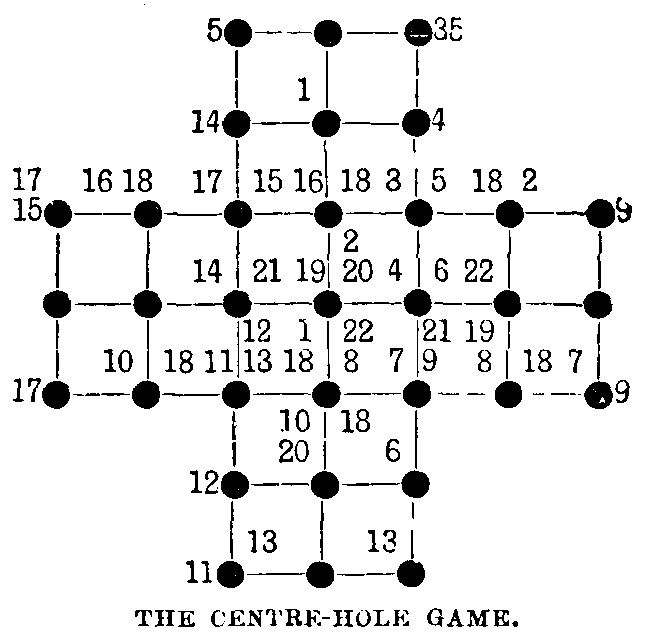
Many variations of the game will suggest themselves as you proceed; but the above will suffice to show the plan and system of Solitaire.
136. Backgammon
A game of mingled chance and skill, played on a board marked with points, and generally to be found inside the box draughtboard. The board has twenty-four points, coloured alternately red and blue; the implements of play are fifteen draught-men on each side, and the movements of the men are determined by the throw of two dice; each player being provided with a dice box and dies. It is an elaborate game to explain on paper, and would occupy too much space to be given in detail in this work. Those, however, who desire to be fully informed as to its various intricacies, may consult "Bohn's Handbook of Games," or the cheaper and more concise treatise by Captain Crawley.
137. Dominoes
This game is played by two or four persons, with twenty-eight pieces of oblong ivory, plain at the back, but on the face divided by a black line in the middle, and indented with spots, from one to a double-six, which pieces are a double-blank, ace-black, double-ace, deuce-blank, deuce-ace, double-deuce, trois-blank, trois-ace, trois-deuce, double-trois, four-blank, four-ace, four-deuce, four-trois, double-four, five-blank, five-ace, five-deuce, five-trois, five-four, double-five, six-blank, six-ace, six-deuce, six-trois, six-four, six-five, and double-six. Sometimes a double set is played with, of which double-nine is the highest.
138. Method of Play
At the commencement of the game the dominoes are well mixed together, with their faces upon the table. Each player draws one, and if four play, those who choose the two highest are partners against these who take the two lowest. Drawing the latter also serves to determine who is to lay down the first piece—a great advantage. Afterwards each player takes seven pieces at random. The eldest hand having laid down one, the next must pair him at either end of the piece he may choose, according to the number of pips, or the blank in the compartment of the piece; but whenever any one cannot match the part, either of the domino last put down, or of that unpaired at the other end of the row, then he says, "
Go
;" and the next is at liberty to play. Thus they play alternately, either until one party has played all his pieces, and thereby won the game, or till the game be
blocked
; that is, when neither party can play, by matching the pieces where unpaired at either end; then that player wins who has the smallest number of pips on the pieces remaining in his hand. It is to the advantage of every player to dispossess himself as early as possible of the heavy pieces, such as a double-six, five, four, &c Sometimes, when two persons play, they take each only three or five pieces, and agree to
play
or
draw
, i.e., when one cannot come in, or pair the pieces upon the board at the end unmatched, he draws from the pieces in stock till he finds one to suit. There are various other ways of playing dominoes, but they are all dependent on the matching of the pips.
139. Quadrilles
The First Set:
Figure Name Actions Repeat
First Figure Le Pantalon Right and left. Balancez to partners; turn partners. Ladies' chain. Half promenade; half right and left. four times
Second Figure L'Été Leading lady and opposite gentleman advance and retire; chassez to right and left; cross over to each other's places; chassez to right and left. Balancez and turn partners. four times
or Double L'Été Both couples advance and retire at the same time; cross over; advance and retire again; cross to places. Balancez and turn partners. four times
Third Figure La Poule Leading lady and opposite gentleman cross over, giving right hands; recross, giving left hands, and fall in a line. Set four in a line; half promenade. Advance two, and retire (twice). Advance four, and retire; half right and left. four times
Fourth Figure Trenise The first couple advance and retire twice, the lady remaining on the opposite side; the two ladies go round the first gentleman, who advances up the centre; balancez and turn hands. four times
Fifth Figure La Pastorale The leading couple advance twice, leaving the lady opposite the second time. The three advance and retire twice. The leading gentleman advance and set. Hands four half round; half right and left1. four times
Sixth Figure Galop Finale Top and bottom couples galopade quite round each other. Advance and retire; four advance again, and change the gentlemen. Ladies' chain. Advance and retire four, and regain your partners in your places. The fourth time all galopade for an unlimited period. four times
or All galopade or promenade, eight bars. Advance four en galopade oblique, and retire, then half promenade, eight bars. Advance four, retire, and return to places with the half promenade, eight bars. Ladies' chain, eight bars. Repeated by the side couples, then by the top and bottom, and lastly by the side couples, finishing with grand promenade.
In different companies the Quadrille varies slightly. For instance, in the last figure, sometimes called Flirtation, the four couples set in a circle, the gentlemen turn their partners, the ladies advance to the centre and retire, the gentlemen advance and retire; the gentlemen turn the ladies to the left and promenade: the whole figure being repeated four times.
Footnote 1:
This or the Trenise must be omitted.
return to footnote mark
140. Lancers
La Rose.—First gentleman and opposite lady advance and set—turn with both hands, retiring to places—return, leading outside—set and turn at corners.
La Lodoiska.—First couple advance twice, leaving the lady in the centre—set in the centre—turn to places—all advance in two lines—all turn partners.
La Dorset.—First lady advance and stop, then the opposite gentleman—both retire, turning round—ladies' hands across half round, and turn the opposite gentlemen with left hands—repeat back to places, and turn partners with left hands.
L'Étoile.—First couple set to couple at right—set to couple at left—change places with partners, and set, and pirouette to places—right and left with opposite couple,
Les Lanciers.—The grand chain. The first couple advance and turn facing the top; then the couple at right advance behind the top couple; then the couple at left and the opposite couple do the same, forming two lines. All change places with partners and back again. The ladies turn in a line on the right, the gentlemen in a line on the left. Each couple meet up the centre. Set in two lines, the ladies in one line, the gentlemen in the other. Turn partners to places. Finish with the grand chain.
141. The Caledonians
Figure Actions Repeat
First Figure The first and opposite couples hands across round the centre and back to places—set and turn partners. Ladies' chain. Half promenade—half right and left. by the side couples
Second Figure The first gentleman advance and retire twice. All set at corners, each lady passing into the next lady's place on the right. Promenade by all. by the other couples
Third Figure The first lady and opposite gentleman advance and retire, bending to each other. First lady and opposite gentleman pass round each other to places. First couple cross over, having hold of hands, while the opposite couple cross on the outside of them—the same reversed. All set at corners, turn, and resume partners. All advance and retire twice, in a circle with hands joined—turn partners.
Fourth Figure The first lady and opposite gentleman advance and stop; then their partners advance; turn partners to places. The four ladies move to right, each taking the next lady's place, and stop—the four gentlemen move to left, each taking the next gentleman's place, and stop—the ladies repeat the same to the right—then the gentlemen to the left. All join hands and promenade round to places, and turn partners. by the other couples
Fifth Figure The first couple promenade or waltz round inside the figure. The four ladies advance, join hands round, and retire—then the gentlemen perform the same—all set and turn partners. Chain figure of eight half round, and set. All promenade to places and turn partners. All change sides, join right hands at corners, and set—back again to places. Finish with grand promenade.
These three are the most admired of the quadrilles: the First Set invariably takes precedence of every other dance.
Coffee was First Brought to England in 1641.
142. Spanish Dance
Danced in a circle or a line by sixteen or twenty couples. The couples stand as for a Country Dance, except that the first gentleman must stand on the ladies' side, and the first lady on the gentlemen's side. First gentleman and second lady balancez to each other, while first lady and second gentleman do the same, and change places. First gentleman and partner balancez, while second gentleman and partner do the same, and change places. First gentleman and second lady balancez, while first lady and second gentleman do the same, and change places. First gentleman and second lady balancez to partners, and change places with them. All four join hands in the centre, and then change places, in the same order as the foregoing figure, four times. All four poussette, leaving the second lady and gentleman at the top, the same as in a Country Dance. The first lady and gentleman then go through the same figure with the third lady and gentleman, and so proceed to the end of the dance. This figure is sometimes danced in eight bars time, which not only hurries and inconveniences the dancers, but also ill accords with the music.
143. Waltz Cotillon.
Places the same as quadrille. First couple waltz round inside; first and second ladies advance twice and cross over, turning twice; first and second gentlemen do the same; third and fourth couples the same; first and second couples waltz to places, third and fourth do the same; all waltz to partners, and turn half round with both hands, meeting the next lady; perform this figure until in four places; form two side lines, all advance twice and cross over, turning twice; the same, returning; all waltz round; the whole repeated four times.
144. La Galopade
is an extremely graceful and spirited dance, in a continual chassez. An unlimited number may join; it is danced in couples, as waltzing.
145. The Galopade Quadrilles.
1st. Galopade.
2nd. Right and left, sides the same.
3rd. Set and turn, hands all eight.
4th. Galopade.
5th. Ladies' chain, sides the same.
6th. Set and turn partners all eight.
7th. Galopade.
8th. Tirois, sides the same.
9th. Set and turn partners all eight.
10th. Galopade.
11th Top lady and bottom gentleman advance and retire, the other six do the same.
12th. Set and turn partners all eight.
13th. Galopade.
14th. Four ladies advance and retire, gentlemen the same.
15th. Double ladies' chain.
16th. Set and turn partners all eight.
17th. Galopade.
18th. Poussette, sides the same.
19th. Set and turn.
20th. Galopade waltz.
146. The Mazurka.
This dance is of Polish origin—first introduced into England by the Duke of Devonshire, on his return from Russia. It consists of twelve movements; and the first eight bars are played (as in quadrilles) before the first movement commences.
147. The Redowa Waltz
is composed of: three parts, distinct from each other. 1st, The Pursuit. 2nd, The waltz called Redowa. 3rd, The waltz a Deux Temps, executed to a peculiar measure, and which, by a change of the rhythm, assumes a new character. The middle of the floor must he reserved for the dancers who execute the promenade, called the pursuit, while those who dance the waltz turn in a circle about the room. The position of the gentleman is the same as for the waltz. The gentleman sets out with the left foot, and the lady with the right. In the pursuit the position is different, the gentleman and his partner face, and take each other by the hand. They advance or fall back at pleasure, and balance in advance and backwards. To advance, the step of the pursuit is made by a glissade forward, without springing,
coupé
with the hind foot, and
jeté
on it. You recommence with the other foot, and so on throughout. The retiring step is made by a sliding step of the foot backwards, without spring,
jeté
with the front foot, and
coupé
with the one behind. It is necessary to advance well upon the sliding step, and to spring lightly in the two others,
sur place
, balancing equally in the
pas de poursuite
, which is executed alternately by the left in advance, and the right backwards. The lady should follow all the movements of her partner, falling back when he advances, and advancing when he falls back. Bring the shoulders a little forward at each sliding step, for they should always follow the movement of the leg as it advances or retreats; but this should not be too marked. When the gentleman is about to waltz, he should take the lady's waist, as in the ordinary waltz. The step of the Redowa, in turning, may be thus described. For the gentleman—
jete
of the left foot, passing before the lady.
Glissade
of the right foot behind to the fourth position aside—the left foot is brought to the third position behind—then the
pas de basque
is executed by the right foot, bringing it forward, and you recommence with the left. The
pas de basque
should be made in three very equal beats, as in the Mazurka. The lady performs the same steps as the gentleman, beginning by the
pas de basque
with the right foot. To waltz à deux temps to the measure of the Redowa, we should make each step upon each beat of the bar, and find ourselves at every two bars, the gentleman with his left foot forwards, and the lady with her right, that is to say, we should make one whole and one half step to every bar. The music is rather slower than for the ordinary waltz.
Phosphorus was Discovered in 1677.
148. Valse Cellarius
The gentleman takes the lady's left hand with his right, moving one bar to the left by
glissade
, and two hops on his left foot, while the lady does the same to the right, on her right foot; at the second bar they repeat the same with the other foot—this is repeated for sixteen bars; they then waltz sixteen bars,
glissade
and two hops, taking care to occupy the time of two bars to get quite round. The gentleman now takes both hands of the lady, and makes the grand square—moving three bars to his left—at the fourth bar making two beats while turning the angle; his right foot is now moved forward to the other angle three bars—at the fourth, beat again while turning the angle; the same repeated for sixteen bars—the lady having her right foot forward when the gentleman has his left toot forward; the waltz is again repeated; after which several other steps are introduced, but which must needs be seen to be understood.
149. Circular Waltz.
The dancers form a circle, then promenade during the introduction—all waltz sixteen bars—set, holding partner's right hand, and turn—waltz thirty-two bars—rest, and turn partners slowly—face partner and chassez to the right and left—pirouette lady twice with the right hand, all waltz sixteen bars—set and turn—all form a circle, still retaining the lady by the right hand, and move round to the left, sixteen bars—waltz for finale.
150. Polka Waltzes
The couples take hold of hands as in the usual waltz.
First Waltz.
The gentleman hops the left foot well forward, then hack; and
glissades
half round. He then hops the right foot forward and back, and
glissades
the other half round. The lady performs the same steps, beginning with the right foot.
Second.
The gentleman, hopping, strikes the left heel three times against the right heel, and then jumps half round on the left foot; he then strikes the right heel three times against the left, and jumps on the right foot, completing the circle. The lady does the same steps with reverse feet.
Third.
The gentleman raises up the left foot, steps it lightly on the ground forward, then strikes the right heel smartly twice, and
glissades
half round. The same is then done with the other foot. The lady begins with the right foot.
151. Valse a Deux Temps.
This waltz contains, like the common waltz, three times, but differently divided. The first time consists of a gliding step; the second a chassez, including two times in one. A chassez is performed by bringing one leg near the other, then moving it forward, backward, right, left, and round. The gentleman begins by sliding to the left with his left foot, then performing a chassez towards the left with his right foot without turning at all during the first two times. He then slides backwards with his right leg, turning half round; after which he puts his left leg behind, to perform a chassez forward, turning then half round for the second time. The lady waltzes in the same manner, except that the first time she slides to the right with the right foot, and also performs the chassez on the right, and continues the same as the gentleman, except that she slides backwards with her right foot when the gentleman slides with his left foot to the left; and when the gentleman slides with his right foot backwards, she slides with the left foot to the left. To perform this waltz gracefully, care must be taken to avoid jumping, but merely to slide, and keep the knees slightly bent.
Average Weight of Man's Brain, 3-1/2lbs, Woman's 2lbs. 11oz.
152. Circassian Circle
The company is arranged in couples round the room—the ladies being placed on the right of the gentlemen,—after which, the first and second couples lead off the dance.
Figure.
Eight and left, set and turn partners—ladies' chain, waltz.
At the conclusion, the first couple with fourth, and the second with the third couple, recommence the figure,—and so on until they go completely round the circle, when the dance is concluded.
153. Polka
In the polka there an but two principal steps, all others belong to fancy dances, and much mischief and inconvenience is likely to arise from their improper introduction into the ball-room.
First step. The gentleman raises the left foot slightly behind the right, the right foot is then hopped with, and the left brought forward with a glissade. The lady commences with the right, jumps on the left, and glissades with the right. The gentleman during his step has hold of the lady's left hand with his right.
Second step. The gentleman lightly hops the left foot forward on the heel, then hops on the toe, bringing the left foot slightly behind the right. He then glissades with the left foot forward; the same is then done, commencing with the right foot. The lady dances the same step, only beginning with the right foot.
There are a variety of other steps of a fancy character, but they can only be understood with the aid of a master, and even when well studied, must be introduced with care. The polka should be danced with grace and elegance, eschewing all
outré
and ungainly steps and gestures, taking care that the leg is not lifted too high, and that the dance is not commenced in too abrupt a manner. Any number of couples may stand up, and it is the privilege of the gentleman to form what figure he pleases, and vary it as often as his fancy and taste may dictate.
First Figure. Four or eight bars are devoted to setting forwards and backwards, turning from and towards your partner, making a slight hop at the commencement of each set, and holding your partner's left hand; you then perform the same step (forwards) all round the room.
Second Figure. The gentleman faces his partner, and does the same step backwards all round the room, the lady following with the opposite foot, and doing the step forwards.
Third Figure. The same as the second figure, only reversed, the lady stepping backwards, and the gentleman forwards, always going the same way round the room.
Fourth Figure. The same step as figures two and three, but turning as in a waltz.
Man's Heart Beats 92,160 Times in a Day.
154. The Gorlitza
is similar to the polka, the figures being waltzed through.
155. The Schottische
The gentleman holds the lady precisely as in the polka. Beginning with the left foot, he slides it forward, then brings up the right foot to the place of the left, slides the left foot forward, and springs or hops on this foot. This movement is repeated to the right. He begins with the right foot, slides it forward, brings up the left foot to the place of the right foot, slides the right foot forward again, and hops upon it. The gentleman springs twice on the left foot, turning half round; twice on the right foot; twice
encore
on the left foot, turning half round; and again twice on the right foot, turning half round. Beginning again, he proceeds as before. The lady begins with the right foot, and her step is the same in principle as the gentleman's. Vary, by a
reverse turn
; or by going in a straight line round the room. Double, if you like, each part, by giving four bars to the first part, and four bars to the second part. The
time
may be stated as precisely the same as in the polka; but let it not be forgotten that
La Schottische
ought to be danced
much slower
.
156. Country Dances. Sir Roger de Coverley
First lady and bottom gentleman advance to centre, salute, and retire; first gentleman and bottom lady, same. First lady and bottom gentleman advance to centre, turn, and retire; first gentleman and bottom lady the same. Ladies promenade, turning off to the right down the room, and back to places, while gentlemen do the same, turning to the left; top couple remain at bottom; repeat to the end of dance.
157. La Polka Country Dances.
All form two lines, ladies on the right, gentlemen on the left.
Figure Top lady and second gentleman heel and toe (polka step) across to each other's place—second lady and top gentleman the same. Top lady and second gentleman retire back to places—second lady and top gentleman the same. Two couples polka step down the middle and back again—two first couples polka waltz. First couple repeat with the third couple, then with fourth, and so on to the end of dance.
158. The Highland Reel
This dance is performed by the company arranged in parties of three, along the room in the following manner: a lady between two gentlemen, in double rows. All advance and retire—each lady then performs the reel with the gentleman on her right hand, and retires with the opposite gentleman to places—hands three round and back again—all six advance and retire— then lead through to the next trio, and continue the figure to the end of the room. Adopt the Highland step, and music of three-four time.
159. Terms used to Describe the Movements of Dances.
Balancez Set to partners.
Chaine Anglaise The top and bottom couples right and left.
Chaine Anglaise double The right and left double.
Chaine des Dames The ladies' chain.
Chaine des Dames double The ladies' chain double, which is performed by all the ladies commencing at the same time.
Chassez Move to the right and left.
Chassez croisez Gentlemen change places with partners, and back again.
Demie Chaine Anglaise The four opposite persons half right and left.
Demie Promenade All eight half promenade.
Dos-à-dos The two opposite persons pass round each other.
Demie Moulinet The ladies all advance to the centre, giving hands, and return to places.
La Grande Chaine All eight chassez quite round, giving alternately right and left hands to partners, beginning with the right.
Le Grand Rond All join hands and advance and retire twice.
Pas d'Allemande The gentlemen turn the partners under their arms.
Traversez The two opposite persons change places.
Vis-à-vis The opposite partner.
The Human Body has 240 Bones.
160. Scandal—Live it down.
Should envious tongues some malice frame, To soil and tarnish your good name, Live it down! Grow not disheartened; 'tis the lot Of all men, whether good or not: Live it down! Him not in answer, but be calm; For silence yields a rapid balm: Live it down! Go not among your friends and say, Evil hath fallen on my way: Live it down! Far better thus yourself alone To suffer, than with friends bemoan The trouble that is all your own: Live it down! What though men evil call your good! So Christ Himself, misunderstood, Was nailed unto a cross of wood! And now shall you for lesser pain, Your inmost soul for ever stain, By rendering evil back again? Live it down!
161. Errors in Speaking
There are several kinds of errors in speaking. The most objectionable of them are those in which words are employed that are unsuitable to convey the meaning intended. Thus, a person wishing to express his intention of going to a given place, says, "I
propose
going," when, in fact, he
purposes
going. The following affords an amusing illustration of this class of error:—A venerable matron was speaking of her son, who, she said, was quite stage-struck. "In fact," remarked the old lady, "he is going to a
premature
performance this evening!" Considering that most
amateur
performances are
premature
, it cannot be said that this word was altogether misapplied; though, evidently, the maternal intention was to convey quite another meaning.
162. Other Errors
arise from the substitution of sounds similar to the words which should be employed; that is, spurious words instead of genuine ones. Thus, some people say "renumerative," when they mean "remunerative." A nurse, recommending her mistress to have a
perambulator
for her child, advised her to purchase a
preamputator!
163. Other Errors (2)
are occasioned by imperfect knowledge of the English grammar: thus, many people say, "Between you and I," instead of "Between you and
me
." And there are numerous other departures from the rules of grammar, which will be pointed out hereafter.
164. By the Misuse of the Adjective:
"What
beautiful
butter!" "What a
nice
landscape! "They should say, "What a
beautiful
landscape!" "What
nice
butter!" Again, errors are frequently occasioned by the following causes:
165. By the Mispronunciation of Words.
Many persons say
pro
noun
ciation
instead of
pronunciation
; others say pro-nun'-she-a-shun, instead of pro-nun-ce-a-shun.
166. By the Misdivision of Words and syllables.
This defect makes the words
an ambassador
sound like
a nam-bassador
, or
an adder
like
a nadder
.
167. By Imperfect Enunciation,
as when a person says
hebben
for
heaven
,
ebber
for
ever
,
jocholate
for
chocolate
, &c
168. By the Use of Provincialisms
or words retained from various dialects, of which we give the following examples:
169. Cambridgeshire, Cheshire, Suffolk, &c
Foyne, twoyne, for
fine
,
twine
; ineet for
night
; a-mon for
man
; poo for
pull
.
170. Cumberland, Scotland, &c
Cuil, bluid, for
cool
,
blood
; spwort, seworn, whoam, for
sport
,
scorn
,
home
; a-theere for
there
; e-reed, seeven, for
red
,
seven
; bleedin' for
bleeding
; hawf for
half
; saumon for
salmon
.
171. Devonshire, Cornwall, &c
F-vind for
find
; fet for
fetch
; wid for
with
; zee for
see
; tudder for
the other
; drash, droo, for
thrash
, and
through
; gewse for
goose
, &c
172. Essex, London, &c
V-wiew for
view;
vent for
went;
vite for
white;
ven for
when;
vot for
what
. Londoners are also prone to say Toosday for
Tuesday;
noomerous for
numerous
; noospaper for
newspaper
, &c
The Musical Scale was Invented in 1022.
173. Hereford, &c
Clom for
climb;
hove for
heave;
puck for
pick;
rep for
reap;
sled for
sledge
.
174. Leicestershire, Lincolnshire, Lancashire, &c
Housen for
houses;
a-ioyne for
lane;
mon for
man;
thik for
this;
brig for
bridge;
thack, pick, for
thatch, pitch
.
175. Yorkshire, &c
Foyt for
foot;
foight for
fight;
o-noite, foil, coil, hoil, for
note, foal, coal, hole;
loyne for
lane;
o-nooin, gooise, fooil, tooil, for
noon, goose, fool, tool;
spwort, scworn, whoam, for
sport, scorn, home;
g-yet for
gate
.
176. Examples of Provincial Dialects
The following will be found very amusing:
177. The Cornish Schoolboy
An ould man found, one day, a young gentleman's portmantle, as he were a going to es dennar; he took'd et en and gived et to es wife, and said, "Mally, here's a roul of lither, look, see, I suppoase some poor ould shoemaker or other have los'en; tak'en, and put'en a top of the teaster of tha bed; he'll be glad to hab'en agin sum day, I dear say." The ould man, Jan, that was es neame, went to es work as before. Mally then opened the portmantle, and found en et three hunderd pounds. Soon after thes, the ould man not being very well, Mally said, "Jan, I'ave saaved away a little money, by the bye, and as thee caan't read or write, thee shu'st go to scool" (he were then nigh threescore and ten). He went but a very short time, and comed hoam one day and said, "Mally, I waint go to scool no more, 'caase the childer do be laffen at me: they can tell their letters, and I caan't tell my A, B, C, and I wud rayther go to work agen." "Do as thee wool," ses Mally. Jan had not been out many days, afore the young gentleman came by that lost the portmantle, and said, "Well, my ould man, did'ee see or hear tell o' sich a thing as a portmantle?" "Port-mantle, sar, was't that un, sumthing like thickey?" (pointing to one behind es saddle). "I vound one the t'other day zackly like that." "Where es, et?" "Come along, I carr'd'en and gov'en to my ould 'ooman, Mally; thee sha't av'en, nevr vear.—Mally, where es that roul of lither I broft en tould thee to put en a top o' the teaster of the bed,
afore I go'd to scool?
" "Drat thee emperance," said the young gentleman; "thee art bewattled;
that were afore I were born.
" So he druv'd off, and left all the three hunderd pounds with Jan and Mally.
178. Yorkshire
Men an' women is like so monny cards, played wi' be two oppoanents, Time an' Eternity: Time gets a gam' noo an' then, and hez t' pleasure o' keepin' his cards for a bit, bud Eternity's be far t'better hand, an' proves, day be day, an' hoor be hoor, 'at he's winnin incalcalably fast.—"Hoo sweet, hoo varry sweet is life!" as t' fiee said when he wur stuck i' treacle!
179. Effect of Provincialisms
Persons bred in these localities, and in Ireland and Scotland, retain more or less of their provincialisms; and, therefore, when they move into other districts, they become conspicuous for their peculiarities of speech. Often they appear vulgar and uneducated, when they are not so. It is, therefore, desirable for all persons to approach the recognised standard of correctness as nearly as possible.
180. Correction of Errors in Speaking
To correct these errors by a systematic course of study would involve a closer application than most persons could afford, and require more space than we can devote to the subject. We will therefore give numerous Rules and Hints, in a concise and simple form, which will be of great assistance to inquirers. These Rules and Hints will be founded upon the authority of scholars, the usages of the bar, the pulpit, and the senate, and the authority of societies formed for the purpose of collecting and diffusing knowledge pertaining to the language of this country.
A Salmon has been Known to Produce 10,000,000 Eggs.
181. Rules and Hints for Correct Speaking.
Who and whom are used in relation to persons, and which in relation to things. But it was once common to say, "the man which." This should now be avoided. It is now usual to say, "Our Father who art in heaven," instead of "which art in heaven."
Whose is, however, sometimes applied to things as well as to persons. We may therefore say, "The country whose inhabitants are free." Grammarians differ in opinion upon this subject, but general usage justifies the rule.
Thou is employed in solemn discourse, and you in common language. Ye (plural) is also used in serious addresses, and you in familiar language.
The uses of the word It are various, and very perplexing to the uneducated. It is not only used to imply persons, but things, and even, ideas, and therefore, in speaking or writing, its assistance is constantly required. The perplexity respecting this word arises from the fact that in using it in the construction of a long sentence, sufficient care is not taken to ensure that when it is employed it really points out or refers to the object intended. For instance, "It was raining when John set out in his cart to go to the market, and he was delayed so long that it was over before he arrived." Now what is to be understood by this sentence? Was the rain over? or the market? Either or both might be inferred from the construction of the sentence, which, therefore, should be written thus:— "It was raining when John set out in his cart to go to the market, and he was delayed so long that the market was over before he arrived."
Rule.—After writing a sentence always look through it, and see that wherever the word It is employed, it refers to or carries the mind back to the object which it is intended to point out.
The general distinction between This and That may be thus defined: this denotes an object present or near, in time or place, that something which is absent.
These refers, in the same manner, to present objects, while those refers to things that are remote.
Who changes, under certain conditions, into whose and whom. But that and which always remain the same.
That may be applied to nouns or subjects of all sorts; as, the girl that went to school, the dog that bit me, the ship that went to London, the opinion that he entertains.
The misuse of these pronouns gives rise to more errors in speaking and writing than any other cause.
When you wish to distinguish between two or more persons, say, "Which is the happy man?"—not who—"Which of those ladies do you admire?"
Instead of "Who do you think him to be?"—say, "Whom do you think him to be?"
Whom should I see?
To whom do you speak?
Who said so?
Who gave it to you?
Of whom did you procure them?