Part 3 (continued 5)
Reading edition
The use of an elastic fruit in early experiments leads to a want of accuracy in the first, steps of the operation, which causes very annoying difficulties afterwards; and therefore a solid, inelastic body—an egg boiled hard—is recommended as the first object to be imitated.
2539. Making the Moulds—First Half
Having filled a small pudding basin about three-quarters full of damp sand (the finer the better), lay the egg lengthways in the sand, so that half of it is above, and half below, the level of the sand, which should be perfectly smooth around it. Then prepare the plaster in another basin, which should be half full of water. Sprinkle the plaster in quickly till it comes to the top of the water, and then, having stirred it for a moment with a spoon, pour the whole upon the egg in the other basin.
2540. Making the Moulds—Second Half
While the half mould thus made is hardening thoroughly, carefully remove every particle of plaster from the basin in which it was mixed, and also from the spoon which has been used. This must be done by placing them both in water and wiping them perfectly clean. This is highly important, since a small quantity of plaster which has set will destroy the quality of a second mixing if it is incorporated therewith. In about five minutes the half mould will be fit to remove, which may be done by turning the basin up with the right hand (taking care not to lose the sand), so that the mould falls into the left hand.
The egg should then be gently allowed to fall back on the sand out of the mould; if, however, it adheres, lightly scrape the plaster from the edge of the mould, and then shake it out into the hollow of the hand. If, however, the exact half of the egg has been immersed in the sand, no such difficulty will arise; this shows how important is exactness in the first position of the object from which a tasting is to be taken.
The egg being removed and laid aside, the moulder casting must be "trimmed;" that is, the sand must be brushed from the flat surface of the mould with a nail-brush very slightly, without touching the extreme and sharp edges where the hollow of the mould commences. Then upon the broad edge from which the sand has been brushed, make four equi-distant hollows (with the round end of a table-knife), like the deep impression of a thimble's-end. These are to guide hereafter in the fixing of the second half of the mould. The egg should now be replaced in the casting, and the edge of the cast, with the holes, thoroughly lubricated with sweet oil, laid on with a feather, or what is better, a large camel-hair brush.
Father and Mother are Kind, but God is Kinder.
2541. Casting Second Half of Mould
Into the small pudding basin from which the sand has been emptied, place with the egg upper-most the half mould, which, if the operation has been managed properly, should
fit
close at the edges to the side of the vessel; then prepare some more liquid plaster as before, and pour it upon the egg and mould, and while it is hardening, round it with the spoon as with the first half.
2542. Completion of Mould
In due time remove the whole from the basin; the halves will be found readily separable, and the egg being removed, the mould is ready to cast in, after it has been set aside for an hour or two, so as to completely harden. This is the simplest form of mould, and all are made upon the same principle.
2543. Casting Egg in Wax
The casting of an egg is not merely interesting as the first step in a series of lessons, but as supplying a means of imitating peculiarly charming objects, which the student of natural history tries almost in vain to preserve. We shall proceed, then, with the directions for the casting of an egg in the mould.
2544. Materials required
For the first experiments, common yellow wax may be used as the material, or the ends of half-burnt wax candles. The materials of the hard (not tallow) composition mould candles will also answer.
2545. Large Castings made Hollow
Every large object to be imitated in wax should be cast
hollow
; and therefore, though the transparent lightness required in the imitation of fruits is not requisite in an artificial egg, the egg may be cast upon the same principle as a piece of fruit, in the following manner.
Firstly
. The two pieces of the plaster of Paris mould must be soaked in hot water for ten minutes.
Secondly
. The wax should in the meantime be very slowly melted in a small tin saucepan, with a spout to it, care being taken not to allow it to boil, or it will be discoloured. As to the quantity of wax to be melted, the following is a general rule:—If a lump, the size of the object to be imitated, be placed in the saucepan, it should be sufficient for casting twice, at least.
Thirdly
. As soon as the wax is melted thoroughly, place the saucepan on the hob of the grate, and taking the parts of the mould from the hot water, remove the moisture from their surfaces by pressing them gently with a handkerchief or soft cloth. It is necessary to use what is called in some of the arts "a very light hand" in this operation, especially in drying moulds of fruits whose aspect possesses characteristic irregularities—such as those on the orange, the lemon, or the cucumber. The mould must not be
wiped
, but only
pressed
. If the
water
has not been hot enough, or if the drying is not performed quickly, the mould will be too cold, and the wax will congeal too rapidly, and settle in ridges and streaks; on the other hand, if the wax has been made too hot, it will adhere to the mould, and refuse to come out entire.
Fourthly
. Having laid the two halves of the mould so that there can be no mistake in fitting the one in its exact place quickly on the other, pour from the saucepan into
one
of the half moulds nearly as much wax as will fill the hollow made by the model (egg), quickly fit the other half on the top of it, squeeze the two pieces tightly together in the hand, and still holding them thus, turn them over in every possible position, so that the wax which is slowly congealing in the internal hollow of the mould may be of equal thickness in all parts. Having continued this process at least two minutes, the hands (still holding and turning the mould) may be immersed in cold water to accelerate the cooling process. The perfect congealment of the wax may be known after a little experience by the absence of the sound of fluid on shaking the mould.
Fifthly
. As soon as the mould is completely cooled, the halves may be separated carefully, the upper being lifted straight up from the under, and if the operation has been properly managed, a waxen egg will be turned out of the mould.
Lastly
. The egg will only require
trimming
, that is, removing the ridge which marks the line at which the halves of the mould joined, and polishing out the scratches or inequalities left by the knife with a piece of soft rag, wet with spirits of turpentine or spirits of wine.
It is always desirable to make several castings of the same object, as the moulds are apt to get chipped when laid by in a cupboard; and for this reason, as well as for the sake of practice, we recommend our pupils to make at least a dozen waxen eggs before they proceed to any other object. If they succeed in this
completely
, they may rest assured that every difficulty which is likely to meet them in any future operation will be easily overcome.
He Doeth Well Who Doeth Good.
2546. Colouring the Wax
While the wax is yet on the hob, and in a fluid state, stir into it a little
flake white
, in powder, and continue to stir the mixture while it is being poured into the half mould. It will be found that unless the fixing and shaking of the moulds is managed quickly, the colouring matter will settle on the side of the half into which the mixture is poured; a little care in manipulation is therefore again requisite. The colouring of the wax is a matter which comes easily enough by experiment. Oranges, lemons, large gooseberries, small cucumbers, &c.,&c., are excellent objects for practice.
2547. Close Imitation of the Surface
It will be noted by the accurate observer that the shell of the common hen's egg has a number of minute holes, which destroy the perfect smoothness of its appearance. This peculiarity is imitated in the following simple manner:—In the first place, very slightly prick with a fine needle the surface of your waxen egg, and then, having smeared it with spirits of turpentine, rub the surface all over. So as
nearly
to obliterate the marks of the needle point.
2548. Diaphanie
This is a beautiful, useful, and inexpensive art easily acquired, and producing imitations of the richest and rarest stained glass; and also of making blinds, screens, skylights, Chinese lanterns, &c., in every variety of colour and design.
2549. Imitation of Coloured Glass
In decorating his house an Englishman spends as much money as he can conveniently spare; the elegances and refinements of modern taste demand something more than mere comfort; yet though his walls are hung with pictures, his drawing-rooms filled with bijouterie, how is it that the windows of his hall, his library, his staircase, are neglected? The reason is obvious. The magnificent historical old stained glass might be envied, but could not be brought within the compass of ordinary means.
Recent improvements in printing in colours led the way to this beautiful invention, by which economy is combined with the most perfect results. A peculiar kind of paper is rendered perfectly transparent, upon which designs are printed in glass colours (
vitre de couleurs
), which will not change with the light. The paper is applied to the glass with a clear white varnish, and when dry, a preparation is finally applied, which increases the transparency, and adds tenfold brilliancy to the effect.
2550. Imitation of Half-Light
There is another design, printed in imitation of the half-light (
abat-jour
); this is used principally for a ground, covering the whole surface of the glass, within which (the necessary spaces having been previously cut out before it is stuck on the glass) are placed medallion centres of Watteau figures, perfectly transparent, which derive increased brilliancy from the semi-transparency of the surrounding ground. This is by far the cheapest method, though involving extra trouble, as the plain grounds printed in sheets are only a fourth the price of the sheets which contain the medallion Watteau centres or other small designs suitable for the purpose.
2551. Sheets of Designs
The transparent sheets measure 20-1/2 in. by 16-1/2, and are ready for immediate use. The other articles required are some clear white varnish, some liqueur diaphane, brushes, metal palettes, and ivory sticks. These are all the appliances required.
2552. Calculation of Quantities
To ascertain the quantity of designs required, measure your glass carefully, and then calculate how many sheets it will take (the sheets being 20-1/2 in. by 16-1/2 in. as given above). The sheets are arranged so that they can be joined together continuously, or cut to any size or shape.
2553. Practical Instructions
Choose a fine day for the operation, as the glass should be perfectly dry, and unaffected by the humidity of the atmosphere. Of course, if you have a choice, it is more
convenient
to work on your glass before it is fixed in the frame. If you are working on a piece of unattached glass, lay it on a
flat
table (a marble slab is preferable), over which you must previously lay a piece of baize or cloth to keep the glass steady.
The glass being thus fixed, clean and polish the side on which you intend to operate (in windows this is the inner side), then with your brush lay on it very equably a good coat of the prepared varnish; let this dry for
an hour
, more or less, according to the dryness of the atmosphere and the thickness of the coat of varnish; meantime cut and trim your designs carefully to fit the glass (if it is one entire transparent sheet you will find little trouble); then lay them on a piece of paper, face downwards, and damp the back of them with a sponge, applied several times, to equalize the moisture.
In ths operation arrange your time so that your designs may now be finally left to dry for fifteen minutes before application to the glass, the varnish on which has now become tacky or sticky, and in a proper state to receive them. Apply the printed side next to the glass without pressure; endeavour to let your sheet fall perfectly level and smooth on your glass, so that you may avoid leaving creases, which would be fatal.
Take now your palette, lay it flat on the design, and press out all the air-bubbles, commencing in the centre, and working them out at the sides; an ivory stick will be found useful in removing creases: you now leave this to dry, and after twenty-four hours apply a slight coat of the liqueur diaphane, leaving it another day, when, if dry, apply a second coat of the same kind, which must be left several days; finally, apply a coat of varnish over all.
2554. Probable Results
If these directions are carefully followed, your glass will never be affected by time or any variations in the weather; it will defy hail, rain, frost, and dust, and can be washed the same as ordinary stained glass, to which, in some respects, it is even superior.
2555. Application of Diaphanie
It is impossible to enumerate the variety of articles to the manufacture of which Diaphanie may be successfully applied, as it is not confined to glass, but can be done on silk, parchment, paper, linen, &c.,
after they have been made transparent
which may be accomplished in the following manner:
2556. Management of Paper, &c.
Stretch your paper, or whatever it may be, on a frame or drawing board, then apply two successive coats (a day between each) of diaphanous liquor, and after leaving it to dry for
several
days, cover it with a thin layer of very clear size, and when dry it will be in a fit state to receive the coat of varnish and the designs.
2557. Management of Textile Fabrics
Silk, linen, or other stuffs should be more carefully stretched, and receive a thicker coat of size than paper or parchment; the latter may be strained on a drawing or any other smooth board, by damping the sheet, and after pasting the edges, stretching it down while damp. Silk, linen, and other stuffs require to be carefully stretched on a suitable frame.
Whatever you use
, take great care to allow time to dry before applying the liqueur diaphane.
2558. Screens, &c., in Diaphanie
All kinds of screens, lamp shades and glasses, lanterns, &c., &c., may be made in this way, as heat will produce no effect upon them. The transparent pictures are successful, because they may be hung on a window frame or removed at will, and the window blinds are superior to anything of that kind yet produced.
2559. Vitremanie
Vitremanie is a process of imitating painting on glass similar to Diaphanie, and Potichomanie is a process of like nature by which glass plates, vases, &c., are made to resemble porcelain.
2560. Decalcomanie
This recently discovered and beautiful art consists in transferring coloured drawings to glass, porcelain, china, wood, silk, furniture, plaster of Paris, alabaster, ivory, paper, paper hangings, windows, tea trays, oil cloth, and all kinds of fancy articles; in short, materials of any kind, shape, or size, provided they possess a smooth surface, can be decorated with Decalcomanie; the immediate result being an exact resemblance to painting by hand. The art itself is simple and ingenious, and while affording agreeable occupation to ladies, it may be made to serve many useful purposes, on account of the numerous objects which will admit of being thus ornamented.
2561. Materials Employed in Decalcomanie
A bottle of transfer varnish for fixing the drawings.
A bottle of light varnish to pass over the drawings when fixed.
A bottle of spirit to clean the brushes, and to remove those pictures which may not be successful.
A piece of beaver cloth about nine inches square.
A paper-knife and roller.
Two or three camel-hair brushes.
A basin of water.
A bottle of opaque varnish.
2562. Instructions
Thoroughly clean and free from grease the article to be decorated; then, having cut off the white paper margin of the drawing, dip one of the brushes into the transfer varnish, and give it a very light coat, being especially careful to cover the whole of the coloured portion, but not to allow it to touch the blank paper; then lay the drawing, face downwards, on the object to be ornamented, taking care to place it at once where it is to remain, as it would be spoilt by moving. If the varnish, on its first application, is too liquid, allow the picture to remain for about ten minutes to set.
Moisten the cloth with water, and lay it gently on the drawing which has been previously laid in its place on the object to be decorated; then rub it over with the paper-knife or roller, so as to cause the print to adhere in every part; this done, remove the cloth, well soak the paper with a camel-hair brush dipped in water, and immediately after lift the paper by one corner, and gently draw it off.
The picture will be left on the object, while the paper will come off perfectly white. Care must be taken that the piece of cloth, without being too wet, is sufficiently so to saturate the paper completely. The drawing must now be washed with a camel-hair brush, in clean water, to remove the surplus varnish, and then left till quite dry. On the following day, cover the picture with a light coat of the fixing varnish, to give brilliancy to the colours.
The Stranger in his Wretchedness...
2563. To Ornament Dark-coloured Objects
To ornament dark-coloured objects, such as the bindings of books, Russia leather, blotting-cases, leathern bags, &c., the picture must be previously covered with a mixture of opaque white varnish, taking care not to pass beyond the outline of the design. On the following day, proceed according to the instructions given in the preceding paragraph.
2564. To ornament Silk, Paper, or Articles which will not bear wetting
Varnish the picture with the transfer varnish, as previously explained, following the outline of the design, then allow it to dry for an hour or two; when quite dry, pass a damp sponge over the entire surface of the sheet, so as to remove the composition which surrounds the picture, and which may spoil the object.
Let the paper dry once more, and varnish the picture again with the transfer varnish; in about ten minutes, place it face downward on the object to be decorated, and rub it with the paper-knife or roller, over the whole of its surface. Finally, moisten the paper with a wet brush, allow it to remain sufficiently long to become moist, then strip the paper off.
To remove a spoilt picture from any object,
dip a soft rag in the essence, and rub it over the surface.
2565. To Insure a Successful Result
To insure a successful result, care must be taken to give a very light coating of varnish to the parts to be transferred. When the varnish is first applied it is very liquid, and must remain ten minutes, the best condition for transferring being when the varnish is only just sticky, without being too dry.
2566. The Following Designs will be found the most Elegant and Appropriate
English flowers of every variety: bouquets, tropical birds, flowers and fruits in imitation of aqua-tint; garlands with cupids after Watteau, and garlands with birds; domestic scenes; pears and cherries, apples and plums, white grapes and plums, black grapes and peaches, plums and mulberries, large bouquet of roses; bouquets of moss roses and pansies.; bouquets of small camellias; bouquets of wall-flowers and poppies; bouquets of orange-blossom, medallions, various subjects; birds'-nests; Gothic initials and monograms, fleurs-de-lis; borders various.
2567. Heraldic Decalcomanie
Heraldic Decalcomanie is an extended application of this art, the arms and crests of persons or families being emblazoned in their proper colours according to the rules of heraldry, and prepared for Decalcomanie. Armorial bearings, thus embellished, serve admirably to ornament and identify the books of a library and pictures of a gallery, to decorate menus for dinner, the invitations to a soirée, &c. By their brilliant colours they give an elegant effect to the table decorations.
2568. Croquet
This out-door pastime is of comparatively modern creation, and until quite lately was very much in vogue. It nay be played by persons of all ages and of either sex; but it is especially adapted for ladies and young persons, as it demands but slight personal exertion, while it affords delightful and health-giving sport.
2569. The Ground
The ground is preferably a grass plot of an oblong form; but an ordinary lawn or expanse of even turf will answer the purpose, so long as it is of sufficient extent for the operations of the game.
2570. Implements
The implements are balls, mallets, starting and turning pegs, croquet clips or markers, hoops or arches.
2571. Arrangement of the Hoops
As much of the interest of this game depends upon the arrangement of the hoops, it is essential that they should be fixed in the ground on definite principles. In the first place, the starting peg is driven in at one end of the ground, and the turning peg is driven in at the other extremity. From each of these pegs a space of twelve feet intervenes; here a hoop is fixed; another space of ten feet intervenes, when a second hoop is fixed; a space of eight feet then succeeds, and at this point is formed what may be termed the base, on each side of which, at a distance of twenty feet, and succeeding each other at intervals of ten feet, three hoops are driven in. By this arrangement, a square is formed, the starting peg leading into its centre, and the turning peg leading from it. Where the ground is small, the distances may be contracted proportionally. Other arrangements of the hoops may he made at the discretion of the players, but the first-named plan will be found best worthy of adoption, as it affords the most excellent opportunities for the display of address and skill.
2572. The Game
The game consists in striking the balls from the starting peg through the hoops to the peg at the opposite extremity. The balls are then driven back again to the starting peg. The game may be played by any number of persons not exceeding eight. A larger number renders the game tedious. The best number is four. If two only play, each player may take two balls, and when as many as eight play, there should be two sides or sets. Each player takes a mallet, ball, and croquet clip of the same colour or number, the clip being used to indicate the hoop at which, in his turn, he aims. The division into sides, choice of balls, mallets, &c., is determined by the players among themselves.
2573. Laws of Croquet
In this game, as with many other sports when first established, there were differences of opinion on certain points of practice. In 1870, however, at a conference of Croquet players, the following rules were settled and adopted. They are now accepted by all players.
There shall be no restriction to the number, weight, size, shape, or material of the mallets: nor as to the attitude or position of the striker.
The players shall toss for choice of lead and of balls: and a succession of games shall take the lead alternately and keep the same balls.
In commencing, each ball shall be placed at one foot from the first hoop in a direct line between the pegs; and a ball having been struck is at once in play, and croquetable whether it shall have made the first hoop or not.
A stroke is considered to have been taken if a ball is moved perceptibly; but should the player have struck it accidentally, and the umpire be satisfied that the stroke was accidental, the ball is replaced and the stroke taken again.
If the player make a foul stroke he loses his turn and all the points made therein, and the balls remain where they lie, at the option of the adversary. The following are considered foul strokes:
To strike with the mallet another ball instead of or besides one's own in making the stroke. To spoon, that is, to push a ball without an audible knock. To strike a ball twice in the same stroke. To stop a ball with the foot in taking a loose Croquet. To allow a ball to touch the mallet in rebounding from the turning peg. To fail to stir the passive ball in taking Croquet. If a player, in striking at a ball which lies against a peg or wire, should move it from its position by striking a peg or wire, the ball must be replaced, and the stroke taken again.
A player continues to play so long as he makes a point or hits a ball. A point consists in making a hoop or hitting the turning peg in order.
The ball has made its hoop when, having passed through from the playing side and ceased to roll, it cannot be touched by a straight-edge placed across the wires on the side from which it was played.
A player who hits a ball must take Croquet: that is, must strike his own ball while in contact with the other, so as perceptibly to stir both. In doing this he is _not_ allowed to place his foot on his ball. A player, when his turn comes round, may hit and Croquet each ball in succession, and can do this again after each point made, but between the points can only take Croquet once off each ball.
A playing ball which hits another after making a point is in hand, and the striker can score no point till he has taken Croquet. After hitting another, a ball may be stopped by any player; but should it, in rolling, displace any of the other balls, such balls must remain where they are driven.
When, at the commencement of a turn, two balls are found touching, Croquet must be taken at once, without repeating the hit.
When a player, in his stroke, hits one or more balls, he must take Croquet off the ball that is struck first; but if he has hit two simultaneously, he may choose from which of them he will take it, and in both cases a second hit is required before he can take it from the other ball.
Should the ball in making its hoop strike another that lies beyond the hoop and then pass through it, the hoop and the hit both count; but, should any part of the ball that is hit have been lying beneath the hoop, the Croquet must be taken, but the hoop does not count.
A rover which strikes or is driven by another ball against the winning peg is out of the game, and must be removed from the ground.
A player who pegs out a rover by a first hit cannot take Croquet from it, as the ball is out of the game, and he is not entitled to another stroke.
Should a player play out of his turn, or with a wrong ball, and this be discovered by his antagonist before a second stroke in error has been made, the turn is lost, and all points made after the mistake, and the balls shall remain as they lay at the time the mistake was discovered, or be replaced to the satisfaction of the antagonist. But if he has made a second stroke before the error is discovered, he continues his break, and the next player follows with the ball that is next in rotation to the one with which he has played, and is liable to lose his turn, and all points made therein, if he plays with that which would have been the right ball if no mistake had been made.
Should a player make the wrong hoop by mistake, or Croquet a ball that he is not entitled to Croquet, and the mistake be discovered before he has made a second stroke, he loses his turn, and any point so made in error; but if he has made a second stroke before the discovery, he shall be allowed to continue his break.
In order to prevent the occurrence of the errors noticed in the above rules (Nos. xv. and xvi), a player is bound, upon being appealed to, to declare truly what is his next hoop or point in order, and is entitled to demand of his antagonist what he his played last, and to insist upon his clip being properly placed.
When clips are used they should be moved by the umpire, or with his cognisance, at the end of each turn, and their position shall he conclusive as to the position of the balls in the game.
Should a ball in play be accidentally stopped by the umpire, he places it where he considers that it would have rolled to. Should it be stopped by a player, it will rest with the side opposed to that player to say whether the ball shall remain where it stopped, or be placed by the umpire, or the stroke be taken again.
If a ball lies within a mallet's length of the boundary, and is not the playing ball, it must at once be put out three feet at right angles from the boundary; but if it is the playing ball, it may, at the discretion of the player, either be put out or played from where it lies.
If it is found that the height of the boundary interferes with the stroke, the player may, at the umpire's discretion, bring out the ball so far as to allow of the free swing of the mallet, and in taking a Croquet both the balls.
Should a player, in trying to make his hoop, knock a wire out of the ground with his ball or mallet, the stroke shall be taken again.
Any player may set upright a peg or hoop except the one next in order; and that, however loose, awry, or slanting it may be, must not be altered except by the umpire.
No ball may be moved because of its lying in a hole or on bad ground, except by the umpire or with his permission.
Where there is no umpire present, permission to move a ball, or to set up a hoop or peg or other indulgence for which an umpire would have been appealed to, must be asked of the other side.
The decision of the umpire shall in all cases be final. His duties are:
To move the clips, or see that they are properly moved; to decide on the application of the laws; to satisfy any player as to the point that is next to be made, or the right ball to play; to keep the score. But he shall not give his opinion, or notice any error that may be made, unless appealed to by one of the players.
It was also decided that the mallet should be held within twelve inches of its head.
2574. Supplementary Laws
The following were added from the Draft Club Laws of Croquet.
If a ball be driven partly through its hoop from the non-playing side, and remain so that a straight-edge placed in contact with the hoop on the non-playing side touches the ball, the ball cannot run its hoop at its next stroke.
If in taking Croquet the striker's ball go off the ground, the striker loses the remainder of his turn; but if by the same stroke the striker make a point or a Croquet, he continues his turn.
If, after a Croquet, the striker's ball, while rolling, be touched by the striker or his partner, the stroke is foul.
2575. Difference between Old and New Laws
The chief difference (says Captain Crawley) between these and previous laws will be found in the method of taking the Croquet. The new laws say that the foot must
not
be placed on the player's ball; the generally accepted practice was to take the Croquet by putting your foot on your ball and striking it so as to send the other bill off to a distance; or if the other ball belonged to your partner to merely tap it in the direction desired. The foot practice is still observed by many players; and some think with advantage.
2576. Technical Terms Used in Croquet
Roquet.—To strike another ball with your own.
Croquet.—When two balls are in contact, the player strikes the other away, either with or without putting the foot on your own ball, as may be previously arranged.
A loose Croquet is made by striking your opponent's ball without putting your foot on your own ball. In taking "two off" it is, however, necessary that the ball should be seen to move.
Wired.—A ball is in contact with a hoop, so as to prevent it going through.
Bridge Ball.—One that has passed the first arch.
Dead Ball.—One in hand after having roqueted another.
To Peg.—To play for either of the pegs in regular order.
The Tour.—The run given to each player till he fails to strike through a hoop.
To Dismiss a ball is to Croquet it to a distance.
Rover.—You become a Rover when you have completed the hoops from point to point, and instead of hitting the starting-peg and retiring, you prefer to strike your ball to any part of the ground, croqueting friends or foes.
The terms side stroke, straight stroke, following ball, over-running a bridge, running a bridge, &c., explain themselves.
2577. Bagatelle
An indoor game played on an oblong board usually from six to ten feet long by a foot and a half to three feet in width. The bed of the table is of slate covered with a fine green cloth; and at the upper end, which is rounded, there are nine holes or cups, numbered from 1 to 9, thus:
5
3 2
8 9 7
4 6
1
Into these holes ivory balls are driven by a leather pointed cue. The player stands at the lower end of the table; and his object is to hole the balls successively into the several cups. Nine balls are used, eight white and one red; or seven white with two coloured balls. The red is placed on a spot just in front of the 1 hole; and the game is played according to the following:
2578. Rules
Any number of persons may play, whether singly or on sides.
Each player strings for lead, and he whose ball falls into the highest hole begins.
The winner of the lead plays the nine balls successively up the table from baulk, first striking at the red ball on the spot.
The red ball counts double when holed, and each white ball scores towards game a number corresponding to that marked in the hole (when two coloured balls are used, each counts double).
The red ball must be first struck; and the rest of the balls are played up to the holes, the sum total of all the holes filled being the striker's score.
Any number of rounds agreed on may be played, and the highest aggregate total by a player or by partners wins the game.
A ball rebounding beyond the baulk line, or forced off the table, is put aside and not re-used in that round.
2579. The French Game (or Sans Egal)
The French Game (or Sans Egal) is played as follows:—The player who wins the lead takes four balls, leaving the other four for his opponent, and placing the black ball on the spot. He plays at it from baulk, and scores all he can. The other player then strikes up one of his balls, and so on alternately; the maker of the highest number of points winning. While the coloured ball is on the table, it must be struck, and when it is holed it counts double, in addition to any other score made by the same stroke. If either player hole his adversary's ball he forfeits to him the number scored by the stroke. If he fail to strike the black ball he forfeits five points. The rules as to rebounding balls, foul strokes, &c., are the same as in the ordinary game.
2580. Old Canon Game
Old Canon Game, sometimes played on a table without holes or pockets, consists entirely of canons—two balls struck in succession by the player's ball. The game, 50 or 100 up, each canon counting two points, is played with three balls only—a white, spot-white, and black (or red) ball. When played on the ordinary bagatelle table, the holes filled after making a canon score to the player. One point is forfeited for missing the white, five points for missing the red; and all points made without a canon. The players go on alternately, the first who scores the stipulated number winning the game.
2581. Other Games
Mississippi, Trou Madame, Cockamaroo, and other toy-games are sometimes played on the bagatelle table; but they need no description. To play well at any of the games, however, requires great care and nicety. Much depends on the manner of holding and using the cue, and the slight degree of force employed in making the stroke. Some experts are able to fill all the holes at one essay, placing the coloured balls in the 8 and 7 at the first stroke, and then playing direct at the cups or at the cushion, till all the balls are holed. At the French Game a hundred or more canons at a break is by no means unusual.
2582. Billiards
This well-known game of skill is played on a rectangular table with three ivory balls,—white, spot-white, and red; the object being to drive one or other of them into either of the six pockets, and to strike one ball against the two others. The first stroke is known as a hazard, and the second as a canon. The instrument for striking at the ball, is a long tapering stick called a cue; and the game is scored by hazards, canons, misses, and forfeitures. The ball struck with the cue is known as the player's ball; the ball played as the object ball. A ball struck into a pocket, is a winning hazard; the player's ball falling into a pocket after contact with the white or red, is a losing hazard. Three principal games are played on the billiard table—the English game, or Billiards, Pyramids, and Pool.
2583. English Billiards
English Billiards,—the best of all the games,—is usually played 50 or 100 up. The points are thus reckoned—three for each red hazard, two for each white hazard, and two for each canon. A coup—that is running in a pocket, or off the table without striking a ball—is a forfeiture of three points,—a miss gives one point to the adversary. The game commences by stringing for lead and choice of balls. The red ball is placed on the spot at the top of the table, and the first player either strikes at it, or gives a miss. Every time the red ball is pocketed, it is replaced on the spot. He who makes a hazard or canon goes on playing till he fails to score. Then the other goes on, and so they play alternately till one or other completes the required number of points, and wins the game.
2584. Pyramids
Pyramids is a game played by two persons, or by four in sides, two against two. Fifteen balls are placed close together in the form of a triangle or pyramid, with the apex towards the player, thus:
0 0 0 0 0
0 0 0 0
0 0 0
0 0
0
The centre of the apex ball covers the second or pyramid spot; and the first player strikes at the mass with a white ball from baulk. Pyramids is a game consisting entirely of winning hazards, and he who succeeds in pocketing the greatest number of balls, wins. A single point is scored for each winning hazard, and a forfeiture of a point for each losing hazard; the game being usually played for a stake—so much (say 6d.) a ball, and so much (say 1s. 6d.) for the game.
2585. Pool
A game played by two or more persons, consisting of winning hazard only. Each player subscribes a certain stake to form a pool or gross sum, and at starting has three chances or lives. He is then provided with a marked or coloured ball, and the game proceeds thus:
The white ball is placed on the spot, and the red is played on to it from baulk. If the player pocket the white he receives the price of a life from the owner of the ball; but if he fail, the next player (yellow) plays on the red; and so on alternately till all have played, or till a ball is pocketed. When a ball is pocketed, the striker plays at the ball nearest his own, and goes on playing as long as he can score. The first player who loses his three lives can star: that is, he can purchase as many lives as are held by the lowest number remaining in the pool. The order of play is usually red upon white, yellow upon red, green upon yellow, brown upon green, blue upon brown, black upon blue, spot-white upon black, white upon spot-white; and this order is retained so long as all the original players remain in the game. When the number of players is reduced to two, they can, if they possess an equality of lives, as two each, or one each, divide the stake; or they may by agreement play out the game for the entire pool.
2586. Single Pool
Single Pool is a game for two players, the white winning game, originally played with two balls, for a money stake upon each life.
2587. Nearest Ball Pool
Nearest Ball Pool is the same as ordinary pool, except that the player, after taking a life, plays upon the ball nearest to the upper or outer side of the baulk; or, if his ball be in hand, upon the ball nearest the baulk semi-circle.
2588. Black Pool
Black Pool is ordinary pool with the addition of a black ball, which is placed on the centre spot. When, after pocketing the ball proper to be played on, the black is struck into a pocket, each player pays the price of a life to the striker.
2589. Skittle Pool
Skittle Pool is pool with three balls and twelve little skittles, placed in order round the table. A stake is determined on, and a price paid out of the pool for every skittle knocked over after striking a ball. An amusing game for a party of ladies and gentlemen.
2590. Penny Pot
Penny Pot is pool without restriction as to the number of lives, played by any number of players, who pay a penny each to the taker of every life or winning hazard. For the scientific principles of billiards, and the full rules of the several games played on the billiard-table, the reader is referred to the excellent little shilling volume, "Billiards Made Easy,"
1
and the more elaborate treatise by Captain Crawley.
Footnote 1:
Billiards made Easy
. With the scientific Principles of the Spot-stroke, and the Side-stroke, familiarly explained: By Winning Hazard. Illustrated by practical diagrams. With a chapter on Bagatelle: Houlston and Sons.
return to footnote mark
2591. Boss; or the Fifteen Puzzle
Apparently simple, this game is really difficult of solution, Fifteen cubes of wood, severally marked from I to 15, are placed indifferently in a box made to hold sixteen; thus:
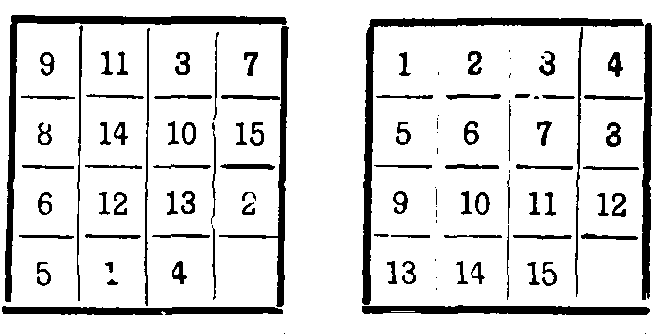
The puzzle consists in sliding the cubes from square to square, without lifting them or removing them from the box, until they are placed in their natural order. It is easy enough to move the squares up to 12; but to get the last three into order is often a puzzle indeed. If the figures fall in either of the following positions—13, 15, 14; 14, 13, 15; or 15, 14, 13—the problem is unsolvable; it follows, therefore, that the last row must be either 14, 15, 13; or 15, 13, 14. If you get the cubes into either of these positions, you can easily bring them right; but if you cannot, the only way is to begin the game all over again. Several other ways are suggested. Cavendish (Mr. H. Jones) thinks he solves the puzzle by turning the box half round; but as this is only possible when the figures are on circular pieces of wood, his solution merely cuts the knot, instead of unravelling it.
2592. The Thirty-Four Puzzle
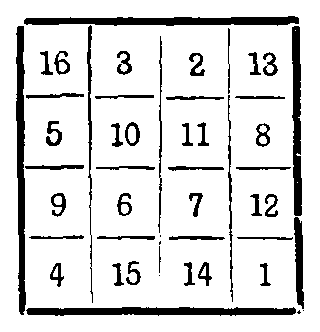
This is an adaptation of tho old magic square, which amused the philosophers of old. A sketch of it appears in Albert Durer's painting of Melancholia. Sixteen discs or squares, numbered from 1 to 16, are placed indifferently on the table—or they may be in the fifteen box; and the puzzle is to so arrange them as to make the sum of the figures add up to 34, whether counted up, down, across or angularly. Here is the solution:
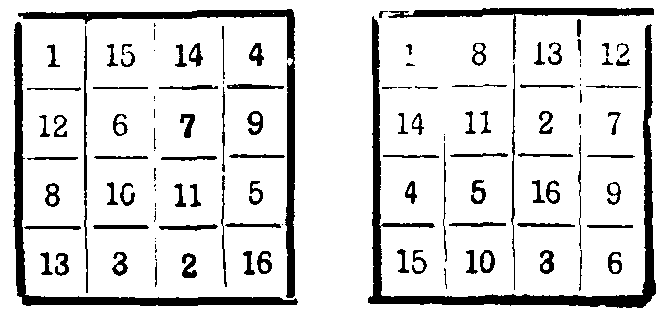
This is the simplest; but a more elaborate plan is to so arrange the figures that any form of the blocks will form a square sum of 34. See the annexed solution, which the ingenious in may still further complicate:
2593. Fox and Geese
This old-fashioned game is played on a solitaire board. Seventeen geese occupy the upper part of the board lines, with the fox in the middle, thus:
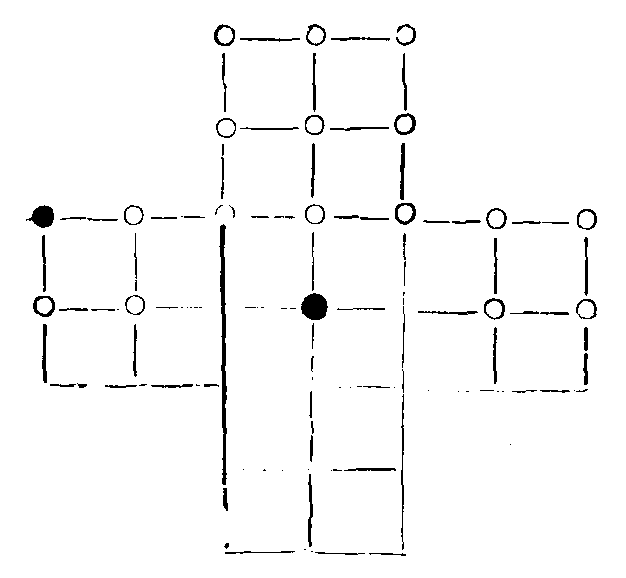
The object of the game is to confine the fox in a corner, so that he cannot move. The geese march forward in straight lines, not on the diagonals; and whenever a goose is on the spot next the fox, the latter can take him, as in draughts, by jumping over to the vacant spot beyond. The fox can move backwards, forwards, or sideways on the straight lines; but the geese must go forward, and are not allowed to retreat. Properly played, the geese must win; but when the number of geese is reduced to six, it is impossible for them to confine the fox.
There are several ways of playing the game, by placing the fox and geese in other positions, or by insisting on the fox catching all the geese. In the latter case, the fox chooses his own starting place. The game may also be played with eight geese and a fox.
Another way of playing this game is on an ordinary draughtboard, with four white men for the geese, and a black king for the fox. The geese can only move forward, but the fox moves either way. The object of the geese is to pen up the fox so that he cannot move; the object of the fox is to break through the line of defence. If the game be properly played, the geese must win. Place them on the draughtboard thus:
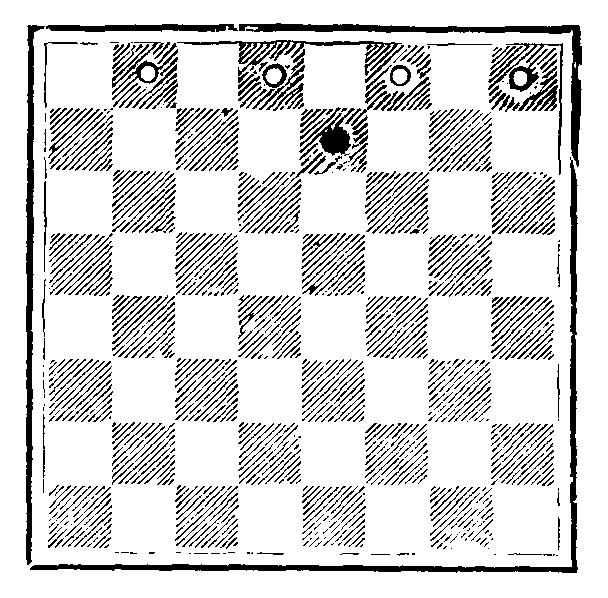
The secret is to keep the geese in a line. The fox tries to prevent this, and if he can succeed in doubling the geese, or getting one to stand before the other, he is nearly sure to pass through them.
2594. The Royal Game of Goose
In the old German game the figure of a goose is printed on a large sheet of paper, and divided into 63 squares or divisions. The object of the players,—any number of whom may join in the game—is to make 63 points by successive throws of two dice. A pool is made by equal contributions by the players, the first of whom gaining the required number wins. The players throw alternately and add each individual throw to that already made.
Each player's position is shown on the goose by a counter, a wafer, or any small article. Any number beyond 63 sends the thrower back as many points as he exceeds 63. Thus if he were 58, and by a 6 and 5 he threw eleven he would go forward 5 squares to 63, and back 6 squares from 63. In addition to this, certain numbers on the goose are barred; and if the player make them he is fined two counters, which are added to the pool. The numbered goose is sold at most toy shops, but a numbered draughtboard will serve as well.
2595. Troco or Lawn Billiards
This is a game that may be played by any number of persons in a field or open space. The implements are wooden balls and long-handled cues at the ends of which are spoonlike ovals of iron. In the centre of the Troco ground is fixed a ring of iron, which moves freely on a pivot, the spike of the ring being driven into a piece of wood let into the ground. The wooden ball is lifted from the ground by means of the spoon-ended cue, and thrown towards the ring—the object of the player being to pass the ball through the ring; and he who succeeds in making any given number of points by fairly ringing his ball, or canoning against the other balls, wins the game.
Canons are made by the player striking two balls successively with his own ball fairly delivered from his spoon. Thus (says the most recent writer on the game) a clever player may make a large number of points—five, seven, or more at a stroke: two the first canon, two for a second canon, and three for the ring. This, however, is very seldom accomplished.
Considerable skill is required in throwing the ball, as the ring, turning freely on its pivot, twists round on being struck. To "make the ring," it is necessary, therefore, that the ball be thrown fairly through its centre. But in order to get nearer to it a judicious player will endeavour to make two or three canons, if the balls lie within a convenient distance and at a proper angle to each other. If the ball be thrown with sufficient force, it will glance off from the ball struck in a line corresponding to its first or original line of projection.
2596. Rules
Troco may be played by two or more persons, each of whom is provided with a ball and a cue. When more than two play, sides are chosen, and the side which first makes the requisite number of points wins the game.
The players stand in a circle, in the centre of which is set up the pivot-ring.
Each player starts from any portion of the circle distant not less than four yards from the ring. The first player lifts his ball with the spoon-cue, and throws it towards the ring; each of the others taking his turn alternately—the balls remaining on the ground where they stop rolling.
If the first player fail to "make his ring," the next goes on, who may either throw at the ring or at the ball in the circle.
Partners may assist each other in getting near the ring; but no player, at starting, may step within four yards of the ring.
Two points are counted for every canon, and three for every fairly-made ring; and successive points are reckoned for any number of rings or canons.
Each player goes on till he fails to canon or ring his ball; when the next plays; and so on, till the required number of points are made.
One point is taken off the player's score for every foul stroke. Foul strokes are made by touching a ball with hand or person while it is in play; by playing with a wrong ball; by playing out of turn; by overturning the ring; and by making two or more steps while throwing the ball.
Each player, after the start, must go on from the place at which his ball was left after the previous stroke.
All disputed points must be settled by the umpire, whose decision is final.
No ball in-play must be removed from its position except by a stroke from another ball, and every ball is considered to be in-play while it is within the circle, which may be of any dimensions chosen by the players previous to the commencement of the game.
Any player leaving a game before it is finished, loses it.
The game is played fifteen, twenty-one, or any other determined number of points. The balls should be perfectly round and smooth. They are generally made of boxwood or lignum vitæ, and weigh about three to five lbs. each; the balls, cues, &c., are sold by most dealers in croquet implements.
2597. Habits of a Man of Business
A sacred regard to the principles of justice forms the basis of every transaction, and regulates the conduct of the upright man of business. The following statements afford a bird's-eye view, as it were, of his habits, practice, and mode of procedure:
He is strict in keeping his engagements.
He does nothing carelessly or in a hurry.
He employs nobody to do what he can easily do himself.
He keeps everything in its proper place.
He leaves nothing undone that ought to be done, and which circumstances permit him to do.
He keeps his designs and business from the view of others.
He is prompt and decisive with his customers, and does not over-trade his capital.
He prefers short credits to long ones; and cash to credit at all times, either in buying or selling; and small profits in credit cases with little risk, to the chance of better gains with more hazard.
He is clear and explicit in all his bargains.
He leaves nothing of consequence to memory which he can and ought to commit to writing.
He keeps copies of all his important letters which he sends away, and has every letter, invoice, &c., belonging to his business, titled, classed, and put away.
He never suffers his desk to be confused by many papers lying upon it.
He is always at the head of his business, well knowing that if he leaves it, it will leave him.
He holds it as a maxim that he whose credit is suspected is not one to be trusted.
He is constantly examining his books, and sees through all his affairs as far as care and attention will enable him.
He balances regularly at stated times, and then makes out and transmits all his accounts current to his customers, both at home and abroad.
He avoids as much as possible all sorts of accommodation in money matters, and lawsuits where there is the least hazard.
He is economical in his expenditure, always living within his income.
He keeps a memorandum-book in his pocket, in which he notes every particular relative to appointments, addresses, and petty cash matters.
He is cautious how he becomes security for any person; and is generous when urged by motives of humanity.
Let a man act strictly to these habits—ever remembering that he hath no profits by his pains whom Providence doth not prosper—and success will attend his efforts.
2598. Taking a Shop or Place of Business
If you are about to take a place of business, you will do well to consider the following remarks:
2599. Small Capitalists
Let us take the case of a person who has no intimate knowledge of any particular trade, but having a very small capital, is about to embark it in the exchange of commodities for cash, in order to obtain an honest livelihood thereby. It is clear, that unless such a person starts with proper precaution and judgment, the capital will be expended without adequate results; rent and taxes will accumulate, the stock will lie dead or become deteriorated, and loss and ruin must follow. For the last absorption acting upon a small capital will soon dry up its source; and we need not picture the trouble that will arise when the mainspring of a tradesman's success abides by him no more.
2600. Larger Capitalists
The case of the larger capitalist can scarcely be considered an exception to the same rule. For it is probable that the larger capitalist, upon commencing a business, would sink more of his funds in a larger stock—would incur liability to a heavier rent; and the attendant taxes, the wages of assistants and servants would be greater, and, therefore, if the return came not speedily, similar consequences must sooner or later ensue.
2601. Localities
Large or small capitalists should, therefore, upon entering on a shopkeeping speculation, consider well the nature of the locality in which they propose to carry on trade, the number of the population, the habits and wants of the people, and the extent to which they are already supplied with the goods which the new adventurer proposes to offer them.
2602. New Neighbourhoods
There is a tendency among small capitalists to rush into new neighbourhoods with the expectation of making an early connection. Low rents also serve as an attraction to these localities. General experience, however, tends to show that the early suburban shops seldom succeed. They are generally entered upon at the very earliest moment that the state of the locality will permit—often before the house is finished the shop is tenanted, and goods exposed for sale—even while the streets are unpaved, and while the roads are as rough and uneven as country lanes.
The consequence is, that as the few inhabitants of these localities have frequent communication with adjacent centres of business, they, as a matter of habit or of choice, supply their chief wants thereat; and the newly arrived shopkeeper has to depend principally for support upon the accidental forgetfulness of his neighbour, who omits to bring something from the cheaper and better market; or upon the changes of the weather, which may sometimes favour him by rendering a "trip to town" exceedingly undesirable.
2603. Failures
"While the grass is growing the horse is starving;" and thus, while the new district is becoming peopled the funds of the small shopkeeper are gradually eaten up, and he puts up his shutters just at the time when a more cautious speculator steps in to profit by the connection already formed, and to take advantage of the new improved condition of the locality. It seems, therefore, desirable for the small capitalists rather to run the risk of a more expensive rent, in a well-peopled district, than to resort to places of slow and uncertain demand; for the welfare of the small shopkeeper depends entirely upon the frequency with which his limited stock is cleared out and replaced by fresh supplies.
2604. Precautions
But should the small capitalist still prefer opening in a suburban district, where competition is less severe, and rents and rates less burdensome, there are certain precautions which he will do well to observe. He should particularly guard against opening a shop to supply what may be termed the superfluities of life; for the inhabitants of new suburban districts are those who, like himself, have resorted to a cheap residence for the sake of economy. Or if this be not the case—if they are people of independent means, who prefer the "detached villa" to the town house, squeezed up on both sides, they have the means of riding and driving to town, and will prefer choosing articles of taste and luxury from the best marts, enriched by the finest display.
2605. Necessaries or Luxuries
The suburban shopkeeper should, therefore, confine himself to supplying the
necessaries
of life. Hungry people dislike to fetch their bread from five miles off; and to bring vegetables from a long distance would evidently be a matter of considerable inconvenience. The baker, the butcher, the greengrocer, the beer retailer, &c., are those who find their trade first established in suburban localities. And not until these are doing well should the tailor, the shoemaker, the hatter, the draper, the hosier, and others, expect to find a return for their capital and reward for their labour.
2606. Civility
In larger localities, where competition abounds, the small shopkeeper frequently outstrips his more powerful rival by one element of success, which may be added to any stock without cost, but cannot be withheld without loss. That element is
civility
. It has already been spoken of elsewhere, but must be enforced here, as aiding the little means of the small shopkeeper to a wonderful degree. A kind and obliging manner carries with it an indescribable charm. It must not be a manner which indicates a mean, grovelling time-serving spirit, but a plain, open, and agreeable demeanour, which seems to desire to oblige for the pleasure of doing so, and not for the sake of squeezing an extra penny out of a customer's pocket.
2607. Integrity
The sole reliance of the shopkeeper should be in the integrity of his transactions, and in the civility of his demeanour. He should make it the interest and the pleasure of the customer to come to his shop. If he does this, he will form the very best "connections," and so long as he continues this system of business, they will never desert him.
2608. Duties of a Shopkeeper
He should cheerfully render his best labour and knowledge to serve those who approach his counter, and place confidence in his transactions; make himself alike to rich and poor, but never resort to mean subterfuge and deception to gain approbation and support. He should be frugal in his expenditure, that in deriving profits from trade, he may not trespass unduly upon the interest of others; he should so hold the balance between man and man that he should feel nothing to reprove his conscience when the day comes for him to repose from his labours and live upon the fruits of his industry. Let the public discover such a man, and they will flock around him for their own sakes.
2609. A Very Useful Book
A very useful book, "The Handy Book of Shopkeeping, Shopkeeper's Guide"
1
(published at one shilling), enlarges upon these subjects in a very able manner, and gives most useful hints to people in every department of trade.
Footnote 1:
Houlston and Sons, London.
return to footnote mark
2610. Early Rising
The difference between rising every morning at six and eight, in the course of forty years, amounts to 29,200 hours, or three years one hundred and twenty-one days and sixteen hours, which are equal to eight hours a day for exactly ten years So that rising at six will be the same as if ten years of life (a weighty consideration) were added, wherein we may command eight hours every day for the cultivation of our minds and the despatch of business.
2611. Frugality
The great philosopher, Dr. Franklin, inspired the mouthpiece of his own eloquence, "Poor Richard," with "many a gem of purest ray serene," encased in the homely garb of proverbial truisms. On the subject of frugality we cannot do better than take the worthy Mentor for our text, and from it address our remarks. A man may, if he knows not how to save as he gets, "keep his nose all his life to the grindstone, and die not worth a groat at last. A fat kitchen makes a lean will."
"Many estates are spent in getting, Since women for tea forsook spinning and knitting, And men for punch forsook hewing and splitting."
If you would be wealthy, think of saving as well as of getting. The Indies have not made Spain rich, because her out-goes are greater than her in-comes.
Away with your expensive follies, and you will not have so much cause to complain of hard times, heavy taxes, and chargeable families.
"What maintains one vice would bring up two children."
You may think, perhaps, that a little tea, or superfluities now and then, diet a little more costly, clothes a little finer, and a little entertainment now and then, can be no great matter; but remember, "Many a little makes a mickle."
Beware of little expenses: "A small leak will sink a great ship," as Poor Richard says; and again, "Who dainties love, shall beggars prove;" and moreover, "Fools make feasts and wise men eat them."
Here you are all got together to this sale of fineries and nick-nacks. You call them goods; but if you do not take care they will prove evils to some of you. You expect they will be sold cheap, and perhaps they may, for less than they cost; but if you have no occasion for them they must be dear to you.
Remember what Poor Richard says, "Buy what thou hast no need of, and ere long thou shalt sell thy necessaries."
"At a great pennyworth, pause awhile." He means, perhaps, that the cheapness is apparent only, and not real; or the bargain, by straightening thee in thy business, may do thee more harm than good; for in another place he says, "Many have been ruined by buying good pennyworths."
"It is foolish to lay out money in the purchase of repentance;" and yet this folly is practised every day at auctions for want of minding the Almanack.
2612. Cash and Credit
If you would get rich, don't deal in bill books. Credit is the "Tempter in a new shape." Buy goods on trust, and you will purchase a thousand articles that cash would never have dreamed of. A shilling in the hand looks larger than ten shillings seen through the perspective of a three months' bill. Cash is practical, while credit takes horribly to taste and romance. Let cash buy a dinner, and you will have a beef-steak flanked with onions. Send credit to market, and he will return with eight pairs of woodcocks and a peck of mushrooms. Credit believes in diamond pins and champagne suppers. Cash is more easily satisfied. Give him three meals a day, and he doesn't care much if two of them are made up of roasted potatoes and a little salt. Cash is a good adviser, while credit is a good fellow to be on visiting terms with. If you want double chins and contentment, do business with cash.
2613. Hints upon Money Matters
Have a supply of change in hand—shillings, sixpences, halfpence. This will obviate the various inconveniences of keeping people at the door, sending out at unreasonable times, and running or calling after any inmate in the house, supposed to be better provided with "the needful." The tradespeople with whom you regularly deal will always give you extra change,
when
you are making purchases or paying bills; while those to whom you apply for it, on a sudden emergency, may neither be willing nor able to do so. Some housekeepers object to this arrangement, that, "as soon as five-pound notes or sovereigns are changed, they always seem to go, without their understanding how;" but to such persons I would humbly intimate, that this is rather the fault of their
not getting understanding
, than any inevitable consequence of
getting change
.
The fact is, that it is the necessity of parting with your money which obliges you to get the larger pieces changed, and not the circumstance of having smaller coin that
necessitates
your parting with your money, though it certainly facilitates your doing so when the necessity arrives. However, as it is easier to count a few sovereigns than many shillings, and loose money is most objectionable, it is well to put up reserve change in small collective packets, and to replenish the housekeeping purse from these daily or weekly, as may be most convenient.
Death does not Blow a Trumpet.
2614. Save Time and Trouble
If Money for daily expenses has to pass through the hands of a servant, it is a time-and-trouble-saving plan to settle with her
every
night, and to make up her cash in hand to a certain
similar
sum. This will prevent such puzzling calculations as the following:
"Let me see: I gave you 10s. on Saturday, and 9d. the day before. Was it 9d.? No, it must have been 11d., for I gave you 1s., and you gave me 1d. out for the beggar; then there was 6s. 6d. on Monday, and 8d. you owed me from last money; and then the 1s. 6d. your master gave you for a parcel—you brought him 2d. back, and 3d-1/2. out of the butcher's bill; no—you had to give 3-1/2d. to the butcher, but you came to me for the 1/2d., and I had no coppers, so we still owe him the 1/2d.; by the way, don't forget to pay him the next time you go. Then there's the baker—no, I paid the baker myself, and I think the housemaid paid the butter-man; but you got in the cheese the day before, and I have a sort of recollection that I may possibly owe you for that, all but a few pence you must have had left of mine, that I told you to take from off the chimney-piece. Well, cook, I think that's nearly all! Now how do your accounts stand?"
This the poor cook, who
is
a cook, and
not
a conjuror, finds it no easy matter to discover; all that she is quite certain of is, that her disbursements have somewhat exceeded her receipts, and being an honest woman, though a poor one, she wishes to cheat neither her mistress nor herself; but what with her memory and her want of it, her involved payments, and different receipts; what she owed her mistress, and what her mistress owes her; what she got from her master, and what was partly settled by the housemaid; the balance from the butcher's bill, and the intricacies of the cheese account, the poor woman is perfectly bewildered.
She counts again and again; recapitulates her mistress's data and her own; sums upwards, backwards, and forwards, and endeavours to explain the differences between them; then, if she can read and write, she brings her slate to "explain the explanation," and the united calculations of maid and mistress, which are after all entirely unavailing to produce a more correct account, probably consume more time, and are expressed in more words, than would suffice to fill another volume like the present. Two minutes' daily reckoning from a
regular
sum in hand would do the business effectually, and prevent either party from being out of pocket or out of temper. Thus, for instance, the maid has her usual sum of five shillings to account for; she pays during the day, for:
s. d.
Bread 1 9
Beer 0 6
Vegetables and fruit 0 10
Milk 0 4
Matches 0 1
Parcel 1 0
Total 4 6
This is easily reckoned, even by the unlearned; the mistress enters the items in her day-book, takes the remaining sixpence, and again gives her servant 5s., in convenient change, to be as readily accounted for on the succeeding day.
Home Truths for Home Peace
; or,
Muddle Defeated.
Time Brings Everything to Those who can Wait.
2615. Don't Run in Debt
"Don't run in debt;"—never mind, never mind If your clothes are faded and torn: Mend them up, make them do; it is better by far Than to have the heart weary and worn. Who'll love you the more for the shape of your hat, Or your ruff, or the tie of your shoe, The cut of your vest, or your boots, or cravat, If they know you're in debt for the new? There's no comfort, I tell you, in walking the street In fine clothes, if you know you're in debt, And feel that, perchance, you some tradesman may meet, Who will sneer—"They're not paid for yet." Good friends, let me beg of you, don't run in debt; If the chairs and the sofas are old, They will fit your back better than any new set, Unless they are paid for—with gold; If the house is too small, draw the closer together, Keep it warm with a hearty good-will; A big one unpaid for, in all kinds of weather, Will send to your warm heart a chill. Don't run in debt—now, dear girls, take a hint, if the fashions have changed since last season, Old Nature is out in the very same tint, And old Nature, we think, has some reason; But just say to your friend, that you cannot afford To spend time to keep up with the fashion; That your purse is too light and your honour too bright, To be tarnished with such silly passion. Men, don't run in debt—let your friends, if they can. Have fine houses, and feathers, and flowers: But, unless they are paid for, be more of a man Than to envy their sunshiny hours. If you've money to spare, I have nothing to say— Spend your silver and gold as you please; But mind you, the man who his bill has to pay Is the man who is never at ease. Kind husbands, don't run into debt any more; 'Twill fill your wives' cup full of sorrow To know that a neighbour may call at your door, With a claim you must settle to-morrow Oh! take my advice—it is good, it is true! But, lest you may some of you doubt it, I'll whisper a secret now, seeing 'tis you— I have tried it, and know all about it, The chain of a debtor is heavy and cold. Its links all corrosion and rust; Gild it o'er as you will, it is never of gold, Then spurn it aside with disgust.
2616. Carving, Ceremonies of the Table, &c.
A dinner-table should be well laid, well lighted, and always afford a little spare room. It is better to invite one friend less in number, than to destroy the comfort of the whole party.
2617. The Laying out of a Table
The laying out of a table must greatly depend upon the nature of the dinner or supper, the taste of the host, the description of the company, and the appliances possessed. It would be useless, therefore, to lay down specific rules. The whiteness of the table-cloth, the clearness of glass, the polish of plate, and the judicious distribution of ornamental groups of fruits and flowers, are matters deserving the utmost attention.
2618. A Sideboard
A sideboard will greatly relieve a crowded table, upon which may be placed many things incidental to the successive courses, until they are required.
2619. Menu
A bill of fare or Menu at large dinner parties, where there are several courses, should be provided neatly inscribed upon small tablets, and distributed about the table, that the diners may know what there is to come.
2620. Napkins
Napkins should be folded neatly. The French method, which is very easy, of folding the napkin like a fan, placing it in a glass, and spreading out the upper part, is very pleasing. But the English method of folding is like a slipper, and placing the bread inside its folds is convenient as well as neat.
As the Virtue is in the Tree, Such is the Fruit.
2621. Bread
Bread should be cut into thick squares, the last thing after the table is laid. If cut too early it becomes dry. A tray should he provided, in which there should be a further supply of bread, new, stale, and brown. For cheese, pulled bread should be provided.
2622. Carving-knives
Carving-knives should be "put in edge" before the dinner commences, for nothing irritates a good carver, or perplexes a bad one, more than a knife which refuses to perform its office; and there is nothing more annoying to the company than to see the carving-knife gliding to and fro over the steel while the dinner is getting cold, and their appetites are being exhausted by delay.
2623. Joints
Joints that require carving should be set upon dishes sufficiently large. The space of the table may be economised by setting upon small dishes those things that do not require carving.
2624. The Carver
The carver should have plenty of room, however closely the diners are compelled to sit together.
2625. The Vegetables
The vegetables, if the table is very crowded, may be placed upon the sideboard, and handed round by those who wait upon the guests.
2626. Smaller Joints
Geese, Turkeys, Poultry, Sucking-pigs, &c., should be
carved before being set on table
; especially in those cases where the whole or the principal part of such dishes is likely to be consumed.
2627. Handing Round
The carver should supply the plates, and the waiter hand them round, instead of putting the question to each guest as to which part he prefers, and then striving to serve him with it, to the prejudice of others present.
2628. Ladies
Ladies should be helped before gentlemen.
2629. Waiters
Waiters should present dishes on the left hand; so that the diner may help himself with his right.
2630. Wine
Wine should be taken after the first course; and it will be found more convenient to let the waiter serve it, than to hand the decanters round, or to allow the guests to fill for themselves.
2631. Removal
Waiters should be instructed to remove whatever articles upon the table are thrown into disuse by the progress of the dinner, as soon as they are at liberty.
2632. Finger-Bowls
Finger-glasses, or glass bowls, filled with water, slightly scented or not, as may be preferred, and slightly warm in winter, and iced in summer, should be handed round.
2633. Dessert
When the dessert is served, the wine should be set upon the table, and the decanters passed round by the company.
2634. Fried Fish
Fried fish should be divided into suitable slices, before the fire, as soon as it leaves the frying-pan.
2635. Cod's Head and Shoulders
The thick part of the back is best. It should be carved in unbroken slices, and each solid slice should be accompanied by a bit of the sound, from under the back-bone, or from the cheek, jaws, tongue, &c., of the head.
2636. Hake
Hake, if sent to table, simply boiled, is served as cod. The better way of dressing hake is to cut it transversely to the length into slices about one inch in thickness. These should be fried and sent to table garnished with parsley.
2637. Turbot
Strike the fish-slice along the back-bone, which runs from head to tail, and then serve square slices from the thick part, accompanying each slice with some of the gelatinous skin of the fins and thin part, which may be raised by laying the fish-slice flat.
2638. Brill
Brill is served in the same manner.
2639. John Dory
John Dory is also served in the same way. This fish has a favourite piece on the cheek.
2640. Plaice and Flat-fish
Plaice and flat-fish generally, are served in the same manner.
2641. Soles
Soles, when large, may be served as
turbot
; but when small they should be sliced across.
2642. Salmon
Serve a slice of the thick with a smaller slice of the thin part. Keep the flakes of the thick part as unbroken as possible.
2643. Mackerel
Mackerel should be served in pieces cut through the side when they are large. It small, they may be divided through the back-bone, and served in halves. The shoulder part is considered the best.
2644. Haddock and Gurnet
Haddock and Gurnet are served as directed for
mackerel
.
2645. Whiting
Whiting are usually fried and curled; they should be cut in halves down the back, and served. The shoulder-part is best.
2646. Eels
Eels are usually cut into several pieces, either for stewing or frying. The thick parts are considered best.
2647. Trout
Trout, if small, are served whole; if large, they may be divided through the back-bone and served in halves. The same applies to perch and other smaller fresh-water fish.
2648. Pike and Jack
Pike and Jack should be served in thick unbroken pieces taken from the side or shoulder of the fish accompanied by a piece of the stuffing with which these fish are usually filled.
2649. Remarks
The
roes
of mackerel, the
sound
of cod, the
head
of carp, the
cheek
of John Dory, the
liver
of cod, &c., are severally considered delicacies, though not by all persons.
2650. Saddle of Mutton
Cut thin slices parallel with the back-bone; or slice it obliquely from the bone to the edge.
2651. Haunch of Mutton or Venison
Make an incision across the knuckle-end, right into the bone, and set free the gravy. Then cut thin slices the whole length of the haunch. Serve pieces of fat with slices of lean.
2652. Rump or Sirloin of Beef
The undercut, called the "fillet," is exceedingly tender, and some carvers will turn the joint and serve the fillet first, reserving the meat on the upper part to be eaten cold. From the upper part, whether hot or cold, the slices should be cut lengthways from top to bottom, so that the fat and lean may be distributed in fair proportions.
2653. Ribs of Beef
Ribs of beef are carved in the same way as the sirloin; but there is no fillet.
2654. Round of Beef
First cut away the irregular outside pieces, to obtain a good surface, and then serve thin and broad slices. Serve bits of the udder fat with the lean.
2655. Brisket of Beef
Cut off the outside, and then serve long slices, cut the whole length of the bones.
2656. Shoulder of Mutton
Make a cross incision on the fore-part of the shoulder, and serve slices from both sides of the incision; then cut slices lengthways along the shoulder-blade. Cut fat slices from the round corner. Another and more economical way, is to cut slices from the under part when first brought to table. The joint then presents a better appearance when cold.
2657. Leg of Mutton
Make an incision across the centre, and serve from the knuckle-side, or the opposite, according to choice. The knuckle-side will be generally found well done, and the opposite side underdone, for those who prefer it.
2658. Loin of Mutton
Cut down between the bones, into chops.
2659. Quarter of Lamb
Lay the knife flat, and cut off the shoulder. The proper point for incision will be indicated by the position of the shoulder. A little lemon juice may be squeezed over the divided part, and a little Cayenne pepper, and the shoulder transferred to another dish, for the opposite end of the table. Next separate the
brisket
, or short bones, by cutting lengthways along the breast. Then serve from either part as desired.
Travel North, or South, or East, or West...
2660. Loin of Veal
Loin of veal may be cut across through the thick part; or slices may be taken in the direction of the bones. Serve pieces of kidney and fat with each plate.
2661. Fillet of Veal
Fillet of veal is carved as a round of beef. The browned bits of the outside are esteemed, and should be shared among the company, with bits of fat, and of forcemeat from the centre.
2662. Breast of Veal
Breast of veal should be divided by cutting the
brisket
, or soft bones, the same as the basket of lamb. When the sweetbread comes to table with the breast, a small piece should be served on each plate.
2663. Sucking-Pig
Sucking-pig should be sent to table in two halves, the head divided, and one half laid at each end of the dish. The shoulders and legs should be taken off by the obvious method of laying the knife under them, and lifting the joint out. They may be served whole, or divided. The ribs are easily divided, and are considered choice.
2664. Tongues
Tongues are cut across in tolerably thick slices.
2665. Calves' Heads
Calves' heads are carved across the cheek, and pieces taken from any part that is come-at-able. The tongue and brain sauce are served separate.
2666. Knuckle of Veal
Knuckle of veal is carved by cutting off the outside pieces, and then obtaining good slices, and apportioning the fat to the lean, adding bits of the sinew that lie around the joint.
2667. Leg of Pork
Leg of pork is carved as a ham, but in thicker slices; when stuffed, the stuffing must be sought for under the skin at the large end.
2668. Loin of Pork
Loin of pork is carved the same as a
loin of mutton
.
2669. Spare-rib of Pork
Spare-rib of pork is carved by separating the chops, which should previously have been jointed. Cut as far as the joint, then return the knife to the point of the bones, and press over, to disclose the joint, which may then be relieved with the point of the knife.
2670. Hams
Hams are cut in very thin slices from the knuckle to the blade.
2671. Pheasants
Carve the breast in slices. Then take off the legs and wings.
2672. Fowls
Fix the fork firmly into the breast, then slip the knife under the legs, and lay it over and dis-joint; detach the wings in the same manner. Do the same on both sides, The smaller bones require a little practice, and it would be well to watch the operations of a good carver. When the merry-thought has been removed (which it may be by slipping the knife through at the point of the breast), and the neck-bones drawn out, the trunk may be turned over, and the knife thrust through the back-bone.
2673. Partridges
Partridges are best carved by cutting off the breast, and then dividing it. But for more economical carving, the wings may be cut with a small breast slice attached.
2674. Woodcocks
Woodcocks may be cut right through the centre, from head to tail. Serve with each portion a piece of the toast upon which they come to table.
2675. Pigeons
Pigeons may be carved as woodcocks, or as partridges.
2676. Snipes
Snipes may be carved the same as woodcocks.
2677. Turkey
Cut slices from each side of the breast down, to the ribs; the legs may then be removed, and the thighs divided from the drumsticks, which are generally tough; but the pinions of the wing are very good, and the white part of the wing is preferred by many to the breast. The stuffing is usually put in the breast; but when truffles, mushrooms, or oysters are put into the body, an opening must be made into it by cutting through the apron.
2678. Goose
The apron must be cut off in a circular direction, when a glass of port wine, mixed with a teaspoonful of mustard, may be poured into the body or not. Some of the stuffing should then be drawn out, and, the neck of the goose being turned a little towards the carver, the flesh of the breast should be sliced on each side of the bone. The wings may then be taken off, then the legs. The other parts are carved the same as a fowl.
A Man's Own Hose is Still the Best.
2679. Ducks
Ducks may be carved, when large, the same as geese; but when young, like chickens. The thigh joints, however, lie much closer into the trunk than those of fowls.
2680. Hares
Hares should be placed with their heads to the left of the carver. Slices may be taken down the whole length of the back; the legs, which, next to the back, are considered the best eating, may then be taken off, and the flesh divided from or served upon them, after the small bones have been parted from the thighs. The shoulders, which are not much esteemed, though sometimes liked by sportsmen, may be taken off by passing the knife between the joint and the trunk. When a hare is young, the back is sometimes divided at the joints into three or four parts, after being freed from the ribs and under-skin.
2681. Remarks
Sufficient general instructions are here given to enable the carver, by observation and practice, to acquit himself well. The art of carving does not consist merely in dissecting the joints sent to table, but in the judicious and economical distribution of them, and the grace and neatness with which this distribution is effected. Every dish should be sent to table properly garnished (where needed), and the carver should preserve the neatness of the arrangement as much as possible.
2682. Dyeing
The filaments from which stuffs of all kinds are fabricated are derived either from the animal or vegetable kingdom. We recognise the former by the property they possess of liberating ammonia on being treated with potash; while the latter afford a liquor having an acid reaction under the same treatment. The animal kingdom furnishes three varieties—silk, wool, and the furs, &c., of various animals; the vegetable kingdom also three—flax, hemp, and cotton: all of which require certain preliminary preparations to render them fit for the dyer, which do not come within our province, our space only admitting of a rapid glance at the production of the various colours.
2683. General Observations
The various shades produced by colouring matters may be classed in one or other of the following groups:
1. Blue
2. Red Simple
3. Yellow
4. Violets
5. Orange colours Binary
6. Green
7. Compound colours Ternary
8. Black
Some colours adhere at once to the stuff, and are called
substantial colours
; while others require that the material to be dyed should undergo some previous preparation in order to render it permanent. The substances used to fix the colouring matters are called
mordants
, which should possess four qualifications:
They should possess an equal affinity for the fibre of the material and the colouring matter.
They should be incapable of injuring or destroying either by prolonged action.
They should form, with the colour, a compound capable of resisting the action of air and water.
They should be capable of readily conforming to the various operations of the dyer.
2684. The Mordants
For the reasons just given, the acetate or tartrate of iron is preferable to the sulphate; and the acetate or tartrate of alumina to alum.
For reds, yellows, green, and pinks
, aluminous mordants are to be used.
For blacks, browns, puces, and violets
, the acetate or tartrate of iron must be employed.
For scarlets
, use a tin mordant, made by dissolving in strong nitric acid one-eighth of its weight of sal-ammoniac, then adding by degrees one-eighth of its weight of tin, and diluting the solution with one-fourth of its weight of water.
Cunning Men's Cloaks Sometimes Fall.
2685. Calico, Linen, and Muslin (Blue)
Blue
.—Wash well to remove dressing, and dry; then dip in a strong solution of sulphate of indigo—partly saturated with potash—and hang up. Dry a piece to see if the colour is deep enough; if not dip again.
Saxon Blue
.—Boil the article in alum, and then dip in a strong solution of chemical blue.
2686. Calico, Linen, and Muslin (Buff)
Buff
.—Boil an ounce of anatto in three quarts of water, add two ounces of potash, stir well, and put in the calico while boiling, and stir well for five minutes; remove and plunge into cold pump water, hang up the articles without wringing, and when almost dry, fold.
2687. Calico, Linen, and Muslin (Pink)
Pink
.—Immerse in the acetate of alumina mordant, and then in the colouring of a pink saucer.
2688. Calico, Linen, and Muslin (Green)
Green
.—Boil the article in an alum mordant, and then in a solution of indigo mixed with any of the yellow dyes until the proper colour is obtained.
2689. Calico, Linen, and Muslin (Yellow)
Yellow
.
Cut potato tops when in flower, and express the juice; steep articles in this for forty-eight hours.
Dip in a strong solution of weld after boiling in an aluminous mordant. Turmeric, fustic, anatto, &c., will answer the same as weld.
2690. Cloth (Black)
Impregnate the material with the acetate of iron mordant, and then boil in a decoction of madder and logwood.
2691. Cloth (Madder Red)
Boil the cloth in a weak solution of pearlash—an ounce to a gallon of water,—wash, dry, and then steep in a decoction of bruised nutgalls. After drying it is to be steeped twice in dry alum water, then dried, and boiled in a decoction made of three quarters of a pound of madder to every pound of the article. It should then be taken out and dried, and steeped in a second bath in the same manner. When dyed, the articles should be washed in warm soap and water, to remove a dun-coloured matter given out by the madder.
2692. Cloth (Scarlet)
Three quarters of a pint of a tin mordant, made by dissolving three pounds of tin in sixty pounds of hydrochloric acid, is added to every pound of lac dye, and digested for six hours. To dye twenty-five pounds of cloth, a tin boiler of seventy-five gallons capacity should be filled nearly full with water, and a fire kindled under it. When the heat is 150° Fahr., half a handful of bran and two ounces of tin mordant are to be thrown into it. The froth which arises is skimmed off, the liquor is made to boil, and two pounds and three quarters of lac dye, previously mixed with a pound and three quarters of the solvent, and fourteen ounces of the tin solvent, are added.
Immediately afterwards two pounds and three quarters of tartar, and a pound of ground sumach, both tied up in a linen bag, are to be added, and suspended in the bath for five minutes. The fire being withdrawn, five gallons of cold water and two pints and three quarters of tin mordant being poured into the bath, the cloth is immersed in it. The fire is then replaced, and the liquid made to boil rapidly for an hour, when the cloth is removed and washed in pure water.
2693. Cloth (Yellow)
Use No. ii. for calico. Quercitron and weld produce a solid yellow; fustic a very brilliant tint; while turmeric yields a less solid yellow.