V. (continued 2)
Reading edition
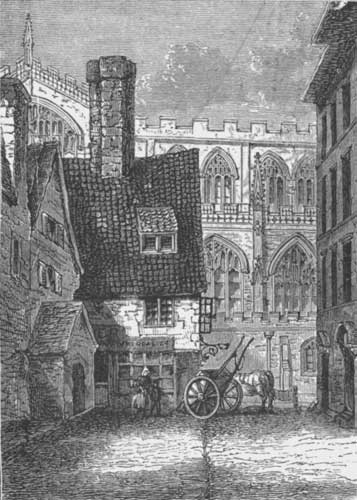
MARKET-SQUARE.
HULL AND BEVERLEY.
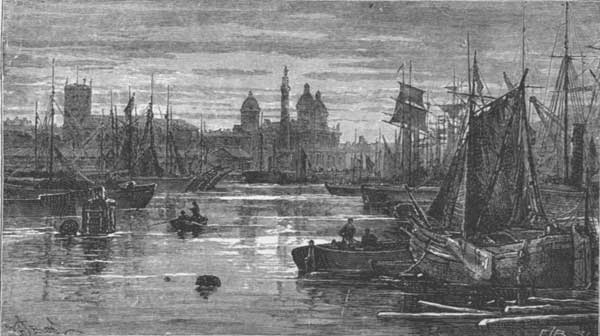
THE HUMBER AT HULL.
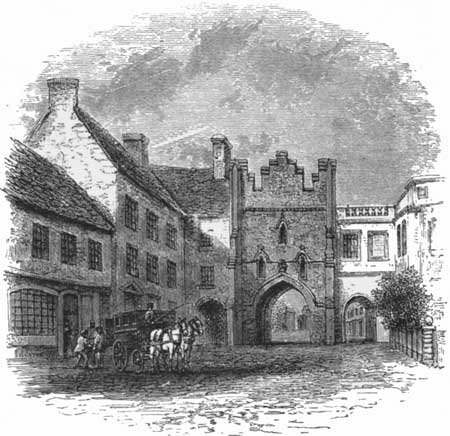
ENTRANCE-GATE, BEVERLEY.
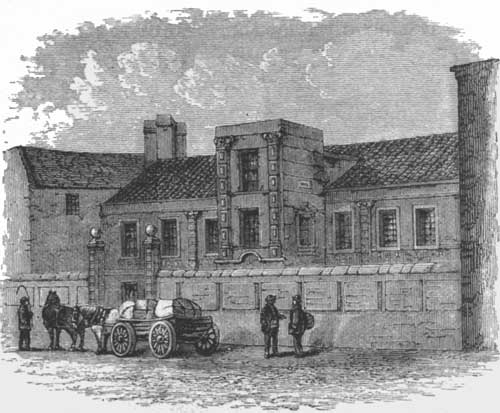
Following the Trent down to the Humber, and turning towards the sea, we come to the noted seaport of Hull, or, as it is best known in those parts, Kingston-upon-Hull. While not possessing great attractions for the ordinary tourist, yet Hull ranks as the third seaport of England, being second only to London and Liverpool. It is the great packet-station for the north of Europe, with steam lines leading to Holland, Denmark, Sweden, Norway, Russia, and the Baltic, most of the English trade with those countries being centred at Hull. It is a town of extreme activity, its docks being all the time crowded with shipping, and its location, practically upon an island, with the river Humber on the south, the river Hull upon the east, and docks upon the northern and western sides, giving it every maritime convenience. The docks, though inferior to those of Liverpool, are the chief feature of the town. The Hull River itself forms a natural dock about a mile and a half long, and from this a chain of other docks leads through the warehouses and the town to the Humber. Hull possesses the Trinity House, one of the three ancient establishments in England—the others being at London and Newcastle—which were founded first as a religious fraternity in the fourteenth century, and became afterwards establishments for the relief of distressed and decayed seamen and their families. The present Trinity House building was erected in the last century. The chief ornament of Hull is the Wilberforce Monument, a pillar of sandstone seventy-two feet high, erected about a half century ago, and surmounted by a statue of the celebrated philanthropist. He was born on High Street August 24, 1759, this being the most important thoroughfare in ancient Hull, but now a narrow and inconvenient lane following the right bank of the Hull River. Here were in former days the houses of the great Hull merchants, and the Wilberforce House is about halfway down the street. It is a curious specimen of brickwork, of a style said to have been imported from Flanders in the reign of William and Mary. It is a low, broad house with a surmounting tower over the doorway. Hull has little else of interest in the way of buildings. Its Holy Trinity Church, in the market-place, is the largest parish church in England, having recently been thoroughly restored, and the Town Hall, built in the Italian style, with a clock-tower, is its finest edifice of modern construction.
HOUSE WHERE WILBERFORCE WAS BORN.
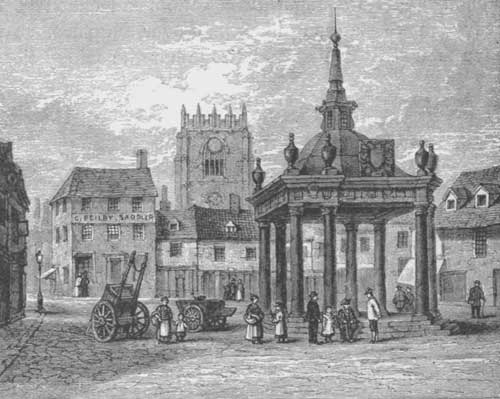
We have now come into Yorkshire, and a few minutes' ride northward by railway along the valley of the Hull River brings the visitor to Beverley, an old-fashioned Yorkshire town of considerable antiquity, eight miles from the seaport. This was anciently a walled town, but of the entrance-gates only one survives, the North Bar, of the time of Edward III. It is a good specimen of brick architecture, with mouldings and niches upon the surface and battlements at the top. This is a favorite old town for the retired merchant and tradesman who wish to pass the declining years of life in quiet, and it contains many ancient buildings of interest. Several of these are clustered around the picturesque market-square, which is an enclosure of about four acres, and contains a quaint cross, a relic of the time when it was customary to build market-crosses. These ancient crosses, which were practically canopies erected over a raised platform, were generally used as pulpits by the preachers when conducting religious services in the open air. Sometimes they were memorials of the dead. We are told that there were formerly five thousand of these crosses of various kinds in England, but most of them were destroyed in the Civil Wars. At these old crosses proclamations used to be read and tolls collected from the market-people. The covered market-cross at Beverley was one of the last that was erected. The name of this interesting town is said to be derived from Beaver Lake, the site having at one time been surrounded by lakes that were formed by the overflowing of the Humber, in which beavers lived in great numbers. The Beverley Minster is an attractive Gothic church, and from the tops of its towers there is an excellent view over the rich and almost level valley through which the Hull River flows. Leconfield Castle, in the suburbs, was an ancient residence of the Percys, of which the moat alone remains.
MARKET-SQUARE, BEVERLEY.
SHEFFIELD.
MANOR-HOUSE, SHEFFIELD.
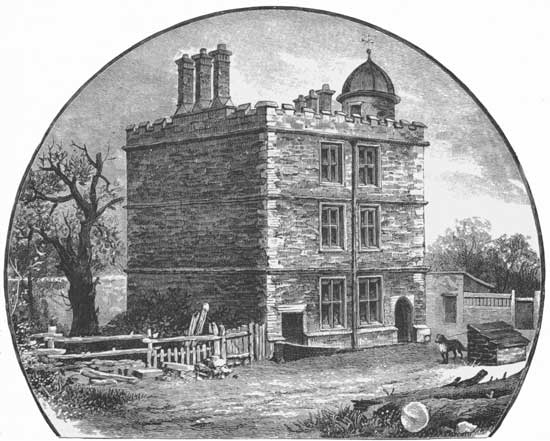
Let us now ascend the estuary of the Humber, and, proceeding up its numerous tributaries, seek out various places of interest in the West Riding of Yorkshire. And first, ascending the river Don, we come to that great manufacturing centre of the "Black Country," sacred to coal and iron, Sheffield. Murray's Guide tells us that while Sheffield is one of the largest and most important towns in Yorkshire, it is "beyond all question the blackest, dirtiest, and least respectable." Horace Walpole in the last century wrote that Sheffield is "one of the foulest towns in England in the most charming situation." It is a crowded city, with narrow and badly-arranged streets, having few handsome public buildings, but bristling with countless tall chimneys belching forth clouds of heavy smoke that hang like a pall over the place. The Don and its tributaries have their beds defiled, and altogether the smoky city is in unpleasant contrast with the beauty of the surrounding country. But, unfortunately, an omelette cannot be made without breaking eggs, nor can Sheffield make cutlery without smoke and bad odors, all of which have amazingly multiplied within the present century, its population having grown from forty-five thousand in 1801 to over three hundred thousand now. It stands at the confluence of the rivers Don and Sheaf, its name being connected with the latter. Three smaller streams join them within the city and are utilized for water-power. The factories spread over the lowlands of the Don valley, and mount up its western slopes towards the moorlands that stretch away to Derbyshire; it is therefore as hilly as it is grimy. Sheffield at the time of the Norman Conquest was the manor of Hallam, which has passed through various families, until, in the seventeenth century, it became by marriage the property of the Duke of Norfolk. The present duke is lord of the manor of Sheffield, and derives a large income from his vast estates there. Sheffield Castle once stood at the confluence of the two rivers, but all traces of it have disappeared. The manor-house, which has been restored, dates from the time of Henry VIII. It is three stories high, and a turret staircase leads from floor to floor, and finally out upon the flat roof.
ENTRANCE TO THE CUTLERS' HALL.
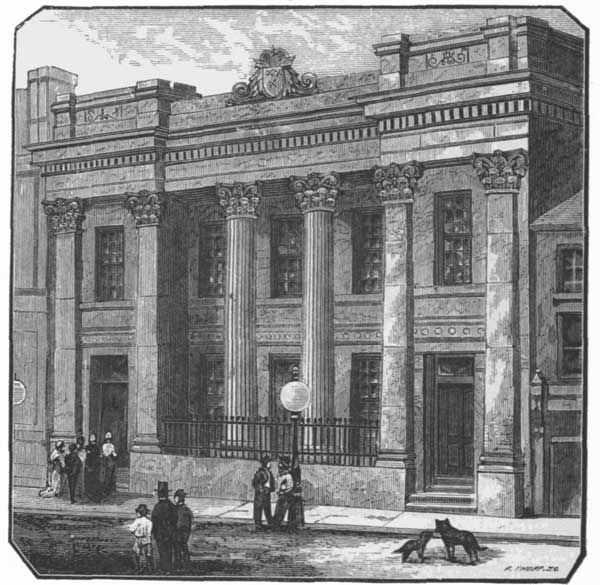
We are told that Sheffield manufactures of metals began in the days of the Romans, and also that Sheffield-made arrows fell thickly at Crecy and Agincourt. Richmond used them with effect at Bosworth Field, and in the sixteenth century we read of Sheffield knives and whittles. Almost the only ancient building of any note the city has is the parish church, but it is so much patched and altered that there is difficulty in distinguishing the newer from the older parts. The chief among the modern buildings is the Cutlers' Hall, a Grecian structure erected for the Cutlers Company in 1833, and enlarged a few years ago by the addition of a handsome apartment. This company, the autocrats of Sheffield, was founded in 1624 by act of Parliament with two express objects—to keep a check upon the number of apprentices and to examine into the quality of Sheffield wares, all of which were to be stamped with the warranty of their excellence. But recently the restrictive powers of this company have been swept away, and it is now little more than a grantor of trade-marks and an excuse for an annual banquet. Sheffield has extensive markets and parks, and the Duke of Norfolk is conspicuous in his gifts of this character to the city; but overtopping all else are the enormous works, which make everything into which iron and steel can be converted, from armor-plating and railway-rails down to the most delicate springs and highly-tempered cutlery. Their products go to every part of the world, and are of enormous value and importance.
WAKEFIELD.
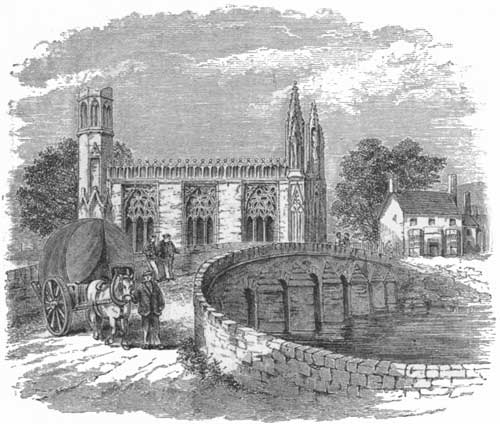
EDWARD IV.'S CHAPEL, WAKEFIELD BRIDGE.
WAKEFIELD.
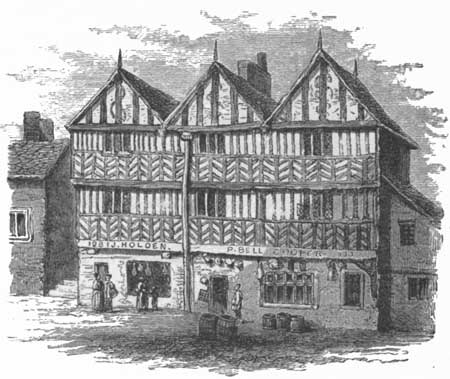
Upon the Calder, another tributary of the Humber, northward of the Don, is the town of Wakefield, which, until the recent great growth of Leeds, was the head-quarters of the Yorkshire clothing-trade. It was here that in the Wars of the Roses the battle of Wakefield was fought on the closing day of the year 1460. The Duke of York wished to remain at Wakefield on the defensive against Queen Margaret's Lancastrian army of twenty thousand men, for his forces were barely one-fourth that number. The Earl of Salisbury, however, prevailed on him to advance to meet the queen, and he probably had no idea of the strength she had to oppose him. The duke was soon cut off, and was among the first to fall, his head having afterwards been put on the Micklegate bar at York. Scenes of great barbarity followed: the Duke of York's son, the Earl of Rutland, was murdered with shocking cruelty after the battle on Wakefield Bridge. Young Rutland's brother, afterwards Edward IV., erected a chapel on the bridge on the spot where he was slain, in order that prayer might be constantly said in it for the repose of the souls of the followers of the White Rose who were slain in the battle. It covers thirty by twenty-four feet, and has recently been restored by a successor of Goldsmith's "Vicar of Wakefield." Near the bridge the spot is pointed out where the Duke of York was killed, now marked by two willows. There is a fine old three-gabled house in Wakefield which was built about the same date as the battle was fought, and is now divided into small shops. It is a good specimen of the ancient black-and-white timbered house, though the carved work on the front has been considerably defaced. It stands in the Kirkgate, which runs down to the Calder, and is known locally as the "Six Chimblies."
LEEDS.
BRIGGATE, LOOKING NORTH.
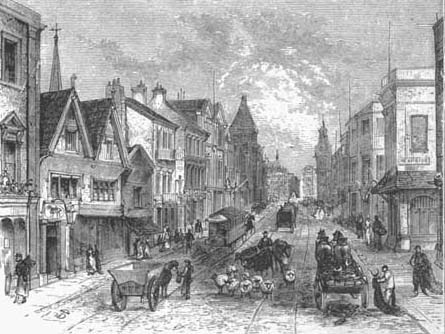
About nine miles north of Wakefield is the great commercial capital of Yorkshire and centre of the cloth-trade. Leeds, built in the valley of the river Aire. Twelve hundred years ago this region, embracing the valleys of the Aire and the Calder, was the independent kingdom of Loidis. It was soon overrun and conquered, however, by the Anglian hosts, and ultimately the conquerors built here the monastery that in Bede's time was presided over by the abbot Thrydwulf. This stood on the site of the present parish church, and in the eighth century it was called "the monastery at Leeta." It stood at the crossing of two important Roman roads in the midst of a forest. This was the beginning of the great city, for soon a hamlet gathered around the monastery, though long since the woods, and indeed all green things, were driven away from Leeds. The village was laid waste by William the Conqueror, and at the time of the Domesday Book it was one of one hundred and fifty manors held by Baron Ilbert de Lacy, whose possessions stretched halfway across Yorkshire. He built a castle at Leeds, which was afterwards a prison of Richard II., but has long since disappeared. In 1530, Leland described Leeds as "a pretty market-town, as large as Bradford, but not so quick as it." Charles I. incorporated it, and the cloth-market was then of some importance. In the Civil War it was taken by the Royalists, and afterwards retaken by Fairfax for the Parliament in a short, sharp struggle, in which a clergyman named Scholfield distinguished himself by his valor, and "by his triumphant psalm-singing" as work after work was captured from the enemy. Flemish workmen brought cloth-making into this part of Yorkshire as early as the reign of Edward III., and two centuries ago the cloth-makers prospered so much that they held a market twice a week at Leeds on a long, narrow bridge crossing the Aire. They laid their cloth on the battlements of the bridge and on benches below, and the country clothiers could buy for four cents from the innkeepers "a pot of ale, a noggin of porridge, and a trencher of boiled or roast beef." This substantial supply was known as the "brigg (bridge)-shot," and from the bridge ran the street known as the Briggate, which has since developed into one of the finest avenues of the city.
ST JOHN'S CHURCH
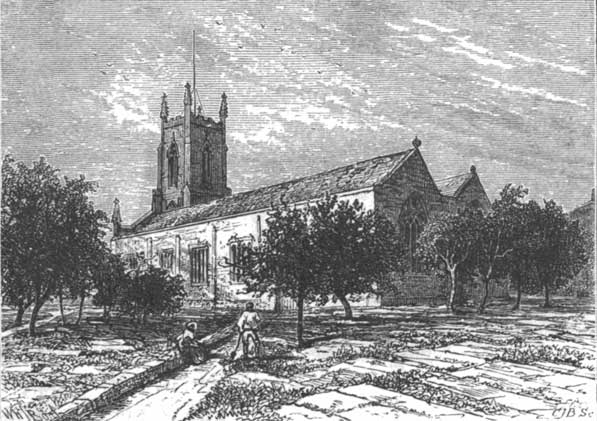
Leeds began to grow in the last century, when it became the chief mart of the woollen clothiers, while the worsted-trade gathered about Bradford. These still remain the centres of the two great divisions of the woollen industry, which is the characteristic business of Yorkshire. The factories began then to appear at Leeds, and in the present century the city has made astonishing advances, growing from fifty-three thousand population in 1801 until it exceeds three hundred thousand now. The great cloth-mart to-day is for miles a region of tall chimneys and barrack-like edifices, within which steadily roars machinery that represents some of the most ingenious skill of the human race. Within this hive of busy industry there still linger some memorials of the past among its hundreds of cloth-mills. Turning out of the broad Briggate into the quiet street of St. John, we come to the church built there by the piety of the wealthy clothier John Harrison, and consecrated in 1634. St. John's Church, which he built and presented to the town because the older parish church could scarce hold half the inhabitants, consists of a long nave and chancel, with a south aisle. It is of Gothic architecture, and much of the ancient woodwork, including the pulpit, remains. Arabesques moulded in white plaster fill the panels between the main roof-beams. This interesting church has undergone little historical change excepting the recent rebuilding of the tower. John Harrison is entombed in the church. The old parish church in Kirkgate has been within a few years entirely rebuilt. The other churches of Leeds, like this one, are all modern, and it also has an imposing Town Hall, opened by the queen in 1858, in which are held the annual musical festivals, which have attained much importance. A statue of the Duke of Wellington stands in the open square in front. The two Cloth Halls of Leeds, the Mixed Cloth Hall and the White Cloth Hall, where the business of selling was at first carried on, are now little used, the trade being conducted directly between the manufacturer and the clothier. Some of the mills are of enormous size, and they include every operation from the raw material to the finished fabric. But, with all their ingenious machinery, the cloth-weavers have not yet been able to supersede the use of the teasel, by which the loose fibres of wool are raised to the surface to form, when cut and sheared, the pile or nap. These teasels, which are largely grown in Yorkshire, are fastened into a cylinder, and at least three thousand of them will be consumed in "teasling" a piece of cloth forty yards long.
BOLTON ABBEY.
THE CHURCHYARD, BOLTON ABBEY.
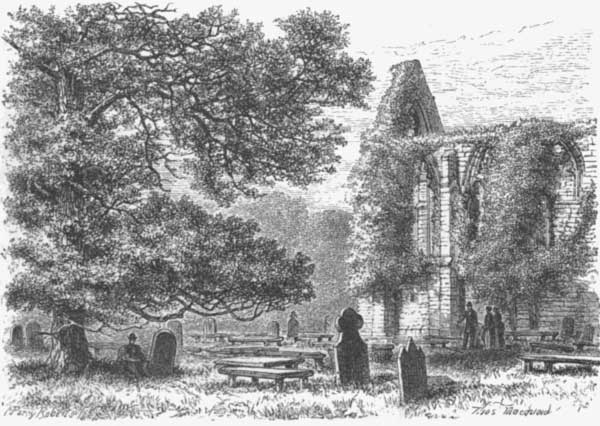
GATEWAY IN THE PRIORY, BOLTON ABBEY.
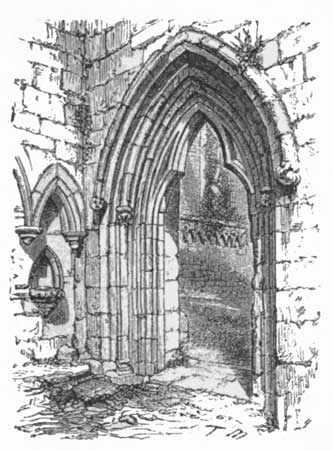
North of the valley of the Aire is the valley of the Wharfe River, and, following that pleasant stream a short distance up, we come to Rumbald's Moor and the water-cure establishments of the town of Ilkley, which is an array of villas and terraces spreading up the hillside from the southern bank of the river. The neighborhood is full of attractive rock-and river-scenery. In the suburbs is the palace of Ben Rhydding, built in the Scottish baronial style, with the Cow and Calf Rocks overhanging the adjacent park. The Panorama Rock also commands a wide prospect, while Rumbald's Moor itself is elevated over thirteen hundred feet. A few miles from Ilkley are the celebrated ruins of Bolton Abbey, standing on a patch of open ground, around which the Wharfe curves, but with much woods clustering near the ruins and on the river-bank. Bolton stands in a deep valley, and on the opposite side of the river rises the steep rock of Simon's Seat, sixteen hundred feet high. The architecture of the abbey is of various styles, the west front coming down to us from the reign of Henry VIII., while its gateway is much older. There is no south aisle to the abbey, and at present the nave and north aisle are roofed in and serve as the parish church. The east end of this aisle is divided from the rest by an ancient wooden screen so as to form a chapel, and beneath this is the vault where the former owners of Bolton—the Claphams and Mauleverers—were buried. Some years ago, when the floor was being repaired, their coffins were found standing upright, whereof the poet tells us:
"Through the chinks in the fractured floor Look down and see a grisly sight— A vault where the bodies are buried upright There, face by face and hand by hand. The Claphams and Mauleverers stand."
The ruins of the north transept are in fair preservation, and the choir has a beautiful arcade, while through the openings beneath there is a charming view of the green-bordered river and of the hills beyond. Bolton Hall, which was the ancient gateway of the abbey, is opposite its western front, and is one of the favorite homes in the shooting season of the Duke of Devonshire, its owner.
THE STRID.
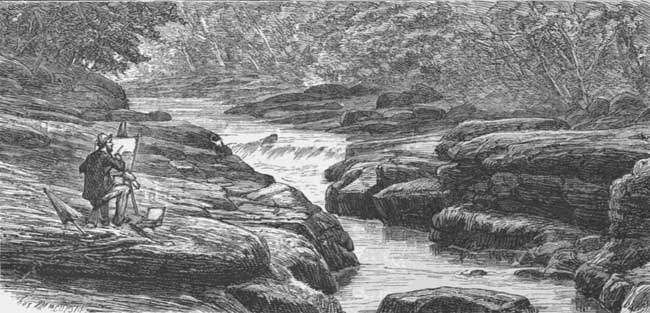
A pleasant walk of two miles along the Wharfe brings us to the famous Strid, where the river is hemmed in between ledges of rock, and the scene of the rushing waters is very fine, especially after a rain. Beautiful paths wind along the hillsides and through the woods, and here, where the ruins of Bardon Tower rise high above the valley, is a favorite resort of artists. At the most contracted part of the rocky river-passage the water rushes through a narrow trench cut out for about sixty yards length, within which distance it falls ten feet. The noise here is almost deafening, and at the narrowest part the distance across is barely five feet. It looks easy to jump over, but from the peculiar position of the slippery rocks and the confusing noise of the rushing water it is a dangerous leap.
"This striding-place is called 'the Strid.' A name which it took of yore. A thousand years hath it borne that name, And shall a thousand more."
It was here that young Romilly, the "Boy of Egremont," was drowned several centuries ago, the story of his death being told by Wordsworth in his poem of "The Force of Prayer." He had been ranging through Bardon Wood, holding a greyhound in a leash, and tried to leap across the Strid:
"He sprang in glee; for what cared he, That the river was strong and the rocks were steep? But the greyhound in the leash hung back, And checked him in his leap. "The boy is in the arms of Wharfe, And strangled by a merciless force; For nevermore was young Romilly seen Till he rose a lifeless corse."
It is said that his disconsolate mother built Bolton Abbey to commemorate the death of her only son, and placed it in one of the most picturesque spots in England.
RIPON AND FOUNTAINS.
RIPON MINSTER.
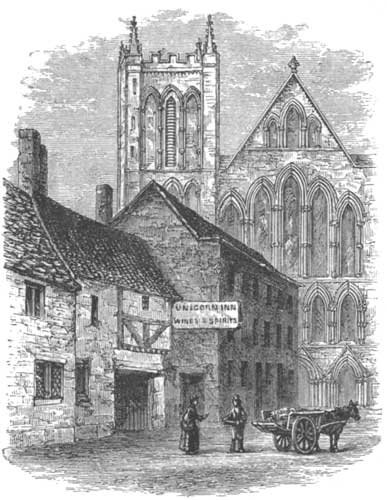
STUDLEY ROYAL PARK.
Proceeding still farther northward from the charming vale of Wharfe, we come to the valley of the Ure, which flows into the Ouse, a main tributary of the Humber, and to the famous cathedral-town of Ripon. This is a place of venerable antiquity, for it has been over twelve centuries since a band of Scotch monks came from Melrose to establish a monastery on the sloping headland above the Ure. A portion of the ancient church then founded is incorporated in the present Ripon Minster, which was built seven centuries ago. It was burned and partly injured by the Scotch in the fourteenth century, and subsequently the central tower and greater part of the nave were rebuilt. It has recently been entirely restored. The cathedral consists of a nave, with aisles extending the full width of the western front, and rather broad for its length; the transepts are short. Parallel to the choir on the southern side is a chapter-house. It is one of the smallest cathedrals in England, being less than two hundred and ninety feet long, and other buildings so encompass it as to prevent a good near view. There is an ample churchyard, but the shrine of St. Wilfrid, the founder, whose relics were the great treasure of the church, has long since disappeared. It appears that in ancient times there was great quarrelling over the possession of his bones, and that Archbishop Odo, declaring his grave to be neglected, carried them off to Canterbury, but after much disputing a small portion of the saint's remains were restored to Ripon. Beneath the corner of the nave is the singular crypt known as Wilfrid's Needle. A long passage leads to a cell from which a narrow window opens into another passage. Through this window we are told that women whose virtue was doubted were made to crawl, and if they stuck by the way were adjudged guilty. This is the oldest part of the church, and is regarded as the most perfect existing relic of the earliest age of Christianity in Yorkshire. The cathedral contains some interesting monuments, one of which demonstrates that epitaph-writing flourished in times agone at Ripon. It commemorates, as "a faint emblem of his refined taste," William Weddell of Newby, "in whom every virtue that ennobles the human mind was united with every elegance that adorns it."
THE TRANSEPT, FOUNTAINS ABBEY.
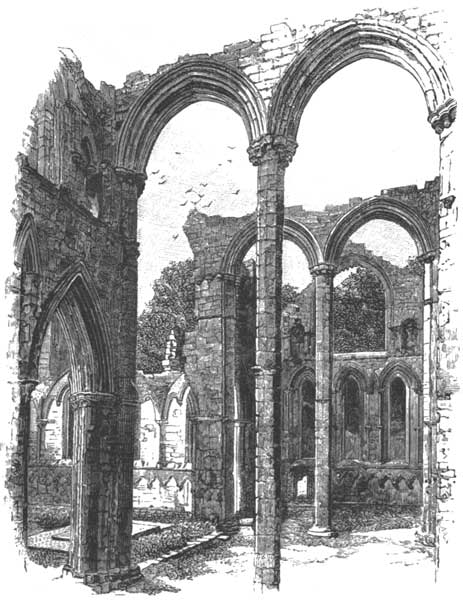
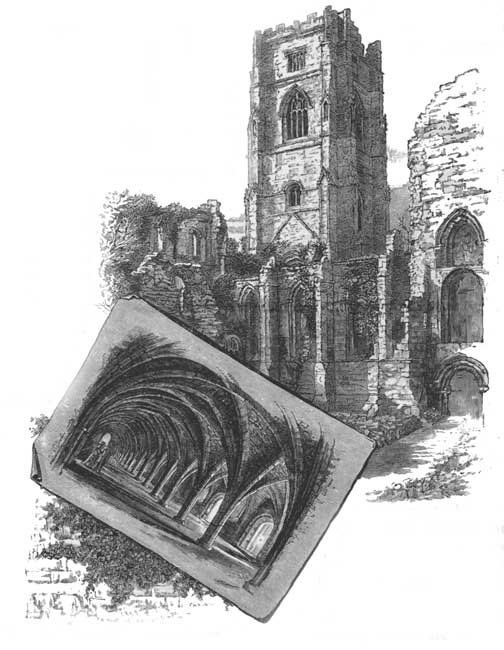
In the neighborhood of Ripon is the world-renowned Fountains Abbey, of which the remains are in excellent preservation, and stand in a beautiful situation on the verge of the fine estate of the Marquis of Ripon, Studley Royal. The gates of this park are about two miles from Ripon, the road winding among the trees, beneath which herds of deer are browsing, and leading up to the mansion, in front of which is an attractive scene. The little river Skell, on its way to the Ure, emerges from a glen, and is banked up to form a lake, from which it tumbles over a pretty cascade. The steep bank opposite is covered with trees. John Aislabie, who had been chancellor of the exchequer, laid out this park in 1720, and such repute did his ornamental works attain that Studley was regarded as the most embellished spot in the North of England. Ultimately, through heiresses, it passed into the hands of the present owner. The pleasure-grounds were laid out in the Dutch style then in vogue, and the slopes of the valley were terraced, planted with evergreens, and adorned with statues. Modern landscape-gardening has somewhat varied the details, but the original design remains. In the gardens are the Octagon Tower, perched upon a commanding knoll, the Temple of Piety, near the water-side, and an arbor known as Anne Boleyn's Seat, which commands a superb view over Fountains Dale. Let us enter this pretty glen, which gradually narrows, becomes more abrupt and rocky, and as we go along the Skell leads us from the woods out upon a level grassy meadow, at the end of which stand the gray ruins of the famous Cistercian abbey. The buildings spread completely across the glen to its craggy sides on either hand. On the right there is only room for a road to pass between the transept and the limestone rock which rears on high the trees rooted in its crannies, whose branches almost brush the abbey's stately tower. On the other side is the little river, with the conventual buildings carried across it in more than one place, the water flowing through a vaulted tunnel. These buildings extend to the bases of the opposite crags. The ruins are of great size, and it does not take much imagination to restore the glen to its aspect when the abbey was in full glory seven or eight hundred years ago. Its founders came hither almost as exiles from York, and began building the abbey in the twelfth century, but it was barely completed when Henry VIII. forced the dissolution of the monasteries. It was very rich, and furnished rare plunder when the monks were compelled to leave it. The close or immediate grounds of the abbey contained about eighty acres, entered by a gate-house to the westward of the church, the ruins of which can still be seen. Near by is an old mill alongside the Skell, and a picturesque bridge crosses the stream, while on a neighboring knoll are some ancient yews which are believed to have sheltered the earliest settlers, and are called the "Seven Sisters." But, unfortunately, only two now remain, gnarled and twisted, with decaying trunks and falling limbs—ruins in fact that are as venerable as Fountains Abbey itself. Botanists say they are twelve hundred years old, and that they were full-grown trees when the exiles from York first encamped alongside the Skell.
FOUNTAINS TOWER AND CRYPT.
FOUNTAINS HALL.
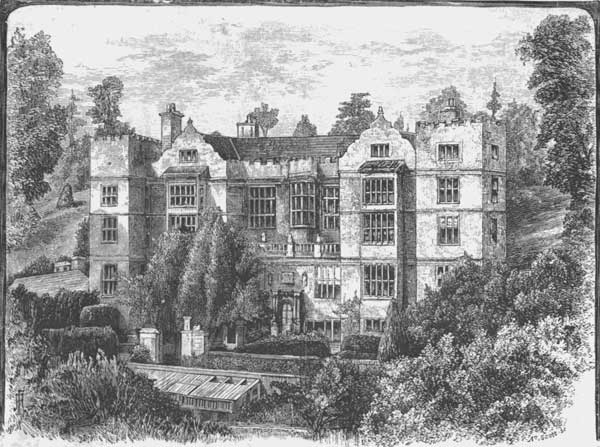
Entering the close, the ruins of the abbey church are seen in better preservation than the other buildings. The roof is gone, for its woodwork was used to melt down the lead by zealous Reformers in the sixteenth century, and green grass has replaced the pavement. The ruins disclose a noble temple, the tower rising one hundred and sixty-eight feet. In the eastern transept is the beautiful "Chapel of the Nine Altars" with its tall and slender columns, some of the clustering shafts having fallen. For some distance southward and eastward from the church extend the ruins of the other convent-buildings. In former times they were used as a stone-quarry for the neighborhood, many of the walls being levelled to the ground, but since the last century they have been scrupulously preserved. The plan is readily traced, for excavations have been made to better display the ruins. South of the nave of the church was the cloister-court. On one side was the transept and chapter-house, and on the other a long corridor supporting the dormitory. This was one hundred yards long, extending across the river, and abutting against the crags on the other side. South of the cloister-court was the refectory and other apartments. To the eastward was a group of buildings terminating in a grand house for the abbot, which also bridged the river. All these are now in picturesque ruin, the long corridor, with its vaulted roof supported by a central row of columns with broad arches, being considered one of the most impressive religious remains in England. One of the chief uses to which the Fountains Abbey stone-quarry was devoted was the building, in the reign of James I., of a fine Jacobean mansion as the residence for its then owner, Sir Stephen Proctor. This is Fountains Hall, an elaborate structure of that period which stands near the abbey gateway, and to a great extent atones, by its quaint attractiveness, for the vandalism that despoiled the abbey to furnish materials for its construction. In fact, the mournful reflection is always uppermost in viewing the remains of this famous place that it would have been a grand old ruin could it have been preserved, but the spoilers who plundered it for their own profit are said to have discovered, in the fleeting character of the riches thus obtained, that ill-gotten gains never prosper.
RICHMOND CASTLE.
RICHMOND CASTLE.
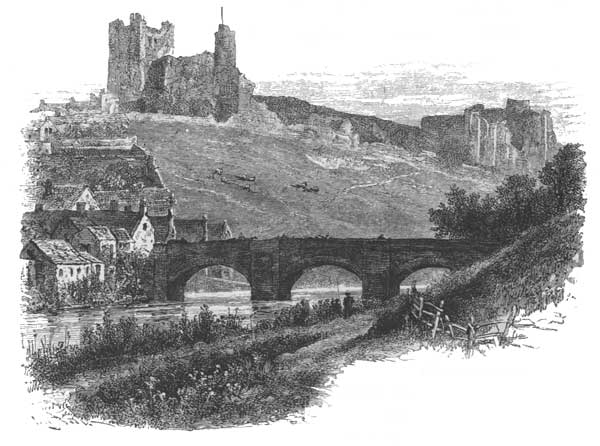
Proceeding northward from Ripon, and crossing over into the valley of the river Swale, we reach one of the most picturesquely located towns of England—Richmond, whose great castle is among the best English remains of the Norman era. The river flows over a broken and rocky bed around the base of a cliff, and crowning the precipice above is the great castle, magnificent even in decay. It was founded in the reign of William the Conqueror by Alan the Red, who was created Earl of Richmond, and it covers a space of about five acres on a rock projecting over the river, the prominent tower of the venerable keep being surrounded by walls and buildings. A lane leads up from the market-place of the town to the castle-gate, alongside of which are Robin Hood's Tower and the Golden Tower, the latter named from a tradition of a treasure being once found there. The Scolland's Hall, a fine specimen of Norman work, adjoins this tower. The keep is one hundred feet high and furnished with walls eleven feet thick, time having had little effect upon its noble structure, one of the most perfect Norman keep-towers remaining in England. There is a grand view from the battlements over the romantic valley of the Swale. In the village is an old gray tower, the only remains of a Franciscan monastery founded in the thirteenth century, and the ruins of Easby Abbey, dating from the twelfth century, are not far away; its granary is still in use. The valley of the Swale may be pursued for a long distance, furnishing constant displays of romantic scenery, or, if that is preferred, excellent trout-fishing.
YORK.
THE MULTANGULAR TOWER AND ST. MARY'S ABBEY.
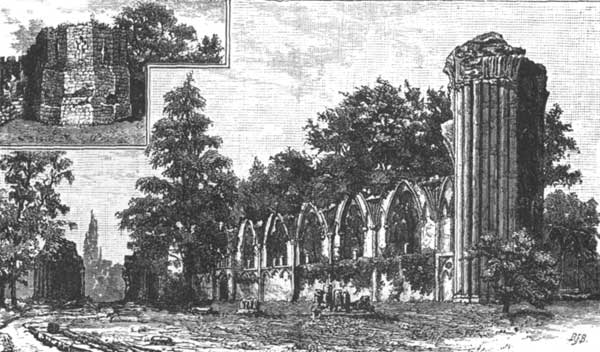
From the high hills in the neighborhood of Fountains Dale there is a magnificent view over the plain of York, and we will now proceed down the valley of the Ouse to the venerable city that the Romans called Eboracum, and which is the capital of a county exceeding in extent many kingdoms and principalities of Europe. This ancient British stronghold has given its name to the metropolis of the New World, but the modern Babylon on the Hudson has far outstripped the little city on the equally diminutive Ouse. It was Ebrane, the king of the Brigantes, who is said to have founded York, but so long ago that he is believed a myth. Whatever its origin, a settlement was there before the Christian era, but nothing certain is known of it beyond the fact that it existed when the Romans invaded Britain and captured York, with other strongholds, in the first century of the Christian era. Eboracum was made the head-quarters of their fifth legion, and soon became the chief city of a district now rich in the relics of the Roman occupation, their dead being still found thickly buried around the town. Portions of the walls of Eboracum remain, among them being that remarkable relic, the tower, polygonal in plan, which is known as the Multangular Tower, and which marks the south-western angle of the ancient Roman city. Not far away are the dilapidated ruins of St. Mary's Abbey, once one of the wealthiest and proudest religious houses in the North of England, but with little now left but portions of the foundations, a gateway, and the north and west walls of the nave. This abbey was founded in the eleventh century, and it was from here that the exiled monks who built Fountains Abbey were driven out. This ruin has been in its present condition for nearly two hundred and fifty years.
For over three centuries Eboracum was a great Roman city. Here came the emperor Severus and died in 211, his body being cremated and the ashes conveyed to Rome. When the empire was divided, Britain fell to the share of Constantius Chlorus, and he made Eboracum his home, dying there in 305. Constantine the Great, his son, was first proclaimed emperor at Eboracum. When the Romans departed evil days fell upon York; the barbarians destroyed it, and it was not till 627 that it reappeared in history, when Eadwine, King of Northumbria, was baptized there by St. Paulinus on Easter Day, a little wooden church being built for the purpose. Then began its ecclesiastical eminence, for Paulinus was the first Archbishop of York, beginning a line of prelates that has continued unbroken since. In the eighth century the Northmen began their incursions, and from spoilers ultimately became settlers. York prospered, being thronged with Danish merchants, and in the tenth century had thirty thousand population. In King Harold's reign the Northmen attacked and captured the town, when Harold surprised and defeated them, killing their leader Tostig, but no sooner had he won the victory than he had to hasten southward to meet William the Norman, and be in turn vanquished and slain. York resisted William, but he ultimately conquered the city and built a castle there, but being rebellious the people attacked the castle. He returned and chastised them and built a second castle on the Ouse; but the discontent deepened, and a Danish fleet appearing in the Humber there was another rebellion, and the Norman garrison firing the houses around the castle to clear the ground for its better defence, the greater part of the city was consumed. While this was going on the Danes arrived, attacked and captured both castles, slaughtered their entire garrisons of three thousand men, and were practically unopposed by the discontented people. Then it was that the stalwart Norman William swore "by the splendor of God" to avenge himself on Northumbria, and, keeping his pledge, he devastated the entire country north of the Humber.
York continued to exist without making much history for several centuries, till the Wars of the Roses came between the rival houses of York and Lancaster. In this York bore its full part, but it was at first the Lancastrian king who was most frequently found at York, and not the duke who bore the title. But after Towton Field, on Palm Sunday, March 29, 1461, the most sanguinary battle ever fought in England, one hundred thousand men being engaged, the news of their defeat was brought to the Lancastrian king Henry and Queen Margaret at York, and they soon became fugitives, and their youthful adversary, the Duke of York, was crowned Edward IV. in York Minster. In the Civil War it was in York that Charles I. took refuge, and from that city issued his first declaration of war against the Parliament. For two years York was loyal to the king, and then the fierce siege took place in which the Parliamentary forces ruined St. Mary's Abbey by undermining and destroying its tower. Prince Rupert raised this siege, but the respite was not long. Marston Moor saw the king defeated, Rupert's troopers being, as the historian tells us, made as "stubble to the swords of Cromwell's Ironsides." The king's shattered army retreated to York, was pursued, and in a fortnight York surrendered to the Parliamentary forces. The city languished afterwards, losing its trade, and developing vast pride, but equal poverty. Since the days of railways, however, it has become a very important junction, and has thus somewhat revived its activity.
YORK MINSTER.
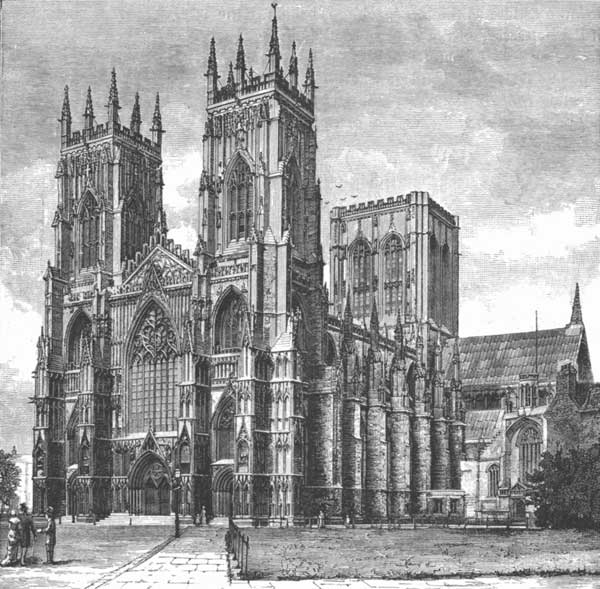
MICKLEGATE BAR—THE RED TOWER
The walls of York are almost as complete as those of Chester, while its ancient gateways are in much better preservation. The gateways, called "bars," are among the marked features of the city, and the streets leading to them are called "gates." The chief of these is Micklegate, the highroad leading to the south, the most important street in York, and Micklegate Bar is the most graceful in design of all, coming down from Tudor days, with turrets and battlements pierced with cross-shaped loopholes and surmounted by small stone figures of warriors. It was on this bar that the head of the Duke of York was exposed, and the ghastly spectacle greeted his son, Edward IV., as he rode into the town after Towton Field. It did not take long to strike off the heads of several distinguished prisoners and put them in his place as an expiatory offering. Here also whitened the heads of traitors down to as late as the last Jacobite rebellion. One of the buttresses of the walls of York is the Red Tower, so called from the red brick of which it is built. These walls and gates are full of interesting relics of the olden time, and they are still preserved to show the line of circumvallation of the ancient walled city. But the chief glory of York is its famous minster, on which the hand of time has been lightly laid. When King Eadwine was baptized in the little wooden church hastily erected for the purpose, he began building at the same place, at the suggestion of Paulinus, a large and more noble basilica of stone, wherein the little church was to be included. But before it was completed the king was slain, and his head was brought to York and buried in the portico of the basilica. This church fell into decay, and was burned in the eighth century. On its site was built a much larger minster, which was consumed in William the Conqueror's time, when the greater part of York was burned. From its ashes rose the present magnificent minster, portions of which were building from the eleventh to the fifteenth century, it being completed as we now see it in 1470, and reconsecrated as the cathedral of St. Peter with great pomp in 1472. Its chief treasure, was the shrine of St. William, the nephew of King Stephen, a holy man of singularly gentle character. When he came into York it is said the pressure of the crowd was so great that it caused the fall of a bridge over the Ouse, but the saint by a miracle saved all their lives. The shrine was destroyed at the Reformation, and the relics buried in the nave, where they were found in the last century. York Minster remained almost unchanged until 1829, when a lunatic named Martin concealed himself one night in the cathedral and set fire to the woodwork of the choir, afterwards escaping through a transept-window. The fire destroyed the timber roofs of the choir and nave and the great organ. Martin was arrested, and confined in an asylum until he died. The restoration cost $350,000, and had not long been completed when some workmen accidentally set fire to the south-western tower, which gutted it, destroyed the bells, and burned the roof of the nave. This mischief cost $125,000 to repair, and the southern transept, which was considered unsafe, has since been partially rebuilt.
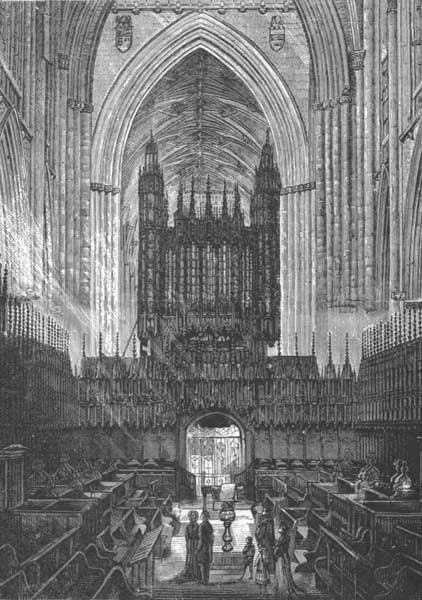
CHOIR OF YORK MINSTER.
TOMB OF ARCHBISHOP WALTER DE GREY, YORK MINSTER.
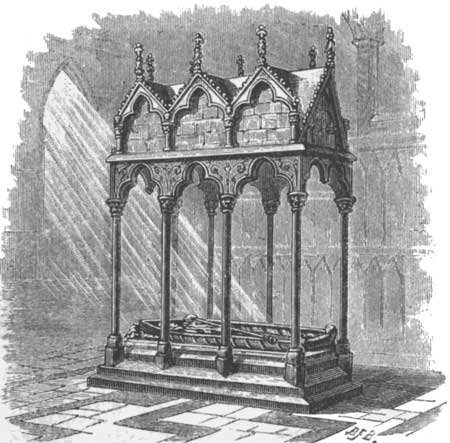
Few English cathedrals exceed York Minster in dignity and massive grandeur. It is the largest Gothic church in the kingdom, and contains one of the biggest bells. "Old Peter," weighing ten and three-quarter tons, and struck regularly every day at noon. The minster is five hundred and twenty-four feet long, two hundred and twenty-two feet wide, ninety-nine feet high in the nave, and its towers rise about two hundred feet, the central tower being two hundred and twelve feet high. Its great charms are its windows, most of them containing the original stained glass, some of it nearly six hundred years old. The east window is the largest stained-glass window in the world, seventy-seven by thirty-two feet, and of exquisite design, being made by John Thornton of Coventry in 1408, who was paid one dollar per week wages and got a present of fifty dollars when he finished it. At the end of one transept is the Five Sisters Window, designed by five nuns, each planning a tall, narrow sash; and a beautiful rose-window is at the end of the other transept. High up in the nave the statue of St. George stands on one side defying the dragon, who pokes out his head on the other. Its tombs are among the minster's greatest curiosities. The effigy of Archbishop Walter de Grey, nearly six hundred and fifty years old, is stretched out in an open coffin lying under a superb canopy, and the corpse instead of being in the ground is overhead in the canopy. All the walls are full of memorial tablets—a few modern ones to English soldiers, but most of them ancient. Strange tombs are also set in the walls, bearing effigies of the dead. Sir William Gee stands up with his two wives, one on each side, and his six children—all eight statues having their hands folded. Others sit up like Punch and Judy, the women dressed in hoops, farthingales, and ruffs, the highest fashions of their age. Here is buried Wentworth, second Earl of Strafford, and scores of archbishops. The body of the famous Hotspur is entombed in the wall beneath the great east window. Burke's friend Saville is buried here, that statesman having written his epitaph. The outside of the minster has all sorts of grotesque protuberances, which, according to the ancient style of church-building, represent the evil spirits that religion casts out. Adjoining the north transept, and approached through a beautiful vestibule, is the chapter-house, an octagonal building sixty-three feet in diameter and surmounted by a pyramidal roof. Seven of its sides are large stained-glass windows, and the ceiling is a magnificent work.
CLIFFORD'S TOWER.
York Castle occupied a peninsula between the Ouse and a branch called the Foss. Of this Clifford's Tower is about all of the ancient work that remains. It rises on its mound high above the surrounding buildings, and was the keep of the ancient fortress, constructed according to a remarkable and unique plan, consisting of parts of four cylinders running into each other. It dates from Edward I., but the entrance was built by Clifford, Earl of Cumberland, its governor under Charles I. The interior of the tower was afterwards burned, and George Fox, the founder of the Society of Friends, who was imprisoned there, planted a walnut tree within the tower which is still growing. It was in the keep of the Norman castle, which this tower replaced, that the massacre of the Jews, which grew out of race-jealousy at their great wealth, occurred in 1190. On March 16th the house of Benet, the leading Jew in York, was sacked by a mob and his wife and children murdered. Five hundred of his countrymen then sought refuge in the castle, and those who remained outside were killed. The mob besieged the castle, led by a hermit from the neighborhood "famed for zeal and holiness," who was clothed in white robes, and each morning celebrated mass and inflamed the fury of the besiegers by his preaching. At last he ventured too near the walls, and was brained by a stone. Battering-rams were then brought up, and a night's carouse was indulged in before the work of knocking down the castle began. Within was a different scene: the Jews were without food or hope. An aged rabbi, who had come as a missionary from the East, and was venerated almost as a prophet, exhorted his brethren to render up freely their lives to God rather than await death at the enemy's hands. Nearly all decided to follow his counsel; they fired the castle, destroyed their property, killed their wives and children, and then turned their swords upon themselves. Day broke, and the small remnant who dared not die called from the walls of the blazing castle that they were anxious for baptism and "the faith and peace of Christ." They were promised everything, opened the gates, and were all massacred. In later years York Castle has enclosed some well-known prisoners, among them Eugene Aram, and Dick Turpin, who was hanged there. The York elections and mass-meetings are held in the courtyard.
THE SHAMBLES.
Here Wilberforce, who long represented York in Parliament, spoke in 1784, when Boswell wrote of him: "I saw what seemed a mere shrimp mount upon the table, but as I listened he grew and grew until the shrimp became a whale." The York streets are full of old houses, many with porches and overhanging fronts. One of the most curious rows is the Shambles, on a narrow street and dating from the fourteenth century. A little way out of town is the village of Holgate, which was the residence of Lindley Murray the grammarian. Guy Fawkes is said to have been a native of York, and this strange and antique old city, we are also credibly assured, was in 1632 the birthplace of Robinson Crusoe.
CASTLE HOWARD.
CASTLE HOWARD, SOUTH FRONT.
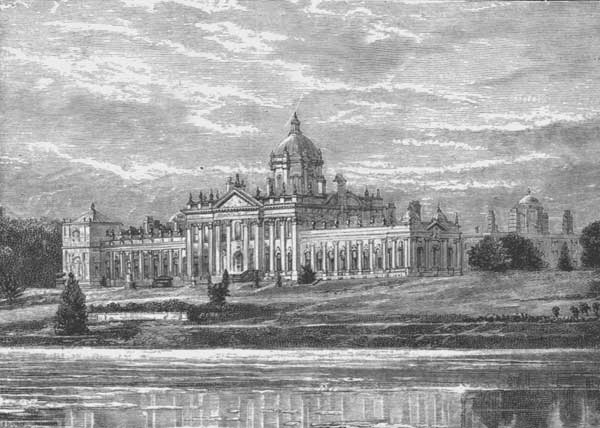
Starting north-east from York towards the coast, we go along the pretty valley of the Derwent, and not far from the borders of the stream come to that magnificent pile, the seat of the Earls of Carlisle—Castle Howard. More than a century ago Walpole wrote of it: "Lord Strafford had told me that I should see one of the finest places in Yorkshire, but nobody had informed me that I should at one view see a palace, a town, a fortified city: temples on high places; woods worthy of being each a metropolis of the Druids; vales connected to hills by other woods; the noblest lawn in the world, fenced by half the horizon; and a mausoleum that would tempt one to be buried alive. In short, I have seen gigantic places before, but never a sublimer one." Castle Howard was the work of Vanbrugh, the designer of Blenheim, and in plan is somewhat similar, but much more sober and simple, with a central cupola that gives it dignity. It avoids many of the faults of Blenheim: its wings are more subdued, so that the central colonnade stands out to greater advantage, and there are few more imposing country-houses in England than this palace of the Howards. This family are scions of the ducal house of Norfolk, so that "all the blood of all the Howards," esteemed the bluest blood in the kingdom, runs in their veins. The Earls of Carlisle are descended from "Belted Will"—Lord William Howard, the lord warden of the Marches in the days of the first Stuart—whose stronghold was at Naworth Castle, twelve miles north-east of Carlisle. His grandson took an active part in the restoration of Charles II., and in recompense was created the first Earl of Carlisle. His bones lie in York Minster. His grandson, the third earl, who was deputy earl-marshal at the coronation of Queen Anne, built Castle Howard. The seventh earl, George William Frederick, was for eight years viceroy in Ireland, resigning in 1864 on account of ill-health; and it is said that he was one of the few English rulers who really won the affections of the people of that unhappy country. He died soon afterwards.
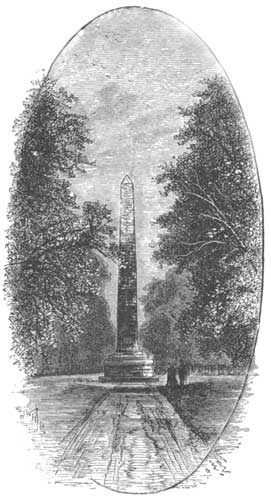
THE OBELISK, CASTLE HOWARD.
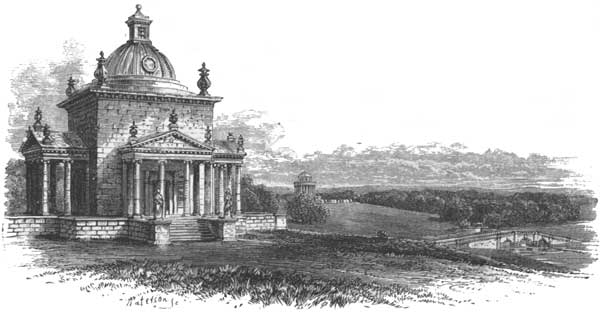
THE TEMPLE, WITH THE MAUSOLEUM IN THE DISTANCE.
Leaving the railway-station in the valley of the Derwent, and mounting the hills to the westward, a little village is reached on the confines of the park. Beyond the village the road to the park-gates passes through meadow-land, and is bordered by beautiful beech trees arranged in clusters of about a dozen trees in each, producing an unusual but most happy effect. The gateway is entered, a plain building in a castellated wall—this being Walpole's "fortified city"—and, proceeding up a slope, the fine avenue of beeches crosses another avenue of lime trees. Here is placed an obelisk erected in honor of John Churchill, Duke of Marlborough, which also bears an inscription telling of the erection of Castle Howard. It recites that the house was built on the site of the old castle of Hinderskelf, and was begun in 1702 by Charles, the third Earl of Carlisle, who set up this inscription in 1731. The happy earl, pleased with the grand palace and park he had created, thus addresses posterity on the obelisk:
"If to perfection these plantations rise, If they agreeably my heirs surprise, This faithful pillar will their age declare As long as time these characters shall spare. Here, then, with kind remembrance read his name Who for posterity performed the same."
The avenue then leads on past the north front of the castle, standing in a fine situation upon a ridge between two shallow valleys. The bed of the northern valley has been converted into a lake, while on the southern slopes are beautiful and extensive lawns and gardens. The house forms three sides of a hollow square, and within, it is interesting in pictures and ornaments. It is cut up, however, into small rooms and long, chilly corridors, which detract from its good effect. The entrance-hall is beneath the central dome and occupies the whole height of the structure, but it is only about thirty-five feet square, giving a sense of smallness. Frescoes decorate the walls and ceilings. The public apartments, which are in several suites opening into each other and flanked by long corridors, are like a museum, so full are they of rare works of art, china, glass, and paintings. Much of the collection came from the Orleans Gallery. There are also many portraits in black and red chalk by Janet, a French artist who flourished in the sixteenth century. Some of the paintings are of great value, and are by Rubens, Caracci, Canaletti, Tintoretto, Titian, Hogarth, Bellini, Mabuse, Holbein, Lely, Vandyke, Reynolds, Gainsborough, and others. The Castle Howard collection is exceptionally valuable in historical portraits. The windows of the drawing-room look out upon extensive flower-gardens, laid out in rather formal style with antique vases and statues. Beyond these gardens is seen a circular temple placed upon a knoll, the "mausoleum" which so moved Walpole. Here the former owners of the castle are buried, a constant memento mori to the tenants of the house, though the taste certainly seems peculiar that has made the family tomb the most prominent object in the view from the drawing-room windows.
GATEWAY, KIRKHAM PRIORY.
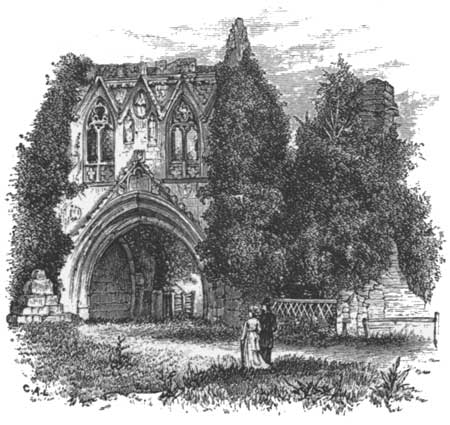
Not far from Castle Howard are the ruins of Kirkham Priory. A charming fragment of this noble church remains in a grassy valley on the margin of the Derwent. Here, nearly eight hundred years ago, the Augustinians established the priory, the founder being Sir Walter l'Espec, one of the leaders of the English who drove back King David's Scottish invasion at the battle of the Standard, near Durham. Sir Walter had an only son, who was one day riding near the site of Kirkham when a wild boar suddenly rushed across his path. The horse plunged and threw his rider, who, striking head-foremost against a projecting stone, was killed. Sir Walter, being childless, determined to devote his wealth to the service of God, and founded three religious houses—one in Bedfordshire, another at Rievaulx, where he sought refuge from his sorrows, and the third at the place of his son's death at Kirkham. Legend says that the youth was caught by his foot in the stirrup when thrown, and was dragged by his runaway horse to the spot where the high altar was afterwards located. Sir Walter's sister married into the family of De Ros, among the ancestors of the Dukes of Rutland, and they were patrons of Kirkham until the dissolution of the monasteries. Little remains of it: the gate-house still stands, and in front is the base of a cross said to have been made from the stone against which the boy was thrown. Alongside this stone they hold a "bird-fair" every summer, where jackdaws, starlings, and other birds are sold, with a few rabbits thrown in; but the fair now is chiefly an excuse for a holiday. The church was three hundred feet long, with the convent-buildings to the southward, but only scant ruins remain. Beyond the ruins, at the edge of the greensward, the river glides along under a gray stone bridge. At Howsham, in the neighborhood, Hudson the railway king was born, and at Foston-le-Clay Sydney Smith lived, having for his friends the Earl and Countess of Carlisle of that day, who made their first call in a gold coach and got stuck fast in the clay. Here the witty vicar resided, having been presented to a living, and built himself a house, which he described as "the ugliest in the county," but admitted by all critics to be "one of the most comfortable," though located "twenty miles from a lemon." Subsequently Smith left here for Somersetshire.
SCARBOROUGH AND WHITBY.
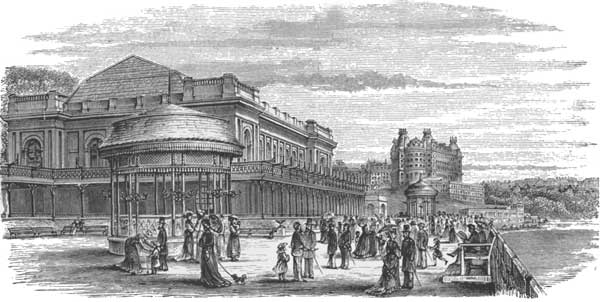
SCARBOROUGH SPA AND ESPLANADE.
The coast of Yorkshire affords the boldest and grandest scenery on the eastern shore of England. A great protruding backbone of chalk rocks projects far into the North Sea at Flamborough Head, and makes one of the most prominent landmarks on all that rugged, iron-bound coast. This is the Ocellum Promontorium of Ptolemy, and its lighthouse is three hundred and thirty feet above the sea, while far away over the waters the view is superb. From Flamborough Head northward beyond Whitby the coast-line is a succession of abrupt white cliffs and bold headlands, presenting magnificent scenery. About twenty-three miles north of Flamborough is the "Queen of Northern Watering-places," as Scarborough is pleased to be called, where a bold headland three hundred feet high juts out into the North Sea for a mile, having on each side semicircular bays, each about a mile and a quarter wide. At the extreme point of the lozenge-shaped promontory stands the ruined castle which named the town Scar-burgh, with the sea washing the rocky base of its foundations on three sides. Steep cliffs run precipitously down to the narrow beach that fringes these bays around, and on the cliffs is the town of Scarborough, while myriads of fishing-vessels cluster about the breakwater-piers that have been constructed to make a harbor of refuge. It would be difficult to find a finer situation, and art has improved it to the utmost, especially as mineral springs add the attractions of a spa to the sea air and bathing. The old castle, battered by war and the elements, is a striking ruin, the precipitous rock on which it stands being a natural fortress. The Northmen when they first invaded Britain made its site their stronghold, but the present castle was not built until the reign of King Stephen, when its builder, William le Gros, Earl of Albemarle, was so powerful in this part of Yorkshire that it was said he was "in Stephen's days the more real king." But Henry II. compelled the proud earl to submit to his authority, though "with much searching of heart and choler," and Scarborough afterwards became one of the royal castles, Edward I. in his earlier years keeping court there. It was there that Edward II. was besieged and his favorite Gaveston starved into surrender, and then beheaded on Blacklow Hill in violation of the terms of his capitulation. Scarborough was repeatedly attacked by the Scotch, but it subsequently enjoyed an interval of peace until the Reformation. In Wyatt's rebellion his friends secured possession of the castle by stratagem. A number of his men, disguised as peasants, on market-day strolled one by one into the castle, and then at a given signal overpowered the sentinels and admitted the rest of their band. The castle, however, was soon recaptured from the rebels, and Thomas Stafford, the leader in this enterprise, was beheaded. From this event is derived the proverb of a "Scarborough warning"—a word and a blow, but the blow first. In Elizabeth's reign Scarborough was little else but a fishing-village, and so unfortunate that it appealed to the queen for aid. In the Civil War the castle was held by the Royalists, and was besieged for six months. While the guns could not reduce it, starvation did, and the Parliamentary army took possession. Three years later the governor declared for the king, and the castle again stood a five months' siege, finally surrendering. Since then it has fallen into decay, but it was a prison-house for George Fox the Quaker, who was treated with severity there. A little way down the hill are the ruins of the ancient church of St. Mary, which has been restored.
SCARBOROUGH FROM THE SEA.
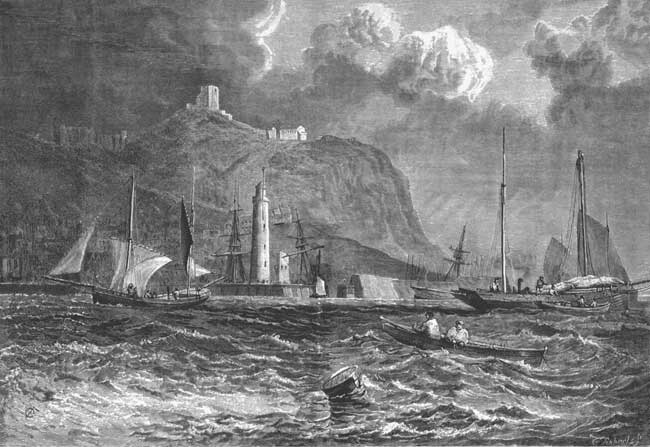
The cliffs on the bay to the south of Castle Hill have been converted into a beautifully-terraced garden and promenade. Here, amid flowers and summer houses and terraced walks, is the fashionable resort, the footpaths winding up and down the face of the cliffs or broadening into the gardens, where music is provided and there are nightly illuminations. Millions of money have been expended in beautifying the front of the cliffs adjoining the Spa, which is on the seashore, and to which Scarborough owed its original fame as a watering-place. The springs were discovered in 1620, and by the middle of the last century had become fashionable, but the present ornamental Spa was erected only about forty years ago. There is a broad esplanade in front. There are two springs, one containing more salt, lime, and magnesia sulphates than the other. In the season, this esplanade—in fact, the entire front of the cliffs—is full of visitors, while before it are rows of little boxes on wheels, the bathing-houses that are drawn into the water. The surf is usually rather gentle, however, though the North Sea can knock things about at a lively rate in a storm.
North of Scarborough the coast extends, a grand escarpment of cliffs and headlands, past Robin Hood's Bay, with its rocky barriers, the North Cheek and the South Cheek, to the little harbor of another watering-place, Whitby. The cliffs here are more precipitous and the situation even more picturesque than at Scarborough. The river Esk has carved a deep glen in the Yorkshire moorland, and in this the town nestles, climbing the steep banks on either side of the river. The ruins of Whitby Abbey are located high up on the side of the ravine opposite to the main part of the town, and they still present a noble if dilapidated pile. The nave fell after a storm in the last century, and a similar cause threw down the central tower in 1830. The choir and northern transept are still standing, extremely beautiful Early English work: only fragments of other portions of the abbey remain. This was in olden times the Westminster of Northumbria, containing the tombs of Eadwine and of Oswy, with kings and nobles grouped around them. It has been over twelve hundred years since a religious house was founded at Whitby, at first known as the White Homestead, an outgrowth of the abbey, which was founded by Oswy and presided over by the sainted Hilda, who chose the spot upon the lonely crags by the sea. The fame of Whitby as a place of learning soon spread, and here lived the cowherd Cædmon, the first English poet. The Danes sacked and burned it but after the Norman Conquest, under the patronage of the Percies, the abbey grew in wealth and fame. Fragments of the monastery yet remain, and on the hill a little lower down is the parish church, with a long flight of steps leading up to it from the harbor along which the people go, and when there is a funeral the coffin has to be slung in order to be carried up the steps. Whitby is famous for its jet, which is worked into numerous ornaments: this is a variety of fossil wood, capable of being cut and taking a high polish. It is also celebrated for its production of iron-ore, which indeed is a product of all this part of Yorkshire; while at night, along the valley of the Tees, not far north of Whitby, the blaze of the myriads of furnaces light up the heavens like the fire of Vesuvius in the Bay of Naples. Among the tales of the abbey is that which
"Whitby's nuns exulting told, How to their house three barons bold Must menial service do."
WHITBY ABBEY.
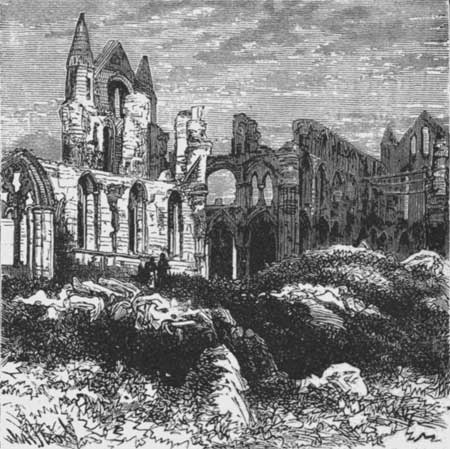
It appears that three gentlemen—De Bruce, De Percy, and Allaston—were hunting boars on the abbey-lands in 1159, and roused a fine one, which their dogs pressed hard and chased to the hermitage, where it ran into the chapel and dropped dead. The hermit closed the door against the hounds, and the hunters, coming up, were enraged to find the dogs baulked of their prey, and on the hermit's opening the door they attacked him with their boar-spears and mortally wounded him. It was not long before they found that this was dangerous sport, and they took sanctuary at Scarborough. The Church, however, did not protect those who had insulted it, and they were given up to the abbot of Whitby, who was about to make an example of them when the dying hermit summoned the abbot and the prisoners to his bedside and granted them their lives and lands. But it was done upon a peculiar tenure: upon Ascension Day at sunrise they were to come to the wood on Eskdale-side, and the abbot's officer was to deliver to each "ten stakes, eleven stout stowers, and eleven yethers, to be cut by you, or some of you, with a knife of one penny price;" these they were to take on their backs to Whitby before nine o'clock in the morning. Then said the hermit, "If it be full sea your labor and service shall cease; and if low water, each of you shall set your stakes to the brim, each stake one yard from the other, and so yether them on each side with your yethers, and so stake on each side with your stout stowers, that they may stand three tides without removing by the force thereof. You shall faithfully do this in remembrance that you did most cruelly slay me, and that you may the better call to God for mercy, repent unfeignedly of your sins, and do good works. The officer of Eskdale-side shall blow, 'Out on you, out on you, out on you for this heinous crime!'" Failure of this strange service was to forfeit their lands to the abbot of Whitby.
DURHAM.
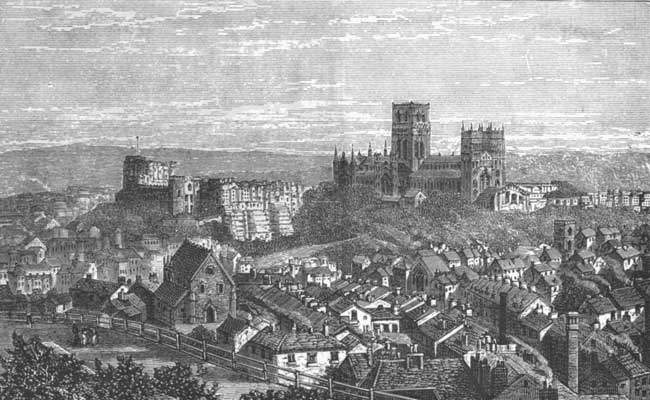
GENERAL VIEW OF THE CATHEDRAL AND CASTLE.
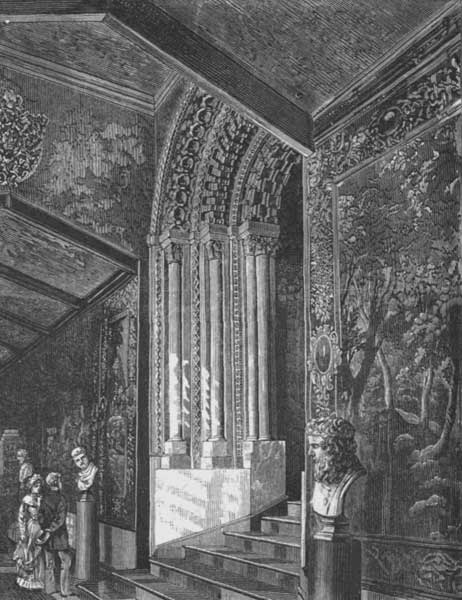
NORMAN DOORWAY IN DURHAM CASTLE.
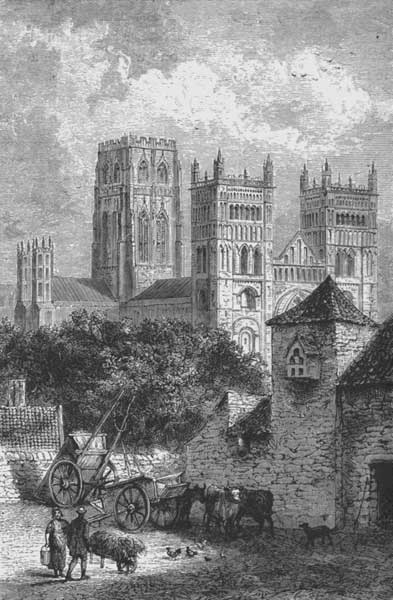
We have now come into a region of coal and iron, with mines and furnaces in abundance, and tall chimneys in all the villages pouring out black smoke. All the country is thoroughly cultivated, and the little streams bubbling over the stones at the bottoms of the deep valleys, past sloping green fields and occasional patches of woods where the land is too steep for cultivation, give picturesqueness to the scene. We have crossed over the boundary from Yorkshire into Durham, and upon the very crooked little river Wear there rise upon the tops of the precipitous cliffs bordering the stream, high elevated above the red-tiled roofs of the town, the towers of Durham Cathedral and Castle. They stand in a remarkable position. The Wear, swinging around a curve like an elongated horseshoe, has excavated a precipitous valley out of the rocks. At the narrower part of the neck there is a depression, so that the promontory around which the river sweeps appears like the wrist with the hand clenched. The town stands at the depression, descending the slopes on either side to the river, and also spreading upon the opposite banks. The castle bars the access to the promontory, upon which stands the cathedral. Thus, almost impregnably fortified, the ancient bishops of Durham were practically sovereigns, and they made war as quickly as they would celebrate a mass if their powers were threatened, for they bore alike the sword and the crozier. Durham was founded to guard the relics of the famous St. Cuthbert of Lindisfarne, the great ascetic of the early English Church, distinguished above all others for the severity of his mortifications and his abhorrence of women. At his shrine, we are told, none of the gentler sex might worship; they were admitted to the church, but in the priory not even a queen could lodge. Queen Philippa was once admitted there as a guest, but a tumult arose, and she had to flee half dressed for safety to the castle. St. Cuthbert was a hermit to whom the sight of human beings was a weariness and the solitude of the desert a delight. He was born in Scotland about the middle of the seventh century, of humble origin, and passed his early years as a shepherd near Melrose. He adopted an austere life, found a friend in the abbot of Melrose, and ultimately sickened of an epidemic, his recovery being despaired of. In answer, however, to the prayers of the monks, he was restored to health as by a miracle, and became the prior of Melrose. Afterwards he was for twelve years prior of Lindisfarne, an island off the Northumbrian coast, but the craving for solitude was too strong to be resisted, and he became a hermit. He went to Farne, a lonely rocky island in the neighboring sea, and, living in a hut, spent his life in prayer and fasting, but having time, according to the legend, to work abundant miracles. A spring issued from the rock to give him water, the sea laid fagots at his feet, and the birds ministered to his wants. At first other monks had free access to him, but gradually he secluded himself in the hut, speaking to them through the window, and ultimately closed even that against them except in cases of emergency. Such sanctity naturally acquired wide fame, and after long urging he consented to become a bishop, at first at Hexham, afterwards at Lindisfarne, thus returning to familiar scenes and an island home. But his life was ebbing, and after two years' service he longed again for his hermit's hut on the rock of Farne. He resigned the bishopric, and, returning to his hut, in a few weeks died. His brethren buried him beside his altar, where he rested eleven years; then exhuming the body, it was found thoroughly preserved, and was buried again in a new coffin at Lindisfarne. Almost two hundred years passed, when the Danes made an incursion, and to escape them the monks took the body, with other precious relics, and left Lindisfarne. During four years they wandered about with their sacred charge, and ultimately settled near Chester-le-Street, where the body of St. Cuthbert rested for over a century; but another Danish invasion in 995 sent the saint's bones once more on their travels, and they were taken to Ripon. The danger past, the monks started on their return, transporting the coffin on a carriage. They had arrived at the Wear, when suddenly the carriage stopped and was found to be immovable. This event no doubt had a meaning, and the monks prayed and fasted for three days to learn what it was. Then the saint appeared in a vision and said he had chosen this spot for his abode. It was a wild place, known as Dunhelm: the monks went to the Dun, or headland, and erected a tabernacle for their ark from the boughs of trees while they built a stone church, within which, in the year 999, the body was enshrined. This church stood until after the Norman Conquest, when the king made its bishop the Earl of Durham, and his palatinate jurisdiction began.
The present Durham Cathedral was begun in 1093, with the castle alongside. As we look at them from the railway-station, they stand a monument of the days when the same hand grasped the pastoral staff and the sword—"half house of God, half castle 'gainst the Scot." Upon the top of the rocks, which are clad in foliage to the river's edge, on the left hand, supported by massive outworks built up from halfway down the slope, rises the western face of the castle. Beyond this, above a fringe of trees, rises the lofty cathedral, its high central tower forming the apex of the group and its two western towers looking down into the ravine. The galilee in front appears built up from the depths of the valley, and is supported by outworks scarcely less solid than those of the castle. Durham, more than any other place in England, is a memorial of the temporal authority of the Church, uniting the mitre and the coronet. The plan of Durham Cathedral is peculiar in having the closed galilee at the western end, instead of the open porch as is usual, while the eastern end, which is wider than the choir, terminates abruptly, having no Lady Chapel, but being in effect cut off, with a gable in the centre and a great rose-window. As the galilee overhangs the ravine, the principal entrance to the cathedral is from a fine northern porch. To the portal is affixed a large knocker of quaint design, which in former days was a Mecca for the fugitive, for the shrine of St. Cuthbert enjoyed the right of sanctuary. When the suppliant grasped this knocker he was safe, for over the door two monks kept perpetual watch to open at the first stroke. As soon as admitted the suppliant was required to confess his crime, whatever it might be. This was written down, and a bell in the galilee tolled to announce the fact that some one had sought "the peace of Cuthbert;" and he was then clothed in a black gown with a yellow cross on the shoulder. After thirty-seven days, if no pardon could be obtained, the malefactor solemnly abjured his native land for ever, and was conveyed to the seacoast, bearing a white wooden cross in his hand, and was sent out of the kingdom by the first ship that sailed.
DURHAM CATHEDRAL, FROM AN OLD HOMESTEAD ON THE WEAR.
THE NAVE, DURHAM CATHEDRAL.
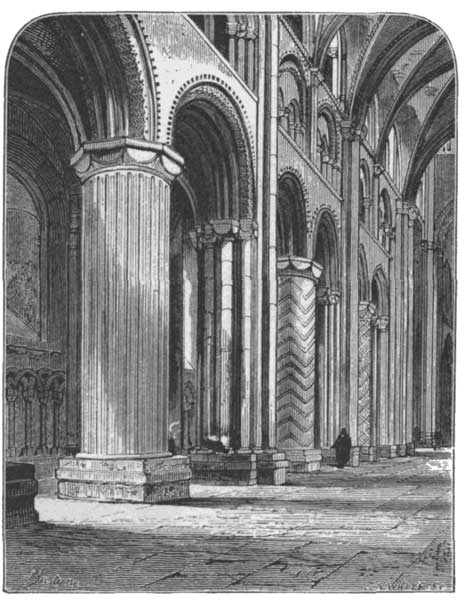
The interior of Durham Cathedral is regarded as the noblest Norman construction yet remaining in England. The arcade, triforium, and clerestory are in fine proportion; the nave has a vaulted roof of stone, and the alternate columns are clustered in plan, their middle shafts extending from floor to roof. These columns are enriched with zigzag, lattice, spiral, and vertical flutings. This cathedral, begun in 1093, was nearly two centuries building, and the Chapel of Nine Altars, in honor of various saints, was erected at the eastern end in the twelfth century. Some of these altars did duty for a pair of saints, St. Cuthbert sharing the central one with St. Bede, a name only second to his in the memories of Durham, so that the nine altars were availed of to reverence sixteen saints. Behind the reredos a platform extends a short distance into this chapel at a height of six feet above the floor. A large blue flagstone is let into the platform, with shallow grooves on either hand. Here stood St. Cuthbert's shrine, highly ornamented, and having seats underneath for the pilgrims and cripples who came to pray for relief. This being never wanting, we are told that the shrine came to be so richly invested that it was esteemed one of the most sumptuous monuments in England, so numerous were the offerings and jewels bestowed upon it. Among the relics here accumulated was the famous Black Rood of Scotland, the prize of the battle of Neville's Cross, fought near Durham. There were also many relics of saints and martyrs, scraps of clothing of the Saviour and the Virgin, pieces of the crown of thorns and of the true cross, vials containing the milk of the Virgin Mother and the blood of St. Thomas, besides elephants' tusks and griffins' claws and eggs, with myriads of jewels. In 1104, St. Cuthbert's body was deposited in this shrine with solemn ceremonies, and it rested there undisturbed until the dissolution of the monasteries, reverentially watched, day and night, by monks stationed in an adjoining chamber. Then the shrine was destroyed and the treasures scattered, the coffin opened, and St. Cuthbert buried beneath the slab, so that now the only remnants visible are the furrows worn in the adjoining pavement by the feet of the ancient worshippers. Tradition tells that the exact position of St. Cuthbert's grave is known only to three Benedictine monks, of whom Scott writes:
"There, deep in Durham's Gothic shade, His relics are in secret laid, But none may know the place, Save of his holiest servants three, Deep sworn to solemn secrecy, Who share that wondrous grace."
The corpse, however, rests beneath the blue slab. In 1827 it was raised, and, while other human remains were found, there was disclosed beneath them, in a coffin, a skeleton vested in mouldering robes, and with it various treasures, which, with the robes, accord with the description of those present in St. Cuthbert's coffin when opened in 1104. The skeleton was reinterred in a new coffin, and the relics, particularly an ancient golden cross and a comb, were placed in the cathedral library.
THE CHOIR, LOOKING WEST, DURHAM CATHEDRAL.
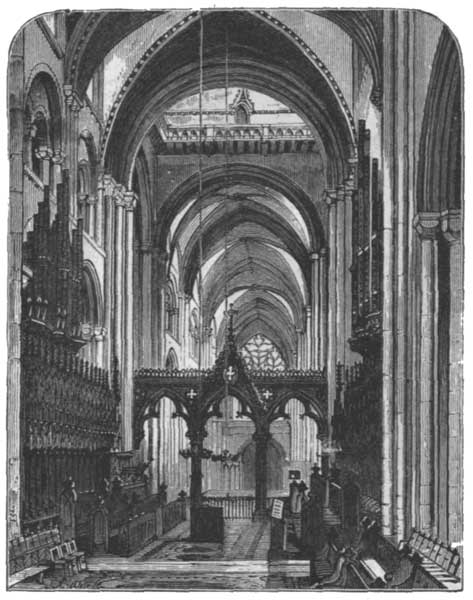
In the galilee of Durham Cathedral, near the south-eastern angle, is a plain, low altar-tomb that marks the resting-place of St. Bede, commonly known as "the Venerable Bede"—a title which angelic hands are said to have supplied to the line inscribed on his tomb. He was the first English historian, a gentle, simple scholar, who spent his life from childhood in a monastery at Jarrow, near the mouth of the Wear, and took his pleasure in learning, teaching, or writing. His great work was the Ecclesiastical History of the English Nation, which occupied many years in compilation, and is still the most trusted history of the period of which it treats. His literary activity was extraordinary, and he produced many other works. He was born near Durham in 672, and died in 735. His devotion to literary work was such that even during his last illness he was dictating to an amanuensis a translation of the Gospel of St. John into Anglo-Saxon, and upon completing the last sentence requested the assistant to place him on the floor of his cell, where he said a short prayer, and expired as the closing words passed his lips. He was buried where he had lived, at Jarrow, and as the centuries passed the fame of his sanctity and learning increased. Then a certain Ælfred conceived the idea of stealing St. Bede's remains for the glorification of Durham. Several times baffled, he at length succeeded, and carrying the precious relics to Durham, they were for a time preserved in St. Cuthbert's shrine, but were afterwards removed to a separate tomb, which in 1370 was placed in the galilee, where it has since remained. At the Reformation the shrine was destroyed, and St. Bede's bones, like St. Cuthbert's, were buried beneath the spot on which the shrine had stood. This tomb was opened in 1831, and many human bones were found beneath, together with a gilt ring. The bones in all probability were St. Bede's remains. Durham Cathedral contains few monuments, for reverence for the solitude of St. Cuthbert whom it enshrined excluded memorials of other men during several centuries.
THE GALILEE AND TOMB OF BEDE.
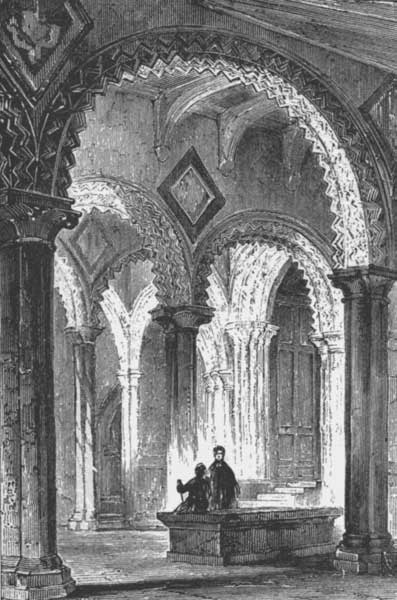
The remains of the Benedictine monastery to which the care of these shrines was entrusted are south of the cathedral, forming three sides of a square, of which the cathedral nave was the fourth. Beyond is an open green, with the castle on the farther side and old buildings on either hand. From this green the castle is entered by a gateway with massive doors, but, while the structure is picturesque, it is not very ancient, excepting this gateway. It has mostly been rebuilt since the twelfth century. This was the palace of the bishops of Durham, of whom Antony Bek raised the power of the see to its highest point. He was prelate, soldier, and politician, equally at home in peace or war, at the head of his troops, celebrating a mass, or surrounded by his great officers of state. He was the first who intruded upon the solitude of St. Cuthbert by being buried in the cathedral. Here lived also Richard of Bury, noted as the most learned man of his generation north of the Alps, and the first English bibliomaniac. Bishop Hatfield also ruled at Durham, famous both as architect and warrior. Cardinal Wolsey lived here when Archbishop of York and his quarrel with Henry VIII. resulted in the Durham palatinate beginning to lose part of its power, so that in the days of his successor, Tunstall, it came to be the "peace of the king," and not of the bishop, that was broken within its borders. Here also ruled the baron-bishop Crewe, who was both a temporal and a spiritual peer, and Bishop Butler, the profound thinker. But the bishops live there no longer, their palace being moved to Auckland, while the university is located in the castle. It is the Northern University, first projected in Cromwell's time. About a mile to the westward of Durham was fought the battle of Neville's Cross in October, 1346. This was a few months after Edward had won the battle of Crecy in France, and the King of Scotland, taking advantage of the absence of the English king and his army, swept over the Border with forty thousand men, devastating the entire country. His chief nobles accompanied him, and to encourage the troops the most sacred relic of Scotland, the "Black Rood," a crucifix of blackened silver, was present on the battlefield. This had been mysteriously delivered to David I. on the spot in Edinburgh where to commemorate it Holyrood Abbey was afterwards founded. But, though King Edward was in France, Queen Philippa was equal to the emergency. An army was quickly gathered under Earl Neville, and Durham sent its contingent headed by the warlike bishop. The invaders drew near the walls of Durham, and the English army, inferior in numbers, awaited them. To confront the "Black Rood," the bishop brought into camp an "ark of God" in obedience to a vision: this was one of the cathedral's choicest treasures, "the holy corporax cloth wherewith St. Cuthbert covered the chalice when he used to say mass." This, attached to the point of a spear, was displayed in sight of the army, while the monks upon the cathedral towers, in full view of the battlefield, prayed for victory for the defenders of St. Cuthbert's shrine. They fought three hours in the morning, the Scotch with axes, the English with arrows; but, as the watching monks turned from prayer to praise, the Scottish line wavered and broke, for the banner of St. Cuthbert proved too much for the Black Rood. The King of Scotland was wounded and captured, and fifteen thousand of his men were slain, including many nobles. The Black Rood was captured, and placed in the Nine Altars Chapel. Afterwards the "corporax cloth" was attached to a velvet banner, and became one of the great standards of England, being carried against Scotland by Richard II. and Henry IV., and it waved over the English army at Flodden. When not in use it was attached to St. Cuthbert's shrine. At the Reformation the Black Rood was lost, and St. Cuthbert's banner fell into possession of one Dean Whittingham, whose wife, the historian lamentingly says, "being a Frenchwoman, did most despitefully burn the same in her fire, to the open contempt and disgrace of all ancient relics." A narrow lane, deeply fringed with ferns, leads out of Durham over the hills to the westward of the town, where at a cross-road stand the mutilated remains of Earl Neville's Cross, set up to mark the battlefield, now a wide expanse of smoky country.
LUMLEY CASTLE AND NEWCASTLE.
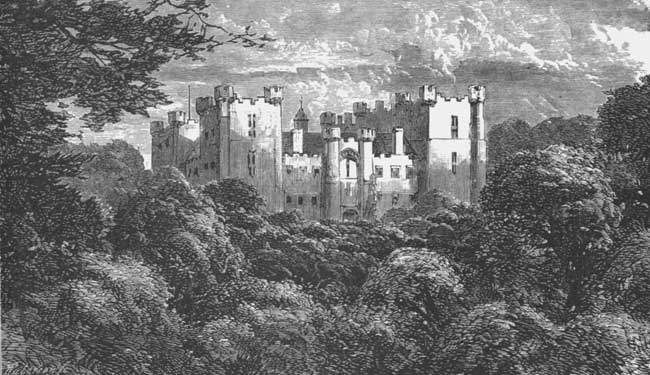
Following the Wear northward towards its mouth, at a short distance below Durham it passes the site of the Roman city of Conderum, which had been the resting-place of St. Cuthbert's bones until the Danish invasion drove them away, and it is now known as Chester-le-Street. Here, in the old church of St. Mary and St. Cuthbert, is the rude effigy of the saint which once surmounted his tomb, and here also is the "Aisle of Tombs," a chain of fourteen monumental effigies of the Lumleys, dating from Queen Elizabeth's reign. Lumley Castle, now the Earl of Scarborough's seat (for he too is a Lumley), is a short distance outside the town, on an eminence overlooking the Wear. It dates from the time of Edward I., but has been much modernized, the chief apartment in the interior being the Great Hall, sixty by thirty feet, with the Minstrel Gallery at the western end. Here on the wall is a life-size statue of the great ancestor of the Lumleys, Liulph the Saxon, seated on a red horse. North of this castle, across the Wear, is the Earl of Durham's seat, Lambton Castle, a Gothic and Tudor structure recently restored.
SOUTH-EAST VIEW OF LUMLEY CASTLE.
GATEWAY, LUMLEY CASTLE, FROM THE WALK.
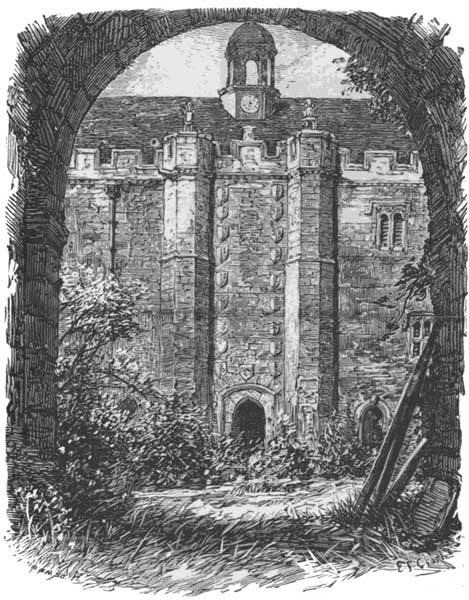
Still journeying northward, we cross the hills between the Wear and the Tyne, and come to the New Castle which gives its name to Newcastle-upon-Tyne, the great coal shipping port. This is a strange-looking town, with red-tiled roofs, narrow, dingy, crooked streets, and myriads of chimneys belching forth smoke from the many iron-works. These mills and furnaces are numerous also in the surrounding country, while the neighborhood is a network of railways carrying coal from the various lines to the shipping-piers. But this famous city is not all smoke and coal-dust: its New Castle is an ancient structure, rather dilapidated now, coming down from the reign of Henry II., approached by steep stairways up the rock on which the keep is perched. It has a fine hall, which is used as a museum of Roman relics, and from the roof is a grand view along the Tyne. This castle has a well ninety-three feet deep bored in the rock. Newcastle in its newer parts has some fine buildings. Grey Street, containing the theatre and Exchange, for a space of about four hundred yards is claimed to be the finest street in the kingdom. In Low Friars Street is the old chapel of the Black Friars monastery, where Baliol did homage to Edward III. for the Scottish throne. Sir William Armstrong lives at Jesmond, just outside Newcastle, and at Elswick, west of the city, are the extensive workshops where are made the Armstrong guns. The great High Level bridge across the Tyne Valley, built by Stephenson, with a railway on top of a roadway, and one thousand three hundred and thirty-seven feet long, is one of the chief engineering works at Newcastle. George Stephenson was born in 1781 at High Street House, Wylam, near Newcastle, while at Frudhoe Castle is a seat of the Duke of Northumberland. At Wallsend, three miles east of Newcastle, begins the celebrated Roman wall that crossed Britain, and was defended by their legions against incursions by the Scots. Its stone-and-turf walls, with the ditch on the north side, can be distinctly traced across the island.
HEXHAM.
HEXHAM.
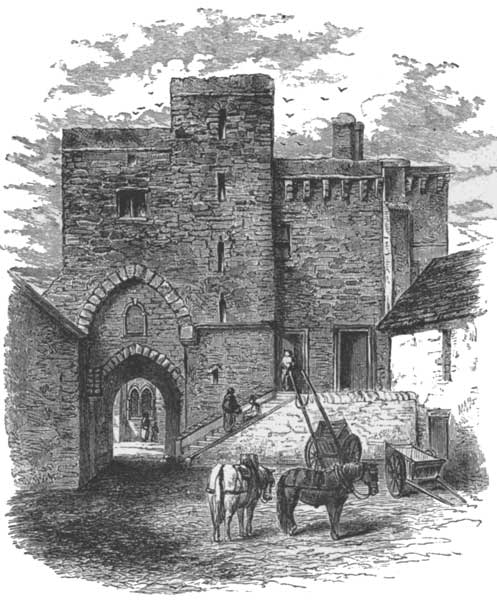
Ascending the Tyne, we come to Hexham, an imposing town as approached by the railway, with the Moat Hall and the abbey church occupying commanding features in the landscape. The Moat Hall is a large and ancient tower, notable for its narrow lights and cornice-like range of corbels. The abbey church, formerly the cathedral of St. Andrew, is a fine specimen of Early English architecture, of which only the transept and some other ruins remain, surmounted by a tower rising about one hundred feet and supported upon magnificent arches. Here is the shrine of the ancient chronicler. Prior Richard, an attractive oratory: and the town also produced another quaint historian of the Border troubles, John of Hexham. It is an antique place, and almost all of its old buildings bear testimony to the disturbed state of the Scottish frontier in the olden time, for not far away are the Cheviot Hills that form the boundary, and in which the Tyne takes its rise. Similar evidence is also given in Haltwhistle, Hexham's suburb, across the narrow river.
ALNWICK CASTLE.
ALNWICK CASTLE, FROM THE LION BRIDGE.
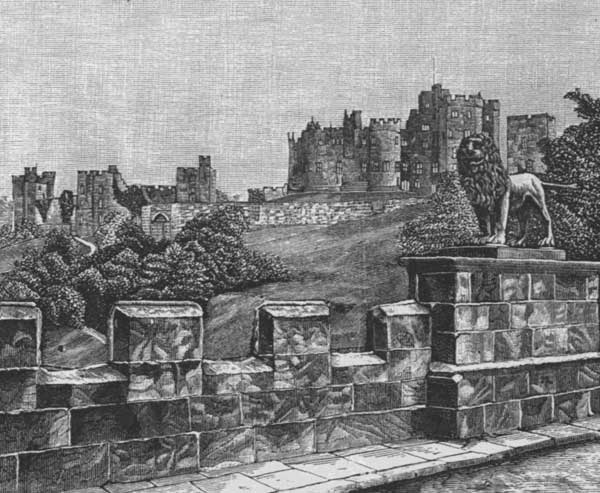
THE BARBICAN.
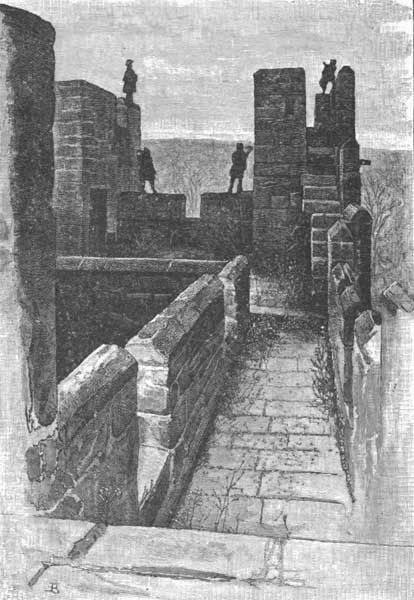
THE BARBICAN GATE.
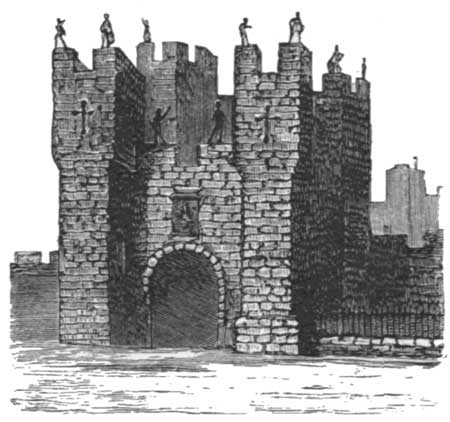
Journeying northward through Northumberland, and following the coastline—for here England narrows as the Scottish border is approached—the road crosses the diminutive river Alne, running through a deep valley, and standing in an imposing situation on its southern bank is the renowned stronghold of the Percies and guardian of the Border, Alnwick Castle. The great fortress, as we now see it, was built as a defence against the Scots, and was protected on the northward by the river-valley and a deep ravine, which formerly cut it off from the village, which is as ancient as the fortress, as its quaint old Pottergate Tower attests. Roman remains have been found on the site, and it was also inhabited by the Saxons, the castle at the time of the Norman Conquest being held by Gilbert Tysen, a powerful Northumbrian chief. It was then a primitive timber fortress in a wild region, for the earliest masonry works are Norman, and are attributed to Tysen's descendants. Alnwick Castle is a cluster of semicircular and angular bastions, surrounded by lofty walls, defended at intervals by towers, and enclosing a space of about five acres. It has three courts or wards, each defended formerly by massive gates, with portcullis, porters lodge, and a strong guardhouse, beneath which was a dungeon. Trap-doors are the only entrances to the latter, into which the prisoners were lowered by ropes. From the village the entrance to the castle is through the barbican, or outer gate, a work of gigantic strength and massive grandeur, which has been the scene of many a brave encounter. Near by is the Postern Tower, a sally-port adjacent to the "Bloody Gap" and "Hotspur's Chair." The history of this famous stronghold is practically the history of this portion of the realm, for in all the Border warfare that continued for centuries it was conspicuous. In the reign of William Rufus it was gallantly defended by Mowbray, Earl of Northumberland, in the memorable siege by the Scots under King Malcolm III. The garrison were about surrendering, being almost starved, when a private soldier undertook their deliverance. He rode out to the besiegers' camp, carrying the keys of the castle dangling from his lance, and presented himself a suppliant before the Scottish king, as if to deliver up the keys. Malcolm advanced to receive them, and the soldier pierced him through the heart. Malcolm fell dead, and in the confusion the bold trooper sprang upon his horse, dashed across the river, and was safe. Malcolm's eldest son, Prince Edward, advanced rashly to avenge the king's death, and fell mortally wounded from the castle. Hammond's Ford, named for the bold trooper, marks the spot where he and his horse swam across the Alne, which at the time was swollen. In memory of Malcolm, a cross stands on the spot where he was slain, and near by is Malcolm's Well and the ruins of St. Leonard's Chapel, built for the unfortunate king's expiation. Upon the cross the inscription states that Malcolm fell November 13, 1093, and that the original cross, decayed by time, was restored by his descendant, Elizabeth, Duchess of Northumberland, in 1774. Eustace de Vesci, who built St. Leonard's Chapel, lived in the days of Henry I. and Stephen, and founded the abbey of Alnwick. King David of Scotland captured the old timber castle there in 1135 on his great invasion of England, and Eustace afterwards built the first masonry work of Alnwick Castle, traces of his walls having since been found.
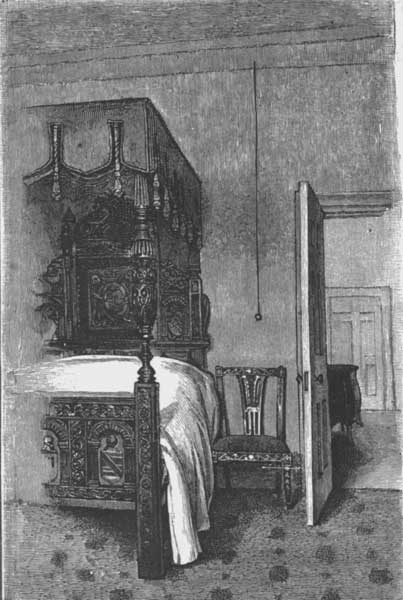
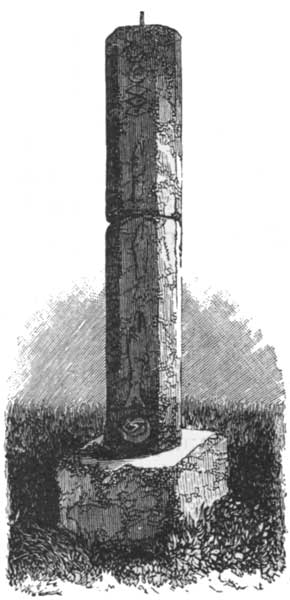
THE PERCY BEDSTEAD.THE PERCY CROSS.
THE EASTERN ANGLE OF THE BARBICAN.
Alnwick descended to William, son of Eustace, and in 1174, William the Lion, returning from an invasion of Cumberland, passed before the castle, and was captured and sent a prisoner into England. Alnwick descended to William's son Eustace, who was visited by King John in 1209, and the king there received the homage of Alexander of Scotland. Eustace was one of the chief barons who wrested Magna Charta from John, and in the closing year of that reign met his death from an arrow before Barnard Castle. Henry III. visited Alnwick, and the great Edward I. was there several times as the guest of John de Vesci near the close of the thirteenth century. The Barons de Vesci soon afterwards became extinct, and then the warlike bishop of Durham, Antony Bek, came in and grabbed the castle. He sold it in 1309 to Henry de Percy, and from this dates the rise of the great family of the northern Border, who have held Alnwick for nearly six centuries, its present owner being his descendant, Algernon George Percy, Duke of Northumberland, in whose veins flows the blood of so many great families that he can use nine hundred heraldic devices on his armorial bearings, including those of many kings and princes. Henry de Percy became the leader of the Border barons, and, although living at Alnwick only five years, seems to have rebuilt most of the castle, his son completing it. The Percies became the Earls of Northumberland, and such warlike lives did they lead (as, for instance, young Henry Percy, "Hotspur") that it is noted that Henry Algernon, the fifth earl, was the first of the race who died in bed. The next of the line was executed for rebellion, and the next was beheaded at York for conspiring against Queen Elizabeth. The eighth earl, favoring Mary Queen of Scots, was imprisoned in the Tower, and was one day found in his chamber shot through the heart. Henry, the ninth earl, was implicated in the Gunpowder Plot, imprisoned in the Tower, and fined $250,000. After his release he spent the remainder of his life at Petworth; Alnwick was neglected; and the direct line of descent ultimately ended with Elizabeth, daughter of the eleventh earl, who married the Duke of Somerset in 1682. Her grandson, Algernon, became Earl of Northumberland, and his daughter, Elizabeth Seymour, was the ancestress of the present family, her husband being created the first Duke of Northumberland. Alnwick was then a ruin, but he restored it, and subsequently, under the direction of the architect Salvin, it was completely rebuilt, everything worthy of preservation being kept, and the new work being adapted to the days of the earlier Percies, whose achievements gave the stronghold such world-wide renown.
EARL HUGH'S TOWER.
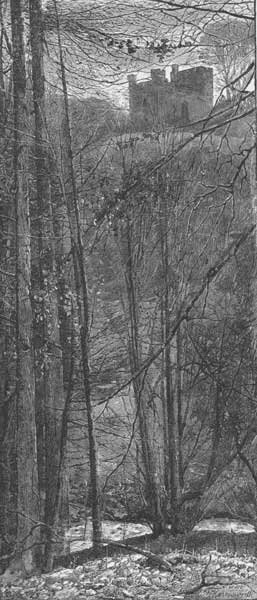
CONSTABLE'S TOWER.
This famous castle is full of recollections of the great men who formerly inhabited it. The Constable's Tower, remaining mostly in its ancient condition, has in an upper apartment arms for fifteen hundred men, the Percy tenantry, while in the rooms beneath is deposited the ancient armor. "Hotspur's Chair" is the name given to a seated recess of the Ravine Tower which was Hotspur's favorite resort, where he sat while his troops exercised in the castle-yard beneath, and where he had an admirable lookout to discover an approaching enemy. Through the loopholes on either side of the seat in this commanding tower there is an extensive prospect over the valley of the Alne and to the distant seacoast. The "Bloody Gap," another noted site in the castle, is between the Ravine and Round Towers. It was the name given to a breach in the wall made by the Scots during the Border wars, although the exact time is unknown. According to tradition, three hundred Scots fell within the breach, and they were ultimately beaten off. Many arrows have been found in the adjacent walls, so located as to indicate they were shot from the battlements and windows of the keep when the assailants were making this breach. Alnwick Castle was restored by Salvin with strict regard to the rules of mediæval military architecture. When it was the great Border stronghold its governor commanded a force of no less than two thousand men, who were employed in a complicated system of day and night watching to guard against forays by the Scots. The day watchers began at daylight, and blew a horn on the approach of the foe, when all men were bound on pain of death to respond for the general defence. The great feature of the restored castle is the Prudhoe Tower, built about twenty-five years ago. After entering the barbican, which admits to the outer ward, the visitor passes between the Abbot's Tower on the left and the Corner Tower and Auditor's Tower on the right. Earl Hugh's turreted tower also rises boldly from the battlements. Passing through the middle gatehouse, the keep, constructed in the form of a polygon around a court, is seen on the right hand, and in the gateway-wall is Percy's famous draw-well, with a statue of St. James above blessing the waters. Opposite this draw-well is a covered drive which leads to the entrance of Prudhoe Tower. This tower is a magnificent structure, containing the family and state-apartments, built and decorated in the Italian style, and approached by a staircase twelve feet wide. It was built at enormous cost, and alongside is a vaulted kitchen of ample proportions, constructed in the baronial style, where there are sufficient facilities to prepare dinner for six hundred persons at one time, while the subterranean regions contain bins for three hundred tons of coal. Such is this great baronial Border stronghold, replete with memories of the warlike Percies. From here Hotspur sallied forth to encounter the marauding Scottish force which under Douglas had laid waste England as far as the gates of York, and almost within the sight of the castle is the bloody field of Otterbourn, where Douglas fell by Hotspur's own hand, though the English lost the day and Hotspur himself was captured. Again, as war's fortunes change, just north of Alnwick is Humbleton Hill, where the Scots had to fly before England's "deadly arrow-hail," leaving their leader, Douglas, with five wounds and only one eye, a prisoner in the hands of the Percies. It was from Alnwick's battlements that the countess watched "the stout Earl of Northumberland" set forth, "his pleasure in the Scottish woods three summer days to take"—an expedition from which he never returned. Such was the history for centuries of this renowned castle, which is regarded as presenting the most perfect specimen now existing, perhaps in the world, of the feudal stronghold of mediæval days.
THE DRAW-WELL AND NORMAN GATEWAY.
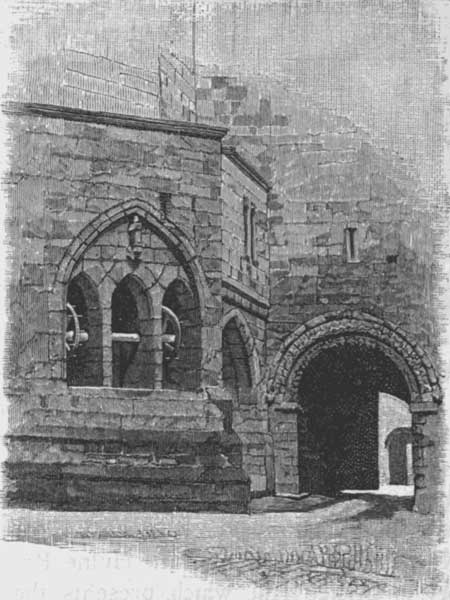
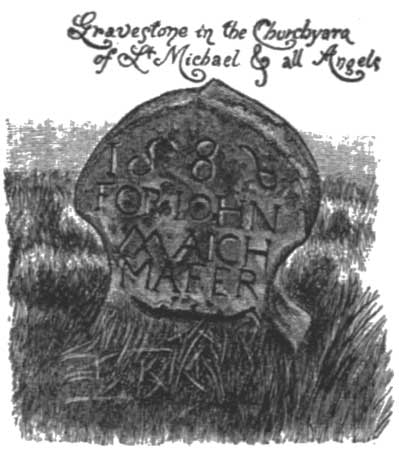
And now let us turn from the castle to the church. Almost alongside of it is St. Michael's Church, built with battlements, as if prepared as much for defence as for worship, and a watch-tower, made evidently for a lookout and to hold a beacon to warn of the approach of forays. This was one of the regular chain of Border beacons. Within the church an old iron-work lectern still holds the "Book of the Homilies," while the churchyard is full of ancient gravestones. Alnwick Abbey once existed down alongside the river, under the protection of the castle, but it has been long since ruined, and its remains have served as a quarry for the village buildings until little of them remains. Its extensive domains are now part of the Duke's Park, and another contributor to this park was Hulne Priory, the earliest Carmelite monastery in England, founded in 1240. It stood upon a projecting spur of rising land above the Alne, backed by rich woods, but was neither large nor wealthy, as the neighboring abbey eclipsed it. The discipline of the Carmelites was rigorous. Each friar had a coffin for his cell and slept on straw, while every morning he dug a shovelful of earth for his grave and crept on his knees in prayer. Silence, solitude, and strict fasting were the injunction upon all, and their buildings were sternly simple. The porter's lodge and curtain-wall enclosing Hulne Priory still stand, and its outline can be traced, though the ruins are scant. Yet this, like all else at Alnwick, bears evidence of the troublous times on the Border. The most important of its remaining buildings is an embattled tower of refuge from the Scottish invader. Its inscription states that it was built in 1448 by Sir Henry Percy, fourth Earl of Northumberland. Opposite Hulne Priory is Brislee Hill, which presents the most renowned view in Alnwick Park. A tower rises among the trees upon the crest of the hill from which bonfires now blaze on occasions of festivity. Here, over the park, can be seen the castle and town, and beyond, to the eastward, the sea, with its coast-castles as far north as Bamborough. The little Coquet Island in the distance breaks the expanse of blue waters. To the westward beyond the moors rises the sharp outline of the Scottish Border, the Cheviot Hills, running off towards the north-east, and containing in their depressions the passes through which the Scots used to pour when they harried Northern England and roused the Alnwick warriors to defend their firesides.