VOLUME XV SLICE VII Kelly, Edward to Kite (continued 9)
Reading edition
The other works of William King include: A Journey to London, in the year 1698. After the Ingenious Method of that made by Dr Martin Lister to Paris, in the same Year ... (1699), which was considered by the author to be his best work; Adversaria, or Occasional Remarks on Men and Manners, a selection from his critical note-book, which shows wide and varied reading; Rufinus, or An Historical Essay on the Favourite Ministry (1712), a satire on the duke of Marlborough. His chief poems are: The Art of Cookery: in imitation of Horace’s Art of Poetry. With some Letters to Dr Lister and Others (1708), one of his most amusing works; The Art of Love; in imitation of Ovid ... (1709); “Mully of Mountoun,” and a burlesque “Orpheus and Eurydice.” A volume of Miscellanies in Prose and Verse appeared in 1705; his Remains ... were edited by J. Brown in 1732; and in 1776 John Nichols produced an excellent edition of his Original Works ... with Historical Notes and Memoirs of the Author. Dr Johnson included him in his Lives of the Poets, and his works appear in subsequent collections.
King is not to be confused with another William King (1685-1763), author of a mock-heroic poem called The Toast (1736) satirizing the countess of Newburgh, and principal of St Mary Hall, Oxford.

KING [OF OCKHAM], PETER KING, 1st Baron (1669-1734), lord chancellor of England, was born at Exeter in 1669. In his youth he was interested in early church history, and published anonymously in 1691 An Enquiry into the Constitution, Discipline, Unity and Worship of the Primitive Church that flourished within the first Three Hundred Years after Christ. This treatise engaged the interest of his cousin, John Locke, the philosopher, by whose advice his father sent him to the university of Leiden, where he stayed for nearly three years. He entered the Middle Temple in 1694 and was called to the bar in 1698. In 1700 he was returned to parliament for Beer Alston in Devonshire; he was appointed recorder of Glastonbury in 1705 and recorder of London in 1708. He was chief justice of the common pleas from 1714 to 1725, when he was appointed speaker of the House of Lords and was raised to the peerage. In June of the same year he was made lord chancellor, holding office until compelled by a paralytic stroke to resign in 1733. He died at Ockham, Surrey, on the 22nd of July 1734. Lord King as chancellor failed to sustain the reputation which he had acquired at the common law bar. Nevertheless he left his mark on English law by establishing the principles that a will of immovable property is governed by the lex loci rei sitae, and that where a husband had a legal right to the personal estate of his wife, which must be asserted by a suit in equity, the court would not help him unless he made a provision out of the property for the wife, if she required it. He was also the author of the Act (4 Geo. II. c. 26) by virtue of which English superseded Latin as the language of the courts. Lord King published in 1702 a History of the Apostles’ Creed (Leipzig, 1706; Basel, 1750) which went through several editions and was also translated into Latin.
His great-great-grandson, William (1805-1893), married in 1835 the only daughter of Lord Byron the poet, and was created earl of Lovelace in 1838. Another descendant, Peter John Locke King (1811-1885), who was member of parliament for East Surrey from 1847 to 1874, won some fame as an advocate of reform, being responsible for the passing of the Real Estate Charges Act of 1854, and for the repeal of a large number of obsolete laws.
KING (O. Eng. cyning, abbreviated into cyng, cing; cf. O. H. G. chun- kuning, chun- kunig, M.H.G. künic, künec, künc, Mod. Ger. König, O. Norse konungr, kongr, Swed. konung, kung), a title, in its actual use generally implying sovereignty of the most exalted rank. Any inclusive definition of the word “king” is, however, impossible. It always implies sovereignty, but in no special degree or sense; e.g. the sovereigns of the British Empire and of Servia are both kings, and so too, at least in popular parlance, are the chiefs of many barbarous peoples, e.g. the Zulus. The use of the title is, in fact, involved in considerable confusion, largely the result of historic causes. Freeman, indeed, in his Comparative Politics (p. 138) says: “There is a common idea of kingship which is at once recognized however hard it may be to define it. This is shown among other things by the fact that no difficulty is ever felt as to translating the word king and the words which answer to it in other languages.” This, however, is subject to considerable modification. “King,” for instance, is used to translate the Homeric ἄναξ equally with the Athenian βασιλεύς or the Roman rex. Yet the Homeric “kings” were but tribal chiefs; while the Athenian and Roman kings were kings in something more than the modern sense, as supreme priests as well as supreme rulers and lawgivers (see Archon; and Rome: History). In the English Bible, too, the title of king is given indiscriminately to the great king of Persia and to potentates who were little more than Oriental sheiks. A more practical difficulty, moreover, presented itself in international intercourse, before diplomatic conventions became, in the 19th century, more or less stereotyped. Originally the title of king was superior to that of emperor, and it was to avoid the assumption of the superior title of rex that the chief magistrates of Rome adopted the names of Caesar, imperator and princeps to signalize their authority. But with the development of the Roman imperial idea the title emperor came to mean more than had been involved in that of rex; very early in the history of the Empire there were subject kings; while with the Hellenizing of the East Roman Empire its rulers assumed the style of βασιλεύς, no longer to be translated “king” but “emperor.” From this Roman conception of the supremacy of the emperor the medieval Empire of the West inherited its traditions. With the barbarian invasions the Teutonic idea of kingship had come into touch with the Roman idea of empire and with the theocratic conceptions which this had absorbed from the old Roman and Oriental views of kingship. With these the Teutonic kingship had in its origin but little in common.
Etymologically the Romance and Teutonic words for king have quite distinct origins. The Latin rex corresponds to the Sanskrit rajah, and meant originally steersman. The Teutonic king on the contrary corresponds to the Sanskrit ganaka, and “simply meant father, the father of a family, the king of his own kin, the father of a clan, the father of a people.”1 The Teutonic kingship, in short, was national; the king was the supreme representative of the people, “hedged with divinity” in so far as he was the reputed descendant of the national gods, but with none of that absolute theocratic authority associated with the titles of rex or βασιλεύς. This, however, was modified by contact with Rome and Christianity. The early Teutonic conquerors had never lost their reverence for the Roman emperor, and were from time to time proud to acknowledge their inferiority by accepting titles, such as “patrician,” by which this was implied. But by the coronation of Charles, king of the Franks, as emperor of the West, the German kingship was absorbed into the Roman imperial idea, a process which exercised a profound effect on the evolution of the Teutonic kingship generally. In the symmetrical political theory of medieval Europe pope and emperor were sun and moon, kings but lesser satellites; though the theory only partially and occasionally corresponded with the facts. But the elevation of Charlemagne had had a profound effect in modifying the status of kingship in nations that never came under his sceptre nor under that of his successors. The shadowy claim of the emperors to universal dominion was in theory everywhere acknowledged; but independent kings hastened to assert their own dignity by surrounding themselves with the ceremonial forms of the Empire and occasionally, as in the case of the Saxon bretwaldas in England, by assuming the imperial style. The mere fact of this usurpation showed that the title of king was regarded as inferior to that of emperor; and so it continued, as a matter of sentiment at least, down to the end of the Holy Roman Empire in 1806 and the cheapening of the imperial title by its multiplication in the 19th century. To the last, moreover, the emperor retained the prerogative of creating kings, as in the case of the king of Prussia in 1701, a right borrowed and freely used by the emperor Napoleon. Since 1814 the title of king has been assumed or bestowed by a consensus of the Powers; e.g. the elector of Hanover was made king by the congress of Vienna (1814), and per contra the title of king was refused to the elector of Hesse by the congress of Aix-la-Chapelle (1818). In general the title of king is now taken to imply a sovereign and independent international position. This was implied in the recognition of the title of king in the rulers of Greece, Rumania, Servia and Bulgaria when these countries were declared absolutely independent of Turkey. The fiction of this independent sovereignty is preserved even in the case of the kings of Bavaria, Saxony and Württemberg, who are technically members of a free confederation of sovereign states, but are not independent, since their relations with foreign Powers are practically controlled by the king of Prussia as German emperor.
The theory of the “divine right” of kings, as at present understood, is of comparatively modern growth. The principle that the kingship is “descendible in one sacred family,” as George Canning put it, is not only still Divine Right of Kings. that of the British constitution, as that of all monarchical states, but is practically that of kingship from the beginning. This is, however, quite a different thing from asserting with the modern upholders of the doctrine of “divine right” not only that “legitimate” monarchs derive their authority from, and are responsible to, God alone, but that this authority is by divine ordinance hereditary in a certain order of succession. The power of popular election remained, even though popular choice was by custom or by religious sentiment confined within the limits of a single family. The custom of primogeniture grew up owing to the obvious convenience of a simple rule that should avoid ruinous contests; the so-called “Salic Law” went further, and by excluding females, removed another possible source of weakness. Neither did the Teutonic kingship imply absolute power. The idea of kingship as a theocratic function which played so great a part in the political controversies of the 17th century, is due ultimately to Oriental influences brought to bear through Christianity. The crowning and anointing of the emperors, borrowed from Byzantium and traceable to the influence of the Old Testament, was imitated by lesser potentates; and this “sacring” by ecclesiastical authority gave to the king a character of special sanctity. The Christian king thus became, in a sense, like the Roman rex, both king and priest. Shakespeare makes Richard II. say, “Not all the water in the rough rude sea can wash the balm off from an anointed king” (act iii. sc. 2); and this conception of the kingship tended to gather strength with the weakening of the prestige of the papacy and of the clergy generally. Before the Reformation the anointed king was, within his realm, the accredited vicar of God for secular purposes; after the Reformation he became this in Protestant states for religious purposes also. In England it is not without significance that the sacerdotal vestments, generally discarded by the clergy—dalmatic, alb and stole—continued to be among the insignia of the sovereign (see Coronation). Moreover, this sacrosanct character he acquired not by virtue of his “sacring,” but by hereditary right; the coronation, anointing and vesting were but the outward and visible symbol of a divine grace adherent in the sovereign by virtue of his title. Even Roman Catholic monarchs, like Louis XIV., would never have admitted that their coronation by the archbishop constituted any part of their title to reign; it was no more than the consecration of their title. In England the doctrine of the divine right of kings was developed to its extremest logical conclusions during the political controversies of the 17th century. Of its exponents the most distinguished was Hobbes, the most exaggerated Sir Robert Filmer. It was the main issue to be decided by the Civil War, the royalists holding that “all Christian kings, princes and governors” derive their authority direct from God, the parliamentarians that this authority is the outcome of a contract, actual or implied, between sovereign and people. In one case the king’s power would be unlimited, according to Louis XIV.’s famous saying: “L’état, c’est moi!” or limitable only by his own free act; in the other his actions would be governed by the advice and consent of the people, to whom he would be ultimately responsible. The victory of this latter principle was proclaimed to all the world by the execution of Charles I. The doctrine of divine right, indeed, for a while drew nourishment from the blood of the royal “martyr”; it was the guiding principle of the Anglican Church of the Restoration; but it suffered a rude blow when James II. made it impossible for the clergy to obey both their conscience and their king; and the revolution of 1688 made an end of it as a great political force. These events had effects far beyond England. They served as precedents for the crusade of republican France against kings, and later for the substitution of the democratic kingship of Louis Philippe, “king of the French by the grace of God and the will of the people,” for the “legitimate” kingship of Charles X., “king of France by the grace of God.”
The theory of the crown in Britain, as held by descent modified and modifiable by parliamentary action, and yet also “by the grace of God,” is in strict accordance with the earliest traditions of the English kingship; but the rival theory of inalienable divine right is not dead. It is strong in Germany and especially in Prussia; it survives as a militant force among the Carlists in Spain and the Royalists in France (see Legitimists); and even in England a remnant of enthusiasts still maintain the claims of a remote descendant of Charles I. to the throne (see Jacobites).
See J. Neville Figgis, Theory of the Divine Right of Kings (Cambridge, 1896).
(W. A. P.)
1 Max Müller, Lect. Sci. Lang., 2nd series, p. 255, “All people, save those who fancy that the name king has something to do with a Tartar khan or with a ‘canning’ ... man, are agreed that the English cyning and the Sanskrit ganaka both come from the same root, from that widely spread root whence comes our own cyn or kin and the Greek γένος. The only question is whether there is any connexion between cyning and ganaka closer than that which is implied in their both coming from the same original root. That is to say, are we to suppose that cyning and ganaka are strictly the same word common to Sanskrit and Teutonic, or is it enough to think that cyning is an independent formation made after the Teutons had separated themselves from the common stock? ... The difference between the two derivations is not very remote, as the cyn is the ruling idea in any case; but if we make the word immediately cognate with ganaka we bring in a notion about ‘the father of his people’ which has no place if we simply derive cyning from cyn.” See also O. Schrader, Reallexikon der Indogermanischen Altertumskunde (Strassburg, 1901) s.v. “König”: the chuning (King) is but the chunni (Kin) personified; cf. A.S. léod masc. = “prince”; léod fem. = “race,” i.e. Lat. gens.
KING-BIRD, the Lanius tyrannus of Linnaeus, and the Tyrannus carolinensis or T. pipiri of most later writers, a common and characteristic inhabitant of North America, ranging as high as 57° N. lat. or farther, and westward to the Rocky Mountains, beyond which it is found in Oregon, in Washington (State), and in British Columbia, though apparently not occurring in California. In Canada and the northern states of the Union it is a summer visitor, wintering in the south, but also reaching Cuba; and, passing through Central America, it has been found in Bolivia and eastern Peru. Both the scientific and common names of this species are taken from the way in which the cock will at times assume despotic authority over other birds, attacking them furiously as they fly, and forcing them to divert or altogether desist from their course. Yet it is love of his mate or his young that prompts this bellicose behaviour, for it is only in the breeding season that he indulges in it; but then almost every large bird that approaches his nest, from an eagle downwards, is assaulted, and those alone that possess greater command of flight can escape from his repeated charges, which are accompanied by loud and shrill cries. On these occasions it may be that the king-bird displays the emblem of his dignity, which is commonly concealed; for, being otherwise rather plainly coloured—dark-ashy grey above and white beneath—the erectile feathers of the crown of the head, on being parted, form as it were a deep furrow, and reveal their base, which is of a bright golden-orange in front, deepening into scarlet, and then passing into silvery white. This species seems to live entirely on insects, which it captures on the wing; it is in bad repute with bee-keepers,1 though, according to Dr E. Coues, it “destroys a thousand noxious insects for every bee it eats.” It builds, often in an exposed situation, a rather large nest, coarsely constructed outside, but neatly lined with fine roots or grasses, and lays five or six eggs of a pale salmon colour, beautifully marked with blotches and spots of purple, brown and orange, generally disposed in a zone near the larger end.
Nearly akin to the king-bird is the petchary or chicheree, so called from its loud and petulant cry, T. dominicensis, or T. griseus, one of the most characteristic and conspicuous birds of the West Indies, and the earliest to give notice of the break of day. In habits, except that it eats a good many berries, it is the very counterpart of its congener, and is possibly even more jealous of any intruder. At all events its pugnacity extends to animals from which it could not possibly receive any harm, and is hardly limited to any season of the year.
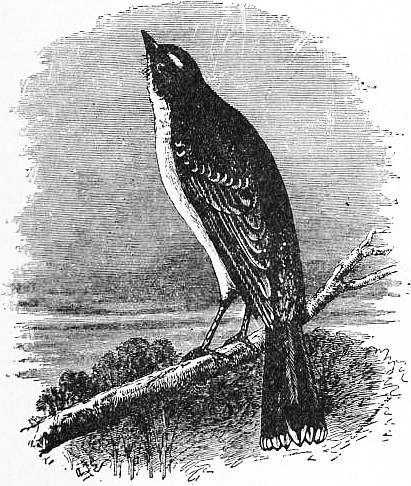
King-Bird.
In several respects both of these birds, with several of their allies, resemble some of the shrikes; but it must be clearly understood that the likeness is but of analogy, and that there is no near affinity between the two families Laniidae and Tyrannidae, which belong to wholly distinct sections of the great Passerine order; and, while the former is a comparatively homogeneous group, much diversity of form and habits is found among the latter. Similarly many of the smaller Tyrannidae bear some analogy to certain Muscicapidae, with which they were at one time confounded (see Flycatcher), but the difference between them is deep seated.2 Nor is this all, for out of the seventy genera, or thereabouts, into which the Tyrannidae have been divided, comprehending perhaps three hundred and fifty species, all of which are peculiar to the New World, a series of forms can be selected which find a kind of parallel to a series of forms to be found in the other group of Passeres; and the genus Tyrannus, though that from which the family is named, is by no means a fair representative of it; but it would be hard to say which genus should be so accounted. The birds of the genus Muscisaxicola have the habits and almost the appearance of wheat-ears; the genus Alectorurus calls to mind a water-wagtail; Euscarthmus may suggest a titmouse, Elaenia perhaps a willow-wren; but the greatest number of forms have no analogous bird of the Old World with which they can be compared; and, while the combination of delicate beauty and peculiar external form possibly attains its utmost in the long-tailed Milvulus, the glory of the family may be said to culminate in the king of king-birds, Muscivora regia.
(A. N.)
1 It is called in some parts the bee-martin.
2 Two easy modes of discriminating them externally may be mentioned. All the Laniidae and Muscicapidae have but nine primary quills in their wings, and their tarsi are covered with scales in front only; while in the Tyrannidae there are ten primaries, and the tarsal scales extend the whole way round. The more recondite distinction in the structure of the trachea seems to have been first detected by Macgillivray, who wrote the anatomical descriptions published in 1839 by Audubon (Orn. Biography, v. 421, 422); but its value was not appreciated till the publication of Johannes Müller’s classical treatise on the vocal organs of Passerine birds (Abhandl. k. Akad. Wissensch. Berlin, 1845, pp. 321, 405).
KING-CRAB, the name given to an Arachnid, belonging to the order Xiphosurae, of the grade Delobranchia or Hydropneustea. King-crabs, of which four, possibly five, existing species are known, were formerly referred to the genus Limulus, a name still applied to them in all zoological textbooks. It has recently been shown, however, that the structural differences between some of the species are sufficiently numerous and important to warrant the recognition of three genera—Xiphosura, of which Limulus is a synonym, Tachypleus and Carcinoscorpius. In Xiphosura the genital operculum structurally resembles the gill-bearing appendages in that the inner branches consist of three distinct segments, the distal of which is lobate and projects freely beyond the margin of the adjacent distal segment of the outer branch; the entosternite (see Arachnida) has two pairs of antero-lateral processes, and in the male only the ambulatory appendages of the second pair are modified as claspers. In Tachypleus and Carcinoscorpius, on the other hand, the genital operculum differs from the gill-bearing appendages in that the inner branches consist of two segments, the distal of which are apically pointed, partially or completely fused in the middle line, and do not project beyond the distal segments of the outer branches; the entosternite has only one pair of antero-lateral processes, and in the male the second and third pairs of ambulatory limbs are modified as claspers. Tachypleus differs from Carcinoscorpius in possessing a long movable spur upon the fourth segment of the sixth ambulatory limb, in having the postanal spine triangular in section instead of round, and the claspers in the male hemichelate, owing to the suppression of the immovable finger, which is well developed in Carcinoscorpius. At the present time king-crabs have a wide but discontinuous distribution. Xiphosura, of which there is but one species, X. polyphemus, ranges along the eastern side of North America from the coast of Maine to Yucatan. Carcinoscorpius, which is also represented by a single species, C. rotundicauda, extends from the Bay of Bengal to the coast of the Moluccas and the Philippines, while of the two better-known species of Tachypleus, T. gigas (= moluccanus) ranges from Singapore to Torres Straits, and T. tridentatus from Borneo to southern Japan. A third species, T. hoeveni, has been recorded from the Moluccas. But although Xiphosura is now so widely sundered geographically from Tachypleus and Carcinoscorpius, the occurrence of the remains of extinct species of king-crabs in Europe, both in Tertiary deposits and in Triassic, Jurassic and Cretaceous strata, suggests that there was formerly a continuous coast-line, with tropical or temperate conditions, extending from Europe westward to America, and eastward to southern Asia. There are, however, no grounds for the assumption that the supposed coast-line between America and Europe synchronized with that between Europe and south Asia. King-crabs do not appear to differ from each other in habits. Except in the breeding season they live in water ranging in depth from about two to six fathoms, and creep about the bottom or bury themselves in the sand. Their food consists for the most part of soft marine worms, which are picked up in the nippers, thrust into the mouth, and masticated by the basal segments of the appendages between which the mouth lies. At the approach of the breeding season, which in the case of Xiphosura polyphemus is in May, June and July, king-crabs advance in pairs into very shallow water at the time of the high tides, the male holding securely to the back of the female by means of his clasping nippers. No actual union between the sexes takes place, the spawn of the female being fertilized by the male at the time of being laid in the sand or soon afterwards. This act accomplished, the two retreat again into deeper water. Deposited in the mud or sand near high-water mark, the eggs are eventually hatched by the heat of the sun, to which they are exposed every day for a considerable time. The newly hatched young is minute and subcircular in shape, but bears a close resemblance to its parents except in the absence of the caudal spine and in the presence of a fringe of stiff bristles round the margin of the body. During growth it undergoes a succession of moults, making its exit from the old integument through a wide split running round the edge of the carapace. Moulting is effected in exactly the same way in scorpions, Pedipalpi, and normally in spiders. The caudal spine appears at the second moult and gradually increases in length with successive changes of the skin. This organ is of considerable importance, since it enables the king-crab to right itself when overturned by rough water or other causes. Without it the animal would remain helpless like an upturned turtle, because it is unable to reach the ground with its legs when lying on its back. Before the tail is sufficiently developed to be used for that purpose, the young king-crab succeeds in regaining the normal position by flapping its flattened abdominal appendages and rising in the water by that means. The king-crab fishery is an industry of some importance in the United States, and in the East Indies the natives eat the animal and tip their lances and arrows with the caudal spine. They also use the hollow empty shell as a water-ladle or pan—hence the name “pan-fish” or “saucepan-crab” by which the animal is sometimes known. Fossil king-crabs have been recorded from strata of the Tertiary and Secondary epochs, and related but less specialized types of the same order are found in rocks of Palaeozoic age. Of these the most important are Belinurus of the Carboniferous, Protolimulus of the Devonian, and Hemiaspis of the Silurian periods. These ancient forms differ principally from true king-crabs in having the segments of the opisthosoma or hinder half of the body distinctly defined instead of welded into a hexagonal shield.
(R. I. P.)
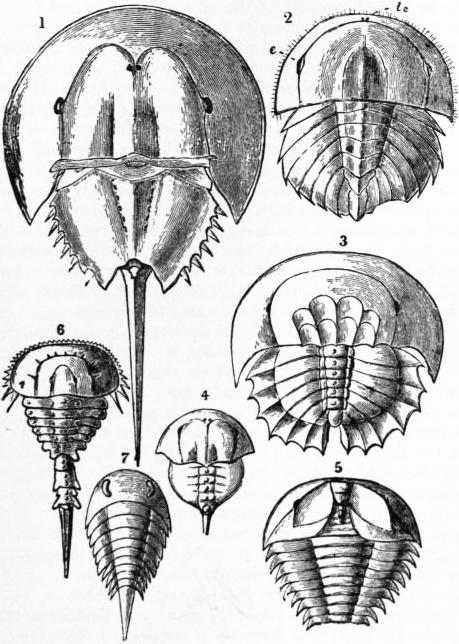
Fig. 1.
1, Limulus polyphemus, adult (dorsal aspect). 2, Limulus polyphemus, young (dorsal aspect). 3, Prestwichia rotundata, Coal M., Shropshire. 4, Prestwichia Birtwelli, Coal M., Lancashire. 5, Neolimulus falcatus, U. Silurian, Lanark. 6, Hemiaspis limuloides, L. Ludlow, Leintwardine, Shropshire. 7, Pseudoniscus aculeatus, U. Silurian, Russia.
KINGFISHER (Ger.1 Königsfischer; Walloon Roi-péheux = pêcheur), the Alceḍo ispida of ornithologists, one of the most beautiful and well-known of European birds, being found, though nowhere very abundantly, in every European country, as well as in North Africa and South-Western Asia as far as Sindh. Its blue-green back and rich chestnut breast render it conspicuous as it frequents the streams and ponds whence it procures its food, by plunging almost perpendicularly into the water, and emerging a moment after with the prey—whether a small fish, crustacean, or an aquatic insect—it has captured. In hard frosts it resorts to the sea-shore, but a severe winter is sure to occasion a great mortality in the species, for many of its individuals seem unable to reach the tidal waters where only in such a season they could obtain sustenance; and to this cause rather than any other is perhaps to be ascribed its general scarcity. Very early in the year it prepares its nest, which is at the end of a tunnel bored by itself in a bank, and therein the six or eight white, glossy, translucent eggs are laid, sometimes on the bare soil, but often on the fishbones which, being indigestible, are thrown up in pellets by the birds; and, in any case, before incubation is completed these rejectamenta accumulate so as to form a pretty cup-shaped structure that increases in bulk after the young are hatched, but, mixed with their fluid excretions and with decaying fishes brought for their support, soon becomes a dripping fetid mass.
The kingfisher is the subject of a variety of legends and superstitions, both classical and medieval. Of the latter one of the most curious is that having been originally a plain grey bird it acquired its present bright colours by flying towards the sun on its liberation from Noah’s ark, when its upper surface assumed the hue of the sky above it and its lower plumage was scorched by the heat of the setting orb to the tint it now bears.2 More than this, the kingfisher was supposed to possess many virtues. Its dried body would avert thunderbolts, and if kept in a wardrobe would preserve from moths the woollen stuffs therein laid, or hung by a thread to the ceiling of a chamber would point with its bill to the quarter whence the wind blew. All readers of Ovid (Metam., bk. xi.) know how the faithful but unfortunate Ceyx and Alcyone were changed into kingfishers—birds which bred at the winter solstice, when through the influence of Aeolus, the wind-god and father of the fond wife, all gales were hushed and the sea calmed so that their floating nest might ride uninjured over the waves during the seven proverbial “Halcyon days”; while a variant or further development of the fable assigned to the halcyon itself the power of quelling storms.3
The common kingfisher of Europe is the representative of a well-marked family of birds, the Alcedinidae or Halcyonidae of ornithologists, which is considered by most authorities4 to be closely related to the Bucerotidae (see Hornbill); but the affinity can scarcely be said as yet to be proved. Be that as it may, the present family forms the subject of an important work by Bowdler Sharpe.5 Herein are described one hundred and twenty-five species, nearly all of them being beautifully figured by Keulemans, and that number may be taken even now as approximately correct; for, while the validity of a few has been denied by some eminent men, nearly as many have since been made known, and it seems likely that two or three more described by older writers may yet be rediscovered. These one hundred and twenty-five species Sharpe groups in nineteen genera, and divides into two sub-families, Alcedininae and Daceloninae,6 the one containing five and the other fourteen genera. With existing anatomical materials perhaps no better arrangement could have been made, but the method afterwards published by Sundevall (Tentamen, pp. 95, 96) differs from it not inconsiderably. Here, however, it will be convenient to follow Sharpe. Externally, which is almost all we can at present say, kingfishers present a great uniformity of structure. One of their most remarkable features is the feebleness of their feet, and the union (syndactylism) of the third and fourth digits for the greater part of their length; while, as if still further to show the comparatively functionless character of these members, in two of the genera, Alcyone and Ceyx, the second digit is aborted, and the birds have but three toes. In most forms the bill does not differ much from that of the common Alcedo ispida, but in Syma its edges are serrated, while in Carcineutes, Dacelo and Melidora the maxilla is prolonged, becoming in the last a very pronounced hook. Generally the wings are short and rounded, and the tail is in many forms inconspicuous; but in Tanysiptera, one of the most beautiful groups, the middle pair of feathers is greatly elongated and spatulate, while this genus possesses only ten rectrices, all the rest having twelve. Sundevall relies on a character not noticed by Sharpe, and makes his principal divisions depend on the size of the scapulars, which in one form a mantle, and in the other are so small as not to cover the back. The Alcedinidae are a cosmopolitan family, but only one genus, Ceryle, is found in America, and that extends as well over a great part of the Old World, though not into the Australian region, which affords by far the greater number both of genera and species, having no fewer than ten of the former and fifty-nine of the latter peculiar to it.7
In habits kingfishers display considerable diversity, though all, it would seem, have it in common to sit at times motionless on the watch for their prey, and on its appearance to dart upon it, seize it as they fly or dive, and return to a perch where it may be conveniently swallowed. But some species, and especially that which is the type of the family, are not always content to await at rest their victim’s showing itself. They will hover like a hawk over the waters that conceal it, and, in the manner already described, precipitate themselves upon it. This is particularly the way with those that are fishers in fact as well as in name; but no inconsiderable number live almost entirely in forests, feeding on insects, while reptiles furnish the chief sustenance of others. The last is characteristic of at least one Australian form, which manages to thrive in the driest districts of that country, where not a drop of water is to be found for miles, and the air is at times heated to a degree that is insupportable by most animals. The belted kingfisher of North America, Ceryle alcyon, is a characteristic bird of that country, though its habits greatly resemble those of the European species; and the so-called “laughing jackass” of New South Wales and South Australia, Dacelo gigas—with its kindred forms, D. leachi, D. cervina and D. occidentalis, from other parts of the country—deserve special mention. Attention must also be called to the speculations of Dr Bowdler Sharpe (op. cit., pp. xliv.-xlvii.) on the genetic affinity of the various forms of Alcedinidae, and it is to be regretted that hitherto no light has been shed by palaeontologists on this interesting subject, for the only fossil referred to the neighbourhood of the family is the Halcyornis toliapicus of Sir R. Owen (Br. Foss. Mamm. and Birds, p. 554) from the Eocene of Sheppey—the very specimen said to have been previously placed by König (Icon. foss. secliles, fig. 153) in the genus Larus.
(A. N.)
1 But more commonly called Eisvogel, which finds its counterpart in the Anglo-Saxon Isern or Isen.
2 Rolland, Faune populaire de la France, ii. 74.
3 In many of the islands of the Pacific Ocean the prevalent kingfisher is the object of much veneration.
4 Cf. Eyton, Contrib. Ornithology (1850), p. 80; Wallace, Ann. Nat. History, series 2, vol. xviii. pp. 201, 205; and Huxley, Proc. Zool. Society (1867), p. 467.
5 A Monograph of the Alcedinidae or Family of the Kingfishers, by R. B. Sharpe, 4to (London, 1868-1871). Some important anatomical points were briefly noticed by Professor Cunningham (Proc. Zool. Soc., 1870, p. 280).
6 The name of this latter sub-family as constituted by Sharpe would seem to be more correctly Ceycinae—the genus Ceyx, founded in 1801 by Lacépède, being the oldest included in it. The word Dacelo, invented by Leach in 1815, is simply an anagram of Alcedo, and, though of course without any etymological meaning, has been very generally adopted.
7 Cf. Wallace. Geog. Distr. Animals, ii. 315.
KINGHORN, a royal and police burgh of Fifeshire, Scotland. Pop. (1901), 1550. It is situated on the Firth of Forth, 2¼ m. E. by N. of Burntisland, on the North British railway. The public buildings include a library and town-hall. It enjoys some repute as a summer resort. The leading industries are ship-building, bleaching and the making of flax and glue. At the time of his visit Daniel Defoe found thread-making in vogue, which employed the women while the men were at sea. Alexander III. created Kinghorn a burgh, but his connexion with the town proved fatal to him. As he was riding from Inverkeithing on the 12th of March 1286 he was thrown by his horse and fell over the cliffs, since called King’s Wud End, a little to the west of the burgh, and killed. A monument was erected in 1887 to mark the supposed scene of the accident. The Witch Hill used to be the place of execution of those poor wretches. Kinghorn belongs to the Kirkcaldy district group of parliamentary burghs. At Pettycur, 1 m. to the south, is a good harbour for its size, and at Kinghorn Ness a battery has been established in connexion with the fortifications on Inchkeith. The hill above the battery was purchased by government in 1903 and is used as a point of observation. About 1 m. to the north of Kinghorn is the estate of Grange, which belonged to Sir William Kirkcaldy. Inchkeith, an island in the fairway of the Firth of Forth, 2½ m. S. by E. of Kinghorn and 3½ m. N. by E. of Leith, belongs to the parish of Kinghorn. It has a north-westerly and south-easterly trend, and is nearly 1 m. long and ¼ m. wide. It is a barren rock, on the summit of which stands a lighthouse visible at night for 21 m. In 1881 forts connected by a military road were erected on the northern, western and southern headlands.
KINGLAKE, ALEXANDER WILLIAM (1800-1891), English historian and traveller, was born at Taunton on the 5th of August 1809. His father, a successful solicitor, intended his son for a legal career. Kinglake went to Eton and Trinity College, Cambridge, where he matriculated in 1828, being a contemporary and friend of Tennyson and Thackeray. After leaving Cambridge he joined Lincoln’s Inn, and was called to the bar in 1837. While still a student he travelled, in 1835, throughout the East, and the impression made upon him by his experiences was so powerful that he was seized with a desire to record them in literature. Eothen, a sensitive and witty record of impressions keenly felt and remembered, was published in 1844, and enjoyed considerable reputation. In 1854 he went to the Crimea, and was present at the battle of the Alma. During the campaign he made the acquaintance of Lord Raglan, who was so much attracted by his talents that he suggested to Kinglake the plan for an elaborate History of the Crimean War, and placed his private papers at the writer’s disposal. For the rest of his life Kinglake was engaged upon the task of completing this monumental history. Thirty-two years elapsed between its commencement and the publication of the last volume, and eight volumes in all appeared at intervals between 1863 and 1887. Kinglake lived principally in London, and sat in parliament for Bridgwater from 1857 until the disfranchisement of the borough in 1868. He died on the 2nd of January 1891. Kinglake’s life-work, The History of the Crimean War, is in scheme and execution too minute and conscientious to be altogether in proportion, but it is a wonderful example of painstaking and talented industry. It is not without errors of partisanship, but it shows remarkable skill in the moulding of vast masses of despatches and technical details into an absorbingly interesting narrative; it is illumined by natural descriptions and character-sketches of great fidelity and acumen; and, despite its length, it remains one of the most picturesque, most vivid and most actual pieces of historical narrative in the English language.
KINGLET, a name applied in many books to the bird called by Linnaeus Motacilla regulus, and by most modern ornithologists Regulus cristatus, the golden-crested or golden-crowned wren of ordinary persons. This species is the type of a small group which has been generally placed among the Sylviidae or true warblers, but by certain systematists it is referred to the titmouse family, Paridae. That the kinglets possess many of the habits and actions of the latter is undeniable, but on the other hand they are not known to differ in any important points of organization or appearance from the former—the chief distinction being that the nostril is covered by a single bristly feather directed forwards. The golden-crested wren is the smallest of British birds, its whole length being about 3½ in., and its wing measuring only 2 in. from the carpal joint. Generally of an olive-green colour, the top of its head is bright yellow, deepening into orange, and bounded on either side by a black line, while the wing coverts are dull black, and some of them tipped with white, forming a somewhat conspicuous bar. The cock has a pleasant but weak song. The nest is a beautiful object, thickly felted of the softest moss, wool, and spiders’ webs, lined with feathers, and usually built under and near the end of the branch of a yew, fir or cedar, supported by the interweaving of two or three laterally diverging and pendent twigs, and sheltered by the rest. The eggs are from six to ten in number, of a dull white sometimes finely freckled with reddish-brown. The species is particularly social, living for the most part of the year in family parties, and often joining bands of any species of titmouse in a common search for food. Though to be met with in Britain at all seasons, the bird in autumn visits the east coast in enormous flocks, apparently emigrants from Scandinavia, while hundreds perish in crossing the North Sea, where they are well known to the fishermen as “woodcock’s pilots.” A second and more local European species is the fire-crested wren, R. ignicapillus, easily recognizable by the black streak on each side of the head, before and behind the eye, as well as by the deeper colour of its crown. A third species, R. maderensis, inhabits the Madeiras, to which it is peculiar; and examples from the Himalayas and Japan have been differentiated as R. himalayensis and R. japonicus. North America has two well-known species, R. satrapa, very like the European R. ignicapillus, and the ruby-crowned wren, R. calendula, which is remarkable for a loud song that has been compared to that of a canary-bird or a skylark, and for having the characteristic nasal feather in a rudimentary or aborted condition.
(A. N.)
KINGS, FIRST AND SECOND BOOKS OF, two books of the Bible, the last of the series of Old Testament histories known as the Earlier or Former Prophets. They were originally reckoned as a single book (Josephus; Origen ap. Eus., H.E. vi. 25; Peshitta; Talmud), though modern Bibles follow the bipartition which is derived from the Septuagint. In that version they are called the third and fourth books of “kingdoms” (βασιλειῶν), the first and second being our books of Samuel. The division into two books is not felicitous, and even the old Hebrew separation between Kings and Samuel must not be taken to mean that the history from the birth of Samuel to the exile was treated by two distinct authors in independent volumes. We cannot speak of the author of Kings or Samuel, but only of an editor or of successive editors whose main work was to arrange in a continuous form extracts or abstracts from earlier sources. The introduction of a chronological scheme and of a series of editorial comments and additions, chiefly designed to enforce the religious meaning of the history, gives a kind of unity to the book of Kings as we now read it; but beneath this we can still distinguish a variety of documents, which, though sometimes mutilated in the process of piecing together, retain sufficient individuality of style and colour to prove their original independence.
Of these documents one of the best defined is the vivid picture of David’s court at Jerusalem (2 Sam. ix.-xx.) from which the first two chapters of 1 Kings manifestly cannot be separated. As it would be unreasonable to suppose that the editor of the history of David closed his work abruptly before the death of the king, breaking off in the middle of a valuable memoir which lay before him, this observation leads us to conclude that the books of Samuel and Kings are not independent histories. They have at least one source in common, and a single editorial hand was at work on both. From an historical point of view, however, the division which makes the beginning of Solomon’s reign the beginning of a new book is very convenient. The conquest of Palestine by the Israelite tribes, recounted in the book of Joshua, leads up to the era of the “judges” (Judg. ii. 6-23; iii. sqq.), and the books of Samuel follow with the institution of the monarchy and the first kings. The books of Kings bring to a close the life of David (c. 975 B.C.), which forms the introduction to the reign of Solomon (1 Kings ii. 12-xi.), the troubles in whose time prepared the way for the separation into the two distinct kingdoms, viz. Judah and the northern tribes of Israel (xii. sqq.). After the fall of Samaria, the history of these Israelites is rounded off with a review (2 Kings xvii.-xviii. 12). The history of the surviving kingdom of Judah is then carried down to the destruction of Jerusalem and the exile (5 and 6), and, after an account of the Chaldean governorship, concludes with the release of the captive king Jehoiachin (561 B.C.) and with an allusion to his kind treatment during the rest of his lifetime.
The most noticeable feature in the book is the recurring interest in the centralization of worship in the Temple at Jerusalem as prescribed in Deuteronomy and enforced by Josiah. Amidst the great variety in style and manner which marks the several parts of the history, features which are imbued with the teaching of Deuteronomy recur regularly in similar stereotyped forms. They point in fact to a specific redaction, and thus it would seem that the editor who treated the foundation of the Temple, the central event of Solomon’s life, as a religious epoch of the first importance, regarded this as the beginning of a new era—the history of Israel under the one sanctuary.
When we assume that the book of Kings was thrown into its present form by a Deuteronomistic redactor we do not affirm that he was the first who digested the sources of the history into a continuous work, nor must we ascribe Successive Redactions. absolute finality to his work. He gave the book a definite shape and character, but the recognized methods of Hebrew literature left it open to additions and modifications by later hands. Even the redaction in the spirit of Deuteronomy seems itself to have had more than one stage, as Ewald long ago recognized.
The evidence to be detailed presently shows that there was a certain want of definiteness about the redaction. The mass of disjointed materials, not always free from inconsistencies, which lay before the editor in separate documents or in excerpts already partially arranged by an earlier hand, could not have been reduced to real unity without critical sifting, and an entire recasting of the narrative in a way foreign to the ideas and literary habits of the Hebrews. The unity which the editor aimed at was limited to (a) chronological continuity in the events recorded and (b) a certain uniformity in the treatment of the religious meaning of the narrative. Even this could not be perfectly attained in the circumstances, and the links of the history were not firmly enough riveted to prevent disarrangement or rearrangement of details by later scribes.
(a) The continued efforts of successive redactors can be traced in the chronology of the book. The chronological method of the narrative appears most clearly in the history after Solomon, where the events of each king’s reign are thrown into a kind of stereotyped framework on this type: “In the twentieth year of Jeroboam, king of Israel, Asa began to reign over Judah, and reigned in Jerusalem forty-one years.” ... “In the third year of Asa, king of Judah, Baasha began to reign over Israel in Tirzah twenty-four years.” The history moves between Judah and Israel according to the date of each accession; as soon as a new king has been introduced, everything that happened in his reign is discussed, and wound up by another stereotyped formula as to the death and burial of the sovereign; and to this mechanical arrangement the natural connexion of events is often sacrificed. In this scheme the elaborate synchronisms between contemporary monarchs of the north and south give an aspect of great precision to the chronology. But in reality the data for Judah and Israel do not agree, and remarkable deviations are sometimes found. The key to the chronology is 1 Kings vi. 1, which, as Wellhausen has shown, was not found in the original Septuagint, and contains internal evidence of post-Chaldean date. In fact the system as a whole is necessarily later than 535 B.C., the fixed point from which it counts back, and although the numbers for the duration of the reigns may be based upon early sources, the synchronisms appear to have been inserted at a much later stage in the history of the text.
(b) Another aspect in the redaction may be called theological. Its characteristic is the retrospective application to the history of a standard belonging to the later developments of Old Testament religion. Thus the redactor regards the sins of Jeroboam as the real cause of the downfall of Israel (2 Kings xvii. 21 seq.), and passes an unfavourable judgment upon all its rulers, not merely to the effect that they did evil in the sight of Yahweh but that they followed in the way of Jeroboam. But his opinion was manifestly not shared by Elijah or Elisha, nor by the original narrator of the lives of these prophets. Moreover, the redactor in 1 Kings iii. 2 seq. regards worship at the high places as sinful after the building of the Temple, although even the best kings before Hezekiah made no attempt to suppress these shrines. This feature in the redaction displays itself not only in occasional comments or homiletical excursuses, but in that part of the narrative in which all ancient historians allowed themselves free scope for the development of their reflections—the speeches placed in the mouths of actors in the history. Here also there is often textual evidence that the theological element is somewhat loosely attached to the earlier narrative and underwent successive additions.
Consequently it is necessary to distinguish between the older sources and the peculiar setting in which the history has been placed; between earlier records and that specific colouring which, from its affinity to Deuteronomy General Structure. and to other portions of the Old Testament which appear to have been similarly treated under the influence of its teaching, may be conveniently termed “Deuteronomistic.” For his sources the compiler refers chiefly to two distinct works, the “words” or “chronicles” of the kings of Israel and those of the kings of Judah. Precisely how much is copied from these works and how much has been expressed in the compiler’s own language is of course uncertain. It is found on inspection that the present history consists usually of an epitome of each reign. It states the king’s age at succession (so Judah only), length of reign, death and burial, with allusions to his buildings, wars, and other political events.1 In the case of Judah, also, the name of the royal or queen-mother is specifically mentioned. The references to the respective “chronicles,” made as though they were still accessible, are wanting in the case of Jehoram and Hoshea of Israel, and of Solomon, Ahaziah, Athaliah, Jehoahaz, Jehoiachin and Zedekiah of Judah. But for Solomon the authority cited, “book of the acts of Solomon” (1 Kings xi. 41), presumably presupposes Judaean chronicles, and the remaining cases preserve details of an annalistic character. Moreover, distinctive annalistic material is found for the Israelite kings Saul and Ishbosheth in 1 Sam. xiii. 1; xiv. 47-51; 2 Sam. ii. 8-10a (including even their age at accession), and for David in 2 Sam. ii. 11 and parts of v. and viii.
The use which the compiler makes of his sources shows that his aim was not the history of the past but its religious significance. It is rare that even qualified praise is bestowed upon the kings of Israel (Jehoram, 2 Kings iii. 2; Jehu x. 30; Hoshea xvii. 2). Kings of great historical importance are treated with extreme brevity (Omri, Jeroboam (2), Uzziah), and similar meagreness of historical information is apparent when the editorial details and the religious judgments are eliminated from the accounts of Nadab, Baasha, and the successors of Jeroboam (2) in Israel or of Abijam and Manasseh in Judah.
To gain a more exact idea of the character of the book we may divide the history into three sections: (1) the life of Solomon, (2) the kingdoms of Ephraim (or Samaria)2 and Judah, and (3) the separate history of Judah after Solomon. the fall of Samaria. I. Solomon.—The events which lead up to the death of David and the accession of Solomon (1 Kings i., ii.) are closely connected with 2 Sam. ix.-xx. The unity is broken by the appendix 2 Sam. xxi. xxi.-xxiv. which is closely connected, as regards general subject-matter, with ibid. v.-viii.; the literary questions depend largely upon the structure of the books of Samuel (q.v.). It is evident, at least, that either the compiler drew upon other sources for the occasion and has been remarkably brief elsewhere, or that his epitomes have been supplemented by the later insertion of material not necessarily itself of late origin. At present 1 Kings i., ii. are both the close of David’s life (no source is cited) and the necessary introduction to Solomon. But Lucian’s recension of the Septuagint (ed. Lagarde), as also Josephus, begin the book at ii. 12, thus separating the annalistic accounts of the two. Since the contents of 1 Kings iii.-xi. do not form a continuous narrative, the compiler’s authority (“Acts of S.” xi. 41) can hardly have been an ordinary chronicle. The chapters comprise (a) sundry notices of the king’s prosperous and peaceful career, severed by (b) a description of the Temple and other buildings; and they conclude with (c) some account of the external troubles which prove to have unsettled the whole of his reign. After an introduction (iii.), a contains generalizing statements of Solomon’s might, wealth and wisdom (iv. 20 seq., 25, 29-34; x. 23-25, 27) and stories of a distinctly late and popular character (iii. 16-28, x. i-10, 13). The present lack of unity can in some cases be remedied by the Septuagint, which offers many deviations from the Hebrew text; this feature together with the present form of the parallel texts in Chronicles will exemplify the persistence of fluctuation to a late period (4th-2nd cent. B.C.).
Thus iii. 2 seq. cannot be by the same hand as v. 4, and v. 2 is probably a later Deut. gloss upon v. 3 (earlier Deut.), which represents the compiler’s view and (on the analogy of the framework) comes closely after ii. 12.3 Ch. iii. 1 can scarcely be severed from ix. 16, and in the Septuagint they appear in iv. in the order: iv. 1-19 (the officers), 27 seq. (their duties), 22-24 (the daily provision), 29-34 (Solomon’s reputation), iii. 1; ix. 16-17a (alliance with Egypt); iv. 20 seq. 25 are of a generalizing character and recur in the Septuagint with much supplementary matter in ii. Ch. iv. 26 is naturally related to x. 26 (cf. 2 Chron. i. 14) and takes its place in Lucian’s recension (cf. 2 Chron. ix. 25). There is considerable variation again in ix. 10-x. 29, and the order ix. 10-14, 26-28, x. 1-22 (so partly Septuagint) has the advantage of recording continuously Solomon’s dealings with Hiram. The intervening verses belong to a class of floating notices (in a very unnatural order) which seem to have got stranded almost by chance at different points in the two recensions; contrast also 2 Chron. viii. Solomon’s preliminary arrangements with Hiram in ch. v. have been elaborated to emphasize the importance of the Temple (vv. 3-5, cf. 2 Sam. vii.); further difficulty is caused by the relation between 13 seq. and 15 seq. (see 2 Chron. ii. 17 seq.) and between both of these and ix. 20 seq. xi. 28. The account of the royal buildings now sandwiched in between the related fragments of a is descriptive rather than narrative, and the accurate details might have been obtained by actual observation of the Temple at a date long subsequent to Solomon. It is not all due to a single hand. Ch. vi. 11-14 (with several late phrases) break the connexion and are omitted by the Septuagint; vv. 15-22, now untranslatable, appear in a simple and intelligible form in the Septuagint. The account of the dedication contains many signs of a late date; viii. 14-53, 54-61 are due to a Deuteronomic writer, and that they are an expansion of the older narrative (vv. 1-13) is suggested by the fact that the ancient fragment, vv. 12, 13 (imperfect in the Hebrew) appears in the Septuagint after v. 53 in completer form and with a reference to the book of Jashar as source (βιβλίον τῆς ᾠδῆς ספר (השיר) הישר). The redactional insertion displaced it in one recension and led to its mutilation in the other. With viii. 27-30, cf. generally Isa. xl.-lvi.; vv. 44-51 presuppose the exile, vv. 54-61 are wanting in Chron., and even the older parts of this chapter have also been retouched in conformity with later (even post-exilic) ritual and law. The Levites who appear at v. 4 in contrast to the priests, in a way unknown to the pre-exilic history, are not named in the Septuagint, which also omits the post-exilic term “congregation” (‘ēdah) in v. 5. There is a general similarity of subject with Deut. xxviii.
The account of the end of Solomon’s reign deals with (a) his religious laxity (xi. 1-13, now in a Deuteronomic form), as the punishment for which the separation of the two kingdoms is announced; and (b) the rise of the adversaries who, according to xi. 25, had troubled the whole of his reign, and therefore cannot have been related originally as the penalty for the sins of his old age. Both, however, form an introduction to subsequent events, and the life of Solomon concludes with a brief annalistic notice of his death, length of reign, successor, and place of burial. (See further Solomon.)
II. Ephraim and Judah.—In the history of the two kingdoms the redactor follows a fixed scheme determined, as has been seen, by the order of succession. The fluctuation of tradition concerning the circumstances of the The Divided Kingdom. schism is evident from a comparison with the Septuagint, and all that is related of Ahijah falls under suspicion of being foreign to the oldest history.4 The story of the man of God from Judah (xiii.) is shown to be late by its general tone (conceptions of prophetism and revelation),5 and by the term “cities of Samaria” (v. 32, for Samaria as a province, cf. 2 Kings xvii. 24, 26; for the building of the city by Omri see 1 Kings xvi. 24). It is a late Judaean narrative inserted after the Deuteronomic redaction, and breaks the connexion between xii. 31 and xiii. 33 seq. The latter describe the idolatrous worship instituted by the first king of the schismatic north, and the religious attitude occurs regularly throughout the compiler’s epitome, however brief the reigns of the kings. In the account of Nadab, xv. 25 seq., 29b, 30 seq. are certainly the compiler’s, and the synchronism in v. 28 must also be editorial; xv. 32 (Septuagint omit) and 16 are duplicates leading up to the Israelite and Judaean accounts of Baasha respectively. But xv. 33-xvi. 7 contains little annalistic information, and the prophecy in xvi. 1-4 is very similar to xiv. 7-11, which in turn breaks the connexion between vv. 6 and 12. Ch. xvi. 7 is a duplicate to vv. 1-4 and out of place; the Septuagint inserts it in the middle of v. 8. The brief reign of Elah preserves an important entract in xvi. 9, but the date in v. 10a (LXX. omits) presupposes the late finished chronological scheme. Zimri’s seven days receive the inevitable condemnation, but the older material embedded in the framework (xvi. 15b-18) is closely connected with v. 9 and is continued in the non-editorial portions of Omri’s reign (xvi. 21 seq., length of reign in v. 23, and v. 24). The achievements of Omri to which the editor refers can fortunately be gathered from external sources (see Omri). Under Omri’s son Ahab the separate kingdoms converge.
Next, as to Judah: the vivid account of the accession of Rehoboam in xii. 1-16 is reminiscent of the full narratives in 2 Sam. ix.-xx.; 1 Kings i., ii. (cf. especially v. 16 with 2 Sam. xx. 1); xii. 15b refers to the prophecy of Ahijah (see above), and “unto this day,” v. 19, cannot be by a contemporary author; v. 17 (LXX. omits) finds a parallel in 2 Chron. xi. 16 seq., and could represent an Ephraimite standpoint. The Judaean standpoint is prominent in vv. 21-24, where (a) the inclusion of Benjamin and (b) the cessation of war (at the command of Shemaiah) conflict with (a) xi. 32, 36, xii. 20 and (b) xiv. 30 respectively. Rehoboam’s history, resumed by the redactor in xiv. 21-24, continues with a brief account of the spoiling of the Temple and palace by Sheshonk (Shishak). (The incident appears in 2 Chron. xii. in a rather different context, before the details which now precede v. 21 seq.) The reign of Abijam is entirely due to the editor, whose brief statement of the war in xv. 7b is supplemented by a lengthy story in 2 Chron. xiii. (where the name is Abijah). Ch. xv. 5b (last clause) and v. 6 are omitted by the Septuagint, the former is a unique gloss (see 2 Sam. xi. seq.), the latter is a mere repetition of xiv. 30; with xv. 2 cf. v. 10. The account of Asa’s long reign contains a valuable summary of his war with Baasha, xv. 16-22; the isolated v. 15 is quite obscure and is possibly related to v. 18 (but cf. vii. 51). His successor Jehoshaphat is now dealt with completely in xxii. 41-50 after the death of Ahab; but the Septuagint, which follows a different chronological scheme (placing his accession in the reign of Omri), gives the summary (with some variations) after xvi. 28. Another light is thrown upon the incomplete annalistic fragments (xxii. 44, 47-49) by 2 Chron. xx. 35-37: the friendship between Judah and Israel appears to have been displeasing to the redactor of Kings.
The history of the few years between the close of Ahab’s life and the accession of Jehu covers about one-third of the entire book of Kings. This is due to the inclusion of a number of narratives which are partly of Ephraim from Ahab to Jehu. a political character, and partly are interested in the work of contemporary prophets. The climax is reached in the overthrow of Omri’s dynasty by the usurper Jehu, when, after a period of close intercourse between Israel and Judah, its two kings perished. The annals of each kingdom would naturally deal independently with these events, but the present literary structure of 1 Kings xvii.-2 Kings xi. is extremely complicated by the presence of the narratives referred to. First as regards the framework, the epitome of Ahab is preserved in xvi. 29-34 and xxii. 39; it contains some unknown references (his ivory house and cities), and a stern religious judgment upon his Phoenician alliance, on which the intervening chapters throw more light. The colourless summary of his son Ahaziah (xxii. 51-53)6 finds its conclusion in 2 Kings i. 17 seq. where v. 18 should precede the accession of his brother Jehoram (v. 17b). Jehoram is again introduced in iii. 1-3 (note the variant synchronism), but the usual conclusion is wanting. In Judah, Jehoshaphat was succeeded by his son Jehoram, who had married Athaliah the daughter of Ahab and Jezebel (viii. 16-24); to the annalistic details (vv. 20-22) 2 Chron. xxi. 11 sqq. adds a novel narrative. His son Ahaziah (viii. 25 sqq.) is similarly denounced for his relations with Israel. He is again introduced in the isolated ix. 29, while Lucian’s recension adds after x. 36 a variant summary of his reign but without the regular introduction. Further confusion appears in the Septuagint, which inserts after i. 18 (Jehoram of Israel) a notice corresponding to iii. 1-3, and concludes “and the anger of the Lord was kindled against the house of Ahab.” This would be appropriate in a position nearer ix. seq. where the deaths of Jehoram and Ahaziah are described. These and other examples of serious disorder in the framework may be associated with the literary features of the narratives of Elijah and Elisha.
Of the more detailed narratives those that deal with the northern kingdom are scarcely Judaean (see 1 Kings xix. 3), and they do not criticize Elijah’s work, as the Judaean compiler denounces the whole history of the north. But they are plainly not of one origin. To supplement the articles Elijah and Elisha, it is to be noticed that the account of Naboth’s death in the history of Elijah (1 Kings xxi.) differs in details from that in the history of Elisha and Jehu (2 Kings ix.), and the latter more precise narrative presupposes events recorded in the extant accounts of Elijah but not these events themselves. In 1 Kings xx., xxii. 1-28 (xxi. follows xix. in the LXX.) Ahab is viewed rather more favourably than in the Elijah-narratives (xix., xxi.) or in the compiler’s summary. Ch. xxii. 6, moreover, proves that there is some exaggeration in xviii. 4, 13; the great contest between Elijah and the king, between Yahweh and Baal, has been idealized. The denunciation of Ahab in xx. 35-43 has some notable points of contact with xiii. and seems to be a supplement to the preceding incidents. Ch. xxii. is important for its ideas of prophetism (especially vv. 19-23; cf. Ezek. xiv. 9; 2 Sam. xxiv. 1 [in contrast to 1 Chron. xxi. 1]); a gloss at the end of v. 28, omitted by the Septuagint, wrongly identifies Micaiah with the well-known Micah (i. 2). Although the punishment passed upon Ahab in xxi. 20 sqq. (20b-26 betray the compiler’s hand; cf. xiv. 10 seq.) is modified in v. 29, this is ignored in the account of his death, xxii. 38, which takes place at Samaria (see below).
The episode of Elijah and Ahaziah (2 Kings i.) is marked by the revelation through an angel. The prophet’s name appears in an unusual form (viz. ēliyyah, not -yahu), especially in vv. 2-8. The prediction of Ahaziah’s fate finds a parallel in 2 Chron. xxi. 12-15; the more supernatural additions have been compared with the late story in 1 Sam. xix. 18-24. The ascension of Elijah (2 Kings ii.) is related as the introduction to the work of Elisha, which apparently begins before the death of Jehoshaphat (see iii. 1, 11 sqq.; contrast 2 Chron. loc. cit.). Among the stories of Elisha are some which find him at the head of the prophetic gilds (iv. 1, 38-44, vi. 1-7), whilst in others he has friendly relations with the “king of Israel” and the court. As a personage of almost superhuman dignity he moves in certain narratives where political records appear to have been utilized to describe the activity of the prophets. The Moabite campaign (iii.) concerns a revolt already referred to in the isolated i. 1; there are parallels with the story of Jehoshaphat and Ahab (iii. 7, 11 seq.; cf. 1 Kings xxii. 4 seq., 7 sqq.), contrast, however, xxii. 7 (where Elijah is not even named) and iii. 11 seq. But Jehoshaphat’s death has been already recorded (1 Kings xxii. 50), and, while Lucian’s recension in 2 Kings iii. reads Ahaziah, i. 17 presupposes the accession of the Judaean Jehoram. Other political narratives may underlie the stories of the Aramaean wars; with vi. 24-vii. 20 (after the complete cessation of hostilities in vi. 23) compare the general style of 1 Kings xx., xxii.; with the famine in Samaria, vi. 25; cf. ibid. xvii.; with the victory, cf. ibid. xx. The account of Elisha and Hazael (viii. 7-15) implies friendly relations with Damascus (in v. 12 the terrors of war are in the future), but the description of Jehu’s accession (ix.) is in the midst of hostilities. Ch. ix. 7-10a are a Deuteronomic insertion amplifying the message in vv. 3-6 (cf. 1 Kings xxi. 20 seq.). The origin of the repetition in ix. 14-15a (cf. viii. 28 seq.) is not clear. The oracle in ix. 25 seq. is not that in 1 Kings xxi. 19 seq., and mentions the additional detail that Naboth’s sons were slain. Here his field or portion is located near Jezreel, but in 1 Kings xxi. 18 his vineyard is by the royal palace in Samaria (cf. xxii. 38 and contrast xxi. 1, where the LXX. omits reference to Jezreel). This fluctuation reappears in 2 Kings x. 1, 11 seq., and 17; in ix. 27 compared with 2 Chron. xxii. 9; and in the singular duplication of an historical incident, viz. the war against the Aramaeans at Ramoth-Gilead (a) by Jehoshaphat and Ahab, and (b) by Ahaziah and Jehoram, in each case with the death of the Israelite king, at Samaria and Jezreel respectively (see above and observe the contradiction in 1 Kings xxi. 29 and xxii. 38). These and other critical questions in this section are involved with (a) the probability that Elisha’s work belongs rather to the accession of Jehu, with whose dynasty he was on most intimate terms until his death some forty-five years later (2 Kings xiii. 14-21), and (b) the problem of the wars between Israel and Syria which appear to have begun only in the time of Jehu (x. 32). See Jew. Quart. Rev. (1908), pp. 597-630, and Jews: History, § 11 seq.
In the annals of Jehu’s dynasty the editorial introduction to Jehu himself is wanting (x. 32 sqq.), although Lucian’s recension in x. 36 concludes in annalistic manner the lives of Jehoram of Israel and Ahaziah of Dynasty of Jehu. Judah. The summary mentions the beginning of the Aramaean wars, the continuation of which is found in the redactor’s account of his successor Jehoahaz (xiii. 1-9). But xiii. 4-6 modify the disasters, and by pointing to the “saviour” or deliverer (cf. Judg. iii. 9, 15) anticipate xiv. 27. The self-contained account of his son Jehoash (xiii. 10-13) is supplemented (a) by the story of the death of Elisha (vv. 14-21) and (b) by some account of the Aramaean wars (vv. 22-25), where v. 23, like vv. 4-6 (Lucian’s recension actually reads it after v. 7), is noteworthy for the sympathy towards the northern kingdom. Further (c) the defeat of Amaziah of Judah appears in xiv. 8-14 after the annals of Judah, although from an Israelite source (v. 11b Bethshemesh defined as belonging to Judah, see also v. 15, and with the repetition of the concluding statements in v. 15 seq., see xiii. 12 seq.). These features and the transference of xiii. 12 seq. after xiii. 25 in Lucian’s recension point to late adjustment. In Judaean history, Jehu’s reform and the overthrow of Jezebel in the north (ix., x. 15-28) find their counterpart in the murder of Athaliah and the destruction of the temple of Baal in Judah (xi. 18). But the framework is incomplete. The editorial conclusion of the reign of Ahaziah, the introduction to that of Athaliah, and the sources for both are wanting. A lengthy Judaean document is incorporated detailing the accession of Joash and the prominence of the abruptly introduced priest Jehoiada. The interest in the Temple and temple-procedure is obvious; and both xi. and xii. have points of resemblance with xxii. seq. (see below and cf. also xi. 4, 7, 11, 19, with 1 Kings xiv. 27 seq.). The usual epitome is found in xi. 21-xii. 3 (the age at accession should follow the synchronism, so Lucian), with fragments of annalistic matter in xii. 17-21 (another version in 2 Chron. xxiv. 23 sqq.). For Joash’s son Amaziah see above; xiv. 6 refers to Deut. xxiv. 16, and 2 Chron. xxv. 5-16 replaces v. 7 by a lengthy narrative with some interesting details. Azariah or Uzziah is briefly summarized in xv. 1-7, hence the notice in xiv. 22 seems out of place; perhaps the usual statements of Amaziah’s death and burial (cf. xiv. 20b, 22b), which were to be expected after v. 18, have been supplemented by the account of the rebellion (vv. 19, 20a, 21).7 The chronological notes for the accession of Azariah imply different views of the history of Judah after the defeat of Amaziah; with xiv. 17, cf. xiii. 10, xiv. 2, 23, but contrast xv. 1, and again v. 8.8
The important reign of Jeroboam (2) is dismissed as briefly as that of Azariah (xiv. 23-29). The end of the Aramaean war presupposed by v. 25 is supplemented by the sympathetic addition in v. 26 seq. (cf. xiii. 4 seq. 23). Of his successors Zechariah, Shallum and Menahem only the briefest records remain, now imbedded in the editorial framework (xv. 8-25). The summary of Pekah (perhaps the same as Pekahiah, the confusion being due to the compiler) contains excerpts which form the continuation of the older material in v. 25 (cf. also vv. 10, 14, 16, 19, 20). For an apparently similar adjustment of an earlier record to the framework see above on 1 Kings xv. 25-31, xvi. 8-25. The account of Hoshea’s conspiracy (xv. 29 seq.) gives the Israelite version with which Tiglath-Pileser’s own statement can now be compared. Two accounts of the fall of Samaria are given, one of which is under the reign of the contemporary Judaean Hezekiah (xvii. i-6, xviii. 9-12); the chronology is again intricate. Reflections on the disappearance of the northern kingdom appear in xvii. 7-23 and xviii. 12; the latter belongs to the Judaean history. The former is composite; xvii. 21-23 (cf. v. 18) look back to the introduction of calf-worship by Jeroboam (1), and agree with the compiler’s usual standpoint; but vv. 19-20 include Judah and presuppose the exile. The remaining verses survey types of idolatry partly of a general kind (vv. 9-12, 16a), and partly characteristic of Judah in the last years of the monarchy (vv. 16b, 17). The brief account of the subsequent history of Israel in xvii. 24-41 is not from one source, since the piety of the new settlers (v. 32-34a, 41) conflicts with the later point of view in 34b-40. The last-mentioned supplements the epilogue in xvii. 7-23, forms a solemn conclusion to the history of the northern kingdom, and is apparently aimed at the Samaritans.
III. Later History of Judah.—The summary of Jotham (xv. 32-38) shows interest in the Temple (v. 35) and alludes to the hostility of Pekah (v. 37) upon which the Israelite annals are silent. 2. Chron. xxvii. expands Judah. the former but replaces the latter by other not unrelated details (see Uzziah). But xv. 37 is resumed afresh in the account of the reign of Ahaz (xvi. 5 sqq.; the text in v. 6 is confused)—another version in 2 Chron. xxviii. 5 sqq.—and is supplemented by a description, evidently from the Temple records, in which the ritual innovations by “king Ahaz” (in contrast to “Ahaz” alone in vv. 5-9) are described (vv. 10-18). There is further variation of detail in 2 Chron. xxviii. 20-27. The summary of Hezekiah (xviii. 1-8) emphasizes his important religious reforms (greatly expanded in 2 Chron. xxix. seq. from a later standpoint), and includes two references to his military achievements. Of these v. 8 is ignored in Chron., and v. 7 is supplemented by (a) the annalistic extract in vv. 13-16, and (b) narratives in which the great contemporary prophet Isaiah is the central figure. The latter are later than Isaiah himself (xix. 37 refers to 681 B.C.) and reappear, with some abbreviation and rearrangement, in Isa. xxxvi.-xxxix. (see Isaiah). They are partly duplicate (cf. xix. 7 with vv. 28, 33; vv. 10-13 with xviii. 28-35), and consist of two portions, xviii. 17-xix. 8 (Isa. xxxvi. 2-xxxvii. 8) and xix. 9b-35 (Isa. xxxvii. 9b-36); to which of these xix. 9a and v. 36 seq. belong is disputed. 2 Chron. xxxii. (where these accounts are condensed) is in general agreement with 2 Kings xviii. 7, as against vv. 14-16. The poetical fragment, xix. 21-28, is connected with the sign in vv. 29-31; both seem to break the connexion between xix. 20 and 32 sqq. Chap. xx. 1-19 appears to belong to an earlier period in Hezekiah’s reign (see v. 6 and cf. 2 Chron. xxxii. 25 seq.); with vv. 1-11 note carefully the forms in Isa. xxxviii. 1-8, 21 seq., and 2 Chron. xxxii. 24-26; with xx. 12-19 (Isa. xxxix) contrast the brief allusion in 2 Chron. xxxii. 31. In v. 17 seq. the exile is foreshadowed. Use has probably been made of a late cycle of Isaiah-stories; such a work is actually mentioned in 2 Chron. xxxii. 32. The accounts of the reactionary kings Manasseh and Amon, although now by the compiler, give some reference to political events (see xxi. 17, 23 seq.); xxi. 7-15 refer to the exile and find a parallel in xxiii. 26 seq., and xxi. 10 sqq. are replaced in 2 Chron. xxxiii. 10-20 by a novel record of Manasseh’s penitence (see also ibid. v. 23 and note omission of 2 Kings xxiii. 26 from Chron).
Josiah’s reign forms the climax of the history. The usual framework (xxii. 1; 2, xxiii. 28, 30b) is supplemented by narratives dealing with the Temple repairs and the reforms of Josiah. These are closely related to xi. seq. (cf. xxii. 3-7 with xii. 4 sqq.), but show many signs of revision; xxii. 16 seq., xxiii. 26 seq., point distinctly to the exile, and xxiii. 16-20 is an insertion (the altar in v. 16 is already destroyed in v. 15) after 1 Kings xiii. But it is difficult elsewhere to distinguish safely between the original records and the later additions. In their present shape the reforms of Josiah are described in terms that point to an acquaintance with the teaching of Deuteronomy which promulgates the reforms themselves.9
The annalistic notice in xxiii. 29 seq. (contrast xxii. 20) should precede v. 28; 2 Chron. xxxv. 20-27 gives another version in the correct position and ignores 2 Kings xxiii. 24-27 (see however the Septuagint). For the last four kings of Judah, the references to the worship at the high places (presumably abolished by Josiah) are wanting, and the literary source is only cited for Jehoiakim; xxiv. 3 seq. (and probably v. 2), which treat the fall of Judah as the punishment for Manasseh’s sins, are a Deuteronomistic insertion (2 Chron. xxxvi. 6 sqq. differs widely; see, however, the Septuagint); v. 13 seq. and v. 15 seq. are duplicates. With xxiv. 18-xxv. 21 cf. Jer. lii. 1-27 (the text of the latter, especially vv. 19 sqq. is superior); and the fragments ibid. xxxix. 1-10. Ch. xxv. 22-26 appears in much fuller form in Jer. xl. seq. (see xl. 7-9, xli. 1-3, 17 seq.). It is noteworthy that Jeremiah does not enter into the history in Kings (contrast Isaiah above). The book of Chronicles in general has a briefer account of the last years, and ignores both the narratives which also appear in Jeremiah and the concluding hopeful note struck by the restoration of Jehoiachin (xxv. 27-30). This last, with the addition of statistical data, forms the present conclusion also of the book of Jeremiah.
Conclusions.—A survey of these narratives as a whole strengthens our impression of the merely mechanical character of the redaction by which they are united. Though editors have written something of their own in almost every chapter, generally from the standpoint of religious pragmatism, there is not the least attempt to work the materials into a history in our sense of the word; and in particular the northern and southern histories are practically independent, being merely pieced together in a sort of mosaic in consonance with the chronological system, which we have seen to be really later than the main redaction. It is very probable that the order of the pieces was considerably readjusted by the author of the chronology; of this indeed the Septuagint still shows traces. But with all its imperfections as judged from a modern standpoint, the redaction has the great merit of preserving material nearer to the actual history than would have been the case had narratives been rewritten from much later standpoints—as often in the book of Chronicles.
Questions of date and of the growth of the literary process are still unsettled, but it is clear that there was an independent history of (north) Israel with its own chronological scheme. It was based upon annals and fuller political records, and at some period apparently passed through circles where the purely domestic stories of the prophets (Elisha) were current.10 This was ultimately taken over by a Judaean editor who was under the influence of the far-reaching reforms ascribed to the 18th year of Josiah (621 B.C.). Certain passages seem to imply that in his time the Temple was still standing and the Davidic dynasty uninterrupted. Also the phrase “unto this day” sometimes apparently presupposes a pre-exilic date. On the other hand, the history is carried down to the end of Jehoiachin’s life (xxv. 27 refers to his fifty-fifth year, vv. 29 seq. look back on his death), and a number of allusions point decisively to the post-exilic period. Consequently, most scholars are agreed that an original pre-exilic Deuteronomic compilation made shortly after Josiah’s reforms received subsequent additions from a later Deuteronomic writer.
These questions depend upon several intricate literary and historical problems. At the outset (a) the compiler deals with history from the Deuteronomic standpoint, selecting certain notices and referring further to separate chronicles of Israel and Judah. The canonical book of Chronicles refers to such a combined work, but is confined to Judah; it follows the religious judgment passed upon the kings, but it introduces new details apparently derived from extant annals, replaces the annalistic excerpts found in Kings by other passages, or uses new narratives which at times are clearly based upon older sources. Next (b) the Septuagint proves that Kings did not reach its present form until a very late date; “each represents a stage and not always the same stage in the long protracted labours of the redactors” (Kuenen).11 In agreement with this are the unambiguous indications of the post-exilic age (especially in the Judaean history) consisting of complete passages, obvious interpolations, and also sporadic phrases in narratives whose pre-exilic origin is sometimes clear and sometimes only to be presumed. Further (c), the Septuagint supports the independent conclusion that the elaborate synchronisms belong to a late stage in the redaction. Consequently it is necessary to allow that the previous arrangement of the material may have been different; the actual wording of the introductory notices was necessarily also affected. In general, it becomes ever more difficult to distinguish between passages incorporated by an early redactor and those which may have been inserted later, though possibly from old sources. Where the regular framework is disturbed such considerations become more cogent. The relation of annalistic materials in 1 Sam. (xiii. i; xiv. 47-51, &c.) to the longer detailed narratives will bear upon the question, as also the relation of 2 Sam. ix-xx. to 1 Kings i. seq. (see Samuel, Books of). Again (d) the lengths of the reigns of the Judaean kings form an integral part of the framework, and their total, with fifty years of exile, allows four hundred and eighty years from the beginning of the Temple to the return from Babylon.12 This round number (cf. again 1 Kings vi. 1) points to a date subsequent to 537, and Robertson Smith has observed that almost all events dated by the years of the kings of Jerusalem have reference to the affairs of the Temple. This suggests a connexion between the chronology and the incorporation of those narratives in which the Temple is clearly the centre of interest. (e) But, apart from the question of the origin of the more detailed Judaean records, the arguments for a pre-exilic Judaean Deuteronomic compilation are not quite decisive. The phrase “unto this day” is not necessarily valid (cf. 2 Chron. v. 9, viii. 8, xxi. 10 with 1 Kings viii. 8, ix. 21, 2 Kings viii. 22), and depends largely upon the compiler’s sagacity. Also, the existence of the Temple and of the Davidic dynasty (1 Kings viii. 14-53; ix. 3; xi. 36-38; xv. 4; 2 Kings viii. 19; cf. 2 Chron. xiii. 5) is equally applicable to the time of the second temple when Zerubbabel, the Davidic representative, kindled new hopes and aspirations. Indeed, if the object of the Deuteronomic compiler is to show from past history that “the sovereign is responsible for the purity of the national religion” (Moore, Ency. Bib. col. 2079), a date somewhere after the death of Jehoiachin (released in 561) in the age of Zerubbabel and the new Temple equally satisfies the conditions. With this is concerned (f) the question whether, on historical grounds, the account of the introduction of Deuteronomic reforms by Josiah is trustworthy.13 Moreover, although a twofold Deuteronomic redaction of Kings is generally recognized, the criteria for the presumably pre-exilic form are not so decisive as those which certainly distinguish the post-exilic portions, and it is frequently very difficult to assign Deuteronomic passages to the earlier rather than to the later. Again, apart from the contrast between the Israelite detailed narratives (relatively early) and those of Judaean origin (often secondary), it is noteworthy that the sympathetic treatment of northern history in 2 Kings xiii. 4 seq. 23, xiv. 26 has literary parallels in the Deuteronomic redaction of Judges (where Israelite tradition is again predominant), but is quite distinct from the hostile feeling to the north which is also Deuteronomic. Even the northern prophet Hosea (q.v.) approximates the Deuteronomic standpoint, and the possibility that the first Deuteronomic compilation of Kings could originate outside Judah is strengthened by the fact that an Israelite source could be drawn upon for an impartial account of Judaean history (2 Kings xiv. 8-15). Finally, (g) literary and historical problems here converge. Although Judaean writers ultimately rejected as heathen a people who could claim to be followers of Yahweh (Ezra iv. 2; 2 Kings xvii. 28, 33; contrast ibid. 34-40, a secondary insertion), the anti-Samaritan feeling had previously been at most only in an incipient stage, and there is reason to infer that relations between the peoples of north and south had been closer.14 The book of Kings reveals changing historical conditions in its literary features, and it is significant that the very age where the background is to be sought is that which has been (intentionally?) left most obscure: the chronicler’s history of the Judaean monarchy (Chron.—Ezra—Nehemiah), as any comparison will show, has its own representation of the course of events, and has virtually superseded both Kings and Jeremiah, which have now an abrupt conclusion. (See further S. A. Cook, Jew. Quart. Rev. (1907), pp. 158 sqq.; and the articles Jews: History, §§ 20, 22; Palestine: History).
Literature.—A. Kuenen, Einleitung; J. Wellhausen, Compos. d. Hexateuch, pp. 266-302; H. Winckler, Alttest. Untersuchungen (1892); and B. Stade, Akademische Reden (1899; on 1 Kings v.-vii.; 2 Kings x.-xiv.; xv.-xxi.); S. R. Driver, Lit. of O. T. (1909); see also C. Holzhey, Das Buch. d. Könige (1899); the commentaries of Benzinger (1899) and Kittel (1900), and especially F. C. Kent, Israel’s Hist. and Biog. Narr. (1905). The article by W. R. Smith, Ency. Brit., 9th ed. (partly retained here), is revised and supplemented by E. Kautzsch in the Ency. Bib. For the Hebrew text see Klostermann’s Sam. u. Könige (1887); C. F. Burney, Notes on the Hebrew Text (1903); and Stade and Schwally’s edition in Haupt’s Sacred Books of the Old Testament (1904). For English readers, J. Skinner’s commentary in the Century Bible, and W. E. Barnes in the Cambridge Bible, are useful introductions.
(S. A. C.)
1 Cp. the brief annalistic form of the Babylonian chronicles (for a specimen, see C. F. Kent, Israel’s Hist. and Biog. Narratives, p. 502 seq.). For a synchronistic history of Assyria and Babylonia, prepared for diplomatic purposes, see Schrader’s Keilinschr. Bibl. i. 194 sqq.; also L. W. King, Studies in Eastern Hist. i. (Tukulti-Ninib), pp. i, 75 seq. (with interesting variant traditions).
2 The term “Israel” as applied to the northern kingdom is apt to be ambiguous, since as a general national name, with a religious significance, it can include or suggest the inclusion of Judah.
3 Here and elsewhere a careful study (e.g. of the marginal references in the Revised Version) will prove the close relation between the “Deuteronomic” passages and the book of Deuteronomy itself. The bearing of this upon the traditional date of that book should not be overlooked.
4 See art. Jeroboam; also W. R. Smith, Old Test. in Jew. Church, pp. 117 sqq.; H. Winckler, Alttest. Untersuchungen, pp. 1 sqq., and the subsequent criticisms by C. F. Burney (Kings, pp. 163 sqq.); J. Skinner (Kings, pp. 443 sqq.); and Ed. Meyer (Israeliten u. Nachbarstämme, pp. 357 sqq.).
5 Notice should everywhere be taken of those prophetical stories which have the linguistic features of the Deuteronomic writers, or which differ in style and expression from the prophecies of Amos, Hosea and others, previous to Jeremiah.
6 The division of the two books at this point is an innovation first made in the LXX. and Vulgate.
7 Both xiv. 22 and xv. 5 presuppose fuller records of which 2 Chron. xxvi. 6-7, 16-20 may represent merely later and less trustworthy versions.
8 See F. Rühl, Deutsche Zeit. f. Geschichtwissens, xii. 54 sqq.; also Jews: History, § 12.
9 See further the special study by E. Day, Journ. Bib. Lit. (1902), pp. 197 sqq.
10 Cf. similarly the prophetic narratives in the books of Samuel (q.v.).
11 “The LXX. of Kings is not a corrupt reproduction of the Hebrew receptus, but represents another recension of the text. Neither recension can claim absolute superiority. The defects of the LXX. lie on the surface, and are greatly aggravated by the condition of the Greek text, which has suffered much in transmission, and particularly has in many places been corrected after the later Greek versions that express the Hebrew receptus of the 2nd century of our era. Yet the LXX. not only preserves many good readings in detail, but throws much light on the long-continued process of redaction at the hand of successive editors or copyists of which the extant Hebrew of Kings is the outcome. Even the false readings of the Greek are instructive, for both recensions were exposed to corrupting influences of precisely the same kind” (W. R. Smith).
12 See W. R. Smith, Journ. of Philology, x. 209 sqq.; Prophets of Israel, p. 147. seq.; and K. Marti, Ency. Bib. art. “Chronology.”
13 Against earlier doubts by Havet (1878), Vernes (1887) and Horst (1888), see W. E. Addis, Documents of Hexateuch, ii. 2 sqq.; but the whole question has been reopened by E. Day (loc. cit. above) and R. H. Kennett (Journ. Theol. Stud., July 1906, 481 sqq.).
14 See Kennett. Journ. Theol. Stud. 1905, pp. 169 sqq.; 1906, pp. 488 sqq.; and cf. J. A. Montgomery, The Samaritans (1907), pp. 47, 53 seq., 57, 59, 61 sqq.
KING’S BENCH, COURT OF, in England, one of the superior courts of common law. This court, the most ancient of English courts—in its correct legal title, “the court of the king before the king himself,” coram ipso rege—is far older than parliament itself, for it can be traced back clearly, both in character and the essence of its jurisdiction, to the reign of King Alfred. The king’s bench, and the two offshoots of the aula regia, the common pleas and the exchequer, for many years possessed co-ordinate jurisdiction, although there were a few cases in which each had exclusive authority, and in point of dignity precedence was given to the court of king’s bench, the lord chief justice of which was also styled lord chief justice of England, being the highest permanent judge of the Crown. The court of exchequer attended to the business of the revenue, the common pleas to private actions between citizens, and the king’s bench retained criminal cases and such other jurisdiction as had not been divided between the other two courts. By an act of 1830 the court of exchequer chamber was constituted as a court of appeal for errors in law in all three courts. Like the court of exchequer, the king’s bench assumed by means of an ingenious fiction the jurisdiction in civil matters which properly belonged to the common pleas.
Under the Judicature Act 1873 the court of king’s bench became the king’s bench division of the High Court of Justice. It consists of the lord chief justice and fourteen puisne judges. It exercises original jurisdiction and also appellate jurisdiction from the county courts and other inferior courts. By the act of 1873 (sec. 45) this appellate jurisdiction is conferred upon the High Court generally, but in practice it is exercised by a divisional court of the king’s bench division only. The determination of such appeals by the High Court is final, unless leave to appeal is given by the court which heard the appeal or by the court of appeal. There was an exception to this rule as regards certain orders of quarter sessions, the history of which involves some complication. But by sec. 1 (5) of the Court of Session Act 1894 the rule applies to all cases where there is a right of appeal to the High Court from any court or person. It may be here mentioned that if leave is given to appeal to the court of appeal there is a further appeal to the House of Lords, except in bankruptcy (Bankruptcy Appeals (County Courts) Act 1884), when the decision of the court of appeal on appeal from a divisional court sitting in appeal is made final and conclusive.
There are masters in the king’s bench division. Unlike the masters in the chancery division, they have original jurisdiction, and are not attached to any particular judge. They hear applications in chambers, act as taxing masters and occasionally as referees to conduct inquiries, take accounts, and assess damages. There is an appeal from the master to the judge in chambers. Formerly there was an appeal from the judge in chambers to a divisional court in every case and thence to the court of appeal, until the multiplication of appeals in small interlocutory matters became a scandal. Under the Supreme Court of Judicature (Procedure) Act 1894 there is no right of appeal to the court of appeal in any interlocutory matters (except those mentioned in subs. (b)) without the leave of the judge or of the court of appeal, and in matters of “practice and procedure” the appeal lies (with leave) directly to the court of appeal from the judge in chambers.