VOLUME XV SLICE VII Kelly, Edward to Kite (continued 10)
Reading edition

KINGSBRIDGE, a market town in the Totnes parliamentary division of Devonshire, England, 48 m. S.S.W. of Exeter, on a branch of the Great Western railway. Pop. of urban district (1901), 3025. It lies 6 m. from the English Channel, at the head of an inlet or estuary which receives only small streams, on a sharply sloping site. The church of St Edmund is mainly Perpendicular, but there are Transitional Norman and Early English portions. The town-hall contains a natural history museum. A house called Pindar Lodge stands on the site of the birthplace of John Wolcot (“Peter Pindar,” 1738-1819). William Cookworthy (1705-1780), a porcelain manufacturer, the first to exploit the deposits of kaolin in the south-west of England, was also born at Kingsbridge. The township of Dodbrooke, included within the civil parish, adjoins Kingsbridge on the north-east. Some iron-founding and ship-building, with a coasting trade, are carried on.
Kingsbridge (Kyngysbrygge) was formerly included in the manor of Churchstow, the first trace of its separate existence being found in the Hundred Roll of 1276, which records that in the manor of Churchstow there is a new borough, which has a Friday market and a separate assize of bread and ale. The name Kingsbridge however does not appear till half a century later. When Kingsbridge became a separate parish is not certainly known, but it was before 1414 when the church was rebuilt and consecrated to St Edmund. In 1461 the abbot of Buckfastleigh obtained a Saturday market at Kingsbridge and a three-days’ fair at the feast of St Margaret, both of which are still held. The manor remained in possession of the abbot until the Dissolution, when it was granted to Sir William Petre. Kingsbridge was never represented in parliament or incorporated by charter, the government being by a portreeve, and down to the present day the steward of the manor holds a court leet and court baron and appoints a portreeve and constables. In 1798 the town mills were converted into a woollen manufactory, which up to recent times produced large quantities of cloth, and the serge manufacture was introduced early in the 19th century. The town has been famous from remote times for a beverage called “white ale.” Included in Kingsbridge is the little town of Dodbrooke, which at the time of the Domesday Survey had a population of 42, and a flock of 108 sheep and 27 goats; and in 1257 was granted a Wednesday market and a fair at the Feast of St Mary Magdalene.
See “Victoria County History”: Devonshire; Kingsbridge and Sulcombe, with the intermediate Estuary, historically and topographically depicted (Kingsbridge, 1819); S. F. Fox, Kingsbridge Estuary (Kingsbridge, 1864).
KING’S COUNTY, a county of Ireland in the province of Leinster, bounded N. by Meath and Westmeath, W. by Roscommon, Galway and Tipperary (the boundary with the first two counties being the river Shannon); S. by Tipperary and Queen’s County, and E. by Kildare. The area is 493,999 acres or about 772 sq. m. The greater part of the county is included in the central plain of Ireland. In the south-east the Slieve Bloom Mountains form the boundary between King’s County and Queen’s County, and run into the former county from south-west to north-east for a distance of about 20 m. consisting of a mass of lofty and precipitous crags through which there are two narrow passes, the Black Gap and the Gap of Glandine. In the north-east Croghan Hill, a beautiful green eminence, rises to a height over 700 ft. The remainder of the county is flat, but a range of low hills crosses its north-eastern division to the north of the Barrow. In the centre of the county from east to west a large portion is occupied by the Bog of Allen. The county shares in the advantage of the navigation of the Shannon, which skirts its western side. The Brosna, which issues from Loch Ennell in Westmeath, enters the county near the town of Clara, and flowing south-westwards across its north-west corner, discharges itself into the Shannon after receiving the Clodagh and the Broughill. A small portion of the north-eastern extremity is skirted by the upper Boyne. The Barrow forms the south-eastern boundary with Queen’s County. The Little Brosna, which rises in the Slieve Bloom Mountains, forms the boundary of King’s County with Tipperary, and falls into the Shannon.
This county lies in the great Carboniferous Limestone plain, with clay-soils and bogs upon its surface, and many drier deposits of esker-gravels rising as green hills above the general level. The Slieve Bloom Mountains, consisting of Old Red Sandstone with Silurian inliers, form a bold feature in the south. North of Philipstown, the prominent mass of Croghan Hill is formed of basic volcanic rocks contemporaneous with the Carboniferous Limestone, and comparable with those in Co. Limerick.
Notwithstanding the large area occupied by bogs, the climate is generally healthy, and less moist than that of several neighbouring districts. The whole of the county would appear to have been covered formerly by a vast forest, and the district bordering on Tipperary is still richly wooded. The soil naturally is not of great fertility except in special cases, but is capable of being rendered so by the judicious application of bog and lime manures according to its special defects. It is generally either a deep bog or a shallow gravelly loam. On the borders of the Slieve Bloom Mountains there are some very rich and fertile pastures, and there are also extensive grazing districts on the borders of Westmeath, which are chiefly occupied by sheep. Along the banks of the Shannon there are some fine tracts of meadow land. With the exception of the tract occupied by the Bog of Allen, the remainder of the county is nearly all under tillage, the most productive portion being that to the north-west of the Hill of Croghan. The percentage of tillage to pasture is roughly as 1 to 2¼. Oats, barley and rye, potatoes and turnips, are all considerably grown; wheat is almost neglected, and the acreage of all crops has a decreasing tendency. Cattle, sheep, pigs and poultry are bred increasingly; dairies are numerous in the north of the county, and the sheep are pastured chiefly in the hilly districts.
The county is traversed from S.E. to N.W. by the Portarlington, Tullamore, Clara and Athlone line of the Great Southern and Western railway, with a branch from Clara to Banagher; from Roscrea (Co. Tipperary) a branch of this company runs to Parsonstown (Birr); while the Midland Great Western has branches from its main line from Enfield (Co. Kildare) to Edenderry, and from Streamstown (Co. Westmeath) to Clara. The Grand Canal runs through the length of the county from east to west, entering the Shannon at Shannon harbour.
The population (65,563 in 1891; 60,187 in 1901), decreasing through emigration, includes about 89% of Roman Catholics. The decrease is rather below the average. The chief towns are Tullamore (the county town, pop. 4639) and Birr or Parsonstown (4438), with Edenderry and Clara. Philipstown near Tullamore was formerly the capital of the county and was the centre of the kingdom of Offaly. The county comprises 12 baronies and 46 civil parishes. It returns two members to parliament, for the Birr and Tullamore divisions respectively. Previous to the Union, King’s County returned six members to parliament, two for the county, and two for each of the boroughs of Philipstown and Banagher. Assizes are held at Tullamore and quarter sessions at Parsonstown, Philipstown and Tullamore. The county is divided into the Protestant dioceses of Killaloe, Meath and Ossory; and the Roman Catholic dioceses of Ardagh, Kildare and Leighlin, Ossory and Clonfert.
King’s County, with portions of Tipperary, Queen’s County and Kildare, at an early period formed one kingdom under the name of Offaly, a title which it retained after the landing of the English. Subsequently it was known as Glenmallery, Western Glenmallery pretty nearly corresponding to the present King’s County, and Eastern Glenmallery to Queen’s County. By a statute of 1556 the western district was constituted a shire under the name of King’s County in honour of Philip, consort of Queen Mary—the principal town, formerly the seat of the O’Connors, being called Philipstown; and the eastern district at the same time received the name of Queen’s County in honour of Mary. Perhaps the oldest antiquarian relic is the large pyramid of white stones in the Slieve Bloom Mountains called the Temple of the Sun or the White Obelisk. There are a considerable number of Danish raths, and a chain of moats commanding the passes of the bogs extended throughout the county. On the borders of Tipperary is an ancient causeway leading presumably to a crannog or lake-dwelling. The most important ecclesiastical ruins are those of the seven churches of Clonmacnoise (q.v.) on the Shannon in the north-west of the county, where an abbey was founded by St Kieran in 648, and where the remains include those of churches, two round towers, crosses, inscribed stones and a castle. Among the more famous religious houses in addition to Clonmacnoise were Durrow Abbey, founded by St Columba in 550; Monasteroris founded in the 14th century by John Bermingham, earl of Louth; and Seirkyran Abbey, founded in the beginning of the 5th century. The principal old castles are Rathmore, probably the most ancient in the county; Banagher, commanding an important pass on the Shannon; Leap Castle, in the Slieve Bloom Mountains; and Birr or Parsonstown, now the seat of the earl of Rosse.
KINGSDOWN, THOMAS PEMBERTON LEIGH, Baron (1793-1867), the eldest son of Thomas Pemberton, a chancery barrister, was born in London on the 11th of February 1793. He was called to the bar at Lincoln’s Inn in 1816, and at once acquired a lucrative equity practice. He sat in parliament for Rye (1831-1832) and for Ripon (1835-1843). He was made a king’s counsel in 1829. Of a retiring disposition, he seldom took part in parliamentary debates, although in 1838 in the case of Stockdale v. Hansard he took a considerable part in upholding the privileges of parliament. In 1841 he accepted the post of attorney-general for the duchy of Cornwall. In 1842 a relative, Sir Robert H. Leigh, left him a life interest in his Wigan estates, amounting to some £15,000 a year; he then assumed the additional surname of Leigh. Having accepted the chancellorship of the duchy of Cornwall and a privy councillorship, he became a member of the judicial committee of the privy council, and for nearly twenty years devoted his energies and talents to the work of that body; his judgments, more particularly in prize cases, of which he took especial charge, are remarkable not only for legal precision and accuracy, but for their form and expression. In 1858, on the formation of Lord Derby’s administration, he was offered the Great Seal, but declined; in the same year, however, he was raised to the peerage as Baron Kingsdown. He died at his seat, Lorry Hill, near Sittingbourne, Kent, on the 7th of October 1867. Lord Kingsdown never married, and his title became extinct.
See Recollections of Life at the Bar and in Parliament, by Lord Kingsdown (privately printed for friends, 1868); The Times (8th of October 1867).
KING’S EVIL, an old, but not yet obsolete, name given to the scrofula, which in the popular estimation was deemed capable of cure by the royal touch. The practice of “touching” for the scrofula, or “King’s Evil,” was confined amongst the nations of Europe to the two Royal Houses of England and France. As the monarchs of both these countries owned the exclusive right of being anointed with the pure chrism, and not with the ordinary sacred oil, it has been surmised that the common belief in the sanctity of the chrism was in some manner inseparably connected with faith in the healing powers of the royal touch. The kings both of France and England claimed a sole and special right to this supernatural gift: the house of France deducing its origin from Clovis (5th century) and that of England declaring Edward th e Confessor the first owner of this virtue. That the Saxon origin of the royal power of healing was the popular theory in England is evident from the striking and accurate description of the ceremony in Macbeth (act vi. scene iii.). Nevertheless the practice of this rite cannot be traced back to an earlier date than the reign of Edward III. in England, and of St Louis (Louis IX.) in France; consequently, it is believed that the performance of healing by the touch emanated in the first instance from the French Crusader-King, whose miraculous powers were subsequently transmitted to his descendant and representative, Isabella of Valois, wife of Edward II. of England. In any case, Queen Isabella’s son and heir, Edward III., claimant to the French throne through his mother, was the first English king to order a public display of an attribute that had hitherto been associated with the Valois kings alone. From his reign dates the use of the “touch-piece,” a gold medal given to the sufferer as a kind of talisman, which was originally the angel coin, stamped with designs of St Michael and of a three-masted ship.
The actual ceremony seems first to have consisted of the sovereign’s personal act of washing the diseased flesh with water, but under Henry VII. the use of an ablution was omitted, and a regular office was drawn up for insertion in the Service Book. At the “Ceremonies for the Healing” the king now merely touched his afflicted subject in the presence of the court chaplain who offered up certain prayers and afterwards presented the touch-piece, pierced so that it might be suspended by a ribbon round the patient’s neck. Henry VII.’s office was henceforth issued with variations from time to time under successive kings, nor did it disappear from certain editions of the Book of Common Prayer until the middle of the 18th century. The practice of the Royal Healing seems to have reached the height of its popularity during the reign of Charles II., who is stated on good authority to have touched over 100,000 strumous persons. So great a number of applicants becoming a nuisance to the Court, it was afterwards enacted that special certificates should in future be granted to individuals demanding the touch, and such certificates are occasionally to be found amongst old parish registers of the close of the 17th century. After the Revolution, William of Orange refused to touch, and referred all applicants to the exiled James II. at St Germain; but Queen Anne touched frequently, one of her patients being Dr Samuel Johnson in his infancy. The Hanoverian kings declined to touch, and there exists no further record of any ceremony of healing henceforward at the English court. The practice, however, was continued by the exiled Stuarts, and was constantly performed in Italy by James Stuart, “the Old Pretender,” and by his two sons, Charles and Henry (Cardinal York).
(H. M. V.)
KINGSFORD, WILLIAM (1819-1898), British engineer and Canadian historian, was born in London on the 23rd of December 1819. He first studied architecture, but disliking the confinement of an office enlisted in the 1st Dragoon Guards, obtaining his discharge in Canada in 1841. After serving for a time in the office of the city surveyor of Montreal he made a survey for the Lachine canal (1846-1848), and was employed in the United States in the building of the Hudson River railroad in 1849, and in Panama on the railroad being constructed there in 1851. In 1853 he was surveyor and, afterwards district superintendent for the Grand Trunk railroad, remaining in the employment of that company until 1864. The following year he went to England but returned to Canada in 1867 in the hope of taking part in the construction of the Intercolonial Railway. In this he was unsuccessful, but from 1872 to 1879 he held a government post in charge of the harbours of the Great Lakes and the St Lawrence. He had previously written books on engineering and topographical subjects, and in 1880 he began to study the records of Canadian history at Ottawa. Among other books he published Canadian Archaeology (1886) and Early Bibliography of Ontario (1892). But the great work of his life was a History of Canada in 10 volumes (1887-1897), ending with the union of Upper and Lower Canada in 1841. Kingsford died on the 28th of September 1898.
KINGSLEY, CHARLES (1819-1875), English clergyman, poet and novelist, was born on the 12th of June 1819, at Holne vicarage, Dartmoor, Devon. His early years were spent at Barnack in the Fen country and at Clovelly in North Devon. The scenery of both made a great impression on his mind, and was afterwards described with singular vividness in his writings. He was educated at private schools and at King’s College, London, after his father’s promotion to the rectory of St Luke’s, Chelsea. In 1838 he entered Magdalene College, Cambridge, and in 1842 he was ordained to the curacy of Eversley in Hampshire, to the rectory of which he was not long afterwards presented, and this, with short intervals, was his home for the remaining thirty-three years of his life. In 1844 he married Fanny, daughter of Pascoe Grenfell, and in 1848 he published his first volume, The Saint’s Tragedy. In 1859 he became chaplain to Queen Victoria; in 1860 he was appointed to the professorship of modern history at Cambridge, which he resigned in 1869; and soon after he was appointed to a canonry at Chester. In 1873 this was exchanged for a canonry at Westminster. He died at Eversley on the 23rd of January 1875.
With the exception of occasional changes of residence in England, generally for the sake of his wife’s health, one or two short holiday trips abroad, a tour in the West Indies, and another in America to visit his eldest son settled there as an engineer, his life was spent in the peaceful, if active, occupations of a clergyman who did his duty earnestly, and of a vigorous and prolific writer. But in spite of this apparently uneventful life, he was for many years one of the most prominent men of his time, and by his personality and his books he exercised considerable influence on the thought of his generation. Though not profoundly learned, he was a man of wide and various information, whose interests and sympathies embraced many branches of human knowledge. He was an enthusiastic student in particular of natural history and geology. Sprung on the father’s side from an old English race of country squires, and on his mother’s side from a good West Indian family who had been slaveholders for generations, he had a keen love of sport and a genuine sympathy with country-folk, but he had at the same time something of the scorn for lower races to be found in the members of a dominant race.
With the sympathetic organization which made him keenly sensible of the wants of the poor, he threw himself heartily into the movement known as Christian Socialism, of which Frederick Denison Maurice was the recognized leader, and for many years he was considered as an extreme radical in a profession the traditions of which were conservative. While in this phase he wrote his novels Yeast and Alton Locke, in which, though he pointed out unsparingly the folly of extremes, he certainly sympathized not only with the poor, but with much that was done and said by the leaders in the Chartist movement. Yet even then he considered that the true leaders of the people were a peer and a dean, and there was no real inconsistency in the fact that at a later period he was among the most strenuous defenders of Governor Eyre in the measures adopted by him to put down the Jamaican disturbances. He looked rather to the extension of the co-operative principle and to sanitary reform for the amelioration of the condition of the people than to any radical political change. His politics might therefore have been described as Toryism tempered by sympathy, or as Radicalism tempered by hereditary scorn of subject races. He was bitterly opposed to what he considered to be the medievalism and narrowness of the Oxford Tractarian Movement. In Macmillan’s Magazine for January 1864 he asserted that truth for its own sake was not obligatory with the Roman Catholic clergy, quoting as his authority John Henry Newman (q.v.). In the ensuing controversy Kingsley was completely discomfited. He was a broad churchman, who held what would be called a liberal theology, but the Church, its organization, its creed, its dogma, had ever an increasing hold upon him. Although at one period he certainly shrank from reciting the Athanasian Creed in church, he was towards the close of his life found ready to join an association for the defence of this formulary. The more orthodox and conservative elements in his character gained the upper hand as time went on, but careful students of him and his writings will find a deep conservatism underlying the most radical utterances of his earlier years, while a passionate sympathy for the poor, the afflicted and the weak held possession of him till the last hour of his life.
Both as a writer and in his personal intercourse with men, Kingsley was a thoroughly stimulating teacher. As with his own teacher, Maurice, his influence on other men rather consisted in inducing them to think for themselves than in leading them to adopt his own views, never, perhaps, very definite. But his healthy and stimulating influence was largely due to the fact that he interpreted the thoughts which were stirring in the minds of many of his contemporaries.
As a preacher he was vivid, eager and earnest, equally plain-spoken and uncompromising when preaching to a fashionable congregation or to his own village poor. One of the very best of his writings is a sermon called The Message of the Church to Working Men; and the best of his published discourses are the Twenty-five Village Sermons which he preached in the early years of his Eversley life.
As a novelist his chief power lay in his descriptive faculties. The descriptions of South American scenery in Westward Ho!, of the Egyptian desert in Hypatia, of the North Devon scenery in Two Years Ago, are among the most brilliant pieces of word-painting in English prose-writing; and the American scenery is even more vividly and more truthfully described when he had seen it only by the eye of his imagination than in his work At Last, which was written after he had visited the tropics. His sympathy for children taught him how to secure their interests. His version of the old Greek stories entitled The Heroes, and Water-babies and Madam How and Lady Why, in which he deals with popular natural history, take high rank among books for children.
As a poet he wrote but little, but there are passages in The Saint’s Tragedy and many isolated lyrics, which are worthy of a place in all standard collections of English literature. Andromeda is a very successful attempt at naturalizing the hexameter as a form of English verse, and reproduces with great skill the sonorous roll of the Greek original.
In person Charles Kingsley was tall and spare, sinewy rather than powerful, and of a restless excitable temperament. His complexion was swarthy, his hair dark, and his eye bright and piercing. His temper was hot, kept under rigid control; his disposition tender, gentle and loving, with flashing scorn and indignation against all that was ignoble and impure; he was a good husband, father and friend. One of his daughters, Mary St Leger Kingsley (Mrs Harrison), has become well known as a novelist under the pseudonym of “Lucas Malet.”
Kingsley’s life was written by his widow in 1877, entitled Charles Kingsley, his Letters and Memories of his Life, and presents a very touching and beautiful picture of her husband, but perhaps hardly does justice to his humour, his wit, his overflowing vitality and boyish fun.
The following is a list of Kingsley’s writings:—Saint’s Tragedy, a drama (1848); Alton Locke, a novel (1849); Yeast, a novel (1849); Twenty-five Village Sermons (1849); Phaeton, or Loose Thoughts for Loose Thinkers (1852); Sermons on National Subjects (1st series, 1852); Hypatia, a novel (1853); Glaucus, or the Wonders of the Shore (1855); Sermons on National Subjects (2nd series, 1854); Alexandria and her Schools (1854); Westward Ho! a novel (1855); Sermons for the Times (1855); The Heroes, Greek fairy tales (1856); Two Years Ago, a novel (1857); Andromeda and other Poems (1858); The Good News of God, sermons (1859); Miscellanies (1859); Limits of Exact Science applied to History (Inaugural Lectures, 1860); Town and Country Sermons (1861); Sermons on the Pentateuch (1863); Water-babies (1863); The Roman and the Teuton (1864); David and other Sermons (1866); Hereward the Wake, a novel (1866); The Ancient Regime (Lectures at the Royal Institution, 1867); Water of Life and other Sermons (1867); The Hermits (1869); Madam How and Lady Why (1869); At last (1871); Town Geology (1872); Discipline and other Sermons (1872); Prose Idylls (1873); Plays and Puritans (1873); Health and Education (1874); Westminster Sermons (1874); Lectures delivered in America (1875). He was a large contributor to periodical literature; many of his essays are included in Prose Idylls and other works in the above list. But no collection has been made of some of his more characteristic writings in the Christian Socialist and Politics for the People, many of them signed by the pseudonym he then assumed, “Parson Lot.”
KINGSLEY, HENRY (1830-1876), English novelist, younger brother of Charles Kingsley, was born at Barnack, Northamptonshire, on the 2nd of January 1830. In 1853 he left Oxford, where he was an undergraduate at Worcester College, for the Australian goldfields. This venture, however, was not a success, and after five years he returned to England. He achieved considerable popularity with his Recollections of Geoffrey Hamlyn (1859), a novel of Australian life. This was the first of a series of novels of which Ravenshoe (1861) and The Hillyars and The Burtons (1865) are the best known. These stories are characterized by much vigour, abundance of incident, and healthy sentiment. He edited for eighteen months the Edinburgh Daily Review, for which he had acted as war correspondent during the Franco-German War. He died at Cuckfield, Sussex, on the 24th of May 1876.
KINGSLEY, MARY HENRIETTA (1862-1900), English traveller, ethnologist and author, daughter of George Henry Kingsley (1827-1892), was born in Islington, London, on the 13th of October 1862. Her father, though less widely known than his brothers, Charles and Henry (see above), was a man of versatile abilities, with a passion for travelling which he managed to indulge in combination with his practice as a doctor. He wrote one popular book of travel, South Sea Bubbles, by the Earl and the Doctor (1872), in collaboration with the 13th earl of Pembroke. Mary Kingsley’s reading in history, poetry and philosophy was wide if desultory, but she was most attracted to natural history. Her family moved to Cambridge in 1886, where she studied the science of sociology. The loss of both parents in 1892 left her free to pursue her own course, and she resolved to study native religion and law in West Africa with a view to completing a book which her father had left unfinished. With her study of “raw fetish” she combined that of a scientific collector of fresh-water fishes. She started for the West Coast in August 1893; and at Kabinda, at Old Calabar, Fernando Po and on the Lower Congo she pursued her investigations, returning to England in June 1894. She gained sufficient knowledge of the native customs to contribute an introduction to Mr R. E. Dennett’s Notes on the Folk Lore of the Fjort (1898). Miss Kingsley made careful preparations for a second visit to the same coast; and in December 1894, provided by the British Museum authorities with a collector’s equipment, she proceeded via Old Calabar to French Congo, and ascended the Ogowé River. From this point her journey, in part across country hitherto untrodden by Europeans, was a long series of adventures and hairbreadth escapes, at one time from the dangers of land and water, at another from the cannibal Fang. Returning to the coast Miss Kingsley went to Corisco and to the German colony of Cameroon, where she made the ascent of the Great Cameroon (13,760 ft.) from a direction until then unattempted. She returned to England in October 1895. The story of her adventures and her investigations in fetish is vividly told in her Travels in West Africa (1897). The book aroused wide interest, and she lectured to scientific gatherings on the fauna, flora and folk-lore of West Africa, and to commercial audiences on the trade of that region and its possible developments, always with a protest against the lack of detailed knowledge characteristic of modern dealings with new fields of trade. In both cases she spoke with authority, for she had brought back a considerable number of new specimens of fishes and plants, and had herself traded in rubber and oil in the districts through which she passed. But her chief concern was for the development of the negro on African, not European, lines and for the government of the British possessions on the West Coast by methods which left the native “a free unsmashed man—not a whitewashed slave or an enemy.” With undaunted energy Miss Kingsley made preparations for a third journey to the West Coast, but the Anglo-Boer War changed her plans, and she decided to go first to South Africa to nurse fever cases. She died of enteric fever at Simon’s Town, where she was engaged in tending Boer prisoners, on the 3rd of June 1900. Miss Kingsley’s works, besides her Travels, include West African Studies, The Story of West Africa, a memoir of her father prefixed to his Notes on Sport and Travel (1899), and many contributions to the study of West African law and folk-lore. To continue the investigation of the subjects Miss Kingsley had made her own “The African Society” was founded in 1901.
Valuable biographical information from the pen of Mr George A. Macmillan is prefixed to a second edition (1901) of the Studies.
KING’S LYNN (Lynn or Lynn Regis), a market town, seaport and municipal and parliamentary borough of Norfolk, England, on the estuary of the Great Ouse near its outflow into the Wash. Pop. (1901), 20,288. It is 97 m. N. by E. from London by the Great Eastern railway, and is also served by the Midland and Great Northern joint line. On the land side the town was formerly defended by a fosse, and there are still considerable remains of the old wall, including the handsome South Gate of the 15th century. Several by-channels of the river, passing through the town, are known as fleets, recalling the similar flethe of Hamburg. The Public Walks forms a pleasant promenade parallel to the wall, and in the centre of it stands a picturesque octagonal Chapel of the Red Mount, exhibiting ornate Perpendicular work, and once frequented by pilgrims. The church of St Margaret, formerly the priory church, is a fine building with two towers at the west end, one of which was formerly surmounted by a spire, blown down in 1741. Norman or transitional work appears in the base of both towers, of which the southern also shows Early English and Decorated work, while the northern is chiefly Perpendicular. There is a fine Perpendicular east window of circular form. The church possesses two of the finest monumental brasses in existence, dated respectively 1349 and 1364. St Nicholas chapel, at the north end of the town, is also of rich Perpendicular workmanship, with a tower of earlier date. All Saints’ church in South Lynn is a beautiful Decorated cruciform structure. Of a Franciscan friary there remains the Perpendicular Grey Friars’ Steeple, and the doorway remains of a priests’ college founded in 1502. At the grammar school, founded in the reign of Henry VIII., but occupying modern buildings, Eugene Aram was usher. Among the other public buildings are the guildhall, with Renaissance front, the corn exchange, the picturesque custom-house of the 17th century, the athenaeum (including a museum, hall and other departments), the Stanley Library and the municipal buildings. The fisheries of the town are important, including extensive mussel-fisheries under the jurisdiction of the corporation, and there are also breweries, corn-mills, iron and brass foundries, agricultural implement manufactories, ship-building yards, rope and sail works. Lynn Harbour has an area of 30 acres and an average depth at low tide of 10 ft. There is also good anchorage in the roads leading from the Wash to the docks. There are two docks of 6¾ and 10 acres area respectively. A considerable traffic is carried on by barges on the Ouse. The municipal and parliamentary boroughs of Lynn are co-extensive; the parliamentary borough returns one member. The town is governed by a mayor, 6 aldermen and 18 councillors. Area, 3061 acres.
As Lynn (Lun, Lenne, Bishop’s Lynn) owes its origin to the trade which its early settlers carried by the Ouse and its tributaries its history dates from the period of settled occupation by the Saxons. It belonged to the bishops of Thetford before the Conquest and remained with the see when it was translated to Norwich. Herbert de Losinga (c. 1054-1119) granted its jurisdiction to the cathedral of Norwich but this right was resumed by a later bishop, John de Gray, who in 1204 had obtained from John a charter establishing Lynn as a free borough. A fuller grant in 1206 gave the burgesses a gild merchant, the husting court to be held once a week only, and general liberties according to the customs of Oxford, saving the rights of the bishop and the earl of Arundel, whose ancestor William D’Albini had received from William II. the moiety of the tolbooth. Among numerous later charters one of 1268 confirmed the privilege granted to the burgesses by the bishop of choosing a mayor; another of 1416 re-established his election by the aldermen alone. Henry VIII. granted Lynn two charters, the first (1524) incorporating it under mayor and aldermen; the second (1537) changing its name to King’s Lynn and transferring to the corporation all the rights hitherto enjoyed by the bishop. Edward VI. added the possessions of the gild of the Trinity, or gild merchant, and St George’s gild, while Queen Mary annexed South Lynn. Admiralty rights were granted by James I. Lynn, which had declared for the Crown in 1643, surrendered its privileges to Charles II. in 1684, but recovered its charter on the eve of the Revolution. A fair held on the festival of St Margaret (July 20) was included in the grant to the monks of Norwich about 1100. Three charters of John granting the bishop fairs on the feasts of St Nicholas, St Ursula and St Margaret are extant, and another of Edward I., changing the last to the feast of St Peter ad Vincula (Aug. 1). A local act was passed in 1558-1559 for keeping a mart or fair once a year. In the eighteenth century besides the pleasure fair, still held in February, there was another in October, now abolished. A royal charter of 1524 established the cattle, corn and general provisions market, still held every Tuesday and Saturday. Lynn has ranked high among English seaports from early times.
See E. M. Beloe, Our Borough (1899); H. Harrod, Report on Deeds, &c.;, of King’s Lynn (1874); Victoria County History: Norfolk.
KING’S MOUNTAIN, a mountainous ridge in Gaston county, North Carolina and York county, South Carolina, U.S.A. It is an outlier of the Blue Ridge running parallel with it, i.e. N.E. and S.W., but in contrast with the other mountains of the Blue Ridge, King’s Mountain has a crest marked with sharp and irregular notches. Its highest point and great escarpment are in North Carolina. About 1½ m. S. of the line between the two states, where the ridge is about 60 ft. above the surrounding country and very narrow at the top, the battle of King’s Mountain was fought on the 7th of October 1780 between a force of about 100 Provincial Rangers and about 1000 Loyalist militia under Major Patrick Ferguson (1744-1780), and an American force of about 900 backwoodsmen under Colonels William Campbell (1745-1781), Benjamin Cleveland (1738-1806), Isaac Shelby, John Sevier and James Williams (1740-1780), in which the Americans were victorious. The British loss is stated as 119 killed (including the commander), 123 wounded, and 664 prisoners; the American loss was 28 killed (including Colonel Williams) and 62 wounded. The victory largely contributed to the success of General Nathanael Greene’s campaign against Lord Cornwallis. There has been some dispute as to the exact site of the engagement, but the weight of evidence is in favour of the position mentioned above, on the South Carolina side of the line. A monument erected in 1815 was replaced in 1880 by a much larger one, and a monument for which Congress appropriated $30,000 in 1906, was completed in 1909.
See L. C. Draper, King’s Mountain and its Heroes (Cincinnati, 1881); and Edward McCrady, South Carolina in the Revolution 1775-1780 (New York, 1901).
KINGSTON, ELIZABETH, Duchess of (1720-1788), sometimes called countess of Bristol, was the daughter of Colonel Thomas Chudleigh (d. 1726), and was appointed maid of honour to Augusta, princess of Wales, in 1743, probably through the good offices of her friend, William Pulteney, earl of Bath. Being a very beautiful woman Miss Chudleigh did not lack admirers, among whom were James, 6th duke of Hamilton, and Augustus John Hervey, afterwards 3rd earl of Bristol. Hamilton, however, left England, and on the 4th of August 1744 she was privately married to Hervey at Lainston, near Winchester. Both husband and wife being poor, their union was kept secret to enable Elizabeth to retain her post at court, while Hervey, who was a naval officer, rejoined his ship, returning to England towards the close of 1746. The marriage was a very unhappy one, and the pair soon ceased to live together; but when it appeared probable that Hervey would succeed his brother as earl of Bristol, his wife took steps to obtain proof of her marriage. This did not, however, prevent her from becoming the mistress of Evelyn Pierrepont, 2nd duke of Kingston, and she was not only a very prominent figure in London society, but in 1765 in Berlin she was honoured by the attentions of Frederick the Great. By this time Hervey wished for a divorce from his wife; but Elizabeth, although equally anxious to be free, was unwilling to face the publicity attendant upon this step. However she began a suit of jactitation against Hervey. This case was doubtless collusive, and after Elizabeth had sworn she was unmarried, the court in February 1769 pronounced her a spinster. Within a month she married Kingston, who died four years later, leaving her all his property on condition that she remained a widow. Visiting Rome the duchess was received with honour by Clement XIV.; after which she hurried back to England to defend herself from a charge of bigamy, which had been preferred against her by Kingston’s nephew, Evelyn Meadows (d. 1826). The house of Lords in 1776 found her guilty, and retaining her fortune she hurriedly left England to avoid further proceedings on the part of the Meadows family, who had a reversionary interest in the Kingston estates. She lived for a time in Calais, and then repaired to St Petersburg, near which city she bought an estate which she named “Chudleigh.” Afterwards she resided in Paris, Rome, and elsewhere, and died in Paris on the 26th of August 1788. The duchess was a coarse and licentious woman, and was ridiculed as Kitty Crocodile by the comedian Samuel Foote in a play A Trip to Calais, which, however, he was not allowed to produce. She is said to have been the original of Thackeray’s characters, Beatrice and Baroness Bernstein.
There is an account of the duchess in J. H. Jesse’s Memoirs of the Court of England 1688-1760, vol. iv. (1901).
KINGSTON, WILLIAM HENRY GILES (1814-1880), English novelist, son of Lucy Henry Kingston, was born in London on the 28th of February 1814. Much of his youth was spent at Oporto, where his father was a merchant, but when he entered the business, he made his headquarters in London. He early wrote newspaper articles on Portuguese subjects. These were translated into Portuguese, and the author received a Portuguese order of knighthood and a pension for his services in the conclusion of the commercial treaty of 1842. In 1844 his first book, The Circassian Chief, appeared, and in 1845 The Prime Minister, a Story of the Days of the Great Marquis of Pombal. The Lusitanian Sketches describe Kingston’s travels in Portugal. In 1851 Peter the Whaler, his first book for boys, came out. These books proved so popular that Kingston retired from business, and devoted himself to the production of tales of adventure for boys. Within thirty years he wrote upwards of one hundred and thirty such books. He had a practical knowledge of seamanship, and his stories of the sea, full of thrilling adventures and hairbreadth escapes, exactly hit the taste of his boy readers. Characteristic specimens of his work are The Three Midshipmen; The Three Lieutenants; The Three Commanders; and The Three Admirals. He also wrote popular accounts of famous travellers by land and sea, and translated some of the stories of Jules Verne.
In all philanthropic schemes Kingston took deep interest; he was the promoter of the mission to seamen; and he acted as secretary of a society for promoting an improved system of emigration. He was editor of the Colonist for a short time in 1844 and of the Colonial Magazine and East Indian Review from 1849 to 1851. He was a supporter of the volunteer movement in England from the first. He died at Willesden on the 5th of August 1880.
KINGSTON, the chief city of Frontenac county, Ontario, Canada, at the north-eastern extremity of Lake Ontario, and the mouth of the Cataraqui River. Pop. (1901), 17,961. It is an important station on the Grand Trunk railway, the terminus of the Kingston & Pembroke railway, and has steamboat communication with other ports on Lake Ontario and the Bay of Quinte, on the St Lawrence and the Rideau canal. It contains a fine stone graving dock, 280 ft. long, 100 ft. wide, and with a depth of 16 ft. at low water on the sill. The fortifications, which at one time made it one of the strongest fortresses in Canada, are now out of date. The sterility of the surrounding country, and the growth of railways have lessened its commercial importance, but it still contains a number of small factories, and important locomotive works and ship-building yards. As an educational and residential centre it retains high rank, and is a popular summer resort. It is the seat of an Anglican and of a Roman Catholic bishopric, of the Royal Military College (founded by the Dominion government in 1875), of an artillery school, and of Queen’s University, an institution founded in 1839 under the nominal control of the Presbyterian church, now including about 1200 students. In the suburbs are a Dominion penitentiary, and a provincial lunatic asylum. Founded by the French in 1673, under the name of Kateracoui, soon changed to Fort Frontenac, it played an important part in the wars between English and French. Taken and destroyed by the English in 1758, it was refounded in 1782 under its present name, and was from 1841 to 1844 the capital of Canada.
KINGSTON, a city and the county-seat of Ulster county, New York, U.S.A., on the Hudson River, at the mouth of Rondout Creek, about 90 m. N. of New York and about 53 m. S. of Albany. Pop. (1900), 24,535—3551 being foreign-born; (1910 census) 25,908. It is served by the West Shore (which here crosses Rondout Creek on a high bridge), the New York Ontario & Western, the Ulster & Delaware, and the Wallkill Valley railways, by a ferry across the river to Rhinecliff, where connexion is made with the New York Central & Hudson River railroad, and by steamboat lines to New York, Albany and other river points. The principal part of the city is built on a level plateau about 150 ft. above the river; other parts of the site vary from flatlands to rough highlands. To the N.W. is the mountain scenery of the Catskills, to the S.W. the Shawangunk Mountains and Lake Mohonk, and in the distance across the river are the Berkshire Hills. The most prominent public buildings are the post office and the city hall; in front of the latter is a Soldiers’ and Sailors’ Monument. The city has a Carnegie library. The “Senate House”—now the property of the state, with a colonial museum—was erected about 1676; it was the meeting place of the first State Senate in 1777, and was burned (except the walls) in October of that year. The court house (1818) stands on the site of the old court house, in which Governor George Clinton was inaugurated in July 1777, and in which Chief Justice John Jay held the first term of the New York Supreme Court in September 1777. The Elmendorf Tavern (1723) was the meeting-place of the New York Council of Safety in October 1777. Kingston Academy was organized in 1773, and in 1864 was transferred to the Kingston Board of Education and became part of the city’s public school system; its present building dates from 1806. Kingston’s principal manufactures are tobacco, cigars and cigarettes, street railway cars and boats; other manufactures are Rosendale cement, bricks, shirts, lace curtains, brushes, motor wheels, sash and blinds. The city ships large quantities of building and flag stones quarried in the vicinity. The total value of the factory product in 1905 was $5,000,922, an increase of 26.5% since 1900.
In 1614 a small fort was built by the Dutch at the mouth of Rondout Creek, and in 1652 a settlement was established in the vicinity and named Esopus after the Esopus Indians, who were a subdivision of the Munsee branch of the Delawares, and whose name meant “small river,” referring possibly to Rondout Creek. The settlement was deserted in 1655-56 on account of threatened Indian attacks. In 1658 a stockade was built by the order of Governor Peter Stuyvesant, and from this event the actual founding of the city is generally dated. In 1659 the massacre of several drunken Indians by the soldiers caused a general rising of the Indians, who unsuccessfully attacked the stockade, killing some of the soldiers and inhabitants, and capturing and torturing others. Hostilities continued into the following year. In 1661 the governor named the place Wiltwyck and gave it a municipal charter. In 1663 it suffered from another Indian attack, a number of the inhabitants being slain or taken prisoners. The English took possession in 1664, and in 1660 Wiltwyck was named Kingston, after Kingston Lisle, near Wantage, England, the family seat of Governor Francis Lovelace. In the same year the English garrison was removed. In 1673-1674 Kingston was again temporarily under the control of the Dutch, who called it Swanenburg. In 1777 the convention which drafted the new state constitution met in Kingston, and during part of the year Kingston was the seat of the new state government. On the 16th of October 1777 the British under General Sir John Vaughan (1748-95) sacked it and burned nearly all its buildings. In 1908 the body of George Clinton was removed from Washington, D.C., and reinterred in Kingston on the 250th anniversary of the building of the stockade. In 1787 Kingston was one of the places contemplated as a site for the national capital. In 1805 it was incorporated as a village, and in 1872 it absorbed the villages of Rondout and Wilbur and was made a city.
See M. Schoonmaker, History of Kingston (New York, 1888).
KINGSTON, a borough of Luzerne county, Pennsylvania, U.S.A., on the North Branch of the Susquehanna river, opposite Wilkes-Barré. Pop. (1900), 3846 (1039 foreign-born); (1910) 6449. Kingston is served by the Delaware, Lackawanna &. Western and the Lehigh Valley railways. It is the seat of Wyoming Seminary (1844; co-educational), a well-known secondary school. Anthracite coal is mined here; there are railway repair and machine-shops; and among the borough’s manufactures are hosiery, silk goods, underwear and adding machines. Kingston (at first called “Kingstown,” from Kings Towne, Rhode Island) was commonly known in its early days as the “Forty Township,” because the first permanent settlement was made by forty pioneers from Connecticut, who were sent out by the Susquehanna Company and took possession of the district in its name in 1769. In 1772 the famous “Forty Fort,” a stockade fortification, was built here, and in 1777 it was rebuilt, strengthened and enlarged. Here on the 3rd of July 1778 about 400 men and boys met, and under the command of Colonel Zebulon Butler (1731-95) went out to meet a force of about 1100 British troops and Indians, commanded by Major John Butler and Old King (Sayenqueraghte). The Americans were defeated in the engagement that followed, and many of the prisoners taken were massacred or tortured by the Indians. A monument near the site of the fort commemorates the battle and massacre. Kingston was incorporated as a borough in 1857. (See Wyoming Valley.)
KINGSTON, the capital and chief port of Jamaica, West Indies. Pop. (1901), 46,542, mostly negroes. It is situated in the county of Surrey, in the south-east of the island, standing on the north shore of a land-locked harbour—for its size one of the finest in the world—and with its suburbs occupying an area of 1080 acres. The town contains the principal government offices. It has a good water supply, a telephone service and a supply of both gas and electric light, while electric trams ply between the town and its suburbs. The Institute of Jamaica maintains a public library, museum and art gallery especially devoted to local interests. The old parish church in King Street, dating probably from 1692 was the burial-place of William Hall (1699) and Admiral Benbow (1702). The suburbs are remarkable for their beauty. The climate is dry and healthy, and the temperature ranges from 93° to 66° F. Kingston was founded in 1693, after the neighbouring town of Port Royal had been ruined by an earthquake in 1692. In 1703, Port Royal having been again laid waste by fire, Kingston became the commercial, and in 1872 the political, capital of the island. On several occasions Kingston was almost entirely consumed by fire, the conflagrations of 1780, 1843, 1862 and 1882 being particularly severe. On the 14th of January 1907 it was devastated by a terrible earthquake. A long immunity had led to the erection of many buildings not specially designed to withstand such shocks, and these and the fire which followed were so destructive that practically the whole town had to be rebuilt. (See Jamaica.)
KINGSTON-ON-THAMES, a market town and municipal borough in the Kingston parliamentary division of Surrey, England, 11 m. S.W. of Charing Cross, London; on the London and South-Western railway. Pop. (1901), 34,375. It has a frontage with public walks and gardens upon the right bank of the Thames, and is in close proximity to Richmond and Bushey Parks, its pleasant situation rendering it a favourite residential district. The ancient wooden bridge over the river, which was in existence as early as 1223, was superseded by a structure of stone in 1827. The parish church of All Saints, chiefly Perpendicular in style, contains several brasses of the 15th century, and monuments by Chantrey and others; the grammar school, rebuilt in 1878, was originally founded as a chantry by Edward Lovekyn in 1305, and converted into a school by Queen Elizabeth. Near the parish church stood the chapel of St Mary, where it is alleged the Saxon kings were crowned. The ancient stone said to have been used as a throne at these coronations was removed to the market-place in 1850. At Norbiton, within the borough, is the Royal Cambridge Asylum for soldiers’ widows (1854). At Kingston Hill is an industrial and training school for girls, opened in 1892. There are large market gardens in the neighbourhood, and the town possesses oil-mills, flour-mills, breweries and brick and tile works. The borough is under a mayor, 8 aldermen and 24 councillors. Area, 1133 acres.
The position of Kingston (Cyningestun, Chingestune) on the Thames where there was probably a ford accounts for its origin; its later prosperity was due to the bridge which existed in 1223 and possibly long before. In 836 or 838 it was the meeting-place of the council under Ecgbert, and in the 10th century some if not all of the West Saxon kings were crowned at Kingston. In the time of Edward the Confessor it was a royal manor, and in 1086 included a church, five mills and three fisheries. Domesday also mentions bedels in Kingston. The original charters were granted by John in 1200 and 1209, by which the free men of Kingston were empowered to hold the town in fee-farm for ever, with all the liberties that it had while in the king’s hands. Henry III. sanctioned the gild-merchant which had existed previously, and granted other privileges. These charters were confirmed and extended by many succeeding monarchs down to Charles I. Henry VI. incorporated the town under two bailiffs. Except for temporary surrenders of their corporate privileges under Charles II. and James II. the government of the borough continued in its original form until 1835, when it was reincorporated under the title of mayor, aldermen and burgesses. Kingston returned two members to parliament in 1311, 1313, 1353 and 1373, but never afterwards. The market, still held on Saturdays, was granted by James I., and the Wednesday market by Charles II. To these a cattle-market on Thursdays has been added by the corporation. The only remaining fair, now held on the 13th of November, was granted by Henry III., and was then held on the morrow of All Souls and seven days following.
KINGSTON-UPON-HULL, EARLS AND DUKES OF. These titles were borne by the family of Pierrepont, or Pierrepoint, from 1628 to 1773.
Robert Pierrepont (1584-1643), second son of Sir Henry Pierrepont of Holme Pierrepont, Nottinghamshire, was member of parliament for Nottingham in 1601, and was created Baron Pierrepont and Viscount Newark in 1627, being made earl of Kingston-upon-Hull in the following year. He remained neutral on the outbreak of the Civil War; but afterwards he joined the king, and was appointed lieutenant-general of the counties of Lincoln, Rutland, Huntingdon, Cambridge and Norfolk. Whilst defending Gainsborough he was taken prisoner, and was accidentally killed on the 25th of July 1643 while being conveyed to Hull. The earl had five sons, one of whom was Francis Pierrepont (d. 1659), a colonel in the parliamentary army and afterwards a member of the Long Parliament; and another was William Pierrepont (q.v.), a leading member of the parliamentary party.
His son Henry Pierrepont (1606-1680), 2nd earl of Kingston and 1st marquess of Dorchester, was member of parliament for Nottinghamshire, and was called to the House of Lords as Baron Pierrepont in 1641. During the earlier part of the Civil War he was at Oxford in attendance upon the king, whom he represented at the negotiations at Uxbridge. In 1645 he was made a privy councillor and created marquess of Dorchester; but in 1647 he compounded for his estates by paying a large fine to the parliamentarians. Afterwards the marquess, who was always fond of books, spent his time mainly in London engaged in the study of medicine and law, his devotion to the former science bringing upon him a certain amount of ridicule and abuse. After the Restoration he was restored to the privy council, and was made recorder of Nottingham and a fellow of the Royal Society. Dorchester had two daughters, but no sons, and when he died in London on the 8th of December 1680 the title of marquess of Dorchester became extinct. He was succeeded as 3rd earl of Kingston by Robert (d. 1682), a son of Robert Pierrepont of Thoresby, Nottinghamshire, and as 4th earl by Robert’s brother William (d. 1690).
Evelyn Pierrepont (c. 1655-1726), 5th earl and 1st duke of Kingston, another brother had been member of parliament for East Retford before his accession to the peerage. While serving as one of the commissioners for the union with Scotland he was created marquess of Dorchester in 1706, and took a leading part in the business of the House of Lords. He was made a privy councillor and in 1715 was created duke of Kingston; afterwards serving as lord privy seal and lord president of the council. The duke, who died on the 5th of March 1726, was a prominent figure in the fashionable society of his day. He was twice married, and had five daughters, among whom was Lady Mary Wortley Montagu (q.v.), and one son, William, earl of Kingston (d. 1713).
The latter’s son, Evelyn Pierrepont (1711-1773), succeeded his grandfather as second duke of Kingston. When the rebellion of 1745 broke out he raised a regiment called “Kingston’s light horse,” which distinguished itself at Culloden. The duke, who attained the rank of general in the army, is described by Horace Walpole as “a very weak man, of the greatest beauty and finest person in England.” He is chiefly famous for his connexion with Elizabeth Chudleigh, who claimed to be duchess of Kingston (q.v.). The Kingston titles became extinct on the duke’s death without children on the 23rd of September 1773, but on the death of the duchess in 1788 the estates came to his nephew Charles Meadows (1737-1816), who took the name of Pierrepont and was created Baron Pierrepont and Viscount Newark in 1796, and Earl Manvers in 1806. His descendant, the present Earl Manvers, is thus the representative of the dukes of Kingston.
KINGSTOWN, a seaport of Co. Dublin, Ireland, in the south parliamentary division, at the south-eastern extremity of Dublin Bay, 6 m. S.E. from Dublin by the Dublin & South-Eastern railway. Pop. of urban district (1901), 17,377. It is a large seaport and favourite watering-place, and possesses several fine streets, with electric trams, and terraces commanding picturesque sea views. The original name of Kingstown was Dunleary, which was exchanged for the present designation after the embarkation of George IV. at the port on his return from Ireland in 1821, an event which is also commemorated by a granite obelisk erected near the harbour. The town was a mere fishing village until the construction of an extensive harbour, begun in 1817 and finally completed in 1859. The eastern pier has a length of 3500 ft. and the western of 4950 ft., the total area enclosed being about 250 acres, with a varying depth of from 15 to 27 ft. Kingstown is the station of the City of Dublin Steam Packet Company’s mail steamers to Holyhead in connexion with the London & North-Western railway. It has large export and import trade both with Great Britain and foreign countries. The principal export is cattle, and the principal imports corn and provisions. Kingstown is the centre of an extensive sea-fishery; and there are three yacht clubs: the Royal Irish, Royal St George and Royal Alfred.
KING-TÊ CHÊN, a town near Fu-liang Hien, in the province of Kiang-si, China, and the principal seat of the porcelain manufacture in that empire. Being situated on the south bank of the river Chang, it was in ancient times known as Chang-nan Chên, or “town on the south of the river Chang.” It is unwalled, and straggles along the bank of the river. The streets are narrow, and crowded with a population which is reckoned at a million, the vast majority of whom find employment at the porcelain factories. Since the Ch’in dynasty (557-589) this has been the great trade of the place, which was then called by its earlier name. In the reign of King-tê (Chên-tsung) of the Sung dynasty, early in the 11th century A.D., a manufactory was founded there for making vases and objects of art for the use of the emperor. Hence its adoption of its present title. Since the time of the Ming dynasty a magistrate has been specially appointed to superintend the factories and to despatch at regulated intervals the imperial porcelain to Peking. The town is situated on a vast plain surrounded by mountains, and boasts of three thousand porcelain furnaces. These constantly burning fires are the causes of frequent conflagrations, and at night give the city the appearance of a place on fire. The people are as a rule orderly, though they have on several occasions shown a hostile bearing towards foreign visitors. This is probably to be accounted for by a desire to keep their art as far as possible a mystery, which appears less unreasonable when it is remembered that the two kinds of earth of which the porcelain is made are not found at King-tê Chên, but are brought from K’i-mun in the neighbouring province of Ngan-hui, and that there is therefore no reason why the trade should be necessarily maintained at that place. The two kinds of earth are known as pai-tun-tsze, which is a fine fusible quartz powder, and kaolin, which is not fusible, and is said to give strength to the ware. Both materials are prepared in the shape of bricks at K’i-mun, and are brought down the Chang to the seat of the manufacture.
KINGUSSIE, a town of Inverness-shire, Scotland. Pop. (1901), 987. It lies at a height of 750 ft. above sea-level, on the left bank of the Spey, here crossed by a bridge, 46½ m. S. by S.E. of Inverness by the Highland railway. It was founded towards the end of the 18th century by the duke of Gordon, in the hope of its becoming a centre of woollen manufactures. This expectation, however, was not realized, but in time the place grew popular as a health resort, the scenery in every direction being remarkably picturesque. On the right bank of the river is Ruthven, where James Macpherson was born in 1736, and on the left bank, some 2½ m. from Kingussie, is the house of Belleville (previously known as Raitts) which he acquired from Mackintosh of Borlum and where he died in 1796. The mansion, renamed Balavil by Macpherson’s great-grandson, was burned down in 1903, when the fine library (including some MSS. of Sir David Brewster, who had married the poet’s second daughter) was destroyed. Of Ruthven Castle, one of the residences of the Comyns of Badenoch, only the ruins of the walls remain. Here the Jacobites made an ineffectual rally under Lord George Murray after the battle of Culloden.
KING WILLIAM’S TOWN, a town of South Africa, in the Cape province and on the Buffalo River, 42 m. by rail W.N.W. of the port of East London. Pop. (1904), 9506, of whom 5987 were whites. It is the headquarters of the Cape Mounted Police. “King,” as the town is locally called, stands 1275 ft. above the sea at the foot of the Amatola Mountains, and in the midst of a thickly populated agricultural district. The town is well laid out and most of the public buildings and merchants’ stores are built of stone. There are manufactories of sweets and jams, candles, soap, matches and leather, and a large trade in wool, hides and grains is done with East London. “King” is also an important entrepôt for trade with the natives throughout Kaffraria, with which there is direct railway communication. Founded by Sir Benjamin D’Urban in May 1835 during the Kaffir War of that year, the town is named after William IV. It was abandoned in December 1836, but was reoccupied in 1846 and was the capital of British Kaffraria from its creation in 1847 to its incorporation in 1865 with Cape Colony. Many of the colonists in the neighbouring districts are descendants of members of the German legion disbanded after the Crimean War and provided with homes in Cape Colony; hence such names as Berlin, Potsdam, Braunschweig, Frankfurt, given to settlements in this part of the country.
KINKAJOU (Cercoleptes caudivolvulus or Potos flavus), the single species of an aberrant genus of the raccoon family (Procyonidae). It has been split up into a number of local races. A native of the forests of the warmer parts of South and Central America, the kinkajou is about the size of a cat, of a uniform pale, yellowish-brown colour, nocturnal and arboreal in its habits, feeding on fruit, honey, eggs and small birds and mammals, and is of a tolerably gentle disposition and easily tamed. (See Carnivora.)
KINKEL, JOHANN GOTTFRIED (1815-1882), German poet, was born on the 11th of August 1815 at Obercassel near Bonn. Having studied theology at Bonn and afterwards in Berlin, he established himself at Bonn in 1836 as privat docent of theology, later became master at the gymnasium there, and was for a short time assistant preacher in Cologne. Changing his religious opinions, he abandoned theology and delivered lectures on the history of art, in which he had become interested on a journey to Italy in 1837. In 1846 he was appointed extraordinary professor of the history of art at Bonn University. For his share in the revolution in the Palatinate in 1849 Kinkel was arrested and, sentenced to penal servitude for life, was interned in the fortress of Spandau. His friend Carl Schurz contrived in November 1850 to effect his escape to England, whence he went to the United States. Returning to London in 1853, he for several years taught German and lectured on German literature, and in 1858 founded the German paper Hermann. In 1866 he accepted the professorship of archaeology and the history of art at the Polytechnikum in Zürich, in which city he died on the 13th of November 1882.
The popularity which Kinkel enjoyed in his day was hardly justified by his talent; his poetry is of the sweetly sentimental type which was much in vogue in Germany about the middle of the 19th century. His Gedichte first appeared in 1843, and have gone through several editions. He is to be seen to most advantage in the verse romances, Otto der Schütz, eine rheinische Geschichte in zwölf Abenteuern (1846) which in 1896 had attained its 75th edition, and Der Grobschmied von Antwerpen (1868). Among Kinkel’s other works may be mentioned the tragedy Nimrod (1857), and his history of art, Geschichte der bildenden Künste bei den christlichen Völkern (1845). Kinkel’s first wife, Johanna, née Mockel (1810-1858), assisted her husband in his literary work, and was herself an author of considerable merit. Her admirable autobiographical novel Hans Ibeles in London was not published until 1860, after her death. She also wrote on musical subjects.
See A. Strodtmann, Gottfried Kinkel (2 vols., Hamburg, 1851); and O. Henne am Rhyn, G. Kinkel, ein Lebensbild (Zürich, 1883).
KINNING PARK, a southern suburb of Glasgow, Scotland. Pop. (1901), 13,852. It is situated on the left bank of the Clyde between Glasgow, with which it is connected by tramway and subway, and Govan. Since 1850 it has grown from a rural village to a busy centre mainly inhabited by artisans and labourers. Its principal industries are engineering, bread and biscuit baking, soap-making and paint-making.
KINNOR (Gr. κινύρα), the Hebrew name for an ancient stringed instrument, the first mentioned in the Bible (Gen. iv. 21), where it is now always translated “harp.” The identification of the instrument has been much discussed, but, from the standpoint of the history of musical instruments, the weight of evidence is in favour of the view that the Semitic kinnor is the Greek cithara (q.v.). This instrument was already in use before 2000 B.C. among the Semitic races and in a higher state of development than it ever attained in Greece during the best classic period. It is unlikely that an instrument (which also appears on Hebrew coins) so widely known and used in various parts of Asia Minor in remote times, and occurring among the Hittite sculptures, should pass unmentioned in the Bible, with the exception of the verses in Dan. iii.
KINO, the West African name of an astringent drug introduced into European medicine in 1757 by John Fothergill. When described by him it was believed to have been brought from the river Gambia in West Africa, and when first imported it was sold in England as Gummi rubrum astringens gambiense. It was obtained from Pterocarpus erinaceus. The drug now recognized as the legitimate kind is East Indian, Malabar or Amboyna kino, which is the evaporated juice obtained from incisions in the trunk of Pterocarpus Marsupium (Leguminosae), though Botany Bay or eucalyptus kino is used in Australia. When exuding from the tree it resembles red-currant jelly, but hardens in a few hours after exposure to the air and sun. When sufficiently dried it is packed into wooden boxes for exportation. When these are opened it breaks up into angular brittle fragments of a blackish-red colour and shining surface. In cold water it is only partially dissolved, leaving a pale flocculent residue which is soluble in boiling water but deposited again on cooling. It is soluble in alcohol and caustic alkalis, but not in ether.
The chief constituent of the drug is kino-tannic acid, which is present to the extent of about 75 %; it is only very slightly soluble in cold water. It is not absorbed at all from the stomach and only very slowly from the intestine. Other constituents are gum, pyrocatechin, and kinoin, a crystalline neutral principle. Kino-red is also present in small quantity, being an oxidation product of kino-tannic acid. The useful preparations of this drug are the tincture (dose ½-1 drachm), and the pulvis kino compositus (dose 5-20 gr.) which contains one part of opium in twenty. The drug is frequently used in diarrhoea, its value being due to the relative insolubility of kino-tannic acid, which enables it to affect the lower part of the intestine. In this respect it is parallel with catechu. It is not now used as a gargle, antiseptics being recognized as the rational treatment for sore-throat.
KINORHYNCHA, an isolated group of minute animals containing the single genus Echinoderes F. Dujardin, with some eighteen species. They occur in mud and on sea-weeds at the bottom of shallow seas below low-water mark and devour organic débris.
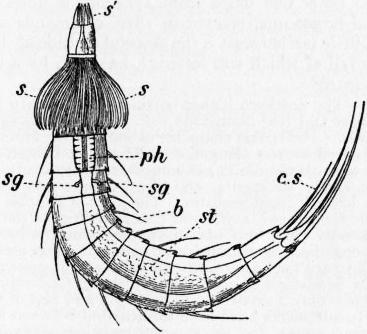
(After Hartog, from Cambridge Natural History, vol. ii., “Worms, &c.,” by permission of Messrs. Macmillan & Co., Ltd.)
b, bristle; cs, caudal spine; ph, pharynx; s & s′, the spines on the two segments of the proboscis; sg, salivary glands; st, stomach.
The body is enclosed in a stout cuticle, prolonged in places into spines and bristles. These are especially conspicuous in two rings round the proboscis and in the two posterior caudal spines. The body is divided into eleven segments and the protrusible proboscis apparently into two, and the cuticle of the central segment is thickened to form three plates, one dorsal and two ventrolateral. The cuticle is secreted by an epidermis in which no cell boundaries are to be seen; it sends out processes into the bristles. The mouth opens at the tip of the retractile proboscis; it leads into a short thin-walled tube which opens into an oval muscular gizzard lined with a thick cuticle; at the posterior end of this are some minute glands and then follows a large stomach slightly sacculated in each segment, this tapers through the rectum to the terminal anus. A pair of pear-shaped, ciliated glands inside lie in the eighth segment and open on the ninth. They are regarded as kidneys. The nervous system consists of a ganglion or brain, which lies dorsally about the level of the junction of the pharynx and the stomach, a nerve ring and a segmented neutral cord. The only sense organs described are eyes, which occur in some species, and may number one to four pairs.
The Kinorhyncha are dioecious. The testes reach forward to the fifth and even to the second segment, and open one each side of the anus. The ovaries open in a similar position but never reach farther forward than the fourth segment. The external openings in the male are armed with a pair of hollowed spines. The animals are probably oviparous.
Literature.—F. Dujardin, Ann. Sci. Nat., 3rd series, Zool. xv. 1851, p. 158; W. Reinhard, Zeitschr. wiss. Zool. xlv. 1887, pp. 401-467, t. xx.-xxii.; C. Zelinka, Verh. d. Deutsch. Zool. Ges., 1894.
(A. E. S.)
KINROSS-SHIRE, a county of Scotland, bounded N. and W. by Perthshire, on the extreme S.W. by Clackmannanshire and S. and E. by Fifeshire. Its area is 52,410 acres or 81.9 sq. m. Excepting Clackmannan it is the smallest county in Scotland both in point of area and of population. On its confines the shire is hilly. To the N. and W. are several peaks of the Ochils, the highest being Innerdouny (1621 ft.) and Mellock (1573); to the E. are the heights of the Lomond group, such as White Craigs (1492 ft.) and Bishop Hill; to the S. are Benarty (1131 ft.) on the Fife border and farther west the Cleish Hills, reaching in Dumglow an altitude of 1241 ft. With the exception of the Leven, which drains Loch Leven and of which only the first mile of its course belongs to the county, all the streams are short. Green’s Burn, the North and South Queich, and the Gairney are the principal. Loch Leven, the only lake, is remarkable rather for its associations than its natural features. The scenery on the Devon, west of the Crook, the river here forming the boundary with Perthshire, is of a lovely and romantic character. At one place the stream rushes through the rocky gorge with a loud clacking sound which has given to the spot the name of the Devil’s Mill, and later it flows under the Rumbling Bridge. In reality there are two bridges, one built over the other, in the same vertical line. The lower one dates from 1713 and is unused; but the loftier and larger one, erected in 1816, commands a beautiful view. A little farther west is the graceful cascade of the Caldron Linn, the fall of which was lessened, however, by a collapse of the rocks in 1886.
Geology.—The northern higher portion of the county is occupied by the Lower Old Red Sandstone volcanic lavas and agglomerates of the Ochils. The coarse character of some of the lower agglomerate beds is well seen in the gorge at Rumbling Bridge. The beds dip gently towards the S.S.E.; in a north-easterly direction they contain more sandy sediments, and the agglomerates and breccias frequently become conglomerates. The plain of Kinross is occupied by the soft sandstones, marls and conglomerates of the upper Old Red Sandstone, which rest unconformably upon the lower division with a strong dip. Southward and eastward these rocks dip conformably beneath the Lower Carboniferous cement stone series of the Calciferous Sandstone group. The overlying Carboniferous limestone occupies only a small area in the south and east of the county. Intrusive basalt sheets have been intercalated between some of the Carboniferous strata, and the superior resisting power of this rock has been the cause of the existence of West Lomond, Benarty, Cleish Hills and Bishop Hill, which are formed of soft marls and sandstones capped by basalt. The Hurlet limestone is worked on the Lomond and Bishop Hills. East- and west-running dikes of basalt are found in the north-east of the county, traversing the Old Red volcanic rocks. Kames of gravel and sand and similar glacial detritus are widely spread over the older rocks.
Climate and Industries.—The lower part of the county is generally well sheltered and adapted to all kinds of crops; and the climate, though wet and cold, offers no hindrance to high farming. The average annual rainfall is 35.5 inches, and the temperature for the year is 48° F., for January 38° F. and for July 59°.5 F. More than half of the holdings exceed 50 acres each. Much of the land has been reclaimed, the mossy tracts when drained and cultivated being very fertile. Barley is the principal crop, and oats also is grown largely, but the acreage under wheat is small. Turnips and potatoes are the chief green crops, the former the more important. The raising of livestock is pursued with great enterprise, the hilly land being well suited for this industry, although many cattle are pastured on the lowland farms. The cattle are mainly a native breed, which has been much improved by crossing. The number of sheep is high for the area. Although most of the horses are used for agricultural work, a considerable proportion are kept solely for breeding. Tartans, plaids and other woollens, and linen are manufactured at Kinross and Milnathort, which is besides an important centre for livestock sales. Brewing and milling are also carried on in the county town, but stock-raising and agriculture are the staple interests. The North British railway company’s lines, from the south and west run through the county via Kinross, and the Mid-Fife line branches off at Mawcarse Junction.
Population and Government.—The population was 6673 in 1891 and 6981 in 1901, when 55 persons spoke Gaelic and English. The only towns are Kinross (pop. in 1901, 2136) and Milnathort (1052). Kinross is the county town, and of considerable antiquity. The county unites with Clackmannanshire to return one member to parliament. It forms a sheriffdom with Fifeshire and a sheriff-substitute sits at Kinross. The shire is under school-board jurisdiction.
History.—For several centuries the shire formed part of Fife, and during that period shared its history. Towards the middle of the 13th century, however, the parishes of Kinross and Orwell seem to have been constituted into a shire, which, at the date (1305) of Edward I.’s ordinance for the government of Scotland, had become an hereditary sheriffdom, John of Kinross then being named for the office. James I. dispensed with the attendance of small barons in 1427 and introduced the principle of representation, when the shire returned one member to the Scots parliament. The inclusion of the Fife parishes of Portmoak, Cleish and Tullibole in 1685, due to the influence of Sir William Bruce, the royal architect and heritable sheriff, converted the older shire into the modern county. Excepting, however, the dramatic and romantic episodes connected with the castle of Loch Leven, the annals of the shire, so far as the national story is concerned, are vacant. As to its antiquities, there are traces of an ancient fort or camp on the top of Dumglow, and on a hill on the northern boundary of the parish of Orwell a remarkable cairn, called Cairn-a-vain, in the centre of which a stone cist was discovered in 1810 containing an urn full of bones and charcoal. Close to the town of Kinross, on the margin of Loch Leven, stands Kinross House, which was built in 1685 by Sir William Bruce as a residence for the Duke of York (James II.) in case the Exclusion Bill should debar him from the throne of England. The mansion, however, was never occupied by royalty.
See Æ. J. G. Mackay, History of Fife and Kinross (Edinburgh, 1896); W. J. N. Liddall, The Place Names of Fife and Kinross (Edinburgh, 1895); C. Ross, Antiquities of Kinross-shire (Perth, 1886); R. B. Begg, History of Lochleven Castle (Kinross, 1887).
KINSALE, a market town and seaport of Co. Cork, Ireland, in the south-east parliamentary division, on the east shore of Kinsale Harbour (the estuary of the Bandon river) 24 m. south of Cork by the Cork Bandon & South Coast railway, the terminus of a branch line. Pop. of urban district (1901), 4250. The town occupies chiefly the acclivity of Compass Hill, and while of picturesque appearance is built in a very irregular manner, the streets being narrow and precipitous. The Charles Fort was completed by the duke of Ormonde in 1677 and captured by the earl of Marlborough in 1690. The parish church of St Multose is an ancient but inelegant structure, said to have been founded as a conventual church in the 12th century by the saint to whom it is dedicated. Kinsale, with the neighbouring villages of Scilly and Cove, is much frequented by summer visitors, and is the headquarters of the South of Ireland Fishing Company, with a fishery pier and a commodious harbour with 6 to 8 fathoms of water; but the general trade is of little importance owing to the proximity of Queenstown and Cork. The Old Head of Kinsale, at the west of the harbour entrance, affords fine views of the coast, and is commonly the first British land sighted by ships bound from New York, &c., to Queenstown.
Kinsale is said to derive its name from cean taile, the headland in the sea. At an early period the town belonged to the De Courcys, a representative of whom was created baron of Kinsale or Kingsale in 1181. It received a charter of incorporation from Edward III., having previously been a borough by prescription, and its privileges were confirmed and extended by various subsequent sovereigns. For several centuries previous to the Union it returned two members to the Irish parliament. It was the scene of an engagement between the French and English fleets in 1380, was forcibly entered by the English in 1488, captured by the Spaniards and retaken by the English in 1601, and entered by the English in 1641, who expelled the Irish inhabitants. Finally, it was the scene of the landing of James II. and of the French army sent to his assistance in 1689, and was taken by the English in the following year.
KINTORE, a royal and police burgh of Aberdeenshire, Scotland. Pop. (1901), 789. It is situated on the Don, 13¼ m. N.W. of Aberdeen by the Great North of Scotland railway. It is a place of some antiquity, having been made a royal burgh in the reign of William the Lion (d. 1214). Kintore forms one of the Elgin group of parliamentary burghs, the others being Banff, Cullen, Elgin, Inverurie and Peterhead. One mile to the south-west are the ruins of Hallforest Castle, of which two storeys still exist, once a hunting-seat of Robert Bruce and afterwards a residence of the Keiths, earls marischal. There are several examples of sculptured stones and circles in the parish, and 2 m. to the north-west is the site of Bruce’s camp, which is also ascribed to the period of the Romans. Near it is Thainston House, the residence of Sir Andrew Mitchell (1708-1771), the British envoy to Frederick the Great. Kintore gives the title of earl in the Scottish, and of baron in the British peerage to the head of the Keith-Falconer family.
KIOTO (Kyoto), the former capital of Japan, in the province of Yamashiro, in 35° 01′ N., 135° 46′ E. Pop. (1903), 379,404. The Kamo-gawa, upon which it stands, is a mere rivulet in ordinary times, trickling through a wide bed of pebbles; but the city is traversed by several aqueducts, and was connected with Lake Biwa in 1890 by a canal 67⁄8 m. long, which carries an abundance of water for manufacturing purposes, brings the great lake and the city into navigable communication, and forms with the Kamo-gawa canal and the Kamo-gawa itself a through route to Osaka, from which Kioto is 25 m. distant by rail. Founded in the year 793, Kioto remained the capital of the empire during nearly eleven centuries. The emperor Kwammu, when he selected this remarkably picturesque spot for the residence of his court, caused the city to be laid out with mathematical accuracy, after the model of the Tang dynasty’s capital in China. Its area, 3 m. by 3½, was intersected by 18 principal thoroughfares, 9 running due north and south, and 9 due east and west, the two systems being connected at intervals by minor streets. At the middle of the northern face stood the palace, its enclosure covering three-quarters of a square mile, and from it to the centre of the south face ran an avenue 283 ft. wide and 3½ m. long. Conflagrations and subsequent reconstructions modified the regularity of this plan, but much of it still remains, and its story is perpetuated in the nomenclature of the streets. In its days of greatest prosperity Kioto contained only half a million inhabitants, thus never even approximating to the size of the Tokugawa metropolis, Yedo, or the Hojo capital Kamakura. The emperor Kwammu called it Heian-jo, or the “city of peace,” when he made it the seat of government; but the people knew it as Miyako, or Kyoto, terms both of which signify “capital,” and in modern times it is often spoken of as Saikyo, or western capital, in opposition to Tokyo, or eastern capital. Having been so long the imperial, intellectual, political and artistic metropolis of the realm, the city abounds with evidences of its unique career. Magnificent temples and shrines, grand monuments of architectural and artistic skill, beautiful gardens, gorgeous festivals, and numerous ateliers where the traditions of Japanese art are obeyed with attractive results, offer to the foreign visitor a fund of interest. Clear water ripples everywhere through the city, and to this water Kioto owes something of its importance, for nowhere else in Japan can fabrics be bleached so white or dyed in such brilliant colours. The people, like their neighbours of Osaka, are full of manufacturing energy. Not only do they preserve, amid all the progress of the age, their old-time eminence as producers of the finest porcelain, faience, embroidery, brocades, bronze, cloisonné enamel, fans, toys and metal-work of all kinds, but they have also adapted themselves to the foreign market, and weave and dye quantities of silk fabrics, for which a large and constantly growing demand is found in Europe and America. Nowhere else can be traced with equal clearness the part played in Japanese civilization by Buddhism, with its magnificent paraphernalia and imposing ceremonial spectacles; nowhere else, side by side with this luxurious factor, can be witnessed in more striking juxtaposition the austere purity and severe simplicity of the Shinto cult; and nowhere else can be more intelligently observed the fine faculty of the Japanese for utilizing, emphasizing and enhancing the beauties of nature. The citizens’ dwellings and the shops, on the other hand, are insignificant and even sombre in appearance, their exterior conveying no idea of the pretty chambers within or of the tastefully laid-out grounds upon which they open behind. Kioto is celebrated equally for its cherry and azalea blossoms in the spring, and for the colours of its autumn foliage.
KIOWAS, a tribe and stock of North American Indians. Their former range was around the Arkansas and Canadian rivers, in Indian Territory (Oklahoma), Colorado and New Mexico. A fierce people, they made raids upon the settlers in western Texas until 1868, when they were placed on a reservation in Indian Territory. In 1874 they broke out again, but in the following year were finally subdued. In number about 1200, and settled in Oklahoma, they are the sole representatives of the Kiowan linguistic stock.
See J. Mooney, “Calendar History of the Kiowa Indians,” 17th Report of Bureau of American Ethnology (Washington, 1898).
KIPLING, RUDYARD (1865- ), British author, was born in Bombay on the 30th of December 1865. His father, John Lockwood Kipling (1837-1911), an artist of considerable ability, was from 1875 to 1893 curator of the Lahore museum in India. His mother was Miss Alice Macdonald of Birmingham, two of whose sisters were married respectively to Sir E. Burne-Jones and Sir Edward Poynter. He was educated at the United Services College, Westward Ho, North Devon, of which a somewhat lurid account is given in his story Stalky and Co. On his return to India he became at the age of seventeen the sub-editor of the Lahore Civil and Military Gazette. In 1886, in his twenty-first year, he published Departmental Ditties, a volume of light verse chiefly satirical, only in two or three poems giving promise of his authentic poetical note. In 1887 he published Plain Tales from the Hills, a collection mainly of the stories contributed to his own journal. During the next two years he brought out, in six slim paper-covered volumes of Wheeler’s Railway Library (Allahabad), Soldiers Three, The Story of the Gadsbys, In Black and White, Under the Deodars, The Phantom ’Rickshaw and Wee Willie Winkee, at a rupee apiece. These were in form and substance a continuation of the Plain Tales. This series of tales, all written before the author was twenty-four, revealed a new master of fiction. A few, but those the best, he afterwards said that his father gave him. The rest were the harvest of his own powers of observation vitalized by imagination. In method they owed something to Bret Harte; in matter and spirit they were absolutely original. They were unequal, as his books continued to be throughout; the sketches of Anglo-Indian social life being generally inferior to the rest. The style was to some extent disfigured by jerkiness and mannered tricks. But Mr Kipling possessed the supreme spell of the story-teller to entrance and transport. The freshness of the invention, the variety of character, the vigour of narrative, the raciness of dialogue, the magic of atmosphere, were alike remarkable. The soldier-stories, especially the exuberant vitality of the cycle which contains the immortal Mulvaney, established the author’s fame throughout the world. The child-stories and tales of the British official were not less masterly, while the tales of native life and of adventure “beyond the pale” disclosed an even finer and deeper vein of romance. India, which had been an old story for generations of Englishmen, was revealed in these brilliant pictures as if seen for the first time in its variety, colour and passion, vivid as mirage, enchanting as the Arabian Nights. The new author’s talent was quickly recognized in India, but it was not till the books reached England that his true rank was appreciated and proclaimed. Between 1887 and 1889 he travelled through India, China, Japan and America, finally arriving in England to find himself already famous. His travel sketches, contributed to The Civil and Military Gazette and The Pioneer, were afterwards collected (the author’s hand having been forced by unauthorized publication) in the two volumes From Sea to Sea (1899). A further set of Indian tales, equal to the best, appeared in Macmillan’s Magazine and were republished with others in Life’s Handicap (1891). In The Light that Failed (1891, after appearing with a different ending in Lippincott’s Magazine) Mr Kipling essayed his first long story (dramatized 1905), but with comparative unsuccess. In his subsequent work his delight in the display of descriptive and verbal technicalities grew on him. His polemic against “the sheltered life” and “little Englandism” became more didactic. His terseness sometimes degenerated into abruptness and obscurity. But in the meanwhile his genius became prominent in verse. Readers of the Plain Tales had been impressed by the snatches of poetry prefixed to them for motto, certain of them being subscribed “Barrack Room Ballad.” Mr Kipling now contributed to the National Observer, then edited by W. E. Henley, a series of Barrack Room Ballads. These vigorous verses in soldier slang, when published in a book in 1892, together with the fine ballad of “East and West” and other poems, won for their author a second fame, wider than he had attained as a story-teller. In this volume the Ballads of the “Bolivar” and of the “Clampherdown,” introducing Mr Kipling’s poetry of the ocean and the engine-room, and “The Flag of England,” finding a voice for the Imperial sentiment, which—largely under the influence of Mr Kipling’s own writings—had been rapidly gaining force in England, gave the key-note of much of his later verse. In 1898 Mr Kipling paid the first of several visits to South Africa and became imbued with a type of imperialism that reacted on his literature, not altogether to its advantage. Before finally settling in England Mr Kipling lived some years in America and married in 1892 Miss Caroline Starr Balestier, sister of the Wolcott Balestier to whom he dedicated Barrack Room Ballads, and with whom in collaboration he wrote the Naulahka (1891), one of his less successful books. The next collection of stories, Many Inventions (1893), contained the splendid Mulvaney extravaganza, “My Lord the Elephant”; a vividly realized tale of metempsychosis, “The Finest Story in the World”; and in that fascinating tale “In the Rukh,” the prelude to the next new exhibition of the author’s genius. This came in 1894 with The Jungle Book, followed in 1895 by The Second Jungle Book. With these inspired beast-stories Kipling conquered a new world and a new audience, and produced what many critics regard as his most flawless work. His chief subsequent publications were The Seven Seas (poems), 1896; Captains Courageous (a yarn of deep-sea fishery), 1897; The Day’s Work (collected stories), 1898; A Fleet in Being (an account of a cruise in a man-of-war), 1898; Stalky and Co. (mentioned above), 1899; From Sea to Sea (mentioned above), 1899; Kim, 1901; Just So Stories (for children), 1902; The Five Nations (poems, concluding with what proved Mr Kipling’s most universally known and popular poem, “Recessional,” originally published in The Times on the 17th of July 1897 on the occasion of Queen Victoria’s second jubilee), 1903; Traffics and Discoveries (collected stories), 1904; Puck of Pook’s Hill (stories), 1906; Actions and Reactions (stories), 1909. Of these Kim was notable as far the most successful of Mr Kipling’s longer narratives, though it is itself rather in the nature of a string of episodes. But everything he wrote, even to a farcical extravaganza inspired by his enthusiasm for the motor-car, breathed the meteoric energy that was the nature of the man. A vigorous and unconventional poet, a pioneer in the modern phase of literary Imperialism, and one of the rare masters in English prose of the art of the short story, Mr Kipling had already by the opening of the 20th century won the most conspicuous place among the creative literary forces of his day. His position in English literature was recognized in 1907 by the award to him of the Nobel prize.
See Rudyard Kipling’s chapter in My First Book (Chatto, 1894); “A Bibliography of Rudyard Kipling,” by John Lane, in Rudyard Kipling: a Criticism, by Richard de Gallienne; “Mr Kipling’s Short Stories” in Questions at Issue, by Edmund Gosse (1893); “Mr Kipling’s Stories” in Essays in Little, by Andrew Lang; “Mr Kipling’s Stories,” by J. M. Barrie in the Contemporary Review (March 1891); articles in the Quarterly Review (July 1892) and Edinburgh Review (Jan. 1898); and section on Kipling in Poets of the Younger Generation, by William Archer (1902). See also for bibliography to 1903 English Illustrated Magazine, new series, vol. xxx. pp. 298 and 429-432.
(W. P. J.)
KIPPER, properly the name by which the male salmon is known at some period of the breeding season. At the approach of this season the male fish develops a sharp cartilaginous beak, known as the “kip,” from which the name “kipper” is said to be derived. The earliest uses of the word (in Old English cypera and Middle English kypre) seem to include salmon of both sexes, and there is no certainty as to the etymology. Skeat derives it from the Old English kippian, “to spawn.” The term has been applied by various writers to salmon both during and after milting; early quotations leave the precise meaning of the word obscure, but generally refer to the unwholesomeness of the fish as food during the whole breeding season. It has been usually accepted, without much direct evidence, that from the practice of rendering the breeding (i.e. “kipper”) salmon fit for food by splitting, salting and smoke-drying them, the term “kipper” is also used of other fish, particularly herrings cured in the same way. The “bloater” as distinct from the “kipper” is a herring cured whole without being split open.