VOLUME XV SLICE VII Kelly, Edward to Kite (continued 3)
Reading edition
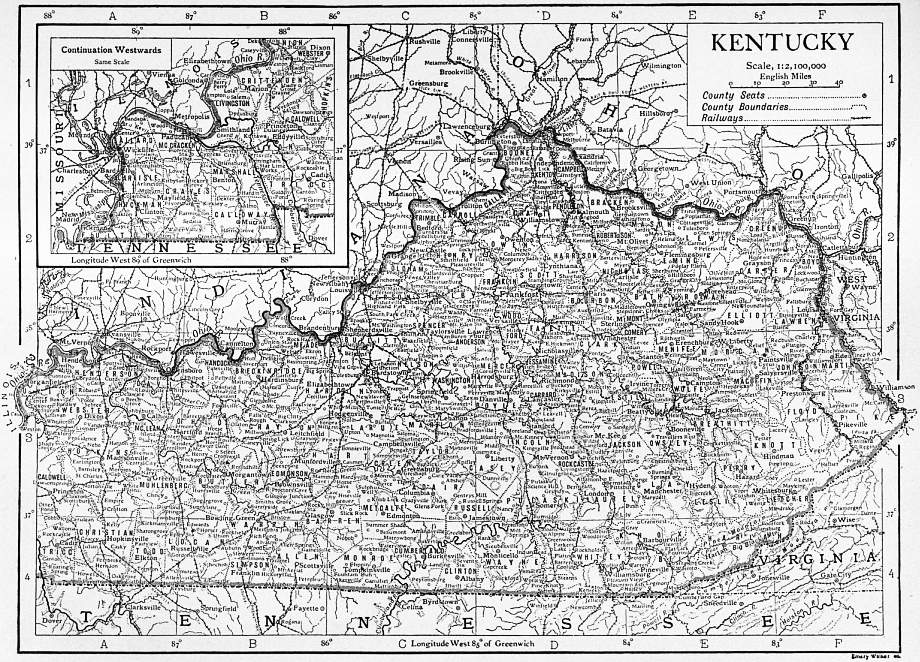
(Click to enlarge.)
Fauna and Flora.—The first white settlers found great numbers of buffaloes, deer, elks, geese, ducks, turkeys and partridges, also many bears, panthers, lynx, wolves, foxes, beavers, otters, minks, musk-rats, rabbits, squirrels, raccoons, woodchucks, opossums and skunks, and the streams were inhabited by trout, perch, buffalo-fish, sun-fish, mullet, eels, and suckers. Of the larger game there remain only a few deer, bears and lynx in the mountain districts, and the numbers of small game and fish have been greatly reduced. In its primeval state Kentucky was generally well timbered, but most of the middle section has been cleared and here the blue grass is now the dominant feature of the flora. Extensive forest areas still remain both in the east and the west. In the east oak, maple, beech, chestnut, elm, tulip-tree (locally “yellow poplar”), walnut, pine and cedar trees are the most numerous; in the west the forests are composed largely of cypress, ash, oak, hickory, chestnut, walnut, beech, tulip-tree, gum and sycamore trees. Locust, pawpaw, cucumber, buck-eye, black mulberry and wild cherry trees also abound, and the grape, raspberry and strawberry are native fruits.
Climate.—The climate is somewhat more mild and even than that of the neighbouring states. The mean annual temperature, about 50° F. on the mountains in the S.E., and 60° W. of the Tennessee, is about 55° F. for the entire state; the thermometer seldom registers as high as 100° or as low as -10°. The mean annual precipitation ranges from about 38 in. in the north-east to 50 in. in the south, and is about 46 in. for the entire state; it is usually distributed evenly throughout the year and very little is in the form of snow. The prevailing winds blow from the west or south-west; rain-bearing winds blow mostly from the south; and the cold waves come from the north or north-west.
Soil.—The best soils are the alluvium in the bottom-lands along some of the larger rivers and that of the Blue Grass Region, which is derived from a limestone rich in organic matter (containing phosphorus) and rapidly decomposing. The soil within a radius of some 20 m. around Lexington is especially rich; outside of this area the Blue Grass soil is less rich in phosphorus and contains a larger mixture of sand. The soils of the Highland Rim Plateau as well as of the lowland west of the Tennessee river vary greatly, but the most common are a clay, containing more or less carbonate of lime, and a sandy loam. On the escarpment around the Blue Grass Region the soils are for the most part either cherty or stiff with clay and of inferior quality. On the mountains and on the Alleghany Plateau, also, much of the soil is very light and thin.
Agriculture.—Kentucky is chiefly an agricultural state. Of the 752,531 of its inhabitants who, in 1900, were engaged in some gainful occupation, 408,185 or 54.2%, were agriculturists, and of its total land surface 21,979,422 acres, or 85.9%, were included in farms. The percentage of improved farm land increased from 35.2 in 1850 to 49.9 in 1880 and to 62.5 in 1900. The number of farms increased from 74,777 in 1850 to 166,453 in 1880 and to 234,667 in 1900; and their average size decreased from 226.7 acres in 1850 to 129.1 acres in 1880 and to 93.7 acres in 1900, these changes being largely due to the breaking up of slave estates, the introduction of a considerable number of negro farmers, and the increased cultivation of tobacco and market-garden produce. In the best stock-raising country, e.g. in Fayette county, the opposite tendency prevailed during the latter part of this period and old farms of a few hundred acres were combined to form some vast estates of from 2000 to 4000 acres. Of the 234,667 farms in 1900, 155,189 contained less than 100 acres, 76,450 contained between 100 and 500 acres, and 558 contained more than 1000 acres; 152,216 or 64.86%, were operated by owners or part owners, of whom 5320 were negroes; 16,776 by cash tenants, of whom 789 were negroes; and 60,289 by share tenants, of whom 4984 were negroes. In 1900 the value of farm land and improvements was $291,117,430; of buildings on farms, $90,887,460; of livestock, $73,739,106. In the year 1899 the value of all farm products was $123,266,785 (of which $21,128,530 was the value of products fed to livestock), including the following items: crops, $74,783,365; animal products, $44,303,940; and forest products, $4,179,840. The total acreage of all crops in 1899 was 6,582,696. Indian corn is the largest and most valuable crop. As late as 1849, when it produced 58,672,591 bu., Kentucky was the second largest Indian-corn producing state in the Union. In 1899 the crop had increased to 73,974,220 bu. and the acreage was 3,319,257 (more than half the acreage of all crops in the state), but the rank had fallen to ninth in product and eleventh in acreage; in 1909 (according to the Yearbook of the United States Department of Agriculture) the crop was 103,472,000 bu. (ninth among the states of the United States), and the acreage was 3,568,000 (twelfth among the states). Among the cereals wheat is the next largest crop; it increased from 2,142,822 bu. in 1849 to 11,356,113 bu. in 1879, and to 14,264,500 bu. in 1899; in 1909 it was only 7,906,000 bu. The crop of each of the other cereals is small and in each case was less in 1899 than in 1849. The culture of tobacco, which is the second most valuable crop in the state, was begun in the north part about 1780 and in the west and south early in the 19th century, but it was late in that century before it was introduced to any considerable extent in the Blue Grass Region, where it was then in a measure substituted for the culture of hemp. By 1849 Kentucky ranked second only to Virginia in the production of tobacco, and in 1899 it was far ahead of any other state in both acreage and yield, there being in that year 384,805 acres, which was 34.9% of the total acreage in the continental United States, yielding 314,288,050 ℔. As compared with the state’s Indian corn crop of that year, the acreage was only a little more than one-ninth, but the value ($18,541,982) was about 63%. In 1909 the tobacco acreage in Kentucky was 420,000, the crop was 350,700,000 ℔, valued at $37,174,200; the average price per pound had increased from 5.9 cents in 1899 to 10.6 cents in 1909. The two most important tobacco-growing districts are: the Black Patch, in the extreme south-west corner of the state, which with the adjacent counties in Tennessee grows a black heavy leaf bought almost entirely by the agents of foreign governments (especially Austria, Spain and Italy) and called “regie” tobacco; and the Blue Grass Region, as far east as Maysville, and the hill country south and east, whose product, the red and white Burley, is a fine-fibred light leaf, peculiarly absorbent of licorice and other adulterants used in the manufacture of sweet chewing tobacco, and hence a peculiarly valuable crop, which formerly averaged 22 cents a pound for all grades.1 The high price received by the hill growers of the Burley induced farmers in the Blue Grass to plant Burley tobacco there, where the crop proved a great success, more than twice as much (sometimes 2000 ℔) being grown to the acre in the Blue Grass as in the hills and twice as large patches being easily managed. In the hill country the share tenant could usually plant and cultivate only four acres of tobacco, had to spend 120 days working the crop, and could use the same land for tobacco only once in six years. So, although a price of 6.5 cents a pound covered expenses of the planter of Burley in the Blue Grass, who could use the same land for tobacco once in four years, this price did not repay the hill planter. The additional production of the Blue Grass Region sent the price of Burley tobacco down to this figure and below it. The planters in the Black Patch had met a combination of the buyers by forming a pool, the Planters’ Protective Association, into which 40,000 growers were forced by “night-riding” and other forms of coercion and persuasion, and had thus secured an advance to 11 cents a pound from the “regie” buyers and had shown the efficacy of pooling methods in securing better prices for the tobacco crop. Following their example, the planters of the Burley formed the Burley Tobacco Society, a Burley pool, with headquarters at Winchester and associated with the American Society of Equity, which promoted in general the pooling of different crops throughout the country. The tobacco planters secured legislation favourable to the formation of crop pools. The Burley Tobacco Society attempted to pool the entire crop and thus force the buyers of the American Tobacco Company of New Jersey (which usually bought more than three-fourths of the crop of Burley) to pay a much higher price for it. In 1906 and in 1907 the crop was very large; the pool sold its lower grades of the 1906 crop at 16 cents a pound to the American Tobacco Company and forced the independent buyers out of business; and the Burley Society decided in 1907 to grow no more tobacco until the 1906 and 1907 crops were sold, making the price high enough to pay for this period of idleness. Members of the pool had used force to bring planters into the pool; and now some tobacco growers, especially in the hills, planted new crops in the hope of immediate return, and a new “night-riding” war was begun on them. Bands of masked men rode about the country both in the Black Patch and in the Burley, burning tobacco houses of the independent planters, scraping their newly-planted tobacco patches, demanding that planters join their organization or leave the country, and whipping or shooting the recalcitrants. Governor Willson, immediately after his inauguration, took measures to suppress disorder. In general the Planters’ Protective Association in the Black Patch was more successful in its pool than the Burley Tobacco Society in its, and there was more violence in the “regie” than in the “Burley” district. In November 1908 the lawlessness subsided in the Burley after the agreement of the American Tobacco Company to purchase the remainder of the 1906 crop at a “round” price of 20½ cents and a part of the 1907 crop at an average price of 17 cents, thus making it profitable to raise a full crop in 1909.
Kentucky is the principal hemp-growing state of the Union; the crop of 1899, which was grown on 14,107 acres and amounted to 10,303,560 ℔, valued at $468,454, was 87.7% of the hemp crop of the whole country. But the competition of cheaper labour in other countries reduced the profits on this plant and the product of 1899 was a decrease from 78,818,000 ℔ in 1859. Hay and forage, the fourth in value of the state’s crops in 1899, were grown on 683,139 acres and amounted to 776,534 tons, valued at $6,100,647; in 1909 the acreage of hay was 480,000 and the crop of 653,000 tons was valued at $7,771,000. In 1899 the total value of fruit grown in Kentucky was $2,491,457 (making the state rank thirteenth among the states of the Union in the value of this product), of which $1,943,645 was the value of orchard fruits and $435,462 that of small fruits. Among fruits, apples are produced in greatest abundance, 6,053,717 bu. in 1899, an amount exceeded in only nine states; in 1889 the crop had been 10,679,389 bu. and was exceeded only by the crop of Ohio and by that of Michigan. Kentucky also grows considerable quantities of cherries, pears, plums and peaches, and, for its size, ranks high in its crops of strawberries, blackberries and raspberries. Indian corn is grown in all parts of the state but most largely in the western portion. Wheat is grown both in the Blue Grass Region and farther west; and the best country for fruit is along the Ohio river between Cincinnati and Louisville and in the hilly land surrounding the Blue Grass Region. In the eastern part of the state where crops are generally light, Indian corn, oats and potatoes are the principal products, but tobacco, flax and cotton are grown. The thoroughbred Kentucky horse has long had a world-wide reputation for speed; and the Blue Grass Region, especially Fayette, Bourbon and Woodford counties, is probably the finest horse-breeding region in America and has large breeding farms. In Fayette county, in 1900, the average value of colts between the ages of one and two years was $377.78. In the Blue Grass Region many thoroughbred shorthorn cattle and fine mules are raised. The numbers of horses, mules, cattle and sheep increased quite steadily from 1850 to 1900, but the number of swine in 1880 and in 1900 was nearly one-third less than in 1850. In 1900 the state had 497,245 horses, 198,110 mules, 364,025 dairy cows, 755,714 other neat cattle, 1,300,832 sheep and 2,008,989 swine; in 1910 there were in Kentucky 407,000 horses, 207,000 mules, 394,000 milch cows, 665,000 other neat cattle, 1,060,000 sheep and 989,000 swine. The principal sheep-raising counties in 1905 were Bourbon, Scott and Harrison, and the principal hog-raising counties were Graves, Hardin, Ohio, Union and Hickman.
Forests and Timber.—More than one-half of the state (about 22,200 sq. m.) was in 1900 still wooded. In 1900 of the total cut of 777,218 M. ft., B.M., 392,804 were white oak and 279,740 M. ft. were tulip-tree. Logging is the principal industry of several localities, especially in the east, and the lumber product of the state increased in value from $1,502,434 in 1850 to $4,064,361 in 1880, and to $13,774,911 in 1900. The factory product in 1900 was valued at $13,338,533 and in 1905 at $14,539,000. In 1905 of a total of 586,371 M. ft., B.M., of sawed lumber, 295,776 M. ft. were oak and 153,057 M. ft. were “poplar.”
The planing mill industry is increasing rapidly, as it is found cheaper to erect mills near the forests; between 1900 and 1905 the capital of planing mills in the state increased 117.2% and the value of products increased 142.8%.
Manufactures.—Kentucky’s manufactures are principally those for which the products of her farms and forests furnish the raw material. The most distinctive of these is probably distilled liquors, the state’s whisky being famous. A colony of Roman Catholic immigrants from Maryland settled in 1787 along the Salt river about 50 m. S.S.E. of Louisville and with the surplus of their Indian corn crop made whisky, a part of which they sold at settlements on the Ohio and the Mississippi. The industry was rapidly developed by distillers, who immediately after the suppression of the Whisky Insurrection, in 1794, removed from Pennsylvania and settled in what is now Mason county and was then a part of Bourbon county—the product is still known as “Bourbon” whisky. During the first half of the 19th century the industry became of considerable local importance in all parts of the state, but since the Civil War the heavy tax imposed has caused its concentration in large establishments. In 1900 nearly 40% and in 1905 more than one-third of the state’s product was distilled in Louisville. Good whisky is made in Maryland and in parts of Pennsylvania from rye, but all efforts in other states to produce from Indian corn a whisky equal to the Bourbon have failed, and it is probable that the quality of the Bourbon is largely due to the character of the Kentucky lime water and the Kentucky yeast germs. The average annual product of the state from 1880 to 1900 was about 20,000,000 gallons; in 1900 the product was valued at $9,786,527; in 1905 at $11,204,649. In 1900 and in 1905 Kentucky ranked fourth among the states in the value of distilled liquors.
The total value of all manufactured products of the state increased from $126,719,857 in 1890 to $154,166,365 in 1900, or 21.7%, and from 1900 to 1905 the value of factory-made products alone increased from $126,508,660 to $159,753,968, or 26.3%.2 Measured by the value of the product, flour and grist mill products rose from third in rank in 1900 to first in rank in 1905, from $13,017,043 to $18,007,786, or 38.3%; and chewing and smoking tobacco and snuff fell during the same period from first to third in rank, from $14,948,192 to $13,117,000, or 12.3%; in 1900 Kentucky was second, in 1905 third, among the states in the value of this product. Lumber and timber products held second rank both in 1900 ($13,338,533) and in 1905 ($14,539,000). Distilled liquors were fourth in rank in 1900 and in 1905. Men’s clothing rose from tenth in rank in 1900 to fifth in rank in 1905, from $3,420,365 to $6,279,078, or 83.6%. Other important manufactures, with their product values in 1900 and in 1905, are iron and steel ($5,004,572 in 1900; $6,167,542 in 1905); railway cars ($4,248,029 in 1900; $5,739,071 in 1905); packed meats ($5,177,167 in 1900; $5,693,731 in 1905); foundry and machine shop products ($4,434,610 in 1900; $4,699,559 in 1905); planing mill products, including sash, doors and blinds ($1,891,517 in 1900; $4,593,251 in 1905—an increase already remarked); carriages and wagons ($2,849,713 in 1900; $4,059,438 in 1905); tanned and curried leather ($3,757,016 in 1900; $3,952,277 in 1905); and malt liquors ($3,186,627 in 1900; $3,673,678 in 1905). Other important manufactures (each with a product value in 1905 of more than one million dollars) were cotton-seed oil and cake (in 1900 Kentucky was fifth and in 1905 sixth among the states in the value of cotton-seed oil and cake), cooperage, agricultural implements, boots and shoes, cigars and cigarettes, saddlery and harness, patent medicines and compounds, cotton goods, furniture, confectionery, carriage and wagon materials, wooden packing boxes, woollen goods, pottery and terra cotta ware, structural iron-work, and turned and carved wood. Louisville is the great manufacturing centre, the value of its products amounting in 1905 to $83,204,125, 52.1% of the product of the entire state, and showing an increase of 25.9% over the value of the city’s factory products in 1900. Ashland is the principal centre of the iron industry.
Minerals.—The mineral resources of Kentucky are important and valuable, though very little developed. The value of all manufactures in 1900 was $154,166,365, and the value of manufactures based upon products of mines or quarries in the same year was $25,204,788; the total value of mineral products was $19,294,341 in 1907. Bituminous coal is the principal mineral, and in 1907 Kentucky ranked eighth among the coal-producing states of the Union; the output in 1907 amounted to 10,753,124 short tons, and in 1902 to 6,766,984 short tons as compared with 2,399,755 tons produced in 1889. In 1902 the amount was about equally divided between the eastern coalfield, which is for the most part in Greenup, Boyd, Carter, Lawrence, Johnson, Lee, Breathitt, Rockcastle, Pulaski, Laurel, Knox, Bell and Whitley counties, and has an area of about 11,180 sq. m., and the western coalfield, which is in Henderson, Union, Webster, Daviess, Hancock, McLean, Ohio, Hopkins, Butler, Muhlenberg and Christian counties, and has an area of 5800 sq. m. In 1907 the output of the western district was 6,295,397 tons; that of the eastern, 4,457,727. The largest coal-producing counties in 1907 were Hopkins (2,064,154 short tons) and Muhlenberg (1,882,913 short tons) in the western coalfield, and Bell (1,437,886 short tons) and Whitley (762,923 short tons) in the south-western part of the eastern coalfield. All Kentucky coal is either bituminous or semi-bituminous, but of several varieties. Of cannel coal Kentucky is the largest producer in the Union, its output for 1902 being 65,317 short tons, and, according to state reports, for 1903, 72,856 tons (of which 46,314 tons were from Morgan county), and for 1904, 68,400 tons (of which 52,492 tons were from Morgan county); according to the Mineral Resources of the United States for 1907 (published by the United States Geological Survey) the production of Kentucky in 1907 of cannel coal (including 4650 tons of semi-cannel coal) was 77,733 tons, and exclusive of semi-cannel coal the output of Kentucky was much larger than that of any other state. Some of the coal mined in eastern Kentucky is an excellent steam producer, especially the Jellico coal of Whitley county, Kentucky, and of Campbell county, Tennessee. But with the exception of that mined in Hopkins and Bell counties, very little is fit for making coke; in 1880 the product was 4250 tons of coke (value $12,250), in 1890, 12,343 tons ($22,191); in 1900, 95,532 tons ($235,505); in 1902, 126,879 tons ($317,875), the maximum product up to 1906; and in 1907, 67,068 tons ($157,288). Coal was first mined in Kentucky in Laurel or Pulaski county in 1827; between 1829 and 1835 the annual output was from 2000 to 6000 tons; in 1840 it was 23,527 tons and in 1860 it was 285,760 tons.
Petroleum was discovered on Little Rennick’s Creek, near Burkesville, in Cumberland county, in 1829, when a flowing oil well (the “American well,” whose product was sold as “American oil” to heal rheumatism, burns, &c.) was struck by men boring for a “salt well,” and after a second discovery in the ’sixties at the mouth of Crocus Creek a small but steady amount of oil was got each year. Great pipe lines from Parkersburg, West Virginia, to Somerset, Pulaski county, and with branches to the Ragland, Barbourville and Prestonburg fields, had in 1902 a mileage of 275 m. The principal fields are in the “southern tier,” from Wayne to Allen county, including Barren county; farther east, Knox county, and Floyd and Knott counties; to the north-east the Ragland field in Bath and Rowan counties on the Licking river. In 1902 the petroleum produced in the state amounted to 248,950 barrels, valued at $172,837, a gain in quantity of 81.4% over 1901. Kentucky is the S.W. extreme of the natural gas region of the west flank of the Appalachian system; the greatest amount is found in Martin county in the east, and Breckinridge county in the north-west. The value of the state’s natural gas output increased from $38,993 in 1891 to $99,000 in 1896, $286,243 in 1900, $365,611 in 1902, and $380,176 in 1907.
Iron ore has been found in several counties, and an iron furnace was built in Bath county, in the N. E. part of the state, as early as 1791, but since 1860 this mineral has received little attention. In 1902 it was mined only in Bath, Lyon and Trigg counties, of which the total product was 71,006 long tons, valued at only $86,169; in 1904 only 35,000 tons were mined, valued at the mines at $35,000.
In 1898 there began an increased activity in the mining of fluorspar, and Crittenden, Fayette and Livingston counties produced in 1902, 29,030 tons (valued at $143,410) of this mineral, in 1903 30,835 tons (valued at $153,960) and in 1904 19,096 tons (valued at $111,499), amounts (and values) exceeding those produced in any other state for these years; but in 1907 the quantity (21,058 tons) was less than the output of Illinois. Lead and zinc are mined in small quantities near Marion in Crittenden county and elsewhere in connexion with mining for fluorspar; in 1907 the output was 75 tons of lead valued at $7950 and 358 tons of zinc valued at $42,244. Jefferson, Jessamine, Warren, Grayson and Caldwell counties have valuable quarries of an excellent light-coloured öolitic limestone, resembling the Bedford limestone of Indiana, and best known under the name of the finest variety, the “Bowling Green stone” of Warren county; and sandstones good for structural purposes are found in both coal regions, and especially in Rowan county. In 1907 the total value of limestone quarried in the state was $891,500, and of all stone, $1,002,450. Fire and pottery clay and cement rock also abound within the state. The value of clay products was $2,406,350 in 1905 (when Kentucky was tenth among the states) and was $2,611,364 in 1907 (when Kentucky was eleventh among the states). The manufacture of cement was begun in 1829 at Shippingport, a suburb of Louisville, whence the natural cement of Kentucky and Indiana, produced within a radius of 15 m. from Louisville, is called “Louisville cement.” In 1905 the value of natural cement manufactured in the state (according to the United States Geological Survey) was only $83,000. The manufacture of Portland cement is of greater importance.
There are mineral springs, especially salt springs, in various parts of the state, particularly in the Blue Grass Region; these are now of comparatively little economic importance; no salt was reported among the state’s manufactures for 1905, and in 1907 only 736,920 gallons of mineral waters were bottled for sale. Historically and geologically, however, these springs are of considerable interest. According to Professor N. S. Shaler, state geologist in 1873-1880, “When the rocks whence they flow were formed on the Silurian sea-floors, a good deal of the sea-water was imprisoned in the strata, between the grains of sand or mud and in the cavities of the shells that make up a large part of these rocks. This confined sea-water is gradually being displaced by the downward sinking of the rain-water through the rifts of the strata, and thus finds its way to the surface: so that these springs offer to us a share of the ancient seas, in which perhaps a hundred million of years ago the rocks of Kentucky were laid down.” To these springs in prehistoric and historic times came annually great numbers of animals for salt, and in the marshes and swamps around some of them, especially Big Bone Lick (in Boone county, about 20 m. S.W. of Cincinnati) have been found many bones of extinct mammals, such as the mastodon and the long-legged bison.3 The early settlers and the Indians came to the springs to shoot large game for food, and by boiling the waters the settlers obtained valuable supplies of salt. Several of the Kentucky springs have been somewhat frequented as summer resorts; among these are the Blue Lick in Nicholas county (about 48 m. N.E. of Lexington), Harrodsburg, Crab Orchard in Lincoln county (about 115 m. S.E. of Louisville), Rock Castle springs in Pulaski county (about 23 m. E. of Somerset) and Paroquet Springs (near Shepherdsville, Bullitt county), which was a well-known resort before the Civil War, and near which, at Bullitt Lick, the first salt works in Kentucky are said to have been erected.
Pearls are found in the state, especially in the Cumberland River, and it is supposed that there are diamonds in the kimberlite deposits in Elliott county.
Transportation.—Kentucky in 1909 had 3,503.98 m. of railway. Railway building was begun in the state in 1830, and in 1835 the first train drawn by a steam locomotive ran from Lexington to Franklin, a distance of 27 m. Not until 1851 was the line completed to Louisville. Kentucky’s trade during the greater part of the 19th century was very largely with the South, and with the facilities which river navigation afforded for this the development of a railway system was retarded. Up to 1880 the railway mileage had increased to only 1,530; but during the next ten years it increased to 2,942, and railways were in considerable measure substituted for water craft. The principal lines are the Louisville & Nashville, the Chesapeake & Ohio, the Illinois Central, and the Cincinnati Southern (Queen & Crescent route). Most of the lines run south or south-west from Cincinnati and Louisville, and the east border of the state still has a small railway mileage and practically no wagon roads, most of the travel being on horseback. The wagon roads of the Blue Grass Region are excellent, because of the plentiful and cheap supply of stone for road building. The assessment of railway property, and in some measure the regulation of railway rates, are entrusted to a state railway commission.
Population.—The population of Kentucky in 18804 was 1,648,690; in 1890, 1,858,635, an increase within the decade of 12.7 %; in 1900 it was 2,147,174; and in 1910 it had reached 2,289,905. Of the total population of 1900, 284,865 were coloured and 50,249 were foreign-born; of the coloured, 284,706 were negroes, 102 were Indians, and 57 were Chinese; of the foreign-born, 27,555 were natives of Germany, 9874 were natives of Ireland, and 3256 were natives of England. Of the foreign-born, 21,427, or 42.6 %, were inhabitants of the city of Louisville, leaving a population outside of this city of which 98.4 % were native born. The rugged east section of the state, a part of Appalachian America, is inhabited by a people of marked characteristics, portrayed in the fiction of Miss Murfree (“Charles Egbert Craddock”) and John Fox, Jr. They are nearly all of British—English and Scotch-Irish—descent, with a trace of Huguenot. They have good native ability, but through lack of communication with the outside world their progress has been retarded. Before the Civil War they were owners of land, but for the most part not owners of slaves, so that a social and political barrier, as well as the barriers of nature, separated them from the other inhabitants of the state. In their speech several hundred words persist which elsewhere have been obsolete for three centuries or occur only in dialects in England. Their life is still in many respects very primitive; their houses are generally built of logs, their clothes are often of homespun, Indian corn and ham form a large part of their diet, and their means of transportation are the saddle-horse and sleds and wheeled carts drawn by oxen or mules. In instincts and in character, also, the typical “mountaineers” are to a marked degree primitive; they are, for the most part, very ignorant; they are primitively hospitable and are warm-hearted to friends and strangers, but are implacable in their enmities and are prone to vendettas and family feuds, which often result in the killing in open fight or from ambush of members of one faction by members of another; and their relative seclusion and isolation has brought them, especially in some districts, to a disregard for law, or to a belief that they must execute justice with their own hands. This appears particularly in their attitude toward revenue officers sent to discover and close illicit stills for the distilling from Indian corn of so-called “moon-shine” whisky (consisting largely of pure alcohol). The taking of life and “moon-shining,” however, have become less and less frequent among them, and Berea College, at Berea, the Lincoln Memorial University, and other schools in Kentucky and adjoining states have done much to educate them and bring them more in harmony with the outside community.
The population of Kentucky is largely rural. However, in the decade between 1890 and 1900 the percentage of urban population (i.e. population of places of 4000 inhabitants or more) to the total population increased from 17.5 to 19.7 and the percentage of semi-urban (i.e. population of incorporated places with a population of less than 4000) to the total increased from 8.86 to 9.86 %; but 48.3 % of the urban population of 1900 was in the city of Louisville. In 1910 the following cities each had a population of more than 5000. Louisville (223,928), Covington (53,270), Lexington (35,099), Newport (30,309), Paducah (22,760), Owensboro (16,011), Henderson (11,452), Frankfort, the capital (10,465), Hopkinsville (9419), Bowling Green (9173), Ashland (8688), Middlesboro (7305), Winchester (7156), Dayton (6979), Bellevue (6683), Maysville (6141), Mayfield (5916), Paris (5859), Danville (5420), Richmond (5340). Of historical interest are Harrodsburg (q.v.), the first permanent settlement in the state, and Bardstown (pop. in 1900, 1711), the county-seat of Nelson county. Bardstown was settled about 1775, largely by Roman Catholics from Maryland. It was the see of a Roman Catholic bishop from 1810 to 1841, and the seat of St Joseph’s College (Roman Catholic) from 1824 to 1890; and was for some time the home of John Fitch (1743-1798), the inventor, who built his first boat here. The Nazareth Literary and Benevolent Institution, at Nazareth (2 m. N. of Bardstown), was founded in 1829 and is a well-known Roman Catholic school for girls. Boonesborough, founded by Daniel Boone in 1775, in what is now Madison county, long ago ceased to exist, though a railway station named Boone, on the Louisville & Nashville railroad, is near the site of the old settlement.
In 1906 there were 858,324 communicants of different religious denominations in the state, including 311,583 Baptists, 165,908 Roman Catholics, 156,007 Methodists, 136,110 Disciples of Christ, 47,822 Presbyterians and 8091 Protestant Episcopalians.
Administration.—Kentucky is governed under a constitution adopted in 1891.5 A convention to revise the constitution or to draft a new one meets on the call of two successive legislatures, ratified by a majority of the popular vote, provided that majority be at least one-fourth of the total number of votes cast at the preceding general election. Ordinary amendments are proposed by a three-fifths majority in each house, and are also subject to popular approval. With the usual exceptions of criminals, idiots and insane persons, all male citizens of the United States, who are at least 21 years of age, and have lived in the state one year, in the county six months, and in the voting precinct sixty days next preceding the election, are entitled to vote. The legislature provides by law for registration in cities of the first, second, third and fourth classes—the minimum population for a city of the fourth class being 3000. Corporations are forbidden to contribute money for campaign purposes on penalty of forfeiting their charters, or, if not chartered in the state, their right to carry on business in the state. The executive is composed of a governor, a lieutenant-governor, a treasurer, an auditor of public accounts, a register of the land office, a commissioner of agriculture, labour, and statistics, a secretary of state, an attorney-general and a superintendent of public instruction. All are chosen by popular vote for four years and are ineligible for immediate re-election, and each must be at least 30 years of age and must have been a resident citizen of the state for two years next preceding his election. If a vacancy occurs in the office of governor during the first two years a new election is held; if it occurs during the last two years the lieutenant-governor serves out the term. Lieutenant-governor Beckham, elected in 1900 to fill out the unexpired term of Governor Goebel (assassinated in 1900), was re-elected in 1903, the leading lawyers of the state holding that the constitutional inhibition on successive terms did not apply in such a case.
The governor is commander-in-chief of the militia when it is not called into the service of the United States; he may remit fines and forfeitures, commute sentences, and grant reprieves and pardons, except in cases of impeachment; and he calls extraordinary sessions of the legislature. His control of patronage, however, is not extensive and his veto power is very weak. He may veto any measure, including items in appropriation bills, but the legislature can repass such a measure by a simple majority of the total membership in each house. Among the various state administrative boards are the board of equalization of five members, the board of health of nine members, a board of control of state institutions with four members (bipartisan), and the railroad commission, the prison commission, the state election commission and the sinking fund commission of three members each. Legislative power is vested in a General Assembly, which consists of a Senate and a House of Representatives. Senators are elected for four years, one-half retiring every two years; representatives are elected for two years. The minimum age for a representative is 24 years, for a senator 30 years. There are thirty-eight senators and one hundred representatives. The Senate sits as a court for the trial of impeachment cases. A majority of either house constitutes a quorum, but as regards ordinary bills, on the third reading, not only must they receive a majority of the quorum, but that majority must be at least two-fifths of the total membership of the house. For the enactment of appropriation bills and bills creating a debt a majority of the total membership in each house is required. All revenue measures must originate in the House of Representatives, but the Senate may introduce amendments. There are many detailed restrictions on local and special legislation. The constitution provides for local option elections on the liquor question in counties, cities, towns and precincts; in 1907, out of 119 counties 87 had voted for prohibition.
The judiciary consists of a court of appeals, circuit courts, quarterly courts, county courts, justice of the peace courts, police courts and fiscal courts. The court of appeals is composed of from five to seven judges (seven in 1909), elected, one from each appellate district, for a term of eight years. The senior judge presides as chief justice and in case two or more have served the same length of time one of them is chosen by lot. The governor may for any reasonable cause remove judges on the address of two-thirds of each house of the legislature. The counties are grouped into judicial circuits, those containing a population of more than 150,000 constituting separate districts; each district has a judge and a commonwealth’s attorney. The county officials are the judge, clerk, attorney, sheriff, jailor, coroner, surveyor and assessor, elected for four years. Each county contains from three to eight justice of the peace districts. The financial board of the county is composed of the county judge and the justices of the peace, or of the county judge and three commissioners elected on a general ticket.
The municipalities are divided into six classes according to population, a classification which permits considerable special local legislation in spite of the constitutional inhibition. Marriages between whites and persons of negro descent are prohibited by law, and a marriage of insane persons is legally void. Among causes for absolute divorce are adultery, desertion for one year, habitual drunkenness for one year, cruelty, ungovernable temper, physical incapacity at time of marriage, and the joining by either party of any religious sect which regards marriage as unlawful. A homestead law declares exempt from execution an unmortgaged dwelling-house (with appurtenances) not to exceed $1000 in value, and certain property, such as tools of one’s trade, libraries (to the value of $500) of ministers and lawyers, and provisions for one year for each member of a family. Child labour is regulated by an act passed by the General Assembly in 1908; this act prohibits the employment of children less than 14 years of age in any gainful occupation during the session of school or in stores, factories, mines, offices, hotels or messenger service during vacations, and prohibits the employment of children between 14 and 16 unless they have employment certificates issued by a superintendent of schools or some other properly authorized person, showing the child’s ability to read and write English, giving information as to the child’s age (based upon a birth certificate if possible), and identifying the child by giving height and weight and colour of eyes and hair. These certificates must be kept on file and lists of children employed must be posted by employers; labour inspectors receive monthly lists from local school boards of children receiving certificates; and children under 16 are not to work more than 10 hours a day or 60 hours a week, or between 7 p.m. and 7 a.m.
Charitable and Penal Institutions.—The charitable and penal institutions are managed by separate boards of trustees appointed by the governor. There are a deaf and dumb institution at Danville (1823), an institution for the blind at Louisville (1842), and an institution for the education of feeble-minded children at Frankfort (1860). The Eastern Lunatic Asylum at Lexington, established in 1815 as a private institution, came under the control of the state in 1824. The Central Lunatic Asylum at Anchorage, founded in 1869 as a house of refuge for young criminals, became an asylum in 1873. The Western Lunatic Asylum at Hopkinsville was founded in 1848. The main penitentiary at Frankfort was completed in 1799 and a branch was established at Eddyville in 1891. Under an act of 1898 two houses of reform for juvenile offenders, one for boys, the other for girls, were established near Lexington.
Education.—The early history of the schools of Kentucky shows that the rural school conditions have been very unsatisfactory. A system of five trustees, with a sixty-day term of school, was replaced by a three trustee system, first with a one-hundred-day term of school, and subsequently with a one-hundred-and-twenty-day term of school annually. The state fund has not been supplemented locally for the payment of teachers, who have consequently been underpaid. The rural teachers, however, have been paid from the state fund, so that the poorer districts receive aid from the richer districts of the commonwealth. The rural schools are supervised by a superintendent in each county. Throughout the state white and negro children are taught in separate schools. The state makes provision for revenue for school purposes as follows: (1) the interest on the Bond of the Commonwealth for $1,327,000.00; (2) dividends on 798 shares of the capital stock of the Bank of Kentucky—representing a par value of $79,800.00; (3) the interest at 6 % on the Bond of the Commonwealth for $381,986.08, which is a perpetual obligation in favour of the several counties; (4) the interest at 6 % on $606,641.03, which was received from the United States; (5) the annual tax of 26½ cents on each $100 of value of all real and personal estate and corporate franchises directed to be assessed for taxation; (6) a certain portion of fines, forfeitures and licences realized by the state; and (7) a portion of the dog taxes of each county. The present school system of Kentucky may be summarized under three heads: the rural schools, the graded schools, and the high schools (which are further classified as city and county high schools). The 1908 session of the General Assembly passed an act providing: that each county of the state be the unit for taxation; that the county tax be mandatory; that there be a local subdistrict tax; and that each county be divided into four, six or eight educational divisions, that one trustee be elected for each subdistrict, that the trustees of the subdistricts form division Boards of Education, and that the chairmen of these various division boards form a County Board of Education together with the county superintendent, who is ex officio chairman. This system of taxation and supervision is a great advance in the administration of public schools. Any subdistrict, town or city of the fifth or sixth class may provide for a graded school by voting for an ad valorem and poll tax which is limited as to amount. There were in 1909 135 districts which had complied with this act, and were known as Graded Common School districts. By special charters the General Assembly has also established 25 special graded schools. Statutes provide that all children between the ages of 7 and 14 years living in such districts must attend school annually for at least eight consecutive weeks. In each city of the first, second and third class there must be, and of the fourth class there may be, maintained under control of a city Board of Education a system of public schools, in which all children between the ages of 6 and 20 residing in the city may be taught at public expense. There were in 1909 62 city public high schools whose graduates are admitted to the State University without examination. A truancy act (1908) provides that every child between the ages of 7 and 14 years living in a city of the first, second, third or fourth class must attend school regularly for the full term of said school. It was provided by statute that before June 1910, there should have been established in each county of the state at least one County High School to which all common school graduates of the county should be admitted without charge. Separate institutes for white and coloured teachers are conducted annually in each county. These institutes are held for a five or ten day session and attendance is required of every teacher. The state provides for the issuance of three kinds of certificates. A state diploma issued by the State Board of Examiners is good for life. A state certificate issued by the State Board of Examiners is good for eight years with one renewal. County certificates issued by the County Board of Examiners are of three classes, valid for one, two and four years respectively.
According to a school census there was in 1908-1909 a school population of 739,352, of which 587,051 were reported from the rural districts. In the school year 1907-1908 the school population was 734,617, the actual enrolment in public schools was 441,377, the average attendance was 260,843; there were approximately 3392 male and 5257 female white teachers and 1274 negro teachers; and the total revenue for school purposes was $3,805,997, of which sum $2,437,942.56 came from the state treasury.
What was formerly the State Agricultural and Mechanical College at Lexington became the State University by legislative enactment (1908); there is no tuition fee except in the School of Law. The State University has a Department of Education. The state maintains for the whites two State Normal Schools, which were established in 1906—one, for the eastern district, at Richmond, and the other, for the western district, at Bowling Green. Under the law establishing State Normal Schools, each county is entitled to one or more appointments of scholarships, one annually for every 500 white school children listed in the last school census. A Kentucky Normal and Industrial School (1886) for negroes is maintained at Frankfort. Among the private and denominational colleges in Kentucky are Central University (Presbyterian), at Danville; Transylvania University, at Lexington; Georgetown College (Baptist) at Georgetown; Kentucky Wesleyan College (M.E. South), at Winchester; and Berea College (non-sectarian) at Berea.
Finance.—Kentucky, in common with other states in this part of the country, suffered from over-speculation in land and railways during 1830-1850. The funded debt of the state amounted to four and one-half millions of dollars in 1850, when the hew constitution limited the power of the legislature to contract further obligations or to decrease or misapply the sinking funds. From 1850 to 1880 there was a gradual reduction except during the years of the war. The system of classifying the revenue into separate funds has frequently produced annual deficits, which are, as a rule only nominal, since the total receipts exceed the total expenditures. In 1902 the net bonded debt, exclusive of about two millions of dollars held for educational purposes, was $1,171,394, but this debt was paid in full in the years immediately following. The sinking fund commission is composed of the governor, attorney-general, secretary of state, auditor and treasurer. The first banking currency in Kentucky was issued in 1802 by a co-operative insurance company established by Mississippi Valley traders. The Bank of Kentucky, established at Frankfort in 1806, had a monopoly for several years. In 1818-1819 the legislature chartered 46 banks, nearly all of which went into liquidation during the panic of 1819. The Bank of the Commonwealth was chartered in 1820 as a state institution and the charter of the Bank of Kentucky was revoked in 1822. A court decision denying the legal tender quality of the notes issued by the Bank of the Commonwealth gave rise to a bitter controversy which had considerable influence upon the political history of the state. This bank failed in 1829. In 1834 the legislature chartered the Bank of Kentucky, the Bank of Louisville and the Northern Bank of Kentucky. These institutions survived the panic of 1837 and soon came to be recognized as among the most prosperous and the most conservative banks west of the Alleghanies. The state banking laws are stringent and most of the business is still controlled by banks operating under state charters.
History.—The settlement and the development of that part of the United States west of the Alleghany Mountains has probably been the most notable feature of American history since the close of the Seven Years’ War (1763). Kentucky was the first settlement in this movement, the first state west of the Alleghany Mountains admitted into the Union. In 1763 the Kentucky country was claimed by the Cherokees as a part of their hunting grounds, by the Six Nations (Iroquois) as a part of their western conquests, and by Virginia as a part of the territory granted to her by her charter of 1609, although it was actually inhabited only by a few Chickasaws near the Mississippi river and by a small tribe of Shawnees in the north, opposite what is now Portsmouth, Ohio. The early settlers were often attacked by Indian raiders from what is now Tennessee or from the country north of the Ohio, but the work of colonization would have been far more difficult if those Indians had lived in the Kentucky region itself. Dr Thomas Walker (1715-1794), as an agent and surveyor of the Loyal Land Company, made an exploration in 1750 into the present state from the Cumberland Gap, in search of a suitable place for settlement but did not get beyond the mountain region. In the next year Christopher Gist, while on a similar mission for the Ohio Company, explored the country westward from the mouth of the Scioto river. In 1752 John Finley, an Indian trader, descended the Ohio river in a canoe to the site of Louisville. It was Finley’s descriptions that attracted Daniel Boone, and soon after Boone’s first visit, in 1767, travellers through the Kentucky region became numerous. The first permanent English settlement was established at Harrodsburg in 1774 by James Harrod, and in October of the same year the Ohio Indians, having been defeated by Virginia troops in the battle of Point Pleasant (in what is now West Virginia), signed a treaty by which they surrendered their claims south of the Ohio river. In March 1775 Richard Henderson and some North Carolina land speculators met about 1200 Cherokee Indians in council on the Watauga river and concluded a treaty with them for the purchase of all the territory south of the Ohio river and between the Kentucky and Cumberland rivers. The purchase was named Transylvania, and within less than a month after the treaty was signed, Boone, under its auspices, founded a settlement at Boonesborough which became the headquarters of the colony. The title was declared void by the Virginia government in 1778, but Henderson and his associates received 200,000 acres in compensation, and all sales made to actual settlers were confirmed. During the War of Independence the colonists were almost entirely neglected by Virginia and were compelled to defend themselves against the Indians who were often under British leadership. Boonesborough was attacked in April and in July 1777 and in August 1778. Bryant’s (or Bryan’s) Station, near Lexington, was besieged in August 1782 by about 600 Indians under the notorious Simon Girty, who after raising the siege drew the defenders, numbering fewer than 200, into an ambush and in the battle of Blue Licks which ensued the Kentuckians lost about 67 killed and 7 prisoners. Kentucky county, practically coterminous with the present state of Kentucky and embracing all the territory claimed by Virginia south of the Ohio river and west of Big Sandy Creek and the ridge of the Cumberland Mountains, was one of three counties which was formed out of Fincastle county in 1776. Four years later, this in turn was divided into three counties, Jefferson, Lincoln and Fayette, but the name Kentucky was revived in 1782 and was given to the judicial district which was then organized for these three counties. The War of Independence was followed by an extensive immigration from Virginia, Maryland and North Carolina6 of a population of which fully 95%, excluding negro slaves, were of pure English, Scotch or Scotch-Irish descent. The manners, customs and institutions of Virginia were transplanted beyond the mountains. There was the same political rivalry between the slave-holding farmers of the Blue Grass Region and the “poor whites” of the mountain districts that there was in Virginia between the tide-water planters and the mountaineers. Between these extremes were the small farmers of the “Barrens”7 in Kentucky and of the Piedmont Region in Virginia. The aristocratic influences in both states have always been on the Southern and Democratic side, but while they were strong enough in Virginia to lead the state into secession they were unable to do so in Kentucky.
At the close of the War of Independence the Kentuckians complained because the mother state did not protect them against their enemies and did not give them an adequate system of local government. Nine conventions were held at Danville from 1784 to 1790 to demand separation from Virginia. The Virginia authorities expressed a willingness to grant the demand provided Congress would admit the new district into the Union as a state. The delay, together with the proposal of John Jay, the Secretary for Foreign Affairs and commissioner to negotiate a commercial treaty with the Spanish envoy, to surrender navigation rights on the lower Mississippi for twenty-five years in order to remove the one obstacle to the negotiations, aroused so much feeling that General James Wilkinson and a few other leaders began to intrigue not only for a separation from Virginia, but also from the United States, and for the formation of a close alliance with the Spanish at New Orleans. Although most of the settlers were too loyal to be led into any such plot they generally agreed that it might have a good effect by bringing pressure to bear upon the Federal government. Congress passed a preliminary act in February 1791, and the state was formally admitted into the Union on the 1st of June 1792. In the Act of 1776 for dividing Fincastle county, Virginia, the ridge of the Cumberland Mountains was named as a part of the east boundary of Kentucky; and now that this ridge had become a part of the boundary between the states of Virginia and Kentucky they, in 1799, appointed a joint commission to run the boundary line on this ridge. A dispute with Tennessee over the southern boundary was settled in a similar manner in 1820.8 The constitution of 1792 provided for manhood suffrage and for the election of the governor and of senators by an electoral college. General Isaac Shelby was the first governor. The people still continued to have troubles with the Indians and with the Spanish at New Orleans. The Federal government was slow to act, but its action when taken was effective. The power of the Indians was overthrown by General Anthony Wayne’s victory in the battle of Fallen Timbers, fought the 20th of August 1794 near the rapids of the Maumee river a few miles above the site of Toledo, Ohio; and the Mississippi question was settled temporarily by the treaty of 1795 and permanently by the purchase of Louisiana in 1803. In 1798-1799 the legislature passed the famous Kentucky Resolutions in protest against the alien and sedition acts.
For several years the Anti-Federalists or Republicans had contended that the administration at Washington had been exercising powers not warranted by the constitution, and when Congress had passed the alien and sedition laws the leaders of that party seized upon the event as a proper occasion for a spirited public protest which took shape principally in resolutions passed by the legislatures of Kentucky and Virginia. The original draft of the Kentucky Resolutions of 1798 was prepared by Vice-President Thomas Jefferson, although the fact that he was the author of them was kept from the public until he acknowledged it in 1821. They were introduced in the House of Representatives by John Breckinridge on the 8th of November, were passed by that body with some amendments but with only one dissenting vote on the 10th, were unanimously concurred in by the Senate on the 13th, and were approved by Governor James Garrard on the 16th. The first resolution was a statement of the ultra states’-rights view of the relation of the states to the Federal government9 and subsequent resolutions declare the alien and sedition laws unconstitutional and therefore “void and of no force,” principally on the ground that they provided for an exercise of powers which were reserved to the state. The resolutions further declare that “this Commonwealth is determined, as it doubts not its co-states are, tamely to submit to undelegated and therefore unlimited powers in no man or body of men on earth,” and that “these and successive acts of the same character, unless arrested on the threshold, may tend to drive these states into revolution and blood.” Copies of the resolutions were sent to the governors of the various states, to be laid before the different state legislatures, and replies were received from Connecticut, Delaware, Massachusetts, New Hampshire, New York, Rhode Island, Vermont and Virginia, but all except that from Virginia were unfavourable. Nevertheless the Kentucky legislature on the 22nd of November 1799 reaffirmed in a new resolution the principles it had laid down in the first series, asserting in this new resolution that the state “does now unequivocally declare its attachment to the Union, and to that compact [the Constitution], agreeably to its obvious and real intention, and will be among the last to seek its dissolution,” but that “the principle and construction contended for by sundry of the state legislatures, that the General Government is the exclusive judge of the extent of the powers delegated to it, stop nothing [short] of despotism—since the discretion of those who administer the government, and not the Constitution, would be the measure of their powers,” “that the several states who formed that instrument, being sovereign and independent, have the unquestionable right to judge of the infraction,” and “that a nullification by those sovereignties of all unauthorized acts done under color of that instrument is the rightful remedy.” These measures show that the state was Democratic-Republican in its politics and pro-French in its sympathies, and that it was inclined to follow the leadership of that state from which most of its people had come.
The constitution of 1799 adopted the system of choosing the governor and senators by popular vote and deprived the supreme court of its original jurisdiction in land cases. The Burr conspiracy (1804-1806) aroused some excitement in the state. Many would have followed Burr in a filibustering attack upon the Spanish in the South-West, but scarcely any would have approved of a separation of Kentucky from the Federal Union. No battles were fought in Kentucky during the War of 1812, but her troops constituted the greater part of the forces under General William Henry Harrison. They took part in the operations at Fort Wayne, Fort Meigs, the river Raisin and the Thames.
The Democratic-Republicans controlled the politics of the state without any serious opposition until the conflict in 1820-1826, arising from the demands for a more adequate system of currency and other measures for the relief of delinquent debtors divided the state into what were known as the relief and anti-relief parties. After nearly all the forty-six banks chartered by the legislature in 1818 had been wrecked in the financial panic of 1819, the legislature in 1820 passed a series of laws designed for the benefit of the debtor class, among them one making state bank notes a legal tender for all debts. A decision of the Clark county district court declaring this measure unconstitutional was affirmed by the court of appeals. The legislature in 1824 repealed all of the laws creating the existing court of appeals and then established a new one. This precipitated a bitter campaign between the anti-relief or “old court” party and the relief or “new court” party, in which the former was successful. The old court party followed the lead of Henry Clay and John Quincy Adams in national politics, and became National Republicans and later Whigs. The new court party followed Andrew Jackson and Martin Van Buren and became Democrats. The electoral vote of the state was cast for Jackson in 1828 and for Clay in 1832. During the next thirty years Clay’s conservative influence dominated the politics of the state.10 Kentucky voted the Whig ticket in every presidential election from 1832 until the party made its last campaign in 1852. When the Whigs were destroyed by the slavery issue some of them immediately became Democrats, but the majority became Americans, or Know-Nothings. They elected the governor in 1855 and almost succeeded in carrying the state for their presidential ticket in 1856. In 1860 the people of Kentucky were drawn toward the South by their interest in slavery and by their social relations, and toward the North by business ties and by a national sentiment which was fostered by the Clay traditions. They naturally assumed the leadership in the Constitutional Union movement of 1860, casting the vote of the state for Bell and Everett. After the election of President Lincoln they also led in the movement to secure the adoption of the Crittenden Compromise or some other peaceful solution of the difficulties between the North and the South.
A large majority of the state legislature, however, were Democrats, and in his message to this body, in January 1861, Governor Magoffin, also a Democrat, proposed that a convention be called to determine “the future of Federal and inter-state relations of Kentucky;” later too, in reply to the president’s call for volunteers, he declared, “Kentucky will furnish no troops for the wicked purpose of subduing her sister Southern States.” Under these conditions the Unionists asked only for the maintenance of neutrality, and a resolution to this effect was carried by a bare majority—48 to 47. Some of the secessionists took this as a defeat and left the state immediately to join the Confederate ranks. In the next month there was an election of congressmen, and an anti-secession candidate was chosen in nine out of ten districts. An election in August of one-half the Senate and all of the House of Representatives resulted in a Unionist majority in the new legislature of 103 to 35, and in September, after Confederate troops had begun to invade the state, Kentucky formally declared its allegiance to the Union. From September 1861 to the fall of Fort Donelson in February 1862 that part of Kentucky which is south and west of the Green River was occupied by the Confederate army under General A. S. Johnston, and at Russellville in that district a so-called “sovereignty convention” assembled on the 18th of November. This body, composed mostly of Kentucky men who had joined the Confederate army, passed an ordinance of secession, elected state officers, and sent commissioners to the Confederate Congress, which body voted on the 9th of December to admit Kentucky into the Confederacy. Throughout the war Kentucky was represented in the Confederate Congress—representatives and senators being elected by Confederate soldiers from the state. The officers of this “provisional government,” headed by G. W. Johnson, who had been elected “governor,” left the state when General A. S. Johnston withdrew; Johnson himself was killed at Shiloh, but an attempt was subsequently made by General Bragg to install this government at Frankfort. General Felix K. Zollicoffer (1812-1862) had entered the south-east part of the state through Cumberland Gap in September, and later with a Confederate force of about 7000 men attempted the invasion of central Kentucky, but in October 1861 he met with a slight repulse at Wild Cat Mountain, near London, Laurel county, and on the 19th of January 1862, in an engagement near Mill Springs, Wayne county, with about an equal force under General George H. Thomas, he was killed and his force was utterly routed. In 1862 General Braxton Bragg in command of the Confederates in eastern Tennessee, eluded General Don Carlos Buell, in command of the Federal Army of the Ohio stationed there, and entering Kentucky in August 1862 proceeded slowly toward Louisville, hoping to win the state to the Confederate cause and gain recruits for the Confederacy in the state. His main army was preceded by a division of about 15,000 men under General Edmund Kirby Smith, who on the 30th of August defeated a Federal force under General Wm. Nelson near Richmond and threatened Cincinnati. Bragg met with little opposition on his march, but Buell, also marching from eastern Tennessee, reached Louisville first (Sept. 24), turned on Bragg, and forced him to withdraw. On his retreat, Bragg attempted to set up a Confederate government at Frankfort, and Richard J. Hawes, who had been chosen as G. W. Johnson’s successor, was actually “inaugurated,” but naturally this state “government” immediately collapsed. On the 8th of October Buell and Bragg fought an engagement at Perryville which, though tactically indecisive, was a strategic victory for Buell; and thereafter Bragg withdrew entirely from the state into Tennessee. This was the last serious attempt on a large scale by the Confederates to win Kentucky; but in February 1863 one of General John H. Morgan’s brigades made a raid on Mount Sterling and captured it; in March General Pegram made a raid into Pulaski county; in March 1864 General N. B. Forrest assaulted Fort Anderson at Paducah but failed to capture it; and in June General Morgan made an unsuccessful attempt to take Lexington.
Although the majority of the people sympathized with the Union, the emancipation of the slaves without compensation even to loyal owners, the arming of negro troops, the arbitrary imprisonment of citizens and the interference of Federal military officials in purely civil affairs aroused so much feeling that the state became strongly Democratic, and has remained so almost uniformly since the war. Owing to the panic of 1893, distrust of the free silver movement and the expenditure of large campaign funds, the Republicans were successful in the gubernational election of 1895 and the presidential election of 1896. The election of 1899 was disputed. William S. Taylor, Republican, was inaugurated governor on the 12th of December, but the legislative committee on contests decided in favour of the Democrats. Governor-elect Goebel was shot by an assassin on the 30th of January 1900, was sworn into office on his deathbed, and died on the 3rd of February. Taylor fled the state to escape trial on the charge of murder. Lieutenant-Governor Beckham filled out the unexpired term and was re-elected in 1903. In 1907 the Republicans again elected their candidate for governor.
Governors of Kentucky
Isaac Shelby Democratic- Republican 1792-1796
James Garrard ” ” 1796-1804
Christopher Greenup ” ” 1804-1808
Charles Scott ” ” 1808-1812
Isaac Shelby ” ” 1812-1816
George Madison* ” ” 1816
Gabriel Slaughter (acting) ” ” 1816-1820
John Adair ” ” 1820-1824
Joseph Desha ” ” 1824-1828
Thomas Metcalfe National ” 1828-1832
John Breathitt* Democrat 1832-1834
James T. Morehead (acting) ” 1834-1836
James Clark* Whig 1836
Charles A. Wickliffe (acting) ” 1836-1840
Robert P. Letcher ” 1840-1844
William Owsley ” 1844-1848
John J. Crittenden† ” 1848-1850
John L. Helm† Democrat 1850-1851
Lazarus W. Powell ” 1851-1855
Charles S. Morehead American 1855-1859
Beriah Magoffin Democrat 1859-1862
James F. Robinson ” 1862-1863
Thomas E. Bramlette ” 1863-1867
John L. Helm* ” 1867
John W. Stevenson‡ ” 1867-1871
Preston H. Leslie‡ ” 1871-1875
James B. McCreary ” 1875-1879
Luke P. Blackburn ” 1879-1883
J. Proctor Knott ” 1883-1887
Simon B. Buckner ” 1887-1891
John Y. Brown ” 1891-1895
William O. Bradley Republican 1895-1899
William S. Taylor§ ” 1899-1900
William Goebel† Democrat 1900
J. C. W. Beckham ” 1900-1907
Augustus E. Willson Republican 1907-
* Died in office.
† Governor Crittenden resigned on the 31st of July to become Attorney-General of the United States and John L. Helm served out the unexpired term.
‡ Governor Stevenson resigned on the 13th of February 1871 to become U.S. Senator from Kentucky. P. H. Leslie filled out the remainder of the term and was elected in 1871 for a full term.
§ Taylor’s election was contested by Goebel, who received the certificate of election.
Bibliography.—For descriptions of physical features and accounts of natural resources see Reports of the Kentucky Geological Survey, the Biennial Reports of the Bureau of Agriculture, Labor and Statistics, the Reports of the United States Census and various publications of the U.S. Geological Survey, and other publications listed in Bulletin 301 (Bibliography and Index of North American Geology for 1901-1905) and other bibliographies of the Survey. For an early description, see Gilbert Imlay, A Topographical Description of the Western Territory of North America (London, 3rd ed., 1797), in which John Filson’s “Discovery, Settlement and Present State of Kentucke” (1784) is reprinted. For a brief description of the Blue Grass Region, see James Lane Allen’s The Blue Grass Region of Kentucky and other Kentucky Articles (New York, 1900). An account of the social and industrial life of the people in the “mountain” districts is given in William H. Haney’s The Mountain People of Kentucky (Cincinnati, 1906). For administration, see the Official Manual for the Use of the Courts, State and County Officials and General Assembly of the State of Kentucky (Lexington), which contains the Constitution of 1891; The Report of the Debates and Proceedings of the Convention ... of 1849 (Frankfort, 1849); The Official Report of the Proceedings and Debates of the Constitutional Convention of 1890 (4 vols., Frankfort, 1890); B. H. Young, History and Texts of Three Constitutions of Kentucky (Louisville, 1890); J. F. Bullitt and John Feland, The General Statutes of Kentucky (Frankfort and Louisville, 1877, revised editions, 1881, 1887); and the Annual Reports of state officers and boards. For history see R. M. McElroy’s Kentucky in the Nation’s History (New York, 1909, with bibliography); or (more briefly) N. S. Shaler’s Kentucky (Boston, 1885), in the American Commonwealths Series. John M. Brown’s The Political Beginnings of Kentucky (Louisville, 1889) is a good monograph dealing with the period before 1792; it should be compared with Thomas M. Green’s The Spanish Conspiracy: A Review of Early Spanish Movements in the Southwest (Cincinnati, 1891), written in reply to it. Among older histories are Humphrey Marshall, The History of Kentucky ... and the Present State of the Country (2 vols., Frankfort, 1812, 1824), extremely Federalistic in tone; Mann Butler, History of Kentucky from its Exploration and Settlement by the Whites to the close of the Southwestern Campaign of 1813 (Louisville, 1834; 2nd ed., Cincinnati, 1836), and Lewis Collins, The History of Kentucky (2 vols., revised edition, Covington, Ky., 1874), a valuable store-house of facts, the basis of Shaler’s work. E. D. Warfield’s The Kentucky Resolutions of 1798 (New York, 2nd ed., 1887) is an excellent monograph. For the Civil War history see “Campaigns in Kentucky and Tennessee,” in the 7th volume of Papers of the Military Historical Society of Massachusetts (Boston, 1908); Thomas Speed, The Union Cause in Kentucky (New York, 1907); Basil W. Duke, History of Morgan’s Cavalry (Cincinnati, 1867), and general works on the history of the war. See also Alvin F. Lewis, History of Higher Education in Kentucky, in Circulars of Information of the U.S. Bureau of Education (Washington, 1899), and R. G. Thwaites, Daniel Boone (New York, 1902). There is much valuable material in the Register (Frankfort, 1903 seq.) of the Kentucky State Historical Society, and especially in the publications of the Filson Club of Louisville. Among the latter are R. T. Durrett’s John Filson, the first Historian of Kentucky (1884); Thomas Speed, The Wilderness Road (1886); W. H. Perrin, The Pioneer Press of Kentucky (1888); G. W. Ranck, Boonesborough: Its Founding, Pioneer Struggles, Indian Experiences, Transylvania Days and Revolutionary Annals (1901), and The Centenary of Kentucky (1892), containing an address, “The State of Kentucky: its Discovery, Settlement, Autonomy and Progress in a Hundred Years,” by Reuben T. Durrett.
1 North of the Black Patch is a district in which is grown a heavy-leaf tobacco, a large part of which is shipped to Great Britain; and farther north and east a dark tobacco is grown for the American market.
2 In the census of 1905 statistics for other than factory-made products, such as those of the hand trades, were not included.
3 For a full account of the “licks,” see vol. i. pt. ii. of the Memoirs of the Kentucky Geological Survey (1876).
4 The population of the state at the previous censuses was: 73,677 in 1790; 220,955 in 1800; 406,511 in 1810; 564,317 in 1820; 687,917 in 1830; 779,828 in 1840; 982,405 in 1850; 1,155,684 in 1860 and 1,321,011 in 1870.
5 There were three previous constitutions—those of 1792, 1799 and 1850.
6 Most of the early settlers of Kentucky made their way thither either by the Ohio river (from Fort Pitt) or—the far larger number—by way of the Cumberland Gap and the “Wilderness Road.” This latter route began at Inglis’s Ferry, on the New river, in what is now West Virginia, and proceeded west by south to the Cumberland Gap. The “Wilderness Road,” as marked by Daniel Boone in 1775, was a mere trail, running from the Watauga settlement in east Tennessee to the Cumberland Gap, and thence by way of what are now Crab Orchard, Danville and Bardstown, to the Falls of the Ohio, and was passable only for men and horses until 1795, when the state made it a wagon road. Consult Thomas Speed, The Wilderness Road (Louisville, Ky., 1886), and Archer B. Hulbert, Boone’s Wilderness Road (Cleveland, O., 1903).
7 The “Barrens” were in the north part of the state west of the Blue Grass Region, and were so called merely because the Indians had burned most of the forests here in order to provide better pasturage for buffaloes and other game.
8 The southern boundary to the Tennessee river was surveyed in 1779-1780 by commissioners representing Virginia and North Carolina, and was supposed to be run along the parallel of latitude 36° 30′, but by mistake was actually run north of that parallel. By a treaty of 1819 the Indian title to the territory west of the Tennessee was extinguished, and commissioners then ran a line along the parallel of 36° 30′ from the Mississippi to the Tennessee. In 1820 commissioners representing Kentucky and Tennessee formally adopted the line of 1779-1780 and the line of 1819 as the boundary between the two states.
9 This resolution read as follows: Resolved, that the several states composing the United States of America are not united on the principle of unlimited submission to their general government; but that by compact under the style of a Constitution for the United States and of amendments thereto, they constituted a general government for special purposes, delegated to that government certain definite powers, reserving each state to itself the residuary mass of right to their own self-government; and that whensoever the general government assumes undelegated powers its acts are unauthoritative, void, and of no force: That to this compact each state acceded as a state, and is an integral party, its co-states forming, as to itself, the other party: That the government created by this compact was not made the exclusive or final judge of the extent of the powers delegated to itself, since that would have made its discretion, and not the Constitution, the measure of its powers; but that, as in all other cases of compact among parties having no common judge, each party has an equal right to judge for itself as well of infractions as of the mode and measure of redress.
10 He died in 1852, but the traditions which he represented survived.

KENYA, a great volcanic mountain in British East Africa, situated just south of the equator in 37° 20′ E. It is one of the highest mountains of Africa, its highest peak reaching an altitude of 17,007 ft. (with a possible error of 30 ft. either way). The central core, which consists of several steep pyramids, is that of a very denuded old volcano, which when its crater was complete may have reached 2000 ft. above the present summit. Lavas dip in all directions from the central crystalline core, pointing to the conclusion that the main portion of the mountain represents a single volcanic mass. From the central peaks, of which the axis runs from W.N.W. to S.S.E., ridges radiate outwards, separated by broad valleys, ending upwards in vast cirques. The most important ridges centre in the peak Lenana (16,300 ft.) at the eastern end of the central group, and through it runs the chief water-parting of the mountain, in a generally north to south direction. Three main valleys, known respectively as Hinde, Gorges and Hobley valleys, run down from this to the east, and four—Mackinder, Hausberg, Teleki and Höhnel—to the west. From the central peaks fifteen glaciers, all lying west of the main divide, descend to the north and south, the two largest being the Lewis and Gregory glaciers, each about 1 m. long, which, with the smaller Kolb glacier, lie immediately west of the main divide. Most of the glaciers terminate at an altitude of 14,800-14,900 ft., but the small César glacier, drained to the Hausberg valley, reaches to 14,450. Glaciation was formerly much more extensive, old moraines being observed down to 12,000 ft. In the upper parts of the valleys a number of lakes occur, occupying hollows and rock basins in the agglomerates and ashes, fed by springs, and feeding many of the streams that drain the mountain slopes. The largest of these are Lake Höhnel, lying at an altitude of 14,000 ft., at the head of the valley of the same name, and measuring 600 by 400 yds.; and Lake Michaelson (12,700 ft.?) in the Gorges Valley. At a distance from the central core the radiating ridges become less abrupt and descend with a gentle gradient, finally passing somewhat abruptly, at a height of some 7000 ft., into the level plateau. These outer slopes are clothed with dense forest and jungle, composed chiefly of junipers and Podocarpus, and between 8000 and 9800 ft. of huge bamboos. The forest zone extends to about 10,500 ft., above which is the steeper alpine zone, in which pasturages alternate with rocks and crags. This extends to a general height of about 15,000 ft., but in damp, sheltered valleys the pasturages extend some distance higher. The only trees or shrubs in this zone are the giant Senecio (groundsel) and Lobelia, and tree-heaths, the Senecio forming groves in the upper valleys. Of the fauna of the lower slopes, tracks of elephant, leopard and buffalo have been seen, between 11,500 and 14,500 ft. That of the alpine zone includes two species of dassy (Procavia), a coney (Hyrax), and a rat (Otomys). The bird fauna is of considerable interest, the finest species of the upper zone being an eagle-owl, met with at 14,000 ft. At 11,000 ft. was found a brown chat, with a good deal of white in the tail. Both the fauna and flora of the higher levels present close affinities with those of Mount Elgon, of other mountains of East Africa and of Cameroon Mountain. The true native names of the mountain are said to be Kilinyaga, Doenyo Ebor (white mountain) and Doenyo Egeri (spotted mountain). It was first seen, from a distance, by the missionary Ludwig Krapf in 1849; approached from the west by Joseph Thomson in 1883; partially ascended by Count S. Teleki (1889), J. W. Gregory (1893) and Georg Kolb (1896); and its summit reached by H. J. Mackinder in 1899.
See J. W. Gregory, The Great Rift-Valley (London, 1896); H. J. Mackinder, “Journey to the Summit of Mount Kenya,” Geog. Jnl., May 1900.
(E. He.)
KENYON, LLOYD KENYON, 1st Baron (1732-1802), lord chief-justice of England, was descended by his father’s side from an old Lancashire family; his mother was the daughter of a small proprietor in Wales. He was born at Gredington, Flintshire, on the 5th of October 1732. Educated at Ruthin grammar school, he was in his fifteenth year articled to an attorney at Nantwich, Cheshire. In 1750 he entered at Lincoln’s Inn, London, and in 1756 was called to the bar. As for several years he was almost unemployed, he utilized his leisure in taking notes of the cases argued in the court of King’s Bench, which he afterwards published. Through answering the cases of his friend John Dunning, afterwards Lord Ashburton, he gradually became known to the attorneys, after which his success was so rapid that in 1780 he was made king’s counsel. He showed conspicuous ability in the cross-examination of the witnesses at the trial of Lord George Gordon, but his speech was so tactless that the verdict of acquittal was really due to the brilliant effort of Erskine, the junior counsel. This want of tact, indeed, often betrayed Kenyon into striking blunders; as an advocate he was, moreover, deficient in ability of statement; and his position was achieved chiefly by hard work, a good knowledge of law and several lucky friendships. Through the influence of Lord Thurlow, Kenyon in 1780 entered the House of Commons as member for Hindon, and in 1782 he was, through the same friendship, appointed attorney-general in Lord Buckingham’s administration, an office which he continued to hold under Pitt. In 1784 he received the mastership of the rolls, and was created a baronet. In 1788 he was appointed lord chief justice as successor to Lord Mansfield, and the same year was raised to the peerage as Baron Kenyon of Gredington. As he had made many enemies, his elevation was by no means popular with the bar; but on the bench, in spite of his capricious and choleric temper, he proved himself not only an able lawyer, but a judge of rare and inflexible impartiality. He died at Bath, on the 4th of April 1802. Kenyon was succeeded as 2nd baron by his son George (1776-1855), whose great-grandson, Lloyd (b. 1864), became the 4th baron in 1869.
See Life by Hon. G. T. Kenyon, 1873.
KEOKUK, a city of Lee county, Iowa, U.S.A., on the Mississippi river, at the mouth of the Des Moines, in the S.E. corner of the state, about 200 m. above St Louis. Pop. (1900), 14,641; (1905), 14,604, including 1534 foreign-born; (1910), 14,008. It is served by the Chicago, Burlington & Quincy, the Chicago, Rock Island & Pacific, the Wabash, and the Toledo, Peoria & Western railways. There is a bridge (about 2200 ft. long) across the Mississippi, and another (about 1200 ft. long) across the Des Moines. The city has a public library and St Joseph and Graham hospitals, and is the seat of the Keokuk Medical College (1849). There is a national cemetery here. Much of the city is built on bluffs along the Mississippi. Keokuk is at the foot of the Des Moines Rapids, round which the Federal Government has constructed a navigable canal (opened 1877) about 9 m. long, with a draft at extreme low water of 5 ft.; at the foot a great dam, 1½ m. long and 38 ft. high, has been constructed. Keokuk has various manufactures; its factory product in 1905 was valued at $4,225,915, 38.6% more than in 1900. The city was named after Keokuk, a chief of the Sauk and Foxes (1780-1848), whose name meant “the watchful” or “he who moves alertly.” In spite of Black Hawk’s war policy in 1832 Keokuk was passive and neutral, and with a portion of his nation remained peaceful while Black Hawk and his warriors fought. His grave, surmounted by a monument, is in Rand Park. The first house on the site of the city was built about 1820, but further settlement did not begin until 1836. Keokuk was laid out as a town in 1837, was chartered as a city in 1848, and in 1907 was one of five cities of the state governed by a special charter.
KEONJHAR, a tributary state of India, within the Orissa division of Bengal; area, 3096 sq. m.; pop. (1901), 285,758; estimated revenue, £20,000. The state is an offshoot from Mayurbhanj. Part of it consists of rugged hills, rising to more than 3000 ft. above sea-level. The residence of the raja is at Keonjhar (pop. 4532).
KEONTHAL, a petty hill state in the Punjab, India, with an area of 116 sq. m.; pop. (1901), 22,499; estimated revenue, £4400. The chief, a Rajput, received the title of raja in 1857. After the Gurkha War in 1815, a portion of Keonthal, which had been occupied by the Gurkhas, was sold to the maharaja of Patiala, the remainder being restored to its hereditary chief. In 1823 the district of Punar was added to the Keonthal state. The raja exercises rights of lordship over the petty states of Kothi, Theog, Madhan and Ratesh.
KEPLER, JOHANN (1571-1630), German astronomer, was born on the 27th of December 1571, at Weil, in the duchy of Württemberg, of which town his grandfather was burgomaster. He was the eldest child of an ill-assorted union. His father, Henry Kepler, was a reckless soldier of fortune; his mother, Catherine Guldenmann, the daughter of the burgomaster of Eltingen, was undisciplined and ill-educated. Her husband found campaigning in Flanders under Alva a welcome relief from domestic life; and, after having lost all he possessed by a forfeited security and tried without success the trade of tavern-keeping in the village of Elmendingen, he finally, in 1589, deserted his family. The misfortune and misconduct of his parents were not the only troubles of Kepler’s childhood. He recovered from small-pox in his fourth year with crippled hands and eyesight permanently impaired; and a constitution enfeebled by premature birth had to withstand successive shocks of severe illness. His schooling began at Leonberg in 1577—the year, as he himself tells us, of a great comet; but domestic bankruptcy occasioned his transference to field-work, in which he was exclusively employed for several years. Bodily infirmity, combined with mental aptitude, were eventually considered to indicate à theological vocation; he was, in 1584, placed at the seminary of Adelberg, and thence removed, two years later, to that of Maulbronn. A brilliant examination for the degree of bachelor procured him, in 1588, admittance on the foundation to the university of Tübingen, where he laid up a copious store of classical erudition, and imbibed Copernican principles from the private instructions of his teacher and life-long friend, Michael Maestlin. As yet, however, he had little knowledge of, and less inclination for, astronomy; and it was with extreme reluctance that he turned aside from the more promising career of the ministry to accept, early in 1594, the vacant chair of that science at Gratz, placed at the disposal of the Tübingen professors by the Lutheran states of Styria.
The best recognized function of German astronomers in that day was the construction of prophesying almanacs, greedily bought by a credulous public. Kepler thus found that the first duties required of him were of an astrological nature, and set himself with characteristic alacrity to master the rules of the art as laid down by Ptolemy and Cardan. He, moreover, sought in the events of his own life a verification of the theory of planetary influences; and it is to this practice that we owe the summary record of each year’s occurrences which, continued almost to his death, affords for his biography a slight but sure foundation. But his thoughts were already working in a higher sphere. He early attained to the settled conviction that for the actual disposition of the solar system some abstract intelligible reason must exist, and this, after much meditation, he believed himself to have found in an imaginary relation between the “five regular solids” and the number and distances of the planets. He notes with exultation the 9th of July 1595, as the date of the pseudo-discovery, the publication of which in Prodromus Dissertationum Cosmographicarum seu Mysterium Cosmographicum (Tübingen, 1596) procured him much fame, and a friendly correspondence with the two most eminent astronomers of the time, Tycho Brahe and Galileo.
Soon after his arrival at Gratz, Kepler contracted an engagement with Barbara von Mühleck, a wealthy Styrian heiress, who, at the age of twenty-three, had already survived one husband and been divorced from another. Before her relatives could be brought to countenance his pretensions, Kepler was obliged to undertake a journey to Württemberg to obtain documentary evidence of the somewhat obscure nobility of his family, and it was thus not until the 27th of April 1597 that the marriage was celebrated. In the following year the archduke Ferdinand, on assuming the government of his hereditary dominions, issued an edict of banishment against Protestant preachers and professors. Kepler immediately fled to the Hungarian frontier, but, by the favour of the Jesuits, was recalled and reinstated in his post. The gymnasium, however, was deserted; the nobles of Styria began to murmur at subsidizing a teacher without pupils; and he found it prudent to look elsewhere for employment. His refusal to subscribe unconditionally to the rigid formula of belief adopted by the theologians of Tübingen permanently closed against him the gates of his alma mater. His embarrassment was relieved however by an offer from Tycho Brahe of the position of assistant in his observatory near Prague, which, after a preliminary visit of four months, he accepted. The arrangement was made just in time; for in August 1600 he received definitive notice to leave Gratz, and, having leased his wife’s property, he departed with his family for Prague.
By Tycho’s unexpected death (Oct. 24, 1601) a brilliant career seemed to be thrown open to Kepler. The emperor Rudolph II. immediately appointed him to succeed his patron as imperial mathematician, although at a reduced salary of 500 florins; the invaluable treasure of Tycho’s observations was placed at his disposal; and the laborious but congenial task was entrusted to him of completing the tables to which the grateful Dane had already affixed the title of Rudolphine. The first works executed by him at Prague were, nevertheless, a homage to the astrological proclivities of the emperor. In De fundamentis astrologiae certioribus (Prague, 1602) he declared his purpose of preserving and purifying the grain of truth which he believed the science to contain. Indeed, the doctrine of “aspects” and “influences” fitted excellently with his mystical conception of the universe, and enabled him to discharge with a semblance of sincerity the most lucrative part of his professional duties. Although he strictly limited his prophetic pretensions to the estimate of tendencies and probabilities, his forecasts were none the less in demand. Shrewd sense and considerable knowledge of the world came to the aid of stellar lore in the preparation of “prognostics” which, not unfrequently hitting off the event, earned him as much credit with the vulgar as his cosmical speculations with the learned. He drew the horoscopes of the emperor and Wallenstein, as well as of a host of lesser magnates; but, though keenly alive to the unworthy character of such a trade, he made necessity his excuse for a compromise with superstition. “Nature,” he wrote, “which has conferred upon every animal the means of subsistence, has given astrology as an adjunct and ally to astronomy.” He dedicated to the emperor in 1603 a treatise on the “great conjunction” of that year (Judicium de trigono igneo); and he published his observations on a brilliant star which appeared suddenly (Sept. 30, 1604), and remained visible for seventeen months, in De stella nova in pede Serpentarii (Prague, 1606). While sharing the opinion of Tycho as to the origin of such bodies by condensation of nebulous matter from the Milky Way, he attached a mystical signification to the coincidence in time and place of the sidereal apparition with a triple conjunction of Mars, Jupiter and Saturn.
The main task of his life was not meanwhile neglected. This was nothing less than the foundation of a new astronomy, in which physical cause should replace arbitrary hypothesis. A preliminary study of optics led to the publication, in 1604, of his Astronomiae pars optica, containing important discoveries in the theory of vision, and a notable approximation towards the true law of refraction. But it was not until 1609 that, the “great Martian labour” being at length completed, he was able, in his own figurative language, to lead the captive planet to the foot of the imperial throne. From the time of his first introduction to Tycho he had devoted himself to the investigation of the orbit of Mars, which, on account of its relatively large eccentricity, had always been especially recalcitrant to theory, and the results appeared in Astronomia nova αἱτιολογητός, seu Physica coelestis tradita commentariis de motibus stellae Martis (Prague, 1609). In this, the most memorable of Kepler’s multifarious writings, two of the cardinal principles of modern astronomy—the laws of elliptical orbits and of equal areas—were established (see Astronomy: History); important truths relating to gravity were enunciated, and the tides ascribed to the influence of lunar attraction; while an attempt to explain the planetary revolutions in the then backward condition of mechanical knowledge produced a theory of vortices closely resembling that afterwards adopted by Descartes. Having been provided, in August 1610, by Ernest, archbishop of Cologne, with one of the new Galilean instruments, Kepler began, with unspeakable delight, to observe the wonders revealed by it. He had welcomed with a little essay called Dissertatio cum Nuncio Sidereo Galileo’s first announcement of celestial novelties; he now, in his Dioptrice (Augsburg, 1611), expounded the theory of refraction by lenses, and suggested the principle of the “astronomical” or inverting telescope. Indeed the work may be said to have founded the branch of science to which it gave its name.
The year 1611 was marked by Kepler as the most disastrous of his life. The death by small-pox of his favourite child was followed by that of his wife, who, long a prey to melancholy, was on the 3rd of July carried off by typhus. Public calamity was added to private bereavement. On the 23rd of May 1611 Matthias, brother of the emperor, assumed the Bohemian crown in Prague, compelling Rudolph to take refuge in the citadel, where he died on the 20th of January following. Kepler’s fidelity in remaining with him to the last did not deprive him of the favour of his successor. Payments of arrears, now amounting to upwards of 4000 florins, was not, however, in the desperate condition of the imperial finances, to be hoped for; and he was glad, while retaining his position as court astronomer, to accept (in 1612) the office of mathematician to the states of Upper Austria. His residence at Linz was troubled by the harsh conduct of the pastor Hitzler, in excluding him from the rites of his church on the ground of supposed Calvinistic leanings—a decision confirmed, with the addition of an insulting reprimand, on his appeal to Württemberg. In 1613 he appeared with the emperor Matthias before the diet of Ratisbon as the advocate of the introduction into Germany of the Gregorian calendar; but the attempt was for the time frustrated by anti-papal prejudice. The attention devoted by him to chronological subjects is evidenced by the publication about this period of several essays in which he sought to prove that the birth of Christ took place five years earlier than the commonly accepted date.
Kepler’s second courtship forms the subject of a highly characteristic letter addressed by him to Baron Stralendorf, in which he reviews the qualifications of eleven candidates for his hand, and explains the reasons which decided his choice in favour of a portionless orphan girl named Susanna Reutlinger. The marriage was celebrated at Linz, on the 30th of October 1613, and seems to have proved a happy and suitable one. The abundant vintage of that year drew his attention to the defective methods in use for estimating the cubical contents of vessels, and his essay on the subject (Nova Stereometria Doliorum, Linz, 1615) entitles him to rank among those who prepared the discovery of the infinitesimal calculus. His observations on the three comets of 1618 were published in De Cometis, contemporaneously with De Harmonice Mundi (Augsburg, 1619), of which the first lineaments had been traced twenty years previously at Gratz. This extraordinary production is memorable as having announced the discovery of the “third law”—that of the sesquiplicate ratio between the planetary periods and distances. But the main purport of the treatise was the exposition of an elaborate system of celestial harmonies depending on the various and varying velocities of the several planets, of which the sentient soul animating the sun was the solitary auditor. The work exhibiting this fantastic emulation of extravagance with genius was dedicated to James I. of England, and the compliment was acknowledged with an invitation to that island, conveyed through Sir Henry Wotton. Notwithstanding the distracted state of his own country, he refused to abandon it, as he had previously, in 1617, declined the post of successor to G. A. Magini in the mathematical chair of Bologna.