VOLUME XV SLICE VII Kelly, Edward to Kite (continued 5)
Reading edition
In the History of the C.M.S., vol. iii. (by Eugene Stock), the missionary influence of the “Keswick men” in Cambridge and elsewhere may be readily traced. See also The Keswick Convention: its Message, its Method and its Men, edited by C. F. Harford (1906).

KET (or Kett), ROBERT (d. 1549), English rebel, is usually called a tanner, but he certainly held the manor of Wymondham in Norfolk. With his brother William he led the men of Wymondham in their quarrel with a certain Flowerden, and having thus come into prominence, he headed the men of Norfolk when they rose in rebellion in 1549 owing to the hardships inflicted by the extensive enclosures of common lands and by the general policy of the protector Somerset. A feast held at Wymondham in July 1549 developed into a riot and gave the signal for the outbreak. Leading his followers to Norwich, Ket formed a camp on Mousehold Heath, where he is said to have commanded 16,000 men, introduced a regular system of discipline, administered justice and blockaded the city. He refused the royal offer of an amnesty on the ground that innocent and just men had no need of pardon, and on the 1st of August 1549 attacked and took possession of Norwich. John Dudley, earl of Warwick, marched against the rebels, and after his offer of pardon had been rejected he forced his way into the city, driving its defenders before him. Then, strengthened by the arrival of some foreign mercenaries, he attacked the main body of the rebels at Dussindale on the 27th of August. Ket’s men were easily routed by the trained soldiery, and Robert and William Ket were seized and taken to London, where they were condemned to death for treason. On the 7th of December 1549 Robert was executed at Norwich, and his body was hanged on the top of the castle, while that of William was hanged on the church tower at Wymondham.
See F. W. Russell, Kett’s Rebellion (1859), and J. A. Froude, History of England, vol. iv. (London, 1898).
KETCH, JOHN (d. 1686), English executioner, who as “Jack Ketch” gave the nickname for nearly two centuries to his successors, is believed to have been appointed public hangman in the year 1663. The first recorded mention of him is in The Plotters Ballad, being Jack Ketch’s incomparable Receipt for the Cure of Traytorous Recusants and Wholesome Physick for a Popish Contagion, a broadside published in December 1672. The execution of William, Lord Russell, on the 21st of July 1683 was carried out by him in a clumsy way, and a pamphlet is extant which contains his “Apologie,” in which he alleges that the prisoner did not “dispose himself as was most suitable” and that he was interrupted while taking aim. On the scaffold, on the 15th of July 1685, the duke of Monmouth, addressing Ketch, referred to his treatment of Lord Russell, the result being that Ketch was quite unmanned and had to deal at least five strokes with his axe, and finally use a knife, to sever Monmouth’s head from his shoulders. In 1686 Ketch was deposed and imprisoned at Bridewell, but when his successor, Pascha Rose, a butcher, was, after four months in the office, hanged at Tyburn, Ketch was reappointed. He died towards the close of 1686.
KETCHUP, also written catsup and katchup (said to be from the Chinese kôe-chiap or kê-tsiap, brine of pickled fish), a sauce or relish prepared principally from the juice of mushrooms and of many other species of edible fungi, salted for preservation and variously spiced. The juices of various fruits, such as cucumbers, tomatoes, and especially green walnuts, are used as a basis of ketchup, and shell-fish ketchup, from oysters, mussels and cockles, is also made; but in general the term is restricted to sauces having the juice of edible fungi as their basis.
KETENES, in chemistry, a group of organic compounds which may be considered as internal anhydrides of acetic acid and its substitution derivatives. Two classes may be distinguished: the aldo-ketenes, including ketene itself, together with its mono-alkyl derivatives and carbon suboxide, and the keto-ketenes which comprise the dialkyl ketenes. The aldo-ketenes are colourless compounds which are not capable of autoxidation, are polymerized by pyridine or quinoline, and are inert towards compounds containing the groupings C:N and C:O. The keto-ketenes are coloured compounds, which undergo autoxidation readily, form ketene bases on the addition of pyridine and quinoline, and yield addition compounds with substances containing the C:N and C:O groupings. The ketenes are usually obtained by the action of zinc on ethereal or ethyl acetate solutions of halogen substituted acid chlorides or bromides. They are characterized by their additive reactions: combining with water to form acids, with alcohols to form esters, and with primary amines to form amides.
Ketene, CH2:CO, was discovered by N. T. M. Wilsmore (Jour. Chem. Soc., 1907, vol. 91, p. 1938) among the gaseous products formed when a platinum wire is electrically heated under the surface of acetic anhydride. It is also obtained by the action of zinc on bromacetyl bromide (H. Staudinger, Ber. 1908, 41, p. 594). At ordinary temperatures it is a gas, but it may be condensed to a liquid and finally solidified, the solid melting at −151° C. It is characterized by its penetrating smell. On standing for some time a brown-coloured liquid is obtained, from which a colourless liquid boiling at 126-127° C., has been isolated (Wilsmore, ibid., 1908, 93, p. 946). Although originally described as acetylketen, it has proved to be a cyclic compound (Ber., 1909, 42, p. 4908). It is soluble in water, the solution showing an acid reaction, owing to the formation of aceto-acetic acid, and with alkalis it yields acetates. It differs from the simple ketenes in that it is apparently unacted upon by phenols and alcohols. Dimethyl ketene, (CH3)2C:CO1 obtained by the action of zinc on α-brom-isobutyryl bromide, is a yellowish coloured liquid. At ordinary temperatures it rapidly polymerizes (probably to a tetramethylcylobutanedione). It boils at 34° C (750 mm.) (Staudinger, Ber. 1905, 38, p. 1735; 1908, 41, p. 2208). Oxygen rapidly converts it into a white explosive solid. Diethyl ketene, (C2H5)2C:CO, is formed on heating diethylmalonic anhydride (Staudinger, ibid.). Diphenyl ketene, (C6H5)2C:CO, obtained by the action of zinc on diphenyl-chloracetyl chloride, is an orange-red liquid which boils at 146° C. (12 mm.). It does not polymerize. Magnesium phenyl bromide gives triphenyl vinyl alcohol.
KETI, a seaport of British India, in Karachi district, Sind, situated on the Hajamro branch of the Indus. Pop. (1901), 2127. It is an important seat of trade, where seaborne goods are transferred to and from river boats.
KETONES, in chemistry, organic compounds of the type R·CO·R′, where R, R′ = alkyl or aryl groups. If the groups R and R′ are identical, the ketone is called a simple ketone, if unlike, a mixed ketone. They may be prepared by the oxidation of secondary alcohols; by the addition of the elements of water to hydrocarbons of the acetylene type RC CH; by oxidation of primary alcohols of the type RR′CH·CH2OH:RR′·CH·CH2OH → R·CO·R′ + H2O + H2CO2; by distillation of the calcium salts of the fatty acids, CnH2nO2; by heating the sodium salts of these acids CnH2nO2 with the corresponding acid anhydride to 190° C. (W. H. Perkin, Jour. Chem. Soc., 1886, 49, p. 322); by the action of anhydrous ferric chloride on acid chlorides (J. Hamonet, Bull. de la soc. chim., 1888, 50, p. 357),
2C2H5COCl → C2H5·CO·CH(CH3)·COCl
→ C2H5·CO·CH(CH3)·CO2H
→ C2H5·CO·CH2·CH3;
and by the action of zinc alkyls on acid chlorides (M. Freund, Ann., 1861, 118, p. 1), 2CH3COCl + ZnC(H3)2 = ZnCl2 + 2CH3·CO·CH3. In the last reaction complex addition products are formed, and must be quickly decomposed by water, otherwise tertiary alcohols are produced (A. M. Butlerow, Jahresb., 1864, p. 496; Ann. 1867, 144, p. 1). They may also be prepared by the decomposition of ketone chlorides with water; by the oxidation of the tertiary hydroxyacids; by the hydrolysis of the ketonic acids or their esters with dilute alkalis or baryta water (see Aceto-acetic Ester); by the hydrolysis of alkyl derivatives of acetone dicarboxylic acid, HO2C·CH2·CO·CHR·CO2H; and by the action of the Grignard reagent on nitriles (E. Blaise, Comptes rendus, 1901, 132, p. 38),
R·CN + R′MgI → RR′C:N·MgI → R·CO·R′ + NH3 + MgI·OH.
The ketones are of neutral reaction, the lower members of the series being colourless, volatile, pleasant-smelling liquids. They do not reduce silver solutions, and are not so readily oxidized as the aldehydes. On oxidation, the molecule is split at the carbonyl group and a mixture of acids is obtained. Sodium amalgam reduces them to secondary alcohols; phosphorus pentachloride replaces the carbonyl oxygen by chlorine, forming the ketone chlorides. Only those ketones which contain a methyl group are capable of forming crystalline addition compounds with the alkaline bisulphites (F. Grimm, Ann., 1871, 157, p. 262). They combine with hydrocyanic acid to form nitriles, which on hydrolysis furnish hydroxyacids,
(CH2)2CO → (CH3)2C·OH·CN → (CH3)2·C·OH·CO2H;
with phenylhydrazine they yield hydrazones; with hydrazine they yield in addition ketazines RR′·C:N·N:C·RR′ (T. Curtius), and with hydroxylamine ketoximes. The latter readily undergo the “Beckmann” transformation on treatment with acid chlorides, yielding substituted acid amides.
RR′·C:NOH → RC(NR′)·OH → R·CO·NHR′
(see Oximes, also A. Hantzsch, Ber., 1891, 24, p. 13). The ketones react with mercaptan to form mercaptols (E. Baumann, Ber., 1885, 18, p. 883), and with concentrated nitric acid they yield dinitroparaffins (G. Chancel, Bull. de la soc. chim., 1879, 31, p. 503). With nitrous acid (obtained from amyl nitrite and gaseous hydrochloric acid, the ketone being dissolved in acetic acid) they form isonitrosoketones, R·CO·CH:NOH (L. Claisen, Ber., 1887, 20, pp. 656, 2194). With ammonia they yield complex condensation products; acetone forming di- and tri-acetonamines (W. Heintz, Ann. 1875, 178, p. 305; 1877, 189, p. 214). They also condense with aldehydes, under the influence of alkalis or sodium ethylate (L. Claisen, Ann., 1883, 218, pp. 121, 129, 145; 1884, 223, p. 137; S. Kostanecki and G. Rossbach, Ber., 1896, 29, pp. 1488, 1495, 1893, &c.). On treatment with the Grignard reagent, in absolute ether solution, they yield addition products which are decomposed by water with production of tertiary alcohols (V. Grignard, Comptes rendus, 1900, 130, P. 1322 et seq.),
RR′CO → RR′·C(OMgI)·R″ → RR′R″·C(OH) + MgI·OH.
Ketones do not polymerize in the same way as aldehydes, but under the influence of acids and bases yield condensation products; thus acetone gives mesityl oxide, phorone and mesitylene (see below).
For dimethyl ketone or acetone, see Acetone. Diethyl ketone, (C2H5)2·CO, is a pleasant-smelling liquid boiling at 102.7° C. With concentrated nitric acid it forms dinitroethane, and it is oxidized by chromic acid to acetic and propionic acids. Methylnonylketone, CH3·CO·C9H19, is the chief constituent of oil of rue, which also contains methylheptylketone, CH3·CO·C7H15, a liquid of boiling-point 85-90° C. (7 mm.), which yields normal caprylic acid on oxidation with hypobromites.
Mesityl oxide, (CH3)2C:CH·CO·CH3, is an aromatic smelling liquid of boiling point 129.5-130° C. It is insoluble in water, but readily dissolves in alcohol. On heating with dilute sulphuric acid it yields acetone, but with the concentrated acid it gives mesitylene, C9H12. Potassium permanganate oxidizes it to acetic acid and hydroxyisobutyric acid (A. Pinner, Ber., 1882, 15, p. 591). It forms hydroxyhydrocollidine when heated with acetamide and anhydrous zinc chloride (F. Canzoneri and G. Spica, Gazz. chim. Ital., 1884, 14, p. 349). Phorone, (CH3)2C:CH·CO·CH:C(CH3)2, forms yellow crystals which melt at 28° C. and boil at 197.2° C. When heated with phosphorus pentoxide it yields acetone, water and some pseudo-cumene. Dilute nitric acid oxidizes it to acetic and oxalic acids, while potassium permanganate oxidizes it to acetone, carbon dioxide and oxalic acid.
Diketones.—The diketones contain two carbonyl groups, and are distinguished as α or 1.2 diketones, β or 1.3 diketones, γ or 1.4 diketones, &c., according as they contain the groupings -CO·CO-, -CO·CH2·CO-, -CO·CH2·CH2·CO-, &c.
The α-diketones may be prepared by boiling the product of the action of alkaline bisulphites on isonitrosoketones with 15% sulphuric acid (H. v. Pechmann, Ber., 1887, 20, p. 3112; 1889, 22, p. 2115), CH3·CO·C:(N·OH)·CH3 → CH3·CO·C:(NHSO3)·CH3 → CH3·CO·CO·CH3; or by the action of isoamyl nitrite on the isonitrosoketones (O. Manasse, Ber., 1888, 21, p. 2177), C2H5·CO·C = (NOH)·CH3 + 11C5HONO = C2H5·CO·CO·CH3 + C5H11OH + N2O. They condense with orthodiamines to form quinoxalines (O. Hinsberg, Ann., 1887, 237, p. 327), and with ammonia and aldehydes to form imidazoles. Diacetyl, CH3·CO·CO·CH3, is a yellowish green liquid, which boils at 87-88°C., and possesses a pungent smell. It combines with sodium bisulphite and with hydrocyanic acid. Dilute alkalis convert it into paraxyloquinone.
The β-diketones form characteristic copper salts, and in alcoholic solution they combine with semicarbazide to form products which on boiling with ammoniacal silver nitrate solution give pyrazoles (T. Posner, Ber., 1901, 34, p. 3975); with hydroxylamine they form isoxazoles, and with phenylhydrazine pyrazoles. Acetyl acetone, CH3·CO·CH2·CO·CH3, may be prepared by the action of aluminium chloride on acetyl chloride, or by condensing ethyl acetate with acetone in the presence of sodium (L. Claisen). It is a liquid of boiling point 136° C. It condenses readily with aniline to give αγ-dimethyl quinoline.
The γ-diketones are characterized by the readiness with which they yield furfurane, pyrrol and thiophene derivatives, the furfurane derivatives being formed by heating the ketones with a dehydrating agent, the thiophenes by heating with phosphorus pentasulphide, and the pyrrols by the action of alcoholic ammonia or amines. Acetonyl acetone, CH3·CO·CH2·CH2·CO·CH3, a liquid boiling at 194° C., may be obtained by condensing sodium aceto-acetate with mono-chloracetone (C. Paal, Ber., 1885, 18, p. 59),
CH3COCH2Cl + Na·CH·COCH3(COOR)
→ CH3CO·CH2·CH·COCH3(COOR)
→ CH3CO·CH2·CH2·COCH3;
or by the hydrolysis of diaceto-succinic ester, prepared by the action of iodine on sodium aceto-acetate (L. Knorr, Ber., 1889, 22, pp. 169, 2100).
1.5 diketones have been prepared by L. Claisen by condensing ethoxymethylene aceto-acetic esters and similar compounds with β-ketonic esters and with 1.3 diketones. The ethoxymethylene aceto-acetic esters are prepared by condensing aceto-acetic ester with ortho-formic ester in the presence of acetic anhydride (German patents 77354, 79087, 79863). The 1.5 diketones of this type, when heated with aqueous ammonia, form pyridine derivatives. Those in which the keto groups are in combination with phenyl residues give pyridine derivatives on treatment with hydroxylamine, thus benzamarone, C6H5CH[CH(C6H5)·CO·C6H5], gives pentaphenylpyridine, NC5(C6H5)5. On the general reactions of the 1.5 diketones, see E. Knoevenagel (Ann., 1894, 281, p. 25 et seq.) and H. Stobbe (Ber., 1902, 35, p. 1445).
Many cyclic ketones are known, and in most respects they resemble the ordinary aliphatic ketones (see Polymethylenes; Terpenes).
KETTELER, WILHELM EMMANUEL, Baron von (1811-1877), German theologian and politician, was born at Harkotten, in Bavaria, on the 25th of December 1811. He studied theology at Göttingen, Berlin, Heidelberg and Munich, and was ordained priest in 1844. He resolved to consecrate his life to maintaining the cause of the freedom of the Church from the control of the State. This brought him into collision with the civil power, an attitude which he maintained throughout a stormy and eventful life. Ketteler was rather a man of action than a scholar, and he first distinguished himself as one of the deputies of the Frankfort National Assembly, a position to which he was elected in 1848, and in which he soon became noted for his decision, foresight, energy and eloquence. In 1850 he was made bishop of Mainz, by order of the Vatican, in preference to the celebrated Professor Leopold Schmidt, of Giessen, whose Liberal sentiments were not agreeable to the Papal party. When elected, Ketteler refused to allow the students of theology in his diocese to attend lectures at Giessen, and ultimately founded an opposition seminary in the diocese of Mainz itself. He also founded orders of School Brothers and School Sisters, to work in the various educational agencies he had called into existence, and he laboured to institute orphanages and rescue homes. In 1858 he threw down the gauntlet against the State in his pamphlet on the rights of the Catholic Church in Germany. In 1863 he adopted Lassalle’s Socialistic views, and published his Die Arbeitfrage und das Christenthum. When the question of papal infallibility arose, he opposed the promulgation of the dogma on the ground that such promulgation was inopportune. But he was not resolute in his opposition. The opponents of the dogma complained at the very outset that he was wavering, half converted by his hosts, the members of the German College at Rome, and further influenced by his own misgivings. He soon deserted his anti-Infallibilist colleagues, and submitted to the decrees in August 1870. He was the warmest opponent of the State in the Kulturkampf provoked by Prince Bismarck after the publication of the Vatican decrees, and was largely instrumental in compelling that statesman to retract the pledge he had rashly given, never to “go to Canossa.” To such an extent did Bishop von Ketteler carry his opposition, that in 1874 he forbade his clergy to take part in celebrating the anniversary of the battle of Sedan, and declared the Rhine to be a “Catholic river.” He died at Burghausen, Upper Bavaria, on the 13th of July 1877.
(J. J. L.*)
KETTERING, a market town in the eastern parliamentary division of Northamptonshire, England, 72 m. N.N.W. from London by the Midland railway. Pop. of urban district (1891), 19,454; (1901), 28,653. The church of SS Peter and Paul, mainly Perpendicular, has a lofty and ornate tower and spire. The chief manufactures are boots, shoes, brushes, stays, clothing and agricultural implements. There are iron-works in the immediate neighbourhood. The privilege of market was granted in 1227 by a charter of Henry III.
KETTLE, SIR RUPERT ALFRED (1817-1894), English county court judge, was born at Birmingham on the 9th of January 1817. His family had for some time been connected with the glass-staining business. In 1845 he was called to the bar, and in 1859 he was made judge of the Worcestershire county courts, becoming also a bencher of the Middle Temple (1882). He acted as arbitrator in several important strikes, and besides being the first president of the Midland iron trade wages board, he was largely responsible for the formation of similar boards in other staple trades. His name thus became identified with the organization of a system of arbitration between employers and employed, and in 1880 he was knighted for his services in this capacity. In 1851 he married; one of his sons subsequently became a London police magistrate. Kettle died on the 6th of October 1894 at Wolverhampton.
KETTLEDRUM1 (Fr. timbales; Ger. Pauken; Ital. timpani; Sp. timbal), the only kind of drum (q.v.) having a definite musical pitch. The kettledrum consists of a hemispherical pan of copper, brass or silver, over which a piece of vellum is stretched tightly by means of screws working on an iron ring, which fits closely round the head of the drum. In the bottom of the pan is a small vent-hole, which prevents the head being rent by the concussion of air. The vellum head may thus be slackened or tightened at will to produce any one of the notes within its compass of half an octave. Each kettledrum gives but one note at a time, and as it takes some little time to alter all the screws, two or three kettledrums, sometimes more, each tuned to a different note, are used in an orchestra or band. For centuries kettledrums have been made and used in Europe in pairs, one large and one small; the relative proportions of the two instruments being well defined and invariable. Even when eight pairs of drums, all tuned to different notes, are used, as by Berlioz in his “Grand Requiem,” there are still but the two sizes of drums to produce all the notes. Various mechanisms have been tried with the object of facilitating the change of pitch, but the simple old-fashioned model is still the most frequently used in England. Two sticks, of which there are several kinds, are employed to play the kettledrum; the best of these are made of whalebone for elasticity, and have a small wooden knob at one end, covered with a thin piece of fine sponge. Others have the button covered with felt or india-rubber. The kettledrum is struck at about a quarter of the diameter from the ring.
The compass of kettledrums collectively is not much more than an octave, between ; the larger instruments, which it is inadvisable to tune below F, take any one of the following notes:—
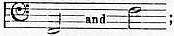

and the smaller are tuned to one of the notes completing the chromatic and enharmonic scale from . These limits comprise all the notes of artistic value that can be obtained from kettledrums. When there are but two drums—the term “drum” used by musicians always denotes the kettledrum—they are generally tuned to the tonic and dominant or to the tonic and subdominant, these notes entering into the composition of most of the harmonies of the key. Formerly the kettledrums used to be treated as transposing instruments, the notation, as for the horn, being in C, the key to which the kettledrums were to be tuned being indicated in the score. Now composers write the real notes.
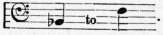
The tone of a good kettledrum is sonorous, rich, and of great power. When noise rather than music is required uncovered sticks are used. The drums may be muffled or covered by placing a piece of cloth or silk over the vellum to damp the sound, a device which produces a lugubrious, mysterious effect and is indicated in the score by the words timpani coperti, timpani con sordini, timbales couvertes, gedämpfte Pauken. Besides the beautiful effects obtained by means of delicate gradations of tone, numerous rhythmical figures may be executed on one, two or more notes. German drummers who were renowned during the 17th and 18th centuries, borrowing the terms from the trumpets with which the kettledrums were long associated, recognized the following beats:—
Single tonguing (Einfache Zungen)

Double tonguing (Doppel oder gerissene Zungen)

Legato tonguing (Tragende Zungen)

Whole double-tonguing (Ganze Doppel-Zungen)

Double cross-beat2 (Doppel Kreuzschläge)
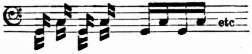
The roll (Wirbel)

The double roll (Doppel Wirbel)

It is generally stated that Beethoven was the first to treat the kettledrum as a solo instrument, but in Dido, an opera by C. Graupner performed at the Hamburg Opera House in 1707, there is a short solo for the kettledrum.3
The tuning of the kettledrum is an operation requiring time, even when the screw-heads, as is now usual, are T-shaped; to expedite the change, therefore, efforts have been made in all countries to invent some mechanism which would enable the performer to tune the drum to a fixed note by a single movement. The first mechanical kettledrums date from the beginning of the 19th century. In Holland a system was invented by J. C. N. Stumpff4; in France by Labbaye in 1827; in Germany Einbigler patented a system in Frankfort-on-Main in 18365; in England Cornelius Ward in 1837; in Italy C. A. Boracchi of Monza in 1839.6
The drawback in most of these systems is the complicated nature of the mechanism, which soon gets out of order, and, being very cumbersome and heavy, it renders the instrument more or less of a fixture. Potter’s kettledrum with instantaneous system of tuning, the best known at the present day in England, and used in some military bands with entire success, is a complete contrast to the above. There is practically no mechanism; the system is simple, ingenious, and neither adds to the weight nor to the bulk of the instrument. There are no screws round the head of Potter’s kettledrum; an invisible system of cords in the interior, regulated by screws and rods in the form of a Maltese cross, is worked from the outside by a small handle connected to a dial, on the face of which are twenty-eight numbered notches. By means of these the performer is able to tune the drum instantly to any note within the compass by remembering the numbers which correspond to each note and pointing the indicator to it on the face of the dial. Should the cords become slightly stretched, flattening the pitch, causing the representative numbers to change, the performer need only give his indicator an extra turn to bring his instrument back to pitch, each note having several notches at its service. The internal mechanism, being of an elastic nature, has no detrimental effect on the tone but tends to increase its volume and improve its quality.
The origin of the kettledrum is remote and must be sought in the East. Its distinctive characteristic is a hemispherical or convex vessel, closed by means of a single parchment or skin drawn tightly over the aperture, whereas other drums consist of a cylinder, having one end or both covered by the parchment, as in the side-drum and tambourine respectively. The Romans were acquainted with the kettledrum, including it among the tympana; the tympanum leve, like a sieve, was the tambourine used in the rites of Bacchus and Cybele.7 The comparatively heavy tympanum of bronze mentioned by Catullus was probably the small kettledrum which appears in pairs on monuments of the middle ages.8 Pliny9 states that half pearls having one side round and the other flat were called tympania. If the name tympania (Gr. τύμπανον, from τύπτειν, to strike) was given to pearls of a certain shape because they resembled the kettledrum, this argues that the instrument was well known among the Romans. It is doubtful, however, if it was adopted by them as a military instrument, since it is not mentioned by Vegetius,10 who defines very clearly the duties of the service instruments buccina, tuba, cornu and lituus.
The Greeks also knew the kettledrum, but as a warlike instrument of barbarians. Plutarch11 mentions that the Parthians, in order to frighten their enemies, in offering battle used not the horn or tuba, but hollow vessels covered with a skin, on which they beat, making a terrifying noise with these tympana. Whether the kettledrum penetrated into western Europe before the fall of the Roman Empire and continued to be included during the middle ages among the tympana has not been definitely ascertained. Isidore of Seville gives a somewhat vague description of tympanum, conveying the impression that his information has been obtained second-hand: “Tympanum est pellis vel corium ligno ex una parte extentum. Est enim pars media symphoniae in similitudinem cribri. Tympanum autem dictum quod medium est. Unde, et margaritum medium tympanum dicitur, et ipsum ut symphonia ad virgulam percutitur.”12 It is clear that in this passage Isidore is referring to Pliny.
The names given during the middle ages to the kettledrum are derived from the East. We have attambal or attabal in Spain, from the Persian tambal, whence is derived the modern French timbales; nacaire, naquaire or nakeres (English spelling), from the Arabic nakkarah or noqqārich (Bengali, nāgarā), and the German Pauke, M.H.G. Bûke or Pûke, which is probably derived from byk, the Assyrian name of the instrument.
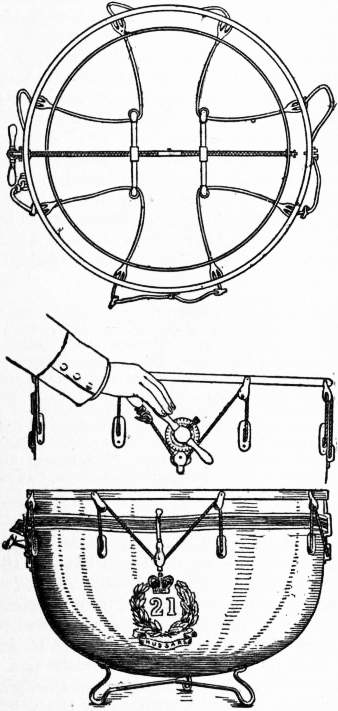
(Geo. Potter & Co. of Aldershot.)
Fig. 1.—Mechanical Kettledrum, showing the system of cords inside the head. This regiment is now the 21st (Empress of India) Lancers.
A line in the chronicles of Joinville definitely establishes the identity of the nakeres as a kind of drum: “Lor il fist sonner les tabours que l’on appelle nacaires.” The nacaire is among the instruments mentioned by Froissart as having been used on the occasion of Edward III.’s triumphal entry into Calais in 1347: “trompes, tambours, nacaires, chalemies, muses.”13 Chaucer mentions them in the description of the tournament in the Knight’s Tale (line 2514):—
“Pipes, trompes, nakeres and clarionnes, That in the bataille blowen blody sonnes.”
The earliest European illustration showing kettledrums is the scene depicting Pharaoh’s banquet in the fine illuminated MS. book of Genesis of the 5th or 6th century, preserved in Vienna. There are two pairs of shallow metal bowls on a table, on which a woman is performing with two sticks, as an accompaniment to the double pipes.14 As a companion illumination may be cited the picture of an Eastern banquet given in a 14th century MS. at the British Museum (Add. MS. 27,695), illuminated by a skilled Genoese. The potentate is enjoying the music of various instruments, among which are two kettledrums strapped to the back of a Nubian slave. This was the earlier manner of using the instrument before it became inseparably associated with the trumpet, sharing its position as the service instrument of the cavalry. Jost Amman15 gives a picture of a pair of kettledrums with banners being played by an armed knight on horseback.
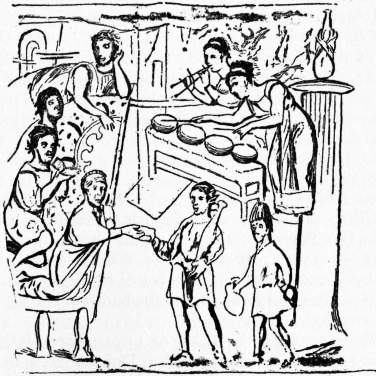
(From Härtel u. Wickhoff’s “Die Wiener Genesis,” Jahrbuch der kunslhistorischen Sammlungen des allerhöchsten Kaiserhauses.)
Fig. 2.—Kettledrums in an early Christian MS.
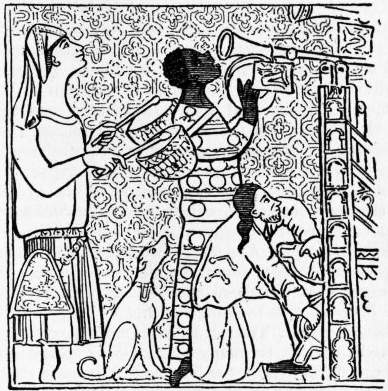
Fig. 3.—Medieval Kettledrums, 14th century. (Brit. Museum.)
As in the case of the trumpet, the use of the kettledrum was placed under great restrictions in Germany and France and to some extent in England, but it was used in churches with the trumpet.16 No French or German regiment was allowed kettledrums unless they had been captured from the enemy, and the timbalier or the Heerpauker on parade, in reviews and marches generally, rode at the head of the squadron; in battle his position was in the wings. In England, before the Restoration, only the Guards were allowed kettledrums, but after the accession of James II. every regiment of horse was provided with them.17 Before the Royal Regiment of Artillery was established, the master-general of ordnance was responsible for the raising of trains of artillery. Among his retinue in time of war were a trumpeter and kettledrummer. The kettledrums were mounted on a chariot drawn by six white horses. They appeared in the field for the first time in a train of artillery during the Irish rebellion of 1689, and the charges for ordnance include the item, “large kettledrums mounted on a carriage with cloaths marked I.R. and cost £158, 9s.”18 A model of the kettledrums with their carriage which accompanied the duke of Marlborough to Holland in 1702 is preserved in the Rotunda Museum at Woolwich. The kettledrums accompanied the Royal Artillery train in the Vigo expedition and during the campaign in Flanders in 1748. Macbean19 states that they were mounted on a triumphal car ornamented and gilt, bearing the ordnance flag and drawn by six white horses. The position of the car on march was in front of the flag gun, and in camp in front of the quarters of the duke of Cumberland with the artillery guns packed round them. The kettledrummer had by order “to mount the kettledrum carriage every night half an hour before the sun sett and beat till gun fireing.” In 1759 the kettledrums ceased to form part of the establishment of the Royal Artillery, and they were deposited, together with their carriage, in the Tower, at the same time as a pair captured at Malplaquet in 1709. These Tower drums were frequently borrowed by Handel for performances of his oratorios.
The kettledrums still form part of the bands of the Life Guards and other cavalry regiments.
(K. S.)
1 From “drum” and “kettle,” a covered metal vessel for boiling water or other liquid; the O.E. word is cetel, cf. Du. ketel, Ger. Kessel, borrowed from Lat. catillus, dim. of catinus, bowl.
2 This rhythmical use of kettledrums was characteristic of the military instrument of percussion, rather than the musical member of the orchestra. During the middle ages and until the end of the 18th century, the two different notes obtainable from the pair of kettledrums were probably used more as a means of marking and varying the rhythm than as musical notes entering into the composition of the harmonies. The kettledrums, in fact, approximated to the side drums in technique. The contrast between the purely rhythmical use of kettledrums, given above, and the more modern musical use is well exemplified by the well-known solo for four kettledrums in Meyerbeer’s Robert le Diable, beginning thus—

3 See Wilhelm Kleefeld, Das Orchester der Hamburger Oper (1678-1738); Internationale Musikgesellschaft, Sammelband i. 2, p. 278 (Leipzig, 1899).
4 See J. Georges Kastner, Méthode complète et raisonnée de timbales (Paris), p. 19, where several of the early mechanical kettledrums are described and illustrated.
5 See Gustav Schilling’s Encyklopädie der gesammten musikal. Wissenschaften (Stuttgart, 1840), vol. v., art. “Pauke.”
6 See Manuale pel Timpanista (Milan, 1842), where Boracchi describes and illustrates his invention.
7 Catullus, lxiii. 8-10; Claud. De cons. Stilich. iii. 365; Lucret. ii. 618; Virg. Aen. ix. 619, &c.
8 John Carter, Specimens of Ancient Sculpture, bas-relief from seats of choir of Worcester cathedral and of collegiate church of St Katherine near the Tower of London (plates, vol. i. following p. 53 and vol. ii. following p. 22).
9 Nat. Hist. ix. 35, 23.
10 De re militari, ii. 22; iii. 5, &c.
11 Crassus, xxiii. 10. See also Justin xli. 2, and Polydorus, lib. 1, cap. xv.
12 See Isidore of Seville, Etymologiarum, lib. iii. cap. 21, 141; Migne, Patr. curs. completus, lxxxii. 167.
13 Panthéon littéraire (Paris, 1837), J. A. Buchon, vol. i. cap. 322, p. 273.
14 Reproduced by Franz Wickhoff, “Die Wiener Genesis,” supplement to the 15th and 16th volumes of the Jahrb. d. kunsthistorischen Sammlungen d. allerhöchsten Kaiserhauses (Vienna, 1895); see frontispiece in colours and plate illustration XXXIV.
15 Artliche u. kunstreiche Figuren zu der Reutterey (Frankfort-on-Main, 1584).
16 See Michael Praetorius, Syntagma Musicum and Monatshefte f. Musikgeschichte, Jahrgang x. 51.
17 See Georges Kastner, op. cit., pp. 10 and 11; Johann Ernst Altenburg, Versuch einer Anleitung z. heroisch-musikalischen Trompeter u. Paukerkunst (Halle, 1795), p. 128; and H. G. Farmer, Memoirs of the Royal Artillery Band p. 23, note 1 (London, 1904).
18 Miller’s Artillery Regimental History; see also H. G. Farmer, op. cit., p. 22; illustration 1702, p. 26.
19 Memoirs of the Royal Artillery.
KEUPER, in geology the third or uppermost subdivision of the Triassic system. The name is a local miners’ term of German origin; it corresponds to the French marnes irisées. The formation is well exposed in Swabia, Franconia, Alsace and Lorraine and Luxemburg; it extends from Basel on the east side of the Rhine into Hanover, and northwards it spreads into Sweden and through England into Scotland and north-east Ireland; it appears flanking the central plateau of France and in the Pyrenees and Sardinia. In the German region it is usual to divide the Keuper into three groups, the Rhaetic or upper Keuper, the middle, Hauptkeuper or gypskeuper, and the lower, Kohlenkeuper or Lettenkohle. In Germany the lower division consists mainly of grey clays and schieferletten with white, grey and brightly coloured sandstone and dolomitic limestone. The upper part of this division is often a grey dolomite known as the Grenz dolomite; the impure coal beds—Lettenkohle—are aggregated towards the base. The middle division is thicker than either of the others (at Göttingen, 450 metres); it consists of a marly series below, grey, red and green marls with gypsum and dolomite—this is the gypskeuper in its restricted sense. The higher part of the series is sandy, hence called the Steinmergel; it is comparatively free from gypsum. To this division belong the Myophoria beds (M. Raibliana) with galena in places; the Estheria beds (E. laxitesta); the Schelfsandstein, used as a building-stone; the Lehrberg and Berg-gyps beds; Semionotus beds (S. Bergeri) with building-stone of Coburg; and the Burgand Stubensandstein. The salt, which is associated with gypsum, is exploited in south Germany at Dreuze, Pettoncourt, Vie in Lorraine and Wimpfen on the Neckar. A ½-metre coal is found on this horizon in the Erzgebirge, and another, 2 metres thick, has been mined in Upper Silesia. The upper Keuper, Rhaetic or Avicula contorta zone in Germany is mainly sandy with dark grey shales and marls; it is seldom more than 25 metres thick. The sandstones are used for building purposes at Bayreuth, Culmbach and Bamberg. In Swabia and the Wesergebirge are several “bone-beds,” thicker than those in the middle Keuper, which contain a rich assemblage of fossil remains of fish, reptiles and the mammalian teeth of Microlestes antiquus and Triglyptus Fraasi. The name Rhaetic is derived from the Rhaetic Alps where the beds are well developed; they occur also in central France, the Pyrenees and England. In S. Tirol and the Judicarian Mountains the Rhaetic is represented by the Kössener beds. In the Alpine region the presence of coral beds gives rise to the so-called “Lithodendron Kalk.”
In Great Britain the Keuper contains the following sub-divisions: Rhaetic or Penarth beds, grey, red and green marls, black shales and so-called “white lias” (10-150 ft.). Upper Keuper marl, red and grey marls and shales with gypsum and rock salt (800-3000 ft.). Lower Keuper sandstone, marls and thin sandstones at the top, red and white sandstones (including the so-called “waterstones”) below, with breccias and conglomerates at the base (150-250 ft.). The basal or “dolomitic conglomerate” is a shore or scree breccia derived from local materials; it is well developed in the Mendip district. The rock-salt beds vary from 1 in. to 100 ft. in thickness; they are extensively worked (mined and pumped) in Cheshire, Middlesbrough and Antrim. The Keuper covers a large area in the midlands and around the flanks of the Pennine range; it reaches southward to the Devonshire coast, eastward into Yorkshire and north-westward into north Ireland and south Scotland. As in Germany, there are one or more “bone beds” in the English Rhaetic with a similar assemblage of fossils. In the “white lias” the upper hard limestone is known as the “sun bed” or “Jew stone”; at the base is the Cotham or landscape marble.
Representatives of the Rhaetic are found in south Sweden, where the lower portion contains workable coals, in the Himalayas, Japan, Tibet, Burma, eastern Siberia and in Spitzbergen. The upper portion of the Karroo beds of South Africa and part of the Otapiri series of New Zealand are probably of Rhaetic age.
The Keuper is not rich in fossils; the principal plants are cypress-like conifers (Walchia, Voltzia) and a few calamites with such forms as Equisetum arenaceum and Pterophyllum Jaegeri, Avicula contorta, Protocardium rhaeticum, Terebratula gregaria, Myophoria costata, M. Goldfassi and Lingula tenuessima, Anoplophoria lettica may be mentioned among the invertebrates. Fishes include Ceratodus, Hybodus and Lepidotus. Labyrinthodonts represented by the footprints of Cheirotherium and the bones of Labyrinthodon, Mastodonsaurus and Capitosaurus. Among the reptiles are Hyperodapedon, Palaeosaurus, Zanclodon, Nothosaurus and Belodon. Microlestes, the earliest known mammalian genus, has already been mentioned.
See also the article Triassic System.
(J. A. H.)
KEW, a township in the Kingston parliamentary division of Surrey, England, situated on the south bank of the Thames, 6 m. W.S.W. of Hyde Park Corner, London. Pop. (1901), 2699. A stone bridge of seven arches, erected in 1789, connecting Kew with Brentford on the other side of the river, was replaced by a bridge of three arches opened by Edward VII. in 1903 and named after him. Kew has increased greatly as a residential suburb of London; the old village consisted chiefly of a row of houses with gardens attached, situated on the north side of a green, to the south of which is the church and churchyard and at the west the principal entrance to Kew Gardens. From remains found in the bed of the river near Kew bridge it has been conjectured that the village marks the site of an old British settlement. The name first occurs in a document of the reign of Henry VII., where it is spelt Kayhough. The church of St Anne (1714) has a mausoleum containing the tomb of the duke of Cambridge (d. 1850) son of George III., and is also the burial-place of Thomas Gainsborough the artist, Jeremiah Meyer the painter of miniatures (d. 1789), John Zoffany the artist (d. 1810), Joshua Kirby the architect (d. 1774), and William Aiton the botanist and director of Kew Gardens (d. 1793).
The free school originally endowed by Lady Capel in 1721 received special benefactions from George IV., and the title of “the king’s free school.”
The estate of Kew House about the end of the 17th century came into the possession of Lord Capel of Tewkesbury, and in 1721 of Samuel Molyneux, secretary to the prince of Wales, afterwards George II. After his death it was leased by Frederick prince of Wales, son of George II., and was purchased about 1789 by George III., who devoted his leisure to its improvement. The old house was pulled down in 1802, and a new mansion was begun from the designs of James Wyatt, but the king’s death prevented its completion, and in 1827 the portion built was removed. Dutch House, close to Kew House, was sold by Robert Dudley, earl of Leicester, to Sir Hugh Portman, a Dutch merchant, late in the 16th century, and in 1781 was purchased by George III. as a nursery for the royal children. It is a plain brick structure, now known as Kew Palace.
The Royal Botanic Gardens of Kew originated in the exotic garden formed by Lord Capel and greatly extended by the princess dowager, widow of Frederick, prince of Wales, and by George III., aided by the skill of William Aiton and of Sir Joseph Banks. In 1840 the gardens were adopted as a national establishment, and transferred to the department of woods and forests. The gardens proper, which originally contained only about 11 acres, were subsequently increased to 75 acres, and the pleasure grounds or arboretum adjoining extend to 270 acres. There are extensive conservatories, botanical museums, including the magnificent herbarium and a library. A lofty Chinese pagoda was erected in 1761. A flagstaff 159 ft. high is made out of the fine single trunk of a Douglas pine. In the neighbouring Richmond Old Park is the important Kew Observatory.
KEWANEE, a city of Henry county, Illinois, U.S.A., in the N. W. part of the state, about 55 m. N. by W. of Peoria. Pop. (1900), 8382, of whom 2006 were foreign-born; (1910 census), 9307. It is served by the Chicago Burlington & Quincy railroad and by the Galesburg & Kewanee Electric railway. Among its manufactures are foundry and machine-shop products, boilers, carriages and wagons, agricultural implements, pipe and fittings, working-men’s gloves, &c. In 1905 the total factory product was valued at $6,729,381, or 61.5% more than in 1900. Kewanee was settled in 1836 by people from Wethersfield, Connecticut, and was first chartered as a city in 1897.
KEY, SIR ASTLEY COOPER (1821-1888), English admiral, was born in London in 1821, and entered the navy in 1833. His father was Charles Aston Key (1793-1849), a well-known surgeon, the pupil of Sir Astley Cooper, and his mother was the latter’s niece. After distinguishing himself in active service abroad, on the South American station (1844-1846), in the Baltic during the Crimean War (C.B. 1855) and China (1857), Key was appointed in 1858 a member of the royal commission on national defence, in 1860 captain of the steam reserve at Devonport, and in 1863 captain of H.M.S. “Excellent” and superintendent of the Royal Naval College. He had a considerable share in advising as to the reorganization of administration, and in 1866, having become rear-admiral, was made director of naval ordnance. Between 1869 and 1872 he held the offices of superintendent of Portsmouth dockyard, superintendent of Malta dockyard, and second in command in the Mediterranean. In 1872 he was made president of the projected Royal Naval College at Greenwich, which was organized by him, and after its opening in 1873 he was made a K.C.B, and a vice-admiral. In 1876 he was appointed commander-in-chief on the North American and West Indian station. Having become full admiral in 1878, he was appointed in 1879 principal A.D.C., and soon afterwards first naval lord of the admiralty, retaining this post till 1885. In 1882 he was made G.C.B. He died at Maidenhead on the 3rd of March, 1888.
See Memoirs of Sir Astley Cooper Key, by Vice-Admiral Colomb (1898).
KEY, THOMAS HEWITT (1799-1875), English classical scholar, was born in London on the 20th of March, 1799. He was educated at St John’s and Trinity Colleges, Cambridge, and graduated 19th wrangler in 1821. From 1825 to 1827 he was professor of mathematics in the university of Virginia, and after his return to England was appointed (1828) professor of Latin in the newly founded university of London. In 1832 he became joint headmaster of the school founded in connexion with that institution; in 1842 he resigned the professorship of Latin, and took up that of comparative grammar together with the undivided headmastership of the school. These two posts he held till his death on the 29th of November 1875. Key is best known for his introduction of the crude-form (the uninflected form or stem of words) system, in general use among Sanskrit grammarians, into the teaching of the classical languages. This system was embodied in his Latin Grammar (1846). In Language, its Origin and Development (1874), he upholds the onomatopoeic theory. Key was prejudiced against the German “Sanskritists,” and the etymological portion of his Latin Dictionary, published in 1888, was severely criticized on this account. He was a member of the Royal Society and president of the Philological Society, to the Transactions of which he contributed largely.
See Proceedings of the Royal Society, vol. xxiv. (1876); R. Ellis in the Academy (Dec. 4, 1875); J. P. Hicks, T. Hewitt Key (1893), where a full list of his works and contributions is given.
KEY (in O. Eng. caég; the ultimate origin of the word is unknown; it appears only in Old Frisian kei of other Teutonic languages; until the end of the 17th century the pronunciation was kay, as in other words in O. Eng. ending in aég; cf. daég, day; claég, clay; the New English Dictionary takes the change to kee to be due to northern influence), an instrument of metal used for the opening and closing of a lock (see Lock). Until the 14th century bronze and not iron was most commonly used. The terminals of the stem of the keys were frequently decorated, the “bow” or loop taking the form sometimes of a trefoil, with figures inscribed within it; this decoration increased in the 16th century, the terminals being made in the shape of animals and other figures. Still more elaborate ceremonial keys were used by court officials; a series of chamberlains’ keys used during the 18th and 19th centuries in several courts in Europe is in the British Museum. The terminals are decorated with crowns, royal monograms and ciphers. The word “key” is by analogy applied to things regarded as means for the opening or closing of anything, for the making clear that which is hidden. Thus it is used of an interpretation as to the arrangement of the letters or words of a cipher, of a solution of mathematical or other problems, or of a translation of exercises or books, &c., from a foreign language. The term is also used figuratively of a place of commanding strategic position. Thus Gibraltar, the “Key of the Mediterranean,” was granted in 1462 by Henry IV. of Castile, the arms, gules, a castle proper, with key pendant to the gate, or; these arms form the badge of the 50th regiment of foot (now 2nd Batt. Essex Regiment) in the British army, in memory of the part which it took in the siege of 1782. The word is also frequently applied to many mechanical contrivances for unfastening or loosening a valve, nut, bolt, &c., such as a spanner or wrench, and to the instruments used in tuning a pianoforte or harp or in winding clocks or watches. A farther extension of the word is to appliances or devices which serve to lock or fasten together distinct parts of a structure, as the “key-stone” of an arch, the wedge or piece of wood, metal, &c., which fixes a joint, or a small metal instrument, shaped like a U, used to secure the bands in the process of sewing in bookbinding.
In musical instruments the term “key” is applied in certain wind instruments, particularly of the wood-wind type, to the levers which open and close valves in order to produce various notes, and in keyboard instruments, such as the organ or the pianoforte, to the exterior white or black parts of the levers which either open or shut the valves to admit the wind from the bellows to the pipes or to release the hammers against the strings (see Keyboard). It is from this application of the word to these levers in musical instruments that the term is also used of the parts pressed by the finger in typewriters and in telegraphic instruments.
A key is the insignia of the office of chamberlain in a royal household (see Chamberlain and Lord Chamberlain). The “power of the keys” (clavium potestas) in ecclesiastical usage represents the authority given by Christ to Peter by the words, “I will give unto thee the keys of the kingdom of heaven” (Matt. xvi. 19). This is claimed by the Roman Church to have been transmitted to the popes as the successors of St Peter.
“Key” was formerly the common spelling of “quay,” a wharf, and is still found in America for “cay,” an island reef or sandbank off the coast of Florida (see Quay).
The origin of the name Keys or House of Keys, the lower branch of the legislature, the court of Tynwald, of the Isle of Man, has been much discussed, but it is generally accepted that it is a particular application of the word “key” by English- and not Manx-speaking people. According to A. W. Moore, History of the Isle of Man, i. 160 sqq. (1900), in the Manx statutes and records the name of the house was in 1417 Claves Manniae et Claves legis, Keys of Man and Keys of the Law; but the popular and also the documentary name till 1585 seems to have been “the 24,” in Manx Kiare as feed. From 1585 to 1734 the name was in the statutes, &c., “the 24 Keys,” or simply “the Keys.” Moore suggests that the name was possibly originally due to an English “clerk of the rolls,” the members of the house being called in to “unlock or solve the difficulties of the law.” There is no evidence for the suggestion that Keys is an English corruption of Kiare-as, the first part of Kiare as feed. Another suggestion is that it is from a Scandinavian word keise, chosen.
KEYBOARD, or Manual (Fr. clavier; Ger. Klaviatur; Ital. tastatura), a succession of keys for unlocking sound in stringed, wind or percussion musical instruments, together with the case or board on which they are arranged. The two principal types of keyboard instruments are the organ and the piano; their keyboards, although similarly constructed, differ widely in scope and capabilities. The keyboard of the organ, a purely mechanical contrivance, is the external means of communicating with the valves or pallets that open and close the entrances to the pipes. As its action is incapable of variation at the will of the performer, the keyboard of the organ remains without influence on the quality and intensity of the sound. The keyboard of the piano, on the contrary, besides its purely mechanical function, also forms a sympathetic vehicle of transmission for the performer’s rhythmical and emotional feeling, in consequence of the faithfulness with which it passes on the impulses communicated by the fingers. The keyboard proper does not, in instruments of the organ and piano types, contain the complete mechanical apparatus for directly unlocking the sound, but only that external part of it which is accessible to the performer.
The first instrument provided with a keyboard was the organ; we must therefore seek for the prototype of the modern keyboard in connexion with the primitive instrument which marks the transition between the mere syrinx provided with bellows, in which all the pipes sounded at once unless stopped by the fingers, and the first organ in which sound was elicited from a pipe only when unlocked by means of some mechanical contrivance. The earliest contrivance was the simple slider, unprovided with a key or touch-piece and working in a groove like the lid of a box, which was merely pushed in or drawn out to open or close the hole that formed the communication between the wind chest and the hole in the foot of the pipe. These sliders fulfilled in a simple manner the function of the modern keys, and preceded the groove and pallet system of the modern organ. We have no clear or trustworthy information concerning the primitive organ with sliders. Athanasius Kircher1 gives a drawing of a small mouth-blown instrument under the name of Magraketha (Mashroqitha’, Dan. iii. 5), and Ugolini2 describes a similar one, but with a pair of bellows, as the magrēphah of the treatise ‘Arākhīn.3 By analogy with the evolution of the organ in central and western Europe from the 8th to the 15th century, of which we are able to study the various stages, we may conclude that in principle both drawings were probably fairly representative, even if nothing better than efforts of the imagination to illustrate a text.
The invention of the keyboard with balanced keys has been placed by some writers as late as the 13th or 14th century, in spite of its having been described by both Hero of Alexandria and Vitruvius and mentioned by poets and writers. The misconception probably arose from the easy assumption that the organ was the product of Western skill and that the primitive instruments with sliders found in 11th century documents4 represent the sum of the progress made in the evolution; in reality they were the result of a laborious effort to reconquer a lost art. The earliest trace of a balanced keyboard we possess is contained in Hero’s description of the hydraulic organ said to have been invented by Ctesibius of Alexandria in the 2nd century B.C. After describing the other parts (see Organ), Hero passes on to the sliders with perforations corresponding with the open feet of the speaking pipes which, when drawn forward, traverse and block the pipes. He describes the following contrivances: attached to the slider is a three-limbed, pivoted elbow-key, which, when depressed, pushes the slider inwards; in order to provide for its automatic return when the finger is lifted from the key, a slip of horn is attached by a gut string to each elbow-key. When the key is depressed and the slider pushed home, the gut string pulls the slip of horn and straightens it. As soon as the key is released, the piece of horn, regaining its natural bent by its own elasticity, pulls the slider out so that the perforation of the slider overlaps and the pipe is silenced.5 The description of the keyboard by Vitruvius Pollio, a variant of that of Hero, is less accurate and less complete.6 From evidence discussed in the article Organ, it is clear that the principle of a balanced keyboard was well understood both in the 2nd and in the 5th century A.D. After this all trace of this important development disappears, sliders of all kinds with and without handles doing duty for keys until the 12th or 13th century, when we find the small portative organs furnished with narrow keys which appear to be balanced; the single bellows were manipulated by one hand while the other fingered the keys. As this little instrument was mainly used to accompany the voice in simple chaunts, it needed few keys, at most nine or twelve. The pipes were flue-pipes. A similar little instrument, having tiny invisible pipes furnished with beating reeds and a pair of bellows (therefore requiring two performers) was known as the regal. There are representations of these medieval balanced keyboards with keys of various shapes, the most common being the rectangular with or without rounded corners and the T-shaped. Until the 14th century all the keys were in one row and of the same level, and although the B flat was used for modulation, it was merely placed between A and B natural in the sequence of notes. During the 14th century small square additional keys made their appearance, one or two to the octave, inserted between the others in the position of our black keys but not raised. An example of this keyboard is reproduced by J. F. Riaño7 from a fresco in the Cistercian monastery of Nuestra Señora de Piedra in Aragon, dated 1390.
So far the history of the keyboard is that of the organ. The only stringed instruments with keys before this date were the organistrum and the hurdy-gurdy, in which little tongues of wood manipulated by handles or keys performed the function of the fingers in stopping the strings on the neck of the instruments, but they did not influence the development of the keyboard. The advent of the immediate precursors of the pianoforte was at hand. In the Wunderbuch8 (1440), preserved in the Grand Ducal Library at Weimar, are represented a number of musical instruments, all named. Among them are a clavichordium and a clavicymbalum with narrow additional keys let in between the wider ones, one to every group of two large keys. The same arrangement prevailed in a clavicymbalum figured in an anonymous MS. attributed to the 14th century, preserved in the public library at Ghent9; from the lettering over the jacks and strings, of which there are but eight, it would seem as though the draughtsman had left the accidentals out of the scheme of notation. These are the earliest known representations of instruments with keyboards. The exact date at which our chromatic keyboard came into use has not been discovered, but it existed in the 15th century and may be studied in the picture of St Cecilia playing the organ on the Ghent altarpiece painted by the brothers Hubert and Jan van Eyck. Praetorius distinctly states that the large Halberstadt organ had the keyboard which he figures (plates xxiv. and xxv.) from the outset, and reproduces the inscription asserting that the organ was built in 1361 by the priest Nicolas Fabri and was renovated in 1495 by Gregorius Kleng. The keyboard of this organ has the arrangement of the present day with raised black notes; it is not improbable that Praetorius’s statement was correct, for Germany and the Netherlands led the van in organ-building during the middle ages.
At the beginning of the 16th century, to facilitate the playing of contrapuntal music having a drone bass or point d’orgue, the arrangement of the pipes of organs and of the strings of spinets and harpsichords was altered, with the result that the lowest octave of the keyboard was made in what is known as short measure, or mi, ré, ut, i.e. a diatonic with B flat included, but grouped in the space of a sixth instead of appearing as a full octave. In order to carry out this device, the note below F was C, instead of E, the missing D and E and the B flat being substituted for the three sharps of F, G and A, and appearing as black notes, thus:—
D E B♭ C F G A B C,
or if the lowest note appeared to be B, it sounded as G and the arrangement was as follows:—
A B G C D E F G.
This was the most common scheme for the short octave during the 16th and 17th centuries, although others are occasionally found. Praetorius also gives examples in which the black notes of the short octave were divided into two halves, or separate keys, the forward half for the drone note, the back half for the chromatic semitone, thus:—
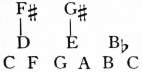
This arrangement, which accomplishes its object without sacrifice, was to be found early in the 17th century in the organs of the monasteries of Riddageshausen and of Bayreuth in Vogtland.
See A. J. Hipkins, History of the Pianoforte (London, 1896), and the older works of Girolamo Diruta (1597), Praetorius (1618), and Mersenne (1636).
(K. S.)
1 See Musurgia, bk. II., iv. § 3.
2 Thes. Antiq. Sacra. (Venice, 1744-1769), xxxii. 477.
3 II. 3 and fol. 10, 2. ‘Arākhīn (“Valuations”) is a treatise in the Babylonian Talmud. The word Magrephah occurs in the Mishna, the description of the instrument in the gemārā.
4 See the Cividale Prayer Book of St Elizabeth in Arthur Haseloff’s Eine Sächs.-thüring. Malerschule, pl. 26, No. 57, also Bible of St Etienne Harding at Dijon (see Organ: History).
5 See the original Greek with translation by Charles Maclean in “The Principle of the Hydraulic Organ,” Intern. Musikges. vi. 2, 219-220 (Leipzig 1905).
6 See Clément Loret’s account in Revue archéologique, pp. 76-102 (Paris, 1890).
7 Early Hist. of Spanish Music (London, 1807).
8 Reproduced by Dr Alwin Schulz in Deutsches Leben im XIV. u. XV. Jhdt., figs. 522 seq. (Vienna, 1892).
9 “De diversis monocordis, pentacordis, etc., ex quibus diversa formantur instrumenta musica,” reproduced by Edm. van der Straeten in Hist. de la musique aux Pays-Bas, i. 278.
KEYSTONE, the central voussoir of an arch (q.v.). The Etruscans and the Romans emphasized its importance by decorating it with figures and busts, and, in their triumphal arches, projected it forward and utilized it as an additional support to the architrave above. Throughout the Italian period it forms an important element in the design, and serves to connect the arch with the horizontal mouldings running above it. In Gothic architecture there is no keystone, but the junction of pointed ribs at their summit is sometimes decorated with a boss to mask the intersection.
KEY WEST (from the Spanish Cayo Hueso, “Bone Reef”), a city, port of entry, and the county-seat of Monroe county, Florida, U.S.A., situated on a small coral island (4½ m. long and about 1 m. wide) of the same name, 60 m. S. W. of Cape Sable, the most southerly point of the mainland. It is connected by lines of steamers with Miami and Port Tampa, with Galveston, Texas, with Mobile, Alabama, with Philadelphia and New York City, and with West Indian ports, and by regular schooner lines with New York City, the Bahamas, British Honduras, &c. There is now an extension of the Florida East Coast railway from Miami to Key West (155 m.). Pop. (1880), 9890; (1890), 18,080; (1900), 17,114, of whom 7266 were foreign-born and 5562 were negroes; (1910 census), 19,945. The island is notable for its tropical vegetation and climate. The jasmine, almond, banana, cork and coco-nut palm are among the trees. The oleander grows here to be a tree, and there is a banyan tree, said to be the only one growing out of doors in the United States. There are many species of plants in Key West not found elsewhere in North America. The mean annual temperature is 76° F., and the mean of the hottest months is 82.2° F.; that of the coldest months is 69° F.; thus the mean range of temperature is only 13°. The precipitation is 35 in.; most of the rain falls in the “rainy season” from May to November, and is preserved in cisterns by the inhabitants as the only supply of drinking water. The number of cloudy days per annum averages 60. The city occupies the highest portion of the island. The harbour accommodates vessels drawing 27 ft.; vessels of 27-30 ft. draft can enter by either the “Main Ship” channel or the south-west channel; the south-east channel admits vessels of 25 ft. draft or less; and four other channels may be used by vessels of 15-19 ft. draft. The harbour is defended by Fort Taylor, built on the island of Key West in 1846, and greatly improved and modernized after the Spanish-American War of 1898. Among the buildings are the United States custom house, the city hall, a convent, and a public library.
In 1869 the insignificant population of Key West was greatly increased by Cubans who left their native island after an attempt at revolution; they engaged in the manufacture of tobacco, and Key West cigars were soon widely known. Towards the close of the 19th century this industry suffered from labour troubles, from the competition of Tampa, Florida, and from the commercial improvement of Havana, Cuba; but soon after 1900 the tobacco business of Key West began to recover. Immigrants from the Bahama Islands form another important element in the population. They are known as “Conchs,” and engage in sponge fishing. In 1905 the value of factory products was $4,254,024 (an increase of 37.7% over the value in 1900); the exports in 1907 were valued at $852,457; the imports were valued at $994,472, the excess over the exports being due to the fact that the food supply of the city is derived from other Florida ports and from the West Indies.
According to tradition the native Indian tribes of Key West, after being almost annihilated by the Caloosas, fled to Cuba. There are relics of early European occupation of the island which suggest that it was once the resort of pirates. The city was settled about 1822. The Seminole War and the war of the United States with Mexico gave it some military importance. In 1861 Confederate forces attempted to seize Fort Taylor, but they were successfully resisted by General William H. French.
KHABAROVSK (known as Khabarovka until 1895), a town of Asiatic Russia, capital of the Amur region and of the Maritime Province. Pop. (1897), 14,932. It was founded in 1858 and is situated on a high cliff on the right bank of the Amur, at its confluence with the Usuri, in 48° 28′ N. and 135° 6′ E. It is connected by rail with Vladivostok (480 m.), and is an important entrepôt for goods coming down the Usuri and its tributary the Sungacha, as well as a centre of trade, especially in sables. The town is built of wood, and has a large cathedral, a monument (1891) to Count Muraviev-Amurskiy, a cadet corps (new building 1904), a branch of the Russian Geographical Society, with museum, and a technical railway school.
KHAIRAGARH, a feudatory state in the Central Provinces, India. Area, 931 sq. m.; pop. (1901), 137,554, showing a decrease of 24% in the decade due to the effects of famine; estimated revenue, £20,000; tribute £4600. The chief, who is descended from the old Gond royal family, received the title of raja as an hereditary distinction in 1898. The state includes a fertile plain, yielding rice and cotton. Its prosperity has been promoted by the Bengal-Nagpur railway, which has a station at Dongargarh, the largest town (pop. 5856), connected by road with Khairagarh town, the residence of the raja.
KHAIREDDIN (Khair-ed-Din = “Joy of Religion”) (d. 1890), Turkish statesman, was of Circassian race, but nothing is known about his birth and parentage. In early boyhood he was in the hands of a Tunisian slave-dealer, by whom he was sold to Hamuda Pasha, then bey of Tunis, who gave him his freedom and a French education. When Khaireddin left school the bey made him steward of his estates, and from this position he rose to be minister of finance. When the prime minister, Mahmud ben Ayad, absconded to France with the treasure-chest of the beylic, Hamuda despatched Khaireddin to obtain the extradition of the fugitive. The mission failed; but the six years it occupied enabled Khaireddin to make himself widely known in France, to become acquainted with French political ideas and administrative methods, and, on his return to Tunisia, to render himself more than ever useful to his government. Hamuda died while Khaireddin was in France, but he was highly appreciated by the three beys—Ahmet (1837), Mohammed (1855), and Sadok (1859)—who in turn followed Hamuda, and to his influence was due the sequence of liberal measures which distinguished their successive reigns. Khaireddin also secured for the reigning family the confirmation from the sultan of Turkey of their right of succession to the beylic. But although Khaireddin’s protracted residence in France had imbued him with liberal ideas, it had not made him a French partisan, and he strenuously opposed the French scheme of establishing a protectorate over Tunisia upon which France embarked in the early ’seventies. This rendered him obnoxious to Sadok’s prime minister—an apostate Jew named Mustapha ben Ismael—who succeeded in completely undermining the bey’s confidence in him. His position thus became untenable in Tunisia, and shortly after the accession of Abdul Hamid he acquainted the sultan with his desire to enter the Turkish service. In 1877 the sultan bade him come to Constantinople, and on his arrival gave him a seat on the Reform Commission then sitting at Tophane. Early in 1879 the sultan appointed him grand vizier, and shortly afterwards he prepared a scheme of constitutional government, but Abdul Hamid refused to have anything to do with it. Thereupon Khaireddin resigned office, on the 28th of July 1879. More than once the sultan offered him anew the grand vizierate, but Khaireddin persistently refused it, and thus incurred disfavour. He died on the 30th of January 1890, practically a prisoner in his own house.
KHAIRPUR, or Khyrpoor, a native state of India, in the Sind province of Bombay. Area, 6050 sq. m.; pop. (1901), 199,313, showing an apparent increase of 55% in the decade; estimated revenue, £90,000. Like other parts of Sind, Khairpur consists of a great alluvial plain, very rich and fertile in the neighbourhood of the Indus and the irrigation canals, the remaining area being a continuous series of sand-hill ridges covered with a stunted brushwood, where cultivation is altogether impossible. A small ridge of limestone hills passes through the northern part of the state, being a continuation of a ridge known as the Ghar, running southwards from Rohri. The state is watered by five canals drawn off from the Indus, besides the Eastern Nara, a canal which follows an old bed of the Indus. In the desert tracts are pits of natron.
Khairpur town is situated on a canal 15 m. E. of the Indus, with a railway station, 20 m. S. of Sukkur, on the Kotri-Rohri branch of the North-Western railway, which here crosses a corner of the state. Pop. (1901), 14,014. There are manufactures of cloth, carpets, goldsmiths’ work and arms, and an export trade in indigo, grain and oilseeds.
The chief, or mir, of Khairpur belongs to a Baluch family, known as the Talpur, which rose on the fall of the Kalhora dynasty of Sind. About 1813, during the troubles in Kabul incidental to the establishment of the Barakzai dynasty, the mirs were able to withhold the tribute which up to that date had been somewhat irregularly paid to the rulers of Afghanistan. In 1832 the individuality of the Khairpur state was recognized by the British government in a treaty under which the use of the river Indus and the roads of Sind were secured. When the first Kabul expedition was decided on, the mir of Khairpur, Ali Murad, cordially supported the British policy; and the result was that, after the battles of Meeanee and Daba had put the whole of Sind at the disposal of the British, Khairpur was the only state allowed to retain its political existence under the protection of the paramount power. The chief mir, Faiz Mahommed Khan, G.C.I.E., who was an enlightened ruler, died in 1909, shortly after returning from a pilgrimage to the Shiite shrine of Kerbela.
KHAJRAHO, a village of Central India, in the state of Chhatarpur, famous for its old temples; pop. (1901), 1242. It is believed to have been the capital of the ancient kingdom of Jijhoti, corresponding with modern Bundelkhand. The temples consist of three groups: Saiva, Vaishnav and Jain, almost all built in the 10th and 11th centuries. They are covered outside and inside with elaborate sculptures, and also bear valuable inscriptions.
KHAKI (from Urdu khak, dust), originally a dust-coloured fabric, of the character of canvas, drill or holland, used by the British and native armies in India. It seems to have been first worn by the Guides, a mixed regiment of frontier troops, in 1848, and to have spread to other regiments during the following years. Some at any rate of the British troops had uniforms of khaki during the Indian Mutiny (1857-58), and thereafter drill or holland (generally called “khaki” whatever its colour) became the almost universal dress of British and native troops in Asia and Africa. During the South African War of 1899-1902, drill of a sandy shade of brown was worn by all troops sent out from Great Britain and the Colonies. Khaki drill, however, proved unsuitable material for the cold weather in the uplands of South Africa, and after a time the troops were supplied with dust-coloured serge uniforms. Since 1900 all drab and green-grey uniforms have been, unofficially at any rate, designated khaki.
KHALIFA, THE. Abdullah et Taaisha (Seyyid Abdullah ibn Seyyid Mahommed) (1846-1899), successor of the mahdi Mahommed Ahmed, born in 1846 in the south-western portion of Darfur, was a member of the Taaisha section of the Baggara or cattle-owning Arabs. His father, Mahommed et Taki, had determined to emigrate to Mecca with his family; but the unsettled state of the country long prevented him, and he died in Africa after advising his eldest son, Abdullah, to take refuge with some religious sheikh on the Nile, and to proceed to Mecca on a favourable opportunity. Abdullah, who had already had much connexion with slave-hunters, and had fought against the Egyptian conquest of Darfur, departed for the Nile valley with this purpose; hearing on the way of the disputes of Mahommed Ahmed, who had not yet claimed a sacred character, with the Egyptian officials, he went to him in spite of great difficulties, and, according to his own statement, at once recognized in him the mahdi (“guide”) divinely appointed to regenerate Islam in the latter days. His advice to Mahommed to stir up revolt in Darfur and Kordofan being justified by the result, he became his most trusted counsellor, and was soon declared principal khalifa or vicegerent of the mahdi, all of whose acts were to be regarded as the mahdi’s own. The mahdi on his deathbed (1885) solemnly named him his successor; and for thirteen years Abdullah ruled over what had been the Egyptian Sudan. Khartum was deserted by his orders, and Omdurman, at first intended as a temporary camp, was made his capital. At length the progress of Sir Herbert (afterwards Lord) Kitchener’s expedition compelled him to give battle to the Anglo-Egyptian forces near Omdurman, where on the 2nd of September 1898 his army, fighting with desperate courage, was almost annihilated. The khalifa, who had not left Omdurman since the death of the mahdi, fled to Kordofan with the remnant of his host. On the 25th of November 1899 he gave battle to a force under Colonel (afterwards General Sir) F. R. Wingate, and was slain at Om Debreikat. He met death with great fortitude, refusing to fly, and his principal amirs voluntarily perished with him.
The khalifa was a man of iron will and great energy, and possessed some military skill. By nature tyrannical, he was impatient of all opposition and appeared to delight in cruelty. It must be remembered, however, that he had to meet the secret or open hostility of all the tribes of the Nile valley and that his authority was dependent on his ability to overawe his opponents. He maintained in public the divine character of the power he inherited from the mahdi and inspired his followers to perform prodigies of valour. Although he treated many of his European captives with terrible severity he never had any of them executed. It is said that their presence in Omdurman ministered to his vanity—one of the most marked features of his character. In private life he showed much affection for his family.
Personal sketches of the khalifa are given in Slatin Pasha’s Fire and Sword in the Sudan (London, 1896), and in Father Ohrwalder’s Ten Years in the Mahdi’s Camp (London, 1892). See also Sir F. R. Wingate’s Mahdiism and the Egyptian Sudan (London, 1891).
KHALĪL IBN AḤMAD [ABŪ ‘Abdurraḥmān ul-Khalīl Ibn Aḥmad ibn ‘Amr ibn Tamīm] (718-791), Arabian philologist, was a native of Oman. He was distinguished for having written the first Arabic dictionary and for having first classified the Arabic metres and laid down their rules. He was also a poet, and lived the ascetic life of a poor student. His grammatical work was carried on by his pupil Sībawaihī. The dictionary known as the Kitāb-ul-‘Ain is ascribed, at least in its inception, to Khalīl. It was probably finished by one of his pupils and was not known in Bagdad until 862. The words were not arranged in alphabetical order but according to physiological principles, beginning with ‘Ain and ending with Ya. The work seems to have been in existence as late as the 14th century, but is now only known from extracts in manuscript.
Various grammatical works are ascribed to Khalīl, but their authenticity seems doubtful; cf. C. Brockelmann, Gesch. der arabischen Literatur, i. 100 (Weimar, 1898).
(G. W. T.)
KHAMGAON, a town of India, in the Buldana district of Berar, 340 m. N.E. of Bombay. Pop. (1901), 18,341. It is an important centre of the cotton trade. The cotton market, the second in the province, was established about 1820. Khamgaon was connected in 1870 with the Great Indian Peninsula railway by a short branch line.
KHAMSEH, a small but important province of Persia, between Kazvin and Tabriz. It consisted formerly of five districts, whence its name Khamseh, “the five,” but is now subdivided into seventeen districts. The language of the inhabitants is Turkish. The province pays a revenue of about £20,000 per annum, and its capital is Zenjān.
KHAMSIN (Arabic for “fifty”), a hot oppressive wind arising in the Sahara. It blows in Egypt at intervals for about fifty days during March, April and May, and fills the air with sand. In Guinea the wind from the Sahara is known as harmattan (q.v.).
KHAMTIS, a tribe of the north-east frontier of India, dwelling in the hills bordering the Lakhimpur district of Assam. They are of Shan origin, and appear to have settled in their present abode in the middle of the 18th century. In 1839 they raided the British outpost of Sadiya, but they have since given no trouble. Their headquarters are in a valley 200 m. from Sadiya, which can be reached only over high passes and through dense jungle. In 1901 the number of speakers of Khamti was returned as only 1490, mostly in Burma.
KHAN (from the Turkī, hence Persian and Arabic Khān), a title of respect in Mahommedan countries. It is a contracted form of khāqān (khakan), a word equivalent to sovereign or emperor, used among the Mongol and Turkī-nomad hordes. The title khan was assumed by Jenghis when he became supreme ruler of the Mongols; his successors became known in Europe as the Great Khans (sometimes as the Chams, &c.) of Tatary or Cathay. Khan is still applied to semi-independent rulers, such as the khans of Russian Turkestan, or the khan of Kalat in Baluchistan, and is also used immediately after the name of rulers such as the sultan of Turkey; the meaning of the term has also extended downwards, until in Persia and Afghanistan it has become an affix to the name of any Mahommedan gentleman, like Esquire, and in India it has become a part of many Mahommedan names, especially when Pathan descent is claimed. The title of Khan Bahadur is conferred by the British government on Mahommedans and also on Parsis.
KHANDESH, EAST and WEST, two districts of British India, in the central division of Bombay. They were formed in 1906 by the division of the old single district of Khandesh. Their areas are respectively 4544 sq. m. and 5497 sq. m., and the population on these areas in 1901 was 957,728 and 469,654. The headquarters of East Khandesh are at Jalgaon, and those of West Khandesh at Dhulia.
The principal natural feature is the Tapti river, which flows through both districts from east to west and divides each into two unequal parts. Of these the larger lie towards the south, and are drained by the rivers Girna, Bori and Panjhra. Northwards beyond the alluvial plain, which contains some of the richest tracts in Khandesh, the land rises towards the Satpura hills. In the centre and east the country is level, save for some low ranges of barren hills, and has in general an arid, unfertile appearance. Towards the north and west, the plain rises into a difficult and rugged country, thickly wooded, and inhabited by wild tribes of Bhils, who chiefly support themselves on the fruits of the forests and by wood-cutting. The drainage of the district centres in the Tapti, which receives thirteen principal tributaries in its course through Khandesh. None of the rivers is navigable, and the Tapti flows in too deep a bed to be useful for irrigation. The district on the whole, however, is fairly well supplied with surface water. Khandesh is not rich in minerals. A large area is under forest; but the jungles have been denuded of most of their valuable timber. Wild beasts are numerous. In 1901 the population of the old single district was 1,427,382, showing an increase of less than 1% in the decade. Of the aboriginal tribes the Bhils are the most important. They number 167,000, and formerly were a wild and lawless robber tribe. Since the introduction of British rule, the efforts made by kindly treatment, and by the offer of suitable employment, to win the Bhils from their disorderly life have been most successful. Many of them are now employed in police duties and as village watchmen. The principal crops are millets, cotton, pulse, wheat and oilseeds. There are many factories for ginning and pressing cotton, and a cotton-mill at Jalgaon. The eastern district is traversed by the Great Indian Peninsula railway, which branches at Bhusawal (an important centre of trade) towards Jubbulpore and Nagpur. Both districts are crossed by the Tapti Valley line from Surat. Khandesh suffered somewhat from famine in 1896-1897, and more severely in 1899-1900.
KHANDWA, a town of British India, in the Nimar district of the Central Provinces, of which it is the headquarters, 353 m. N.E. of Bombay by rail. Pop. (1901), 19,401. Khandwa is an ancient town, with Jain and other temples. As a centre of trade, it has superseded the old capital of Burhanpur. It is an important railway junction, where the Malwa line from Indore meets the main line of the Great Indian Peninsula. There are factories for ginning and pressing cotton, and raw cotton is exported.
KHANSĀ (Tumāḍir bint ‘Amr, known as al-Khansā) (d. c. 645), Arabian poetess of the tribe Sulaim, a branch of Qais, was born in the later years of the 6th century and brought up in such wealth and luxury as the desert could give. Refusing the offer of Duraid ibn uṣ-Ṣimma, a poet and prince, she married Mirdās and had by him three sons. Afterwards she married again. Before the time of Islam she lost her brothers Ṣakhr and Moawiya in battle. Her elegies written on these brothers and on her father made her the most famous poetess of her time. At the fair of ‘Ukāz Nābigha Dhubyāni is said to have placed A‘sha first among the poets then present and Khansā second above Hassān ibn Thābit. Khansā with her tribe accepted Islam somewhat late, but persisted in wearing the heathen sign of mourning, against the precepts of Islam. Her four sons fought in the armies of Islam and were slain in the battle of Kadisīya. Omar wrote her a letter congratulating her on their heroic end and assigned her a pension. She died in her tent c. 645. Her daughter ‘Amra also wrote poetry. Opinion was divided among later critics as to whether Khansā or Laila (see Arabic Literature: § Poetry) was the greater.
Her diwan has been edited by L. Cheikho (Beirut, 1895) and translated into French by De Coppier (Beirut, 1889). Cf. T. Nöldeke’s Beiträge zur Kenntniss der Poesie der alten Araber (Hanover, 1864). Stories of her life are contained in the Kitāb ul-Aghāni, xiii. 136-147.
(G. W. T.)
KHAR, a small but very fertile province of Persia, known by the ancients as Choara and Choarene; pop. about 10,000. The governor of the province resides at Kishlak Khar, a large village situated 62 m. S.E. of Teheran, or at Aradān, a village 10 m. farther E. The province has an abundant water-supply from the Hableh-rūd, and produces great quantities of wheat, barley and rice. Of the £6000 which it pays to the state, more than £4000 is paid in kind—wheat, barley, straw and rice.
KHARAGHODA, a village of British India, in the Ahmedabad district of Bombay, situated on the Little Runn of Cutch, and the terminus of a branch railway; pop. (1901), 2108. Here is the government factory of salt, known as Baragra salt, producing nearly 2,000,000 cwt. a year, most of which is exported to other provinces in Central and Northern India.
KHARGA (Wah el-Kharga, the outer oasis), the largest of the Egyptian oases, and hence frequently called the Great Oasis. It lies in the Libyan desert between 24° and 26° N. and 30° and 31° E., the chief town, also called Kharga, being 435 m. by rail S. by W. of Cairo. It is reached by a narrow-gauge line (opened in 1908) from Kharga junction, a station on the Nile valley line near Farshut. The oasis consists of a depression in the desert some 1200 sq. m. in extent, and is about 100 m. long N. to S. and from 12 to 50 broad E. to W. Formerly, and into historic times, a lake occupied a considerable part of the depression, and the thick deposits of clay and sand then laid down now form the bulk of the cultivated lands of the oasis. It includes, however, a good deal of desert land. The inhabitants numbered (1907 census) 8348. They are of Berber stock. Administratively the oasis forms part of the mudiria of Assiut. It is practically rainless, and there is not now a single natural flowing spring. There are, however, numerous wells, water being obtained freely from the porous sandstone which underlies a great part of the Libyan desert. Some very ancient wells are 400 ft. deep. In water-bearing sandstones near the surface there are underground aqueducts dating from Roman times. The oasis contains many groves of date palms, there being over 60,000 adult trees in 1907. The dom palm, tamarisk, acacia and wild senna are also found. Rice, barley and wheat are the chief cereals cultivated, and lucerne for fodder. Besides agriculture the only industry is basket and mat making—from palm leaves and fibre. Since 1906 extensive boring and land reclamation works have been undertaken in the oasis.
The name of the oasis appears in hieroglyphics as Kenem, and that of its capital as Hebi (the plough). In Pharaonic times it supported a large population, but the numerous ruins are mostly of later date. The principal ruin, a temple of Ammon, built under Darius, is of sandstone, 142 ft. long by 63 ft. broad and 30 ft. in height. South-east is another temple, a square stone building with the name of Antoninus Pius over one off the entrances. On the eastern escarpment of the oasis on the way to Girga are the remains of a large Roman fort with twelve bastions. On the road to Assiut is a fine Roman columbarium or dove-cote. Next to the great temple the most interesting ruin in the oasis is, however, the necropolis, a burial-place of the early Christians, placed on a hill 3 m. N. of the town of Kharga. There are some two hundred rectangular tomb buildings in unburnt brick with ornamented fronts. In most of the tombs is a chamber in which the mummy was placed, the Egyptian Christians at first continuing this method of preserving the bodies of their dead. In several of the tombs and in the chapel of the cemetery is painted the Egyptian sign of life, which was confounded with the Christian cross. The chapel is basilican; in it and in another building in the necropolis are crude frescoes of biblical subjects.
Kharga town (pop. 1907 census, 5362) is picturesquely situated amid palm groves. The houses are of sun-dried bricks, the streets narrow and winding and for the most part roofed over, the roofs carrying upper storeys. Some of the streets are cut through the solid rock. South of the town are the villages of Genna, Guehda (with a temple dedicated to Ammon, Mut and Khonsu), Bulak (pop. 1012), Dakakin, Beris (pop. 1564), Dush (with remains of a fine temple bearing the names of Domitian and Hadrian), &c.
Kharga is usually identified with the city of Oasis mentioned by Herodotus as being seven days’ journey from Thebes and called in Greek the Island of the Blessed. The oasis was traversed by the army of Cambyses when on its way to the oasis of Ammon (Siwa), the army perishing in the desert before reaching its destination. During the Roman period, as it had also been in Pharaonic times, Kharga was used as a place of banishment, the most notable exile being Nestorius, sent thither after his condemnation by the council of Ephesus. Later it became a halting-place for the caravans of slaves brought from Darfur to Egypt.
About 100 m. W. of Kharga is the oasis of Dakhla, the inner or receding oasis, so named in contrast to Kharga as being farther from the Nile. Dakhla has a population (1907) of 18,368. Its chief town, El Kasr, has 3602 inhabitants. The principal ruin, of Roman origin and now called Deir el Hagar (the stone convent), is of considerable size. The Theban triad were the chief deities worshipped here. Some 120 m. N.W. of Dakhla is the oasis of Farafra, population about 1000, said to be the first of the oases conquered by the Moslems from the Christians. It is noted for the fine quality of its olives. The Baharia, or Little Oasis (pop. about 6000), lies 80 m. N.N.E. of Farafra. Many of its inhabitants, who are of Berber race, are Senussites. Baharia is about 250 m. E.S.E. of the oasis of Siwa (see Egypt: The Oases; and Siwa).
See H. Brugsch, Reise nach dem grossen Oase el-Khargeh in der Libyschen Wüste (Leipzig, 1878); H. J. L. Beadnell, An Egyptian Oasis (London, 1909); Murray’s Handbook for Egypt, 11th ed. (London, 1907); Geological and Topographical Report on Kharga Oasis (1899), on Farafra Oasis (1899), on Dakhla Oasis (1900), on Baharia Oasis (1903), all issued by the Public Works Department, Cairo.
(F. R. C.)
KHARKOV, a government of Little Russia, surrounded by those of Kursk, Poltava, Ekaterinoslav, territory of the Don Cossacks, and Voronezh, and belonging partly to the basin of the Don and partly to that of the Dnieper. The area is 21,035 sq. m. In general the government is a table-land, with an elevation of 300 to 450 ft., traversed by deep-cut river valleys. The soil is for the most part of high fertility, about 57% of the surface being arable land and 24% natural pasture; and though the winter is rather severe, the summer heat is sufficient for the ripening of grapes and melons in the open air. The bulk of the population is engaged in agricultural pursuits and the breeding of sheep, cattle and horses, though various manufacturing industries have developed rapidly, more especially since the middle of the 19th century. Horses are bred for the army, and the yield of wool is of special importance. The ordinary cereals, maize, buckwheat, millet, hemp, flax, tobacco, poppies, potatoes and beetroot are all grown, and bee-keeping and silkworm-rearing are of considerable importance. Sixty-three per cent. of the land is owned by the peasants, 25% by the nobility, 6% by owners of other classes, and 6% by the crown and public institutions. Beetroot sugar factories, cotton-mills, distilleries, flour-mills, tobacco factories, brickworks, breweries, woollen factories, iron-works, pottery-kilns and tanneries are the leading industrial establishments. Gardening is actively prosecuted. Salt is extracted at Slavyansk. The mass of the people are Little Russians, but there are also Great Russians, Kalmucks, Germans, Jews and Gypsies. In 1867 the total population was 1,681,486, and in 1897 2,507,277, of whom 1,242,892 were women and 367,602 lived in towns. The estimated population in 1906 was 2,983,900. The government is divided into eleven districts. The chief town is Kharkov (q.v.). The other district towns, with their populations in 1897, are Akhtyrka (25,965 in 1900), Bogodukhov (11,928), Izyum (12,959), Kupyansk (7256), Lebedin (16,684), Starobyelsk (13,128), Sumy (28,519 in 1900), Valki (8842), Volchansk (11,322), and Zmiyev (4652).
KHARKOV, a town of southern Russia, capital of the above government, in 56° 37′ N. and 25° 5′ E., in the valley of the Donets, 152 m. by rail S.S.E. of Kursk. Oak forests bound it on two sides. Pop. (1867), 59,968; (1900), 197,405. Kharkov is an archiepiscopal see of the Orthodox Greek Church, and the headquarters of the X. army corps. The four annual fairs are among the busiest in Russia, more especially the Kreshchenskaya or Epiphany fair, which is opened on the 6th (19th) of January, and the Pokrovsky fair in the autumn. The turnover at the former is estimated at £3,000,000 to £4,000,000. Thousands of horses are bought and sold. At the Trinity (Troitsa) fair in June an extensive business (£800,000) is done in wool. A great variety of manufactured goods are produced in the town—linen, felt, beetroot sugar, tobacco, brandy, soap, candles, cast-iron. Kharkov is an educational centre for the higher and middle classes. Besides a flourishing university, instituted in 1805, and attended by from 1600 to 1700 students, it possesses a technological institute (400 students), a railway engineering school, an observatory, a veterinary college, a botanical garden, a theological seminary, and a commercial school. The university building was formerly a royal palace. The library contains 170,000 volumes; and the zoological collections are especially rich in the birds and fishes of southern Russia. Public gardens occupy the site of the ancient military works; and the government has a model farm in the neighbourhood. Of the Orthodox churches one has the rank of cathedral (1781). Among the public institutions are a people’s palace (1903) and an industrial museum.
The foundation of Kharkov is assigned to 1650, but there is archaeological evidence of a much earlier occupation of the district, if not of the site. The Cossacks of Kharkov remained faithful to the tsar during the rebellions of the latter part of the 17th century; in return they received numerous privileges, and continued to be a strong advance-guard of the Russian power, till the final subjugation of all the southern region. With other military settlements Kharkov was placed on a new footing in 1765; and at the same time it became the administrative centre of the Ukraine.
KHARPUT, the most important town in the Kharput (or Mamuret el-Aziz) vilayet of Asia Minor, situated at an altitude of 4350 ft., a few miles south of the Murad Su or Eastern Euphrates, and almost as near the source of the Tigris, on the Samsun-Sivas-Diarbekr road. Pop. about 20,000. The town is built on a hill terrace about 1000 ft. above a well-watered plain of exceptional fertility which lies to the south and supports a large population. Kharput probably stands on or near the site of Carcathiocerta in Sophene, reached by Corbulo in A.D. 65. The early Moslem geographers knew it as Hisn Ziyad, but the Armenian name was Khartabirt or Kharbirt, whence Kharput. Cedrenus (11th century) writes Χάρποτε. There is a story that in 1122 Joscelin (Jocelyn) of Courtenay, and Baldwin II., king of Jerusalem, both prisoners of the Amir Balak in its castle, were murdered by being cast from its cliffs after an attempted rescue. The story is told by William of Tyre, who calls the place Quart Piert or Pierre, but it is a mere romance. Kharput is an important station of the American missionaries, who have built a college, a theological seminary, and boys’ and girls’ schools. In November 1895 Kurds looted and burned the Armenian villages on the plain; and in the same month Kharput was attacked and the American schools were burned down. A large number of the Gregorian and Protestant Armenian clergy and people were massacred, and churches, monasteries and houses were looted. The vilayet Kharput was founded in 1888, being the result of a provincial rearrangement, designed to ensure better control over the disturbed districts of Kurdistan. It has much mineral wealth, a healthy climate and a fertile soil. The seat of government is Mezere, on the plain 3 m. S. of Kharput.