VOLUME XV SLICE II Jacobites to Japan (part) (continued 7)
Reading edition
Except for the number of buildings composing it, the palace had little to distinguish it from a nobleman’s mansion. The latter consisted of a principal hall, where the master of the house lived, ate and slept, and of three suites of chambers, disposed on the north, the east and the west of the principal hall. In the northern suite the lady of the house dwelt, the eastern and western suites being allotted to other members of the family. Corridors joined the principal hall to the subordinate edifices, for as yet the idea had not been conceived of having more than one chamber under the same roof. The principal hall was usually 42 ft. square. Its centre was occupied by a “parent chamber,” 30 ft. square, around which ran an ambulatory and a veranda, each 6 ft. wide. The parent chamber and the ambulatory were ceiled, sometimes with interlacing strips of bark or broad laths, so as to produce a plaited effect; sometimes with plain boards. The veranda had no ceiling. Sliding doors, a characteristic feature of modern Japanese houses, had not yet come into use, and no means were provided for closing the veranda, but the ambulatory was surrounded by a wall of latticed timber or plain boards, the lower half of which could be removed altogether, whereas the upper half, suspended from hooks, could be swung upward and outward. Privacy was obtained by blinds of split bamboo, and the parent chamber was separated from the ambulatory by similar bamboo blinds with silk cords for raising or lowering them, or by curtains. The thick rectangular mats of uniform size which, fitting together so as to present a level unbroken surface, cover the floor of all modern Japanese houses, were not yet in use: floors were boarded, having only a limited space matted. This form of mansion underwent little modification until the 12th century, when the introduction of the Zen sect of Buddhism with its contemplative practice called for greater privacy. Interiors were then divided into smaller rooms by means of sliding doors covered with thin rice-paper, which permitted the passage of light while obstructing vision; the hanging lattices were replaced by wooden doors which could be slid along a groove so as to be removable in the daytime, and an alcove was added in the principal chamber for a sacred picture or Buddhist image to serve as an object of contemplation for a devotee while practising the rite of abstraction. Thus the main features of the Japanese dwelling-house were evolved, and little change took place subsequently, except that the brush of the painter was freely used for decorating partitions, and in aristocratic mansions unlimited care was exercised in the choice of rare woods.
The Buddhist temple underwent little change at Japanese hands except in the matter of decoration. Such as it was in Buddhist Temple Architecture. outline when first erected in accordance with Chinese models, such it virtually remained, though in later times all the resources of the sculptor and the painter were employed to beautify it externally and internally.
“The building, sometimes of huge dimensions, is invariably surrounded by a raised gallery, reached by a flight of steps in the centre of the approach front, the balustrade of which is a continuation of the gallery railing. This gallery is sometimes supported upon a deep system of bracketing, corbelled out from the feet of the main pillars. Within this raised gallery, which is sheltered by the over-sailing eaves, there is, in the larger temples, a columned loggia passing round the two sides and the front of the building, or, in some cases, placed on the façade only. The ceilings of the loggias are generally sloping, with richly carved roof-timbers showing below at intervals; and quaintly carved braces connect the outer pillars with the main posts of the building. Some temples are to be seen in which the ceiling of the loggia is boarded flat and decorated with large paintings of dragons in black and gold. The intercolumniation is regulated by a standard of about six or seven feet, and the general result of the treatment of columns, wall-posts, &c., is that the whole mural space, not filled in with doors or windows, is divided into regular oblong panels, which sometimes receive plaster, sometimes boarding and sometimes rich framework and carving or painted panels. Diagonal bracing or strutting is nowhere to be found, and in many cases mortises and other joints are such as very materially to weaken the timbers at their points of connexion. It would seem that only the immense weight of the roofs and their heavy projections prevent a collapse of some of these structures in high winds. The principal façade of the temple is filled in one, two or three compartments with hinged doors, variously ornamented and folding outwards, sometimes in double folds. From these doorways, generally left open, the interior light is principally obtained, windows, as the term is generally understood, being rare. An elaborate cornice of wooden bracketing crowns the walls, forming one of the principal ornaments of the building. The whole disposition of pillars, posts, brackets and rafters is harmonically arranged according to some measure of the standard of length. A very important feature of the façade is the portico or porch-way, which covers the principal steps and is generally formed by producing the central portion of the main roof over the steps and supporting such projection upon isolated wooden pillars braced together near the top with horizontal ties, carved, moulded and otherwise fantastically decorated. Above these ties are the cornice brackets and beams, corresponding in general design to the cornice of the walls, and the intermediate space is filled with open carvings of dragons or other characteristic designs. The forms of roof are various, but mostly they commence in a steep slope at the top, gradually flattening towards the eaves so as to produce a slightly concave appearance, this concavity being rendered more emphatic by the tilt which is given to the eaves at the four corners. The appearance of the ends of the roof is half hip, half gable. Heavy ribs of tile-cresting with large terminals are carried along the ridge and the slope of the gable. The result of the whole is very picturesque, and has the advantage of looking equally satisfactory from any point of view. The interior arrangement of wall columns, horizontal beams and cornice bracketing corresponds with that on the outside. The ceiling is invariably boarded and subdivided by ribs into small rectangular coffers. Sometimes painting is introduced into these panels and lacquer and metal clasps are added to the ribs. When the temple is of very large dimensions an interior peristyle of pillars is introduced to assist in supporting the roof, and in such cases each pillar carries profuse bracketing corresponding to that of the cornice. The construction of the framework of the Japanese roof is such that the weights all act vertically; there is no thrust on the outer walls, and every available point of the interior is used as a means of support.
“The floor is partly boarded and partly matted. The shrines, altars and oblatory tables are placed at the back in the centre, and there are often other secondary shrines at the sides. In temples of the best class the floor of the gallery and of the central portion of the main building from entrance to altar are richly lacquered; in those of inferior class they are merely polished by continued rubbing.”—(J. Conder, in the Proceedings of the Royal Institute of British Architects.)
None of the magnificence of the Buddhist temple belongs to the Shintō shrine. In the case of the latter conservatism has been absolute from time immemorial. The shrines of Ise, which may be called the Mecca of Shintō Shintō Architecture. devotees, are believed to present to-day precisely the appearance they presented in 478, when they were moved thither in obedience to a revelation from the Sun-goddess. It has been the custom to rebuild them every twentieth year, alternately on each of two sites set apart for the purpose, the features of the old edifice being reproduced in the new with scrupulous accuracy.
They are enlarged replicas of the primeval wooden hut described above, having rafters with their upper ends crossed; thatched or shingled roof; boarded floors, and logs laid on the roof-ridge at right angles for the purpose of binding the ridge and the rafters firmly together. A thatched roof is imperative in the orthodox shrine, but in modern days tiles or sheets of copper are sometimes substituted. At Ise, however, no such novelties are tolerated. The avenue of approach generally passes under a structure called torii. Originally designed as a perch for fowls which sang to the deities at daybreak, this torii subsequently came to be erroneously regarded as a gateway characteristic of the Shintō shrine. It consists of two thick trunks placed upright, their upper ends mortised into a horizontal log which projects beyond them at either side. The structure derives some grace from its extreme simplicity.
Textile Fabrics and Embroidery.—In no branch of applied art does the decorative genius of Japan show more attractive results than in that of textile fabrics, and in none has there been more conspicuous progress during recent years. Her woven and embroidered stuffs have always been beautiful; but in former times few pieces of size and splendour were produced, if we except the curtains used for draping festival cars and the hangings of temples. Tapestry, as it is employed in Europe, was not thought of, nor indeed could the small hand-looms of the period be easily adapted to such work. All that has been changed, however. Arras of large dimensions, showing remarkable workmanship and grand combinations of colours, is now manufactured in Kiōto, the product of years of patient toil on the part of weaver and designer alike. Kawashima of Kiōto has acquired high reputation for work of this kind. He inaugurated the new departure a few years ago by copying a Gobelin, but it may safely be asserted that no Gobelin will bear comparison with the pieces now produced in Japan.
The most approved fashion of weaving is called tsuzure-ori (linked-weaving); that is to say, the cross threads are laid in with the fingers and pushed into their places with a comb by hand, very little machinery being used. The threads extend only to the outlines of each figure, and it follows that every part of the pattern has a rim of minute holes like pierced lines separating postage stamps in a sheet, the effect being that the design seems to hang suspended in the ground—linked into it, as the Japanese term implies.3 A specimen of this nature recently manufactured by Kawashima’s weavers measured 20 ft. by 13, and represented the annual festival at the Nikkō mausolea. The chief shrine was shown, as were also the gate and the long flight of stone steps leading up to it, several other buildings, the groves of cryptomeria that surround the mausolea, and the festival procession. All the architectural and decorative details, all the carvings and colours, all the accessories—everything was wrought in silk, and each of the 1500 figures forming the procession wore exactly appropriate costume. Even this wealth of detail, remarkable as it was, seemed less surprising than the fact that the weaver had succeeded in producing the effect of atmosphere and aerial perspective. Through the graceful cryptomerias distant mountains and the still more distant sky could be seen, and between the buildings in the foreground and those in the middle distance atmosphere appeared to be perceptible. Two years of incessant labour with relays of artisans working steadily throughout the twenty-four hours were required to finish this piece. Naturally such specimens are not produced in large numbers. Next in decorative importance to tsuzure-ori stands yūzen birôdo, commonly known among English-speaking people as cut velvet. Dyeing by the yūzen process is an innovation of modern times. The design is painted on the fabric, after which the latter is steamed, and the picture is ultimately fixed by methods which are kept secret. The soft silk known as habutaye is a favourite ground for such work, but silk crape also is largely employed. No other method permits the decorator to achieve such fidelity and such boldness of draughtsmanship. The difference between the results of the ordinary and the yūzen processes of dyeing is, in fact, the difference between a stencilled sketch and a finished picture. In the case of cut velvet, the yūzen process is supplemented as follows: The cutter, who works at an ordinary wooden bench, has no tool except a small sharp chisel with a V-shaped point. This chisel is passed into an iron pencil having at the end guards, between which the point of the chisel projects, so that it is impossible for the user to cut beyond a certain depth. When the velvet comes to him, it already carries a coloured picture permanently fixed by the yūzen process, but the wires have not been withdrawn. It is, in fact, velvet that has passed through all the usual stages of manufacture except the cutting of the thread along each wire and the withdrawal of the wires. The cutting artist lays the piece of unfinished velvet on his bench, and proceeds to carve into the pattern with his chisel, just as though he were shading the lines of the design with a steel pencil. When the pattern is lightly traced, he uses his knife delicately; when the lines are strong and the shadows heavy, he makes the point pierce deeply. In short, the little chisel becomes in his fingers a painter’s brush, and when it is remembered that, the basis upon which he works being simply a thread of silk, his hand must be trained to such delicacy of muscular effort as to be capable of arresting the edge of the knife at varying depths within the diameter of the tiny filament, the difficulty of the achievement will be understood. Of course it is to be noted that the edge of the cutting tool is never allowed to trespass upon a line which the exigencies of the design require to be solid. The veining of a cherry petal, for example, the tessellation of a carp’s scales, the serration of a leaf’s edge—all these lines remain intact, spared by the cutter’s tool, while the leaf itself, or the petal, or the scales of the fish, have the threads forming them cut so as to show the velvet nap and to appear in soft, low relief. In one variety of this fabric, a slip of gold foil is laid under each wire, and left in position after the wire is withdrawn, the cutting tool being then used with freedom in some parts of the design, so that the gold gleams through the severed thread, producing a rich and suggestive effect. Velvet, however, is not capable of being made the basis for pictures so elaborate and microscopically accurate as those produced by the yūzen process on silk crape or habutaye. The rich-toned, soft plumage of birds or the magnificent blending of colours in a bunch of peonies or chrysanthemums cannot be obtained with absolute fidelity on the ribbed surface of velvet.
The embroiderer’s craft has been followed for centuries in Japan with eminent success, but whereas it formerly ranked with dyeing and weaving, it has now come to be regarded as an art. Formerly the embroiderer was Embroidery. content to produce a pattern with his needle, now he paints a picture. So perfectly does the modern Japanese embroiderer elaborate his scheme of values that all the essential elements of pictorial effects—chiaroscuro, aerial perspective and atmosphere are present in his work. Thus a graceful and realistic school has replaced the comparatively stiff and conventional style of former times.
Further, an improvement of a technical character was recently made, which has the effect of adding greatly to the durability of these embroideries. Owing to the use of paper among the threads of the embroidery and sizing in the preparation of the stuff forming the ground, every operation of folding used to cause perceptible injury to a piece, so that after a few years it acquired a crumpled and dingy appearance. But by the new method embroiderers now succeed in producing fabrics which defy all destructive influences—except, of course, dirt and decay.
Ceramics.—All research proves that up to the 12th century of the Christian era the ceramic ware produced in Japan was of a very rude character. The interest attaching to it is historical rather than technical. Pottery was certainly Early Period. manufactured from an early date, and there is evidence that kilns existed in some fifteen provinces in the 10th century. But although the use of the potter’s wheel had long been understood, the objects produced were simple utensils to contain offerings of rice, fruit and fish at the austere ceremonials of the Shintō faith, jars for storing seeds, and vessels for common domestic use. In the 13th century, however, the introduction of tea from China, together with vessels for infusing and serving it, revealed to the Japanese a new conception of ceramic possibilities, for the potters of the Middle Kingdom had then (Sung dynasty) fully entered the road which was destined to carry them ultimately to a high pinnacle of their craft. It had long been customary in Japan to send students to China for the purpose of studying philosophy and religion, and she now (1223) sent a potter, Kato Shirozaemon, who, on his return, opened a kiln at Seto in the province of Owari, and began to produce little jars for preserving tea and cups for drinking it. These were conspicuously superior to anything previously manufactured. Kato is regarded as the father of Japanese ceramics. But the ware produced by him and his successors at the Seto kilns, or by their contemporaries in other parts of the country, had no valid claim to decorative excellence. Nearly three centuries elapsed before a radically upward movement took place, and on this occasion also the inspiration came from China. In 1520 a potter named Gorodayu Goshonzui (known to posterity as Shonzui) made his way to Fuchow and thence to King-te-chen, where, after five years’ study, he acquired the art of manufacturing porcelain, as distinguished from pottery, together with the art of applying decoration in blue under the glaze. He established his kiln at Arita in Hizen, and the event marked the opening of the second epoch of Japanese ceramics. Yet the new departure then made did not lead far. The existence of porcelain clay in Hizen was not discovered for many years, and Shonzui’s pieces being made entirely with kaolin imported from China, their manufacture ceased after his death, though knowledge of the processes learned by him survived and was used in the production of greatly inferior wares. The third clearly differentiated epoch was inaugurated by the discovery of true kaolin at Izumi-yama in Hizen, the discoverer being one of the Korean potters who came to Japan in the train of Hideyoshi’s generals returning from the invasion of Korea, and the date of the discovery being about 1605. Thus much premised, it becomes possible to speak in detail of the various wares for which Japan became famous.
The principal kinds of ware are Hizen, Kiōto, Satsuma, Kutani, Owari, Bizen, Takatori, Banko, Izumo and Yatsushiro.
There are three chief varieties of Hizen ware, namely, (1) the enamelled porcelain of Arita—the “old Japan” of European collectors; (2) the enamelled porcelain of Nabeshima; and (3) the blue and white, or plain white, porcelain of Hizen. Hirado. The earliest manufacture of porcelain—as distinguished from pottery—began in the opening years of the 16th century, but its materials were exotic. Genuine Japanese porcelain dates from about a century later. The decoration was confined to blue under the glaze, and as an object of art the ware possessed no special merit. Not until the year 1620 do we find any evidence of the style for which Arita porcelain afterwards became famous, namely, decoration with vitrifiable enamels. The first efforts in this direction were comparatively crude; but before the middle of the 17th century, two experts—Goroshichi and Kakiemon—carried the art to a point of considerable excellence. From that time forward the Arita factories turned out large quantities of porcelain profusely decorated with blue under the glaze and coloured enamels over it. Many pieces were exported by the Dutch, and some also were specially manufactured to their order. Specimens of the latter are still preserved in European collections, where they are classed as genuine examples of Japanese ceramic art, though beyond question their style of decoration was greatly influenced by Dutch interference. The porcelains of Arita were carried to the neighbouring town of Imari for sale and shipment. Hence the ware came to be known to Japanese and foreigners alike as Imari-yaki (yaki = anything baked; hence ware).
The Nabeshima porcelain—so called because of its production at private factories under the special patronage of Nabeshima Naoshige, feudal chief of Hizen—was produced at Okawachiyama. It differed from Imari-yaki in the milky whiteness and Nabeshima. softness of its glaze, the comparative sparseness of its enamelled decoration, and the relegation of blue sous couverte to an entirely secondary place. This is undoubtedly the finest jewelled porcelain in Japan; the best examples leave nothing to be desired. The factory’s period of excellence began about the year 1680, and culminated at the close of the 18th century.
The Hirado porcelain—so called because it enjoyed the special patronage of Matsuura, feudal chief of Hirado—was produced at Mikawa-uchi-yama, but did not attain excellence until the middle of the 18th century, from which time until Hirado. about 1830 specimens of rare beauty were produced. They were decorated with blue under the glaze, but some were pure white with exquisitely chiselled designs incised or in relief. The production was always scanty, and, owing to official prohibitions, the ware did not find its way into the general market.
The history of Kiōto ware—which, being for the most part faience, belongs to an entirely different category from the Hizen porcelains Kiōto. spoken of above—is the history of individual ceramists rather than of special manufactures. Speaking broadly, however, four different varieties are usually distinguished. They are raku-yaki, awata-yaki, iwakura-yaki and kiyomizu-yaki.
Raku-yaki is essentially the domestic faience of Japan; for, being entirely hand-made and fired at a very low temperature, its manufacture offers few difficulties, and has consequently been carried on by amateurs in their own Raku. homes at various places throughout the country. The raku-yaki of Kiōto is the parent of all the rest. It was first produced by a Korean who emigrated to Japan in the early part of the 16th century. But the term raku-yaki did not come into use until the close of the century, when Chōjiro (artistic name, Chōryū) received from Hideyoshi (the Taikō) a seal bearing the ideograph raku, with which he thenceforth stamped his productions. Thirteen generations of the same family carried on the work, each using a stamp with the same ideograph, its calligraphy, however, differing sufficiently to be identified by connoisseurs. The faience is thick and clumsy, having soft, brittle and very light pâte. The staple type has black glaze showing little lustre, and in choice varieties this is curiously speckled and pitted with red. Salmon-coloured, red, yellow and white glazes are also found, and in late specimens gilding was added. The raku faience owed much of its popularity to the patronage of the tea clubs. The nature of its paste and glaze adapted it for the infusion of powdered tea, and its homely character suited the austere canons of the tea ceremonies.
Awata-yaki is the best known among the ceramic productions of Kiōto. There is evidence to show that the art of decoration with enamels over the glaze reached Kiōto from Hizen in the middle of the 17th century. Just at that time Awata. there flourished in the Western capital a potter of remarkable ability, called Nomura Seisuke. He immediately utilized the new method, and produced many beautiful examples of jewelled faience, having close, hard pâte, yellowish-white, or brownish-white, glaze covered with a network of fine crackle, and sparse decoration in pure full-bodied colours—red, green, gold and silver. He worked chiefly at Awata, and thus brought that factory into prominence. Nomura Seisuke, or Ninsei as he is commonly called, was one of Japan’s greatest ceramists. Genuine examples of his faience have always been highly prized, and numerous imitations were subsequently produced, all stamped with the ideograph Ninsei. After Ninsei’s time, the most renowned ceramists of the Awata factories were Kenzan (1688-1740); Ebisei, a contemporary of Kenzan; Dōhachi (1751-1763), who subsequently moved to Kiyōmizu-zaka, another part of Kiōto, the faience of which constitutes the Kiyōmizu-yaki mentioned above; Kinkōzan (1745-1760); Hōzan (1690-1721); Taizan (1760-1800); Bizan (1810-1838); and Tanzan, who was still living in 1909. It must be noted that several of these names, as Kenzan, Dōhachi, Kinkōzan, Hōzan and Taizan, were not limited to one artist. They are family names, and though the dates we have given indicate the eras of the most noted ceramists in each family, amateurs must not draw any chronological conclusion from the mere fact that a specimen bears such and such a name.
The Iwakura. origin of the Iwakura-yaki is somewhat obscure, and its history, at an early date, becomes confused with that of the Awata yaki, from which, indeed, it does not materially differ.
In the term Kiyōmizu-yaki may be included roughly all the faience of Kiōto, with the exception of the three varieties described above. The distinction between Kiyōmizu, Awata and Iwakura is primarily local. They are parts of the same Kiyōmizu. city, and if their names have been used to designate particular classes of pottery, it is not because the technical or decorative features of each class distinguish it from the other two, but chiefly for the purpose of identifying the place of production. On the slopes called Kiyōmizu-zaka and Gojō-zaka lived a number of ceramists, all following virtually the same models with variations due to individual genius. The principal Kiyōmizu artists were: Ebisei, who moved from Awata to Gojō-zaka in 1688; Eisen and Rokubei, pupils of Ebisei; Mokubei, a pupil of Eisen, but more celebrated than his master; Shūhei (1790-1810), Kentei (1782-1820), and Zengoro Hozen, generally known as Eiraku (1790-1850). Eisen was the first to manufacture porcelain (as distinguished from faience) in Kiōto, and this branch of the art was carried to a high standard of excellence by Eiraku, whose speciality was a rich coral-red glaze with finely executed decoration in gold. The latter ceramist excelled also in the production of purple, green and yellow glazes, which he combined with admirable skill and taste. Some choice ware of the latter type was manufactured by him in Kishū, by order of the feudal chief of that province. It is known as Kaira-ku-yen-yaki (ware of the Kairaku park).
Plate VII.
LACQUER
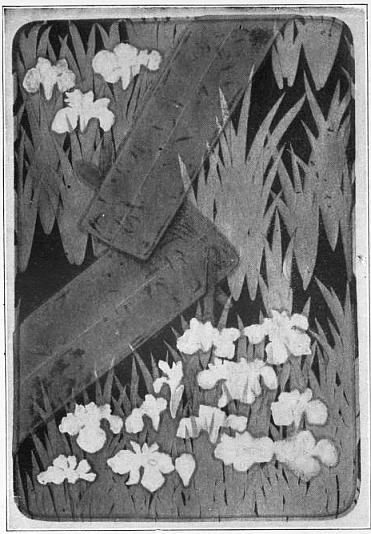
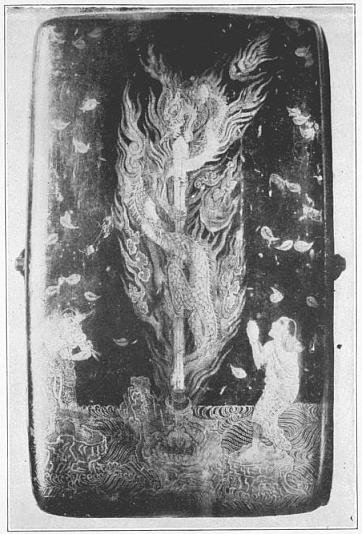
Fig. 18.—LID OF BOX. By Korin. Fig. 19.—CASE FOR HEAD OF A SKAKUJO.
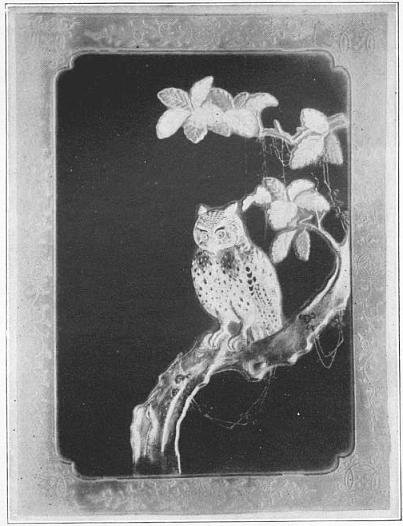
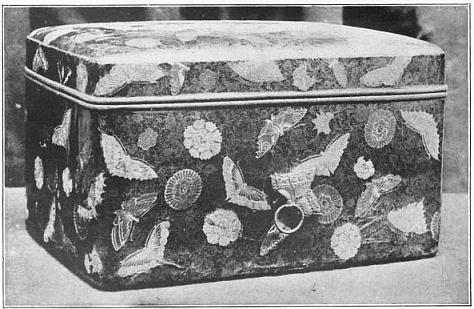
Fig. 20.—OWL ON A BRANCH. By Ritsuo. Fig. 21.—BOX WITH BUTTERFLIES AND FLOWERS IN GOLD (12th century).
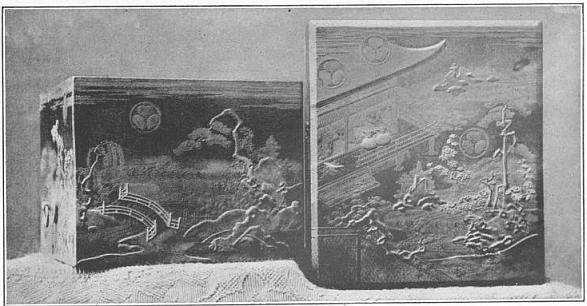
Fig. 22.—LACQUERED BOXES. By Kôami (1598-1651).
Plate VIII.
POTTERY AND PORCELAIN
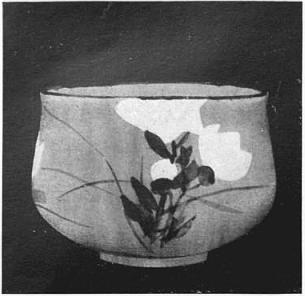
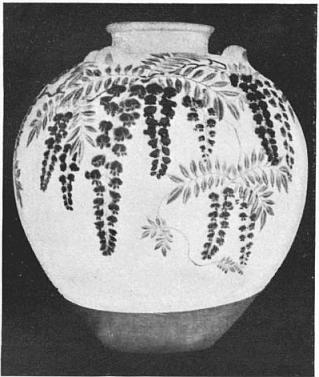
Fig. 23.—TEA BOWL. By Kenzan. Fig. 24.—TEA JAR. By Ninsei.
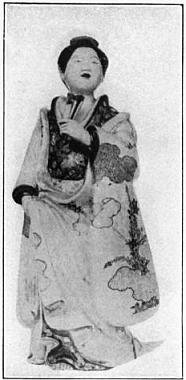
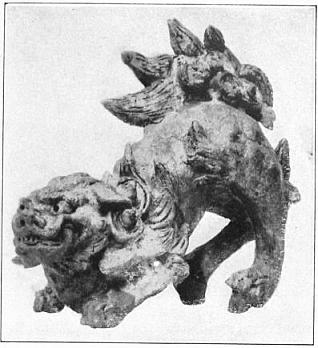
Fig. 25.—FIGURE. By Kakiemon. Arita porcelain. Fig. 26.—LION. By Chojiro Raku.
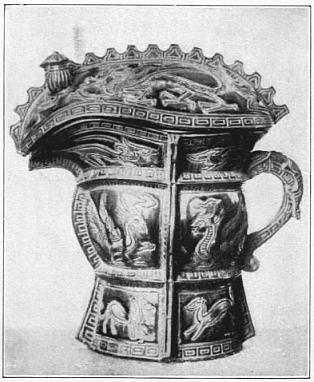
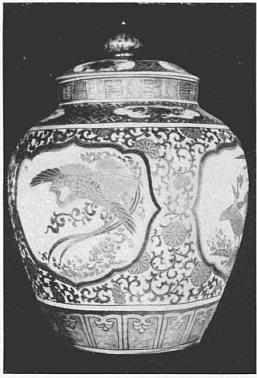
Fig. 27.—CENSER, WITH KOCHI GLAZE. By Eisen. Fig. 28.—TEA JAR. By Ninsei.
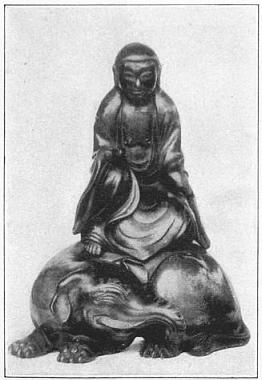
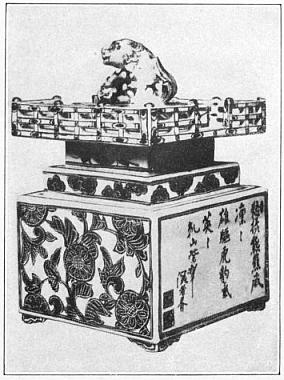
Fig. 29.—BIZEN WARE. Samantabhadra. Fig. 30.—CENSER. By Kenzan.
No phrase is commoner in the mouths of Western collectors than “Old Satsuma”; no ware is rarer in Western collections. Nine hundred and ninety-nine pieces out of every thousand that do duty as genuine examples of this prince of Satsuma. faiences are simply examples of the skill of modern forgers. In point of fact, the production of faience decorated with gold and coloured enamels may be said to have commenced at the beginning of the eighth century in Satsuma. Some writers maintain that it did actually commence then, and that nothing of the kind had existed there previously. Setting aside, however, the strong improbability that a style of decoration so widely practised and so highly esteemed could have remained unknown during a century and a half to experts working for one of the most puissant chieftains in Japan, we have the evidence of trustworthy traditions and written records that enamelled faience was made by the potters at Tatsumonji—the principal factory of Satsuma-ware in early days—as far back as the year 1676. Mitsuhisa, then feudal lord of Satsuma, was a munificent patron of art. He summoned to his fief the painter Tangen—a pupil of the renowned Tanyū, who died in 1674—and employed him to paint faience or to furnish designs for the ceramists of Tatsumonji. The ware produced under these circumstances is still known by the name of Satsuma Tangen. But the number of specimens was small. Destined chiefly for private use or for presents, their decoration was delicate rather than rich, the colour chiefly employed being brown, or reddish brown, under the glaze, and the decoration over the glaze being sparse and chaste. Not until the close of the l8th century or the beginning of the 19th did the more profuse fashion of enamelled decoration come to be largely employed. It was introduced by two potters who had visited Kiōto, and there observed the ornate methods so well illustrated in the wares of Awata and Kiyōmizu. At the same time a strong impetus was given to the production of faience at Tadeno—then the chief factory in Satsuma—owing to the patronage of Shimazu Tamanobu, lord of the province. To this increase in production and to the more elaborate application of verifiable enamels may be attributed the erroneous idea that Satsuma faience decorated with gold and coloured enamels had its origin at the close of the 18th century. For all the purposes of the ordinary collector it may be said to have commenced then, and to have come to an end about 1860; but for the purposes of the historian we must look farther back.
The ceramic art in Satsuma owed much to the aid of a number of Korean experts who settled there after the return of the Japanese forces from Korea. One of these men, Boku Heii, discovered (1603) clay fitted for the manufacture of white craquelé faience. This was the subsequently celebrated Satsuma-yaki. But in Boku’s time, and indeed as long as the factories flourished, many other kinds of faience were produced, the principal having rich black or flambé glazes, while a few were green or yellow monochromes. One curious variety, called same-yaki, had glaze chagrined like the skin of a shark. Most of the finest pieces of enamelled faience were the work of artists at the Tadeno factory, while the best specimens of other kinds were by the artists of Tatsumonji.
The porcelain of Kutani is among those best known to Western collectors, though good specimens ofthe old ware have always been scarce. Its manufacture dates from the close of the 17th century, when the feudal chief of Kaga took the industry Kutani. under his patronage. There were two principal varieties of the ware: ao-Kutani, so called because of a green (ao) enamel of great brilliancy and beauty which was largely used in its decoration, and Kutani with painted and enamelled pâte varying from hard porcelain to pottery. Many of the pieces are distinguished by a peculiar creamy whiteness of glaze, suggesting the idea that they were intended to imitate the soft-paste wares of China. The enamels are used to delineate decorative subjects and are applied in masses, the principal colours being green, yellow and soft Prussian blue, all brilliant and transparent, with the exception of the last which is nearly opaque. In many cases we find large portions of the surface completely covered with green or yellow enamel overlying black diapers or scroll patterns. The second variety of Kutani ware may often be mistaken for “old Japan” (i.e. Imari porcelain). The most characteristic examples of it are distinguishable, however, by the preponderating presence of a peculiar russet red, differing essentially from the full-bodied and comparatively brilliant colour of the Arita pottery. Moreover, the workmen of Kaga did not follow the Arita precedent of massing blue under the glaze. In the great majority of cases they did not use blue at all in this position, and when they did, its place was essentially subordinate. They also employed silver freely for decorative purposes, whereas we rarely find it thus used on “old Japan” porcelain.
About the time (1843) of the ao-Kutani revival, a potter called lida Hachiroemon introduced a style of decoration which subsequently came to be regarded as typical of all Kaga procelains. Taking the Eiraku porcelains of Kiōto as models, Hachiroemon employed red grounds with designs traced on them in gold. The style was not absolutely new in Kaga. We find similar decoration on old and choice examples of Kutani-yaki. But the character of the old red differs essentially from that of the modern manufacture—the former being a soft, subdued colour, more like a bloom than an enamel; the latter a glossy and comparatively crude pigment. In Hachiroemon’s time and during the twenty years following the date of his innovation, many beautiful examples of elaborately decorated Kutani porcelain were produced. The richness, profusion and microscopic accuracy of their decoration could scarcely have been surpassed; but, with very rare exceptions, their lack of delicacy of technique disqualifies them to rank as fine porcelains.
It was at the little village of Seto, some five miles from Nagoya, the chief town of the province of Owari, or Bishū, that the celebrated Kato Shirozaemon made the first Japanese faience worthy to be considered a technical success. Shirozaemon Owari. produced dainty little tea-jars, ewers and other cha-no-yu utensils. These, being no longer stoved in an inverted position, as had been the habit before Shirozaemon’s time, were not disfigured by the bare, blistered lips of their predecessors. Their pâte was close and well-manufactured pottery, varying in colour from dark brown to russet, and covered with thick, lustrous glazes—black, amber-brown, chocolate and yellowish grey. These glazes were not monochromatic: they showed differences of tint, and sometimes marked varieties of colour; as when chocolate-brown passed into amber, or black was relieved by streaks and clouds of grey and dead-leaf red. This ware came to be known as Tōshiro-yaki, a term obtained by combining the second syllable of Katō with the two first of Shirozaemon. A genuine example of it is at present worth many times its weight in gold to Japanese dilettanti, though in foreign eyes it is little more than interesting. Shirozaemon was succeeded at the kiln by three generations of his family, each representative retaining the name of Tōshiro, and each distinguishing himself by the excellence of his work. Thenceforth Seto became the headquarters of the manufacture of cha-no-yu utensils, and many of the tiny pieces turned out there deserve high admiration, their technique being perfect, and their mahogany, russet-brown, amber and buff glazes showing wonderful lustre and richness. Seto, in fact, acquired such a widespread reputation for its ceramic productions that the term seto-mono (Seto article) came to be used generally for all pottery and porcelain, just as “China” is in the West. Seto has now ceased to be a pottery-producing centre, and has become the chief porcelain manufactory of Japan. The porcelain industry was inaugurated in 1807 by Tamikichi, a local ceramist, who had visited Hizen and spent three years there studying the necessary processes. Owari abounds in porcelain stone; but it does not occur in constant or particularly simple forms, and as the potters have not yet learned to treat their materials scientifically, their work is often marred by unforeseen difficulties. For many years after Tamikichi’s processes had begun to be practised, the only decoration employed was blue under the glaze. Sometimes Chinese cobalt was used, sometimes Japanese, and sometimes a mixture of both. To Kawamoto Hansuke, who flourished about 1830-1845, belongs the credit of having turned out the richest and most attractive ware of this class. But, speaking generally, Japanese blues do not rank on the same decorative level with those of China. At Arita, although pieces were occasionally turned out of which the colour could not be surpassed in purity and brilliancy, the general character of the blue sous couverte was either thin or dull. At Hirado the ceramists affected a lighter and more delicate tone than that of the Chinese, and, in order to obtain it, subjected the choice pigment of the Middle Kingdom to refining processes of great severity. The Hirado blue, therefore, belongs to a special aesthetic category. But at Owari the experts were content with an inferior colour, and their blue-and-white porcelains never enjoyed a distinguished reputation, though occasionally we find a specimen of great merit.
Decoration with vitrifiable enamels over the glaze, though it began to be practised at Owari about the year 1840, never became a speciality of the place. Nowadays, indeed, numerous examples of porcelains decorated in this manner are classed among Owari products. But they receive their decoration, almost without exception, in Tōkyō or Yokohama, where a large number of artists, called e-tsuke-shi, devote themselves entirely to porcelain-painting. These men seldom use vitrifiable enamels, pigments being much more tractable and less costly. The dominant feature of the designs is pictorial. They are frankly adapted to Western taste. Indeed, of this porcelain it may be said that, from the monster pieces of blue-and-white manufactured at Seto—vases six feet high and garden pillar-lamps half as tall again do not dismay the Bishū ceramist—to tiny coffee-cups decorated in Tōkyō, with their delicate miniatures of birds, flowers, insects, fishes and so forth, everything indicates the death of the old severe aestheticism. To such a depth of debasement had the ceramic art fallen in Owari, that before the happy renaissance of the past ten years, Nagoya discredited itself by employing porcelain as a base for cloisonné enamelling. Many products of this vitiated industry have found their way into the collections of foreigners.
Pottery was produced at several hamlets in Bizen as far back as the 14th century, but ware worthy of artistic notice did not make its appearance until the close of the 16th century, when the Taikō himself paid a visit to the factory at Imbe. Bizen. Thenceforth utensils for the use of the tea clubs began to be manufactured. This Bizen-yaki was red stoneware, with thin diaphanous glaze. Made of exceedingly refractory clay, it underwent stoving for more than three weeks, and was consequently remarkable for its hardness and metallic timbre. Some fifty years later, the character of the choicest Bizen-yaki underwent a marked change. It became slate-coloured or bluish-brown faience, with pâte as fine as pipe-clay, but very hard. In the ao-Bizen (blue Bizen), as well as in the red variety, figures of mythical beings and animals, birds, fishes and other natural objects, were modelled with a degree of plastic ability that can scarcely be spoken of in too high terms. Representative specimens are truly admirable—every line, every contour faithful. The production was very limited, and good pieces soon ceased to be procurable except at long intervals and heavy expense. The Bizen-yaki familiar to Western collectors is comparatively coarse brown or reddish brown, stoneware, modelled rudely, though sometimes redeemed by touches of the genius never entirely absent from the work of the Japanese artisan-artist. Easy to be confounded with it is another ware of the same type manufactured at Shidoro in the province of Tōtōmi.
The Japanese potters could never vie with the Chinese in the production of glazes: the wonderful monochromes and polychromes of the Middle Kingdom had no peers anywhere. In Japan they were most closely approached by the faience Takatori. of Takatori in the province of Chikuzen. In its early days the ceramic industry of this province owed something to the assistance of Korean experts who settled there after the expedition of 1592. But its chief development took place under the direction of Igarashi Jizaemon, an amateur ceramist, who, happening to visit Chikuzen about 1620, was taken under the protection of the chief of the fief and munificently treated. Taking the renowned yao-pien-yao, or “transmutation ware” of China as a model, the Takatori potters endeavoured, by skilful mixing of colouring materials, to reproduce the wonderful effects of oxidization seen in the Chinese ware. They did not, indeed, achieve their ideal, but they did succeed in producing some exquisitely lustrous glazes of the flambé type, rich transparent brown passing into claret colour, with flecks or streaks of white and clouds of “iron dust.” The pâte of this faience was of the finest description, and the technique in every respect faultless. Unfortunately, the best experts confined themselves to working for the tea clubs, and consequently produced only insignificant pieces, as tea-jars, cups and little ewers. During the 18th century, a departure was made from these strict canons. From this period date most of the specimens best known outside Japan—cleverly modelled figures of mythological beings and animals covered with lustrous variegated glazes, the general colours being grey or buff, with tints of green, chocolate, brown and sometimes blue.
A ware of which considerable quantities have found their way westward of late years in the Awaji-yaki, so called from the island of Awaji where it is manufactured in the village of Iga. It was first produced between the years 1830 and 1840 Awaji. by one Kajū Mimpei, a man of considerable private means who devoted himself to the ceramic art out of pure enthusiasm. His story is full of interest, but it must suffice here to note the results of his enterprise. Directing his efforts at first to reproducing the deep green and straw-yellow glazes of China, he had exhausted almost his entire resources before success came, and even then the public was slow to recognize the merits of his ware. Nevertheless he persevered, and in 1838 we find him producing not only green and yellow monochromes, but also greyish white and mirror-black glazes of high excellence. So thoroughly had he now mastered the management of glazes that he could combine yellow, green, white and claret colour in regular patches to imitate tortoise-shell. Many of his pieces have designs incised or in relief, and others are skilfully decorated with gold and silver. Awaji-yaki, or Mimpei-yaki as it is often called, is generally porcelain, but we occasionally find specimens which may readily be mistaken for Awata faience.
Banko faience is a universal favourite with foreign collectors. The type generally known to them is exceedingly light ware, for the most part made of light grey, unglazed clay, and having hand-modelled decoration in relief. But there are Banko. numerous varieties. Chocolate or dove-coloured grounds with delicate diapers in gold and engobe; brown or black faience with white, yellow and pink designs incised or in relief; pottery curiously and deftly marbled by combinations of various coloured clays—these and many other kinds are to be found, all, however, presenting one common feature, namely, skilful finger-moulding and a slight roughening of the surface as though it had received the impression of coarse linen or crape before baking. This modern banko-yaki is produced chiefly at Yokkaichi in the province of Ise. It is entirely different from the original banko-ware made in Kuwana, in the same province, by Numanami Gozaemon at the close of the 18th century. Gozaemon was an imitator. He took for his models the raku faience of Kiōto, the masterpieces of Ninsei and Kenzan, the rococo wares of Korea, the enamelled porcelain of China, and the blue-and-white ware of Delft. He did not found a school, simply because he had nothing new to teach, and the fact that a modern ware goes by the same name as his productions is simply because his seal—the inscription on which (banko, everlasting) suggested the name of the ware—subsequently (1830) fell into the hands of one Mori Yūsetsu, who applied it to his own ware. Mori Yūsetsu, however, had more originality than Numanami. He conceived the idea of shaping his pieces by putting the mould inside and pressing the clay with the hand into the matrix. The consequence was that his wares received the design on the inner as well as the outer surface, and were moreover thumb-marked—essential characteristics of the banko-yaki now so popular.
Among a multitude of other Japanese wares, space allows us to mention only two, those of Izumo and Yatsushiro. The chief of the former is faience, having light grey, close pâte and yellow or straw-coloured glaze, with or without crackle, Izumo. to which is applied decoration in gold and green enamel. Another variety has chocolate glaze, clouded with amber and flecked with gold dust. The former faience had its origin at the close of the 17th century, the latter at the close of the 18th; but the Izumo-yaki now procurable is a modern production.
The Yatsushiro faience is a production of the province of Higo, where a number of Korean potters settled at the close of the 17th century. It is the only Japanese ware in which the characteristics of a Korean original are unmistakably preserved. Yatsushiro. Its diaphanous, pearl-grey glaze, uniform, lustrous and finely crackled, overlying encaustic decoration in white slip, the fineness of its warm reddish pâte, and the general excellence of its technique, have always commanded admiration. It is produced now in considerable quantities, but the modern ware falls far short of its predecessor.
Many examples of the above varieties deserve the enthusiastic admiration they have received, yet they unquestionably belong to a lower rank of ceramic achievements than the choice productions of Chinese kilns. The potters of the Middle Kingdom, from the early eras of the Ming dynasty down to the latest years of the 18th century, stood absolutely without rivals as makers of porcelain. Their technical ability was incomparable—though in grace of decorative conception they yielded the palm to the Japanese—and the representative specimens they bequeathed to posterity remained, until quite recently, far beyond the imitative capacity of European or Asiatic experts. As for faience and pottery, however, the Chinese despised them in all forms, with one notable exception, the yi-hsing-yao, known in the Occident as boccaro. Even the yi-hsing-yao, too, owed much of its popularity to special utility. It was essentially the ware of the tea-drinker. If in the best specimens exquisite modelling, wonderful accuracy of finish and pâtes of interesting tints are found, such pieces are, none the less, stamped prominently with the character of utensils rather than with that of works of art. In short, the artistic output of Chinese kilns in their palmiest days was, not faience or pottery, but porcelain, whether of soft or hard paste. Japan, on the contrary, owes her ceramic distinction in the main to her faience. A great deal has been said by enthusiastic writers about the famille chrysanthemo-péonienne of Imari and the genre Kakiemon of Nabeshima, but these porcelains, beautiful as they undoubtedly are, cannot be placed on the same level with the kwan-yao and famille rose of the Chinese experts. The Imari ware, even though its thick biscuit and generally ungraceful shapes be omitted from the account, shows no enamels that can rival the exquisitely soft, broken tints of the famille rose; and the Kakiemon porcelain, for all its rich though chaste contrasts, lacks the delicate transmitted tints of the shell-like kwan-yao. So, too, the blue-and-white porcelain of Hirado, though assisted by exceptional tenderness of sous-pâte colour, by milk-white glaze, by great beauty of decorative design, and often by an admirable use of the modelling or graving tool, represents a ceramic achievement palpably below the soft paste kai-pien-yao of King-te-chen. It is a curious and interesting fact that this last product of Chinese skill remained unknown in Japan down to very recent days. In the eyes of a Chinese connoisseur, no blue-and-white porcelain worthy of consideration exists, or ever has existed, except the kai-pien-yao, with its imponderable pâte, its wax-like surface, and its rich, glowing blue, entirely free from superficiality or garishness and broken into a thousand tints by the microscopic crackle of the glaze. The Japanese, although they obtained from their neighbour almost everything of value she had to give them, did not know this wonderful ware, and their ignorance is in itself sufficient to prove their ceramic inferiority. There remains, too, a wide domain in which the Chinese developed high skill, whereas the Japanese can scarcely be said to have entered it at all; namely, the domain of monochromes and polychromes, striking every note of colour from the richest to the most delicate; the domain of truité and flambé glazes, of yō-pien-yao (transmutation ware), and of egg-shell with incised or translucid decoration. In all that region of achievement the Chinese potters stood alone and seemingly unapproachable. The Japanese, on the contrary, made a specialty of faience, and in that particular line they reached a high standard of excellence. No faience produced either in China or any other Oriental country can dispute the palm with really representative specimens of Satsuma ware. Not without full reason have Western connoisseurs lavished panegyrics upon that exquisite production. The faience of the Kiōto artists never reached quite to the level of the Satsuma in quality of pâte and glowing mellowness of decoration; their materials were slightly inferior. But their skill as decorators was as great as its range was wide, and they produced a multitude of masterpieces on which alone Japan’s ceramic fame might safely be rested.
When the mediatization of the fiefs, in 1871, terminated the local patronage hitherto extended so munificently to artists, the Japanese ceramists gradually learned that they must thenceforth depend chiefly upon the Change of Style after the Restoration. markets of Europe and America. They had to appeal, in short, to an entirely new public, and how to secure its approval was to them a perplexing problem. Having little to guide them, they often interpreted Western taste incorrectly, and impaired their own reputation in a corresponding degree. Thus, in the early years of the Meiji era, there was a period of complete prostitution. No new skill was developed, and what remained of the old was expended chiefly upon the manufacture of meretricious objects, disfigured by excess of decoration and not relieved by any excellence of technique. In spite of their artistic defects, these specimens were exported in considerable numbers by merchants in the foreign settlements, and their first cost being very low, they found a not unremunerative market. But as European and American collectors became better acquainted with the capacities of the pre-Meiji potters, the great inferiority of these new specimens was recognized, and the prices commanded by the old wares gradually appreciated. What then happened was very natural: imitations of the old wares were produced, and having been sufficiently disfigured by staining and other processes calculated to lend an air of rust and age, they were sold to ignorant persons, who laboured under the singular yet common hallucination that the points to be looked for in specimens from early kilns were, not technical excellence, decorative tastefulness and richness of colour, but dinginess, imperfections and dirt; persons who imagined, in short, that defects which they would condemn at once in new porcelains ought to be regarded as merits in old. Of course a trade of that kind, based on deception, could not have permanent success. One of the imitators of “old Satsuma” was among the first to perceive that a new line must be struck out. Yet the earliest results of his awakened perception helped to demonstrate still further the depraved spirit that had come over Japanese art. For he applied himself to manufacture wares having a close affinity with the shocking monstrosities used for sepulchral purposes in ancient Apulia, where fragments of dissected satyrs, busts of nymphs or halves of horses were considered graceful excrescences for the adornment of an amphora or a pithos. This Makuzu faience, produced by the now justly celebrated Miyagawa Shōzan of Ota (near Yokohama), survives in the form of vases and pots having birds, reptiles, flowers, crustacea and so forth plastered over the surface—specimens that disgrace the period of their manufacture, and represent probably the worst aberration of Japanese ceramic conception.
A production so degraded as the early Makuzu faience could not possibly have a lengthy vogue. Miyagawa soon began to cast about for a better inspiration, and found it in the monochromes and polychromes of the Chinese Adoption of Chinese Models. Kang-hsi and Yung-cheng kilns. The extraordinary value attaching to the incomparable red glazes of China, not only in the country of their origin but also in the United States, where collectors showed a fine instinct in this matter, seems to have suggested to Miyagawa the idea of imitation. He took for model the rich and delicate “liquid-dawn” monochrome, and succeeded in producing some specimens of considerable merit. Thenceforth his example was largely followed, and it may now be said that the tendency of many of the best Japanese ceramists is to copy Chinese chefs-d’œuvre. To find them thus renewing their reputation by reverting to Chinese models, is not only another tribute to the perennial supremacy of Chinese porcelains, but also a fresh illustration of the eclectic genius of Japanese art. All the products of this new effort are porcelains proper. Seven kilns are devoted, wholly or in part, to the new wares: belonging to Miyagawa Shōzan of Ota, Seifū Yōhei of Kiōto, Takemoto Hayata and Katō Tomojiro of Tōkyō, Higuchi Haruzane of Hirado, Shida Yasukyo of Kaga and Kato Masukichi of Seto.
Among the seven ceramists here enumerated, Seifū of Kiōto probably enjoys the highest reputation. If we except the ware of Satsuma, it may be said that nearly all the fine faience of Japan was manufactured formerly in Kiōto. Nomura Seifū of Kiōto. Ninsei, in the middle of the 17th century, inaugurated a long era of beautiful productions with his cream-like “fish-roe” craquelé glazes, carrying rich decoration of clear and brilliant vitrifiable enamels. It was he who gave their first really artistic impulse to the kilns of Awata, Mizoro and Iwakura, whence so many delightful specimens of faience issued almost without interruption until the middle of the 19th century and continue to issue to-day. The three Kenzan, of whom the third died in 1820; Ebisei; the four Dōhachi, of whom the fourth was still alive in 1909; the Kagiya family, manufacturers of the celebrated Kinkōzan ware; Hōzan, whose imitations of Delft faience and his pâte-sur-pâte pieces with fern-scroll decoration remain incomparable; Taizan Yōhei, whose ninth descendant of the same name now produces fine specimens of Awata ware for foreign markets; Tanzan Yōshitaro and his son Rokuro, to whose credit stands a new departure in the form of faience having pâte-sur-pâte decoration of lace patterns, diapers and archaic designs executed in low relief with admirable skill and minuteness; the two Bizan, renowned for their representations of richly apparelled figures as decorative motives; Rokubei, who studied painting under Maruyama Ōkyō and followed the naturalistic style of that great artist; Mokubei, the first really expert manufacturer of translucid porcelain in Kiōto; Shūhei, Kintei, and above all, Zengoro Hōzen, the celebrated potter of Eiraku wares—these names and many others give to Kiōto ceramics an eminence as well as an individuality which few other wares of Japan can boast. Nor is it to be supposed that the ancient capital now lacks great potters. Okamura Yasutaro, commonly called Shōzan, produces specimens which only a very acute connoisseur can distinguish from the work of Nomura Ninsei; Tanzan Rokuro’s half-tint enamels and soft creamy glazes would have stood high in any epoch; Taizan Yōhei produces Awata faience not inferior to that of former days; Kagiya Sōbei worthily supports the reputation of the Kinkōzan ware; Kawamoto Eijiro has made to the order of a well-known Kiōto firm many specimens now figuring in foreign collections as old masterpieces; and Itō Tōzan succeeds in decorating faience with seven colours sous couverte (black, green, blue, russet-red, tea-brown, purple and peach), a feat never before accomplished. It is therefore an error to assert that Kiōto has no longer a title to be called a great ceramic centre. Seifū Yōhei, however, has the special faculty of manufacturing monochromatic and jewelled porcelain and faience, which differ essentially from the traditional Kiōto types, their models being taken directly from China. But a sharp distinction has to be drawn between the method of Seifū and that of the other six ceramists mentioned above as following Chinese fashions. It is this, that whereas the latter produce their chromatic effects by mixing the colouring matter with the glaze, Seifū paints the biscuit with a pigment over which he runs a translucid colourless glaze. The Kiōto artist’s process is much easier than that of his rivals, and although his monochromes are often of most pleasing delicacy and fine tone, they do not belong to the same category of technical excellence as the wares they imitate. From this judgment must be excepted, however, his ivory-white and céladon wares, as well as his porcelains decorated with blue, or blue and red sous couverte, and with vitrifiable enamels over the glaze. In these five varieties he is emphatically great. It cannot be said, indeed, that his céladon shows the velvety richness of surface and tenderness of colour that distinguished the old Kuang-yao and Lungchuan-yao of China, or that he has ever essayed the moss-edged crackle of the beautiful Ko-yao. But his céladon certainly equals the more modern Chinese examples from the Kang-hsi and Yung-cheng kilns. As for his ivory-white, it distinctly surpasses the Chinese Ming Chen-yao in every quality except an indescribable intimacy of glaze and pâte which probably can never be obtained by either Japanese or European methods.
Miyagawa Shōzan, or Makuzu, as he is generally called, has never followed Seifū’s example in descending from the difficult manipulation of coloured glazes to the comparatively simple process of painted biscuit. This comment does not Miyagawa Shōzan. refer to the use of blue and red sous couverte. In that class of beautiful ware the application of pigment to the unglazed pâte is inevitable, and both Seifū and Miyagawa, working on the same lines as their Chinese predecessors, produce porcelains that almost rank with choice Kang-hsi specimens, though they have not yet mastered the processes sufficiently to employ them in the manufacture of large imposing pieces or wares of moderate price. But in the matter of true monochromatic and polychromatic glazes, to Shōzan belongs the credit of having inaugurated Chinese fashions, and if he has never fully succeeded in achieving lang-yao (sang-de-bœuf), chi-hung (liquid-dawn red), chiang-tou-hung (bean-blossom red, the “peach-blow” of American collectors), or above all pin-kwo-tsing (apple-green with red bloom), his efforts to imitate them have resulted in some very interesting pieces.
Takemoto and Katō of Tōkyō entered the field subsequently to Shōzan, but followed the same models approximately. Takemoto, however, has made a speciality of black glazes, his aim being to rival the Sung Chien-yao, with its glaze Tōkyō Ceramists. of mirror-black or raven’s-wing green, and its leveret fur streaking or russet-moss dappling, the prince of all wares in the estimation of the Japanese tea-clubs. Like Shōzan, he is still very far from his original, but, also like Shōzan, he produces highly meritorious pieces in his efforts to reach an ideal that will probably continue to elude him for ever. Of Katō there is not much to be said. He has not succeeded in winning great distinction, but he manufactures some very delicate monochromes, fully deserving to be classed among prominent evidences of the new departure. Tōkyō was never a centre of ceramic production. Even during the 300 years of its conspicuous prosperity as the administrative capital of the Tokugawa shōguns, it had no noted factories, doubtless owing to the absence of any suitable potter’s clay in the immediate vicinity. Its only notable production of a ceramic character was the work of Miura Kenya (1830-1843), who followed the methods of the celebrated Haritsu (1688-1704) of Kiōto in decorating plain or lacquered wood with mosaics of raku faience having coloured glazes. Kenya was also a skilled modeller of figures, and his factory in the Imado suburb obtained a considerable reputation for work of that nature. He was succeeded by Tozawa Benshi, an old man of over seventy in 1909, who, using clay from Owari or Hizen, has turned out many porcelain statuettes of great beauty. But although the capital of Japan formerly played only an insignificant part in Japanese ceramics, modern Tōkyō has an important school of artist-artisans. Every year large quantities of porcelain and faience are sent from the provinces to the capital to receive surface decoration, and in wealth of design as well as carefulness of execution the results are praiseworthy. But of the pigments employed nothing very laudatory could be said until very recent times. They were generally crude, of impure tone, and without depth or brilliancy. Now, however, they have lost these defects and entered a period of considerable excellence. Figure-subjects constitute the chief feature of the designs. A majority of the artists are content to copy old pictures of Buddha’s sixteen disciples, the seven gods of happiness, and other similar assemblages of mythical or historical personages, not only because such work offers large opportunity for the use of striking colours and the production of meretricious effects, dear to the eye of the average Western householder and tourist, but also because a complicated design, as compared with a simple one, has the advantage of hiding the technical imperfections of the ware. Of late there have happily appeared some decorators who prefer to choose their subjects from the natural field in which their great predecessors excelled, and there is reason to hope that this more congenial and more pleasing style will supplant its modern usurper. The best known factory in Tōkyō for decorative purposes is the Hyōchi-en. It was established in the Fukagawa suburb in 1875, with the immediate object of preparing specimens for the first Tōkyō exhibition held at that time. Its founders obtained a measure of official aid, and were able to secure the services of some good artists, among whom may be mentioned Obanawa and Shimauchi. The porcelains of Owari and Arita naturally received most attention at the hands of the Hyōchi-en decorators, but there was scarcely one of the principal wares of Japan upon which they did not try their skill, and if a piece of monochromatic Minton or Sèvres came in their way, they undertook to improve it by the addition of designs copied from old masters or suggested by modern taste. The cachet of the Fukagawa atelier was indiscriminately applied to all such pieces, and has probably proved a source of confusion to collectors. Many other factories for decoration were established from time to time in Tōkyō. Of these some still exist; others, ceasing to be profitable, have been abandoned. On the whole, the industry may now be said to have assumed a domestic character. In a house, presenting no distinctive features whatsoever, one finds the decorator with a cupboard full of bowls and vases of glazed biscuit, which he adorns, piece by piece, using the simplest conceivable apparatus and a meagre supply of pigments. Sometimes he fixes the decoration himself, employing for that purpose a small kiln which stands in his back garden; sometimes he entrusts this part of the work to a factory. As in the case of everything Japanese, there is no pretence, no useless expenditure about the process. Yet it is plain that this school of Tōkyō decorators, though often choosing their subjects badly, have contributed much to the progress of the ceramic art during the past few years. Little by little there has been developed a degree of skill which compares not unfavourably with the work of the old masters. Table services of Owari porcelain—the ware itself excellently manipulated and of almost egg-shell fineness—are now decorated with floral scrolls, landscapes, insects, birds, figure-subjects and all sorts of designs, chaste, elaborate or quaint; and these services, representing so much artistic labour and originality, are sold for prices that bear no due ratio to the skill required in their manufacture.
There is only one reservation to be made in speaking of the modern decorative industry of Japan under its better aspects. In Tōkyō, Kiōto, Yokohama and Kobe—in all of which places decorating ateliers (etsuke-dokoro), similar to those of Tōkyō, have been established in modern times—the artists use chiefly pigments, seldom venturing to employ vitrifiable enamels. That the results achieved with these different materials are not comparable is a fact which every connoisseur must admit. The glossy surface of a porcelain glaze is ill fitted for rendering artistic effects with ordinary colours. The proper field for the application of these is the biscuit, in which position the covering glaze serves at once to soften and to preserve the pigment. It can scarcely be doubted that the true instincts of the ceramist will ultimately counsel him to confine his decoration over the glaze to vitrifiable enamels, with which the Chinese and Japanese potters of former times obtained such brilliant results. But to employ enamels successfully is an achievement demanding special training and materials not easy to procure or to prepare. The Tōkyō decorators are not likely, therefore, to change their present methods immediately.
An impetus was given to ceramic decoration by the efforts of a new school, which owed its origin to Dr G. Wagener, an eminent German expert formerly in the service of the Japanese government. Dr Wagener conceived the idea of developing the art of decoration under the glaze, as applied to faience. Faience thus decorated has always been exceptional in Japan. Rare specimens were produced in Satsuma and Kiōto, the colour employed being chiefly blue, though brown and black were used in very exceptional instances. The difficulty of obtaining clear, rich tints was nearly prohibitive, and though success, when achieved, seemed to justify the effort, this class of ware never received much attention in Japan. By careful selection and preparation of pâte, glaze and pigments, Dr Wagener proved not only that the manufacture was reasonably feasible, but also that decoration thus applied to pottery possesses unique delicacy and softness. Ware manufactured by his direction at the Tōkyō school of technique (shokkô gakkô), under the name of asahi-yaki, ranks among the interesting productions of modern Japan. The decorative colour chiefly employed is chocolate brown, which harmonizes excellently with the glaze. But the ware has never found favour in Japanese eyes, an element of unpleasant garishness being imparted to it by the vitreous appearance of the glaze, which is manufactured according to European methods. The modern faience of Ito Tōzan of Kiōto, decorated with colour under the glaze, is incomparably more artistic than the Tōkyō asahi-yaki, from which, nevertheless, the Kiōto master doubtless borrowed some ideas. The decorative industry in Tōkyō owed much also to the kōshō-kaisha, an institution started by Wakai and Matsuo in 1873, with official assistance. Owing to the intelligent patronage of this company, and the impetus given to the ceramic trade by its enterprise, the style of the Tōkyō etsuke was much improved and the field of their industry extended. It must be acknowledged, however, that the Tōkyō artists often devote their skill to purposes of forgery, and that their imitations, especially of old Satsuma-yaki, are sometimes franked by dealers whose standing should forbid such frauds. In this context it may be mentioned that, of late years, decoration of a remarkably microscopic character has been successfully practised in Kiōto, Osaka and Kobe, its originator being Meisan of Osaka. Before dismissing the subject of modern Tōkyō ceramics, it may be added that Katō Tomatarō, mentioned above in connexion with the manufacture of special glazes, has also been very successful in producing porcelains decorated with blue sous couverte at his factory in the Koishikawa suburb.
Higuchi of Hirado is to be classed with ceramists of the new school on account of one ware only, namely, porcelain having translucid decoration, the so-called “grains of rice” of American collectors, designated hotaru-de (firefly style) in Japan. Modern Wares of Hirado. That, however, is an achievement of no small consequence, especially since it had never previously been essayed outside China. The Hirado expert has not yet attained technical skill equal to that of the Chinese. He cannot, like them, cover the greater part of a specimen’s surface with a lacework of transparent decoration, exciting wonder that pâte deprived so greatly of continuity could have been manipulated without accident. But his artistic instincts are higher than those of the Chinese, and there is reasonable hope that in time he may excel their best works. In other respects the Hirado factories do not produce wares nearly so beautiful as those manufactured there between 1759 and 1840, when the Hirado-yaki stood at the head of all Japanese porcelain on account of its pure, close-grained pâte, its lustrous milk-white glaze, and the soft clear blue of its carefully executed decoration.
The Owari potters were slow to follow the lead of Miyagawa Shōzan and Seifū Yōhei. At the industrial exhibition in Kiōto (1895) the first results of their efforts were shown, attracting attention at once. In medieval times Owari Ware of Owari. was celebrated for faience glazes of various colours, much affected by the tea-clubs, but its staple manufacture from the beginning of the 19th century was porcelain decorated with blue under the glaze, the best specimens of which did not approach their Chinese prototypes in fineness of pâte, purity of glaze or richness of colour. During the first twenty-five years of the Meiji era the Owari potters sought to compensate the technical and artistic defects of their pieces by giving them magnificent dimensions; but at the Tōkyō industrial exhibition (1891) they were able to contribute some specimens showing decorative, plastic and graving skill of no mean order. Previously to that time, one of the Seto experts, Katō Gosuke, had developed remarkable ability in the manufacture of céladon, though in that field he was subsequently distanced by Seifū of Kiōto. Only lately did Owari feel the influence of the new movement towards Chinese types. Its potters took flambé glazes for models, and their pieces possessed an air of novelty that attracted connoisseurs. But the style was not calculated to win general popularity, and the manufacturing processes were too easy to occupy the attention of great potters. On a far higher level stood egg-shell porcelain, remarkable examples of which were sent from Seto to the Kiōto industrial exhibition of 1895. Chinese potters of the Yung-lo era (1403-1414) enriched their country with a quantity of ware to which the name of totai-ki (bodiless utensil) was given on account of its wonderfully attenuated pâte. The finest specimens of this porcelain had incised decoration, sparingly employed but adding much to the beauty of the piece. In subsequent eras the potters of King-te-chen did not fail to continue this remarkable manufacture, but its only Japanese representative was a porcelain distinctly inferior in more than one respect, namely, the egg-shell utensils of Hizen and Hirado, some of which had finely woven basket-cases to protect their extreme fragility. The Seto experts, however, are now making bowls, cups and vases that rank nearly as high as the celebrated Yung-lo totai-ki. In purity of tone and velvet-like gloss of surface there is distinct inferiority on the side of the Japanese ware, but in thinness of pâte it supports comparison, and in profusion and beauty of incised decoration it excels its Chinese original.
Latest of all to acknowledge the impulse of the new departure have been the potters of Kaga. For many years their ware enjoyed the credit, or discredit, of being the most lavishly decorated porcelain in Japan. It is known to Western collectors Ware of Kaga. as a product blazing with red and gold, a very degenerate offspring of the Chinese Ming type, which Hozen of Kiōto reproduced so beautifully at the beginning of the 19th century under the name of eiraku-yaki. Undoubtedly the best specimens of this kinran-de (brocade) porcelain of Kaga merit praise and admiration; but, on the whole, ware so gaudy could not long hold a high place in public esteem. The Kaga potters ultimately appreciated that defect. They still manufacture quantities of tea and coffee sets, and dinner or dessert services of red-and-gold porcelain for foreign markets; but about 1885 some of them made zealous and patient efforts to revert to the processes that won so much fame for the old Kutani-yaki, with its grand combinations of rich, lustrous, soft-toned glazes. The attempt was never entirely successful, but its results restored something of the Kaga kilns’ reputation. Since 1895, again, a totally new departure has been made by Morishita Hachizaemon, a ceramic expert, in conjunction with Shida Yasukyo, president of the Kaga products joint stock company (Kaga bussan kabushiki kaisha) and teacher in the Kaga industrial school. The line chosen by these ceramists is purely Chinese. Their great aim seems to be the production of the exquisite Chinese monochromes known as u-kwo-tien-tsing (blue of the sky after rain) and yueh-peh (clair-de-lune). But they also devote much attention to porcelains decorated with blue or red sous couverte. Their work shows much promise, but like all fine specimens of the Sino-Japanese school, the prices are too high to attract wide custom.
The sum of the matter is that the modern Japanese ceramist, after many efforts to cater for the taste of the Occident, evidently concludes that his best hope consists in devoting all his technical and artistic resources to Summary. reproducing the celebrated wares of China. In explanation of the fact that he did not essay this route in former times, it may be noted, first, that he had only a limited acquaintance with the wares in question; secondly, that Japanese connoisseurs never attached any value to their countrymen’s imitation of Chinese porcelains so long as the originals were obtainable; thirdly, that the ceramic art of China not having fallen into its present state of decadence, the idea of competing with it did not occur to outsiders; and fourthly, that Europe and America had not developed their present keen appreciation of Chinese masterpieces. Yet it is remarkable that China, at the close of the 19th century, should have again furnished models to Japanese eclecticism.
Lacquer.—Japan derived the art of lacquering from China (probably about the beginning of the 6th century), but she ultimately carried it far beyond Chinese conception. At first her experts confined themselves to plain black lacquer. From the early part of the 8th century they began to ornament it with dust of gold or mother-of-pearl, and throughout the Heian epoch (9th to 12th century) they added pictorial designs, though of a formal character, the chief motives being floral subjects, arabesques and scrolls. All this work was in the style known as hira-makie (flat decoration); that is to say, having the decorative design in the same plane as the ground. In the days of the great dilettante Yoshimasa (1449-1490), lacquer experts devised a new style, taka-makie, or decoration in relief, which immensely augmented the beauty of the ware, and constituted a feature altogether special to Japan. Thus when, at the close of the 16th century, the Taikō inaugurated the fashion of lavishing all the resources of applied art on the interior decoration of castles and temples, the services of the lacquerer were employed to an extent hitherto unknown, and there resulted some magnificent work on friezes, coffered ceilings, door panels, altar-pieces and cenotaphs. This new departure reached its climax in the Tokugawa mausolea of Yedo and Nikkō, which are enriched by the possession of the most splendid applications of lacquer decoration the world has ever seen, nor is it likely that anything of comparable beauty and grandeur will be again produced in the same line. Japanese connoisseurs indicate the end of the 17th century as the golden period of the art, and so deeply rooted is this belief that whenever a date has to be assigned to any specimen of exceptionally fine quality, it is unhesitatingly referred to the time of Joken-in (Tsunayoshi).
Among the many skilled artists who have practised this beautiful craft since the first on record, Kiyohara Norisuye (c. 1169), may be mentioned Kōyetsu (1558-1637) and his pupils, who are especially noted for their inro (medicine-cases worn as part of the costume); Kajikawa Kinjirō (c. 1680), the founder of the great Kajikawa family, which continued up to the 19th century; and Koma Kyūhaku (d. 1715), whose pupils and descendants maintained his traditions for a period of equal length. Of individual artists, perhaps the most notable is Ogata Kōrin (d. 1716), whose skill was equally great in the arts of painting and pottery. He was the eldest son of an artist named Ogato Sōken, and studied the styles of the Kanō and Tosa schools successively. Among the artists who influenced him were Kanō Tsunenobu, Nomura Sōtatsu and Kōyetsu. His lacquer-ware is distinguished for a bold and at times almost eccentric impressionism, and his use of inlay is strongly characteristic. Ritsuō (1663-1747), a pupil and contemporary of Kōrin, and like him a potter and painter also, was another lacquerer of great skill. Then followed Hanzan, the two Shiome, Yamamoto Shunshō and his pupils, Yamada Jōka and Kwanshōsai Tōyō (late 18th century). In the beginning of the 19th century worked Shōkwasai, who frequently collaborated with the metal-worker Shibayama, encrusting his lacquer with small decorations in metal by the latter.
No important new developments have taken place during modern times in Japan’s lacquer manufacture. Her artists follow the old ways faithfully; and indeed it is not easy to see how they could do better. On the other hand, there has Modern Work. not been any deterioration; all the skill of former days is still active. The contrary has been repeatedly affirmed by foreign critics, but no one really familiar with modern productions can entertain such a view. Lacquer-making, however, being essentially an art and not a mere handicraft, has its eras of great masters and its seasons of inferior execution. Men of the calibre of Kōyetsu Kōrin, Ritsuō, Kajikawa and Mitsutoshi must be rare in any age, and the epoch when they flourished is justly remembered with enthusiasm. But the Meiji era has had its Zeshin, and it had in 1909 Shirayama Fukumatsu, Kawanabe Itchō, Ogāwa Shōmin, Uematsu Hōmin, Shibayama Sōichi, Morishita Morihachi and other lesser experts, all masters in designing and execution. Zeshin, shortly before he died, indicated Shirayama Fukumatsu as the man upon whom his mantle should descend, and that the judgment of this really great craftsman was correct cannot be denied by any one who has seen the works of Shirayama. He excels in his representations of landscapes and waterscapes, and has succeeded in transferring to gold-lacquer panels tender and delicate pictures of nature’s softest moods—pictures that show balance, richness, harmony and a fine sense of decorative proportion. Kawanabe Itchō is celebrated for his representations of flowers and foliage, and Morishita Morihachi and Asano Saburo (of Kaga) are admirable in all styles, but especially, perhaps, in the charming variety called togi-dashi (ground down), which is pre-eminent for its satin-like texture and for the atmosphere of dreamy softness that pervades the decoration. The togi-dashi design, when finely executed, seems to hang suspended in the velvety lacquer or to float under its silky surface. The magnificent sheen and richness of the pure kin-makie (gold lacquer) are wanting, but in their place we have inimitable tenderness and delicacy.
The only branch of the lacquerer’s art that can be said to have shown any marked development in the Meiji era is that in which parts of the decorative scheme consist of objects in gold, silver, shakudo, shibuichi, iron, or, above all, ivory or mother-of-pearl. New Development. It might indeed be inferred, from some of the essays published in Europe on the subject of Japan’s ornamental arts, that this application of ivory and mother-of-pearl holds a place of paramount importance. Such is not the case. Cabinets, fire-screens, plaques and boxes resplendent with gold lacquer grounds carrying elaborate and profuse decoration of ivory and mother-of-pearl4 are not objects that appeal to Japanese taste. They belong essentially to the catalogue of articles called into existence to meet the demand of the foreign market, being, in fact, an attempt to adapt the lacquerer’s art to decorative furniture for European houses. On the whole it is a successful attempt. The plumage of gorgeously-hued birds, the blossoms of flowers (especially the hydrangea), the folds of thick brocade, microscopic diapers and arabesques, are built up with tiny fragments of iridescent shell, in combination with silver-foil, gold-lacquer and coloured bone, the whole producing a rich and sparkling effect. In fine specimens the workmanship is extraordinarily minute, and every fragment of metal, shell, ivory or bone, used to construct the decorative scheme, is imbedded firmly in its place. But in a majority of cases the work of building is done by means of paste and glue only, so that the result lacks durability. The employment of mother-of-pearl to ornament lacquer grounds dates from a period as remote as the 8th century, but its use as a material for constructing decorative designs began in the 17th century, and was due to an expert called Shibayama, whose descendant, Shibayama Sōichi, has in recent years been associated with the same work in Tōkyō.
Processes.
In the manufacture of Japanese lacquer there are three processes. The first is the extraction and preparation of the lac; the second, its application; and the third, the decoration of the lacquered surface. The lac, when taken from an incision in the trunk of the Rhus vernicifera (urushi-no-ki), contains approximately 70% of lac acid, 4% of gum arabic, 2% of albumen, and 24% of water. It is strained, deprived of its moisture, and receives an admixture of gamboge, cinnabar, acetous protoxide or some other colouring matter. The object to be lacquered, which is generally made of thin white pine, is subjected to singularly thorough and painstaking treatment, one of the processes being to cover it with a layer of Japanese paper or thin hempen cloth, which is fixed by means of a pulp of rice-paste and lacquer. In this way the danger of warping is averted, and exudations from the wooden surface are prevented from reaching the overlaid coats of lacquer. Numerous operations of luting, sizing, lacquering, polishing, drying, rubbing down, and so on, are performed by the nurimono-shi, until, after many days’ treatment, the object emerges with a smooth, lustre-like dark-grey or coloured surface, and is ready to pass into the hands of the makie-shi, or decorator. The latter is an artist; those who have performed the preliminary operations are merely skilled artisans. The makie-shi may be said to paint a picture on the surface of the already lacquered object. He takes for subject a landscape, a seascape, a battle-scene, flowers, foliage, birds, fishes, insects—in short, anything. This he sketches in outline with a paste of white lead, and then, having filled in the details with gold and colours, he superposes a coat of translucid lacquer, which is finally subjected to careful polishing. If parts of the design are to be in relief, they are built up with a putty of black lacquer, white lead, camphor and lamp-black. In all fine lacquers gold predominates so largely that the general impression conveyed by the object is one of glow and richness. It is also an inviolable rule that every part must show beautiful and highly finished work, whether it be an external or an internal part. The makie-shi ranks almost as high as the pictorial artist in Japanese esteem. He frequently signs his works, and a great number of names have been thus handed down during the past two centuries.
Cloisonné Enamel.—Cloisonné enamel is essentially of modern development in Japan. The process was known at an early period, and was employed for the purpose of subsidiary decoration from the close of the 16th century, but not until the 19th century did Japanese experts begin to manufacture the objects known in Europe as “enamels;” that is to say, vases, plaques, censers, bowls, and so forth, having their surface covered with vitrified pastes applied either in the champlevé or the cloisonné style. It is necessary to insist upon this fact, because it has been stated with apparent authority that numerous specimens which began to be exported from 1865 were the outcome of industry commencing in the 16th century and reaching its point of culmination at the beginning of the 18th. There is not the slenderest ground for such a theory. The work began in 1838, and Kaji Tsunekichi of Owari was its originator. During 20 years previously to the reopening of the country in 1858, cloisonné enamelling was practised in the manner now understood by the term; when foreign merchants began to settle in Yokohama, several experts were working skilfully in Owari after the methods of Kaji Tsunekichi. Up to that time there had been little demand for enamels of large dimensions, but when the foreign market called for vases, censers, plaques and such things, no difficulty was found in supplying them. Thus, about the year 1865, there commenced an export of enamels which had no prototypes in Japan, being destined frankly for European and American collectors. From a technical point of view these specimens had much to recommend them. The base, usually of copper, was as thin as cardboard; the cloisons, exceedingly fine and delicate, were laid on with care and accuracy; the colours were even, and the designs showed artistic judgment. Two faults, however, marred the work—first, the shapes were clumsy and unpleasing, being copied from bronzes whose solidity justified forms unsuited to thin enamelled vessels; secondly, the colours, sombre and somewhat impure, lacked the glow and mellowness that give decorative superiority to the technically inferior Chinese enamels of the later Ming and early Tsing eras. Very soon, however, the artisans of Nagoya (Owari), Yokohama and Tōkyō—where the art had been taken up—found that faithful and fine workmanship did not pay. The foreign merchant desired many and cheap specimens for export, rather than few and costly. There followed then a period of gradual decline, and the enamels exported to Europe showed so much inferiority that they were supposed to be the products of a widely different era and of different makers. The industry was threatened with extinction, and would certainly have dwindled to insignificant dimensions had not a few earnest artists, working in the face of many difficulties and discouragements, succeeded in striking out new lines and establishing new standards for excellence.
Three clearly differentiated schools now (1875) came into existence. One, headed by Namikawa Yasuyuki of Kiōto, took for its objects the utmost delicacy and perfection of technique, richness of decoration, purity of design and harmony of New Schools. colour. The thin clumsily-shaped vases of the Kaji school, with their uniformly distributed decoration of diapers, scrolls and arabesques in comparatively dull colours, ceased altogether to be produced, their place being taken by graceful specimens, technically flawless, and carrying designs not only free from stiffness, but also executed in colours at once rich and soft. This school may be subdivided, Kiōto representing one branch, Nagoya, Tōkyō and Yokohama the other. In the products of the Kiōto branch the decoration generally covered the whole surface of the piece; in the products of the other branch the artist aimed rather at pictorial effect, placing the design in a monochromatic field of low tone. It is plain that such a method as the latter implies great command of coloured pastes, and, indeed, no feature of the manufacture is more conspicuous than the progress made during the period 1880-1900 in compounding and firing vitrifiable enamels. Many excellent examples of cloisonné enamel have been produced by each branch of this school. There has been nothing like them in any other country, and they stand at an immeasurable distance above the works of the early Owari school represented by Kaji Tsunekichi and his pupils and colleagues.
The second of the modern schools is headed by Namikawa Sosuke of Tōkyō. It is an easily traced outgrowth of the second branch of the first school just described, for one can readily understand that from placing the decorative design in a Cloisonless Enamels. monochromatic field of low tone, which is essentially a pictorial method, development would proceed in the direction of concealing the mechanics of the art in order to enhance the pictorial effect. Thus arose the so-called “cloisonless enamels” (musenjippō). They are not always without cloisons. The design is generally framed at the outset with a ribbon of thin metal, precisely after the manner of ordinary cloisonné ware. But as the work proceeds the cloisons are hidden—unless their presence is necessary to give emphasis to the design—and the final result is a picture in vitrified enamels.
The characteristic productions of the third among the modern schools are monochromatic and translucid enamels. All students of the ceramic art know that the monochrome porcelains of China owe their beauty to the fact that the Monochromatic Enamels. colour is in the glaze, not under it. The ceramist finds no difficulty in applying a uniform coat of pigment to porcelain biscuit, and covering the whole with a diaphanous glaze. The colour is fixed and the glaze set by secondary firing at a lower temperature than that necessary for hardening the pâte. Such porcelains, however, lack the velvet-like softness and depth of tone so justly prized in the genuine monochrome, where the glaze itself contains the colouring matter, pâte and glaze being fired simultaneously at the same high temperature. It is apparent that a vitrified enamel may be made to perform, in part at any rate, the function of a porcelain glaze. Acting upon that theory, the experts of Tōkyō and Nagoya have produced many very beautiful specimens of monochrome enamel—yellow (canary or straw), rose du Barry, liquid-dawn, red, aubergine purple, green (grass or leaf), dove-grey and lapis lazuli blue. The pieces do not quite reach the level of Chinese monochrome porcelains, but their inferiority is not marked. The artist’s great difficulty is to hide the metal base completely. A monochrome loses much of its attractiveness when the colour merges into a metal rim, or when the interior of a vase is covered with crude unpolished paste. But to spread and fix the enamel so that neither at the rim nor in the interior shall there be any break of continuity, or any indication that the base is copper, not porcelain, demands quite exceptional skill.
The translucid enamels of the modern school are generally associated with decorative bases. In other words, a suitable design is chiselled in the metal base so as to be visible through the diaphanous enamel. Very beautiful effects of broken Translucid Enamel. and softened lights, combined with depth and delicacy of colour, are thus obtained. But the decorative designs which lend themselves to such a purpose are not numerous. A gold base deeply chiselled in wave-diaper and overrun with a paste of aubergine purple is the most pleasing. A still higher achievement is to apply to the chiselled base designs executed in coloured enamels, finally covering the whole with translucid paste. Admirable results are thus produced; as when, through a medium of cerulean blue, bright goldfish and blue-backed carp appear swimming in silvery waves, or brilliantly plumaged birds seem to soar among fleecy clouds. The artists of this school show also much skill in using enamels for the purposes of subordinate decoration—suspending enamelled butterflies, birds or floral sprays, among the reticulations of a silver vase chiselled à jour; or filling with translucid enamels parts of a decorative scheme sculptured in iron, silver, gold or shakudo.
V.—Economic Conditions
Communications.—From the conditions actually existing in the 8th century after the Christian era the first compilers of Japanese history inferred the conditions which might have existed in the 7th century before that era. One Roads and Posts in Early Times. of their inferences was that, in the early days, communication was by water only, and that not until 549 B.C. did the most populous region of the empire—the west coast—come into possession of public roads. Six hundred years later, the local satraps are represented as having received instructions to build regular highways, and in the 3rd century the massing of troops for an over-sea expedition invested roads with new value. Nothing is yet heard, however, about posts. These evidences of civilization did not make their appearance until the first great era of Japanese reform, the Taika period (645-650), when stations were established along the principal highways, provision was made of post-horses, and a system of bells and checks was devised for distinguishing official carriers. In those days ordinary travellers were required to carry passports, nor had they any share in the benefits of the official organization, which was entirely under the control of the minister of war. Great difficulties attended the movements of private persons. Even the task of transmitting to the central government provincial taxes paid in kind had to be discharged by specially organized parties, and this journey from the north-eastern districts to the capital generally occupied three months. At the close of the 7th century the emperor Mommu is said to have enacted a law that wealthy persons living near the highways must supply rice to travellers, and in 745 an empress (Koken) directed that a stock of medical necessaries must be kept at the postal stations. Among the benevolent acts attributed to renowned Buddhist priests posterity specially remembers their efforts to encourage the building of roads and bridges. The great emperor Kwammu (782-806) was constrained to devote a space of five years to the reorganization of the whole system of post-stations. Owing to the anarchy which prevailed during the 10th, 11th and 12th centuries, facilities of communication disappeared almost entirely, even for men of rank a long journey involved danger of starvation or fatal exposure, and the pains and perils of travel became a household word among the people.
Yoritomo, the founder of feudalism at the close of the 12th century, was too great a statesman to underestimate the value of roads and posts. The highway between his stronghold, Kamakura, and the imperial city, Kiōto, began in his time to develop features which ultimately entitled it to be called one of the finest roads in the world. But after Yoritomo’s death the land became once more an armed camp, in which the rival barons discouraged travel beyond the limits of their own domains. Not until the Tokugawa family obtained military control of the whole empire (1603), and, fixing its capital at Yedo, required the feudal chiefs to reside there every second year, did the problem of roads and post-stations force itself once more on official attention. Regulations were now strictly enforced, fixing the number of horses and carriers available at each station, the loads to be carried by them and their charges, as well as the transport services that each feudal chief was entitled to demand and the fees he had to pay in return. Tolerable hostelries now came into existence, but they furnished only shelter, fuel and the coarsest kind of food. By degrees, however, the progresses of the feudal chiefs to and from Yedo, which at first were simple and economical, developed features of competitive magnificence, and the importance of good roads and suitable accommodation received increased attention. This found expression in practice in 1663. A system more elaborate than anything antecedent was then introduced under the name of “flying transport.” Three kinds of couriers operated. The first class were in the direct employment of the shōgunate. They carried official messages between Yedo and Osaka—a distance of 348 miles—in four days by means of a well organized system of relays. The second class maintained communications between the fiefs and the Tokugawa court as well as their own families in Yedo, for in the alternate years of a feudatory’s compulsory residence in that city his family had to live there. The third class were maintained by a syndicate of 13 merchants as a private enterprise for transmitting letters between the three great cities of Kiōto, Osaka and Yedo and intervening places. This syndicate did not undertake to deliver a letter direct to an addressee. The method pursued was to expose letters and parcels at fixed places in the vicinity of their destination, leaving the addressees to discover for themselves that such things had arrived. Imperfect as this system was, it represented a great advance from the conditions in medieval times.