VOLUME XV SLICE II Jacobites to Japan (part) (continued 6)
Reading edition
(F. By.)
IV.—Japanese Art
Painting and Engraving.—In Japanese art the impressionist element is predominant. Pictures, as the term is understood in Europe, can scarcely be said to have existed at any time in Japan. The artist did not depict Pictorial Art. emotion: he depicted the subjects that produce emotion. Therefore he took his motives from nature rather than from history; or, if he borrowed from the latter, what he selected was a scene, not the pains or the passions of its actors. Moreover, he never exhausted his subject, but was always careful to leave a wide margin for the imagination of the spectator. This latter consideration sometimes impelled him to represent things which, to European eyes, seem trivial or insignificant, but which really convey hints of deep significance. In short, Japanese pictures are like Japanese poetry: they do not supply thought but only awaken it. Often their methods show conventionalism, but it is conventionalism so perfect and free in its allurements that nature seems to suggest both the motive and the treatment. Thus though neither botanically nor ornithologically correct, their flowers and their birds show a truth to nature, and a habit of minute observation in the artist, which cannot be too much admired. Every blade of grass, each leaf and feather, has been the object of loving and patient study.
It has been rashly assumed by some writers that the Japanese do not study from nature. All their work is an emphatic protest against this supposition. It can in fact be shown conclusively that the Japanese have derived all their fundamental ideas of symmetry, so different from ours, from a close study of nature and her processes in the attainment of endless variety. A special feature of their art is that, while often closely and minutely imitating natural objects, such as birds, flowers and fishes, the especial objects of their predilection and study, they frequently combine the facts of external nature with a conventional mode of treatment better suited to their purpose. During the long apprenticeship that educated Japanese serve to acquire the power of writing with the brush the complicated characters borrowed from Chinese, they unconsciously cultivate the habit of minute observation and the power of accurate imitation, and with these the delicacy of touch and freedom of hand which only long practice can give. A hair’s-breadth deviation in a line is fatal to good calligraphy, both among the Chinese and the Japanese. When they come to use the pencil in drawing, they already possess accuracy of eye and free command of the brush. Whether a Japanese art-worker sets himself to copy what he sees before him or to give play to his fancy in combining what he has seen with some ideal in his mind, the result shows perfect facility of execution and easy grace in all the lines.
The beauties of the human form never appealed to the Japanese artist. Associating the nude solely with the performance of menial tasks, he deemed it worse than a solecism to transfer such subjects to his canvas, and thus a wide field of motive was closed to him. On the other hand, the draped figure received admirable treatment from his brush, and the naturalistic school of the 17th, 18th and 19th centuries reached a high level of skill in depicting men, women and children in motion. Nor has there ever been a Japanese Landseer. Sosen’s monkeys and badgers constitute the one possible exception, but the horses, oxen, deer, tigers, dogs, bears, foxes and even cats of the best Japanese artists were ill drawn and badly modelled. In the field of landscape the Japanese painter fully reached the eminence on which his great Chinese masters stood. He did not obey the laws of linear perspective as they are formulated in the Occident, nor did he show cast shadows, but his aerial perspective and his foreshortening left nothing to be desired. It has been suggested that he deliberately eschewed chiaroscuro because his pictures, destined invariably to hang in an alcove, were required to be equally effective from every aspect and had also to form part of a decorative scheme. But the more credible explanation is that he merely followed Chinese example in this matter, as he did also in linear perspective, accepting without question the curious canon that lines converge as they approach the spectator.
It is in the realm of decorative art that the world has chiefly benefited by contact with Japan. Her influence is second only to that of Greece. Most Japanese decorative designs consist of natural objects, treated sometimes in a more Decorative Art. or less conventional manner, but always distinguished by delicacy of touch, graceful freedom of conception and delightfully harmonized tints. Perhaps the admiration which the Japanese artist has won in this field is due not more to his wealth of fancy and skilful adaptation of natural forms, than to his individuality of character in treating his subjects. There is complete absence of uniformity and monotony. Repetition without any variation is abhorrent to every Japanese. He will not tolerate the stagnation and tedium of a dull uniformity by mechanical reproduction. His temperament will not let him endure the labour of always producing the same pattern. Hence the repetition of two articles exactly like each other, and, generally, the division of any space into equal parts are instinctively avoided, as nature avoids the production of any two plants, or even any two leaves of the same tree, which in all points shall be exactly alike.
Plate I.
PAINTING
(These illustrations are reproduced by permission of the Kokka Company, Tokyo, Japan.)
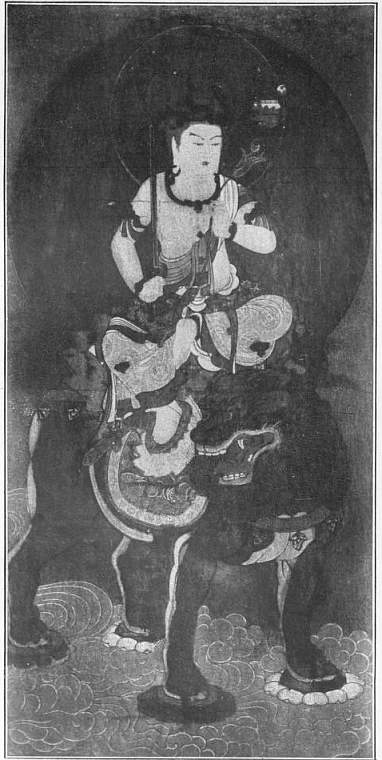
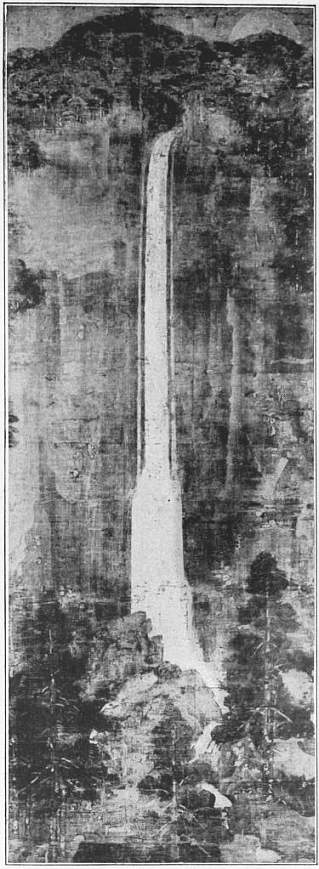
Fig. 1.—MANJUSRI, DEITY OF WISDOM. Kosé School (13th century). Fig. 2.—WATERFALL OF NACHI. Attributed to Kanaoka (9th century).
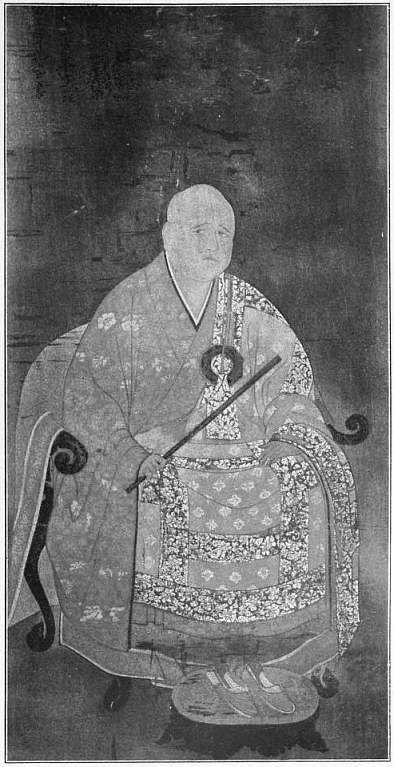
Fig. 3.—PORTRAIT OF THE PRIEST DAITO-KOKUSHI. Tosa School (14th century).
Plate II.
PAINTING
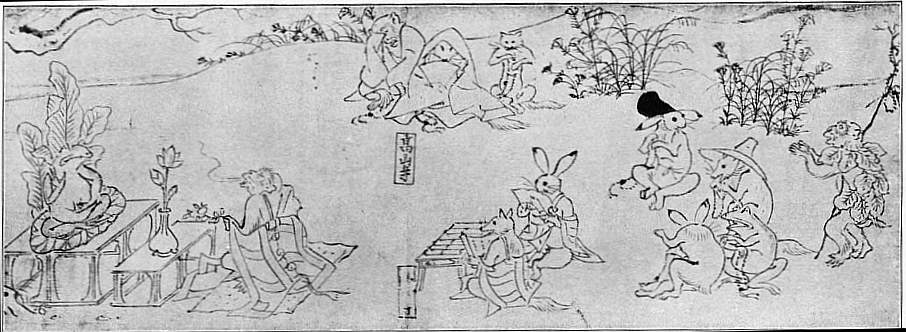
Fig. 4.—PRIESTS CARICATURED BY ANIMALS. By Toba Sojo (1053-1140).
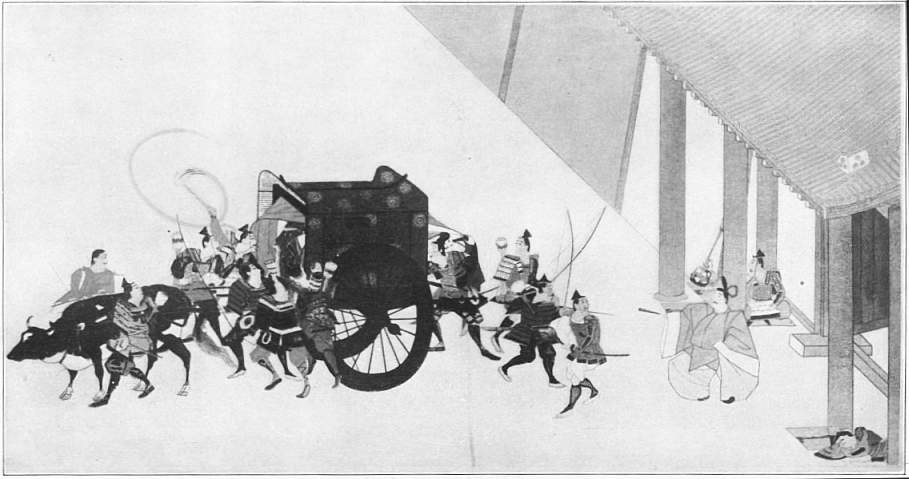
Fig. 5.—ESCAPE OF THE EMPEROR DISGUISED AS A WOMAN. Scene from the Civil War. By Keion (13th century).
The application of this principle in the same free spirit is the secret of much of the originality and the excellence of the decorative art of Japan. Her artists and artisans alike aim at symmetry, not by an equal division of parts, as we do, but rather by a certain balance of corresponding parts, each different from the other, and not numerically even, with an effect of variety and freedom from formality. They seek it, in fact, as nature attains the same end. If we take for instance the skins of animals that are striped or spotted, we have the best possible illustration of nature’s methods in this direction. Examining the tiger or the leopard, in all the beauty of their symmetrical adornment, we do not see in any one example an exact repetition of the same stripes or spots on each side of the mesial line. They seem to be alike, and yet are all different. The line of division along the spine, it will be observed, is not perfectly continuous or defined, but in part suggested; and each radiating stripe on either side is full of variety in size, direction, and to some extent in colour and depth of shade. Thus nature works, and so, following in her footsteps, works the Japanese artist. The same law prevailing in all nature’s creation, in the plumage of birds, the painting of butterflies’ wings, the marking of shells, and in all the infinite variety and beauty of the floral kingdom, the lesson is constantly renewed to the observant eye. Among flowers the orchids, with all their fantastic extravagance and mimic imitations of birds and insects, are especially prolific in examples of symmetrical effects without any repetition of similar parts or divisions into even numbers.
The orchids may be taken as offering fair types of the Japanese artist’s ideal in all art work. And thus, close student of nature’s processes, methods, and effects as the Japanese art workman is, he ever seeks to produce humble replicas from his only art master. Thus he proceeds in all his decorative work, avoiding studiously the exact repetition of any lines and spaces, and all diametrical divisions, or, if these be forced upon him by the shape of the object, exercising the utmost ingenuity to disguise the fact, and train away the eye from observing the weak point, as nature does in like circumstances. Thus if a lacquer box in the form of a parallelogram is the object, Japanese artists will not divide it in two equal parts by a perpendicular line, but by a diagonal, as offering a more pleasing line and division. If the box be round, they will seek to lead the eye away from the naked regularity of the circle by a pattern distracting attention, as, for example, by a zigzag breaking the circular outline, and supported by other ornaments. A similar feeling is shown by them as colourists, and, though sometimes eccentric and daring in their contrasts, they never produce discords in their chromatic scale. They have undoubtedly a fine sense of colour, and a similarly delicate and subtle feeling for harmonious blending of brilliant and sober hues. As a rule they prefer a quiet and refined style, using full but low-toned colours. They know the value of bright colours, however, and how best to utilize them, both supporting and contrasting them with their secondaries and complementaries.
The development of Japanese painting may be divided into the following six periods, each signalized by a wave of progress. (1) From the middle of the 6th to the middle of the 9th century: the naturalization of Chinese and Chino-Buddhist Division into Periods. art. (2) From the middle of the 9th to the middle of the 15th century: the establishment of great native schools under Kosé no Kanaoka and his descendants and followers, the pure Chinese school gradually falling into neglect. (3) From the middle of the 15th to the latter part of the 17th century: the revival of the Chinese style. (4) From the latter part of the 17th to the latter part of the 18th century: the establishment of a popular school. (5) From the latter part of the 18th to the latter part of the 19th century: the foundation of a naturalistic school, and the first introduction of European influence into Japanese painting; the acme and decline of the popular school. (6) From about 1875 to the present time: a period of transition.
Tradition refers to the advent of a Chinese artist named Nanriu, invited to Japan in the 5th century as a painter of the Imperial banners, but of the labours and influence of this man and of his descendants we have no record. First Period. The real beginnings of the study of painting and sculpture in their higher branches must be dated from the introduction of Buddhism from China in the middle of the 6th century, and for three centuries after this event there is evidence that the practice of the arts was carried on mainly by or under the instruction of Korean and Chinese immigrants.
The paintings of which we have any mention were almost limited to representations of Buddhist masters of the Tang dynasty (618-905), notably Wu Tao-zu (8th century), of whose genius romantic stories are related. The oldest existing work of this period is a mural decoration in the hall of the temple of Horyū-ji, Nara, attributed to a Korean priest named Donchô, who lived in Japan in the 6th century; and this painting, in spite of the destructive effects of time and exposure, shows traces of the same power of line, colour and composition that stamps the best of the later examples of Buddhist art.
The native artist who crested the first great wave of Japanese painting was a court noble named Kosé no Kanaoka, living under the patronage of the emperor Seiwa (850-859) and his successors down to about the end of Second Period. the 9th century, in the midst of a period of peace and culture. Of his own work few, if any, examples have reached us; and those attributed with more or less probability to his hand are all representations of Buddhist divinities, showing a somewhat formal and conventional design, with a masterly calligraphic touch and perfect harmony of colouring. Tradition credits him with an especial genius for the delineation of animals and landscape, and commemorates his skill by a curious anecdote of a painted horse which left its frame to ravage the fields, and was reduced to pictorial stability only by the sacrifice of its eyes. He left a line of descendants extending far into the 15th century, all famous for Buddhist pictures, and some engaged in establishing a native style, the Wa-gwa-ryū.
At the end of the 9th century there were two exotic styles of painting, Chinese and Buddhist, and the beginning of a native style founded upon these. All three were practised by the same artists, and it was not until a later period that each became the badge of a school.
The Chinese style (Kara-ryū), the fundamental essence of all Japanese art, has a fairly distinct history, dating back to the introduction of Buddhism into China (A.D. 62), and it is said to have been chiefly from the works of Wu Chinese Style. Tao-zu, the master of the 8th century, that Kanaoka drew his inspiration. This early Chinese manner, which lasted in the parent country down to the end of the 13th century, was characterized by a virile grace of line, a grave dignity of composition, striking simplicity of technique, and a strong but incomplete naturalistic ideal. The colouring, harmonious but subdued in tone, held a place altogether secondary to that of the outline, and was frequently omitted altogether, even in the most famous works. Shadows and reflections were ignored, and perspective, approximately correct for landscape distances, was isometrical for near objects, while the introduction of a symbolic sun or moon lent the sole distinction between a day and a night scene. The art was one of imperfect evolution, but for thirteen centuries it was the only living pictorial art in the world, and the Chinese deserve the honour of having created landscape painting. The materials used were water-colours, brushes, usually of deer-hair, and a surface of unsized paper, translucid silk or wooden panel. The chief motives were landscapes of a peculiarly wild and romantic type, animal life, trees and flowers, and figure compositions drawn from Chinese and Buddhist history and Taoist legend; and these, together with the grand aims and strange shortcomings of its principles and the limited range of its methods, were adopted almost without change by Japan. It was a noble art, but unfortunately the rivalry of the Buddhist and later native styles permitted it to fall into comparative neglect, and it was left for a few of the faithful, the most famous of whom was a priest of the 14th century named Kawo, to preserve it from inanition till the great Chinese renaissance that lent its stamp to the next period. The reputed founder of Japanese caricature may also be added to the list. He was a priest named Kakuyū, but better known as the abbot of Toba, who lived in the 12th century. An accomplished artist in the Chinese manner, he amused himself and his friends by burlesque sketches, marked by a grace and humour that his imitators never equalled. Later, the motive of the Toba pictures, as such caricatures were called, tended to degenerate, and the elegant figures of Kakuyū were replaced by scrawls that often substituted indecency and ugliness for art and wit. Some of the old masters of the Yamato school were, however, admirable in their rendering of the burlesque, and in modern times Kyōsai, the last of the Hokusai school, outdid all his predecessors in the riotous originality of his weird and comic fancies. A new phase of the art now lives in the pages of the newspaper press.
The Buddhist style was probably even more ancient than the Chinese, for the scheme of colouring distinctive of the Buddhist picture was almost certainly of Indian origin; brilliant and decorative, and heightened by a lavish use of Buddhist Style. gold, it was essential to the effect of a picture destined for the dim light of the Buddhist temple. The style was applied only to the representations of sacred personages and scenes, and as the traditional forms and attributes of the Brahmanic and Buddhist divinities were mutable only within narrow limits, the subjects seldom afforded scope for originality of design or observation of nature. The principal Buddhist painters down to the 14th century were members of the Kosé, Takuma and Kasuga lines, the first descended from Kanaoka, the second from Takuma Taméuji (ending 10th century), and the third from Fujiwara no Motomitsu (11th century). The last and greatest master of the school was a priest named Meicho, better known as Chō Densu, the Japanese Fra Angelico. It is to him that Japan owes the possession of some of the most stately and most original works in her art, sublime in conception, line and colour, and deeply instinct with the religious spirit. He died in 1427, at the age of seventy-six, in the seclusion of the temple where he had passed the whole of his days.
The native style, Yamato or Wa-gwa-ryū, was an adaptation of Chinese art canons to motives drawn from the court life, poetry and stories of old Japan. It was undoubtedly practised by the Kose line, and perhaps by their predecessors, Native Style. but it did not take shape as a school until the beginning of the 11th century under Fujiwara no Motomitsu, who was a pupil of Kose no Kinmochi; it then became known as Yamato-ryū, a title which two centuries later was changed to that of Tosa, on the occasion of one of its masters, Fujiwara no Tsunetaka, assuming that appellation as a family name. The Yamato-Tosa artists painted in all styles, but that which was the speciality of the school, to be found in nearly all the historical rolls bequeathed to us by their leaders, was a lightly-touched outline filled in with flat and bright body-colours, in which verdigris-green played a great part. The originality of the motive did not prevent the adoption of all the Chinese conventions, and of some new ones of the artist’s own. The curious expedient of spiriting away the roof of any building of which the artist wished to show the interior was one of the most remarkable of these. Amongst the foremost names of the school are those of Montomitsu (11th century), Nobuzane (13th century), Tsunetaka (13th century), Mitsunobu (15th and 16th centuries), his son Mitsushige, and Mitsuōki (17th century). The struggle between the Taira and Minamoto clans for the power that had long been practically abandoned by the Imperial line lasted through the 11th and the greater part of the 12th centuries, ending only with the rise of Yoritomo to the shōgunate in 1185. These internecine disturbances had been unfavourable to any new departure in art, except in matters appertaining to arms and armour, and the strife between two puppet emperors for a shadow of authority in the 14th century brought another distracting element. It was not until the triumph of the northern dynasty was achieved through the prowess of an interested champion of the Ashikaga clan that the culture of ancient Japan revived. The palace of the Ashikaga shōguns then replaced the Imperial court as the centre of patronage of art and literature and established a new era in art history.
Towards the close of the Ashikaga shōgunate painting entered on a new phase. Talented representatives of the Kose, Takuma and Tosa lines maintained the reputation of the native and Buddhist schools, and the long-neglected Third Period. Chinese school was destined to undergo a vigorous revival. The initiation of the new movement is attributed to a priest named Jôsetsu, who lived in the early part of the 15th century, and of whom little else is known. It is not even certain whether he was of Chinese or Japanese birth; he is, however, believed by some authorities to have been the teacher of three great artists—Shūbun, Sesshū and Kano Masanobu—who became the leaders of three schools: Shūbun, that of the pure Chinese art of the Sung and Yuan dynasties (10th and 13th centuries); Sesshū, that of a modified school bearing his name; and Masanobu, of the great Kano school, which has reached to the present day. The qualities of the new Chinese schools were essentially those of the older dynasties: breadth, simplicity, a daringly calligraphic play of brush that strongly recalled the accomplishments of the famous scribes, and a colouring that varied between sparing washes of flat local tints and a strength and brilliancy of decorative effort that rivalled even that of the Buddhist pictures. The motives remained almost identical with those of the Chinese masters, and so imbued with the foreign spirit were many of the Japanese disciples that it is said they found it difficult to avoid introducing Chinese accessories even into pictures of native scenery.
Sesshū (1421-1507) was a priest who visited China and studied painting there for several years, at length returning in 1469, disappointed with the living Chinese artists, and resolved to strike out a style of his own, based upon that of the old masters. He was the boldest and most original of Japanese landscape artists, leaving powerful and poetic records of the scenery of his own land as well as that of China, and trusting more to the sure and sweeping stroke of the brush than to colour. Shūbun was an artist of little less power, but he followed more closely his exemplars, the Chinese masters of the 12th and 13th centuries; while Kano Masanobū (1424-1520), trained in the love of Chinese art, departed little from the canons he had learned from Jōsetsu or Oguri Sōtan. It was left to his more famous son, Motonobu, to establish the school which bears the family name. Kano Motonobu (1477-1559) was one of the greatest Japanese painters, an eclectic of genius, who excelled in every style and every branch of his art. His variety was inexhaustible, and he remains to this day a model whom the most distinguished artists are proud to imitate. The names of the celebrated members of this long line are too many to quote here, but the most accomplished of his descendants was Tanyū, who died in 1674, at the age of seventy-three. The close of this long period brought a new style of art, that of the Kōrin school. Ogata Kōrin (1653-1716) is claimed by both the Tosa and Kano schools, but his work bears more resemblance to that of an erratic offshoot of the Kano line named Sōtatsu than to the typical work of the academies. He was an artist of eccentric originality, who achieved wonders in bold decorative effects in spite of a studied contempt for detail. As a lacquer painter he left a strong mark upon the work of his contemporaries and successors. His brother and pupil, Kenzan, adopted his style, and left a reputation as a decorator of pottery hardly less brilliant than Kōrin’s in that of lacquer; and a later follower, Hōitsu (1762-1828), greatly excelled the master in delicacy and refinement, although inferior to him in vigour and invention. Down to the end of this era painting was entirely in the hands of a patrician caste—courtiers, priests, feudal nobles and their military retainers, all men of high education and gentle birth, living in a polished circle. It was practised more as a phase of aesthetic culture than with any utilitarian views. It was a labour of loving service, untouched by the spirit of material gain, conferring upon the work of the older masters a dignity and poetic feeling which we vainly seek in much of the later work. Unhappily, but almost inevitably, over-culture led to a gradual falling-off from the old virility. The strength of Meichō, Sesshū, Motonobu and Tanyū gave place to a more or less slavish imitation of the old Japanese painters and their Chinese exemplars, till the heirs to the splendid traditions of the great masters preserved little more than their conventions and shortcomings. It was time for a new departure, but there seemed to be no sufficient strength left within the charmed circle of the orthodox schools, and the new movement was fated to come from the masses, whose voice had hitherto been silent in the art world.
A new era in art began in the latter half of the 17th century with the establishment of a popular school under an embroiderer’s draughtsman named Hishigawa Moronobu (c. 1646-1713). Perhaps no great change is ever entirely a Fourth Period: Popular School. novelty. The old painters of the Yamato-Tosa line had frequently shown something of the daily life around them, and one of the later scions of the school, named Iwasa Matahei, had even made a specialty of this class of motive; but so little is known of Matahei and his work that even his period is a matter of dispute, and the few pictures attributed to his pencil are open to question on grounds of authenticity. He probably worked some two generations before the time of Moronobu, but there is no reason to believe that his labours had any material share in determining the creation and trend of the new school.
Moronobu was a consummate artist, with all the delicacy and calligraphic force of the best of the Tosa masters, whom he undoubtedly strove to emulate in style; and his pictures are not only the most beautiful but also the most trustworthy records of the life of his time. It was not to his paintings, however, that he owed his greatest influence, but to the powerful impulse he gave to the illustration of books and broadsides by wood-engravings. It is true that illustrated books were known as early as 1608, if not before, but they were few and unattractive, and did little to inaugurate the great stream of ehon, or picture books, that were to take so large a share in the education of his own class. It is to Moronobu that Japan owes the popularization of artistic wood-engravings, for nothing before his series of xylographic albums approached his best work in strength and beauty, and nothing since has surpassed it. Later there came abundant aid to the cause of popular art, partly from pupils of the Kano and Tosa schools, but mainly from the artisan class. Most of these artists were designers for books and broadsides by calling, painters only on occasion, but a few of them did nothing for the engravers. Throughout the whole of this period, embracing about a hundred years, there still continued to work, altogether apart from the men who were making the success of popular art, a large number of able painters of the Kano, Tosa and Chinese schools, who multiplied pictures that had every merit except that of originality. These men, living in the past, paid little attention to the great popular movement, which seemed to be quite outside their social and artistic sphere and scarcely worthy of cultured criticism. It was in the middle of the 18th century that the decorative, but relatively feeble, Chinese art of the later Ming period found favour in Japan and a clever exponent in a painter named Ryūrikyō. It must be regarded as a sad decadence from the old Chinese ideals, which was further hastened, from about 1765, by the popularity of the southern Chinese style. This was a weak affectation that found its chief votaries amongst literary men ambitious of an easily earned artistic reputation. The principal Japanese supporter of this school was Taigadō (1722-1775), but the volume of copies of his sketches, Taigadō sansui juseki, published about 1870, is one of the least attractive albums ever printed in Japan.
The fifth period was introduced by a movement as momentous as that which stamped its predecessor—the foundation of a naturalistic school under a group of men outside the orthodox academical circles. The naturalistic principle Fifth Period: Naturalistic School. was by no means a new one; some of the old Chinese masters were naturalistic in a broad and noble manner, and their Japanese followers could be admirably and minutely accurate when they pleased; but too many of the latter were content to construct their pictures out of fragmentary reminiscences of ancient Chinese masterpieces, not presuming to see a rock, a tree, an ox, or a human figure, except through Chinese spectacles. It was a farmer’s son named Okyō, trained in his youth to paint in the Chinese manner, who was first bold enough to adopt as a canon what his predecessors had only admitted under rare exceptions, the principle of an exact imitation of nature. Unfortunately, even he had not all the courage of his creed, and while he would paint a bird or a fish with perfect realism, he no more dared to trust his eyes in larger motives than did the most devout follower of Shūbun or Motonobu. He was essentially a painter of the classical schools, with the speciality of elaborate reproduction of detail in certain sections of animal life, but fortunately this partial concession to truth, emphasized as it was by a rare sense of beauty, did large service.
Okyō rose into notice about 1775, and a number of pupils flocked to his studio in Shijō Street, Kiōto (whence Shijō school). Amongst these the most famous were Goshun (1742-1811), who is sometimes regarded as one of the founders of the school; Sosen (1757-1821), an animal painter of remarkable power, but especially celebrated for pictures of monkey life; Shūhō, the younger brother of the last, also an animal painter; Rōsetsu (1755-1799), the best landscape painter of his school; Keibun, a younger brother of Goshun, and some later followers of scarcely less fame, notably Hoyen, a pupil of Keibun; Tessan, an adopted son of Sosen; Ippō and Yōsai (1788-1878), well known for a remarkable set of volumes, the Zenken kojitsu, containing a long series of portraits of ancient Japanese celebrities. Ozui and Ojyu, the sons of Okyō, painted in the style of their father, but failed to attain great eminence. Lastly, amongst the associates of the Shijō master was the celebrated Ganku (1798-1837), who developed a special style of his own, and is sometimes regarded as the founder of a distinct school. He was, however, greatly influenced by Okyō’s example, and his sons, Gantai, Ganryo, and Gantoku or Renzan, drifted into a manner almost indistinguishable from that of the Shijō school.
It remains only to allude to the European school, if school it can be called, founded by Kokan and Denkichi, two contemporaries of Okyō. These artists, at first educated in one of the native schools, obtained from a Hollander European School. in Nagasaki some training in the methods and principles of European painting, and left a few oil paintings in which the laws of light and shade and perspective were correctly observed. They were not, however, of sufficient capacity to render the adopted manner more than a subject of curiosity, except to a few followers who have reached down to the present generation. It is possible that the essays in perspective found in the pictures of Hokusai, Hiroshige, and some of the popular artists of the 19th century, were suggested by Kokan’s drawings and writings.
The sixth period began about 1875, when an Italian artist was engaged by the government as a professor of painting in the Engineering College at Tōkyō. Since that time some distinguished European artists have visited Japan, Sixth Period. and several Japanese students have made a pilgrimage to Europe to see for themselves what lessons may be gained from Western art. These students, confronted by a strong reaction in favour of pure Japanese art, have fought manfully to win public sympathy, and though their success is not yet crowned, it is not impossible that an Occidental school may ultimately be established. Thus far the great obstacle has been that pictures painted in accordance with Western canons are not suited to Japanese interiors and do not appeal to the taste of the most renowned Japanese connoisseurs. Somewhat more successful has been an attempt—inaugurated by Hashimoto Gahō and Kawabata Gyokusho—to combine the art of the West with that of Japan by adding to the latter the chiaroscuro and the linear perspective of the former. If the disciples of this school could shake off the Sesshū tradition of strong outlines and adopt the Kano Motonobu revelation of modelling by mass only, their work would stand on a high place. But they, too, receive little encouragement. The tendency of the time is conservative in art matters.
A series of magnificent publications has popularized art and its best products in a manner such as could never have been anticipated. The Kokka, a monthly magazine richly and beautifully illustrated and edited by Japanese students, has reached its 223rd number; the Shimbi Daikan, a colossal album containing chromoxylographic facsimiles of celebrated examples in every branch of art, has been completed in 20 volumes; the masterpieces of Kōrin and Motonobu have been reproduced in similar albums; the masterpieces of the Ukiyo-e are in process of publication, and it seems certain that the Japanese nation will ultimately be educated to such a knowledge of its own art as will make for permanent appreciation. Meanwhile the intrepid group of painters in oil plod along unflinchingly, having formed themselves into an association (the hakuba-kai) which gives periodical exhibitions, and there are, in Tōkyō and Kiōto, well-organized and flourishing art schools which receive a substantial measure of state aid, as well as a private academy founded by Okakura with a band of seceders from the hybrid fashions of the Gahō system. Altogether the nation seems to be growing more and more convinced that its art future should not wander far from the lines of the past.
(W. An.; F. By.)
Although a little engraving on copper has been practised in Japan of late years, it is of no artistic value, and the only branch of the art which calls for recognition is the Engraving. cutting of wood-blocks for use either with colours or without. This, however, is of supreme importance, and as its technique differs in most respects from the European practice, it demands a somewhat detailed description.
The wood used is generally that of the cherry-tree, sakura, which has a grain of peculiar evenness and hardness. It is worked plankwise to a surface parallel with the grain, and not across it. A design is drawn by the artist, to whom the whole credit of the production generally belongs, with a brush on thin paper, which is then pasted face downwards on the block. The engraver, who is very rarely the designer, then cuts the outlines into the block with a knife, afterwards removing the superfluous wood with gouges and chisels. Great skill is shown in this operation, which achieves perhaps the finest facsimile reproduction of drawings ever known without the aid of photographic processes. A peculiar but highly artistic device is that of gradually rounding off the surfaces where necessary, in order to obtain in printing a soft and graduated mass of colour which does not terminate too abruptly. In printing with colours a separate block is made in this manner for each tint, the first containing as a rule the mere lines of the composition, and the others providing for the masses of tint to be applied. In all printing the paper is laid on the upper surface of the block, and the impression rubbed off with a circular pad, composed of twisted cord within a covering of paper cloth and bamboo-leaf, and called the baren. In colour-printing, the colours, which are much the same as those in use in Europe, are mixed, with rice-paste as a medium, on the block for each operation, and the power of regulating the result given by this custom to an intelligent craftsman (who, again, is neither the artist nor the engraver) was productive in the best period of very beautiful and artistic effects, such as could never have been obtained by any mechanical device. A wonderfully accurate register, or successive superposition of each block, is got mainly by the skill of the printer, who is assisted only by a mark defining one corner and another mark showing the opposite side limit.
The origins of this method of colour-printing are obscure. It has been practised to some extent in China and Korea, but there is no evidence of its antiquity in these countries. It appears to be one of the few indigenous arts of Japan. But before accepting this conclusion as final, one must not lose sight of the fact that the so-called chiaroscuro engraving was at the height of its use in Italy at the same time that embassies from the Christians in Japan visited Rome, and that it is thus possible that the suggestion at least may have been derived from Europe. The fact that no traces of it have been discovered in Japan would be easily accounted for, when it is remembered that the examples taken home would almost certainly have been religious pictures, would have been preserved in well-known and accessible places, and would thus have been entirely destroyed in the terrible and minute extermination of Christianity by Hideyoshi at the beginning of the 17th century. Japanese tradition ascribes the invention of colour-printing to Idzumiya Gonshirō, who, about the end of the 17th century, first made use of a second block to apply a tint of red (beni) to his prints. Sir Ernest Satow states more definitely that “Sakakibara attributes its origin to the year 1695, when portraits of the actor Ichikawa Danjiuro, coloured by this process, were sold in the streets of Yedo for five cash apiece.” The credit of the invention is also given to Torii Kiyonobu, who worked at about this time, and, indeed, is said to have made the prints above mentioned. But authentic examples of his work now remaining, printed in three colours, seem to show a technique too complete for an origin quite so recent. However, he is the first artist of importance to have produced the broadsheets—for many years chiefly portraits of notable actors, historical characters and famous courtesans—which are the leading and characteristic use to which the art was applied. Pupils, the chief of whom were Kiyomasa, Kiyotsume, Kiyomitsu, Kiyonaga and Kiyomine, carried on his tradition until the end of the 18th century, the three earlier using but few colours, while the works of the two last named show a technical mastery of all the capabilities of the process.
The next artist of importance is Suzuki Harunobu (worked c. 1760-1780), to whom the Japanese sometimes ascribe the invention of the process, probably on the grounds of an improvement in his technique, and the fact that he seems to have been one of the first of the colour-print makers to attain great popularity. Katsukawa Shunshō (d. 1792) must next be mentioned, not only for the beauty of his own work, but because he was the first master of Hokusai; then Yeishi (worked c. 1781-1800), the founder of the Hosoda school; Utamaro (1754-1806), whose prints of beautiful women were collected by Dutchmen while he was still alive, and have had in our own day a vogue greater, perhaps, than those of any other of his fellows; and Toyokuni I. (1768-1825), who especially devoted himself to broadsheet portraits of actors and dramatic scenes. The greatest of all the artists of the popular school was, however, Hokusai (1760-1849). His most famous series of broadsheets is the Thirty-six Views of Mount Fuji (1823-1829), which, in spite of the conventional title, includes at least forty-six. His work is catalogued in detail by E. de Goncourt. At the beginning of the 19th century the process was technically at its greatest height, and in the hands of the great landscape artist, Hiroshige I., as well as the pupils of Toyokuni I.—Kunisada and Kuniyoshi—and those of Hokusai, it at first kept up an excellent level. But an undue increase in the number of blocks used, combined with the inferiority of the imported colours and carelessness or loss of skill in printing, brought about a rapid decline soon after 1840. This continued until the old traditions were well-nigh exhausted, but since 1880 there has been a distinct revival. The prints of the present day are cut with great skill, and the designs are excellent, though both these branches seem to lack the vigour of conception and breadth of execution of the older masters. The colours now used are almost invariably of cheap German origin, and though they have a certain prettiness—ephemeral, it is to be feared—they again can not compare with the old native productions. Among workers in this style, Yoshitoshi (d. c. 1898) was perhaps the best. Living artists in 1908 included Toshihide, Miyagawa Shuntei, Yoshiu Chikanobu—one of the elder generation—Tomisuka Yeishu, Toshikata and Gekko. Formerly the colour-print artist was of mean extraction and low social position, but he now has some recognition at the hands of the professors of more esteemed branches of art. This change is doubtless due in part to Occidental appreciation of the products of his art, which were formerly held in little honour by his own countrymen, the place assigned to them being scarcely higher than that accorded to magazine illustrations in Europe and America. But it is also largely due to his displays of unsurpassed skill in preparing xylographs for the beautiful art publications issued by the Shimbi Shōin and the Kokka company. These xylographs prove that the Japanese art-artisan of the present day was not surpassed by the greatest of his predecessors in this line.
(E. F. S.; F. By.)
The history of the illustrated book in Japan may be said to begin with the Ise monogatari, a romance first published in the 10th century, of which an edition adorned with woodcuts appeared in 1608. In the course of the 17th century many other Book Illustration. works of the same nature were issued, including some in which the cuts were roughly coloured by hand; but the execution of these is not as good as contemporary European work. The date of the first use of colour-printing in Japanese book illustration is uncertain. In 1667 a collection of designs for kimono (garments) appeared, in which inks of several colours were made use of; but these were only employed in turn for single printings, and in no case were two of them used on the same print. It is certain, however, that the mere use of coloured inks must soon have suggested the combination of two or more of them, and it is probable that examples of this will be discovered much earlier in date than those known at present.
About the year 1680 Hishigawa Moronobu achieved a great popularity for woodcut illustration, and laid the foundations of the splendid school which followed. The names of the engravers who cut his designs are not known, and in fact the reputation of these craftsmen is curiously subordinated to that of the designers in all Japanese work of the kind. With Moronobu must be associated Okumura Masanobu, a little later perhaps in date, whose work is also of considerable value. During the ensuing thirty years numerous illustrated books appeared, including the earliest yet known which are illustrated by colour-printing. Nishikawa Sukenobu (1671-1751) illustrated a very large number of books, many of which were not published until after his death. With him may be associated Ichiō Shumboku (d. c. 1773) and Tsukioka Tange (1717-1786), the latter of whom made the drawings for many of the meishō or guide-books which form so interesting and distinctive a branch of Japanese illustration. The work of Tachibana Morikuni (1670-1748) is also of great importance. The books illustrated by the men of this school were mainly collections of useful information, guide-books, romances and historical and religious compilations; but much of the best of their work is to be found in the collections of pictorial designs, very often taken from Chinese sources, which were produced for the use of workers in lacquer, pottery and similar crafts. These, both for design and for skill of cutting, hold their own with the best work of European wood-cutting of any period. The development of the art of Japanese colour-printing naturally had its effect on book-illustration, and the later years of the 18th and the earlier of the 19th century saw a vast increase of books illustrated by this process. The subjects also now include a new series of landscapes and views drawn as seen by the designers, and not reproductions of the work of other men; and also sketches of scenes and characters of everyday life and of the folk-lore in which Japan is so rich. Among the artists of this period, as of all others in Japan, Hokusai (1760-1849) is absolutely pre-eminent. His greatest production in book-illustration was the Mangwa, a collection of sketches which cover the whole ground of Japanese life and legend, art and handicraft. It consists of fifteen volumes, which appeared at intervals from 1812 to 1875, twelve being published during his life and the others from material left by him. Among his many other works may be mentioned the Azuma Asobi (Walks round Yedo, 1799). Of his pupils, Hokkei (1780-1856) and Kyōsai were the greatest. Most of the artists, whose main work was the designing of broadsheets, produced elaborately illustrated books; and this series includes specimens of printing in colours from wood-blocks, which for technique have never been excelled. Among them should be mentioned Shunshō (Seirō bijin awase kagami, 1776); Utamaro (Seirō nenjyū gyoji, 1804); Toyokuni I. (Yakusha kono teikishiwa, 1801); as well as Harunobu Yeishi (Onna sanjyu rokkasen, 1798), Kitao Masanobu and Tachibana Minko, each of whom produced beautiful work of the same nature. In the period next following, the chief artists were Keisai Yeisen (Keisai so-gwa, 1832) and Kikuchi Yōsai (Zenken kojitsu), the latter of whom ranks perhaps as highly as any of the artists who confined their work to black and white. The books produced in the period 1880-1908 in Japan are still of high technical excellence. The colours are, unfortunately, of cheap European manufacture; and the design, although quite characteristic and often beautiful, is as a rule merely pretty. The engraving is as good as ever. Among the book-illustrators of our own generation must be again mentioned Kyōsai; Kōno Bairei (d. 1895), whose books of birds—the Bairei hyakucho gwafu (1881 and 1884) and Yūaka-no-tsuki (1889)—are unequalled of their kind; Imao Keinen, who also issued a beautiful set of illustrations of birds and flowers (Keinen kwachō gwafu), engraved by Tanaka Jirokichi and printed by Miki Nisaburō (1891-1892); and Watanabe Seitei, whose studies of similar subjects have appeared in Seitei kwachō gwafu (1890-1891) and the Bijutsu sekai (1894), engraved by Gotō Tokujirō. Mention should also be made of several charming series of fairy tales, of which that published in English by the Kobunsha in Tōkyō in 1885 is perhaps the best. In their adaptation of modern processes of illustration the Japanese are entirely abreast of Western nations, the chromo-lithographs and other reproductions in the Kokka, a periodical record of Japanese works of art (begun in 1889), in the superb albums of the Shimbi Shōin, and in the publications of Ogawa being of quite a high order of merit.
(E. F. S.; F. By.)
Plate III.
PAINTING
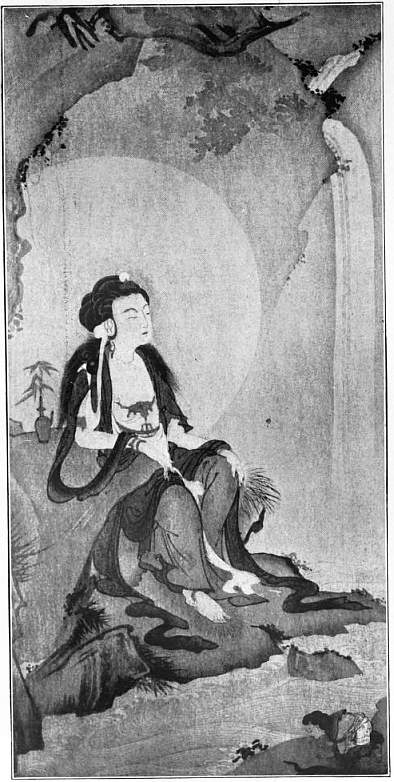
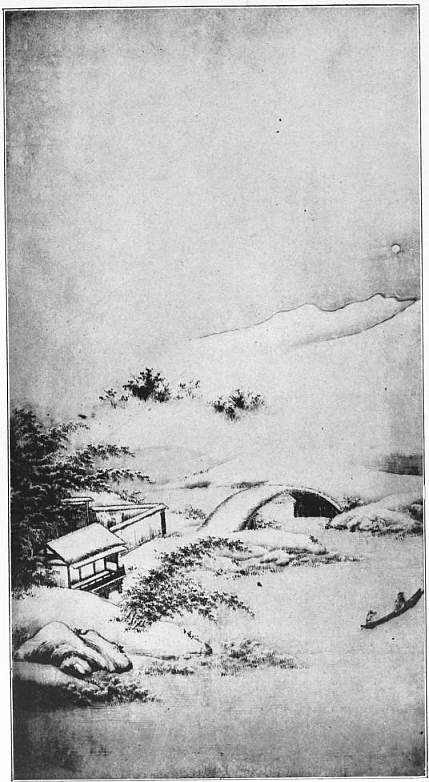
Fig. 6.—KWANNON, GODDESS OF MERCY. By Mincho or Cho Densu (1352-1431). Fig. 7.—LANDSCAPE IN SNOW. By Kano Motonobu (1476-1559).
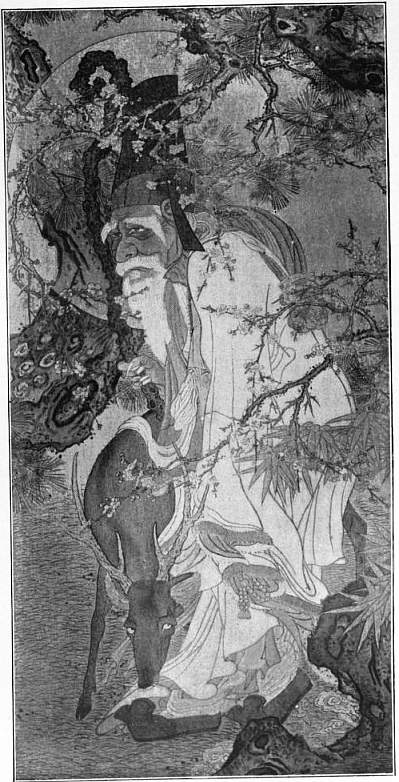
Fig. 8.—JUROJIN. By Sesshiu (1420-1506).
Plate IV.
PAINTING
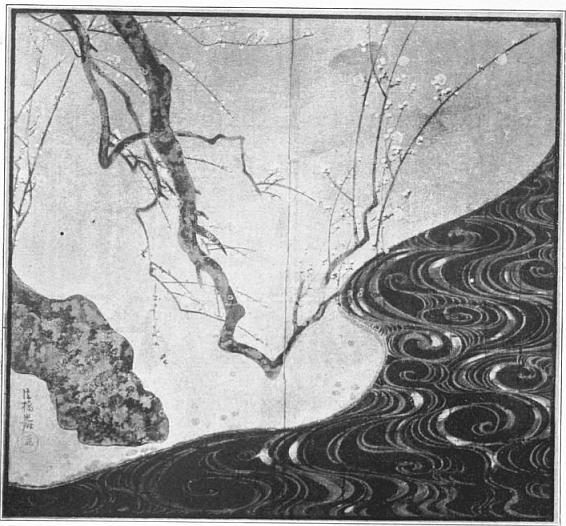
Fig. 9.—PLUM TREES AND STREAM—SCREEN ON GOLD GROUND. By Korin (1661-1716).
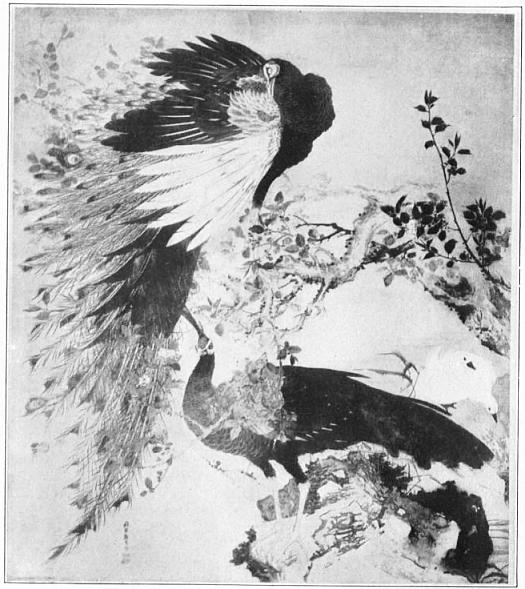
Fig. 10.—PEACOCKS. By Ganku (1749-1838).
Sculpture and Carving.—Sculpture in wood and metal is of ancient date in Japan. Its antiquity is not, indeed, comparable to that of ancient Egypt or Greece, but no country besides Japan can boast a living and highly developed art that has Historical Sketch. numbered upwards of twelve centuries of unbroken and brilliant productiveness. Setting aside rude prehistoric essays in stone and metal, which have special interest for the antiquary, we have examples of sculpture in wood and metal, magnificent in conception and technique, dating from the earliest periods of what we may term historical Japan; that is, from near the beginning of the great Buddhist propaganda under the emperor Kimmei (540-571) and the princely hierarch, Shōtoku Taishi (573-621). Stone has never been in favour in Japan as a material for the higher expression of the sculptor’s art.
The first historical period of glyptic art in Japan reaches from the end of the 6th to the end of the 12th century, culminating First Period. in the work of the great Nara sculptors, Unkei and his pupil Kwaikei. Happily, there are still preserved in the great temples of Japan, chiefly in the ancient capital of Nara, many noble relics of this period.
The place of honour may perhaps be conferred upon sculptures in wood, representing the Indian Buddhists, Asangha and Vasabandhu, preserved in the Golden Hall of Kofuku-ji, Nara. These are attributed to a Kamakura sculptor of the 8th or 9th century, and in simple and realistic dignity of pose and grand lines of composition are worthy of comparison with the works of ancient Greece. With these may be named the demon lantern-bearers, so perfect in the grotesque treatment of the diabolical heads and the accurate anatomical forms of the sturdy body and limbs; the colossal temple guardians of the great gate of Tōdai-ji, by Unkei and Kwaikei (11th century), somewhat conventionalized, but still bearing evidence of direct study from nature, and inspired with intense energy of action; and the smaller but more accurately modelled temple guardians in the Saikondo, Nara, which almost compare with the “fighting gladiator” in their realization of menacing strength. The “goddess of art” of Akishino-dera, Nara, attributed to the 8th century, is the most graceful and least conventional of female sculptures in Japan, but infinitely remote from the feminine conception of the Greeks. The wooden portrait of Vimalakirtti, attributed to Unkei, at Kofuku-ji, has some of the qualities of the images of the two Indian Buddhists. The sculptures attributed to Jōchō, the founder of the Nara school, although powerful in pose and masterly in execution, lack the truth of observation seen in some of the earlier and later masterpieces.
The most perfect of the ancient bronzes is the great image of Bhaicha-djyaguru in the temple of Yakushi-ji, Nara, attributed to a Korean monk of the 7th century, named Giōgi. The bronze image of the same divinity at Hōryū-ji, said to have been cast at the beginning of the 7th century by Tori Busshi, the grandson of a Chinese immigrant, is of good technical quality, but much inferior in design to the former. The colossal Nara Daibutsu (Vairocana) at Tōdai-ji, cast in 749 by a workman of Korean descent, is the largest of the great bronzes in Japan, but ranks far below the Yakushi-ji image in artistic qualities. The present head, however, is a later substitute for the original, which was destroyed by fire.
The great Nara school of sculpture in wood was founded in the early part of the 11th century by a sculptor of Imperial descent named Jōchō, who is said to have modelled his style upon that of the Chinese wood-carvers of the Tang dynasty; his traditions were maintained by descendants and followers down to the beginning of the 13th century. All the artists of this period were men of aristocratic rank and origin, and were held distinct from the carpenter-architects of the imposing temples which were to contain their works.
Sacred images were not the only specimens of glyptic art produced in these six centuries; reliquaries, bells, vases, incense-burners, candlesticks, lanterns, decorated arms and armour, and many other objects, showing no less mastery of design and execution, have reached us. Gold and silver had been applied to the adornment of helmets and breastplates from the 7th century, but it was in the 12th century that the decoration reached the high degree of elaboration shown us in the armour of the Japanese Bayard, Yoshitsunē, which is still preserved at Kasuga, Nara.
Wooden masks employed in the ancient theatrical performances were made from the 7th century, and offer a distinct and often grotesque phase of wood-carving. Several families of experts have been associated with this class of sculpture, and their designs have been carefully preserved and imitated down to the present day.
The second period in Japanese glyptic art extends from the beginning of the 13th to the early part of the 17th century. The great struggle between the Taira and Minamoto clans had ended, but the militant spirit was still strong, and brought Second Period. work for the artists who made and ornamented arms and armour. The Miyōchins, a line that claimed ancestry from the 7th century, were at the head of their calling, and their work in iron breastplates and helmets, chiefly in repoussé, is still unrivalled. It was not until the latter half of the 15th century that there came into vogue the elaborate decoration of the sword, a fashion that was to last four hundred years.
The metal guard (tsuba), made of iron or precious alloy, was adorned with engraved designs, often inlaid with gold and silver. The free end of the hilt was crowned with a metallic cap or pommel (kashira), the other extremity next the tsuba was embraced by an oval ring (fuchi), and in the middle was affixed on each side a special ornament called the menuki, all adapted in material and workmanship to harmonize with the guard. The kodzuka, or handle of a little knife implanted into the sheath of the short sword or dagger, was also of metal and engraved with like care. The founder of the first great line of tsuba and menuki artists was Gotō Yūjō (1440-1512), a friend of the painter Kano Motonobu, whose designs he adopted. Many families of sword artists sprang up at a later period, furnishing treasures for the collector even down to the present day, and their labours reached a level of technical mastery and refined artistic judgment almost without parallel in the art industries of Europe. Buddhist sculpture was by no means neglected during this period, but there are few works that call for special notice. The most noteworthy effort was the casting by Ono Goroyémon in 1252 of the well-known bronze image, the Kamakura Daibutsu.
The third period includes the 17th, 18th and the greater part of the 19th centuries. It was the era of the artisan artist. The makers of Buddhist images and of sword ornaments carried on their work with undiminished industry Third Period. and success, and some famous schools of the latter arose during this period. The Buddhist sculptors, however, tended to grow more conventional and the metal-workers more naturalistic as the 18th century began to wane. It was in connexion with architecture that the great artisan movement began. The initiator was Hidari Jingoro (1594-1652), at first a simple carpenter, afterwards one of the most famous sculptors in the land of great artists. The gorgeous decoration of the mausoleum of Iyeyasu at Nikkō, and of the gateway of the Nishi Hongwan temple at Kiōto, are the most striking instances of his handiwork or direction.
The pillars, architraves, ceilings, panels, and almost every available part of the structure, are covered with arabesques and sculptured figures of dragons, lions, tigers, birds, flowers, and even pictorial compositions with landscapes and figures, deeply carved in solid or open work—the wood sometimes plain, sometimes overlaid with pigment and gilding, as in the panelled ceiling of the chapel of Iyeyasu in Tōkyō. The designs for these decorations, like those of the sword ornaments, were adopted from the great schools of painting, but the invention of the sculptor was by no means idle. From this time the temple carvers, although still attached to the carpenters’ guild, took a place apart from the rest of their craft, and the genius of Hidari Jingoro secured for one important section of the artisan world a recognition like that which Hishigawa Moronobu, the painter and book-illustrator, afterwards won for another.
A little later arose another art industry, also emanating from the masses. The use of tobacco, which became prevalent in the 17th century, necessitated the pouch. In order to suspend this from the girdle there was employed a kind of button or toggle—the netsuke. The metallic bowl and mouthpiece of the pipe offered a tempting surface for embellishment, as well as the clasp of the pouch; and the netsuke, being made of wood, ivory or other material susceptible of carving, also gave occasion for art and ingenuity.
The engravers of pipes, pouch clasps, and the metallic discs (kagami-buta) attached to certain netsuke, sprang from the same class and were not less original. They worked, too, with a skill little inferior to that of the Gotōs, Naras, and other aristocratic sculptors of sword ornaments, and often with a refinement which their relative disadvantages in education and associations render especially remarkable. The netsuke and the pipe, with all that pertained to it, were for the commoners what the sword-hilt and guard were for the gentry. Neither class cared to bestow jewels upon their persons, but neither spared thought or expense in the embellishment of the object they most loved. The final manifestation of popular glyptic art was the okimono, an ornament pure and simple, in which utility was altogether secondary in intention to decorative effect. Its manufacture as a special branch of art work dates from the rise of the naturalistic school of painting and the great expansion of the popular school under the Katsugawa, but the okimono formed an occasional amusement of the older glyptic artists. Some of the most exquisite and most ingenious of these earlier productions, such as the magnificent iron eagle in the South Kensington Museum, the wonderful articulated models of crayfish, dragons, serpents, birds, that are found in many European collections, came from the studios of the Miyōchins; but these were the play of giants, and were not made as articles of commerce. The new artisan makers of the okimono struck out a line for themselves, one influenced more by the naturalistic and popular schools than by the classical art, and the quails of Kamejo, the tortoises of Seimin, the dragons of Tōun and Tōryū, and in recent years the falcons and the peacocks of Suzuki Chokichi, are the joy of the European collector. The best of these are exquisite in workmanship, graceful in design, often strikingly original in conception, and usually naturalistic in ideal. They constitute a phase of art in which Japan has few rivals.
The present generation is more systematically commercial in its glyptic produce than any previous age. Millions of commercial articles in metal-work, wood and ivory flood the European markets, and may be bought in any street in Europe at a small price, but they offer a variety of design and an excellence of workmanship which place them almost beyond Western competition. Above all this, however, the Japanese sculptor is a force in art. He is nearly as thorough as his forefathers, and maintains the same love of all things beautiful; and if he cannot show any epoch-making novelty, he is at any rate doing his best to support unsurpassed the decorative traditions of the past.
History has been eminently careful to preserve the names and records of the men who chiselled sword furniture. The sword being regarded as the soul of the samurai, every one who contributed to its manufacture, Sword-making Families. whether as forger of the blade or sculptor of the furniture, was held in high repute. The Gotō family worked steadily during 14 generations, and its 19th century representative—Gotō Ichijō—will always be remembered as one of the family’s greatest experts. But there were many others whose productions fully equalled and often excelled the best efforts of the Gotō. The following list gives the names and periods of the most renowned families:—
(It should be noted that the division by centuries indicates the time of a family’s origin. In a great majority of cases the representatives of each generation worked on through succeeding centuries).
15th and 16th Centuries.
Miyōchin; Gotō; Umetada; Muneta; Aoki; Sōami; Nakai.
17th Century.
Kuwamura; Mizuno; Koichi; Nagayoshi; Kuninaga; Yoshishige; Katsugi; Tsuji; Muneyoshi; Tadahira; Shōami; Hosono; Yokoya; Nara; Okada; Okamoto; Kinai; Akao; Yoshioka; Hirata; Nomura; Wakabayashi; Inouye; Yasui; Chiyo; Kaneko; Uemura; Iwamoto.
18th Century.
Gorobei; Shōemon; Kikugawa; Yasuyama; Noda; Tamagawa; Fujita; Kikuoka; Kizaemon; Hamano; Ōmori; Okamoto; Kashiwaya; Kusakari; Shichibei; Itō.
19th Century.
Natsuo; Ishiguro; Yanagawa; Honjo; Tanaka; Okano; Kawarabayashi; Oda; and many masters of the Ōmori, Hamano and Iwamoto families, as well as the five experts, Shuraku, Temmin, Ryūmin, Minjō and Minkoku.
(W. An.; F. By.)
There is a radical difference between the points of view of the Japanese and the Western connoisseur in estimating the merits of sculpture in metal. The quality of the chiselling is the first feature to which the Japanese Japanese Point of View. directs his attention; the decorative design is the prime object of the Occidental’s attention. With very rare exceptions, the decorative motives of Japanese sword furniture were always supplied by painters. Hence it is that the Japanese connoisseur draws a clear distinction between the decorative design and its technical execution, crediting the former to the pictorial artist and the latter to the sculptor. He detects in the stroke of a chisel and the lines of a graving tool subjective beauties which appear to be hidden from the great majority of Western dilettanti. He estimates the rank of a specimen by the quality of the chisel-work. The Japanese kinzoku-shi (metal sculptor) uses thirty-six principal classes of chisel, each with its distinctive name, and as most of these classes comprise from five to ten sub-varieties, his cutting and graving tools aggregate about two hundred and fifty.
Scarcely less important in Japanese eyes than the chiselling of the decorative design itself is the preparation of the field to which it is applied. There used to be a strict canon The Field for Sculptured Decoration. with reference to this in former times. Namako (fish-roe) grounds were essential for the mountings of swords worn on ceremonial occasions, the ishime (stone-pitting) or jimigaki (polished) styles being considered less aristocratic.
Namako is obtained by punching the whole surface—except the portion carrying the decorative design—into a texture of microscopic dots. The first makers of namako did not aim at regularity in the distribution of these dots; they were content to produce the effect of millet-seed sifted haphazard over the surface. But from the 15th century the punching of the dots in rigidly straight lines came to be considered essential, and the difficulty involved was so great that namako-making took its place among the highest technical achievements of the sculptor. When it is remembered that the punching tool was guided solely by the hand and eye, and that three or more blows of the mallet had to be struck for every dot, some conception may be formed of the patience and accuracy needed to produce these tiny protuberances in perfectly straight lines, at exactly equal intervals and of absolutely uniform size. Namako disposed in straight parallel lines originally ranked at the head of this kind of work. But a new kind was introduced in the 16th century. It was obtained by punching the dots in intersecting lines, so arranged that the dots fell uniformly into diamond-shaped groups of five each. This is called go-no-me-namako, because of its resemblance to the disposition of chequers in the Japanese game of go. A century later, the daimyō namako was invented, in which lines of dots alternated with lines of polished ground. Ishime may be briefly described as diapering. There is scarcely any limit to the ingenuity and skill of the Japanese expert in diapering a metal surface. It is not possible to enumerate here even the principal styles of ishime, but mention may be made of the zara-maki (broad-cast), in which the surface is finely but irregularly pitted after the manner of the face of a stone; the nashi-ji (pear-ground), in which we have a surface like the rind of a pear; the hari-ishime (needle ishime), where the indentations are so minute that they seem to have been made with the point of a needle; the gama-ishime, which is intended to imitate the skin of a toad; the tsuya-ishime, produced with a chisel sharpened so that its traces have a lustrous appearance; the ore-kuchi (broken-tool), a peculiar kind obtained with a jagged tool; and the gozamé, which resembles the plaited surface of a fine straw mat.
Great importance has always been attached by Japanese experts to the patina of metal used for artistic chiselling. It was mainly for the sake of their patina that value attached to the remarkable alloys shakudo (3 parts of gold to 97 of Patina. copper) and shibuichi (1 part of silver to 3 of copper). Neither metal, when it emerges from the furnace, has any beauty, shakudo being simply dark-coloured copper and shibuichi pale gun-metal. But after proper treatment2 the former develops a glossy black patina with violet sheen, and the latter shows beautiful shades of grey with silvery lustre. Both these compounds afford delicate, unobtrusive and effective grounds for inlaying with gold, silver and other metals, as well as for sculpture, whether incised or in relief. Copper, too, by patina-producing treatment, is made to show not merely a rich golden sheen with pleasing limpidity, but also red of various hues, from deep coral to light vermilion, several shades of grey, and browns of numerous tones from dead-leaf to chocolate. Even greater value has always been set upon the patina of iron, and many secret recipes were preserved in artist families for producing the fine, satin-like texture so much admired by all connoisseurs.
In Japan, as in Europe, three varieties of relief carving are distinguished—alto (taka-bori), mezzo (chūniku-bori) and basso (usuniku-bori). In the opinion of the Japanese expert, these styles hold the same respective rank as that occupied by the Methods of Chiselling. three kinds of ideographic script in caligraphy. High relief carving corresponds to the kaisho, or most classical form of writing; medium relief to the gyōsho, or semi-cursive style; and low relief to the sōsho or grass character. With regard to incised chiselling, the commonest form is kebori (hair-carving), which may be called engraving, the lines being of uniform thickness and depth. Very beautiful results are obtained by the kebori method, but incomparably the finest work in the incised class is that known as kata-kiri-bori. In this kind of chiselling the Japanese artist can claim to be unique as well as unrivalled. Evidently the idea of the great Yokoya experts, the originators of the style, was to break away from the somewhat formal monotony of ordinary engraving, where each line performs exactly the same function, and to convert the chisel into an artist’s brush instead of using it as a common cutting tool. They succeeded admirably. In the kata-kiri-bori every line has its proper value in the pictorial design, and strength and directness become cardinal elements in the strokes of the burin just as they do in the brushwork of the picture-painter. The same fundamental rule applied, too, whether the field of the decoration was silk, paper or metal. The artist’s tool, be it brush or burin, must perform its task by one effort. There must be no appearance of subsequent deepening, or extending, or re-cutting or finishing. Kata-kiri-bori by a great expert is a delight. One is lost in astonishment at the nervous yet perfectly regulated force and the unerring fidelity of every trace of the chisel. Another variety of carving much affected by artists of the 17th century, and now largely used, is called shishi-ai-bori or niku-ai-bori. In this style the surface of the design is not raised above the general plane of the field, but an effect of projection is obtained either by recessing the whole space immediately surrounding the design, or by enclosing the latter in a scarped frame. Yet another and very favourite method, giving beautiful results, is to model the design on both faces of the metal so as to give a sculpture in the round. The fashion is always accompanied by chiselling à jour (sukashi-bori), so that the sculptured portions stand out in their entirety.
Inlaying with gold or silver was among the early forms of decoration in Japan. The skill developed in modern times is at least equal to anything which the past can show, and the results produced are much more imposing. There Inlaying. are two principal kinds of inlaying: the first called hon-zōgan (true inlaying), the second nunome-zōgan (linen-mesh inlaying). As to the former, the Japanese method does not differ from that seen in the beautiful iron censers and vases inlaid with gold which the Chinese produced from the Süen-tē era (1426-1436). In the surface of the metal the workman cuts grooves wider at the base than at the top, and then hammers into them gold or silver wire. Such a process presents no remarkable features, except that it has been carried by the Japanese to an extraordinary degree of elaborateness. The nunome-zōgan is more interesting. Suppose, for example, that the artist desires to produce an inlaid diaper. His first business is to chisel the surface in lines forming the basic pattern of the design. Thus, for a diamond-petal diaper the chisel is carried across the face of the metal horizontally, tracing a number of parallel bands divided at fixed intervals by ribs which are obtained by merely straightening the chisel and striking it a heavy blow. The same process is then repeated in another direction, so that the new bands cross the old at an angle adapted to the nature of the design. Several independent chisellings may be necessary before the lines of the diaper emerge clearly, but throughout the whole operation no measurement of any kind is taken, the artist being guided entirely by his hand and eye. The metal is then heated, not to redness, but sufficiently to develop a certain degree of softness, and the workman, taking a very thin sheet of gold (or silver), hammers portions of it into the salient points of the design. In ordinary cases this is the sixth process. The seventh is to hammer gold into the outlines of the diaper; the eighth, to hammer it into the pattern filling the spaces between the lines, and the ninth and tenth to complete the details. Of course the more intricate the design the more numerous the processes. It is scarcely possible to imagine a higher effort of hand and eye than this nunome-zōgan displays, for while intricacy and elaborateness are carried to the very extreme, absolute mechanical accuracy is obtained. Sometimes in the same design we see gold of three different hues, obtained by varying the alloy. A third kind of inlaying, peculiar to Japan, is sumi-zōgan (ink-inlaying), so called because the inlaid design gives the impression of having been painted with Indian ink beneath the transparent surface of the metal. The difference between this process and ordinary inlaying is that for sumi-zōgan the design to be inlaid is fully chiselled out of an independent block of metal with sides sloping so as to be broader at the base than at the top. The object which is to receive the decoration is then channelled in dimensions corresponding to those of the design block, and the latter having been fixed in the channels, the surface is ground and polished until an intimate union is obtained between the inlaid design and the metal forming its field. Very beautiful effects are thus produced, for the design seems to have grown up to the surface of the metal field rather than to have been planted in it. Shibuichi inlaid with shakudo used to be the commonest combination of metals in this class of decoration, and the objects usually depicted were bamboos, crows, wild-fowl under the moon, peony sprays and so forth.
A variety of decoration much practised by early experts, and carried to a high degree of excellence in modern times, is mokume-ji (wood-grained ground). The process in this case is to take a thin plate of metal and beat it into another plate Wood-grained Grounds. of similar metal, so that the two, though welded together, retain their separate forms. The mass, while still hot, is coated with hena-tsuchi (a kind of marl) and rolled in straw ash, in which state it is roasted over a charcoal fire raised to glowing heat with the bellows. The clay having been removed, another plate of the same metal is beaten in, and the same process is repeated. This is done several times, the number depending on the quality of graining that the expert desires to produce. The manifold plate is then heavily punched from one side, so that the opposite face protrudes in broken blisters, which are then hammered down until each becomes a centre of wave propagation. In fine work the apex of the blister is ground off before the final hammering. Iron was the metal used exclusively for work of this kind down to the 16th century, but various metals began thenceforth to be combined. Perhaps the choicest variety is gold graining in a shakudo field. By repeated hammering and polishing the expert obtains such control of the wood-grain pattern that its sinuosities and eddies seem to have developed symmetry without losing anything of their fantastic grace. There are other methods of producing mokume-ji.
It has been frequently asserted by Western critics that the year (1876) which witnessed the abolition of sword-wearing in Japan, witnessed also the end of her artistic metal-work. That is a great mistake. The art has merely Modern and Ancient Skill. developed new phases in modern times. Not only are its masters as skilled now as they were in the days of the Gotō, the Nara, the Yokoya and the Yanagawa celebrities, but also their productions must be called greater in many respects and more interesting than those of their renowned predecessors. They no longer devote themselves to the manufacture of sword ornaments, but work rather at vases, censers, statuettes, plaques, boxes and other objects of a serviceable or ornamental nature. All the processes described above are practised by them with full success, and they have added others quite as remarkable.
Of these, one of the most interesting is called kiribame (insertion). The decorative design having been completely chiselled in the round, is then fixed in a field of a different metal, in which a design of exactly similar outline has been cut out. The result is that the picture has no blank reverse. For example, on the surface of a shibuichi box-lid we see the backs of a flock of geese chiselled in silver, and when the lid is opened, their breasts and the under-sides of their pinions appear. The difficulty of such work is plain. Microscopic accuracy has to be attained in cutting out the space for the insertion of the design, and while the latter must be soldered firmly in its place, not the slightest trace of solder or the least sign of junction must be discernible between the metal of the inserted picture and that of the field in which it is inserted. Suzuki Gensuke is the inventor of this method. He belongs to a class of experts called uchimono-shi (hammerers) who perform preparatory work for glyptic artists in metal. The skill of these men is often wonderful. Using the hammer only, some of them can beat out an intricate shape as truly and delicately as a sculptor could carve it with his chisels. Ōhori Masatoshi, an uchimono-shi of Aizu (d. 1897), made a silver cake-box in the form of a sixteen-petalled chrysanthemum. The shapes of the body and lid corresponded so intimately that, whereas the lid could be slipped on easily and smoothly without any attempt to adjust its curves to those of the body, it always fitted so closely that the box could be lifted by grasping the lid only. Another feat of his was to apply a lining of silver to a shakudo box by shaping and hammering only, the fit being so perfect that the lining clung like paper to every part of the box. Suzuki Gensuke and Hirata Sōkō are scarcely less expert. The latter once exhibited in Tōkyō a silver game-cock with soft plumage and surface modelling of the most delicate character. It had been made by means of the hammer only. Suzuki’s kiribame process is not to be confounded with the kiribame-zōgan (inserted inlaying) of Tōyoda Kokō, also a modern artist. The gist of the latter method is that a design chiselled à jour has its outlines veneered with other metal which serves to emphasize them. Thus, having pierced a spray of flowers in a thin sheet of shibuichi, the artist fits a slender rim of gold, silver or shakudo to the petals, leaves and stalks, so that an effect is produced of transparent blossoms outlined in gold, silver or purple. Another modern achievement—also due to Suzuki Gensuke—is maze-gane (mixed metals). It is a singular conception, and the results obtained depend largely on chance. Shibuichi and shakudo are melted separately, and when they have cooled just enough not to mingle too intimately, they are cast into a bar which is subsequently beaten flat. The plate thus obtained shows accidental clouding, or massing of dark tones, and these patches are taken as the basis of a pictorial design to which final character is given by inlaying with gold and silver, and by katā-kiri sculpture. Such pictures partake largely of the impressionist character, but they attain much beauty in the hands of the Japanese artist with his extensive répertoire of suggestive symbols. A process resembling maze-gane, but less fortuitous, is shibuichi-dōshi (combined shibuichi), which involves beating together two kinds of shibuichi and then adding a third variety, after which the details of the picture are worked in as in the case of maze-gane. The charm of these methods is that certain parts of the decorative design seem to float, not on the surface of the metal, but actually within it, an admirable effect of depth and atmosphere being thus produced. Mention must also be made of an extraordinarily elaborate and troublesome process invented by Kajima Ippu, a great artist of the present day. It is called togi-dashi-zōgan (ground-out inlaying). In this exquisite and ingenious kind of work the design appears to be growing up from the depths of the metal, and a delightful impression of atmosphere and water is obtained. All these processes, as well as that of repoussé, in which the Japanese have excelled from a remote period, are now practised with the greatest skill in Tokyo, Kiōto, Osaka and Kanazawa. At the art exhibitions held twice a year in the principal cities there may be seen specimens of statuettes, alcove ornaments, and household utensils which show that the Japanese worker in metals stands more indisputably than ever at the head of the world’s artists in that field. The Occident does not yet appear to have full realized the existence of such talent in Japan; partly perhaps because its displays in former times were limited chiefly to sword-furniture, possessing little interest for the average European or American; and partly because the Japanese have not yet learned to adapt their skill to foreign requirements. They confine themselves at present to decorating plaques, boxes and cases for cigars or cigarettes, and an occasional tea or coffee service; but the whole domain of salvers, dessert-services, race-cups and so on remains virtually unexplored. Only within the past few years have stores been established in the foreign settlements for the sale of silver utensils, and already the workmanship on these objects displays palpable signs of the deterioration which all branches of Japanese art have undergone in the attempt to cater for foreign taste. In a general sense the European or American connoisseur is much less exacting than the Japanese. Broad effects of richness and splendour captivate the former, whereas the latter looks for delicacy of finish, accuracy of detail and, above all, evidences of artistic competence. It is nothing to a Japanese that a vase should be covered with profuse decoration of flowers and foliage: he requires that every blossom and every leaf shall be instinct with vitality, and the comparative costliness of fine workmanship does not influence his choice. But if the Japanese sculptor adopted such standards in working for foreign patrons, his market would be reduced to very narrow dimensions. He therefore adapts himself to his circumstances, and, using the mould rather than the chisel, produces specimens which snow tawdry handsomeness and are attractively cheap. It must be admitted, however, that even though foreign appreciative faculty were sufficiently educated, the Japanese artist in metals would still labour under the great difficulty of devising shapes to take the place of those which Europe and America have learned to consider classical.
Bronze is called by the Japanese kara-kane, a term signifying “Chinese metal” and showing clearly the source from which knowledge of the alloy was obtained. It is a copper-lead-tin compound, the proportions of its constituents Bronze Casting. varying from 72 to 88% of copper, from 4 to 20% of lead and from 2 to 8% of tin. There are also present small quantities of arsenic and antimony, and zinc is found generally as a mere trace, but sometimes reaching to 6%. Gold is supposed to have found a place in ancient bronzes, but its presence has never been detected by analysis, and of silver not more than 2% seems to have been admitted at any time. Mr W. Gowland has shown that, whatever may have been the practice of Japanese bronze makers in ancient and medieval eras, their successors in later days deliberately introduced arsenic and antimony into the compound in order to harden the bronze without impairing its fusibility, so that it might take a sharper impression of the mould. Japanese bronze is well suited for castings, not only because of its low melting-point, great fluidity and capacity for taking sharp impressions, but also because it has a particularly smooth surface and readily develops a fine patina. One variety deserves special mention. It is a golden yellow bronze, called sentoku—this being the Japanese pronunciation of Suen-tē, the era of the Ming dynasty of China when this compound was invented. Copper, tin, lead and zinc, mixed in various proportions by different experts, are the ingredients, and the beautiful golden hues and glossy texture of the surface are obtained by patina-producing processes, in which branch of metal-work the Japanese show altogether unique skill.
From the time when they began to cast bronze statues, Japanese experts understood how to employ a hollow, removable core round which the metal was run in a skin just thick enough for strength without waste of material; and they also understood the use of wax for modelling purposes. In ordinary circumstances, a casting thus obtained took the form of a shell without any break of continuity. But for very large castings the process had to be modified. The great image of Lochana Buddha at Nara, for example, would measure 138 ft. in height were it standing erect, and its weight is about 550 tons. The colossal Amida at Kamakura has a height only 3 ft. less. It would have been scarcely possible to cast such statues in one piece in situ, or, if cast elsewhere, to transport them and elevate them on their pedestals. The plan pursued was to build them up gradually in their places by casting segment after segment. Thus, for the Nara Daibutsu, the mould was constructed in a series of steps ascending 12 in. at a time, until the head and neck were reached, which, of course, had to be cast in one shell, 12 ft. high.
The term “parlour bronzes” serves to designate objects for domestic use, as flower-vases, incense-burners and alcove ornaments. Bronze-casters began to turn their attention to these objects about the middle of the 17th century. The art of casting bronze reached its culmination in the hands of a group of great experts—Seimin, Tōun, Masatune, Teijō, Sōmin, Keisai, Takusai, Gido, Zenryūsai and Hotokusai—who flourished during the second half of the 18th century and the first half of the 19th. Many brilliant specimens of these men’s work survive, their general features being that the motives are naturalistic, that the quality of the metal is exceptionally fine, that in addition to beautifully clear casting obtained by highly skilled use of the cera-perduta process, the chisel was employed to impart delicacy and finish to the design, and that modelling in high relief is most successfully introduced. But it is a mistake to assert, as many have asserted, that after the era of the above ten masters—the latest of whom, Sōmin, ceased to work in 1871—no bronzes comparable with theirs were cast. Between 1875 and 1879 some of the finest bronzes ever produced in Japan were turned out by a group of experts working under the business name of Sanseisha. Started by two brothers, Oshima Katsujiro (art-name Jōun) and Oshima Yasutaro (art-name Shōkaku), this association secured the services of a number of skilled chisellers of sword-furniture, who had lost their occupation by the abandonment of sword-wearing. Nothing could surpass the delicacy of the works executed at the Sanseisha’s atelier in Tōkyō, but unfortunately such productions were above the standard of the customers for whom they were intended. Foreign buyers, who alone stood in the market at that time, failed to distinguish the fine and costly bronzes of Jōun, Shōkaku and their colleagues from cheap imitations which soon began to compete with them, so that ultimately the Sanseisha had to be closed. This page in the modern history of Japan’s bronzes needs little alteration to be true of her applied art in general. Foreign demand has shown so little discrimination that experts, finding it impossible to obtain adequate remuneration for first-class work, have been obliged to abandon the field altogether, or to lower their standard to the level of general appreciation, or by forgery to cater for the perverted taste which attaches unreasoning value to age. Jōun has produced, and is thoroughly capable of producing, bronzes at least equal to the best of Seimin’s masterpieces, yet he has often been induced to put Seimin’s name on objects for the sake of attracting buyers who attach more value to cachet than to quality. If to the names of Jōun and his brilliant pupil Ryūki we add those of Suzuki Chōkichi, Okazaki Sessei, Hasegawa Kumazō, Kanaya Gorosaburō and Jomi Eisuke, we have a group of modern bronze-casters who unquestionably surpass the ten experts beginning with Seimin and ending with Sōmin. Okazaki Sessei has successfully achieved the casting of huge panels carrying designs in high relief; and whether there is question of patina or of workmanship, Jōmi Eisuke has never been surpassed.
Occidental influence has been felt, of course, in the field of modern bronze-casting. At a school of art officially established in Tōkyō in 1873 under the direction of Italian teachers—a school which owed its signal failure partly to the incompetence and intemperate behaviour of some of its foreign professors, and partly to a strong renaissance of pure Japanese classicism—one of the few accomplishments successfully taught was that of modelling in plaster and chiselling in marble after Occidental methods. Marble statues are out of place in the wooden buildings as well as in the parks of Japan, and even plaster busts or groups, though less incongruous perhaps, have not yet found favour. Hence the skill undoubtedly possessed by several graduates of the defunct art school has to be devoted chiefly to a subordinate purpose, namely, the fashioning of models for metal-casters. To this combination of modellers in European style and metal-workers of such force as Suzuki and Okazaki, Japan owes various memorial bronzes and effigies which are gradually finding a place in her parks, her museums, her shrines or her private houses. There is here little departure from the well-trodden paths of Europe. Studies in drapery, prancing steeds, ideal poses, heads with fragments of torsos attached (in extreme violation of true art), crouching beasts of prey—all the stereotyped styles are reproduced. The imitation is excellent.
Among the artists of early times it is often difficult to distinguish between the carver of wood and the caster of bronze. The latter sometimes made his own models in wax, sometimes chiselled them in wood, and sometimes had Carving in Wood and Ivory. recourse to a specialist in wood-carving. The group of splendid sculptors in wood that graced the 11th, 12th and 13th centuries left names never to be forgotten, but undoubtedly many other artists of scarcely less force regarded bronze-casting as their principal business. Thus the story of wood-carving is very difficult to trace. Even in the field of architectural decoration for interiors, tradition tells us scarcely anything about the masters who carved such magnificent works as those seen in the Kiōto temples, the Tokugawa mausolea, and some of the old castles. There are, however, no modern developments of such work to be noted. The ability of former times exists and is exercised in the old way, though the field for its employment has been greatly narrowed.
Plate V.
SCULPTURE
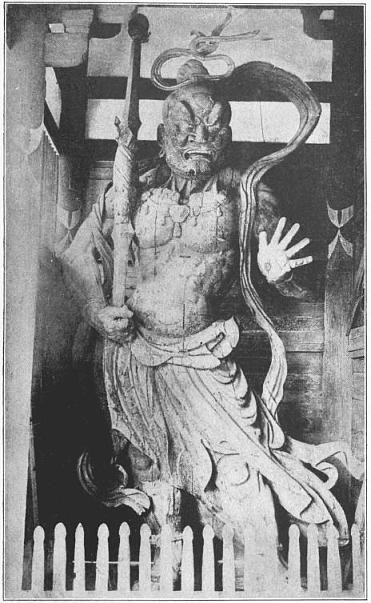
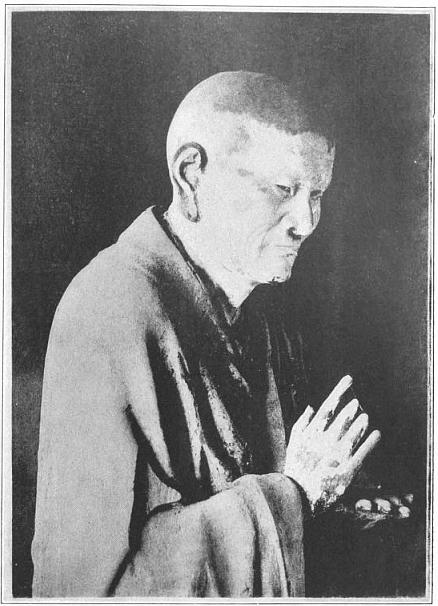
Fig. 11.—VAJRA MALLA. By Unkei (13th century). Fig. 12.—STATUE OF ASANGA (12th century, artist unknown).
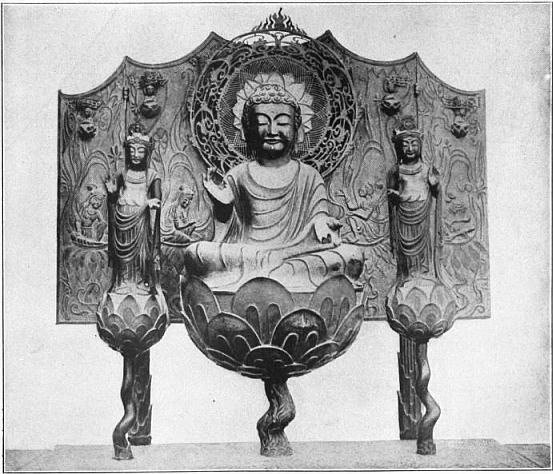
Fig. 13.—STATUES OF BUDDHA AMI’TABHA AND TWO BODHISATTVAS (7th century).
Plate VI.
METAL WORK AND LACQUER
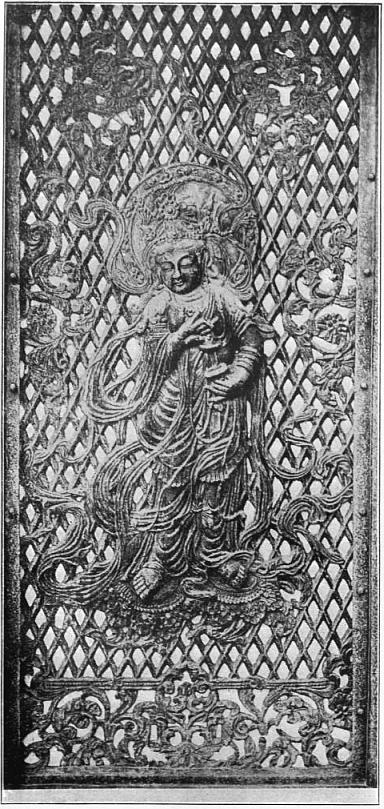
Fig 14.—DOOR OF BRONZE LANTERN IN THE TODAI TEMPLE (8th century).
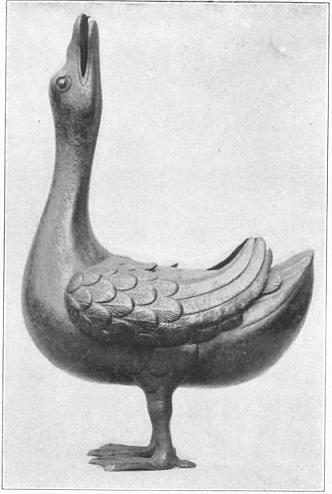
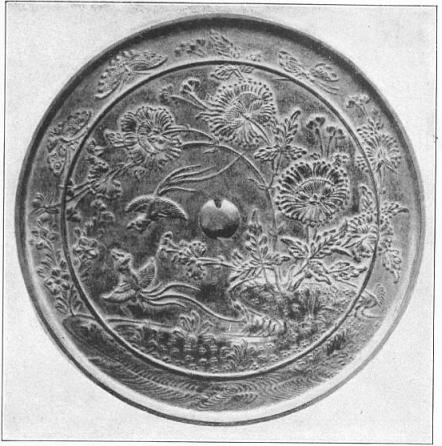
Fig. 15.—BRONZE DUCK INCENSE BURNER (15th century). British Museum. Fig. 16.—BRONZE MIRROR (12th to 13th century).
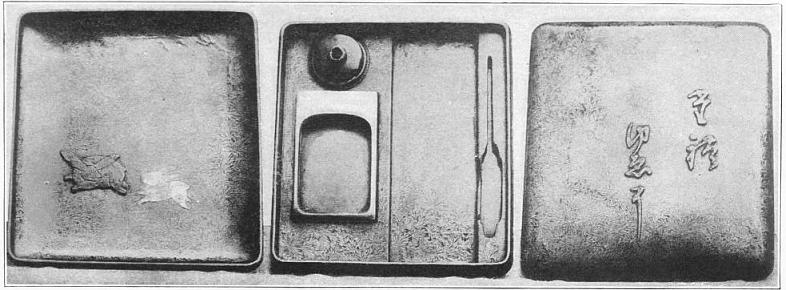
Fig. 17.—INKSTONE BOX IN LACQUER. By Koyetsu (1557-1637).
When Japanese sculpture in wood or ivory is spoken of, the first idea that presents itself is connected with the netsuke, which, of all the art objects found in Japan, is perhaps the most essentially Japanese. If Japan had given us nothing Netsuke Carvers. but the netsuke, we should still have no difficulty in differentiating the bright versatility of her national genius from the comparatively sombre, mechanic and unimaginative temperament of the Chinese. But the netsuke may now be said to be a thing of the past. The inro (medicine-box), which it mainly served to fix in the girdle, has been driven out of fashion by the new civilization imported from the West, and artists who would have carved netsuke in former times now devote their chisels to statuettes and alcove ornaments. It is not to be inferred, however, though it is a favourite assertion of collectors, that no good netsuke have been made in modern times. That theory is based upon the fact that after the opening of the country to foreign intercourse in 1857, hundreds of inferior specimens of netsuke were chiselled by inexpert hands, purchased wholesale by treaty-port merchants, and sent to New York, London and Paris, where, though they brought profit to the exporter, they also disgusted the connoisseur and soon earned discredit for their whole class. But in fact the glyptic artists of Tōkyō, Osaka and Kiōto, though they now devote their chisels chiefly to works of more importance than the netsuke, are in no sense inferior to their predecessors of feudal days, and many beautiful netsuke bearing their signatures are in existence. As for the modern ivory statuette or alcove ornament, of which great numbers are now carved for the foreign market, it certainly stands on a plane much higher than the netsuke, since anatomical defects which escape notice in the latter owing to its diminutive size, become obtrusive in the former.
One of the most remarkable developments of figure sculpture in modern Japan was due to Matsumoto Kisaburo (1830-1869). He carved human figures with as much accuracy as though they were destined for purposes of surgical demonstration. The Realistic Departure. Considering that this man had neither art education nor anatomical instruction, and that he never enjoyed an opportunity of studying from a model in a studio, his achievements were remarkable. He and the craftsmen of the school he established completely refute the theory that the anatomical solecisms commonly seen in the works of Japanese sculptors are due to faulty observation. Without scientific training of any kind Matsumoto and his followers produced works in which the eye of science cannot detect any error. But it is impossible to admit within the circle of high-art productions these wooden figures of everyday men and women, unrelieved by any subjective element, and owing their merit entirely to the fidelity with which their contours are shaped, their muscles modelled, and their anatomical proportions preserved. They have not even the attraction of being cleanly sculptured in wood, but are covered with thinly lacquered muslin, which, though doubtless a good preservative, accentuates their puppet-like character. Nevertheless, Matsumoto’s figures marked an epoch in Japanese wood sculpture. Their vivid realism appealed strongly to the taste of the average foreigner. A considerable school of carvers soon began to work in the Matsumoto style, and hundreds of their productions have gone to Europe and America, finding no market in Japan.
Midway between the Matsumoto school and the pure style approved by the native taste in former times stand a number of wood-carvers headed by Takamura Kōun, who occupies in the field of sculpture much the same place The Semi-foreign School. as that held by Hashimoto Gaho in the realm of painting. Kōun carves figures in the round which not only display great power of chisel and breadth of style, but also tell a story not necessarily drawn from the motives of the classical school. This departure from established canons must be traced to the influence of the short-lived academy of Italian art established by the Japanese government early in the Meiji era. In the forefront of the new movement are to be found men like Yoneharu Unkai and Shinkai Taketarō; the former chiselled a figure of Jenner for the Medical Association of Japan when they celebrated the centenary of the great physician, and the latter has carved life-size effigies of two Imperial princes who lost their lives in the war with China (1894-95). The artists of the Kōun school, however, do much work which appeals to emotions in general rather than to individual memories. Thus Arakawa Reiun, one of Kōun’s most brilliant pupils, has exhibited a figure of a swordsman in the act of driving home a furious thrust. The weapon is not shown. Reiun sculptured simply a man poised on the toes of one foot, the other foot raised, the arm extended, and the body straining forward in strong yet elastic muscular effort. A more imaginative work by the same artist is a figure of a farmer who has just shot an eagle that swooped upon his grandson. The old man holds his bow still raised. Some of the eagle’s feathers, blown to his side, suggest the death of the bird; at his feet lies the corpse of the little boy, and the horror, grief and anger that such a tragedy would inspire are depicted with striking realism in the farmer’s face. Such work has very close affinities with Occidental conceptions. The chief distinguishing feature is that the glyptic character is preserved at the expense of surface finish. The undisguised touches of the chisel tell a story of technical force and directness which could not be suggested by perfectly smooth surfaces. To subordinate process to result is the European canon; to show the former without marring the latter is the Japanese ideal. Many of Kōun’s sculptures appear unfinished to eyes trained in Occidental galleries, whereas the Japanese connoisseur detects evidence of a technical feat in their seeming roughness.
Architecture.—From the evidence of ancient records it appears that before the 5th century the Japanese resided in houses of a very rude character. The sovereign’s palace itself was merely a wooden hut. Its pillars were thrust Private Dwellings. into the ground and the whole framework—consisting of posts, beams, rafters, door-posts and window-frames—was tied together with cords made by twisting the long fibrous stems of climbing plants. The roof was thatched, and perhaps had a gable at each end with a hole to allow the smoke of the wood fire to escape. Wooden doors swung on a kind of hook; the windows were mere holes in the walls. Rugs of skins or rush matting were used for sitting on, and the whole was surrounded with a palisade. In the middle of the 5th century two-storeyed houses seem to have been built, but the evidence on the subject is slender. In the 8th century, however, when the court was moved to Nara, the influence of Chinese civilization made itself felt. Architects, turners, tile-makers, decorative artists and sculptors, coming from China and from Korea, erected grand temples for the worship of Buddha enshrining images of much beauty and adorned with paintings and carvings of considerable merit. The plan of the city itself was taken from that of the Chinese metropolis. A broad central avenue led straight to the palace, and on either side of it ran four parallel streets, crossed at right angles by smaller thoroughfares. During this century the first sumptuary edict ordered that the dwellings of all high officials and opulent civilians should have tiled roofs and be coloured red, the latter injunction being evidently intended to stop the use of logs carrying their bark. Tiles thenceforth became the orthodox covering for a roof, but vermilion, being regarded as a religious colour, found no favour in private dwellings. In the 9th century, after the capital had been established at Kiōto, the palace of the sovereigns and the mansions of ministers and nobles were built on a scale of unprecedented grandeur. It is true that all the structures of the time had the defect of a box-like appearance. Massive, towering roofs, which impart an air of stateliness even to a wooden building and yet, by their graceful curves, avoid any suggestion of ponderosity, were still confined to Buddhist edifices. The architect of private dwellings attached more importance to satin-surfaced boards and careful joinery than to any appearance of strength or solidity.