VOLUME XV SLICE II Jacobites to Japan (part) (continued 4)
Reading edition
The fundamental laws of the janissaries, which were very early infringed, were as follows: implicit obedience to their officers; perfect accord and union among themselves; abstinence from luxury, extravagance and practices unseemly for a soldier and a brave man; observance of the rules of Haji Bektash and of the religious law; exclusion from the ranks of all save those properly levied; special rules for the infliction of the death-penalty; promotion to be by seniority; janissaries to be admonished or punished by their own officers only; the infirm and unfit to be pensioned; janissaries were not to let their beards grow, not to marry, nor to leave their barracks, nor to engage in trade; but were to spend their time in drill and in practising the arts of war.
In time of peace the state supplied no arms, and the janissaries on service in the capital were armed only with clubs; they were forbidden to carry any arm save a cutlass, the only exception being at the frontier-posts. In time of war the janissaries provided their own arms, and these might be any which took their fancy. However, they were induced by rivalry to procure the best obtainable and to keep them in perfect order. The banner of the janissaries was of white silk on which verses from the Koran were embroidered in gold. This banner was planted beside the aga’s tent in camp, with four other flags in red cases, and his three horse-tails. Each orta had its flag, half-red and half-yellow, placed before the tent of its commander. Each orta had two or three great caldrons used for boiling the soup and pilaw; these were under the guard of subordinate officers. A particular superstition attached to them: if they were lost in battle all the officers were disgraced, and the orta was no longer allowed to parade with its caldrons in public ceremonies. The janissaries were stationed in most of the guard-houses of Constantinople and other large towns. No sentries were on duty, but rounds were sent out two or three times a day. It was customary for the sultan or the grand vizier to bestow largess on an orta which they might visit.
The janissaries conducted themselves with extreme violence and brutality towards civilians. They extorted money from them on every possible pretext: thus, it was their duty to sweep the streets in the immediate vicinity of their barracks, but they forced the civilians, especially if rayas, to perform this task or to pay a bribe. They were themselves subject to severe corporal punishments; if these were to take place publicly the ojak was first asked for its consent.
At first a source of strength to Turkey as being the only well-organized and disciplined force in the country, the janissaries soon became its bane, thanks to their lawlessness and exactions. One frequent means of exhibiting their discontent was to set fire to Constantinople; 140 such fires are said to have been caused during the 28 years of Ahmed III.’s reign. The janissaries were at all times distinguished for their want of respect towards the sultans; their outbreaks were never due to a real desire for reforms of abuses or of misgovernment, but were solely caused to obtain the downfall of some obnoxious minister.
The first recorded revolt of the janissaries is in 1443, on the occasion of the second accession of Mahommed II., when they broke into rebellion at Adrianople. A similar revolt happened at his death, when Bayazid II. was forced to yield to their demands and thus the custom of the accession-bakshish was established; at the end of his reign it was the janissaries who forced Bayazid to summon Prince Selim and to hand over the reins of power to him. During the Persian campaign of Selim I. they mutinied more than once. Under Osman II. their disorders reached their greatest height and led to the dethronement and murder of the sultan. It would be tedious to recall all their acts of insubordination. Throughout Turkish history they were made use of as instruments by unscrupulous and ambitious statesmen, and in the 17th century they had become a praetorian guard in the worst sense of the word. Sultan Selim III. in despair endeavoured to organize a properly drilled and disciplined force, under the name of nizam-i-jedid, to take their place; for some time the janissaries regarded this attempt in sullen silence; a curious detail is that Napoleon’s ambassador Sebastiani strongly dissuaded the sultan from taking this step. Again serving as tools, the janissaries dethroned Selim III. and obtained the abolition of the nizam-i-jedid. But after the successful revolution of Bairakdar Pasha of Widdin the new troops were re-established and drilled: the resentment of the janissaries rose to such a height that they attacked the grand vizier’s house, and after destroying it marched against the sultan’s palace. They were repulsed by cannon, losing 600 men in the affair (1806). But such was the excitement and alarm caused at Constantinople that the nizam-i-jedid, or sekbans as they were now called, had to be suppressed. During the next 20 years the misdeeds and turbulence of the janissaries knew no bounds. Sultan Mahmud II., powerfully impressed by their violence and lawlessness at his accession, and with the example of Mehemet Ali’s method of suppressing the Mamlukes before his eyes, determined to rid the state of this scourge; long biding his time, in 1825 he decided to form a corps of regular drilled troops known as eshkenjis. A fetva was obtained from the Sheikh-ul-Islam to the effect that it was the duty of Moslems to acquire military science. The imperial decree announcing the formation of the new troops was promulgated at a grand council, and the high dignitaries present (including certain of the principal officers of the janissaries who concurred) undertook to comply with its provisions. But the janissaries rose in revolt, and on the 10th of June 1826, began to collect on the Et Meidan square at Constantinople; at midnight they attacked the house of the aga of janissaries, and, finding he had made good his escape, proceeded to overturn the caldrons of as many ortas as they could find, thus forcing the troops of those ortas to join the insurrection. Then they pillaged and robbed throughout the town. Meanwhile the government was collecting its forces; the ulema, consulted by the sultan, gave the following fetva: “If unjust and violent men attack their brethren, fight against the aggressors and send them before their natural judge!” On this the sacred standard of the prophet was unfurled, and war was formally declared against these disturbers of order. Cannon were brought against the Et Meidan, which was surrounded by troops. Ibrahim Aga, known as Kara Jehennum, the commander of the artillery, made a last appeal to the janissaries to surrender; they refused, and fire was opened upon them. Such as escaped were shot down as they fled; the barracks where many found refuge were burnt; those who were taken prisoner were brought before the grand vizier and hanged. Before many days were over the corps had ceased to exist, and the janissaries, the glory of Turkey’s early days and the scourge of the country for the last two centuries, had passed for ever from the page of her history.
See M. d’Ohsson, Tableaux de l’empire ottoman (Paris, 1787-1820); Ahmed Vefyk, Lehjé-i-osmanié (Constantinople, 1290-1874); A. Djévad Bey, État militaire ottoman (Constantinople, 1885).

JANIUAY, a town of the province of Iloilo, Panay, Philippine Islands, on the Suague river, about 20 m. W.N.W. of Iloilo, the capital. Pop. (1903), 27,399, including Lambúnao (6661) annexed to Janiuay in 1903. The town commands delightful views of mountain and valley scenery. An excellent road connects it with Pototan, about 10 m. E. The surrounding country is hilly but fertile and well cultivated, producing rice, sugar, tobacco, vegetables (for the Iloilo market), hemp and Indian corn. The women weave and sell beautiful fabrics of pina, silk, cotton and abaca. The language is Panay-Visayan. Janiuay was founded in 1578; it was first established in the mountains and was subsequently removed to its present site.
JANJIRA, a native state of India, in the Konkan division of Bombay, situated along the coast among the spurs of the Western Ghats, 40 m. S. of Bombay city. Area, 324 sq. m. Pop. (1901), 85,414, showing an increase of 4% in the decade. The estimated revenue is about £37,000; there is no tribute. The chief, whose title is Nawab Sahib, is by descent a Sidi or Abyssinian Mahommedan; and his ancestors were for many generations admirals of the Mahommedan rulers of the Deccan. The state, popularly known as Habsan (= Abyssinian), did not come under direct subordination to the British until 1870. It supplies sailors and fishermen, and also fire-wood, to Bombay, with which it is in regular communication by steamer.
The Nawab of Janjira is also chief of the state of Jafarabad (q.v.).
JAN MAYEN, an arctic island between Greenland and the north of Norway, about 71° N. 8° W. It is 34 m. long and 9 in greatest breadth, and is divided into two parts by a narrow isthmus. The island is of volcanic formation and mountainous, the highest summit being Beerenberg in the north (8350 ft.). Volcanic eruptions have been observed. Glaciers are fully developed. Henry Hudson discovered the island in 1607 and called it Hudson’s Tutches or Touches. Thereafter it was several times observed by navigators who successively claimed its discovery and renamed it. Thus, in 1611 or the following year whalers from Hull named it Trinity Island; in 1612 Jean Vrolicq, a French whaler, called it Île de Richelieu; and in 1614 Joris Carolus named one of its promontories Jan Meys Hoek after the captain of one of his ships. The present name of the island is derived from this, the claim of its discovery by a Dutch navigator, Jan Mayen, in 1611, being unsupportable. The island is not permanently inhabited, but has been frequently visited by explorers, sealers and whalers; and an Austrian station for scientific observations was maintained here for a year in 1882-1883. During this period a mean temperature of 27.8° F. was recorded.
JANSEN, CORNELIUS (1585-1638), bishop of Ypres, and father of the religious revival known as Jansenism, was born of humble Catholic parentage at Accoy in the province of Utrecht on the 28th of October 1585. In 1602 he entered the university of Louvain, then in the throes of a violent conflict between the Jesuit, or scholastic, party and the followers of Michael Baius, who swore by St Augustine. Jansen ended by attaching himself strongly to the latter party, and presently made a momentous friendship with a like-minded fellow-student, Du Vergier de Hauranne, afterwards abbot of Saint Cyran. After taking his degree he went to Paris, partly to recruit his health by a change of scene, partly to study Greek. Eventually he joined Du Vergier at his country home near Bayonne, and spent some years teaching at the bishop’s college. All his spare time was spent in studying the early Fathers with Du Vergier, and laying plans for a reformation of the Church. In 1616 he returned to Louvain, to take charge of the college of St Pulcheria, a hostel for Dutch students of theology. Pupils found him a somewhat choleric and exacting master and academic society a great recluse. However, he took an active part in the university’s resistance to the Jesuits; for these had established a theological school of their own in Louvain, which was proving a formidable rival to the official faculty of divinity. In the hope of repressing their encroachments, Jansen was sent twice to Madrid, in 1624 and 1626; the second time he narrowly escaped the Inquisition. He warmly supported the Catholic missionary bishop of Holland, Rovenius, in his contests with the Jesuits, who were trying to evangelize that country without regard to the bishop’s wishes. He also crossed swords more than once with the Dutch Presbyterian champion, Voetius, still remembered for his attacks on Descartes. Antipathy to the Jesuits brought Jansen no nearer Protestantism; on the contrary, he yearned to beat these by their own weapons, chiefly by showing them that Catholics could interpret the Bible in a manner quite as mystical and pietistic as theirs. This became the great object of his lectures, when he was appointed regius professor of scriptural interpretation at Louvain in 1630. Still more was it the object of his Augustinus, a bulky treatise on the theology of St Augustine, barely finished at the time of his death. Preparing it had been his chief occupation ever since he went back to Louvain. But Jansen, as he said, did not mean to be a school-pedant all his life; and there were moments when he dreamed political dreams. He looked forward to a time when Belgium should throw off the Spanish yoke and become an independent Catholic republic on the model of Protestant Holland. These ideas became known to his Spanish rulers, and to assuage them he wrote a philippic called the Mars gallicus (1635), a violent attack on French ambitions generally, and on Richelieu’s indifference to international Catholic interests in particular. The Mars gallicus did not do much to help Jansen’s friends in France, but it more than appeased the wrath of Madrid with Jansen himself; in 1636 he was appointed bishop of Ypres. Within two years he was cut off by a sudden illness on the 6th of May 1638; the Augustinus, the book of his life, was published posthumously in 1640.
Full details as to Jansen’s career will be found in Reuchlin’s Geschichte von Port Royal (Hamburg, 1839), vol. i. See also Jansénius by the Abbés Callawaert and Nols (Louvain, 1893).
(St C.)
JANSENISM, the religious principles laid down by Cornelius Jansen in his Augustinus. This was simply a digest of the teaching of St Augustine, drawn up with a special eye to the needs of the 17th century. In Jansen’s opinion the church was suffering from three evils. The official scholastic theology was anything but evangelical. Having set out to embody the mysteries of faith in human language, it had fallen a victim to the excellence of its own methods; language proved too strong for mystery. Theology sank into a branch of dialectic; whatever would not fit in with a logical formula was cast aside as useless. But average human nature does not take kindly to a syllogism, and theology had ceased to have any appreciable influence on popular religion. Simple souls found their spiritual pasture in little mincing “devotions”; while robuster minds built up for themselves a natural moralistic religion, quite as close to Epictetus as to Christianity. All these three evils were attacked by Jansen. As against the theologians, he urged that in a spiritual religion experience, not reason, must be our guide. As against the stoical self-sufficiency of the moralists, he dwelt on the helplessness of man and his dependence on his maker. As against the ceremonialists, he maintained that no amount of church-going will save a man, unless the love of God is in him. But this capacity for love no one can give himself. If he is born without the religious instinct, he can only receive it by going through a process of “conversion.” And whether God converts this man or that depends on his good pleasure. Thus Jansen’s theories of conversion melt into predestination; although, in doing so, they somewhat modify its grimness. Even for the worst miscreant there is hope—for who can say but that God may yet think fit to convert him? Jansen’s thoughts went back every moment to his two spiritual heroes, St Augustine and St Paul, each of whom had been “the chief of sinners.”
Such doctrines have a marked analogy to those of Calvin; but in many ways Jansen differed widely from the Protestants. He vehemently rejected their doctrine of justification by faith; conversion might be instantaneous, but it was only the beginning of a long and gradual process of justification. Secondly, although the one thing necessary in religion was a personal relation of the human soul to its maker, Jansen held that that relation was only possible in and through the Roman Church. Herein he was following Augustine, who had managed to couple together a high theory of church authority and sacramental grace with a strongly personal religion. But the circumstances of the 17th century were not those of the 5th; and Jansen landed his followers in an inextricable confusion. What were they to do, when the outward church said one thing, and the inward voice said another? Some time went by, however, before the two authorities came into open conflict. Jansen’s ideas were popularized in France by his friend Du Vergier, abbot of St Cyran; and he dwelt mainly on the practical side of the matter—on the necessity of conversion and love of God, as the basis of the religious life. This brought him into conflict with the Jesuits, whom he accused of giving absolution much too easily, without any serious inquiry into the dispositions of their penitent. His views are expounded at length by his disciple, Antoine Arnauld, in a book on Frequent Communion (1643). This book was the first manifestation of Jansenism to the general public in France, and raised a violent storm. But many divines supported Arnauld; and no official action was taken against his party till 1649. In that year the Paris University condemned five propositions from Jansen’s Augustinus, all relative to predestination. This censure, backed by the signatures of eighty-five bishops, was sent up to Rome for endorsement; and in 1653 Pope Innocent X. declared all five propositions heretical.
This decree placed the Jansenists between two fires; for although the five propositions only represented one side of Jansen’s teaching, it was recognized by both parties that the whole question was to be fought out on this issue. Under the leadership of Arnauld, who came of a great family of lawyers, the Jansenists accordingly took refuge in a series of legal tactics. Firstly, they denied that Jansen had meant the propositions in the sense condemned. Alexander VII. replied (1656) that his predecessor had condemned them in the sense intended by their author. Arnauld retorted that the church might be infallible in abstract questions of theology; but as to what was passing through an author’s mind it knew no more than any one else. However, the French government supported the pope. In 1656 Arnauld was deprived of his degree, in spite of Pascal’s Provincial Letters (1656-1657), begun in an attempt to save him (see Pascal; Casuistry). In 1661 a formulary, or solemn renunciation of Jansen, was imposed on all his suspected followers; those who would not sign it went into hiding, or to the Bastille. Peace was only restored under Clement IX. in 1669.
This peace was treated by Jansenist writers as a triumph; really it was the beginning of their downfall. They had set out to reform the Church of Rome; they ended by having to fight hard for a doubtful foothold within it. Even that foothold soon gave way. Louis XIV. was a fanatic for uniformity, civil and religious; the last thing he was likely to tolerate was a handful of eccentric recluses, who believed themselves to be in special touch with Heaven, and therefore might at any moment set their conscience up against the law. During the lifetime of his cousin, Madame de Longueville, the great protectress of the Jansenists, Louis stayed his hand; on her death (1679) the reign of severity began. That summer Arnauld, who had spent the greater part of his life in hiding, was forced to leave France for good.
Six years later he was joined in exile by Pasquier Quesnel who succeeded him as leader of the party. Long before his flight from France Quesnel had published a devotional commentary—Réflexions morales sur le Nouveau Testament—which had gone through many editions without exciting official suspicion. But in 1695 Louis Antoine de Noailles, bishop of Châlons, was made archbishop of Paris. He was known to be very hostile to the Jesuits, and at Châlons had more than once expressed official approval of Quesnel’s Réflexions. So the Jesuit party determined to wreck archbishop and book at the same time. The Jansenists played into their hands by suddenly raising (1701) in the Paris divinity school the question whether it was necessary to accept the condemnation of Jansen with interior assent, or whether a “respectful silence” was enough. Very soon ecclesiastical France was in a blaze. In 1703 Louis XIV. wrote to Pope Clement XI., proposing that they should take joint action to make an end of Jansenism for ever. Clement replied in 1705 with a bull condemning respectful silence. This measure only whetted Louis’s appetite. He was growing old and increasingly superstitious; the affairs of his realm were going from bad to worse; he became frenziedly anxious to propitiate the wrath of his maker by making war on the enemies of the Church. In 1711 he asked the pope for a second, and still stronger bull, that would tear up Jansenism by the roots. The pope’s choice of a book to condemn fell on Quesnel’s Réflexions; in 1713 appeared the bull Unigenitus, anathematizing no less than one-hundred-and-one of its propositions. Indeed, in his zeal against the Jansenists the pope condemned various practices in no way peculiar to their party; thus, for instance, many orthodox Catholics were exasperated at the heavy blow he dealt at popular Bible reading. Hence the bull met with much opposition from Archbishop de Noailles and others who did not call themselves Jansenists. In the midst of the conflict Louis XIV. died (September 1715); but the freethinking duke of Orleans, who succeeded him as regent, continued after some wavering to support the bull. Thereupon four bishops appealed against it to a general council; and the country became divided into “appellants” and “acceptants” (1717). The regent’s disreputable minister, Cardinal Dubois, patched up an abortive truce in 1720, but the appellants promptly “re-appealed” against it. During the next ten years, however, they were slowly crushed, and in 1730 the Unigenitus was proclaimed part and parcel of the law of France. This led to a great quarrel with the judges, who were intensely Gallican in spirit (see Gallicanism), and had always regarded the Unigenitus as a triumph of ultramontanism. The quarrel dragged indefinitely on through the 18th century, though the questions at issue were really constitutional and political rather than religious.
Meanwhile the most ardent Jansenists had followed Quesnel to Holland. Here they met with a warm welcome from the Dutch Catholic body, which had always been in close sympathy with Jansenism, although without regarding itself as formally pledged to the Augustinus. But it had broken loose from Rome in 1702, and was now organizing itself into an independent church (see Utrecht). The Jansenists who remained in France had meanwhile fallen on evil days. Persecution usually begets hysteria in its victims; and the more extravagant members of the party were far advanced on the road which leads to apocalyptic prophecy and “speaking with tongues.” About 1728 the “miracles of St Médard” became the talk of Paris. This was the cemetery where was buried François de Pâris, a young Jansenist deacon of singularly holy life, and a perfervid opponent of the Unigenitus. All sorts of miraculous cures were believed to have been worked at his tomb, until the government closed the cemetery in 1732. This gave rise to the famous epigram:
De par le roi, défense à Dieu De faire miracle en ce lieu.
On the miracles soon followed the rise of the so-called Convulsionaries. These worked themselves up, mainly by the use of frightful self-tortures, into a state of frenzy, in which they prophesied and cured diseases. They were eventually disowned by the more reputable Jansenists, and were severely repressed by the police. But in 1772 they were still important enough for Diderot to enter the field against them. Meanwhile genuine Jansenism survived in many country parsonages and convents, and led to frequent quarrels with the authorities. Only one of its latter-day disciples, however, rose to real eminence; this was the Abbé Henri Grégoire, who played a considerable part in the French Revolution. A few small Jansenist congregations still survive in France; and others have been started in connexion with the Old Catholic Church in Holland.
Literature.—For the 17th century see the Port Royal of Sainte-Beuve (5th ed., Paris, 1888) in six volumes. See also H. Reuchlin, Geschichte von Port Royal (2 vols., Hamburg, 1839-1844), and C. Beard, Port Royal (2 vols., London, 1861). No satisfactory Roman Catholic history of the subject exists, though reference may be made to Count Joseph de Maistre’s De l’église gallicane (last ed., Lyons, 1881). On the Jansenism of the 18th century no single work exists, though much information will be found in the Gallican Church of Canon Jervis (2 vols., London, 1872). For a series of excellent sketches see also Seche, Les Derniers Jansénistes (3 vols., Paris, 1891). A more detailed list of books bearing on the subject will be found in the 5th volume of the Cambridge Modern History; and J. Paquier’s Le Jansénisme (Paris, 1909) may also be consulted.
(St C.)
JANSSEN, or Jansen (sometimes Johnson), CORNELIUS (1593-1664), Flemish painter, was apparently born in London, and baptized on the 14th of October 1593. There seems no reason to suppose, as was formerly stated, that he was born at Amsterdam. He worked in England from 1618 to 1643, and afterwards retired to Holland, working at Middelburg, Amsterdam, The Hague and Utrecht, and dying at one of the last two places about 1664. In England he was patronized by James I. and the court, and under Charles I. he continued to paint the numerous portraits which adorn many English mansions and collections. Janssen’s pictures, chiefly portraits, are distinguished by clear colouring, delicate touch, good taste and careful finish. He generally painted upon panel, and often worked on a small scale, sometimes producing replicas of his larger works. A characteristic of his style is the very dark background, which throws the carnations of his portraits into rounded relief. In all probability his earliest portrait (1618) was that of John Milton as a boy of ten.
JANSSEN, JOHANNES (1820-1891), German historian, was born at Xanten on the 10th of April 1829, and was educated as a Roman Catholic at Münster, Louvain, Bonn and Berlin, afterwards becoming a teacher of history at Frankfort-on-the-Main. He was ordained priest in 1860; became a member of the Prussian Chamber of Deputies in 1875; and in 1880 was made domestic prelate to the pope and apostolic pronotary. He died at Frankfort on the 24th of December 1891. Janssen was a stout champion of the Ultramontane party in the Roman Catholic Church. His great work is his Geschichte des deutschen Volkes seit dem Ausgang des Mittelalters (8 vols., Freiburg, 1878-1894). In this book he shows himself very hostile to the Reformation, and attempts to prove that the Protestants were responsible for the general unrest in Germany during the 16th and 17th centuries. The author’s partisanship led to some controversy, and Janssen wrote An meine Kritiker (Freiburg, 1882) and Ein zweites Wort an meine Kritiker (Freiburg, 1883) in reply to the Janssens Geschichte des deutschen Volkes (Munich, 1883) of M. Lenz, and other criticisms.
The Geschichte, which has passed through numerous editions, has been continued and improved by Ludwig Pastor, and the greater part of it has been translated into English by M. A. Mitchell and A. M. Christie (London, 1896, fol.). Of his other works perhaps the most important are: the editing of Frankfurts Reichskorrespondenz, 1376-1519 (Freiburg, 1863-1872); and of the Leben, Briefe und kleinere Schriften of his friend J. F. Böhmer (Leipzig, 1868); a monograph, Schiller als Historiker (Freiburg, 1863); and Zeit- und Lebensbilder (Freiburg, 1875).
See L. Pastor, Johannes Janssen (Freiburg, 1893); F. Meister, Erinnerung an Johannes Janssen (Frankfort, 1896); Schwann, Johannes Janssen und die Geschichte der deutschen Reformation (Munich, 1892).
JANSSEN, PIERRE JULES CÉSAR (1824-1907), French astronomer, was born in Paris on the 22nd of February 1824, and studied mathematics and physics at the faculty of sciences. He taught at the lycée Charlemagne in 1853, and in the school of architecture 1865-1871, but his energies were mainly devoted to various scientific missions entrusted to him. Thus in 1857 he went to Peru in order to determine the magnetic equator; in 1861-1862 and 1864, he studied telluric absorption in the solar spectrum in Italy and Switzerland; in 1867 he carried out optical and magnetic experiments at the Azores; he successfully observed both transits of Venus, that of 1874 in Japan, that of 1882 at Oran in Algeria; and he took part in a long series of solar eclipse-expeditions, e.g. to Trani (1867), Guntoor (1868), Algiers (1870), Siam (1875), the Caroline Islands (1883), and to Alcosebre in Spain (1905). To see the eclipse of 1870 he escaped from besieged Paris in a balloon. At the great Indian eclipse of 1868 he demonstrated the gaseous nature of the red prominences, and devised a method of observing them under ordinary daylight conditions. One main purpose of his spectroscopic inquiries was to answer the question whether the sun contains oxygen or not. An indispensable preliminary was the virtual elimination of oxygen-absorption in the earth’s atmosphere, and his bold project of establishing an observatory on the top of Mont Blanc was prompted by a perception of the advantages to be gained by reducing the thickness of air through which observations have to be made. This observatory, the foundations of which were fixed in the snow that appears to cover the summit to a depth of ten metres, was built in September 1893, and Janssen, in spite of his sixty-nine years, made the ascent and spent four days taking observations. In 1875 he was appointed director of the new astrophysical observatory established by the French government at Meudon, and set on foot there in 1876 the remarkable series of solar photographs collected in his great Atlas de photographies solaires (1904). The first volume of the Annales de l’observatoire de Meudon was published by him in 1896. He died at Paris on the 23rd of December 1907.
See A. M. Clerke, Hist. of Astr. during the 19th Century (1903); H. Macpherson, Astronomers of To-Day (1905).
JANSSENS (or Jansens), VICTOR HONORIUS (1664-1739), Flemish painter, was born at Brussels. After seven years in the studio of an obscure painter named Volders, he spent four years in the household of the duke of Holstein. The next eleven years Janssens passed in Rome, where he took eager advantage of all the aids to artistic study, and formed an intimacy with Tempesta, in whose landscapes he frequently inserted figures. Rising into popularity, he painted a large number of cabinet historical scenes; but, on his return to Brussels, the claims of his increasing family restricted him almost entirely to the larger and more lucrative size of picture, of which very many of the churches and palaces of the Netherlands contain examples. In 1718 Janssens was invited to Vienna, where he stayed three years, and was made painter to the emperor. The statement that he visited England is based only upon the fact that certain fashionable interiors of the time in that country have been attributed to him. Janssen’s colouring was good, his touch delicate and his taste refined.
JANSSENS (or Jansens) VAN NUYSSEN, ABRAHAM (1567-1632), Flemish painter, was born at Antwerp in 1567. He studied under Jan Snellinck, was a “master” in 1602, and in 1607 was dean of the master-painters. Till the appearance of Rubens he was considered perhaps the best historical painter of his time. The styles of the two artists are not unlike. In correctness of drawing Janssens excelled his great contemporary; in bold composition and in treatment of the nude he equalled him; but in faculty of colour and in general freedom of disposition and touch he fell far short. A master of chiaroscuro, he gratified his taste for strong contrasts of light and shade in his torchlights and similar effects. Good examples of this master are to be seen in the Antwerp museum and the Vienna gallery. The stories of his jealousy of Rubens and of his dissolute life are quite unfounded. He died at Antwerp in 1632.
JANUARIUS, ST, or San Gennaro, the patron saint of Naples. According to the legend, he was bishop of Benevento, and flourished towards the close of the 3rd century. On the outbreak of the persecution by Diocletian and Maximian, he was taken to Nola and brought before Timotheus, governor of Campania, on account of his profession of the Christian religion. After various assaults upon his constancy, he was sentenced to be cast into the fiery furnace, through which he passed wholly unharmed. On the following day, along with a number of fellow martyrs, he was exposed to the fury of wild beasts, which, however, laid themselves down in tame submission at his feet. Timotheus, again pronouncing sentence of death, was struck with blindness, but immediately healed by the powerful intercession of the saint, a miracle which converted nearly five thousand men on the spot. The ungrateful judge, only roused to further fury by these occurrences, caused the execution of Januarius by the sword to be forthwith carried out. The body was ultimately removed by the inhabitants of Naples to that city, where the relic became very famous for its miracles, especially in counteracting the more dangerous eruptions of Vesuvius. Whatever the difficulties raised by his Acta, the cult of St Januarius, bishop and martyr, is attested historically at Naples as early as the 5th century (Biblioth. hagiog. latina, No. 6558). Two phials preserved in the cathedral are believed to contain the blood of the martyr. The relic is shown twice a year—in May and September. On these occasions the substance contained in the phial liquefies, and the Neapolitans see in this phenomenon a supernatural manifestation. The “miracle of St Januarius” did not occur before the middle of the 15th century.
A great number of saints of the name of Januarius are mentioned in the martyrologies. The best-known are the Roman martyr (festival, the 10th of July), whose epitaph was written by Pope Damasus (De Rossi, Bullettino, p. 17, 1863), and the martyr of Cordova, who forms along with Faustus and Martialis the group designated by Prudentius (Peristephanon, iv. 20) by the name of tres coronae. The festival of these martyrs is celebrated on the 13th of October.
See Acta sanctorum, September, vi. 761-891; G. Scherillo, Esame di un codice greco pubblicato nel tomo secondo della bibliotheca casinensis (Naples, 1876); G. Taglialatela, Memorie storico-critiche del culto del sangue di S. Gennaro (Naples, 1893), which contains many facts, but little criticism; G. Albini, Sulla mobilità dei liquidi viscosi non omogenei (Società reale di Napoli, Rendiconti, 2nd series, vol. iv., 1890); Acta sanctorum, October, vi. 187-193.
(H. De.)
JANUARY, the first month in the modern calendar, consisting of thirty-one days. The name (Lat. Januarius) is derived from the two-faced Roman god Janus, to whom the month was dedicated. As doorkeeper of heaven, as looking both into the past and the future, and as being essentially the deity who busied himself with the beginnings of all enterprises, he was appropriately made guardian of the fortunes of the new year. The consecration of the month took place by an offering of meal, salt, frankincense and wine, each of which was new. The Anglo-Saxons called January Wulfmonath, in allusion to the fact that hunger then made the wolves bold enough to come into the villages. The principal festivals of the month are: New Year’s Day; Feast of the Circumcision; Epiphany; Twelfth-Day; and Conversion of St Paul (see Calendar).
JANUS, in Roman mythology one of the principal Italian deities. The name is generally explained as the masculine form of Diana (Jana), and Janus as originally a god of light and day, who gradually became the god of the beginning and origin of all things. According to some, however, he is simply the god of doorways (januae) and in this connexion is the patron of all entrances and beginnings. According to Mommsen, he was “the spirit of opening,” and the double-head was connected with the gate that opened both ways. Others, attributing to him an Etruscan origin, regard him as the god of the vault of heaven, which the Etruscan arch is supposed to resemble. The rationalists explained him as an old king of Latium, who built a citadel for himself on the Janiculum. It was believed that his worship, which was said to have existed as a local cult before the foundation of Rome, was introduced there by Romulus, and that a temple was dedicated to him by Numa. This temple, in reality only an arch or gateway (Janus geminus) facing east and west, stood at the north-east end of the forum. It was open during war and closed during peace (Livy i. 19); it was shut only four times before the Christian era. A possible explanation is, that it was considered a bad omen to shut the city gates while the citizens were outside fighting for the state; it was necessary that they should have free access to the city, whether they returned victorious or defeated. Similarly, the door of a private house was kept open while the members of the family were away, but when all were at home it was closed to keep out intruders. There was also a temple of Janus near the theatre of Marcellus, in the forum olitorium, erected by Gaius Duilius (Tacitus, Ann. ii. 49), if not earlier.
The beginning of the day (hence his epithet Matutinus), of the month, and of the year (January) was sacred to Janus; on the 9th of January the festival called Agonia was celebrated in his honour. He was invoked before any other god at the beginning of any important undertaking; his priest was the Rex Sacrorum, the representative of the ancient king in his capacity as religious head of the state. All gateways, housedoors and entrances generally, were under his protection; he was the inventor of agriculture (hence Consivius, “he who sows or plants”), of civil laws, of the coining of money and of religious worship. He was worshipped on the Janiculum as the protector of trade and shipping; his head is found on the as, together with the prow of a ship. He is usually represented on the earliest coins with two bearded faces, looking in opposite directions; in the time of Hadrian the number of faces is increased to four. In his capacity as porter or doorkeeper he holds a staff in his right hand, and a key (or keys) in his left; as such he is called Patulcius (opener) and Clusius (closer). His titles Curiatius, Patricius, Quirinus originate in his worship in the gentes, the curiae and the state, and have no reference to any special functions or characteristics. In late times, he is both bearded and unbearded; in place of the staff and keys, the fingers of his right hand show the number 300 (CCC.), those of his left the number of the remaining days of the year (LXV.). According to A. B. Cook (Classical Review, xviii. 367), Janus is only another form of Jupiter, the name under which he was worshipped by the pre-Latin (aboriginal) inhabitants of Rome; after their conquest by the Italians, Janus and Jana took their place as independent divinities by the side of the Italian Jupiter and Juno. He considers it probable that the three-headed Janus was a triple oak-god worshipped in the form of two vertical beams and a cross-bar (such as the tigillum sororium, for which see Horatii); hence also the door, consisting of two lintels and side-posts, was sacred to Janus. The three-headed type may have been the original, from which the two-headed and four-headed types were developed. J. G. Frazer (The Early History of the Kingship, pp. 214, 285), who also identifies Janus with Jupiter, is of opinion that Janus was not originally a doorkeeper, but that the door was called after him, not vice versa. Janua may be an adjective, janua foris meaning a door with a symbol of Janus close by the chief entrance, to serve as a protection for the house; then janua alone came to mean a door generally, with or without the symbol of Janus. The double head may have been due to the desire to make the god look both ways for greater protection. By J. Rhys (Hibbert Lectures, 1886, pp. 82, 94) Janus is identified with the three-faced (sometimes three-headed) Celtic god Cernunnus, a chthonian divinity, compared by Rhys with the Teutonic Heimdal, the warder of the gods of the under-world; like Janus, Cernunnus and Heimdal were considered to be the fons et origo of all things.
See S. Linde, De Jano summo romanorum deo (Lund, 1891); J. S. Speÿer, “Le Dieu romain Janus,” in Revue de l’histoire des religions (xxvi., 1892); G. Wissowa, Religion und Kultus der Römer (1902); W. Deecke, Etruskische Forschungen, vol. ii.; W. Warde Fowler, The Roman Festivals of the Period of the Republic (1899), pp. 282-290; articles in W. H. Roscher’s Lexikon der Mythologie and Daremberg and Saglio’s Dictionnaire des Antiquités; J. Toutain, Études de Mythologie (1909). On other jani (arched passages) in Rome, frequented by business men and money changers, see O. Richter, Topographie der Stadt Rom (1901).
(J. H. F.)
JAORA, a native state of Central India, in the Malwa agency. It consists of two isolated tracts, between Ratlam and Neemuch Area, with the dependencies of Piplauda and Pant Piplauda, 568 sq. m. Pop. (1901), 84,202. The estimated revenue is £57,000; tribute, £9000. The chief, whose title is nawab, is a Mahommedan of Afghan descent. The state was confirmed by the British government in 1818 by the Treaty of Mandsaur. Nawab Mahommed Ismail, who died in 1895, was an honorary major in the British army. His son, Iftikhar Ali Khan, a minor at his accession, was educated in the Daly College at Indore, with a British officer for his tutor, and received powers of administration in 1906. The chief crops are millets, cotton, maize and poppy. The last supplies a large part of the Malwa opium of commerce. The town of Jaora is on the Rajputana-Malwa railway, 20 m. N. of Ratlam. Pop. (1901), 23,854. It is well laid out, with many good modern buildings, and has a high school and dispensary. To celebrate Queen Victoria’s Diamond Jubilee, the Victoria Institute and a zenana dispensary were opened in 1898.
JAPAN, an empire of eastern Asia, and one of the great powers of the world. The following article is divided for convenience into ten sections:—I. Geography; II. The People; III. Language and Literature; IV. Art; V. Economic Conditions; VI. Government and Administration; VII. Religion; VIII. Foreign Intercourse; IX. Domestic History; X. The Claim of Japan.
I.—Geography
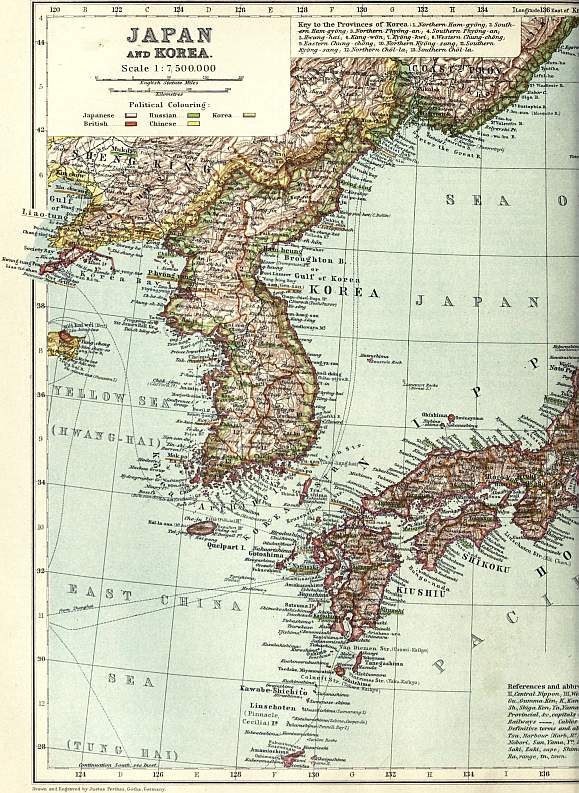
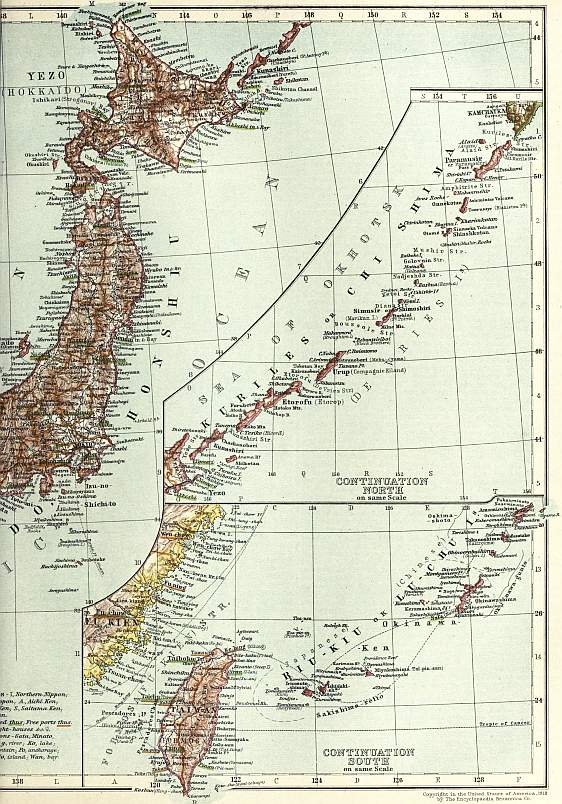
The continent of Asia stretches two arms into the Pacific Ocean, Kamchatka in the north and Malacca in the south, between which lies a long cluster of islands constituting the Japanese empire, which covers Position and Extent. 37° 14′ of longitude and 29° 11′ of latitude. On the extreme north are the Kuriles (called by the Japanese Chishima, or the “myriad isles”), which extend to 156° 32′ E. and to 50° 56′ N.; on the extreme south is Formosa (called by the Japanese Taiwan), which extends to 122° 6′ E., and to 21° 45′ N. There are six large islands, namely Sakhalin (called by the Japanese Karafuto); Yezo or Ezo (which with the Kuriles is designated Hokkaidō, or the north-sea district); Nippon (the “origin of the sun”), which is the main island; Shikoku (the “four provinces”), which lies on the east of Nippon; Kiūshiū or Kyushu (the “nine provinces”), which lies on the south of Nippon, and Formosa, which forms the most southerly link of the chain. Formosa and the Pescadores were ceded to Japan by China after the war of 1894-1895, and the southern half of Sakhalin—the part south of 50° N.—was added to Japan by cession from Russia in 1905. Korea, annexed in August 1910, is separately noticed.
Coast-line.—The following table shows the numbers, the lengths of coast-line, and the areas of the various groups of islands, only those being indicated that have a coast-line of at least 1 ri (2½ m.), or that, though smaller, are inhabited; except in the case of Formosa and the Pescadores, where the whole numbers are given:—
Number. Length of coast in miles. Area in square miles.
Nippon 1 4,765.03 99,373.57
Isles adjacent to Nippon 167 1,275.09 470.30
Shikoku 1 1,100.85 6,461.39
Isles adjacent to Shikoku 75 548.12 175.40
Kiūshiū 1 2,101.28 13,778.68
Isles adjacent to Kiūshiū 150 2,405.06 1,821.85
Yezo 1 1,423.32 30,148.41
Isles adjacent to Yezo 13 110.24 30.51
Sakhalin (Karafuto) 1 Unsurveyed 12,487.64
Sado 1 130.05 335.92
Okishima 1 182.27 130.40
Isles adjacent to Okishima 1 3.09 0.06
Awaji 1 94.43 217.83
Isles adjacent to Awaji 1 5.32 0.83
Iki 1 86.47 50.96
Isles adjacent to Iki 1 4.41 0.47
Tsushima 1 409.23 261.72
Isles adjacent to Tsushima 5 118.80 4.58
Riūkiū (or Luchu) Islands 55 768.74 935.18
Kuriles (Chishima) 31 1,496.23 6,159.42
Bonin (Ogasawara Islands) 20 174.65 26.82
Taiwan (Formosa) 1 731.31 13,429.31
Isles adjacent to Formosa 7 128.32 Not surveyed
Pescadores (Hoko-tō) 12 98.67 85.50
—— ———— ————
Totals 549 18,160.98 173,786.75
If the various smaller islands be included, a total of over 3000 is reached, but there has not been any absolutely accurate enumeration.
(Click to enlarge left section.) (Click to enlarge right section.)
It will be observed that the coast-line is very long in proportion to the area, the ratio being 1 m. of coast to every 9.5 in. of area. The Pacific Ocean, which washes the eastern shores, moulds their outline into much greater diversity than does the Sea of Japan which washes the western shores. Thus the Pacific sea-board measures 10,562 m. against 2887 m. for that of the Japan Sea. In depth of water, too, the advantage is on the Pacific side. There the bottom slopes very abruptly, descending precipitously at a point not far from the north-east coast of the main island, where soundings have shown 4655 fathoms. This, the deepest sea-bed in the world, is called the Tuscarora Deep, after the name of the United States’ man-of-war which made the survey. The configuration seems to point to a colossal crater under the ocean, and many of the earthquakes which visit Japan appear to have their origin in this submarine region. On the other hand, the average depth of the Japan Sea is only 1200 fathoms, and its maximum depth is 3200. The east coast, from Cape Shiriya (Shiriyazaki) in the north to Cape Inuboye (Inuboesaki) near Tōkyō Bay, though abounding in small indentations, has only two large bays, those of Sendai and Matsushima; but southward from Tōkyō Bay to Cape Satta (Satanomisaki) in Kiūshiū there are many capacious inlets which offer excellent anchorage, as the Gulf of Sagami (Sagaminada), the Bays of Suruga (Surugawan), Ise (Isenumi) and Osaka, the Kii Channel, the Gulf of Tosa (Tosonada), &c. Opening into both the Pacific and the Sea of Japan and separating Shikoku and Kiūshiū from the main island as well as from each other, is the celebrated Inland Sea, one of the most picturesque sheets of water in the world. Its surface measures 1325 sq. m.; it has a length of 255 m. and a maximum width of 56 m.; its coast-lines aggregate 700 m.; its depth is nowhere more than 65 fathoms, and it is studded with islands which present scenery of the most diverse and beautiful character. There are four narrow avenues connecting this remarkable body of water with the Pacific and the Japan Sea; that on the west, called Shimonoseki Strait, has a width of 3000 yds., that on the south, known as Hayamoto Strait, is 8 m. across; and the two on the north, Yura and Naruto Straits, measure 3000 and 1500 yds. respectively. It need scarcely be said that these restricted approaches give little access to the storms which disturb the seas outside. More broken into bays and inlets than any other part of the coast is the western shore of Kiūshiū. Here three promontories—Nomo, Shimabara and Kizaki—enclose a large bay having on its shores Nagasaki, the great naval port of Sasebo, and other anchorages. On the south of Kiūshiū the Bay of Kagoshima has historical interest, and on the west are the bays of Ariakeno-ura and Yatsushiro. To the north of Nagasaki are the bays of Hakata, Karatsu and Imari. Between this coast and the southern extremity of the Korean peninsula are situated the islands of Iki and Tsushima, the latter being only 30 m. distant from the peninsula. Passing farther north, the shoreline of the main island along the Japan Sea is found to be comparatively straight and monotonous, there being only one noteworthy indentation, that of Wakasa-wan, where are situated the naval port of Maizuru and the harbour of Tsuruga, the Japanese point of communication with the Vladivostok terminus of the Trans-Asian railway. From this harbour to Osaka Japan’s waist measures only 77 m., and as the great lake of Biwa and some minor sheets of water break the interval, a canal may be dug to join the Pacific and the Sea of Japan. Yezo is not rich in anchorages. Uchiura (Volcano Bay), Nemuro (Walfisch) Bay and Ishikari Bay are the only remarkable inlets. As for Formosa, the peculiarity of its outline is that the eastern coast falls precipitously into deep water, while the western slopes slowly to shelving bottoms and shoals. The Pescadores Islands afford the best anchorage in this part of Japan.
Mountains.—The Japanese islands are traversed from north to south by a range of mountains which sends out various lateral branches. Lofty summits are separated by comparatively low passes, which lie at the level of crystalline rocks and schists constituting the original uplands upon which the summits have been piled by volcanic action. The scenery among the mountains is generally soft. Climatic agencies have smoothed and modified everything rugged or abrupt, until an impression of gentle undulation rather than of grandeur is suggested. Nowhere is the region of eternal snow reached, and masses of foliage enhance the gentle aspect of the scenery and glorify it in autumn with tints of striking brilliancy. Mountain alternates with valley, so that not more than one-eighth of the country’s entire area is cultivable.
The king of Japanese mountains is Fuji-yama or Fuji-san (peerless mount), of which the highest point (Ken-ga-mine) is 12,395 ft. above sea-level. The remarkable grace of this mountain’s curve—an inverted catenary—makes it one Fuji. of the most beautiful in the world, and has obtained for it a prominent place in Japanese decorative art. Great streams of lava flowed from the crater in ancient times. The course of one is still visible to a distance of 15 m. from the summit, but the rest are covered, for the most part, with deep deposits of ashes and scoriae. On the south Fuji slopes unbroken to the sea, but on the other three sides the plain from which it rises is surrounded by mountains, among which, on the north and west, a series of most picturesque lakes has been formed in consequence of the rivers having been dammed by ashes ejected from Fuji’s crater. To a height of some 1500 ft. the slopes of the mountain are cultivated; a grassy moorland stretches up the next 2500 ft.; then follows a forest, the upper edge of which climbs to an altitude of nearly 8000 ft., and finally there is a wide area of ashes and scoriae. There is entire absence of the Alpine plants found abundantly on the summits of other high mountains in Japan, a fact due, doubtless, to the comparatively recent activity of the volcano. The ascent of Fuji presents no difficulties. A traveller can reach the usual point of departure, Gotemba, by rail from Yokohama, and thence the ascent and descent may be made in one day by a pedestrian.
The provinces of Hida and Etchiu are bounded on the east by a chain of mountains including, or having in their immediate vicinity, the highest peaks in Japan after Fuji. Six of these summits rise to a height of 9000 ft. or upwards, and The Japanese Alps. constitute the most imposing assemblage of mountains in the country. The ridge runs due north and south through 60 to 70 m., and has a width of 5 to 10 m. It is mostly of granite, only two of the mountains—Norikura and Tateyama—showing clear traces of volcanic origin. Its lower flanks are clothed with forests of beech, conifers and oak. Farther south, in the same range, stands Ontake (10,450 ft.), the second highest mountain in Japan proper (as distinguished from Formosa); and other remarkable though not so lofty peaks mark the same regions. This grand group of mountains has been well called the “Alps of Japan,” and a good account of them may be found in The Japanese Alps (1896) by the Rev. W. Weston. On the summit of Ontake are eight large and several small craters, and there also may be seen displays of trance and “divine possession,” such as are described by Mr Percival Lowell in Occult Japan (1895).
Even more picturesque, though less lofty, than the Alps of Japan, are the Nikko mountains, enclosing the mausolea of the two greatest The Nikko Mountains. of the Tokugawa shōguns. The highest of these are Shirane-san (7422 ft.), Nantai-san (8169 ft.), Nyohô-zan (8100 ft.), and Omanago (7546 ft.). They are clothed with magnificent vegetation, and everywhere they echo the voices of waterfalls and rivulets.
In the north of the main island there are no peaks of remarkable height. The best known are Chiokai-zan, called “Akita-Fuji” (the Fuji of the Akita province), a volcano 7077 ft. high, which was active as late as 1861; Ganju-san Mountains of the North. (6791 ft.), called also “Nambu-Fuji” or Iwate-zan, remarkable for the beauty of its logarithmic curves; Iwaki-san (5230 ft.), known as Tsugaru-Fuji, and said by some to be even more imposing than Fuji itself; and the twin mountains Gassan (6447 ft.) and Haguro-san (5600 ft.). A little farther south, enclosing the fertile plain of Aizu (Aizu-taira, as it is called) several important peaks are found, among them being Iide-san (6332 ft.); Azuma-yama (7733 ft.), which, after a long interval of quiescence, has given many evidences of volcanic activity during recent years; Nasu-dake (6296 ft.), an active volcano; and Bandai-san (6037 ft.). A terrible interest attaches to the last-named mountain, for, after having remained quiet so long as to lull the inhabitants of the neighbouring district into complete security, it suddenly burst into fierce activity on the 15th of July 1888, discharging a vast avalanche of earth and rock, which dashed down its slopes like an inundation, burying four hamlets, partially destroying seven villages, killing 461 people and devastating an area of 27 sq. m.
In the province of Kōzuke, which belongs to the central part of the main island, the noteworthy mountains are Asama-yama (8136 ft.), one of the best known and most violently active volcanoes of Japan; Akagi-san, a circular range of Mountains of Kōzuke, Kai and Shinano. peaks surrounding the basin of an old crater and rising to a height of 6210 ft.; the Haruna group, celebrated for scenic beauties, and Myogi-san, a cluster of pinnacles which, though not rising higher than 3880 ft., offer scenery which dispels the delusion that nature as represented in the classical pictures (bunjingwa) of China and Japan exists only in the artist’s imagination. Farther south, in the province of Kai (Kōshiu), and separating two great rivers, the Fuji-kawa and the Tenriu-gawa, there lies a range of hills with peaks second only to those of the Japanese Alps spoken of above. The principal elevations in this range are Shirane-san—with three summits, Nōdori (9970 ft.), Ai-no-take (10,200 ft.) and Kaigane (10,330 ft.)—and Hōōzan (9550 ft.). It will be observed that all the highest mountains of Japan form a species of belt across the widest part of the main island, beginning on the west with the Alps of Etchiu, Hida and Shinano, and ending on the east with Fuji-yama. In all the regions of the main island southward of this belt the only mountains of conspicuous altitude are Omine (6169 ft.) and Odai-gaharazan (5540 ft.) in Yamato and Daisen or Oyama (5951 ft.) in Hōki.
The island of Shikoku has no mountains of notable magnitude. The highest is Ishizuchi-zan (7727 ft.), but Mountains of Shikoku. Mountains of Kiūshiū. there are several peaks varying from 3000 to 6000 ft.
Kiūshiū, though abounding in mountain chains, independent or connected, is not remarkable for lofty peaks. In the neighbourhood of Nagasaki, over the celebrated solfataras of Unzen-take (called also Onsen) stands an extinct volcano, whose summit, Fugen-dake, is 4865 ft. high. More notable is Aso-take, some 20 m. from Kumamoto; for, though the highest of its five peaks has an altitude of only 5545 ft., it boasts the largest crater in the world, with walls nearly 2000 ft. high and a basin from 10 to 14 m. in diameter. Aso-take is still an active volcano, but its eruptions during recent years have been confined to ashes and dust. Only two other mountains in Kiūshiū need be mentioned—a volcano (3743 ft.) on the island Sakura-jima, in the extreme south; and Kirishima-yama (5538 ft.), on the boundary of Hiūga, a mountain specially sacred in Japanese eyes, because on its eastern peak (Takachiho-dake) the god Ninigi descended as the forerunner of the first Japanese sovereign, Jimmu.
Among the mountains of Japan there are three volcanic ranges, namely, that of the Kuriles, that of Fuji, and that of Kirishima. Fuji is the most remarkable volcanic peak. The Japanese regard it as a sacred mountain, and numbers Volcanoes. of pilgrims make the ascent in midsummer. From 500 to 600 ft. is supposed to be the depth of the crater. There are neither sulphuric exhalations nor escapes of steam at present, and it would seem that this great volcano is permanently extinct. But experience in other parts of Japan shows that a long quiescent crater may at any moment burst into disastrous activity. Within the period of Japan’s written history several eruptions are recorded the last having been in 1707, when the whole summit burst into flame, rocks were shattered, ashes fell to a depth of several inches even in Yedo (Tōkyō), 60 m. distant, and the crater poured forth streams of lava. Among still active volcanoes the following are the best known:—
Name of Volcano. Height in feet. Remarks.
Tarumai (Yezo) 2969. Forms southern wall of a large ancient crater now occupied by a lake (Shikotsu). A little steam still issues from several smaller cones on the summit of the ridge, as well as from one, called Eniwa, on the northern side.
Noboribetsu (Yezo) 1148. In a state of continuous activity, with frequent detonations and rumblings. The crater is divided by a wooded rock-wall. The northern part is occupied by a steaming lake, while the southern part contains numerous solfataras and boiling springs.
Komagatake (Yezo) 3822. The ancient crater-wall, with a lofty pinnacle on the western side, contains a low new cone with numerous steaming rifts and vents. In a serious eruption in 1856 the S.E. flank of the mountain and the country side in that direction were denuded of trees.
Esan 2067. A volcano-promontory at the Pacific end of the Tsugaru Strait: a finely formed cone surrounded on three sides by the sea, the crater breached on the land side. The central vent displays considerable activity, while the rocky walls are stained with red, yellow and white deposits from numerous minor vents.
Agatsuma (Iwaki) 5230. Erupted in 1903 and killed two geologists.
Bandai-san (Iwashiro) 6037. Erupted in 1888 after a long period of quiescence. The outbreak was preceded by an earthquake of some severity, after which about 20 explosions took place. A huge avalanche of earth and rocks buried the Nagase Valley with its villages and inhabitants, and devastated an area of over 27 sq. m. The number of lives lost was 461; four hamlets were completely entombed with their inhabitants and cattle; seven villages were partially wrecked; forests were levelled or the trees entirely denuded of bark; rivers were blocked up, and lakes were formed. The lip of the fracture is now marked by a line of steaming vents.
Azuma-yama (Fukushima) 7733. Long considered extinct, but has erupted several times since 1893, the last explosion having been in 1900, when 82 sulphur-diggers were killed or injured; ashes were thrown to a distance of 5 m., accumulating in places to a depth of 5 ft.; and a crater 300 ft. in diameter, and as many in depth, was formed on the E. side of the mountain. This crater is still active. The summit-crater is occupied by a beautiful lake. On the Fukushima (E.) side of the volcano rises a large parasitic cone, extinct.
Nasu (Tochigi) 6296. Has both a summit and a lateral crater, which are apparently connected and perpetually emitting steam. At or about the main vents are numerous solfataras. The whole of the upper part of the cone consists of grey highly acidic lava. At the base is a thermal spring, where baths have existed since the 7th century.
Shirane (Nikko) 7422. The only remaining active vent of the once highly volcanic Nikko district. Eruption in 1889.
Shirane (Kai) 10,330. Eruption in 1905, when the main crater was enlarged to a length of 3000 ft. It is divided into three parts, separated by walls, and each containing a lake, of which the middle one emits steam and the two others are cold. The central lake, during the periods of eruption (which are frequent), displays a geyser-like activity. These lakes contain free sulphuric acid, mixed with iron and alum.
Unzen (Hizen) 4865. A triple-peaked volcano in the solfatara stage, extinct at the summit, but displaying considerable activity at its base in the form of numerous fumaroles and boiling sulphur springs.
Aso-take (Higo) 5545. Remarkable for the largest crater in the world. It measures 10 m. by 15, and rises almost symmetrically to a height of about 2000 ft., with only one break through which the river Shira flows. The centre is occupied by a mass of peaks, on the W. flank of which lies the modern active crater. Two of the five compartments into which it is divided by walls of deeply striated volcanic ash are constantly emitting steam, while a new vent displaying great activity has been opened at the base of the cone on the south side. Eruptions have been recorded since the earliest days of Japanese history. In 1884 the ejected dust and ashes devastated farmlands through large areas. An outbreak in 1894 produced numerous rifts in the inner walls from which steam and smoke have issued ever since.
Kaimon (Kagoshima Bay) 3041. One of the most beautiful volcanoes of Japan, known as the Satsuma-Fuji. The symmetry of the cone is marred by a convexity on the seaward (S.) side. This volcano is all but extinct.
Sakura-jima (Kagomshima Bay) 3743. An island-volcano, with several parasitic cones (extinct), on the N. and E. sides. At the summit are two deep craters, the southern of which emits steam. Grass grows, however, to the very edges of the crater. The island is celebrated for thermal springs, oranges and daikon (radishes), which sometimes grow to a weight of 70 ℔.
Kiri-shima (Kagoshima Bay) 5538. A volcanic range of which Takachiho, the only active cone, forms the terminal (S.E.) peak. The crater, situated on the S.W. side of the volcano, lies some 500 ft. below the summit-peak. It is of remarkably regular formation, and the floor is pierced by a number of huge fumaroles whence issue immense volumes of steam.
Izuno Oshima (Vries Island) (Izu) 2461. The volcano on this island is called Mihara. There is a double crater, the outer being almost complete. The diameter of the outer crater, within which rises the modern cone to a height of 500 ft. above the surrounding floor, is about 2 m.; while the present crater, which displays incessant activity, has itself a diameter of ¼ m.
Asama (Ise) 8136. The largest active volcano in Japan. An eruption in 1783, with a deluge of lava, destroyed an extensive forest and overwhelmed several villages. The present cone is the third, portions of two concentric crater rings remaining. The present crater is remarkable for the absolute perpendicularity of its walls, and has an immense depth—from 600 to 800 ft. It is circular, ¾ m. in circumference, with sides honeycombed and burned to a red hue.
Some of the above information is based upon Mr. C. E. Bruce-Mitford’s valuable work (see Geog. Jour., Feb. 1908, &c.).
Earthquakes.—Japan is subject to marked displays of seismic violence. One steadily exercised influence is constantly at work, for the shores bordering the Pacific Ocean are slowly though appreciably rising, while on the side of the Japan Sea a corresponding subsidence is taking place. Japan also experiences a vast number of petty vibrations not perceptible without the aid of delicate instruments. But of earthquakes proper, large or small, she has an exceptional abundance. Thus in the thirteen years ending in 1897—that is to say, the first period when really scientific apparatus for recording purposes was available—she was visited by no fewer than 17,750 shocks, being an average of something over 3½ daily. The frequency of these phenomena is in some degree a source of security, for the minor vibrations are believed to exercise a binding effect by removing weak cleavages. Nevertheless the annals show that during the three centuries before 1897 there were 108 earthquakes sufficiently disastrous to merit historical mention. If the calculation be carried farther back—as has been done by the seismic disaster investigation committee of Japan, a body of scientists constantly engaged in studying these phenomena under government auspices,—it is found that, since the country’s history began to be written in the 8th century A.D., there have been 2006 major disturbances; but inasmuch as 1489 of these occurred before the beginning of the Tokugawa administration (early in the 17th century, and therefore in an era when methods of recording were comparatively defective), exact details are naturally lacking. The story, so far as it is known, may be gathered from the following table:—
Date A.D. Region. Houses destroyed. Deaths.
684 Southern part of Tosa — — (1)
869 Mutsu — — (2)
1361 Kiōto — —
1498 Tōkaidō — 2,000(3)
1569 Bungo — 700
1596 Kiōto — 2,000
1605 (31/1) Pacific Coast — 5,000
1611 (27/9) Aizu — 3,700
1614 (2/12) Pacific Coast (N.E.) — 1,700
1662 (16/6) Kiōto 5,500 500
1666 (2/2) Pacific Coast (N.E.) — 1,500
1694 (19/12) Ugo 2,760 390
1703 (30/12) Tōkyō 20,162 5,233
1707 (28/10) Pacific Coast of Kiūshiū and Shikoku 29,000 4,900
1751 (20/5) Echigo 9,100 1,700
1766 (8/3) Hirosaki 7,500 1,335
1792 (10/2) Hizen and Higo 12,000 15,000
1828 (18/2) Echigo 11,750 1,443
1844 (8/5) Echigo 34,000 12,000
1854 (6/7) Yamato, Iga, Ise 5,000 2,400
1854 (23/12) Tōkaidō (Shikoku) 60,000 3,000
1855 (11/11) Yedo, (Tōkyō 50,000 6,700
1891 (28/10) Mino, Owari 222,501 7,273
1894 (22/10) Shōnai 8,403 726
1896 (15/6) Sanriku 13,073 27,122
1896 (31/8) Ugo, Rikuchu 8,996 209
1906 (12/2) Formosa 5,556 1,228
(1) An area of over 1,200,000 acres swallowed up by the sea. (2) Tidal wave killed thousands of people. (3) Hamana lagoon formed.
In the capital (Tōkyō) the average yearly number of shocks throughout the 26 years ending in 1906 was 96, exclusive of minor vibrations, but during the 50 years then ending there were only two severe shocks (1884 and 1894), and they were not directly responsible for any damage to life or limb. The Pacific coast of the Japanese islands is more liable than the western shore to shocks disturbing a wide area. Apparent proof has been obtained that the shocks occurring in the Pacific districts originate at the bottom of the sea—the Tuscarora Deep is supposed to be the centre of seismic activity—and they are accompanied in most cases by tidal waves. It would seem that of late years Tajima, Hida, Kōzuke and some other regions in central Japan have enjoyed the greatest immunity, while Musashi (in which province Tōkyō is situated) and Sagami have been most subject to disturbance.
Plains.—Japan, though very mountainous, has many extensive plains. The northern island—Yezo—contains seven, and there are as many more in the main and southern islands, to say nothing of flat lands of minor dimensions. The principal are given in the following table:—
Name. Situation. Area. Remarks.
Tokachi plain Yezo. 744,000 acres. —
Ishikari ” ” 480,000 acres. —
Kushiro ” ” 1,229,000 acres. —
Nemuro ” ” 320,000 acres. —
Kitami ” ” 230,000 acres. —
Hidaka ” ” 200,000 acres. —
Teshio ” ” 180,000 acres. —
Echigo ” Main Island. Unascertained. —
Sendai ” ” ” —
Kwanto ” ” ” In this plain lie the capital, Tōkyō, and the town of Yokohama. It supports about 6 millions of people.
Mino-Owari ” ” ” Has 1½ million inhabitants.
Kinai ” ” ” Has the cities of Osaka, Kiōto and Kobe, and 2½ million people.
Tsukushi ” Kiūshiū. ” The chief coalfield of Japan.
Rivers.—Japan is abundantly watered. Probably no country in the world possesses a closer network of streams, supplemented by canals and lakes. But the quantity of water carried seawards varies within wide limits; for whereas, during the rainy season in summer and while the snows of winter are melting in spring, great volumes of water sweep down from the mountains, these broad rivers dwindle at other times to petty rivulets trickling among a waste of pebbles and boulders. Nor are there any long rivers, and all are so broken by shallows and rapids that navigation is generally impossible except by means of flat-bottomed boats drawing only a few inches. The chief rivers are given in the following table:—
Length in miles. Source. Mouth.
Ishikari-gawa 275 Ishikari-dake Otaru.
Shinano-gawa 215 Kimpu-san Niigata.
Teshio-gawa 192 Teshio-take Sea of Japan.
Tone-gawa 177 Monju-zan, Kōzuke Choshi (Shimosa).
Mogami-gawa 151 Dainichi-dake(Uzen) Sakata.
Yoshino-gawa 149 Yahazu-yama (Tosa) Tokushima (Awa).
Kitakami-gawa 146 Nakayama-dake (Rikuchiu) Ishinomaki (Rikuzen).
Tenriu-gawa 136 Suwako (Shinano) Tōtōmi Bay.
Go-gawa or Iwa-megawa 122 Maruse-yama (Bingo) Iwami Bay.
Abukuma-gawa 122 Asahi-take (Iwashiro) Matsushima Bay.
Tokachi-gawa 120 Tokachi-dake Tokachi Bay.
Sendai-gawa 112 Kunimi-zan (Hiuga) Kumizaki (Satsuma).
Oi-gawa 112 Shirane-san (Kai) Suruga Bay.
Kiso-gawa 112 Kiso-zan (Shinano) Bay of Isenumi.
Arakawa 104 Chichibu-yama Tōkyō Bay.
Naga-gawa 102 Nasu-yama (Shimotsuke) Naka-no-minato (Huachi).
Lakes and Waterfalls.—Japan has many lakes, remarkable for the beauty of their scenery rather than for their extent. Some are contained in alluvial depressions in the river valleys; others have been formed by volcanic eruptions, the ejecta damming the rivers until exits were found over cliffs or through gorges. Some of these lakes have become favourite summer resorts for foreigners. To that category belong especially the lakes of Hakone, of Chiuzenji, of Shōji, of Inawashiro, and of Biwa. Among these the highest is Lake Chiuzenji, which is 4375 ft. above sea-level, has a maximum depth of 93 fathoms, and empties itself at one end over a fall (Kegon) 250 ft. high. The Shōji lakes lie at a height of 3160 ft., and their neighbourhood abounds in scenic charms. Lake Hakone is at a height of 2428 ft.; Inawashiro, at a height of 1920 ft. and Biwa at a height of 328 ft. The Japanese associate Lake Biwa (Omi) with eight views of special loveliness (Omi-no-hakkei). Lake Suwa, in Shinano, which is emptied by the Tenriu-gawa, has a height of 2624 ft. In the vicinity of many of these mountain lakes thermal springs, with remarkable curative properties, are to be found.
(F. By.)
Geology.—It is a popular belief that the islands of Japan consist for the most part of volcanic rocks. But although this conception might reasonably be suggested by the presence of many active and extinct volcanoes, Professor J. Milne has pointed out that it is literally true of the Kuriles alone, partially true for the northern half of the Main Island and for Kiūshiū, and quite incorrect as applied to the southern half of the Main Island and to Shikoku. This authority sums up the geology of Japan briefly and succinctly as follows (in Things Japanese, by Professor Chamberlain): “The backbone of the country consists of primitive gneiss and schists. Amongst the latter, in Shikoku, there is an extremely interesting rock consisting largely of piedmontite. Overlying these amongst the Palaeozoic rocks, we meet in many parts of Japan with slates and other rocks possibly of Cambrian or Silurian age. Trilobites have been discovered in Rikuzen. Carboniferous rocks are represented by mountain masses of Fusulina and other limestones. There is also amongst the Palaeozoic group an interesting series of red slates containing Radiolaria. Mesozoic rocks are represented by slates containing Ammonites and Monotis, evidently of Triassic age, rocks containing Ammonites Bucklandi of Liassic age, a series of beds rich in plants of Jurassic age, and beds of Cretaceous age containing Trigonia and many other fossils. The Cainozoic or Tertiary system forms a fringe round the coasts of many portions of the empire. It chiefly consists of stratified volcanic tuffs rich in coal, lignite, fossilized plants and an invertebrate fauna. Diatomaceous earth exists at several places in Yezo. In the alluvium which covers all, the remains have been discovered of several species of elephant, which, according to Dr Edmund Naumann, are of Indian origin. The most common eruptive rock is andesite. Such rocks as basalt, diorite and trachyte are comparatively rare. Quartz porphyry, quartzless porphyry, and granite are largely developed.” Drs von Richthofen and Rein discuss the subject in greater detail. They have pointed out that in the mountain system of Japan there are three main lines. One runs from S.W. to N.E.; another from S.S.W. to N.N.E., and the third is meridional. These they call respectively the “southern schist range,” the “northern schist range,” and the “snow range,” the last consisting mainly of old crystalline massive rocks. The rocks predominating in Japan fall also into three groups. They are, first, plutonic rocks, especially granite; secondly, volcanic rocks, chiefly trachyte and dolerite; and thirdly, palaeozoic schists. On the other hand, limestone and sandstone, especially of the Mesozoic strata, are strikingly deficient. The strike of the old crystalline rocks follows, in general, the main direction of the islands (S.W. to N.E.). They are often overlain by schists and quartzites, or broken through by volcanic masses. “The basis of the islands consist of granite, syenite, diorite, diabase and related kinds of rock, porphyry appearing comparatively seldom. Now the granite, continuing for long distances, forms the prevailing rock; then, again, it forms the foundation for thick strata of schist and sandstone, itself only appearing in valleys of erosion and river boulders, in rocky projections on the coasts or in the ridges of the mountains.... In the composition of many mountains in Hondo (the main island) granite plays a prominent part.... It appears to form the central mass which crops up in hundreds of places towards the coast and in the interior. Old schists, free from fossils and rich in quartz, overlie it in parallel chains through the whole length of the peninsula, especially in the central and highest ridges, and bear the ores of Chū-goku (the central provinces), principally copper pyrites and magnetic pyrites. These schist ridges rich in quartz show, to a depth of 20 metres, considerable disintegration. The resulting pebble and quartz-sand is very unproductive, and supports chiefly a poor underwood and crippled pines with widely spreading roots which seek their nourishment afar. In the province of Settsu granite everywhere predominates, which may be observed also in the railway cuttings between Hiōgo and Osaka, as well as in the temples and walls of these towns. The waterfalls near Kobe descend over granite walls and the mikageishi (stone of Mikage), famous throughout Japan, is granite from Settsu.... In the hill country on the borders of Ise, Owari, Mikawa and Tōtōmi, on the one side, and Omi, Mino and Shinano, on the other, granite frequently forms dark grey and much disintegrated rock-projections above schist and diluvial quartz pebbles. The feldspar of a splendid pegmatite and its products of disintegration on the borders of Owari, Mino and Mikawa form the raw material of the very extensive ceramic industry of this district, with its chief place, Seto. Of granite are chiefly formed the meridional mountains of Shinano. Granite, diorite and other plutonic rocks hem in the winding upper valleys of the Kiso-gawa, the Saigawa (Shinano river) and many other rivers of this province, their clear water running over granite. Also in the hills bordering on the plain of Kwanto these old crystalline rocks are widely spread. Farther northwards they give way again, as in the south, to schists and eruptive rocks. Yet even here granite may be traced in many places. Of course it is not always a pure granite; even hablit and granite-porphyry are found here and there. Thus, for instance, near Nikkō in the upper valley of the Daiya-gawa, and in several other places in the neighbouring mountains, a granite-porphyry appears with large, pale, flesh-coloured crystals of orthoclase, dull triclinic felspar, quartz and hornblende.” “From the mine of Ichinokawa in Shikoku come the wonderful crystals of antimonite, which form such conspicuous objects in the mineralogical cabinets of Europe.” (Rein’s Japan and Milne in Things Japanese.) The above conditions suggest the presence of tertiary formations, yet only the younger groups of that formation appear to be developed. Nor is there any sign of moraines, glacier-scorings or other traces of the ice-age.
The oldest beds which have yielded fossils in any abundance belong to the Carboniferous System. The Trias proper is represented by truly marine deposits, while the Rhaetic beds contain plant remains. The Jurassic and Cretaceous beds are also in part marine and in part terrestrial. During the whole of the Mesozoic era Japan appears to have lain on or near the margin of the Asiatic continent, and the marine deposits are confined for the most part to the eastern side of the islands.
The igneous rocks occur at several geological horizons, but the great volcanic eruptions did not begin until the Tertiary period. The existing volcanoes belong to four separate arcs or chains. On the south is the arc of the Luchu islands, which penetrates into Kiū Shiū. In the centre there is the arc of the Izu-no-Shichito islands, which is continued into Hondo along the Fossa Magna. In North Hondo the great Bandai arc forms the axis of the island and stretches into Yezo (Hokkaidō). Finally in the east of Yezo rise the most westerly volcanoes of the Kurile chain. The lavas and ashes ejected by these volcanoes consist of liparite, dacite, andesite and basalt.
Structurally Japan is divided into two regions by a depression (the “Fossa Magna” of Naumann) which stretches across the island of Hondo from Shimoda to Nagano. The depression is marked by a line of volcanoes, including Fuji, and is in part buried beneath the products of their eruptions. It is supposed to be due to a great fault along its western margin. South and west of the Fossa Magna the beds are thrown into folds which run approximately parallel to the general direction of the coast, and two zones may be recognized—an outer, consisting of Palaeozoic and Mesozoic beds, and an inner, consisting of Archaean and Palaeozoic rocks, with granitic intrusions. Nearly along the boundary between the two zones lie the inland seas of south Japan. Towards the Fossa Magna the folds bend northwards.
North and east of the Fossa Magna the structure is concealed, to a very large extent, by the outpourings of the volcanoes which form so marked a feature in the northern part of Hondo. But the foundation on which the volcanoes rest is exposed along the east coast of Hondo (in the Kwanto, Abukuma and Kitakami hills), and also in the island of Yezo. This foundation consists of Archean, Palaeozoic and Mesozoic beds folded together, the direction of the folds being N. by W. to S. by E., that is to say, slightly oblique to the general direction of this part of the island. Towards the Fossa Magna the folds bend sharply round until they are nearly parallel to the Fossa itself.
(P. La.)
It has been abundantly demonstrated by careful observations that the east coasts of Japan are slowly rising. This phenomenon was first noticed in the case of the plain on which stands the capital, Tōkyō. Maps of sufficiently trustworthy Secular Movement. accuracy show that in the 11th century Tōkyō Bay penetrated much more deeply in a northern direction than it does now; the point where the city’s main river (Sumida or Arakawa) enters the sea was considerably to the north of its present position, and low-lying districts, to-day thickly populated, were under water. Edmund Naumann was the discoverer of these facts, and his attention was first drawn to them by learning that an edible sea-weed, which flourishes only in salt water, is called Asakusa-nori, from the place (Asakusa) of its original provenance, which now lies some 3 m. inland. Similar phenomena were found in Sakhalin by Schmidt and on the north-east coast of the main island by Rein, and there can be little doubt that they exist at other places also. Naumann has concluded that “formerly Tōkyō Bay stretched further over the whole level country of Shimosa and Hitachi and northwards as far as the plain of Kwantō extends;” that “the mountain country of Kasusa-Awa emerged from it an island, and that a current ran in a north-westerly direction between this island and the northern mountain margin of the present plain toward the north-east into the open ocean.”
Mineral Springs.—The presence of so many active volcanoes is partially compensated by a wealth of mineral springs. Since many of these thermal springs possess great medicinal value, Japan may become one of the world’s favourite health-resorts. There are more than a hundred spas, some hot, some cold, which, being easily accessible and highly efficacious, are largely visited by the Japanese. The most noteworthy are as follows:—
Name of Spa. Prefecture. Quality. Temp., F°.
Arima Hiogo Salt 100
Asama Nagano Pure 111—127
Asamushi Aomori Salt 134—168
Atami Shizuoka ” 131—226
Beppu Oita Carbonic Acid 109—132
Bessho Nagano Pure or Sulphurous 108—113
Dogo Ehime Pure 70—110
Hakone Kanagawa Pure, Salt or Sulphurous 98—168
Higashi-yama Fukushima Pure or Salt 117—144
Ikao Gumma Salt 111—127
Isobe ” ” Cold
Kusatsu ” Sulphurous 127—148
Nasu Tochigi Sulphurous 162-172
Noboribetsu Ishikari ” 125
Shibu Nagano Salt 98-115
Chiuzenji Shizuoka Carbonate of Soda and Sulphur 114-185
Takarazuka Hiogo Carbonic Acid Cold
Ureshino Saga ” 230
Unzen Nagasaki Sulphurous 158-204
Wagura Ishikawa Salt 180
Yamashiro ” ” 165
Yunoshima Hiogo ” 104-134
Climate.—The large extension of the Japanese islands in a northerly and southerly direction causes great varieties of climate. General characteristics are hot and humid though short summers, and long, cold and clear winters. The equatorial currents produce conditions differing from those existing at corresponding latitudes on the neighbouring continent. In Kiūshiū, Shikoku and the southern half of the main island, the months of July and August alone are marked by oppressive heat at the sea-level, while in elevated districts a cool and even bracing temperature may always be found, though the direct rays of the sun retain distressing power. Winter in these districts does not last more than two months, from the end of December to the beginning of March; for although the latter month is not free from frost and even snow, the balminess of spring makes itself plainly perceptible. In the northern half of the main island, in Yezo and in the Kuriles, the cold is severe during the winter, which lasts for at least four months, and snow falls sometimes to great depths. Whereas in Tōkyō the number of frosty nights during a year does not average much over 60, the corresponding number in Sapporo on the north-west of Yezo is 145. But the variation of the thermometer in winter and summer being considerable—as much as 72° F. in Tōkyō—the climate proves somewhat trying to persons of weak constitution. On the other hand, the mean daily variation is in general less than that in other countries having the same latitude: it is greatest in January, when it reaches 18° F., and least in July, when it barely exceeds 9° F. The monthly variation is very great in March, when it usually reaches 43° F.
During the first 40 years of the Meiji era numerous meteorological stations were established. Reports are constantly forwarded by telegraph to the central observatory in Tōkyō, which Meteorology. issues daily statements of the climatic conditions during the previous twenty-four hours, as well as forecasts for the next twenty-four. The whole country is divided into districts for meteorological purposes, and storm-warnings are issued when necessary. At the most important stations observations are taken every hour; at the less important, six observations daily; and at the least important, three observations. From the record of three decades the following yearly averages of temperature are obtained:—
F°.
Taihoku (in Formosa) 71
Nagasaki (Kiūshiū) 60
Kōbe (Main Island) 59
Osaka (Main Island) 59
Okayama (Main Island) 58
Nagoya (Main Island) 58
Sakai (Main Island) 58
Tōkyō (Capital) 57
Kiōto (Main Island) 57
Niigata (Main Island) 55
Ishinomaki (Main Island) 52
Aomori (Main Island) 50
Sapporo (Yezo) 44
The following table affords data for comparing the climates of Peking, Shanghai, Hakodate, Tōkyō and San Francisco:—
Longitude. Latitude. Mean Temp., F°.
Peking 116° 29′ E. 39° 57′ N. 53
Shanghai 121° 20′ E. 31° 12′ N. 59
Hakodate 140° 45′ E. 41° 46′ N. 47
Tōkyō 138° 47′ E. 35° 41′ N. 57
San Francisco 122° 25′ E. 37° 48′ N. 56
Hottest Month. Mean Temp. of Hottest Month.
Peking July 80
Shanghai ” 84
Hakodate August 71
Tōkyō ” 79
San Francisco September 63
Coldest Month. Mean Temp. of Coldest Month.
Peking January 22
Shanghai ” 26
Hakodate ” 28
Tōkyō ” 36
San Francisco ” 49
There are three wet seasons in Japan: the first, from the middle of April to the beginning of May; the second, from the middle of June to the beginning of July; and the third, from early in September to early in October. The dog days (doyō) Rainfall. are from the middle of July till the second half of August. September is the wettest month; January the driest. During the four months from November to February inclusive only about 18% of the whole rain for the year falls. In the district on the east of the main island the snowfall is insignificant, seldom attaining a depth of more than four or five inches and generally melting in a few days, while bright, sunny skies are usual. But in the mountainous provinces of the interior and in those along the western coast, deep snow covers the ground throughout the whole winter, and the sky is usually wrapped in a veil of clouds. These differences are due to the action of the north-westerly wind that blows over Japan from Siberia. The intervening sea being comparatively warm, this wind arrives at Japan having its temperature increased and carrying moisture which it deposits as snow on the western faces of the Japanese mountains. Crossing the mountains and descending their eastern slopes, the wind becomes less saturated and warmer, so that the formation of clouds ceases. Japan is emphatically a wet country so far as quantity of rainfall is concerned, the average for the whole country being 1570 mm. per annum. Still there are about four sunny days for every three on which rain or snow falls, the actual figures being 150 days of snow or rain and 215 days of sunshine.
During the cold season, which begins in October and ends in April, northerly and westerly winds prevail throughout Japan. They come from the adjacent continent of Asia, and they develop considerable strength owing to the fact that Wind. there is an average difference of some 22 mm. between the atmospheric pressure (750 mm.) in the Pacific and that (772 mm.) in the Japanese islands. But during the warm season, from May to September, these conditions of atmospheric pressure are reversed, that in the Pacific rising to 767 mm. and that in Japan falling to 750 mm. Hence throughout this season the prevailing winds are light breezes from the west and south. A comparison of the force habitually developed by the wind in various parts of the islands shows that at Suttsu in Yezo the average strength is 9 metres per second, while Izuhara in the island Tsushima, Kumamoto in Kiūshiū and Gifu in the east centre of the main island stand at the bottom of the list with an average wind velocity of only 2 metres. A calamitous atmospheric feature is the periodical arrival of storms called “typhoons” (Japanese tai-fu or “great wind”). These have their origin, for the most part, in the China Sea, especially in the vicinity of Luzon. Their season is from June to October, but they occur in other months also, and they develop a velocity of 5 to 75 m. an hour. The meteorological record for ten years ended 1905 shows a total of 120 typhoons, being an average of 12 annually. September had 14 of these phenomena, March 11 and April 10, leaving 85 for the remaining 9 months. But only 65 out of the whole number developed disastrous force. It is particularly unfortunate that September should be the season of greatest typhoon frequency, for the earlier varieties of rice flower in that month and a heavy storm does much damage. Thus, in 1902—by no means an abnormal year—statistics show the following disasters owing to typhoons: casualties to human life, 3639; ships and boats lost, 3244; buildings destroyed wholly or partially, 695,062; land inundated, 1,071,575 acres; roads destroyed, 1236 m.; bridges washed away, 13,685; embankments broken, 705 m.; crops damaged, 8,712,655 bushels. The total loss, including cost of repairs, was estimated at nearly 3 millions sterling, which may be regarded as an annual average.
Flora.—The flora of Japan has been carefully studied by many scientific men from Siebold downwards. Foreigners visiting Japan are immediately struck by the affection of the people for flowers, trees and natural beauties of every kind. In actual wealth of blossom or dimensions of forest trees the Japanese islands cannot claim any special distinction. The spectacles most admired by all classes are the tints of the foliage in autumn and the glory of flowering trees in the spring. In beauty and variety of pattern and colour the autumnal tints are unsurpassed. The colours pass from deep brown through purple to yellow and white, thrown into relief by the dark green of non-deciduous shrubs and trees. Oaks and wild prunus, wild vines and sumachs, various kinds of maple, the dōdan (Enkianthus Japonicus Hook.)—a wonderful bush which in autumn develops a hue of ruddy red—birches and other trees, all add multitudinous colours to the brilliancy of a spectacle which is further enriched by masses of feathery bamboo. The one defect is lack of green sward. The grass used for Japanese lawns loses its verdure in autumn and remains from November to March a greyish-brown blot upon the scene. Spring is supposed to begin in February when, according to the old calendar, the new year sets in, but the only flowers then in bloom are the camellia japonica and some kinds of daphne. The former—called by the Japanese tsubaki—may often be seen glowing fiery red amid snow, but the pink (otome tsubaki), white (shiro-tsubaki) and variegated (shibori-no-tsubaki) kinds do not bloom until March or April. Neither the camellia nor the daphne is regarded as a refined flower: their manner of shedding their blossoms is too unsightly. Queen of spring flowers is the plum (ume). The tree lends itself with peculiar readiness to the skilful manipulation of the gardener, and is by him trained into shapes of remarkable grace. Its pure white or rose-red blossoms, heralding the first approach of genial weather, are regarded with special favour and are accounted the symbol of unassuming hardihood. The cherry (sakura) is even more esteemed. It will not suffer any training, nor does it, like the plum, improve by pruning, but the sunshine that attends its brief period of bloom in April, the magnificence of its flower-laden boughs and the picturesque flutter of its falling petals, inspired an ancient poet to liken it to the “soul of Yamato” (Japan), and it has ever since been thus regarded. The wild peach (momo) blooms at the same time, but attracts little attention. All these trees—the plum, the cherry and the peach—bear no fruit worthy of the name, nor do they excel their Occidental representatives in wealth of blossom, but the admiring affection they inspire in Japan is unique. Scarcely has the cherry season passed when that of the wistaria (fuji) comes, followed by the azalea (tsutsuji) and the iris (shōbu), the last being almost contemporaneous with the peony (botan), which is regarded by many Japanese as the king of flowers and is cultivated assiduously. A species of weeping maple (shidare-momiji) dresses itself in peachy-red foliage and is trained into many picturesque shapes, though not without detriment to its longevity. Summer sees the lotus (renge) convert wide expanses of lake and river into sheets of white and red blossoms; a comparatively flowerless interval ensues until, in October and November, the chrysanthemum arrives to furnish an excuse for fashionable gatherings. With the exception of the dog-days and the dead of winter, there is no season when flowers cease to be an object of attention to the Japanese, nor does any class fail to participate in the sentiment. There is similar enthusiasm in the matter of gardens. From the 10th century onwards the art of landscape gardening steadily grew into a science, with esoteric as well as exoteric aspects, and with a special vocabulary. The underlying principle is to reproduce nature’s scenic beauties, all the features being drawn to scale, so that however restricted the space, there shall be no violation of proportion. Thus the artificial lakes and hills, the stones forming rockeries or simulating solitary crags, the trees and even the bushes are all selected or manipulated so as to fall congruously into the general scheme. If, on the one hand, huge stones are transported hundreds of miles from seashore or river-bed where, in the lapse of long centuries, waves and cataracts have hammered them into strange shapes, and if the harmonizing of their various colours and the adjustment of their forms to environment are studied with profound subtlety, so the training and tending of the trees and shrubs that keep them company require much taste and much toil. Thus the red pine (aka-matsu or pinus densiflora), which is the favourite garden tree, has to be subjected twice a year to a process of spray-dressing which involves the careful removal of every weak or aged needle. One tree occupies the whole time of a gardener for about ten days. The details are endless, the results delightful. But it has to be clearly understood that there is here no mention of a flower-garden in the Occidental sense of the term. Flowers are cultivated, but for their own sakes, not as a feature of the landscape garden. If they are present, it is only as an incident. This of course does not apply to shrubs which blossom at their seasons and fall always into the general scheme of the landscape. Forests of cherry-trees, plum-trees, magnolia trees, or hiyaku-jikkō (Lagerstroemia indica), banks of azalea, clumps of hydrangea, groups of camellia—such have their permanent places and their foliage adds notes of colour when their flowers have fallen. But chrysanthemums, peonies, roses and so forth, are treated as special shows, and are removed or hidden when out of bloom. There is another remarkable feature of the Japanese gardener’s art. He dwarfs trees so that they remain measurable only by inches after their age has reached scores, even hundreds, of years, and the proportions of leaf, branch and stem are preserved with fidelity. The pots in which these wonders of patient skill are grown have to be themselves fine specimens of the ceramist’s craft, and as much as £200 is sometimes paid for a notably well trained tree.