VOLUME XV SLICE II Jacobites to Japan (part) (continued 2)
Reading edition
Shortly after his first appointment to a professorship in Halle Jakob had begun to turn his attention rather to the practical than the speculative side of philosophy, and in 1805 he published at Halle Lehrbuch der Nationalökonomie, in which he was the first to advocate in Germany the necessity of a distinct science dealing specially with the subject of national wealth. His principal other works are Grundriss der allgemeinen Logik (Halle, 1788); Grundsätze der Polizeigesetzgebung und Polizeianstalten (Leipzig, 1809); Einleitung in das Studium der Staatswissenschaften (Halle, 1819); Entwurf eines Criminalgesetzbuchs für das russische Reich (Halle, 1818) and Staatsfinanzwissenschaft (2 vols., Halle, 1821).

JAKOVA (also written Diakova, Gyakovo and Gjakovica), a town of Albania, European Turkey, in the vilayet of Kossovo; on the river Erenik, a right-hand tributary of the White Drin. Pop. (1905) about 12,000. Jakova is the chief town of the Alpine region which extends from the Montenegrin frontier to the Drin and White Drin. This region has never been thoroughly explored, or brought under effective Turkish rule, on account of the inaccessible character of its mountains and forests, and the lawlessness of its inhabitants—a group of two Roman Catholic and three Moslem tribes, known collectively as the Malsia Jakovs, whose official representative resides in Jakova.
JAKUNS, an aboriginal race of the Malay Peninsula. They have become much mixed with other tribes, and are found throughout the south of the peninsula and along the coasts. The purest types are straight-haired, exhibit marked Mongolian characteristics and are closely related to the Malays. They are probably a branch of the Pre-Malays, the “savage Malays” of A. R. Wallace. They are divided into two groups: (1) Jakuns of the jungle, (2) Jakuns of the sea or Orang Laut. The latter set of tribes now comprise the remnants of the pirates or “sea-gipsies” of the Malaccan straits. The Jakuns, who must be studied in conjunction with the other aboriginal peoples of the Malay Peninsula, the Semangs and the Sakais, are not so dwarfish as those. The head is round; the skin varies from olive-brown to dark copper; the face is flat and the lower jaw square. The nose is thick and short, with wide, open nostrils. The cheekbones are high and well marked. The hair has a blue-black tint, eyes are black and the beard is scanty. The Jakuns live a wild forest life, and in general habits much resemble the Sakai, being but little in advance of the latter in social conditions except where they come into close contact with the Malay peoples.
JALALABAD, or Jellalabad, a town and province of Afghanistan. The town lies at a height of 1950 ft. in a plain on the south side of the Kabul river, 96 m. from Kabul and 76 from Peshawar. Estimated pop., 4000. Between it and Peshawar intervenes the Khyber Pass, and between it and Kabul the passes of Jagdalak, Khurd Kabul, &c. The site was chosen by the emperor Baber, and he laid out some gardens here; but the town itself was built by his grandson Akbar in A.D. 1560. It resembles the city of Kabul on a smaller scale, and has one central bazaar, the streets generally being very narrow. The most notable episode in the history of the place is the famous defence by Sir Robert Sale during the first Afghan war, when he held the town from November 1841 to April 1842. On its evacuation in 1842 General Pollock destroyed the defences, but they were rebuilt in 1878. The town is now fortified, surrounded by a high wall with bastions and loopholes. The province of Jalalabad is about 80 m. in length by 35 in width, and includes the large district of Laghman north of the Kabul river, as well as that on the south called Ningrahar. The climate of Jalalabad is similar to that of Peshawar. As a strategical centre Jalalabad is one of the most important positions in Afghanistan, for it dominates the entrances to the Laghman and the Kunar valleys; commanding routes to Chitral or India north of the Khyber, as well as the Kabul-Peshawar road.
JALAP, a cathartic drug consisting of the tuberous roots of Ipomaea Purga, a convolvulaceous plant growing on the eastern declivities of the Mexican Andes at an elevation of 5000 to 8000 ft. above the level of the sea, more especially about the neighbourhood of Chiconquiaco, and near San Salvador on the eastern slope of the Cofre de Perote. Jalap has been known in Europe since the beginning of the 17th century, and derives its name from the city of Jalapa in Mexico, near which it grows, but its botanical source was not accurately determined until 1829, when Dr. J. R. Coxe of Philadelphia published a description and coloured figure taken from living plants sent him two years previously from Mexico. The jalap plant has slender herbaceous twining stems, with alternately placed heart-shaped pointed leaves and salver-shaped deep purplish-pink flowers. The underground stems are slender and creeping; their vertical roots enlarge and form turnip-shaped tubers. The roots are dug up in Mexico throughout the year, and are suspended to dry in a net over the hearth of the Indians’ huts, and hence acquire a smoky odour. The large tubers are often gashed to cause them to dry more quickly. In their form they vary from spindle-shaped to ovoid or globular, and in size from a pigeon’s egg to a man’s fist. Externally they are brown and marked with small transverse paler scars, and internally they present a dirty white resinous or starchy fracture. The ordinary drug is distinguished in commerce as Vera Cruz jalap, from the name of the port whence it is shipped.
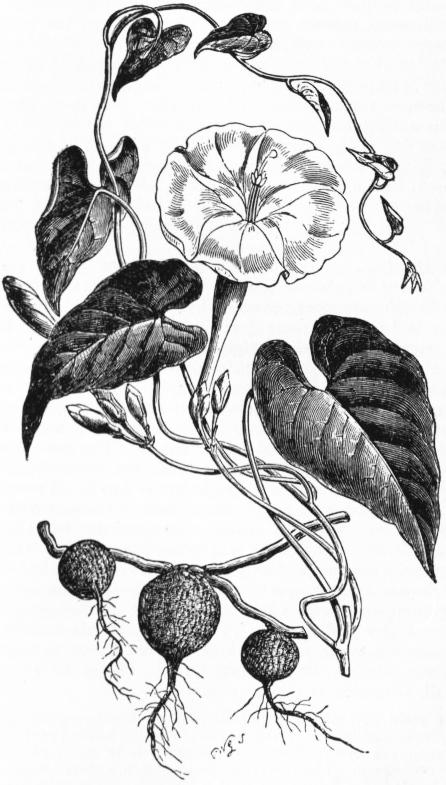
Jalap (Ipomaea Purga); about half natural size.
Jalap has been cultivated for many years in India, chiefly at Ootacamund, and grows there as easily as a yam, often producing clusters of tubers weighing over 9 ℔; but these, as they differ in appearance from the commercial article, have not as yet obtained a place in the English market. They are found, however, to be rich in resin, containing 18%. In Jamaica also the plant has been grown, at first amongst the cinchona trees, but more recently in new ground, as it was found to exhaust the soil.
Besides Mexican or Vera Cruz jalap, a drug called Tampico jalap has been imported for some years in considerable quantity. It has a much more shrivelled appearance and paler colour than ordinary jalap, and lacks the small transverse scars present in the true drug. This kind of jalap, the Purga de Sierra Gorda of the Mexicans, was traced by Hanbury to Ipomaea simulans. It grows in Mexico along the mountain range of the Sierra Gorda in the neighbourhood of San Luis de la Paz, from which district it is carried down to Tampico, whence it is exported. A third variety of jalap known as woody jalap, male jalap, or Orizaba root, or by the Mexicans as Purgo macho, is derived from Ipomaea orizabensis, a plant of Orizaba. The root occurs in fibrous pieces, which are usually rectangular blocks of irregular shape, 2 in. or more in diameter, and are evidently portions of a large root. It is only occasionally met with in commerce.
The dose of jalap is from five to twenty grains, the British Pharmacopeia directing that it must contain from 9 to 11% of the resin, which is given in doses of two to five grains. One preparation of this drug is in common use, the Pulvis Jalapae Compositus, which consists of 5 parts of jalap, 9 of cream of tartar, and 1 of ginger. The dose is from 20 grains to a drachm. It is best given in the maximum dose which causes the minimum of irritation.
The chief constituents of jalap resin are two glucosides—convolvulin and jalapin—sugar, starch and gum. Convolvulin constitutes nearly 20% of the resin. It is insoluble in ether, and is more active than jalapin. It is not used separately in medicine. Jalapin is present in about the same proportions. It dissolves readily in ether, and has a soft resinous consistence. It may be given in half-grain doses. It is the active principle of the allied drug scammony. According to Mayer, the formula of convolvulin is C34H50O16, and that of jalapin C31H50O16.
Jalap is a typical hydragogue purgative, causing the excretion of more fluid than scammony, but producing less stimulation of the muscular wall of the bowel. For both reasons it is preferable to scammony. It was shown by Professor Rutherford at Edinburgh to be a powerful secretory cholagogue, an action possessed by few hydragogue purgatives. The stimulation of the liver is said to depend upon the solution of the resin by the intestinal secretion. The drug is largely employed in cases of Bright’s disease and dropsy from any cause, being especially useful when the liver shares in the general venous congestion. It is not much used in ordinary constipation.
JALAPA, Xalapa, or Halapa, a city of the state of Vera Cruz, Mexico, 70 m. by rail N.W. of the port of Vera Cruz. Pop. (1900), 20,388. It is picturesquely situated on the slopes of the sierra which separates the central plateau from the tierra caliente of the Gulf Coast, at an elevation of 4300 ft., and with the Cofre de Perote behind it rising to a height of 13,419 ft. Its climate is cool and healthy and the town is frequented in the hot season by the wealthier residents of Vera Cruz. The city is well built, in the old Spanish style. Among its public buildings are a fine old church, a Franciscan convent founded by Cortez in 1556, and three hospitals, one of which, that of San Juan de Dios, dates from colonial times. The neighbouring valleys and slopes are fertile, and in the forests of this region is found the plant (jalap), which takes its name from the place. Jalapa was for a time the capital of the state, but its political and commercial importance has declined since the opening of the railway between Vera Cruz and the city of Mexico. It manufactures pottery and leather.
JALAUN, a town and district of British India, in the Allahabad division of the United Provinces. Pop. of town (1901), 8573. Formerly it was the residence of a Mahratta governor, but never the headquarters of the district, which are at Orai.
The District of Jalaun has an area of 1477 sq. m. It lies entirely within the level plain of Bundelkhand, north of the hill country, and is almost surrounded by the Jumna and its tributaries the Betwa and Pahuj. The central region thus enclosed is a dead level of cultivated land, almost destitute of trees, and sparsely dotted with villages. The southern portion presents almost one unbroken sheet of cultivation. The boundary rivers form the only interesting feature in Jalaun. The river Non flows through the centre of the district, which it drains by innumerable small ravines instead of watering. Jalaun has suffered much from the noxious kans grass, owing to the spread of which many villages have been abandoned and their lands thrown out of cultivation. Pop. (1901), 399,726, showing an increase of 1%. The two largest towns are Kunch (15,888), and Kalpi (10,139). The district is traversed by the line of the Indian Midland railway from Jhansi to Cawnpore. A small part of it is watered by the Betwa canal. Grain, oil-seeds, cotton and ghi are exported.
In early times Jalaun seems to have been the home of two Rajput clans, the Chandels in the east and the Kachwahas in the west. The town of Kalpi on the Jumna was conquered for the princes of Ghor as early as 1196. Early in the 14th century the Bundelas occupied the greater part of Jalaun, and even succeeded in holding the fortified post of Kalpi. That important possession was soon recovered by the Mussulmans, and passed under the sway of the Mogul emperors. Akbar’s governors at Kalpi maintained a nominal authority over the surrounding district; and the Bundela chiefs were in a state of chronic revolt, which culminated in the war of independence under Chhatar Sal. On the outbreak of his rebellion in 1671 he occupied a large province to the south of the Jumna. Setting out from this basis, and assisted by the Mahrattas, he reduced the whole of Bundelkhand. On his death he bequeathed one-third of his dominions to his Mahratta allies, who before long succeeded in annexing the whole of Bundelkhand. Under Mahratta rule the country was a prey to constant anarchy and intestine strife. To this period must be traced the origin of the poverty and desolation which are still conspicuous throughout the district. In 1806 Kalpi was made over to the British, and in 1840, on the death of Nana Gobind Ras, his possessions lapsed to them also. Various interchanges of territory took place, and in 1856 the present boundaries were substantially settled. Jalaun had a bad reputation during the Mutiny. When the news of the rising at Cawnpore reached Kalpi, the men of the 53rd native infantry deserted their officers, and in June the Jhansi mutineers reached the district, and began their murder of Europeans. The inhabitants everywhere revelled in the licence of plunder and murder which the Mutiny had spread through all Bundelkhand, and it was not till September 1858 that the rebels were finally defeated.
JALISCO, Xalisco, or Guadalajara, a Pacific coast state of Mexico, of very irregular shape, bounded, beginning on the N., by the territory of Tepic and the states of Durango, Zacatecas, Aguas Calientes, Guanajuato, Michoacán, and Colima. Pop. (1900), 1,153,891. Area, 31,846 sq. m. Jalisco is traversed from N.N.W. to S.S.E. by the Sierra Madre, locally known as the Sierra de Nayarit and Sierra de Jalisco, which divides the state into a low heavily forested coastal plain and a high plateau region, part of the great Anáhuac table-land, with an average elevation of about 5000 ft., broken by spurs and flanking ranges of moderate height. The sierra region is largely volcanic and earthquakes are frequent; in the S. are the active volcanoes of Colima (12,750 ft.) and the Nevado de Colima (14,363 ft.). The tierra caliente zone of the coast is tropical, humid, and unfavourable to Europeans, while the inland plateaus vary from subtropical to temperate and are generally drier and healthful. The greater part of the state is drained by the Rio Grande de Lerma (called the Santiago on its lower course) and its tributaries, chief of which is the Rio Verde. Lakes are numerous; the largest are the Chapala, about 80 m. long by 10 to 35 m. wide, which is considered one of the most beautiful inland sheets of water in Mexico, the Sayula and the Magdalena, noted for their abundance of fish. The agricultural products of Jalisco include Indian corn, wheat and beans on the uplands, and sugar-cane, cotton, rice, indigo and tobacco in the warmer districts. Rubber and palm oil are natural forest products of the coastal zone. Stock-raising is an important occupation in some of the more elevated districts. The mineral resources include silver, gold, cinnabar, copper, bismuth, and various precious stones. There are reduction works of the old-fashioned type and some manufactures, including cotton and woollen goods, pottery, refined sugar and leather. The commercial activities of the state contribute much to its prosperity. There is a large percentage of Indians and mestizos in the population. The capital is Guadalajara, and other important towns with their populations in 1900 (unless otherwise stated) are: Zapotlanejo (20,275), 21 m. E. by N. of Guadalajara; Ciudad Guzmán (17,374 in 1895), 60 m. N.E. of Colima; Lagos (14,716 in 1895), a mining town 100 m. E.N.E. of Guadalajara on the Mexican Central railway; Tamazula (8783 in 1895); Sayula (7883); Autlán (7715); Teocaltiche (8881); Ameca (7212 in 1895), in a fertile agricultural region on the western slopes of the sierras; Cocula (7090 in 1895); and Zacoalco (6516). Jalisco was first invaded by the Spaniards about 1526 and was soon afterwards conquered by Nuño de Guzman. It once formed part of the reyno of Nueva Galicia, which also included Aguas Calientes and Zacatecas. In 1889 its area was much reduced by a subdivision of its coastal zone, which was set apart as the territory of Tepic.
JALNA, or Jaulna, a town in Hyderabad state, India, on the Godavari branch of the Nizam’s railway, and 210 m. N.E. of Bombay. Pop. (1901), 20,270. Until 1903 it was a cantonment of the Hyderabad contingent, originally established in 1827. Its gardens produce fruit, which is largely exported. On the opposite bank of the river Kundlika is the trading town of Kadirabad; pop. (1901), 11,159.
JALPAIGURI, or Julpigoree, a town and district of British India, in the Rajshahi division of Eastern Bengal and Assam. The town is on the right bank of the river Tista, with a station on the Eastern Bengal railway about 300 m. due N. of Calcutta. Pop. (1901), 9708. It is the headquarters of the commissioner of the division.
The District of Jalpaiguri (organized in 1869) occupies an irregularly shaped tract south of Darjeeling and Bhutan and north of the state of Kuch Behar. It includes the Western Dwars, annexed from Bhutan after the war of 1864-1865. Area, 2,962 sq. m. Pop. (1901), 787,380, an increase of 16% in the decade. The district is divided into a “regulation” tract, lying towards the south-west, and a strip of country, about 22 m. in width, running along the foot of the Himalayas, and known as the Western Dwars. The former is a continuous expanse of level paddy fields, only broken by groves of bamboos, palms, and fruit-trees. The frontier towards Bhutan is formed by the Sinchula mountain range, some peaks of which attain an elevation of 6000 ft. It is thickly wooded from base to summit. The principal rivers, proceeding from west to east, are the Mahananda, Karatoya, Tista, Jaldhaka, Duduya, Mujnai, Tursa, Kaljani, Raidak, and Sankos. The most important is the Tista, which forms a valuable means of water communication. Lime is quarried in the lower Bhutan hills. The Western Dwars are the principal centre of tea cultivation in Eastern Bengal. The other portion of the district produces jute. Jalpaiguri is traversed by the main line of the Eastern Bengal railway to Darjeeling. It is also served by the Bengal Dwars railway.
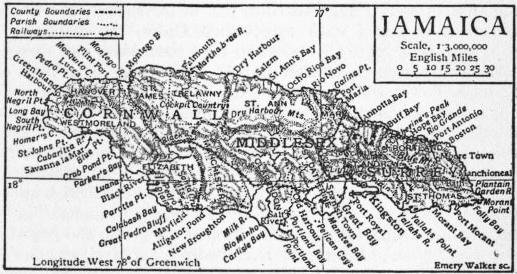
JAMAICA, the largest island in the British West Indies. It lies about 80 m. S. of the eastern extremity of Cuba, between 17° 43′ and 18° 32′ N. and 76° 10′ and 78° 20′ W., is 144 m. long, 50 m. in extreme breadth, and has an area of 4207 sq. m. The coast-line has the form of a turtle, the mountain ridges representing the back. A mountainous backbone runs through the island from E. to W., throwing off a number of subsidiary ridges, mostly in a north-westerly or south-easterly direction. In the east this range is more distinctly marked, forming the Blue Mountains, with cloud-capped peaks and numerous bifurcating branches. They trend W. by N., and are crossed by five passes at altitudes varying from 3000 to 4000 ft. They culminate in Blue Mountain Peak (7360 ft.), after which the heights gradually decrease until the range is merged into the hills of the western plateau. Two-thirds of the island are occupied by this limestone plateau, a region of great beauty broken by innumerable hills, valleys and sink-holes, and covered with luxuriant vegetation. The uplands usually terminate in steep slopes or bluffs, separated from the sea, in most cases, by a strip of level land. On the south coast, especially, the plains are often large, the Liguanea plain, on which Kingston stands, having an area of 200 sq. m. Upwards of a hundred rivers and streams find their way to the sea, besides the numerous tributaries which issue from every ravine in the mountains. These streams for the most part are not navigable, and in times of flood they become devastating torrents. In the parish of Portland, the Rio Grande receives all the smaller tributaries from the west. In St Thomas in the east the main range is drained by the Plantain Garden river, the tributaries of which form deep ravines and narrow gorges. The valley of the Plantain Garden expands into a picturesque and fertile plain. The Black river flows through a level country, and is navigable by small craft for about 30 m. The Salt river and the Cabaritta, also in the south, are navigable by barges. Other rivers of the south are the Rio Cobre (on which are irrigation works for the sugar and fruit plantations), the Yallahs and the Rio Minho; in the north are the Martha Brae, the White river, the Great Spanish river, and the Rio Grande. Vestiges of intermittent volcanic action occur, and there are several medicinal springs. Jamaica has 16 harbours, the chief of which are Port Morant, Kingston, Old Harbour, Montego Bay, Falmouth, St Ann’s Bay, Port Maria and Port Antonio.
Geology.—The greater part of Jamaica is covered by Tertiary deposits, but in the Blue Mountain and some of the other ranges the older rocks rise to the surface. The foundation of the island is formed by a series of stratified shales and conglomerates, with tuffs and other volcanic rocks and occasional bands of marine limestone. The limestones contain Upper Cretaceous fossils, and the whole series has been strongly folded. Upon this foundation rests unconformably a series of marls and limestones of Eocene and early Oligocene age. Some of the limestones are made of Foraminifera, together with Radiolaria, and indicate a subsidence to abyssal depths. Nevertheless, the higher peaks of the island still remained above the sea. Towards the middle of the Oligocene period, mountain folding took place on an extensive scale, and the island was raised far above its present level and was probably connected with the rest of the Greater Antilles and perhaps with the mainland also. At the same time plutonic rocks of various kinds were intruded into the deposits already formed, and in some cases produced considerable metamorphism. During the Miocene and Pliocene periods the island again sank, but never to the depths which it reached in the Eocene period. The deposits formed were shallow-water conglomerates, marls and limestones, with mollusca, brachiopoda, corals, &c. Finally, a series of successive elevations of small amount, less than 500 ft. in the aggregate, raised the island to its present level. The terraces which mark the successive stages in this elevation are well shown in Montego Bay and elsewhere. The remarkable depressions of the Cockpit country and the closed basin of the Hector river are similar in origin to swallow-holes, and were formed by the solution of a limestone layer resting upon insoluble rocks. The island produces a great variety of marbles, porphyrites, granite and ochres. Traces of gold have been found associated with some of the oxidized copper ores (blue and green carbonates) in the Clarendon mines. Copper ores are widely diffused but are very expensive to work; as are the lead and cobalt which are also found. Manganese iron ores and a form of arsenic occur.
Climate.—The climate is one of the island’s chief attractions. Near the coast it is warm and humid, but that of the uplands is delightfully mild and equable. At Kingston the temperature ranges from 70.7° to 87.8° F., and this is generally the average of all the low-lying coast land. At Cinchona, 4907 ft. above the sea, it varies from 57.5° to 68.5°. The vapours from the rivers and the ocean produce in the upper regions clouds saturated with moisture which induce vegetation belonging to a colder climate. During the rainy seasons there is such an accumulation of these vapours as to cause a general coolness and occasion sudden heavy showers, and sometimes destructive floods. The rainy seasons, in May and October, last for about three weeks, although, as a rule no month is quite without rain. The fall varies greatly; while the annual average for the island is 66.3 in., at Kingston it is 32.6 in., at Cinchona 105.5 in., and at some places in the north-east it exceeds 200 in. The climate of the Santa Cruz Mountains is extremely favourable to sufferers from tubercular and rheumatic diseases. Excepting near morasses and lagoons, the island is very healthy, and yellow fever, once prevalent, now rarely occurs. In the early part of the 19th century, hurricanes often devastated Jamaica, but now, though they pass to the N.E. and S.W. with comparative frequency, they rarely strike the island itself.
Flora.—The flora is remarkable, showing types from North, Central, and South America, with a few European forms, besides the common plants found everywhere in the tropics. Of flowering plants there are 2180 distinct species, and of ferns 450 species, several of both being indigenous. The largeness of these numbers may be to some extent accounted for by differences of altitude, temperature and humidity. There are many beautiful flowers, such as the aloe, the yucca, the datura, the mountain pride and the Victoria regia; and the cactus tribe is well represented. The Sensitive Plant grows in pastures, and orchids in the woods. There are forest trees fit for every purpose; including the ballata, rosewood, satinwood, mahogany, lignum vitae, lancewood and ebony. The logwood and fustic are exported for dyeing. There are also the Jamaica cedar, and the silk cotton tree (Ceiba Bombax). Pimento (peculiar to Jamaica) is indigenous, and furnishes the allspice. The bamboo, coffee and cocoa are well known. Several species of palm abound,—the macaw, the fan palm, screw palm, and palmetto royal. There are plantations of coconut palm. The other noticeable trees and plants are the mango, the breadfruit tree, the papaw, the lacebark tree, and the guava. The Palma Christi, from which castor oil is made, is a very abundant annual. English vegetables grow in the hills, and the plains produce plantains, cocoa, yams, cassava, ochra, beans, pease, ginger and arrowroot. Maize and guinea-corn are cultivated, and the guinea-grass, accidentally introduced in 1750, is very valuable for horses and cattle,—so much so that pen-keeping or cattle farming is a highly profitable occupation. Among the principal fruits are the orange, shaddock, lime, grape or cluster fruit, pine-apple, mango, banana, grapes, melons, avocado pear, breadfruit, and tamarind.
Fauna.—There are fourteen sorts of lampyridae or fireflies, besides the elateridae or lantern beetles. There are no venomous serpents, but numerous harmless snakes and lizards exist. The land-crab is considered a table delicacy, and the land-turtle also is eaten. The scorpion and centipede, though poisonous, are not very dangerous. Ants, sandflies and mosquitoes swarm in the lowlands. There are twenty different song-birds, and forty-three varieties of birds are presumed to be peculiar to the island. The sea and the rivers swarm with fish. Turtles abound, and the seal, the manatee and the crocodile are sometimes found. The coral reefs, with their varied polyps and anemones, the numerous alcyonarians and diverse coral-dwelling animals are readily accessible to the student, and the island is also celebrated for the number of species of its land-shells.
People.—The population of the island was estimated in 1905 at 806,690. Jamaica is rich in traces of its former Arawâk inhabitants. Aboriginal petaloid celts and other implements, flattened skulls and vessels are common, and images are sometimes found in the large limestone caverns of the island. The present inhabitants, of whom only 2% are white, include Maroons, the descendants of the slaves of the Spaniards who fled into the interior when the island was captured by the British; descendants of imported African slaves; mixed race of British and African blood; coolies from India; a few Chinese, and the British officials and white settlers. The Maroons live by themselves and are few in number, while the half-castes enter into trade and sometimes into the professions. The number of white inhabitants other than British is very small. A negro peasant population is encouraged, with a view to its being a support to the industries of the island; but, in many cases a field negro will not work for his employer more than four days a week. He may till his own plot of ground on one of the other days or not, as the spirit moves him, but four days’ work a week will keep him easily. He has little or no care for the future. He has probably squatted on someone’s land, and has no rent to pay. Clothes he need hardly buy, fuel he needs only for cooking, and food is ready to his hand for the picking. Unfortunately a widespread indulgence in predial larceny is a great hindrance to agriculture as well as to moral progress. But that habits of thrift are being inculcated is shown by the steady increase in the accounts in the government savings banks. That gross superstition is still prevalent is shown by the cases of obeah or witchcraft that come before the courts from time to time. Another indication of the status of the negro may be found in the fact that more than 60% of the births are illegitimate, a percentage that shows an unfortunate tendency to increase rather than diminish.
The capital, Kingston, stands on the south-east coast, and near it is the town of Port Royal. Spanish Town (pop. 5019), the former capital, is in the parish of St Catherine, Middlesex, 11¾ m. by rail west of Kingston. Since the removal of the seat of government to Kingston, the town has gradually sunk in importance. In the cathedral many of the governors of the island are buried. A marble statue of Rodney commemorates his victory over the count de Grasse off Dominica in 1782. Montego Bay (pop. 4803), on the north-west coast, is the second town on the island, and is also a favourite bathing resort. Port Antonio (1784) lies between two secure harbours on the north-east, and owes its prosperity mainly to the development of the trade in fruit, for which it is the chief place of shipment.
Industries.—Agricultural enterprise falls into two classes—planting and pen-keeping, i.e. the breeding of horses, mules, cattle and sheep. The chief products are bananas, oranges, coffee, sugar, rum, logwood, cocoa, pimento, ginger, coco-nuts, limes, nutmegs, pineapples, tobacco, grape-fruit and mangoes. There is a board of agriculture, with an experimental station at Hope; there is also an agricultural society with 26 branches throughout the colony. Bee-keeping is a growing industry, especially among the peasants. The land as a rule is divided into small holdings, the vast majority consisting of five acres and less. The manufactures are few. In addition to the sugar and coffee estates and cigar factories, there are tanneries, distilleries, breweries, electric light and gas works, ironfoundries, potteries and factories for the production of coconut oil, essential oils, ice, matches and mineral waters. There is an important establishment at Spanish Town for the production of logwood extract. The exports, more than half of which go to the United States, mostly comprise fruit, sugar and rum. The United States also contributes the majority of the imports. More than half the revenue of the colony is derived from import duties, the remainder is furnished by excise, stamps and licences. With the exception of that of the parish boards, there is no direct taxation.
Communications.—In 1900 an Imperial Direct West India Line of steamers was started by Elder, Dempster & Co., to encourage the fruit trade with England; it had a subsidy of £40,000, contributed jointly by the Imperial and Jamaican governments. Two steamers go round the island once a week, calling at the principal ports, the circuit occupying about 120 hours. A number of sailing “droghers” also ply from port to port. Jamaica has a number of good roads and bridle paths; the main roads, controlled by the public works department, encircle the island, with several branches from north to south. The parochial roads are maintained by the parish boards. A railway traverses the island from Kingston in the south-east to Montego Bay in the north-west, and also branches to Port Antonio and to Ewarton. Jamaica is included in the Postal Union and in the Imperial penny post, and there is a weekly mail service to and from England by the Royal Mail Line, but mails are also carried by other companies. The island is connected by cable with the United States via Cuba, and with Halifax, Nova Scotia via Bermuda.
There is a government savings bank at Kingston with branches throughout the island, and there are also branches of the Colonial Bank of London and the Bank of Nova Scotia. The coins in circulation are British gold and silver, but not bronze, instead of which local nickel is used. United States gold passes as currency. English weights and measures are used.
Administration, &c.—The island is divided into three counties, Surrey in the east, Middlesex in the centre, and Cornwall in the west, and each of these is subdivided into five parishes. The parish is the unit of local government, and has jurisdiction over roads, markets, sanitation, poor relief and waterworks. The management is vested in a parish board, the members of which are elected. The chairman or custos is appointed by the governor. The island is administered by a governor, who bears the old Spanish title of captain-general, assisted by a legislative council of five ex officio members, not more than ten nominated members, and fourteen members elected on a limited suffrage. There is also a privy council of three ex officio and not more than eight nominated members. There is an Imperial garrison of about 2000 officers and men, with headquarters at Newcastle, consisting of Royal Engineers, Royal Artillery, infantry and four companies of the West India Regiment. There is a naval station at Port Royal, and the entrance to its harbour is strongly fortified. In addition there is a militia of infantry and artillery, about 800 strong.
Previous to 1870 the Church of England was established in Jamaica, but in that year a disestablishment act was passed which provided for gradual disendowment. It is still the most numerous body, and is presided over by the bishop of Jamaica, who is also archbishop of the West Indies. The Baptists, Wesleyans, Presbyterians, Moravians and Roman Catholics are all represented; there is a Jewish synagogue at Kingston, and the Salvation Army has a branch on the island. The Church of England maintains many schools, a theological college, a deaconesses’ home and an orphanage. The Baptists have a theological college; and the Roman Catholics support a training college for teachers, two industrial schools and two orphanages. Elementary education is in private hands, but fostered, since 1867, by government grants; it is free but not compulsory, although the governor has the right to compel the attendance of all children from 6 to 14 years of age in such towns and districts as he may designate. The teachers in these schools are for the most part trained in the government-aided training colleges of the various denominations. For higher education there are the University College and high school at Hope near Kingston, Potsdam School in St Elizabeth, the Mico School and Wolmer’s Free School in Kingston, founded (for boys and girls) in 1729, the Montego Bay secondary school, and numerous other endowed and self-supporting establishments. The Cambridge Local Examinations have been held regularly since 1882.
History.—Jamaica was discovered by Columbus on the 3rd of May 1494. Though he called it Santiago, it has always been known by its Indian name Jaymaca, “the island of springs,” modernized in form and pronunciation into Jamaica. Excepting that in 1505 Columbus once put in for shelter, the island remained unvisited until 1509, when Diego, the discoverer’s son, sent Don Juan d’Esquivel to take possession, and thenceforward it passed under Spanish rule. Sant’ Iago de la Vega, or Spanish Town, which remained the capital of the island until 1872, was founded in 1523. Sir Anthony Shirley, a British admiral, attacked the island in 1596, and plundered and burned the capital, but did not follow up his victory. Upon his retirement the Spaniards restored their capital and were unmolested until 1635, when the island was again raided by the British under Colonel Jackson. The period of the Spanish occupation is mainly memorable for the annihilation of the gentle and peaceful Arawâk Indian inhabitants; Don Pedro d’Esquivel was one of their cruellest oppressors. The whole island was divided among eight noble Spanish families, who discouraged immigration to such an extent that when Jamaica was taken by the British the white and slave population together did not exceed 3000. Under the vigorous foreign policy of Cromwell an attempt was made to crush the Spanish power in the West Indies, and an expedition under Admirals Penn and Venables succeeded in capturing and holding Jamaica in 1655. The Spanish were entirely expelled in 1658. Their slaves then took to the mountains, and down to the end of the 18th century the disaffection of these Maroons, as they were called, caused constant trouble. Jamaica continued to be governed by military authority until 1661, when Colonel D’Oyley was appointed captain-general and governor-in-chief with an executive council, and a constitution was introduced resembling that of England. He was succeeded in the next year by Lord Windsor, under whom a legislative council was established. Jamaica soon became the chief resort of the buccaneers, who not infrequently united the characters of merchant or planter with that of pirate or privateer. By the Treaty of Madrid, 1670, the British title to the island was recognized, and the buccaneers were suppressed. The Royal African Company was formed in 1672 with a monopoly of the slave trade, and from this time Jamaica was one of the greatest slave marts in the world. The sugar-industry was introduced about this period, the first pot of sugar being sent to London in 1673. An attempt was made in 1678 to saddle the island with a yearly tribute to the Crown and to restrict the free legislature. The privileges of the legislative assembly, however, were restored in 1682; but not till 46 years later was the question of revenue settled by a compromise by which Jamaica undertook to settle £8000 (an amount afterwards commuted to £6000) per annum on the Crown, provided that English statute laws were made binding in Jamaica.
During these years of political struggle the colony was thrice afflicted by nature. A great earthquake occurred in 1692, when the chief part of the town of Port Royal, built on a shelving bank of sand, slipped into the sea. Two dreadful hurricanes devastated the island in 1712 and 1722, the second of which did so much damage that the seat of commerce had to be transferred from Port Royal to Kingston.
The only prominent event in the history of the island during the later years of the 18th century, was the threatened invasion by the French and Spanish in 1782, but Jamaica was saved by the victory of Rodney and Hood off Dominica. The last attempt at invasion was made in 1806, when the French were defeated by Admiral Duckworth. When the slave trade was abolished the island was at the zenith of its prosperity; sugar, coffee, cocoa, pimento, ginger and indigo were being produced in large quantities, and it was the dépôt of a very lucrative trade with the Spanish main. The anti-slavery agitation in Great Britain found its echo in the island, and in 1832 the negroes revolted, believing that emancipation had been granted. They killed a number of whites and destroyed a large amount of valuable property. Two years later the Emancipation Act was passed, and, subject to a short term of apprenticeship, the slaves were free. Emancipation left the planters in a pitiable condition financially. The British government awarded them compensation at the rate of £19 per slave, the market value of slaves at the time being £35, but most of this compensation went into the hands of the planters’ creditors. They were left with over-worked estates, a poor market and a scarcity of labour. Nor was this the end of their misfortunes. During the slavery times the British government had protected the planter by imposing a heavy differential duty on foreign sugar; but on the introduction of free trade the price of sugar fell by one-half and reduced the profits of the already impoverished planter. Many estates, already heavily mortgaged, were abandoned, and the trade of the island was at a standstill. Differences between the executive, the legislature, and the home government, as to the means of retrenching the public expenditure, created much bitterness. Although some slight improvement marked the administration of Sir Charles Metcalfe and the earl of Elgin, when coolie immigration was introduced to supply the scarcity and irregularity of labour and the railway was opened, the improvement was not permanent. In 1865 Edward John Eyre became governor. Financial affairs were at their lowest ebb and the colonial treasury showed a deficit of £80,000. To meet this difficulty new taxes were imposed and discontent was rife among the negroes. Dr Underhill, the secretary of a Baptist organization known as the British Union, wrote to the colonial secretary in London, pointing out the state of affairs. This letter became public in Jamaica, and in the opinion of the governor added in no small measure to the popular excitement. On the 11th of October 1865 the negroes rose at Morant Bay and murdered the custos and most of the white inhabitants. The slight encounter which followed filled the island with terror, and there is no doubt that many excesses were committed on both sides. The assembly passed an act by which martial law was proclaimed, and the legislature passed an act abrogating the constitution.
The action of Governor Eyre, though generally approved throughout the West Indies, caused much controversy in England, and he was recalled. A prosecution was instituted against him, resulting in an elaborate exposition of martial law by Chief Justice Cockburn, but the jury threw out the bill and Eyre was discharged. He was succeeded in the government of Jamaica by Sir Henry Storks, and under the crown colony system of government the state of the island made slow but steady progress. In 1868 the first fruit shipment took place from Port Antonio, the immigration of coolies was revived, and cinchona planting was introduced. The method of government was changed in 1884, when a new constitution, slightly modified in 1895, was granted to the island.
In the afternoon of the 14th of January 1907 a terrible earthquake visited Kingston. Almost every building in the capital and in Port Royal, and many in St Andrews, were destroyed or seriously injured. The loss of life was variously estimated, but probably exceeded one thousand. Among those killed was Sir James Fergusson, 6th baronet (b. 1832). The principal shock was followed by many more of slighter intensity during the ensuing fortnight and later. On the 17th of January assistance was brought by three American war-ships under Rear-Admiral Davis, who however withdrew them on the 19th, owing to a misunderstanding with the governor of the island, Sir Alexander Swettenham, on the subject of the landing of marines from the vessels with a view to preserving order. The incident caused considerable sensation, and led to Sir A. Swettenham’s resignation in the following March, Sir Sydney Olivier, K.C.M.G., being appointed governor. Order was speedily restored; but the destructive effect of the earthquake was a severe check to the prosperity of the island.
See Bryan Edwards, History of the West Indies (London, 1809, and appendix, 1819); P. H. Gosse, Journal of a Naturalist in Jamaica (London, 1851) and Birds of Jamaica (1847); Jamaica Handbook (London, annual); Bacon and Aaron, New Jamaica (1890); W. P. Livingstone, Black Jamaica (London, 1900), F. Cundall, Bibliotheca Jamaicensis. (Kingston, 1895), and Studies in Jamaica History (1900); W. J. Gardner, History of Jamaica (New York, 1909). For geology, see R. T. Hill, “The Geology and Physical Geography of Jamaica,” Bull. Mus. Com. Zool. Harvard, xxxiv. (1899).
JAMAICA, formerly a village of Queens county, Long Island, New York, U.S.A., but after the 1st of January 1898 a part of the borough of Queens, New York City. Pop. (1890) 5361. It is served by the Long Island railroad, the lines of which from Brooklyn and Manhattan meet here and then separate to serve the different regions of the island.1 King’s Park (about 10 acres) comprises the estate of John Alsop King (1788-1867), governor of New York in 1857-1859, from whose heirs in 1897 the land was purchased by the village trustees. In South Jamaica there is a race track, at which meetings are held in the spring and autumn. The headquarters of the Queens Borough Department of Public Works and Police are in the Jamaica town-hall, and Jamaica is the seat of a city training school for teachers (until 1905 one of the New York State normal schools). For two guns, a coat, and a quantity of powder and lead, several New Englanders obtained from the Indians a deed for a tract of land here in September 1655. In March 1657 they received permission from Governor Stuyvesant to found a town, which was chartered in 1660 and was named Rustdorp by Stuyvesant, but the English called it Jamaica; it was rechartered in 1666, 1686 and 1788. The village was incorporated in 1814 and reincorporated in 1855. In 1665 it was made the seat of justice of the north riding; in 1683-1788 it was the shire town of Queens county. With Hempstead, Gravesend, Newtown and Flushing, also towns of New England origin and type, Jamaica was early disaffected towards the provincial government of New York. In 1669 these towns complained that they had no representation in a popular assembly, and in 1670 they protested against taxation without representation. The founders of Jamaica were mostly Presbyterians, and they organized one of the first Presbyterian churches in America. At the beginning of the War of Independence Jamaica was under the control of Loyalists; after the defeat of the Americans in the battle of Long Island (27th August 1776) it was occupied by the British; and until the end of the war it was the headquarters of General Oliver Delancey, who had command of all Long Island.
1 In June 1908 the subway lines of the interborough system of New York City were extended to the Flatbush (Brooklyn) station of the Long Island railroad, thus bringing Jamaica into direct connexion with Manhattan borough by way of the East river tunnel, completed in the same year.
JAMB (from Fr. jambe, leg), in architecture, the side-post or lining of a doorway or other aperture. The jambs of a window outside the frame are called “reveals.” Small shafts to doors and windows with caps and bases are known as “jamb-shafts”; when in the inside arris of the jamb of a window they are sometimes called “scoinsons.”
JAMES (a variant of the name Jacob, Heb. יעקב, one who holds by the heel, outwitter, through O. Fr. James, another form of Jacques, Jaques, from Low Lat. Jacobus; cf. Ital. Jacopo [Jacob], Giacomo [James], Prov. Jacme, Cat. Jaume, Cast. Jaime), a masculine proper name popular in Christian countries as having been that of two of Christ’s apostles. It has been borne by many sovereigns and other princes, the most important of whom are noticed below, after the heading devoted to the characters in the New Testament, in the following order: (1) kings of England and Scotland, (2) other kings in the alphabetical order of their countries, (3) the “Old Pretender.” The article on the Epistle of James in the New Testament follows after the remaining biographical articles in which James is a surname.
JAMES (Gr. Ἰάκωβος, the Heb. Ya‘akob or Jacob), the name of several persons mentioned in the New Testament.
1. James, the son of Zebedee. He was among the first who were called to be Christ’s immediate followers (Mark i. 19 seq.; Matt. iv. 21 seq., and perhaps Luke v. 10), and afterwards obtained an honoured place in the apostolic band, his name twice occupying the second place after Peter’s in the lists (Mark iii. 17; Acts i. 13), while on at least three notable occasions he was, along with Peter and his brother John, specially chosen by Jesus to be with him (Mark v. 37; Matt. xvii. i, xxvi. 37). This same prominence may have contributed partly to the title “Boanerges” or “sons of thunder” which, according to Mark iii. 17, Jesus himself gave to the two brothers. But its most natural interpretation is to be found in the impetuous disposition which would have called down fire from heaven on the offending Samaritan villagers (Luke ix. 54), and afterwards found expression, though in a different way, in the ambitious request to occupy the places of honour in Christ’s kingdom (Mark x. 35 seq.). James is included among those who after the ascension waited at Jerusalem (Acts i. 13) for the descent of the Holy Ghost on the day of Pentecost. And though on this occasion only his name is mentioned, he must have been a zealous and prominent member of the Christian community, to judge from the fact that when a victim had to be chosen from among the apostles, who should be sacrificed to the animosity of the Jews, it was on James that the blow fell first. The brief notice is given in Acts xii. 1, 2. Eusebius (Hist. Eccl. ii. 9) has preserved for us from Clement of Alexandria the additional information that the accuser of the apostle “beholding his confession and moved thereby, confessed that he too was a Christian. So they were both led away to execution together; and on the road the accuser asked James for forgiveness. Gazing on him for a little while, he said, ‘Peace be with thee,’ and kissed him. And then both were beheaded together.”
The later, and wholly untrustworthy, legends which tell of the apostle’s preaching in Spain, and of the translation of his body to Santiago de Compostela, are to be found in the Acta Sanctorum (July 25), vi. 1-124; see also Mrs Jameson’s Sacred and Legendary Art, i. 230-241.
2. James, the son of Alphaeus. He also was one of the apostles, and is mentioned in all the four lists (Matt. x. 3; Mark iii. 18; Luke vi. 15; Acts i. 13) by this name. We know nothing further regarding him, unless we believe him to be the same as James “the little.”
3. James, the little. He is described as the son of a Mary (Matt, xxvii. 56; Mark xv. 40), who was in all probability the wife of Clopas (John xix. 25). And on the ground that Clopas is another form of the name Alphaeus, this James has been thought by some to be the same as 2. But the evidence of the Syriac versions, which render Alphaeus by Chalphai, while Clopas is simply transliterated Kleopha, makes it extremely improbable that the two names are to be identified. And as we have no better ground for finding in Clopas the Cleopas of Luke xxiv. 18, we must be content to admit that James the little is again an almost wholly unknown personality, and has no connexion with any of the other Jameses mentioned in the New Testament.
4. James, the father of Judas. There can be no doubt that in the mention of “Judas of James” in Luke vi. 16 the ellipsis should be supplied by “the son” and not as in the A.V. by “the brother” (cf. Luke iii. 1, vi. 14; Acts xii. 2, where the word ἀδελφός is inserted). This Judas, known as Thaddaeus by Matthew and Mark, afterwards became one of the apostles, and is expressly distinguished by St John from the traitor as “not Iscariot” (John xiv. 22).
5. James, the Lord’s brother. In Matt. xiii. 55 and Mark vi. 3 we read of a certain James as, along with Joses and Judas and Simon, a “brother” of the Lord. The exact nature of the relationship there implied has been the subject of much discussion. Jerome’s view (de vir. ill. 2), that the “brothers” were in reality cousins, “sons of Mary the sister of the Lord’s mother,” rests on too many unproved assumptions to be entitled to much weight, and may be said to have been finally disposed of by Bishop Lightfoot in his essay on “The Brothers of the Lord” (Galatians, pp. 252 sqq., Dissertations on the Apostolic Age, pp. 1 sqq.). Even however if we understand the word “brethren” in its natural sense, it may be applied either to the sons of Joseph by a former wife, in which case they would be the step-brothers of Jesus, or to sons born to Joseph and Mary after the birth of Jesus. The former of these views, generally known as the Epiphanian view from its most zealous advocate in the 4th century, can claim for its support the preponderating voice of tradition (see the catena of references given by Lightfoot, loc. cit., who himself inclines to this view). On the other hand the Helvidian theory as propounded by Helvidius, and apparently accepted by Tertullian (cf. adv. Marc. iv. 29), which makes James a brother of the Lord, as truly as Mary was his mother, undoubtedly seems more in keeping with the direct statements of the Gospels, and also with the after history of the brothers in the Church (see W. Patrick, James the Brother of the Lord, 1906, p. 5). In any case, whatever the exact nature of James’s antecedents, there can be no question as to the important place which he occupied in the early Church. Converted to a full belief in the living Lord, perhaps through the special revelation that was granted to him (1 Cor. xv. 7), he became the recognized head of the Church at Jerusalem (Acts xii. 17, xv. 13, xxi. 18), and is called by St Paul (Gal. ii. 9), along with Peter and John, a “pillar” of the Christian community. He was traditionally the author of the epistle in the New Testament which bears his name (see James, Epistle of). From the New Testament we learn no more of the history of James the Lord’s brother, but Eusebius (Hist. Eccl. ii. 23) has preserved for us from Hegesippus the earliest ecclesiastical traditions concerning him. By that authority he is described as having been a Nazarite, and on account of his eminent righteousness called “Just” and “Oblias.” So great was his influence with the people that he was appealed to by the scribes and Pharisees for a true and (as they hoped) unfavourable judgment about the Messiahship of Christ. Placed, to give the greater publicity to his words, on a pinnacle of the temple, he, when solemnly appealed to, made confession of his faith, and was at once thrown down and murdered. This happened immediately before the siege. Josephus (Antiq. xx. 9, 1) tells that it was by order of Ananus the high priest, in the interval between the death of Festus and the arrival of his successor Albinus, that James was put to death; and his narrative gives the idea of some sort of judicial examination, for he says that along with some others James was brought before an assembly of judges, by whom they were condemned and delivered to be stoned. Josephus is also cited by Eusebius (Hist. Eccl. ii. 23) to the effect that the miseries of the siege were due to divine vengeance for the murder of James. Later writers describe James as an ἐπίσκοπος (Clem. Al. apud Eus. Hist. Ecc. ii. 1) and even as an ἐπίσκοπος ἐπισκόπων (Clem. Hom., ad init.). According to Eusebius (Hist. Eccl. vii. 19) his episcopal chair was still shown at Jerusalem at the time when Eusebius wrote.
Bibliography.—In addition to the relevant literature cited above, see the articles under the heading “James” in Hastings’s Dictionary of the Bible (Mayor) and Dictionary of Christ and the Gospels (Fulford), and in the Encycl. Biblica (O. Cone); also the introductions to the Commentaries on the Epistle of James by Mayor and Knowling. Zahn has an elaborate essay on Brüder und Vettern Jesu (“The Brothers and Cousins of Jesus”) in the Forschungen zur Geschichte des neutestamentlichen Kanons, vi. 2 (Leipzig, 1900).
(G. Mi.)
JAMES I. (1566-1625), king of Great Britain and Ireland, formerly king of Scotland as James VI., was the only child of Mary Queen of Scots, and her second husband, Henry Stewart Lord Darnley. He was born in the castle of Edinburgh on the 19th of June 1566, and was proclaimed king of Scotland on the 24th of July 1567, upon the forced abdication of his mother. Until 1578 he was treated as being incapable of taking any real part in public affairs, and was kept in the castle of Stirling for safety’s sake amid the confused fighting of the early years of his minority.
The young king was a very weakly boy. It is said that he could not stand without support until he was seven, and although he lived until he was nearly sixty, he was never a strong man. In after life he was a constant and even a reckless rider, but the weakness in his legs was never quite cured. During a great part of his life he found it necessary to be tied to the saddle. When on one occasion in 1621 his horse threw him into the New River near his palace of Theobalds in the neighbourhood of London, he had a very narrow escape of being drowned; yet he continued to ride as before. At all times he preferred to lean on the shoulder of an attendant when walking. This feebleness of body, which had no doubt a large share in causing certain corresponding deficiencies of character, was attributed to the agitations and the violent efforts forced on his mother by the murder of her secretary Rizzio when she was in the sixth month of her pregnancy. The fact that James was a bold rider, in spite of this serious disqualification for athletic exercise, should be borne in mind when he is accused of having been a coward.
The circumstances surrounding him in boyhood were not favourable to the development of his character. His immediate guardian or foster-father, the earl of Mar, was indeed an honourable man, and the countess, who had charge of the nursing of the king, discharged her duty so as to win his lasting confidence. James afterwards entrusted her with the care of his eldest son, Henry. When the earl died in 1572 his place was well filled by his brother, Sir Alexander Erskine. The king’s education was placed under the care of George Buchanan, assisted by Peter Young, and two other tutors. Buchanan, who did not spare the rod, and the other teachers, who had more reverence for the royal person, gave the boy a sound training in languages. The English envoy, Sir Henry Killigrew, who saw him in 1574, testified to his proficiency in translating from and into Latin and French. As it was very desirable that he should be trained a Protestant king, he was well instructed in theology. The exceptionally scholastic quality of his education helped to give him a taste for learning, but also tended to make him a pedant.
James was only twelve when the earl of Morton was driven from the regency, and for some time after he can have been no more than a puppet in the hands of intriguers and party leaders. When, for instance, in 1582 he was seized by the faction of nobles who carried out the so-called raid of Ruthven, which was in fact a kidnapping enterprise carried out in the interest of the Protestant party, he cried like a child. One of the conspirators, the master of Glamis, Sir Thomas Lyon, told him that it was better “bairns should greet [children should cry] than bearded men.” It was not indeed till 1583, when he broke away from his captors, that James began to govern in reality.
For the history of his reign reference may be made to the articles on the histories of England and Scotland. James’s work as a ruler can be divided, without violating any sound rule of criticism, into black and white—into the part which was a failure and a preparation for future disaster, and the part which was solid achievement, honourable to himself and profitable to his people. His native kingdom of Scotland had the benefit of the second. Between 1583 and 1603 he reduced the anarchical baronage of Scotland to obedience, and replaced the subdivision of sovereignty and consequent confusion, which had been the very essence of feudalism, by a strong centralized royal authority. In fact he did in Scotland the work which had been done by the Tudors in England, by Louis XI. in France, and by Ferdinand and Isabella in Spain. It was the work of all the strong rulers of the Renaissance. But James not only brought his disobedient and intriguing barons to order—that was a comparatively easy achievement and might well have been performed by more than one of his predecessors, had their lives been prolonged—he also quelled the attempts of the Protestants to found what Hallam has well defined as a “Presbyterian Hildebrandism.” He enforced the superiority of the state over the church. Both before his accession to the throne of England (1603) and afterwards he took an intelligent interest in the prosperity of his Scottish kingdom, and did much for the pacification of the Hebrides, for the enforcement of order on the Borders, and for the development of industry. That he did so much although the crown was poor (largely it must be confessed because he made profuse gifts of the secularized church lands), and although the armed force at his disposal was so small that to the very end he was exposed to the attacks of would-be kidnappers (as in the case of the Gowrie conspiracy of 1600), is proof positive that he was neither the mere poltroon nor the mere learned fool he has often been called.
James’s methods of achieving ends in themselves honourable and profitable were indeed of a kind which has made posterity unjust to his real merits. The circumstances in which he passed his youth developed in him a natural tendency to craft. He boasted indeed of his “king-craft” and probably believed that he owed it to his studies. But it was in reality the resource of the weak, the art of playing off one possible enemy against another by trickery, and so deceiving all. The marquis de Fontenay, the French ambassador, who saw him in the early part of his reign, speaks of him as cowed by the violence about him. It is certain that James was most unscrupulous in making promises which he never meant to keep, and the terror in which he passed his youth sufficiently explains his preference for guile. He would make promises to everybody, as when he wrote to the pope in 1584 more than hinting that he would be a good Roman Catholic if helped in his need. His very natural desire to escape from the poverty and insecurity of Scotland to the opulent English throne not only kept him busy in intrigues to placate the Roman Catholics or anybody else who could help or hinder him, but led him to behave basely in regard to the execution of his mother in 1587. He blustered to give himself an air of courage, but took good care to do nothing to offend Elizabeth. When the time came for fulfilling his promises and half-promises, he was not able, even if he had been willing, to keep his word to everybody. The methods which had helped him to success in Scotland did him harm in England, where his reign prepared the way for the great civil war. In his southern kingdom his failure was in fact complete. Although England accepted him as the alternative to civil war, and although he was received and surrounded with fulsome flattery, he did not win the respect of his English subjects. His undignified personal appearance was against him, and so were his garrulity, his Scottish accent, his slovenliness and his toleration of disorders in his court, but, above all, his favour for handsome male favourites, whom he loaded with gifts and caressed with demonstrations of affection which laid him open to vile suspicions. In ecclesiastical matters he offended many, who contrasted his severity and rudeness to the Puritan divines at the Hampton Court conference (1604) with his politeness to the Roman Catholics, whom he, however, worried by fits and starts. In a country where the authority of the state had been firmly established and the problem was how to keep it from degenerating into the mere instrument of a king’s passions, his insistence on the doctrine of divine right aroused distrust and hostility. In itself, and in its origin, the doctrine was nothing more than a necessary assertion of the independence of the state in face of the “Hildebrandism” of Rome and Geneva alike. But when Englishmen were told that the king alone had indefeasible rights, and that all the privileges of subjects were revocable gifts, they were roused to hostility. His weaknesses cast suspicion on his best-meant schemes. His favour for his countrymen helped to defeat his wise wish to bring about a full union between England and Scotland. His profusion, which had been bad in the poverty of Scotland and was boundless amid the wealth of England, kept him necessitous, and drove him to shifts. Posterity can give him credit for his desire to forward religious peace in Europe, but his Protestant subjects were simply frightened when he sought a matrimonial alliance with Spain. Sagacious men among his contemporaries could not see the consistency of a king who married his daughter Elizabeth to the elector palatine, a leader of the German Protestants, and also sought to marry his son to an infanta of Spain. The king’s subservience to Spain was indeed almost besotted. He could not see her real weakness, and he allowed himself to be befooled by the ministers of Philip III. and Philip IV. The end of his scheming was that he was dragged into a needless war with Spain by his son Charles and his favourite George Villiers, duke of Buckingham, just before his death on the 5th of March 1625 at his favourite residence, Theobalds.
James married in 1589 Anne, second daughter of Frederick II., king of Denmark. His voyage to meet his bride, whose ship had been driven into a Norwegian port by bad weather, is the only episode of a romantic character in the life of this very prosaic member of a poetic family. By this wife James had three children who survived infancy: Henry Frederick, prince of Wales, who died in 1612; Charles, the future king; and Elizabeth, wife of the elector palatine, Frederick V.
Not the least of James’s many ambitions was the desire to excel as an author. He left a body of writings which, though of mediocre quality as literature, entitle him to a unique place among English kings since Alfred for width of intellectual interest and literary faculty. His efforts were inspired by his preceptor George Buchanan, whose memory he cherished in later years. His first work was in verse, Essayes of a Prentise in the Divine Art of Poesie (Edin. Vautrollier, 1584), containing fifteen sonnets, “Ane Metaphoricall invention of a tragedie called Phoenix,” a short poem “Of Time,” translations from Du Bartas, Lucan and the Book of Psalms (“out of Tremellius”), and a prose tract entitled “Ane short treatise, containing some Reulis and Cautelis to be observit and eschewit in Scottis Poesie.” The volume is introduced by commendatory sonnets, including one by Alexander Montgomerie. The chief interest of the book lies in the “Treatise” and the prefatory sonnets “To the Reader” and “Sonnet decifring the perfyte poete.” There is little originality in this youthful production. It has been surmised that it was compiled from the exercises written when the author was Buchanan’s pupil at Stirling, and that it was directly suggested by his preceptor’s De Prosodia and his annotations on Vives. On the other hand, it shows intimate acquaintance with the critical reflections of Ronsard and Du Bellay, and of Gascoigne in his Notes of Instruction (1575). In 1591 James published Poeticall Exercises at Vacant Houres, including a translation of the Furies of Du Bartas, his own Lepanto, and Du Bartas’s version of it, La Lepanthe. His Daemonologie, a prose treatise denouncing witchcraft and exhorting the civil power to the strongest measures of suppression, appeared in 1599. In the same year he printed the first edition (seven copies) of his Basilikon Doron, strongly Protestant in tone. A French edition, specially translated for presentation to the pope, has a disingenuous preface explaining that certain phrases (e.g. “papistical doctrine”) are omitted, because of the difficulty of rendering them in a foreign tongue. The original edition was, however, translated by order of the suspicious pope, and was immediately placed on the Index. Shortly after going to England James produced his famous Counterblaste to Tobacco (London, 1604), in which he forsakes his Scots tongue for Southern English. The volume was published anonymously. James’s prose works (including his speeches) were collected and edited (folio, 1616) by James Montagu, bishop of Winchester, and were translated into Latin by the same hand in a companion folio, in 1619 (also Frankfort, 1689). A tract, entitled “The True Law of Free Monarchies,” appeared in 1603; “An Apology for the Oath of Allegiance” in 1607; and a “Déclaration du Roy Jacques I. ... pour le droit des Rois” in 1615. In 1588 and 1589 James issued two small volumes of Meditations on some verses of (a) Revelations and (b) 1 Chronicles. Other two “meditations” were printed posthumously.
See T. F. Henderson, James I. and VI. (London, 1904); P. Hume Brown, History of Scotland, vol. ii. (Edinburgh and Cambridge, 1902); and Andrew Lang, History of Scotland, vol. ii. (Edinburgh, 1902) and James VI. and the Gowrie Mystery (London, 1902); The Register of the Privy Council of Scotland (Edinburgh, 1877, &c.), vols. ii. to xiii.; S. R. Gardiner, History of England 1603-1642 (London, 1883-1884). A comprehensive bibliography will be found in the Cambridge Modern Hist. iii. 847 (Cambridge, 1904).
For James’s literary work, see Edward Arber’s reprint of the Essayes and Counterblaste (“English Reprints,” 1869, &c.); R. S. Rait’s Lusus Regius (1900); G. Gregory Smith’s Elizabethan Critical Essays (1904), vol. i., where the Treatise is edited for the first time; A. O. Meyer’s “Clemens VIII. und Jacob I. von England” in Quellen und Forschungen (Preuss. Hist. Inst.), VII. ii., for an account of the issues of the Basilikon Doron; P. Hume Brown’s George Buchanan (1890), pp. 250-261, for a sketch of James’s association with Buchanan.
JAMES II. (1633-1701), king of Great Britain and Ireland, second surviving son of Charles I. and Henrietta Maria, was born at St James’s on the 15th of October 1633, and created duke of York in January 1643. During the Civil War James was taken prisoner by Fairfax (1646), but contrived to escape to Holland in 1648. Subsequently he served in the French army under Turenne, and in the Spanish under Condé, and was applauded by both commanders for his brilliant personal courage. Returning to England with Charles II. in 1660 he was appointed lord high admiral and warden of the Cinque Ports. Pepys, who was secretary to the navy, has recorded the patient industry and unflinching probity of his naval administration. His victory over the Dutch in 1665, and his drawn battle with De Ruyter in 1672, show that he was a good naval commander as well as an excellent administrator. These achievements won him a reputation for high courage, which, until the close of 1688, was amply deserved. His private record was not as good as his public. In December 1660 he admitted to having contracted, under discreditable circumstances, a secret marriage with Anne Hyde (1637-1671), daughter of Lord Clarendon, in the previous September. Both before and after the marriage he seems to have been a libertine as unblushing though not so fastidious as Charles himself. In 1672 he made a public avowal of his conversion to Roman Catholicism. Charles II. had opposed this project, but in 1673 allowed him to marry the Catholic Mary of Modena as his second wife. Both houses of parliament, who viewed this union with abhorrence, now passed the Test Act, forbidding Catholics to hold office. In consequence of this James was forced to resign his posts. It was in vain that he married his daughter Mary to the Protestant prince of Orange in 1677. Anti-Catholic feeling ran so high that, after the discovery of the Popish Plot, he found it wiser to retire to Brussels (1679), while Shaftesbury and the Whigs planned to exclude him from the succession. He was lord high commissioner of Scotland (1680-1682), where he occupied himself in a severe persecution of the Covenanters. In 1684 Charles, having triumphed over the Exclusionists, restored James to the office of high admiral by use of his dispensing power.
James ascended the throne on the 16th of February 1685. The nation showed its loyalty by its firm adherence to him during the rebellions of Argyll in Scotland and Monmouth in England (1685). The savage reprisals on their suppression, in especial the “Bloody Assizes” of Jeffreys, produced a revulsion of public feeling. James had promised to defend the existing Church and government, but the people now became suspicious. James was not a mere tyrant and bigot, as the popular imagination speedily assumed him to be. He was rather a mediocre but not altogether obtuse man, who mistook tributary streams for the main currents of national thought. Thus he greatly underrated the strength of the Establishment, and preposterously exaggerated that of Dissent and Catholicism. He perceived that opinion was seriously divided in the Established Church, and thought that a vigorous policy would soon prove effective. Hence he publicly celebrated Mass, prohibited preaching against Catholicism, and showed exceptional favour to renegades from the Establishment. By undue pressure he secured a decision of the judges, in the test case of Godden v. Hale (1687), by which he was allowed to dispense Catholics from the Test Act. Catholics were now admitted to the chief offices in the army, and to some important posts in the state, in virtue of the dispensing power of James. The judges had been intimidated or corrupted, and the royal promise to protect the Establishment violated. The army had been increased to 20,000 men and encamped at Hounslow Heath to overawe the capital. Public alarm was speedily manifested and suspicion to a high degree awakened. In 1687 James made a bid for the support of the Dissenters by advocating a system of joint toleration for Catholics and Dissenters. In April 1687 he published a Declaration of Indulgence—exempting Catholics and Dissenters from penal statutes. He followed up this measure by dissolving parliament and attacking the universities. By an unscrupulous use of the dispensing power he introduced Dissenters and Catholics into all departments of state and into the municipal corporations, which were remodelled in their interests. Then in April 1688 he took the suicidal step of issuing a proclamation to force the clergy and bishops to read the Declaration in their pulpits, and thus personally advocate a measure they detested. Seven bishops refused, were indicted by James for libel, but acquitted amid the indescribable enthusiasm of the populace. Protestant nobles of England, enraged at the tolerant policy of James, had been in negotiation with William of Orange since 1687. The trial of the seven bishops, and the birth of a son to James, now induced them to send William a definite invitation (June 30, 1688). James remained in a fool’s paradise till the last, and only awakened to his danger when William landed at Torbay (November 5, 1688) and swept all before him. James pretended to treat, and in the midst of the negotiations fled to France. He was intercepted at Faversham and brought back, but the politic prince of Orange allowed him to escape a second time (December 23, 1688).
At the end of 1688 James seemed to have lost his old courage. After his defeat at the Boyne (July 1, 1690) he speedily departed from Ireland, where he had so conducted himself that his English followers had been ashamed of his incapacity, while French officers had derided him. His proclamations and policy towards England during these years show unmistakable traces of the same incompetence. On the 17th of May 1692 he saw the French fleet destroyed before his very eyes off Cape La Hogue. He was aware of, though not an open advocate of the “Assassination Plot,” which was directed against William. By its revelation and failure (February 10, 1696) the third and last serious attempt of James for his restoration failed. He refused in the same year to accept the French influence in favour of his candidature to the Polish throne, on the ground that it would exclude him from the English. Henceforward he neglected politics, and Louis of France ceased to consider him as a political factor. A mysterious conversion had been effected in him by an austere Cistercian abbot. The world saw with astonishment this vicious, rough, coarse-fibred man of the world transformed into an austere penitent, who worked miracles of healing. Surrounded by this odour of sanctity, which greatly edified the faithful, James lived at St Germain until his death on the 17th of September 1701.
The political ineptitude of James is clear; he often showed firmness when conciliation was needful, and weakness when resolution alone could have saved the day. Moreover, though he mismanaged almost every political problem with which he personally dealt, he was singularly tactless and impatient of advice. But in general political morality he was not below his age, and in his advocacy of toleration decidedly above it. He was more honest and sincere than Charles II., more genuinely patriotic in his foreign policy, and more consistent in his religious attitude. That his brother retained the throne while James lost it is an ironical demonstration that a more pitiless fate awaits the ruler whose faults are of the intellect, than one whose faults are of the heart.
By Anne Hyde James had eight children, of whom two only, Mary and Anne, both queens of England, survived their father. By Mary of Modena he had seven children, among them being James Francis Edward (the Old Pretender) and Louisa Maria Theresa, who died at St Germain in 1712. By one mistress, Arabella Churchill (1648-1730), he had two sons, James, duke of Berwick, and Henry (1673-1702), titular duke of Albemarle and grand prior of France, and a daughter, Henrietta (1667-1730), who married Sir Henry Waldegrave, afterwards Baron Waldegrave; and by another, Catherine Sedley, countess of Dorchester (1657-1717), a daughter, Catherine (d. 1743), who married James Annesley, 5th earl of Anglesey, and afterwards John Sheffield, duke of Buckingham and Normanby.
Bibliography.—Original Authorities: J. S. Clarke, James II. Life (London, 1816); James Macpherson, Original Papers (2 vols., London, 1775); Gilbert Burnet, Supplement to History, ed. H. C. Foxcroft (Oxford, 1902); Earl of Clarendon and Earl of Rochester, Correspondence, vol. ii. (London, 1828); John Evelyn, Diary and Correspondence and Life, edited by Bray and Wheatley (London, 1906); Sir John Reresby, Memoirs, ed. A. Ivatt (1904); Somers Tracts, vols, ix.-xi. (London, 1823). Modern Works: Lord Acton, Lectures on Modern History, pp. 195-276 (London, 1906); Moritz Brosch, Geschichte von England, Bd. viii. (Gotha, 1903); Onno Klopp, Der Fall des Hauses Stuart, Bde. i.-ix. (Vienna, 1875-1878); L. von Ranke, History of England, vols, iv.-vi. (Oxford, 1875); and Allan Fea, James II. and his Wives (1908).
JAMES I. (1394-1437), king of Scotland and poet, the son of King Robert III., was born at Dunfermline in July 1394. After the death of his mother, Annabella Drummond of Stobhall, in 1402, he was placed under the care of Henry Wardlaw (d. 1440), who became bishop of St Andrews in 1403, but soon his father resolved to send him to France. Robert doubtless decided upon this course owing to the fact that in 1402 his elder son, David, duke of Rothesay, had met his death in a mysterious fashion, being probably murdered by his uncle, Robert, duke of Albany, who, as the king was an invalid, was virtually the ruler of Scotland. On the way to France, however, James fell into the hands of some English sailors and was sent to Henry IV., who refused to admit him to ransom. The chronicler Thomas Walsingham, says that James’s imprisonment began in 1406, while the future king himself places it in 1404; February 1406 is probably the correct date. On the death of Robert III. in April 1406 James became nominally king of Scotland, but he remained a captive in England, the government being conducted by his uncle, Robert of Albany, who showed no anxiety to procure his nephew’s release. Dying in 1420, Albany was succeeded as regent by his son, Murdoch. At first James was confined in the Tower of London, but in June 1407 he was removed to the castle at Nottingham, whence about a month later he was taken to Evesham. His education was continued by capable tutors, and he not only attained excellence in all manly sports, but became perhaps more cultured than any other prince of his age. In person he was short and stout, but well-proportioned and very strong. His agility was not less remarkable than his strength; he excelled in all athletic feats which demanded suppleness of limb and quickness of eye. As regards his intellectual attainments he is reported to have been acquainted with philosophy, and it is evident from his subsequent career that he had studied jurisprudence; moreover, besides being proficient in vocal and instrumental music, he cultivated the art of poetry with much success. When Henry V. became king in March 1413, James was again imprisoned in the Tower of London, but soon afterwards he was taken to Windsor and was treated with great consideration by the English king. In 1420, with the intention of detaching the Scottish auxiliaries from the French standard, he was sent to take part in Henry’s campaign in France; this move failed in its immediate object and he returned to England after Henry’s death in 1422. About this time negotiations for the release of James were begun in earnest, and in September 1423 a treaty was signed at York, the Scottish nation undertaking to pay a ransom of 60,000 marks “for his maintenance in England.” By the terms of the treaty James was to wed a noble English lady, and on the 12th of February 1424 he was married at Southwark to Jane, daughter of John Beaufort, earl of Somerset, a lady to whom he was faithful through life. Ten thousand marks of his ransom were remitted as Jane’s dowry, and in April 1424 James and his bride entered Scotland.
With the reign of James I., whose coronation took place at Scone on the 21st of May 1424, constitutional sovereignty may be said to begin in Scotland. By the introduction of a system of statute law, modelled to some extent on that of England, and by the additional importance assigned to parliament, the leaven was prepared which was to work towards the destruction of the indefinite authority of the king, and of the unbridled licence of the nobles. During the parliament held at Perth in March 1425 James arrested Murdoch, duke of Albany, and his son, Alexander; together with Albany’s eldest son, Walter, and Duncan, earl of Lennox, who had been seized previously; they were sentenced to death, and the four were executed at Stirling. In a parliament held at Inverness in 1427 the king arrested many turbulent northern chiefs, and his whole policy was directed towards crushing the power of the nobles. In this he was very successful. Expeditions reduced the Highlands to order; earldom after earldom was forfeited; but this vigour aroused the desire for revenge, and at length cost James his life. Having been warned that he would never again cross the Forth, the king went to reside in Perth just before Christmas 1436. Among those whom he had angered was Sir Robert Graham (d. 1437), who had been banished by his orders. Instigated by the king’s uncle, Walter Stewart, earl of Atholl (d. 1437), and aided by the royal chamberlain, Sir Robert Stewart, and by a band of Highlanders, Graham burst into the presence of James on the night of the 20th of February 1437 and stabbed the king to death. Graham and Atholl were afterwards tortured and executed. James had two sons: Alexander, who died young, and James II., who succeeded to the throne; and six daughters, among them being Margaret, the queen of Louis XI. of France. His widow, Jane, married Sir James Stewart, the “black knight of Lorne,” and died on the 15th of July 1445.
During the latter part of James’s reign difficulties arose between Scotland and England and also between Scotland and the papacy. Part of the king’s ransom was still owing to England; other causes of discord between the two nations existed, and in 1436 these culminated in a short war. In ecclesiastical matters James showed himself merciless towards heretics, but his desire to reform the Scottish Church and to make it less dependent on Rome brought him into collision with Popes Martin V. and Eugenius IV.
James was the author of two poems, the Kingis Quair and Good Counsel (a short piece of three stanzas). The Song of Absence, Peblis to the Play and Christis Kirk on the Greene have been ascribed to him without evidence. The Kingis Quair (preserved in the Selden MS. B. 24 in the Bodleian) is an allegorical poem of the cours d’amour type, written in seven-lined Chaucerian stanzas and extending to 1379 lines. It was composed during James’s captivity in England and celebrates his courtship of Lady Jane Beaufort. Though in many respects a Chaucerian pastiche, it not rarely equals its model in verbal and metrical felicity. Its language is an artificial blend of northern and southern (Chaucerian) forms, of the type shown in Lancelot of the Laik and the Quair of Jelusy.
Bibliography.—The contemporary authorities for the reign of James I. are Andrew of Wyntoun, The Orygynale Cronykil of Scotland, edited by D. Laing (Edinburgh, 1872-1879); and Walter Bower’s continuation of John of Fordun’s Scotichronicon, edited by T. Hearne (Oxford, 1722). See also J. Pinkerton, History of Scotland (1797); A. Lang, History of Scotland, vol. i. (1900); and G. Burnett, Introduction to the Exchequer Rolls of Scotland (Edinburgh, 1878-1901). The Kingis Quair was first printed in the Poetical Remains of James the First, edited by William Tytler (1783). Later editions are Morison’s reprint (Perth, 1786); J. Sibbald’s, in his Chronicle of Scottish Poetry (1802, vol. i.); Thomson’s in 1815 and 1824; G. Chalmers’s, in his Poetic Remains of some of the Scottish Kings (1824); Rogers’s Poetical Remains of King James the First (1873); Skeat’s edition published by the Scottish Text Society (1884). An attempt has been made to dispute James’s authorship of the poem, but the arguments elaborated by J. T. T. Brown (The Authorship of the Kingis Quair, Glasgow, 1896) have been convincingly answered by Jusserand in his Jacques Ier d’Écosse fut-il poète? Étude sur l’authenticité du cahier du roi (Paris, 1897, reprinted from the Revue historique, vol. lxiv.). See also the full correspondence in the Athenaeum (July-Aug. 1896 and Dec. 1899); W. A. Neilson, Origins and Sources of the Court of Love (Boston, 1899) pp. 152 &c., 235 &c.; and Gregory Smith, Transition Period (1900), pp. 40, 41.
JAMES II. (1430-1460), king of Scotland, the only surviving son of James I. and his wife, Jane, daughter of John Beaufort, earl of Somerset, was born on the 16th of October 1430. Crowned king at Holyrood in March 1437, shortly after the murder of his father, he was at first under the guardianship of his mother, while Archibald, 5th earl of Douglas, was regent of the kingdom, and considerable power was possessed by Sir Alexander Livingstone and Sir William Crichton (d. 1454). When about 1439 Queen Jane was married to Sir James Stewart, the knight of Lorne, Livingstone obtained the custody of the young king, whose minority was marked by fierce hostility between the Douglases and the Crichtons, with Livingstone first on one side and then on the other. About 1443 the royal cause was espoused by William, 8th earl of Douglas, who attacked Crichton in the king’s name, and civil war lasted until about 1446. In July 1449 James was married to Mary (d. 1463), daughter of Arnold, duke of Gelderland, and undertook the government himself; and almost immediately Livingstone was arrested, but Douglas retained the royal favour for a few months more. In 1452, however, this powerful earl was invited to Stirling by the king, and, charged with treachery, was stabbed by James and then killed by the attendants. Civil war broke out at once between James and the Douglases, whose lands were ravaged; but after the Scots parliament had exonerated the king, James, the new earl of Douglas, made his submission. Early in 1455 this struggle was renewed. Marching against the rebels James gained several victories, after which Douglas was attainted and his lands forfeited. Fortified by this success and assured of the support of the parliament and of the great nobles, James, acting as an absolute king, could view without alarm the war which had broken out with England. After two expeditions across the borders, a truce was made in July 1457, and the king employed the period of peace in strengthening his authority in the Highlands. During the Wars of the Roses he showed his sympathy with the Lancastrian party after the defeat of Henry VI. at Northampton by attacking the English possessions to the south of Scotland. It was while conducting the siege of Roxburgh Castle that James was killed, through the bursting of a cannon, on the 3rd of August 1460. He left three sons, his successor, James III., Alexander Stewart, duke of Albany, and John Stewart, earl of Mar (d. 1479); and two daughters. James, who is sometimes called “Fiery Face,” was a vigorous and popular prince, and, although not a scholar like his father, showed interest in education. His reign is a period of some importance in the legislative history of Scotland, as measures were passed with regard to the tenure of land, the reformation of the coinage, and the protection of the poor, while the organization for the administration of justice was greatly improved.
JAMES III. (1451-1488), king of Scotland, eldest son of James II., was born on the 10th of July 1451. Becoming king in 1460 he was crowned at Kelso. After the death of his mother in 1463, and of her principal supporter, James Kennedy, bishop of St Andrews, two years later, the person of the young king, and with it the chief authority in the kingdom, were seized by Sir Alexander Boyd and his brother Lord Boyd, while the latter’s son, Thomas, was created earl of Arran and married to the king’s sister, Mary. In July 1469 James himself was married to Margaret (d. 1486), daughter of Christian I., king of Denmark and Norway, but before the wedding the Boyds had lost their power. Having undertaken the government in person, the king received the submission of the powerful earl of Ross, and strengthened his authority in other ways. But his preference for a sedentary and not for an active life and his increasing attachment to favourites of humble birth diminished his popularity, and he had some differences with his parliament. About 1479, probably with reason both suspicious and jealous, James arrested his brothers, Alexander, duke of Albany, and John, earl of Mar; Mar met his death in a mysterious fashion at Craigmillar, but Albany escaped to France and then visited England, where in 1482 Edward IV. recognized him as king of Scotland by the gift of the king of England. War broke out with England, but James, made a prisoner by his nobles, was unable to prevent Albany and his ally, Richard, duke of Gloucester (afterwards Richard III.), from taking Berwick and marching to Edinburgh. Peace with Albany followed, but soon afterwards the duke was again in communication with Edward, and was condemned by the parliament after the death of the English king in April 1483. Albany’s death in France in 1485 did not end the king’s troubles. His policy of living at peace with England and of arranging marriages between the members of the royal families of the two countries did not commend itself to the turbulent section of his nobles; his artistic tastes and lavish expenditure added to the discontent, and a rebellion broke out. Fleeing into the north of his kingdom James collected an army and came to terms with his foes; but the rebels, having seized the person of the king’s eldest son, afterwards James IV., renewed the struggle. The rival armies met at the Sauchieburn near Bannockburn, and James soon fled. Reaching Beaton’s Mill he revealed his identity, and, according to the popular story, was killed on the 11th of June 1488 by a soldier in the guise of a priest who had been called in to shrive him. He left three sons—his successor, James IV.; James Stewart, duke of Ross, afterwards archbishop of St Andrews, and John Stewart, earl of Mar. James was a cultured prince with a taste for music and architecture, but was a weak and incapable king. His character is thus described by a chronicler: “He was ane man that loved solitude, and desired nevir to hear of warre, bot delighted more in musick and policie and building nor he did in the government of the realme.”
JAMES IV. (1473-1513), king of Scotland, eldest son of James III., was born on the 17th of March 1473. He was nominally the leader of the rebels who defeated the troops of James III. at the Sauchieburn in June 1488, and became king when his father was killed. As he adopted an entirely different policy with the nobles from that of his father, and, moreover, showed great affability towards the lower class of his subjects, among whom he delighted to wander incognito, few if any of the kings of Scotland have won such general popularity, or passed a reign so untroubled by intestine strife. Crowned at Scone a few days after his accession, James began at once to take an active part in the business of government. A slight insurrection was easily suppressed, and a plot formed by some nobles to hand him over to the English king, Henry VII., came to nothing. In spite of this proceeding Henry wished to live at peace with his northern neighbour, and soon contemplated marrying his daughter to James, but the Scottish king was not equally pacific. When, in 1495, Perkin Warbeck, pretending to be the duke of York, Edward IV.’s younger son, came to Scotland, James bestowed upon him both an income and a bride, and prepared to invade England in his interests. For various reasons the war was confined to a few border forays. After Warbeck left Scotland in 1497, the Spanish ambassador negotiated a peace, and in 1502 a marriage was definitely arranged between James and Henry’s daughter Margaret (1489-1541). The wedding took place at Holyrood in August 1503, and it was this union which led to the accession of the Stewart dynasty to the English throne.
About the same time James crushed a rebellion in the western isles, into which he had previously led expeditions, and parliament took measures to strengthen the royal authority therein. At this date too, or a little earlier, the king of Scotland began to treat as an equal with the powerful princes of Europe, Maximilian I., Louis XII. and others; sending assistance to his uncle Hans, king of Denmark, and receiving special marks of favour from Pope Julius II., anxious to obtain his support. But his position was weakened when Henry VIII. followed Henry VII. on the English throne in 1509. Causes of quarrel already existed, and other causes, both public and private, soon arose between the two kings; sea-fights took place between their ships, while war was brought nearer by the treaty of alliance which James concluded with Louis XII. in 1512. Henry made a vain effort to prevent, or to postpone, the outbreak of hostilities; but urged on by his French ally and his queen, James declared for war, in spite of the counsels of some of his advisers, and (it is said) of the warning of an apparition. Gathering a large and well-armed force, he took Norham and other castles in August 1513, spending some time at Ford Castle, where, according to report, he was engaged in an amorous intrigue with the wife of its owner. Then he moved out to fight the advancing English army under Thomas Howard, earl of Surrey. The battle, which took place at Flodden, or more correctly, at the foot of Brankston Hill, on Friday the 9th of September 1513, is among the most famous and disastrous, if not among the most momentous, in the history of Scotland. Having led his troops from their position of vantage, the king himself was killed while fighting on foot, together with nearly all his nobles; there was no foundation for the rumour that he had escaped from the carnage. He left one legitimate child, his successor James V., but as his gallantries were numerous he had many illegitimate children, among them (by Marion Boyd) Alexander Stewart, archbishop of St Andrews and chancellor of Scotland, who was killed at Flodden, and (by Janet Kennedy) James Stewart, earl of Moray (d. 1544). One of his other mistresses was Margaret Drummond (d. 1501).