VOLUME XIV SLICE VI Inscriptions to Ireland, William Henry (continued 7)
Reading edition
The documents required to establish a claim for total loss are: (1) Protest of master. (2) Set of bills of lading (endorsed if necessary, so as to be available to the underwriter). (3) Policy or certificate of insurance (endorsed if necessary). (4) In the United States: Statement of loss in detail. In the United States certified copies of Nos. (1), (2), and (3) are taken; but as none of these copy-documents can transfer possession to the underwriter, there is necessary for that purpose another document, viz. (5) Bill of sale and abandonment with subrogation to underwriter—that is, an assignment of all interest to the underwriter. In the absence of the full set of bills of lading, a similar document should be taken in Great Britain, especially in all cases in which salvage operations are likely to be undertaken. Such a document handed to a salvage association or a manager of salvage (whether acting for shipowner or for underwriter) settles the ownership of salved goods, and ensures that any claim for salvage expenses will be sent directly to the underwriter. This is from the insured’s point of view desirable, and it greatly simplifies the management of salvage cases. As a claim for total loss cannot extend beyond the full amount insured in the policy, it follows that the documents required to substantiate such a claim must be supplied to the underwriter free of charge.
For the substantiation of a claim for particular average the following documents are required: (1) Protest of master or logbook. (2) Set of bills of lading (cargo claims). (3) Policy or certificate of insurance (endorsed if necessary). (4) Certified statements in detail of actual cash value at destination of goods in damaged state, all charges paid. Certified statements in detail of sound value at destination of goods on same day, all charges paid. Or original vouchers of costs of repair of ship, all discounts, rebates, allowances and returns deducted. (5) In the United States, subrogation to underwriters of damaged goods.
Authorities.—E. K. Allen, Stamp Duties on Sea Insurances (2nd ed., London, 1903); Th. Andresen, Seeversicherung (Hamburg, 1888); Joseph Arnould, Treatise on the Law of Marine Insurance and Average (2 vols., 2nd edition, London, 1857); eighth edition by de Hart and Simey (London, 1909); Laurence R. Baily, Perils of the Seas (London, 1860); William Barber, Principles of the Law of Insurance (San Francisco, 1887); W. G. Black, Digest of Decisions in Scottish Shipping Cases, 1865-1890 (Edinburgh, 1891); Sir M. D. Chalmers and Douglas Owen, Marine Insurance Act 1906 (London, 1906); Alfred de Courcy, Commentaire des polices françaises d’assurances maritimes (2nd edition, Paris, 1888); E. L. de Hart and R. I. Simey, The Marine Insurance Act 1906 (London, 1907); R. R. Douglas, Index to Maritime Law Decisions (London, 1888); John Duer, Law and Practice of Marine Insurance (2 vols., New York, 1845, 1846); William Gow, Marine Insurance (3rd corrected edition, London, 1909); Victor Jacobs, Étude sur les assurances maritimes et les avaries (Brussels, 1885); Richard Lowndes, Practical Treatise on the Law of Marine Insurance (2nd edition, London, 1885); Law of General Average, English and Foreign (4th edition, London, 1888); Charles M’Arthur, Contract of Marine Insurance (2nd edition, London, 1890); D. Maclachlan, Arnould on the Law of Marine Insurance (2 vols., 6th edition, London, 1887); Reginald G. Marsden, Admiralty Cases, 1648 to 1860 (London, 1885); Law of Collisions at Sea (5th edition, London, 1904), Douglas Owen, Marine Insurance Notes and Clauses (3rd edition, 1890); Theophilus Parsons, Law of Marine Insurance and General Average (2 vols., Boston, 1868); G. G. Phillimore, “Marine Insurance” in Encyclopaedia of the Laws of England, vol. viii. (London, 1907); Willard Phillips, Treatise on the Law of Insurance (2 vols., 5th edition, New York, 1867); C. R. Tyser, Law relating to Losses under a Policy of Marine Insurance (London, 1894); Rudolph Ulrich, Grosse Haverei (2nd ed., 3 vols., Berlin, 1903, 1905, 1906); G. Denis Weil, Des assurances maritimes et des avaries (Paris, 1879).
(W. Go.)
1 On the Effects of Selection, by Emory McClintock (New York, 1892), p. 94.
2 As a result of investigation into the affairs of various American insurance companies in 1905 by a committee appointed by the state legislature of New York, a new law regulating life insurance down to the minutest details was passed in 1906 (ch. 326). The surrender value of a policy is to be the amount of insurance which the reserve, computed on the 4½% mortality table, standing to its credit, will purchase as a single premium. Other important features of the legislation are that no New York company may hold a contingency reserve beyond a fixed proportion of the net value of its policies; the limiting of types of policies permitted, the defining of the nature of investments permitted, and provisions for state supervision, valuation, and annual division of profits.
3 An important addition to the marine insurance law of the United Kingdom was made by the Marine Insurance (Gambling Policies) Act 1909, which made void policies taken out by persons uninterested in ships or cargo, who only gain by the loss of the vessel. Such policies are known as “policies proof of interest.”
(P. P. I.)
4 Lord Mansfield expressed it: “The warranty in a contract of insurance is a condition or a contingency, and unless that be performed there is no contract” (Hibbert v. Pigou, apud Marshall, 3rd ed., p. 375).
INTAGLIO (an Ital. word, from intagliare, to incise, cut into), a form of engraving or carving, in which the pattern or design is sunk below the surface of the material thus treated, opposed to “cameo” or “relievo”—carving or engraving where the design is raised. Intaglio is thus applied to incised gems, as cameo (q.v.) to gems cut in relief (see Gems).
INTELLECT (Lat. intellectus, from intelligere, to understand), the general term for the mind in reference to its capacity for knowing or understanding. It is very vaguely used in common language. A man is described as “intellectual” generally because he is occupied with theory and principles rather than with practice, often with the further implication that his theories are concerned mainly with abstract matters: he is aloof from the world, and especially is a man of training and culture who cares little for the ordinary pleasures of sense. “Intellect” is thus distinguished from “intelligence” by the field of its operations, “intelligence” being used in the practical sphere for readiness to grasp a situation. (The employment of the word as a synonym for “news” is mere journalese; such phrases as “Intelligence Department” in connexion with newspapers and public offices are more justifiable.) In philosophy the “intellect” is contrasted with the senses and the will; it sifts and combines sense-given data, which otherwise would be only momentary, lasting practically only as long as the stimuli continued to operate. It thus includes the cognitive processes, and is the source of all real knowledge. Various attempts have been made to narrow the use of the term, e.g. to the higher regions of knowledge entirely above the region of sense (so Kant), or to conceptual processes; but no agreement has been reached. “Intellection” (i.e. the process as opposed to the capacity) has similarly been narrowed (e.g. by Professor James Ward) to the sphere of concepts; other writers, however, give it a much wider meaning. “Intellectualism” is a term given to any system which emphasizes the cognitive function; thus aesthetic intellectualism is that view of aesthetics which subordinates the sensual gratification or the delight in purely formal beauty to what may be called the ideal content.
INTELLIGENCE IN ANIMALS.1 Professor G. J. Romanes, in his work on Animal Intelligence (1881), used the term “intelligence” as synonymous with “reason,” and defined it as follows: “Reason or intelligence is the faculty which is concerned in the intentional adaptation of means to ends. It therefore implies the conscious knowledge of the relation between means employed and ends attained, and may be exercised in adaptation to circumstances novel alike to the experience of the individual and that of the species.” There is here some ambiguity as to the exact psychological significance of the words “intentional adaptation” and of the phrase “conscious knowledge of the relation between the means employed and the ends attained.” A chick a day or two old learns to leave untouched nauseous caterpillars, and Romanes would certainly have regarded this as a case of intelligent profiting by experience; but how far there is intentional adaptation and whether the chick has conscious knowledge of the relation of means to ends, is doubtful, and, to say the least of it, open to discussion. St George Mivart, the acute dialectical opponent of Romanes, denied that animals are capable of the exercise of reason or intelligence. He urged that according to traditional views reason should denote and include all intellectual perception, whether it be direct and intuitive or indirect and inferential (sensu stricto), and contended that under neither head are to be included the sensuous perceptions and merely practical inferences of animals. Wasmann, who argues on similar grounds, regards such behaviour as that of the chicken as instinctive in the wider sense (see Instinct) and not intelligent; man alone, he contends, is intelligent, that is to say has the power of perceiving the relations of concepts to each other, and of drawing conclusions therefrom. It is clear that the discussion largely turns on the definition of terms; but more than this lies behind it. Both Mivart and Wasmann are emphatic in their assertions that instinctive modes of behaviour in the wider sense or the sensuous perceptions and practical inferences of animals differ fundamentally in kind from the rational or intelligent conduct of human folk, and that by no conceivable process of evolution could the one pass upwards into the other.
Wasmann regards the inclusion of those activities which result from sense-experience under the term “intelligence” as pseudo-psychological. To modern psychologists of standing we must therefore turn. Under the heading Psychological definition. “Intellect or Intelligence,” in the Dictionary of Philosophy and Psychology, G. F. Stout and J. Mark Baldwin say: “There is a tendency to apply the term intellect more especially to the capacity for conceptual thinking. This does not hold in the same degree of the connected word intelligence. We speak freely of ‘animal intelligence,’ but the phrase ‘animal intellect’ is unusual. However, the restriction of the term to conceptual process is by no means so fixed and definite as to justify us in including it in the definition.” With respect to the word intellection again: “There is a tendency to restrict the term to conceptual thinking. Ward does so definitely and consistently. Croom-Robertson, on the other hand, gives the word the widest possible application, making it cover all forms of cognitive process. On the whole, if the term is to be employed at all, Robertson’s usage appears preferable, as corresponding better to the generality of the words intellect and intelligence.” It does not seem to be pseudo-psychological, therefore, to apply the term intelligence to the capacity, unquestionably possessed by animals, of profiting by sensory experience. The present writer has suggested that the term may be conveniently restricted to the capacity of guiding behaviour through perceptual process, reserving the terms intellect and reason for the so-called faculties which involve conceptual process. There are, however, advantages, as Stout and Baldwin contend, in employing the word in a somewhat wide and general sense. It is probably best for strictly psychological purposes to define somewhat strictly perceptual and conceptual (or ideational) process and to leave to intelligence the comparative freedom of a word to be used in general literature and therein defined by its context. It may be helpful, however, to place in tabular form the different uses above indicated:—
Perceptual Process. Conceptual Process.
1. Instinct (wider sense). Intelligence (e.g. Wasmann).
2. Sense-perception Intelligence (e.g. Mivart).
3. Intelligence (e.g. Stout and Baldwin).
4. Intelligence. Intellect and Reason
(e.g. Lloyd Morgan).
From this table it may be seen at a glance that, with such divergence of usage, the application of the word “intelligent” to any given case of animal behaviour has in itself little psychological significance. If the psychological status of the animal is to be seriously discussed, the question to be answered is this: Are the observed activities explainable in terms of perceptual process only, or do they demand also a supplementary exercise of conceptual process? Granting that they are intelligent in the broad acceptation of the word, are they only perceptually intelligent or also conceptually intelligent?
It would require more space than is at our command to make the distinction which is drawn by those who use these terms clear and distinct; but enough may perhaps be said to enable the general reader to grasp the salient points. Perceptual process. It will be convenient to take a concrete case. A chick in the performance of its truly instinctive activities pecks at all sorts of small objects. In doing so it gains a certain amount of initial experience. Very soon it may be observed that some grubs and caterpillars are seized with avidity whenever occasion offers; while others are after a few trials let alone. Broadly speaking, we have here intelligent selection and rejection. Psychologically interpreted what is believed to take place is somewhat as follows. Each grub or caterpillar affords a visual impression or sensation. This as such is just a presentation to sight and nothing more. But in virtue of previous experience it suggests what was formerly presented to consciousness in that experience. It has meaning. An impression which carries meaning begotten of previous experience is raised to the level of a percept; and behaviour which is influenced and guided by such percepts, that is to say by impressions and the meaning for behaviour they suggest, is the outcome of perceptual process. If a dog learns to open a gate by lifting the latch, this may be due to perceptual process. Through previous experience the sight of the latch may suggest meaning for practical behaviour. His action may be simply due to the fact that the visual presentation has been directly associated with the appropriate bodily activities, and now by suggestion reinstates like activities; he Conceptual process. may not, though on the other hand he may, exercise conceptual thought. Let us suppose that the chick which selects certain caterpillars and rejects others does form concepts. What does this imply from the standpoint of psychology? Stout and Baldwin define conception as the “cognition of a universal as distinguished from the particulars which it unifies. The universal apprehended in this way is called a concept.” If then the chick apprehends the universal “good-for-eating” as exemplified in the particular maggot, and the maggot as a concrete case of the abstract and universal “good-for-eating,” it has a capacity for conceptual thought. “There is one point in our definition,” say Stout and Baldwin, “which requires to be specially emphasized. Conception is the cognition of a universal as distinguished from the particulars which it unifies. The words “as distinguished from” are of essential importance. The mere presence of a universal element in cognition does not constitute a concept. Otherwise all cognition would be conceptual. The simplest perception includes a universal.... The universal must be apprehended in antithesis to the particulars which it unifies.” The general, or in technical phraseology, the universal characteristic “good-for-eating” is present in all that the chick practically finds to be edible; but the chick may just eat the nice caterpillars without thinking for a moment of edibility.
Few would dream of contending that the chick a few days old is capable of conceptual thought. Naïve perceptual process pretty obviously suffices for an explanation of the behaviour of the little bird. But so too, it may be Their value. said, does it suffice for the explanation of much of the practical behaviour of men. If a great number of the actions of animals are only perceptually intelligent, so too are a great number of the actions of men and women. This is unquestionably the case; and it serves to bring out the distinction in value which may be assigned to the percept and the concept respectively. The value of the percept is for simple direct practical behaviour; the value of the concept is for the elaboration of systematic knowledge. Any given impression may have meaning for behaviour in a given situation which is like that which has previously developed in a certain manner; but it may also have significance for the interpretation of such situations in a conceptual scheme of thought. The sight of the sage-blossom may have meaning for the bee which has sucked the sweets contained in such flowers; the sight of the bee in this situation may have significance for scientific interpretation as an example of the fertilization of flowers by insects. The bee may be only perceptually intelligent; the man who observes its action may or may not be conceptually intelligent.
A good deal of human behaviour may be interpreted in terms of perceptual intelligence, and a far larger proportion of animal behaviour may be so interpreted. But some human conduct cannot be explained save as the outcome of conceptual intelligence. The question is, whether any carefully observed and well-authenticated cases of animal procedure are inexplicable in the absence of conceptual thought, and if so what concepts are necessarily involved? It is now conceded that the mere collection of anecdotes which result from casual as opposed to systematic observation can afford no satisfactory basis for an answer to this question. A solution can only be obtained by well-planned observations conducted by those who have an adequate psychological training. Even under these conditions a criterion of the presence or absence of conceptual factors is needed; and such a criterion is not easy to formulate or to apply.
If we institute inquiries with a view to ascertaining how the conceptual factor originates, it appears to be the result of analysis and abstraction, and to be reached by a process of comparison which becomes intentional Development of concept. and deliberate. If, for example, in educational procedure, we seek to assist children in forming concepts of colour, shape and material, we place before them a number of objects, some round, some square, some triangular; some red, some yellow, some blue; some made of paper, some of wood, some of flannel. Any given object is both red and square and made of flannel, blue and round and made of wood, and so on. We teach the child to group the objects, to put all the blues, yellows and reds together irrespective of shape or material; then all the rounds, squares and triangles together; then all which are made of like material. We thus help the children to grasp that though shape, colour and material are combined in each object, yet for the immediate purpose in hand one matters and the others do not matter. That which does matter is abstracted from the rest. The child has to analyse his experience and fix his attention on some given factor therein. He has to compare the objects intentionally, that is, for a definite end. He reaches, for example, the concept “blue” and realizes that the word may be applied to a number of particular objects differing in other respects, and that each is an example of what he understands by the word blue. Whether he could reach the concept without words is a question on which opinions differ.
Locke held that animals are incapable of the abstraction which is implied in such procedure. Dr Stout considers that observation of their behaviour shows little if any evidence of intentional comparison. And it is open Are animals conceptually intelligent? to discussion whether they are able to analyse the situations opened up by their perceptual behaviour. The matter cannot be fully considered here. It must suffice if enough has been said to show the nature of the distinction between perceptual and conceptual process.
An example may, however, be given of the kind of observation which, since it was carefully planned and carried out, is of evidential value. Dr Alexander Hill’s fox terrier was “taught” to open the side door of a large box by lifting a projecting latch. When the door swung open he was never allowed to find anything in the box, but was given a piece of biscuit from the hand. Then a warm chop-bone was put inside the box, which was placed in a courtyard so that the dog would pass it when no one was near, though he could be watched from the window. Details of the terrier’s behaviour are given by Dr Hill in Nature (lxvii. 558, April 1903). The net result was that the dog failed to apply at once his quite familiar experience of lifting the latch in the usual way. Here two situations were presented; first the box with people around and a piece of biscuit to be obtained from one of them by lifting the latch; secondly the box with no one near and a redolent chop-bone inside. To us it is obvious enough that the lifted latch is the key to the development of both situations; we analyse them so as to get the essential factor which matters. The dog apparently did not do so. He seemingly was incapable of this modest amount of analysis and abstraction.
We can now see more clearly what was meant by saying that Romanes’ phrase (that intelligence “implies a conscious knowledge of the relation between means employed and ends attained”) is ambiguous. The dog which lifts Ambiguity of phrase “conscious knowledge of means.” the latch of a gate and goes out when the gate swings open undoubtedly employs means to reach an end; he need not analytically think the means as conducive to the end and the end as reached by the means; he need not conceive this relationship as exemplified in a number of particular cases; he need not cognize the universal as distinguished from the particulars. Perceptual experience, therefore, does not imply what Romanes states if his words are interpreted in terms of conception; it does, however, imply that the relationship is contained within the unanalysed whole of experience and is a factor contributing to an acquired mode of behaviour.
Opinions differ as to how far, if at all, animals show what we are bound to interpret as the rudiments of conceptual thinking. It is perhaps best to regard the question as still sub judice. The evolutionist school, but not without exception, incline to the view that we find in animals the beginnings of conceptual experience; some are, however, of opinion that, in the absence of language, conceptual analysis is well-nigh impossible, and in any case cannot be carried far. To an evolutionist the assertion that conceptual intelligence could not conceivably have had a natural genesis from perceptual experience, appears to be made on grounds other than scientific. Few if any psychologists contend, on strictly psychological grounds, for a distinction of kind such as Mivart and Wasmann postulate. Conscious experience is indeed sui generis and is distinct in kind from the energy with which the physicist or the physiologist has to deal; but within conscious experience from its earliest manifestation to its latest development scientific psychology only recognizes differences of mode.
In individual development the earliest manifestation of experience is the conscious accompaniment or concomitant of that type of organic behaviour which includes all reflex and instinctive acts. This affords the primordial Stages of development. tissue of experience, including a conscious awareness of the stimulating presentations which initiate organic behaviour and the kinaesthetic presentations which accompany it. Thus arises an awareness of the development of the instinctive situation. Perceptual intelligence depends upon associative re-presentation—the earlier phases of a presented situation calling up a revival of the whole previous experience before its later phases are again actually presented. Through the process of inhibition, to the clearer understanding of which physiology is daily contributing fresh data, the actual development through behaviour of the later phases of the situation is checked, and an acquired modification of the behaviour results. The whole range of perceptual intelligence in animals illustrates the manner in which accommodation to varied circumstances is reached. On these foundations in varied experience conceptual intelligence is developed. The early stages of its development, whether in the child, in whom it unquestionably occurs, or in the higher animals, in which it is not improbably incipient, are difficult to determine on the basis of observation of its expression in behaviour or conduct. But the distinguishing features of conceptual as contrasted with perceptual intelligence are the comparison of situations with a view to their analysis, the disentangling of factors which are of importance for some purpose of interpretation or of conduct, and the attitude of mind which is expressed by saying that the particular case is an example of what experience has shown to be, in technical phrase, universal, and is realized as such. Under the comprehensive phrase, intelligence in animals, this may or may not be included.
For literature, see under Instinct.
(C. Ll. M.)
1 For a discussion of human intelligence, see Psychology.
INTENDANT (from Lat. intendens, pres. part. of intendere, to apply the mind to, to watch over; cf. “superintendent”), the name used in early times in France to designate a functionary invested by the king with an important and durable commission.1 As early as the 14th century the title of intendentes or superintendentes financiarum was given to the commissaries appointed by the king to levy the aides, or temporary subsidies. In the 16th century Francis I. created the intendants des finances, permanent functionaries who formed the central and superior administration in financial matters. They took the place of the généraux des finances and the “treasurers of France,” who became provincial functionaries in the various généralités. The intendants des finances existed until the end of the ancien régime; they were at first under the authority of the surintendant, and subsequently under that of the contrôleur général des finances. The intendants des provinces date from the last thirty years of the 16th century. They were commissaries sent by the king with wide powers to restore order in the provinces after the civil wars. Their functions were at first extraordinary and temporary, but a few were retained as permanent state officials, and in course of time they came to be fairly generally distributed over the whole kingdom. The existing territorial divisions were not disturbed, each intendant being placed over a généralité, save in some cases where slight modifications were necessary for administrative purposes. In their functions, however, there is another element worthy of notice. In the 13th and 14th centuries the monarchy had organized a species of inspection (chevauchée) over the provincial functionaries, which was performed by the maîtres des requêtes, and this the reform ordinances of the 16th century sought to revive. This inspectorate passed to the intendant, who became the resident local inspector and supervisor of all the other functionaries in his district; its connexion with the old chevauchée is plainly shown by the fact that the intendants were almost invariably selected from the maîtres des requêtes. The early intendants had naturally been largely concerned with the troops; eventually special military intendants (the only ones that exist in modern French law) were created, but the intendants des provinces retained certain military duties, notably those relating to the housing of the troops.
The early intendants were called indifferently intendants de justice or intendants de finances, their full official title being intendants de justice, police et finances, et commissaires, départis dans les généralités du royaume pour l’exécution des ordres de Sa Majesté. This title shows the wide range of their duties, the word “police” in this connexion connoting general administration. Not being officers of the king, but merely commissaries, they could always be recalled, and their powers were fixed by the commission they received from the king. As their functions became pre-eminently administrative the laws of the 17th and 18th centuries referred many questions to their decision, and, in this respect, their powers were determined by law. They became the direct general representatives of the king in each généralité, with authority over the other officials, whom they were empowered to censure, suspend or sometimes even replace. They were in constant touch with the king’s council, with which they were connected by their original rights as maîtres des requêtes. In the first half of the 17th century they encountered some opposition from the governors of provinces, who had formerly been the direct political representatives of the crown, and also from the parliaments, which traditionally intervened in the administration, especially by means of arrêts de règlement (decisions, from which there was no appeal, regulating questions of procedure, civil law or custom). The intendants, however, were energetically supported, and so complete was their triumph that in the 18th century governors of provinces could not enter upon their duties without formal lettres de résidence.
The intendants had wide powers in the drawing by lot of the militia and in the royal corvées for the making and repair of the high roads, and were largely concerned with the administration of the taille, in which they effected useful reforms. They were the sole administrators of the principal direct and indirect imposts created in the second half of the 17th century and in the 18th century, and had full powers to settle disputes arising out of these taxes. Owing to the vast size of the districts allotted to the intendants (there were no more than thirty-two intendants in 1788), they often felt the need of assistants. As commissaries of the king, they could delegate their powers to sub-délégués, who were, however, not royal officials, but merely mandatories of the intendant. Decisions of the intendant could be carried to the king’s council, and those of the sub-délégué to the intendant.
See Gabriel Hanotaux, Origines de l’institution des intendants des provinces (1884); D’Arbois de Jubainville, L’Administration des intendants d’après les archives de l’Aube (1880); P. Ardascheff, Provintzalnaya administratsiya vo Frantsii ve poshednoyo porou starago poryadka: provintsialny Intendanty (St Petersburg, 1900-1906).
(J. P. E.)
1 In Germany the title Intendant is applied to the head of public institutions, more particularly to the high officials in charge of court theatres, royal gardens, palaces and the like. The director of certain civic theatres is now also sometimes styled Intendant. The title Generalintendant implies the same official duties, but higher rank. In the German army the Intendantur corresponds to the British quartermaster-general’s and financial departments of the War Office, the French intendance militaire. Subordinate to these are the intendances (Intendanturen) under general officers commanding, the heads of which are in Germany called Korpsintendanten, and in France intendants-généraux, intendants militaires, &c. (see Army, § 58).
INTENT (from Lat. intendere, to stretch out, extend, particularly in the phrase intendere animum, to turn one’s mind to, purpose), in law, the purpose or object with which an act is done. The question of intent is important with reference both to civil and criminal responsibility. Briefly, it may be said that in criminal law the constituent element of an offence is the mens rea or the guilty intent. The commission of an act without the intent is not, as a general rule, sufficient to constitute a crime, nor, on the other hand, does the existence of a guilty intent without commission of the act amount to the legal conception of a crime (see Criminal Law). In the case of civil wrongs, in general, the opposite holds good. A wrongful act done to the person or property of another carries with it legal liability, irrespective of the motive with which the act was done (see Tort). In reference to the construction of contracts, wills and other documents, the question of intention is material as showing the sense and meaning of the words used, and what they were intended to effect.
INTERAMNA LIRENAS, an ancient town of Italy in the Volscian territory near the modern Pignataro Interamna, 5 m. S.E. of Aquinum; the additional name distinguishes it from Interamna Praetuttianorum (mod. Teramo) and Interamna Nahartium (mod. Terni). It was founded by the Romans as a Latin colony in 312 B.C. as a military base in the war against Samnium, no fewer than 4000 colonists being sent thither. It was among the Latin colonies which in 209 B.C. refused to supply further contingents or money for the Hannibalic war. It became a municipium with the other Latin colonies, but we hear no more of it—mainly, no doubt, because it lay off the Via Latina. Livy’s description of it as on the Via Latina is not strictly accurate, and cannot be used as an indication that the former course of the Via Latina was through Interamna. The city lay on a hill on the N. bank of the Liris, between two of its tributaries, thus lacking natural defences on the N. side alone. Many inscriptions have been found, and there are considerable remains of antiquity. One inscription bears the date A.D. 408, and the site was occupied in the middle ages by a castle called Terame or Termine.
(T. As.)
INTERCALARY (from Lat. intercalare, to proclaim, calare, the insertion of a day in the calendar), a term applied to a month, day or days inserted between other months or days in order to adjust the reckoning of time, based on the revolution of the earth round the sun, the day, and of the moon round the earth, the lunar month, to the revolution of the earth round the sun, the solar year (see Calendar). From the meaning of something inserted or placed between, intercalary is used for something which interrupts a series, or comes between two types. In botany, the term is used of growth which is not apical but somewhere between the apex and base of an organ, such as the growth in length of an Iris leaf, or of the internode of a grass-haulm.
INTERCOLUMNIATION, in architecture, the distance between the columns of a peristyle, generally referred to in terms of the lower diameter of the column. They are thus set forth by Vitruvius (iii. 2): (a) Pycnostyle, equal to 1½ diameters; (b) Systyle, 2 diameters; (c) Eustyle, 2¼ diameters (which was the proportion preferred by him); (d) Diastyle, 3 diameters; and (e) Araeostyle or wide spaced, 4 diameters, a span only possible when the architrave was in wood. Vitruvius’s definition would seem to apply only to examples with which he was acquainted in Rome, or to Greek temples described by authors he had studied. In the earlier Doric temples the intercolumniation is sometimes less than one diameter, and it increases gradually as the style developed; thus in the Parthenon it is 1¼, in the Temple of Diana Propylaea at Eleusis, 1¼; and in the portico at Delos, 2½. The intercolumniations of the columns of the Ionic Order are greater, averaging 2 diameters, but then the relative proportion of height to diameter in the column has to be taken into account, as also the width of the peristyle. Thus in the temple of Apollo Branchidae, where the columns are slender and over 10 diameters in height, the intercolumniation is 1¾, notwithstanding its late date, and in the Temple of Apollo Smintheus in Asia Minor, in which the peristyle is pseudodipteral, or double width, the intercolumniation is just over 1½. Temples of the Corinthian Order follow the proportions of those of the Ionic Order.
INTERDICT (Lat. interdictum, from interdicere, to forbid by decree, lit., interpose by speech), in its full technical sense as an ecclesiastical term, a sentence by a competent ecclesiastical authority forbidding all celebration of public worship, the administration of some sacraments (baptism, confirmation and penance are permitted) and ecclesiastical burial. From general interdicts, however, are excepted the feast days of Christmas, Easter, Whitsunday, the Assumption and Corpus Christi. An interdict may be either local, personal or mixed, according as it applies to a locality, to a particular person or class of persons, or to a particular locality as long as it shall be the residence of a particular person or class of persons. Local interdicts again may be either general or particular; in the latter instance they refer only to particular buildings set apart for religious services. An interdict is a measure which seeks to punish a population or a religious body (e.g. a chapter) for the fault of some only of its members, who cannot be reached separately. It is a penalty directed against society rather than against individuals. In 869 Hincmar of Laon laid his entire diocese under an interdict, a proceeding for which he was severely censured by Hincmar of Reims. In the Chronicle of Ademar of Limoges (ad ann. 994) it is stated that Bishop Alduin introduced there “a new plan for punishing the wickedness of his people; he ordered the churches and monasteries to cease from divine worship and the people to abstain from divine praise, and this he called excommunication” (see Gieseler, Kirchengesch. iii. 342, where also the text is given of a proposal to a similar effect made by Odolric, abbot of St Martial, at the council of Limoges in 1031). It was not until the 11th century that the use of the interdict obtained a recognized place among the means of discipline at the disposal of the Roman hierarchy, which used it, without great success, to bring back the secular authorities to obedience. Important historical instances of the use of the interdict occur in the cases of Scotland under Pope Alexander III. in 1181, of France under Innocent III. in 1200, and of England under the same pope in 1209. So far as the interdict is “personal,” that is to say, applied to a particular individual, it may be regarded as a kind of partial excommunication; for instance, a bishop may, for certain faults, be interdicted from entering the church (ab ingressu ecclesiae), that is, without being excommunicated, he must not celebrate or assist at the celebration of divine offices. Interdicts cease at the expiration of the term, or by removal (relaxatio). General and local interdicts are no longer in use.
See the canonists in tit. 39 lib. v., De sententia excommun., &c.; L. Ferraris, Prompta bibliotheca canonica, &c., s.v. “Interdictum.”
Interdict, in Scots law, is an order of court pronounced on cause shown for stopping any proceedings complained of as illegal or wrongful. It may be resorted to as a remedy against all encroachments either on property or possession. For the analogous English practice see Injunction.
INTERDICTION, in Scots law, a process of restraint applied to prodigals and others who, “from weakness, facility or profusion, are liable to imposition.” It is either voluntary or judicial. Voluntary interdiction is effected by the prodigal himself, who executes a bond obliging himself to do no deed which may affect his estate without the assent of certain persons called the “interdictors.” This may be removed by the court of session, by the joint act of the interdictors and the interdicted, and by the number of interdictors being reduced below the number constituting a quorum. Judicial interdiction is imposed by order of the court, either moved by an interested party or acting in the exercise of its nobile officium, and can only be removed by a similar order. Deeds done by the interdicted person, so far as they affect or purport to affect his heritable estate, are reducible, unless they have been done with the consent of the interdictors. Interdiction has no effect, however, on movable property.
INTERESSE TERMINI (Lat. for “interest in a term”), in law, an executory interest, being the right of entry which the grant of a lease confers upon a lessee. Actual entry on the lands by the lessor converts the right into an estate. If the lease, however, has been created by a bargain and sale or by any other conveyance under the Statute of Uses, which does not require an entry, the term vests in the lessee at once. An interesse termini gives a cause of action against any person through whose action entry by the lessee or delivery of possession to him may have been prevented. An interesse termini is a right in rem, alienable at common law, and transmissible to the executors of the lessee.
INTEREST, etymologically a state or condition of being concerned in or having a share in anything, hence a legal or other claim to or share in property, benefits or advantages. Further developments of meaning are found in the application of the word to the benefits, advantages, matters of importance, &c., in which “interest” or concern can be felt, and to the feeling of concern so excited; hence also the word is used of the persons who have a concern in some common “interest,” e.g. the trading or commercial interest, and of the personal or other influence due to a connexion with specific “interests.” The word is derived from the Latin interesse (literally “to be between”), to make a difference, to concern, be of importance. The form which the word takes in English is a substantival use of the 3rd person singular of the present indicative of the Latin verb, and is due to a similar use in French of the older interest, modern intérêt. The earlier English word was interess, which survived till the end of the 17th century; the earliest example of “interest” in the New English Dictionary is from the Rolls of Parliament of 1450.
These meanings of “interest” are plainly derived from the ordinary uses of the Latin interesse. The origin of the application of the word to the compensation paid for the use of money or for the forbearance of a debt, with which, as far as present English law is concerned, this article deals, forms part of the history of Usury and Money-Lending (q.v.). By Roman law, where one party to a contract made default, the other could enforce, over and above the fulfilment of the agreement, compensation based on the difference (id quod interest) to the creditor’s position caused by the default of the debtor, which was technically known as mora, delay. This difference could be reckoned according as actual loss had accrued, and also on a calculation of the profit that might have been made had performance been carried out. Now this developed the canonist doctrine of damnum emergens and lucrum cessans respectively, which played a considerable part in the breaking down of the ecclesiastical prohibition of the taking of usury. The medieval lawyers used the phrase damna et interesse (in French dommages et intérêts) for such compensation by way of damages for the non-fulfilment of a contract, and for damages and indemnity generally. Thus interesse and intérêt came to be particularly applied to the charge for the use of money disguised by a legal fiction under the form of an indemnity for the failure to perform a contract.
At English common law an agreement to pay interest is not implied unless in the case of negotiable instruments, when it is supported by mercantile usage. As a general rule therefore debts certain, payable at a specified time, do not carry interest from that time unless there has been an express agreement that they should do so. But when it has been the constant practice of a trade or business to charge interest, or where as between the parties interest has been always charged and paid, a contract to pay interest is implied. It is now provided by the Civil Procedure Act 1833 that, “upon all debts or sums certain payable at a certain time or otherwise, the jury on the trial of any issue or in any inquisition of damages may if they shall think fit allow interest to the creditor at a rate not exceeding the current rate of interest, from the time when such debts or sums certain were payable, if such debts or sums be payable by virtue of some written instrument at a certain time; or if payable otherwise, then from the time when demand of payment shall have been made in writing, so as such demand shall give notice to the debtor that interest will be claimed from the date of such demand until the term of payment: provided that interest shall be payable in all cases in which it is now payable by law.” Compound interest requires to be supported by positive proof that it was agreed to by the parties; an established practice to account in this manner will be evidence of such an agreement. When interest is awarded by a court it is generally at the rate of 4%; under special circumstances 5% has been allowed.
INTERFERENCE OF LIGHT. § 1. This term1 and the ideas underlying it were introduced into optics by Thomas Young. His Bakerian lecture on “The Theory of Light and Colours” (Phil. Trans., 1801) formulated the following hypotheses and propositions, and thereby laid the foundations of the wave theory:—
Hypotheses.
(i.) A luminiferous aether pervades the universe, rare and elastic in a high degree.
(ii.) Undulations are excited in this aether whenever a body becomes luminous.
(iii.) The sensation of different colours depends on the different frequency of vibrations excited by the light in the retina.
(iv.) All material bodies have an attraction for the aethereal medium, by means of which it is accumulated in their substance, and for a small distance around them, in a state of greater density but not of greater elasticity.
Propositions.
(i.) All impulses are propagated in a homogeneous elastic medium with an equable velocity.
(ii.) An undulation conceived to originate from the vibration of a single particle must expand through a homogeneous medium in a spherical form, but with different quantities of motion in different parts.
(iii.) A portion of a spherical undulation, admitted through an aperture into a quiescent medium, will proceed to be further propagated rectilinearly in concentric superfices, terminated laterally by weak and irregular portions of newly diverging undulations.
(iv.) When an undulation arrives at a surface which is the limit of mediums of different densities, a partial reflection takes place, proportionate in force to the difference of the densities.
(v.) When an undulation is transmitted through a surface terminating different mediums, it proceeds in such a direction that the sines of the angles of incidence and refraction are in the constant ratio of the velocity of propagation in the two mediums.
(vi.) When an undulation falls on the surface of a rarer medium, so obliquely that it cannot be regularly refracted, it is totally reflected at an angle equal to that of its incidence.
(vii.) If equidistant undulations be supposed to pass through a medium, of which the parts are susceptible of permanent vibrations somewhat slower than the undulations, their velocity will be somewhat lessened by this vibratory tendency; and, in the same medium, the more, as the undulations are more frequent.
(viii.) When two undulations, from different origins, coincide either perfectly or very nearly in direction, their joint effect is a combination of the motions belonging to each.
(ix.) Radiant light consists in undulations of the luminiferous aether.
In the Philosophical Transactions for 1802, Young refers to his discovery of “a simple and general law.” The law is that “wherever two portions of the same light arrive at the eye by different routes, either exactly or very nearly in the same direction, the light becomes most intense where the difference of the routes is a multiple of a certain length, and least intense in the intermediate state of the interfering portions; and this length is different for light of different colours.”
This appears to be the first use of the word interfering or interference as applied to light. When two portions of light by their co-operation cause darkness, there is certainly “interference” in the popular sense; but from a mechanical or mathematical point of view, the superposition contemplated in proposition viii. would more naturally be regarded as taking place without interference. Young applied his principle to the explanation of colours of striated surfaces (gratings), to the colours of thin plates, and to an experiment which we shall discuss later in the improved form given to it by Fresnel, where a screen is illuminated simultaneously by light proceeding from two similar sources. As a preliminary to these explanations we require an analytical expression for waves of simple type, and an examination of the effects of compounding them.
§ 2. Plane Waves of Simple Type.—Whatever may be the character of the medium and of its vibration, the analytical expression for an infinite train of plane waves is
A cos { 2π (Vt − x) + α }
λ
(1),
in which λ represents the wave-length, and V the corresponding velocity of propagation. The coefficient A is called the amplitude, and its nature depends upon the medium and may here be left an open question. The phase of the wave at a given time and place is represented by α. The expression retains the same value whatever integral number of wave-lengths be added to or subtracted from x. It is also periodic with respect to t, and the period is
τ = λ/V
(2).
In experimenting upon sound we are able to determine independently τ, λ, and V; but on account of its smallness the periodic time of luminous vibrations eludes altogether our means of observation, and is only known indirectly from λ and V by means of (2).
There is nothing arbitrary in the use of a circular function to represent the waves. As a general rule this is the only kind of wave which can be propagated without a change of form; and, even in the exceptional cases where the velocity is independent of wave-length, no generality is really lost by this procedure, because in accordance with Fourier’s theorem any kind of periodic wave may be regarded as compounded of a series of such as (1), with wave-lengths in harmonical progression.
A well-known characteristic of waves of type (1) is that any number of trains of various amplitudes and phases, but of the same wave-length, are equivalent to a single train of the same type. Thus
ΣA cos { 2π (Vt − x) + α } = ΣA cos α·cos 2π (Vt − x) − ΣA sin α·sin 2π (Vt − x)
λ λ λ
= P cos { 2π (Vt − x) + φ }
λ
(3),
where
P2 = (ΣA cos α)2 = Σ(A sin α)2
(4),
tan φ = Σ(A sin α)
Σ(A cos α)
(5).
An important particular case is that of two component trains only.
A cos { 2π (Vt − x) + α } + A′ cos { 2π (Vt − x) + α′ }
λ λ
= P cos { 2π (Vt − x) + φ },
λ
where
P2 = A2 + A′2 + 2AA′ cos (α − α′)
(6).
The composition of vibrations of the same period is precisely analogous, as was pointed out by Fresnel, to the composition of forces, or indeed of any other two-dimensional vector quantities. The magnitude of the force corresponds to the amplitude of the vibration, and the inclination of the force corresponds to the phase. A group of forces, of equal intensity, represented by lines drawn from the centre to the angular points of a regular polygon, constitute a system in equilibrium. Consequently, a system of vibrations of equal amplitude and of phases symmetrically distributed round the period has a zero resultant.
According to the phase-relation, determined by (α − α′), the amplitude of the resultant may vary from (A − A′) to (A + A′). If A′ and A are equal, the minimum resultant is zero, showing that two equal trains of waves may neutralize one another. This happens when the phases are opposite, or differ by half a (complete) period, and the effect is that described by Young as “interference.”
§ 3. Intensity.—The intensity of light of given wave-length must depend upon the amplitude, but the precise nature of the relation is not at once apparent. We are not able to appreciate by simple inspection the relative intensities of two unequal lights; and, when we say, for example, that one candle is twice as bright as another, we mean that two of the latter burning independently would give us the same light as one of the former. This may be regarded as the definition; and then experiment may be appealed to to prove that the intensity of light from a given source varies inversely as the square of the distance. But our conviction of the truth of the law is perhaps founded quite as much upon the idea that something not liable to loss is radiated outwards, and is distributed in succession over the surfaces of spheres concentric with the source, whose areas are as the squares of the radii. The something can only be energy; and thus we are led to regard the rate at which energy is propagated across a given area parallel to the waves as the measure of intensity; and this is proportional, not to the first power, but to the square of the amplitude.
§ 4. Resultant of a Large Number of Vibrations of Arbitrary Phase.—We have seen that the resultant of two vibrations of equal amplitude is wholly dependent upon their phase-relation, and it is of interest to inquire what we are to expect from the composition of a large number (n) of equal vibrations of amplitude unity, and of arbitrary phases. The intensity of the resultant will of course depend upon the precise manner in which the phases are distributed, and may vary from n2 to zero. But is there a definite intensity which becomes more and more probable as n is increased without limit?
The nature of the question here raised is well illustrated by the special case in which the possible phases are restricted to two opposite phases. We may then conveniently discard the idea of phase, and regard the amplitudes as at random positive or negative. If all the signs are the same, the intensity is n2; if, on the other hand, there are as many positive as negative, the result is zero. But, although the intensity may range from 0 to n2, the smaller values are much more probable than the greater.
The simplest part of the problem relates to what is called in the theory of probabilities the “expectation” of intensity, that is, the mean intensity to be expected after a great number of trials, in each of which the phases are taken at random. The chance that all the vibrations arc positive is 2−n, and thus the expectation of intensity corresponding to this contingency is 2−n·n2. In like manner the expectation corresponding to the number of positive vibrations being (n − 1) is
2−n·n·(n − 2)2,
and so on. The whole expectation of intensity is thus
1 { 1·n2 + n·(n − 2)2 + n(n − 1) (n − 4)2
2n 1·2
+ n (n − 1) (n − 2) (n − 6)2 + ... }
1·2·3
(1).
Now the sum of the (n + 1) terms of this series is simply n, as may be proved by comparison of coefficients of x2 in the equivalent forms
(ex + e−x)n = 2n (1 + ½ x2 + ... )n
= enx + ne(n−2)x + n (n − 1) e(n−4)x + ...
1·2
The expectation of intensity is therefore n, and this whether n be great or small.
The same conclusion holds good when the phases are unrestricted. From (4), § 2, if A = 1,
P2 = n + 2Σ cos (α2 − α1)
(2),
where under the sign of summation are to be included the cosines of the ½ n(n − 1) differences of phase. When the phases are arbitrary, this sum is as likely to be positive as negative, and thus the mean value of P2 is n.
The reader must be on his guard here against a fallacy which has misled some high authorities. We have not proved that when n is large there is any tendency for a single combination to give the intensity equal to n, but the quite different proposition that in a large number of trials, in each of which the phases are rearranged arbitrarily, the mean intensity will tend more and more to the value n. It is true that even in a single combination there is no reason why any of the cosines in (2) should be positive rather than negative, and from this we may infer that when n is increased the sum of the terms tends to vanish in comparison with the number of terms. But, the number of terms being of the order n2, we can infer nothing as to the value of the sum of the series in comparison with n.
Indeed it is not true that the intensity in a single combination approximates to n, when n is large. It can be proved (Phil. Mag., 1880, 10, p. 73; 1899, 47. p. 246) that the probability of a resultant intermediate in amplitude between r and r + dr is
2 e−r2/n r dr
n
(3).
The probability of an amplitude less than r is thus
2 ∫ r0 e−r2/n r dr = 1 − e−r2/n
n
(4),
or, which is the same thing, the probability of an amplitude greater than r is
e−r2/n
(5).
The accompanying table gives the probabilities of intensities less than the fractions of n named in the first column. For example, the probability of intensity less than n is .6321.
.05 .0488 .80 .5506
.10 .0952 1.00 .6321
.20 .1813 1.50 .7768
.40 .3296 2.00 .8647
.60 .4512 3.00 .9502
It will be seen that, however great n may be, there is a fair chance of considerable relative fluctuations of intensity in consecutive combinations.
The mean intensity, expressed by
2 ∫ ∞0 e−r2/n · r2 · r dr,
n
is, as we have already seen, equal to n.
It is with this mean intensity only that we are concerned in ordinary photometry. A source of light, such as a candle or even a soda flame, may be regarded as composed of a very large number of luminous centres disposed throughout a very sensible space; and, even though it be true that the intensity at a particular point of a screen illuminated by it and at a particular moment of time is a matter of chance, further processes of averaging must be gone through before anything is arrived at of which our senses could ordinarily take cognizance. In the smallest interval of time during which the eye could be impressed, there would be opportunity for any number of rearrangements of phase, due either to motions of the particles or to irregularities in their modes of vibration. And even if we supposed that each luminous centre was fixed, and emitted perfectly regular vibrations, the manner of composition and consequent intensity would vary rapidly from point to point of the screen, and in ordinary cases the mean illumination over the smallest appreciable area would correspond to a thorough averaging of the phase-relationships. In this way the idea of the intensity of a luminous source, independently of any questions of phase, is seen to be justified, and we may properly say that two candles are twice as bright as one.

Fig. 1.
§ 5. Interference Fringes.—In Fresnel’s fundamental experiment light from a point O (fig. 1) falls upon an isosceles prism of glass BCD, with the angle at C very little less than two right angles. The source of light may be a pin-hole through which sunlight enters a dark room, or, more conveniently, the image of the sun formed by a lens of short focus (1 or 2 in.). For actual experiment when, as usually happens, it is desirable to economize light, the point may be replaced by a line of light perpendicular to the plane of the diagram, obtained either from a linear source, such as the filament of an incandescent electric lamp, or by admitting light through a narrow vertical slit.
If homogeneous light be used, the light which passes through the prism will consist of two parts, diverging as if from points O1 and O2 symmetrically situated on opposite sides of the line CO. Suppose a sheet of paper to be placed at A with its plane perpendicular to the line OCA, and let us consider what illumination will be produced at different parts of this paper. As O1 and O2 are images of O, crests of waves must be supposed to start from them simultaneously. Hence they will arrive simultaneously at A, which is equidistant from them, and there they will reinforce one another. Thus there will be a bright band on the paper parallel to the edges of the prism. If P1 be chosen so that the difference between P1O2 and P1O1 is half a wave-length (i.e. half the distance between two successive crests), the two streams of light will constantly meet in such relative conditions as to destroy one another. Hence there will be a line of darkness on the paper, through P1, parallel to the edges of the prism. At P2, where O2P2 exceeds O1P2 by a whole wave-length, we have another bright band; and at P3, where O2P3 exceeds O1P3 by a wave-length and a half, another dark band; and so on. Hence, as everything is symmetrical about the bright band through A, the screen will be illuminated by a series of bright and dark bands, gradually shading into one another. If the paper screen be moved parallel to itself to or from the prism, the locus of all the successive positions of any one band will (by the nature of the curve) obviously be an hyperbola whose foci are O1 and O2. Thus the interval between any two bands will increase in a more rapid ratio than does the distance of the screen from the source of light. But the intensity of the bright bands diminishes rapidly as the screen moves farther off; so that, in order to measure their distance from A, it is better to substitute the eye (furnished with a convex lens) for the screen. If we thus measure the distance AP1 between A and the nearest bright band, measure also AO, and calculate (from the known material and form of the prism, and the distance CO) the distance O1O2, it is obvious that we can deduce from them the lengths of O1P2 and O2P2. Their difference is the length of a wave of the homogeneous light experimented with. Though this is not the method actually employed for the purpose (as it admits of little precision), it has been thus fully explained here because it shows in a very simple way the possibility of measuring a wave-length.
The difference between O1P1 and O2P1 becomes greater as AP1 is greater. Thus it is clear that the bands are more widely separated the longer the wave-length of the homogeneous light employed. Hence when we use white light, and thus have systems of bands of every visible wave-length superposed, the band A will be red at its edges, the next bright bands will be blue at their inner edges and red at their outer edges. But, after a few bands are passed, the bright bands due to one kind of light will gradually fill up the dark bands due to another; so that, while we may count hundreds of successive bright and dark bars when homogeneous light is used, with white light the bars become gradually less and less defined as they are farther from A, and finally merge into an almost uniform white illumination of the screen.
If D be the distance from O to A, and P be a point on the screen in the neighbourhood of A, then approximately
O1P − O2P = √{ D2 + (u + ½b)2 } − √{ D2 + (u − ½b)2 } = ub / D,
where O1O2 = b, AP = u.
Thus, if λ be the wave-length, the places where the phases are accordant are given by
u = nλD / b
(1),
n being an integer.
If the light were really homogeneous, the successive fringes would be similar to one another and unlimited in number; moreover there would be no place that could be picked out by inspection as the centre of the system. In practice λ varies, and (as we have seen) the only place of complete accordance for all kinds of light is at A, where u = 0. Theoretically, there is no place of complete discordance for all kinds of light, and consequently no complete blackness. In consequence, however, of the fact that the range of sensitiveness of the eye is limited to less than an “octave,” the centre of the first dark band (on either side) is sensibly black, even when white light is employed; but it should be carefully remarked that the existence of even one band is due to selection, and that the formation of several visible bands is favoured by the capability of the retina to make chromatic distinctions within the visible range.
The number of perceptible bands increases pari passu with the approach of the light to homogeneity. For this purpose there are two methods that may be used.
We may employ light, such as that from the soda flame, which possesses ab initio a rather high degree of homogeneity. If the range of wave-length included be 1⁄50000, a corresponding number of interference fringes may be made visible. The above was the number obtained by A. H. L. Fizeau. Using vacuum tubes containing, for example, mercury or cadmium vapour, A. A. Michelson has been able to go much farther. The narrowness of the bright line of light seen in the spectroscope, and the possibility of a large number of Fresnel’s bands, depend upon precisely the same conditions; the one is in truth as much an interference phenomenon as the other.
In the second method the original light may be highly composite, and homogeneity is brought about with the aid of a spectroscope. The analogy with the first method is closest if we use the spectroscope to give us a line of homogeneous light in simple substitution for the artificial flame. Or, following J. B. L. Foucault and Fizeau, we may allow the white light to pass, and subsequently analyse the mixture transmitted by a narrow slit in the screen upon which the interference bands are thrown. In the latter case we observe a channelled spectrum, with maxima of brightness corresponding to the wave-lengths bu/(nD). In either case the number of bands observable is limited solely by the resolving power of the spectroscope, and proves nothing with respect to the regularity, or otherwise, of the vibrations of the original light.
In lieu of the biprism, reflectors may be invoked to double the original source of light. In one arrangement two reflected images are employed, obtained from two reflecting surfaces nearly parallel and in the same plane. Glass, preferably blackened behind, may be used, provided the incidence be made sufficiently oblique. In another arrangement, due to H. Lloyd, interference takes place between light proceeding directly from the original source, and from one reflected image. Lloyd’s experiment deserves to be better known, as it may be performed with great facility and without special apparatus. Sunlight is admitted horizontally into a darkened room through a slit situated in a window-shutter, and, at a distance of 15 to 20 ft., is received at nearly grazing incidence upon a vertical slab of plate glass. The length of the slab in the direction of the light should not be less than 2 or 3 in., and for some special observations may advantageously be much increased. The bands are observed on a plane through the hinder vertical edge of the slab by means of a hand-magnifying glass of from 1 to 2 in. focus. The obliquity of the reflector is, of course, to be adjusted according to the fineness of the bands required.
From the manner of their formation it might appear that under no circumstances could more than half the system be visible. But according to Sir G. B. Airy’s principle (see below) the bands may be displaced if examined through a prism. In practice all that is necessary is to hold the magnifier somewhat excentrically. The bands may then be observed gradually to detach themselves from the mirror, until at last the complete system is seen, as in Fresnel’s form of the experiment.
The fringes now under discussion are those which arise from the superposition of two simple and equal trains of waves whose directions are not quite parallel. If the two directions of propagation are inclined on opposite sides of the axis of x at small angles α, the expressions for two components of equal amplitude are
cos 2π {Vt − x cos α − y sin α},
λ
and
cos 2π {Vt − x cos α + y sin α},
λ
so that the resultant is expressed by
2 cos 2πy sin α cos 2π {Vt − x cos α},
λ λ
from which it appears that the vibrations advance parallel to the axis of x, unchanged in type, and with a uniform velocity V/cos α. Considered as depending on y, the vibration is a maximum when y sin α is equal to O, λ, 2λ, 3λ, &c., corresponding to the centres of the bright bands, while for intermediate values ½λ, 3⁄2λ, &c., there is no vibration.
From (1) we see that the linear width Λ of the bands, reckoned from bright to bright or dark to dark, is
Λ = λD / b
(2).
The degree of homogeneity necessary for the approximate perfection of the nth Fresnel’s band may be found at once from (1) and (2). For if du be the change in u corresponding to the change dλ, then
du / Λ = ndλ / λ
(3).
Now clearly du must be a small fraction of Λ, so that dλ/λ must be many times smaller than 1/n, if the darkest places are to be sensibly black. But the phenomenon will be tolerably well marked if the proportional range of wave-length do not exceed 1/2n, provided, that is, that the distribution of illumination over this range be not concentrated towards the extreme parts.
So far we have supposed the sources at O1, O2 to be mathematically small. In practice, the source is an elongated slit, whose direction requires to be carefully adjusted to parallelism with the reflecting surface or surfaces. By this means an important advantage is gained in respect of brightness without loss of definition, as the various parts of the aperture give rise to coincident systems of bands.
The question of the admissible width of the slit requires consideration. We will suppose that the light issuing from various parts of the aperture is without permanent phase-relations, as when the slit is backed immediately by a flame, or by an incandescent filament. Regular interference can then only take place between light coming from corresponding parts of the two images, and a distinction must be drawn between the two ways in which the images may be situated relatively to one another. In Fresnel’s experiment, whether carried out with the mirrors or with the biprism, the corresponding parts of the images are on the same side; that is, the right of one corresponds to the right of the other, and the left of the one to the left of the other. On the other hand, in Lloyd’s arrangement the reflected image is reversed relatively to the original source; the two outer edges corresponding, as also the two inner. Thus in the first arrangement the bands due to various parts of the slit differ merely by a lateral shift, and the condition of distinctness is simply that the projection of the width of the slit be a small fraction of the width of the bands. From this it follows as a corollary that the limiting width is independent of the order of the bands under examination. It is otherwise in Lloyd’s method. In this case the centres of the systems of bands are the same, whatever part of the slit is supposed to be operative, and it is the distance apart of the images (b) that varies. The bands corresponding to the various parts of the slit are thus upon different scales, and the resulting confusion must increase with the order of the bands. From (1) the corresponding changes in u and b are given by
du = −nλD db/b2;
so that
du/Λ = −n db/b
(4).
If db represents twice the width of the slit, (4) gives a measure of the resulting confusion in the bands. The important point is that the slit must be made narrower as n increases if the bands are to retain the same degree of distinctness.
§ 6. Achromatic Interference Bands.—We have already seen that in the ordinary arrangement, where the source is of white light entering through a narrow slit, the heterogeneity of the light forbids the visibility of more than a few bands. The scale of the various band-systems is proportional to λ. But this condition of things, as we recognize from (2) (see § 5), depends upon the constancy of b, i.e. upon the supposition that the various kinds of light all come from the same place. Now there is no reason why such a limitation need be imposed. If we regard b as variable, we see that we have only to take b proportional to λ, in order to render the band-interval Λ independent of colour. In such a case the system of bands is achromatic, and the heterogeneity of the light is no obstacle to the formation of visible bands of high order.
These requirements are very easily met by the use of Lloyd’s mirrors, and of a diffraction grating (see Diffraction) with which to form a spectrum. White light enters the dark room through a slit in the window-shutter, and falls in succession upon a grating and an achromatic lens, so as to form a real diffraction spectrum, or rather a series of such, in the focal plane. The central image and all the lateral coloured images except one are intercepted by a screen. The spectrum which is allowed to pass is the proximate source of light in the interference experiment, and since the deviation of any colour from the central white image is proportional to λ, it is only necessary to arrange the mirror so that its plane passes through the white image in order to realize the conditions for the formation of achromatic bands.
When a suitable grating is at hand, the experiment in this form succeeds very well. If we are satisfied with a less perfect fulfilment of the achromatic conditions, the diffraction spectrum may be replaced by a prismatic one, so arranged that d(λ/b) = 0 for the most luminous rays. The bands are then achromatic in the sense that the ordinary telescope is so. In this case there is no objection to a merely virtual spectrum, and the experiment may be very simply executed with Lloyd’s mirror and a prism of (say) 20° held just in front of it.
The number of black and white bands shown by the prism is not so great as might be expected. The lack of contrast that soon supervenes can only be due to imperfect superposition of the various component systems. That the fact is so is at once proved by observing according to the method of Fizeau; for the spectrum from a slit at a very moderate distance out is seen to be traversed by bands. If the adjustment has been properly made, a certain region in the yellow-green is uninterrupted, while the closeness of the bands increases towards the other end of the spectrum. So far as regards the red and blue rays, the original bands may be considered to be already obliterated, but so far as regards the central rays, to be still fairly defined. Under these circumstances it is remarkable that so little colour should be apparent on direct inspection of the bands. It would seem that the eye is but little sensitive to colours thus presented, perhaps on account of its own want of achromatism.
§ 7. Airy’s Theory of the White Centre.—If a system of Fresnel’s bands be examined through a prism, the central white band undergoes an abnormal displacement, which has been supposed to be inconsistent with theory. The explanation has been shown by Airy (Phil. Mag., 1833, 2, p. 161) to depend upon the peculiar manner in which the white band is in general formed.
“Any one of the kinds of homogeneous light composing the incident heterogeneous light will produce a series of bright and dark bars, unlimited in number as far as the mixture of light from the two pencils extends, and undistinguishable in quality. The consideration, therefore, of homogeneous light will never enable us to determine which is the point that the eye immediately turns to as the centre of the fringes. What then is the physical circumstance that determines the centre of the fringes?
“The answer is very easy. For different colours the bars have different breadths. If then the bars of all colours coincide at one part of the mixture of light, they will not coincide at any other part; but at equal distances on both sides from that place of coincidence they will be equally far from a state of coincidence. If then we can find where the bars of all colours coincide, that point is the centre of the fringes.
“It appears then that the centre of the fringes is not necessarily the point where the two pencils of light have described equal paths, but is determined by considerations of a perfectly different kind.... The distinction is important in this and in other experiments.”
The effect in question depends upon the dispersive power of the prism. If v be the linear shifting due to the prism of the originally central band, v must be regarded as a function of λ. Measured from the original centre, the position of the nth bar is now
v + nλD / b.
The coincidence of the various bright bands occurs when this quantity is as independent as possible of λ, that is, when n is the nearest integer to
n = − b dv
D dλ
(1);
or, as Airy expresses it in terms of the width of a band (Λ), n = −dv/dΛ.
The apparent displacement of the white band is thus not v simply, but
v − Λdv / dΛ
(2).
The signs of dv and dΛ being opposite, the abnormal displacement is in addition to the normal effect of the prism. But, since dv/dΛ, or dv/dλ, is not constant, the achromatism of the white band is less perfect than when no prism is used.
If a grating were substituted for the prism, v would vary as Λ, and (2) would vanish, so that in all orders of spectra the white band would be seen undisplaced.
In optical experiments two trains of waves can interfere only when they have their origin in the same source. Otherwise, as it is usually put, there can be no permanent phase-relation, and therefore no regular interference. It should be understood, however, that this is only because trains of optical waves are never absolutely homogeneous. A really homogeneous train could maintain a permanent phase-relation with another such train, and, it may be added, would of necessity be polarized in its character. The peculiarities of polarized light with respect to interference are treated under Polarization of Light.
In a classical experiment interference-bands were employed to examine whether light moved faster or slower in glass than in air. For this purpose a very thin piece of glass may be interposed in the path of one of the interfering rays, and the resulting displacement of the bands is such as to indicate that the light passing through the glass is retarded. In a better form of the experiment two pieces of parallel glass cut from the same plate are interposed between the prism and the screen, so that the rays from O1 (fig. 1) pass through one part and those from O2 through the other. So long as these pieces are parallel, no shifting takes place, but if one be slightly turned, the bands are at once displaced. In the absence of dispersion the retardation R due to the plate would be independent of λ, and therefore completely compensated at the point determined by u = DR/b; but when there is dispersion it is accompanied by a fictitious displacement of the fringes on the principle explained by Airy, as was shown by Stokes.
Before quitting this subject it is proper to remark that Fresnel’s bands are more influenced by diffraction than their discoverer supposed. On this account the fringes are often unequally broad and undergo fluctuations of brightness. A more precise calculation has been given by H. F. Weber and by H. Struve, but the matter is too complicated to be further considered here. The observations of Struve appear to agree well with the corrected theory.
§ 8. Colours of Thin Plates.—These colours, familiarly known as those of the soap-bubble, are seen under a variety of conditions and were studied with some success by Robert Hooke under the name of “fantastical colours” (Micrographia, 1664). The inquiry was resumed by Sir Isaac Newton with his accustomed power (“Discourse on Light and Colours,” 1675, Opticks, book ii.), and by him most of the laws regulating these phenomena were discovered. Newton experimented especially with thin plates of air enclosed by slightly curved glasses, and the coloured rings so exhibited are usually called after him “Newton’s rings.”
The colours are manifested in the greatest purity when the reflecting surfaces are limited to those which bound the thin film. This is the case of the soap-bubble. When, as is in other respects more convenient, two glass plates enclosing a film of air are substituted, the light under examination is liable to be contaminated by that reflected from the outer surfaces. A remedy may be found in the use of wedge-shaped glasses so applied that the outer surfaces, though parallel to one another, are inclined to the inner operating surfaces. By suitable optical arrangements the two portions of light, desired and undesired, may then be separated.
In his first essay upon this subject Thomas Young was able to trace the formation of these colours as due to the interference of light reflected from the two surfaces of the plate; or, as it would be preferable to say, to the superposition of the two reflected vibrations giving resultants of variable magnitude according to the phase-relation. A difficulty here presents itself which might have proved insurmountable to a less acute inquirer. The luminous vibration reflected at the second surface travels a distance increased by twice the thickness of the plate, and it might naturally be supposed that the relative retardation would be measured by this quantity. If this were so, the two vibrations reflected from the surfaces of an infinitely thin plate would be in accordance, and the intensity of the resultant a maximum. The facts were notoriously the reverse. At the place of contact of Newton’s glasses, or at the thinnest part of a soap-film just before it bursts, the colour is black and not white as the explanation seems to require. Young saw that the reconciliation lies in the circumstance that the two reflections occur under different conditions, one, for example, as the light passes from air to water, and the second as it passes from water to air. According to mechanical principles the second reflection involves a change of sign, equivalent to a gain or loss of half an undulation. When a series of waves constituting any particular coloured light is reflected from an infinitely thin plate, the two partial reflections are in absolute discordance and, if of equal intensity, must give on superposition complete darkness. With the aid of this principle the sequence of colours in Newton’s rings is explained in much the same way as that of interference fringes (above, § 5).
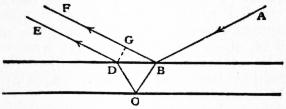
Fig. 2.
The complete theory of the colours of thin plates requires us to take account not merely of the two reflections already mentioned but of an infinite series of such reflections. This was first effected by S. D. Poisson for the case of retardations which are exact multiples of the half wave-length, and afterwards more generally by Sir G. B. Airy (Camb. Phil. Trans., 1832, 4, p. 409).
In fig. 2, ABF is the ray, perpendicular to the wave-front, reflected at the upper surface, ABCDE the ray transmitted at B, reflected at C and transmitted at D; and these are accompanied by other rays reflected internally 3, 5, &c., times. The first step is to calculate the retardation δ between the first and second waves, so far as it depends on the distances travelled in the plate (of index μ) and in air.
If the angle ABF = 2α, angle BCD = 2α′ and the thickness of plate = t, we have
δ = μ (BC + CD) − BG = 2μBC − 2BC sin α sin α′ = 2μBC (l − sin2 α′) = 2μt cos α′
(1).
In (1) α′ is the angle of refraction, and we see that, contrary to what might at first have been expected, the retardation is least when the obliquity is greatest, and reaches a maximum when the obliquity is zero or the incidence normal. If we represent all the vibrations by complex quantities, from which finally the imaginary parts are rejected, the retardation δ may be expressed by the introduction of the factor ε−iκδ, where i = √(−1), and κ = 2π/λ.
At each reflection or refraction the amplitude of the incident wave must be supposed to be altered by a certain factor which allows room for the reversal postulated by Young. When the light proceeds from the surrounding medium to the plate, the factor for reflection will be supposed to be b, and for refraction c; the corresponding quantities when the progress is from the plate to the surrounding medium will be denoted by e, f. Denoting the incident vibration by unity, we have then for the first component of the reflected wave b, for the second cefε−iκδ, for the third ce3fε−2iκδ, and so on. Adding these together, and summing the geometric series, we find
b + cef ε−iκδ
1 − e2 ε−iκδ
(2).
In like manner for the wave transmitted through the plate we get
cf
1 − e2 ε−iκδ
(3).
The quantities b, c, e, f are not independent. The simplest way to find the relations between them is to trace the consequences of supposing δ = 0 in (2) and (3). This may be regarded as a development from Young’s point of view. A plate of vanishing thickness is ultimately no obstacle at all. In the nature of things a surface cannot reflect. Hence with a plate of vanishing thickness there must be a vanishing reflection and a total transmission, and accordingly
b + e = 0, cf = l − e2
(4),
the first of which embodies Arago’s law of the equality of reflections, as well as the famous “loss of half an undulation.” Using these we find for the reflected vibration,
− e(1 − ε−iκδ)
1 − e2 ε−iκδ
(5),
and for the transmitted vibration
1 − e2
1 − e2 ε−iκδ
(6).
The intensities of the reflected and transmitted lights are the squares of the moduli of these expressions. Thus
Intensity of reflected light = e2 (1 − cos κδ)2 + sin2 κδ
(1 − e2 cos κδ)2 + e4 sin2 κδ
= 4e2 sin2 (½κδ)
1 − 2e2 cos κδ + e4
(7);
Intensity of transmitted light = (1 − e2)2
1 − 2e2 cos κδ + e4
(8),
the sum of the two expressions being unity.
According to (7) not only does the reflected light vanish completely when δ = o, but also whenever ½κδ = nπ, n being an integer, that is, whenever δ = nλ. When the first and third mediums are the same, as we have here supposed, the central spot in the system of Newton’s ring is black, even though the original light contain a mixture of all wave-lengths. If the light reflected from a plate of any thickness be examined with a spectroscope of sufficient resolving power, the spectrum will be traversed by dark bands, of which the centre corresponds to those wave-lengths which the plate is incompetent to reflect. It is obvious that there is no limit to the fineness of the bands which may be thus impressed upon a spectrum, whatever may be the character of the original mixed light.
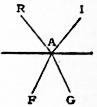
Fig. 3.
The relations between the factors b, c, e, f have been proved, independently of the theory of thin plates, in a general manner by Stokes, who called to his aid the general mechanical principle of reversibility. If the motions constituting the reflected and refracted rays to which an incident ray gives rise be supposed to be reversed, they will reconstitute a reversed incident ray. This gives one relation; and another is obtained from the consideration that there is no ray in the second medium, such as would be generated by the operation alone of either the reversed reflected or refracted rays. Space does not allow of the reproduction of the argument at length, but a few words may perhaps give the reader an idea of how the conclusions are arrived at. The incident ray (IA) (fig. 3) being 1, the reflected (AR) and refracted (AF) rays are denoted by b and c. When b is reversed, it gives rise to a reflected ray b2 along AI, and a refracted ray bc along AG (say). When c is reversed, it gives rise to cf along AI, and ce along AG. Hence bc + ce = 0, b2 + cf = 1, which agree with (4). It is here assumed that there is no change of phase in the act of reflection or refraction, except such as can be represented by a change of sign.
When the third medium differs from the first, the theory of thin plates is more complicated, and need not here be discussed. One particular case, however, may be mentioned. When a thin transparent film is backed by a perfect reflector, no colours should be visible, all the light being ultimately reflected, whatever the wave-length may be. The experiment may be tried with a thin layer of gelatin on a polished silver plate. In other cases where a different result is observed, the inference is that either the metal does not reflect perfectly, or else that the material of which the film is composed is not sufficiently transparent. Some apparent exceptions to the above rule, exhibited by thin films of collodion resting upon silver surfaces, have been described by R. W. Wood (Physical Optics, p. 143), who attributes the very curious effects observed to frilling of the collodion film.
For study of the colours of thin plates there are no more interesting subjects than the soap-film. For projection the films may be stretched across vertical rings of iron wire coated with paraffin. In their undisturbed condition they thin from the top, and the colours are disposed in horizontal bands. If, as suggested by Brewster, a jet of wind issuing from a small nozzle and supplied from a well-regulated bellows be allowed to impinge obliquely, parts of the film are set in rotation, and displays of colours may be exhibited to a large audience, astonishing by their brilliance and by the rapidity with which they change. Permanent films, analogous to soap-films, are best obtained by Glew’s method. A few drops of celluloid varnish are poured upon the surface of water contained in a large dish. After evaporation of the solvent, the films may be picked up upon rings of iron wire.
As a variant upon Newton’s rings, interesting effects may be obtained by the partial etching of the surfaces of picked pieces of plate-glass. A surface is coated in parallel stripes with paraffin wax and treated with dilute hydrofluoric acid for such a time (found by preliminary trials) as is required to eat away the exposed portions to a depth of one quarter of the mean wave-length of light. Two such prepared surfaces pressed in the crossed position into suitable contact exhibit a chess-board pattern. Where two uncorroded, or where two corroded, parts overlap, the colours are nearly the same; but where a corroded and an uncorroded surface meet, a strongly contrasted colour is developed. The combination lends itself to projection and the pattern seen upon the screen is very beautiful if proper precautions are taken to eliminate the white light reflected from the first and fourth surfaces of the plates (see Nature, 1901, 64, 385).
Theory and observation alike show that the transmitted colours of a thin plate, e.g. a soap film or a layer of air, are very inferior to those reflected. Specimens of ancient glass, which have undergone superficial decomposition, on the other hand, sometimes show transmitted colours of remarkable brilliancy. The probable explanation, suggested by Brewster, is that we have here to deal not merely with one, but with a series of thin plates of not very different thicknesses. It is evident that with such a series the transmitted colours would be much purer, and the reflected much brighter, than usual. If the thicknesses are strictly equal, certain wave-lengths must still be absolutely missing in the reflected light; while on the other hand a constancy of the interval between the plates will in general lead to a special preponderance of light of some other wave-length for which all the component parts as they ultimately emerge are in agreement as to phase.
On the same principle are doubtless to be explained the colours of fiery opals, and, more remarkable still, the iridescence of certain crystals of potassium chlorate. Stokes showed that the reflected light is often in a high degree monochromatic, and that it is connected with the existence of twin planes. A closer discussion appears to show that the twin planes must be repeated in a periodic manner (Phil. Mag., 1888, 26, 241, 256; also see R. W. Wood, Phil. Mag., 1906).
A beautiful example of a similar effect is presented by G. Lippmann’s coloured photographs. In this case the periodic structure is actually the product of the action of light. The plate is exposed to stationary waves, resulting from the incidence of light upon a reflecting surface (see Photography).
All that can be expected from a physical theory is the determination of the composition of the light reflected from or transmitted by a thin plate in terms of the composition of the incident light. The further question of the chromatic character of the mixtures thus obtained belongs rather to physiological optics, and cannot be answered without a complete knowledge of the chromatic relations of the spectral colours themselves. Experiments upon this subject have been made by various observers, and especially by J. Clerk Maxwell (Phil. Trans., 1860), who has exhibited his results on a colour diagram as used by Newton. A calculation of the colours of thin plates, based upon Maxwell’s data, and accompanied by a drawing showing the curve representative of the entire series up to the fifth order, has been given by Rayleigh (Edin. Trans., 1887). The colours of Newton’s scale are met with also in the light transmitted by a somewhat thin plate of doubly-refracting material, such as mica, the plane of analysis being perpendicular to that of primitive polarization.
The same series of colours occur also in other optical experiments, e.g. at the centre of the illuminated area when light issuing from a point passes through a small round aperture in an otherwise opaque screen.