VOLUME XIV SLICE VI Inscriptions to Ireland, William Henry (continued 3)
Reading edition
7. Many of the private documents just alluded to have not a monumental character similar to that of the other inscriptions in the wider sense of the word, as they are written on materials not very durable, such as wood and lead—in the majority of cases, in cursive characters; but, nevertheless, they cannot be classed as literature. As a last species, therefore, of instrumenta, there remain some documents, public and private, which similarly lack the strict monumental character, but still are to be reckoned among inscriptions. These are the inscriptions painted or scratched (graffiti) on the walls of the buildings of ancient towns, like Pompeii, where, as was to be expected, most of them have been preserved, those from other ancient cities buried by the eruptions of Vesuvius and from Rome being very small in number. All the various classes of these inscriptions—public and private advertisements, citations for the municipal elections, and private scribblings of the most diverse (and sometimes most indecent) character, one partly collected by Chr. Wordsworth (Inscriptiones Pompeianae, &c., London, 1837, 1846)—are now arranged by Zangemeister in the Corpus, vol. iv. with supplement (some specimens in Wil. 1951 sq.), whence their peculiar palaeographic and epigraphic rules may be learned. And, lastly, as related to some of these advertisements, though widely differing from them in age and character, may be mentioned the so-called diptycha consularia, monuments, in the first instance, of the still very respectable skill in this branch of sculpture to be found at this late period. They are carved-ivory tablets, in the form of pugillaria, and seem to have been invitations to the solemnities connected with the accession of high magistrates, especially to the spectacles of the circus and amphitheatre; for they contain, along with representations of such spectacles, the names, and often the portraits, of high functionaries, mostly of the 5th and 6th centuries. Since Gori’s well-known work on this class of monuments (Thesaurus veterum diptychorum, &c., 3 vols., Florence, 1759) no comprehensive collection of them has been published, but a full list is given by H. de Villefosse in the Gazette Archéologique of 1884; as specimens see C.I.L. ii. 2699, and v. 8120, 1-9.
Bibliography.—As a “Textbook” of Roman epigraphy R. Cagnat, Cours d’épigraphie latine (3rd ed., Paris, 1898, with supplement, 1904) can be heartily recommended. But students must be warned against Zell’s Handbuch der römischen Epigraphik (2 vols., Heidelberg, 1850-1852), an unsatisfactory work which is open to serious criticism. J. C. Egbert’s Introduction to the Study of Latin Inscriptions (1896) is designed for American and English students. For Christian inscriptions Le Blant’s Manuel d’épigraphie chrétienne d’après les marbres de la Gaule (Paris, 1869) may still be consulted with advantage.
(E. Hü.; W. M. L.)
1 See Winckler in Schrader’s Keilinschr. Bibl. v. (Berlin, &c., 1896).
2 A nearly complete text has been made from these with the help of a squeeze taken before its destruction. See the handbooks mentioned below.
3 Published with other fragments in the Jew. Quart. Review, xvi. 1.
4 Zeitsch. f. Aegypt. Spr. (1879). These were the first specimens found. See also Erman and Krebs, Aus den Papyrus d. kgl. Mus. p. 290 (Berlin, 1899).
5 Mittheilungen ... Rainer, i. 38 (Wien, 1886).
6 Those in France were collected by Schwab in Nouvelles archives, xii. 3. See also Chwolson, Corpus Inscr. Hebr. (St Petersburg, 1882).
7 These have been collected by J. H. Stevenson, Babyl. and Assyr. Contracts (New York, 1902). A more complete collection has been prepared by Professor A. T. Clay.
8 For the literature see Kalinka, Tituli Lyciae, No. 152 (Vienna, 1901).
9 Répertoire d’épigr. sém., No. 438.
10 So Bacher in J. Q. R. xix. 441.
11 In Mém. Acad. inscr. 1re sér. xi. 297. See also Rép. d’épigr. sém., for some smaller fragments, Nos. 244-248.
12 Sayce and Cowley, Aramaic Papyri (London, 1906).
13 Sachau, “Drei aram. Papyrusurkunden” Abh. d. kgl. Preuss. Akad. (Berlin, 1907).
14 See P.S.B.A. (1907), p. 260.
15 See Lidzbarski, Ephemeris, ii. 247.
16 J.Q.R. xvi. 7.
17 ed. E. O. Winstedt (Cambr. 1909), p. 154.
18 A view revived by C. Forster, even after Beer, in The Israelitish Authorship of the Sinaitic Inscriptions (London, 1856) and other works.
19 The cross and other Christian symbols often found with the inscriptions have been added later by pilgrims.—C.I.S. ii. 1, p. 352.
20 Reise in Syrien (Leipzig, 1883).
21 Inscriptions sém. de la Syrie, &c. i. (Paris, 1907).
22 J. H. Mordtmann, “Beitr. zur Minäischen Epigraphik,” in Semitistische Studien, 12 (Weimar, 1897).
23 In Bent’s Sacred City of the Ethiopians (London, 1893).
24 Revue sémitique (1901).
25 Journ. As. x., xvii., xix.
26 Zur Entzifferung d. Safā-Inschr. (Leipzig, 1901).
27 It may be remarked that there are about twelve different views regarding the date of Kaṇishka and the origin of the Vikrama era. Some writers hold that Kaṇishka began to reign in A.D. 78: one writer would place his initial date about A.D. 123: others would place it in A.D. 278. The view maintained by the present writer was held at one time by Sir A. Cunningham; and, as some others have already begun to recognize, evidence is now steadily accumulating in support of the correctness of it.
28 The legends on coins form part of numismatics, though closely connected with inscriptions.
29 The amphorae which conveyed the wine and other products of various localities have imprinted on their handles the name of the magistrate and other marks of the place and date. Large collections have been made of them, and they repay inquiry. See Dumont, Inscriptions céramiques (1872); Paul Becker, Henkelinschriften (Leipzig, pt. i. 1862, pt. ii. 1863); Hiller v. Gaertringen, I.G. xii. 1065-1441.
30 e.g. Treaty between Elis and the Heraeans, about 550-500 B.C., from Olympia (Boeckh, C.I.G. 11, Hicks, 29, and others in Dittenberger-Purgold, Inschr. v. Olympia, 1-43); a similar bronze treaty from the Locri Ozolae (Dittenberger, I.G. ix. 334); bronze plate from Dodona, recording the victory of Athens over the Lacedaemonians in a sea-fight, probably 429 B.C. (Dittenberger, Syll. 2. 30).
31 See Wünsch I.G. iii., App.; Audollent, Defixionum Tabellae (1904).
32 See Karapanos, Dodone et ses ruines; Hoffman, Gr. Dial. Inschr. 1558-1598.
33 What was done by Themistocles under stress of public necessity (Thucyd. i. 93) was done by others with less justification elsewhere; and from Byzantine times onward Greek temples and inscriptions were found convenient quarries.
34 It appears from Cicero, De Legibus, ii. 26, 27, that the size of Athenian gravestones was limited by law.
35 An index to the four volumes was long wanting; it was at length completed and appeared in 1877.
36 See E. Hübner, Über mechanische Copieen von Inschriften (Berlin, 1881).
37 Compare De Rossi, Bullettino dell’ instituto archeologico (1871), p. 1 sq.
38 His works have been published by the French government in several volumes 4to (Paris, 1862 sqq.).
39 For other details of numerical notation, fractions, &c., see the manuals of metrology.
40 On the system of Roman nomenclature and the abbreviations employed in it see Cagnat’s textbook, and for more detail Mommsen in Römische Forschungen, i. 1 seq., and in Hermes, iii. (1869), p. 70, W. Schulze, Zur Geschichte lateinischen Eigennamen (Berlin, 1904); on the cognomina (but only those occurring in ancient literature), Ellendt, De cognomine et agnomine Romano (Königsberg, 1853), and on the local cognomina of the Roman patriciate, Mommsen, Röm. Forsch, ii. 290 seq.; on the nomina gentilicia, Hübner (Ephem. epigr. ii. 25 seq.). The indexes to Orelli, Wilmanns, and the volumes of the Corpus may also be consulted.
41 This observation, applied to a large number of monuments, gave rise to many of the splendid epigraphical labours of Borghesi (see e.g. his dissertation upon the inscription of the consul L. Burbuleius, Œuvres, iv. 103 sq.).
42 The character of an elogium is assumed in a special way by the inscriptions on triumphal arches, such as that of Augustus on the arch of Susa in Piedmont, dating from the year 745 (9 B.C.) (C.I.L. v. 7231; Orel. 626), and the similar one on the tropaea Augusti (la Turbia) (C.I.L. v. 7817) of the year 747 (7 B.C.), which Pliny also (Hist. Nat. iii. § 136) records, and those of the other emperors at Rome, of which only that of Claudius, the conqueror of Britain (C.I.L. vi. 920, 921; Orel. 715; Wil. 899), with the statues of himself and his family, need be mentioned.
43 See the important work of R. Lanciani, Commentari di Frontino intorno le acque e gli acquedotti, &c. (Rome, 1880).
INSECT, the anglicized form of the Late Lat. insectum, used by Pliny in his Natural History as the equivalent of the Gr. ἔντομον. Aristotle had included in one class “Entoma” the six-legged arthropods which form the modern zoological class of the Hexapoda or Insecta, besides the Arachnida, the centipedes and the millipedes. The word was introduced to English readers in a translation (1601) of Pliny’s Natural History by Philemon Holland, who defined “insects” as “little vermine or smal creatures which have (as it were) a cut or division betwene their heads and bodies, as pismires, flies, grashoppers, under which are comprehended earthworms, caterpilers, &c.” Few zoological terms have been more loosely used both by scientific and popular writers. The definition just quoted might include all animals belonging to the groups of the Arthropoda and Annelida, and U. Aldrovandi in De animalibus insectis (1602) almost contemporaneously distinguished between “terrestrial insects,” including woodlice, earthworms and slugs, and “aquatic insects,” comprising annelids and starfishes. Perhaps the widest meaning ever attached to the word was that of R.A.F. de Réaumur, who “would willingly refer to the class of insects all animals whose form would not allow them to be placed in the class of ordinary quadrupeds, in that of birds, or in that of fishes. The size of an animal should not suffice to exclude it from the number of insects.... A crocodile would be a terrible insect; I should have no difficulty, however, in giving it that name. All reptiles belong to the class of insects, for the same reasons that earthworms belong to it.”
The class Insecta of Linnaeus (1758) was co-extensive with the Arthropoda of modern zoologists. The general practice for many years past among naturalists has been to restrict the terms “Insecta” and “insect” to the class of Arthropods with three pairs of legs in the adult condition: bees, flies, moths, bugs, grasshoppers, springtails are “insects,” but not spiders, centipedes nor crabs, far less earthworms, and still less slugs, starfishes or coral polyps.
For a general account of the structure, development and relationships of insects, see Arthropoda and Hexapoda, while details of the form, habits and classification of insects will be found in articles on the various orders or groups of orders (Aptera, Coleoptera, Dipteria, Hemiptera, Hymenoptera, Lepidoptera, Neuroptera, Orthoptera, Thysanoptera), and in special articles on the more familiar divisions (Ant, Bee, Dragon-fly, Earwig, &c.). The history of the study of insects is sketched under Entomology.
(G. H. C.)
INSECTIVORA, an order of non-volant placental mammals of small size, with a dentition adapted to an insect-diet. In nearly all cases these creatures are nocturnal, and the majority are terrestrial, many burrowing in the ground, although a few are arboreal and others aquatic. They have plantigrade or partially plantigrade feet, that is to say, they apply the whole or the greater portion of the soles to the ground when walking; and there are generally five toes, each terminating in a claw, and the first never being opposable to the others in either the fore or hind limb. A full series of differentiated teeth, including temporary or deciduous milk-molars, is developed, and the cheek-teeth have distinct roots and are crowned with sharp cusps, which in some instances are three in number and arranged in a triangle. Very frequently the number of the teeth is the typical forty-four, arranged as i. 3⁄3, c. 1⁄1, p. 4⁄4, m. 3⁄3, but occasionally there is a fourth pair of molars, while the incisors may be reduced to two pairs above and one below, and the canine is frequently like an incisor or a premolar. The skull is of a primitive type, often with vacuities on the palate, as in marsupials, with a small brain-chamber, and the tympanic bone generally ring-like instead of forming a bladder-shaped bulla; except in the African Potamogale, clavicles, or collar-bones, are always present; the humerus generally has a perforation on the inner side of its lower extremity; and a centrale bone is usually present in the carpus. In the brain the smooth hemispheres are so short as to leave the cerebellum and sometimes even the corpora quadrigemina exposed. The uterus is two-horned; the placenta, so far as known, is deciduate and discoidal; the testes are abdominal or inguinal; and the teats usually numerous. The body in several instances is covered with sharp spines in place of hair.
The great majority of the Insectivora are nocturnal in their habits, and their whole structure indicates an extremely low grade of organisation, fully as low as that of marsupials. It is noteworthy that the dentition in several of the groups approximates to that of the extinct mammals of the Jurassic epoch (see Marsupialia), and exhibits more or less distinctly the primitive tritubercular type. Although the past history of the group is very imperfectly known, it seems probable that the Insectivora are nearly related to the original primitive mammalian stock. Indeed, it has been stated that were it not for the apparently advanced type of placenta, they might easily be regarded as the little modified descendants of the ancestors of most other mammals. Probably they are in some way related to the creodont carnivores (see Creodonta), but if, as has been suggested, the latter are akin to the primitive ungulates, the connexion would seem to be less close than has been sometimes supposed.
Representatives of this order are found throughout the temperate and tropical parts of both hemispheres, with the exception of South America (where only a few shrews have effected an entrance from the north) and Australia, and exhibit much variety both in organization and in habit. The greater number are cursorial, but some (Talpa, Chrysochloris, Oryzorictes) are burrowing, others (Limnogale, Potamogale, Nectogale, Myogale) aquatic, and some (Tupaiidae) arboreal. To the great majority the term insectivorous is applicable, although Potamogale is said to feed on fish, and the moles live chiefly on worms. Notwithstanding the nature of their food, much variety prevails in the form and number of the teeth, and while in many cases the division into incisors, canines, premolars and molars may be readily traced, in others, forming the great majority of the species, such as the shrews, this is difficult.
In most cases the brain-cavity is of small relative capacity, and in no instance is the brain-case elevated to any considerable extent above the face-line. The facial part of the skull is generally much produced, and the premaxillary and nasal bones well developed; but the cheek, or zygomatic arch, is usually slender or deficient, the latter being the case in most of the species, and post-orbital processes of the frontals are found only in the Tupaiidae and Macroscelididae. The number of dorsal vertebrae varies from 13 in Tupaia to 19 in Centetes, of lumbar from 3 in Chrysochloris to 6 in Talpa and Sorex, and of caudal from the rudimentary vertebrae of Centetes to the 40 or more well-developed ones of Microgale.
The breast-bone, or sternum, is variable, but generally narrow, bilobate in front and divided into segments. The shoulder-girdle presents extreme adaptive modifications in the mole, in relation to the use of the fore-limbs in burrowing; but in the golden moles the fore-arm and fore-foot alone become specially modified. In Macroscelides the bones of the fore-arm are united at their lower ends, but in all other Insectivora the radius and ulna are distinct. The fore-foot has generally five digits; but in Rhynchocyon and in one species of Oryzorictes the first toe is absent, and in the moles it is extremely modified. The femur has, in most species, a prominent ridge below the greater trochanter presenting the characters of a third trochanter. In Tupaia, Centetes, Hemicentetes, Ericulus and Solenodon the tibia and fibula are distinct, but in most other genera united. The hind-foot consists usually of five digits (rarely four by reduction of the first), and in some, as in the leaping species (Macroscelides, Rhynchocyon), the tarsal bones are elongated. The form of the pelvis, and especially of the symphysis pubis, varies within certain limits, so that while in the Tupaiidae and Macroscelididae there is a long symphysis, in the Erinaceidae, Centetidae and Potamogalidae it is short, and in the Soricidae, Talpidae and Chrysochloridae there is none.
Owing to the similarity in the character of the food, the truly insectivorous species, forming more than nine-tenths of the order, present little variety in the structure of the digestive organs. The stomach is a simple, thin-walled sac; sometimes as in Centetes, with the pyloric and oesophageal openings close together; the intestinal canal has much the same calibre throughout, and varies from three (in the shrews) to twelve times (in the hedgehogs) the length of the head and body. In the arboreal Tupaia and the allied Macroscelididae, which probably feed on vegetable substances as well as insects most of the species possess a caecum. The liver is deeply divided into lobes, the right and left lateral being cut off by deep fissures; both the caudate and Spigelian lobes are generally well developed, and the gall-bladder, usually large and globular, is placed on the middle of the posterior surface of the right central lobe.
All the members of the order appear to be highly prolific, the number of young varying from two to eight in the hedgehog, and from twelve to twenty-one in the tenrec. The position of the milk-glands and the number of teats vary greatly. In Solenodon there is a single pair of post-inguinal teats, but in most species these organs range from the thorax to the abdomen, varying from two pairs in Gymnura to twelve in the tenrec. In the golden moles the thoracic and inguinal teats are lodged in deep cut-shaped depressions.
Scent-glands exist in many species. In most shrews they occur on the sides of the body at a short distance behind the axilla, and their exudation is probably protective, as few carnivorous animals will eat their dead bodies. In both species of Gymnura and in Potamogale large pouches are situated on each side of the rectum, and discharge their secretions by ducts, opening in the first-named genus in front of and in the latter within the margin of the vent. In the tenrec similarly situated glands discharge by pores opening at the bottom of deep pits.
The skin is thin, but in many species lined with well-developed muscles, which are probably more developed in hedgehogs than in any other mammals. In this family and in the tenrec most of the species are protected by spines implanted in the skin-muscle, or panniculus carnosus.
The Insectivora may be divided into two groups, according to the degree of development of the union between the two halves of the pelvis. The first group is characterized by the full development of this union, both pubis and ischium Tree-Shrews. entering into the symphysis. The tympanum remains as a ring within an auditory bulla; the orbit is either surrounded by bone, or separated from the hinder part of the skull by a post-orbital process of the frontal; the upper molars have broad 5-cusped crowns with a W-shaped pattern; and the intestine is generally furnished with a caecum. The first family of this group is the Tupaiidae, represented by the tree-shrews, or tupaias, of the Indo-Malay countries, characterized by the complete bony ring round the eye-socket, the freedom of the fibula from the tibia in the hind-limb, and the absence of any marked elongation of the tarsus. The dental formula is i. 2⁄3, c. 1⁄1, p. 3⁄3, m. 3⁄3, total 38. In appearance and habits tree-shrews are extremely like squirrels, although they differ, of course, in toto as regards their dentition. A large number of species are included as the typical genus Tupaia, which ranges from north-eastern India to the great Malay Islands. In these animals the tail has a fringe of long hairs on opposite sides throughout its length. In the pen-tailed, tree-shrew (Ptilocercus lowii), fig. 1, the only representative of its genus, and a native of Sumatra, Borneo and the Malay Peninsula, the fringes of long hair are confined to the terminal third of the tail. There are also differences in the skulls of the two genera. A third genus, Urogale, represented by U. cylindrura of the mountains of Mindanao, in the Philippines, and U. everetti, of Borneo, has been established for the round-tailed tupaias, in which the tail is uniformly short-haired, and the second upper incisor and the lower canines are unusually large, the third lower incisor being proportionately small, and also erect, while the second upper incisor resembles a canine. (See Tree-Shrew.)
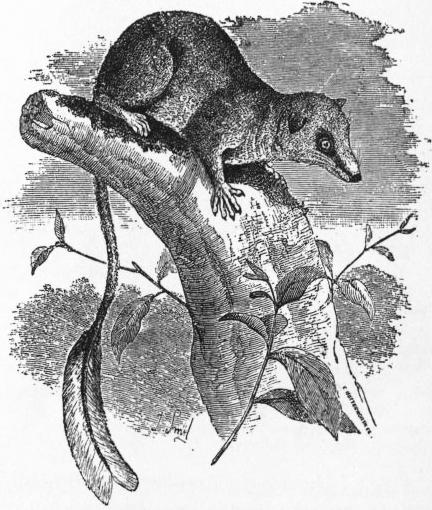
Fig. 1. Pen-tailed Tree-Shrew (Ptilocercus lowii).
In Africa the tupaias are apparently represented by the jumping-shrews, or elephant-shrews (so called from their elongated muzzles), constituting the family Macroscelididae. From the Tupaiidae the members of this family are readily distinguished by the fact that the socket of the eye, in place of having a complete bony ring, is separated from the hinder part of the skull merely by a post-orbital process of the frontal bone, and also by the more or less marked elongation of the tarsus or lower portion of the hind-limb; another feature being the union of the lower ends of the tibia and fibula. As indicated by one of their names, the members of the group leap after the fashion of gerbils, or jerboas, and hence walk much more on their toes than the majority of the order. In the typical genus Macroscelides, which ranges all over Africa and has numerous specific representatives, the dental formula is i. 3⁄3, c. 1⁄1, p. 4⁄4, m. 2/(2 or 3), total 40 or 42; while there are five toes to each foot, and the lower ends of the radius and ulna are united. In Petrodromus (fig. 2) of East Africa, there are only four front-toes, and the hairs on the lower part of the tail form stiff bristles, with swollen tips; the dental formula being the same as that of those species of Macroscelides as have only two lower molars. A further reduction of the number of the digits takes place in the long-nosed jumping-shrews of the genus Rhynchocyon, which are larger animals with a much longer snout, only four toes to each foot, and a dental formula of i. (1 or 0)/3, c. 1⁄1, p. 4⁄4, m. 2⁄2, total 36 or 34. Some of the species, all of which are East African, differ from the members of the typical genus by the deep rufous brown instead of olive-grey colour of their coat. (See Jumping-Shrew.)
In the second group, which includes all the other members of the order, the pelvic symphysis is either lacking or formed merely by the epiphyses of the pubes; the orbit and temporal region of the skull are confluent; and, except in the Talpidae and Chrysochloridae, the tympanum is ring-like, the tympanic cavity being formed by the alisphenoid and basisphenoid bones. The upper molars are triconodont, being either of the typical or a modified form of what is known as the tritubercular sectorial type. There is no caecum.
The first representatives of this group are the moles, or Talpidae, in which the lower ends of the tibia and fibula are united (fig. 3, t, fb), there is a descent of the testes, the tympanum forms a bladder-like bulla, the zygomatic, or cheek-arch, Moles. although slender, is complete, there is no pelvic symphysis, the upper molars are five-cusped, and the first upper incisor is simple, and the lower vertical. In habits the majority of the family are burrowing, but a few are aquatic; and all feed on animal substances. The distribution is limited to the temperate regions of Europe, Asia and North America.
Throughout the family the eyes are minute, and in some species are covered with skin; the ears are short and hidden in the fur; and the fore-limbs are generally more or less modified for digging.
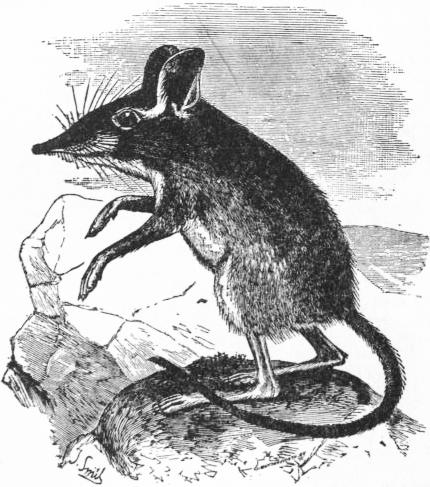
Fig. 2.—Peter’s Jumping-Shrew (Petrodromus tetradactylus).
The true moles of the genus Talpa are the typical representatives of the first subfamily, or Talpinae, in which the clavicle (fig. 3, cl.) and humerus (h) are very short and broad, while there is an additional sickle-like bone (fc) on the inner side of the fore-foot. In Talpa itself the first upper incisor is but little larger than the second, the fore-foot is very broad, and the dental formula is i. 2⁄2, c. 1/(1 or 0), p. 3⁄3, 3⁄4, or 4⁄4, m. 3⁄3. There are about a dozen species, all confined to the Old World. The variation in the dental formula of some of the best known of these is as follows:—
i. 3⁄3, c. 1⁄0, p. 4⁄4, m. 3⁄3 × 2 (T. wogura, robusta). i. 3⁄3, c. 1⁄1, p. 4⁄4, m. 3⁄3 × 2 (T. europaea, caeca, romana, longirostris, micrura). i. 3⁄3, c. 1⁄1, p. 3⁄4, m. 3⁄3 × 2 (T. leucura, leptura). i. 3⁄3, c. 1⁄1, p. 3⁄3, m. 3⁄3 × 2 (T. moschata).
Except in T. europaea, the eyes are covered by a membrane. In T. micrura the short tail is concealed by the fur. T. europaea extends from England to Japan.
T. caeca and T. romana are found south of the Alps, the remaining species are all Asiatic, two only—T. micrura and T. leucura—occurring south of the Himalaya.
The genus may be split up into subgenera corresponding with the above table; these subdivisions being sometimes accorded full generic rank. For instance the Japanese T. wogura and the Siberian T. robusta are often referred to under the ill-sounding titles of Mogera wogura and M. robusta.
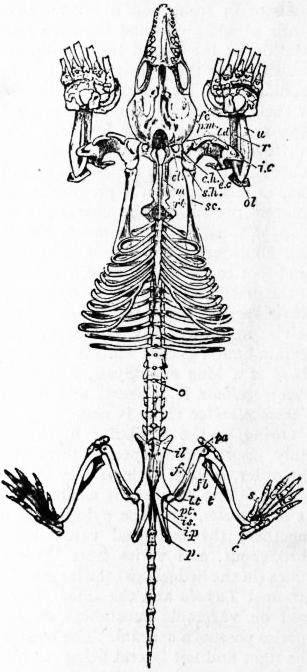
Fig. 3.—Skeleton of Mole (Talpa europaea) (lower jaw removed to show base of skull).
c, Calcaneum. c.h, Clavicular articulation of the humerus. cl, Clavicle. e.c, External condyle of humerus. f, Femur. fb, Fibula. fc, Falciform bone (radial sesamoid). h, Humerus. i.c, Internal condyle of humerus. il, Left iliac bone. i.p, Ramus of the ilium and pubis. is, Ischium. l.d, Ridge of insertion of latissimus dorsi muscle. l.t, Lesser trochanter. m, Manubrium sterni. o, Fourth hypapophysial sesamoid ossicle. ol, Olecranon. p, Pubic bone widely separated from that of the opposite side. pa, Patella. p.m, Ridge for insertion of pectoralis major muscle. pt, Pectineal eminence. r, Radius. rb, First rib. s, Plantar sesamoid ossicle corresponding to the radial sesamoid (os falciform) in the manus. sc, Scapula. s.h, Scapular articulation of the humerus. t, Tibia. u, Ulna.
Referring more fully to the European species, it may be mentioned that the mole exhibits in its organization perfect adaptation to its mode of life. In the structure of the skeleton striking departures from the typical mammalian forms are noticeable. The first sternal bone is so much produced as to extend forward as far as a vertical line from the second cervical vertebra, carrying with it the very short almost quadrate clavicles, which are articulated with its anterior extremity and externally with the humeri, being also connected ligamentously with the scapula. The fore-limbs are thus brought opposite the sides of the neck, and from this position a threefold advantage is derived:—in the first place, as this is the narrowest part of the body, they add little to the width, which, if increased, would lessen the power of movement in a confined space; secondly this position allows of a longer fore-limb than would otherwise be possible, and so increases its lever power; and, thirdly, although the entire limb is relatively short, its anterior position enables the animal, when burrowing, to thrust the claws so far forward as to be in a line with the end of the muzzle, the importance of which is evident. Posteriorly, we find the hind-limbs removed out of the way by approximation of the hip-joints to the centre line of the body. This is effected by inward curvature of the innominate bones at the acetabulum to such an extent that they almost meet in the centre, while the pubic bones are widely separated behind. The shortness of the fore-limb is due to the humerus, which, like the clavicle, is so reduced in length as to present the appearance of a flattened X-shaped bone, with prominent ridges and deep depressions for the attachments of powerful muscles. Its upper extremity presents two rounded prominences; the smaller, the true head of the bone, articulates as usual with the scapula; the larger, which is the external tuberosity rounded off, forms a separate joint with the end of the clavicle. This double articulation gives the rigidity necessary to support the great lateral pressure sustained by the fore-limb in excavating. The bones of the fore-leg are normal, but those of the fore-foot are flattened and laterally expanded. The great width of the fore-foot is also partly due to the presence of a peculiar bone on the inner side of the palm and articulating with the wrist.
The muscles acting on these modified limbs are homologous with those of cursorial insectivora, differing only in their relative development. The tendon of the biceps traverses a long bony tunnel, formed by the expansion of the margin of the bicipital groove for the insertion of the pectoralis major muscle; the anterior division of the latter muscle is unconnected with the sternum, extending across as a band between the humeri, and co-ordinating the motions of the fore-limbs. The teres major and latissimus dorsi muscles are of immense size, inserted into the prominent ridge below the pectoral attachment, and are the principal agents in the excavating action of the limb. The cervical muscles connecting the slender scapulae, and through them the fore-limbs, with the centre line of the neck and with the occiput are large, and the ligamentum nuchae between them is ossified. The latter condition appears to be due to the prolongation forwards of the sternum, preventing flexion of the head downwards; and accordingly, the normal office of the ligament being lost, it ossifies, and affords a fixed point for the origins of the superficial cervical muscles.
The skull is long, with slender zygomatic arches; the nasal bones are strong and early become united, and in front of them the nostrils are continued forwards in tubes formed of thick cartilage, the septum between which becomes partially or wholly ossified beneath. There are 7 cervical, 13 dorsal, 6 lumbar, 6 sacral and 10-12 caudal vertebrae; of the dorsal and lumbar there may be one more or less. The sacral vertebrae are united by their expanded and compressed spinous processes, and all the others, with the exception of the cervical, are closely and solidly articulated together, so as to support the powerful propulsive and fossorial actions of the limbs. The upper incisors are simple chisel-edged teeth; the canine is long and two-rooted; then follow three subequal conical premolars, and a fourth, much larger, and like a canine; these are succeeded by three molars with W-shaped cusps. In the lower jaw the three incisors on each side are slightly smaller, and slant more forwards; close behind them is a tooth which, though like them, must, from its position in front of the upper canine, be considered as the canine; behind it, but separated by an interval, is a large double-rooted conical tooth, the first premolar; the three following premolars are like the corresponding teeth above, but smaller, and are succeeded, as above, by the three molars. See Mole.
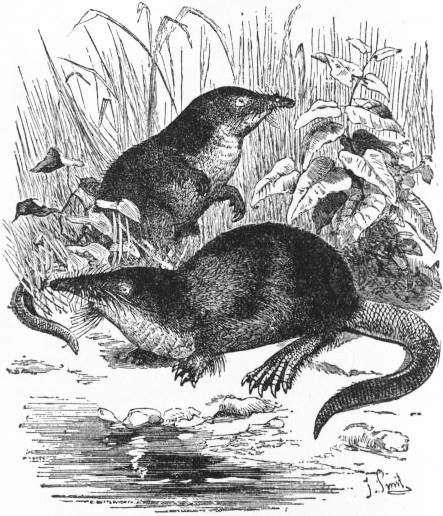
Fig. 4.—Russian Desman (Myogale moschata).
In the other members of the Talpinae, which are North American, the first upper incisor is much taller than the second. They include the curious star-nosed mole (Condylura cristata), which has the typical series of 44 teeth and a series of fleshy appendages round the extremity of the snout; the species known as Scapanus townsendi and Parascalops americanus, each representing a genus by itself, and characterized by the absence of nasal appendages and the presence of only two pairs of lower incisors; and, finally, Scalops aquaticus, in which the dentition is further reduced by the loss of the lower canine, the total number of teeth thus being forty.
Forming a transition to the subfamily Myogalinae, in which the clavicle and humerus are typically of normal form, and there is no sickle-shaped bone in the fore-foot, is the Chinese mole (Scaptonyx piscicauda), characterized by having the clavicle and humerus of the true mole-type, but the foot like that of the under-mentioned Urotrichus. The relative proportions of the first and second upper incisors are also as in Talpa, but there are only two pairs of lower incisors.
Among the more typical Myogalinae, mention may be made of Dymecodon pilirostris, from Japan, representing a genus by itself; nearly allied to which are the shrew-moles, as represented by the small and long-tailed Urotrichus of Japan, with incisors 2⁄1 and premolars 4⁄3, and U. (Neurotrichus) gibbsi of North America, in which the premolars are ¾. A still more interesting form is the Tibetan Uropsilus soricipes, a non-burrowing species, with the external appearance of a shrew combined with the skull of a mole, the feet being much narrower than in Urotrichus, and the dental formula i. 2⁄1, c. 1⁄1, p. 3⁄3, m. 3⁄3.
The typical representatives of the subfamily are the two European desmans, Myogale moschata and M. pyrenaica, which are aquatic in habits and have the feet webbed and the full series of 44 teeth. The former is by far the largest member of the whole family, its total length being about 16 in. Its long proboscis-like snout projects far beyond the margin of the upper lip; the toes are webbed as far as the bases of the claws; and the long scaly tail is laterally flattened, forming a powerful instrument of propulsion when swimming. This species inhabits the banks of streams and lakes in south-east Russia, where its food consists of various aquatic insects. M. pyrenaica, living in a similar manner in the Pyrenees, is much smaller, has a cylindrical tail, and a relatively long snout.
The Shrew-mice, or, shortly, shrews (Soricidae), are closely related to the Talpidae, with which they are connected by means of some of the subfamily Myogalinae. They are, however, distinguished Shrews. by the ring-like tympanic, the incompleteness of the zygomatic arch, the tubercular-sectorial type of upper molar, the two-cusped first upper incisor, and the forward direction of the corresponding lower tooth. As a rule they are terrestrial, but a few are aquatic.
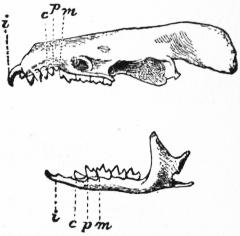
Fig. 5.—Skull and Dentition of a Shrew-mouse (Sorex-verae-pacis); i, first incisors; c in the upper jaw is the canine; and p-m the three premolars, behind which are the three molars; in the lower jaw c is the second incisor, and p the single premolar.
The dentition (fig. 5) is characteristic, and affords one of the chief means of classifying this exceedingly difficult group of mammals. There are no lower canines, and always six functional teeth on each side of the lower jaw, but in some rare instances an additional rudimentary tooth is squeezed in between two of the others. The first pair of teeth in each jaw differ from the rest; in the upper jaw they are hooked and have a more or less pronounced basal cusp; in the lower jaw they are long and project horizontally forwards, sometimes with an upward curve at the tip. Behind the first upper incisor comes a variable number of small teeth, of which, when all are developed, the first two are incisors, the third the canine, and the next two premolars; behind these, again, are four larger teeth, of which the front one is the last premolar, while the other three are molars. Thus we have in the typical genus Sorex (fig. 5) the dental formula i. 3⁄2, c. 1⁄0, p. 3⁄1, m. 3⁄3, total 32, or twenty upper and twelve lower teeth. The lower formula, as already stated, is constant, but the number of the upper series varies from the above maximum of twenty to a minimum of fourteen in Diplomesodon and Anurosorex, in which the formula is i. 2, c. 1, p. 1, m. 3. From the relation of the fourth upper tooth to the premaxillo-maxillary suture it has been supposed that shrews, like many polyprotodont marsupials, have four pairs of upper incisors; but this is improbable, and the formula is accordingly here taken to follow the ordinary placental type.
Shrews may be divided into two sections, according as to whether the teeth are tipped with brownish or reddish or are wholly white, the former group constituting the Soricinae and the latter the Crocidurinae.
In the red-tipped group is the typical genus Sorex, which ranges over Europe and Asia north of the Himalaya Mountains to North America. There are twenty upper teeth with the formula given above, the ears are well developed, the tail is long and evenly haired, and the aperture of the generative organs in at least one of the sexes is distinct from the vent. The common shrew-mouse (Sorex araneus) has a distribution co-extensive with that of the genus in the Old World, and the North American S. richardsoni can scarcely be regarded as more than a local race. A few species, such as Sorex hydrodomus of Alaska and S. palustris of the United States, have fringes of long hairs on the feet, and are aquatic in habit. The latter has been made the type of the genus Neosorex, but such a distinction, according to Dr J. E. Dobson, is unnecessary. The same authority likewise rejects the separation of the North American S. bendirei as Atophyrax, remarking that this species is an inhabitant of marshy land, and appears to present many characters intermediate between S. palustris and the terrestrial species of the genus, differing from the former in the absence of well-defined fringes to the digits, but agreeing with it closely in dentition, in the large size of the infra-orbital foramen, and in the remarkable shortness of the angular process of the lower jaw. In India and Burma the place of Sorex is taken by Soriculus, in which the upper teeth are generally 18, although rarely 20, and the generative organs have an opening in common with the vent after the fashion of the monotreme mammals. The latter feature occurs in the North American Blarina, which is characterized by the truncation of the upper part of the ear and the short tail, the number of upper teeth being 20 or 18. Another American genus, Notiosorex, in which the ear is well developed and the tail medium, has only 16 upper teeth. From all the rest of the red-toothed group the water-shrew, Neomys (or Crossopus) fodiens, of Europe and northern Asia, differs by the fringe of long hairs on the lower surface of the tail; the number of upper teeth being 18.
In the white-toothed, or crocidurine, group, the small African genus Myosorex, which has either 18 or 20 upper teeth, includes long-tailed and large-eared species in which the aperture of the generative organs and the vent, although close together, are yet distinct. In the musk-shrews (Crocidura), on the other hand, which are common to Europe, Asia and Africa, the reproductive organs and the alimentary canal discharge into a common cloaca, the long tail is sparsely covered with long and short hairs, there are anal glands secreting a strong musky fluid, and the number of upper teeth is 16 or 18. Diplomesodon pulchellus of the Kirghiz steppes, has, on the other hand, only 14 upper teeth, and is further characterized by the moderately long tail and the hairy soles of the hind-feet. Another genus is represented by the Tibetan Anurosorex squamipes, which has the same dental formula, but a mole-like form, rudimentary tail and scaly hind-soles. Lastly, we have two Asiatic mountain aquatic species, Chimarrogale himalayaca of the Himalayas and Nectogale elegans of Tibet, which have fringed tails like the European water-shrew, and 16 upper teeth, the former characterized by the small but perfect external ears, and the latter (fig. 6) by the absence of the ears and presence of adhesive disks on the feet.
It will be seen that the red- and the white-toothed series have parallel representative forms, which may indicate that the division of the family into the two groups is one based rather on convenience than on essential differences. See Shrew.
From the shrews, the hedgehogs and gymnuras, or rat-shrews, collectively forming the family Erinaceidae, differ structurally by the broader ring made by the tympanic, the complete zygomatic arch, the five-cusped broad upper molars, and the presence of a short pubic symphysis. At the present day they are an exclusively Old World group.
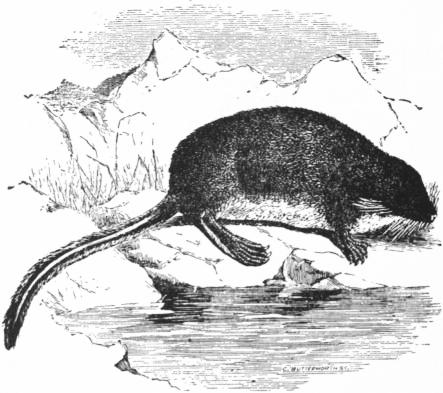
Fig. 6.—The Tibetan Water-shrew (Nectogale elegans).
The typical group, or Erinaceinae, is represented only by the hedgehogs, with the one genus Erinaceus, easily recognized by their spiny coats, and further characterized by the rudimentary tail, the presence of vacuities in the palate, and the broad Hedgehogs. pelvis. Hedgehogs (Erinaceus) have the dental formula i. 2⁄2, c. 1⁄1, p. 3⁄2, m. 3⁄3, and are represented by over a score of species, distributed throughout Europe, Africa and the greater part of Asia, but unknown in Madagascar, Ceylon, Burma, Siam, the Malay countries, and, of course, Australia. All the species resemble one another in the armour of spines covering the upper surface and sides of the body; and all possess the power of rolling themselves up into the form of a ball protected on all sides by these spines, the skin of the back being brought downwards and inwards over the head and tail so as to include the limbs by the action of special muscles.
Curiously enough the European hedgehog (E. europaeus) is the most aberrant species, differing from all the rest in the peculiarly-shaped and single-rooted third upper incisor and first premolar (fig. 7, A), and in its very coarse harsh fur. The dentition of the long-eared Indian E. grayi (fig. 7, B) may, on the other hand, be considered characteristic of all the other species, the only important differences being found in the variable size and position of the second upper premolar, which is very small, external and deciduous in the Indian E. micropus and E. pictus. The former species, limited to South India, is further distinguished by the absence of the jugal bone. Of African species, E. diadematus, with long frontal spines, is probably the commonest, and E. albiventris has been made the type of a separate genus on account of the total absence of the first front-toe. See Hedgehog.
The members of the second subfamily, Gymnurinae, are more or less rat-like animals, confined to the Malay countries, and easily distinguished from the hedgehogs by the absence of spines among the fur and the well-developed tail. They also lack Rat-shrew. vacuities in the palate, and have a long and narrow pelvis. The typical representative of the family is the greater rat-shrew, or greater gymnura (Gymnura rafflesi) a creature which may be compared to a giant shrew, and whose colour is partly black and partly white, although a uniformly pale-coloured race. (G. r. alba) inhabits Borneo. In common with the next genus, it has the full series of 44 teeth; and its range extends from Tenasserim and the Malay Peninsula to Sumatra and Borneo, the island individuals being stated to be considerably larger than those from the mainland. In this species the length of the tail is about three-fourths that of the head and body; but in the lesser rat-shrew (Hylomys suillus), ranging from Burma and the Malay Peninsula to Java and Sumatra, the former dimension is only about one-sixth of the latter. In the Philippines the group is represented by Podogymnura truei, distinguished from the other genera by the great elongation of the hind-foot, the tail being likewise long. There are only three pairs of premolars in each jaw.
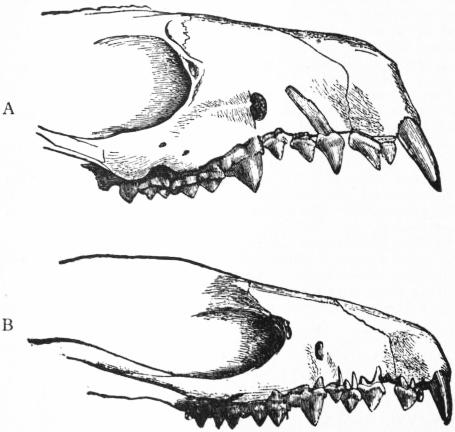
Fig. 7.—Fore-part of Skulls of Common Hedgehog (Erinaceus europaeus), A, and Gray’s Hedgehog (E. grayi), B, much enlarged.
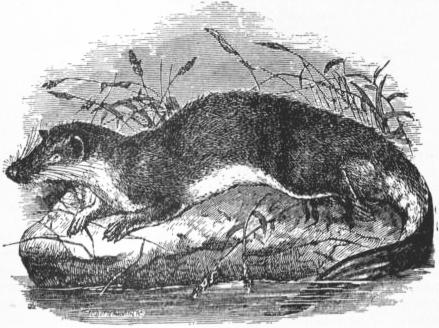
Fig. 8.—The Insectivorous Otter (Potagmogale velox).
In the remaining families of the Insectivora the tibia and fibula may be either separated or united at the lower end; there is no descent of the testes, except in Solenodon; a short symphysis is formed by the junction of the pubic epiphyses; Insectivorous Otter. and the upper molars are generally small, and triangular, with three cusps arranged in a V. The first family, Potamogalidae, is represented by the otter-like Potamogale velox of the rivers of West Africa (fig. 8), distinguished from all other members of the order by the absence of clavicles. The tibia and fibula are united interiorly, the skull has a ring-like tympanic, no zygomatic arch, and the upper molars are of the tuberculo-sectorial type, with broader crowns than in the following families. The dental formula is i. 3⁄3, c. 1⁄1, p. 3⁄3, m. 3⁄3, total 40. This animal inhabits the banks of streams in west equatorial Africa, and its whole structure indicates an aquatic life. It is nearly 2 ft. in length, the tail measuring about half. The long cylindrical body is continued uninterruptedly into the thick laterally compressed tail, the legs are very short, and the toes are not webbed, progression through the water depending wholly on the action of the powerful tail, while the limbs are folded inwards and backwards. The muzzle is broad and flat, and the nostrils are protected by valves. The fur is dark brown above, the extremities of the hairs on the back being of a metallic violet hue by reflected light, beneath whitish.
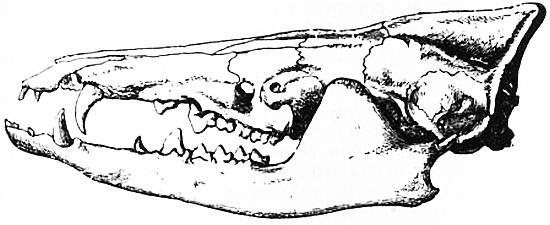
Fig. 9.—Skull of the Tenrec (Centeles ecaudatus), somewhat reduced.
In the remaining groups the upper molars form narrow V’s of the true tritubercular type. The family, Centetidae, represented by the tenrec and a number of allied animals from Madagascar, is specially characterized by the ring-like tympanic, and Tenrec. the absence of a zygomatic arch and of any constriction of the skull behind the orbits, and the presence of teats on the breast as well as the abdomen. In the more typical members of the family the tibia and fibula are separate, and, as in hedgehogs, spines are mingled with the fur. The true or great tenrec (Centetes ecaudatus), alone representing the typical genus, has the dental formula i. (3 or 2)/3, c. 1⁄1, p. 3⁄3, m. (3 or 4)/(3 or 4), total 38, 40, 42 or 44. The fourth lower molar, when developed, does not appear till late in life. Of the long and sharp canines, the tips of the lower pair are received into pits in the upper jaw (fig. 9). The creature grows to a length of aoout a foot. The young have strong white spines arranged in longitudinal lines along the back, but these are lost in the adult which has only a crest of long rigid hairs on the nape of the neck. The lesser tenrecs, Hemicentetes semispinosus and H. nigriceps, are distinguished by the persistence of the third upper incisor and the form of the skull. The two species are much smaller than the great tenrec, and spines are retained in the adult on the body. The hedgehog-tenrec, Ericulus setosus, has the whole upper surface, and even the short tail, densely covered with close-set spines. The facial bones are much shorter than in the preceding genera, and the first upper incisors are elongated; while there are only two pairs of incisors in each jaw. Judging from the slight development of the cutaneous muscles compared with those of the hedgehog, it would seem that these creatures cannot roll themselves completely into balls in hedgehog-fashion. A second species of this genus, Ericulus (Echinops) telfairi, has two, in place of three, pairs of molars, thus reducing the total number of teeth to 32. Moreover, the zygomatic arches of the skull are reduced to mere threads. Here should perhaps be placed Geogale aurita, a small long-tailed Malagasy insectivore, with 34 teeth, and no spines; the tibia and fibula being separate. It has been classed in the Potamogalidae, but from its habitat such a reference is improbable. The absence of spines may entitle it to separation from the Centetinae, so that it should perhaps be regarded as representing a subfamily, Geogalinae, by itself.
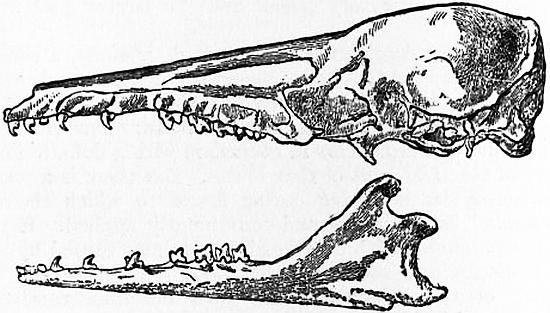
Fig. 10.—Skull of the Lesser Tenrec (Hemicentetes spinosus).
The absence of spines coupled with the union of the tibia and fibula form the leading characteristics of the subfamily Oryzorictinae, typified by the rice-tenrecs Oryzorictes, of which there are several species. These creatures, which excavate burrows in the rice-fields of Madagascar, are somewhat mole-like in appearance, but have tails of considerable length. In the typical O. hova the fore-feet are five-toed, but in O. tetradactylus the number of front digits is reduced to four. The long-tailed tenrecs (Microgale) are represented by fully half-a-dozen species with tails of great length; that appendage in the typical M. longicaudata being more than double the length of the head and body, and containing no fewer than forty-seven vertebrae. The teeth are generally similar to those of Centetes, but are not spaced in front; their number being i. 3⁄3, c. 1⁄1, p. 3⁄3, m., 3⁄3, total 40, or the same as in Oryzorictes. Finally, Limnogale mergulus, a creature about the size of a black rat, has webbed toes and a laterally compressed tail, evidently adapted for swimming. See Tenrec.
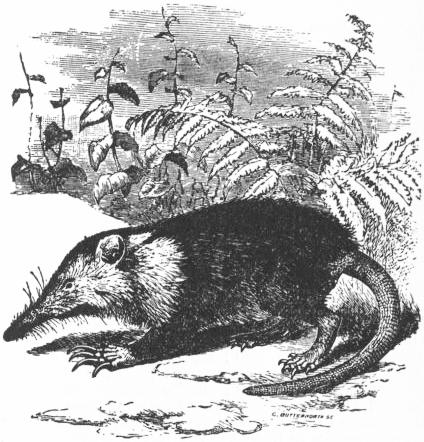
Fig. 11.—Solenodon cubanus.
All the foregoing are natives of Madagascar. It has been suggested however, that two remarkable West Indian insectivores, namely Solendon cubanus of Cuba (fig. 11) and S. paradoxus of Hayti, should be regarded as representing merely a subfamily Solenodon. of Centetidae. It is true that the main features distinguishing these strange creatures from the Malagasy representatives of that family are the constriction of the skull behind the orbits, the descent of the testes into the perineum, and the post-inguinal position of the teats, and that none of these are of very great importance. But the geographical positions of the two groups are so widely sundered that it seems preferable to await further evidence before definitely assigning the two to a single family; and the family Solenodontidae may accordingly be retained for the West Indian animals. Solenodons, which look like huge long-nosed, parti-coloured rats, have the tibia and fibula separate, and the same dental formula as Microgale. Each of the two species (which differ in colour and the quality of the fur) has a long cylindrical snout, an elongated naked tall, feet formed for running, and the body clothed with long, coarse fur. The position of the teats on the buttocks is unique among Insectivora. The first upper incisors are much enlarged, and like the other incisors, canines and premolars, closely resemble the corresponding teeth of Myogale; the second lower incisors are much larger than the upper ones, and hollowed out on the inner side.
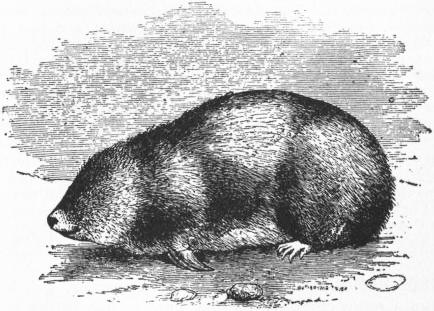
Fig. 12.—A Golden Mole (Chrysochloris obtusirostris) reduced.
The last family, Chrysochloridae, is represented by the golden moles of South and East Africa, which differ from the Centetidae and Solenodontidae by the development of a bulla to the tympanic, and the presence of a zygomatic arch to the Golden Mole. skull; the tibia and fibula being separate, and the symphysis of the pelvis formed merely by ligament. The skull is not constricted across the orbits. The teats, which are placed both on the breast and in the groin, are situated in shallow depressions. The ears are buried in the fur, and the eyes concealed beneath the skin; the feet are four-toed and provided with powerful claws for burrowing in the fashion of the mole, but it is interesting to note that the skeleton is modified for the same purpose in a manner quite different from that obtaining in the latter animal. These animals derive their name from the metallic iridescence of the fur of most of the species. In the more typical species the dental formula is the same as in Microgale, that is to say, there are 40 teeth. In other species, which it has been proposed to separate as Amblysomus, there are, however, only 36 teeth, owing to the absence of the last pair of molars. The group is evidently nearly related to the Centetidae—most nearly perhaps to the Oryzorictinae.
Fossil Insectivora.
Some years ago Dr F. Ameghino, of Buenos Aires, described from the Tertiary formation of Santa Cruz, in Patagonia, the remains of an insectivore under the name of Necrolestes. The occurrence of a member of the Insectivora in these beds is remarkable, since this group is represented at the present day in South America only by a shrew or two which have wandered from the north. Dr Ameghino expressed his belief that the extinct Patagonian insectivore was nearly related to the golden moles, and although this opinion appears to have been withdrawn, Professor W. B. Scott states that he is convinced of the close affinity existing between Necrolestes and Chrysochloris. Although this view may not be accepted, it must be remembered that it represents the opinion of a palaeontologist who has had better opportunities than most of his fellow-workers of forming a trustworthy judgment. So convinced is Dr Scott of the closeness of the relationship between Necrolestes and the golden moles that he regards it as rendering probable the former existence of a direct land-connexion between Africa and South America. There is no reason, he says, to suppose that the track of migration could have been by way of Europe and North America, for no trace of the group has been found anywhere north of the equator. This supposed connexion between Africa and South America in Tertiary times has often been suggested, and is supported by many independent lines of evidence; and the presumed affinity between the two mammals here referred to adds to the weight of such evidence.
The discovery in the Oligocene Tertiary deposits of Dakota of the remains of a species of hedgehog is a fact of great interest, for the hedgehog-tribe (Erinaceidae) is at the present day an exclusively Old World group. The discovery of the fossil American species, which has been made the type of a new genus under the name of Protherix, serves to strengthen the view that the northern countries of the Western and Eastern hemispheres form a single zoological region; and that formerly there was comparatively free communication between them in the neighbourhood of Bering Sea, under climatic conditions which permitted of temperate forms passing from one continent to the other. As might have been expected, remains of hedgehog-like mammals have been obtained in the Tertiary deposits of Europe. Among these, Palaeoerinaceus, from the Upper Oligocene of France, seems scarcely separable from the existing genus. Necrogymnurus (Neurogymnurus) from the Lower Oligocene, of the same country, appears to be allied to Hylomys, which is itself the most generalised of the family, so that the extinct genus, of which Caluxotherium is a synonym, may represent the ancestral type of the Erinaceidae. The genus Galerix, or Lanthanotherium, of the Oligocene, which has the typical series of 44 teeth, a bony ring round the orbit, and conjoint tibia and fibula, has been regarded as representing the Tupaiidae and Macroscelididae, but is more probably referable to the Erinaceidae, being apparently akin to Gymnura. The moles are represented in the French Oligocene by Amphidozotherium and in the Miocene by Talpa, while in the North American early Tertiary we have the primitive Talpavus. Shrews are also known from the Lower Oligocene upwards both in the eastern and western hemispheres. Of the Lower Eocene Adapisorex, with the typical 22 lower teeth, Adapisoriculus and Orthaspidotherium, all from France, the affinities are quite uncertain. The American Oligocene Leptictis, with i. 2, c. 1, p. 4, m. 3 in the upper jaw, and Ictops, with i. 3⁄2, c. 1⁄1, p. 4⁄4, m. 3⁄3, may be insectivorous mammals, with affinities to the creodont Carnivora. It is, indeed, probable that not only is there a relationship between the Creodonta and the Insectivora, but also one between the latter and the Marsupialia, so that the marked similarity between the cheek-teeth of the insectivorous Chrysochloris and the Marsupial Notoryctes may be due to genetic relationship. That the bats and the flying-lemur are descendants of the Insectivora cannot be doubted.
Bibliography.—G. E. Dobson, “Monograph of the Insectivora” (London, 1883-1890); W. Leche, “Zur Morphologie des Zahnsystems der Insectivoren,” Anatom. Anzeiger (xiii. 1 and 514, 1897); C. J. Forsyth-Major, “Diagnoses of New Mammals from Madagascar.” Ann. Mag. Nat. Hist. ser. 6. vol. xviii. pp. 318 and 461 (1896): A. A. Mearns, “Descriptions of New Mammals from the Philippine Islands,” Proc. U.S. Museum (xxviii. 425, 1905).
(R. L.*)
INSECTIVOROUS PLANTS. Insectivorous or, as they are sometimes more correctly termed, carnivorous plants are, like the parasites, the climbers, or the succulents, a physiological assemblage belonging to a number of distinct natural orders. They agree in the extraordinary habit of adding to the supplies of nitrogenous material afforded them in common with other plants by the soil and atmosphere, by the capture and consumption of insects and other small animals. The curious and varied mechanical arrangements by which these supplies of animal food are obtained and utilized are described under the headings of the more important plants.
The best known and most important order of insectivorous plants—Droseraceae—includes six genera: Byblis, Roridula, Drosera, Drosophyllum, Aldrovanda and Dionaea, of which the last three are monotypic, i.e. include only one species. The Sarraceniaceae contain the genera Sarracenia, Darlingtonia, Heliamphora, while the true pitcher plants or Nepenthaceae consist of the single large genus Nepenthes. These three orders are closely allied and form the series Sarraceniales of the free-petalled section (Choripetalae) of Dicotyledons. The curious pitcher-plant, Cephalotus follicularis, comprises a separate natural order Cephalotaceae, closely allied to the Saxifragaceae. Finally the genera Pinguicula, Utricularia, Genlisea and Polypompholix belong to the gamopetalous order Lentibulariaceae.
While the large genus Drosera has an all but world-wide distribution, its congeners are restricted to well-defined and usually comparatively small areas. Thus Drosophyllum occurs only in Portugal and Morocco, Byblis in tropical Australia, and, although Aldrovanda is found in Queensland, in Bengal and in Europe, a wide distribution explained by its aquatic habit, Dionaea is restricted to a few localities in North and South Carolina. Cephalotus occurs only near Albany in Western Australia, Heliamphora on the Roraima Mountains in Venezuela, Darlingtonia on the Sierra Nevada of California, and these three genera too are as yet monotypic; of Sarracenia, however, there are seven known species scattered over the eastern states of North America. The forty species of Nepenthes are mostly natives of the hotter parts of the Indian Archipelago, but a few range into Ceylon, Bengal, Cochin China, and some even occur in tropical Australia on the one hand, and in the Seychelles and Madagascar on the other. Pinguicula is abundant in the north temperate zone, and ranges down the Andes as far as Patagonia; the 250 species of Utricularia are mostly aquatic, and some are found in all save polar regions; their unimportant congeners, Genlisea and Polypompholix, occur in tropical America and south-western Australia respectively. It is remarkable that all the insectivorous plants agree in inhabiting damp heaths, bogs, marshes and similar situations where water is abundant, but where they are not brought into contact with the plenteous supply of inorganic nitrogenous food as are the roots of terrestrial plants.
INSEIN, a town of British India, in the Hanthawaddy district of Burma, 10 m. N.W. of Rangoon; pop. (1901) 5350. It is an important railway centre, containing the principal workshops of the Burma railway company, also a government engineering school, a reformatory school and the largest gaol in the province.
INSOMNIA, or deprivation of sleep (Lat. somnus), a common and troublesome feature of most illnesses, both acute and chronic. It may be due to pain, fever or cerebral excitement, as in delirium tremens, or to organic changes in the brain. The treatment, when failure to sleep occurs in connexion with a definite illness, is part of the treatment of that illness. But there is a form of sleeplessness not occurring during illness to which the term “insomnia” is commonly and conveniently applied. It must not be confounded with occasional wakefulness caused by some minor discomfort, such as indigestion, nor with the “bad nights” of the valetudinarian. Real insomnia consists in the prolonged inability to obtain sleep sufficient in quantity and quality for the maintenance of health. It is a condition of modern urban life, and may be regarded as a malady in itself. It is a potent factor in causing those nervous breakdowns ascribed to “overwork.” It may occur as a sequel to some exhausting illness, notably influenza, which affects the nervous system long after convalescence. But it very often occurs without any such cause. Professional and business men are the most frequent sufferers. Insomnia is comparatively rare among the poor, who do little or no brain work. It may be brought on by some exceptional strain, by long-continued worry, or by sheer overwork. The broad pathology is simple enough. It has been demonstrated by exact observations that in sleep the blood leaves the brain automatically. The function is rhythmical, like all the vital functions, and the mechanism by which it is carried out is no doubt the vaso-motor system, which controls the contraction and dilation of the blood-vessels. In sleep the vessels in the brain automatically contract, but when the brain is working actively a plentiful supply of blood is required, and the vessels are dilated. If the activity is carried to great excess the vessels become engorged, the mechanism does not act and sleep is banished. In insomnia this condition has become fixed.
When a breakdown has happened or is pending the only treatment is complete rest, combined, if possible, with change of air and scene; but if the mischief has gone far it will take very long to repair, and may never be repaired at all. In no matter of health is the importance of “taking it early” more pronounced. Delay is the worst economy. A few days’ holiday at the commencement of trouble may save months or years of enforced idleness. Sea-air sometimes acts like a charm. But if it is impossible to give up work and leave worry behind, even for a short time, sleep should be carefully wooed by every possible means. In the first place, plenty of time should be devoted to it, and no chance should be missed. That is to say, the night should not be curtailed at either end, and if sleepiness approaches in the daytime, as it often does, it should be encouraged. It is better to lie still at night and try to sleep than to give way to restlessness, and a few minutes snatched in the daytime, when somnolence offers the opportunity, has a restorative effect out of all proportion to the time occupied. Then all accidental causes of disturbance should be avoided. Lights and sounds should be excluded, comfort studied and digestion attended to. Fresh air is a great help. As much time should be spent out of doors as possible, and exercise, even to the point of fatigue, may be found helpful. But this requires watching: in some cases bodily exhaustion aggravates the malady. A little food (e.g. a glass of hot milk) immediately before going to bed is useful in inducing sleep, and persons who are apt to wake in the night and lie awake for hours may obtain relief by the same means. Hypnotic drugs, which have greatly multiplied of late years, should only be taken under medical advice. The real end to aim at is the restoration of the natural function, and the substitution of artificial sleep, which differs in character and effect; tends rather to prevent than to promote that end. It is often possible to induce sleep by rhythmic breathing.
INSPIRATION (Lat. inspirare, breathe upon or into), strictly the act of drawing physical breath into the lungs as opposed to “expiration.” Metaphorically the term is used generally of analogous mental phenomena; thus we speak of a sudden spontaneous idea as an “inspiration.” The term is specially used in theology for the condition of being directly under divine influence, as the equivalent of the Greek θεοπνευστία (the adjective θεόπνευστος is used of the Holy Scriptures in 2 Timothy iii. 16). Similar in meaning is ἐνθουσιασμός, enthusiasm (from ἐνθουσιάζω from ἔνθεος). Possession by the divine spirit (πνεῦμα) was regarded as necessarily accompanied by intense stimulation of the emotions. The possibility of a human being becoming the habitation and organ of a divinity is generally assumed in the lower religions. In the popular religion of China some of the priests, the Wu, claim to be able to take up into their body a god or a spirit, and thereby to give oracles. In wild frenzy they rush about half naked with hair hanging loose, wounding themselves with swords, knives, daggers, and uttering all kinds of sounds, which are then interpreted by people who claim to be able to understand such divine speech. The Maoris at the initiation of the young men into the tribal mysteries sing a song, called “breath,” to the mystic wind by which they believe their god makes his presence known. An Australian woman claimed to have heard the descent of the god as a rushing wind. In some savage tribes blood is drunk to induce the frenzy of inspiration; music and dancing are widely employed for the same purpose. Dionysus, the god of wine in Greece, was also the god of inspiration; and in their orgies the worshippers believed themselves to enter into real union with the deity. In Delphi the Pythia, the priestess who delivered the oracles, was intoxicated by the vapour which rose from a well, through a small hole in the ground. As the oracles were often enigmatic, they were interpreted by a prophet. In Rome the inspiration of Numa was derived from the nymph Egeria; and great value was attached to the books of the Cumaean Sibyl. In Arabia the kahin (priest) was recognized as the channel of divine communication. Inspiration may mean only possession by the deity, or it may mean further that the person so possessed becomes the channel through which the deity reveals his word and will. (See J. A. Macculloch’s Comparative Theology, chap. xv., 1902).
Prophecy in the Old Testament in its beginnings is similar to the phenomenon in other religions. Saul and his servant came to Samuel, the man of God, the seer, with a gift in their hands to inquire their way (1 Sam. ix. 8). The companies of prophets who went about the country in Samuel’s time were enthusiasts for Yahweh and for Israel. When Saul found himself among them he was possessed by the same spirit (1 Sam. x. 10, 11.). The prophesying in which he took part probably included violent movements of the body, inarticulate cries, a state of ecstasy or even frenzy. The phrase “holy spirit” in Acts, as applied to the Apostolic Church, probably indicates a similar state of religious exaltation; it was accompanied by speaking with tongues, inarticulate utterances, which needed interpretation (1 Corinthians xiv. 27). In every religious revival, when the emotions are deeply stirred, similar phenomena are met with. Such a movement was Montanism in the 3rd century. At the Reformation, while Luther was at the Wartburg, fanaticism broke out, and spread from Wittenberg; prophets went about declaring the revelations which they had received. The Evangelical Revival in the 18th century also had its abnormal religious features. The Revival in Scotland in 1860 was marked by one curious feature—the Gospel dance—when in their excitement men and women got up and spun round and round till they were exhausted. Spontaneous praise and prayer marked the revival in Wales in 1905-1906.
Prophecy, as represented by the writings of the prophets, arose out of this state of religious exaltation, but left behind many of its features. Yahweh was believed to guide and guard the history of His chosen people Israel; He controlled the action of the nations that came in contact with His people, so that, using them as His instruments, He might accomplish His purpose. The function of the prophets was to interpret the course of history so as to communicate God’s Word and will in judgment or in mercy. They were divinely endowed for this function by their inspiration. While these prophets seem to have continued in the exercise of all their normal faculties, which were stimulated and not suppressed, yet they do claim a distinctive divine activity in their consciousness, and distinguish with confidence their own thoughts from the revealed word. That abnormal psychic states, such as visions and voices, were sometimes experienced is not improbable; but the usual prophetic state seems to have been one of withdrawal of attention from the outer world, absorption of interest in the inner life, devout communion and intercession with God, and the divine response in a moral or a spiritual intuition rather than an intellectual ratiocination. Possession by the Spirit in its external manifestations is ascribed to Gideon, Jephthah, Samson, Saul, Elijah; but even when the same language is used of the later prophets, it is probably such an inward state as has just been described which is to be assumed. A feature inseparable from this later phase of prophecy is prediction. For the warning or the encouragement of the people the prophet as Jehovah’s messenger declares what He is about to do. Thus the fall of Samaria in 722 B.C., the deliverance of Jerusalem in 701, the overthrow of the kingdom of Judah in 586, the return from exile in 537 were all heralded by prophecy. This prediction was no shrewd political conjecture, but an application to existing conditions of the permanent laws of God’s government. The abnormal phenomena of inspiration, the presence and operation of the Holy Spirit, in the Apostolic Church, have already been noticed. While Paul does not deny nor depreciate these charisms, as tongues, miracles, &c., he represents as the more excellent way the Christian life in faith, hope and love (1 Cor. xii. 31). The New Testament represents the Christian life as an inspired life. It is living communion with Christ, and therefore constant possession of the Holy Spirit. Every Christian in the measure in which he has become a new creature in Christ is a prophet, because he knows by the enlightening of God’s Spirit “what is the good and acceptable and perfect will of God” (Romans xii. 2). An occasional state of divine possession in the other religions becomes in the prophets of Israel a permanent endowment for a few select agents of God’s revelation; but when that revelation is consummated in Christ, inspiration becomes the universal privilege of all believers.
While there is much superstition in the view of inspiration found in many religions, and much imposture in the claims to the possession of it, yet it would be illogical to conclude that this feature of religion is altogether human error and not at all divine truth. Man’s knowledge of God is conditional, and therefore limited by his knowledge of the world and himself, and has accordingly the same imperfection. The reality of a divine communion and communication with man is not to be denied because its nature has been imperfectly apprehended. We must estimate the worth of inspiration by the higher and not the lower stages, by the vision of an Isaiah or the consecration of a Paul; but at the same time we must be prepared to recognize its lowly beginnings.
In dealing with the inspiration of the Bible, to which the use of the term has in the Christian Church been largely restricted, it is important to remember that inspiration is primarily personal; and that it assumes varied forms and allows varying degrees.
Other religions besides Christianity possess their sacred scriptures. The value attached to the Sibylline writings in Rome has already been mentioned. In Greece, Homer and Hesiod were esteemed as authoritative exponents of the mythology; a distinction was made between the poet’s own words and the divine element, and what was offensive to reason, conscience or taste was explained allegorically. Hinduism distinguishes two classes of sacred writings, the S’ruti (hearing), which were believed to have been heard by inspired men from a divine source, and were endowed with supernatural powers, and the Smriti (recollection) derived from tradition. While the poets of the Rig-Veda, the oldest of the holy writings, do not claim inspiration, it is ascribed to them in the highest degree. Some of the Hindu sects—Vaishnavist and Saivist—regard some of the later writings, as also divine revelation. In Zoroastrianism, the books of the Zend-Avesta were conceived by later generations at least as having been eternally formed by Ormuzd, and revealed at the creation to his prophet Zoroaster, who, however, guarded the communication carefully in his mind until a very much later date in the world’s history. Ormuzd drove Ahriman back to hell by reciting one of the holy hymns. Buddhism has its Tripitaka (three baskets), and the reading, reciting and copying of the sacred scriptures is one of the surest means of acquiring merit. But as it ignores the gods, and places Buddha far above them, it does not claim divine inspiration for its writings. Buddha himself enlightens, but every man must save himself by walking in the true way which has been shown to him. Confucianism has its literature of absolute authority on manners, morals, rites and politics, but its claim does not rest on inspiration. These writings are revered as preserving the beliefs and customs of former ages, which are believed to have been more familiar than the present with the Way of Heaven. For the Koran very extravagant claims are made by orthodox Islam. Although Mahomet at first feared that his call to be a prophet was a deception of evil spirits, and wished to take his own life, yet afterwards he uttered his decisions on most trivial matters as divine oracles. God preserves the original text of the Koran in Heaven, and blots out what He wills and leaves what He wills. By the angel Gabriel God communicated this book word for word to the prophet, so that the Koran is a faithful copy of the heavenly book. The angels in heaven read the Koran. While the orthodox theology asserted the eternity of the Koran, the Mo’tazilite school denied this for the reason that the spoken sounds and the written signs in which alone a revelation could be given must have come to be in time. As Islam was not altogether independent of Christianity and Judaism, this doctrine of the Koran was probably intended as a reply to the claims of Jews and Christians for their holy writings.
The Pentateuch was accepted as authoritative law by the Jewish Church in 444 B.C. About two centuries later the Prophets (including the histories as well as the prophetic writings proper) were also acknowledged as sacred scriptures, although of inferior authority to the Law. In the century before the Christian era the Writings, including Psalms and Proverbs, were included in the Canon. Palestinian and Hellenistic Judaism disagreed about the recognition of the books now known as the Apocrypha. The writers of the New Testament use the Old Testament as holy scriptures, as an authoritative declaration of the mind and will of God; but the inaccuracy of many of the quotations, together with the use of the Greek translation as well as the original Hebrew, forbid our ascribing to them any theory of verbal inspiration. By the middle of the 2nd century the four Gospels were probably accepted as trustworthy records of the life of Jesus. The Epistles were accepted as authoritative in virtue of apostolic authorship. By the end of the 3rd century the use and approval of the churches had established the present canon.
The doctrine of the inspiration of these writings in the Jewish and Christian Church now claims attention. Inspiration is first of all ascribed to persons to account for abnormal states, or exceptional powers and gifts; in this doctrine it is transferred to writings, and its effects in securing for these inerrancy, authority, &c., are discussed with little regard for the psychic state of the writers.
The New Testament affirms the inspiration of the Old Testament. Jesus introduced a quotation from the 110th Psalm with the words “David himself by the Holy Spirit said” (Mark xii. 36), and in appealing to the law against tradition He used the phrase “God said” (Matt. xv. 4). The author of the first Gospel describes a prediction as that “which was spoken by the Lord through the prophet” (Matt. i. 22), and so Peter refers to “the scripture which the Holy Spirit spake before by the mouth of David” (Acts i. 16). For Paul as for Peter the utterances of the Old Testament are “the oracles of God” (Romans iii. 2; 1 Peter iv. 11). The final appeal is to what is written. God spoke in the prophets (Romans ix. 25; Hebrews i. 1). The use of θεόπνευστος in regard to the Scriptures in 2 Timothy iii. 16 has already been noted. The Spirit of Christ is said to have been in the prophets (1 Peter i. 11); and it is affirmed that “no prophecy ever came by the will of man; but men spake from God, being moved by the Holy Spirit” (2 Peter i. 21). The constant use of the Old Testament in the New confirms this doctrine of inspiration. Contemporary Jewish thought was in agreement with this view of the Old Testament. Philo describes Moses as “that purest mind which received at once the gift of legislation and of prophecy with divinely inspired wisdom” (De congr. erud. c. 24). Josephus again and again expresses his deep reverence for the holy Scriptures, and his belief that the authors wrote under the influence of the Spirit of God. According to Weber the doctrine of the Talmud is that “the holy scripture came to be through the inspiration of the Holy Spirit, and has its origin in God Himself, who speaks in it.” But the nature of this inspiration must be more closely defined, and hence have arisen a number of theories of inspiration.
The first theory is that of mechanical dictation, or verbal inspiration. The writers of the books of the Bible were God’s pens rather than His penmen; every word was given them by God. Their faculties were suppressed that God alone might be active in them. This conception is found in Plato, “God has given the art of divination, not to the wisdom, but to the foolishness of man. No man, when in his wits, attains prophetic truth and inspiration; but when he receives the inspired word, either his intelligence is enthralled in sleep, or he is demented by some distemper or possession” (Timaeus, 71). Philo declares that “the understanding that dwells in us is ousted on the arrival of the Divine Spirit, but is restored to its own dwelling when that Spirit departs, for it is unlawful that mortal dwell with immortal” (Quis rer. div. haeres, c. 53). Athenagoras adopted this view in regard to the prophets. “While entranced and deprived of their natural powers of reason by the influence of the Divine Spirit, they uttered that which was wrought in them, the spirit using them as its instrument, as a flute player might blow a flute.” Other figures used are these; the inspired writer was the lyre, and the Holy Spirit the plectrum, or the writer was the vase, and the Holy Spirit filled it. The extravagances of Montanism threw some discredit on this conception, and we find Miltiades writing a treatise with the title That the Prophet ought not to speak in Ecstasy. But Gregory the Great called the writers of Scripture the calami of the Holy Spirit. After the Reformation the Protestant Scholastics revived this view. Gerhard, Calovius and Quenstedt agree in ascribing to the Scriptures absolute infallibility in all matters, and describe the writers as “amanuenses of God, or Christ,” “hands of the Spirit,” “clerks,” “secretaries,” “manus et Spiritus sive.” The Formula consensus Helvetica probably reaches the extreme statement, when it declares that the Old Testament was “tum quoad consonas, tum quoad vocalia, sive puncta ipsa, sive punctorum saltem potestatem, et tum quoad res, tum quoad verba θεόπνευστος.” Seeing that the vowel-point system was introduced by Jewish scribes centuries after the books were written, this statement shows how recklessly theory may override fact. Of this theory, which has now few advocates, it is sufficient to say that it ignores all the data the Bible itself offers. On the one hand it is impossible to maintain the inerrancy of the Bible in matters of science, philosophy, history, and even in doctrine and morals there is progress; on the other hand the personal characteristics, the historical circumstances, the individual differences of the writers are so reproduced in the writings that the action of the human factor must be frankly and fully recognized as well as the divine activity.
The second theory is that of dynamic influence or degrees of inspiration. While the Spirit controls and directs, the human personality is not entirely suppressed. Even Philo recognized that all portions of Scripture were not equally inspired, and assigned to Moses the highest degree of inspiration. The Jewish rabbis placed the Law, the Prophets and the Writings on a descending scale of inspiration. “The schoolmen followed them, and some distinguished four degrees of influence: superintendence, which saved from positive error; elevation, which imparted loftiness to the thought; direction, which prompted the writer what to insert and what to omit; and suggestion, which inspired both thoughts and words” (M. Dods, The Bible, its Origin and Nature, p. 118, 1905). The co-operation of the divine and the human factors is recognized in Augustine’s saying about the authors: “Inspiratus a Deo, sed tamen homo.” It is interesting to note that Plutarch had to account for the same human peculiarities and imperfections in the Pythian responses as the Christian apologist in the Bible, and he offers a similar explanation. “If she were obliged to write down, and not to utter the responses, we should not, I suppose, believe the handwriting to be the god’s, and find fault with it, because it is inferior in point of calligraphy to the imperial rescripts; for neither is the old woman’s voice, nor her diction, nor her metre the god’s; but it is the god alone who presents the visions to this woman, and kindles light in her soul regarding the future; for this is the inspiration” (op. cit. p. 119). While degrees of inspiration must be recognized, the distinction must be made objectively, and not subjectively. We may say that where the revelation is the clearest, there inspiration is the fullest, that nearness to the perfect fulfilment in Christ of God’s progressive purpose determines the degree of inspiration; but we cannot formulate any elaborate theory of the operation of the Spirit from the standpoint of the psychic states of the writers. While subjectively we cannot separate the divine and the human spirit in the process, so objectively we cannot distinguish the divine substance and the human form in the product of inspiration. This theory neither helps us to explain the origin of the writings nor guides us in estimating the contents.
The third theory, which is a modification of the second, is that of essential inspiration, which distinguishes matters of doctrine and conduct as closely related to God’s purpose in the Scriptures from the remaining contents of the Scripture, and claims for the Bible only such inspiration as was necessary to secure accuracy in regard to these. The theology and the morality of the Bible are inspired, but not its history, science, philosophy. This distinction is already anticipated in Thomas Aquinas’ theory of two kinds of inspiration, “the direct, which is to be found where doctrinal and moral truths are directly taught, and the indirect, which appears in historical passages, whence the doctrinal and moral can only be indirectly evolved by the use of allegorical interpretation.” This view has the support of such names as Erasmus, Hugo Grotius, Richard Baxter, W. Paley and J. J. I. von Döllinger. It is to be observed that it lays emphasis on the necessity of correct views about doctrine and conduct; and this is an intellectualist standpoint which is not in accord either with the character or the influence of the Bible. Further, it does not explain how the same human mind can by divine inspiration obtain infallible knowledge in some matters, and yet be left prone to err in others. Again it does not take account of the fact that the teaching of the Old Testament as regards belief and morals is progressive; and that the imperfections of the earlier stages of the development are corrected in the later. That it is an advance on the other theories must be acknowledged, as from this standpoint errors in history or science are no difficulties to the believer in the Bible as so inspired. It is necessary here to add that this emphasis on the infallibility of the knowledge of doctrine and morals communicated by the Scriptures had as its legitimate inference in the patristic and medieval period the claim that the Church alone was the infallible interpreter of the Scriptures.
The fourth theory—that of the Reformers (though not of their successors, the Protestant scholastics)—might be called that of vital inspiration, as its emphasis is on religious and moral life rather than on knowledge. While giving to the Scriptures supreme authority in all matters of faith and doctrine, the Reformers laid stress on the use of the Bible for edification; it was for them primarily a means of grace for awakening and nourishing the new life in the hearts of God’s people. By the enlightening work of the Spirit of God the World of God is discovered in the Scriptures: it is the testimonium Spiritus Sancti in the soul of the Christian that makes the Bible the power and wisdom of God unto salvation. By thus laying stress on this redemptive purpose of the divine revelation, the Reformers were delivered from the bondage of the letter of Scripture, and could face questions of date and authorship of the writings frankly and boldly. Hence a pioneer of the higher criticism in Great Britain, W. Robertson Smith, was able to appeal to this Reformation doctrine. “If I am asked why I receive Scripture as the Word of God, and as the only perfect rule of faith and life, I answer with all the fathers of the Protestant Church, ‘Because the Bible is the only record of the redeeming love of God, because in the Bible alone I find God drawing near to man in Christ Jesus, and declaring to us in Him His will for our salvation. And this record I know to be true by the witness of His Spirit in my heart, whereby I am assured that none other but God Himself is able to speak such words to my soul’” (in Denney’s Studies in Theology, p. 205). The Reformers’ application of this theory to the Bible was necessarily conditioned by the knowledge of their age; but it is a theory wide enough to leave room for our growing modern knowledge of the Bible.
Briefly stated, these are the conclusions which our modern knowledge allows. (1) Inspiration, or the presence and influence of the Divine Spirit in the soul of man, cannot be limited to the writers of the Scriptures; but, comparing the Bible with the other sacred literature of the world, its religious and moral superiority cannot be denied, and we may, therefore, claim for it as a whole a fuller inspiration. (2) As different writings in the Bible have more or less important functions in the progressive divine revelation, we may distinguish degrees of inspiration. (3) This inspiration is primarily personal, an inward enlightening and quickening, both religious and moral, of the writer, finding an expression conditioned by his individual characteristics in his writing. (4) The purpose of inspiration is practical; the inspired men are used of God to give guidance in belief and duty by declaring the word and will of God as bearing on human life. (5) As revelation is progressive, inspiration does not exclude defects in doctrine and practice in the earlier stages and their correction in the later stages of development. (6) As the progressive revelation culminates in Christ, so He possesses fullest inspiration; and it varies in others according to the closeness of their contact, and intimacy of their communion with Him. (7) As the primary function of Christ is redemptive, so the inspiration of the Bible is directed to make men “wise unto salvation.” (8) It is the presence and influence in the souls of men of the same Spirit of God as inspired the Scriptures which makes the Bible effective as a means of grace; and only those who yield themselves to the Spirit of God have the witness in themselves that the Bible conveys to them the truth and the grace of God.
In addition to the books mentioned, see: A. B. Bruce, The Chief End of Revelation (1881); C. A. Briggs, The Bible, the Church, and the Reason (1892); W. N. Clarke, The Use of the Scriptures in Theology (1906); H. E. Ryle, The Canon of the Old Testament (1892); B. F. Westcott, A General Survey of the History of the Canon of the New Testament (7th ed., 1896); W. Sanday, Inspiration (3rd ed., 1896); A. B. Davidson, article “Prophecy” in Hastings’s Bible Dictionary, iv.; A. E. Garvie, “Revelation” in Hastings’s Bible Dictionary (extra volume).
(A. E. G.*)
INSTALLATION, the action of installing or formally placing some one in occupation of an office or place. The med. Lat. installare meant literally “to place in a seat or stall” (stallum), and the word, as now, was particularly used of the ceremonial induction of an ecclesiastic, such as a canon or prebendary, to his stall in his cathedral choir. Similarly knights of an order of chivalry are ceremonially led to their stalls in the chapel of their order. The term is transferred to any formal establishment in office or position. From a French use of installer and installation, the word is frequently applied in a transferred sense to the fixing in position and making ready for use of a mechanical, particularly electrical, apparatus or plant.
INSTALMENT (for earlier stallment or estallment, from Fr. estaler, to fix, arrange; the change is probably due to the influence of the verb “install”), the payment of a sum of money at stated intervals and in fixed portions instead of in a lump sum; hence the sums of money as they fall due at the periods agreed upon. For the system of purchase by deferred payments or instalments see Hire-Purchase Agreement.
INSTERBURG, a town in the kingdom of Prussia, situated at the point where the Angerapp and Inster join to form the Pregel, 57 m. E. of Königsberg by the railway to Eydtkuhnen, and at the junction of lines to Memel and Allenstein. Pop. (1900) 27,787. It has four Evangelical churches, of which the town church is celebrated for its fine wood carvings, a Roman Catholic church, a synagogue, several schools and a park. Besides flax-spinning and iron-founding, Insterburg has manufactures of machinery, shoes, cement, leather and beer, along with a considerable trade in cereals, vegetables, flax, linseed and wood, while horse-breeding is extensively carried on in the neighbourhood. Close to the town lies the demesne of Georgenburg, with an old castle which formerly belonged to the Teutonic order. Insterburg, the “burg” on the Inster, was founded in the 14th century by the knights of the Teutonic order. Having passed to the margraves of Brandenburg, the village which had sprung up round the castle received civic privileges in 1583. During the next century it made rapid advances in prosperity, partly owing to the settlement in it of several Scottish trading families. In 1679 it was besieged by the Swedes; in 1690 it suffered severely from a fire; and in 1710-1711 from pestilence.
See Töws, Urkunden zur Geschichte des Hauptamts Insterburg (Inst., 1895-1897, 3 parts); and Kurze Chronik der Stadt Insterburg (Königsberg, 1883).
INSTINCT. It is in the first place desirable to distinguish between the word “instinct” (Lat. instinctus, from instinguere, to incite, impel) as employed in general literature and the term “instinct” as used in scientific discourse. The significance of the former is somewhat elastic, and is in large measure determined by the context. Thus in social relationships we speak of “instinctive” liking or distrust; we are told that the Greeks had “instinctive” appreciation of art; we hear of an instinct of reverence or “instinctive” beliefs. We understand what is meant and neither desire nor demand a strict definition. But in any scientific discussion the term instinct must be used within narrower limits, and hence it is necessary that the term should be defined. There are difficulties, however, in framing a satisfactory definition. That given by G. J. Romanes in the 9th edition of the Encyclopaedia Britannica runs as follows: “Instinct is a generic term comprising all those faculties of mind which lead to the conscious performance of actions that are adaptive in character but pursued without necessary knowledge of the relation between the means employed and the ends attained.” This has been criticized both from the biological and from the psychological standpoint. From the biological point of view the reference of certain modes of behaviour, termed instinctive, to faculties of mind for which “instinct” is the generic term is scarcely satisfactory; from the psychological point of view the phrase “without necessary knowledge of the relation between the means employed and the end attained” is ambiguous. (See Intelligence of Animals.) In recent scientific literature the term is more frequently used in its adjectival than in its substantive form; and the term “instinctive” is generally applied to certain hereditary modes of behaviour. Investigation thus becomes more objective, and this is a distinct advantage from the biological point of view. It is indeed sometimes urged that instinctive modes of behaviour should be so defined as to entirely exclude any reference to their psychological concomitants in consciousness, which are, it is said, entirely inferential. But as a matter of fact no small part of the interest and value of investigations in this field of Conscious concomitant. inquiry lies in the relationships which may thereby be established between biological and psychological interpretations. Fully realizing, therefore, the difficulty of finding and applying a criterion of the presence or absence of consciousness, it is none the less desirable, in the interests of psychology, to state that truly instinctive acts (as defined) are accompanied by consciousness. This marks them off from such reflex acts as are unconsciously performed, and from the tropisms of plants and other lowly organisms. There remains, however, the difficulty of finding any satisfactory criterion of the presence of consciousness. We seem forced to accept a practical criterion for purposes of interpretation rather than one which can be theoretically defended against all adverse criticism. We have reason to believe that some organisms profit by experience and show that they do so by the modification of their behaviour in accordance with circumstances. Such modification is said to be individually acquired. To profit by individual experience is thus the only criterion we possess of the existence of the conscious experience itself. But if hereditary behaviour is unaccompanied by consciousness, it can in no wise contribute to experience, and can afford no data by which the organism can profit. Hence, for purposes of psychological interpretation it seems necessary to assume that instinctive behaviour, including the stimulation by which it is initiated and conditioned, affords that naive awareness which forms an integral part of what may be termed the primordial tissue of experience.
We are now in a position to give an expanded definition of instinctive behaviour as comprising those complex groups of co-ordinated acts which, though they contribute to experience, are, on their first occurrence, not determined by individual experience; which are adaptive and tend to the well-being of the individual and the preservation of the race; which are due to the co-operation of external and internal stimuli; which are similarly performed by all members of the same more or less restricted group of animals; but which are subject to variation, and to subsequent modification under the guidance of individual experience.