VOLUME XIII SLICE IV Hero to Hindu Chronology (continued 7)
Reading edition
The relation between the internal body-temperature and the respiratory movements has been worked out in hibernating dormice, hedgehogs, marmots and bats. When the temperature is below 12° C., the torpid animal exhibits long periods of apnoea of several minutes’ duration and interrupted by a few respirations. With the temperature rising above 13° C., the periods of apnoea in the still inactive animal become shorter, the respiration suddenly commencing and ceasing (Biot’s type), or gradually waxing and waning (Cheyne-Stokes’ type). When the temperature is at about 16° C., the periods of apnoea in the gradually awaking animal are very short and infrequent. When the temperature is about 20° and rising apace, respiration becomes continuous and rapid and the animal is awake. These stages have been especially recorded in the case of dormice. In the last stage the respiration of hedgehogs and marmots is somewhat different, there being a series of rapid respirations, often followed by a single deep sighing respiration.
Respiration appears to be totally suspended in animals in a complete state of hibernation, if left undisturbed. It may however, be readily re-excited by the slightest stimulus; and to this fact may perhaps be attributed the belief that breathing does not actually cease. If a hibernating hedgehog be lightly touched it draws a deep breath, and breathing is maintained for a longer or shorter time before again ceasing; but if at the same time the temperature of the atmosphere be raised, respiration becomes continuous and lethargy is succeeded by activity (Marshall Hall). The opinion that respiration is totally suspended is supported by a number of facts. Hibernating marmots and bats, for example, have been known to live four hours in carbon dioxide, a gas which proves almost instantly fatal to mammals in a state of normal activity (Spallanzani). A hedgehog which may be drowned in about three minutes when awake and active, has been removed from water uninjured when in deep winter sleep after twenty-two and a half minutes’ submergence. A hibernating noctule bat, when similarly treated, survived sixteen minutes’ immersion. Further proof of the suspension of respiration has been furnished by experiments upon a bat which while in a deep and undisturbed state of lethargy was kept in a pneumatometer for ten hours without appreciably affecting the percentage of oxygen in the air. The same animal, when active, removed over 5 cub. in. of oxygen in the space of one hour from the instrument.
As in the case of respiration, alimentation and excretion are suspended during hibernation.
The circulation of the blood, on the other hand, continues without interruption, though its rapidity is greatly retarded. This fact may be observed by microscopic examination of the wings of bats in a state of winter sleep. Moreover, in the case of a hedgehog lethargic from hibernation, it was experimentally shown that when the spinal cord was severed behind the occipital foramen, the brain removed and the entire spinal cord gently destroyed, the heart continued to beat strongly and regularly for several hours, the contraction of the auricles and ventricles being quite perceptible, though feeble, even after the lapse of ten hours. After eleven hours the organ was motionless; but resumed its activity when stimulated by a knife-point. Even after twelve hours both auricles responded to the same stimulus, though the ventricles remained motionless. Shortly afterwards the auricles gave no response. On the other hand, when the spinal cord of a hedgehog in a normal state of activity was severed at the occiput, the left ventricle ceased to beat almost at once, and the left auricle in less than fifteen minutes; the right auricle was the next to cease, whereas the right ventricle continued its contraction for about two hours. Experiments upon marmots have yielded very similar results. The heart of a marmot decapitated in a state of lethargy continued to beat for over three hours. The pulsations, at first strong and frequent and varying from 16 to 18 per minute, became gradually weaker and less frequent, until at the end of the third hour only 3 were recorded in the same length of time. Excised pieces of voluntary muscular tissue contracted vigorously three hours after death under electric stimulus. Only at the end of four hours did they cease to respond. The heart of an active marmot killed in the same way contracted about 28 times a minute at first, the number of pulsations falling to about 12 at the end of fifteen minutes, to 8 at the end of thirty minutes, and ceasing altogether at the end of fifty minutes. Similarly the response of the muscles to galvanic shock failed at a correspondingly rapid rate. It is evident, therefore, that during hibernation the irritability of the heart is augmented in a marked degree, and that the irritability of the left side of the organ is scarcely less pronounced than that of the right side. Similar reduction in the rate of the circulation has been demonstrated in certain hibernating mollusca, Mr C. Ashford having proved experimentally that the number of pulsations of the heart per minute gradually lessens with a falling temperature. At a temperature of 52° F. the number was 22 in the common garden snail (Helix hortensis), and 21 in the cellar slug (Hyalinia cellaria). At a temperature of 30° F. the pulsation fell to 4 in the former and to 3 in the latter animal.
The nature of hibernation, and probably also of aestivation, and the principal physiological phenomena connected with them, may be briefly summarized as follows:—
1. During hibernation death from starvation and wasting of the tissues is prevented by the absorption of fat, which, at least in the case of mammalia, is stored in considerable quantities, sometimes in definite parts of the body, during the weeks of activity immediately preceding the period of winter sleep.
2. Every gradation seems to exist between ordinary sleep and hibernation; the differences between the ordinary diurnal or nocturnal sleep in summer of hibernating animals and their prolonged and lethargic quiescence in winter are merely differences of degree, differences, that is to say, of intensity and duration.
3. The physiological accompaniments of hibernation are: (a) Cessation of all activities associated with alimentation and excretion; (b) lowering of the body temperature to that of the surrounding medium or to within a few degrees of it; (c) total or almost total cessation of respiration, accompanied by power to survive immersion for a considerable time in water or asphyxiating gases, which prove rapidly fatal to the same animals when normally active; (d) marked increase in the irritability of the muscles, especially of those of the left side of the heart, whereby the pulsations of that organ, although retarded, are uninterruptedly maintained; (e) a slight exchange of gases in the lungs is kept up by the cardio-pneumatic movement.
4. Amongst cold-blooded animals, both vertebrate and invertebrate, devoid of the faculty of temperature adjustment, the phenomenon of hibernation or aestivation is of general occurrence wherever the conditions of existence accompanying the onset of cold or drought are inimical to active life. In hot-blooded vertebrates, on the contrary, the phenomena are non-existent so far as birds are concerned; aestivation is of very rare occurrence in mammalia, while hibernation is practised by a comparatively small number of species; and in these the faculty of temperature adjustment appears to be temporarily at all events in abeyance.
II. The Zoology of Hibernation and Aestivation.—Owing to the extreme difficulty of keeping wild animals under observation in their natural haunts for any lengthened time, it is almost impossible to get accurate knowledge of the details of this state of existence. In a general way it is known, or assumed from their disappearance, that certain species retire to winter quarters in particular districts, but on such important points as whether the winter sleep is continuous or interrupted, light or profound, assured information is for the most part not forthcoming. This is true even of familiar species inhabiting Europe and North America, which have been objects of study for many years. It is still more true of species occurring in countries uninhabited and rarely visited, especially in winter, by naturalists interested in such questions. The Chiroptera (bats) furnish an illustration of this truth. It was formerly assumed that the winter sleep of these animals in north and temperate Europe was complete and uninterrupted. Marshall Hall, for example, remarked that “perhaps the bat may be the only animal which sleeps profoundly the winter through without awaking to take food.” It was known, it is true, that in countries where gnats and other winged insects disappear with the first frosts of winter, bats which feed upon them retire to winter quarters in hollow trees, caves, sheds or other places likely to afford them sufficient shelter. Here they hang suspended, solitary or in companies according to the species. But a mild spell of weather in mid-winter will sometimes entice a few to take wing while it lasts, although they never appear in any numbers until crepuscular and nocturnal insects are plentiful. But Mr T. A. Coward has recently shown in the case of the greater and lesser horseshoe bats (Rhinolophus ferrum-equinum and R. hipposiderus), that during the early period of their occupation of the winter retreat, hibernation, in the strict sense of the word, does not take place, and that even later in the season the sleep is constantly interrupted, especially when the temperature of the air rises above 46° F., and that during their wakeful intervals they crawl about and feed apparently upon the insects which live throughout the year in the caves. This is also true of the long-eared bat (Plecotus auritus), and probably of other species of this group. At Mussoorie in the Himalayas, and in other parts of northern India, insectivorous bats, such as Rhinolophus luctus and Rh. affinis, pass the winter in a semi-torpid state, and are rarely seen abroad during the cold season. The fruit-eating bats, on the contrary (Pteropidae), which are more southern in their distribution and are restricted in the Himalayas to the warmer valleys and lower slopes of the mountains, are as active in the winter as at other times of the year (Blanford).
Although almost as exclusively insectivorous as bats, moles and shrews do not, so far as is known, hibernate. This distinction between two groups so nearly alike in diet, no doubt depends upon the difference in their habitats and in those of the creatures they live upon. By tunnelling deeper in winter than in summer, moles are still able to find worms and various insects buried in the earth beyond the reach of frost; and shrews hunt out spiders, centipedes and insects which in their larval, pupal or sexual stages have taken shelter and lie dormant in holes and crannies of the soil, beneath the leaves of ground plants or under stones and logs of wood. In view of the perennially active life of the two insectivora just mentioned, it is a singular fact that the common hedgehog (Erinaceus europaeus)—the only member of this order besides genera referable to the moles (Talpidae) and shrews (Soricidae) that inhabits temperate and north-temperate latitudes in Europe and Asia—passes the winter in a state of torpor unsurpassed in profundity by that of any species of mammal so far as is known. Possibly the explanation of this seeming anomaly may be found in the bionomial differences between the three animals. The subterranean feeding habits of the mole render hibernation unnecessary on his part. Therefore the shrew and the hedgehog, both surface feeders for the most part, need only be considered in this connexion. As compared with shrews, amongst the smallest of palaearctic mammals, the hedgehog is of considerable size. Moreover, in point of vivacious energy it would be difficult to find two mammals of the same order more utterly unlike. Hence in winter when insects are scarce and demand active and diligent search, it is quite intelligible that the shrews, in virtue of their smallness and rapidity of movement, are able to procure sufficient food for their needs; whereas the hedgehogs, requiring a far larger quantity and handicapped by lack of activity, would probably starve under the same conditions. Like the common hedgehog of Europe, the long-eared hedgehog (Erinaceus megalotis) hibernates in Afghanistan from November till February. The tenrec (Centetes ecaudatus), a large insectivore from Madagascar, aestivates during the hottest weeks of the year; and specimens exhibited in the Zoological Gardens in London preserved the habit although kept at a uniform temperature and regularly supplied with food.
Amongst the Rodentia, no members of the Lagomorpha (hares, rabbits and picas) are known to hibernate, although some of the species, like the mountain hare (Lepus timidus), extend far to the north in the palaearctic region, and the picas (Ochotona) live at high altitudes in the Himalayas and Central Asia, where the cold of winter is excessive, and where the snow lies deep for many months. It is probable that the picas live in fissures and burrows beneath the snow, and feed on stores of food accumulated during the summer and autumn. The Hystrico-morpha also are non-hibernators. It is true that the common porcupine (Hystrix cristata) of south Europe and north Africa is alleged to hibernate; the statement cannot, however, be accepted without confirmation, because the cold is seldom excessive in the countries it frequents, and specimens exhibited in the Zoological Gardens in London remain active throughout the year, although kept in enclosures without artificial heat of any kind. Even the most northerly representative of this group, the Canadian porcupine (Erethizon dorsatus), which inhabits forest-covered tracts in the United States and Canada, may be trapped and shot in the winter. Some members of this group, like capybaras (Hydrochaerus capybara) and coypus (Myocastors coypus) which live in tropical America, are unaffected by the winter cold of temperate countries, and live in the open all the year round in parks and zoological gardens in England. Several of the genera of Myomorpha contain species inhabiting the northern hemisphere, which habitually hibernate. The three European genera of dormice (Myoxidae), namely Muscardinus, Eliomys and Glis, sleep soundly practically throughout the winter; and examples of the South African genus Graphiurus practise the same habit when imported to Europe. If a warm spell in the winter rouses dormice from their slumbers, they feed upon nuts or other food accumulated during the autumn, but do not as a rule leave the nests constructed for shelter during the winter. According to the weather, the sleep lasts from about five to seven months. In the family Muridae, the true mice and rats (Murinae) and the voles and lemmings (Arvicolinae) seem to remain active through the winter, although some species, like the lemmings, range far to the north in Europe and Asia; but the white-footed mice (Hesperomys) of North America, belonging to the Cricetinae, spend the winter sleeping in underground burrows, where food is laid up for consumption in the early spring. The Canadian jumping mouse (Zapus hudsonianus), one of the Jaculidae, also hibernates, although the sleep is frequently interrupted by milder days. Some of the most northerly species of jerboas (Jaculidae), namely Alactaga decumana of the Kirghiz Steppes and A. indica of Afghanistan, sleep from September or October till April; and the Egyptian species (Jaculus jaculus) and the Cape jumping hare (Pedetes caffer), one of the Hystrico-morpha, remain in their burrows during the wet season in a state analogous to winter sleep. The sub-order Sciuromorpha also contains many hibernating species. None of the true squirrels, however, appear to sleep throughout the winter. Even the red squirrel (Sciurus hudsonianus) of North America retains its activity in spite of the sub-arctic conditions that prevail. The same is true of its European ally Sc. vulgaris. The North American grey squirrel (Sc. cinereus), although more southerly in its distribution than the red squirrel of that country, hibernates partially. Specimens running wild in the Zoological Gardens in London disappear for a day or two when the cold is exceptionally keen, but for the most part they may be seen abroad throughout the season. On the other hand, ground squirrels like the chipmunks (Tamias) and the susliks or gophers (Spermophilus) of North America and Central Asia, at all events in the more northern districts of their range, sleep from the late autumn till the spring in their subterranean burrows, where they accumulate food for use in early spring and for spells of warmer weather in the winter which may rouse them from their slumbers. The North American flying squirrel (Sciuropterus volucella) and its ally Pteromys inornatus are believed to hibernate in hollow trees. All the true marmots (Arctomys), a genus of which the species live at tolerably high altitudes in Central Europe, Asia and North America, appear to spend the winter in uninterrupted slumber buried deep in their burrows. They apparently lay up no store of food, but accumulate a quantity of fat as the summer and autumn advance, and frequently, as in the case of the woodchuck (A. monax) of the Adirondacks, retire to winter quarters in the autumn long before the onset of the winter cold. The prairie marmots or prairie dogs (Cynomys ludovicianus) of North America, which live in the plains, do not hibernate to the same extent as the true marmots, although they appear to remain in their burrows during the coldest portions of the winter. Beavers (Castor), although formerly at all events extending in North America from the tropic of Cancer up to the Arctic circle, do not hibernate. When the ground is deep in snow and the river frozen over, they are still able to feed on aquatic plants beneath the ice.
Amongst the terrestrial carnivora hibernation appears to be practised, with one possible exception, only by species belonging to the group Arctoidea. In north temperate latitudes both in Europe and Asia, as well as in the Himalayas, brown bears (Ursus arctos) hibernate, so also does the North American grizzly bear (U. horribilis), at least in the more northern districts of its range. The smaller black bear of the Himalayas (U. tibetanus) appears to lapse into a state of semi-torpor during the winter, only emerging from his retreat to hunt for food when occasional breaks in the weather occur. In the case of the American black bear (U. americanus) the female seeks winter quarters comparatively early in the season in preparation for the birth of her progeny soon after the turn of the year; but the males remain active so long as plenty of food is to be found. In the case of all bears, except the Polar bear (U. maritimus), the site chosen as the hibernaculum is either a cave or hole or some sheltered spot beneath a ledge of rock, or the roots of large trees, more or less overgrown with brushwood which holds the snow until it freezes into a solid roof over the hollow where the sleeping animal lies. In the hibernating brown and black bears the intestine is blocked by a plug commonly called “tappen” and composed principally of pine leaves, which is usually not evacuated until the spring. There is much diversity of opinion on the subject of the hibernation of Polar bears. Their absence during the winter from particular spots in the Arctic regions where icebound ships have spent the winter, and the occasional discovery of specimens buried beneath the snow, have led to the belief that these animals habitually retire to winter quarters through the cold sunless months of the year. This may possibly be the true explanation at least for certain districts. But it has been alleged that bears, both adult and half-grown, may be seen throughout the winter; and it is known that pregnant females bury themselves in the autumn under the snow, where they remain without feeding with their newly-born young until the spring of the following year. Hence the absence of bears in the winter from the neighbourhood of icebound ships may be explained on the supposition that the adult females alone hibernate for breeding purposes, while the full-grown males and half-grown specimens of both sexes migrate in the winter to the edges of the ice-floes and to coast lines, where the water is open. Before retiring to winter quarters the pregnant females store up sufficient quantity of fat in their tissues not only to sustain themselves but also to supply milk for their cubs. In the Adirondack region and probably in other districts of the same or more northern latitudes in North America, raccoons (Procyon lotor) retire in the winter to some sheltered place, such as a hollow tree-trunk, and pass the severest part of the season in sleep, emerging in February or March when the snow has begun to disappear. In the same country, the skunks (Mephitis mephitica), a member of the weasel family, also seek shelter during the coldest portion of the winter. Merriam believes that the hibernation of this animal is determined by cold, and not by failure of food-supply, for he observes that skunks may frequently be seen in numbers on snow lying 5 ft. deep at a time of the year when they feed almost entirely upon mice and shrews which do not hibernate even when the thermometer registers over twelve degrees of frost. In British North America the badger (Taxidea americana) is said to hibernate from October till April; but the duration of the period probably depends, as in the case of its European ally (Meles meles), upon the length and severity of the inclement season. In the last-named species the winter repose is not as a rule sufficiently profound to prevent a break in the weather rousing the animal from sleep to sally forth in search of food. This interrupted hibernation takes place at least in England and even in Scandinavia; but in countries where frost is continuous throughout the winter it is probable that the badger’s sleep is unbroken.
The one exception to the general rule that hibernation in the Carnivora is restricted to the Arctoidea, is supplied by the raccoon dog (Nyctereutes procyonoides) of Japan and north-eastern Asia, which is said by Radde to hibernate in burrows in Amurland if food has been sufficiently plentiful in late summer and autumn to enable the animal to lay on enough fat to resist the cold and sustain a long period of fast. If, however, food has been scarce, this dog is compelled to remain active all through the winter. The Arctic fox (Vulpes lagopus), although considerably more northern in range than the raccoon dog, does not hibernate. It was long a mystery how these animals obtained food in winter, but it has been ascertained that in some districts they migrate southwards in large numbers in the late autumn, whereas in other districts apparently they lay up stores of dead lemmings or hares, for food during the winter months. In Australia the porcupine ant-eater (Echidna aculeata) hibernates; and the habit is retained by specimens imported to Europe if exposed to the cold in outdoor cages.
Instances of quasi-hibernation have been recorded in the case of man. For example, in the government of Pskov in Russia, where food is scarce throughout the year and in danger of exhaustion during the winter, the peasants are said to resort to a practice closely akin to hibernation, spending at least one-half of the cold weather in sleep. From time immemorial it has been the custom when the first snows fall for families to shut themselves up in their huts, huddle round the stove and lapse into slumber, each member taking his turn to keep the fire alight. Once a day only do the inmates rouse themselves from sleep to eat a little dry bread.
Reptiles in which the body-temperature falls with that of the surrounding medium pass the winter in temperate countries in a state of lethargy; and specimens exported from the tropics into northern latitudes become dormant when exposed to cold in virtue of their inability to maintain their temperature at a higher level than that of the atmosphere. The common land tortoise (Testudo graeca) of South Europe buries itself in the soil during the winter in its natural habitat, and even when imported to England is able, in some cases at least, to withstand the more rigorous winter by practising the same habit, as Gilbert White originally recorded. In Pennsylvania the box-tortoise (Cistudo carolina) passes the winter in a burrow; and Testudo elegans, which inhabits dry hilly districts in north India, takes shelter beneath tufts of grass or bushes as the cold weather approaches and remains in a semi-lethargic state until the return of the warmth. The European pond tortoise (Emys orbicularis) also hibernates buried in the soil; and the North American salt-water terrapin (Malacoclemmys concentrica), abundant in the salt-marshes round Charleston, S. Carolina, retires into the muddy banks to spend the cold months of the year. In certain parts of the tropics tortoises protect themselves from the excessive heat by burrowing into the soil which afterwards becomes indurated. When drought sets in with the dry season and the tanks become exhausted and food unobtainable, crocodiles and alligators sometimes wander across country in search of water, but more commonly bury themselves in the mud and remain in a state of quiescence until the return of the rains; and according to Humboldt, large snakes, anacondas or boa constrictors are often found by the Indians in South America buried in the same lethargic state. Snakes and lizards in all countries where there is any considerable seasonal variation in temperature become dormant or semi-dormant during the colder months.
Batrachians, like reptiles, hibernate in Europe and other countries situated in temperate latitudes. Frogs bury themselves in the mud at the bottom of tanks and ponds, often congregating in numbers in the same spot. Toads retire to burrows or other secluded places on the land, and newts either bury themselves in the mud of ponds, like frogs, or lie up beneath stones and pieces of wood on the land. According to Mr G. A. Boulenger, however, European frogs and toads do not pass the winter in profound torpor, but merely in a state of sluggish quiescence. In tropical countries, where wet and dry seasons alternate, frogs which, like the rest of the batrachians, are for the most part intolerant of great heat, especially when accompanied by dryness of atmosphere, bury themselves deep in the soil during the time of drought and emerge from their retreats in numbers with the breaking of the rains.
This habit of passing the dry season in the hardened mud forming the bottom of exhausted pools and rivers is practised by several species of tropical freshwater fishes, belonging principally to the family Siluridae. The members of this group are able to exist and thrive in moist mud, and can even support life for a comparatively long time out of water altogether. The instinct is exhibited by species occurring both in the eastern and western hemispheres, as is shown by its record in the case of species of Callicthys and Loricaria in Guiana and by Clarias lazera in Senegambia. It is also met with, according to Tennent, in a species of climbing perch (Anabas oligolepis) found in Ceylon and belonging to the family Anabantidae, all the species of which are able to live for a certain length of time out of water, and may sometimes be found crawling across land in search of fresh pools. The habit is also common to some species of mud fishes of the order Dipneusti, in which the air bladder plays the part of lungs. Protopterus, from tropical Africa, for instance, burrows into the mud and remains for nearly half the year coiled up at the bottom in a slightly enlarged chamber. The walls of this are lined with a layer of slime secreted from the fish’s skin, and the orifice is closed with a lid the centre of which is perforated and forms an inturned tube by means of which air is conducted to the fish’s mouth. The aestivating burrow of the Brazilian mudfish (Lepidosiren) is similar, except that the lid is perforated with several apertures. The Australian mudfish (Ceratodus) is not known to hibernate or aestivate.
In countries where winter frosts arrest the growth of vegetation terrestrial mollusca seek hibernacula beneath stones or fallen tree trunks, in rock crannies, holes in walls, in heaps of dead leaves, in moss or under the soil, and remain quiescent until the coming of spring. Amongst pulmonate gastropods, most species of snails (Helix, Clausilia) close the mouth of the shell at this period with a membranous or calcified plate, the epiphragm. Slugs (Limax, Arion), on the contrary, lie buried in the earth encysted in a coating of slime. Similarly in the tropics members of this group, such as Achatina in tropical Africa and Orthalicus in Brazil, aestivate during the dry season, the epiphragm preserving them against desiccation; and examples of two species of Achatina from east and west Africa exhibited in the Zoological Gardens in London remained concealed in their shells during the winter, although kept in an artificially warmed house, and resumed their activity in the summer.
Freshwater Pulmonata do not appear to hibernate, such forms as Limnaea and Planorbis having been frequently seen crawling about beneath the ice of frozen ponds. During periods of drought in England, however, they commonly bury themselves in the mud, a habit which is also practised during the dry season in the tropics by species of Prosobranchiate Gastropods belonging to the genera Ampullaria, Melania and others, which lie dormant until the first rains rouse them from their lethargy. Freshwater Pelecypoda (Anodonta, Unio) spend the European winter buried deep in the muddy bottom of ponds and streams.
In cold and temperate latitudes a great majority of insects pass the winter in a dormant state, either in the larval, pupal or imaginal (reproductive) stages. In some the state of hibernation is complete in the sense that although the insects may be roused from their lethargy to the extent of movement by spells of warm weather, they do not leave their hibernacula to feed; in others it is incomplete in the sense that the insects emerge to feed, as in the case of the caterpillar of Euprepia fuliginosa, or to take the wing as in the case of the midge Trichocera hiemalis. Others again, like Podura nivalis and Boreus hiemalis, never appear to hibernate, at least in England. The insects which hibernate as larvae belong to those species which pass more than one season in that stage, such as the goat-moth (Cossus ligniperda), cockchafers (Melolontha), stagbeetles (Lucanus) and dragon-flies (Libellula), &c.; and to some species which, although they only live a few months in this immature state, are hatched in the autumn or summer and only reach the final stage of growth in the following spring, like the butterflies of the genus Argynnis (paphia, aglaia, &c.) in England. As an instance of species which survive the winter in the pupal or chrysalis stage may be cited the swallow-tailed butterfly of Europe (Papilio machaon); while to the category of species which hibernate as perfect insects belong many of the Coleoptera (Rhyncophora, Coccinellidae), &c., as well as some Hemiptera, Hymenoptera, Diptera and Lepidoptera (Vanessa io, urticae, &c.). In the case of the social Hymenoptera it is only the fertilized queen wasp out of the nest that survives the frost of winter, all the workers dying with the onset of cold in the autumn; the common hive bees (Apis mellifica), although they retire to the hive, do not hibernate, the numbers and activity of the individuals within the hive being sufficient to keep up the temperature above soporific point. Ants also remain actively at work underground unless the temperature falls several degrees below zero.
Spiders, like nearly all insects, hibernate in cold temperate latitudes. Burrowing species like trap-door spiders of the family Ctenizidae and some species of Lycosidae seal the doors of their burrows with silk or close up the orifice with a sheet of that material. Other non-burrowing species, like some species of Clubionidae and Drassidae, lie up in silken cases attached to the underside of stones or of pieces of loose bark, or buried under dead leaves or concealed in the cracks of walls. Other species, on the contrary, pass the winter in an immature state protected from the cold by the silken cocoon spun by the mother for her eggs before she dies in the late autumn, as in the “garden spider” (Aranea diadema). Commonly, however, when the cocoons are later in the making, or the cold weather sets in early, the eggs of this and of allied species do not hatch until the spring; but in either case the young emerge in the warm weather, become adult during the summer and die in the autumn after pairing and oviposition. Some members of this family, nevertheless, like Zilla x-notata, which live in the corners of windows, or in outhouses where the habitat affords a certain degree of protection from the cold, may survive the winter in the adult stage and be roused from lethargy by breaks in the weather and tempted by the warmth to spin new webs. Typical members of the Opiliones or harvest spiders, belonging to the family Phalangiidae, do not hibernate in temperate and more northern latitudes in Europe and America, but perish in the autumn, leaving their eggs buried in the soil to hatch in the succeeding spring. During the early summer, therefore, only immature individuals are found. Other species of this order, belonging to the family Trogulidae, spend the winter in a dormant state under stones or buried in the soil. False scorpions (Pseudo-scorpiones) also hibernate in temperate latitudes, passing the cold months, like many spiders, enclosed in silken cases attached to the underside of stones or loosened pieces of bark. Centipedes and millipedes bury themselves in the earth, or lie up in some secluded shelter such as stones or fallen tree trunks afford during the winter; and in the tropics millipedes lie dormant during seasons of drought.
What is true of the dormant condition of arthropod life in the winter of the northern hemisphere is also true in a general way of that of the southern hemisphere at the same season of the year. This is proved—to mention no other cases—by the observations of Darwin on the hibernation of insects and spiders at Montevideo and Bahia Blanca in South America, and by Distant’s account of the paucity of insect life in the winter in South Africa; by his discovery under stones of hibernating semi-torpid Coleoptera and Hemiptera at the end of August in the Transvaal, and of the gradual increase in the numbers of individuals and species of insects in that country as the spring advanced and the dry season came to an end.
Bibliography.—T. Bell, A History of British Reptiles (and Amphibians) (1849); W. T. Blanford, Fauna of British India: Mammalia (1889-1891); G. A. Boulenger, Monograph of the Tailless Batrachians of Europe, edited by the Ray Society; “Teleostei” in Cambridge Natural History, vii. 541-727 (1904); T. W. Bridge, “Dipneustei” in Cambridge Natural History, vii. 505-520 (1904); A. H. Cooke, “Molluscs” in Cambridge Natural History, iii. 25-27 (1895); T. A. Coward, P.Z.S. pp. 849-855 (1906), and pp. 312-324 (1907); C. Darwin, A Naturalist’s Voyage Round the World, pp. 97-98 (1907 ed.); W. L. Distant, A Naturalist in the Transvaal, ch. iii. (1892); Marshall Hall, “Hibernation,” in Todd’s Cyclopaedia of Anatomy and Physiology, pp. 764-776 (1839) (Bibliography); Phil. Trans. Roy. Soc. (1832); John Hunter, Observations on parts of the Animal Economy (1837); Index Catalogue of the Library of the Surgeon-General’s Office of the U.S. Army, vii. (1902), Bibliography relating to physiology of Hibernation; W. Kirby and W. Spence, An Introduction to Entomology, ed. 17, pp. 517-533 (1856); L. Landois, A Text-book of Human Physiology, translated by W. Stirling, i. 410 (1904); V. Laporte, “Suspension of Vitality in Animals,” Pop. Sci. Monthly, xxxvi. 257-259 (New York, 1889-1890); Mangili, “Essai sur la léthargie périodique,” Annales du Muséum, x. 453-456 (1807); C. Hart Merriam, North American Pocket Mice (Washington, 1889); W. Miller, “Hibernation and Allied States in Animals,” Trans. Pan-Amer. Med. Congr. (1893), pt. ii. pp. 1274-1285 (Washington, 1895); M. S. Pembrey and A. G. Pitts, “The Relation between the Internal Temperature and the Respiratory Movements of Hibernating Animals,” Journ. Physiol. (London, 1899), pp. 305-316; Prunelle, “Recherches sur les phénomènes et sur les causes du sommeil hivernal,” Annales du Muséum, xviii.; J. A. Saissy, Recherches sur les animaux hivernans (1808); L. Spallanzani, Mémoires sur la respiration (1803); J. Emerson Tennent, Sketches of the Natural History of Ceylon, pp. 351-358 (1861); Volkov, “Le Sommeil hivernal chez les paysans russes,” Bull. Mem. Soc. Anthropol. (Paris, 1900), i. 67; abstract in Brit. Med. Journ. (1900), i. 1554.
(R. I. P.)
HIBERNIA, in ancient geography, one of the names by which Ireland was known to Greek and Roman writers. Other names were Ierne, Iuverna, Iberio. All these are adaptations of a stem from which also Erin is descended. The island was well known to the Romans through the reports of traders, so far at least as its coasts. But it never became part of the Roman empire. Agricola (about A.D. 80) planned its conquest, which he judged an easy task, but the Roman government vetoed the enterprise. During the Roman occupation of Britain, Irish pirates seem to have been an intermittent nuisance, and Irish emigrants may have settled occasionally in Wales; the best attested emigration is that of the Scots into Caledonia. It was only in post-Roman days that Roman civilization, brought perhaps by Christian missionaries like Patrick, entered the island.
HICKERINGILL (or Hickhorngill), EDMUND (1631-1708), English divine, lived an eventful life in the days of the Commonwealth and the Restoration. After graduating at Caius College, Cambridge, where he was junior fellow in 1651-1652, he joined Lilburne’s regiment as chaplain, and afterwards served in the ranks in Scotland and in the Swedish service, ultimately becoming a captain in Fleetwood’s regiment. He then lived for a time in Jamaica, of which he published an account in 1661. In the same year he was ordained by Robert Sanderson, bishop of Lincoln, having already passed through such shades of belief as are connoted by the terms Baptist, Quaker and Deist. From 1662 until his death in 1708 he was vicar of All Saints’, Colchester. He was a vigorous pamphleteer, and came into collision with Henry Compton, bishop of London, to whom he had to pay heavy damages for slander in 1682. He made a public recantation in 1684, was excluded from his living in 1685-1688, and ended his career by being convicted for forgery in 1707.
HICKES, GEORGE (1642-1715), English divine and scholar, was born at Newsham near Thirsk, Yorkshire, on the 20th of June 1642. In 1659 he entered St John’s College, Oxford, whence after the Restoration he removed to Magdalen College and then to Magdalen Hall. In 1664 he was elected fellow of Lincoln College, and in the following year proceeded M.A. In 1673 he graduated in divinity, and in 1675 he was appointed rector of St Ebbe’s, Oxford. In 1676, as private chaplain, he accompanied the duke of Lauderdale, the royal commissioner, to Scotland, and shortly afterwards received the degree of D.D. from St Andrews. In 1680 he became vicar of All Hallows, Barking, London; and after having been made chaplain to the king in 1681, he was in 1683 promoted to the deanery of Worcester. He opposed both James II.’s declaration of indulgence and Monmouth’s rising, and he tried in vain to save from death his nonconformist brother John Hickes (1633-1685), one of the Sedgemoor refugees harboured by Alice Lisle. At the revolution of 1688, having declined to take the oath of allegiance, Hickes was first suspended and afterwards deprived of his deanery. When he heard of the appointment of a successor he affixed to the cathedral doors a “protestation and claim of right.” After remaining some time in concealment in London, he was sent by Sancroft and the other nonjurors to James II. in France on matters connected with the continuance of their episcopal succession; upon his return in 1694 he was himself consecrated suffragan bishop of Thetford. His later years were largely occupied in controversies and in writing, while in 1713 he persuaded two Scottish bishops, James Gadderar and Archibald Campbell, to assist him in consecrating Jeremy Collier, Samuel Hawes and Nathaniel Spinckes as bishops among the nonjurors. He died on the 15th of December 1715.
The chief writings of Hickes are the Institutiones Grammaticae Anglo-Saxonicae et Moeso-Gothicae (1689), and Linguarum veterum Septentrionalium Thesaurus grammatico-criticus et archaeologicus (1703-1705), a work of great learning and industry.
Apart from these two works Hickes was a voluminous and laborious author. His earliest writings, which were anonymous, were suggested by contemporary events in Scotland that gave him great satisfaction—the execution of James Mitchell on a charge of having attempted to murder Archbishop Sharp, and that of John Kid and John King, Presbyterian ministers, “for high treason and rebellion” (Ravillac Redivivus, 1678; The Spirit of Popery speaking out of the Mouths of Phanatical Protestants, 1680). In his Jovian (an answer to S. Johnson’s Julian the Apostate, 1683), he endeavoured to show that the Roman empire was not hereditary, and that the Christians under Julian had recognized the duty of passive obedience. His two treatises, one Of the Christian Priesthood and the other Of the Dignity of the Episcopal Order, originally published in 1707, have been more than once reprinted, and form three volumes of the Library of Anglo-Catholic Theology (1847). In 1705 and 1710 were published Collections of Controversial Letters, in 1711 a collection of Sermons, and in 1726 a volume of Posthumous Discourses. Other treatises, such as the Apologetical Vindication of the Church of England, are to be met with in Edmund Gibson’s Preservative against Popery. There is a manuscript in the Bodleian Library which sketches his life to the year 1689, and many of his letters are extant in various collections. A posthumous publication of his The Constitution of the Catholick Church and the Nature and Consequences of Schism (1716) gave rise to the celebrated Bangorian controversy.
See the article by the Rev. W. D. Macray in the Dictionary of National Biography, vol. xxvi. (1891); and J. H. Overton, The Nonjurors (1902).
HICKOK, LAURENS PERSEUS (1798-1888), American philosopher and divine, was born at Bethel, Connecticut, on the 29th of December 1798. He took his degree at Union College in 1820. Until 1836 he was occupied in active pastoral work, and was then appointed professor of theology at the Western Reserve College, Ohio, and later (1844-1852) at the Auburn (N.Y.) Theological Seminary. From this post he was elected vice-president of Union College and professor of mental and moral science. In 1866 he succeeded Dr E. Nott as president, but in July 1868 retired to Amherst, Massachusetts, where he devoted himself to writing and study. A collected edition of his principal works was published at Boston in 1875. He died at Amherst on the 7th of May 1888. He wrote Rational Psychology (1848), System of Moral Science (1853), Empirical Psychology (1854), Rational Cosmology (1858), Creator and Creation, or the Knowledge in the Reason of God and His Work (1872), Humanity Immortal (1872), Logic of Reason (1874).
HICKORY, a shortened form of the American Indian name pohickery. Hickory trees are natives of North America, and belong to the genus Carya. They are closely allied to the walnuts (Juglans), the chief or at least one very obvious difference being that, whilst in Carya the husk which covers the shell of the nut separates into four valves, in Juglans it consists of but one piece, which bursts irregularly. The timber is both strong and heavy, and remarkable for its extreme elasticity, but it decays rapidly when exposed to heat and moisture, and is peculiarly subject to the attacks of worms. It is very extensively employed in manufacturing musket stocks, axle-trees, screws, rake teeth, the bows of yokes, the wooden rings used on the rigging of vessels, chair-backs, axe-handles, whip-handles and other purposes requiring great strength and elasticity. Its principal use in America is for hoop-making; and it is the only American wood found perfectly fit for that purpose.
The wood of the hickory is of great value as fuel, on account of the brilliancy with which it burns and the ardent heat which it gives out, the charcoal being heavy, compact and long-lived. The species which furnish the best wood are Carya alba (shell-bark hickory), C. tomentosa (mockernut), C. olivaeformis (pecan or pacane nut), and C. porcina (pig-nut), that of the last named, on account of its extreme tenacity, being preferred for axle-trees and axle-handles. The wood of C. alba splits very easily and is very elastic, so that it is much used for making whip-handles and baskets. The wood of this species is also used in the neighbourhood of New York and Philadelphia for making the back bows of Windsor chairs. The timber of C. amara and C. aquatica is considered of inferior quality.
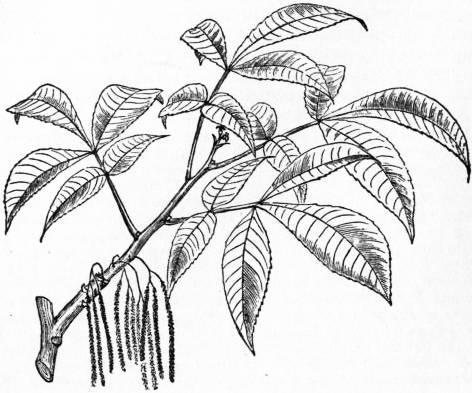
Fig. 1.—Shell-bark Hickory (Carya alba) in flower.
Most of the hickories form fine-looking noble trees of from 60 to 90 ft. in height, with straight, symmetrical trunks, well-balanced ample heads, and bold, handsome, pinnated foliage. When confined in the forest they shoot up 50 to 60 ft. without branches, but when standing alone they expand into a fine head, and produce a lofty round-headed pyramid of foliage. They have all the qualities necessary to constitute fine graceful park trees. The most ornamental of the species are C. olivaeformis, C. alba and C. porcina, the last two also producing delicious nuts, and being worthy of cultivation for their fruit alone.
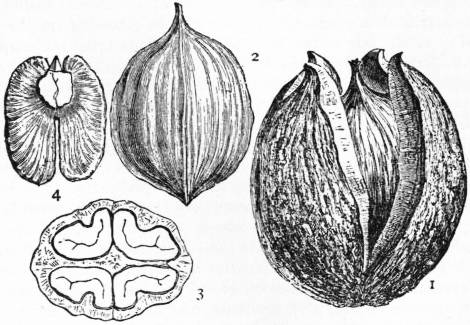
Fig. 2.—1, Fruit of Carya alba; 2, Hickory Nut; 3, Cross Section of Nut; 4, Vertical Section of the Seed.
The husk of the hickory nut, as already stated, breaks up into four equal valves or separates into four equal portions in the upper part, while the nut itself is tolerably even on the surface, but has four or more blunt angles in its transverse outline. The hickory nuts of the American markets are the produce of C. alba, called the shell-bark hickory because of the roughness of its bark, which becomes loosened from the trunk in long scales bending outwards at the extremities and adhering only by the middle. The nuts are much esteemed in all parts of the States, and are exported in considerable quantities to Europe. The pecan-nuts, which come from the Western States, are from 1 in. to 1½ in. long, smooth, cylindrical, pointed at the ends and thin-shelled, with the kernels full, not like those of most of the hickories divided by partitions, and of delicate and agreeable flavour. The thick-shelled fruits of the pig-nut are generally left on the ground for swine, squirrels, &c., to devour. In C. amara the kernel is so bitter that even squirrels refuse to eat it.
HICKS, ELIAS (1748-1830), American Quaker, was born in Hempstead township, Long Island, on the 19th of March 1748. His parents were Friends, but he took little interest in religion until he was about twenty; soon after that time he gave up the carpenter’s trade, to which he had been apprenticed when seventeen, and became a farmer. By 1775 he had “openings leading to the ministry” and was “deeply engaged for the right administration of discipline and order in the church,” and in 1779 he first set out on his itinerant preaching tours between Vermont and Maryland. He attacked slavery, even when preaching in Maryland; wrote Observations on the Slavery of the Africans and their Descendants (1811); and was influential in procuring the passage (in 1817) of the act declaring free after 1827 all negroes born in New York and not freed by the Act of 1799. He died at Jericho, Long Island, on the 27th of February 1830. His preaching was practical rather than doctrinal and he was heartily opposed to any set creed; hence his successful opposition at the Baltimore yearly meeting of 1817 to the proposed creed which would make the Society in America approach the position of the English Friends by definite doctrinal statements. His Doctrinal Epistle (1824) stated his position, and a break ensued in 1827-1828, Hicks’s followers, who call themselves the “Liberal Branch,” being called “Hicksites” by the “Orthodox” party, which they for a time outnumbered. The village of Hicksville, in Nassau County, New York, 15 m. E. of Jamaica, lies in the centre of the Quaker district of Long Island and was named in honour of Elias Hicks.
See A Series of Extemporaneous Discourses ... by Elias Hicks (Philadelphia, 1825); The Journal of the Life and Labors of Elias Hicks (Philadelphia, 1828), and his Letters (Philadelphia, 1834).
HICKS, HENRY (1837-1899), British physician and geologist, was born on the 26th of May 1837 at St David’s, in Pembrokeshire, where his father, Thomas Hicks, was a surgeon. He studied medicine at Guy’s Hospital, London, qualifying as M.R.C.S. in 1862. Returning to his native place he commenced a practice which he continued until 1871, when he removed to Hendon. He then devoted special attention to mental diseases, took the degree of M.D. at St Andrews in 1878, and continued his medical work until the close of his life. In Wales he had been attracted to geology by J. W. Salter (then palaeontologist to the Geological Survey), and his leisure time was given to the study of the older rocks and fossils of South Wales. In conjunction with Salter, he established in 1865 the Menevian group (Middle Cambrian) characterized by the trilobite Paradoxides. Subsequently Hicks contributed a series of important papers on the Cambrian and Lower Silurian rocks, and figured and described many new species of fossils. Later he worked at the Pre-Cambrian rocks of St David’s, describing the Dimetian (granitoid rock) and the Pebidian (volcanic series), and his views, though contested, have been generally accepted. At Hendon Dr Hicks gave much attention to the local geology and also to the Pleistocene deposits of the Denbighshire caves. For a few years before his death he had laboured at the Devonian rocks. With his keen eye for fossils he detected organic remains in the Morte slates, previously regarded as unfossiliferous, and these he regarded as including representatives of Lower Devonian and Silurian. His papers were mostly published in the Geol. Mag. and Quart. Journ. Geol. Soc. He was elected F.R.S. in 1885, and president of the Geological Society of London 1896-1898. He died at Hendon on the 18th of November 1899.
HICKS, WILLIAM (1830-1883), British soldier, entered the Bombay army in 1849, and served through the Indian mutiny, being mentioned in despatches for good conduct at the action of Sitka Ghaut in 1859. In 1861 he became captain, and in the Abyssinian expedition of 1867-68 was a brigade major, being again mentioned in despatches and given a brevet majority. He retired with the honorary rank of colonel in 1880. After the close of the Egyptian war of 1882, he entered the khedive’s service and was made a pasha. Early in 1883 he went to Khartum as chief of the staff of the army there, then commanded by Suliman Niazi Pasha. Camp was formed at Omdurman and a new force of some 8000 fighting men collected—mostly recruited from the fellahin of Arabi’s disbanded troops, sent in chains from Egypt. After a month’s vigorous drilling Hicks led 5000 of his men against an equal force of dervishes in Sennar, whom he defeated, and cleared the country between the towns of Sennar and Khartum of rebels. Relieved of the fear of an immediate attack by the mahdists the Egyptian officials at Khartum intrigued against Hicks, who in July tendered his resignation. This resulted in the dismissal of Suliman Niazi and the appointment of Hicks as commander-in-chief of an expeditionary force to Kordofan with orders to crush the mahdi, who in January 1883 had captured El Obeid, the capital of that province. Hicks, aware of the worthlessness of his force for the purpose contemplated, stated his opinion that it would be best to “wait for Kordofan to settle itself” (telegram of the 5th of August). The Egyptian ministry, however, did not then believe in the power of the mahdi, and the expedition started from Khartum on the 9th of September. It was made up of 7000 infantry, 1000 cavalry and 2000 camp followers and included thirteen Europeans. On the 20th the force left the Nile at Duem and struck inland across the almost waterless wastes of Kordofan for Obeid. On the 5th of November the army, misled by treacherous guides and thirst-stricken, was ambuscaded in dense forest at Kashgil, 30 m. south of Obeid. With the exception of some 300 men the whole force was killed. According to the story of Hicks’s cook, one of the survivors, the general was the last officer to fall, pierced by the spear of the khalifa Mahommed Sherif. After emptying his revolver, the pasha kept his assailants at bay for some time with his sword, a body of Baggara who fled before him being known afterwards as “Baggar Hicks” (the cows driven by Hicks), a play on the words baggara and baggar, the former being the herdsmen and the latter the cows. Hicks’s head was cut off and taken to the mahdi.
See Mahdiism and the Egyptian Sudan, book iv., by Sir F. R. Wingate (London, 1891), and With Hicks Pasha in the Soudan, by J. Colborne (London, 1884), Also Egypt: Military Operations.
HIDALGO, an inland state of Mexico, bounded N. by San Luis Potosi and Vera Cruz, E. by Vera Cruz and Puebla, S. by Tlaxcala and Mexico (state), and W. by Querétaro. Pop. (1895) 551,817, (1900) 605,051. Area, 8917 sq. m. The northern and eastern parts are elevated and mountainous, culminating in the Cerro de Navajas (10,528 ft.). A considerable area of this region on the eastern side of the state is arid and semi-barren, being part of the elevated tableland of Apam where the maguey (American aloe) has been grown for centuries. The southern and western parts of the state consist of rolling plains, in the midst of which is the large lake of Metztitlan. Hidalgo produces cereals in the more elevated districts, sugar, maguey, coffee, beans, cotton and tobacco. Maguey is cultivated for the production of pulque, the national drink. The chief industry, however, is mining, the mineral districts of Pachuca, El Chico, Real del Monte, San José del Oro, and Zimapán being among the richest in Mexico. The mineral products include silver, gold, mercury, copper, iron, lead, zinc, antimony, manganese and plumbago. Coal, marble and opals are also found. Railway facilities are afforded by a branch of the Vera Cruz and Mexico line, which runs from Ometusco to Pachuca, the capital of the state, and by the Mexican Central. Among the principal towns are Tulancingo (pop. 9037), a rich mining centre 24 m. E. of Pachuca, Ixmiquilpán (about 9000) with silver mines 80 m. N. by W. of the Federal Capital, and Actópan (2666), the chief town of the district N.N.W. of Pachuca, inhabited principally by Indians of the Othomies nation.
HIDALGO (a Spanish word, contracted from hijo d’algo or hijo de algo, son of something, or somewhat), originally a Spanish title of the lower nobility; the hidalgo being the lowest grade of nobility which was entitled to use the prefix “don.” The term is now used generally to denote one of gentle birth. The Portuguese fidalgo has a similar history and meaning.
HIDALGO Y COSTILLA, MIGUEL (1753-1811), Mexican patriot, was born on the 8th of May 1753, on a farm at Corralejos, near Guanajuato. His mother’s maiden name was Gallaga, but contrary to the usual custom of the Spaniards he used only the surname of his father, Cristobal Hidalgo y Costilla. He was educated at Valladolid in Mexico, and was ordained priest in 1779. Until 1809 he was known only as a man of pious life who exerted himself to introduce various forms of industry, including the cultivation of silk, among his parishioners at Dolores. But Napoleon’s invasion of Spain in 1808 caused a widespread commotion. The colonists were indisposed to accept a French ruler and showed great zeal in proclaiming Ferdinand VII. as king. The societies they formed for their professedly loyal purpose were regarded, however, by the Spanish authorities with suspicion as being designed to prepare the independence of Mexico. Hidalgo and several of his friends, among whom was Miguel Dominguez, mayor of Querétaro, engaged in consultation and preparations which the authorities considered treasonable. Dominguez was arrested, but Hidalgo was warned in time. He collected some hundred of his parishioners, and on the 16th of September 1810 they seized the prison at Dolores. This action began what was in fact a revolt against the Spanish and Creole elements of the population. With what is known as the “grito” or cry of Dolores as their rallying shout, a multitude gathered round Hidalgo, who took for his banner a wonder-working picture of the Virgin belonging to a popular shrine. At first he met with some success. A regiment of dragoons of the militia joined him, and some small posts were stormed. The whole tumultuous host moved on the city of Mexico. But here the Spaniards and Creoles were concentrated. Hidalgo lost heart and retreated. Many of his followers deserted, and on the march to Querétaro he was attacked at Aculco by General Felix Calleja on the 7th of November 1810, and routed. He endeavoured to continue the struggle, and did succeed in collecting a mob estimated at 100,000 about Guadalajara. With this ill-armed and undisciplined crowd he took up a position on the bridge of Calderon on the river Santiago. On the 17th of January 1811 he was completely beaten by Calleja and a small force of soldiers. Hidalgo was deposed by the other leaders, and soon afterwards all of them were betrayed to the Spaniards. They were tried at Chihuahua, and condemned. Hidalgo was first degraded from the priesthood and then shot as a rebel, on the 31st of July or the 1st of August 1811.
See H. H. Bancroft, The Pacific States, vol. vii., which contains a copious bibliography.
HIDDENITE, a green transparent variety of spodumene, (q.v.) used as a gem-stone. It was discovered by William E. Hidden (b. 1853) about 1879 at Stonypoint, Alexander county, North Carolina, and was at first taken for diopside. In 1881 J. Lawrence Smith proved it to be spodumene, and named it. Hiddenite occurs in small slender monoclinic crystals of prismatic habit, often pitted on the surface. A well-marked prismatic cleavage renders the mineral rather difficult to cut. Its colour passes from an emerald green to a greenish-yellow, and is often unevenly distributed through the stone. The mineral is dichroic in a marked degree, and shows much “fire” when properly cut. The composition of the mineral is represented by the formula LiAl(SiO3)2, the green colour being probably due to the presence of a small proportion of chromium. The presence of lithia in this green mineral suggested the inappropriate name of lithia emerald, by which it is sometimes known. Hiddenite was originally found as loose crystals in the soil, but was afterwards worked in a veinstone, where it occurred in association with beryl, quartz, garnet, mica, rutile, &c.
HIDE1 (Lat. hida, A.-S. higíd, híd or hiwisc, members of a household), a measure of land. The word was in general use in England in Anglo-Saxon and early English times, although its meaning seems to have varied somewhat from time to time. Among its Latin equivalents are terra unius familiae, terra unius cassati and mansio; the first of these forms is used by Bede, who, like all early writers, gives to it no definite area. In its earliest form the hide was the typical holding of the typical family. Gradually, this typical holding came to be regarded as containing 120 “acres” (not 120 acres of 4840 sq. yds. each, but 120 times the amount of land which a ploughteam of eight oxen could plough in a single day). This definition appears to have been very general in England before the Norman Conquest, and in Domesday Book 30, 40, 50 and 80 acres are repeatedly mentioned as fractions of a hide. Some historians, however, have thought that the hide only contained 30 acres or thereabouts.
“The question about the hide,” says Professor Maitland in Domesday Book and Beyond, “is ‘pre-judicial’ to all the great questions of early English history.” The main argument employed by J. M. Kemble (The Saxons in England) in favour of the “small” hide is that the number of hides stated to have existed in the various parts of England gives an acreage far in excess of the total acreage of these parts, making due allowance for pasture and for woodland, an allowance necessary because the hide was only that part of the land which came under the plough, and each hide must have carried with it a certain amount of pasture. Two illustrations in support of Kemble’s theory must suffice. Bede says the Isle of Wight contained 1200 hides. Now 1200 hides of 120 acres each gives a total acreage of 144,000 acres, while the total acreage of the island to-day is only 93,000 acres. Again a document called The Tribal Hidage puts the number of hides in the whole of England at nearly a quarter of a million. This gives in acres a figure about equal to the total acreage of England at the present time, but it leaves no room for pasture and for the great proportion of land which was still woodland. On these grounds Kemble regarded the hide as containing 30 or 33, certainly not more than 40 acres, and thought that each acre contained about 4000 sq. yds., i.e. that it was roughly equal to the modern acre. Another argument brought forward is that 30 or 40 acres was enough land for the support of the average family, in other words that it was the terra unius familiae of Bede. Another Domesday student, R. W. Eyton, puts down the hide at 48 acres.
But formidable arguments have been advanced against the “small” hide. There is no doubt that at the time of Domesday the hide was equated with 120 and not with 30 acres. Then, taking the word familia in its proper sense, a household with many dependent members, and making an allowance for primitive methods of agriculture, it is questionable whether 30 or 40 acres were sufficient for its support; and again if the equation 1 hide = 120 acres is rejected there is no serious evidence in favour of any other. A possible explanation is that, although in early Anglo-Saxon times the hide consisted of 30 acres or thereabouts, it had come before the time of Domesday to contain 120 acres. But no trace of such change can be found; there is no break in the continuity of the land-charters which refer to hides and manses. Reviewing the whole question Professor Maitland accepts the view that the hide contained 120 acres. The difficulties are serious but they are not insuperable. Bede, writing in a primitive age and speaking for the most part of lands far away from Northumbria, uses figures in a vague and general fashion; then the hide of 120 acres does not mean 120 times 4840 yds., it means much less; and lastly at the time of Domesday the hide was not a unit of measurement, it was a unit for purposes of taxation. On the other hand, Mr. H. M. Chadwick (Studies on Anglo-Saxon Institutions) says there is no evidence that the hide contained 120 acres before the 10th century. He suggests that possibly the size of the hide in Mercia may have been fixed at 40 acres, while in Wessex it was regarded as containing 120 acres. Dr Stubbs (Const. Hist. i.) suggests that the confusion may have arisen because the word was used “to express the whole share of one man in all the fields of the village.” Thus it might refer to 30 acres, his share in one field, or to 120 acres, his share in the four fields. He adds, however, that this explanation is not adequate for all cases. But these differences about the size of the hide are not peculiar to modern times. Henry of Huntingdon says, Hida Anglice vocatur terra unius aratri culturae sufficiens per annum, while the Dialogus de scaccario puts its size at 100 acres, though this may be the long hundred, or 120. Perhaps, therefore, Selden is wisest when he says, “hides were of an incertain quantity.” Certainly he gives a very good description of the early hide when he says (Titles of Honour): “Now a hide of land regularly is and was (as I think) as much land as might be well manured with one plough, together with pasture, meadow and wood competent for the maintenance of that plough, and the servants of the family.” The view that the size of the hide varied from district to district is borne out by Professor Vinogradoff’s more recent researches. In his English Society in the Eleventh Century he mentions that there was a hide of 48 acres in Wiltshire and one of 40 acres in Dorset. In addition some authorities distinguish between English hides and Welsh hides, and in Sussex the hide often contained 8 virgates. Sometimes again in the 11th century hides were not merely fiscal units; they were shares in the land itself.
The fact that the hide was a unit of assessment, has been established by Mr J. H. Round in his Feudal England, and is regarded as throwing a most valuable light upon the many problems which present themselves to the student of Domesday. The process which converted the hide from a unit of measurement to a unit for assessment purposes is probably as follows. Being in general use to denote a large piece of land, and such pieces of land being roughly equal all over England, the hide was a useful unit on which to levy taxation, a use which dates doubtless from the time of the Danegeld. For some time the two meanings were used side by side, but before the Norman Conquest the hide, a unit for taxation, had quite supplanted the hide, a measure of land, and this was the state of affairs when in 1086 William I. ordered his great inquest to be made. The formula used in Domesday varies from county to county, but a single illustration may be given. Huntedun Burg defendebat se ad geldum regis pro quarta parte de Hyrstingestan hundred pro L. hidis. This does not mean that the town of Huntingdon contained a certain fixed number of square yards multiplied by 50, but that for purposes of taxation Huntingdon was regarded as worth 50 times a certain fiscal unit.
This view of the nature of the hide was hinted at by R. W. Eyton in A Key to Domesday and was accepted by Maitland. Its proof rests primarily upon the prevalence of the five-hide unit. By collating various documents which formed part of the Domesday inquest Mr Round has brought together for certain parts of England, especially for Cambridgeshire and Bedfordshire, the holdings of the various lords in the different vills, and vill after vill shows a total of 5 hides or 10 hides or only a slight discrepancy therefrom. A similar result is shown for the hundreds where multiples of 5 are almost universal, and the total hidage for the county of Worcester is very near the round figure of 1200. This arrangement is obviously artificial; it must have been imposed upon the counties or the hundreds by the central authority and then divided among the vills. Another proof is found in what is called “beneficial hidation.” It is shown that in certain cases the number of hides in a hundred has been reduced since the time of Edward the Confessor, and that this reduction had been transferred pro rata to the vills in the hundred. Thus Mr Round concludes that the hide was fixed “independently of area or value.” Some slight criticism has been directed against the idea of “artificial hidation,” but the most that can be said against it is that its proof rests upon isolated cases, a reproach which further research will doubtless remove. However, Professor Vinogradoff accepts the hide primarily as a fiscal unit “which corresponds only in a very rough way to the agrarian reality,” and Maitland says the fiscal hide is “at its best a lame compromise between a unit of area and a unit of value.”
What is the origin of the five-hide unit? Various conjectures have been hazarded, and the unit is undoubtedly older than the Danegeld. Rejecting the idea that it is of Roman or of British origin, and pointing to the serious difference in the rates at which the various counties were assessed, Mr Round thinks that it dates from the time when the various Anglo-Saxon kingdoms were independent. Possibly it was the unit of assessment for military service, possibly it was the recognized endowment of a Saxon thegn. In Anglo-Saxon times a man’s standing in society was dependent to a great extent upon the number of hides which he possessed; this statement is fully proved from the laws. Moreover, in the laws of the Wessex king, Ine, the value of a man’s oath is expressed in hides, the oath for a king’s thegn being probably worth 60 hides and that of a ceorl 5 hides.
The usual division of the hide was into virgates, a virgate being, after the Conquest at least, the normal holding of the villein with two oxen. Mr Round holds that in Domesday at all events the hide always consisted of four virgates; Mr F. Seebohm in The English Village Community, although thinking that the normal hide “consisted as a rule of four virgates of 30 acres each,” says that the Hundred Rolls for Huntingdonshire show that “the hide did not always contain the same number of virgates.” The virgate, it may be noted, consisted of a strip of land in each acre of the hide, and there is undoubtedly a strong case in favour of the equation 1 hide = 4 virgates.
Mr Seebohm, propounding his theory that English institutions are rooted in those of Rome, argues for some resemblance between the methods of taxation of land in Rome and in England; he sees some connexion between the Roman centuria and the hide, and between the Roman system of taxation called jugatio and the English hidage. Professor Vinogradoff (Villainage in England) summarizes the views of those who hold a contrary opinion thus: “The curious fact that the normal holding, the hide, was equal all over England can be explained only by its origin; it came full-formed from Germany and remained unchanged in spite of all diversities of geographical and economical conditions.”
In the Danish parts of England, or rather in the district of the “Five Boroughs,” the carucate takes the place of the hide as the unit of value, and six supplants five, six carucates being the unit of assessment. In Leicestershire and in part of Lancashire the hide is quite different from what it is elsewhere in England. According to Mr Round the Leicestershire hide consisted of 18 carucates; Mr W. H. Stevenson (English Historical Review, vol. v.) argues that it contained only 12 and that it was a hundred and not a hide. Mr Seebohm thinks there was a solanda or double hide of 240 acres in Essex and other southern counties, but Mr Round does not think that this word refers to a measure or unit of assessment at all. For Kent, however, the word sullung or solin, is used in Domesday Book and in the charters instead of hide and carucate as elsewhere, and Vinogradoff thinks that this contained from 180 to 200 acres.
Under the Norman and early Plantagenet kings a levy of two or more shillings on each hide of land was a usual and recognized method of raising money, royal and some other estates, however, as is seen from Domesday, not being hidated and not paying the tax. This geld, or tax, received several names, one of the most general being hidage (Lat. hidagium). “Hidage,” says Vinogradoff, “is historically connected with the old English Danegeld system,” and as Danegeld and then hidage it was levied long after its original purpose was forgotten, and was during the 11th century “the most sweeping and the heaviest of all the taxes.” Henry of Huntingdon says its usual rate was 2s. on each hide of land, and this was evidently the rate at the time of the famous dispute between Henry II. and Becket at Woodstock in 1163, but it was not always kept at this figure, as in 1084 William I. had levied a tax of 6s. on each hide, an unusual extortion. The feudal aids were levied on the hide. Thus in 1109 Henry I. raised one at the rate of 3s. per hide for the marriage of his daughter Matilda with the emperor Henry V., and in 1194, when money was collected for the ransom of Richard I., some of the taxation for this purpose seems to have been assessed according to the hidage given in Domesday Book.
By this time the word hidage as the designation of the tax was disappearing, its place being taken by the word carucage. The carucate (Lat. caruca, a plough) was a measure of land which prevailed in the north of England, the district inhabited by people of Danish descent. Some authorities regard it as equivalent to the hide, others deny this identity. In 1198, however, when Richard I. imposed a tax of 5s. on each carucata terrae sive hyda, the two words were obviously interchangeable, and about the same time the size of the carucate was fixed at 100 acres. The word carucage remained in use for some time longer, and then other names were given to the various taxes on land.
One or two other questions with regard to the hide still remain unsolved. What is the connexion, if any, between the hundred and a hundred hides? Again, was the size of the hide fixed at 120 acres to make the work of reckoning the amount of Danegeld, or hidage, a simple process? 120 acres to the hide, 240 pence to the pound, makes calculations easy. Lastly, is the English hide derived from the German hufe or huba?
(A. W. H.*)
1 The homonym “hide,” meaning to conceal, is in O. Eng. hýdan; the word appears in various forms in Old Teutonic languages. The root is probably seen in Gr. κεύθειν to hide, or may be the same as in “hide,” skin, O. Eng. hýd, which is also seen in Ger. Haut, Dutch huid; the root appears in Lat. cutis, Gr. κύτος. The Indo-European root ku-, weakened form of sku-, seen in “sky,” and meaning “to cover,” may be the ultimate source of both words. The slang use of “to hide,” to flog or whip, means “to take the skin off, to flay.”
HIEL, EMMANUEL (1834-1899), Belgian-Dutch poet and prose writer, was born at Dendermonde, in Flanders, in May 1834. He acted in various functions, from teacher and government official to journalist and bookseller, busily writing all the time both for the theatre and the magazines of North and South Netherlands. His last posts were those of librarian at the Industrial Museum and professor of declamation at the Conservatoire in Brussels. Among his better-known poetic works may be cited Looverkens (“Leaflets,” 1857); Nieuwe Liedekens (“New Poesies,” 1861); Gedichten (“Poems,” 1863); Psalmen, Zangen, en Oratorios (“Psalms, Songs, and Oratorios,” 1869); De Wind (1869), an inspiriting cantata, which had a large measure of success and was crowned; De Liefde in ’t Leven (“Love in Life,” 1870); Elle and Isa (two musical dramas, 1874); Liederen voor Groote en Kleine Kinderen (“Songs for Big and Small Folk,” 1879); Jakoba van Beieren (“Jacqueline of Bavaria,” a poetic drama, 1880); Mathilda van Denemarken (a lyrical drama, 1890). His collected poetical works were published in three volumes at Rousselaere in 1885. Hiel took an active and prominent part in the so-called “Flemish movement” in Belgium, and his name is constantly associated with those of Jan van Beers, the Willems and Peter Benoit. The last wrote some of his compositions to Hiel’s verses, notably to his oratorios Lucifer (performed in London at the Royal Albert Hall and elsewhere) and De Schelde (“The Scheldt”); whilst the Dutch composer, Richard Hol (of Utrecht), composed the music to Hiel’s “Ode to Liberty,” and van Gheluwe to the poet’s “Songs for Big and Small Folk” (second edition, much enlarged, 1879), which has greatly contributed to their popularity in schools and among Belgian choral societies. Hiel also translated several foreign lyrics. His rendering of Tennyson’s Dora appeared at Antwerp in 1871. For the national festival of 1880 at Brussels, to commemorate the fiftieth anniversary of Belgian independence, Hiel composed two cantatas, Belgenland (“The Land of the Belgians”) and Eer Belgenland (“Honour to Belgium”), which, set to music, were much appreciated. He died at Schaerbeek, near Brussels, on the 27th of August 1899. Hiel’s efforts to counteract Walloon influences and bring about a rapprochement between the Netherlanders in the north and the Teutonic racial sympathizers across the Rhine made him very popular with both, and a volume of his best poems was in 1874 the first in a collection of Dutch authors published at Leipzig.
HIEMPSAL, the name of the two kings of Numidia. For Hiempsal I. see under Jugurtha. Hiempsal II. was the son of Gauda, the half-brother of Jugurtha. In 88 B.C., after the triumph of Sulla, when the younger Marius fled from Rome to Africa, Hiempsal received him with apparent friendliness, his real intention being to detain him as a prisoner. Marius discovered this intention in time and made good his escape with the assistance of the king’s daughter. In 81 Hiempsal was driven from his throne by the Numidians themselves, or by Hiarbas, ruler of part of the kingdom, supported by Cn. Domitius Ahenobarbus, the leader of the Marian party in Africa. Soon afterwards Pompey was sent to Africa by Sulla to reinstate Hiempsal, whose territory was subsequently increased by the addition of some land on the coast in accordance with a treaty concluded with L. Aurelius Cotta. When the tribune P. Servilius Rullus introduced his agrarian law (63), these lands, which had been originally assigned to the Roman people by Scipio Africanus, were expressly exempted from sale, which roused the indignation of Cicero (De lege agraria, i. 4, ii. 22). From Suetonius (Caesar, 71) it is evident that Hiempsal was alive in 62. According to Sallust (Jugurtha, 17), he was the author of an historical work in the Punic language.
Plutarch, Marius, 40, Pompey, 12; Appian, Bell. civ., i. 62. 80; Dio Cassius xli. 41.
HIERAPOLIS. 1. (Arabic Manbij or Mumbij) an ancient Syrian town occupying one of the finest sites in Northern Syria, in a fertile district about 16 m. S.W. of the confluence of the Sajur and Euphrates. There is abundant water supply from large springs. In 1879, after the Russo-Turkish war, a colony of Circassians from Vidin (Widdin) was planted in the ruins, and the result has been the constant discovery of antiquities, which find their way into the bazaars of Aleppo and Aintab. The place first appears in Greek as Bambyce, but Pliny (v. 23) tells us its Syrian name was Mabog. It was doubtless an ancient Commagenian sanctuary; but history knows it first under the Seleucids, who made it the chief station on their main road between Antioch and Seleucia-on-Tigris; and as a centre of the worship of the Syrian Nature Goddess, Atargatis (q.v.), it became known to the Greeks as the city of the sanctuary Ἱερόπολις, and finally as the Holy City Ἱεράπολις. Lucian, a native of Commagene (or some anonymous writer) has immortalized this worship in the tract De Dea Syria, wherein are described the orgiastic luxury of the shrine and the tank of sacred fish, of which Aelian also relates marvels. According to the De Dea Syria, the worship was of a phallic character, votaries offering little male figures of wood and bronze. There were also huge phalli set up like obelisks before the temple, which were climbed once a year with certain ceremonies, and decorated. For the rest the temple was of Ionic character with golden plated doors and roof and much gilt decoration. Inside was a holy chamber into which priests only were allowed to enter. Here were statues of a goddess and a god in gold, but the first seems to have been the more richly decorated with gems and other ornaments. Between them stood a gilt xoanon, which seems to have been carried outside in sacred processions. Other rich furniture is described, and a mode of divination by movements of a xoanon of Apollo. A great bronze altar stood in front, set about with statues, and in the forecourt lived numerous sacred animals and birds (but not swine) used for sacrifice. Some three hundred priests served the shrine and there were numerous minor ministrants. The lake was the centre of sacred festivities and it was customary for votaries to swim out and decorate an altar standing in the middle of the water. Self-mutilation and other orgies went on in the temple precinct, and there was an elaborate ritual on entering the city and first visiting the shrine under the conduct of local guides, which reminds one of the Meccan Pilgrimage.
The temple was sacked by Crassus on his way to meet the Parthians (53 B.C.); but in the 3rd century of the empire the city was the capital of the Euphratensian province and one of the great cities of Syria. Procopius called it the greatest in that part of the world. It was, however, ruinous when Julian collected his troops there ere marching to his defeat and death in Mesopotamia, and Chosroes I. held it to ransom after Justinian had failed to put it in a state of defence. Harun restored it at the end of the 8th century and it became a bone of contention between Byzantines, Arabs and Turks. The crusaders captured it from the Seljuks in the 12th century, but Saladin retook it (1175), and later it became the headquarters of Hulagu and his Mongols, who completed its ruin. The remains are extensive, but almost wholly of late date, as is to be expected in the case of a city which survived into Moslem times. The walls are Arab, and no ruins of the great temple survive. The most noteworthy relic of antiquity is the sacred lake, on two sides of which can still be seen stepped quays and water-stairs. The first modern account of the site is in a short narrative appended by H. Maundrell to his Journey from Aleppo to Jerusalem. He was at Mumbij in 1699.
The coinage of the city begins in the 4th century B.C. with an Aramaic series, showing the goddess, either as a bust with mural crown or as riding on a lion. She continues to supply the chief type even during imperial times, being generally shown seated with the tympanum in her hand. Other coins substitute the legend Θεᾶς Συρίας Ἱεροπολιτῶν, within a wreath. It is interesting to note that from Bambyce (near which much silk was produced) were derived the bombycina vestis of the Romans and, through the crusaders, the bombazine of modern commerce.
See F. R. Chesney, Euphrates Expedition (1850); W. F. Ainsworth, Personal Narrative of the Euphrates Expedition (1888); E. Sachau, Reise in Syrien, &c. (1883); D. G. Hogarth in Journal of Hellenic Studies (1909).
2. A Phrygian city, altitude 1200 ft. on the right bank of the Churuk Su (Lycus), about 8 m. above its junction with the Menderes (Maeander), situated on a broad terrace, 200 ft. above the valley and 6 m. N. of Laodicea. On the terrace rise calcareous springs, that have deposited vast incrustations of snowy whiteness. To these springs, which are warm and slightly sulphureous, and to the “Plutonium”—a hole reaching deep into the earth, from which issued a mephitic vapour—the place owed its celebrity and sanctity. Here, at an early date, a religious establishment (hieron) existed in connexion with the old Phrygian Kydrara, a settlement of the tribe Hydrelitae; and the town which grew round it became one of the greatest centres of Phrygian native life but of non-political importance. The chief religious festival was the Letoia, named after the goddess Leto, a local variety of the Mother Goddess (Cybele), who was honoured with orgiastic rites in which elements of the original Anatolian matriarchate and Nature-cult survived: there was also a worship of Apollo Lairbenos. Hierapolis was the seat of an early church (Col. iv. 13), with which tradition closely connects the apostle Philip. Epictetus, the philosopher, and Papias, a disciple of St John and author of a lost work on the Sayings of Jesus, were born there. Hierapolis is now easily reached from Gonjeli, a station on the Dineir railway about 7 m. distant. A village of Yuruks has gradually grown below the site. The native name for the place is apparently Pambuk Kale (though doubt has been thrown on the statement), and this has always been explained by the cotton-like appearance of the white incrustations. It should be noted, however, that this name, if genuine, is curiously like that given by the Syrians to the Commagenian Hierapolis (above), Bambyce, the origin of which it has been suggested was a native name of the goddess Pambē or Mambē (whence Mabog). Considering that cotton is a comparatively modern phenomenon in Anatolia, it is worth suggesting that Pambuk in this case may be a survival of a primitive name, derived from the same goddess, Pambē. The goddesses of the two Hierapoleis were in any case closely akin. If an old native name has reappeared here after the decline of Greek influence, and been given a meaning in modern Turkish, it affords another instance of a very common feature of west Asian nomenclature. Combined with the petrified terraces, the ruins of Hierapolis present the most attractive of the easily accessible spectacles in Asia Minor. They are remarkable for the long avenue of tombs, mostly inscribed sarcophagi on plinths, by which the city is approached from the W., and for a very perfect theatre partly excavated in the hill at the N. side of the site. Stage buildings as well as auditorium are well preserved. On the S., just above the white terraces and largely blocked with petrified deposit, stand large baths, into which the natural warm spring was once conducted. Behind these is a fine triumphal arch, whence runs a colonnade. Ruins of several churches survive, and also of a large basilica. There is a sulphureous pool which may represent the “Plutonium,” but it has no such deadly power as was ascribed to that pond. Ramsay thinks that the “Plutonium” was obliterated by Christians in the 4th century. Over 300 inscriptions have been collected, mostly sepulchral, whence Ramsay has deduced interesting facts about the very early Christian community which existed here. The site has been often visited and described, and was systematically examined in 1887 by parties under W. M. Ramsay and K. Humann respectively.
See K. Humann, Altertümer v. Hierapolis (1888); Sir W. M. Ramsay, Cities and Bishoprics of Phrygia, vol. i. (1895).
(C. W. W.; D. G. H.)
HIERARCHY (Gr. ἱερός, holy, and ἄρχειν, to rule), the office of a steward or guardian of holy things, not a “ruler of priests” or “priestly ruler” (see Boeckh, Corp. inscr. Gr. No. 1570), a term commonly used in ecclesiastical language to denote the aggregate of those persons who exercise authority within the Christian Church, the patriarchate, episcopate or entire three-fold order of the clergy. The word ἱεραρχία, which does not occur in any classical Greek writer, owes its present extensive currency to the celebrated writings of Dionysius Areopagiticus. Of these the most important are the two which treat of the celestial and of the ecclesiastical hierarchy respectively. Defining hierarchy as the “function which comprises all sacred things,” or, more fully, as “a sacred order and science and activity, assimilated as far as possible to the godlike, and elevated to the imitation of God proportionately to the Divine illuminations conceded to it,” the author proceeds to enumerate the nine orders of the heavenly host, which are subdivided again into hierarchies or triads, in descending order, thus: Seraphim, Cherubim, Thrones; Dominations, Virtues, Powers; Principalities, Archangels, Angels. These all exist for the common object of raising men through ascending stages of purification and illumination to perfection. The ecclesiastical or earthly hierarchy is the counterpart of the other. In it the first or highest triad is formed by baptism, communion and chrism. The second triad consists of the three orders of the ministry, bishop or hierarch, priest and minister or deacon (ἱεράρχης, ἱερεύς, λειτουργός); this is the earliest known instance in which the title hierarch is applied to a bishop. The third or lowest triad is made up of monks, “initiated” and catechumens. To Dionysius may be traced, through Thomas Aquinas and other Catholic writers of the intervening period, the definition of the term usually given by Roman Catholic writers—“coëtus seu ordo praesidum et sacrorum ministrorum ad regendam ecclesiam gignendamque in hominibus sanctitatem divinitus institutus”1—although it immediately rests upon the authority of the sixth canon of the twenty-third session of the council of Trent, in which anathema is pronounced upon all who deny the existence within the Catholic Church of a hierarchy instituted by divine appointment, and consisting of bishops, priests and ministers.2 (See Order, Holy).
1 Perrone, De locis theologicis, pt. i., sec. i. cap. 2.
2 Si quis dixerit in ecclesia catholica non esse hierarchiam divina ordinatione institutam, quae constat ex episcopis, presbyteris, et ministris: anathema sit.
HIERATIC, priestly or sacred (Gr. ἱερατικὀς, ἱερὀς, sacred), a term particularly applied to a style of ancient Egyptian writing, which is a simplified cursive form of hieroglyphic. The name was first given by Champollion (see Egypt, § Language).
HIERAX, or Hieracas, a learned ascetic who flourished about the end of the 3rd century at Leontopolis in Egypt, where he lived to the age of ninety, supporting himself by calligraphy and devoting his leisure to scientific and literary pursuits, especially to the study of the Bible. He was the author of Biblical commentaries both in Greek and Coptic, and is said to have composed many hymns. He became leader of the so-called sect of the Hieracites, an ascetic society from which married persons were excluded, and of which one of the leading tenets was that only the celibate could enter the kingdom of heaven. He asserted that the suppression of the sexual impulse was emphatically the new revelation brought by the Logos, and appealed to 1 Cor. vii., Heb. xii. 14, and Matt. xix. 12, xxv. 21. Hierax may be called the connecting link between Origen and the Coptic monks. A man of deep learning and prodigious memory, he seems to have developed Origen’s Christology in the direction of Athanasius. He held that the Son was a torch lighted at the torch of the Father, that Father and Son are a bipartite light. He repudiated the ideas of a bodily resurrection and a material paradise, and on the ground of 2 Tim. ii. 5 questioned the salvation of even baptized infants, “for without knowledge no conflict, without conflict no reward.” In his insistence on virginity as the specifically Christian virtue he set up the great theme of the church of the 4th and 5th centuries.
HIERO (strictly Hieron), the name of two rulers of Syracuse.
Hiero I. was the brother of Gelo, and tyrant of Syracuse from 478 to 467/6 B.C. During his reign he greatly increased the power of Syracuse. He removed the inhabitants of Naxos and Catana to Leontini, peopled Catana (which he renamed Aetna) with Dorians, concluded an alliance with Acragas (Agrigentum), and espoused the cause of the Locrians against Anaxilaus, tyrant of Rhegium. His most important achievement was the defeat of the Etruscans at Cumae (474), by which he saved the Greeks of Campania. A bronze helmet (now in the British Museum), with an inscription commemorating the event, was dedicated at Olympia. Though despotic in his rule Hiero was a liberal patron of literature. He died at Catana in 467.
See Diod. Sic. xi. 38-67; Xenophon, Hiero, 6. 2; E. Lübbert, Syrakus zur Zeit des Gelon und Hieron (1875); for his coins see Numismatics (section Sicily).
HIERO II., tyrant of Syracuse from 270 to 216 B.C., was the illegitimate son of a Syracusan noble, Hierocles, who claimed descent from Gelo. On the departure of Pyrrhus from Sicily (275) the Syracusan army and citizens appointed him commander of the troops. He materially strengthened his position by marrying the daughter of Leptines, the leading citizen. In the meantime, the Mamertines, a body of Campanian mercenaries who had been employed by Agathocles, had seized the stronghold of Messana, whence they harassed the Syracusans. They were finally defeated in a pitched battle near Mylae by Hiero, who was only prevented from capturing Messana by Carthaginian interference. His grateful countrymen then chose him king (270). In 264 he again returned to the attack, and the Mamertines called in the aid of Rome. Hiero at once joined the Punic leader Hanno, who had recently landed in Sicily; but being defeated by the consul Appius Claudius, he withdrew to Syracuse. Pressed by the Roman forces, in 263 he was compelled to conclude a treaty with Rome, by which he was to rule over the south-east of Sicily and the eastern coast as far as Tauromenium (Polybius i. 8-16; Zonaras viii. 9). From this time till his death in 216 he remained loyal to the Romans, and frequently assisted them with men and provisions during the Punic wars (Livy xxi. 49-51, xxii. 37, xxiii. 21). He kept up a powerful fleet for defensive purposes, and employed his famous kinsman Archimedes in the construction of those engines that, at a later date, played so important a part during the siege of Syracuse by the Romans.
A picture of the prosperity of Syracuse during his rule is given in the sixteenth idyll of Theocritus, his favourite poet. See Diod. Sic. xxii. 24-xxvi. 24; Polybius i. 8-vii. 7; Justin xxiii. 4.
HIEROCLES, proconsul of Bithynia and Alexandria, lived during the reign of Diocletian (A.D. 284-305). He is said to have been the instigator of the fierce persecution of the Christians under Galerius in 303. He was the author of a work (not extant) entitled λόγοι φιλαλήθεις πρὸς τοὺς Χριστιανούς in two books, in which he endeavoured to persuade the Christians that their sacred books were full of contradictions, and that in moral influence and miraculous power Christ was inferior to Apollonius of Tyana. Our knowledge of this treatise is derived from Lactantius (Instit. div. v. 2) and Eusebius, who wrote a refutation entitled Ἀντιῤῥητικὸς πρὸς τὰ Ἱεροκλέους.
HIEROCLES OF ALEXANDRIA, Neoplatonist writer, flourished c. A.D. 430. He studied under the celebrated Neoplatonist Plutarch at Athens, and taught for some years in his native city. He seems to have been banished from Alexandria and to have taken up his abode in Constantinople, where he gave such offence by his religious opinions that he was thrown into prison and cruelly flogged. The only complete work of his which has been preserved is the commentary on the Carmina Aurea of Pythagoras. It enjoyed a great reputation in middle age and Renaissance times, and there are numerous translations in various European languages. Several other writings, especially one on providence and fate, a consolatory treatise dedicated to his patron Olympiodorus of Thebes, author of ἱστορικοὶ λόγοι, are quoted or referred to by Photius and Stobaeus. The collection of some 260 witticisms (ἀστεῖα) called Φιλόγελως (ed. A. Eberhard, Berlin, 1869), attributed to Hierocles and Philagrius, has no connexion with Hierocles of Alexandria, but is probably a compilation of later date, founded on two older collections. It is now agreed that the fragments of the Elements of Ethics (Ἠθικὴ στοιχείωσις) preserved in Stobaeus are from a work by a Stoic named Hierocles, contemporary of Epictetus, who has been identified with the “Hierocles Stoicus vir sanctus et gravis” in Aulus Gellius (ix. 5. 8). This theory is confirmed by the discovery of a papyrus (ed. H. von Arnim in Berliner Klassikertexte, iv. 1906; see also C. Prächter, Hierokles der Stoiker, 1901).