VOLUME XIII SLICE IV Hero to Hindu Chronology (continued 4)
Reading edition
Authorities.—Article on Hesilrige by C. H. Firth in the Dict. of Nat. Biography, and authorities there quoted; Early History of the Family of Hesilrige, by W. G. D. Fletcher; Cal. of State Papers, Domestic, 1631-1664, where there are a large number of important references, as also in Hist. MSS., Comm. Series, MSS. of Earl Cowper, Duke of Leeds and Duke of Portland; Egerton MSS. 2618, Harleian 7001 f. 198, and in the Sloane, Stowe and Additional collections in the British Museum; also S. R. Gardiner, Hist. of England, Hist. of the Great Civil War and Commonwealth; Clarendon’s History, State Papers and Cal. of State Papers, J. L. Sanford’s Studies of the Great Rebellion. His life is written by Noble in the House of Cromwell, i. 403. For his public letters and speeches in parliament see the catalogue of the British Museum.
HESIOD, the father of Greek didactic poetry, probably flourished during the 8th century B.C. His father had migrated from the Aeolic Cyme in Asia Minor to Boeotia; and Hesiod and his brother Perses were born at Ascra, near mount Helicon (Works and Days, 635). Here, as he fed his father’s flocks, he received his commission from the Muses to be their prophet and poet—a commission which he recognized by dedicating to them a tripod won by him in a contest of song (see below) at some funeral games at Chalcis in Euboea, still in existence at Helicon in the age of Pausanias (Theogony, 20-34, W. and D., 656; Pausanias ix. 38. 3). After the death of his father Hesiod is said to have left his native land in disgust at the result of a law-suit with his brother and to have migrated to Naupactus. There was a tradition that he was murdered by the sons of his host in the sacred enclosure of the Nemean Zeus at Oeneon in Locris (Thucydides iii. 96; Pausanias ix. 31); his remains were removed for burial by command of the Delphic oracle to Orchomenus in Boeotia, where the Ascraeans settled after the destruction of their town by the Thespians, and where, according to Pausanias, his grave was to be seen.
Hesiod’s earliest poem, the famous Works and Days, and according to Boeotian testimony the only genuine one, embodies the experiences of his daily life and work, and, interwoven with episodes of fable, allegory, and personal history, forms a sort of Boeotian shepherd’s calendar. The first portion is an ethical enforcement of honest labour and dissuasive of strife and idleness (1-383); the second consists of hints and rules as to husbandry (384-764); and the third is a religious calendar of the months, with remarks on the days most lucky or the contrary for rural or nautical employments. The connecting link of the whole poem is the author’s advice to his brother, who appears to have bribed the corrupt judges to deprive Hesiod of his already scantier inheritance, and to whom, as he wasted his substance lounging in the agora, the poet more than once returned good for evil, though he tells him there will be a limit to this unmerited kindness. In the Works and Days the episodes which rise above an even didactic level are the “Creation and Equipment of Pandora,” the “Five Ages of the World” and the much-admired “Description of Winter” (by some critics judged post-Hesiodic). The poem also contains the earliest known fable in Greek literature, that of “The Hawk and the Nightingale.” It is in the Works and Days especially that we glean indications of Hesiod’s rank and condition in life, that of a stay-at-home farmer of the lower class, whose sole experience of the sea was a single voyage of 40 yds. across the Euripus, and an old-fashioned bachelor whose misogynic views and prejudice against matrimony have been conjecturally traced to his brother Perses having a wife as extravagant as himself.
The other poem attributed to Hesiod or his school which has come down in great part to modern times is The Theogony, a work of grander scope, inspired alike by older traditions and abundant local associations. It is an attempt to work into system, as none had essayed to do before, the floating legends of the gods and goddesses and their offspring. This task Herodotus (ii. 53) attributes to Hesiod, and he is quoted by Plato in the Symposium (178 B) as the author of the Theogony. The first to question his claim to this distinction was Pausanias, the geographer (A.D. 200). The Alexandrian grammarians had no doubt on the subject; and indications of the hand that wrote the Works and Days may be found in the severe strictures on women, in the high esteem for the wealth-giver Plutus and in coincidences of verbal expression. Although, no doubt, of Hesiodic origin, in its present form it is composed of different recensions and numerous later additions and interpolations. The Theogony consists of three divisions—(1) a cosmogony, or creation; (2) a theogony proper, recounting the history of the dynasties of Zeus and Cronus; and (3) a brief and abruptly terminated heroögony, the starting-point not improbably of the supplementary poem, the κατάλογος, or “Lists of Women” who wedded immortals, of which all but a few fragments are lost.1 The proem (1-116) addressed to the Heliconian and Pierian muses, is considered to have been variously enlarged, altered and arranged by successive rhapsodists. The poet has interwoven several episodes of rare merit, such as the contest of Zeus and the Olympian gods with the Titans, and the description of the prison-house in which the vanquished Titans are confined, with the Giants for keepers and Day and Night for janitors (735 seq.).
The only other poem which has come down to us under Hesiod’s name is the Shield of Heracles, the opening verses of which are attributed by a nameless grammarian to the fourth book of Eoiai. The theme of the piece is the expedition of Heracles and Iolaus against the robber Cycnus; but its main object apparently is to describe the shield of Heracles (141-317). It is clearly an imitation of the Homeric account of the shield of Achilles (Iliad, xviii. 479) and is now generally considered spurious. Titles and fragments of other lost poems of Hesiod have come down to us: didactic, as the Maxims of Cheiron; genealogical, as the Aegimius, describing the contest of that mythical ancestor of the Dorians with the Lapithae; and mythical, as the Marriage of Ceyx and the Descent of Theseus to Hades.
Recent editions of Hesiod include the Ἀγὼν Ὁμήρου καὶ Ἡσιόδου, the contest of song between Homer and Hesiod at the funeral games held in honour of King Amphidamas at Chalcis. This little tract belongs to the time of Hadrian, who is actually mentioned as having been present during its recitation, but is founded on an earlier account by the sophist Alcidamas (q.v.). Quotations (old and new) are made from the works of both poets, and, in spite of the sympathies of the audience, the judge decides in favour of Hesiod. Certain biographical details of Homer and Hesiod are also given.
A strong characteristic of Hesiod’s style is his sententious and proverbial philosophy (as in Works and Days, 24-25, 40, 218, 345, 371). There is naturally less of this in the Theogony, yet there too not a few sentiments take the form of the saw or adage. He has undying fame as the first of didactic poets (see Didactic Poetry), the accredited systematizer of Greek mythology and the rough but not unpoetical sketcher of the lines on which Virgil wrought out his exquisitely finished Georgics.
Bibliography.—Complete works: Editio princeps (Milan, 1493); Göttling-Flach (1878), with full bibliography up to date of publication; C. Sittl (1889), with introduction and critical and explanatory notes in Greek; F. A. Paley (1883); A. Rzach (1902), including the fragments. Separate works: Works and Days: Van Lennep (1847); A. Kirchhoff (1889); A. Steitz, Die Werke und Tage des Hesiodos (1869), dealing chiefly with the composition and arrangement of the poem; G. Wlastoff, Prométhée, Pandore, et la légende des siècles (1883). Theogony: Van Lennep (1843); F. G. Welcker (1865), valuable edition; G. F. Schömann (1868), with text, critical notes and exhaustive commentary; H. Flach, Die Hesiodische Theogonie (1873), with prolegomena dealing chiefly with the digamma in Hesiod, System der Hesiodischen Kosmogonie (1874), and Glossen und Scholien zur Theogonie (1876); Meyer, De compositione Theogoniae (1887). Shield of Heracles: Wolf-Ranke (1840); Van Lennep-Hullemann (1854); F. Stegemann, De scuti Herculis Hesiodei poëta Homeri carminum imitatore (1904); the fragments were published by W. Marckscheffel in 1840; for the Ἀγὼν Ὁμήρου (ed. A. Rzach, 1908) see F. Nietzsche in Rheinisches Museum (new series), xxv. p. 528. For papyrus fragments of the “Catalogue,” some 50 lines on the wooing of Helen, and a shorter fragment in praise of Peleus, see Wilamowitz-Möllendorff in Sitzungsber. der königl. preuss. Akad. der Wissenschaften, for 26th of July 1900; for fragments relating to Meleager and the suitors of Helen, Berliner Klassikertexte, v. (1907); of the Theogony, Oxyrh. Pap. vi. (1908).
On the subject generally, consult G. F. Schömann, Opuscula, ii. (1857); H. Flach, Die Hesiodischen Gedichte (1874); A. Rzach, Der Dialekt des Hesiodos (1876); P. O. Gruppe, Die griechischen Kulte und Mythen, i. (1887); O. Friedel, Die Sage vom Tode Hesiods (1879), from Jahrbücher für classische Philologie (10th suppl. Band, 1879); J. Adam, Religious Teachers of Greece (1908). There is a full bibliography of the publications relating to Hesiod (1884-1898) by A. Rzach in Bursian’s Jahresbericht über die Fortschritte der klassischen Altertumswissenschaft, xxvii. (1900).
There are translations of the Hesiodic poems in English by Cooke (1728), C. A. Elton (1815), J. Banks (1856), and specially by A. W. Mair, with introduction and appendices (Oxford Library of Translations, 1908); in German (metrical version) with valuable introductions and notes by R. Peppmüller (1896) and in other modern languages.
(J. Da.; J. H. F.)
1 Part of the poem was called Eoiai, because the description of each heroine began with ἤ οἴη, "or like as." (See Bibliography.)
HESPERIDES, in Greek mythology, maidens who guarded the golden apples which Earth gave Hera on her marriage to Zeus. According to Hesiod (Theogony, 215) they were the daughters of Erebus and Night; in later accounts, of Atlas and Hesperis, or of Phorcys and Ceto (schol. on Apoll. Rhod. iv. 1399; Diod. Sic. iv. 27). They were usually supposed to be three in number—Aegle, Erytheia, Hesperis (or Hesperethusa); according to some, four, or even seven. They lived far away in the west at the borders of Ocean, where the sun sets. Hence the sun (according to Mimnermus ap. Athenaeum xi. p. 470) sails in the golden bowl made by Hephaestus from the abode of the Hesperides to the land where he rises again. According to other accounts their home was among the Hyperboreans. The golden apples grew on a tree guarded by Ladon, the ever-watchful dragon. The sun is often in German and Lithuanian legends described as the apple that hangs on the tree of the nightly heaven, while the dragon, the envious power, keeps the light back from men till some beneficent power takes it from him. Heracles is the hero who brings back the golden apples to mankind again. Like Perseus, he first applies to the Nymphs, who help him to learn where the garden is. Arrived there he slays the dragon and carries the apples to Argos; and finally, like Perseus, he gives them to Athena. The Hesperides are, like the Sirens, possessed of the gift of delightful song. The apples appear to have been the symbol of love and fruitfulness, and are introduced at the marriages of Cadmus and Harmonia and Peleus and Thetis. The golden apples, the gift of Aphrodite to Hippomenes before his race with Atalanta, were also plucked from the garden of the Hesperides.
HESPERUS (Gr. Ἕσπερος, Lat. Vesper), the evening star, son or brother of Atlas. According to Diodorus Siculus (iii. 60, iv. 27), he ascended Mount Atlas to observe the motions of the stars, and was suddenly swept away by a whirlwind. Ever afterwards he was honoured as a god, and the most brilliant star in the heavens was called by his name. Although as a mythological personality he is regarded as distinct from Phosphoros or Heosphoros (Lat. Lucifer), the morning star or bringer of light, the son of Astraeus (or Cephalus) and Eos, the two stars were early identified by the Greeks.
Diog. Laërt. viii. 1. 14; Cicero, De nat. deorum, ii. 20; Pliny, Nat. Hist. ii. 6 [8].
HESS, the name of a family of German artists.
Heinrich Maria Hess (1798-1863)—von Hess, after he received a patent of personal nobility—was born at Düsseldorf and brought up to the profession of art by his father, the engraver Karl Ernst Christoph Hess (1755-1828). Karl Hess had already acquired a name when in 1806 the elector of Bavaria, having been raised to a kingship by Napoleon, transferred the Düsseldorf academy and gallery to Munich. Karl Hess accompanied the academy to its new home, and there continued the education of his children. In time Heinrich Hess became sufficiently master of his art to attract the attention of King Maximilian. He was sent with a stipend to Rome, where a copy which he made of Raphael’s Parnassus, and the study of great examples of monumental design, probably caused him to become a painter of ecclesiastical subjects on a large scale. In 1828 he was made professor of painting and director of all the art collections at Munich. He decorated the Aukirche, the Glyptothek and the Allerheiligencapelle at Munich with frescoes; and his cartoons were selected for glass windows in the cathedrals of Cologne and Regensburg. Then came the great cycle of frescoes in the basilica of St Boniface at Munich, and the monumental picture of the Virgin and Child enthroned between the four doctors, and receiving the homage of the four patrons of the Munich churches (now in the Pinakothek). His last work, the “Lord’s Supper,” was found unfinished in his atelier after his death in 1863. Before testing his strength as a composer Heinrich Hess tried genre, an example of which is the Pilgrims entering Rome, now in the Munich gallery. He also executed portraits, and twice had sittings from Thorwaldsen (Pinakothek and Schack collections). But his fame rests on the frescoes representing scenes from the Old and New Testaments in the Allerheiligencapelle, and the episodes from the life of St Boniface and other German apostles in the basilica of Munich. Here he holds rank second to none but Overbeck in monumental painting, being always true to nature though mindful of the traditions of Christian art, earnest and simple in feeling, yet lifelike and powerful in expression. Through him and his pupils the sentiment of religious art was preserved and extended in the Munich school.
Peter Hess (1792-1871)—afterwards von Hess—was born at Düsseldorf and accompanied his younger brother Heinrich Maria to Munich in 1806. Being of an age to receive vivid impressions, he felt the stirring impulses of the time and became a painter of skirmishes and battles. In 1813-1815 he was allowed to join the staff of General Wrede, who commanded the Bavarians in the military operations which led to the abdication of Napoleon; and there he gained novel experiences of war and a taste for extensive travel. In the course of years he successively visited Austria, Switzerland and Italy. On Prince Otho’s election to the Greek throne King Louis sent Peter Hess to Athens to gather materials for pictures of the war of liberation. The sketches which he then made were placed, forty in number, in the Pinakothek, after being copied in wax on a large scale (and little to the edification of German feeling) by Nilsen, in the northern arcades of the Hofgarten at Munich. King Otho’s entrance into Nauplia was the subject of a large and crowded canvas now in the Pinakothek, which Hess executed in person. From these, and from battlepieces on a scale of great size in the Royal Palace, as well as from military episodes executed for the czar Nicholas, and the battle of Waterloo now in the Munich Gallery, we gather that Hess was a clever painter of horses. His conception of subject was lifelike, and his drawing invariably correct, but his style is not so congenial to modern taste as that of the painters of touch. He finished almost too carefully with thin medium and pointed tools; and on that account he lacked to a certain extent the boldness of Horace Vernet, to whom he was not unaptly compared. He died suddenly, full of honours, at Munich, in April 1871. Several of his genre pictures, horse hunts, and brigand scenes may be found in the gallery of Munich.
Karl Hess (1801-1874), the third son of Karl Christoph Hess, born at Düsseldorf, was also taught by his father, who hoped that he would obtain distinction as an engraver. Karl, however, after engraving one plate after Adrian Ostade, turned to painting under the guidance of Wagenbauer of Munich, and then studied under his elder brother Peter. But historical composition proved to be as contrary to his taste as engraving, and he gave himself exclusively at last to illustrations of peasant life in the hill country of Bavaria. He became clever alike in representing the people, the animals and the landscape of the Alps, and with constant means of reference to nature in the neighbourhood of Reichenhall, where he at last resided, he never produced anything that was not impressed with the true stamp of a kindly realism. Some of his pictures in the museum of Munich will serve as examples of his manner. He died at Reichenhall on the 16th of November 1874.
HESS, HEINRICH HERMANN JOSEF, Freiherr von (1788-1870), Austrian soldier, entered the army in 1805 and was soon employed as a staff officer on survey work. He distinguished himself as a subaltern at Aspern and Wagram, and in 1813, as a captain, again served on the staff. In 1815 he was with Schwarzenberg. He had in the interval between the two wars been employed as a military commissioner in Piedmont, and at the peace resumed this post, gaining knowledge which later proved invaluable to the Austrian army. In 1831, when Radetzky became commander-in-chief in Austrian Italy, he took Hess as his chief-of-staff, and thus began the connexion between two famous soldiers which, like that of Blücher and Gneisenau, is a classical example of harmonious co-operation of commander and chief-of-staff. Hess put into shape Radetzky’s military ideas, in the form of new drill for each arm, and, under their guidance, the Austrian army in North Italy, always on a war footing, became the best in Europe. From 1834 to 1848 Hess was employed in Moravia, at Vienna, &c., but, on the outbreak of revolution and war in the latter year, was at once sent out to Radetzky as chief-of-staff. In the two campaigns against King Charles Albert which followed, culminating in the victory of Novara, Hess’s assistance to his chief was made still more valuable by his knowledge of the enemy, and the old field-marshal acknowledged his services in general orders. Lieut.-Fieldmarshal Hess was at once promoted Feldzeugmeister, made a member of the emperor’s council, and Freiherr, assuming at the same time the duties of the quartermaster-general. Next year he became chief of the staff to the emperor. He was often employed in missions to various capitals, and he appeared in the field in 1854 at the head of the Austrian army which intervened so effectually in the Crimean war. In 1859 he was sent to Italy after the early defeats. He became field-marshal in 1860, and a year later, on resigning his position as chief-of-staff, he was made captain of the Trabant guard. He died in Vienna in 1870.
See “General Hess” in Lebensgeschichtlichen Hinrissen (Vienna, 1855).
HESSE (Lat. Hessia, Ger. Hessen), a grand duchy forming a state of the German empire. It was known until 1866 as Hesse-Darmstadt, the history of which is given under a separate heading below. It consists of two main parts, separated from each other by a narrow strip of Prussian territory. The northern part is the province of Oberhessen; the southern consists of the contiguous provinces of Starkenburg and Rheinhessen. There are also eleven very small exclaves, mostly grouped about Homburg to the south-west of Oberhessen; but the largest is Wimpfen on the north-west frontier of Württemberg. Oberhessen is hilly; though of no great elevation it extends over the water-parting between the basins of the Rhine and the Weser, and in the Vogelsberg it has as its culminating point the Taufstein (2533 ft.). In the north-west it includes spurs of the Taunus. Between these two systems of hills lies the fertile undulating tract known as the Wetterau, watered by the Wetter, a tributary of the Main. Starkenburg occupies the angle between the Main and the Rhine, and in its south-eastern part includes some of the ranges of the Odenwald, the highest part being the Seidenbucher Höhe (1965 ft.). Rheinhessen is separated from Starkenburg by the Rhine, and has that river as its northern as well as its eastern frontier, though it extends across it at the north-east corner, where the Rhine, on receiving the Main, changes its course abruptly from south to west. The territory consists of a fertile tract of low hills, rising towards the south-west into the northern extremity of the Hardt range, but at no point reaching a height of more than 1050 ft.
The area and population of the three provinces of Hesse are as follow:
Area. Population.
sq. m. 1895. 1905.
Oberhessen 1267 271,524 296,755
Starkenburg 1169 444,562 542,996
Rheinhessen 530 322,934 369,424
Total 2966 1,039,020 1,209,175
The chief towns of the grand duchy are Darmstadt (the capital) and Offenbach in Starkenburg, Mainz and Worms in Rheinhessen and Giessen in Oberhessen. More than two-thirds of the inhabitants are Protestants; the majority of the remainder are Roman Catholics, and there are about 25,000 Jews. The grand duke is head of the Protestant church. Education is compulsory, the elementary schools being communal, assisted by state grants. There are a university at Giessen and a technical high school at Darmstadt. Agriculture is important, more than three-fifths of the total area being under cultivation. The largest grain crops are rye and barley, and nearly 40,000 acres are under vines. Minerals, in which Oberhessen is much richer than the two other provinces, include iron, manganese, salt and some coal.
The constitution dates from 1820, but was modified in 1856, 1862, 1872 and 1900. There are two legislative chambers. The upper consists of princes of the grand-ducal family, heads of mediatized houses, the head of the Roman Catholic and the superintendent of the Protestant church, the chancellor of the university, two elected representatives of the land-owning nobility, and twelve members nominated by the grand duke. The lower chamber consists of ten deputies from large towns and forty from small towns and rural districts. They are indirectly elected, by deputy electors (Wahlmänner) nominated by the electors, who must be Hessians over twenty-five years old, paying direct taxes. The executive ministry of state is divided into the departments of the interior, justice and finance. The three provinces are divided for local administration into 18 circles and 989 communes. The ordinary revenue and expenditure amount each to about £4,000,000 annually, the chief taxes being an income-tax, succession duties and stamp tax. The public debt, practically the whole of which is on railways, amounted to £19,097,468 in 1907.
History.—The name of Hesse, now used principally for the grand duchy formerly known as Hesse-Darmstadt, refers to a country which has had different boundaries and areas at different times. The name is derived from that of a Frankish tribe, the Hessi. The earliest known inhabitants of the country were the Chatti, who lived here during the 1st century A.D. (Tacitus, Germania, c. 30), and whose capital, Mattium on the Eder, was burned by the Romans about A.D. 15. “Alike both in race and language,” says Walther Schultze, “the Chatti and the Hessi are identical.” During the period of the Völkerwanderung many of these people moved westward, but some remained behind to give their name to the country, although it was not until the 8th century that the word Hesse came into use. Early Hesse was the district around the Fulda, the Werra, the Eder and the Lahn, and was part of the Frankish kingdom both during Merovingian and during Carolingian times. Soon Hessegau is mentioned, and this district was the headquarters of Charlemagne during his campaigns against the Saxons. By the treaty of Verdun in 843 it fell to Louis the German, and later it seems to have been partly in the duchy of Saxony and partly in that of Franconia. The Hessians were converted to Christianity mainly through the efforts of St Boniface; their land was included in the archbishopric of Mainz; and religion and culture were kept alive among them largely owing to the foundation of the Benedictine abbeys of Fulda and Hersfeld. Like other parts of Germany during the 9th century Hesse felt the absence of a strong central power, and, before the time of the emperor Otto the Great, several counts, among whom were Giso and Werner, had made themselves practically independent; but after the accession of Otto in 936 the land quietly accepted the yoke of the medieval emperors. About 1120 another Giso, count of Gudensberg, secured possession of the lands of the Werners; on his death in 1137 his daughter and heiress, Hedwig, married Louis, landgrave of Thuringia; and from this date until 1247, when the Thuringian ruling family became extinct, Hesse formed part of Thuringia. The death of Henry Raspe, the last landgrave of Thuringia, in 1247, caused a long war over the disposal of his lands, and this dispute was not settled until 1264 when Hesse, separated again from Thuringia, was secured by his niece Sophia (d. 1284), widow of Henry II., duke of Brabant. In the following year Sophia handed over Hesse to her son Henry (1244-1308), who, remembering the connexion of Hesse and Thuringia, took the title of landgrave, and is the ancestor of all the subsequent rulers of the country. In 1292 Henry was made a prince of the Empire, and with him the history of Hesse properly begins.
For nearly 300 years the history of Hesse is comparatively uneventful. The land, which fell into two main portions, upper Hesse round Marburg, and lower Hesse round Cassel, was twice divided between two members of the ruling family, but no permanent partition took place before the Reformation. A Landtag was first called together in 1387, and the landgraves were constantly at variance with the electors of Mainz, who had large temporal possessions in the country. They found time, however, to increase the area of Hesse. Giessen, part of Schmalkalden, Ziegenhain, Nidda and, after a long struggle, Katzenelnbogen were acquired, while in 1432 the abbey of Hersfeld placed itself under the protection of Hesse. The most noteworthy of the landgraves were perhaps Louis I. (d. 1458), a candidate for the German throne in 1440, and William II. (d. 1509), a comrade of the German king, Maximilian I. In 1509 William’s young son, Philip (q.v.), became landgrave, and by his vigorous personality brought his country into prominence during the religious troubles of the 16th century. Following the example of his ancestors Philip cared for education and the general welfare of his land, and the Protestant university of Marburg, founded in 1527, owes to him its origin. When he died in 1567 Hesse was divided between his four sons into Hesse-Cassel, Hesse-Darmstadt, Hesse-Marburg and Hesse-Rheinfels. The lines ruling in Hesse-Rheinfels and Hesse-Marburg, or upper Hesse, became extinct in 1583 and 1604 respectively, and these lands passed to the two remaining branches of the family. The small landgraviate of Hesse-Homburg was formed in 1622 from Hesse-Darmstadt. After the annexation of Hesse-Cassel and Hesse-Homburg by Prussia in 1866 Hesse-Darmstadt remained the only independent part of Hesse, and it generally receives the common name.
Hesse-Philippsthal is an offshoot of Hesse-Cassel, and was founded in 1685 by Philip (d. 1721), son of the Landgrave William VI. In 1909 the representative of this family was the Landgrave Ernest (b. 1846). Hesse-Barchfeld was founded in 1721 by Philip’s son, William (d. 1761), and in 1909 its representative was the Landgrave Clovis (b. 1876). The lands of both these princes are now mediatized. Hesse-Nassau is a province of Prussia formed in 1866 from part of Hesse-Cassel and part of the duchy of Nassau.
See H. B. Wenck, Hessische Landesgeschichte (Frankfort, 1783-1803); C. von Rommel, Geschichte von Hesse (Cassel, 1820-1858); F. Münscher, Geschichte von Hesse (Marburg, 1894); F. Gundlach, Hesse und die Mainzer Stiftsfehde (Marburg, 1899); Walther, Literarisches Handbuch für Geschichte und Landeskunde von Hesse (Darmstadt, 1841; Supplement, 1850-1869); K. Ackermann, Bibliotheca Hessiaca (Cassel, 1884-1899); Hoffmeister, Historischgenealogisches Handbuch über alle Linien des Regentenhauses Hesse (Marburg, 1874), and the Zeitschrift des Vereins für hessische Geschichte (1837-1904).
HESSE-CASSEL (in German Kurhessen, i.e. Electoral Hesse), now the government district of Cassel in the Prussian province of Hesse-Nassau. It was till 1866 a landgraviate and electorate of Germany, consisting of several detached masses of territory, to the N.E. of Frankfort-on-the-Main. It contained a superficial area of 3699 sq. m., and its population in 1864 was 745,063.
History.—The line of Hesse-Cassel was founded by William IV., surnamed the Wise, eldest son of Philip the Magnanimous. On his father’s death in 1567 he received one half of Hesse, with Cassel as his capital; and this formed the landgraviate of Hesse-Cassel. Additions were made to it by inheritance from his brother’s possessions. His son, Maurice the Learned (1592-1627), turned Protestant in 1605, became involved later in the Thirty Years’ War, and, after being forced to cede some of his territories to the Darmstadt line, abdicated in favour of his son William V. (1627-1637), his younger sons receiving apanages which created several cadet lines of the house, of which that of Hesse-Rheinfels-Rotenburg survived till 1834. On the death of William V., whose territories had been conquered by the Imperialists, his widow Amalie Elizabeth, as regent for her son William VI. (1637-1663), reconquered the country and, with the aid of the French and Swedes, held it, together with part of Westphalia. At the peace of Westphalia (1648), accordingly, Hesse-Cassel was augmented by the larger part of the countship of Schaumburg and by the abbey of Hersfeld, secularized as a principality of the Empire. The Landgravine Amalie Elizabeth introduced the rule of primogeniture. William VI., who came of age in 1650, was an enlightened patron of learning and the arts. He was succeeded by his son William VII., an infant, who died in 1670, and was succeeded by his brother Charles (1670-1730). Charles’s chief claim to remembrance is that he was the first ruler to adopt the system of hiring his soldiers out to foreign powers as mercenaries, as a means of improving the national finances. Frederick I., the next landgrave (1730-1751), had become by marriage king of Sweden, and on his death was succeeded in the landgraviate by his brother William VIII. (1751-1760), who fought as an ally of England during the Seven Years’ War. From his successor Frederick II. (1760-1785), who had become a Roman Catholic, 22,000 Hessian troops were hired by England for about £3,191,000, to assist in the war against the North American colonies. This action, often bitterly criticized, has of late years found apologists (cf. v. Werthern, Die hessischen Hilfstruppen im nordamerikanischen Unabhängigkeitskriege, Cassel, 1895). It is argued that the troops were in any case mercenaries, and that the practice was quite common. Whatever opinion may be held as to this, it is certain that Frederick spent the money well: he did much for the development of the economic and intellectual improvement of the country. The reign of the next landgrave, William IX. (1785-1821), was an important epoch in the history of Hesse-Cassel. Ascending the throne in 1785, he took part in the war against France a few years later, but in 1795 peace was arranged by the treaty of Basel. For the loss in 1801 of his possessions on the left bank of the Rhine he was in 1803 compensated by some of the former French territory round Mainz, and at the same time was raised to the dignity of Elector (Kurfürst) as William I. In 1806 he made a treaty of neutrality with Napoleon, but after the battle of Jena the latter, suspecting William’s designs, occupied his country, and expelled him. Hesse-Cassel was then added to Jerome Bonaparte’s new kingdom of Westphalia; but after the battle of Leipzig in 1813 the French were driven out and on the 21st of November the elector returned in triumph to his capital. A treaty concluded by him with the Allies (Dec. 2) stipulated that he was to receive back all his former territories, or their equivalent, and at the same time to restore the ancient constitution of his country. This treaty, so far as the territories were concerned, was carried out by the powers at the congress of Vienna. They refused, however, the elector’s request to be recognized as “King of the Chatti” (König der Katten), a request which was again rejected at the conference of Aix-la-Chapelle (1818). He therefore retained the now meaningless title of elector, with the predicate of “royal highness.”
The elector had signalized his restoration by abolishing with a stroke of the pen all the reforms introduced under the French régime, repudiating the Westphalian debt and declaring null and void the sale of the crown domains. Everything was set back to its condition on the 1st of November 1806; even the officials had to descend to their former rank, and the army to revert to the old uniforms and powdered pigtails. The estates, indeed, were summoned in March 1815, but the attempt to devise a constitution broke down; their appeal to the federal diet at Frankfort to call the elector to order in the matter of the debt and the domains came to nothing owing to the intervention of Metternich; and in May 1816 they were dissolved, never to meet again. William I. died on the 27th of February 1821, and was succeeded by his son, William II. Under him the constitutional crisis in Hesse-Cassel came to a head. He was arbitrary and avaricious like his father, and moreover shocked public sentiment by his treatment of his wife, a popular Prussian princess, and his relations with his mistress, one Emilie Ortlöpp, created countess of Reichenbach, whom he loaded with wealth. The July revolution in Paris gave the signal for disturbances; the elector was forced to summon the estates; and on the 5th of January 1831 a constitution on the ordinary Liberal basis was signed. The elector now retired to Hanau, appointed his son Frederick William regent, and took no further part in public affairs.
The regent, without his father’s coarseness, had a full share of his arbitrary and avaricious temper. Constitutional restrictions were intolerable to him; and the consequent friction with the diet was aggravated when, in 1832, Hassenpflug (q.v.) was placed at the head of the administration. The whole efforts of the elector and his minister were directed to nullifying the constitutional control vested in the diet; and the Opposition was fought by manipulating the elections, packing the judicial bench, and a vexatious and petty persecution of political “suspects,” and this policy continued after the retirement of Hassenpflug in 1837. The situation that resulted issued in the revolutionary year 1848 in a general manifestation of public discontent; and Frederick William, who had become elector on his father’s death (November 20, 1847), was forced to dismiss his reactionary ministry and to agree to a comprehensive programme of democratic reform. This, however, was but short-lived. After the breakdown of the Frankfort National Parliament, Frederick William joined the Prussian Northern Union, and deputies from Hesse-Cassel were sent to the Erfurt parliament. But as Austria recovered strength, the elector’s policy changed. On the 23rd of February 1850 Hassenpflug was again placed at the head of the administration and threw himself with renewed zeal into the struggle against the constitution and into opposition to Prussia. On the 2nd of September the diet was dissolved; the taxes were continued by electoral ordinance; and the country was placed under martial law. It was at once clear, however, that the elector could not depend on his officers or troops, who remained faithful to their oath to the constitution. Hassenpflug persuaded the elector to leave Cassel secretly with him, and on the 15th of October appealed for aid to the reconstituted federal diet, which willingly passed a decree of “intervention.” On the 1st of November an Austrian and Bavarian force marched into the electorate.
This was a direct challenge to Prussia, which under conventions with the elector had the right to the use of the military roads through Hesse that were her sole means of communication with her Rhine provinces. War seemed imminent; Prussian troops also entered the country, and shots were actually exchanged between the outposts. But Prussia was in no condition to take up the challenge; and the diplomatic contest that followed issued in the Austrian triumph at Olmütz (1851). Hesse was surrendered to the federal diet; the taxes were collected by the federal forces, and all officials who refused to recognize the new order were dismissed. In March 1852 the federal diet abolished the constitution of 1831, together with the reforms of 1848, and in April issued a new provisional constitution. The new diet had, under this, very narrow powers; and the elector was free to carry out his policy of amassing money, forbidding the construction of railways and manufactories, and imposing strict orthodoxy on churches and schools. In 1855, however, Hassenpflug—who had returned with the elector—was dismissed; and five years later, after a period of growing agitation, a new constitution was granted with the consent of the federal diet (May 30, 1860). The new chambers, however, demanded the constitution of 1831; and, after several dissolutions which always resulted in the return of the same members, the federal diet decided to restore the constitution of 1831 (May 24, 1862). This had been due to a threat of Prussian occupation; and it needed another such threat to persuade the elector to reassemble the chambers, which he had dismissed at the first sign of opposition; and he revenged himself by refusing to transact any public business. In 1866 the end came. The elector, full of grievances against Prussia, threw in his lot with Austria; the electorate was at once overrun with Prussian troops; Cassel was occupied (June 20); and the elector was carried a prisoner to Stettin. By the treaty of Prague Hesse-Cassel was annexed to Prussia. The elector Frederick William (d. 1875) had been, by the terms of the treaty of cession, guaranteed the entailed property of his house. This was, however, sequestered in 1868 owing to his intrigues against Prussia; part of the income was paid, however, to the eldest agnate, the landgrave Frederick (d. 1884), and part, together with certain castles and palaces, was assigned to the cadet lines of Philippsthal and Philippsthal-Barchfeld.
See K. W. Wippermann, Kurhessen seit den Freiheitskriegen (Cassel, 1850); Röth, Geschichte von Hessen-Kassel (Cassel, 1856; 2nd ed. continued by Stamford, 1883-1885); H. Gräfe, Der Verfassungskampf in Kurhessen (Leipzig, 1851) and works under Hesse.
HESSE-DARMSTADT, a grand-duchy in Germany, the history of which begins with the partition of Hesse in 1567. George I. (1547-1597), the youngest son of the landgrave Philip, received the upper county of Katzenelnbogen, and, selecting Darmstadt as his residence, became the founder of the Hesse-Darmstadt line. Additions to the landgraviate were made both in the reigns of George and of his son and successor, Louis V. (1577-1626), but in 1622 Hesse-Homburg was cut off to form an apanage for George’s youngest son, Frederick (d. 1638). Although Louis V., who founded the university of Giessen in 1607, was a Lutheran, he and his son, George II. (1605-1661), sided with the imperialists in the Thirty Years’ War, during which Hesse-Darmstadt suffered very severely from the ravages of the Swedes. In this struggle Hesse-Cassel took the other side, and the rivalry between the two landgraviates was increased by a dispute over Hesse-Marburg, the ruling family of which had become extinct in 1604. This quarrel was interwoven with the general thread of the Thirty Years’ War, and was not finally settled until 1648, when the disputed territory was divided between the two claimants. Louis VI. (d. 1678), a careful and patriotic prince, followed the policy of the three previous landgraves, but the anxiety of his son, Ernest Louis (d. 1739), to emulate the French court under Louis XIV. led his country into debt. Under Ernest Louis and his son and successor, Louis VIII. (d. 1768), another dispute occurred between Darmstadt and Cassel; this time it was over the succession to the county of Hanau, which was eventually divided, Hesse-Darmstadt receiving Lichtenberg. During the 18th century the War of the Austrian Succession and the Seven Years’ War dealt heavy blows at the prosperity of the landgraviate, which was always loyal to the house of Austria. Louis IX. (1719-1790), who served in the Prussian army under Frederick the Great, is chiefly famous as the husband of Caroline (1721-1774), “the great landgravine,” who counted Goethe, Herder and Grimm among her friends and was described by Frederick the Great as femina sexu, ingenio vir. In April 1790, just after the outbreak of the French Revolution, Louis X. (1753-1830), an educated prince who shared the tastes and friendships of his mother, Caroline, became landgrave. In 1792 he joined the allies against France, but in 1799 he was compelled to sign a treaty of neutrality. In 1803, having formally surrendered the part of Hesse on the left bank of the Rhine which had been taken from him in the early days of the Revolution, Louis received in return a much larger district which had formerly belonged to the duchy of Westphalia, the electorate of Mainz and the bishopric of Worms. In 1806, being a member of the confederation of the Rhine, he took the title of Louis I., grand-duke of Hesse; he supported Napoleon with troops from 1805 to 1813, but after the battle of Leipzig he joined the allies. In 1815 the congress of Vienna made another change in the area and boundaries of Hesse-Darmstadt. Louis secured again a district on the left bank of the Rhine, including the cities of Mainz and Worms, but he made cessions of territory to Prussia and to Bavaria and he recognized the independence of Hesse-Homburg, which had recently been incorporated with his lands. However, his title of grand-duke was confirmed, and as grand-duke of Hesse and of the Rhine he entered the Germanic confederation. Soon the growing desire for liberty made itself felt in Hesse, and in 1820 Louis gave a constitution to the land; various forms were carried through; the system of government was reorganized, and in 1828 Hesse-Darmstadt joined the Prussian Zollverein. Louis I., who did a great deal for the welfare of his country, died on the 6th of April 1830, and was followed on the throne by his son, Louis II. (1777-1848). This grand-duke had some trouble with his Landtag, but, dying on the 16th of June 1848, he left his son, Louis III. (1806-1877), to meet the fury of the revolutionary year 1848. Many concessions were made to the popular will, but during the subsequent reaction these were withdrawn, and the period between 1850 and 1871, when Karl Friedrich Reinhard, Freiherr von Dalwigk (1802-1880), was chiefly responsible for the government of Hesse-Darmstadt, was one of repression, although some benefits were conferred upon the people. Dalwigk was one of Prussia’s enemies, and during the war of 1866 the grand-duke fought on the Austrian side, the result being that he was compelled to pay a heavy indemnity and to cede certain districts, including Hesse-Homburg, which he had only just acquired, to Prussia. In 1867 Louis entered the North German Confederation, but only for his lands north of the Main, and in 1871 Hesse-Darmstadt became one of the states of the new German empire. After the withdrawal of Dalwigk from public life at this time a more liberal policy was adopted in Hesse. Many reforms in ecclesiastical, educational, financial and administrative matters were introduced, and in general the grand-duchy may be said to have passed largely under the influence of Prussia, which, by an arrangement made in 1896, controls the Hessian railway system. The constitution of 1820, subject to four subsequent modifications, is still the law of the land, the legislative power being vested in two chambers and the executive power being exercised by the three departments of the ministry of state. Since the annexation of Hesse-Cassel by Prussia in 1866 the grand-duchy has been known simply as Hesse. Louis III. died on the 13th of June 1877, and was succeeded by his nephew, Louis IV. (1837-1892), a son-in-law of Queen Victoria; he died on the 13th of March 1892, and was succeeded by his son, Ernest Louis (b. 1868). This grand-duke’s marriage with Victoria (b. 1876), daughter of Alfred, duke of Saxe-Coburg and Gotha, was dissolved in 1901. The union was childless, and consequently in 1902 a law regulating the succession was passed. By this the landgrave Alexander Frederick (b. 1863), the representative of the family which ruled Hesse-Cassel until 1866, was declared the heir to Hesse in case the grand-duke died without sons. However, in 1905 Ernest Louis married Elenore, princess of Solms-Hohensolms-Lich (b. 1871), by whom he had a son George (b. 1906).
See L. Baur, Urkunden zur hessischen Landes-, Orts- und Familiengeschichte (Darmstadt, 1846-1873); Steiner, Geschichte des Grossherzogtums Hessen (Darmstadt, 1833-1834); Klein, Das Grossherzogtum Hessen (Mainz, 1861); Ewald, Historische Übersicht der Territorialveränderungen der Landgrafschaft Hessen und des Grossherzogtums Hessen (Darmstadt, 1872); F. Soldan, Geschichte des Grossherzogtums Hessen (Giessen, 1896); H. Heppe, Kirchengeschichte beider Hessen (Marburg, 1876-1878); C. Hessler, Geschichte von Hessen (Cassel, 1891), and Hessische Landes- und Volkskunde (Marburg, 1904-1906); F. Küchler, A. E. Braun and A. K. Weber, Verfassungs- und Verwaltungsrecht des Grossherzogtums Hessen (Darmstadt, 1894-1897); H. Künzel, Grossherzogtum Hessen (Giessen, 1893); and W. Zeller, Handbuch der Verfassung und Verwaltung im Grossherzogtum Hessen (Darmstadt, 1885-1893). See also Archiv für hessische Geschichte und Altertumskunde (Darmstadt, 1894 fol.) and Hessisches Urkundenbuch (Leipzig, 1879 fol.).
HESSE-HOMBURG, formerly a small landgraviate in Germany. It consisted of two parts, the district of Homburg on the right side of the Rhine, and the district of Meisenheim, which was added in 1815, on the left side of the same river. Its area was about 100 sq. m., and its population in 1864 was 27,374. Homburg now forms part of the Prussian province of Hesse-Nassau, and Meisenheim of the province of the Rhine. Hesse-Homburg was formed into a separate landgraviate in 1622 by Frederick I. (d. 1638), son of George I., landgrave of Hesse-Darmstadt, although it did not become independent of Hesse-Darmstadt until 1768. By two of Frederick’s sons it was divided into Hesse-Homburg and Hesse-Homburg-Bingenheim; but these parts were again united in 1681 under the rule of Frederick’s third son, Frederick II. (d. 1708). In 1806, during the long reign of the landgrave Frederick V., which extended from 1751 to 1820, Hesse-Homburg was mediatized, and incorporated with Hesse-Darmstadt; but in 1815 by the congress of Vienna the latter state was compelled to recognize the independence of Hesse-Homburg, which was increased by the addition of Meisenheim. Frederick V. joined the German confederation as a sovereign prince in 1817, and after his death his five sons in succession filled the throne. The last of these, Ferdinand, who succeeded in 1848, granted a liberal constitution to his people, but cancelled it during the reaction of 1852. When he died on the 24th of March 1866, Hesse-Homburg was inherited by Louis III., grand-duke of Hesse-Darmstadt, while Meisenheim fell to Prussia. In the following September, however, Louis was forced to cede his new possession to Prussia, as he had supported Austria during the war between these two powers.
See R. Schwartz, Landgraf Friedrich V. von Hessen-Homburg und seine Familie (1878); and von Herget, Das landgräfliche Haus Homburg (Homburg, 1903).
HESSE-NASSAU (Ger. Hessen-Nassau), a province of Prussia, bounded, from N. to E., S. and W., successively by Westphalia, Waldeck, Hanover, the province of Saxony, the Thuringian States, Bavaria, Hesse and the Rhine Province. There are small detached portions in Waldeck, Thuringia, &c.; on the other hand the province enclaves the province of Oberhessen belonging to the grand-duchy of Hesse, and the circle of Wetzlar belonging to the Rhine Province. Hesse-Nassau was formed in 1867-1868 out of the territories which accrued to Prussia after the war of 1866, namely, the landgraviate of Hesse-Cassel and the duchy of Nassau, in addition to the greater part of the territory of Frankfort-on-Main, parts of the grand-duchy of Hesse, the territory of Homburg and the countship of Hesse-Homburg, together with certain small districts which belonged to Bavaria. It is now divided into the governments of Cassel and Wiesbaden, the second of which consists mainly of the former territory of Nassau (q.v.).
The province has an area of 6062 sq. m., and had a population in 1905 of 2,070,052, being the fourth most densely populated province in Prussia, after Berlin, the Rhine Province and Westphalia. The east and north parts lie in the basin of the river Fulda, which near the north-eastern boundary joins with the Werra to form the Weser. The Main forms part of the southern boundary, and the Rhine the south-western; the western part of the province lies mostly in the basin of the Lahn, a tributary of the Rhine. The province is generally hilly, the highest hills occurring in the east and west. The Fulda rises in the Wasserkuppe (3117 ft.), an eminence of the Rhöngebirge, the highest in the province. In the south-west are the Taunus, bordering the Main, and the Westerwald, west of the Lahn, in which the highest points respectively are the Grosser Feldberg (2887 ft.) and the Fuchskauten (2155 ft.). The congeries of small groups of lower hills in the north are known as the Hessische Bergland.
The province is not notably well suited to agriculture, but in forests it is the richest in Prussia, and the timber trade is large. The chief trees are beech, oak and conifers. Cattle-breeding is extensively practised. The vine is cultivated chiefly on the slopes of the Taunus, in the south-west, where the names of several towns are well known for their wines—Schierstein, Erbach (Marcobrunner), Johannisberg, Geisenheim, Rüdesheim, Assmannshausen. Iron, coal, copper and manganese are mined. The mineral springs are important, including those at Wiesbaden, Homburg, Langenschwalbach, Nenndorf, Schlangenbad and Soden. The chief manufacturing centres are Cassel, Diez, Eschwege, Frankfort, Fulda, Gross Almerode, Hanau and Hersfeld. The province is divided for administration into 42 circles (Kreise), 24 in the government of Cassel and 18 in that of Wiesbaden. It returns 14 representatives to the Reichstag. Marburg is the seat of a university.
HESSE-ROTENBURG, a German landgraviate which was broken up in 1834. In 1627 Ernest (1623-1693), a younger son of Maurice, landgrave of Hesse-Cassel (d. 1632), received Rheinsfels and lower Katzenelnbogen as his inheritance, and some years later, on the deaths of two of his brothers, he added Eschwege, Rotenburg, Wanfried and other districts to his possessions. Ernest, who was a convert to the Roman Catholic Church, was a great traveller and a voluminous writer. About 1700 his two sons, William (d. 1725) and Charles (d. 1711), divided their territories, and founded the families of Hesse-Rotenburg and Hesse-Wanfried. The latter family died out in 1755, when William’s grandson, Constantine (d. 1778), reunited the lands except Rheinfels, which had been acquired by Hesse-Cassel in 1735, and ruled them as landgrave of Hesse-Rotenburg. At the peace of Lunéville in 1801 the part of the landgraviate on the left bank of the Rhine was surrendered to France, and in 1815 other parts were ceded to Prussia, the landgrave Victor Amadeus being compensated by the abbey of Corvey and the Silesian duchy of Ratibor. Victor was the last male member of his family, so, with the consent of Prussia, he bequeathed his allodial estates to his nephews the princes Victor and Chlodwig of Hohenlohe-Waldenburg-Schillingsfürst (see Hohenlohe). When the landgrave died on the 12th of November 1834 the remaining parts of Hesse-Rotenburg were united with Hesse-Cassel according to the arrangement of 1627. It may be noted that Hesse-Rotenburg was never completely independent of Hesse-Cassel. Perhaps the most celebrated member of this family was Charles Constantine (1752-1821), a younger son of the landgrave Constantine, who was called “citoyen Hesse,” and who took part in the French Revolution.
HESSIAN, the name of a jute fabric made as a plain cloth, in various degrees of fineness, width and quality. The common, or standard, hessian is 40 in. wide, weighs 10½ oz. per yd., and in the finished state contains about 12 threads and 12½ picks per in. The name is probably of German origin, and the fabric was originally made from flax and tow. Small quantities of cloth are still made from yarns of these fibres, but the jute fibre, owing to its comparative cheapness, has now almost supplanted all others.
This useful cloth is employed in countless ways, especially for packing all kinds of dry goods, while large quantities, of different qualities, are made up into bags for sugar, flour, coffee, grain, ore, manure, sand, potatoes, onions, &c. Indeed, bags made from one or other quality of this cloth, or from sacking, bagging or tarpaulin, form the most convenient, and at the same time the cheapest covering for any kind of goods which are not damaged by being crushed.
Certain types are specially treated, dyed black, tan or other colour, or left in their natural colour, stiffened and used for paddings and linings for cheap clothing, boots, shoes, bags and other articles. When dyed in art shades the cloth forms an attractive decoration for stages and platforms, and generally for any temporary erection, and in many cases it is stencilled and then used for wall decoration.
The great linoleum industry depends upon certain types of this fabric for the foundation of its products, while large quantities are used for the backs of fringe rugs, spring mattresses and the upholstery of furniture.
The great centres for the manufacture of this fabric are Dundee and Calcutta, and every variety of the cloth, and all kinds of hand- and machine-sewn, as well as seamless bags, are made in the former city. The American name for hessian is burlap; this particular kind is 40 in. wide, and is now largely made in Calcutta as well as in Dundee and other places.
HESSUS, HELIUS EOBANUS (1488-1540), German Latin poet, was born at Halgehausen in Hesse-Cassel, on the 6th of January 1488. His family name is said to have been Koch; Eoban was the name of a local saint; Hessus indicates the land of his birth, Helius the fact that he was born on Sunday. In 1504 he entered the university of Erfurt, and soon after his graduation was appointed rector of the school of St Severus. This post he soon lost, and spent the years 1509-1513 at the court of the bishop of Riesenburg. Returning to Erfurt, he was reduced to great straits owing to his drunken and irregular habits. At length (in 1517) he was appointed professor of Latin in the university. He was prominently associated with the distinguished men of the time (Johann Reuchlin, Conrad Peutinger, Ulrich von Hutten, Conrad Mutianus), and took part in the political, religious and literary quarrels of the period, finally declaring in favour of Luther and the Reformation, although his subsequent conduct showed that he was actuated by selfish motives. The university was seriously weakened by the growing popularity of the new university of Wittenberg, and Hessus endeavoured (but without success) to gain a living by the practice of medicine. Through the influence of Camerarius and Melanchthon, he obtained a post at Nuremberg (1526), but, finding a regular life distasteful, he again went back to Erfurt (1533). But It was not the Erfurt he had known; his old friends were dead or had left the place; the university was deserted. A lengthy poem gained him the favour of the landgrave of Hesse, by whom he was summoned in 1536 as professor of poetry and history to Marburg, where he died on the 5th of October 1540. Hessus, who was considered the foremost Latin poet of his age, was a facile verse-maker, but not a true poet. He wrote what he thought was likely to pay or secure him the favour of some important person. He wrote local, historical and military poems, idylls, epigrams and occasional pieces, collected under the title of Sylvae. His most popular works were translations of the Psalms into Latin distichs (which reached forty editions) and of the Iliad into hexameters. His most original poem was the Heroïdes in imitation of Ovid, consisting of letters from holy women, from the Virgin Mary down to Kunigunde, wife of the emperor Henry II.
His Epistolae were edited by his friend Camerarius, who also wrote his life (1553). There are later accounts of him by M. Hertz (1860), G. Schwertzell (1874) and C. Krause (1879); see also D. F. Strauss, Ulrich von Hutten (Eng. trans., 1874). His poems on Nuremberg and other towns have been edited with commentaries and 16th-century illustrations by J. Neff and V. von Loga in M. Herrmann and S. Szamatolski’s Lateinische Literaturdenkmäler des XV. u. XVI. Jahrhunderts (Berlin, 1896).
HESTIA, in Greek mythology, the “fire-goddess,” daughter of Cronus and Rhea, the goddess of hearth and home. She is not mentioned in Homer, although the hearth is recognized as a place of refuge for suppliants; this seems to show that her worship was not universally acknowledged at the time of the Homeric poems. In post-Homeric religion she is one of the twelve Olympian deities, but, as the abiding goddess of the household, she never leaves Olympus. When Apollo and Poseidon became suitors for her hand, she swore to remain a maiden for ever; whereupon Zeus bestowed upon her the honour of presiding over all sacrifices. To her the opening sacrifice was offered; to her at the sacrificial meal the first and last libations were poured. The fire of Hestia was always kept burning, and, if by any accident it became extinct, only sacred fire produced by friction, or by burning glasses drawing fire from the sun, might be used to rekindle it. Hestia is the goddess of the family union, the personification of the idea of home; and as the city union is only the family union on a large scale, she was regarded as the goddess of the state. In this character her special sanctuary was in the prytaneum, where the common hearth-fire round which the magistrates meet is ever burning, and where the sacred rites that sanctify the concord of city life are performed. From this fire, as the representative of the life of the city, intending colonists took the fire which was to be kindled on the hearth of the new colony. Hestia was closely connected with Zeus, the god of the family both in its external relation of hospitality and its internal unity round its own hearth; in the Odyssey a form of oath is by Zeus, the table and the hearth. Again, Hestia is often associated with Hermes, the two representing home and domestic life on the one hand, and business and outdoor life on the other; or, according to others, the association is local—that of the god of boundaries with the goddess of the house. In later philosophy Hestia became the hearth of the universe—the personification of the earth as the centre of the universe, identified with Cybele and Demeter. As Hestia had her home in the prytaneum, special temples dedicated to her are of rare occurrence. She is seldom represented in works of art, and plays no important part in legend. It is not certain that any really Greek statues of Hestia are in existence, although the Giustiniani Vesta in the Torlonia Museum is usually accepted as such. In this she is represented standing upright, simply robed, a hood over her head, the left hand raised and pointing upwards. The Roman deity corresponding to the Greek Hestia is Vesta (q.v.).
See A. Preuner, Hestia-Vesta (1864), the standard treatise on the subject, and his article in Roscher’s Lexikon der Mythologie; J. G. Frazer, “The Prytaneum,” &c., in Journal of Philology, xiv. (1885); G. Hagemann, De Graecorum prytaneis (1881), with bibliography and notes; Homeric Hymns, xxix., ed. T. W. Allen and E. E. Sikes (1904); Farnell, Cults, the Greek States, v. (1909).
HESYCHASTS (ἡσυχασταί or ἡσυχάζοντες, from ἥσυχος, quiet, also called ὀμφαλόψυχοι, Umbilicanimi, and sometimes referred to as Euchites, Massalians or Palamites), a quietistic sect which arose, during the later period of the Byzantine empire, among the monks of the Greek church, especially at Mount Athos, then at the height of its fame and influence under the reign of Andronicus the younger and the abbacy of Symeon. Owing to various adventitious circumstances the sect came into great prominence politically and ecclesiastically for a few years about the middle of the 14th century. Their opinion and practice will be best represented in the words of one of their early teachers (quoted by Gibbon, Decline and Fall, c. 63): “When thou art alone in thy cell shut thy door, and seat thyself in a corner; raise thy mind above all things vain and transitory; recline thy beard and chin on thy breast; turn thine eyes and thy thought towards the middle of thy belly, the region of the navel (ὀμφαλός); and search the place of the heart, the seat of the soul. At first all will be dark and comfortless; but if thou persevere day and night, thou wilt feel an ineffable joy; and no sooner has the soul discovered the place of the heart than it is involved in a mystic and ethereal light.” About the year 1337 this hesychasm, which is obviously related to certain well-known forms of Oriental mysticism, attracted the attention of the learned and versatile Barlaam, a Calabrian monk, who at that time held the office of abbot in the Basilian monastery of St Saviour’s in Constantinople, and who had visited the fraternities of Mount Athos on a tour of inspection. Amid much that he disapproved, what he specially took exception to as heretical and blasphemous was the doctrine entertained as to the nature of this divine light, the fruition of which was the supposed reward of hesychastic contemplation. It was maintained to be the pure and perfect essence of God Himself, that eternal light which had been manifested to the disciples on Mount Tabor at the transfiguration. This Barlaam held to be polytheistic, inasmuch as it postulated two eternal substances, a visible and an invisible God. On the hesychastic side the controversy was taken up by Gregory Palamas, afterwards archbishop of Thessalonica, who laboured to establish a distinction between eternal οὐσία and eternal ἐνέργεια. In 1341 the dispute came before a synod held at Constantinople and presided over by the emperor Andronicus; the assembly, influenced by the veneration in which the writings of the pseudo-Dionysius were held in the Eastern Church, overawed Barlaam, who recanted and returned to Calabria, afterwards becoming bishop of Hierace in the Latin communion. One of his friends, Gregory Acindynus, continued the controversy, and three other synods on the subject were held, at the second of which the Barlaamites gained a brief victory. But in 1351 under the presidency of the emperor John Cantacuzenus, the uncreated light of Mount Tabor was established as an article of faith for the Greeks, who ever since have been ready to recognize it as an additional ground of separation from the Roman Church. The contemporary historians Cantacuzenus and Nicephorus Gregoras deal very copiously with this subject, taking the Hesychast and Barlaamite sides respectively. It may be mentioned that in the time of Justinian the word hesychast was applied to monks in general simply as descriptive of the quiet and contemplative character of their pursuits.
See article “Hesychasten” in Herzog-Hauck, Realencyklopädie (3rd ed., 1900), where further references are given.
HESYCHIUS, grammarian of Alexandria, probably flourished in the 5th century A.D. He was probably a pagan; and the explanations of words from Gregory of Nazianzus and other Christian writers (glossae sacrae) are interpolations of a later time. He has left a Greek dictionary, containing a copious list of peculiar words, forms and phrases, with an explanation of their meaning, and often with a reference to the author who used them or to the district of Greece where they were current. Hence the book is of great value to the student of the Greek dialects; while in the restoration of the text of the classical authors generally, and particularly of such writers as Aeschylus and Theocritus, who used many unusual words, its value can hardly be exaggerated. The explanations of many epithets and phrases reveal many important facts about the religion and social life of the ancients. In a prefatory letter Hesychius mentions that his lexicon is based on that of Diogenianus (itself extracted from an earlier work by Pamphilus), but that he has also used similar works by Aristarchus, Apion, Heliodorus and others.
The text is very corrupt, and the order of the words has often been disturbed. There is no doubt that many interpolations, besides the Christian glosses, have been made. The work has come down to us from a single MS., now in the library at Venice, from which the editio princeps was published. The best edition is by M. Schmidt (1858-1868); in a smaller edition (1867) he attempts to distinguish the additions made by Hesychius to the work of Diogenianus.
HESYCHIUS OF MILETUS, Greek chronicler and biographer, surnamed Illustrius, son of an advocate, flourished at Constantinople in the 5th century A.D. during the reign of Justinian. According to Photius (cod. 69) he was the author of three important works, (1) A Compendium of Universal History in six books, from Belus, the reputed founder of the Assyrian empire, to Anastasius I. (d. 518). A considerable fragment has been preserved from the sixth book, entitled Πάτρια Κωνσταντινουπόλεως, a history of Byzantium from its earliest beginnings till the time of Constantine the Great. (2) A Biographical Dictionary (Ὀνοματολόγος or Πίναξ) of Learned Men, arranged according to classes (poets, philosophers), the chief sources of which were the Μουσικὴ ἱστορία of Aelius Dionysius and the works of Herennius Philo. Much of it has been incorporated in the lexicon of Suidas, as we learn from that author. It is disputed, however, whether the words in Suidas (“of which this book is an epitome”) mean that Suidas himself epitomized the work of Hesychius, or whether they are part of the title of an already epitomized Hesychius used by Suidas. The second view is more generally held. The epitome referred to, in which alphabetical order was substituted for arrangement in classes and some articles on Christian writers added as a concession to the times, is assigned from internal indications to the years 829-837. Both it and the original work are lost, with the exception of the excerpts in Photius and Suidas. A smaller compilation, chiefly from Diogenes Laërtius and Suidas, with a similar title, is the work of an unknown author of the 11th or 12th century. (3) A History of the Reign of Justin I. (518-527) and the early years of Justinian, completely lost. Photius praises the style of Hesychius, and credits him with being a veracious historian.
Editions: J. C. Orelli (1820) and J. Flach (1882); fragments in C. W. Müller, Frag. hist. Graec. iv. 143 and in T. Preger’s Scriptores originis Constantinopolitanae, i. (1901); Pseudo-Hesychius, by J. Flach (1880); see generally C. Krumbacher, Geschichte der byzantinischen Literatur (1897).
HETAERISM (Gr. ἕταιρα mistress), the term employed by anthropologists to express the primitive condition of man in his sexual relations. The earliest social organization of the human race was characterized by the absence of the institution of marriage in any form. Women were the common property of their tribe, and the children never knew their fathers.
HETEROKARYOTA, a zoological name proposed by S. J. Hickson for the Infusoria (q.v.) on the ground of the differentiation of their nuclear apparatus into meganucleus and micronucleus (or nuclei).
See Lankester’s Treatise of Zoology, vol. i. fasc. 1 (1903).
HETERONOMY (from Gr. ἕτερος and νόμος, the rule of another), the state of being under the rule of another person. In ethics the term is specially used as the antithesis of “autonomy,” which, especially in Kantian terminology, treats of the true self as will, determining itself by its own law, the moral law. “Heteronomy” is therefore applied by Kant to all other ethical systems, inasmuch as they place the individual in subjection to external laws of conduct.
HETMAN (a Polish word, probably derived from the Ger. Hauptmann, head-man or captain; the Russian form is ataman), a military title formerly in use in Poland; the Hetman Wielki, or Great Hetman, was the chief of the armed forces of the nation, and commanded in the field, except when the king was present in person. The office was abolished in 1792. From Poland the word was introduced into Russia, in the form ataman, and was adopted by the Cossacks, as a title for their head, who was practically an independent prince, when under the suzerainty of Poland. After the acceptance of Russian rule by the Cossacks in 1654, the post was shorn of its power. The title of “ataman” or “hetman of all the Cossacks” is held by the Cesarevitch. “Ataman” or “hetman” is also the name of the elected elder of the stanitsa, the unit of Cossack administration. (See Cossacks.)
HETTNER, HERMANN THEODOR (1821-1882), German literary historian and writer on the history of art, was born at Leisersdorf, near Goldberg, in Silesia, on the 12th of March 1821. At the universities of Berlin, Halle and Heidelberg he devoted himself chiefly to the study of philosophy, but in 1843 turned his attention to aesthetics, art and literature. With a view to furthering these studies, he spent three years in Italy, and, on his return, published a Vorschule zur bildenden Kunst der Alten (1848) and an essay on Die neapolitanischen Malerschulen. He became Privatdozent for aesthetics and the history of art at Heidelberg and, after the publication of his suggestive volume on Die romantische Schule in ihrem Zusammenhang mit Goethe und Schiller (1850), accepted a call as professor to Jena where he lectured on the history of both art and literature. In 1855 he was appointed director of the royal collections of antiquities and the museum of plaster casts at Dresden, to which posts were subsequently added that of director of the historical museum and a professorship at the royal Polytechnikum. He died in Dresden on the 29th of May 1882. Hettner’s chief work is his Literaturgeschichte des 18ten Jahrhunderts, which appeared in three parts, devoted respectively to English, French and German literature, between 1856 and 1870 (5th ed. of I. and II., revised by A. Brandl and H. Morf, 1894; 4th of III., revised by O. Harnack, 1894). Although to some extent influenced by the political and literary theories of the Hegelian school, which, since Hettner’s day have fallen into discredit, and at times losing sight of the main issues of literary development over questions of social evolution, this work belongs to the best histories that the 19th century produced. Hettner’s judgment is sound and his point of view always original and stimulating. His other works include Griechische Reiseskizzen (1853), Das moderne Drama (1852)—a book that arose from a correspondence with Gottfried Keller—Italienische Studien (1879), and several works descriptive of the Dresden art collections. His Kleine Schriften were collected and published in 1884.
See A. Stern, Hermann Hettner, ein Lebensbild (1885); H. Spitzer, H. Hettners kunstphilosophische Anfänge und Literaturästhetik (1903).
HETTSTEDT, a town of Germany, in Prussian Saxony, on the Wipper, and at the junction of the railways Berlin-Blankenheim and Hettstedt-Halle, 23 m. N.W. of the last town. Pop. (1905), 9230. It has a Roman Catholic and four Evangelical churches, and has manufactures of machinery, pianofortes and artificial manure. In the neighbourhood are mines of argentiferous copper, and the surrounding district and villages are occupied with smelting and similar works. Silver and sulphuric acid are the other chief products; nickel and gold are also found in small quantities. In the Kaiser Friedrich mine close by, the first steam-engine in Germany was erected on the 23rd of August 1785. Hettstedt is mentioned as early as 1046; in 1220 it possessed a castle; and in 1380 it received civic privileges. When the countship of Mansfeld was sequestrated, Hettstedt came into the possession of Saxony, passing to Prussia in 1815.
HEUGLIN, THEODOR VON (1824-1876), German traveller in north-east Africa, was born on the 20th of March 1824 at Hirschlanden near Leonberg in Württemberg. His father was a Protestant pastor, and he was trained to be a mining engineer. He was ambitious, however, to become a scientific investigator of unknown regions, and with that object studied the natural sciences, especially zoology. In 1850 he went to Egypt where he learnt Arabic, afterwards visiting Arabia Petraea. In 1852 he accompanied Dr Reitz, Austrian consul at Khartum, on a journey to Abyssinia, and in the next year was appointed Dr Reitz’s successor in the consulate. While he held this post he travelled in Abyssinia and Kordofan, making a valuable collection of natural history specimens. In 1857 he journeyed through the coast lands of the African side of the Red Sea, and along the Somali coast. In 1860 he was chosen leader of an expedition to search for Eduard Vogel, his companions including Werner Munzinger, Gottlob Kinzelbach, and Dr Hermann Steudner. In June 1861 the party landed at Massawa, having instructions to go direct to Khartum and thence to Wadai, where Vogel was thought to be detained. Heuglin, accompanied by Dr Steudner, turned aside and made a wide detour through Abyssinia and the Galla country, and in consequence the leadership of the expedition was taken from him. He and Steudner reached Khartum in 1862 and there joined the party organized by Miss Tinné. With her or on their own account, they travelled up the White Nile to Gondokoro and explored a great part of the Bahr-el-Ghazal, where Steudner died of fever on the 10th of April 1863. Heuglin returned to Europe at the end of 1864. In 1870 and 1871 he made a valuable series of explorations in Spitsbergen and Novaya Zemlya; but 1875 found him again in north-east Africa, in the country of the Beni Amer and northern Abyssinia. He was preparing for an exploration of the island of Sokotra, when he died, at Stuttgart, on the 5th of November 1876. It is principally by his zoological, and more especially his ornithological, labours that Heuglin has taken rank as an independent authority.
His chief works are Systematische Übersicht der Vögel Nordost-Afrikas (1855); Reisen in Nordost-Afrika, 1852-1853 (Gotha, 1857); Syst. Übersicht der Säugetiere Nordost-Afrikas (Vienna, 1867); Reise nach Abessinien, den Gala-Ländern, &c., 1861-1862 (Jena, 1868); Reise in das Gebiet des Weissen Nil, &c. 1862-1864 (Leipzig, 1869); Reisen nach dem Nordpolarmeer, 1870-1871 (Brunswick, 1872-1874); Ornithologie von Nordost-Afrika (Cassel, 1869-1875); Reise in Nordost-Afrika (Brunswick, 1877, 2 vols.) A list of the more important of his numerous contributions to Petermann’s Mitteilungen will be found in that serial for 1877 at the close of the necrological notice.
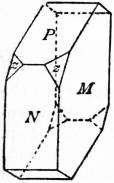
HEULANDITE, a mineral of the zeolite group, consisting of hydrous calcium and aluminium silicate, H4CaAl2(SiO3)6 + 3H20. Small amounts of sodium and potassium are usually present replacing part of the calcium. Crystals are monoclinic, and have a characteristic coffin-shaped habit. They have a perfect cleavage parallel to the plane of symmetry (M in the figure), on which the lustre is markedly pearly; on other faces the lustre is of the vitreous type. The mineral is usually colourless or white, sometimes brick-red, and varies from transparent to translucent. The hardness is 3½-4, and the specific gravity 2.2.
Heulandite closely resembles stilbite (q.v.) in appearance, and differs from it chemically only in containing rather less water of crystallization. The two minerals may, however, be readily distinguished by the fact that in heulandite the acute positive bisectrix of the optic axes emerges perpendicular to the cleavage. Heulandite was first separated from stilbite by A. Breithaupt in 1818, and named by him euzeolite (meaning beautiful zeolite); independently, in 1822, H. J. Brooke arrived at the same result, giving the name heulandite, after the mineral collector, Henry Heuland.
Heulandite occurs with stilbite and other zeolites in the amygdaloidal cavities of basaltic volcanic rocks, and occasionally in gneiss and metalliferous veins. The best specimens are from the basalts of Berufjord, near Djupivogr, in Iceland and the Faroe Islands, and the Deccan traps of the Sahyadri mountains near Bombay. Crystals of a brick-red colour are from Campsie Fells in Stirlingshire and the Fassathal in Tirol. A variety known as beaumontite occurs as small yellow crystals on syenitic schist near Baltimore in Maryland.
Isomorphous with heulandite is the strontium and barium zeolite brewsterite, named after Sir David Brewster. The greyish monoclinic crystals have the composition H4(Sr, Ba, Ca)Al2(SiO3)6 + 3H2O, and are found in the basalt of the Giant’s Causeway in Co. Antrim, and with harmotome in the lead mines at Strontian in Argyllshire.
(L. J. S.)
HEUSCH, WILLEM, or Guilliam de, a Dutch landscape painter in the 17th century at Utrecht. The dates of this artist’s birth and death are unknown. Nothing certain is recorded of him except that he presided over the gild of Utrecht, whilst Cornelis Poelemburg, Jan Both and Jan Weenix formed the council of that body, in 1649. According to the majority of historians, Heusch was born in 1638, and was taught by Jan Both. But each of these statements seems open to doubt; and although it is obvious that the style of Heusch is identical with that of Both, it may be that the two masters during their travels in Italy fell under the influence of Claude Lorraine, whose “Arcadian” art they imitated. Heusch certainly painted the same effects of evening in wide expanses of country varied by rock formations and lofty thin-leaved arborescence as Both. There is little to distinguish one master from the other, except that of the two Both is perhaps the more delicate colourist. The gild of Utrecht in the middle of the 17th century was composed of artists who clung faithfully to each other. Poelemburg, who painted figures for Jan Both, did the same duty for Heusch. Sometimes Heusch sketched landscapes for the battlepieces of Molenaer. The most important examples of Heusch are in the galleries of the Hague and Rotterdam, in the Belvedere at Vienna, the Städel at Frankfort and the Louvre. His pictures are signed with the full name, beginning with a monogram combining a G (for Guilliam), D and H. Heusch’s etchings, of which thirteen are known, are also in the character of those of Both.
After Guilliam there also flourished at Utrecht his nephew, Jacob de Heusch, who signs like his uncle, substituting an initial J for the initial G. He was born at Utrecht in 1657, learnt drawing from his uncle, and travelled early to Rome, where he acquired friends and patrons for whom he executed pictures after his return. He settled for a time at Berlin, but finally retired to Utrecht, where he died in 1701. Jacob was an “Arcadian,” like his relative, and an imitator of Both, and he chiefly painted Italian harbour views. But his pictures are now scarce. Two of his canvases, the “Ponte Rotto” at Rome, in the Brunswick Gallery, and a lake harbour with shipping in the Lichtenstein collection at Vienna, are dated 1696. A harbour with a tower and distant mountains, in the Belvedere at Vienna, was executed in 1699. Other examples may be found in English private galleries, in the Hermitage of St Petersburg and the museums of Rouen and Montpellier.
HEVELIUS [Hevel or Höwelcke], JOHANN (1611-1687), German astronomer, was born at Danzig on the 28th of January 1611. He studied jurisprudence at Leiden in 1630; travelled in England and France; and in 1634 settled in his native town as a brewer and town councillor. From 1639 his chief interest became centred in astronomy, though he took, throughout his life, a leading part in municipal affairs. In 1641 he built an observatory in his house, provided with a splendid instrumental outfit, including ultimately a tubeless telescope of 150 ft. focal length, constructed by himself. It was visited, on the 29th of January 1660, by John II. and Maria Gonzaga, king and queen of Poland. Hevelius made observations of sun-spots, 1642-1645, devoted four years to charting the lunar surface, discovered the moon’s libration in longitude, and published his results in Selenographia (1647), a work which entitles him to be called the founder of lunar topography. He discovered four comets in the several years 1652, 1661, 1672 and 1677, and suggested the revolution of such bodies in parabolic tracks round the sun. On the 26th of September 1679, his observatory, instruments and books were maliciously destroyed by fire, the catastrophe being described in the preface to his Annus climactericus (1685). He promptly repaired the damage, so far as to enable him to observe the great comet of December 1680; but his health suffered from the shock, and he died on the 28th of January 1687. Among his works were: Prodromus cometicus (1665); Cometographia (1668); Machina coelestis (first part, 1673), containing a description of his instruments; the second part (1679) is extremely rare, nearly the whole issue having perished in the conflagration of 1679. The observations made by Hevelius on the variable star named by him “Mira” are included in Annus climactericus. His catalogue of 1564 stars appeared posthumously in Prodromus astronomiae (1690). Its value was much impaired by his preference of the antique “pinnules” to telescopic sights on quadrants. This led to an acrimonious controversy with Robert Hooke. In an Atlas of 56 sheets, corresponding to his catalogue, and entitled Firmamentum Sobiescianum (1690), he delineated seven new constellations, still in use. Hevelius had his book printed in his own house, at lavish expense, and himself not only designed but engraved many of the plates.
See J. H. Westphal, Leben, Studien, und Schriften des Astronomen Johann Hevelius (1820); C. B. Lengnich, Anekdoten und Nachrichten (1780); Allgemeine deutsche Biographie (C. Bruhns); J. B. J. Delambre, Histoire de l’astronomie moderne, ii. 471; J. F. Weidler, Historia astronomiae, p. 486; F. Baily’s edition of the Catalogue of Hevelius, Memoirs Roy. Astr. Society, xiii. (1843); R. Wolf, Geschichte der Astronomie, p. 396; J. C. Poggendorff, Biog.-lit. Handwörterbuch. For an account of the epistolary remains of Hevelius, see C. G. Hecker, Monatl. Correspondenz, viii. 30; also Astr. Nachrichten, vols. xxiii., xxiv.
(A. M. C.)
HEWETT, SIR PRESCOTT GARDNER, Bart. (1812-1891), British surgeon, was born on the 3rd of July 1812, being the son of a Yorkshire country gentleman. He lived for some years in early life in Paris, and started on a career as an artist, but abandoned it for surgery. He entered St George’s Hospital, London (where his half-brother, Dr Cornwallis Hewett, was physician from 1825 to 1833) becoming demonstrator of anatomy and curator of the museum. He was the pupil and intimate friend of Sir B. C. Brodie, and helped him in much of his work. Eventually he rose to be anatomical lecturer, assistant-surgeon and surgeon to the hospital. In 1876 he was president of the College of Surgeons; in 1877 he was made serjeant-surgeon extraordinary to Queen Victoria, in 1884 serjeant-surgeon, and in 1883 he was created a baronet. He was a very good lecturer, but shrank from authorship; his lectures on Surgical Affections of the Head were, however, embodied in his treatise on the subject in Holmes’s System of Surgery. As a surgeon he was always extremely conservative, but hesitated at no operation, however severe, when convinced of its expediency. He was a perfect operator, and one of the most trustworthy of counsellors. He died on the 19th of June 1891.
HEWITT, ABRAM STEVENS (1822-1903), American manufacturer and political leader, was born in Haverstraw, New York, on the 31st of July 1822. His father, John, a Staffordshire man, was one of a party of four mechanics who were sent by Boulton and Watt to Philadelphia about 1790 to set up a steam engine for the city water-works and who in 1793-1794 built at Belleville, N.J., the first steam engine constructed wholly in America; he made a fortune in the manufacture of furniture, but lost it by the burning of his factories. The boy’s mother was of Huguenot descent. He graduated with high rank from Columbia College in 1842, having supported himself through his course. He taught mathematics at Columbia, and in 1845 was admitted to the bar, but, owing to defective eyesight, never practised. With Edward Cooper (son of Peter Cooper, whom Hewitt greatly assisted in organizing Cooper Union, and whose daughter he married) he went into the manufacture of iron girders and beams under the firm name of Cooper, Hewitt & Co. His study of the making of gun-barrel iron in England enabled him to be of great assistance to the United States government during the Civil War, when he refused any profit on such orders. The men in his works never struck—indeed in 1873-1878 his plant was run at an annual loss of $100,000. In politics he was a Democrat. In 1871 he was prominent in the re-organization of Tammany after the fall of the “Tweed Ring”; from 1875 until the end of 1886 (except in 1879-1881) he was a representative in Congress; in 1876 he left Tammany for the County Democracy; in the Hayes-Tilden campaign of that year he was chairman of the Democratic National Committee, and in Congress he was one of the House members of the joint committee which drew up the famous Electoral Count Act providing for the Electoral Commission. In 1886 he was elected mayor of New York City, his nomination having been forced upon the Democratic Party by the strength of the other nominees, Henry George and Theodore Roosevelt; his administration (1887-1888) was thoroughly efficient and creditable, but he broke with Tammany, was not renominated, ran independently for re-election, and was defeated. In 1896 and 1900 he voted the Republican ticket, but did not ally himself with the organization. He died in New York City on the 18th of January 1903. In Congress he was a consistent defender of sound money and civil service reform; in municipal politics he was in favour of business administrations and opposed to partisan nominations. He was a leader of those who contended for reform in municipal government, was conspicuous for his public spirit, and exerted a great influence for good not only in New York City but in the state and nation. His most famous speech was that made at the opening of the Brooklyn Bridge in 1883. He was a terse, able and lucid speaker, master of wit and sarcasm, and a fearless critic. He gave liberally to Cooper Union, of which he was trustee and secretary, and which owes much of its success to him; was a trustee of Columbia University from 1901 until his death, chairman of the board of trustees of Barnard College, and was one of the original trustees, first chairman of the board of trustees, and a member of the executive committee of the Carnegie Institution.
HEWLETT, MAURICE HENRY (1861- ), English novelist, was born on the 22nd of January 1861, the eldest son of Henry Gay Hewlett, of Shaw Hall, Addington, Kent. He was educated at the London International College, Spring Grove, Isleworth, and was called to the bar in 1891. From 1896 to 1900 he was keeper of the land revenue records and enrolments. He published in 1895 two books on Italy, Earthwork out of Tuscany, and (in verse) The Masque of Dead Florentines. Songs and Meditations followed in 1897, and in 1898 he won an immediate reputation by his Forest Lovers, a romance of medieval England, full of rapid movement and passion. In the same year he printed the pastoral and pagan drama of Pan and the Young Shepherd, shortened for purposes of representation and produced at the Court Theatre in March 1905, when it was followed by the Youngest of the Angels, dramatized from a chapter in his Fool Errant. In Little Novels of Italy (1899), a collection of brilliant short stories, he showed again his power of literary expression together with a close knowledge of medieval Italy. The new and vivid portraits of Richard Cœur de Lion in his Richard Yea-and-Nay (1900), and of Mary, queen of Scots, in The Queen’s Quair (1904) showed the combination of fiction with real history at its best. The New Canterbury Tales (1901) was another volume of stories of English life, but he returned to Italian subjects with The Road in Tuscany (1904); in Fond Adventures, Tales of the Youth of the World (1905), two are Italian tales, and The Fool Errant (1905) purports to be the memoirs of Francis Antony Stretley, citizen of Lucca. Later works were the novel The Stooping Lady (1907), and a volume of poems, Artemision (1909).
HEXAMETER, the name of the earliest and most important form of classical verse in dactylic rhythm. The word is due to each line containing six feet or measures (μέτρα), the last of which must be a spondee and the penultimate a dactyl, though occasionally, for some special effect, a spondee may be allowed in the fifth foot, when the line is said to be spondaic. The four other feet may be either spondees or dactyls. All the great heroic and epic verse of the Greek and Roman poets is in this metre, of which the finest examples are to be found in Homer and in Virgil. Varied cadences and varied caesura are essential to this form of verse, otherwise the monotony is wearying to the ear. The most usual places for the caesura are at the middle of the third, or the middle of the fourth foot: the former is known as the penthemimeral and the latter as hepthemimeral caesura. There are several more or less successful examples of English poems in this metre, for example Longfellow’s Evangeline, Kingsley’s Andromeda and Clough’s Bothie of Tober-na-Vuoilich, but it does not really suit the genius of the English language. In English the lack of true spondees is severely felt, even though the English metre depends, not, as in Greek and Latin, on the distinction between long and short syllables, but on that between accented and unaccented syllables. The accent must always (or it sounds very ugly) fall on the first syllable, whatever may have been the case in Greek and Latin—Voss, Klopstock and Goethe have written hexameter poems of varying merit and the metre suits the German language distinctly better than the English. The customary form of hexameter in English verse is exemplified by Coleridge’s descriptive line:—
“In the hex | ameter | rises the | fountain’s | silvery | column.”
Several modern poets, and in particular Robert Browning, and Lord Bowen (1835-1894) have used with effect a truncated hexameter consisting of the usual verse deprived of its last syllable. Thus Browning:—
“Well, it is I gone at | last, the | palace of | music I | reared.”
It is not sufficiently observed that even the classic Greek poets introduced considerable variations into their treatment of the hexameter. These have been treated with erudition in G. Hermann’s De aetate scriptoris Argonauticorum. The differences in the hexameters of the Latin poets were not so remarkable, but even these varied, in various epochs, their treatment of the separate feet, and the position of the caesura. The satirists in particular allowed themselves an extraordinary licence: these hexameters, from Persius, are as far removed from the rhythm of Homer, or even of Virgil, as possible, if they are to remain hexameters:—
“Mane piger stertis. ‘Surge!’ inquit Avaritia, ‘heia Surge!’ negas; instat ‘Surge!’ inquit ‘Non queo.’ ‘Surge!’ ‘Et quid agam?’ ‘Rogitas? en saperdam advehe Ponto.’”
It is also to be noted that various prosodical liberties, due originally to the extreme antiquity of the hexameter, and long reformed and repressed by the culture of poets, were apt to be revived in later ages, by writers who slavishly copied the most antique examples of the art of verse.
See Wilhelm Christ, Metrik der Griechen und Römer, 2te Aufl. (1879).
HEXAPLA (Gr. for “sixfold”), the term for an edition of the Bible in six versions, and especially the edition of the Old Testament compiled by Origen, which placed side by side (1) Hebrew, (2) Hebrew in Greek character, (3) Aquila, (4) Symmachus, (5) Septuagint, (6) Theodotion. See Bible: Old Testament, Texts and Versions.
HEXAPODA (Gr. ἕξ, six, and πούς, foot), a term used in systematic zoology for that class of the Arthropoda, popularly known as insects. Linnaeus in his Systema naturae (1735) grouped under the class Insecta all segmented animals with firm exoskeleton and jointed limbs—that is to say, the insects, centipedes, millipedes, crustaceans, spiders, scorpions and their allies. This assemblage is now generally regarded as a great division (phylum or sub-phylum) of the animal kingdom and known by K. T. E. von Siebold’s (1848) name of Arthropoda. For the class of the true insects included in this phylum, Linnaeus’s old term Insecta, first used in a restricted sense by M. J. Brisson (1756), is still adopted by many zoologists, while others prefer the name Hexapoda, first used systematically in its modern sense by P. A. Latreille in 1825 (Familles naturelles du règne animal), since it has the advantage of expressing, in a single word, an important characteristic of the group. The terms “Hexapoda” and “hexapod” had already been used by F. Willughby, J. Ray and others in the late 17th century to include the active larvae of beetles, as well as bugs, lice, fleas and other insects with undeveloped wings.
Characters.
A true insect, or member of the class Hexapoda, may be known by the grouping of its body-segments in three distinct regions—a head, a thorax and an abdomen—each of which consists of a definite number of segments. In the terminology proposed by E. R. Lankester the arrangement is “nomomeristic” and “nomotagmic.” The head of an insect carries usually four pairs of conspicuous appendages—feelers, mandibles and two pairs of maxillae, so that the presence of four primitive somites is immediately evident. The compound eyes of insects resemble so closely the similar organs in Crustaceans that there can hardly be reasonable doubt of their homology, and the primitively appendicular nature of the eyes in the latter class suggests that in the Hexapoda also they represent the appendages of an anterior (protocerebral) segment. Behind the antennal (or deutocerebral) segment an “intercalary” or tritocerebral segment has been demonstrated by W. M. Wheeler (1893) and others in various insect embryos, while in the lowest insect order—the Aptera—a pair of minute jaws—the maxillulae—in close association with the tongue are present, as has been shown by H. J. Hansen (1893) and J. W. Folsom (1900). Distinct vestiges of the maxillulae exist also in the earwigs and booklice, according to G. Enderlein and C. Börner (1904), and they are very evident in larval may-flies. The number of limb-bearing somites in the insectan head is thus seen to be seven. All of these are to be regarded as primitively post-oral, but in the course of development the mouth moves back to the mandibular segment, so that the first three somites—ocular, antennal and intercalary—lie in front of it. In Lankester’s terminology, therefore, the head of an insect is “triprosthomerous.” The maxillae of the hinder pair become more or less fused together to form a “lower lip” or labium, and the segment of these appendages is, in some insects, only imperfectly united with the head-capsule.