VOLUME XIII SLICE IV Hero to Hindu Chronology (continued 2)
Reading edition
In the Astrée of Honoré d’Urfé, which was a pure pastoral, in the religious romances of Pierre Camus (1582-1653), in the comic Francion of Charles Sorel, piquancy had been given to the recital by this belief that real personages could be recognized under the disguises. But in the Carithée of Gomberville (1621) we have a pastoral which is already beginning to be a heroic romance, and a book in which, under a travesty of Roman history, an appeal is made to an extravagantly chivalrous enthusiasm. A further development was seen in the Polyxène (1623) of François de Molière, and the Endymion (1624) of Gombauld; in the latter the elderly queen, Marie de’ Medici, was celebrated under the disguise of Diana, for whom a beautiful shepherd of Caria (the author himself) nourishes a hopeless passion. The earliest of the Heroic Romances, pure and simple, is, however, the celebrated Polexandre (1629) of Gomberville. The author began by intending his hero to represent Louis XIII., but he changed his mind, and drew a portrait of Cardinal Richelieu. In this novel, for the first time, the romantic character proper to this class of books is seen undiluted; there is no intrusion of a personage who is not celebrated for his birth, his beauty or his exploits. The story deals with the adventures of a hero who visits all the sea-coasts of the world, the most remote as well as the most fabulous, in search of an ineffable princess, Alcidiane. This absurd and pretentious, yet very original piece of invention enjoyed an immense success, and historical romances of a similar class competed for the favour of the public. There was an equal amount of geography and more of ancient history in the Ariane (1632) of Desmarets de Saint-Sorlin (1595-1676), a book which, long neglected, has in late years been rediscovered, and which has been greeted by M. Paul Morillot as the most readable and the least tiresome of all the Heroic Romances. The type of that class of literature, however, has always been found in the highly elaborate writings of Gauthier de Coste de la Calprenède (1609-1663), which enjoyed for a time a prodigious celebrity, and were read and imitated all over Europe. La Calprenède was a Gascon soldier, imbued with all the extravagance of his race, and in full sympathy with the audacity and violence of the aristocratic society of France in his day. His Cassandre, which appeared in ten volumes between 1642 and 1645, is perhaps the most characteristic of all the Heroic Romances. It deals with a highly romantic epoch of ancient history, the decline of the empire of Alexander the Great. The wars of the Persians and of the Scythians are introduced, and among the characters are discovered such personages as Artaxerxes, Roxana and Ephestion. It must not be supposed, however, that la Calprenède makes the smallest effort to deal with the subject accurately or realistically. The figures are those of his own day; they are seigneurs and great ladies of the court of Louis XIII., masquerading in Macedonian raiment. The passion of love is dominant throughout, and it is treated in the most exalted and hyperbolical spirit. The central heroes of the story, Oroondate and Lysimachus, are dignified, eloquent and amorous; they undergo unexampled privations in the quest of incomparable ladies whose beauty and whose nobility is only equalled by their magnificent loyalty. These books were written with an aim that was partly didactic. Their object was to entertain the ladies and to gratify a taste for endlessly wire-drawn sentimentality, but it was also to teach fortitude and grandeur of soul and to inculcate lessons of practical chivalry. La Calprenède followed up the success of his Cassandre with a Cléopâtre (1647) in twelve volumes, and a Faramond (1661) which he did not live to finish. He became more extravagant, more rhapsodical as he proceeded, and he lost all the little hold on history which he had ever held. Cléopâtre, nevertheless, enjoyed a prodigious popularity, and it became the fashion to emulate as far as possible the prowess of its magnificent hero, the proud Artaban. It should be said that la Calprenède objected to his books being styled romances, and insisted that they were specimens of “history embellished with certain inventions.” He may, in opposition to his wishes, claim the doubtful praise of being, in reality, the creator of the modern historical novel. He was immediately imitated or accompanied by a large number of authors, of whom two have achieved a certain immortality, which, unhappily, must be confessed to be partly of ridicule. The vogue of the historical romance was carried to its height by a brother and a sister, Georges de Scudéry (1601-1667) and Madeleine de Scudéry (1608-1701), who represented in their own persons all the extravagant, tempestuous and absurd elements of the age, and whose elephantine romances remain as portents in the history of literature. These novels—there are five of them—were signed by Georges de Scudéry, but it is believed that all were in the main written by Madeleine. The earliest was Ibrahim, ou l’Illustre Bassa (1641); it was followed by Le Grand Cyrus (1648-1653) and the final, and most preposterous member of the series was Clélie (1649-1654). The romances of Mlle de Scudéry (for to her we may safely attribute them) are much inferior in style to those of la Calprenède. They are pretentious, affected and sickly. The author abuses the element of analysis, and pushes a psychology, which was beyond the age in penetration, to a wearisome and excessive extent. Nothing, it is probable, in the whole evolution of the Historical Romances has attracted so much attention as the “Carte de Tendre” which occurs in the opening book of Clélie. This celebrated map, drawn by the heroine in order to show the route from New Friendship to Tender, and a geographical symbol, therefore, of the progress of love, with its city of Tender-upon-Esteem, its sea of Enmity, its river of Inclination, its rock-built citadel of Pride, its cold lake of Indifference, is a miracle of elaborate and incongruous ingenuity. But, amusing as it is, it shows into what depths of puerility the amorous casuistry of these romances had fallen. These novels formed the chief topic of conversation and of correspondence in the literary society which gathered at and around the Hotel de Rambouillet, and in the personages of Mlle de Scudéry’s romances could be recognized all the famous leaders of that society. The mawkish love-making and the false heroism of these monstrous novels went rapidly out of fashion in France soon after 1660, when the epoch of the Heroic Romance came to an end. In England the Heroic Romance had a period of flourishing popularity. All the principal French examples were very promptly translated, and “he was not to be admitted into the academy of wit who had not read Astrea and The Grand Cyrus.” The great vogue of these books in England lasted from about 1645 to 1660. It led, of course, to the composition of original works in imitation of the French. The most remarkable and successful of these was Parthenissa, published in 1654 by Roger Boyle, Lord Broghill and afterwards Earl of Orrery (1621-1679), which was greatly admired by Dorothy Osborne and her correspondents. Addison speaks in the “Spectator” of the popularity of all these huge books, “the Grand Cyrus, with a pin stuck in one of the middle leaves, Clélie, which opened of itself in the place that describes two lovers in a bower.” When the drama, and in particular tragedy, was reinstituted in England, sentimental readers found a field for their emotions on the stage, and the heroic romances immediately began to go out of fashion. They lingered, however, for a quarter of a century more, and M. Jusserand has analysed what may be considered the very latest of the race, Pandion and Amphigenia, published in 1665 by the dramatist, John Crowne.
See Gordon de Percel, De l’usage des romans (1734); André Le Breton, Le Roman au XVIIe siècle (1890); Paul Morillot, Le Roman en France depuis 1610 (1894); J. J. Jusserand, Le Roman anglais au XVIIe siècle (1888).
(E. G.)
HEROIC VERSE, a term exclusively used in English to Indicate the rhymed iambic line or Heroic Couplet. In ancient literature, the heroic verse, ἡρωικὸν μέτρον, was synonymous with the dactylic hexameter. It was in this measure that those typically heroic poems, the Iliad and Odyssey and the Aeneid were written. In English, however, it was not enough to designate a single iambic line of five beats as heroic verse, because it was necessary to distinguish blank verse from the distich, which was formed by the heroic couplet. This had escaped the notice of Dryden, when he wrote “The English Verse, which we call Heroic, consists of no more than ten syllables.” If that were the case, then Paradise Lost would be written in heroic verse, which is not true. What Dryden should have said is “consists of two rhymed lines, each of ten syllables.” In French the alexandrine has always been regarded as the heroic measure of that language. The dactylic movement of the heroic line in ancient Greek, the famous ῥυθμὸς ἡρῷος of Homer, is expressed in modern Europe by the iambic movement. The consequence is that much of the rush and energy of the antique verse, which at vigorous moments was like the charge of a battalion, is lost. It is owing to this, in part, that the heroic couplet is so often required to give, in translation, the full value of a single Homeric hexameter. It is important to insist that it is the couplet, not the single line, which constitutes heroic verse. It is interesting to note that the Latin poet Ennius, as reported by Cicero, called the heroic metre of one line versum longum, to distinguish it from the brevity of lyrical measures. The current form of English heroic verse appears to be the invention of Chaucer, who used it in his Legend of Good Women and afterwards, with still greater freedom, in the Canterbury Tales. Here is an example of it in its earliest development:—
“And thus the longë day in fight they spend, Till, at the last, as everything hath end, Anton is shent, and put him to the flight, And all his folk to go, as best go might.”
This way of writing was misunderstood and neglected by Chaucer’s English disciples, but was followed nearly a century later by the Scottish poet, called Blind Harry (c. 1475), whose Wallace holds an important place in the history of versification as having passed on the tradition of the heroic couplet. Another Scottish poet, Gavin Douglas, selected heroic verse for his translation of the Aeneid (1513), and displayed, in such examples as the following, a skill which left little room for improvement at the hands of later poets:—
“One sang, ‘The ship sails over the salt foam, Will bring the merchants and my leman home’; Some other sings, ‘I will be blithe and light, Mine heart is leant upon so goodly wight.’”
The verse so successfully mastered was, however, not very generally used for heroic purposes in Tudor literature. The early poets of the revival, and Spenser and Shakespeare after them, greatly preferred stanzaic forms. For dramatic purposes blank verse was almost exclusively used, although the French had adopted the rhymed alexandrine for their plays. In the earlier half of the 17th century, heroic verse was often put to somewhat unheroic purposes, mainly in prologues and epilogues, or other short poems of occasion; but it was nobly redeemed by Marlowe in his Hero and Leander and respectably by Browne in his Britannia’s Pastorals. It is to be noted, however, that those Elizabethans who, like Chapman, Warner and Drayton, aimed at producing a warlike and Homeric effect, did so in shambling fourteen-syllable couplets. The one heroic poem of that age written at considerable length in the appropriate national metre is the Bosworth Field of Sir John Beaumont (1582-1628). Since the middle of the 17th century, when heroic verse became the typical and for a while almost the solitary form in which serious English poetry was written, its history has known many vicissitudes. After having been the principal instrument of Dryden and Pope, it was almost entirely rejected by Wordsworth and Coleridge, but revised, with various modifications, by Byron, Shelley (in Julian and Maddalo) and Keats (in Lamia). In the second half of the 19th century its prestige was restored by the brilliant work of Swinburne in Tristram and elsewhere.
(E. G.)
HÉROLD, LOUIS JOSEPH FERDINAND (1791-1833), French musician, the son of François Joseph Hérold, an accomplished pianist, was born in Paris, on the 28th of January 1791. It was not till after his father’s death that Hérold in 1806 entered the Paris conservatoire, where he studied under Catal and Méhul. In 1812 he gained the grand prix de Rome with the cantata La Duchesse de la Vallière, and started for Italy, where he remained till 1815 and composed a symphony, a cantata and several pieces of chamber music. During his stay in Italy also Hérold for the first time ventured on the stage with the opera La Gioventù di Enrico V., first performed at Naples in 1815 with moderate success. During a short stay in Vienna he was much in the society of Salieri. Returning to Paris he was invited by Boieldieu to collaborate with him on an opera called Charles de France, performed in 1816, and soon followed by Hérold’s first French opera, Les Rosières (1817), which was received very favourably. Hérold produced numerous dramatic works for the next fifteen years in rapid succession. Only the names of some of the more important need here be mentioned:—La Clochette (1817), L’Auteur mort et vivant (1820), Marie (1826), and the ballets La Fille mal gardée (1828) and La Belle au bois dormant (1829). Hérold also wrote a vast quantity of pianoforte music, in spite of his time being much occupied by his duties as accompanist at the Italian opera in Paris. In 1831 he produced the romantic opera Zampa, and in the following year Le Pré aux clercs (first performance December 15, 1832), in which French esprit and French chivalry find their most perfect embodiment. These two operas secured immortality for the name of the composer, who died on the 18th of January 1833, of the lung disease from which he had suffered for many years, and the effects of which he had accelerated by incessant work. Hérold’s incomplete opera Ludovic was afterwards printed by J. F. F. Halévy.
HERON (Fr. héron; Ital. aghirone, airone; Lat. ardea; Gr. ἐρωδιός: A.-S. hragra; Icelandic, hegre; Swed. häger; Dan. heire; Ger. Heiger, Reiher, Heergans; Dutch, reiger), a long-necked, long-winged and long-legged bird, the typical representative of the group Ardeidae. It is difficult or even impossible to estimate with any accuracy the number of species of Ardeidae which exist. Professor Hermann Schlegel in 1863 enumerated 61, besides 5 of what he terms “conspecies,” as contained in the collection at Leyden (Mus. des Pays-Bas, Ardeae, 64 pp.),—on the other hand, G. R. Gray in 1871 (Handlist, &c. iii. 26-34) admitted above 90, while Dr Anton Reichenow (Journ. für Ornithologie, 1877, pp. 232-275) recognizes 67 as known, besides 15 “subspecies” and 3 varieties, arranging them in 3 genera, Nycticorax, Botaurus and Ardea, with 17 sub-genera. But it is difficult to separate the family, with any satisfactory result, into genera, if structural characters have to be found for these groups, for in many cases they run almost insensibly into each other—though in common language it is easy to speak of herons, egrets, bitterns, night-herons and boatbills. With the exception of the last, Professor Schlegel retains all in the genus Ardea, dividing it into eight sections, the names of which may perhaps be Englished—great herons, small herons, egrets, semi-egrets, rail-like herons, little bitterns, bitterns and night-herons.
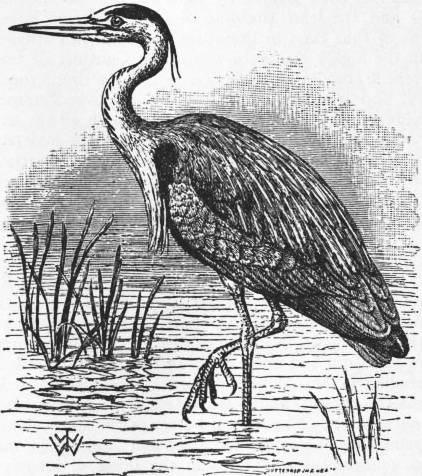
Fig. 1.—Heron.
The common heron of Europe, Ardea cinerea of Linnaeus, is universally allowed to be the type of the family, and it may also be regarded as that of Professor Schlegel’s first section. The species inhabits suitable localities throughout the whole of Europe, Africa and Asia, reaching Japan, many of the islands of the Indian Archipelago and even Australia. Though by no means so numerous as formerly in Britain, it is still sufficiently common,1 and there must be few persons who have not seen it rising slowly from some river-side or marshy flat, or passing overhead in its lofty and leisurely flight on its way to or from its daily haunts; while they are many who have been entertained by watching it as it sought its food, consisting chiefly of fishes (especially eels and flounders) and amphibians—though young birds and small mammals come not amiss—wading midleg in the shallows, swimming occasionally when out of its depth, or standing motionless to strike its prey with its formidable and sure beak. When sufficiently numerous the heron breeds in societies, known as heronries, which of old time were protected both by law and custom in nearly all European countries, on account of the sport their tenants afforded to the falconer. Of late years, partly owing to the withdrawal of the protection they had enjoyed, and still more, it would seem, from agricultural improvement, which, by draining meres, fens and marshes, has abolished the feeding-places of a great population of herons, many of the larger heronries have broken up—the birds composing them dispersing to neighbouring localities and forming smaller settlements, most of which are hardly to be dignified by the name of heronry, though commonly accounted such. Thus the number of so-called heronries in the United Kingdom, and especially in England and Wales, has become far greater than formerly, but no one can doubt that the number of herons has dwindled. The sites chosen by the heron for its nest vary greatly. It is generally built in the top of a lofty tree, but not unfrequently (and this seems to have been much more usual in former days) near or on the ground among rough vegetation, on an island in a lake, or again on a rocky cliff of the coast. It commonly consists of a huge mass of sticks, often the accumulation of years, lined with twigs, and in it are laid from four to six sea-green eggs. The young are clothed in soft flax-coloured down, and remain in the nest for a considerable time, therein differing remarkably from the “pipers” of the crane, which are able to run almost as soon as they are hatched. The first feathers assumed by young herons in a general way resemble those of the adult, but the pure white breast, the black throat-streaks and especially the long pendent plumes, which characterize only the very old birds, and are most beautiful in the cocks, are subsequently acquired. The heron measures about 3 ft. from the bill to the tail, and the expanse of its wings is sometimes not less than 6 ft., yet it weighs only between 3 and 4 ℔.
Large as is the common heron of Europe, it is exceeded in size by the great blue heron of America (Ardea herodias), which generally resembles it in appearance and habits, and both are smaller than the A. sumatrana or A. typhon of India and the Malay Archipelago, while the A. goliath, of wide distribution in Africa and Asia, is the largest of all. The purple heron, A. purpurea, as a well-known European species having a great range over the Old World, also deserves mention here. The species included in Professor Schlegel’s second section inhabit the tropical parts of Africa, Australasia and America. The egrets, forming his third group, require more notice, distinguished as they are by their pure white plumage, and, when in breeding-dress, by the beautiful dorsal tufts of decomposed feathers that ordinarily droop over the tail, and are so highly esteemed as ornaments by Oriental magnates. The largest species is A. occidentalis, only known apparently from Florida and Cuba; but one not much less, the great egret (A. alba), belongs to the Old World, breeding regularly in south-eastern Europe, and occasionally straying to Britain. A third, A. egretta, represents it in America, while much the same may be said of two smaller species, A. garzetta, the little egret of English authors, and A. candidissima; and a sixth, A. intermedia, is common in India, China and Japan, besides occurring in Australia. The group of semi-egrets, containing some nine or ten forms, among which the buff-backed heron (A. bubulcus), is the only species that is known to have occurred in Europe, is hardly to be distinguished from the last section except by their plumage being at certain seasons varied in some species with slaty-blue and in others with rufous. The rail-like herons form Professor Schlegel’s next section, but it can scarcely be satisfactorily differentiated, and the epithet is misleading, for its members have no rail-like affinities, though the typical species, which inhabits the south of Europe, and occasionally finds its way to England, has long been known as A. ralloides.2 Nearly all these birds are tropical or subtropical. Then there is the somewhat better defined group of little bitterns, containing about a dozen species—the smallest of the whole family. One of them, A. minuta, though very local in its distribution, is a native of the greater part of Europe, and has bred in England. It has a close counterpart in the A. exilis of North America, and is represented by three or four forms in other parts of the world, the A. pusilla of Australia especially differing very slightly from it. Ranged by Professor Schlegel with these birds, which are all remarkable for their skulking habits, but more resembling the true herons in their nature, are the common green bittern of America (A. virescens) and its very near ally the African A. atricapilla, from which last it is almost impossible to distinguish the A. javanica, of wide range throughout Asia and its islands, while other species, less closely related, occur elsewhere as A. flavicollis—one form of which, A. gouldi, inhabits Australia.
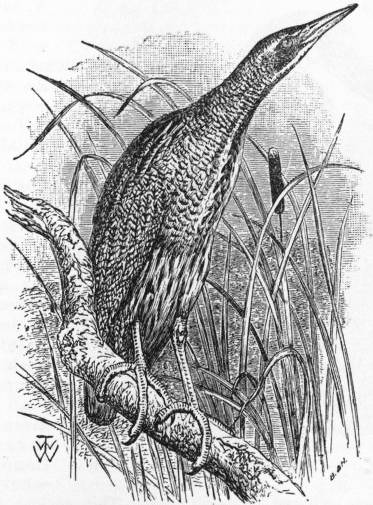
Fig. 2.—Bittern.
The true bitterns, forming the genus Botaurus of most authors, seem to be fairly separable, but more perhaps on account of their wholly nocturnal habits and correspondingly adapted plumage than on strictly structural grounds, though some differences of proportion are observable. The common bittern (q.v.) of Europe (B. stellaris), is widely distributed over the eastern hemisphere.3 Australia and New Zealand have a kindred species, B. poeciloptilus, and North America a third, B. mugitans4 or B. lentiginosus. Nine other species from various parts of the world are admitted by Professor Schlegel, but some of them should perhaps be excluded from the genus Botaurus.
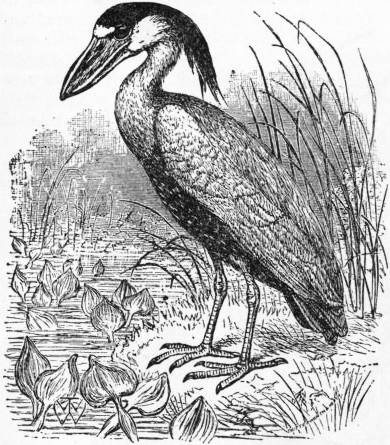
Fig. 3.—Boatbill.
Of the night-herons the same author recognizes six species, all of which may be reasonably placed in the genus Nycticorax, characterized by a shorter beak and a few other peculiarities, among which the large eyes deserve mention. The first is N. griseus, a bird widely spread over the Old World, and not unfrequently visiting England, where it would undoubtedly breed if permitted. Professor Schlegel unites with it the common night-heron of America; but this, though very closely allied, is generally deemed distinct, and is the N. naevius or N. gardeni of most writers. A clearly different American species, with a more southern habitat, is the N. violaceus or N. cayennensis, while others are found in South America, Australia, some of the Asiatic Islands and in West Africa. The Galapagos have a peculiar species, N. pauper, and another, so far as is known, peculiar to Rodriguez, N. megacephalus, existed in that island at the time of its being first colonized, but is now extinct.
The boatbill, of which only one species is known, seems to be merely a night-heron with an exaggerated bill,—so much widened as to suggest its English name,—but has always been allowed generic rank. This curious bird, the Cancroma cochlearia of most authors, is a native of tropical America, and what is known of its habits shows that they are essentially those of a Nycticorax.5
Bones of the common heron and bittern are not uncommon in the peat of the East-Anglian fens. Remains from Sansan and Langy in France have been referred by Alphonse Milne-Edwards to herons under the names of Ardea perplexa and A. formosa; a tibia from the Miocene of Steinheim am Albuch by Dr Fraas to an A. similis, while Sir R. Owen recognized a portion of a sternum from the London Clay as most nearly approaching this family.
It remains to say that the herons form part of Huxley’s section Pelargomorphae, belonging to his larger group Desmognathae, and to draw attention to the singular development of the patches of “powder-down” which in the family Ardeidae attain a magnitude hardly to be found elsewhere. Their use is utterly unknown.
(A. N.)
1 In many parts of England it is generally called a “hernser”—being a corruption of “heronsewe,” which, as Professor Skeat states (Etymol. Dictionary, p. 264), is a perfectly distinct word from “heronshaw,” commonly confounded with it. The further corruption of “hernser” into “handsaw,” as in the well-known proverb, was easy in the mouth of men to whom hawking the heronsewe was unfamiliar.
2 It is the “Squacco-Heron” of modern British authors—the distinctive name, given “Sguacco” by Willughby and Ray from Aldrovandus, having been misspelt by Latham.
3 The last-recorded instance of the bittern breeding in England was in 1868, as mentioned by Stevenson (Birds of Norfolk, ii. 164).
4 Richardson, a most accurate observer, asserts (Fauna Boreali-Americana, ii. 374) that its booming (whence the epithet) exactly resembles that of its Old-World congener, but American ornithologists seem only to have heard the croaking note it makes when disturbed.
5 The very wonderful shoe-bird (Balaeniceps) has been regarded by many authorities as allied to Cancroma; but there can be little doubt that it is more nearly related to the genus Scopus belonging to the storks. The sun-bittern (Eurypyga) forms a family of itself, allied to the rails and cranes.
HERPES (from the Gr. ἕρπειν, to creep), an inflammation of the true skin resulting from a lesion of the underlying nerve or its ganglion, attended with the formation of isolated or grouped vesicles of various sizes upon a reddened base. They contain a clear fluid, and either rupture or dry up. Two well-marked varieties of herpes are frequently met with. (a) In herpes labialis et nasalis the eruption occurs about the lips and nose. It is seen in cases of certain acute febrile ailments, such as fevers, inflammation of the lungs or even in a severe cold. It soon passes off. (b) In the herpes zoster, zona or “shingles” the eruption occurs in the course of one or more cutaneous nerves, often on one side of the trunk, but it may be on the face, limbs or other parts. It may occur at any age, but is probably more frequently met with in elderly people. The appearance of the eruption is usually preceded by severe stinging neuralgic pains for several days, and, not only during the continuance of the herpetic spots, but long after they have dried up and disappeared, these pains sometimes continue and give rise to great suffering. The disease seldom recurs. The most that can be done for its relief is to protect the parts with cotton wool or some dusting powder, while the pain may be allayed by opiates or bromide of potassium. Quinine internally is often of service.
HERRERA, FERNANDO DE (c. 1534-1597), Spanish lyrical poet, was born at Seville. Although in minor orders, he addressed many impassioned poems to the countess of Gelves, wife of Alvaro Colon de Portugal; but it is suggested that these should be regarded as Platonic literary exercises in the manner of Petrarch. As is shown by his Anotaciones á las obras de Garcilaso de la Vega (1580), Herrera had a boundless admiration for the Italian poets, and continued the work of Boscán in naturalizing the Italian metrical system in Spain. His commentary on Garcilaso involved him in a series of literary polemics, and his verbal innovations laid him open to attack. But, even if his amatory sonnets are condemned as insincere in sentiment, their workmanship is admirable, while his odes on the battle of Lepanto, on Don John of Austria, and the elegy on King Sebastian of Portugal entitle him to rank as the greatest of Andalusian poets and as the most important of the followers of Garcilaso de la Vega (see Vega). His poems were published in 1582, and reprinted with additions in 1619; they are reissued in the Biblioteca de autores españoles, vol. xxxii. Of Herrera’s prose works only the Vida y muerta de Tomas Moro (1592) survives; it is a translation of the life in Thomas Stapleton’s Tres Thomae (1588).
Bibliography.—E. Bourciez, “Les Sonnets de Fernando de Herrera,” Annales de la Faculté des Lettres de Bordeaux (1891); Fernando de Herrera, controversia sobre sus anotaciones á les obras de Garcilaso de la Vega (Seville, 1870); A. Morel-Fatio, L’Hymne sur Lépante (Paris, 1893).
HERRERA, FRANCISCO (1576-1656), surnamed el Viejo (the old), Spanish historical and fresco painter, studied under Luis Fernandez in Seville, his native city, where he spent most of his life. Although so rough and coarse in manners that neither scholar nor child could remain with him, the great talents of Herrera, and the promptitude with which he used them, brought him abundant commissions. He was also a skilful worker in bronze, an accomplishment that led to his being charged with coining base money. From this accusation, whether true or false, he sought sanctuary in the Jesuit college of San Hermenegildo, which he adorned with a fine picture of its patron saint. Philip IV., on his visit to Seville in 1624, having seen this picture, and learned the position of the artist, pardoned him at once, warning him, however, that such powers as his should not be degraded. In 1650 Herrera removed to Madrid, where he lived in great honour till his death in 1656. Herrera was the first to relinquish the timid Italian manner of the old Spanish school of painting, and to initiate the free, vigorous touch and style which reached such perfection in Velazquez, who had been for a short time his pupil. His pictures are marked by an energy of design and freedom of execution quite in keeping with his bold, rough character. He is said to have used very long brushes in his painting; and it is also said that, when pupils failed, his servant used to dash the colours on the canvas with a broom under his directions, and that he worked them up into his designs before they dried. The drawing in his pictures is correct, and the colouring original and skilfully managed, so that the figures stand out in striking relief. What has been considered his best easel-work, the “Last Judgment,” in the church of San Bernardo at Seville, is an original and striking composition, showing in its treatment of the nude how ill-founded the common belief was that Spanish painters, through ignorance of anatomy, understood only the draped figure. Perhaps his best fresco is that on the dome of the church of San Buenaventura; but many of his frescoes have perished, some by the effects of the weather and others by the artist’s own carelessness in preparing his surfaces. He has, however, preserved several of his own designs in etchings. For his easel-works Herrera often chose such humble subjects as fairs, carnivals, ale-houses and the like.
His son Francisco Herrara (1622-1685), surnamed el Mozo (the young), was also an historical and fresco painter. Unable to endure his father’s cruelty, the younger Herrera, seizing what money he could find, fled from Seville to Rome. There, instead of devoting himself to the antiquities and the works of the old Italian masters, he gave himself up to the study of architecture and perspective, with the view of becoming a fresco-painter. He did not altogether neglect easel-work, but became renowned for his pictures of still-life, flowers and fruit, and from his skill in painting fish was called by the Italians Lo Spagnuolo degli pesci. In later life he painted portraits with great success. He returned to Seville on hearing of his father’s death, and in 1660 was appointed subdirector of the new academy there under Murillo. His vanity, however, brooked the superiority of no one; and throwing up his appointment he went to Madrid. There he was employed to paint a San Hermenegildo for the barefooted Carmelites, and to decorate in fresco the roof of the choir of San Felipe el Real. The success of this last work procured for him a commission from Philip IV. to paint in fresco the roof of the Atocha church. He chose as his subject for this the Assumption of the Virgin. Soon afterwards he was rewarded with the title of painter to the king, and was appointed superintendent of the royal buildings. He died at Madrid in 1685. Herrera el Mozo was of a somewhat similar temperament to his father, and offended many people by his inordinate vanity and suspicious jealousy. His pictures are inferior to the older Herrera’s both in design and in execution; but in some of them traces of the vigour of his father, who was his first teacher, are visible. He was by no means an unskilful colourist, and was especially master of the effects of chiaroscuro. As his best picture Sir Edmund Head in his Handbook names his “San Francisco,” in Seville Cathedral. An elder brother, known as Herrera el Rubio (the ruddy), who died very young, gave great promise as a painter.
HERRERA Y TORDESILLAS, ANTONIO DE (1549-1625), Spanish historian, was born at Cuellar, in the province of Segovia in Spain. His father, Roderigo de Tordesillas, and his mother, Agnes de Herrera, were both of good family. After studying for some time in his native country, Herrera proceeded to Italy, and there became secretary to Vespasian Gonzago, with whom, on his appointment as viceroy of Navarre, he returned to Spain. Gonzago, sensible of his secretary’s abilities, commended him to Philip II. of Spain; and that monarch appointed Herrera first historiographer of the Indies, and one of the historiographers of Castile. Placed thus in the enjoyment of an ample salary, Herrera devoted the rest of his life to the pursuit of literature, retaining his offices until the reign of Philip IV., by whom he was appointed secretary of state very shortly before his death, which took place at Madrid on the 29th of March 1625. Of Herrera’s writings, the most valuable is his Historia general de los hechos de los Castellanos en las islas y tierra firme del Mar Oceano (Madrid, 1601-1615, 4 vols.), a work which relates the history of the Spanish-American colonies from 1492 to 1554. The author’s official position gave him access to the state papers and to other authentic sources not attainable by other writers, while he did not scruple to borrow largely from other MSS., especially from that of Bartolomé de Las Casas. He used his facilities carefully and judiciously; and the result is a work on the whole accurate and unprejudiced, and quite indispensable to the student either of the history of the early colonies, or of the institutions and customs of the aboriginal American peoples. Although it is written in the form of annals, mistakes are not wanting, and several glaring anachronisms have been pointed out by M. J. Quintana. “If,” to quote Dr Robertson, “by attempting to relate the various occurrences in the New World in a strict chronological order, the arrangement of events in his work had not been rendered so perplexed, disconnected and obscure that it is an unpleasant task to collect from different parts of his book and piece together the detached shreds of a story, he might justly have been ranked among the most eminent historians of his country.” This work was republished in 1730, and has been translated into English by J. Stevens (London, 1740), and into other European languages.
Herrera’s other works are the following: Historia de lo sucedido en Escocia é Inglaterra en quarenta y quatro años que vivió la reyna Maria Estuarda (Madrid, 1589); Cinco libros de la historia de Portugal, y conquista de las islas de los Açores, 1582-1583 (Madrid, 1591); Historia de lo sucedido en Francia, 1585-1594 (Madrid, 1598); Historia general del mundo del tiempo del rey Felipe II, desde 1559 hasta su muerte (Madrid, 1601-1612, 3 vols.); Tratado, relacion, y discurso historico de los movimientos de Aragon (Madrid, 1612); Comentarios de los hechos de los Españoles, Franceses, y Venecianos en Italia, &c., 1281-1559 (Madrid, 1624, seq.). See W. H. Prescott, History of the Conquest of Mexico, vol. ii.
HERRICK, ROBERT (1591-1674), English poet, was born at Cheapside, London, and baptized on the 24th of August 1591. He belonged to an old Leicestershire family which had settled in London. He was the seventh child of Nicholas Herrick, goldsmith, of the city of London, who died in 1592, under suspicion of suicide. The children were brought up by their uncle, Sir William Herrick, one of the richest goldsmiths of the day, to whom in 1607 Robert was bound apprentice. He had probably been educated at Westminster school, and in 1614 he proceeded to Cambridge; and it was no doubt during his apprenticeship that the young poet was introduced to that circle of wits which he was afterwards to adorn. He seems to have been present at the first performance of The Alchemist in 1610, and it was probably about this time that Ben Jonson adopted him as his poetical “son.” He entered the university as fellow-commoner of St John’s College, and he remained there until, in 1616, upon taking his degree, he removed to Trinity Hall. A lively series of fourteen letters to his uncle, mainly begging for money, exists at Beaumanoir, and shows that Herrick suffered much from poverty at the university. He took his B.A. in 1617, and in 1620 he became master of arts. From this date until 1627 we entirely lose sight of him; it has been variously conjectured that he spent these years preparing for the ministry at Cambridge, or in much looser pursuits in London. In 1629 (September 30) he was presented by the king to the vicarage of Dean Prior, not far from Totnes in Devonshire. At Dean Prior he resided quietly until 1648, when he was ejected by the Puritans. The solitude there oppressed him at first; the village was dull and remote, and he felt very bitterly that he was cut off from all literary and social associations; but soon the quiet existence in Devonshire soothed and delighted him. He was pleased with the rural and semi-pagan customs that survived in the village, and in some of his most charming verses he has immortalized the morris-dances, wakes and quintains, the Christmas mummers and the Twelfth Night revellings, that diversified the quiet of Dean Prior. Herrick never married, but lived at the vicarage surrounded by a happy family of pets, and tended by an excellent old servant named Prudence Baldwin. His first appearance in print was in some verses he contributed to A Description of the King and Queen of Fairies, in 1635. In 1650 a volume of Wit’s Recreations contained sixty-two small poems afterwards acknowledged by Herrick in the Hesperides, and one not reprinted until our own day. These partial appearances make it probable that he visited London from time to time. We have few hints of his life as a clergyman. Anthony Wood says that Herricks’s sermons were florid and witty, and that he was “beloved by the neighbouring gentry.” A very aged woman, one Dorothy King, stated that the poet once threw his sermon at his congregation, cursing them for their inattention. The same old woman recollected his favourite pig, which he taught to drink out of a tankard. He was a devotedly loyal supporter of the king during the Civil War, and immediately upon his ejection in 1648 he published his celebrated collection of lyrical poems, entitled Hesperides; or the Works both Human and Divine of Robert Herrick. The “divine works” bore the title of Noble Numbers and the date 1647. That he was reduced to great poverty in London has been stated, but there is no evidence of the fact. In August 1662 Herrick returned to Dean Prior, supplanting his own supplanter, Dr John Syms. He died in his eighty-fourth year, and was buried at Dean Prior, October 15, 1674. A monument was erected to his memory in the parish church in 1857, by Mr Perry Herrick, a descendant of a collateral branch of the family. The Hesperides (and Noble Numbers) is the only volume which Herrick published, but he contributed poems to Lachrymae Musarum (1649) and to Wit’s Recreations.
As a pastoral lyrist Herrick stands first among English poets. His genius is limited in scope, and comparatively unambitious, but in its own field it is unrivalled. His tiny poems—and of the thirteen hundred that he has left behind him not one is long—are like jewels of various value, heaped together in a casket. Some are of the purest water, radiant with light and colour, some were originally set in false metal that has tarnished, some were rude and repulsive from the first. Out of the unarranged, heterogeneous mass the student has to select what is not worth reading, but, after he has cast aside all the rubbish, he is astonished at the amount of excellent and exquisite work that remains. Herrick has himself summed up, very correctly, the themes of his sylvan muse when he says:—
“I sing of brooks, of blossoms, birds and bowers, Of April, May, of June and July flowers, I sing of May-poles, hock-carts, wassails, wakes, Of bridegrooms, brides and of their bridal-cakes.”
He saw the picturesqueness of English homely life as no one before him had seen it, and he described it in his verse with a certain purple glow of Arcadian romance over it, in tones of immortal vigour and freshness. His love poems are still more beautiful; the best of them have an ardour and tender sweetness which give them a place in the forefront of modern lyrical poetry, and remind us of what was best in Horace and in the poets of the Greek anthology.
After suffering complete extinction for more than a century, the fame of Herrick was revived by John Nichols, who introduced his poems to the readers of the Gentleman’s Magazine of 1796 and 1797. Dr Drake followed in 1798 with considerable enthusiasm. By 1810 interest had so far revived in the forgotten poet that Dr Nott ventured to print a selection from his poems, which attracted the favourable notice of the Quarterly Review. In 1823 the Hesperides and the Noble Numbers were for the first time edited by Mr T. Maitland, afterwards Lord Dundrennan. Since then the reprints of Herrick’s have been too numerous to be mentioned here; there are few English poets of the 17th century whose writings are now more accessible. See F. W. Moorman, Robert Herrick (1910).
(E. G.)
HERRIES, JOHN CHARLES (1778-1855), English politician, son of a London merchant, began his career as a junior clerk in the treasury, and became known for his financial abilities as private secretary to successive ministers. He was appointed commissary-in-chief (1811), and, on the abolition of that office (1816), auditor of the civil list. In 1823 he entered parliament as secretary to the treasury, and in 1827 became chancellor of the exchequer under Lord Goderich; but in consequence of internal differences, arising partly out of a slight put upon Herries, the ministry was broken up, and in 1828 he was appointed master of the mint. In 1830 he became president of the board of trade, and for the earlier months of 1835 he was secretary at war. From 1841 to 1847 he was out of parliament, but during 1852 he was president of the board of control under Lord Derby. He was a consistent and upright Tory of the old school, who carried weight as an authority on financial subjects. His eldest son, Sir Charles John Herries (1815-1882), was chairman of the board of inland revenue.
See the Life by his younger son, Edward Herries (1880).
HERRIES, JOHN MAXWELL, 4th Lord (c. 1512-1583), Scottish politician, was the second son of Robert Maxwell, 4th Lord Maxwell (d. 1546). In 1547 he married Agnes (d. 1594), daughter of William Herries, 3rd Lord Herries (d. 1543), a grandson of Herbert Herries (d. c. 1500) of Terregles, Kirkcudbrightshire, who was created a lord of the Scottish parliament about 1490, and in 1567 he obtained the title of Lord Herries. But before this event Maxwell had become prominent among the men who rallied round Mary queen of Scots, although during the earlier part of his public life he had been associated with the religious reformers and had been imprisoned by the regent, Mary of Lorraine. He was, moreover—at least until 1563—very friendly with John Knox, who calls him “a man zealous and stout in God’s cause.” But the transition from one party to the other was gradually accomplished, and from March 1566, when Maxwell joined Mary at Dunbar after the murder of David Rizzio and her escape from Holyrood, he remained one of her staunchest friends, although he disliked her marriage with Bothwell. He led her cavalry at Langside, and after this battle she committed herself to his care. Herries rode with the queen into England in May 1568, and he and John Lesley, bishop of Ross, were her chief commissioners at the conferences at York. He continued to labour in Mary’s cause after returning to Scotland, and was imprisoned by the regent Murray; he also incurred Elizabeth’s displeasure by harbouring the rebel Leonard Dacres, but he soon made his peace with the English queen. He showed himself in general hostile to the regent Morton, but he was among the supporters of the regent Lennox until his death on the 20th of January 1583. His son William, 5th Lord Herries (d. 1604), was, like his father, warden of the west marches.
William’s grandson John, 7th Lord Herries (d. 1677), became 3rd earl of Nithsdale in succession to his cousin Robert Maxwell, the 2nd earl, in 1667. John’s grandson was William, 5th earl of Nithsdale, the Jacobite (see Nithsdale). William was deprived of his honours in 1716, but in 1858 the House of Lords decided that his descendant William Constable-Maxwell (1804-1876) was rightly Lord Herries of Terregles. In 1876 William’s son Marmaduke Constable-Maxwell (b. 1837) became 12th Lord Herries, and in 1884 he was created a baron of the United Kingdom.
HERRING (Clupea harengus, Häring in German, le hareng in French, sill in Swedish), a fish belonging to the genus Clupea, of which more than sixty different species are known in various parts of the globe. The sprat, pilchard or sardine and shad are species of the same genus. Of all sea-fishes Clupeae are the most abundant; for although other genera may comprise a greater variety of species, they are far surpassed by Clupea with regard to the number of individuals. The majority of the species of Clupea are of greater or less utility to man; it is only a few tropical species that acquire, probably from their food, highly poisonous properties, so as to be dangerous to persons eating them. But no other species equals the common herring in importance as an article of food or commerce. It inhabits in incredible numbers the North Sea, the northern parts of the Atlantic and the seas north of Asia. The herring inhabiting the corresponding latitudes of the North Pacific is another species, but most closely allied to that of the eastern hemisphere. Formerly it was the general belief that the herring inhabits the open ocean close to the Arctic Circle, and that it migrates at certain seasons towards the northern coasts of Europe and America. This view has been proved to be erroneous, and we know now that this fish lives throughout the year in the vicinity of our shores, but at a greater depth, and at a greater distance from the coast, than at the time when it approaches land for the purpose of spawning.
Herrings are readily recognized and distinguished from the other species of Clupea by having an ovate patch of very small teeth on the vomer (that is, the centre of the palate). In the dorsal fin they have from 17 to 20 rays, and in the anal fin from 16 to 18; there are from 53 to 59 scales in the lateral line and 54 to 56 vertebrae in the vertebral column. They have a smooth gill-cover, without those radiating ridges of bone which are so conspicuous in the pilchard and other Clupeae. The sprat cannot be confounded with the herring, as it has no teeth on the vomer and only 47 or 48 scales in the lateral line.
The spawn of the herring is adhesive, and is deposited on rough gravelly ground at varying distances from the coast and always in comparatively shallow water. The season of spawning is different in different places, and even in the same district, e.g. the east coast of Scotland, there are herrings spawning in spring and others in autumn. These are not the same fish but different races. Those which breed in winter or spring deposit their spawn near the coast at the mouths of estuaries, and ascend the estuaries to a considerable distance at certain times, as in the Firths of Forth and Clyde, while those which spawn in summer or autumn belong more to the open sea, e.g. the great shoals that visit the North Sea annually.
Herrings grow very rapidly; according to H. A. Meyer’s observations, they attain a length of from 17 to 18 mm. during the first month after hatching, 34 to 36 mm. during the second, 45 to 50 mm. during the third, 55 to 61 mm. during the fourth, and 65 to 72 mm. during the fifth. The size which they finally attain and their general condition depend chiefly on the abundance of food (which consists of crustaceans and other small marine animals), on the temperature of the water, on the season at which they have been hatched, &c. Their usual size is about 12 in., but in some particularly suitable localities they grow to a length of 15 in., and instances of specimens measuring 17 in. are on record. In the Baltic, where the water is gradually losing its saline constituents, thus becoming less adapted for the development of marine species, the herring continues to exist in large numbers, but as a dwarfed form, not growing either to the size or to the condition of the North-Sea herring. The herring of the American side of the Atlantic is specifically identical with that of Europe. A second species (Clupea leachii) has been supposed to exist on the British coast; but it comprises only individuals of a smaller size, the produce of an early or late spawn. Also the so-called “white-bait” is not a distinct species, but consists chiefly of the fry or the young of herrings and sprats, and is obtained “in perfection” at localities where these small fishes find an abundance of food, as in the estuary of the Thames.
Several excellent accounts of the herring have been published, as by Valenciennes in the 20th vol. of the Histoire naturelle des poissons, and more especially by Mr J. M. Mitchell, The Herring, its Natural History and National Importance (Edinburgh, 1864). Recent investigations are described in the Reports of the Fishery Board for Scotland, and in the reports of the German Kommission zur Untersuchung der Deutschen Meere (published at Kiel).
(J. T. C.)
HERRING-BONE, a term in architecture applied to alternate courses of bricks or stone, which are laid diagonally with binding courses above and below: this is said to give a better bond to the wall, especially when the stone employed is stratified, such as Stonefield stone, and too thin to be laid in horizontal courses. Although it is only occasionally found in modern buildings, it was a type of construction constantly employed in Roman, Byzantine and Romanesque work, and in the latter is regarded as a test of very early date. It is frequently found in the Byzantine walls in Asia Minor, and in Byzantine churches was employed decoratively to give variety to the wall surface. Sometimes the diagonal courses are reversed one above the other. Examples in France exist in the churches at Querqueville in Normandy and St Christophe at Suèvres (Loir et Cher), both dating from the 10th century, and in England herring-bone masonry is found in the walls of castles, such as at Guildford, Colchester and Tamworth. The term is also applied to the paving of stable yards with bricks laid flat diagonally and alternating so that the head of one brick butts against the side of another; and the effect is more pleasing than when laid in parallel courses.
HERRINGS, BATTLE OF THE, the name applied to the action of Rouvray, fought in 1429 between the French (and Scots) and the English, who, under Sir John Falstolfe (or Falstaff), were convoying Lenten provisions, chiefly herrings, to the besiegers of Orleans. (See Orleans and Hundred Years’ War.)
HERRNHUT, a town of Germany, in the kingdom of Saxony, 18 m. S.E. of Bautzen, and situated on the Löbau-Zittau railway. Pop. 1200. It is chiefly known as the principal seat of the Moravian or Bohemian brotherhood, the members of which are called Herrnhuter. A colony of these people, fleeing from persecution in Moravia, settled at Herrnhut in 1722 on a site presented by Count Zinzendorf. The buildings of the society include a church, a school and houses for the brethren, the sisters and the widowed of both sexes, while it possesses an ethnographical museum and other collections of interest. The town is remarkable for its ordered, regular life and its scrupulous cleanliness. Linen, paper (to varieties of which Herrnhut gives its name), tobacco and various minor articles are manufactured. The Hutberg, at the foot of which the town lies, commands a pleasant view. Berthelsdorf, a village about a mile distant, has been the seat of the directorate of the community since about 1789.
HERSCHEL, CAROLINE LUCRETIA (1750-1848), English astronomer, sister of Sir William Herschel, the eighth child and fourth daughter of her parents, was born at Hanover on the 16th of March 1750. On account of the prejudices of her mother, who did not desire her to know more than was necessary for being useful in the family, she received, in youth only the first elements of education. After the death of her father in 1767 she obtained permission to learn millinery and dressmaking with a view to earning her bread, but continued to assist her mother in the management of the household until the autumn of 1772, when she joined her brother William, who had established himself as a teacher of music at Bath. At once she became a valuable co-operator with him both in his professional duties and in the astronomical researches to which he had already begun to devote all his spare time. She was the principal singer at his oratorio concerts, and acquired such a reputation as a vocalist that she was offered an engagement for the Birmingham festival, which, however, she declined. When her brother accepted the office of astronomer to George III., she became his constant assistant in his observations, and also executed the laborious calculations which were connected with them. For these services she received from the king in 1787 a salary of £50 a year. Her chief amusement during her leisure hours was sweeping the heavens with a small Newtonian telescope. By this means she detected in 1783 three remarkable nebulae, and during the eleven years 1786-1797 eight comets, five of them with unquestioned priority. In 1797 she presented to the Royal Society an Index to Flamsteed’s observations, together with a catalogue of 561 stars accidentally omitted from the “British Catalogue,” and a list of the errata in that publication. Though she returned to Hanover in 1822 she did not abandon her astronomical studies, and in 1828 she completed the reduction, to January 1800, of 2500 nebulae discovered by her brother. In 1828 the Astronomical Society, to mark their sense of the benefits conferred on science by such a series of laborious exertions, unanimously resolved to present her with their gold medal, and in 1835 elected her an honorary member of the society. In 1846 she received a gold medal from the king of Prussia. She died on the 9th of January 1848.
See The Memoir and Correspondence of Caroline Herschel, by Mrs John Herschel (1876).
HERSCHEL, SIR FREDERICK WILLIAM (1738-1822), generally known as Sir William Herschel, English astronomer, was born at Hanover on the 15th of November 1738. His father was a musician employed as hautboy player in the Hanoverian guard. The family had quitted Moravia for Saxony in the early part of the 17th century on account of religious troubles, they themselves being Protestants. Herschel’s earlier education was necessarily of a very limited character, chiefly owing to the warlike commotions of his country; but being at all times an indomitable student, he, by his own exertions, more than repaired this deficiency. He became a very skilful musician, both theoretical and practical; while his attainments as a self-taught mathematician were fully adequate to the prosecution of those branches of astronomy which he so eminently advanced and adorned. Whatever he did he did methodically and thoroughly; and in this methodical thoroughness lay the secret of what Arago very properly termed his astonishing scientific success.
In 1752, at the age of fourteen, he joined the band of the Hanoverian guard, and with his detachment visited England in 1755, accompanied by his father and eldest brother; in the following year he returned to his native country; but the hardships of campaigning during the Seven Years’ War imperilling his health, his parents privately removed him from the regiment, and on the 26th of July 1757 despatched him to England. There, as might have been expected, the earlier part of his career was attended with formidable difficulties and much privation. We find him engaged in several towns in the north of England as organist and teacher of music, which were not lucrative occupations. But the tide of his fortunes began to flow when he obtained in 1766 the appointment of organist to the Octagon chapel in Bath, at that time the resort of the wealth and fashion of the city.
During the next five or six years he became the leading musical authority, and the director of all the chief public musical entertainments at Bath. His circumstances having thus become easier, he revisited Hanover for the purpose of bringing back with him his sister Caroline, whose services he much needed in his multifarious undertakings. She arrived in Bath in August 1772, being at that time in her twenty-third year. She thus describes her brother’s life soon after her arrival: “He used to retire to bed with a bason of milk or a glass of water, with Smith’s Harmonics and Ferguson’s Astronomy, &c., and so went to sleep buried under his favourite authors; and his first thoughts on waking were how to obtain instruments for viewing those objects himself of which he had been reading.” It is not without significance that we find him thus reading Smith’s Harmonics; to that study loyalty to his profession would impel him; as a reward for his thoroughness this led him to Smith’s Optics; and this, by a natural sequence, again led him to astronomy, for the purposes of which the chief optical instruments were devised. It was in this way that he was introduced to the writings of Ferguson and Keill, and subsequently to those of Lalande, whereby he educated himself to become an astronomer of undying fame. In those days telescopes were very rare, very expensive and not very efficient, for the Dollonds had not as yet perfected even their beautiful little achromatics of 2¾ in. aperture. So Herschel was obliged to content himself with hiring a small Gregorian reflector of about 2 in. aperture, which he had seen exposed for loan in a tradesman’s shop. Not satisfied with this implement, he procured a small lens of about 18 ft. focal length, and set his sister to work on a pasteboard tube to match it, so as to make him a telescope. This unsatisfactory material was soon replaced by tin, and thus a sorry sort of vision was obtained of Jupiter, Saturn and the moon. He then sought in London for a reflector of much larger dimensions; but no such instrument was on sale; and the terms demanded for the construction of a reflecting telescope of 5 or 6 ft. focal length he regarded as too exorbitant even for the gratification of such desires as his own. So he was driven to the only alternative that remained; he must himself build a large telescope. His first step in this direction was to purchase the débris of an amateur’s implements for grinding and polishing small mirrors; and thus, by slow degrees, and by indomitable perseverance, he in 1774 had, as he says, the satisfaction of viewing the heavens with a Newtonian telescope of 6 ft. focal length made by his own hands. But he was not contented to be a mere star-gazer; on the contrary, he had from the very first conceived the gigantic project of surveying the entire heavens, and, if possible, of ascertaining the plan of their general structure by a settled mode of procedure, if only he could provide himself with adequate instrumental means. For this purpose he, his brother and his sister toiled for many years at the grinding and polishing of hundreds of specula, always retaining the best and recasting the others, until the most perfect of the earlier products had been surpassed. This was the work of the daylight in those seasons of the year when the fashionable visitors of Bath had quitted the place, and had thus freed the family from professional duties. After 1774 every available hour of the night was devoted to the long-hoped-for scrutiny of the skies. In those days no machinery had been invented for the construction of telescopic mirrors; the man who had the hardihood to undertake polishing them doomed himself to walk leisurely and uniformly round an upright post for many hours, without removing his hands from the mirror, until his work was done. On these occasions Herschel received his food from the hands of his faithful sister. But his reward was nigh.
In May 1780 his first two papers containing some results of his observations on the variable star “Mira” and the mountains of the moon were communicated to the Royal Society through the influential introduction of Dr William Watson. Herschel had made his acquaintance in a characteristic manner. In order to obtain a sight of the moon the astronomer had taken his telescope into the street opposite his house; the celebrated physician happening to pass at the time, and seeing his eye removed for a moment from the instrument, requested permission to take his place. The mutual courtesies and intelligent conversation which ensued soon ripened this casual acquaintance into a solid and enduring regard.
The phenomena of variable stars were examined by Herschel as a guide to what might be occurring in our own sun. The sun, he knew, rotated on its axis, and he knew that dark spots often exist on its photosphere; the questions that he put to himself were—Are there dark spots also on variable stars? Do the stars also rotate on their axes? or are they sometimes partially eclipsed by the intervention of opaque bodies? And he went on to enquire, What are these singular spots upon the sun? and have they any practical relation to the inhabitants of this planet? To these questions he applied his telescopes and his thoughts; and he communicated the results to the Royal Society in no less than six memoirs, occupying very many pages in the Philosophical Transactions, and extending in date from 1780 to 1801. It was in the latter year that these remarkable papers culminated in the inquiry whether any relation could be traced in the recurrence of sun-spots, regarded as evidences of solar activity, and the varying seasons of our planet, as exhibited by the varying price of corn. Herschel’s reply was inconclusive; nor has a final solution of the related problems yet been obtained.
In 1781 he communicated to the Royal Society the first of a series of papers on the rotation of the planets and of their several satellites. The object which he had in view was not so much to ascertain the times of their rotation as to discover whether those rotations are strictly uniform. From the result he expected to gather, by analogy, the probability of an alteration in the length of our own day. These inquiries occupy the greater part of seven memoirs extending from 1781 to 1797. While engaged on them he noticed the curious appearance of a white spot near to each of the poles of the planet Mars. On investigating the inclination of its axis to the plane of its orbit, and finding that it differed little from that of the earth, he concluded that its changes of climate also would resemble our own, and that these white patches were probably polar snow. Modern researches have confirmed his conclusion. He also discovered that, as far as his observations extended, the times of the rotations of the various satellites round their axes conform to the analogy of our moon by equalling the times of their revolution round their primaries. Here again we perceive that his discoveries arose out of the systematic and comprehensive nature of his investigation. Nothing with such a man is accidental.
In the same year (1781) Herschel made a discovery which completely altered the character of his professional life. In the course of a methodical review of the heavens he lighted on an object which at first he supposed to be a comet, but which, by its subsequent motions and appearance, averred itself to be a new planet, moving outside the orbit of Saturn. The name of Georgium Sidus was by him assigned to it, but has by general consent been laid aside in favour of Uranus. The object was detected with a 7-ft. reflector having an aperture of 6½ in.; subsequently, when he had provided himself with a much more powerful telescope, of 20 ft. focal length, he discovered, as he believed, no less than six Uranian satellites. Modern observations, while abolishing four of these supposed attendants, have added two others apparently not observed by Herschel. Seven memoirs on the subject were communicated by him to the Royal Society, extending from the date of the discovery in 1781 to 1815. A noteworthy peculiarity in Herschel’s mode of observation led to the discovery of this planet. He had observed that the spurious diameters of stars are not much affected by increasing the magnifying powers, but that the case is different with other celestial objects; hence if anything in his telescopic field struck him as unusual in aspect, he immediately varied the magnifying power in order to decide its nature. Thus Uranus was discovered; and had a similar method been applied to Neptune, that planet would have been found at Cambridge some months before it was recognized at Berlin.
We now come to the beginning of Herschel’s most important series of observations, culminating in what ought probably to be regarded as his capital discovery. A material part of the task which he had set himself embraced the determination of the relative distances of the stars from our sun and from each other. Now, in the course of his scrutiny of the heavens, he had observed many stars in apparently very close contiguity, but often differing greatly in relative brightness. He concluded that, on the average, the brighter star would be the nearer to us, the smaller enormously more distant; and considering that an astronomer on the earth, in consequence of its immense orbital displacement of some 180 millions of miles every six months, would see such a pair of stars under different perspective aspects, he perceived that the measurement of these changes should lead to an approximate determination of the stars’ relative distances. He therefore mapped down the places and aspects of all the double stars that he met with, and communicated in 1782 and 1785 very extensive catalogues of the results. Indeed, his very last scientific memoir, sent to the Royal Astronomical Society in the year 1822, when he was its first president and already in the eighty-fourth year of his age, related to these investigations. In the memoir of 1782 he threw out the hint that these apparently contiguous stars might be genuine pairs in mutual revolution; but he significantly added that the time had not yet arrived for settling the question. Eleven years afterwards (1793), he remeasured the relative positions of many such couples, and we may conceive what his feelings must have been at finding his prediction verified. For he ascertained that some of these stars circulated round each other, after the manner required by the laws of gravitation, and thus demonstrated the action among the distant members of the starry firmament of the same mechanical laws which bind together the harmonious motions of our solar system. This sublime discovery, announced in 1802, would of itself suffice to immortalize his memory. If only he had lived long enough to learn the approximate distances of some of these binary combinations, he would at once have been able to calculate their masses relative to that of our own sun; and the quantities being, as we now know, strictly comparable, he would have found another of his analogical conjectures realized.
In the year 1782 Herschel was invited to Windsor by George III., and accepted the king’s offer to become his private astronomer, and henceforth devote himself wholly to a scientific career. His salary was fixed at £200 per annum, to which an addition of £50 per annum was subsequently made for the astronomical assistance of his sister. Dr Watson, to whom alone the amount was mentioned, made the natural remark, “Never before was honour purchased by a monarch at so cheap a rate.” In this way the great astronomer removed from Bath, first to Datchet and soon afterwards permanently to Slough, within easy access of his royal patron at Windsor.
The old pursuits at Bath were soon resumed at Slough, but with renewed vigour and without the former professional interruptions. The greater part, in fact, of the papers already referred to are dated from Datchet and Slough; for the magnificent astronomical speculations in which he was engaged, though for the most part conceived in the earlier portion of his philosophical career, required years of patient observation before they could be fully examined and realized.
It was at Slough in 1783 that he wrote his first memorable paper on the “Motion of the Solar System in Space,”—a sublime speculation, yet through his genius realized by considerations of the utmost simplicity. He returned to the same subject with fuller details in 1805. It was also after his removal to Slough that he published his first memoir on the construction of the heavens, which from the first had been the inspiring idea of his varied toils. In a long series of remarkable papers, addressed as usual to the Royal Society, and extending from the year 1784 to 1818, when he was eighty years of age, he demonstrated the fact that our sun is a star situated not far from the bifurcation of the Milky Way, and that all the stars visible to us lie more or less in clusters scattered throughout a comparatively thin, but immensely extended stratum. At one time he imagined that his powerful instruments had pierced through this stellar stratum, and that he had approximately determined the form of some of its boundaries. In the last of his memoirs, having convinced himself of his error, he admitted that to his telescopes the Milky Way was “fathomless.” On either side of this assemblage of stars, presumably in ceaseless motion round their common centre of gravity, Herschel discovered a canopy of discrete nebulous masses, such as those from the condensation of which he supposed the whole stellar universe to have been formed,—a magnificent conception, pursued with a force of genius and put to the practical test of observation with an industry almost incredible.
Hitherto we have said nothing about the great reflecting telescope, of 40 ft. focal length and 4 ft. aperture, the construction of which is often, though mistakenly, regarded as his chief performance. The full description of this celebrated instrument will be found in the 85th volume of the Transactions of the Royal Society. On the day that it was finished (August 28, 1789) Herschel saw at the first view, in a grandeur not witnessed before, the Saturnian system with six satellites, five of which had been discovered long before by C. Huygens and G. D. Cassini, while the sixth, subsequently named Enceladus, he had, two years before, sighted by glimpses in his exquisite little telescope of 6½ in. aperture, but now saw in unmistakable brightness with the towering giant he had just completed. On the 17th of September he discovered a seventh, which proved to be the nearest to the globe of Saturn. It has since received the name of Mimas. It is somewhat remarkable that, notwithstanding his long and repeated scrutinies of this planet, the eighth satellite, Hyperion, and the crape ring should have escaped him.
Herschel married, on the 8th of May 1788, the widow of Mr John Pitt, a wealthy London merchant, by whom he had an only son, John Frederick William. The prince regent conferred a Hanoverian knighthood upon him in 1816. But a far more valued and less tardy distinction was the Copley medal assigned to him by his associates in the Royal Society in 1781.
He died at Slough on the 25th of August 1822, in the eighty-fourth year of his age, and was buried under the tower of St Laurence’s Church, Upton, within a few hundred yards of the old site of the 40-ft. telescope. A mural tablet on the wall of the church bears a Latin inscription from the pen of the late Dr Goodall, provost of Eton College.
See Mrs John Herschel, Memoir of Caroline Herschel (1876); E. S. Holden, Herschel, his Life and Works (1881); A. M. Clerke, The Herschels and Modern Astronomy (1895); E. S. Holden and C. S. Hastings, Synopsis of the Scientific Writings of Sir William Herschel (Washington, 1881); Baron Laurier, Éloge historique, Paris Memoirs (1823), p. lxi.; F. Arago, Analyse historique, Annuaire du Bureau des Longitudes (1842), p. 249; Arago, Biographies of Scientific Men, p. 167; Madame d’Arblay’s Diary, passim; Public Characters (1798-1799), p. 384 (with portrait); J. Sime, William Herschel and his Work (1900). Herschel’s photometric Star Catalogues were discussed and reduced by E. C. Pickering in Harvard Annals, vols. xiv. p. 345, xxiii. p. 185, and xxiv.
(C. P.; A. M. C.)
HERSCHEL, SIR JOHN FREDERICK WILLIAM, Bart. (1792-1871), English astronomer, the only son of Sir William Herschel, was born at Slough, Bucks, on the 7th of March 1792. His scholastic education commenced at Eton, but maternal fears or prejudices soon removed him to the house of a private tutor. Thence, at the early age of seventeen, he was sent to St John’s College, Cambridge, and the form and method of the mathematical instruction he there received exercised a material influence on the whole complexion of his scientific career. In due time the young student won the highest academical distinction of his year, graduating as senior wrangler in 1813. It was during his undergraduateship that he and two of his fellow-students who subsequently attained to very high eminence, Dean Peacock and Charles Babbage, entered into a compact that they would “do their best to leave the world wiser than they found it,”—a compact loyally and successfully carried out by all three to the end. As a commencement of this laudable attempt we find Herschel associated with these two friends in the production of a work on the differential calculus, and on cognate branches of mathematical science, which changed the style and aspect of mathematical learning in England, and brought it up to the level of the Continental methods. Two or three memoirs communicated to the Royal Society on new applications of mathematical analysis at once placed him in the front rank of the cultivators of this branch of knowledge. Of these his father had the gratification of introducing the first, but the others were presented in his own right as a fellow.
With the intention of being called to the bar, he entered his name at Lincoln’s Inn on the 24th of January 1814, and placed himself under the guidance of an eminent special pleader. Probably this temporary choice of a profession was inspired by the extraordinary success in legal pursuits which had attended the efforts of some noted Cambridge mathematicians. Be that as it may, an early acquaintance with Dr Wollaston in London soon changed the direction of his studies. He experimented in physical optics; took up astronomy in 1816; and in 1820, assisted by his father, he completed for a reflecting telescope a mirror of 18 in. diameter and 20 ft. focal length. This, subsequently improved by his own hands, became the instrument which enabled him to effect the astronomical observations forming the chief basis of his fame. In 1821-1823 we find him associated with Sir James South in the re-examination of his father’s double stars, by the aid of two excellent refractors, of 7 and 5 ft. focal length respectively. For this work he was presented in 1826 with the Astronomical Society’s gold medal; and with the Lalande medal of the French Institute in 1825; while the Royal Society had in 1821 bestowed upon him the Copley medal for his mathematical contributions to their Transactions. From 1824 to 1827 he held the responsible post of secretary to that society; and was in 1827 elected to the chair of the Astronomical Society, which office he also filled on two subsequent occasions. In the discharge of his duties to the last-named society he delivered presidential addresses and wrote obituary notices of deceased fellows, memorable for their combination of eloquence and wisdom. In 1831 the honour of knighthood was conferred on him by William IV., and two years later he again received the recognition of the Royal Society by the award of one of their medals for his memoir “On the Investigation of the Orbits of Revolving Double Stars.” The award significantly commemorated his completion of his father’s discovery of gravitational stellar systems by the invention of a graphical method whereby the eye could as it were see the two component stars of the binary system revolving under the prescription of the Newtonian law.
Before the end of the year 1833, being then about forty years of age, Sir John Herschel had re-examined all his father’s double stars and nebulae, and had added many similar bodies to his own lists; thus accomplishing, under the conditions then prevailing, the full work of a lifetime. For it should be remembered that astronomers were not as yet provided with those valuable automatic contrivances which at present materially abridge the labour and increase the accuracy of their determinations. Equatorially mounted instruments actuated by clockwork, electrical chronographs for recording the times of the phenomena observed, were not available to Sir John Herschel; and he had no assistant.
His scientific life now entered upon another and very characteristic phase. The bias of his mind, as he subsequently was wont to declare, was towards chemistry and the phenomena of light, rather than towards astronomy. Indeed, very shortly after taking his degree at Cambridge, he proposed himself as a candidate for the vacant chair of chemistry in that university; but, as he said with some humour, the result of the election was to leave him in a glorious minority of one. In fact Herschel had become an astronomer from a sense of duty, and it was by filial loyalty to his father’s memory that he was now impelled to undertake the completion of the work nobly begun at Slough. William Herschel had searched the northern heavens; John Herschel determined to explore the southern, besides re-exploring northern skies. “I resolved,” he said, “to attempt the completion of a survey of the whole surface of the heavens; and for this purpose to transport into the other hemisphere the same instrument which had been employed in this, so as to give a unity to the results of both portions of the survey, and to render them comparable with each other.” In accordance with this resolution, he and his family embarked for the Cape on the 13th November 1833; they arrived in Table Bay on the 15th January 1834; and proceedings, he says, “were pushed forward with such effect that on the 22nd of February I was enabled to gratify my curiosity by a view of κ Crucis, the nebula about η Argûs, and some other remarkable objects in the 20-ft. reflector, and on the night of the 4th of March to commence a regular course of sweeping.”
To give an adequate description of the vast mass of labour completed during the next four busy years of his life at Feldhausen would require the transcription of a considerable portion of the Cape Observations, a volume of unsurpassed interest and importance; although it might perhaps be equalled by a judicious selection from Sir William’s “Memoirs,” now scattered through some thirty volumes of the Philosophical Transactions. It was published, at the sole expense of the late duke of Northumberland, but not till 1847, nine years after the author’s return to England, for the cogent reason, that as he said, “The whole of the observations, as well as the entire work of reducing, arranging and preparing them for the press, have been executed by myself.” There are 164 pages of catalogues of southern nebulae and clusters of stars. There are then careful and elaborate drawings of the great nebula in Orion, and of the region surrounding the remarkable star in Argo. The labour and the thought bestowed upon some of these objects are almost incredible; several months were spent upon a minute spot in the heavens containing 1216 stars, but which an ordinary spangle, held at a distance of an arm’s length, would eclipse. These catalogues and charts being completed, he proceeded to discuss their significance. He confirmed his father’s hypothesis that these wonderful masses of glowing vapours are not irregularly scattered over the visible heavens, but are collected in a sort of canopy, whose vertex is at the pole of that vast stratum of stars in which our solar system finds itself buried, as Herschel supposed, at a depth not greater than that of the average distance from us of an eleventh magnitude star. Then follows his catalogue of the relative positions and magnitudes of the southern double stars, to one of which, γ Virginis, he applied the beautiful method of orbital determination invented by himself, and he had the satisfaction of witnessing the fulfilment of his prediction that the components would, in the course of their revolution, appear to close up into a single star, inseparable by any telescopic power. In the next chapter he proceeded to describe his observations on the varying and relative brightness of the stars. It has been already detailed how his father began his scientific career by similar observations on stellar light-fluctuations, and how his remarks culminated years afterwards in the question whether the radiative changes of our sun, due to the presence or absence of sun-spots, affected our harvests and the price of corn. Sir John carried speculation still farther, pointing out that variations to the extent of half a magnitude in the sun’s brightness would account for those strange alternations of semi-arctic and semi-tropical climates which geological researches show to have occurred in various regions of our globe.
Herschel returned to his English home in the spring of 1838. As was natural and right, he was welcomed with an enthusiastic greeting. By the queen at her coronation he was created a baronet; and, what to him was better than all such rewards, other men caught the contagion of his example, and laboured in fields similar to his own, with an adequate portion of his success.
Herschel was a highly accomplished chemist. His discovery in 1819 of the solvent power of hyposulphite of soda on the otherwise insoluble salts of silver was the prelude to its use as a fixing agent in photography; and he invented in 1839, independently of Fox Talbot, the process of photography on sensitized paper. He was the first person to apply the now well-known terms positive and negative to photographic images, and to imprint them upon glass prepared by the deposit of a sensitive film. He also paved the way for Sir George Stokes’s discovery of fluorescence, by his addition of the lavender rays to the spectrum, and by his announcement in 1845 of “epipolic dispersion,” as exhibited by sulphate of quinine. Several other important researches connected with the undulatory theory of light are embodied in his treatise on “Light” published in the Encyclopaedia metropolitana.
Perhaps no man can become a truly great mathematician or philosopher if devoid of imaginative power. John Herschel possessed this endowment to a large extent; and he solaced his declining years with the translation of the Iliad into verse, having earlier executed a similar version of Schiller’s Walk. But the main work of his later life was the collection of all his father’s catalogues of nebulae and double stars combined with his own observations and those of other astronomers each into a single volume. He lived to complete the former, to present it to the Royal Society, and to see it published in a separate form in the Philosophical Transactions, vol. cliv. The latter work he left unfinished, bequeathing it, in its imperfect form, to the Astronomical Society. That society printed a portion of it, which serves as an index to the observations of various astronomers on double stars up to the year 1866.
A complete list of his contributions to learned societies will be found in the Royal Society’s great catalogue, and from them may be gathered most of the records of his busy scientific life. Sir John Herschel met with an amount of public recognition which was unusual in the time of his illustrious father. Naturally he was a member of almost every important learned society in both hemispheres. For five years he held the same office of master of the mint, which more than a century before had belonged to Sir Isaac Newton; his friends also offered to propose him as president of the Royal Society and again as member of parliament for the university of Cambridge, but neither position was desired by him.
In private life Sir John Herschel was a firm and most active friend; he had no jealousies; he avoided all scientific feuds; he gladly lent a helping hand to those who consulted him in scientific difficulties; he never discouraged, and still less disparaged, men younger than or inferior to himself; he was pleased by appreciation of his work without being solicitous for applause; it was said of him by a discriminating critic, and without extravagance, that “his was a life full of serenity of the sage and the docile innocence of a child.”
He died at Collingwood, his residence near Hawkhurst in Kent, on the 11th of May 1871, in the seventy-ninth year of his age, and his remains are interred in Westminster Abbey close to the grave of Sir Isaac Newton.
Besides the laborious Cape Observations, Sir John Herschel was the author of several books, one of which at least, On the Study of Natural Philosophy (1830), possesses an interest which no future advances of the subjects on which he wrote can obliterate. In 1849 came the Outlines of Astronomy, a volume still replete with charm and instruction. His articles, “Meteorology,” “Physical Geography,” and “Telescope,” contributed to the 8th edition of the Encyclopaedia Britannica, were afterwards published separately. When he was at the Cape he was more than once assisted in the attempts there made to diffuse a love of knowledge among men not engaged in literary pursuits; and with the same purpose he, on his return to England, published, in Good Words and elsewhere, a series of papers on interesting points of natural philosophy, subsequently collected in a volume called Familiar Lectures on Scientific Subjects. Another less widely known volume is his Collected Addresses, in which he is seen in his happiest and most instructive mood.
See also Mrs John Herschel, “Memoir of Caroline Herschel,” Month. Notices Roy. Astr. Society, xxxii. 122 (C. Pritchard); Proceedings Roy. Society, xx. p. xvii. (T. Romney Robinson); Proceedings Roy. Society of Edinburgh vii. 543 (P. G. Tait); Nature iv. 69; E. Dunkin, Obituary Notices, p. 47; Report Brit. Association (1871), p. lxxxv. (Lord Kelvin); The Times. (May 13, 1871); R. Grant, History of Phys. Astronomy; A. M. Clerke, Popular Hist. of Astronomy; A. M. Clerke, The Herschels and Modern Astronomy; J. H. Mädler, Geschichte der Himmelskunde, Bd. ii.; Mémoires de la Société Physique de Genève, xxi. 586 (E. Gautier). Reductions, based on standard magnitudes of 919 southern stars, observed by Herschel in sequences of relative brightness, were published by W. Doberck in the Astrophysical Journal, xi. 192, 270, and in Harvard Annals, vol. xli., No. viii.
(C. P.; A. M. C.)
HERSCHELL, FARRER HERSCHELL, 1st Baron (1837-1899), lord chancellor of England, was born on the 2nd of November 1837. His father was the Rev. Ridley Haim Herschell, a native of Strzelno, in Prussian Poland, who, when a young man, exchanged the Jewish faith for Christianity, took a leading part in founding the British Society for the Propagation of the Gospel among the Jews, and, after many journeyings, settled down to the charge of a Nonconformist chapel near the Edgware Road, in London, where he ministered to a large congregation. His mother was a daughter of William Mowbray, a merchant of Leith. He was educated at a private school and at University College, London. In 1857 he took his B.A. degree at the University of London. He was reckoned the best speaker in the school debating society, and he displayed there the same command of language and lucidity of thought which were his characteristics during his official life. The reputation which Herschell enjoyed during his school days was maintained after he became a law-student at Lincoln’s Inn. In 1858 he entered the chambers of Thomas Chitty, the famous common law pleader, father of the late Lord Justice Chitty. His fellow pupils, amongst whom were A. L. Smith, afterwards master of the rolls, and Arthur Charles, afterwards judge of the queen’s bench division, gave him the sobriquet of “the chief baron” in recognition of his superiority. He subsequently read with James Hannen, afterwards Lord Hannen. In 1860 he was called to the bar and joined the northern circuit, then in its palmy days of undividedness. For four or five years he did not obtain much work. Fortunately, he was never a poor man, and so was not forced into journalism, or other paths of literature, in order to earn a living. Two of his contemporaries, each of whom achieved great eminence, found themselves in like case. One of these, Charles Russell, became lord chief justice of England; the other, William Court Gully, speaker of the House of Commons. It is said that these three friends, dining together during a Liverpool assize some years after they had been called, agreed that their prospects were anything but cheerful. Certain it is that about this time Herschell meditated quitting England for Shanghai and practising in the consular courts there. Herschell, however, soon made himself useful to Edward James, the then leader of the northern circuit, and to John Richard Quain, the leading stuff-gownsman. For the latter he was content to note briefs and draft opinions, and when, in 1866, Quain donned “silk,” it was on Herschell that a large portion of his mantle descended.
In 1872 Herschell was made a queen’s counsel. He had all the necessary qualifications for a leader—a clear, though not resonant voice; a calm, logical mind; a sound knowledge of legal principles; and (greatest gift of all) an abundance of common sense. He never wearied the judges by arguing at undue length, and he knew how to retire with dignity from a hopeless cause. His only weak point was cross-examination. In handling a hostile witness he had neither the insidious persuasiveness of a Hawkins nor the compelling, dominating power of a Russell. But he made up for all by his speech to the jury, marshalling such facts as told in his client’s favour with the most consummate skill. He very seldom made use of notes, but trusted to his memory, which he had carefully trained. By this means he was able to conceal his art, and to appear less as a paid advocate than as an outsider interested in the case anxious to assist the jury in arriving at the truth. By 1874 Herschell’s business had become so good that he turned his thoughts to parliament. In February of that year there was a general election, with the result that the Conservative party came into power with a majority of fifty. The usual crop of petitions followed. The two Radicals (Thompson and Henderson) who had been returned for Durham city were unseated, and an attack was then made on the seats of two other Radicals (Bell and Palmer) who had been returned for Durham county. For one of these last Herschell was briefed. He made so excellent an impression on the local Radical leaders that they asked him to stand for Durham city; and after a fortnight’s electioneering, he was elected as junior member. Between 1874 and 1880 Herschell was most assiduous in his attendance in the House of Commons. He was not a frequent speaker, but a few great efforts sufficed in his case to gain for him a reputation as a debater. The best examples of his style as a private member will be found in Hansard under the dates 18th February 1876, 23rd May 1878, 6th May 1879. On the last occasion he carried a resolution in favour of abolishing actions for breach of promise of marriage except when actual pecuniary loss had ensued, the damages in such cases to be measured by the amount of such loss. The grace of manner and solid reasoning with which he acquitted himself during these displays obtained for him the notice of Gladstone, who in 1880 appointed Herschell solicitor-general.
Herschell’s public services from 1880 to 1885 were of great value, particularly in dealing with the “cases for opinion” submitted by the Foreign Office and other departments. He was also very helpful in speeding government measures through the House, notably the Irish Land Act 1881, the Corrupt Practices and Bankruptcy Acts 1883, the County Franchise Act 1884 and the Redistribution of Seats Act 1885. This last was a bitter pill for Herschell, since it halved the representation of Durham city, and so gave him statutory notice to quit. Reckoning on the local support of the Cavendish family, he contested the North Lonsdale division of Lancashire; but in spite of the powerful influence of Lord Hartington, he was badly beaten at the poll, though Mr Gladstone again obtained a majority in the country. Herschell now thought he saw the solicitor-generalship slipping away from him, and along with it all prospect of high promotion. Lord Selborne and Sir Henry James, however, successively declined Gladstone’s offer of the Woolsack, and in 1886 Herschell, by a sudden turn of fortune’s wheel, found himself in his forty-ninth year lord chancellor.