VOLUME XII SLICE VIII Haller, Albrecht to Harmonium (continued 9)
Reading edition
HARDWAR, or Hurdwar, an ancient town of British India, and Hindu place of pilgrimage, in the Saharanpur district of the United Provinces, on the right bank of the Ganges, 17 m. N.E. of Rurki, with a railway station. The Ganges canal here takes off from the river. A branch railway to Dehra was opened in 1900. Pop. (1901), 25,597. The town is of great antiquity, and has borne many names. It was originally known as Kapila from the sage Kapila. Hsūan Tsang, the Chinese Buddhist pilgrim, in the 7th century visited a city which he calls Mo-yu-lo, the remains of which still exist at Mayapur, a little to the south of the modern town. Among the ruins are a fort and three temples, decorated with broken stone sculptures. The great object of attraction at present is the Hari-ka-charan, or bathing ghat, with the adjoining temple of Gangadwara. The charan or foot-mark of Vishnu, imprinted on a stone let into the upper wall of the ghat, forms an object of special reverence. A great assemblage of people takes place annually, at the beginning of the Hindu solar year, when the sun enters Aries; and every twelfth year a feast of peculiar sanctity occurs, known as a Kumbh-mela. The ordinary number of pilgrims at the annual fair amounts to 100,000, and at the Kumbh-mela to 300,000; in 1903 there were 400,000 present. Since 1892 many sanitary improvements have been made for the benefit of the annual concourse of pilgrims. In early days riots and also outbreaks of cholera were of common occurrence. The Hardwar meeting also possesses mercantile importance, being one of the principal horse-fairs in Upper India. Commodities of all kinds, Indian and European, find a ready sale, and the trade in grain and food-stuffs forms a lucrative traffic.
HARDWICKE, PHILIP YORKE, 1st Earl of (1690-1764), English lord chancellor, son of Philip Yorke, an attorney, was born at Dover, on the 1st of December 1690. Through his mother, Elizabeth, daughter and co-heiress of Richard Gibbon of Rolvenden, Kent, he was connected with the family of Gibbon the historian. At the age of fourteen, after a not very thorough education at a private school at Bethnal Green, where, however, he showed exceptional promise, he entered an attorney’s office in London. Here he gave some attention to literature and the classics as well as to law; but in the latter he made such progress that his employer, Salkeld, impressed by Yorke’s powers, entered him at the Middle Temple in November 1708; and soon afterwards recommended him to Lord Chief Justice Parker (afterwards earl of Macclesfield) as law tutor to his sons. In 1715 he was called to the bar, where his progress was, says Lord Campbell, “more rapid than that of any other débutant in the annals of our profession,” his advancement being greatly furthered by the patronage of Macclesfield, who became lord chancellor in 1718, when Yorke transferred his practice from the king’s bench to the court of chancery, though he continued to go on the western circuit. In the following year he established his reputation as an equity lawyer in a case in which Sir Robert Walpole’s family was interested, by an argument displaying profound learning and research concerning the jurisdiction of the chancellor, on lines which he afterwards more fully developed in a celebrated letter to Lord Kames on the distinction between law and equity. Through Macclesfield’s influence with the duke of Newcastle Yorke entered parliament in 1719 as member for Lewes, and was appointed solicitor-general, with a knighthood, in 1720, although he was then a barrister of only four years’ standing. His conduct of the prosecution of Christopher Layer in that year for treason as a Jacobite further raised Sir Philip Yorke’s reputation as a forensic orator; and in 1723, having already become attorney-general, he passed through the House of Commons the bill of pains and penalties against Bishop Atterbury. He was excused, on the ground of his personal friendship, from acting for the crown in the impeachment of Macclesfield in 1725, though he did not exert himself to save his patron from disgrace largely brought about by Macclesfield’s partiality for Yorke himself. He soon found a new and still more influential patron in the duke of Newcastle, to whom he henceforth gave his political support. He rendered valuable service to Walpole’s government by his support of the bill for prohibiting loans to foreign powers (1730), of the increase of the army (1732) and of the excise bill (1733). In 1733 Yorke was appointed lord chief justice of the king’s bench, with the title of Lord Hardwicke, and was sworn of the privy council; and in 1737 he succeeded Talbot as lord chancellor, thus becoming a member of Sir Robert Walpole’s cabinet. One of his first official acts was to deprive the poet Thomson of a small office conferred on him by Talbot.
Hardwicke’s political importance was greatly increased by his removal to the House of Lords, where the incompetency of Newcastle threw on the chancellor the duty of defending the measures of the government. He resisted Carteret’s motion to reduce the army in 1738, and the resolutions hostile to Spain over the affair of Captain Jenkins’s ears. But when Walpole bent before the storm and declared war against Spain, Hardwicke advocated energetic measures for its conduct; and he tried to keep the peace between Newcastle and Walpole. There is no sufficient ground for Horace Walpole’s charge that the fall of Sir Robert was brought about by Hardwicke’s treachery. No one was more surprised than himself when he retained the chancellorship in the following administration, and he resisted the proposal to indemnify witnesses against Walpole in one of his finest speeches in May 1742. He exercised a leading influence in the Wilmington Cabinet; and when Wilmington died in August 1743, it was Hardwicke who put forward Henry Pelham for the vacant office against the claims of Pulteney. For many years from this time he was the controlling power in the government. During the king’s absences on the continent Hardwicke was left at the head of the council of regency; it thus fell to him to concert measures for dealing with the Jacobite rising in 1745. He took a just view of the crisis, and his policy for meeting it was on the whole statesmanlike. After Culloden he presided at the trial of the Scottish Jacobite peers, his conduct of which, though judicially impartial, was neither dignified nor generous; and he must be held partly responsible for the unnecessary severity meted out to the rebels, and especially for the cruel, though not illegal, executions on obsolete attainders of Charles Radcliffe and (in 1753) of Archibald Cameron. He carried, however, a great reform in 1746, of incalculable benefit to Scotland, which swept away the grave abuses of feudal power surviving in that country in the form of private heritable jurisdictions in the hands of the landed gentry. On the other hand his legislation in 1748 for disarming the Highlanders and prohibiting the use of the tartan in their dress was vexatious without being effective. Hardwicke supported Chesterfield’s reform of the calendar in 1751; in 1753 his bill for legalizing the naturalization of Jews in England had to be dropped on account of the popular clamour it excited; but he successfully carried a salutary reform of the marriage law, which became the basis of all subsequent legislation on the subject.
On the death of Pelham in 1754 Hardwicke obtained for Newcastle the post of prime minister, and for reward was created earl of Hardwicke and Viscount Royston; and when in November 1756 the weakness of the ministry and the threatening aspect of foreign affairs compelled Newcastle to resign, Hardwicke retired with him. He played an important and disinterested part in negotiating the coalition between Newcastle and Pitt in 1757, when he accepted a seat in Pitt’s cabinet without returning to the woolsack. After the accession of George III. Hardwicke opposed the ministry of Lord Bute on the peace with France in 1762, and on the cider tax in the following year. In the Wilkes case Hardwicke condemned general warrants, and also the doctrine that seditious libels published by members of parliament were protected by parliamentary privilege. He died in London on the 6th of March 1764.
Although for a lengthy period Hardwicke was an influential minister, he was not a statesman of the first rank. On the other hand he was one of the greatest judges who ever sat on the English bench. He did not, indeed, by his three years’ tenure of the chief-justiceship of the king’s bench leave any impress on the common law; but Lord Campbell pronounces him “the most consummate judge who ever sat in the court of chancery, being distinguished not only for his rapid and satisfactory decision of the causes which came before him, but for the profound and enlightened principles which he laid down, and for perfecting English equity into a systematic science.” He held the office of lord chancellor longer than any of his predecessors, with a single exception; and the same high authority quoted above asserts that as an equity judge Lord Hardwicke’s fame “has not been exceeded by that of any man in ancient or modern times. His decisions have been, and ever will continue to be, appealed to as fixing the limits and establishing the principles of the great juridical system called Equity, which now not only in this country and in our colonies, but over the whole extent of the United States of America, regulates property and personal rights more than the ancient common law.”1 Hardwicke had prepared himself for this great and enduring service to English jurisprudence by study of the historical foundations of the chancellor’s equitable jurisdiction, combined with profound insight into legal principle, and a thorough knowledge of the Roman civil law, the principles of which he scientifically incorporated into his administration of English equity in the absence of precedents bearing on the causes submitted to his judgment. His decisions on particular points in dispute were based on general principles, which were neither so wide as to prove inapplicable to future circumstances, nor too restricted to serve as the foundation for a coherent and scientific system. His recorded judgments—which, as Lord Campbell observes, “certainly do come up to every idea we can form of judicial excellence”—combine luminous method of arrangement with elegance and lucidity of language.
Nor was the creation of modern English equity Lord Hardwicke’s only service to the administration of justice. Born within two years of the death of Judge Jeffreys his influence was powerful in obliterating the evil traditions of the judicial bench under the Stuart monarchy, and in establishing the modern conception of the duties and demeanour of English judges. While still at the bar Lord Chesterfield praised his conduct of crown prosecutions as a contrast to the former “bloodhounds of the crown”; and he described Sir Philip Yorke as “naturally humane, moderate and decent.” On the bench he had complete control over his temper; he was always urbane and decorous and usually dignified. His exercise of legal patronage deserves unmixed praise. As a public man he was upright and, in comparison with most of his contemporaries, consistent. His domestic life was happy and virtuous. His chief fault was avarice, which perhaps makes it the more creditable that, though a colleague of Walpole, he was never suspected of corruption. But he had a keen and steady eye to his own advantage, and he was said to be jealous of all who might become his rivals for power. His manners, too, were arrogant. Lord Waldegrave said of Hardwicke that “he might have been thought a great man had he been less avaricious, less proud, less unlike a gentleman.” Although in his youth he contributed to the Spectator over the signature “Philip Homebred,” he seems early to have abandoned all care for literature, and he has been reproached by Lord Campbell and others with his neglect of art and letters. He married, on the 16th of May 1719, Margaret, daughter of Charles Cocks (by his wife Mary, sister of Lord Chancellor Somers), and widow of John Lygon, by whom he had five sons and two daughters. His eldest daughter, Elizabeth, married Lord Anson; and the second, Margaret, married Sir Gilbert Heathcote. Three of his younger sons attained some distinction. Charles Yorke (q.v.), the second son, became like his father lord chancellor; the third, Joseph, was a diplomatist, and was created Lord Dover; while James, the fifth son, became bishop of Ely.
Hardwicke was succeeded in the earldom by his eldest son, Philip Yorke (1720-1795), 2nd earl of Hardwicke, born on the 19th of March 1720, and educated at Cambridge. In 1741 he became a fellow of the Royal Society. With his brother, Charles Yorke, he was one of the chief contributors to Athenian Letters; or the Epistolary Correspondence of an agent of the King of Persia residing at Athens during the Peloponnesian War (4 vols., London, 1741), a work that for many years had a considerable vogue and went through several editions. He sat in the House of Commons as member for Reigate (1741-1747), and afterwards for Cambridgeshire; and he kept notes of the debates which were afterwards embodied in Cobbett’s Parliamentary History. He was styled Viscount Royston from 1754 till 1764, when he succeeded to the earldom. In politics he supported the Rockingham Whigs. He held the office of teller of the exchequer, and was lord-lieutenant of Cambridgeshire and high steward of Cambridge University. He edited a quantity of miscellaneous state papers and correspondence, to be found in MSS. collections in the British Museum. He died in London, on the 16th of May 1790. He married Jemima Campbell, only daughter of John, 3rd earl of Breadalbane, and grand-daughter and heiress of Henry de Grey, duke of Kent, who became in her own right marchioness de Grey.
In default of sons, the title devolved on his nephew, Philip Yorke (1757-1834), 3rd earl of Hardwicke, eldest son of Charles Yorke, lord chancellor, by his first wife, Catherine Freman, who was born on the 31st of May 1757 and was educated at Cambridge. He was M.P. for Cambridgeshire, following the Whig traditions of his family; but after his succession to the earldom in 1790 he supported Pitt, and took office in 1801 as lord lieutenant of Ireland (1801-1806), where he supported Catholic emancipation. He was created K.G. in 1803, and was a fellow of the Royal Society. He married Elizabeth, daughter of James Lindsay, 5th earl of Balcarres, in 1782, but left no son.
He was succeeded in the peerage by his nephew, Charles Philip Yorke (1799-1873), 4th earl of Hardwicke, English admiral, eldest son of Admiral Sir Joseph Sydney Yorke (1768-1831), who was second son of Charles Yorke, lord chancellor, by his second wife, Agneta Johnson. Charles Philip was born at Southampton on the 2nd of April 1799 and was educated at Harrow. He entered the royal navy in 1815, and served on the North American station and in the Mediterranean, attaining the rank of captain in 1825. He represented Reigate (1831) and Cambridgeshire (1832-1834) in the House of Commons; and after succeeding to the earldom in 1834, was appointed a lord in waiting by Sir Robert Peel in 1841. In 1858 he retired from the active list with the rank of rear-admiral, becoming vice-admiral in the same year, and admiral in 1863. He was a member of Lord Derby’s cabinet in 1852 as postmaster-general and lord privy seal in 1858. In 1833 he married Susan, daughter of the 1st Lord Ravensworth, by whom he had five sons and three daughters. His eldest son, Charles Philip Yorke (1836-1897), 5th earl of Hardwicke, was comptroller of the household of Queen Victoria (1866-1868) and master of the buckhounds (1874-1880). He married in 1863, Sophia Georgiana, daughter of the 1st Earl Cowley. He was succeeded by his only son Albert Edward Philip Henry Yorke (1867-1904), 6th earl of Hardwicke, who, after holding the posts of under-secretary of state for India (1900-1902) and for war (1902-1903), died unmarried on the 29th of November 1904; the title then went to his uncle, John Manners Yorke (1840-1909), 7th earl of Hardwicke, second son of Charles Philip, the 4th earl, who joined the royal navy and served in the Baltic and in the Crimea (1854-1855). This earl died on the 13th of March 1909 and was succeeded by his son Charles Alexander (b. 1869) as 8th earl.
The contemporary authorities for the life of Lord Chancellor Hardwicke are voluminous, being contained in the memoirs of the period and in numerous collections of correspondence in the British Museum. See, especially, the Hardwicke Papers; the Stowe MSS.; Hist. MSS. Commission (Reports 2, 3, 4, 6, 8, 9, 11); Horace Walpole, Letters (ed. by P. Cunningham, 9 vols., London, 1857-1859); Letters to Sir H. Mann (ed. by Lord Dover, 4 vols., London, 1843-1844); Memoirs of the Reign of George II. (ed. by Lord Holland, 2nd ed. revised, London, 1847); Memoirs of the Reign of George III. (ed. by G. F. R. Barker, 4 vols., London, 1894); Catalogue of Royal and Noble Authors of England, Scotland and Ireland (ed. by T. Park, 5 vols., London, 1806). Horace Walpole was violently hostile to Hardwicke, and his criticism, therefore, must be taken with extreme reserve. See also the earl Waldegrave, Memoirs 1754-1758 (London, 1821); Lord Chesterfield, Letters (ed. by Lord Mahon, 5 vols., London, 1892); Richard Cooksey, Essay on John, Lord Somers, and Philip, Earl of Hardwicke (Worcester, 1791); William Coxe, Memoirs of Sir R. Walpole (4 vols., London, 1816); Memoirs of the Administration of Henry Pelham (2 vols., London, 1829); Lord Campbell, Lives of the Lord Chancellors, vol. v. (8 vols., London, 1845); Edward Foss, The Judges of England, vols. vii. and viii. (9 vols., London, 1848-1864); George Harris, Life of Lord Chancellor Hardwicke; with Selections from his Correspondence, Diaries, Speeches and Judgments (3 vols., London, 1847). The last-named work may be consulted for the lives of the 2nd and 3rd earls. For the 3rd earl see also the duke of Buckingham, Memoirs of the Court and Cabinets of George III. (4 vols., London, 1853-1855). For the 4th earl see Charles Philip Yorke, by his daughter, Lady Biddulph of Ledbury (1910).
(R. J. M.)
1 Lord Campbell, Lives of the Lord Chancellors, v. 43 (London, 1846).
HARDY, ALEXANDRE (1569?-1631), French dramatist, was born in Paris. He was one of the most fertile of all dramatic authors, and himself claimed to have written some six hundred plays, of which, however, only thirty-four are preserved. He seems to have been connected all his life with a troupe of actors headed by a clever comedian named Valleran-Lecomte, whom he provided with plays. Hardy toured the provinces with this company, which gave some representations in Paris in 1599 at the Hôtel de Bourgogne. Valleran-Lecomte occupied the same theatre in 1600-1603, and again in 1607, apparently for some years. In consequence of disputes with the Confrérie de la Passion, who owned the privilege of the theatre, they played elsewhere in Paris and in the provinces for some years; but in 1628, when they had long borne the title of “royal,” they were definitely established at the Hôtel de Bourgogne. Hardy’s numerous dedications never seem to have brought him riches or patrons. His most powerful friend was Isaac de Laffemas (d. 1657), one of Richelieu’s most unscrupulous agents, and he was on friendly terms with the poet Théophile, who addressed him in some verses placed at the head of his Théâtre (1632), and Tristan l’Hermite had a similar admiration for him. Hardy’s plays were written for the stage, not to be read; and it was in the interest of the company that they should not be printed and thus fall into the common stock. But in 1623 he published Les Chastes et loyales amours de Théagène et Cariclée, a tragi-comedy in eight “days” or dramatic poems; and in 1624 he began a collected edition of his works, Le Théâtre d’Alexandre Hardy, parisien, of which five volumes (1624-1628) were published, one at Rouen and the rest in Paris. These comprise eleven tragedies: Didon se sacrifiant, Scédase ou l’hospitalité violée, Panthée, Méléagre, La Mort d’Achille, Coriolan, Marianne, a trilogy on the history of Alexander, Alcméon, ou la vengeance féminine; five mythological pieces; thirteen tragi-comedies, among them Gésippe, drawn from Boccaccio; Phraarte, taken from Giraldi’s Cent excellentes nouvelles (Paris, 1584); Cornélie, La Force du sang, Félismène, La Belle Égyptienne, taken from Spanish subjects; and five pastorals, of which the best is Alphée, ou la justice d’amour. Hardy’s importance in the history of the French theatre can hardly be over-estimated. Up to the end of the 16th century medieval farce and spectacle kept their hold on the stage in Paris. The French classical tragedy of Étienne Jodelle and his followers had been written for the learned, and in 1628 when Hardy’s work was nearly over and Rotrou was on the threshold of his career, very few literary dramas by any other author are known to have been publicly represented. Hardy educated the popular taste, and made possible the dramatic activity of the 17th century. He had abundant practical experience of the stage, and modified tragedy accordingly, suppressing chorus and monologue, and providing the action and variety which was denied to the literary drama. He was the father in France of tragi-comedy, but cannot fairly be called a disciple of the romantic school of England and Spain. It is impossible to know how much later dramatists were indebted to him in detail, since only a fraction of his work is preserved, but their general obligation is amply established. He died in 1631 or 1632.
The sources for Hardy’s biography are extremely limited. The account given by the brothers Parfaict in their Hist. du théâtre français (1745, &c., vol. iv. pp. 2-4) must be received with caution, and no documents are forthcoming. Many writers have identified him with the provincial playwright picturesquely described in chap. xi. of Le Page disgrâcié (1643), the autobiography of Tristan l’Hermite, but if the portrait is drawn from life at all, it is more probably drawn from Théophile. See Le Théâtre d’Alexandre Hardy, edited by E. Stengel (Marburg and Paris, 1883-1884, 5 vols.); E. Lombard, “Étude sur Alexandre Hardy,” in Zeitschr. für neufranz. Spr. u. Lit. (Oppeln and Leipzig, vols. i. and ii., 1880-1881); K. Nagel, A. Hardy’s Einfluss auf Pierre Corneille (Marburg, 1884); and especially E. Rigal, Alexandre Hardy ... (Paris, 1889) and Le Théâtre français avant la période classique (Paris, 1901.)
HARDY, THOMAS (1840- ), English novelist, was born in Dorsetshire on the 2nd of June 1840. His family was one of the branches of the Dorset Hardys, formerly of influence in and near the valley of the Frome, claiming descent from John Le Hardy of Jersey (son of Clement Le Hardy, lieutenant-governor of that island in 1488), who settled in the west of England. His maternal ancestors were the Swetman, Childs or Child, and kindred families, who before and after 1635 were small landed proprietors in Melbury Osmond, Dorset, and adjoining parishes. He was educated at local schools, 1848-1854, and afterwards privately, and in 1856 was articled to Mr John Hicks, an ecclesiastical architect of Dorchester. In 1859 he began writing verse and essays, but in 1861 was compelled to apply himself more strictly to architecture, sketching and measuring many old Dorset churches with a view to their restoration. In 1862 he went to London (which he had first visited at the age of nine) and became assistant to the late Sir Arthur Blomfield, R.A. In 1863 he won the medal of the Royal Institute of British Architects for an essay on Coloured Brick and Terra-cotta Architecture, and in the same year won the prize of the Architectural Association for design. In March 1865 his first short story was published in Chambers’s Journal, and during the next two or three years he wrote a good deal of verse, being somewhat uncertain whether to take to architecture or to literature as a profession. In 1867 he left London for Weymouth, and during that and the following year wrote a “purpose” story, which in 1869 was accepted by Messrs Chapman and Hall. The manuscript had been read by Mr George Meredith, who asked the writer to call on him, and advised him not to print it, but to try another, with more plot. The manuscript was withdrawn and re-written, but never published. In 1870 Mr Hardy took Mr Meredith’s advice too literally, and constructed a novel that was all plot, which was published in 1871 under the title Desperate Remedies. In 1872 appeared Under the Greenwood Tree, a “rural painting of the Dutch school,” in which Mr Hardy had already “found himself,” and which he has never surpassed in happy and delicate perfection of art. A Pair of Blue Eyes, in which tragedy and irony come into his work together, was published in 1873. In 1874 Mr Hardy married Emma Lavinia, daughter of the late T. Attersoll Gifford of Plymouth. His first popular success was made by Far from the Madding Crowd (1874), which, on its appearance anonymously in the Cornhill Magazine, was attributed by many to George Eliot. Then came The Hand of Ethelberta (1876), described, not inaptly, as “a comedy in chapters”; The Return of the Native (1878), the most sombre and, in some ways, the most powerful and characteristic of Mr Hardy’s novels; The Trumpet-Major (1880); A Laodicean (1881); Two on a Tower (1882), a long excursion in constructive irony; The Mayor of Casterbridge (1886); The Woodlanders (1887); Wessex Tales (1888); A Group of Noble Dames (1891); Tess of the D’Urbervilles (1891), Mr Hardy’s most famous novel; Life’s Little Ironies (1894); Jude the Obscure (1895), his most thoughtful and least popular book; The Well-Beloved, a reprint, with some revision, of a story originally published in the Illustrated London News in 1892 (1897); Wessex Poems, written during the previous thirty years, with illustrations by the author (1898); and The Dynasts (2 parts, 1904-1906). In 1909 appeared Time’s Laughing-stocks and other Verses. In all his work Mr Hardy is concerned with one thing, seen under two aspects; not civilization, nor manners, but the principle of life itself, invisibly realized in humanity as sex, seen visibly in the world as what we call nature. He is a fatalist, perhaps rather a determinist, and he studies the workings of fate or law (ruling through inexorable moods or humours), in the chief vivifying and disturbing influence in life, women. His view of women is more French than English; it is subtle, a little cruel, not as tolerant as it seems, thoroughly a man’s point of view, and not, as with Mr Meredith, man’s and woman’s at once. He sees all that is irresponsible for good and evil in a woman’s character, all that is untrustworthy in her brain and will, all that is alluring in her variability. He is her apologist, but always with a reserve of private judgment. No one has created more attractive women of a certain class, women whom a man would have been more likely to love or to regret loving. In his earlier books he is somewhat careful over the reputation of his heroines; gradually he allows them more liberty, with a franker treatment of instinct and its consequences. Jude the Obscure is perhaps the most unbiassed consideration in English fiction of the more complicated questions of sex. There is almost no passion in his work, neither the author nor his characters ever seeming able to pass beyond the state of curiosity, the most intellectually interesting of limitations, under the influence of any emotion. In his feeling for nature, curiosity sometimes seems to broaden into a more intimate communion. The heath, the village with its peasants, the change of every hour among the fields and on the roads of that English countryside which he has made his own—the Dorsetshire and Wiltshire “Wessex”—mean more to him, in a sense, than even the spectacle of man and woman in their blind and painful and absorbing struggle for existence. His knowledge of woman confirms him in a suspension of judgment; his knowledge of nature brings him nearer to the unchanging and consoling element in the world. All the entertainment which he gets out of life comes to him from his contemplation of the peasant, as himself a rooted part of the earth, translating the dumbness of the fields into humour. His peasants have been compared with Shakespeare’s; he has the Shakespearean sense of their placid vegetation by the side of hurrying animal life, to which they act the part of chorus, with an unconscious wisdom in their close, narrow and undistracted view of things. The order of merit was conferred upon Mr Hardy in July 1910.
See Annie Macdonell, Thomas Hardy (London, 1894); Lionel P. Johnson, The Art of Thomas Hardy (London, 1894).
(A. Sy.)
HARDY, SIR THOMAS DUFFUS (1804-1878), English antiquary, was the third son of Major Thomas Bartholomew Price Hardy, and belonged to a family several members of which had distinguished themselves in the British navy. Born at Port Royal in Jamaica on the 22nd of May 1804, he crossed over to England and in 1819 entered the Record Office in the Tower of London. Trained under Henry Petrie (1768-1842) he gained a sound knowledge of palaeography, and soon began to edit selections of the public records. From 1861 until his death on the 15th of June 1878 he was deputy-keeper of the Record Office, which just before his appointment had been transferred to its new London headquarters in Chancery Lane. Hardy, who was knighted in 1873, had much to do with the appointment of the Historical Manuscripts Commission in 1869.
Sir T. Hardy edited the Close Rolls, Rotuli litterarum clausarum, 1204-1227 (2 vols., 1833-1844), with an introduction entitled “A Description of the Close Rolls, with an Account of the early Courts of Law and Equity”; and the Patent Rolls, Rotuli litterarum patentium, 1201-1216 (1835), with introduction, “A Description of the Patent Rolls, to which is added an Itinerary of King John.” He also edited the Rotuli de oblatis et finibus (1835), which deal also with the time of King John; the Rotuli Normanniae, 1200-1205, and 1417-1418 (1835), containing letters and grants of the English kings concerning the duchy of Normandy; the Charter Rolls, Rotuli chartarum, 1199-1216 (1837), giving with this work an account of the structure of charters; the Liberate Rolls, Rotuli de liberate ac de misis et praestitis regnante Johanne (1844); and the Modus tenendi parliamentum, with a translation (1846). He wrote A Catalogue of Lords Chancellors, Keepers of the Great Seal, Masters of the Rolls and Officers of the Court of Chancery (1843); the preface to Henry Petrie’s Monumenta historica Britannica (1848); and Descriptive Catalogue of Materials relating to the History of Great Britain and Ireland (3 vols., 1862-1871). He edited William of Malmesbury’s De gestis regum anglorum (2 vols., 1840); he continued and corrected John le Neve’s Fasti ecclesiae Anglicanae (3 vols., Oxford, 1854); and with C. T. Martin he edited and translated L’Estorie des Engles of Geoffrey Gaimar (1888-1889). He wrote Syllabus in English of Documents in Rymer’s Foedera (3 vols., 1869-1885), and gave an account of the history of the public records from 1837 to 1851 in his Memoirs of the Life of Henry, Lord Langdale (1852), Lord Langdale (1783-1851), master of the rolls from 1836 to 1851, being largely responsible for the erection of the new Record Office. Hardy took part in the controversy about the date of the Athanasian creed, writing The Athanasian Creed in connection with the Utrecht Psalter (1872); and Further Report on the Utrecht Psalter (1874).
His younger brother, Sir William Hardy (1807-1887), was also an antiquary. He entered the Record Office in 1823, leaving it in 1830 to become keeper of the records of the duchy of Lancaster. In 1868, when these records were presented by Queen Victoria to the nation, he returned to the Record Office as an assistant keeper, and in 1878 he succeeded his brother Sir Thomas as deputy-keeper, resigning in 1886. He died on the 17th of March 1887.
Sir W. Hardy edited Jehan de Waurin’s Recueil des croniques et anchiennes istories de la Grant Bretaigne (5 vols., 1864-1891); and he translated and edited the Charters of the Duchy of Lancaster (1845).
HARDY, SIR THOMAS MASTERMAN, Bart. (1769-1839), British vice-admiral, of the Portisham (Dorsetshire) family of Hardy, was born on the 5th of April 1769, and in 1781 began his career as a sailor. He became lieutenant in 1793, and in 1796, being then attached to the “Minerve” frigate, attracted the attention of Nelson by his gallant conduct. He continued to serve with distinction, and in 1798 was promoted to be captain of the “Vanguard,” Nelson’s flagship. In the “St George” he did valuable work before the battle of Copenhagen in 1801, and his association with Nelson was crowned by his appointment in 1803 to the “Victory” as flag-captain, in which capacity he was engaged at the battle of Trafalgar in 1805, witnessed Nelson’s will, and was in close attendance on him at his death. Hardy was created a baronet in 1806. He was then employed on the North American station, and later (1819), was made commodore and commander-in-chief on the South American station, where his able conduct came prominently into notice. In 1825 he became rear-admiral, and in December 1826 escorted the expeditionary force to Lisbon. In 1830 he was made first sea lord of the admiralty, being created G.C.B. in 1831. In 1834 he was appointed governor of Greenwich hospital, where thenceforward he devoted himself with conspicuous success to the charge of the naval pensioners; in 1837 he became vice-admiral. He died at Greenwich on the 20th of September 1839. In 1807 he had married Anne Louisa Emily, daughter of Sir George Cranfield Berkeley, under whom he had served on the North American station, and by her he had three daughters, the baronetcy becoming extinct.
See Marshall, Royal Naval Biography, ii. and iii.; Nicolas, Despatches of Lord Nelson; Broadley and Bartelot, The Three Dorset Captains at Trafalgar (1906), and Nelson’s Hardy, his Life, Letters and Friends (1909).
HARDYNG or HARDING, JOHN (1378-1465), English chronicler, was born in the north, and as a boy entered the service of Sir Henry Percy (Hotspur), with whom he was present at the battle of Shrewsbury (1403). He then passed into the service of Sir Robert Umfraville, under whom he was constable of Warkworth Castle, and served in the campaign of Agincourt in 1415 and in the sea-fight before Harfleur in 1416. In 1424 he was on a diplomatic mission at Rome, where at the instance of Cardinal Beaufort he consulted the chronicle of Trogus Pompeius. Umfraville, who died in 1436, had made Hardyng constable of Kyme in Lincolnshire, where he probably lived till his death about 1465. Hardyng was a man of antiquarian knowledge, and under Henry V. was employed to investigate the feudal relations of Scotland to the English crown. For this purpose he visited Scotland, at much expense and hardship. For his services he says that Henry V. promised him the manor of Geddington in Northamptonshire. Many years after, in 1439, he had a grant of £10 a year for similar services. In 1457 there is a record of the delivery of documents relating to Scotland by Hardyng to the earl of Shrewsbury, and his reward by a further pension of £20. It is clear that Hardyng was well acquainted with Scotland, and James I. is said to have offered him a bribe to surrender his papers. But the documents, which are still preserved in the Record Office, have been shown to be forgeries, and were probably manufactured by Hardyng himself. Hardyng spent many years on the composition of a rhyming chronicle of England. His services under the Percies and Umfravilles gave him opportunity to obtain much information of value for 15th century history. As literature the chronicle has no merit. It was written and rewritten to suit his various patrons. The original edition ending in 1436 had a Lancastrian bias and was dedicated to Henry VI. Afterwards he prepared a version for Richard, duke of York (d. 1460), and the chronicle in its final form was presented to Edward IV. after his marriage to Elizabeth Woodville in 1464.
The version of 1436 is preserved in Lansdowne MS. 204, and the best of the later versions in Harley MS. 661, both in the British Museum. Richard Grafton printed two editions in January 1543, which differ much from one another and from the now extant manuscripts. Stow, who was acquainted with a different version, censured Grafton on this point somewhat unjustly. Sir Henry Ellis published the longer version of Grafton with some additions from the Harley MS. in 1812.
See Ellis’ preface to Hardyng’s Chronicle, and Sir F. Palgrave’s Documents illustrating the History of Scotland (for an account of Hardyng’s forgeries).
(C. L. K.)
HARE, AUGUSTUS JOHN CUTHBERT (1834-1903), English writer and traveller, was born at Rome in 1834. He was educated at Harrow school and at University College, Oxford. His name is familiar as the author of a large number of guide-books to the principal countries and towns of Europe, most of which were written to order for John Murray. They were made up partly of the author’s own notes of travel, partly of quotations from others’ books taken with a frankness of appropriation that disarmed criticism. He also wrote Memorials of a Quiet Life—that of his aunt by whom he had been adopted when a baby (1872), and a tediously long autobiography in six volumes, The Story of My Life. He died at St Leonards-on-Sea on the 22nd of January 1903.
HARE, SIR JOHN (1844- ), English actor and manager, was born in Yorkshire on the 16th of May 1844, and was educated at Giggleswick school, Yorkshire. He made his first appearance on the stage at Liverpool in 1864, coming to London in 1865, and acting for ten years with the Bancrofts. He soon made his mark, particularly in T. W. Robertson’s comedies, and in 1875 became manager of the Court theatre. But it was in association with Mr and Mrs Kendal at the St James’s theatre from 1879 to 1888 that he established his popularity in London, in important “character” and “men of the world” parts, the joint management of Hare and Kendal making this theatre one of the chief centres of the dramatic world for a decade. In 1889 he became lessee and manager of the Garrick theatre, where (though he was often out of the cast) he produced several important plays, such as Pinero’s The Profligate and The Notorious Mrs Ebbsmith, and had a remarkable personal success in the chief part in Sydney Grundy’s A Pair of Spectacles. In 1897 he took the Globe theatre, where his acting in Pinero’s Gay Lord Quex was another personal triumph. He became almost as well known in the United States as in England, his last tour in America being in 1900 and 1901. He was knighted in 1907.
HARE, JULIUS CHARLES (1795-1855), English theological writer, was born at Valdagno, near Vicenza, in Italy, on the 13th of September 1795. He came to England with his parents in 1799, but in 1804-1805 spent a winter with them at Weimar, where he met Goethe and Schiller, and received a bias to German literature which influenced his style and sentiments throughout his whole career. On the death of his mother in 1806, Julius was sent home to the Charterhouse in London, where he remained till 1812, when he entered Trinity College, Cambridge. There he became fellow in 1818, and after some time spent abroad he began to read law in London in the following year. From 1822 to 1832 he was assistant-tutor at Trinity College. Turning his attention from law to divinity, Hare took priest’s orders in 1826; and, on the death of his uncle in 1832, he succeeded to the rich family living of Hurstmonceaux in Sussex, where he accumulated a library of some 12,000 volumes, especially rich in German literature. Before taking up residence in his parish he once more went abroad, and made in Rome the acquaintance of the Chevalier Bunsen, who afterwards dedicated to him part of his work, Hippolytus and his Age. In 1840 Hare was appointed archdeacon of Lewes, and in the same year preached a course of sermons at Cambridge (The Victory of Faith), followed in 1846 by a second, The Mission of the Comforter. Neither series when published attained any great popularity. Archdeacon Hare married in 1844 Esther, a sister of his friend Frederick Maurice. In 1851 he was collated to a prebend in Chichester; and in 1853 he became one of Queen Victoria’s chaplains. He died on the 23rd of January 1855.
Julius Hare belonged to what has been called the “Broad Church party,” though some of his opinions approach very closely to those of the Evangelical Arminian school, while others again seem vague and undecided. He was one of the first of his countrymen to recognize and come under the influence of German thought and speculation, and, amidst an exaggerated alarm of German heresy, did much to vindicate the authority of the sounder German critics. His writings, which are chiefly theological and controversial, are largely formed of charges to his clergy, and sermons on different topics; but, though valuable and full of thought, they lose some of their force by the cumbrous German structure of the sentences, and by certain orthographical peculiarities in which the author indulged. In 1827 Guesses at Truth by Two Brothers1 appeared. Hare assisted Thirlwall, afterwards bishop of St David’s, in the translation of the 1st and 2nd volumes of Niebuhr’s History of Rome (1828 and 1832), and published a Vindication of Niebuhr’s History in 1829. He wrote many similar works, among which is a Vindication of Luther against his recent English Assailants (1854). In 1848 he edited the Remains of John Sterling, who had formerly been his curate. Carlyle’s Life of John Sterling was written through dissatisfaction with the “Life” prefixed to Archdeacon Hare’s book. Memorials of a Quiet Life, published in 1872, contain accounts of the Hare family.
1 Julius Hare’s co-worker in this book was his brother Augustus William Hare (1792-1834), who, after a distinguished career at Oxford, was appointed rector of Alton Barnes, Wiltshire. He died prematurely at Rome in 1834. He was the author of Sermons to a Country Congregation, published in 1837.
HARE, the name of the well-known English rodent now designated Lepus europaeus (although formerly termed, incorrectly, L. timidus). In a wider sense the name includes all the numerous allied species which do not come under the designation of rabbits (see Rabbit). Over the greater part of Europe, where the ordinary species (fig. 1) does not occur, its place is taken by the closely allied Alpine, or mountain hare (fig. 2), the true L. timidus of Linnaeus, and the type of the genus Lepus and the family Leporidae (see Rodentia). The second is a smaller animal than the first, with a more rounded and relatively smaller head, and the ears, hind-legs and tail shorter. In Ireland and the southern districts of Sweden it is permanently of a light fulvous grey colour, with black tips to the ears, but in more northerly districts the fur—except the black ear-tips—changes to white in winter, and still farther north the animal appears to be white at all seasons of the year. The range of the common or brown hare, inclusive of its local races, extends from England across southern and central Europe to the Caucasus; while that of the blue or mountain species, likewise inclusive of local races, reaches from Ireland, Scotland and Scandinavia through northern Europe and Asia to Japan and Kamchatka, and thence to Alaska.
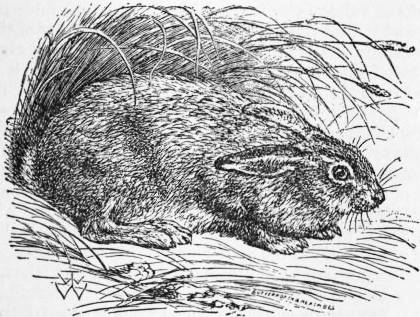
Fig. 1.—The Hare (Lepus europaeus).
The brown hare is a night-feeding animal, remaining during the day on its “form,” as the slight depression is called which it makes in the open field, usually among grass. This it leaves at nightfall to seek fields of young wheat and other cereals whose tender herbage forms its favourite food. It is also fond of gnawing the bark of young trees, and thus often does great damage to plantations. In the morning it returns to its form, where it finds protection in the close approach which the colour of its fur makes to that of its surroundings; should it thus fail, however, to elude observation it depends for safety on its extraordinary fleetness. On the first alarm of danger it sits erect to reconnoitre, when it either seeks concealment by clapping close to the ground, or takes to flight. In the latter case its great speed, and the cunning endeavours it makes to outwit its canine pursuers, form the chief attractions of coursing. The hare takes readily to the water, where it swims well; an instance having been recorded in which one was observed crossing an arm of the sea about a mile in width. Hares are remarkably prolific, pairing when scarcely a year old, and the female bringing forth several broods in the year, each consisting of from two to five leverets (from the Fr. lièvre), as the young are called. These are born covered with hair and with the eyes open, and after being suckled for a month are able to look after themselves. In Europe this species has seldom bred in confinement, although an instance has recently been recorded. It will interbreed with the blue hare. Hares (and rabbits) have a cosmopolitan distribution with the exception of Madagascar and Australasia; and are now divided into numerous genera and subgenera, mentioned in the article Rodentia. Reference may here be made to a few species. Asia is the home of numerous species, of which the Common Indian L. ruficaudatus and the black-necked hare L. nigricollis, are inhabitants of the plains of India; the latter taking its name from a black patch on the neck. In Assam there is a small spiny hare (Caprolagus hispidus), with the habits of a rabbit; and an allied species (Nesolagus nitscheri) inhabits Sumatra, and a third (Pentalagus furnessi) the Liu-kiu Islands. The plateau of Tibet is very rich in species, among which L. hypsibius is very common.
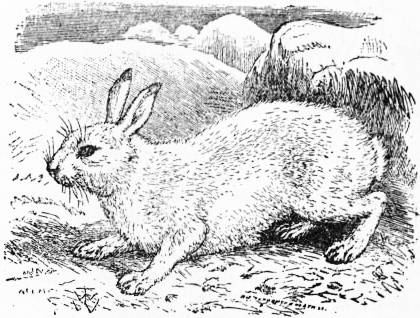
Fig. 2.—The Blue or Mountain Hare (Lepus timidus) in winter dress.
Of African species, the Egyptian Hare (L. aegyptius) is a small animal, with long ears and pale fur; and in the south there are the Cape hare (L. capensis), the long-eared rock-hare (L. saxatilis) and the diminutive Pronolagus crassicaudatus, characterized by its thick red tail.
North America is the home of numerous hares, some of which are locally known as “cotton-tails” and others as “jack-rabbits.” The most northern are the Polar hare (L. arcticus), the Greenland hare (L. groenlandicus) and the Alaska hare (L. timidus tschuktschorum), all allied to the blue hare. Of the others, two, namely the large prairie-hare (L. campestris) and the smaller varying hare (L. [Poecilolagus] americanus), turn white in winter; the former having long ears and the whole tail white, whereas in the latter the ears are shorter and the upper surface of the tail is dark. Of those which do not change colour, the wood-hare, grey-rabbit or cotton-tail, Sylvilagus floridanus, is a southern form, with numerous allied kinds. Distantly allied to the prairie-hare or white-tailed jack-rabbit, are several forms distinguished by having a more or less distinct black stripe on the upper surface of the tail. These include a buff-bellied species found in California, N. Mexico and S.W. Oregon (L. [Macrotolagus] californicus), a large, long-legged form from S. Arizona and Sonora (L. [M.] alleni), the Texan jack-rabbit (L. [M.] texanus) and the black-eared hare (L. [M.] melanotis) of the Great Plains, which differs from the third only by its shorter ears and richer coloration. In S. America, the small tapiti or Brazilian hare (Sylvilagus brasiliensis) is nearly allied to the wood-hare, but has a yellowish brown under surface to the tail.
See also Coursing.
(R. L.*)
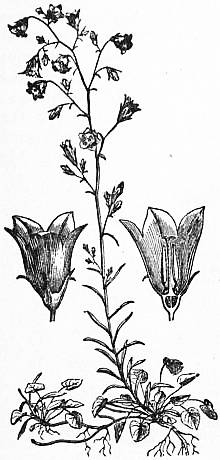
Harebell (Campanula rotundifolia).
HAREBELL (sometimes wrongly written Hairbell), known also as the blue-bell of Scotland, and witches’ thimbles, a well-known perennial wild flower, Campanula rotundifolia, a member of the natural order Campanulaceae. The harebell has a very slender slightly creeping root-stock, and a wiry, erect stem. The radical leaves, that is, those at the base of the stem, to which the specific name rotundifolia refers, have long stalks, and are roundish or heart-shaped with crenate or serrate margin; the lower stem leaves are ovate or lanceolate, and the upper ones linear, subsessile, acute and entire, rarely pubescent. The flowers are slightly drooping, arranged in a panicle, or in small specimens single, having a smooth calyx, with narrow pointed erect segments, the corolla bell-shaped, with slightly recurved segments, and the capsule nodding, and opening by pores at the base. There are two varieties:—(a) genuina, with slender stem leaves, and (b) montana, in which the lower stem-leaves are broader and somewhat elliptical in shape. The plant is found on heaths and pastures throughout Great Britain and flowers in late summer and in autumn; it is widely spread in the north temperate zone. The harebell has ever been a great favourite with poets, and on account of its delicate blue colour has been considered as an emblem of purity.
HAREM, less frequently Haram or Harim (Arab harīm—commonly but wrongly pronounced hārĕm—“that which is illegal or prohibited”), the name generally applied to that part of a house in Oriental countries which is set apart for the women; it is also used collectively for the women themselves. Strictly the women’s quarters are the haremlik (lik, belonging to), as opposed to selamlik the men’s quarters, from which they are in large houses separated by the mabein, the private apartments of the householder. The word harem is strictly applicable to Mahommedan households only, but the system is common in greater or less degree to all Oriental communities, especially where polygamy is permitted. Other names for the women’s quarters are Seraglio (Ital. serraglio, literally an enclosure, from Lat. sera, a bar; wrongly narrowed down to the sense of harem through confusion with Turkish serāi or sarāi, palace or large building, cf. caravanserai); Zenana (strictly zanana, from Persian zan, woman, allied with Gr. γυνή), used specifically of Hindu harems; Andarūn (or Anderoon), the Persian word for the “inner part” (sc. of a house). The Indian harem system is also commonly known as pardah or purdah, literally the name of the thick curtains or blinds which are used instead of doors to separate the women’s quarters from the rest of the house. A male doctor attending a zenana lady would put his hand between the purdah to feel her pulse.
The seclusion of women in the household is fundamental to the Oriental conception of the sex relation, and its origin must, therefore, be sought far earlier than the precepts of Islam as set forth in the Koran, which merely regulate a practically universal Eastern custom.1 It is inferred from the remains of many ancient Oriental palaces (Babylonian, Persian, &c.) that kings and wealthy nobles devoted a special part of the palace to their womankind. Though in comparatively early times there were not wanting men who regarded polygamy as wrong (e.g. the prophets of Israel), nevertheless in the East generally there has never been any real movement against the conception of woman as a chattel of her male relatives. A man may have as many wives and concubines as he can support, but each of these women must be his exclusive property. The object of this insistence upon female chastity is partly the maintenance of the purity of the family with special reference to property, and partly to protect women from marauders, as was the case with the people of India when the Mahommedans invaded the country and sought for women to fill their harems. In Mahommedan countries theoretically a woman must veil her face to all men except her father, her brother and her husband; any violation of this rule is still regarded by strict Mahommedans as the gravest possible offence, though among certain Moslem communities (e.g. in parts of Albania) women of the poorer classes may appear in public unveiled. If any other man make his way into a harem he may lose his life; the attempted escape of a harem woman is a capital offence, the husband having absolute power of life and death, to such an extent that, especially in the less civilized parts of the Moslem world, no one would think of questioning a man’s right to mutilate or kill a disobedient wife or concubine.
Turkish Harems.—A good deal of misapprehension, due to ignorance combined with strong prejudice against the whole system, exists in regard to the system in Turkey. It is often assumed, for example, that the sultan’s seraglio is typical, though on a uniquely large scale, of all Turkish households, and as a consequence that every Turk is a polygamist. This is far from being the case, for though the Koran permits four wives, and etiquette allows the sultan seven, the man of average possessions is perforce content with one, and a small number of female servants. It is, therefore, necessary to take the imperial seraglio separately.
Though the sultan’s household in modern times is by no means as numerous as it used to be, it is said that the harem of Abdul Hamid contained about 1000 women, all of whom were of slave origin. This body of women form an elaborately organized community with a complete system of officers, disciplinary and administrative, and strict distinctions of status. The real ruler of this society is the sultan’s mother, the Sultana Validé, who exercises her authority through a female superintendent, the Kyahya Khatun. She has also a large retinue of subordinate officials (Kalfas) ranging downwards from the Hasnadar ousta (“Lady of the Treasury”) to the “Mistress of the Sherbets” and the “Chief Coffee Server.” Each of these officials has under her a number of pupil-slaves (alaiks), whom she trains to succeed her if need be, and from whom the service is recruited. After the sultana validé (who frequently enjoys considerable political power and is a mistress of intrigue) ranks the mother of the heir-apparent; she is called the Bash Kadin Effendi (“Her excellency the Chief Lady”), and also hasseki or kasseky, and is distinguished from the other three chief wives who only bear the title Kadin Effendi. Next come the ladies who have borne the younger children of the sultan, the Hanum Effendis, and after them the so-called Odalisks or Odalisques (a perversion of odalik, from odah, chamber). These are subdivided, according to the degree of favour in which they stand with the sultan or padishah, into Ikbals (“Favourites”) and Geuzdés (literally the “Eyed” ones), those whom the sultan has favourably noticed in the course of his visits to the apartments of his wives or his mother. All the women are at the disposal of the sultan, though it is contrary to etiquette for him actually to select recruits for his harem. The numbers are kept up by his female relatives and state officials, the latter of whom present girls annually on the evening before the 15th of Ramadan.
Every odalisk who has been promoted to the royal couch receives a daïra, consisting of an allowance of money, a suite of apartments, and a retinue, in proportion to her status. It should be noted that, since all the harem women are slaves, the sultans, with practically no exceptions, have never entered into legal marriage contracts. Any slave, in however menial a position, may be promoted to the position of a kadin effendi. Hence all the slaves who have any pretension to beauty are carefully trained, from the time they enter the harem, in deportment, dancing, music and the arts of the toilette: they are instructed in the Moslem religion and learn the daily prayers (namaz); a certain number are specially trained in reading and writing for secretarial work. Discipline is strict, and continued disobedience leads to corporal punishment by the eunuchs. All the women of the harem are absolutely under the control of the sultana validé (who alone of the harem of her dead husband is not sent away to an older palace when her son succeeds), and owe her the most profound respect, even to the point of having to obtain permission to leave their own apartments. Her financial secretary, the Haznadar Ousta, succeeds to her power if she dies. The sultan’s foster-mother also is a person of importance, and is known as the Taia Kadin.
The security of the harem is in the hands of a body of eunuchs both black and white. The white eunuchs have charge of the outer gates of the seraglio, but they are not allowed to approach the women’s apartments, and obtain no posts of distinction. Their chief, however, the kapu aghasi (“master of the gates”) has part control over the ecclesiastical possessions, and even the vizier cannot enter the royal apartments without his permission. The black eunuchs have the right of entering the gardens and chambers of the harem. Their chief, usually called the kislar aghasi (“master of the maidens”), though his true title is darus skadet aga (“chief of the abode of felicity”), is an official of high importance. His appointment is for life. If he is deprived of his post he receives his freedom; and if he resigns of his own accord he is generally sent to Egypt with a pension of 100 francs a day. His secretary keeps count of the revenues of the mosques built by the sultans. He is usually succeeded by the second eunuch, who bears the title of treasurer, and has charge of the jewels, &c., of the women. The number of eunuchs is always a large one. The sultana validé and the sultana hasseki have each fifty at their service, and others are assigned to the kadins and the favourite odalisks.
The ordinary middle-class household is naturally on a very different scale. The selamlik is on the ground floor with a separate entrance, and there the master of the house receives his male guests; the rest of the ground floor is occupied by the kitchen and perhaps the stables. The haremlik is generally (in towns at least) on the upper floor fronting on and slightly overhanging the street; it has a separate entrance, courtyard and garden. The windows are guarded by lattices pierced with circular holes through which the women may watch without being seen. Communication with the haremlik is effected by a locked door, of which the Effendi keeps the key and also by a sort of revolving cupboard (dutap) for the conveyance of meals. The furniture, of the old-fashioned harems at least, is confined to divans, rugs, carpets and mirrors. For heating purposes the old brass tray of charcoal and wood ash is giving way to American stoves, and there is a tendency to import French furniture and decoration without regard to their suitability.
The presence of a second wife is the exception, and is generally attributable to the absence of children by the first wife. The expense of marrying a free woman leads many Turks to prefer a slave woman who is much more likely to be an amenable partner. If a slave woman bears a child she is often set free and then the marriage ceremony is gone through.
The harem system is, of course, wholly inconsistent with any high ideal of womanhood. Certain misapprehensions, however, should be noticed. The depravity of the system and the vapid idleness of harem life are much exaggerated by observers whose sympathies are wholly against the system. In point of fact much depends on the individuals. In many households there exists a very high degree of mutual consideration and the standard of conduct is by no means degraded. Though a woman may not be seen in the streets without the yashmak which covers her face except for her eyes, and does not leave her house except by her husband’s permission, none the less in ordinary households the harem ladies frequently drive into the country and visit the shops and public baths. Their seclusion has very considerable compensations, and legally they stand on a far better basis in relation to their husbands than do the women of monogamous Christian communities. From the moment when a woman, free or slave, enters into any kind of wifely relation with a man, she has a legally enforceable right against him both for her own and for her children’s maintenance. She has absolute control over her personal property whether in money, slaves or goods; and, if divorce is far easier in Islam than in Christendom, still the marriage settlement must be of such amount as will provide suitable maintenance in that event.
On the other hand, of course, the system is open to the gravest abuse, and in countries like Persia, Morocco and India, the life of Moslem women and slaves is often far different from that of middle class women of European Turkey, where law is strict and culture advanced. The early age at which girls are secluded, the dulness of their surroundings, and the low moral standard which the system produces react unfavourably not only upon their moral and intellectual growth but also upon their capacity for motherhood and their general physique. A harem woman is soon passée, and the lot of a woman past her youth, if she is divorced or a widow, is monotonous and empty. This is true especially of child-widows.
Since the middle of the 19th century familiarity with European customs and the direct influence of European administrators has brought about a certain change in the attitude of Orientals to the harem system. This movement is, however, only in its infancy, and the impression is still strong that the time is not ripe for reform. The Oriental women are in general so accustomed to their condition that few have any inclination to change it, while men as a rule are emphatically opposed to any alteration of the system. The Young Turkish party, the upper classes in Egypt, as also the Babists in Persia, have to some extent progressed beyond the orthodox conception of the status of women, but no radical reform has been set on foot.
In India various attempts have been made by societies, missionary and other, as well as by private individuals, to improve the lot of the zenana women. Zenana schools and hospitals have been founded, and a few women have been trained as doctors and lawyers for the special purposes of protecting the women against their own ignorance and inertia. Thus in 1905 a Parsee Christian lady, Cornelia Sorabjee, was appointed by the Bengal government as legal adviser to the court of wards, so that she might give advice to the widowed mothers of minors within the harem walls. Similarly trained medical women are introduced into zenanas and harems by the Lady Dufferin Association for medical aid to Indian women. Gradually native Christian churches are making provision for the attendance of women at their services, though the sexes are rigorously kept apart. In India, as in Turkey, the introduction of Western dress and education has begun to create new ideas and ambitions, and not a few Eastern women have induced English women to enter the harems as companions, nurses and governesses. But training and environment are extremely powerful, and in some parts of the Mahommedan world, the supply of Asiatic, European and even American girls is so steady, that reform has touched only the fringe of the system.
Among the principal societies which have been formed to better the condition of Indian and Chinese women in general with special reference to the zenana system are the Church of England Zenana Missionary Society and the Zenana Bible and Medical Mission. Much information as to the medical, industrial and educational work done by these societies will be found in their annual reports and other publications. Among these are J. K. H. Denny’s Toward the Uprising; Irene H. Barnes, Behind the Pardah (1897), an account of the former society’s work; the general condition of Indian women is described in Mrs Marcus B. Fuller’s Wrongs of Indian Womanhood (1900), and Maud Dover’s The Englishwoman in India (1909); see also article Missions.
Authorities.—The literature of the subject is very large, though a great deal of it is naturally based on insufficient evidence, and coloured by Western prepossessions. Among useful works are A. van Sommer and Zwerner, Our Moslem Sisters (1907), a collection of essays by authors acquainted with various parts of the Mahommedan world and strongly opposed to the whole harem system; Mrs W. M. Ramsay, Everyday Life in Turkey (1897), cc. iv. and v., containing an account of a day in a harem near Afium-Kara-Hissar; cf. e.g. art. “Harem” in Hughes, Dictionary of Islam; Mrs S. Harvey’s Turkish Harems and Circassian Homes (1871); for Mahomet’s regulations, see R. Bosworth Smith’s Mohammed and Mohammedanism (1889); for Egypt, Lane, Manners and Customs of the Modern Egyptians (1837); and E. Lott, Harem Life in Egypt and Constantinople (1869); for the sultan’s household in the 18th century, Lady Wortley Montagu’s Letters, with which may be compared S. Lane-Poole, Turkey (ed. 1909); G. Dorys, La Femme turque (1902); especially Lucy M. J. Garnett (with J. S. Stuart-Glennie), The Women of Turkey (London, 1901), and The Turkish People (London, 1909). For the attempts which have been made to modify and improve the Indian zenana system, see e.g. the reports of the Dufferin Association and other official publications. Other information will be found in Hoffman’s article in Ersch and Gruber’s Encyclopädie; Flandin in Revue des deux mondes (1852) on the harem of the Persian prince Malik Kasim Mirza; the count de Beauvoir, in Voyage round the World (1870), on Javanese and Siamese harems; Häntzsche in Zeitschrift für allgemeine Erdkunde (Berlin, 1864).
(J. M. M.)
1 In Africa also, among the non-Mahommedan negroes of the west coast and the Bahima of the Victoria Nyanza, the seclusion of women of the upper classes has been practised in states (e.g. Ashanti and Buganda) possessing a considerable degree of civilization.
HARFLEUR, a port of France in the department of Seine-Inférieure, about 6 m. E. of Havre by rail. Pop. (1906) 2864. It lies in the fertile valley of the Lézarde, at the foot of wooded hills not far from the north bank of the estuary of the Seine. The port, which had been rendered almost inaccessible owing to the deposits of the Lézarde, again became available on the opening of the Tancarville canal (1887) connecting it with the port of Havre and with the Seine. Vessels drawing 18 ft. can moor alongside the quays of the new port, which is on a branch of the canal, has some trade in coal and timber, and carries on fishing. The church of St Martin is the most remarkable building in the town, and its lofty stone steeple forms a landmark for the pilots of the river. It dates from the 15th and 16th centuries, but the great portal is the work of the 17th, and the whole has undergone modern restoration. Of the old castle there are only insignificant ruins, near which, in a fine park, stands the present castle, a building of the 17th century. The old ramparts of the town are now replaced by manufactories, and the fosses are transformed into vegetable gardens. There is a statue of Jean de Grouchy, lord of Montérollier, under whose leadership the English were expelled from the town in 1435. The industries include distilling, metal founding and the manufacture of oil and grease.
Harfleur is identified with Caracotinum, the principal port of the ancient Calates. In the middle ages, when its name, Herosfloth, Harofluet or Hareflot, was still sufficiently uncorrupted to indicate its Norman derivation, it was the principal seaport of north-western France. In 1415 it was captured by Henry V. of England, but when in 1435 the people of the district of Caux rose against the English, 104 of the inhabitants opened the gates of the town to the insurgents, and thus got rid of the foreign yoke. The memory of the deed was long perpetuated by the bells of St Martin’s tolling 104 strokes. Between 1445 and 1449 the English were again in possession; but the town was recovered for the French by Dunois. In the 16th century the port began to dwindle in importance owing to the silting up of the Seine estuary and the rise of Havre. In 1562 the Huguenots put Harfleur to pillage, and its registers and charters perished in the confusion; but its privileges were restored by Charles IX. in 1568, and it was not till 1710 that it was subjected to the “taille.”
HARIANA, a tract of country in the Punjab, India, once the seat of a flourishing Hindu civilization. It consists of a level upland plain, interspersed with patches of sandy soil, and largely overgrown with brushwood. The Western Jumna canal irrigates the fields of a large number of its villages. Since the 14th century Hissar has been the local capital. During the troubled period which followed on the decline of the Mogul empire, Hariana formed the battlefield where the Mahrattas, Bhattis and Sikhs met to settle their territorial quarrels. The whole country was devastated by the famine of 1783. In 1797-1798 Hariana was overrun by the famous Irish adventurer George Thomas, who established his capital at Hansi; in 1801 he was dispossessed by Sindhia’s French general Perron; in 1803 Hariana passed under British rule. On the conquest of the Punjab Hariana was broken up into the districts of Hissar, Rohtak and Sirsa, which last has in its turn been divided between Hissar and Ferozepore.
HARINGTON, SIR JOHN (1561-1612), English writer, was born at Kelston, near Bath, in 1561. His father, John Harington, acquired considerable estates by marrying Etheldreda, a natural daughter of Henry VIII., and after his wife’s death he was attached to the service of the Princess Elizabeth. He married Isabella Markham, one of her ladies, and on Mary’s accession he and his wife were imprisoned in the Tower with the princess. John, the son of the second marriage, was Elizabeth’s godson. He studied at Eton and at Christ’s College, Cambridge, where he took the degree of M.A., his tutor being John Still, afterwards bishop of Bath and Wells, formerly reputed to be the author of Gammer Gurton’s Needle. He came up to London about 1583 and was entered at Lincoln’s Inn, but his talents marked him out for success at court rather than for a legal career. Tradition relates that he translated the story of Giocondo from Ariosto and was reproved by the queen for acquainting her ladies with so indiscreet a selection. He was to retire to his seat at Kelston until he completed the translation of the entire work. Orlando Furioso in English heroical verse was published in 1591 and reprinted in 1607 and 1634. Harington was high sheriff of Somerset in 1592 and received Elizabeth at his house during her western progress of 1591. In 1596 he published in succession The Metamorphosis of Ajax, An Anatomie of the Metamorphosed Ajax, and Ulysses upon Ajax, the three forming collectively a very absurd and indecorous work of a Pantagruelistic kind. An allusion to Leicester in this book threw the writer into temporary disgrace, but in 1598 he received a commission to serve in Ireland under Essex. He was knighted on the field, to the annoyance of Elizabeth. Harington saved himself from being involved in Essex’s disgrace by writing an account of the Irish campaign which increased Elizabeth’s anger against the unfortunate earl. Among some papers found in the chapter library at York was a Tract on the Succession to the Crown (1602), written by Harington to secure the favour of the new king, to whom he sent the gift of a lantern constructed to symbolize the waning glory of the late queen and James’s own splendour. This pamphlet, which contains many details of great interest about Elizabeth and gives an unprejudiced sketch of the religious question, was edited for the Roxburghe Club in 1880 by Sir Clements Markham. Harington’s efforts to win favour at the new court were unsuccessful. In 1605 he even asked for the office of chancellor of Ireland and proposed himself as archbishop. The document in which he preferred this extraordinary request was published in 1879 with the title of A Short View of the State of Ireland written in 1605. Harington was before his time in advocating a policy of generosity and conciliation towards that country. He eventually succeeded in obtaining a position as one of the tutors of Prince Henry, for whom he annotated Francis Godwin’s De praesulibus Angliae. Harington’s grandson, John Chetwind, found in this somewhat scandalous production an argument for the Presbyterian side, and published it in 1653, under the title of A Briefe View of the State of the Church, &c.
Harington died at Kelston on the 20th of November 1612. His Epigrams were printed in a collection entitled Alcilia in 1613, and separately in 1615. The translation of the Orlando Furioso was carried out with skill and perseverance. It is not to be supposed that Harington failed to realize the ironic quality of his original, but he treated it as a serious allegory to suit the temper of Queen Elizabeth’s court. He was neither a very exact scholar nor a very poetical translator, and he cannot be named in the same breath with Fairfax. The Orlando Furioso was sumptuously illustrated, and to it was prefixed an Apologie of Poetrie, justifying the subject matter of the poem, and, among other technical matters, the author’s use of disyllabic and trisyllabic rhymes, also a life of Ariosto compiled by Harington from various Italian sources. Harington’s Rabelaisian pamphlets show that he was almost equally endowed with wit and indelicacy, and his epigrams are sometimes smart and always easy. His works include The Englishman’s Doctor, Or the School of Salerne (1608), and Nugae antiquae, miscellaneous papers collected in 1779.
A biographical account of Harington is prefixed to the Roxburghe Club edition of his tract on the succession mentioned above.
ḤARĪRĪ [Abū Maḥommed ul-Qāsim ibn ’Ali ibn Maḥommed al-Ḥarīrī,] i.e. “the manufacturer or seller of silk”] (1054-1122), Arabian writer, was born at Baṣra. He owned a large estate with 18,000 date-palms at Mashān, a village near Baṣra. He is said to have occupied a government position, but devoted his life to the study of the niceties of the Arabic language. On this subject he wrote a grammatical poem the Mulḥat ul-‘Irāb (French trans. Les Récréations grammaticales with notes by L. Pinto, Paris 1885-1889; extracts in S. de Sacy’s Anthologie arabe, pp. 145-151, Paris, 1829); a work on the faults of the educated called Ḍurrat ul-Ghawwās (ed. H. Thorbecke, Leipzig, 1871), and some smaller treatises such as the two letters on words containing the letters sin and shin (ed. in Arnold’s Chrestomathy, pp. 202-9). But his fame rests chiefly on his fifty maqāmas (see Arabia: Literature, section “Belles Lettres”). These were written in rhymed prose like those of Hamadhānī, and are full of allusions to Arabian history, poetry and tradition, and discussions of difficult points of Arabic grammar and rhetoric.
The Maqāmas have been edited with Arabic commentary by S. de Sacy (Paris, 1822, 2nd ed. with French notes by Reinaud and J. Derenbourg, Paris, 1853); with English notes by F. Steingass (London, 1896). An English translation with notes was made by T. Preston (London, 1850), and another by T. Chenery and F. Steingass (London, 1867 and 1898). Many editions have been published in the East with commentaries, especially with that of Sharīshī (d. 1222).
(G. W. T.)
HARI-RUD, a river of Afghanistan. It rises in the northern slopes of the Koh-i-Baba to the west of Kabul, and finally loses itself in the Tejend oasis north of the Trans-Caspian railway and west of Merv. It runs a remarkably straight course westward through a narrow trough from Daolatyar to Obeh, amidst the bleak wind-swept uplands of the highest central elevations in Afghanistan. From Obeh to Kuhsan 50 m. west of Herat, it forms a valley of great fertility, densely populated and highly cultivated; practically all its waters being drawn off for purposes of irrigation. It is the contrast between the cultivated aspect of the valley of Herat and the surrounding desert that has given Herat its great reputation for fertility. Three miles to the south of Herat the Kandahar road crosses the river by a masonry bridge of 26 arches now in ruins. A few miles below Herat the river begins to turn north-west, and after passing through a rich country to Kuhsan, it turns due north and breaks through the Paropamisan hills. Below Kuhsan it receives fresh tributaries from the west. Between Kuhsan and Zulfikar it forms the boundary between Afghanistan and Persia, and from Zulfikar to Sarakhs between Russia and Persia. North of Sarakhs it diminishes rapidly in volume till it is lost in the sands of the Turkman desert. The Hari-Rud marks the only important break existing in the continuity of the great central water-parting of Asia. It is the ancient Arius.
(T. H. H.*)
HARISCHANDRA, in Hindu mythology, the 28th king of the Solar race. He was renowned for his piety and justice. He is the central figure of legends in the Aitareyabrahmana, Mahabharata and the Markandeyapurana. In the first he is represented as so desirous of a son that he vows to Varuna that if his prayer is granted the boy shall be eventually sacrificed to the latter. The child is born, but Harischandra, after many delays, arranges to purchase another’s son and make a vicarious sacrifice. According to the Mahabharata he is at last promoted to Paradise as the reward for his munificent charity.
ḤĀRITH IBN ḤILLIZA UL-YASHKURĪ, pre-Islamic Arabian poet of the tribe of Bakr, famous as the author of one of the poems generally received among the Mo‘allakāt (q.v.). Nothing is known of the details of his life.
ḤARIZI, JUDAH BEN SOLOMON (13th cent.), called also al-Ḥarizi, a Spanish Hebrew poet and traveller. He translated from the Arabic to Hebrew some of the works of Maimonides (q.v.) and also of the Arab poet Ḥariri. His own most considerable work was the Taḥkemoni, composed between 1218 and 1220. This is written in Hebrew in unmetrical rhymes, in what is commonly termed “rhymed prose.” It is a series of humorous episodes, witty verses, and quaint applications of Scriptural texts. The episodes are bound together by the presence of the hero and of the narrator, who is also the author. Ḥarizi not only brought to perfection the art of applying Hebrew to secular satire, but he was also a brilliant literary critic and his makame on the Andalusian Hebrew poets is a fruitful source of information.
See, on the Taḥkemoni, Kaempf, Nicht-andalusische Poesie andalusischer Dichter (Prague, 1858). In that work a considerable section of the Taḥkemoni is translated into German.
(I. A.)
HARKNESS, ALBERT (1822-1907), American classical scholar, was born at Mendon, Massachusetts, on the 6th of October 1822. He graduated at Brown University in 1842, taught in the Providence high school in 1843-1853, studied in Berlin, Bonn (where in 1854 he was the first American to receive the degree of Ph.D.) and Göttingen, and was professor of Greek language and literature in Brown University from 1855 to 1892, when he became professor emeritus. He was one of the founders in 1869 of the American Philological Association, of which he was president in 1875-1876, and to whose Transactions he made various contributions; was a member of the Archaeological Institute’s committee on founding the American School of Classical Studies at Athens, and served as the second director of that school in 1883-1884. He studied English and German university methods during trips to Europe in 1870 and 1883, and introduced a new scholarly spirit into American teaching of Latin in secondary schools with a series of Latin text-books, which began in 1851 with a First Latin Book and continued for more than fifty years. His Latin Grammar (1864, 1881) and Complete Latin Grammar (1898) are his best-known books. He was a member of the board of fellows of Brown University from 1904 until his death, and in 1904-1905 was president of the Rhode Island Historical Society. He died in Providence, Rhode Island, on the 27th of May 1907.
His son, Albert Granger Harkness (1857- ), also a classical scholar, was born in Providence, Rhode Island, on the 19th of November 1857. He graduated at Brown University in 1879, studied in Germany in 1879-1883, and was professor of German and Latin at Madison (now Colgate) University from 1883 to 1889, and associate professor of Latin at Brown from 1889 to 1893, when he was appointed to the chair of Roman literature and history there. He was director of the American School of Classical Studies in Rome in 1902-1903.
HARKNESS, ROBERT (1816-1878), English geologist, was born at Ormskirk, Lancashire, on the 28th of July 1816. He was educated at the high school, Dumfries, and afterwards (1833-1834) at the university of Edinburgh where he acquired an interest in geology from the teachings of Robert Jameson and J. D. Forbes. Returning to Ormskirk he worked zealously at the local geology, especially on the Coal-measures and New Red Sandstone, his first paper (read before the Manchester Geol. Soc. in 1843) being on The Climate of the Coal Epoch. In 1848 his family went to reside in Dumfries and there he commenced to work on the Silurian rocks of the S.W. of Scotland, and in 1849 he carried his investigations into Cumberland. In these regions during the next few years he added much to our knowledge of the strata and their fossils, especially graptolites, in papers read before the Geological Society of London. He wrote also on the New Red rocks of the north of England and Scotland. In 1853 he was appointed professor of geology in Queen’s College, Cork, and in 1856 he was elected F.R.S. During this period he wrote some articles on the geology of parts of Ireland, and exercised much influence as a teacher, but he returned to England during his vacations and devoted himself assiduously to the geology of the Lake district. He was also a constant attendant at the meetings of the British Association. In 1876 the syllabus for the Queen’s Colleges in Ireland was altered, and Professor Harkness was required to lecture not only on geology, palaeontology, mineralogy and physical geography, but also on zoology and botany. The strain of the extra work proved too much, he decided to relinquish his post, and had retired but a short time when he died, on the 4th of October 1878.
“Memoir,” by J. G. Goodchild, in Trans. Cumberland Assoc. No. viii. (with portrait). In memory of Professor Harkness his sister established two Harkness scholarships. One scholarship (of the value of about £35 a year, tenable for three years) for women, tenable at either Girton or Newnham College, Cambridge, is awarded triennially to the best candidate in an examination in geology and palaeontology, provided that proficiency be shown; the other, for men, is vested in the hands of the university of Cambridge, and is awarded annually, any member of the university being eligible who has graduated as a B.A., “provided that not more than three years have elapsed since the 19th day of December next following his final examination for the degree of bachelor of arts.”
HARLAN, JAMES (1820-1899), American politician, was born in Clark county, Illinois, on the 26th of August 1820. He graduated from Indiana Asbury (now De Pauw) University in 1845, was president (1846-1847) of the newly founded and short-lived Iowa City College, studied law, was first superintendent of public instruction in Iowa in 1847-1848, and was president of Iowa Wesleyan University in 1853-1855. He took a prominent part in organizing the Republican party in Iowa, and was a member of the United States Senate from 1855 to 1865, when he became secretary of the interior. He had been a delegate to the peace convention in 1861, and from 1861 to 1865 was chairman of the Senate committee on public lands. He disapproved of President Johnson’s conservative reconstruction policy, retired from the cabinet in August 1866, and from 1867 to 1873 was again a member of the United States Senate. In 1866 he was a delegate to the loyalists’ convention at Philadelphia. One of his principal speeches in the Senate was that which he made in March 1871 in reply to Sumner’s and Schurz’s attack on President Grant’s Santo Domingan policy. He was presiding judge of the court of commissioners of Alabama claims (1882-1885). He died in Mount Pleasant, Iowa, on the 5th of October 1899.
HARLAN, JOHN MARSHALL (1833- ), American jurist, was born in Boyle county, Kentucky, on the 1st of June 1833. He graduated at Centre College, Danville, Ky., in 1850, and at the law department of Transylvania University, Lexington, in 1853. He was county judge of Franklin county in 1858-1859, was an unsuccessful candidate for Congress on the Whig ticket in 1859, and was elector on the Constitutional Union ticket in 1860. On the outbreak of the Civil War he recruited and organized the Tenth Kentucky United States Volunteer Infantry, and in 1861-1863 served as colonel. Retiring from the army in 1863, he was elected by the Union party attorney-general of the state, and was re-elected in 1865, serving from 1863 to 1867, when he removed to Louisville to practise law. He was the Republican candidate for governor in 1871 and in 1875, and was a member of the commission which was appointed by President Hayes early in 1877 to accomplish the recognition of one or other of the existing state governments of Louisiana (q.v.); and he was a member of the Bering Sea tribunal which met in Paris in 1893. On the 29th of November 1877 he became an associate justice of the United States Supreme Court. In this position he showed himself a liberal constructionist. In opinions on the Civil Rights cases and in the interpretation of the 13th, 14th and 15th Amendments to the Constitution, he dissented from the majority of the court and advocated increasing the power of the Federal government. He supported the constitutionality of the income tax clause in the Wilson Tariff Bill of 1894, and he drafted the decision of the court in the Northern Securities Company Case, which applied to railways the provisions of the Sherman Anti-Trust Law. In 1889 he became a professor in the Law School of the Columbian University (afterwards George Washington University) in Washington, D.C.
HARLAND, HENRY (1861-1905), American novelist, was born in St Petersburg, Russia, in March 1861, and was educated in New York and at Harvard. He went to Europe as a journalist, and, after publishing several novels, mainly of American-Jewish life (under the name of Sidney Luska), first made his literary reputation in London as editor of the Yellow Book in 1894. His association with this clever publication, and his own contributions to it, brought his name into prominence, but it was not till he published The Cardinal’s Snuff-box (1900), followed by The Lady Paramount (1902), that his lightly humorous touch and picturesque style as a novelist brought him any real success. His health was always delicate, and he died at San Remo on the 20th of December 1905.
HARLAY DE CHAMPVALLON, FRANÇOIS DE (1625-1695), 5th archbishop of Paris, was born in that city on the 14th of August 1625. Nephew of François de Harlay, archbishop of Rouen, he was presented to the abbey of Jumièges immediately on leaving the Collège de Navarre, and he was only twenty-six when he succeeded his uncle in the archiepiscopal see. He was transferred to the see of Paris in 1671, he was nominated by the king for the cardinalate in 1690, and the domain of St Cloud was erected into a duchy in his favour. He was commander of the order of the Saint Esprit and a member of the French Academy. During the early part of his political career he was a firm adherent of Mazarin, and is said to have helped to procure his return from exile. His private life gave rise to much scandal, but he had a great capacity for business, considerable learning, and was an eloquent and persuasive speaker. He definitely secured the favour of Louis XIV. by his support of the claims of the Gallican Church formulated by the declaration made by the clergy in assembly on the 19th of March 1682, when Bossuet accused him of truckling to the court like a valet. One of the three witnesses of the king’s marriage with Madame de Maintenon, he was hated by her for using his influence with the king to keep the matter secret. He had a weekly audience of Louis XIV. in company with Père la Chaise on the affairs of the Church in Paris, but his influence gradually declined, and Saint-Simon, who bore him no good will for his harsh attitude to the Jansenists, says that his friends deserted him as the royal favour waned, until at last most of his time was spent at Conflans in company with the duchess of Lesdiguières, who alone was faithful to him. He urged the revocation of the edict of Nantes, and showed great severity to the Huguenots at Dieppe, of which he was temporal and spiritual lord. He died suddenly, without having received the sacraments, on the 6th of August 1695. His funeral discourse was delivered by the Père Gaillard, and Mme de Sévigné made on the occasion the severe comment that there were only two trifles to make this a difficult matter—his life and his death.
See Abbé Legendre, Vita Francisci de Harlay (Paris, 1720) and Éloge de Harlay (1695); Saint-Simon, Mémoires (vol. ii., ed. A. de Boislisle, 1879), and numerous references in the Lettres of Mme de Sévigné.
HARLECH (perhaps for Hardd lech, fair slate, or Harleigh, an Anglicized variant), a town of Merionethshire, Wales, 38 m. from Aberystwyth, and 29 from Carnarvon on the Cambrian railway. Pop. 900. Ruins of a fortress crown the rock of Harlech, about half a mile from the sea. Discovery of Roman coins makes it probable that it was once occupied by the Romans. In the 3rd century Bronwen (white bosom), daughter of Bran Fendigaid (the blessed), is said to have stayed here, perhaps by force; and there was here a tower, called Twr Bronwen, and replaced about A.D. 550 by the building of Maelgwyn Gwynedd, prince of North Wales. In the early 10th century, Harlech castle was, apparently, repaired by Colwyn, lord of Ardudwy, founder of one of the fifteen North Wales tribes, and thence called Caer Colwyn. The present structure dates, like many others in the principality, from Edward I., perhaps even from the plans of the architect of Carnarvon and Conway castles, but with the retention of old portions. It is thought to have been square, each side measuring some 210 ft., with towers and turrets. Glendower held it for four years. Here, in 1460, Margaret, wife of Henry VI., defeated at Northampton, took refuge. Dafydd ap Ieuan ap Einion held it for the Lancastrians, until famine, rather than Edward IV., made him surrender. From this time is said to date the air “March of the men of Harlech” (Rhyfelgerdd gwyr Harlech). The castle was alternately Roundhead and Cavalier in the civil war. Edward I. made Harlech a free borough, and it was formerly the county town. It is in the parish of Llandanwg (pop. in 1901, 931). Though interesting from an antiquarian point of view, the district around, especially Dyffryn Ardudwy (the valley), is dreary and desolate, e.g. Drws (the door of) Ardudwy, Rhinog fawr and Rhinog fach (cliffs); an exception is the verdant Cwm bychan (little combe or hollow). The Meini gwyr Ardudwy (stones of the men of Ardudwy) possibly mark the site of a fight.
HARLEQUIN, in modern pantomime, the posturing and acrobatic character who gives his name to the “harlequinade,” attired in mask and parti-coloured and spangled tights, and provided with a sword like a bat, by which, himself invisible, he works wonders. It has generally been assumed that Harlequin was transferred to France from the “Arlecchino” of Italian medieval and Renaissance popular comedy; but Dr Driesen in his Ursprung des Harlekins (Berlin, 1904) shows that this is incorrect. An old French “Harlekin” (Herlekin, Hellequin and other variants) is found in folk-literature as early as 1100; he had already become proverbial as a ragamuffin of a demoniacal appearance and character; in 1262 a number of harlekins appear in a play by Adam de la Halle as the intermediaries of King Hellekin, prince of Fairyland, in courting Morgan le Fay; and it was not till much later that the French Harlekin was transformed into the Italian Arlecchino. In his typical French form down to the time of Gottsched, he was a spirit of the air, deriving thence his invisibility and his characteristically light and aery whirlings. Subsequently he returned from the Italian to the French stage, being imported by Marivaux into light comedy; and his various attributes gradually became amalgamated into the latter form taken in pantomime.
HARLESS (originally Harles), GOTTLIEB CHRISTOPH (1738-1815), German classical scholar and bibliographer, was born at Culmbach in Bavaria on the 21st of June 1738. He studied at Halle, Erlangen and Jena. In 1765 he was appointed professor of oriental languages and eloquence at the Gymnasium Casimirianum in Coburg, in 1770 professor of poetry and eloquence at Erlangen, and in 1776 librarian of the university. He held his professorship for forty-five years till his death on the 2nd of November 1815. Harless was an extremely prolific writer. His numerous editions of classical authors, deficient in originality and critical judgment, although valuable at the time as giving the student the results of the labours of earlier scholars, are now entirely superseded. But he will always be remembered for his meritorious work in connexion with the great Bibliotheca Graeca of J. A. Fabricius, of which he published a new and revised edition (12 vols., 1790-1809, not quite completed),—a task for which he was peculiarly qualified. He also wrote much on the history and bibliography of Greek and Latin literature.
His life was written by his son, Johann Christian Friedrich Harless (1818).
HARLESS, GOTTLIEB CHRISTOPH ADOLF VON (1806-1879), German divine, was born at Nuremberg on the 21st of November 1806, and was educated at the universities of Erlangen and Halle. He was appointed professor of theology at Erlangen in 1836 and at Leipzig in 1845. He was a strong Lutheran and exercised a powerful influence in that direction as court preacher in Dresden and as president of the Protestant consistory at Munich. His chief works were Theologische Encyklopädie und Methodologie (1837) and Die christliche Ethik (1842, Eng. trans. 1868). He died on the 5th of September 1879, having, a few years earlier, written an autobiography under the title Bruchstücke aus dem Leben eines süddeutschen Theologen.
HARLINGEN, a seaport in the province of Friesland, Holland, on the Zuider Zee, and the terminus of the railway and canal from Leeuwarden (15½ m. E.). It is connected by steam tramway by way of Bolswaard with Sneek. Pop. (1900) 10,448. Harlingen has become the most considerable seaport of Friesland since the construction of the large outer harbour in 1870-1877, and in addition to railway and steamship connexion with Bremen, Amsterdam, and the southern provinces there are regular sailings to Hull and London. Powerful sluices protect the inner harbour from the high tides. The only noteworthy buildings are the town hall (1730-1733), the West church, which consists of a part of the former castle of Harlingen, the Roman Catholic church, the Jewish synagogue and the schools of navigation and of design. The chief trade of Harlingen is the exportation of Frisian produce, namely, butter and cheese, cattle, sheep, fish, potatoes, flax, &c. There is also a considerable import trade in timber, coal, raw cotton, hemp and jute for the Twente factories. The local industries are unimportant, consisting of saw-mills, rope-yards, salt refineries, and sail-cloth and margarine factories.