VOLUME XII SLICE VIII Haller, Albrecht to Harmonium (continued 8)
Reading edition
HANTHAWADDY, a district in the Pegu division of Lower Burma, the home district of Rangoon, from which the town was detached to make a separate district in 1880. It has an area of 3023 sq. m., with a population in 1901 of 484,811, showing an increase of 22% in the decade. Hanthawaddy and Henzada are the two most densely populated districts in the province. It consists of a vast plain stretching up from the sea between the To or China Bakir mouth of the Irrawaddy and the Pegu Yomas. Except the tract lying between the Pegu Yomas on the east and the Hlaing river, the country is intersected by numerous tidal creeks, many navigable by large boats and some by steamers. The headquarters of the district are in Rangoon, which is also the sub-divisional headquarters. The second sub-division has its headquarters at Insein, where there are large railway works. Cultivation is almost wholly confined to rice, but there are many vegetable and fruit gardens.
HANUKKAH, a Jewish festival, the “Feast of Dedication” (cf. John x. 22) or the “Feast of the Maccabees,” beginning on the 25th day of the ninth month Kislev (December), of the Hebrew ecclesiastical year, and lasting eight days. It was instituted in 165 B.C. in commemoration of, and thanksgiving for, the purification of the temple at Jerusalem on this day by Judas Maccabaeus after its pollution by Antiochus Epiphanes, king of Syria, who in 168 B.C. set up a pagan altar to Zeus Olympius. The Talmudic sources say that when the perpetual lamp of the temple was to be relighted only one flask of holy oil sufficient for the day remained, but this miraculously lasted for the eight days (cf. the legend in 2 Macc. i. 18). In memory of this the Jews burn both in synagogues and in houses on the first night of the festival one light, on the second two, and so on to the end (so the Hillelites), or vice versa eight lights on the first, and one less on each succeeding night (so the Shammaites). From the prominence of the lights the festival is also known as the “Festival of Lights” or “Illumination” (Talmud). It is said that the day chosen by Judas for the setting up of the new altar was the anniversary of that on which Antiochus had set up the pagan altar; hence it is suggested (e.g. by Wellhausen) that the 25th of Kislev was an old pagan festival, perhaps the day of the winter solstice.
For further details and illustrations of Ḥanukkah lamps see Jewish Encyc., s.v.
HANUMAN, in Hindu mythology, a monkey-god, who forms a central figure in the Ramayana. He was the child of a nymph by the god of the wind. His exploits, as the ally of Rama (incarnation of Vishnu) in the latter’s recovery of his wife Sita from the clutches of the demon Ravana, include the bridging of the straits between India and Ceylon with huge boulders carried away from the Himalayas. He is the leader of a host of monkeys who aid in these supernatural deeds. Temples in his honour are frequent throughout India.
HANWAY, JONAS (1712-1786), English traveller and philanthropist, was born at Portsmouth in 1712. While still a child, his father, a victualler, died, and the family moved to London. In 1729 Jonas was apprenticed to a merchant in Lisbon. In 1743, after he had been some time in business for himself in London, he became a partner with Mr Dingley, a merchant in St Petersburg, and in this way was led to travel in Russia and Persia. Leaving St Petersburg on the 10th of September 1743, and passing south by Moscow, Tsaritsyn and Astrakhan, he embarked on the Caspian on the 22nd of November, and arrived at Astrabad on the 18th of December. Here his goods were seized by Mohammed Hassan Beg, and it was only after great privations that he reached the camp of Nadir Shah, under whose protection he recovered most (85%) of his property. His return journey was embarrassed by sickness (at Resht), by attacks from pirates, and by six weeks’ quarantine; and he only reappeared at St Petersburg on the 1st of January 1745. He again left the Russian capital on the 9th of July 1750 and travelled through Germany and Holland to England (28th of October). The rest of his life was mostly spent in London, where the narrative of his travels (published in 1753) soon made him a man of note, and where he devoted himself to philanthropy and good citizenship. In 1756 he founded the Marine Society, to keep up the supply of British seamen; in 1758 he became a governor of the Foundling, and established the Magdalen, hospital; in 1761 he procured a better system of parochial birth-registration in London; and in 1762 he was appointed a commissioner for victualling the navy (10th of July); this office he held till October 1783. He died, unmarried, on the 5th of September 1786. He was the first Londoner, it is said, to carry an umbrella, and he lived to triumph over all the hackney coachmen who tried to hoot and hustle him down. He attacked “vail-giving,” or tipping, with some temporary success; by his onslaught upon tea-drinking he became involved in controversy with Johnson and Goldsmith. His last efforts were on behalf of little chimney-sweeps. His advocacy of solitary confinement for prisoners and opposition to Jewish naturalization were more questionable instances of his activity in social matters.
Hanway left seventy-four printed works, mostly pamphlets; the only one of literary importance is the Historical Account of British Trade over the Caspian Sea, with a Journal of Travels, &c. (London, 1753). On his life, see also Pugh, Remarkable Occurrences in the Life of Jonas Hanway (London, 1787); Gentleman’s Magazine, vol. xxxii. p. 342; vol. lvi. pt. ii. pp. 812-814, 1090, 1143-1144; vol. lxv. pt. ii. pp. 721-722, 834-835; Notes and Queries, 1st series, i. 436, ii. 25; 3rd series, vii. 311; 4th series, viii. 416.
HANWELL, an urban district in the Brentford parliamentary division of Middlesex, England, 10½ m. W. of St Paul’s cathedral, London, on the river Brent and the Great Western railway. Pop. (1891) 6139; (1901) 10,438. It ranks as an outer residential suburb of London. The Hanwell lunatic asylum of the county of London has been greatly extended since its erection 1831, and can accommodate over 2500 inmates. The extensive cemeteries of St Mary Abbots, Kensington, and St George, Hanover Square, London, are here. In the churchyard of St Mary’s church was buried Jonas Hanway (d. 1786), traveller, philanthropist, and by repute, introducer of the umbrella into England. The Roman Catholic Convalescent Home for women and children was erected in 1865. Before the Norman period the manor of Hanwell belonged to Westminster Abbey.
HAPARANDA (Finnish Haaparanta, “Aspen Shore”), a town of Sweden in the district (län) of Norbotten, at the head of the Gulf of Bothnia. Pop. (1900) 1568. It lies about 1½ m. from the mouth of the Torne river, on the frontier with Russia (Finland), opposite the town of Torneå which has belonged to Russia since 1809. The towns are divided by a marshy channel, formerly the bed of the Torne, but the main stream is now east of the Russian town. Haparanda was founded in 1812, and at first bore the name of Karljohannstad. It received its municipal constitution in 1842. Shipbuilding is prosecuted. Sea-going vessels load and unload at Salmio, 7 m. from Haparanda. Since 1859 the town has been the seat of an important meteorological station. Annual mean temperature, 32.4° Fahr.; February 10.5°; July 58.8°. Rainfall, 16.5 in. annually. Up the Torne valley (54 m.) is the hill Avasaxa, whither pilgrimages were formerly made in order to stand in the light of the sun at midnight on St John’s day (June 24).
HAPLODRILI (so called by Lankester), often called Archiannelida (Hatschek), the name provisionally given to a number of interesting lowly-organized marine worms, whose affinities are very doubtful (see Chaetopoda.) Polygordius and Protodrilus live in sand, but while the former moves by means of the contraction of its body-wall muscles, Protodrilus can progress by the action of the bands of cilia surrounding its segments, and of the longitudinal ciliated ventral groove. Saccocirrus, which also lives in sand, and more closely resembles the Polychaeta, has throughout the greater length of its body on each segment a pair of small uniramous parapodia bearing a bunch of simple setae. No other member of the group is known to have any trace of setae or parapodia at any stage of development.
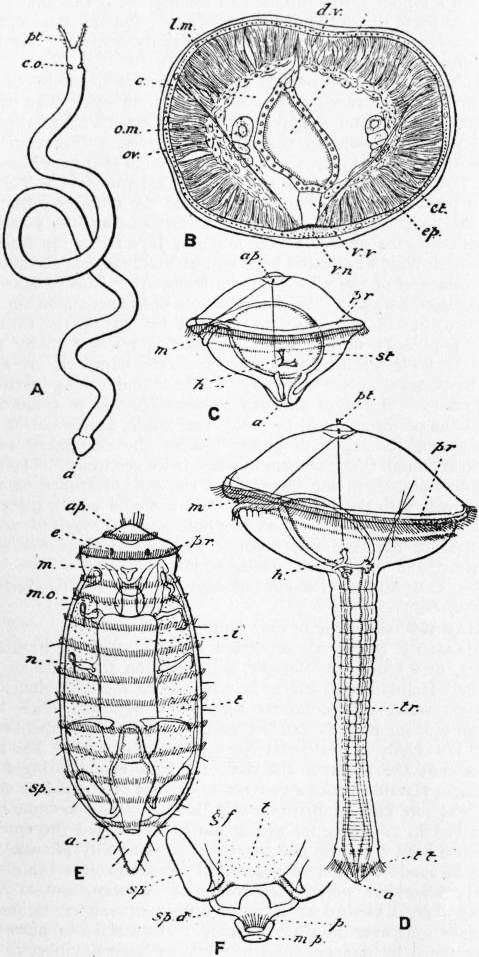
Fig. 1.
A, Polygordius neapolitanus. (From Fraipont.) B, Transverse section of Polygordius. (From Fraipont.) C, Trochophore of Polygordius. and D, later stage of the same, showing the development of the trunk. (From Hatschek.) E, Dorsal view of Dinophilus taeniatus. F, Male apparatus of the same (From Harmer.) a, Anus. ap, Apical organ. c, Coelom. c.o, Ciliated pit. c.t, Cuticle. d.v, Dorsal vessel. e, Eye. ep, Epidermis. g.f, Genital funnel. h, “Head kidney,” with second nephridium just below it. i, Intestine. l.m, Longitudinal muscles. m, Mouth. m.o, Muscular pharyngeal organ. m.p, Male pore. n, Nephridium. o.m, Oblique muscles. ov, Ovary. p, Penis. pr, Prototroch. pt, Prostomial tentacle. sp, Sperm-sac. spd, Sperm-duct. st, Stomach. t, Testes. tr, Trunk segment. tt, Telotroch. v.n, Ventral nerve cord. v.v, Ventral vessel.
These three genera have the following characters in common. The body is composed of a large number of segments; the prostomium bears a pair of tentacles; the nervous system consists of a brain and longitudinal ventral nerve cords closely connected with the epidermis (without distinct ganglia), widely separated in Saccocirrus, closely approximated in Protodrilus, fused together in Polygordius; the coelom is well developed, the septa are distinct, and the dorsal and ventral longitudinal mesenteries are complete; the nephridia are simple, and open into the coelom. Polygordius differs from Protodrilus and Saccocirrus in the absence of a distinct suboesophageal muscular pouch, and in the absence of a peculiar closed cavity in the head region, which is especially well developed in Saccocirrus, and probably represents the specialized coelom of the first segment. Moreover, in Saccocirrus the genital organs, present in the majority of the trunk segments, have become much complicated (fig. 2). In the female there is in every fertile segment a pair of spermathecae opening at the nephridiopores. In the male there are a right and a left protrusible penis in every genital segment, into which opens the nephridium and a sperm-sac. The wide funnels of the nephridia of this region are possibly of coelomic origin.
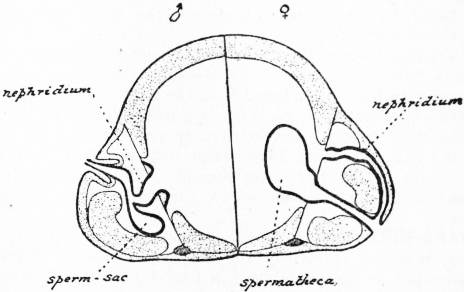
Fig. 2.—Diagram of a transverse section of Saccocirrus showing on the left side the organs in a genital segment of a male, and on the right side the organs in a genital segment of a female. (From Goodrich.)
Dinophilus is a free-swimming form without tentacles, and with segmental bands of cilia (fig. 1). The parasitic Histriodritus (Histriobdella) feeds on the eggs of the lobster. It resembles Dinophilus in the possession of a ventral pharyngeal pouch (which bears teeth in Histriodrilus only), the small number of segments, and absence of distinct septa, the absence of a vascular system, the presence of distinct ganglia on the ventral nerve cords, and of small nephridia which do not appear to open internally. Histriodrilus resembles Saccocirrus in the possession of two posterior adhesive processes, and to some extent in the structure of the complex genital organs, which, however, are restricted to a single segment. In Dinophilus, there is also only a single pair of genital ducts behind; and in the male there are sperm-sacs and a median penis. In some species of Dinophilus there is pronounced sexual dimorphism (the male being small and without gut) as in the Rotifera. The resemblance of Dinophilus to the Rotifera is, however, quite superficial, and the general structure of this genus with distinct traces of segmentation, especially in the embryo, points to its close affinity, if not to Polygordius in particular, at all events to the Annelida.
That Polygordius, Protodrilus and Saccocirrus are on the whole primitive forms, and related to each other, there can be little doubt, but their place amongst the Annelida is difficult to determine. The development of Polygordius alone is well known, having been studied by Hatschek, Fraipont and others. The larva (fig. 1, C and D) is a typical but very specialized form of trochophore, provided with a branching nephridium bearing solenocytes. The trunk develops on the lower surface of the disk-like larva, which undergoes a more or less sudden metamorphosis into the young worm (fig. 1). There appears to be little either in the development or in the structure of the Haplodrili to warrant the view held by Hatschek and Fraipont that Polygordius and Protodrilus are exceedingly primitive forms, ancestral to the whole group of seta-bearing Annelids (Oligochaeta, Polychaeta, Hirudinea and Echiuroidea). Whatever may be the conclusion as to the position of Dinophilus and Histriodrilus, it seems only reasonable to suppose that Polygordius and Protodrilus, so far from representing a stage in the phylogeny of the Annelida before setae were developed, have lost the setae, which are already in a reduced state in Saccocirrus.
Authorities.—Hatschek, “Studien z. Entw. der Anneliden,” Arb. Zool. Inst. Wien, vol. i., 1878; “Protodrilus,” ibid. vol. iii. (1881); Fraipont, “Le Genre Polygordius,” Fauna u. Flora d. Golfes v. Neapel., xiv., 1887; Weldon, “Dinophilus gigas,” Quart. Journ. Micr. Sci. vol. xxvii., 1886; Harmer, “Dinophilus,” Journ. Mar. Biol. N.S. vol. i., 1889; Schimkewitsch, “Entwickl. des Dinophilus,” Zeit. f. wiss. Zool. vol. lix., 1895; Korschelt, “Über Bau u. Entw. des Dinophilus,” Zeit. f. wiss. Zool. vol. xxxvii., 1882; Foettinger, “Histriobdella,” Arch. Biol. vol. v., 1884; Goodrich, “On Saccocirrus,” Quart. Journ. Micr. Sci. vol. xliv., 1901.
(E. S. G.)
HAPTARA (lit. conclusion), the Hebrew title given to the prophetic lessons with which the ancient Synagogue service concluded. In the time of Christ these prophetic lessons were already in vogue, and Christ himself read the lessons and discoursed on them in the synagogues of Galilee. In the modern synagogue these readings from the prophets are regularly included in the ritual of Sabbaths, festivals and some other occasions.
A list of the current lessons is given in the Jewish Encyclopedia, vol. vi. pp. 136-137.
(I. A.)
HAPUR, a town of British India in the Meerut district of the United Provinces, 18 m. S. of Meerut. Pop. (1901) 17,796. It is said to have been founded in the 10th century, and was granted by Sindhia to his French general Perron at the end of the 18th century. Several fine groves surround the town, but the wall and ditch have fallen out of repair, and only the names of the five gates remain. Considerable trade is carried on in sugar, grain, cotton, timber, bamboos and brass utensils.
HARA-KIRI (Japanese hara, belly, and kiri, cutting), self-disembowelment, primarily the method of suicide permitted to offenders of the noble class in feudal Japan, and later the national form of honourable suicide. Hara-kiri has been often translated as “the happy dispatch” in confusion with a native euphemism for the act. More usually the Japanese themselves speak of hara-kiri by its Chinese synonym, Seppuku. Hara-kiri is not an aboriginal Japanese custom. It was a growth of medieval militarism, the act probably at first being prompted by the desire of the noble to escape the humiliation of falling into an enemy’s hands. By the end of the 14th century the custom had become a much valued privilege, being formally established as such under the Ashi-Kaga dynasty. Hara-kiri was of two kinds, obligatory and voluntary. The first is the more ancient. An official or noble, who had broken the law or been disloyal, received a message from the emperor, couched always in sympathetic and gracious tones, courteously intimating that he must die. The mikado usually sent a jewelled dagger with which the deed might be done. The suicide had so many days allotted to him by immemorial custom in which to make dignified preparations for the ceremony, which was attended by the utmost formality. In his own baronial hall or in a temple a daïs 3 or 4 in. from the ground was constructed. Upon this was laid a rug of red felt. The suicide, clothed in his ceremonial dress as an hereditary noble, and accompanied by his second or “Kaishaku,” took his place on the mat, the officials and his friends ranging themselves in a semicircle round the daïs. After a minute’s prayer the weapon was handed to him with many obeisances by the mikado’s representative, and he then made a public confession of his fault. He then stripped to the waist. Every movement in the grim ceremony was governed by precedent, and he had to tuck his wide sleeves under his knees to prevent himself falling backwards, for a Japanese noble must die falling forward. A moment later he plunged the dagger into his stomach below the waist on the left side, drew it across to the right and, turning it, gave a slight cut upward. At the same moment the Kaishaku who crouched at his friend’s side, leaping up, brought his sword down on the outstretched neck. At the conclusion of the ceremony the bloodstained dagger was taken to the mikado as a proof of the consummation of the heroic act. The performance of hara-kiri carried with it certain privileges. If it was by order of the mikado half only of a traitor’s property was forfeited to the state. If the gnawings of conscience drove the disloyal noble to voluntary suicide, his dishonour was wiped out, and his family inherited all his fortune.
Voluntary hara-kiri was the refuge of men rendered desperate by private misfortunes, or was committed from loyalty to a dead superior, or as a protest against what was deemed a false national policy. This voluntary suicide still survives, a characteristic case being that of Lieutenant Takeyoshi who in 1891 gave himself the “belly-cut” in front of the graves of his ancestors at Tōkyo as a protest against what he considered the criminal lethargy of the government in not taking precautions against possible Russian encroachments to the north of Japan. In the Russo-Japanese War, when faced by defeat at Vladivostock, the officer in command of the troops on the transport “Kinshu Maru” committed hara-kiri. Hara-kiri has not been uncommon among women, but in their case the mode is by cutting the throat. The popularity of this self-immolation is testified to by the fact that for centuries no fewer than 1500 hara-kiris are said to have taken place annually, at least half being entirely voluntary. Stories of amazing heroism are told in connexion with the performance of the act. One noble, barely out of his teens, not content with giving himself the customary cuts, slashed himself thrice horizontally and twice vertically. Then he stabbed himself in the throat until the dirk protruded on the other side with the sharp edge to the front, and with a supreme effort drove the knife forward with both hands through his neck. Obligatory hara-kiri was obsolete in the middle of the 19th century, and was actually abolished in 1868.
See A. B. Mitford, Tales of Old Japan; Basil Hall Chamberlain, Things Japanese (1898).
HARALD, the name of four kings of Norway.
Harald I. (850-933), surnamed Haarfager (of the beautiful hair), first king over Norway, succeeded on the death or his father Halfdan the Black in A.D. 860 to the sovereignty of several small and somewhat scattered kingdoms, which had come into his father’s hands through conquest and inheritance and lay chiefly in south-east Norway (see Norway). The tale goes that the scorn of the daughter of a neighbouring king induced Harald to take a vow not to cut nor comb his hair until he was sole king of Norway, and that ten years later he was justified in trimming it; whereupon he exchanged the epithet “Shockhead” for the one by which he is usually known. In 866 he made the first of a series of conquests over the many petty kingdoms which then composed Norway; and in 872, after a great victory at Hafrsfjord near Stavanger, he found himself king over the whole country. His realm was, however, threatened by dangers from without, as large numbers of his opponents had taken refuge, not only in Iceland, then recently discovered, but also in the Orkneys, Shetlands, Hebrides and Faeroes, and in Scotland itself; and from these winter quarters sallied forth to harry Norway as well as the rest of northern Europe. Their numbers were increased by malcontents from Norway, who resented Harald’s claim of rights of taxation over lands which the possessors appear to have previously held in absolute ownership. At last Harald was forced to make an expedition to the west to clear the islands and Scottish mainland of Vikings. Numbers of them fled to Iceland, which grew into an independent commonwealth, while the Scottish isles fell under Norwegian rule. The latter part of Harald’s reign was disturbed by the strife of his many sons. He gave them all the royal title and assigned lands to them which they were to govern as his representatives; but this arrangement did not put an end to the discord, which continued into the next reign. When he grew old he handed over the supreme power to his favourite son Erik “Bloody Axe,” whom he intended to be his successor. Harald died in 933, in his eighty-fourth year.
HARALD II., surnamed Graafeld, a grandson of Harald I., became, with his brothers, ruler of the western part of Norway in 961; he was murdered in Denmark in 969.
Harald III. (1015-1066), king of Norway, surnamed Haardraade, which might be translated “ruthless,” was the son of King Sigurd and half-brother of King Olaf the Saint. At the age of fifteen he was obliged to flee from Norway, having taken part in the battle of Stiklestad (1030), at which King Olaf met his death. He took refuge for a short time with Prince Yaroslav of Novgorod (a kingdom founded by Scandinavians), and thence went to Constantinople, where he took service under the empress Zoe, whose Varangian guard he led to frequent victory in Italy, Sicily and North Africa, also penetrating to Jerusalem. In the year 1042 he left Constantinople, the story says because he was refused the hand of a princess, and on his way back to his own country he married Ellisif or Elizabeth, daughter of Yaroslav of Novgorod. In Sweden he allied himself with the defeated Sven of Denmark against his nephew Magnus, now king of Norway, but soon broke faith with Sven and accepted an offer from Magnus of half his kingdom. In return for this gift Harald is said to have shared with Magnus the enormous treasure which he had amassed in the East. The death of Magnus in 1047 put an end to the growing jealousies between the two kings, and Harald turned all his attention to the task of subjugating Denmark, which he ravaged year after year; but he met with such stubborn resistance from Sven that in 1064 he gave up the attempt and made peace. Two years afterwards, possibly instigated by the banished Earl Tostig of Northumbria, he attempted the conquest of England, to the sovereignty of which his predecessor had advanced a claim as successor of Harthacnut. In September 1066 he landed in Yorkshire with a large army, reinforced from Scotland, Ireland and the Orkneys; took Scarborough by casting flaming brands into the town from the high ground above it; defeated the Northumbrian forces at Fulford; and entered York on the 24th of September. But the following day the English Harold arrived from the south, and the end of the long day’s fight at Stamford Bridge saw the rout of the Norwegian forces after the fall of their king (25th of September 1066). He was only fifty years old, but he was the first of the six kings who had ruled Norway since the death of Harald Haarfager to reach that age. As a king he was unpopular on account of his harshness and want of good faith, but his many victories in the face of great odds prove him to have been a remarkable general, of never-failing resourcefulness and indomitable courage.
Harald IV. (d. 1136), king of Norway, surnamed Gylle (probably from Gylle Krist, i.e. servant of Christ), was born in Ireland about 1103. About 1127 he went to Norway and declared he was a son of King Magnus III. (Barefoot), who had visited Ireland just before his death in 1103, and consequently a half-brother of the reigning king, Sigurd. He appears to have submitted successfully to the ordeal of fire, and the alleged relationship was acknowledged by Sigurd on condition that Harald did not claim any share in the government of the kingdom during his lifetime or that of his son Magnus. Living on friendly terms with the king, Harald kept this agreement until Sigurd’s death in 1130. Then war broke out between himself and Magnus, and after several battles the latter was captured in 1134, his eyes were put out, and he was thrown into prison. Harald now ruled the country until 1136, when he was murdered by Sigurd Slembi-Diakn, another bastard son of Magnus Barefoot. Four of Harald’s sons, Sigurd, Ingi, Eysteinn and Magnus, were subsequently kings of Norway.
HARBIN, or Kharbin, town of Manchuria, on the right bank of the river Sungari. Pop. about 20,000. Till 1896 there was only a small village here, but in that year the town was founded in connexion with surveys for the Chinese Eastern railway company, at a point which subsequently became the junction of the main line of the Manchurian railway with the branch line southward to Port Arthur. Occupying such a position, Harbin became an important Russian military centre during the Russo-Japanese War. The portion of the town founded in 1896 is called Old Harbin, but the centre has shifted to New Harbin, where the chief public buildings and offices of the railway administration are situated. The river-port forms a third division of the town, industrially the most important; here are railway workshops, factories and mercantile establishments. Trade is chiefly in the hands of the Chinese.
HARBINGER, originally one who provides a shelter or lodging for an army. The word is derived from the M. E. and O. Fr. herbergere, through the Late Lat. heribergator, formed from the O. H. Ger. heri, mod. Ger. Heer, an army, and bergen, shelter or defence, cf. “harbour.” The meaning was soon enlarged to include any place where travellers could be lodged or entertained, and also by transference the person who provided lodgings, and so one who goes on before a party to secure suitable lodgings in advance. A herald sent forward to announce the coming of a king. A Knight Harbinger was an officer in the royal household till 1846. In these senses the word is now obsolete. It is used chiefly in poetry and literature for one who announces the immediate approach of something, a forerunner. This is illustrated in the “harbinger of spring,” a name given to a small plant belonging to the Umbelliferae, which has a tuberous root, and small white flowers; it is found in the central states of North America, and blossoms in March.
HARBOUR (from M. E. hereberge, here, an army; cf. Ger. Heer and -beorg, protection or shelter. Other early forms in English were herberwe and harborow, as seen in various place names, such as Market Harborough. The French auberge, an inn, derived through heberger, is thus the same word), a place of refuge or shelter. It is thus used for an asylum for criminals, and particularly for a place of shelter for ships.
Sheltered sites along exposed sea-coasts are essential for purposes of trade, and very valuable as refuges for vessels from storms. In a few places, natural shelter is found in combination with ample depth, as in the Bay of Rio de Janeiro, New York Harbour (protected by Long Island), Portsmouth Harbour and Southampton Water (sheltered by the Isle of Wight), and the land-locked creeks of Milford Haven and Kiel Harbour. At various places there are large enclosed areas which have openings into the sea; but these lagoons for the most part are very shallow except in the main channels and at their outlets. Access to them is generally obstructed by a bar as at the lagoon harbour of Venice (fig. 1), and similar harbours, like those of Poole and Wexford; and such harbours usually require works to prevent their deterioration, and to increase the depth near their outlet. Generally, however, harbours are formed where shelter is provided to a certain extent by a bay, creek or projecting headland, but requires to be rendered complete by one or more breakwaters (see Breakwater), or where the approach to a river, a ship-canal or a seaport, needs protection. A refuge harbour is occasionally constructed where a long length of stormy coast, near the ordinary track of vessels, is entirely devoid of natural shelter. Naval harbours are required by maritime powers as stations for their fleets, and dockyards for construction and repairs, and also in some cases as places of shelter from the night attacks of torpedoes. Commercial harbours have to be provided for the formation of ports within their shelter on important trade routes, or for the protection of the approaches from the sea of ports near the sea-coast, or maritime waterways running inland, in some cases at points on the coast devoid of all natural shelter. A greater latitude in the selection of suitable sites is, indeed, possible for refuge and naval harbours than for commercial harbours; but these three classes of harbours are very similar in their general outline and the works protecting them, only differing in size and internal arrangements according to the purpose for which they have been constructed, the chief differences being due to the local conditions.
Harbours may be divided into three distinct groups, namely, lagoon harbours, jetty harbours and sea-coast harbours, protected by breakwaters, including refuge, naval and commercial harbours.
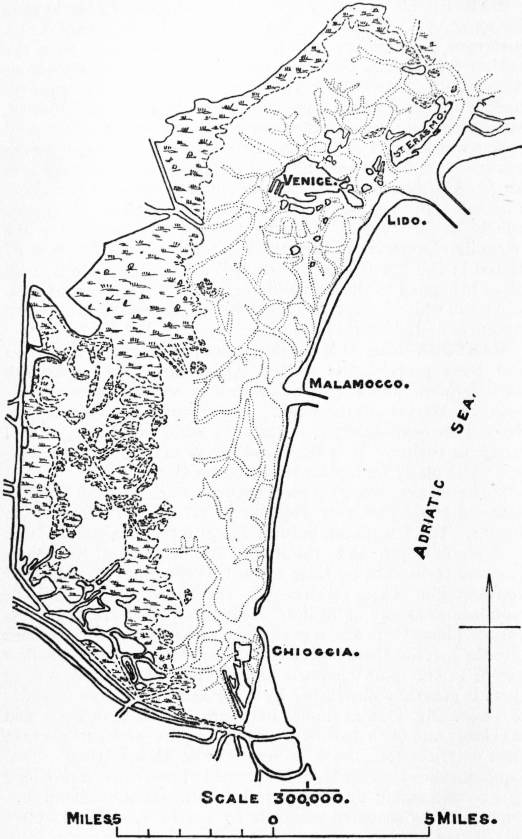
Fig. 1.—Venetian Lagoon Harbour.
Lagoon Harbours.—A lagoon, consisting of a sort of large shallow lake separated from the sea by a narrow belt of coast, formed of deposit from a deltaic river or of sand dunes heaped up by on-shore winds along a sandy shore, possesses good natural shelter; and, owing to the large expanse which is filled and emptied at each tide, even when the tidal range is quite small, together with the discharge from any rivers flowing into the lagoon, one or more fairly deep outlets are maintained through the fringe of coast, which afford navigable access to the lagoon; whilst channels formed inside by the currents lead to ports on its banks. Lagoons, however, are liable to be gradually silted up, if rivers flowing into them bring down considerable quantities of alluvium, which is readily deposited in their fairly still waters; and their outlet channels are in danger of becoming shallower, by the sea in storms forming additional outlets by breaking through the narrow barrier separating them from the sea. Moreover, the approach from the sea to these channels through the fringe of coast is generally impeded by a bar, owing to the scour of the issuing current through these outlet channels becoming gradually too enfeebled, on entering the open sea, to overcome the heaping-up action of the waves along the shore, which tends to form a continuous beach across these openings. Rivers, accordingly, whose discharge is very valuable in maintaining a lagoon if their waters are free from sediment, must, if possible, be diverted from a lagoon if they bring down large amounts of silt; whilst the narrow belt of land in front of the lagoon must be protected from erosion by the waves, on its sea face, by groynes or revetments. The depth over the bar in front of an outlet can be improved by concentrating the current through the outlet by jetties on each side, and prolonging the jetties, and consequently the scour, out to the bar so as to lower it, and by supplementing the scouring action, if necessary, by dredging.
Jetty Harbours.—Several small ports were formed on the sea-coast long ago at points where flat marshy ground lying below the level of high-water, and shut off from the sandy beach by dikes or sand dunes, was connected with the sea by a small creek or river. Such ports presented in their original condition a slight resemblance to lagoons on a very small scale. Several examples are to be found on the sandy shores of the English Channel and North Sea, such as Dieppe, Boulogne, Calais, Dunkirk, Nieuport and Ostend, where the influx and efflux of the water from these enclosed tide-covered areas, through a narrow opening, sufficed to maintain a shallow channel to the sea across the beach, deep enough near high-water for vessels of small draught. When the increase in draught necessitated the provision of an improved channel, the scour of the issuing current was concentrated and prolonged by erecting parallel jetties across the beach, raised solid to a little above low water of neap tides, with open timber-work above to indicate the channel and guide the vessels. Even this low obstruction, however, to the littoral drift of sand caused an advance of the low water line as the jetties were carried out, so that further extensions of the jetties had eventually to be abandoned, as occurred at Dunkirk (see Dock). Moreover, reclamation of the low-lying areas was gradually effected, thus reducing the tidal scour; and sluicing basins were excavated in part of the low ground, into which the tide flowed through the entrance channel, and the water being shut in at high tide by gates at the outlet of the basin, was released at low water, producing a rapid current through the channel as a compensation for the loss of the former natural scour. The current, however, from the sluicing basin gradually lost its velocity in passing down the channel, and besides, being most effective near the outlet of the basin, could only scour the channel down to a moderate depth below low water, on account of the increase in the volume of still water in the channel at low tide as its deepening progressed. Lastly, about 1880, improvements in suction dredgers (see Dredge and Dredging) led to the adoption of sand-pump dredging in the outer part of the channel, and across the foreshore in front to deep water; and at Dunkirk, docks were formed on the site of the sluicing basin; whilst at Calais sluicing was abandoned in favour of dredging. Ostend is the only jetty harbour in which a large sluicing basin has been recently constructed, but it can only provide for the maintenance of deep-water quays in its vicinity; and dredging is relied upon to an increasing extent, both for the maintenance and further deepening of the outer portion of the approach channel, and for maintaining the direct channel dredged to deep water across the Stroombank extending in front of Ostend (fig. 2).
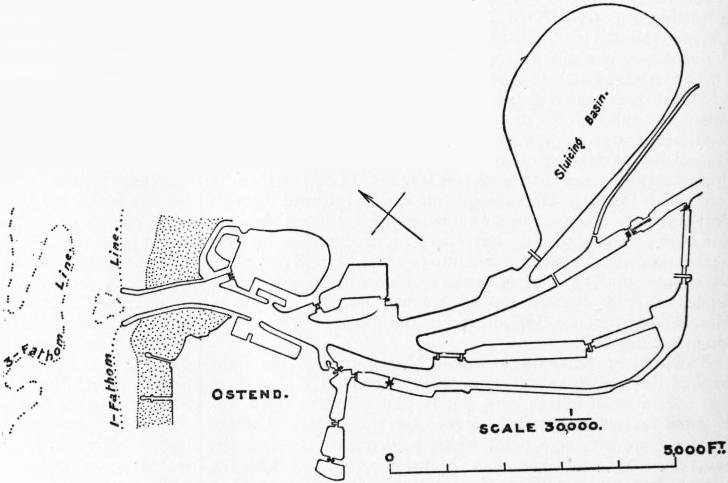
Fig. 2.—Ostend Harbour and Jetty Channel.
Similar methods of improving the entrance channel to ports possessing an extensive backwater have been adopted on a large scale in the United States. For instance at Charleston, converging jetties, about 2¾ m. long, have been extended across the bar to concentrate the scour due to a small tidal range expanding over the enclosed backwater, 15 sq. m. in extent, and to protect the channel from littoral drift; but these jetties have caused an advance of the foreshore, and a progression seawards of the bar, necessitating dredging beyond the ends of the jetties to maintain the requisite depth.
Parallel jetties, moreover, across the beach, combined with extensive sand-pump dredging, have been employed with success at some of the ports situated at the outlet of rivers, enclosed bays, or lagoons, on the sandy shores of south-east Africa, for improving the access to them across encumbering shoals, where the littoral drift is too great to allow of the projection of breakwaters from the shore to shelter an approach channel.
Harbours Protected by Breakwaters.—The design for a harbour on the sea-coast must depend on the configuration of the adjacent coast-line, the extent and direction of the exposure, the amount of sheltered area required and the depth obtainable, the prospect of the accumulation of drift or the occurrence of scour from the proposed works, and the best position for an entrance in respect of shelter and depth of approach.
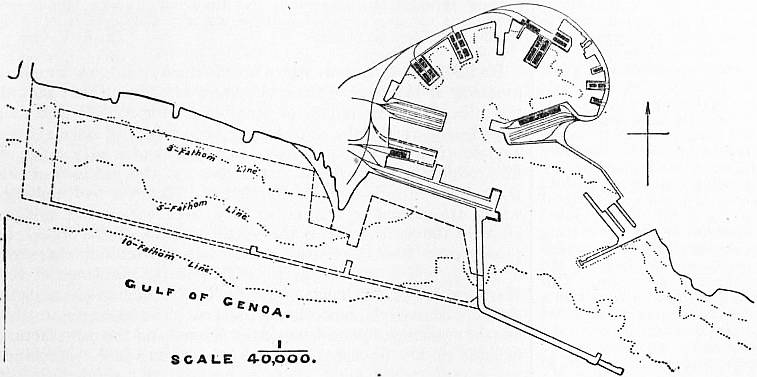
Fig. 3.—Genoa Harbour and Extensions.
Completion of Shelter of Harbours in Bays.—In the case of a deep, fairly land-locked bay, a detached breakwater across the outlet completes the necessary shelter, leaving an entrance between each extremity and the shore, provided there is deep enough water near the shore, as effected at Plymouth harbour, and also across the wider but shallower bay forming Cherbourg harbour. A breakwater may instead be extended across the outlet from each shore, leaving a single central entrance between the ends of the breakwaters; and if one breakwater placed somewhat farther out is made to overlap an inner one, a more sheltered entrance is obtained. This arrangement has been adopted at the existing Genoa harbour within the bay (fig. 3), and for the harbour at the mouth of the Nervion (see River Engineering). The adoption of a bay with deep water for a harbour does not merely reduce the shelter to be provided artificially, but it also secures a site not exposed to silting up, and where the sheltering works do not interfere with any littoral drift along the open coast. A third method of sheltering a deep bay is that adopted for forming a refuge harbour at Peterhead (fig. 4), where a single breakwater is extended out from one shore for 3250 ft. across the outlet of the bay, leaving a single entrance between its extremity and the opposite shore and enclosing an area of about 250 acres at low tide, half of which has a depth of over 5 fathoms.
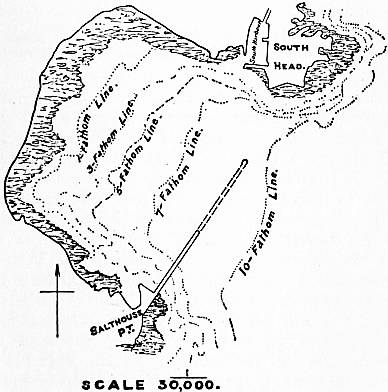
Fig. 4.—Peterhead Harbour of Refuge.
Harbours possessing partial Natural Shelter.—The most common form of harbour is that in which one or more breakwaters supplement a certain amount of natural shelter. Sometimes, where the exposure is from one direction only, approximately parallel with the coast-line at the site, and there is more or less shelter from a projecting headland or a curve of the coast in the opposite direction, a single breakwater extending out at right angles to the shore, with a slight curve or bend inwards near its outer end, suffices to afford the necessary shelter. As examples of this form of harbour construction may be mentioned Newhaven breakwater, protecting the approach to the port from the west, and somewhat sheltered from the moderate easterly storms by Beachy Head, and Table Bay breakwater, which shelters the harbour from the north-east, and is somewhat protected on the opposite side by the wide sweep of the coast-line known as Table Bay. Generally, however, some partial embayment, or abrupt projection from the coast, is utilized as providing shelter from one quarter, which is completed by breakwaters enclosing the site, of which Dover and Colombo (fig. 5) harbours furnish typical and somewhat similar examples.
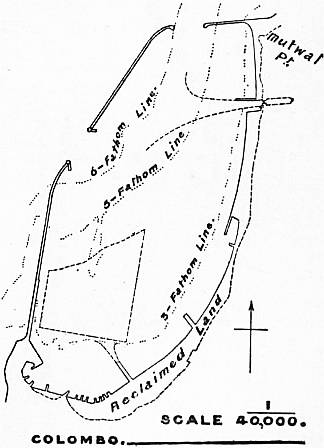
Fig. 5.—Colombo Harbour.
Harbours formed on quite Open Seacoasts.—Occasionally harbours have to be constructed for some special purpose where no natural shelter exists, and where on an open, sandy shore considerable littoral drift may occur. Breakwaters, carried out from the shore at some distance apart, and converging to a central entrance of suitable width, provide the requisite shelter, as for instance the harbour constructed to form a sheltered approach to the river Wear and the Sunderland docks (fig. 6). If there is little littoral drift from the most exposed quarter, the amount of sand brought in during storms, which is smaller in proportion to the depth into which the entrance is carried, can be readily removed by dredging; whilst the scour across the projecting ends of the breakwaters tends to keep the outlet free from deposit. Where there is littoral drift in both directions on an open, sandy coast, due to winds blowing alternately from opposite quarters, sand accumulates in the sheltered angles outside the harbour between each converging breakwater and the shore. This has happened at Ymuiden harbour at the entrance to the Amsterdam ship-canal on the North Sea, but there the advance of the shore appears to have reached its limit only a short distance out from the old shore-line on each side; and the only evidence of drift consists in the advance seawards of the lines of soundings alongside, and in the considerable amount of sand which enters the harbour and has to be removed by dredging. The worst results occur where the littoral drift is almost wholly in one direction, so that the projection of a solid breakwater out from the shore causes a very large accretion on the side facing the exposed quarter; whilst owing to the arrest of the travel of sand, erosion of the beach occurs beyond the second breakwater enclosing the harbour on its comparatively sheltered side. These effects have been produced at Port Said harbour at the entrance to the Suez Canal from the Mediterranean, formed by two converging breakwaters, where, owing to the prevalent north-westerly winds, the drift is from west to east, and is augmented by the alluvium issuing from the Nile. Accordingly, the shore has advanced considerably against the outer face of the western breakwater; and erosion of the beach has occurred at the shore end of the eastern breakwater, cutting it off from the land. The advance of the shore-line, however, has been much slower during recent years; and though the progress seawards of the lines of soundings close to and in front of the harbour continues, the advance is checked by the sand and silt coming from the west passing through some apertures purposely left in the western breakwater, and falling into the approach channel, from which it is readily dredged and taken away. Madras harbour, begun in 1875, consists of two breakwaters, 3000 ft. apart, carried straight out to sea at right angles to the shore for 3000 ft., and completed by two return arms inclined slightly seawards, enclosing an area of 220 acres and leaving a central entrance, 550 ft. wide, facing the Indian Ocean in a depth of about 8 fathoms. The great drift, however, of sand along the coast from south to north soon produced an advance of the shore against the outside of the south breakwater, and erosion beyond the north breakwater; and the progression of the foreshore has extended so far seawards as to produce shoaling at the entrance. Accordingly, the closing of the entrance, and the formation of a new entrance through the outer part of the main north breakwater, facing north and sheltered by an arm starting from the angle of the northern return arm and running north parallel to the shore, round the end of which vessels would turn to enter, have been recommended, to provide a deep entrance beyond the influence of the advancing foreshore.
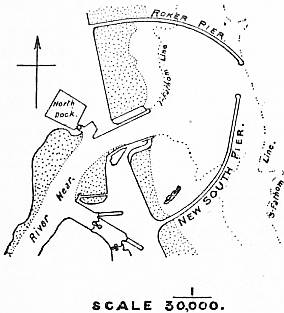
Fig. 6.—Sunderland Harbour.
Proposals have been made from time to time to evade this advance of the foreshore against a solid obstacle, by extending an open viaduct across the zone of littoral drift, and forming a closed harbour, or a sheltering breakwater against which vessels can lie, beyond the influence of accretion. This principle was carried out on a large scale at the port of call and sheltering breakwater constructed in front of the entrance to the Bruges ship-canal, at Zeebrugge on the sandy North Sea coast, where a solid breakwater, provided with a wide quay furnished with sidings and sheds, and curving round so as to overlap thoroughly the entrance to the canal and shelter a certain water-area, is approached by an open metal viaduct extending out 1007 ft. from low water into a depth of 20 ft. (fig. 7). It is hoped that by thus avoiding interference with the littoral drift close to the shore, coming mainly from the west, the accumulation of silt to the west of the harbour, and also in the harbour itself, will be prevented; and though it appears probable that some accretion will occur within the area sheltered by the breakwater, it will to some extent be disturbed by the wash of the steamers approaching and leaving the quays, and can readily be removed under shelter by dredging.
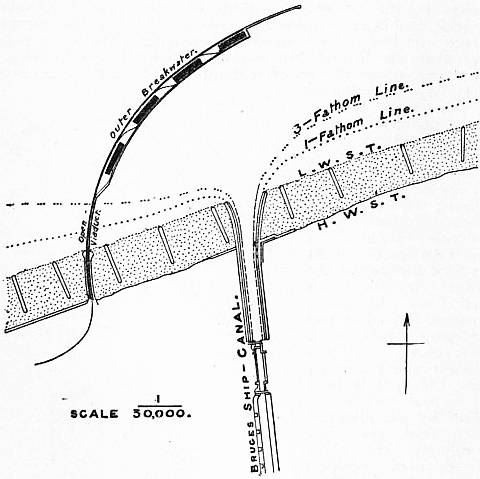
Fig. 7.—Zeebrugge Harbour.
Entrances to Harbours.—Though captains of vessels always wish for wide entrances to harbours as affording greater facility of safe access, it is important to keep the width as narrow as practicable, consistent with easy access, to exclude waves and swell as much as possible and secure tranquillity inside. At Madras, the width of 550 ft. proved excessive for the great exposure of the entrance, and moderate size of the harbour, which does not allow of the adequate expansion of the entering swell. Where an adequately easy and safe approach can be secured, it is advantageous to make the entrance face a somewhat sheltered quarter by the overlapping of the end of one of the breakwaters, as accomplished at Bilbao and Genoa harbours (fig. 3), and at the southern entrance to Dover harbour. Occasionally, owing to the comparative shelter afforded by a bend in the adjacent coast-line, a very wide entrance can be left between a breakwater and the shore; typical examples are furnished by the former open northern entrance to Portland harbour, now closed against torpedoes, and the wide entrances at Holyhead and Zeebrugge (fig. 7). With a large harbour and the adoption of a detached breakwater, it is possible to gain the advantage of two entrances facing different quarters, as effected at Dover and Colombo, which enables vessels to select their entrance according to the state of the wind and weather; where there is a large tidal rise they reduce the current through the entrances, and they may, under favourable conditions, create a circulation of the water in the harbour, tending to check the deposit of silt.
(L. F. V.-*H.)
HARBURG, a seaport town of Germany, in the Prussian province of Hanover, on the left bank of the southern arm of the Elbe, 6 m. by rail S. of Hamburg. Pop. (1885), 26,320; (1905)—the area of the town having been increased since 1895—55,676. It is pleasantly situated at the foot of a lofty range of hills, which here dip down to the river, at the junction of the main lines of railway from Bremen and Hanover to Hamburg, which are carried to the latter city over two grand bridges crossing the southern and the northern arms of the Elbe. It possesses a Roman Catholic and two Protestant churches, a palace, which from 1524 to 1642 was the residence of the Harburg line of the house of Brunswick, a high-grade modern school, a commercial school and a theatre. The leading industries are the crushing of palm-kernels and linseed and the manufacture of india-rubber, phosphates, starch, nitrate and jute. Machines are manufactured here; beer is brewed, and shipbuilding is carried on. The port is accessible to vessels drawing 18 ft. of water, and, despite its proximity to Hamburg, its trade has of late years shown a remarkable development. It is the chief mart in the empire for resin and palm-oil. The Prussian government proposes establishing here a free port, on the lines of the Freihafen in Hamburg.
Harburg belonged originally to the bishopric of Bremen, and received municipal rights in 1297. In 1376 it was united to the principality of Lüneburg, along with which it fell in 1705 to Hanover, and in 1806 to Prussia. In 1813 and 1814 it suffered considerably from the French, who then held Hamburg, and who built a bridge between the two towns, which remained standing till 1816.
See Ludewig, Geschichte des Schlosses und der Stadt Harburg (Harburg, 1845); and Hoffmeyer, Harburg und die nächste Umgegend (1885).
HARCOURT, a village in Normandy, now a commune in the department of Eure, arrondissement of Bernay and canton of Brionne, which gives its name to a noble family distinguished in French history, a branch of which was early established in England. Of the lords of Harcourt, whose genealogy can be traced back to the 11th century, the first to distinguish himself was Jean II. (d. 1302) who was marshal and admiral of France. Godefroi d’Harcourt, seigneur of Saint Sauveur le Vicomte, surnamed “Le boiteux” (the lame), was a marshal in the English army and was killed near Coutances in 1356. The fief of Harcourt was raised to the rank of a countship by Philip of Valois, in favour of Jean IV., who was killed at the battle of Creçy (1346). His son, Jean V. (d. 1355) married Blanche, heiress of Jean II., count of Aumale, and the countship of Harcourt passed with that of Aumale until, in 1424, Jean VIII., count of Aumale and Mortain and lieutenant-general of Normandy, was killed at the battle of Verneuil, and with him the elder branch became extinct in the male line. The heiress, Marie, by her marriage with Anthony of Lorraine, count of Vaudémont, brought the countship of Harcourt into the house of Lorraine. The title of count of Harcourt was borne by several princes of this house. The most famous instance was Henry of Lorraine, count of Harcourt, Brionne, and Armagnac, and nicknamed “Cadet la perle” (1601-1666). He distinguished himself in several campaigns against Spain, and later played an active part in the civil wars of the Fronde. He took the side of the princes, and fought against the government in Alsace; but was defeated by Marshal de la Ferté, and made his submission in 1654.
The most distinguished among the younger branches of the family are those of Montgomery and of Beuvron. To the former belonged Jean d’Harcourt, bishop of Amiens and Tournai, archbishop of Narbonne and patriarch of Antioch, who died in 1452; and Guillaume d’Harcourt, count of Tancarville, and viscount of Melun, who was head of the administration of the woods and forests in the royal domain (souverain maître et réformateur des eaux et forêts de France) and died in 1487.
From the branch of the marquises of Beuvron sprang Henri d’Harcourt, marshal of France, and ambassador at the Spanish court, who was made duke of Harcourt (1700) and a peer of France (1709); also François Eugène Gabriel, count, and afterwards duke, of Harcourt, who was ambassador first in Spain, and later at Rome, and died in 1865. This branch of the family is still in existence.
See G. A. de la Rogne, Histoire généalogique de la maison d’Harcourt (4 vols., Paris, 1662); P. Anselme, Histoire généalogique de la maison de France, v. 114, &c.; and Dom le Noir, Preuves généalogiques et historiques de la maison de Harcourt (Paris, 1907).
(M. P.*)
HARCOURT, SIMON HARCOURT, 1st Viscount (c. 1661-1727), lord chancellor of England, only son of Sir Philip Harcourt of Stanton Harcourt, Oxfordshire, by his first wife, Anne, daughter of Sir William Waller, was born about 1661 at Stanton Harcourt, and was educated at a school at Shilton, Oxfordshire, and at Pembroke College, Oxford. He was called to the bar in 1683, and soon afterwards was appointed recorder of Abingdon, which borough he represented as a Tory in parliament from 1690 to 1705. In 1701 he was nominated by the Commons to conduct the impeachment of Lord Somers; and in 1702 he became solicitor-general and was knighted by Queen Anne. He was elected member for Bossiney in 1705, and as commissioner for arranging the union with Scotland was largely instrumental in promoting that measure. Harcourt was appointed attorney-general in 1707, but resigned office in the following year when his friend Robert Harley, afterwards earl of Oxford, was dismissed. He defended Sacheverell at the bar of the House of Lords in 1710, being then without a seat in parliament; but in the same year was returned for Cardigan, and in September again became attorney-general. In October he was appointed lord keeper of the great seal, and in virtue of this office he presided in the House of Lords for some months without a peerage, until, on the 3rd of September 1711, he was created Baron Harcourt of Stanton Harcourt; but it was not till April 1713 that he received the appointment of lord chancellor. In 1710 he had purchased the Nuneham-Courtney estate in Oxfordshire, but his usual place of residence continued to be at Cokethorpe near Stanton Harcourt, where he received a visit in state from Queen Anne. In the negotiations preceding the peace of Utrecht, Harcourt took an important part. There is no sufficient evidence for the allegations of the Whigs that Harcourt entered into treasonable relations with the Pretender. On the accession of George I. he was deprived of office and retired to Cokethorpe, where he enjoyed the society of men of letters, Swift, Pope, Prior and other famous writers being among his frequent guests. With Swift, however, he had occasional quarrels, during one of which the great satirist bestowed on him the sobriquet of “Trimming Harcourt.” He exerted himself to defeat the impeachment of Lord Oxford in 1717, and in 1723 he was active in obtaining a pardon for another old political friend, Lord Bolingbroke. In 1721 Harcourt was created a viscount and returned to the privy councils; and on several occasions during the king’s absences from England he was on the council of regency. He died in London on the 23rd of July 1727. Harcourt was not a great lawyer, but he enjoyed the reputation of being a brilliant orator; Speaker Onslow going so far as to say that Harcourt “had the greatest skill and power of speech of any man I ever knew in a public assembly.” He was a member of the famous Saturday Club, frequented by the chief literati and wits of the period, with several of whom he corresponded. Some letters to him from Pope are preserved in the Harcourt Papers. His portrait by Kneller is at Nuneham.
Harcourt married, first, Rebecca, daughter of Thomas Clark, his father’s chaplain, by whom he had five children; secondly, Elizabeth, daughter of Richard Spencer; and thirdly, Elizabeth, daughter of Sir Thomas Vernon. He left issue by his first wife only. His son, Simon (1684-1720), married Elizabeth, sister of Sir John Evelyn of Wotton, by whom he had one son and four daughters, one of whom married George Venables Vernon, afterwards Lord Vernon (see Harcourt, Sir William—footnote). Simon Harcourt predeceased his father, the lord chancellor, in 1720, leaving a son Simon Harcourt (1714-1777), 1st Earl Harcourt, who succeeded his grandfather in the title of viscount in 1727. He was educated at Westminster school. In 1745, having raised a regiment, he received a commission as a colonel in the army; and in 1749 he was created Earl Harcourt of Stanton Harcourt. He was appointed governor to the prince of Wales, afterwards George III., in 1751; and after the accession of the latter to the throne he was appointed, in 1761, special ambassador to Mecklenburg-Strelitz to negotiate a marriage between King George and the princess Charlotte, whom he conducted to England. After holding a number of appointments at court and in the diplomatic service, he was promoted to the rank of general in 1772; and in October of the same year he succeeded Lord Townsend as lord lieutenant of Ireland, an office which he held till 1777. His proposal to impose a tax of 10% on the rents of absentee landlords had to be abandoned owing to opposition in England; but he succeeded in conciliating the leaders of Opposition in Ireland, and he persuaded Henry Flood to accept office in the government. Resigning in January 1777, he retired to Nuneham, where he died in the following September. He married, in 1735, Rebecca, daughter and heiress of Charles Samborne Le Bas, of Pipewell Abbey, Northamptonshire, by whom he had two daughters and two sons, George Simon and William, who succeeded him as 2nd and 3rd earl respectively.
See Lord Campbell, Lives of the Lord Chancellors, vol. v. (London, 1846); Edward Foss, The Judges of England, vol. viii. (London, 1848); Gilbert Burnet, Hist. of his own Time (with notes by earls of Dartmouth and Hardwicke, &c., Oxford, 1833); Earl Stanhope, Hist. of England, comprising the reign of Queen Anne until the Peace of Utrecht (London, 1870). In addition to the above-mentioned authorities many particulars concerning the 1st Viscount Harcourt, and also of his grandson, the 1st earl, will be found in the Harcourt Papers. For the earl, see also Horace Walpole, Memoirs of the Reign of George II. (3 vols., 2nd ed., London, 1847), Memoirs of the Reign of George III. (4 vols., London, 1845, 1894); also, for his vice-royalty of Ireland, see Henry Grattan, Memoirs of the Life and Times of the Right Hon. H. Grattan (5 vols., London, 1839-1846); Francis Hardy, Memoirs of J. Caulfield, Earl of Charlemont (2 vols., London, 1812); and for his genealogy, see Sir John Bernard Burke, Genealogical History of Dormant and Extinct Peerages (London, 1883).
(R. J. M.)
HARCOURT, SIR WILLIAM GEORGE GRANVILLE VENABLES VERNON (1827-1904). English statesman, second son of the Rev. Canon William Vernon Harcourt (q.v.), of Nuneham Park, Oxford, was born on the 14th of October 1827. Canon Harcourt was the fourth son and eventually heir of Edward Harcourt (1757-1847), archbishop of York, who was the son of the 1st Lord Vernon (d. 1780), and who took the name of Harcourt alone instead of Vernon on succeeding to the property of his cousin, the last Earl Harcourt, in 1831.1 The subject of this biography was therefore born a Vernon, and by his connexion with the old families of Vernon and Harcourt was related to many of the great English houses, a fact which gave him no little pride. Indeed, in later life his descent from the Plantagenets2 was a subject of some banter on the part of his political opponents. He was educated at Trinity College, Cambridge, graduating with first-class honours in the classical tripos in 1851. He was called to the bar in 1854, became a Q.C. in 1866, and was appointed Whewell professor of international law, Cambridge, 1869. He quickly made his mark in London society as a brilliant talker; he contributed largely to the Saturday Review, and wrote some famous letters (1862) to The Times over the signature of “Historicus,” in opposition to the recognition of the Southern States as belligerents in the American Civil War. He entered parliament as Liberal member for Oxford, and sat from 1868 to 1880, when, upon seeking re-election after acceptance of office, he was defeated by Mr Hall. A seat was, however, found for him at Derby, by the voluntary retirement of Mr Plimsoll, and he continued to represent that constituency until 1895, when, having been defeated at the general election, he found a seat in West Monmouthshire. He was appointed solicitor-general and knighted in 1873; and, although he had not shown himself a very strenuous supporter of Mr Gladstone during that statesman’s exclusion from power, he became secretary of state for the home department on the return of the Liberals to office in 1880. His name was connected at that time with the passing of the Ground Game Act (1880), the Arms (Ireland) Act (1881), and the Explosives Act (1883). As home secretary at the time of the dynamite outrages he had to take up a firm attitude, and the Explosives Act was passed through all its stages in the shortest time on record. Moreover, as champion of law and order against the attacks of the Parnellites, his vigorous speeches brought him constantly into conflict with the Irish members. In 1884 he introduced an abortive bill for unifying the municipal administration of London. He was indeed at that time recognized as one of the ablest and most effective leaders of the Liberal party; and when, after a brief interval in 1885, Mr Gladstone returned to office in 1886, he was made chancellor of the exchequer, an office which he again filled from 1892 to 1895.
Between 1880 and 1892 Sir William Harcourt acted as Mr Gladstone’s loyal and indefatigable lieutenant in political life. A first-rate party fighter, his services were of inestimable value; but in spite of his great success as a platform speaker, he was generally felt to be speaking from an advocate’s brief, and did not impress the country as possessing much depth of conviction. It was he who coined the phrase about “stewing in Parnellite juice,” and, when the split came in the Liberal party on the Irish question, even those who gave Mr Gladstone and Mr Morley the credit of being convinced Home Rulers could not be persuaded that Sir William had followed anything but the line of party expediency. In 1894 he introduced and carried a memorable budget, which equalized the death duties on real and personal property. After Mr Gladstone’s retirement in 1894 and Lord Rosebery’s selection as prime minister Sir William became the leader of the Liberal party in the House of Commons, but it was never probable that he would work comfortably in the new conditions. His title to be regarded as Mr Gladstone’s successor had been too lightly ignored, and from the first it was evident that Lord Rosebery’s ideas of Liberalism and of the policy of the Liberal party were not those of Sir William Harcourt. Their differences were patched up from time to time, but the combination could not last. At the general election of 1895 it was clear that there were divisions as to what issue the Liberals were fighting for, and the effect of Sir William Harcourt’s abortive Local Veto Bill on the election was seen not only in his defeat at Derby, which gave the signal for the Liberal rout, but in the set-back it gave to temperance legislation. Though returned for West Monmouthshire (1895, 1900), his speeches in debate only occasionally showed his characteristic spirit, and it was evident that for the hard work of Opposition he no longer had the same motive as of old. In December 1898 the crisis arrived, and with Mr John Morley he definitely retired from the counsels of the party and resigned his leadership of the Opposition, alleging as his reason, in letters exchanged between Mr Morley and himself, the cross-currents of opinion among his old supporters and former colleagues. The split excited considerable comment, and resulted in much heart-burning and a more or less open division between the section of the Liberal party following Lord Rosebery (q.v.) and those who disliked that statesman’s Imperialistic views.
Though now a private member, Sir William Harcourt still continued to vindicate his opinions in his independent position, and his attacks on the government were no longer restrained by even the semblance of deference to Liberal Imperialism. He actively intervened in 1899 and 1900, strongly condemning the government’s financial policy and their attitude towards the Transvaal; and throughout the Boer War he lost no opportunity of criticizing the South African developments in a pessimistic vein. One of the readiest parliamentary debaters, he savoured his speeches with humour of that broad and familiar order which appeals particularly to political audiences. In 1898-1900 he was conspicuous, both on the platform and in letters written to The Times, in demanding active measures against the Ritualistic party in the Church of England; but his attitude on that subject could not be dissociated from his political advocacy of Disestablishment. In March 1904, just after he had announced his intention not to seek election again to parliament, he succeeded, by the death of his nephew, to the family estates at Nuneham. But he died suddenly there on the 1st of October in the same year. He married, first, in 1859, Thérèse (d. 1863), daughter of Mr T. H. Lister, by whom he had one son, Lewis Vernon Harcourt (b. 1863), afterwards first commissioner of works both in Sir Henry Campbell-Bannerman’s 1905 ministry (included in the cabinet in 1907) and in Mr Asquith’s cabinet (1908); and secondly, in 1876, Elizabeth, widow of Mr T. Ives and daughter of Mr. J. L. Motley, the historian, by whom he had another son, Robert (b. 1878).
Sir William Harcourt was one of the great parliamentary figures of the Gladstonian Liberal period. He was essentially an aristocratic type of late 19th century Whig, with a remarkable capacity for popular campaign fighting. He had been, and remained, a brilliant journalist in the non-professional sense. He was one of those who really made the Saturday Review in its palmy days, and in the period of his own most ebullient vigour, while Mr Gladstone was alive, his sense of political expediency and platform effectiveness in controversy was very acute. But though he played the game of public life with keen zest, he never really touched either the country or his own party with the faith which creates a personal following, and in later years he found himself somewhat isolated and disappointed, though he was free to express his deeper objections to the new developments in church and state. A tall, fine man, with the grand manner, he was, throughout a long career, a great personality in the life of his time.
(H. Ch.)
1 William, 3rd and last Earl Harcourt (1743-1830), who succeeded his brother in the title, was a soldier who distinguished himself in the American War of Independence by capturing General Charles Lee, and commanded the British forces in Flanders in 1794, eventually becoming a field-marshal. He was a son of Simon, 1st earl (1714-1777), created viscount and earl in 1749, a soldier, and from 1772 to 1777 viceroy of Ireland, who was grandson and heir of Simon, Viscount Harcourt (1661-1727), lord chancellor—the “trimming Harcourt” of Swift—the purchaser of the Nuneham-Courtney estates in Oxfordshire, and son of Sir Philip Harcourt of Stanton Harcourt. The knights of Stanton Harcourt, from the 13th century onwards, traced their descent to the Norman de Harcourts, a branch of that family having come over with the Conqueror; and the pedigree claims to go back to Bernard of Saxony, who in 876 acquired the lordships of Harcourt, Castleville and Beauficel in Normandy. Viscount Harcourt’s second son Simon, who was father of the 1st earl, was also father of Martha, who married George Venables Vernon, of Sudbury, created 1st Baron Vernon in 1762. The latter was a descendant of Sir Richard Vernon (d. 1451), speaker of the Leicester parliament (1425) and treasurer of Calais, a member of a Norman family which came over with the Conqueror.
2 The Plantagenet descent (see The Blood Royal of Britain, by the marquis of Ruvigny, 1903, for tables) could be traced through Lady Anna Leveson Gower (wife of Archbishop Harcourt) to Lady Frances Stanley, the wife of the 1st earl of Bridgewater (1579-1649), and so to Lady Eleanor Brandon, wife of the earl of Cumberland (1517-1570), and daughter of Mary Tudor (wife of Charles Brandon, duke of Suffolk, 1484-1545), the daughter of Henry VII. and grand-daughter of Edward IV.
HARCOURT, WILLIAM VERNON (1789-1871), founder of the British Association, was born at Sudbury, Derbyshire, in 1789, a younger son of Edward Vernon [Harcourt], archbishop of York (see above). Having served for five years in the navy he went up to Christ Church, Oxford, with a view to taking holy orders. He began his clerical duties at Bishopthorpe, Yorkshire, in 1811, and having developed a great interest in science while at the university, he took an active part in the foundation of the Yorkshire Philosophical Society, of which he was the first president. The laws and the plan of proceedings for the British Association for the Advancement of Science were drawn up by him; and Harcourt was elected president in 1839. In 1824 he became canon of York and rector of Wheldrake in Yorkshire, and in 1837 rector of Bolton Percy. The Yorkshire school for the blind and the Castle Howard reformatory both owe their existence to his energies. His spare time until quite late in life was occupied with scientific experiments. Inheriting the Harcourt estates in Oxfordshire from his brother in 1861, he removed to Nuneham, where he died in April 1871.
HARDANGER FJORD, an inlet on the west coast of Norway, penetrating the mainland for 70 m. apart from the deep fringe of islands off its mouth, the total distance from the open sea to the head of the fjord being 114 m. Its extreme depth is about 350 fathoms. The entrance at Torö is 50 m. by water south of Bergen, 60° N., and the general direction is N.E. from that point. The fjord is flanked by magnificent mountains, from which many waterfalls pour into it. The main fjord is divided into parts under different names, and there are many fine branch fjords. The fjord is frequented by tourists, and the principal stations have hotels. The outer fjord is called the Kvindherredsfjord, flanked by the Melderskin (4680 ft.); then follow Sildefjord and Bonde Sund, separated by Varalds island. Here Mauranger-fjord opens on the east; from Sundal on this inlet the great Folgefond snowfield may be crossed, and a fine glacier (Bondhusbrae) visited. Bakke and Vikingnaes are stations on Hisfjord, Nordheimsund and Östensö on Ytre Samlen, which throws off a fine narrow branch northward, the Fiksensund. There follow Indre Samlen and Utnefjord, with the station of Utne opposite Oxen (4120 ft.), and its northward branch, Gravenfjord, with the beautiful station of Eide at its head, whence a road runs north-west to Vossevangen. From the Utne terminal branches of the fjord run south and east; the Sörfjord, steeply walled by the heights of the Folgefond, with the frequented resort of Odde at its head; and the Eidfjord, with its branch Osefjord, terminating beneath a tremendous rampart of mountains, through which the sombre Simodal penetrates, the river flowing from Daemmevand, a beautiful lake among the fields, and forming with its tributaries the fine falls of Skykje and Rembesdal. Vik is the principal station on Eidfjord, and Ulvik on a branch of the Ose, with a road to Vossevangen. At Vik is the mouth of the Björeia river, which, in forming the Vöringfos, plunges 520 ft. into a magnificent rock-bound basin. A small stream entering Sörfjord forms in its upper course the Skjaeggedalsfos, of equal height with the Vöringfos, and hardly less beautiful. The natives of Hardanger have an especially picturesque local costume.
HARDEE, WILLIAM JOSEPH (1815-1873), American soldier, was born in Savannah, Georgia, on the 10th of November 1815 and graduated from West Point in 1838. As a subaltern of cavalry he was employed on a special mission to Europe to study the cavalry methods in vogue (1839). He was promoted captain in 1844 and served under Generals Taylor and Scott in the Mexican War, winning the brevet of major for gallantry in action in March 1847 and subsequently that of lieut.-colonel. After the war he served as a substantive major under Colonel Sidney Johnston and Lieut.-Colonel Robert Lee in the 2nd U.S. cavalry, and for some time before 1856 he was engaged in compiling the official manual of infantry drill and tactics which, familiarly called “Hardee’s Tactics,” afterwards formed the text-book for the infantry arm in both the Federal and the Confederate armies. From 1856 to 1861 he was commandant of West Point, resigning his commission on the secession of his state in the latter year. Entering the Confederate service as a colonel, he was shortly promoted brigadier-general. He distinguished himself very greatly by his tactical leadership on the field of Shiloh, and was immediately promoted major-general. As a corps commander he fought under General Bragg at Perryville and Stone River, and for his distinguished services in these battles was promoted lieutenant-general. He served in the latter part of the campaign of 1863 under Bragg and in that of 1864 under J. E. Johnston. When the latter officer was superseded by Hood, Hardee was relieved at his own request, and for the remainder of the war he served in the Carolinas. When the Civil War came to an end in 1865 he retired to his plantation near Selma, Alabama. He died at Wytheville, Virginia, on the 6th of November 1873.
HARDENBERG, KARL AUGUST VON, Prince (1750-1822), Prussian statesman, was born at Essenroda in Hanover on the 31st of May 1750. After studying at Leipzig and Göttingen he entered the Hanoverian civil service in 1770 as councillor of the board of domains (Kammerrat); but, finding his advancement slow, he set out—on the advice of King George III.—on a course of travels, spending some time at Wetzlar, Regensburg (where he studied the mechanism of the Imperial government), Vienna and Berlin. He also visited France, Holland and England, where he was kindly received by the king. On his return he married, by his father’s desire, the countess Reventlow. In 1778 he was raised to the rank of privy councillor and created a count. He now again went to England, in the hope of obtaining the post of Hanoverian envoy in London; but, his wife becoming entangled in an amour with the prince of Wales, so great a scandal was created that he was forced to leave the Hanoverian service. In 1782 he entered that of the duke of Brunswick, and as president of the board of domains displayed a zeal for reform, in the manner approved by the enlightened despots of the century, that rendered him very unpopular with the orthodox clergy and the conservative estates. In Brunswick, too, his position was in the end made untenable by the conduct of his wife, whom he now divorced; he himself, shortly afterwards, marrying a divorced woman. Fortunately for him, this coincided with the lapsing of the principalities of Ansbach and Bayreuth to Prussia, owing to the resignation of the last margrave, Charles Alexander, in 1791. Hardenberg, who happened to be in Berlin at the time, was on the recommendation of Herzberg appointed administrator of the principalities (1792). The position, owing to the singular overlapping of territorial claims in the old Empire, was one of considerable delicacy, and Hardenberg filled it with great skill, doing much to reform traditional anomalies and to develop the country, and at the same time labouring to expand the influence of Prussia in South Germany. After the outbreak of the revolutionary wars his diplomatic ability led to his appointment as Prussian envoy, with a roving commission to visit the Rhenish courts and win them over to Prussia’s views; and ultimately, when the necessity for making peace with the French Republic had been recognized, he was appointed to succeed Count Goltz as Prussian plenipotentiary at Basel (February 28, 1795), where he signed the treaty of peace.
In 1797, on the accession of King Frederick William III., Hardenberg was summoned to Berlin, where he received an important position in the cabinet and was appointed chief of the departments of Magdeburg and Halberstadt, for Westphalia, and for the principality of Neuchâtel. In 1793 Hardenberg had struck up a friendship with Count Haugwitz, the influential minister for foreign affairs, and when in 1803 the latter went away on leave (August-October) he appointed Hardenberg his locum tenens. It was a critical period. Napoleon had just occupied Hanover, and Haugwitz had urged upon the king the necessity for strong measures and the expediency of a Russian alliance. During his absence, however, the king’s irresolution continued; he clung to the policy of neutrality which had so far seemed to have served Prussia so well; and Hardenberg contented himself with adapting himself to the royal will. By the time Haugwitz returned, the unyielding attitude of Napoleon had caused the king to make advances to Russia; but the mutual declarations of the 3rd and 25th of May 1804 only pledged the two powers to take up arms in the event of a French attack upon Prussia or of further aggressions in North Germany. Finally, Haugwitz, unable to persuade the cabinet to a more vigorous policy, resigned, and on the 14th of April 1804 Hardenberg succeeded him as foreign minister.
If there was to be war, Hardenberg would have preferred the French alliance, which was the price Napoleon demanded for the cession of Hanover to Prussia; for the Eastern powers would scarcely have conceded, of their free will, so great an augmentation of Prussian power. But he still hoped to gain the coveted prize by diplomacy, backed by the veiled threat of an armed neutrality. Then occurred Napoleon’s contemptuous violation of Prussian territory by marching three French corps through Ansbach; King Frederick William’s pride overcame his weakness, and on the 3rd of November he signed with the tsar Alexander the terms of an ultimatum to be laid before the French emperor. Haugwitz was despatched to Vienna with the document; but before he arrived the battle of Austerlitz had been fought, and the Prussian plenipotentiary had to make the best terms he could with the conqueror. Prussia, indeed, by the treaty signed at Schönbrunn on the 15th of December 1805, received Hanover, but in return for all her territories in South Germany. One condition of the arrangement was the retirement of Hardenberg, whom Napoleon disliked. He was again foreign minister for a few months after the crisis of 1806 (April-July 1807); but Napoleon’s resentment was implacable, and one of the conditions of the terms granted to Prussia by the treaty of Tilsit was Hardenberg’s dismissal.
After the enforced retirement of Stein in 1810 and the unsatisfactory interlude of the feeble Altenstein ministry, Hardenberg was again summoned to Berlin, this time as chancellor (June 6, 1810). The campaign of Jena and its consequences had had a profound effect upon him; and in his mind the traditions of the old diplomacy had given place to the new sentiment of nationality characteristic of the coming age, which in him found expression in a passionate desire to restore the position of Prussia and crush her oppressors. During his retirement at Riga he had worked out an elaborate plan for reconstructing the monarchy on Liberal lines; and when he came into power, though the circumstances of the time did not admit of his pursuing an independent foreign policy, he steadily prepared for the struggle with France by carrying out Stein’s far-reaching schemes of social and political reorganization. The military system was completely reformed, serfdom was abolished, municipal institutions were fostered, the civil service was thrown open to all classes, and great attention was devoted to the educational needs of every section of the community.
When at last the time came to put these reforms to the test, after the Moscow campaign of 1812, it was Hardenberg who, supported by the influence of the noble Queen Louise, determined Frederick William to take advantage of General Yorck’s loyal disloyalty and declare against France. He was rightly regarded by German patriots as the statesman who had done most to encourage the spirit of national independence; and immediately after he had signed the first peace of Paris he was raised to the rank of prince (June 3, 1814) in recognition of the part he had played in the War of Liberation.
Hardenberg now had an assured position in that close corporation of sovereigns and statesmen by whom Europe, during the next few years, was to be governed. He accompanied the allied sovereigns to England, and at the congress of Vienna (1814-1815) was the chief plenipotentiary of Prussia. But from this time the zenith of his influence, if not of his fame, was passed. In diplomacy he was no match for Metternich, whose influence soon overshadowed his own in the councils of Europe, of Germany, and ultimately even of Prussia itself. At Vienna, in spite of the powerful backing of Alexander of Russia, he failed to secure the annexation of the whole of Saxony to Prussia; at Paris, after Waterloo, he failed to carry through his views as to the further dismemberment of France; he had weakly allowed Metternich to forestall him in making terms with the states of the Confederation of the Rhine, which secured to Austria the preponderance in the German federal diet; on the eve of the conference of Carlsbad (1819) he signed a convention with Metternich, by which—to quote the historian Treitschke—“like a penitent sinner, without any formal quid pro quo, the monarchy of Frederick the Great yielded to a foreign power a voice in her internal affairs.” At the congresses of Aix-la-Chapelle, Troppau, Laibach and Verona the voice of Hardenberg was but an echo of that of Metternich.
The cause lay partly in the difficult circumstances of the loosely-knit Prussian monarchy, but partly in Hardenberg’s character, which, never well balanced, had deteriorated with age. He continued amiable, charming and enlightened as ever; but the excesses which had been pardonable in a young diplomatist were a scandal in an elderly chancellor, and could not but weaken his influence with so pious a Landesvater as Frederick William III. To overcome the king’s terror of Liberal experiments would have needed all the powers of an adviser at once wise and in character wholly trustworthy. Hardenberg was wise enough; he saw the necessity for constitutional reform; but he clung with almost senile tenacity to the sweets of office, and when the tide turned strongly against Liberalism he allowed himself to drift with it. In the privacy of royal commissions he continued to elaborate schemes for constitutions that never saw the light; but Germany, disillusioned, saw only the faithful henchman of Metternich, an accomplice in the policy of the Carlsbad Decrees and the Troppau Protocol. He died, soon after the closing of the congress of Verona, at Genoa, on the 26th of November 1822.
See L. v. Ranke, Denkwürdigkeiten des Staatskanzlers Fürsten von Hardenberg (5 vols., Leipzig, 1877); J. R. Seeley, The Life and Times of Stein (3 vols., Cambridge, 1878); E. Meier, Reform der Verwaltungsorganisation unter Stein und Hardenberg (ib., 1881); Chr. Meyer, Hardenberg und seine Verwaltung der Fürstentümer Ansbach und Bayreuth (Breslau, 1892); Koser, Die Neuordnung des preussischen Archivwesens durch den Staatskanzler Fürsten v. Hardenberg (Leipzig, 1904).
HARDERWYK, a seaport in the province of Gelderland, Holland, on the shores of the Zuider Zee, 17 m. by rail N.N.E. of Amersfoort. Pop. (1900) 7425. It is a quaint old town, approached by a fine avenue of trees, and standing in the midst of a patch of fertile ground. Harderwyk is chiefly important as being the depot for recruits for the Dutch colonial army. It contains a small fort and large barracks. The principal buildings are the town hall, with some ancient furniture, a large 15th century church with a notable square tower, a municipal orphanage, and the Nassau-Veluwe gymnasium. Agriculture, fishing, and a few domestic industries form the only employment of the inhabitants. As a seaport its trade is now confined exclusively to the Zuider Zee.
HARDICANUTE [more correctly Hardacnut] (c. 1010-1042), son of Canute, king of England, by his wife Ælfgifu or Emma, was born about 1019. In the contest for the English crown which followed the death of Canute in 1035 the claims of Hardicanute were supported by Emma and her ally, Godwine, earl of the West Saxons, in opposition to those of Harold, Canute’s illegitimate son, who was backed by the Mercian earl Leofric and the chief men of the north. At a meeting of the witan at Oxford a compromise was ultimately arranged by which Harold was temporarily elected regent of all England, pending the final settlement of the question on the return of Hardicanute from Denmark. The compromise was strongly opposed by Godwine and Emma, who for a time forcibly held Wessex in Hardicanute’s behalf. But Harold’s party rapidly increased; and early in 1037 he was definitely elected king. Emma was driven out and took refuge at Bruges. In 1039 Hardicanute joined her, and together they concerted an attack on England. But next year Harold died; and Hardicanute peacefully succeeded. His short reign was marked by great oppression and cruelty. He caused the dead body of Harold to be dug up and thrown into a fen; he exacted so heavy a geld for the support of his foreign fleet that great discontent was created throughout the kingdom, and in Worcestershire a general uprising took place against those sent to collect the tax, whereupon he burned the city of Worcester to the ground and devastated the surrounding country; in 1041 he permitted Edwulf, earl of Northumbria, to be treacherously murdered after having granted him a safe-conduct. While “he stood at his drink” at the marriage feast of one of his flegns he was suddenly seized with a fit, from which he died a few days afterwards on the 8th of June 1042.
HARDING, CHESTER (1792-1866), American portrait painter, was born at Conway, Massachusetts, on the 1st of September 1792. Brought up in the wilderness of New York state, Harding, as a lad of splendid physique, standing over 6 ft. 3 in., marched as a drummer with the militia to the St Lawrence in 1813. He became subsequently chairmaker, peddler, inn-keeper, and house-painter, painting signs in Pittsburg, Pa., and eventually going on the road, self-taught, as an itinerant portrait painter. He made enough money to take him to the schools at the Philadelphia Academy of Design, and he soon became proficient enough to gain a competency, so that later he went to England and set up a studio in London. There he met with great success, painting royalty and the nobility, and, despite the lackings of an early education and social experience, he became a favourite in all circles. Returning to the United States, he settled in Boston and painted portraits of many of the prominent men and women of his time. He died on the 1st of April 1866.
HARDING, JAMES DUFFIELD (1798-1863), English landscape painter, was the son of an artist, and took to the same vocation at an early age, although he had originally been destined for the law. He was in the main a water-colour painter and a lithographer, but he produced various oil-paintings both at the beginning and towards the end of his career. He frequently contributed to the exhibitions of the Water-Colour Society, of which he became an associate in 1821, and a full member in 1822. He was also very largely engaged in teaching, and published several books developing his views of art—amongst others, The Tourist in Italy (1831); The Tourist in France (1834); The Park and the Forest (1841); The Principles and the Practice of Art (1845); Elementary Art (1846); Scotland Delineated in a Series of Views (1847); Lessons on Art (1849). He died at Barnes on the 4th of December 1863. Harding was noted for facility, sureness of hand, nicety of touch, and the various qualities which go to make up an elegant, highly trained, and accomplished sketcher from nature, and composer of picturesque landscape material; he was particularly skilful in the treatment of foliage.
HARDINGE, HENRY HARDINGE, Viscount (1785-1856), British field marshal and governor-general of India, was born at Wrotham in Kent on the 30th of March 1785. After being at Eton, he entered the army in 1799 as an ensign in the Queen’s Rangers, a corps then stationed in Upper Canada. His first active service was at the battle of Vimiera, where he was wounded; and at Corunna he was by the side of Sir John Moore when he received his death-wound. Subsequently he received an appointment as deputy-quartermaster-general in the Portuguese army from Marshal Beresford, and was present at nearly all the battles of the Peninsular War, being wounded again at Vittoria. At Albuera he saved the day for the British by taking the responsibility at a critical moment of strongly urging General Cole’s division to advance. When peace was again broken in 1815 by Napoleon’s escape from Elba, Hardinge hastened into active service, and was appointed to the important post of commissioner at the Prussian headquarters. In this capacity he was present at the battle of Ligny on the 16th of June 1815, where he lost his left hand by a shot, and thus was not present at Waterloo, fought two days later. For the loss of his hand he received a pension of £300; he had already been made a K.C.B., and Wellington presented him with a sword that had belonged to Napoleon. In 1820 and 1826 Sir Henry Hardinge was returned to parliament as member for Durham; and in 1828 he accepted the office of secretary at war in Wellington’s ministry, a post which he also filled in Peel’s cabinet in 1841-1844. In 1830 and 1834-1835 he was chief secretary for Ireland. In 1844 he succeeded Lord Ellenborough as governor-general of India. During his term of office the first Sikh War broke out; and Hardinge, waiving his right to the supreme command, magnanimously offered to serve as second in command under Sir Hugh Gough; but disagreeing with the latter’s plan of campaign at Ferozeshah, he temporarily reasserted his authority as governor-general (see Sikh Wars). After the successful termination of the campaign at Sobraon he was created Viscount Hardinge of Lahore and of King’s Newton in Derbyshire, with a pension of £3000 for three lives; while the East India Company voted him an annuity of £5000, which he declined to accept. Hardinge’s term of office in India was marked by many social and educational reforms. He returned to England in 1848, and in 1852 succeeded the duke of Wellington as commander-in-chief of the British army. While in this position he had the home management of the Crimean War, which he endeavoured to conduct on Wellington’s principles—a system not altogether suited to the changed mode of warfare. In 1855 he was promoted to the rank of field marshal. Viscount Hardinge resigned his office of commander-in-chief in July 1856, owing to failing health, and died on the 24th of September of the same year at South Park near Tunbridge Wells. His elder son, Charles Stewart (1822-1894), who had been his private secretary in India, was the 2nd Viscount Hardinge; and the latter’s eldest son succeeded to the title. The younger son of the 2nd Viscount, Charles Hardinge (b. 1858), became a prominent diplomatist (see Edward VII.), and was appointed governor-general of India in 1910, being created Baron Hardinge of Penshurst.
See C. Hardinge, Viscount Hardinge (Rulers of India series, 1891); and R. S. Rait, Life and Campaigns of Viscount Gough (1903).
HARDOI, a town and district of British India, in the Lucknow division of the United Provinces. The town is 63 m. N.E. of Lucknow by rail. Pop. (1901) 12,174. It has a wood-carving industry, saltpetre works, and an export trade in grain.
The District of Hardoi has an area of 2331 sq. m. It is a level district watered by the Ganges, Ramganga, Deoha or Garra, Sukheta, Sai, Baita and Gumti—the three rivers first named being navigable by country boats. Towards the Ganges the land is uneven, and often rises in hillocks of sand cultivated at the base, and their slopes covered with lofty munj grass. Several large jhils or swamps are scattered throughout the district, the largest being that of Sāndi, which is 3 m. long by from 1 to 2 m. broad. These jhils are largely used for irrigation. Large tracts of forest jungle still exist. Leopards, black buck, spotted deer, and nilgai are common; the mallard, teal, grey duck, common goose, and all kinds of waterfowl abound. In 1901 the population of the district was 1,092,834, showing a decrease of nearly 2% in the decade. The district contains a larger urban population than any other in Oudh, the largest town being Shahabad, 20,036 in 1901. It is traversed by the Oudh and Rohilkhand railway from Lucknow to Shahjahanpur, and its branches. The chief exports are grain, sugar, hides, tobacco and saltpetre.
The first authentic records of Hardoi are connected with the Mussulman colonization. Bāwan was occupied by Sayyid Sālār Masāūd in 1028, but the permanent Moslem occupation did not begin till 1217. Owing to the situation of the district, Hardoi formed the scene of many sanguinary battles between the rival Afghan and Mogul empires. Between Bīlgrām and Sāndi was fought the great battle between Humāyun and Sher Shāh, in which the former was utterly defeated. Hardoi, along with the rest of Oudh, became British territory under Lord Dalhousie’s proclamation of February 1856.
HARDOUIN, JEAN (1646-1729), French classical scholar, was born at Quimper in Brittany. Having acquired a taste for literature in his father’s book-shop, he sought and obtained about his sixteenth year admission into the order of the Jesuits. In Paris, where he went to study theology, he ultimately became librarian of the Collège Louis le Grand in 1683, and he died there on the 3rd of September 1729. His first published work was an edition of Themistius (1684), which included no fewer than thirteen new orations. On the advice of Jean Garnier (1612-1681) he undertook to edit the Natural History of Pliny for the Delphin series, a task which he completed in five years. His attention having been turned to numismatics as auxiliary to his great editorial labours, he published several learned works in that department, marred, however, as almost everything he did was marred, by a determination to be at all hazards different from other interpreters. It is sufficient to mention his Nummi antiqui populorum et urbium illustrati (1684), Antirrheticus de nummis antiquis coloniarum et municipiorum (1689), and Chronologia Veteris Testamenti ad vulgatam versionem exacta et nummis illustrata (1696). By the ecclesiastical authorities Hardouin was appointed to supervise the Conciliorum collectio regia maxima (1715); but he was accused of suppressing important documents and foisting in apocryphal matter, and by the order of the parlement of Paris (then at war with the Jesuits) the publication of the work was delayed. It is really a valuable collection, much cited by scholars. Hardouin declared that all the councils supposed to have taken place before the council of Trent were fictitious. It is, however, as the originator of a variety of paradoxical theories that Hardouin is now best remembered. The most remarkable, contained in his Chronologiae ex nummis antiquis restitutae (1696) and Prolegomena ad censuram veterum scriptorum, was to the effect that, with the exception of the works of Homer, Herodotus and Cicero, the Natural History of Pliny, the Georgics of Virgil, and the Satires and Epistles of Horace, all the ancient classics of Greece and Rome were spurious, having been manufactured by monks of the 13th century, under the direction of a certain Severus Archontius. He denied the genuineness of most ancient works of art, coins and inscriptions, and declared that the New Testament was originally written in Latin.
See A. Debacker, Bibliothèque des écrivains de la Compagnie de Jésus (1853).
HARDT, HERMANN VON DER (1660-1746), German historian and orientalist, was born at Melle, in Westphalia, on the 15th of November 1660. He studied oriental languages in Jena and in Leipzig, and in 1690 he was called to the chair of oriental languages at Helmstedt. He resigned his position in 1727, but lived at Helmstedt until his death on the 28th of February 1746. Among his numerous writings the following deserve mention: Autographa Lutheri aliorumque celebrium virorum, ab anno 1517 ad annum 1546, Reformationis aetatem et historiam egregie illustrantia (1690-1691); Magnum oecumenicum Constantiense concilium (1697-1700); Hebraeae linguae fundamenta (1694); Syriacae linguae fundamenta (1694); Elementa Chaldaica (1693); Historia litteraria reformationis (1717); Enigmata prisci orbis (1723). Hardt left in manuscript a history of the Reformation which is preserved in the Helmstedt Juleum.
See F. Lamey, Hermann von der Hardt in seinen Briefen (Karlsruhe, 1891).
HARDT, THE, a mountainous district of Germany, in the Bavarian palatinate, forming the northern end of the Vosges range. It is, in the main, an undulating high plateau of sandstone formation, of a mean elevation of 1300 ft., and reaching its highest point in the Donnersberg (2254 ft.). The eastern slope, which descends gently towards the Rhine, is diversified by deep and well-wooded valleys, such as those of the Lauter and the Queich, and by conical hills surmounted by the ruins of frequent feudal castles and monasteries. Noticeable among these are the Madenburg near Eschbach, the Trifels (long the dungeon of Richard I. of England), and the Maxburg near Neustadt. Three-fifths of the whole area is occupied by forests, principally oak, beech and fir. The lower eastern slope is highly cultivated and produces excellent wine.