VOLUME XII SLICE VIII Haller, Albrecht to Harmonium (continued 2)
Reading edition
As a portrait painter Frans Hals had scarcely the psychological insight of a Rembrandt or Velazquez, though in a few works, like the “Admiral de Ruyter,” in Earl Spencer’s collection, the “Jacob Olycan” at the Hague Gallery, and the “Albert van der Meer” at Haarlem town hall, he reveals a searching analysis of character which has little in common with the instantaneous expression of his so-called “character” portraits. In these he generally sets upon the canvas the fleeting aspect of the various stages of merriment, from the subtle, half ironic smile that quivers round the lips of the curiously misnamed “Laughing Cavalier” in the Wallace Collection to the imbecile grin of the “Hille Bobbe” in the Berlin Museum. To this group of pictures belong Baron Gustav Rothschild’s “Jester,” the “Bohémienne” at the Louvre, and the “Fisher Boy” at Antwerp, whilst the “Portrait of the Artist with his second Wife” at the Ryks Museum in Amsterdam, and the somewhat confused group of the “Beresteyn Family” at the Louvre show a similar tendency. Far less scattered in arrangement than this Beresteyn group, and in every respect one of the most masterly of Frans Hals’s achievements is the group called “The Painter and his Family” in the possession of Colonel Warde, which was almost unknown until it appeared at the winter exhibition at the Royal Academy in 1906.
Though a visit to Haarlem town hall, which contains the five enormous Doelen groups and the two Regenten pictures, is as necessary for the student of Hals’s art as a visit to the Prado in Madrid is for the student of Velazquez, good examples of the Dutch master have found their way into most of the leading public and private collections. In the British Isles, besides the works already mentioned, portraits from his brush are to be found at the National Gallery, the Edinburgh Gallery, the Glasgow Corporation Gallery, Hampton Court, Buckingham Palace, Devonshire House, and the collections of Lord Northbrooke, Lord Ellesmere, Lord Iveagh and Lord Spencer.
At Amsterdam is the celebrated “Flute Player,” once in the Dupper collection at Dort; at Brussels, the patrician “Heythuysen”; at the Louvre, “Descartes”; at Dresden, the painter “Van der Vinne.” Hals’s sitters were taken from every class of society—admirals, generals and burgomasters pairing with merchants, lawyers, clerks. To register all that we find in public galleries would involve much space. There are eight portraits at Berlin, six at Cassel, five at St Petersburg, six at the Louvre, two at Brussels, five at Dresden, two at Gotha. In private collections, chiefly in Paris, Haarlem and Vienna, we find an equally important number. Amongst the painter’s most successful representations of fishwives and termagants we should distinguish the “Hille Bobbe” of the Berlin Museum, and the “Hille Bobbe with her Son” in the Dresden Gallery. Itinerant players are best illustrated in the Neville-Goldsmith collection at the Hague, and the Six collection at Amsterdam. Boys and girls singing, playing or laughing, or men drinking, are to be found in the gallery of Schwerin, in the Arenberg collection, and in the royal palace at Brussels.
For two centuries after his death Frans Hals was held in such poor esteem that some of his paintings, which are now among the proudest possessions of public galleries, were sold at auction for a few pounds or even shillings. The portrait of “Johannes Acronius,” now at the Berlin Museum, realized five shillings at the Enschede sale in 1786. The splendid portrait of the man with the sword at the Liechtenstein gallery was sold in 1800 for £4, 5s. With his rehabilitation in public esteem came the enormous rise in values, and, at the Secretan sale in 1889, the portrait of “Pieter van de Broecke d’Anvers” was bid up to £4420, while in 1908 the National Gallery paid £25,000 for the large group from the collection of Lord Talbot de Malahide.
Of the master’s numerous family none has left a name except Frans Hals the Younger, born about 1622, who died in 1669. His pictures represent cottages and poultry; and the “Vanitas” at Berlin, a table laden with gold and silver dishes, cups, glasses and books, is one of his finest works and deserving of a passing glance.
Quite in another form, and with much of the freedom of the elder Hals, Dirk Hals, his brother (born at Haarlem, died 1656), is a painter of festivals and ball-rooms. But Dirk had too much of the freedom and too little of the skill in drawing which characterized his brother. He remains second on his own ground to Palamedes. A fair specimen of his art is a “Lady playing a Harpsichord to a Young Girl and her Lover” in the van der Hoop collection at Amsterdam, now in the Ryks Museum. More characteristic, but not better, is a large company of gentle-folk rising from dinner, in the Academy at Vienna.
Literature.—See W. Bode, Frans Hals und seine Schule (Leipzig, 1871); W. Unger and W. Vosmaer, Etchings after Frans Hals (Leyden, 1873); Percy Rendell Head, Sir Anthony Van Dyck and Frans Hals (London, 1879); D. Knackfuss, Frans Hals (Leipzig, 1896); G. S. Davies, Frans Hals (London, 1902).
(P. G. K.)
HALSBURY, HARDINGE STANLEY GIFFARD, 1st Earl of (1825- ), English lord chancellor, son of Stanley Lees Giffard, LL.D., was born in London on the 3rd of September 1825. He was educated at Merton College, Oxford, and was called to the bar at the Inner Temple in 1850, joining the North Wales and Chester circuit. Afterwards he had a large practice at the central criminal court and the Middlesex sessions, and he was for several years junior prosecuting counsel to the treasury. He was engaged in most of the celebrated trials of his time, including the Overend and Gurney and the Tichborne cases. He became queen’s counsel in 1865, and a bencher of the Inner Temple. Mr Giffard twice contested Cardiff in the Conservative interest, in 1868 and 1874, but he was still without a seat in the House of Commons when he was appointed solicitor-general by Disraeli in 1875 and received the honour of knighthood. In 1877 he succeeded in obtaining a seat, when he was returned for Launceston, which borough he continued to represent until his elevation to the peerage in 1885. He was then created Baron Halsbury and appointed lord chancellor, thus forming a remarkable exception to the rule that no criminal lawyer ever reaches the woolsack. Lord Halsbury resumed the position in 1886 and held it until 1892 and again from 1895 to 1905, his tenure of the office, broken only by the brief Liberal ministries of 1886 and 1892-1895, being longer than that of any lord chancellor since Lord Eldon. In 1898 he was created earl of Halsbury and Viscount Tiverton. Among Conservative lord chancellors Lord Halsbury must always hold a high place, his grasp of legal principles and mastery in applying them being pre-eminent among the judges of his day.
HALSTEAD, a market-town in the Maldon parliamentary division of Essex, England, on the Colne, 17 m. N.N.E. from Chelmsford; served by the Colne Valley railway from Chappel Junction on the Great Eastern railway. Pop. of urban district (1901), 6073. It lies on a hill in a pleasant wooded district. The church of St Andrew is mainly Perpendicular. It contains a monument supposed to commemorate Sir Robert Bourchier (d. 1349), lord chancellor to Edward III. The Lady Mary Ramsay grammar school dates from 1594. There are large silk and crape works. Two miles N. of Halstead is Little Maplestead, where the church is the latest in date of the four churches with round naves extant in England, being perhaps of 12th-century foundation, but showing early Decorated work in the main. The chancel, which is without aisles, terminates in an apse. Three miles N.W. from Halstead are the large villages of Sible Hedingham (pop. 1701) and Castle Hedingham (pop. 1097). At the second is the Norman keep of the de Veres, of whom Aubrey de Vere held the lordship from William I. The keep dates from the end of the 11th century, and exhibits much fine Norman work. The church of St Nicholas, Castle Hedingham, has fine Norman, Transitional and Early English details, and there is a black marble tomb of John de Vere, 15th earl of Oxford (d. 1540), with his countess.
There are signs of settlement at Halstead (Halsteda, Halgusted, Halsted) in the Bronze Age; but there is no evidence of the causes of its growth in historic times. Probably its situation on the river Colne made it to some extent a local centre. Throughout the middle ages Halstead was unimportant, and never rose to the rank of a borough.
HALT. (1) An adjective common to Teutonic languages and still appearing in Swedish and Danish, meaning lame, crippled. It is also used as a verb, meaning to limp, and as a substantive, especially in the term “string-halt” or “spring-halt,” a nervous disorder affecting the muscles of the hind legs of horses. (2) A pause or stoppage made on a march or a journey. The word came into English in the form “to make alto” or “alt,” and was taken from the French faire alte or Italian far alto. The origin is a German military term, Halt machen, Halt meaning “hold.”
HALUNTIUM (Gr. Ἀλόντιον, mod. S. Marco d’Alunzio), an ancient city of Sicily, 6 m. from the north coast and 25 m. E.N.E. of Halaesa. It was probably of Sicel origin, though its foundation was ascribed to some of the companions of Aeneas. It appears first in Roman times as a place of some importance, and suffered considerably at the hands of Verres. The abandoned church of S. Mark, just outside the modern town, is built into the cella of an ancient Greek temple, which measures 62 ft. by 18. A number of ancient inscriptions have been found there.
HALYBURTON, JAMES (1518-1589), Scottish reformer, was born in 1518, and was educated at St Andrews, where he graduated M.A. in 1538. From 1553 to 1586 he was provost of St Andrews and a prominent figure in the national life. He was chosen as one of the lords of the congregation in 1557, and commanded the contingents sent by Forfar and Fife against the queen regent in 1559. He took part in the defence of Edinburgh, and in the battles of Langside (1568) and Restalrig (1571). He had stoutly opposed the marriage of Mary with Darnley, and when, after Restalrig, he was captured by the queen’s troops, he narrowly escaped execution. He represented Morton at the conference of 1578, and was one of the royal commissioners to the General Assembly in 1582 and again in 1588. He died in February 1589.
HALYBURTON, THOMAS (1674-1712), Scottish divine, was born at Dupplin, near Perth, on the 25th of December 1674. His father, one of the ejected ministers, having died in 1682, he was taken by his mother in 1685 to Rotterdam to escape persecution, where he for some time attended the school founded by Erasmus. On his return to his native country in 1687 he completed his elementary education at Perth and Edinburgh, and in 1696 graduated at the university of St Andrews. In 1700 he was ordained minister of the parish of Ceres, and in 1710 he was recommended by the synod of Fife for the chair of theology in St Leonard’s College, St Andrews, to which accordingly he was appointed by Queen Anne. After a brief term of active professorial life he died from the effects of overwork in 1712.
The works by which he continues to be known were all of them published after his death. Wesley and Whitefield were accustomed to commend them to their followers. They were published as follows: Natural Religion Insufficient, and Revealed Religion Necessary, to Man’s Happiness in his Present State (1714), an able statement of the orthodox Calvinistic criticism of the deism of Lord Herbert of Cherbury and Charles Blount; Memoirs of the Life of Mr Thomas Halyburton (1715), three parts by his own hand, the fourth from his diary by another hand; The Great Concern of Salvation (1721), with a word of commendation by I. Watts; Ten Sermons Preached Before and After the Lord’s Supper (1722); The Unpardonable Sin Against the Holy Ghost (1784). See Halyburton’s Memoirs (1714).
HAM, in the Bible. (1) חם, Ḥām, in Gen. v. 32, vi. 10, vii. 13, ix. 18, x. 5, 1 Chron. i. 4, the second son of Noah; in Gen. ix. 24, the youngest son (but cf. below); and in Gen. x. 6, 1 Chron. i. 8, the father of Cush (Ethiopia), Mizraim (Egypt), Phut and Canaan. Genesis x. exhibits in the form of genealogies the political, racial and geographical relations of the peoples known to Israel; as it was compiled from various sources and has been more than once edited, it does not exactly represent the situation at any given date,1 but Ham seems to stand roughly for the south-western division of the world as known to Israel, which division was regarded as the natural sphere of influence of Egypt. Ham is held to be the Egyptian word Khem (black) which was the native name of Egypt; thus in Pss. lxxviii. 51, cv. 23, 27, cvi. 22, Ham = Egypt. In Gen. ix. 20-26 Canaan was originally the third son of Noah and the villain of the story. Ham is a later addition to harmonize with other passages.
(2) חם, Ḥām, 1 Chron. iv. 40, apparently the name of a place or tribe. It can hardly be identical with (1); nothing else is known of this second Ham, which may be a scribe’s error; the Syriac version rejects the name.
(3) חם, Ḥam, Gen. xiv. 5; the place where Chedorlaomer defeated the Zuzim, apparently in eastern Palestine. The place is unknown, and the name may be a scribe’s error, perhaps for Ammon.
(W. H. Be.)
1 A. Jeremias, Das A.T. im Lichte des alten Orients, p. 145, holds that it represents the situation in the 8th century B.C.
HAM, a small town of northern France, in the department of Somme, 36 m. E.S.E. of Amiens on the Northern railway between that city and Laon. Pop. (1906), 2957. It stands on the Somme in a marshy district where market-gardening is carried on. From the 9th century onwards it appears as the seat of a lordship which, after the extinction of its hereditary line, passed in succession to the houses of Coucy, Enghien, Luxembourg, Rohan, Vendôme and Navarre, and was finally united to the French crown on the accession of Henry IV. Notre-Dame, the church of an abbey of canons regular of St Augustin, dates from the 12th and 13th centuries, but in 1760 all the inflammable portions of the building were destroyed by a conflagration caused by lightning, and a process of restoration was subsequently carried out. Of special note are the bas-reliefs of the nave and choir, executed in the 17th and 18th centuries, and the crypt of the 12th century, which contains the sepulchral effigies of Odo IV. of Ham and his wife Isabella of Béthencourt. The castle, founded before the 10th century, was rebuilt early in the 13th, and extended in the 14th; its present appearance is mainly due to the constable Louis of Luxembourg, count of St Pol, who between 1436 and 1470 not only furnished it with outworks, but gave such a thickness to the towers and curtains, and more especially to the great tower or donjon which still bears his motto Mon Myeulx, that the great engineer and architect Viollet-le-Duc considered them, even in the 19th century, capable of resisting artillery. It forms a rectangle 395 ft. long by 263 ft. broad, with a round tower at each angle and two square towers protecting the curtains. The eastern and western sides are each defended by a demi-lune. The Constable’s Tower, for so the great tower is usually called in memory of St Pol, has a height of about 100 ft., and the thickness of the walls is 36 ft.; the interior is occupied by three large hexagonal chambers in as many stories. The castle of Ham, which now serves as barracks, has frequently been used as a state prison both in ancient and modern times, and the list of those who have sojourned there is an interesting one, including as it does Joan of Arc, Louis of Bourbon, the ministers of Charles X., Louis Napoleon, and Generals Cavaignac and Lamoricière. Louis Napoleon was there for six years, and at last effected his escape in the disguise of a workman. During 1870-1871 Ham was several times captured and recaptured by the belligerents. A statue commemorates the birth in the town of General Foy (1775-1825).
See J. G. Cappot, Le Château de Ham (Paris, 1842); and Ch. Gomart, Ham, son château et ses prisonniers (Ham, 1864).
HAMADĀN, a province and town of Persia. The province is bounded N. by Gerrūs and Khamseh, W. by Kermanshah, S. by Malāyir and Irāk, E. by Savah and Kazvin. It has many well-watered, fertile plains and more than four hundred flourishing villages producing much grain, and its population, estimated at 350,000—more than half being Turks of the Karaguzlu (black-eyed) and Shāmlu (Syrian) tribes—supplies several battalions of infantry to the army, and pays, besides, a yearly revenue of about £18,000.
Hamadān, the capital of the province, is situated 188 m. W.S.W. of Teheran, at an elevation of 5930 ft., near the foot of Mount Elvend (old Persian Arvand, Gr. Orontes), whose granite peak rises W. of it to an altitude of 11,900 ft. It is a busy trade centre with about 40,000 inhabitants (comprising 4000 Jews and 300 Armenians), has extensive and well-stocked bazaars and fourteen large and many small caravanserais. The principal industries are tanning leather and the manufacture of saddles, harnesses, trunks, and other leather goods, felts and copper utensils. The leather of Hamadān is much esteemed throughout the country and exported to other provinces in great quantities. The streets are narrow, and by a system called Kūcheh-bandi (street-closing) established long ago for impeding the circulation of crowds and increasing general security, every quarter of the town, or block of buildings, is shut off from its neighbours by gates which are closed during local disorders and regularly at night. Hamadān has post and telegraph offices and two churches, one Armenian, the other Protestant (of the American Presbyterian Mission).
Among objects of interest are the alleged tombs of Esther and Mordecai in an insignificant domed building in the centre of the town. There are two wooden sarcophagi carved all over with Hebrew inscriptions. That ascribed to Mordecai has the verses Isaiah lix. 8; Esther ii. 5; Ps. xvi. 9, 10, 11, and the date of its erection A.M. 4318 (A.D. 557). The inscriptions on the other sarcophagus consist of the verses Esther ix. 29, 32, x. 1; and the statement that it was placed there A.M. 4602 (A.D. 841) by “the pious and righteous woman Gemal Setan.” A tablet let into the wall states that the building was repaired A.M. 4474 (A.D. 713). Hamadān also has the grave of the celebrated physician and philosopher Abu Ali ibn Sina, better known as Avicenna (d. 1036). It is now generally admitted that Hamadān is the Hagmatana (of the inscriptions), Agbatana or Ecbatana (q.v., of the Greek writers), the “treasure city” of the Achaemenian kings which was taken and plundered by Alexander the Great, but very few ancient remains have been discovered. A rudely carved stone lion, which lies on the roadside close to the southern extremity of the city, and by some is supposed to have formed part of a building of the ancient city, is locally regarded as a talisman against famine, plague, cold, &c., placed there by Pliny, who is popularly known as the sorcerer Balinās (a corruption of Plinius).
Five miles S.W. from the city in a mountain gorge of Mount Elvend is the so-called Ganjnāma (treasure-deed), which consists of two tablets with trilingual cuneiform inscriptions cut into the rock and relating the names and titles of Darius I. (521-485 B.C.) and his son Xerxes I. (485-465 B.C.).
(A. H. S.)
HAMADHĀNĪ, in full Abū-l Faḍl Aḥmad ibn ul-Ḥusain ul-Hamadhānī (967-1007), Arabian writer, known as Badi‘ uz-Zamān (the wonder of the age), was born and educated at Hamadbān. In 990 be went to Jorjān, where he remained two years; then passing to Nīshapūr, where he rivalled and surpassed the learned Khwārizmī. After journeying through Khorasan and Sijistān, he finally settled in Herāt under the protection of the vizir of Mahmūd, the Ghaznevid sultan. There he died at the age of forty. He was renowned for a remarkable memory and for fluency of speech, as well as for the purity of his language. He was one of the first to renew the use of rhymed prose both in letters and maqāmas (see Arabia: Literature, section “Belles Lettres”).
His letters were published at Constantinople (1881), and with commentary at Beirut (1890); his maqāmas at Constantinople (1881), and with commentary at Beirut (1889). A good idea of the latter may be obtained from S. de Sacy’s edition of six of the maqāmas with French translation and notes in his Chrestomathie arabe, vol. iii. (2nd ed., Paris, 1827). A specimen of the letters is translated into German in A. von Kremer’s Culturgeschichte des Orients, ii. 470 sqq. (Vienna, 1877).
(G. W. T.)
HAMAH, the Hamath of the Bible, a Hittite royal city, situated in the narrow valley of the Orontes, 110 English miles N. (by E.) of Damascus. It finds a place in the northern boundaries of Israel under David, Solomon and Jeroboam II. (2 Sam. viii. 9; 1 Kings viii. 65; 2 Kings xiv. 25). The Orontes flows winding past the city and is spanned by four bridges. On the south-east the houses rise 150 ft. above the river, and there are four other hills, that of the Kalah or castle being to the north 100 ft. high. Twenty-four minarets rise from the various mosques. The houses are principally of mud, and the town stands amid poplar gardens with a fertile plain to the west. The castle is ruined, the streets are narrow and dirty, but the bazaars are good, and the trade with the Bedouins considerable. The numerous water-wheels (naūrah,) of enormous dimension, raising water from the Orontes are the most remarkable features of the view. Silk, woollen and cotton goods are manufactured. The population is about 40,000.
In the year 854 B.C. Hamath was taken by Shalmaneser II., king of Assyria, who defeated a large army of allied Hamathites, Syrians and Israelites at Karkor and slew 14,000 of them. In 738 B.C. Tiglath Pileser III. reduced the city to tribute, and another rebellion was crushed by Sargon in 720 B.C. The downfall of so ancient a state made a great impression at Jerusalem (Isa. x. 9). According to 2 Kings xvii. 24, 30, some of its people were transported to the land of N. Israel, where they made images of Ashima or Eshmun (probably Ishtar). After the Macedonian conquest of Syria Hamath was called Epiphania by the Greeks in honour of Antiochus IV., Epiphanes, and in the early Byzantine period it was known by both its Hebrew and its Greek name. In A.D. 639 the town surrendered to Abu ’Obeida, one of Omar’s generals, and the church was turned into a mosque. In A.D. 1108 Tancred captured the city and massacred the Ism’aileh defenders. In 1115 it was retaken by the Moslems, and in 1178 was occupied by Saladin. Abulfeda, prince of Hamah in the early part of the 14th century, is well known as an authority on Arab geography.
HAMANN, JOHANN GEORG (1730-1788), German writer on philosophical and theological subjects, was born at Königsberg in Prussia on the 27th of August 1730. His parents were of humble rank and small means. The education he received was comprehensive but unsystematic, and the want of definiteness in this early training doubtless tended to aggravate the peculiar instability of character which troubled Hamann’s after life. In 1746 be began theological studies, but speedily deserted them and turned his attention to law. That too was taken up in a desultory fashion and quickly relinquished. Hamann seems at this time to have thought that any strenuous devotion to “bread-and-butter” studies was lowering, and accordingly gave himself entirely to reading, criticism and philological inquiries. Such studies, however, were pursued without any definite aim or systematic arrangement, and consequently were productive of nothing. In 1752, constrained to secure some position in the world, he accepted a tutorship in a family resident in Livonia, but only retained it a few months. A similar situation in Courland he also resigned after about a year. In both cases apparently the rupture might be traced to the curious and unsatisfactory character of Hamann himself. After leaving his second post he was received into the house of a merchant at Riga named Johann Christoph Behrens, who contracted a great friendship for him and selected him as his companion for a tour through Danzig, Berlin, Hamburg, Amsterdam and London. Hamann, however, was quite unfitted for business, and when left in London, gave himself up entirely to his fancies, and was quickly reduced to a state of extreme poverty and want. It was at this period of his life, when his inner troubles of spirit harmonized with the unhappy external conditions of his lot, that he began an earnest and prolonged study of the Bible; and from this time dates the tone of extreme pietism which is characteristic of his writings, and which undoubtedly alienated many of his friends. He returned to Riga, and was well received by the Behrens family, in whose house he resided for some time. A quarrel, the precise nature of which is not very clear though the occasion is evident, led to an entire separation from these friends. In 1759 Hamann returned to Königsberg, and lived for several years with his father, filling occasional posts in Königsberg and Mitau. In 1767 he obtained a situation as translator in the excise office, and ten years later a post as storekeeper in a mercantile house. During this period of comparative rest Hamann was able to indulge in the long correspondence with learned friends which seems to have been his greatest pleasure. In 1784 the failure of some commercial speculations greatly reduced his means, and about the same time he was dismissed with a small pension from his situation. The kindness of friends, however, supplied provision for his children, and enabled him to carry out the long-cherished wish of visiting some of his philosophical allies. He spent some time with Jacobi at Pempelfort and with Buchholz at Walbergen. At the latter place he was seized with illness, and died on the 21st of June 1788.
Hamann’s works resemble his life and character. They are entirely unsystematic so far as matter is concerned, chaotic and disjointed in style. To a reader not acquainted with the peculiar nature of the man, which led him to regard what commended itself to him as therefore objectively true, they must be, moreover, entirely unintelligible and, from their peculiar, pietistic tone and scriptural jargon, probably offensive. A place in the history of philosophy can be yielded to Hamann only because he expresses in uncouth, barbarous fashion an idea to which other writers have given more effective shape. The fundamental thought is with him the unsatisfactoriness of abstraction or one-sidedness. The Aufklärung, with its rational theology, was to him the type of abstraction. Even Epicureanism, which might appear concrete, was by him rightly designated abstract. Quite naturally, then, Hamann is led to object strongly to much of the Kantian philosophy. The separation of sense and understanding is for him unjustifiable, and only paralleled by the extraordinary blunder of severing matter and form. Concreteness, therefore, is the one demand which Hamann expresses, and as representing his own thought he used to refer to Giordano Bruno’s conception (previously held by Nicolaus Curanus) of the identity of contraries. The demand, however, remains but a demand. Nothing that Hamann has given can be regarded as in the slightest degree a response to it. His hatred of system, incapacity for abstract thinking, and intense personality rendered it impossible for him to do more than utter the disjointed, oracular, obscure dicta which gained for him among his friends the name of “Magus of the North.” Two results only appear throughout his writings—first, the accentuation of belief; and secondly, the transference of many philosophical difficulties to language. Belief is, according to Hamann, the groundwork of knowledge, and he accepts in all sincerity Hume’s analysis of experience as being most helpful in constructing a theological view. In language, which he appears to regard as somehow acquired, he finds a solution for the problems of reason which Kant had discussed in the Kritik der reinen Vernunft. On the application of these thoughts to the Christian theology one need not enter.
None of Hamann’s writings is of great bulk; most are mere pamphlets of some thirty or forty pages. A complete collection has been published by F. Roth (Schriften, 8vo, 1821-1842), and by C. H. Gildemeister (Leben und Schriften, 6 vols., 1851-1873). See also M. Petri, Hamanns Schriften u. Briefe, (4 vols., 1872-1873); J. Poel, Hamann, der Magus im Norden, sein Leben u. Mitteilungen aus seinen Schriften (2 vols., 1874-1876); J. Claassen, Hamanns Leben und Werke (1885). Also H. Weber, Neue Hamanniana (1905). A very comprehensive essay on Hamann is to be found in Hegel’s Vermischte Schriften, ii. (Werke, Bd. xvii.). On Hamann’s influence on German literature, see J. Minor, J. G. Hamann in seiner Bedeutung für die Sturm- und Drang-Periode (1881).
HAMAR, or Storehammer (Great Hamar), a town of Norway in Hedemarken amt (county), 78 m. by rail N. of Christiania. Pop. (1900), 6003. It is pleasantly situated between two bays of the great Lake Mjösen, and is the junction of the railways to Trondhjem (N.) and to Otta in Gudbrandsdal (N.W.). The existing town was laid out in 1849, and made a bishop’s see in 1864. Near the same site there stood an older town, which, together with a bishop’s see, was founded in 1152 by the Englishman Nicholas Breakspeare (afterwards Pope Adrian IV.); but both town and cathedral were destroyed by the Swedes in 1567. Remains of the latter include a nave-arcade with rounded arches. The town is a centre for the local agricultural and timber trade.
ḤAMĀSA (Ḥamāsah), the name of a famous Arabian anthology compiled by Ḥabīb ibn Aus aṭ-Ṭā’ī, surnamed Abū Tammām (see Abū Tammām). The collection is so called from the title of its first book, containing poems descriptive of constancy and valour in battle, patient endurance of calamity, steadfastness in seeking vengeance, manfulness under reproach and temptation, all which qualities make up the attribute called by the Arabs ḥamāsah (briefly paraphrased by at-Tibrīzī as ash-shiddah fi-l-amr). It consists of ten books or parts, containing in all 884 poems or fragments of poems, and named respectively—(1) al-Ḥamāsa, 261 pieces; (2) al-Marāthī, “Dirges,” 169 pieces; (3) al-Adab, “Manners,” 54 pieces; (4) an-Nasīb, “The Beauty and Love of Women,” 139 pieces; (5) al-Hijā, “Satires,” 80 pieces; (6) al-Aḍyāf wa-l-Madīḥ, “Hospitality and Panegyric,” 143 pieces; (7) aṣ-Ṣifāt, “Miscellaneous Descriptions,” 3 pieces; (8) as-Sair wa-n-Nu’ās, “Journeying and Drowsiness,” 9 pieces; (9) al-Mulaḥ, “Pleasantries,” 38 pieces; and (10) Madhammat-an-nisā, “Dispraise of Women,” 18 pieces. Of these books the first is by far the longest, both in the number and extent of its poems, and the first two together make up more than half the bulk of the work. The poems are for the most part fragments selected from longer compositions, though a considerable number are probably entire. They are taken from the works of Arab poets of all periods down to that of Abū Tammām himself (the latest ascertainable date being A.D. 832), but chiefly of the poets of the Ante-Islamic time (Jāhiliyyūn), those of the early days of Al-Islām (Mukhaḍrimūn), and those who flourished during the reigns of the Omayyad caliphs, A.D. 660-749 (Islāmiyyūn). Perhaps the oldest in the collection are those relating to the war of Basūs, a famous legendary strife which arose out of the murder of Kulaib, chief of the combined clans of Bakr and Taghlib, and lasted for forty years, ending with the peace of Dhu-l-Majāz, about A.D. 534. Of the period of the Abbasid caliphs, under whom Abū Tammām himself lived, there are probably not more than sixteen fragments.
Most of the poems belong to the class of extempore or occasional utterances, as distinguished from qaṣīdas, or elaborately finished odes. While the latter abound with comparisons and long descriptions, in which the skill of the poet is exhibited with much art and ingenuity, the poems of the Ḥamāsa are short, direct and for the most part free from comparisons; the transitions are easy, the metaphors simple, and the purpose of the poem clearly indicated. It is due probably to the fact that this style of composition was chiefly sought by Abū Tammām in compiling his collection that he has chosen hardly anything from the works of the most famous poets of antiquity. Not a single piece from Imra ’al-Qais (Amru-ul-Qais) occurs in the Ḥamāsa, nor are there any from ‘Alqama, Zuhair or A‘shā; Nābigha is represented only by two pieces (pp. 408 and 742 of Freytag’s edition) of four and three verses respectively; ‘Antara by two pieces of four verses each (id. pp. 206, 209); Ṭarafa by one piece of five verses (id. p. 632); Labīd by one piece of three verses (id. p. 468); and ‘Amr ibn Kulthūm by one piece of four verses (id. p. 236). The compilation is thus essentially an anthology of minor poets, and exhibits (so far at least as the more ancient poems are concerned) the general average of poetic utterance at a time when to speak in verse was the daily habit of every warrior of the desert.
To this description, however, there is an important exception in the book entitled an-Nasīb, containing verses relating to women and love. In the classical age of Arab poetry it was the established rule that all qaṣīdas, or finished odes, whatever their purpose, must begin with the mention of women and their charms (tashbīb), in order, as the old critics said, that the hearts of the hearers might be softened and inclined to regard kindly the theme which the poet proposed to unfold. The fragments included in this part of the work are therefore generally taken from the opening verses of qaṣīdas; where this is not the case, they are chiefly compositions of the early Islamic period, when the school of exclusively erotic poetry (of which the greatest representative was ‘Omar ibn Abī Rabi‘a) arose.
The compiler was himself a distinguished poet in the style of his day, and wandered through many provinces of the Moslem empire earning money and fame by his skill in panegyric. About 220 A.H. he betook himself to Khorasan, then ruled by ‘Abdallah ibn Ṭāhir, whom he praised and by whom he was rewarded; on his journey home to ‘Irāk he passed through Hamadhān, and was there detained for many months a guest of Abu-l-Wafā, son of Salama, the road onward being blocked by heavy falls of snow. During his residence at Hamadhān, Abū Tammām is said to have compiled or composed, from the materials which he found in Abu-l-Wafā’s library, five poetical works, of which one was the Ḥamāsa. This collection remained as a precious heirloom in the family of Abu-l-Wafā until their fortunes decayed, when it fell into the hands of a man of Dīnawar named Abu-l-‘Awādhil, who carried it to Iṣfahān and made it known to the learned of that city.
The worth of the Ḥamāsa as a store-house of ancient legend, of faithful detail regarding the usages of the pagan time and early simplicity of the Arab race, can hardly be exaggerated. The high level of excellence which is found in its selections, both as to form and matter, is remarkable, and caused it to be said that Abū Tammām displayed higher qualities as a poet in his choice of extracts from the ancients than in his own compositions. What strikes us chiefly in the class of poetry of which the Ḥamāsa is a specimen, is its exceeding truth and reality, its freedom from artificiality and hearsay, the evident first-hand experience which the singers possessed of all of which they sang. For historical purposes the value of the collection is not small; but most of all there shines forth from it a complete portraiture of the hardy and manful nature, the strenuous life of passion and battle, the lofty contempt of cowardice, niggardliness and servility, which marked the valiant stock who bore Islām abroad in a flood of new life over the outworn civilizations of Persia, Egypt and Byzantium. It has the true stamp of the heroic time, of its cruelty and wantonness as of its strength and beauty.
No fewer than twenty commentaries are enumerated by Ḥājjī Khalīfa. Of these the earliest was by Abū Riyāsh (otherwise ar-Riyāshī), who died in 257 A.H.; excerpts from it, chiefly in elucidation of the circumstances in which the poems were composed, are frequently given by at-Tibrīzī (Tabrīzī). He was followed by the famous grammarian Abu-l-Fatḥ ibn al-Jinnī (d. 392 A.H.), and later by Shihāb ad-Din Aḥmad al-Marzūqī of Iṣfahān (d. 421 A.H.). Upon al-Marzūqī’s commentary is chiefly founded that of Abu Zakarīyā Yaḥyā at-Tibrīzī (b. 421 A.H., d. 502), which has been published by the late Professor G. W. Freytag of Bonn, together with a Latin translation and notes (1828-1851). This monumental work, the labour of a life, is a treasure of information regarding the classical age of Arab literature which has not perhaps its equal for extent, accuracy, and minuteness of detail in Europe. No other complete edition of the Ḥamāsa has been printed in the West; but in 1856 one appeared at Calcutta under the names of Maulavī Ghulām Rabbānī and Kabīru-d-dīn Aḥmad. Though no acknowledgment of the fact is contained in this edition, it is a simple reprint of Professor Freytag’s text (without at-Tibrīzī’s commentary), and follows its original even in the misprints (corrected by Freytag at the end of the second volume, which being in Latin the Calcutta editors do not seem to have consulted). It contains in an appendix of 12 pages a collection of verses (and some entire fragments) not found in at-Tibrīzī’s recension, but stated to exist in some copies consulted by the editors; these are, however, very carelessly edited and printed, and in many places unintelligible. Freytag’s text, with at-Tibrīzī’s commentary, has been reprinted at Būlāq (1870). In 1882 an edition of the text, with a marginal commentary by Munshi ‘Abdul-Qādir ibn Shaikh Luqmān, was published at Bombay.
The Ḥamāsa has been rendered with remarkable skill and spirit into German verse by the illustrious Friedrich Rückert (Stuttgart, 1846), who has not only given translations of almost all the poems proper to the work, but has added numerous fragments drawn from other sources, especially those occurring in the scholia of at-Tibrīzī, as well as the Mu‘allaqas of Zuhair and ‘Antara, the Lāmiyya of Ash-Shanfarà, and the Bānat Su‘ād of Ka‘b, son of Zuhair. A small collection of translations, chiefly in metres imitating those of the original, was published in London by Sir Charles Lyall in 1885.
When the Ḥamāsa is spoken of, that of Abū Tammām, as the first and most famous of the name, is meant; but several collections of a similar kind, also called Ḥamāsa, exist. The best-known and earliest of these is the Ḥamāsa of Buhturi (d. 284 A.H.), of which the unique MS. now in the Leiden University Library, has been reproduced by photo-lithography (1909); a critical edition has been prepared by Professor Chlikho at Beyreuth. Four other works of the same name, formed on the model of Abū Tammām’s compilation, are mentioned by Hājjī Khalīfa. Besides these, a work entitled Ḥamasat ar-Rāh (“the Ḥamāsa of wine”) was composed of Abu-l-‘Alāal-Ma‘arrī (d. 429 A.H.).
(C. J. L.)
HAMBURG, a state of the German empire, on the lower Elbe, bounded by the Prussian provinces of Schleswig-Holstein and Hanover. The whole territory has an area of 160 sq. m., and consists of the city of Hamburg with its incorporated suburbs and the surrounding district, including several islands in the Elbe, five small enclaves in Holstein; the communes of Moorburg in the Lüneburg district of the Prussian province of Hanover and Cuxhaven-Ritzebüttel at the mouth of the Elbe, the island of Neuwerk about 5 m. from the coast, and the bailiwick (amt) of Bergedorf, which down to 1867 was held in common by Lübeck and Hamburg. Administratively the state is divided into the city, or metropolitan district, and four rural domains (or Landherrenschaften), each under a senator as praeses, viz. the domain of the Geestlande, of the Marschlande, of Bergedorf and of Ritzebüttel with Cuxhaven. Cuxhaven-Ritzebüttel and Bergedorf are the only towns besides the capital. The Geestlande comprise the suburban districts encircling the city on the north and west; the Marschlande includes various islands in the Elbe and the fertile tract of land lying between the northern and southern arms of the Elbe, and with its pastures and market gardens supplying Hamburg with large quantities of country produce. In the Bergedorf district lies the Vierlande, or Four Districts (Neuengamme, Kirchwärder, Altengamme and Curslack), celebrated for its fruit gardens and the picturesque dress of the inhabitants. Ritzebüttel with Cuxhaven, also a watering-place, have mostly a seafaring population. Two rivers, the Alster and the Bille, flow through the city of Hamburg into the Elbe, the mouth of which, at Cuxhaven, is 75 m. below the city.
Government.—As a state of the empire, Hamburg is represented in the federal council (Bundesrat) by one plenipotentiary, and in the imperial diet (Reichstag) by three deputies. Its present constitution came into force on the 1st of January 1861, and was revised in 1879 and again in 1906. According to this Hamburg is a republic, the government (Staatsgewalt) residing in two chambers, the Senate and the House of Burgesses. The Senate, which exercises the greater part of the executive power, is composed of eighteen members, one half of whom must have studied law or finance, while at least seven of the remainder must belong to the class of merchants. The members of the Senate are elected for life by the House of Burgesses; but a senator is free to retire from office at the expiry of six years. A chief (ober-) and second (zweiter-) burgomaster, the first of whom bears the title of “Magnificence,” chosen annually in secret ballot, preside over the meetings of the Senate, and are usually jurists. No burgomaster can be in office for longer than two years consecutively, and no member of the Senate may hold any other public office. The House of Burgesses consists of 160 members, of whom 80 are elected in secret ballot by the direct suffrages of all tax-paying citizens, 40 by the owners of house-property within the city (also by ballot), and the remaining 40, by ballot also, by the so-called “notables,” i.e. active and former members of the law courts and administrative boards. They are elected for a period of six years, but as half of each class retire at the end of three years, new elections for one half the number take place at the end of that time. The House of Burgesses is represented by a Bürgerausschuss (committee of the house) of twenty deputies whose duty it is to watch over the proceedings of the Senate and the constitution generally. The Senate can interpose a veto in all matters of legislation, saving taxation, and where there is a collision between the two bodies, provision is made for reference to a court of arbitration, consisting of members of both houses in equal numbers, and also to the supreme court of the empire (Reichsgericht) sitting at Leipzig. The law administered is that of the civil and penal codes of the German empire, and the court of appeal for all three Hanse towns is the common Oberlandesgericht, which has its seat in Hamburg. There is also a special court of arbitration in commercial disputes and another for such as arise under accident insurance.
Religion.—The church in Hamburg is completely separated from the state and manages its affairs independently. The ecclesiastical arrangements of Hamburg have undergone great modifications since the general constitution of 1860. From the Reformation to the French occupation in the beginning of the 19th century, Hamburg was a purely Lutheran state; according to the “Recess” of 1529, re-enacted in 1603, non-Lutherans were subject to legal punishment and expulsion from the country. Exceptions were gradually made in favour of foreign residents; but it was not till 1785 that regular inhabitants were allowed to exercise the religious rites of other denominations, and it was not till after the war of freedom that they were allowed to have buildings in the style of churches. In 1860 full religious liberty was guaranteed, and the identification of church and state abolished. By the new constitution of the Lutheran Church, published at first in 1870 for the city only, but in 1876 extended to the rest of the Hamburg territory, the parishes or communes are divided into three church-districts, and the general affairs of the whole community are entrusted to a synod of 53 members and to an ecclesiastical council of 9 members which acts as an executive. Since 1887 a church rate has been levied on the Evangelical-Lutheran communities, and since 1904 upon the Roman Catholics also. The German Reformed Church, the French Reformed, the English Episcopal, the English Reformed, the Roman Catholic, and the Baptist are all recognized by the state. Civil marriages have been permissible in Hamburg since 1866, and since the introduction of the imperial law in January 1876 the number of such marriages has greatly increased.
Finance.—The jurisdiction of the Free Port was on the 1st of January 1882 restricted to the city and port by the extension of the Zollverein to the lower Elbe, and in 1888 the whole of the state of Hamburg, with the exception of the so-called “Free Harbour” (which comprises the port proper and some large warehouses, set apart for goods in bond), was taken into the Zollverein.
Population.—The population increased from 453,000 in 1880 to 622,530 in 1890, and in 1905 amounted to 874,878. The population of the country districts (exclusive of the city of Hamburg) was 72,085 in 1905. The crops raised in the country districts are principally vegetables and fruit, potatoes, hay, oats, rye and wheat. For manufactures and trade statistics see Hamburg (city).
The military organization of Hamburg was arranged by convention with Prussia. The state furnishes three battalions of the 2nd Hanseatic regiment, under Prussian officers. The soldiers swear the oath of allegiance to the senate.
HAMBURG, a seaport of Germany, capital of the free state of Hamburg, on the right bank of the northern arm of the Elbe, 75 m. from its mouth at Cuxhaven and 178 m. N.W. from Berlin by rail. It is the largest and most important seaport on the continent of Europe and (after London and New York) the third largest in the world. Were it not for political and municipal boundaries Hamburg might be considered as forming with Altona and Ottensen (which lie within Prussian territory) one town. The view of the three from the south, presenting a continuous river frontage of six miles, the river crowded with shipping and the densely packed houses surmounted by church towers—of which three are higher than the dome of St Paul’s in London—is one of great magnificence.
The city proper lies on both sides of the little river Alster, which, dammed up a short distance from its mouth, forms a lake, of which the southern portion within the line of the former fortifications bears the name of the Inner Alster (Binnen Alster), and the other and larger portion (2500 yards long and 1300 yards at the widest) that of the Outer Alster (Aussen Alster). The fortifications as such were removed in 1815, but they have left their trace in a fine girdle of green round the city, though too many inroads on its completeness have been made by railways and roadways. The oldest portion of the city is that which lies to the east of the Alster; but, though it still retains the name of Altstadt, nearly all trace of its antiquity has disappeared, as it was rebuilt after the great fire of 1842. To the west lies the new town (Neustadt), incorporated in 1678; beyond this and contiguous to Altona is the former suburb of St Pauli, incorporated in 1876, and towards the north-east that of St Georg, which arose in the 13th century but was not incorporated till 1868.
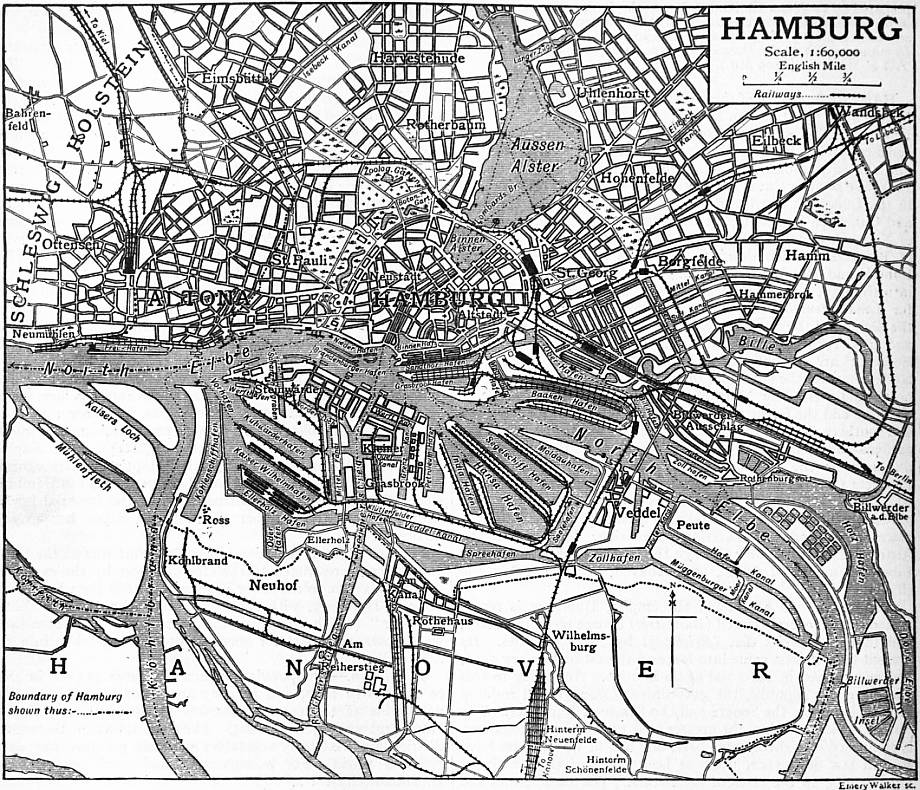
The old town lies low, and it is traversed by a great number of narrow canals or “fleets” (Fleeten)—for the same word which has left its trace in London nomenclature is used in the Low German city—which add considerably to the picturesqueness of the meaner quarters, and serve as convenient channels for the transport of goods. They generally form what may be called the back streets, and they are bordered by warehouses, cellars and the lower class of dwelling-houses. As they are subject to the ebb and flow of the Elbe, at certain times they run almost dry. As soon as the telegram at Cuxhaven announces high tide three shots are fired from the harbour to warn the inhabitants of the “fleets”; and if the progress of the tide up the river gives indication of danger, another three shots follow. The “fleets” with their quaint medieval warehouses, which come sheer down to the water, and are navigated by barges, have gained for Hamburg the name of “Northern Venice.” They are, however, though antique and interesting, somewhat dismal and unsavoury. In fine contrast to them is the bright appearance of the Binnen Alster, which is enclosed on three sides by handsome rows of buildings, the Alsterdamm in the east, the Alter Jungfernstieg in the south, and the Neuer Jungfernstieg in the west, while it is separated from the Aussen Alster by part of the rampart gardens traversed by the railway uniting Hamburg with Altona and crossing the lakes by a beautiful bridge—the Lombards-Brücke. Around the outer lake are grouped the suburbs Harvestehude and Pösseldorf on the western shore, and Uhlenhorst on the eastern, with park-like promenades and villas surrounded by well-kept gardens. Along the southern end of the Binnen Alster runs the Jungfernstieg with fine shops, hotels and restaurants facing the water. A fleet of shallow-draught screw steamers provides a favourite means of communication between the business centre of the city and the outlying colonies of villas.
The streets enclosing the Binnen Alster are fashionable promenades, and leading directly from this quarter are the main business thoroughfares, the Neuer-Wall, the Grosse Bleichen and the Hermannstrasse. The largest of the public squares in Hamburg is the Hopfenmarkt, which contains the church of St Nicholas (Nikolaikirche) and is the principal market for vegetables and fruit. Others of importance are the Gänsemarkt, the Zeughausmarkt and the Grossneumarkt. Of the thirty-five churches existing in Hamburg (the old cathedral had to be taken down in 1805), the St Petrikirche, Nikolaikirche, St Katharinenkirche, St Jakobikirche and St Michaeliskirche are those that give their names to the five old city parishes. The Nikolaikirche is especially remarkable for its spire, which is 473 ft. high and ranks, after those of Ulm and Cologne, as the third highest ecclesiastical edifice in the world. The old church was destroyed in the great fire of 1842, and the new building, designed by Sir George Gilbert Scott in 13th century Gothic, was erected 1845-1874. The exterior and interior are elaborately adorned with sculptures. Sandstone from Osterwald near Hildesheim was used for the outside, and for the inner work a softer variety from Postelwitz near Dresden. The Michaeliskirche, which is built on the highest point in the city and has a tower 428 ft. high, was erected (1750-1762) by Ernst G. Sonnin on the site of the older building of the 17th century destroyed by lightning; the interior, which can contain 3000 people, is remarkable for its bold construction, there being no pillars. The St Petrikirche, originally consecrated in the 12th century and rebuilt in the 14th, was the oldest church in Hamburg; it was burnt in 1842 and rebuilt in its old form in 1844-1849. It has a graceful tapering spire 402 ft. in height (completed 1878); the granite columns from the old cathedral, the stained glass windows by Kellner of Nuremberg, and H. Schubert’s fine relief of the entombment of Christ are worthy of notice. The St Katharinenkirche and the St Jakobikirche are the only surviving medieval churches, but neither is of special interest. Of the numerous other churches, Evangelical, Roman Catholic and Anglican, none are of special interest. The new synagogue was built by Rosengarten between 1857 and 1859, and to the same architect is due the sepulchral chapel built for the Hamburg merchant prince Johann Heinrich, Freiherr von Schröder (1784-1883), in the churchyard of the Petrikirche. The beautiful chapel of St Gertrude was unfortunately destroyed in 1842.
Hamburg has comparatively few secular buildings of great architectural interest, but first among them is the new Rathaus, a huge German Renaissance building, constructed of sandstone in 1886-1897, richly adorned with sculptures and with a spire 330 ft. in height. It is the place of meeting of the municipal council and of the senate and contains the city archives. Immediately adjoining it and connected with it by two wings is the exchange. It was erected in 1836-1841 on the site of the convent of St Mary Magdalen and escaped the conflagration of 1842. It was restored and enlarged in 1904, and shelters the commercial library of nearly 100,000 vols. During the business hours (1-3 P.M.) the exchange is crowded by some 5000 merchants and brokers. In the same neighbourhood is the Johanneum, erected in 1834 and in which are preserved the town library of about 600,000 printed books and 5000 MSS. and the collection of Hamburg antiquities. In the courtyard is a statue (1885) of the reformer Johann Bugenhagen. In the Fischmarkt, immediately south of the Johanneum, a handsome fountain was erected in 1890. Directly west of the town hall is the new Stadthaus, the chief police station of the town, in front of which is a bronze statue of the burgomaster Karl Friedrich Petersen (1809-1892), erected in 1897. A little farther away are the headquarters of the Patriotic Society (Patriotische Gesellschaft), founded in 1765, with fine rooms for the meetings of artistic and learned societies. Several new public buildings have been erected along the circuit of the former walls. Near the west extremity, abutting upon the Elbe, the moat was filled in in 1894-1897, and some good streets were built along the site, while the Kersten Miles-Brücke, adorned with statues of four Hamburg heroes, was thrown across the Helgoländer Allee. Farther north, along the line of the former town wall, are the criminal law courts (1879-1882, enlarged 1893) and the civil law courts (finished in 1901). Close to the latter stand the new supreme court, the old age and accident state insurance offices, the chief custom house, and the concert hall, founded by Karl Laeisz, a former Hamburg wharfinger. Farther on are the chemical and the physical laboratories and the Hygienic Institute. Facing the botanical gardens a new central post-office, in the Renaissance style, was built in 1887. At the west end of the Lombards-Brücke there is a monument by Schilling, commemorating the war of 1870-71. A few streets south of that is a monument to Lessing (1881); while occupying a commanding site on the promenades towards Altona is the gigantic statue of Bismarck which was unveiled in June 1906. The Kunst-Halle (the picture gallery), containing some good works by modern masters, faces the east end of Lombards-Brücke. The new Natural History Museum, completed in 1891, stands a little distance farther south. To the east of it comes the Museum for Art and Industry, founded in 1878, now one of the most important institutions of the kind in Germany, with which is connected a trades school. Close by is the Hansa-fountain (65 ft. high), erected in 1878. On the north-east side of the suburb of St Georg a botanical museum and laboratory have been established. There is a new general hospital at Eppendorf, outside the town on the north, built on the pavilion principle, and one of the finest structures of the kind in Europe; and at Ohlsdorf, in the same direction, a crematorium was built in 1891 in conjunction with the town cemeteries (370 acres). There must also be mentioned the fine public zoological gardens, Hagenbeck’s private zoological gardens in the vicinity, the schools of music and navigation, and the school of commerce. In 1900 a high school for shipbuilding was founded, and in 1901 an institute for seamen’s and tropical diseases, with a laboratory for their physiological study, was opened, and also the first public free library in the city. The river is spanned just above the Frei Hafen by a triple-arched railway bridge, 1339 ft. long, erected in 1868-1873 and doubled in width in 1894. Some 270 yds. higher up is a magnificent iron bridge (1888) for vehicles and foot passengers. The southern arm of the Elbe, on the south side of the island of Wilhelmsburg, is crossed by another railway bridge of four arches and 2050 ft. in length.
Railways.—The through railway traffic of Hamburg is practically confined to that proceeding northwards—to Kiel and Jutland—and for the accommodation of such trains the central (terminus) station at Altona is the chief gathering point. The Hamburg stations, connected with the other by the Verbindungs-Bahn (or metropolitan railway) crossing the Lombards-Brücke, are those of the Venloer (or Hanoverian, as it is often called) Bahnhof on the south-east, in close proximity to the harbour, into which converge the lines from Cologne and Bremen, Hanover and Frankfort-on-Main, and from Berlin, via Nelzen; the Klostertor-Bahnhof (on the metropolitan line) which temporarily superseded the old Berlin station, and the Lübeck station a little to the north-east, during the erection of the new central station, which occupies a site between the Klostertor-Bahnhof and the Lombards-Brücke. Between this central station and Altona terminus runs the metropolitan railway, which has been raised several feet so as to bridge over the streets, and on which lie the important stations Dammtor and Sternschanze. An excellent service of electric trams interconnect the towns of Hamburg, Altona and the adjacent suburbs, and steamboats provide communication on the Elbe with the riparian towns and villages; and so with Blankenese and Harburg, with Stade, Glückstadt and Cuxhaven.
Trade and Shipping.—Probably there is no place which during the last thirty years of the 19th century grew faster commercially than Hamburg. Its commerce is, however, almost entirely of the nature of transit trade, for it is not only the chief distributing centre for the middle of Europe of the products of all other parts of the world, but is also the chief outlet for German, Austrian, and even to some extent Russian (Polish) raw products and manufactures. Its principal imports are coffee (of which it is the greatest continental market), tea, sugar, spices, rice, wine (especially from Bordeaux), lard (from Chicago), cereals, sago, dried fruits, herrings, wax (from Morocco and Mozambique), tobacco, hemp, cotton (which of late years shows a large increase), wool, skins, leather, oils, dyewoods, indigo, nitrates, phosphates and coal. Of the total importations of all kinds of coal to Hamburg, that of British coal, particularly from Northumberland and Durham, occupies the first place, and despite some falling off in late years, owing to the competition made by Westphalian coal, amounts to more than half the total import. The increase of the trade of Hamburg is most strikingly shown by that of the shipping belonging to the port. Between 1876 and 1880 there were 475 sailing vessels with a tonnage of 230,691, and 110 steam-ships with a tonnage of 87,050. In 1907 there were (exclusive of fishing vessels) 470 sailing ships with a tonnage of 271,661, and 610 steamers with a tonnage of 1,256,449. In 1870 the crews numbered 6900 men, in 1907 they numbered 29,536.
Industries.—The development of manufacturing industries at Hamburg and its immediate vicinity since 1880, though not so rapid as that of its trade and shipping, has been very remarkable, and more especially has this been the case since the year 1888, when Hamburg joined the German customs union, and the barriers which prevented goods manufactured at Hamburg from entering into other parts of Germany were removed. Among the chief industries are those for the production of articles of food and drink. The import trade of various cereals by sea to Hamburg is very large, and a considerable portion of this corn is converted into flour at Hamburg itself. There are also, in this connexion, numerous bakeries for biscuit, rice-peeling mills and spice mills. Besides the foregoing there are cocoa, chocolate, confectionery and baking-powder factories, coffee-roasting and ham-curing and smoking establishments, lard refineries, margarine manufactories and fish-curing, preserving and packing factories. There are numerous breweries, producing annually about 24,000,000 gallons of beer, spirit distilleries and factories of artificial waters. Yarns, textile goods and weaving industries generally have not attained any great dimensions, but there are large jute-spinning mills and factories for cotton-wool and cotton driving-belts. Among other important articles of domestic industry are tobacco and cigars (manufactured mainly in bond, within the free harbour precincts), hydraulic machinery, electro-technical machinery, chemical products (including artificial manures), oils, soaps, india-rubber, ivory and celluloid articles and the manufacture of leather.
Shipbuilding has made very important progress, and there are at present in Hamburg eleven large shipbuilding yards, employing nearly 10,000 hands. Of these, however, only three are of any great extent, and one, where the largest class of ocean-going steamers and of war vessels for the German navy are built, employs about 5000 persons. There are also two yards for the building of pleasure yachts and rowing-boats (in both which branches of sport Hamburg takes a leading place in Germany). Art industries, particularly those which appeal to the luxurious taste of the inhabitants in fitting their houses, such as wall-papers and furniture, and those which are included in the equipment of ocean-going steamers, have of late years made rapid strides and are among the best productions of this character of any German city.
Harbour.—It was the accession of Hamburg to the customs union in 1888 which gave such a vigorous impulse to her more recent commercial development. At the same time a portion of the port was set apart as a free harbour, altogether an area of 750 acres of water and 1750 acres of dry land. In anticipation of this event a gigantic system of docks, basins and quays was constructed, at a total cost of some £7,000,000 (of which the imperial treasury contributed £2,000,000), between the confluence of the Alster and the railway bridge (1868-1873), an entire quarter of the town inhabited by some 24,000 people being cleared away to make room for these accessories of a great port. On the north side of the Elbe there are the Sandtor basin (3380 ft. long, 295 to 427 ft. wide), in which British and Dutch steamboats and steamboats of the Sloman (Mediterranean) line anchor. South of this lies the Grasbrook basin (quayage of 2100 ft. and 1693 ft. alongside), which is used by French, Swedish and transatlantic steamers. At the quay point between these two basins there are vast state granaries. On the outer (i.e. river) side of the Grasbrook dock is the quay at which the emigrants for South America embark, and from which the mail boats for East Africa, the boats of the Woermann (West Africa) line, and the Norwegian tourist boats depart. To the east of these two is the small Magdeburg basin, penetrating north, and the Baaken basin, penetrating east, i.e. parallel to the river. The latter affords accommodation to the transatlantic steamers, including the emigrant ships of the Hamburg-America line, though their “ocean mail boats” generally load and unload at Cuxhaven. On the south bank of the stream there follow in succession, going from east to west, the Moldau dock for river craft, the sailing vessel dock (Segelschiff Hafen, 3937 ft. long, 459 to 886 ft. wide, 26¼ ft. deep), the Hansa dock, India dock, petroleum dock, several swimming and dry docks; and in the west of the free port area three other large docks, one of 77 acres for river craft, the others each 56 acres in extent, and one 23¾ ft. deep, the other 26¼ ft. deep, at low water, constructed in 1900-1901. In 1897 Hamburg was provided with a huge floating dock, 558 ft. long and 84 ft. in maximum breadth, capable of holding a vessel of 17,500 tons and draught not exceeding 29 ft., so constructed and equipped that in time of need (war) it could be floated down to Cuxhaven. During the last 25 years of the 19th century the channel of the Elbe was greatly improved and deepened, and during the last two years of the 19th century some £360,000 was spent by Hamburg alone in regulating and correcting this lower course of the river. The new Kuhwärder-basin, on the left bank of the river, as well as two other large dock basins (now leased to the Hamburg-American Company), raise the number of basins to twelve in all.
Emigration.—Hamburg is one of the principal continental ports for the embarkation of emigrants. In 1881-1890, on an average they numbered 90,000 a year (of whom 60,000 proceeded to the United States). In 1900 the number was 87,153 (and to the United States 64,137). The number of emigrant Germans has enormously decreased of late years, Russia and Austria-Hungary now being most largely represented. For the accommodation of such passengers large and convenient emigrant shelters have been recently erected close to the wharf of embarkation.
Health and Population.—The health of the city of Hamburg and the adjoining district may be described as generally good, no epidemic diseases having recently appeared to any serious degree. The malady causing the greatest number of deaths is that of pulmonary consumption; but better housing accommodation has of late years reduced the mortality from this disease very considerably. The results of the census of 1905 showed the population of the city (not including the rural districts belonging to the state of Hamburg) to be 802,793.
Hamburg is well supplied with places of amusement, especially of the more popular kind. Its Stadt-Theater, rebuilt in 1874, has room for 1750 spectators and is particularly devoted to operatic performances; the Thalia-Theater dates from 1841, and holds 1700 to 1800 people, and the Schauspielhaus (for drama) from 1900 people, and there are some seven or eight minor establishments. Theatrical performances were introduced into the city in the 17th century, and 1678 is the date of the first opera, which was played in a house in the Gänsemarkt. Under Schröder and Lessing the Hamburg stage rose into importance. Though contributing few names of the highest rank to German literature, the city has been intimately associated with the literary movement. The historian Lappenberg and Friedrich von Hagedorn were born in Hamburg; and not only Lessing, but Heine and Klopstock lived there for some time.
History.—Hamburg probably had its origin in a fortress erected in 808 by Charlemagne, on an elevation between the Elbe and Alster, as a defence against the Slavs, and called Hammaburg because of the surrounding forest (Hamme). In 811 Charlemagne founded a church here, perhaps on the site of a Saxon place of sacrifice, and this became a great centre for the evangelization of the north of Europe, missionaries from Hamburg introducing Christianity into Jutland and the Danish islands and even into Sweden and Norway. In 834 Hamburg became an archbishopric, St Ansgar, a monk of Corbie and known as the apostle of the North, being the first metropolitan. In 845 church, monastery and town were burnt down by the Norsemen, and two years later the see of Hamburg was united with that of Bremen and its seat transferred to the latter city. The town, rebuilt after this disaster, was again more than once devastated by invading Danes and Slavs. Archbishop Unwan of Hamburg-Bremen (1013-1029) substituted a chapter of canons for the monastery, and in 1037 Archbishop Bezelin (or Alebrand) built a stone cathedral and a palace on the Elbe. In 1110 Hamburg, with Holstein, passed into the hands of Adolph I., count of Schauenburg, and it is with the building of the Neustadt (the present parish of St Nicholas) by his grandson, Adolph III. of Holstein, that the history of the commercial city actually begins. In return for a contribution to the costs of a crusade, he obtained from the emperor Frederick I. in 1189 a charter granting Hamburg considerable franchises, including exemption from tolls, a separate court and jurisdiction, and the rights of fishery on the Elbe from the city to the sea. The city council (Rath), first mentioned in 1190, had jurisdiction over both the episcopal and the new town. Craft gilds were already in existence, but these had no share in the government; for, though the Lübeck rule excluding craftsmen from the Rath did not obtain, they were excluded in practice. The counts, of course, as over-lords, had their Vogt (advocatus) in the town, but this official, as the city grew in power, became subordinate to the Rath, as at Lübeck.
The wealth of the town was increased in 1189 by the destruction of the flourishing trading centre of Bardowieck by Henry the Lion; from this time it began to be much frequented by Flemish merchants. In 1201 the city submitted to Valdemar of Schleswig, after his victory over the count of Holstein, but in 1225, owing to the capture of King Valdemar II. of Denmark by Henry of Schwerin, it once more exchanged the Danish over-lordship for that of the counts of Schauenburg, who established themselves here and in 1231 built a strong castle to hold it in check. The defensive alliance of the city with Lübeck in 1241, extended for other purpose by the treaty of 1255, practically laid the foundations of the Hanseatic League (q.v.), of which Hamburg continued to be one of the principal members. The internal organization of the city, too, was rendered more stable by the new constitution of 1270, and the recognition in 1292 of the complete internal autonomy of the city by the count of Schauenburg. The exclusion of the handicraftsmen from the Rath led, early in the 15th century, to a rising of the craft gilds against the patrician merchants, and in 1410 they forced the latter to recognize the authority of a committee of 48 burghers, which concluded with the senate the so-called First Recess; there were, however, fresh outbursts in 1458 and 1483, which were settled by further compromises. In 1461 Hamburg did homage to Christian I. of Denmark, as heir of the Schauenburg counts; but the suzerainty of Denmark was merely nominal and soon repudiated altogether; in 1510 Hamburg was made a free imperial city by the emperor Maximilian I.
In 1529 the Reformation was definitively established in Hamburg by the Great Recess of the 19th of February, which at the same time vested the government of the city in the Rath, together with the three colleges of the Oberalten, the Forty-eight (increased to 60 in 1685) and the Hundred and Forty-four (increased to 180). The ordinary burgesses consisted of the freeholders and the master-workmen of the gilds. In 1536 Hamburg joined the league of Schmalkalden, for which error it had to pay a heavy fine in 1547 when the league had been defeated. During the same period the Lutheran zeal of the citizens led to the expulsion of the Mennonites and other Protestant sects, who founded Altona. The loss this brought to the city was, however, compensated for by the immigration of Protestant refugees from the Low Countries and Jews from Spain and Portugal. In 1549, too, the English merchant adventurers removed their staple from Antwerp to Hamburg.
The 17th century saw notable developments. Hamburg had established, so early as the 16th century, a regular postal service with certain cities in the interior of Germany, e.g. Leipzig and Breslau; in 1615 it was included in the postal system of Turn and Taxis. In 1603 Hamburg received a code of laws regulating exchange, and in 1619 the bank was established. In 1615 the Neustadt was included within the city walls. During the Thirty Years’ War the city received no direct harm; but the ruin of Germany reacted upon its prosperity, and the misery of the lower orders led to an agitation against the Rath. In 1685, at the invitation of the popular leaders, the Danes appeared before Hamburg demanding the traditional homage; they were repulsed, but the internal troubles continued, culminating in 1708 in the victory of the democratic factions. The imperial government, however, intervened, and in 1712 the “Great Recess” established durable good relations between the Rath and the commonalty. Frederick IV. of Denmark, who had seized the opportunity to threaten the city (1712), was bought off with a ransom of 246,000 Reichsthaler. Denmark, however, only finally renounced her claims by the treaty of Gottorp in 1768, and in 1770 Hamburg was admitted for the first time to a representation in the diet of the empire.
The trade of Hamburg received its first great impulse in 1783, when the United States, by the treaty of Paris, became an independent power. From this time dates its first direct maritime communication with America. Its commerce was further extended and developed by the French occupation of Holland in 1795, when the Dutch trade was largely directed to its port. The French Revolution and the insecurity of the political situation, however, exercised a depressing and retarding effect. The wars which ensued, the closing of continental ports against English trade, the occupation of the city after the disastrous battle of Jena, and pestilence within its walls brought about a severe commercial crisis and caused a serious decline in its prosperity. Moreover, the great contributions levied by Napoleon on the city, the plundering of its bank by Davoust, and the burning of its prosperous suburbs inflicted wounds from which the city but slowly recovered. Under the long peace which followed the close of the Napoleonic wars, its trade gradually revived, fostered by the declaration of independence of South and Central America, with both of which it energetically opened close commercial relations, and by the introduction of steam navigation. The first steamboat was seen on the Elbe on the 17th of June 1816; in 1826 a regular steam communication was opened with London; and in 1856 the first direct steamship line linked the port with the United States. The great fire of 1842 (5th-8th of May) laid in waste the greatest part of the business quarter of the city and caused a temporary interruption of its commerce. The city, however, soon rose from its ashes, the churches were rebuilt and new streets laid out on a scale of considerable magnificence. In 1866 Hamburg joined the North German Confederation, and in 1871, while remaining outside the Zollverein, became a constituent state of the German empire. In 1883-1888 the works for the Free Harbour were completed, and on the 18th of October 1888 Hamburg joined the Customs Union (Zollverein). In 1892 the cholera raged within its walls, carried off 8500 of its inhabitants, and caused considerable losses to its commerce and industry; but the visitation was not without its salutary fruits, for an improved drainage system, better hospital accommodation, and a purer water-supply have since combined to make it one of the healthiest commercial cities of Europe.
Further details about Hamburg will be found in the following works: O. C. Gaedechens, Historische Topographie der Freien und Hansestadt Hamburg (1880); E. H. Wichmann, Heimatskunde von Hamburg (1863); W. Melhop, Historische Topographie der Freien und Hansestadt Hamburg von 1880-1895 (1896); Wulff, Hamburgische Gesetze und Verordnungen (1889-1896); and W. von Melle, Das hamburgische Staatsrecht (1891). There are many valuable official publications which may be consulted, among these being: Statistik des hamburgischen Staates (1867-1904); Hamburgs Handel und Schiffahrt (1847-1903); the yearly Hamburgischer Staatskalender; and Jahrbuch der Hamburger wissenschaftlichen Anstalten. See also Hamburg und seine Bauten (1890); H. Benrath, Lokalführer durch Hamburg und Umgebungen (1904); and the consular reports by Sir William Ward, H.B.M.’s consul-general at Hamburg, to whom the author is indebted for great assistance in compiling this article.
For the history of Hamburg see the Zeitschrift des Vereins für hamburgische Geschichte (1841, fol.); G. Dehio, Geschichte des Erzbistums Hamburg-Bremen (Berlin, 1877); the Hamburgisches Urkundenbuch (1842), the Hamburgische Chroniken (1852-1861), and the Chronica der Stadt Hamburg bis 1557 of Adam Tratziger (1865), all three edited by J. M. Lappenberg; the Briefsammlung des hamburgischen Superintendenten Joachim Westphal 1530-1575, edited by C. H. W. Sillem (1903); Gallois, Geschichte der Stadt Hamburg (1853-1856); K. Koppmann, Aus Hamburgs Vergangenheit (1885), and Kammereirechnungen der Stadt Hamburg (1869-1894); H. W. C. Hubbe, Beiträge zur Geschichte der Stadt Hamburg (1897); C. Mönckeberg, Geschichte der Freien und Hansestadt Hamburg (1885); E. H. Wichmann, Hamburgische Geschichte in Darstellungen aus alter und neuer Zeit (1889); and R. Bollheimer, Zeittafeln der hamburgischen Geschichte (1895).
HAMDĀNĪ, in full Abū Maḥommed ul-Ḥasan ibn Aḥmad ibn Ya‘qūb ul-Hamdānī (d. 945), Arabian geographer, also known as Ibn ul-Ḥā‘ik. Little is known of him except that he belonged to a family of Yemen, was held in repute as a grammarian in his own country, wrote much poetry, compiled astronomical tables, devoted most of his life to the study of the ancient history and geography of Arabia, and died in prison at San‘a in 945. His Geography of the Arabian Peninsula (Kitāb Jazīrat ul-‘Arab) is by far the most important work on the subject. After being used in manuscript by A. Sprenger in his Post- und Reiserouten des Orients (Leipzig, 1864) and further in his Alte Geographie Arabiens (Bern, 1875), it was edited by D. H. Müller (Leiden, 1884; cf. A. Sprenger’s criticism in Zeitschrift der deutschen morgenländischen Gesellschaft, vol. 45, pp. 361-394). Much has also been written on this work by E. Glaser in his various publications on ancient Arabia. The other great work of Hamdānī is the Iklīl (Crown) concerning the genealogies of the Himyarites and the wars of their kings in ten volumes. Of this, part 8, on the citadels and castles of south Arabia, has been edited and annotated by D. H. Müller in Die Burgen und Schlösser Südarabiens (Vienna, 1879-1881).
For other works said to have been written by Hamdānī cf. G. Flügel’s Die grammatischen Schulen der Araber (Leipzig, 1862), pp. 220-221.
(G. W. T.)
HAMELIN, FRANÇOIS ALPHONSE (1796-1864), French admiral, was born at Pont l’Évêque on the 2nd of September 1796. He went to sea with his uncle, J. F. E. Hamelin, in the “Vénus” frigate in 1806 as cabin boy. The “Vénus” was part of the French squadron in the Indian Ocean, and young Hamelin had an opportunity of seeing much active service. She, in company with another and a smaller vessel, captured the English frigate “Ceylon” in 1810, but was immediately afterwards captured herself by the “Boadicéa,” under Commodore Rowley (1765-1842). Young Hamelin was a prisoner of war for a short time. He returned to France in 1811. On the fall of the Empire he had better fortune than most of the Napoleonic officers who were turned ashore. In 1821 he became lieutenant, and in 1823 took part in the French expedition under the duke of Angoulême into Spain. In 1828 he was appointed captain of the “Actéon,” and was engaged till 1831 on the coast of Algiers and in the conquest of the town and country. His first command as flag officer was in the Pacific, where he showed much tact during the dispute over the Marquesas Islands with England in 1844. He was promoted vice-admiral in 1848. During the Crimean War he commanded in the Black Sea, and co-operated with Admiral Dundas in the bombardment of Sevastopol 17th of October 1854. His relations with his English colleague were not very cordial. On the 7th of December 1854 he was promoted admiral. Shortly afterwards he was recalled to France, and was named minister of marine. His administration lasted till 1860, and was remarkable for the expeditions to Italy and China organized under his directions; but it was even more notable for the energy shown in adopting and developing the use of armour. The launch of the “Gloire” in 1859 set the example of constructing sea-going iron-clads. The first English iron-clad, the “Warrior,” was designed as an answer to the “Gloire.” When Napoleon III. made his first concession to Liberal opposition, Admiral Hamelin was one of the ministers sacrificed. He held no further command, and died on the 10th of January 1864.
HAMELN, a town of Germany, in the Prussian province of Hanover, at the confluence of the Weser and Hamel, 33 m. S.W. of Hanover, on the line to Altenbeken, which here effects a junction with railways to Löhne and Brunswick. Pop. (1905) 20,736. It has a venerable appearance and has many interesting and picturesque houses. The chief public buildings of interest are the minster, dedicated to St Boniface and restored in 1870-1875; the town hall; the so-called Rattenfängerhaus (rat-catcher’s house) with mural frescoes illustrating the legend (see below); and the Hochzeitshaus (wedding house) with beautiful gables. There are classical, modern and commercial schools. The principal industries are the manufacture of paper, leather, chemicals and tobacco, sugar refining, shipbuilding and salmon fishing. By the steamboats on the Weser there is communication with Karlshafen and Minden. In order to avoid the dangerous part of the river near the town a channel was cut in 1734, the repairing and deepening of which, begun in 1868, was completed in 1873. The Weser is here crossed by an iron suspension bridge 830 ft. in length, supported by a pier erected on an island in the middle of the river.
The older name of Hameln was Hameloa or Hamelowe, and the town owes its origin to an abbey. It existed as a town as early as the 11th century, and in 1259 it was sold by the abbot of Fulda to the bishop of Minden, afterwards passing under the protection of the dukes of Brunswick. About 1540 the Reformation gained an entrance into the town, which was taken by both parties during the Thirty Years’ War. In 1757 it capitulated to the French, who, however, vacated it in the following year. Its fortifications were strengthened in 1766 by the erection of Fort George, on an eminence to the west of the town, across the river. On the capitulation of the Hanoverian army in 1803 Hameln fell into the hands of the French; it was retaken by the Prussians in 1806, but, after the battle of Jena, again passed to the French, who dismantled the fortifications and incorporated the town in the kingdom of Westphalia. In 1814 it again became Hanoverian, but in 1866 fell with that kingdom to Prussia.
Legend of the Pied Piper.—Hameln is famed as the scene of the myth of the piper of Hameln. According to the legend, the town in the year 1284 was infested by a terrible plague of rats. One day there appeared upon the scene a piper clad in a fantastic suit, who offered for a certain sum of money to charm all the vermin into the Weser. His conditions were agreed to, but after he had fulfilled his promise the inhabitants, on the ground that he was a sorcerer, declined to fulfil their part of the bargain, whereupon on the 26th of June he reappeared in the streets of the town, and putting his pipe to his lips began a soft and curious strain. This drew all the children after him and he led them out of the town to the Koppelberg hill, in the side of which a door suddenly opened, by which he entered and the children after him, all but one who was lame and could not follow fast enough to reach the door before it shut again. Some trace the origin of the legend to the Children’s Crusade of 1211; others to an abduction of children; and others to a dancing mania which seized upon some of the young people of Hameln who left the town on a mad pilgrimage from which they never returned. For a considerable time the town dated its public documents from the event. The story is the subject of a poem by Robert Browning, and also of one by Julius Wolff. Curious evidence that the story rests on a basis of truth is given by the fact that the Koppelberg is not one of the imposing hills by which Hameln is surrounded, but no more than a slight elevation of the ground, barely high enough to hide the children from view as they left the town.
See C. Langlotz, Geschichte der Stadt Hameln (Hameln, 1888 fol.); Sprenger, Geschichte der Stadt Hameln (1861); O. Meinardus, Der historische Kern der Rattenfängersage (Hameln, 1882); Jostes, Der Rattenfänger von Hameln (Bonn, 1885); and S. Baring-Gould, Curious Myths of the Middle Ages (1868).
HAMERLING, ROBERT (1830-1889), Austrian poet, was born at Kirchenberg-am-Walde in Lower Austria, on the 24th of March 1830, of humble parentage. He early displayed a genius for poetry and his youthful attempts at drama excited the interest and admiration of some influential persons. Owing to their assistance young Hamerling was enabled to attend the gymnasium in Vienna and subsequently the university. In 1848 he joined the student’s legion, which played so conspicuous a part in the revolutions of the capital, and in 1849 shared in the defence of Vienna against the imperialist troops of Prince Windischgrätz, and after the collapse of the revolutionary movement he was obliged to hide for a long time to escape arrest. For the next few years he diligently pursued his studies in natural science and philosophy, and in 1855 was appointed master at the gymnasium at Trieste. For many years he battled with ill-health, and in 1866 retired on a pension, which in acknowledgment of his literary labours was increased by the government to a sum sufficient to enable him to live without care until his death at his villa in Stiftingstal near Graz, on the 13th of July 1889. Hamerling was one of the most remarkable of the poets of the modern Austrian school; his imagination was rich and his poems are full of life and colour. His most popular poem, Ahasver in Rom (1866), of which the emperor Nero is the central figure, shows at its best the author’s brilliant talent for description. Among his other works may be mentioned Venus im Exil (1858); Der König von Sion (1869), which is generally regarded as his masterpiece; Die sieben Todsünden (1872); Blätter im Winde (1887); Homunculus (1888); Amor und Psyche (1882). His novel, Aspasia (1876) gives a finely-drawn description of the Periclean age, but like his tragedy Danton und Robespierre (1870), is somewhat stilted, showing that Hamerling’s genius, though rich in imagination, was ill-suited for the realistic presentation of character.
A popular edition of Hamerling’s works in four volumes was published by M. M. Rabenlechner (Hamburg, 1900). For the poet’s life, see his autobiographical writings, Stationen meiner Lebenspilgerschaft (1889) and Lehrjahre der Liebe (1890); also M. M. Rabenlechner, Hamerling, sein Leben und seine Werke, i. (Hamburg, 1896); a short biography by the same (Dresden, 1901); R. H. Kleinert, R. Hamerling, ein Dichter der Schönheit (Hamburg, 1889); A. Polzer, Hamerling, sein Wesen und Wirken (Hamburg, 1890).
HAMERTON, PHILIP GILBERT (1834-1894), English artist and author, was born at Laneside, near Shaw, close to Oldham, on the 10th of September 1834. His mother died at his birth, and having lost his father ten years afterwards, he was educated privately under the direction of his guardians. His first literary attempt, a volume of poems, proving unsuccessful, he devoted himself for a time entirely to landscape painting, encamping out of doors in the Highlands, where he eventually rented the island of Innistrynych, upon which he settled with his wife, a French lady, in 1858. Discovering after a time that his qualifications were rather those of an art critic than of a painter he removed to the neighbourhood of his wife’s relatives in France, where he produced his Painter’s Camp in the Highlands (1863), which obtained a great success and prepared the way for his standard work on Etching and Etchers (1866). In the following year he published a book, entitled Contemporary French Painters, and in 1868 a continuation, Painting in France after the Decline of Classicism. He had meanwhile become art critic to the Saturday Review, a position which, from the burden it laid upon him of frequent visits to England, he did not long retain. He proceeded (1870) to establish an art journal of his own, The Portfolio, a monthly periodical, each number of which consisted of a monograph upon some artist or group of artists, frequently written and always edited by him. The discontinuance of his active work as a painter gave him time for more general literary composition, and he successively produced The Intellectual Life (1873), perhaps the best known and most valuable of his writings; Round my House (1876), notes on French society by a resident; and Modern Frenchmen (1879), admirable short biographies. He also wrote two novels, Wenderholme (1870) and Marmorne (1878). In 1884 Human Intercourse, another valuable volume of essays, was published, and shortly afterwards Hamerton began to write his autobiography, which he brought down to 1858. In 1882 he issued a finely illustrated work on the technique of the great masters of various arts, under the title of The Graphic Arts, and three years later another splendidly illustrated volume, Landscape, which traces the influence of landscape upon the mind of man. His last books were: Portfolio Papers (1889) and French and English (1889). In 1891 he removed to the neighbourhood of Paris, and died suddenly on the 4th of November 1894, occupied to the last with his labours on The Portfolio and other writings on art.
In 1896 was published Philip Gilbert Hamerton: an Autobiography, 1834-1858; and a Memoir by his Wife, 1858-1894.
HAMI, a town in Chinese Turkestan, otherwise called Kamil, Komul or Kamul, situated on the southern slopes of the Tian-Shan mountains, and on the northern verge of the Great Gobi desert, in 42° 48′ N., 93° 28′ E., at a height above sea-level of 3150 ft. The town is first mentioned in Chinese history in the 1st century, under the name I-wu-lu, and said to be situated 1000 lis north of the fortress Yü-men-kuan, and to be the key to the western countries. This evidently referred to its advantageous position, lying as it did in a fertile tract, at the point of convergence of two main routes running north and south of the Tian-Shan and connecting China with the west. It was taken by the Chinese in A.D. 73 from the Hiungnu (the ancient inhabitants of Mongolia), and made a military station. It next fell into the bands of the Uighurs or Eastern Turks, who made it one of their chief towns and held it for several centuries, and whose descendants are said to live there now. From the 7th to the 11th century I-wu-lu is said to have borne the name of Igu or I-chu, under the former of which names it is spoken of by the Chinese pilgrim, Hsüan tsang, who passed through it in the 7th century. The name Hami is first met in the Chinese Yüan-shi or “History of the Mongol Dynasty,” but the name more generally used there is Homi-li or Komi-li. Marco Polo, describing it apparently from hearsay, calls it Camul, and speaks of it as a fruitful place inhabited by a Buddhist people of idolatrous and wanton habits. It was visited in 1341 by Giovanni de Marignolli, who baptized a number of both sexes there, and by the envoys of Shah Rukh (1420), who found a magnificent mosque and a convent of dervishes, in juxtaposition with a fine Buddhist temple. Hadji Mahommed (Ramusio’s friend) speaks of Kamul as being in his time (c. 1550) the first Mahommedan city met with in travelling from China. When Benedict Goes travelled through the country at the beginning of the 17th century, the power of the king Mahommed Khan of Kashgar extended over nearly the whole country at the base of the Tian-Shan to the Chinese frontier, including Kamil. It fell under the sway of the Chinese in 1720, was lost to them in 1865 during the great Mahommedan rebellion, and the trade route through it was consequently closed, but was regained in 1873. Owing to its commanding position on the principal route to the west, and its exceptional fertility, it has very frequently changed hands in the wars between China and her western neighbours. Hami is now a small town of about 6000 inhabitants, and is a busy trading centre. The Mahommedan population consists of immigrants from Kashgaria, Bokhara and Samarkand, and of descendants of the Uighurs.
HAMILCAR BARCA, or Barcas (Heb. barak “lightning”), Carthaginian general and statesman, father of Hannibal, was born soon after 270 B.C. He distinguished himself during the First Punic War in 247, when he took over the chief command in Sicily, which at this time was almost entirely in the hands of the Romans. Landing suddenly on the north-west of the island with a small mercenary force he seized a strong position on Mt. Ercte (Monte Pellegrino, near Palermo), and not only maintained himself against all attacks, but carried his raids as far as the coast of south Italy. In 244 he transferred his army to a similar position on the slopes of Mt. Eryx (Monte San Giuliano), from which he was able to lend support to the besieged garrison in the neighbouring town of Drepanum (Trapani). By a provision of the peace of 241 Hamilcar’s unbeaten force was allowed to depart from Sicily without any token of submission. On returning to Africa his troops, which had been kept together only by his personal authority and by the promise of good pay, broke out into open mutiny when their rewards were withheld by Hamilcar’s opponents among the governing aristocracy. The serious danger into which Carthage was brought by the failure of the aristocratic generals was averted by Hamilcar, whom the government in this crisis could not but reinstate. By the power of his personal influence among the mercenaries and the surrounding African peoples, and by superior strategy, he speedily crushed the revolt (237). After this success Hamilcar enjoyed such influence among the popular and patriotic party that his opponents could not prevent him being raised to a virtual dictatorship. After recruiting and training a new army in some Numidian forays he led on his own responsibility an expedition into Spain, where he hoped to gain a new empire to compensate Carthage for the loss of Sicily and Sardinia, and to serve as a basis for a campaign of vengeance against the Romans (236). In eight years by force of arms and diplomacy he secured an extensive territory in Spain, but his premature death in battle (228) prevented him from completing the conquest. Hamilcar stood out far above the Carthaginians of his age in military and diplomatic skill and in strength of patriotism; in these qualities he was surpassed only by his son Hannibal, whom he had imbued with his own deep hatred of Rome and trained to be his successor in the conflict.
This Hamilcar has been confused with another general who succeeded to the command of the Carthaginians in the First Punic War, and after successes at Therma and Drepanum was defeated at Ecnomus (256 B.C.). Subsequently, apart from unskilful operations against Regulus, nothing is certainly known of him. For others of the name see Carthage, Sicily, Smith’s Classical Dictionary. So far as the name itself is concerned, Milcar is perhaps the same as Melkarth, the Tyrian god.