VOLUME XI SLICE VII Geoponici to Germany (part) (continued 4)
Reading edition
Géricault’s biography, accompanied by a catalogue raisonné of his works, was published by M.C. Clément in 1868.
GERIZIM, a mountain in the hill-country of Samaria, 2849 ft. above the sea-level, and enclosing, with its companion Ebal, the valley in which lies the town of Nāblus (Shechem). It is the holy place of the community of the Samaritans, who hold that it was the scene of the sacrifice of Isaac—a tradition accepted by Dean Stanley but no other western writers of importance. Here, on the formal entrance of the Israelites into the possession of the Promised Land, were pronounced the blessings connected with a faithful observance of the law (Josh. viii. 33, 34; cf. Deut. xi. 29, 30, xxvii. 12-26), the six tribes, Simeon, Levi, Judah, Issachar, Joseph and Benjamin, standing here for the purpose while the remaining tribes stood on Ebal to accept the curses attached to specific violations thereof. Gerizim was probably chosen as the mount of blessing as being on the right hand, the fortunate side, of a spectator facing east. The counter-suggestion of Eusebius and Jerome that the Ebal and Gerizim associated with this solemnity were not the Shechem mountains at all, but two small hills near Jericho, is no longer considered important. From this mountain Jotham spoke his parable to the elders of Shechem (Judg. ix. 7). Manasseh, the son of the Jewish high-priest in the days of Nehemiah, married the daughter of Sanballat and, about 432 B.C., erected on this mountain a temple for the Samaritans; it was destroyed by Hyrcanus about 300 years afterwards. Its site is a small level plateau a little under the summit of the mountain. Close to this is the place where the Passover is still annually celebrated in exact accordance with the rites prescribed in the Pentateuch. On the summit of the mountain, which commands a view embracing the greater part of Palestine, are a small Moslem shrine and the ruins of a castle probably dating from Justinian’s time. There was an octagonal Byzantine church here, but the foundations alone remain. Josephus describes it as the highest of the mountains of Samaria, but Ebal and Tell Azur are both higher.
(R. A. S. M.)
GERLACHE, ÉTIENNE CONSTANTIN, Baron de (1785-1871), Belgian politician and historian, was born at Biourge, Luxemburg, on the 24th of December 1785. He studied law in Paris and practised there for some time, but settled at Liege after the establishment of the kingdom of the Netherlands. As member of the states-general he was an energetic member of the opposition, and, though he repudiated an ultramontane policy, he supported the alliance of the extreme Catholics with the Liberal party, which paved the way for the revolution of 1830. On the outbreak of disturbance in August 1830 he still, however, thought the Orange-Nassau dynasty and the union with the Dutch states essential; but his views changed, and, after holding various offices in the provisional government, he became president of congress, and brought forward the motion inviting Leopold of Saxe-Coburg to become king of the Belgians. In 1832 he was president of the chamber of representatives, and for thirty-five years he presided over the court of appeal. He presided over the Catholic congresses held at Malines between 1863 and 1867. That his early Liberal views underwent some modification is plain from the Conservative principles enunciated in his Essai sur le mouvement des partis en Belgique (Brussels, 1852). As an historian his work was strongly coloured by his anti-Dutch prejudices and his Catholic predilections. His Histoire des Pays-Bas depuis 1814 jusqu’en 1830 (Brussels, 2 vols., 1839), which reached a fourth edition in 1875, was a piece of special pleading against the Dutch domination. The most important of his other works were his Histoire de Liége (Brussels, 1843) and his Études sur Salluste et sur quelques-uns des principaux historiens de l’antiquité (Brussels, 1847).
A complete edition of his works (6 vols., Brussels, 1874-1875) contains a biography by M. Thonissen.
GERLE, CHRISTOPHE ANTOINE (1736-c. 1801), French revolutionist and mystic, was born at Riom in Auvergne. Entering the Carthusian order early in life, he became prior of Laval-Dieu in Perche, and afterwards of Pont-Sainte-Marie at Moulins. Elected deputy to the states-general in 1789, Gerle became very popular, and though he had no seat in the assembly until after the Tennis Court oath, being only deputy suppléant, he is represented in David’s classic painting as taking part in it. In 1792 he was chosen elector of Paris. In the revolutionary turmoil Gerle developed a strong vein of mysticism, mingled with ideas of reform, and in June 1790 the prophetic powers of Suzanne Labrousse (1747-1821), a visionary who had predicted the Revolution ten years before, were brought by him to the notice of the Convention. In Paris, where he lived first with a spiritualistic doctor and afterwards, like Robespierre, at the house of a cabinetmaker, his mystical tendencies were strengthened. The insane fancies of Catherine Théot, a convent servant turned prophetess, who proclaimed herself the Virgin, the “Mother of God” and the “new Eve,” were eminently attractive to Gerle; in the person of Robespierre he recognized the Messiah, and at the meetings of the Théotists he officiated with the aged prophetess as co-president. But the activities of Catherine and her adepts were short-lived. The Théotists’ cult of Robespierre was a weapon in the hands of his opponents; and shortly after the festival of the Supreme Being, Vadier made a report to the Convention calling for the prosecution of Catherine, Gerle and others as fanatics and conspirators. They were arrested, thrown into prison and, in the confusion of Robespierre’s fall, apparently forgotten. Catherine died in prison, but Gerle, released by the Directory, became one of the editors of the Messager du soir, and was afterwards in the office of Pierre Bénézech (1775-1802), minister of the interior. Having renounced his monastic vows in Paris, he is thought to have married, towards the close of his life, Christine Raffet, aunt of the artist Denis Raffet. The date of his death is uncertain.
GERMAN BAPTIST BRETHREN, or German Brethren, a sect of American Baptists which originated in Germany, and whose members are popularly known in the United States as “Dunkers,” “Dunkards” or “Tunkers,” corruptions of the German verb tunken, “to dip,” in recognition of the sect’s continued adherence to the practice of trine immersion. The sect was the outcome of one of the many Pietistic movements of the 17th century, and was founded in 1708 by Andrew Mack of Swartzenau, Germany, and seven of his followers, upon the general issue that both the Lutheran and Reformed churches were taking liberties with the literal teachings of the Scriptures. The new sect was scarcely organized in Germany when its members were compelled by persecution to take refuge in Holland, whence they emigrated to Pennsylvania, in small companies, between 1719 and 1729. The first congregation in America was organized on Christmas Day 1723 by Peter Becker at Germantown, Pennsylvania, and here in 1743 Christopher Sauer, one of the sect’s first pastors, and a printer by trade, printed the first Bible (a few copies of which are still in existence) published in a European language in America. From Pennsylvania the sect spread chiefly westward, and, after various vicissitudes, caused by defections and divisions due to doctrinal differences, in 1908 were most numerous in Pennsylvania, Maryland, Virginia, Ohio, Indiana, Illinois, Iowa, Missouri, Nebraska, Kansas and North Dakota.
There is much uncertainty about the early theological history of the sect, but it is probable that Mack and his followers were influenced by both the Greek Catholics and the Waldensians. P.H. Bashor in his historical sketch, read before the World’s Fair Congress of the Brethren Church (1894), says: “From the history of extended labour by Greek missionaries, from the active propaganda of doctrine by scattered Waldensian refugees, through parts of Germany and Bavaria, from the credence that may generally be given to local tradition, and from the strong similarity between the three churches in general features of circumstantial service, the conclusion, without additional evidence, is both reasonable and natural that the founders of the new church received their teaching, their faith and much of their church idea from intimate acquaintance with the established usages of both societies, and from their amplification and enforcement by missionaries and pastors.... In doctrine the church has been from the first contentious for believers’ baptism, holding that nowhere in the New Testament can be found any authority even by inference, precept or example for the baptism of infants. On questions of fundamental doctrine they held to the belief in one self-existing supreme ruler of the Universe—the Divine Godhead—the Father, the Son and the Holy Spirit—the tri-personality.” Hence their practice of triple immersion, which provides that the candidate shall kneel in the water and be immersed, face first, three times—in the name of the Father, the Son and the Holy Spirit. (From this practice the sect received the less commonly used nickname “Dompelaers,” meaning “tumblers.”) They accept implicitly and literally the New Testament as the infallible guide in spiritual matters, holding it to be the inspired word of God, revealed through Jesus Christ and, by inspiration, through the Apostles. They also believe in the inspiration of the Old Testament. In their celebration of the communion service they aim exactly to imitate the forms observed by Christ. It is celebrated in the evening, and is accompanied by the ancient love feast (partaken by all communicants seated at a common table), by the ceremony of the washing of feet and by the salutation of the holy kiss, the three last-named ceremonies being observed by the sexes separately. They pray over their sick and, when so requested, anoint them with oil. They are rigid non-resistants, and will not bear arms or study the art of war; they refuse to take oaths, and discountenance going to law over issues that can possibly be settled out of the courts. The taking of interest was at first forbidden, but that prohibition is not now insisted upon. They “testify” against the use of intoxicating liquor and tobacco, and advocate simplicity in dress. In its earlier history the sect opposed voting or taking any active part in political affairs, but these restrictions have quite generally disappeared. Similarly the earlier prejudice against higher education, and the maintenance of institutions for that purpose, has given place to greater liberality along those lines. In 1782 the sect forbade slave-holding by its members.
The church officers (generally unpaid) comprise bishops (or ministers), elders, teachers, deacons (or visiting brethren) and deaconesses—chiefly aged women who are permitted at times to take leading parts in church services. The bishops are chosen from the teachers; they are itinerant, conduct marriage and funeral services, and are present at communions, at ordinations, when deacons are chosen or elected, and at trials for the excommunication of members. The elders are the first or oldest teachers of congregations, for which there is no regular bishop. They have charge of the meetings of such congregations, and participate in excommunication proceedings, besides which they preach, exhort, baptize, and may, when needed, take the offices of the deacons. The teachers, who are chosen by vote, may also exhort or preach, when their services are needed for such purposes, and may, at the request of a bishop, perform marriage or baptismal ceremonies. The deacons have general oversight of the material affairs of the congregation, and are especially charged with the care of poor widows and their children. In the discharge of these duties they are expected to visit each family in the congregation at least once a year. The government of the church is chiefly according to the congregational principle, and the women have an equal voice with the men; but annual meetings, attended by the bishops, teachers and other delegates from the several congregations are held, and at these sessions the larger questions involving church polity are considered and decided by a committee of five bishops.
An early secession from the general body of Dunkers was that of the Seventh Day Dunkers, whose distinctive principle was that the seventh day was the true Sabbath. Their founder was Johann Conrad Beissel (1690-1768), a native of Eberbach and one of the first emigrants, who, after living as a hermit for several years on Mill Creek, Lancaster county, Pennsylvania, founded the sect (1725), then again lived as a hermit in a cave (formerly occupied by another hermit, one Elimelech) on the Cocalico Creek in Pennsylvania, and in 1732-1735 established a semi-monastic community (the “Order of the Solitary”) with a convent (the “Sister House”) and a monastery (the “Brother House”) at Ephrata, in what is now Lancaster county, about 55 m. W. by N. from Philadelphia. Among the industries of the men were printing (in both English and German), book-binding, tanning, quarrying, and the operation of a saw mill, a bark mill, and perhaps a pottery; the women did embroidery, quilting, and engrossing in a beautiful but peculiar hand, known as Fracturschrift.1 The monastic feature was gradually abandoned, and in 1814 the Society was incorporated as the Seventh Day Baptists, its affairs being placed in the hands of a board of trustees. More important in the history of the modern church was the secession, in the decade between 1880 and 1890, of the Old Order Brethren, who opposed Sunday Schools and the missionary work of the Brethren, in Asia Minor and India, and in several European countries; and also in 1882 of the radicals, or Progressives, who objected to a distinctive dress and to the absolute supremacy of the yearly conferences. Higher education was long forbidden and is consistently opposed by the Old Order. The same element in the Brethren opposed a census, but according to Howard Miller’s census of 1880 (Record of the Faithful) the number of Dunkers was 59,749 in that year; by the United States census of 1890 it was then 73,795; the figures for 1904 are given by Henry King Carroll in his “Statistics of the Churches” in the Christian Advocate (Jan. 5, 1905): Conservatives, or German Baptist Brethren, 95,000; Old Order, 4000; Progressives or Brethren, 15,000; Seventh Day, 194; total, 114,194. In 1909 the German Baptist Brethren had an estimated membership of approximately 100,000, and the Brethren of 18,000. The main body, or Conservatives, support schools at Huntingdon, Pennsylvania; Mt. Morris, Illinois; Lordsburg, California; McPherson, Kansas; Bridgewater, Virginia; Canton, Ohio; Chicago, Illinois; North Manchester, Indiana; Plattsburg, Missouri; Elizabethtown, Pennsylvania; Union Bridge, Maryland; and Fruitdale, Alabama. They have a publishing house at Elgin, Illinois, and maintain missions in Denmark, Sweden, France, Italy, India and China. The Progressives have a college, a theological seminary and a publishing house at Ashland, Ohio; and they carry on missionary work in Canada, South America and Persia.
Authorities.—Lamech and Agrippa, Chronicon Ephratense, in German (Ephrata, Penn., 1786) and in English (Lancaster, 1889); G.N. Falkenstein, “The German Baptist Brethren, or Dunkers,” part 8 of “Pennsylvania: The German Influence in its Settlement and Development,” in vol. x. of the Pennsylvania German Society, Proceedings and Addresses (Lancaster, Penn., 1900); Julius Friedrich Sachse, The German Sectarians of Pennsylvania, 1742-1800: A Critical and Legendary History of the Ephrata Cloister and the Dunkers (Philadelphia, 1900); and John Lewis Gillin, The Dunkers: A Sociological Interpretation (New York, 1906), a doctor’s dissertation, with full bibliography.
1 Beissel (known in the community as “Friedsam”) was their leader until his death; he published several collections of hymns. The stone over his grave bears the inscription: “Here rests an outgrowth of the love of God, ‘Friedsam,’ a Solitary Brother, afterwards a leader of the Solitary and the Congregation of Grace in and around Ephrata ... Fell asleep July 6, 1768, in the 52nd year of his spiritual life, but the 72nd year and fourth month of his natural life.” The borough of Ephrata was separated from the township in 1891. Pop. (1900) of the borough, 2451; of the township, 2390. The “Brother House” and the “Sister House” are still standing (though in a dilapidated condition). In 1777, after the battle of Brandywine, many wounded American soldiers were nursed here by the Sisters, and about 200 are buried here.
GERMAN CATHOLICS (Deutschkatholiken), the name assumed in Germany towards the close of 1844 by certain dissentients from the Church of Rome. The most prominent leader of the German Catholic movement was Johann Ronge, a priest who in the Sächsische Vaterlandsblätter for the 15th of October 1844 made a vigorous attack upon Wilhelm Arnoldi, bishop of Trier since 1842, for having ordered (for the first time since 1810) the exposition of the “holy coat of Trier,” alleged to be the seamless robe of Christ, an event which drew countless pilgrims to the cathedral. Ronge, who had formerly been chaplain at Grottkau, was then a schoolmaster at Laurahütte near the Polish border. The article made a great sensation, and led to Ronge’s excommunication by the chapter of Breslau in December 1844. The ex-priest received a large amount of public sympathy, and a dissenting congregation was almost immediately formed at Breslau with a very simple creed, in which the chief articles were belief in God the Father, creator and ruler of the universe; in Jesus Christ the Saviour, who delivers from the bondage of sin by his life, doctrine and death; in the operation of the Holy Ghost; in a holy, universal, Christian church; in forgiveness of sins and the life everlasting. The Bible was made the sole rule, and all external authority was barred. Within a few weeks similar communities were formed at Leipzig, Dresden, Berlin, Offenbach, Worms, Wiesbaden and elsewhere; and at a “council” convened at Leipzig at Easter 1845, twenty-seven congregations were represented by delegates, of whom only two or at most three were in clerical orders.
Even before the beginning of the agitation led by Ronge, another movement fundamentally distinct, though in some respects similar, had been originated at Schneidemühl, Posen, under the guidance of Johann Czerski (1813-1893), also a priest, who had come into collision with the church authorities on the then much discussed question of mixed marriages, and also on that of the celibacy of the clergy. The result had been his suspension from office in March 1844; his public withdrawal, along with twenty-four adherents, from the Roman communion in August; his excommunication; and the formation, in October, of a “Christian Catholic” congregation which, while rejecting clerical celibacy, the use of Latin in public worship, and the doctrines of purgatory and transubstantiation, retained the Nicene theology and the doctrine of the seven sacraments. Czerski had been at some of the sittings of the “German Catholic” council of Leipzig; but when a formula somewhat similar to that of Breslau had been adopted, he refused his signature because the divinity of Christ had been ignored, and he and his congregation continued to retain by preference the name of “Christian Catholics,” which they had originally assumed. Of the German Catholic congregations which had been represented at Leipzig some manifested a preference for the fuller and more positive creed of Schneidemühl, but a great majority continued to accept the comparatively rationalistic position of the Breslau school. The number of these rapidly increased, and the congregations scattered over Germany numbered nearly 200. External and internal checks, however, soon limited this advance. In Austria, and ultimately also in Bavaria, the use of the name German Catholics was officially prohibited, that of “Dissidents” being substituted, while in Prussia, Baden and Saxony the adherents of the new creed were laid under various disabilities, being suspected both of undermining religion and of encouraging the revolutionary tendencies of the age. Ronge himself was a foremost figure in the troubles of 1848; after the dissolution of the Frankfort parliament he lived for some time in London, returning in 1861 to Germany. He died at Vienna on the 26th of October 1887. In 1859 some of the German Catholics entered into corporate union with the “Free Congregations,” an association of free-thinking communities that had since 1844 been gradually withdrawing from the orthodox Protestant Church, when the united body took the title of “The Religious Society of Free Congregations.” Before that time many of the congregations which were formed in 1844 and the years immediately following had been dissolved, including that of Schneidemühl itself, which ceased to exist in 1857. There are now only about 2000 strict German Catholics, all in Saxony. The movement has been superseded by the Old Catholic (q.v.) organization.
See G.G. Gervinus, Die Mission des Deutschkatholicismus (1846); F. Kampe, Das Wesen des Deutschkatholicismus (1860); Findel, Der Deutschkatholicismus in Sachsen (1895); Carl Mirbt, in Herzog-Hauck’s Realencyk. für prot. Theol. iv. 583.
GERMAN EAST AFRICA, a country occupying the east-central portion of the African continent. The colony extends at its greatest length north to south from 1° to 11° S., and west to east from 30° to 40° E. It is bounded E. by the Indian Ocean (the coast-line extending from 4° 20′ to 10° 40′ S.), N.E. and N. by British East Africa and Uganda, W. by Belgian Congo, S.W. by British Central Africa and S. by Portuguese East Africa.
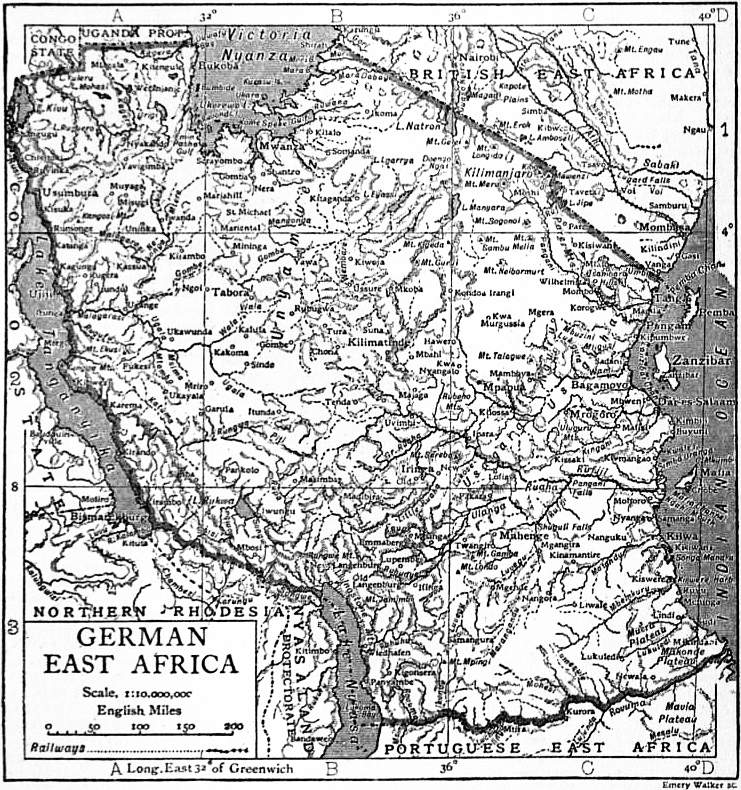
Area and Boundaries.—On the north the boundary line runs N.W. from the mouth of the Umba river to Lake Jipe and Mount Kilimanjaro including both in the protectorate, and thence to Victoria Nyanza, crossing it at 1° S., which parallel it follows till it reaches 30° E. In the west the frontier is as follows: From the point of intersection of 1° S. and 30° E., a line running S. and S.W. to the north-west end of Lake Kivu, thence across that lake near its western shore, and along the river Rusizi, which issues from it, to the spot where the Rusizi enters the north end of Lake Tanganyika; along the middle line of Tanganyika to near its southern end, when it is deflected eastward to the point where the river Kalambo enters the lake (thus leaving the southern end of Tanganyika to Great Britain). From this point the frontier runs S.E. across the plateau between Lakes Tanganyika and Nyasa, in its southern section following the course of the river Songwe. Thence it goes down the middle of Nyasa as far as 11° 30′ S. The southern frontier goes direct from the last-named point eastward to the Rovuma river, which separates German and Portuguese territory. A little before the Indian Ocean is reached the frontier is deflected south so as to leave the mouth of the Rovuma in German East Africa. These boundaries include an area of about 364,000 sq. m. (nearly double the size of Germany), with a population estimated in 1910 at 8,000,000. Of these above 10,000 were Arabs, Indians, Syrians and Goanese, and 3000 Europeans (over 2000 being Germans). The island of Mafia (see below) is included in the protectorate.
Physical Features.—The coast of German East Africa (often spoken of as the Swahili coast, after the inhabitants of the seaboard) is chiefly composed of coral, is little indented, and is generally low, partly sandy, partly rich alluvial soil covered with dense bush or mangroves. Where the Arabs have established settlements the coco-palm and mango tree introduced by them give variety to the vegetation. The coast plain is from 10 to 30 m. wide and 620 m. long; it is bordered on the west by the precipitous eastern side of the interior plateau of Central Africa. This plateau, considerably tilted from its horizontal position, attains its highest elevation north of Lake Nyasa (see Livingstone Mountains), where several peaks rise over 7000 ft., one to 9600, while its mean altitude is about 3000 to 4000 ft. From this region the country slopes towards the north-west, and is not distinguished by any considerable mountain ranges. A deep narrow gorge, the so-called “eastern rift-valley,” traverses the middle of the plateau in a meridional direction. In the northern part of the country it spreads into several side valleys, from one of which rises the extinct volcano Kilimanjaro (q.v.), the highest mountain in Africa (19,321 ft.). Its glaciers send down a thousand rills which combine to form the Pangani river. About 40 m. west of Kilimanjaro is Mount Meru (14,955 ft.), another volcanic peak, with a double crater. The greater steepness of its sides makes Meru in some aspects a more striking object than its taller neighbour. South-east of Mount Kilimanjaro are the Pare Mountains and Usambara highlands, separated from the coast by a comparatively narrow strip of plain. To the south of the Usambara hills, and on the eastern edge of the plateau, are the mountainous regions of Nguru (otherwise Unguru), Useguha and Usagara. As already indicated, the southern half of Victoria Nyanza and the eastern shores, in whole or in part, of Lakes Kivu, Tanganyika and Nyasa, are in German territory. (The lakes are separately described.) Several smaller lakes occur in parts of the eastern rift-valley. Lake Rukwa (q.v.) north-west of Nyasa is presumably only the remnant of a much larger lake. Its extent varies with the rainfall of each year. North-west of Kilimanjaro is a sheet of water known as the Natron Lake from the mineral alkali it contains. In the northern part of the colony the Victoria Nyanza is the dominant physical feature. The western frontier coincides with part of the eastern wall of another depression, the Central African or Albertine rift-valley, in which lie Tanganyika, Kivu and other lakes. Along the north-west frontier north of Kivu are volcanic peaks (see Mfumbiro).
The country is well watered, but with the exception of the Rufiji the rivers, save for a few miles from their mouths, are unnavigable. The largest streams are the Rovuma and Rufiji (q.v.), both rising in the central plateau and flowing to the Indian Ocean. Next in importance is the Pangani river, which, as stated above, has its head springs on the slopes of Kilimanjaro. Flowing in a south-easterly direction it reaches the sea after a course of some 250 m. The Wami and Kingani, smaller streams, have their origin in the mountainous region fringing the central plateau, and reach the ocean opposite the island of Zanzibar. Of inland river systems there are four—one draining to Victoria Nyanza, another to Tanganyika, a third to Nyasa and a fourth to Rukwa. Into Victoria Nyanza are emptied, on the east, the waters of the Mori and many smaller streams; on the west, the Kagera (q.v.), besides smaller rivers. Into Tanganyika flows the Malagarasi, a considerable river with many affluents, draining the west-central part of the plateau. The Kalambo river, a comparatively small stream near the southern end of Tanganyika, flows in a south-westerly direction. Not far from its mouth there is a magnificent fall, a large volume of water falling 600 ft. sheer over a rocky ledge of horse-shoe shape. Of the streams entering Nyasa the Songwe has been mentioned. The Ruhuhu, which enters Nyasa in 10° 30′ S., and its tributaries drain a considerable area west of 36° E. The chief feeders of Lake Rukwa are the Saisi and the Rupa-Songwe.
Mafia Island lies off the coast immediately north of 8° N. It has an area of 200 sq. m. The island is low and fertile, and extensively planted with coco-nut palms. It is continued southwards by an extensive reef, on which stands the chief village, Chobe, the residence of a few Arabs and Banyan traders. Chobe stands on a shallow creek almost inaccessible to shipping.
Geology.—The narrow foot-plateau of British East Africa broadens out to the south of Bagamoyo to a width of over 100 m. This is covered to a considerable extent by rocks of recent and late Tertiary ages. Older Tertiary rocks form the bluffs of Lindi. Cretaceous marls and limestones appear at intervals, extending in places to the edge of the upper plateau, and are extensively developed on the Makonde plateau. They are underlain by Jurassic rocks, from beneath which sandstones and shales yielding Glossopteris browniana var. indica, and therefore of Lower Karroo age, appear in the south but are overlapped on the north by Jurassic strata. The central plateau consists almost entirely of metamorphic rocks with extensive tracts of granite in Unyamwezi. In the vicinity of Lakes Nyasa and Tanganyika, sandstones and shales of Lower Karroo age and yielding seams of coal are considered to owe their position and preservation to being let down by rift faults into hollows of the crystalline rocks. In Karagwe certain quartzites, slates and schistose sandstones resemble the ancient gold-bearing rocks of South Africa.
The volcanic plateau of British East Africa extends over the boundary in the region of Kilimanjaro. Of the sister peaks, Kibo and Mawenzi, the latter is far the oldest and has been greatly denuded, while Kibo retains its crateriform shape intact. The rift-valley faults continue down the depression, marked by numerous volcanoes, in the region of the Natron Lake and Lake Manyara; while the steep walls of the deep depression of Tanganyika and Nyasa represent the western rift system at its maximum development.
Fossil remains of saurians of gigantic size have been found; one thigh bone measures 6 ft. 10 in., the same bone in the Diplodocus Carnegii measuring only 4 ft. 11 in.
Climate.—The warm currents setting landwards from the Indian Ocean bring both moisture and heat, so that the Swahili coast has a higher temperature and heavier rainfall than the Atlantic seaboard under the same parallels of latitude. The mean temperature on the west and east coasts of Africa is 72° and 80° Fahr. respectively, the average rainfall in Angola 36 in., in Dar-es-Salaam 60 in. On the Swahili coast the south-east monsoon begins in April and the north-east monsoon in November. In the interior April brings south-east winds, which continue until about the beginning of October. During the rest of the year changing winds prevail. These winds are charged with moisture, which they part with on ascending the precipitous side of the plateau. Rain comes with the south-east monsoon, and on the northern part of the coast the rainy season is divided into two parts, the great and the little Masika: the former falls in the months of September, October, November; the latter in February and March. In the interior the climate has a more continental character, and is subject to considerable changes of temperature; the rainy season sets in a little earlier the farther west and north the region, and is well marked, the rain beginning in November and ending in April; the rest of the year is dry. On the highest parts of the plateau the climate is almost European, the nights being sometimes exceedingly cold. Kilimanjaro has a climate of its own; the west and south sides of the mountain receive the greatest rainfall, while the east and north sides are dry nearly all the year. Malarial diseases are rather frequent, more so on the coast than farther inland. The Kilimanjaro region is said to enjoy immunity. Smallpox is frequent on the coast, but is diminishing before vaccination; other epidemic diseases are extremely rare.
Flora and Fauna.—The character of the vegetation varies with and depends on moisture, temperature and soil. On the low littoral zone the coast produced a rich tropical bush, in which the mangrove is very prominent. Coco-palms and mango trees have been planted in great numbers, and also many varieties of bananas. The bush is grouped in copses on meadows, which produce a coarse tall grass. The river banks are lined with belts of dense forest, in which useful timber occurs. The Hyphaene palm is frequent, as well as various kinds of gum-producing mimosas. The slopes of the plateau which face the rain-bringing monsoon are in some places covered with primeval forest, in which timber is plentiful. The silk-cotton tree (Bombax ceiba), miomba, tamarisk, copal tree (Hymenaea courbaril) are frequent, besides sycamores, banyan trees (Ficus indica) and the deleb palm (Borassus aethiopum). It is here we find the Landolphia florida, which yields the best rubber. The plateau is partly grass land without bush and forest, partly steppe covered with mimosa bush, which sometimes is almost impenetrable. Mount Kilimanjaro and Mount Meru exhibit on a vertical scale the various forms of vegetation which characterize East Africa (see Kilimanjaro).
East Africa is rich in all kinds of antelope, and the elephant, rhinoceros and hippopotamus are still plentiful in parts. Characteristic are the giraffe, the chimpanzee and the ostrich. Buffaloes and zebras occur in two or three varieties. Lions and leopards are found throughout the country. Crocodiles are numerous in all the larger rivers. Snakes, many venomous, abound. Of birds there are comparatively few on the steppe, but by rivers, lakes and swamps they are found in thousands. Locusts occasion much damage, and ants of various kinds are often a plague. The tsetse fly (Glossina morsitans) infests several districts; the sand-flea has been imported from the west coast. Land and water turtles are numerous.
Inhabitants.—On the coast and at the chief settlements inland are Arab and Indian immigrants, who are merchants and agriculturists. The Swahili (q.v.) are a mixed Bantu and Semitic race inhabiting the seaboard. The inhabitants of the interior may be divided into two classes, those namely of Bantu and those of Hamitic stock. What may be called the indigenous population consists of the older Bantu races. These tribes have been subject to the intrusion from the south of more recent Bantu folk, such as the Yao, belonging to the Ama-Zulu branch of the race, while from the north there has been an immigration of Hamito-Negroid peoples. Of these the Masai and Wakuafi are found in the region between Victoria Nyanza and Kilimanjaro. The Masai (q.v.) and allied tribes are nomads and cattle raisers. They are warlike, and live in square mud-plastered houses called tembe which can be easily fortified and defended. The Bantu tribes are in general peaceful agriculturists, though the Bantus of recent immigration retain the warlike instincts of the Zulus. The most important group of the Bantus is the Wanyamwezi (see Unyamwezi), divided into many tribes. They are spread over the central plains, and have for neighbours on the south-east, between Nyasa and the Rufiji, the warlike Wahehe. The Wangoni (Angoni), a branch of the Ama-Zulu, are widely spread over the central and Nyasa regions. Other well-known tribes are the Wasambara, who have given their name to the highlands between Kilimanjaro and the coast, and the Warundi, inhabiting the district between Tanganyika and the Kagera. In Karagwe, a region adjoining the south-west shores of Victoria Nyanza, the Bahima are the ruling caste. Formerly Karagwe under its Bahima kings was a powerful state. Many different dialects are spoken by the Bantu tribes, Swahili being the most widely known (see Bantu Languages). Their religion is the worship of spirits, ancestral and otherwise, accompanied by a vague and undefined belief in a Supreme Being, generally regarded as indifferent to the doings of the people.
The task of civilizing the natives is undertaken in various ways by the numerous Protestant and Roman Catholic missions established in the colony, and by the government. The slave trade has been abolished, and though domestic slavery is allowed, all children of slaves born after the 31st of December 1905 are free. For certain public works the Germans enforce a system of compulsory labour. Efforts are made by instruction in government and mission schools to spread a knowledge of the German language among the natives, in order to fit them for subordinate posts in administrative offices, such as the customs. Native chiefs in the interior are permitted to help in the administration of justice. The Mission du Sacré Cœur in Bagamoyo, the oldest mission in the colony, has trained many young negroes to be useful mechanics. The number of native Christians is small. The Moslems have vigorous and successful missions.
Chief Towns.—The seaports of the colony are Tanga (pop. about 6000), Bagamoyo 5000 (with surrounding district some 18,000), Dar-es-Salaam 24,000, Kilwa 5000, (these have separate notices), Pangani, Sadani, Lindi and Mikindani. Pangani (pop. about 3500) is situated at the mouth of the river of the same name; it serves a district rich in tropical products, and does a thriving trade with Zanzibar and Pemba. Sadani is a smaller port midway between Pangani and Bagamoyo. Lindi (10° 0′ S., 39° 40′ E.) is 80 m. north of Cape Delgado. Lindi (Swahili for The Deep Below) Bay runs inland 6 m. and is 3 m. across, affording deep anchorage. Hills to the west of the bay rise over 1000 ft. The town (pop. about 4000) is picturesquely situated on the north side of the bay. The Arab boma, constructed in 1800, has been rebuilt by the Germans, who have retained the fine sculptured gateway. Formerly a rendezvous for slave caravans Lindi now has a more legitimate trade in white ivory. Mikindani is the most southern port in the colony. Owing to the prevalence of malaria there, few Europeans live at the town, and trade is almost entirely in the hands of Banyans.
Inland the principal settlements are Korogwe, Mrogoro, Kilossa, Mpapua and Tabora. Korogwe is in the Usambara hills, on the north bank of the Pangani river, and is reached by railway from Tanga. Mrogoro is some 140 m. due west of Dar-es-Salaam, and is the first important station on the road to Tanganyika. Kilossa and Mpapua are farther inland on the same caravan route. Tabora (pop. about 37,000), the chief town of the Wanyamwezi tribes, occupies an important position on the central plateau, being the meeting-place of the trade routes from Tanganyika, Victoria Nyanza and the coast. In the railway development of the colony Tabora is destined to become the central junction of lines going north, south, east and west.
On Victoria Nyanza there are various settlements. Mwanza, on the southern shore, is the lake terminus of the route from Bagamoyo: Bukoba is on the western shore, and Schirati on the eastern shore; both situated a little south of the British frontier. On the German coast of Tanganyika are Ujiji (q.v.), pop. about 14,000, occupying a central position; Usumbura, at the northern end of the lake where is a fort built by the Germans; and Bismarckburg, near the southern end. On the shores of the lake between Ujiji and Bismarckburg are four stations of the Algerian “White Fathers,” all possessing churches, schools and other stone buildings. Langenburg is a settlement on the north-east side of Lake Nyasa. The government station, called New Langenburg, occupies a higher and more healthy site north-west of the lake. Wiedhafen is on the east side of Nyasa at the mouth of the Ruhuhu, and is the terminus of the caravan route from Kilwa.
Productions.—The chief wealth of the country is derived from agriculture and the produce of the forests. From the forests are obtained rubber, copal, bark, various kinds of fibre, and timber (teak, mahogany, &c.). The cultivated products include coffee, the coco-nut palm, tobacco, sugar-cane, cotton, vanilla, sorghum, earth-nuts, sesame, maize, rice, beans, peas, bananas (in large quantities), yams, manioc and hemp. Animal products are ivory, hides, tortoise-shell and pearls. On the plateaus large numbers of cattle, goats and sheep are reared. The natives have many small smithies. Gold, coal, iron, graphite, copper and salt have been found. Garnets are plentiful in the Lindi district, and agates, topaz, moonstone and other precious stones are found in the colony. The chief gold and iron deposits are near Victoria Nyanza. In the Mwanza district are conglomerate reefs of great extent. Mining began in 1905, Mica is mined near Mrogoro. The chief exports are sisal fibre, rubber, hides and skins, wax, ivory, copra, coffee, ground-nuts and cotton. The imports are chiefly articles of food, textiles, and metals and hardware. More than half the entire trade, both export and import, is with Zanzibar. Germany takes about 30% of the trade. In the ten years 1896-1905 the value of the external trade increased from about £600,000 to over £1,100,000. In 1907 the imports were valued at £1,190,000, the exports at £625,000.
Numerous companies are engaged in developing the resources of the country by trading, planting and mining. The most important is the Deutsch-Ostafrikanische Gesellschaft, founded in 1885, which has trading stations in each seaport, and flourishing plantations in various parts of the country. It is the owner of vast tracts of land. From 1890 to 1903 this company was in possession of extensive mining, railway, banking and coining rights, but in the last-named year, by agreement with the German government, it became a land company purely. The company has a right to a fifth part of the land within a zone of 10 m. on either side of any railway built in the colony previously to 1935. In addition to the companies a comparatively large number of private individuals have laid out plantations, Usambara and Pare having become favourite districts for agricultural enterprise. In the delta of the Rufiji and in the Kilwa district cotton-growing was begun in 1901. The plantations are all worked by native labour. The government possesses large forest reserves.
Communications.—Good roads for foot traffic have been made from the seaports to the trading stations on Lakes Nyasa, Tanganyika and Victoria. Caravans from Dar-es-Salaam to Tanganyika take 60 days to do the journey. The lack of more rapid means of communication hindered the development of the colony and led to economic crises (1898-1902), which were intensified, and in part created, by the building of a railway in the adjacent British protectorate from Mombasa to Victoria Nyanza, the British line securing the trade with the lake. At that time the only railway in the country was a line from Tanga to the Usambara highlands. This railway passes through Korogwe (52 m. from Tanga) and is continued via Mombo to Wilhelmstal, a farther distance of 56 m. The building of a trunk line from Dar-es-Salaam to Mrogoro (140 m.), and ultimately to Ujiji by way of Tabora, was begun in 1905. Another proposed line would run from Kilwa to Wiedhafen on Lake Nyasa. This railway would give the quickest means of access to British Central Africa and the southern part of Belgian Congo. On each of the three lakes is a government steamer. British steamers on Victoria Nyanza maintain communication between the German stations and the take terminus of the Uganda railway. The German East Africa Line of Hamburg runs a fleet of first-class steamers to East Africa, which touch at Tanga, Dar-es-Salaam and Zanzibar. There is a submarine cable from Dar-es-Salaam to Zanzibar, and an overland line connecting all the coast stations.
Administration, Revenue, &c.—For administrative purposes the country is divided into districts (Bezirksämter), and stations (Stationsbezirke). Each station has a chief, who is subordinate to the official of his district, these in their turn being under the governor, who resides in Dar-es-Salaam. The governor is commander of the colonial force, which consists of natives under white officers. District councils are constituted, on which the European merchants and planters are represented. Revenue is raised by taxes on imports and exports, on licences for the sale of land and spirituous liquors, and for wood-cutting, by harbour and other dues, and a hut tax on natives. The deficiency between revenue and expenditure is met by a subsidy from the imperial government. In no case during the first twenty-one years’ existence of the colony had the local revenue reached 60% of the local expenditure, which in normal years amounted to about £500,000. In 1909, however, only the expenditure necessary for military purposes (£183,500) was received by way of subsidy.
History.—Until nearly the middle of the 19th century only the coast lands of the territory now forming German East Africa were known either to Europeans or to the Arabs. When at the beginning of the 16th century the Portuguese obtained possession of the towns along the East African coast, they had been, for periods extending in some cases fully five hundred years, under Arab dominion. After the final withdrawal of the Portuguese in the early years of the 18th century, the coast towns north of Cape Delgado fell under the sway of the Muscat Arabs, passing from them to the sultan of Zanzibar. From about 1830, or a little earlier, the Zanzibar Arabs began to penetrate inland, and by 1850 had established themselves at Ujiji on the eastern shore of Lake Tanganyika. The Arabs also made their way south to Nyasa. This extension of Arab influence was accompanied by vague claims on the part of the sultan of Zanzibar to include all these newly opened countries in his empire. How far from the coast the real authority of the sultan extended was never demonstrated. Zanzibar at this time was in semi-dependence on India, and British influence was strong at the court of Bargash, who succeeded to the sultanate in 1870. Bargash in 1877 offered to Sir (then Mr) William Mackinnon a lease of all his mainland territory. The offer, made in the year in which H.M. Stanley’s discovery of the course of the Congo initiated the movement for the partition of the continent, was declined. British influence was, however, still so powerful in Zanzibar that the agents of the German Colonization Society, who in 1884 sought to secure for their country territory on the east coast, deemed it prudent to act secretly, so that both Great Britain and Zanzibar might be confronted with accomplished facts. Making their way inland, three young Germans, Karl Peters, Joachim Count Pfeil and Dr Jühlke, concluded a “treaty” in November 1884 with a chieftain in Usambara who was declared to be independent of Zanzibar. Other treaties followed, and on the 17th of February 1885, the German emperor granted a charter of protection to the Colonization Society. The German acquisitions were resented by Zanzibar, but were acquiesced in by the British government (the second Gladstone administration). The sultan was forced to acknowledge their validity, and to grant a German company a lease of his mainland territories south of the mouth of the Umba river, a British company formed by Mackinnon taking a lease of the territories north of that point. The story of the negotiations between Great Britain, Germany and France which led to this result is told elsewhere (see Africa, section 5). By the agreement of the 1st of July 1890, between the British and German governments, and by agreements concluded between Germany and Portugal in 1886 and 1894, and Germany and the Congo Free State in 1884 and later dates, the German sphere of influence attained its present area. On the 28th of October 1890 the sultan of Zanzibar ceded absolutely to Germany the mainland territories already leased to a German company, receiving as compensation £200,000.
While these negotiations were going on, various German companies had set to work to exploit the country, and on the 16th of August 1888 the German East African Company, the lessee of the Zanzibar mainland strip, took over the administration from the Arabs. This was followed, five days later, by a revolt of all the coast Arabs against German rule—the Germans, raw hands at the task of managing Orientals, having aroused intense hostility by their brusque treatment of the dispossessed rulers. The company being unable to quell the revolt, Captain Hermann Wissmann—subsequently Major Hermann von Wissmann (1853-1905)—was sent out by Prince Bismarck as imperial commissioner. Wissmann, with 1000 soldiers, chiefly Sudanese officered by Germans, and a German naval contingent, succeeded by the end of 1889 in crushing the power of the Arabs. Wissmann remained in the country until 1891 as commissioner, and later (1895-1896) was for eighteen months governor of the colony—as the German sphere had been constituted by proclamation (1st of January 1897). Towards the native population Wissmann’s attitude was conciliatory, and under his rule the development of the resources of the country was pushed on. Equal success did not attend the efforts of other administrators; in 1891-1892 Karl Peters had great trouble with the tribes in the Kilimanjaro district and resorted to very harsh methods, such as the execution of women, to maintain his authority. In 1896 Peters was condemned by a disciplinary court for a misuse of official power, and lost his commission. After 1891, in which year the Wahehe tribe ambushed and almost completely annihilated a German military force of 350 men under Baron von Zelewski, there were for many years no serious risings against German authority, which by the end of 1898 had been established over almost the whole of the hinterland. The development of the country was, however, slow, due in part to the disinclination of the Reichstag to vote supplies sufficient for the building of railways to the fertile lake regions. Count von Götzen (governor 1901-1906) adopted the policy of maintaining the authority of native rulers as far as possible, but as over the greater part of the colony the natives have no political organizations of any size, the chief burden of government rests on the German authorities. In August 1905 serious disturbances broke out among the Bantu tribes in the colony. The revolt was due largely to resentment against the restrictions enforced by the Germans in their efforts at civilization, including compulsory work on European plantations in certain districts. Moreover, it is stated that the Herero in rebellion in German South-west Africa sent word to the east coast natives to follow their example, an instance of the growing solidarity of the black races of Africa. Though the revolt spread over a very large area, the chief centre of disturbance was the region between Nyasa and the coast at Kilwa and Lindi. Besides a number of settlers a Roman Catholic bishop and a party of four missionaries and nuns were murdered in the Kilwa hinterland, while nearer Nyasa the warlike Wangoni held possession of the country. The Germans raised levies of Masai and Sudanese, and brought natives from New Guinea to help in suppressing the rising, besides sending naval and military contingents from Germany. In general, the natives, when encountered, were easily dispersed, but it was not until March 1906 that the coast regions were again quiet. In July following the Wangoni were beaten in a decisive engagement. It was officially stated that the death-roll for the whole war was not below 120,000 men, women and children. In 1907 a visit was paid to the colony by Herr B. Dernburg, the colonial secretary. As a result of this visit more humane methods in the treatment of the natives were introduced, and measures taken to develop more fully the economic resources of the country.
Authorities.—S. Passarge and others, Das deutsche Kolonialreich, Erster Band (Leipzig, 1909); P. Reichard, Deutsch Ostafrika, das Land und seine Bewohner (Leipzig, 1892); F. Stuhlmann, Mit Emin Pasha im Herzen von Afrika (Berlin, 1894); Brix Foerster, Deutsch-Ostafrika; Geographie und Geschichte (Leipzig, 1890); Oscar Baumann, In Deutsch-Ostafrika während des Aufstands (Vienna, 1890), Usambara und seine Nachbargebiete (Berlin, 1891), and Durch Massailand zur Nilquelle (Berlin, 1894). For special studies see P. Samassa, Die Besiedelung Deutsch-Ostafrikas (Leipzig, 1909); A. Engler, Die Pflanzenwelt Ost-Afrikas und der Nachbargebiete (Berlin, 1895-1896) and other works by the same author; Stromer von Reichenbach, Die Geologie der deutschen Schutzgebiete in Afrika (Munich and Leipzig, 1896); W. Bornhardt, Deutsch-Ostafrika (Berlin, 1898); F. Fullerborn, Beiträge zur physischen Anthropologie der Nord-Nyassaländer (Berlin, 1902), a fine series of pictures of native types, and Das Deutsche Nyassa- und Ruwuma-gebiet, Land und Leute (Berlin, 1906); K. Weule, Native Life in East Africa (London, 1909); Hans Meyer, Der Kilimandjaro (Berlin, 1900) and Die Eisenbahnen im tropischen Afrika (Leipzig, 1902); J. Strandes, Die Portugiesenzeit von Deutsch- u. Englisch-Ostafrika (Berlin, 1899), a valuable monograph on the Portuguese period. See also British Official Reports on East Africa (specially No. 4221 ann. ser.), the German White Books and annual reports, the Mitteilungen aus den deutschen Schutzgebiete, and the Deutsches Kolonialblatt, published fortnightly at Berlin since 1890. The Deutscher Kolonial-Atlas has maps on the 1:1,000,000 scale.
(F. R. C.)
GERMAN EVANGELICAL SYNOD OF NORTH AMERICA, a Protestant church dating from October 1840, and known, in its early years, as the German Evangelical Association of the West. It was formed by six German ministers who had been ordained in Prussia and were engaged in missionary and pioneer work in Missouri and Illinois. The original organization was strengthened in 1858 by amalgamation with the German Evangelical Church Association of Ohio, and later by the inclusion of the German United Evangelical Synod of the East (1860), the Evangelical Synod of the North-West (1872) and the United Evangelical Synod of the East (1872). The church bases its position on the Bible as interpreted by the symbols of the Lutheran and Reformed churches so far as they are in agreement, points of difference being left to “that liberty of conscience which, as a component part of the basis of man’s ultimate responsibility to God himself, is the inalienable privilege of every believer.” The church, which has (1909) 985 ministers and some 238,000 communicant members, is divided into seventeen districts, with officers responsible to the General Synod, which meets every four years. There are boards for home and foreign missions, the latter operating chiefly in the Central Provinces of India. The literature of the church is mainly in German, though English is rapidly gaining ground.
GERMANIC LAWS, EARLY. Of those Germanic laws of the early middle ages which are known as leges barbarorum, we here deal with the principal examples other than Frankish, viz. (1) Leges Wisigothorum, (2) Lex Burgundionum, (3) Pactus Alamannorum and Lex Alamannorum, (4) Lex Bajuvariorum, (5) Lex Saxonum, (6) Lex Frisionum, (7) Lex Angliorum et Werinorum, hoc est, Thuringorum, and (8) Leges Langobardorum. All these laws may in general be described as codes of procedure and tariffs of compositions. They present somewhat similar features with the Salic law, but often differ from it in the date of compilation, the amount of fines, the number and nature of the crimes, the number, rank, duties and titles of the officers, &c. For the Salic law and other Frankish laws, see Salic Law, and for the edict of Theodoric I., which was applicable to the Ostrogoths and Romans, see Roman Law.
For the whole body of the Germanic laws see P. Canciani, Barbarorum leges antiquae (Venice, 1781-1789); F. Walter, Corpus juris germanici antiqui (Berlin, 1824); Monumenta Germaniae historica, Leges. For further information on the codes in general, see H.M. Zöpfl, Deutsche Rechtsgeschichte (4th ed., Heidelberg, 1871-1876); J.E.O. Stobbe, Geschichte der deutschen Rechtsquellen (Brunswick, 1860-1864); Paul Viollet, Histoire du droit civil français (2nd ed., Paris, 1893); H. Brunner, Deutsche Rechtsgeschichte (2nd ed., Leipzig, 1906).
1. Leges Wisigothorum.—Karl Zeumer’s edition of these laws in the 4to series of the Mon. Germ. Hist. throws new light on all questions relating to their date and composition. It is now certain that the earliest written code of the Visigoths dates back to King Euric (466-485). Besides his own constitutions, Euric included in this collection constitutions of his predecessors, Theodoric I. (419-451), Thorismund (451-453), and Theodoric II. (453-466), and he arranged the whole in a logical order. Of this code fragments of chapters cclxxvi. to cccxxxvi.1 have been discovered in a palimpsest MS. in the Bibliothèque Nationale at Paris (Latin coll., No. 12161), a fact which proves that the code ran over a large area. Euric’s code was used for all cases between Goths, and between them and Romans; in cases between Romans, Roman law was used. At the instance of Euric’s son, Alaric II., an examination was made of the Roman laws in use among Romans in his dominions, and the resulting compilation was approved in 506 at an assembly at Aire, in Gascony, and is known as the Breviary of Alaric, and sometimes as the Liber Aniani, from the fact that the authentic copies bear the signature of the referendarius Anian.
Euric’s code remained in force among the Visigoths of Spain until the reign of Leovigild (568-586), who made a new one, improving upon that of his predecessor. This work is lost, and we have no direct knowledge of any fragment of it. In the 3rd codification, however, many provisions have been taken from the 2nd, and these are designated by the word “antiqua”; by means of these “antiqua” we are enabled in a certain measure to reconstruct the work of Leovigild.
After the reign of Leovigild the legislation of the Visigoths underwent a transformation. The new laws made by the kings were declared to be applicable to all the subjects in the kingdom, of whatever race—in other words, they became territorial; and this principle of territoriality was gradually extended to the ancient code. Moreover, the conversion of Reccared I. (586-601) to orthodoxy effaced the religious differences among his subjects, and all subjects, qua Christians, had to submit to the canons of the councils, which were made obligatory by the kings. After this change had been accepted, Recceswinth (649-672) made a new code, which was applicable to Visigoths and Romans alike. This code, known as the Liber judiciorum, is divided into 12 books, which are subdivided into tituli and chapters (aerae). It comprises 324 constitutions taken from Leovigild’s collection, a few of the laws of Reccared and Sisebut, 99 laws of Chindaswinth (642-653), and 87 of Recceswinth. A recension of this code of Recceswinth was made in 681 by King Erwig (680-687), and is known as the Lex Wisigothorum renovata; and, finally, some additamenta were made by Egica (687-702). In Zeumer’s edition of the Leges Wisigothorum the versions of Recceswinth and Erwig, where they differ from each other, are shown in parallel columns, and the laws later than Erwig are denoted by the sign “nov.”
For further information see the preface to Zeumer’s edition; H. Brunner, Deutsche Rechtsgeschichte (2nd ed., Leipzig, 1906); Ureña y Smenyaud, La Legislacion Gotico-hispana (Madrid, 1905).
2. Lex Burgundionum.—This code was compiled by King Gundobald (474-516), very probably after his defeat by Clovis in 500. Some additamenta were subsequently introduced either by Gundobald himself or by his son Sigismund. This law bears the title of Liber Constitutionum, which shows that it emanated from the king; it is also known as the Lex Gundobada or Lex Gombata. It was used for cases between Burgundians, but was also applicable to cases between Burgundians and Romans. For cases between Romans, however, Gundobald compiled the Lex Romana Burgundionum, called sometimes, through a misreading of the MSS., the Liber Papiani or simply Papianus. The barbarian law of the Burgundians shows strong traces of Roman influence. It recognizes the will and attaches great importance to written deeds, but on the other hand sanctions the judicial duel and the cojuratores (sworn witnesses). The vehement protest made in the 9th century by Agobard, bishop of Lyons, against the Lex Gundobada shows that it was still in use at that period. So late as the 10th and even the 11th centuries we find the law of the Burgundians invoked as personal law in Cluny charters, but doubtless these passages refer to accretions of local customs rather than to actual paragraphs of the ancient code.
The text of the Lex Burgundionum has been published by F. Bluhme in the Mon. Germ. hist., Leges, iii. 525; by Karl Binding in the Fontes rerum Bernensium (vol. i., 1880); by J.E. Valentin Smith (Paris, 1889 seq.); and by von Salis (1892) in the 4to series of the Mon. Germ. hist. Cf. R. Dareste, “La Loi Gombette,” in the Journal des savants (July 1891).
3. Pactus Alamannorum and Lex Alamannorum.—Of the laws of the Alamanni, who dwelt between the Rhine and the Lech, and spread over Alsace and what is now Switzerland to the south of Lake Constance, we possess two different texts. The earlier text, of which five short fragments have come down to us, is known as the Pactus Alamannorum, and from the persistent recurrence of the expression “et sic convenit” was most probably drawn up by an official commission. The reference to affranchisement in ecclesia shows that it was composed at a period subsequent to the conversion of the Alamanni to Christianity. There is no doubt that the text dates back to the reign of Dagobert I., i.e. to the first half of the 7th century. The later text, known as the Lex Alamannorum, dates from a period when Alamannia was independent under national dukes, but recognized the theoretical suzerainty of the Frankish kings. There seems no reason to doubt the St Gall MS., which states that the law had its origin in an agreement between the great Alamannic lords and Duke Landfrid, who ruled the duchy from 709 to 730.
The two texts have been published by J. Merkel in the Mon. Germ. hist., Leges, iii., and by Karl Lehmann in the 4to series of the same collection.
4. Lex Bajuvariorum.—We possess an important law of the Bavarians, whose duchy was situated in the region east of the Lech, and was an outpost of Germany against the Huns, known later as Avars. Parts of this law have been taken directly from the Visigothic law of Euric and from the law of the Alamanni. The Bavarian law, therefore, is later than that of the Alamanni. It dates unquestionably from a period when the Frankish authority was very strong in Bavaria, when the dukes were vassals of the Frankish kings. Immediately after the revolt of Bavaria in 743 the Bavarian duke Odilo was forced to submit to Pippin and Carloman, the sons of Charles Martel, and to recognize the Frankish suzerainty. About the same period, too, the church of Bavaria was organized by St Boniface, and the country divided into several bishoprics; and we find frequent references to these bishops (in the plural) in the law of the Bavarians. On the other hand, we know that the law is anterior to the reign of Duke Tassilo III. (749-788). The date of compilation must, therefore, be placed between 743 and 749.
There is an edition of the Lex Bajuvariorum by J. Merkel in the Mon. Germ. hist., Leges, iii. 183, and another was undertaken by E. von Schwind for the 4to series of the same collection. Cf. von Schwind’s article in the Neues Archiv, vol. xxxi.
5. Lex Saxonum.—Germany comprised two other duchies, Saxony and Frisia, of each of which we possess a text of law. The Lex Saxonum has come down to us in two MSS. and two old editions (those of B.J. Herold and du Tillet), and the text has been edited by Karl von Richthofen in the Mon. Germ. hist., Leges, v. The law contains ancient customary enactments of Saxony, and, in the form in which it has reached us, is later than the conquest of Saxony by Charlemagne. It is preceded by two capitularies of Charlemagne for Saxony—the Capitulatio de partibus Saxoniae (A. Boretius i. 68), which dates undoubtedly from 782, and is characterized by great severity, death being the penalty for every offence against the Christian religion; and the Capitulare Saxonicum (A. Boretius i. 71), of the 28th of October 797, in which Charlemagne shows less brutality and pronounces simple compositions for misdeeds which formerly entailed death. The Lex Saxonum apparently dates from 803, since it contains provisions which are in the Capitulare legi Ribuariae additum of that year. The law established the ancient customs, at the same time eliminating anything that was contrary to the spirit of Christianity; it proclaimed the peace of the churches, whose possessions it guaranteed and whose right of asylum it recognized.
6. Lex Frisionum.—This consists of a medley of documents of the most heterogeneous character. Some of its enactments are purely pagan—thus one paragraph allows the mother to kill her new-born child, and another prescribes the immolation to the gods of the defiler of their temple; others are purely Christian, such as those which prohibit incestuous marriages and working on Sunday. The law abounds in contradictions and repetitions, and the compositions are calculated in different moneys. From this it would appear that the documents were merely materials collected from various sources and possibly with a view to the compilation of a homogeneous law. These materials were apparently brought together at the beginning of the 9th century, at a time of intense legislative activity at the court of Charlemagne.
There are no MSS. of the document extant; our knowledge of it is based upon B.J. Herold’s edition (Originum ac Germanicarum antiquitatum libri, Basel, 1557), which has been reproduced by Karl von Richthofen in the Mon. Germ. hist., Leges, iii. 631.
7. Lex Angliorum el Werinorum, hoc est, Thuringorum.—In early times there dwelt in Thuringia, south of the river Unstrut, the Angli, who gave their name to the pagus Engili, and to the east, between the Saale and the Elster, the Warni (Werini, or Varini), whose name is seen in Werenofeld. In the 9th century, however, this region (then called Werenofeld) was occupied by the Sorabi, and the Warni and Angli either coalesced with the Thuringi or sought an asylum in the north of Germany. A collection of laws has come down to us bearing the name of these two peoples, the Lex Angliorum et Werinorum, hoc est, Thuringorum. This text is a collection of local customs arranged in the same order as the law of the Ripuarians. Parts of it are based on the Capitulare legi Ribuariae additum of 803, and it seems to have been drawn up in the same conditions and circumstances as the law of the Saxons. There is an edition of this code by Karl von Richthofen in the Mon. Germ. hist., Leges, v. 103. The old opinion that the law originated in south Holland is entirely without foundation.
8. Leges Langobardorum.—We possess a fair amount of information on the origin of the last barbarian code, the laws of the Lombards. The first part, consisting of 388 chapters, is known as the Edictus Langobardorum, and was promulgated by King Rothar at a diet held at Pavia on the 22nd of November 643. This work, composed at one time and arranged on a systematic plan, is very remarkable. The compilers knew Roman law, but drew upon it only for their method of presentation and for their terminology; and the document presents Germanic law in its purity. Rothar’s edict was augmented by his successors; Grimoald (668) added nine chapters; Liutprand (713-735), fifteen volumes, containing a great number of ecclesiastical enactments; Ratchis (746), eight chapters; and Aistulf (755), thirteen chapters. After the union of the Lombards to the Frankish kingdom, the capitularies made for the entire kingdom were applicable to Italy. There were also special capitularies for Italy, called Capitula Italica, some of which were appended to the edict of Rothar.
At an early date compilations were formed in Italy for the use of legal practitioners and jurists. Eberhard, duke and margrave of Rhaetia and Friuli, arranged the contents of the edict with its successive additamenta into a Concordia de singulis causis (829-832). In the 10th century a collection was made of the capitularies in use in Italy, and this was known as the Capitulare Langobardorum. Then appeared, under the influence of the school of law at Pavia, the Liber legis Langobardorum, also called Liber Papiensis (beginning of 11th century), and the Lombarda (end of 11th century) in two forms—that given in a Monte Cassino MS. and known as the Lombarda Casinensis, and the Lombarda Vulgata.
There are editions of the Edictus, the Concordia, and the Liber Papiensis by F. Bluhme and A. Boretius in the Mon. Germ. hist., Leges, iv. Bluhme also gives the rubrics of the Lombardae, which were published by F. Lindenberg in his Codex legum antiquarum in 1613. For further information on the laws of the Lombards see J. Merkel, Geschichte des Langobardenrechts (1850); A. Boretius, Die Kapitularien im Langobardenreich (1864); and C. Kier, Edictus Rotari (Copenhagen, 1898). Cf. R. Dareste in the Nouvelle Revue historique de droit français et étranger (1900, p. 143).
(C. Pf.)
1 The lacunae in these fragments have been filled in by the aid of the law of the Bavarians, where the chief provisions are reproduced.
GERMANICUS CAESAR (15 B.C.-A.D. 19), a Roman general and provincial governor in the reign of Tiberius. The name Germanicus, the only one by which he is known in history, he inherited from his father, Nero Claudius Drusus, the famous general, brother of Tiberius and stepson of Augustus. His mother was the younger Antonia, daughter of Marcus Antonius and niece of Augustus, and he married Agrippina, the granddaughter of the same emperor. It was natural, therefore, that he should be regarded as a candidate for the purple. Augustus, it would seem, long hesitated whether he should name him as his successor, and as a compromise required his uncle Tiberius to adopt him, though Tiberius had a son of his own. Of his early years and education little is known. That he possessed considerable literary abilities, and that these were carefully trained, we gather, both from the speeches which Tacitus puts into his mouth, and from the reputation he left as an orator, as attested by Suetonius and Ovid, and from the extant fragments of his works.
At the age of twenty he served his apprenticeship as a soldier under Tiberius, and was rewarded with the triumphal insignia for his services in crushing the revolt in Dalmatia and Pannonia. In A.D. 11 he accompanied Tiberius in his campaign on the Rhine, undertaken, in consequence of the defeat of Varus, with the object of securing the German frontier. In 12 he was made consul, and increased his popularity by appearing as an advocate in the courts of justice, and by the celebration of brilliant games. Soon afterwards he was appointed by Augustus to the important command of the eight legions on the Rhine. The news of the emperor’s death (14) found Germanicus at Lugdunum (Lyons), where he was superintending the census of Gaul. Close upon this came the report that a mutiny had broken out among his legions on the lower Rhine. Germanicus hurried back to the camp, which was now in open insurrection. The tumult was with difficulty quelled, partly by well-timed concessions, for which the authority of the emperor was forged, but chiefly owing to his personal popularity. Some of the insurgents actually proposed that he should put himself at their head and secure the empire for himself, but their offer was rejected with indignation. In order to calm the excitement Germanicus determined at once on an active campaign. Crossing the Rhine, he attacked and routed the Marsi, and laid waste the valley of the Ems. In the following year he marched against Arminius, the conqueror of Varus, and performed the last rites over the remains of the Roman soldiers that still lay there unburied, erecting a barrow to mark the spot. Arminius, however, favoured by the marshy ground, was able to hold his own, and it required another campaign before he was finally defeated. A masterly combined movement by land and water enabled Germanicus to concentrate his forces against the main body of the Germans encamped on the Weser, and to crush them in two obstinately contested battles. A monument erected on the field proclaimed that the army of Tiberius had conquered every tribe between the Rhine and the Elbe. Great, however, as the success of the Roman arms had been, it was not such as to justify this boastful inscription; we read of renewed attacks from the barbarians, and plans of a fourth campaign for the next summer.
But the success of Germanicus had already stirred the jealousy and fears of Tiberius, and he was reluctantly compelled to return to Rome. On the 26th of May 17 he celebrated a triumph. The enthusiasm with which he was welcomed, not only by the populace, but by the emperor’s own praetorians, was so great that the earliest pretext was seized to remove him from the capital. He was sent to the East with extraordinary powers to settle a disputed succession in Parthia and Armenia. At the same time Gnaeus Calpurnius Piso, one of the most violent and ambitious of the old nobility, was sent as governor of Syria to watch his movements. Germanicus proceeded by easy stages to his province, halting on his way in Dalmatia, and visiting the battlefield of Actium, Athens, Ilium, and other places of historic interest. At Rhodes he met his coadjutor Piso, who was seeking everywhere to thwart and malign him. When at last he reached his destination, he found little difficulty in effecting the settlement of the disturbed provinces, notwithstanding Piso’s violent and persistent opposition. At Artaxata Zeno, the popular candidate for the throne, was crowned king of Armenia. To the provinces of Cappadocia and Commagene Roman governors were assigned; Parthia was conciliated by the banishment of the dethroned king Vonones.
After wintering in Syria Germanicus started for a tour in Egypt. The chief motive for his journey was love of travel and antiquarian study, and it seems never to have occurred to him, till he was warned by Tiberius, that he was thereby transgressing an unwritten law which forbade any Roman of rank to set foot in Egypt without express permission. On his return to Syria he found that all his arrangements had been upset by Piso. Violent recriminations followed, the result of which, it would seem, was a promise on the part of Piso to quit the province. But at this juncture Germanicus was suddenly attacked at Epidaphne near Antioch by a violent illness, which he himself and his friends attributed to poison administered by Plancina, the wife of Piso, at the instigation of Tiberius. Whether these suspicions were true is open to question; it seems more probable that his death was due to natural causes. His ashes were brought to Rome in the following year (20) by his wife Agrippina, and deposited in the grave of Augustus. He had nine children, six of whom, three sons and three daughters, survived him, amongst them the future emperor Gaius and the notorious Agrippina, the mother of Nero. The news of his death cast a gloom over the whole empire. Nor was Germanicus unworthy of this passionate devotion. He had wiped out a great national disgrace; he had quelled the most formidable foe of Rome. His private life had been stainless, and he possessed a singularly attractive personality. Yet there were elements of weakness in his character which his short life only half revealed: an impetuosity which made him twice threaten to take his own life; a superstitious vein which impelled him to consult oracles and shrink from bad omens; an amiable dilettantism which led him to travel in Egypt while his enemy was plotting his ruin; a want of nerve and resolution which prevented him from coming to an open rupture with Piso till it was too late.
He possessed considerable literary abilities; his speeches and Greek comedies were highly spoken of by his contemporaries. But the only specimen of his work that has come down to us is the translation in Latin hexameters (generally attributed to him, although some consider Domitian the author), together with scholia, of the Phaenomena of Aratus, which is superior to those of Cicero and Avienus (best edition by A. Breysig, 1867; 1899, without the scholia). A few extant Greek and Latin epigrams also bear the name Germanicus.
In addition to monographs by A. Zingerle (Trent, 1867) and A. Breysig (Erfurt, 1892), there are treatises on the German campaigns by E. von Wietersheim (1850), P. Höfer (1884), F. Knoke (1887, 1889), W. Fricke (1889), A. Taramelli (1891), Dahm (1902).
See Tacitus, Annals, i.-iv. (ed. Furneaux); Suetonius, Augustus, Tiberius; J.C. Tarver, Tiberius (1902); Merivale, Hist. of the Romans under the Empire, chs. 42, 43; H. Schiller, Geschichte der römischen Kaiserzeit, i. 1 (1883), pp. 227, 258, 261-266, 270-276; M. Schanz, Geschichte der römischen Litteratur, pt. ii. (2nd ed., 1901), and Teuffel-Schwabe, Hist. of Roman Literature (Eng. tr., 1900), 275.
GERMANIUM (symbol Ge, atomic weight 72.5); one of the metallic elements included in the same natural family as carbon, silicon, tin and lead. It was discovered in 1886 by C. Winkler in argyrodite, a mineral found at Freiberg in Saxony. On examination of the metal and its salts it was shown to be identical with the hypothetical element ekasilicon, whose properties had been predicted by D. Mendeléeff many years previously. The element is of extremely rare occurrence, being met with only in argyrodite and, to a very small extent, in euxenite. It may be obtained from argyrodite by heating the mineral in a current of hydrogen; or by heating the dioxide to redness with carbon. It forms grey coloured octahedra of specific gravity 5.496 at 20° C., melting at 900° C.; it burns at a red heat, is insoluble in hydrochloric acid, but dissolves in aqua regia, and is also soluble in molten alkalis. Two oxides of germanium are known, the dioxide, GeO2, being obtained by roasting the sulphide and treatment with nitric acid. It is a white powder, very slightly soluble in water, and possesses acid properties. By heating with a small quantity of magnesium it is converted into germanious oxide, GeO. By heating the metal with chlorine, germanic chloride, GeCl4, is obtained as a colourless fuming liquid boiling at 86-87° C., it is decomposed by water forming a hydrated germanium dioxide. Germanium dichloride, GeCl2, and germanium chloroform, GeHCl3, have also been described.
Germanium compounds on fusion with alkaline carbonates and sulphur form salts known as thiogermanates. If excess of a mineral acid be added to a solution of an alkaline thiogermanate a white precipitate of germanium disulphide, GeS2, is obtained. It can also be obtained by passing sulphuretted hydrogen through a solution of the dioxide in hydrochloric acid. It is appreciably soluble in water, and also in solutions of the caustic alkalis and alkaline sulphides. By heating the disulphide in a current of hydrogen, germanious sulphide, GeS, is formed. It sublimes in thin plates of a dark colour and metallic lustre, and is soluble in solutions of the caustic alkalis. Alkyl compounds of germanium such as germanium tetra-ethyl, Ge(C2H5)4, a liquid boiling at 160° C., have been obtained. The germanium salts are most readily recognized by the white precipitate of the disulphide, formed in acid solutions, on passing sulphuretted hydrogen. The atomic weight of the element was determined by C. Winkler by analysis of the pure chloride GeCl4, the value obtained being 72.32, whilst Lecoq de Boisbaudran (Comptes rendus, 1886, 103, 452), by a comparison of the lines in the spark spectrum of the element, deduced the value 72.3.
GERMAN LANGUAGE. Together with English and Frisian, the German language forms part of the West Germanic group of languages. To this group belongs also Langobardian, a dialect which died out in the 9th or 10th century, while Burgundian, traces of which are not met with later than the 5th century, is usually classed with the East Germanic group. Both these tongues were at an early stage crushed out by Romance dialects, a fate which also overtook the idiom of the Western Franks, who, in the so-called Strassburg Oaths1 of 842, use the Romance tongue, and are addressed in that tongue by Louis the German.
Leaving English and Frisian aside, we understand by Deutsche Sprache the language of those West Germanic tribes, who, at their earliest appearance in history, spoke a Germanic tongue, and still speak it at the present day. The chief of these tribes are: the Saxons, the Franks (but with the restriction noted above), the Chatti (Hessians), Thuringians, Alemannians and Bavarians. This definition naturally includes the languages spoken in the Low Countries, Flemish and Dutch, which are offsprings of the Low Franconian dialect, mixed with Frisian and Saxon elements; but, as the literary development of these languages has been in its later stages entirely independent of that of the German language, they are excluded from the present survey.
The German language, which is spoken by about seventy-one millions, and consequently occupies in this respect the third place among European languages, borders, in the west and south, on Romance languages (French, Italian), and also to some extent on Slavonic. On Italian and Slovenian territory there are several German-speaking “islands,” notably the Sette and Tredici Communi, east and north-east of the Lake of Garda, and the “Gottschee Ländchen” to the south of Laibach. The former of these is, however, on the point of dying out. Neighbours on the east, where the boundary line runs by no means as straight as on the west or south, are the Magyars and again Slavonic races. Here, too, there are numerous “islands” on Hungarian and Slavonic territory. Danes and Frisians join hands with the Germans in the north.2
In the west and south the German language has, compared with its status in earlier periods, undoubtedly lost ground, having been encroached upon by Romance tongues. This is the case in French Flanders, in Alsace and Lorraine, at any rate before the war of 1870, in the valleys south of Monte Rosa and in southern Tirol; in Styria and Carinthia the encroachment is less marked, but quite perceptible. On the east, on the other hand, German steadily spread from the days of Charles the Great down to recent times, when it has again lost considerable ground in Bohemia, Moravia and Livonia. At the time of Charles the Great the eastern frontier extended very little beyond the lower Elbe, following this river beyond Magdeburg, whence it passed over to the Saale, the Bohemian forest and the river Enns (cf. the map in F. Dahn, Urgeschichte der germanischen und romanischen Völker, vol. iii.). Partly as a result of victories gained by the Germans over the Avars and Slavs, partly owing to peaceful colonization, the eastern boundary was pushed forward in subsequent centuries; Bohemia was in this way won for the German tongue by German colonists in the 13th century, Silesia even a little earlier; in Livonia German gained the upper hand during the 13th century, while about the same time the country of the Prussians was conquered and colonized by the knights of the Teutonic order. The dialect which these colonists and knights introduced bore the Middle German character; and this, in various modifications, combined with Low German and even Dutch elements, formed the German spoken in these newly-won territories. In the north (Schleswig), where at the time of Charles the Great the river Eider formed the linguistic boundary, German has gained and is still gaining on Danish.
Before considering the development of the language spoken within these boundaries, a word of explanation is perhaps necessary with regard to the word deutsch. As applied to the language, deutsch first appears in the Latin form theotiscus, lingua theotisca, teutisca, in certain Latin writings of the 8th and 9th centuries, whereas the original Old High German word thiudisc, tiutisc (from thiot, diot, “people,” and the suffix -isc) signified only “appertaining to the people,” “in the manner of the people.” Cf. also Gothic þiudisko as a translation of ἐθνικῶς (Gal. ii. 14). It, therefore, seems probable that if the application of the word to the language (lingua theotisca) was not exactly an invention of Latin authors of German nationality, its use in this sense was at least encouraged by them in order to distinguish their own vernacular (lingua vulgaris) from Latin as well as from the lingua romana.3
In the 8th and 9th centuries German or “Deutsch” first appears as a written language in the dialects of Old High German and Old Low German. Of an “Urdeutsch” or primitive German, i.e. the common language from which these sharply distinguished dialects of the earliest historical period must have developed, we have no record; we can only infer its character—and it was itself certainly not free from dialectic variations—by a study of the above-named and other Germanic dialects. It is usual to divide the history of the German language from this earliest period, when it appears only in the form of proper names and isolated words as glosses to a Latin text, down to the present day, into three great sections: (1) Old High German (Althochdeutsch) and Old Low German (Old Saxon; Altniederdeutsch, Altsächsisch); (2) Middle High German (Mittelhochdeutsch) and Middle Low German (Mittelniederdeutsch); and (3) Modern High German and Modern Low German (Neuhochdeutsch and Neuniederdeutsch). It is more difficult to determine the duration of the different periods, for it is obvious that the transition from one stage of a language to another takes place slowly and gradually.
The first or Old High German period is commonly regarded as extending to about the year 1100. The principal characteristic of the change from Old High German to Middle High German is the weakening of the unaccented vowels in final syllables (cf. O.H.G. tagā, gesti, geban, gābum and M.H.G. tage, geste, geben, gāben). But it must be remembered that this process began tentatively as early as the 10th century in Low German, and also that long, unaccented vowels are preserved in the Alemannic dialect as late as the 14th century and even later. Opinion is more at variance with regard to the division between the second and third periods. Some would date Modern High German from the time of Luther, that is to say, from about 1500. But it must be noted that certain characteristics attributed to the Modern German vowel system, such as lengthening of Middle High German short vowels, the change from Middle High German ī, ū, iu to Modern High German ei, au, eu (öu), of Middle High German ie, uo, üe to Modern High German ī, ū, ü, made their appearance long before 1500. Taking this fact into consideration, others distinguish a period of classical Middle High German extending to about 1250, and a period of transition (sometimes called Frühneuhochdeutsch, or Early Modern High German) from 1250 to 1650. The principal characteristics of Modern High German would then consist in a greater stability of the grammatical and syntactical rules, due to the efforts of earlier grammarians, such as Schottelius, Gottsched and others, and the substitution of a single vowel sound for the varying vowels of the singular and plural of the preterite of strong verbs (cf. Middle High German schreib, schriben, and Modern High German schrieb, schrieben, &c.). The much debated question of the origins of Modern High German has been recently reopened by O. Behaghel (Geschichte der deutschen Sprache, l.c. 661), who hopes that a more satisfactory solution may be arrived at by the study of certain syntactical peculiarities to be seen in the dialects of more recent periods.
As the middle ages did not produce a German Schriftsprache or literary language in the modern sense of the word, which—as is undoubtedly the case in Modern German—might have influenced the spoken language (Umgangssprache), the history of the language in its earlier stages is a history of different dialects. These dialects will, therefore, claim our attention at some length.
It may be assumed that the languages of the different West Germanic tribes enumerated above were, before the appearance of the tribes in history, distinguished by many dialectic variations; this was certainly the case immediately after the Migrations, when the various races began to settle down. But these differences, consisting presumably in matters of phonology and vocabulary, were nowhere so pronounced as to exclude a mutual understanding of individuals belonging to different tribes. One might compare the case of the Poles and Czechs of the present day. During the 6th century, however, a phonological process set in, which ultimately resulted in the separation of Germany into two great linguistic divisions, south and north, or, as the languages are called, High and Low German. This fundamental change, which is known as the second or High German Soundshifting (Lautverschiebung), spread northward from the mountainous districts in the south, and, whatever its cause may have been,4 left behind it clear and easily recognizable effects on the Germanic voiced stop d, which became changed to t, and more especially on the voiceless stops t, p and k. Dialects which have shifted initial t and tt in the middle of a word to the affricate tz (written z, tz) and p and k in corresponding positions to the affricates pf and kχ (written ch), further, t, p and k in the middle of words between vowels, to the double spirant zz (now written ss, sz), ff, hh (written ch), are called High German; those in which these changes have not taken place form the Low German group, this group agreeing in this respect with English and Frisian.
Of these sound changes, that of t to tz and zz (ss) is the most universal, extending over the whole region in which shifting occurs; that of k to kχ (ch), the most restricted, being only found in Old Bavarian, and in the Swiss pronunciation, e.g. in chind. The remaining dialects occupy positions between the two extremes of complete shifting and the absence of shifting. Some Franconian dialects, for instance, leave p unchanged under certain conditions, and in one dialect at least, Middle Franconian, t has remained after vowels in certain pronominal forms (dat, wat, allet, &c.). On this ground a subdivision has been made in the High German dialects into (a) an Upper German (Oberdeutsch) and (b) a Middle German (Mitteldeutsch) group; and this subdivision practically holds good for all periods of the language, although in Old High German times the Middle German group is only represented, as far as the written language is concerned, by Franconian dialects.
As the scientific study of the German language advanced there arose a keen revival of interest—and that not merely on the part of scholars—in the dialects which were so long held in contempt as a mere corruption of the Schriftsprache.5 We are still in the midst of a movement which, under the guidance of scholars, has, during the last three decades, bestowed great care on many of the existing dialects; phonological questions have received most attention, but problems of syntax have also not been neglected. Monumental works like Wenker’s Sprachatlas des deutschen Reiches and dialect dictionaries are either in course of publication or preparing;6 while the difficult questions concerned with defining the boundaries of the various dialects and explaining the reasons for them form the subject of many monographs.7
Beginning in the north we shall now pass briefly in review the dialects spoken throughout the German-speaking area.
A. The Low German Dialects
The Low German dialects, as we have seen, stand nearest to the English and Frisian languages, owing to the total absence of the consonantal shifting which characterizes High German, as well as to other peculiarities of sounds and inflections, e.g. the loss of the nasals m and n before the spirants f, s and p. Cf. Old Saxon fif (five), us (us), kup (cf. uncouth). The boundary-line between Low and High German, the so-called Benrather Linie, may roughly be indicated by the following place-names, on the understanding, however, that the Ripuarian dialect (see below) is to be classed with High German: Montjoie (French border-town), Eupen, Aachen, Benrath, Düsseldorf, north of Siegen, Cassel, Heiligenstadt, Harzgerode, to the Elbe south of Magdeburg; this river forms the boundary as far as Wittenberg, whence the line passes to Lübben on the Spree, Fürstenwald on the Oder and Birnbaum near the river Warthe. Beyond this point the Low Germans have Slavs as their neighbours. Compared with the conditions in the 13th century, it appears that Low German has lost ground; down to the 14th and 15th centuries several towns, such as Mansfeld, Eisleben, Merseburg, Halle, Dessau and Wittenberg, spoke Low German.
Low German falls into two divisions, a western division, namely, Low Franconian, the parent, as we have already said, of Flemish and Dutch, and an eastern division, Low Saxon (Plattdeutsch, or, as it is often simply called, Low German). The chief characteristic of the division is to be sought in the ending of the first and third person plural of the present indicative of verbs, this being in the former case -en, in the latter -et. Inasmuch as the south-eastern part of Low Franconian—inclusive of Gelderland and Cleves—shifts final k to ch (e.g. ich, mich, auch, -lich), it must obviously be separated from the rest, and in this respect be grouped with High German. Low Saxon is usually divided into Westphalian (to the west of the Weser) and Low Saxon proper, between Weser and Elbe. The south-eastern part of the latter has the verbal ending -en and further shows the peculiarity that the personal pronoun has the same form in the dative and accusative (mik, dick), whereas the remainder, as well as the Westphalian, has mi, di in the dative, and mi, di or mik, dik in the accusative. To these Low German dialects must also be added those spoken east of the Elbe on what was originally Slavonic territory; they have the ending -en in the first and third person plural of verbs.8
B. The High German Dialects
1. The Middle German Group.—This group, which comprises the dialects of the Middle Rhine, of Hesse, Thuringia, Upper Saxony (Meissen), Silesia and East Prussia to the east of the lower Vistula between Bischofswerder, Marienburg, Elbing, Wormditt and Wartenberg—a district originally colonized from Silesia—may be most conveniently divided into an East and a West Middle German group. A common characteristic of all these dialects is the diminutive suffix -chen, as compared with the Low German form -ken and the Upper German -lein (O.H.G. līn). East Middle German consists of Silesian, Upper Saxon and Thuringian,9 together with the linguistic colony in East Prussia. While these dialects have shifted initial Germanic p to ph, or even to f (fert = Pferd), the West Middle German dialects (roughly speaking to the west of the watershed of Werra and Fulda) have retained it. If, following a convincing article in the Zeitschrift für deutsches Altertum (37, 288 ff.) by F. Wrede, we class East and South Franconian—both together may be called High Franconian—with the Upper German dialects, there only remain in the West Middle German group:10 (a) Middle Franconian and (b) Rhenish Franconian. The former of these,11 which with its dat, wat, allet, &c. (cf. above) and its retention of the voiced spirant b (written v) represents a kind of transition dialect to Low German, is itself divided into (α) Ripuarian or Low Rhenish with Cologne and Aachen (Aix-la-Chapelle) as centres, and (β) Moselle Franconian12 with Trier (Treves) as principal town. The latter is distinguished by the fact that in the Middle High German period it shifts Germanic -rp- and -rd-, which are retained in (a), to -rf- and -rt- (cf. werfen, hirtin with werpen, hirdin).13 The Rhenish Franconian dialect is spoken in the Rhenish palatinate, in the northern part of Baden (Heidelberg), Hesse14 and Nassau, and in the German-speaking part of Lorraine. A line drawn from Falkenberg at the French frontier to Siegen on the Lahn, touching the Rhine near Boppard, roughly indicates the division between Middle and Rhenish Franconian.
2. The Upper German Group.—The Upper German dialects, which played the most important part in the literature of the early periods, may be divided into (a) a Bavarian-Austrian group and (b) a High Franconian-Alemannic group. Of all the German dialects the Bavarian-Austrian has carried the soundshifting to its furthest extreme; here only do we find the labial voiced stop b written p in the middle of a word, viz. old Bavarian kāpamēs, old Alemannic kābamēs (“we gave”); here too, in the 12th century, we find the first traces of that broadening of ī, ū, iu (ü) to ei, au, eu, a change which, even at the present day, is still foreign to the greater part of the Alemannic dialects. Only in Bavarian do we still find the old pronominal dual forms es and enk (for ihr and euch). Finally, Bavarian forms diminutives in -el and -erl (Mädel, Mäderl), while the Franconian-Alemannic forms are -la and -le (Mädle). On the other hand, the pronunciation of -s as -sch, especially -st as -scht (cf. Last, Haspel, pronounced Lascht, Haschpel), may be mentioned as characteristic of the Alemannic, just as the fortis pronunciation of initial t is characteristic of High Franconian, while the other Franconian and Upper German dialects employ the lenis.
The Alemannic dialect which, roughly speaking, is separated from Bavarian by the Lech and borders on Italian territory in the south and on French in the west, is subdivided into: (a) Swabian, the dialect of the kingdom of Württemberg and the north-western part of Tirol (cf. H. Fischer, Geographie der schwäbischen Mundart, 1895); (b) High Alemannic (Swiss), including the German dialects of Switzerland, of the southern part of the Black Forest (the Basel-Breisgau dialect), and that of Vorarlberg; (c) Low Alemannic, comprising the dialects of Alsace and part of Baden (to the north of the Feldberg and south of Rastatt), also, at the present day, the town of Basel. Only Swabian has taken part in the change of i to ei, &c., mentioned above, while initial Germanic k has been shifted to ch (χ) only in High Alemannic (cf. chalt, chind, chorn, for kalt, kind, korn). The pronunciation of ū as ü, ü (Hüs for Haus) is peculiar to Alsatian.