VOLUME XI SLICE VII Geoponici to Germany (part) (continued 3)
Reading edition
But in September of the same year the Democrats in the state legislature, being assisted by some of the white Republicans, expelled the 27 negro members and seated their defeated white contestants, relying upon the legal theory that the right to hold office belonged only to those citizens designated by statute, the common law or custom. In retaliation the 41st Congress excluded the state’s representatives on a technicality, and, on the theory that the government of Georgia was a provisional organization, passed an act requiring the ratification of the Fifteenth Amendment before the admission of Georgia’s senators and representatives. The war department now concluded that the state was still subject to military authority, and placed General A.H. Terry in command. With his aid, and that of Congressional requirements that all members of the legislature must take the Test Oath and none be excluded on account of colour, a Republican majority was secured for both houses, and the Fifteenth Amendment was ratified. Georgia was now finally admitted to the Union by Act of Congress, on the 15th of July 1870.
The Reconstruction period in Georgia is remarkable for its comparative moderation. Although there was great political excitement, there was not as much extravagance in public administration as there was in other Southern States, the state debt increasing approximately from $6,600,000 to $16,000,000. The explanation lies in the fact that there were comparatively few “carpet-baggers” or adventurers in the state, and that a large number of conservative citizens, under the leadership of ex-Governor Brown, supported the Reconstruction policy of Congress and joined the Republican party.
The election of 1871 gave the Democrats a majority in the legislature; Governor Bullock, fearing impeachment, resigned, and at a special election James M. Smith was chosen to fill the unexpired term. After that the control of the Democrats was complete. In 1891 the Populist party was organized, but it never succeeded in securing a majority of the votes in the state.
List of Governors
I. Administration of the Trustees.
James Edward Oglethorpe8 1732-1743
William Stephens9 1743-1751
Henry Parker9 1751-1753
Patrick Graham9 1753-1754
II. Royal Administration.
John Reynolds 1754-1757
Henry Ellis 1757-1760
Sir James Wright 1760-1782
III. Provincial Administration.
William Ewen10 1775
Archibald Bulloch11 1776
Button Gwinnett11 1777
Jonathan Bryan11 1777
IV. Georgia as a State.
John A. Treutlen12 1777-1778
John Houston 1778-1779
John Wereat13 1779
George Walton 1779-1780
Richard Hawley 1780
Stephen Heard13 1780-1781
Myrick Davies13 1781
Nathan Brownson 1781-1782
John Martin 1782-1783
Lyman Hall 1783-1785
Samuel Elbert 1785-1786
Edward Telfair 1786-1787
George Matthews 1787-1788
George Handley 1788-1789
George Walton 1789-1790 Democratic-Republican
Edward Telfair 1790-1793 ” ”
George Matthews 1793-1796 ” ”
Jared Irwin 1796-1798 ” ”
James Jackson 1798-1801 ” ”
David Emanuel 1801 ” ”
Josiah Tattnall 1801-1802 ” ”
John Milledge 1802-1806 ” ”
Jared Irwin 1806-1809 ” ”
David B. Mitchell 1809-1813 ” ”
Peter Early 1813-1815 ” ”
David B. Mitchell 1815-1817 ” ”
William Rabun14 1817-1819 ” ”
Matthew Talbot14 1819 ” ”
John Clarke 1819-1823 ” ”
George M. Troup 1823-1827 ” ”
John Forsyth 1827-1829 ” ”
George R. Gilmer 1829-1831 National Republican
Wilson Lumpkin 1831-1835 Democratic-Republican
William Schley 1835-1837 Union
George Gilmer 1837-1839 Democrat
Charles J. McDonald 1839-1843 Union
George W. Crawford 1843-1847 Whig
George W.B. Towns 1847-1851 Democrat
Howell Cobb 1851-1853 Constitutional Union
Herschell V. Johnson 1853-1856 Democrat
Joseph E. Brown 1857-1865 ”
James Johnson15 1865 ”
Charles J. Jenkins 1865-1868 ”
Thomas H. Ruger 1868 ”
Rufus B. Bullock 1868-1871 Republican
Benjamin Conley14 1871-1872 ”
James M. Smith 1872-1876 Democrat
Alfred H. Colquitt 1876-1882 ”
Alexander H. Stephens 1882-1883 ”
James S. Boynton14 1883 ”
Henry D. McDaniel 1883-1886 ”
John B. Gordon 1886-1890 ”
W.J. Northen 1890-1894 ”
W.Y. Atkinson 1894-1898 ”
A.D. Candler 1898-1902 ”
Joseph M. Terrell 1902-1907 ”
Hoke Smith 1907-1909 ”
Joseph M. Brown 1909-1911 ”
Hoke Smith 1911- ”
A brief bibliography, chiefly of historical materials, is given by U.B. Phillips in his monograph “Georgia and State Rights,” in vol. ii. of the Annual Report of the American Historical Association for 1901 (Washington, 1902). Valuable information concerning the resources and products of the state is given in the publications of the Department of Agriculture, which include weekly and monthly Bulletins, biennial Reports and a volume entitled Georgia, Historical and Industrial (Atlanta, 1901). The Reports of the United States Census (especially the Twelfth Census for 1900 and the special census of manufactures for 1905) should be consulted, and Memoirs of Georgia (2 vols., Atlanta, Ga., 1895) contains chapters on industrial conditions.
The principal sources for public administration are the annual reports of the state officers, philanthropic institutions, the prison commission and the railroad commission, and the revised Code of Georgia (Atlanta, 1896), adopted in 1895; see also L.F. Schmeckebier’s “Taxation in Georgia” (Johns Hopkins University Studies, vol. xviii.) and “Banking in Georgia” (Banker’s Magazine, vol. xlviii.). Education and social conditions are treated in C.E. Jones’s History of Education in Georgia (Washington, 1890), the Annual Reports of the School Commissioner, and various magazine articles, such as “Georgia Cracker in the Cotton Mill” (Century Magazine, vol. xix.) and “A Plea for Light” (South Atlantic Quarterly, vol. iii.). The view of slavery given in Frances A. Kemble’s Journal of a Residence on a Georgia Plantation in 1838-1839 (New York, 1863) should be compared with R.Q. Mallard’s Plantation Life before Emancipation (Richmond, Va., 1897), and with F.L. Olmsted’s A Journey in the Seaboard Slave States (New York, 1856).
The best book for the entire field of Georgia history is Lawton B. Evans’s A Student’s History of Georgia (New York, 1898), a textbook for schools. This should be supplemented by C.C. Jones’s Antiquities of the Southern Indians, particularly of the Georgia Tribes (New York, 1873), for the aborigines; W.B. Stevens’s History of Georgia to 1798 (2 vols., Philadelphia, 1847-1859) and C.C. Jones, jun., History of Georgia (2 vols., Boston, 1883) for the Colonial and Revolutionary periods; C.H. Haskins’s The Yazoo Land Companies (Washington, 1891); the excellent monograph (mentioned above) by U.B. Phillips for politics prior to 1860; Miss Annie H. Abel’s monograph “The History of Events Resulting in Indian Consolidation West of the Mississippi,” in vol. i. of the Annual Report of the American Historical Association for 1906 (Washington, 1908) for a good account of the removal of the Indians from Georgia; the judicious monograph by E.C. Woolley, Reconstruction in Georgia (New York, 1901); and I.W. Avery’s History of Georgia from 1850 to 1881 (New York, 1881), which is marred by prejudice but contains material of value. The Confederate Records of the State of Georgia were published at Atlanta in 1909. See also: E.J. Harden’s Life of George M. Troup (Savannah, 1840); R.M. Johnston and W.H. Browne, Life of Alexander H. Stephens (Philadelphia, 1878), and Louis Pendleton, Life of Alexander H. Stephens (Philadelphia, 1907); P.A. Stovall’s Robert Toombs (New York, 1892); H. Fielder’s Life, Times and Speeches of Joseph E. Brown (Springfield, Mass., 1883) and C.C. Jones, jun., Biographical Sketches of Delegates from Georgia to the Continental Congress (New York, 1891). There is much valuable material, also, in the publications (beginning with 1840) of the Georgia Historical Society (see the list in vol. ii. of the Report of the American Historical Association for 1905).
1 According to the usual nomenclature, the branch flowing S.W. is called the Chattooga; this unites with the Tallulah to form the Tugaloo, which in turn unites with the Kiowee to form the Savannah proper.
2 The manufacturing statistics for 1900 which follow are not those given in the Twelfth Census, but are taken from the Census of Manufactures, 1905, the 1900 figures here given being only for “establishments on a factory basis,” and thus being comparable with those of 1905. In 1890 there were 53 mills with a capital of $17,664,675 and a product valued at $12,035,629.
3 In these valuations for 1900 and for 1905 the rough lumber dressed or remanufactured in planing mills enters twice into the value of the product.
4 The population of the state was 82,548 in 1790, 162,686 in 1800, 252,433 in 1810, 340,989 in 1820, 516,823 in 1830, 691,392 in 1840, 906,185 in 1850, 1,057,286 in 1860, and 1,184,100 in 1870.
5 This negro percentage includes 211 Chinese, Japanese and Indians.
6 The state has had four other constitutions—those of 1777, 1789, 1798 and 1868.
7 Owing to the custom which holds in Georgia of choosing state senators in rotation from each of the counties making up a senatorial district, it happened in 1907 that few cities were represented directly by senators chosen from municipalities. It is believed that this fact contributed to the passage of the prohibition law.
8 De facto.
9 President of the Colony.
10 President of the Council of Safety.
11 President of Georgia.
12 First Governor under a State Constitution.
13 President Executive Council and de facto Governor.
14 President of Senate.
15 Provisional.
GEORGIA, a former kingdom of Transcaucasia, which existed historically for more than 2000 years. Its earliest name was Karthli or Karthveli; the Persians knew it as Gurjistan, the Romans and Greeks as Iberia, though the latter placed Colchis also in the west of Georgia. Vrastan is the Armenian name and Gruzia the Russian. Georgia proper, which included Karthli and Kakhetia, was bounded on the N. by Ossetia and Daghestan, on the S. by the principalities of Erivan and Kars, and on the W. by Guria and Imeretia; but the kingdom also included at different times Guria, Mingrelia, Abkhasia, Imeretia and Daghestan, and extended from the Caucasus range on the N. to the Aras or Araxes on the S. It is now divided between the Russian governments of Tiflis and Kutais, under which headings further geographical particulars are given. (See also Caucasia.)
History.—According to traditional accounts, the Georgian (Karthlian), Kakhetian, Lesghian, Mingrelian and other races of Transcaucasia are the descendants of Thargamos, great-grandson of Japheth, son of Noah, though Gen. x. 3 makes Togarmah to be the son of Gomer, who was the son of Japheth. These various races were subsequently known under the general name of Thargamosides. Karthlos, the second son of Thargamos, is the eponymous king of his race, their country being called Karthli after him. Mtskhethos, son of Karthlos, founded the city of Mtskhetha (the modern Mtskhet) and made it the capital of his kingdom. We come, however, to firmer historic ground when we read that Georgia was conquered by Alexander the Great, or rather by one of his generals. The Macedonian yoke was shaken off by Pharnavaz or Pharnabazus, a prince of the royal race, who ruled from 302 to 237 B.C. All through its history Georgia, being on the outskirts of Armenia and Persia, both of them more powerful neighbours than itself, was at times more or less closely affected by their destinies. In this way it was sometimes opposed to Rome, sometimes on terms of friendship with Byzantium, according as these were successively friendly or hostile to the Armenians and the Persians. In the end of the 2nd century B.C. the last Pharnavazian prince was dethroned by his own subjects and the crown given to Arsaces, king of Armenia, whose son Arshag, ascending the throne of Georgia in 93 B.C., established there the Arsacid dynasty. This close association with Armenia brought upon the country an invasion (65 B.C.) by the Roman general Pompey, who was then at war with Mithradates, king of Pontus and Armenia; but Pompey did not establish his power permanently over Iberia. A hundred and eighty years later the Emperor Trajan penetrated (A.D. 114) into the heart of the country, and chastised the Georgians; yet his conquest was only a little more permanent than Pompey’s. During one of the internecine quarrels, which were not infrequent in Georgia, the throne fell to Mirhan or Mirian (265-342), a son of the Persian king, who had married a daughter of Asphagor, the last sovereign of the Arsacid dynasty.
With Mirian begins the Sassanian dynasty. He and his subjects were converted to Christianity by a nun Nuno (Nino), who had escaped from the religious persecutions of Tiridates, king of Armenia. Mirian erected the first Christian church in Georgia on the site now occupied by the cathedral of Mtskhet. In or about the year 371 Georgia was overrun by the Persian king Shapur or Sapor II., and in 379 a Persian general built the stronghold of Tphilis (afterwards Tiflis) as a counterpoise to Mtskhet. The Persian grasp upon Georgia was loosened by Tiridates, who reigned from 393 to 405. One of Mirian’s successors, Vakhtang (446-499), surnamed Gurgaslan or Gurgasal, the Wolf-Lion, established a patriarchate at Mtskhet and made Tphilis his capital. This sovereign, having conquered Mingrelia and Abkhasia, and subdued the Ossetes, made himself master of a large part of Armenia. Then, co-operating for once with the king of Persia, he led an army into India; but towards the end of his reign there was enmity between him and the Persians, against whom he warred unsuccessfully. His son Dachi or Darchil (499-514) upon ascending the throne transferred the seat of government permanently from Mtskhet to Tphilis (Tiflis). Again Persia stretched out her hand over Georgia, and proved a formidable menace to the existence of the kingdom, until, owing to the severe pressure of the Turks on the one side and of the Byzantine Greeks on the other, she found it expedient to relax her grasp. The Georgians, seizing the opportunity, appealed (571) to the Byzantine emperor, Justin II. who gave them a king in the person of Guaram, a prince of the Bagratid family of Armenia, conferring upon him the title, not of king, but of viceroy. Thus began the dynasty of the Bagratids, who ruled until 1803.
This was not, however, the first time that Byzantine influence had been effectively exercised in Georgia. As early as the reign of Mirian, in the 3rd century, the organizers of the early Georgian church had looked to Byzantium, the leading Christian power in the East, for both instruction and guidance, and the connexion thus begun had been strengthened as time went on. From this period until the Arab (i.e. Mahommedan) invasions began, the authority of Byzantium was supreme in Georgia. Some seventy years after the Bagratids began to rule in Georgia the all-conquering Arabs appeared on the frontiers of the country, and for the next one hundred and eighty years they frequently devastated the land, compelling its inhabitants again and again to accept Islam at the sword’s point. But it was not until the death of the Georgian king Ashod (787-826) that they completely subdued the Caucasian state and imposed their will upon it. Nevertheless they were too much occupied elsewhere or too indifferent to its welfare to defend it against alien aggressors, for in 842 Bogha, a Turkish chief, invaded the country, and early in the 10th century the Persians again overran it. But a period of relief from these hostile incursions was afforded by the reign of Bagrat III. (980-1014). During his father’s lifetime he had been made king of Abkhasia, his mother belonging to the royal house of that land, and after ascending the Georgian throne he made his power felt far beyond the frontiers of his hereditary dominions, until his kingdom extended from the Black Sea to the Caspian, while Armenia, Azerbaijan and Kirman all paid him tribute. Not only did he encourage learning and patronize the fine arts, but he built, in 1003, the cathedral at Kutais, one of the finest examples extant of Georgian architecture. During the reign of Bagrat IV. (1027-1072) the Seljuk Turks more than once burst, after 1048, into the country from Asia Minor, but they were on the whole successfully repulsed, although they plundered Tiflis. During the reign of the next king, George II., they again devastated Tiflis. But once more fortune changed after the accession of David II. (1089-1125), surnamed the Renovator, one of the greatest of Georgian kings. With the help of the Kipchaks, a Mongol or Turkish race, from the steppe lands to the north of the Caucasus, whom he admitted into his country, David drove the Seljuks out of his domains and forced them back over the Armenian mountains. Under George III. (1156-1184), a grandson of David II., Armenia was in part conquered, and Ani, one of its capitals, taken. George’s daughter Thamar or Tamara, who succeeded him, reigned over the kingdom as left by David II. and further extended her power over Trebizond, Erzerum, Tovin (in Armenia) and Kars. These successes were continued by her son George IV. (1212-1223), who conquered Ganja (now Elisavetpol) and repulsed the attacks of the Persians; but in the last years of his reign there appeared (1220 and 1222) the people who were to prove the ruin of Georgia, namely the Mongol hosts of Jenghiz Khan, led by his sons. George IV. was succeeded by his sister Rusudan, whose capital was twice captured by the Persians and her kingdom overrun and fearfully devastated by the Mongols in 1236. Then, after a period of wonderful recovery under George V. (1318-1346), who conquered Imeretia and reunited it to his crown, Georgia was again twice (1386 and 1393-1394) desolated by the Mongols under Timur (Tamerlane), prince of Samarkand, who on the second occasion laid waste the entire country with fire and sword, and crushed it under his relentless heel until the year 1403. Alexander I. (1413-1442) freed his country from the last of the Mongols, but at the end of his reign divided his territory between his three sons, whom he made sovereigns of Imeretia, Kakhetia and Karthli (Georgia) respectively. The first mentioned remained a separate state until its annexation to Russia in 1810; the other two were soon reunited.
Political relations between Russia and Georgia began in the end of the same century, namely in 1492, when the king of Kakhetia sought the protection of Ivan III. during a war between the Turks and the Persians. In the 17th century the two states were brought into still closer relationship. In 1619, when Georgia was harried by Shah Abbas of Persia, Theimuraz (1629-1634), king of Georgia, appealed for help to Michael, the first of the Romanov tsars of Russia, and his example was followed later in the century by the rulers of other petty Thargamosid or Caucasian states, namely Imeretia and Guria. In 1638 the prince of Mingrelia took the oath of allegiance to the Russian tsar, and in 1650 the same step was taken by the prince of Imeretia. Vakhtang VI. of Georgia put himself under the protection of Peter the Great early in the 18th century. When Persia fell into the grip of the Afghans early in the 18th century the Turks seized the opportunity, and, ousting the Persians from Georgia, captured Tiflis and compelled Vakhtang to abdicate. But in 1735 they renounced all claim to supremacy over the Caucasian states. This left Persia with the predominating influence, for though Peter the Great extorted from Persia (1722) her prosperous provinces beside the Caspian, he left the mountaineers to their own dynastic quarrels. Heraclius II. of Georgia declared himself the vassal of Russia in 1783, and when, twelve years later, he was hard pressed by Agha Mahommed, shah of Persia, who seized Tiflis and laid it in ruins, he appealed to Russia for help. The appeal was again renewed by the next king of Georgia, George XIII., in 1798, and in the following year he renounced his crown in favour of the tsar, and in 1801 Georgia was converted into a Russian province. The state of Guria submitted to Russia in 1829.
(J. T. Be.)
Ethnology.—Of the three main groups into which the Caucasian races are now usually divided, the Georgian is in every respect the most important and interesting. It has accordingly largely occupied the attention of Orientalists almost incessantly from the days of Klaproth. Yet such are the difficulties connected with the origin and mutual relations of the Caucasian peoples that its affinities are still far from being clearly established. Anton von Schiefner and P.V. Uslar, however, arrived at some negative conclusions valuable as starting-points for further research. In their papers, published in the Memoirs of the St Petersburg Imperial Academy of Sciences and elsewhere (1859 et seq.), they finally disposed of the views of Bopp and Brosset (1836), who attempted on linguistic grounds to connect the Georgians with the Indo-European family. They also clearly show that Max Müller’s “Turanian” theory is untenable, and they go a long way towards proving that the Georgian, with all the other Caucasian languages except the Ossetian, forms a distinct linguistic family absolutely independent of all others. This had already been suspected by Klaproth, and the same conclusion was arrived at by Fr. Müller and Zagarelli.
Uslar’s “Caucasian Family” comprises the following three great divisions:
1. Western Group. Typical races: Circassians and Abkhasians.
2. Eastern Group. Typical races: Chechens and Lesghians.
3. Southern Group. Typical race: Georgians.
Here the term “family” must be taken in a far more elastic sense than when applied, for instance, to the Indo-European, Semitic or Eastern Polynesian divisions of mankind. Indeed the three groups present at least as wide divergences as are found to exist between the Semitic and Hamitic linguistic families. Thus, while the Abkhasian of group 1 is still at the agglutinating, the Lesghian of group 2 has fairly reached the inflecting stage, and the Georgian seems still to waver between the two. In consequence of these different stages of development, Uslar hesitated finally to fix the position of Georgian in the family, regarding it as possibly a connecting link between groups 1 and 2, but possibly also radically distinct from both.
Including all its numerous ramifications, the Georgian or southern group occupies the greater part of Transcaucasia, reaching from about the neighbourhood of Batum on the Black Sea eastwards to the Caspian, and merging southwards with the Armenians of Aryan stock. It comprises altogether nine subdivisions, as in the subjoined table:
1. The Georgians Proper, who are the Iberians of the ancients and the Grusians of the Russians, but who call themselves Karthlians, and who in medieval times were masters of the Rion and Upper Kura as far as its confluence with the Alazan.
2. The Imeretians, west of the Suram mountains as far as the river Tskheniz-Tskhali.
3. The Gurians, between the Rion and Lazistan.
4. The Lazis of Lazistan on the Black Sea.
5. The Svanetians, Shvans or Swanians, on the Upper Ingur and Tskheniz-Tskhali rivers.
6. The Mingrelians, between the rivers Tskheniz-Tskhali, Rion, Ingur and the Black Sea.
7. The Tushes or Mosoks about the headstreams of the Alazan and Yora rivers.
8. The Pshavs or Ph’chavy
9. The Khevsurs
The representative branch of the race has always been the Karthlians. It is now pretty well established that the Georgians are the descendants of the aborigines of the Pambak highlands, and that they found their way to their present homes from the south-east some four or five thousand years ago, possibly under pressure from the great waves of Aryan migration flowing from the Iranian tableland westwards to Asia Minor and Europe. The Georgians proper are limited on the east by the Alazan, on the north by the Caucasus, on the west by the Meskes hills, separating them from the Imeretians, and on the south by the Kura river and Kara-dagh and Pambak mountains. Southwards, however, no hard and fast ethnical line can be drawn, for even immediately south of Tiflis, Georgians, Armenians and Tatars are found intermingled confusedly together.
The Georgian race, which represents the oldest elements of civilization in the Caucasus, is distinguished by some excellent mental qualities, and is especially noted for personal courage and a passionate love of music. The people, however, are described as fierce and cruel, and addicted to intemperance, though Max von Thielmann (Journey in the Caucasus, &c., 1875) speaks of them as “rather hard drinkers than drunkards.” Physically they are a fine athletic race of pure Caucasian type; hence during the Moslem ascendancy Georgia supplied, next to Circassia, the largest number of female slaves for the Turkish harems and of recruits for the Osmanli armies, more especially for the select corps of the famous Mamelukes.
The social organization rested on a highly aristocratic basis, and the lowest classes were separated by several grades of vassalage from the highest. But since their incorporation with the Russian empire, these relations have become greatly modified, and a more sharply defined middle class of merchants, traders and artisans has been developed. The power of life and death, formerly claimed and freely exercised by the nobles over their serfs, has also been expressly abolished. The Georgians are altogether at present in a fairly well-to-do condition, and under Russian administration they have become industrious, and have made considerable moral and material progress.
Missionaries sent by Constantine the Great introduced Christianity about the beginning of the 4th century. Since that time the people have, notwithstanding severe pressure from surrounding Mahommedan communities, remained faithful to the principles of Christianity, and are still amongst the most devoted adherents of the Orthodox Greek Church. Indeed it was their attachment to the national religion that caused them to call in the aid of the Christian Muscovites against the proselytizing attempts of the Shiite Persians—a step which ultimately brought about their political extinction.
As already stated, the Karthli language is not only fundamentally distinct from the Indo-European linguistic family, but cannot be shown to possess any clearly ascertained affinities with either of the two northern Caucasian groups. It resembles them chiefly in its phonetic system, so that according to Rosen (Sprache der Lazen) all the languages of central and western Caucasus might be adequately rendered by the Georgian alphabet. Though certainly not so harsh as the Avar, Lesghian and other Daghestan languages, it is very far from being euphonious, and the frequent recurrence of such sounds as ts, ds, thz, kh, khh, gh (Arab. غ), q (Arab. ق), for all of which there are distinct characters, renders its articulation rather more energetic and rugged than is agreeable to ears accustomed to the softer tones of the Iranian and western Indo-European tongues. It presents great facilities for composition, the laws of which are very regular. Its peculiar morphology, standing midway between agglutination and true inflexion, is well illustrated by its simple declension common to noun, adjective and pronoun, and its more intricate verbal conjugation, with its personal endings, seven tenses and incorporation of pronominal subject and object, all showing decided progress towards the inflecting structure of the Indo-European and Semitic tongues.
Georgian is written in a native alphabet obviously based on the Armenian, and like it attributed to St Mesropius (Mesrop), who flourished in the 5th century. Of this alphabet there are two forms, differing so greatly in outline and even in the number of the letters that they might almost be regarded as two distinct alphabetic systems. The first and oldest, used exclusively in the Bible and liturgical works, is the square or monumental Khutsuri, i.e. “sacerdotal,” consisting of 38 letters, and approaching the Armenian in appearance. The second is the Mkhedrūli khēli, i.e. “soldier’s hand,” used in ordinary writing, and consisting of 40 letters, neatly shaped and full of curves, hence at first sight not unlike the modern Burmese form of the Pali.
Of the Karthli language there are several varieties; and, besides those comprised in the above table, mention should be made of the Kakhetian current in the historic province of Kakhetia. A distinction is sometimes drawn between the Karthlians proper and the Kakhetians, but it rests on a purely political basis, having originated with the partition in 1424 of the ancient Iberian estates into the three new kingdoms of Karthlinia, Kakhetia and Imeretia. On the other hand, both the Laz of Lazistan and the Svanetian present such serious structural and verbal differences from the common type that they seem to stand rather in the relation of sister tongues than of dialects to the Georgian proper. All derive obviously from a common source, but have been developed independently of each other. The Tush or Mosok appears to be fundamentally a Kistinian or Chechen idiom affected by Georgian influences.
The Bible is said to have been translated into Georgian as early as the 5th century. The extant version, however, dates only from the 8th century, and is attributed to St Euthymius. But even so, it is far the most ancient work known to exist in the language. Next in importance is, perhaps, the curious poem entitled The Amours of Turiel and Nestan Darejan, or The man clothed in the panther’s skin, attributed to Rustevel, who lived during the prosperous reign of Queen Thamar (11th century). Other noteworthy compositions are the national epics of the Baramiani and the Rostomiani, and the prose romances of Visramiani and Darejaniani, the former by Sarg of Thmogvi, the latter by Mosi of Khoni. Apart from these, the great bulk of Georgian literature consists of ecclesiastical writings, hymns sacred and profane, national codes and chronicles.
Bibliography.—The standard authority on the history is M.F. Brosset’s translation of the Georgian chronicles under the title of Histoire de la Géorgie (5 vols., St Petersburg, 1849-1858); but compare also Khakanov, Histoire de Géorgie (Paris, 1900). See further A. Leist, Das georgische Volk (Dresden, 1903); M. de Villeneuve, La Géorgie (Paris, 1870); O. Wardrop, The Kingdom of Georgia (London, 1888); and Langlois, Numismatique géorgienne (Paris, 1860). For the philology see Zagarelli, Examen de la littérature relative à la grammaire géorgienne (1873); Friedrich Müller, Grundriss der Sprachwissenschaft (1887), iii. 2; Leist, Georgische Dichter (1887); Erskert, Sprachen des kaukasischen Stammes (1895). For other points as to anthropology, Michel Smirnow’s paper in Revue d’anthropologie (April 15, 1878); Chantre, Recherches anthropologiques dans le Caucase (1885-1887); and Erckert, Der Kaukasus und seine Völker (1887).
GEORGIAN BAY, the N.E. section of Lake Huron, separated from it by Manitoulin Island and the peninsula comprising the counties of Grey and Bruce, Ontario. It is about 100 m. long and 50 m. wide, and is said to contain 30,000 islands. It receives numerous rivers draining a large extent of country; of these the chief are the French river draining Lake Nipissing, the Maganatawan draining a number of small lakes, the Muskoka draining the Muskoka chain of lakes (Muskoka, Rosseau, Joseph, &c.) and the Severn draining Lake Simcoe. Into its southern extremity, known as Nottawasaga Bay, flows the river of the same name. The Trent valley canal connects Georgian Bay with the Bay of Quinte and Lake Ontario, and a canal system has long been projected to Montreal by way of the French and Ottawa rivers and Lake Nipissing.
GEORGSWALDE, a town of Bohemia, Austria, 115 m. N.E. of Prague by rail. Pop. (1900) 8131, including Neu-Georgswalde, Wiesenthal and Philippsdorf, which form together a single commune. Georgswalde is one of the oldest industrial places of Bohemia, and together with the neighbouring town of Rumburg is the principal centre of the linen industry. The village of Philippsdorf, now incorporated with Georgswalde, has become since 1866 a famous place of pilgrimage, owing to the miracles attributed to an image of the Virgin, placed now in a magnificent new church (1885).
GEPHYREA, the name used for several groups of worm-like animals with certain resemblances but of doubtful affinity. In the article “Annelida” in the 9th edition of this Encyclopaedia, W.C. McIntosh followed the accepted view in associating in this group the Echiuridae, Sipunculidae and Priapulidae. E. Ray Lankester, in the preface to the English translation of C. Gegenbaur’s Comparative Anatomy (1878), added the Phoronidae to these forms. Afterwards the same author (article “Zoology,” Ency. Brit., 9th ed.) recognized that the Phoronidae had other affinities, and placed the other “gephyreans” in association with the Polyzoa as the two classes of a phylum Podaxonia. In the present state of knowledge the old group Gephyrea is broken up into Echiuroidea (q.v.) or Gephyrea armata, which are certainly Annelids; the Sipunculoidea (q.v.) or Gephyrea achaeta, an independent group, certainly coelomate, but of doubtful affinity; the Priapuloidea (q.v.), equally of doubtful affinity; and the Phoronidea (q.v.), which are almost certainly Hemichordata.
GERA, a town of Germany, capital of the principality of Reuss-Schleiz (called also Reuss younger line), situated in a valley on the banks of the White Elster, 45 m. S.S.W. of Leipzig on the railway to Probstzella. Pop. (1885) 34,152; (1905) 47,455. It has been mostly rebuilt since a great fire in 1780, and the streets are in general wide and straight, and contain many handsome houses. There are three Evangelical churches and one Roman Catholic. Among other noteworthy buildings are the handsome town-hall (1576, afterwards restored) and the theatre (1902). Its educational establishments include a gymnasium, a commercial and a weaving school. The castle of Osterstein, the residence of the princes of Reuss, dates from the 9th century, but has been almost entirely rebuilt in modern times. Gera is noted for its industrial activity. Its industries include wool-weaving and spinning, dyeing, iron-founding, the manufacture of cotton and silk goods, machinery, sewing machines and machine oil, leather and tobacco, and printing (books and maps) and flower gardening.
Gera (in ancient chronicles Geraha) was raised to the rank of a town in the 11th century, at which time it belonged to the counts of Groitch. In the 12th century it came into the possession of the lords of Reuss. It was stormed and sacked by the Bohemians in 1450, was two-thirds burned down by the Swedes in 1639 during the Thirty Years’ War, and suffered afterwards from great conflagrations in 1686 and 1780, being in the latter year almost completely destroyed.
GERALDTON, a town in the district of Victoria, West Australia, on Champion Bay, 306 m. by rail N.W. of Perth. Pop. (1901) 2593. It is the seat of a Roman Catholic bishop, an important seaport carrying on a considerable trade with the surrounding gold-fields and agricultural districts, the centre of a considerable railway system and an increasingly popular seaside resort. The harbour is safe and extensive, having a pier affording accommodation for large steamers. The chief exports are gold, copper, lead, wool and sandalwood.
GÉRANDO, MARIE JOSEPH DE (1772-1842), French philosopher, was born at Lyons on the 29th of February 1772. When the city was besieged in 1793 by the armies of the Republic, de Gérando took up arms, was made prisoner and with difficulty escaped with his life. He took refuge in Switzerland, whence he afterwards fled to Naples. In 1796 the establishment of the Directory allowed him to return to France. At the age of twenty-five he enlisted as a private in a cavalry regiment. About this time the Institute proposed as a subject for an essay this question,—“What is the influence of symbols on the faculty of thought?” De Gérando gained the prize, and heard of his success after the battle of Zürich, in which he had distinguished himself. This literary triumph was the first step in his upward career. In 1799 he was attached to the ministry of the interior by Lucien Bonaparte; in 1804 he became general secretary under Champagny; in 1805 he accompanied Napoleon into Italy; in 1808 he was nominated master of requests; in 1811 he received the title of councillor of state; and in the following year he was appointed governor of Catalonia. On the overthrow of the empire, de Gérando was allowed to retain this office; but having been sent during the hundred days into the department of the Moselle to organize the defence of that district, he was punished at the second Restoration by a few months of neglect. He was soon after, however, readmitted into the council of state, where he distinguished himself by the prudence and conciliatory tendency of his views. In 1819 he opened at the law-school of Paris a class of public and administrative law, which in 1822 was suppressed by government, but was reopened six years later under the Martignac ministry. In 1837 he was made a baron. He died at Paris on the 9th of November 1842.
De Gérando’s best-known work is his Histoire comparée des systèmes de philosophie relativement aux principes des connaissances humaines (Paris, 1804, 3 vols.). The germ of this work had already appeared in the author’s Mémoire de la génération des connaissances humaines (Berlin, 1802), which was crowned by the Academy of Berlin. In it de Gérando, after a rapid review of ancient and modern speculations on the origin of our ideas, singles out the theory of primary ideas, which he endeavours to combat under all its forms. The latter half of the work, devoted to the analysis of the intellectual faculties, is intended to show how all human knowledge is the result of experience; and reflection is assumed as the source of our ideas of substance, of unity and of identity. It is divided into two parts, the first of which is purely historical, and devoted to an exposition of various philosophical systems; in the second, which comprises fourteen chapters of the entire work, the distinctive characters and value of these systems are compared and discussed. In spite of the disadvantage that it is impossible to separate advantageously the history and critical examination of any doctrine in the arbitrary manner which de Gérando chose, the work has great merits. In correctness of detail and comprehensiveness of view it was greatly superior to every work of the same kind that had hitherto appeared in France. During the Empire and the first years of the Restoration, de Gérando found time to prepare a second edition (Paris, 1822, 4 vols.), which is enriched with so many additions that it may pass for an entirely new work. The last chapter of the part published during the author’s lifetime ends with the revival of letters and the philosophy of the 15th century. The second part, carrying the work down to the close of the 18th century, was published posthumously by his son in 4 vols. (Paris, 1847). Twenty-three chapters of this were left complete by the author in manuscript; the remaining three were supplied from other sources, chiefly printed but unpublished memoirs.
His essay Du perfectionnement moral et de l’éducation de soi-même was crowned by the French Academy in 1825. The fundamental idea of this work is that human life is in reality only a great education, of which perfection is the aim.
Besides the works already mentioned, de Gérando left many others, of which we may indicate the following:—Considérations sur diverses méthodes d’observation des peuples sauvages (Paris, 1801); Éloge de Dumarsais,—discours qui a remporté le prix proposé par la seconde classe de l’Institut National (Paris, 1805); Le Visiteur de pauvre (Paris, 1820); Instituts du droit administratif (4 vols., Paris, 1830); Cours normal des instituteurs primaires ou directions relatives à l’éducation physique, morale, et intellectuelle dans les écoles primaires (Paris, 1832); De l’éducation des sourds-muets (2 vols., Paris, 1832); De la bienfaisance publique (4 vols., 1838). A detailed analysis of the Histoire comparée des systèmes will be found in the Fragments philosophiques of M. Cousin. In connexion with his psychological studies, it is interesting that in 1884 the French Anthropological Society reproduced his instructions for the observation of primitive peoples, and modern students of the beginnings of speech in children and the cases of deaf-mutes have found useful matter in his works. See also J.P. Damiron, Essai sur la philosophie en France au XIXe siècle.
GERANIACEAE, in botany, a small but very widely distributed natural order of Dicotyledons belonging to the subclass Polypetalae, containing about 360 species in 11 genera. It is represented in Britain by two genera, Geranium (crane’s-bill) and Erodium (stork’s-bill), to which belong nearly two-thirds of the total number of species. The plants are mostly herbs, rarely becoming shrubby, with generally simple glandular hairs on the stem and leaves. The opposite or alternate leaves have a pair of small stipules at the base of the stalk and a palminerved blade. The flowers, which are generally arranged in a cymose inflorescence, are hermaphrodite, hypogynous, and, except in Pelargonium, regular. The parts are arranged in fives. There are five free sepals, overlapping in the bud, and, alternating with these, five free petals. In Pelargonium the flower is zygomorphic with a spurred posterior sepal and the petals differing in size or shape. In Geranium the stamens are obdiplostemonous, i.e. an outer whorl of five opposite the petals alternates with an inner whorl of five opposite the sepals; at the base of each of the antisepalous stamens is a honey-gland. In Erodium the members of the outer whorl are reduced to scale-like structures (staminodes), and in Pelargonium from two to seven only are fertile. There is no satisfactory explanation of this break in the regular alternation of successive whorls; the outer whorl of stamens arises in course of development before the inner, so that there is no question of subsequent displacement. There are five, or sometimes fewer, carpels, which unite to form an ovary with as many chambers, in each of which are one or two, rarely more, pendulous anatropous ovules, attached to the central column in such a way that the micropyle points outwards and the raphe is turned towards the placenta. The long beak-like style divides at the top into a corresponding number of slender stigmas.
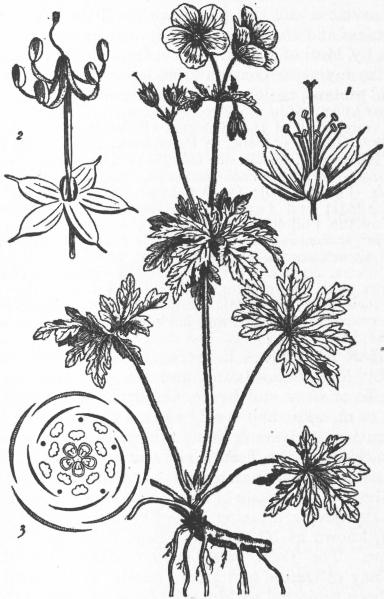
Meadow Crane’s-bill, Geranium pratense. (After Curtis, Flora Londinensis.
1, Flower after removal of petals. 2, Fruit after splitting. 1 and 2 about natural size. 3, Floral diagram, the dots opposite the inner stamens represent honey-glands.
The larger-flowered species of Geranium are markedly protandrous, the outer stamens, inner stamens and stigmas becoming functional in succession. For instance, in meadow crane’s-bill G. pratense, each whorl of stamens ripens in turn, becoming erect and shedding their pollen; as the anthers wither the filaments bend outwards, and when all the anthers have diverged the stigmas become mature and ready for pollination. By this arrangement self-pollination is prevented and cross-pollination ensured by the visits of bees which come for the honey secreted by the glands at the base of the inner stamens.
In species with smaller and less conspicuous flowers, such as G. molle, the flowers of which are only 1⁄3 to ½ in. in diameter, self-pollination is rendered possible, since the divisions of the stigma begin to separate before the outer stamens have shed all their pollen; the nearness of the stigmas to the dehiscing anthers favours self-pollination.
In the ripe fruit the carpels separate into five one-seeded portions (cocci), which break away from the central column, either rolling elastically outwards and upwards or becoming spirally twisted. In most species of Geranium the cocci split open on the inside and the seeds are shot out by the elastic uptwisting (fig. 1); in Erodium and Pelargonium each coccus remains closed, and the long twisted upper portion separates from the central column, forming an awn, the distribution of which is favoured by the presence of bristles or hairs. The embryo generally fills the seed, and the cotyledons are rolled or folded on each other.
Geranium is the most widely distributed genus; it has 160 species and is spread over all temperate regions with a few species in the tropics. Three British species—G. sylvaticum, G. pratense and G. Robertianum (herb-Robert)—reach the arctic zone, while G. patagonicum and G. magellanicum are found in the antarctic. Erodium contains 50 species (three are British), most of which are confined to the Mediterranean region and west Asia, though others occur in America, in South Africa and West Australia. Pelargonium, with 175 species, has its centre in South Africa; the well-known garden and greenhouse “geraniums” are species of Pelargonium (see Geranium).
GERANIUM, the name of a genus of plants, which is taken by botanists as the type of the natural order Geraniaceae. The name, as a scientific appellation, has a much more restricted application than when taken in its popular sense. Formerly the genus Geranium was almost conterminous with the order Geraniaceae. Then as now the geranium was very popular as a garden plant, and the species included in the original genus became widely known under that name, which has more or less clung to them ever since, in spite of scientific changes which have removed the large number of them to the genus Pelargonium. This result has been probably brought about in some degree by an error of the nurserymen, who seem in many cases to have acted on the conclusion that the group commonly known as Scarlet Geraniums were really geraniums and not pelargoniums, and were in consequence inserted under the former name in their trade catalogues. In fact it may be said that, from a popular point of view, the pelargoniums of the botanist are still better known as geraniums than are the geraniums themselves, but the term “zonal Pelargonium” is gradually making its way amongst the masses.
The species of Geranium consist mostly of herbs, of annual or perennial duration, dispersed throughout the temperate regions of the world. They number about 160, and bear a considerable family resemblance. The leaves are for the most part palmately-lobed, and the flowers are regular, consisting of five sepals, five imbricating petals, alternating with five glandules at their base, ten stamens and a beaked ovary. Eleven species are natives of the British Isles and are popularly known as crane’s-bill. G. Robertianum is herb-Robert, a common plant in hedgebanks. G. sanguineum, with flowers a deep rose colour, is often grown in borders, as are also the double-flowered varieties of G. pratense. Many others of exotic origin form handsome border plants in our gardens of hardy perennials; amongst these G. armenum, G. Endressi, G. ibericum and its variety platypetalum are conspicuous.
From these regular-flowered herbs, with which they had been mixed up by the earlier botanists, the French botanist L’Heritier in 1787 separated those plants which have since borne the name of Pelargonium, and which, though agreeing with them in certain points of structure, differ in others which are admitted to be of generic value. One obvious distinction of Pelargonium is that the flowers are irregular, the two petals which stand uppermost being different—larger, smaller or differently marked—from the other three, which latter are occasionally wanting. This difference of irregularity the modern florist has done very much to annul, for the increased size given to the flowers by high breeding has usually been accompanied by the enlargement of the smaller petals, so that a very near approach to regularity has been in some cases attained. Another well-marked difference, however, remains in Pelargonium: the back or dorsal sepal has a hollow spur, which spur is adnate, i.e. joined for its whole length with the flower-stalk; while in Geranium there is no spur. This peculiarity is best seen by cutting clean through the flower-stalk just behind the flower, when in Pelargonium there will be seen the hollow tube of the spur, which in the case of Geranium will not be found, but the stalk will appear as a solid mass. There are other characters which support those already pointed out, such as the absence of the glandules, and the declination of the stamens; but the features already described offer the most ready and obvious distinctions.
To recapitulate, the geraniums properly so-called are regular-flowered herbs with the flower-stalks solid, while many geraniums falsely so-called in popular language are really pelargoniums, and may be distinguished by their irregular flowers and hollow flower-stalks. In a great majority of cases too, the pelargoniums so commonly met with in greenhouses and summer parterres are of shrubby or sub-shrubby habit.
The various races of pelargoniums have sprung from the intermixture of some of the species obtained from the Cape. The older show-flowered varieties have been gradually acquired through a long series of years. The fancy varieties, as well as the French spotted varieties and the market type, have been evolved from them. The zonal or bedding race, on the other hand, has been more recently perfected; they are supposed to have arisen from hybrids between Pelargonium inquinans and P. zonale. In all the sections the varieties are of a highly ornamental character, but for general cultivation the market type is preferable for indoor purposes, while the zonals are effective either in the greenhouse or flower garden. Some of the Cape species are still in cultivation—the leaves of many of them being beautifully subdivided, almost fern-like in character, and some of them are deliciously scented; P. quercifolium is the oak-leaf geranium. The ivy-leaf geranium, derived from P. peltatum, has given rise to an important class of both double- and single-flowered forms adapted especially for pot culture, hanging baskets, window boxes and the greenhouse. Of late years the ivy-leaf “geraniums” have been crossed with the “zonals,” and a new race is being gradually evolved from these two distinct groups.
The best soil for pelargoniums is a mellow fibrous loam with good well-rotted stable manure or leaf-mould in about the proportion of one-fifth; when used it should not be sifted, but pulled to pieces by the hand, and as much sand should be added as will allow the water to pass freely through it. The large-flowered and fancy kinds cannot bear so much water as most soft-wooded plants, and the latter should have a rather lighter soil.
All the pelargoniums are readily increased by cuttings made from the shoots when the plants are headed down after flowering, or in the spring, when they will root freely in a temperature of 65° to 70°. They must not be kept too close, and must be very moderately watered. When rooted they may be moved into well-drained 3-in. pots, and when from 6 to 8 in. high, should have the points pinched out in order to induce them to push out several shoots nearer the base. These shoots are, when long enough, to be trained in a horizontal direction; and when they have made three joints they should have the points again pinched out. These early-struck plants will be ready for shifting into 6-in. pots by the autumn, and should still be trained outwards. The show varieties after flowering should be set out of doors in a sunny spot to ripen their wood, and should only get water enough to keep them from flagging. In the course of two or three weeks they will be ready to cut back within two joints of where these were last stopped, when they should be placed in a frame or pit, and kept close and dry until they have broken. When they have pushed an inch or so, turn them out of their pots, shake off the old soil, trim the straggling roots, and repot them firmly in smaller pots if practicable; keep them near the light, and as the shoots grow continue to train them outwardly. They require to be kept in a light house, and to be set well up to the glass; the night temperature should range about 45°; and air should be given on all mild days, but no cold currents allowed, nor more water than is necessary to keep the soil from getting parched. The young shoots should be topped about the end of October, and when they have grown an inch or two beyond this, they may be shifted into 7-in. pots for flowering. The shoots must be kept tied out so as to be fully exposed to the light. If required to flower early they should not be stopped again; if not until June they may be stopped in February.
The zonal varieties, which are almost continuous bloomers, are of much value as decorative subjects; they seldom require much pruning after the first stopping. For winter flowering, young plants should be raised from cuttings about March, and grown on during the summer, but should not be allowed to flower. When blossoms are required, they should be placed close up to the glass in a light house with a temperature of 65°, only just as much water being given as will keep them growing. For bedding purposes the zonal varieties are best struck towards the middle of August in the open air, taken up and potted or planted in boxes as soon as struck, and preserved in frames or in the greenhouse during winter.
The fancy varieties root best early in spring from the half-ripened shoots; they are slower growers, and rather more delicate in constitution than the zonal varieties, and very impatient of excess of water at the root.
GERARD (d. 1108), archbishop of York under Henry I., began his career as a chancery clerk in the service of William Rufus. He was one of the two royal envoys who, in 1095, persuaded Urban II. to send a legate and Anselm’s pallium to England. Although the legate disappointed the king’s expectations, Gerard was rewarded for his services with the see of Hereford (1096). On the death of Rufus he at once declared for Henry I., by whom he was nominated to the see of York. He made difficulties when required to give Anselm the usual profession of obedience; and it was perhaps to assert the importance of his see that he took the king’s side on the question of investitures. He pleaded Henry’s cause at Rome with great ability, and claimed that he had obtained a promise, on the pope’s part, to condone the existing practice of lay investiture. But this statement was contradicted by Paschal, and Gerard incurred the suspicion of perjury. About 1103 he wrote or inspired a series of tracts which defended the king’s prerogative and attacked the oecumenical pretensions of the papacy with great freedom of language. He changed sides in 1105, becoming a stanch friend and supporter of Anselm. Gerard was a man of considerable learning and ability; but the chroniclers accuse him of being lax in his morals, an astrologer and a worshipper of the devil.
See the Tractatus Eboracenses edited by H. Bochmer in Libelli de lite Sacerdotii et Imperii, vol. iii. (in the Monumenta hist. Germaniae, quarto series), and the same author’s Kirche und Staat in England und in der Normandie (Leipzig, 1899).
(H. W. C. D.)
GERARD (c. 1040-1120), variously surnamed Tum, Tunc, Tenque or Thom, founder of the order of the knights of St John of Jerusalem (q.v.), was born at Amalfi about the year 1040. According to other accounts Martigues in Provence was his birthplace, while one authority even names the Château d’Avesnes in Hainaut. Either as a soldier or a merchant, he found his way to Jerusalem, where a hospice had for some time existed for the convenience of those who wished to visit the holy places. Of this institution Gerard became guardian or provost at a date not later than 1100; and here he organized that religious order of St John which received papal recognition from Paschal II. in 1113, by a bull which was renewed and confirmed by Calixtus II. shortly before the death of Gerard in 1120.
GERARD OF CREMONA (c. 1114-1187), the medieval translator of Ptolemy’s Astronomy, was born at Cremona, Lombardy, in or about 1114. Dissatisfied with the meagre philosophies of his Italian teachers, he went to Toledo to study in Spanish Moslem schools, then so famous as depositories and interpreters of ancient wisdom; and, having thus acquired a knowledge of the Arabic language, he appears to have devoted the remainder of his life to the business of making Latin translations from its literature. The date of his return to his native town is uncertain, but he is known to have died there in 1187. His most celebrated work is the Latin version by which alone Ptolemy’s Almagest was known to Europe until the discovery of the original Μεγάλη Σύνταξις. In addition to this, he translated various other treatises, to the number, it is said, of sixty-six; among these were the Tables of “Arzakhel,” or Al Zarkala of Toledo, Al Farabi On the Sciences (De scientiis), Euclid’s Geometry, Al Farghani’s Elements of Astronomy, and treatises on algebra, arithmetic and astrology. In the last-named latitudes are reckoned from Cremona and Toledo. Some of the works, however, with which he has been credited (including the Theoria or Theorica planetarum, and the versions of Avicenna’s Canon of Medicine—the basis of the numerous subsequent Latin editions of that well-known work—and of the Almansorius of Abu Bakr Razi) are probably due to a later Gerard, of the 13th century, also called Cremonensis but more precisely de Sabloneta (Sabbionetta). This writer undertook the task of interpreting to the Latin world some of the best work of Arabic physicians, and his translation of Avicenna is said to have been made by order of the emperor Frederic II.
See Pipini, “Cronica,” in Muratori, Script. rer. Ital. vol. ix.; Nicol. Antonio, Bibliotheca Hispana vetus, vol. ii.; Tiraboschi, Storia della letteratura Italiana, vols. iii. (333) and iv.; Arisi, Cremona literata; Jourdain, Recherches sur ... l’origine des traductions latines d’Aristote; Chasles, Aperçu historique des méthodes en géométrie, and in Comptes rendus de l’Académie des Sciences, vol. xiii. p. 506; J.T. Reinaud, Géographie d’Aboulféda, introduction, vol. i. pp. ccxlvi.-ccxlviii.; Boncompagni, Della vita e delle opere di Gherardo Cremonese e di Gherardo da Sabbionetta (Rome, 1851). Much of the work of both the Gerards remains in manuscript, as in Paris, National Library, MSS. Lat. 7400, 7421; MSS. Suppl. Lat. 49; Rome, Vatican library, 4083, and Ottobon, 1826; Oxford, Bodleian library, Digby, 47, 61. The Vatican MS. 2392 is stated to contain a eulogy of “Gerard of Cremona” and a list of “his” translations, apparently confusing the two scholars. The former’s most valuable work was in astronomy; the latter’s in medicine.
(C. R. B.)
GÉRARD, ÉTIENNE MAURICE, Count (1773-1852), French general, was born at Damvilliers (Meuse), on the 4th of April 1773. He joined a battalion of volunteers in 1791, and served in the campaigns of 1792-1793 under Generals Dumouriez and Jourdan. In 1795 he accompanied Bernadotte as aide-de-camp. In 1799 he was promoted chef d’escadron, and in 1800 colonel. He distinguished himself at the battles of Austerlitz and Jena, and was made general of brigade in November 1806, and for his conduct in the battle of Wagram he was created a baron. In the Spanish campaign of 1810 and 1811 he gained special distinction at the battle of Fuentes d’Onor; and in the expedition to Russia he was present at Smolensk and Valutina, and displayed such bravery and ability in the battle of Borodino that he was made general of division. He won further distinction in the disastrous retreat from Moscow. In the campaign of 1813, in command of a division, he took part in the battles of Lützen and Bautzen and the operations of Marshal Macdonald, and at the battle of Leipzig (in which he commanded the XI. corps) he was dangerously wounded. After the battle of Bautzen he was created by Napoleon a count of the empire. In the campaign of France of 1814, and especially at La Rothière and Montereau, he won still greater distinction. After the first restoration he was named by Louis XVIII. grand cross of the Legion of Honour and chevalier of St Louis. In the Hundred Days Napoleon made Gérard a peer of France and placed him in command of the IV. corps of the Army of the North. In this capacity Gérard took a brilliant part in the battle of Ligny (see Waterloo Campaign), and on the morning of the 18th of June he was foremost in advising Marshal Grouchy to march to the sound of the guns. Gérard retired to Brussels after the fall of Napoleon, and did not return to France till 1817. He sat as a member of the chamber of deputies in 1822-1824, and was re-elected in 1827. He took part in the revolution of 1830, after which he was appointed minister of war and named a marshal of France. On account of his health he resigned the office of war minister in the October following, but in 1831 he took the command of the northern army, and was successful in thirteen days in driving the army of Holland out of Belgium. In 1832 he commanded the besieging army in the famous scientific siege of the citadel of Antwerp. He was again chosen war minister in July 1834, but resigned in the October following. In 1836 he was named grand chancellor of the Legion of Honour in succession to Marshal Mortier, and in 1838 commander of the National Guards of the Seine, an office which he held till 1842. He became a senator under the empire in 1852, and died on the 17th of April in the same year.
GÉRARD, FRANÇOIS, Baron (1770-1837), French painter, was born on the 4th of May 1770, at Rome, where his father occupied a post in the house of the French ambassador. At the age of twelve Gérard obtained admission into the Pension du Roi at Paris. From the Pension he passed to the studio of Pajou (sculptor), which he left at the end of two years for that of the painter Brenet, whom he quitted almost immediately to place himself under David. In 1789 he competed for the Prix de Rome, which was carried off by his comrade Girodet. In the following year (1790) he again presented himself, but the death of his father prevented the completion of his work, and obliged him to accompany his mother to Rome. In 1791 he returned to Paris; but his poverty was so great that he was forced to forgo his studies in favour of employment which should bring in immediate profit. David at once availed himself of his help, and one of that master’s most celebrated pictures—Le Pelletier de St Fargeau—may owe much to the hand of Gérard. This painting was executed early in 1793, the year in which Gérard, at the request of David, was named a member of the revolutionary tribunal, from the fatal decisions of which he, however, invariably absented himself. In 1794 he obtained the first prize in a competition, the subject of which was “The Tenth of August,” and, further stimulated by the successes of his rival and friend Girodet in the Salons of 1793 and 1794, Gérard (nobly aided by Isabey the miniaturist) produced in 1795 his famous “Bélisaire.” In 1796 a portrait of his generous friend (in the Louvre) obtained undisputed success, and the money received from Isabey for these two works enabled Gérard to execute in 1797 his “Psyché et l’Amour.” At last, in 1799, his portrait of Madame Bonaparte established his position as one of the first portrait-painters of the day. In 1808 as many as eight, in 1810 no less than fourteen portraits by him, were exhibited at the Salon, and these figures afford only an indication of the enormous numbers which he executed yearly; all the leading figures of the empire and of the restoration, all the most celebrated men and women of Europe, sat to Gérard. This extraordinary vogue was due partly to the charm of his manner and conversation, for his salon was as much frequented as his studio; Madame de Staël, Canning, Talleyrand, the duke of Wellington, have all borne witness to the attraction of his society. Rich and famous, Gérard was stung by remorse for earlier ambitions abandoned; at intervals he had indeed striven to prove his strength with Girodet and other rivals, and his “Bataille d’Austerlitz” (1810) showed a breadth of invention and style which are even more conspicuous in “L’Entrée d’Henri IV” (Versailles)—the work with which in 1817 he did homage to the Bourbons. After this date Gérard declined, watching with impotent grief the progress of the Romantic school. Loaded with honours—baron of the empire, member of the Institute, officer of the legion of honour, first painter to the king—he worked on sad and discouraged; the revolution of 1830 added to his disquiet; and on the 11th of January 1837, after three days of fever, he died. By his portraits Gérard is best remembered; the colour of his paintings has suffered, but his drawings show in uninjured delicacy the purity of his line; and those of women are specially remarkable for a virginal simplicity and frankness of expression.
M. Ch. Lenormant published in 1846 Essai de biographie et de critique sur François Gérard, a second edition of which appeared in 1847; and M. Delécluze devoted several pages to the same subject in his work Louis David, son école et son temps.
GÉRARD, JEAN IGNACE ISIDORE (1803-1847), French caricaturist, generally known by the pseudonym of Grandville—the professional name of his grandparents, who were actors—was born at Nancy on the 13th of September 1803. He received his first instruction in drawing from his father, a miniature painter, and at the age of twenty-one came to Paris, where he soon afterwards published a collection of lithographs entitled Les Tribulations de la petite propriété. He followed this by Les Plaisirs de toutâge and La Sibylle des salons; but the work which first established his fame was Métamorphoses du jour, published in 1828, a series of seventy scenes in which individuals with the bodies of men and faces of animals are made to play a human comedy. These drawings are remarkable for the extraordinary skill with which human characteristics are represented in animal features. The success of this work led to his being engaged as artistic contributor to various periodicals, such as La Silhouette, L’Artiste, La Caricature, Le Charivari; and his political caricatures, which were characterized by marvellous fertility of satirical humour, soon came to enjoy a general popularity. Besides supplying illustrations for various standard works, such as the songs of Béranger, the fables of La Fontaine, Don Quixote, Gulliver’s Travels, Robinson Crusoe, he also continued the issue of various lithographic collections, among which may be mentioned La Vie privée et publique des animaux, Les Cent Proverbes, L’Autre Monde and Les Fleurs animées. Though the designs of Gérard are occasionally unnatural and absurd, they usually display keen analysis of character and marvellous inventive ingenuity, and his humour is always tempered and refined by delicacy of sentiment and a vein of sober thoughtfulness. He died of mental disease on the 17th of March 1847.
A short notice of Gérard, under the name of Grandville, is contained in Théophile Gautier’s Portraits contemporains. See also Charles Blanc, Grandville (Paris, 1855).
GERARD, JOHN (1545-1612), English herbalist and surgeon, was born towards the end of 1545 at Nantwich in Cheshire. He was educated at Wisterson, or Willaston, 2 m. from Nantwich, and eventually, after spending some time in travelling, took up his abode in London, where he exercised his profession. For more than twenty years he also acted as superintendent of the gardens in London and at Theobalds, in Hertfordshire, of William Cecil, Lord Burghley. In 1596 he published a catalogue of plants cultivated in his own garden in Holborn, London, 1039 in number, inclusive of varieties of the same species. Their English as well as their Latin names are given in a revised edition of the catalogue issued in 1599. In 1597 appeared Gerard’s well-known Herball, described by him in its preface as “the first fruits of these mine own labours,” but more truly an adaptation of the Stirpium historiae pemptades of Rembert Dodoens (1518-1585), published in 1583, or rather of a translation of the whole or part of the same by Dr Priest, with M. Lobel’s arrangement. Of the numerous illustrations of the Herball sixteen appear to be original, the remainder are mostly impressions from the wood blocks employed by Jacob Theodorus Tabernaemontanus in his Icones stirpium, published at Frankfort in 1590. A second edition of the Herball, with considerable improvements and additions, was brought out by Thomas Johnson in 1633, and reprinted in 1636. Gerard was elected a member of the court of assistants of the barber-surgeons in 1595, by which company he was appointed an examiner in 1598, junior warden in 1605, and master in 1608. He died in February 1612, and was buried at St Andrews, Holborn.
See Johnson’s preface to his edition of the Herball; and A Catalogue of Plants cultivated in the Garden of John Gerard in the years 1596-1599, edited with Notes, References to Gerard’s Herball, the Addition of modern Names, and a Life of the Author, by Benjamin Daydon Jackson, F.L.S., privately printed (London, 1876, 4to).
GÉRARDMER, a town of north-eastern France, in the department of Vosges, 33 m. E.S.E. of Epinal by rail. Pop. (1906) of the town, 3993; of the commune, 10,041. Gérardmer is beautifully situated at a height of 2200 ft. at the eastern end of the small Lake of Gérardmer (285 acres in extent) among forest-clad mountains. It is the chief summer-resort of the French Vosges and is a centre for excursions, among which may be mentioned those to the Höhneck (4481 ft.), the second highest summit in the Vosges, the Schlucht, the mountain pass from France to Germany, and, nearer the town, the picturesque defile of Granges, watered by the Vologne, which at one point forms the cascade known as the Saut des Cuves. The town itself, in which the chief object of interest is the huge lime-tree in the market-place, carries on cloth-weaving, bleaching, wood-sawing and the manufacture of wooden goods; there is trade in the cheeses (géromés) manufactured in the neighbourhood. Gérardmer is said to owe its name to Gerard of Alsace, 1st duke of Lorraine, who in the 11th century built a tower on the bank of the lake or mer, near which, in 1285, a new town was founded.
GERASA (mod. Gerash or Jerash), a city of Palestine, and a member of the league known as the Decapolis (q.v.), situated amid the mountains of Gilead, about 1757 ft. above the sea, 20 m. from the Jordan and 21 m. N. of Philadelphia. Of its origin nothing is known; it has been suggested that it represents the biblical Ramoth Gilead. From Josephus we learn that it was captured by Alexander Jannaeus (c. 83 B.C.), rebuilt by the Romans (c. A.D. 65), burned by the Jews in revenge for the massacre at Caesarea, and again plundered and depopulated by Annius, the general of Vespasian; but, in spite of these disasters, it was still in the 2nd and 3rd centuries of the Christian era one of the wealthiest and most flourishing cities of Palestine. It was a centre of Greek civilization, devoted especially to the worship of Artemis, and producing famous teachers, of whom Stephen the Byzantine mentions Ariston, Kerykos and Plato. As late as 1121 the soldiers of Baldwin II. found it defended by a castle built by a king of Damascus; but at the beginning of the following century the Arabian geographer Yaqut speaks of it as deserted and overthrown. The ruins of Jerash, discovered about 1806, and since then frequently visited and described, still attest the splendour of the Roman city. They are distributed along both banks of the Kerwan, a brook which flows south through the Wadi-ed-Dēr to join the Zerka or Jabbok; but all the principal buildings are situated on the level ground to the right of the stream. The town walls, which can still be traced and indeed are partly standing, had a circuit of not more than 2 m., and the main street was less than half a mile in length; but remains of buildings on the road for fully a mile beyond the south gate, show that the town had outgrown the limit of its fortifications. The most striking feature of the ruins is the profusion of columns, no fewer than 230 being even now in position; the main street is a continuous colonnade, a large part of which is still entire, and it terminates to the south in a forum of similar formation. Among the public buildings still recognizable are a theatre capable of accommodating 6000 spectators, a naumachia (circus for naval combats) and several temples, of which the largest was probably the grandest structure in the city, possessing a portico of Corinthian pillars 38 ft. high. The desolation of the city is probably due to earthquake; and the absence of Moslem erections or restorations seems to show that the disaster took place before the Mahommedan period.
The town is now occupied by a colony of Circassians, whose houses have been built with materials from the earlier buildings, and there has been much destruction of the interesting ruins. “The country of the Gerasenes” (Matt. viii. 28 and parallels; other readings, Gadarenes, Gergesenes) must be looked for in another quarter—on the E. coast of the Sea of Galilee, probably in the neighbourhood of the modern Khersa (C.W. Wilson in Recovery of Jerusalem, p. 369).
(R. A. S. M.)
GÉRAULT-RICHARD, ALFRED LÉON (1860- ), French journalist and politician, was born at Bonnétable in the department of Sarthe, of a peasant family. He began life as a working upholsterer, first at Mans, then at Paris (1880), where his peasant and socialist songs soon won him fame in the Montmartre quarter. Lissagaray, the communist, offered him a position on La Bataille, and he became a regular contributor to the advanced journals, especially to La Petite République, of which he became editor-in-chief in 1897. In 1893 he founded Le Chambard, and was imprisoned for a year (1894) on account of a personal attack upon the president, Casimir-Périer. In January 1895 he was elected to the chamber as a Socialist for the thirteenth arrondissement of Paris. He was defeated at the elections of 1898 at Paris, but was re-elected in 1902 and in 1906 by the colony of Guadeloupe.
GERBER, ERNST LUDWIG (1746-1819), German musician, author of a famous dictionary of musicians, was born at Sondershausen in the principality of Schwarzburg-Sondershausen on the 29th of September 1746. His father, Henry Nicolas Gerber (1702-1775), a pupil of J.S. Bach, was an organist and composer of some distinction, and under his direction Ernst Ludwig at an early age had made great progress in his musical studies. In 1765 he went to Leipzig to study law, but the claims of music, which had gained additional strength from his acquaintanceship with J.A. Hiller, soon came to occupy almost his sole attention. On his return to Sondershausen he was appointed music teacher to the children of the prince, and in 1775 he succeeded his father as court organist. Afterwards he devoted much of his time to the study of the literature and history of music, and with this view he made himself master of several modern languages. His Historisch-biographisches Lexikon der Tonkünstler appeared in 1790 and 1792 in two volumes; and the first volume of what was virtually an improved and corrected edition of this work was published in 1810 under the title Neues historisch-biographisches Lexikon der Tonkünstler, followed by other three volumes in 1812, 1813 and 1814. Gerber also contributed a number of papers to musical periodicals, and published several minor musical compositions. He died at Sondershausen on the 30th of June 1819.
GERBERON, GABRIEL (1628-1711), French Jansenist monk, was born on the 12th of August 1628 at St Calais, in the department of Sarthe. At the age of twenty he took the vows of the Benedictine order at the abbey of Ste Melaine, Rennes, and afterwards taught rhetoric and philosophy in several monasteries. His open advocacy of Jansenist opinions, however, caused his superiors to relegate him to the most obscure houses of the order, and finally to keep him under surveillance at the abbey of St Germain-des-Prés at Paris. Here he wrote a defence of the doctrine of the Real Presence against the Calvinists in the form of an apology for Rupert, abbot of Deutz (Apologia pro Ruperto abbate Tuitensi, Paris, 1669). In 1676 he published at Brussels, under the name of “Sieur Flore de Ste Foi” his Miroir de la piété chrétienne, an enlarged edition of which appeared at Liége in the following year. This was condemned by certain archbishops and theologians as the repetition of the five condemned propositions of Jansen, and Gerberon defended it, under the name of “Abbé Valentin” in Le Miroir sans tache (Paris, 1680). He had by this time aroused against him the full fury of the Jesuits, and at their instigation a royal provost was sent to Corbie to arrest him. He had, however, just time to escape, and fled to the Low Countries, where he lived in various towns. He was invited by the Jansenist clergy to Holland, where he wrote another controversial work against the Protestants: Défense de l’Église Romain contre la calomnie des Protestants (Cologne, 1688-1691). This produced unpleasantness with the Reformed clergy, and feeling himself no longer safe he returned to Brussels. In 1700 he published his history of Jansenism (Histoire générale du Jansénisme), a dry work, by which, however, he is best remembered. He adhered firmly to the Augustinian doctrine of Predestination, and on the 30th of May 1703 he was arrested at Brussels at the instance of the archbishop of Malines, and ordered to subscribe the condemnation of the five sentences of Jansen. On his refusal, he was handed over to his superiors and imprisoned in the citadel of Amiens and afterwards at Vincennes. Every sort of pressure was brought to bear upon him to make his submission, and at last, broken in health and spirit, he consented to sign a formula which the cardinal de Noailles claimed as a recantation. Upon this he was released in 1710. The first use he made of his freedom was to write a work (which, however, his friends prudently prevented him from publishing), Le Vaine Triomphe du cardinal de Noailles, containing a virtual withdrawal of the compulsory recantation. He died at the abbey of St Denis on the 29th of March 1711.
GERBERT, MARTIN (1720-1793), German theologian, historian and writer on music, belonged to the noble family of Gerbert von Hornau, and was born at Horb on the Neckar, Württemberg, on the 12th (or 11th or 13th) of August 1720. He was educated at Freiburg in the Breisgau, at Klingenau in Switzerland and at the Benedictine abbey of St Blasien in the Black Forest, where in 1737 he took the vows. In 1744 he was ordained priest, and immediately afterwards appointed professor, first of philosophy and later of theology. Between 1754 and 1764 he published a series of theological treatises, their main tendency being to modify the rigid scholastic system by an appeal to the Fathers, notably Augustine; from 1759 to 1762 he travelled in Germany, Italy and France, mainly with a view to examining the collections of documents in the various monastic libraries. In 1764 he was elected prince-abbot of St Blasien, and proved himself a model ruler both as abbot and prince. His examination of archives during his travels had awakened in him a taste for historical research, and under his rule St Blasien became a notable centre of the methodical study of history; it was here that Marquard Herrgott wrote his Monumenta domus Austriacae, of which the first two volumes were edited, for the second edition, by Gerbert, who also published a Codex epistolaris Rudolphi I., Romani regis (1772) and De Rudolpho Suevico comite de Rhinfelden, duce et rege, deque ejus familia (1785). It was, however, in sacramental theology, liturgiology, and notably ecclesiastical music that Gerbert was mainly interested. In 1774 he published two volumes De cantu et musica sacra; in 1777, Monumenta veteris liturgiae Alemannicae; and in 1784, in three volumes, Scriptores ecclesiastici de musica sacra, a collection of the principal writers on church music from the 3rd century till the invention of printing. The materials for this work he had gathered during his travels, and although it contains many textual errors, its publication has been of great importance for the history of music, by preserving writings which might either have perished or remained unknown. His interest in music led to his acquaintance with the composer Gluck, who became his intimate friend.
As a prince of the Empire Gerbert was devoted to the interests of the house of Austria; as a Benedictine abbot he was opposed to Joseph II.’s church policy. In the Febronian controversy (see Febronianism) he had early taken a mediating attitude, and it was largely due to his influence that Bishop Hontheim had been induced to retract his extreme views.
In 1768 the abbey of St Blasien, with the library and church, was burnt to the ground, and the splendid new church which rose on the ruins of the old (1783) remained until its destruction by fire in 1874, at once a monument of Gerbert’s taste in architecture and of his Habsburg sympathies. It was at his request that it was made the mausoleum of all the Austrian princes buried outside Austria, whose remains were solemnly transferred to its vaults. In connexion with its consecration he published his Historia Nigrae Silvae, ordinis S. Benedicti coloniae (3 vols., St Blasien, 1783).
Gerbert, who was beloved and respected by Catholics and Protestants alike, died on the 3rd of May 1793.
See Joseph Bader, Das ehemalige Kloster St Blasien und seine Gelehrtenakademie (Freiburg-im-Breisgau, 1874), which contains a chronological list of Gerbert’s works.
GERBIL, or Gerbille, the name of a group of small, elegant, large-eyed, jumping rodents typified by the North African Gerbillus aegyptiacus (or gerbillus), and forming a special subfamily, Gerbillinae, of the rat tribe or Muridae. They are found over the desert districts of both Asia and Africa, and are classed in the genera Gerbillus (or Tatera), Pachyuromys, Meriones, Psammomys and Rhombomys, with further divisions into subgenera. They have elongated hind-limbs and long hairy tails; and progress by leaps, in the same manner as jerboas, from which they differ in having five hind-toes. The cheek-teeth have transverse plates of enamel on the crowns; the number of such plates diminishing from three in the first tooth to one or one and a half in the third. The upper incisor teeth are generally marked by grooves. Gerbils are inhabitants of open sandy plains, where they dwell in burrows furnished with numerous exits, and containing large grass-lined chambers. The Indian G. indicus produces at least a dozen young at a birth. All are more or less completely nocturnal.
GERENUK, the Somali name of a long-necked aberrant gazelle, commonly known as Waller’s gazelle (Lithocranius walleri), and ranging from Somaliland to Kilimanjaro. The long neck and limbs, coupled with peculiarities in the structure of the skull, entitle the gerenuk, which is a large species, to represent a genus. The horns of the bucks are heavy, and have a peculiar forward curvature at the tips; the colour of the coat is red-fawn, with a broad brown band down the back. Gerenuk are browsing ruminants, and, in Somaliland, are found in small family-parties, and feed more by browsing on the branches and leaves of trees and shrubs than by grazing. Frequently they raise themselves by standing on their hind-legs with the fore-feet resting against the trunk of the tree on which they are feeding. Their usual pace is an awkward trot, not unlike that of a camel; and they seldom break into a gallop. The Somali form has been separated as L. sclateri, but is not more than a local race. (See Antelope.)
GERGOVIA (mod. Gergovie), in ancient geography, the chief town of the Arverni, situated on a hill in the Auvergne, about 8 m. from the Puy de Dôme, France. Julius Caesar attacked it in 52 B.C., but was beaten off; some walls and earthworks seem still to survive from this period. Later, when Gaul had been subdued, the place was dismantled and its Gaulish inhabitants resettled 4 m. away in the plain at the new Roman city of Augustonemĕtum (mod. Clermont-Ferrand).
GERHARD, FRIEDRICH WILHELM EDUARD (1795-1867), German archaeologist, was born at Posen on the 29th of November 1795, and was educated at Breslau and Berlin. The reputation he acquired by his Lectiones Apollonianae (1816) led soon afterwards to his being appointed professor at the gymnasium of Posen. On resigning that office in 1819, on account of weakness of the eyes, he went in 1822 to Rome, where he remained for fifteen years. He contributed to Platner’s Beschreibung der Stadt Rom, then under the direction of Bunsen, and was one of the principal originators and during his residence in Italy director of the Instituto di corrispondenza archeologica, founded at Rome in 1828. Returning to Germany in 1837 he was appointed archaeologist at the Royal Museum of Berlin, and in 1844 was chosen a member of the Academy of Sciences, and a professor in the university. He died at Berlin on the 12th of May 1867.
Besides a large number of archaeological papers in periodicals, in the Annali of the Institute of Rome, and in the Transactions of the Berlin Academy, and several illustrated catalogues of Greek, Roman and other antiquities in the Berlin, Naples and Vatican Museums, Gerhard was the author of the following works: Antike Bildwerke (Stuttgart, 1827-1844); Auserlesene griech. Vasenbilder (1839-1858); Etruskische Spiegel (1839-1865); Hyperboreisch-röm. Studien (vol. i., 1833; vol. ii., 1852); Prodromus mytholog. Kunsterklärung (Stuttgart and Tübingen, 1828); and Griech. Mythologie (1854-1855). His Gesammelte akademische Abhandlungen und kleine Schriften were published posthumously in 2 vols., Berlin, 1867.
GERHARD, JOHANN (1582-1637), Lutheran divine, was born in Quedlinburg on the 17th of October 1582. In his fifteenth year, during a dangerous illness, he came under the personal influence of Johann Arndt, author of Das wahre Christenthum, and resolved to study for the church. He entered the university of Wittenberg in 1599, and first studied philosophy. He also attended lectures in theology, but, a relative having persuaded him to change his subject, he studied medicine for two years. In 1603, however, he resumed his theological reading at Jena, and in the following year received a new impulse from J.W. Winckelmann (1551-1626) and Balthasar Mentzer (1565-1627) at Marburg. Having graduated and begun to give lectures at Jena in 1605, he in 1606 accepted the invitation of John Casimir, duke of Coburg, to the superintendency of Heldburg and mastership of the gymnasium; soon afterwards he became general superintendent of the duchy, in which capacity he was engaged in the practical work of ecclesiastical organization until 1616, when he became theological professor at Jena, where the remainder of his life was spent. Here, with Johann Major and Johann Himmel, he formed the “Trias Johannea.” Though still comparatively young, Gerhard had already come to be regarded as the greatest living theologian of Protestant Germany; in the numerous “disputations” of the period he was always protagonist, while on all public and domestic questions touching on religion or morals his advice was widely sought. It is recorded that during the course of his lifetime he had received repeated calls to almost every university in Germany (e.g. Giessen, Altdorf, Helmstädt, Jena, Wittenberg), as well as to Upsala in Sweden. He died in Jena on the 20th of August 1637.
His writings are numerous, alike in exegetical, polemical, dogmatic and practical theology. To the first category belong the Commentarius in harmoniam historiae evangelicae de passione Christi (1617), the Comment, super priorem D. Petri epistolam (1641), and also his commentaries on Genesis (1637) and on Deuteronomy (1658). Of a controversial character are the Confessio Catholica (1633-1637), an extensive work which seeks to prove the evangelical and catholic character of the doctrine of the Augsburg Confession from the writings of approved Roman Catholic authors; and the Loci communes theologici (1610-1622), his principal contribution to science, in which Lutheranism is expounded “nervose, solide, et copiose,” in fact with a fulness of learning, a force of logic and a minuteness of detail that had never before been approached. The Meditationes sacrae (1606), a work expressly devoted to the uses of Christian edification, has been frequently reprinted in Latin and has been translated into most of the European languages, including Greek. The English translation by R. Winterton (1631) has passed through at least nineteen editions. There is also an edition by W. Papillon in English blank verse (1801). His life, Vita Joh. Gerhardi, was published by E.R. Fischer in 1723, and by C.J. Böttcher, Das Leben Dr Johann Gerhards, in 1858. See also W. Gass, Geschichte der protestantischen Dogmatik (1854-1867), and the article in the Allgemeine deutsche Biographie.
GERHARDT, CHARLES FRÉDÉRIC (1816-1856), French chemist, was born at Strassburg on the 21st of August 1816. After attending the gymnasium at Strassburg and the polytechnic at Karlsruhe, he was sent to the school of commerce at Leipzig, where he studied chemistry under Otto Erdmann. Returning home in 1834 he entered his father’s white lead factory, but soon found that business was not to his liking, and after a sharp disagreement with his father enlisted in a cavalry regiment. In a few months military life became equally distasteful, and he purchased his discharge with the assistance of Liebig, with whom, after a short interval at Dresden, he went to study at Giessen in 1836. But his stay at Giessen was also short, and in 1837 he re-entered the factory. Again, however, he quarrelled with his father, and in 1838 went to Paris with introductions from Liebig. There he attended Jean Baptiste Dumas’ lectures and worked with Auguste Cahours (1813-1891) on essential oils, especially cumin, in Michel Eugéne Chevreul’s laboratory, while he earned a precarious living by teaching and making translations of some of Liebig’s writings. In 1841, by the influence of Dumas, he was charged with the duties of the chair of chemistry at the Montpellier faculty of sciences, becoming titular professor in 1844. In 1842 he annoyed his friends in Paris by the matter and manner of a paper on the classification of organic compounds, and in 1845 he and his opinions were the subject of an attack by Liebig, unjustifiable in its personalities but not altogether surprising in view of his wayward disregard of his patron’s advice. The two were reconciled in 1850, but his faculty for disagreeing with his friends did not make it easier for him to get another appointment after resigning the chair at Montpellier in 1851, especially as he was unwilling to go into the provinces. He obtained leave of absence from Montpellier in 1848 and from that year till 1855 resided in Paris. During that period he established an “École de chimie pratique” of which he had great hopes; but these were disappointed, and in 1855, after refusing the offer of a chair of chemistry at the new Zürich Polytechnic in 1854, he accepted the professorships of chemistry at the Faculty of Sciences and the École Polytechnique at Strassburg, where he died on the 19th of August in the following year. Although Gerhardt did some noteworthy experimental work—for instance, his preparation of acid anhydrides in 1852—his contributions to chemistry consist not so much in the discovery of new facts as in the introduction of new ideas that vitalized and organized an inert accumulation of old facts. In particular, with his fellow-worker Auguste Laurent (1807-1853), he did much to reform the methods of chemical formulation by insisting on the distinction between atoms, molecules and equivalents; and in his unitary system, directly opposed to the dualistic doctrines of Berzelius, he combined Dumas’ substitution theory with the old radicle theory and greatly extended the notion of types of structure. His chief works were Précis de chimie organique (1844-1845), and Traité de chimie organique (1853-1856).
See Charles Gerhardt, sa vie, son œuvre, sa correspondance, by his son, Charles Gerhardt, and E. Grimaux (Paris, 1900).
GERHARDT, PAUL (c. 1606-1676), German hymn-writer, was born of a good middle-class family at Gräfenhainichen, a small town on the railway between Halle and Wittenberg, in 1606 or 1607—some authorities, indeed, give the date March 12, 1607, but neither the year nor the day is accurately known. His education appears to have been retarded by the troubles of the period, the Thirty Years’ War having begun about the time he reached his twelfth year. After completing his studies for the church he is known to have lived for some years at Berlin as tutor in the family of an advocate named Berthold, whose daughter he subsequently married, on receiving his first ecclesiastical appointment at Mittelwald (a small town in the neighbourhood of Berlin) in 1651. In 1657 he accepted an invitation as “diaconus” to the Nicolaikirche of Berlin; but, in consequence of his uncompromising Lutheranism in refusing to accept the elector Frederick William’s “syncretistic” edict of 1664, he was deprived in 1666. Though absolved from submission and restored to office early in the following year, on the petition of the citizens, his conscience did not allow him to retain a post which, as it appeared to him, could only be held on condition of at least a tacit repudiation of the Formula Concordiae, and for upwards of a year he lived in Berlin without fixed employment. In 1668 he was appointed archdeacon of Lübben in the duchy of Saxe-Merseburg, where, after a somewhat sombre ministry of eight years, he died on the 7th of June 1676. Gerhardt is the greatest hymn-writer of Germany, if not indeed of Europe. Many of his best-known hymns were originally published in various church hymn-books, as for example in that for Brandenburg, which appeared in 1658; others first saw the light in Johann Crüger’s Geistliche Kirchenmelodien (1649) and Praxis pietatis melica (1656). The first complete set of them is the Geistliche Andachten, published in 1666-1667 by Ebeling, music director in Berlin. No hymn by Gerhardt of a later date than 1667 is known to exist.
The life of Gerhardt has been written by Roth (1829), by Langbecker (1841), by Schultz (1842), by Wildenhahn (1845) and by Bachmann (1863); also by Kraft in Ersch u. Gruber’s Allg. Encycl. (1855). The best modern edition of the hymns, published by Wackernagel in 1843, has often been reprinted. There is an English translation by Kelly (Paul Gerhardt’s Spiritual Songs, 1867).
GÉRICAULT, JEAN LOUIS ANDRÉ THÉODORE (1791-1824), French painter, the leader of the French realistic school, was born at Rouen in 1791. In 1808 he entered the studio of Charles Vernet, from which, in 1810, he passed to that of Guérin, whom he drove to despair by his passion for Rubens, and by the unorthodox manner in which he persisted in interpreting nature. At the Salon of 1812 Géricault attracted attention by his “Officier de Chasseurs à Cheval” (Louvre), a work in which he personified the cavalry in its hour of triumph, and turned to account the solid training received from Guérin in rendering a picturesque point of view which was in itself a protest against the cherished convictions of the pseudo-classical school. Two years later (1814) he re-exhibited this work accompanied with the reverse picture “Cuirassier blessé” (Louvre), and in both subjects called attention to the interest of contemporary aspects of life, treated neglected types of living form, and exhibited that mastery of and delight in the horse which was a feature of his character. Disconcerted by the tempest of contradictory opinion which arose over these two pictures, Géricault gave way to his enthusiasm for horses and soldiers, and enrolled himself in the mousquetaires. During the Hundred Days he followed the king to Bethune, but, on his regiment being disbanded, eagerly returned to his profession, left France for Italy in 1816, and at Rome nobly illustrated his favourite animal by his great painting “Course des Chevaux Libres.” Returning to Paris, Géricault exhibited at the Salon of 1819 the “Radeau de la Méduse” (Louvre), a subject which not only enabled him to prove his zealous and scientific study of the human form, but contained those elements of the heroic and pathetic, as existing in situations of modern life, to which he had appealed in his earliest productions. Easily depressed or elated, Géricault took to heart the hostility which this work excited, and passed nearly two years in London, where the “Radeau” was exhibited with success, and where he executed many series of admirable lithographs now rare. At the close of 1822 he was again in Paris, and produced a great quantity of projects for vast compositions, models in wax, and a horse écorché, as preliminary to the production of an equestrian statue. His health was now completely undermined by various kinds of excess, and on the 26th of January 1824 he died, at the age of thirty-three.