VOLUME XI SLICE VII Geoponici to Germany (part) (continued 2)
Reading edition
GEORGE, king of Saxony (1832-1904), the youngest son of King John of Saxony (d. 1873) and Queen Amelia, was born at Dresden on the 8th of August 1832. From an early age he received a careful scientific and military training, and in 1846 entered the active army as a lieutenant of artillery. In 1849-1850 he was a student at the university of Bonn, but soon returned to military life, for which he had a predilection. In the Austro-Prussian War of 1866 he commanded a Saxon cavalry brigade, and in the early part of the war of 1870-71 a division, but later succeeded to the supreme command of the XII. (Saxon) army corps in the room of his brother, the crown prince Albert (afterwards king) of Saxony. His name is inseparably associated with this campaign, during which he showed undoubted military ability and an intrepidity which communicated itself to all ranks under his command, notably at the battles of St Privat and Beaumont, in which he greatly distinguished himself. On his brother succeeding to the throne he became commander-in-chief of the Saxon army, and was in 1888 made a Prussian field marshal by the emperor William I. He married in 1859 the infanta Maria, sister of King Louis of Portugal, and King Albert’s marriage being childless, succeeded on his death in 1902 to the throne of Saxony. He died on the 15th of October 1904, at Pillnitz.
GEORGE OF LAODICEA in Syria, often called “the Cappadocian,” from 356 to 361 Arian archbishop of Alexandria, was born about the beginning of the 4th century. According to Ammianus (xxii. 11), he was a native of Epiphania, in Cilicia. Gregory Nazianzen tells us that his father was a fuller, and that he himself soon became notorious as a parasite of so mean a type that he would “sell himself for a cake.” After many wanderings, in the course of which he seems to have amassed a considerable fortune, first as an army-contractor and then as a receiver of taxes, he ultimately reached Alexandria. It is not known how or when he obtained ecclesiastical orders; but, after Athanasius had been banished in 356, George was promoted by the influence of the then prevalent Arian faction to the vacant see. His theological attitude was that known as semi-Arian or Homoiousian, and his associates were Eustathius of Sebaste and Basil of Ancyra. At George’s instigation the second Sirmian formula (promulgated by the third council of Sirmium 357), which was conciliatory towards strict Arianism, was opposed at the council of Ancyra in 358 (Harnack, Hist. of Dogma, iv. 76). His persecutions and oppressions of the orthodox ultimately raised a rebellion which compelled him to flee for his life; but his authority was restored, although with difficulty, by a military demonstration. Untaught by experience, he resumed his course of selfish tyranny over Christians and heathen alike, and raised the irritation of the populace to such a pitch that when, on the accession of Julian, his downfall was proclaimed and he was committed to prison, they dragged him thence and killed him, finally casting his body into the sea (24th of December 361). With much that was sordid and brutal in his character George combined a highly cultivated literary taste, and in the course of his chequered career he had found the means of collecting a splendid library, which Julian ordered to be conveyed to Antioch for his own use. An anonymous work against the Manicheans discovered by Lagarde in 1859 in a MS. of Titus of Bostra has been attributed to him.
The original sources for the facts of the life of George of Laodicea are Ammianus, Gregory Nazianzen, Epiphanius and Athanasius. His character has been drawn with graphic fidelity by Gibbon in the 23rd chapter of the Decline and Fall; but the theory, accepted by Gibbon, which identifies him with the patron saint of England is now rejected (see George, Saint). See C.S. Hulst, St George of Cappadocia in Legend and History (1910).
GEORGE OF TREBIZOND (1395-1484), Greek philosopher and scholar, one of the pioneers of the revival of letters in the Western world, was born in the island of Crete, and derived his surname Trapezuntios from the fact that his ancestors were from Trebizond. At what period he came to Italy is not certain; according to some accounts he was summoned to Venice about 1430 to act as amanuensis to Francesco Barbaro, who appears to have already made his acquaintance; according to others he did not visit Italy till the time of the council of Florence (1438-1439). He learned Latin from Vittorino da Feltre, and made such rapid progress that in three years he was able to teach Latin literature and rhetoric. His reputation as a teacher and a translator of Aristotle was very great, and he was selected as secretary by Pope Nicholas V., an ardent Aristotelian. The needless bitterness of his attacks upon Plato (in the Comparatio Aristotelis et Platonis), which drew forth a powerful response from Bessarion (q.v.), and the manifestly hurried and inaccurate character of his translations of Plato, Aristotle and other classical authors, combined to ruin his fame as a scholar, and to endanger his position as a teacher of philosophy. The indignation against him on account of his first-named work was so great that he would probably have been compelled to leave Italy had not Alphonso V. given him protection at the court of Naples. He subsequently returned to Rome, where he died in great poverty on the 12th of August 1484. He had long outlived his reputation, and towards the end of his life his intellect failed him. From all accounts he was a man of very disagreeable character, conceited and quarrelsome.
See G. Voigt, Die Wiederbelebung des klassischen Altertums (1893), and article by C.F. Bähr in Ersch and Gruber’s Allgemeine Encyklopädie. For a complete list of his numerous works, consisting of translations from Greek into Latin (Plato, Aristotle and the Fathers) and original essays in Greek (chiefly theological) and Latin (grammatical and rhetorical), see Fabricius, Bibliotheca Graeca (ed. Harles), xii.
GEORGE THE MONK [Georgios Monachos], called Hamartolos (Greek for “sinner”), Byzantine chronicler, lived during the reign of Michael III. (842-867). He wrote a Chronicle of events, in four books, from the creation of the world to the death of the emperor Theophilus (842), whose widow Theodora restored the worship of images in the same year. It is the only original contemporary authority for the years 813-842, and therefore so far indispensable; the early parts of the work are merely a compilation. In the introduction the author disclaims all pretensions to literary style, and declares that his only object was to relate such things as were “useful and necessary” with a strict adherence to truth. Far too much attention, however, is devoted to religious matters; the iconoclasts are fiercely attacked, and the whole is interlarded with theological discussions and quotations from the fathers. The work was very popular, and translations of it served as models for Slavonic writers. The MSS. give a continuation down to 948, the author of which is indicated simply as “the logothete,” by whom probably Symeon Metaphrastes (second half of the 10th century) is meant. In this religious questions are relegated to the background, more attention is devoted to political history, and the language is more popular. Still further continuations of little value go down to 1143. The large circulation of the work and its subsequent reissues, with alterations and interpolations, make it very difficult to arrive at the original text.
Editions: E. de Muralt (St Petersburg, 1859); J.P. Migne, Patrologia Graeca, cx.; C. de Boor (in Teubner series, 1904- ). See F. Hirsch, Byzantinische Studien (1876); C. de Boor in Historische Untersuchungen (in honour of Arnold Schäfer, Bonn, 1882); C. Krumbacher, Geschichte der byzantinischen Litteratur (1897).
GEORGE THE SYNCELLUS [Georgios Synkellos], of Constantinople, Byzantine chronicler and ecclesiastic, lived at the end of the 8th and the beginning of the 9th century A.D. He was the syncellus (cell-mate, the confidential companion assigned to the patriarchs, sometimes little more than a spy; see Syncellus) or private secretary of Tara(u)sius, patriarch of Constantinople (784-806), after whose death he retired to a convent, and wrote his Chronicle of events from Adam to Diocletian (285). At his earnest request, the work, which he doubtless intended to bring down to his own times, was continued after his death by his friend Theophanes Confessor. The Chronicle, which, as its title implies, is rather a chronological table (with notes) than a history, is written with special reference to pre-Christian times and the introduction of Christianity, and exhibits the author as a staunch upholder of orthodoxy. But in spite of its religious bias and dry and uninteresting character, the fragments of ancient writers and apocryphal books preserved in it render it specially valuable. For instance, considerable portions of the original text of the Chronicle of Eusebius have been restored by the aid of Syncellus. His chief authorities were Annianus of Alexandria (5th century) and Panodorus, an Egyptian monk, who wrote about the year 400 and drew largely from Eusebius, Dexippus and Julius Africanus.
Editio princeps, by J. Goar (1652); in Bonn Corpus scriptorum hist. Byz., by W. Dindorf (1829). See also H. Gelzer, Sextus Julius Africanus, ii. 1 (1885); C. Krumbacher, Geschichte der byzantinischen Litteratur (1897).
GEORGE, HENRY (1839-1897), American author and political economist, was born in Philadelphia, Penn., on the 2nd of September 1839. He settled in California in 1858; removed to New York, 1880; was first a printer, then an editor, but finally devoted all his life to economic and social questions. In 1871 he published Our Land Policy, which, as further developed in 1879 under the title of Progress and Poverty, speedily attracted the widest attention both in America and in Europe. In 1886 he published Protection or Free Trade. Henry George had no political ambition, but in 1886 he received an independent nomination as mayor of New York City, and became so popular that it required a coalition of the two strongest political parties to prevent his election. He received 68,000 votes, against 90,000 for the coalition candidate. His death on the 29th of October 1897 was followed by one of the greatest demonstrations of popular feeling and general respect that ever attended the funeral of any strictly private citizen in American history. The fundamental doctrine of Henry George, the equal right of all men to the use of the earth, did not originate with him; but his clear statement of a method by which it could be enforced, without increasing state machinery, and indeed with a great simplification of government, gave it a new form. This method he named the Single Tax. His doctrine may be condensed as follows: The land of every country belongs of right to all the people of that country. This right cannot be alienated by one generation, so as to affect the title of the next, any more than men can sell their yet unborn children for slaves. Private ownership of land has no more foundation in morality or reason than private ownership of air or sunlight. But the private occupancy and use of land are right and indispensable. Any attempt to divide land into equal shares is impossible and undesirable. Land should be, and practically is now, divided for private use in parcels among those who will pay the highest price for the use of each parcel. This price is now paid to some persons annually, and it is called rent. By applying the rent of land, exclusive of all improvements, to the equal benefit of the whole community, absolute justice would be done to all. As rent is always more than sufficient to defray all necessary expenses of government, those expenses should be met by a tax upon rent alone, to be brought about by the gradual abolition of all other taxes. Landlords should be left in undisturbed possession and nominal ownership of the land, with a sufficient margin over the tax to induce them to collect their rents and pay the tax. They would thus be transformed into mere land agents. Obviously this would involve absolute free trade, since all taxes on imports, manufactures, successions, documents, personal property, buildings or improvements would disappear. Nothing made by man would be taxed at all. The right of private property in all things made by man would thus be absolute, for the owner of such things could not be divested of his property, without full compensation, even under the pretence of taxation. The idea of concentrating all taxes upon ground-rent has found followers in Great Britain, North America, Australia and New Zealand. In practical politics this doctrine is confined to the “Single Tax, Limited,” which proposes to defray only the needful public expenses from ground-rent, leaving the surplus, whatever it may be, in the undisturbed possession of landowners.
The principal books by Henry George are: Progress and Poverty (1879), The Irish Land Question (1881), Social Problems (1884), Protection or Free Trade (1886), The Condition of Labor (1891), A Perplexed Philosopher (1892), Political Economy (1898). His son, Henry George (b. 1862), has written a Life (1900). For the Single Tax theory see Shearman’s Natural Taxation (1899).
(T. G. S.)
GEORGE PISIDA [Georgios Pisides], Byzantine poet, born in Pisidia, flourished during the 7th century A.D. Nothing is known of him except that he was a deacon and chartophylax (keeper of the records) of the church of St Sophia. His earliest work, in three cantos (ἀκροάσεις), on the campaign of the emperor Heraclius against the Persians, seems to be the work of an eyewitness. This was followed by the Avarica, an account of a futile attack on Constantinople by the Avars (626), said to have been repulsed by the aid of the Virgin Mary; and by the Heraclias, a general survey of the exploits of Heraclius both at home and abroad down to the final overthrow of Chosroes in 627. George Pisida was also the author of a didactic poem, Hexaëmeron or Cosmourgia, upon the creation of the world; a treatise on the vanity of life, after the manner of Ecclesiastes; a controversial composition against Severus, bishop of Antioch; two short poems upon the resurrection of Christ and on the recovery of the sacred crucifix stolen by the Persians. The metre chiefly used is the iambic. As a versifier Pisida is correct and even elegant; as a chronicler of contemporary events he is exceedingly useful; and later Byzantine writers enthusiastically compared him with, and even preferred him to Euripides. Recent criticism, however, characterizes his compositions as artificial and almost uniformly dull.
Complete works in J.P. Migne, Patrologia Graeca, xcii.; see also De Georgii Pisidae apud Theophanem aliosque historicos reliquiis. (1900), by S.L. Sternbach, who has edited several new poems for the first time from a Paris MS. in Wiener Studien, xiii., xiv. (1891-1892); C. Krumbacher, Geschichte der byzantinischen Litteratur (1897); C.F. Bähr in Ersch and Gruber’s Allgemeine Encyklopädie.
GEORGE, LAKE, a lake in the E. part of New York, U.S.A., among the S.E. foothills of the Adirondack Mountains. It extends from N.N.E. to S.S.W. about 34 m., and varies in width from 2 to 4 m. It has a maximum depth of about 400 ft., and is 323 ft. above the sea and 227 ft. above Lake Champlain, into which it has an outlet to the northward through a narrow channel and over falls and rapids. The lake is fed chiefly by mountain brooks and submerged springs; its bed is for the most part covered with a clean sand; its clear water is coloured with beautiful tints of blue and green; and its surface is studded with about 220 islands and islets, all except nineteen of which belong to the state and constitute a part of its forest reserve. Near the head of the lake is Prospect Mountain, rising 1736 ft. above the sea, while several miles farther down the shores is Black Mountain, 2661 ft. in height. Lake George has become a favourite summer resort. Lake steamers ply between the village of Lake George (formerly Caldwell) at the southern end of the lake and Baldwin, whence there is rail connexion with Lake Champlain steamers.
Lake George was formed during the Glacial period by glacial drift which clogged a pre-existing valley. According to Prof. J.F. Kemp the valley occupied by Lake George was a low pass before the Glacial period; a dam of glacial drift at the southern end and of lacustrine clays at the northern end formed the lake which has submerged the pass, leaving higher parts as islands. Before the advent of the white man the lake was a part of the war-path over which the Iroquois Indians frequently made their way northward to attack the Algonquins and the Hurons, and during the struggle between the English and the French for supremacy in America, waterways being still the chief means of communication, it was of great strategic importance (see Champlain, Lake). Father Isaac Jogues, René Goupil and Guillaume Couture seem to have been the first white men to see the lake (on the 9th of August 1642) as they were being taken by their Iroquois captors from the St Lawrence to the towns of the Mohawks, and in 1646 Father Jogues, having undertaken a half-religious, half-political mission to the Mohawks, was again at the lake, to which, in allusion to his having reached it on the eve of Corpus Christi, he gave the name Lac Saint Sacrement. This name it bore until the summer of 1755, when General William Johnson renamed it Lake George in honour of King George II.
General Johnson was at this time in command of a force of colonists and Indians sent against the French at Crown Point on Lake Champlain. The expedition, however, had proceeded no farther than to the head of Lake George when Johnson was informed that a force of French and Indians under Baron Ludwig August Dieskau was pushing on from Crown Point to Fort Lyman (later Fort Edward), 14 m. to the S. of their encampment. Accordingly, on the morning of the 8th of September a detachment of 1000 colonials under Colonel Ephraim Williams (1715-1755) and 200 Indians under Hendrick, a Mohawk chief, was sent to aid Fort Lyman, but when about 3 m. S. of the lake this detachment fell into an ambuscade prepared for it by Dieskau and both Williams and Hendrick were killed. The survivors were pursued to their camp, and then followed on the same day the main battle of Lake George, in which 1000 colonials fighting at first behind a hastily prepared barricade defeated about 1400 French and Indians. Both commanders were wounded; Dieskau was captured; the French lost about 300; and the colonials nearly the same (including those who fell earlier in the day). Johnson now built on the lake shore, near the battlefield, a fort of gravel and logs and called it Fort William Henry (the site was occupied by the Fort William Henry Hotel till it was burned in 1909). In the meantime the French entrenched themselves at Ticonderoga at the foot of the lake. In March 1757 Fort William Henry successfully withstood an attack of 1600 men sent out by the marquis de Vaudreuil, governor of Canada, but on the 9th of August of the same year its garrison, after being reduced to desperate straits, surrendered to the marquis de Montcalm. By the terms of surrender the garrison was to be allowed to march out with the honours of war and was to be escorted to Fort Edward, but the guard provided by Montcalm was inadequate to protect them from his Indian allies and on the day following the surrender many were massacred or taken prisoners. The fort was razed to the ground. In 1758 General James Abercrombie proceeded by way of Lake George against Fort Ticonderoga, and in 1759 Baron Jeffrey Amherst, while on his way to co-operate with General James Wolfe against Quebec, built near the site of Fort William Henry one bastion of a fort since known as Fort George, the ruins of which still remain.
A monument commemorative of the battle of Lake George was unveiled on the 8th of September 1903, on the site of the battle, and within the state reservation of 35 acres known as Fort George Battle Park. Horicon is a name that was given to the lake by James Fenimore Cooper. The Indian name of the lake was Andia-ta-roc-te.
See Francis Parkman, Montcalm and Wolfe (Boston, 1884); and E.E. Seelye, Lake George in History (Lake George, 1897).
GEORGE JUNIOR REPUBLIC, an American industrial institution, situated near the small village of Freeville, in Tompkins county, New York, U.S.A., 9 m. E.N.E. of Ithaca, at the junction of the Sayre-Auburn and the Elmira-Cortland branches of the Lehigh Valley railway. The George Junior Republic forms a miniature state whose economic, civic and social conditions, as nearly as possible, reproduce those of the United States, and whose citizenship is vested in young people, especially those who are neglected or wayward, who are thus taught self-reliance, self-control and morality. The founder, William Reuben George (b. 1866), was a native of West Dryden, a village near Freeville, who as a business man in New York City became interested in the Fresh Air Fund charity supervised by the New York Tribune, took charge of summer outings for city children (1890-1894), and, becoming convinced that such charities tended to promote pauperism and crime among the older of their protégés, devised first (1894) the plan of requiring payment by the children in labour for all they received during these summer jaunts, then (1895) self-government for a summer colony near Freeville, and finally a permanent colony, in which the children stay for several years. The Republic was founded on the 10th of July 1895; the only check on the powers of executive, representative and judicial branches of the government lies in the veto of the superintendent. “Nothing without labour” is the motto of the community, so strictly carried out that a girl or boy in the Republic who has not money1 to pay for a night’s lodging must sleep in jail and work the next day for the use of the cell. The legislative body, originally a House of Representatives and a Senate, in 1899 became more like the New England town meeting. The respect for the law that follows its enactment by the citizens themselves is remarkable in a class so largely of criminal tendencies; and it is particularly noticeable that positions on the police force are eagerly coveted. Fifteen is the age of majority; suffrage is universal, children under fifteen must be in charge of a citizen guardian. The average age of citizens was seventeen in 1908. The proportion of girls to boys was originally small, but gradually increased; in 1908 there were about 70 girls and 90 boys. The tendency is to admit only those aged at least sixteen and physically well equipped. In the Republic’s earlier years the citizens lived in boarding-houses of different grades, but later in family groups in cottages (there were in 1910 twelve cottages) under the care of “house-mothers.” The labour of the place is divided into sewing, laundry work, cooking and domestic service for the girls, and furniture making, carpentry, farm work, baking bread and wafers (the business of an Auburn biscuit factory was bought in 1903), plumbing and printing for the boys. Masonry and shoe and harness making were tried for a few years. There is an efficient preparatory and high school, from which students enter directly leading colleges. The religious influence is strong, wholesome and unsectarian; students in Auburn Theological Seminary have assisted in the religious work; Roman Catholic and Hebrew services are also held; and attendance at church services is compulsory only on convicts and prisoners.
There are “Woman’s Aid” societies in New York City, Ithaca, Syracuse, Buffalo, Boston and elsewhere, to promote the work of the Republic. A “republic” for younger boys, begun at Freeville, was established in Litchfield, Connecticut; and a National Junior Republic near Annapolis Junction, Maryland, and a Carter Junior Republic at Readington, near Easton, Pennsylvania, are modelled on the George Junior Republic. In 1908-1910 new “states” were established at Chino, California, Grove City, Pennsylvania, and Flemington Junction, New Jersey. In February 1908 the National Association of Junior Republics was formed with Mr George (its founder) as its director, its aims being to establish at least one “republic” in each state of the Union, and in other countries similar institutions for youth and miniature governments modelled on that of the country in which each “state” is established, and to establish colonies for younger children, to be sent at the age of fifteen to the Junior Republic. At the time of its formation the National Association included the “states” at Freeville, N.Y., Litchfield, Conn., and Annapolis Junction, Md.; others joined the federation later.
See William R. George, The Junior Republic: its History and Ideals (New York, 1910); The Junior Republic Citizen (Freeville, 1895 sqq.), written and printed by “citizens”; Nothing Without Labor, George Junior Republic (7th ed., Freeville, 1909), a manual; J.R. Commons, “The Junior Republic,” in The American Journal of Sociology (1898); D.F. Lincoln, “The George Junior Republic,” in The Coming Age (1900); and Lyman Abbott, “A Republic within a Republic,” in the Outlook for February 15, 1908.
1 The “government” issued its own currency in tin and later in aluminium, and “American” money could not be passed within the 48 acres of the Republic until 1906, when depreciation forced the Republic’s coinage out of use and “American” coin was made legal tender.
GEORGETOWN, the capital of British Guiana (see Guiana), and the seat of the colonial government, situated on the left bank of the Demerara river at its mouth, in 6° 29′ 24″ N. and 58° 11′ 30″ W. It was known during the Dutch occupation as Stabroek, and was established as the seat of government of the combined colonies of Essequibo and Demerara (now with Berbice forming the three counties of British Guiana) in 1784, its name being changed to Georgetown in 1812. It is one of the finest towns in this part of the world, the streets being wide and straight, intersecting each other at right angles, several having double roadways with lily-covered canals in the centre, the grass banks on either side carrying rows of handsome shade trees. In Main Street, the finest street in Georgetown, the canal has been filled in to form a broad walk, an obvious precedent for the treatment of the other canals, which (however beautiful) are useless and merely act as breeding grounds for mosquitoes. The principal residences, standing in their own gardens surrounded by foliage and flowers, are scattered over the town, as are also the slums, almost the worst of which abut on the best residential quarters. Water Street, the business centre, runs parallel to the river for about 2½ m. and contains the stores of the wholesale and retail merchants, their wharves running out into the river to allow steamers to come alongside. Most of the houses and public buildings are constructed of wood, the former generally raised on brick pillars some 4 ft. to 10 ft. from the ground, the bright colouring of the wooden walls, jalousies and roofs adding to the beauty of the best streets. The large structure known as the Public Buildings in the centre of the city, containing the offices of the executive government and the hall of the court of policy, was erected between 1829 and 1834. It is a handsome, E-shaped, brick-plastered building of considerable size, with deep porticos and marble-paved galleries carried on cast-iron columns. The law courts, built in the ’eighties, have a ground floor of concrete and iron, the upper storey being of hardwood. Among other public buildings are the town hall, the Anglican and Roman Catholic cathedrals, several handsome churches, the local banks and insurance offices, and the almshouse. The public hospital consists of several large blocks. The Royal Agricultural and Commercial Society has a large reading-room and lending library. The assembly rooms, above and owned by the Georgetown club, has a good stage and is admirably adapted to dramatic and musical entertainments. A museum (free), belonging to the Royal Agricultural and Commercial Society, is chiefly devoted to the fauna of British Guiana, but also contains an instructive collection of local economic, mineralogical and botanical exhibits, a miscellaneous collection of foreign birds and mammals, and an interesting series of views of the colony. The botanical gardens to the east of the city are of considerable extent and admirably laid out. The nurseries cover a large area and are devoted chiefly to the raising of plants of economic importance which can be purchased at nominal rates. The collections of ferns and orchids are very fine. In the gardens are also located the fields of the board of agriculture, where experimental work in the growth of sugar-cane, rice, cotton and all tropical plants of economic importance is carried on. Other popular resorts are the sea wall and the promenade gardens in the centre of the city.
The local government of Georgetown is vested in a mayor and town council elected under a very restricted franchise. The city is divided into fourteen wards each with one representative. A councillor must possess, either personally or through his wife, premises within the city of the appraised value of at least $1500. A voter must either own house property of the appraised value of $250 or occupy premises of an annual rental of $240. There are indeed only 297 municipal voters in a population of nearly 50,000. The revenue, just over £50,000 annually, is mainly derived from a direct rate on house property. The colonial government pays rates on its property and also gives a grant-in-aid towards the upkeep of the streets. The expenditure is principally on sanitation, fire brigade, streets, water-supply, street lighting and drainage. Street lighting is carried out under contract by the Demerara Electric Company, which has a monopoly of private lighting and works an excellent tram service. Water for public and domestic purposes is taken from the conservancy of the east coast and is delivered by pumping throughout the city, but drinking-water is collected in tanks attached to the dwellings from the rain falling on the roofs. The fire brigade is a branch of the police force, half the cost being borne by the rates and half by the general revenue. There is an excellent service of telephones, a branch of the post office, and halfpenny postage within the city boundaries. There are in Georgetown two well-equipped foundries, a dry dock, and factories for the manufacture of rice, cigars, soap, boots, chocolate, candles, aerated waters and ice. Georgetown is connected by rail and ferry with New Amsterdam, by ferry and rail with the west coast of Demerara, and by steamer with all the country districts along the coast and up the navigable reaches of the principal rivers.
(A. G. B.*)
GEORGETOWN, formerly a city of the District of Columbia, U.S.A., and now part (sometimes called West Washington) of the city of Washington, U.S.A., at the confluence of the Potomac river and Rock Creek, and on the Chesapeake and Ohio Canal, about 2½ m. W.N.W. of the National Capitol. Pop. (1890) 14,046; (1900) 14,549. The streets are old-fashioned, narrow and well shaded. On the “Heights” are many fine residences with beautiful gardens; the Monastery and Academy (for girls) of Visitation, founded in 1799 by Leonard Neale, second archbishop of Baltimore; and the college and the astronomical observatory (1842) of Georgetown University. The university was founded as a Roman Catholic Academy in 1789, was opened in 1791, transferred to the Society of Jesus in 1805, authorized in 1815 by Congress to confer college or university degrees, and by the Holy See in 1833 to confer degrees in philosophy and theology, incorporated as Georgetown College by Act of Congress in 1844, and began graduate work about 1856. The college library includes the historical collection of James Gilmary Shea. A school of medicine was opened in 1851, a dental school in 1901 and a school of law in 1870. In 1909-1910 the university had an enrolment of 859 students. Rising in terraces from Rock Creek is Oak Hill Cemetery, a beautiful burying-ground containing the graves of John Howard Payne, the author of “Home, Sweet Home,” Edwin McMasters Stanton and Joseph Henry. On the bank of the Potomac is a brick house which was for several years the home of Francis Scott Key, author of “The Star-Spangled Banner”; on Analostan Island in the river was a home of James Murray Mason; Georgetown Heights was the home of the popular novelist, Mrs Emma Dorothy Eliza Nevitte Southworth (1819-1899). Before the advent of railways Georgetown had an important commerce by way of the Chesapeake and Ohio Canal, by which considerable coal as well as some grain is still brought hither, and of which Georgetown is now a terminus; the canal formerly crossed the Potomac at this point on an aqueduct bridge (1446 ft. long), but in 1887 the crossing was abandoned and the old bridge was purchased by the United States government, which in 1889 constructed a new steel bridge upon the old masonry piers. Chief among the manufactories are several large flour mills—Georgetown flour was long noted for its excellence. There is a very large fish-market here. Georgetown was settled late in the 17th century, was laid out as a town in 1751, chartered as a city in 1789, merged in the District of Columbia in 1871, and annexed to the city of Washington in 1878. In the early days of Washington it was a social centre of some importance, where many members of Congress as well as some cabinet officers and representatives of foreign countries lived and the President gave state dinners; and here were the studio, for two years, of Gilbert Stuart, and “Kalorama,” the residence of Joel Barlow.
GEORGETOWN, a city and the county-seat of Scott county, Kentucky, U.S.A., about 11 miles N. of Lexington. Pop. (1900) 3823 (1677 negroes); (1910) 4533. Georgetown is served by the Cincinnati Southern (Queen & Crescent Route), the Frankfort & Cincinnati, and the Southern railways, and is connected with Lexington by an electric line. It is the seat of Georgetown College (Baptist, co-educational), chartered in 1829 as the successor of Rittenhouse Academy, which was founded in 1798. Georgetown is situated in the Blue Grass region of Kentucky, and the surrounding country is devoted to agriculture and stock-raising. One of the largest independent oil refineries in the country (that of the Indian Refining Co.) is in Georgetown, and among manufactures are bricks, flour, ice, bagging and hemp. The remarkable “Royal Spring,” which rises near the centre of the city, furnishes about 200,000 gallons of water an hour for the city’s water supply, and for power for the street railway and for various industries. The first settlement was made in 1775, and was named McClellan’s, that name being changed to Lebanon a few years afterwards. In 1790 the place was incorporated as a town under its present name (adopted in honour of George Washington), and Georgetown was chartered as a city of the fourth class in 1894. Bacon College, which developed into Kentucky (now Transylvania) University (see Lexington, Ky.), was established here by the Disciples of Christ in 1836, but in 1839 was removed to Harrodsburg.
GEORGETOWN, a city, a port of entry and the county-seat of Georgetown county, South Carolina, U.S.A., at the head of Winyah Bay, and at the mouth of the Pedee river, about 15 m. from the Atlantic Ocean, and about 55 m. N.E. of Charleston. Pop. (1890) 2895; (1900) 4138 (2718 negroes); (1910) 5530. Georgetown is served by the Georgetown & Western railway, has steamship communication with Charleston, Wilmington, New York City and other Atlantic ports, and, by the Pedee river and its tributaries (about 1000 m. of navigable streams), has trade connexions with a large area of South Carolina and part of North Carolina. The principal public buildings are the post office and custom house. Among the city’s manufactures are lumber, foundry and machine-shop products, naval stores and oars; and there are shad and sturgeon fisheries. The growing of cotton and truck-gardening are important industries in the neighbouring region, and there is considerable trade in such products. The first settlement here was made about 1700; and the town was laid out a short time before 1734. The Winyah Indigo Society grew out of a social club organized about 1740, and was founded in 1757 by a group of planters interested in raising indigo; It long conducted a school (discontinued during the Civil War) which eventually became part of the city’s public school system. In 1780 Georgetown was occupied by a body of Loyalist troops, with whom the American troops had several skirmishes, but on the 10th of August 1781 General Francis Marion forced the evacuation of the town and took possession of it. A few days later, an American named Manson, who had joined the British forces, attacked the town from an armed vessel, and burned about forty houses, the small body of militia being unable to make an effective resistance. General Lafayette first landed on American soil at Georgetown on the 24th of April 1777. Georgetown was incorporated as a town in 1805, and was chartered as a city in 1895.
GEORGETOWN, a city and the county-seat of Williamson county, Texas, U.S.A., on the San Gabriel river, about 25 m. N. by E. of Austin. Pop. (1890) 2447; (1900) 2790 (608 negroes); (1910) 3096. The city is served by the International & Great Northern, and the Missouri, Kansas & Texas railways. Georgetown is the seat of the Southwestern University (Methodist Episcopal, South, co-educational), formed in 1873 (chartered 1875) by the combination of Ruterville College (Methodist Episcopal, at Ruterville, Texas, chartered in 1840, and closed in 1850), McKenzie College (at Clarksville, Texas, founded in 1841 and closed in 1872), Wesleyan College at San Augustine (chartered in 1844, burned a few years later, and not rebuilt), and Soule University at Chapel Hill (chartered in 1856, but closed in 1870). The university includes a fitting school at Georgetown, and a medical department at Dallas, Texas; in 1909 it had an enrolment of 1037 students. The principal manufactures of Georgetown are cotton and cotton-seed oil, and planing-mill products. In Page Park are mineral springs, whose waters have medicinal qualities similar to the famous Karlsbad waters. The first settlement was made here in 1848; and Georgetown was incorporated as a town in 1866, and was chartered as a city in 1890.
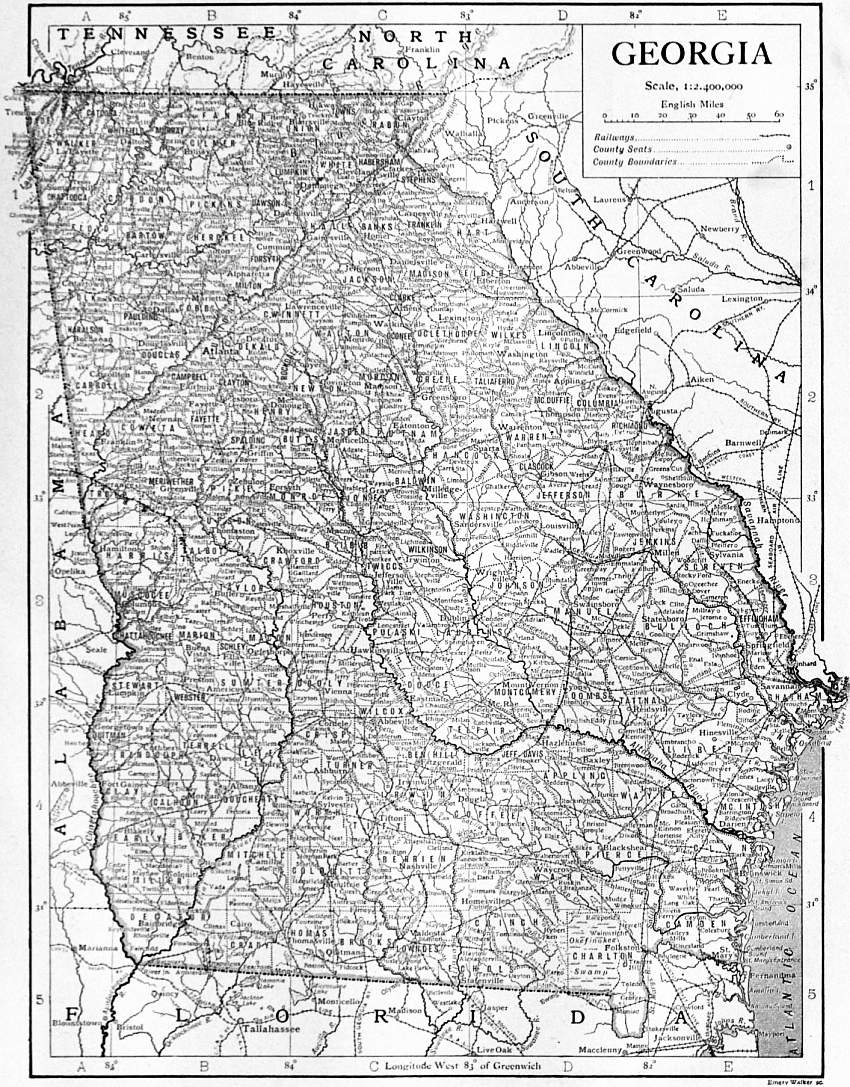
GEORGIA, a southern state of the United States of America, one of the thirteen original states, situated between 30° 31′ 39″ and 35° N., and between 81° and 85° 53′ 38″ W. It is bounded N. by Tennessee and North Carolina, E. by South Carolina and the Atlantic Ocean, S. by Florida, and W. by Alabama. The total area of the state is 59,265 sq. m., of which 540 sq. m. are water surface.
The surface of Georgia is divided into five physiographic zones. From the sea coast, which is skirted by fertile, semi-tropical islands, a plain of 35,000 sq. m., known as South Georgia, extends northward to the “fall-line” passing from Augusta, through Milledgeville and Macon, to Columbus. This is a part of the great Atlantic Coastal Plain. For 20 m. from the coast its elevation is 10 ft., then it rises abruptly 70 ft. higher, and 20 m. farther N. another elevation begins, which reaches 575 ft. at Milledgeville, the average elevation of the entire region being 250 ft. North of the line mentioned, and collectively known as North Georgia, are the four other regions, each with well-defined characteristics. The largest and southernmost, a broad belt extending from the “fall-line” to a line passing through Clarkesville, Habersham county, Cartersville, Bartow county and Buchanan, Haralson county (approximately), is known as the Piedmont Belt or Plateau, being a region of faint relief eroded on highly complicated crystalline rocks. The Blue Ridge escarpment, a striking topographic feature in Virginia and the Carolinas, extends into Georgia along the north-eastern border of this belt, but is less strongly developed here than elsewhere, dying out entirely towards the south-west. North of the Piedmont Belt lie the Appalachian Mountains Region and the Great Valley Region, the former to the east, the latter to the west of a dividing line from Cartersville northward. The former region consists of detached mountain masses of crystalline rocks, not yet eroded down to the level of the Piedmont Belt. In Towns county, in the Appalachian Region, is the highest point in the state, Brasstown Bald, also called Enota Mountain (4768 ft.). The Great Valley Region consists of folded sedimentary rocks, extensive erosion having removed the soft layers to form valleys, leaving the hard layers as ridges, both layers running in a N.E.-S.W. direction. In the extreme north-west corner of the state is a small part of the Cumberland Plateau, represented by Lookout and Sand Mts.
On the Blue Ridge escarpment near the N.E. corner of the state is a water-parting separating the waters which find their way respectively N.W. to the Tennessee river, S.W. to the Gulf of Mexico and S.E. to the Atlantic Ocean; indeed, according to B.M. and M.R. Hall (Water Resources of Georgia, p. 2), “there are three springs in north-east Georgia within a stone’s throw of each other that send out their waters to Savannah, Ga., to Apalachicola, Fla., and to New Orleans, La.” The water-parting between the waters flowing into the Atlantic and those flowing into the Gulf extends from this point first S.E. for a few miles, then turns S.W. to Atlanta, and from there extends S.S.E. to the Florida line. West of where the escarpment dies out, the Great Valley Region and a considerable portion of the Appalachian Mountains Region are drained by the Coosa, the Tallapoosa and their tributaries, into Mobile Bay, but the Cumberland Plateau, like that part of the Appalachian Mountains Region which lies directly N. of the Blue Ridge escarpment, constitutes a part of the Tennessee Basin. The principal rivers of the state are the Chattahoochee and the Flint, which unite in the S.W. corner to form the Apalachicola; the Ocmulgee (whose western tributary, the Towaliga, falls 96 ft. in less than a quarter of a mile), and the Oconee, which unite in the S.E. to form the Altamaha; and the Savannah, which forms the boundary between Georgia and South Carolina. All of these rise in the upper part of the Piedmont Plateau, through which they pursue a rapid course over rocky beds, and are navigable only south of the “fall-line,” at which and north of which they furnish an abundance of water-power. The upper Savannah river first flows S.W., then turns abruptly S.E., while the Chattahoochee river rises near this point and continues S.W. This is because the upper Savannah1 was formerly part of the Chattahoochee, but was captured and turned S.E. by headward growth of the Savannah. As a result of the capture there is a deep gorge along the upper Savannah, especially along the branch called the Tallulah river; and the upper Tallulah, in a series of cascades, 22⁄3 m. long, falls 525 ft. from the former higher level down to the main bed of the upper Savannah, at Tallulah Falls, a summer resort.
The fauna and flora have no distinctive features. (See United States.)
Climate and Soils.—The climate of Georgia, though temperate, differs considerably in different parts of the state. All the nine climate belts in the United States, except that of southern Florida, are represented within its borders. The lowest mean annual temperature, 40° F. and below, is that of some of the mountain tops of northern Georgia; from the mountain-sides to the Piedmont Plateau this mean temperature varies from 45° to 60°; on the Piedmont Plateau from 60° to 65°; and on the Coastal Plain from 60° to 70°. The July isotherm of 80° crosses the state a little N. of Augusta and Macon, touching the W. boundary at West Point, Troup county. The mean July temperature for the whole state is 81.8°; for the part S. of the 80° isotherm the average temperature for July is between 80° and 85°. The average rainfall for the state is 49.3 in.; the maximum is 71.7 in., at Rabun Gap in the extreme N.E. part of the state; the minimum is 39.4 at Swainsboro, Emanuel county, a little S.E. of the centre of the state.
Georgia is also notable for the variety of its soils. In the Cumberland Plateau and Great Valley Regions are a red or brown loam, rich in decomposed limestone and calcareous shales, and sandy or gravelly loams. In the Piedmont Plateau and Appalachian Mountains Regions the surface soil is generally sandy, but in considerable areas the subsoil is a red clay derived largely from the decomposition of hornblende. By far the greatest variety of soils is found in the Coastal Plain Region. Here the Central Cotton Belt, extending from the “fall-line” as far S. as a line bisecting Early county in the W. and passing through Baker, Worth, Dooly, Dodge, Laurens, Johnson, Jefferson and Burke counties, has three distinct kinds of soil; a sand, forming what is known as the sand-hill region; red clay derived from silicious rock in the red hills; and grey, sandy soils with a subsoil of yellow loam. South of the Cotton Belt is the Lime Sink Region, which includes Miller, Baker, Mitchell, Colquitt and Worth counties, the northern portions of Decatur, Grady, Thomas, Brooks and Lowndes, the eastern parts of Dooly and Lee, and the eastern portions of Berrien, Irwin, Wilcox, Dodge, and some parts of Burke, Screven and Bulloch. The soft limestone underlying this region is covered, in the uplands, with grey, sandy soils, which have a subsoil of loam; in the lowlands the surface soils are loams, the subsoils clays. Adjoining this region are the pine barrens, which extend S. to a line passing through the northern portions of Pierce, Wayne, Liberty, Bryan and Effingham counties. Here the prevailing soils are grey and sandy with a subsoil of loam, but they are less fertile than those of the Lime Sink or Cotton Belts. The coast counties of the S.E. and generally those on the Florida frontier are not suitable for cultivation, on account of the numerous marshes and swamps, Okefinokee Swamp being 45 m. long and approximately 30 m. wide; but the southern portions of Decatur, Grady, Thomas and Brooks counties are sufficiently elevated for agriculture, and the islands off the coast are exceedingly productive.
Minerals.—The mineral resources of Georgia are as varied as its climate and soils, a total of thirty-nine different mineral products being found within its borders. The most important is stone: in 1905 the value of the granite quarried in the state was $971,207 (Georgia ranking fifth in the United States), of the marble $774,550 (Georgia ranking third in the United States, Vermont and New York being first and second); in 1908 the granite was valued at $970,832 (Georgia ranking fifth in the United States), and the marble at $916,281 (Georgia ranking second in the United States, Vermont being first). Generally more than one-fourth of the granite is used for paving; curb, building and monument stone are next in importance in the order named. Stone Mountain (1686 ft.) in De Kalb county near Atlanta is a remarkable mass of light-coloured muscovite granite, having a circumference at its base of 7 m. Stone Mountain granite was first quarried about 1850; it is extensively used as building material in Georgia and other southern states. A laminated granite, otherwise like the Stone Mountain granite, is found in De Kalb, Rockdale and Gwinnett counties, and is used for curbing and building. Biotite granites, which take a good polish and are used for monuments and for decoration, are quarried in Oglethorpe and Elbert counties. Georgia marble was first quarried on a large scale in Pickens county in 1884; the pure white marble of this county had been worked for tombstones near Tate, the centre of the marble belt, in 1840; after its commercial exploitation it was used in the capitol buildings of Georgia, Rhode Island, Mississippi and Minnesota, in the Corcoran Art Gallery, Washington, D.C., and in St Luke’s Hospital, New York City. It is sometimes used for the entire building, and sometimes only for decoration. Other colours than the snowy white are found in the main marble belt of the state, which runs from Canton, Cherokee county, 60 m. generally N. to the northern boundary of the state. Other deposits, less well known, are the dark brown and light grey marbles of Whitfield county, which resemble the stone quarried in eastern Tennessee. Limestone and slate are quarried at Rock Mart, Polk county, and there are cement quarries at Cement, near Kingston, Bartow county. Iron deposits occur in Bartow, Polk and Floyd counties, where are the more important brown ores, and (red ores) in Walker and Chattooga counties. The quantity of iron ore mined in Georgia declined from 1890 to 1900; it was 200,842 long tons in 1905 and 321,060 long tons in 1908, when 319,812 tons were brown haematite and 1248 tons were red haematite. Before the discovery of gold in California the Georgia “placers” were very profitable, the earliest mining being in 1829 by placer miners from the fields of Burke county, North Carolina, who began work in what is now White county, and went thence to Habersham and Lumpkin counties. Dahlonega and Auraria, the latter named by John C. Calhoun, who owned a mine there, were the centres of this early gold mining. Work was summarily stopped by Federal troops enforcing the governor’s proclamation in 1831, because of the disorder in the mining region; but it was soon renewed and a mint was established at Dahlonega in 1838. After the discovery of gold in California, mining in Georgia was not renewed on anything but the smallest scale until the early ’eighties. In 1908 the gold product was valued at $56,207 (it was $96,910 in 1905) and the silver product at $106. Up to 1909 the gold product of Georgia (see State Geol. Survey Bulletin 19) was about $17,500,000. Extensive clay deposits occur in all parts of the state, and are remarkable for their comparative freedom from impurities and for their high fusion point; the most valuable are sedimentary, and form a belt several miles wide across the middle of the state from Augusta to Columbus. In 1908 the clay products of the state were valued at $1,928,611. More asbestos has been found in Georgia than in any other state of the Union; it occurs in the amphibole form throughout the N. part of the state, and most of the country’s domestic supply comes from the Sall Mountain mine in White county. Manganese ores, found in Bartow, Polk and Floyd counties, were formerly important; in 1896 4096 long tons were mined, in 1905 only 150 tons, and in 1908 none. Bauxite was found in Georgia first of the United States, near Rome, in 1887; the output, principally from Floyd, Bartow and Polk counties, was the entire product of the United States until 1891, and in 1902 was more than half the country’s product, but in 1908, even when combined with the Alabama output, was less than the amount mined in Arkansas. Coal is not extensively found, but the mine on Sand Mountain, in Walker county, was one of the first opened S. of the Ohio river; in 1908 the value of the coal mined in the state was $364,279 (264,822 short tons), the value of coke at the ovens was $137,524 (39,422 short tons), and the value of ammonium sulphate, coal tar, illuminating gas and gas coke was more than $800,000. Copper was mined in Fannin and Cherokee counties before the Civil War. In 1906 the copper mined was valued at $5057. Corundum was discovered on Laurel Creek in Rabun county in 1871, and was worked there and at Trackrock, Union county, especially between 1880 and 1893, but in later years low prices closed most of the mines. The limestone formations furnished most of the lime for domestic use. Sandstone, ochre, slate, soapstone, graphite are also mined, and lead, zinc, barytes, gypsum and even diamonds have been discovered but not exploited.
Agriculture.—The principal occupation in Georgia is agriculture, which in 1900 engaged seven-tenths of the land surface of the state and the labour of three-fifths of the population, ten years old and over, who are employed in profitable occupations. The products are so diversified that, with the exception of some tropical fruits of California and Florida, almost everything cultivated in the United States can be produced. The chief staple is cotton, of which a valuable hybrid called the Floradora, a cross of long and short staple, has been singularly successful. Cotton is raised in all counties of the state except Rabun, Towns and Fannin in the extreme north, and about one-third of the total cultivated land of the state was devoted to it in 1900-1907. In 1899-1904 the crop exceeded that of the other cotton-producing states except Texas, and in 1899, 1900 and 1903 Mississippi, averaging 1,467,121 commercial bales per annum; the crop in 1904 was 1,991,719 bales, and in 1907-1908 the crop was 1,815,834 bales, second only to the crop of Texas. The cause of this extensive cultivation of cotton is not a high average yield per acre, but the fact that before 1860 “Cotton was King,” and that the market value of the staple when the Civil War closed was so high that farmers began to cultivate it to the exclusion of the cereals, whose production, Indian corn excepted, showed a decline during each decade from 1879 to 1899. But in the ’nineties the price of the cotton fell below the cost of production, owing to the enormous supply, and this was accompanied by economic depression. These conditions have caused some diversification of crops, and successful experiments in cattle-raising, movements encouraged by the Department of Agriculture and the leading newspapers.
The principal cereals cultivated are Indian corn (product, 53,750,000 bushels in 1908) and wheat; the cultivation of the latter, formerly remunerative, declined on account of the competition of the Western States, but revived after 1899, largely owing to the efforts of the Georgia Wheat Growers’ Association (organized in 1897), and in 1908 the yield was 2,208,000 bushels. The sugar-cane crop declined in value after 1890, and each year more of it was made into syrup. In 1908 the tobacco crop was 2,705,625 ℔, and the average farm price was 35 cents, being nearly as high as that of the Florida crop; Sumatra leaf for wrappers is grown successfully. The acreage and product of tobacco and peanuts increased from 1890 to 1900 respectively 188% and 319.2%, and 92.6% and 129.9%, and in the production of sweet potatoes Georgia was in 1899 surpassed only by North Carolina. Alfalfa and grasses grow well. Truck farming and the cultivation of orchard and small fruits have long been remunerative occupations; the acreage devoted to peaches doubled between 1890 and 1900. Pecan nuts are an increasingly important crop.
Agriculture in Georgia was in a state of transition at the beginning of the 20th century. Owing to the abundance of land and to negro slavery, exploitative methods of cultivation were employed before the Civil War, and such methods, by which lands after being worked to exhaustion are deserted for new fields, had not yet been altogether abandoned. One reason for this was that, according to the census of 1900, 36.9% of the farms were operated by negroes, of whom 86% were tenants who desired to secure the greatest possible product without regard to the care of the soil. Consequently there were large tracts of untilled “waste” land; but these rapidly responded to fertilization and rotation of crops, often yielding 800 to 1200 ℔ of cotton per acre, and Georgia in 1899 used more fertilizers than any other state in the Union. Another feature of agriculture in Georgia was the great increase in the number of farms, the average size of plantations having declined from 440 acres in 1860 to 117.5 in 1900, or almost 75%, while the area in cultivation increased only 15.6% between 1850 and 1900. The tenantry system was also undergoing a change—the share system which developed in the years succeeding the Civil War being replaced by a system of cash rental.
(Click to enlarge.)
Manufactures.—Although excelled by Alabama in the manufacture of mineral products, and by North Carolina and South Carolina in the number and output of cotton mills, in 1900 and in 1905 Georgia surpassed each of those states in the total value of factory products, which was, however, less than the value of the factory products of Louisiana and Virginia among the southern states. The chief features of this industrial activity are its early beginning and steady, constant development. As far back as 1850 there were 1522 manufacturing establishments (35 of which were cotton mills) in the state, whose total product was valued at $7,082,075. Despite the Civil War, there was some advance during each succeeding decade, the most prosperous relatively being that from 1880 to 1890. In 1900 the number of establishments was 7504, an increase of 75.1% over the number in 1890; the capital invested was $89,789,656, an increase of 57.7%, and the value of products ($106,654,527) was 54.8% more than in 1890. Of the 7504 establishments in 1900, 3015 were conducted under the “factory system,” and had a capital of $79,303,316 and products valued at $94,532,368. In 1905 there were 3219 factories, with a capital of $135,211,551 (an increase of 70.5% over 1900), and a gross product valued at $151,040,455 (59.8% greater than the value of the factory product in 1900).
The most important manufacturing industries are those that depend upon cotton for raw material, with a gross product in 1900 valued at $26,521,757. In that year2 there were 67 mills engaged in the manufacture of cotton goods, with a capital of $24,158,159, and they yielded a gross product valued at $18,457,645; the increase between 1900 and 1905 was actually much larger (and proportionately very much larger) than between 1890 and 1900; the number of factories in 1905 was 103 (an increase of 53.7% over 1900); their capital was $42,349,618 (75.3% more than in 1900); and their gross product was valued at $35,174,248 (an increase of 90.6% since 1900). The rank of Georgia among the cotton manufacturing states was seventh in 1900 and fourth in 1905. Cotton-seed oil and cake factories increased in number from 17 to 43 from 1890 to 1900, and to 112 in 1905, and the value of their product increased from $1,670,196 to $8,064,112, or 382.8% in 1890-1900, and to $13,539,899 in 1905, or an increase of 67.9% over 1900, and in 1900 and in 1905 the state ranked second (to Texas) in this industry in the United States. This growth in cotton manufactures is due to various causes, among them being the proximity of raw material, convenient water-power, municipal exemption from taxation and the cheapness of labour. The relation between employer and employee is in the main far more personal and kindly than in the mills of the Northern States.
The forests of Georgia, next to the fields, furnish the largest amount of raw material for manufactures. The yellow pines of the southern part of the state, which have a stand of approximately 13,778,000 ft., yielded in 1900 rosin and turpentine valued at $8,110,468 (more than the product of any other state in the Union) and in 1905 valued at $7,705,643 (second only to the product of Florida). From the same source was derived most of the lumber product valued3 in 1900 at $13,341,160 (more than double what it was in 1890) and in 1905 at $16,716,594. The other important woods are cypress, oak and poplar.
Fourth in value in 1905 (first, cotton goods; second, lumber and timber; third, cotton-seed oil and cake) were fertilizers, the value of which increased from $3,367,353 in 1900 to $9,461,415 in 1905, when the state ranked first of the United States in this industry; in 1900 it had ranked sixth.
Communications.—Means of transportation for these products are furnished by the rivers, which are generally navigable as far north as the “fall line” passing through Augusta, Milledgeville, Macon and Columbus; by ocean steamship lines which have piers at St Mary’s, Brunswick, Darien and Savannah; and by railways whose mileage in January 1909 was 6,871.8 m. The most important of the railways are the Central of Georgia, the Southern, the Atlantic Coast Line, the Seaboard Air Line, the Georgia and the Georgia Southern & Florida. In 1878 a state railway commission was established which has mandatory power for the settlement of all traffic problems and makes annual reports.
Population.—The population of Georgia in 1880 was 1,542,180; in 1890 1,837,353, an increase of 19.1%; in 1900 2,216,331, a further increase of 20.6%4; in 1910, 2,609,121. Of the 1900 population, 53.3% were whites and 46.7% were negroes,5 the centre of the black population being a little south of the “fall line.” Here the negroes increased, from 1890 to 1900, faster than the whites in eighteen counties, but in northern Georgia, where the whites are in the majority, the negro population declined in twelve counties. Also the percentage of negro illiteracy is higher in northern Georgia than in other parts of the state, the percentage of negro male illiterates of voting age being 38.3% in Atlanta in 1900, and in Savannah only 30.7%. The population of Georgia has a very slight foreign-born element (.6% in 1900) and a small percentage (1.7% in 1900) of people of foreign parentage. The urban population (i.e. the population in places of 2500 inhabitants and over) was 15.6% of the total in 1900, and the number of incorporated cities, towns and villages was 372. Of these only forty had a population exceeding 2000, and thirteen exceeding 5000. The largest city in 1900 was Atlanta, the capital since 1868 (Louisville, Jefferson county, was the capital in 1795-1804, and Milledgeville in 1804-1868), with 89,872 inhabitants. Savannah ranked second with 54,244, and Augusta third with 39,441. In 1900 the other cities in the state with a population of more than 5000 were: Macon (23,272), Columbus (17,614), Athens (10,245), Brunswick (9081), Americus (7674), Rome (7291), Griffin (6857), Waycross (5919), Valdosta (5613), and Thomasville (5322).
The total membership of the churches in 1906 was about 1,029,037, of whom 596,319 were Baptists, 349,079 were Methodists, 24,040 were Presbyterians, 19,273 were Roman Catholics, 12,703 were Disciples of Christ, 9790 were Protestant Episcopalians, and 5581 were Congregationalists.
Government.—The present constitution, which was adopted in 1877,6 provides for a system of government similar in general to that of the other states (see United States). The executive officials are elected for a term of two years, and the judges of the Supreme Court and of the court of appeals for six years, while those of the superior court and of the ordinaries and the justices of the peace are chosen every four years. Before 1909 all male citizens of the United States at least twenty-one years of age (except those mentioned below), who had lived in the state for one year immediately preceding an election and in the county six months, and had paid their taxes, were entitled to vote. From the suffrage and the holding of office are excluded idiots and insane persons and all those who have been convicted of treason, embezzlement, malfeasance in office, bribery or larceny, or any crime involving moral turpitude and punishable under the laws of the state by imprisonment in the penitentiary—this last disqualification, however, is removable by a pardon for the offence. Before 1909 there was no constitutional discrimination aimed against the exercise of the suffrage by the negro, but in fact the negro vote had in various ways been greatly reduced. By a constitutional amendment adopted by a large majority at a special election in October 1908, new requirements for suffrage, designed primarily to exclude negroes, especially illiterate negroes, were imposed (supplementary to the requirements mentioned above concerning age, residence and the payment of taxes), the amendment coming into effect on the 1st of January 1909: in brief this amendment requires that the voter shall have served in land or naval forces of the United States or of the Confederate States or of the state of Georgia in time of war, or be lawfully descended from some one who did so serve; or that he be a person of good character who proves to the satisfaction of the registrars of elections that he understands the duties and obligations of a citizen; or that he read correctly in English and (unless physically disabled) write any paragraph of the Federal or state constitution; or that he own 40 acres of land or property valued at $500 and assessed for taxation. After the 1st of January 1915 no one may qualify as a voter under the first or second of these clauses (the “grandfather” and “understanding” clauses); but those who shall have registered under their requirements before the 1st of January 1915 thus become voters for life.
The governor, who receives a salary of $5000, must be at least thirty years old, must at the time of his election have been a citizen of the United States for fifteen years and of the state for six years, and “shall not be eligible to re-election after the expiration of a second term, for the period of four years.” In case of his “death, removal or disability,” the duties of his office devolve in the first instance upon the president of the Senate, and in the second upon the speaker of the House of Representatives. The governor’s power of veto extends to separate items in appropriation bills, but in every case his veto may be overridden by a two-thirds vote of the legislature. An amendment to the constitution may be proposed by a two-thirds vote of the legislature, and comes into effect on receiving a majority of the popular vote. Members of the Senate must be at least twenty-five years old, must be citizens of the United States, and must, at the time of their election, have been citizens of the state for four years, and of the senatorial district for one year; representatives must be at least twenty-one years old, and must, at the time of their election, have been citizens of the state for two years. By law, in Georgia, lobbying is a felony.
Habitual intoxication, wilful desertion for three years, cruel treatment, and conviction for an offence the commission of which involved moral turpitude and for which the offender has been sentenced to imprisonment for at least two years, are recognized as causes for divorce. All petitions for divorce must be approved by two successive juries, and a woman holds in her own name all property acquired before and after marriage. Marriage between the members of the white and negro races is prohibited by law.
As the result of the general campaign against child labour, an act was passed in 1906 providing that no child under 10 shall be employed or allowed to labour in or about any factory, under any circumstances; after the 1st of January 1907 no child under 12 shall be so employed, unless an orphan with no other means of support, or unless a widowed mother or disabled or aged father is dependent on the child’s labour, in which case a certificate to the facts, holding good for one year only, is required; after the 1st of January 1908 no child under 14 shall be employed in a factory between the hours of 7 P.M. and 6 A.M.; after the same date no child under 14 shall be employed in any factory without a certificate of school attendance for 12 weeks (of which 6 weeks must be consecutive) of the preceding year; no child shall be employed without the filing of an affidavit as to age. Making a false affidavit as to age or as to other facts required by the act, and the violation of the act by any agent or representative of a factory or by any parent or guardian of a child are misdemeanours.
In 1907 a state law was passed prohibiting after the 1st of January 1908 the manufacture or sale of intoxicating liquors; nine-tenths of the counties of the state, under local option laws, were already “dry” at the passage of this bill. The law permits druggists to keep for sale no other form of alcoholic drink than pure alcohol; physicians prescribing alcohol must fill out a blank, specifying the patient’s ailment, and certifying that alcohol is necessary; the prescription must be filled the day it is dated, must be served directly to the physician or to the patient, must not call for more than a pint, and may not be refilled.7
The state supports four benevolent institutions: a lunatic asylum for the whites and a similar institution for the negroes, both at Milledgeville, an institute for the deaf and dumb at Cave Spring, and an academy for the blind at Macon. There are also a number of private charitable institutions, the oldest being the Bethesda orphan asylum, near Savannah, founded by George Whitefield in 1739. The Methodist, Baptist, Roman Catholic and Protestant Episcopal Churches, and the Hebrews of the state also support homes for orphans. A penitentiary was established in 1817 at Milledgeville. In 1866 the lease system was introduced, by which the convicts were leased for a term of years to private individuals. In 1897 this was supplanted by the contract system, by which a prison commission accepted contracts for convict labour, but the prisoners were cared for by state officials. But the contract system for convicts and the peonage system (under which immigrants were held in practical slavery while they “worked out” advances made for passage-money, &c.) were still sources of much injustice. State laws made liable to prosecution for misdemeanour any contract labourer who, having received advances, failed for any but good cause to fulfil the contract; or any contract labourer who made a second contract without giving notice to his second employer of a prior and unfulfilled contract; or any employer of a labourer who had not completed the term of a prior contract. In September 1908, after an investigation which showed that many wardens had been in the pay of convict lessees and that terrible cruelty had been practised in convict camps, an extra session of the legislature practically put an end to the convict lease or contract system; the act then passed provided that after the 31st of March 1909, the date of expiration of leases in force, no convicts may be leased for more than twelve months and none may be leased at all unless there are enough convicts to supply all demands for convict labour on roads made by counties, each county to receive its pro rata share on a population basis, and to satisfy all demands made by municipalities which thus secure labour for $100 per annum (per man) paid into the state treasury, and all demands made by the state prison farm and factory established by this law.
Education.—Georgia’s system of public instruction was not instituted until 1870, but as early as 1817 the legislature provided a fund for the education in the private schools of the state of children of indigent parents. The constitution of 1868 authorized “a thorough system of general education, to be for ever free to all children of the State,” and in 1870 the first public school law was enacted. Education, however, has never been made compulsory. The constitution, as amended in 1905, provides that elections on the question of local school taxes for counties or for school districts may be called upon a petition signed by one-fourth of the qualified voters of the county, or district, in question; under this provision several counties and a large number of school districts are supplementing the general fund. But the principal source of the annual school revenue is a state tax; the fund derived from this tax, however, is not large enough. In 1908 the common school fund approximated $3,786,830, of which amount the state paid $2,163,200 and about $1,010,680 was raised by local taxation. In 1908 69% of the school population (79% of whites; 58% of negroes) were enrolled in the schools; in 1902 it was estimated that the negroes, 52.3% of whom (10 years of age and over) were illiterates (i.e. could not write or could neither read nor write) in 1900 (81.6% of them were illiterate in 1880), received the benefit of only about a fifth of the school fund. Of the total population, 10 years of age and over, 30.5% were illiterates in 1900—49.9% were illiterates in 1880—and as regards the whites of native birth alone, Georgia ranked ninth in illiteracy, in 1900, among the states and territories of the Union. Of the illiterates about four-fifths were negroes in 1900. In addition to the public schools, the state also supports the University of Georgia; and in 1906 $235,000 was expended for the support of higher education. In 1906-1907 eleven agricultural and mechanical arts colleges were established, one in each congressional district of the state. Of the colleges of the university, Franklin was the first state college chartered in America (1785); the Medical College of Georgia, at Augusta, was opened in 1829; the State College of Agriculture and Mechanic Arts was established at Athens in 1872; the North Georgia Agricultural College, at Dahlonega, was opened in 1873; the Georgia School of Technology, at Atlanta, in 1888; the Georgia Normal and Industrial College (for women), in Milledgeville, in 1899; the Georgia State Normal School, at Athens, in 1895; the Georgia State Industrial College for Coloured Youth, near Savannah, in 1890; the School of Pharmacy, at Athens, in 1903; and the School of Forestry, and the Georgia State College of Agriculture, at Athens, in 1906. Affiliated with the university, but not receiving state funds, are three preparatory schools, the South Georgia Military and Agricultural College at Thomasville, the Middle Georgia Military and Agricultural College at Milledgeville, and the West Georgia Agricultural and Mechanical College at Hamilton. Among the institutions generally grouped as denominational are—Baptist: Mercer University, at Macon (Penfield, 1837; Macon, 1871), Shorter College (1877) at Rome, Spelman Seminary (1881) in Atlanta for negro women and girls, and Bessie Tift College, formerly Monroe College (1849) for women, at Forsyth; Methodist Episcopal: Emory College (1836), at Oxford, and Wesleyan Female College (1836) at Macon, both largely endowed by George Ingraham Seney (1837-1893), and the latter one of the earliest colleges for women in the country; Methodist Episcopal Church, South: Young Harris College (1855) at Young Harris, Andrew Female College (1854) at Cuthbert, and Dalton Female College (1872) at Dalton; Presbyterian: Agnes Scott College at Decatur; and African Methodist Episcopal: Morris Brown College (1885) at Atlanta. A famous school for negroes is the non-sectarian Atlanta University (incorporated in 1867, opened in 1869), which has trained many negroes for teaching and other professions. Non-sectarian colleges for women are: Lucy Cobb Institute (1858) at Athens, Cox College (1843) at College Park, near Atlanta, and Brenau College Conservatory (1878) at Gainesville.
Finance.—The assessed value of taxable property in 1910 was about $735,000,000. A general property tax, which furnishes about four-fifths of the public revenue, worked so inequitably that a Board of Equalization was appointed in 1901. By the Constitution the tax rate is limited to $5 on the thousand, and, as the rate of taxation has increased faster than the taxable property, the state has been forced to contract several temporary loans since 1901, none of which has exceeded $200,000, the limit for each year set by the Constitution. On the 1st of January 1910 the bonded debt was $6,944,000, mainly incurred by the extravagance of the Reconstruction administration (see History, below). Each year $100,000 of this debt is paid off, and there are annual appropriations for the payment of interest (about $303,260 in 1910). The state owns the Western & Atlantic railway (137 m. long) from Chattanooga, Tennessee, to Atlanta, which has valuable terminal facilities in both cities, and which in 1910 was estimated to be worth $8,400,240 (more than the amount of the bonded debt); this railway the state built in 1841-1850, and in 1890 leased for 29 years, at an annual rental of $420,012, to the Nashville, Chattanooga & St Louis railway.
Banking in Georgia is in a prosperous condition. The largest class of depositors are the farmers, who more and more look to the banks for credit, instead of to the merchants and cotton speculators. Hence the number of banks in agricultural districts is increasing. The state treasurer is the bank examiner, and to him all banks must make a quarterly statement and submit their books for examination twice a year. The legal rate of interest is 7%, but by contract it may be 8%.
History.—Georgia derives its name from King George II. of Great Britain. It was the last to be established of the English colonies in America. Its formation was due to a desire of the British government to protect South Carolina from invasion by the Spaniards from Florida and by the French from Louisiana, as well as to the desire of James Edward Oglethorpe (q.v.) to found a refuge for the persecuted Protestant sects and the unfortunate but worthy indigent classes of Europe. A charter was granted in 1732 to “the Trustees for establishing the colony of Georgia in America,” and parliament gave £10,000 to the enterprise. The first settlement was made at Savannah in 1733 under the personal supervision of Oglethorpe. The early colonists were German Lutherans (Salzburgers), Piedmontese, Scottish Highlanders, Swiss, Portuguese Jews and Englishmen; but the main tide of immigration, from Virginia and the Carolinas, did not set in until 1752. As a bulwark against the Spanish, the colony was successful, but as an economic experiment it was a failure. The trustees desired that there should be grown in the colony wine grapes, hemp, silk and medical plants (barilla, kali, cubeb, caper, madder, &c.) for which England was dependent upon foreign countries; they required the settlers to plant mulberry trees, and forbade the sale of rum, the chief commercial staple of the colonies. They also forbade the introduction of negro slaves. Land was leased by military tenure, and until 1739 grants were made only in male tail and alienations were forbidden. The industries planned for the colony did not thrive, and as sufficient labour could not be obtained, the importation of slaves was permitted under certain conditions in 1749. About the same time the House of Commons directed the trustees to remove the prohibition on the sale of rum. In 1753 the charter of the trustees expired and Georgia became a royal province.
Under the new regime the colony was so prosperous that Sir James Wright (1716-1785), the last of the royal governors, declared Georgia to be “the most flourishing colony on the continent.” The people were led to revolt against the mother country through sympathy with the other colonies rather than through any grievance of their own. The centre of revolutionary ideas was St John’s Parish, settled by New Englanders (chiefly from Dorchester, Massachusetts). The Loyalist sentiment was so strong that only five of the twelve parishes sent representatives to the First Provincial Congress, which met on the 18th of January 1775, and its delegates to the Continental Congress therefore did not claim seats in that assembly. But six months later all the parishes sent representatives to another Provincial Congress which met on the 4th of July 1775. Soon afterward the royal government collapsed and the administration of the colony was assumed by a council of safety.
The war that followed was really a severe civil conflict, the Loyalist and Revolutionary parties being almost equal in numbers. In 1778 the British seized Savannah, which they held until 1782, meanwhile reviving the British civil administration, and in 1779 they captured Augusta and Sunbury; but after 1780 the Revolutionary forces were generally successful. Civil affairs also fell into confusion. In 1777 a state constitution was adopted, but two factions soon appeared in the government, led by the governor and the executive council respectively, and harmony was not secured until 1781.
Georgia’s policy in the formation of the United States government was strongly national. In the constitutional convention of 1787 its delegates almost invariably gave their support to measures designed to strengthen the central government. Georgia was the fourth state to ratify (January 2, 1788), and one of the three that ratified unanimously, the Federal Constitution. But a series of conflicts between the Federal government and the state government caused a decline of this national sentiment and the growth of States Rights theories.
First of these was the friction involved in the case, before the Supreme Court of the United States, of Chisolm v. Georgia, by which the plaintiff, one Alexander Chisolm, a citizen of South Carolina, secured judgment in 1793 against the state of Georgia (see 2 Dallas Reports 419). In protest, the Georgia House of Representatives, holding that the United States Supreme Court had no constitutional power to try suits against a sovereign state, resolved that any Federal marshal who should attempt to execute the court’s decision would be “guilty of felony, and shall suffer death, without benefit of clergy, by being hanged.” No effort was made to execute the decision, and in 1798 the Eleventh Amendment to the Federal Constitution was adopted, taking from Federal courts all jurisdiction over any suit brought “against one of the United States by citizens of another state, or by citizens or subjects of any foreign state.”
The position of Congress and of the Supreme Court with reference to Georgia’s policy in the Yazoo Frauds also aroused distrust of the Federal government. In 1795 the legislature granted for $500,000 the territory extending from the Alabama and Coosa rivers to the Mississippi river and between 35° and 31° N. lat. (almost all of the present state of Mississippi and more than half of the present state of Alabama) to four land companies, but in the following year a new legislature rescinded the contracts on the ground that they had been fraudulently and corruptly made, as was probably the case, and the rescindment was embodied in the Constitution of 1798., In the meantime the United States Senate had appointed a committee to inquire into Georgia’s claim to the land in question, and as this committee pronounced that claim invalid, Congress in 1800 established a Territorial government over the region. The legislature of Georgia remonstrated but expressed a willingness to cede the land to the United States, and in 1802 the cession was ratified, it being stipulated among other things that the United States should pay to the state $1,250,000, and should extinguish “at their own expense, for the use of Georgia, as soon as the same can be peaceably obtained on reasonable terms,” the Indian title to all lands within the state of Georgia. Eight years later the Supreme Court of the United States decided in the case of Fletcher v. Peck (6 Cranch 87) that such a rescindment as that in the new state constitution was illegal, on the ground that a state cannot pass a law impairing the obligation of contracts; and at an expense of more than four millions of dollars the Federal government ultimately extinguished all claims to the lands.
This decision greatly irritated the political leaders of Georgia, and the question of extinguishing the Indian titles, on which there had long been a disagreement, caused further and even more serious friction between the Federal and state authorities. The National government, until the administration of President Jackson, regarded the Indian tribes as sovereign nations with whom it alone had the power to treat, while Georgia held that the tribes were dependent communities with no other right to the soil than that of tenants at will. In 1785 Georgia made treaties with the Creeks by which those Indians ceded to the state their lands S. and W. of the Altamaha river and E. of the Oconee river, but after a remonstrance of one of their half-breed chiefs Congress decided that the cessions were invalid, and the National government negotiated, in 1790, a new treaty which ceded only the lands E. of the Oconee. The state appealed to the National government to endeavour to secure further cessions, but none had been made when, in 1802, the United States assumed its obligation to extinguish all Indian titles within the state. Several cessions were made between 1802 and 1824, but the state in the latter year remonstrated in vigorous terms against the dilatory manner in which the National government was discharging its obligation, and the effect of this was that in 1825 a treaty was negotiated at Indian Springs by which nearly all the Lower Creeks agreed to exchange their remaining lands in Georgia for equal territory beyond the Mississippi. But President J.Q. Adams, learning that this treaty was not approved by the entire Creek nation, authorized a new one, signed at Washington in 1826, by which the treaty of 1825 was abrogated and the Creeks kept certain lands W. of the Chattahoochee. The Georgia government, under the leadership of Governor George M. Troup (1780-1856), had proceeded to execute the first treaty, and the legislature declared the second treaty illegal and unconstitutional. In reply to a communication of President Adams early in 1827 that the United States would take strong measures to enforce its policy, Governor Troup declared that he felt it his duty to resist to the utmost any military attack which the government of the United States should think proper to make, and ordered the military companies to prepare to resist “any hostile invasion of the territory of this state.” But the strain produced by these conditions was relieved by information that new negotiations had been begun for the cession of all Creek lands in Georgia. These negotiations were completed late in the year.
There was similar conflict in the relation of the United States and Georgia with the Cherokees. In 1785 the Cherokees of Georgia placed themselves under the protection of the Federal government, and in 1823 their chiefs, who were mostly half-breeds, declared: “It is the fixed and unalterable determination of this nation never again to cede one foot more of land,” and that they could not “recognize the sovereignty of any state within the limits of their territory”; in 1827 they framed a constitution and organized a representative government. President Monroe and President J.Q. Adams treated the Cherokees with the courtesy due to a sovereign nation, and held that the United States had done all that was required to meet the obligation assumed in 1802. The Georgia legislature, however, contended that the United States had not acted in good faith, declared that all land within the boundaries of the state belonged to Georgia, and in 1828 extended the jurisdiction of Georgia law to the Cherokee lands. Then President Jackson, holding that Georgia was in the right on the Indian question, informed the Cherokees that their only alternative to submission to Georgia was emigration. Thereupon the chiefs resorted to the United States Supreme Court, which in 1832 declared that the Cherokees formed a distinct community “in which the laws of Georgia have no force,” and annulled the decision of a Georgia court that had extended its jurisdiction into the Cherokee country (Worcester v. Georgia). But the governor of Georgia declared that the decision was an attempt at usurpation which would meet with determined resistance, and President Jackson refused to enforce the decree. The President did, however, work for the removal of the Indians, which was effected in 1838.
On account of these conflicts a majority of Georgians adopted the principles of the Democratic-Republican party, and early in the 19th century the people were virtually unanimous in their political ideas. Local partisanship centred in two factions: one, led by George M. Troup, which represented the interests of the aristocratic and slave-holding communities; the other, formed by John Clarke (1766-1832) and his brother Elijah, found support among the non-slave-holders and the frontiersmen. The cleavage of these factions was at first purely personal; but by 1832 it had become one of principle. Then the Troup faction under the name of States Rights party, endorsed the nullification policy of South Carolina, while the Clarke faction, calling itself a Union party, opposed South Carolina’s conduct, but on the grounds of expediency rather than of principle. On account, however, of its opposition to President Jackson’s attitude toward nullification, the States Rights party affiliated with the new Whig party, which represented the national feeling in the South, while the Union party was merged into the Democratic party, which emphasized the sovereignty of the states.
The activity of Georgia in the slavery controversy was important. As early as 1835 the legislature adopted a resolution which asserted the legality of slavery in the Territories, a principle adopted by Congress in the Kansas Bill in 1854, and in 1847 ex-Governor Wilson Lumpkin (1783-1870) advocated the organization of the Southern states to resist the aggression of the North. Popular opinion at first opposed the Compromise of 1850, and some politicians demanded immediate secession from the Union; and the legislature had approved the Alabama Platform of 1848. But Congressmen Robert Toombs, Alexander H. Stephens, Whigs, and Howell Cobb, a Democrat, upon their return from Washington, contended that the Compromise was a great victory for the South, and in a campaign on this issue secured the election of such delegates to the state convention (at Milledgeville) of 1850 that that body adopted on the 10th of December, by a vote of 237 to 19, a series of conciliatory resolutions, since known as the “Georgia Platform,” which declared in substance: (1) that, although the state did not wholly approve of the Compromise, it would “abide by it as a permanent adjustment of this sectional controversy,” to preserve the Union, as the thirteen original colonies had found compromise necessary for its formation; (2) that the state “will and ought to resist, even (as a last resort) to the disruption of every tie that binds her to the Union,” any attempt to prohibit slavery in the Territories or a refusal to admit a slave state. The adoption of this platform was accompanied by a party reorganization, those who approved it organizing the Constitutional Union party, and those who disapproved, mostly Democrats, organizing the Southern Rights party; the approval in other states of the Georgia Platform in preference to the Alabama Platform (see Alabama) caused a reaction in the South against secession. The reaction was followed for a short interval by a return to approximately the former party alignment, but in 1854 the rank and file of the Whigs joined the American or Know-Nothing party while most of the Whig leaders went over to the Democrats. The Know-Nothing party was nearly destroyed by its crushing defeat in 1856 and in the next year the Democrats by a large majority elected for governor Joseph Emerson Brown (1821-1894) who by three successive re-elections was continued in that office until the close of the Civil War. Although Governor Brown represented the poorer class of white citizens he had taken a course in law at Yale College, had practised law, and at the time of his election was judge of a superior court; although he had never held slaves he believed that the abolition of slavery would soon result in the ruin of the South, and he was a man of strong convictions. The Kansas question and the attitude of the North toward the decision in the Dred Scott case were arousing the South when he was inaugurated the first time, and in his inaugural address he clearly indicated that he would favour secession in the event of any further encroachment on the part of the North. In July 1859 Senator Alfred Iverson (1798-1874) declared that in the event of the election of a Free-Soil resident in 1860 he would favour the establishment of an independent confederacy; later in the same year Governor Brown expressed himself to a similar effect and urged the improvement of the military service. On the 7th of November following the election of President Lincoln the governor, in a special message to the legislature, recommended the calling of a convention to decide the question of secession, and Alexander H. Stephens was about the only prominent political leader who contended that Lincoln’s election was insufficient ground for such action. On the 17th of November the legislature passed an act directing the governor to order an election of delegates on the 2nd of January 1861 and their meeting in a convention on the 16th. On the 19th this body passed an ordinance of secession by a vote of 208 to 89. Already the first regiment of Georgia Volunteers, under Colonel Alexander Lawton (1818-1896) had seized Fort Pulaski at the mouth of the Savannah river and now Governor Brown proceeded to Augusta and seized the Federal arsenal there. Toward the close of the same year, however, Federal warships blockaded Georgia’s ports, and early in 1862 Federal forces captured Tybee Island, Fort Pulaski, St Mary’s, Brunswick and St Simon Island. Georgia had responded freely to the call for volunteers, but when the Confederate Congress had passed, in April 1862, the Conscript Law which required all white men (except those legally exempted from service) between the ages of 18 and 35 to enter the Confederate service, Governor Brown, in a correspondence with President Davis which was continued for several months, offered serious objections, his leading contentions being that the measure was unnecessary as to Georgia, unconstitutional, subversive of the state’s sovereignty, and therefore “at war with the principles for the support of which Georgia entered into this revolution.”
In 1863 north-west Georgia was involved in the Chattanooga campaign. In the following spring Georgia was invaded from Tennessee by a Federal army under General William T. Sherman; the resistance of General Joseph E. Johnston and General J.B. Hood proved ineffectual; and on the 1st of September Atlanta was taken. Then Sherman began his famous “march to the sea,” from Atlanta to Savannah, which revealed the weakness of the Confederacy. In the spring of 1865, General J.H. Wilson with a body of cavalry entered the state from Alabama, seized Columbus and West Point on the 16th of April, and on the 10th of May captured Jefferson Davis, president of the Confederacy, at Irwinville in Irwin county.
In accord with President Andrew Johnson’s plan for reorganizing the Southern States, a provisional governor, James Johnson, was appointed on the 17th of June 1865, and a state convention reformed the constitution to meet the new conditions, rescinding the ordinance of secession, abolishing slavery and formally repudiating the state debt incurred in the prosecution of the war. A governor and legislature were elected in November 1865, the legislature ratified the Thirteenth Amendment on the 9th of December and five days later the governor-elect was inaugurated. But both the convention and legislature incurred the suspicion and ill-will of Congress; the convention had congratulated the president on his policy, memorialized him on behalf of Jefferson Davis, and provided pensions for disabled Confederate soldiers and the widows of those who had lost their lives during the war, while the legislature passed apprenticeship, labour and vagrancy laws to protect and regulate the negroes, and rejected the Fourteenth Amendment. Although the civil rights were conferred upon the freedmen, Congress would not tolerate the political incapacity and social inferiority which the legislature had assigned to them, and therefore Georgia was placed under military government, as part of the third military district, by the Reconstruction Act of the 2nd of March 1867. Under the auspices of the military authorities registration of electors for a new state convention was begun and 95,168 negroes and 96,333 whites were registered. The acceptance of the proposition to call the convention and the election of many conscientious and intelligent delegates were largely due to the influence of ex-Governor Brown, who was strongly convinced that the wisest course for the South was to accept quickly what Congress had offered. The convention met in Atlanta on the 9th of December 1867 and by March 1868 had revised the constitution to meet the requirements of the Reconstruction Acts. The constitution was duly adopted by popular vote, and elections were held for the choice of a governor and legislature. Rufus Brown Bullock (b. 1834), Republican, was chosen governor, the Senate had a majority of Republicans, but in the House of Representatives a tie vote was cast for the election of a speaker. On the 21st of July the Fourteenth Amendment was ratified, and a section of the state constitution (which denied the power of state courts to entertain against any resident of the state suits founded on contracts existing on the 15th of June 1865) was repealed by the legislature in pursuance of the congressional “Omnibus Bill” of the 25th of June 1868, and as evidence of the restoration of Georgia to the Union the congressmen were seated on the 25th of July in that year.