VOLUME XI SLICE V Gassendi, Pierre to Geocentric (continued 5)
Reading edition
See also J. Derenbourg in Jüd. Zeitschrift, xi. 299-308; E. Schrieber, Abraham Geiger als Reformator des Judentums (1880), art. (with portrait) in Jewish Encyclopedia.
Abraham Geiger’s nephew Lazarus Geiger (1829-1870), philosopher and philologist, born at Frankfort-on-Main, was destined to commerce, but soon gave himself up to scholarship and studied at Marburg, Bonn and Heidelberg. From 1861 till his sudden death in 1870 he was professor in the Jewish high school at Frankfort. His chief aim was to prove that the evolution of human reason is closely bound up with that of language. He further maintained that the origin of the Indo-Germanic language is to be sought not in Asia but in central Germany. He was a convinced opponent of rationalism in religion. His chief work was his Ursprung und Entwickelung der menschlichen Sprache und Vernunft (vol. i., Stuttgart, 1868), the principal results of which appeared in a more popular form as Der Ursprung der Sprache (Stuttgart, 1869 and 1878). The second volume of the former was published in an incomplete form (1872, 2nd ed. 1899) after his death by his brother Alfred Geiger, who also published a number of his scattered papers as Zur Entwickelung der Menschheit (1871, 2nd ed. 1878; Eng. trans. D. Asher, Hist. of the Development of the Human Race, Lond., 1880).
See L.A. Rosenthal, Laz. Geiger: seine Lehre vom Ursprung d. Sprache und Vernunft und sein Leben (Stuttgart, 1883); E. Peschier, L. Geiger, sein Leben und Denken (1871); J. Keller, L. Geiger und d. Kritik d. Vernunft (Wertheim, 1883) and Der Ursprung d. Vernunft (Heidelberg, 1884).
GEIJER, ERIK GUSTAF (1783-1847), Swedish historian, was born at Ransäter in Värmland, on the 12th of January 1783, of a family that had immigrated from Austria in the 17th century. He was educated at the university of Upsala, where in 1803 he carried off the Swedish Academy’s great prize for his Äreminne öfver Sten Sture den äldre. He graduated in 1806, and in 1810 returned from a year’s residence in England to become docent in his university. Soon afterwards he accepted a post in the public record office at Stockholm, where, with some friends, he founded the “Gothic Society,” to whose organ Iduna he contributed a number of prose essays and the songs Manhem, Vikingen, Den siste kämpen, Den siste skalden, Odalbonden, Kolargossen, which he set to music. About the same time he issued a volume of hymns, of which several are inserted in the Swedish Psalter.
Geijer’s lyric muse was soon after silenced by his call to be assistant to Erik Michael Fant, professor of history at Upsala, whom he succeeded in 1817. In 1824 he was elected a member of the Swedish Academy. A single volume of a great projected work, Svea Rikes Häfder, itself a masterly critical examination of the sources of Sweden’s legendary history, appeared in 1825. Geijer’s researches in its preparation had severely strained his health, and he went the same year on a tour through Denmark and part of Germany, his impressions from which are recorded in his Minnen. In 1832-1836 he published three volumes of his Svenska folkets historia (Eng. trans. by J.H. Turner, 1845), a clear view of the political and social development of Sweden down to 1654. The acute critical insight, just thought, and finished historical art of these incomplete works of Geijer entitle him to the first place among Swedish historians. His chief other historical and political writings are his Teckning af Sveriges tillsånd 1718-1772 (Stockholm, 1838), and Feodalism och republikanism, ett bidrag till Samhällsförfattningens historia (1844), which led to a controversy with the historian Anders Fryxell regarding the part played in history by the Swedish aristocracy. Geijer also edited, with the aid of J.H. Schröder, a continuation of Fant’s Scriptores rerum svecicarum medii aevi (1818-1828), and, by himself, Thomas Thorild’s Samlade skrifter (1819-1825), and Konung Gustaf III.’s efterlemnade Papper (4 vols., 1843-1846). Geijer’s academic lectures, of which the last three, published in 1845 under the title Om vår tids inre samhällsforhållanden, i synnerhet med afseende på Fäderneslandet, involved him in another controversy with Fryxell, but exercised a great influence over his students, who especially testified to their attachment after the failure of a prosecution against him for heresy. A number of his extempore lectures, recovered from notes, were published in 1856. He also wrote a life of Charles XIV. (Stockholm, 1844). Failing health forced Geijer to resign his chair in 1846, after which he removed to Stockholm for the purpose of completing his Svenska folkets historia, and died there on the 23rd of April 1847. His Samlade skrifter (13 vols., 1840-1855; new ed., 1873-1877) include a large number of philosophical and political essays contributed to reviews, particularly to Litteraturbladet (1838-1839), a periodical edited by himself, which attracted great attention in its day by its pronounced liberal views on public questions, a striking contrast to those he had defended in 1828-1830, when, as again in 1840-1841, he represented Upsala University in the Swedish diet. His poems were collected and published as Skaldestycken (Upsala, 1835 and 1878).
Geijer’s style is strong and manly. His genius bursts out in sudden flashes that light up the dark corners of history. A few strokes, and a personality stands before us instinct with life. His language is at once the scholar’s and the poet’s; with his profoundest thought there beats in unison the warmest, the noblest, the most patriotic heart. Geijer came to the writing of history fresh from researches in the whole field of Scandinavian antiquity, researches whose first-fruits are garnered in numerous articles in Iduna, and his masterly treatise Om den gamla nordiska folkvisan, prefixed to the collection of Svenska folkvisor which he edited with A.A. Afzelius (3 vols., 1814-1816). The development of freedom is the idea that gives unity to all his historical writings.
For Geijer’s biography, see his own Minnen (1834), which contains copious extracts from his letters and diaries; B.E. Malmström, Minnestal öfver E.G. Geijer, addressed to the Upsala students (June 6, 1848), and printed among his Tal och esthetiska afhandlingar (1868), and Grunddragen af Svenska vitterhetens häfder (1866-1868); and S.A. Hollander, Minne af E.G. Geijer (Örebro, 1869). See also lives of Geijer by J. Hellstenius (Stockholm, 1876) and J. Niekson (Odense, 1902).
GEIKIE, SIR ARCHIBALD (1835- ), Scottish geologist, was born at Edinburgh on the 28th of December 1835. He was educated at the high school and university of Edinburgh, and in 1855 was appointed an assistant on the Geological Survey. Wielding the pen with no less facility than the hammer, he inaugurated his long list of works with The Story of a Boulder; or, Gleanings from the Note-Book of a Geologist (1858). His ability at once attracted the notice of his chief, Sir Roderick Murchison, with whom he formed a lifelong friendship, and whose biographer he subsequently became. With Murchison some of his earliest work was done on the complicated regions of the Highland schists; and the small geological map of Scotland published in 1862 was their joint work: a larger map was issued by Geikie in 1892. In 1863 he published an important essay “On the Phenomena of the Glacial Drift of Scotland,” Trans. Geol. Soc. Glasgow, in which the effects of ice action in that country were for the first time clearly and connectedly delineated. In 1865 appeared Geikie’s Scenery of Scotland (3rd edition, 1901), which was, he claimed, “the first attempt to elucidate in some detail the history of the topography of a country.” In the same year he was elected F.R.S. At this time the Edinburgh school of geologists—prominent among them Sir Andrew Ramsay, with his Physical Geology and Geography of Great Britain—were maintaining the supreme importance of denudation in the configuration of land-surfaces, and particularly the erosion of valleys by the action of running water. Geikie’s book, based on extensive personal knowledge of the country, was an able contribution to the doctrines of the Edinburgh school, of which he himself soon began to rank as one of the leaders.
In 1867, when a separate branch of the Geological Survey was established for Scotland, he was appointed director. On the foundation of the Murchison professorship of geology and mineralogy at the university of Edinburgh in 1871, he became the first occupant of the chair. These two appointments he continued to hold till 1881, when he succeeded Sir Andrew Ramsay in the joint offices of director-general of the Geological Survey of the United Kingdom and director of the museum of practical geology, London, from which he retired in February 1901. A feature of his tenure of office was the impetus given to microscopic petrography, a branch of geology to which he had devoted special study, by a splendid collection of sections of British rocks. Later he wrote two important and interesting Survey Memoirs, The Geology of Central and Western Fife and Kinross (1900), and The Geology of Eastern Fife (1902).
From the outset of his career, when he started to investigate the geology of Skye and other of the Western Isles, he took a keen interest in volcanic geology, and in 1871 he brought before the Geological Society of London an outline of the Tertiary volcanic history of Britain. Many difficult problems, however, remained to be solved. Here he was greatly aided by his extensive travels, not only throughout Europe, but in western America. While the canyons of the Colorado confirmed his long-standing views on erosion, the eruptive regions of Wyoming, Montana and Utah supplied him with valuable data in explanation of volcanic phenomena. The results of his further researches were given in an elaborate and charmingly written essay on “The History of Volcanic Action during the Tertiary Period in the British Isles,” Trans. Roy. Soc. Edin., (1888). His mature views on volcanic geology were given to the world in his presidential addresses to the Geological Society in 1891 and 1892, and afterwards embodied in his great work on The Ancient Volcanoes of Great Britain (1897). Other results of his travels are collected in his Geological Sketches at Home and Abroad (1882).
His experience as a field geologist resulted in an admirable text-book, Outlines of Field Geology (5th edition, 1900). After editing and practically re-writing Jukes’s Student’s Manual of Geology in 1872, he published in 1882 a Text-Book and in 1886 a Class-Book of geology, which have taken rank as standard works of their kind. A fourth edition of his Text-Book, in two vols., was issued in 1903. His writings are marked in a high degree by charm of style and power of vivid description. His literary ability has given him peculiar qualifications as a writer of scientific biography, and the Memoir of Edward Forbes (with G. Wilson), and those of his old chiefs, Sir R.I. Murchison (2 vols., 1875) and Sir Andrew Crombie Ramsay (1895), are models of what such works should be. His Founders of Geology consists of the inaugural course of Lectures (founded by Mrs G.H. Williams) at Johns Hopkins University, Baltimore, delivered in 1897. In 1897 he issued an admirable Geological Map of England and Wales, with Descriptive Notes. In 1898 he delivered the Romanes Lectures, and his address was published under the title of Types of Scenery and their Influence on Literature. The study of geography owes its improved position in Great Britain largely to his efforts. Among his works on this subject is The Teaching of Geography (1887). His Scottish Reminiscences (1904) and Landscape in History and other Essays (1905) are charmingly written and full of instruction. He was foreign secretary of the Royal Society from 1890 to 1894, joint secretary from 1903 to 1908, president in 1909, president of the Geological Society in 1891 and 1892, and president of the British Association, 1892. He received the honour of knighthood in 1891.
GEIKIE, JAMES (1839- ), Scottish geologist, younger brother of Sir Archibald Geikie, was born at Edinburgh on the 23rd of August 1839. He was educated at the high school and university of Edinburgh. He served on the Geological Survey from 1861 until 1882, when he succeeded his brother as Murchison professor of geology and mineralogy at the university of Edinburgh. He took as his special subject of investigation the origin of surface-features, and the part played in their formation by glacial action. His views are embodied in his chief work, The Great Ice Age and its Relation to the Antiquity of Man (1874; 3rd ed., 1894). He was elected F.R.S. in 1875. James Geikie became the leader of the school that upholds the all-important action of land-ice, as against those geologists who assign chief importance to the work of pack-ice and icebergs. Continuing this line of investigation in his Prehistoric Europe (1881), he maintained the hypothesis of five inter-Glacial periods in Great Britain, and argued that the palaeolithic deposits of the Pleistocene period were not post- but inter- or pre-Glacial. His Fragments of Earth Lore: Sketches and Addresses, Geological and Geographical (1893) and Earth Sculpture (1898) are mainly concerned with the same subject. His Outlines of Geology (1886), a standard text-book of its subject, reached its third edition in 1896; and in 1905 he published an important manual on Structural and Field Geology. In 1887 he displayed another side of his activity in a volume of Songs and Lyrics by H. Heine and other German Poets, done into English Verse. From 1888 he was honorary editor of the Scottish Geographical Magazine.
GEIKIE, WALTER (1795-1837), Scottish painter, was born at Edinburgh on the 9th of November 1795. In his second year he was attacked by a nervous fever by which he permanently lost the faculty of hearing, but through the careful attention of his father he was enabled to obtain a good education. Before he had the advantage of the instruction of a master he had attained considerable proficiency in sketching both figures and landscapes from nature, and in 1812 he was admitted into the drawing academy of the board of Scottish manufactures. He first exhibited in 1815, and was elected an associate of the Royal Scottish Academy in 1831, and a fellow in 1834. He died on the 1st of August 1837, and was interred in the Greyfriars churchyard, Edinburgh. Owing to his want of feeling for colour, Geikie was not a successful painter in oils, but he sketched in India ink with great truth and humour the scenes and characters of Scottish lower-class life in his native city. A series of etchings which exhibit very high excellence were published by him in 1829-1831, and a collection of eighty-one of these was republished posthumously in 1841, with a biographical introduction by Sir Thomas Dick Lauder, Bart.
GEILER (or Geyler) VON KAISERSBERG, JOHANN (1445-1510), “the German Savonarola,” one of the greatest of the popular preachers of the 15th century, was born at Schaffhausen on the 16th of March 1445, but from 1448 passed his childhood and youth at Kaisersberg in Upper Alsace, from which place his current designation is derived. In 1460 he entered the university of Freiburg in Baden, where, after graduation, he lectured for some time on the Sententiae of Peter Lombard, the commentaries of Alexander of Hales, and several of the works of Aristotle. A living interest in theological subjects, awakened by the study of John Gerson, led him in 1471 to the university of Basel, a centre of attraction to some of the most earnest spirits of the time. Made a doctor of theology in 1475, he received a professorship at Freiburg in the following year; but his tastes, no less than the spirit of the age, began to incline him more strongly to the vocation of a preacher, while his fervour and eloquence soon led to his receiving numerous invitations to the larger towns. Ultimately he accepted in 1478 a call to the cathedral of Strassburg, where he continued to work with few interruptions until within a short time of his death on the 10th of March 1510. The beautiful pulpit erected for him in 1481 in the nave of the cathedral, when the chapel of St Lawrence had proved too small, still bears witness to the popularity he enjoyed as a preacher in the immediate sphere of his labours, and the testimonies of Sebastian Brant, Beatus Rhenanus, Johann Reuchlin, Melanchthon and others show how great had been the influence of his personal character. His sermons—bold, incisive, denunciatory, abounding in quaint illustrations and based on texts by no means confined to the Bible,—taken down as he spoke them, and circulated (sometimes without his knowledge or consent) by his friends, told perceptibly on the German thought as well as on the German speech of his time.
Among the many volumes published under his name only two appear to have had the benefit of his revision, namely, Der Seelen Paradies von waren und volkomnen Tugenden, and that entitled Das irrig Schaf. Of the rest, probably the best-known is a series of lectures on his friend Seb. Brant’s work, Das Narrenschiff or the Navicula or Speculum fatuorum, of which an edition was published at Strassburg in 1511 under the following title:—Navicula sive speculum fatuorum praestantissimi sacrarum literarum doctoris Joannis Geiler Keysersbergii.
See F.W. von Ammon, Geyler’s Leben, Lehren und Predigten (1826); L. Dacheux, Un Réformateur catholique à la fin du XVe siècle, J.G. de K. (Paris, 1876); R. Cruel, Gesch. der deutschen Predigt, pp. 538-576 (1879); P. de Lorenzi, Geiler’s ausgewählte Schriften (4. vols., 1881); T.M. Lindsay, History of the Reformation, i. 118 (1906); and G. Kawerau in Herzog-Hauck, Realencyklopädie, vi. 427.
GEINITZ, HANS BRUNO (1814-1900), German geologist, was born at Altenburg, the capital of the duchy of Saxe-Altenburg, on the 16th of October 1814. He was educated at the universities of Berlin and Jena, and gained the foundations of his geological knowledge under F.A. Quenstedt. In 1837 he took the degree of Ph.D. with a thesis on the Muschelkalk of Thuringia. In 1850 he became professor of geology and mineralogy in the Royal Polytechnic School at Dresden, and in 1857 he was made director of the Royal Mineralogical and Geological Museum; he held these posts until 1894. He was distinguished for his researches on the Carboniferous and Cretaceous rocks and fossils of Saxony, and in particular for those relating to the fauna and flora of the Permian or Dyas formation. He described also the graptolites of the local Silurian strata; and the flora of the Coal-formation of Altai and Nebraska. From 1863 to 1878 he was one of the editors of the Neues Jahrbuch. He was awarded the Murchison medal by the Geological Society of London in 1878. He died at Dresden on the 28th of January 1900. His son Franz Eugene Geinitz (b. 1854), professor of geology in the university of Rostock, became distinguished for researches on the geology of Saxony, Mecklenburg, &c.
H.B. Geinitz’s publications were Das Quadersandsteingebirge oder Kreidegebirge in Deutschland (1849-1850); Die Versteinerungen der Steinkohlenformation in Sachsen (1855); Dyas, oder die Zechsteinformation und das Rothliegende (1861-1862); Das Elbthalgebirge in Sachsen (1871-1875).
GEISHA (a Chino-Japanese word meaning “person of pleasing accomplishments”), strictly the name of the professional dancing and singing girls of Japan. The word is, however, often loosely used for the girls and women inhabiting Shin Yoshiwara, the prostitutes’ quarter of Tokyo. The training of the true Geisha or singing girl, which includes lessons in dancing, begins often as early as her seventh year. Her apprenticeship over, she contracts with her employer for a number of years, and is seldom able to reach independence except by marriage. There is a capitation fee of two yen per month on the actual singing girls, and of one yen on the apprentices.
See Jukichi Inouye, Sketches of Tokyo Life.
GEISLINGEN, a town of Germany in the kingdom of Württemberg, on the Thierbach, 38 m. by rail E.S.E. of Stuttgart. Pop. (1905) 7050. It has shops for the carving and turning of bone, ivory, wood and horn, besides iron-works, machinery factories, glass-works, brewing and bleaching works, &c. The church of St Mary contains wood-carving by Jörg Syrlin the Younger. Above the town lie the ruins of the castle of Helfenstein, which was destroyed in 1552. Having been for a few years in the possession of Bavaria, the town passed to Württemberg in 1810.
See Weitbrecht, Wanderungen durch Geislingen und seine Umgebung (Stuttgart, 1896).
GEISSLER, HEINRICH (1814-1879), German physicist, was born at the village of Igelshieb in Saxe-Meiningen on the 26th of May 1814 and was educated as a glass-blower. In 1854 he settled at Bonn, where he speedily gained a high reputation for his skill and ingenuity of conception in the fabrication of chemical and physical apparatus. With Julius Plücker, in 1852, he ascertained the maximum density of water to be at 3.8° C. He also determined the coefficient of expansion for ice between −24° and −7°, and for water freezing at 0°. In 1869, in conjunction with H.P.J. Vogelsang, he proved the existence of liquid carbon dioxide in cavities in quartz and topaz, and later he obtained amorphous from ordinary phosphorus by means of the electric current. He is best known as the inventor of the sealed glass tubes which bear his name, by means of which are exhibited the phenomena accompanying the discharge of electricity through highly rarefied vapours and gases. Among other apparatus contrived by him were a vaporimeter, mercury air-pump, balances, normal thermometer, and areometer. From the university of Bonn, on the occasion of its jubilee in 1868, he received the honorary degree of doctor of philosophy. He died at Bonn on the 24th of January 1879.
See A.W. Hofmann, Ber. d. deut. chem. Ges. p. 148 (1879).
GELA, a city of Sicily, generally and almost certainly identified with the modern Terranova (q.v.). It was founded by Cretan and Rhodian colonists in 688 B.C., and itself founded Acragas (see Agrigentum) in 582 B.C. It also had a treasure-house at Olympia. The town took its name from the river to the east (Thucydides vi. 2), which in turn was so called from its winter frost (γέλα in the Sicel dialect; cf. Lat. gelidus). The Rhodian settlers called it Lindioi (see Lindus). Gela enjoyed its greatest prosperity under Hippocrates (498-491 B.C.), whose dominion extended over a considerable part of the island. Gelon, who seized the tyranny on his death, became master of Syracuse in 485 B.C., and transferred his capital thither with half the inhabitants of Gela, leaving his brother Hiero to rule over the rest. Its prosperity returned, however, after the expulsion of Thrasybulus in 466 B.C.,1 but in 405 it was besieged by the Carthaginians and abandoned by Dionysius’ order, after his failure (perhaps due to treachery) to drive the besiegers away (E.A. Freeman, Hist. of Sic. iii. 562 seq.). The inhabitants later returned and rebuilt the town, but it never regained its position. In 311 B.C. Agathocles put to death 5000 of its inhabitants; and finally, after its destruction by the Mamertines about 281 B.C., Phintias of Agrigentum transferred the remainder to the new town of Phintias (now Licata, q.v.). It seems that in Roman times they still kept the name of Gelenses or Geloi in their new abode (Th. Mommsen in C.I.L. x., Berlin, 1883, p. 737).
(T. As.)
1 Aeschylus died there in 456 B.C.
GELADA, the Abyssinian name of a large species of baboon, differing from the members of the genus Papio (see Baboon) by the nostrils being situated some distance above the extremity of the muzzle, and hence made the type of a separate genus, under the name of Theropithecus gelada. In the heavy mantle of long brown hair covering the fore-quarters of the old males, with the exception of the bare chest, which is reddish flesh-colour, the gelada recalls the Arabian baboon (Papio hamadryas), and from this common feature it has been proposed to place the two species in the same genus. The gelada inhabits the mountains of Abyssinia, where, like other baboons, it descends in droves to pillage cultivated lands. A second species, or race, Theropithecus obscurus, distinguished by its darker hairs and the presence of a bare flesh-coloured ring round each eye, inhabits the eastern confines of Abyssinia.
(R. L.*)
GELASIUS, the name of two popes.
Gelasius I., pope from 492 to 496, was the successor of Felix III. He confirmed the estrangement between the Eastern and Western churches by insisting on the removal of the name of Acacius, bishop of Constantinople, from the diptychs. He is the author of De duabus in Christo naturis adversus Eutychen et Nestorium. A great number of his letters has also come down to us. His name has been attached to a Liber Sacramentorum anterior to that of St Gregory, but he can have composed only certain parts of it. As to the so-called Decretum Gelasii de libris recipiendis et non recipiendis, it also is a compilation of documents anterior to Gelasius, and it is difficult to determine Gelasius’s contributions to it. At all events, as we know it, it is of Roman origin, and 6th-century or later.
(L. D.*)
Gelasius II. (Giovanni Coniulo), pope from the 24th of January 1118 to the 29th of January 1119, was born at Gaeta of an illustrious family. He became a monk of Monte Cassino, was taken to Rome by Urban II., and made chancellor and cardinal-deacon of Sta Maria in Cosmedin. Shortly after his unanimous election to succeed Paschal II. he was seized by Cencius Frangipane, a partisan of the emperor Henry V., but freed by a general uprising of the Romans in his behalf. The emperor drove Gelasius from Rome in March, pronounced his election null and void, and set up Burdinus, archbishop of Braga, as antipope under the name of Gregory VIII. Gelasius fled to Gaeta, where he was ordained priest on the 9th of March and on the following day received episcopal consecration. He at once excommunicated Henry and the antipope and, under Norman protection, was able to return to Rome in July; but the disturbances of the imperialist party, especially of the Frangipani, who attacked the pope while celebrating mass in the church of St Prassede, compelled Gelasius to go once more into exile. He set out for France, consecrating the cathedral of Pisa on the way, and arrived at Marseilles in October. He was received with great enthusiasm at Avignon, Montpellier and other cities, held a synod at Vienne in January 1119, and was planning to hold a general council to settle the investiture contest when he died at Cluny. His successor was Calixtus II.
His letters are in J.P. Migne, Patrol. Lat. vol. 163. The original life by Pandulf is in J.M. Watterich, Pontif. Roman. vitae (Leipzig, 1862), and there is an important digest of his bulls and official acts in Jaffé-Wattenbach, Regesta pontif. Roman. (1885-1888).
See J. Langen, Geschichte der römischen Kirche von Gregor VII. bis Innocenz III. (Bonn, 1893); F. Gregorovius, Rome in the Middle Ages, vol. 4, trans. by Mrs G.W. Hamilton (London, 1896); A. Wagner, Die unteritalischen Normannen und das Papsttum, 1086-1150 (Breslau, 1885); W. von Giesebrecht, Geschichte der deutschen Kaiserzeit, Bd. iii. (Brunswick, 1890); G. Richter, Annalen der deutschen Geschichte im Mittelalter, iii. (Halle, 1898); H.H. Milman, Latin Christianity, vol. 4 (London, 1899).
(C. H. Ha.)
GELATI, a Georgian monastery in Russian Transcaucasia, in the government of Kutais, 11 m. E. of the town of Kutais, standing on a rocky spur (705 ft. above sea-level) in the valley of the Rion. It was founded in 1109 by the Georgian king David the Renovator. The principal church, a sandstone cathedral, dates from the end of the preceding century, and contains the royal crown of the former Georgian kingdom of Imeretia, besides ancient MSS., ecclesiological furniture, and fresco portraits of the kings of Imeretia. Here also, in a separate chapel, is the tomb of David the Renovator (1089-1125) and part of the iron gate of the town of Ganja (now Elisavetpol), which that monarch brought away as a trophy of his capture of the place.
GELATIN, or Gelatine, the substance which passes into solution when “collagen,” the ground substance of bone, cartilage and white fibrous tissue, is treated with boiling water or dilute acids. It is especially characterized by its property of forming a jelly at ordinary temperature, becoming liquid when heated, and resolidifying to a jelly on cooling. The word is derived from the Fr. gélatine, and Ital. gelatina, from the Lat. gelata, that which is frozen, congealed or stiff. It is, therefore, in origin cognate with “jelly,” which came through the Fr. gélee from the same Latin original.
The “collagen,” obtained from tendons and connective tissues, also occurs in the cornea and sclerotic coat of the eye, and in fish scales. Cartilage was considered to be composed of a substance chondrigen, which gave chondrin or cartilage-glue on boiling with water. Recent researches make it probable that cartilage contains (1) chondromucoid, (2) chondroitin-sulphuric acid, (3) collagen, (4) an albumoid present in old but not in young cartilage; whilst chondrin is a mixture of gelatin and mucin. “Bone collagen,” or “ossein,” constitutes, with calcium salts, the ground substance of bones. Gelatin consists of two substances, glutin and chondrin; the former is the main constituent of skin-gelatin, the latter of bone-gelatin.
True gelatigenous tissue occurs in all mature vertebrates, with the single exception, according to E.F.I. Hoppe-Seyler, of the Amphioxus lanceolatus. Gelatigenous tissue was discovered by Hoppe-Seyler in the cephalopods Octopus and Sepiola, but in an extension of his experiments to other invertebrates, as cockchafers and Anodon and Unio, no such tissue could be detected. Neither glutin nor chondrin occurs ready formed in the animal kingdom, but they separate when the tissues are boiled with water. A similar substance, vegetable gelatin, is obtained from certain mosses.
Pure gelatin is an amorphous, brittle, nearly transparent substance, faintly yellow, tasteless and inodorous, neutral in reaction and unaltered by exposure to dry air. Its composition is in round numbers C = 50, H = 7, N = 18, O = 25%; sulphur is also present in an amount varying from 0.25 to 0.7%.
Nothing is known with any certainty as to its chemical constitution, or of the mode in which it is formed from albuminoids. It exhibits in a general way a connexion with that large and important class of animal substances called proteids, being, like them, amorphous, soluble in acids and alkalis, and giving in solution a left-handed rotation of the plane of polarization. Nevertheless, the ordinary well-recognized reactions for proteids are but faintly observed in the case of gelatin, and the only substances which at once and freely precipitate it from solution are mercuric chloride, strong alcohol and tannic acid.
Although gelatin in a dry state is unalterable by exposure to air, its solution exhibits, like all the proteids, a remarkable tendency to putrefaction; but a characteristic feature of this process in the case of gelatin is that the solution assumes a transient acid reaction. The ultimate products of this decomposition are the same as are produced by prolonged boiling with acid. It has been found that oxalic acid, over and above the action common to all dilute acids of preventing the solidification of gelatin solutions, has the further property of preventing in a large measure this tendency to putrefy when the gelatin is treated with hot solutions of this acid, and then freed from adhering acid by means of calcium carbonate. Gelatin so treated has been called metagelatin.
In spite of the marked tendency of gelatin solutions to develop ferment-organisms and undergo putrefaction, the stability of the substance in the dry state is such that it has even been used, and with some success, as a means of preserving perishable foods. The process, invented by Dr Campbell Morfit, consists in impregnating the foods with gelatin, and then drying them till about 10% or less of water is present. Milk gelatinized in this way is superior in several respects to the products of the ordinary condensation process, more especially in the retention of a much larger proportion of albuminoids.
Gelatin has a marked affinity for water, abstracting it from admixture with alcohol, for example. Solid gelatin steeped for some hours in water absorbs a certain amount and swells up, in which condition a gentle heat serves to convert it into a liquid; or this may be readily produced by the addition of a trace of alkali or mineral acid, or by strong acetic acid. In the last case, however, or if we use the mineral acids in a more concentrated form, the solution obtained has lost its power of solidifying, though not that of acting as a glue. This property is utilized in the preparation of liquid glue (see Glue). By prolonged boiling of strong aqueous solutions at a high, or of weak solutions at a lower temperature, the characteristic properties of gelatin are impaired and ultimately destroyed. After this treatment it acts less powerfully as a glue, loses its tendency to solidify, and becomes increasingly soluble in cold water; nevertheless the solutions yield on precipitation with alcohol a substance identical in composition with gelatin.
By prolonged boiling in contact with hydrolytic agents, such as sulphuric acid or caustic alkali, it yields quantities of leucin and glycocoll (so-called “sugar of gelatin,” this being the method by which glycocoll was first prepared), but no tyrosin. In this last respect it differs from the great body of proteids, the characteristic solid products of the decomposition of which are leucin and tyrosin.
Gelatin occurs in commerce in varying degrees of purity; the purer form obtained from skins and bones (to which this article is restricted) is named gelatin; a preparation of great purity is “patent isinglass,” while isinglass (q.v.) itself is a fish-gelatin; less pure forms constitute glue (q.v.), while a dilute aqueous solution appears in commerce as size (q.v.). The manufacture follows much the same lines as that of glue; but it is essential that the raw materials must be carefully selected, and in view of the consumption of most of the gelatin in the kitchen—for soups, jellies, &c.—great care must be taken to ensure purity and cleanliness.
In the manufacture of bone-gelatin the sorted bones are degreased as in the case of glue manufacture, and then transferred to vats containing a dilute hydrochloric acid, by which means most of the mineral matter is dissolved out, and the bones become flexible. Instead of hydrochloric acid some French makers use phosphoric acid. After being well washed with water to remove all traces of hydrochloric acid, the bones are bleached by leading in sulphur dioxide. They are now transferred to the extractors, and heated by steam, care being taken that the temperature does not exceed 85° C. The digestion is repeated, and the runnings are clarified, concentrated, re-bleached and jellied as with glue. Skin-gelatin is manufactured in the same way as skin-glue. After steeping in lime pits the selected skins are digested three times; the first and second runnings are worked up for gelatin, while the third are filtered for “size.”
Vegetable gelatin is manufactured from a seaweed, genus Laminaria; from the tengusa, an American seaweed, and from Irish moss. The Laminaria is first extracted with water, and the residue with sodium carbonate; the filtrate is acidified with hydrochloric acid and the precipitated alginic acid washed and bleached. It is then dissolved in an alkali, the solution concentrated, and cooled down by running over horizontal glass plates. Flexible colourless sheets resembling animal gelatin are thus obtained. In America the weed is simply boiled with water, the solution filtered, and cooled to a thick jelly. Irish moss is treated in the same way. Both tengusa and Irish moss yield a gelatin suitable for most purposes; tengusa gelatin clarifies liquids in the same way as isinglass, and forms a harder and firmer jelly than ordinary gelatin.
Applications of Gelatin.—First and foremost is the use of gelatin as a food-stuff—in jellies, soups, &c. Referring to the articles Glue, Isinglass and Size for the special applications of these forms of gelatin, we here enumerate the more important uses of ordinary gelatin. In photography it is employed in carbon-processes, its use depending on the fact that when treated with potassium bichromate and exposed to light, it is oxidized to insoluble compounds; it plays a part in many other processes. A solution of gelatin containing readily crystallized salts—alum, nitre, &c.—solidifies with the formation of pretty designs; this is the basis of the so-called “crystalline glass” used for purposes of ornamentation. It is also used for coating pills to prevent them adhering together and to make them tasteless. Compounded with various mineral salts, the carbonates and phosphates of calcium, magnesium and aluminium, it yields a valuable ivory substitute. It also plays a part in the manufacture of artificial leather, of India inks, and of artificial silk (the Vanduara Company processes).
GELDERLAND, Gelders, or Guelders, formerly a duchy of the Empire, on the lower Rhine and the Yssel, bounded by Friesland, Westphalia, Brabant, Holland and the Zuider Zee; part of which has become the province of Holland, dealt with separately below. The territory of the later duchy of Gelderland was inhabited at the beginning of the Christian era by the Teutonic tribes of the Sicambri and the Batavi, and later, during the period of the decline of the Roman empire, by the Chamavi and other Frank peoples. It formed part of the Caroling kingdom of Austrasia, and was divided into pagi or gauen, ruled by official counts (comites-graven). In 843, by the treaty of Verdun, it became part of Lotharingia (Lorraine), and in 879 was annexed to the kingdom of East Francia (Germany) by the treaty of Meerssen. The nucleus of the later county and duchy was the gau or district surrounding the town of Gelder or Gelre, lying between the Meuse and the Niers, and since 1715 included in Rhenish Prussia.
The early history is involved in much obscurity. There were in the 11th century a number of counts ruling in various parts of what was afterwards known as Gelderland. Towards the close of that century Gerard of Wassenburg, who besides the county of Gelre ruled over portions of Hamalant and Teisterbant, acquired a dominant position amongst his neighbours. He is generally reckoned as the first hereditary count of Gelderland (d. 1117/8). His son, Gerard II.—the Long—(d. 1131), married Irmingardis, daughter and heiress of Otto, count of Zutphen, and their son, Henry I. (d. 1182), inherited both countships. His successors Otto I. (1182-1207) and Gerard III. (1207-1229) were lovers of peace and strong supporters of the Hohenstaufen emperors, through whose favour they were able to increase their territories by acquisitions in the districts of Veluwe and Betuwe. He acted as guardian to his nephew Floris IV. of Holland during his minority. Otto II., the Lame (1220-1271), fortified several towns and bestowed privileges upon them for the purpose of encouraging trade. He became a person of so much importance that he was urged to be a candidate for the dignity of emperor. He preferred to support the claims of his cousin, William II. of Holland. In return for the loan of a considerable sum of money William gave to him the city of Nijmwegen in pledge. His son Reinald I. (d. 1326) married Irmingardis, heiress of Limburg, and in right of his wife laid claim to the duchy against Adolf of Berg, who had sold his rights to John I. of Brabant. War followed, and on the 5th of June 1288 Reinald, who meantime had also sold his rights to the count of Luxemburg, was defeated and taken prisoner at the battle of Woeringen. In this battle the count of Luxemburg was slain, and Reinald had to surrender his claims as the price of his defeat to John of Brabant. In 1310, in return for his support, Reinald received from the emperor Henry VII. for all his territories privilegium de non evocando, i.e. the exemption of his subjects from the liability to be sued before any court outside his jurisdiction. In 1317 he was made a prince of the Empire. A wound received at the battle of Woeringen had affected his brain, and an insurrection against him was in 1316 headed by his son Reinald, who assumed the government under the title of “Son of the Count.” Reinald I. was finally in 1320 immured in prison, where he died in 1326.
Reinald II., the Black (1326-1343), was one of the foremost princes in the Netherlands of his day. He married (1) Sophia, heiress of Mechlin, and (2) in 1331 Eleanor, sister of Edward III. of England. By purchase or conquest he added considerably to his territories. He did much to improve the condition of the country, to foster trade, to promote the prosperity of the towns, and to maintain order and security in his lands by wise laws and firm administration. In 1338 the title of duke was bestowed upon him by the emperor Louis the Bavarian, who at the same time granted to him the fief of East Friesland. He died in 1343, leaving three daughters by his first marriage, and two sons, Reinald and Edward, both minors, by Eleanor of England. His elder son was ten years of age, and succeeded to the duchy under the guardianship of his mother Eleanor. Declared of age two years later, the youthful Reinald III. found himself involved in many difficulties through the struggles between the rival factions named after the two noble families of Bronkhorst and Hekeren. What was the quarrel between them, and what the causes they represented, cannot now be ascertained with certainty. There is good reason, however, to believe that they were the counterparts of the contemporary Cod and Hook parties in Holland, and of the Schieringers and Vetkoopers in Friesland. In Gelderland the quarrel between them was converted into a dynastic struggle, the Hekeren recognizing Duke Reinald, while the Bronkhorsten set up his younger brother Edward. At the battle of Tiel (1361) Reinald was defeated and taken prisoner, and Edward held the duchy till 1371. He was a good and successful ruler, and his death by an arrow wound, after a brilliant victory over the duke of Brabant near Baesweller (August 1371), was a loss to his country. He was in his thirty-fifth year and left no heirs. Reinald was now taken from the prison in which he had been confined to reign once more, but his health was broken and he died childless three years afterwards. The war of factions again broke out, the half-sisters of Reinald III. and Edward both claiming the inheritance; the elder, Matilda (Machteld), in her own right, the younger Maria on behalf of her seven-year-old boy William of Jülich, as the only male representative of the family. The Hekeren supported Matilda, the Bronkhorsten William of Jülich. The war of succession lasted till 1379, and ended in William’s favour, the emperor Wenceslas (Wenzel) recognizing him as duke four years later.
Duke William was able, restless and adventurous, an ideal knight of the palmy days of chivalry. He took part in no less than five crusades with the Teutonic order against the heathen Lithuanians and Prussians. In 1393 he inherited the duchy of Jülich, and died in 1402. He was succeeded by his brother, Reinald IV. (d. 1423), in the united sovereignty of Gelderland, Zutphen and Jülich, who, in accordance with a promise made before his accession, ceded the town of Emmerich to Duke Adolf of Cleves. He took the part of his brother-in-law, John of Arkel, against William VI. of Holland, and in a war of several years’ duration was not successful in preventing the Arkel territory being incorporated in Holland. On his death without legitimate issue, Gelderland passed to the young Arnold of Egmont, grandson of his sister Johanna, who had married John, lord of Arkel, their daughter Maria (d. 1415) being the wife of John, count of Egmont (d. 1451). Arnold was recognized as duke in 1424 by the emperor Sigismund, but in the following year the emperor revoked his decision and bestowed the duchy upon Adolf of Berg. Arnold in retaliation laid claim to the duchy of Jülich, which had likewise been granted to Adolf by Sigismund, and a war followed in which the cities and nobles of Gelderland stood by Arnold; it ended in Arnold retaining Gelderland and Zutphen, and Gerard, the son of Adolf (d. 1437), being acknowledged as duke of Jülich. To gain the support of the estates of Gelderland in this war of succession, Arnold had been compelled to make many concessions limiting the ducal prerogatives, and granting large powers to a council consisting of representatives of the nobles and the four chief cities, and his extravagance and exactions led to continual conflicts, in which the prince was compelled to yield to the demands of his subjects. In his later years a conspiracy was formed against him, headed by his wife, the violent and ambitious Catherine of Cleves, and his son Adolf. Arnold was at first successful and Adolf had to go into exile; but he returned, and in 1465, having taken his father prisoner by treachery, interned him in the castle of Buren. Charles the Bold of Burgundy now seized the opportunity to intervene. In 1471 he forced Adolf to release his father, who sold the reversion of the duchy to the duke of Burgundy for 92,000 golden gulden. On the 23rd of February 1473 Arnold died, and Charles of Burgundy became duke of Gelderland. His succession was not unopposed. Nijmwegen offered an heroic resistance and only fell after a long siege. After Charles’s death in 1477 Adolf was released from the captivity in which he had been held, and placed himself at the head of a party in the powerful city of Ghent, which sought to settle the disputed succession by forcing a match between him and Mary, the heiress of Burgundy. On the 29th of June 1477, however, he was killed at the siege of Tournai; and Mary gave her hand to Maximilian of Austria, afterwards emperor. Catherine, Adolf’s sister, made an attempt to assert the rights of his son Charles to the duchy, but by 1483 Maximilian had crushed all opposition and established himself as duke of Gelderland.
Charles of Egmont, however, did not surrender his claims, but with the aid of the French collected an army, and in the course of 1492 and 1493 succeeded in reconquering his inheritance. The efforts of Maximilian to recover the country were vain, and the successive governors of the Netherlands, Philip the Fair and his sister Margaret, fared no better. In 1507 Charles of Egmont invaded Holland and Brabant, captured Harderwijk and Bommel in 1511, threatened Amsterdam in 1512, and took Groningen. It was, undoubtedly, a great and heroic achievement for the ruler of a petty state like Gelderland thus to assert and maintain his independence for a long period against the overwhelming power of the house of Austria. It was not till 1528 that the emperor Charles V. could force him to accept the compromise of the treaty of Gorichen, by which he received Gelderland and Zutphen for life as fiefs of the Empire. In 1534 the duke, who was childless, attempted to transfer the reversion of Gelderland to France, but this project was violently resisted by the estates of the duchy, and Charles was compelled by them in 1538 to appoint as his successor William V.—the Rich—of Cleves (d. 1592). Charles died the same year, and William, with the aid of the French, succeeded in maintaining his position in Gelderland for several years. The Habsburg power was, however, in the end too great for him, and he was forced to cede the duchy to Charles V. by the treaty of Venloo, signed on the 7th of September 1543.
Gelderland was now definitely amalgamated with the Habsburg dominions in the Netherlands, until the revolt of the Low Countries led to its partition. In 1579 the northern and greater part, comprising the three “quarters” of Nijmwegen, Arnhem and Zutphen, joined the Union of Utrecht and became the province of Gelderland in the Dutch republic. Only the quarter of Roermonde remained subject to the crown of Spain, and was called Spanish Gelderland. By the treaty of Utrecht (1715) this was ceded to Prussia with the exception of Venloo, which fell to the United Provinces, and Roermonde, which, with the remaining Spanish Netherlands, passed to Austria. Of this, part was ceded to France at the peace of Basel in 1795, and the whole by the treaty of Lunéville in 1801, when it received the name of the department of the Roer. By the peace of Paris of 1814 the bulk of Gelderland was incorporated in the United Netherlands, the remainder falling to Prussia, where it forms the circle of Düsseldorf.
The rise of the towns in Gelderland began in the 13th century, river commerce and markets being the chief cause of their prosperity, but they never attained to the importance of the larger cities in Holland and Utrecht, much less to that of the great Flemish municipalities. They differed also from the Flemish cities in the nature of their privileges and immunities, as they did not possess the rights of communes, but only those of “free cities” of the Rhenish type. The power of the feudal lord over them was much greater. The states of Gelderland first became a considerable power in the land during the reign of Arnold of Egmont (1423-1473). Their claim to large privileges and a considerable share in the government of the county were formulated in a document drawn up at Nijmwegen in April 1436. These the duke had to concede, and to agree further to the appointment of a council to assist him in his administration. From this time the absolute authority of the sovereign in Gelderland was broken. The states consisted of two members—the nobility and the towns. The towns were divided into four separate districts or “quarters” named after the chief town in each—Nijmwegen, Arnhem, Zutphen and Roermonde. In the time of the republic, as has been stated above, the province of Gelderland comprised the three first-named “quarters” only. The three quarters had each of them peculiar rights and customs, and their representatives met together in a separate assembly before taking part in the diet (landdag) of the states. The nobility possessed great influence in Gelderland and retained it in the time of the republic.
(G. E.)
GELDERLAND (Guelders), a province of Holland, bounded S. by Rhenish Prussia and North Brabant, W. by Utrecht and South Holland, N. by the Zuider Zee, N.E. by Overysel, and S.E. by the Prussian province of Westphalia. It has an area of 1906 sq. m. and a pop. (1900) of 566,549. Historically it was part of the duchy of Gelderland, which is treated separately above.
The main portion of Gelderland north of the Rhine and the Old Ysel forms as it were an extension of the province of Overysel, being composed of diluvial sand and gravel, covered with sombre heaths and patches of fen. South of this line, however, the soil consists of fertile river-clay. The northern portion is divided by the New (or Gelders) Ysel into two distinct regions, namely, the Veluwe (“bad land”) on the west, and the former countship of Zutphen on the east. In this last division the ground slopes downwards from south-east to north-west (131 to 26 ft.) and is intersected by several fertilizing streams which flow in the same direction to join the Ysel. The extreme eastern corner is occupied by older Tertiary loam, which is used for making bricks, and upon this and the river-banks are the most fertile spots, woods, cultivated land, pastures, towns and villages. The highlands of the Veluwe lying west of the Ysel really extend as far as the Crooked Rhine and the Vecht in the province of Utrecht, but are slightly detached from the Utrecht hills by the so-called Gelders valley, which forms the boundary between the two provinces. This valley extends from the Rhine along the Grift, the Luntersche Beek, and the Eem to the Zuider Zee, and would still offer an outlet in this direction to the Rhine at high water if it were not for the river dikes. The two main ridges of the Veluwe hills (164 and 360 ft.) extend from the neighbourhood of Arnhem north to Harderwyk and north-east to Hattem. In the south they stretch themselves along the banks of the Rhine, forming a strip of picturesque river scenery made up of the varied elements of sandhills and trees, clay-lands and pastures. A large number of country-houses and villas are to be found here, and the riverside villages of Dieren, Velp and Renkum. All over the Veluwe are heaths, scantily cultivated, with fields of rye and buckwheat, cattle of inferior quality, and sheep, and a sparse population. There is also a considerable cultivation of wood, especially of fir and copse, while tobacco plantations are found at Nykerk and Wageningen.
The southern division of the province presents a very different aspect, and contains many old towns and villages. It is watered by the three large rivers, the Rhine, the Waal and the Maas, and has a level clay soil, varied only by isolated hills and a sandy, wooded stretch between Nijmwegen and the southern border. The region enclosed between the Rhine and the Waal and watered by the Linge is called the Betuwe (“good land”), and gave its name to the Germanic tribe of Batavians, who are sometimes wrongly regarded as the parent stock of the Dutch people. There is here a denser population, occupied in the cultivation of wheat, beetroot and fruit, the breeding of excellent cattle, shipping and industrial pursuits. The principal centres of population, such as Zutphen, Arnhem (the chief town of the province), Nijmwegen and Tiel, lie along the large rivers. Smaller, but of equal antiquity, are the riverside towns of Doesburg, which is strongly fortified; Wageningen, with the State agricultural schools; Doetinchem, with a bridge over the Old Ysel which is mentioned as early as the 14th century; Zalt-Bommel, with an old church (1304), and a railway bridge over the Waal; and Kuilenburg, with a fine railway bridge (1863-1868) over the Rhine. Five m. S. of Zalt-Bommel, on the Maas, is the medieval castle of Ammerzode or Ammersooi, also called Amelroy during the French occupation in 1674. It is in an excellent state of preservation and has been restored in modern times. The first authentic record of the castle is its possession by John de Herlar of the noble family of Loo at the end of the 13th century. In 1480 it passed by marriage to the powerful lords van Arkel, and was partly destroyed by fire at the end of the 16th century. The chapel dates from the 15th century, and the keep from 1564. Among the family portraits are works by Albert Dürer. Zetten, on the railway between Nijmwegen and Tiel, is famous for the charitable institutions founded here by the preacher Otto Gerhard Heldring (d. 1876). They comprise a penitentiary (1849) for women; an educational home (1858) for girls; a theological training college (1864); and a Magdalen hospital. Nykerk, Harderwyk and Elburg are fishing towns on the Zuider Zee. Apeldoorn is situated on the edge of the sand-grounds. Heerenberg on the south-eastern border is remarkable for its ancient castle near the seat of the powerful lords van den Bergh. Other ancient and historical towns bordering on the Prussian frontier are Zevenaar, which was for long the cause of dispute between the houses of Cleves and Gelder and was finally attached to the kingdom of the Netherlands in 1816; Breedevoort, once the seat of a lordship of the same name belonging to the counts van Loon or Lohn, who built a castle here in the beginning of the 13th century which was destroyed in 1646—the lordship was presented to Prince William III. in 1697; Winterswyk, now an important railway junction, and of growing industrial importance; and Borkeloo, or Borkulo, the seat of an ancient lordship dating from the first half of the 12th century, which finally came into the possession of Prince William V. of Orange Nassau in 1777. The castle was formerly of importance.
Gelderland is intersected by the main railway lines, which are largely supplemented by steam-tram railways. Steam-tramways connect Arnhem and Zutphen, Wageningen, Nijmwegen, Velp, Doetinchem (by way of Dieren and Doesburg), whence there are various lines to Emmerich and Gendringen on the Prussian borders. Groenlo and Lichtenvorde, Borkulo and Deventer are also connected.
GELDERN, a town of Germany, in Rhenish Prussia, on the Niers, 28 m. N. W. of Düsseldorf, at the junction of railways to Wesel and Cologne. Pop. (1905) 6551. It has an Evangelical and two Roman Catholic churches and a town hall with a fine council chamber. Its industries include the manufacture of buttons, shoes, cigars and soap. The town dates from about 1100 and was early an important fortified place; until 1371 it was the residence of the counts and dukes of Gelderland. Having passed to Spain, its fortifications were strengthened by Philip II., but they were razed by Frederick the Great, the town having been in the possession of Prussia since 1703.
See Nettesheim, Geschichte der Stadt und des Amtes Geldern (Crefeld, 1863); Henrichs, Beiträge zur innern Geschichte der Stadt Geldern (Geldern, 1893); and Real, Chronik der Stadt und Umgegend von Geldern (Geldern, 1897).
GELL, SIR WILLIAM (1777-1836), English classical archaeologist, was born at Hopton in Derbyshire. He was educated at Jesus College, Cambridge, and subsequently elected a fellow of Emmanuel College (B.A. 1798, M.A. 1804). About 1800 he was sent on a diplomatic mission to the Ionian islands, and on his return in 1803 he was knighted. He went with Princess (afterwards Queen) Caroline to Italy in 1814 as one of her chamberlains, and gave evidence in her favour at the trial in 1820 (see G.P. Clerici, A Queen of Indiscretions, Eng. trans., London, 1907). He died at Naples on the 4th of February 1836. His numerous drawings of classical ruins and localities, executed with great detail and exactness, are preserved in the British Museum. Gell was a thorough dilettante, fond of society and possessed of little real scholarship. None the less his topographical works became recognized text-books at a time when Greece and even Italy were but superficially known to English travellers. He was a fellow of the Royal Society and the Society of Antiquaries, and a member of the Institute of France and the Berlin Academy.
His best-known work is Pompeiana; the Topography, Edifices and Ornaments of Pompeii (1817-1832), in the first part of which he was assisted by J.P. Gandy. It was followed in 1834 by the Topography of Rome and its Vicinity (new ed. by E.H. Bunbury, 1896). He wrote also Topography of Troy and its Vicinity (1804); Geography and Antiquities of Ithaca (1807); Itinerary of Greece, with a Commentary on Pausanias and Strabo (1810, enlarged ed. 1827); Itinerary of the Morea (1816; republished as Narrative of a Journey in the Morea, 1823). All these works have been superseded by later publications.
GELLERT, CHRISTIAN FÜRCHTEGOTT (1715-1769), German poet, was born at Hainichen in the Saxon Erzgebirge on the 4th of July 1715. After attending the famous school of St Afra in Meissen, he entered Leipzig University in 1734 as a student of theology, and on completing his studies in 1739 was for two years a private tutor. Returning to Leipzig in 1741 he contributed to the Bremer Beiträge, a periodical founded by former disciples of Johann Christoph Gottsched, who had revolted from the pedantry of his school. Owing to shyness and weak health Gellert gave up all idea of entering the ministry, and, establishing himself in 1745 as privatdocent in philosophy at the university of Leipzig, lectured on poetry, rhetoric and literary style with much success. In 1751 he was appointed extraordinary professor of philosophy, a post which he held until his death at Leipzig on the 13th of December 1769.
The esteem and veneration in which Gellert was held by the students, and indeed by persons in all classes of society, was unbounded, and yet due perhaps less to his unrivalled popularity as a lecturer and writer than to his personal character. He was the noblest and most amiable of men, generous, tender-hearted and of unaffected piety and humility. He wrote in order to raise the religious and moral character of the people, and to this end employed language which, though at times prolix, was always correct and clear. He thus became one of the most popular German authors, and some of his poems enjoyed a celebrity out of proportion to their literary value. This is more particularly true of his Fabeln und Erzählungen (1746-1748) and of his Geistliche Oden und Lieder (1757). The fables, for which he took La Fontaine as his model, are simple and didactic. The “spiritual songs,” though in force and dignity they cannot compare with the older church hymns, were received by Catholics and Protestants with equal favour. Some of them were set to music by Beethoven. Gellert wrote a few comedies: Die Betschwester (1745), Die kranke Frau (1748), Das Los in der Lotterie (1748), and Die zärtlichen Schwestern (1748), the last of which was much admired. His novel Die schwedische Gräfin von G. (1746), a weak imitation of Richardson’s Pamela, is remarkable as being the first German attempt at a psychological novel. Gellert’s Briefe (letters) were regarded at the time as models of good style.
See Gellert’s Sämtliche Schriften (first edition, 10 vols., Leipzig, 1769-1774; last edition, Berlin, 1867). Sämtliche Fabeln und Erzählungen have been often published separately, the latest edition in 1896. A selection of Gellert’s poetry (with an excellent introduction) will be found in F. Muncker, Die Bremer Beiträge (Stuttgart, 1899). A translation by J.A. Murke, Gellert’s Fables and other Poems (London, 1851). For a further account of Gellert’s life and work see lives by J.A. Cramer (Leipzig, 1774), H. Döring (Greiz, 1833), and H.O. Nietschmann (2nd ed., Halle, 1901); also Gellerts Tagebuch aus dem Jahre 1761 (2nd ed., Leipzig, 1863) and Gellerts Briefwechsel mit Demoiselle Lucius (Leipzig, 1823).
GELLERT, or Killhart, in Welsh traditional history, the dog of Llewellyn, prince of Wales. The dog, a greyhound, was left to guard the cradle in which the infant heir slept. A wolf enters, and is about to attack the child, when Gellert flies at him. In the struggle the cradle is upset and the infant falls underneath. Gellert kills the wolf, but when Prince Llewellyn arrives and sees the empty cradle and blood all around, he does not for the moment notice the wolf, but thinks Gellert has killed the baby. He at once stabs him, but almost instantly finds his son safe under the cradle and realizes the dog’s bravery. Gellert is supposed to have been buried near the village of Beddgelert (“grave of Gellert”), Snowdon, where his tomb is still pointed out to visitors. The date of the incident is traditionally given as 1205. The incident has given rise to a Welsh proverb, “I repent as much as the man who slew his greyhound.” The whole story is, however, only the Welsh version of a tale long before current in Europe, which is traced to the Indian Panchatantra and perhaps as far back as 200 B.C.
See W.A. Clouston, Popular Tales and Fictions (1887); D.E. Jenkins, Beddgelert, its Facts, Fairies and Folklore (Portmadoc, 1899).
GELLIUS, AULUS (c. A.D. 130-180), Latin author and grammarian, probably born at Rome. He studied grammar and rhetoric at Rome and philosophy at Athens, after which he returned to Rome, where he held a judicial office. His teachers and friends included many distinguished men—Sulpicius Apollinaris, Herodes Atticus and Fronto. His only work, the Noctes Atticae, takes its name from having been begun during the long nights of a winter which he spent in Attica. He afterwards continued it at Rome. It is compiled out of an Adversaria, or commonplace book, in which he had jotted down everything of unusual interest that he heard in conversation or read in books, and it comprises notes on grammar, geometry, philosophy, history and almost every other branch of knowledge. The work, which is utterly devoid of sequence or arrangement, is divided into twenty books. All these have come down to us except the eighth, of which nothing remains but the index. The Noctes Atticae is valuable for the insight it affords into the nature of the society and pursuits of those times, and for the numerous excerpts it contains from the works of lost ancient authors.
Editio princeps (Rome, 1469); the best editions are those of Gronovius (1706) and M. Hertz (1883-1885; editio minor, 1886, revised by C. Hosius, 1903, with bibliography). There is a translation in English by W. Beloe (1795), and in French by various hands (1896). See Sandys, Hist. Class. Schol. i. (1906), 210.
GELLIVARA [Gellivare], a mining town of Sweden in the district (län) of Norrbotten, 815 m. N. by E. of Stockholm by rail. It lies in the well-nigh uninhabited region of Swedish Lapland, 43 m. N. of the Arctic Circle. It owes its importance to the iron mines in the mountain Malmberget 4½ m. to the north, rising to 2024 ft. above sea-level (830 ft. above Gellivara town). During the dark winter months work proceeds by the aid of electric light. In 1864 the mines were acquired by an English company, but abandoned in 1867. In 1884 another English company took them up and completed a provisional railway from Malmberget to Luleå at the head of the Gulf of Bothnia (127 m. S.S.E.), besides executing a considerable portion of the preliminary works for the continuation of the line on the Norwegian side from Ofoten Fjord upwards (see Narvik). But this company, after extracting some 150,000 tons of ore in 1888-1889, went into liquidation in the latter year. Two years later the mines passed into the hands of a Swedish company, and the railway was acquired by the Swedish Government. The output of ore was insignificant until 1892, when it stood at 178,000 tons; but in 1902 it amounted to 1,074,000 tons. Three miles S.W. rises the hill Gellivara Dundret (2700 ft.), from which the sun is visible at midnight from June 5 to July 11. The population of the parish (about 6500 sq. m.) in 1900 was 11,745; the greater part of the population being congregated at the town of Gellivara and at Malmberget.
GELNHAUSEN, a town of Germany, in the Prussian province of Hesse-Nassau, on the Kinzig, 27 m. E.N.E. of Frankfort-on-Main, on the railway to Bebra. Pop. 4500. It is romantically situated on the slope of a vine-clad hill, and is still surrounded by ancient walls and towers. On an island in the river are the ivy-covered ruins of the imperial palace which Frederick I. (Barbarossa) built before 1170, and which was destroyed by the Swedes during the Thirty Years’ War. It has an interesting and beautiful church (the Marien Kirche), with four spires (of which that on the transept is curiously crooked), built in the 13th century, and restored in 1876-1879; also several other ancient buildings, notably the town-hall, the Fürstenhof (now administrative offices), and the Hexenthurm. India-rubber goods are manufactured, and wine is made. Gelnhausen became an imperial town in 1169, and diets of the Empire were frequently held within its walls. In 1634 and 1635 it suffered severely from the Swedes. In 1803 the town became the property of Hesse-Cassel, and in 1866 passed to Prussia.
GELO, son of Deinomenes, tyrant of Gela and Syracuse. On the death of Hippocrates, tyrant of Gela (491 B.C.), Gelo, who had been his commander of cavalry, succeeded him; and in 485, his aid having been invoked by the Gamori (the oligarchical landed proprietors) of Syracuse who had been driven out by the populace, he seized the opportunity of making himself despot. From this time Gelo paid little attention to Gela, and devoted himself to the aggrandizement of Syracuse, which attained extraordinary wealth and influence. When the Greeks solicited his aid against Xerxes, he refused it, since they would not give him command of the allied forces (Herodotus vii. 171). In the same year the Carthaginians invaded Sicily, but were totally defeated at Himera, the result of the victory being that Gelo became lord of all Sicily. After he had thus established his power, he made a show of resigning it; but his proposal was rejected by the multitude, and he reigned without opposition till his death (478). He was honoured as a hero, and his memory was held in such respect that when all the brazen statues of tyrants were condemned to be sold in the time of Timoleon (150 years later) an exemption was made in favour of the statue of Gelo.
Herodotus vii.; Diod. Sic. xi. 20-38; see also Sicily: History, and Syracuse; for his coins see Numismatics: Sicily.
GELSEMIUM, a drug consisting of the root of Gelsemium nitidum, a clinging shrub of the natural order Loganiaceae, having a milky juice, opposite, lanceolate shining leaves, and axillary clusters of from one to five large, funnel-shaped, very fragrant yellow flowers, whose perfume has been compared with that of the wallflower. The fruit is composed of two separable jointed pods, containing numerous flat-winged seeds. The stem often runs underground for a considerable distance, and indiscriminately with the root it is used in medicine. The plant is a native of the United States, growing on rich clay soil by the side of streams near the coast, from Virginia to the south of Florida. In the United States it is commonly known as the wild, yellow or Carolina jessamine, although in no way related to the true jessamines, which belong to the order Oleaceae. It was first described in 1640 by John Parkinson, who grew it in his garden from seed sent by Tradescant from Virginia; at the present time it is but rarely seen, even in botanical gardens, in Great Britain.
The drug contains a volatile oil and two potent alkaloids, gelseminine and gelsemine. Gelseminine is a yellowish, bitter substance, readily soluble in ether and alcohol. It is not employed therapeutically. Gelsemine has the formula C11H19NO2, and is a colourless, odourless, intensely bitter solid, which is insoluble in water, but readily forms a soluble hydrochloride.
The dose of this salt is from 1⁄60th to 1⁄20th of a grain. The British Pharmacopoeia contains a tincture of gelsemium, the dose of which is from five to fifteen minims.
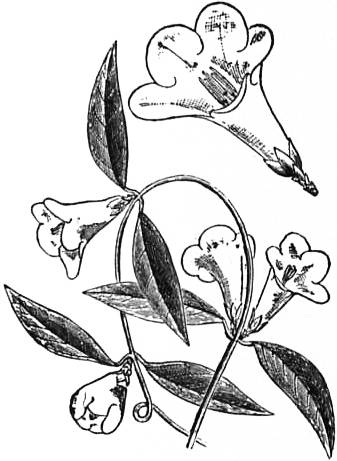
Gelsemium nitidum, half natural size; flower, nat. size.
The drug is essentially a nerve poison. It has no action on the skin and no marked action on the alimentary or circulatory systems. Its action on the cerebrum is slight, consciousness being retained even after toxic doses, but there may be headache and giddiness. The drug rapidly causes failure of vision, diplopia, ptosis or falling of the upper eyelid, dilatation of the pupil, and a lowering of the intra-ocular tension. This last action is doubtful. The symptoms appear to be due to a paralysis of the motor cells that control the internal and external ocular muscles. The most marked action of the drug is upon the anterior cornua of grey matter in the spinal cord. It can be shown by a process of experimental exclusion that to an arrest of function of these cells is due the paralysis of all the voluntary muscles of the body that follows the administration of gelsemium or gelsemine. Just before death the sensory part of the spinal cord is also paralysed, general anaesthesia resulting. The drug kills by its action on the respiratory centre in the medulla oblongata. Shortly after the administration of even a moderate dose the respiration is slowed and is ultimately arrested, this being the cause of death. In cases of poisoning the essential treatment is artificial respiration, which may be aided by the subcutaneous exhibition of strychnine.
Though the drug is still widely used, the rational indications for its employment are singularly rare and uncertain. The conditions in which it is most frequently employed are convulsions, bronchitis, severe and purposeless coughing, myalgia or muscular pain, neuralgia and various vague forms of pain.
GELSENKIRCHEN, a town of Germany in the Prussian province of Westphalia, 27 m. W. of Dortmund on the railway Duisburg-Hamm. Pop. (1905) 147,037. It has coal mines, iron furnaces, steel and boiler works, and soap, glass and chemical factories. In 1903 various neighbouring industrial townships were incorporated with the town.
GEM (Lat. gemma, a bud,—from the root gen, meaning “to produce,”—or precious stone; in the latter sense the Greek term is ψῆφος), a word applied in a wide sense to certain minerals which, by reason of their brilliancy, hardness and rarity, are valued for personal decoration; it is extended to include pearl. In a restricted sense the term is applied only to precious stones after they have been cut and polished as jewels, whilst in their raw state the minerals are conveniently called “gem-stones.” Sometimes, again, the term “gem” is used in a yet narrower sense, being restricted to engraved stones, like seals and cameos.
The subject is treated here in two sections: (1) Mineralogy and general properties; (2) Gems in Art, i.e. engraved gems, such as seals and cameos. The artificial products which simulate natural gem-stones in properties and chemical composition are treated in the separate article Gem, Artificial.
1. Mineralogy and General Properties
The gem-stones form a small conventional group of minerals, including principally the diamond, ruby, sapphire, emerald and opal. Other stones of less value—such as topaz, spinel, chrysoberyl, chrysolite, zircon and tourmaline—are sometimes called “fancy stones.” Many minerals still less prized, yet often used as ornamental stones,—like moonstone, rock-crystal and agate,—occasionally pass under the name of “semi-precious stones,” but this is rather a vague term and may include the stones of the preceding group. The classification of gem-stones is, indeed, to some extent a matter of fashion.
Descriptions of the several gem-stones will be found under their respective headings, and the present article gives only a brief review of the general characters of the group.
A high degree of hardness is an essential property of a gem-stone, for however beautiful and brilliant a mineral may be it is useless to the jeweller if it lack sufficient hardness to withstand the abrasion to which articles of personal Hardness. decoration are necessarily subjected. Even if not definitely scratched, the polished stone becomes dull by wear. Imitations in paste may be extremely brilliant, but being comparatively soft they soon lose lustre when rubbed. In the article Mineralogy it is explained that the varying degrees of hardness are registered on a definite scale. The exceptional hardness of the diamond gives it a supreme position in this scale, and to it the arbitrary value of 10 has been assigned. The corundum gem-stones (ruby and sapphire), though greatly inferior in hardness to the diamond, come next, with the value of 9; and it is notable that the sapphire is usually rather harder than ruby. Then follows the topaz, which, with spinel and chrysoberyl, has a hardness of 8; whilst quartz falls a degree lower. Most gem-stones are harder than quartz, though precious opal, turquoise, moonstone and sphene are inferior to it in hardness. Those stones which are softer than quartz have been called by jewellers demi-dures. To test the hardness of a cut stone, one of its sharp edges may be drawn, with firm pressure, across the smooth surface of a piece of quartz; if it leave a scratch its hardness must be above 7. The stone is then applied in like manner to a fragment of topaz, preferably a cleavage-piece, and if it fail to leave a distinct scratch its hardness is between 7 and 8, whereas if the topaz be scratched it is above 8. An expert may obtain a fair idea of hardness by gently passing the stone over a fine steel file, and observing the feel of the stone and the grating sound which it emits. If a stone be scratched by a steel knife its hardness is below 6. The degree of hardness of a precious stone is soon ascertained by the lapidary when cutting it.
Gem-stones differ markedly among themselves in density or specific weight; and although this is a character which does not directly affect their value for ornamental purposes, it furnishes by its constancy an important means of distinguishing one stone Specific gravity. from another. Moreover, it is a character very easily determined and can be applied to cut stones without injury. The relative weightiness of a stone is called its specific gravity, and is often abbreviated as S.G. The number given in the description of a mineral as S.G. shows how many times the stone is heavier than an equal bulk of the standard with which it is compared, the standard being distilled water at 4° C. If, for example, the S.G. of diamond is said to be 3.5 it means that a diamond weighs 3½ times as much as a mass of water of the same bulk. The various methods of determining specific gravity are described under Density. The readiest method of testing precious stones, especially when cut, is to use dense liquids. Suppose it be required to determine whether a yellow stone be true topaz or false topaz (quartz), it is merely necessary to drop the stone into a liquid made up to the specific gravity of about 3; and since topaz has S.G. of 3.5 it sinks in this medium, but as quartz has S.G. of only 2.65 it floats. The densest gem-stone is zircon, which may have S.G. as high as 4.7, whilst the lowest is opal with S.G. 2.2. Amber, it is true, is lighter still, being scarcely denser than water, but this substance can hardly be called a gem.
Although the great majority of precious stones occur crystallized, the characteristic form is destroyed in cutting. The crystal-forms of the several stones are noticed under their respective headings, and the subject is discussed Crystalline form and cleavage. fully under Crystallography. A few substances used as ornamental stones—like opal, turquoise, obsidian and amber—are amorphous or without crystalline form; whilst others, like the various stones of the chalcedony-group, display no obvious crystal-characters, but are seen under the microscope to possess a crystalline structure. Gem-stones are frequently found in gravels or other detrital deposits, where they occur as rolled crystals or fragments of crystals, and in many cases have been reduced to the form of pebbles. By the disintegration of the rock which formed the original matrix, its constituent minerals were set free, and whilst many of them were worn away by long-continued attrition, the gem-stones survived by virtue of their superior hardness.
Many crystallized gem-stones exhibit cleavage, or a tendency to split in definite directions. The lapidary recognizes a “grain” in the stone. When the cleavage is perfect, as in topaz, it may render the working of the stone difficult, and produce incipient cracks in the cut gem. Flaws due to the cleavage planes are called “feathers.” The octahedral cleavage of the diamond is taken advantage of in dressing the stone before cutting it. The cutting of gem-stones is explained under Lapidary.
The beauty and consequent value of gems depend mainly on their colour. Some stones, it is true, are valued for entire absence of colour, as diamonds of pure “water.” Certain kinds of sapphire and topaz, too, are “water Colour. clear,” as also is pure rock-crystal; but in most stones colour is a prime element of attraction. The colour, however, is not generally an essential property of the mineral, but is due to the presence of foreign pigmentary matter, often in very small proportion and in some cases eluding determination. Thus, corundum when pure is colourless, but the presence of traces of certain mineral substances imparts to it not only the red of ruby and the blue of sapphire, but almost every other colour. The tinctorial matter may be distributed either uniformly throughout the stone or in regular zones, or in quite irregular patches. A tourmaline, for instance, may be red at one end of a prismatic crystal and green at the other extremity, or the colour may be so disposed that in transverse section the centre will be red and the outer zone green. A beryl may be yellow and green in the same crystal. Sapphire, again, is often parti-coloured, one portion of the stone being blue and other portions white or yellow; and the skilful lapidary, in cutting the stone, will take advantage of the blue portion. The character of the pigment is in many cases not definitely known. It by no means follows that the material capable of imparting a certain tint to glass is identical with that which naturally colours a stone of the same tint; thus a glass of sapphire-blue may be obtained by the use of cobalt, yet cobalt has not been detected in the sapphire. Probably the most common mineral pigments are compounds of iron, manganese, copper and chromium. If the colour of the stone be discharged by heat, an organic pigment is presumably present. Some ornamental stones change their colour, or even lose it, on exposure to sunlight and air: such is the case with rose-quartz, chrysoprase and certain kinds of topaz and turquoise. Exposure to heat alters the colour of some stones so readily that the change is taken advantage of commercially; thus, sherry-yellow topaz may be rendered pink, smoky and amethystine quartz may become yellow, and coloured zircons may be decolorized, so as to resemble diamonds.
The colours of some gem-stones are greatly affected by radioactivity, and Prof. F. Bordas has found this to be particularly the case with sapphire. From his experiments he believes that yellow corundum, or oriental topaz, may have been formed from blue corundum under the influence of radioactive substances present in the soil in which the sapphire was embedded. Different shades of colour may be presented by different stones of the same species; and it was formerly the custom of lapidaries to regard the darker stones as masculine and the paler as feminine, a full blue sapphire, for instance, being called a “male sapphire” and a delicate blue stone a “female sapphire.” It is notable that some stones appear to change colour by candle-light and by most other artificial means of illumination; some amethysts thus become inky, and certain sapphires acquire a murky tint, whilst others become amethystine. For an example of a remarkable change of this character, see Alexandrite.
As the optical properties of minerals are fully explained under Crystallography, little need be said here on this subject. The brilliancy of a cut stone depends on the amount of light reflected from its faces; and in the form Refraction. known as the “brilliant” the gem is so cut that much of the incident light, after entering the stone and suffering refraction, is totally reflected from the facets at the back. The amount of light which is thus returned to the eye of the observer will be greater as the angle of total reflection, or critical angle, is smaller, but this angle will be small if the refractive power of the stone is great, so that the brilliancy directly depends on the refractivity. The diamond has the highest refractive index of any gem-stone (2.42). Jargoon, or zircon, has also a high index (mean 1.95), and sphene, which is occasionally cut as a gem, is likewise very notable in this respect. The index of refraction generally bears a relation to the specific gravity of the stone, the heaviest gems having the highest indices, though a few minerals offer exceptions. The refractive index, which is thus a very important character in the scientific discrimination of gem-stones, may be conveniently determined, within certain limits, by means of the refractometer devised by Dr G.F. Herbert Smith. This instrument is an improved form of the total reflectometer, in which the refractive power of a given substance is determined by the method of total reflection. It may be used for indices ranging from 1.300 to 1.775, and may be applied to faceted stones without removal from their settings.
The play of prismatic colours exhibited by a cut stone, often known as its “fire,” is due to the decomposition of the white light which enters the stone, and is returned, by internal reflection, after resolution in to its coloured components. Dispersion. This decomposition depends on the dispersive power of the substance. The exceptional beauty of the fiery flashes in the diamond is due to its high dispersion, in other words, to the difference between the refractive indices for the red rays and the violet rays at the extremities of the spectrum. The peculiar lustre exhibited by the diamond is called adamantine, and is shared to some extent by certain other stones which have a high refractive index and high dispersion, such as zircon.
The use of the spectroscope may be valuable in discriminating between certain precious stones. It was shown by Sir A.H. Church that almandine garnet and zircon when simply Spectroscopic characters. viewed through this instrument give, under proper conditions, characteristic absorption spectra, due to the light reflected from the stone having penetrated to some extent into the substance of the mineral and suffered absorption. It is sometimes useful to examine the behaviour of a stone under the action of the Röntgen rays.
A very useful means of discriminating between certain stones is found in their dichroism, or, to use a more general term, pleochroism. Neither amorphous minerals, like opal, nor minerals crystallizing in the cubic system, like Dichroism. spinel and garnet, possess this property; but coloured minerals which are doubly refracting may show different colours, when properly examined, in different directions. Occasionally this is so marked as to be detected by the naked eye, as in iolite or dichroite, but usually the stone needs to be examined with such an instrument as Haidinger’s dichroscope (see Crystallography). It must be remembered that in the direction of an optic axis the two images will be of the same colour in all positions of the instrument, and it is therefore necessary before reaching a definite conclusion to turn the stone about and examine it in various directions. The use of the dichroscope is so simple that it can be applied by any one to the examination of a cut stone, but there are other means of determining the nature of a stone by its optical properties available to the mineralogist and more suitably discussed under Crystallography.
In chemical composition the gem-stones present great variety. Diamond is composed of only a single element; ruby, sapphire and the quartz-group are oxides; spinel and chrysoberyl may be regarded as aluminates; turquoise and Chemical composition. beryllonite are phosphates; and a great number of ornamental stones are silicates of greater or less complexity, such as emerald, topaz, chrysolite, garnet, zircon, tourmaline, kunzite, sphene and benitoite. In the examination of a cut stone chemical tests are not available, since they usually involve the partial destruction of the mineral. The artificial production of certain gems by chemical processes which yield products identical in composition and physical properties with the natural stones, is described in the article Gem, Artificial.
Doublets and triplets are composite stone, sometimes prepared for fraudulent purposes. In a doublet a slab of real gem-stone covers the face of a paste, whilst in a triplet the paste is both faced and backed by a slice of genuine stone. By the action of a suitable solvent, such as chloroform or in some cases even hot water, the cement uniting the pieces gives way and the compound character of the structure is detected.
Before the chemical composition of gem-stones was understood, their classification remained vague and unscientific. As the ancients depended almost entirely on the eye, the colour of the stone naturally became the chief factor in classification. A variety of stones agreeing roughly in colour would be grouped together under a common name, widely as they might differ in other respects. Thus the emerald, the peridot, green fluorspar, malachite, and certain kinds of quartz and jade seem to have been united under the general name of σμάραγδος whilst the ruby, red spinel and garnet were probably grouped together as carbunculus. In this way minerals radically different were associated on the ground of what is generally a superficial and accidental character, and rarely of any classificatory value. On the other hand, a grouping based only on colour led to several names being in some cases applied to the same mineral species. Thus the ruby and sapphire are essentially identical in chemical composition and in all physical characters, save colour.
Descriptions of precious stones by ancient writers generally are too vague for exact diagnosis. The principal classical authorities are Theophrastus and the elder Pliny. Stones were formerly held in esteem not only for their beauty and Superstitions. rarity but for the medicinal and magical powers with which they were reputed to be endowed. Up to comparatively recent years the toadstone, for example, was worn not for beauty but for sake of occult virtue; and even at the present day certain stones, like jade, are valued for a similar reason. Prof. W. Ridgeway has suggested that jewelry took its origin not, as often supposed, in an innate love of personal decoration, but rather in the belief that the objects used possessed magical virtue. Small stones peculiar in colour or shape, especially those with natural perforations, are usually valued by uncivilized peoples as amulets. The Orphic poem Λιθικά, reputed to be of very early though unknown date, is rich in allusions to the virtues of many of the gem-stones. Many of the medical and other virtues of precious stones were evidently attributed to them on the well-known doctrine of signatures. Thus, the blood-red colour of a fine jasper suggested that the stone would be useful in haemorrhage; a green jasper would bring fertility to the soil; and the purple wine-colour of amethyst pointed to its value as a preventive of intoxication. Many of the superstitions came down to modern times, and even at the present day the belief in “lucky stones” is by no means extinct.
Bibliography.—The most comprehensive work on gem-stones is Professor Max Bauer’s Edelsteinkunde (1896), translated, with additions, by L.J. Spencer under the title Precious Stones (1904). Less detailed are Professor P. Groth’s Grundriss der Edelsteinkunde (1887) and Professor C. Doelter’s Edelsteinkunde (1893). Sir A. H. Church’s Precious Stones (1905), intended as a guide to the collections in the Victoria and Albert Museum, is a convenient introduction: and Professor H.A. Miers’s Cantor Lectures at the Society of Arts on Precious Stones (1896) may be studied with advantage. For American stones, the valuable work of Dr G.F. Kunz, The Gems and Precious Stones of N. America, is a standard authority; and the Annual Reports of this writer and others, published by the Geological Survey of the United States in the Mineral Resources, form a repertory of valuable information on precious stones in general. The articles in The Mineral Industry (founded by R.P. Rothwell) should also be consulted. See likewise O.C. Farrington, Gems and Gem Minerals (Chicago, 1903). For optical characters reference should be made to G.F.H. Smith, The Herbert Smith Refractometer (London, 1907); L. Claremont, The Gem-Cutter’s Craft (London, 1906); W. Goodchild, Precious Stones (London, 1908).
(F. W. R.*)
2. Gems in Art
In art, the word Gem is the general term for precious stones when engraved with designs, whether adapted for sealing (σφραγίς, sigillum, intaglio), or mainly for artistic effect (imagines ectypae, cameo). They exist in a very large number of undoubtedly genuine old examples, extending from the mists of Babylonian antiquity to the decline of Roman civilization, and again starting with a new, but less original impulse on the revival of art. Apart from workmanship they possess the charms of colour deep, rich, and varied, of material unequalled for its endurance, and of scarcity, which in many instances has been enhanced by the remoteness of the lands whence they came or the fortuity of their occurrence. These qualities united within the small compass of a gem were precisely such as were required in a seal as a thing of constant use, so inalienable in its possession as to become naturally a personal ornament and an attractive medium of artistic skill, no less than the centre of traditions or of religious and legendary associations. As regards the nations of classical antiquity, all seals are classed as gems, though in many cases the material is not such as would strictly come under that heading, and precious stones in the modern sense are hardly known to occur. On the other hand it must not be supposed that gems engraved in intaglio were necessarily employed as seals. At all periods many intaglios are found which could not have been so employed without great difficulty. In Greece and Rome, within historic times, gems were worn engraved with designs to show that the bearer was an adherent of a particular worship, the follower of a certain philosopher, or the attached subject of an emperor. However, speaking generally, the intaglio engraving is a means to an end, namely, a seal-impression, while an engraving in relief is complete in itself.
Methods of Engraving (see also under Lapidary).—In gem-engraving the principal modern implement is a wheel or minute copper disk, driven in the manner of a lathe, and moistened with olive oil mixed with emery or diamond dust. There is no clear proof of the use among the ancients of a wheel mounted lathewise, but we have abundant indications of drilling with a revolving tool, which might be either a tubular drill making a ring-like depression, a pointed tool making a cup-like sinking, or a small wheel with a cutting edge, making a boat-shaped depression.
We have one sepulchral monument from Philadelphia showing the tool of an intaglio engraver (δακτυλοκοιλογύφος; see Athenische Mitteilungen des Arch. Inst. xv. p. 333). Unfortunately the relief is incomplete, and the published illustration inadequate. It would seem, however, that a revolving tool was supported by a kind of mandrel, and actuated in primitive fashion by a bow. An alternative plan of working was to use a splinter of diamond set in a handle and applied like a graver. Both systems are clearly indicated by Pliny, who in one passage (H.N. xxxvii. 60) states that diamond splinters are sought out by gem engravers and set in iron, and so easily hollow out stones of any degree of hardness; while elsewhere (H.N. xxxvii. 200) he speaks of the special efficacy of the fervor terebrarum, the vehement action of drills. A third method is also indicated by Pliny (ibid.) when he speaks of the use of a blunted tool, which must have been moistened and supplied with emery of Naxos.
A four-sided pendant of the Hellenistic period published by Furtwängler (Antike Gemmen, Gesch. p. 400) shows clearly the successive stages of the operation. On side a the subject is slightly sketched in with the diamond point. On side b the deepest parts of the figure have also been roughly scooped out with the wheel. On sides c and d the wheel work is fairly complete, but the finer internal work has not been begun.
After the design had been completed the stone must have received a final polish on its surface, to obliterate any erroneous strokes of the first sketch; but this process was not carried as far as in modern work. It is a popular error to suppose that a high degree of internal polish is a proof of antiquity. If the interior of the design has a high degree of polish it may be either ancient or modern, or it may be an ancient stone repolished in modern times. If it has a matt surface uniformly produced by intention, it is probably modern. If the design is slightly dimmed and worn or scratched the stone may be antique, but is not necessarily so, since modern engravers have observed this peculiarity, and have imitated it with a success which, were there no other grounds of suspicion, might escape detection.