VOLUME XI SLICE V Gassendi, Pierre to Geocentric (continued 4)
Reading edition
The dedication of his Rural Sports (1713) to Pope was the beginning of a lasting friendship. Gay could have no pretensions to rivalry with Pope, who seems never to have tired of helping his friend. In 1713 he produced a comedy, The Wife of Bath, which was acted only three nights, and The Fan, one of his least successful poems; and in 1714 The Shepherd’s Week, a series of six pastorals drawn from English rustic life. Pope had urged him to undertake this last task in order to ridicule the Arcadian pastorals of Ambrose Philips, who had been praised by the Guardian, to the neglect of Pope’s claims as the first pastoral writer of the age and the true English Theocritus. Gay’s pastorals completely achieved this object, but his ludicrous pictures of the English swains and their loves were found to be abundantly entertaining on their own account. Gay had just been appointed secretary to the British ambassador to the court of Hanover through the influence of Jonathan Swift, when the death of Queen Anne three months later put an end to all his hopes of official employment. In 1715, probably with some help from Pope, he produced What d’ye call it? a dramatic skit on contemporary tragedy, with special reference to Otway’s Venice Preserved. It left the public so ignorant of its real meaning that Lewis Theobald and Benjamin Griffin (1680-1740) published a Complete Key to what d’ye call it by way of explanation. In 1716 appeared his Trivia, or the Art of Walking the Streets of London, a poem in three books, for which he acknowledged having received several hints from Swift. It contains graphic and humorous descriptions of the London of that period. In January 1717 he produced the comedy of Three Hours after Marriage, which was grossly indecent without being amusing, and was a complete failure. There is no doubt that in this piece he had assistance from Pope and Arbuthnot, but they were glad enough to have it assumed that Gay was the sole author.
Gay had numerous patrons, and in 1720 he published Poems on Several Occasions by subscription, realizing £1000 or more. In that year James Craggs, the secretary of state, presented him with some South Sea stock. Gay, disregarding the prudent advice of Pope and other of his friends, invested his all in South Sea stock, and, holding on to the end, he lost everything. The shock is said to have made him dangerously ill. As a matter of fact Gay had always been a spoilt child, who expected everything to be done for him. His friends did not fail him at this juncture. He had patrons in William Pulteney, afterwards earl of Bath, in the third earl of Burlington, who constantly entertained him at Chiswick or at Burlington House, and in the third earl of Queensberry. He was a frequent visitor with Pope, and received unvarying kindness from Congreve and Arbuthnot. In 1724 he produced a tragedy called The Captives. In 1727 he wrote for Prince William, afterwards duke of Cumberland, his famous Fifty-one Fables in Verse, for which he naturally hoped to gain some preferment, although he has much to say in them of the servility of courtiers and the vanity of court honours. He was offered the situation of gentleman-usher to the Princess Louisa, who was still a child. He refused this offer, which all his friends seem to have regarded, for no very obvious reason, as an indignity. As the Fables were written for the amusement of one royal child, there would appear to have been a measure of reason in giving him a sinecure in the service of another. His friends thought him unjustly neglected by the court, but he had already received (1722) a sinecure as lottery commissioner with a salary of £150 a year, and from 1722 to 1729 he had lodgings in the palace at Whitehall. He had never rendered any special services to the court.
He certainly did nothing to conciliate the favour of the government by his next production, the Beggars’ Opera, a lyrical drama produced on the 29th of January 1728 by Rich, in which Sir Robert Walpole was caricatured. This famous piece, which was said to have made “Rich gay and Gay rich,” was an innovation in many respects, and for a time it drove Italian opera off the English stage. Under cover of the thieves and highwaymen who figured in it was disguised a satire on society, for Gay made it plain that in describing the moral code of his characters he had in mind the corruptions of the governing class. Part of the success of the Beggars’ Opera may have been due to the acting of Lavinia Fenton, afterwards duchess of Bolton, in the part of Polly Peachum. The play ran for sixty-two nights, though the representations, four of which were “benefits” of the author, were not, as has sometimes been stated, consecutive. Swift is said to have suggested the subject, and Pope and Arbuthnot were constantly consulted while the work was in progress, but Gay must be regarded as the sole author. He wrote a sequel, Polly, the representation of which was forbidden by the lord chamberlain, no doubt through the influence of Walpole. This act of “oppression” caused no loss to Gay. It proved an excellent advertisement for Polly, which was published by subscription in 1729, and brought its author more than £1000. The duchess of Queensberry was dismissed from court for enlisting subscribers in the palace. The duke of Queensberry gave him a home, and the duchess continued her affectionate patronage until Gay’s death, which took place on the 4th of December 1732. He was buried in Westminster Abbey. The epitaph on his tomb is by Pope, and is followed by Gay’s own mocking couplet:—
“Life is a jest, and all things show it, I thought so once, and now I know it.”
Acis and Galatea, an English pastoral opera, the music of which was written by Handel, was produced at the Haymarket in 1732. The profits of his posthumous opera of Achilles (1733), and a new volume of Fables (1738) went to his two sisters, who inherited from him a fortune of £6000. He left two other pieces, The Distressed Wife (1743), a comedy, and The Rehearsal at Goatham (1754), a farce. The Fables, slight as they may appear, cost him more labour than any of his other works. The narratives are in nearly every case original, and are told in clear and lively verse. The moral which rounds off each little story is never strained. They are masterpieces in their kind, and the very numerous editions of them prove their popularity. They have been translated into Latin, French and Italian, Urdu and Bengali.
See his Poetical Works (1893) in the Muses’ Library, with an introduction by Mr John Underhill; also Samuel Johnson’s Lives of the Poets, John Gay’s Singspiele (1898), edited by G. Sarrazin (Englische Textbibliothek II.); and an article by Austin Dobson in vol. 21 of the Dictionary of National Biography; Gay’s Chair (1820), edited by Henry Lee, a fellow-townsman, contained a biographical sketch by his nephew, the Rev. Joseph Baller.
GAY, MARIE FRANÇOISE SOPHIE (1776-1852), French author, was born in Paris on the 1st of July 1776. Madame Gay was the daughter of M. Nichault de la Valette and of Francesca Peretti, an Italian lady. In 1793 she was married to M. Liottier, an exchange broker, but she was divorced from him in 1799, and shortly afterwards was married to M. Gay, receiver-general of the department of the Roër or Ruhr. This union brought her into intimate relations with many distinguished personages; and her salon came to be frequented by all the distinguished littérateurs, musicians, actors and painters of the time, whom she attracted by her beauty, her vivacity and her many amiable qualities. Her first literary production was a letter written in 1802 to the Journal de Paris, in defence of Madame de Staël’s novel, Delphine; and in the same year she published anonymously her first novel Laure d’Estell. Léonie de Montbreuse, which appeared in 1813, is considered by Sainte-Beuve her best work; but Anatole (1815), the romance of a deaf-mute, has perhaps a higher reputation. Among her other works, Salons célèbres (2 vols., 1837) may be especially mentioned. Madame Gay wrote several comedies and opera libretti which met with considerable success. She was also an accomplished musician, and composed both the words and music of a number of songs. She died in Paris on the 5th of March 1852. For an account of her daughter, Delphine Gay, Madame de Girardin, see Girardin.
See her own Souvenirs d’une vieille femme (1834); also Théophile Gautier, Portraits contemporains; and Sainte-Beuve, Causeries du lundi, vol. vi.
GAY, WALTER (1856- ), American artist, was born at Hingham, Massachusetts, on the 22nd of January 1856. In 1876 he became a pupil of Léon Bonnat in Paris. He received an honourable mention in the Salon of 1885; a gold medal in 1888, and similar awards at Vienna (1894), Antwerp (1895), Berlin (1896) and Munich (1897). He became an officer of the Legion of Honour and a member of the Society of Secession, Munich. Works by him are in the Luxembourg, the Tate Gallery (London), and the Boston and Metropolitan (New York) Museums of Art. His compositions are mainly figure subjects portraying French peasant life.
GAYA, a city and district of British India, in the Patna division of Bengal. The city is situated 85 m. S. of Patna by rail. Pop. (1901) 71,288. It consists of two distinct parts, adjoining each other; the part containing the residences of the priests is Gaya proper; and the other, which is the business quarter, is called Sahibganj. The civil offices and residences of the European inhabitants are situated here. Gaya derives its sanctity from incidents in the life of Buddha. But a local legend also exists concerning a pagan monster of great sanctity, named Gaya, who by long penance had become holy, so that all who saw or touched him were saved from perdition. Yama, the lord of hell, appealed to the gods, who induced Gaya to lie down in order that his body might be a place of sacrifice; and once down, Yama placed a large stone on him to keep him there. The tricked demon struggled violently, and, in order to pacify him, Vishnu promised that the gods should take up their permanent residence in him, and that any one who made a pilgrimage to the spot where he lay should be delivered from the terrors of the Hindu place of torment. This may possibly be a Brahmanic rendering of Buddha’s life and work. There are forty-five sacred spots (of which the temple of Vishnupada is the chief) in and around the city, and these are visited by thousands of pilgrims annually. During the Mutiny the large store of treasure here was conveyed safely to Calcutta by Mr A. Money. The city contains a government high school and an hospital, with a Lady Elgin branch for women.
The District of Gaya comprises an area of 4712 sq. m. Generally speaking, it consists of a level plain, with a ridge of prettily wooded hills along the southern boundary, whence the country falls with a gentle slope towards the Ganges. Rocky hills occasionally occur, either detached or in groups, the loftiest being Maher hill about 12 m. S.E. of Gaya city, with an elevation of 1620 ft. above sea-level. The eastern part of the district is highly cultivated; the portions to the north and west are less fertile; while in the south the country is thinly peopled and consists of hills, the jungles on which are full of wild animals. The principal river is the Son, which marks the boundary between Gaya and Shahabad, navigable by small boats throughout the year, and by craft of 20-tons burden in the rainy season. Other rivers are the Punpun, Phalgu and Jamuna. Two branches of the Son canal system, the eastern main canal and the Patna canal, intersect the district. In 1901 the population was 2,059,933, showing a decrease of 3% in the decade. Among the higher castes there is an unusually large proportion of Brahmans, a circumstance due to the number of sacred places which the district contains. The Gayawals, or priests in charge of the holy places, are held in high esteem by the pilgrims; but they are not pure Brahmans, and are looked down upon by those who are. They live an idle and dissolute life, but are very wealthy, from contributions extorted from the pilgrims. Buddh Gaya, about 6 m. S. of Gaya city, is one of the holiest sites of Buddhism, as containing the tree under which Sakyamuni attained enlightenment. In addition to many ruins and sculptures, there is a temple restored by the government in 1881. Another place of religious interest is a temple of great antiquity, which crowns the highest peak of the Barabar hills, and at which a religious fair is held each September, attended by 10,000 to 20,000 pilgrims. At the foot of the hill are numerous rock caves excavated about 200 B.C. The opium poppy is largely cultivated. There are a number of lac factories. Manufactures consist of common brass utensils, black stone ornaments, pottery, tussur-silk and cotton cloth. Formerly paper-making was an important manufacture in the district, but it has entirely died out. The chief exports are food grains, oil seeds, indigo, crude opium (sent to Patna for manufacture), saltpetre, sugar, blankets, brass utensils, &c. The imports are salt, piece goods, cotton, timber, bamboos, tobacco, lac, iron, spices and fruits. The district is traversed by four branches of the East Indian railway. In 1901 it suffered severely from the plague.
See District Gazetteer (1906); Sir A. Cunningham, Mahabodhi (1892).
GAYAL, a domesticated ox allied to the Gaur, but distinguished, among other features, by the more conical and straighter horns, and the straight line between them. Gayal are kept by the natives of the hill-districts of Assam and parts of Tenasserim and Upper Burma. Although it has received a distinct name, Bos (Bibos) frontalis, there can be little doubt that the gayal is merely a domesticated breed of the gaur, many gayal-skulls showing characters approximating to those of the gaur.
GAYANGOS Y ARCE, PASCUAL DE (1809-1897), Spanish scholar and Orientalist, was born at Seville on the 21st of June 1809. At the age of thirteen he was sent to be educated at Pont-le-Voy near Blois, and in 1828 began the study of Arabic under Silvestre de Sacy. After a visit to England, where he married, he obtained a post in the Spanish treasury, and was transferred to the foreign office as translator in 1833. In 1836 he returned to England, wrote extensively in English periodicals, and translated Almakkari’s History of the Mahommedan Dynasties in Spain (1840-1843) for the Royal Asiatic Society. In England he also made the acquaintance of Ticknor, to whom he was very serviceable. In 1843 he returned to Spain as professor of Arabic at the university of Madrid, which post he held until 1881, when he was made director of public instruction. This office he resigned upon being elected senator for the district of Huelva. His latter years were spent in cataloguing the Spanish manuscripts in the British Museum; he had previously continued Bergenroth’s catalogue of the manuscripts relating to England in the Simancas archives. His best-known original work is his dissertation on Spanish romances of chivalry in Rivadeneyra’s Biblioteca de autores españoles. He died in London on the 4th of October 1897.
GAYARRÉ, CHARLES ÉTIENNE ARTHUR (1805-1895), American historian, was born in New Orleans, Louisiana, on the 9th of January 1805. After studying at the Collège d’Orléans he began, in 1826, to study law in Philadelphia, and three years later was admitted to the bar. In 1830 he was elected a member of the House of Representatives of Louisiana, in 1831 was appointed deputy attorney-general of his state, in 1833 became presiding judge of the city court of New Orleans, and in 1834 was elected as a Jackson Democrat to the United States Senate. On account of ill-health, however, he immediately resigned without taking his seat, and for the next eight years travelled in Europe and collected historical material from the French and the Spanish archives. In 1844-1845 and in 1856-1857 he was again a member of the state House of Representatives, and from 1845 to 1853 was secretary of state of Louisiana. He supported the Southern Confederacy during the Civil War, in which he lost a large fortune, and after its close lived chiefly by his pen. He died in New Orleans on the 11th of February 1895. He is best known as the historian of Louisiana. He wrote Histoire de la Louisiane (1847); Romance of the History of Louisiana (1848); Louisiana: its Colonial History and Romance (1851), reprinted in A History of Louisiana; History of Louisiana: the Spanish Domination (1854); Philip II. of Spain (1866); and A History of Louisiana (4 vols., 1866), the last being a republication and continuation of his earlier works in this field, the whole comprehending the history of Louisiana from its earliest discovery to 1861. He wrote also several dramas and romances, the best of the latter being Fernando de Lemos (1872).
GAY-LUSSAC, JOSEPH LOUIS (1778-1850), French chemist and physicist, was born at St Léonard, in the department of Haute Vienne, on the 6th of December 1778. He was the elder son of Antoine Gay, procureur du roi and judge at Pont-de-Noblac, who assumed the name Lussac from a small property he had in the neighbourhood of St Léonard. Young Gay-Lussac received his early education at home under the direction of the abbé Bourdieux and other masters, and in 1794 was sent to Paris to prepare for the École Polytechnique, into which he was admitted at the end of 1797 after a brilliant examination. Three years later he was transferred to the École des Ponts et Chaussées, and shortly afterwards was assigned to C.L. Berthollet, who wanted an able student to help in his researches. The new assistant scarcely came up to expectations in respect of confirming certain theoretical views of his master’s by the experiments set him to that end, and appears to have stated the discrepancy without reserve; but Berthollet nevertheless quickly recognized the ability displayed, and showed his appreciation not only by desiring to be Gay-Lussac’s “father in science,” but also by making him in 1807 an original member of the Société d’Arcueil. In 1802 he was appointed demonstrator to A.F. Fourcroy at the École Polytechnique, where subsequently (1809) he became professor of chemistry, and from 1808 to 1832 he was professor of physics at the Sorbonne, a post which he only resigned for the chair of chemistry at the Jardin des Plantes. In 1831 he was elected to represent Haute Vienne in the chamber of deputies, and in 1839 he entered the chamber of peers. He died in Paris on the 9th of May 1850.
Gay-Lussac’s earlier researches were mostly physical in character and referred mainly to the properties of gases, vapour-tensions, hygrometry, capillarity, &c. In his first memoir (Ann. de Chimie, 1802) he showed that different gases are dilated in the same proportion when heated from 0° to 100° C. Apparently he did not know of Dalton’s experiments on the same point, which indeed were far from accurate; but in a note he explained that “le cit. Charles avait remarqué depuis 15 ans la même propriété dans ces gaz; mais n’ayant jamais publié ses résultats, c’est par le plus grand hasard que je les ai connus.” In consequence of his candour in thus rescuing from oblivion the observation which his fellow-citizen did not think worth publishing, his name is sometimes dissociated from this law, which instead is known as that of Charles. In 1804 he had an opportunity of prosecuting his researches on air in somewhat unusual conditions, for the French Academy, desirous of securing some observations on the force of terrestrial magnetism at great elevations above the earth, through Berthollet and J.E. Chaptal obtained the use of the balloon which had been employed in Egypt, and entrusted the task to him and J.B. Biot. In their first ascent from the garden of the Conservatoire des Arts on the 24th of August 1804 an altitude of 4000 metres (about 13,000 ft.) was attained. But this elevation was not considered sufficient by Gay-Lussac, who therefore made a second ascent by himself oh the 16th of September, when the balloon rose 7016 metres (about 23,000 ft.) above sea-level. At this height, with the thermometer marking 9½ degrees below freezing, he remained for a considerable time, making observations not only on magnetism, but also on the temperature and humidity of the air, and collecting several samples of air at different heights. The magnetic observations, though imperfect, led him to the conclusion that the magnetic effect at all attainable elevations above the earth’s surface remains constant; and on analysing the samples of air he could find no difference of composition at different heights. (For an account of both ascents see Journ. de phys. for 1804.) On the 1st of October in the same year, in conjunction with Alexander von Humboldt, he read a paper on eudiometric analysis (Ann. de Chim., 1805), which contained the germ of his most important generalization, the authors noting that when oxygen and hydrogen combine together by volume, it is in the proportion of one volume of the former to two volumes of the latter. But his law of combination by volumes was not enunciated in its general form until after his return from a scientific journey through Switzerland, Italy and Germany, on which with Humboldt he started from Paris in March 1805. This journey was interrupted in the spring of 1806 by the news of the death of M.J. Brisson, and Gay-Lussac hurried back to Paris in the hope, which was gratified, that he would be elected to the seat thus vacated in the Academy. In 1807 an account of the magnetic observations made during the tour with Humboldt was published in the first volume of the Mémoires d’Arcueil, and the second volume, published in 1809, contained the important memoir on gaseous combination (read to the Société Philomathique on the last day of 1808), in which he pointed out that gases combining with each other in volume do so in the simplest proportions—1 to 1, 1 to 2, 1 to 3—and that the volume of the compound formed bears a simple ratio to that of the constituents.
About this time Gay-Lussac’s work, although he by no means entirely abandoned physical questions, became of a more chemical character; and in three instances it brought him into direct rivalry with Sir Humphry Davy. In the first case Davy’s preparation of potassium and sodium by the electric current spurred on Gay-Lussac and his collaborator L.J. Thénard, who had no battery at their disposal, to search for a chemical method of obtaining those metals, and by the action of red-hot iron on fused potash—a method of which Davy admitted the advantages—they succeeded in 1808 in preparing potassium, going on to make a full study of its properties and to use it, as Davy also did, for the reduction of boron from boracic acid in 1809. The second concerned the nature of “oxymuriatic acid” (chlorine). While admitting the possibility that it was an elementary body, after many experiments they finally declared it to be a compound (Mém. d’Arcueil, 1809). Davy, on the other hand, could see no reason to suppose it contained oxygen, as they surmised, and ultimately they had to accept his view of its elementary character. The third case roused most feeling of all. Davy, passing through Paris on his way to Italy at the end of 1813, obtained a few fragments of iodine, which had been discovered by Bernard Courtois (1777-1838) in 1811, and after a brief examination by the aid of his limited portable laboratory perceived its analogy to chlorine and inferred it to be an element. Gay-Lussac, it is said, was nettled at the idea of a foreigner making such a discovery in Paris, and vigorously took up the study of the new substance, the result being the “Mémoire sur l’iode,” which appeared in the Ann. de chim. in 1814. He too saw its resemblance to chlorine, and was obliged to agree with Davy’s opinion as to its simple nature, though not without some hesitation, due doubtless to his previous declaration about chlorine. Davy on his side seems to have felt that the French chemist was competing with him, not altogether fairly, in trying to appropriate the honour of discovering the character of the substance and of its compound, hydriodic acid.
In 1810 he published a paper which contains some classic experiments on fermentation, a subject to which he returned in a second paper published in 1815. At the same time he was working with Thénard at the improvement of the methods of organic analysis, and by combustion with oxidizing agents, first potassium chlorate and subsequently copper oxide, he determined the composition of a number of organic substances. But his last great piece of pure research was on prussic acid. In a note published in 1811 he described the physical properties of this acid, but he said nothing about its chemical composition till 1815, when he described cyanogen as a compound radicle, prussic acid as a compound of that radicle with hydrogen alone, and the prussiates (cyanides) as compounds of the radicle with metals. The proof that prussic acid contains hydrogen but no oxygen was a most important support to the hydrogen-acid theory, and completed the downfall of Lavoisier’s oxygen theory; while the isolation of cyanogen was of equal importance for the subsequent era of compound radicles in organic chemistry.
After this research Gay-Lussac’s attention began to be distracted from purely scientific investigation. He had now secured a leading if not the foremost place among the chemists of the French capital, and the demand for his services as adviser in technical problems and matters of practical interest made great inroads on his available time. He had been a member of the consultative committee on arts and manufactures since 1805; he was attached to the “administration des poudres et salpêtres” in 1818, and in 1829 he received the lucrative post of assayer to the mint. In these new fields he displayed the powers so conspicuous in his scientific inquiries, and he was now to introduce and establish scientific accuracy where previously there had been merely practical approximations. His services to industry included his improvements in the processes for the manufacture of sulphuric acid (1818) and oxalic acid (1829); methods of estimating the amount of real alkali in potash and soda by the volume of standard acid required for neutralization, and for estimating the available chlorine in bleaching powder by a solution of arsenious acid; directions for the use of the centesimal alcoholometer published in 1824 and specially commended by the Institute; and the elaboration of a method of assaying silver by a standard solution of common salt, a volume on which was published in 1833. Among his research work of this period may be mentioned the improvements in organic analysis and the investigation of fulminic acid made with the help of Liebig, who gained the privilege of admission to his private laboratory in 1823-1824.
Gay-Lussac was patient, persevering, accurate to punctiliousness, perhaps a little cold and reserved, and not unaware of his great ability. But he was also bold and energetic, not only in his work but also in support and defence of his friends. His early childish adventures, as told by Arago, herald the fearless aeronaut and the undaunted investigator of volcanic eruptions (Vesuvius was in full eruption when he visited it during his tour in 1805); and the endurance he exhibited under the laboratory accidents that befell him shows the power of will with which he would face the prospect of becoming blind and useless for the prosecution of the science which was his very life, and of which he was one of the most distinguished ornaments. Only at the very end, when the disease from which he was suffering left him no hope, did he complain with some bitterness of the hardship of leaving this world where the many discoveries being made pointed to yet greater discoveries to come.
The most complete list of Gay-Lussac’s papers is contained in the Royal Society’s Catalogue of Scientific Papers, which enumerates 148, exclusive of others written jointly with Humboldt, Thénard, Welter and Liebig. Many of them were published in the Annales de chimie, which after it changed its title to Annales de chimie et physique he edited, with Arago, up to nearly the end of his life; but some are to be found in the Mémoires d’Arcueil and the Comptes rendus, and in the Recherches physiques et chimiques, published with Thénard in 1811.
GAZA, THEODORUS (c. 1400-1475), one of the Greek scholars who were the leaders of the revival of learning in the 15th century, was born at Thessalonica. On the capture of his native city by the Turks in 1430 he fled to Italy. During a three years’ residence in Mantua he rapidly acquired a competent knowledge of Latin under the teaching of Vittorino da Feltre, supporting himself meanwhile by giving lessons in Greek, and by copying manuscripts of the ancient classics.1 In 1447 he became professor of Greek in the newly founded university of Ferrara, to which students in great numbers from all parts of Italy were soon attracted by his fame as a teacher. He had taken some part in the councils which were held in Siena (1423), Ferrara (1438), and Florence (1439), with the object of bringing about a reconciliation between the Greek and Latin Churches; and in 1450, at the invitation of Pope Nicholas V., he went to Rome, where he was for some years employed by his patron in making Latin translations from Aristotle and other Greek authors. After the death of Nicholas (1455), being unable to make a living at Rome, Gaza removed to Naples, where he enjoyed the patronage of Alphonso the Magnanimous for two years (1456-1458). Shortly afterwards he was appointed by Cardinal Bessarion to a benefice in Calabria, where the later years of his life were spent, and where he died about 1475. Gaza stood high in the opinion of most of his learned contemporaries, but still higher in that of the scholars of the succeeding generation. His Greek grammar (in four books), written in Greek, first printed at Venice in 1495, and afterwards partially translated by Erasmus in 1521, although in many respects defective, especially in its syntax, was for a long time the leading text-book. His translations into Latin were very numerous, including the Problemata, De partibus animalium and De generatione animalium of Aristotle; the Historia plantarum of Theophrastus; the Problemata of Alexander Aphrodisias; the De instruendis aciebus of Aelian; the De compositione verborum of Dionysius of Halicarnassus; and some of the Homilies of John Chrysostom. He also turned into Greek Cicero’s De senectute and Somnium Scipionis—with much success, in the opinion of Erasmus; with more elegance than exactitude, according to the colder judgment of modern scholars. He was the author also of two small treatises entitled De mensibus and De origine Turcarum.
See G. Voigt, Die Wiederbelebung des klassischen Altertums (1893), and article by C.F. Bähr in Ersch and Gruber’s Allgemeine Encyklopädie. For a complete list of his works, see Fabricius, Bibliotheca Graeca (ed. Harles), x.
1 According to Voigt, Gaza came to Italy some ten years later from Constantinople, where he had been a teacher or held some clerical office.
GAZA (or ‘Azzah, mod. Ghuzzeh), the most southerly of the five princely Philistine cities, situated near the sea, at the point where the old trade routes from Egypt, Arabia and Petra to Syria met. It was always a strong border fortress and a place of commercial importance, in many respects the southern counterpart of Damascus. The earliest notice of it is in the Tell el-Amarna tablets, in a letter from the local governor, who then held it for Egypt, with which country it always stood in close connexion. It never passed for long into Israelite hands, though subject for a while to Hezekiah of Judah; from him it passed to Assyria. In Amos i. 6 the city is denounced for giving up Hebrew slaves to Edom. To Herodotus (iii. 5) the place seemed as important as Sardis. The city withstood Alexander the Great for five months (332 B.C.), and in 96 B.C. was razed to the ground by Alexander Jannaeus. It was rebuilt by Aulus Gabinius, 57 B.C., but on a new site; the old site was remembered and spoken of as “Old” or “Desert Gaza”: compare Acts viii. 26. In the 2nd and 3rd centuries Gaza was a thriving Greek city, with good schools and famous temples, especially one to the local god Marna (i.e. “Lord” or “Our Lord”). A statue of this god has been found near Gaza; it much resembles the Greek representation of Zeus. The struggle with Christianity here was long and intense. Egyptian monks gradually won over the country folk, and in 402, under the influence of Theodosius and Porphyry the local bishop, the Marneion was destroyed and the cross made politically supreme. In the 5th and 6th centuries Gaza was held in high repute as a place of learning. But after it passed into Moslem hands (635) it gradually lost all save commercial importance, and even the Crusaders did little to revive its old military glory. It finally was captured by the Moslems in 1244. Napoleon captured it in 1799.
The modern town (pop. 16,000) is divided into four quarters, one of which is built on a low hill. A magnificent grove of very ancient olives forms an avenue 4 m. long to the north. There are many lofty minarets in various parts of the town, and a fine mosque built of ancient materials. A 12th century church towards the south side of the hill has also been converted into a mosque. On the east is shown the tomb of Samson (an erroneous tradition dating back to the middle ages). The ancient walls are now covered up beneath green mounds of rubbish. The water-supply is from wells sunk through the sandy soil to the rock; of these there are more than twenty—an unusual number for a Syrian town. The land for the 3 m. between Gaza and the sea consists principally of sand dunes. There is no natural harbour, but traces of ruins near the shore mark the site of the old Maiuma Gazae or Port of Gaza, now called el Mineh, which in the 5th century was a separate town and episcopal see, under the title Constantia or Limena Gaza. Hāshem, an ancestor of Mahomet, lies buried in the town. On the east are remains of a race-course, the corners marked by granite shafts with Greek inscriptions on them. To the south is a remarkable hill, quite isolated and bare, with a small mosque and a graveyard. It is called el Muntār, “the watch tower,” and is supposed to be the mountain “before (or facing) Hebron,” to which Samson carried the gates of Gaza (Judg. xvi. 3). The bazaars of Gaza are considered good. An extensive pottery exists in the town, and black earthenware peculiar to the place is manufactured there. The climate is dry and comparatively healthy, but the summer temperature often exceeds 110° Fahr. The surrounding country is partly cornland, partly waste, and is inhabited by wandering Arabs. The prosperity of Ghuzzeh has partially revived through the growing trade in barley, of which the average annual export to Great Britain for 1897-1899 was over 30,000 tons. The dress of the people is Egyptian rather than Syrian. Gaza is an episcopal see both of the Greek and the Armenian church. The Church Missionary Society maintains a mission, with schools for both sexes, and a hospital.
GAZALAND, a district of Portuguese East Africa, extending north from the Komati or Manhissa river, Delagoa Bay, to the Pungwe river. It is a well-watered, fertile country. Gazaland is one of the chief recruiting grounds for negro labour in the Transvaal gold mines. The country derives its name from a Swazi chief named Gaza, a contemporary of Chaka, the Zulu king. Refugees from various clans oppressed by Dingaan (Chaka’s successor) were welded into one tribe by Gaza’s son Manikusa, who took the name of Sotshangana, his followers being known generally as Matshangana. A section of them was called Maviti or Landeens (i.e. couriers), a designation which persists as a tribal name. Between 1833 and 1836 Manikusa made himself master of the country as far north as the Zambezi and captured the Portuguese posts at Delagoa Bay, Inhambane, Sofala and Sena, killing nearly all the inhabitants. The Portuguese reoccupied their posts, but held them with great difficulty, while in the interior the Matshangana continued their ravages unchecked, depopulating large regions. Manikusa died about 1860, and his son Umzila, receiving some help from the Portuguese at Delagoa Bay in a struggle against a brother for the chieftainship, ceded to them the territory south of the Manhissa river. North of that stream as far as the Zambezi and inland to the continental plateau Umzila established himself in independence, a position he maintained till his death (c. 1884). His chief rival was a Goanese named Gouveia, who came to Africa about 1850. Having obtained possession of a prazo in the Gorongoza district, he ruled there as a feudal lord while acknowledging himself a Portuguese subject. Gouveia recovered from the Matshangana and other troublers of the peace much of the country in the Zambezi valley, and was appointed by the Portuguese captain-general of a large region. From 1868 onward the country began to be better known. Probably the first European to penetrate any distance inland from the Sofala coast since the Portuguese gold-seekers of the 16th century was St Vincent W. Erskine, who explored the region between the Limpopo and Pungwe (1868-1875). Portugal’s hold on the coast had been more firmly established at the time of Umzila’s death, and Gungunyana, his successor, was claimed as a vassal, while efforts were made to open up the interior. This led in 1890-1891 to collisions on the borderland of the plateau with the newly established British South Africa Company, and to the arrest by the company’s agents of Gouveia, who was, however, set at liberty and returned to Mozambique via Cape Town. An offer made by Gungunyana (1891) to come under British protection was not accepted. In 1892 Gouveia was killed in a war with a native chief. Gungunyana maintained his independence until 1895, when he was captured by a Portuguese force and exiled, first to Lisbon and afterwards to Angola, where he died in 1906. With the capture of Gungunyana opposition to Portuguese rule largely ceased.
In flora, fauna and commerce Gazaland resembles the neighbouring regions of Portuguese East Africa. (q.v.).
See G. McCall Theal, History of South Africa since 1795, vol. v. (London, 1908).
GAZEBO (usually explained as a comic Latinism, for “I will gaze”; the New English Dictionary suggests a possible oriental origin now lost), a term used in the 18th century for a structure on the outer wall of a garden, having an upper storey with windows on each side so as to overlook the road. Similar buildings are found in Holland on the borders of the canals, which in some cases form very picturesque features.
GAZETTE, a name given to news-sheets or newspapers having an abstract of current events (see Newspapers). The London Gazette is the title of the English official organ for announcements by the government, and is published every Tuesday and Friday. It contains all proclamations, orders of council, promotions and appointments to commissions in the army and navy, all appointments to offices of state, and such other orders, rules and regulations as are directed by act of parliament to be published therein. It also contains notices of proceedings in bankruptcy, dissolutions of partnership, &c. By the Documentary Evidence Act 1868 the production of a copy of the Gazette is prima facie evidence of royal proclamations and government orders and regulations. Similar gazettes are also published in Edinburgh and Dublin. Most countries (the United States excepted) have official journals containing information more or less similar to that of the London Gazette, as the French Journal officiel, the German Deutscher Reichs-und Kgl. Preuss. Staats-Anzeiger, &c. The word “gazetteer” was originally applied to one who wrote for “gazettes,” but is now only used for a geographical dictionary arranged on an alphabetical plan.
GEAR (connected with “garb,” properly elegance, fashion, especially of dress, and with “gar,” to cause to do, only found in Scottish and northern dialects; the root of the word is seen in the Old Teut. garwjan, to make ready), an outfit, applied to the wearing apparel of a person, or to the harness and trappings of a horse or any draft animal, as riding-gear, hunting-gear, &c.; also to household goods or stuff. The phrase “out of gear,” though now connected with the mechanical application of the word, was originally used to signify “out of harness” or condition, not ready to work, not fit. The word is also used of apparatus generally, and especially of the parts collectively in a machine by which motion is transmitted from one part to another by a series of cog-wheels, continuous bands, &c. It is used in a special sense in reference to a bicycle, meaning the diameter of an imaginary wheel, the circumference of which is equal to the distance accomplished by one revolution of the pedals (see Bicycle).
GEBER. The name Geber has long been used to designate the author of a number of Latin treatises on alchemy, entitled Summa perfectionis magisterii, De investigatione perfectionis, De inventione veritatis, Liber fornacum, Testamentum Geberi Regis Indiae and Alchemia Geberi, and these writings were generally regarded as translations from the Arabic originals of Abu Abdallah Jaber ben Hayyam (Haiyan) ben Abdallah al-Kufi, who is supposed to have lived in the 8th or 9th century of the Christian era. About him, however, there is considerable uncertainty. According to the Kitāb-al-Fihrist (10th century), which gives his name as above, the authorities disagree, some asserting him to have been a writer on philosophy and rhetoric, and others claiming for him the first place among the adepts of his time in the art of making gold and silver. The writer of the Kitāb-al-Fihrist says he had been assured that Jaber only wrote one book and even that he never existed at all, but these statements he scouts as ridiculous, and expressing the conviction that Jaber really did exist, and that his works were numerous and important, goes on to quote the titles of some 500 treatises attributed to him. He is said to have resided most frequently at Kufa, where he prepared the “elixir,” but, according to others, he never spent long in one place, having reason to keep his whereabouts unknown. His patron or master is variously given as Ja’far ben Yahya, and as Ja’far es-Sadiq; in the Arabic Book of Royalty, professedly written by him, he addresses the last-named as his master. In addition to these details the Fihrist mentions a tradition that he originally came from Khorasan. Another story given by d’Herbelot (Bibliothèque orientale, s.v. “Giaber”) makes him a native of Harran in Mesopotamia and a Sabaean. Leo Africanus, who in 1526 gave an account of the Alchemists of Fez in Africa (see the English translation of his Africae descriptio by John Pory, A Geographical History of Africa, London, 1600, p. 155), states that their principal authority was Geber, a Greek who had apostatized to Mahommedanism and lived a century after Mahomet. In Albertus Magnus the name Geber occurs only once and then with the epithet “of Seville”; doubtless the reference is to the Arabian Jabir ben Aflah, who lived in that city in the 11th century, and wrote an astronomy in 9 books which is of importance in the history of trigonometry.
The great puzzle connected with the name Geber lies in the character of the writings attributed to him, their style and matter differentiating them strongly from those of even the best authors of the later alchemical period, and making it difficult to account for their existence at all. The researches of M.P.E. Berthelot threw a great deal of light on this question. Taking the six treatises enumerated above he concluded, after critical examination, that the two last may be disregarded as of later date than the others, and that the De investigatione perfectionis, the De inventione and the Liber fornacum are merely extracts from or summaries of the Summa perfectionis with later additions. The Summa he therefore regarded as representative of the work of the Latin Geber, and study of it convinced him that it contains no indication of an Arabic origin, either in its method, which is conspicuous for clearness of reasoning and logical co-ordination of material, or in its facts, or in the words and persons quoted. Without going so far as to deny that some words and phrases may be taken from the writings of the Arabian Jaber, he was disposed to hold that it is the original work of some unknown Latin author, who wrote it in the second half of the 13th century and put it under the patronage of the venerated name of Geber. The MS. of this work in the Bibliothèque Nationale at Paris dates from about the year 1300. Berthelot further investigated Arabic MSS. existing in the Paris library and in the university of Leiden, and containing works attributed to Jaber, and had translations made of six treatises—two, of which he gives the titles as Livre de la royauté and Petit Livre de la miséricorde,—from Paris, and four—Livre des balances, Livre de la miséricorde, Livre de la concentration and Livre de la mercure orientale—from Leiden. Berthelot was not prepared to assert that these treatises were actually written by Jaber, but he held it certain that they are works written in Arabic between the 9th and 12th centuries, at a period anterior to the relations of the Latins with the Arabs. In style these treatises are entirely different from the Summa of Geber. Their language is vague and allegorical, full of allusions and pious Mussulman invocations; the author continually announces that he is about to speak without mystery or reserve, but all the same never gives any precise details of the secrets he professes to reveal. He holds the doctrine that everything endowed with an apparent quality possesses an opposite occult quality in much the same terms as it is found in Latin writers of the middle ages, but he makes no allusion to the theory of the generation of the metals by sulphur and mercury, a theory generally attributed to Geber, who also added arsenic to the list. Again he fully accepts the influence of the stars on the production of the metals, whereas the Latin Geber disputes it, and in general the chemical knowledge of the two is on a different plane. Here again the inference is that the Latin treatises printed from the 15th century onwards as the work of Geber are not authentic, regarded as translations of the Arabic author Jaber, always supposing that the Arabic MSS. transcribed and translated for Berthelot are really, as they profess to be, the work of Jaber, and as representative of his opinions and attainments.
But while Berthelot thus deprived the world of what were long regarded as genuine Latin versions of Jaber’s works, he also gave it something in their place, for among the Paris MSS. he found a mutilated treatise, hitherto unpublished, entitled Liber de Septuaginta (Johannis), translatus a Magistro Renaldo Cremonensi, which he considered the only known Latin work that can be regarded as a translation from the Arabic Jaber. The latter states in the Arabic works referred to above that under that title he collected 70 of the 500 little treatises or tracts of which he was the author, and the titles of those tracts enumerated in the Kitāb-al-Fihrist as forming the chapters of the Liber de Septuaginta correspond in general with those of the Latin work, which further is written in a style similar to that of the Arabic Jaber and contains the same doctrines. Hence Berthelot felt justified in assigning it to Jaber, although no Arabic original is known.
The evidence collected by Berthelot has an important bearing on the history of chemistry. Most of the chemical knowledge attributed to the Arabs has been attributed to them on the strength of the reputed Latin writings of Geber. If, therefore, these are original works rather than translations, and contain facts and doctrines which are not to be found in the Arabian Jaber, it follows that, on the one hand, the chemical knowledge of the Arabs has been overestimated and, on the other, that more progress was made in the middle ages than has generally been supposed.
See M.P.E. Berthelot’s works on the history of alchemy and especially his Chimie au moyen âge (3 vols., Paris, 1893), the third volume of which contains a French translation of Jaber’s works together with the Arabic text.
GEBHARD TRUCHSESS VON WALDBURG (1547-1601), elector and archbishop of Cologne, was the second son of William, count of Waldburg, and nephew of Otto, cardinal bishop of Augsburg (1514-1573). Belonging thus to an old and distinguished Swabian family, he was born on the 10th of November 1547, and after studying at the universities of Ingolstadt, Perugia, Louvain and elsewhere began his ecclesiastical career at Augsburg. Subsequently he held other positions at Strassburg, Cologne and Augsburg, and in December 1577 was chosen elector of Cologne after a spirited contest. Gebhard is chiefly noted for his conversion to the reformed doctrines, and for his marriage with Agnes, countess of Mansfeld, which was connected with this step. After living in concubinage with Agnes he decided, perhaps under compulsion, to marry her, doubtless intending at the same time to resign his see. Other counsels, however, prevailed. Instigated by some Protestant supporters he declared he would retain the electorate, and in December 1582 he formally announced his conversion to the reformed faith. The marriage with Agnes was celebrated in the following February, and Gebhard remained in possession of the see. This affair created a great stir in Germany, and the clause concerning ecclesiastical reservation in the religious peace of Augsburg was interpreted in one way by his friends, and in another way by his foes; the former holding that he could retain his office, the latter that he must resign. Anticipating events Gebhard had collected some troops, and had taken measures to convert his subjects to Protestantism. In April 1583 he was deposed and excommunicated by Pope Gregory XIII.; a Bavarian prince, Ernest, bishop of Liége, Freising and Hildesheim, was chosen elector, and war broke out between the rivals. The cautious Lutheran princes of Germany, especially Augustus I., elector of Saxony, were not enthusiastic in support of Gebhard, whose friendly relations with the Calvinists were not to their liking; and although Henry of Navarre, afterwards Henry IV. of France, tried to form a coalition to aid the deposed elector, the only assistance which he obtained came from John Casimir, administrator of the Palatinate of the Rhine. The inhabitants of the electorate were about equally divided on the question, and Ernest, supported by Spanish troops, was too strong for Gebhard. John Casimir, who acted as commander-in-chief, returned to the Palatinate in October 1583, and early in the following year Gebhard was driven from Bonn and took refuge in the Netherlands. The electorate was soon completely in the possession of Ernest, and the defeat of Gebhard was a serious blow to Protestantism, and marks a stage in the history of the Reformation. Living in the Netherlands he became very intimate with Elizabeth’s envoy, Robert Dudley, earl of Leicester, but he failed to get assistance for renewing the war either from the English queen or in any other quarter. In 1589 Gebhard took up his residence at Strassburg, where he had held the office of dean of the cathedral since 1574. Before his arrival some trouble had arisen in the chapter owing to the fact that three excommunicated canons persisted in retaining their offices. He joined this party, which was strongly supported in the city, took part in a double election to the bishopric in 1592, and in spite of some opposition retained his office until his death at Strassburg on the 31st of May 1601. Gebhard was a drunken and licentious man, who owes his prominence rather to his surroundings than to his abilities.
See M. Lossen, Der kölnische Krieg (Gotha, 1882), and the article on Gebhard in band viii. of the Allgemeine deutsche Biographie (Leipzig, 1878); J.H. Hennes, Der Kampf um das Erzstift Köln (Cologne, 1878); L. Ennen, Geschichte der Stadt Köln (Cologne, 1863-1880); and Nuntiaturberichte aus Deutschland. Der Kampf um Köln, edited by J. Hansen (Berlin, 1892).
GEBWEILER (Fr. Guebwiller), a town of Germany in the imperial province of Alsace-Lorraine, at the foot of the Vosges, on the Lauch, 13 m. S. of Colmar, on the railway Bollweiler-Lautenbach. Pop. (1905) 13,259. Among the principal buildings are the Roman Catholic church of St Leodgar, dating from the 12th century, the Evangelical church, the synagogue, the town-house, and the old Dominican convent now used as a market and concert hall. The chief industries are spinning and dyeing, and the manufacture of cloth and of machinery; quarrying is carried on and the town is celebrated for its white wines.
Gebweiler is mentioned as early as 774. It belonged to the religious foundation of Murbach, and in 1759 the abbots chose it for their residence. In 1789, at the outbreak of the Revolution, the monastic buildings were laid in ruins, and, though the archives were rescued and removed to Colmar, the library perished.
GECKO,1 the common name applied to all the species of the Geckones, one of the three sub-orders of the Lacertilia. The geckoes are small creatures, seldom exceeding 8 in. in length including the tail. With the head considerably flattened, the body short and thick, the legs not high enough to prevent the body dragging somewhat on the ground, the eyes large and almost destitute of eyelids, and the tail short and in some cases nearly as thick as the body, the geckoes altogether lack the litheness and grace characteristic of most lizards. Their colours also are dull, and to the weird and forbidding aspect thus produced the general prejudice against those creatures in the countries where they occur, which has led to their being classed with toads and snakes, is no doubt to be attributed. Their bite was supposed to be venomous, and their saliva to produce painful cutaneous eruptions; even their touch was thought sufficient to convey a dangerous taint. It is needless to say that in this instance the popular mind was misled by appearances. The geckoes are not only harmless, but are exceedingly useful creatures, feeding on insects, which, owing to the great width of their oesophagus, they are enabled to swallow whole, and in pursuit of which they do not hesitate to enter human dwellings, where they are often killed on suspicion. The structure of the toes in these lizards forms one of their most characteristic anatomical features.
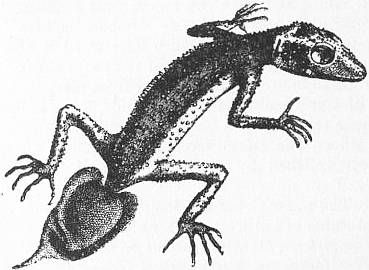
Leaf-tailed Gecko (Gymnodactylus platurus) of Australia.
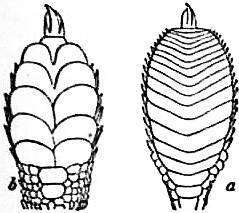
Lower Surface of the Toe of (a) Gecko, (b) Hemidactylus—enlarged.
Most geckoes have adhesive digits and toes, by means of which they are enabled not only to climb absolutely smooth and vertical surfaces, for instance a window-pane, but to run along a white-washed ceiling, back downwards. The adhesion is not produced by sticky matter but by numerous transverse lamellae, each of which is further beset with tiny hair-like excrescences. The arrangement of the lamellae and pads differs much in the various genera and is used for classificatory purposes. Those which live on sandy ground have narrow digits without the adhesive apparatus. Most species have sharp, curved claws, often retractile between some of the lamellae or into a special sheath. The tail is very brittle and can be quickly regenerated; it varies much in size and shape; the most extraordinary is that of the leaf-tailed gecko. Ptychozoon homalocephalon of the Malay countries has membranous expansions on the sides of the head, body, limbs and tail, which look like parachutes, but more probably they aid in concealing the creature when it is closely pressed to the similarly coloured bark of a tree. Most geckoes are dull coloured, yellow to brown, and they soon change colour from lighter to dark tints. They are insectivorous and chiefly nocturnal, but are fond of basking in the sun, motionless on the bark of a tree, or on a rock the colour of which is then imitated to a nicety. Some species are more or less transparent.
Geckoes, of which about 270 species are known, subdivided into about 50 genera, are cosmopolitan within the warmer zones, including New Zealand, and even the remotest volcanic islands. This wide distribution is due partly to the great age of the suborder (although fossils are unknown), partly to their being able to exist for several months without food so that, concealed in hollow trunks of trees, they may float about for a very long time. Ships, also, act as distributors. In south Europe occur only Hemidactylus turcicus, Tarentola mauritanica (Platydactylus facetanus) and Phyllodactylus europaeus.
1 The Malay name gē-koq imitates the animal’s cry.
GED, WILLIAM (1690-1749), the inventor of stereotyping, was born at Edinburgh in 1690. In 1725 he patented his invention, developed from the simple process of soldering together loose types of Van der Mey. Ged, although he succeeded in obtaining a cast in similar metal, of a type page, could not persuade Edinburgh printers to take up his invention, and finally entered into partnership with a London stationer named Jenner and Thomas James, a typefounder. The partnership, however, turned out very ill; and Ged, broken-hearted at his want of success due to trade jealousy and the compositors’ dislike of the innovation, died in poverty on the 19th of October 1749. Two prayer-books for the university of Cambridge and an edition of Sallust were printed from his stereotype plates. In his time the best type was imported from Holland, and Ged’s daughter reports that he had repeated offers from the Dutch which, from patriotic motives, he refused. His sons tried to carry out his patent, and it was eventually perfected by Andrew Wilson.
GEDDES, ALEXANDER (1737-1802), Scottish Roman Catholic theologian, was born in Rathven, Banffshire, on the 14th of September 1737. He was trained at the Roman Catholic seminary at Scalan and at the Scottish College in Paris, where he studied biblical philology, school divinity and modern languages. In 1764 he officiated as a priest in Dundee, but in May 1765 accepted an invitation to live with the earl of Traquair; where, with abundance of leisure and the free use of an adequate library, he made further progress in his favourite biblical studies. After a second visit to Paris, which was employed by him in reading and making extracts from rare books and manuscripts, he was appointed in 1769 priest of Auchinhalrig and Preshome in his native county. The freedom with which he fraternized with his Protestant neighbours called forth the rebuke of his bishop (George Hay), and ultimately, for hunting and for occasionally attending the parish church of Cullen, where one of his friends was minister, he was deprived of his charge and forbidden the exercise of ecclesiastical functions within the diocese. This happened in 1779; and in 1780 he went with his friend Lord Traquair to London, where he spent the rest of his life. Before leaving Scotland he had received the honorary degree of LL.D. from the university of Aberdeen, and had been made an honorary member of the Society of Antiquaries, in the institution of which he had taken a very active part. In London Geddes soon received an appointment in connexion with the chapel of the imperial ambassador, and was also helped by Lord Petre in his scheme for a new Catholic version of the Bible. In 1786, supported also by such scholars as Benjamin Kennicott and Robert Lowth, Geddes published a Prospectus of a new Translation of the Holy Bible, a considerable quarto volume, in which the defects of previous translations were fully pointed out, and the means indicated by which these might be removed. It was well received, and led to the publication in 1788 of Proposals for Printing, with a specimen, and in 1790 of a General Answer to Queries, Counsels and Criticisms. The first volume of the translation itself, which was entitled The Holy Bible ... faithfully translated from corrected Texts of the Originals, with various Readings, explanatory Notes and critical Remarks, appeared in 1792, and was the signal for a storm of hostility on the part of both Catholics and Protestants. It was obvious enough—no small offence in the eyes of some—that as a critic Geddes had identified himself with C.F. Houbigant (1686-1783), Kennicott and J.D. Michaelis, but others did not hesitate to stigmatize him as the would-be “corrector of the Holy Ghost.” Three of the vicars-apostolic almost immediately warned all the faithful against the “use and reception” of his translation, on the ostensible ground that it had not been examined and approved by due ecclesiastical authority; and by his own bishop (Douglas) he was in 1793 suspended from the exercise of his orders in the London district. The second volume of the translation, completing the historical books, published in 1797, found no more friendly reception; but this circumstance did not discourage him from giving forth in 1800 the volume of Critical Remarks on the Hebrew Scriptures, which presented in a somewhat brusque manner the then novel and startling views of Eichhorn and his school on the primitive history and early records of mankind.
Geddes was engaged on a critical translation of the Psalms (published in 1807) when he was seized with an illness of which he died on the 26th of February 1802. Although under ecclesiastical censures, he had never swerved from a consistent profession of faith as a Catholic; and on his death-bed he duly received the last rites of his communion.
Besides pamphlets on the Catholic and slavery questions, as well as several fugitive jeux d’esprit, and a number of unsigned articles in the Analytical Review, Geddes also published a free metrical version of Select Satires of Horace (1779), and a verbal rendering of the First Book of the Iliad of Homer (1792). The Memoirs of his life and writings by his friend John Mason Good appeared in 1803.
GEDDES, ANDREW (1783-1844), British painter, was born at Edinburgh. After receiving a good education in the high school and in the university of that city, he was for five years in the excise office, in which his father held the post of deputy auditor. After the death of his father, who had opposed his desire to become an artist, he came to London and entered the Royal Academy schools. His first contribution to the exhibitions of the Royal Academy, a “St John in the Wilderness,” appeared at Somerset House in 1806, and from that year onwards Geddes was a fairly constant exhibitor of figure-subjects and portraits. His well-known portrait of Wilkie, with whom he was on terms of intimacy, was at the Royal Academy in 1816. He alternated for some years between London and Edinburgh, with some excursions on the Continent, but in 1831 settled in London, and was elected associate of the Royal Academy in 1832; and he died in London of consumption in 1844. A very able executant, a good colourist, and a close student of character, he made his chief success as a portrait-painter, but he produced occasional figure subjects and landscapes, and executed some admirable copies of the old masters as well. He was also a good etcher. His portrait of his mother, and a portrait study, called “Summer,” are in the National Gallery of Scotland, and his portrait of Sir Walter Scott is in the Scottish National Portrait Gallery.
See Art in Scotland: its Origin and Progress, by Robert Brydall (1889); The Scottish School of Painting, by William D. McKay, R.S.A. (1906).
GEDDES, JAMES LORRAINE (1827-1887), American soldier and writer, was born in Edinburgh, Scotland, on the 19th of March 1827. In his boyhood he was taken to Canada, but in 1843 he returned to Scotland; then studied at Calcutta in the military academy, entered the army, and after distinguishing himself in the Punjab campaign, returned to Canada, whence in 1857 he removed to Vinton, Iowa. In the American Civil War he served in the Federal army first as lieutenant-colonel and after February 1862 as colonel of volunteers, taking part in the fighting at Shiloh, Vicksburg and Corinth. He was captured at Shiloh and was imprisoned for a time at Madison, Ga., and in Libby prison, Richmond, Va., and in 1865 was brevetted brigadier-general of volunteers. He was principal of the College for the Blind at Vinton after the war, and until his death was connected with the Iowa College of Agriculture at Ames, being military instructor and cashier in 1870-1882, acting president in 1876-1877, librarian in 1877-1875, vice-president and professor of military tactics in 1880-1882, and treasurer in 1884-1887. He died at Ames on the 21st of February 1887. He wrote a number of war songs, including “The Soldiers’ Battle Prayer” and “The Stars and Stripes.”
GEDDES, SIR WILLIAM DUGUID (1828-1900), Scottish scholar and educationist, was born in Aberdeenshire. He was educated at Elgin academy and university and King’s College, Aberdeen, and after having held various scholastic posts he was appointed in 1860 professor of Greek and in 1885 principal of the (united) university of Aberdeen. He was knighted in 1892. He died in Aberdeen on the 9th of February 1900. It is chiefly as a teacher that Geddes will be remembered, and in his enthusiastic and successful efforts to raise the standard of Greek at the Scottish universities he has been compared with the humanists of the Renaissance. Amongst other works he was the author of A Greek Grammar (1855; 17th edition, 1883; new and revised edition, 1893); a meritorious edition of the Phaedo of Plato (2nd ed., 1885); and The Problem of the Homeric Poems (1878), in which, while supporting Grote’s view that the Iliad consisted of an original Achilleïs with insertions or additions by later hands, he maintains that these insertions are due to the author of the Odyssey.
GEDYMIN (d. 1342), grand-duke of Lithuania, was supposed by the earlier chroniclers to have been the servant of Witen, prince of Lithuania, but more probably he was Witen’s younger brother and the son of Lutuwer, another Lithuanian prince. Gedymin inherited a vast domain, comprising Lithuania proper, Samogitia, Red Russia, Polotsk and Minsk; but these possessions were environed by powerful and greedy foes, the most dangerous of them being the Teutonic Knights and the Livonian knights of the Sword. The systematic raiding of Lithuania by the knights under the pretext of converting it had long since united all the Lithuanian tribes against the common enemy; but Gedymin aimed at establishing a dynasty which should make Lithuania not merely secure but mighty, and for this purpose he entered into direct diplomatic negotiations with the Holy See. At the end of 1322 he sent letters to Pope John XXII. soliciting his protection against the persecution of the knights, informing him of the privileges already granted to the Dominicans and the Franciscans in Lithuania for the preaching of God’s Word, and desiring that legates should be sent to receive him also into the bosom of the church. On receiving a favourable reply from the Holy See, Gedymin issued circular letters, dated 25th of January 1325, to the principal Hanse towns, offering a free access into his domains to men of every order and profession from nobles and knights to tillers of the soil. The immigrants were to choose their own settlements and be governed by their own laws. Priests and monks were also invited to come and build churches at Vilna and Novogrodek. Similar letters were sent to the Wendish or Baltic cities, and to the bishops and landowners of Livonia and Esthonia. In short Gedymin, recognizing the superiority of western civilization, anticipated Ivan the Terrible and Peter the Great by throwing open the semi-savage Russian lands to influences of culture.
In October 1323 representatives of the archbishop of Riga, the bishop of Dorpat, the king of Denmark, the Dominican and Franciscan orders, and the Grand Master of the Teutonic Order assembled at Vilna, when Gedymin confirmed his promises and undertook to be baptized as soon as the papal legates arrived. A compact was then signed at Vilna, “in the name of the whole Christian World,” between Gedymin and the delegates, confirming the promised privileges. But the christianizing of Lithuania was by no means to the liking of the Teutonic Knights, and they used every effort to nullify Gedymin’s far-reaching design. This, unfortunately, it was easy to do. Gedymin’s chief object was to save Lithuania from destruction at the hands of the Germans. But he was still a pagan reigning over semi-pagan lands; he was equally bound to his pagan kinsmen in Samogitia, to his orthodox subjects in Red Russia, and to his Catholic allies in Masovia. His policy, therefore, was necessarily tentative and ambiguous, and might very readily be misinterpreted. Thus his raid upon Dobrzyn, the latest acquisition of the knights on Polish soil, speedily gave them a ready weapon against him. The Prussian bishops, who were devoted to the knights, at a synod at Elbing questioned the authority of Gedymin’s letters and denounced him as an enemy of the faith; his orthodox subjects reproached him with leaning towards the Latin heresy; while the pagan Lithuanians accused him of abandoning the ancient gods. Gedymin disentangled himself from his difficulties by repudiating his former promises; by refusing to receive the papal legates who arrived at Riga in September 1323; and by dismissing the Franciscans from his territories. These apparently retrogressive measures simply amounted to a statesmanlike recognition of the fact that the pagan element was still the strongest force in Lithuania, and could not yet be dispensed with in the coming struggle for nationality. At the same time Gedymin through his ambassadors privately informed the papal legates at Riga that his difficult position compelled him for a time to postpone his steadfast resolve of being baptized, and the legates showed their confidence in him by forbidding the neighbouring states to war against Lithuania for the next four years, besides ratifying the treaty made between Gedymin and the archbishop of Riga. Nevertheless in 1325 the Order, disregarding the censures of the church, resumed the war with Gedymin, who had in the meantime improved his position by an alliance with Wladislaus Lokietek, king of Poland, whose son Casimir now married Gedymin’s daughter Aldona.
While on his guard against his northern foes, Gedymin from 1316 to 1340 was aggrandizing himself at the expense of the numerous Russian principalities in the south and east, whose incessant conflicts with each other wrought the ruin of them all. Here Gedymin’s triumphal progress was irresistible; but the various stages of it are impossible to follow, the sources of its history being few and conflicting, and the date of every salient event exceedingly doubtful. One of his most important territorial accretions, the principality of Halicz-Vladimir, was obtained by the marriage of his son Lubart with the daughter of the Haliczian prince; the other, Kiev, apparently by conquest. Gedymin also secured an alliance with the grand-duchy of Muscovy by marrying his daughter, Anastasia, to the grand-duke Simeon. But he was strong enough to counterpoise the influence of Muscovy in northern Russia, and assisted the republic of Pskov, which acknowledged his overlordship, to break away from Great Novgorod. His internal administration bears all the marks of a wise ruler. He protected the Catholic as well as the orthodox clergy, encouraging them both to civilize his subjects; he raised the Lithuanian army to the highest state of efficiency then attainable; defended his borders with a chain of strong fortresses; and built numerous towns including Vilna, the capital (c. 1321). Gedymin died in the winter of 1342 of a wound received at the siege of Wielowa. He was married three times, and left seven sons and six daughters.
See Teodor Narbutt, History of the Lithuanian nation (Pol.) (Vilna, 1835); Antoni Prochaska, On the Genuineness of the Letters of Gedymin (Pol.) (Cracow, 1895); Vladimir Bonifatovich Antonovich, Monograph concerning the History of Western and South-western Russia (Rus.) (Kiev, 1885).
(R. N. B.)
GEE, THOMAS (1815-1898), Welsh Nonconformist preacher and journalist, was born at Denbigh on the 24th of January 1815. At the age of fourteen he went into his father’s printing office, but continued to attend the grammar school in the afternoons. In 1837 he went to London to improve his knowledge of printing, and on his return to Wales in the following year ardently threw himself into literary, educational and religious work. Among his publications were the well-known quarterly magazine Y Traethodydd (“The Essayist”), Gwyddoniadur Cymreig (“Encyclopaedia Cambrensis”), and Dr Silvan Evans’s English-Welsh Dictionary (1868), but his greatest achievement in this field was the newspaper Baner Cymru (“The Banner of Wales”), founded in 1857 and amalgamated with Yr Amserau (“The Times”) two years later. This paper soon became an oracle in Wales, and played a great part in stirring up the nationalist movement in the principality. In educational matters he waged a long and successful struggle on behalf of undenominational schools and for the establishment of the intermediate school system. He was an enthusiastic advocate of church disestablishment, and had a historic newspaper duel with Dr John Owen (afterwards bishop of St David’s) on this question. The Eisteddfod found in him a thorough friend and a wise counsellor. His commanding presence, mastery of diction, and resonant voice made him an effective platform speaker. He was ordained to the Calvinistic Methodist ministry at Bala in 1847, and gave his time and talents ungrudgingly to Sunday school and temperance work. Throughout his life he believed in the itinerant unpaid ministry rather than in the settled pastorate. He died on the 28th of September 1898, and his funeral was the most imposing ever seen in North Wales.
GEEL, JACOB (1789-1862), Dutch scholar and critic, was born at Amsterdam on the 12th of November 1789. In 1823 he was appointed sub-librarian, and in 1833 chief librarian and honorary professor at Leiden, where he died on the 11th of November 1862. Geel materially contributed to the development of classical studies in Holland. He was the author of editions of Theocritus (1820), of the Vatican fragments of Polybius (1829), of the Ὀλυμπιακός of Dio Chrysostom (1840) and of numerous essays in the Rheinisches Museum and Bibliotheca critica nova, of which he was one of the founders. He also compiled a valuable catalogue of the MSS. in the Leiden library, wrote a history of the Greek sophists, and translated various German works into Dutch.
GEELONG, a seaport of Grant county, Victoria, Australia, situated on an extensive land-locked arm of Port Phillip known as Corio Bay, 45 m. by rail S.W. of Melbourne. Pop. of the city proper (1901) 12,399; with the adjacent boroughs of Geelong West, and Newton-and-Chilwell, 23,311. Geelong slopes to the bay on the north and to the Barwon river on the south, and its position in this respect, as well as the shelter it obtains from the Bellarine hills, renders it one of the healthiest towns in Victoria. As a manufacturing centre it is of considerable importance. The first woollen mill in the colony was established here, and the tweeds, cloths and other woollen fabrics of the town are noted throughout Australia. There are extensive tanneries, flour-mills and salt works, while at Fyansford, 3 m. distant, there are important cement works and paper-mills. The extensive vineyards in the neighbourhood of the town were destroyed under the Phylloxera Act, but replanting subsequently revived this industry. Corio Bay, a safe and commodious harbour, is entered by two channels across its bar, one of which has a depth of 23½ ft. There is extensive quayage, and the largest wool ships are able to load alongside the wharves, which are connected by rail with all parts of the colony. The facilities given for shipping wool direct to England from this port have caused a very extensive wool-broking trade to grow up in the town. The country surrounding Geelong is agricultural, but there are large limestone quarries east of the town, and in the Otway Forest, 23 m. distant, coal is worked. Geelong was incorporated in 1849.
GEESTEMÜNDE, a seaport town of Germany, in the Prussian province of Hanover, on the right bank of the Weser, at the mouth of the Geeste, which separates it from Bremerhaven, 32 m. N. from Bremen by rail. Pop. (1905) 23,625. The interest of the place is purely naval and commercial, its origin dating no farther back than 1857, when the construction of the harbour was begun. The great basin, which can accommodate large sea-going vessels, was completed in 1863, the petroleum basin was opened in 1874, and additional wharves have been constructed for the reception of vessels engaged in the fishing industry. The fish market of Geestemünde is the most important in Germany, and the auction hall practically determines the price of fish throughout the empire. The whole port is protected by powerful fortifications. Among the industrial establishments of the town are shipbuilding yards, foundries, engineering works and saw-mills.
GEFFCKEN, FRIEDRICH HEINRICH (1830-1896), German diplomatist and jurist, was born on the 9th of December 1830 at Hamburg, of which city his father was senator. After studying law at Bonn, Göttingen and Berlin, he was attached in 1854 to the Prussian legation at Paris. For ten years (1856-1866) he was the diplomatic representative of Hamburg in Berlin, first as chargé d’affaires, and afterwards as minister-resident, being afterwards transferred in a like capacity to London. Appointed in 1872 professor of constitutional history and public law in the reorganized university of Strassburg, Geffcken became in 1880 a member of the council of state of Alsace-Lorraine. Of too nervous a temperament to withstand the strain of the responsibilities of his position, he retired from public service in 1882, and lived henceforth mostly at Munich, where he died, suffocated by an accidental escape of gas into his bedchamber, on the 1st of May 1896. Geffcken was a man of great erudition and wide knowledge and of remarkable legal acumen, and from these qualities proceeded the personal influence he possessed. He was moreover a clear writer and made his mark as an essayist. He was one of the most trusted advisers of the Prussian crown prince, Frederick William (afterwards the emperor Frederick), and it was he (it is said, at Bismarck’s suggestion) who drew up the draft of the New German federal constitution, which was submitted to the crown prince’s headquarters at Versailles during the war of 1870-71. It was also Geffcken who assisted in framing the famous document which the emperor Frederick, on his accession to the throne in 1888, addressed to the chancellor. This memorandum gave umbrage, and on the publication by Geffcken in the Deutsche Rundschau (Oct. 1888) of extracts from the emperor Frederick’s private diary during the war of 1870-71, he was, at Bismarck’s instance, prosecuted for high treason. The Reichsgericht (supreme court), however, quashed the indictment, and Geffcken was liberated after being under arrest for three months. Publications of various kinds proceeded from his pen. Among these are Zur Geschichte des orientalischen Krieges 1853-1856 (Berlin, 1881); Frankreich, Russland und der Dreibund (Berlin, 1894); and Staat und Kirche (1875), English translation by E.F. Fairfax (1877). His writings on English history have been translated by S.J. Macmullan and published as The British Empire, with essays on Prince Albert, Palmerston, Beaconsfield, Gladstone, and reform of the House of Lords (1889).
GEFFROY, MATHIEU AUGUSTE (1820-1895), French historian, was born in Paris. After studying at the École Normale Supérieure he held history professorships at various lycées. His French thesis for the doctorate of letters, Étude sur les pamphlets politiques et religieux de Milton (1848), showed that he was attracted towards foreign history, a study for which he soon qualified himself by mastering the Germanic and Scandinavian languages. In 1851 he published a Histoire des états scandinaves, which is especially valuable for clear arrangement and for the trustworthiness of its facts. Later, a long stay in Sweden furnished him with valuable documents for a political and social history of Sweden and France at the end of the 18th century. In 1864 and 1865 he published in the Revue des deux mondes a series of articles on Gustavus III. and the French court, which were republished in book form in 1867. To the second volume he appended a critical study on Marie Antoinette et Louis XVI apocryphes, in which he proved, by evidence drawn from documents in the private archives of the emperor of Austria, that the letters published by Feuillet de Conches (Louis XVI, Marie Antoinette et Madame Elisabeth, 1864-1873) and Hunolstein (Corresp. inédite de Marie Antoinette, 1864) are forgeries. With the collaboration of Alfred von Arneth, director of the imperial archives at Vienna, he edited the Correspondance secrète entre Marie-Thérèse et le comte de Mercy-Argenteau (3 vols., 1874), the first account based on trustworthy documents of Marie Antoinette’s character, private conduct and policy. The Franco-German War drew Geffroy’s attention to the origins of Germany, and his Rome et les Barbares: étude sur la Germanie de Tacite (1874) set forth some of the results of German scholarship. He was then appointed to superintend the opening of the French school of archaeology at Rome, and drew up two useful reports (1877 and 1884) on its origin and early work. But his personal tastes always led him back to the study of modern history. When the Paris archives of foreign affairs were thrown open to students, it was decided to publish a collection of the instructions given to French ambassadors since 1648 (Recueil des instructions données aux ambassadeurs et ministres de France depuis le traité de Westphalie), and Geffroy was commissioned to edit the volumes dealing with Sweden (vol. ii., 1885) and Denmark (vol. xiii., 1895). In the interval he wrote Madame de Maintenon d’après sa correspondance authentique (2 vols., 1887), in which he displayed his penetrating critical faculty in discriminating between authentic documents and the additions and corrections of arrangers like La Beaumelle and Lavallée. His last works were an Essai sur la formation des collections d’antiques de la Suède and Des institutions et des mœurs du paganisme scandinave: l’Islande avant le Christianisme, both published posthumously. He died at Bièvre on the 16th of August 1895.
GEFLE, a seaport of Sweden on an inlet of the Gulf of Bothnia, chief town of the district (län) of Gefleborg, 112 m. N.N.W. of Stockholm by rail. Pop. (1900) 29,522. It is the chief port of the district of Kopparberg, with its iron and other mines and forests. The exports consist principally of timber and wood-pulp, iron and steel. The harbour, which has two entrances about 20 ft. deep, is usually ice-bound in mid-winter. Large vessels generally load in the roads at Gråberg, 6 m. distant. There are slips and shipbuilding yards, and a manufacture of sail-cloth. The town is an important industrial centre, having tobacco and leather factories, electrical and other mechanical works, and breweries. At Skutskär at the mouth of the Dal river are wood-pulp and saw mills, dealing with the large quantities of timber floated down the river; and there are large wood-yards in the suburb of Bomhus. Gefle was almost destroyed by fire in 1869, but was rebuilt in good style, and has the advantage of a beautiful situation. The principal buildings are a castle, founded by King John III. (1568-1592), but rebuilt later, a council-house erected by Gustavus III., who held a diet here in 1792, an exchange, and schools of commerce and navigation.
GEGENBAUR, CARL (1826-1903), German anatomist, was born on the 21st of August 1826 at Würzburg, the university of which he entered as a student in 1845. After taking his degree in 1851 he spent some time in travelling in Italy and Sicily, before returning to Würzburg as Privatdocent in 1854. In 1855 he was appointed extraordinary professor of anatomy at Jena, where after 1865 his fellow-worker, Ernst Haeckel, was professor of zoology, and in 1858 he became the ordinary professor. In 1873 he was appointed to Heidelberg, where he was professor of anatomy and director of the Anatomical Institute until his retirement in 1901. He died at Heidelberg on the 14th of June 1903. The work by which perhaps he is best known is his Grundriss der vergleichenden Anatomie (Leipzig, 1874; 2nd edition, 1878). This was translated into English by W.F. Jeffrey Bell (Elements of Comparative Anatomy, 1878), with additions by E. Ray Lankester. While recognizing the importance of comparative embryology in the study of descent, Gegenbaur laid stress on the higher value of comparative anatomy as the basis of the study of homologies, i.e. of the relations between corresponding parts in different animals, as, for example, the arm of man, the foreleg of the horse and the wing of a fowl. A distinctive piece of work was effected by him in 1871 in supplementing the evidence adduced by Huxley in refutation of the theory of the origin of the skull from expanded vertebrae, which, formulated independently by Goethe and Oken, had been championed by Owen. Huxley demonstrated that the skull is built up of cartilaginous pieces; Gegenbaur showed that “in the lowest (gristly) fishes, where hints of the original vertebrae might be most expected, the skull is an unsegmented gristly brain-box, and that in higher forms the vertebral nature of the skull cannot be maintained, since many of the bones, notably those along the top of the skull, arise in the skin.” Other publications by Gegenbaur include a Text-book of Human Anatomy (Leipzig, 1883, new ed. 1903), the Epiglottis (1892) and Comparative Anatomy of the Vertebrates in relation to the Invertebrates (Leipzig, 2 vols., 1898-1901). In 1875 he founded the Morphologisches Jahrbuch, which he edited for many years. In 1901 he published a short autobiography under the title Erlebtes und Erstrebtes.
See Fürbringer in Heidelberger Professoren aus dem 19ten Jahrhundert (Heidelberg, 1903).
GEGENSCHEIN (Ger. gegen, opposite, and schein, shine), an extremely faint luminescence of the sky, seen opposite the direction of the sun. Germany was the country in which it was first discovered and described. The English rendering “counterglow” is also given to it. Its faintness is such that it can be seen only by a practised eye under favourable conditions. It is invisible during the greater part of June, July, December and January, owing to its being then blotted out by the superior light of the Milky Way. It is also invisible during moonlight and near the horizon, and the neighbourhood of a bright star or planet may interfere with its recognition. When none of these unfavourable conditions supervene it may be seen at nearly any time when the air is clear and the depression of the sun below the horizon more than 20°. (See Zodiacal Light.)
GEIBEL, EMANUEL (1815-1884), German poet, was born at Lübeck on the 17th of October 1815, the son of a pastor in the city. He was originally intended for his father’s profession, and studied at Bonn and Berlin, but his real interests lay not in theology but in classical and romance philology. In 1838 he accepted a tutorship at Athens, where he remained until 1840. In the same year he brought out, in conjunction with his friend Ernst Curtius, a volume of translations from the Greek. His first poems, Zeitstimmen, appeared in 1841; a tragedy, König Roderich, followed in 1843. In the same year he received a pension from the king of Prussia, which he retained until his invitation to Munich by the king of Bavaria in 1851 as honorary professor at the university. In the interim he had produced König Sigurds Brautfahrt (1846), an epic, and Juniuslieder (1848, 33rd ed. 1901), lyrics in a more spirited and manlier style than his early poems. A volume of Neue Gedichte, published at Munich in 1857, and principally consisting of poems on classical subjects, denoted a further considerable advance in objectivity, and the series was worthily closed by the Spätherbstblätter, published in 1877. He had quitted Munich in 1869 and returned to Lübeck, where he died on the 6th of April 1884. His works further include two tragedies, Brunhild (1858, 5th ed. 1890), and Sophonisbe (1869), and translations of French and Spanish popular poetry. Beginning as a member of the group of political poets who heralded the revolution of 1848, Geibel was also the chief poet to welcome the establishment of the Empire in 1871. His strength lay not, however, in his political songs but in his purely lyric poetry, such as the fine cycle Ada and his still popular love-songs. He may be regarded as the leading representative of German lyric poetry between 1848 and 1870.
Geibel’s Gesammelte Werke were published in 8 vols. (1883, 4th ed. 1906); his Gedichte have gone through about 130 editions. An excellent selection in one volume appeared in 1904. For biography and criticism, see K. Goedeke, E. Geibel (1869); W. Scherer’s address on Geibel (1884); K.T. Gaedertz, Geibel-Denkwurdigkeiten (1886); C.C.T. Litzmann, E. Geibel, aus Erinnerungen, Briefen und Tagebüchern (1887), and biographies by C. Leimbach (2nd ed., 1894), and K.T. Gaedertz (1897).
GEIGE (O. Fr. gigue, gige; O. Ital. and Span. giga; Prov. gigua; O. Dutch gighe), in modern German the violin; in medieval German the name applied to the first stringed instruments played with a bow, in contradistinction to those whose strings were plucked by fingers or plectrum such as the cithara, rotta and fidula, the first of these terms having been very generally used to designate various instruments whose strings were plucked. The name gîge in Germany, of which the origin is uncertain,1 and its derivatives in other languages, were in the middle ages applied to rebecs having fingerboards. As the first bowed instruments in Europe were, as far as we know, those of the rebab type, both boat-shaped and pear-shaped, it seems probable that the name clung to them long after the bow had been applied to other stringed instruments derived from the cithara, such as the fiddle (videl) or vielle. In the romances of the 12th and 13th centuries the gîge is frequently mentioned, and generally associated with the rotta. Early in the 16th century we find definite information concerning the Geige in the works of Sebastian Virdung (1511), Hans Judenkünig (1523), Martin Agricola (1532), Hans Gerle (1533); and from the instruments depicted, of two distinct types and many varieties, it would appear that the principal idea attached to the name was still that of the bow used to vibrate the strings. Virdung qualifies the word Geige with Klein (small) and Gross (large), which do not represent two sizes of the same instrument but widely different types, also recognized by Agricola, who names three or four sizes of each, discant, alto, tenor and bass. Virdung’s Klein Geige is none other than the rebec with two C-shaped soundholes and a raised fingerboard cut in one piece with the vaulted back and having a separate flat soundboard glued over it, a change rendered necessary by the arched bridge. Agricola’s Klein Geige with three strings was of a totally different construction, having ribs and wide incurvations but no bridge; there was a rose soundhole near the tailpiece and two C-shaped holes in the shoulders. Agricola (Musica instrumentalis) distinctly mentions three kinds of Geigen with three, four and five strings. From him we learn that only one position was as yet used on these instruments, one or two higher notes being occasionally obtained by sliding the little finger along. A century later Agricola’s Geige was regarded as antiquated by Praetorius, who reproduces one of the bridgeless ones with five strings, a rose and two C-shaped soundholes, and calls it an old fiddle; under Geige he gives the violins.
(K. S.)
1 The words gîge, gîgen, geic appear suddenly in the M. H. German of the 12th century, and thence passed apparently into the Romance languages, though some would reverse the process (e.g. Weigand, Deutsches Wörterbuch). An elaborate argument in the Deutsches Wörterbuch of J. and W. Grimm (Leipzig, 1897) connects the word with an ancient common Teut. root gag—meaning to sway to and fro, as preserved in numerous forms: e.g. M.H.G gagen, gugen, “to sway to and fro” (gugen, gagen, the rocking of a cradle), the Swabian gigen, gagen, in the same sense, the Tirolese gaiggern, to sway, doubt, or the old Norse geiga, to go astray or crooked. The reference is to the swaying motion of the violin bow. The English “jig” is derived from gîge through the O. Fr. gigue (in the sense of a stringed instrument); the modern French gigue (a dance) is the English “jig” re-imported (Hatzfeld and Darmesteter, Dictionnaire). This opens up another possibility, of the origin of the name of the instrument in the dance which it accompanied.
(W. A. P.)
GEIGER, ABRAHAM (1810-1874), Jewish theologian and orientalist, was born at Frankfort-on-Main on the 24th of May 1810, and educated at the universities of Heidelberg and Bonn. As a student he distinguished himself in philosophy and in philology, and at the close of his course wrote on the relations of Judaism and Mahommedanism a prize essay which was afterwards published in 1833 under the title Was hat Mohammed aus dem Judentum aufgenommen? (English trans. Judaism and Islam, Madras, 1898). In November 1832 he went to Wiesbaden as rabbi of the synagogue, and became in 1835 one of the most active promoters of the Zeitschrift für jüdische Theologie (1835-1839 and 1842-1847). From 1838 to 1863 he lived in Breslau, where he organized the reform movement in Judaism and wrote some of his most important works, including Lehr- und Lesebuch zur Sprache der Mischna (1845), Studien from Maimonides (1850), translation into German of the poems of Juda ha-Levi (1851), and Urschrift und Übersetzungen der Bibel in ihrer Abhängigkeit von der innern Entwickelung des Judentums (1857). The last-named work attracted little attention at the time, but now enjoys a great reputation as a new departure in the methods of studying the records of Judaism. The Urschrift has moreover been recognized as one of the most original contributions to biblical science. In 1863 Geiger became head of the synagogue of his native town, and in 1870 he removed to Berlin, where, in addition to his duties as chief rabbi, he took the principal charge of the newly established seminary for Jewish science. The Urschrift was followed by a more exhaustive handling of one of its topics in Die Sadducäer und Pharisäer (1863), and by a more thorough application of its leading principles in an elaborate history of Judaism (Das Judentum und seine Geschichte) in 1865-1871. Geiger also contributed frequently on Hebrew, Samaritan and Syriac subjects to the Zeitschrift der deutschen morgenländischen Gesellschaft, and from 1862 until his death (on the 23rd of October 1874) he was editor of a periodical entitled Jüdische Zeitschrift für Wissenschaft und Leben. He also published a Jewish prayerbook (Israëlitisches Gebetbuch) and a variety of minor monographs on historical and literary subjects connected with the fortunes of his people.
(I. A.)
An Allgemeine Einleitung and five volumes of Nachgelassene Schriften were edited in 1875 by his son Ludwig Geiger (b. 1848), who in 1880 became extraordinary professor in the university of Berlin. Ludwig Geiger published a large number of biographical and literary works and made a special study of German humanism. He edited the Goethe-Jahrbuch from 1880, Vierteljahrsschrift für Kultur und Litteratur der Renaissance (1885-1886), Zeitschr. für die Gesch. der Juden im Deutschland (1886-1891), Zeitschr. für vergleichende Litteraturgeschichte und Renaissance-Litteratur (1887-1891). Among his works are Johann Reuchlin, sein Leben und seine Werke (Leipzig, 1871); and Johann Reuchlin’s Briefwechsel (Tübingen, 1875); Renaissance und Humanismus in Italien und Deutschland (1882, 2nd ed. 1901); Gesch. des geistigen Lebens der preussischen Hauptstadt (1892-1894); Berlin’s geistiges Leben (1894-1896).