VOLUME XI SLICE IV G to Gaskell Elizabeth (continued 9)
Reading edition
This ingenious pleading, however, did not serve, and he was obliged to be content with a general commission for Campeggio and Wolsey to try the cause in England. This, as Wolsey saw, was quite inadequate for the purpose in view; and he again instructed Gardiner, while thanking the pope for the commission actually granted, to press him once more by very urgent pleas, to send the desired decretal on, even if the latter was only to be shown to the king and himself and then destroyed. Otherwise, he wrote, he would lose his credit with the king, who might even be tempted to throw off his allegiance to Rome altogether. At last the pope—to his own bitter regret afterwards—gave what was desired on the express conditions named, that Campeggio was to show it to the king and Wolsey and no one else, and then destroy it, the two legates holding their court under the general commission. After obtaining this Gardiner returned home; but early in the following year, 1529, when proceedings were delayed on information of the brief in Spain, he was sent once more to Rome. This time, however, his efforts were unavailing. The pope would make no further concessions, and would not even promise not to revoke the cause to Rome, as he did very shortly after.
Gardiner’s services, however, were fully appreciated. He was appointed the king’s secretary. He had been already some years archdeacon of Taunton, and the archdeaconry of Norfolk was added to it in March 1529, which two years later he resigned for that of Leicester. In 1530 he was sent to Cambridge to procure the decision of the university as to the unlawfulness of marriage with a deceased brother’s wife, in accordance with the new plan devised for settling the question without the pope’s intervention. In this he succeeded, though not without a good deal of artifice, more creditable to his ingenuity than to his virtue. In November 1531 the king rewarded him for his services with the bishopric of Winchester, vacant by Wolsey’s death. The promotion was unexpected, and was accompanied by expressions from the king which made it still more honourable, as showing that if he had been in some things too subservient, it was from no abject, self-seeking policy of his own. Gardiner had, in fact, ere this remonstrated boldly with his sovereign on some points, and Henry now reminded him of the fact. “I have often squared with you, Gardiner,” he said familiarly, “but I love you never the worse, as the bishopric I give will convince you.” In 1532, nevertheless, he excited some displeasure in the king by the part he took in the preparation of the famous “Answer of the Ordinaries” to the complaints brought against them in the House of Commons. On this subject he wrote a very manly letter to the king in his own defence.
His next important action was not so creditable; for he was, not exactly, as is often said, one of Cranmer’s assessors, but, according to Cranmer’s own expression, “assistant” to him as counsel for the king, when the archbishop, in the absence of Queen Catherine, pronounced her marriage with Henry null and void on the 23rd of May 1533. Immediately afterwards he was sent over to Marseilles, where an interview between the pope and Francis I. took place in September, of which event Henry stood in great suspicion, as Francis was ostensibly his most cordial ally, and had hitherto maintained the justice of his cause in the matter of the divorce. It was at this interview that Bonner intimated the appeal of Henry VIII. to a general council in case the pope should venture to proceed to sentence against him. This appeal, and also one on behalf of Cranmer presented with it, were of Gardiner’s drawing up. In 1535 he and other bishops were called upon to vindicate the king’s new title of “Supreme Head of the Church of England.” The result was his celebrated treatise De vera obedientia, the ablest, certainly, of all the vindications of royal supremacy. In the same year he had an unpleasant dispute with Cranmer about the visitation of his diocese. He was also employed to answer the pope’s brief threatening to deprive Henry of his kingdom.
During the next few years he was engaged in various embassies in France and Germany. He was indeed so much abroad that he had little influence upon the king’s councils. But in 1539 he took part in the enactment of the severe statute of the Six Articles, which led to the resignation of Bishops Latimer and Shaxton and the persecution of the Protestant party. In 1540, on the death of Cromwell, earl of Essex, he was elected chancellor of the university of Cambridge. A few years later he attempted, in concert with others, to fasten a charge of heresy upon Archbishop Cranmer in connexion with the Act of the Six Articles; and but for the personal intervention of the king he would probably have succeeded. He was, in fact, though he had supported the royal supremacy, a thorough opponent of the Reformation in a doctrinal point of view, and it was suspected that he even repented his advocacy of the royal supremacy. He certainly had not approved of Henry’s general treatment of the church, especially during the ascendancy of Cromwell, and he was frequently visited with storms of royal indignation, which he schooled himself to bear with patience. In 1544 a relation of his own, named German Gardiner, whom he employed as his secretary, was put to death for treason in reference to the king’s supremacy, and his enemies insinuated to the king that he himself was of his secretary’s way of thinking. But in truth the king had need of him quite as much as he had of Cranmer; for it was Gardiner, who even under royal supremacy, was anxious to prove that England had not fallen away from the faith, while Cranmer’s authority as primate was necessary to upholding that supremacy. Thus Gardiner and the archbishop maintained opposite sides of the king’s church policy; and though Gardiner was encouraged by the king to put up articles against the archbishop himself for heresy, the archbishop could always rely on the king’s protection in the end. Heresy was gaining ground in high places, especially after the king’s marriage with Catherine Parr; and there seems to be some truth in the story that the queen herself was nearly committed for it at one time, when Gardiner, with the king’s approbation, censured some of her expressions in conversation. In fact, just after her marriage, four men of the Court were condemned at Windsor and three of them were burned. The fourth, who was the musician Marbeck, was pardoned by Gardiner’s procurement.
Great as Gardiner’s influence had been with Henry VIII., his name was omitted at the last in the king’s will, though Henry was believed to have intended making him one of his executors. Under Edward VI. he was completely opposed to the policy of the dominant party both in ecclesiastical and in civil matters. The religious changes he objected to both on principle and on the ground of their being moved during the king’s minority, and he resisted Cranmer’s project of a general visitation. His remonstrances, however, were met by his own committal to the Fleet, and the visitation of his diocese was held during his imprisonment. Though soon afterwards released, it was not long before he was called before the council, and, refusing to give them satisfaction on some points, was thrown into the Tower, where he continued during the whole remainder of the reign, a period slightly over five years. During this time he in vain demanded his liberty, and to be called before parliament as a peer of the realm. His bishopric was taken from him and given to Dr Poynet, a chaplain of Cranmer’s who had not long before been made bishop of Rochester. At the accession of Queen Mary, the duke of Norfolk and other state prisoners of high rank were in the Tower along with him; but the queen, on her first entry into London, set them all at liberty. Gardiner was restored to his bishopric and appointed lord chancellor, and he set the crown on the queen’s head at her coronation. He also opened her first parliament and for some time was her leading councillor.
He was now called upon, in advanced life, to undo not a little of the work in which he had been instrumental in his earlier years—to vindicate the legitimacy of the queen’s birth and the lawfulness of her mother’s marriage, to restore the old religion, and to recant what he himself had written touching the royal supremacy. It is said that he wrote a formal Palinodia or retractation of his book De vera obedientia, but it does not seem to be now extant; and the reference is probably to his sermon on Advent Sunday 1554, after Cardinal Pole had absolved the kingdom from schism. As chancellor he had the onerous task of negotiating the queen’s marriage treaty with Philip, to which he shared the general repugnance, though he could not oppose her will. In executing it, however, he took care to make the terms as advantageous for England as possible, with express provision that the Spaniards should in nowise be allowed to interfere in the government of the country. After the coming of Cardinal Pole, and the reconciliation of the realm to the see of Rome, he still remained in high favour. How far he was responsible for the persecutions which afterwards arose is a debated question. He no doubt approved of the act, which passed the House of Lords while he presided there as chancellor, for the revival of the heresy laws. Neither is there any doubt that he sat in judgment on Bishop Hooper, and on several other preachers whom he condemned, not exactly to the flames, but to be degraded from the priesthood. The natural consequence of this, indeed, was that when they declined, even as laymen, to be reconciled to the Church, they were handed over to the secular power to be burned. Gardiner, however, undoubtedly did his best to persuade them to save themselves by a course which he conscientiously followed himself; nor does it appear that, when placed on a commission along with a number of other bishops to administer a severe law, he could very well have acted otherwise than he did. In his own diocese no victim of the persecution is known to have suffered till after his death; and, much as he was already maligned by opponents, there are strong evidences that his natural disposition was humane and generous. In May 1553 he went over to Calais as one of the English commissioners to promote peace with France; but their efforts were ineffectual. In October 1555 he again opened parliament as lord chancellor, but towards the end of the month he fell ill and grew rapidly worse till the 12th of November, when he died over sixty years of age.
Perhaps no celebrated character of that age has been the subject of so much ill-merited abuse at the hands of popular historians. That his virtue was not equal to every trial must be admitted, but that he was anything like the morose and narrow-minded bigot he is commonly represented there is nothing whatever to show. He has been called ambitious, turbulent, crafty, abject, vindictive, bloodthirsty and a good many other things besides, not quite in keeping with each other; in addition to which it is roundly asserted by Bishop Burnet that he was despised alike by Henry and by Mary, both of whom made use of him as a tool. How such a mean and abject character submitted to remain five years in prison rather than change his principles is not very clearly explained; and as to his being despised, we have seen already that neither Henry nor Mary considered him by any means despicable. The truth is, there is not a single divine or statesman of that day whose course throughout was so thoroughly consistent. He was no friend to the Reformation, it is true, but he was at least a conscientious opponent. In doctrine he adhered to the old faith from first to last, while as a question of church policy, the only matter for consideration with him was whether the new laws and ordinances were constitutionally justifiable.
His merits as a theologian it is unnecessary to discuss; it is as a statesman and a lawyer that he stands conspicuous. But his learning even in divinity was far from commonplace. The part that he was allowed to take in the drawing up of doctrinal formularies in Henry VIII.’s time is not clear; but at a later date he was the author of various tracts in defence of the Real Presence against Cranmer, some of which, being written in prison, were published abroad under a feigned name. Controversial writings also passed between him and Bucer, with whom he had several interviews in Germany, when he was there as Henry VIII.’s ambassador.
He was a friend of learning in every form, and took great interest especially in promoting the study of Greek at Cambridge. He was, however, opposed to the new method of pronouncing the language introduced by Sir John Cheke, and wrote letters to him and Sir Thomas Smith upon the subject, in which, according to Ascham, his opponents showed themselves the better critics, but he the superior genius. In his own household he loved to take in young university men of promise; and many whom he thus encouraged became distinguished in after life as bishops, ambassadors and secretaries of state. His house, indeed, was spoken of by Leland as the seat of eloquence and the special abode of the muses.
He lies buried in his own cathedral at Winchester, where his effigy is still to be seen.
(J. Ga.)
GARDINER, a city of Kennebec county, Maine, U.S.A., at the confluence of Cobbosseecontee river with the Kennebec, 6 m. below Augusta. Pop. (1890) 5491; (1900) 5501 (537 foreign-born); (1910) 5311. It is served by the Maine Central railway. The site of the city is only a few feet above sea-level, and the Kennebec is navigable for large vessels to this point; the water of the Cobbosseecontee, falling about 130 ft. in a mile, furnishes the city with good power for its manufactures (chiefly paper, machine-shop products, and shoes). The city exports considerable quantities of lumber and ice. Gardiner was founded in 1760 by Dr Sylvester Gardiner (1707-1786), and for a time the settlement was called Gardinerston; in 1779, when it was incorporated as a town, the founder being then a Tory, it was renamed Pittston. But in 1803, when that part of Pittston which lay on the W. bank of the Kennebec was incorporated as a separate town and new life was given to it by the grandson of the founder, the present name was adopted. Gardiner was chartered as a city in 1849. The town of Pittston, on the E. bank of the Kennebec, had a population of 1177 in 1900.
GARDNER, PERCY (1846- ), English classical archaeologist, was born in London, and was educated at the City of London school and Christ’s College, Cambridge (fellow, 1872). He was Disney professor of archaeology at Cambridge from 1880 to 1887, and was then appointed professor of classical archaeology at Oxford, where he had a stimulating influence on the study of ancient, and particularly Greek, art. He also became prominent as an historical critic on Biblical subjects. Among his works are: Types of Greek Coins (1883); A Numismatic Commentary on Pausanias (with F. Imhoof-Blumer, 1887); New Chapters in Greek History (1892), an account of excavations in Greece and Asia Minor; Manual of Greek Antiquities (with F.B. Jevons, 2nd ed. 1898); Grammar of Greek Art (1905); Exploratio Evangelica (1899), on the origin of Christian belief; A Historic View of the New Testament (1901); Growth of Christianity (1907).
His brother, Ernest Arthur Gardner (1862- ), educated at the City of London school and Caius College, Cambridge (fellow, 1885), is also well known as an archaeologist. From 1887 to 1895 he was director of the British School of Archaeology at Athens, and later became professor of archaeology at University College, London. His publications include: Introduction to Greek Epigraphy (1887); Ancient Athens (1902); Handbook of Greek Sculpture (1905); Six Greek Sculptors (1910). He was elected first Public Orator of London University in 1910.
GARDNER, a township of Worcester county, Massachusetts, U.S.A. Pop. (1890) 8424; (1900) 10,813, of whom 3449 were foreign-born; (1910 census) 14,699. The township is traversed by the Boston & Maine railway. It has an area of 21.4 sq. m. of hill country, well watered with streams and ponds, and includes the villages of Gardner (15 m. by rail W. of Fitchburg), South Gardner and West Gardner. In the township are the state colony for the insane, the Henry Heywood memorial hospital, and the Levi Heywood memorial library (opened in 1886), a memorial to Levi Heywood (1800-1882), a prominent local manufacturer of chairs, who invented various kinds of chair-making machinery. By far the principal industry of the township (dating from 1805) is the manufacture of chairs, the township having in 1905 the largest chair factory in the world; among the other manufactures are toys, baby-carriages, silver-ware and oil stoves. In 1905 the total factory product of the township was valued at $5,019,019, the furniture product alone amounting to $4,267,064, or 85.2% of the total. Gardner, formed from parts of Ashburnham, Templeton, Westminster and Winchenden, was incorporated in 1785, and was named in honour of Col. Thomas Gardner (1724-1775), a patriot leader of Massachusetts, who was mortally wounded in the battle of Bunker Hill.
See W.D. Herrick, History of the Town of Gardner (Gardner, 1878), covering the years 1785-1878.
GARE-FOWL1 (Icelandic, Geirfugl; Gaelic, Gearbhul), the anglicized form of the Hebridean name of a large sea-bird now considered extinct, formerly a visitor to certain remote Scottish islands, the Great Auk of most English book-writers, and the Alca impennis of Linnaeus. In size it was hardly less than a tame goose, and in appearance it much resembled its smaller and surviving relative the razor-bill (Alca torda); but the glossy black of its head was varied by a large patch of white occupying nearly all the space between the eye and the bill, in place of the razor-bill’s thin white line, while the bill itself bore eight or more deep transverse grooves instead of the smaller number and the ivory-like mark possessed by the species last named. Otherwise the coloration was similar in both, and there is satisfactory evidence that the gare-fowl’s winter-plumage differed from that of the breeding-season just as is ordinarily the case in other members of the family Alcidae to which it belongs. The most striking characteristic of the gare-fowl, however, was the comparatively abortive condition of its wings, the distal portions of which, though the bird was just about twice the linear dimensions of the razor-bill, were almost exactly of the same size as in that species—proving, if more direct evidence were wanting, its inability to fly.
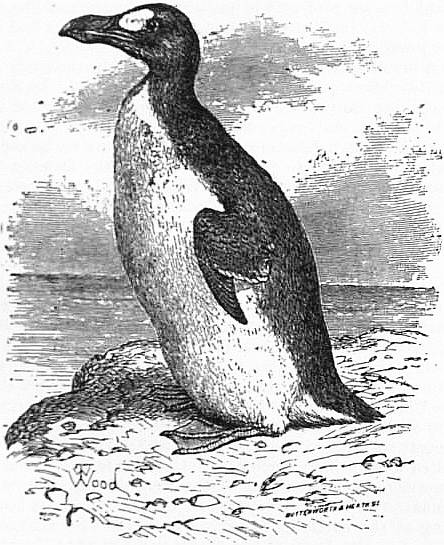
Gare-Fowl, or Great Auk.
The most prevalent misconception concerning the gare-fowl is one which has been repeated so often, and in books of such generally good repute and wide dispersal, that a successful refutation seems almost hopeless. This is the notion that it was a bird possessing a very high northern range, and consequently to be looked for by Arctic explorers. How this error arose would take too long to tell, but the fact remains indisputable that, setting aside general assertions resting on no evidence worthy of attention, there is but a single record deserving any credit at all of a single example of the species having been observed within the Arctic Circle, and this, according to Prof. Reinhardt, who had the best means of ascertaining the truth, is open to grave doubt.2 It is clear that the older ornithologists let their imagination get the better of their knowledge or their judgment, and their statements have been blindly repeated by most of their successors. Another error which, if not so widely spread, is at least as serious, since Sir R. Owen unhappily gave it countenance, is that this bird “has not been specially hunted down like the dodo and dinornis, but by degrees has become more scarce.” If any reliance can be placed upon the testimony of former observers, the first part of this statement is absolutely untrue. Of the dodo all we know is that it flourished in Mauritius, its only abode, at the time the island was discovered, and that some 200 years later it had ceased to exist—the mode of its extinction being open to conjecture, and a strong suspicion existing that though indirectly due to man’s acts it was accomplished by his thoughtless agents (Phil. Trans., 1869, p. 354). The extinction of the Dinornis lies beyond the range of recorded history. Supposing it even to have taken place at the very latest period as yet suggested—and there is much to be urged in favour of such a supposition—little but oral tradition remains to tell us how its extirpation was effected. That it existed after New Zealand was inhabited by man is indeed certain, and there is nothing extraordinary in the proved fact that the early settlers (of whatever race they were) killed and ate moas. But evidence that the whole population of those birds was done to death by man, however likely it may seem, is wholly wanting. The contrary is the case with the gare-fowl. In Iceland there is the testimony of a score of witnesses, taken down from their lips by one of the most careful naturalists who ever lived, John Wolley, that the latest survivors of the species were caught and killed by expeditions expressly organized with the view of supplying the demands of caterers to the various museums of Europe. In like manner the fact is incontestable that its breeding-stations in the western part of the Atlantic were for three centuries regularly visited and devastated with the combined objects of furnishing food or bait to the fishermen from very early days, and its final extinction, according to Sir Richard Bonnycastle (Newfoundland in 1842, i. p. 232), was owing to “the ruthless trade in its eggs and skin.” There is no doubt that one of the chief stations of this species in Icelandic waters disappeared through volcanic action, and that the destruction of the old Geirfuglaskér drove some at least of the birds which frequented it to a rock nearer the mainland, where they were exposed to danger from which they had in their former abode been comparatively free; yet on this rock (Eldey = fire-island) they were “specially hunted down” whenever opportunity offered, until the stock there was wholly extirpated in 1844.
A third misapprehension is that entertained by John Gould in his Birds of Great Britain, where he says that “formerly this bird was plentiful in all the northern parts of the British Islands, particularly the Orkneys and the Hebrides. At the commencement of the 19th century, however, its fate appears to have been sealed; for though it doubtless existed, and probably bred, up to the year 1830, its numbers annually diminished until they became so few that the species could not hold its own.” Now of the Orkneys, we know that George Low, who died in 1795, says in his posthumously-published Fauna Orcadensis that he could not find it was ever seen there; and on Bullock’s visit in 1812 he was told, says Montagu (Orn. Dict. App.), that one male only had made its appearance for a long time. This bird he saw and unsuccessfully hunted, but it was killed soon after his departure, while its mate had been killed just before his arrival, and none have been seen there since. As to the Hebrides, St Kilda is the only locality recorded for it, and the last example known to have been obtained there, or in its neighbourhood, was that given to Fleming (Edinb. Phil. Journ. x. p. 96) in 1821 or 1822, having been some time before captured by Mr Maclellan of Glass. That the gare-fowl was not plentiful in either group of islands is sufficiently obvious, as also is the impossibility of its continuing to breed “up to the year 1830.”
But mistakes like these are not confined to British authors. As on the death of an ancient hero myths gathered round his memory as quickly as clouds round the setting sun, so have stories, probable as well as impossible, accumulated over the true history of this species, and it behoves the conscientious naturalist to exercise more than common caution in sifting the truth from the large mass of error. Americans have asserted that the specimen which belonged to Audubon (now at Vassar College) was obtained by him on the banks of Newfoundland, though there is Macgillivray’s distinct statement (Brit. Birds, v. p. 359) that Audubon procured it in London. The account given by Degland (Orn. Europ. ii. p. 529) in 1849, and repeated in the last edition of his work by M. Gerbe, of its extinction in Orkney, is so manifestly absurd that it deserves to be quoted in full: “Il se trouvait en assez grand nombre il y a une quinzaine d’années aux Orcades; mais le ministre presbytérien dans le Mainland, en offrant une forte prime aux personnes qui lui apportaient cet oiseau, a été cause de sa destruction sur ces îles.” The same author claims the species as a visitor to the shores of France on the testimony of Hardy (Annuaire normand, 1841, p. 298), which he grievously misquotes both in his own work and in another place (Naumannia, 1855, p. 423), thereby misleading an anonymous English writer (Nat. Hist. Rev., 1865, p. 475) and numerous German readers.
John Milne in 1875 visited Funk Island, one of the former resorts of the gare-fowl, or “penguin,” as it was there called, in the Newfoundland seas, a place where bones had before been obtained by Stuvitz, and natural mummies so lately as 1863 and 1864. Landing on this rock at the risk of his life, he brought off a rich cargo of its remains, belonging to no fewer than fifty birds, some of them in size exceeding any that had before been known. His collection was subsequently dispersed, most of the specimens finding their way into various public museums.
A literature by no means inconsiderable has grown up respecting the gare-fowl. Neglecting works of general bearing, few of which are without many inaccuracies, the following treatises may be especially mentioned:—J.J.S. Steenstrup, “Et Bidrag til Geirfuglens Naturhistorie og saerligt til Kundskaben om dens tidligere Udbredningskreds,” Naturh. Foren. Vidensk. Meddelelser (Copenhagen, 1855), p. 33; E. Charlton, “On the Great Auk,” Trans. Tyneside Nat. Field Club, iv. p. 111; “Abstract of Mr J. Wolley’s Researches in Iceland respecting the Gare-fowl,” Ibis (1861), p. 374; W. Preyer, “Über Plautus impennis,” Journ. für Orn. (1862), pp. 110, 337; K.E. von Baer, “Über das Aussterben der Tierarten in physiologischer und nicht physiologischer Hinsicht,” Bull. de l’Acad. Imp. de St-Pétersb. vi. p. 513; R. Owen, “Description of the Skeleton of the Great Auk,” Trans. Zool. Soc. v. p. 317; “The Gare-fowl and its Historians,” Nat. Hist. Rev. v. p. 467; J.H. Gurney, jun., “On the Great Auk,” Zoologist (2nd ser.), pp. 1442, 1639; H. Reeks, “Great Auk in Newfoundland,” &c., op. cit. p. 1854; V. Fatio, “Sur l’Alca impennis,” Bull. Soc. Orn. Suisse, ii. pp. 1, 80, 147; “On existing Remains of the Gare-fowl,” Ibis (1870), p. 256; J. Milne, “Relics of the Great Auk,” Field (27th of March, 3rd and 10th of April 1875). Lastly, reference cannot be omitted to the happy exercise of poetic fancy with which Charles Kingsley was enabled to introduce the chief facts of the gare-fowl’s extinction (derived from one of the above-named papers) into his charming Water Babies.
(A. N.)
1 The name first appears, and in this form, in the Account of Hirta (St Kilda) and Rona, &c., by the lord register, Sir George M‘Kenzie, of Tarbat, printed by Pinkerton in his Collection of Voyages and Travels (iii. p. 730), and then in Sibbald’s Scotia illustrata (1684). Martin soon after, in his Voyage to St Kilda, spelt it “Gairfowl.” Sir R. Owen adopted the form “garfowl,” without, as would seem, any precedent authority.
2 The specimen is in the Museum of Copenhagen; the doubt lies as to the locality where it was obtained, whether at Disco, which is within, or at the Fiskernäs, which is without, the Arctic Circle.
GARFIELD, JAMES ABRAM (1831-1881), twentieth president of the United States, was born on the 19th of November 1831 in a log cabin in the little frontier town of Orange, Cuyahoga county, Ohio. His early years were spent in the performance of such labour as fell to the lot of every farmer’s son in the new states, and in the acquisition of such education as could be had in the district schools held for a few weeks each winter. But life on a farm was not to his liking, and at sixteen he left home and set off to make a living in some other way. A book of stories of adventure on the sea, which he read over and over again when a boy, had filled him with a longing for a seafaring life. He decided, therefore, to become a sailor, and, in 1848, tramping across the country to Cleveland, Ohio, he sought employment from the captain of a lake schooner. But the captain drove him from the deck, and, wandering on in search of work, he fell in with a canal boatman who engaged him. During some months young Garfield served as bowsman, deck-hand and driver of a canal boat. An attack of the ague sent him home, and on recovery, having resolved to attend a high school and fit himself to become a teacher, he passed the next four years in a hard struggle with poverty and in an earnest effort to secure an education, studying for a short time in the Geauga Seminary at Chester, Ohio. He worked as a teacher, a carpenter and a farmer; studied for a time at the Western Reserve Eclectic Institute at Hiram, Ohio, which afterward became Hiram College, and finally entered Williams College. On graduation, in 1856, Garfield became professor of ancient languages and literature in the Eclectic Institute at Hiram, and within a year had risen to the presidency of the institution.
Soon afterwards he entered political life. In the early days of the Republican party, when the shameful scenes of the Kansas struggle were exciting the whole country, and during the campaigns of 1857 and 1858, he became known as an effective speaker and ardent anti-slavery man. His reward for his services was election in 1859 to the Ohio Senate as the member from Portage and Summit counties. When the “cotton states” seceded, Garfield appeared as a warm supporter of vigorous measures. He was one of the six Ohio senators who voted against the proposed amendment to the Federal Constitution (Feb. 28th, 1861) forbidding any constitutional amendment which should give Congress the power to abolish or interfere with slavery in any state; he upheld the right of the government to coerce seceded states; defended the “Million War Bill” appropriating a million dollars for the state’s military expenses; and when the call came for 75,000 troops, he moved that Ohio furnish 20,000 soldiers and three millions of dollars as her share. He had just been admitted to the bar, but on the outbreak of war he at once offered his services to the governor, and became lieutenant-colonel and then colonel of the 42nd Ohio Volunteers, recruited largely from among his former students. He served in Kentucky, was promoted to the rank of brigadier-general of volunteers early in 1862; took part in the second day’s fighting at the battle of Shiloh, served as chief of staff under Rosecrans in the Army of the Cumberland in 1863, fought at Chickamauga, and was made a major-general of volunteers for gallantry in that battle. In 1862 he was elected a member of Congress from the Ashtabula district of Ohio, and, resigning his military commission, took his seat in the House of Representatives in December 1863. In Congress he joined the radical wing of the Republican party, advocated the confiscation of Confederate property, approved and defended the Wade-Davis manifesto denouncing the tameness of Lincoln, and was soon recognized as a hard worker and ready speaker. Capacity for work brought him places on important committees—he was chairman successively of the committee on military affairs, the committee on banking and currency, and the committee on appropriations,—and his ability as a speaker enabled him to achieve distinction on the floor of the House and to rise to leadership. Between 1863 and 1873 Garfield delivered speeches of importance on “The Constitutional Amendment to abolish Slavery,” “The Freedman’s Bureau,” “The Reconstruction of the Rebel States,” “The Public Debt and Specie Payments,” “Reconstruction,” “The Currency,” “Taxation of United States Bonds,” “Enforcing the 14th Amendment,” “National Aid to Education,” and “the Right to Originate Revenue Bills.” The year 1874 was one of disaster to the Republican party. The greenback issue, the troubles growing out of reconstruction in the South, the Crédit Mobilier and the “Salary Grab,” disgusted thousands of independent voters and sent a wave of Democracy over the country. Garfield himself was accused of corruption in connexion with the Crédit Mobilier scandal, but the charge was never proved. A Republican convention in his district demanded his resignation, and re-election seemed impossible; but he defended himself in two pamphlets, “Increase of Salaries” and “Review of the Transactions of the Crédit Mobilier Company,” made a village-to-village canvass, and was victorious. In 1876 Garfield for the eighth time was chosen to represent his district; and afterwards as one of the two representatives of the Republicans in the House, he was a member of the Electoral Commission which decided the dispute regarding the presidential election of 1876. When, in 1877, James G. Blaine was made a senator from Maine, the leadership of the House of Representatives passed to Garfield, and he became the Republican candidate for speaker. But the Democrats had a majority in the House, and he was defeated. Hayes, the new president, having chosen John Sherman to be his secretary of the treasury, an effort was made to send Garfield to the United States Senate in Sherman’s place. But the president needed his services in the House, and he was not elected to the Senate until 1880.
The time had now come (1880) when the Republican party must nominate a candidate for the presidency. General Grant had served two terms (1869-1877), and the unwritten law of custom condemned his being given another. But the “bosses” of the Republican party in three great States—New York, Pennsylvania and Illinois—were determined that he should be renominated. These men and their followers were known as the “stalwarts.” Opposed to them were two other factions, one supporting James G. Blaine, of Maine, and the other John Sherman, of Ohio. When the convention met and the balloting began, the contest along these factional lines started in earnest. For eight-and-twenty ballots no change of any consequence was noticeable. Though votes were often cast for ten names, there were but two real candidates before the convention, Grant and Blaine. That the partisans of neither would yield in favour of the other was certain. That the choice therefore rested with the supporters of the minor candidates was manifest, and with the cry “Anything to beat Grant!” an effort was made to find some man on whom the opposition could unite. Such a man was Garfield. His long term of service in the House, his leadership of his party on its floor, his candidacy for the speakership, and his recent election to the United States Senate, marked him out as the available man. Between the casting of the first and the thirty-third ballot, Garfield, who was the leader of Sherman’s adherents in the convention, had sometimes received one or two votes and at other times none. On the thirty-fourth he received seventeen, on the next fifty, and on the next almost the entire vote hitherto cast for Blaine and Sherman, and was declared nominated. During the campaign Garfield was subject to violent personal abuse; the fact that he was alleged to have received $329 from the Crédit Mobilier as a dividend on stock led his opponents to raise the campaign cry of “329,” and this number was placarded in the streets of the cities and printed in flaring type in partisan newspapers. The forged “Morey letter,” in which he was made to appear as opposed to the exclusion of the Chinese, was widely circulated and injured his candidacy in the West. That the charges against Garfield were not generally credited, however, is shown by the fact that he received 214 electoral votes to his opponent’s 155. He was inaugurated on the 4th of March 1881.
Unfortunately, the new president was unequal to the task of composing the differences in his party. For his secretary of state he chose James G. Blaine, the bitterest political enemy of Senator Roscoe Conkling (q.v.), the leader of the New York “stalwarts.” Without consulting the New York senators, Garfield appointed William H. Robertson, another political enemy of Conkling’s, to the desirable post of Collector of the Port of New York, and thereby destroyed all prospects of party harmony. On the 2nd of July, while on his way to attend the commencement exercises at Williams College, the new president was shot in a Washington railway station by a disappointed office-seeker named Charles J. Guiteau, whose mind had no doubt been somewhat influenced by the abuse lavished upon the president by his party opponents; and on the 19th of September 1881, he died at Elberon, New Jersey, whither he had been removed on the 6th. He was buried in Cleveland, Ohio, where in 1890 a monument was erected by popular subscription to his memory.
In 1858 Garfield had married Miss Lucretia Rudolph, by whom he had seven children. His son, Harry Augustus Garfield (b. 1863) graduated at Williams College in 1885, practised law in Cleveland, Ohio, in 1888-1903, was professor of politics at Princeton University in 1903-1908, and in 1908 became president of Williams College. Another son, James Rudolph Garfield (b. 1865), also graduated at Williams College in 1885 and practised law in Cleveland; he was a Republican member of the Ohio Senate in 1896-1899, was commissioner of corporations, Department of Commerce and Labour, in 1903-1907, attracting wide attention by his reports on certain large industrial organizations, and was secretary of the interior (1907-1909) in the cabinet of President Roosevelt.
President Garfield’s writings, edited by Burke A. Hinsdale, were published at Boston, in two volumes, in 1882.
(J. B. McM.)
GAR-FISH, the name given to a genus of fishes (Belone) found in nearly all the temperate and tropical seas, and readily recognized by their long, slender, compressed and silvery body, and by their jaws being produced into a long, pointed, bony and sharply-toothed beak. About fifty species are known from different parts of the globe, some attaining to a length of 4 or 5 ft. One species is common on the British coasts, and is well known by the names of “long-nose,” “green-bone,” &c. The last name is given to those fishes on account of the peculiar green colour of their bones, which deters many people from eating them, although their flesh is well flavoured and perfectly wholesome. The skipper (Scomberesox) and half-beak (Hemirhamphus), in which the lower jaw only is prolonged, are fishes nearly akin to the gar-pikes.
GARGANEY1 (North-Italian, Garganello), or Summer-Teal, the Anas querquedula and A. circia of Linnaeus (who made, as did Willughby and Ray, two species out of one), and the type of Stephens’s genus Querquedula. This bird is one of the smallest of the Anatidae, and has gained its common English name from being almost exclusively a summer-visitant to England where nowadays it only regularly resorts to breed in some of the East-Norfolk Broads, though possibly at one time it was found at the same season throughout the great Fen-district. Slightly larger than the common teal (A. crecca), the male is readily distinguished therefrom by its peculiarly-coloured head, the sides of which are nutmeg-brown, closely freckled with short whitish streaks, while a conspicuous white curved line descends backwards from the eyes. The upper wing-coverts are bluish grey, the scapulars black with a white shaft-stripe, and the wing-spot (speculum) greyish green bordered above and below by white. The female closely resembles the hen teal, but possesses no wing-spot. In Ireland or Scotland the garganey is very rare, and though it is recorded from Iceland, more satisfactory evidence of its occurrence there is needed. It has not a high northern range, and its appearance in Norway and Sweden is casual. Though it breeds in many parts of Europe, in none can it be said to be common; but it ranges far to the eastward in Asia—even to Formosa, according to Swinhoe—and yearly visits India in winter in enormous numbers. Those that breed in Norfolk arrive somewhat late in spring and make their nests in the vast reed-beds which border the Broads—a situation rarely or never chosen by the teal. The labyrinth or bony enlargement of the trachea in the male garganey differs in form from that described in any other drake, being more oval and placed nearly in the median line of the windpipe, instead of on one side, as is usually the case.
1 The word was introduced by Willughby from Gesner (Orn., lib. iii. p. 127), but, though generally adopted by authors, seems never to have become other than a book-name in English, the bird being invariably known in the parts of this island where it is indigenous as “summer-teal.”
GARGANO, MONTE (anc. Garganus Mons), a massive mountainous peninsula projecting E. from the N. coast of Apulia, Italy, and belonging geologically to the opposite Dalmatian coast; it was indeed separated from the rest of Italy by an arm of the sea as late as the Tertiary period. The highest point (Monte Calvo) is 3465 ft. above sea-level. The oak forests for which it was renowned in Roman times have entirely disappeared.
GARGOYLE, or Gurgoyle (from the Fr. gargouille, originally the throat or gullet, cf. Lat. gurgulio, gula, and similar words derived from root gar, to swallow, the word representing the gurgling sound of water; Ital. doccia di grande; Ger. Ausguss), in architecture, the carved termination to a spout which conveys away the water from the gutters. Gargoyles are mostly grotesque figures. The term is applied more especially to medieval work, but throughout all ages some means of throwing the water off the roofs, when not conveyed in gutters, has been adopted, and in Egypt there are gargoyles to eject the water used in the washing of the sacred vessels which would seem to have been done on the flat roofs of the temples. In Greek temples the water from the roof passed through the mouths of lions whose heads were carved or modelled in the marble or terra-cotta cymatium of the cornice. At Pompeii large numbers of terra-cotta gargoyles have been found which were modelled in the shape of various animals.
GARHWAL, or Gurwal. 1. A district of British India, in the Kumaon division of the United Provinces. It has an area of 5629 sq. m., and consists almost entirely of rugged mountain ranges running in all directions, and separated by narrow valleys which in some cases become deep gorges or ravines. The only level portion of the district is a narrow strip of waterless forest between the southern slopes of the hills and the fertile plains of Rohilkhand. The highest mountains are in the north, the principal peaks being Nanda Devi (25,661 ft.), Kamet (25,413), Trisul (23,382), Badrinath (23,210), Dunagiri (23,181) and Kedarnath (22,853). The Alaknanda, one of the main sources of the Ganges, receives with its affluents the whole drainage of the district. At Devaprayag the Alaknanda joins the Bhagirathi, and thenceforward the united streams bear the name of the Ganges. Cultivation is principally confined to the immediate vicinity of the rivers, which are employed for purposes of irrigation. Garhwal originally consisted of 52 petty chieftainships, each chief with his own independent fortress (garh). Nearly 500 years ago, one of these chiefs, Ajai Pál, reduced all the minor principalities under his own sway, and founded the Garhwal kingdom. He and his ancestors ruled over Garhwal and the adjacent state of Tehri, in an uninterrupted line till 1803, when the Gurkhas invaded Kumaon and Garhwal, driving the Garhwal chief into the plains. For twelve years the Gurkhas ruled the country with a rod of iron, until a series of encroachments by them on British territory led to the war with Nepal in 1814. At the termination of the campaign, Garhwal and Kumaon were converted into British districts, while the Tehri principality was restored to a son of the former chief. Since annexation, Garhwal has rapidly advanced in material prosperity. Pop. (1901) 429,900. Two battalions of the Indian army (the 39th Garhwal Rifles) are recruited in the district, which also contains the military cantonment of Lansdowne. Grain and coarse cloth are exported, and salt, borax, live-stock and wool are imported, the trade with Tibet being considerable. The administrative headquarters are at the village of Pauri, but Srinagar is the largest place. This is an important mart, as is also Kotdwara, the terminus of a branch of the Oudh and Rohilkhand railway from Najibabad.
2. A native state, also known as Tehri, after its capital; area 4180 sq. m.; pop. (1901) 268,885. It adjoins the district mentioned above, and its topographical features are similar. It contains the sources of both the Ganges and the Jumna, which are visited by thousands of Hindu pilgrims. The gross revenue is about £28,000, of which nearly half is derived from forests. No tribute is paid to the British government.
GARIBALDI, GIUSEPPE (1807-1882), Italian patriot, was born at Nice on the 4th of July 1807. As a youth he fled from home to escape a clerical education, but afterwards joined his father in the coasting trade. After joining the “Giovine Italia” he entered the Sardinian navy, and, with a number of companions on board the frigate “Euridice,” plotted to seize the vessel and occupy the arsenal of Genoa at the moment when Mazzini’s Savoy expedition should enter Piedmont. The plot being discovered, Garibaldi fled, but was condemned to death by default on the 3rd of June 1834. Escaping to South America in 1836, he was given letters of marque by the state of Rio Grande do Sul, which had revolted against Brazil. After a series of victorious engagements he was taken prisoner and subjected to severe torture, which dislocated his limbs. Regaining liberty, he renewed the war against Brazil, and took Porto Allegro. During the campaign he met his wife, Anita, who became his inseparable companion and mother of three children, Anita, Ricciotti and Menotti. Passing into the service of Uruguay, he was sent to Corrientes with a small flotilla to oppose Rosas’s forces, but was overtaken by Admiral Brown, against whose fleet he fought for three days. When his ammunition was exhausted he burned his ships and escaped. Returning to Montevideo, he formed the Italian Legion, with which he won the battles of Cerro and Sant’ Antonio in the spring of 1846, and assured the freedom of Uruguay. Refusing all honours and recompense, he prepared to return to Italy upon receiving news of the incipient revolutionary movement. In October 1847 he wrote to Pius IX., offering his services to the Church, whose cause he for a moment believed to be that of national liberty.
Landing at Nice on the 24th of June 1848, he placed his sword at the disposal of Charles Albert, and, after various difficulties with the Piedmontese war office, formed a volunteer army 3000 strong, but shortly after taking the field was obliged, by the defeat of Custozza, to flee to Switzerland. Proceeding thence to Rome, he was entrusted by the Roman republic with the defence of San Pancrazio against the French, where he gained the victory of the 30th of April 1849, remaining all day in the saddle, although wounded in the side at the beginning of the fight. From the 3rd of May until the 30th of May he was continuously engaged against the Bourbon troops at Palestrina, Velletri and elsewhere, dispersing an army of 20,000 men with 3000 volunteers. After the fall of Rome he left the city at the head of 4000 volunteers, with the idea of joining the defenders of Venice, and started on that wonderful retreat through central Italy pursued by the armies of France, Austria, Spain and Naples. By his consummate generalship and the matchless endurance of his men the pursuers were evaded and San Marino reached, though with a sadly diminished force. Garibaldi and a few followers, including his devoted wife Anita, after vainly attempting to reach Venice, where the tricolor still floated, took refuge in the pine forests of Ravenna; the Austrians were seeking him in all directions, and most of his legionaries were captured and shot. Anita died near Comacchio, and he himself fled across the peninsula, being assisted by all classes of the people, to Tuscany, whence he escaped to Piedmont and ultimately to America. At New York, in order to earn a living, he became first a chandler, and afterwards a trading skipper, returning to Italy in 1854 with a small fortune, and purchasing the island of Caprera, on which he built the house thenceforth his home. On the outbreak of war in 1859 he was placed in command of the Alpine infantry, defeating the Austrians at Casale on the 8th of May, crossing the Ticino on the 23rd of May, and, after a series of victorious fights, liberating Alpine territory as far as the frontier of Tirol. When about to enter Austrian territory proper his advance was, however, checked by the armistice of Villafranca.
Returning to Como to wed the countess Raimondi, by whom he had been aided during the campaign, he was apprised, immediately after the wedding, of certain circumstances which caused him at once to abandon that lady and to start for central Italy. Forbidden to invade the Romagna, he returned indignantly to Caprera, where with Crispi and Bertani he planned the invasion of Sicily. Assured by Sir James Hudson of the sympathy of England, he began active preparations for the expedition to Marsala. At the last moment he hesitated, but Crispi succeeded in persuading him to sail from Genoa on the 5th of May 1860 with two vessels carrying a volunteer corps of 1070 strong. Calling at Talamone to embark arms and money, he reached Marsala on the 11th of May, and landed under the protection of the British vessels “Intrepid” and “Argus.” On the 12th of May the dictatorship of Garibaldi was proclaimed at Salemi, on the 15th of May the Neapolitan troops were routed at Calatafimi, on the 25th of May Palermo was taken, and on the 6th of June 20,000 Neapolitan regulars, supported by nine frigates and protected by two forts, were compelled to capitulate. Once established at Palermo, Garibaldi organized an army to liberate Naples and march upon Rome, a plan opposed by the emissaries of Cavour, who desired the immediate annexation of Sicily to the Italian kingdom. Expelling Lafarina and driving out Depretis, who represented Cavour, Garibaldi routed the Neapolitans at Milazzo on the 20th of July. Messina fell on the 20th of July, but Garibaldi, instead of crossing to Calabria, secretly departed for Aranci Bay in Sardinia, where Bertani was fitting out an expedition against the papal states. Cavour, however, obliged the expedition to sail for Palermo. Returning to Messina, Garibaldi found a letter from Victor Emmanuel II. dissuading him from invading the kingdom of Naples. Garibaldi replied asking “permission to disobey.” Next day he crossed the Strait, won the battle of Reggio on the 21st of August, accepted the capitulation of 9000 Neapolitan troops at San Giovanni and of 11,000 more at Soveria. The march upon Naples became a triumphal progress, which the wiles of Francesco II. were powerless to arrest. On the 7th of September Garibaldi entered Naples, while Francesco fled to Gaeta. On the 1st of October he routed the remnant of the Bourbon army 40,000 strong on the Volturno. Meanwhile the Italian troops had occupied the Marches, Umbria and the Abruzzi, a battalion of Bersaglieri reaching the Volturno in time to take part in the battle. Their presence put an end to the plan for the invasion of the papal states, and Garibaldi unwillingly issued a decree for the plébiscite which was to sanction the incorporation of the Two Sicilies in the Italian realm. On the 7th of November Garibaldi accompanied Victor Emmanuel during his solemn entry into Naples, and on the morrow returned to Caprera, after disbanding his volunteers and recommending their enrolment in the regular army.
Indignation at the cession of Nice to France and at the neglect of his followers by the Italian government induced him to return to political life. Elected deputy in 1861, his anger against Cavour found violent expression. Bixio attempted to reconcile them, but the publication by Cialdini of a letter against Garibaldi provoked a hostility which, but for the intervention of the king, would have led to a duel between Cialdini and Garibaldi. Returning to Caprera, Garibaldi awaited events. Cavour’s successor, Ricasoli, enrolled the Garibaldians in the regular army; Rattazzi, who succeeded Ricasoli, urged Garibaldi to undertake an expedition in aid of the Hungarians, but Garibaldi, finding his followers ill-disposed towards the idea, decided to turn his arms against Rome. On the 29th of June 1862 he landed at Palermo and gathered an army under the banner “Roma o morte.” Rattazzi, frightened at the prospect of an attack upon Rome, proclaimed a state of siege in Sicily, sent the fleet to Messina, and instructed Cialdini to oppose Garibaldi. Circumventing the Italian troops, Garibaldi entered Catania, crossed to Melito with 3000 men on the 25th of August, but was taken prisoner and wounded by Cialdini’s forces at Aspromonte on the 27th of August. Liberated by an amnesty, Garibaldi returned once more to Caprera amidst general sympathy.
In the spring of 1864 he went to London, where he was accorded an enthusiastic reception and given the freedom of the city. From England he returned again to Caprera. On the outbreak of war in 1866 he assumed command of a volunteer army and, after the defeat of the Italian troops at Custozza, took the offensive in order to cover Brescia. On the 3rd of July he defeated the Austrians at Monte Saello, on the 7th at Lodrone, on the 10th at Darso, on the 16th at Condino, on the 19th at Ampola, on the 21st at Bezzecca, but, when on the point of attacking Trent, he was ordered by General Lamarmora to retire. His famous reply “Obbedisco” (“I obey”) has often been cited as a classical example of military obedience to a command destructive of a successful leader’s hopes, but documents now published (cf. Corriere della sera, 9th of August 1906) prove beyond doubt that Garibaldi had for some days known that the order to evacuate the Trentino would shortly reach him. The order arrived on the 9th of August, whereas Crispi had been sent as early as the 16th of July to warn Garibaldi that, owing to Prussian opposition, Austria would not cede the Trentino to Italy, and that the evacuation was inevitable. Hence Garibaldi’s laconic reply. From the Trentino he returned to Caprera to mature his designs against Rome, which had been evacuated by the French in pursuance of the Franco-Italian convention of the 15th of September 1864. Gathering volunteers in the autumn of 1867, he prepared to enter papal territory, but was arrested at Sinalunga by the Italian government and conducted to Caprera. Eluding the surveillance of the Italian cruisers, he returned to Florence, and, with the complicity of the second Rattazzi cabinet, entered Roman territory at Passo Corese on the 23rd of October. Two days later he took Monterotondo, but on the 2nd of November his forces were dispersed at Mentana by French and papal troops. Recrossing the Italian frontier, he was arrested at Figline and taken back to Caprera, where he eked out his slender resources by writing several romances. In 1870 he formed a fresh volunteer corps and went to the aid of France, defeating the German troops at Chatillon, Autun and Dijon. Elected a member of the Versailles assembly, he resigned his mandate in anger at French insults, and withdrew to Caprera until, in 1874, he was elected deputy for Rome. Popular enthusiasm induced the Conservative Minghetti cabinet to propose that a sum of £40,000 with an annual pension of £2000 be conferred upon him as a recompense for his services, but the proposal, though adopted by parliament (27th May 1875), was indignantly refused by Garibaldi. Upon the advent of the Left to power, however, he accepted both gift and pension, and worked energetically upon the scheme for the Tiber embankment to prevent the flooding of Rome. At the same time he succeeded in obtaining the annulment of his marriage with the countess Raimondi (with whom he had never lived) and contracted another marriage with the mother of his children, Clelia and Manlio. In 1880 he went to Milan for the inauguration of the Mentana monument, and in 1882 visited Naples and Palermo, but was prevented by illness from being present at the 600th anniversary of the Sicilian Vespers. On the 2nd of June 1882 his death at Caprera plunged Italy into mourning.
See Garibaldi, Epistolario, ed. E.E. Ximenes (2 vols., Milan, 1885), and Memorie autografiche (11th ed., Florence, 1902; Eng. translation by A. Werner, with supplement by J.W. Mario in vol. iii. of 1888 ed.); Giuseppe Guerzoni, Garibaldi (2 vols., Florence, 1882); Jessie White Mario, Garibaldi e i suoi tempi (Milan, 1884); G.M. Trevelyan, Garibaldi’s Defence of the Roman Republic (London, 1907), which contains an excellent sketch of Garibaldi’s early career, of the events leading up to the proclamation of the Roman Republic, and a picturesque, detailed and authoritative account of the defence of Rome and of Garibaldi’s flight, with a very full bibliography; also Trevelyan’s Garibaldi and the Thousand (1909).
(H. W. S.)
GARIN LE LOHERAIN, French epic hero. The 12th century chanson de geste of Garin le Loherain is one of the fiercest and most sanguinary narratives left by the trouvères. This local cycle of Lorraine, which is completed by Hervis de Metz, Girbers de Metz, Anséis, fils de Girbert and Yon, is obviously based on history, and the failure absolutely to identify the events recorded does not deprive the poems of their value as a picture of the savage feudal wars of the 11th and 12th centuries. The episodes are evolved naturally and the usual devices adopted by the trouvères to reconcile their inconsistencies are absent. Nevertheless no satisfactory historical explanation of the story has yet been offered. It has been suggested by a recent critic (F. Settegast, Quellenstudien zur gallo-romanischen Epik, 1904) that these poems resume historical traditions going back to the Vandal irruption of 408 and the battle fought by the Romans and the West Goths against the Huns in 451. The cycle relates three wars against hosts of heathen invaders. In the first of these Charles Martel and his faithful vassal Hervis of Metz fight by an extraordinary anachronism against the Vandals, who have destroyed Reims and besieged other cities. They are defeated in a great battle near Troyes. In the second Hervis is besieged in Metz by the “Hongres.” He sends first for help to Pippin, who defers his assistance by the advice of the traitor Hardré. Hervis then transfers his allegiance to Anséis of Cologne, by whose help the invaders are repulsed, though Hervis himself is slain. In the third Thierry, king of Moriane1 sends to Pippin for help against four Saracen kings. He is delivered by a Frankish host, but falls in the battle. Hervis of Metz was the son of a citizen to whom the duke of Lorraine had married his daughter Aelis, and his sons Garin and Begue are the heroes of the chanson which gives its name to the cycle. The dying king Thierry had desired that his daughter Blanchefleur should marry Garin, but when Garin prefers his suit at the court of Pippin, Fromont of Bordeaux puts himself forward as his rival and Hardré, Fromont’s father, is slain by Garin. The rest of the poem is taken up with the war that ensues between the Lorrainers and the men of Bordeaux. They finally submit their differences to the king, only to begin their disputes once more. Blanchefleur becomes the wife of Pippin, while Garin remains her faithful servant. One of the most famous passages of the poem is the assassination of Begue by a nephew of Fromont, and Garin, after laying waste his enemy’s territory, is himself slain. The remaining songs continue the feud between the two families. According to Paulin Paris, the family of Bordeaux represents the early dukes of Aquitaine, the last of whom, Waifar (745-768) was dispossessed and slain by Pippin the Short, king of the Franks; but the trouvères had in mind no doubt the wars which marked the end of the Carolingian dynasty.
See Li Romans de Garin le Loherain, ed. P. Paris (Paris, 1833); Hist. litt. de la France, vol. xxii. (1852); J.M. Ludlow, Popular Epics of the Middle Ages (London and Cambridge, 1865); F. Lot, Études d’histoire du moyen âge (Paris, 1896); F. Settegast, Quellenstudien zur gallo-romanischen Epik (Leipzig, 1904). A complete edition of the cycle was undertaken by E. Stengel, the first volume of which, Hervis de Mes (Gesellschaft für roman. Lit., Dresden), appeared in 1903.
1 i.e. Maurienne, now a district and diocese (St Jean de Maurienne) of Savoy.
GARLAND, JOHN (fl. 1202-1252), Latin grammarian, known as Johannes Garlandius, or, more commonly, Johannes de Garlandia, was born in England, though most of his life was spent in France. John Bale in his Catalogus, and John Pits, following Bale, placed him among the writers of the 11th century. The main facts of his life, however, are stated in a long poem De triumphis ecclesiae contained in Cotton MS. Claudius A x in the British Museum, and edited by Thomas Wright for the Roxburghe Club in 1856. Garland narrates the history of his time from the point of view of the victories gained by the church over heretics at home and infidels abroad. He studied at Oxford under a certain John of London, whom it is difficult to distinguish from others of the same name; but he must have been in Paris in or before 1202, for he mentions as one of his teachers Alain de Lisle, who died in that year or the next. Garland was one of the professors chosen in 1229 for the new university of Toulouse, and remained in the south during the Albigensian crusade, of which he gives a detailed account in books iv.-vi. In 1232 or 1233 the hatred of the people made further residence in Toulouse unsafe for the professors of the university, who had been installed by the Catholic party. Garland was one of the first to fly, and the rest of his life was spent in Paris, where he finished his poem in 1252. Garland’s grammatical works were much used in England, and were often printed by Richard Pynson and Wynkyn de Worde. He was also a voluminous Latin poet. Works on mathematics and music have also been assigned to him, but the ascription may have arisen from confusion of his works with those of Gerlandus, a canon of Besançon in the 12th century. The treatise on alchemy, Compendium alchimiae, often printed under his name, was by a 14th-century writer named Martin Ortolan, or Lortholain.
The best known of his poems beside the “De Triumphis Ecclesiae” is “Epithalamium beatae Mariae Virginis,” contained in the same MS. Among his other works are his “Dictionarius,” a Latin vocabulary, printed by T. Wright in the Library of National Antiquities (vol. i., 1857); Compendium totius grammatices ..., printed at Deventer, 1489; two metrical treatises, entitled Synonyma and Equivoca, frequently printed at the close of the 15th century.
For further bibliographical information see the British Museum catalogue; J.A. Fabricius, Bibliotheca Latina mediae et infimae aetatis ..., vol. iii. (1754); G. Brunet, Manuel du libraire, &c. See also Histoire litt. de la France, vols. viii., xxi., xxiii. and xxx.; the prefaces to the editions by T. Wright mentioned above; P. Meyer, La Chanson de la croisade contre les Albigeois, vol. ii. pp. xxi-xxiii. (Paris, 1875); Dr A. Scheler, Lexicographie latine du XIIe et du XIIIe siècles (Leipzig, 1867); the article by C.L. Kingsford in the Dict. Nat. Biog., giving a list also of the works on alchemy, mathematics and music, rightly or wrongly ascribed to him; J.E. Sandys, Hist. of Class. Schol. i. (1906) 549.
(E. G.)
GARLIC (O. Eng. gárleác, i.e. “spear-leek”; Gr. σκόροδον; Lat. allium; Ital. aglio; Fr. ail; Ger. Knoblauch), Allium sativum, a bulbous perennial plant of the natural order Liliaceae, indigenous apparently to south-west Siberia. It has long, narrow, flat, obscurely keeled leaves, a deciduous spathe, and a globose umbel of whitish flowers, among which are small bulbils. The bulb, which is the only part eaten, has membranous scales, in the axils of which are 10 or 12 cloves, or smaller bulbs. From these new bulbs can be procured by planting out in February or March. The bulbs are best preserved hung in a dry place. If of fair size, twenty of them weigh about 1 ℔. To prevent the plant from running to leaf, Pliny (Nat. Hist. xix. 34) advises to bend the stalk downward and cover with earth; seeding, he observes, may be prevented by twisting the stalk.
Garlic is cultivated in the same manner as the shallot (q.v.). It is stated to have been grown in England before the year 1548. The percentage composition of the bulbs is given by E. Solly (Trans. Hort. Soc. Lond., new ser., iii. p. 60) as water 84.09, organic matter 13.38, and inorganic matter 1.53—that of the leaves being water 87.14, organic matter 11.27 and inorganic matter 1.59. The bulb has a strong and characteristic odour and an acrid taste, and yields an offensively smelling oil, essence of garlic, identical with allyl sulphide (C3H5)2S (see Hofmann and Cahours, Journ. Chem. Soc. x. p. 320). This, when garlic has been eaten, is evolved by the excretory organs, the activity of which it promotes. From the earliest times garlic has been used as an article of diet. It formed part of the food of the Israelites in Egypt (Numb. xi. 5) and of the labourers employed by Cheops in the construction of his pyramid, and is still grown in Egypt, where, however, the Syrian is the kind most esteemed (see Rawlinson’s Herodotus, ii. 125). It was largely consumed by the ancient Greek and Roman soldiers, sailors and rural classes (cf. Virg. Ecl. ii. 11), and, as Pliny tells us (N.H. xix. 32), by the African peasantry. Galen eulogizes it as the rustic’s theriac (see F. Adams’s Paulus Aegineta, p. 99), and Alexander Neckam, a writer of the 12th century (see Wright’s edition of his works, p. 473, 1863), recommends it as a palliative of the heat of the sun in field labour. “The people in places where the simoon is frequent,” says Mountstuart Elphinstone (An Account of the Kingdom of Caubul, p. 140, 1815), “eat garlic, and rub their lips and noses with it, when they go out in the heat of the summer, to prevent their suffering by the simoon.” “O dura messorum ilia,” exclaims Horace (Epod. iii.), as he records his detestation of the popular esculent, to smell of which was accounted a sign of vulgarity (cf. Shakespeare, Coriol. iv. 6, and Meas. for Meas. iii. 2). In England garlic is seldom used except as a seasoning, but in the southern countries of Europe it is a common ingredient in dishes, and is largely consumed by the agricultural population. Garlic was placed by the ancient Greeks on the piles of stones at cross-roads, as a supper for Hecate (Theophrastus, Characters, Δεισιδαιμονίας); and according to Pliny garlic and onions were invocated as deities by the Egyptians at the taking of oaths. The inhabitants of Pelusium in lower Egypt, who worshipped the onion, are said to have held both it and garlic in aversion as food. Garlic possesses stimulant and stomachic properties, and was of old, as still sometimes now, employed as a medicinal remedy. Pliny (N.H. xx. 23) gives an exceedingly long list of complaints in which it was considered beneficial. Dr T. Sydenham valued it as an application in confluent smallpox, and, says Cullen (Mat. Med. ii. p. 174, 1789), found some dropsies cured by it alone. In the United States the bulb is given in doses of ½-2 drachms in cases of bronchiectasis and phthisis pulmonalis. Garlic may also be prescribed as an extract consisting of the inspissated juice, in doses of 5-10 grains, and as the syrupus allii aceticus, in doses of 1-4 drachms. This last preparation has recently been much extolled in the treatment of pulmonary tuberculosis or phthisis.
The wild “crow garlic” and “field garlic” of Britain are the species Allium vineale and A. oleraceum respectively.
GARNET, or Garnett, HENRY (1555-1606), English Jesuit, son of Brian Garnett, a schoolmaster at Nottingham, was educated at Winchester and afterwards studied law in London. Having become a Roman Catholic, he went to Italy, joined the Society of Jesus in 1575, and acquired under Bellarmine and others a reputation for varied learning. In 1586 he joined the mission in England, becoming superior of the province on the imprisonment of William Weston in the following year. In the dispute between the Jesuits and the secular clergy known as the “Wisbech Stirs” (1595-1596) he zealously supported Weston in his resistance to any compromise with the civil government. His antagonism to the secular clergy was also shown later, when in 1603 he, with other Jesuits, was the means of betraying to the government the “Bye Plot,” contrived by William Watson, a secular priest. In 1598 he was professed of the four vows.
Garnet supervised the Jesuit mission for eighteen years with conspicuous success. His life was one of concealment and disguises; a price was put on his head; but he was fearless and indefatigable in carrying on his propaganda and in ministering to the scattered Catholics, even in their prisons. The result was that he gained many converts, while the number of Jesuits in England increased during his tenure of office from three to forty. It is, however, in connexion with the Gunpowder Plot that he is best remembered. His part in this, for which he suffered death, needs discussion in greater detail.
In 1602 Garnet received briefs from Pope Clement VIII. directing that no person unfavourable to the Catholic religion should be allowed to succeed to the throne. About the same time he was consulted by Catesby, Tresham and Winter, all afterwards involved in the Gunpowder Plot, on the subject of the mission to be sent to Spain to induce Philip III. to invade England. According to his own statement he disapproved, but he gave Winter a recommendation to Father Creswell, an influential person at Madrid. Moreover, in May 1605 he gave introductions to Guy Fawkes when he went to Flanders, and to Sir Edmund Baynham when he went to Rome (see Gunpowder Plot). The preparations for the plot had now been actively going forward since the beginning of 1604, and on the 9th of June 1605 Garnet was asked by Catesby whether it was lawful to enter upon any undertaking which should involve the destruction of the innocent together with the guilty, to which Garnet answered in the affirmative, giving as an illustration the fate of persons besieged in a town in time of war. Afterwards, feeling alarmed, according to his own accounts, he admonished Catesby against intending the death of “not only innocents but friends and necessary persons for a commonwealth,” and showed him a letter from the pope forbidding rebellion. According to Sir Everard Digby, however, Garnet, when asked the meaning of the brief, replied “that they were not (meaning the priests) to undertake or procure stirs, but yet they would not hinder any, neither was it the pope’s mind they should, that should be undertaken for Catholic good.... This answer, with Mr Catesby’s proceedings with him and me, gave me absolute belief that the matter in general was approved, though every particular was not known.” Both men were endeavouring to exculpate themselves, and therefore both statements are subject to suspicion. A few days later, according to Garnet, the Jesuit, Oswald Tesemond, known as Greenway, informed him of the whole plot “by way of confession,” when, as he declares, he expressed horror at the design and urged Greenway to do his utmost to prevent its execution. Subsequently, after his trial, Garnet said he “could not certainly affirm” that Greenway intended to relate the matter to him in confession.
Garnet’s conduct in now keeping the plot a secret has been a matter of considerable controversy not only between Roman Catholics and Protestants, but amongst Roman Catholic writers themselves. Father Martin del Rio, a Jesuit, writing in 1600, discusses the exact case of the revelation of a plot in confession. Almost all the learned doctors, he says, declare that the confessor may reveal it, but he adds, “the contrary opinion is the safer and better doctrine, and more consistent with religion and with the reverence due to the holy rite of confession.” According to Bellarmine, Garnet’s zealous friend and defender, “If the person confessing be concealed, it is lawful for a priest to break the seal of confession in order to avert a great calamity”; but he justifies Garnet’s silence by insisting that it was not lawful to disclose a treasonable secret to a heretical king. According to Garnet’s own opinion a priest cognizant of treason against the state “is bound to find all lawful means to discover it salvo sigillo confessionis.” In this connexion it is worth pointing out that Garnet had not thought it his duty to disclose the treasonable intrigue with the king of Spain in 1602, though there was no pretence in this case that he was restricted by the seal of confession, and his inactivity now tells greatly in his disfavour; for, allowing even that he was bound by confessional secrecy from taking action on Greenway’s information, he had still Catesby’s earlier revelations to act upon. He appears to have taken no steps whatever to prevent the crime, beyond writing to Rome in vague terms that “he feared some particular desperate courses,” which aroused no suspicions in that quarter. At the same time he wrote to Father Parsons on the 4th of September that “as far as he could now see the minds of the Catholics were quieted.”
His movements immediately prior to the attempt were certainly suspicious. In September, shortly before the expected meeting of parliament on the 3rd of October, Garnet organized a pilgrimage to St Winifred’s Well in Flintshire, which started from Gothurst (now Gayhurst), Sir Everard Digby’s house in Buckinghamshire, included Rokewood, and stopped at the houses of John Grant and Robert Winter, three others of the conspirators. During the pilgrimage Garnet asked for the prayers of the company “for some good success for the Catholic cause at the beginning of parliament.” After his return he went on the 29th of October to Coughton in Warwickshire, near which place it had been settled the conspirators were to assemble after the explosion. On the 6th of November, Bates, Catesby’s servant and one of the conspirators, brought him a letter with the news of the failure of the plot and desiring advice. On the 30th Garnet addressed a letter to the government in which he protested his innocence with the most solemn oaths, “as one who hopeth for everlasting salvation.”
It was not till the 4th of December, however, that Garnet and Greenway were, by the confession of Bates, implicated in the plot; and on the same day Garnet removed from Coughton to Hindlip Hall, near Worcester, a house furnished with cleverly-contrived hiding-places for the use of the proscribed priests. Here he remained some time in concealment in company with another priest, Oldcorne alias Hall, but at last on the 30th of January 1606, unable to bear the close confinement any longer, they surrendered and were taken up to London, being well treated during the journey by Salisbury’s express orders. He was examined by the council on the 13th of February and frequently questioned during the following days, but refused to incriminate himself, and a threat to inflict torture had no effect upon his resolution. Subsequently Garnet and Oldcorne having been placed in adjoining rooms and enabled to communicate with one another, their conversations were overheard on several separate occasions and considerable information obtained. Garnet at first denied all speech with Oldcorne, but subsequently on the 8th of March confessed his connexion with the plot. He was tried at the Guildhall on the 28th.
Garnet was clearly guilty of misprision of treason, i.e. of having concealed his knowledge of the crime, an offence which exposed him to perpetual imprisonment and forfeiture of his property; for the law of England took no account of religious scruples or professional etiquette when they permit the execution of a preventable crime. Strangely enough, however, the government passed over the incriminating conversation with Greenway, and relied entirely on the strong circumstantial evidence to support the charge of high treason against the prisoner. The trial was not conducted in a manner which would be permitted in more modern days. The rules of evidence which now govern the procedure in criminal cases did not then exist, and Garnet’s trial, like many others, was influenced by the political situation, the case against him being supported by general political accusations against the Jesuits as a body, and with evidence of their complicity in former plots against the government. The prisoner himself deeply prejudiced his cause by his numerous false statements, and still more by his adherence to the doctrine of equivocation. Garnet, it is true, claimed to limit the justification of equivocation to cases “of necessary defence from injustice and wrong or of the obtaining some good of great importance when there is no danger of harm to others,” and he could justify his conduct in lying to the council by their own conduct towards him, which included treacherous eavesdropping and fraud, and also threats of torture. Moreover, the attempt of the counsel for the crown to force the prisoner to incriminate himself was opposed to the whole spirit and tradition of the law of England. He was declared guilty, and it is probable, in spite of the irregularity and unjudicial character of his trial, that substantial justice was done by his conviction. His execution took place on the 3rd of May 1606, Garnet acknowledging himself justly condemned for his concealment of the plot, but maintaining to the last that he had never approved it. The king, who had shown him favour throughout and who had forbidden his being tortured, directed that he should be hanged till he was quite dead and that the usual frightful cruelties should be omitted.
Soon after his death the story of the miracle of “Garnet’s Straw” was circulated all over Europe, according to which a blood-stained straw from the scene of execution which came into the hands of one John Wilkinson, a young and fervent Roman Catholic, who was present, developed Garnet’s likeness. In consequence of the credence which the story obtained, Archbishop Bancroft was commissioned by the privy council to discover and punish the impostors. Garnet’s name was included in the list of the 353 Roman Catholic martyrs sent to Rome from England in 1880, and in the 2nd appendix of the Menology of England and Wales compiled by order of the cardinal archbishop and the bishops of the province of Westminster by R. Stanton in 1887, where he is styled “a martyr whose cause is deferred for future investigation.” The passage in Macbeth (Act II. Scene iii.) on equivocators no doubt refers especially to Garnet. His aliases were Farmer, Marchant, Whalley, Darcey Meaze, Phillips, Humphreys, Roberts, Fulgeham, Allen. Garnet was the author of a letter on the Martyrdom of Godfrey Maurice, alias John Jones, in Diego Yepres’s Historia particular de la persecucion de Inglaterra (1599); a Treatise of Schism, a MS. treatise in reply to A Protestant Dialogue between a Gentleman and a Physician; a translation of the Stemma Christi with supplements (1622); a treatise on the Rosary; a Treatise of Christian Renovation or Birth (1616).
Authorities.—Of the great number of works embodying the controversy on the question of Garnet’s guilt the following may be mentioned, in order of date: A True and Perfect Relation of the whole Proceedings against ... Garnet a Jesuit and his Confederates (1606, repr. 1679), the official account, but incomplete and inaccurate; Apologia pro Henrico Garneto (1610), by the Jesuit L’Heureux, under the pseudonym Eudaemon-Joannes, and Dr Robert Abbot’s reply, Antilogia versus Apologiam Eudaemon-Joannes, in which the whole subject is well treated; Henry More, Hist. Provinciae Anglicanae Societatis (1660); D. Jardine, Gunpowder Plot (1857); J. Morris, S.J., Condition of the Catholics under James I. (1872), containing Father Gerard’s narrative; J.H. Pollen, Father Henry Garnet and the Gunpowder Plot (1888); S.R. Gardiner, What Gunpowder Plot was (1897), in reply to John Gerard, S.J., What was the Gunpowder Plot? (1897); J. Gerard, Contributions towards a Life of Father Henry Garnet (1898). See also State Trials II., and Cal. of State Papers Dom., (1603-1610). The original documents are preserved in the Gunpowder Plot Book at the Record Office.
GARNET, a name applied to a group of closely-related minerals, many of which are used as gem-stones. The name probably comes from the Lat. granaticus, a stone so named from its resemblance to the pulp of the pomegranate in colour, or to its seeds in shape; or possibly from granum, “cochineal,” in allusion to the colour of the stone. The garnet was included, with other red stones, by Theophrastus, under the name of ἄνθραξ, while the common garnet seems to have been his ἀνθράκιον. Pliny groups several stones, including garnet, under the term carbunculus. The modern carbuncle is a deep red garnet (almandine) cut en cabochon, or with a smooth convex surface, frequently hollowed out at the back, in consequence of the depth of colour, and sometimes enlivened with a foil (see Almandine). The Hebrew word nophek, translated ἄνθραξ in the Septuagint, seems to have been the garnet or carbuncle, whilst bareketh (σμάραγδος of the Septuagint), though also rendered “carbuncle,” was probably either beryl or, in the opinion of Professor Flinders Petrie, rock-crystal. Garnets were used as beads in ancient Egypt. Though not extensively employed by the Greeks as a material for engraved gems, it was much used for this purpose by the Romans of the Empire. Flat polished slabs of garnet are found inlaid in mosaic work in Anglo-Saxon and Merovingian jewelry, the material used being almandine, or “precious garnet.”
Garnets vary considerably in chemical composition, but the variation is limited within a certain range. All are orthosilicates, conformable to the general formula R″3R″′2(SiO4)3, where R″ = Ca, Mg, Fe, Mn, and R″′ = Al, Fe, Cr. Although there are many kinds of garnet they may be reduced to the following six types, which may occur intermixed isomorphously:—
1. Calcium-aluminium garnet (Grossularite), Ca3Al2Si3O12.
2. Calcium-ferric garnet (Andradite), Ca3Fe2Si3O12.
3. Calcium-chromium garnet (Uvarovite), Ca3Cr2Si3O12.
4. Magnesium-aluminium garnet (Pyrope), Mg3Al2Si3O12.
5. Ferrous-aluminium garnet (Almandine), Fe3Al2Si3O12.
6. Manganous-aluminium garnet (Spessartine), Mn3Al2Si3O12.
These are frequently called respectively:—(1) Lime-alumina garnet; (2) lime-iron garnet; (3) lime-chrome garnet; (4) magnesia-alumina garnet; (5) iron-alumina garnet; (6) manganese-alumina garnet.
The types are usually modified by isomorphous replacement of some of their elements.
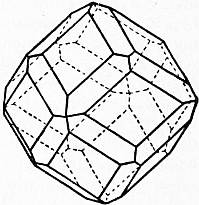
All garnets crystallize in the cubic system, usually in rhombic dodecahedra or in icositetrahedra, or in a combination of the two forms (see fig.). Octahedra and cubes are rare, but the six-faced octahedron occurs in some of the combinations. Cleavage obtains parallel to the dodecahedron, but is imperfect. The hardness varies according to composition from 6.5 to 7.5, and the specific gravity in like manner has a wide range, varying from 3.4 in the calcium-aluminium garnets to 4.3 in the ferrous-aluminium species. Sir Arthur H. Church found that many garnets when fused yielded a product of lower density than the original mineral. The colour is typically red, but may be brown, yellow, green or even black, while some garnets are colourless. Being cubic the garnets are normally singly refracting, but anomalies frequently occur, leading some authorities to doubt whether the mineral is really cubic. The refractive power of garnet is high, so that in microscopic sections, viewed by transmitted light, the mineral stands out in relief.
Garnets are very widely distributed, occurring in crystalline schists, gneiss, granite, metamorphic limestone, serpentine, and occasionally in volcanic rocks. With omphacite and smaragdite, garnet forms the peculiar rock called eclogite. The garnets used for industrial purposes are usually found loose in detrital deposits, weathered from the parent rock, though in some important workings the rock is quarried. The garnets employed as gem-stones are described under their respective headings (see Almandine, Cinnamon Stone, Demantoid and Pyrope). Most of the minerals noticed in this article are of scientific rather than commercial interest.
Grossularite or “gooseberry-stone,” is typically a brownish-green garnet from Siberia, known also as wiluite (a name applied also to vesuvianite, q.v.), from the river Wilui where it occurs. It is related to hessonite, or cinnamon-stone. A Mexican variety occurs in rose-pink dodecahedra. Romanzovite is a brown garnet, of grossularia-type, from Finland, taking its name from Count Romanzov. Andradite was named by J.D. Dana after B.J. d’Andrada e Silva, who described, in 1800, one of its varieties allochroite, a Norwegian garnet, so named from its variable colour. This species includes most of the common garnet occurring in granular and compact masses, sometimes forming garnet rock. To andradite may be referred melanite, a black garnet well known from the volcanic tuffs near Rome, used occasionally in the 18th century for mourning jewelry. Another black garnet, in small crystals from the Pyrenees, is called pyreneite. Under andradite may also be placed topazolite, a honey-yellow garnet, rather like topaz, from Piedmont; colophonite, a brown resin-like garnet, with which certain kinds of idocrase have been confused; aplome, a green garnet from Saxony and Siberia; and jelletite, a green Swiss garnet named after the Rev. J.H. Jellet. Here also may be placed the green Siberian mineral termed demantoid (q.v.), sometimes improperly called olivine by jewellers. Uvarovite, named after a Russian minister, Count S.S. Uvarov, is a rare green garnet from Siberia and Canada, but though of fine colour is never found in crystals large enough for gem-stones. Spessartite, or spessartine, named after Spessart, a German locality, is a fine aurora-red garnet, cut for jewelry when sufficiently clear, and rather resembling cinnamon-stone. It is found in Ceylon, and notably in the mica-mines in Amelia county, Virginia, United States. A beautiful rose-red garnet, forming a fine gem-stone, occurs in gravels in Macon county, N.C., and has been described by W.E. Hidden and Dr J.H. Pratt under the name of rhodolite. It seems related to both almandine and pyrope, and shows the absorption-spectrum of almandine. The Bohemian garnets largely used in jewelry belong to the species pyrope (q.v.).
Garnets are not only cut as gems, but are used for the bearings of pivots in watches, and are in much request for abrasive purposes. Garnet paper is largely used, especially in America, in place of sandpaper for smoothing woodwork and for scouring leather in the boot-trade. As an abrasive agent it is worked at several localities in the United States, especially in New York State, along the borders of the Adirondacks, where it occurs in limestone and in gneiss. Much of the garnet used as an abrasive is coarse almandine. Common garnet, where abundant, has sometimes been used as a fluxing agent in metallurgical operations. Garnet has been formed artificially, and is known as a furnace-product.
It may be noted that the name of white garnet has been given to the mineral leucite, which occurs, like garnet, crystallized in icositetrahedra.
(F. W. R.*)
GARNETT, RICHARD (1835-1906), English librarian and author, son of the learned philologist Rev. Richard Garnett (1789-1850), priest-vicar of Lichfield cathedral and afterwards keeper of printed books at the British Museum, who came of a Yorkshire family, was born at Lichfield on the 27th of February 1835. His father was really the pioneer of modern philological research in England; his articles in the Quarterly Review (1835, 1836) on English lexicography and dialects, and on the Celtic question, and his essays in the Transactions of the Philological Society (reprinted 1859), were invaluable to the later study of the English language. The son, who thus owed much to his parentage, was educated at home and at a private school, and in 1851, just after his father’s death, entered the British Museum as an assistant in the library. In 1875 he rose to be superintendent of the reading-room, and from 1890 to 1899, when he retired, he was keeper of the printed books. In 1883 he was given the degree of LL.D. at Edinburgh, an honour repeated by other universities, and in 1895 he was made a C.B.
His long connexion with the British Museum library, and the value of his services there, made him a well-known figure in the literary world, and he published much original work in both prose and verse. His chief publications in book-form were: in verse, Primula (1858), Io in Egypt (1859), Idylls and Epigrams (1869, republished in 1892 as A Chaplet from the Greek Anthology), The Queen and other Poems (1902), Collected Poems (1893); in prose, biographies of Carlyle (1887), Emerson (1887), Milton (1890), Edward Gibbon Wakefield (1898); a volume of remarkably original and fanciful tales, The Twilight of the Gods (1888); a tragedy, Iphigenia in Delphi (1890); A Short History of Italian Literature (1898); Essays in Librarianship and Bibliophily (1899); Essays of an Ex-librarian (1901). He was an extensive contributor to the Encyclopaedia Britannica and the Dictionary of National Biography, editor of the International Library of Famous Literature, and co-editor, with E. Gosse, of the elaborate English Literature: an illustrated Record. So multifarious was his output, however, in contributions to reviews, &c., and as translator or editor, that this list represents only a small part of his published work. He was a member of numerous learned literary societies, British and foreign. His facility as an expositor, and his gift for lucid and acute generalization, together with his eminence as a bibliophile, gave his work an authority which was universally recognized, though it sometimes suffered from his relying too much on his memory and his power of generalizing—remarkable as both usually were—in cases requiring greater precision of statement in matters of detail. But as an interpreter, whether of biography or belles lettres, who brought an unusually wide range of book-learning, in its best sense, interestingly and comprehensibly before a large public, and at the same time acceptably to the canons of careful scholarship, Dr Garnett’s writing was always characterized by clearness, common sense and sympathetic appreciation. His official career at the British Museum marked an epoch in the management of the library, in the history of which his place is second only to that of Panizzi. Besides introducing the “sliding press” in 1887 he was responsible for reviving the publication of the general catalogue, the printing of which, interrupted in 1841, was resumed under him in 1880, and gradually completed. The antipodes of a Dryasdust, his human interest in books made him an ideal librarian, and his courtesy and helpfulness were outstanding features in a personality of singular charm. The whole bookish world looked on him as a friend. Among his “hobbies” was a study of astrology, to which, without associating his name with it in public, he devoted prolonged inquiry. Under the pseudonym of “A.G. Trent” he published in 1880 an article (in the University Magazine) on “The Soul and the Stars”—quoted in Wilde and Dodson’s Natal Astrology. He satisfied himself that there was more truth in the old astrology than modern criticism supposed, and he had intended to publish a further monograph on the subject, but the intention was frustrated by the ill-health which led up to his death on the 13th of April 1906. He married (1863) an Irish wife, Olivia Narney Singleton (d. 1903), and had a family of six children; his son Edward (b. 1868) being a well-known literary man, whose wife translated Turgeneff’s works into English.
(H. Ch.)
GARNIER, CLÉMENT JOSEPH (1813-1881), French economist, was born at Beuil (Alpes maritimes) on the 3rd of October 1813. Coming to Paris he studied at the École de Commerce, of which he eventually became secretary and finally a professor. In 1842 he founded with Gilbert-Urbain Guillaumin (1801-1864) the Société d’Économie politique, becoming its secretary, a post which he held till his death; and in 1846 he organized the Association pour la Liberté des Échanges. He also helped to establish and edited for many years the Journal des économistes and the Annuaire de l’économie politique. Of the school of laissez faire, he was engaged during his whole life in the advancement of the science of political economy, and in the improvement of French commercial education. In 1873 he became a member of the Institute, and in 1876 a senator for the department in which he was born. He died at Paris on the 25th of September 1881. Of his writings, the following are the more important: Traité d’économie politique (1845), Richard Cobden et la Ligue (1846), Traité des finances (1862), and Principes du population (1857).
GARNIER, GERMAIN, Marquis (1754-1821), French politician and economist, was born at Auxerre on the 8th of November 1754. He was educated for the law, and obtained when young the office of procureur to the Châtelet in Paris. On the calling of the states-general he was elected as one of the députés suppléants of the city of Paris, and in 1791 administrator of the department of Paris. After the 10th of August 1792 he withdrew to the Pays de Vaud, and did not return to France till 1795. In public life, however, he seems to have been singularly fortunate. In 1797 he was on the list of candidates for the Directory; in 1800 he was prefect of Seine-et-Oise; and in 1804 he was made senator and in 1808 a count. After the Restoration he obtained a peerage, and on the return of Louis XVIII., after the Hundred Days, he became minister of state and member of privy council, and in 1817 was created a marquis. He died at Paris on the 4th of October 1821. At court he was, when young, noted for his facile power of writing society verse, but his literary reputation depends rather on his later works on political economy, especially his admirable translation, with notes and introduction, of Smith’s Wealth of Nations (1805) and his Histoire de la monnaie (2 vols., 1819), which contains much sound and well-arranged material. His Abrégé des principes de l’écon. polit. (1796) is a very clear and instructive manual. The valuable Description géographique, physique, et politique du département de Seine-et-Oise (1802) was drawn up from his instructions. Other works are De la propriété (1792) and Histoire des banques d’escompte (1806).