VOLUME XI SLICE IV G to Gaskell Elizabeth (continued 5)
Reading edition
GALLIPOLI (anc. Callipolis), a seaport town and episcopal see of Apulia, Italy, in the province of Lecce, 31 m. S. by W. of it by rail, 46 ft. above sea-level. Pop. (1901) town, 10,399; commune, 13,459. It is situated on a rocky island in the Gulf of Taranto, but is united to the mainland by a bridge, protected by a castle constructed by Charles I. of Anjou. The other fortifications have been removed. The handsome cathedral dates from 1629. The town was once famous for its exports of olive-oil, which was stored, until it clarified, in cisterns cut in the rock. This still continues, but to a less extent; the export of wine, however, is increasing, and fruit is also exported.
The ancient Callipolis was obviously of Greek origin, as its name (“beautiful city”) shows. It is hardly mentioned in ancient times. Pliny tells us that in his time it was known as Anxa. It lay a little off the road from Tarentum to Hydruntum, but was reached by a branch from Aletium (the site is marked by the modern church of S. Maria della Lizza), among the ruins of which many Messapian inscriptions, but no Latin ones, have been found.
(T. As.)
GALLIPOLI (Turk. Gelibolu, anc. Καλλίπολις), a seaport and city of European Turkey, in the vilayet of Adrianople; at the north-western extremity of the Dardanelles, on a narrow peninsula 132 m. W.S.W. of Constantinople, and 90 m. S. of Adrianople, in 40° 24′ N. and 26° 40′ 30″ E. Pop. (1905) about 25,000. Nearly opposite is Lapsaki on the Asiatic side of the channel, which is here about 2 m. wide. Gallipoli has an unattractive appearance; its streets are narrow and dirty, and many of its houses are built of wood, although there are a few better structures, occupied by the foreign residents and the richer class of Turkish citizens. The only noteworthy buildings are the large, crowded and well-furnished bazaars with leaden domes. There are several mosques, none of them remarkable, and many interesting Roman and Byzantine remains, especially a magazine of the emperor Justinian (483-565), a square castle and tower attributed to Bayezid I. (1389-1403), and some tumuli on the south, popularly called the tombs of the Thracian kings. The lighthouse, built on a cliff, has a fine appearance as seen from the Dardanelles. Gallipoli is the seat of a Greek bishop. It has two good harbours, and is the principal station for the Turkish fleet. From its position as the key of the Dardanelles, it was occupied by the allied French and British armies in 1854. Then the isthmus a few miles north of the town, between it and Bulair, was fortified with strong earthworks by English and French engineers, mainly on the lines of the old works constructed in 1357. These fortifications were renewed and enlarged in January 1878, on the Russians threatening to take possession of Constantinople. The peninsula thus isolated by the fortified positions has the Gulf of Saros on the N.W., and extends some 50 m. S.W. The guns of Gallipoli command the Dardanelles just before the strait joins the Sea of Marmora. The town itself is not very strongly fortified, the principal fortifications being farther down the Dardanelles, where the passage is narrower.
The district (sanjak) of Gallipoli is exceedingly fertile and well adapted for agriculture. It has about 100,000 inhabitants, and comprises four kazas (cantons), namely, (1) Maitos, noted for its excellent cotton; (2) Keshan, lying inland north of Gallipoli, noted for its cattle-market, and producing grain, linseed and canary seed; (3) Myriofyto; and (4) Sharkeui or Shar-Koi (Peristeri) on the coast of the Sea of Marmora. Copper ore and petroleum are worked at Sharkeui, and the neighbourhood formerly produced wine that was highly esteemed and largely exported to France for blending. Heavy taxation, however, amounting to 55% of the value of the wine, broke the spirit of the viticulturists, most of whom uprooted their vines and replanted their lands with mulberry trees, making sericulture their occupation.
There are no important industrial establishments in Gallipoli itself, except steam flour-mills and a sardine factory. The line of railway between Adrianople and the Aegean Sea has been prejudicial to the transit trade of Gallipoli, and several attempts have been made to obtain concessions for the construction of a railway that would connect this port with the Turkish railway system. Steamers to and from Constantinople call regularly. In 1904 the total value of the exports was £80,000. Wheat and maize are exported to the Aegean islands and to Turkish ports on the mainland; barley, oats and linseed to Great Britain; canary seed chiefly to Australia; beans to France and Spain. Semolina and bran are manufactured in the district. Live stock, principally sheep, pass through Gallipoli in transit to Constantinople and Smyrna. Cheese, sardines, goats’ skins and sheepskins are also exported. The imports include woollen and cotton fabrics from Italy, Germany, France and Great Britain, and hardware from Germany and Austria. These goods are imported through Constantinople. Cordage is chiefly obtained from Servia. Other imports are fuel, iron and groceries.
The Macedonian city of Callipolis was founded in the 5th century B.C. At an early date it became a Christian bishopric, and in the middle ages developed into a great commercial city, with a population estimated at 100,000. It was fortified by the East Roman emperors owing to its commanding strategic position and its valuable trade with Greece and Italy. In 1190 the armies of the Third Crusade, under the emperor Frederick I. (Barbarossa), embarked here for Asia Minor. After the capture of Constantinople by the Latins in 1204, Gallipoli passed into the power of Venice. In 1294 the Genoese defeated a Venetian force in the neighbourhood. A body of Catalans, under Roger Florus, established themselves here in 1306, and after the death of their leader massacred almost all the citizens; they were vainly besieged by the allied troops of Venice and the Empire, and withdrew in 1307, after dismantling the fortifications. About the middle of the 14th century the Turks invaded Europe, and Gallipoli was the first city to fall into their power. The Venetians under Pietro Loredano defeated the Turks here in 1416.
GALLIPOLIS, a city and the county-seat of Gallia county, Ohio, U.S.A., on the Ohio river, about 125 m. E. by S. of Cincinnati. Pop. (1890) 4498; (1900) 5432 (852 negroes); (1910) 5560. It is served by the Kanawha & Michigan (Ohio Central Lines) and the Hocking Valley railways, and (at Gallipolis Ferry, West Virginia, across the Ohio) by the Baltimore & Ohio railway. The city is built on a level site several feet above the river’s high-water mark. It has a United States marine hospital and a state hospital for epileptics. Among the city’s manufactures are lumber, furniture, iron, stoves, flour and brooms. The municipality owns and operates its water-works. Gallipolis was settled in 1790 by colonists from France, who had received worthless deeds to lands in Ohio from the Scioto Land Company, founded by Col. William Duer (1747-1799) and others in 1787 and officially organized in 1789 as the Compagnie du Scioto in Paris by Joel Barlow, the agent of Duer and his associates abroad, William Playfair, an Englishman, and six Frenchmen. This company had arranged with the Ohio Company in 1787 for the use of about 4,000,000 acres, N. of the Ohio and E. of the Scioto, on which the Ohio Company had secured an option only. The dishonesty of those who conducted the sales in France, the unbusinesslike methods of Barlow, and the failure of Duer and his associates to meet their contract with the Ohio Company, caused the collapse of the Scioto Company early in 1790, and two subsequent attempts to revive it failed. Meanwhile about 150,000 acres had been sold to prospective settlers in France, and in October 1790 the French immigrants, who had been detained for two months at Alexandria, Virginia, arrived on the site of Gallipolis, where rude huts had been built for them. This land, however, fell within the limits of the tract bought outright by the Ohio Company, which sold it to the Scioto Company, and to which it reverted on the failure of the Scioto Company to pay. In 1794 William Bradford, attorney-general of the United States, decided that all rights in the 4,000,000 acres, on which the Ohio Company had secured an option for the Scioto Company, were legally vested in the Ohio Company. In 1795 the Ohio Company sold to the French settlers for $1.25 an acre the land they occupied and adjacent improved lots, and the United States government granted to them 24,000 acres in the southern part of what is now Scioto County in 1795; little of this land (still known as the “French Grant”), however, was ever occupied by them. Gallipolis was incorporated as a village in 1842, and was first chartered as a city in 1865.
See Theodore T. Belote, The Scioto Speculation and the French Settlement at Gallipolis (Cincinnati, 1907), series 2, vol. iii. No. 3 of the University Studies of the University of Cincinnati.
GALLITZIN, DEMETRIUS AUGUSTINE (1770-1840), American Roman Catholic priest, called “The Apostle of the Alleghanies,” was born at the Hague on the 22nd of December 1770. His name is a form of Golitsuin (q.v.), the Russian family from which he came. His father, Dimitri Alexeievich Gallitzin (1735-1803), Russian ambassador to Holland, was an intimate friend of Voltaire and a follower of Diderot; so, too, for many years was his mother, Countess Adelheid Amalie von Schmettau (1748-1806), until a severe illness in 1786 led her back to the Roman Catholic church, in which she had been reared. At the age of seventeen he too became a member of that church. His father had planned for him a diplomatic or military career, and in 1792 he was aide-de-camp to the commander of the Austrian troops in Brabant; but, after the assassination of the king of Sweden, he, like all other foreigners, was dismissed from the service. He then set out to complete his education by travel, and on the 28th of October 1792 arrived in Baltimore, Maryland, where he finally decided to enter the priesthood. He was ordained priest in March 1795, being the first Roman Catholic priest ordained in America, and then worked in the mission at Port Tobacco, Maryland, whence he was soon transferred to the Conewago district. His impulsive objection to some of Bishop Carroll’s instructions was sharply rebuked, and he was recalled to Baltimore. But in 1796 he removed to Taneytown, Maryland, and in both Maryland and Pennsylvania worked with such misdirected zeal and autocratic manners that he was again reproved by his bishop in 1798. In the Alleghanies, in 1799, he planned a settlement in what is now Cambria county, Pennsylvania, and bought up much land which he gave or sold at low prices to Catholic immigrants, spending $150,000 or more in the purchase of some 20,000 acres in a spot singularly ill suited for such an enterprise. In 1808, after his father’s death, he was disinherited by the emperor Alexander I. of Russia “by reason of your Catholic faith and your ecclesiastical profession”; and although his sister Anne repeatedly promised him his half of the valuable estate and sent him money from time to time, after her death her brother received little or nothing from the estate. The priest, who after his father’s death had in 1809 discarded the name of Augustine Smith, under which he had been naturalized, and had taken his real name, was soon deeply in debt. No small part was a loan from Charles Carroll, and when Gallitzin was suggested for the see of Philadelphia in 1814, Bishop Carroll gave as an objection Gallitzin’s “great load of debt rashly, though for excellent and charitable purposes, contracted.” In 1815 Gallitzin was suggested for the bishopric of Bardstown, Kentucky, and in 1827 for the proposed see of Pittsburg, and he refused the bishopric of Cincinnati. He died at Loretto, the settlement he had founded in Cambria county, on the 6th of May 1840. Among his parishioners Gallitzin was a great power for good. His part in building up the Roman Catholic Church in western Pennsylvania cannot be estimated; but it is said that at his death there were 10,000 members of his church in the district where forty years before he had found a scant dozen. One of the villages he founded bears his name. Among his controversial pamphlets are: A Defence of Catholic Principles (1816), Letter to a Protestant Friend on the Holy Scriptures (1820), Appeal to the Protestant Public (1834), and Six Letters of Advice (1834), in reply to attacks on the Catholic Church by a Presbyterian synod.
See Sarah M. Brownson, Life of D.A. Gallitzin, Prince and Priest (New York, 1873); a brief summary of his life by A.A. Lambing in American Catholic Records (Pittsburg, Pennsylvania, October 1886, pp. 58-68); and a good bibliography by Thomas C. Middleton in The Gallitzin Memorandum Book, in American Catholic Historical Society of Philadelphia, Records, vol. 4, pp. 32 sqq.
GALLIUM (symbol Ga; atomic weight 69.9), one of the metallic chemical elements. It was discovered in 1875 through its spectrum, in a specimen of zinc blende by Lecoq de Boisbaudran (Comptes rendus, 1875, 81, p. 493, and following years). The chief chemical and physical properties of gallium had been predicted many years before by D. Mendeléeff (c. 1869) from a consideration of the properties of aluminium, indium and zinc (see Element). The metal is obtained from zinc blende (which only contains it in very small quantity) by dissolving the mineral in an acid, and precipitating the gallium by metallic zinc. The precipitate is dissolved in hydrochloric acid and foreign metals are removed by sulphuretted hydrogen; the residual liquid being then fractionally precipitated by sodium carbonate, which throws out the gallium before the zinc. This precipitate is converted into gallium sulphate and finally into a pure specimen of the oxide, from which the metal is obtained by the electrolysis of an alkaline solution. Gallium crystallizes in greyish-white octahedra which melt at 30.15° C. to a silvery-white liquid. It is very hard and but slightly malleable and flexible, although in thin plates it may be bent several times without breaking. The specific gravity of the solid form is 5.956 (24.5° C.), of the liquid 6.069, whilst the specific heats of the two varieties are, for the solid form 0.079 (12-23° C.) and for the liquid 0.082 (106-119°) [M. Berthelot, Comptes rendus, 1878, 86, p. 786]. It is not appreciably volatilized at a red heat. Chlorine acts on it readily in the cold, bromine not so easily, and iodine only when the mixture is heated. The atomic weight of gallium has been determined by Lecoq de Boisbaudran by ignition of gallium ammonium alum, and also by L. Meyer and K. Seubert.
Gallium oxide Ga2O3 is obtained when the nitrate is heated, or by solution of the metal in nitric acid and ignition of the nitrate. It forms a white friable mass which after ignition is insoluble in acids. On heating to redness in a stream of hydrogen it forms a bluish mass which is probably a lower oxide of composition GaO. Gallium forms colourless salts, which in neutral dilute aqueous solutions are converted on heating into basic salts. The gallium salts are precipitated by alkaline carbonates and by barium carbonate, but not by sulphuretted hydrogen unless in acetic acid solution. Potassium ferrocyanide gives a precipitate even in very dilute solution. In neutral solutions, zinc gives a precipitate of gallium oxide. By heating gallium in a regulated stream of chlorine the dichloride GaCl2 is obtained as a crystalline mass, which melts at 164° C. and readily decomposes on exposure to moist air. The trichloride GaCl3 is similarly formed when the metal is heated in a rapid stream of chlorine, and may be purified by distillation in an atmosphere of nitrogen. It forms very deliquescent long white needles melting at 75.5° C. and boiling at 215-220° C. The bromide, iodide and sulphate are known, as is also gallium ammonium alum. Gallium is best detected by means of its spark spectrum, which gives two violet lines of wave length 4171 and 4031.
GALLON, an English measure of capacity, usually of liquids, but also used as a dry measure for corn. A gallon contains four quarts. The word was adapted from an O. Norm. Fr. galon, Central Fr. jalon, and was Latinized as galo and galona. It appears to be connected with the modern French jale, a bowl, but the ultimate origin is unknown; it has been referred without much plausibility to Gr. γαυλός, a milk pail. The British imperial gallon of four quarts contains 277.274 cub. in. The old English wine gallon of 231 cub. in. capacity is the standard gallon of the United States.
GALLOWAY, JOSEPH (1731-1803), American lawyer and politician, one of the most prominent of the Loyalists, was born in West River, Anne Arundel county, Maryland, in 1731. He early removed to Philadelphia, where he acquired a high standing as a lawyer. From 1756 until 1774 (except in 1764) he was one of the most influential members of the Pennsylvania Assembly, over which he presided in 1766-1773. During this period, with his friend Benjamin Franklin, he led the opposition to the Proprietary government, and in 1764 and 1765 attempted to secure a royal charter for the province. With the approach of the crisis in the relations between Great Britain and the American colonies he adopted a conservative course, and, while recognizing the justice of many of the colonial complaints, discouraged radical action and advocated a compromise. As a member of the First Continental Congress, he introduced (28th September 1774) a “Plan of a Proposed Union between Great Britain and the Colonies,” and it is for this chiefly that he is remembered. It provided for a president-general appointed by the crown, who should have supreme executive authority over all the colonies, and for a grand council, elected triennially by the several provincial assemblies, and to have such “rights, liberties and privileges as are held and exercised by and in the House of Commons of Great Britain”; the president-general and grand council were to be “an inferior distinct branch of the British legislature, united and incorporated with it.” The assent of the grand council and of the British parliament was to be “requisite to the validity of all ... general acts or statutes,” except that “in time of War, all bills for granting aid to the crown, prepared by the grand council and approved by the president-general, shall be valid and passed into a law, without the assent of the British parliament.” The individual colonies, however, were to retain control over their strictly internal affairs. The measure was debated at length, was advocated by such influential members as John Jay and James Duane of New York and Edward Rutledge of South Carolina, and was eventually defeated only by the vote of six colonies to five. Galloway declined a second election to Congress in 1775, joined the British army at New Brunswick, New Jersey (December 1776), advised the British to attack Philadelphia by the Delaware, and during the British occupation of Philadelphia (1777-1778) was superintendent of the port, of prohibited articles, and of police of the city. In October 1778 he went to England, where he remained until his death at Watford, Hertfordshire, on the 29th of August 1803. After he left America his life was attainted, and his property, valued at £40,000, was confiscated by the Pennsylvania Assembly, a loss for which he received a partial recompense in the form of a small parliamentary pension. He was one of the clearest thinkers and ablest political writers among the American Loyalists, and, according to Prof. Tyler, “shared with Thomas Hutchinson the supreme place among American statesmen opposed to the Revolution.”
Among his pamphlets are A Candid Examination of the Mutual Claims of Great Britain and the Colonies (1775); Historical and Political Reflections on the Rise and Progress of the American Rebellion (1780); Cool Thoughts on the Consequences to Great Britain of American Independence (1780); and The Claim of the American Loyalists Reviewed and Maintained upon Incontrovertible Principles of Law and Justice (1788).
See Thomas Balch (Ed.), The Examination of Joseph Galloway by a Committee of the House of Commons (Philadelphia, 1855); Ernest H. Baldwin, Joseph Galloway, the Loyalist Politician (New Haven, 1903); and M.C. Tyler, Literary History of the American Revolution (2 vols., New York, 1897).
GALLOWAY, THOMAS (1796-1851), Scottish mathematician, was born at Symington, Lanarkshire, on the 26th of February 1796. In 1812 he entered the university of Edinburgh, where he distinguished himself specially in mathematics. In 1823 he was appointed one of the teachers of mathematics at the military college of Sandhurst, and in 1833 he was appointed actuary to the Amicable Life Assurance Office, the oldest institution of that kind in London; in which situation he remained till his death on the 1st of November 1851. Galloway was a voluminous, though, for the most part, an anonymous writer. His most interesting paper is “On the Proper Motion of the Solar System,” and was published in the Phil. Trans., 1847. He contributed largely to the seventh edition of the Encyclopaedia Britannica, and also wrote several scientific papers for the Edinburgh Review and various scientific journals. His Encyclopaedia article, “Probability,” was published separately.
See Transactions of the Royal Astronomical Society (1852).
GALLOWAY, a district in the south-west of Scotland, comprising the counties of Kirkcudbright and Wigtown. It was the Novantia of the Romans, and till the end of the 12th century included Carrick, now the southern division of Ayrshire. Though the designation has not been adopted civilly, its use historically and locally has been long established. Thus the Bruces were lords of Galloway, and the title of earl of Galloway (created 1623) is now held by a branch of the Stewarts. Galloway also gives its name to a famous indigenous breed of black hornless cattle. See Kirkcudbrightshire and Wigtownshire.
GALLOWS1 (a common Teutonic word—cf. Goth. galga, O. H. Ger. galgo, Mod. Ger. Galgen, A.S. galzan, &c.—of uncertain origin), the apparatus for executing the sentence of death by hanging. It usually consists of two upright posts and a cross-beam, but sometimes of a single upright with a beam projecting from the top. The Roman gallows was the cross, and in the older translations of the Bible “gallows” was used for the cross on which Christ suffered (so galga in Ulfilas’s Gothic Testament).2 Another form of gallows in the middle ages was that of which the famous example at Montfaucon near Paris was the type. This was a square structure formed of columns of masonry connected in each tier with cross-pieces of wood, and with pits beneath, into which the bodies fell after disarticulation by exposure to the weather.
According to actual usage the condemned man stands on a platform or drop (introduced in England in 1760), the rope hangs from the cross-beam, and the noose at its end is placed round his neck. He is hanged by the falling of the drop, the knot in the noose being so adjusted that the spinal cord is broken by the fall and death instantaneous. In old times the process was far less merciful; sometimes the condemned man stood in a cart, which was drawn away from under him; sometimes he had to mount a ladder, from which he was thrust by the hangman. Until 1832 malefactors in England were sometimes hanged by being drawn up from the platform by a heavy weight at the other end of the rope. Death in these cases was by strangulation. At the present time executions in the United Kingdom are private, the gallows being erected in a chamber or enclosed space set apart for the purpose inside the gaol.
The word “gibbet,” the Fr. gibet, gallows, which appears in the first instance to have meant a crooked stick,3 was originally used in English synonymously with gallows, as it sometimes still is. Its later and more special application, however, was to the upright posts with a projecting arm on which the bodies of criminals were suspended after their execution. These gibbets were erected in conspicuous spots, on the tops of hills (Gallows Hill is still a common name) or near frequented roads. The bodies, smeared with pitch to prevent too rapid decomposition, hung in chains as a warning to evildoers. From the gruesome custom comes the common use of the word “to gibbet” for any holding up to public infamy or contempt.
1 The word “gallows” is the plural of a word (galwe, galowe, gallow) which, according to the New English Dictionary, was occasionally used as late as the 17th century, though from the 13th century onwards the plural form was more usual. Caxton speaks both of “a gallows,” and, in the older form, of “a pair of gallows,” this referring probably to the two upright posts. From the 16th century onwards “gallows” has been consistently treated as a singular form, a new plural, “gallowses,” having come into use. “The latter, though not strictly obsolete, is now seldom used; the formation is felt to be somewhat uncouth, so that the use of the word in the plural in commonly evaded” (New Eng. Dict. s.v. “Gallows”).
2 In Med. Lat. “gallows” was translated by furia and patibulum, both words applied in classical Latin to a fork-shaped instrument of punishment fastened on the neck of slaves and criminals. Furia, in feudal law, was the right granted to tenants having major jurisdiction to erect a gallows within the limits of their fief.
3 Cf. Wace, Roman de Rou, iii. 8349:
“Et il a le gibet saisi Qui a son destre braz pendi.”
GALLS. In animals galls occur mostly on or under the skin of living mammals and birds, and are produced by Acaridea, and by dipterous insects of the genus Oestrus. Signor Moriggia1 has described and figured a horny excrescence, nearly 8 in. in length, from the back of the human hand, which was caused by Acarus domesticus. What are commonly known as galls are vegetable excrescences, and, according to the definition of Lacaze-Duthiers, comprise “all abnormal vegetable productions developed on plants by the action of animals, more particularly by insects, whatever may be their form, bulk or situation.” For the larvae of their makers the galls provide shelter and sustenance. The exciting cause of the hypertrophy, in the case of the typical galls, appears to be a minute quantity of some irritating fluid, or virus, secreted by the female insect, and deposited with her egg in the puncture made by her ovipositor in the cortical or foliaceous parts of plants. This virus causes the rapid enlargement and subdivision of the cells affected by it, so as to form the tissues of the gall. Oval or larval irritation also, without doubt, plays an important part in the formation of many galls. Though, as Lacaze-Duthiers remarks, a certain relation is necessary between the “stimulus” and the “supporter of the stimulus,” as evidenced by the limitation in the majority of cases of each species of gall-insect to some one vegetable structure, still it must be the quality of the irritant of the tissues, rather than the specific peculiarities or the part of the plant affected, that principally determines the nature of the gall. Thus the characteristics of the currant-gall of Spathegaster baccarum, L., which occurs alike on the leaves and on the flower-stalks of the oak, are obviously due to the act of oviposition, and not to the functions of the parts producing it; the bright red galls of the saw-fly Nematus gallicola are found on four different species of willow, Salix fragilis, S. alba, S. caprea and S. cinerea;2 and the galls of a Cynipid, Biorhiza aptera, usually developed on the rootlets of the oak, have been procured also from the deodar.3 Often the gall bears no visible resemblance to the structures out of which it is developed; commonly, however, outside the larval chamber, or gall proper, and giving to the gall its distinctive form, are to be detected certain more or less modified special organs of the plant. The gall of Cecidomyia strobilina, formed from willow-buds, is mainly a rosette of leaves the stalks of which have had their growth arrested. The small, smooth, seed-shaped gall of the American Cynips seminator, Harris, according to W.F. Bassett,4 is the petiole, and its terminal tuft of woolly hairs the enormously developed pubescence of the young oak-leaf. The moss-like covering of the “bedeguars” of the wild rose, the galls of a Cynipid, Rhodites rosae, represents leaves which have been developed with scarcely any parenchyma between their fibro-vascular bundles; and the “artichoke-galls” or “oak-strobile,” produced by Aphilothrix gemmae, L., which insect arrests the development of the acorn, consists of a cupule to which more or less modified leaf-scales are attached, with a peduncular, oviform, inner gall.5 E. Newman held the view that many oak-galls are pseudobalani or false acorns: “to produce an acorn has been the intention of the oak, but the gall-fly has frustrated the attempt.” Their formation from buds which normally would have yielded leaves and shoots is explained by Parfitt as the outcome of an effort at fructification induced by oviposition, such as has been found to result in several plants from injury by insect-agency or otherwise.6 Galls vary remarkably in size and shape according to the species of their makers. The polythalamous gall of Aphilothrix radicis, found on the roots of old oak-trees, may attain the size of a man’s fist; the galls of another Cynipid, Andricus occultus, Tschek,7 which occurs on the male flowers of Quercus sessiliflora, is 2 millimetres, or barely a line, in length. Many galls are brightly coloured, as, for instance, the oak-leaf hairy galls of Spathegaster tricolor, which are of a crimson hue, more or less diffused according to exposure to light. The variety of forms of galls is very great. Some are like urns or cups, others lenticular. The “knoppern” galls of Cynips polycera, Gir., are cones having the broad, slightly convex upper surface surrounded with a toothed ridge. Of the Ceylonese galls, “some are as symmetrical as a composite flower when in bud, others smooth and spherical like a berry; some protected by long spines, others clothed with yellow wool formed of long cellular hairs, others with regularly tufted hairs.”8 The characters of galls are constant, and as a rule exceedingly diagnostic, even when, as in the case of ten different gall-gnats of an American willow, Salix humilis, it is difficult or impossible to tell the full-grown insects that produce them from one another. In degree of complexity of internal structure galls differ considerably. Some are monothalamous, and contain but one larva of the gall-maker, whilst others are many-celled and numerously inhabited. The largest class are the unilocular, or simple, external galls, divided by Lacaze-Duthiers into those with and those without a superficial protective layer or rind, and composed of hard, or spongy, or cellular tissue. In a common gall-nut that authority distinguished seven constituent portions: an epidermis; a subdermic cellular tissue; a spongy and a hard layer, composing the parenchyma proper; vessels which, without forming a complete investment, underlie the parenchyma; a hard protective layer; and lastly, within that, an alimentary central mass inhabited by the growing larva.9
Galls are formed by insects of several orders. Among the Hymenoptera are the gall-wasps (Cynips and its allies), which infect the various species of oak. They are small insects, having straight antennae, and a compressed, usually very short abdomen with the second or second and third segments greatly developed, and the rest imbricated, and concealing the partially coiled ovipositor. The transformations from the larval state are completed within the gall, out of which the imago, or perfect insect, tunnels its way,—usually in autumn, though sometimes, as has been observed of some individuals of Cynips Kollari, after hibernation.
Among the commoner of the galls of the Cynipidae are the “oak-apple” or “oak-sponge” of Andricus terminalis, Fab.; the “currant” or “berry galls” of Spathegaster baccarum, L., above mentioned; and the “oak-spangles” of Neuroterus lenticularis,10 Oliv., generally reputed to be fungoid growths, until the discovery of their true nature by Frederick Smith,11 and the succulent “cherry-galls” of Dryophanta scutellaris, Oliv. The “marble” or “Devonshire woody galls” of oak-buds, which often destroy the leading shoots of young trees, are produced by Cynips Kollari,12 already alluded to. They were first introduced into Devonshire about the year 1847, had become common near Birmingham by 1866, and two or three years later were observed in several parts of Scotland.13 They contain about 17% of tannin.14 On account of their regular form they have been used, threaded on wire, for making ornamental baskets. The large purplish Mecca or Bussorah galls,15 produced on a species of oak by Cynips insana, Westw., have been regarded by many writers as the Dead Sea fruit, mad-apples (mala insana), or apples of Sodom (poma sodomitica), alluded to by Josephus and others, which, however, are stated by E. Robinson (Bibl. Researches in Palestine, vol. i. pp. 522-524, 3rd ed., 1867) to be the singular fruit called by the Arabs ’Ösher, produced by the Asclepias gigantea or procera of botanists. What in California are known as “flea seeds” are oak-galls made by a species of Cynips; in August they become detached from the leaves that bear them, and are caused to jump by the spasmodic movements of the grub within the thin-walled gall-cavity.16
Common gall-nuts, nut-galls, or oak-galls, the Aleppo, Turkey, or Levant galls of commerce (Ger. Galläpfel, levantische Gallen; Fr. noix de Galle), are produced on Quercus infectoria, a variety of Q. Lusitanica, Webb, by Cynips (Diplolepis, Latr.) tinctoria, L., or C. gallae tinctoriae Oliv. Aleppo galls (gallae halepenses) are brittle, hard, spherical bodies, 2⁄5-4⁄5 in. in diameter, ridged and warty on the upper half, and light brown to dark greyish-yellow within. What are termed “blue,” “black,” or “green” galls contain the insect; the inferior “white” galls, which are lighter coloured, and not so compact, heavy or astringent, are gathered after its escape (see fig. 1.). Less valued are the galls of Tripoli (Taraplus or Tarabulus, whence the name “Tarablous galls”). The most esteemed Syrian galls, according to Pereira, are those of Mosul on the Tigris. Other varieties of nut-galls, besides the above-mentioned, are employed in Europe for various purposes. Commercial gall-nuts have yielded on analysis from 26 (H. Davy) to 77 (Buchner) % of tannin (see Vinen, loc. cit.), with gallic and ellagic acids, ligneous fibre, water, and minute quantities of proteids, chlorophyll, resin, free sugar and, in the cells around the inner shelly chamber, calcium oxalate. Oak-galls are mentioned by Theophrastus, Dioscorides (i. 146), and other ancient writers, including Pliny (Nat. Hist. xvi. 9, 10, xxiv. 5), according to whom they may be produced “in a single night.” Their insect origin appears to have been entirely unsuspected until within comparatively recent times, though Pliny, indeed, makes the observation that a kind of gnat is produced in certain excrescences on oak leaves. Bacon describes oak-apples as “an exudation of plants joined with putrefaction.” Pomet17 thought that gall-nuts were the fruit of the oak, and a similar opinion obtains among the modern Chinese, who apply to them the term Mu-shih-tsze, or “fruits for the foodless.”18 Hippocrates administered gall-nuts for their astringent properties, and Pliny (Nat. Hist. xxiv. 5) recommends them as a remedy in affections of the gums and uvula, ulcerations of the mouth and some dozen more complaints. In British pharmacy gall-nuts are used in the preparation of the two astringent ointments unguentum gallae and unguentum gallae cum opio, and of the tinctura gallae, and also as a source of tannin and of gallic acid (q.v.). They have from very early times been resorted to as a means of staining the hair of a dark colour, and they are the base of the tattooing dye of the Somali women.19
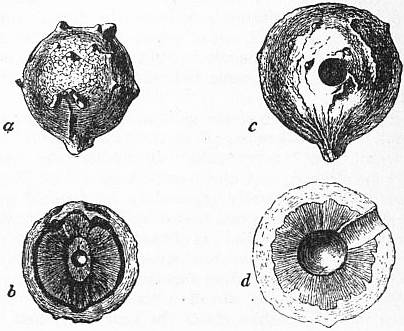
Fig. 1.—a, Aleppo “blue” gall; b, ditto in section, showing central cavity for grub; c, Aleppo “white” gall, perforated by insect; d, the same in section (natural size).
The gall-making Hymenoptera include, besides the Cynipidae proper, certain species of the genus Eurytoma (Isosoma, Walsh) and family Chalcididae, e.g. E. hordei, the “joint-worm” of the United States, which produces galls on the stalks of wheat;20 also various members of the family Tenthredinidae, or saw-flies. The larvae of the latter usually vacate their galls, to spin their cocoons in the earth, or, as in the case of Athalia abdominalis, Klg., of the clematis, may emerge from their shelter to feed for some days on the leaves of the gall-bearing plant.
The dipterous gall-formers include the gall-midges, or gall-gnats (Cecidomyidae), minute slender-bodied insects, with bodies usually covered with long hairs, and the wings folded over the back. Some of them build cocoons within their galls, others descend to the ground or become pupae. The true willow-galls are the work either of these or of saw-flies. Their galls are to be met with on a great variety of plants of widely distinct genera, e.g. the ash, maple, horn-beam, oak,21 grape-vine,22 alder, gooseberry, blackberry, pine, juniper, thistle, fennel, meadowsweet,23 common cabbage and cereals. In the northern United States, in May, “legions of these delicate minute flies fill the air at twilight, hovering over wheat-fields and shrubbery. A strong north-west wind, at such times, is of incalculable value to the farmer.”24 Other gall-making dipterous flies are members of the family Trypetidae, which disfigure the seed-heads of plants, and of the family Mycetophilidae, such as the species Sciara tilicola,25 Löw, the cause of the oblong or rounded green and red galls of the young shoots and leaves of the lime.
Galls are formed also by hemipterous and homopterous insects of the families Tingidae, Psyllidae, Coccidae and Aphidae. Coccus pinicorticis causes the growth of patches of white flocculent and downy matter on the smooth bark of young trees of the white pine in America.26 The galls of examples of the last family are common objects on lime-leaves, and on the petioles of the poplar. An American Aphid of the genus Pemphigus produces black, ragged, leathery and cut-shaped excrescences on the young branches of the hickory.
The Chinese galls of commerce (Woo-pei-tsze) are stated to be produced by Aphis Chinensis, Bell, on Rhus semialata, Murr. (R. Bucki-amela, Roxb.), an Anacardiaceous tree indigenous to N. India, China and Japan. They are hollow, brittle, irregularly pyriform, tuberculated or branched vesicles, with thin walls, covered externally with a grey down, and internally with a white chalk-like matter, and insect-remains (see fig. 2). The escape of the insect takes place on the spontaneous bursting of the walls of the vesicle, probably when, after viviparous (thelytokous) reproduction for several generations, male winged insects are developed. The galls are gathered before the frosts set in, and are exposed to steam to kill the insects.27
Chinese galls examined by Viedt28 yielded 72% of tannin, and less mucilage than Aleppo galls. Several other varieties of galls are produced by Aphides on species of Pistacia.
M.J. Lichtenstein has established the fact that from the egg of the Aphis of Pistachio galls, Anopleura lentisci, is hatched an apterous insect (the gall-founder), which gives birth to young Aphides (emigrants), and that these, having acquired wings, fly to the roots of certain grasses (Bromus sterilis and Hordeum vulgare), and by budding underground give rise to several generations of apterous insects, whence finally comes a winged brood (the pupifera). These last issuing from the ground fly to the Pistachio, and on it deposit their pupae. From the pupae, again, are developed sexual individuals, the females of which lay fecundated eggs productive of gall-founders, thus recommencing the biological cycle (see Compt. rend., Nov. 18, 1878, p. 782, quoted in Ann. and Mag. Nat. Hist., 1879, p. 174).
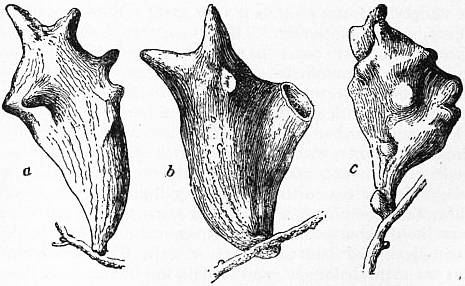
Fig. 2.—a, Chinese gall (abt. ½ natural size); b, ditto broken, showing thin-walled cavity; c, Japanese gall (natural size).
Of other insects which have been recognized as gall-makers there are, among the Coleoptera, certain Curculionids (gall-weevils), and species of the exotic Sagridae and Lamiadae and an American beetle, Saperda inornata (Cerambycidae), which forms the pseudo-galls of Salix longifolia and Populus angulata, or cottonwood. Among the Lepidoptera are gall-forming species belonging to the Tineidae, Aegeriidae, Tortricidae and Pterophoridae. The larva of a New Zealand moth, Morova subfasciata, Walk. (Cacoëcia gallicolens), of the family Drepanulidae, causes the stem of a creeping plant, on the pith of which it apparently subsists, to swell up into a fusiform gall.29
Mite-galls, or acarocecidia, are abnormal growths of the leaves of plants, produced by microscopic Acaridea of the genus Phytoptus (gall-mites), and consist of little tufts of hairs, or of thickened portions of the leaves, usually most hypertrophied on the upper surface, so that the lower is drawn up into the interior, producing a bursiform cavity. Mite-galls occur on the sycamore, pear, plum, ash, alder, vine, mulberry and many other plants; and formerly, e.g. the gall known as Erineum quercinum, on the leaves of Quercus Cerris, were taken for cryptogamic structures. The lime-leaf “nail-galls” of Phytoptus tiliae closely resemble the “trumpet-galls” formed on American vines by a species of Cecidomyia.30 Certain minute Nematoid worms, as Anguillula scandens, which infests the ears of wheat, also give rise to galls.
Besides the larva of the gall-maker, or the householder, galls usually contain inquilines or lodgers, the larvae of what are termed guest-flies or cuckoo-flies. Thus the galls of Cynips and its allies are inhabited by members of other cynipideous genera, as Synergus, Amblynotus and Synophrus; and the pine-cone-like gall of Salix strobiloides, as Walsh has shown,30 is made by a large species of Cecidomyia, which inhabits the heart of the mass, the numerous smaller cecidomyidous larvae in its outer part being mere inquilines. In many instances the lodgers are not of the same order of insects as the gall-makers. Some saw-flies, for example, are inquilinous in the galls of gall-gnats and some gall-gnats in the galls of saw-flies. Again, galls may afford harbour to insects which are not essentially gall-feeders, as in the case of the Curculio beetle Conotrachelius nenuphar, Hbst., of which one brood eats the fleshy part of the plum and peach, and another lives in the “black knot” of the plum-tree, regarded by Walsh as probably a true cecidomyidous gall. The same authority (loc. cit. p. 550) mentions a willow-gall which provides no less than sixteen insects with food and protection; these are preyed upon by about eight others, so that altogether some twenty-four insects, representing eight orders, are dependent for their existence on what to the common observer appears to be nothing but “an unmeaning mass of leaves.” Among the numerous insects parasitic on the inhabitants of galls are hymenopterous flies of the family Proctotrypidae, and of the family Chalcididae, e.g. Callimome regius, the larva of which preys on the larvae of both Cynips glutinosa and its lodger Synergus facialis. The oak-apple often contains the larvae of Braconidae and Ichneumonidae, which Von Schlechtendal (loc. sup. cit. p. 33) considers to be parasites not on the owner of the gall, Andricus terminalis, but on inquilinous Tortricidae. Birds are to be included among the enemies of gall-insects. Oak-galls, for example, are broken open by the titmouse in order to obtain the grub within, and the “button-galls” of Neuroterus numismatis, Oliv., are eaten by pheasants.
A great variety of deformations and growths produced by insects and mites as well as by fungi have been described. They are in some cases very slight, and in others form remarkably large and definite structures. The whole are now included under the term Cecidia; a prefix gives the name of the organism to which the attacks are due, e.g. Phytoptocecidia are the galls formed by Phytoptid mites. Simple galls are those that arise when only one member of a plant is involved; compound galls are the result of attacks on buds. Amongst the most remarkable galls recently discovered we may mention those found on Eucalyptus, Casuarina and other trees and plants in Australia. They are remarkable for their variety, and are due to small scale-insects of the peculiar sub-family Brachyscelinae. As regards the mode of production of galls, the most important distinction is between galls that result from the introduction of an egg, or other matter, into the interior of the plant, and those that are due to an agent acting externally, the gall in the latter case frequently growing in such a manner as ultimately to enclose its producers. The form and nature of the gall are the result of the powers of growth possessed by the plant. It has long been known, and is now generally recognized, that a gall can only be produced when the tissue of a plant is interfered with during, or prior to, the actual development of the tissue. Little more than this is known. The power that gall-producers possess of influencing by direct interference the growth of the cells of the plant that affords them the means of subsistence is an art that appears to be widely spread among animals, but is at the same time one of which we have little knowledge. The views of Adler as to the alternation of generations of numerous gall-flies have been fully confirmed, it having been ascertained by direct observation that the galls and the insects produced from them in one generation are entirely different from the next generation; and it has also been rendered certain that frequently one of the alternate generations is parthenogenetic, no males being produced. It is supposed that these remarkable phenomena have gradually been evoked by difference in the nutrition of the alternating generations. When two different generations are produced in one year on the same kind of tree it is clear the properties of the sap and tissues of the tree must be diverse so that the two generations are adapted to different conditions. In some cases the alternating generations are produced on different species of trees, and even on different parts of the two species.
On galls and their makers and inhabitants see further—J.T.C. Ratzeburg, Die Forst-Insecten, Teil iii. pp. 53 seq. (Berlin, 1844); T.W. Harris, Insects injurious to Vegetation (Boston, U.S., 2nd ed., 1852); C.L. Koch, Die Pflanzenläuse Aphiden (Nuremberg, 1854); T. Hartig, Die Familien der Blattwespen und Holzwespen (Berlin, 1860); Walsh, “On the Insects, Coleopterous, Hymenopterous and Dipterous, inhabiting the Galls of certain species of Willow,” Proc. Ent. Soc. Philadelphia, iii. (1863-1864), pp. 543-644, and vi. (1866-1867), pp. 223-288; T.A. Marshall, “On some British Cynipidae,” Ent. Month. Mag. iv. pp. 6-8, &c.; H.W. Kidd and Albert Müller, “A List of Gall-bearing British Plants,” ib. v. pp. 118 and 216; G.L. Mayr, Die mitteleuropäischen Eichengallen in Wort und Bild (Vienna, 1870-1871), and the translation of that work, with notes, in the Entomologist, vols. vii. seq.; also, by the same author, “Die Einmiethler der mitteleuropäischen Eichengallen,” Verhandl. d. zoolog.-bot. Ges. in Wien, xxii. pp. 669-726; and “Die europäischen Torymiden,” ib. xxiv. pp. 53-142 (abstracted in Cistula entomologica, i., London, 1869-1876); F. Löw, “Beiträge zur Kenntnis der Gallmücken,” ib. pp. 143-162, and 321-328; J.E. von Bergenstamm and P. Löw, “Synopsis Cecidomyidarum,” ib. xxvi. pp. 1-104; Perris, Ann. Soc. Entom. de France, 4th ser. vol. x. pp. 176-185; R. Osten-Sacken, “On the North American Cecidomyidae,” Smithsonian Miscellaneous Collections, vol. vi. (1867), p. 173; E.L. Taschenberg, Entomologie für Gärtner und Gartenfreunde (Leipzig, 1871); J.W.H. Traill, “Scottish Galls,” Scottish Naturalist, i. (1871), pp. 123, &c.; Albert Müller, “British Gall Insects,” The Entomologist’s Annual for 1872, pp. 1-22; B. Altum, Forstzoologie, iii. “Insecten,” pp. 250 seq. (Berlin, 1874); J.H. Kaltenbach, Die Pflanzenfeinde aus der Classe der Insecten (Stuttgart, 1874); A. d’Arbois de Jubainville and J. Vesque, Les Maladies des plantes cultivées, pp. 98-105 (Paris, 1878).
(F. H. B.)
1 Quoted in Zoological Record, iv. (1867), p. 192.
2 P. Cameron, Scottish Naturalist, ii. pp. 11-15.
3 Entomologist, vii. p. 47.
4 See in Proc. Entom. Soc. of London for the Year 1873, p. xvi.
5 See A. Müller, Gardener’s Chronicle (1871), pp. 1162 and 1518; and E.A. Fitch, Entomologist, xi. p. 129.
6 Entomologist, vi. pp. 275-278, 339-340.
7 Verhandl. d. zoolog.-bot. Ges. in Wien, xxi. p. 799.
8 Darwin, Variations of Animals and Plants under Domestication, ii. p. 282.
9 “Recherches pour servir à l’histoire des galles,” Ann. des sci. nat. xix. pp. 293 sqq.
10 According to Dr Adler, alternation of generations takes place between N. lenticularis and Spathegaster baccarum (see E.A. Ormerod, Entomologist, xi. p. 34).
11 See Westwood, Introd. to the Mod. Classif. of Insects, ii. (1840) p. 130.
12 For figures and descriptions of insect and gall, see Entomologist, iv. p. 17, vii. p. 241, ix. p. 53, xi. p. 131.
13 Scottish Naturalist, i. (1871) p. 116, &c.
14 Vinen, Journ. de pharm. et de chim. xxx. (1856) p. 290; “English Ink-Galls,” Pharm. Journ. 2nd ser. iv. p. 520.
15 See Pereira, Materia Medica, vol. ii. pt. i. p. 347; Pharm. Journ. 1st ser. vol. viii. pp. 422-424.
16 See R.H. Stretch and C.D. Gibbes, Proc. California Acad. of Sciences, iv. pp. 265 and 266.
17 A Complete History of Drugs (translation), p. 169 (London, 1748).
18 F. Porter Smith, Contrib. towards the Mat. Medica ... of China, p. 100 (1871).
19 R.F. Burton, First Footsteps in E. Africa, p. 178 (1856).
20 A.S. Packard, jun., Guide to the Study of Insects, p. 205 (Salem, 1870).
21 On the Cecidomyids of Quercus Cerris, see Fitch, Entomologist, xi. p. 14.
22 See, on Cecidomyia oenephila, Von Haimhoffen, Verhandl. d. zoolog.-bot. Ges. in Wien, xxv. pp. 801-810.
23 See Entomologist’s Month. Mag. iv. (1868) p. 233; and for figure and description, Entomologist, xi. p. 13.
24 A.S. Packard, jun., Our Common Insects, p. 203 (Salem, U.S. 1873). On the Hessian fly, Cecidomyia destructor, Say, the May brood of which produces swellings immediately above the joints of barley attacked by it, see Asa Fitch, The Hessian Fly (Albany, 1847), reprinted from Trans. New York State Agric. Soc. vol. vi.
25 J. Winnertz, Beitrag zu einer Monographie der Sciarinen, p. 164 (Vienna, 1867).
26 Asa Fitch, First and Second Rep. on the Noxious ... Insects of the State of New York, p. 167 (Albany, 1856).
27 See E. Doubleday, Pharm. Journ. 1st ser, vol. vii. p. 310: and Pereira, ib. vol. iii. p. 377.
28 Dingler’s Polyt. Journ. ccxvi. p. 453.
29 For figure and description see Zoology of the “Erebus” and “Terror,” ii. pp. 46, 47 (1844-1875).
30 On the mite-galls and their makers, see F. Löw, “Beiträge zur Naturgesch. der Gallmilben (Phytoptus, Duj.),” Verhandl. d. zoolog.-bot. Ges. in Wien, xxiv. (1874), pp. 2-16, with plate; and “Über Milbengallen (Acarocecidien) der Wiener-Gegend,” ib. pp. 495-508; Andrew Murray, Economic Entomology, Aptera, pp. 331-374 (1876); and F.A.W. Thomas, Ältere und neue Beobachtungen über Phytopto-Cecidien (Halle, 1877).
GALLUPPI, PASQUALE (1770-1846), Italian philosopher, was born on the 2nd of April 1770 at Tropea, in Calabria. He was of good family, and after studying at the university of Naples he entered the public service, and was for many years employed in the office of the administration of finances. At the age of sixty, having become widely known by his writings on philosophy, he was called to the chair of logic and metaphysics in the university of Naples, which he held till his death in November 1846. His most important works are: Lettere filosofiche (1827), in which he traces his philosophical development; Elementi di filosofia (1832); Saggio filosofico sulla critica della conoscenza (1819-1832); Sull’ analisi e sulla sintesi (1807); Lezioni di logica e di metafisica (1832-1836); Filosofia della volontà (1832-1842, incomplete); Storia della filosofia (i., 1842); Considerazioni filosofiche sull’ idealismo trascendentale (1841), a memoir on the system of Fichte.
On his philosophical views see L. Ferri, Essai sur l’histoire de la philosophie en Italie au XIXe siècle, i. (1869); V. Botta in Ueberweg’s Hist. of Philosophy, ii. app. 2; G. Barzellotti, “Philosophy in Italy,” in Mind, iii. (1878); V. Lastrucci, Pasquale Galluppi. Studio critico (Florence, 1890).
GALLUS, CORNELIUS (c. 70-26 B.C.), Roman poet, orator and politician, was born of humble parents at Forum Julii (Fréjus) in Gaul. At an early age he removed to Rome, where he was taught by the same master as Virgil and Varius Rufus. Virgil, who dedicated one of his eclogues (x.) to him, was in great measure indebted to the influence of Gallus for the restoration of his estate. In political life Gallus espoused the cause of Octavianus, and as a reward for his services was made praefect of Egypt (Suetonius, Augustus, 66). His conduct in this position afterwards brought him into disgrace with the emperor, and having been deprived of his estates and sentenced to banishment, he put an end to his life (Dio Cassius liii. 23). Gallus enjoyed a high reputation among his contemporaries as a man of intellect, and Ovid (Tristia, iv. 10) considered him the first of the elegiac poets of Rome. He wrote four books of elegies chiefly on his mistress Lycoris (a poetical name for Cytheris, a notorious actress), in which he took for his model Euphorion of Chalcis (q.v.); he also translated some of this author’s works into Latin. Nothing by him has survived; the fragments of the four poems attributed to him (first published by Aldus Manutius in 1590 and printed in A. Riese’s Anthologia Latina, 1869) are generally regarded as a forgery.
See C. Völker, De C. Galli vita et scriptis (1840-1844); A. Nicolas, De la vie et des ouvrages de C. Gallus (1851), an exhaustive monograph. An inscription found at Philae (published 1896) records the Egyptian exploits; see M. Schanz, Geschichte der römischen Litteratur, and Plessis, Poésie latine (1909).
GALLUS, GAIUS AELIUS, praefect of Egypt 26-24 B.C. By order of Augustus he undertook an expedition to Arabia Felix, with disastrous results. The troops suffered greatly from disease, heat, want of water and the obstinate resistance of the inhabitants. The treachery of a foreign guide also added to his difficulties. After six months Gallus was obliged to return to Alexandria, having lost the greater part of his force. He was a friend of the geographer Strabo, who gives an account of the expedition (xvi. pp. 780-782; see also Dio Cassius liii. 29; Pliny, Nat. Hist. vi. 32; C. Merivale, Hist. of the Romans under the Empire, ch. 34; H. Krüger, Der Feldzug des A. G. nach dem glücklichen Arabien, 1862). He has been identified with the Aelius Gallus frequently quoted by Galen, whose remedies are stated to have been used with success in an Arabian expedition.
GALLUS, GAIUS CESTIUS, governor of Syria during the reign of Nero. When the Jews in Jerusalem, stirred to revolt by the outrages of the Roman procurators, had seized the fortress of Masada and treacherously murdered the garrison of the palace of Herod, Gallus set out from Antioch to restore order. On the 17th of November A.D. 66 he arrived before Jerusalem. Having gained possession of the northern suburb, he attacked the temple mount; but, after five days’ fighting, just when (according to Josephus) success was within his grasp, he unaccountably withdrew his forces. During his retreat he was closely pursued by the Jews and surrounded in a ravine, and only succeeded in making good his escape to Antioch by sacrificing the greater part of his army and a large amount of war material. Soon after his return Gallus died (before the spring of 67), and was succeeded in the governorship by Licinius Mucianus, the prosecution of the war being entrusted to Vespasian.
See Tacitus, Hist. v. 10, 13; Suetonius, Vespasian, 4; Josephus, Bell. Jud. ii. 14-20; E. Schürer, Hist. of the Jewish People, div. i. vol. ii. p. 212 (Eng. tr., 1890).
GALLUS, GAIUS SULPICIUS, Roman general, statesman and orator. Under Lucius Aemilius Paulus, his intimate friend, he commanded the 2nd legion in the campaign against Perseus, king of Macedonia, and gained great reputation for having predicted an eclipse of the moon on the night before the battle of Pydna (168 B.C.). On his return from Macedonia he was elected consul (166), and in the same year reduced the Ligurians to submission. In 164 he was sent as ambassador to Greece and Asia, where he held a meeting at Sardis to investigate the charges brought against Eumenes of Pergamum by the representatives of various cities of Asia Minor. Gallus was a man of great learning, an excellent Greek scholar, and in his later years devoted himself to the study of astronomy, on which subject he is quoted as an authority by Pliny.
See Livy xliv. 37, Epit. 46; Polybius xxxi. 9, 10; Cicero, Brutus, 20, De officiis, i. 6, De senectute, 14; Pliny, Nat. Hist. ii. 9.
GALOIS, EVARISTE (1811-1832), French mathematician, was born on the 25th of October 1811, and killed in a duel on the 31st of May 1832. An obituary notice by his friend Auguste Chevalier appeared in the Revue encyclopédique (1832); and his collected works are published, Journal de Liouville (1846), pp. 381-444, about fifty of these pages being occupied by researches on the resolubility of algebraic equations by radicals. This branch of algebra he notably enriched, and to him is also due the notion of a group of substitutions (see Equation: Theory of Equations; also Groups, Theory of).
His collected works, with an introduction by C.F. Picard, were published in 1897 at Paris.
GALSTON, a police burgh and manufacturing town of Ayrshire, Scotland. Pop. (1901) 4876. It is situated on the Irvine, 5 m. E. by S. of Kilmarnock, with a station on the Glasgow & South-Western railway. The manufactures include blankets, lace, muslin, hosiery and paper-millboard, and coal is worked in the vicinity. About 1 m. to the north, amid the “bonnie woods and braes,” is Loudoun Castle, a seat of the earl of Loudoun.
GALT, SIR ALEXANDER TILLOCH (1817-1893), Canadian statesman, was the youngest son of John Galt the author. Born in London on the 6th of September 1817, he emigrated to Canada in 1835, and settled in Sherbrooke, in the province of Quebec, where he entered the service of the British American Land Company, of which he rose to be chief commissioner. Later he was one of the contractors for extending the Grand Trunk railway westward from Toronto. He entered public life in 1849 as Liberal member for the county of Sherbrooke, but opposed the chief measure of his party, the Rebellion Losses Bill, and in the same year signed a manifesto in favour of union with the United States, believing that in no other way could Protestant and Anglo-Saxon ascendancy over the Roman Catholic French majority in his native province be maintained. In the same year he retired from parliament but re-entered it in 1853, and was till 1872 the chief representative of the English-speaking Protestants of Quebec province. On the fall of the Brown-Dorion administration in 1858 he was called on to form a ministry, but declined the task, and became finance minister under Sir John Macdonald and Sir George Cartier on condition that the federation of the British North American provinces should become a part of their programme. From 1858 to 1862 and 1864 to 1867 he was finance minister, and did much to reduce the somewhat chaotic finances of Canada into order. To him are due the introduction of the decimal system of currency and the adoption of a system of protection to Canadian manufactures. To his diplomacy was due the coalition in 1864 between Macdonald, Brown and Cartier, which carried the federation of the British North American provinces, and throughout the three years of negotiation which followed his was one of the chief influences. He became finance minister in the first Dominion ministry, but suddenly and mysteriously resigned on the 4th of November 1867. After his retirement he gave to the administration of Sir John Macdonald a support which grew more and more fitful, and advocated independence as the final destiny of Canada. In 1871 he was again offered the ministry of finance on condition of abandoning these views, but declined. In 1877 he was the Canadian nominee on the Anglo-American fisheries commission at Halifax, and rendered brilliant service. In 1880 he was appointed Canadian high commissioner to Great Britain, but retired in 1883 in favour of Sir Charles Tupper. During this period he advocated imperial federation. He was Canadian delegate at the Paris Monetary Conference of 1881, and to the International Exhibition of Fisheries in 1883. From this date till his death on the 19th of September 1893 he lived in retirement. No Canadian statesman has had sounder or more abundant ideas, but a certain intellectual fickleness made him always a somewhat untrustworthy colleague in political life.
(W. L. G.)
GALT, JOHN (1779-1839), Scottish novelist, was born at Irvine, Ayrshire, on the 2nd of May 1779. He received his early education at Irvine and Greenock, and read largely from one of the public libraries while serving as a clerk in a mercantile office. In 1804 he went to settle in London, where he published anonymously a poem on the Battle of Largs. After unsuccessful attempts to succeed in business Galt entered at Lincoln’s Inn, but was never called to the bar. He obtained a commission from a British firm to go abroad to find out whether the Berlin and Milan decrees could be evaded. He met Byron and Sir John Hobhouse at Gibraltar, travelled with Byron to Malta, and met him again at Athens. He was afterwards employed by the Glasgow merchant Kirkman Finlay on similar business at Gibraltar, and in 1814 visited France and Holland. His early works are the Life and Administration of Wolsey, Voyages and Travels, Letters from the Levant, the Life of Benjamin West, Historical Pictures and The Wandering Jew; and he induced Colburn to publish a periodical containing dramatic pieces rejected by London managers. These were afterwards edited by Galt as the New British Theatre, which included some plays of his own. He first showed his real power as a writer of fiction in The Ayrshire Legatees, which appeared in Blackwood’s Magazine in 1820. This was followed in 1821 by his masterpiece—The Annals of the Parish; and, at short intervals, Sir Andrew Wylie, The Entail, The Steam-Boat and The Provost were published. These humorous studies of Scottish character are all in his happiest manner. His next works were Ringan Gilhaize (1823), a story of the Covenanters; The Spaewife (1823), which relates to the times of James I. of Scotland; Rothelan (1824), a novel founded on the reign of Edward III.; The Omen (1825), which was favourably criticized by Sir Walter Scott; and The Last of the Lairds, another picture of Scottish life.
In 1826 he went to America as secretary to the Canada Land Company. He carried out extensive schemes of colonization, and opened up a road through what was then forest country between Lakes Huron and Erie. In 1827 he founded Guelph in upper Canada, passing on his way the township of Galt on the Grand river, named after him by the Hon. William Dixon. But all this work proved financially unprofitable to Galt. In 1829 he returned to England commercially a ruined man, and devoted himself with great ardour to literary pursuits, of which the first fruit was Lawrie Todd—one of his best novels. Then came Southennan, a tale of Scottish life in the times of Queen Mary. In 1830 he was appointed editor of the Courier newspaper—a post he soon relinquished. His untiring industry was seen in the publication, in rapid succession, of a Life of Byron, Lives of the Players, Bogle Corbet, Stanley Buxton, The Member, The Radical, Eben Erskine, The Stolen Child, his Autobiography, and a collection of tales entitled Stories of the Study. In 1834 appeared his Literary Life and Miscellanies, dedicated by permission to William IV., who sent the author a present of £200. As soon as this work was published Galt retired to Greenock, where he continued his literary labours till his death on the 11th of April 1839.
Galt, like almost all voluminous writers, was exceedingly unequal. His masterpieces are The Ayrshire Legatees, The Annals of the Parish, Sir Andrew Wylie, The Entail, The Provost and Lawrie Todd. The Ayrshire Legatees gives, in the form of a number of exceedingly diverting letters, the adventures of the Rev. Dr Pringle and his family in London. The letters are made the excuse for endless tea-parties and meetings of kirk-session in the rural parish of Garnock. The Annals of the Parish are told by the Rev. Micah Balwhidder, Galt’s finest character. This work (which, be it remembered, existed in MS. before Waverley was published) is a splendid picture of the old-fashioned Scottish pastor and the life of a country parish; and, in rich humour, genuine pathos and truth to nature it is unsurpassed even by Scott. It is a fine specimen of the homely graces of the Scottish dialect, and preserves much vigorous Doric phraseology fast passing out of use even in country districts. In this novel Mr Galt used, for the first time, the term “Utilitarian,” which afterwards became so intimately associated with the doctrines of John Stuart Mill and Bentham (see Annals of the Parish, chap. xxxv., and a note by Mill in Utilitarianism, chap. ii.). In Sir Andrew Wylie the hero entered London as a poor lad, but achieved remarkable success by his shrewd business qualities. The character is somewhat exaggerated, but excessively amusing. The Entail was read thrice by Byron and Scott, and is the best of Galt’s longer novels. Leddy Grippy is a wonderful creation, and was considered by Byron equal to any female character in literature since Shakespeare’s time. The Provost, in which Provost Pawkie tells his own story, portrays inimitably the jobbery, bickerings and self-seeking of municipal dignitaries in a quaint Scottish burgh. In Lawrie Todd Galt, by giving us the Scot in America, accomplished a feat which Sir Walter never attempted. This novel exhibits more variety of style and a greater love of nature than his other books. The life of a settler is depicted with unerring pencil, and with an enthusiasm and imaginative power much more poetical than any of the author’s professed poems.
The best of Galt’s novels were reprinted in Blackwood’s Standard Novels, to volume i. of which his friend Dr Moir prefixed a memoir.
GALT, a town in Waterloo county, Ontario, Canada, 23 m. N.N.W. of Hamilton, on the Grand river and on the Grand Trunk and Canadian Pacific railways. Pop. (1881) 5187; (1901) 7866. It is named after John Galt, the author. It has excellent water privileges which furnish power for flour-mills and for manufactures of edge tools, castings, machinery, paper and other industries.
GALTON, SIR FRANCIS (1822- ), English anthropologist, son of S.T. Galton, of Duddeston, Warwickshire, was born on the 16th of February 1822. His grandfather was the poet-naturalist Erasmus Darwin, and Charles Darwin was his cousin. After attending King Edward VI.’s grammar school, Birmingham, he studied at Birmingham hospital, and afterwards at King’s College, London, with the intention of making medicine his profession; but after taking his degree at Trinity College, Cambridge, in 1843 he changed his mind. The years 1845-1846 he spent in travelling in the Sudan, and in 1850 he made an exploration, with Dr John Anderson, of Damaraland and the Ovampo country in south-west Africa, starting from Walfisch Bay. These tracts had practically never been traversed before, and on the appearance of the published account of his journey and experiences under the title of Narrative of an Explorer in Tropical South Africa (1853) Galton was awarded the gold medal of the Royal Geographical Society. His Art of Travel; or, Shifts and Contrivances in Wild Countries was first published in 1855. In 1860 he visited the north of Spain, and published the fruits of his observations of the country and the people in the first of a series of volumes, which he edited, entitled Vacation Tourists. He then turned to meteorology, the result of his investigations appearing in Meteorographica, published in 1863. This work was the first serious attempt to chart the weather on an extensive scale, and in it also the author first established the existence and theory of anti-cyclones. Galton was a member of the meteorological committee (1868), and of the Meteorological Council which succeeded it, for over thirty years. But his name is most closely associated with studies in anthropology and especially in heredity. In 1869 appeared his Hereditary Genius, its Laws and Consequences, a work which excited much interest in scientific and medical circles. This was followed by English Men of Science, their Nature and Nurture, published in 1874; Inquiries into Human Faculty and its Development, issued in 1883; Life-History Album (1884); Record of Family Faculties (1884) (tabular forms and directions for entering data, with a preface); and Natural Inheritance (1889). The idea that systematic efforts should be made to improve the breed of mankind by checking the birth-rate of the unfit and furthering the productivity of the fit was first put forward by him In 1865; he mooted it again in 1884, using the term “eugenics” for the first time in Human Faculty, and in 1904 he endowed a research fellowship in the university of London for the promotion of knowledge of that subject, which was defined as “the study of agencies under social control that may improve or impair the racial qualities of future generations, either physically or mentally.” Galton was the author of memoirs on various anthropometric subjects; he originated the process of composite portraiture, and paid much attention to finger-prints and their employment for the identification of criminals, his publications on this subject including Finger Prints (1892), Decipherment of Blurred Finger Prints (1893) and Finger Print Directories (1895). From the Royal Society, of which he was elected a fellow in 1860, he received a royal medal in 1886 and the Darwin medal in 1902, and honorary degrees were bestowed on him by Oxford (1894) and Cambridge (1895). In 1908 he published Memories of My Life, and in 1909 he received a knighthood.
GALUPPI, BALDASSARE (1706-1785), Italian musical composer, was born on the 18th of October 1706 on the island of Burano near Venice, from which he was often known by the nickname of Buranello. His father, a barber, and violinist at the local theatre, was his first teacher. His first opera, composed at the age of sixteen, being hissed off the stage, he determined to study seriously, and entered the Conservatorio degli Incurabili at Venice, as a pupil of Antonio Lotti. After successfully producing two operas in collaboration with a fellow-pupil, G.B. Pescetti, in 1728 and 1729, he entered upon a busy career as a composer of operas for Venetian theatres, writing sometimes as many as five in a year. He visited London in 1741, and arranged a pasticcio, Alexander in Persia, for the Haymarket. Burney considered his influence on English music to have been very powerful. In 1740 he became vice-maestro di cappella at St Mark’s and maestro in 1762. In 1749 he began writing comic operas to libretti by Goldoni, which enjoyed an enormous popularity. He was invited to Russia by Catherine II. in 1766, where his operas made a favourable impression, and his influence was also felt in Russian church music. He returned to Venice in 1768, where he had held the post of director of the Conservatorio degli Incurabili since 1762. He died on the 3rd of January 1785.
Galuppi’s best works are his comic operas, of which Il Filosofo di Campagna (1754), known in England as The Guardian Trick’d (Dublin, 1762) was the most popular. His melody is attractive rather than original, but his workmanship in harmony and orchestration is generally superior to that of his contemporaries. He seems to have been the first to extend the concerted finales of Leo and Logroscino into a chain of several separate movements, working up to a climax, but in this respect he is much inferior to Sarti and Mozart.
Browning’s poem, “A Toccata of Galuppi,” does not refer to any known composition, but more probably to an imaginary extemporization on the harpsichord, such as was of frequent occurrence in the musical gatherings of Galuppi’s day.
See also Alfred Wotquerme, Baldassare Galuppi, étude bibliographique sur ses œuvres dramatiques (Brussels, 1902). Many of his autograph scores are in the library of the Brussels conservatoire.
(E. J. D.)
GALVANI, LUIGI (1737-1798), Italian physiologist, after whom galvanism received its name, was born at Bologna on the 9th of September 1737. It was his wish in early life to enter the church, but by his parents he was educated for a medical career. At the university of Bologna, in which city he practised, he was in 1762 appointed public lecturer in anatomy, and soon gained repute as a skilled though not eloquent teacher, and, chiefly from his researches on the organs of hearing and genito-urinary tract of birds, as a comparative anatomist. His celebrated theory of animal electricity he enunciated in a treatise, “De viribus electricitatis in motu musculari commentarius,” published in the 7th volume of the memoirs of the Institute of Sciences at Bologna in 1791, and separately at Modena in the following year, and elsewhere subsequently. The statement has frequently been repeated that, in 1786, Galvani had noticed that the leg of a skinned frog, on being accidentally touched by a scalpel which had lain near an electrical machine, was thrown into violent convulsions; and that it was thus that his attention was first directed to the relations of animal functions to electricity. From documents in the possession of the Institute of Bologna, however, it appears that twenty years previous to the publication of his Commentary Galvani was already engaged in investigations as to the action of electricity upon the muscles of frogs. The observation that the suspension of certain of these animals on an iron railing by copper hooks caused twitching in the muscles of their legs led him to the invention of his metallic arc, the first experiment with which is described in the third part of the Commentary, with the date September 20, 1786. The arc he constructed of two different metals, which, placed in contact the one with a frog’s nerve and the other with a muscle, caused contraction of the latter. In Galvani’s view the motions of the muscle were the result of the union, by means of the metallic arc, of its exterior or negative electrical charge with positive electricity which proceeded along the nerve from its inner substance. Volta, on the other hand, attributed them solely to the effect of electricity having its source in the junction of the two dissimilar metals of the arc, and regarded the nerve and muscle simply as conductors. On Galvani’s refusal, from religious scruples, to take the oath of allegiance to the Cisalpine republic in 1797, he was removed from his professorship. Deprived thus of the means of livelihood, he retired to the house of his brother Giacomo, where he soon fell into a feverish decline. The republican government, in consideration of his great scientific fame, eventually, but too late, determined to reinstate him in his chair, and he died at Bologna on the 4th of December 1798.
A quarto edition of his works was published at Bologna in 1841-1842, by the Academy of Sciences of the Institute of that city, under the title Opere edite ed inedite del professore Luigi Galvani.
GALVANIZED IRON, sheet iron having its surface covered with a thin coating of zinc. In spite of the name, galvanic action has often no part in the production of galvanized iron, which is prepared by dipping the iron, properly cleaned and pickled in acid, in a bath of molten zinc. The hotter the zinc the thinner the coating, but as a high temperature of the bath is attended with certain objections, it is a common practice to use a moderate temperature and clear off the excess of zinc by passing the plates between rollers. In Norwood and Rogers’s process a thin coating of tin is applied to the iron before it is dipped in the zinc, by putting the plates between layers of granulated tin in a wooden tank containing a dilute solution of stannous chloride, when tin is deposited on them by galvanic action. In “cold galvanizing” the zinc is deposited electrolytically from a bath, preferably kept neutral or slightly acid, containing a 10% solution of crystallized zinc sulphate, ZnSO4·7H2O. The resulting surface is usually duller and less lustrous than that obtained by the use of molten zinc. Another method of forming a coating of zinc, known as “sherardizing,” was invented by Sherard Cowper-Coles, who found that metals embedded in zinc dust (a product obtained in zinc manufacture and consisting of metallic zinc mixed with a certain amount of zinc oxide) and heated to temperatures well below the melting point of zinc, become coated with a layer of that metal. In carrying out the process the articles are placed in an air-tight vessel with the zinc dust, which must be dry, and subjected to a heat of 250-330°C., the time for which the heating is continued depending on the thickness of the deposit required and varying from one-half to several hours. If an air-tight receptacle is not available, a small percentage of powdered carbon is added to the zinc-dust, to prevent increase in the amount of oxide, which, if present in excess, tends to make the deposit dull.
Galvanized iron by its zinc surface is protected from corrosion by the weather, though the protection is not very efficient in the presence of acid or sulphurous fumes, and accordingly it is extensively employed for roofing, especially in the form of corrugated sheets. The iron wire used for wire-netting, telegraphic purposes, &c., is commonly galvanized, as also are bolts, nuts, chains and other fittings on ships.
GALVANOMETER, an instrument for detecting or measuring electric currents. The term is generally applied to instruments which indicate electric current in scale divisions or arbitrary units, as opposed to instruments called amperemeters (q.v.), which show directly on a dial the value of the current in amperes. Galvanometers may be divided into direct current and alternating current instruments, according as they are intended to measure one or other of these two classes of currents (see Electrokinetics).
Direct Current Galvanometers.—The principle on which one type of direct current galvanometer, called a movable needle galvanometer, depends for its action is that a small magnet when suspended in the centre of a coil of wire tends to set its magnetic axis in the direction of the magnetic field of the coil at that point due to the current passing through it. In the other type, or movable coil galvanometer, the coil is suspended and the magnet fixed; hence the coil tends to set itself with its axis parallel to the lines of force of the magnet. The movable system must be constrained in some way to take up and retain a definite position when no current is passing by means which are called the “control.”
In its simple and original form the movable needle galvanometer consisted of a horizontal magnetic needle suspended within a coil of insulated wire by silk fibres or pivoted on a point like a compass needle. The direction of such a needle is controlled Movable needle galvanometer. by the direction of the terrestrial magnetic force within the coil. If the needle is so placed that its axis is parallel to the plane of the coil, then when an electric current passes through the coil it is deflected and places itself at an angle to the axis of the coil determined by the strength of the current and of the controlling field. In the early forms of movable needle galvanometer the needle was either a comparatively large magnet several inches in length, or else a smaller magnet was employed carrying a long pointer which moved over a scale of degrees so as to indicate the deflexion. A method of measuring the deflexion by means of a mirror scale and telescope was introduced by K.F. Gauss and W. Weber. The magnet had a mirror attached to it, and a telescope having cross wires in the focus was used to observe the scale divisions of a fixed scale seen reflected in the mirror. Lord Mirror galvanometers. Kelvin (Professor W. Thomson) made the important improvement of reducing the size of the needle and attaching it to the back of a very small mirror, the two being suspended by a single fibre of cocoon silk. The mirror was made of silvered microscopic glass about ¼ in. in diameter, and the magnetic needle or needles consisted of short fragments of watchspring cemented to its back. A ray of light being thrown on the mirror from a lamp the deflexions of the needle were observed by watching the movements of a spot of light reflected from it upon a fixed scale. This form of mirror galvanometer was first devised in connexion with submarine cable signalling, but soon became an indispensable instrument in the physical laboratory.
In course of time both the original form of single needle galvanometer and mirror galvanometer were improved by introducing the astatic principle and weakening the external controlling magnetic field. If two magnetic needles of equal size and Astatic galvanometers. moment are attached rigidly to one stem parallel to each other but with poles placed in opposite directions an astatic system results; that is, if the needles are so suspended as to be free to move in a horizontal plane, and if they are made exactly equal in magnetic strength, the system will have no directive power. If one needle is slightly weaker than the other, the suspended system will set itself with some axis parallel to the lines of force of a field in which it is placed. In a form of astatic needle galvanometer devised by Professor A. Broca of Paris, the pair of magnetized needles are suspended vertically and parallel to each other with poles in opposite directions. The upper poles are included in one coil and the lower poles within another coil, so connected that the current circulates in the right direction in each coil to displace the pairs of poles in the same direction. By this mode of arrangement a greater magnetic moment can be secured, together with more perfect astaticity and freedom from disturbance by external fields. The earth’s magnetic field can be weakened by means of a controlling magnet arranged to create in the space in the interior of the galvanometer coils an extremely feeble controlling magnetic field. In instruments having a coil for each needle and designed so that the current in both coils passes so as to turn both needles in the same direction, the controlling magnet is so adjusted that the normal position of the needles is with the magnetic axis parallel to the plane of the coil. An astatic magnetic system used in conjunction with a mirror galvanometer gives a highly sensitive form of instrument (fig. 1); it is, however, easily disturbed by stray magnetic fields caused by neighbouring magnets or currents through conductors, and therefore is not suitable for use in many places.
This fact led to the introduction of the movable coil galvanometer which was first devised by Lord Kelvin as a telegraphic signalling instrument but subsequently modified by A. d’Arsonval and others into a laboratory galvanometer (fig. 2). In this Movable coil galvanometer. instrument a permanent magnet, generally of the horseshoe shape, is employed to create a strong magnetic field, in which a light movable coil is suspended. The suspension is bifilar, consisting of two fine wires which are connected to the ends of the coil and serve to lead the current in and out. If such a coil is placed with its plane parallel to the lines of force of the permanent magnet, then when a current is passing through it it displaces itself in the field, so as to set with its axis more nearly parallel to the lines of force of the field. The movable coil may carry a pointer or a mirror; in the latter form it is well represented by several much used laboratory instruments. The movable coil galvanometer has the great advantage that it is not easily disturbed by the magnetic fields caused by neighbouring magnets or electric currents, and thus is especially useful in the electrical workshop and factory.
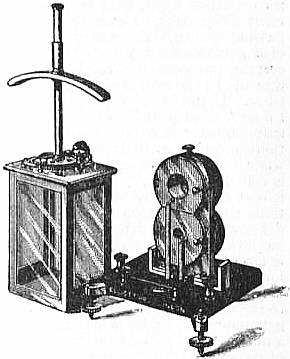
Fig. 1.—Kelvin Astatic Mirror Galvanometer. Elliott square pattern.
In the practical construction of the suspended needle fixed coil galvanometer great care must be taken with the insulation of the wire of the coil. This wire is generally silk-covered, wound on a frame, the whole being thoroughly saturated Construction and use. with paraffin wax. In some cases two wires are wound on in parallel, constituting a “differential galvanometer.” When properly adjusted this instrument can be used for the exact comparison of electric currents by a null method, because if an electric current is passed through one wire and creates certain deflexions of the needle, the current which annuls this deflexion when passed through the other wire must be equal to the first current. In the construction of a movable coil galvanometer, it is usual to intensify the magnetic field by inserting a fixed soft iron core in the interior of the movable coil. If the current to be measured is too large to be passed entirely through the galvanometer, a portion is allowed to flow through a circuit connecting the two terminals of the instrument. This circuit is called a shunt and is generally arranged so as to take 0.9, 0.99, or 0.999 of the total current, leaving 0.1, 0.01 or 0.001 to flow through the galvanometer. W.E. Ayrton and T. Mather have designed a universal shunt box or resistance which can be applied to any galvanometer and by which a known fraction of any current can be sent through the galvanometer when we know its resistance (see Jour. Inst. Elec. Eng. Lond., 1894, 23, p. 314). A galvanometer can be calibrated, or the meaning of its deflexion determined, by passing through it an electric current of known value and observing the deflexion of the needle or coil. The known current can be provided in the following manner:—a single secondary cell of any kind can have its electromotive force measured by the potentiometer (q.v.), and compared with that of a standard voltaic cell. If the secondary cell is connected with the galvanometer through a known high resistance R, and if the galvanometer is shunted, that is, has its terminals connected by another resistance S, then if the resistance of the galvanometer itself is denoted by G, the whole resistance of the shunted galvanometer and high resistance has a value represented by R + GS/(G + S), and therefore the current through the galvanometer produced by an electromotive force E of the cell is represented by
SE .
R(G + S) + GS
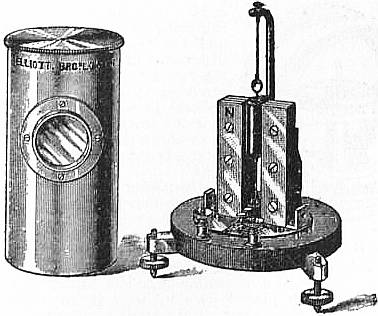
Fig. 2.—Movable Coil Galvanometer.
Suppose this current produces a deflexion of the needle or coil or spot of light equal to X scale divisions, we can then alter the value of the resistances R and S, and so determine the relation between the deflexion and the current. By the sensitiveness of the galvanometer is meant the deflexion produced by a known electromotive force put upon its terminals or a known current sent through it. It is usual to specify the sensitiveness of a mirror galvanometer by requiring a certain deflexion, measured in millimetres, of a spot of light thrown on the scale placed at one metre from the mirror, when an electromotive force of one-millionth of a volt (microvolt) is applied to the terminals of the galvanometer; it may be otherwise expressed by stating the deflexion produced under the same conditions when a current of one microampere is passed through the coil. In modern mirror galvanometers a deflexion of 1 mm. of the spot of light upon a scale at 1 metre distance can be produced by a current as small as one hundred millionth (10−8) or even one ten thousand millionth (10−10) of an ampere. It is easy to produce considerable sensitiveness in the galvanometer, but for practical purposes it must always be controlled by the condition that the zero remains fixed, that is to say, the galvanometer needle or coil must come back to exactly the same position when no current is passing through the instrument. Other important qualifications of a galvanometer are its time-period and its dead-beatness. For certain purposes the needle or coil should return as quickly as possible to the zero position and with either no, or very few, oscillations. If the latter condition is fulfilled the galvanometer is said to be “dead-beat.” On the other hand, for some purposes the galvanometer is required with the opposite quality, that is to say, there must be as little retardation as possible to the needle or coil when set in motion under an impulsive blow. Such a galvanometer is called “ballistic.” The quality of a galvanometer in this respect is best estimated by taking the logarithmic decrement of the oscillations when the movable system is set swinging. This last term is defined as the logarithm of the ratio of one swing to the next succeeding swing, and a galvanometer of which the logarithmic decrement is large, is said to be highly damped. For many purposes, such as for resistance measurement, it is desirable to have a galvanometer which is highly damped; this result can be obtained by affixing to the needles either light pieces of mica, when it is a movable needle galvanometer, or by winding the coil on a silver frame when it is a movable coil galvanometer. On the other hand, for the comparison of capacities of condensers and for other purposes, a galvanometer is required which is as little damped as possible, and for this purpose the coil must have the smallest possible frictional resistance to its motion through the air. In this case the moment of inertia of the movable system must be decreased or the control strengthened.
The Einthoven string galvanometer is another form of sensitive instrument for the measurement of small direct currents. It consists of a fine wire or silvered quartz fibre stretched in a strong magnetic field. When a current passes through the wire it is displaced across the field and the displacement is observed with a microscope.
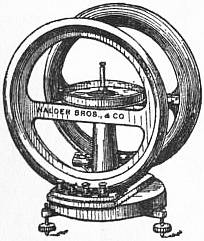
Fig. 3.—Helmholtz Tangent Galvanometer.
For the measurement of large currents a “tangent galvanometer” is employed (fig. 3). Two fixed circular coils are placed apart at a distance equal to the radius of either coil, so that a current passing through them creates in the central Tangent galvanometer. region between them a nearly uniform magnetic field. At the centre of the coils is suspended a small magnetic needle the length of which should not be greater than 1⁄10 the radius of either coil. The normal position of the needle is at right angles to the line joining the centre of the coils. If a current is passed through the coils, the needle will be deflected, and the tangent of the angle of its deflexion will be nearly proportional to the current passing through the coil, provided that the controlling field is uniform in strength and direction, and that the length of the magnetic needle is so short that the space in which it rotates is a practically uniform magnetic field.
Alternating Current Galvanometers.—For the detection of small alternating currents a magnetic needle or movable coil galvanometer is of no utility. We can, however, construct an instrument suitable for the purpose by suspending within a coil of insulated wire a small needle of soft iron placed with its axis at an angle of 45° to the axis of the coil. When an alternating current passes through the coil the soft iron needle tends to set itself in the direction of the axis of the coil, and if it is suspended by a quartz fibre or metallic wire so as to afford a control, it can become a metrical instrument. Another arrangement, devised by J.A. Fleming in 1887, consists of a silver or copper disk suspended within a coil, the plane of the disk being held at 45° to that of the coil. When an alternating current is passed through the coil, induced currents are set up in the disk and the mutual action causes the disk to endeavour to set itself so that these currents are a minimum. This metal disk galvanometer has been made sufficiently sensitive to detect the feeble oscillatory electric currents set up in the receiving wire of a wireless telegraph apparatus. The Duddell thermal ammeter is another very sensitive form of alternating current galvanometer. In it the current to be detected or measured is passed through a high resistance wire or strip of metal leaf mounted on glass, over which is suspended a closed loop of bismuth and antimony, forming a thermoelectric couple. This loop is suspended by a quartz fibre in a strong magnetic field, and one junction of the couple is held just over the resistance wire and as near it as possible without touching. When an alternating current passes through the resistance it creates heat which in turn acts on the thermo-junction and generates a continuous current in the loop, thus deflecting it in the magnetic field. The sensitiveness of such a thermal ammeter can be made sufficiently great to detect a current of a few microamperes.
References.—J.A. Fleming, A Handbook for the Electrical Laboratory and Testing Room, vol. i. (London, 1901); W.E. Ayrton, T. Mather and W.E. Sumpner, “On Galvanometers,” Proc. Phys. Soc. London (1890), 10, 393; H.R. Kempe, A Handbook of Electrical Testing (London, 1906); A. Gray, Absolute Measurements in Electricity and Magnetism, vol. ii. part ii. (London, 1893). Useful information is also contained in the catalogues of all the principal electrical instrument makers—Messrs. Elliott Bros., Nalder, The Cambridge Scientific Instrument Company, Pitkin, Hartmann and Braun, Queen and others.
(J. A. F.)
GALVESTON, a city and port of entry and the county-seat of Galveston county, Texas, U.S.A., on the Gulf of Mexico, near the N.E. extremity of Galveston Island and at the entrance to Galveston Bay. It is about 48 m. S.E. of Houston and 310 m. W. of New Orleans. Pop. (1890) 29,084; (1900) 37,789, (6339 were foreign-born and 8291 negroes); (1910) 36,981; land area (1906) 7.8 sq. m. It is served by the Galveston, Houston & Henderson, the Galveston, Harrisburg & San Antonio, the Gulf, Colorado & Santa Fé, the Trinity & Brazos Valley, the International & Great Northern, and the Missouri, Kansas & Texas railways, and by numerous steamship lines to Gulf ports in the United States and Mexico, and to Cuba, South America, Europe and the Atlantic ports of the United States. Galveston Island is a low, sandy strip of land about 28 m. long and 1½ to 3½ m. wide, lying from 2 to 3 m. off the mainland. The city, which extends across the island from Gulf to Bay, faces and has its harbour on the latter. The island was connected with the mainland before the 1900 storm by a road bridge and several railway bridges, which, a short distance W. of the city, crossed the narrow strip of water separating the West Bay from Galveston Bay proper; the bridge least harmed (a single-track railway bridge) was repaired immediately and was for a time the city’s only connexion with the mainland, but in 1908 bonds were issued for building a concrete causeway, accommodating four railway tracks, one interurban car track, and a roadway for vehicles and pedestrians. An enormous sea-wall (completed in 1904 at a cost of $2,091,000) was constructed on the eastern and Gulf sides of the city, about 5 m. long, 17 ft. above mean low tide (1.5 ft. above the high-water mark of the storm of 1900 and 7.5 ft. above the previous high-water mark, that of September 1875), 16 ft. wide at the base and 5 ft. at the top, weighing 20 tons to the lineal foot, and with a granite rip-rap apron extending out 27 ft. on the Gulf side. The entire grade of the city was raised from 1 to 15 ft. above the old level. Between the sea-wall and the sea there is a splendid beach, the entire length of which is nearly 30 m. Among the principal buildings are the city hall, the court-house, the masonic temple, the Federal custom-house and post-office, the Y.M.C.A. building and the public library. The United States government maintains a marine hospital, a live-saving station, an immigrant landing station, and the state and the Federal government separate quarantine stations. In addition to the Ball public high school, Galveston is the seat of St Mary’s University (1854), the Sacred Heart and Ursuline academies, and the Cathedral school, all under Roman Catholic control.