VOLUME XI SLICE IV G to Gaskell Elizabeth (continued 10)
Reading edition
GARNIER, JEAN LOUIS CHARLES (1825-1898), French architect, was born in Paris on the 6th of November 1825. He was educated in a primary school, and it was intended that he should pursue his father’s craft, that of a wheelwright. His mother, however, having heard that with a little previous study he might enter an architect’s office and eventually become a measuring surveyor (vérificateur), and earn as much as six francs a day, and foreseeing that in consequence of his delicate health he would be unfit to work at the forge, sent him to learn drawing and mathematics at the Petite École de Dessin, in the rue de Médecine, the cradle of so many of the great artists of France. His progress was such as to justify his being sent first into an architect’s office and then to the well-known atelier of Lebas, where he began his studies in preparation for the examination of the École des Beaux Arts, which he passed in 1842, at the age of seventeen. Shortly after his admission it became necessary that he should support himself, and accordingly he worked during the day in various architects’ offices, among them in that of M. Viollet-le-Duc, and confined his studies for the École to the evening. In 1848 he carried off, at the early age of twenty-three, the Grand Prix de Rome, and with his comrades in sculpture, engraving and music, set off for the Villa de Medicis. His principal works were the measured drawings of the Forum of Trajan and the temple of Vesta in Rome, and the temple of Serapis at Pozzuoli. In the fifth year of his travelling studentship he went to Athens and measured the temple at Aegina, subsequently working out a complete restoration of it, with its polychromatic decoration, which was published as a monograph in 1877. The elaborate set of drawings which he was commissioned by the duc de Luynes to make of the tombs of the house of Anjou were not published, owing to the death of his patron; and since Garnier’s death they have been given to the library of the École des Beaux Arts, along with other drawings he made in Italy. On his return to Paris in 1853 he was appointed surveyor to one or two government buildings, with a very moderate salary, so that the commission given him by M. Victor Baltard to make two water-colour drawings of the Hôtel de Ville, to be placed in the album presented to Queen Victoria in 1855, on the occasion of her visit to Paris, proved very acceptable. These two drawings are now in the library at Windsor.
In 1860 came, at last, Garnier’s chance: a competition was announced for a design for a new imperial academy of music, and out of 163 competitors Garnier was one of five selected for a second competition, in which, by unanimous vote, he carried off the first prize, and the execution of the design was placed in his hands. Begun in 1861, but delayed in its completion by the Franco-German War, it was not till 1875 that the structure of the present Grand Opera House of Paris was finished, at a cost of about 35,000,000 francs (£1,420,000). During the war the building was utilized as the municipal storehouse of provisions. The staircase and the magnificent hall are the finest portion of the interior, and alike in conception and realization have never been approached. Of Garnier’s other works, the most remarkable are the Casino at Monte Carlo, the Bischoffsheim villa at Bordighera, the Hôtel du Cercle de la Librairie in Paris; and, among tombs, those of the musicians Bizet, Offenbach, Massé and Duprato. In 1874 he was elected a member of the Institute of France, and after passing through the grades of chevalier, officer and commander of the Legion of Honour, received in 1895 the rank of grand officer, a high distinction that had never before been granted to an architect. Charles Garnier’s reputation was not confined to France; it was recognized by all the countries of Europe, and in England he received, in 1886, the royal gold medal of the Royal Institute of Architects, given by Queen Victoria. Besides his monograph on the temple of Aegina, he wrote several works, of which Le Nouvel Opéra de Paris is the most valuable. For the International Exhibition of 1889 he designed the buildings illustrating the “History of the House” in all periods, and a work on this subject was afterwards published by him in conjunction with M. Ammann. Not the least of his claims to the gratitude of his country were the services which he rendered on the various art juries appointed by the state, the Institute of France, and the École des Beaux-Arts, services which in France are rendered in an honorary capacity. Garnier died on the 3rd of August 1898.
(R. P. S.)
GARNIER, MARIE JOSEPH FRANÇOIS [Francis] (1839-1873), French officer and explorer, was born at St Étienne on the 25th of July 1839. He entered the navy, and after voyaging in Brazilian waters and the Pacific he obtained a post on the staff of Admiral Charner, who from 1860 to 1862 was campaigning in Cochin-China. After some time spent in France he returned to the East, and in 1862 he was appointed inspector of the natives in Cochin-China, and entrusted with the administration of Cho-lon, a suburb of Saigon. It was at his suggestion that the marquis de Chasseloup-Laubat determined to send a mission to explore the valley of the Mekong, but as Garnier was not considered old enough to be put in command, the chief authority was entrusted to Captain Doudart de Lagrée. In the course of the expedition—to quote the words of Sir Roderick Murchison addressed to the youthful traveller when, in 1870, he was presented with the Victoria Medal of the Royal Geographical Society of London—from Kratie in Cambodia to Shanghai 5392 m. were traversed, and of these 3625 m., chiefly of country unknown to European geography, were surveyed with care, and the positions fixed by astronomical observations, nearly the whole of the observations being taken by Garnier himself. Volunteering to lead a detachment to Talifu, the capital of Sultan Suleiman, the sovereign of the Mahommedan rebels in Yunnan, he successfully carried out the more than adventurous enterprise. When shortly afterwards Lagrée died, Garnier naturally assumed the command of the expedition, and he conducted it in safety to the Yang-tsze-Kiang, and thus to the Chinese coast. On his return to France he was received with enthusiasm. The preparation of his narrative was interrupted by the Franco-German War, and during the siege of Paris he served as principal staff officer to the admiral in command of the eighth “sector.” His experiences during the siege were published anonymously in the feuilleton of Le Temps, and appeared separately as Le Siège de Paris, journal d’un officier de marine (1871). Returning to Cochin-China he found the political circumstances of the country unfavourable to further exploration, and accordingly he went to China, and in 1873 followed the upper course of the Yang-tsze-Kiang to the waterfalls. He was next commissioned by Admiral Dupré, governor of Cochin-China, to found a French protectorate or a new colony in Tongking. On the 20th of November 1873 he took Hanoi, the capital of Tongking, and on the 21st of December he was slain in fight with the Black Flags. His chief fame rests on the fact that he originated the idea of exploring the Mekong, and carried out the larger portion of the work.
The narrative of the principal expedition appeared in 1873, as Voyage d’exploration en Indo-Chine effectué pendant les années 1866, 1867 et 1868, publié sous la direction de M. Francis Garnier, avec le concours de M. Delaporte et de MM. Joubert et Thorel (2 vols.). An account of the Yang-tsze-Kiang from Garnier’s pen is given in the Bulletin de la Soc. de Géog. (1874). His Chronique royale du Cambodje, was reprinted from the Journal Asiatique in 1872. See Ocean Highways (1874) for a memoir by Colonel Yule; and Hugh Clifford, Further India, in the Story of Exploration series (1904).
GARNIER, ROBERT (c. 1545-c. 1600), French tragic poet, was born at Ferté Bernard (Le Maine) in 1545. He published his first work while still a law-student at Toulouse, where he won a prize (1565) in the jeux floraux. It was a collection of lyrical pieces, now lost, entitled Plaintes amoureuses de Robert Garnier (1565). After some practice at the Parisian bar, he became conseiller du roi au siège présidial et sénéchaussée of Le Maine, his native district, and later lieutenant-général criminel. His friend Lacroix du Maine says that he enjoyed a great reputation as an orator. He was a distinguished magistrate, of considerable weight in his native province, who gave his leisure to literature, and whose merits as a poet were fully recognized by his own generation. He died at Le Mans probably in 1599 or 1600.
In his early plays he was a close follower of the school of dramatists who were inspired by the study of Seneca. In these productions there is little that is strictly dramatic except the form. A tragedy was a series of rhetorical speeches relieved by a lyric chorus. His pieces in this manner are Porcie (published 1568, acted at the hôtel de Bourgogne in 1573), Cornélie and Hippolyte (both acted in 1573 and printed in 1574). In Porcie the deaths of Cassius, Brutus and Portia are each the subject of an eloquent recital, but the action is confined to the death of the nurse, who alone is allowed to die on the stage. His next group of tragedies—Marc-Antoine (1578), La Troade (1579), Antigone (acted and printed 1580)—shows an advance on the theatre of Étienne Jodelle and Jacques Grévin, and on his own early plays, in so much that the rhetorical element is accompanied by abundance of action, though this is accomplished by the plan of joining together two virtually independent pieces in the same way.
In 1582 and 1583 he produced his two masterpieces Bradamante and Les Juives. In Bradamante, which alone of his plays has no chorus, he cut himself adrift from Senecan models, and sought his subject in Ariosto, the result being what came to be known later as a tragi-comedy. The dramatic and romantic story becomes a real drama in Garnier’s hands, though even there the lovers, Bradamante and Roger, never meet on the stage. The contest in the mind of Roger supplies a genuine dramatic interest in the manner of Corneille. Les Juives is the pathetic story of the barbarous vengeance of Nebuchadnezzar on the Jewish king Zedekiah and his children. The Jewish women lamenting the fate of their children take a principal part in this tragedy, which, although almost entirely elegiac in conception, is singularly well designed, and gains unity by the personality of the prophet. M. Faguet says that of all French tragedies of the 16th and 17th centuries it is, with Athalie, the best constructed with regard to the requirements of the stage. Actual representation is continually in the mind of the author; his drama is, in fact, visually conceived.
Garnier must be regarded as the greatest French tragic poet of his century and the precursor of the great achievements of the next.
The best edition of his works is by Wendelin Foerster (Heilbronn, 4 vols., 1882-1883). A detailed criticism of his works is to be found in Émile Faguet, La Tragédie française au XVIe siècle (1883, pp. 183-307).
GARNIER-PAGÈS, ÉTIENNE JOSEPH LOUIS (1801-1841), French politician, was born at Marseilles on the 27th of December 1801. Soon after his birth his father Jean François Garnier, a naval surgeon, died, and his mother married Simon Pagès, a college professor, by whom she had a son. The boys were brought up together, and took the double name Garnier-Pagès. Étienne found employment first in a commercial house in Marseilles, and then in an insurance office in Paris. In 1825 he began to study law, and made some mark as an advocate. A keen opponent of the Restoration, he joined various democratic societies, notably the Aide-toi, le ciel t’aidera, an organization for purifying the elections. He took part in the revolution of July 1830; became secretary of the Aide-toi, le ciel t’aidera, whose propaganda he brought into line with his anti-monarchical ideas; and in 1831 was sent from Isère to the chamber of deputies. He was concerned in the preparation of the Compte rendu of 1832, and advocated universal suffrage. He was an eloquent speaker, and his sound knowledge of business and finance gave him a marked influence among all parties in the chamber. He died in Paris on the 23rd of June 1841.
His half-brother, Louis Antoine Garnier-Pagès (1803-1878), fought on the barricades during the revolution of July 1830, and after Étienne’s death was elected to the chamber of deputies (1842). He was a keen promoter of reform, and was a leading spirit in the affair of the reform banquet fixed for the 22nd of February 1848. He was a member of the provisional government of 1848, and was named mayor of Paris. On the 5th of March 1848 he was made minister of finance, and incurred great unpopularity by the imposition of additional taxes. He was a member of the Constituent Assembly and of the Executive Commission. Under the Empire he was conspicuous in the republican opposition and opposed the war with Prussia, and after the fall of Napoleon III. became a member of the Government of National Defence. Unsuccessful at the elections for the National Assembly (the 8th of February 1871), he retired into private life, and died in Paris on the 31st of October 1878. He wrote Histoire de la révolution de 1848 (1860-1862); Histoire de la commission exécutive (1869-1872); and L’Opposition et l’empire (1872).
GARNISH, a word meaning to fit out, equip, furnish, now particularly used of decoration or ornament. It is formed from the O. Fr. garnisant or guarnissant, participle of garnir, guarnir, to furnish, equip. This is of Teutonic origin, the base being represented in O. Eng. warnian, to take warning, beware, and Ger. warnen, to warn, Eng. warn; the original sense would be to guard against, fortify, hence equip or fit out. The meaning of “warn” is seen in the law term “garnishee,” a person who owes money to or holds money belonging to another and is “warned” by order of the court not to pay it to his immediate creditor but to a third person who has obtained final judgment against that creditor. (See Attachment; Execution; Bankruptcy.)
GARO HILLS, a district of British India, in the hills division of Eastern Bengal and Assam. It takes its name from the Garos, a tribe of doubtful ethnical affinities and peculiar customs, by whom it is almost entirely inhabited. The Garos are probably a section of the great Bodo tribe, which at one time occupied a large part of Assam. According to the census of 1901 they numbered 128,117. In the 18th century they are mentioned as being frequently in conflict with the inhabitants of the plains below their hills, and in 1790 the British government first tried to reduce them. No permanent success was achieved. In 1852 raids by the Garos were followed by a blockade of the hills, but in 1856 they were again in revolt. Again a repressive expedition was despatched in 1861, but in 1866 there was a further raid. A British officer was now posted among the hills; this step was effective; in 1869 the district was constituted, and though in 1871 an outrage was committed against a native on the survey staff, there was little opposition when an expedition was sent in 1872-1873 to bring the whole district into submission, and there were thereafter no further disturbances.
The district consists of the last spurs of the Assam hills, which here run down almost to the bank of the Brahmaputra, where that river debouches upon the plain of Bengal and takes its great sweep to the south. The administrative headquarters are at Tura. The area of the district is 3140 sq. m. In 1901 the population was 138,274, showing an increase of 14% in the decade. The American missionaries maintain a small training school for teachers. The public buildings at Tura were entirely destroyed by the earthquake of June 12, 1897, and the roads in the district were greatly damaged by subsidence and fissures. Coal in large quantities and petroleum are known to exist. The chief exports are cotton, timber and forest products. Trade is small, though the natives, according to their own standard, are prosperous. They are fair agriculturists. Communications within the district are by cart-roads, bridle-paths and native tracks.
GARONNE (Lat. Garumna), a river of south-western France, rising in the Maladetta group of the Pyrenees, and flowing in a wide curve to the Atlantic Ocean. It is formed by two torrents, one of which has a subterranean course of 2½ m., disappearing in the sink known as the Trou du Taureau (“bull’s hole”) and reappearing at the Goueil de Jouéou. After a course of 30 m. in Spanish territory, during which it flows through the fine gorge called the Vallée d’Aran, the Garonne enters France in the department of Haute Garonne through the narrow defile of the Pont du Roi, and at once becomes navigable for rafts. At Montréjeau it receives on the left the Neste, and encountering at this point the vast plateau of Lannemezan is forced to turn abruptly east, flowing in a wide curve to Toulouse. At Saint Martory it gives off the irrigation canal of that name. At this point the Garonne enters a fertile plain, and supplies the motive power to several mills. It is joined on the right by various streams fed by the snows of the Pyrenees. Such are the Salat, at whose confluence river navigation proper begins, and the Arize and the Ariège (both names signifying “river”). From Toulouse the Garonne flows to the north-west, now skirting the northern border of the plateau of Lannemezan which here drains into it, the principal streams being the Save, the Gers and the Baïse. On its right hand the Garonne is swelled by its two chief tributaries, the Tarn, near Moissac, and the Lot, below Agen; farther down it is joined by the Drot (or Dropt), and on the left by the Ciron. Between Toulouse and Castets, 33½ m. above Bordeaux, and the highest point to which ordinary spring-tides ascend, the river is accompanied at a distance of from a ½ to 3 m. by the so-called “lateral canal” of the Garonne, constructed in 1838-1856. This canal is about 120 m. long, or 133 m. including its branches, one of which runs off at right angles to Montauban on the Tarn. From Toulouse to Agen the main canal follows the right bank of the Garonne, crossing the Tarn on an aqueduct at Moissac, while another magnificent aqueduct of twenty-three arches carries it at Agen from the right to the left bank of the river. It has a fall of 420 ft. and over fifty locks, and is navigable for vessels having the maximum dimensions of 98½ ft. length, 19 ft. breadth and 6½ ft. draught. The carrying trade upon it is chiefly in agricultural produce and provisions, building materials, wood and industrial products. At Toulouse the canal connects with the Canal du Midi, which runs to the Mediterranean. After passing Castets the Garonne begins to widen out considerably, and from being 160 yds. broad at Agen increases to about 650 yds. at Bordeaux, its great commercial port. From here it flows with ever increasing width between two flat shores to the Bec d’Ambès (15½ m.), where, after a course of 357 m., it unites with the Dordogne to form the vast estuary known as the Gironde. The triangular peninsula lying between these two great tidal rivers is called Entre-deux-mers (“between two seas”) and is famous for its wines. The drainage area of the Garonne is nearly 33,000 sq. m. Floods are of common occurrence, and descend very suddenly. The most disastrous occurred in 1875, 1856 and in 1770, when the flood level at Castets attained the record height of 42½ ft. above low-water mark.
GARRET (from the O. Fr. garite, modern guérite, a watch-tower, connected ultimately with “guard” and “ward”), properly a small look-out tower built on a wall, and hence the name given to a room on the top storey of a building, the sloping ceiling of which is formed by the roof.
GARRETT, JOÃO BAPTISTA DA SILVA LEITÃO DE ALMEIDA, Visconde de Almeida-Garrett (1799-1854), perhaps the greatest Portuguese poet since Camoens, was of Irish descent. Born in Oporto, his parents moved to the Quinta do Castello at Gaya when he was five years old. The French invasion of Portugal drove the family to the Azores, and Garrett made his first studies at Angra, beginning to versify at an early age under the influence of his uncle, a poet of the school of Bocage. Going to the university of Coimbra in 1816, he soon earned notoriety by the precocity of his talents and his fervent Liberalism, and there he gained his first oratorical and literary successes. His tragedy Lucrecia was played there in February 1819, and during this period he also wrote Merope as well as a great part of Cato, all these plays belonging to the so-called classical school. Leaving Coimbra with a law degree, he proceeded to Lisbon, and on the 11th of November 1822 married D. Luiza Midosi; but the alliance proved unhappy and a formal separation took place in 1839.
The reactionary movement against the Radical revolution of 1820 reached its height in 1823, and Garrett had to leave Portugal by order of the Absolutist ministry then in power, and went to England. He became acquainted with the masterpieces of the English and German romantic movements during his stay abroad.
Imbued with the spirit of nationality, he wrote in 1824 at Havre the poem “Camões,” which destroyed the influence of the worn-out classical and Arcadian rhymers, and in the following year composed the patriotic poem “D. Branca,” or “The Conquest of the Algarve.” He was permitted to return to Portugal in 1826, and thereupon devoted himself to journalism. With the publication of O Portuguez, he raised the tone of the press, exhibiting an elevation of ideas and moderation of language then unknown in political controversy, and he introduced the “feuilleton.” But his defence of Liberal principles brought him three months’ imprisonment, and when D. Miguel was proclaimed absolute king on the 3rd of May 1828, Garrett had again to leave the country. In London, where he sought refuge, he continued his adhesion to romanticism by publishing Adozinda and Bernal-Francez, expansions of old folk-poems, which met with the warmest praise from Southey and were translated by Adamson. He spent the next three years in and about Birmingham, Warwick and London, engaged in writing poetry and political pamphlets, and by these and by his periodicals he did much to unite the Portuguese émigrés and to keep up their spirit amid their sufferings in a foreign land. Learning that an expedition was being organized in France for the liberation of Portugal, Garrett raised funds and joined the forces under D. Pedro as a volunteer. Sailing in February 1832, he disembarked at Terceira, whence he passed to S. Miguel, then the seat of the Liberal government. Here he became a co-operator with the statesman Mousinho da Silveira, and assisted him in drafting those laws which were to revolutionize the whole framework of Portuguese society, this important work being done far from books and without pecuniary reward. In his spare time he wrote some of the beautiful lyrics afterwards collected into Flores sem Fructo. He took part in the expedition that landed at the Mindello on the 8th of July 1832, and in the occupation of Oporto. Early in the siege he sketched out, under the influence of Walter Scott, the historical romance Arco de Sant’ Anna, descriptive of the city in the reign of D. Pedro I.; and, in addition, he organized the Home and Foreign offices under the marquis of Palmella, drafted many important royal decrees, and prepared the criminal and commercial codes. In the following November he was despatched as secretary to the marquis on a diplomatic mission to foreign courts, which involved him in much personal hardship. In the next year the capture of Lisbon enabled him to return home, and he was charged to prepare a scheme for the reform of public instruction.
In 1834-1835 he served as consul-general and chargé d’affaires at Brussels, representing Portugal with distinction under most difficult circumstances, for which he received no thanks and little pay. When he got back, the government employed him to draw up a proposal for the construction of a national theatre and for a conservatoire of dramatic art, of which he became the head. He instituted prizes for the best plays, himself revising nearly all that were produced, and a school of dramatists and actors arose under his influence. To give them models, he proceeded to write a series of prose dramas, choosing his subjects from Portuguese history. He began in 1838 with the Auto de Gil Vicente, considering that the first step towards the recreation of the Portuguese drama was to revive the memory of its founder, and he followed this up in 1842 by the Alfageme de Santarem, dealing with the Holy Constable, and in 1843 by Frei Luiz de Sousa, one of the few great tragedies of the 19th century, a work as intensely national as The Lusiads. The story, which in part is historically true, and has the merit of being simple, like the action, is briefly as follows. D. João de Portugal, who was supposed to have died at the battle of Alcacer, returns, years afterwards, to find his wife married to Manoel de Sousa and the mother of a daughter by him, named Maria. Thereupon the pair separate and enter religion, and Manoel becomes the famous chronicler, Frei Luiz de Sousa (q.v.). The characters live and move, especially Telmo, the old servant, who would never believe in the death of his former master D. João, and the consumptive child Maria, who helps Telmo to create the atmosphere of impending disaster; while the episodes, particularly those of the return of D. João and the death of Maria, are full of power, and the language is Portuguese of the best.
Entering parliament in 1837, Garrett soon made his mark as an orator. In that year he delivered many notable discourses in defence of liberal ideas. He also brought in a literary copyright bill, which, when it became law in 1851, served as a precedent for similar legislation in England and Prussia. In 1840 he made his famous speech known as Porto Pyreu, in which he skilfully turned the well-known anecdote of the “mad Athenian” against his opponents. While attending with assiduity to his duties as a deputy, he wrote, about this time, the drama D. Filippa de Vilhena, founded on an incident in the revolution of 1640, for representation by the pupils of the conservatoire, and the session of 1841 saw another of his oratorical triumphs in his speech against the law of tithes. In July 1843 an excursion to Santarem resulted in his prose masterpiece Viagens na minha terra, at once a novel and a miscellany of literary, political and philosophic criticism, written without plan or method, easy, jovial and epigrammatic. He took no part in the civil war that followed the revolution of Maria da Fonte, but continued his literary labours, producing in 1848 the comedy A Sobrinha do Marquez, dealing with the times of Pombal, and in 1849 an historical memoir on Mousinho da Silveira. He spent much of the year 1850 in finishing his Romanceiro, a collection of folk-poetry of which he was the first to perceive the value; and in June 1851 he was created a viscount. In the following December he drew up the additional act to the constitutional charter, and his draft was approved by the ministers at a cabinet meeting in his house. Further, he initiated the Conselho Ultramarino; and the Law of the Misericordias, with its preamble, published in 1852, was entirely from his pen. In the same year he became for a short time minister of foreign affairs. In 1853 he brought out Folhas Cahidas, a collection of short poems ablaze with passion and exquisite in form, of which his friend Herculano said: “if Camoens had written love verses at Garrett’s age, he could not have equalled him.” His final literary work was a novel, Helena, which he left unfinished, and on the 10th of February 1854 he made his last notable speech in the House. He died on the 9th of December 1854, and on the 3rd of May 1903 his remains were translated to the national pantheon, the Jeronymos at Belem, where they rest near to those of Camoens. As poet, novelist, journalist, orator and dramatist, he deserves the remark of Rebello da Silva: “Garrett was not a man of letters only but an entire literature in himself.”
Besides his strong religious faith, Garrett was endowed with a deep sensibility, a creative imagination, rare taste and a singular capacity for sympathy. Thus, though a learned man and an able jurist, he was bound to be first and always an artist. His artistic temperament explains his many-sided activity, his expansive kindliness, his seductive charm, especially for women, his patriotism, his aristocratic pretensions, his huge vanity and dandyism, and the ingenuousness that absolves him from many faults in an irregular life. From his rich artistic nature sprang his profound, sincere, sensual and melancholy lyrics, the variety and perfection of his scenic creations, the splendour of his eloquence, the truth of his comic vein, the elegance of his lighter compositions. Two books stand out in bold relief from among his writings: Folhas Cahidas, and that tragedy of fatality and pity, Frei Luiz de Sousa, with its gallery of noble figures incarnating the truest realism in an almost perfect prose form. The complete collection of his works comprises twenty-four volumes and there are several editions.
Authorities.—Gomes de Amorim, Garrett, memorias biographicas (3 vols., Lisbon, 1881-1888); D. Romero Ortiz, La Litteratura Portuguesa en el siglo XIX (Madrid, 1869), pp. 165-221; Dr Theophilo Braga, Garrett e o romantismo (Oporto, 1904), and Garrett e os dramas romanticos (Oporto, 1905), with a full bibliography; Innocencio da Silva, Diccionario bibliographico Portuguez, vol. iii. pp. 309-316, and vol. x. pp. 180-185. See Revue encyclopédique Larousse, No. 284, for a bibliography of the foreign translations of Garrett. Frei Luiz de Sousa was translated by Edgar Prestage under the title Brother Luiz de Sousa (London, 1909).
(E. Pr.)
GARRETTING, properly Galletting, a term in architecture for the process in which the “gallets” or small splinters of stone are inserted in the joints of coarse masonry to protect the mortar joints; they are stuck in while the mortar is wet.
GARRICK, DAVID (1717-1779), English actor and theatrical manager, was descended from a good French Protestant family named Garric or Garrique of Bordeaux, which had settled in England on the revocation of the Edict of Nantes. His father, Captain Peter Garrick, who had married Arabella Clough, the daughter of a vicar choral of Lichfield cathedral, was on a recruiting expedition when his famous third son was born at Hereford on the 19th of February 1717. Captain Garrick, who had made his home at Lichfield, where he had a large family, in 1731 rejoined his regiment at Gibraltar. This kept him absent from home for many years, during which letters were written to him by “little Davy,” acquainting him with the doings at Lichfield. When the boy was about eleven years old he paid a short visit to Lisbon where his uncle David had settled as a wine merchant. On his father’s return from Gibraltar, David, who had previously been educated at the grammar school of Lichfield, was, largely by the advice of Gilbert Walmesley, registrar of the ecclesiastical court, sent with his brother George to the “academy” at Edial, just opened in June or July 1736 by Samuel Johnson, the senior by seven years of David, who was then nineteen. This seminary was, however, closed in about six months, and on the 2nd of March 1736/7 both Johnson and Garrick left Lichfield for London—Johnson, as he afterwards said, “with twopence halfpenny in his pocket,” and Garrick “with three-halfpence in his.” Johnson, whose chief asset was the MS. tragedy of Irene, was at first the host of his former pupil, who, however, before the end of the year took up his residence at Rochester with John Colson (afterwards Lucasian professor at Cambridge). Captain Garrick died about a month after David’s arrival in London. Soon afterwards, his uncle, the wine merchant at Lisbon, having left David a sum of £1000, he and his brother entered into partnership as wine merchants in London and Lichfield, David taking up the London business. The concern was not prosperous—though Samuel Foote’s assertion that he had known Garrick with three quarts of vinegar in the cellar calling himself a wine merchant need not be taken literally—and before the end of 1741 he had spent nearly half of his capital.
His passion for the stage completely engrossed him; he tried his hand both at dramatic criticism and at dramatic authorship. His first dramatic piece, Lethe, or Aesop in the Shades, which he was thirty-seven years later to read from a splendidly bound transcript to King George III. and Queen Charlotte, was played at Drury Lane on the 15th of April 1740; and he became a well-known frequenter of theatrical circles. His first appearance on the stage was made in March 1741, incognito, as harlequin at Goodman’s Fields, Yates, who was ill, having allowed him to take his place during a few scenes of the pantomime entitled Harlequin Student, or The Fall of Pantomime with the Restoration of the Drama. Garrick subsequently accompanied a party of players from the same theatre to Ipswich, where he played his first part as an actor under the name of Lyddal, in the character of Aboan (in Southerne’s Oroonoko). His success in this and other parts determined his future career. On the 19th of October 1741 he made his appearance at Goodman’s Fields as Richard III. and gained the most enthusiastic applause. Among the audience was Macklin, whose performance of Shylock, early in the same year, had pointed the way along which Garrick was so rapidly to pass in triumph. On the morrow the latter wrote to his brother at Lichfield, proposing to make arrangements for his withdrawal from the partnership, which, after much distressful complaint on the part of his family, met by him with the utmost consideration, were ultimately carried into effect. Meanwhile, each night had added to his popularity on the stage. The town, as Gray (who, like Horace Walpole, at first held out against the furore) declared, was “horn-mad” about him. Before his Richard had exhausted its original effect, he won new applause as Aboan, and soon afterwards as Lear and as Pierre in Otway’s Venice Preserved, as well as in several comic characters (including that of Bayes). Glover (“Leonidas”) attended every performance; the duke of Argyll, Lords Cobham and Lyttelton, Pitt, and several other members of parliament testified their admiration. Within the first six months of his theatrical career he acted in eighteen characters of all kinds, and from the 2nd of December he appeared in his own name. Pope went to see him three times during his first performances, and pronounced that “that young man never had his equal as an actor, and he will never have a rival.” Before next spring he had supped with “the great Mr Murray, counsellor,” and was engaged to do so with Mr Pope through Murray’s introduction, while he was dining with Halifax, Sandwich and Chesterfield. “There was a dozen dukes of a night at Goodman’s Fields,” writes Horace Walpole. Garrick’s farce of The Lying Valet, in which he performed the part of Sharp, was at this time brought out with so much success that he ventured to send a copy to his brother.
His fortune was now made, and while the managers of Covent Garden and Drury Lane resorted to the law to make Giffard, the manager of Goodman’s Fields, close his little theatre, Garrick was engaged by Fleetwood for Drury Lane for the season of 1742. In June of that year he went over to Dublin, where he found the same homage paid to his talents as he had received from his own countrymen. He was accompanied by Margaret (Peg) Woffington, of whom he had been for some time a fervent admirer. (His claim to the authorship of the song to Lovely Peggy is still sub judice. There remains some obscurity as to the end of their liaison.) From September 1742 to April 1745 he played at Drury Lane, after which he again went over to Dublin. Here he remained during the whole season, as joint-manager with Sheridan, in the direction and profits of the Theatre Royal in Smock Alley. In 1746-1747 he fulfilled a short engagement with Rich at Covent Garden, his last series of performances under a management not his own. With the close of that season Fleetwood’s patent for the management of Drury Lane expired, and Garrick, in conjunction with Lacy, purchased the property of the theatre, together with the renewal of the patent; contributing £8000 as two-thirds of the purchase-money. In September 1747 it was opened with a strong company of actors, Johnson’s prologue being spoken by Garrick, while the epilogue, written by him, was spoken by Mrs Woffington. The negotiations involved Garrick in a bitter quarrel with Macklin, who appears to have had a real grievance in the matter. Garrick took no part himself till his performance of Archer in the Beaux’ Stratagem, a month after the opening. For a time at least “the drama’s patrons” were content with the higher entertainment furnished them; in the end Garrick had to “please” them, like most other managers, by gratifying their love of show. Garrick was surrounded by many players of eminence, and he had the art, as he was told by Mrs Clive, “of contradicting the proverb that one cannot make bricks without straw, by doing what is infinitely more difficult, making actors and actresses without genius.” He had to encounter very serious opposition from the old actors whom he had distanced, and with the younger actors and actresses he was involved in frequent quarrels. But to none of them or their fellows did he, so far as it appears, show that jealousy of real merit from which so many great actors have been unable to remain free. For the present he was able to hold his own against all competition. The naturalness of his acting fascinated those who, like Partridge in Tom Jones, listened to nature’s voice, and justified the preference of more conscious critics. To be “pleased with nature” was, as Churchill wrote, in the Rosciad (1761),1 to be pleased with Garrick. For the stately declamation, the sonorous, and beyond a doubt impressive, chant of Quin and his fellows, Garrick substituted rapid changes of passion and humour in both voice and gesture, which held his audiences spellbound. “It seemed,” wrote Richard Cumberland, “as if a whole century had been stepped over in the passage of a single scene; old things were done away, and a new order at once brought forward, bright and luminous, and clearly destined to dispel the barbarisms of a tasteless age, too long superstitiously devoted to the illusions of imposing declamation.” Garrick’s French descent and his education may have contributed to give him the vivacity and versatility which distinguished him as an actor; and nature had given him an eye, if not a stature, to command, and a mimic power of wonderful variety. The list of his characters in tragedy, comedy and farce is large, and would be extraordinary for a modern actor of high rank; it includes not less than seventeen Shakespearian parts. As a manager, though he committed some grievous blunders, he did good service to the theatre and signally advanced the popularity of Shakespeare’s plays, of which not less than twenty-four were produced at Drury Lane under his management. Many of these were not pure Shakespeare; and he is credited with the addition of a dying speech to the text of Macbeth. On the other hand, Tate Wilkinson says that Garrick’s production of Hamlet in 1773 was well received at Drury Lane even by the galleries, “though without their favourite acquaintances the gravediggers.” Among his published adaptations are an opera, The Fairies (from Midsummer Night’s Dream) (1755); an opera The Tempest (1756); Catherine and Petruchio (1758); Florizel and Perdita (1762). But not every generation has the same notions of the way in which Shakespeare is best honoured. Few sins of omission can be charged against Garrick as a manager, but he refused Home’s Douglas, and made the wrong choice between False Delicacy and The Good Natur’d Man. For the rest, he purified the stage of much of its grossness, and introduced a relative correctness of costume and decoration unknown before. To the study of English dramatic literature he rendered an important service by bequeathing his then unrivalled collection of plays to the British Museum.
After escaping from the chains of his passion for the beautiful but reckless Mrs Woffington, Garrick had in 1749 married Mademoiselle Violette (Eva Maria Veigel), a German lady who had attracted admiration at Florence or at Vienna as a dancer, and had come to England early in 1746, where her modest grace and the rumours which surrounded her created a furore, and where she found enthusiastic patrons in the earl and countess of Burlington. Garrick, who called her “the best of women and wives,” lived most happily with her in his villa at Hampton, acquired by him in 1754, whither he was glad to escape from his house in Southampton Street. To this period belongs Garrick’s quarrel with Barry, the only actor who even temporarily rivalled him in the favour of the public. In 1763 Garrick and his wife visited Paris, where they were cordially received and made the acquaintance of Diderot and others at the house of the baron d’Holbach. It was about this time that Grimm extolled Garrick as the first and only actor who came up to the demands of his imagination; and it was in a reply to a pamphlet occasioned by Garrick’s visit that Diderot first gave expression to the views expounded in his Paradoxe sur le comédien. After some months spent in Italy, where Garrick fell seriously ill, they returned to Paris in the autumn of 1764 and made more friends, reaching London in April 1765. Their union was childless, and Mrs Garrick survived her husband until 1822. Her portrait by Hogarth is at Windsor Castle.
Garrick practically ceased to act in 1766, but he continued the management of Drury Lane, and in 1769 organized the Shakespeare celebrations at Stratford-on-Avon, an undertaking which ended in dismal failure, though he composed an “Ode upon dedicating a building and erecting a Statue to Shakespeare” on the occasion. (See, inter alia, Garrick’s Vagary, or England Run Mad; with particulars of the Stratford Jubilee, 1769.) Of his best supporters on the stage, Mrs Cibber, with whom he had been reconciled, died in 1766, and Mrs (Kitty) Clive retired in 1769; but Garrick contrived to maintain the success of his theatre. He sold his share in the property in 1776 for £35,000, and took leave of the stage by playing a round of his favourite characters—Hamlet, Lear, Richard and Benedick, among Shakespearian parts; Lusignan in Zara, Aaron Hill’s adaptation of Voltaire’s Zaire; and Kitely in his own adaptation of Ben Jonson’s Every Man in his Humour; Archer in Farquhar’s Beaux’ Stratagem; Abel Drugger in Ben Jonson’s Alchemist; Sir John Brute in Vanbrugh’s Provoked Wife; Leon in Fletcher’s Rule a Wife and have a Wife. He ended the series, as Tate Wilkinson says, “in full glory” with “the youthful Don Felix” in Mrs Centlivre’s Wonder on the 10th of June 1776. He died in London on the 20th of January 1779. He was buried in Westminster Abbey at the foot of Shakespeare’s statue with imposing solemnities. An elegy on his death was published by William Tasker, poet and physiognomist, in the same year.
In person, Garrick was a little below middle height; in his later years he seems to have inclined to stoutness. The extraordinary mobility of his whole person, and his power of as it were transforming himself at will, are attested by many anecdotes and descriptions, but the piercing power of his eye must have been his most irresistible feature.
Johnson, of whose various and often merely churlish remarks on Garrick and his doings many are scattered through the pages of Boswell, spoke warmly of the elegance and sprightliness of his friend’s conversation, as well as of his liberality and kindness of heart; while to the great actor’s art he paid the exquisite tribute of describing Garrick’s sudden death as having “eclipsed the gaiety of nations, and impoverished the public stock of harmless pleasure.” But the most discriminating character of Garrick, slightly tinged with satire, is that drawn by Goldsmith in his poem of Retaliation. Beyond a doubt he was not without a certain moral timidity contrasting strangely with his eager temperament and alertness of intellect; but, though he was not cast in a heroic mould, he must have been one of the most amiable of men. Garrick was often happy in his epigrams and occasional verse, including his numerous prologues and epilogues. He had the good taste to recognize, and the spirit to make public his recognition of, the excellence of Gray’s odes at a time when they were either ridiculed or neglected. His dramatic pieces, The Lying Valet, adapted from Motteux’s Novelty Lethe (1740), The Guardian, Linco’s Travels (1767), Miss in her Teens (1747), Irish Widow, &c., and his alterations and adaptations of old plays, which together fill four volumes, evinced his knowledge of stage effect and his appreciation of lively dialogue and action; but he cannot be said to have added one new or original character to the drama. He was joint author with Colman of The Clandestine Marriage (1766), in which he is said to have written his famous part of Lord Ogleby. The excellent farce, High Life below Stairs, appears to have been wrongly attributed to Garrick, and to be by James Townley. His Dramatic Works (1798) fill three, his Poetic (1735) two volumes.
Garrick’s Private Correspondence (published in 1831-1832 with a short memoir by Boaden, in 2 vols. 4to), which includes his extensive Foreign Correspondence with distinguished French men and women, and the notices of him in the memoirs of Cumberland, Hannah More and Madame D’Arblay, and above all in Boswell’s Life of Johnson, bear testimony to his many attractive qualities as a companion and to his fidelity as a friend.
Bibliography.—A collection of unprinted Garrick letters is in the Forster library at South Kensington. A list of publications of all kinds for and against Garrick will be found in R. Lowe’s Bibliographical History of English Theatrical Literature (1887). The earlier biographies of Garrick are by Arthur Murphy (2 vols., 1801) and by the bookseller Tom Davies (2 vols., 4th ed., 1805), the latter a work of some merit, but occasionally inaccurate and confused as to dates; and a searching if not altogether sympathetic survey of his verses is furnished by Joseph Knight’s valuable Life (1894). A memoir of Garrick is included in a volume of French Memoirs of Mlle Clairon and others, published by Levain (H.L. Cain) at Paris in 1846; and an Italian Biografia di Davide Garrick was published by C. Blasis at Milan in 1840. Mr Percy Fitzgerald’s Life (2 vols., 1868; new edition, 1899) is full and spirited, and has been reprinted, with additions, among Sir Theodore Martin’s Monographs (1906). A delightful essay on Garrick appeared in the Quarterly Review (July 1868), directing attention to the admirable criticisms of Garrick’s acting in 1775 in the letters of G.C. Lichtenberg (Verm. Schriften, iii., Göttingen, 1801). See also for a very valuable survey of Garrick’s labours as an actor, with a bibliography, C. Gaehde, David Garrick als Shakespeare-Darsteller, &c. (Berlin, 1904). Mrs Parsons’ Garrick, and his Circle and Some unpublished Correspondence of David Garrick, ed. G.P. Baker (Boston, Mass., 1907), are interesting additions to the literature of the subject. There is also a Life by James Smyth, David Garrick (1887). T.W. Robertson’s play David Garrick, first acted by Sothern, and later associated with Sir Charles Wyndham, is of course mere fiction.
As to the portraits of Garrick, see W.T. Lawrence in The Connoisseur (April 1905). That by Gainsborough at Stratford-on-Avon was preferred by Mrs Garrick to all others. Several remain from the hand of Hogarth, including the famous picture of Garrick as Richard III. The portraits by Reynolds include the celebrated “Garrick between Tragedy and Comedy.” Zoffany’s are portraits in character. Roubiliac’s statue of Shakespeare, for which Garrick sat, and for which he paid the sculptor three hundred guineas, was originally placed in a small temple at Hampton, and is now in the entrance hall at the British Museum.
(R. Ca.; A. W. W.)
1 In the subsequent Apology addressed to the Critical Reviewers, Churchill revenged himself for the slight which he supposed Garrick to have put upon him, by some spiteful lines, which, however, Garrick requited by good-humoured kindness.
GARRISON, WILLIAM LLOYD (1805-1879), the American anti-slavery leader, was born in Newburyport, Massachusetts, U.S.A., on the 10th of December 1805. His parents were from the British province of New Brunswick. The father, Abijah, a sea-captain, went away from home when William was a child, and it is not known whether he died at sea or on land. The mother, whose maiden name was Lloyd, is said to have been a woman of high character, charming in person and eminent for piety. She died in 1823. William had a taste for books, and made the most of his limited opportunities. His mother first set him to learn the trade of a shoemaker, first at Newburyport, and then, after 1815, at Baltimore, Maryland, and, when she found that this did not suit him, let him try his hand at cabinet-making (at Haverhill, Mass.). But this pleased him no better. In October 1818, when he was in his fourteenth year, he was made more than content by being indentured to Ephraim W. Allen, proprietor of the Newburyport Herald, to learn the trade of a printer. He soon became an expert compositor, and after a time began to write anonymously for the Herald. His communications won the commendation of the editor, who had not at first the slightest suspicion that he was the author. He also wrote for other papers with equal success. A series of political essays, written by him for the Salem Gazette, was copied by a prominent Philadelphia journal, the editor of which attributed them to the Hon. Timothy Pickering, a distinguished statesman of Massachusetts. His skill as a printer won for him the position of foreman, while his ability as a writer was so marked that the editor of the Herald, when temporarily called away from his post, left the paper in his charge.
The printing-office was for him, what it has been for many another poor boy, no mean substitute for the academy and for the college. He was full of enthusiasm for liberty; the struggle of the Greeks to throw off the Turkish yoke enlisted his warmest sympathy, and at one time he seriously thought of entering the West Point Academy and fitting himself for a soldier’s career. His apprenticeship ended in 1826, when he began the publication of a new paper (actually the old one under a new name), the Free Press, in his native place. The paper, whose motto was “Our Country, our Whole Country, and nothing but our Country,” was full of spirit and intellectual force, but Newburyport was a sleepy place and the enterprise failed. Garrison then went to Boston, where, after working for a time as a journeyman printer, he became the editor of the National Philanthropist, the first journal established in America to promote the cause of total abstinence from intoxicating liquors. His work in this paper was highly appreciated by the friends of temperance, but a change in the proprietorship led to his withdrawal before the end of the year. In 1828 he was induced to establish the Journal of the Times at Bennington, Vermont, to support the re-election of John Quincy Adams to the presidency of the United States. The new paper, though attractive in many ways, and full of force and fire, was too far ahead of public sentiment on moral questions to win a large support. In Boston he had met Benjamin Lundy (q.v.), who had for years been preaching the abolition of slavery. Garrison had been deeply moved by Lundy’s appeals, and after going to Vermont he showed the deepest interest in the slavery question. Lundy was then publishing in Baltimore a small monthly paper, entitled The Genius of Universal Emancipation, and he resolved to go to Bennington and invite Garrison to join him in the editorship. With this object in view he walked from Boston to Bennington, through the frost and snow of a New England winter, a distance of 125 m. His mission was successful. Garrison was deeply impressed by the good Quaker’s zeal and devotion, and he resolved to join him and devote himself thereafter to the work of abolishing slavery.
In pursuance of this plan he went to Baltimore in the autumn of 1829, and thenceforth the Genius was published weekly, under the joint editorship of the two men. It was understood, however, that Garrison would do most of the editorial work, while Lundy would spend most of his time in lecturing and procuring subscribers. On one point the two editors differed radically, Lundy being the advocate of gradual and Garrison of immediate emancipation. The former was possessed with the idea that the negroes, on being emancipated, must be colonized somewhere beyond the limits of the United States; the latter held that they should be emancipated on the soil of the country, with all the rights of freemen. In view of this difference it was agreed that each should speak on his own individual responsibility in the paper, appending his initial to each of his articles for the information of the reader. It deserves mention here that Garrison was then in utter ignorance of the change previously wrought in the opinions of English abolitionists by Elizabeth Heyrick’s pamphlet in favour of immediate, in distinction from gradual emancipation. The sinfulness of slavery being admitted, the duty of immediate emancipation to his clear ethical instinct was perfectly manifest. He saw that it would be idle to expose and denounce the evils of slavery, while responsibility for the system was placed upon former generations, and the duty of abolishing it transferred to an indefinite future. His demand for immediate emancipation fell like a tocsin upon the ears of slaveholders. For general talk about the evils of slavery they cared little, but this assertion that every slave was entitled to instant freedom filled them with alarm and roused them to anger, for they saw that, if the conscience of the nation were to respond to the proposition, the system must inevitably fall. The Genius, now that it had become a vehicle for this dangerous doctrine, was a paper to be feared and intensely hated. Baltimore was then one of the centres of the domestic slave trade, and upon this traffic Garrison heaped the strongest denunciations. A vessel owned in Newburyport having taken a cargo of slaves from Baltimore to New Orleans, he characterized the transaction as an act of “domestic piracy,” and avowed his purpose to “cover with thick infamy” those engaged therein. He was thereupon prosecuted for libel by the owner of the vessel, fined $50, mulcted in costs, and, in default of payment, committed to gaol. His imprisonment created much excitement, and in some quarters, in spite of the pro-slavery spirit of the time, was a subject of indignant comment in public as well as private. The excitement was fed by the publication of two or three striking sonnets, instinct with the spirit of liberty, which Garrison inscribed on the walls of his cell. One of these, Freedom of Mind, is remarkable for freshness of thought and terseness of expression.
John G. Whittier, the Quaker poet, interceded with Henry Clay to pay Garrison’s fine and thus release him from prison. To the credit of the slaveholding statesman it must be said that he responded favourably, but before he had time for the requisite preliminaries Arthur Tappan, a philanthropic merchant of New York, contributed the necessary sum and set the prisoner free after an incarceration of seven weeks. The partnership between Garrison and Lundy was then dissolved by mutual consent, and the former resolved to establish a paper of his own, in which, upon his sole responsibility, he could advocate the doctrine of immediate emancipation and oppose the scheme of African colonization. He was sure, after his experiences at Baltimore, that a movement against slavery resting upon any less radical foundation than this would be ineffectual. He first proposed to establish his paper at Washington, in the midst of slavery, but on returning to New England and observing the state of public opinion there, he came to the conclusion that little could be done at the South while the non-slaveholding North was lending her influence, through political, commercial, religious and social channels, for the sustenance of slavery. He determined, therefore, to publish his paper in Boston, and, having issued his prospectus, set himself to the task of awakening an interest in the subject by means of lectures in some of the principal cities and towns of the North. It was an up-hill work. Contempt for the negro and indifference to his wrongs were almost universal. In Boston, then a great cotton mart, he tried in vain to procure a church or vestry for the delivery of his lectures, and thereupon announced in one of the daily journals that if some suitable place was not promptly offered he would speak on the common. A body of infidels under the leadership of Abner Kneeland (1774-1844), who had previously been in turn a Baptist minister and the editor of a Universalist magazine, proffered him the use of their small hall; and, no other place being accessible, he accepted it gratefully, and delivered therein (in October 1830) three lectures, in which he unfolded his principles and plans. He visited privately many of the leading citizens of the city, statesmen, divines and merchants, and besought them to take the lead in a national movement against slavery; but they all with one consent made excuse, some of them listening to his plea with manifest impatience. He was disappointed, but not disheartened. His conviction of the righteousness of his cause, of the evils and dangers of slavery, and of the absolute necessity of the contemplated movement, was intensified by opposition, and he resolved to go forward, trusting in God for success.
On the 1st of January 1831, without a dollar of capital, and without a single subscriber, he and his partner Isaac Knapp (1804-1843) issued the first number of the Liberator, avowing their “determination to print it as long as they could subsist on bread and water, or their hands obtain employment.” Its motto was, “Our country is the world—our countrymen are mankind”; and the editor, in his address to the public, uttered the words which have become memorable as embodying the whole purpose and spirit of his life: “I am in earnest—I will not equivocate—I will not excuse—I will not retreat a single inch—and I will be heard.” Help came but slowly. For many months Garrison and his brave partner, who died long before the end of the conflict, made their bed on the floor of the room, “dark, unfurnished and mean,” in which they printed their paper, and where Mayor Harrison Gray Otis of Boston, in compliance with the request of Governor Robert Y. Hayne of South Carolina, “ferreted them out” in “an obscure hole,” “their only visible auxiliary a negro boy.” But the paper founded under such inauspicious circumstances exerted a mighty influence, and lived to record not only President Lincoln’s proclamation of emancipation, but the adoption of an amendment to the constitution of the United States for ever prohibiting slavery. It was the beginning and the nucleus of an agitation that eventually pervaded and filled every part of the country. Other newspapers were afterwards established upon the same principles; anti-slavery societies, founded upon the doctrine of immediate emancipation, sprang up on every hand; the agitation was carried into political parties, into the press, and into legislative and ecclesiastical assemblies; until in 1861 the Southern states, taking alarm from the election of a president known to be at heart opposed to slavery though pledged to enforce all the constitutional safeguards of the system, seceded from the Union and set up a separate government.
Garrison sought the abolition of slavery by moral means alone. He knew that the national government had no power over the system in any state, though it could abolish it at the national capital, and prohibit it in the territories. He thought it should bring its moral influence to bear in favour of abolition; but neither he nor his associates ever asked Congress to exercise any unconstitutional power. His idea was to combine the moral influence of the North, and pour it through every open channel upon the South. To this end he made his appeal to the Northern churches and pulpits, beseeching them to bring the power of Christianity to bear against the slave system, and to advocate the rights of the slaves to immediate and unconditional freedom. He was a man of peace, hating war not less than he did slavery; but he warned his countrymen that if they refused to abolish slavery by moral power a retributive war must sooner or later ensue. The conflict was irrepressible. Slavery must be overthrown, if not by peaceful means, then in blood. The first society organized under Garrison’s auspices, and in accordance with his principles, was the New England Anti-Slavery Society, which adopted its constitution in January 1832. In the spring of this year Garrison issued his Thoughts on African Colonization, in which he showed by ample citations from official documents that the American Colonization Society was organized in the interest of slavery, and that in offering itself to the people of the North as a practical remedy for that system it was guilty of deception. His book, aided by others taking substantially the same view, smote the society with a paralysis from which it never recovered. Agents of the American Colonization Society in England having succeeded in deceiving leading Abolitionists there as to its character and tendency, Garrison was deputed by the New England Anti-Slavery Society to visit England for the purpose of counteracting their influence. He went in the spring of 1833, when he was but twenty-seven years of age, and was received with great cordiality by British Abolitionists, some of whom had heard of his bold assaults upon American slavery, and had seen a few numbers of the Liberator. The struggle for emancipation in the West Indies was then at the point of culmination; the leaders of the cause, from all parts of the kingdom, were assembled in London, and Garrison was at once admitted to their councils and treated with distinguished consideration. He took home with him a “protest” against the American Colonization Society, signed by Wilberforce, Zachary Macaulay, Samuel Gurney, William Evans, S. Lushington, T. Fowell Buxton, James Cropper, Daniel O’Connell and others, in which they declared their deliberate judgment that “its precepts were delusive,” and “its real effects of the most dangerous nature.” He also received assurances of the cordial sympathy of British Abolitionists with him in his efforts to abolish American slavery. He gained a hearing before a large popular assembly in London, and won the confidence of those whom he addressed by his evident earnestness, sincerity and ability.
Garrison’s visit to England enraged the pro-slavery people and press of the United States at the outset, and when he returned home in September with the “protest” against the Colonization Society, and announced that he had engaged the services of George Thompson as a lecturer against American slavery, there were fresh outbursts of rage on every hand. The American Anti-Slavery Society was organized in December of that year (1833), putting forth a masterly declaration of its principles and purposes from the pen of Garrison. This added fresh fuel to the public excitement, and when Thompson came over in the next spring, the hostility to the cause began to manifest itself in mobs organized to suppress the discussion of the slavery question. Now began what Harriet Martineau called “the martyr age in America.” In the autumn of 1835 Thompson was compelled, in order to save his life, to embark secretly for England. Just before his departure the announcement that he would address the Woman’s Anti-Slavery Society of Boston created “a mob of gentlemen of property and standing,” from which, if he had been present, he could hardly have escaped with his life. The whole city was in an uproar. Garrison, almost denuded of his clothing, was dragged through the streets with a rope by infuriated men. He was rescued with great difficulty, and consigned to the gaol for safety, until he could be secretly removed from the city.
Anti-slavery societies were greatly multiplied throughout the North, and many men of influence, both in the church and in the state, were won to the cause. Garrison, true to his original purpose, never faltered or turned back. The Abolitionists of the United States were a united body until 1839-1840, when divisions sprang up among them. Garrison countenanced the activity of women in the cause, even to the extent of allowing them to vote and speak in the anti-slavery societies, and appointing them as lecturing agents; moreover, he believed in the political equality of the sexes, to which a strong party was opposed upon social and religious grounds. Then there were some who thought Garrison dealt too severely with the churches and pulpits for their complicity with slavery, and who accused him of a want of religious orthodoxy; indeed, according to the standards of his time he was decidedly heterodox, though he had an intensely religious nature and was far from being an infidel, as he was often charged with being. He was, moreover, not only a non-resistant but also an opponent of all political systems based on force. “As to the governments of this world,” he said, “whatever their titles or forms we shall endeavour to prove that in their essential elements, as at present administered, they are all anti-Christ; that they can never by human wisdom be brought into conformity with the will of God; that they cannot be maintained except by naval and military power to carry them into effect; that all their penal enactments, being a dead letter without any army to carry them into effect, are virtually written in human blood; and that the followers of Jesus should instinctively shun their stations of honor, power, and emolument—at the same time ‘submitting to every ordinance of man for the Lord’s sake’ and offering no physical resistance to any of their mandates, however unjust or tyrannical.” These views were very distasteful to many, who, moreover, felt that Garrison greatly injured abolitionism by causing it to be associated in men’s minds with these unpopular views on other subjects. The dissentients from his opinions determined to form an anti-slavery political party, while he believed in working by moral rather than political party instrumentalities. These differences led to the organization of a new National Anti-Slavery Society in 1840, and to the formation of the “Liberty Party” (q.v.) in politics. (See Birney, James G.) The two societies sent their delegates to the World’s Anti-Slavery Convention in London in 1840, and Garrison refused to take his seat in that body, because the women delegates from the United States were excluded. The discussions of the next few years served to make clearer than before the practical workings of the constitution of the United States as a shield and support of slavery; and Garrison, after a long and painful reflection, came to the conclusion that its pro-slavery clauses were immoral, and that it was therefore wrong to take an oath for its support. The Southern states had greatly enlarged representation in Congress on account of their slaves, and the national government was constitutionally bound to assist in the capture of fugitive slaves, and to suppress every attempt on their part to gain their freedom by force. In view of these provisions, Garrison, adopting a bold scriptural figure of speech, denounced the constitution as “a covenant with death and an agreement with hell,” and chose as his motto, “No union with slaveholders.”
One class of Abolitionists sought to evade the difficulty by strained interpretations of the clauses referred to, while others, admitting that they were immoral, felt themselves obliged, notwithstanding, to support the constitution in order to avoid what they thought would be still greater evils. The American Anti-Slavery Society, of which Garrison was the president from 1843 to the day of emancipation, was during all this period the nucleus of an intense and powerful moral agitation, which was greatly valued by many of the most faithful workers in the field of politics, who respected Garrison for his fidelity to his convictions. On the other hand, he always had the highest respect for every earnest and faithful opponent of slavery, however far their special views might differ. When in 1861 the Southern states seceded from the Union and took up arms against it, he saw clearly that slavery would perish in the struggle, that the constitution would be purged of its pro-slavery clauses, and that the Union henceforth would rest upon the sure foundations of liberty, justice and equality to all men. He therefore ceased from that hour to advocate disunion, and devoted himself to the task of preparing the way for and hastening on the inevitable event. His services at this period were recognized and honoured by President Lincoln and others in authority, and the whole country knew that the agitation which made the abolition of slavery feasible and necessary was largely due to his uncompromising spirit and indomitable courage.
In 1865 at the close of the war, he declared that, slavery being abolished, his career as an abolitionist was ended. He counselled a dissolution of the American Anti-Slavery Society, insisting that it had become functus officiis, and that whatever needed to be done for the protection of the freedmen could best be accomplished by new associations formed for that purpose. The Liberator was discontinued at the end of the same year, after an existence of thirty-five years. He visited England for the second time in 1846, and again in 1867, when he was received with distinguished honours, public as well as private. In 1877, when he was there for the last time, he declined every form of public recognition. He died in New York on the 24th of May 1879, in the seventy-fourth year of his age, and was buried in Boston, after a most impressive funeral service, four days later. In 1843 a small volume of his Sonnets and other Poems was published, and in 1852 appeared a volume of Selections from his Writings and Speeches. His wife, Helen Eliza Benson, died in 1876. Four sons and one daughter survived them.
Garrison’s son, William Lloyd Garrison (1838-1909), was a prominent advocate of the single tax, free trade, woman’s suffrage, and of the repeal of the Chinese Exclusion Act, and an opponent of imperialism; another son, Wendell Phillips Garrison (1840-1907), was literary editor of the New York Nation from 1865 to 1906.
The above article, with certain modifications, reproduces the account given in the 9th edition of this work by Oliver Johnson (reprinted from his Garrison: an Outline of his Life, New York, 1879). The writer (1809-1889) was a prominent Abolitionist, editor, and an intimate friend of Garrison; he edited the Liberator during Garrison’s absence in England in 1833, and later was an editor or an associate editor of various journals, including, after the Civil War, the New York Tribune and the New York Evening Post. He also published an excellent brief biography in William Lloyd Garrison and his Times (Boston, 1880).
The great authority on the life of Garrison is the thorough and candid work of his sons, W.P. and F.J. Garrison, William Lloyd Garrison 1805-1879: The Story of his Life told by his Children (4 vols., New York, 1885-1889), which is indispensable for the student of the anti-slavery struggle in America. Goldwin Smith’s The Moral Crusader: a Biographical Essay on William Lloyd Garrison (New York, 1892) is a brilliant sketch.
GARRISON, originally a term for stores or supplies, also a defence or protection, now confined in meaning to a body of troops stationed in a town or fortress for the purpose of defence. In form the word is derived from O. Fr. garison, modern guérison, from guérir, to furnish with stores, to preserve, but in its later meaning it has been confused with the Fr. garnison, the regular word for troops stationed for purposes of defence. In English “garnison” was used till the 16th century, when “garrison” took its place. In the British army “garrison troops,” especially “garrison artillery,” are troops trained and employed for garrison work as distinct from field operations.
GARROTE (Spanish for “cudgel”), an appliance used in Spain and Portugal for the execution of criminals condemned to death. The criminal is conducted to the place of execution (which is public) on horseback or in a cart, wearing a black tunic, and is attended by a procession of priests, &c. He is seated on a scaffold fastened to an upright post by an iron collar (the garrote), and a knob worked by a screw or lever dislocates his spinal column, or a small blade severs the spinal column at the base of the brain. (See Capital Punishment.) Originally a stout cord or bandage was tied round the neck of the criminal, who was seated in a chair fixed to a post. Between the cord and the neck a stick was inserted (hence the name) and twisted till strangulation ensued.
“Garrotting” is the name given in England to a form of robbery with violence which became rather common in the winter of 1862-1863. The thief came up behind his victim, threw a cord over his head, and tightened it nearly to strangulation point, while robbing him. An act of 1863, imposing the penalty of flogging in addition to penal servitude for this offence, had the effect of stopping garrotting almost entirely. At any rate, the practice was checked; and, though the opponents of any sort of flogging refuse to admit that this was due to the penalty, that view has always been taken by the English judges who had experience of such cases.
GARRUCHA, a seaport of south-eastern Spain, in the province of Almeria; on the Mediterranean Sea and on the right bank of the river Antas. Pop. (1900) 4461. The harbour of Garrucha, which is defended by an ancient castle, affords shelter to large ships, and is the natural outlet for the commerce of a thriving agricultural and mining district. Despite its small size and the want of railway communication, Garrucha has thus a considerable trade in lead, silver, copper, iron, esparto grass, fruit, &c. Besides sea-going ships, many small coasters enter in ballast, and clear with valuable cargoes. In 1902, 135 vessels of 390,000 tons entered the harbour, the majority being British or Spanish; and in the same year the value of the exports reached £478,000, and that of the imports £128,000. Both imports and exports trebled their value in the ten years 1892-1902.
GARSTON, a seaport in the Widnes parliamentary division of Lancashire, England, on the Mersey, 6 m. S.E. of Liverpool. Pop. (1891) 13,444; (1901) 17,289. The docks, belonging to the London & North Western railway company, employ most of the working population. There is about a mile of quayage, with special machinery for the shipping of coal, which forms the chief article of export.
GARTH, SIR SAMUEL (1661-1719), English physician and poet, was born of a good Yorkshire family in 1661. He entered Peterhouse, Cambridge, in 1676, graduating B.A. in 1679 and M.A. in 1684. He took his M.D. and became a member of the College of Physicians in 1691. In 1697 he delivered the Harveian oration, in which he advocated a scheme dating from some ten years back for providing dispensaries for the relief of the sick poor, as a protection against the greed of the apothecaries. In 1699 he published a mock-heroic poem, The Dispensary, in six cantos, which had an instant success, passing through three editions within a year. In this he ridiculed the apothecaries and their allies among the physicians. The poem has little interest at the present day, except as a proof that the heroic couplet was written with smoothness and polish before the days of Pope. Garth was a member of the Kit-Kat Club, and became the leading physician of the Whigs, as Radcliffe was of the Tories. In 1714 he was knighted by George I. and he died on the 18th of January 1719. He wrote little besides his best-known work The Dispensary and Claremont, a moral epistle in verse. He made a Latin oration (1700) in praise of Dryden and translated the Life of Otho in the fifth volume of Dryden’s Plutarch. In 1717 he edited a translation of Ovid’s Metamorphoses, himself supplying the fourteenth and part of the fifteenth book.
GARTOK, a trade-market of Tibet, situated on the bank of the Indus on the road between Shigatse and Leh, to the east of Simla. In accordance with the Tibet treaty of 1904, Gartok, together with Yatung and Gyantse, was thrown open to British trade. On the return of the column from Lhasa in that year Gartok was visited by a party under Captain Ryder, who found only a few dozen people in winter quarters, their houses being in the midst of a bare plain. In summer, however, all the trade between Tibet and Ladakh passes through this place.
GARY, a city of Lake county, Indiana, U.S.A., at the southern end of Lake Michigan, about 25 m. S.E. of Chicago, Ill. Pop. (1910 census) 16,802. Gary is served by the Baltimore & Ohio, the Lake Shore & Michigan Southern, the Michigan Central, the Pennsylvania, the Wabash, and (for freight only) the Chicago, Lake Shore & Eastern, and the Indiana Harbor Belt railways, and by several steamship lines plying the Great Lakes. There are about 21 sq. m. within the municipal limits, but the city lies chiefly within a tract of about 8000 acres composed at the time of its settlement mainly of sand dunes and swamps intersected from east to west by the Grand Calumet and the Little Calumet rivers, small streams respectively about 1 and 3 m. S. of the lake shore. In 1906 the United States Steel Corporation bought this tract to establish on it a great industrial community, as direct water connexion with the Lake Superior ore region was possible, and it was comparatively accessible to West Virginia coal and Michigan limestone, with unusual railroad facilities. The Steel Corporation began the actual building of the town in June 1906, the first step being the installation of an elaborate system of sewers, and of mains and conduits, for the distribution of water, gas and electricity. The water-supply is taken from the lake at a point 2 m. offshore by means of a tunnel. These public utilities the Steel Corporation controls, and it has built about 500 dwellings, two hotels, a bank, and its own plant. A small patch of land, now within the limits of the city, has been from the beginning in the hands of private owners, but the remainder of the lots (except those already sold) are owned by the Steel Corporation, and are sold under certain restrictions intended to prevent real estate speculation, to guarantee bona fide improvement of the property, and to restrict the sale of intoxicating drinks. Between the Grand Calumet river (which has been dredged out into a canal) and the lake lies the plant of the Steel Corporation, covering about 1200 acres. All the machinery in this great plant is driven by electricity from generators whose motive power is supplied by the combustion of gases from the blast furnaces. From the same sources is also supplied the electricity for lighting the city. The rail mill is operated by three-phase induction motors of from 2000 to 6000 horse-power capacity. The city was chartered in 1906 and was named in honour of Elbert Henry Gary (b. 1846), chairman of the board of directors and chairman of the finance committee of the United States Steel Corporation.
GAS, a general term for one of the three states of aggregation of matter; also more specifically applied to coal-gas, the gaseous product formed in the destructive distillation of coal or other carbonaceous matter (see below, section Gas Manufacture; for gas engines see the separate heading Gas Engine).
The Gaseous State.—Matter is studied under three physical phases—solids, liquids and gases, the latter two being sometimes grouped as “fluids.” The study of the physical properties of fluids in general constitutes the science of hydromechanics, and their applications in the arts is termed hydraulics; the special science dealing with the physical properties of gases is named pneumatics.
The gaseous fluid with which we have chiefly to do is our atmosphere. Though practically invisible, it appeals in its properties to other of our senses, so that the evidences of its presence are manifold. Thus we feel it in its motion as wind, and observe the dynamical effects of this motion in the quiver of the leaf or the motion of a sailing ship. It offers resistance to the passage of bodies through it, destroying their motion and transforming their energy—as is betrayed to our hearing in the whiz of the rifle bullet, to our sight in the flash of the meteor.
The practically obvious distinction between solids and fluids may be stated in dynamical language thus:—solids can sustain a longitudinal pressure without being supported by a lateral pressure; fluids cannot. Hence any region of space enclosed by a rigid boundary can be easily filled with a fluid, which then takes the form of the bounding surface at every point of it. But here we distinguish between fluids according as they are gases or liquids. The gas will always completely fill the region, however small the quantity put in. Remove any portion and the remainder will expand so as to fill the whole space again. On the other hand, it requires a definite quantity of liquid to fill the region. Remove any portion and a part of the space will be left unoccupied by liquid. Part of the liquid surface is then otherwise conditioned than by the form of the wall or bounding surface of the region; and if the portion of the wall not in contact with the liquid is removed the form and quantity of the liquid are in no way affected. Hence a liquid can be kept in an open vessel; a gas cannot so be. To quote the differentia of Sir Oliver Lodge: “A solid has volume and shape; a liquid has volume, but no shape; a gas has neither volume nor shape.”
It is necessary to distinguish between a gas and a “vapour.” The latter possesses the physical property stated above which distinguishes a gas from a fluid, but it differs from a gas by being readily condensible to a liquid, either by lowering the temperature or moderately increasing the pressure. The study of the effects of pressure and temperature on many gases led to the introduction of the term “permanent gases” to denote gases which were apparently not liquefiable. The list included hydrogen, nitrogen and oxygen; but with improved methods these gases have been liquefied and even solidified, thus rendering the term meaningless (see Liquid Gases). The term “perfect gas” is applied to an imaginary substance in which there is no frictional retardation of molecular motion; or, in other words, the time during which any molecule is influenced by other molecules is infinitesimally small compared with the time during which it traverses its mean free path. It serves as a means of research, more particularly in mathematical investigations, the simple laws thus deduced being subsequently modified by introducing assumptions in order to co-ordinate actual experiences.
The gaseous state was well known to the ancients; for instance, in Greek cosmology, “air” (πνεῦμα) was one of the fundamental elements. The alchemists used such terms as spiritus, flatus, halitus, aura, emanatio nubila, &c., words implying a “wind” or “breath.” The word “gas” was invented by J.B. van Helmont in his Ortus medicinae, posthumously published in 1648, in the course of his description of the gas now known as carbon dioxide. He found that charcoal on burning yielded a “spirit,” which he named spiritus sylvestris on account of its supposed untamable nature (“Gas sylvestre sive incoërcibile, quod in corpus cogi non potest visibile”); and he invented the word “gas” in the expression: “... this spirit, hitherto unknown, ... I call by a new name gas” (“hunc spiritum, incognitum hactenus, novo nomine gas voco”). The word was suggested by the Gr. χάος, chaos, for he also writes: “I have called this spirit gas, it being scarcely distinguishable from the Chaos of the ancients” (“halitum illum Gas vocavi, non longe a Chao veterum secretum”). The view that the word was suggested by the Dutch geest, spirit, is consequently erroneous. Until the end of the 18th century the word “air,” qualified by certain adjectives, was in common use for most of the gases known—a custom due in considerable measure to the important part which common air played in chemical and physical investigations.
The study of gases may be divided into two main branches: the physical and the chemical. The former investigates essentially general properties, such as the weight and density, the relation between pressure, volume and temperature (piezometric and thermometric properties), calorimetric properties, diffusion, viscosity, electrical and thermal conductivity, &c., and generally properties independent of composition. These subjects are discussed in the articles Density; Thermometry; Calorimetry; Diffusion; Conduction of Heat; and Condensation of Gases. The latter has for its province the preparation, collection and identification of gases, and the volume relations in which they combine; in general it deals with specific properties. The historical development of the chemistry of gases—pneumatic chemistry—is treated in the article Chemistry; the technical analysis of gaseous mixtures is treated below under Gas Analysis. Connecting the experimental study of the physical and chemical properties is the immense theoretical edifice termed the kinetic theory of gases. This subject, which is discussed in the article Molecule, has for its purpose (1) the derivation of a physical structure of a gas which will agree with the experimental observations of the diverse physical properties, and (2) a correlation of the physical properties and chemical composition.
Gas Analysis.—The term “gas analysis” is given to that branch of analytical chemistry which has for its object the quantitative determination of the components of a gaseous mixture. The chief applications are found in the analysis of flue gases (in which much information is gained as to the completeness and efficiency of combustion), and of coal gas (where it is necessary to have a product of a definite composition within certain limits). There are, in addition, many other branches of chemical technology in which the methods are employed. In general, volumetric methods are used, i.e. a component is absorbed by a suitable reagent and the diminution in volume noted, or it is absorbed in water and the amount determined by titration with a standard solution. Exact analysis is difficult and tedious, and consequently the laboratory methods are not employed in technology, where time is an important factor and moderate accuracy is all that is necessary. In this article an outline of the technical practice will be given.
The apparatus consists of (1) a measuring vessel, and (2) a series of absorption pipettes. A convenient form of measuring vessel is that devised by W. Hempel. It consists of two vertical tubes provided with feet and connected at the bottom by flexible rubber tubing. One tube, called the “measuring tube,” is provided with a capillary stopcock at the top and graduated downwards; the other tube, called the “level tube,” is plain and open. To use the apparatus, the measuring tube is completely filled with water by pouring water into both tubes, raising the level tube until water overflows at the stopcock, which is then turned. The test gas is brought to the stopcock, by means of a fine tube which has been previously filled with water or in which the air has been displaced by running the gas through. By opening the stopcock and lowering the level tube any desired quantity of the gas can be aspirated over. In cases where a large quantity of gas, i.e. sufficient for several tests, is to be collected, the measuring tube is replaced by a large bottle.
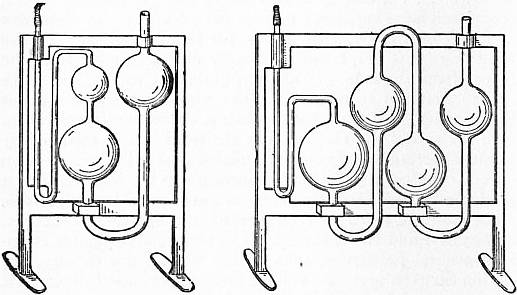
(By permission of Messrs Baird & Tatlock.)
Fig. 1. Fig. 2.
The volume of the gas in the measuring tube is determined by bringing the water in both tubes to the same level, and reading the graduation on the tube, avoiding parallax and the other errors associated with recording the coincidence of a graduation with a meniscus. The temperature and atmospheric pressure are simultaneously noted. If the tests be carried out rapidly, the temperature and pressure may be assumed to be constant, and any diminution in volume due to the absorption of a constituent may be readily expressed as a percentage. If, however, the temperature and pressure vary, the volumes are reduced to 0° and 760 mm. by means of the formula V0 = V(P − p)/(1 + .00366t)760, in which V is the observed volume, P the barometric pressure, p the vapour tension of water at the temperature t of the experiment. This reduction is facilitated by the use of tables.
Some common forms of absorption pipettes are shown in figs. 1 and 2. The simpler form consists of two bulbs connected at the bottom by a wide tube. The lower bulb is provided with a smaller bulb bearing a capillary through which the gas is led to the apparatus, the higher bulb has a wider outlet tube. The arrangement is mounted vertically on a stand. Sometimes the small bulb on the left is omitted. The form of the pipette varies with the nature of the absorbing material. For solutions which remain permanent in air the two-bulbed form suffices; in other cases a composite pipette (fig. 2) is employed, in which the absorbent is protected by a second pipette containing water. In the case of solid reagents, e.g. phosphorus, the absorbing bulb has a tubulure at the bottom. To use a pipette, the absorbing liquid is brought to the outlet of the capillary by tilting or by squeezing a rubber ball fixed to the wide end, and the liquid is maintained there by closing with a clip. The capillary is connected with the measuring tube by a fine tube previously filled with water. The clip is removed, the stopcock opened, and the level tube of the measuring apparatus raised, so that the gas passes into the first bulb. There it is allowed to remain, the pipette being shaken from time to time. It is then run back into the measuring tube by lowering the level tube, the stopcock is closed, and the volume noted. The operation is repeated until there is no further absorption.
The choice of absorbents and the order in which the gases are to be estimated is strictly limited. Confining ourselves to cases where titration methods are not employed, the general order is as follows: carbon dioxide, olefines, oxygen, carbon monoxide, hydrogen, methane and nitrogen (by difference). This scheme is particularly applicable to coal-gas. Carbon dioxide is absorbed by a potash solution containing one part of potash to between two and three of water; the stronger solution absorbs about 40 volumes of the gas. The olefines—ethylene, &c.—are generally absorbed by a very strong sulphuric acid prepared by adding sulphur trioxide to sulphuric acid to form a mixture which solidifies when slightly cooled. Bromine water is also employed. Oxygen is absorbed by stick phosphorus contained in a tubulated pipette filled with water. The temperature must be above 18°; and the absorption is prevented by ammonia, olefines, alcohol, and some other substances. An alkaline solution of pyrogallol is also used; this solution rapidly absorbs oxygen, becoming black in colour, and it is necessary to prepare the solution immediately before use. Carbon monoxide is absorbed by a solution of cuprous chloride in hydrochloric acid or, better, in ammonia. When small in amount, it is better to estimate as carbon dioxide by burning with oxygen and absorbing in potash; when large in amount, the bulk is absorbed in ammoniacal cuprous chloride and the residue burned. Hydrogen may be estimated by absorption by heated palladium contained in a capillary through which the gas is passed, or by exploding (under reduced pressure) with an excess of oxygen, and measuring the diminution in volume, two-thirds of which is the volume of hydrogen. The explosion method is unsatisfactory when the gas is contained over water, and is improved by using mercury. Methane cannot be burnt in this way even when there is much hydrogen present, and several other methods have been proposed, such as mixing with air and aspirating over copper oxide heated to redness, or mixing with oxygen and burning in a platinum tube heated to redness, the carbon dioxide formed being estimated by absorption in potash. Gases soluble in water, such as ammonia, hydrochloric acid, sulphuretted hydrogen, sulphur dioxide, &c., are estimated by passing a known volume of the gas through water and titrating the solution with a standard solution. Many types of absorption vessel are in use, and the standard solutions are generally such that 1 c.c. of the solution corresponds to 1 c.c. of the gas under normal conditions.
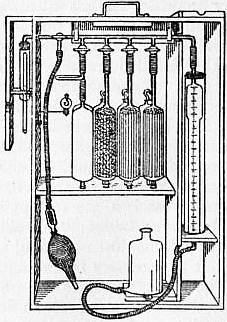
(By permission of Messrs Baird & Tatlock.)
Fig. 3.
Many forms of composite gas-apparatus are in use. One of the commonest is the Orsat shown in fig. 3. The gas is measured in the graduated cylinder on the right, which is surrounded by a water jacket and provided with a levelling bottle. At the top it is connected by a capillary tube bent at right angles to a series of absorbing vessels, the connexion being effected by stopcocks. These vessels consist of two vertical cylinders joined at the bottom by a short tube. The cylinder in direct communication with the capillary is filled with glass tubes so as to expose a larger surface of the absorbing solution to the gas. The other cylinder is open to the air and serves to hold the liquid ejected from the absorbing cylinder. Any number of bulbs can be attached to the horizontal capillary; in the form illustrated there are four, the last being a hydrogen pipette in which the palladium is heated in a horizontal tube by a spirit lamp. At the end of the horizontal tube there is a three-way cock connecting with the air or an aspirator. To use the apparatus, the measuring tube is completely filled with water by raising the levelling bottle. The absorbing vessels are then about half filled with the absorbents, and, by opening the cocks and aspirating, the liquid is brought so as completely to fill the bulbs nearer the capillary. The cocks are then closed. By opening the three-way cock to the supply of the test gas and lowering the levelling bottle, any desired amount can be drawn into the measuring tube. The absorption is effected by opening the cock of an absorbing vessel and raising the levelling bottle. The same order of absorption and general directions pertaining to the use of Hempel pipettes have to be adopted.