VOLUME XI SLICE IV G to Gaskell Elizabeth (continued 8)
Reading edition
A B C D E F G
La, Si, Ut or Do, Re, Mi, Fa, Sol.
In Germany a remnant of Greek use survives. A was originally followed in the scale by the semitone above, as the classical Mesē was followed by Paramesē, and this note, namely ♭ B, is still called B in German, English ♮ B (French and Italian Si) being represented by the letter H. The gamut which, whenever instituted, did not pass out of use until the 19th century, regarded the hexachord and not the octachord, employed both letters and syllables, made the former invariable while changing the latter according to key relationship, and acknowledged only the three keys of G, C and F; it took its name from having the Greek letter gamma with Ut for its lowest keynote, though the Latin letters with the corresponding syllables were applied to all the other notes.
GANDAK, a river of northern India. It rises in the Nepal-Himalayas, flows south-west until it reaches British territory, where it forms the boundary between the United Provinces and Bengal for a considerable portion of its course, and falls into the Ganges opposite Patna. It is a snow-fed stream, and the surrounding country in the plains, lying at a lower level than its banks, is endangered by its floods. The river is accordingly enclosed by protective embankments.
The Little Gandak rises in the Nepal hills, enters Gorakhpur district about 8 m. west of the Gandak, and joins the Gogra just within the Saran district of Bengal.
The Burhi (or old) Gandak also rises in the Nepal hills, and follows a course roughly parallel to and east of that of the Gandak, of which it represents an old channel, passing Muzaffarpur, and joining the Ganges nearly opposite to Moughjr. Its principal tributary is the Baghmati, which rises in the hills N. of Kathmandu, flows in a southerly direction through Tirhut, and joins the Burhi Gandak close to Rusera.
GANDAMAK, a village of Afghanistan, 35 m. from Jalalabad on the road to Kabul. On the retreat from Kabul of General Elphinstone’s army in 1842, a hill near Gandamak was the scene of the massacre of the last survivors of the force, twenty officers and forty-five British soldiers. It is also notable for the treaty of Gandamak, which was signed here in 1879 with Yakub Khan. (See Afghanistan.)
GANDERSHEIM, a town of Germany in the duchy of Brunswick, in the deep valley of the Gande, 48 m. S.W. of Brunswick, on the railway Böissum-Holzminden. Pop. (1905) 2847. It has two Protestant churches of which the convent church (Stiftskirche) contains the tombs of famous abbesses, a palace (now used as law courts) and the famous abbey (now occupied by provincial government offices). There are manufactures of linen, cigars, beet-root sugar and beer.
The abbey of Gandersheim was founded by Duke Ludolf of Saxony, who removed here in 856 the nuns who had been shortly before established at Brunshausen. His own daughter Hathumoda was the first abbess, who was succeeded on her death by her sister Gerberga. Under Gerberga’s government Louis III. granted a privilege, by which the office of abbess was to continue in the ducal family of Saxony as long as any member was found competent and willing to accept the same. Otto III. gave the abbey a market, a right of toll and a mint; and after the bishop of Hildesheim and the archbishop of Mainz had long contested with each other about its supervision, Pope Innocent III. declared it altogether independent of both. The abbey was ultimately recognized as holding directly of the Empire, and the abbess had a vote in the imperial diet. The conventual estates were of great extent, and among the feudatories who could be summoned to the court of the abbess were the elector of Hanover and the king of Prussia. Protestantism was introduced in 1568, and Magdalena, the last Roman Catholic abbess, died in 1589; but Protestant abbesses were appointed to the foundation, and continued to enjoy their imperial privileges till 1803, when Gandersheim was incorporated with Brunswick. The last abbess, Augusta Dorothea of Brunswick, was a princess of the ducal house, and kept her rank till her death. The memory of Gandersheim will long be preserved by its literary memorials. Hroswitha, the famous Latin poet, was a member of the sisterhood in the 9th century; and the rhyming chronicle of Eberhard of Gandersheim ranks as in all probability the earliest historical work composed in low German.
The Chronicle, which contains an account of the first period of the monastery, is edited by L. Wieland in the Monumenta Germ. historica (1877), and has been the object of a special study by Paul Hasse (Göttingen, 1872). See also “Agii vita Hathumodae abbatissae Gandershemensis primae,” in J.G. von Eckhart’s Veterum monumentorum quaternio (Leipzig, 1720); and Hase, Mittelalterliche Baudenkmäler Niedersachsens (1870).
GANDHARVA, in Hindu mythology, the term used to denote (1) in the Rig-Veda usually a minor deity; (2) in later writings a class of divine beings. As a unity Gandharva has no special attributes but many duties, and is in close relation with the great gods. Thus he is director of the sun’s horses; he is guardian of soma, the sacred liquor, and therefore is regarded as the heavenly physician, soma being a panacea. He is servant of Agni the god of light and of Varuna the divine judge. He is omnipresent: in the heavens, in the air and in the waters. He is the keeper of heaven’s secrets and acts as messenger between gods and men. He is gorgeously clothed and carries shining weapons. For wife he has the spirit of the clouds and waters, Apsaras, and by her became father of the first mortals, Yama and Yami. He is the tutelary deity of women and presides over marriage ceremonies. In their collective capacity the Gandharva share the duties allotted to the single deity. They live in the house of Indra and with their wives, the Apsaras, beguile the time by singing, acting and dancing. Sometimes they are represented as numbering twelve, sometimes twenty-seven, or they are innumerable. In Hindu law a Gandharva marriage is one contracted by mutual consent and without formality.
GANDÍA, a seaport of eastern Spain, in the province of Valencia; on the Gandía-Alcóy and Alcira-Denia railways. Pop. (1900) 10,026. Gandía is on the left bank of the river Alcóy or Sérpis, which waters one of the richest and most populous plains of Valencia and enters the Mediterranean Sea at the small harbour of Gandía (El Grao), 3 m. N.E. The chief ancient buildings of Gandía are the Gothic church, the college, founded by San Francisco de Borgia, director-general of the order of Jesus (1510-1572), and the palace of the dukes of Gandía—a title held in the 15th and 16th centuries by members of the princely house of Borgia or Borja. A Jesuit convent, the theatre, schools and the palace of the dukes of Osuna, are modern. Besides its manufactures of leather, silk, velvet and ribbons, Gandía has a thriving export trade in fruit, and imports coal, guano, timber and flour. In 1904, 400 vessels, of 200,000 tons, entered the harbour.
GANDO, a sultanate of British West Africa, included in the protectorate of Nigeria, situated on the left bank of the Niger above Borgu. The sultanate was established, c. 1819, on the death of Othman Dan Fodio, the founder of the Fula empire, and its area and importance varied considerably during the 19th century, several of the Fula emirates being regarded as tributaries, while Gando itself was more or less dependent on Sokoto. Gando in the middle of the century included both banks of the Niger at least as far N.W. as Say. The districts outside the British protectorate now belong to France. Since 1884 Gando has been in treaty relations with the British, and in 1903 the part assigned to the British sphere by agreement with France came definitely under the control of the administration in Nigeria. Gando now forms the sub-province of the double province of Sokoto. The emir was appointed under British authority after the conquest of Sokoto in 1903. Since that date the province has been organized for administration on the same system as the rest of the protectorate of Northern Nigeria. Provincial and native courts of justice have been established, roads have been opened, the slave trade has been abolished, and the country assessed under the new scheme for taxation. British garrisons are stationed at Jegga and Ambrusa. The chief town is Gando, situated on the Sokoto, the first considerable affluent of the Niger from the east, about 60 m. S.W. of the town of Sokoto.
GANESA, or Ganesh, in Hindu mythology, the god of wisdom and prudence, always represented with an elephant’s head possibly to indicate his sagacity. He is the son of Siva and Parvati. He is among the most popular of Indian deities, and almost every act, religious or social, in a Hindu’s life begins with an invocation to him, as do most books. He typifies not the wisdom of knowledge but that worldly wisdom which results in financial success, and thus he is particularly the god of the Hindu shopkeeper. In his divine aspect Ganesa is ruler over the hosts of heaven, the spirits which come and go to do Indra’s will.
GANGES (Ganga), a great river of northern India, formed by the drainage of the southern ranges of the Himalayas. This mighty stream, which in its lower course supplies the river system of Bengal, rises in the Garhwal state, and falls into the Bay of Bengal after a course of 1500 m. It issues, under the name of the Bhagirathi, from an ice cave at the foot of a Himalayan snow-bed near Gangotri, 10,300 ft. above the level of the sea.
During its passage through the southern spurs of the Himalayas it receives the Jahnavi from the north-west, and subsequently the Alaknanda, after which the united stream takes the name of the Ganges. Deo Prayag, their point of junction, is a celebrated place of pilgrimage, as is also Gangotri, the source of the parent stream. At Sukhi it pierces through the Himalayas, and turns south-west to Hardwar, also a place of great sanctity. It proceeds by a tortuous course through the districts of Dehra Dun, Saharanpur, Muzaffarnagar, Bulandshahr and Farukhabad, in which last district it receives the Ramganga. Thus far the Ganges has been little more than a series of broad shoals, long deep pools and rapids, except, of course, during the melting of the snows and throughout the rainy season. At Allahabad, however, it receives the Jumna, a mighty sister stream, which takes its rise also in the Himalayas to the west of the sources of the Ganges. The combined river winds eastwards by south-east through the United Provinces, receiving the Gumti and the Gogra. The point of junction with both the Gumti and the Gogra has more or less pretension to sanctity. But the tongue of land at Allahabad, where the Jumna and the Ganges join, is the true Prayag, the place of pilgrimage, to which hundreds of thousands of devout Hindus repair to wash away their sins in the sacred river. It is here that the great festival called the Magh mela is held.
Shortly after passing the holy city of Benares the Ganges enters Behar, and after receiving an important tributary, the Sone from the south, passes Patna, and obtains another accession to its volume from the Gandak, which rises in Nepal. Farther to the east it receives the Kusi, and then, skirting the Rajmahal hills, turns sharply to the southward, passing near the site of the ruined city of Gaur. By this time it has approached to within 240 m., as the crow flies, from the sea. About 20 m. farther on it begins to branch out over the level country, and this spot marks the commencement of the delta, 220 m. in a straight line, or 300 by the windings of the river, from the Bay of Bengal. The main channel takes the name of the Padma or Padda, and proceeds in a south-easterly direction, past Pabna to Goalanda, above which it is joined by the Jamuna or main stream of the Brahmaputra. The vast confluence of waters rushes towards the sea, receiving further additions from the hill country on the east, and forming a broad estuary known under the name of the Meghna, which enters the Bay of Bengal near Noakhali. This estuary, however, is only the largest and most easterly of a great number of mouths or channels. The most westerly is the Hugli, which receives the waters of a number of distributary channels that start from the parent Ganges above Murshidabad. Between the Hugli on the west and the Meghna on the east lies the delta. The upper angle of it consists of rich and fertile districts, such as Murshidabad, Nadia, Jessore and the 24 Parganas. But towards its southern base, resting on the sea, the country sinks into a series of great swamps, intercepted by a network of innumerable channels. This wild waste is known as the Sundarbans, from the sundari tree, which grows in abundance in the seaboard tracts.
The most important channel of the Ganges for commerce is the Hugli, on which stands Calcutta, about 90 m. from the mouth. Beyond this city the navigation is conducted by native craft,—the modern facilities for traffic by rail and the increasing shoals in the river having put an end to the previous steamer communication, which plied until about 1860 as high up as Allahabad. Below Calcutta important boat routes through the delta connect the Hugli with the eastern branches of the river, for both native craft and steamers.
The Ganges is essentially a river of great cities: Calcutta, Monghyr, Patna, Benares and Allahabad all lie on its course below its junction with the Jumna; and the ancient capitals, Agra and Delhi, are on the Jumna, higher up. The catchment basin of the Ganges is bounded on the N. by a length of about 700 m. of the Himalayan range, on the S. by the Vindhya mountains, and on the E. by the ranges which separate Bengal from Burma. The vast river basin thus enclosed embraces 432,480 sq. m. According to the latest calculations, the length of the main stream of the Ganges is 1540 m., or with its longest affluent, 1680; breadth at true entrance into the sea, 20 m.; breadth of channel in dry season, 1¼ to 2¼ m.; depth in dry season, 30 ft.; flood discharge, 1,800,000 cub. ft. per second; ordinary discharge, 207,000 cub. ft.; longest duration of flood, about 40 days. The average fall from Allahabad to Benares is 6 in. per mile; from Benares to Calcutta, between 4 and 5 in.; from Calcutta to the sea, 1 to 2 in. Great changes take place from time to time in the river-bed, which alter the face of the country. Extensive islands are thrown up, and attach themselves to the mainland, while the river deserts its old bed and seeks a new channel, it may be many miles off. Such changes are so rapid and on so vast a scale, and the corroding power of the current on the bank so irresistible, that in Lower Bengal it is considered perilous to build any structure of a large or permanent character on its margin. Many decayed or ruined cities attest the changes in the river-bed in ancient times; and within our own times the main channel which formerly passed Rajmahal has turned away from it, and left the town high and dry, 7 m. from the bank.
The Ganges is crossed by six railway bridges on its course as far as Benares; and another, at Sara in Eastern Bengal, has been sanctioned.
The Upper Ganges Canal and the Lower Ganges Canal are the two principal systems of perennial irrigation in the United Provinces. The Ganges canal was opened by Lord Dalhousie in 1854, and irrigates 978,000 acres. The Lower Ganges canal, an extension of the original canal, has been in operation since 1878 and irrigates 830,000 acres. The two canals, together with the eastern Jumna, command the greater portion of the Doab lying between the Ganges and the Jumna, above Allahabad. Navigation in either is insignificant.
(T. H. H.*)
GANGOTRI, a celebrated place of Hindu pilgrimage, among the Himalaya Mountains. It is situated in the native state of Garhwal in the United Provinces, on the Bhagirathi, the chief head-stream of the Ganges, which is here not above 15 or 20 yds. broad, with a moderate current, and not in general above 3 ft. deep. The course of the river runs N. by E.; and on the bank near Gangotri there is a small temple about 20 ft. high, in which are images representing Ganga, Bhagirathi and other figures of mythology. It dates from the early part of the 18th century. The bed of the river adjoining the temple is divided off by the Brahmans into three basins, where the pilgrims bathe. One of these portions is dedicated to Brahma, another to Vishnu and the third to Siva. The pilgrimage to Gangotri is considered efficacious in washing away the sins of the devotee, and ensuring him eternal happiness in the world to come. The water taken from this sacred spot is exported by pilgrims to India and sold at a high price. The elevation of the temple above the sea is 10,319 ft.
GANGPUR, a tributary state of Orissa, Bengal, included until 1905 among the Chota Nagpur States. It is bounded N. by Ranchi district, E. by the Singhbhum district, S. by Sambalpur and Bamra, and W. by Raigarh in the Central Provinces. The country is for the most part an undulating plain, broken by detached ranges of hills, one of which, the Mahavira range, possesses a very remarkable appearance, springing abruptly from the plain in an irregular wall of tilted and disrupted rock, with two flanking peaks. The rivers are the Ib and the Brahmani, formed here by the union of the Sankh and the South Koel, both navigable by canoes. The Ib was formerly famous on account of diamonds found in its bed, and its sands are still washed for gold. One of the largest coalfields in India extends into the state, and iron ore is also found. Jungle products—lac, silk cocoons, catechu and resin, which are exported; wild animals—bisons, buffaloes, tigers, leopards, hyenas, wolves, jackals, wild dogs and many sorts of deer. Area, 2492 sq. m.; pop. (1901) 238,896; estimated revenue, £16,000.
GANGRENE (from Gr. γάγγραινα, an eating sore, from γραίνειν, to gnaw), a synonym in medicine for mortification (q.v.), or a local death in the animal body due to interruption of the circulation by various causes.
GANILH, CHARLES (1758-1836), French economist and politician, was born at Allanche in Cantal on the 6th of January 1758. He was educated for the profession of law and practised as avocat. During the troubled period which culminated in the taking of the Bastille on the 14th of July 1789, he came prominently forward in public affairs, and was one of the seven members of the permanent Committee of Public Safety which sat at the hôtel de ville. He was imprisoned during the Reign of Terror, and was only released by the counter-revolution of the 9th Thermidor. During the first consulate he was called to the tribunate, but was excluded in 1802. In 1815 he was elected deputy for Cantal, and finally left the Chamber on its dissolution in 1823. He died in 1836. Ganilh is best known as the most vigorous defender of the mercantile school in opposition to the views of Adam Smith and the English economists.
His works, though interesting from the clearness and precision with which these peculiar opinions are presented, do not now possess much value for the student of political economy. He wrote Essai politique sur le revenue des peuples de l’antiquité, du moyen âge, &c. (1808); Des systèmes d’économie politique (1809); Théorie d’économie politique (1815); Dictionnaire analytique de l’économie politique (1826).
GANJAM, a district of British India, in the extreme north-east of the Madras Presidency. It has an area of 8372 sq. m. Much of the district is exceedingly mountainous and rocky, but is interspersed with open valleys and fertile plains. Pleasant groves of trees in the plains give to the scenery a greener appearance than is usually met with in the districts to the south. The mountainous tract known as the Maliyas, or chain of the Eastern Ghats, has an average height of about 2000 ft.—its principal peaks being Singharaj (4976 ft.), Mahendragiri (4923) and Devagiri (4535). The hilly region forms the agency of Ganjam, with an area of 3483 sq. m. and a population (in 1901) of 321,114, mostly wild backward tribes, incapable of being governed under ordinary conditions and therefore ruled by an agent of the governor with special powers. The chief rivers are the Rushikulya, the Vamsadhara and the Languliya. The sea and river fisheries afford a livelihood to a considerable section of the population. The hilly region abounds in forests consisting principally of sal, with satin-wood, ebony and sandal-wood in smaller quantities.
Ganjam formed part of the ancient kingdom of Kalinga. Its early history is involved in obscurity, and it was not till after the Gajapati dynasty ascended the throne of Orissa that this tract became even nominally a part of their dominions. Owing to the nature of the country the rising Mahommedan power was long kept at bay; and it was not till nearly a century after the first invasion of Orissa that a Mahommedan governor was sent to govern the Chicacole Circars, which included the present district of Ganjam. In 1753 Chicacole, with the Northern Circars, were made over to the French by Salabat Jang for the maintenance of his French auxiliaries. In 1759 Masulipatam was taken by an English force sent from Bengal, and the French were compelled to abandon Ganjam and their other factories in the north. In 1765 the Northern Circars (including Ganjam) were granted to the English by imperial firman, and in August 1768 an English factory was founded at Ganjam, protected by a fort. The present district of Ganjam was constituted in 1802. In the earlier years of British rule considerable difficulty was experienced in the administration of the district; and on more than one occasion the refractory large landholders had to be coerced by means of regular troops. In 1816 Ganjam was overrun by the Pindaris; and in 1836 occurred the Gumsur campaign, when the British first came into contact with the aboriginal Kondhs, the suppression of whose practice of human sacrifice was successfully accomplished. A petty rising of a section of the Kondhs occurred in 1865, which was, however, suppressed without the aid of regular troops.
In 1901 the pop. of the district was 2,010,256, showing an increase of 20% in the decade. There are two systems of government irrigation: (1) the Rushikulya project, and (2) the Ganjam minor rivers system. The principal crops are rice, other food grains, pulse, oil seeds and a little sugar-cane and cotton. Salt is evaporated, as a government monopoly, along the coast. Sugar is refined, according to German methods, at Aska, where rum also is produced. A considerable trade is conducted at the ports of Gopalpur and Calingapatam, which are only open roadsteads. The district is traversed throughout by the East Coast railway (Bengal-Nagpur system), which was opened from Calcutta to Madras in 1900. There are colleges at Berhampore and Parlakimedi. The headquarters station is Berhampore; the town of Ganjam occupied this position till 1815, when it was found unhealthy, and its importance has since declined.
GANNAL, JEAN NICOLAS (1791-1852), French chemist, was born at Sarre-Louis on the 28th of July 1791. In 1808 he entered the medical department of the French army, and witnessed the retreat from Moscow in 1812. After the downfall of the empire he worked at the École Polytechnique in Paris and subsequently at the Faculty of Sciences as assistant to L.J. Thénard. His contributions to technical chemistry included a method of refining borax, the introduction of elastic rollers formed of gelatin and sugar for use in printing, and processes for manufacturing glue and gelatin, lint, white lead, &c. The Institute awarded him a Montyon prize in 1827 for his advocacy of chlorine as a remedy in pulmonary phthisis, and again in 1835 for his discovery of the efficacy of solutions of aluminium acetate and chloride for preserving anatomical preparations. In the latter part of his life he turned his attention to embalmment, his method depending on the injection of solutions of aluminium salts into the arteries. He died at Paris in January 1852. His son Felix, born in 1829, also devoted himself to the question of the disposal of the dead, among his publications being Mort réelle et mort apparente (1868), Inhumation et crémation (1876), and Les Cimetières (1885), a work on the history and law of burial, of which only one volume appeared.
GANNET (O.E. ganot) or Solan Goose,1 the Pelecanus bassanus of Linnaeus and the Sula bassana of modern ornithologists, a large sea-fowl long known as a numerous visitor, for the purpose of breeding, to the Bass Rock at the entrance of the Firth of Forth, and to certain other islands off the coast of Britain, of which four are in Scottish waters—namely, Ailsa Craig, at the mouth of the Firth of Clyde; the group known collectively as St Kilda; Suleskerry, some 40 m. north-east of the Butt of Lewis; and the Stack and Skerry, about the same distance westward of Stromness. It appears also to have two stations off the coast of Ireland, the Skellig Islands and the Stags of Broadhaven, and it resorts besides to Lundy Island in the Bristol Channel—its only English breeding-place. Farther to the northward its settlements are Myggenaes, the most westerly of the Faeroes, and various small islands off the coast of Iceland, of which the Vestmannaeyjar, the Reykjanes Fuglaskér and Grimsey are the chief. On the western side of the Atlantic it appears to have but five stations, one in the Bay of Fundy, and four rocks in the Gulf of St Lawrence. On all these seventeen places the bird arrives about the end of March or in April and departs in autumn when its young are ready to fly; but even during the breeding-season many of the adults may be seen on their fishing excursions at a vast distance from their home, while at other times of the year their range is greater still, for they not only frequent the North Sea and the English Channel, but stray to the Baltic, and, in winter, extend their flight to the Madeiras, while the members of the species of American birth traverse the ocean from the shores of Greenland to the Gulf of Mexico.
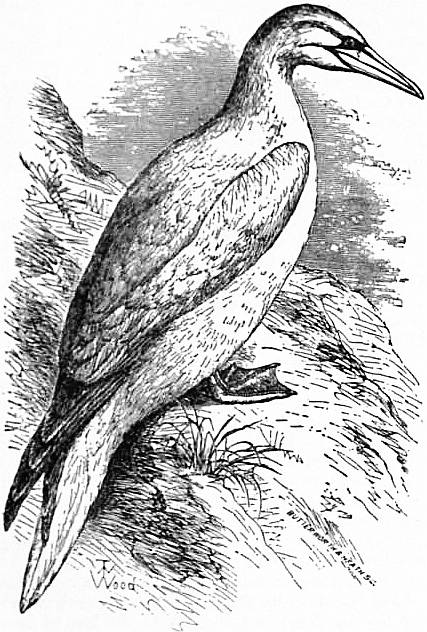
Gannet, or Solan Goose.
Apparently as bulky as a goose, and with longer wings and tail, the gannet weighs considerably less. The plumage of the adult is white, tinged on the head and neck with buff, while the outer edge and principal quills of the wings are black, and some bare spaces round the eyes and on the throat reveal a dark blue skin. The first plumage of the young is of a deep brown above, but paler beneath, and each feather is tipped with a triangular white spot. The nest is a shallow depression, either on the ground itself or on a pile of turf, grass and seaweed—which last is often conveyed from a great distance. The single egg it contains has a white shell of the same chalky character as a cormorant’s. The young are hatched blind and naked, but the slate-coloured skin with which their body is covered is soon clothed with white down, replaced in due time by true feathers of the dark colour already mentioned. The mature plumage is believed not to be attained for some three years. Towards the end of summer the majority of gannets, both old and young, leave the neighbourhood of their breeding-place, and, betaking themselves to the open sea, follow the shoals of herrings and other fishes (the presence of which they are most useful in indicating to fishermen) to a great distance from land. Their prey is almost invariably captured by plunging upon it from a height, and a company of gannets fishing presents a curious and interesting spectacle. Flying in a line, each bird, when it comes over the shoal, closes its wings and dashes perpendicularly into the waves, whence it emerges after a few seconds, and, shaking the water from its feathers, mounts in a wide curve, and orderly takes its place in the rear of the string, to repeat its headlong plunge so soon as it again finds itself above its prey.2
Structurally the gannet presents many points worthy of note, such as its closed nostrils, its aborted tongue, and its toes all connected by a web—characters which it possesses in common with most of the other members of the group of birds (Steganopodes) to which it belongs. But more remarkable still is the system of subcutaneous air-cells, some of large size, pervading almost the whole surface of the body, communicating with the lungs, and capable of being inflated or emptied at the will of the bird. This peculiarity has attracted the attention of several writers—Montagu, Sir R. Owen (Proc. Zool. Soc., 1831, p. 90), and Macgillivray.
In the southern hemisphere the gannet is represented by two nearly allied but somewhat smaller forms—one, Sula capensis, inhabiting the coast of South Africa, and the other, S. serrator, the Australian seas. Both much resemble the northern bird, but the former seems to have a permanently black tail, and the latter a tail the four middle feathers of which are blackish-brown with white shafts.
Apparently inseparable from the gannets generically are the smaller birds well known to sailors as boobies, from the extraordinary stupidity they commonly display. They differ, however, in having no median stripe of bare skin down the front of the throat; they almost invariably breed upon trees and are inhabitants of warmer climates. One of them, S. cyanops, when adult has much of the aspect of a gannet, but S. piscator is readily distinguishable by its red legs, and S. leucogaster by its upper plumage and neck of deep brown. These three are widely distributed within the tropics, and are in some places exceedingly abundant. The fourth, S. variegata, which seems to preserve throughout its life the spotted suit characteristic of the immature S. bassana, has a much more limited range, being as yet only known from the coast of Peru, where it is one of the birds which contribute to the formation of guano.
(A. N.)
1 The phrase ganotes bæð (gannet’s bath), a periphrasis for the sea, occurs in the Anglo-Saxon Chronicle, in reference to events which took place A.D. 975, as pointed out by Prof. Cunningham, whose learned treatise on this bird (Ibis, 1866, p. 1) nearly exhausts all that can be said of its history and habits. A few pages further on (p. 13) this writer remarks:—“The name gannet is intimately connected with our modern English gander, both words being modifications of the ancient British ‘gan’ or ‘gans,’ which is the same word as the modern German ‘Gans,’ which in its turn corresponds with the old High German ‘Kans,’ the Greek χήν, the Latin anser, and the Sanskrit ‘hansa,’ all of which possess the same signification, viz. a goose. The origin of the names solan or soland, sulan, sula and haf-sula, which are evidently all closely related, is not so obvious. Martin [Voy. St Kilda] informs us that ‘some imagine that the word solan comes from the Irish souler, corrupted and adapted to the Scottish language, qui oculis irretortis e longinquo respiciat praedam.’ The earlier writers in general derive the word from the Latin solea, in consequence of the bird’s supposed habit of hatching its egg with its foot; and in a note intercalated into Ray’s description of the solan goose in the edition of his Itineraries published by the Ray Society, and edited by Dr Lankester, we are told, though no authority for the statement is given, that ‘the gannet, Sula alba, should be written solent goose, i.e. a channel goose.’” Hereon an editorial note remarks that this last statement appears to have been a suggestion of Yarrell’s, and that it seems at least as possible that the “Solent” took its name from the bird.
2 The large number of gannets, and the vast quantity of fish they take, has been frequently animadverted upon, but the computations on this last point are perhaps fallacious. It seems to be certain that in former days fishes, and herrings in particular, were at least as plentiful as now, if not more so, notwithstanding that gannets were more numerous. Those frequenting the Bass were reckoned by Macgillivray at 20,000 in 1831, while in 1869 they were computed at 12,000, showing a decrease of two-fifths in 38 years. On Ailsa in 1869 there were supposed to be as many as on the Bass, but their number was estimated at 10,000 in 1877 (Report on the Herring Fisheries of Scotland, 1878, pp. xxv. and 171),—being a diminution of one-sixth in eight years, or nearly twice as great as on the Bass.
GANODONTA (so named from the presence of bands of enamel on the teeth), a group of specialized North American Lower and Middle Eocene mammals of uncertain affinity. The group includes Hemiganus, Psittacotherium and Conoryctes from the Puerco, Calamodon and Hemiganus from the Wasatch, and Stylinodon from the Bridger Eocene. With the exception of Conoryctes, in which it is longer, the skull is short and suggests affinity to the sloths, as does what little is known of the limb-bones. The dentition, too, is of a type which might well be considered ancestral to that of the Edentata. For instance, the molars when first developed have tritubercular summits, but these soon become worn away, leaving tall columnar crowns, with a subcircular surface of dentine exposed at the summit of each. Moreover, while the earlier types have a comparatively full series of teeth, all of which are rooted and invested with enamel, in the later forms the incisors are lost, the cheek-teeth never develop roots but grow continuously throughout life. These and other features induced Dr J.L. Wortman to regard the Ganodonta as an ancestral suborder of Edentata; but this view is not accepted by Prof. W.B. Scott. Teeth provisionally assigned to Calamodon have been obtained from the Lower Tertiary deposits of Switzerland.
See J.L. Wortman, “The Ganodonta and their Relationship to the Edentata,” Bull. Amer. Mus. vol. ix. p. 59 (1897); W.B. Scott, “Mammalia of the Santa Cruz Beds, Edentata,” Rep. Princeton Exped. to Patagonia, vol. v. (1903-1904).
(R. L.*)
GANS, EDUARD (1797-1839), German jurist, was born at Berlin on the 22nd of March 1797, of prosperous Jewish parents. He studied law first at Berlin, then at Göttingen, and finally at Heidelberg, where he attended Hegel’s lectures, and became thoroughly imbued with the principles of the Hegelian philosophy. In 1820, after taking his doctor’s degree, he returned to Berlin as lecturer on law. In 1825 he turned Christian, and the following year was appointed extraordinary, and in 1828 ordinary, professor in the Berlin faculty of law. At this period the historical school of jurisprudence was coming to the front, and Gans, predisposed owing to his Hegelian tendencies to treat law historically, applied the method to one special branch—the right of succession. His great work, Erbrecht in weltgeschichtlicher Entwicklung (1824, 1825, 1829 and 1835), is of permanent value, not only for its extensive survey of facts, but for the admirable manner in which the general theory of the slow evolution of legal principles is presented. In 1830, and again in 1835, Gans visited Paris, and formed an intimate acquaintance with the leaders of literary culture and criticism there. The liberality of his views, especially on political matters, drew upon Gans the displeasure of the Prussian government, and his course of lectures on the history of the last fifty years (published as Vorlesungen über d. Geschichte d. letzten fünfzig Jahre, Leipzig, 1833-1834) was prohibited. He died at Berlin on the 5th of May 1839. In addition to the works above mentioned, there may be noted the treatise on the fundamental laws of property (Über die Grundlage des Besitzes, Berlin, 1829), a portion of a systematic work on the Roman civil law (System des römischen Civil-Rechts, 1827), and a collection of his miscellaneous writings (Vermischte Schriften, 1832). Gans edited the Philosophie der Geschichte in Hegel’s Werke, and contributed an admirable preface.
See Revue des deux mondes (Dec. 1839).
GÄNSBACHER, JOHANN BAPTIST (1778-1844), Austrian musical composer, was born in 1778 at Sterzing in Tirol. His father, a schoolmaster and teacher of music, undertook his son’s early education, which the boy continued under various masters till 1802, when he became the pupil of the celebrated Abbé G.J. Vogler. To his connexion with this artist and with his fellow-pupils, more perhaps than to his own merits, Gänsbacher’s permanent place in the history of music is due; for it was during his second stay with Vogler, then (1810) living at Darmstadt, that he became acquainted with Weber and Meyerbeer, and the close friendship which sprang up among the three young musicians, and was dissolved by death only, has become celebrated in the history of their art. But Gänsbacher was himself by no means without merit. He creditably filled the responsible and difficult post of director of the music at St Stephen’s cathedral, Vienna, from 1823 till his death (July 13, 1844); and his compositions show high gifts and accomplishment. They consist chiefly of church music, 17 masses, besides litanies, motets, offertories, &c., being amongst the number. He also wrote several sonatas, a symphony, and one or two minor compositions of a dramatic kind.
GANTÉ, a cloth made from cotton or tow warp and jute weft. It is largely used for bags for sugar and similar material, and has the appearance of a fine hessian cloth.
GANYMEDE, in Greek mythology, son of Tros, king of Dardania, and Callirrhoë. He was the most beautiful of mortals, and was carried off by the gods (in the later story by Zeus himself, or by Zeus in the form of an eagle) to Olympus to serve as cup-bearer (Apollodorus iii. 12; Virgil, Aeneid, v. 254; Ovid, Metam. x. 255). By way of compensation, Zeus presented his father with a team of immortal horses (or a golden vine). Ganymede was afterwards regarded as the genius of the fountains of the Nile, the life-giving and fertilizing river, and identified by astronomers with the Aquarius of the zodiac. Thus the divinity that distributed drink to the gods in heaven became the genius who presided over the due supply of water on earth. When pederasty became common in Greece, an attempt was made to justify it and invest it with dignity by referring to the rape of the beautiful boy by Zeus; in Crete, where the love of boys was reduced to a system, Minos, the primitive ruler and law-giver, was said to have been the ravisher of Ganymede. Thus the name which once denoted the good genius who bestowed the precious gift of water upon man was adopted to this use in vulgar Latin under the form Catamitus. Ganymede being carried off by the eagle was the subject of a bronze group by the Athenian sculptor Leochares, imitated in a marble statuette in the Vatican. E. Veckenstedt (Ganymedes, Libau, 1881) endeavours to prove that Ganymede is the genius of intoxicating drink (μέθυ, mead, for which he postulates a form μῆδος), whose original home was Phrygia.
See article by P. Weizsäcker in Roscher’s Lexikon der Mythologie. In the article Greek Art, fig. 53 (Pl. I.) gives an illustration of Ganymede borne aloft by an eagle.
GAO, Gao-Gao, or Garo, a town of French West Africa, in the Upper Senegal and Niger colony, on the left bank of the Niger, 400 m. by river below Timbuktu. Pop. about 5000. The present town dates from the French occupation in 1900; of the ancient city there are scanty ruins, the chief being a truncated pyramid, the remains of the tomb (16th century) of Mahommed Askia, the Songhoi conqueror, and those of the great mosque. According to tradition a city stood on this spot in very ancient times and its inhabitants are said to have had intercourse with the Egyptians. It is known, however, that the city of which the French settlement is the successor was founded by the Songhoi, probably in the 7th or 8th century, and became the capital of their empire. Garo (Ga-rho) appears to have been the correct name of the Songhoi city, though it was also known as Gogo and Kuku (Kaougha)1. In the 12th century Idrisi describes Kuku as a populous unwalled town devoted to commerce and industry; it is possible, however, that Idrisi is referring not to Gao but to another town somewhat to the south—at that period the middle course of the Niger had many prosperous towns along its banks. In the 14th century Gao was conquered by the king of Melle, and its great mosque was built (c. 1325) by the Melle sovereign Kunkur Musa on his return from a pilgrimage to Mecca. In the 15th century the Songhoi regained power and Gao attained its greatest prosperity in the reign of Askia. It did not enjoy the commercial importance of Jenné nor the intellectual supremacy of Timbuktu, but was the political centre of the western Sudan for a long period. On the break up of the Songhoi power the city declined in importance. It became subject in 1590 to the Ruma of Timbuktu, from whom it was wrested in 1770 by the Tuareg, the last named surrendering possession to the French. The first European to reach Gao was Mungo Park (1805); he was followed in 1851 by Heinrich Barth, and in 1896 by the French naval lieutenant Hourst. Gao is now the headquarters of a military district. A caravan route leads from it to Kano and Bornu. From Gao upwards the Niger is navigable for over 1000 m.
See Timbuktu. For the Gao region of the Niger see an article by F. Dubois in L’Afrique française (January 1909).
1 There was another city called Kaoka or Gaoga east of Lake Chad in the country now known as Bagirmi. It was the seat of the Bulala dynasty, an offshoot of the royal family of Kanem, whose rule in the 15th century extended from the Shari to Darfur. The existence of the state was first mentioned by Leo Africanus. To the Bornuese it was known as Bulala or Kuka Bulala, a name which persists as that of a district in French Congo (see Bornu). The similarity of the name Gaoga to that of the Songhoi capital has given rise to much confusion.
GAOL, or Jail, a prison (q.v.). The two forms of the word are due to the parallel dual forms in Old Central and Norman French respectively, jaiole or jaole, and gaiole or gayolle. The common origin is the med. Lat. gabiola, a diminutive formed from cavea, a hollow, a den, from which the English “cave” is derived. The form “gaol” still commonly survives in English, and is in official usage, e.g. “gaol-delivery,” but the common pronunciation of both words, “jail,” shows the real surviving word.
GAON (Heb. for “Excellency,” plural Geonim), the title given to the heads of the two Jewish academies in Babylonia, Sura and Pumbeditha. Though the name is far older, it is chiefly applied to Rabbis who lived between the close of the Talmud and the transference of the centre of Judaism from Asia to Europe—i.e. from the end of the 6th to the middle of the 11th century A.D. The Geonim were required to do homage to the Exilarchs (see Exilarch) but were otherwise independent. They exercised wide authority and were appealed to in settlement of the social and religious affairs of the diaspora. To them must be assigned the arrangement of the main lines of the present Synagogue liturgy. Their chief literary activity took the form of Answers to Questions—a form which was extensively used in later centuries. The most noted of the Geonim, who will be found treated under their respective names, were Aḥai, Amram, Ṣemach, Saadiah, Sherira and Hai. Hai Gaon died in 1038, closing the period of the Geonim after an activity of four and a half centuries.
A full list of the Geonim is given in tabular form in the Jewish Encyclopaedia, vol. v. p. 571.
(I. A.)
GAP, the capital of the French department of the Hautes Alpes. Pop. (1906) town, 6888; commune, 10,823. It is built at a height of 2418 ft. on the right bank of the Luye (an affluent of the Durance), in an agreeable position, and is dominated afar by snowy peaks on the N.E. The little city has the look of a Provençal town, being white. The 17th-century cathedral church has been entirely reconstructed (1866-1905). In the prefecture is the tomb of the constable de Lesdiguières (1543-1626), dating from about 1613, and due to a Lorraine sculptor, Jacob Richier. The same building contains various scientific and archaeological collections, as well as the very rich archives, which include many MSS. from the monastery of Durbon, &c. There are a few small manufactories of purely local importance. Gap is connected by railway with Briançon (51½ m.) and with Grenoble (85½ m.), while from the railway junction of Veynes (16½ m. W. of Gap) it is 122 m. by rail to Marseilles. The episcopal see of Gap, now in the ecclesiastical province of Aix en Provence, is first certainly mentioned in the 6th century, and in 1791 was enlarged by the annexation of that of Embrun (then suppressed).
Gap is the Vapincum of the Romans, and was founded by Augustus about 14 B.C. It long formed part of Provence, but in 1232 most of the region passed by marriage to the dauphins of Viennois. The town itself, however, remained under the rule of the bishops until 1512, when it was annexed to the crown of France. The bishops continued to bear the title of count of Gap until the Revolution. The town was sacked by the Huguenots in 1567 and 1577, and by the duke of Savoy in 1692. It was the birthplace of the reformer Guillaume Farel (1489-1565), who first preached his doctrines there about 1561-1562, but then took refuge in Switzerland.
See J. Roman, Histoire de la ville de Gap (Gap, 1892).
(W. A. B. C.)
GAPAN, a town of the province of Nueva Ecija, Luzon, Philippine Islands, 3 m. E. of San Isidro, the capital. Pop. (1903) 11,278. It is situated in a rich rice-growing region, and extensive forests in its vicinity contain fine hardwoods. Its climate is comparatively cool and healthy. The principal native dialects spoken are Tagalog and Pampangan. Gapan is the oldest town of the province.
GARARISH (Kararish), a semi-nomadic tribe of Semitic origin, dwelling along the right bank of the Nile from Wādi Halfa to Merawi. Many members of the tribe are agriculturists, others act as guides or transport drivers. They declare themselves kinsfolk of the Ababda, but they are more Arab than Beja.
GARASHANIN, ILIYA (1812-1874), Servian statesman, was the son of a Servian peasant, who made money by exporting cattle and pigs to Austria and by his intelligence and wealth attained to a certain influence in the country. He wanted to give his son as good an education as possible, and therefore sent him to Hungary to learn first in a Greek and then in a German school. Highly gifted, and having passed through a regular although somewhat short school training, the young Iliya very quickly came to the front. In 1836 Prince Milosh appointed him a colonel and commander of the then just organized regular army of Servia. In 1842 he was called to the position of assistant to the home minister, and from that time until his retirement from public life in 1867 he was repeatedly minister of home affairs, distinguishing himself by the energy and justice of his administration. But he rendered far greater services to his country as minister for foreign affairs. He was the first Servian statesman who had a political programme, and who worked to replace the Russian protectorate over Servia by the joint protectorate of all the great powers of Europe. As minister for foreign affairs in 1853 he was decidedly opposed to Servia joining Russia in war against Turkey and the western powers. His anti-Russian views resulted in Prince Menshikov, while on his mission in Constantinople, 1853, peremptorily demanding from the prince of Servia (Alexander Karageorgevich) his dismissal. But although dismissed, his personal influence in the country secured the neutrality of Servia during the Crimean War. He enjoyed esteem in France, and it was due to him that France proposed to the peace conference of Paris (1856) that the old constitution, granted to Servia by Turkey as suzerain and Russia as protector in 1839, should be replaced by a more modern and liberal constitution, framed by a European international commission. But the agreement of the powers was not secured. Garashanin induced Prince Alexander Karageorgevich to convoke a national assembly, which had not been called to meet for ten years. The assembly was convoked for St Andrew’s Day 1858, but its first act was to dethrone Prince Alexander and to recall the old Prince Milosh Obrenovich. When after the death of his father Milosh (in 1860) Prince Michael ascended the throne, he entrusted the premiership and foreign affairs to Iliya Garashanin. The result of their policy was that Servia was given a new, although somewhat conservative, constitution, and that she obtained, without war, the evacuation of all the fortresses garrisoned by the Turkish troops on the Servian territory, including the fortress of Belgrade (1867). Garashanin was preparing a general rising of the Balkan nations against the Turkish rule, and had entered into confidential arrangements with the Rumanians, Bosnians, Albanians, Bulgarians and Greeks, and more especially with Montenegro. But the execution of his plans was frustrated by his sudden resignation (at the end of 1867), and more especially by the assassination of Prince Michael a few months later (the 10th of June 1868). Although he was a Conservative in politics, and as such often in conflict with the leader of the Liberal movement, Yovan Ristich, he certainly was one of the ablest statesmen whom Servia had in the 19th century.
(C. Mi.)
GARAT, DOMINIQUE JOSEPH (1740-1833), French writer and politician, was born at Bayonne on the 8th of September 1749. After receiving a good education under the direction of a relation who was a curé, and having been an advocate at Bordeaux, he came to Paris, where he obtained introductions to the most distinguished writers of the time, and became a contributor to the Encyclopédie méthodique and the Mercure de France. He gained considerable reputation by an éloge on Michel de L’Hôpital in 1778, and was afterwards three times crowned by the Academy for éloges on Suger, Montausier and Fontenelle. In 1785 he was named professor of history at the Lycée, where his lectures enjoyed an equal popularity with those of G.F. Laharpe on literature. Being chosen a deputy to the states-general in 1789, he rendered important service to the popular cause by his narrative of the proceedings of the Assembly contributed to the Journal de Paris. Possessing strongly optimist views, a mild and irresolute character, and indefinite and changeable convictions, he played a somewhat undignified part in the great political events of the time, and became a pliant tool in carrying out the designs of others. Danton had him named minister of justice in 1792, and in this capacity had entrusted to him what he called the commission affreuse of communicating to Louis XVI. his sentence of death. In 1793 he became minister of the interior. In this capacity he proved himself quite inefficient. Though himself uncorrupt, he winked at the most scandalous corruption in his subordinates, and in spite of the admirably organized detective service, which kept him accurately informed of every movement in the capital, he entirely failed to maintain order, which might easily have been done by a moderate display of firmness. At last, disgusted with the excesses which he had been unable to control, he resigned (August 15, 1793). On the 2nd of October he was arrested for Girondist sympathies but soon released, and he escaped further molestation owing to the friendship of Barras and, more especially, of Robespierre, whose literary amour-propre he had been careful to flatter. On the 9th Thermidor, however, he took sides against Robespierre, and on the 12th of September 1794 he was named by the Convention as a member of the executive committee of public instruction. In 1798 he was appointed ambassador to Naples, and in the following year he became a member, then president, of the Council of the Ancients. Alter the revolution of the 18th Brumaire he was chosen a senator by Napoleon and created a count. During the Hundred Days he was a member of the chamber of representatives. In 1803 he was chosen a member of the Institute of France, but after the restoration of Louis XVIII. his name was, in 1816, deleted from the list of members. After the revolution of 1830 he was named a member of the new Academy of Moral and Political Science. He died at Ustaritz near Bayonne, April 25, 1833. His writings are characterized by elegance, grace and variety of style, and by the highest kind of rhetorical eloquence; but his grasp of his subject is superficial, and as his criticisms have no root in fixed and philosophical principles they are not unfrequently whimsical and inconsistent. He must not be confounded with his elder brother Dominique (1735-1799), who was also a deputy to the states-general.
The works of Garat include, besides those already mentioned, Considérations sur la Révolution Française (Paris, 1792); Mémoires sur la Révolution, ou exposé de ma conduite (1795); Mémoires sur la vie de M. Suard, sur ses écrits, et sur le XVIIIe siècle (1820); éloges on Joubert, Kléber and Desaix; several notices of distinguished persons; and a large number of articles in periodicals. Valuable materials for the history of Garat’s tenure of the ministry, notably the police reports of Dutard, are given in W.A. Schmidt’s Tableaux de la Révolution Française (3 vols., Leipzig, 1867-1870).
GARAT, PIERRE-JEAN (1764-1823), French singer, nephew of Dominique Joseph Garat, was born in Bordeaux on the 25th of April 1764. Gifted with a voice of exceptional timbre and compass he devoted himself, from an early age, to the cultivation of his musical talents. On account of his manifesting a distaste for the legal profession, for which his father wished him to study, he was deprived of his allowance, but through the patronage of a friend he obtained the office of secretary to Comte d’Artois, and was afterwards engaged to give musical lessons to the queen of France. At the beginning of the Revolution he accompanied Rode to England, where the two musicians appeared together in concerts. He returned to Paris in 1794. After the Revolution he became a professional singer, and on account of a song which he had composed in reference to the misfortunes of the royal family he was thrown into prison. On regaining his liberty he went to Hamburg, where he at once achieved extraordinary success; and by his subsequent appearances in Paris, and his visits to Italy, Spain, Germany and Russia, he made for himself a reputation as a singer unequalled by any other of his own time. He was a keen partisan of Gluck in opposition to Handel. On the institution of the Conservatoire de Musique he became its professor of singing. He also composed a number of songs, many of which have considerable merit. He died on the 1st of March 1823 in Paris.
GARAY, JÁNOS (1812-1853), Hungarian poet and author, was born on the 10th of October 1812, at Szegszárd, in the county of Tolna. From 1823 to 1828 he studied at Fünfkirchen, and subsequently, in 1829, at the university of Pest. In 1834 he brought out an heroic poem, in hexameters, under the title Csatár. After this he issued in quick succession various historical dramas, among which the most successful were Arbócz, Országh Ilona and Báthori Erzsébet,—the first two published at Pest in 1837 and the last in 1840. Garay was an energetic journalist, and in 1838 he removed to Pressburg, where he edited the political journal Hirnök (Herald). He returned to Pest in 1839, when he was elected a corresponding member of the Hungarian Academy of Sciences. In 1842 he was admitted into the Kisfaludy Society, of which he became second secretary. Garay enriched Hungarian literature with numerous lyrical poems, ballads and tales. The first collection of his poems was published at Pest in 1843; and his prose tales appeared in 1845, under the title of Tollrajzok (Sketches with the Pen). His historical ballads and legends, styled Arpádok (Pest, 1847, 2nd ed. 1848), showed him to be a master in the art of ballad-writing. Some of his lyrical poems also are excellent, as, for example, Balatoni Kagylók (Shells from the Balaton Lake) (Pest, 1848). His legend Bosnyák Zsófia (Pest, 1847), and his poetical romance Frangepán Kristófné (Christopher Frangepan’s Wife) (Pest, 1846), gained the prize of the Kisfaludy Society. His last and most famous work was an historical poem in twelve cantos, with the title Szent László (Saint Ladislaus) (Eger, 1852, 2nd ed., Pest, 1853, 3rd ed. 1863). Garay was professor of Hungarian language and literature to the university of Pest in 1848-1849. After about four years’ illness he died on the 5th of November 1853, in great want. A collective edition of his poems was published at Pest the year after his death by F. Ney (2nd ed. 1860), and several of his poems were translated by Kertbeny.
See Garay János Összes költeményei (2nd ed., Pest, 1860); and Dichtungen von Johann Garay (2nd ed., Vienna, 1856).
GARBLE (a word derived from the Arab. gharbala, to sift, and related to ghirbal, a sieve; the Arabic words are of foreign origin, probably from the Lat. cribrum, a sieve), originally a medieval commercial term in the Mediterranean ports, meaning to sort out, or to sift merchandize, such as corn, spices, &c., in order to separate what was good from the refuse or waste; hence to select the best of anything for retention. Similarly a “garbler” was an official who was appointed to sort out, or test the work of those who had already sorted, the spices or drugs offered for sale in the London markets. In this original sense the word is now obsolete, but by inversion, or rather perversion, “garble” now means to sort out or select, chiefly from books or other literary works, or from public speeches, some portion which twists, mutilates, or renders ineffective the meaning of the author or speaker.
GARÇÃO, PEDRO ANTONIO JOAQUIM CORRÊA (1724-1772), Portuguese lyric poet, was the son of Philippe Corrêa da Serra, a fidalgo of the royal house who held an important post in the foreign office; his mother was of French descent. The poet’s health was frail, and after going through a Jesuit school in Lisbon and learning English, French and Italian at home, he proceeded in 1742 to the university of Coimbra with a view to a legal career. He took his degree in 1748, and two years later was created a knight of the Order of Christ. In 1751 his marriage with D. Maria Salema brought him a rich dower which enabled him to live in ease and cultivate letters; but in later years a law-suit reduced him to poverty. From 1760 to 1762 he edited the Lisbon Gazette. In 1756, in conjunction with Cruz e Silva and others, Garção founded the Arcadia Lusitana to reform the prevailing bad taste in literature, identified with Seicentismo, which delighted in conceits, windy words and rhetorical phrases. The Arcadia fulfilled its mission to some extent, but it lacked creative power, became dogmatic, and ultimately died of inanition. Garção was the chief contributor to its proceedings, bearing the name of “Corydon Erimantheo,” and his orations and dissertations, with many of his lyrics, were pronounced and read at its meetings. He lived much in the society of the English residents in Lisbon, and he is supposed to have conceived a passion for an English married lady which completely absorbed him and contributed to his ruin. In the midst of his literary activity and growing fame, he was arrested on the night of the 9th of April 1771, and committed to prison by Pombal, whose displeasure he had incurred by his independence of character. The immediate cause of his incarceration would appear to have been his connexion with a love intrigue between a young friend of his and the daughter of a Colonel Elsden, but he was never brought to trial, and the matter must remain in doubt. After much solicitation, his wife obtained from the king an order for her husband’s release on the 10th of November 1772, but it came too late. Broken by infirmities and the hardships of prison life, Garção expired that very day in the Limoeiro, at the age of forty-seven.
Taking Horace as his model, and aided by sound judgment, scholarship and wide reading, Garção set out to raise and purify the standard of poetical taste, and his verses are characterized by a classical simplicity of form and expression. His sonnets ad sodales show a charming personality; his vigorous and elegant odes and epistles are sententious in tone and reveal an inspired poet and a man chastened by suffering. His two comedies in hendecasyllables, the Theatro Novo (played in January 1766) and the Assemblêa, are excellent satires on the social life of the capital; and in the Cantata de Dido, included in the latter piece, the spirit of Greek art is allied to perfection of form, making this composition perhaps the gem of Portuguese 18th century poetry.
Garção wrote little and spent much time on the labor limae. His works were published posthumously in 1778, and the most complete and accessible edition is that of J.A. de Azevedo Castro (Rome, 1888). An English version of the Cantata de Dido appeared in the Academy (January 19th, 1895). See Innocencio da Silva, Diccionario bibliographico Portuguez, vol. vi. pp. 386-393, and vol. xvii. pp. 182-184; also Dr Theophilo Braga, A Arcadia Lusitana (Oporto, 1899).
(E. Pr.)
GARCIA (DEL POPOLO VICENTO), MANOEL (1775-1832), Spanish singer and composer, was born in Seville on the 22nd of January 1775. He became a chorister at the cathedral of Seville, and studied music under the best masters of that city. At seventeen he made his début on the stage at Cadiz, in an operetta, in which were included songs of his own composition. Soon afterwards he appeared at Madrid in the twofold capacity of singer and composer. His reputation being established, he proceeded to Paris, where he appeared for the first time, in 1808, in Paer’s opera Griselda. Here also he was received with great applause, his style of singing being especially appreciated. This he further improved by careful study of the Italian method in Italy itself, where he continued his successes. His opera Il Califo di Bagdad was favourably received at Naples in 1812, but his chief successes were again due to his perfection as a vocalist. His opera La Morte di Tasso was produced in 1821 in Paris, where it was followed in 1823 by his Il Fazzoletto. In 1824 he went to London, and thence proceeded to America (1825) with a company of artistes, amongst whom were his son Manoel and his daughter Maria, better known under her subsequent name of Malibran. In New York was produced his opera La Figlia dell’ aria in 1827. He extended his artistic tour as far as Mexico, and was on the point of returning to Europe in order to retire from public life when he was robbed of his well-earned wealth by brigands on his way to Vera Cruz. Settled again in Paris in 1829, he soon retired from the stage, and devoted himself exclusively to teaching. He died in Paris on the 2nd of June 1832. His method of teaching was famous, and some of the most celebrated singers of the early part of the century were amongst his pupils. He also wrote an excellent book on the art of singing called Metodo di canto, of which the essence was subsequently incorporated by his son Manoel in his admirable Traité complet de l’art du chant (1847). His operas have not survived their day. He wrote nearly forty in all, but with the exception of those quoted, and El Poeta calculista, produced when he was thirty, none are remarkable. Besides the children already mentioned, his daughter Paulina, Madame Viardot (1821-1910), worthily continued the tradition for the best singing with which his name had become associated.
His son, Manoel Garcia (1805-1906), who celebrated his hundredth birthday in London on the 17th of March 1905, was born at Madrid, and after his father’s death devoted himself to teaching. He was a professor at the Paris Conservatoire from 1830 to 1848, from that time to 1895 was a professor at the Royal Academy of Music in London. He became famous for his invention of the laryngoscope about 1850, apart from his position as the greatest representative of the old “bel canto” style of singing.
GARCÍA DE LA HUERTA, VICENTE ANTONIO (1734-1787), Spanish dramatist, was born at Zafra on the 9th of March 1734, and was educated at Salamanca. At Madrid he soon attracted attention by his literary arrogance and handsome person; and at an early age became chief of the National Library, a post from which he was dismissed owing to the intrigues of his numerous enemies. The publication of his unsatisfactory collection of Spanish plays entitled Theatro Hespanol (1785-1786) exposed him to severe censures, which appear to have affected his reason. He died at Madrid on the 12th of March 1787, without carrying into effect his avowed intention of reviving the national drama. His Agamemnón vengado derives from Sophocles, his Jaire is translated from Voltaire, and even his once famous Raquel, though Spanish in subject, is classic in form.
GARCÍA DE PAREDES, DIEGO (1466-1534), Spanish soldier and duellist, was a native of Trujillo in Estremadura, Spain. He never commanded an army or rose to the position of a general, but he was a notable figure in the wars of the end of the 15th and beginning of the 16th century, when personal prowess had still a considerable share in deciding the result of actions. His native town and its district, which lie between Talavera and Madrid, produced many of the most noted conquistadores of America, including the Pizarro family. Diego himself served in his youth in the war of Granada. His strength, daring and activity fitted him to shine in operations largely composed of night marches, escalades, surprises and hand-to-hand combats. The main scene of his achievements was in Italy, and he betook himself to it—on his own showing—not in search of glory, but because he had killed a relation of his own, Ruy Sanchez de Vargas, in a street fight arising out of a quarrel about a horse. He fled to Rome, then under the rule of the Borgias. Diego was a distant relation to the cardinal of Santa Cruz (Carvajal), a favourite with Pope Alexander VI., who was in conflict with the barons of the Romagna and took Diego into his service. He remained a soldier of the pope till he killed a man in a personal quarrel and found it necessary to pass over to the enemy. Now he became acquainted with the Colonnas, who appreciated his services. The wars between Ferdinand V. of Aragon (the Catholic king) and Louis XII. gave him a more creditable opening. The Spanish general Gonsalvo de Córdoba, who knew his value, employed him and trusted him; and he took part in all the wars of Italy on the frontier of Navarre, and once against the Turks on the Danube, till 1530. His countrymen made him the hero of many Münchausen-like stories of personal prowess. It was said that he held a bridge single-handed against 200 Frenchmen, that he stopped the wheel of a water-mill, and so forth. In the “Brief Summary” of his life and deeds attributed to him, and printed at the end of the Chronicle of the Great Captain, published in 1584 at Alcalá de Henares, he lays no claim to having done more than was open to a very athletic man. He was killed at Bologna in 1534 by a fall while engaged in a jumping-match with some of the younger officers of the army. His body was carried to his native town Trujillo, and buried in the church of Santa Maria Mayor in 1545.
GARCÍA GUTIÉRREZ, ANTONIO (1812-1884), Spanish dramatist, was born at Chiclana (Cadiz) on the 5th of July 1812, and studied medicine in his native town. In 1832 he removed to Madrid, and earned a scanty living by translating plays of Scribe and the elder Dumas; despairing of success, he was on the point of enlisting when he suddenly sprang into fame as the author of El Trovador, which was played for the first time on the 1st of March 1836. García Gutiérrez never surpassed this first effort, which placed him among the leaders of the romantic movement in Spain, and which became known all over Europe through Verdi’s music. His next great success was Simón Bocanegra (1843), but, as his plays were not lucrative, he emigrated to Spanish America, working as a journalist in Cuba and Mexico till 1850, when he returned to Spain. The best works of his later period are a zarzuela entitled El Grumete (1853), La Venganza catalana (1864) and Juan Lorenzo (1865). He became head of the archaeological museum at Madrid, and died there on the 6th of August 1884. His Poesías (1840) and another volume of lyrics, entitled Luz y tinieblas (1842), are unimportant; but the brilliant versification of his plays, and his power of analysing feminine emotions, give him a foremost place among the Spanish dramatists of the 19th century.
GARD, a department in the south of France, consisting of part of the old province of Languedoc. Pop. (1906) 421,166. Area 2270 sq. m. It is bounded N. by the departments of Lozère and Ardèche, E. by the Rhone, which separates it from Vaucluse and Bouches-du-Rhône, S. by the Mediterranean, S.W. by Hérault and W. by Aveyron. Gard is divided into three sharply-defined regions. Its north-western districts are occupied by the range of the Cévennes, which on the frontier of Lozère attain a height of 5120 ft. The whole of this region is celebrated for its fruitful valleys, its gorges, its beautiful streams, its pastures, and the chestnut, mulberry and other fruit trees with which the mountains are often clothed to their summits. The Garrigues, a dry, hilly region of limestone, which lends itself to the cultivation of cereals, the vine and olive, stretches from the foot of the Cévennes over the centre of the department, covering about half its area. The southern portion, which extends to the sea, and was probably at one time covered by it, is a low plain with numerous lakes and marshes. Though unhealthy, it is prosperous, and comprises the best arable land and vineyards in Gard.
Besides the Rhone, which bounds the department on the E., and the Ardèche, the lower course of which forms part of its boundary on the N., the principal rivers are the Cèze, Gard, Vidourle and Hérault. The most northern of these is the Cèze, which rises in the Cévennes, and after a course of about 50 m. in an E.S.E. direction falls into the Rhone above Roquemaure. The Gard, or Gardon, from which the department takes its name, is also an affluent of the Rhone, and, rising in the Cévennes from several sources, traverses the centre of the department, having a length of about 60 m. In the upper part of its course it flows through a succession of deep mountain gorges, and from the melting of the snows on the Cévennes is subject to inundations, which often cause great damage. Its waters not infrequently rise 18 or 20 ft. in a few hours, and its bed is sometimes increased in width to nearly a mile. Near Remoulins it is crossed by a celebrated Roman aqueduct—the Pont du Gard (see Aqueduct). The Vidourle flows in a S.S.E. direction from its source near Le Vigan, and after a course of about 50 m. falls into the sea. Below Sommières it forms the western boundary of the department. The Hérault has its source and part of its course in the west of Gard. The Canal de Beaucaire extends from the Rhone at Beaucaire to Aigues-Mortes, which communicates with the Mediterranean at Grau-du-Roi by means of the Grand-Roubine canal.
The climate is warm in the south-east, colder in the north-west; it is rather changeable, and rain-storms are common. The cold and violent north-west wind known as the mistral is its worst drawback. Les Fumades (near Allègre) and Euzet have mineral springs. The chief grain crops are wheat and oats. Rye, barley and potatoes are also grown. Gard is famed for its cattle, its breed of small horses, and its sheep, the wool of which is of a very fine quality. In the rearing of silk-worms it ranks first among French departments. The principal fruit trees are the olive, mulberry and chestnut. The vine is extensively cultivated and yields excellent red and white wines. The department is rich in minerals, and the mines of coal, iron, lignite, asphalt, zinc, lead and copper, which are for the most part situated in the neighbourhoods of Alais and La Grand’-Combe, constitute one of the chief sources of its wealth. Great quantities of salt are obtained from the salt marshes along the coast. The quarries of building and other stone employ a considerable number of workmen. The fisheries are productive. The manufactures are extensive, and include those of silk, of which Alais is the chief centre, cotton and woollen fabrics, hosiery, ironware, hats (Anduze), liquorice, gloves, paper, leather, earthenware and glass. There are also breweries and distilleries, and important metallurgical works, the chief of which are those of Bessèges. The exports of Gard include coal, lignite, coke, asphalt, building-stone, iron, steel, silk, hosiery, wine, olives, grapes and truffles.
The department is served by the Paris-Lyon railway. It is divided into the arrondissements of Nîmes, Alais, Uzès and Le Vigan, with 40 cantons and 351 communes. The chief town is Nîmes, which is the seat of a bishopric of the province of Avignon and of a court of appeal. Gard belongs to the 15th military region, which has its headquarters at Marseilles, and to the académie (educational division) of Montpellier. Nîmes, Alais, Uzès, Aigues-Mortes, Beaucaire, Saint-Gilles, Bessèges, La Grand’-Combe and Villeneuve-lès-Avignon are the principal places. Opposite the manufacturing town of Pont-St-Esprit the Rhone is crossed by a fine medieval bridge more than 1000 yds. long built by the Pontiff brethren. Le Vigan, an ancient town with several old houses, carries on silk-spinning.
GARDA, LAKE OF (the Lacus Benacus of the Romans), the most easterly and the most extensive of the great Lombard lakes, being only surpassed in the Alpine region by those of Geneva and Constance. Save the extreme northern extremity (Riva, which was secured from Venice by Tirol in 1517), the whole lake is Italian, being divided between the provinces of Verona and Brescia. Its broad basin orographically represents the southern portion of the valley of the Adige, though that river now flows through a narrow trench which is separated from the lake by the long narrow ridge of the Monte Baldo (7277 ft.). Nowadays the lake is fed by the Sarca, that flows in at its north end from the glaciers of the Adamello, while at the southern extremity of the lake the Mincio flows out, on its way to join the Po. The area of the lake is about 143 sq. m., its length is 32¼ m., its greatest breadth is about 10 m., the height of its surface above sea-level is 216 ft. and the greatest depth yet measured is 1916 ft. Its upper or northern end is narrow, but between Garda (E.) and Salò (W.) the lake expands gradually into a nearly circular basin, which at the southern extremity is divided into two parts by the long low promontory of Sermione, that projects from the southern shore between Peschiera and Desenzano. Owing to this conformation the lake is much exposed to sudden and violent winds, which Virgil alludes to in his well-known line (Georg. ii. line 160): fluctibus et fremitu assurgens, Benace, marino. The most dangerous of these winds is the Borea or Suer, that sweeps down from the north as through a funnel. In the southern portion of the lake the Vinessa, an E.S.E. wind, is most dreaded. The Ora is a regular wind coming from the east which, on reaching the lake, blows from S. to N. The steep grey limestone crags of Monte Baldo, on the eastern side of the lake, contrast strongly with the rich vegetation on the western and southern shores. The portion of the western shore that extends from Gargnano to Salò is the most sheltered and warmest part of the region, so that not merely does it resemble one continuous garden (producing lemons, figs, mulberries, olives, &c.), but is frequented in winter, and has been given the name of the Riviera Benacense. The lovely promontory of Sermione, at the southern end of the lake, has also an extremely luxuriant vegetation, while it contains many remains of buildings of Roman and later date, having been the Sirmio of Catullus, who resided here and celebrated its beauties in many of his poems. In 1827 a boat with paddles set in motion by horses was put on the lake, but the first steamer dates only from 1844. At the south end of the lake, E. and W. respectively of the promontory of Sermione, are the towns of Peschiera (14¼ m. by rail from Verona on the east) and of Desenzano (17½ m. by rail from Brescia on the west), which are 8¾ m. distant from each other. On the west shore of the lake are Salò, Toscolano, Gargnano and Limone, while the rugged east shore can boast only of Bardolino and Garda. At the northern tip of the lake, and in Tirol, is Riva, the most considerable town on the lake, and 15½ m. by rail from the Mori station on the main Brenner line.
(W. A. B. C.)
GARDANE, CLAUDE MATTHIEU, Count (1766-1818), French general and diplomatist, was born on the 30th of January 1766. He entered the army and rose rapidly during the revolutionary wars, becoming captain in 1793. In May 1799 he distinguished himself by saving a division of the French army which was about to be crushed by the Russians at the battle of Bassignana, and was named at once brigadier-general by Moreau. He incurred Napoleon’s displeasure for an omission of duty shortly before the battle of Marengo (June 14th, 1800), but in 1805 was appointed to be aide-de-camp of the emperor. His chief distinction, however, was to be won in the diplomatic sphere. In the spring of 1807, when Russia and Prussia were at war with France, and the emperor Alexander I. of Russia was also engaged in hostilities with Persia, the court of Teheran sent a mission to the French emperor, then at the castle of Finkenstein in the east of Prussia, with a view to the conclusion of a Franco-Persian alliance. This was signed on the 4th of May 1807, at that castle; and Napoleon designed Gardane as special envoy for the cementing of that alliance. The secret instructions which he drew up for Gardane, and signed on the 30th of May, are of interest as showing the strong oriental trend of the emperor’s policy. France was to guarantee the integrity of Persia, to recognize that Georgia (then being invaded by the Russians) belonged to the shah, and was to make all possible efforts for restoring that territory to him. She was also to furnish to the shah arms, officers and workmen, in the number and to the amount demanded by him. Napoleon on his side required Persia to declare war against Great Britain, to expel all Britons from her territory, and to come to an understanding with the Afghans with a view to a joint Franco-Perso-Afghan invasion of India. Gardane, whose family was well known in the Levant, had a long and dangerous journey overland, but was cordially received at Teheran in December 1807. The conclusion of the Franco-Russian treaty at Tilsit in July 1807 rendered the mission abortive. Persia longed only for help against Russia and had no desire, when all hope of that was past, to attack India. The shah, however, promised to expel Britons and to grant to France a commercial treaty. For a time French influence completely replaced that of England at Teheran, and the mission of Sir John Malcolm to that court was not allowed to proceed. Finally, however, Gardane saw that nothing much was to be hoped for in the changed situation of European affairs, and abruptly left the country (April 1809). This conduct was not wholly approved by Napoleon, but he named him count and in 1810 attached him to Masséna’s army in Portugal. There, during the disastrous retreat from Santarem to Almeida, he suffered a check which brought him into disfavour. The rest of his career calls for no notice. He died in 1818. The report which he sent to Champagny (dated April 23rd, 1809) on the state of Persia and the prospects of a successful invasion of India is of great interest. He admitted the difficulties of this enterprise, but thought that a force of picked French troops, aided by Persians and Afghans, might under favourable conditions penetrate into India by way of Kandahar, or through Sind, especially if the British were distracted by maritime attacks from Mauritius.
See Count Alfred de Gardane, Mission du général Gardane en Perse (Paris, 1865); and P.A.L. de Driault, La Politique orientale de Napoléon: Sébastiani et Gardane (Paris, 1904).
(J. Hl. R.)
GARDELEGEN, a town of Germany, in Prussian Saxony, on the right bank of the Milde, 20 m. W. from Stendal, on the main line of railway Berlin-Hanover. Pop. (1905) 8193. It has a Roman Catholic and three Evangelical churches, a hospital, founded in 1285, and a high-grade school. There are considerable manufactures, notably agricultural machinery and buttons, and its beer has a great repute. Gardelegen was founded in the 10th century, and was for a long time the seat of a line of counts. It suffered considerably in the Thirty Years’ War, and in 1775 was burned by the French. On the neighbouring heath Margrave Louis I. of Brandenburg gained, in 1343, a victory over Otto the Mild of Brunswick.
GARDEN (from O. Fr. gardin, mod. Fr. jardin; this, like our words “garth,” a paddock attached to a building, and “yard,” comes from a Teutonic word for an enclosure which appears in Gothic as gards and O.H. Ger. gart, cf. Dutch gaarde and Ger. garten), the ground enclosed and cultivated for the growth of fruit, flowers or vegetables (see Horticulture). The word is also used for grounds laid out ornamentally, used as places of public entertainment. Such were the famous Ranelagh and Vauxhall Gardens in London; it is similarly used in zoological gardens, and as a name in towns for squares, terraces or streets. From the fact that Epicurus (q.v.) taught in the gardens at Athens, the disciples of his school of philosophy were known as οἱ ἀπὸ τῶν κήπων (so Diog. Laërtius x. 10); and Cicero (De finibus v. 1. 3, and elsewhere) speaks of the Horti Epicuri. Thus as the “Academy” refers to the Platonic and the “Porch” (στοά) to the Stoic school, so the “Garden” is the name given to the Epicurean school of philosophy. Apollodorus was known as κηποτύραννος, the tyrant of the garden.
GARDENIA, in botany, a genus of the natural order Rubiaceae, containing about sixty species of evergreen trees and shrubs, natives of the warmer parts of the old world. Several are grown in stoves or greenhouses for their handsome, sweet-scented white flowers. The flowers are developed singly at the end of a branch or in the leaf-axils, and are funnel- or salver-shaped with a long tube. The double forms of Gardenia florida (a native of China) and G. radicans (a native of Japan) are amongst the most beautiful and highly perfumed of any in cultivation. Gardenias are grown chiefly for cut flowers, and are readily propagated by cuttings. They require plenty of heat and moisture in the growing season, and must be kept free from insects such as the mealy bug, green fly, red spider and scale-insect.
GARDINER, JAMES (1688-1745), Scottish soldier, was born at Carriden in Linlithgowshire, on the 11th of January 1688. At the age of fourteen he entered a Scottish regiment in the Dutch service, and was afterwards present at the battle of Ramillies, where he was wounded. He subsequently served in different cavalry regiments, and in 1730 was advanced to the rank of lieutenant-colonel, and in 1743 to that of colonel. He fell at the battle of Prestonpans, the 21st of September 1745. The circumstances of his death are described in Sir Walter Scott’s Waverley. In his early years he was distinguished for his recklessness and profligacy, but in 1719 a supernatural vision, as he regarded it, led to his conversion, and from that time he lived a life of great devoutness and of thorough consistency with his Christian profession. Dr Alexander Carlyle of Inveresk, author of an autobiography, says that he was “very ostentatious” about his conversion—speaks of him as weak, and plainly thinks there was a great deal of delusion in Col. Gardiner’s account of his sins.
His life was written by Dr Philip Doddridge and has been often reprinted.
GARDINER, SAMUEL RAWSON (1829-1902), English historian, son of Rawson Boddam Gardiner, was born near Alresford, Hants, on the 4th of March 1829. He was educated at Winchester and Christ Church, Oxford, where he obtained a first class in literae humaniores. He was subsequently elected to fellowships at All Souls (1884) and Merton (1892). For some years he was professor of modern history at King’s College, London, and devoted his life to historical work. He is the historian of the Puritan revolution, and has written its history in a series of volumes, originally published under different titles, beginning with the accession of James I.; the seventeenth (the third volume of the History of the Commonwealth and Protectorate) appeared in 1901. This was completed in two volumes by C.H. Firth as The Last Years of the Protectorate (1909). The series is History of England from the Accession of James I. to the Outbreak of the Civil War, 1603-1642 (10 vols.); History of the Great Civil War, 1642-1649 (4 vols.); and History of the Commonwealth and Protectorate, 1649-1660. His treatment is exhaustive and philosophical, taking in, along with political and constitutional history, the changes in religion, thought and sentiment during his period, their causes and their tendencies. Of the original authorities on which his work is founded many of great value exist only in manuscript, and his researches in public and private collections of manuscripts at home, and in the archives of Simancas, Venice, Rome, Brussels and Paris, were indefatigable and fruitful. His accuracy is universally acknowledged. He was perhaps drawn to the Puritan period by the fact of his descent from Cromwell and Ireton, but he has certainly written of it with no other purpose than to set forth the truth. In his judgments of men and their actions he is unbiassed, and his appreciations of character exhibit a remarkable fineness of perception and a broad sympathy. Among many proofs of these qualities it will be enough to refer to what he says of the characters of James I., Bacon, Laud, Strafford and Cromwell. On constitutional matters he writes with an insight to be attained only by the study of political philosophy, discussing in a masterly fashion the dreams of idealists and the schemes of government proposed by statesmen. Throughout his work he gives a prominent place to everything which illustrates human progress in moral and religious, as well as political conceptions, and specially to the rise and development of the idea of religious toleration, finding his authorities not only in the words and actions of men of mark, but in the writings of more or less obscure pamphleteers, whose essays indicate currents in the tide of public opinion. His record of the relations between England and other states proves his thorough knowledge of contemporary European history, and is rendered specially valuable by his researches among manuscript sources which have enabled him to expound for the first time some intricate pieces of diplomacy.
Gardiner’s work is long and minute; the fifty-seven years which it covers are a period of exceptional importance in many directions, and the actions and characters of the principal persons in it demand careful analysis. He is perhaps apt to attach an exaggerated importance to some of the authorities which he was the first to bring to light, to see a general tendency in what may only be the expression of an individual eccentricity, to rely too much on ambassadors’ reports which may have been written for some special end, to enter too fully into the details of diplomatic correspondence. In any case the length of his work is not the result of verbiage or repetitions. His style is clear, absolutely unadorned, and somewhat lacking in force; he appeals constantly to the intellect rather than to the emotions, and is seldom picturesque, though in describing a few famous scenes, such as the execution of Charles I., he writes with pathos and dignity. The minuteness of his narrative detracts from its interest; though his arrangement is generally good, here and there the reader finds the thread of a subject broken by the intrusion of incidents not immediately connected with it, and does not pick it up again without an effort. And Gardiner has the defects of his supreme qualities, of his fairness and critical ability as a judge of character; his work lacks enthusiasm, and leaves the reader cold and unmoved. Yet, apart from its sterling excellence, it is not without beauties, for it is marked by loftiness of thought, a love of purity and truth, and refinement in taste and feeling. He wrote other books, mostly on the same period, but his great history is that by which his name will live. It is a worthy result of a life of unremitting labour, a splendid monument of historical scholarship. His position as an historian was formally acknowledged: in 1862 he was given a civil list pension of £150 per annum, “in recognition of his valuable contributions to the history of England”; he was honorary D.C.L. of Oxford, LL.D. of Edinburgh, and Ph.D. of Göttingen, and honorary student of Christ Church, Oxford; and in 1894 he declined the appointment of regius professor of modern history at Oxford, lest its duties should interfere with the accomplishment of his history. He died on the 24th of February 1902.
Among the more noteworthy of Gardiner’s separate works are: Prince Charles and the Spanish Marriage (2 vols., London, 1869); Constitutional Documents of the Puritan Revolution, 1625-1660 (1st ed., Oxford, 1889; 2nd ed., Oxford, 1899); Oliver Cromwell (London, 1901); What Gunpowder Plot was (London, 1897); Outline of English History (1st ed., London, 1887; 2nd ed., London, 1896); and Student’s History of England (2 vols., 1st ed., London, 1890-1891; 2nd ed., London, 1891-1892). He edited collections of papers for the Camden Society, and from 1891 was editor of the English Historical Review.
(W. Hu.)
GARDINER, STEPHEN (c. 1493-1555), English bishop and lord chancellor, was a native of Bury St Edmunds. The date of his birth as commonly given, 1483, seems to be about ten years too early, and surmises which have passed current that he was some one’s illegitimate child are of no authority. His father is now known to have been John Gardiner, a substantial cloth merchant of the town where he was born (see his will, printed in Proceedings of the Suffolk Archaeological Institute, i. 329), who took care to give him a good education. In 1511 he, being then a lad, met Erasmus at Paris (Nichols’s Epistles of Erasmus, ii. 12, 13). But he had probably already been to Cambridge, where he studied at Trinity Hall and greatly distinguished himself in the classics, especially in Greek. He afterwards devoted himself to the canon and civil law, in which subjects he attained so great a proficiency that no one could dispute his pre-eminence. He received the degree of doctor of civil law in 1520, and of canon law in the following year.
Ere long his abilities attracted the notice of Cardinal Wolsey, who made him his secretary, and in this capacity he is said to have been with him at More Park in Hertfordshire, when the conclusion of the celebrated treaty of the More brought Henry VIII. and the French ambassadors thither. It is stated, and with great probability, that this was the occasion on which he was first introduced to the king’s notice, but he does not appear to have been actively engaged in Henry’s service till three years later. In that of Wolsey he undoubtedly acquired a very intimate knowledge of foreign politics, and in 1527 he and Sir Thomas More were named commissioners on the part of England in arranging a treaty with the French ambassadors for the support of an army in Italy against the emperor. That year he accompanied Wolsey on his important diplomatic mission to France, the splendour and magnificence of which are so graphically described by Cavendish. Among the imposing train who went with the cardinal—including, as it did, several noblemen and privy councillors—Gardiner alone seems to have been acquainted with the real heart of the matter which made this embassy a thing of such peculiar moment. Henry was then particularly anxious to cement his alliance with Francis I., and gain his co-operation as far as possible in the object on which he had secretly set his heart—a divorce from Catherine of Aragon. In the course of his progress through France he received orders from Henry to send back his secretary Gardiner, or, as he was called at court, Master Stevens, for fresh instructions; to which he was obliged to reply that he positively could not spare him as he was the only instrument he had in advancing the king’s “secret matter.” Next year Gardiner, still in the service of Wolsey, was sent by him to Italy along with Edward Fox, provost of King’s College, Cambridge, to promote the same business with the pope. His despatches on this occasion are still extant, and whatever we may think of the cause on which he was engaged, they certainly give a wonderful impression of the zeal and ability with which he discharged his functions. Here his perfect familiarity with the canon law gave him a great advantage. He was instructed to procure from the pope a decretal commission, laying down principles of law by which Wolsey and Campeggio might hear and determine the cause without appeal. The demand, though supported by plausible pretexts, was not only unusual but clearly inadmissible. Clement VII. was then at Orvieto, and had just recently escaped from captivity at St Angelo at the hands of the imperialists. But fear of offending the emperor could not have induced him to refuse a really legitimate request from a king like Henry. He naturally referred the question to the cardinals about him; with whom Gardiner held long arguments, enforced, it would seem, by not a little browbeating of the College. What was to be thought, he said, of a spiritual guide, who either could not or would not show the wanderer his way? The king and lords of England would be driven to think that God had taken away from the Holy See the key of knowledge, and that pontifical laws which were not clear to the pope himself might as well be committed to the flames.