VOLUME XI SLICE III Frost to Fyzabad
Reading edition
Articles in This Slice
FROST FULMAR
FROSTBITE FULMINIC ACID
FROSTBURG FULTON, ROBERT
FROTHINGHAM, OCTAVIUS BROOKS FULTON (Missouri, U.S.A.)
FROUDE, JAMES ANTHONY FULTON (New York, U.S.A.)
FRUCTOSE FUM
FRUGONI, CARLO INNOCENZIO MARIA FUMARIC AND MALEIC ACIDS
FRUIT FUMAROLE
FRUIT AND FLOWER FARMING FUMIGATION
FRUMENTIUS FUMITORY
FRUNDSBERG, GEORG VON FUNCHAL
FRUSTUM FUNCTION
FRUYTIERS, PHILIP FUNDY, BAY OF
FRY FUNERAL RITES
FRY, SIR EDWARD FUNGI
FRY, ELIZABETH FUNJ
FRYXELL, ANDERS FUNKIA
FUAD PASHA FUNNEL
FUCHOW FUR
FUCHS, JOHANN NEPOMUK VON FURAZANES
FUCHS, LEONHARD FURETIÈRE, ANTOINE
FUCHSIA FURFOOZ
FUCHSINE FURFURANE
FUCINO, LAGO DI FURIES
FUEL FURLONG
FUENTE OVEJUNA FURNACE
FUENTERRABIA FURNEAUX, TOBIAS
FUERO FURNES
FUERTEVENTURA FURNESS, HORACE HOWARD
FUGGER FURNESS
FUGITIVE SLAVE LAWS FURNISS, HARRY
FUGLEMAN FURNITURE
FUGUE FURNIVALL, FREDERICK JAMES
FÜHRICH, JOSEPH VON FURSE, CHARLES WELLINGTON
FUJI FÜRST, JULIUS
FU-KIEN FÜRSTENBERG
FUKUI FÜRSTENWALDE
FUKUOKA FÜRTH
FULA FURTWÄNGLER, ADOLF
FULCHER OF CHARTRES FURZE
FULDA FUSARO, LAGO
FULGENTIUS, FABIUS PLANCIADES FUSELI, HENRY
FULGINIAE FUSEL OIL
FULGURITE FUSIBLE METAL
FULHAM FUSILIER
FULK (king of Jerusalem) FUSION
FULK (archbishop of Reims) FÜSSEN
FULKE, WILLIAM FUST, JOHANN
FULK NERRA FUSTEL DE COULANGES, NUMA DENIS
FÜLLEBORN, GEORG GUSTAV FUSTIAN
FULLER, ANDREW FUSTIC
FULLER, GEORGE FUTURES
FULLER, MARGARET FUX, JOHANN JOSEPH
FULLER, MELVILLE WESTON FUZE
FULLER, THOMAS FYNE, LOCH
FULLER, WILLIAM FYRD
FULLER'S EARTH FYT, JOHANNES
FULLERTON, LADY GEORGIANA CHARLOTTE FYZABAD
FROST (a common Teutonic word, cf. Dutch, vorst, Ger. Frost, from the common Teutonic verb meaning “to freeze,” Dutch, vriezen, Ger. frieren; the Indo-European root is seen in Lat. pruina, hoar-frost, cf. prurire, to itch, burn, pruna, burning coal, Sansk. plush, to burn), in meteorology, the act, or agent of the process, of freezing; hence the terms “hoar-frost” and “white-frost” applied to visible frozen vapour formed on exposed surfaces. A frost can only occur when the surface temperature falls below 32° F., the freezing-point of water; if the temperature be between 28° and 32° it is a “light frost,” if below 28° it is a “heavy,” “killing” or “black frost”; the term “black frost” is also used when no hoar-frost is present. The number of degrees below freezing-point is termed “degrees of frost.” As soon as a mass of air is cooled to its dew-point, water begins to be precipitated in the form of rain, dew, snow or hail. Hoarfrost is only formed at the immediate surface of the land if the latter be at a temperature below 32°, and this may occur even when the temperature of the air a few feet above the ground is 12°-16° above the freezing-point. The heaviest hoar-frosts are formed under weather conditions similar to those under which the heaviest summer dews occur, namely, clear and calm nights, when there is no cloud to impede the radiation of heat from the surface of the land, which thereby becomes rapidly and completely cooled. The danger of frost is minimized when the soil is very moist, as for example after 10-12 mm. of rain; and it is a practice in America to flood fields on the receipt of a frost warning, radiation being checked by the light fog sheets which develop over moist soils, just as a cloud-layer in the upper atmosphere impedes radiation on a grand scale. A layer of smoke will also impede radiation locally, and to this end smoky fires are sometimes lit in such positions that the smoke may drift over planted ground which it is desirable to preserve from frost. Similarly, frost may occur in open country when a town, protected by its smoke-cloud above, is free of it. In a valley with fairly high and steep flanks frost sometimes occurs locally at the bottom, because the layer of air cooled by contact with the cold surface of the higher ground is heavier than that not so cooled, and therefore tends to flow or settle downwards along the slope of the land. When meteorological considerations point to a frost, an estimate of the night temperature may be obtained by multiplying the difference between the readings of the wet and dry bulb thermometer by 2.5 and subtracting the result from the dry bulb temperature. This rule applies when the evening air is at about 50° and 30.1 in. pressure, the sky being clear. An instrument has been devised in France for the prediction of frost. It consists of a wet bulb and a dry bulb thermometer, mounted on a board on which is also a scale of lines corresponding to degrees of the dry bulb, and a pointer traversing a scale graduated according to degrees of the wet bulb. Observations for the night are taken about half an hour before sunset. By means of the pointer and scale, the point may be found at which the line of the dry-bulb reading meets the pointer set to the reading of the wet bulb. The scale is further divided by colours so that the observed point may fall within one of three zones, indicating certain frost, probable frost or no probability of frost.
FROSTBITE, a form of mortification (q.v.), due to the action of extreme cold in cutting off the blood-supply from the fingers, toes, nose, ears, &c. In comparatively trifling forms it occurs as “chaps” and “chilblains,” but the term frostbite is usually applied only to more severe cases, where the part affected becomes in danger of gangrene. An immediate application of snow, or ice-water, will restore the circulation; the application of heat would cause inflammation. But if the mortification has gone too far for the circulation to be restored, the part will be lost, and surgical treatment may be necessary.
FROSTBURG, a town of Allegany county, Maryland, U.S.A., 11 m. W. of Cumberland. Pop. (1890) 3804; (1900) 5274 (578 foreign-born and 236 negroes); (1910) 6028. It is served by the Cumberland & Pennsylvania railway and the Cumberland & Westernport electric railway. The town is about 2000 ft. above sea-level on a plateau between the Great Savage and Dans mountains, and its delightful scenery and air have made it attractive as a summer resort. It is the seat of the second state normal school, opened in 1904. Frostburg is in the midst of the coal region of the state, and is itself almost completely undermined; it has planing mills and manufactures large quantities of fire-brick. The municipality owns and operates its waterworks. Natural gas is piped to Frostburg from the West Virginia fields, 120 m. away. Frostburg was first settled in 1812; was called Mount Pleasant until about 1830, when the present name was substituted in honour of Meshech Frost, one of the town’s founders; and was incorporated in 1870.
FROTHINGHAM, OCTAVIUS BROOKS (1822-1895), American clergyman and author, was born in Boston on the 26th of November 1822, son of Nathaniel Langdon Frothingham (1793-1870), a prominent Unitarian preacher of Boston, and through his mother’s family related to Phillips Brooks. He graduated from Harvard College in 1843 and from the Divinity School in 1846. He was pastor of the North Unitarian church of Salem, Massachusetts, in 1847-1855. From 1855 to 1860 he was pastor of a new Unitarian society in Jersey City, where he gave up the Lord’s Supper, thinking that it ministered to self-satisfaction; and it was as a radical Unitarian that he became pastor of another young church in New York City in 1860. Indeed in 1864 he was recognized as leader of the radicals after his reply to Dr Hedge’s address to the graduating students of the Divinity School on Anti-Supernaturalism in the Pulpit. In 1865, when he had practically given up “transcendentalism,” his church building was sold and his congregation began to worship in Lyric Hall under the name of the Independent Liberal Church; in 1875 they removed to the Masonic Temple, but four years later ill-health compelled Frothingham’s resignation, and the church dissolved. Paralysis threatened him and he never fully recovered his health; in 1881 he returned to Boston, where he died on the 27th of November 1895. To this later period of his life belongs his best literary work. While he was in New York he was for a time art critic of the Tribune. Always himself on the unpopular side and an able but thoroughly fair critic of the majority, he habitually under-estimated his own worth; he was not only an anti-slavery leader when abolition was not popular even in New England, and a radical and rationalist when it was impossible for him to stay conveniently in the Unitarian Church, but he was the first president of the National Free Religious Association (1867) and an early and ardent disciple of Darwin and Spencer. To his radical views he was always faithful. It is a mistake to say that he grew more conservative in later years; but his judgment grew more generous and catholic. He was a greater orator than man of letters, and his sermons in New York were delivered to large audiences, averaging one thousand at the Masonic Temple, and were printed each week; in eloquence and in the charm of his spoken word he was probably surpassed in his day by none save George William Curtis. Personally he seemed cold and distant, partly because of his impressive appearance, and partly because of his own modesty, which made him backward in seeking friendships.
His principal published works are: Stories from the Life of the Teacher (1863), A Child’s Book of Religion (1866), and other works of religious teaching for children; several volumes of sermons; Beliefs of Unbelievers (1876), The Cradle of the Christ: a Study in Primitive Christianity (1877), The Spirit of New Faith (1877), The Rising and the Setting Faith (1878), and other expositions of the “new faith” he preached; Life of Theodore Parker (1874), Transcendentalism in New England (1876), which is largely biographical, Gerrit Smith, a Biography (1878), George Ripley (1882), in the “American Men of Letters” series, Memoir of William Henry Channing (1886), Boston Unitarianism, 1820-1850 (1890), really a biography of his father; and Recollections and Impressions, 1822-1890 (1891).
FROUDE, JAMES ANTHONY (1818-1894), English historian, son of R.H. Froude, archdeacon of Totnes, was born at Dartington, Devon, on the 23rd of April 1818. He was educated at Westminster and Oriel College, Oxford, then the centre of the ecclesiastical revival. He obtained a second class and the chancellor’s English essay prize, and was elected a fellow of Exeter College (1842). His elder brother, Richard Hurrell Froude (1803-1836), had been one of the leaders of the High Church movement at Oxford. Froude joined that party and helped J.H. Newman, afterwards cardinal, in his Lives of the English Saints. He was ordained deacon in 1845. By that time his religious opinions had begun to change, he grew dissatisfied with the views of the High Church party, and came under the influence of Carlyle’s teaching. Signs of this change first appeared publicly in his Shadows of the Clouds, a volume containing two stories of a religious sort, which he published in 1847 under the pseudonym of “Zeta,” and his complete desertion of his party was declared a year later in his Nemesis of Faith, an heretical and unpleasant book, of which the earlier part seems to be autobiographical.
On the demand of the college he resigned his fellowship at Oxford, and mainly at least supported himself by writing, contributing largely to Fraser’s Magazine and the Westminster Review. The excellence of his style was soon generally recognized. The first two volumes of his History of England from the Fall of Wolsey to the Defeat of the Spanish Armada appeared in 1856, and the work was completed in 1870. As an historian he is chiefly remarkable for literary excellence, for the art with which he represents his conception of the past. He condemns a scientific treatment of history and disregards its philosophy. He held that its office was simply to record human actions and that it should be written as a drama. Accordingly he gives prominence to the personal element in history. His presentations of character and motives, whether truthful or not, are undeniably fine; but his doctrine that there should be “no theorizing” about history tended to narrow his survey, and consequently he sometimes, as in his remarks on the foreign policy of Elizabeth, seems to misapprehend the tendencies of a period on which he is writing.
Froude’s work is often marred by prejudice and incorrect statements. He wrote with a purpose. The keynote of his History is contained in his assertion that the Reformation was “the root and source of the expansive force which has spread the Anglo-Saxon race over the globe.” Hence he overpraises Henry VIII. and others who forwarded the movement, and speaks too harshly of some of its opponents. So too, in his English in Ireland (1872-1874), which was written to show the futility of attempts to conciliate the Irish, he aggravates all that can be said against the Irish, touches too lightly on English atrocities, and writes unjustly of the influence of Roman Catholicism. A strong anti-clerical prejudice is manifest in his historical work generally, and is doubtless the result of the change in his views on Church matters and his abandonment of the clerical profession. Carlyle’s influence on him may be traced both in his admiration for strong rulers and strong government, which led him to write as though tyranny and brutality were excusable, and in his independent treatment of character. His rehabilitation of Henry VIII. was a useful protest against the idea that the king was a mere sanguinary profligate, but his representation of him as the self-denying minister of his people’s will is erroneous, and is founded on the false theory that the preambles of the acts of Henry’s parliaments represented the opinions of the educated laymen of England. As an advocate he occasionally forgets that sobriety of judgment and expression become an historian. He was not a judge of evidence, and seems to have been unwilling to admit the force of any argument or the authority of any statement which militated against his case. In his Divorce of Catherine of Aragon (1891) he made an unfortunate attempt to show that certain fresh evidence on the subject, brought forward by Dr Gairdner, Dr Friedmann and others, was not inconsistent with the views which he has expressed in his History nearly forty years before. He worked diligently at original manuscript authorities at Simancas, the Record Office and Hatfield House; but he used his materials carelessly, and evidently brought to his investigation of them a mind already made up as to their significance. His Life of Caesar (1879), a glorification of imperialism, betrays an imperfect acquaintance with Roman politics and the life of Cicero; and of his two pleasant books of travel, The English in the West Indies (1888) shows that he made little effort to master his subject, and Oceana (1886), the record of a tour in Australia and New Zealand, among a multitude of other blunders, notes the prosperity of the working-classes in Adelaide at the date of his visit, when, in fact, owing to a failure in the wheat-crop, hundreds were then living on charity. He was constitutionally inaccurate, and seems to have been unable to represent the exact sense of a document which lay before him, or even to copy from it correctly. Historical scholars ridiculed his mistakes, and Freeman, the most violent of his critics, never let slip a chance of hitting at him in the Saturday Review. Froude’s temperament was sensitive, and he suffered from these attacks, which were often unjust and always too savage in tone. The literary quarrel between him and Freeman excited general interest when it blazed out in a series of articles which Freeman wrote in the Contemporary Review (1878-1879) on Froude’s Short Study of Thomas Becket.
Notwithstanding its defects, Froude’s History is a great achievement; it presents an important and powerful account of the Reformation period in England, and lays before us a picture of the past magnificently conceived, and painted in colours which will never lose their freshness and beauty. As with Froude’s work generally, its literary merit is remarkable; it is a well-balanced and orderly narrative, coherent in design and symmetrical in execution. Though it is perhaps needlessly long, the thread of the story is never lost amid a crowd of details; every incident is made subordinate to the general idea, appears in its appropriate place, and contributes its share to the perfection of the whole. The excellence of its form is matched by the beauty of its style, for Froude was a master of English prose. The most notable characteristic of his style is its graceful simplicity; it is never affected or laboured; his sentences are short and easy, and follow one another naturally. He is always lucid. He was never in doubt as to his own meaning, and never at a loss for the most appropriate words in which to express it. Simple as his language is, it is dignified and worthy of its subject. Nowhere perhaps does his style appear to more advantage than in his four series of essays entitled Short Studies on Great Subjects (1867-1882), for it is seen there unfettered by the obligations of narrative. Yet his narrative is admirably told. For the most part flowing easily along, it rises on fit occasions to splendour, picturesque beauty or pathos. Few more brilliant pieces of historical writing exist than his description of the coronation procession of Anne Boleyn through the streets of London, few more full of picturesque power than that in which he relates how the spire of St Paul’s was struck by lightning; and to have once read is to remember for ever the touching and stately words in which he compares the monks of the London Charterhouse preparing for death with the Spartans at Thermopylae. Proofs of his power in the sustained narration of stirring events are abundant; his treatment of the Pilgrimage of Grace, of the sea fight at St Helens and the repulse of the French invasion, and of the murder of Rizzio, are among the most conspicuous examples of it. Nor is he less successful when recording pathetic events, for his stories of certain martyrdoms, and of the execution of Mary queen of Scots, are told with exquisite feeling and in language of well-restrained emotion. And his characters are alive. We may not always agree with his portraiture, but the men and women whom he saw exist for us instinct with the life with which he endows them and animated by the motives which he attributes to them. His successes must be set against his failures. At the least he wrote a great history, one which can never be disregarded by future writers on his period, be their opinions what they may; which attracts and delights a multitude of readers, and is a splendid example of literary form and grace in historical composition.
The merits of his work met with full recognition. Each instalment of his History, in common with almost everything which he wrote, was widely read, and in spite of some adverse criticisms was received with eager applause. In 1868 he was elected rector of St Andrews University, defeating Disraeli by a majority of fourteen. He was warmly welcomed in the United States, which he visited in 1872, but the lectures on Ireland which he delivered there caused much dissatisfaction. On the death of his adversary Freeman in 1892, he was appointed, on the recommendation of Lord Salisbury, to succeed him as regius professor of modern history at Oxford. Except to a few Oxford men, who considered that historical scholarship should have been held to be a necessary qualification for the office, his appointment gave general satisfaction. His lectures on Erasmus and other 16th-century subjects were largely attended. With some allowance for the purpose for which they were originally written, they present much the same characteristics as his earlier historical books. His health gave way in the summer of 1894, and he died on the 20th of October.
His long life was full of literary work. Besides his labours as an author, he was for fourteen years editor of Fraser’s Magazine. He was one of Carlyle’s literary executors, and brought some sharp criticism upon himself by publishing Carlyle’s Reminiscences and the Memorials of Jane Welsh Carlyle, for they exhibited the domestic life and character of his old friend in an unpleasant light. Carlyle had given the manuscripts to him, telling him that he might publish them if he thought it well to do so, and at the close of his life agreed to their publication. Froude therefore declared that in giving them to the world he was carrying out his friend’s wish by enabling him to make a posthumous confession of his faults. Besides publishing these manuscripts he wrote a Life of Carlyle. His earlier study of Irish history afforded him suggestions for a historical novel entitled The Two Chiefs of Dunboy (1889). In spite of one or two stirring scenes it is a tedious book, and its personages are little more than machines for the enunciation of the author’s opinions and sentiments. Though Froude had some intimate friends he was generally reserved. When he cared to please, his manners and conversation were charming. Those who knew him well formed a high estimate of his ability in practical affairs. In 1874 Lord Carnarvon, then colonial secretary, sent Froude to South Africa to report on the best means of promoting a confederation of its colonies and states, and in 1875 he was again sent to the Cape as a member of a proposed conference to further confederation. Froude’s speeches in South Africa were rather injudicious, and his mission was a failure (see South Africa: History). He was twice married. His first wife, a daughter of Pascoe Grenfell and sister of Mrs Charles Kingsley, died in 1860; his second, a daughter of John Warre, M.P. for Taunton, died in 1874.
Froude’s Life, by Herbert Paul, was published in 1905.
(W. Hu.)
FRUCTOSE, Laevulose, or Fruit-Sugar, a carbohydrate of the formula C6H12O6. It is closely related to ordinary d-glucose, with which it occurs in many fruits, starches and also in honey. It is a hydrolytic product of inulin, from which it may be prepared; but it is more usual to obtain it from “invert sugar,” the mixture obtained by hydrolysing cane sugar with sulphuric acid. Cane sugar then yields a syrupy mixture of glucose and fructose, which, having been freed from the acid and concentrated, is mixed with water, cooled in ice and calcium hydroxide added. The fructose is precipitated as a saccharate, which is filtered, suspended in water and decomposed by carbon dioxide. The liquid is filtered, the filtrate concentrated, and the syrup so obtained washed with cold alcohol. On cooling the fructose separates. It may be obtained as a syrup, as fine, silky needles, a white crystalline powder, or as a granular crystalline, somewhat hygroscopic mass. When anhydrous it melts at about 95° C. It is readily soluble in water and in dilute alcohol, but insoluble in absolute alcohol. It is sweeter than cane sugar and is more easily assimilated. It has been employed under the name diabetin as a sweetening agent for diabetics, since it does not increase the sugar-content of the urine; other medicinal applications are in phthisis (mixed with quassia or other bitter), and for children suffering from tuberculosis or scrofula in place of cane sugar or milk-sugar.
Chemically, fructose is an oxyketone or ketose, its structural formula being CH2OH·(CH·OH)3·CO·CH2OH; this result followed from its conversion by H. Kiliani into methylbutylacetic acid. The form described above is laevo-rotatory, but it is termed d-fructose, since it is related to d-glucose. Solutions exhibit mutarotation, fresh solutions having a specific rotation of −104.0°, which gradually diminishes to −92°. It was synthesized by Emil Fischer, who found the synthetic sugar which he named α-acrose to be (d + l)-fructose, and by splitting this mixture he obtained both the d and l forms. Fructose resembles d-glucose in being fermentable by yeast (it is the one ketose which exhibits this property), and also in its power of reducing alkaline copper and silver solutions; this latter property is assigned to the readiness with which hydroxyl and ketone groups in close proximity suffer oxidation. For the structural (stereochemical) relations of fructose see Sugar.
FRUGONI, CARLO INNOCENZIO MARIA (1692-1768), Italian poet, was born at Genoa on the 21st of November 1692. He was originally destined for the church and at the age of fifteen, in opposition to his strong wishes, was shut up in a convent; but although in the following year he was induced to pronounce monastic vows, he had no liking for this life. He acquired considerable reputation as an elegant writer both of Latin and Italian prose and verse; and from 1716 to 1724 he filled the chairs of rhetoric at Brescia, Rome, Genoa, Bologna and Modena successively, attracting by his brilliant fluency a large number of students at each university. Through Cardinal Bentivoglio he was recommended to Antonio Farnese, duke of Parma, who appointed him his poet laureate; and he remained at the court of Parma until the death of Antonio, after which he returned to Genoa. Shortly afterwards, through the intercession of Bentivoglio, he obtained from the pope the remission of his monastic vows, and ultimately succeeded in recovering a portion of his paternal inheritance. After the peace of Aix-la-Chapelle he returned to the court of Parma, and there devoted the later years of his life chiefly to poetical composition. He died on the 20th of December 1768. As a poet Frugoni was one of the best of the school of the Arcadian Academy, and his lyrics and pastorals had great facility and elegance.
His collected works were published at Parma in 10 vols. in 1799, and a more complete edition appeared at Lucca in the same year in 15 vols. A selection from his works was published at Brescia in 1782, in 4 vols.
FRUIT (through the French from the Lat. fructus; frui, to enjoy), in its widest sense, any product of the soil that can be enjoyed by man or animals; the word is so used constantly in the Bible, and extended, as a Hebraism, to offspring or progeny of man and of animals, in such expressions as “the fruit of the body,” “of the womb,” “fruit of thy cattle” (Deut. xxviii. 4), &c., and generally to the product of any action or effort. Between this wide and frequently figurative use of the word and its application in the strict botanical sense treated below, there is a popular meaning, regarding the objects denoted by the word entirely from the standpoint of edibility, and differentiating them roughly from those other products of the soil, which, regarded similarly, are known as vegetables. In this sense “fruit” is applied to such seed-envelopes of plants as are edible, either raw or cooked, and are usually sweet, juicy or of a refreshing flavour. But applications of the word in this sense are apt to be loose and shifting according to the fashion of the time.
Fruit, in the botanical sense, is developed from the flower as the result of fertilization of the ovule. After fertilization various changes take place in the parts of the flower. Those more immediately concerned in the process, the anther and stigma, rapidly wither and decay, while the filaments and style often remain for some time; the floral envelopes become dry, the petals fall, and the sepals are either deciduous, or remain persistent in an altered form; the ovary becomes enlarged, forming the pericarp; and the ovules are developed as the seeds, containing the embryo-plant. The term fruit is strictly applied to the mature pistil or ovary, with the seeds in its interior; but it often includes other parts of the flower, such as the bracts and floral envelopes. Thus the fruit of the hazel and oak consists of the ovary enveloped by the bracts; that of the apple and pear, of the ovary and floral receptacle; and that of the pine-apple, of the whole inflorescence. Such fruits are sometimes distinguished as pseudocarps. In popular language, the fruit includes all those parts which exhibit a striking change as the result of fertilization. In general, the fruit is not ripened unless fertilization has been effected; but cases occur as the result of cultivation in which the fruit swells and becomes to all appearance perfect, while no seeds are produced. Thus, there are seedless oranges, grapes and pineapples. When the ovules are unfertilized, it is common to find that the ovary withers and does not come to maturity; but in the case of bananas, plantains and bread-fruit, the non-development of seeds seems to lead to a larger growth and a greater succulence of fruit.
The fruit, like the ovary, may be formed of a single carpel or of several. It may have one cell or cavity, being unilocular; or many, multilocular, &c. The number and nature of the divisions depend on the number of carpels and the extent to which their edges are folded inwards. The appearances presented by the ovary do not always remain permanent in the fruit. Great changes are observed to take place, not merely as regards the increased size of the ovary, its softening or hardening, but also in its internal structure, owing to the suppression, additional formation or enlargement of parts. Thus, in the ash (fig. 1) an ovary with two cells, each containing an ovule attached to a central placenta, is changed into a unilocular fruit with one seed; one ovule becomes abortive, while the other, g, gradually enlarging until the septum is pushed to one side, unites with the walls of the cell, and the placenta appears to be parietal. In the oak and hazel, an ovary with three and two cells respectively, and two ovules in each, produces a one-celled fruit with one seed. In the coco-nut, a trilocular and triovular ovary produces a one-celled, one-seeded fruit. This abortion may depend on the pressure caused by the development of certain ovules, or it may proceed from non-fertilization of all the ovules and consequent non-enlargement of the carpels. Again, by the growth of the placenta, or the folding inwards of parts of the carpels, divisions occur in the fruit which did not exist in the ovary. In Cathartocarpus Fistula a one-celled ovary is changed into a fruit having each of its seeds in a separate cell, in consequence of spurious dissepiments being produced horizontal from the inner wall of the ovary. In flax (Linum) by the folding inwards of the back of the carpels a five-celled ovary becomes a ten-celled fruit. In Astragalus the folding inwards of the dorsal suture converts a one-celled ovary into a two-celled fruit; and in Oxytropis the folding of the ventral suture gives rise to a similar change. The development of cellular or pulpy matter, and the enlargement of parts not forming whorls of the flower, frequently alter the appearance of the fruit, and render it difficult to discover its formation. In the gooseberry (fig. 29), grape, guava, tomato and pomegranate, the seeds nestle in pulp formed by the placentas. In the orange the pulpy matter surrounding the seeds is formed by succulent cells, which are produced from the inner partitioned lining of the pericarp. In the strawberry the receptacle becomes succulent, and bears the mature carpels on its convex surface (fig. 2); in the rose there is a fleshy hollow receptacle which bears the carpels on its concave surface (fig. 3). In the juniper the scaly bracts grow up round the seeds and become succulent, and in the fig (fig. 4) the receptacle becomes succulent and encloses an inflorescence.
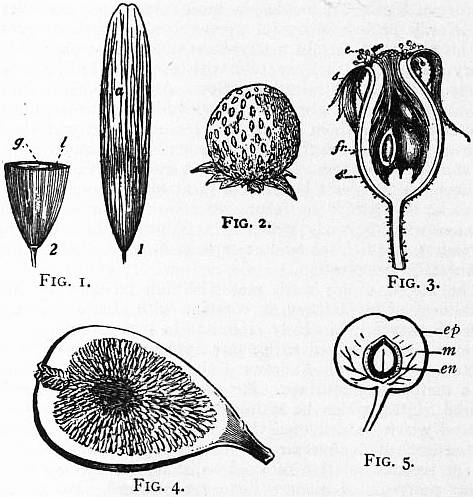
Fig. 1.—Samara or winged fruit of Ash (Fraxinus). 1, Entire, with its wing a; 2, lower portion cut transversely, to show that it consists of two cells; one of which, l, is abortive, and is reduced to a very small cavity, while the other is much enlarged and filled with a seed g.
Fig. 2.—Fruit of the Strawberry (Fragaria vesca), consisting of an enlarged succulent receptacle, bearing on its surface the small dry seed-like fruits (achenes). (After Duchartre.)
From Strasburger’s Lehrbuch der Botanik, by permission of Gustav Fischer.
Fig. 3.—Fruit of the Rose cut vertically. s’, Fleshy hollowed receptacle; s, persistent sepals; fr, ripe carpels; e, stamens, withered.
Fig. 4.—Peduncle of Fig (Ficus Carica), ending in a hollow receptacle enclosing numerous male and female flowers.
Fig. 5.—Fruit of Cherry (Prunus Cerasus) in longitudinal section. ep, Epicarp; m, mesocarp; en, endocarp.
From Strasburger’s Lehrbuch der Botanik, by permission of Gustav Fischer.
The pericarp consists usually of three layers, the external, or epicarp (fig. 5, ep); the middle, or mesocarp, m; and the internal, or endocarp, en. These layers are well seen in such a fruit as the peach, plum or cherry, where they are separable one from the other; in them the epicarp forms what is commonly called the skin; the mesocarp, much developed, forms the flesh or pulp, and hence has sometimes been called sarcocarp; while the endocarp, hardened by the production of woody cells, forms the stone or putamen immediately covering the kernel or seed. The pulpy matter found in the interior of fruits, such as the gooseberry, grape and others, is formed from the placentas, and must not be confounded with the sarcocarp. In some fruits, as in the nut, the three layers become blended together and are indistinguishable. In bladder senna (Colutea arborescens) the pericarp retains its leaf-like appearance, but in most cases it becomes altered both in consistence and in colour. Thus in the date the epicarp is the outer brownish skin, the pulpy matter is the mesocarp or sarcocarp, and the thin papery-like lining is the endocarp covering the hard seed. In the medlar the endocarp becomes of a stony hardness. In the melon the epicarp and endocarp are very thin, while the mesocarp forms the bulk of the fruit, differing in texture and taste in its external and internal parts. The rind of the orange consists of epicarp and mesocarp, while the endocarp forms partitions in the interior, filled with pulpy cells. The part of the pericarp attached to the peduncle is the base, and the point where the style or stigma existed is the apex. This latter is not always the apparent apex, as in the case of the ovary; it may be lateral or even basilar. The style sometimes remains in a hardened form, rendering the fruit apiculate; at other times it falls off, leaving only traces of its existence. The presence of the style or stigma serves to distinguish certain single-seeded pericarps from seeds.
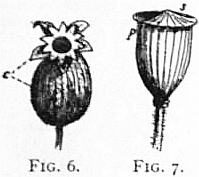
Fig. 6.—Seed-vessel or capsule of Campion, opening by ten teeth at the apex. The calyx c is seen surrounding the seed-vessel.
Fig. 7.—Capsule of Poppy, opening by pores p, under the radiating peltate stigma s.
When the fruit is mature and the seeds are ripe, the carpels usually give way either at the ventral or dorsal suture or at both, and so allow the seeds to escape. The fruit in this case is dehiscent. But some fruits are indehiscent, falling to Dehiscence of fruits. the ground entire, and the seeds eventually reaching the soil by their decay. By dehiscence the pericarp becomes divided into different pieces, or valves, the fruit being univalvular, bivalvular or multivalvular, &c., according as there are one, two or many valves. The splitting extends the whole length of the fruit, or is partial, the valves forming teeth at the apex, as in the order Caryophyllaceae (fig. 6). Sometimes the valves are detached only at certain points, and thus dehiscence takes place by pores at the apex, as in poppy (fig. 7), or at the base, as in Campanula. Indehiscent fruits are either dry, as the nut, or fleshy, as the cherry and apple. They are formed of one or several carpels. In the former case they usually contain only a single seed, which may become so incorporated with the pericarp as to appear to be naked, as in the grain of wheat and generally in grasses. In such cases the presence of the remains of style or stigma determines their true nature.
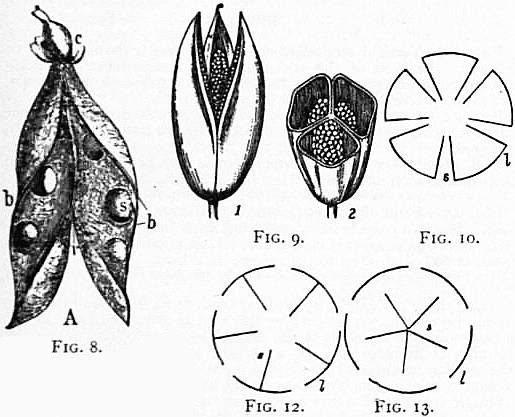
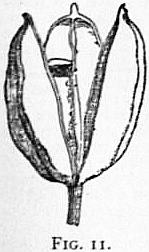
Fig. 8.—Dry dehiscent fruit. The pod (legume) of the Pea; r, the dorsal suture; b, the ventral; c, calyx; s, seeds.
From Vines’ Students’ Text-Book of Botany, by permission of Swan Sonnenschein & Co.
Fig. 9.—(1) Fruit or capsule of Meadow Saffron (Colchicum autumnale), dehiscing along the septa (septicidally); (2) same cut across, showing the three chambers with the seeds attached along the middle line (axile placentation).
Fig. 10.—Diagram to illustrate the septicidal dehiscence in a pentalocular capsule. The loculaments l correspond to the number of the carpels, which separate by splitting through the septa, s.
Fig. 11.—The seed vessel (capsule) of the Flower-de-Luce (Iris), opening in a loculicidal manner. The three valves bear the septa in the centre, and the opening takes place through the back of the loculaments. Each valve is formed by the halves of contiguous carpels.
Fig. 12.—Diagram to illustrate loculicidal dehiscence. The loculaments l, split at the back, and the valves separate, bearing the septa s on their centres.
Fig. 13.—Diagram to illustrate septifragal dehiscence, in which the dehiscence takes place through the back of the loculaments l, and the valves separate from the septa s, which are left attached to the placentas in the centre.
Dehiscent fruits, when composed of single carpels, may open by the ventral suture only, as in the paeony, hellebore, Aquilegia (fig. 28) and Caltha; by the dorsal suture only, as in magnolias and some Proteaceae, or by both together, as in the pea (fig. 8) and bean; in these cases the dehiscence is sutural. When composed of several united carpels, two types of dehiscence occur—a longitudinal and a transverse. In the longitudinal the separation may take place by the dissepiments throughout their length, so that the fruit is resolved into its original carpels, and each valve represents a carpel, as in rhododendron, Colchicum, &c.; this dehiscence, in consequence of taking place through the septum, is called septicidal (figs. 9, 10). The valves separate from their commissure, or central line of union, carrying the placentas with them, or they leave the latter in the centre, so as to form with the axis a column of a cylindrical, conical or prismatic shape. Dehiscence is loculicidal when the union between the edges of the carpels is persistent, and they dehisce by the dorsal suture, or through the back of the loculaments, as in the lily and iris (figs. 11, 12). In these cases each valve consists of a half of each of two contiguous carpels. The placentas either remain united to the axis, or they separate from it, being attached to the septa on the valves. When the outer walls of the carpels break off from the septa, leaving them attached to the central column, the dehiscence is said to be septifragal (fig. 13), and where, as in Linum catharticum and Calluna, the splitting takes place first of all in a septicidal manner, the fruit is described as septicidally septifragal; while in other cases, as in thorn apple (Datura Stramonium), where the splitting is at first loculicidal, the dehiscence is loculicidally septifragal. In all those forms the separation of the valves takes place either from above downwards or from below upwards. In Saxifraga a splitting for a short distance of the ventral sutures of the carpels takes place, so that a large apical pore is formed. In the fruit of Cruciferae, as wallflower (fig. 14), the valves separate from the base of the fruit, leaving a central replum, or frame, which supports the false septum formed by a prolongation from the parietal placentas on opposite sides of the fruit, extending between the ventral sutures of the carpels. In Orchidaceae (fig. 15) the pericarp, when ripe, separates into three valves in a loculicidal manner, but the midribs of the carpels, to which the placentas are attached, often remain adherent to the axis both at the apex and base after the valves bearing the seeds have fallen. The other type of dehiscence is transverse, or circumscissile, when the upper part of the united carpels falls off in the form of a lid or operculum, as in Anagallis and in henbane (Hyoscyamus) (fig. 16).
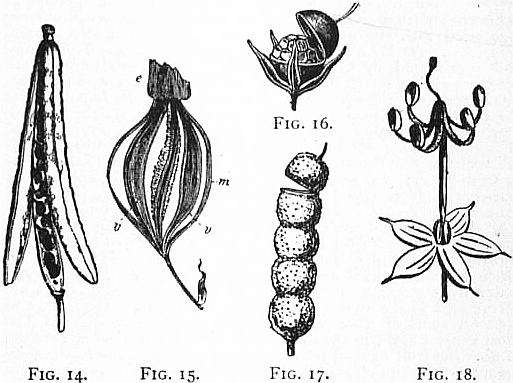
Fig. 14.—Siliqua or seed-vessel of Wallflower (Cheiranthus Cheiri), opening by two valves, which separate from the base upwards, leaving the seeds attached to the dissepiment which is supported by the replum.
From Strasburger’s Lehrbuch der Botanik, by permission of Gustav Fischer.
Fig. 15.—Capsule of an Orchid (Xylobium). v, valve.
Fig. 16.—Seed-vessel of Anagallisarvensis, opening by circumscissile dehiscence.
From Strasburger’s Lehrbuch der Botanik, by permission of Gustav Fischer.
Fig. 17.—Lomentum of Hedysarum which, when ripe, separates transversely into single-seeded portions or mericarps.
Fig. 18.—Fruit of Geranium pratense, after splitting.
Sometimes the axis is prolonged beyond the base of the carpels, as in the mallow and castor-oil plant, the carpels being united to it throughout their length by their faces, and separating from it without opening. In the Umbelliferae the two carpels separate from the lower part of the axis, and remain attached by their apices to a prolongation of it, called a carpophore or podocarp, which splits into two (fig. 25) and suspends them; hence the fruit is termed a cremocarp, which divides into two mericarps. The general term schizocarp is applied to all dry fruits, which break up into two or more one-seeded indehiscent mericarps, as in Hedysarum (fig. 17). In the order Geraniaceae the styles remain attached to a central column, and the mericarps separate from below upwards, before dehiscing by their ventral suture (fig. 18). Carpels which separate one from another in this manner are called cocci. They are well seen in the order Euphorbiaceae, where there are usually three such carpels, and the fruit is termed tricoccus. In many of them, as Hura crepitans, the cocci separate with great force and elasticity. In many leguminous plants, such as Ornithopus, Hedysarum (fig. 17), Entada, Coronilla and the gum-arabic plant (Acacia arabica), the fruit becomes a schizocarp by the formation of transverse partitions from the folding in of the sides of the pericarp, and distinct separations taking place at these partitions.
Fruits are formed by one flower, or are the product of several flowers combined. In the former case they are either apocarpous, of one mature carpel or of several separate free carpels; or syncarpous, of several carpels, more or less completely united. When the fruit is composed of the ovaries of several flowers united, it is usual to find the bracts and floral envelopes also joined with them, so as to form one mass; hence such fruits are known as multiple, confluent or anthocarpous. The term simple is applied to fruits which are formed by the ovary of a single flower, whether they are composed of one or several carpels, and whether these carpels are separate or combined.
From Vines’ Students’ Text-Book of Botany, by permission of Swan Sonnenschein & Co.
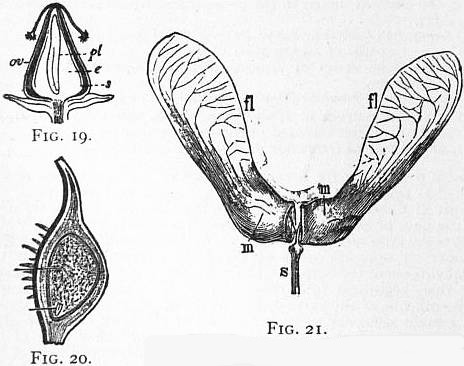
Fig. 19.—Dry one-seeded fruit of dock (Rumex) cut vertically. ov, Pericarp formed from ovary wall; s, seed; e, endosperm; pl, embryo with radicle pointing upwards and cotyledons downwards—enlarged.
Fig. 20.—Achene of Ranunculus arvensis in longitudinal section; e, endosperm; pl, embryo. (After Baillon, enlarged.)
From Strasburger’s Lehrbuch der Botanik, by permission of Gustav Fischer.
Fig. 21.—Fruit of Common Sycamore (Acer Pseudoplatanus), dividing into two mericarps m; s, pedicel; fl, wings (nat. size).
The object of the fruit in the economy of the plant is the protection and nursing of the developing seed and the dispersion of the ripe seeds. Hence, generally, one-seeded fruits are indehiscent, while fruits containing more than one seed open to allow Dispersal of fruit or seed. of the dispersal of the seeds over as wide an area as possible. The form, colour, structure and method of dehiscence of fruits and the form of the contained seeds are intimately associated with the means of dispersal, which fall into several categories. (1) By a mechanism residing in the fruit. Thus many fruits open suddenly when they are dry, and the seeds are ejected by the twisting or curving of the valves, or in some other way; e.g. in gorse, by the spiral curving of the valves; in Impatiens, by the twisting of the cocci; in squirting cucumber, by the pressure exerted on the pulpy contents by the walls of the pericarp. (2) By aid of various external agencies such as water. Fruits or seeds are sometimes sufficiently buoyant to float for a long time on sea- or fresh-water; e.g. coco-nut, by means of its thick, fibrous coat (mesocarp), is carried hundreds of miles in the sea, the tough, leathery outer coat (epicarp) preventing it from becoming water-soaked. Fruits and seeds of West Indian plants are thrown up on the coasts of north-west Europe, having been carried by the Gulf Stream, and will often germinate; many are rendered buoyant by air-containing cavities, and the embryo is protected from the seawater by the tough coat of fruit or seed. Water-lily seeds are surrounded with a spongy tissue when set free from the fruit, and float for some distance before dropping to the bottom. (3) The most general agent in the dispersal of seeds is the wind or currents of air—the fruit or seed being rendered buoyant by wing-developments as in fruits of ash (fig. 1) or maple (fig. 21), seeds of pines and firs, or many members of the order Bignoniaceae; or hair-developments as in fruits of clematis, where the style forms a feathery appendage, fruits of many Compositae (dandelion, thistle, &c.), which are crowned by a plumose pappus, or seeds of willow and poplar, or Asclepias (fig. 36), which bear tufts of silky hairs; to this category belong bladder-like fruits, such as bladder-senna, which are easily rolled by the wind, or cases like the so-called rose of Jericho, a small cruciferous plant (Anastatica hierocuntica), where the plant dries up after developing its fruits and becomes detached from the ground; the branches curl inwards, and the whole plant is rolled over the dry ground by the wind. The wind also aids the dispersal of the seeds in the case of fruits which open by small teeth (many Caryophyllaceae [fig. 6]) or pores (poppy [fig. 7], Campanula, &c.); the seeds are in these cases small and numerous, and are jerked through the pores when the capsules, which are generally borne on long, dry stems or stalks, are shaken by the wind. (4) In other cases members of the animal world aid in seed-dispersal. Fruits often bear stiff hairs or small hooks, which cling to the coat of an animal or the feathers of a bird; such are fruits of cleavers (Galium Aparine), a common hedge-row plant, Ranunculus arvensis (fig. 20), carrot, Geum, &c.; or the fruit or seed has an often bright-coloured, fleshy covering, which is sought by birds as food, as in stone-fruits such as plum, cherry (fig. 5), &c., where the seed is protected from injury in the mouth or stomach of the animal by the hard endocarp; or the hips of the rose (fig. 3), where the succulent scarlet “fruit” (the swollen receptacle) envelops a number of small dry true fruits (achenes), which cling by means of stiff hairs to the beak of the bird.
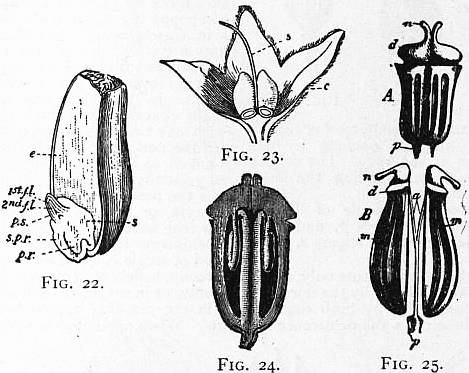
Fig. 22.—Vertical section of a grain of wheat, showing embryo below at the base of the endosperm e; s, scutellum separating embryo from endosperm; f.l, foliage leaf; p.s, sheath of plumule; p.r, primary root; s.p.r, sheath of primary root.
Fig. 23.—Fruit of Comfrey (Symphytum) surrounded by persistent calyx, c. The style s appears to arise from the base of the carpels, enlarged.
Fig. 24.—Ovary of Foeniculum officinale with pendulous ovules, in longitudinal section. (After Berg and Schmidt, magnified.)
From Strasburger’s Lehrbuch der Botanik, by permission of Gustav Fischer.
Fig. 25.—Fruit of Carum Carui. A, Ovary of the flower; B, ripe fruit. The two carpels have separated so as to form two mericarps (m). Part of the septum constitutes the carpophore (a). p, Top of flower-stalk; d, disk on top of ovary; n, stigma.
From Vines’ Students’ Text-Book of Botany, by permission of Swan Sonnenschein & Co.
Simple fruits have either a dry or succulent pericarp. The achene is a dry, one-seeded, indehiscent fruit, the pericarp of which is closely applied to the seed, but separable from it. It is solitary, forming a single fruit, as in the dock (fig. 19) and in the Forms of fruit. cashew, where it is supported on a fleshy peduncle; or aggregate, as in Ranunculus (fig. 20), where several achenes are placed on a common elevated receptacle. In the strawberry the achenes (fig. 2) are aggregated on a convex succulent receptacle. In the rose they are supported on a concave receptacle (fig. 3), and in the fig the succulent receptacle completely encloses the achenes (fig. 4). In Dorstenia the achenes are situated on a flat or slightly concave receptacle. Hence what in common language are called the seeds of the strawberry, rose and fig, are in reality ripe carpels. The styles occasionally remain attached to the achenes in the form of feathery appendages, as in Clematis. In Compositae, the fruit is an inferior achene (cypsela), to which the pappus (modified calyx) remains adherent. Such is also the nature of the fruit in Dipsacaceae (e.g. scabious). When the pericarp is thin, and appears like a bladder surrounding the seed, the achene is termed a utricle, as in Amarantaceae. When the pericarp is extended in the form of a winged appendage, a samara or samaroid achene is produced, as in the ash (fig. 1) and common sycamore (fig. 21). In these cases there are usually two achenes united, one of which, however, as in Fraxinus (fig. 1), may be abortive. The wing surrounds the fruit longitudinally in the elm. When the pericarp becomes so incorporated with the seed as to be inseparable from it, as in grains of wheat (fig. 22), maize, oats and other grasses, then the name caryopsis is given. The one-seeded portions (mericarps) of schizocarps often take the form of achenes, e.g. the mericarps of the mallows or of umbellifers (figs. 24, 25). In Labiatae and Boraginaceae (e.g. comfrey, fig. 23), where the bicarpellary ovary becomes our one-seeded portions in the fruit, the partial fruits are of the nature of achenes or nutlets according to the texture (leathery or hard) of the pericarp.
From Strasburger’s Lehrbuch der Botanik, by permission of Gustav Fischer.
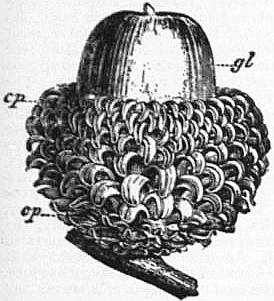
Fig. 26.—Cupule of Quercus Aegilops. cp, cupule; gl, fruit. (After Duchartre.)
The nut or glans is a dry one-celled indehiscent fruit with a hardened pericarp, often surrounded by bracts at the base, and, when mature, containing only one seed. In the young state the ovary often contains two or more ovules, but only one comes to maturity. It is illustrated by the fruits of the hazel and chestnut, which are covered by leafy bracts, in the form of a husk, and by the acorn, in which the bracts and receptacle form a cupula or cup (fig. 26). The parts of the pericarp of the nut are united so as to appear one. In common language the term nut is very vaguely applied both to fruit and seeds.
The drupe is a succulent usually one-seeded indehiscent fruit, with a pericarp easily distinguishable into epicarp, mesocarp and endocarp. This term is applied to such fruits as the cherry (fig. 5), peach, plum, apricot or mango. The endocarp is usually hard, forming the stone (putamen) of the fruit, which encloses the kernel or seed. The mesocarp is generally pulpy and succulent, so as to be truly a sarcocarp, as in the peach, but it is sometimes of a tough texture, as in the almond, and at other times is more or less fibrous, as in the coco-nut. In the almond there are often two ovules formed, only one of which comes to perfection. In the raspberry and bramble several small drupes or drupels are aggregated so as to constitute an etaerio.
The follicle is a dry unilocular many-seeded fruit, formed from one carpel and dehiscing by the ventral suture. It is rare to meet with a solitary follicle forming the fruit. There are usually several aggregated together, either in a whorl on a shortened receptacle, as in hellebore, aconite, larkspur, columbine (figs. 27, 28) or the order Crassulaceae, or in a spiral manner on an elongated receptacle, as in Magnolia and Banksia. Occasionally, follicles dehisce by the dorsal suture, as in Magnolia grandiflora and Banksia.
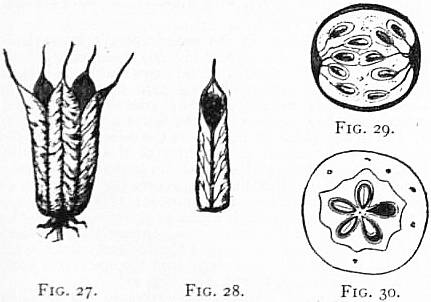
Fig. 27.—Fruit of Columbine (Aquilegia), formed of five follicles.
Fig. 28.—Single follicle, showing dehiscence by the ventral suture.
Fig. 29.—Transverse section of berry of Gooseberry, showing the seeds attached to the parietal placentas and immersed in pulp, which is formed partly from the endocarp, partly from the seed-coat.
Fig. 30.—Section of the fruit of the Apple (Pyrus Malus), or pome, consisting of a fleshy covering formed by the floral receptacle and the true fruit or core with five cavities with seeds.
The legume or pod is a dry monocarpellary unilocular many-seeded fruit, formed from one carpel, dehiscing both by the ventral and the dorsal suture. It characterizes leguminous plants, as the bean and pea (fig. 8). In the bladder-senna it forms an inflated legume. In some Leguminosae, as Arachis, Cathartocarpus Fistula and the tamarind, the fruit must be considered a legume, although it does not dehisce. The first of these plants produces its fruit underground, and is called earth-nut; the second has a partitioned legume and is schizocarpic; and both the second and third have pulpy matter surrounding the seeds. Some legumes are schizocarpic by the formation of constrictions externally. Such a form is the lomentum or lomentaceous legume of Hedysarum (fig. 17), Coronilla, Ornithopus, Entada and of some Acacias. In Medicago the legume is twisted like a snail, and in Caesalpinia coriaria, or Divi-divi, it is vermiform or curved like a worm. Sometimes the number of seeds is reduced, as in Erythrina monosperma and Geoffroya superba, which are one-seeded, and in Pterocarpus and Dalbergia, which are two-seeded.
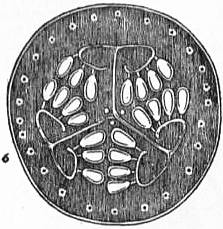
Fig. 31.—Transverse section of the fruit of the Melon (Cucumis Melo), showing the placentas with the seeds attached to them. The three carpels forming the pepo are separated by partitions. From the centre processes pass outwards, ending in the curved placenta.
The berry (bacca) is a term applied generally to all fruits with seeds immersed in pulp, and includes fruits of very various origin. In Actaea (baneberry) or Berberis (barberry) it is derived from a single free carpel; generally, however, it is the product of a syncarpous ovary, which is superior, as in grape or potato, or inferior, as in gooseberry (fig. 29) or currant. In the pomegranate there is a peculiar baccate many-celled inferior fruit, having a tough rind, enclosing two rows of carpels placed one above the other. The seeds are immersed in pulp, and are attached irregularly to the wall, base and centre of the loculi. In the baobab there is a multilocular syncarpous fruit, in which the seeds are immersed in pulp.
The pepo, another indehiscent syncarpous fruit, is illustrated by the fruit of the gourd, melon (fig. 31) and other Cucurbitaceae. It is formed of three carpels, surmounted by the calyx; the rind is thick and fleshy, and there are three or more seed-bearing parietal placentas, either surrounding a central cavity or prolonged inwards into it. The fruit of the papaw resembles the pepo, but the calyx is not superior.
The hesperidium is the name given to such indehiscent fleshy syncarpous fruits as the orange, lemon and shaddock, in which the epicarp and mesocarp form a separable rind, and the endocarp sends prolongations inwards, forming triangular divisions, to the inner angle of which the seeds are attached, pulpy cells being developed around them from the wall. Both pepo and hesperidium may be considered as modifications of the berry.
The pome (fig. 30), seen in the apple, pear, quince, medlar and hawthorn, is a fleshy indehiscent syncarpous fruit, in the formation of which the receptacle takes part. The outer succulent part is the swollen receptacle, the horny core being the true fruit developed from the usually five carpels and enclosing the seeds. In the medlar the core (or true pericarp) is of a stony hardness, while the outer succulent covering is open at the summit. The pome somewhat resembles the fruit of the rose (fig. 3), where the succulent receptacle surrounds a number of separate achenes.
The name capsule is applied generally to all dry syncarpous fruits, which dehisce by valves. It may thus be unilocular or multilocular, one- or many-seeded. The true valvular capsule is observed in Colchicum (fig. 9), lily and iris (fig. 11). The porose capsule is seen in the poppy (fig. 7), Antirrhinum and Campanula. In Campanula the pores occur at the base of the capsule, which becomes inverted when ripe. When the capsule opens by a lid, or by circumscissile dehiscence, it is called a pyxidium, as in pimpernel (Anagallis arvensis) (fig. 16), henbane and monkey-pot (Lecythis). The capsule assumes a screw-like form in Helicteres, and a star-like form in star-anise (Illicium anisatum). In certain instances the cells of the capsule separate from each other, and open with elasticity to scatter the seeds. This kind of capsule is met with in the sandbox tree (Hura crepitans) and other Euphorbiaceae, where the cocci, containing each a single seed, burst asunder with force; and in Geraniaceae, where the cocci, each containing, when mature, usually one seed, separate from the carpophore, become curved upwards by their adherent styles, and open by the ventral suture (fig. 18).
The siliqua is a dry syncarpous bilocular many-seeded fruit, formed from two carpels, with a false septum, dehiscing by two valves from below upwards, the valves separating from the placentas and leaving them united by the septum (fig. 32). The seeds are attached on both sides of the septum, either in one row or in two. When the fruit is long and narrow it is a siliqua (fig. 14); when broad and short, silicula (fig. 33). It occurs in cruciferous plants, as wallflower, cabbage and cress. In Glaucium and Eschscholtzia (Papaveraceae) the dissepiment is of a spongy nature. It may become transversely constricted (lomentaceous), as in radish (Raphanus) and sea-kale, and it may be reduced, as in woad (Isatis), to a one-seeded condition.
It sometimes happens that the ovaries of two flowers unite so as to form a double fruit (syncarp). This may be seen in many species of honeysuckle. But the fruits which are now to be considered consist usually of the floral envelopes, as well as the ovaries of several flowers united into one, and are called multiple or confluent. The term anthocarpous has also been applied as indicating that the floral envelopes as well as the carpels are concerned in the formation of the fruit.
The sorosis is a succulent multiple fruit formed by the confluence of a spike of flowers, as in the fruit of the pine-apple (fig. 34), the bread-fruit and jack-fruit. Similarly the fruit of the mulberry represents a catkin-like inflorescence.
The syconus is an anthocarpous fruit, in which the receptacle completely encloses numerous flowers and becomes succulent. The fig (fig. 4) is of this nature, and what are called its seeds are the achenes of the numerous flowers scattered over the succulent hollowed receptacle. In Dorstenia the axis is less deeply hollowed, and of a harder texture, the fruit exhibiting often very anomalous forms.
The strobilus, or cone, is a seed-bearing spike, more or less elongated, covered with scales, each of which may be regarded as representing a separate flower, and has often two seeds at its base; the seeds are naked, no ovary being present. This fruit is seen in the cones of firs, spruces, larches and cedars, which have received the name of Coniferae, or cone-bearers, on this account. Cone-like fruit is also seen in most Cycadaceae. The scales of the strobilus are sometimes thick and closely united, so as to form a more or less angular and rounded mass, as in the cypress; while in the juniper they become fleshy, and are so incorporated as to form a globular fruit like a berry. The dry fruit of the cypress and the succulent fruit of the juniper have received the name of galbulus. In the hop the fruit is called also a strobilus, but in it the scales are thin and membranous, and the seeds are not naked but are contained in pericarps.
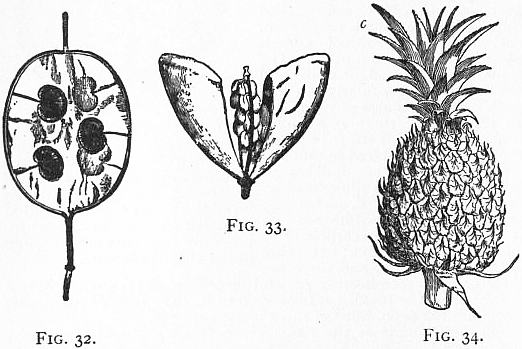
Fig. 32.—Honesty (Lunaria biennis), showing the septum after the carpels have fallen away.
From Strasburger’s Lehrbuch der Botanik, by permission of Gustav Fischer.
Fig. 33.—Silicula or pouch of shepherd’s purse (Capsella), opening by two folded valves, which separate from above downwards. The partition is narrow, hence the silicula is angustiseptal.
From Strasburger’s Lehrbuch der Botanik, by permission of Gustav Fischer.
Fig. 34.—Fruit of the pine-apple (Ananassa sativa), developed from a spike of numerous flowers with bracts, united so as to form a collective or anthocarpous fruit. The crown of the pine-apple, c, consists of a series of empty bracts prolonged beyond the fruit.
The same causes which produce alterations in the other parts of the flower give rise to anomalous appearances in the fruit. The carpels, in place of bearing seeds, are sometimes changed into leaves, with lobes at their margins. Leaves are sometimes produced from the upper part of the fruit. In the genus Citrus, to which the orange and lemon belong, it is very common to meet with a separation of the carpels, so as to produce what are called horned oranges and fingered citrons. In this case a syncarpous fruit has a tendency to become apocarpous. In the orange we occasionally find a supernumerary row of carpels produced, giving rise to the appearance of small and imperfect oranges enclosed within the original one; the navel orange is of this nature. It sometimes happens that, by the union of flowers, double fruits are produced. Occasionally a double fruit is produced, not by the incorporation of two flowers, but by the abnormal development of a second carpel in the flower.
Arrangement of Fruits.
A. True fruits—developed from the ovary alone.
1. Pericarp not fleshy or fibrous.
i. Indehiscent—not opening to allow the escape of the seeds—generally one-seeded. Achene; caryopsis; cypsela; nut; schizocarp.
ii. Dehiscent—the pericarp splits to allow the escape of the seeds—generally many-seeded. Follicle; legume; siliqua; capsule.
2. Pericarp generally differentiated into distinct layers, one of which is succulent or fibrous. Drupe; berry.
B. Pseudocarps—the development extends beyond the ovary. Pome; syconus; sorosis.
The Seed.—The seed is formed from the ovule as the result of fertilization. It is contained in a seed-vessel formed from the ovary in the plants called angiospermous; while in gymnospermous plants, such as Coniferae and Cycadaceae, it is naked, or, in other words, has no true pericarp. It sometimes happens in Angiosperms, that the seed-vessel is ruptured at an early period of growth, so that the seeds become more or less exposed during their development; this occurs in mignonette, where the capsule opens at the apex, and in Cuphea, where the placenta bursts through the ovary and floral envelopes, and appears as an erect process bearing the young seeds. After fertilization the ovule is greatly changed, in connexion with the formation of the embryo. In the embryo-sac of most Angiosperms (q.v.) there is a development of cellular tissue, the endosperm, more or less filling the embryo-sac. In Gymnosperms (q.v.) the endosperm is formed preparatory to fertilization. The fertilized egg enlarges and becomes multicellular, forming the embryo. The embryo-sac enlarges greatly, displacing gradually the surrounding nucellus, which eventually forms merely a thin layer around the sac, or completely disappears. The remainder of the nucellus and the integuments of the ovules form the seed-coats. In some cases (fig. 35) a delicate inner coat or tegmen can be distinguished from a tougher outer coat or testa; often, however, the layers are not thus separable. The consistency of the seed-coat, its thickness, the character of its surface, &c., vary widely, the variations being often closely associated with the environment or with the means of seed-dispersal. An account of the development of the seed from the ovule will be found in the article Angiosperms. When the pericarp is dehiscent the seed-covering is of a strong and often rough character; but when the pericarp is indehiscent and encloses the seed for a long period, the outer seed-coat is thin and soft. The cells of the testa are often coloured, and have projections and appendages of various kinds. Thus in Abrus precatorius and Adenanthera pavonina it is of a bright red colour; in French beans it is beautifully mottled; in the almond it is veined; in the tulip and primrose it is rough; in the snapdragon it is marked with depressions; in cotton and Asclepias (fig. 36) it has hairs attached to it; and in mahogany, Bignonia, and the pines and firs it is expanded in the form of wing-like appendages (fig. 37). In Collomia, Acanthodium, Cobaea scandens and other seeds, it contains spiral cells, from which, when moistened with water, the fibres uncoil in a beautiful manner; and in flax (Linum) and others the cells are converted into mucilage. These structural peculiarities of the testa in different plants have relation to the scattering of the seed and its germination upon a suitable nidus. But in some plants the pericarps assume structures which subserve the same purpose; this especially occurs in small pericarps enclosing single seeds, as achenes, caryopsides, &c. Thus in Compositae and valerian, the pappose limb of the calyx forms a parachute to the pericarp; in Labiatae and some Compositae spiral cells are formed in the epicarp; and the epicarp is prolonged as a wing in Fraxinus (fig. 1) and Acer (fig. 21).
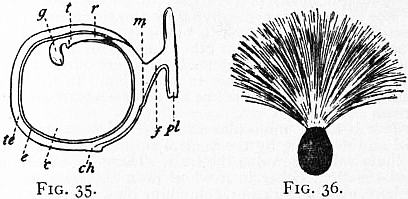
Fig. 35.—Seed of Pea (Pisum) with one cotyledon removed. c, Remaining cotyledon; ch, chalaza-point at which the nourishing vessels enter; e, tegmen or inner coat; f, funicle or stalk; g, plumule of embryo; m, micropyle; pl, placenta; r, radicle of embryo; t, tigellum or stalk between root and plumule; te, testa.
Fig. 36.—Seed of Asclepias, with a cluster of hairs arising from the edges of the micropyle.
Sometimes there is an additional covering to the seed, formed after fertilization, to which the name arillus has been given (fig. 38). This is seen in the passion-flower, where the covering arises from the placenta or extremity of the funicle at the base of the ovule and passes upwards towards the apex, leaving the micropyle uncovered. In the nutmeg and spindle tree this additional coat is formed from above downwards, constituting in the former case a laciniated scarlet covering called mace. In such instances it has been called an arillode (fig. 39). This arillode, after growing downwards, may be reflected upwards so as to cover the micropyle. The fleshy scarlet covering formed around the naked seed in the yew is by some considered of the nature of an aril. On the testa, at various points, there are produced at times other cellular bodies, to which the name of strophioles, or caruncles, has been given, the seeds being strophiolate or carunculate. These tumours may occur near the base of the seed, as in Polygala, or at the apex, as in Castor-oil plant (Ricinus); or they may occur in the course of the raphe, as in blood-root (Sanguinaria) and Asarabacca. The funicles of the ovules frequently attain a great length in the seed, and in some magnolias, when the fruit dehisces, they appear as long scarlet cords suspending the seeds outside. The hilum or umbilicus of the seed is usually well marked, as a scar of varying size; in the calabar bean and in some species of Mucuna and Dolichos it extends along a large portion of the edge of the seed; it frequently exhibits marked colours, being black in the bean, white in many species of Phaseolus, &c. The micropyle (fig. 35, m) of the seed may be recognizable by the naked eye, as in the pea and bean tribe, Iris, &c., or it may be very minute or microscopic. It indicates the true apex of the seed, and is important as marking the point to which the root of the embryo is directed. At the micropyle in the bean is observed a small process of integument, which, when the young plant sprouts, is pushed up like a lid; it is called the embryotega. The chalaza (fig. 38, ch) is often of a different colour from the rest of the seed. In the orange (fig. 40) it is of a reddish-brown colour, and is easily recognized at one end of the seed when the integuments are carefully removed. In anatropal seeds the raphe forms a distinct ridge along one side of the seed (fig. 41).
The position of the seed as regards the pericarp resembles that of the ovule in the ovary, and the same terms are applied—erect, ascending, pendulous, suspended, curved, &c. These terms have no reference to the mode in which the fruit is attached to the axis. Thus the seed may be erect while the fruit itself is pendent, in the ordinary meaning of that term. The part of the seed next the axis or the ventral suture is its face, the opposite side being the back. Seeds exhibit great varieties of form. They may be flattened laterally (compressed), or from above downwards (depressed). They may be round, oval, triangular, polygonal, rolled up like a snail, as in Physostemon, or coiled up like a snake, as in Ophiocaryon paradoxum.
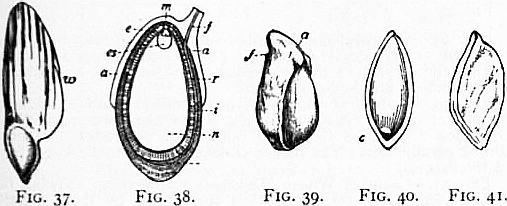
Fig. 37.—Seed of Pine (Pinus), with a membranous appendage w to the testa, called a wing.
Fig. 38.—Young anatropal seed of the white Water-lily (Nymphaea alba), cut vertically. It is attached to the placenta by the funicle f, cellular prolongations from which form an aril a a. The vessels of the cord are prolonged to the base of the nucellus n by means of the raphe r. The base of the nucellus is indicated by the chalaza ch, while the apex is at the micropyle m. The covering of the seed is marked i. n is the nucellus or perisperm, enclosing the embryo-sac es, in which the endosperm is formed. The embryo e, with its suspensor, is contained in the sac, the radicle pointing to the micropyle m.
Fig. 39.—Arillode a, or false aril, of the Spindle-tree (Euonymus), arising from the micropyle f.
Fig. 40.—Anatropal seed of the Orange (Citrus Aurantium) opened to show the chalaza c, which forms a brown spot at one end.
Fig. 41.—Entire anatropal seed of the Orange (Citrus Aurantium), with its rugose or wrinkled testa, and the raphe r ramifying in the thickness of the testa on one side.
The endosperm formed in the embryo-sac of angiosperms after fertilization, and found previous to it in gymnosperms, consists of cells containing nitrogenous and starchy or fatty matter, destined for the nutriment of the embryo. It occupies the whole cavity of the embryo-sac, or is formed only at certain portions of it, at the apex, as in Rhinanthus, at the base, as in Vaccinium, or in the middle, as in Veronica. As the endosperm increases in size along with the embryo-sac and the embryo, the substance of the original nucellus of the ovule is gradually absorbed. Sometimes, however, as in Musaceae, Cannaceae, Zingiberaceae, no endosperm is formed; the cells of the original nucellus, becoming filled with food-materials for the embryo, are not absorbed, but remain surrounding the embryo-sac with the embryo, and constitute the perisperm. Again, in other plants, as Nymphaeaceae (fig. 38) and Piperaceae, both endosperm and perisperm are present. It was from observations on cases such as these that old authors, imagining a resemblance betwixt the plant-ovule and the animal ovum, applied the name albumen to the outer nutrient mass or perisperm, and designated the endosperm as vitellus. The term albumen is very generally used as including all the nutrient matter stored up in the seed, but it would be advisable to discard the name as implying a definite chemical substance. There is a large class of plants in which although at first after fertilization a mass of endosperm is formed, yet, as the embryo increases in size, the nutrient matter from the endospermic cells passes out from them, and is absorbed by the cells of the embryo plant. In the mature seed, in such cases, there is no separate mass of tissue containing nutrient food-material apart from the embryo itself. Such a seed is said to be exalbuminous, as in Compositae, Cruciferae and most Leguminosae (e.g. pea, fig. 35). When either endosperm or perisperm or both are present the seed is said to be albuminous.
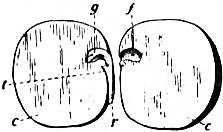
Fig. 42.—The dicotyledonous embryo of the Pea laid open. c, c, The two fleshy cotyledons, or seed-lobes, which remain under ground when the plant sprouts; r, the radicular extremity of the axis whence the root arises; t, the axis (hypocotyl) bearing the young stalk and leaves g (plumule), which lie in a depression of the cotyledons f.
The albumen varies much in its nature and consistence, and furnishes important characters. It may be farinaceous or mealy, consisting chiefly of cells filled with starch, as in cereal grains, where it is abundant; fleshy or cartilaginous, consisting of thicker cells which are still soft, as in the coco-nut, and which sometimes contain oil, as in the oily albumen of Croton, Ricinus and poppy; horny, when the cell-walls are slightly thickened and capable of distension, as in date and coffee; the cell-walls sometimes become greatly thickened, filling up the testa as a hard mass, as in vegetable ivory (Phytelephas). The albumen may be uniform throughout, or it may present a mottled appearance, as in the nutmeg, the seeds of Anonaceae and some Palms, where it is called ruminated. This mottled appearance is due to a protrusion of a dark lamella of the integument between folded protuberances of albumen. A cavity is sometimes left in the centre which is usually filled with fluid, as in the coco-nut. The relative size of the embryo and of the endosperm varies much. In Monocotyledons the embryo is usually small, and the endosperm large, and the same is true in the case of coffee and many other plants amongst Dicotyledons. The opposite is the case in other plants, as in the Labiatae, Plumbaginaceae, &c.
The embryo consists of an axis bearing the cotyledons (fig. 42, c), or the first leaves of the plant. To that part of this axis immediately beneath the cotyledons the terms hypocotyl, caulicle or tigellum (t) have been applied, and continuous backwards with it is the young root or radicle (r), the descending axis, their point of union being the collar or neck. The terminal growing bud of the axis is called the plumule or gemmule (g), and represents the ascending axis. The radicular extremity points towards the micropyle, while the cotyledonary extremity is pointed towards the base of the ovule or the chalaza. Hence, by ascertaining the position of the micropyle and chalaza, the two extremities of the embryo can in general be discovered. It is in many cases difficult to recognize the parts in an embryo; thus in Cuscuta, the embryo appears as an elongated axis without divisions; and in Caryocar the mass of the embryo is made up by the radicular extremity and hypocotyl, in a groove of which the cotyledonary extremity lies embedded (fig. 52). In some monocotyledonous embryos, as in Orchidaceae, the embryo is a cellular mass showing no parts. In parasitic plants also which form no chlorophyll, as Orobanche, Monotropa, &c., the embryo remains without differentiation, consisting merely of a mass of cells until the ripening of the seed. When the embryo is surrounded by the endosperm on all sides except its radicular extremity it is internal (see figs. 19, 20); when lying outside the endosperm, and only coming into contact with it at certain points, it is external, as in grasses (e.g. wheat, fig. 22). When the embryo follows the direction of the axis of the seed, it is axile or axial (fig. 43); when it is not in the direction of the axis, it becomes abaxile or abaxial. In campylotropal seeds the embryo is curved, and in place of being embedded in endosperm, is frequently external to it, following the concavity of the seed (fig. 44), and becoming peripherical, with the chalaza situated in the curvature of the embryo, as in Caryophyllaceae.
It has been already stated that the radicle of the embryo is directed to the micropyle, and the cotyledons to the chalaza. In some cases, by the growth of the integuments, the former is turned round so as not to correspond with the apex of the nucellus, and then the embryo has the radicle directed to one side, and is called excentric, as is seen in Primulaceae, Plantaginaceae and many palms, especially the date. The position of the embryo in different kinds of seeds varies. In an orthotropal seed the embryo is inverted or antitropal, the radicle pointing to the apex of the seed, or to the part opposite the hilum. Again, in an anatropal seed the embryo is erect or homotropal (fig. 43), the radicle being directed to the base of the seed. In curved or campylotropal seeds the embryo is folded so that its radicular and cotyledonary extremities are approximated, and it becomes amphitropal (fig. 44). In this instance the seed may be exalbuminous, and the embryo may be folded on itself; or albuminous, the embryo surrounding more or less completely the endosperm and being peripherical. According to the mode in which the seed is attached to the pericarp, the radicle may be directed upwards or downwards, or laterally, as regards the ovary. In an orthotropal seed attached to the base of the pericarp it is superior, as also in a suspended anatropal seed. In other anatropal seeds the radicle is inferior. When the seed is horizontal as regards the pericarp, the radicle is either centrifugal, when it points to the outer wall of the ovary; or centripetal, when it points to the axis or inner wall of the ovary. These characters are of value for purposes of classification, as they are often constant in large groups of genera.
Plants in which there are two cotyledons produced in the embryo are dicotyledonous. The two cotyledons thus formed are opposite to each other (figs. 42 and 45), but are not always of the same size. Thus, in Abronia and other members of the order Nyctaginaceae, one of them is smaller than the other (often very small), and in Carapa guianensis there appears to be only one, in consequence of the intimate union which takes place between the two. The union between the cotyledonary leaves may continue after the young plant begins to germinate. Such embryos have been called pseudomonocotyledonous. The texture of the cotyledons varies. They may be thick, as in the pea (fig. 42), exhibiting no traces of venation, with their flat internal surfaces in contact, and their backs more or less convex; or they may be in the form of thin and delicate laminae, flattened on both sides, and having distinct venation, as in Ricinus, Jatropha, Euonymus, &c. The cotyledons usually form the greater part of the mature embryo, and this is remarkably well seen in such exalbuminous seeds as the bean and pea.
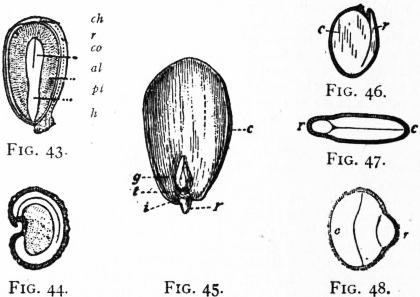
Fig. 43.—Seed of Pansy (Viola tricolor) cut vertically. The embryo pl is axial, in the midst of fleshy endosperm al. The seed is anatropal, and the embryo is homotropal; the cotyledons co point to the base of the nucellus or chalaza ch, while the radicle, or the other extremity of the embryo, points to the micropyle, close to the hilum h. The hilum or base of the seed, and the chalaza or base of the nucellus are united by means of the raphe r.
Fig. 44.—Seed of the Red Campion (Lychnis), cut vertically, showing the peripheral embryo, with its two cotyledons and its radicle. The embryo is curved round the albumen, so that its cotyledons and radicle both come near the hilum (amphitropal).
Fig. 45.—Mature dicotyledonous embryo of the Almond, with one of the cotyledons removed. r, Radicle; t, young stem or caulicle; c, one of the cotyledons left; i, line of insertion of the cotyledon which has been removed; g, plumule.
Fig. 46.—Exalbuminous seed of Wallflower (Cheiranthus) cut vertically. The radicle r is folded on the edges of the cotyledons c which are accumbent.
Fig. 47.—Transverse section of the seed of the Wallflower (Cheiranthus), showing the radicle r folded on the edges of the accumbent cotyledons c.
Fig. 48.—Transverse section of the seed of the Dame’s Violet (Hesperis). The radicle r is folded on the back of the cotyledons c, which are said to be incumbent.
Cotyledons are usually entire and sessile. But they occasionally become lobed, as in the walnut and the lime; or petiolate, as in Geranium molle; or auriculate, as in the ash. Like leaves in the bud, cotyledons may be either applied directly to each other, or may be folded in various ways. In geranium the cotyledons are twisted and doubled; in convolvulus they are corrugated; and in the potato and in Bunias, they are spiral,—the same terms being applied as to the foliage leaves. The radicle and cotyledons are either straight or variously curved. Thus, in some cruciferous plants, as the wallflower, the cotyledons are applied by their faces, and the radicle (figs. 46, 47) is folded on their edges, so as to be lateral; the cotyledons are here accumbent. In others, as Hesperis, the cotyledons (fig. 48) are applied to each other by their faces, and the radicle, r, is folded on their back, so as to be dorsal, and the cotyledons are incumbent. Again, the cotyledons are conduplicate when the radicle is dorsal, and enclosed between their folds. In other divisions the radicle is folded in a spiral manner, and the cotyledons follow the same course.
In many gymnosperms more than two cotyledons are present, and they are arranged in a whorl. This occurs in Coniferae, especially in the pine, fir (fig. 49), spruce and larch, in which six, nine, twelve and even fifteen have been observed. They are linear, and resemble in their form and mode of development the clustered or fasciculated leaves of the larch. Plants having numerous cotyledons are termed polycotyledonous. In species of Streptocarpus the cotyledons are permanent, and act the part of leaves. One of them is frequently largely developed, while the other is small or abortive.
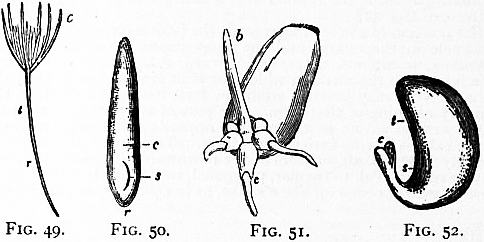
Fig. 49.—Polycotylodonous embryo of the Pine (Pinus) beginning to sprout. t, Hypocotyl; r, radicle. The cotyledons c are numerous. Within the cotyledons the primordial leaves are seen, constituting the plumule or first bud of the plant.
Fig. 50.—Embryo of a species of Arrow-grass (Triglochin), showing a uniform conical mass, with a slit s near the lower part. The cotyledon c envelops the young bud, which protrudes at the slit during germination. The radicle is developed from the lower part of the axis r.
Fig. 51.—Grain of wheat (Triticum) germinating, showing (b) the cotyledon and (c) the rootlets surrounded by their sheaths (coleorrhizae).
Fig. 52.—Embryo of Caryocar. t, Thick hypocotyl, forming nearly the whole mass, becoming narrowed and curved at its extremity, and applied to the groove s. In the figure this narrowed portion is slightly separated from the groove; c, two rudimentary cotyledons.
In those plants in which there is only a single cotyledon in the embryo, hence called monocotyledonous, the embryo usually has a cylindrical form more or less rounded at the extremities, or elongated and fusiform, often oblique. The axis is usually very short compared with the cotyledon, which in general encloses the plumule by its lower portion, and exhibits on one side a small slit which indicates the union of the edges of the vaginal or sheathing portion of the leaf (fig. 50). In grasses, by the enlargement of the embryo in a particular direction, the endosperm is pushed on one side, and thus the embryo comes to lie outside at the base of the endosperm (figs. 22, 51). The lamina of the cotyledon is not developed. Upon the side of the embryo next the endosperm and enveloping it is a large shield-shaped body, termed the scutellum. This is an outgrowth from the base of the cotyledon, enveloping more or less the cotyledon and plumule, in some cases, as in maize, completely investing it; in other cases, as in rice, merely sending small prolongations over its anterior face at the apex. By others this scutellum is considered as the true cotyledon, and the sheathing structure covering the plumule is regarded as a ligule or axillary stipule (see Grasses). In many aquatic monocotyledons (e.g. Potamogeton, Ruppia and others) there is a much-developed hypocotyl, which forms the greater part of the embryo and acts as a store of nutriment in germination; these are known as macropodous embryos. A similar case is that of Caryocar among Dicotyledons, where the swollen hypocotyl occupies most of the embryo (fig. 52). In some grasses, as oats and rice, a projection of cellular tissue is seen upon the side of the embryo opposite to the scutellum, that is, on the anterior side. This has been termed the epiblast. It is very large in rice. This by some was considered the rudimentary second cotyledon; but is now generally regarded as an outgrowth of the sheath of the true cotyledon.
(A. B. R.)
FRUIT AND FLOWER FARMING. The different sorts of fruits and flowers are dealt with in articles under their own headings, to which reference may be made; and these give the substantial facts as to their cultivation. See also the article Horticulture.
Great Britain
Table I.—Extent of Orchards in Great Britain in each Year, 1887 to 1901.
Year. Acres. Year. Acres. Year. Acres.
1887 202,234 1892 208,950 1897 224,116
1888 199,178 1893 211,664 1898 226,059
1889 199,897 1894 214,187 1899 228,603
1890 202,305 1895 218,428 1900 232,129
1891 209,996 1896 221,254 1901 234,660
Table II.—Areas under Orchards in England, Wales and Scotland—Acres.
Year. England. Wales. Scotland. Great Britain.
1896 215,642 3677 1935 221,254
1897 218,261 3707 2148 224,116
1898 220,220 3690 2149 226,059
1899 222,712 3666 2225 228,603
1900 226,164 3695 2270 232,129
1901 228,580 3767 2313 234,660
1908 244,430 3577 2290 250,297
The extent of the fruit industry may be gathered from the figures for the acreage of land under cultivation in orchards and small fruit plantations. The Board of Agriculture returns concerning the orchard areas of Great Britain showed a continuous expansion year by year from 199,178 acres in 1888 to 234,660 acres in 1901, as will be learnt from Table I. There was, it is true, an exception in 1892, but the decline in that year is explained by the circumstance that since 1891 the agricultural returns have been collected only from holdings of more than one acre, whereas they were previously obtained from all holdings of a quarter of an acre or more. As there are many holdings of less than an acre in extent upon which fruit is grown, and as fruit is largely raised also in suburban and other gardens which do not come into the returns, it may be taken for granted that the actual extent of land devoted to fruit culture exceeds that which is indicated by the official figures. In the Board of Agriculture returns up to June 1908, 308,000 acres are stated to be devoted to fruit cultivation of all kinds in Great Britain. Table II. shows that the expansion of the orchard area of Great Britain is mainly confined to England, for it has slightly decreased in Wales and Scotland. The acreage officially returned as under orchards is that of arable or grass land which is also used for fruit trees of any kind. Conditions of soil and climate determine the irregular distribution of orchards in Great Britain. The dozen counties which possess the largest extent of orchard land all lie in the south or west of the island. According to the returns for 1908 (excluding small fruit areas) they were the following:—
County. Acres. County. Acres. County. Acres.
Kent 32,751 Worcester 23,653 Salop 4685
Devon 27,200 Gloucester 20,424 Dorset 4464
Hereford 28,316 Cornwall 5,415 Monmouth 3914
Somerset 25,279 Middlesex 5,300 Wilts 3630
Leaving out of consideration the county of Kent, which grows a greater variety of fruit than any of the others, the counties of Devon, Hereford, Somerset, Worcester and Gloucester have an aggregate orchard area of 124,872 acres. These five counties of the west and south-west of England—constituting in one continuous area what is essentially the cider country of Great Britain—embrace therefore rather less than half of the entire orchard area of the island, while Salop, Monmouth and Wilts have about 300 less than they had a few years ago. Five English counties have less than 1000 acres each of orchards, namely, the county of London, and the northern counties of Cumberland, Westmorland, Northumberland and Durham. Rutland has just over 100 acres. The largest orchard areas in Wales are in the two counties adjoining Hereford—Brecon with 1136 acres and Radnor with 727 acres; at the other extreme is Anglesey, with a decreasing orchard area of only 22 acres. Of the Scottish counties, Lanark takes the lead with 1285 acres, Perth, Stirling and Haddington following with 684 and 129 acres respectively. Ayr and Midlothian are the only other counties possessing 100 acres or more of orchards, whilst Kincardine, Orkney and Shetland return no orchard area, and Banff, Bute, Kinross, Nairn, Peebles, Sutherland and Wigtown return less than 10 acres each. It may be added that in 1908 Jersey returned 1090 acres of orchards, Guernsey, &c., 144 acres, and the Isle of Man, 121 acres; the two last-named places showing a decline as compared with eight years previously.
Outside the cider counties proper of England, the counties in which orchards for commercial fruit-growing have increased considerably in recent years include Berks, Buckingham, Cambridge, Essex, Lincoln, Middlesex, Monmouth, Norfolk, Oxford, Salop, Sussex, Warwick and Wilts. Apples are the principal fruit grown in the western and south-western counties, pears also being fairly common. In parts of Gloucestershire, however, and in the Evesham and Pershore districts of Worcestershire, plum orchards exist. Plums are almost as largely grown as apples in Cambridgeshire. Large quantities of apples, plums, damsons, cherries, and a fair quantity of pears are grown for the market in Kent, whilst apples, plums and pears predominate in Middlesex. In many counties damsons are cultivated around fruit plantations to shelter the latter from the wind.
Of small fruit (currants, gooseberries, strawberries, raspberries, &c.) no return was made of the acreage previous to 1888, in which year it was given as 36,724 acres for Great Britain. In 1889 it rose to 41,933 acres.
Later figures are shown in Table III. It will be observed that, owing to corrections made in the enumeration in 1897, a considerable reduction in the area is recorded for that year, and presumably the error then discovered existed in all the preceding returns. The returns for 1907 gave the acreage of small fruit as 82,175 acres, and in 1908 at 84,880 acres—an area more than double that of 1889.
Table III.—Areas of Small Fruit in Great Britain.
Year. Acres. Year. Acres. Year. Acres.
1890 46,234 1894 68,415 1898 69,753
1891 58,704 1895 74,547 1899 71,526
1892 62,148 1896 76,245 1900 73,780
1893 65,487 1897 69,792 1901 74,999
Table IV.—Areas under Small Fruit in England, Wales and Scotland—Acres.
Year. England. Wales. Scotland. Great Britain.
1898 63,438 1044 5271 69,753
1899 64,867 1106 5553 71,526
1900 66,749 1109 5922 73,780
1901 67,828 1092 6079 74,999
1908 75,750 1200 7930 84,880
There has undoubtedly been a considerable expansion, rather than a contraction, of small fruit plantations since 1896. The acreage of small fruit in Great Britain is about one-third that of the orchards. As may be seen in Table IV., it is mainly confined to England, though Scotland has over 4000 more acres of small fruit than of orchards. About one-third of the area of small fruit in England belongs to Kent alone, that county having returned 24,137 acres in 1908. Cambridge now ranks next with 6878 acres, followed by Norfolk with 5876 acres, Worcestershire with 4852 acres, Middlesex with 4163 acres, Hants with 3320 acres and Essex with 2150 acres. It should be remarked that between 1900 and 1908 Cambridgeshire had almost doubled its area of small fruits, from 3740 to 6878 acres; whilst both Norfolk and Worcestershire in 1908 had larger areas devoted to small fruits than Middlesex—in which county there had been a decrease of about 400 acres during the same period. The largest county area of small fruit in Wales is 806 acres in Denbighshire, and in Scotland 2791 acres in Perthshire, 2259 acres in Lanarkshire, followed by 412 acres in Forfarshire. The only counties in Great Britain which make no return under the head of small fruit are Orkney and Shetland; and Sutherland only gives 2½ acres. It is hardly necessary to say that considerable areas of small fruit, in kitchen gardens and elsewhere, find no place in the official returns, which, however, include small fruit grown between and under orchard trees.
Gooseberries are largely grown in most small fruit districts. Currants are less widely cultivated, but the red currant is more extensively grown than the black, the latter having suffered seriously from the ravages of the black currant mite. Kent is the great centre for raspberries and for strawberries, though, in addition, the latter fruit is largely grown in Cambridgeshire (2411 acres), Hampshire (2327 acres), Norfolk (2067 acres) and Worcestershire (1273 acres). Essex, Lincolnshire, Cheshire, Cornwall and Middlesex each has more than 500 acres devoted to strawberry cultivation.
The following statement from returns for 1908 shows the area under different kinds of fruit in 1907 and 1908 in Great Britain, and also whether there had been an increase or decrease:
1907. 1908. Increase or Decrease.
Acres. Acres. Acres.
Small Fruit—
Strawberries 27,827 28,815 + 988
Raspberries 8,878 9,323 + 445
Currants and Gooseberries 25,590 26,241 + 651
Other kinds 19,880 20,501 + 621
82,175 84,880 +2705
Orchards—
Apples 172,643 172,751 + 108
Pears 8,911 9,604 + 693
Cherries 12,027 11,868 − 159
Plums 14,901 15,683 + 782
Other kinds 41,694 40,391 −1303
250,176 250,297 + 121
It appears from the Board of Agriculture returns that 27,433 acres of small fruit was grown in orchards, so that the total extent of land under fruit cultivation in Great Britain at the end of 1908 was about 308,000 acres.
There are no official returns as to the acreage devoted to orchard cultivation in Ireland. The figures relating to small fruit, moreover, extend back only to 1899, when the area under this head was returned as 4809 acres, which became 4359 acres in 1900 and 4877 acres in 1901. In most parts of the country there are districts favourable to the culture of small fruits, such as strawberries, raspberries, gooseberries and currants, and of top fruits, such as apples, pears, plums and damsons. The only localities largely identified with fruit culture as an industry are the Drogheda district and the Armagh district. In the former all the kinds named are grown except strawberries, the speciality being raspberries, which are marketed in Dublin, Belfast and Liverpool. In the Armagh district, again, all the kinds named are grown, but in this case strawberries are the speciality, the markets utilized being Richhill, Belfast, and those in Scotland. In the Drogheda district the grower bears the cost of picking, packing and shipping, but he cannot estimate his net returns until his fruit is on the market. Around Armagh the Scottish system prevails—that is, the fruit is sold while growing, the buyer being responsible for the picking and marketing.
The amount of fruit imported into the United Kingdom has such an important bearing on the possibilities of the industry that the following figures also may be useful:
The quantities of apples, pears, plums, cherries and grapes imported in the raw condition into the United Kingdom in each year, 1892 to 1901, are shown in Table V. Previous to 1892 apples only were separately enumerated. Up to 1899 inclusive the quantities were given in bushels, but in 1900 a change was made to hundred-weights. This renders the quantities in that and subsequent years not directly comparable with those in earlier years, but the comparison of the values, which are also given in the table, continues to hold good. The figures for 1908 have been added to show the increase that had taken place. In some years the value of imported apples exceeds the aggregate value of the pears, plums, cherries and grapes imported. The extreme values for apples shown in the table are £844,000 in 1893 and £2,079,000 in 1908. Grapes rank next to apples in point of value, and over the seventeen years the amount ranged between £394,000 in 1892 and £728,000 in 1908. On the average, the annual outlay on imported pears is slightly in excess of that on plums. The extremes shown are £167,000 in 1895 and £515,000 in 1908. In the case of plums, the smallest outlay tabulated is £166,000 in 1895, whilst the largest is £498,000 in 1897. The amounts expended upon imported cherries varied between £96,000 in 1895 and £308,000 in 1900. In 1900 apricots and peaches, imported raw, previously included with raw plums, were for the first time separately enumerated, the import into the United Kingdom for that year amounting to 13,689 cwt., valued at £25,846; in 1901 the quantity was 13,463 cwt. and the value £32,350. The latter rose in 1908 to £60,000. In 1900, also, currants, gooseberries and strawberries, hitherto included in unenumerated raw fruit, were likewise for the first time separately returned. Of raw currants the import was 64,462 cwt., valued at £87,170 (1908, £121,850); of raw gooseberries 26,045 cwt., valued at £14,626 (1908, £25,520); and of raw strawberries, 52,225 cwt., valued at £85,949. In 1907 only 44,000 cwt. of strawberries were imported. In 1901 the quantities and values were respectively—currants, 70,402 cwt., £75,308; gooseberries, 21,735 cwt., £11,420; strawberries, 38,604 cwt., £51,290. Up to 1899 the imports of tomatoes were included amongst unenumerated raw vegetables, so that the quantity was not separately ascertainable. For 1900 the import of tomatoes was 833,032 cwt., valued at £792,339, which is equivalent to a fraction under 2½d. per ℔. For 1901 the quantity was 793,991 cwt., and the value £734,051; for 1906, there were 1,124,700 cwt., valued at £953,475; for 1907, 1,135,499 cwt., valued at £1,020,805; and for 1908, 1,160,283 cwt., valued at £955,983.