VOLUME XI SLICE III Frost to Fyzabad (continued 2)
Reading edition
Table V.—Imports of Raw Apples, Pears, Plums, Cherries and Grapes into the United Kingdom, 1892 to 1901. Quantities in Thousands of Bushels (thousands of cwt. in 1900 and 1901). Values in Thousands of Pounds Sterling.
Year. Quantities.
Apples. Pears. Plums. Cherries. Grapes.
1892 4515 637 413 217 762
1893 3460 915 777 346 979
1894 4969 1310 777 311 833
1895 3292 407 401 196 865
1896 6177 483 560 219 883
1897 4200 1052 1044 312 994
1898 3459 492 922 402 1136
1899 3861 572 558 281 1158
1900 2129* 477* 423* 243* 593*
1901 1830* 349* 264* 213* 680*
Values.
1892 1354 297 200 135 394
1893 844 347 332 195 530
1894 1389 411 302 167 470
1895 960 167 166 96 487
1896 1582 207 242 106 443
1897 1187 378 498 178 495
1898 1108 222 435 231 550
1899 1186 266 294 154 588
1900 1225 367 393 308 595
1901 1183 296 244 214 695
1908 2079 515 428 235 728
* Thousands of cwts.
In 1908 the outlay of the United Kingdom upon imported raw fruits, such as can easily be produced at home, was £4,195,654, made up as follows:
Apples £2,079,703 Plums £428,966
Grapes 728,026 Currants 121,852
Pears 515,914 Apricots and peaches 60,141
Cherries 235,523 Gooseberries 25,529
In addition about £280,000 was spent upon “unenumerated” raw fruit, and £560,000 on nuts other than almonds “used as fruit,” which would include walnuts and filberts, both produced at home. It is certain, therefore, that the expenditure on imported fruits, such as are grown within the limits of the United Kingdom, exceeds four millions sterling per annum. The remainder of the outlay on imported fruit in 1908, amounting to over £5,000,000, was made up of £2,269,651 for oranges, £471,713 for lemons, £1,769,249 for bananas, and £560,301 for almond-nuts; these cannot be grown on an industrial scale in the British Isles.
It may be interesting to note the source of some of these imported fruits. The United States and Canada send most of the apples, the quantity for 1907 being 1,413,000 cwt. and 1,588,000 cwt. respectively, while Australia contributes 280,000 cwt. Plums come chiefly from France (200,000 cwt.), followed with 38,000 cwt. from Germany and 28,000 cwt. from the Netherlands. Pears are imported chiefly from France (204,000 cwt.) and Belgium (176,000); but the Netherlands send 52,000 cwt., and the United States 24,000 cwt. The great bulk of imported tomatoes comes from the Canary Islands, the quantity in 1907 being 604,692 cwt. The Channel Islands also sent 223,800 cwt., France 115,500 cwt., Spain 169,000 cwt., and Portugal a long way behind with 11,700 cwt. Most of the strawberries imported come from France (33,800 cwt.) and the Netherlands (10,300 cwt.).
Fruit-growing in Kent.—Kent is by far the largest fruit-growing county in England. For centuries that county has been famous for its fruit, and appears to have been the centre for the distribution of trees and grafts throughout the country. The cultivation of fruit land upon farms in many parts of Kent has always been an important feature in its agriculture. An excellent description of this noteworthy characteristic of Kentish farming is contained in a comprehensive paper on the agriculture of Kent by Mr Charles Whitehead,1 whose remarks, with various additions and modifications, are here reproduced.
Where the conditions are favourable, especially in East and Mid Kent, there is a considerable acreage of fruit land attached to each farm, planted with cherry, apple, pear, plum and damson trees, and with bush fruits, or soft fruits as they are sometimes called, including gooseberries, currants, raspberries, either with or without standard trees, and strawberries, and filberts and cob-nuts in Mid Kent. This acreage has largely increased, and will no doubt continue to increase, as, on the whole, fruit-growing has been profitable and has materially benefited those fortunate enough to have fruit land on their farms. There are also cultivators who grow nothing but fruit. These are principally in the district of East Kent, between Rochester and Canterbury, and in the district of Mid Kent near London, and they manage their fruit land, as a rule, better than farmers, as they give their undivided attention to it and have more technical knowledge. But there has been great improvement of late in the management of fruit land, especially of cherry and apple orchards, the grass of which is fed off by animals having corn or cake, or the land is well manured. Apple trees are grease-banded and sprayed systematically by advanced fruit-growers to prevent or check the attacks of destructive insects. Far more attention is being paid to the selection of varieties of apples and pears having colour, size, flavour, keeping qualities, and other attributes to meet the tastes of the public, and to compete with the beautiful fruit that comes from the United States and Canada.
Of the various kinds of apples at present grown in Kent mention should be made of Mr Gladstone, Beauty of Bath, Devonshire Quarrenden, Lady Sudely, Yellow Ingestre and Worcester Pearmain. These are dessert apples ready to pick in August and September, and are not stored. For storing, King of the Pippins, Cox’s Orange Pippin (the best dessert apple in existence), Cox’s Pomona, Duchess, Favourite, Gascoyne’s Scarlet Seedling, Court Pendu Plat, Baumann’s Red Reinette, Allington Pippin, Duke of Devonshire and Blenheim Orange. Among kitchen apples for selling straight from the trees the most usually planted are Lord Grosvenor, Lord Suffield, Keswick Codlin, Early Julian, Eclinville Seedling, Pott’s Seedling, Early Rivers, Grenadier, Golden Spire, Stirling Castle and Domino. For storing, the cooking sorts favoured now are Stone’s or Loddington, Warner’s King, Wellington, Lord Derby, Queen Caroline, Tower of Glamis, Winter Queening, Lucombe’s Seedling, Bismarck, Bramley’s Seedling, Golden Noble and Lane’s Prince Albert. Almost all these will flourish equally as standards, pyramids and bushes. Among pears are Hessle, Clapp’s Favourite, William’s Bon Chrétien, Beurré de Capiaumont, Fertility, Beurré Riche, Chissel, Beurré Clairgeau, Louise Bonne of Jersey, Doyenne du Comice and Vicar of Winkfield. Among plums, Rivers’s Early Prolific, Tsar, Belgian Purple, Black Diamond, Kentish Bush Plum, Pond’s Seedling, Magnum Bonum and Victoria are mainly cultivated. The damson known as Farleigh Prolific, or Crittenden’s, is most extensively grown throughout the county, and usually yields large crops, which make good prices. As a case in point, purchasers were offering to contract for quantities of this damson at £20 per ton in May of 1899, as the prospects of the yield were unsatisfactory. On the other hand, in one year recently when the crop was abnormally abundant, some of the fruit barely paid the expenses of sending to market. The varieties of cherries most frequently grown are Governor Wood, Knight’s Early Black, Frogmore Blackheart, Black Eagle, Waterloo, Amberheart, Bigarreau, Napoleon Bigarreau and Turk. A variety of cherry known as the Kentish cherry, of a light red colour and fine subacid flavour, is much grown in Kent for drying and cooking purposes. Another cherry, similar in colour and quality, which comes rather late, known as the Flemish, is also extensively cultivated, as well as the very dark red large Morello, used for making cherry brandy. These three varieties are grown extensively as pyramids, and the last-named also on walls and sides of buildings. Sometimes the cherry crop is sold by auction to dealers, who pick, pack and consign the fruit to market. Large prices are often made, as much as £80 per acre being not uncommon. The crop on a large cherry orchard in Mid Kent has been sold for more than £100 per acre.
Where old standard trees have been long neglected and have become overgrown by mosses and lichens, the attempts made to improve them seldom succeed. The introduction of bush fruit trees dwarfed by grafting on the Paradise stock has been of much advantage to fruit cultivators, as they come into bearing in two or three years, and are more easily cultivated, pruned, sprayed and picked than standards. Many plantations of these bush trees have been formed in Kent of apples, pears and plums. Half standards and pyramids have also been planted of these fruits, as well as of cherries. Bushes of gooseberries and currants, and clumps or stools of raspberry canes, have been planted to a great extent in many parts of the East and Mid divisions of Kent, but not much in the Weald, where apples are principally grown. Sometimes fruit bushes are put in alternate rows with bush of standard trees of apple, pear, plum or damson, or they are planted by themselves. The distances apart for planting are generally for cherry and apple trees on grass 30 ft. by 30 ft.; for standard apples and pear trees from 20 ft. to 24 ft. upon arable land, with bush fruit, as gooseberries and currants, under them. These are set 6 ft. by 6 ft. apart, and 5 ft. by 2 ft. for raspberries, and strawberries 2 ft. 6 in. to 3 ft. by 1 ft. 6 in. to 1 ft. 3 in. apart. On some fruit farms bush or dwarf trees—apples, pears, plums—are planted alone, at distances varying from 8 ft. to 10 ft. apart, giving from 485 to 680 bush trees per acre, nothing being grown between them except perhaps strawberries or vegetables during the first two or three years. It is believed that this is the best way of ensuring fruit of high quality and colour. Another arrangement consists in putting standard apple or pear trees 30 ft. apart (48 trees per acre), and setting bush trees of apples or pears 15 ft. apart between them; these latter come quickly into bearing, and are removed when the standards are fully grown. Occasionally gooseberry or currant bushes, or raspberry canes or strawberry plants, are set between the bush trees, and taken away directly they interfere with the growth of these. Half standard apple or plum trees are set triangularly 15 ft. apart, and strawberry plants at a distance of 1½ ft. from plant to plant and 2½ ft. from row to row. Or currant or gooseberry bushes are set between the half standards, and strawberry plants between these.
These systems involve high farming. The manures used are London manure, where hops are not grown, and bone meal, super-phosphate, rags, shoddy, wool-waste, fish refuse, nitrate of soda, kainit and sulphate of ammonia. Where hops are grown the London manure is wanted for them. Fruit plantations are always dug by hand with the Kent spud. Fruit land is never ploughed, as in the United States and Canada. The soil is levelled down with the “Canterbury” hoe, and then the plantations are kept free from weeds with the ordinary draw or “plate” hoe. The best fruit farmers spray fruit trees regularly in the early spring, and continue until the blossoms come out, with quassia and soft soap and paraffin emulsions, and a very few with Paris green only, where there is no under fruit, in order to prevent and check the constant attacks of the various caterpillars and other insect pests. This is a costly and laborious process, but it pays well, as a rule. The fallacy that fruit trees on grass land require no manure, and that the grass may be allowed to grow up to their trunks without any harm, is exploding, and many fruit farmers are well manuring their grass orchards and removing the grass for some distance round the stems, particularly where the trees are young.
Strawberries are produced in enormous quantities in the northern part of the Mid Kent district round the Crays, and from thence to Orpington; also near Sandwich, and to some extent near Maidstone. Raspberry canes have been extensively put in during the last few years, and in some seasons yield good profits. There is a very great and growing demand for all soft fruits for jam-making, and prices are fairly good, taking an average of years, notwithstanding the heavy importations from France, Belgium, Holland, Spain and Italy. The extraordinary increase in the national demand for jam and other fruit preserves has been of great benefit to Kent fruit producers. The cheapness of duty-free sugar, as compared with sugar paying duty in the United States and other large fruit-producing countries, afforded one of the very few advantages possessed by British cultivators, but the reimposition of the sugar duty in the United Kingdom in 1901 has modified the position in this respect. Jam factories were established in several parts of Kent about 1889 or 1890, but most of them collapsed either from want of capital or from bad management. There are still a few remaining, principally in connexion with large fruit farms. One of these is at Swanley, whose energetic owners farm nearly 2000 acres of fruit land in Kent. The fruit grown by them that will not make satisfactory prices in a fresh raw state is made into jam, or if time presses it is first made into pulp, and kept until the opportunity comes for making it into jam. In this factory there are fifteen steam-jacketed vats in one row, and six others for candied peel. A season’s output on a recent occasion comprised about 3500 tons of jam, 850 tons of candied peel and 750 gross (108,000 bottles) of bottled fruit. A great deal of the fruit preserved is purchased, whilst much of that grown on the farms is sold. A strigging machine is employed, which does as much work as fifty women in taking currants off their strigs or stalks. Black currant pulp is stored in casks till winter, when there is time to convert it into jam. Strawberries cannot be pulped to advantage, but it is otherwise with raspberries, the pulp of which is largely made. Apricots for jam are obtained chiefly from France and Spain. There is another flourishing factory near Sittingbourne worked on the same lines. It is very advantageous to fruit farmers to have jam factories in connexion with their farms or to have them near, as they can thoroughly grade their fruit, and send only the best to market, thus ensuring a high reputation for its quality. Carriage is saved, which is a serious charge, though railway rates from Kent to the great manufacturing towns and to Scotland are very much less proportionally than those to London, and consequently Kent growers send increasing quantities to these distant markets, where prices are better, not being so directly interfered with by imported fruit, which generally finds its way to London.
Kentish fruit-growers are becoming more particular in picking, grading, packing and storing fruit, as well as in marketing it. A larger quantity of fruit is now carefully stored, and sent to selected markets as it ripens, or when there is an ascertained demand, as it is found that if it is consigned to market direct from the trees there must frequently be forced sales and competition with foreign fruit that is fully matured and in good order. It was customary formerly for Kentish growers to consign all their fruit to the London markets; now a good deal of it is sent to Manchester, Birmingham, Liverpool, Sheffield, Newcastle and other large cities. Some is sent even to Edinburgh and Glasgow. Many large growers send no fruit to London now. It is by no means uncommon for growers to sell their fruit crops on the trees or bushes by auction or private treaty, or to contract to supply a stipulated quantity of specified fruit, say of currants, raspberries or strawberries, to jam manufacturers. There is a considerable quantity of fruit, such as grapes, peaches, nectarines, grown under glass, and this kind of culture tends to increase.
Filberts and cob-nuts are a special product of Kent, in the neighbourhood of Maidstone principally, and upon the Ragstone soils, certain conditions of soil and situation being essential for their profitable production. A part of the filbert and cob-nut crop is picked green in September, as they do well for dessert, though their kernels are not large or firm, and it pays to sell them green, as they weigh more heavily. One grower in Mid Kent has 100 acres of nuts, and has grown 100 tons in a good year. The average price of late years has been about 5d. per ℔, which would make the gross return of the 100 acres amount to £4660. Kentish filberts have long been proverbial for their excellence. Cobs are larger and look better for dessert, though their flavour is not so fine. They are better croppers, and are now usually planted. This cultivation is not much extending, as it is very long before the trees come into full bearing. The London market is supplied entirely with these nuts from Kent, and there is some demand in America for them. Filbert and cob trees are most closely pruned. All the year’s growth is cut away except the very finest young wood, which the trained eye of the tree-cutter sees at a glance is blossom-bearing. The trees are kept from 5½ to 7 ft. high upon stems from 1½ to 2 ft. high, and are trained so as to form a cup of from 7 to 8 ft. in diameter.
There seems no reason to expect any decrease in the acreage of fruit land in Kent, and if the improvement in the selection of varieties and in the general management continues it will yet pay. A hundred years ago every one was grubbing fruit land in order that hops might be planted, and for this many acres of splendid cherry orchards were sacrificed. Now the disposition is to grub hop plants and substitute apples, plums, or small fruit or cherry trees.
Fruit-growing in other Districts.—The large fruit plantations in the vicinity of London are to be found mostly in the valley of the Thames, around such centres as Brentford, Isleworth, Twickenham, Heston, Hounslow, Cranford and Southall. All varieties of orchard trees, but mostly apples, pears, and plums and small fruit, are grown in these districts, the nearness of which to the metropolitan fruit market at Covent Garden is of course an advantage. Some of the orchards are old, and are not managed on modern principles. They contain, moreover, varieties of fruit many of which are out of date and would not be employed in establishing new plantations. In the better-managed grounds the antiquated varieties have been removed, and their places taken by newer and more approved types. In addition to apples, pears, plums, damsons, cherries and quinces as top fruit, currants, gooseberries and raspberries are grown as bottom fruit. Strawberries are extensively grown in some of the localities, and in favourable seasons outdoor tomatoes are ripened and marketed.
Fruit is extensively grown in Cambridgeshire and adjacent counties in the east of England. A leading centre is Cottenham, where the Lower Greensand crops out and furnishes one of the best of soils for fruit-culture. In Cottenham about a thousand acres are devoted to fruit, and nearly the same acreage to asparagus, which is, however, giving place to fruit. Currants, gooseberries and strawberries are the most largely grown, apples, plums and raspberries following. Of varieties of plums the Victoria is first in favour, and then Rivers’s Early Prolific, Tsar and Gisborne. London is the chief market, as it receives about half the fruit sent away, whilst a considerable quantity goes to Manchester, and some is sent to a neighbouring jam factory at Histon, where also a moderate acreage of fruit is grown. Another fruit-growing centre in Cambridgeshire is at Willingham, where—besides plums, gooseberries and raspberries—outdoor tomatoes are a feature. Greengages are largely grown near Cambridge. Wisbech is the centre of an extensive fruit district, situated partly in Cambridgeshire and partly in Norfolk. Gooseberries, strawberries and raspberries are largely grown, and as many as 80 tons of the first-named fruit have been sent away from Wisbech station in a single day. In the fruit-growing localities of Huntingdonshire apples, plums and gooseberries are the most extensively grown, but pears, greengages, cherries, currants, strawberries and raspberries are also cultivated. As illustrating variations in price, it may be mentioned that about the year 1880 the lowest price for gooseberries was £10 per ton, whereas it has since been down to £4. Huntingdonshire fruit is sent chiefly to Yorkshire, Scotland and South Wales, but railway freights are high.
Essex affords a good example of successful fruit-farming at Tiptree Heath, near Kelvedon, where under one management about 260 acres out of a total of 360 are under fruit. The soil, a stiff loam, grows strawberries to perfection, and 165 acres are allotted to this fruit. The other principal crops are 43 acres of raspberries and 30 acres of black currants, besides which there are small areas of red currants, gooseberries, plums, damsons, greengages, cherries, apples, quinces and blackberries. The variety of strawberry known as the Small Scarlet is a speciality here, and it occupies 55 acres, as it makes the best of jam. The Paxton, Royal Sovereign and Noble varieties are also grown. Strawberries stand for six or seven years on this farm, and begin to yield well when two years old. A jam factory is worked in conjunction with the fruit farm. Pulp is not made except when there is a glut of fruit. Perishable fruit intended for whole-fruit preserves is never held over after it is gathered. The picking of strawberries begins at 4 A.M., and the first lot is made into jam by 6 A.M.
Hampshire, like Cambridgeshire and Norfolk, are the only counties in which the area of small fruit exceeds that of orchards. The returns for 1908 show that Hampshire had 3320 acres of small fruit to 2236 acres of orchards; Cambridge had 6878 acres of small fruit to 5221 of orchards; and Norfolk had 5876 acres of small fruit against 5188 acres of orchards. Compared with twenty years previously, the acreage of small fruit had trebled. This is largely due in Hampshire to the extension of strawberry culture in the Southampton district, where the industry is in the hands of many small growers, few of whom cultivate more than 20 acres each. Sarisbury and Botley are the leading parishes in which the business is carried on. Most of the strawberry holdings are from half an acre to 5 acres in extent, a few are from 5 to 10 acres, fewer still from 10 to 20 acres and only half-a-dozen over that limit. Runners from one-year plants are used for planting, being found more fruitful than those from older plants. Peat-moss manure from London stables is much used, but artificial manures are also employed with good results. Shortly after flowering the plants are bedded down with straw at the rate of about 25 cwt. per acre. Picking begins some ten days earlier than in Kent, at a date between 1st June and 15th June. The first week’s gathering is sent mostly to London, but subsequently the greater part of the fruit goes to the Midlands and to Scotland and Ireland.
In recent years fruit-growing has much increased in South Worcestershire, in the vicinity of Evesham and Pershore. Hand-lights are freely used in the market gardens of this district for the protection of cucumbers and vegetable marrows, besides which tomatoes are extensively grown out of doors. At one time the egg plum and the Worcester damson were the chief fruit crops, apples and cherries ranking next, pears being grown to only a moderate extent. According to the 1908 returns, however, apples come first, plums second, pears third and cherries fourth. In a prolific season a single tree of the Damascene or Worcester damson will yield from 400 to 500 ℔ of fruit. There is a tendency to grow plum trees in the bush shape, as they are less liable than standards to injury from wind. The manures used include soot, fish guano, blood manure and phosphates—basic slag amongst the last-named. In the Pershore district, where there is a jam factory, plums are the chief tree fruit, whilst most of the orchard apples and pears are grown for cider and perry. Gooseberries are a feature, as are also strawberries, red and black currants and a few white, but raspberries are little grown. The soil, a strong or medium loam of fair depth, resting on clay, is so well adapted to plums that trees live for fifty years. In order to check the ravages of the winter moth, plum and apple trees are grease-banded at the beginning of October and again at the end of March. The trees are also sprayed when necessary with insecticidal solutions. Pruning is done in the autumn. An approved distance apart at which to grow plum trees is 12 ft. by 12 ft. In the Earl of Coventry’s fruit plantation, 40 acres in extent, at Croome Court, plums and apples are planted alternately, the bottom fruit being black currants, which are less liable to injury from birds than are red currants or gooseberries. Details concerning the methods of cultivation of fruit and flowers in various parts of England, the varieties commonly grown, the expenditure involved, and allied matters, will be found in Mr W.E. Bear’s papers in the Journal of the Royal Agricultural Society in 1898 and 1899.
Apart altogether from market gardening and commercial fruit-growing, it must be borne in mind that an enormous business is done in the raising of young fruit-trees every year. Hundreds of thousands of apples, pears, plums, cherries, peaches, nectarines and apricots are budded or grafted each year on suitable stocks. They are trained in various ways, and are usually fit for sale the third year. These young trees replace old ones in private and commercial gardens, and are also used to establish new plantations in different parts of the kingdom.
The Woburn Experimental Fruit Farm.—The establishment in 1894 of the experimental fruit farm at Ridgmont, near Woburn, Beds, has exercised a healthy influence upon the progress and development of fruit-farming in England. The farm was founded and carried on by the public-spirited enterprise of the Duke of Bedford and Mr Spencer U. Pickering, the latter acting as director. The main object of the experimental station was “to ascertain facts relative to the culture of fruit, and to increase our knowledge of, and to improve our practice in, this industry.” The farm is 20 acres in extent, and occupies a field which up to June 1894 had been used as arable land for the ordinary rotation of farm crops. The soil is a sandy loam 9 or 10 in. deep, resting on a bed of Oxford Clay. Although it contains a large proportion of sand, the land would generally be termed very heavy, and the water often used to stand on it in places for weeks together in a wet season. The tillage to which the ground was subjected for the purposes of the fruit farm much improved its character, and in dry weather it presents as good a tilth as could be desired. Chemical analyses of the soil from different parts of the field show such wide differences that it is admitted to be by no means an ideal one for experimental purposes. Without entering upon further details, it may be useful to give a summary of the chief results obtained.
Apples have been grown and treated in a variety of ways, but of the different methods of treatment careless planting, coupled with subsequent neglect, has given the most adverse results, the crop of fruit being not 5% of that from trees grown normally. Of the separate deleterious items constituting total neglect, by far the most effective was the growth of weeds on the surface; careless planting, absence of manure, and the omission of trenching all had comparatively little influence on the results. A set of trees that had been carelessly planted and neglected, but subsequently tended in the early part of 1896, were in the autumn of that year only 10% behind their normally-treated neighbours, thus demonstrating that the response to proper attention is prompt. The growth of grass around young apple trees produced a very striking effect, the injury being much greater than that due to weeds. It is possible, however, that in wet years the ill-effects of both grass and weeds would be less than in dry seasons. Nevertheless, the grass-grown trees, after five years, were scarcely bigger than when planted, and the actual increase in weight which they showed during that time was about eighteen times smaller than in the case of similar trees in tilled ground. It is believed that one of the main causes of the ill-effects is the large increase in the evaporation of water from the soil which is known to be produced by grass, the trees being thereby made to suffer from drought, with constant deprivation of other nourishment as well. That grass growing round young apple trees is deleterious was a circumstance known to many horticulturists, but the extent to which it interferes with the development of the trees had never before been realized. Thousands of pounds are annually thrown away in England through want of knowledge of this fact. Yet trees will flourish in grass under certain conditions. Whether the dominant factor is the age (or size) of the tree has been investigated by grassing over trees which have hitherto been in the open ground, and the results appear to indicate that the grass is as deleterious to the older trees as it was to the younger ones. Again, it appears to have been demonstrated that young apple trees, at all events in certain soils, require but little or no manure in the early stages of their existence, so that in this case also large sums must be annually wasted upon manurial dressings which produce no effects. The experiments have dealt with dwarf trees of Bramley, Cox and Potts, six trees of each variety constituting one investigation. Some of the experiments were repeated with Stirling Castle, and others with standard trees of Bramley, Cox and Lane’s Prince Albert. All were planted in 1894-1895, the dwarfs being then three years old and the standards four. In each experiment the “normal” treatment is altered in some one particular, this normal treatment consisting of planting the trees carefully in trenched ground, and subsequently keeping the surface clean; cutting back after planting, pruning moderately in autumn, and shortening the growths when it appeared necessary in summer; giving in autumn a dressing of mixed mineral manures, and in February one of nitrate of soda, this dressing being probably equivalent to one of 12 tons of dung per acre. In the experiments on branch treatment, the bad effects of omitting to cut the trees back on planting, or to prune them subsequently, is evident chiefly in the straggling and bad shape of the resulting trees, but such trees also are not so vigorous as they should be. The quantity of fruit borne, however, is in excess of the average. The check on the vigour and growth of a tree by cutting or injuring its roots is in marked contrast with the effects of a similar interference with the branches. Trees which had been root-pruned each year were in 1898 little more than half as big as the normal trees, whilst those root-pruned every second year were about two-thirds as big as the normal. The crops borne by these trees were nevertheless heavy in proportion to the size of the trees. Such frequent root-pruning is not, of course, a practice which should be adopted. It was found that trees which had been carefully lifted every other year and replanted at once experienced no ill-effects from the operation; but in a case where the trees after being lifted had been left in a shed for three days before replanting—which would reproduce to a certain extent the conditions experienced when trees are sent out from a nursery—material injury was suffered, these trees after four years being 28% smaller than similar ones which had not been replanted. Sets of trees planted respectively in November, January and March have, on the whole, shown nothing in favour of any of these different times for planting purposes. Some doubt is thrown on the accepted view that there is a tendency, at any rate with young apple and pear trees, to fruit in alternate seasons.
Strawberries of eighty-five different varieties have been experimented with, each variety being represented in 1900 by plants of five different ages, from one to five years. In 1896 and 1898 the crops of fruit were about twice as heavy as in 1897 and 1899, but it has not been found possible to correlate these variations with the meteorological records of the several seasons. Taking the average of all the varieties, the relative weights of crop per plant, when these are compared with the two-year-old plants in the same season, are, for the five ages of one to five years, 31, 100, 122, 121 and 134, apparently showing that the bearing power increases rapidly up to two years, less rapidly up to three years, after which age it remains practically constant. The relative average size of the berries shows a deterioration with the age of the plant. The comparative sizes from plants of one to five years old were 115, 100, 96, 91 and 82 respectively. If the money value of the crop is taken to be directly dependent on its total weight, and also on the size of the fruits, the relative values of the crop for the different ages would be 34, 100, 117, 111 and 110, so that, on the Ridgmont ground, strawberry plants could be profitably retained up to five years and probably longer. As regards what may be termed the order of merit of different varieties of strawberries, it appears that even small differences in position and treatment cause large variations, not only in the features of the crop generally, but also in the relative behaviour of the different varieties. The relative cropping power of the varieties under apparently similar conditions may often be expressed by a number five or tenfold as great in one case as in the other. A comparison of the relative behaviour of the same varieties in different seasons is attended by similar variations. The varying sensitiveness of different varieties of strawberry plants to small and undefinable differences in circumstances is indeed one of the most important facts brought to light in the experiments.
Fruit Culture in Ireland.—The following figures have been kindly supplied by the Irish Board of Agriculture, and deal with the acreage under fruit culture in Ireland up to the end of the year 1907.
1. Orchard Fruit— Statute Acres.
Apples 5829
Pears 224
Plums 223
Damsons 138
Other kinds 129
——
Total 6543
2. Small Fruit—
Currants, black 234
Currants, red and white 159
Gooseberries 675
Raspberries 374
Strawberries 994
Mixed fruit 2470
——
Total 4906
It therefore appears that while Ireland grows only about one-thirty-third the quantity of apples that England does, it is nevertheless nearly 5000 acres ahead of Scotland and about 2000 acres ahead of Wales. It grows 41 times fewer pears than England, but still is ahead of Scotland and a long way ahead of Wales in this fruit. There are 70 times fewer plums grown in Ireland than in England, and about the same in Scotland, while Wales does very little indeed. In small fruit Ireland is a long way behind Scotland in the culture of strawberries and raspberries, although with currants and gooseberries it is very close. Considering the climate, and the fact that there are, according to the latest available returns, over 62,000 holdings above 1 acre but not exceeding 5 acres (having a total of 224,000 acres), it is possible fruit culture may become more prevalent than it has been in the past.
The Flower-growing Industry.—During the last two or three decades of the 19th century a very marked increase in flower production occurred in England. Notably was this the case in the neighbourhood of London, where, within a radius of 15 or 20 m., the fruit crops, which had largely taken the place of garden vegetables, were themselves ousted in turn to satisfy the increasing demand for land for flower cultivation. No flower has entered more largely into the development of the industry than the narcissus or daffodil, of which there are now some 600 varieties. Comparatively few of these, however, are grown for market purposes, although all are charming from the amateur point of view. On some flower farms a dozen or more acres are devoted to narcissi alone, the production of bulbs for sale as well as of flowers for market being the object of the growers.
In the London district the country in the Thames valley west of the metropolis is as largely occupied by flower farms as it is by fruit farms—in fact, the cultivation of flowers is commonly associated with that of fruit. In the vicinity of Richmond narcissi are extensively grown, as they also are more to the west in the Long Ditton district, and likewise around Twickenham, Isleworth, Hounslow, Feltham and Hampton. Roses come more into evidence in the neighbourhood of Hounslow, Cranford, Hillingdon and Uxbridge, and in some gardens daffodils and roses occupy alternate rows. In this district also such flowers as herbaceous paeonies, Spanish irises, German irises, Christmas roses, lilies of the valley, chrysanthemums, foxgloves, hollyhocks, wallflowers, carnations, &c., are extensively grown in many market gardens. South of London is the Mitcham country, long noted for its production of lavender. The incessant growth of the lavender plant upon the same land, however, has led to the decline of this industry, which has been largely transferred to districts in the counties of Bedford, Essex and Hertford. At Mitcham, nevertheless, mixed flowers are very largely grown for the supply of the metropolis, and one farm alone has nearly 100 acres under flowers and glass-houses. Chrysanthemums, asters, Iceland poppies, gaillardias, pansies, bedding calceolarias, zonal pelargoniums and other plants are cultivated in immense quantities. At Swanley and Eynsford, in Kent, flowers are extensively cultivated in association with fruit and vegetables. Narcissi, chrysanthemums, violets, carnations, campanulas, roses, pansies, irises, sweet peas, and many other flowers are here raised, and disposed of in the form both of cut flowers and of plants.
The Scilly Isles are important as providing the main source of supply of narcissi to the English markets in the early months of the year. This trade arose almost by accident, for it was about the year 1865 that a box of narcissi sent to Covent Garden Market, London, realized £1; and the knowledge of this fact getting abroad, the farmers of the isles began collecting wild bulbs from the fields in order to cultivate them and increase their stocks. Some ten years, however, elapsed before the industry promised to become remunerative. In 1885 a Bulb and Flower Association was established to promote the industrial growth of flowers. The exports of flowers in that year reached 65 tons, and they steadily increased until 1893, when they amounted to 450 tons. A slight decline followed, but in 1896 the quantity exported was no less than 514 tons. This would represent upwards of 3½ million bunches of flowers, chiefly narcissi and anemones. Rather more than 500 acres are devoted to flower-growing in the isles, by far the greater part of this area being assigned to narcissi, whilst anemones, gladioli, marguerites, arum lilies, Spanish irises, pinks and wallflowers are cultivated on a much smaller scale. The great advantage enjoyed by the Scilly flower-growers is earliness of production, due to climatic causes; the soil, moreover, is well suited to flower culture and there is an abundance of sunshine. The long journey to London is somewhat of a drawback, in regard to both time and freight, but the earliness of the flowers more than compensates for this. Open-air narcissi are usually ready at the beginning of January, and the supply is maintained in different varieties up to the middle or end of May. The narcissus bulbs are usually planted in October, 4 in. by 3 in. apart for the smaller sorts and 6 in. by 4 to 6 in. for the larger. A compost of farmyard manure, seaweed, earth and road scrapings is the usual dressing, but nitrate of soda, guano and bones are also occasionally employed. A better plan, perhaps, is to manure heavily the previous crop, frequently potatoes, no direct manuring then being needed for the bulbs, these not being left in the ground more than two or three years. The expenses of cultivation are heavy, the cost of bulbs alone—of which it requires nearly a quarter of a million of the smaller varieties, or half as many of the largest, to plant an acre—being considerable. The polyanthus varieties of narcissus are likely to continue the most remunerative to the flower-growers of Scilly, as they flourish better in these isles than on the mainland.
In the district around the Wash, in the vicinity of such towns as Wisbech, Spalding and Boston, the industrial culture of bulbs and flowers underwent great expansion in the period between 1880 and 1909. At Wisbech one concern alone has a farm of some 900 acres, devoted chiefly to flowers and fruit, the soil being a deep fine alluvium. Roses are grown here, one field containing upwards of 100,000 trees. Nearly 20 acres are devoted to narcissi, which are grown for the bulbs and also, together with tulips, for cut flowers. Carnations are cultivated both in the field and in pots. Cut flowers are sent out in large quantities, neatly and effectively packed, the parcel post being mainly employed as a means of distribution. In the neighbourhood of Spalding crocuses and snowdrops are less extensively grown than used to be the case. On one farm, however, upwards of 20 acres are devoted to narcissi alone, whilst gladioli, lilies and irises are grown on a smaller scale. Around Boston narcissi are also extensively grown for the market, both bulbs and cut blooms being sold. The bulbs are planted 3 in. apart in rows, the latter being 9 in. apart, and are allowed to stand from two to four years.
The imports of fresh flowers into the United Kingdom were not separately shown prior to 1900. In that year, however, their value amounted to £200,585, in 1901 to £225,011, in 1906 to £233,884, in 1907 to £233,641, and in 1908 to £229,802, so that the trade showed a fairly steady condition. From the monthly totals quoted in Table VI. it would appear that the trade sinks to its minimum dimensions in the four months July to October inclusive, and that after September the business continually expands up to April, subsequent to which contraction again sets in. About one-half of the trade belongs practically to the three months of February, March and April.
Table VI.—Values of Fresh Flowers imported into the United Kingdom.
Month. 1906. 1907. 1908.
January £31,035 £18,545 £29,180
February 34,647 25,541 30,541
March 50,232 42,611 35,185
April 30,809 50,418 42,681
May 22,980 21,767 23,129
June 17,641 18,358 16,904
July 3,386 4,509 3,467
August 1,646 1,539 1,081
September 852 736 953
October 4,481 3,180 4,504
November 17,506 15,763 15,097
December 18,669 30,674 27,080
Total £233,884 £233,641 £229,802
Hothouse Culture of Fruit and Flowers.—The cultivation of fruit and flowers under glass has increased enormously since about the year 1880, especially in the neighbourhood of London, where large sums of money have been sunk in the erection and equipment of hothouses. In the parish of Cheshunt, Herts, alone there are upwards of 130 acres covered with glass, and between that place on the north and London on the south extensive areas of land are similarly utilized. In Middlesex, in the north, in the districts of Edmonton, Enfield, Ponders End and Finchley, and in the west from Isleworth to Hampton, Feltham, Hillingdon, Sipson and Uxbridge, many crops are now cultivated under glass. At Erith, Swanley, and other places in Kent, as also at Worthing, in Sussex, glass-house culture has much extended. A careful estimate puts the area of industrial hothouses in England at about 1200 acres, but it is probably much more than this. Most of the greenhouses are fixtures, but in some parts of the kingdom structures that move on rails and wheels are used, to enable the ground to be prepared in the open for one crop while another is maturing under glass. The leading products are grapes, tomatoes and cucumbers, the last-named two being true fruits from the botanist’s point of view, though commercially included with vegetables. To these may be added on the same ground dwarf or French beans, and runner or climbing beans. Peaches, nectarines and strawberries are largely grown under glass, and, in private hothouses—from which the produce is used mainly for household consumption, and which are not taken into consideration here—pineapples, figs and other fruit. Conservative estimates indicate the average annual yield of hothouse grapes to be about 12 tons per acre and of tomatoes 20 tons. The greater part of the space in the hothouses is assigned to fruit, but whilst some houses are devoted exclusively to flowers, in others, where fruit is the main object, flowers are forced in considerable quantities in winter and early spring. The flowers grown under glass include tulips, hyacinths, primulas, cyclamens, spiraeas, mignonettes, fuchsias, calceolarias, roses, chrysanthemums, daffodils, arum lilies or callas, liliums, azaleas, eucharises, camellias, stephanotis, tuberoses, bouvardias, gardenias, heaths or ericas, poinsettias, lilies of the valley, zonal pelargoniums, tuberous and fibrous rooted begonias, and many others. There is an increasing demand for foliage hothouse plants, such as ferns, palms, crotons, aspidistras, araucarias, dracaenas, India-rubber plants, aralias, grevilleas, &c. Berried plants like solanums and aucubas also find a ready sale, while the ornamental kinds of asparagus such as sprengeri and plumosus nanus, are ever in demand for trailing decorations, as well as myrsiphyilum. Special mention must be made of the winter or perpetual flowering carnations which are now grown by hundreds of thousands in all parts of the kingdom for decorative work during the winter season. The converse of forcing plants into early blossom is adopted with such an important crop as lily of the valley. During the summer season the crowns are placed in refrigerators with about 2 degrees of frost, and quantities are taken out as required every week and transferred to the greenhouse to develop. Tomatoes are grown largely in houses exclusively occupied by them, in which case two and sometimes three crops can be gathered in the year. In the Channel Islands, where potatoes grown under glass are lifted in April and May, in order to secure the high prices of the early markets, tomato seedlings are planted out from boxes into the ground as quickly as the potatoes are removed, the tomato planter working only a few rows behind the potato digger. The trade in imported tomatoes is so considerable that home growers are well justified in their endeavours to meet the demand more fully with native produce, whether raised under glass or in the open. Tomatoes were not separately enumerated in the imports previous to 1900. It has already been stated that in 1900 the raw tomatoes imported amounted to 833,032 cwt., valued at £792,339, and in 1901 to 793,991 cwt., valued at £734,051. From the monthly quantities given in Table VII., it would appear that the imports are largest in June, July and August, about one-half of the year’s total arriving during those three months. It is too early in June and July for home-grown outdoor tomatoes to enter into competition with the imported product, but home-grown hothouse tomatoes should be qualified to challenge this trade.
Table VII.—Quantities of Tomatoes imported into the United Kingdom.
Month. 1906. 1907. 1908.
January 61,940 56,022 73,409
February 58,187 58,289 69,350
March 106,458 98,028 86,928
April 103,273 109,057 74,917
May 67,933 114,041 88,901
June 62,906 144,379 127,793
July 238,362 150,907 171,978
August 180,046 102,600 124,757
September 114,860 101,198 119,224
October 52,678 67,860 75,722
November 41,513 66,522 74,292
December 36,316 66,591 73,012
Total 1,124,472 1,135,494 1,160,283
Value £953,475 £1,135,499 £1,160,283
An important feature of modern flower growing is the production and cultivation of what are known as “hardy herbaceous perennials.” Some 2000 or 3000 different species and varieties of these are now raised in special nurseries; and during the spring, summer and autumn seasons magnificent displays are to be seen not only in the markets but at the exhibitions in London and at the great provincial shows held throughout the kingdom. The production of many of these perennials is so easy that amateurs in several instances have taken it up as a business hobby; and in some cases, chiefly through advertising in the horticultural press, very lucrative concerns have been established.
Ornamental flowering trees and shrubs constitute another feature of modern gardening. These are grown and imported by thousands chiefly for their sprays of blossom or foliage, and for planting in large or small gardens, public parks, &c., for landscape effect. Indeed there is scarcely an easily grown plant from the northern or southern temperate zones that does not now find a place in the nursery or garden, provided it is sufficiently attractive to sell for its flowers, foliage or appearance.
Conditions of the Fruit and Flower growing Industries.—As regards open-air fruit-growing, the outlook for new ventures is perhaps brighter than in the hothouse industry, not—as Mr Bear has pointed out—because the area of fruit land in England is too small, but because the level of efficiency, from the selection of varieties to the packing and marketing of the produce, is very much lower in the former than in the latter branch of enterprise. In other words, whereas the practice of the majority of hothouse nurserymen is so skilled, so up-to-date, and so entirely under high pressure that a new competitor, however well trained, will find it difficult to rise above mediocrity, the converse is true of open-air fruit-growers. Many, and an increasing proportion, of the latter are thoroughly efficient in all branches of their business, and are in possession of plantations of the best market varieties of fruit, well cultivated, pruned and otherwise managed. But the extent of fruit plantations completely up to the mark in relation to varieties and treatment of trees and bushes, and in connexion with which the packing and marketing of the produce are equally satisfactory, is small in proportion to the total fruit area of the country. Information concerning the best treatment of fruit trees has spread widely in recent years, and old plantations, as a rule, suffer from the neglect or errors of the past, however skilful their present holders may be. Although the majority of professional market fruit-growers may be well up to the standard in skill, there are numerous contributors to the fruit supply who are either ignorant of the best methods of cultivation and marketing or careless in their application. The bad condition of the great majority of farm orchards is notorious, and many landowners, farmers and amateur gardeners who have planted fruit on a more or less extensive scale have mismanaged their undertakings. For these reasons new growers of open-air fruit for market have opportunities of succeeding by means of superiority to the majority of those with whom they will compete, provided that they possess the requisite knowledge, energy and capital. It has been asserted on sound authority that there is no chance of success for fruit-growers except in districts favourable as regards soil, climate and nearness to a railway or a good market; and, even under these conditions, only for men who have had experience in the industry and are prepared to devote their unremitting attention to it. Most important is it to a beginner that he should ascertain the varieties of fruit that flourish best in his particular district. Certain kinds seem to do well or fairly well in all parts of the country; others, whilst heavy croppers in some localities, are often unsatisfactory in others.
As has been intimated, there is probably in England less room for expansion of fruit culture under glass than in the open. The large increase of glass-houses in modern times appears to have brought the supply of hothouse produce, even at greatly reduced prices, at least up to the level of the demand; and as most nurserymen continue to extend their expanse of glass, the prospect for new competitors is not a bright one. Moreover, the vast scale upon which some of the growers conduct the hothouse industry puts small producers at a great disadvantage, not only because the extensive producers can grow grapes and other fruit more economically than small growers—with the possible exception of those who do all or nearly all their own work—but also, and still more, because the former have greater advantages in transporting and marketing their fruit. There has, in recent years, been a much greater fall in the prices of hothouse than of open-air fruit, especially under the existing system of distribution, which involves the payment by consumers of 50 to 100% more in prices than growers receive. The best openings for new nurseries are probably not where they are now to be found in large groups, and especially not in the neighbourhood of London, but in suitable spots near the great centres of population in the Midlands and the North, or big towns elsewhere not already well supplied with nurseries. By such a selection of a locality the beginner may build up a retail trade in hothouse fruit, or at least a trade with local fruiterers and grocers, thus avoiding railway charges and salesmen’s commissions to a great extent, though it may often be advantageous to send certain kinds of produce to a distant market. Above all, a man who has no knowledge of the hothouse industry should avoid embarking his capital in it, trusting himself in the hands of a foreman, as experience shows that such a venture usually leads to disaster. Some years of training in different nurseries are desirable for any young man who is desirous of becoming a grower of hothouse fruits or flowers.
There can be no doubt that flower-growing is greatly extending in England, and that competition among home growers is becoming more severe. Foreign supplies of flowers have increased, but not nearly as greatly in proportion as home supplies, and it seems clear that home growers have gained ground in relation to their foreign rivals, except with respect to flowers for the growth of which foreigners have extraordinary natural advantages. There seems some danger of the home culture of the narcissus being over-done, and the florists’ chrysanthemum appears to be produced in excess of the demand. Again, in the production of violets the warm and sunny South of France has an advantage not possessed by England, whilst Holland, likewise for climatic reasons, maintains her hold upon the hyacinth and tulip trade. Whether the production of flowers as a whole is gaining ground upon the demand or not is a difficult question to answer. It is true that the prices of flowers have fallen generally; but production, at any rate under glass, has been cheapened, and if a fair profit can be obtained, the fall in prices, without which the existing consumption of flowers would be impossible, does not necessarily imply over-production. There is some difference of opinion among growers upon this point; but nearly all agree that profits are now so small that production on a large scale is necessary to provide a fair income. Industrial flower-growing affords such a wide scope for the exercise of superior skill, industry and alertness, that it is not surprising to find some who are engaged in it doing remarkably well to all appearance, while others are struggling on and hardly paying their way. That a man with only a little capital, starting in a small way, has many disadvantages is certain; also, that his chance of saving money and extending his business quickly is much smaller than it was. To the casual looker-on, who knows nothing of the drudgery of the industry, flower-growing seems a delightful method of getting a living. That it is an entrancing pursuit there is no doubt; but it is equally true that it is a very arduous one, requiring careful forethought, ceaseless attention and abundant energy. Fortunately for those who might be tempted, without any knowledge of the industry, to embark capital in it, flower-growing, if at all comprehensive in scope, so obviously requires a varied and extensive technical knowledge, combined with good commercial ability, that any one can see that a thorough training is necessary to a man who intends to adopt it as a business, especially if hothouse flowers are to be produced.
The market for fruit, and more especially for flowers, is a fickle one, and there is nearly always some uncertainty as to the course of prices. The perishable nature of soft fruit and cut flowers renders the markets very sensitive to anything in the nature of a glut, the occurrence of which is usually attended with disastrous results to producers. Foreign competition, moreover, has constantly to be faced, and it is likely to increase rather than diminish. French growers have a great advantage over the open-air cultivators of England, for the climate enables them to get their produce into the markets early in the season, when the highest prices are obtainable. The geographical advantage which France enjoys in being so near to England is, however, considerably discounted by the increasing facilities for cold storage in transit, both by rail and sea. The development of such facilities permits of the retail sale in England of luscious fruit as fresh and attractive as when it was gathered beneath the sunny skies of California. In the case of flowers, fashion is an element not to be ignored. Flowers much in request in one season may meet with very little demand in another, and it is difficult for the producer to anticipate the changes which caprice may dictate. Even for the same kind of flower the requirements are very uncertain, and the white blossom which is all the rage in one season may be discarded in favour of one of another colour in the next. The sale of fresh flowers for church decoration at Christmas and Easter has reached enormous dimensions. The irregularity in the date of the festival, however, causes some inconvenience to growers. If it falls very early the great bulk of suitable flowers may not be sufficiently forward for sale, whilst a late Easter may find the season too far advanced. The trade in cut flowers, therefore, is generally attended by uncertainty, and often by anxiety.
(W. Fr.; J. Ws.)
United States
In the United States horticulture and market gardening have now assumed immense proportions. In a country of over 3,000,000 sq. m., stretching from the Atlantic to the Pacific on the one hand, and from the Gulf of Mexico to the great northern lakes and the Dominion of Canada on the other, a great variation of climatic conditions is not unnatural. From a horticultural point of view there are practically two well-defined regions: (1) that to the east of the Rocky Mountains across to the Atlantic, where the climate is more like that of eastern Asia than of western Europe so far as rainfall, temperature and seasonable conditions are concerned; (2) that to the west of the Rockies, known as the Pacific coast region, where the climate is somewhat similar to that of western Europe. It may be added that in the northern states—in Washington, Montana, North Dakota, Minnesota, Wisconsin, &c.—the winters are often very severe, while the southern states practically enjoy a temperature somewhat similar to that of the Riviera. Indeed the range of temperature between the extreme northern states and the extreme southern may vary as much as 120° F. The great aim of American gardeners, therefore, has been to find out or to produce the kinds of fruits, flowers and vegetables that are likely to flourish in different parts of this immense country.
Fruit Culture.—There is probably no country in the world where so many different kinds of fruit can be grown with advantage to the nation as in the United States. In the temperate regions apples, pears and plums are largely grown, and orchards of these are chiefly to be found in the states of New York, Massachusetts, Pennsylvania, Michigan, Missouri, Colorado, and also in northern Texas, Arkansas and N. California. To these may be added cranberries and quinces, which are chiefly grown in the New England states. The quinces are not a crop of first-rate importance, but as much as 800,000 bushels of cranberries are grown each year. The peach orchards are assuming great proportions, and are chiefly to be found in Georgia and Texas, while grapes are grown throughout the Republic from east to west in all favourable localities. Oranges, lemons and citrons are more or less extensively grown in Florida and California, and in these regions what are known as Japanese or “Kelsey” plums (forms of Prunus triflora) are also grown as marketable crops. Pomegranates are not yet largely grown, but it is possible their culture will develop in southern Texas and Louisiana, where the climate is tempered by the waters of the Gulf of Mexico. Tomatoes are grown in most parts of the country so easily that there is frequently a glut; while the strawberry region extends from Florida to Virginia, Pennsylvania and other states—thus securing a natural succession from south to north for the various great market centres.
Of the fruits mentioned apples are undoubtedly the most important. Not only are the American people themselves supplied with fresh fruit, but immense quantities are exported to Europe—Great Britain alone absorbing as much as 1,430,000 cwt. in 1908. The varieties originally grown were of course those taken or introduced from Europe by the early settlers. Since the middle of the 19th century great changes have been brought about, and the varieties mostly cultivated now are distinctly American. They have been raised by crossing and intercrossing the most suitable European forms with others since imported from Russia. In the extreme northern states indeed, where it is essential to have apple trees that will stand the severest winters, the Russian varieties crossed with the berry crab of eastern Europe (Pyrus baccata) have produced a race eminently suited to that particular region. The individual fruits are not very large, but the trees are remarkably hardy. Farther south larger fruited varieties are grown, and among these may be noted Baldwins, Newton pippins, Spitzenbergs and Rhode Island greening. Apple orchards are numerous in the State of New York, where it is estimated that over 100,000 acres are devoted to them. In the hilly regions of Missouri, Arkansas and Colorado there are also great plantations of apples. The trees, however, are grown on different principles from those in New York State. In the latter state apple trees with ordinary care live to more than 100 years of age and produce great crops; in the other states, however, an apple tree is said to be middle-aged at 20, decrepit at 30 and practically useless at 40 years of age. They possess the advantage, however, of bearing early and heavily.
Until the introduction of the cold-storage system, about the year 1880, America could hardly be regarded as a commercial fruit-growing country. Since then, however, owing to the great improvements made in railway refrigerating vans and storage houses, immense quantities of fruit can be despatched in good condition to any part of the world; or they can be kept at home in safety until such time as the markets of Chicago, New York, Boston, Baltimore, Philadelphia, &c., are considered favourable for their reception.
Apple trees are planted at distances varying from 25 ft. to 30 ft. apart in the middle western states, to 40 ft. to 50 ft. apart in New York State. Here and there, however, in some of the very best orchards the trees are planted 60 ft. apart every way. Each tree thus has a chance to develop to its utmost limits, and as air and light reach it better, a far larger fruit-bearing surface is secured. Actual experience has shown that trees planted at 60 ft. apart—about 28 to the acre—produce more fruit by 43 bushels than trees at 30 ft. apart—i.e. about 48 to the acre.
Until recent years pruning as known to English and French gardeners was practically unknown. There was indeed no great necessity for it, as the trees, not being cramped for space, threw their branches outwards and upwards, and thus rarely become overcrowded. When practised, however, the operation could scarcely be called pruning; lopping or trimming would be more accurate descriptions.
Apple orchards are not immune from insect pests and fungoid diseases, and an enormous business is now done in spraying machines and various insecticides. It pays to spray the trees, and figures have been given to show that orchards that have been sprayed four times have produced an average income of £211 per acre against £103 per acre from unsprayed orchards.
The spring frosts are also troublesome, and in the Colorado and other orchards the process known as “smudging” is now adopted to save the crops. This consists in placing 20 or 30, or even more, iron or tin pots to an acre, each pot containing wooden chips soaked in tar (or pitch) mixed with kerosene. Whenever the thermometer shows 3 or 4 degrees of frost the smudge-pots are lighted. A dense white smoke then arises and is diffused throughout the orchards, enveloping the blossoming heads of the trees in a dense cloud. This prevents the frost from killing the tender pistils in the blossoms, and when several smudge-pots are alight at the same time the temperature of the orchard is raised two or three degrees. This work has generally to be done between 3 and 5 A.M., and the growers naturally have an anxious time until all danger is over. The failure to attend to smudging, even on one occasion, may result in the loss of the entire crop of plums, apples or pears.
Next to apples perhaps peaches are the most important fruit crop. The industry is chiefly carried on in Georgia, Texas and S. Carolina, and on a smaller scale in some of the adjoining states. Peaches thus flourish in regions that are quite unsuitable for apples or pears. In many orchards in Georgia, where over 3,000,000 acres have been planted, there are as many as 100,000 peach trees; while some of the large fruit companies grow as many as 365,000. In one place in West Virginia there is, however, a peach orchard containing 175,000 trees, and in Missouri another company has 3 sq. m. devoted to peach culture. As a rule the crops do well. Sometimes, however, a disease known as the “yellows” makes sad havoc amongst them, and scarcely a fruit is picked in an orchard which early in the season gave promise of a magnificent crop.
Plums are an important crop in many states. Besides the European varieties and those that have been raised by crossing with American forms, there is now a growing trade done in Japanese plums. The largest of these is popularly known as “Kelseys,” named after John Kelsey, who raised the first fruit in 1876 from trees brought to California in 1870. Sometimes the fruits are 3 in. in diameter, and like most of the Japanese varieties are more heart-shaped and pointed than plums of European origin. One apparent drawback to the Kelsey plum is its irregularity in ripening. It has been known in some years to be quite ripe in June, while in others the fruits are still green in October.
Pears are much grown in such states as Massachusetts, New York, Pennsylvania, Missouri and California; while bush fruits like currants, gooseberries and raspberries find large spaces devoted in most of the middle and northern states. Naturally a good deal of crossing and intercrossing has taken place amongst the European and American forms of these fruits, but so far as gooseberries are concerned no great advance seems to have been made in securing varieties capable of resisting the devastating gooseberry mildew.
Other fruits of more or less commercial value are oranges, lemons and citrons, chiefly in Florida. Lemons are practically a necessity to the American people, owing to the heat of the summers, when cool and refreshing drinks with an agreeable acidulous taste are in great demand. The pomelo (grape-fruit) is a kind of lemon with a thicker rind and a more acid flavour. At one time its culture was confined to Florida, but of recent years it has found its way into Californian orchards. Notwithstanding the prevailing mildness of the climate in both California and Florida, the crops of oranges, lemons, citrons, &c., are sometimes severely injured by frosts when in blossom.
Other fruits likely to be heard of in the future are the kaki or persimmon, the loquat, which is already grown in Louisiana, as well as the pomegranate.
Great aid and encouragement are given by the government to the progress of American fruit-growing, and by the experiments that are being constantly carried out and tabulated at Cornell University and by the U.S.A. department of agriculture.
Flower Culture.—So far as flowers are concerned there appears to be little difference between the kinds of plants grown in the United States and in England, France, Belgium, Germany, Holland, &c. Indeed there is a great interchange of new varieties of plants between Europe and America, and modifications in systems of culture are being gradually introduced from one side of the Atlantic to the other. The building of greenhouses for commercial purposes is perhaps on a somewhat different scale from that in England, but there are probably no extensive areas of glass such as are to be seen north of London from Enfield Highway to Broxburne. Hot water apparatus differs merely in detail, although most of the boilers used resemble those on the continent of Europe rather than in England. Great business is done in bulbs—mostly imported from Holland—stove and greenhouse plants, hardy perennials, orchids, ferns of the “fancy” and “dagger” types of Nephrolepis, and in carnations and roses. Amongst the latter thousands of such varieties as Beauty, Liberty, Killarney, Richmond and Bride are grown, and realize good prices as a rule in the markets. Carnations of the winter-flowering or “perpetual” type have long been grown in America, and enormous prices have been given for individual plants on certain occasions, rivalling the fancy prices paid in England for certain orchids. The American system of carnation-growing has quite captivated English cultivators, and new varieties are being constantly raised in both countries. Chrysanthemums are another great feature of American florists, and sometimes during the winter season a speculative grower will send a living specimen to one of the London exhibitions in the hope of booking large orders for cuttings of it later on. Sweet peas, dahlias, lilies of the valley, arum lilies and indeed every flower that is popular in England is equally popular in America, and consequently is largely grown.
Vegetables.—So far as these are concerned, potatoes, cabbages, cauliflowers, beans of all kinds, cucumbers, tomatoes (already referred to under fruits), musk-melons, lettuces, radishes, endives, carrots, &c.; are naturally grown in great quantities, not only in the open air, but also under glass. The French system of intensive cultivation as practised on hot beds of manure round Paris is practically unknown at present. In the southern states there would be no necessity to practise it, but in the northern ones it is likely to attract attention.
(J. Ws.)
1 Jour. Roy. Agric. Soc., 1899.
FRUMENTIUS (c. 300-c. 360), the founder of the Abyssinian church, traditionally identified in Abyssinian literature with Abba Salama or Father of Peace (but see Ethiopia), was a native of Phoenicia. According to the 4th-century historian Rufinus (x. 9), who gives Aedesius himself as his authority, a certain Tyrian, Meropius, accompanied by his kinsmen Frumentius and Aedesius, set out on an expedition to “India,” but fell into the hands of Ethiopians on the shore of the Red Sea and, with his ship’s crew, was put to death. The two young men were taken to the king at Axum, where they were well treated and in time obtained great influence. With the help of Christian merchants who visited the country Frumentius gave Christianity a firm footing, which was strengthened when in 326 he was consecrated bishop by Athanasius of Alexandria, who in his Epistola ad Constantinum mentions the consecration, and gives some details of the history of Frumentius’s mission. Later witnesses speak of his fidelity to the homoousian during the Arian controversies. Aedesius returned to Tyre, where he was ordained presbyter.
FRUNDSBERG, GEORG VON (1473-1528), German soldier, was born at Mindelheim on the 24th of September 1473. He fought for the German king Maximilian I. against the Swiss in 1499, and in the same year was among the imperial troops sent to assist Ludovico Sforza, duke of Milan, against the French. Still serving Maximilian, he took part in 1504 in the war over the succession to the duchy of Bavaria-Landshut, and afterwards fought in the Netherlands. Convinced of the necessity of a native body of trained infantry Frundsberg assisted Maximilian to organize the Landsknechte (q.v.), and subsequently at the head of bands of these formidable troops he was of great service to the Empire and the Habsburgs. In 1509 he shared in the war against Venice, winning fame for himself and his men; and after a short visit to Germany returned to Italy, where in 1513 and 1514 he gained fresh laurels by his enterprises against the Venetians and the French. Peace being made, he returned to Germany, and at the head of the infantry of the Swabian league assisted to drive Ulrich of Württemberg from his duchy in 1519. At the diet of Worms in 1521 he spoke words of encouragement to Luther, and when the struggle between France and the Empire was renewed he took part in the invasion of Picardy, and then proceeding to Italy brought the greater part of Lombardy under the influence of Charles V. through his victory at Bicocca in April 1522. He was partly responsible for the great victory over the French at Pavia in February 1525, and, returning to Germany, he assisted to suppress the Peasant revolt, using on this occasion, however, diplomacy as well as force. When the war in Italy was renewed Frundsberg raised an army at his own expense, and skilfully surmounting many difficulties, joined the constable de Bourbon near Piacenza and marched towards Rome. Before he reached the city, however, his unpaid troops showed signs of mutiny, and their leader, stricken with illness and unable to pacify them, gave up his command. Returning to Germany, he died at Mindelheim on the 20th of August 1528. He was a capable and chivalrous soldier, and a devoted servant of the Habsburgs. His son Caspar (1500-1536) and his grandson Georg (d. 1586) were both soldiers of some distinction. With the latter’s death the family became extinct.
See Adam Reissner, Historia Herrn Georgs und Herrn Kaspars von Frundsberg (Frankfort, 1568). A German translation of this work was published at Frankfort in 1572. F.W. Barthold, Georg von Frundsberg (Hamburg, 1833); J. Heilmann, Kriegsgeschichte von Bayern, Franken, Pfalz und Schwaben (Munich, 1868).
FRUSTUM (Latin for a “piece broken off”), a term in geometry for the part of a solid figure, such as a cone or pyramid, cut off by a plane parallel to the base, or lying between two parallel planes; and hence in architecture a name given to the drum of a column.
FRUYTIERS, PHILIP (1627-1666), Flemish painter and engraver, was a pupil of the Jesuits’ college at Antwerp in 1627, and entered the Antwerp gild of painters without a fee in 1631. He is described in the register of that institution as “illuminator, painter and engraver.” The current account of his life is “that he worked exclusively in water colours, yet was so remarkable in this branch of his art for arrangement, drawing, and especially for force and clearness of colour, as to excite the admiration of Rubens, whom he portrayed with all his family.” The truth is that he was an artist of the most versatile talents, as may be judged from the fact that in 1646 he executed an Assumption with figures of life size, and four smaller pictures in oil, for the church of St Jacques at Antwerp, for which he received the considerable sum of 1150 florins. Unhappily no undoubted production of his hand has been preserved. All that we can point to with certainty is a series of etched plates, chiefly portraits, which are acknowledged to have been powerfully and skilfully handled. If, however, we search the portfolios of art collections on the European continent, we sometimes stumble upon miniatures on vellum, drawn with great talent and coloured with extraordinary brilliancy. In form they quite recall the works of Rubens, and these, it may be, are the work of Philip Fruytiers.
FRY, the name of a well-known English Quaker family, originally living in Wiltshire. About the middle of the 18th century Joseph Fry (1728-1787), a doctor, settled in Bristol, where he acquired a large practice, but eventually abandoned medicine for commerce. He became interested in china-making, soap-boiling and type-founding businesses in Bristol, and in a chemical works at Battersea, all of which ventures proved very profitable. The type-founding business was subsequently removed to London and conducted by his son Edmund. Joseph Fry, however, is best remembered as the founder of the great Bristol firm of J.S. Fry & Sons, chocolate manufacturers. He purchased the chocolate-making patent of William Churchman and on it laid the foundations of the present large business. After his death the Bristol chocolate factory was carried on with increasing success by his widow and by his son, Joseph Storrs Fry (1767-1835).
In 1795 a new and larger factory was built in Union Street, Bristol, which still forms the centre of the firm’s premises, and in 1798 a Watt’s steam-engine was purchased and the cocoa-beans ground by steam. On the death of Joseph Storrs Fry his three sons, Joseph (1795-1879), Francis, and Richard (1807-1878) became partners in the firm, the control being mainly in the hands of Francis Fry (1803-1886). Francis Fry was in every way a remarkable character. The development of the business to its modern enormous proportion was chiefly his work, but this did not exhaust his activities. He took a principal part in the introduction of railways to the west of England, and in 1852 drew up a scheme for a general English railway parcel service. He was an ardent bibliographer, taking a special interest in early English Bibles, of which he made in the course of a long life a large and striking collection, and of the most celebrated of which he published facsimiles with bibliographical notes. Francis Fry died in 1886, and his son Francis J. Fry and nephew Joseph Storrs Fry carried on the business, which in 1896 was for family reasons converted into a private limited company, Joseph Storrs Fry being chairman and all the directors members of the Fry family.
FRY, SIR EDWARD (1827- ), English judge, second son of Joseph Fry (1795-1879), was born at Bristol on the 4th of November 1827, and educated at University College, London, and London University. He was called to the bar in 1854 and was made a Q.C. in 1869, practising in the rolls court and becoming recognized as a leading equity lawyer. In 1877 he was raised to the bench and knighted. As chancery judge he will be remembered for his careful interpretations and elucidations of the Judicature Acts, then first coming into operation. In 1883 he was made a lord justice of appeal, but resigned in 1892; and subsequently his knowledge of equity and talents for arbitration were utilized by the British government from time to time in various special directions, particularly as chairman of many commissions. He was also one of the British representatives at the Paris North Sea Inquiry Commission (1905), and was appointed a member of the Hague Permanent Arbitration Court. He wrote A Treatise on the Specific Performance of Public Contracts (London, 1858, and many subsequent editions).
FRY, ELIZABETH (1780-1845), English philanthropist, and, after Howard, the chief promoter of prison reform in Europe, was born in Norwich on the 21st of May 1780. Her father, John Gurney, afterwards of Earlham Hall, a wealthy merchant and banker, represented an old family which for some generations had belonged to the Society of Friends. While still a girl she gave many indications of the benevolence of disposition, clearness and independence of judgment, and strength of purpose, for which she was afterwards so distinguished; but it was not until after she had entered her eighteenth year that her religion assumed a decided character, and that she was induced, under the preaching of the American Quaker, William Savery, to become an earnest and enthusiastic though never fanatical “Friend.” In August 1800 she became the wife of Joseph Fry, a London merchant.
Amid increasing family cares she was unwearied in her attention to the poor and the neglected of her neighbourhood; and in 1811 she was acknowledged by her co-religionists as a “minister,” an honour and responsibility for which she was undoubtedly qualified, not only by vigour of intelligence and warmth of heart, but also by an altogether unusual faculty of clear, fluent and persuasive speech. Although she had made several visits to Newgate prison as early as February 1813, it was not until nearly four years afterwards that the great public work of her life may be said to have begun. The association for the Improvement of the Female Prisoners in Newgate was formed in April 1817. Its aim was the much-needed establishment of some of what are now regarded as the first principles of prison discipline, such as entire separation of the sexes, classification of criminals, female supervision for the women, and adequate provision for their religious and secular instruction, as also for their useful employment. The ameliorations effected by this association, and largely by the personal exertions of Mrs Fry, soon became obvious, and led to a rapid extension of similar methods to other places. In 1818 she, along with her brother, visited the prisons of Scotland and the north of England; and the publication (1819) of the notes of this tour, as also the cordial recognition of the value of her work by the House of Commons committee on the prisons of the metropolis, led to a great increase of her correspondence, which now extended to Italy, Denmark and Russia, as well as to all parts of the United Kingdom. Through a visit to Ireland, which she made in 1827, she was led to direct her attention to other houses of detention besides prisons; and her observations resulted in many important improvements in the British hospital system, and in the treatment of the insane. In 1838 she visited France, and besides conferring with many of the leading prison officials, she personally visited most of the houses of detention in Paris, as well as in Rouen, Caen and some other places. In the following year she obtained an official permission to visit all the prisons in that country; and her tour, which extended from Boulogne and Abbeville to Toulouse and Marseilles, resulted in a report which was presented to the minister of the interior and the prefect of police. Before returning to England she had included Geneva, Zürich, Stuttgart and Frankfort-on-Main in her inspection. The summer of 1840 found her travelling through Belgium, Holland and Prussia on the same mission; and in 1841 she also visited Copenhagen. In 1842, through failing health, Mrs Fry was compelled to forgo her plans for a still more widely extended activity, but had the satisfaction of hearing from almost every quarter of Europe that the authorities were giving increased practical effect to her suggestions. In 1844 she was seized with a lingering illness, of which she died on the 12th of October 1845. She was survived by a numerous family, the youngest of whom was born in 1822.
Two interesting volumes of Memoirs, with Extracts from her Journals and Letters, edited by two of her daughters, were published in 1847. See also Elizabeth Fry, by G. King Lewis (1910).
FRYXELL, ANDERS (1795-1881), Swedish historian, was born at Hesselskog, Dalsland, Sweden, on the 7th of February 1795. He was educated at Upsala, took holy orders in 1820, was made a doctor of philosophy in 1821, and in 1823 began to publish the great work of his life, the Stories from Swedish History. He did not bring this labour to a close until, fifty-six years later, he published the forty-sixth and crowning volume of his vast enterprise. Fryxell, as a historian, appealed to every class by the picturesqueness of his style and the breadth of his research; he had the gift of awakening to an extraordinary degree the national sense in his readers. In 1824 he published his Swedish Grammar, which was long without a rival. In 1833 he received the title of professor, and in 1835 he was appointed to the incumbency of Sunne, in the diocese of Karlstad, where he resided for the remainder of his life. In 1840 he was elected to the Swedish Academy in succession to the poet Wallin (1779-1839). In 1847 Fryxell received from his bishop permission to withdraw from all the services of the Church, that he might devote himself without interruption to historical investigation. Among his numerous minor writings are prominent his Characteristics of Sweden between 1592 and 1600 (1830), his Origins of the Inaccuracy with which the History of Sweden in Catholic Times has been Treated (1847), and his Contributions to the Literary History of Sweden. It is now beginning to be seen that the abundant labours of Fryxell were rather of a popular than of a scientific order, and although their influence during his lifetime was unbounded, it is only fair to later and exacter historians to admit that they threaten to become obsolete in more than one direction. On the 21st of March 1881 Anders Fryxell died at Stockholm, and in 1884 his daughter Eva Fryxell (born 1829) published from his MS. an interesting History of My History, which was really a literary autobiography and displays the persistency and tirelessness of his industry.
(E. G.)
FUAD PASHA (1815-1869), Turkish statesman, was the son of the distinguished poet Kechéji-zadé Izzet Molla. He was educated at the medical school and was at first an army surgeon. About 1836 he entered the civil service as an official of the foreign ministry. He became secretary of the embassy in London; was employed on special missions in the principalities and at St Petersburg (1848), and was sent to Egypt as special commissioner in 1851. In that year he became minister for foreign affairs, a post to which he was appointed also on four subsequent occasions and which he held at the time of his death. During the Crimean War he commanded the troops on the Greek frontier and distinguished himself by his bravery. He was Turkish delegate at the Paris conference of 1856; was charged with a mission to Syria in 1860; grand vizier in 1860 and 1861, and also minister of war. He accompanied the sultan Abd-ul-Aziz on his journey to Egypt and Europe, when the freedom of the city of London was conferred on him. He died at Nice (whither he had been ordered for his health) in 1869. Fuad was renowned for his boldness and promptness of decision, as well as for his ready wit and his many bons mots. Generally regarded as the partisan of a pro-English policy, he rendered most valuable service to his country by his able management of the foreign relations of Turkey, and not least by his efficacious settlement of affairs in Syria after the massacres of 1860.
FUCHOW, Fu-Chau, Foochow, a city of China, capital of the province of Fu-kien, and one of the principal ports open to foreign commerce. In the local dialect it is called Hokchiu. It is situated on the river Min, about 35 m. from the sea, in 26° 5′ N. and 119º 20′ E., 140 m. N. of Amoy and 280 S. of Hang-chow. The city proper, lying nearly 3 m. from the north bank of the river, is surrounded by a wall about 30 ft. high and 12 ft. thick, which makes a circuit of upwards of 5 m. and is pierced by seven gateways surrounded by tall fantastic watch-towers. The whole district between the city and the river, the island of Nantai, and the southern banks of the Min are occupied by extensive suburbs; and the river itself bears a large floating population. Communication from bank to bank is afforded by a long stone bridge supported by forty solid stone piers in its northern section and by nine in its southern. The most remarkable establishment of Fuchow is the arsenal situated about 3 m. down the stream at Pagoda Island, where the sea-going vessels usually anchor. It was founded in 1867, and is conducted under the direction of French engineers according to European methods. In 1870 it employed about 1000 workmen besides fifty European superintendents, and between that date and 1880 it turned out about 20 or 30 small gunboats. In 1884 it was partially destroyed by the French fleet, and for a number of years the workshops and machinery were allowed to stand idle and go to decay. On the 1st of August 1895 an attack was made on the English mission near the city of Ku-chang, 120 m. west of Fuchow, on which occasion nine missionaries, of whom eight were ladies, were massacred. The port was opened to European commerce in 1842; and in 1853 the firm of Russell and Co. shipped the first cargoes of tea from Fuchow to Europe and America. The total trade in foreign vessels in 1876 was imports to the value of £1,531,617, and exports to the value of £3,330,489. In 1904 the imports amounted to £1,440,351, and the exports to £1,034,436. The number of vessels that entered in 1876 was 275, and of these 211 were British, 27 German, 11 Danish and 9 American. While in 1904, 480 vessels entered the port, 216 of which were British. A large trade is carried on by the native merchants in timber, paper, woollen and cotton goods, oranges and olives; but the foreign houses mainly confine themselves to opium and tea. Commercial intercourse with Australia and New Zealand is on the increase. The principal imports, besides opium, are shirtings, T-cloths, lead and tin, medicines, rice, tobacco, and beans and peas. Two steamboat lines afford regular communication with Hong-Kong twice a month. The town is the seat of several important missions, of which the first was founded in 1846. That supported by the American board had in 1876 issued 1,3000,000 copies of Chinese books and tracts.
FUCHS, JOHANN NEPOMUK VON (1774-1856), German chemist and mineralogist, was born at Mattenzell, near Brennberg in the Bavarian Forest, on the 15th of May 1774. In 1807 he became professor of chemistry and mineralogy at the university of Landshut, and in 1823 conservator of the mineralogical collections at Munich, where he was appointed professor of mineralogy three years later, on the removal thither of the university of Landshut. He retired in 1852, was ennobled by the king of Bavaria in 1854, and died at Munich on the 5th of March 1856. His name is chiefly known for his mineralogical observations and for his work on soluble glass.
His collected works, including Über den Einfluss der Chemie und Mineralogie (1824), Die Naturgeschichte des Mineralreichs (1842), Über die Theorien der Erde (1844), were published at Munich in 1856.
FUCHS, LEONHARD (1501-1566), German physician and botanist, was born at Wembdingen in Bavaria on the 17th of January 1501. He attended school at Heilbronn and Erfurt, and in 1521 graduated at the university of Ingolstadt. About the same time he espoused the doctrines of the Reformation. Having in 1524 received his diploma as doctor of medicine, he practised for two years in Munich. He became in 1526 professor of medicine at Ingolstadt, and in 1528 physician to the margrave of Anspach. In Anspach he was the means of saving the lives of many during the epidemic locally known as the “English sweating-sickness.” By the duke of Württemberg he was, in 1535, appointed to the professorship of medicine at the university of Tübingen, a post held by him till his death on the 10th of May 1566. Fuchs was an advocate of the Galenic school of medicine, and published several Latin translations of treatises by its founder and by Hippocrates. But his most important publication was De historia stirpium commentarii insignes (Basel, 1542), a work illustrated with more than five hundred excellent outline illustrations, including figures of the common foxglove and of another species of the genus Digitalis, which was so named by him.
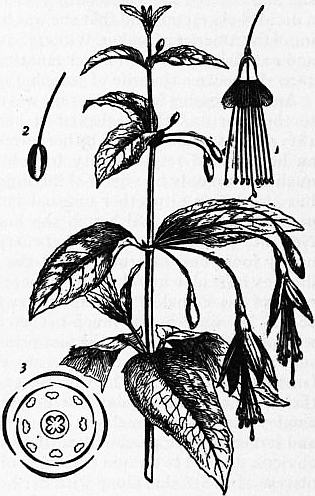
Fuchsia coccinea.
1, Flower cut open after removal of sepals; 2, fruit; 3, floral diagram.
FUCHSIA, so named by Plumier in honour of the botanist Leonhard Fuchs, a genus of plants of the natural order Onagraceae, characterized by entire, usually opposite leaves, pendent flowers, a funnel-shaped, brightly coloured, quadripartite, deciduous calyx, 4 petals, alternating with the calycine segments, 8, rarely 10, exserted stamens, a long filiform style, an inferior ovary, and fruit, a fleshy ovoid many-seeded berry. All the members of the genus, with the exception of the New Zealand species, F. excorticata, F. Colensoi and F. procumbens, are natives of Central and South America—occurring in the interior of forests or in damp and shady mountainous situations. The various species differ not a little in size as well as in other characters; some, as F. verrucosa, being dwarf shrubs; others, as F. arborescens and F. apetala, attaining a height of 12 to 16 ft., and having stems several inches in diameter. Plumier, in his Nova plantarum Americanarum genera (p. 14, tab. 14, Paris, 1703), gave a description of a species of fuchsia, the first known, under the name of Fuchsia triphylla, flore coccineo, and a somewhat conventional outline figure of the same plant was published at Amsterdam in 1757 by Burmann. In the Histoire des plantes médicinales of the South American traveller Feuillée (p. 64, pl. XLVII.), written in 1709-1711, and published by him with his Journal, Paris, 1725, the name Thilco is applied to a species of fuchsia from Chile, which is described, though not evidently so figured, as having a pentamerous calyx. The F. coccinea of Alton (fig.) (see J.D. Hooker, in Journal Linnean Soc., Botany, vol. x. p. 458, 1867), the first species of fuchsia cultivated in England, where it was long confined to the greenhouse, was brought from South America by Captain Firth in 1788 and placed in Kew Gardens. Of this species Mr Lee, a nurseryman at Hammersmith, soon afterwards obtained an example, and procured from it by means of cuttings several hundred plants, which he sold at a guinea each. In 1823 F. macrostemma and F. gracilis, and during the next two or three years several other species, were introduced into England; but it was not until about 1837, or soon after florists had acquired F. fulgens, that varieties of interest began to make their appearance. The numerous hybrid forms now existing are the result chiefly of the intercrossing of that or other long-flowered with globose-flowered plants. F. Venus-victrix, raised by Mr Gulliver, gardener to the Rev. S. Marriott of Horsemonden, Kent, and sold in 1822 to Messrs Cripps, was the earliest white-sepalled fuchsia. The first fuchsia with a white corolla was produced about 1853 by Mr Storey. In some varieties the blossoms are variegated, and in others they are double. There appears to be very little limit to the number of forms to be obtained by careful cultivation and selection. To hybridize, the flower as soon as it opens is emasculated, and it is then fertilized with pollen from some different flower.