VOLUME XI SLICE III Frost to Fyzabad (continued 12)
Reading edition
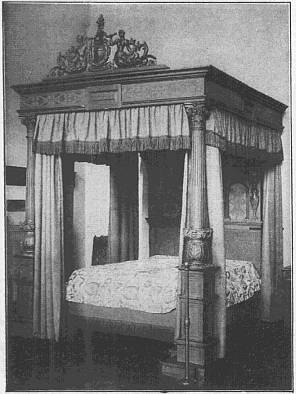
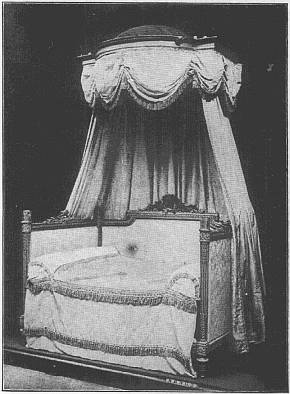
Plate V.
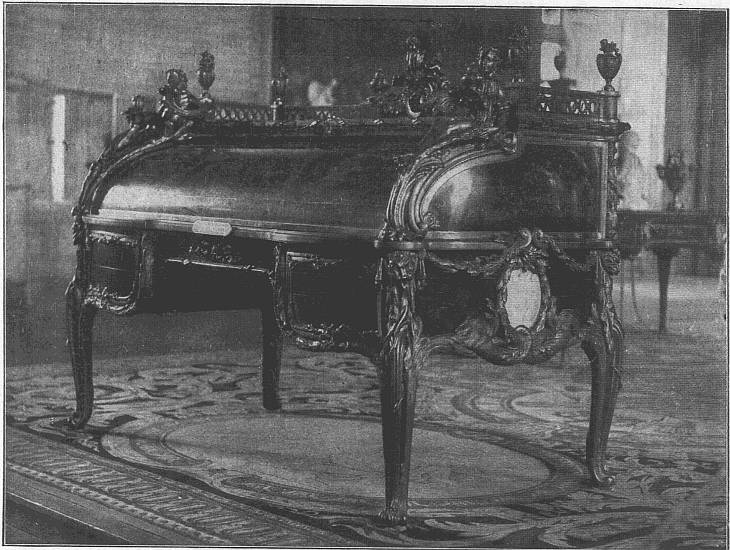
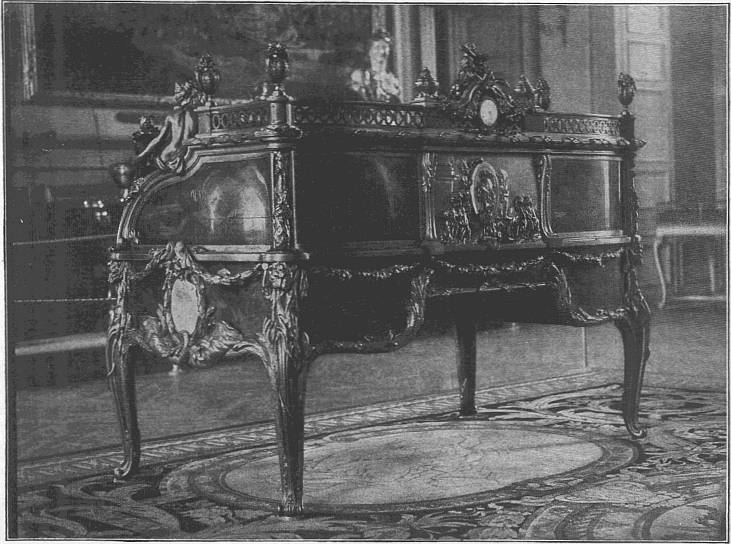
Photo, Mansell & Co.
THE “BUREAU DU ROI,” MADE FOR LOUIS XV., NOW IN THE LOUVRE. For description, see Desk.
A decided, if not always intelligent, effort to devise a new style in furniture began during the last few years of the 19th century, which gained the name of “l’art nouveau.” Its pioneers professed to be free from all old traditions and to seek inspiration from nature alone. Happily nature is less forbidding than many of these interpretations of it, and much of the “new art” is a remarkable exemplification of the impossibility of altogether ignoring traditional forms. The style was not long in degenerating into extreme extravagance. Perhaps the most striking consequence of this effort has been, especially in England, the revival of the use of oak. Lightly polished, or waxed, the cheap foreign oaks often produce very agreeable results, especially when there is applied to them a simple inlay of boxwood and stained holly, or a modern form of pewter. The simplicity of these English forms is in remarkable contrast to the tortured and ungainly outlines of continental seekers after a conscious and unpleasing “originality.”
Until a very recent period the most famous collections of historic furniture were to be found in such French museums as the Louvre, Cluny and the Garde Meuble. Now, however, they are rivalled, if not surpassed, by the magnificent collections of the Victoria and Albert Museum at South Kensington, and the Wallace collection at Hertford House, London. The latter, in conjunction with the Jones bequest at South Kensington, forms the finest of all gatherings of French furniture of the great periods, notwithstanding that in the Bureau du Roi the Louvre possesses the most magnificent individual example in existence. In America there are a number of admirable collections representative of the graceful and homely “colonial furniture” made in England and the United States during the Queen Anne and Georgian periods.
See also the separate articles in this work on particular forms of furniture. The literature of the subject has become very extensive, and it is needless to multiply here the references to books. Perrot and Chipiez, in their great Histoire de l’art dans l’antiquité (1882 et seq.) deal with ancient times, and A. de Champeaux, in Le Meuble (1885), with the middle ages and later period; English furniture is admirably treated by Percy Macquoid in his History of English Furniture (1905); and Lady Dilke’s French Furniture in the 18th Century (1901), and Luke Vincent Lockwood’s Colonial Furniture in America (1901), should also be consulted.
(J. P. B.)
FURNIVALL, FREDERICK JAMES (1825-1910), English philologist and editor, was born at Egham, Surrey, on the 4th of February 1825, the son of a surgeon. He was called to the bar in 1849, but his attention was soon diverted to philological studies and social problems. He gave Frederick Denison Maurice valuable assistance in the Christian Socialist movement, and was one of the founders of the Working Men’s College. For half a century he indefatigably promoted the study of early English literature, partly by his own work as editor, and still more efficaciously by the agency of the numerous learned societies of which he was both founder and director, especially the Early English Text Society (1864), which has been of inestimable service in promoting the study of early and middle English. He also established and conducted the Chaucer, Ballad, New Shakespeare and Wyclif Societies, and at a later period societies for the special study of Browning and Shelley. He edited texts for the Early English Text Society, for the Roxburghe Club and the Rolls Series; but his most important labours were devoted to Chaucer, whose study he as an editor greatly assisted by his “Six-Text” edition of the Canterbury Tales, and other publications of the Chaucer Society. He was the honorary secretary of the Philological Society, and was one of the original promoters of the Oxford New English Dictionary. He co-operated with its first editor, Herbert Coleridge, and after his death was for some time principal editor during the preliminary period of the collection of material. The completion of his half-century of labour was acknowledged in 1900 by a handsome testimonial, including the preparation by his friends of a volume of philological essays specially dedicated to him, An English Miscellany (Oxford, 1901), and a considerable donation to the Early English Text Society. Dr Furnivall was always an enthusiastic oarsman, and till the end kept up his interest in rowing; with John Beesley in 1845 he introduced the new type of narrow sculling boat, and in 1886 started races on the Thames for sculling fours and sculling eights. He died on the 2nd of July 1910.
FURSE, CHARLES WELLINGTON (1868-1904), English painter, born at Staines, the son of the Rev. C.W. Furse, archdeacon of Westminster, was descended collaterally from Sir Joshua Reynolds, and in his short span of life achieved such rare excellence as a portrait and figure painter that he forms an important link in the chain of British portraiture which extends from the time when Van Dyck was called to the court of Charles I. to our own day. His talent was precocious; at the age of seven he gave indications of it in a number of drawings illustrating Scott’s novels. He entered the Slade school in 1884, winning the Slade scholarship in the following year, and completed his education at Julian’s atelier in Paris. Hard worker as he was, his activity was frequently interrupted by spells of illness, for he had developed signs of consumption when he was still attending the Slade school. An important canvas called “Cain” was his first contribution (1888) to the Royal Academy, to the associateship of which he was elected in the year of his death. For some years before he had been a staunch supporter of the New English Art Club, to the exhibitions of which he was a regular contributor. He was married in October 1900 to Katherine, daughter of John Addington Symonds. His fondness for sport and of an open-air life found expression in his art and introduced a new, fresh and vigorous note into portraiture. There is never a suggestion of the studio or of the fatiguing pose in his portraits. The sitters appear unconscious of being painted, and are generally seen in the pursuit of their favourite outdoor sport or pastime, in the full enjoyment of life. Such are the “Diana of the Uplands,” the “Lord Roberts” and “The Return from the Ride” at the Tate Gallery; the four children in the “Cubbing with the York and Ainsty,” “The Lilac Gown,” “Mr and Mrs Oliver Fishing” and the portrait of Lord Charles Beresford. Most of these pictures, and indeed nearly all the work completed in the few years of Furse’s activity, show a pronounced decorative tendency. His sense of space, composition and decorative design can best be judged by his admirable mural decorations for Liverpool town hall, executed between 1899 and 1902. A memorial exhibition of Furse’s paintings and sketches was held at the Burlington Fine Arts Club in 1906.
FÜRST, JULIUS (1805-1873), German Orientalist, was born of Jewish parents at Zerkowo in Posen, on the 12th of May 1805. He studied philosophy and philology at Berlin, and oriental literature at Posen, Breslau and Halle. In 1857 he was appointed to a lectureship at the university of Leipzig, and he was promoted to a professorship in 1864, which he held until his death at Leipzig on the 9th of February 1873. Among his writings may be mentioned Lehrgebäude der aramäischen Idiome (Leipzig, 1835); Librorum sacrorum Veteris Testamenti concordantiae Hebraicae atque Chaldaicae (Leipzig, 1837-1840); Hebräisches und chaldäisches Wörterbuch (1851, English translation by S. Davidson 1867); Kultur und Literaturgeschichte der Juden in Asien (1849). Fürst also edited a valuable Bibliotheca Judaica (Leipzig, 1849-1863), and was the author of some other works of minor importance. From 1840 to 1851 he was editor of Der Orient, a journal devoted to the language, literature, history and antiquities of the Jews.
FÜRSTENBERG, the name of two noble houses of Germany.
1. The more important is in possession of a mediatized principality in the district of the Black Forest and the Upper Danube, which comprises the countship of Heiligenberg, about 7 m. to the N. of the Lake of Constance, the landgraviates of Stühlingen and Baar, and the lordships of Jungnau, Trochtelfingen, Hausen and Möskirch or Messkirch. The territory is discontinuous; and as it lies partly in Baden, partly in Württemberg, and partly in the Prussian province of Sigmaringen, the head of the family is an hereditary member of the first chamber of Baden and of the chamber of peers in Württemberg and in Prussia. The relations of the principality with Baden are defined by the treaty of May 1825, and its relations with Württemberg by the royal declaration of 1839. The Stammort or ancestral seat of the family is Fürstenberg in the Black Forest, about 13 m. N. of Schaffhausen, but the principal residence of the present representatives of the main line is at Donaueschingen.
The family of Fürstenberg claims descent from a certain Count Unruoch, a contemporary of Charlemagne, but their authentic pedigree is only traceable to Egino II., count of Urach, who died before 1136. In 1218 his successors inherited the possessions of the house of Zähringen in the Baar district of the Black Forest, where they built the town and castle of Fürstenberg. Of the two sons of Egino V. of Urach, Conrad, the elder, inherited the Breisgau and founded the line of the counts of Freiburg, while the younger, Heinrich (1215-1284), received the territories lying in the Kinzigthal and Baar, and from 1250 onward styled himself first lord, then count, of Fürstenberg. His territories were subsequently divided among several branches of his descendants, though temporarily reunited under Count Friedrich III., whose wife, Anna, heiress of the last count of Wardenberg, brought him the countship of Heiligenberg and lordships of Jungnau and Trochtelfingen in 1534. On Friedrich’s death (1559) his territories were divided between his two sons, Joachim and Christof I. Of these the former founded the line of Heiligenberg, the latter that of Kinzigthal. The Kinzigthal branch was again subdivided in the 17th century between the two sons of Christof II. (d. 1614), the elder, Wratislaw II. (d. 1642), founding the line of Mösskirch, the younger, Friedrich Rudolf (d. 1655), that of Stühlingen. The Heiligenberg branch received an accession of dignity by the elevation of Count Hermann Egon (d. 1674) to the rank of prince of the Empire in 1664, but his line became extinct with the death of his son Prince Anton Egon, favourite of King Augustus the Strong and regent of Saxony, in 1716. The heads of both the Mösskirch and Stühlingen lines were now raised to the dignity of princes of the Empire (1716). The Mösskirch branch died out with Prince Karl Friedrich (d. 1744); the territories of the Stühlingen branch had been divided on the death of Count Prosper Ferdinand (1662-1704) between his two sons, Joseph Wilhelm Ernst (1699-1762) and Ludwig August Egon (1705-1759). The first of these was created prince of the Empire on the 10th of December 1716, and founded the princely line of the Swabian Fürstenbergs; in 1772 he obtained from the emperor Francis I. for all his legitimate sons and their descendants the right to bear, instead of the style of landgrave, that of prince, which had so far been confined to the reigning head of the family. Ludwig, on the other hand, founded the family of the landgraves of Fürstenberg, who, since their territories lay in Austria and Moravia, were known as the “cadet line in Austria.” The princely line became extinct with the death of Karl Joachim in 1804, and the inheritance passed to the Bohemian branch of the Austrian cadet line in the person of Karl Egon II. (see below). Two years later the principality was mediatized.
In 1909 there were two branches of the princely house of Fürstenberg: (1) the main branch, that of Fürstenberg-Donaueschingen, the head of which was Prince Maximilian Egon (b. 1863), who succeeded his cousin Karl Egon III. in 1896; (2) that of Fürstenberg-Königshof, in Bohemia, the head of which was Prince Emil Egon (b. 1876), chamberlain and secretary of legation to the Austro-Hungarian embassy in London (1907). The cadet line of the landgraves of Fürstenberg is now extinct, its last representative having been the landgrave Joseph Friedrich Ernst of Fürstenberg-Weitra (1860-1896), son of the landgrave Ernst (1816-1889) by a morganatic marriage. He was not recognized as ebenbürtig by the family. The landgraves of Fürstenberg were in 1909 represented only by the landgravines Theresa (b. 1839) and Gabrielle (b. 1844), daughters of the landgrave Johann Egon (1802-1879).
From the days of Heinrich of Urach, a relative and notable supporter of Rudolph of Habsburg, the Fürstenbergs have played a stirring part in German history as statesmen, ecclesiastics and notably soldiers. There was a popular saying that “the emperor fights no great battle but a Fürstenberg falls.” In the Heiligenberg line the following may be more particularly noticed.
Franz Egon (1625-1682), bishop of Strassburg, was the elder son of Egon VII., count of Fürstenberg (1588-1635), who served with distinction as a Bavarian general in the Thirty Years’ War. He began life as a soldier in the imperial service, but on the elevation of his friend Maximilian Henry of Bavaria to the electorate of Cologne in 1650, he went to his court and embraced the ecclesiastical career. He soon gained a complete ascendancy over the weak-minded elector, and, with his brother William Egon (see below), was mainly instrumental in making him the tool of the aggressive policy of Louis XIV. of France. Ecclesiastical preferments were heaped upon him. As a child he had been appointed to a canonry of Cologne; to these he added others at Strassburg, Liége, Hildesheim and Spires; he became also suffragan bishop and dean of Cologne and provost of Hildesheim, and in 1663 bishop of Strassburg. Later he was also prince-abbot of Lüders and Murbach and abbot of Stablo and Malmedy. On the conclusion of a treaty between the emperor and the elector of Cologne, on the 11th of May 1674, Franz was deprived of all his preferments in Germany, and was compelled to take refuge in France. He was, however, amnestied with his brother William by a special article of the treaty of Nijmwegen (1679), whereupon he returned to Cologne. After the French occupation of Strassburg (1681) he took up his residence there and died on the 1st of April 1682.
His brother William Egon (1629-1704), bishop of Strassburg, began his career as a soldier in the French service. He went to the court of the elector of Cologne at the same time as Franz Egon, whose zeal for the cause of Louis XIV. of France he shared. In 1672 the intrigues of the two Fürstenbergs had resulted in a treaty of offensive alliance between the French monarchy and the electorate of Cologne, and, the brothers being regarded by the Imperialists as the main cause of this disaster, William was seized by imperial soldiers in the monastery of St Pantaleon at Cologne, hurried off to Vienna and there tried for his life. He was saved by the intervention of the papal nuncio, but was kept in prison till the signature of the treaty of Nijmwegen (1679). As a reward for his services Louis XIV. appointed him bishop of Strassburg in succession to his brother in 1682, in 1686 obtained for him from Pope Innocent XI. the cardinal’s hat, and in 1688 succeeded in obtaining his election as coadjutor-archbishop of Cologne and successor to the elector Maximilian Henry. At the instance of the emperor, however, the pope interposed his veto; the canons followed the papal lead, and, the progress of the Allies against Louis XIV. depriving him of all prospect of success, William Egon retired to France. Here he took up his abode at his abbey of St Germain des Près near Paris, where he died on the 10th of April 1704.
In the Stühlingen line the most notable was Karl Egon (1796-1854), prince of Fürstenberg, the son of Prince Karl Alois of Fürstenberg, a general in the Austrian service, who was killed at the battle of Loptingen on the 25th of March 1799. In 1804 he inherited the Swabian principality of Fürstenberg and all the possessions of the family except the Moravian estates. He studied at Freiburg and Würzburg, and in 1815 accompanied Prince Schwarzenberg to Paris as staff-officer. In 1817 he came of age, and in the following year married the princess Amalie of Baden. By the mediatization of his principality in 1806 the greater part of his vast estates had fallen under the sovereignty of the grand-duke of Baden, and Prince Fürstenberg took a conspicuous part in the upper house of the grand-duchy. In politics he distinguished himself by a liberalism rare in a great German noble, carrying through by his personal influence with his peers the abolition of tithes and feudal dues and stanchly advocating the freedom of the press. He was not less distinguished by his large charities: among other foundations he established a hospital at Donaueschingen. For the industrial development of the country, too, he did much, and proved himself also a notable patron of the arts. His palace of Donaueschingen, with its collections of paintings, engravings and coins, was a centre of culture, where poets, painters and musicians met with princely entertainment. He died on the 14th of September 1869, and was succeeded by his son Karl Egon II. (1820-1892), with the death of whose son, Karl Egon III., in 1896, the title and estates passed to Prince Maximilian Egon, head of the cadet line of Fürstenberg-Pürglitz.
See Münch, Gesch. des Hauses und des Landes Fürstenberg, 4 vols. (Aix-la-Chapelle, 1829-1847); S. Riezler, Gesch. des fürstlichen Hauses Fürstenberg bis 1507 (Tübingen, 1883); Fürstenbergisches Urkundenbuch, edited by S. Riezler and F.L. Baumann, vols. i.-vii. (Tübingen, 1877-1891), continued s. tit. Mitteilungen aus dem fürstlich. Fürstenbergischem Archiv by Baumann and G. Tumbült, 2 vols. (ib. 1899-1902); Stokvis, Manuel d’histoire (Leiden, 1890-1893); Almanach de Gotha; Allgemeine deutsche Biographie.
2. The second Fürstenberg family has its possessions in Westphalia and the country of the Rhine, and takes its name from the castle of Fürstenberg on the Ruhr. The two most remarkable men whom it has produced are Franz Friedrich Wilhelm, freiherr von Fürstenberg, and Franz Egon, count von Fürstenberg-Stammheim. The former (1728-1810) became ultimately vicar-general of the prince-bishop of Münster, and effected a great number of important reforms in the administration of the country, besides doing much for its educational and industrial development. The latter (1797-1859) was an enthusiastic patron of art, who zealously advocated the completion of the Cologne cathedral, and erected the beautiful church of St Apollinaris near Remagen on the Rhine. He was a member of the Prussian Upper House in 1849, collaborated in founding the Preussisches Wochenblatt, and was an ardent defender of Catholic interests. His son, Count Gisbert von Fürstenberg-Stammheim (b. 1836), was in 1909 head of the Rhenish line of the house of Fürstenberg.
FÜRSTENWALDE, a town of Germany, in the Prussian province of Brandenburg, on the right bank of the Spree, and on the railway from Berlin to Frankfort-on-Oder, 28 m. E. of the former city. Pop. (1905) 20,498. Its beautiful cathedral church contains several old monuments. The industries are important, including, besides brewing and malting, manufactures of starch, vinegar, electric lamps and gas-fittings, stoves, &c., iron-founding and wool-weaving. Fürstenwalde is one of the oldest towns of Brandenburg. From 1385 it was the seat of the bishop of Lebus, whose bishopric was incorporated with the electorate of Brunswick in 1595.
FÜRTH, a manufacturing town of Germany, in the kingdom of Bavaria, at the confluence of the Pegnitz with the Regnitz, 5 m. N.W. from Nuremberg by rail, at the junction of lines to Hof and Würzburg. Pop. (1885) 35,455; (1905) 60,638. It is a modern town in appearance, with broad streets and palatial business houses. Of its four Evangelical churches, the old St Michaeliskirche is a handsome structure; but its chief edifices are the new town hall, with a tower 175 ft. high and the magnificent synagogue. The Jews have also a high school, which enjoys a great reputation. There are besides a classical, a wood-carving and an agricultural school and a library. Fürth is the seat of several important industries; particularly, the production of chromolithographs and picture-books, the manufacture of mirrors and mirror-frames, bronze and gold-leaf wares, pencils, toys, haberdashery, optical instruments, silver work, turnery, chicory, machinery, fancy boxes and cases, and an extensive trade is carried on in these goods as also in hops, metals, wool, groceries and coal. A large annual fair is held at Michaelmas and lasts for eleven days. The earliest railway in Germany was that between Nuremberg and Fürth (opened on the 7th of December 1835).
Fürth was founded, according to tradition, by Charlemagne, who erected a chapel there. It was for a time a Vogtei (advocateship) under the burgraves of Nuremberg, but about 1314 it was bequeathed to the see of Bamberg, and in 1806 it came into the possession of Bavaria. In 1632 Gustavus Adolphus besieged it in vain, and in 1634 it was pillaged and burnt by the Croats. It owes its rise to prosperity to the tolerance it meted out to the Jews, who found here an asylum from the oppression under which they suffered in Nuremberg.
See Fronmüller, Chronik der Stadt Fürth (1887).
FURTWÄNGLER, ADOLF (1853-1907), German archaeologist, was born at Freiburg im Breisgau, and was educated there, at Leipzig and at Munich, where he was a pupil of H. Brunn, whose comparative method in art-criticism he much developed. He took part in the excavations at Olympia in 1878, became an assistant in the Berlin Museum in 1880, and professor at Berlin (1884) and later at Munich. His latest excavation work was at Aegina. He was a prolific writer, with a prodigious knowledge and memory, and a most ingenious and confident critic; and his work not only dominated the field of archaeological criticism but also raised its standing both at home and abroad. Among his numerous publications the most important were a volume on the bronzes found at Olympia, vast works on ancient gems and Greek vases, and the invaluable Masterpieces of Greek Sculpture (English translation by Eugénie Strong). He died at Athens on the 10th of October 1907.
FURZE, Gorse or Whin; botanical name Ulex (Ger. Stechginster, Fr. ajonc), a genus of thorny papilionaceous shrubs, of few species, confined to west and central Europe and north-west Africa. Common furze, U. europaeus, is found on heaths and commons in western Europe from Denmark to Italy and Greece, and in the Canaries and Azores, and is abundant in nearly all parts of the British Isles. It grows to a height of 2-6 ft.; it has hairy stems, and the smaller branches end each in a spine; the leaves, sometimes lanceolate on the lowermost branches, are mostly represented by spines from 2 to 6 lines long, and branching at their base; and the flowers, about three-quarters of an inch in length, have a shaggy, yellowish-olive calyx, with two small ovate bracts at its base, and appear in early spring and late autumn. They are yellow and sweet-scented and visited by bees. The pods are few-seeded; their crackling as they burst may often be heard in hot weather. This species comprises the varieties vulgaris, or U. europaeus proper, which has spreading branches, and strong, many-ridged spines, and strictus (Irish furze), with erect branches, and slender 4-edged spines. The other British species of furze is U. nanus, dwarf furze, a native of Belgium, Spain and the west of France; it is a procumbent plant, less hairy than U. europaeus, with smaller and more orange-coloured flowers, which spring from the primary spines, and have a nearly smooth calyx, with minute basal bracts. Furze, or gorse, is sometimes employed for fences.
Notwithstanding its formidable spines, the young shoots yield a palatable and nutritious winter forage for horses and cattle. To fit it for this purpose it must be chopped and bruised to destroy the spines. This is sometimes done in a primitive and laborious way by laying the gorse upon a block of wood and beating it with a mallet, flat at one end and armed with crossed knife-edges at the other, by the alternate use of which it is bruised and chopped. There are now a variety of machines by which this is done rapidly and efficiently, and which are in use where this kind of forage is used to any extent. The agricultural value of this plant has often been over-rated by theoretical writers. In the case of very poor, dry soils it does, however, yield much valuable food at a season when green forage is not otherwise to be had. It is on this account of importance to dairymen; and to them it has this further recommendation, that cows fed upon it give much rich milk, which is free from any unpleasant flavour. To turn it to good account, it must be sown in drills, kept clean by hoeing, and treated as a regular green crop. If sown in March, on land fitly prepared and afterwards duly cared for, it is ready for use in the autumn of the following year. A succession of cuttings of proper age is obtained for several years from the same field. It is cut by a short stout scythe, and must be brought from the field daily; for when put in a heap after being chopped and bruised it heats rapidly. It is given to horses and cows in combination with chopped hay or straw. An acre will produce about 2000 faggots of green two-year-old gorse, weighing 20 ℔ each.
This plant is invaluable in mountain sheep-walks. The rounded form of the furze bushes that are met with in such situations shows how diligently the annual growth, as far as it is accessible, is nibbled by the sheep. The food and shelter afforded to them in snowstorms by clusters of such bushes is of such importance that the wonder is our sheep farmers do not bestow more pains to have it in adequate quantity. Young plants of whin are so kept down by the sheep that they can seldom attain to a profitable size unless protected by a fence for a few years. In various parts of England it is cut for fuel. The ashes contain a large proportion of alkali, and are a good manure, especially for peaty land.
FUSARO, LAGO, a lake of Campania, Italy, ½ m. W. of Baia, and 1 m. S. of the acropolis of Cumae. It is the ancient Acherusia palus, separated from the sea on the W. by a line of sandhills. It may have been the harbour of Cumae in early antiquity. In the 1st century A.D. an artificial outlet was dug for it at its S. end, with a tunnel, lined with opus reticulatum and brick, under the hill of Torregaveta. This hill is covered with the remains of a large villa, which is almost certainly that of Servilius Vatia, described by Seneca (Epist. 55). There are remains of other villas on the shores of the lake. Oyster cultivation is carried on there.
See J. Beloch, Campanien (2nd ed., Breslau, 1890), 188.
(T. As.)
FUSELI, HENRY (1741-1825), English painter and writer on art, of German-Swiss family, was born at Zürich in Switzerland on the 7th of February 1741; he himself asserted in 1745, but this appears to have been a mere whim. He was the second child in a family of eighteen. His father was John Caspar Füssli, of some note as a painter of portraits and landscapes, and author of Lives of the Helvetic Painters. This parent destined his son for the church, and with this view sent him to the Caroline college of his native town, where he received an excellent classical education. One of his schoolmates there was Lavater, with whom he formed an intimate friendship.
After taking orders in 1761 Fuseli was obliged to leave his country for a while in consequence of having aided Lavater to expose an unjust magistrate, whose family was still powerful enough to make its vengeance felt. He first travelled through Germany, and then, in 1765, visited England, where he supported himself for some time by miscellaneous writing: there was a sort of project of promoting through his means a regular literary communication between England and Germany. He became in course of time acquainted with Sir Joshua Reynolds, to whom he showed his drawings. By Sir Joshua’s advice he then devoted himself wholly to art. In 1770 he made an art-pilgrimage to Italy, where he remained till 1778, changing his name from Füssli to Fuseli, as more Italian-sounding. Early in 1779 he returned to England, taking Zürich on his way. He found a commission awaiting him from Alderman Boydell, who was then organizing his celebrated Shakespeare gallery. Fuseli painted a number of pieces for this patron, and about this time published an English edition of Lavater’s work on physiognomy. He likewise gave Cowper some valuable assistance in preparing the translation of Homer. In 1788 Fuseli married Miss Sophia Rawlins (who it appears was originally one of his models, and who proved an affectionate wife), and he soon after became an associate of the Royal Academy. Two years later he was promoted to the grade of Academician. In 1799 he exhibited a series of paintings from subjects furnished by the works of Milton, with a view to forming a Milton gallery corresponding to Boydell’s Shakespeare gallery. The number of the Milton paintings was forty-seven, many of them very large; they were executed at intervals within nine years. This exhibition, which closed in 1800, proved a failure as regards profit. In 1799 also he was appointed professor of painting to the Academy. Four years afterwards he was chosen keeper, and resigned his professorship; but he resumed it in 1810, and continued to hold both offices till his death. In 1805 he brought out an edition of Pilkington’s Lives of the Painters, which, however, did not add much to his reputation. Canova, when on his visit to England, was much taken with Fuseli’s works, and on returning to Rome in 1817 caused him to be elected a member of the first class in the Academy of St Luke. Fuseli, after a life of uninterrupted good health, died at Putney Hill on the 16th of April 1825, at the advanced age of eighty-four, and was buried in the crypt of St Paul’s cathedral. He was comparatively rich at his death, though his professional gains had always appeared to be meagre.
As a painter, Fuseli had a daring invention, was original, fertile in resource, and ever aspiring after the highest forms of excellence. His mind was capable of grasping and realizing the loftiest conceptions, which, however, he often spoiled on the canvas by exaggerating the due proportions of the parts, and throwing his figures into attitudes of fantastic and over-strained contortion. He delighted to select from the region of the supernatural, and pitched everything upon an ideal scale, believing a certain amount of exaggeration necessary in the higher branches of historical painting. “Damn Nature! she always puts me out,” was his characteristic exclamation. In this theory he was confirmed by the study of Michelangelo’s works and the marble statues of the Monte Cavallo, which, when at Rome, he used often to contemplate in the evening, relieved against a murky sky or illuminated by lightning. But this idea was by him carried out to an excess, not only in the forms, but also in the attitudes of his figures; and the violent and intemperate action which he often displays destroys the grand effect which many of his pieces would otherwise produce. A striking illustration of this occurs in his famous picture of “Hamlet breaking from his Attendants to follow the Ghost”: Hamlet, it has been said, looks as though he would burst his clothes with convulsive cramps in all his muscles. This intemperance is the grand defect of nearly all Fuseli’s compositions. On the other hand, his paintings are never either languid or cold. His figures are full of life and earnestness, and seem to have an object in view which they follow with rigid intensity. Like Rubens he excelled in the art of setting his figures in motion. Though the lofty and terrible was his proper sphere, Fuseli had a fine perception of the ludicrous. The grotesque humour of his fairy scenes, especially those taken from A Midsummer-Night’s Dream, is in its way not less remarkable than the poetic power of his more ambitious works. As a colourist Fuseli has but small claims to distinction. He scorned to set a palette as most artists do; he merely dashed his tints recklessly over it. Not unfrequently he used his paints in the form of a dry powder, which he rubbed up with his pencil with oil, or turpentine, or gold size, regardless of the quantity, and depending for accident on the general effect. This recklessness may perhaps be explained by the fact that he did not paint in oil till he was twenty-five years of age. Despite these drawbacks he possessed the elements of a great painter.
Fuseli painted more than 200 pictures, but he exhibited only a minority of them. His earliest painting represented “Joseph interpreting the Dreams of the Baker and Butler”; the first to excite particular attention was the “Nightmare,” exhibited in 1782. He produced only two portraits. His sketches or designs numbered about 800; they have admirable qualities of invention and design, and are frequently superior to his paintings.
His general powers of mind were large. He was a thorough master of French, Italian, English and German, and could write in all these tongues with equal facility and vigour, though he preferred German as the vehicle of his thoughts. His writings contain passages of the best art-criticism that English literature can show. The principal work is his series of Lectures in the Royal Academy, twelve in number, commenced in 1801.
Many interesting anecdotes of Fuseli, and his relations to contemporary artists, are given in his Life by John Knowles, who also edited his works in 3 vols. 8vo, London, 1831.
(W. M. R.)
FUSEL OIL (from the Ger. Fusel, bad spirits), the name applied to the volatile oily liquids, of a nauseous fiery taste and smell, which are obtained in the rectification of spirituous liquors made by the fermentation of grain, potatoes, the marc of grapes, and other material, and which, as they are of higher boiling point than ethyl alcohol, occur in largest quantity in the last portions of the distillate. Besides ethyl or ordinary alcohol, and amyl alcohol, which are present in them all, there have been found in fusel oil several other bodies of the CnH2n+1·OH series, also certain ethers, and members of the CnH2n+1·CO2H series of fatty acids. Normal propyl alcohol is contained in the fusel oil of the marc brandy of the south of France, and isoprimary butyl alcohol in that of beet-root molasses. The chief constituent of the fusel oil procured in the manufacture of alcohol from potatoes and grain, usually known as fusel oil and potato-spirit, is isoprimary amyl alcohol, or isobutylcarbinol. Ordinary fusel oil yields also an isomeric amyl alcohol (active amyl alcohol) boiling at about 128°. Variable quantities of fusel oil, less or greater according to the stage of ripening, exist in commercial spirits (see Spirits).
Fusel oil and its chief constituent, amyl alcohol, are direct nerve poisons. In small doses it causes only thirst and headache, with furred tongue and some excitement. In large doses it is a convulsent poison. Impure beverages induce all the graver neurotic and visceral disorders in alcoholism; and, like fusel oil, furfurol and the essence of absinthe, are convulsent poisons. Pure ethyl alcohol intoxication, indeed, is rarely seen, being modified in the case of spirits by the higher alcohols contained in fusel oil. According to Rabuteau the toxic properties of the higher alcohols increase with their molecular weight and boiling point. Richet considers that the fusel oil contained in spirits constitutes the chief danger in the consumption of alcoholic beverages. The expert can immediately detect the peculiarly virulent characters of the mixed intoxication due to the consumption of spirits containing a large percentage of fusel oil.
FUSIBLE METAL, a term applied to certain alloys, generally composed of bismuth, lead and tin, which possess the property of melting at comparatively low temperatures. Newton’s fusible metal (named after Sir Isaac Newton) contains 50 parts of bismuth, 31.25 of lead and 18.75 of tin; that of Jean Darcet (1725-1801), 50 parts of bismuth with 25 each of lead and tin; and that of Valentin Rose the elder, 50 of bismuth with 28.1 of lead and 24.1 of tin. These melt between 91° and 95° C. The addition of cadmium gives still greater fusibility; in Wood’s metal, for instance, which is Darcet’s metal with half the tin replaced by cadmium, the melting point is lowered to 66°-71° C.; while another described by Lipowitz and containing 15 parts of bismuth, 8 of lead, 4 of tin and 3 of cadmium, softens at about 55° and is completely liquid a little above 60°. By the addition of mercury to Darcet’s metal the melting point may be reduced so low as 45°. These fusible metals have the peculiarity of expanding as they cool; Rose’s metal, for instance, remains pasty for a considerable range of temperature below its fusing point, contracts somewhat rapidly from 80° to 55°, expands from 55° to 35°, and contracts again from 35° to 0°. For this reason they may be used for taking casts of anatomical specimens or making clichés from wood-blocks, the expansion on cooling securing sharp impressions. By suitable modification in the proportions of the components, a series of alloys can be made which melt at various temperatures above the boiling point of water; for example, with 8 parts of bismuth, 8 of lead and 3 of tin the melting point is 123°, and with 8 of bismuth, 30 of lead and 24 of tin it is 172°. With tin and lead only in equal proportions it is 241°. Such alloys are used for making the fusible plugs inserted in the furnace-crowns of steam boilers, as a safeguard in the event of the water-level being allowed to fall too low. When this happens the plug being no longer covered with water is heated to such a temperature that it melts and allows the contents of the boiler to escape into the furnace. In automatic fire-sprinklers the orifices of the pipes are closed with fusible metal, which melts and liberates the water when, owing to an outbreak of fire in the room, the temperature rises above a predetermined limit.
FUSILIER, originally (in French about 1670, in English about 1680) the name of a soldier armed with a light flintlock musket called the fusil; now a regimental designation. Various forms of flintlock small arms had been used in warfare since the middle of the 16th century. At the time of the English civil war (1642-1652) the term “firelock” was usually employed to distinguish these weapons from the more common matchlock musket. The special value of the firelock in armies of the 17th century lay in the fact that the artillery of the time used open powder barrels for the service of the guns, making it unsafe to allow lighted matches in the muskets of the escort. Further, a military escort was required, not only for the protection, but also for the surveillance of the artillerymen of those days. Companies of “firelocks” were therefore organized for these duties, and out of these companies grew the “fusiliers” who were employed in the same way in the wars of Louis XIV. In the latter part of the Thirty Years’ War (1643) fusiliers were simply mounted troops armed with the fusil, as carabiniers were with the carbine. But the escort companies of artillery came to be known by the name shortly afterwards, and the regiment of French Royal Fusiliers, organized in 1671 by Vauban, was considered the model for Europe. The general adoption of the flintlock musket and the suppression of the pike in the armies of Europe put an end to the original special duties of fusiliers, and they were subsequently employed to a large extent in light infantry work, perhaps on account of the greater individual aptitude for detached duties naturally shown by soldiers who had never been restricted to a fixed and unchangeable place in the line of battle. The senior fusilier regiment in the British service, the (7th) Royal Fusiliers (City of London Regiment), was formed on the French model in 1685; the 5th foot (now Northumberland Fusiliers), senior to the 7th in the army, was not at that time a fusilier regiment. The distinctive head-dress of fusiliers in the British service is a fur cap, generally resembling, but smaller than and different in details from, that of the Foot Guards.
In Germany the name “fusilier” is borne by certain infantry regiments and by one battalion in each grenadier regiment.
FUSION, the term generally applied to the melting of a solid substance, or the change of state of aggregation from the solid to the liquid. The term “liquefaction” is frequently employed in the same sense, but is often restricted to the condensation of a gas or vapour. The converse process of freezing or solidification, the change from the liquid to the solid state, is subject to the same laws, and must be considered together with fusion. The solution of a solid in a foreign liquid, and the deposition or crystallization of a solid from a solution, are so closely related to the fusion of a pure substance, that it will also be necessary to consider some of the analogies which they present.
1. General Phenomena.—There are two chief varieties of the process of fusion, namely, crystalline and amorphous, which are in many ways distinct, although it is possible to find intermediate cases which partake of the characteristics of both. The melting of ice may be taken as a typical case of crystalline fusion. The passage from rigid solid to mobile liquid occurs at a definite surface without any intermediate stage or plastic condition. The change takes place at a definite temperature, the fusing or freezing point (abbreviated F.P.), and requires the addition of a definite quantity of heat to the solid, which is called the latent heat of fusion. There is also in general a considerable change of volume during fusion, which amounts in the case of ice to a contraction of 9%. Typical cases of amorphous solidification are those of silica, glass, plastic sulphur, pitch, alcohol and many organic liquids. In this type the liquid gradually becomes more and more viscous as the temperature falls, and ultimately attains the rigidity characteristic of a solid, without any definite freezing point or latent heat. The condition of the substance remains uniform throughout, if its temperature is uniform; there is no separation into the two distinct phases of solid and liquid, and there is no sudden change of volume at any temperature.
A change or transition from one crystalline form to another may occur in the solid state with evolution or absorption of heat at a definite temperature, and is analogous to the change from solid to liquid, but usually takes place more slowly owing to the small molecular mobility of the solid state. Thus rhombic sulphur when heated passes slowly at 95.6° C. into the monosymmetric form which melts at 120°, but if heated rapidly the rhombic form melts at 114.5. The two forms, rhombic and monosymmetric, can exist in equilibrium at 95.6°, the transition point at which they have the same vapour pressure. Similarly a solid solution of carbon in iron, when cooled slowly, passes at about 700° C., with considerable evolution of heat, into the form of “pearlite,” which is soft when cold, but if rapidly chilled the carbon remains in solution and the steel is very hard (see also Alloys).
In the case of crystalline fusion it is necessary to distinguish two cases, the homogeneous and the heterogeneous. In the first case the composition of the solid and liquid phases are the same, and the temperature remains constant during the whole process of fusion. In the second case the solid and liquid phases differ in composition; that of the liquid phase changes continuously, and the temperature does not remain constant during the fusion. The first case comprises the fusion of pure substances, and that of eutectics, or cryohydrates; the second is the general case of an alloy or a solution. These have been very fully studied and their phenomena greatly elucidated in recent years.
There is also a sub-variety of amorphous fusion, which may be styled colloid or gelatinous, and may be illustrated by the behaviour of solutions of water in gelatin. Many of these jellies melt at a fairly definite temperature on heating, and coagulate or set at a definite temperature on cooling. But in some cases the process is not reversible, and there is generally marked hysteresis, the temperature of setting and other phenomena depending on the rate of cooling. This case has not yet been fully worked out; but it appears probable that in many cases the jelly possesses a spongy framework of solid, holding liquid in its meshes or interstices. It might be regarded as a case of “heterogeneous” amorphous fusion, in which the liquid separates into two phases of different composition, one of which solidifies before the other. The two phases cannot, as a rule, be distinguished optically, but it is generally possible to squeeze out some of the liquid phase when the jelly has set, which proves that the substance is not really homogeneous. In very complicated mixtures, such as acid lavas or slags containing a large proportion of silica, amorphous and crystalline solidification may occur together. In this case the crystals separate first during the process of cooling, the mother liquor increases gradually in viscosity, and finally sets as an amorphous ground-mass or matrix, in which crystals of different kinds and sizes, formed at different stages of the cooling, remain embedded. The formation of crystals in an amorphous solid after it has set is also of frequent occurrence. It is termed devitrification, but is a very slow process unless the solid is in a plastic state.
2. Homogeneous Crystalline Fusion.—The fusion of a solid of this type is characterized most clearly by the perfect constancy of temperature during the process. In fact, the law of constant temperature, which is generally stated as the first of the so-called “laws of fusion,” does not strictly apply except to this case. The constancy of the F.P. of a pure substance is so characteristic that change of the F.P. is often one of the most convenient tests of the presence of foreign material. In the case of substances like ice, which melt at a low temperature and are easily obtained in large quantities in a state of purity, the point of fusion may be very accurately determined by observing the temperature of an intimate mixture of the solid and liquid while slowly melting as it absorbs heat from surrounding bodies. But in the majority of cases it is more convenient to observe the freezing point as the liquid is cooled. By this method it is possible to ensure perfect uniformity of temperature throughout the mass by stirring the liquid continuously during the process of freezing, whereas it is difficult to ensure uniformity of temperature in melting a solid, however gradually the heat is supplied, unless the solid can be mixed with the liquid. It is also possible to observe the F.P. in other ways, as by noting the temperature at the moment of the breaking of a wire, of the stoppage of a stirrer, or of the maximum rate of change of volume, but these methods are generally less certain in their indications than the point of greatest constancy of temperature in the case of homogeneous crystalline solids.
Fusing Points of Common Metals
Mercury −38.8° Antimony 630°
Potassium 62.5° Aluminium 655°
Sodium 95.6° Silver 962°
Tin 231.9° Gold 1064°
Bismuth 269.2° Copper 1082°
Cadmium 320.7° Nickel 1427°
Lead 327.7° Palladium 1535°
Zinc 419.0° Platinum 1710°
The above table contains some of the most recent values of fusing points of metals determined (except the first three and the last three) with platinum thermometers. The last three values are those obtained by extrapolation with platinum-rhodium and platinum-iridium couples. (See Harker, Proc. Roy. Soc. A 76, p. 235, 1905.) Some doubt has recently been raised with regard to the value for platinum, which is much lower than that previously accepted, namely 1775°.
3. Superfusion, Supersaturation.—It is generally possible to cool a liquid several degrees below its normal freezing point without a separation of crystals, especially if it is protected from agitation, which would assist the molecules to rearrange themselves. A liquid in this state is said to be “undercooled” or “superfused.” The phenomenon is even more familiar in the case of solutions (e.g. sodium sulphate or acetate) which may remain in the “metastable” condition for an indefinite time if protected from dust, &c. The introduction into the liquid under this condition of the smallest fragment of the crystal, with respect to which the solution is supersaturated, will produce immediate crystallization, which will continue until the temperature is raised to the saturation point by the liberation of the latent heat of fusion. The constancy of temperature at the normal freezing point is due to the equilibrium of exchange existing between the liquid and solid. Unless both solid and liquid are present, there is no condition of equilibrium, and the temperature is indeterminate.
It has been shown by H.A. Miers (Jour. Chem. Soc., 1906, 89, p. 413) that for a supersaturated solution in metastable equilibrium there is an inferior limit of temperature, at which it passes into the “labile” state, i.e. spontaneous crystallization occurs throughout the mass in a fine shower. This seems to be analogous to the fine misty condensation which occurs in a supersaturated vapour in the absence of nuclei (see Vaporization) when the supersaturation exceeds a certain limit.
4. Effect of Pressure on the F.P.—The effect of pressure on the fusing-point depends on the change of volume during fusion. Substances which expand on freezing, like ice, have their freezing points lowered by increase of pressure; substances which expand on fusing, like wax, have their melting points raised by pressure. In each case the effect of pressure is to retard increase of volume. This effect was first predicted by James Thomson on the analogy of the effect of pressure on the boiling point, and was numerically verified by Lord Kelvin in the case of ice, and later by Bunsen in the case of paraffin and spermaceti. The equation by which the change of the F.P. is calculated may be proved by a simple application of the Carnot cycle, exactly as in the case of vapour and liquid. (See Thermodynamics.) If L be the latent heat of fusion in mechanical units, v′ the volume of unit mass of the solid, and v″ that of the liquid, the work done in an elementary Carnot cycle of range dθ will be dp(v″ − v′), if dp is the increase of pressure required to produce a change dθ in the F.P. Since the ratio of the work-difference or cycle-area to the heat-transferred L must be equal to dθ/θ, we have the relation
dθ/dp = θ (v″ − v′)/L.
(1)
The sign of dθ, the change of the F.P., is the same as that of the change of volume (v″ − v′). Since the change of volume seldom exceeds 0.1 c.c. per gramme, the change of the F.P. per atmosphere is so small that it is not as a rule necessary to take account of variations of atmospheric pressure in observing a freezing point. A variation of 1 cm. in the height of the barometer would correspond to a change of .0001° C. only in the F.P. of ice. This is far beyond the limits of accuracy of most observations. Although the effect of pressure is so small, it produces, as is well known, remarkable results in the motion of glaciers, the moulding and regelation of ice, and many other phenomena. It has also been employed to explain the apparent inversion of the order of crystallization in rocks like granite, in which the arrangement of the crystals indicates that the quartz matrix solidified subsequently to the crystals of felspar, mica or hornblende embedded in it, although the quartz has a higher melting point. It is contended that under enormous pressure the freezing points of the more fusible constituents might be raised above that of the quartz, if the latter is less affected by pressure. Thus Bunsen found the F.P. of paraffin wax 1.4° C. below that of spermaceti at atmospheric pressure. At 100 atmospheres the two melted at the same temperature. At higher pressures the paraffin would solidify first. The effect of pressure on the silicates, however, is much smaller, and it is not so easy to explain a change of several hundred degrees in the F.P. It seems more likely in this particular case that the order of crystallization depends on the action of superheated water or steam at high temperatures and pressures, which is well known to exert a highly solvent and metamorphic action on silicates.
5. Variation of Latent Heat.—C.C. Person in 1847 endeavoured to show by the application of the first law of thermodynamics that the increase of the latent heat per degree should be equal to the difference (s″ − s′) between the specific heats of the liquid and solid. If, for instance, water at 0° C. were first frozen and then cooled to −t° C., the heat abstracted per gramme would be (L′ + s′t) calories. But if the water were first cooled to −t° C., and then frozen at −t°C., by abstracting heat L″, the heat abstracted would be L″ + s″t. Assuming that the heat abstracted should be the same in the two cases, we evidently obtain L′ − L″ = (s″ − s′)t. This theory has been approximately verified by Petterson, by observing the freezing of a liquid cooled below its normal F.P. (Jour. Chem. Soc. 24, p. 151). But his method does not represent the true variation of the latent heat with temperature, since the freezing, in the case of a superfused liquid, really takes place at the normal freezing point. A quantity of heat s″t is abstracted in cooling to −t, (L″ − s″t) in raising to 0° and freezing at 0°, and s’t in cooling the ice to -t. The latent heat L″ at −t does not really enter into the experiment. In order to make the liquid freeze at a different temperature, it is necessary to subject it to pressure, and the effect of the pressure on the latent heat cannot be neglected. The entropy of a liquid φ″ at its F.P. reckoned from any convenient zero φ0 in the solid state may be represented by the expression
φ″ − φ0 = ∫ s′dθ/θ + L/θ.
(2)
Since θdφ″/dθ = s″, we obtain by differentiation the relation
dL/dθ = s″ − s′ + L/θ,
(3)
which is exactly similar to the equation for the specific heat of a vapour maintained in the saturated condition. If we suppose that the specific heats s′ and s″ of the solid and liquid at equilibrium pressure are nearly the same as those ordinarily observed at constant pressure, the relation (3) differs from that of Person only by the addition of the term L/θ. Since s″ is greater than s′ in all cases hitherto investigated, and L/θ is necessarily positive, it is clear that the latent heat of fusion must increase with rise of temperature, or diminish with fall of temperature. It is possible to imagine the F.P. so lowered by pressure (positive or negative) that the latent heat should vanish, in which case we should probably obtain a continuous passage from the liquid to the solid state similar to that which occurs in the case of amorphous substances. According to equation (3), the rate of change of the latent heat of water is approximately 0.80 calorie per degree at 0° C. (as compared with 0.50, Person), if we assume s″ = 1, and s′ = 0.5. Putting (s″ − s′) = 0.5 in equation (2), we find L = 0 at −160° C. approximately, but no stress can be laid on this estimate, as the variation of (s″ − s′) is so uncertain.
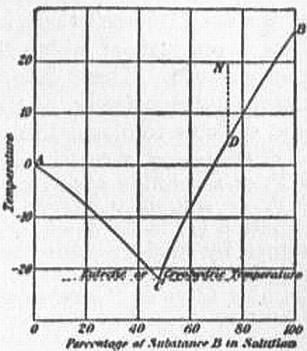
Fig. 1.—F.P. or Solubility Curve: simple case.
6. Freezing of Solutions and Alloys.—The phenomena of freezing of heterogeneous crystalline mixtures may be illustrated by the case of aqueous solutions and of metallic solutions or alloys, which have been most widely studied. The usual effect of an impurity, such as salt or sugar in solution in water, is to lower the freezing point, so that no crystallization occurs until the temperature has fallen below the normal F.P. of the pure solvent, the depression of F.P. being nearly proportional to the concentration of the solution. When freezing begins, the solvent generally separates out from the solution in the pure state. This separation of the solvent involves an increase in the strength of the remaining solution, so that the temperature does not remain constant during the freezing, but continues to fall as more of the solvent is separated. There is a perfectly definite relation between temperature and concentration at each stage of the process, which may be represented in the form of a curve as AC in fig. 1, called the freezing point curve. The equilibrium temperature, at the surface of contact between the solid and liquid, depends only on the composition of the liquid phase and not at all on the quantity of solid present. The abscissa of the F.P. curve represents the composition of that portion of the original solution which remains liquid at any temperature. If instead of starting with a dilute solution we start with a strong solution represented by a point N, and cool it as shown by the vertical line ND, a point D is generally reached at which the solution becomes “saturated.” The dissolved substance or “solute” then separates out as the solution is further cooled, and the concentration diminishes with fall of temperature in a definite relation, as indicated by the curve CB, which is called the solubility curve. Though often called by different names, the two curves AC and CB are essentially of a similar nature. To take the case of an aqueous solution of salt as an example, along CB the solution is saturated with respect to salt, along AC the solution is saturated with respect to ice. When the point C is reached along either curve, the solution is saturated with respect to both salt and ice. The concentration cannot vary further, and the temperature remains constant, while the salt and ice crystallize out together, maintaining the exact proportions in which they exist in the solution. The resulting solid was termed a cryohydrate by F. Guthrie, but it is really an intimate mixture of two kinds of crystals, and not a chemical compound or hydrate containing the constituents in chemically equivalent proportions. The lowest temperature attainable by means of a freezing mixture is the temperature of the F.P. of the corresponding cryohydrate. In a mixture of salt and ice with the least trace of water a saturated brine is quickly formed, which dissolves the ice and falls rapidly in temperature, owing to the absorption of the latent heat of fusion. So long as both ice and salt are present, if the mixture is well stirred, the solution must necessarily become saturated with respect to both ice and salt, and this can only occur at the cryohydric temperature, at which the two curves of solubility intersect.
The curves in fig. 1 also illustrate the simplest type of freezing point curve in the case of alloys of two metals A and B which do not form mixed crystals or chemical compounds. The alloy corresponding to the cryohydrate, possessing the lowest melting point, is called the eutectic alloy, as it is most easily cast and worked. It generally possesses a very fine-grained structure, and is not a chemical compound. (See Alloys.)
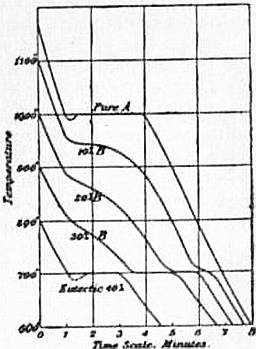
Fig. 2.—Cooling Curves of Alloys: typical case.
To obtain a complete F.P. curve even for a binary alloy is a laborious and complicated process, but the information contained in such a curve is often very valuable. It is necessary to operate with a number of different alloys of suitably chosen composition, and to observe the freezing points of each separately. Each alloy should also be analysed after the process if there is any risk of its composition having been altered by oxidation or otherwise. The freezing points are generally best determined by observing the gradual cooling of a considerable mass, which is well stirred so long as it remains liquid. The curve of cooling may most conveniently be recorded, either photographically, using a thermocouple and galvanometer, as in the method of Sir W. Roberts-Austen, or with pen and ink, if a platinum thermometer is available, according to the method put in practice by C.T. Heycock and F.H. Neville. A typical set of curves obtained in this manner is shown in fig. 2. When the pure metal A in cooling reaches its F.P. the temperature suddenly becomes stationary, and remains accurately constant for a considerable period. Often it falls slightly below the F.P. owing to super-fusion, but rises to the F.P. and remains constant as soon as freezing begins. The second curve shows the cooling of A with 10% of another metal B added. The freezing begins at a lower temperature with the separation of pure A. The temperature no longer remains constant during freezing, but falls more and more rapidly as the proportion of B in the liquid increases. When the eutectic temperature is reached there is a second F.P. or arrest at which the whole of the remaining liquid solidifies. With 20% of B the first F.P. is further lowered, and the temperature falls faster. The eutectic F.P. is of longer duration, but still at the same temperature. For an alloy of the composition of the eutectic itself there is no arrest until the eutectic temperature is reached, at which the whole solidifies without change of temperature. There is a great advantage in recording these curves automatically, as the primary arrest is often very slight, and difficult to observe in any other way.
7. Change of Solubility with Temperature.—The lowering of the F.P. of a solution with increase of concentration, as shown by the F.P. or solubility curves, may be explained and calculated by equation (1) in terms of the osmotic pressure of the dissolved substance by analogy with the effect of mechanical pressure. It is possible in salt solutions to strain out the salt mechanically by a suitable filter or “semi-permeable membrane,” which permits the water to pass, but retains the salt. To separate 1 gramme of salt requires the performance of work PV against the osmotic pressure P, where V is the corresponding diminution in the volume of the solution. In dilute solutions, to which alone the following calculation can be applied, the volume V is the reciprocal of the concentration C of the solution in grammes per unit volume, and the osmotic pressure P is equal to that of an equal number of molecules of gas in the same space, and may be deduced from the usual equation of a gas,
P = Rθ / VM = RθC / M,
(4)
where M is the molecular weight of the salt in solution, θ the absolute temperature, and R a constant which has the value 8.32 joules, or nearly 2 calories, per degree C. It is necessary to consider two cases, corresponding to the curves CB and AB in fig. 1, in which the solution is saturated with respect to salt and water respectively. To facilitate description we take the case of a salt dissolved in water, but similar results apply to solutions in other liquids and alloys of metals.
(a) If unit mass of salt is separated in the solid state from a saturated solution of salt (curve CB) by forcing out through a semi-permeable membrane against the osmotic pressure P the corresponding volume of water V in which it is dissolved, the heat evolved is the latent heat of saturated solution of the salt Q together with the work done PV. Writing (Q + PV) for L, and V for (v″ − v′) in equation (1), and substituting P for p, we obtain
Q + PV = VθdP / dθ,
(5)
which is equivalent to equation (1), and may be established by similar reasoning. Substituting for P and V in terms of C from equation (4), if Q is measured in calories, R = 2, and we obtain
QC = 2θ²dC / dθ,
(6)
which may be integrated, assuming Q constant, with the result
2logeC″ / C′ = Q / θ′ − Q / θ″,
(7)
where C′, C″ are the concentrations of the saturated solution corresponding to the temperatures θ′ and θ″. This equation may be employed to calculate the latent heat of solution Q from two observations of the solubility. It follows from these equations that Q is of the same sign as dC/dθ, that is to say, the solubility increases with rise of temperature if heat is absorbed in the formation of the saturated solution, which is the usual case. If, on the other hand, heat is liberated on solution, as in the case of caustic potash or sulphate of calcium, the solubility diminishes with rise of temperature.
(b) In the case of a solution saturated with respect to ice (curve AC), if one gramme of water having a volume v is separated by freezing, we obtain a precisely similar equation to (5), but with L the latent heat of fusion of water instead of Q, and v instead of V. If the solution is dilute, we may neglect the external work Pv in comparison with L, and also the heat of dilution, and may write P/t for dP/dθ, where t is the depression of the F.P. below that of the pure solvent. Substituting for P in terms of V from equation (4), we obtain
t = 2θ²v / LVM = 2θ²w / LWM,
(8)
where W is the weight of water and w that of salt in a given volume of solution. If M grammes of salt are dissolved in 100 of water, w = M and W = 100. The depression of the F.P. in this case is called by van ‘t Hoff the “Molecular Depression of the F.P.” and is given by the simple formula
t = .02θ² / L.
(9)
Equation (8) may be used to calculate L or M, if either is known, from observations of t, θ and w/W. The results obtained are sufficiently approximate to be of use in many cases in spite of the rather liberal assumptions and approximations effected in the course of the reasoning. In any case the equations give a simple theoretical basis with which to compare experimental data in order to estimate the order of error involved in the assumptions. We may thus estimate the variation of the osmotic pressure from the value given by the gaseous equation, as the concentration of the solution or the molecular dissociation changes. The most uncertain factor in the formula is the molecular weight M, since the molecule in solution may be quite different from that denoted by the chemical formula of the solid. In many cases the molecule of a metal in dilute solution in another metal is either monatomic, or forms a compound molecule with the solvent containing one atom of the dissolved metal, in which case the molecular depression is given by putting the atomic weight for M. In other cases, as Cu, Hg, Zn, in solution in cadmium, the depression of the F.P. per atom, according to Heycock and Neville, is only half as great, which would imply a diatomic molecule. Similarly As and Au in Cd appear to be triatomic, and Sn in Pb tetratomic. Intermediate cases may occur in which different molecules exist together in equilibrium in proportions which vary according to the temperature and concentration. The most familiar case is that of an electrolyte, in which the molecule of the dissolved substance is partly dissociated into ions. In such cases the degree of dissociation may be estimated by observing the depression of the F.P., but the results obtained cannot always be reconciled with those deduced by other methods, such as measurement of electrical conductivity, and there are many difficulties which await satisfactory interpretation.
Exactly similar relations to (8) and (9) apply to changes of boiling point or vapour pressure produced by substances in solution (see Vaporization), the laws of which are very closely connected with the corresponding phenomena of fusion; but the consideration of the vapour phase may generally be omitted in dealing with the fusion of mixtures where the vapour pressure of either constituent is small.
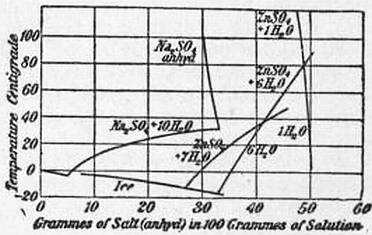
Fig. 3.—Solubility Curves of Hydrates.
8. Hydrates.—The simple case of a freezing point curve, illustrated in fig. 1, is generally modified by the occurrence of compounds of a character analogous to hydrates of soluble salts, in which the dissolved substance combines with one or more molecules of the solvent. These hydrates may exist as compound molecules in the solution, but their composition cannot be demonstrated unless they can be separated in the solid state. Corresponding to each crystalline hydrate there is generally a separate branch of the solubility curve along which the crystals of the hydrate are in equilibrium with the saturated solution. At any given temperature the hydrate possessing the least solubility is the most stable. If two are present in contact with the same solution, the more soluble will dissolve, and the less soluble will be formed at its expense until the conversion is complete. The two hydrates cannot be in equilibrium with the same solution except at the temperature at which their solubilities are equal, i.e. at the point where the corresponding curves of solubility intersect. This temperature is called the “Transition Point.” In the case of ZnSO4, as shown in fig. 3, the heptahydrate, with seven molecules of water, is the least soluble hydrate at ordinary temperatures, and is generally deposited from saturated solutions. Above 39° C., however, the hexahydrate, with six molecules, is less soluble, and a rapid conversion of the hepta- into the hexahydrate occurs if the former is heated above the transition point. The solubility of the hexahydrate is greater than that of the heptahydrate below 39°, but increases more slowly with rise of temperature. At about 80° C. the hexahydrate gives place to the monohydrate, which dissolves in water with evolution of heat, and diminishes in solubility with rise of temperature. Intermediate hydrates exist, but they are more soluble, and cannot be readily isolated. Both the mono- and hexahydrates are capable of existing in equilibrium with saturated solutions at temperatures far below their transition points, provided that the less soluble hydrate is not present in the crystalline form. The solubility curves can therefore be traced, as in fig. 3, over an extended range of temperature. The equilibrium of each hydrate with the solvent, considered separately, would present a diagram of two branches similar to fig. 1, but as a rule only a small portion of each curve can be realized, and the complete solubility curve, as experimentally determined, is composed of a number of separate pieces corresponding to the ranges of minimum solubility of different hydrates. Failure to recognize this, coupled with the fact that in strong and viscous solutions the state of equilibrium is but slowly attained, is the probable explanation of the remarkable discrepancies existing in many recorded data of solubility.
Transition Points of Hydrates.
Na2CrO4·10H2O 19.9° NaBr·2H20 50.7°
Na2SO4·10H2O 32.4° MnCl2·4H2O 57.8°
Na2CO3·10H2O 35.1° Na3PO4·12H2O 73.4°
Na2S2O3·5H2O 48.0° Ba(OH)2·8H2O 77.9°
The transition points of the hydrates given in the above list (Richards, Proc. Amer. Acad., 1899, 34, p. 277) afford well-marked constant temperatures which can be utilized as fixed points for experimental purposes.
9. Formation of Mixed Crystals.—An important exception to the general type already described, in which the addition of a dissolved substance lowers the F.P. of the solvent, is presented by the formation of mixed crystals, or “solid solutions,” in which the solvent and solute occur mixed in varying proportions. This isomorphous replacement of one substance by another, in the same crystal with little or no change of form, has long been known and studied in the case of minerals and salts, but the relations between composition and melting-point have seldom been investigated, and much still remains obscure. In this case the process of freezing does not necessitate the performance of work of separation of the constituents of the solution, the F.P. is not necessarily depressed, and the effect cannot be calculated by the usual formula for dilute solutions. One of the simplest types of F.P. curve which may result from the occurrence of mixed crystals is illustrated by the case of alloys of gold and silver, or gold and platinum, in which the F.P. curve is nearly a straight line joining the freezing-points of the constituents. The equilibrium between the solid and liquid, in both of which the two metals are capable of mixing in all proportions, bears in this case an obvious and close analogy to the equilibrium between a mixed liquid (e.g. alcohol and water) and its vapour. In the latter case, as is well known, the vapour will contain a larger proportion of the more volatile constituent. Similarly in the case of the formation of mixed crystals, the liquid should contain a larger proportion of the more fusible constituent than the solid with which it is in equilibrium. The composition of the crystals which are being deposited at any moment will, therefore, necessarily change as solidification proceeds, following the change in the composition of the liquid, and the temperature will fall until the last portions of the liquid to solidify will consist chiefly of the more fusible constituent, at the F.P. of which the solidification will be complete. If, however, as seems to be frequently the case, the composition of the solid and liquid phases do not greatly differ from each other, the greater part of the solidification will occur within a comparatively small range of temperature, and the initial F.P. of the alloy will be well marked. It is possible in this case to draw a second curve representing the composition of the solid phase which is in equilibrium with the liquid at any temperature. This curve will not represent the average composition of the crystals, but that of the outer coating only which is in equilibrium with the liquid at the moment. H.W.B. Roozeboom (Zeit. Phys. Chem. xxx. p. 385) has attempted to classify some of the possible cases which may occur in the formation of mixed crystals on the basis of J.W. Gibbs’s thermodynamic potential, the general properties of which may be qualitatively deduced from a consideration of observed phenomena. But although this method may enable us to classify different types, and even to predict results in a qualitative manner, it does not admit of numerical calculation similar to equation (8), as the Gibbs’s function itself is of a purely abstract nature and its form is unknown. There is no doubt that the formation of mixed crystals may explain many apparent anomalies in the study of F.P. curves. The whole subject has been most fruitful of results in recent years, and appears full of promise for the future.
For further details in this particular branch the reader may consult a report by Neville (Brit. Assoc. Rep., 1900), which contains numerous references to original papers by Roberts-Austen, Le Chatelier, Roozeboom and others. For the properties of solutions see Solution.
(H. L. C.)
FÜSSEN, a town of Germany, in the kingdom of Bavaria, at the foot of the Alps (Tirol), on the Lech, 2500 ft. above the sea, with a branch line to Oberdorf on the railway to Augsburg. Pop. 4000. It has six Roman Catholic churches, a Franciscan monastery and a castle. Rope-making is an important industry. The castle, lying on a rocky eminence, is remarkable for the peace signed here on the 22nd of April 1745 between the elector Maximilian III., Joseph of Bavaria and Maria Theresa. Two miles to the S.E., immediately on the Austrian frontier, romantically situated on a rock overlooking the Schwanensee, is the magnificent castle of Hohenschwangau, and a little to the north, on the site of an old castle, that of Neuschwanstein, built by Louis II. of Bavaria.
See H. Feistle, Füssen und Umgebung (1898).
FUST, JOHANN ( ?-1466), early German printer, belonged to a rich and respectable burgher family of Mainz, which is known to have flourished from 1423, and to have held many civil and religious offices. The name was always written Fust, but in 1506 Johann Schöffer, in dedicating the German translation of Livy to the emperor Maximilian, called his grandfather Faust, and thenceforward the family assumed this name, and the Fausts of Aschaffenburg, an old and quite distinct family, placed Johann Fust in their pedigree. Johann’s brother Jacob, a goldsmith, was one of the burgomasters in 1462, when Mainz was stormed and sacked by the troops of Count Adolf of Nassau, on which occasion he seems to have perished (see a document, dated May 8, 1463, published by Wyss in Quartalbl. des hist. Vereins für Hessen, 1879, p. 24). There is no evidence that, as is commonly asserted, Johann Fust was a goldsmith, but he appears to have been a money-lender or banker. On account of his connexion with Gutenberg (q.v.), he has been represented by some as the inventor of printing, and the instructor as well as the partner of Gutenberg, by others as his patron and benefactor, who saw the value of his discovery and supplied him with means to carry it out, whereas others paint him as a greedy and crafty speculator, who took advantage of Gutenberg’s necessity and robbed him of the fruits of his invention. However this may be, the Helmasperger document of November 6, 1455, shows that Fust advanced money to Gutenberg (apparently 800 guilders in 1450, and another 800 in 1452) for carrying on his work, and that Fust, in 1455, brought a suit against Gutenberg to recover the money he had lent, claiming 2020 (more correctly 2026) guilders for principal and interest. It appears that he had not paid in the 300 guilders a year which he had undertaken to furnish for expenses, wages, &c., and, according to Gutenberg, had said that he had no intention of claiming interest. The suit was apparently decided in Fust’s favour, November 6, 1455, in the refectory of the Barefooted Friars of Mainz, when Fust made oath that he himself had borrowed 1550 guilders and given them to Gutenberg. There is no evidence that Fust, as is usually supposed, removed the portion of the printing materials covered by his mortgage to his own house, and carried on printing there with the aid of Peter Schöffer, of Gernsheim (who is known to have been a scriptor at Paris in 1449), to whom, probably about 1455,1 he gave his only daughter Dyna or Christina in marriage. Their first publication was the Psalter, August 14, 1457, a folio of 350 pages, the first printed book with a complete date, and remarkable for the beauty of the large initials printed each in two colours, red and blue, from types made in two pieces.2 The Psalter was reprinted with the same types, 1459 (August 29), 1490, 1502 (Schöffer’s last publication) and 1516. Fust and Schöffer’s other works are given below.3 In 1464 Adolf of Nassau appointed for the parish of St Quintin three Baumeisters (master-builders) who were to choose twelve chief parishioners as assistants for life. One of the first of these “Vervaren,” who were named on May-day 1464, was Johannes Fust, and in 1467 Adam von Hochheim was chosen instead of “the late” (selig) Johannes Fust. Fust is said to have gone to Paris in 1466 and to have died of the plague, which raged there in August and September. He certainly was in Paris on the 4th of July, when he gave Louis de Lavernade of the province of Forez, then chancellor of the duke of Bourbon and first president of the parliament of Toulouse, a copy of his second edition of Cicero, as appears from a note in Lavernade’s own hand at the end of the book, which is now in the library of Geneva. But nothing further is known than that on the 30th of October, probably in 1471, an annual mass was instituted for him by Peter Schöffer, Conrad Henlif (for Henekes, or Henckis, Schöffer’s partner? who married Fust’s widow about 14684) and Johann Fust (the son), in the abbey-church of St Victor of Paris, where he was buried; and that Peter Schöffer founded a similar memorial service for Fust in 1473 in the church of the Dominicans at Mainz (Bockenheimer, Gesch. der Stadt Mainz, iv. 15).
Fust was formerly often confused with the famous magician Dr Johann Faust, who, though an historical figure, had nothing to do with him (see Faust).
See further the articles Gutenberg and Typography.
(J. H. H.)
1 This date is uncertain; some place the marriage in 1453 or soon after, others about 1464. It is probable that Fust alluded to this relationship when he spoke of Schöffer as pueri mei in the colophons of Cicero’s De officiis of 1465 and 1466.
2 This method was patented in England by Solomon Henry in 1780, and by Sir William Congreve in 1819.
3 (3) Durandus, Rationale divinorum officiorum (1459), folio, 160 leaves; (4) the Clementine Constitutions, with the gloss of Johannes Andreae (1460), 51 leaves; (5) Biblia Sacra Latina (1462), folio, 2 vols., 242 and 239 leaves, 48 lines to a full page; (6) the Sixth Book of Decretals, with Andreae’s gloss, 17th December 1465, folio, 141 leaves; (7) Cicero, De officiis (1465). 4to, 88 leaves, the first edition of a Latin classic and the first book containing Greek characters, while in the colophon Fust for the first time calls Schöffer “puerum suum”; (8) the same, 4th February 1466; (9) Grammatica rhytmica (1466), folio, 11 leaves. They also printed in 1461-1462 several papal bulls, proclamations of Adolf of Nassau, &c. Nothing is known to have appeared for three years after the storming and capture of Mainz in 1462.
4 Some confusion in the history of the Fust family has arisen since the publication of Bernard’s Orig. de l’imprimerie (1853). On p. 262, vol. i. he gave an extract from the correspondence between Oberlin and Bodmann (now preserved in the Paris Nat. Library), from which it would appear that Peter Schöffer was the son-in-law, not of Johann Fust, but of a brother of his, Conrad Fust. Of the latter, however, no other trace has been found, and he is no doubt a fiction of F.J. Bodmann, who, partly basing himself on the “Conrad” (Henlif, or Henckis) mentioned above, added the rest to gratify Oberlin (see Wyss in Quartalblätter des hist. Vereins für Hessen, 1879, p. 17).
FUSTEL DE COULANGES, NUMA DENIS (1830-1889), French historian, was born in Paris on the 18th of March 1830, of Breton descent. After studying at the École Normale Supérieure he was sent to the French school at Athens in 1853, directed some excavations in Chios, and wrote an historical account of the island. After his return he filled various educational offices, and took his doctor’s degree with two theses, Quid Vestae cultus in institutis veterum privatis publicisque valuerit and Polybe, ou la Grèce conquise par les Romains (1858). In these works his distinctive qualities were already revealed. His minute knowledge of the language of the Greek and Roman institutions, coupled with his low estimate of the conclusions of contemporary scholars, led him to go direct to the original texts, which he read without political or religious bias. When, however, he had succeeded in extracting from the sources a general idea that seemed to him clear and simple, he attached himself to it as if to the truth itself, employing dialectic of the most penetrating, subtle and even paradoxical character in his deduction of the logical consequences. From 1860 to 1870 he was professor of history at the faculty of letters at Strassburg, where he had a brilliant career as a teacher, but never yielded to the influence exercised by the German universities in the field of classical and Germanic antiquities.
It was at Strassburg that he published his remarkable volume La Cité antique (1864), in which he showed forcibly the part played by religion in the political and social evolution of Greece and Rome. Although his making religion the sole factor of this evolution was a perversion of the historical facts, the book was so consistent throughout, so full of ingenious ideas, and written in so striking a style, that it ranks as one of the masterpieces of the French language in the 19th century. By this literary merit Fustel set little store, but he clung tenaciously to his theories. When he revised the book in 1875, his modifications were very slight, and it is conceivable that, had he recast it, as he often expressed the desire to do in the last years of his life, he would not have abandoned any part of his fundamental thesis. The work is now largely superseded.
Fustel de Coulanges was the most conscientious of men, the most systematic and uncompromising of historians. Appointed to a lectureship at the École Normale Supérieure in February 1870, to a professorship at the Paris faculty of letters in 1875, and to the chair of medieval history created for him at the Sorbonne in 1878, he applied himself to the study of the political institutions of ancient France. The invasion of France by the German armies during the war of 1870-71 attracted his attention to the Germanic invasions under the Roman Empire. Pursuing the theory of J.B. Dubos, but singularly transforming it, he maintained that those invasions were not marked by the violent and destructive character usually attributed to them; that the penetration of the German barbarians into Gaul was a slow process; that the Germans submitted to the imperial administration; that the political institutions of the Merovingians had their origins in the Roman laws at least as much as, if not more than, in German usages; and, consequently, that there was no conquest of Gaul by the Germans. This thesis he sustained brilliantly in his Histoire des institutions politiques de l’ancienne France, the first volume of which appeared in 1874. It was the author’s original intention to complete this work in four volumes, but as the first volume was keenly attacked in Germany as well as in France, Fustel was forced in self-defence to recast the book entirely. With admirable conscientiousness he re-examined all the texts and wrote a number of dissertations, of which, though several (e.g. those on the Germanic mark and on the allodium and beneficium) were models of learning and sagacity, all were dominated by his general idea and characterized by a total disregard for the results of such historical disciplines as diplomatic. From this crucible issued an entirely new work, less well arranged than the original, but richer in facts and critical comments. The first volume was expanded into three volumes, La Gaule romaine (1891), L’Invasion germanique et la fin de l’empire (1891) and La Monarchie franque (1888), followed by three other volumes, L’Alleu et le domaine rural pendant l’époque mérovingienne (1889), Les Origines du système féodal: le bénéfice et le patronat ... (1890) and Les Transformations de la royauté pendant l’époque carolingienne (1892). Thus, in six volumes, he had carried the work no farther than the Carolingian period. The result of this enormous labour, albeit worthy of a great historian, clearly showed that the author lacked all sense of historical proportion. He was a diligent seeker after the truth, and was perfectly sincere when he informed a critic of the exact number of “truths” he had discovered, and when he remarked to one of his pupils a few days before his death, “Rest assured that what I have written in my book is the truth.” Such superb self-confidence can accomplish much, and it undoubtedly helped to form Fustel’s talent and to give to his style that admirable concision which subjugates even when it fails to convince; but a student instinctively distrusts an historian who settles the most controverted problems with such impassioned assurance. The dissertations not embodied in his great work were collected by himself and (after his death) by his pupil, Camille Jullian, and published as volumes of miscellanies: Recherches sur quelques problèmes d’histoire (1885), dealing with the Roman colonate, the land system in Normandy, the Germanic mark, and the judiciary organization in the kingdom of the Franks; Nouvelles recherches sur quelques problèmes d’histoire (1891); and Questions historiques (1893), which contains his paper on Chios and his thesis on Polybius.
His life was devoted almost entirely to his teaching and his books. In 1875 he was elected member of the Académie des Sciences Morales, and in 1880 reluctantly accepted the post of director of the École Normale. Without intervening personally in French politics, he took a keen interest in the questions of administration and social reorganization arising from the fall of the imperialist régime and the disasters of the war. He wished the institutions of the present to approximate more closely to those of the past, and devised for the new French constitution a body of reforms which reflected the opinions he had formed upon the democracy at Rome and in ancient France. But these were dreams which did not hold him long, and he would have been scandalized had he known that his name was subsequently used as the emblem of a political and religious party. He died at Massy (Seine-et-Oise) on the 12th of September 1889. Throughout his historical career—at the École Normale and the Sorbonne and in his lectures delivered to the empress Eugénie—his sole aim was to ascertain the truth, and in the defence of truth his polemics against what he imagined to be the blindness and insincerity of his critics sometimes assumed a character of harshness and injustice. But, in France at least, these critics were the first to render justice to his learning, his talents and his disinterestedness.
See Paul Guiraud, Fustel de Coulanges (1896); H. d’Arbois de Jubainville, Deux Manières d’écrire l’histoire: critique de Bossuet, d’Augustin Thierry et de Fustel de Coulanges (1896); and Gabriel Monod, Portraits et souvenirs (1897).
(C. B.*)
FUSTIAN, a term which includes a variety of heavy woven cotton fabrics, chiefly prepared for men’s wear. It embraces plain twilled cloth called jean, and cut fabrics similar to velvet, known as velveteen, moleskin, corduroy, &c. The term was once applied to a coarse cloth made of cotton and flax; now, fustians are usually of cotton and dyed various colours. In the reign of Edward III. the name was given to a woollen fabric. The name is said to be derived from El-Fustat, a suburb of Cairo, where it was first made; and certainly a kind of cloth has long been known under that name. In a petition to parliament, temp. Philip and Mary, “fustian of Naples” is mentioned. In the 13th and 14th centuries priests’ robes and women’s dresses were made of fustian, but though dresses are still made from some kinds the chief use is for labourers’ clothes.
FUSTIC (Fr. fustoc, from Arab. fustuq, Gr. πιστάκη, pistachio) Yellow Wood or Old Fustic, a dye-stuff consisting of the wood of Chlorophora tinctoria, a large tree of the natural order Moraceae, growing in the West Indies and tropical America. Fustic occurs in commerce in blocks, which are brown without, and of a brownish-yellow within. It is sometimes employed for inlaid work. The dye-stuff termed young fustic or Zante fustic, and also Venetian sumach, is the wood of Rhus cotinus (fustet, or smoke tree), a southern European and Asiatic shrub of the natural order Anacardiaceae, called by Gerarde “red sumach,” and apparently the “coccygia” and “cotinus” of Pliny (Nat. Hist. xiii. 41, xvi. 30). Its colouring matter is fisetin, C15H10O6, which was synthesized by S. von Kostanecki (Ber., 1904, 37, p. 384). (See Dyeing.)
FUTURES, a term used in the produce markets for purchases or sales of commodities to be completed at a future date, as opposed to cash or “spot” transactions, which are settled immediately. See Market, and (for a detailed discussion of the question as affecting cotton) Cotton: Marketing and Supply.
FUX, JOHANN JOSEPH (1660-1741), Austrian musician, was born at Hirtenfeld (Styria) in 1660. Of his youth and early training nothing is known. In 1696 he was organist at one of the principal churches of Vienna, and in 1698 was appointed by the emperor Leopold I. as his “imperial court-composer,” with a salary of about £6 a month. At the court of Leopold and of his successors Joseph I. and Charles VI., Fux remained for the rest of his life. To his various court dignities that of organist at St Stephen’s cathedral was added in 1704. He married the daughter of the government secretary Schnitzbaum. As a proof of the high favour in which he was held by the art-loving Charles VI., it is told that at the coronation of that emperor as king of Bohemia in 1723 an opera, La Constanza e la Fortezza, especially composed by Fux for the occasion, was given at Prague in an open-air theatre. Fux at the time was suffering from gout, but the emperor had him carried in a litter all the way from Vienna, and gave him a seat in the imperial box. Fux died at Vienna on the 13th of February 1741. His life, although passed in the great world, was eventless, and his only troubles arose from the intrigues of his Italian rivals at court. Of the numerous operas which Fux wrote it is unnecessary to speak. They do not essentially differ from the style of the Italian opera seria of the time. Of greater importance are his sacred compositions, psalms, motets, oratorios and masses, the celebrated Missa Canonica amongst the latter. It is an all but unparalleled tour de force of learned musicianship, being written entirely in that most difficult of contrapuntal devices—the canon. As a contrapuntist and musical scholar generally, Fux was unsurpassed by any of his contemporaries, and his great theoretical work, the Gradus ad Parnassum, long remained by far the most thorough treatment of counterpoint and its various developments. The title of the original Latin edition is Gradus ad Parnassum sive manuductio ad compositionem musicae regularem, methoda nova ac certa nondum ante tam exacta ordine in lucem edita, elaborata a Joanne Josepho Fux (Vienna, 1715). It was translated into most European languages during the 18th century, and is still studied by musicians interested in the history of their art. The expenses of the publication were defrayed by the emperor Charles VI.
Fux’s biography was published by Ludwig von Köchel (Vienna, 1871). It is based on minute original research and contains, amongst other valuable materials, a complete catalogue of the composer’s numerous works.
FUZE or Fuse, an appliance for firing explosives in blasting operations, military shells, &c. (see Blasting and Ammunition, § Shell). The spelling is not governed by authority, but modern convenience has dictated the adoption of the “z” by military engineers as a general rule, in order to distinguish this sense from that of melting by heat (see below). The word, according to the New English Dictionary, is one of the forms in which the Lat. fusus, spindle, has been adapted through Romanic into English, the ordinary fuze taking the shape of a spindle-like tube. Similarly the term “fusee” (Fr. fusée, spindle full of tow, Late Lat. fusata) is applied to a coned spindle sometimes used in the wheel train of watches and spring clocks to equalize the action of the mainspring (see Watch); and the application of the same term to a special kind of match may also be due to its resemblance to a spindle. Again, in heraldry, another form, “fusil,” derived through the French from a Late Lat. diminutive (fusillus or fusellus) of this same fusus, is used of a bearing, an elongated lozenge. According to other etymological authorities, however (see Skeat, Etym. Dict., 1898), “fuze” or “fuse,” and “fusee” in the sense of match, are all forms derived through the Fr. fusil, from Late Lat. focile, steel for striking fire from a flint, from Lat. focus, hearth. The Fr. fusil and English “fusil” were thus transferred to the “firelock,” i.e. the light musket of the 17th century (see Fusilier).