VOLUME XI SLICE III Frost to Fyzabad (continued 11)
Reading edition
With regard to the merits of European dressing, it may be fairly taken that English, German and French dressers have specialities of excellence. In England, for instance, the dressing of sables, martens, foxes, otters, seals, bears, lions, tigers and leopards is first rate; while with skunk, mink, musquash, chinchillas, beavers, lambs and squirrels, the Germans show better results, particularly in the last. The pelt after the German dressing is dry, soft and white, which is due to a finishing process where meal is used, thus they compare favourably with the moister and consequently heavier English finish. In France they do well with cheaper skins, such as musquash, rabbit and hare, which they dye in addition to dressing. Russian dressing is seldom reliable; not only is there an unpleasant odour, but in damp weather the pelts often become clammy, which is due to the saline matter in the dressing mixture. Chinese dressing is white and supple, but contains much powder, which is disagreeable and difficult to get rid of, and in many instances the skin is rendered so thin that the roots of the fur are weakened, which means that it is liable to shed itself freely, when subject to ordinary friction in handling or wearing. American and Canadian dressing is gradually improving, but hitherto their results have been inferior to the older European methods.
In the case of seal and beaver skins the process is a much more difficult one, as the water or hard top hairs have to be removed by hand after the pelt has been carefully rendered moist and warm. With seal skins the process is longer than with any other fur preparation and the series of processes engage many specialists, each man being constantly kept upon one section of the work. The skins arrive simply salted. After being purchased at the auction sales they are washed, then stretched upon a hoop, when all blubber and unnecessary flesh is removed, and the pelt is reduced to an equal thickness, but not so thin as it is finally rendered. Subsequently the hard top hairs are taken out as in the case of otters and beavers and the whole thoroughly cleaned in the revolving drums. The close underwool, which is of a slightly wavy nature and mostly of a pale drab colour, is then dyed by repeated applications of a rich dark brown colour, one coat after another, each being allowed to thoroughly dry before the next is put on, till the effect is almost a lustrous black on the top. The whole is again put through the cleaning process and evenly reduced in thickness by revolving emery wheels, and eventually finished off in the palest buff colour.
The English dye for seals is to-day undoubtedly the best; its constituents are more or less of a trade secret, but the principal ingredients comprise gall nuts, copper dust, camphor and antimony, and it would appear after years of careful watching that the atmosphere and particularly the water of London are partly responsible for good and lasting results. The Paris dyers do excellent work in this direction, but the colour is not so durable, probably owing to a less pure water. In America of late, strides have been made in seal dyeing, but preference is still given to London work. In Paris, too, they obtain beautiful results in the “topping” or colouring Russian sables and the Germans are particularly successful in dyeing Persian lambs black and foxes in all blue, grey, black and smoke colours and in the insertion of white hairs in imitation of the real silver fox. Small quantities of good beaver are dyed in Russia occasionally, and white hairs put in so well that an effect similar to sea otter is obtained.
The process of inserting white hairs is called in the trade “pointing, “and is either done by stitching them in with a needle or by adhesive caoutchouc.
The Viennese are successful in dyeing marmot well, and their cleverness in colouring it with a series of stripes to represent the natural markings of sable which has been done after the garments have been made, so as to obtain symmetry of lines, has secured for them a large trade among the dealers of cheap furs in England and the continent.
Manufacturing Methods and Specialities.—In the olden times the Skinners’ Company of the city of London was an association of furriers and skin dressers established under royal charter granted by Edward III. At that period the chief concern of the body was to prevent buyers from being imposed upon by sellers who were much given to offering old furs as new; a century later the Skinners’ Company received other charters empowering them to inspect not only warehouses and open markets, but workrooms. In 1667 they were given power to scrutinize the preparing of rabbit or cony wool for the wool trade and the registration of the then customary seven years’ apprenticeship. To-day all these privileges and powers are in abeyance, and the interest that they took in the fur trade has been gradually transferred to the leather-dressing craft.
The work done by English furriers was generally good, but since about 1865 has considerably improved on account of the influx of German workmen, who have long been celebrated for excellent fur work, being In their own country obliged to satisfy officially appointed experts and to obtain a certificate of capacity before they can be there employed. The French influence upon the trade has been, and still is, primarily one of style and combination of colour, bad judgment in which will mar the beauty of the most valuable furs. It is a recognized law among high-class furriers that furs should be simply arranged, that is, that an article should consist of one fur or of two furs of a suitable contrast, to which lace may be in some cases added with advantage. As illustrative of this, it may be explained that any brown tone of fur such as sable, marten, mink, black marten, beaver, nutria, &c., will go well upon black or very dark-brown furs, while those of a white or grey nature, such as ermine, white lamb, chinchilla, blue fox, silver fox, opossum, grey squirrel, grey lamb, will set well upon seal or black furs, as Persian lamb, broadtail, astrachan, caracul lamb, &c. White is also permissible upon some light browns and greys, but brown motley colours and greys should never be in contrast. One neutralizes the other and the effect is bad. The qualities, too have to be considered—the fulness of one, the flatness of the other, or the coarseness or fineness of the furs. The introduction of a third fur in the same garment or indiscriminate selection of colours of silk linings, braids, buttons, &c., often spoils an otherwise good article.
With regard to the natural colours of furs, the browns that command the highest prices are those that are of a bluish rather than a reddish tendency. With greys it is those that are bluish, not yellow, and with white those that are purest, and with black the most dense, that are most esteemed and that are the rarest.
Perhaps for ingenuity and the latest methods of manipulating skins in the manufacturing of furs the Americans lead the way, but as fur cutters are more or less of a roving and cosmopolitan character the larger fur businesses in London, Berlin, Vienna, St Petersburg, Paris and New York are guided by the same thorough and comparatively advanced principles.
During the period just mentioned the tailors’ methods of scientific pattern cutting have been adopted by the leading furriers in place of the old chance methods of fur cutters, so that to-day a fur garment may be as accurately and gracefully fitted as plush or velvet, and with all good houses a material pattern is fitted and approved before the skins are cut.
Through the advent of German and American fur sewing-machines since about 1890 fur work has been done better and cheaper. There are, however, certain parts of a garment, such as the putting in of sleeves and placing on of collars, &c., that can only be sewn by hand. For straight seams the machines are excellent, making as neat a seam as is found in glove work, unless, of course, the pelts are especially heavy, such as bears and sheep rugs.
A very great feature of German and Russian work is the fur linings called rotondes, sacques or plates, which are made for their home use and exportation chiefly to Great Britain, America and France.
In Weissenfels, near Leipzig, the dressing of Russian grey squirrel and the making it into linings is a gigantic industry, and is the principal support of the place. After the dressing process the backs of the squirrels are made up separately from the under and thinner white and grey parts, the first being known as squirrel-back and the other as squirrel-lock linings. A few linings are made from entire skins and others are made from the quite white pieces, which in some instances are spotted with the black ear tips of the animals to resemble ermine. The smaller and uneven pieces of heads and legs are made up into linings, so there is absolutely no waste. Similar work is done in Russia on almost as extensive a scale, but neither the dressing nor the work is so good as the German.
The majority of heads, gills or throats, sides or flanks, paws and pieces of skins cut up in the fur workshops of Great Britain, America and France, weighing many tons, are chiefly exported to Leipzig, and made up in neighbouring countries and Greece, where labour can be obtained at an alarmingly low rate. Although the sewing, which is necessarily done by hand, the sections being of so unequal and tortuous a character, is rather roughly executed, the matching of colours and qualities is excellent. The enormous quantities of pieces admit of good selection and where odd colours prevail in a lining it is dyed. Many squirrel-lock linings are dyed blue and brown and used for the outside of cheap garments. They are of little weight, warm and effective, but not of great durability.
The principal linings are as follows: Sable sides, sable heads and paws, sable gills, mink sides, heads and gills, marten sides, heads and gills, Persian lamb pieces and paws, caracul lamb pieces or paws, musquash sides and heads, nutria sides, genet pieces, raccoon sides or flanks, fox sides, kolinski whole skins, and small rodents as kaluga and hamster. The white stripes cut out of skunks are made into rugs.
Another great source of inexpensive furs is China, and for many years past enormous quantities of dressed furs, many of which are made up in the form of linings and Chinese loose-shaped garments, have been imported by England, Germany and France for the lower class of business; the garments are only regarded as so much fur and are reworked. With, however, the exception of the best white Tibet lambs, the majority of Chinese furs can only be regarded as inferior material. While the work is often cleverly done as to matching and manipulation of the pelt which is very soft, there are great objections in the odour and the brittleness or weakness of the fur. One of the most remarkable results of the European intervention in the Boxer rising in China (1900) was the absurd price paid for so-called “loot” of furs, particularly in mandarins’ coats of dyed and natural fox skins and pieces, and natural ermine, poor in quality and yellowish in colour; from three to ten times their value was paid for them when at the same time huge parcels of similar quality were warehoused in the London docks, because purchasers could not be found for them.
With regard to Japanese furs, there is little to commend them. The best are a species of raccoon usually sold as fox, and, being of close long quality of fur, they are serviceable for boas, collars, muffs and carriage aprons. The sables, martens, minks and otters are poor in quality, and all of a very yellow colour and they are generally dyed for the cheap trade. A small number of very pretty guanaco and vicuna carriage rugs are imported into Europe, and many come through travellers and private sources, but generally they are so badly dressed that they are quite brittle upon the leather side. Similar remarks are applicable to opossum rugs made in Australia. From South Africa a quantity of jackal, hyena, fox, leopard and sheep karosses, i.e. a peculiarly shaped rug or covering used by native chiefs, is privately brought over. The skins are invariably tanned and beautifully sewn, the furs are generally flat in quality and not very strong in the hair, and are retained’ more as curiosities than for use as a warm covering.
Hatters’ Furs and Cloths and Shawls.—The hat trade is largely interested in the fur piece trade, the best felt hats being made from beaver and musquash wool and the cheaper sorts from nutria, hare and rabbit wools. For weaving, the most valuable pieces are mohair taken from the angora and vicuna. They are limited in quantity and costly, and the trade depends upon various sorts of other sheep and goat wools for the bulk of its productions.
Frauds and Imitations.—The opportunities for cheating in the fur trade are very considerable, and most serious frauds have been perpetrated in the selling of sables that have been coloured or “topped”; that is, just the tips of the hairs stained dark to represent more expensive skins. It is only by years of experience that some of these colourings can be detected. Where the skins are heavily dyed it is comparatively easy to see the difference between a natural and a dyed colour, as the underwool and top hair become almost alike and the leather is also dark, whereas in natural skins the base of the underwool is much paler than the top, or of a different colour, and the leather Is white unless finished in a pale reddish tone as is sometimes the case when mahogany sawdust is used in the final cleaning. As has been explained, sable is a term applied for centuries past to the darker sorts of the Russian Siberian martens, and for years past the same term has been bestowed by the retail trade upon the American and Canadian martens. The baum and stone martens caught in France, the north of Turkey and Norway are of the same family, but coarser in underwool and the top hair is less in quantity and not so silky. The kolinski, or as it is sometimes styled Tatar sable, is the animal, the tail of which supplies hair for artists’ brushes. This is also of the marten species and has been frequently offered, when dyed dark, as have baum and stone martens, as Russian sables. Hares, too, are dyed a sable colour and advertised as sable. The fur, apart from a clumsy appearance, is so brittle, however, as to be of scarcely any service whatever.
Among the principal imitations of other furs is musquash, out of which the top hair has been pulled and the undergrowth of wool clipped and dyed exactly the same colour as is used for seal, which is then offered as seal or red river seal. Its durability, however, is far less than that of seal. Rabbit is prepared and dyed and frequently offered as “electric sealskin.” Nutria also is prepared to represent sealskin, and in its natural colour, after the long hairs are plucked out, it is sold as otter or beaver. The wool is, however, poor compared to the otter and beaver, and the pelt thin and in no way comparable to them in strength. White hares are frequently sold as white fox, but the fur is weak, brittle and exceedingly poor compared to fox and possesses no thick underwool. Foxes, too, and badger are dyed a brownish black, and white hairs inserted to imitate silver fox, but the white hairs are too coarse and the colour too dense to mislead any one who knows the real article. But if sold upon its own merits, pointed fox is a durable fur.
Garments made of sealskin pieces and Persian lamb pieces are frequently sold as if they were made of solid skins, the term “pieces” being simply suppressed. The London Chamber of Commerce have issued to the British trade a notice that any misleading term in advertising and all attempts at deception are illegal, and offenders are liable under the Merchandise Marks Act 1887.
The most usual misnaming of manufactured furs is as follow:—
Musquash, pulled and dyed Sold as seal.
Nutria, pulled and dyed Sold as seal.
Nutria, pulled and natural Sold as beaver.
Rabbit, sheared and dyed Sold as seal or electric seal.
Otter, pulled and dyed Sold as seal.
Marmot, dyed Sold as mink or sable.
Fitch, dyed Sold as sable.
Rabbit, dyed Sold as sable or French sable.
Hare, dyed Sold as sable, or fox, or lynx.
Musquash, dyed Sold as mink or sable.
Wallaby, dyed Sold as skunk.
White Rabbit Sold as ermine.
White Rabbit, dyed Sold as chinchilla.
White Hare, dyed or natural Sold as fox, foxaline, and other similar names.
Goat, dyed Sold as bear, leopard, &c.
Dyed manufactured articles of all kinds Sold as “natural.”
White hairs inserted in foxes and sables Sold as real or natural furs.
Kids Sold as lamb or broadtails.
American sable Sold as real Russian sable.
Mink Sold as sable.
The Preservation of Furs.—For many years raw sealskins have been preserved in cold storage, but it is only within a recent period, owing to the difficulty there was in obtaining the necessary perfectly dry atmosphere, that dressed and made-up furs have been preserved by freezing. Furs kept in such a condition are not only immune from the ravages of the larvae of moth, but all the natural oils in the pelt and fur are conserved, so that its colour and life are prolonged, and the natural deterioration is arrested. Sunlight has a tendency to bleach furs and to encourage the development of moth eggs, therefore continued exposure is to be avoided. When furs are wetted by rain they should be well shaken and allowed to dry in a current of air without exposure to sun or open fire.
Where a freezing store for furs is not accessible, furs should be well shaken and afterwards packed in linen and kept in a perfectly cool dry place, and examined in the summer at periods of not less than five weeks. Naphthalene and the usual malodorous powders are not only very disagreeable, but quite useless. Any chemical that is strong enough to destroy the life in a moth egg would also be sufficiently potent to injure the fur itself. In England moth life is practically continuous all the year round, that is, as regards those moths that attack furs, though the destructive element exists to a far greater extent during spring and summer.
Comparative Durability of Various Furs and Weight of Unlined Skins per Square Foot.
The following estimates of durability refer to the use of fur when made up “hair outside” in garments or stoles, not as a lining. The durability of fur used as linings, which is affected by other conditions, is set forth separately. Otter, with its water hairs removed, the strongest of furs for external use, is, in this table, taken as the standard at 100 and other furs marked accordingly:—
The Precious Furs.
Points of Durability. 2 Weight in oz. per sq. ft.
Sable 60 2½
Sea 75 3
Fox, Silver or Black 40 3
Fox, White 20 3
Ermine 25 1¼
Chinchilla 15 1½
Sea-otter (for stoles or collars) 100 4¼
The Less Valuable Furs.
Points of Durability. Weight in oz. per sq. ft.
Sable “topped,” i.e. top hairs coloured 55 2½
Sable tinted, i.e. fur all coloured. 50 2½
Baum Marten, natural 65 2¾
Baum Marten, tinted 45 2¾
Stone Marten 40 2¾
Nutria 27 3¼
Musquash, natural 37 3¼
Musquash, water hairs removed, sheared and seal finished. 33 3¼
Skunk 70 2¾
Mink 70 3¼
Lynx, natural 25 2¾
Lynx, tinted black 20 2¾
Marmot, tinted 10 3
Fox, tinted black 25 3
Fox, tinted blue 20 3
Opossum 37 3
Otter (with water hairs) 100 4
Otter (water hairs removed) 95 315⁄16
Beaver (water hairs cut level with fur) 90 4
Beaver (water hairs removed) 85 315⁄16
Moleskin 7 1¾
Persian Lamb 65 3¼
Grey Lamb 30 3¼
Broadtail 15 2¼
Caracul Kid 10 3¼
Caracul Lamb 15 3¼
Squirrel 25 1¾
Hare 5 1¾
Rabbit 5 2¼
Quantities of Fur needed, in Square Feet.
The “Paris Model” figure is the basis of these estimates for ladies’ garments, the standard measurements being height 5 ft. 6 in., waist 23 in., bust 38 in.
Sq. Ft. (approximate).
Straight stole ½ length (just below the waist line) 2¾
Straight stole ¾ length (just below the knee) 3¾
Stole, broad enough at the neck to cover the top of arm ¾ length 5
The same, full length (to hem of skirt) 6
Eton jacket, without collar 13
Plain cape, 15 in. long 6½
Deep cape, 30 in. long 15
Full cape with broad stole front, ¾ length 15
Inverness cape (to knee) 25
Double-breasted, straight, semi-fitting coat, covering hips 16
Double-breasted sacque jacket, 36 in. long, full sleeves 20
Same, 30 in. long 18
Same, 22 in. long 15
Long, full, shawl cape with points at back and front, well below knee 15
Shorter shawl cape 16
Motoring or driving coat, ¾ length 22
Motoring or driving coat, full length 27
Weight and Durability of Furs for Men’s Coat Linings.
Otter with the water hairs removed, the strongest fur suited for linings, is here taken as the standard.
Points of Durability. Weight in oz. per sq. ft.
Otter (the water hairs removed) 100 315⁄16
Beaver (the water hairs removed) 90 315⁄16
Mink 90 3¼
Sealskin 75 3
Raccoon 75 4½
Persian lamb or astrachan 70 3¼
Sable 65 2½
Musquash 55 3½
Nutria 40 3¼
Grey Opossum 40 3
Wallaby 30 3¾
Squirrel 30 1¾
Hamster 15 1¼
Rabbit 10 2¼
Durability and Weight of Linings for Ladies’ Coats or Wraps.
Sable gills, the strongest fur suited for ladies’ linings, is taken as the standard.
Points of Durability. Weight in oz. per sq. ft.
Sable gills 100 27⁄8
Sable 85 2½
Sable paws 64 15⁄8
Ermine 57 1¼
Squirrel back 50 1¾
Squirrel heads 36 2½
Squirrel lock 21 13⁄16
Hamster 10 1¼
Rabbit 7 2¼
Durability and Weight of Motoring Furs made up with Fur outside.
Otter with the water hairs, the strongest fur suited for motoring garments, is taken as the standard.
Points of Durability. Weight in oz. per sq. ft.
Otter (with water hairs) 100 4
Sealskin, marble 80 3
”Hair Sealskin” (tinted) with water hairs (a special variety of seal) 75 3¼
Raccoon 65 4½
Russian Pony 35 25⁄8
Durability and Weight of Furs for Rugs and Foot-sacks.
Points of Durability. Weight in oz. per sq. ft.
Wolverine 100 6
Bear (black or brown natural) 94 7
Bear (tinted black) 88 7½
Beaver 88 4
Raccoon 77 4½
Opossum 61 3
Wolf 50 6½
Jackal 27 4½
Australian Bear 16 6
Goat 11 41⁄6
Wolverine, the strongest fur suited for rugs and foot-sacks, is taken as the standard.
For a rug about 20 to 25 sq. ft. of fur are needed, for a foot-sack 14½.
(W. S. P.)
1 The measurements given are from nose to root of tail of average large sizes after the dressing process, which has a shrinking tendency. The depths of fur quoted are the greatest, but there are plenty of good useful skins possessing a lesser depth.
2 Stout, old-fashioned boxcloth is almost the only cloth that (after a soft, heavy lining has been added to it) affords even two-thirds as much protection against cold as does fur. It weighs 4.273 oz. per sq. ft. more than the heaviest of coat-furs, and is so rigid as to be uncomfortable, while the subtileness of fur makes it “kind” to the body.
FURAZANES (furo—a.a′—diazoles), organic compounds obtained by heating the glyoximes (dioximes of ortho-diketones) with alkalis or ammonia. Dimethylfurazane is prepared by heating dimethylglyoxime with excess of ammonia for six hours at 165° C. (L. Wolff, Ber., 1895, 28, p. 70). It is a liquid (at ordinary temperature) which boils at 156° C. (744 mm.). Potassium permanganate oxidizes it first to methylfurazane-carboxylic acid and then to furazanedicarboxylic acid. Methyl-ethylfurazane and diphenylfurazane are also known. By warming oxyfurazane acetic acid with excess of potassium permanganate to 100° C. oxyfurazanecarboxylic acid is obtained (A. Hantzsch and J. Urbahn, Ber., 1895, 28, p. 764). It crystallizes in prisms, which melt at 175° C. Furazanecarboxylic acid is prepared by the action of a large excess of potassium permanganate on a hot solution of furazanepropionic acid. It melts at 107º C, and dissolves in caustic soda, with a deep yellow colour and formation of nitrosocyanacetic acid (L. Wolff and P.F. Ganz, Ber., 1891, 24, p. 1167). Furoxane is an oxide of furazane, considered by H. Wieland to be identical with glyoxime peroxide; Kekulés dibromnitroacetonitrile is dibromfuroxane.
The formulae of the compounds above mentioned are:

FURETIÈRE, ANTOINE (1619-1688), French scholar and miscellaneous writer, was born in Paris on the 28th of December 1619. He first studied law, and practised for a time as an advocate, but eventually took orders and after various preferments became abbé of Chalivoy in the diocese of Bourges in 1662. In his leisure moments he devoted himself to letters, and in virtue of his satires—Nouvelle Allégorique, ou histoire des derniers troubles arrivés au royaume d’éloquence (1658); Voyage de Mercure (1653)—he was admitted a member of the French Academy in 1662. That learned body had long promised a complete dictionary of the French tongue; and when they heard that Furetière was on the point of issuing a work of a similar nature, they interfered, alleging that he had purloined from their stores, and that they possessed the exclusive privilege of publishing such a book. After much bitter recrimination on both sides the offender was expelled in 1685; but for this act of injustice he took a severe revenge in his satire, Couches de l’académie (Amsterdam, 1687). His Dictionnaire universel was posthumously published in 1690 (Rotterdam, 2 vols.). It was afterwards revised and improved by the Protestant jurist, Henri Basnage de Beauval (1656-1710), who published his edition (3 vols.) in 1701; and it was only superseded by the compilation known as the Dictionnaire de Trévoux (Paris, 3 vols., 1704; 7th ed., 8 vols., 1771), which was in fact little more than a reimpression of Basnage’s edition. Furetière is perhaps even better known as the author of Le Roman bourgeois (1666). It cast ridicule on the fashionable romances of Mlle de Scudéry and of La Calprenède, and is of interest as descriptive of the everyday life of his times. There is no element of burlesque, as in Scarron’s Roman comique, but the author contents himself with stringing together a number of episodes and portraits, obviously drawn from life, without much attempt at sequence. The book was edited in 1854 by Edward Fournier and Charles Asselineau and by P. Jannet.
The Fureteriana, which appeared in Paris eight years after Furetière’s death, which took place on the 14th of May 1688, is a collection of but little value.
FURFOOZ, a village some 10 m. from Dinant in the Ardennes, Belgium. Three caves containing prehistoric remains were here excavated in 1872. Of these the Trou de Frontal is the most famous. In it were found human skeletons with brachycephalic skulls, associated with animal bones, those of the reindeer being particularly plentiful. Among the skeletons was discovered an oval vase of pottery. The Furfooz type of mankind is believed to date from the close of the Quaternary age. G. de Mortillet dates the type in the Robenhausen epoch of the Neolithic period. His theory is that the bones are those of men of that period buried in what had been a cave-dwelling of the Madelenian epoch.
FURFURANE, or Furane, C4H4O, a colourless liquid boiling at 32° C., found in the distillation products of pine wood. It was first synthetically prepared by H. Limpricht (Ann., 1873, 165, p. 281) by distilling barium mucate with soda lime, pyromucic acid C4H3O·CO2H being formed, which, on further loss of carbon dioxide, yielded furfurane. A. Henniger (Ann. chim. phys., 1886 [2], 7, p. 220), by distilling erthyrite with formic acid, obtained a dihydrofurfurane
C4H6(OH)4 + 2H2CO2 = C4H6O + CO + CO2 + 4H2O,
which, on treatment with phosphorus pentachloride, yielded furfurane. Furfurane is insoluble in water and possesses a characteristic smell. It does not react with sodium or with phenylhydrazine, but yields dye-stuffs with isatin and phenanthrenequinone. It reacts violently with hydrochloric acid, producing a brown amorphous substance. Methyl and phenyl derivatives have been prepared by C. Paal (Ber., 1884, 17, p. 915). Paal prepared acetonyl acetophenone by condensing sodium acetoacetate with phenacylbromide, and this substance on dehydration yields αα′-phenylmethylfurfurane, the acetonyl acetophenone probably reacting in the tautomeric “enolic” form,
CH3·CO·CHNa·COOR + C6H5·CO·CH2Br = CH3·CO·CH(CH2COC6H5)·COOR.
This ester readily hydrolyses, and the acid formed yields acetonyl acetophenone (by loss of carbon dioxide), which then on dehydration yields the furfurane derivative, thus

L. Knorr (Ber., 1889, 22, p. 158) obtained diacetosuccinic ester by condensing sodium acetoacetate with iodine, and by dehydrating the ester he prepared αα′-dimethylfurfurane ββ′-dicarboxylic acid (carbopyrotritaric acid), which on distillation yields αα′-dimethylfurfurane as a liquid boiling at 94° C. Paal also obtained this compound by using monochloracetone in the place of phenacylbromide. By the distillation of mucic acid or isosaccharic acid, furfurane-α-carboxylic acid (pyromucic acid), C4H3O·CO2H, is obtained; it crystallizes in needles or leaflets, and melts at 134° C.
Furfurol (furol), C4H3O·CHO, is the aldehyde of pyromucic acid, and is formed on distilling bran, sugar, wood and most carbohydrates with dilute sulphuric acid, or by distilling the pentoses with hydrochloric acid. It is a colourless liquid which boils at 162° C., and is moderately soluble in water; it turns brown on exposure to air and has a characteristic aromatic smell. It shows all the usual properties of an aldehyde, forming a bisulphite compound, an oxime and a hydrazone; whilst it can be reduced to the corresponding furfuryl alcohol by means of sodium amalgam, and oxidized to pyromucic acid by means of silver oxide. It also shows all the condensation reactions of benzaldehyde (q.v.); condensing with aldehydes and ketones in the presence of caustic soda to form more complex aldehydes and ketones with unsaturated side chains, such as furfuracrolein, C4H3O·CH:CH·CHO, and furfuracetone, C4H3O·CH:CH·CO·CH3. With alcoholic potassium cyanide It changes to furoin, C4H3O·CHOH·CO·C4H3O, which can be oxidized to furil, C4H3O·CO·CO·C4H3O, whilst alcoholic potash converts it into furfuryl alcohol. With fatty acids and acid anhydrides it gives the “Perkin” reaction (see Cinnamic Acid). Furfurol is shown to have its aldehydic group in the a position, by conversion into furfurpropionic acid, C4H3O·CH2·CH2·CO2H, which on oxidation by bromine water and subsequent reduction of the oxidized product is converted into n-pimelic acid, HO2C(CH2)5CO2H. Furfurol in minute quantities can be detected by the red colour it forms with a solution of aniline acetate.
Furfurane—αα′-dicarboxylic acid or dehydromucic acid, C4H2O(CO2H)2, is formed when mucic acid is heated with hydrochloric acid at 100° C. On being heated, it loses carbon dioxide and gives pyromucic acid. By digesting acetoacetic ester with sodium succinate and acetic anhydride, methronic acid, C8H8O5, is obtained; for the constitution of this acid, see L. Knorr, Ber., 1889, 22, p. 152, and R. Fittig, Ann., 1889, 259, p. 166.
Di- and tetrahydrofurfurane compounds are also known (see A. Lipp, Ber., 1889, 22, p. 1196; W.H. Perkin, junr. Journ. Chem. Soc., 1899, 57, p. 944; and S. Ruhemann, ibid., 1896, 69, p. 1383).
FURIES (Lat. Furiae, also called Dirae), in Roman mythology an adaptation of the Greek Erinyes (q.v.), with whom they are generally identical. A special aspect of them in Virgil is that of agents employed by the higher gods to stir up mischief, strife and hatred upon earth. Mention may here be made of an old Italian deity Furina (or Furrina), whose worship fell early into disuse, and who was almost forgotten in the time of Varro. By the mythologists of Cicero’s time the name was connected with the verb furere and the noun furia, which in the plural (not being used in the singular in this sense) was accepted as the equivalent of the Greek Erinyes. But it is more probably related to furvus, fuscus, and signifies one of the spirits of darkness, who watched over men’s lives and haunted their abodes. This goddess had her own special priest, a grove across the Tiber where Gaius Gracchus was slain, and a festival on the 25th of July. Authorities differ as to the existence of more than one goddess called Furina, and their identity with the Forinae mentioned in two inscriptions found at Rome (C.I.L. vi. 422 and 10,200).
FURLONG (from the O. Eng. furlang, i.e. “furrow-long”), a measure of length, originally the length of a furrow in the “common field” system. As the field in this system was generally taken to be a square, 10 acres in extent, and as the acre varied in different districts and at different times, the “furlong” also varied. The side of a square containing 10 statute acres is 220 yds. or 40 poles, which was the usually accepted length of the furlong. This is also the length of 1⁄8th of the statute mile. “Furlong” was as early as the 9th century used to translate the Latin stadium, 1⁄8th of the Roman mile.
FURNACE, a contrivance for the production and utilization of heat by the combustion of fuel. The word is common to all the Romance tongues, appearing in more or less modified forms of the Latin fornax. But in all those languages the word has a more extended meaning than in English, as it covers every variety of heating apparatus; while here, in addition to furnaces proper, we distinguish other varieties as ovens, stoves and kilns. The first of these, in the form Ofen, is used in German as a general term like the French four; but in English it has been restricted to those apparatus in which only a moderate temperature, usually below a red heat, is produced in a close chamber. Our bakers’ ovens, hot-air ovens or stoves, annealing ovens for glass or metal, &c., would all be called fours in French and Öfen in German, in common with furnaces of all kinds. Stove, an equivalent of oven, is from the German Stube, i.e. a heated room, and is commonly so understood; but is also applied to open fire-places, which appears to be somewhat of a departure from the original signification.
Furnaces are constructed according to many different patterns with varying degrees of complexity in arrangement; but all may be considered as combining three essential parts, namely, the fire-place in which the fuel is consumed, the heated chamber, laboratory, hearth or working bed, as it is variously called, where the heat is applied to the special work for which the furnace is designed, and the apparatus for producing rapid combustion by the supply of air under pressure to the fire. In the simplest cases the functions of two or more of these parts may be combined into one, as in the smith’s forge, where the fire-place and heating chamber are united, the iron being placed among the coals, only the air for burning being supplied under pressure from a blowing engine by a second special contrivance, the tuyere, tuiron, twyer or blast-pipe; but in the more refined modern furnaces, where great economy of fuel is an object, the different functions are distributed over separate and distinct apparatus, the fuel being converted into gas in one, dried in another, and heated in a third, before arriving at the point of combustion in the working chamber of the furnace proper.
Furnaces may be classified according as the products of combustion are employed (1) only for heating purposes, or (2) both for heating and bringing about some chemical change. The furnaces employed for steam-raising or for heating buildings are invariably of the first type (see Boiler and Heating), while those employed in metallurgy are generally of the second. The essential difference in construction is that in the first class the substances heated do not come into contact with either the fuel or the furnace gases, whereas in the second they do. Metallurgical furnaces of the first class are termed crucible, muffle or retort furnaces, and of the second shaft and reverberatory furnaces. The following is a detailed subdivision:—
(1) Fuel and substance in contact.
(a) Height of furnace greater than diameter = shaft furnaces.
(α) No blast = kilns.
(β) With blast = blast furnaces.
(b) Height not much greater than diameter = hearth furnaces.
(2) Substance heated by products of combustion = reverberatory furnaces.
(a) Charge not melted = roasting or calcining furnaces.
(b) Charge melted = melting furnaces.
(3) Substance is not directly heated by the fuel or by the products of combustion.
(a) Heating chamber fixed and forming part of furnace = muffle furnaces.
(b) Crucible furnaces.
(c) Retort furnaces.
Another classification may be based upon the nature of the heating agent, according as it is coal (or some similar combustible) oil, gas or electricity. In this article the general principles of metallurgical furnaces will be treated; the subject of gas- and oil-heated furnaces is treated in the article Fuel, and of the electric furnace in the article Electrometallurgy. For special furnaces reference should be made to the articles on the industry concerned, e.g. Glass, Gas, § Manufacture, &c.
Shaft, Blast and Hearth Furnaces.—The blast furnace in its simplest form is among the oldest, if not the oldest, of metallurgical contrivances. In the old copper-smelting district of Arabia Petraea, clay blast-pipes dating back to the earlier dynasties of ancient Egypt have been found buried in slag heaps; and in India the native smiths and iron-workers continue to use furnaces of similar types. These, when reduced to their most simple expression, are mere basin-shaped hollows in the ground, containing ignited charcoal and the substances to be heated, the fire being urged by a blast of air blown in through one or more nozzles from a bellows at or near the top. They are essentially the same as the smith’s forge. This class of furnace is usually known as an open fire or hearth, and is represented in a more advanced stage of development by the Catalan, German and Walloon forges formerly used in the production of malleable iron.
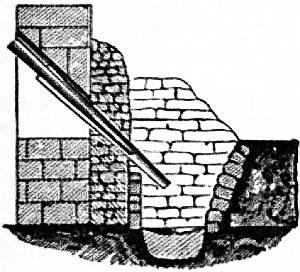
Fig. 1.—Elevation of Catalan Forge.
Fig. 1 represents a Catalan forge. The cavity in the ground is represented by a pit of square or rectangular section lined with brick or stone of a kind not readily acted on by heat, about 1½ or 2 ft. deep, usually somewhat larger above than below, with a tuyere or blast-pipe of copper penetrating one of the walls near the top, with a considerable downward inclination, so that the air meets the fuel some way down. In iron-smelting the ore is laid in a heap upon the fuel (charcoal) filling up the hearth, and is gradually brought to the metallic state by the reducing action of the carbon monoxide formed at the tuyere. The metal sinks through the ignited fuel, forming, in the hearth, a spongy mass or ball, which is lifted out by the smelters at the end of each operation, and carried to the forge hammer. The earthy matters form a fusible glass or slag melt, and collect at the lowest point of the hearth, whence they are removed by opening a hole pierced through the front wall at the bottom. The active portion of such a furnace is essentially that above the blast-pipe, the function of the lower part being merely the collection of the reduced metal; the fire may therefore be regarded as burning in an unconfined space, with the waste of a large amount of its heating power. By continuing the walls of the hearth above the tuyere, into a shaft or stack either of the same or some other section, we obtain a furnace of increased capacity, but with no greater power of consuming fuel, in which the material to be treated can be heated up gradually by loading it into the stack, alternately with layers of fuel, the charge descending regularly to the point of combustion, and absorbing a proportion of the heat of the flame that went to waste in the open fire. This principle is capable of very wide extension, the blast furnace being mainly limited in height by the strength the column of materials or “burden” has to resist crushing, under the weight due to the head adopted, and the power of the blowing engine to supply blast of sufficient density to overcome the resistance of the closely packed materials to the free passage of the spent gases. The consuming power of the furnace or the rate at which it can burn the fuel supplied is measured by the number of tuyeres and their section.
The development of blast furnaces is practically the development of iron-smelting. The profile has been very much varied at different times. The earliest examples were square or rectangular in horizontal section, but the general tendency of modern practice is to substitute round sections, their construction being facilitated by the use of specially moulded bricks which have entirely superseded the sandstone blocks formerly used. The vertical section, on the other hand, is subject to considerable variation according to the work to which the furnace is applied. Where the operation is simply one of fusion, as in the iron-founder’s cupola, in which there is no very great change in volume in the materials on their descent to the tuyeres, the stack is nearly or quite straight-sided; but when, as is the case with the smelting of iron ores with limestone flux, a large proportion of volatile matter has to be removed in the process, a wall of varying inclination is used, so that the body of the furnace is formed of two dissimilar truncated cones, joined by their bases, the lower one passing downwards into a short, nearly cylindrical, position. For further consideration of this subject see Iron and Steel.
Hearth furnaces are employed in certain metallurgical operations, e.g. in the air-reduction process for smelting lead ores. The principle is essentially that of the Catalan forge. Such furnaces are very wasteful, and have little to recommend them (see Schnabel, Metallurgy, 1905, vol. 1. p. 409).
Reverberatory Furnaces.—Blast furnaces are, from the intimate contact between the burden to be smelted and the fuel, the least wasteful of heat; but their use supposes the possibility of obtaining fuel of good quality and free from sulphur or other substances likely to deteriorate the metal produced. In all cases, therefore, where it is desired to do the work out of contact with the solid fuel, the operation of burning or heat-producing must be performed in a special fire-place or combustion chamber, the body of flame and heated gas being afterwards made to act upon the surface of the material exposed in a broad thin layer in the working bed or laboratory of the furnace by reverberation from the low vaulted roof covering the bed. Such furnaces are known by the general name of reverberatory or reverbatory furnaces, also as air or wind furnaces, to distinguish them from those worked with compressed air or blast.
Originally the term cupola was used for the reverberatory furnace, but in the course of time it has changed its meaning, and is now given to a small blast furnace such as that used by iron-founders—reverberatory smelting furnaces in the same trade being called air furnaces.
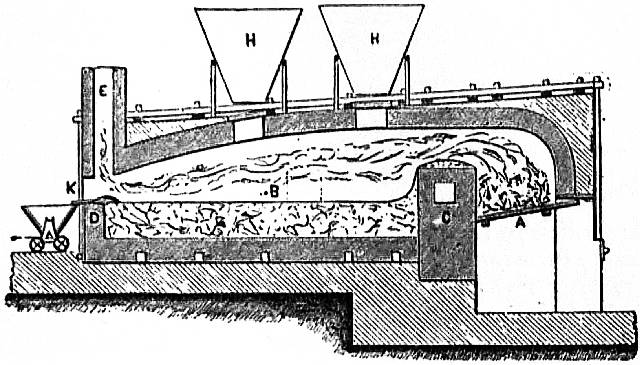
Fig. 2.—Longitudinal section of Reverberatory Furnace.
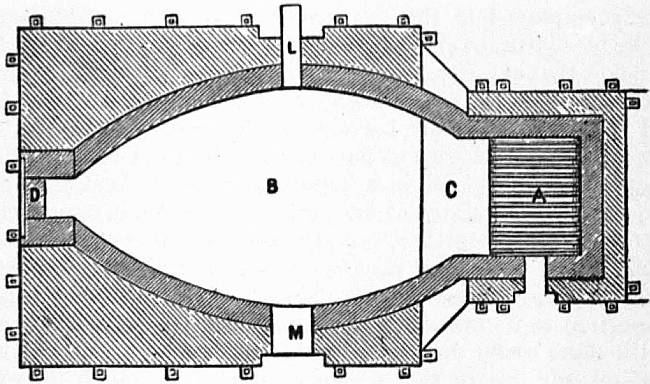
Fig. 3.—Reverberatory Furnace (horizontal section).
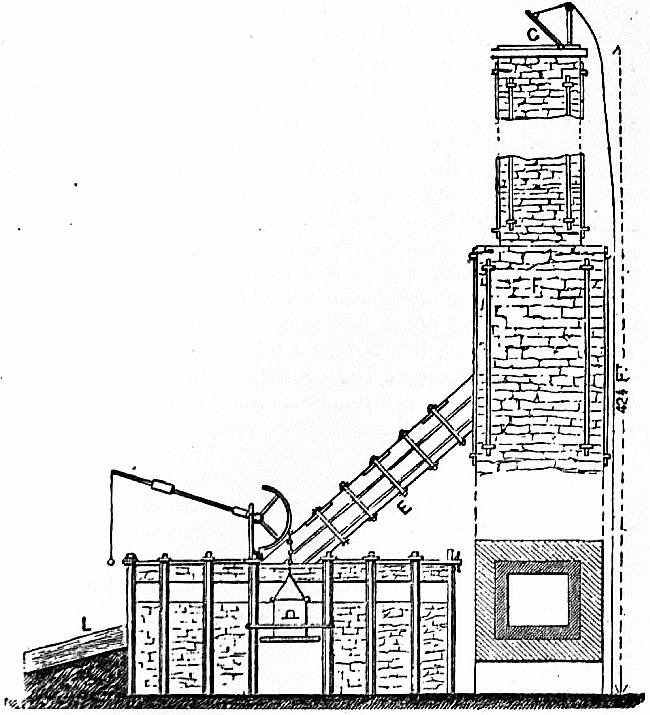
Fig. 4.—Reverberatory Furnace (elevation at flue end).
Figs. 2, 3 and 4 represent a reverberatory furnace such as is used for the fusion of copper ores for regulus, and may be taken as generally representing its class. The fire-place A is divided from the working bed B by a low wall C known as the fire bridge, and at the opposite end there is sometimes, though not invariably, a second bridge of less height called the flue bridge D. A short diagonal flue or up-take E conveys the current of spent flame to the chimney F, which is of square section, diminishing by steps at two or three different heights, and provided at the top with a covering plate or damper G, which may be raised or lowered by a chain reaching to the ground, and serves for regulating the speed of the exhaust gases, and thereby the draught of air through the fire. Where several furnaces are connected with the same chimney stack, the damper takes the form of a sliding plate in the mouth of the connecting flue, so that the draught in one may be modified without affecting the others. The fire bridge is partially protected against the intense heat of the body of flame issuing through the fire arch by a passage to which the air has free access. The material to be melted is introduced into the furnace from the hoppers HH through the charging holes in the roof. When melted the products separate on the bed (which is made of closely packed sand or other infusible substances), according to their density; the lighter earthy matters forming an upper layer of slag are drawn out by the slag hole K at the flue end into an iron wagon or bogie, while the metal subsides to the bottom of the bed, and at the termination of the operation is run out by the tap hole L into moulds or granulated into water. The opposite opening M is the working door, through which the tool for stirring the charge is introduced. It is covered by a plate suspended to a lever, similar to that seen in the end elevation (fig. 4) in front of the slag hole.
According to the purposes to which they are applied, reverberatory furnaces may be classed into two groups, namely, fusion or melting furnaces, and calcining or wasting furnaces, also called calciners. The former have a very extended application in many branches of industry, being used by both founders and smelters in the fusion of metals; in the concentration of poor metallic compounds by fusion into regulus; in the reduction of lead and tin ores; for refining copper and silver; and for making malleable iron by the puddling processes and welding. Calcining furnaces have a less extended application, being chiefly employed in the conversion of metallic sulphides into oxides by continued exposure to the action of air at a temperature far below that of fusion, or into chlorides by roasting with common salt. As some of these substances (for example, lead sulphide and copper pyrites) are readily fusible when first heated, but become more refractory as part of the sulphur is dissipated and oxygen takes its place, it is important that the heat should be very carefully regulated at first, otherwise the mass may become clotted or fritted together, and the oxidizing effect of the air soon ceases unless the fritted masses be broken small again. This is generally done by making the bed of the furnace very long in proportion to its breadth and to the fire-grate area, which may be the more easily done as a not inconsiderable amount of heat is given out during the oxidation of the ore—such increased length being often obtained by placing two or even three working beds one above the other, and allowing the flame to pass over them in order from below upwards. Such calciners are used especially in roasting zinc blende into zinc oxide, and in the conversion of copper sulphides into chlorides in the wet extraction process. In some processes of lead-smelting, where the minerals treated contain sand, the long calciner is provided with a melting bottom close to the fire-place, so that the desulphurized ore leaves the furnace as a glassy slag or silicate, which is subsequently reduced to the metallic state by fusion with fluxes in blast furnaces. Reverberatory furnaces play an important part in the manufacture of sodium carbonate; descriptions and illustrations are given in the article Alkali Manufacture.
Muffle, Crucible and Retort Furnaces.—A third class of furnaces is so arranged that the work is done by indirect heating; that is, the material under treatment, whether subjected to calcination, fusion or any other process, is not brought in contact either with fuel or flame, but is raised to the proper temperature by exposure in a chamber heated externally by the products of combustion. These are known as muffle or chamber furnaces; and by supposing the crucibles or retorts to represent similar chambers of only temporary duration, the ordinary pot melting air furnaces, and those for the reduction of zinc ores or the manufacture of coal gas, may be included in the same category. These are almost invariably air furnaces, though sometimes air under pressure is used, as, for example, in the combustion of small anthracitic coal, where a current of air from a fan-blower is sometimes blown under the grate to promote combustion. Types of muffle furnaces are figured in the article Annealing, Hardening and Tempering.
Furnace Materials.—The materials used in the construction of furnaces are divisible into two classes, namely, ordinary and refractory or fire-resisting. The former are used principally as casing, walls, pillars or other supporting parts of the structure, and includes ordinary red or yellow bricks, clay-slate, granite and most building stones; the latter are reserved for the parts immediately in contact with the fuel and flame, such as the lining of the fire-place, the arches, roof and flues, the lower part if not the whole of the chimney lining in reverberatory furnaces, and the whole of the internal walls of blast furnaces. Among such substances are fireclay and firebricks, certain sandstones, silica in the form of ganister, and Dinas stone and bricks, ferric oxide and alumina, carbon (as coke and graphite), magnesia, lime and chromium oxide—their relative importance being indicated by their order, the last two or three indeed being only of limited use.
The most essential point in good fireclays, or in the bricks or other objects made from them, is the power of resisting fusion at the highest heat to which they may be exposed. This supposes them to be free from metallic oxides forming easily fusible compounds with silica, such as lime or iron, the presence of the former even in comparatively small proportion being very detrimental. As clays they must be sufficiently plastic to be readily moulded, but at the same time possess sufficient stiffness not to contract too strongly in drying, whereby the objects produced would be liable to be warped or cracked before firing. In most cases, however, the latter tendency is guarded against, in making up the paste for moulding, by adding to the fresh clay a certain proportion of burnt material of the same kind, such as old bricks or potsherds, ground to a coarse powder. Coke dust or graphite is used for the same purpose in crucible making (see Firebrick).
The most highly valued fireclays are derived from the Coal Measures. Among the chief localities are the neighbourhood of Stourbridge in Worcestershire and Stannington near Sheffield, which supply most of the materials for crucibles used in steel and brass melting, and the pots for glass houses; Newcastle-on-Tyne and Glenboig near Glasgow, where heavy blast furnace and other firebricks, gas retorts, &c., are made in large quantities. Coarse-grained but very strong firebricks are also made of the waste of china clay works.
In Belgium the clay raised at Andenne is very largely used for making retorts for zinc furnaces. The principal French fireclays are derived from the Tertiary strata in the south, and more nearly resemble porcelain clays than those of the Coal Measures. They give wares of remarkably fine texture and surface, combined with high refractory character.
In Germany, Ips and Passau on the Danube, and Gross Almerode in Hesse, are the best known localities producing fireclay goods, the crucibles from the last-mentioned place, known as Hessian crucibles, going all over the world. These, though not showing a great resistance to extreme heat, are very slightly affected by sudden alternations in heating, as they may be plunged cold into a strongly heated furnace without cracking, a treatment to which French and Stourbridge pots cannot be subjected with safety.
Plumbago or graphite is largely used in the production of crucibles, not in the pure state but in admixture with fireclay; the proportion of the former varies with the quality from 25 to nearly 50%. These are the most enduring of all crucibles, the best lasting out 70 or 80 meltings in brass foundries, about 50 with bronze, and 8 to 10 in steel-melting.
Silica is used in furnace-building in the forms of sand, ganister, a finely ground sandstone from the Coal Measures of Yorkshire, and the analogous substance known as Dinas clay, which is really nearly pure silica, containing at most about 2½% of bases. Dinas clay is found at various places in the Vale of Neath in South Wales, in the form of a loose disintegrated sandstone, which is crushed between rollers, mixed with about 1% of lime, and moulded into bricks that are fired in kilns at a very high temperature. These bricks are specially used for the roof, fire arches, and other parts subjected to intense heat in reverberatory steel-melting furnaces, and, although infusible under ordinary conditions, are often fairly melted by the heat without fluxing or corrosion after a certain amount of exposure. Ganister, a slightly plastic siliceous sand, is similarly used for the lining of Bessemer steel converters; it is found in the neighbourhood of Sheffield.
Alumina as a refractory material is chiefly used in the form of bauxite, but its applications are somewhat special. It has been found to stand well for the linings of rotatory puddling furnaces, where, under long-continued heating, it changes into a substance as hard and infusible as natural emery. In the Paris Exhibition of 1878 bricks very hard and dense in character, said to be of pure alumina, were exhibited by Muller & Co. of Paris, as well as bricks of magnesia, the latter being specially remarkable for their great weight. They are intended for use at the extreme temperatures obtainable in steel furnaces, or for the melting of platinum before the oxy-hydrogen blowpipe. For the latter purpose, however, lime is generally used; but as this substance has only small stability, it is usually bedded in a casing of firebrick. Oxide of chromium and chrome iron ore have been proposed as refractory crucible materials. The former may be used as a bed for melting platinum in the same way as lime or magnesia, without affecting the quality of the metal.
Ferric oxide, though not strictly infusible, is largely used as a protecting lining for furnaces in which malleable iron is made, a portion of the ore being reduced and recovered in the process. In an oxidizing atmosphere it is indifferent to silica, and therefore siliceous bricks containing a considerable proportion of ferric oxide, when used in flues of boilers, brewers’ coppers, &c. and similar situations, are perfectly fire-resisting so long as the heated gas contains a large proportion of unconsumed air. The red firebricks known as Windsor bricks, which are practically similar in composition to soft red sandstone, are of this character.
The electric furnace has led to the discovery of several important materials, which have been employed as furnace linings. Carborundum (q.v.) was applied by Engels in 1899, firebricks being washed with carborundum paste and then baked. Siloxicon, a compound of carbon, silicon and oxygen, formed from carbon and silica in the electric furnace, was patented by E.G. Acheson in 1903. It is very refractory, and is applied by mixing with water and some bond, such as sodium silicate or gas-tar. An amorphous, soft silicon carbide, also formed in the electric furnace, was patented by B. Talbot in 1899. For basic linings, magnesia crystallized in the electric furnace is being extensively used, replacing dolomite to some extent (see E. Kilburn Scott, “Refractory Materials for Furnace Linings,” Faraday Soc., 1906, p. 289).
Furnace Construction.—In the construction of furnaces provision has to be made for the unequal expansion of the different parts under the effect of heat. This is especially necessary in the case of reverberatory furnaces, which are essentially weak structures, and therefore require to be bound together by complicated systems of tie rods and uprights or buck staves. The latter are very commonly made of old flat bottom rails, laid with the flat of the flange against the wall. Puddling furnaces are usually entirely cased with iron plates, and blast furnaces with hoops round each course of the stack, or in those of thinner constructions the firebrick work is entirely enclosed in a wrought iron casing or jacket. Such parts as may be subjected to extreme heat and the fretting action of molten material, as the tuyere and slag breasts of blast furnaces, and the fire bridges and bed plates of reverberatory furnaces, are often made in cast iron with double walls, a current of water or air being kept circulating through the intermediate space. In this way the metal, owing to its high conductivity and low specific heat as compared to that of water, is kept at a temperature far below its melting point if the water is renewed quickly enough. It is of course necessary in such cases that the circulation shall be perfectly free, in order to prevent the accumulation of steam under pressure in the interior of the casting. This method has received considerable extension, notably in furnace-smelting of iron ores containing manganese, where the entire hearth is often completely water-cased, and in some lead furnaces where no firebrick lining is used, the lower part of the furnace stack being a mere double iron box cooled by water sufficiently to keep a coating of slag adhering to the inner shell which prevents the metal from being acted upon.
Mechanical Furnaces.—The introduction and withdrawal of the charges in fusion furnaces is effected by gravitation, the solid masses of raw ore, fuel and flux being thrown in at the top, and flowing out of the furnace at the taphole or slag run at the bottom. Vertical kilns, such as those used for burning limestone, are worked in a similar manner—the raw stone going in at the top, and the burnt product falling through holes in the bottom when allowed to do so. With reverberatory calciners, however, where the work is done upon a horizontal bed, a considerable amount of hand labour is expended in raking out the charge when finished, and in drawing slags from fusion furnaces; and more particularly in the puddling process of refining iron the amount of manual exertion required is very much greater. To diminish the item of expenditure on this head, various kinds of mechanical furnaces have been adopted, all of which can be classified under three heads of gravitating furnaces, mechanical stirrers and revolving furnaces.
1. In gravitating furnaces the bed is laid at a slope just within the angle of repose of the charge, which is introduced at the upper end, and is pushed down the slope by fresh material, when necessary, in the contrary direction to the flame which enters at the lower end. Gerstenhofer’s pyrites burner is a furnace of this class. It has a tall vertical chamber heated from below, and traversed by numerous narrow horizontal cross bars at different heights. The ore in fine powder is fed in at the top, through a hopper, in a regular thin stream, by a pair of rollers, and in falling lodges on the flats of the bars, forming a talus upon each of the height corresponding to the angle of rest of the material, which is, however, at short intervals removed to lower levels by the arrival of fresh ore from above. In this way a very large surface is exposed to the heat, and the ore, if containing sufficient sulphur to maintain the combustion, is perfectly burned when it arrives at the bottom; if, however, it is imperfectly sized or damp, or if it contains much earthy matter, the result is not very satisfactory. There are many other furnaces in which the same principle is utilized.
2. Mechanical stirrers constitute a second division of mechanical furnaces, in which the labour of rabbling or stirring the charges is performed by combinations of levers and wheel-work taking motion from a rotating shaft, and more or less perfectly imitating the action of hand labour. They are almost entirely confined to puddling furnaces.
3. Revolving furnaces, the third and most important division of mechanical furnaces, are of two kinds. The first of these resemble an ordinary reverberatory furnace by having a flat bed which, however, has the form of a circular disk mounted on a central shaft, and receives a slow movement of rotation from a water-wheel or other motor, so that every part of the surface is brought successively under the action of the fire, the charge being stirred and ultimately removed by passing under a series of fixed scraper arms placed above the surface at various points. Brunton’s calciner, used in the “burning” of the pyritic minerals associated with tin ore, is a familiar example of this type. The hearth may either rotate on an inclined axis, so that the path of its surface is oblique to that of the flame, or the working part may be a hollow cylinder, between the fireplace and flue, with its axis horizontal or nearly so, whose inner surface represents the working bed, mounted upon friction rollers, and receiving motion from a special steam-engine by means of a central belt of spur gearing. Furnaces of the second kind were first used in alkali works for the conversion of sulphate into carbonate of sodium in the process known as black ash fusion, but have since been applied to other processes. As calciners they are used in tin mines and for the chlorination of silver ores. Mechanical furnaces are figured in the article Alkali Manufacture.
Use of Heated Air.—The calorific intensity of fuel is found to be very considerably enhanced, if the combustion be effected with air previously heated to any temperature between that of boiling water and a dull red heat, the same effect being observed both with solid and gaseous fuel. The latter, especially when brought to the burning point at a high temperature, produces a heat that can be resisted by the most refractory substances only, such as silica, alumina and magnesia. This is attained in the regenerative furnace of Siemens, detailed consideration of which belongs more properly to the subject of iron.
Economy of Waste Heat.—In every system of artificial heating, the amount of heat usefully applied is but a small proportion of that developed by combustion. Even under the most advantageous application, that of evaporation of water in a steam boiler where the gases of the fire have to travel through a great length of flues bounded by thin iron surfaces of great heat-absorbing capacity, the temperature of the current at the chimney is generally much above that required to maintain an active draught in the fireplace; and other tubes containing water, often in considerable numbers, forming the so-called fuel economizers, may often be interposed between the boiler and the chimney with marked advantage as regards saving of fuel. In reverberatory and air furnaces used in the different operations of iron manufacture, where an extremely high temperature has to be maintained in spaces of comparatively small extent, such as the beds of puddling, welding and steel-melting furnaces, the temperature of the exhaust gases is exceedingly high, and if allowed to pass directly into the chimney they appear as a great body of flame at the top. It is now general to save a portion of this heat by passing the flame through flues of steam boilers, air-heating apparatus, or both—so that the steam required for the necessary operations of the forge and heated blast for the furnace itself may be obtained without further expenditure of fuel. The most perfect method of utilizing the waste heat hitherto applied is that of the Siemens regenerator, in which the spent gases are made to travel through chambers, known as regenerators or recuperators of heat, containing a quantity of thin firebricks piled into a cellular mass so as to offer a very large heat-absorbing surface, whereby their temperature is very considerably reduced, and they arrive at the chimney at a heat not exceeding 300 or 400 degrees. As soon as the bricks have become red hot, the current is diverted to an adjacent chamber or pair of chambers, and the acquired heat is removed by a current of cool gas or air passing towards the furnace, where it arrives at a temperature sufficiently high to ensure the greatest possible heating effect in combustion.
In iron-smelting blast furnaces the waste gases are of considerable fuel value, and may render important services if properly applied. Owing to the conditions of the work, which require the maintenance of a sensibly reducing atmosphere, they contain a very notable proportion of carbonic oxide, and are drawn off by large wrought iron tubes near the top of the furnace and conveyed by branch pipes to the different boilers and air-heating apparatus, which are now entirely heated by the combustion of such gases, or mixed with air and exploded in gas engines. Formerly they were allowed to burn to waste at the mouth of a short chimney place above the furnace top, forming a huge body of flame, which was one of the most striking features of the Black Country landscape at night.
Laboratory and Portable Furnaces.—Small air-furnaces with hot plates or sand bath flues were formerly much employed in chemical laboratories, as well as small blast furnaces for crucibles heated with charcoal or coke. The use of such furnaces has very considerably diminished, owing to the general introduction of coal-gas for heating purposes in laboratories, which has been rendered possible by the invention of the Bunsen burner, in which the mixture of air and gas giving the least luminous but most powerfully heating flame is effected automatically by the effluent gas. These burners, or modifications of them, have also been applied to muffle furnaces, which are convenient when only a few assays have to be made—the furnace being a mere clay shell and soon brought to a working temperature; but the fuel is too expensive to allow of their being used habitually or on a large scale. Petroleum, or rather the heavy oils obtained in tar refineries, having an equal or superior heating power to coal-gas, may also be used in laboratories for producing high temperatures. The oil is introduced in a thin stream upon a series of inclined and channelled bars, where it is almost immediately volatilized and burnt by air flowing in through parallel orifices. Furnaces of this kind may be used for melting cast iron or bronze in small quantities, and were employed by H. Sainte Claire Deville in experiments in the metallurgy of the platinum group of metals.
Sefstrom’s blast furnace, used in Sweden for the assay of iron ores, is a convenient form of portable furnace applied to melting in crucibles. It consists of a sheet-iron cylinder about 8 or 9 in. in diameter, within which is fixed one of smaller size lined with fireclay. The space between the two cylinders serves as a heater and distributor for the blast, which is introduced through the nozzle at the bottom, and enters the furnace through a series of several small tuyeres arranged round the inner lining. Charcoal is the fuel used, and the crucibles stand upon the bottom of the clay lining. When a large body of fuel is required, the cylinder can be lengthened by an iron hoop which fits over the top ring. Deville’s portable blast furnace is very similar in principle to the above, but the body of the furnace is formed of a single cast iron cylinder lined with fireclay, closed below by a cast iron plate perforated by a ring of small holes—a hemispherical basin below forming the air-heating chamber.
FURNEAUX, TOBIAS (1735-1781), English navigator, was born at Swilly near Plymouth on the 21st of August 1735. He entered the royal navy, and was employed on the French and African coasts and in the West Indies during the latter part of the Seven Years’ War (1760-1763). He served as second lieutenant of the “Dolphin” under Captain Samuel Wallis on the latter’s voyage round the globe (August 1766-May 1768); was made a commander in November 1771; and commanded the “Adventure” which accompanied Captain Cook (in the “Resolution”) in Cook’s second voyage. On this expedition Furneaux was twice separated from his leader (February 8-May 19, 1773; October 22, 1773-July 14, 1774, the date of his return to England). On the former occasion he explored a great part of the south and east coasts of Tasmania, and made the earliest British chart of the same. Most of his names here survive; Cook, visiting this shore-line on his third voyage, confirmed Furneaux’s account and delineation of it (with certain minor criticisms and emendations), and named after him the islands in Banks Straits, opening into Bass’s Straits, and the group now known as the Low Archipelago. After the “Adventure” was finally separated from the “Resolution” off New Zealand in October 1773, Furneaux returned home alone, bringing with him Omai of Ulaietea. This first South Sea Islander seen in the British Isles returned to his home with Cook in 1776-1777. Furneaux was made a captain in 1775, and commanded the “Syren” in the British attack of the 28th of June 1776 upon Charleston, South Carolina. His successful efforts to introduce domestic animals and potatoes into the South Sea Islands are worthy of note. He died at Swilly on the 19th of September 1781.
See Hawkesworth’s Narrative of Wallis’ Voyage; Captain Cook’s Narrative of his Second Voyage; also T. Furneaux’s life by Rev. Henry Furneaux in the Dictionary of National Biography.
FURNES (Flem. Veurne), an old-fashioned little town amid the dunes near the coast in West Flanders, Belgium, about 26 m. S.W. of Bruges. Pop. (1904) 6099. It is the centre of a considerable area extending to the French frontier, and its market is an important one for the disposal of corn, stock, hops and dairy produce. During the Norman raids Furnes was destroyed, and the present town was built by Baldwin Bras de Fer, first count of Flanders, about the year 870. At the height of the prosperity of the Flemish communes in the 14th century there were dependent on the barony of Furnes not fewer than fifty-two rich villages, but these have all disappeared, partly no doubt as the consequence of repeated French invasions down to the end of the 18th century, but chiefly through the encroachment of the sea followed by the accumulation of sand along the whole of this portion of the coast. Furnes contains many curious old houses and the church of St Walburga, which is a fine survival of the 13th century with some older portions. The old church and buildings, grouped round the Grand Place, which is the scene of the weekly market, present a quaint picture which is perhaps not to be equalled in the country. Near Furnes on the seashore is the fashionable bathing place called La Panne.
Furnes one day a year becomes a centre of attraction to all the people of Flanders. This is the last Sunday in July, when the fête of Calvary and the Crucifixion is celebrated. Of all popular festivities in Belgium this is the nearest approach to the old Passion Play. The whole story of Christ is told with great precision by means of succeeding groups which typify the different phases of the subject. The people of Furnes pose as Roman soldiers or Jewish priests, as the apostles or mere spectators, while the women put on long black veils so that they may figure in the procession as the just women.
FURNESS, HORACE HOWARD (1833- ), American Shakespearian scholar, was born in Philadelphia on the 2nd of November 1833, being the son of William Henry Furness (1802-1896) minister of the First Unitarian church in that city, a powerful preacher and writer. He graduated at Harvard in 1854, and was admitted to the bar in 1859, but soon devoted himself to the study of Shakespeare. He accumulated a collection of illustrative material of great richness and extent, and brought out in 1871 the first volume of a new Variorum edition, designed to represent and summarize the conclusions of the best authorities in all languages—textual, critical and annotative. The volumes appeared as follows: Romeo and Juliet (1871); Macbeth (1873) (revised edition, 1903); Hamlet (2 vols., 1877); King Lear (1880); Othello (1886); The Merchant of Venice (1888); As You Like It (1890); The Tempest (1892); A Midsummer Night’s Dream (1895); The Winter’s Tale (1898); Much Ado about Nothing (1899); Twelfth Night (1901); Love’s Labour’s Lost (1904). The edition has been generally accepted as a thorough and scholarly piece of work; its chief fault is that, beginning with Othello (1858), the editor used the First Folio text as his basis, while in others he makes the text of the Cambridge (Globe) editors his foundation. His wife, Helen Kate Furness (1837-1883), compiled A Concordance to the Poems of Shakespeare (1872).
FURNESS, a district of Lancashire, England, separated from the major portion of the county by Morecambe Bay. It is bounded S.E. by this inlet of the Irish Sea, S.W. by the sea, W. by the Duddon estuary and Cumberland, and N. and E. by Westmorland. Its area is about 250 sq. m. It forms the greater part of the North Lonsdale parliamentary division of Lancashire, and contains the parliamentary borough of Barrow-in-Furness. The surface is almost entirely hilly. The northern half is included in the celebrated Lake District, and contains such eminences as the Old Man of Coniston and Wetherlam. Apart from the Duddon, which forms part of the western boundary, the principal rivers are the Leven and Crake, flowing southward into a common estuary in Morecambe Bay. The Leven drains Windermere and the Crake Coniston Lake. The usage of the term “Lake District,” however, tends to limit the name of Furness in common thought to the district south of the Lakes, where several of the place-names are suffixed with that of the district, as Barrow-in-Farness, Dalton-in-Furness, Broughton-in-Furness. Between the Duddon and Morecambe Bay lies Walney Island, 8 m. in length, and in the shallow strait between it and the mainland are several smaller islands. That part of Furness which forms a peninsula between the Leven estuary and Morecambe Bay, and the Duddon estuary, is rich in hematite iron ore, which has been worked from very early times. It was known and smelted by British and Romans, and by the monks of Furness Abbey and Conishead Priory, both in the district. It was owing to the existence of this ore that the town of Barrow grew up in the 19th century; at first as a port from which the ore was exported to South Wales, while later furnaces were established on the spot, and acquired additional importance on the introduction of the Bessemer process, which requires a non-phosphoric ore such as is found here. The hematite is also worked at Ulverston, Askam, Dalton and elsewhere, but the furnaces now depend in part upon ore imported from Spain. The supposed extension of the ore under the sands of the Duddon estuary led to the construction of a sea wall to facilitate the working. The district is served by the main line of the Furness railway, from Carnforth (junction with the London & North-Western railway), passing the pleasant watering-place of Grange, and approximately following the coast by Ulverston, Dalton and Barrow, with branches to Lake Side, Windermere, and to Coniston.
Apart from its industrial importance and scenic attractions, Furness has an especial interest on account of its famous abbey. The ruins of this, beautifully situated in a wooded valley, are extensive, and mainly of fine transitional Furness Abbey. Norman and Early English date, acquiring additional picturesqueness from the warm colour of the red sandstone of which they are built. The abbey of Furness, otherwise Furdenesia or the further nese (promontory), which was dedicated to St Mary, was founded in 1127 by a small body of monks belonging to the Benedictine order of Savigny. In 1124 they had settled at Tulketh, near Preston, but migrated in 1127 to Furness under the auspices of Stephen, count of Boulogne, afterwards king, at that time lord of the liberty of Furness. In 1148 the brotherhood joined the Cistercian order. Stephen granted to the monks the lordship of Furness, and his charter was confirmed by Henry I., Henry II. and subsequent kings. The abbot’s power throughout the lordship was almost absolute; he had a market and fair at Dalton, was free from service to the county and wapentake, and held a sheriff’s tourn. By a succession of gifts the abbey became one of the richest in England and was the largest Cistercian foundation in the kingdom. At the Dissolution its revenues amounted to between £750 and £800 a year, exclusive of meadows, pastures, fisheries, mines, mills and salt works, and the wealth of the monks enabled them to practise a regal hospitality. The abbot was one of the twenty Cistercian abbots summoned to the parliament of 1264, but was not cited after 1330, as he did not hold of the king in capite per baroniam. The abbey founded several offshoot houses, one of the most important being Rushen Abbey in the Isle of Man. In 1535 the royal commissioners visited the abbey and reported four of its inmates, including the abbot, for incontinence. In 1536 the abbot was charged with complicity in the Pilgrimage of Grace, and on the 7th of April 1537, under compulsion, surrendered the abbey to the king. A few monks were granted pensions, and the abbot was endowed with the profits of the rectory of Dalton, valued at £33, 6s. 8d. per annum. In 1540 the estates and revenues were annexed by act of parliament to the Duchy of Lancaster. About James I.’s reign the site and territories were alienated to the Prestons of Preston-Patrick, from whom they descended to the dukes of Devonshire.
Conishead Priory, near Ulverston, an Augustinian foundation of the reign of Henry II., has left no remains, but of the priory of Cartmel (1188) the fine church is still in use. It is a cruciform structure of transitional Norman and later dates, its central tower having the upper storey set diagonally upon the lower. The chancel contains some superb Jacobean carved oak screens, with stalls of earlier date.
FURNISS, HARRY (1854- ), British caricaturist and illustrator, was born at Wexford, Ireland, of English and Scottish parents. He was educated in Dublin, and in his schooldays edited a Schoolboy’s Punch in close imitation of the original. He came to London when he was nineteen, and began to draw for the illustrated papers, being for some years a regular contributor to the Illustrated London News. His first drawing in Punch appeared in 1880, and he joined its staff in 1884. He illustrated Lucy’s “Diary of Toby, M.P.,” in Punch, where his political caricatures became a popular feature. Among his other successes were a series of “Puzzle Heads,” and his annual “Royal Academy guy’d.” In Royal Academy Antics (1890) he published a volume of caricatures of the work of leading artists. He resigned from the staff of Punch in 1894, produced for a short time a weekly comic paper Lika Joko, and in 1898 began a humorous monthly, Fair Game; but these were short-lived. Among the numerous books he illustrated were James Payn’s Talk of the Town, Lewis Carroll’s Sylvie and Bruno, Gilbert à Beckett’s Comic Blackstone, G.E. Farrow’s Wallypug Book, and his own novel, Poverty Bay (1905). Our Joe, his great Fight (1903), was a collection of original cartoons. His volume of reminiscences, Confessions of a Caricaturist (1901), was followed by Harry Furniss at Home (1904). In 1905 he published How to draw in Pen and Ink, and produced the first number of Harry Furniss’s Christmas Annual.
FURNITURE (from “furnish,” Fr. fournir), a general term of obscure origin, used to describe the chattels and fittings required to adapt houses and other buildings for use. Wood, ivory, precious stones, bronze, silver and gold have been used from the most ancient times in the construction or for the decoration of furniture. The kinds of objects required for furniture have varied according to the changes of manners and customs, as well as with reference to the materials at the command of the workman, in different climates and countries. Of really ancient furniture there are very few surviving examples, partly by reason of the perishable materials of which it was usually constructed; and partly because, however great may have been the splendour of Egypt, however consummate the taste of Greece, however luxurious the life of Rome, the number of household appliances was very limited. The chair, the couch, the table, the bed, were virtually the entire furniture of early peoples, whatever the degree of their civilization, and so they remained until the close of what are known in European history as the middle ages. During the long empire-strewn centuries which intervened between the lapse of Egypt and the obliteration of Babylon, the extinction of Greece and the dismemberment of Rome and the great awakening of the Renaissance, household comfort developed but little. The Ptolemies were as well lodged as the Plantagenets, and peoples who spent their lives in the open air, going to bed in the early hours of darkness, and rising as soon as it was light, needed but little household furniture.
Indoor life and the growth of sedentary habits exercised a powerful influence upon the development of furniture. From being splendid, or at least massive, and exceedingly sparse and costly, it gradually became light, plentiful and cheap. In the ancient civilizations, as in the periods when our own was slowly growing, household plenishings, save in the rudest and most elementary forms, were the privilege of the great—no person of mean degree could have obtained, or would have dared to use if he could, what is now the commonest object in every house, the chair (q.v.). Sparse examples of the furniture of Egypt, Nineveh, Greece and Rome are to be found in museums; but our chief sources of information are mural and sepulchral paintings and sculptures. The Egyptians used wooden furniture carved and gilded, covered with splendid textiles, and supported upon the legs of wild animals; they employed chests and coffers as receptacles for clothes, valuables and small objects generally. Wild animals and beasts of the chase were carved upon the furniture of Nineveh also; the lion, the bull and the ram were especially characteristic. The Assyrians were magnificent in their household appointments; their tables and couches were inlaid with ivory and precious metals. Cedar and ebony were much used by these great Eastern peoples, and it is probable that they were familiar with rosewood, walnut and teak. Solomon’s bed was of cedar of Lebanon. Greek furniture was essentially Oriental in form; the more sumptuous varieties were of bronze, damascened with gold and silver. The Romans employed Greek artists and workmen and absorbed or adapted many of their mobiliary fashions, especially in chairs and couches. The Roman tables were of splendid marbles or rare woods. In the later ages of the empire, in Rome and afterwards in Constantinople, gold and silver were plentifully used in furniture; such indeed was the abundance of these precious metals that even cooking utensils and common domestic vessels were made of them.
The architectural features so prominent in much of the medieval furniture begin in these Byzantine and late Roman thrones and other seats. These features became paramount as Pointed architecture became general in Europe, and scarcely less so during the Renaissance. Most of the medieval furniture, chests, seats, trays, &c., of Italian make were richly gilt and painted. In northern Europe carved oak was more generally used. State seats in feudal halls were benches with ends carved in tracery, backs panelled or hung with cloths (called cloths of estate), and canopies projecting above. Bedsteads were square frames, the testers of panelled wood, resting on carved posts. Chests of oak carved with panels of tracery, or of Italian cypress (when they could be imported), were used to hold and to carry clothes, tapestries, &c., to distant castles and manor houses; for house furniture, owing to its scarcity and cost, had to be moved from place to place. Copes and other ecclesiastical vestments were kept in chests with ornamental lock plates and iron hinges. The splendour of most feudal houses depended on pictorial tapestries which could be packed and carried from place to place. Wardrobes were rooms fitted for the reception of dresses, as well as for spices and other valuable stores. Excellent carving in relief was executed on caskets, which were of wood or of ivory, with painting and gilding, and decorated with delicate hinge and lock metal-work. The general subjects of sculpture were taken from legends of the saints or from metrical romances. Renaissance art made a great change in architecture, and this change was exemplified in furniture. Cabinets (q.v.) and panelling took the outlines of palaces and temples. In Florence, Rome, Venice, Milan and other capitals of Italy, sumptuous cabinets, tables, chairs, chests, &c., were made to the orders of the native princes. Vasari (Lives of Painters) speaks of scientific diagrams and mathematical problems illustrated in costly materials, by the best artists of the day, on furniture made for the Medici family. The great extent of the rule of Charles V. helped to give a uniform training to artists from various countries resorting to Italy, so that cabinets, &c., which were made in vast numbers in Spain, Flanders and Germany, can hardly be distinguished from those executed in Italy. Francis I. and Henry VIII. encouraged the revived arts in their respective dominions. Pietra dura, or inlay of hard pebbles, agate, lapis lazuli, and other stones, ivory carved and inlaid, carved and gilt wood, marquetry or veneering with thin woods, tortoise-shell, brass, &c., were used in making sumptuous furniture during the first period of the Renaissance. Subjects of carving or relief were generally drawn from the theological and cardinal virtues, from classical mythology, from the seasons, months, &c. Carved altarpieces and woodwork in churches partook of the change in style.
The great period of furniture in almost every country was, however, unquestionably the 18th century. That century saw many extravagances in this, as in other forms of art, but on the whole it saw the richest floraison of taste, and the widest sense of invention. This is the more remarkable since the furniture of the 17th century has often been criticized as heavy and coarse. The criticism is only partly justified. Throughout the first three-quarters of the period between the accession of James I. and that of Queen Anne, massiveness and solidity were the distinguishing characteristics of all work. Towards the reign of James II., however, there came in one of the most pleasing and elegant styles ever known in England. Nearly a generation before then Boulle was developing in France the splendid and palatial method of inlay which, although he did not invent it, is inseparably associated with his name. We owe it perhaps to the fact that France, as the neighbour of Italy, was touched more immediately by the Renaissance than England that the reign of heaviness came earlier to an end in that country than on the other side of the Channel. But there is a heaviness which is pleasing as well as one which is forbidding, and much of the furniture made in England any time after the middle of the 17th century was highly attractive. If English furniture of the Stuart period be not sought after to the same extent as that of a hundred years later, it is yet highly prized and exceedingly decorative. Angularity it often still possessed, but generally speaking its elegance of form and richness of upholstering lent it an attraction which not long before had been entirely lacking. Alike in France and in England, the most attractive achievements of the cabinetmaker belong to the 18th century—English Queen Anne and early Georgian work is universally charming; the regency and the reigns of Louis XV. and XVI. formed a period of the greatest artistic splendour. The inspiration of much of the work of the great English school was derived from France, although the gropings after the Chinese taste and the earlier Gothic manner were mainly indigenous. The French styles of the century, which began with excessive flamboyance, closed before the Revolution with a chaste perfection of detail which is perhaps more delightful than anything that has ever been done in furniture. In the achievements of Riesener, David Röntgen, Gouthière, Oeben and Rousseau de la Rottière we have the high-water mark of craftsmanship. The marquetry of the period, although not always beautiful in itself, was executed with extraordinary smoothness and finish; the mounts of gilded bronze, which were the leading characteristic of most of the work of the century, were finished with a minute delicacy of touch which was until then unknown, and has never been rivalled since. If the periods of Francis I. and Henry II., of Louis XIV. and the regency produced much that was sumptuous and even elegant, that of Louis XVI., while men’s minds were as yet undisturbed by violent political convulsions, stands out as, on the whole, the one consummate era in the annals of furniture. Times of great achievement are almost invariably followed directly by those in which no tall thistles grow and in which every little shrub is magnified to the dimensions of a forest tree; and the so-called “empire style” which had begun even while the last monarch of the ancien régime still reigned, lacked alike the graceful conception and the superb execution of the preceding style. Heavy and usually uninspired, it was nurtured in tragedy and perished amid disaster. Yet it is a profoundly interesting style, both by reason of the classical roots from which it sprang and the attempt, which it finally reflected, to establish new ideas in every department of life. Founded upon the wreck of a lingering feudalism it reached back to Rome and Greece, and even to Egypt. If it is rarely charming, it is often impressive by its severity. Mahogany, satinwood and other rich timbers were characteristic of the style of the end of the 18th century; rosewood was most commonly employed for the choicer work of the beginning of the 19th. Bronze mounts were in high favour, although their artistic character varied materially.
Previously to the middle of the 18th century the only cabinetmaker who gained sufficient personal distinction to have had his name preserved was André Charles Boulle; beginning with that period France and England produced many men whose renown is hardly less than that of artists in other media. With Chippendale there arose a marvellously brilliant school of English cabinetmakers, in which the most outstanding names are those of Sheraton, Heppelwhite, Shearer and the Adams. But if the school was splendid it was lamentably short-lived, and the 19th century produced no single name in the least worthy to be placed beside these giants. Whether, in an age of machinery, much room is left for fine individual execution may be doubted, and the manufacture of furniture now, to a great extent, takes place in large factories both in England and on the continent. Owing to the necessary subdivision of labour in these establishments, each piece of furniture passes through numerous distinct workshops. The master and a few artificers formerly superintended each piece of work, which, therefore, was never far removed from the designer’s eye. Though accomplished artists are retained by the manufacturers of London, Paris and other capitals, there can no longer be the same relation between the designer and his work. Many operations in these modern factories are carried on by machinery. This, though an economy of labour, entails loss of artistic effect. The chisel and the knife are no longer in such cases guided and controlled by the sensitive touch of the human hand.
Plate I.
Fig. 1.—Venetian Folding Chair of carved and gilt walnut, leather back and seat; about 1530. Fig. 2.—Oak Arm-chair. English, 17th century. Fig. 3.—Arm-chair, solid seat, cane back; about 1660. Fig. 4.—Arm-chair, stuffed back and seat; about 1650.
Fig. 5.—Painted and carved High-Back Chair; about 1660. Fig. 6.—Carved Walnut Chairs. English, early 18th century. The arm-chair is inlaid. Fig. 7.—Walnut Chair; about 1710.
Fig. 8.—Carved Mahogany Chair in the style of Chippendale; 2nd half of 18th century. Fig. 9.—Carved Mahogany Arm-chair, in the style of Chippendale, with ribbon pattern. Fig. 10.—Carved and Inlaid Mahogany Chair, in the style of Hepplewhite; late 18th century. Fig. 11.—Mahogany Chair in the style of Sheraton; about 1780.
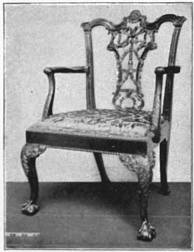
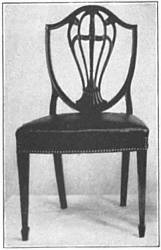
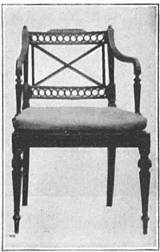
Fig. 12.—Painted and gilt Arm-chair with cane seat, in the style of Adam; about 1790. Fig. 13.—Arm-chair of carved and gilt wood with stuffed back, seat and arms. French, Louis XV. style. Fig. 14.—Mahogany Arm-chair. Empire style, early 19th century, said to have belonged to the Bonaparte family. Fig. 15.—Painted and gilt Beech Chair. English, about 1800.
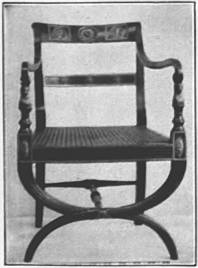
Plate II.
Fig. 1.—Front of Oak Coffer with wrought iron bands. French, 2nd half of 13th century. Fig. 2.—English Oak Chest, dated 1637.
Fig. 3.—Italian (Florentine) Coffer of Wood with gilt arabesque stucco ornament, about 1480. Fig. 4.—Italian “Cassone” or Marriage Coffer, 13th century. Carved and gilt wood with painted front and ends.
Fig. 5.—Walnut Table with expanding leaves. Swiss, 17th century. Fig. 6.—Oak Gate-Legged Table. English, 17th century.
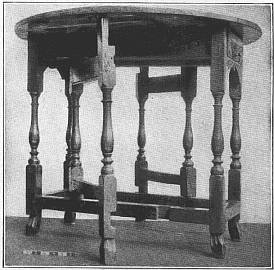
Fig. 7.—Writing Table. French, end of Louis XV. period. Riesener marquetry, ormolu mounts and Sèvres plaques. Fig. 8.—Painted Satin-Wood Tables, in the style of Sheraton, about 1790. (The above are in the Victoria and Albert Museum, except Fig. 8, which were in the Bethnal Green Exhibition, 1892.)
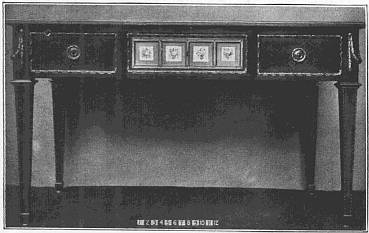
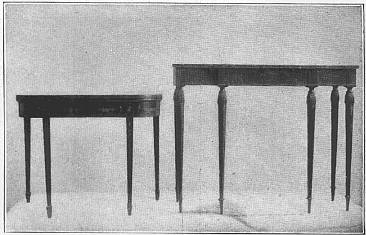
Plate III.
1. CARVED OAK SIDEBOARD. English, 17th century. Victoria and Albert Museum. 2. CARVED OAK COURT CUPBOARD. English, early 17th century. Victoria and Albert Museum.
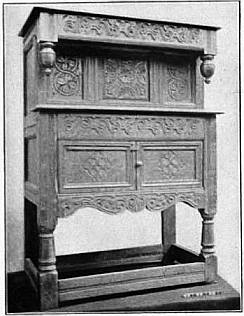
3. EBONY CARVED CABINET. The interior decorated with inlaid ivory and coloured woods; French or Dutch, middle of 17th century. Victoria and Albert Museum. 4. VENEERED CHEST OF DRAWERS. About 1690. Lent to Bethnal Green Exhibition by Sir Spencer Ponsonby-Fane, G.C.B.
5. EBONY ARMOIRE. With tortoise-shell panels inlaid with brass and other metals, and ormolu mountings. Designed by Bérain, and executed by André Boulle. French, Louis XIV. period. Victoria and Albert Museum. 6. GLASS-FRONTED BOOKCASE AND CABINET. Of mahogany. In the style of Sheraton, about 1790. Lent to the Bethnal Green Exhibition by the late Vincent J. Robinson, C.I.E.
Plate IV.
1. COMMODE OF PINE. With marquetry of brass, ebony, tortoise-shell, mother-of-pearl, ivory, and green-stained bone. “Boulle” work with designs in the style of Bérain. French, late period of Louis XIV. 2. COMMODE. With panels of Japanese lacquer and ormolu mountings, in the style of Caffieri. French, Louis XV. period.
3. TABLE OF KING AND TULIP WOODS. With ormolu mountings. Louis XV. period. 4. ESCRITOIRE À TOILETTE. Formerly belonging to Marie Antoinette. Of tulip and sycamore woods inlaid with other coloured woods, ormolu mounts. Louis XV. period.
5. FOUR-POST BEDSTEAD. Of oak inlaid with bog-oak and holly, from the “Inlaid Room” at Sizergh Castle, Westmorland. Latter half of sixteenth century. 6. CARVED AND GILT BEDSTEAD. With blue silk damask coverings and hangings. French, late 18th century. Louis XVI. period. From the Victoria and Albert Museum, S. Kensington.