VOLUME XI SLICE II French Literature to Frost, William (continued 9)
Reading edition
Meanwhile, Napoleon had issued orders for the main body to stand fast, and for the detachments to take up their definitive covering positions. Duhesme’s corps was directed, from its eastern foray, to Piacenza, to join the main body. Moncey was to provide for the defence of the Ticino line, Lechi to form a “flying camp” in the region of Orzinovi-Brescia and Cremona, and another mixed brigade was to control the Austrians in Pizzighetone and in the citadel of Piacenza. On the other side of the Po, between Piacenza and Montebello, was the main body (Lannes, Murat and part of Victor’s and Duhesme’s corps), and a flank guard was stationed near Pavia, with orders to keep on the right of the army as it advanced (this is the first and only hint of any intention to go westward) and to fall back fighting should Melas come on by the left bank. One division was to be always a day’s march behind the army on the right bank, and a flotilla was to ascend the Po, to facilitate the speedy reinforcement of the flank guard. Farther to the north was a small column on the road Milan-Vercelli. All the protective troops, except the division of the main body detailed as an eventual support for the flank guard, was to be found by Moncey’s corps (which had besides to watch the Austrians in the citadel of Milan) and Chabran’s and Lechi’s weak commands. On this same day Bonaparte tells the Minister of War, Carnot, that Moncey has only brought half the expected reinforcements and that half of these are unreliable. As to the result of the impending contest Napoleon counts greatly upon the union of 18,000 men under Masséna and Suchet to crush Melas against the “strategic barrage” of the Army of Reserve, by one or other bank of the Po, and he seems equally confident of the result in either case. If Genoa had held out three days more, he says, it would have been easy to count the number of Melas’s men who escaped. The exact significance of this last notion is difficult to establish, and all that could be written about it would be merely conjectural. But it is interesting to note that, without admitting it, Napoleon felt that his “barrage” might not stand before the flood. The details of the orders of the 9th to the main body (written before the news of Montebello arrived at headquarters) tend to the closest possible concentration of the main body towards Casteggio, in view of a decisive battle on the 12th or 13th.
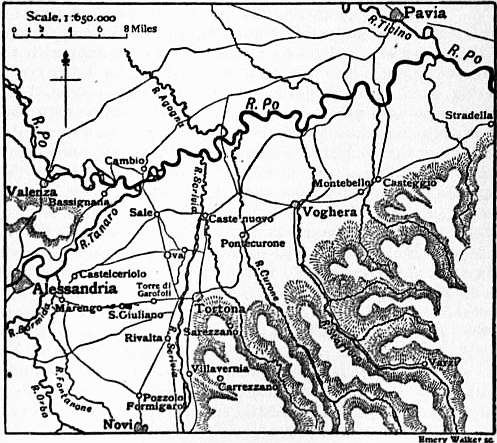
But another idea had begun to form itself in his mind. Still believing that Melas would attack him on the Stradella side, and hastening his preparations to meet this, he began to allow for the contingency of Melas giving up or failing in his Napoleon’s advance. attempt to re-establish his communication with the Mantovese, and retiring on Genoa, which was now in his hands and could be provisioned and reinforced by sea. On the 10th Napoleon ordered reserve ammunition to be sent from Pavia, giving Serravalle, which is south of Novi, as its probable destination. But this was surmise, and of the facts he knew nothing. Would the enemy move east on the Stradella, north-east on the Ticino or south on Genoa? Such reports as were available indicated no important movements whatever, which happened to be true, but could hardly appear so to the French headquarters. On the 11th, though he thereby forfeited the reinforcements coming up from Duhesme’s corps at Cremona, Napoleon ordered the main body to advance to the Scrivia. Lapoype’s division (the right flank guard), which was observing the Austrian posts towards Casale, was called to the south bank of the Po, the zone around Milan was stripped so bare of troops that there was no escort for the prisoners taken at Montebello, while information sent by Chabran (now moving up from Ivrea) as to the construction of bridges at Casale (this was a feint made by Melas on the 10th) passed unheeded. The crisis was at hand, and, clutching at the reports collected by Lapoype as to the quietude of the Austrians toward Valenza and Casale, Bonaparte and Berthier strained every nerve to bring up more men to the Voghera side in the hope of preventing the prey from slipping away to Genoa.
On the 12th, consequently, the army (the ordre de bataille of which had been considerably modified on the 11th) moved to the Scrivia, Lannes halting at Castelnuovo, Desaix (who had just joined the army from Egypt) at Pontecurone, Victor at Tortona with Murat’s cavalry in front towards Alessandria. Lapoype’s division, from the left bank of the Po, was marching in all haste to join Desaix. Moncey, Duhesme, Lechi and Chabran were absent. The latter represented almost exactly half of Berthier’s command (30,000 out of 58,000), and even the concentration of 28,000 men on the Scrivia had only been obtained by practically giving up the “barrage” on the left bank of the Po. Even now the enemy showed nothing but a rearguard, and the old questions reappeared in a new and acute form. Was Melas still in Alessandria? Was he marching on Valenza and Casale to cross the Po? or to Acqui against Suchet, or to Genoa to base himself on the British fleet? As to the first, why had he given up his chances of fighting on one of the few cavalry battlegrounds in north Italy—the plain of Marengo—since he could not stay in Alessandria for any indefinite time? The second question had been answered in the negative by Lapoype, but his latest information was thirty-six hours old. As for the other questions, no answer whatever was forthcoming, and the only course open was to postpone decisive measures and to send forward the cavalry, supported by infantry, to gain information.
On the 13th, therefore, Murat, Lannes and Victor advanced into the plain of Marengo, traversed it without difficulty and carrying the villages held by the Austrian rearguard, established themselves for the night within a mile of Marengo. the fortress. But meanwhile Napoleon, informed we may suppose of their progress, had taken a step that was fraught with the gravest consequences. He had, as we know, no intention of forcing on a decision until his reconnaissance produced the information on which to base it, and he had therefore kept back three divisions under Desaix at Pontecurone. But as the day wore on without incident, he began to fear that the reconnaissance would be profitless, and unwilling to give Melas any further start, he sent out these divisions right and left to find and to hold the enemy, whichever way the latter had gone. At noon Desaix with one division was despatched southward to Rivalta to head off Melas from Genoa and at 9 A.M. on the 14th,21 Lapoype was sent back over the Po to hold the Austrians should they be advancing from Valenza towards the Ticino. Thus there remained in hand only 21,000 men when at last, in the forenoon of the 14th the whole of Melas’s army, more than 40,000 strong, moved out of Alessandria, not southward nor northward, but due west into the plain of Marengo (q.v.). The extraordinary battle that followed is described elsewhere. The outline of it is simple enough. The Austrians advanced slowly and in the face of the most resolute opposition, until their attack had gathered weight, and at last they were carrying all before them, when Desaix returned from beyond Rivalta and initiated a series of counterstrokes. These were brilliantly successful, and gave the French not only local victory but the supreme self-confidence that, next day, enabled them to extort from Melas an agreement to evacuate all Lombardy as far as the Mincio. And though in this way the chief prize, Melas’s army, escaped after all, Marengo was the birthday of the First Empire.
One more blow, however, was required before the Second Coalition collapsed, and it was delivered by Moreau. We have seen that he had crossed the upper Rhine and defeated Kray at Stokach. This was followed by other partial victories, and Kray then retired to Ulm, where he reassembled his forces, hitherto scattered in a long weak line from the Neckar to Schaffhausen. Moreau continued his advance, extending his forces up to and over the Danube below Ulm, and winning several combats, of which the most important was that of Höchstädt, fought on the famous battlegrounds of 1703 and 1704, and memorable for the death of La Tour d’Auvergne, the “First Grenadier of France” (June 19). Finding himself in danger of envelopment, Kray now retired, swiftly and skilfully, across the front of the advancing French, and reached Ingolstadt in safety. Thence he retreated over the Inn, Moreau following him to the edge of that river, and an armistice put an end for the moment to further operations.
This not resulting in a treaty of peace, the war was resumed both in Italy and in Germany. The Army of Reserve and the Army of Italy, after being fused into one, under Masséna’s command, were divided again into a fighting army under Brune, who opposed the Austrians (Bellegarde) on the Mincio, and a political army under Murat, which re-established French influence in the Peninsula. The former, extending on a wide front as usual, won a few strategical successes without tactical victory, the only incidents of which worth recording are the gallant fight of Dupont’s division, which had become isolated during a manœuvre, at Pozzolo on the Mincio (December 25) and the descent of a corps under Macdonald from the Grisons by way of the Splügen, an achievement far surpassing Napoleon’s and even Suvárov’s exploits, in that it was made after the winter snows had set in.
In Germany the war for a moment reached the sublime. Kray had been displaced in command by the young archduke John, who ordered the denunciation of the armistice and a general advance. His plan, or that of his Hohenlinden. advisers, was to cross the lower Inn, out of reach of Moreau’s principal mass, and then to swing round the French flank until a complete chain was drawn across their rear. But during the development of the manœuvre, Moreau also moved, and by rapid marching made good the time he had lost in concentrating his over-dispersed forces. The weather was appalling, snow and rain succeeding one another until the roads were almost impassable. On the 2nd of December the Austrians were brought to a standstill, but the inherent mobility of the Revolutionary armies enabled them to surmount all difficulties, and thanks to the respite afforded him by the archduke’s halt, Moreau was able to see clearly into the enemy’s plans and dispositions. On the 3rd of December, while the Austrians in many disconnected columns were struggling through the dark and muddy forest paths about Hohenlinden, Moreau struck the decisive blow. While Ney and Grouchy held fast the head of the Austrian main column at Hohenlinden, Richepanse’s corps was directed on its left flank. In the forest Richepanse unexpectedly met a subsidiary Austrian column which actually cut his column in two. But profiting by the momentary confusion he drew off that part of his forces which had passed beyond the point of contact and continued his march, striking the flank of the archduke’s main column, most of which had not succeeded in deploying opposite Ney, at the village of Mattempost. First the baggage train and then the artillery park fell into his hands, and lastly he reached the rear of the troops engaged opposite Hohenlinden, whereupon the Austrian main body practically dissolved. The rear of Richepanse’s corps, after disengaging itself from the Austrian column it had met in the earlier part of the day, arrived at Mattempost in time to head off thousands of fugitives who had escaped from the carnage at Hohenlinden. The other columns of the unfortunate army were first checked and then driven back by the French divisions they met, which, moving more swiftly and fighting better in the broken ground and the woods, were able to combine two brigades against one wherever a fight developed. On this disastrous day the Austrians lost 20,000 men, 12,000 of them being prisoners, and 90 guns.
Marengo and Hohenlinden decided the war of the Second Coalition as Rivoli had decided that of the First, and the Revolutionary Wars came to an end with the armistice of Steyer (December 25, 1800) and the treaty of Lunéville (February 9, 1801). But only the first act of the great drama was accomplished. After a short respite Europe entered upon the Napoleonic Wars.
Bibliography.—By far the most important modern works are A. Chuquet’s Guerres de la Révolution (11 monographs forming together a complete history of the campaigns of 1792-93), and the publications of the French General Staff. The latter appear first, as a rule, in the official “Revue d’histoire” and are then republished in separate volumes, of which every year adds to the number. V. Dupuis’ L’Armée du nord 1793; Coutanceau’s L’Armée du nord 1794; J. Colin’s Éducation militaire de Napoléon and Campagne de 1793 en Alsace; and C. de Cugnac’s Campagne de l’armée de réserve 1800 may be specially named. Among other works of importance the principal are C. von B(inder)-K(rieglstein), Geist und Stoff im Kriege (Vienna, 1896); E. Gachot’s works on Masséna’s career (containing invaluable evidence though written in a somewhat rhetorical style); Ritter von Angeli, Erzherzog Karl (Vienna, 1896); F. N. Maude, Evolution of Modern Strategy; G. A. Furse, Marengo and Hohenlinden; C. von Clausewitz, Feldzug 1796 in Italien and Feldzug 1799 (French translations); H. Bonnal, De Rosbach à Ulm; Krebs and Moris, Campagnes dans les Alpes (Paris, 1891-1895); Yorck von Wartenburg, Napoleon als Feldherr (English and French translations); F. Bouvier, Bonaparte en Italie 1796; Kuhl, Bonaparte’s erster Feldzug; J. W. Fortescue, Hist. of the British Army, vol. iv.; G. D. v. Scharnhorst, Ursache des Glücks der Franzosen 1793-1794 (reprinted in A. Weiss’s Short German Military Readings, London, 1892); E. D’Hauterive, L’Armée sous la Révolution; C. Rousset, Les Volontaires; Max Jähns, Das französische Heer; Shadwell, Mountain Warfare; works of Colonel Camon (Guerre Napoléonienne, &c.); Austrian War Office, Krieg gegen die franz. Revolution 1792-1797 (Vienna, 1905); Archduke Charles, Grundsätze der Strategie (1796 campaign in Germany), and Gesch. des Feldzuges 1799 in Deutschl. und der Schweiz; v. Zeissberg, Erzherzog Karl; the old history called Victoires et conquêtes des Français (27 volumes, Paris, 1817-1825); M. Hartmann, Anteil der Russen am Feldzug 1799 in der Schweiz (Zürich, 1892); Danélewski-Miliutin, Der Krieg Russlands gegen Frankreich unter Paul I. (Munich, 1858); German General Staff, “Napoleons Feldzug 1796-1797” (Suppl. Mil. Wochenblatt, 1889), and Pirmasens und Kaiserslautern (“Kriegsgesch. Einzelschriften,” 1893).
(C. F. A.)
Naval Operations
The naval side of the wars arising out of the French Revolution was marked by unity, and even by simplicity. France had but one serious enemy, Great Britain, and Great Britain had but one purpose, to beat down France. Other states were drawn into the strife, but it was as the allies, the enemies and at times the victims, of the two dominating powers. The field of battle was the whole expanse of the ocean and the landlocked seas. The weapons, the methods and the results were the same. When a general survey of the whole struggle is taken, its unity is manifest. The Revolution produced a profound alteration in the government of France, but none in the final purposes of its policy. To secure for France its so-called “natural limits”—the Rhine, the Alps, the Pyrenees and the ocean; to protect both flanks by reducing Holland on the north and Spain on the south to submission; to confirm the mighty power thus constituted, by the subjugation of Great Britain, were the objects of the Republic and of Napoleon, as they had been of Louis XIV. The naval war, like the war on land, is here considered in the first of its two phases—the Revolutionary (1792-99). (For the Napoleonic phase (1800-15), see Napoleonic Campaigns.)
The Revolutionary war began in April 1792. In the September of that year Admiral Truguet sailed from Toulon to co-operate with the French troops operating against the Austrians and their allies in northern Italy. In December Latouche Tréville was sent with another squadron to cow the Bourbon rulers of Naples. The extreme feebleness of their opponents alone saved the French from disaster. Mutinies, which began within ten days of the storming of the Bastille (14th of July 1789), had disorganized their navy, and the effects of these disorders continued to be felt so long as the war lasted. In February 1793 war broke out with Great Britain and Holland. In March Spain was added to the list of the powers against which France declared war. Her resources at sea were wholly inadequate to meet the coalition she had provoked. The Convention did indeed order that fifty-two ships of the line should be commissioned in the Channel, but it was not able in fact to do more than send out a few diminutive and ill-appointed squadrons, manned by mutinous crews, which kept close to the coast. The British navy was in excellent order, but the many calls made on it for the protection of world-wide commerce and colonial possessions caused the operations in the Channel to be somewhat languid. Lord Howe cruised in search of the enemy without being able to bring them to action. The severe blockade which in the later stages of the war kept the British fleet permanently outside of Brest was not enforced in the earlier stages. Lord Howe preferred to save his fleet from the wear and tear of perpetual cruising by maintaining his headquarters at St Helens, and keeping watch on the French ports by frigates. The French thus secured a freedom of movement which in the course of 1794 enabled them to cover the arrival of a great convoy laden with food from America (see First of June, Battle of). This great effort was followed by a long period of languor. Its internal defects compelled the French fleet in the Channel to play a very poor part till the last days of 1796. Squadrons were indeed sent a short way to sea, but their inefficiency was conspicuously displayed when, on the 17th of June 1795, a much superior number of their line of battle ships failed to do any harm to the small force of Cornwallis, and when on the 22nd of the same month they fled in disorder before Lord Bridport at the Isle de Groix.
Operations of a more decisive character had in the meantime taken place both in the Mediterranean and in the West Indies. In April 1793 the first detachment of a British fleet, which was finally raised to a strength of 21 sail of the line, under the command of Lord Hood, sailed for the Mediterranean. By August the admiral was off Toulon, acting in combination with a Spanish naval force. France was torn by the contentions of Jacobins and Girondins, and its dissensions led to the surrender of the great arsenal to the British admiral and his Spanish colleague Don Juan de Lángara, on the 27th of August. The allies were joined later by a contingent from Naples. But the military forces were insufficient to hold the land defences against the army collected to expel them. High ground commanding the anchorage was occupied by the besieging force, and on the 18th of December 1793 the allies retired. They carried away or destroyed thirty-three French vessels, of which thirteen were of the line. But partly through the inefficiency and partly through the ill-will of the Spaniards, who were indisposed to cripple the French, whom they considered as their only possible allies against Great Britain, the destruction was not so complete as had been intended. Twenty-five ships, of which eighteen were of the line, were left to serve as the nucleus of an active fleet in later years. Fourteen thousand of the inhabitants fled with the allies to escape the vengeance of the victorious Jacobins. Their sufferings, and the ferocious massacre perpetrated on those who remained behind by the conquerors, form one of the blackest pages of the French Revolution. The Spanish fleet took no further part in the war. Lord Hood now turned to the occupation of Corsica, where the intervention of the British fleet was invited by the patriotic party headed by Pascual Paoli. The French ships left at Toulon were refitted and came to sea in the spring of 1794, but Admiral Martin who commanded them did not feel justified in giving battle, and his sorties were mere demonstrations. From the 25th of January 1794 till November 1796 the British fleet in the Mediterranean was mainly occupied in and about Corsica, securing the island, watching Toulon and co-operating with the allied Austrians and Piedmontese in northern Italy. It did much to hamper the coastwise communications of the French. But neither Lord Hood, who went home at the end of 1794, nor his indolent successor Hotham, was able to deliver an effective blow at the Toulon squadron. The second of these officers fought two confused actions with Admiral Martin in the Gulf of Lyons on the 16th of March and the 12th of July 1795, but though three French ships were cut off and captured, the baffling winds and the placid disposition of Hotham united to prevent decisive results. A new spirit was introduced into the command of the British fleet when Sir John Jervis, afterwards Earl Saint Vincent, succeeded Hotham in November 1795.
Jervis came to the Mediterranean with a high reputation, which had been much enhanced by his recent command in the West Indies. In every war with France it was the natural policy of the British government to seize on its enemy’s colonial possessions, not only because of their intrinsic value, but because they were the headquarters of active privateers. The occupation of the little fishing stations of St Pierre and Miquelon (14th May 1793) and of Pondicherry in the East Indies (23rd Aug. 1793) were almost formal measures taken at the beginning of every war. But the French West Indian islands possessed intrinsic strength which rendered their occupation a service of difficulty and hazard. In 1793 they were torn by dissensions, the result of the revolution in the mother country. Tobago was occupied in April, and the French part of the great island of San Domingo was partially thrown into British hands by the Creoles, who were threatened by their insurgent slaves. During 1794 a lively series of operations, in which there were some marked alternations of fortune, took place in and about Martinique and Guadaloupe. The British squadron, and the contingent of troops it carried, after a first repulse, occupied them both in March and April, together with Santa Lucia. A vigorous counter-attack was carried out by the Terrorist Victor Hugues with ability and ferocity. Guadaloupe and Santa Lucia were recovered in August. Yet on the whole the British government was successful in its policy of destroying the French naval power in distant seas. The seaborne commerce of the Republic was destroyed.
The naval supremacy of Great Britain was limited, and was for a time menaced, in consequence of the advance of the French armies on land. The invasion of Holland in 1794 led to the downfall of the house of Orange, and the establishment of the Batavian Republic. War with Great Britain under French dictation followed in January 1795. In that year a British expedition under the command of Admiral Keith Elphinstone (afterwards Lord Keith) occupied the Dutch colony at the Cape (August-September) and their trading station in Malacca. The British colonial empire was again extended, and the command of the sea by its fleet confirmed. But the necessity to maintain a blockading force in the German Ocean imposed a fresh strain on its naval resources, and the hostility of Holland closed a most important route to British commerce in Europe. In 1795 Spain made peace with France at Basel, and in September 1796 re-entered the war as her ally. The Spanish navy was most inefficient, but it required to be watched and therefore increased the heavy strain on the British fleet. At the same time the rapid advance of the French arms in Italy began to close the ports of the peninsula to Great Britain. Its ships were for a time withdrawn from the Mediterranean. Poor as it was in quality, the Spanish fleet was numerous. It was able to facilitate the movements of French squadrons sent to harass British commerce in the Atlantic, and a concentration of forces became necessary.
It was the more important because the cherished French scheme for an attack on the heart of the British empire began to take shape. While Spain occupied one part of the British fleet to the south, and Holland another in the north, a French expedition, which was to have been aided by a Dutch expedition from the Texel, was prepared at Brest. The Dutch were confined to harbour by the vigilant blockade of Admiral Duncan, afterwards Lord Camperdown. But in December 1796 a French fleet commanded by Admiral Morard de Galle, carrying 13,000 troops under General Hoche, was allowed to sail from Brest for Ireland, by the slack management of the blockade under Admiral Colpoys. Being ill-fitted, ill-manned and exposed to constant bad weather the French ships were scattered. Some reached their destination, Bantry Bay, only to be driven out again by north-easterly gales. The expedition finally returned after much suffering, and in fragments, to Brest. Yet the year 1797 was one of extreme trial to Great Britain. The victory of Sir John Jervis over the Spaniards near Cape Saint Vincent on the 14th of February (see Saint Vincent, Battle of) disposed of the Spanish fleet. In the autumn of the year the Dutch, having put to sea, were defeated at Camperdown by Admiral Duncan on the 11th of October. Admiral Duncan had the more numerous force, sixteen ships to fifteen, and they were on the average heavier. Attacking from windward he broke through the enemy’s line and concentrated on his rear and centre. Eight line of battleships and two frigates were taken, but the good gunnery and steady resistance of the Dutch made the victory costly. Between these two battles the British fleet was for a time menaced in its very existence by a succession of mutinies, the result of much neglect of the undoubted grievances of the sailors. The victory of Camperdown, completing what the victory of Cape Saint Vincent had begun, seemed to put Great Britain beyond fear of invasion. But the government of the Republic was intent on renewing the attempt. The successes of Napoleon at the head of the army of Italy had reduced Austria to sign the peace of Campo Formio, on the 17th of October 1797, and he was appointed commander of the new army of invasion. It was still thought necessary to maintain the bulk of the British fleet in European waters, within call in the ocean. The Mediterranean was left free to the French, whose squadrons cruised in the Levant, where the Republic had become possessed of the Ionian Islands by the plunder of Venice. The absence of a British force in the Mediterranean offered to the government of the French Republic an alternative to an invasion of Great Britain or Ireland, which promised to be less hazardous and equally effective. It was induced largely by the persuasion of Napoleon himself, and the wish of the politicians who were very willing to see him employed at a distance. The expedition to Egypt under his command sailed on the 19th of May 1798, having for its immediate purpose the occupation of the Nile valley, and for its ultimate aim an attack on Great Britain “from behind” in India (see Nile, Battle of the). The British fleet re-entered the Mediterranean to pursue and baffle Napoleon. The destruction of the French squadron at the anchorage of Aboukir on the 1st of August gave it the complete command of the sea. A second invasion of Ireland on a smaller scale was attempted and to some extent carried out, while the great attack by Egypt was in progress. One French squadron of four frigates carrying 1150 soldiers under General Humbert succeeded in sailing from Rochefort on the 6th of August. On the 22nd Humbert was landed at Killala Bay, but after making a vigorous raid he was compelled to surrender at Ballinamuck on the 8th of September. Eight days after his surrender, another French squadron of one sail of the line and eight frigates carrying 3000 troops, sailed from Brest under Commodore Bompart to support Humbert. It was watched and pursued by frigates, and on the 12th of October was overtaken and destroyed by a superior British force commanded by Sir John Borlase Warren, near Tory Island.
From the close of 1798 till the coup d’état of the 18th Brumaire (9th November) 1799, which established Napoleon as First Consul and master of France, the French navy had only one object—to reinforce and relieve the army cut off in Egypt by the battle of the Nile. The relief of the French garrison in Malta was a subordinate part of the main purpose. But the supremacy of the British navy was by this time so firmly founded that neither Egypt nor Malta could be reached except by small ships which ran the blockade. On the 25th of April, Admiral Bruix did indeed leave Brest, after baffling the blockading fleet of Lord Bridport, which was sent on a wild-goose chase to the south of Ireland by means of a despatch sent out to be captured and to deceive. Admiral Bruix succeeded in reaching Toulon, and his presence in the Mediterranean caused some disturbance. But, though his twenty-five sail of the line formed the best-manned fleet which the French had sent to sea during the war, and though he escaped being brought to battle, he did not venture to steer for the eastern Mediterranean. On the 13th of August he was back at Brest, bringing with him a Spanish squadron carried off as a hostage for the fidelity of the government at Madrid to its disastrous alliance with France. On the day on which Bruix re-entered Brest, the 13th of August 1799, a combined Russian and British expedition sailed from the Downs to attack the French army of occupation in the Batavian Republic. The military operations were unsuccessful, and terminated in the withdrawal of the allies. But the naval part was well executed. Vice-admiral Mitchell forced the entrance to the Texel, and on the 30th of August received the surrender of the remainder of the Dutch fleet—thirteen vessels in the Nieuwe Diep—the sailors having refused to fight for the republic. In spite of the failure on land, the expedition did much to confirm the naval supremacy of Great Britain by the entire suppression of the most seamanlike of the forces opposed to it.
Authorities.—Chevalier, Histoire de la marine française sous la première République (Paris, 1886); James’s Naval History (London, 1837); Captain Mahan, Influence of Sea Power upon the French Revolution and the Empire (London, 1892). The French schemes of invasion are exhaustively dealt with in Captain E. Desbrière’s Projets et tentatives de débarquements aux Îles Britanniques (Paris, 1900, &c.).
(D. H.)
1 For the following operations see map in Spanish Succession War.
2 Coburg refrained from a regular siege of Condé. He wished to gain possession of the fortress in a defensible state, intending to use it as his own depot later in the year. He therefore reduced it by famine. During the siege of Valenciennes the Allies appear to have been supplied from Mons.
3 Henceforth to the end of 1794 both armies were more or less “in cordon,” the cordon possessing greater or less density at any particular moment or place, according to the immediate intentions of the respective commanders and the general military situation.
4 In the course of this the column from Bouchain, 4500 strong, was caught in the open at Avesnes-le-Sec by 5 squadrons of the allied cavalry and literally annihilated.
5 One of the generals at Maubeuge, Chancel, was guillotined.
6 Each of the fifteen armies on foot had been allotted certain departments as supply areas, Jourdan’s being of course far away in Lorraine.
7 Liguria was not at this period thought of, even by Napoleon, as anything more than a supply area.
8 Vukassovich had received Beaulieu’s order to demonstrate with two battalions, and also appeals for help from Argenteau. He therefore brought most of his troops with him.
9 We have seen that after Tourcoing, taught by experience, Souham posted Vandamme’s covering force 14 or 15 m. out. But Napoleon’s disposition was in advance of experience.
10 The proposed alliance with the Sardinians came to nothing. The kings of Sardinia had always made their alliance with either Austria or France conditional on cessions of conquered territory. But, according to Thiers, the Directory only desired to conquer the Milanese to restore it to Austria in return for the definitive cession of the Austrian Netherlands. If this be so, Napoleon’s proclamations of “freedom for Italy” were, if not a mere political expedient, at any rate no more than an expression of his own desires which he was not powerful enough to enforce.
11 On entering the territory of the duke of Parma Bonaparte imposed, besides other contributions, the surrender of twenty famous pictures, and thus began a practice which for many years enriched the Louvre and only ceased with the capture of Paris in 1814.
12 See C. von B.-K., Geist und Stoff, pp. 449-451.
13 The assumption by later critics (Clausewitz even included) that the “flank position” held by these forces relatively to the main armies in Italy and Germany was their raison d’être is unsupported by contemporary evidence.
14 For this expedition, which was repulsed by Brune in the battle of Castricum, see Fortescue’s Hist. of the British Army, vol. iv., and Sachot’s Brune en Hollande.
15 He afterwards appointed Berthier to command the Army of Reserve, but himself accompanied it and directed it, using Berthier as chief of staff.
16 Only one division of the main body used the Little St Bernard.
17 When he made his decision he was unaware that Béthencourt had been held up at Arona.
18 This may be accounted for by the fact that Napoleon’s mind was not yet definitively made up when his advanced guard had already begun to climb the St Bernard (12th). Napoleon’s instructions for Moncey were written on the 14th. The magazines, too, had to be provided and placed before it was known whether Moreau’s detachment would be forthcoming.
19 Six guns had by now passed Fort Bard and four of these were with Murat and Duhesme, two with Lannes.
20 It is supposed that the foreign spies at Dijon sent word to their various employers that the Army was a bogy. In fact a great part of it never entered Dijon at all, and the troops reviewed there by Bonaparte were only conscripts and details. By the time that the veteran divisions from the west and Paris arrived, either the spies had been ejected or their news was sent off too late to be of use.
21 On the strength of a report, false as it turned out, that the Austrian rearguard had broken the bridges of the Bormida.
FRENCH WEST AFRICA (L’Afrique occidentale française), the common designation of the following colonies of France:—(1) Senegal, (2) Upper Senegal and Niger, (3) Guinea, (4) the Ivory Coast, (5) Dahomey; of the territory of Mauretania, and of a large portion of the Sahara. The area is estimated at nearly 2,000,000 sq. m., of which more than half is Saharan territory. The countries thus grouped under the common designation French West Africa comprise the greater part of the continent west of the Niger delta (which is British territory) and south of the tropic of Cancer. It embraces the upper and middle course of the Niger, the whole of the basin of the Senegal and the south-western part of the Sahara. Its most northern point on the coast is Cape Blanco, and it includes Cape Verde, the most westerly point of Africa. Along the Guinea coast the French possessions are separated from one another by colonies of Great Britain and other powers, but in the interior they unite not only with one another but with the hinterlands of Algeria and the French Congo.
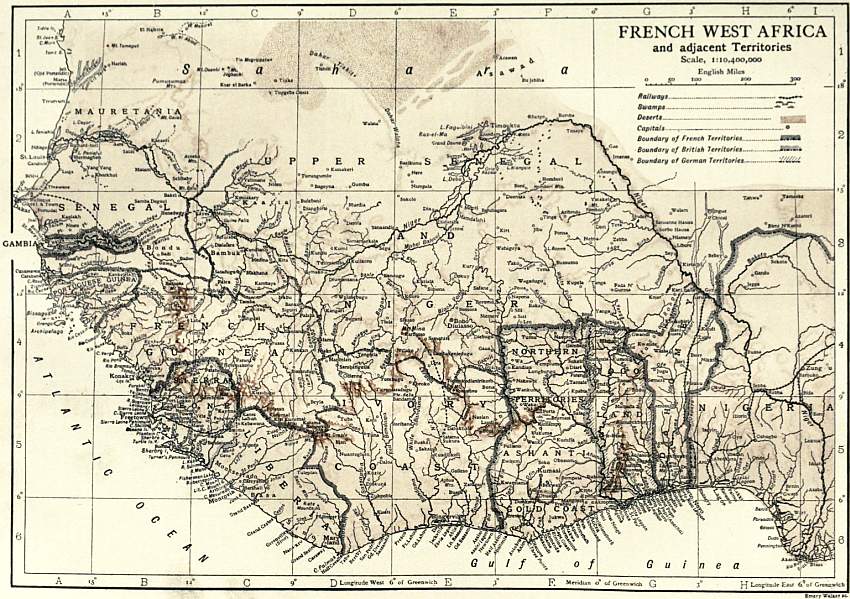
(Click to enlarge.)
In physical characteristics French West Africa presents three types: (1) a dense forest region succeeding a narrow coast belt greatly broken by lagoons; (2) moderately elevated and fertile plateaus, generally below 2000 ft., such as the region enclosed in the great bend of the Niger; (3) north of the Senegal and Niger, the desert lands forming part of the Sahara (q.v.). The most elevated districts are Futa Jallon, whence rise the Senegal, Gambia and Niger, and Gon—both massifs along the south-western edge of the plateau lands, containing heights of 5000 to 6000 ft. or more. Among the chief towns are Timbuktu and Jenné on the Niger, Porto Novo in Dahomey, and St Louis and Dakar in Senegal, Dakar being an important naval and commercial port. The inhabitants are for the most part typical Negroes, with in Senegal and in the Sahara an admixture of Berber and Arab tribes. In the upper Senegal and Futa Jallon large numbers of the inhabitants are Fula. The total population of French West Africa is estimated at about 13,000,000. The European inhabitants number about 12,000.
The French possessions in West Africa have grown by the extension inland of coast colonies, each having an independent origin. They were first brought under one general government in 1895, when they were placed under the supervision of the governor of Senegal, whose title was altered to meet the new situation. Between that date and 1905 various changes in the areas and administrations of the different colonies were made, involving the disappearance of the protectorates and military territories known as French Sudan and dependent on Senegal. These were partly absorbed in the coast colonies, whilst the central portion became the colony of Upper Senegal and Niger. At the same time the central government was freed from the direct administration of the Senegal and Niger countries (Decrees of Oct. 1902 and Oct. 1904). Over the whole of French West Africa is a governor-general, whose headquarters are at Dakar.1 He is assisted by a government council, composed of high functionaries, including the lieutenant-governors of all colonies under his control. The central government, like all other French colonial administrations, is responsible, not to the colonists, but to the home government, and its constitution is alterable at will by presidential decree save in matters on which the chambers have expressly legislated. To it is confided financial control over the colonies, responsibility for the public debt, the direction of the departments of education and agriculture, and the carrying out of works of general utility. It alone communicates with the home authorities. Its expenses are met by the duties levied on goods and vessels entering and leaving any port of French West Africa. It may make advances to the colonies under its care, and may, in case of need, demand from them contributions to the central exchequer. The administration of justice is centralized and uniform for all French West Africa. The court of appeal sits at Dakar. There is also a uniform system of land registration adopted in 1906 and based on that in force in Australia. Subject to the limitations indicated the five colonies enjoy autonomy. The territory of Mauretania is administered by a civil commissioner under the direct control of the governor-general. The colony of Senegal is represented in the French parliament by one deputy.
Since the changes in administration effected in 1895 the commerce of French West Africa has shown a steady growth, the volume of external trade increasing in the ten years 1895-1904 from £3,151,094 to £6,238,091. In 1907 the value of the trade was £7,097,000; of this 53% was with France. Apart from military expenditure, about £600,000 a year, which is borne by France, French West Africa is self-supporting. The general budget for 1906 balanced at £1,356,000. There is a public debt of some £11,000,000, mainly incurred for works of general utility.
See Senegal, French Guinea, Ivory Coast and Dahomey. For Anglo-French boundaries east of the Niger see Sahara and Nigeria. For the constitutional connexion between the colonies and France see France: Colonies. An account of the economic situation of the colonies is given by G. François in Le Gouvernement général de l’Afrique occidentale française (Paris, 1908). Consult also the annual Report on the Trade, Agriculture, &c. of French West Africa issued by the British foreign office. A map of French West Africa by A. Meunier and E. Barralier (6 sheets on the scale 1:2,000,000) was published in Paris, 1903.
1 The organization of the new government was largely the work of E. N. Roume (b. 1858), governor-general 1902-1907, an able and energetic official, formerly director of Asian affairs at the colonial ministry.
FRENTANI, one of the ancient Samnite tribes which formed an independent community on the east coast of Italy. They entered the Roman alliance after their capital, Frentrum, was taken by the Romans in 305 or 304 B.C. (Livy ix. 16. 45). This town either changed its name or perished some time after the middle of the 3rd century B.C., when it was issuing coins of its own with an Oscan legend. The town Larinum, which belonged to the same people (Pliny, Nat. Hist. iii. 103), became latinized before 200 B.C., as its coins of that epoch bear a legend—LARINOR(VM)—which cannot reasonably be treated as anything but Latin. Several Oscan inscriptions survive from the neighbourhood of Vasto (anc. Histonium), which was in the Frentane area.
On the forms of the name, and for further details see R. S. Conway, Italic Dialects, p. 206 ff and p. 212: for the coins id. No. 195-196.
FREPPEL, CHARLES ÉMILE (1827-1891), French bishop and politician, was born at Oberehnheim (Obernai), Alsace, on the 1st of June 1827. He was ordained priest in 1849 and for a short time taught history at the seminary of Strassburg, where he had previously received his clerical training. In 1854 he was appointed professor of theology at the Sorbonne, and became known as a successful preacher. He went to Rome in 1869, at the instance of Pius IX., to assist in the steps preparatory to the promulgation of the dogma of papal infallibility. He was consecrated bishop of Angers in 1870. During the Franco-German war Freppel organized a body of priests to minister to the French prisoners in Germany, and penned an eloquent protest to the emperor William I. against the annexation of Alsace-Lorraine. In 1880 he was elected deputy for Brest and continued to represent it until his death. Being the only priest in the Chamber of Deputies since the death of Dupanloup, he became the chief parliamentary champion of the Church, and, though no orator, was a frequent speaker. On all ecclesiastical affairs Freppel voted with the Royalist and Catholic party, yet on questions in which French colonial prestige was involved, such as the expedition to Tunis, Tong-King, Madagascar (1881, 1883-85), he supported the government of the day. He always remained a staunch Royalist and went so far as to oppose Leo XIII.’s policy of conciliating the Republic. He died at Angers on the 12th of December 1891. Freppel’s historical and theological works form 30 vols., the best known of which are: Les Pères apostoliques et leur époque (1859); Les Apologistes chrétiens au IIe siècle (2 vols., 1860); Saint Irénée et l’éloquence chrétienne dans la Gaule aux deux premiers siècles (1861); Tertullien (2 vols., 1863); Saint Cyprien et l’Église d’Afrique (1864); Clément d’Alexandrie (1865); Origène (2 vols., 1867).
There are interesting lives by E. Cornut (Paris, 1893) and F. Charpentier (Angers, 1904).
FRERE, SIR HENRY BARTLE EDWARD (1815-1884), British administrator, born at Clydach in Brecknockshire, on the 29th of March 1815, was the son of Edward Frere, a member of an old east county family, and a nephew of John Hookham Frere, of Anti-Jacobin and Aristophanes fame. After leaving Haileybury, Bartle Frere was appointed a writer in the Bombay civil service in 1834, and went out to India by way of Egypt, crossing the Red Sea in an open boat from Kosseir to Mokha, and sailing thence to Bombay in an Arab dhow. Having passed his examination in the native languages, he was appointed assistant collector at Poona in 1835. There he did valuable work and was in 1842 chosen as private secretary to Sir George Arthur, governor of Bombay. Two years later he became political resident at the court of the rajah of Satara, where he did much to benefit the country by the development of its communications. On the rajah’s death in 1848 he administered the province both before and after its formal annexation in 1849. In 1850 he was appointed chief commissioner of Sind, and took ample advantage of the opportunities afforded him of developing the province. He pensioned off the dispossessed amirs, improved the harbour at Karachi, where he also established municipal buildings, a museum and barracks, instituted fairs, multiplied roads, canals and schools.
Returning to India in 1857 after a well-earned rest, Frere was greeted at Karachi with news of the mutiny. His rule had been so successful that he felt he could answer for the internal peace of his province. He therefore sent his only European regiment to Multan, thus securing that strong fortress against the rebels, and sent further detachments to aid Sir John Lawrence in the Punjab. The 178 British soldiers who remained in Sind proved sufficient to extinguish such insignificant outbreaks as occurred. His services were fully recognized by the Indian authorities, and he received the thanks of both houses of parliament and was made K.C.B. He became a member of the viceroy’s council in 1859, and was especially serviceable in financial matters. In 1862 he was appointed governor of Bombay, where he effected great improvements, such as the demolition of the old ramparts, and the erection of handsome public offices upon a portion of the space, the inauguration of the university buildings and the improvement of the harbour. He established the Deccan College at Poona, as well as a college for instructing natives in civil engineering. The prosperity—due to the American Civil War—which rendered these developments possible brought in its train a speculative mania, which led eventually to the disastrous failure of the Bombay Bank (1866), an affair in which, from neglecting to exercise such means of control as he possessed, Frere incurred severe and not wholly undeserved censure. In 1867 he returned to England, was made G.C.S.I., and received honorary degrees from Oxford and Cambridge; he was also appointed a member of the Indian council.
In 1872 he was sent by the foreign office to Zanzibar to negotiate a treaty with the sultan, Seyyid Burghash, for the suppression of the slave traffic. In 1875 he accompanied the prince of Wales to Egypt and India. The tour was beyond expectation successful, and to Frere, from Queen Victoria downwards, came acknowledgments of the service he had rendered in piloting the expedition. He was asked by Lord Beaconsfield to choose between being made a baronet or G.C.B. He chose the former, but the queen bestowed both honours upon him. But the greatest service that Frere undertook on behalf of his country was to be attempted not in Asia, but in Africa. Sir Bartle landed at Cape Town as high commissioner of South Africa on the 31st of March 1877. He had been chosen by Lord Carnarvon in the previous October as the statesman most capable of carrying his scheme of confederation into effect, and within two years it was hoped that he would be the first governor of the South African Dominion. He went out in harmony with the aims and enthusiasm of his chief, “hoping to crown by one great constructive effort the work of a bright and noble life.” In this hope he was disappointed. As he stated at the close of his high commissionership, a great mistake seemed to have been made in trying to hasten what could only result from natural growth, and the state of South Africa during Frere’s tenure of office was inimical to such growth.
Discord or a policy of blind drifting seemed to be the alternatives presented to Frere upon his arrival at the Cape. He chose the former as the less dangerous, and the first year of his sway was marked by a Kaffir war on the one hand and by a rupture with the Cape (Molteno-Merriman) ministry on the other. The Transkei Kaffirs were subjugated early in 1878 by General Thesiger (the 2nd Lord Chelmsford) and a small force of regular and colonial troops. The constitutional difficulty was solved by Frere dismissing his obstructive cabinet and entrusting the formation of a ministry to Mr (afterwards Sir) Gordon Sprigg. Frere emerged successfully from a year of crisis, but the advantage was more than counterbalanced by the resignation of Lord Carnarvon early in 1878, at a time when Frere required the steadiest and most unflinching support. He had reached the conclusion that there was a widespread insurgent spirit pervading the natives, which had its focus and strength in the celibate military organization of Cetywayo and in the prestige which impunity for the outrages he had committed had gained for the Zulu king in the native mind. That organization and that evil prestige must be put an end to, if possible by moral pressure, but otherwise by force. Frere reiterated these views to the colonial office, where they found a general acceptance. When, however, Frere undertook the responsibility of forwarding, in December 1878, an ultimatum to Cetywayo, the home government abruptly discovered that a native war in South Africa was inopportune and raised difficulties about reinforcements. Having entrusted to Lord Chelmsford the enforcement of the British demands, Frere’s immediate responsibility ceased. On the 11th of January 1879 the British troops crossed the Tugela, and fourteen days later the disaster of Isandhlwana was reported; and Frere, attacked and censured in the House of Commons, was but feebly defended by the government. Lord Beaconsfield, it appears, supported Frere; the majority of the cabinet were inclined to recall him. The result was the unsatisfactory compromise by which he was censured and begged to stay on. Frere wrote an elaborate justification of his conduct, which was adversely commented on by the colonial secretary (Sir Michael Hicks Beach), who “did not see why Frere should take notice of attacks; and as to the war, all African wars had been unpopular.” Frere’s rejoinder was that no other sufficient answer had been made to his critics, and that he wished to place one on record. “Few may now agree with my view as to the necessity of the suppression of the Zulu rebellion. Few, I fear, in this generation. But unless my countrymen are much changed, they will some day do me justice. I shall not leave a name to be permanently dishonoured.”
The Zulu trouble and the disaffection that was brewing in the Transvaal reacted upon each other in the most disastrous manner. Frere had borne no part in the actual annexation of the Transvaal, which was announced by Sir Theophilus Shepstone a few days after the high commissioner’s arrival at Cape Town. The delay in giving the country a constitution afforded a pretext for agitation to the malcontent Boers, a rapidly increasing minority, while the reverse at Isandhlwana had lowered British prestige. Owing to the Kaffir and Zulu wars Sir Bartle had hitherto been unable to give his undivided attention to the state of things in the Transvaal. In April 1879 he was at last able to visit that province, and the conviction was forced upon him that the government had been unsatisfactory in many ways. The country was very unsettled. A large camp, numbering 4000 disaffected Boers, had been formed near Pretoria, and they were terrorizing the country. Frere visited them unarmed and practically alone. Even yet all might have been well, for he won the Boers’ respect and liking. On the condition that the Boers dispersed, Frere undertook to present their complaints to the British government, and to urge the fulfilment of the promises that had been made to them. They parted with mutual good feeling, and the Boers did eventually disperse—on the very day upon which Frere received the telegram announcing the government’s censure. He returned to Cape Town, and his journey back was in the nature of a triumph. But bad news awaited him at Government House—on the 1st of June 1879 the prince imperial had met his death in Zululand—and a few hours later Frere heard that the government of the Transvaal and Natal, together with the high commissionership in the eastern part of South Africa, had been transferred from him to Sir Garnet Wolseley.
When Gladstone’s ministry came into office in the spring of 1880, Lord Kimberley had no intention of recalling Frere. In June, however, a section of the Liberal party memorialized Gladstone to remove him, and the prime minister weakly complied (1st August 1880). Upon his return Frere replied to the charges relating to his conduct respecting Afghanistan as well as South Africa, previously preferred in Gladstone’s Midlothian speeches, and was preparing a fuller vindication when he died at Wimbledon from the effect of a severe chill on the 29th of May 1884. He was buried in St Paul’s, and in 1888 a statue of Frere upon the Thames embankment was unveiled by the prince of Wales. Frere edited the works of his uncle, Hookham Frere, and the popular story-book, Old Deccan Days, written by his daughter, Mary Frere. He was three times president of the Royal Asiatic Society.
His Life and Correspondence, by John Martineau, was published in 1895. For the South African anti-confederation view, see P. A. Molteno’s Life and Times of Sir John Charles Molteno (2 vols., London 1900). See also South Africa: History.
FRERE, JOHN HOOKHAM (1769-1846), English diplomatist and author, was born in London on the 21st of May 1769. His father, John Frere, a gentleman of a good Suffolk family, had been educated at Caius College, Cambridge, and would have been senior wrangler in 1763 but for the redoubtable competition of Paley; his mother, daughter of John Hookham, a rich London merchant, was a lady of no small culture, accustomed to amuse her leisure with verse-writing. His father’s sister Eleanor, who married Sir John Fenn (1739-1794), the learned editor of the Paston Letters, wrote various educational works for children under the pseudonyms “Mrs Lovechild” and “Mrs Teachwell.” Young Frere was sent to Eton in 1785, and there began an intimacy with Canning which greatly affected his after life. From Eton he went to his father’s college at Cambridge, and graduated B.A. in 1792 and M.A. in 1795. He entered public service in the foreign office under Lord Grenville, and sat from 1796 to 1802 as member of parliament for the close borough of West Looe in Cornwall.
From his boyhood he had been a warm admirer of Pitt, and along with Canning he entered heart and soul into the defence of his government, and contributed freely to the pages of the Anti-Jacobin, edited by Gifford. He contributed, in collaboration with Canning, “The Loves of the Triangles,” a clever parody of Darwin’s “Loves of the Plants,” “The Needy Knife-Grinder” and “The Rovers.” On Canning’s removal to the board of trade in 1799 he succeeded him as under-secretary of state; in October 1800 he was appointed envoy extraordinary and plenipotentiary to Lisbon; and in September 1802 he was transferred to Madrid, where he remained for two years. He was recalled on account of a personal disagreement he had with the duke of Alcudia, but the ministry showed its approval of his action by a pension of £1700 a year. He was made a member of the privy council in 1805; in 1807 he was appointed plenipotentiary at Berlin, but the mission was abandoned, and Frere was again sent to Spain in 1808 as plenipotentiary to the Central Junta. The condition of Spain rendered his position a very responsible and difficult one. When Napoleon began to advance on Madrid it became a matter of supreme importance to decide whether Sir John Moore, who was then in the north of Spain, should endeavour to anticipate the occupation of the capital or merely make good his retreat, and if he did retreat whether he should do so by Portgual or by Galicia. Frere was strongly of opinion that the bolder was the better course, and he urged his views on Sir John Moore with an urgent and fearless persistency that on one occasion at least overstepped the limits of his commission. After the disastrous retreat to Corunna, the public accused Frere of having by his advice endangered the British army, and though no direct censure was passed upon his conduct by the government, he was recalled, and the marquess of Wellesley was appointed in his place.
Thus ended Frere’s public life. He afterwards refused to undertake an embassy to St Petersburg, and twice declined the honour of a peerage. In 1816 he married Elizabeth Jemima, dowager countess of Erroll, and in 1820, on account of her failing health, he went with her to the Mediterranean. There he finally settled in Malta, and though he afterwards visited England more than once, the rest of his life was for the most part spent in the island of his choice. In quiet retirement he devoted himself to literature, studied his favourite Greek authors, and taught himself Hebrew and Maltese. His hospitality was well known to many an English guest, and his charities and courtesies endeared him to his Maltese neighbours. He died at the Pietà Valetta on the 7th of January 1846. Frere’s literary reputation now rests entirely upon his spirited verse translations of Aristophanes, which remain in many ways unrivalled. The principles according to which he conducted his task were elucidated in an article on Mitchell’s Aristophanes, which he contributed to The Quarterly Review, vol. xxiii. The translations of The Acharnians, The Knights, The Birds, and The Frogs were privately printed, and were first brought into general notice by Sir G. Cornewall Lewis in the Classical Museum for 1847. They were followed some time after by Theognis Restitutus, or the personal history of the poet Theognis, reduced from an analysis of his existing fragments. In 1817 he published a mock-heroic Arthurian poem entitled Prospectus and Specimen of an intended National Work, by William and Robert Whistlecraft, of Stowmarket in Suffolk, Harness and Collar Makers, intended to comprise the most interesting particulars relating to King Arthur and his Round Table. William Tennant in Anster Fair had used the ottava rima as a vehicle for semi-burlesque poetry five years earlier, but Frere’s experiment is interesting because Byron borrowed from it the measure that he brought to perfection in Don Juan.
Frere’s complete works were published in 1871, with a memoir by his nephews, W. E. and Sir Bartle Frere, and reached a second edition in 1874. Compare also Gabrielle Festing, J. H. Frere and his Friends (1899).
FRÈRE, PIERRE ÉDOUARD (1819-1886), French painter, studied under Delaroche, entered the École des Beaux-Arts in 1836 and exhibited first at the Salon in 1843. The marked sentimental tendency of his art makes us wonder at Ruskin’s enthusiastic eulogy which finds in Frère’s work “the depth of Wordsworth, the grace of Reynolds, and the holiness of Angelico.” What we can admire in his work is his accomplished craftsmanship and the intimacy and tender homeliness of his conception. Among his chief works are the two paintings, “Going to School” and “Coming from School,” “The Little Glutton” (his first exhibited picture) and “L’Exercice” (Mr Astor’s collection). A journey to Egypt in 1860 resulted in a small series of Orientalist subjects, but the majority of Frère’s paintings deal with the life of the kitchen, the workshop, the dwellings of the humble, and mainly with the pleasures and little troubles of the young, which the artist brings before us with humour and sympathy. He was one of the most popular painters of domestic genre in the middle of the 19th century.
FRÈRE-ORBAN, HUBERT JOSEPH WALTHER (1812-1896), Belgian statesman, was born at Liége on the 24th of April 1812. His family name was Frère, to which on his marriage he added his wife’s name of Orban. After studying law in Paris, he practised as a barrister at Liége, took a prominent part in the Liberal movement, and in June 1847 was returned to the Chamber as member for Liége. In August of the same year he was appointed minister of public works in the Rogier cabinet, and from 1848 to 1852 was minister of finance. He founded the Banque Nationale and the Caisse d’Épargne, abolished the newspaper tax, reduced the postage, and modified the customs duties as a preliminary to a decided free-trade policy. The Liberalism of the cabinet, in which Frère-Orban exercised an influence hardly inferior to that of Rogier, was, however, distasteful to Napoleon III. Frère-Orban, to facilitate the negotiations for a new commercial treaty, conceded to France a law of copyright, which proved highly unpopular in Belgium, and he resigned office, soon followed by the rest of the cabinet. His work La Mainmorte et la charité (1854-1857), published under the pseudonym of “Jean van Damme,” contributed greatly to restore his party to power in 1857, when he again became minister of finance. He now embodied his free-trade principles in commercial treaties with England and France, and abolished the octroi duties and the tolls on the national roads. He resigned in 1861 on the gold question, but soon resumed office, and in 1868 succeeded Rogier as prime minister. In 1869 he defeated the attempt of France to gain control of the Luxemburg railways, but, despite this service to his country, fell from power at the elections of 1870. He returned to office in 1878 as president of the council and foreign minister. He provoked the bitter opposition of the Clerical party by his law of 1879 establishing secular primary education, and in 1880 went so far as to break off diplomatic relations with the Vatican. He next found himself at variance with the Radicals, whose leader, Janson, moved the introduction of universal suffrage. Frère-Orban, while rejecting the proposal, conceded an extension of the franchise (1883); but the hostility of the Radicals, and the discontent caused by a financial crisis, overthrew the government at the elections of 1884. Frère-Orban continued to take an active part in politics as leader of the Liberal opposition till 1894, when he failed to secure re-election. He died at Brussels on the 2nd of January 1896. Besides the work above mentioned, he published La Question monétaire (1874); La Question monétaire en Belgique in 1889; Échange de vues entre MM. Frère-Orban et E. de Laveleye (1890); and La Révision constitutionnelle en Belgique et ses conséquences (1894). He was also the author of numerous pamphlets, among which may be mentioned his last work, La Situation présente (1895).
FRÉRET, NICOLAS (1688-1749), French scholar, was born at Paris on the 15th of February 1688. His father was procureur to the parlement of Paris, and destined him to the profession of the law. His first tutors were the historian Charles Rollin and Father Desmolets (1677-1760). Amongst his early studies history, chronology and mythology held a prominent place. To please his father he studied law and began to practise at the bar; but the force of his genius soon carried him into his own path. At nineteen he was admitted to a society of learned men before whom he read memoirs on the religion of the Greeks, on the worship of Bacchus, of Ceres, of Cybele and of Apollo. He was hardly twenty-six years of age when he was admitted as pupil to the Academy of Inscriptions. One of the first memoirs which he read was a learned and critical discourse, Sur l’origine des Francs (1714). He maintained that the Franks were a league of South German tribes and not, according to the legend then almost universally received, a nation of free men deriving from Greece or Troy, who had kept their civilization intact in the heart of a barbarous country. These sensible views excited great indignation in the Abbé Vertot, who denounced Fréret to the government as a libeller of the monarchy. A lettre de cachet was issued, and Fréret was sent to the Bastille. During his three months of confinement he devoted himself to the study of the works of Xenophon, the fruit of which appeared later in his memoir on the Cyropaedia. From the time of his liberation in March 1715 his life was uneventful. In January 1716 he was received associate of the Academy of Inscriptions, and in December 1742 he was made perpetual secretary. He worked without intermission for the interests of the Academy, not even claiming any property in his own writings, which were printed in the Recueil de l’académie des inscriptions. The list of his memoirs, many of them posthumous, occupies four columns of the Nouvelle Biographie générale. They treat of history, chronology, geography, mythology and religion. Throughout he appears as the keen, learned and original critic; examining into the comparative value of documents, distinguishing between the mythical and the historical, and separating traditions with an historical element from pure fables and legends. He rejected the extreme pretensions of the chronology of Egypt and China, and at the same time controverted the scheme of Sir Isaac Newton as too limited. He investigated the mythology not only of the Greeks, but of the Celts, the Germans, the Chinese and the Indians. He was a vigorous opponent of the theory that the stories of mythology may be referred to historic originals. He also suggested that Greek mythology owed much to the Phoenicians and Egyptians. He was one of the first scholars of Europe to undertake the study of the Chinese language; and in this he was engaged at the time of his committal to the Bastille. He died in Paris on the 8th of March 1749.
Long after his death several works of an atheistic character were falsely attributed to him, and were long believed to be his. The most famous of these spurious works are the Examen critique des apologistes de la religion chrétienne (1766), and the Lettre de Thrasybule à Leucippe, printed in London about 1768. A very defective and inaccurate edition of Fréret’s works was published in 1796-1799. A new and complete edition was projected by Champollion-Figeac, but of this only the first volume appeared (1825). It contains a life of Fréret. His manuscripts, after passing through many hands, were deposited in the library of the Institute. The best account of his works is “Examen critique des ouvrages composés par Fréret” in C. A. Walckenaer’s Recueil des notices, &c. (1841-1850). See also Quérard’s France littéraire.
FRÉRON, ÉLIE CATHERINE (1719-1776), French critic and controversialist, was born at Quimper in 1719. He was educated by the Jesuits, and made such rapid progress in his studies that before the age of twenty he was appointed professor at the college of Louis-le-Grand. He became a contributor to the Observations sur les écrits modernes of the abbé Guyot Desfontaines. The very fact of his collaboration with Desfontaines, one of Voltaire’s bitterest enemies, was sufficient to arouse the latter’s hostility, and although Fréron had begun his career as one of his admirers, his attitude towards Voltaire soon changed. Fréron in 1746 founded a similar journal of his own, entitled Lettres de la Comtesse de.... It was suppressed in 1749, but he immediately replaced it by Lettres sur quelques écrits de ce temps, which, with the exception of a short suspension in 1752, on account of an attack on the character of Voltaire, was continued till 1754, when it was succeeded by the more ambitious Année littéraire. His death at Paris on the 10th of March 1776 is said to have been hastened by the temporary suppression of this journal. Fréron is now remembered solely for his attacks on Voltaire and the Encyclopaedists, and by the retaliations they provoked on the part of Voltaire, who, besides attacking him in epigrams, and even incidentally in some of his tragedies, directed against him a virulent satire, Le Pauvre diable, and made him the principal personage in a comedy L’Écossaise, in which the journal of Fréron is designated L’Âne littéraire. A further attack on Fréron entitled Anecdotes sur Fréron ... (1760), published anonymously, is generally attributed to Voltaire.
Fréron was the author of Ode sur la bataille de Fontenoy (1745); Histoire de Marie Stuart (1742, 2 vols.); and Histoire de l’empire d’Allemagne, (1771, 8 vols.). See Ch. Nisard, Les Ennemis de Voltaire (1853); Despois, Journalistes et journaux du XVIIIe siècle; Barthélemy, Les confessions de Fréron: Ch. Monselet, Fréron, ou l’illustre critique (1864); Fréron, sa vie, souvenirs, &c. (1876).
FRÉRON, LOUIS MARIE STANISLAS (1754-1802), French revolutionist, son of the preceding, was born at Paris on the 17th of August 1754. His name was, on the death of his father, attached to L’Année littéraire, which was continued till 1790 and edited successively by the abbés G. M. Royou and J. L. Geoffroy. On the outbreak of the revolution Fréron, who was a schoolfellow of Robespierre and Camille Desmoulins, established the violent journal L’Orateur du peuple. Commissioned, along with Barras in 1793, to establish the authority of the convention at Marseilles and Toulon, he distinguished himself in the atrocity of his reprisals, but both afterwards joined the Thermidoriens, and Fréron became the leader of the jeunesse dorée and of the Thermidorian reaction. He brought about the accusation of Fouquier-Tinville, and of J. B. Carrier, the deportation of B. Barère, and the arrest of the last Montagnards. He made his paper the official journal of the reactionists, and being sent by the Directory on a mission of peace to Marseilles he published in 1796 Mémoire historique sur la réaction royale et sur les malheurs du midi. He was elected to the council of the Five Hundred, but not allowed to take his seat. Failing as suitor for the hand of Pauline Bonaparte, one of Napoleon’s sisters, he went in 1799 as commissioner to Santo Domingo and died there in 1802. General V. M. Leclerc, who had married Pauline Bonaparte, also received a command in Santo Domingo in 1801, and died in the same year as his former rival.
FRESCO (Ital. for cool, “fresh”), a term introduced into English, both generally (as in such phrases as al fresco, “in the fresh air”), and more especially as a technical term for a sort of mural painting on plaster. In the latter sense the Italians distinguished painting a secco (when the plaster had been allowed to dry) from a fresco (when it was newly laid and still wet). The nature and history of fresco-painting is dealt with in the article Painting.
FRESCOBALDI, GIROLAMO (1583-1644), Italian musical composer, was born in 1583 at Ferrara. Little is known of his life except that he studied music under Alessandro Milleville, and owed his first reputation to his beautiful voice. He was organist at St Peter’s in Rome from 1608 to 1628. According to Baini no less than 30,000 people flocked to St Peter’s on his first appearance there. On the 20th of November 1628 he went to live in Florence, becoming organist to the duke. From December 1633 to March 1643 he was again organist at St Peter’s. But in the last year of his life he was organist in the parish church of San Lorenzo in Monte. He died on the 2nd of March 1644, being buried at Rome in the Church of the Twelve Apostles. Frescobaldi also excelled as a teacher, Frohberger being the most distinguished of his pupils. Frescobaldi’s compositions show the consummate art of the early Italian school, and his works for the organ more especially are full of the finest devices of fugal treatment. He also wrote numerous vocal compositions, such as canzone, motets, hymns, &c., a collection of madrigals for five voices (Antwerp, 1608) being among the earliest of his published works.
FRESENIUS, KARL REMIGIUS (1818-1897), German chemist, was born at Frankfort-on-Main on the 28th of December 1818. After spending some time in a pharmacy in his native town, he entered Bonn University in 1840, and a year later migrated to Giessen, where he acted as assistant in Liebig’s laboratory, and in 1843 became assistant professor. In 1845 he was appointed to the chair of chemistry, physics and technology at the Wiesbaden Agricultural Institution, and three years later he became the first director of the chemical laboratory which he induced the Nassau government to establish at that place. Under his care this laboratory continuously increased in size and popularity, a school of pharmacy being added in 1862 (though given up in 1877) and an agricultural research laboratory in 1868. Apart from his administrative duties Fresenius occupied himself almost exclusively with analytical chemistry, and the fullness and accuracy of his text-books on that subject (of which that on qualitative analysis first appeared in 1841 and that on quantitative in 1846) soon rendered them standard works. Many of his original papers were published in the Zeitschrift für analytische Chemie, which he founded in 1862 and continued to edit till his death. He died suddenly at Wiesbaden on the 11th of June 1897. In 1881 he handed over the directorship of the agricultural research station to his son, Remigius Heinrich Fresenius (b. 1847), who was trained under H. Kolbe at Leipzig. Another son, Theodor Wilhelm Fresenius (b. 1856), was educated at Strassburg and occupied various positions in the Wiesbaden laboratory.
FRESHWATER, a watering place in the Isle of Wight, England, 12 m. W. by S. of Newport by rail. Pop.(1901) 3306. It is a scattered township lying on the peninsula west of the river Var, which forms the western extremity of the island. The portion known as Freshwater Gate fronts the English Channel from the strip of low-lying coast interposed between the cliffs of the peninsula and those of the main part of the island. The peninsula rises to 397 ft. in Headon Hill, and the cliffs are magnificent. The western promontory is flanked on the north by the picturesque Alum Bay, and the lofty detached rocks known as the Needles lie off it. Farringford House in the parish was for some time the home of Alfred, Lord Tennyson, who is commemorated by a tablet in All Saints’ church and by a great cross on the high downs above the town. There are golf links on the downs.
FRESNEL, AUGUSTIN JEAN (1788-1827), French physicist, the son of an architect, was born at Broglie (Eure) on the 10th of May 1788. His early progress in learning was slow, and when eight years old he was still unable to read. At the age of thirteen he entered the École Centrale in Caen, and at sixteen and a half the École Polytechnique, where he acquitted himself with distinction. Thence he went to the École des Ponts et Chaussées. He served as an engineer successively in the departments of Vendée, Drôme and Ille-et-Villaine; but his espousal of the cause of the Bourbons in 1814 occasioned, on Napoleon’s reaccession to power, the loss of his appointment. On the second restoration he obtained a post as engineer in Paris, where much of his life from that time was spent. His researches in optics, continued until his death, appear to have been begun about the year 1814, when he prepared a paper on the aberration of light, which, however, was not published. In 1818 he read a memoir on diffraction for which in the ensuing year he received the prize of the Académie des Sciences at Paris. He was in 1823 unanimously elected a member of the academy, and in 1825 he became a member of the Royal Society of London, which in 1827, at the time of his last illness, awarded him the Rumford medal. In 1819 he was nominated a commissioner of lighthouses, for which he was the first to construct compound lenses as substitutes for mirrors. He died of consumption at Ville-d’Avray, near Paris, on the 14th of July 1827.
The undulatory theory of light, first founded upon experimental demonstration by Thomas Young, was extended to a large class of optical phenomena, and permanently established by his brilliant discoveries and mathematical deductions. By the use of two plane mirrors of metal, forming with each other an angle of nearly 180°, he avoided the diffraction caused in the experiment of F. M. Grimaldi (1618-1663) on interference by the employment of apertures for the transmission of the light, and was thus enabled in the most conclusive manner to account for the phenomena of interference in accordance with the undulatory theory. With D. F. J. Arago he studied the laws of the interference of polarized rays. Circularly polarized light he obtained by means of a rhomb of glass, known as “Fresnel’s rhomb,” having obtuse angles of 126°, and acute angles of 54°. His labours in the cause of optical science received during his lifetime only scant public recognition, and some of his papers were not printed by the Académie des Sciences till many years after his decease. But, as he wrote to Young in 1824, in him “that sensibility, or that vanity, which people call love of glory” had been blunted. “All the compliments,” he says, “that I have received from Arago, Laplace and Biot never gave me so much pleasure as the discovery of a theoretic truth, or the confirmation of a calculation by experiment.”
See Duleau, “Notice sur Fresnel,” Revue ency. t. xxxix.; Arago, Œuvres complètes, t. i.; and Dr G. Peacock, Miscellaneous Works of Thomas Young, vol. i.
FRESNILLO, a town of the state of Zacatecas, Mexico, 37 m. N.W. of the city of Zacatecas on a branch of the Santiago river. Pop. (1900) 6309. It stands on a fertile plain between the Santa Cruz and Zacatecas ranges, about 7700 ft. above sea-level, has a temperate climate, and is surrounded by an agricultural district producing Indian corn and wheat. It is a clean, well-built town, whose chief distinction is its school of mines founded in 1853. Fresnillo has large amalgam works for the reduction of silver ores. Its silver mines, located in the neighbouring Proaño hill, were discovered in 1569, and were for a time among the most productive in Mexico. Since 1833, when their richest deposits were reached, the output has greatly decreased. There is a station near on the Mexican Central railway.
FRESNO, a city and the county-seat of Fresno county, California, U.S.A., situated in the San Joaquin valley (altitude about 300 ft.) near the geographical centre of the state. Pop. (1880) 1112; (1890) 10,818; (1900) 12,470, of whom 3299 were foreign-born and 1279 were Asiatics; (1910 census) 24,892. The city is served by the Southern Pacific and the Atchison, Topeka & Santa Fé railways. The county is mainly a vast expanse of naturally arid plains and mountains. The valley is the scene of an extensive irrigation system, water being brought (first in 1872-1876) from King’s river, 20 m. distant; in 1905 500 sq. m. were irrigated. Fresno is in a rich farming country, producing grains and fruit, and is the only place in America where Smyrna figs have been grown with success; it is the centre of the finest raisin country of the state, and has extensive vineyards and wine-making establishments. The city’s principal manufacture is preserved (dried) fruits, particularly raisins; the value of the fruits thus preserved in 1905 was $6,942,440, being 70.5% of the total value of the factory product in that year ($9,849,001). In 1900-1905 the factory product increased 257.9%, a ratio of increase greater than that of any other city in the state. In the mountains, lumbering and mining are important industries; lumber is carried from Shaver in the mountains to Clovis on the plains by a V-shaped flume 42 m. long, the waste water from which is ditched for irrigation. The petroleum field of the county is one of the richest in California. Fresno is the business and shipping centre of its county and of the surrounding region. The county was organized in 1856. In 1872 the railway went through, and Fresno was laid out and incorporated. It became the county-seat in 1874 and was chartered as a city in 1885.
FRESNOY, CHARLES ALPHONSE DU (1611-1665), French painter and writer on his art, was born in Paris, son of an apothecary. He was destined for the medical profession, and well educated in Latin and Greek; but, having a natural propensity for the fine arts, he would not apply to his intended vocation, and was allowed to learn the rudiments of design under Perrier and Vouet. At the age of twenty-one he went off to Rome, with no resources; he drew ruins and architectural subjects. After two years thus spent he re-encountered his old fellow-student Pierre Mignard, and by his aid obtained some amelioration of his professional prospects. He studied Raphael and the antique, went in 1633 to Venice, and in 1656 returned to France. During two years he was now employed in painting altar-pieces in the château of Raincy, landscapes, &c. His death was caused by an attack of apoplexy followed by palsy; he expired at Villiers le Bel, near Paris. He never married. His pictorial works are few; they are correct in drawing, with something of the Caracci in design, and of Titian in colouring, but wanting fire and expression, and insufficient to keep his name in any eminent repute. He is remembered now almost entirely as a writer rather than painter. His Latin poem, De arte graphica, was written during his Italian sojourn, and embodied his observations on the art of painting; it may be termed a critical treatise on the practice of the art, with general advice to students. The precepts are sound according to the standard of his time; the poetical merits slender enough. The Latin style is formed chiefly on Lucretius and Horace. This poem was first published by Mignard, and has been translated into several languages. In 1684 it was turned into French by Roger de Piles; Dryden translated the work into English prose; and a rendering into verse by Mason followed, to which Sir Joshua Reynolds added some annotations.
FRET. (1) (From O. Eng. fretan, a word common in various forms to Teutonic languages; cf. Ger. fressen, to eat greedily), properly to devour, hence to gnaw, so used of the slow corroding action of chemicals, water, &c., and hence, figuratively, to chafe or irritate. Possibly connected with this word, in sense of rubbing, is the use of “fret” for a bar on the fingerboard of a banjo, guitar, or similar musical instruments to mark the fingering. (2) (Of doubtful origin; possibly from the O. Eng. frætive, ornaments, but its use is paralleled by the Fr. frette, trellis or lattice), network, a term used in heraldry for an interlaced figure, but best known as applied to the decoration used by the Greeks in their temples and vases: the Greek fret consists of a series of narrow bands of different lengths, placed at right angles to one another, and of great variety of design. It is an ornament which owes its origin to woven fabrics, and is found on the ceilings of the Egyptian tombs at Benihasan, Siout and elsewhere. In Greek work it was painted on the abacus of the Doric capital and probably on the architraves of their temples; when employed by the Romans it was generally carved; the Propylaea of the temple at Damascus and the temple at Atil being examples of the 2nd century. It was carved in large dimensions on some of the Mexican temples, as for instance on the palace at Mitla with other decorative bands, all of which would seem to have been reproductions of woven patterns, and had therefore an independent origin. It is found in China and Japan, and in the latter country when painted on lacquer is employed as a fret-diaper, the bands not being at right angles to one another but forming acute and obtuse angles. In old English writers a wider signification was given to it, as it was applied to raised patterns in plaster oh roofs or ceilings, which were not confined to the geometrical fret but extended to the modelling of flowers, leaves and fruit; in such cases the decoration was known as fret-work. In France the fret is better known as the “meander.”
FREUDENSTADT, a town of Germany, in the kingdom of Württemberg, on the right bank of the Murg, 40 m. S.W. from Stuttgart, on the railway to Hochdorf. Pop. 7000. It has a Protestant and a Roman Catholic church, some small manufactures of cloth, furniture, knives, nails and glass, and is frequented as a climatic health resort. It was founded in 1599 by Protestant refugees from Salzburg.
FREUND, WILHELM (1806-1894), German philologist and lexicographer, was born at Kempen in the grand duchy of Posen on the 27th of January 1806. He studied at Berlin, Breslau and Halle, and was for twenty years chiefly engaged in private tuition. From 1855-1870 he was director of the Jewish school at Gleiwitz in Silesia, and subsequently retired to Breslau, where he died on the 4th of June 1894. Although chiefly known for his philological labours, Freund took an important part in the movement for the emancipation of his Prussian co-religionists, and the Judengesetz of 1847 was in great measure the result of his efforts. The work by which he is best known is his Wörterbuch der lateinischen Sprache (1834-1845), practically the basis of all Latin-English dictionaries. His Wie studiert man klassische Philologie? (6th ed., 1903) and Triennium philologicum (2nd ed., 1878-1885) are valuable aids to the classical student.
FREWEN, ACCEPTED (1588-1664), archbishop of York, was born at Northiam, in Sussex, and educated at Magdalen College, Oxford, where in 1612 he became a fellow. In 1617 and 1621 the college allowed him to act as chaplain to Sir John Digby, ambassador in Spain. At Madrid he preached a sermon which pleased Prince Charles, afterwards Charles I., and the latter on his accession appointed Frewen one of his chaplains. In 1625 he became canon of Canterbury and vice-president of Magdalen College, and in the following year he was elected president. He was vice-chancellor of the university in 1628 and 1629, and again in 1638 and 1639. It was mainly by his instrumentality that the university plate was sent to the king at York in 1642. Two years later he was consecrated bishop of Lichfield and Coventry, and resigned his presidentship. Parliament declared his estates forfeited for treason in 1652, and Cromwell afterwards set a price on his head. The proclamations, however, designated him Stephen Frewen, and he was consequently able to escape into France. At the Restoration he reappeared in public, and in 1660 he was consecrated archbishop of York. In 1661 he acted as chairman of the Savoy conference.
FREY (Old Norse, Freyr) son of Njord, one of the chief deities in the northern pantheon and the national god of the Swedes. He is the god of fruitfulness, the giver of sunshine and rain, and thus the source of all prosperity. (See Teutonic Peoples, ad fin.)
FREYBURG [Freyburg an der Unstrut], a town of Germany, in Prussian Saxony, in an undulating vine-clad country on the Unstrut, 6 m. N. from Naumberg-on-the-Saale, on the railway to Artern. Pop. 3200. It has a parish church, a mixture of Gothic and Romanesque architecture, with a handsome tower. It is, however, as being the “Mecca” of the German gymnastic societies that Freyburg is best known. Here Friedrich Ludwig Jahn (1778-1852), the father of German gymnastic exercises, lies buried. Over his grave is built the Turnhalle, with a statue of the “master,” while hard by it the Jahn Museum in Romanesque style, erected in 1903. Freyburg produces sparkling wine of good quality and has some other small manufactures. On a hill commanding the town is the castle of Neuenburg, built originally in 1062 by Louis the Leaper, count in Thuringia, but in its present form mainly the work of the dukes of Saxe-Weissenfels.
FREYCINET, CHARLES LOUIS DE SAULCES DE (1828- ), French statesman, was born at Foix on the 14th of November 1828. He was educated at the École Polytechnique, and entered the government service as a mining engineer. In 1858 he was appointed traffic manager to the Compagnie de chemins de fer du Midi, a post in which he gave proof of his remarkable talent for organization, and in 1862 returned to the engineering service (in which he attained in 1886 the rank of inspector-general). He was sent on a number of special scientific missions, among which may be mentioned one to England, on which he wrote a notable Mémoire sur le travail des femmes et des enfants dans les manufactures de l’Angleterre (1867). On the establishment of the Third Republic in September 1870, he offered his services to Gambetta, was appointed prefect of the department of Tarn-et-Garronne, and in October became chief of the military cabinet. It was mainly his powers of organization that enabled Gambetta to raise army after army to oppose the invading Germans. He showed himself a strategist of no mean order; but the policy of dictating operations to the generals in the field was not attended with happy results. The friction between him and General d’Aurelle de Paladines resulted in the loss of the advantage temporarily gained at Orleans, and he was responsible for the campaign in the east, which ended in the destruction of Bourbaki’s army. In 1871 he published a defence of his administration under the title of La Guerre en province pendant le siège de Paris. He entered the Senate in 1876 as a follower of Gambetta, and in December 1877 became minister of public works in the Dufaure cabinet. He carried a great scheme for the gradual acquisition of the railways by the state and the construction of new lines at a cost of three milliards, and for the development of the canal system at a further cost of one milliard. He retained his post in the ministry of Waddington, whom he succeeded in December 1879 as president of the council and minister for foreign affairs. He passed an amnesty for the Communists, but in attempting to steer a middle course on the question of the religious associations, lost the support of Gambetta, and resigned in September 1880. In January 1882 he again became president of the council and minister for foreign affairs. His refusal to join England in the bombardment of Alexandria was the death-knell of French influence in Egypt. He attempted to compromise by occupying the Isthmus of Suez, but the vote of credit was rejected in the Chamber by 417 votes to 75, and the ministry resigned. He returned to office in April 1885 as foreign minister in the Brisson cabinet, and retained that post when, in January 1886, he succeeded to the premiership. He came into power with an ambitious programme of internal reform; but except that he settled the question of the exiled pretenders, his successes were won chiefly in the sphere of colonial extension. In spite of his unrivalled skill as a parliamentary tactician, he failed to keep his party together, and was defeated on 3rd December 1886. In the following year, after two unsuccessful attempts to construct new ministries he stood for the presidency of the republic; but the radicals, to whom his opportunism was distasteful, turned the scale against him by transferring the votes to M. Sadi Carnot.
In April 1888 he became minister of war in the Floquet cabinet—the first civilian since 1848 to hold that office. His services to France in this capacity were the crowning achievement of his life, and he enjoyed the conspicuous honour of holding his office without a break for five years through as many successive administrations—those of Floquet and Tirard, his own fourth ministry (March 1890-February 1892), and the Loubet and Ribot ministries. To him were due the introduction of the three-years’ service and the establishment of a general staff, a supreme council of war, and the army commands. His premiership was marked by heated debates on the clerical question, and it was a hostile vote on his Bill against the religious associations that caused the fall of his cabinet. He failed to clear himself entirely of complicity in the Panama scandals, and in January 1893 resigned the ministry of war. In November 1898 he once more became minister of war in the Dupuy cabinet, but resigned office on 6th May 1899. He has published, besides the works already mentioned, Traité de mécanique rationnelle (1858); De l’analyse infinitésimale (1860, revised ed., 1881); Des pentes économiques en chemin de fer (1861); Emploi des eaux d’égout en agriculture (1869); Principes de l’assainissement des villes and Traité d’assainissement industriel (1870); Essai sur la philosophie des sciences (1896); La Question d’Égypte (1905); besides some remarkable “Pensées” contributed to the Contemporain under the pseudonym of “Alceste.” In 1882 he was elected a member of the Academy of Sciences, and in 1890 to the French Academy in succession to Émile Augier.
FREYCINET, LOUIS CLAUDE DESAULSES DE (1779-1842), French navigator, was born at Montélimart, Drôme, on the 7th of August 1779. In 1793 he entered the French navy. After taking part in several engagements against the British, he joined in 1800, along with his brother Louis Henri Freycinet (1777-1840), who afterwards rose to the rank of admiral, the expedition sent out under Captain Baudin in the “Naturaliste” and “Géographe” to explore the south and south-west coasts of Australia. Much of the ground already gone over by Flinders was revisited, and new names imposed by this expedition, which claimed credit for discoveries really made by the English navigator. An inlet on the coast of West Australia, in 26° S., is called Freycinet Estuary; and a cape near the extreme south-west of the same coast also bears the explorer’s name. In 1805 he returned to Paris, and was entrusted by the government with the work of preparing the maps and plans of the expedition; he also completed the narrative, and the whole work appeared under the title of Voyage de découvertes aux terres australes (Paris, 1807-1816). In 1817 he commanded the “Uranie,” in which Arago and others went to Rio de Janeiro, to take a series of pendulum measurements. This was only part of a larger scheme for obtaining observations, not only in geography and ethnology, but in astronomy, terrestrial magnetism, and meteorology, and for the collection of specimens in natural history. On this expedition the hydrographic operations were conducted by Louis Isidore Duperry (1786-1865) who in 1822 was appointed to the command of the “Coquille,” and during the next three years carried out scientific explorations in the southern Pacific and along the coast of South America. For three years Freycinet cruised about, visiting Australia, the Marianne, Sandwich, and other Pacific islands, South America, and other places, and, notwithstanding the loss of the “Uranie” on the Falkland Islands during the return voyage, returned to France with fine collections in all departments of natural history, and with voluminous notes and drawings which form an important contribution to a knowledge of the countries visited. The results of this voyage were published under Freycinet’s supervision, with the title of Voyage autour du monde sur les corvettes “l’Uranie” et “la Physicienne” in 1824-1844, in 13 quarto volumes and 4 folio volumes of fine plates and maps. Freycinet was admitted into the Academy of Sciences in 1825, and was one of the founders of the Paris Geographical Society. He died at Freycinet, Drôme, on the 18th of August 1842.