VOLUME XI SLICE II French Literature to Frost, William (continued 8)
Reading edition
At this point, mindful of the narrow escape he had had of losing his command, Bonaparte thought it well to begin the resettlement of Italy. The scheme for co-operating with Moreau on the Danube was indefinitely postponed, and the Army of Italy (now reinforced from the Army of the Alps and counting 42,000 effectives) was again disposed in a protective “zone of manœuvre,” with a strong central reserve. Over 8000 men, however, garrisoned the fortresses of Piedmont and Lombardy, and the effective blockade of Mantua and political expeditions into the heart of the Peninsula soon used up the whole of this reserve.
Moreover, no siege artillery was available until the Austrians in the citadel of Milan capitulated, and thus it was not till the 18th of July that the first parallel was begun. Almost at the same moment Wurmser began his advance from Trent with 55,000 men to relieve Mantua.
The protective system on which his attack would fall in the first instance was now as follows:—Augereau (6000) about Legnago, Despinoy (8000) south-east of Verona, Masséna (13,000) at Verona and Peschiera, with Siege of Mantua. outposts on the Monte Baldo and at La Corona, Sauret (4500) at Salo and Gavardo. Sérurier (12,000) was besieging Mantua, and the only central reserve was the cavalry (2000) under Kilmaine. The main road to Milan passed by Brescia. Sauret’s brigade, therefore, was practically a detached post on the line of communication, and on the main defensive front less than 30,000 men were disposed at various points between La Corona and Legnago (30 m. apart), and at a distance of 15 to 20 m. from Mantua. The strength of such a disposition depended on the fighting power and handiness of the troops, who in each case would be called upon to act as a rearguard to gain time. Yet the lie of the country scarcely permitted a closer grouping, unless indeed Bonaparte fell back on the old-time device of a “circumvallation,” and shut himself up, with the supplies necessary for the calculated duration of the siege, in an impregnable ring of earthworks round Mantua. This, however, he could not have done even if he had wished, for the wave of revolt radiating from Milan had made accumulations of food impossible, and the lakes above and below the fortress, besides being extremely unhealthy, would have extended the perimeter of the circumvallation so greatly that the available forces would not suffice to man it. It was not in this, but in the absence of an important central reserve that Bonaparte’s disposition is open to criticism, which indeed could impugn the scheme in its entirety, as overtaxing the available resources, more easily than it could attack its details.
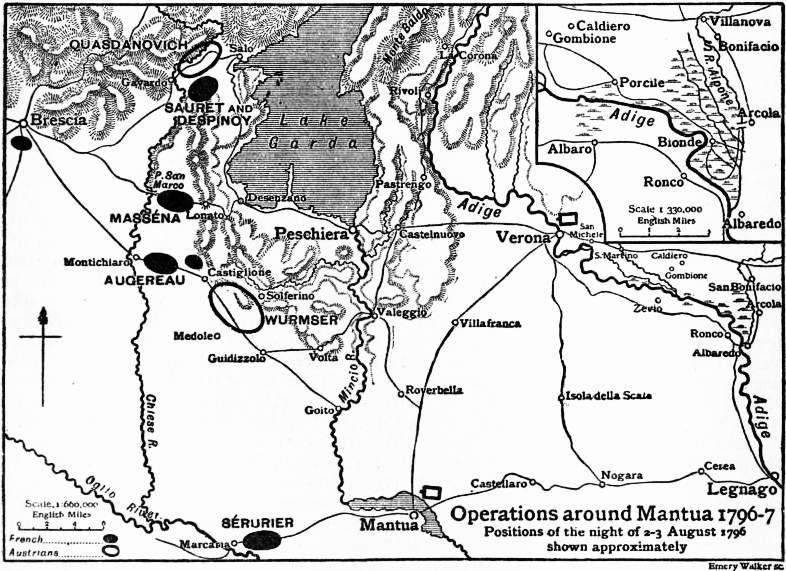
If Bonaparte has occasionally been criticized for his defensive measures, Wurmser’s attack procedure has received almost universal condemnation, as to the justice of which it may be pointed out12 that the object of the expedition was not to win a battle by falling on the disunited French with a well-concentrated army, but to overpower one, any one, of the corps covering the siege, and to press straight forward to the relief of Mantua, i.e. to the destruction of Bonaparte’s batteries and the levelling of his trench work. The old principle that a battle was a grave event of doubtful issue was reinforced in the actual case by Beaulieu’s late experiences of French élan, and as a temporary victory at one point would suffice for the purpose in hand, there was every incentive to multiply the points of contact. The soundness of Wurmser’s plan was proved by the event. New ideas and new forces, undiscernible to a man of seventy-two years of age, obliterated his achievement by surpassing it, but such as it was—a limited use of force for a limited object—the venture undeniably succeeded.
The Austrians formed three corps, one (Quasdanovich, 18,000 men) marching round the west side of the Lake of Garda on Gavardo, Salo and the Brescia road, the second (under Wurmser, about 30,000) moving directly down the Adige, and the third (Davidovich, 6000) making a détour by the Brenta valley and heading for Verona by Vicenza.
On the 29th Quasdanovich attacked Sauret at Salo, drove him towards Desenzano, and pushed on to Gavardo and thence into Brescia. Wurmser expelled Masséna’s advanced guard from La Corona, and captured in succession the Monte Baldo and Rivoli posts. The Brenta column approached Verona with little or no fighting. News of this column led Napoleon early in the day to close up Despinoy, Masséna and Kilmaine at Castelnuovo, and to order Augereau from Legnago to advance on Montebello (19 m. east of Verona) against Davidovich’s left rear. But after these orders had been despatched came the news of Sauret’s defeat, and this moment was one of the most anxious in Napoleon’s career. He could not make up his mind to give up the siege of Mantua, but he hurried Augereau back to the Mincio, and sent order after order to the officers on the lines of communication to send all convoys by the Cremona instead of by the Brescia road. More, he had the baggage, the treasure and the sick set in motion at once for Marcaria, and wrote to Sérurier a despatch which included the words “perhaps we shall recover ourselves ... but I must take serious measures for a retreat.” On the 30th he wrote: “The enemy have broken through our line in three places ... Sauret has evacuated Salo ... and the enemy has captured Brescia. You see that our communications with Milan and Verona are cut.” The reports that came to him during the morning of the 30th enabled him to place the main body of the enemy opposite Masséna, and this, without in the least alleviating the gravity of the situation, helped to make his course less doubtful. Augereau was ordered to hold the line of the Molinella, in case Davidovich’s attack, the least-known factor, should after all prove to be serious; Masséna to reconnoitre a road from Peschiera through Castiglione towards Orzinovi, and to stand fast at Castelnuovo opposite Wurmser as long as he could. Sauret and Despinoy were concentrated at Desenzano with orders on the 31st to clear the main line of retreat and to recapture Brescia. The Austrian movements were merely the continuation of those of the 29th. Quasdanovich wheeled inwards, his right finally resting on Montechiaro and his left on Salo. Wurmser drove back Masséna to the west side of the Mincio. Davidovich made a slight advance.
In the late evening Bonaparte held a council of war at Roverbella. The proceedings of this council are unknown, but it at any rate enabled Napoleon to see clearly and to act. Hitherto he had been covering the siege of Mantua with Relief of Mantua. various detachments, the defeat of any one of which might be fatal to the enterprise. Thus, when he had lost his main line of retreat, he could assemble no more than 8000 men at Desenzano to win it back. Now, however, he made up his mind that the siege could not be continued, and bitter as the decision must have been, it gave him freedom. At this moment of crisis the instincts of the great captain came into play, and showed the way to a victory that would more than counterbalance the now inevitable failure. Sérurier was ordered to spike the 140 siege guns that had been so welcome a few days before, and, after sending part of his force to Augereau, to establish himself with the rest at Marcaria on the Cremona road. The field forces were to be used on interior lines. On the 31st Sauret, Despinoy, Augereau and Kilmaine advanced westward against Quasdanovich. The first two found the Austrians at Salo and Lonato and drove them back, while with Augereau and the cavalry Bonaparte himself made a forced march on Brescia, never halting night or day till he reached the town and recovered his depots. Meantime Sérurier had retired (night of July 31), Masséna had gradually drawn in towards Lonato, and Wurmser’s advanced guard triumphantly entered the fortress (August 1).
The Austrian general now formed the plan of crushing Bonaparte between Quasdanovich and his own main body. But meantime Quasdanovich had evacuated Brescia under the threat of Bonaparte’s advance and was now fighting a long irregular action with Despinoy and Sauret about Gavardo and Salo, and Bonaparte, having missed his expected target, had brought Augereau by another severe march back to Montechiaro on the Chiese. Masséna was now assembled between Lonato and Ponte San Marco, and Sérurier was retiring quietly on Marcaria. Wurmser’s main body, weakened by the detachment sent to Mantua, crossed the Mincio about Valeggio and Goito on the 2nd, and penetrated as far as Castiglione, whence Masséna’s rearguard was expelled. But a renewed advance of Quasdanovich, ordered by Wurmser, which drove Sauret and Despinoy Lonato and Castiglione. back on Brescia and Lonato, in the end only placed a strong detachment of the Austrians within striking distance of Masséna, who on the 3rd attacked it, front to front, and by sheer fighting destroyed it, while at the same time Augereau recaptured Castiglione from Wurmser. On the 4th Sauret and Despinoy pressed back Quasdanovich beyond Salo and Gavardo. One of the Austrian columns, finding itself isolated and unable to retreat with the others, turned back to break its way through to Wurmser, and was annihilated by Masséna in the neighbourhood of Lonato. On this day Augereau fought his way towards Solferino, and Wurmser, thinking rightly or wrongly that he could not now retire to the Mincio without a battle, drew up his whole force, close on 30,000 men, in the plain between Solferino and Medole. The finale may be described in very few words. Bonaparte, convinced that no more was to be feared from Quasdanovich, and seeing that Wurmser meant to fight, called in Despinoy’s division to the main body and sent orders to Sérurier, then far distant on the Cremona road, to march against the left flank of the Austrians. On the 5th the battle of Castiglione was fought. Closely contested in the first hours of the frontal attack till Sérurier’s arrival decided the day, it ended in the retreat of the Austrians over the Mincio and into Tirol whence they had come.
Thus the new way had failed to keep back Wurmser, and the old had failed to crush Napoleon. Each was the result of its own conditions. In former wars a commander threatened as Napoleon was, would have fallen back at once to the Adda, abandoning the siege in such good time that he would have been able to bring off his siege artillery. Instead of this Bonaparte hesitated long enough to lose it, which, according to accepted canons was a waste, and held his ground, which was, by the same rules, sheer madness. But Revolutionary discipline was not firm enough to stand a retreat. Once it turned back, the army would have streamed away to Milan and perhaps to the Alps (cf. 1799), and the only alternative to complete dissolution therefore was fighting.
As to the manner of this fighting, even the principle of “relative superiority” failed him so long as he was endeavouring to cover the siege and again when his chief care was to protect his new line of retreat and to clear his old. In this period, viz. up to his return from Brescia on the 2nd of August, the only “mass” he collected delivered a blow in the air, while the covering detachments had to fight hard for bare existence. Once released from its trammels, the Napoleonic principle had fair play. He stood between Wurmser and Quasdanovich, ready to fight either or both. The latter was crushed, thanks to local superiority and the resolute leading of Masséna, but at Castiglione Wurmser actually outnumbered his opponent till the last of Napoleon’s precautionary dispositions had been given up, and Sérurier brought back from the “alternative line of retreat” to the battlefield. The moral is, again, that it was not the mere fact of being on interior lines that gave Napoleon the victory, but his “tact,” his fine appreciation of the chances in his favour, measured in terms of time, space, attacking force and containing power. All these factors were greatly influenced by the ground, which favoured the swarms and columns of the French and deprived the brilliant Austrian cavalry of its power to act. But of far greater importance was the mobility that Napoleon’s personal force imparted to the French. Napoleon himself rode five horses to death in three days, and Augereau’s division marched from Roverbella to Brescia and back to Montechiaro, a total distance of nearly 50 m., in about thirty-six hours. This indeed was the foundation of his “relative superiority,” for every hour saved in the time of marching meant more freedom to destroy one corps before the rest could overwhelm the covering detachments and come to its assistance.
Wurmser’s plan for the relief of Mantua, suited to its purpose, succeeded. But when he made his objective the French field army, he had to take his own army as he found it, disposed for an altogether different purpose. A properly, combined attack of convergent columns framed ab initio by a good staff officer, such as Mack, might indeed have given good results. But the success of such a plan depends principally on the assailant’s original possession of the initiative, and not on the chances of his being able to win it over to his own side when operations, as here, are already in progress. When the time came to improvise such a plan, the initiative had passed over to Napoleon, and the plan was foredoomed.
By the end of the second week in August the blockade of Mantua had been resumed, without siege guns. But still under the impression of a great victory gained, Bonaparte was planning a long forward stride. He thought that by advancing past Mantua directly on Trieste and thence onwards to the Semmering he could impose a peace on the emperor. The Directory, however, which had by now focussed its attention on the German campaign, ordered him to pass through Tirol and to co-operate with Moreau, and this plan, Bonaparte, though protesting against an Alpine venture being made so late in the year, prepared to execute, drawing in reinforcements and collecting great quantities of supplies in boats on the Adige and Lake Garda. Wurmser was thought to have posted his main body near Trent, and to have detached one division to Bassano “to cover Trieste.” The French advanced northward on the 2nd, in three disconnected columns (precisely as Wurmser had done in the reverse direction at the end of July)—Masséna (13,000) from Rivoli to Ala, Augereau (9000) from Verona by hill roads, keeping on his right rear, Vaubois (11,000) round the Lake of Garda by Riva and Torbole. Sahuguet’s division (8000) remained before Mantua. The French divisions successfully combined and drove the enemy before them to Trent.
There, however, they missed their target. Wurmser had already drawn over the bulk of his army (22,000) into the Val Sugana, whence, with the Bassano division as his advanced guard, he intended once more to relieve Mantua, while Davidovich with 13,000 (excluding detachments) was to hold Tirol against any attempt of Bonaparte to join forces with Moreau.
Thus Austria was preparing to hazard a second (as in the event she hazarded a third and a fourth) highly trained and expensive professional army in the struggle for the preservation of a fortress, and we must conclude that there were weighty reasons which actuated so notoriously cautious a body as the Council of War in making this unconditional venture. While Mantua stood, Napoleon, for all his energy and sanguineness, could not press forward into Friuli and Carniola, and immunity from a Republican visitation was above all else important for the Vienna statesmen, governing as they did more or less discontented and heterogeneous populations that had not felt the pressure of war for a century and more. The Austrians, so far as is known, desired no more than to hold their own. They no longer possessed the superiority of moral that guarantees victory to one side when both are materially equal. There was therefore nothing to be gained, commensurate with the risk involved, by fighting a battle in the open field. In Italien siegt nicht die Kavallerie was an old saying in the Austrian army, and therefore the Austrians could not hope to win a victory of the first magnitude. The only practicable alternative was to strengthen Mantua as opportunities offered themselves, and to prolong the passive resistance as much as possible. Napoleon’s own practice in providing for secondary theatres of war was to economize forces and to delay a decision, and the fault of the Austrians, viewed from a purely military standpoint, was that they squandered, instead of economizing, their forces to gain time. If we neglect pure theory, and regard strategy as the handmaiden of statesmanship—which fundamentally it is—we cannot condemn the Vienna authorities unless it be first proved that they grossly exaggerated the possible results of Bonaparte’s threatened irruption. And if their capacity for judging the political situation be admitted, it naturally follows that their object was to preserve Mantua at all costs—which object Wurmser, though invariably defeated in action, did in fact accomplish.
When Masséna entered Trent on the morning of the 5th of September, Napoleon became aware that the force in his front was a mere detachment, and news soon came in that Wurmser was in the Val Sugana about Primolano and Bassano. at Bassano. This move he supposed to be intended to cover Trieste, being influenced by his own hopes of advancing in that direction, and underestimating the importance, to the Austrians, of preserving Mantua. He therefore informed the Directory that he could not proceed with the Tirol scheme, and spent one more day in driving Davidovich well away from Trent. Then, leaving Vaubois to watch him, Napoleon marched Augereau and Masséna, with a rapidity he scarcely ever surpassed, into the Val Sugana. Wurmser’s rearguard was attacked and defeated again and again, and Wurmser himself felt compelled to stand and fight, in the hope of checking the pursuit before going forward into the plains. Half his army had already reached Montebello on the Verona road, and with the rear half he posted himself at Bassano, where on the 8th he was attacked and defeated with heavy losses. Then began a strategic pursuit or general chase, and in this the mobility of the French should have finished the work so well begun by their tactics.
But Napoleon directed the pursuers so as to cut off Wurmser from Trieste, not from Mantua. Masséna followed up the Austrians to Vicenza, while Augereau hurried towards Padua, and it was not until late on the 9th that Bonaparte realized that his opponent was heading for Mantua via Legnago. On the 10th Masséna crossed the Adige at Ronco, while Augereau from Padua reached Montagnara. Sahuguet from Mantua and Kilmaine from Verona joined forces at Castellaro on the 11th, with orders to interpose between Wurmser and the fortress. Wurmser meantime had halted for a day at Legnago, to restore order, and had then resumed his march. It was almost too late, for in the evening, after having to push aside the head of Masséna’s column at Cerea, he had only reached Nogara, some miles short of Castellaro, and close upon his rear was Augereau, who reached Legnago that night. On the 12th, eluding Sahuguet by a detour to the southward, he reached Mantua, with all the columns of the French, weary as most of them were, in hot pursuit. After an attempt to keep the open field, defeated in a general action on the 15th, the relieving force was merged in the garrison, now some 28,000 in all. So ended the episode of Bassano, the most brilliant feature of which as usual was the marching power of the French infantry. This time it sufficed to redeem even strategical misconceptions and misdirections. Between the 5th and the 11th, besides fighting three actions, Masséna had marched 100 m. and Augereau 114.
Feldzeugmeister Alvintzi was now appointed to command a new army of relief. This time the mere distribution of the troops imposed a concentric advance of separate columns, for practically the whole of the fresh forces available were in Carniola, the Military Frontier, &c., while Davidovich was still in Tirol. Alvintzi’s intention was to assemble his new army (29,000) in Friuli, and to move on Bassano, which was to be occupied on the 4th of November. Meantime Davidovich (18,000) was to capture Trent, and the two columns were to connect by the Val Sugana. All being well, Alvintzi and Davidovich, still separate, were then to converge on the Adige between Verona and Legnago. Wurmser was to co-operate by vigorous sorties. At this time Napoleon’s protective system was as follows: Kilmaine (9000) investing Mantua, Vaubois (10,000) at Trent, and Masséna (9000) at Bassano and Treviso, Augereau (9000) and Macquard (3000) at Verona and Villafranca constituting, for the first time in these operations, important mobile reserves. Hearing of Alvintzi’s approach in good time, he meant first to drive back Davidovich, then with Augereau, Masséna, Macquard and 3000 of Vaubois’s force to fall upon Alvintzi, who, he calculated, would at this stage have reached Bassano, and finally to send back a large force through the Val Sugana to attack Davidovich. This plan practically failed.
Instead of advancing, Vaubois was driven steadily backward. By the 6th, Davidovich had fought his way almost to Roveredo, and Alvintzi had reached Bassano and was there successfully repelling the attacks of Masséna and Caldiero. Augereau. That night Napoleon drew back to Vicenza. On the 7th Davidovich drove in Vaubois to Corona and Rivoli, and Alvintzi came within 5 m. of Vicenza. Napoleon watched carefully for an opportunity to strike out, and on the 8th massed his troops closely around the central point of Verona. On the 9th, to give himself air, he ordered Masséna to join Vaubois, and to drive back Davidovich at all costs. But before this order was executed, reports came in to the effect that Davidovich had suspended his advance. The 10th and 11th were spent by both sides in relative inaction, the French waiting on events and opportunities, the Austrians resting after their prolonged exertions. Then, on the afternoon of the 11th, being informed that Alvintzi was approaching, Napoleon decided to attack him. On the 12th the advanced guard of Alvintzi’s army was furiously assailed in the position of Caldiero. But the troops in rear came up rapidly, and by 4 P.M. the French were defeated all along the line and in retreat on Verona. Napoleon’s situation was now indeed precarious. He was on “interior lines,” it is true, but he had neither the force nor the space necessary for the delivery of rapid radial blows. Alvintzi was in superior numbers, as the battle of Caldiero had proved, and at any moment Davidovich, who had twice Vaubois’s force, might advance to the attack of Rivoli. The reserves had proved insufficient, and Kilmaine had to be called up from Mantua, which was thus for the third time freed from the blockaders. Again the alternatives were retreat, in whatever order was possible to Republican armies, and beating the nearest enemy at any sacrifice. Napoleon chose the latter, though it was not until the evening of the 14th that he actually issued the fateful order.
The Austrians, too, had selected the 15th as the date of their final advance on Verona, Davidovich from the north, Alvintzi via Zevio from the south. But Napoleon was no longer there; leaving Vaubois to hold Davidovich as best he might, and posting only 3000 men in Verona, he had collected the rest of his small army between Albaro and Ronco. His plan seems to have been to cross the Adige well in rear of the Austrians, to march north on to the Verona-Vicenza highway, and there, supplying himself from their convoys, to fight to the last. On the 15th he had written to the Directory, “The weakness and the exhaustion of the army causes me to fear the worst. We are perhaps on the eve of losing Italy.” In this extremity of danger the troops passed the Adige in three columns near Ronco and Albaredo, and marched forward along the dikes, with deep marshes and pools on either hand. If Napoleon’s intention was to reach the dry open ground of S. Bonifacio in rear of the Austrians, it was not realized, for the Austrian army, instead of being at the gates of Verona, was still between Caldiero and S. Bonifacio, heading, as we know, for Zevio. Thus Alvintzi was able, easily and swiftly, to wheel to the south.
The battle of Arcola almost defies description. The first day passed in a series of resultless encounters between the heads of the columns as they met on the dikes. In the evening Bonaparte withdrew over the Adige, expecting Arcola. at every moment to be summoned to Vaubois’s aid. But Davidovich remained inactive, and on the 16th the French again crossed the river. Masséna from Ronco advanced on Porcile, driving the Austrians along the causeway thither, but on the side of Arcola, Alvintzi had deployed a considerable part of his forces on the edge of the marshes, within musket shot of the causeway by which Bonaparte and Augereau had to pass, along the Austrian front, to reach the bridge of Arcola. In these circumstances the second day’s battle was more murderous and no more decisive than the first, and again the French retreated to Ronco. But Davidovich again stood still, and with incredible obstinacy Bonaparte ordered a third assault for the 17th, using indeed more tactical expedients than before, but calculating chiefly on the fighting powers of his men and on the exhaustion of the enemy. Masséna again advanced on Porcile, Robert’s brigade on Arcola, but the rest, under Augereau, were to pass the Alpone near its confluence with the Adige, and joining various small bodies which passed the main stream lower down, to storm forward on dry ground to Arcola. The Austrians, however, themselves advanced from Arcola, overwhelmed Robert’s brigade on the causeway and almost reached Ronco. This was perhaps the crisis of the battle, for Augereau’s force was now on the other side of the stream, and Masséna, with his back to the new danger, was approaching Porcile. But the fire of a deployed regiment stopped the head of the Austrian column; Masséna, turning about, cut into its flank on the dike; and Augereau, gathering force, was approaching Arcola from the south. The bridge and the village were evacuated soon afterwards, and Masséna and Augereau began to extend in the plain beyond. But the Austrians still sullenly resisted. It was at this moment that Bonaparte secured victory by a mere ruse, but a ruse which would have been unprofitable and ridiculous had it not been based on his fine sense of the moral conditions. Both sides were nearly fought out, and he sent a few trumpeters to the rear of the Austrian army to sound the charge. They did so, and in a few minutes the Austrians were streaming back to S. Bonifacio. This ended the drama of Arcola, which more than any other episode of these wars, perhaps of any wars in modern history, centres on the personality of the hero. It is said that the French fought without spirit on the first day, and yet on the second and third Bonaparte had so thoroughly imbued them with his own will to conquer that in the end they prevailed over an enemy nearly twice their own strength.
The climax was reached just in time, for on the 17th Vaubois was completely defeated at Rivoli and withdrew to Peschiera, leaving the Verona and Mantua roads completely open to Davidovich. But on the 19th Napoleon turned upon him, and combining the forces of Vaubois, Masséna and Augereau against him, drove him back to Trent. Meantime Alvintzi returned from Vicenza to San Bonifacio and Caldiero (November 21st), and Bonaparte at once stopped the pursuit of Davidovich. On the return of the French main body to Verona, Alvintzi finally withdrew, Wurmser, who had emerged from Mantua on the 23rd, was driven in again, and this epilogue of the great struggle came to a feeble end because neither side was now capable of prolonging the crisis.
Alvintzi renewed his advance in January 1797 with all the forces that could be assembled for a last attempt to save Mantua. At this time 8000 men under Sérurier blockaded Mantua, Masséna (9000) was at Verona, Joubert (Vaubois’s successor) at Rivoli with 10,000, Augereau at Legnago with 9000. In reserve were Rey’s division (4000) between Brescia and Montechiaro, and Victor’s brigade at Goito and Castelnuovo. On the other side, Alvintzi had 9000 men under Provera at Padua, 6000 under Bayalič at Bassano, and he himself with 28,000 men stood in the Tirol about Trent. This time he intended to make his principal effort on the Rivoli side. Provera was to capture Legnago on the 9th of January, and Bayalič Verona on the 12th, while the main army was to deliver its blow against the Rivoli position on the 13th.
The first marches of this scheme were duly carried out, and several days elapsed before Napoleon was able to discern the direction of the real attack. Augereau fell back, skirmishing a little, as Provera’s and Bayalič’s advance Rivoli. developed. On the 11th, when the latter was nearing Verona, Alvintzi’s leading troops appeared in front of the Rivoli position. On the 12th Bayalič with a weak force (he had sent reinforcements to Alvintzi by the Val Pantena) made an unsuccessful attack on Verona, Provera, farther south, remaining inactive. On the 13th Napoleon, still in doubt, launched Masséna’s division against Bayalič, who was driven back to San Bonifacio; but at the same time definite news came from Joubert that Alvintzi’s main army was in front of La Corona. From this point begins the decisive, though by no means the most intense or dramatic, struggle of the campaign. Once he felt sure of the situation Napoleon acted promptly. Joubert was ordered to hold on to Rivoli at all costs. Rey was brought up by a forced march to Castelnuovo, where Victor joined him, and ahead of them both Masséna was hurried on to Rivoli. Napoleon himself joined Joubert on the night of the 13th. There he saw the watch-fires of the enemy in a semicircle around him, for Alvintzi, thinking that he had only to deal with one division, had begun a widespread enveloping attack. The horns of this attack were as yet so far distant that Napoleon, instead of extending on an equal front, only spread out a few regiments to gain an hour or two and to keep the ground for Masséna and Rey, and on the morning of January 14th, with 10,000 men in hand against 26,000, he fell upon the central columns of the enemy as they advanced up the steep broken slopes of the foreground. The fighting was severe, but Bonaparte had the advantage. Masséna arrived at 9 A.M., and a little later the column of Quasdanovich, which had moved along the Adige and was now attempting to gain a foothold on the plateau in rear of Joubert, was crushed by the converging fire of Joubert’s right brigade and by Masséna’s guns, their rout being completed by the charge of a handful of cavalry under Lasalle. The right horn of Alvintzi’s attack, when at last it swung in upon Napoleon’s rear, was caught between Masséna and the advancing troops of Rey and annihilated, and even before this the dispirited Austrians were in full retreat. A last alarm, caused by the appearance of a French infantry regiment in their rear (this had crossed the lake in boats from Salo), completed their demoralization, and though less than 2000 had been killed and wounded, some 12,000 Austrian prisoners were left in the hands of the victors. Rivoli was indeed a moral triumph. After the ordeal of Arcola, the victory of the French was a foregone conclusion at each point of contact. Napoleon hesitated, or rather refrained from striking, so long as his information was incomplete, but he knew now from experience that his covering detachment, if well led, could not only hold its own without assistance until it had gained the necessary information, but could still give the rest of the army time to act upon it. Then, when the centre of gravity had been ascertained, the French divisions hurried thither, caught the enemy in the act of manœuvring and broke them up. And if that confidence in success which made all this possible needs a special illustration, it may be found in Napoleon’s sending Murat’s regiment over the lake to place a mere two thousand bayonets across the line of retreat of a whole army. Alvintzi’s manœuvre was faulty neither strategically in the first instance nor tactically as regards the project of enveloping Joubert on the 14th. It failed because Joubert and his men were better soldiers than his own, and because a French division could move twice as fast as an Austrian, and from these two factors a new form of war was evolved, the essence of which was that, for a given time and in a given area, a small force of the French should engage and hold a much larger force of the enemy.
The remaining operations can be very briefly summarized. Provera, still advancing on Mantua, joined hands there with Wurmser, and for a time held Sérurier at a disadvantage. But hearing of this, Napoleon sent back Masséna from the field of Rivoli, and that general, with Augereau and Sérurier, not only forced Wurmser to retire again into the fortress, but compelled Provera to lay down his arms. On the 2nd of February 1797, after a long and honourable defence, Mantua, and with it what was left of Wurmser’s army, surrendered.
The campaign of 1797, which ended the war of the First Coalition, was the brilliant sequel of these hard-won victories. Austria had decided to save Mantua at all costs, and had lost her armies in the attempt, a loss which was not compensated by the “strategic” victories of the archduke. Thus the Republican “visitation” of Carinthia and Carniola was one swift march—politically glorious, if dangerous from a purely military standpoint—of Napoleon’s army to the Semmering. The archduke, who was called thither from Germany, could do no more than fight a few rearguard actions, and make threats against Napoleon’s rear, which the latter, with his usual “tact,” ignored. On the Rhine, as in 1795 and 1796, the armies of the Sambre-and-Meuse (Hoche) and the Rhine-and-Moselle (Moreau) were opposed by the armies of the Lower Rhine (Werneck) and of the Upper Rhine (Latour). Moreau crossed the river near Strassburg and fought a series of minor actions. Hoche, like his predecessors, crossed at Düsseldorf and Neuwied and fought his way to the Lahn, where for the last time in the history of these wars, there was an irregular widespread battle. But Hoche, in this his last campaign, displayed the brilliant energy of his first, and delivered the “series of incessant blows” that Carnot had urged upon Jourdan the year before. Werneck was driven with ever-increasing losses from the lower Lahn to Wetzlar and Giessen. Thence, pressed hard by the French left wing under Championnet, he retired on the Leoben. Nidda, only to find that Hoche’s right had swung completely round him. Nothing but the news of the armistice of Leoben saved him from envelopment and surrender. This general armistice was signed by Bonaparte, on his own authority and to the intense chagrin of the Directory and of Hoche, on the 18th of April, and was the basis of the peace of Campo Formio.
Napoleon in Egypt
Within the scope of this article, yet far more important from its political and personal than from its general military interest, comes the expedition of Napoleon to Egypt and its sequel (see also Egypt: History; Napoleon, &c.). A very brief summary must here suffice. Napoleon left Toulon on the 19th of May 1798, at the same time as his army (40,000 strong in 400 transports) embarked secretly at various ports. Nelson’s fleet was completely evaded, and, capturing Malta en route, the armada reached the coast of Egypt on the 1st of July. The republicans stormed Alexandria on the 2nd. Between Embabeh and Gizeh, on the left bank of the Nile, 60,000 Mamelukes were defeated and scattered on the 21st (battle of the Pyramids), the French for the most part marching and fighting in the chequer of infantry squares that afterwards became the classical formation for desert warfare. While his lieutenants pursued the more important groups of the enemy, Napoleon entered Cairo in triumph, and proceeded to organize Egypt as a French protectorate. Meantime Nelson, though too late to head off the expedition, had annihilated the squadron of Admiral Brueys. This blow severed the army from the home country, and destroyed all hope of reinforcements. But to eject the French already in Egypt, military invasion of that country was necessary. The first attempts at this were made in September by the Turks as overlords of Egypt. Napoleon—after suppressing a revolt in Cairo—marched into Syria to meet them, and captured El Arish and Jaffa (at the latter place the prisoners, whom he could afford neither to feed, to release, nor to guard, were shot by his order). But he was brought to a standstill (March 17-May 20) before the half-defensible fortifications of Acre, held by a Turkish garrison and animated by the leadership of Sir W. Sidney Smith (q.v.). In May, though meantime a Turkish relieving army had been severely beaten in the battle of Mount Tabor (April 16, 1799), Napoleon gave up his enterprise, and returned to Egypt, where he won a last victory in annihilating at Aboukir, with 6000 of his own men, a Turkish army 18,000 strong that had landed there (July 25, 1799). With this crowning tactical success to set against the Syrian reverses, he handed over the command to Kléber and returned to France (August 22) to ride the storm in a new coup d’état, the “18th Brumaire.” Kléber, attacked by the English and Turks, concluded the convention of El Arish (January 27, 1800), whereby he secured free transport for the army back to France. But this convention was disavowed by the British government, and Kléber prepared to hold his ground. On the 20th of March 1800 he thoroughly defeated the Turkish army at Heliopolis and recovered Cairo, and French influence was once more in the ascendant in Egypt, when its director was murdered by a fanatic on the 14th of June, the day of Marengo. Kléber’s successor, the incompetent Menou, fell an easy victim to the British expeditionary force under Sir Ralph Abercromby in 1801. The British forced their way ashore at Aboukir on the 8th of March. On the 21st, Abercromby won a decisive battle, and himself fell in the hour of victory (see Alexandria: Battle of 1801). His successor, General Hely Hutchinson, slowly followed up this advantage, and received the surrender of Cairo in July and of Alexandria in August, the débris of the French army being given free passage back to France. Meantime a mixed force of British and native troops from India, under Sir David Baird, had landed at Kosseir and marched across the desert to Cairo.
The War of the Second Coalition
In the autumn of 1798, while Napoleon’s Egyptian expedition was in progress, and the Directory was endeavouring at home to reduce the importance and the predominance of the army and its leaders, the powers of Europe once more allied themselves, not now against the principles of the Republic, but against the treaty of Campo Formio. Russia, Austria, England, Turkey, Portugal, Naples and the Pope formed the Second Coalition. The war began with an advance into the Roman States by a worthless and ill-behaved Neapolitan army (commanded, much against his will, by Mack), which the French troops under Championnet destroyed with ease. Championnet then revolutionized Naples. After this unimportant prelude the curtain rose on a general European war. The Directory which now had at its command neither numbers nor enthusiasm, prepared as best it could to meet the storm. Four armies, numbering only 160,000, were set on foot, in Holland (Brune, 24,000); on the Upper Rhine (Jourdan, 46,000); in Switzerland, which had been militarily occupied in 1798 (Masséna, 30,000); and in upper Italy (Schérer, 60,000). In addition there was Championnet’s army, now commanded by Macdonald, in southern Italy. All these forces the Directory ordered, in January and February 1799, to assume the offensive.
Jourdan, in the Constance and Schaffhausen region, had only 40,000 men against the archduke Charles’s 80,000, and was soon brought to a standstill and driven back on Stokach. The archduke had won these preliminary successes Stokach. with seven-eighths of his army acting as one concentrated mass. But as he had only encountered a portion of Jourdan’s army, he became uneasy as to his flanks, checked his bold advance, and ordered a reconnaissance in force. This practically extended his army while Jourdan was closing his, and thus the French began the battle of Stokach (March 25) in superior numbers, and it was not until late in the day that the archduke brought up sufficient strength (60,000) to win a victory. This was a battle of the “strategic” type, a widespread straggling combat in which each side took fifteen hours to inflict a loss of 12% on the other, and which ended in Jourdan accepting defeat and drawing off, unpursued by the magnificent Austrian cavalry, though these counted five times as many sabres as the French.
The French secondary army in Switzerland was in the hands of the bold and active Masséna. The forces of both sides in the Alpine region were, from a military point of view, mere flank guards to the main armies on the Rhine and the Adige. But unrest, amounting to civil war, among the Swiss and Grison peoples tempted both governments to give these flank guards considerable strength.13
The Austrians in the Vorarlberg and Grisons were under Hotze, who had 13,000 men at Bregenz, and 7000 commanded by Auffenberg around Chur, with, between them, 5000 men at Feldkirch and a post of 1000 in the strong Masséna in Switzerland. position of the Luziensteig near Mayenfeld. Masséna’s available force was about 20,000, and he used almost the whole of it against Auffenberg. The Rhine was crossed by his principal column near Mayenfeld, and the Luziensteig stormed (March 6), while a second column from the Zürich side descended upon Disentis and captured its defenders. In three days, thanks to Masséna’s energy and the ardent attacking spirit of his men, Auffenberg’s division was broken up, Oudinot meanwhile holding off Hotze by a hard-fought combat at Feldkirch (March 7). But a second attack on Feldkirch made on the 23rd by Masséna with 15,000 men was repulsed and the advance of his left wing came to a standstill.
Behind Auffenberg and Hotze was Bellegarde in Tirol with some 47,000 men. Most of these were stationed north of Innsbruck and Landeck, probably as a sort of strategic reserve to the archduke. The rest, with the assistance of the Tirolese themselves, were to ward off irruptions from Italy. Here the French offensive was entrusted to two columns, one from Masséna’s command under Lecourbe, the other from the Army of Italy under Dessolle. Simultaneously with Masséna, Lecourbe marched from Bellinzona with 10,000 men, by the San Bernadino pass into the Splügen valley, and thence over the Julier pass into the upper Engadine. A small Austrian force under Major-General Loudon attacked him near Zernetz, but was after three days of rapid manœuvres and bold tactics driven back to Martinsbrück, with considerable losses, especially in prisoners. But ere long the country people flew to arms, and Lecourbe found himself between two fires, the levies occupying Zernetz and Loudon’s regulars Martinsbrück. But though he had only some 5000 of his original force left, he was not disconcerted, and, by driving back the levies into the high valleys whence they had come, and constantly threatening Loudon, he was able to maintain himself and to wait for Dessolles. The latter, moving up the Valtelline, by now fought his way to the Stelvio pass, but beyond it the defile of Tauffers (S.W. of Glurns) was entrenched by Loudon, who thus occupied a position midway between the two French columns, while his irregulars beset all the passes and ways giving access to the Vintschgau and the lower Engadine. In this situation the French should have been destroyed in detail. But as usual their speed and dash gave them the advantage in every manœuvre and at every point of contact.
On the 25th Lecourbe and Dessolles attacked Loudon at Nauders in the Engadine and Tauffers in the Vintschgau respectively. At Nauders the French passed round the flanks of the defence by scrambling along the high Lecourbe and Dessolles in Tirol. mountain crests adjacent, while at Tauffers the assailants, only 4500 strong, descended into a deep ravine, debouched unnoticed in the Austrians’ rear, and captured 6000 men and 16 guns. The Austrian leader with a couple of companies made his way through Glurns to Nauders, and there, finding himself headed off by Lecourbe, he took to the mountains. His corps, like Auffenberg’s, was annihilated.
This ended the French general offensive. Jourdan had been defeated by the archduke and forced or induced to retire over the Rhine. Masséna was at a standstill before the strong position of Feldkirch, and the Austrians of Hotze were still massed at Bregenz, but the Grisons were revolutionized, two strong bodies of Austrians numbering in all about 20,000 men had been destroyed, and Lecourbe and Dessolles had advanced far into Tirol. A pause followed. The Austrians in the mountains needed time to concentrate and to recover from their astonishment. The archduke fell ill, and the Vienna war council forbade his army to advance lest Tirol should be “uncovered,” though Bellegarde and Hotze still disposed of numbers equal to those of Masséna and Lecourbe. Masséna succeeded Jourdan in general command on the French side and promptly collected all available forces of both armies in the hilly non-Alpine country between Basel, Zürich and Schaffhausen, thereby directly barring the roads into France (Berne-Neuchâtel-Pontarlier and Basel-Besançon) which the Austrians appeared to desire to conquer. The protection of Alsace and the Vosges was left to the fortresses. There was no suggestion, it would appear, that the Rhine between Basel and Schaffhausen was a flank position sufficient of itself to bar Alsace to the enemy.
It is now time to turn to events in Italy, where the Coalition intended to put forth its principal efforts. At the beginning of March the French had 80,000 men in Upper Italy and some 35,000 in the heart of the Peninsula, the latter engaged chiefly in supporting newly-founded republics. Of the former, 53,000 formed the field army on the Mincio under Schérer. The Austrians, commanded by Kray, numbered in all 84,000, but detachments reduced this figure to 67,000, of whom, moreover, 15,000 had not yet arrived when operations began. They were to be joined by a Russian contingent under the celebrated Suvárov, who was to command the whole on arrival, and whose extraordinary personality gives the campaign its special interest. Kray himself was a resolute soldier, and when the French, obeying the general order to advance, crossed the Adige, he defeated them in a severely fought battle at Magnano near Verona (March 5), the French losing 4000 killed and wounded and 4500 taken, out of 41,000. The Austrians lost some 3800 killed and wounded and 1500 prisoners, out of 46,000 engaged. The war, however, was undertaken not to annihilate, but to evict the French, and, probably under orders from Vienna, Kray allowed the beaten enemy to depart.
Suvárov appeared with 17,000 Russians on the 4th of April. His first step was to set Russian officers to teach the Austrian troops—whose feelings can be imagined—how to attack with the bayonet, his next to order the whole Suvárov. army forward. The Allies broke camp on the 17th, 18th and 19th of April, and on the 20th, after a forced march of close on 30 m., they passed the Chiese. Brescia had a French garrison, but Suvárov soon cowed it into surrender by threats of a massacre, which no one doubted that he would carry into execution. At the same time, dissatisfied with the marching of the Austrian infantry, he sent the following characteristic reproof to their commander: “The march was in the service of the Kaiser. Fair weather is for my lady’s chamber, for dandies, for sluggards. He who dares to cavil against his high duty (der Grosssprecher wider den hohen Dienst) is, as an egoist, instantly to vacate his command. Whoever is in bad health can stay behind. The so-called reasoners (raisonneurs) do no army any good....” One day later, under this unrelenting pressure, the advanced posts of the Allies reached Cremona and the main body the Oglio. The pace became slower in the following days, as many bridges had to be made, and meanwhile Moreau, Schérer’s successor, prepared with a mere 20,000 men to defend Lodi, Cassano and Lecco on the Adda. On the 26th the Russian hero attacked him all along the line. The moral supremacy had passed over to the Allies. Melas, under Suvárov’s stern orders, flung his battalions regardless of losses against the strong position of Cassano. The story of 1796 repeated itself with the rôles reversed. The passage was carried, and the French rearguard under Sérurier was surrounded and captured by an inferior corps of Austrians. The Austrians (the Russians at Lecco were hardly engaged) lost 6000 men, but they took 7000 prisoners, and in all Moreau’s little army lost half its numbers and retreated in many disconnected bodies to the Ticino, and thence to Alessandria. Everywhere the Italians turned against the French, mindful of the exactions of their commissaries. The strange Cossack cavalry that western Europe had never yet seen entered Milan on the 29th of April, eleven days after passing the Mincio, and next day the city received with enthusiasm the old field marshal, whose exploits against the Turks had long invested him with a halo of romance and legend. Here, for the moment, his offensive culminated. He desired to pass into Switzerland and to unite his own, the archduke’s, Hotze’s and Bellegarde’s armies in one powerful mass. But the emperor would not permit the execution of this scheme until all the fortresses held by the enemy in Upper Italy should have been captured. In any case, Macdonald’s army in southern Italy, cut off from France by the rapidity of Suvárov’s onslaught, and now returning with all speed to join Moreau by force or evasion, had still to be dealt with.
Suvárov’s mobile army, originally 90,000 strong, had now dwindled, by reason of losses and detachments for sieges, to half that number, and serious differences arose between the Vienna government and himself. If he offended the pride of the Austrian army, he was at least respected as a leader who gave it victories, but in Vienna he was regarded as a madman who had to be kept within bounds. But at last, when he was becoming thoroughly exasperated by this treatment, Macdonald came within striking distance and the active campaign recommenced. In the second week of June, Moreau, who had retired into the Apennines about Gavi, advanced with the intention of drawing upon himself troops that would otherwise have been employed against Macdonald. He succeeded, for Suvárov with his usual rapidity collected 40,000 men at Alessandria, only to learn that Macdonald with 35,000 men was coming up on the Parma road. When this news arrived, Macdonald had already engaged an Austrian detachment at Modena and driven it back, and Suvárov found himself between Moreau and Macdonald with barely enough men under his hand to enable him to play the game of “interior lines.” But at the crisis the rough energetic warrior who despised “raisonneurs,” displayed generalship of the first order, and taking in hand all his scattered detachments, he manœuvred them in the Napoleonic fashion.
On the 14th Macdonald was calculated to be between Modena, Reggio and Carpi, but his destination was uncertain. Would he continue to hug the Apennines to join Moreau, or would he strike out northwards against Kray, who The Trebbia. with 20,000 men was besieging Mantua? From Alessandria it is four marches to Piacenza and nine to Mantua, while from Reggio these places are four and two marches respectively. Piacenza, therefore, was the crucial point if Macdonald continued westward, while, in the other case, nothing could save Kray but the energetic conduct of Hohenzollern’s detachment, which was posted near Reggio. This latter, however, was soon forced over the Po, and Ott, advancing from Cremona to join it, found himself sharply pressed in turn. The field marshal had hoped that Ott and Hohenzollern together would be able to win him time to assemble at Parma, where he could bring on a battle whichever way the French took. But on receipt of Ott’s report he was convinced that Macdonald had chosen the western route, and ordering Ott to delay the French as long as possible by stubborn rearguard actions and to put a garrison into Piacenza under a general who was to hold out “on peril of his life and honour,” he collected what forces were ready to move and hurried towards Piacenza, the rest being left to watch Moreau. He arrived just in time. When after three forced marches the main body (only 26,000 strong) reached Castel San Giovanni, Ott had been driven out of Piacenza, but the two joined forces safely. Both Suvárov and Macdonald spent the 17th in closing up and deploying for battle. The respective forces were Allies 30,000, French 35,000. Suvárov believed the enemy to be only 26,000 strong, and chiefly raw Italian regiments, but his temperament would not have allowed him to stand still even had he known his inferiority. He had already issued one of his peculiar battle-orders, which began with the words, “The hostile army will be taken prisoners” and continued with directions to the Cossacks to spare the surrendered enemy. But Macdonald too was full of energy, and believed still that he could annihilate Ott before the field marshal’s arrival. Thus the battle of the Trebbia (June 17-19) was fought by both sides in the spirit of the offensive. It was one of the severest struggles in the Republican wars, and it ended in Macdonald’s retreat with a loss of 15,000 men—probably 6000 in the battle and 9000 killed and prisoners when and after the equilibrium was broken—for Suvárov, unlike other generals, had the necessary surplus of energy after all the demands made upon him by a great battle, to order and to direct an effective pursuit. The Allies lost about 7000. Macdonald retreated to Parma and Modena, harassed by the peasantry, and finally recrossed the Apennines and made his way to Genoa. The battle of the Trebbia is one of the most clearly-defined examples in military history of the result of moral force—it was a matter not merely of energetic leading on the battlefield, but far more of educating the troops beforehand to meet the strain, of ingraining in the soldier the determination to win at all costs. “It was not,” says Clausewitz, “a case of losing the key of the position, of turning a flank or breaking a centre, of a mistimed cavalry charge or a lost battery ... it is a pure trial of strength and expense of force, and victory is the sinking of the balance, if ever so slightly, in favour of one side. And we mean not merely physical, but even more moral forces.”
To return now to the Alpine region, where the French offensive had culminated at the end of March. Their defeated left was behind the Rhine in the northern part of Switzerland, the half-victorious centre athwart the Rhine between Mayenfeld and Chur, and their wholly victorious right far within Tirol between Glurns, Nauders and Landeck. But neither the centre nor the right could maintain itself. The forward impulse given by Suvárov spread along the whole Austrian front from left to right. Dessolles’ column (now under Loison) was forced back to Chiavenna. Bellegarde drove Lecourbe from position to position towards the Rhine during April. There Lecourbe added to the remnant of his expeditionary column the outlying bodies of Masséna’s right wing, but even so he had only 8000 men against Bellegarde’s 17,000, and he was now exposed to the attack of Hotze’s 25,000 as well. The Luziensteig fell to Hotze and Chur to Bellegarde, but the defenders managed to escape from the converging Austrian columns into the valley of the Reuss. Having thus reconquered all the lost ground and forced the French into the interior of Switzerland, Bellegarde and Hotze parted company, the former marching with the greater part of his forces to join Suvárov, the latter moving to his right to reinforce the archduke. Only a chain of posts was left in the Rhine Valley between Disentis and Feldkirch. The archduke’s operations now recommenced.
Charles and Hotze stood, about the 15th of May, at opposite ends of the lake of Constance. The two together numbered about 88,000 men, but both had sent away numerous detachments to the flanks, and the main bodies dwindled to 35,000 for the archduke and 20,000 for Hotze. Masséna, with 45,000 men in all, retired slowly from the Rhine to the Thur. The archduke crossed the Rhine at Stein, Hotze at Balzers, and each then cautiously felt his way towards the other. Their active opponent attempted to take advantage of their separation, and an irregular fight took place in the Thur valley (May 25), but Masséna, finding Hotze close on his right flank, retired without attempting to force a decision. On the 27th, having joined forces, the Austrians dislodged Masséna from his new position on the Töss without difficulty, and this process was repeated from time to time in the Action of Zürich. next few days, until at last Masséna halted in the position he had prepared for defence at Zürich. He had still but 25,000 of his 45,000 men in hand, for he maintained numerous small detachments on his right, behind the Zürcher See and the Wallen See, and on his left towards Basel. These 25,000 occupied an entrenched position 5 m. in length; against which the Austrians, detaching as usual many posts to protect their flanks and rear, deployed only 42,000 men, of whom 8000 were sent on a wide turning movement and 8000 held in reserve 4 m. in rear of the battlefield. Thus the frontal attack was made with forces not much greater than those of the defence and it failed accordingly (June 4). But Masséna, fearing perhaps to strain the loyalty of the Swiss to their French-made constitution by exposing their town to assault and sack, retired on the 5th.
He did not fall back far, for his outposts still bordered the Limmat and the Linth, while his main body stood in the valley of the Aar between Baden and Lucerne. The archduke pressed Masséna as little as he had pressed Jourdan after Stokach (though in this case he had less to gain by pursuit), and awaited the arrival of a second Russian army, 30,000 strong, under Korsákov, before resuming the advance, meantime throwing out covering detachments towards Basel, where Masséna had a division. Thus for two months operations, elsewhere than in Italy, were at a standstill, while Masséna drew in reinforcements and organized the fractions of his forces in Alsace as a skeleton army, and the Austrians distributed arms to the peasantry of South Germany.
In the end, under pressure from Paris, it was Masséna who resumed active movements. Towards the middle of August, Lecourbe, who formed a loose right wing of the French army in the Reuss valley, was reinforced to a strength of 25,000 men, and pounced upon the extended left wing of the enemy, which had stretched itself, to keep pace with Suvárov, as far westward as the St Gothard. The movement began on the 14th, and in two days the Austrians were driven back from the St Gothard and the Furka to the line of the Linth, with the loss of 8000 men and many guns. At the same time an attempt to take advantage of Masséna’s momentary weakness by forcing the Aar at Döttingen near its mouth failed completely (August 16-17). Only 200 men guarded the point of passage, but the Austrian engineers had neglected to make a proper examination of the river, and unlike the French, the Austrian generals had no authority to waste their expensive battalions in forcing the passage in boats. No one regarded this war as a struggle for existence, and no one but Suvárov possessed the iron strength of character to send thousands of men to death for the realization of a diplomatic success—for ordinary men, the object of the Coalition was to upset the treaty of Campo Formio. This was the end of the archduke’s campaign in Switzerland. Though he would have preferred to continue it, the Vienna government desired him to return to Germany. An Anglo-Russian expedition was about to land in Holland,14 and the French were assembling fresh forces on the Rhine, and, with the double object of preventing an invasion of South Germany and of inducing the French to augment their forces in Alsace at the expense of those in Holland, the archduke left affairs in Switzerland to Hotze and Korsákov, and marched away with 35,000 men to join the detachment of Sztarray (20,000) that he had placed in the Black Forest before entering Switzerland. His new campaign never rose above the level of a war of posts and of manœuvres about Mannheim and Philippsburg. In the latter stage of it Lecourbe commanded the French and obtained a slight advantage.
Suvárov’s last exploit in Italy coincided in time, but in no other respect, with the skirmish at Döttingen. Returning swiftly from the battlefield of the Trebbia, he began to drive back Moreau to the Riviera. At this point Joubert succeeded to the command on the French side, and against the advice of his generals, gave battle. Equally against the advice of his own subordinates, the field marshal accepted it, and won his last great victory at Novi on the 13th of August, Joubert being killed. This was followed by another rapid march against a new French “Army of the Alps” (Championnet) which had entered Italy by way of the Mont Cenis. But immediately after this he left all further operations in Italy to Melas with 60,000 men and himself with the Russians and an Austrian corps marched away, via Varese, for the St Gothard to combine operations against Masséna with Hotze and Korsákov. It was with a heavy heart that he left the scene of his battles, in which the force of his personality had carried the old-fashioned “linear” armies for the last time to complete victory. In the early summer he had himself suggested, eagerly and almost angrily, the concentration of his own and the archduke’s armies in Switzerland with a view, not to conquering that country, but to forcing Jourdan and Masséna into a grand decisive battle. But, as we have seen, the Vienna government would not release him until the last Italian fortress had been reoccupied, and when finally he received the order that a little while before he had so ardently desired, it was too late. The archduke had already left Switzerland, and he was committed to a resultless warfare in the high mountains, with an army which was a mere detachment Suvárov ordered to Switzerland. and in the hope of co-operating with two other detachments far away on the other side of Switzerland. As for the reasons which led to the issue of such an order, it can only be said that the bad feeling known to exist between the Austrians and Russians induced England to recommend, as the first essential of further operations, the separate concentration of the troops of each nationality under their own generals. Still stranger was the reason which induced the tsar to give his consent. It was alleged that the Russians would be healthier in Switzerland than the men of the southern plains! From such premises as these the Allied diplomats evolved a new plan of campaign, by which the Anglo-Russians under the duke of York were to reconquer Holland and Belgium, the Archduke Charles to operate on the Middle Rhine, Suvárov in Switzerland and Melas in Piedmont—a plan destitute of every merit but that of simplicity.
It is often said that it is the duty of a commander to resign rather than undertake an operation which he believes to be faulty. So, however, Suvárov did not understand it. In the simplicity of his loyalty to the formal order of his sovereign he prepared to carry out his instructions to the letter. Masséna’s command (77,000 men) was distributed, at the beginning of September, along an enormous S, from the Simplon, through the St Gothard and Glarus, and along the Linth, the Züricher See and the Limmat to Basel. Opposite the lower point of this S, Suvárov (28,000) was about to advance. Hotze’s corps (25,000 Austrians), extending from Utznach by Chur to Disentis, formed a thin line roughly parallel to the lower curve of the S, Korsákov’s Russians (30,000) were opposite the centre at Zürich, while Nauendorff with a small Austrian corps at Waldshut faced the extreme upper point. Thus the only completely safe way in which Suvárov could reach the Zürich region was by skirting the lower curve of the S, under protection of Hotze. But this detour would be long and painful, and the ardent old man preferred to cross the mountains once for all at the St Gothard, and to follow the valley of the Reuss to Altdorf and Schwyz—i.e. to strike vertically upward to the centre of the S—and to force his way through the French cordon to Zürich, and if events, so far as concerned his own corps, belied his optimism, they at any rate justified his choice of the shortest route. For, aware of the danger gathering in his rear, Masséna gathered up all his forces within reach towards his centre, leaving Lecourbe to defend the St Gothard Battle of Zürich. and the Reuss valley and Soult on the Linth. On the 24th he forced the passage of the Limmat at Dietikon. On the 25th, in the second battle of Zürich, he completely routed Korsákov, who lost 8000 killed and wounded, large numbers of prisoners and 100 guns. All along the line the Allies fell back, one corps after another, at the moment when Suvárov was approaching the foot of the St Gothard.
On the 21st the field marshal’s headquarters were at Bellinzona, where he made the final preparations. Expecting to be four days en route before he could reach the nearest friendly magazine, he took his trains with him, which inevitably Suvárov in the Alps. augmented the difficulties of the expedition. On the 24th Airolo was taken, but when the far greater task of storming the pass itself presented itself before them, even the stolid Russians were terrified, and only the passionate protests of the old man, who reproached his “children” with deserting their father in his extremity, induced them to face the danger. At last after twelve hours’ fighting, the summit was reached. The same evening Suvárov pushed on to Hospenthal, while a flanking column from Disentis made its way towards Amsteg over the Crispalt. Lecourbe was threatened in rear and pressed in front, and his engineers, to hold off the Disentis column, had broken the Devil’s Bridge. Discovering this, he left the road, threw his guns into the river and made his way by fords and water-meadows to Göschenen, where by a furious attack he cleared the Disentis troops off his line of retreat. His rearguard meantime held the ruined Devil’s Bridge. This point and the tunnel leading to it, called the Urner Loch, the Russians attempted to force, with the most terrible losses, battalion after battalion crowding into the tunnel and pushing the foremost ranks into the chasm left by the broken bridge. But at last a ford was discovered and the bridge, cleared by a turning movement, was repaired. More broken bridges lay beyond, but at last Suvárov joined the Disentis column near Göschenen. When Altdorf was reached, however, Suvárov found not only Lecourbe in a threatening position, but an entire absence of boats on the Lake of the Four Cantons. It was impossible (in those days the Axenstrasse did not exist) to take an army along the precipitous eastern shore, and thus passing through one trial after another, each more severe than the last, the Russians, men and horses and pack animals in an interminable single file, ventured on the path leading over the Kinzig pass into the Muotta Thal. The passage lasted three days, the leading troops losing men and horses over the precipices, the rearguard from the fire of the enemy, now in pursuit. And at last, on arrival in the Muotta Thal, the field marshal received definite information that Korsákov’s army was no longer in existence. Yet even so it was long before he could make up his mind to retreat, and the pursuers gathered on all sides. Fighting, sometimes severe, and never altogether ceasing, went on day after day as the Allied column, now reduced to 15,000 men, struggled on over one pass after another, but at last it reached Ilanz on the Vorder Rhine (October 8). The Archduke Charles meanwhile had, on hearing of the disaster of Zürich, brought over a corps from the Neckar, and for some time negotiations were made for a fresh combined operation against Masséna. But these came to nothing, for the archduke and Suvárov could not agree, either as to their own relations or as to the plan to be pursued. Practically, Suvárov’s retreat from Altdorf to Ilanz closed the campaign. It was his last active service, and formed a gloomy but grand climax to the career of the greatest soldier who ever wore the Russian uniform.
Marengo and Hohenlinden
The disasters of 1799 sealed the fate of the Directory, and placed Bonaparte, who returned from Egypt with the prestige of a recent victory, in his natural place as civil and military head of France. In the course of the campaign the field strength of the French had been gradually augmented, and in spite of losses now numbered 227,000 at the front. These were divided into the Army of Batavia, Brune (25,000), the Army of the Rhine, Moreau (146,000), the Army of Italy, Masséna (56,000), and, in addition, there were some 100,000 in garrisons and depots in France.
Most of these field armies were in a miserable condition owing to the losses and fatigues of the last campaign. The treasury was empty and credit exhausted, and worse still—for spirit and enthusiasm, as in 1794, would have remedied material deficiencies—the conscripts obtained under Jourdan’s law of 1798 (see Conscription) came to their regiments most unwillingly. Most of them, indeed, deserted on the way to join the colours. A large draft sent to the Army of Italy arrived with 310 men instead of 10,250, and after a few such experiences, the First Consul decided that the untrained men were to be assembled in the fortresses of the interior and afterwards sent to the active battalions in numerous small drafts, which they could more easily assimilate. Besides accomplishing the immense task of reorganizing existing forces, he created new ones, including the Consular Guard, and carried out at this moment of crisis two such far-reaching reforms as the replacement of the civilian drivers of the artillery by soldiers, and of the hired teams by horses belonging to the state, and the permanent grouping of divisions in army corps.
As early as the 25th of January 1800 the First Consul provided for the assembly of all available forces in the interior in an “Army of Reserve.” He reserved to himself the command of this army,15 which gradually came into The Army of Reserve. being as the pacification of Vendée and the return of some of Brune’s troops from Holland set free the necessary nucleus troops. The conscription law was stringently reenforced, and impassioned calls were made for volunteers (the latter, be it said, did not produce five hundred useful men). The district of Dijon, partly as being central with respect to the Rhine and Italian Armies, partly as being convenient for supply purposes, was selected as the zone of assembly. Chabran’s division was formed from some depleted corps of the Army of Italy and from the depots of those in Egypt. Chambarlhac’s, chiefly of young soldiers, lost 5% of its numbers on the way to Dijon from desertion—a loss which appeared slight and even satisfactory after the wholesale débandade of the winter months. Lechi’s Italian legion was newly formed from Italian refugees. Boudet’s division was originally assembled from some of the southern garrison towns, but the units composing it were frequently changed up to the beginning of May. The cavalry was deficient in saddles, and many of its units were new formations. The Consular Guard of course was a corps d’élite, and this and two and a half infantry divisions and a cavalry brigade coming from the veteran “Army of the West” formed the real backbone of the army. Most of the newer units were not even armed till they had left Dijon for the front.
Such was the first constitution of the Army of Reserve. We can scarcely imagine one which required more accurate and detailed staff work to assemble it—correspondence with the district commanders, with the adjutant-generals of the various armies, and orders to the civil authorities on the lines of march, to the troops themselves and to the arsenals and magazines. No one but Napoleon, even aided by a Berthier, could have achieved so great a task in six weeks, and the great captain, himself doing the work that nowadays is apportioned amongst a crowd of administrative staff officers, still found time to administer France’s affairs at home and abroad, and to think out a general plan of campaign that embraced Moreau’s, Masséna’s and his own armies.
The Army of the Rhine, by far the strongest and best equipped, lay on the upper Rhine. The small and worn-out Army of Italy was watching the Alps and the Apennines from Mont Blanc to Genoa. Between them Switzerland, secured by the victory of Zürich, offered a starting-point for a turning movement on either side—this year the advantage of the flank position was recognized and acted upon. The Army of Reserve was assembling around Dijon, within 200 m. of either theatre of war. The general plan was that the Army of Reserve should march through Switzerland to close on the right wing of the Army of the Rhine. Thus supported to whatever degree might prove to be necessary, Moreau was to force the passage of the Rhine about Schaffhausen, to push back the Austrians rapidly beyond the Lech, and then, if they took the offensive in turn, to hold them in check for ten or twelve days. During this period of guaranteed freedom the decisive movement was to be made. The Army of Reserve, augmented by one large corps of the Army of the Rhine, was to descend by the Splügen (alternatively by the St Gothard and even by Tirol) into the plains of Lombardy. Magazines were to be established at Zürich and Lucerne (not at Chur, lest the plan should become obvious from the beginning), and all likely routes reconnoitred in advance. The Army of Italy was at first to maintain a strict defensive, then to occupy the Austrians until the entry of the Reserve Army into Italy was assured, and finally to manœuvre to join it.
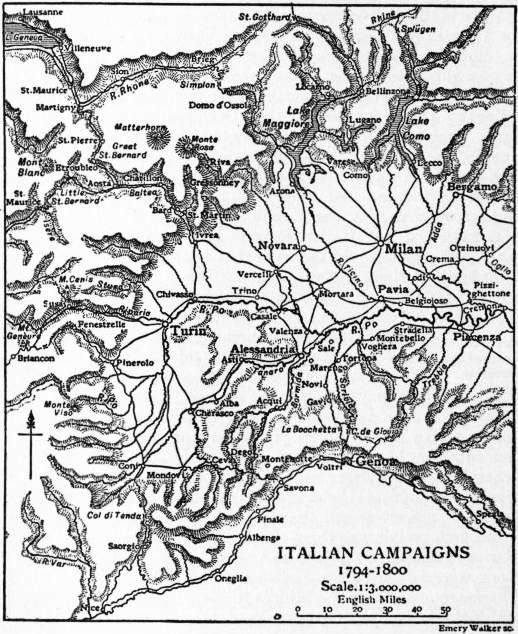
Moreau, however, owing to want of horses for his pontoon train and also because of the character of the Rhine above Basel, preferred to cross below that place, especially as in Alsace there were considerably greater supply facilities than in a country which had already been fought over and stripped bare. With the greatest reluctance Bonaparte let him have his way, and giving up the idea of using the Splügen and the St Gothard, began to turn his attention to the more westerly passes, the St Bernard and the Simplon. It was not merely Moreau’s scruples that led to this essential modification in the scheme. At the beginning of April the enemy took the offensive against Masséna. On the 8th Melas’s right wing dislodged the French from the Mont Cenis, and most of the troops that had then reached Dijon were shifted southward to be ready for emergencies. By the 25th Berthier reported that Masséna was seriously attacked and that he might have to be supported by the shortest route. Bonaparte’s resolution was already taken. He waited no longer for Moreau (who indeed so far from volunteering assistance, actually demanded it for himself). Convinced from the paucity of news that Masséna’s army was closely pressed and probably severed from France, and feeling also that the Austrians were deeply committed to their struggle with the Army of Italy, he told Berthier to march with 40,000 men at once by way of the St Bernard unless otherwise advised. Berthier protested that he had only 25,000 effectives, and the equipment and armament was still far from complete—as indeed it remained to the end—but the troops marched, though their very means of existence were precarious from the time of leaving Geneva to the time of reaching Milan, for nothing could extort supplies and money from the sullen Swiss.
At the beginning of May the First Consul learned of the serious plight of the Army of Italy. Masséna with his right wing was shut up in Genoa, Suchet with the left wing driven back to the Var. Meanwhile Moreau had won Napoleon’s plan of campaign. a preliminary victory at Stokach, and the Army of Reserve had begun its movement to Geneva. With these data the plan of campaign took a clear shape at last—Masséna to resist as long as possible; Suchet to resume the offensive, if he could do so, towards Turin; the Army of Reserve to pass the Alps and to debouch into Piedmont by Aosta; the Army of the Rhine to send a strong force into Italy by the St Gothard. The First Consul left Paris on the 6th of May. Berthier went forward to Geneva, and still farther on the route magazines were established at Villeneuve and St-Pierre. Gradually, and with immense efforts, the leading troops of the long column16 were passed over the St Bernard, drawing their artillery on sledges, on the 15th and succeeding days. Driving away small posts of the Austrian army, the advance guard entered Aosta on the 16th and Châtillon on the 18th and the alarm was given. Melas, committed as he was to his Riviera campaign, began to look to his right rear, but he was far from suspecting the seriousness of his opponent’s purpose.
Infinitely more dangerous for the French than the small detachment that Melas opposed to them, or even the actual crossing of the pass, was the unexpected stopping power of the little fort of Bard. The advanced guard Bard. of the French appeared before it on the 19th, and after three wasted days the infantry managed to find a difficult mountain by-way and to pass round the obstacle. Ivrea was occupied on the 23rd, and Napoleon hoped to assemble the whole army there by the 27th. But except for a few guns that with infinite precautions were smuggled one by one through the streets of Bard, the whole of the artillery, as well as a detachment (under Chabran) to besiege the fort, had to be left behind. Bard surrendered on the 2nd of June, having delayed the infantry of the French army for four days and the artillery for a fortnight.
The military situation in the last week of May, as it presented itself to the First Consul at Ivrea, was this. The Army of Italy under Masséna was closely besieged in Genoa, where provisions were running short, and the population so hostile that the French general placed his field artillery to sweep the streets. But Masséna was no ordinary general, and the First Consul knew that while Masséna lived the garrison would resist to the last extremity. Suchet was defending Nice and the Var by vigorous minor operations. The Army of Reserve, the centre of which had reached at Ivrea the edge of the Italian plains, consisted of four weak army corps under Victor, Duhesme, Lannes and Murat. There were still to be added to this small army of 34,000 effectives, Turreau’s division, which had passed over the Mont Cenis and was now in the valley of the Dora Riparia, Moncey’s corps of the Army of the Rhine, which had at last been extorted from Moreau and was due to pass the St Gothard before the end of May, Chabran’s division left to besiege Bard, and a small force under Béthencourt, which was to cross the Simplon and to descend by Arona (this place proved in the event a second Bard and immobilized Béthencourt until after the decisive battle). Thus it was only the simplest part of Napoleon’s task to concentrate half of his army at Ivrea, and he had yet to bring in the rest. The problem was to reconcile the necessity for time, which he wanted to ensure the maximum force being brought over the Alps, with the necessity for haste, in view of the impending fall of Genoa and the probability that once this conquest was achieved, Melas would bring back his 100,000 men into the Milanese to deal with the Army of Reserve. As early as the 14th of May he had informed Moncey that from Ivrea the Army of Reserve would move on Milan. On the 25th of May, in response to Berthier’s request for guidance, the First Consul ordered Lannes (advanced guard) to push out on the Turin road, “in order to deceive the enemy and to obtain news of Turreau,” and Duhesme’s and Murat’s corps to proceed along the Milan road. On the 27th, after Lannes had on the 26th defeated an Austrian column near Chivasso, the main body was already advancing on Vercelli.
Very few of Napoleon’s acts of generalship have been more criticized than this resolution to march on Milan, which abandoned Genoa to its fate and gave Melas a week’s leisure to assemble his scattered forces. The account of his motives The march to Milan. he dictated at St Helena (Nap. Correspondence, v. 30, pp. 375-377), in itself an unconvincing appeal to the rules of strategy as laid down by the theorists—which rules his own practice throughout transcended—gives, when closely examined, some at least of the necessary clues. He says in effect that by advancing directly on Turin he would have “risked a battle against equal forces without an assured line of retreat, Bard being still uncaptured.” It is indeed strange to find Napoleon shrinking before equal forces of the enemy, even if we admit without comment that it was more difficult to pass Bard the second time than the first. The only incentive to go towards Turin was the chance of partial victories over the disconnected Austrian corps that would be met in that direction, and this he deliberately set aside. Having done so, for reasons that will appear in the sequel, he could only defend it by saying in effect that he might have been defeated—which was true, but not the Napoleonic principle of war. Of the alternatives, one was to hasten to Genoa; this in Napoleon’s eyes would have been playing the enemy’s game, for they would have concentrated at Alessandria, facing west “in their natural position.” It is equally obvious that thus the enemy would have played his game, supposing that this was to relieve Genoa, and the implication is that it was not. The third course, which Napoleon took, and in this memorandum defended, gave his army the enemy’s depots at Milan, of which it unquestionably stood in sore need, and the reinforcement of Moncey’s 15,000 men from the Rhine, while at the same time Moncey’s route offered an “assured line of retreat” by the Simplon17 and the St Gothard. He would in fact make for himself there a “natural position” without forfeiting the advantage of being in Melas’s rear. Once possessed of Milan, Napoleon says, he could have engaged Melas with a light heart and with confidence in the greatest possible results of a victory, whether the Austrians sought to force their way back to the east by the right or the left bank of the Po, and he adds that if the French passed on and concentrated south of the Po there would be no danger to the Milan-St Gothard line of retreat, as this was secured by the rivers Ticino and Sesia. In this last, as we shall see, he is shielding an undeniable mistake, but considering for the moment only the movement to Milan, we are justified in assuming that his object was not the relief of Genoa, but the most thorough defeat of Melas’s field army, to which end, putting all sentiment aside, he treated the hard-pressed Masséna as a “containing force” to keep Melas occupied during the strategical deployment of the Army of Reserve. In the beginning he had told Masséna that he would “disengage” him, even if he had to go as far east as Trent to find a way into Italy. From the first, then, no direct relief was intended, and when, on hearing bad news from the Riviera, he altered his route to the more westerly passes, it was probably because he felt that Masséna’s containing power was almost exhausted, and that the passage and reassembly of the Reserve Army must be brought about in the minimum time and by the shortest way. But the object was still the defeat of Melas, and for this, as the Austrians possessed an enormous numerical superiority, the assembly of all forces, including Moncey’s, was indispensable. One essential condition of this was that the points of passage used should be out of reach of the enemy. The more westerly the passes chosen, the more dangerous was the whole operation—in fact the Mont Cenis column never reached him at all—and though his expressed objections to the St Bernard line seem, as we have said, to be written after the event, to disarm his critics, there is no doubt that at the time he disliked it. It was a pis aller forced upon him by Moreau’s delay and Masséna’s extremity, and from the moment at which he arrived at Milan he did, as a fact, abandon it altogether in favour of the St Gothard. Lastly, so strongly was he impressed with the necessity of completing the deployment of all his forces, that though he found the Austrians on the Turin side much scattered and could justifiably expect a series of rapid partial victories, Napoleon let them go, and devoted his whole energy to creating for himself a “natural” position about Milan. If he sinned, at any rate he sinned handsomely, and except that he went to Milan by Vercelli instead of by Lausanne and Domodossola18 (on the safe side of the mountains), his march is logistically beyond cavil.
Napoleon’s immediate purpose, then, was to reassemble the Army of Reserve in a zone of manœuvre about Milan. This was carried out in the first days of June. Lannes at Chivasso stood ready to ward off a flank attack until the main army had filed past on the Vercelli road, then leaving a small force to combine with Turreau (whose column had not been able to advance into the plain) in demonstrations towards Turin, he moved off, still acting as right flank guard to the army, in the direction of Pavia. The main body meanwhile, headed by Murat, advanced on Milan by way of Vercelli and Magenta, forcing the passage of the Ticino on the 31st of May at Turbigo and Buffalora. On the same day the other divisions closed up to the Ticino,19 and faithful to his principles Napoleon had an examination made of the little fortress of Novara, intending to occupy it as a place du moment to help in securing his zone of manœuvre. On the morning of the 2nd of June Murat occupied Milan, and in the evening of the same day the headquarters entered the great city, the Austrian detachment under Vukassovich (the flying right wing of Melas’s general cordon system in Piedmont) retiring to the Adda. Duhesme’s corps forced that river at Lodi, and pressed on with orders to organize Crema and if possible Orzinovi as temporary fortresses. Lechi’s Italians were sent towards Bergamo and Brescia. Lannes meantime had passed Vercelli, and on the evening of the 2nd his cavalry reached Pavia, where, as at Milan, immense stores of food, equipment and warlike stores were seized.
Napoleon was now safe in his “natural” position, and barred one of the two main lines of retreat open to the Austrians. But his ambitions went further, and he intended to cross the Po and to establish himself on the other likewise, thus establishing across the plain a complete barrage between Melas and Mantua. Here his end outranged his means, as we shall see. But he gave himself every chance that rapidity could afford him, and the moment that some sort of a “zone of manœuvre” had been secured between the Ticino and the Oglio, he pushed on his main body—or rather what was left after the protective system had been provided for—to the Po. He would not wait even for his guns, which had at last emerged from the Bard defile and were ordered to come to Milan by a safe and circuitous route along the foot of the Alps.
At this point the action of the enemy began to make itself felt. Melas had not gained the successes that he had expected in Piedmont and on the Riviera, thanks to Masséna’s obstinacy and to Suchet’s brilliant defence of the Var. Melas’s movements. These operations had led him very far afield, and the protection of his over-long line of communications had caused him to weaken his large army by throwing off many detachments to watch the Alpine valleys on his right rear. One of these successfully opposed Turreau in the valley of the Dora Riparia, but another had been severely handled by Lannes at Chivasso, and a third (Vukassovich) found itself, as we know, directly in the path of the French as they moved from Ivrea to Milan, and was driven far to the eastward. He was further handicapped by the necessity of supporting Ott before Genoa and Elsnitz on the Var, and hearing of Lannes’s bold advance on Chivasso and of the presence of a French column with artillery (Turreau) west of Turin, he assumed that the latter represented the main body of the Army of Reserve—in so far indeed as he believed in the existence of that army at all.20 Next, when Lannes moved away towards Pavia, Melas thought for a moment that fate had delivered his enemy into his hands, and began to collect such troops as were at hand at Turin with a view to cutting off the retreat of the French on Ivrea while Vukassovich held them in front. It was only when news came of Moncey’s arrival in Italy and of Vukassovich’s fighting retreat on Brescia that the magnitude and purpose of the French column that had penetrated by Ivrea became evident. Melas promptly decided to give up his western enterprises, and to concentrate at Alessandria, preparatory to breaking his way through the network of small columns—as the disseminated Army of Reserve still appeared to be—which threatened to bar his retreat. But orders circulated so slowly that he had to wait in Turin till the 8th of June for Elsnitz, whose retreat was, moreover, sharply followed up and made exceedingly costly by the enterprising Suchet. Ott, too, in spite of orders to give up the siege of Genoa at once and to march with all speed to hold the Alessandria-Piacenza road, waited two days to secure the prize, and agreed (June 4) to allow Masséna’s army to go free and to join Suchet. And lastly, the cavalry of O’Reilly, sent on ahead from Alessandria to the Stradella defile, reached that point only to encounter the French. The barrage was complete, and it remained for Melas to break it with the mass that he was assembling, with all these misfortunes and delays, about Alessandria. His chances of doing so were anything but desperate.
On the 5th of June Murat, with his own corps and part of Duhesme’s, had moved on Piacenza, and stormed the bridge-head there. Duhesme with one of his divisions pushed out on Crema and Orzinovi and also towards Pizzighetone. Moncey’s leading regiments approached Milan, and Berthier thereupon sent on Victor’s corps to support Murat and Lannes. Meantime the half abandoned line of operations, Ivrea-Vercelli, was briskly attacked by the Austrians, who had still detachments on the side of Turin, waiting for Elsnitz to rejoin, and the French artillery train was once more checked. On the 6th Lannes from Pavia, crossing the Po at San Cipriano, encountered and defeated a large force, (O’Reilly’s column), and barred the Alessandria-Parma main road. Opposite Piacenza Murat had to spend the day in gathering material for his passage, as the pontoon bridge had been cut by the retreating garrison of the bridge-head. On the eastern border of the “zone of manœuvre” Duhesme’s various columns moved out towards Brescia and Cremona, pushing back Vukassovich. Meantime the last divisions of the Army of Reserve (two of Moncey’s excepted) were hurried towards Lannes’s point of passage, as Murat had not yet secured Piacenza. On the 7th, while Duhesme continued to push back Vukassovich and seized Cremona, Murat at last captured Piacenza, finding there immense magazines. Meantime the army, division by division, passed over, slowly owing to a sudden flood, near Belgiojoso, and Lannes’s advanced guard was ordered to open communication with Murat along the main road Stradella-Piacenza. “Moments are precious” said the First Consul. He was aware that Elsnitz was retreating before Suchet, that Melas had left Turin for Alessandria, and that heavy forces of the enemy were at or east of Tortona. He knew, too, that Murat had been engaged with certain regiments recently before Genoa and (wrongly) assumed O’Reilly’s column, beaten by Lannes at San Cipriano, to have come from the same quarter. Whether this meant the deliverance or the surrender of Genoa he did not yet know, but it was certain that Masséna’s holding action was over, and that Melas was gathering up his forces to recover his communications. Hence Napoleon’s great object was concentration. “Twenty thousand men at Stradella,” in his own words, was the goal of his efforts, and with the accomplishment of this purpose the campaign enters on a new phase.
On the 8th of June, Lannes’s corps was across, Victor following as quickly as the flood would allow. Murat was at Piacenza, but the road between Lannes and Murat was not known to be clear, and the First Consul made the establishment of the Napoleon’s dispositions. connexion, and the construction of a third point of passage midway between the other two, the principal objects of the day’s work. The army now being disseminated between the Alps, the Apennines, the Ticino and the Chiese, it was of vital importance to connect up the various parts into a well-balanced system. But the Napoleon of 1800 solved the problem that lay at the root of his strategy, “concentrate, but be vulnerable nowhere,” in a way that compares unfavourably indeed with the methods of the Napoleon of 1806. Duhesme was still absent at Cremona. Lechi was far away in the Brescia country, Béthencourt detained at Arona. Moncey with about 15,000 men had to cover an area of 40 m. square around Milan, which constituted the original zone of manœuvre, and if Melas chose to break through the flimsy cordon of outposts on this side (the risk of which was the motive for detaching Moncey at all) instead of at the Stradella, it would take Moncey two days to concentrate his force on any battlefield within the area named, and even then he would be outnumbered by two to one. As for the main body at the Stradella, its position was wisely chosen, for the ground was too cramped for the deployment of the superior force that Melas might bring up, but the strategy that set before itself as an object 20,000 men at the decisive point out of 50,000 available, is, to say the least, imperfect. The most serious feature in all this was the injudicious order to Lannes to send forward his advanced guard, and to attack whatever enemy he met with on the road to Voghera. The First Consul, in fact, calculated that Melas could not assemble 20,000 men at Alessandria before the 12th of June, and he told Lannes that if he met the Austrians towards Voghera, they could not be more than 10,000 strong. A later order betrays some anxiety as to the exactitude of these assumptions, warns Lannes not to let himself be surprised, indicates his line of retreat, and, instead of ordering him to advance on Voghera, authorizes him to attack any corps that presented itself at Stradella. But all this came too late. Acting on the earlier order Lannes fought the battle of Montebello on the 9th. This Montebello. was a very severe running fight, beginning east of Casteggio and ending at Montebello, in which the French drove the Austrians from several successive positions, and which culminated in a savage fight at close quarters about Montebello itself. The singular feature of the battle is the disproportion between the losses on either side—French, 500 out of 12,000 engaged; Austrians, 2100 killed and wounded and 2100 prisoners out of 14,000. These figures are most conclusive evidence of the intensity of the French military spirit in those days. One of the two divisions (Watrin’s) was indeed a veteran organization, but the other, Chambarlhac’s, was formed of young troops and was the same that, in the march to Dijon, had congratulated itself that only 5% of its men had deserted. On the other side the soldiers fought for “the honour of their arms”—not even with the courage of despair, for they were ignorant of the “strategic barrage” set in front of them by Napoleon, and the loss of their communications had not as yet lessened their daily rations by an ounce.