VOLUME XI SLICE II French Literature to Frost, William (continued 7)
Reading edition
Matters did not, of course, present themselves in this light at Souham’s headquarters, where the generals met in an informal council. The project of flinging Bonnaud’s corps against the flank of the duke of York had not received even a beginning of execution, and the outposts, reinforced though they were from the main group, had everywhere been driven in. All the subordinate leaders, moreover (except Bonnaud), sent in the most despondent reports. “Councils of war never fight” is an old maxim, justified in ninety-nine cases in a hundred. But this council determined to do so, and with all possible vigour. The scheme was practically that which Coburg’s first threat had produced and his first brusque advance had inhibited. Vandamme was to hold Clerfayt, the garrison of Lille and a few outlying corps to occupy the archduke and Kinsky, and in the centre Moreau and Bonnaud, with 40,000 effectives, were to attack the Tourcoing-Mouvaux position in front and flank at dawn with all possible energy.
The first shots were fired on the Lys, where, it will be remembered, Clerfayt’s infantry had effected its crossing in the night. Vandamme, who was to defend the river, had in the evening assembled his troops (fatigued by a Battle of Tourcoing. long march) near Menin instead of pushing on at once. Thus only one of his battalions had taken part in the defence of Werwick on the 17th, and the remainder were by this chance massed on the flank of Clerfayt’s subsequent line of advance. Vandamme used his advantage well. He attacked, with perhaps 12,000 men against 21,000, the head and the middle of Clerfayt’s columns as they moved on Lincelles. Clerfayt stopped at once, turned upon him and drove him towards Roncq and Menin. Still, fighting in succession, rallying and fighting again, Vandamme’s regiments managed to spin out time and to commit Clerfayt deeper and deeper to a false direction till it was too late in the day to influence the battle elsewhere.
V. dem Bussche’s column at Dottignies, shaken by the blow it had received the day before, did nothing, and actually retreated to the Scheldt. On the other flank, Kinsky and the archduke Charles practically remained inactive despite repeated orders to proceed to Lannoy, Kinsky waiting for the archduke, and the latter using up his time and forces in elaborating a protective cordon all around his left and rear. Both alleged that “the troops were tired,” but there was a stronger motive. It was felt that Belgium was about to be handed over to France as the price of peace, and the generals did not see the force of wasting soldiers on a lost cause. There remained the two centre columns, Otto’s and the duke of York’s. The orders of the emperor to the duke were that he should advance to establish communication with Clerfayt at Lincelles. Having thus cut off the French Courtrai group, he was to initiate a general advance to crush it, in which all the allied columns would take part, Clerfayt, York and Otto in front, von dem Bussche on the right flank and the archduke and Kinsky in support. These airy schemes were destroyed at dawn on the 18th. Macdonald’s brigade carried Tourcoing at the first rush, though Otto’s guns and the volleys of the infantry checked its further progress. Malbrancq’s brigade swarmed around the duke of York’s entrenchments at Mouvaux, while Bonnaud’s mass from the side of Lille passed the Marque and lapped round the flanks of the British posts at Roubaix and Lannoy. The duke had used up his reserves in assisting Otto, and by 8 A.M. the positions of Roubaix, Lannoy and Mouvaux were isolated from each other. But the Allies fought magnificently, and by now the Republicans were in confusion, excited to the highest pitch and therefore extremely sensitive to waves of enthusiasm or panic; and at this moment Clerfayt was nearing success, and Vandamme fighting almost back to back with Malbrancq. Otto was able to retire gradually, though with heavy losses, to Leers, before Macdonald’s left column was able to storm Watrelos, or Daendels’ brigade, still farther towards the Scheldt, could reach his rear. The resistance of the Austrians gave breathing space to the English, who held on to their positions till about 11.30, attacked again and again by Bonnaud, and then, not without confusion, retired to join Otto at Leers.
With the retreat of the two sorely tried columns and the suspension of Clerfayt’s attack between Lincelles and Roncq, the battle of Tourcoing ended. It was a victory of which the young French generals had reason to be proud. The main attack was vigorously conducted, and the two-to-one numerical superiority which the French possessed at the decisive point is the best testimony at once to Souham’s generalship and to Vandamme’s bravery. As for the Allies, those of them who took part in the battle at all, generals and soldiers, covered themselves with glory, but the inaction of two-thirds of Coburg’s army was the bankruptcy declaration of the old strategical system. The Allies lost, on this day, about 4000 killed and wounded and 1500 prisoners besides 60 guns. The French loss, which was probably heavier, is not known. The duke of York defeated, Souham at once turned his attention to Clerfayt, against whom he directed all the forces he could gather after a day’s “horde-tactics.” The Austrian commander, however, withdrew over the river unharmed. On the 19th he was at Rousselaer and Ingelminster, 9 or 10 m. north of Courtrai, while Coburg’s forces assembled and encamped in a strong position some 3 m. west and north-west of Tournai, the Hanoverians remaining out in advance of the right on the Espierre.
Souham’s victory, thanks to his geographical position, had merely given him air. The Allies, except for the loss of some 5500 men, were in no way worse off. The plan had failed, but the army as a whole had not been defeated, while the troops of the duke of York and Otto were far too well disciplined not to take their defeat as “all in the day’s work.” Souham was still on the Lys and midway between the two allied masses, able to strike each in turn or liable to be crushed between them in proportion as the opposing generals calculated time, space and endurance accurately. Souham, therefore, as early as the 19th, had decided that until Clerfayt had been pushed back to his old positions near Thielt he could not deal with the main body of the Allies on the side of Tournai, and he had left Bonnaud to hold the latter while he concentrated most of his forces towards Courtrai. This move had the desired effect, for Clerfayt retired without a contest, and on the 21st of May Souham issued his orders for an advance on Coburg’s army, which, as he knew, had meantime been reinforced. Vandamme alone was left to face Clerfayt, and this time with outposts far out, at Ingelminster and Roosebeke, so as to ensure his chief, not a few hours’, but two or three days’ freedom from interference.
Pichegru now returned and took up the supreme command, Souham remaining in charge of his own and Moreau’s divisions. On the extreme right, from Pont-à-Tressin, only demonstrations were to be made; the centre, between Battle of Tournai. Baisieux and Estaimbourg, was to be the scene of the holding attack of Bonnaud’s command, while Souham, in considerably greater density, delivered the decisive attack on the allied right by St Leger and Warcoing. At Helchin a brigade was to guard the outer flank of the assailants against a movement by the Hanoverians and to keep open communication with Courtrai in case of attack from the direction of Oudenarde. The details of the allied position were insufficiently known owing to the multiplicity of their advanced posts and the intricate and densely cultivated nature of the ground. The battle of Tournai opened in the early morning of the 22nd and was long and desperately contested. The demonstration on the French extreme right was soon recognized by the defenders to be negligible, and the allied left wing thereupon closed on the centre. There Bonnaud attacked with vigour, forcing back the various advanced posts, especially on the left, where he dislodged the Allies from Nechin. The defenders of Templeuve then fell back, and the attacking swarms—a dissolved line of battle—fringed the brook beyond Templeuve, on the other side of which was the Allies’ main position, and even for a moment seized Blandain. Meanwhile the French at Nechin, in concert with the main attack, pressed on towards Ramegnies.
Macdonald’s and other brigades had forced the Espierre rivulet and driven von dem Bussche’s Hanoverians partly over the Scheldt (they had a pontoon bridge), partly southward. The main front of the Allies was defined by the brook that flows between Templeuve and Blandain, then between Ramegnies and Pont-à-Chin and empties into the Scheldt near the last-named hamlet. On this front till close on nightfall a fierce battle raged. Pichegru’s main attack was still by his left, and Pont-à-Chin was taken and retaken by French, Austrians, British and Hanoverians in turn. Between Blandain and Pont-à-Chin Bonnaud’s troops more than once entered the line of defence. But the attack was definitively broken off at nightfall and the Republicans withdrew slowly towards Lannoy and Leers. They had for the first time in a fiercely contested “soldier’s battle” measured their strength, regiment for regiment, against the Allies, and failed, but by so narrow a margin that henceforward the Army of the North realized its own strength and solidity. The Army of the Revolution, already superior in numbers and imbued with the decision-compelling spirit, had at last achieved self-confidence.
But the actual decision was destined by a curious process of evolution to be given by Jourdan’s far-distant Army of the Moselle, to which we now turn.
The Army of the Moselle had been ordered to assemble a striking force on its left wing, without prejudicing the rest of its cordon in Lorraine, and with this striking force to operate towards Liége and Namur. Its first movement on Arlon, in April, was repulsed by a small Austrian corps under Beaulieu that guarded this region. But in the beginning of May the advance was resumed though the troops were ill-equipped and ill-fed, and requisitions had reduced the civil population to semi-starvation and sullen hostility. We quote Jourdan’s instructions to his advanced guard, not merely as evidence of the trivial purpose of the march as originally planned, but still more as an illustration of the driving power that made the troops march at all, and of the new method of marching and subsisting them.
Its commander was “to keep in mind the purpose of cutting the communications between Luxemburg and Namur, and was therefore to throw out strong bodies against the enemy daily and at different points, to parry the enemy’s movements by rapid Jourdan’s movement on Liége. marches, to prevent any transfer of troops to Belgium, and lastly to seek an occasion for giving battle, for cutting off his convoys and for seizing his magazines.” So much for the purpose. The method of achieving it is defined as follows. “General Hatry, in order to attain the object of these instructions, will have with him the minimum of wagons. He is to live at the expense of the enemy as much as possible, and to send back into the interior of the Republic whatever may be useful to it; he will maintain his communications with Longwy, report every movement to me, and when necessary to the Committee of Public Safety and to the minister of war, maintain order and discipline, and firmly oppose every sort of pillage.” How the last of these instructions was to be reconciled with the rest, Hatry was not informed. In fact, it was ignored. “I am far from believing,” wrote the representative on mission Gillet, “that we ought to adopt the principles of philanthropy with which we began the war.”
At the moment when, on these terms, Jourdan’s advance was resumed, the general situation east of the Scheldt was as follows: The Allies’ centre under Coburg had captured Landrecies, and now (May 4) lay around that place, about 65,000 strong, while the left under Kaunitz (27,000) was somewhat north of Maubeuge, with detachments south of the Sambre as far as the Meuse. Beyond these again were the detachment of Beaulieu (8000) near Arlon, and another, 9000 strong, around Trier. On the side of the French, the Army of the Moselle (41,000 effectives) was in cordon between Saargemünd and Longwy; the Army of the Ardennes (22,000) between Beaumont and Givet; of the Army of the North, the right wing (38,000) in the area Beaumont—Maubeuge and the centre (24,000) about Guise. In the aggregate the allied field armies numbered 139,000 men, those of the French 203,000. Tactically the disproportion was sufficient to give the latter the victory, if, strategically, it could be made effective at a given time and place. But the French had mobility as a remedy for over-extension, and though their close massing on the extreme flanks left no more than equal forces opposite Coburg in the centre, the latter felt unable either to go forward or to close to one flank when on his right the storm was brewing at Menin and Tournai, and on his left Kaunitz reported the gathering of important masses of the French around Beaumont.
Thus the initiative passed over to the French, but they missed their opportunity, as Coburg had missed his in 1793. Pichegru’s right was ordered to march on Mons, and his left to master the navigation of the Scheldt so as to reduce the Allies to wagon-drawn supplies—the latter an objective dear to the 18th-century general; while Jourdan’s task, as we know, was to conquer the Liége or Namur country without unduly stripping the cordon on the Saar and the Moselle. Jourdan’s orders and original purpose were to get Beaulieu out of his way by the usual strategical tricks, and to march through the Ardennes as rapidly as possible, living on what supplies he could pick up from the enemy or the inhabitants. But he had scarcely started when Beaulieu made his existence felt by attacking a French post at Bouillon. Thereupon Jourdan made the active enemy, instead of Namur, his first object.
The movement of the operative portion of the Army of the Moselle began on the 21st of May from Longwy through Arlon towards Neufchâteau. Irregular fighting, sometimes with the Austrians, sometimes with the bitterly hostile inhabitants, marked its progress. Beaulieu was nowhere forced into a battle. But fortune was on Jourdan’s side. The Austrians were a detachment of Coburg’s army, not an independent force, and when threatened they retired towards Ciney, drawing Jourdan after them in the very direction in which he desired to go. On the 28th the French, after a vain detour made in the hope of forcing Beaulieu to fight—“les esclaves n’osent pas se mesurer avec des hommes libres,” wrote Jourdan in disgust,—reached Ciney, and there heard that the enemy had fallen back to a strongly entrenched position on the east bank of the Meuse near Namur. Jourdan was preparing to attack them there, when considerations of quite another kind intervened to change his direction, and thereby to produce the drama of Charleroi and Fleurus—which military historians have asserted to be the foreseen result of the initial plan.
The method of “living on the country” had failed lamentably in the Ardennes, and Jourdan, though he had spoken of changing his line of supply from Arlon to Carignan, then to Mézières and so on as his march progressed, was still actually living from hand to mouth on the convoys that arrived intermittently from his original base. When he sought to take what he needed from the towns on the Meuse, he infringed on the preserves of the Army of the Ardennes.6 The advance, therefore, came for the moment to a standstill, while Beaulieu, solicitous for the safety of Charleroi—in which fortress he had a magazine—called up the outlying troops left behind on the Moselle to rejoin him by way of Bastogne. At the same moment (29th) Jourdan received new orders from Paris—(a) to take Dinant and Charleroi and to clear the country between the Meuse and the Sambre, and (b) to attack Namur, either by assault or by regular siege. In the latter case the bulk of the forces were to form a covering army beyond the place, to demonstrate towards Nivelles, Louvain and Liége, and to serve at need as a support to the right flank of the Ardennes Army. From these orders and from the action of the enemy the campaign at last took a definite shape.
When the Army of the Moselle passed over to the left bank of the Meuse, it was greeted by the distant roar of guns towards Charleroi and by news that the Army of the Ardennes, which had already twice been defeated by Kaunitz, Charleroi. was for the third time deeply and unsuccessfully engaged beyond the Sambre. The resumption of the march again complicated the supply question, and it was only slowly that the army advanced towards Charleroi, sweeping the country before it and extending its right towards Namur. But at last on the 3rd of June the concentration of parts of three armies on the Sambre was effected. Jourdan took command of the united force (Army of the Sambre and Meuse) with a strong hand, the 40,000 new-comers inspired fresh courage in the beaten Ardennes troops, and in the sudden dominating enthusiasm of the moment pillaging and straggling almost ceased. Troops that had secured bread shared it with less fortunate comrades, and even the Liégois peasantry made free gifts of supplies. “We must believe,” says the French general staff of to-day, “that the idea symbolized by the Tricolour, around which marched ever these sansculottes, shoeless and hungry, unchained a mysterious force that preceded our columns and aided the achievement of military success.”
Friction, however, arose between Jourdan and the generals of the Ardennes Army, to whom the representatives thought it well to give a separate mission. This detachment of 18,000 men was followed by another, of 16,000, to keep touch with Maubeuge. Deducting another 6000 for the siege of Charleroi, when this should be made, the covering army destined to fight the Imperialists dwindled to 55,000 out of 96,000 effectives. Even now, we see, the objective was not primarily the enemy’s army. The Republican leaders desired to strike out beyond the Sambre, and as a preliminary to capture Charleroi. They would not, however, risk the loss of their connexion with Maubeuge before attaining the new foothold.
Meanwhile, Tourcoing and Tournai had at last convinced Coburg that Pichegru was his most threatening opponent, and he had therefore, though with many misgivings, decided to move towards his right, leaving the prince of Orange with not more than 45,000 men on the side of Maubeuge-Charleroi-Namur.
Jourdan crossed the Sambre on the 12th of June, practically unopposed. Charleroi was rapidly invested and the covering army extended in a semicircular position. For the fourth time the Allies counter-attacked successfully, and after a severe struggle the French had to abandon their positions and their siege works and to recross the Sambre (June 16). But the army was not beaten. On the contrary, it was only desirous of having its revenge for a stroke of ill-fortune, due, the soldiers said, to the fog and to the want of ammunition. The fierce threats of St Just (who had joined the army) to faire tomber les têtes if more energy were not shown were unnecessary, and within two days the army was advancing again. On the 18th Jourdan’s columns recrossed the river and extended around Charleroi in the same positions as before. This time, having in view the weariness of his troops and their heavy losses on the 16th, the prince of Orange allowed the siege to proceed. His reasons for so doing furnish an excellent illustration of the different ideas and capacities of a professional army and a “nation in arms.” “The Imperial troops,” wrote General Alvintzi, “are very fatigued. We have fought nine times since the 10th of May, we have bivouacked constantly, and made forced marches. Further, we are short of officers.” All this, it need hardly be pointed out, applied equally to the French.
Charleroi, garrisoned by less than 3000 men, was intimidated into surrender (25th) when the third parallel was barely established. Thus the object of the first operations was achieved. As to the next neither Jourdan nor the representatives seem to have had anything further in view than the capture of more fortresses. But within twenty-four hours events had decided for them.
Coburg had quickly abandoned his intention of closing on his right wing, and (after the usual difficulties with his Allies on that side) had withdrawn 12,000 Austrians from the centre of his cordon opposite Pichegru, and made forced marches to join the prince of Orange. On the 24th of June he had collected 52,000 men at various points round Charleroi, and on the 25th he set out to relieve the little fortress. But he was in complete ignorance of the state of affairs at Charleroi. Signal guns were fired, but the woods drowned even the roar of the siege batteries, and at last a party under Lieutenant Radetzky made its way through the covering army and discovered that the place had fallen. The party was destroyed on its return, but Radetzky was reserved for greater things. He managed, though twice wounded, to rejoin Coburg with his bad news in the midst of the battle of Fleurus.
On the 26th Jourdan’s army (now some 73,000 strong) was still posted in a semicircle of entrenched posts, 20 m. in extent, round the captured town, pending the removal of the now unnecessary pontoon bridge at Marchiennes and the selection of a shorter line of defence.
Coburg was still more widely extended. Inferior in numbers as he was, he proposed to attack on an equal front, and thus gave himself, for the attack of an entrenched position, an order of battle of three men to every two yards of Fleurus. front, all reserves included. The Allies were to attack in five columns, the prince of Orange from the west and north-west towards Trazegnies and Monceau wood, Quasdanovich from the north on Gosselies, Kaunitz from the north-east, the archduke Charles from the east through Fleurus, and finally Beaulieu towards Lambusart. The scheme was worked out in such minute detail and with so entire a disregard of the chance of unforeseen incidents, that once he had given the executive command to move, the Austrian general could do no more. If every detail worked out as planned, victory would be his; if accidents happened he could do nothing to redress them, and unless these righted themselves (which was improbable in the case of the stiffly organized old armies) he could only send round the order to break off the action and retreat.
In these circumstances the battle of Fleurus is the sum rather than the product of the various fights that took place between each allied column and the French division that it met. The prince of Orange attacked at earliest dawn and gradually drove in the French left wing to Courcelles, Roux and Marchiennes, but somewhat after noon the French, under the direction for the most part of Kléber, began a series of counterstrokes which recovered the lost ground, and about 5, without waiting for Coburg’s instructions, the prince retired north-westward off the battlefield. The French centre division, under Morlot, made a gradual fighting retreat on Gosselies, followed up by the Quasdanovich column and part of Kaunitz’s force. No serious impression was made on the defenders, chiefly because the brook west of Mellet was a serious obstacle to the rigid order of the Allies and had to be bridged before their guns could be got over. Kaunitz’s column and Championnet’s division met on the battlefield of 1690. The French were gradually driven in from the outlying villages to their main position between Heppignies and Wangenies. Here the Allies, well led and taking every advantage of ground and momentary chances, had the best of it. They pressed the French hard, necessitated the intervention of such small reserves as Jourdan had available, and only gave way to the defenders’ counterstroke at the moment they received Coburg’s orders for a general retreat.
On the allied left wing the fighting was closer and more severe than at any point. Beaulieu on the extreme left advanced upon Velaine and the French positions in the woods to the south in several small groups of all arms. Here were the divisions of the Army of the Ardennes, markedly inferior in discipline and endurance to the rest, and only too mindful of their four previous reverses. For six hours, more or less, they resisted the oncoming Allies, but then, in spite of the example and the despairing appeals of their young general Marceau, they broke and fled, leaving Beaulieu free to combine with the archduke Charles, who carried Fleurus after obstinate fighting, and then pressed on towards Campinaire. Beaulieu took command of all the allied forces on this side about noon, and from then to 5 P.M. launched a series of terrible attacks on the French (Lefebvre’s division, part of the general reserve, and the remnant of Marceau’s troops) above Campinaire and Lambusart. The disciplined resolution of the imperial battalions, and the enthusiasm of the French Revolutionaries, were each at their height. The Austrians came on time after time over ground that was practically destitute of cover. Villages, farms and fields of corn caught fire. The French grew more and more excited—“No retreat to-day!” they called out to their leaders, and finally, clamouring to be led against the enemy, they had their wish. Lefebvre seized the psychological moment when the fourth attack of the Allies had failed, and (though he did not know it) the order to retreat had come from Coburg. The losses of the unit that delivered it were small, for the charge exactly responded to the moral conditions of the moment, but the proportion of killed to wounded (55 to 81) is good evidence of the intensity of the momentary conflict.
So ended the battle. Coburg had by now learned definitely that Charleroi had surrendered, and while the issue of the battle was still doubtful—for though the prince of Orange was beaten, Beaulieu was in the full tide of success—he gave (towards 3 P.M.) the order for a general retreat. This was delivered to the various commanders between 4 and 5, and these, having their men in hand even in the heat of the engagement, were able to break off the battle without undue confusion. The French were far too exhausted to pursue them (they had lost twice as many men as the Allies), and their leader had practically no formed body at hand to follow up the victory, thanks to the extraordinary dissemination of the army.
Tourcoing, Tournay and Fleurus represent the maximum result achievable under the earlier Revolutionary system of making war, and show the men and the leaders at the highest point of combined steadiness and enthusiasm they ever reached—that is, as a “Sansculotte” army. Fleurus was also the last great victory of the French, in point of time, prior to the advent of Napoleon, and may therefore be considered as illustrating the general conditions of warfare at one of the most important points in its development.
The sequel of these battles can be told in a few words. The Austrian government had, it is said, long ago decided to evacuate the Netherlands, and Coburg retired over the Meuse, practically unpursued, while the duke of York’s forces fell back in good order, though pursued by Pichegru through Flanders. The English contingent embarked for home, the rest retired through Holland into Hanoverian territory, leaving the Dutch troops to surrender to the victors. The last phase of the pursuit reflected great glory on Pichegru, for it was conducted in midwinter through a country bare of supplies and densely intersected with dykes and meres. The crowning incident was the dramatic capture of the Dutch fleet, frozen in at the Texel, by a handful of hussars who rode over the ice and browbeat the crews of the well-armed battleships into surrender. It was many years before a prince of Orange ruled again in the United provinces, while the Austrian whitecoats never again mounted guard in Brussels.
The Rhine campaign of 1794, waged as before chiefly by the Prussians, was not of great importance. General v. Möllendorf won a victory at Kaiserslautern on the 23rd of May, but operations thereafter became spasmodic, and were soon complicated by Coburg’s retreat over the Meuse. With this event the offensive of the Allies against the French Revolution came to an inglorious end. Poland now occupied the thoughts of European statesmen, and Austria began to draw her forces on to the east. England stopped the payment of subsidies, and Prussia made the Peace of Basel on the 5th of April 1795. On the Spanish frontier the French under General Dugommier (who was killed in the last battle) were successful in almost every encounter, and Spain, too, made peace. Only the eternal enemies, France and Austria, were left face to face on the Rhine, and elsewhere, of all the Allies, Sardinia alone (see below under Italian Campaigns) continued the struggle in a half-hearted fashion.
The operations of 1795 on the Rhine present no feature of the Revolutionary Wars that other and more interesting campaigns fail to show. Austria had two armies on foot under the general command of Clerfayt, one on the upper Rhine, the other south of the Main, while Mainz was held by an army of imperial contingents. The French, Jourdan on the lower; Pichegru on the upper Rhine, had as usual superior numbers at their disposal. Jourdan combined a demonstrative frontal attack on Neuwied with an advance in force via Düsseldorf, reunited his wings beyond the river near Neuwied, and drove back the Austrians in a series of small engagements to the Main, while Pichegru passed at Mannheim and advanced towards the Neckar. But ere long both were beaten, Jourdan at Höchst and Pichegru at Mannheim, and the investment of Mainz had to be abandoned. This was followed by the invasion of the Palatinate by Clerfayt and the retreat of Jourdan to the Moselle. The position was further compromised by secret negotiations between Pichegru and the enemy for the restoration of the Bourbons. The meditated treason came to light early in the following year, and the guilty commander disappeared into the obscure ranks of the royalist secret agents till finally brought to justice in 1804.
The Campaign of 1796 in Germany
The wonder of Europe now transferred itself from the drama of the French Revolution to the equally absorbing drama of a great war on the Rhine. “Every day, for four terrible years,” wrote a German pamphleteer early in 1796, “has surpassed the one before it in grandeur and terror, and to-day surpasses all in dizzy sublimity.” That a manœuvre on the Lahn should possess an interest to the peoples of Europe surpassing that of the Reign of Terror is indeed hardly imaginable, but there was a good reason for the tense expectancy that prevailed everywhere. France’s policy was no longer defensive. She aimed at invading and “revolutionizing” the monarchies and principalities of old Europe, and to this end the campaign of 1796 was to be the great and conclusive effort. The “liberation of the oppressed” had its part in the decision, and the glory of freeing the serf easily merged itself in the glory of defeating the serf’s masters. But a still more pressing motive for carrying the war into the enemy’s country was the fact that France and the lands she had overrun could no longer subsist her armies. The Directory frankly told its generals, when they complained that their men were starving and ragged, that they would find plenty of subsistence beyond the Rhine.
On her part, Austria, no longer fettered by allied contingents nor by the expenses of a far distant campaign, could put forth more strength than on former campaigns, and as war came nearer home and the citizen saw himself threatened by “revolutionizing” and devastating armies, he ceased to hamper or to swindle the troops. Thus the duel took place on the grandest scale then known in the history of European armies. Apart from the secondary theatre of Italy, the area embraced in the struggle was a vast triangle extending from Düsseldorf to Basel and thence to Ratisbon, and Carnot sketched the outlines in accordance with the scale of the picture. He imagined nothing less than the union of the armies of the Rhine and the Riviera before the walls of Vienna. Its practicability cannot here be discussed, but it is worth contrasting the attitude of contemporaries and of later strategical theorists towards it. The former, with their empirical knowledge of war, merely thought it impracticable with the available means, but the latter have condemned it root and branch as “an operation on exterior lines.”
The scheme took shape only gradually. The first advance was made partly in search of food, partly to disengage the Palatinate, which Clerfayt had conquered in 1795. “If you have reason to believe that you would find some supplies on the Lahn, hasten thither with the greater part of your forces,” wrote the Directory to Jourdan (Army of the Sambre-and-Meuse, 72,000) on the 29th of March. He was to move at once, before the Austrians could concentrate, and to pass the Rhine at Düsseldorf, thereby bringing back the centre of the Jourdan and Moreau. enemy over the river. He was, further, to take every advantage of their want of concentration to deliver blow after blow, and to do his utmost to break them up completely. A fortnight later Moreau (Army of the Rhine-and-Moselle, 78,000) was ordered to take advantage of Jourdan’s move, which would draw most of the Austrian forces to the Mainz region, to enter the Breisgau and Suabia. “You will attack Austria at home, and capture her magazines. You will enter a new country, the resources of which, properly handled, should suffice for the needs of the Army of the Rhine-and-Moselle.”
Jourdan, therefore, was to take upon himself the destruction of the enemy, Moreau the invasion of South Germany. The first object of both was to subsist their armies beyond the Rhine, the second to defeat the armies and terrorize the populations of the empire. Under these instructions the campaign opened. Jourdan crossed at Düsseldorf and reached the Lahn, but the enemy concentrated against him very swiftly and he had to retire over the river. Still, if he had not been able to “break them up completely,” he had at any rate drawn on himself the weight of the Austrian army, and enabled Moreau to cross at Strassburg without much difficulty.
The Austrians were now commanded by the archduke Charles, who, after all detachments had been made, disposed of some 56,000 men. At first he employed the bulk of this force against Jourdan, but on hearing of Moreau’s progress he returned to the Neckar country with 20,000 men, leaving Feldzeugmeister v. Wartensleben with 36,000 to observe Jourdan. In later years he admitted himself that his own force was far too small to deal with Moreau, who, he probably thought, would retire after a few manœuvres.
But by now the two French generals were aiming at something more than alternate raids and feints. Carnot had set before them the ideal of a decisive battle as the great object. Jourdan was instructed, if the archduke turned on The archduke’s plan. Moreau, to follow him up with all speed and to bring him to action. Moreau, too, was not retreating but advancing. The two armies, Moreau’s and the archduke’s, met in a straggling and indecisive battle at Malsch on the 9th of July, and soon afterwards Charles learned that Jourdan had recrossed the Rhine and was driving Wartensleben before him. He thereupon retired both armies from the Rhine valley into the interior, hoping that at least the French would detach large forces to besiege the river fortresses. Disappointed of this, and compelled to face a very grave situation, he resorted to an expedient which may be described in his own words: “to retire both armies step by step without committing himself to a battle, and to seize the first opportunity to unite them so as to throw himself with superior or at least equal strength on one of the two hostile enemies.” This is the ever-recurring idea of “interior lines.” It was not new, for Frederick the Great had used similar means in similar circumstances, as had Souham at Tourcoing and even Dampierre at Valenciennes. Nor was it differentiated, as were Napoleon’s operations in this same year, by the deliberate use of a small containing force at one point to obtain relative superiority at another. A general of the 18th century did not believe in the efficacy of superior numbers—had not Frederick the Great disproved it?—and for him operations on “interior lines” were simply successive blows at successive targets, the efficacy of the blow in each case being dependent chiefly on his own personal qualities and skill as a general on the field of battle. In the present case the point to be observed is not the expedient, which was dictated by the circumstances, but the courage of the young general, who, unlike Wartensleben and the rest of his generals, unlike, too, Moreau and Jourdan themselves, surmounted difficulties instead of lamenting them.
On the other side, Carnot, of course, foresaw this possibility. He warned the generals not to allow the enemy to “use his forces sometimes against one, sometimes against the other, as he did in the last campaign,” and ordered them to go forward respectively into Franconia and into the country of the upper Neckar, with a view to seeking out and defeating the enemy’s army. But the plan of operations soon grew bolder. Jourdan was informed on the 21st of July that if he reached the Regnitz without meeting the enemy, or if his arrival there forced the latter to retire rapidly to the Danube, he was not to hesitate to advance to Ratisbon and even to Passau if the disorganization of the enemy admitted it, but in these contingencies he was to detach a force into Bohemia to levy contributions. “We presume that the enemy is too weak to offer a successful resistance and will have united his forces on the Danube; we hope that our two armies will act in unison to rout him completely. Each is, in any case, strong enough to attack by itself, and nothing is so pernicious as slowness in war.” Evidently the fear that the two Austrian armies would unite against one of their assailants had now given place to something like disdain.
This was due in all probability to the rapidity with which Moreau was driving the archduke before him. After a brief stand on the Neckar at Cannstadt, the Austrians, only 25,000 strong, fell back to the Rauhe Alb, where they halted again, to cover their magazines at Ulm and Günzburg, towards the end of July. Wartensleben was similarly falling back before Jourdan, though the latter, starting considerably later than Moreau, had not advanced so far. The details of the successive positions occupied by Wartensleben need not be stated; all that concerns the general development of the campaign is the fact that the hitherto independent leader of the “Lower Rhine Army” resented the loss of his freedom of action, and besides lamentations opposed a dull passive resistance to all but the most formal orders of the prince. Many weeks passed before this was overcome sufficiently for his leader even to arrange for the contemplated combination, and in these weeks the archduke was being driven back day by day, and the German principalities were falling away one by one as the French advanced and preached the revolutionary formula. In such circumstances as these—the general facts, if not the causes, were patent enough—it was natural that the confident Paris strategists should think chiefly of the profits of their enterprise and ignore the fears of the generals at the front. But the latter were justified in one important respect; their operating armies had seriously diminished in numbers, Jourdan disposing of not more than 45,000 and Moreau of about 50,000. The archduke had now, owing to the arrival of a few detachments from the Black Forest and elsewhere, about 34,000 men, Wartensleben almost exactly the same, and the former, for some reason which has never been fully explained but has its justification in psychological factors, suddenly turned Neresheim. and fought a long, severe and straggling battle above Neresheim (August 11). This did not, however, give him much respite, and on the 12th and 13th he retired over the Danube. At this date Wartensleben was about Amberg, almost as far away from the other army as he had been on the Rhine, owing to the necessity of retreating round instead of through the principality of Bayreuth, which was a Prussian possession and could therefore make its neutrality respected.
Hitherto Charles had intended to unite his armies on the Danube against Moreau. His later choice of Jourdan’s army as the objective of his combination grew out of circumstances and in particular out of the brilliant reconnaissance work of a cavalry brigadier of the Lower Rhine Army, Nauendorff. This general’s reports—he was working in the country south and south-east of Nürnberg, Wartensleben being at Amberg—indicated first an advance of Jourdan’s army from Forchheim through Nürnberg to the south, and induced the archduke, on the 12th, to begin a concentration of his own army towards Ingolstadt. This was a purely defensive measure, but Nauendorff reported on the 13th and 14th that the main columns of the French were swinging away to the east against Wartensleben’s front and inner flank, and on the 14th he boldly suggested the idea that decided the campaign. “If your Royal Highness will or can advance 12,000 men against Jourdan’s rear, he is lost. We could not have a better opportunity.” When this message arrived at headquarters the archduke had already issued orders to the same effect. Lieutenant Field Marshal Count Latour, with 30,000 men, was to keep Moreau occupied—another expedient of the moment, due to the very close pressure of Moreau’s advance, and the failure of the attempt to put him out of action at Neresheim. The small remainder of the army, with a few detachments gathered en route, in all about 27,000 men, began to recross the Danube on the 14th, and slowly advanced north on a broad front, its leader being now sure that at some point on his line he would encounter the French, whether they were heading for Ratisbon or Amberg. Meanwhile, the Directory had, still acting on the theory of the archduke’s weakness, ordered Moreau to combine the operations with those of Bonaparte in Italian Tirol, and Jourdan to turn both flanks of his immediate opponent, and thus to prevent his joining the archduke, as well as his retreat into Bohemia. And curiously enough it was this latter, and not Moreau’s move, which suggested to the archduke that his chance had come. The chance was, in fact, one dear to the 18th century general, catching his opponent in the act of executing a manœuvre. So far from “exterior lines” being fatal to Jourdan, it was not until the French general began to operate against Wartensleben’s inner flank that the archduke’s opportunity came.
The decisive events of the campaign can be described very briefly, the ideas that directed them having been made clear. The long thin line of the archduke wrapped itself round Jourdan’s right flank near Amberg, while Wartensleben Amberg and Würzburg. fought him in front. The battle (August 24) was a series of engagements between the various columns that met; it was a repetition in fact of Fleurus, without the intensity of fighting spirit that redeems that battle from dulness. Success followed, not upon bravery or even tactics, but upon the pre-existing strategical conditions. At the end of the day the French retired, and next morning the archduke began another wide extension to his left, hoping to head them off. This consumed several days. In the course of it Jourdan attempted to take advantage of his opponent’s dissemination to regain the direct road to Würzburg, but the attempt was defeated by an almost fortuitous combination of forces at the threatened point. More effective, indeed, than this indirect pursuit was the very active hostility of the peasantry, who had suffered in Jourdan’s advance and retaliated so effectually during his retreat that the army became thoroughly demoralized, both by want of food and by the strain of incessant sniping. Defeated again at Würzburg on the 3rd of September, Jourdan continued his retreat to the Lahn, and finally withdrew the shattered army over the Rhine, partly by Düsseldorf, partly by Neuwied. In the last engagement on the Lahn the young and brilliant Marceau was mortally wounded. Far away in Bavaria, Moreau had meantime been driving Latour from one line of resistance to another. On receiving the news of Jourdan’s reverses, however, he made a rapid and successful retreat to Strassburg, evading the prince’s army, which had ascended the Rhine valley to head him off, in the nick of time.
This celebrated campaign is pre-eminently strategical in its character, in that the positions and movements anterior to the battle preordained its issue. It raised the reputation of the archduke Charles to the highest point, and deservedly, for he wrested victory from the most desperate circumstances by the skilful and resolute employment of his one advantage. But this was only possible because Moreau and Jourdan were content to accept strategical failure without seeking to redress the balance by hard fighting. The great question of this campaign is, why did Moreau and Jourdan fail against inferior numbers, when in Italy Bonaparte with a similar army against a similar opponent won victory after victory against equal and superior forces? The answer will not be supplied by any theory of “exterior and interior lines.” It lies far deeper. So far as it is possible to summarize it in one phrase, it lies in the fact that though the Directory meant this campaign to be the final word on the Revolutionary War, for the nation at large this final word had been said at Fleurus. The troops were still the nation; they no longer fought for a cause and for bare existence, and Moreau and Jourdan were too closely allied in ideas and sympathies with the misplaced citizen soldiers they commanded to be able to dominate their collective will. In default of a cause, however, soldiers will fight for a man, and this brings us by a natural sequence of ideas to the war in Italy.
The War in Italy 1793-97
Hitherto we have ignored the operations on the Italian frontier, partly because they were of minor importance and partly because the conditions out of which Napoleon’s first campaign arose can be best considered in connexion with that campaign itself, from which indeed the previous operations derive such light as they possess. It has been mentioned that in 1792 the French overran Savoy and Nice. In 1793 the Sardinian army and a small auxiliary corps of Austrians waged a desultory mountain warfare against the Army of the Alps about Briançon and the Army of Italy on the Var. That furious offensive on the part of the French, which signalized the year 1793 elsewhere, was made impossible here by the counter-revolution in the cities of the Midi.
In 1794, when this had been crushed, the intention of the French government was to take the offensive against the Austro-Sardinians. The first operation was to be the capture of Oneglia. The concentration of large forces in the lower Rhone valley had naturally infringed upon the areas told off for the provisioning of the Armies of the Alps (Kellermann) and of Italy (Dumerbion); indeed, the sullen population could hardly be induced to feed the troops suppressing the revolt, still less the distant frontier armies. Thus the only source of supply was the Riviera of Genoa: “Our connexion with this district is imperilled by the corsairs of Oneglia (a Sardinian town) owing to the cessation of our operations afloat. The army is living from hand to mouth,” wrote the younger Robespierre in September 1793. Vessels bearing supplies from Genoa could not avoid the corsairs by taking the open sea, for there the British fleet was supreme. Carnot therefore ordered the Army of Italy to capture Oneglia, and 21,000 men (the rest of the 67,000 effectives were held back for coast defence) began operations in April. The French left moved against the enemy’s positions on the main road over the Col di Tenda, the centre towards Ponte di Nava, and the right Saorgio. along the Riviera. All met with success, thanks to Masséna’s bold handling of the centre column. Not only was Oneglia captured, but also the Col di Tenda. Napoleon Bonaparte served in these affairs on the headquarter staff. Meantime the Army of the Alps had possessed itself of the Little St Bernard and Mont Cenis, and the Republicans were now masters of several routes into Piedmont (May). But the Alpine roads merely led to fortresses, and both Carnot and Bonaparte—Napoleon had by now captivated the younger Robespierre and become the leading spirit in Dumerbion’s army—considered that the Army of the Alps should be weakened to the profit of the Army of Italy, and that the time had come to disregard the feeble neutrality of Genoa, and to advance over the Col di Tenda.
Napoleon’s first suggestion for a rapid condensation of the French cordon, and an irresistible blow on the centre of the Allies by Tenda-Coni,7 came to nothing owing to the waste of time in negotiations between the generals and the Napoleon in 1794. distant Committee, and meanwhile new factors came into play. The capture of the pass of Argentera by the right wing of the Army of the Alps suggested that the main effort should be made against the barrier fortress of Demonte, but here again Napoleon proposed a concentration of effort on the primary and economy of force in the secondary objective. About the same time, in a memoir on the war in general, he laid down his most celebrated maxim: “The principles of war are the same as those of a siege. Fire must be concentrated on one point, and as soon as the breach is made, the equilibrium is broken and the rest is nothing.” In the domain of tactics he was and remains the principal exponent of the art of breaking the equilibrium, and already he imagined the solution of problems of policy and strategy on the same lines. “Austria is the great enemy; Austria crushed, Germany, Spain, Italy fall of themselves. We must not disperse, but concentrate our attack.” Napoleon argued that Austria could be effectively wounded by an offensive against Piedmont, and even more effectively by an ulterior advance from Italian soil into Germany. In pursuance of the single aim he asked for the appointment of a single commander-in-chief to hold sway from Bayonne to the Lake of Geneva, and for the rejection of all schemes for “revolutionizing” Italy till after the defeat of the arch-enemy.
Operations, however, did not after all take either of these forms. The younger Robespierre perished with his brother in the coup d’état of 9th Thermidor, the advance was suspended, and Bonaparte, amongst other leading spirits of the Army of Italy, was arrested and imprisoned. Profiting by this moment, Austria increased her auxiliary corps. An Austrian general took command of the whole of the allied forces, and pronounced a threat from the region of Cairo (where the Austrians took their place on the left wing of the combined army) towards the Riviera. The French, still dependent on Genoa for supplies, had to take the offensive at once to save themselves from starvation, and the result was the expedition of Dego, planned chiefly by Napoleon, who had been released from prison and was at headquarters, though unemployed. The movement began on the 17th of September; and although the Austrian general Colloredo repulsed an attack at Dego (Sept. 21) he retreated to Acqui, and the incipient offensive of the Allies ended abruptly.
The first months of the winter of 1794-1795 were spent in re-equipping the troops, who stood in sore need after their rapid movements in the mountains. For the future operations, the enforced condensation of the army on its right wing with the object of protecting its line of supply to Genoa and the dangers of its cramped situation on the Riviera suggested a plan roughly resembling one already recommended by Napoleon, who had since the affair of Dego become convinced that the way into Italy was through the Apennines and not the Alps. The essence of this was to anticipate the enemy by a very early and rapid advance from Vado towards Carcare by the Ceva road, the only good road of which the French disposed and which they significantly called the chemin de canon.
The plan, however, came to nothing; the Committee, which now changed its personnel at fixed intervals, was in consequence wavering and non-committal, troops were withdrawn for a projected invasion of Corsica, and in November Schérer and Kellermann. 1794 Dumerbion was replaced by Schérer, who assembled only 17,000 of his 54,000 effectives for field operations, and selected as his line of advance the Col di Tenda-Coni road. Schérer, besides being hostile to any suggestion emanating from Napoleon, was impressed with the apparent danger to his right wing concentrated in the narrow Riviera, which it was at this stage impossible to avert by a sudden and early assumption of the offensive. After a brief tenure Schérer was transferred to the Spanish frontier, but Kellermann, who now received command of the Army of Italy in addition to his own, took the same view as his predecessor—the view of the ordinary general. But not even the Schérer plan was put into execution, for spring had scarcely arrived when the prospect of renewed revolts in the south of France practically paralysed the army.
This encouraged the enemy to deliver the blow that had so long been feared. The combined forces, under Devins,—the Sardinians, the Austrian auxiliary corps and the newly arrived Austrian main army,—advanced together and forced the French right wing to evacuate Vado and the Genoese littoral. But at this juncture the conclusion of peace with Spain released the Pyrenees armies, and Schérer returned to the Army of Italy at the head of reinforcements. He was faced with a difficult situation, but he had the means wherewith to meet it, as Napoleon promptly pointed out. Up to this, Napoleon said, the French commanded the mountain crest, and therefore covered Savoy and Nice, and also Oneglia, Loano and Vado, the ports of the Riviera. But now that Vado was lost the breach was made. Genoa was cut off, and the south of France was the only remaining resource for the army commissariat. Vado must therefore be retaken and the line reopened to Genoa, and to do this it was essential first to close up the over-extended cordon—and with the greatest rapidity, lest the enemy, with the shorter line to move on, should gather at the point of contact before the French—and to advance on Vado. Further, knowing (as every one knew) that the king of Sardinia was not inclined to continue the struggle indefinitely, he predicted that this ruler would make peace once the French army had established itself in his dominions, and for this the way into the interior, he asserted, was the great road Savona-Ceva. But Napoleon’s mind ranged beyond the immediate future. He calculated that once the French advanced the Austrians would seek to cover Lombardy, the Piedmontese Turin, and this separation, already morally accomplished, it was to be the French general’s task to accentuate in fact. Next, Sardinia having been coerced into peace, the Army of Italy would expel the Austrians from Lombardy, and connect its operations with those of the French in South Germany by way of Tirol. The supply question, once the soldiers had gained the rich valley of the Po, would solve itself.
This was the essence of the first of four memoranda on this subject prepared by Napoleon in his Paris office. The second indicated the means of coercing Sardinia—first the Austrians were to be driven or scared away towards Loano. Alessandria, then the French army would turn sharp to the left, driving the Sardinians eastward and north-eastward through Ceva, and this was to be the signal for the general invasion of Piedmont from all sides. In the third paper he framed an elaborate plan for the retaking of Vado, and in the fourth he summarized the contents of the other three. Having thus cleared his own mind as to the conditions and the solution of the problem, he did his best to secure the command for himself.
The measures recommended by Napoleon were translated into a formal and detailed order to recapture Vado. To Napoleon the miserable condition of the Army of Italy was the most urgent incentive to prompt action. In Schérer’s judgment, however, the army was unfit to take the field, and therefore ex hypothesi to attack Vado, without thorough reorganization, and it was only in November that the advance was finally made. It culminated, thanks once more to the resolute Masséna, in the victory of Loano (November 23-24). But Schérer thought more of the destitution of his own army than of the fruits of success, and contented himself with resuming possession of the Riviera.
Meanwhile the Mentor whose suggestions and personality were equally repugnant to Schérer had undergone strange vicissitudes of fortune—dismissal from the headquarters’ staff, expulsion from the list of general officers, and then the “whiff of grapeshot” of 13th Vendémiaire, followed shortly by his marriage with Josephine, and his nomination to command the Army of Italy. These events had neither shaken his cold resolution nor disturbed his balance.
The Army of Italy spent the winter of 1795-1796 as before in the narrow Riviera, while on the one side, just over the mountains, lay the Austro-Sardinians, and on the other, out of range of the coast batteries but ready to pounce on the Napoleon in command. supply ships, were the British frigates. On Bonaparte’s left Kellermann, with no more than 18,000, maintained a string of posts between Lake Geneva and the Argentera as before. Of the Army of Italy, 7000 watched the Tenda road and 20,000 men the coast-line. There remained for active operations some 27,000 men, ragged, famished and suffering in every way in spite of their victory of Loano. The Sardinian and Austrian auxiliaries (Colli), 25,000 men, lay between Mondovi and Ceva, a force strung out in the Alpine valleys opposed Kellermann, and the main Austrian army (commanded by Beaulieu), in widely extended cantonments between Acqui and Milan, numbered 27,000 field troops. Thus the short-lived concentration of all the allied forces for the battle against Schérer had ended in a fresh separation. Austria was far more concerned with Poland than with the moribund French question, and committed as few of her troops as possible to this distant and secondary theatre of war. As for Piedmont, “peace” was almost the universal cry, even within the army. All this scarcely affected the regimental spirit and discipline of the Austrian squadrons and battalions, which had now recovered from the defeat of Loano. But they were important factors for the new general-in-chief on the Riviera, and formed the basis of his strategy.
Napoleon’s first task was far more difficult than the writing of memoranda. He had to grasp the reins and to prepare his troops, morally and physically, for active work. It was not merely that a young general with many enemies, a political favourite of the moment, had been thrust upon the army. The army itself was in a pitiable condition. Whole companies with their officers went plundering in search of mere food, the horses had never received as much as half-rations for a year past, and even the generals were half-starved. Thousands of men were barefooted and hundreds were without arms. But in a few days he had secured an almost incredible ascendancy over the sullen, starved, half-clothed army.
“Soldiers,” he told them, “you are famished and nearly naked. The government owes you much, but can do nothing for you. Your patience, your courage, do you honour, but give you no glory, no advantage. I will lead you into the most fertile plains of the world. There you will find great towns, rich provinces. There you will find honour, glory and riches. Soldiers of Italy, will you be wanting in courage?”
Such words go far, and little as he was able to supply material deficiencies—all he could do was to expel rascally contractors, sell a captured privateer for £5000 and borrow £2500 from Genoa—he cheerfully told the Directory on the 28th of March that “the worst was over.” He augmented his army of operations to about 40,000, at the expense of the coast divisions, and set on foot also two small cavalry divisions, mounted on the half-starved horses that had survived the winter. Then he announced that the army was ready and opened the campaign.
The first plan, emanating from Paris, was that, after an expedition towards Genoa to assist in raising a loan there, the army should march against Beaulieu, previously neutralizing the Sardinians by the occupation of Ceva. When Beaulieu was beaten it was thought probable that the Piedmontese would enter into an alliance with the French against their former comrades. A second plan, however, authorized the general to begin by subduing the Piedmontese to the extent necessary to bring about peace and alliance, and on this Napoleon acted. If the present separation of the Allies continued, he proposed to overwhelm the Sardinians first, before the Austrians could assemble from winter quarters, and then to turn on Beaulieu. If, on the other hand, the Austrians, before he could strike his blow, united with Colli, he proposed to frighten them into separating again by moving on Acqui and Alessandria. Hence Carcare, where the road from Acqui joined the “cannon-road,” was the first objective of his march, and from there he could manœuvre and widen the breach between the allied armies. His scattered left wing would assist in the attack on the Sardinians as well as it could—for the immediate attack on the Austrians its co-operation would of course have been out of the question. In any case he grudged every week spent in administrative preparation. The delay due to this, as a matter of fact, allowed a new situation to develop. Beaulieu was himself the first to move, and he moved towards Genoa instead of towards his Allies. The gap between the two allied wings was thereby widened, but it was no longer possible for the French to use it, for their plan of destroying Colli while Beaulieu was ineffective had collapsed.
In connexion with the Genoese loan, and to facilitate the movement of supply convoys, a small French force had been pushed forward to Voltri. Bonaparte ordered it back as soon as he arrived at the front, but the alarm was given. The Austrians broke up from winter quarters at once, and rather than lose the food supplies at Voltri, Bonaparte actually reinforced Masséna at that place, and gave him orders to hold on as long as possible, cautioning him only to watch his left rear (Montenotte). But he did not abandon his purpose. Starting from the new conditions, he devised other means, as we shall see, for reducing Beaulieu to ineffectiveness. Meanwhile Beaulieu’s plan of offensive operations, such as they were, developed. The French advance to Voltri had not only spurred him into activity, but convinced him that the bulk of the French army lay east of Savona. He therefore made Voltri the objective of a converging Opening movements. attack, not with the intention of destroying the French army but with that of “cutting its communications with Genoa,” and expelling it from “the only place in the Riviera where there were sufficient ovens to bake its bread.” (Beaulieu to the Aulic Council, 15 April.) The Sardinians and auxiliary Austrians were ordered to extend leftwards on Dego to close the gap that Beaulieu’s advance on Genoa-Voltri opened up, which they did, though only half-heartedly and in small force, for, unlike Beaulieu, they knew that masses of the enemy were still in the western stretch of the Riviera. The rightmost of Beaulieu’s own columns was on the road between Acqui and Savona with orders to seize Monte Legino as an advanced post, the others were to converge towards Voltri from the Genoa side and the mountain passes about Campofreddo and Sassello. The wings were therefore so far connected that Colli wrote to Beaulieu on this day “the enemy will never dare to place himself between our two armies.” The event belied the prediction, and the proposed minor operation against granaries and bakeries became the first act of a decisive campaign.
On the night of the 9th of April the French were grouped as follows: brigades under Garnier and Macquard at the Finestre and Tenda passes, Sérurier’s division and Rusca’s brigade east of Garessio; Augereau’s division about Loano, Meynier’s at Finale, Laharpe’s at Savona with an outpost on the Monte Legino, and Cervoni’s brigade at Voltri. Masséna was in general charge of the last-named units. The cavalry was far in rear beyond Loano. Colli’s army, excluding the troops in the valleys that led into Dauphiné, was around Coni and Mondovi-Ceva, the latter group connecting with Beaulieu by a detachment under Provera between Millesimo and Carcare. Of Beaulieu’s army, Argenteau’s division, still concentrating to the front in many small bodies, extended over the area Acqui-Dego-Sassello. Vukassovich’s brigade was equally extended between Ovada and the mountain-crests above Voltri, and Pittoni’s division was grouped around Gavi and the Bocchetta, the two last units being destined for the attack on Voltri. Farther to the rear was Sebottendorf’s division around Alessandria-Tortona.
On the afternoon of the 10th Beaulieu delivered his blow at Voltri, not, as he anticipated, against three-quarters of the French army, but against Cervoni’s detachment. This, after a long irregular fight, slipped away in the night to Savona. Discovering his mistake next morning, Beaulieu sent back some of his battalions to join Argenteau. But there was no road by which they could do so save the détour through Acqui and Dego, and long before they arrived Argenteau’s advance on Monte Legino had forced on the crisis. On the 11th (a day behind time), this general drove in the French outposts, but he soon came on three battalions under Colonel Rampon, who threw himself into some old earthworks that lay near, and said to his men, “We must win or die here, my friends.” His redoubt and his men stood the trial well, and when day broke on the 12th Bonaparte was ready to deliver his first “Napoleon-stroke.”
The principle that guided him in the subsequent operations may be called “superior numbers at the decisive point.” Touch had been gained with the enemy all along the long line between the Tenda and Voltri, and he decided to Montenotte. concentrate swiftly upon the nearest enemy—Argenteau. Augereau’s division, or such part of it as could march at once, was ordered to Mallare, picking up here and there on the way a few horsemen and guns. Masséna, with 9000 men, was to send two brigades in the direction of Carcare and Altare, and with the third to swing round Argenteau’s right and to head for Montenotte village in his rear. Laharpe with 7000 (it had become clear that the enemy at Voltri would not pursue their advantage) was to join Rampon, leaving only Cervoni and two battalions in Savona. Sérurier and Rusca were to keep the Sardinians in front of them occupied. The far-distant brigades of Garnier and Macquard stood fast, but the cavalry drew eastward as quickly as its condition permitted. In rain and mist on the early morning of the 12th the French marched up from all quarters, while Argenteau’s men waited in their cold bivouacs for light enough to resume their attack on Monte Legino. About 9 the mists cleared, and heavy fighting began, but Laharpe held the mountain, and the vigorous Masséna with his nearest brigade stormed forward against Argenteau’s right. A few hours later, seeing Augereau’s columns heading for their line of retreat, the Austrians retired, sharply pressed, on Dego. The threatened intervention of Provera was checked by Augereau’s presence at Carcare.
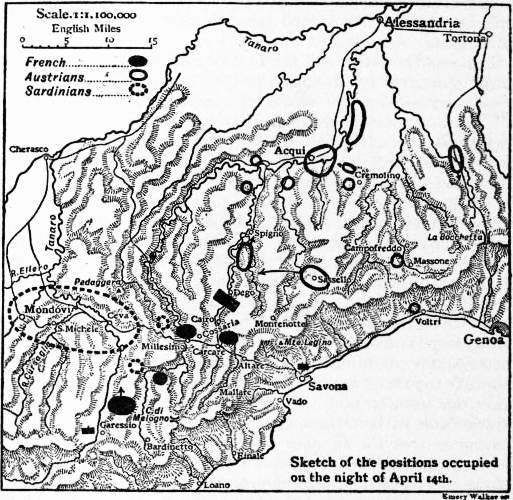
Montenotte was a brilliant victory, and one can imagine its effects on the but lately despondent soldiers of the Army of Italy, for all imagined that Beaulieu’s main body had been defeated. This was far from being the case, however, and although the French spent the night of the battle at Cairo-Carcare-Montenotte, midway between the allied wings, only two-thirds of Argenteau’s force, and none of the other divisions, had been beaten, and the heaviest fighting was to come. This became evident on the afternoon of the 13th, but meanwhile Bonaparte, eager to begin at once the subjugation of the Piedmontese (for which purpose he wanted to bring Sérurier and Rusca into play) sent only Laharpe’s division and a few details of Masséna’s, under the latter, towards Dego. These were to protect the main attack from interference by the forces that had been Millesimo. engaged at Montenotte (presumed to be Beaulieu’s main body), the said main attack being delivered by Augereau’s division, reinforced by most of Masséna’s, on the positions held by Provera. The latter, only 1000 strong to Augereau’s 9000, shut himself in the castle of Cossaria, which he defended à la Rampon against a series of furious assaults. Not until the morning of the 14th was his surrender secured, after his ammunition and food had been exhausted.
Argenteau also won a day’s respite on the 13th, for Laharpe did not join Masséna till late, and nothing took place opposite Dego but a little skirmishing. During the day Bonaparte saw for himself that he had overrated the effects of Montenotte. Beaulieu, on the other hand, underrated them, treating it as a mishap which was more than counterbalanced by his own success in “cutting off the French from Genoa.” He began to reconstruct his line on the front Dego-Sassello, trusting to Colli to harry the French until the Voltri troops had finished their détour through Acqui and rejoined Argenteau. This, of course, presumed that Argenteau’s troops were intact and Colli’s able to move, which was not the case with either. Not until the afternoon of the 14th did Beaulieu place a few extra battalions at Argenteau’s disposal “to be used only in case of extreme necessity,” and order Vukassovich from the region of Sassello to “make a diversion” against the French right with two battalions.
Thus Argenteau, already shaken, was exposed to destruction. On the 14th, after Provera’s surrender, Masséna and Laharpe, reinforced until they had nearly a two-to-one superiority, stormed Dego and killed or captured 3000 of Dego. Argenteau’s 5500 men, the remnant retreating in disorder to Acqui. But nothing was done towards the accomplishment of the purpose of destroying Colli on that day, save that Sérurier and Rusca began to close in to meet the main body between Ceva and Millesimo. Moreover, the victory at Dego had produced its usual results on the wild fighting swarms of the Republicans, who threw themselves like hungry wolves on the little town, without pursuing the beaten enemy or even placing a single outpost on the Acqui road. In this state, during the early hours of the 15th, Vukassovich’s brigade,8 marching up from Sassello, surprised them, and they broke and fled in an instant. The whole morning had to be spent in rallying them at Cairo, and Bonaparte had for the second time to postpone his union with Sérurier and Rusca, who meanwhile, isolated from one another and from the main army, were groping forward in the mountains. A fresh assault on Dego was ordered, and after very severe fighting, Masséna and Laharpe succeeded late in the evening in retaking it. Vukassovich lost heavily, but retired steadily and in order on Spigno. The killed and wounded numbered probably about 1000 French and 1500 Austrians, out of considerably less than 10,000 engaged on each side—a loss which contrasted very forcibly with those suffered in other battles of the Revolutionary Wars, and by teaching the Army of Italy to bear punishment, imbued it with self-confidence. But again success bred disorder, and there was a second orgy in the houses and streets of Dego which went on till late in the morning and paralysed the whole army.
This was perhaps the crisis of the campaign. Even now it was not certain that the Austrians had been definitively pushed aside, while it was quite clear that Beaulieu’s main body was intact and Colli was still more an unknown quantity. But Napoleon’s intention remained the same, to attack the Piedmontese as quickly and as heavily as possible, Beaulieu being held in check by a containing force under Masséna and Laharpe. The remainder of the army, counting in now Rusca and Sérurier, was to move westward towards Ceva. This disposition, while it illustrates the Napoleonic principle of delivering a heavy blow on the selected target and warding off interference at other points, shows also the difficulty of rightly apportioning the available means between the offensive mass and the defensive system, for, as it turned out, Beaulieu was already sufficiently scared, and thought of nothing but self-defence on the line Acqui-Ovada-Bocchetta, while the French offensive mass was very weak compared with Colli’s unbeaten and now fairly concentrated army about Ceva and Montezemolo.
On the afternoon of the 16th the real advance was begun by Augereau’s division, reinforced by other troops. Rusca joined Augereau towards evening, and Sérurier approached Ceva from the south. Colli’s object was now to spin out time, and having repulsed a weak attack by Augereau, and feeling able to repeat these tactics on each successive spur of the Apennines, he retired in the night to a new position behind the Cursaglia. On the 17th, reassured by the absence of fighting on the Dego side, and by the news that no enemy remained at Sassello, Bonaparte released Masséna from Dego, leaving only Laharpe there, and brought him over towards the right of the main body, which thus on the evening of the 17th formed a long straggling line on both sides of Ceva, Sérurier on the left, écheloned forward, Augereau, Joubert and Rusca in the centre, and Masséna, partly as support, partly as flank guard, on Augereau’s right rear. Sérurier had been bidden to extend well out and to strive to get contact with Masséna, i.e. to encircle the enemy. There was no longer any idea of waiting to besiege Ceva, although the artillery train had been ordered up from the Riviera by the “cannon-road” for eventual use there. Further, the line of supply, as an extra guarantee against interference, was changed from that of Savona-Carcare to that of Loano-Bardinetto. When this was accomplished, four clear days could be reckoned on with certainty in which to deal with Colli.
The latter, still expecting the Austrians to advance to his assistance, had established his corps (not more than 12,000 muskets in all) in the immensely strong positions of the Cursaglia, with a thin line of posts on his left San Michele. stretching towards Cherasco, whence he could communicate, by a roundabout way, with Acqui. Opposite this position the long straggling line of the French arrived, after many delays due to the weariness of the troops, on the 19th. A day of irregular fighting followed, everywhere to the advantage of the defenders. Napoleon, fighting against time, ordered a fresh attack on the 20th, and only desisted when it became evident that the army was exhausted, and, in particular, when Sérurier reported frankly that without bread the soldiers would not march. The delay thus imposed, however, enabled him to clear the “cannon-road” of all vehicles, and to bring up the Dego detachment to replace Masséna in the valley of the western Bormida, the latter coming in to the main army. Further, part at any rate of the convoy service was transferred still farther westward to the line Albenga-Garessio-Ceva. Nelson’s fleet, that had so powerfully contributed to force the French inland, was becoming less and less innocuous. If leadership and force of character could overcome internal friction, all the success he had hoped for was now within the young commander’s grasp.
Twenty-four thousand men, for the first time with a due proportion of cavalry and artillery, were now disposed along Colli’s front and beyond his right flank. Colli, outnumbered by two to one and threatened with envelopment, Mondovi. decided once more to retreat, and the Republicans occupied the Cursaglia lines on the morning of the 21st without firing a shot. But Colli halted again at Vico, half-way to Mondovi (in order, it is said, to protect the evacuation of a small magazine he had there), and while he was in this unfavourable situation the pursuers came on with true Republican swiftness, lapped round his flanks and crushed him. A few days later (27th April), the armistice of Cherasco put an end to the campaign before the Austrians moved a single battalion to his assistance.
The interest of the campaign being above all Napoleonic, its moral must be found by discovering the “Napoleon touch” that differentiated it from other Revolutionary campaigns. A great deal is common to all, on both sides. The Austrians The “Napoleon touch.” and Sardinians worked together at least as effectively as the Austrians, Prussians, British and Dutch in the Netherlands. Revolutionary energy was common to the Army of Italy and to the Army of the North. Why, therefore, when the war dragged on from one campaign to another in the great plains of the Meuse and Rhine countries, did Napoleon bring about so swift a decision in these cramped valleys? The answer is to be found partly in the exigencies of the supply service, but still more in Napoleon’s own personality and the strategy born of it. The first, as we have seen, was at the end of its resources when Beaulieu placed himself across the Genoa road. Action of some sort was the plain alternative to starvation, and at this point Napoleon’s personality intervened. He would have no quarter-rations on the Riviera, but plenty and to spare beyond the mountains. If there were many thousand soldiers who marched unarmed and shoeless in the ranks, it was towards “the Promised Land” that he led them. He looked always to the end, and met each day as if with full expectation of attaining it before sunset. Strategical conditions and “new French” methods of war did not save Bonaparte in the two crises—the Dego rout and the sullen halt of the army at San Michele—but the personality which made the soldiers, on the way to Montenotte, march barefoot past a wagon-load of new boots.
We have said that Napoleon’s strategy was the result of this personal magnetism. Later critics evolved from his success the theory of “interior lines,” and then accounted for it by applying the criterion they had evolved. Actually, the form in which the will to conquer found expression was in many important respects old. What, therefore, in the theory or its application was the product of Napoleon’s own genius and will-power? A comparison with Souham’s campaign of Tourcoing will enable us to answer this question. To begin with, Souham found himself midway between Coburg and Clerfayt almost by accident, and his utilization of the advantages of his position was an expedient for the given case. Napoleon, however, placed himself deliberately and by fighting his way thither, in an analogous situation at Carcare and Cairo. Military opinion of the time considered it dangerous, as indeed it was, for no theory can alter the fact that had not Napoleon made his men fight harder and march farther than usual, he would have been destroyed. The effective play of forces on interior lines depends on the two conditions that the outer enemies are not so near together as to give no time for the inner mass to defeat one before the arrival of the other, and that they are not so far apart that before one can be brought to action the other has inflicted serious damage elsewhere.
Neither condition was fully met at any time in the Montenotte campaign. On the 11th Napoleon knew that the attack on Voltri had been made by a part only of the Austrian forces, yet he flung his own masses on Montenotte. On the 13th he thought that Beaulieu’s main body was at Dego and Colli’s at Millesimo, and on this assumption had to exact the most extraordinary efforts from Augereau’s troops at Cossaria. On the 19th and 20th he tried to exclude the risks of the Austrians’ intervention, and with this the chances of a victory over them to follow his victory over Colli, by transferring the centre of gravity of his army to Ceva and Garessio, and fighting it out with Colli alone.
It was not, in fact, to gain a position on interior lines—with respect to two opponents—that Napoleon pushed his army to Carcare. Before the campaign began he hoped by using the “cannon-road” to destroy the Piedmontese before the Austrians were in existence at all as an army. But on the news from Voltri and Monte Legino he swiftly “concentrated fire, made the breach, and broke the equilibrium” at the spot where the interests and forces of the two Allies converged and diverged. The hypothesis in the first case was that the Austrians were practically non-existent, and the whole object in the second was to breach the now connected front of the Allies (“strategic penetration”) and to cause them to break up into two separate systems. More, having made the breach, he had the choice (which he had not before) of attacking either the Austrians or the Sardinians, as every critic has pointed out. Indeed the Austrians offered by far the better target. But he neither wanted nor used the new alternative. His purpose was to crush Piedmont. “My enemies saw too much at once,” said Napoleon. Singleness of aim and of purpose, the product of clear thinking and of “personality,” was the foundation-stone of the new form of strategy.
In the course of subduing the Sardinians, Napoleon found himself placed on interior lines between two hostile masses, and another new idea, that of “relative superiority.” reveals itself. Whereas Souham had been in superior force (90,000 against 70,000), Napoleon (40,000 against 50,000) was not, and yet the Army of Italy was always placed in a position of relative superiority (at first about 3 to 2 and ultimately 2 to 1) to the immediate antagonist. “The essence of strategy,” said Napoleon in 1797, “is, with a weaker army, always to have more force at the crucial point than the enemy. But this art is taught neither by books nor by practice; it is a matter of tact.” In this he expressed the result of his victories on his own mind rather than a preconceived formula which produced those victories. But the idea, though undefined, and the method of practice, though imperfectly worked out, were in his mind from the first. As soon as he had made the breach, he widened it by pushing out Masséna and Laharpe on the one hand and Augereau on the other. This is mere common sense. But immediately afterwards, though preparing to throw all available forces against Colli, he posted Masséna and Laharpe at Dego to guard, not like Vandamme on the Lys against a real and pressing enemy, but against a possibility, and he only diminished the strength and altered the position of this containing detachment in proportion as the Austrian danger dwindled. Later in his career he defined this offensive-defensive system as “having all possible strength at the decisive point,” and “being nowhere vulnerable,” and the art of reconciling these two requirements, in each case as it arose, was always the principal secret of his generalship. At first his precautions (judged by events Relative superiority. and not by the probabilities of the moment) were excessive, and the offensive mass small. But the latter was handled by a general untroubled by multiple aims and anxieties, and if such self-confidence was equivalent to 10,000 men on the battlefield, it was legitimate to detach 10,000 men to secure it. These 10,000 were posted 8 m. out on the dangerous flank, not almost back to back with the main body as Vandamme had been,9 and although this distance was but little compared to those of his later campaigns, when he employed small armies for the same purpose, it sufficed in this difficult mountain country, where the covering force enjoyed the advantage of strong positions. Of course, if Colli had been better concentrated, or if Beaulieu had been more active, the calculated proportions between covering force and main body might have proved fallacious, and the system on which Napoleon’s relative superiority rested might have broken down. But the point is that such a system, however rough its first model, had been imagined and put into practice.
This was Napoleon’s individual art of war, as raiding bakeries and cutting communications were Beaulieu’s speciality. Napoleon made the art into a science, and in our own time, with modern conditions of effective, armament and communications, it is more than possible that Moreaus and Jourdans will prove able to practise it with success. But in the old conditions it required a Napoleon. “Strategy,” said Moltke, “is a system of expedients.” But it was the intense personal force, as well as the genius, of Napoleon that forged these expedients into a system.
The first phase of the campaign satisfactorily settled, Napoleon was free to turn his attention to the “arch-enemy” to whom he was now considerably superior in numbers (35,000 to 25,000). The day after the signature of the armistice of Cherasco he began preparing for a new advance and also for the rôle of arbiter of the destinies of Italy. Many whispers there were, even in his own army, as to the dangers of passing on without “revolutionizing” aristocratic Genoa and monarchical Piedmont, and of bringing Venice, the pope and the Italian princes into the field against the French. But Bonaparte, flushed with victory, and better informed than the malcontents of the real condition of Italy, never hesitated. His first object was to drive out Beaulieu, his second to push through Tirol, and his only serious restriction the chance that the armistice with Piedmont would not result in a definitive treaty. Beaulieu had fallen back into Lombardy, and now bordered the Po right and left of Valenza. To achieve further progress, Napoleon had first to cross that river, and the point and method of crossing was the immediate problem, a problem the more difficult as Napoleon had no bridge train and could only make use of such existing bridges as he could seize intact.10 If he crossed above Valenza, he would be confronted by one river-line after another, on one of which at least Beaulieu would probably stand to fight. But quite apart from the immediate problem, Napoleon’s intention was less to beat the Austrians than to dislodge them. He needed a foothold in Lombardy which would make him independent of, and even a menace to, Piedmont. If this were assured, he could for a few weeks entirely ignore his communications with France and strike out against Beaulieu, dethrone the king of Sardinia, or revolutionize Parma, Modena and the papal states according to circumstances.
Milan, therefore, was his objective, and Tortona-Piacenza his route thither. To give himself every chance, he had stipulated with the Piedmontese authorities for the right of passing at Valenza, and he had the satisfaction of Piacenza. seeing Beaulieu fall into the trap and concentrate opposite that part of the river. The French meantime had moved to the region Alessandria-Tortona. Thence on the 6th of May Bonaparte, with a picked body of troops, set out for a forced march on Piacenza, and that night the advanced guard was 30 m. on the way, at Castel San Giovanni, and Laharpe’s and the cavalry divisions at Stradella, 10 m. behind them. Augereau was at Broni, Masséna at Sale and Sérurier near Valenza, the whole forming a rapidly extending fan, 50 m. from point to point. If the Piacenza detachment succeeded in crossing, the army was to follow rapidly in its track. If, on the other hand, Beaulieu fell back to oppose the advanced guard, the Valenza divisions would take advantage of his absence to cross there. In either case, be it observed, the Austrians were to be evaded, not brought to action.
On the morning of the 7th, the swift advanced guard under General Dallemagne crossed at Piacenza,11 and, hearing of this, Bonaparte ordered every division except Sérurier’s thither with all possible speed. In the exultation of the moment he mocked at Beaulieu’s incapacity, but the old Austrian was already on the alert. This game of manœuvres he understood; already one of his divisions had arrived in close proximity to Dallemagne and the others were marching eastward by all available roads. It was not until the 8th that the French, after a series of partial encounters, were securely established on the left bank of the Po, and Beaulieu had given up the idea of forcing their most advanced troops to accept battle at a disadvantage. The success of the French was due less to their plan than to their mobility, which enabled them first to pass the river before the Austrians (who had actually started a day in advance of them) put in an appearance, and afterwards to be in superior numbers at each point of contact. But the episode was destined after all to culminate in a great event, which Napoleon himself indicated as the turning-point of his life. “Vendémiaire and even Montenotte did not make me think myself a superior being. It was after Lodi that the idea came to me.... That first kindled the spark of boundless ambition.”
The idea of a battle having been given up, Beaulieu retired to the Adda, and most of his troops were safely beyond it before the French arrived near Lodi, but he felt it necessary to leave a strong rearguard on the river opposite that Lodi. place to cover the reassembly of his columns after their scattered march. On the afternoon of the 10th of May, Bonaparte, with Dallemagne, Masséna and Augereau, came up and seized the town. But 200 yds. of open ground had to be passed from the town gate to the bridge, and the bridge itself was another 250 in length. A few hundred yards beyond it stood the Austrians, 9000 strong with 14 guns. Napoleon brought up all his guns to prevent the enemy from destroying the bridge. Then sending all his cavalry to turn the enemy’s right by a ford above the town, he waited two hours, employing the time in cannonading the Austrian lines, resting his advanced infantry and closing up Masséna’s and Augereau’s divisions. Finally he gave the order to Dallemagne’s 4000 grenadiers, who were drawn up under cover of the town wall, to rush the bridge. As the column, not more than thirty men broad, made its appearance, it was met by the concentrated fire of the Austrian guns, and half way across the bridge it checked, but Bonaparte himself and Masséna rushed forward, the courage of the soldiers revived, and, while some jumped off the bridge and scrambled forward in the shallow water, the remainder stormed on, passed through the guns and drove back the infantry. This was, in bare outline, the astounding passage of the Bridge of Lodi. It was not till after the battle that Napoleon realized that only a rearguard was in front of him. When he launched his 4000 grenadiers he thought that on the other side there were four or five times that number of the enemy. No wonder, then, that after the event he recognized in himself the flash of genius, the courage to risk everything, and the “tact” which, independent of, and indeed contrary to all reasoned calculations, told him that the moment had come for “breaking the equilibrium.” Lodi was a tactical success in the highest sense, in that the principles of his tactics rested on psychology—on the “sublime” part of the art of war as Saxe had called it long ago. The spirit produced the form, and Lodi was the prototype of the Napoleonic battle—contact, manœuvre, preparation, and finally the well-timed, massed and unhesitating assault. The absence of strategical results mattered little. Many months elapsed before this bold assertion of superiority ceased to decide the battles of France and Austria.
Next day, still under the vivid tactical impressions of the Bridge of Lodi, he postponed his occupation of the Milanese and set off in pursuit of Beaulieu, but the latter was now out of reach, and during the next few days the Milan. French divisions were installed at various points in the area Pavia-Milan-Pizzighetone, facing outwards in all dangerous directions, with a central reserve at Milan. Thus secured, Bonaparte turned his attention to political and military administration. This took the form of exacting from the neighbouring princes money, supplies and objects of art, and the once famished Army of Italy revelled in its opportunity. Now, however, the Directory, suspicious of the too successful and too sanguine young general, ordered him to turn over the command in Upper Italy to Kellermann, and to take an expeditionary corps himself into the heart of the Peninsula, there to preach the Republic and the overthrow of princes. Napoleon absolutely refused, and offered his resignation. In the end (partly by bribery) he prevailed, but the incident reawakened his desire to close with Beaulieu. This indeed he could now do with a free hand, since not only had the Milanese been effectively occupied, but also the treaty with Sardinia had been ratified.
But no sooner had he resumed the advance than it was interrupted by a rising of the peasantry in his rear. The exactions of the French had in a few days generated sparks of discontent which it was easy for the priests and the nobles to fan into open flames. Milan and Pavia as well as the countryside broke into insurrection, and at the latter place the mob forced the French commandant to surrender. Bonaparte acted swiftly and ruthlessly. Bringing back a small portion of the army with him, he punished Milan on the 25th, sacked and burned Binasco on the 26th, and on the evening of the latter day, while his cavalry swept the open country, he broke his way into Pavia with 1500 men and beat down all resistance. Napoleon’s cruelty was never purposeless. He deported several scores of hostages to France, executed most of the mob leaders, and shot the French officer who had surrendered. In addition, he gave his 1500 men three hours’ leave to pillage. Then, as swiftly as they had come, they returned to the army on the Oglio. From this river Napoleon advanced to the banks of the Mincio, where the remainder of the Italian campaign was fought out, both sides contemptuously disregarding Venetian neutrality.
It centred on the fortress of Mantua, which Beaulieu, too weak to keep the field, and dislodged from the Mincio in the action of Borghetto (May 30), strongly garrisoned before retiring into Tirol. Beaulieu was soon afterwards replaced by Dagobert Siegmund, count von Wurmser (b. 1724), who brought considerable reinforcements from Germany.