VOLUME XI SLICE II French Literature to Frost, William (continued 10)
Reading edition
FREYIA, the sister of Frey, and the most prominent goddess in Northern mythology. Her character seems in general to have resembled that of her brother. (See Teutonic Peoples, ad fin.)
FREYTAG, GEORG WILHELM FRIEDRICH (1788-1861), German philologist, was born at Lüneburg on the 19th of September 1788. After attending school he entered the university of Göttingen as a student of philology and theology; here from 1811 to 1813 he acted as a theological tutor, but in the latter year accepted an appointment as sub-librarian at Königsberg. In 1815 he became a chaplain in the Prussian army, and in that capacity visited Paris. On the proclamation of peace he resigned his chaplaincy, and returned to his researches in Arabic, Persian and Turkish, studying at Paris under De Sacy. In 1819 he was appointed to the professorship of oriental languages in the new university of Bonn, and this post he continued to hold until his death on the 16th of November 1861.
Besides a compendium of Hebrew grammar (Kurzgefasste Grammatik der hebräischen Sprache, 1835), and a treatise on Arabic versification (Darstellung der arabischen Verskunst, 1830), he edited two volumes of Arabic songs (Hamasae carmina, 1828-1852) and three of Arabic proverbs (Arabum proverbia, 1838-1843). But his principal work was the laborious and praiseworthy Lexicon Arabico-latinum (Halle, 1830-1837), an abridgment of which was published in 1837.
FREYTAG, GUSTAV (1816-1895), German novelist, was born at Kreuzburg, in Silesia, on the 13th of July 1816. After attending the gymnasium at Öls, he studied philology at the universities of Breslau and Berlin, and in 1838 took the degree with a remarkable dissertation, De initiis poëseos scenicae apud Germanos. In 1839 he settled at Breslau, as Privatdocent in German language and literature, but devoted his principal attention to writing for the stage, and achieved considerable success with the comedy Die Brautfahrt, oder Kunz von der Rosen (1844). This was followed by a volume of unimportant poems, In Breslau (1845) and the dramas Die Valentine (1846) and Graf Waldemar (1847). He at last attained a prominent position by his comedy, Die Journalisten (1853), one of the best German comedies of the 19th century. In 1847 he migrated to Berlin, and in the following year took over, in conjunction with Julian Schmidt, the editorship of Die Grenzboten, a weekly journal which, founded in 1841, now became the leading organ of German and Austrian liberalism. Freytag helped to conduct it until 1861, and again from 1867 till 1870, when for a short time he edited a new periodical, Im neuen Reich. His literary fame was made universal by the publication in 1855 of his novel, Soll und Haben, which was translated into almost all the languages of Europe. It was certainly the best German novel of its day, impressive by its sturdy but unexaggerated realism, and in many parts highly humorous. Its main purpose is the recommendation of the German middle class as the soundest element in the nation, but it also has a more directly patriotic intention in the contrast which it draws between the homely virtues of the Teuton and the shiftlessness of the Pole and the rapacity of the Jew. As a Silesian, Freytag had no great love for his Slavonic neighbours, and being a native of a province which owed everything to Prussia, he was naturally an earnest champion of Prussian hegemony over Germany. His powerful advocacy of this idea in his Grenzboten gained him the friendship of the duke of Saxe-Coburg-Gotha, whose neighbour he had become, on acquiring the estate of Siebleben near Gotha. At the duke’s request Freytag was attached to the staff of the crown prince of Prussia in the campaign of 1870, and was present at the battles of Wörth and Sedan. Before this he had published another novel, Die verlorene Handschrift (1864), in which he endeavoured to do for German university life what in Soll und Haben he had done for commercial life. The hero is a young German professor, who is so wrapt up in his search for a manuscript by Tacitus that he is oblivious to an impending tragedy in his domestic life. The book was, however, less successful than its predecessor. Between 1859 and 1867 Freytag published in five volumes Bilder aus der deutschen Vergangenheit, a most valuable work on popular lines, illustrating the history and manners of Germany. In 1872 he began a work with a similar patriotic purpose, Die Ahnen, a series of historical romances in which he unfolds the history of a German family from the earliest times to the middle of the 19th century. The series comprises the following novels, none of which, however, reaches the level of Freytag’s earlier books. (1) Ingo und Ingraban (1872), (2) Das Nest der Zaunkönige (1874), (3) Die Brüder vom deutschen Hause (1875), (4) Marcus König (1876), (5) Die Geschwister (1878), and (6) in conclusion, Aus einer kleinen Stadt (1880). Among Freytag’s other works may be noticed Die Technik des Dramas (1863); an excellent biography of the Baden statesman Karl Mathy (1869); an autobiography (Erinnerungen aus meinen Leben, 1887); his Gesammelte Aufsätze, chiefly reprinted from the Grenzboten (1888); Der Kronprinz und die deutsche Kaiserkrone; Erinnerungsblätter (1889). He died at Wiesbaden on the 30th of April 1895.
Freytag’s Gesammelte Werke were published in 22 vols. at Leipzig (1886-1888); his Vermischte Aufsätze have been edited by E. Elster, 2 vols. (Leipzig, 1901-1903). On Freytag’s life see, besides his autobiography mentioned above, the lives by C. Alberti (Leipzig, 1890) and F. Seiler (Leipzig, 1898).
FRIAR (from the Lat. frater, through the Fr. frère), the English generic name for members of the mendicant religious orders. Formerly it was the title given to individual members of these orders, as Friar Laurence (in Romeo and Juliet), but this is not now common. In England the chief orders of friars were distinguished by the colour of their habit: thus the Franciscans or Minors were the Grey Friars; the Dominicans or Preachers were the Black Friars (from their black mantle over a white habit), and the Carmelites were the White Friars (from their white mantle over a brown habit): these, together with the Austin Friars or Hermits, formed the four great mendicant orders—Chaucer’s “alle the ordres foure.” Besides the four great orders of friars, the Trinitarians (q.v.), though really canons, were in England called Trinity Friars or Red Friars; the Crutched or Crossed Friars were often identified with them, but were really a distinct order; there were also a number of lesser orders of friars, many of which were suppressed by the second council of Lyons in 1274. Detailed information on these orders and on their position in England is given in separate articles. The difference between friars and monks is explained in article Monasticism. Though the usage is not accurate, friars, and also canons regular, are often spoken of as monks and included among the monastic orders.
See Fr. Cuthbert, The Friars and how they came to England, pp. 11-32 (1903); also F. A. Gasquet, English Monastic Life, pp. 234-249 (1904), where special information on all the English friars is conveniently brought together.
(E. C. B.)
FRIBOURG [Ger. Freiburg], one of the Swiss Cantons, in the western portion of the country, and taking its name from the town around which the various districts that compose it gradually gathered. Its area is 646.3 sq. m., of which 568 sq. m. are classed as “productive” (forests covering 119 sq. m. and vineyards .8 sq. m.); it boasts of no glaciers or eternal snow. It is a hilly, not mountainous, region, the highest summits (of which the Vanil Noir, 7858 ft., is the loftiest) rising in the Gruyère district at its south-eastern extremity, the best known being probably the Moléson (6582 ft.) and the Berra (5653 ft.). But it is the heart of pastoral Switzerland, is famed for its cheese and cattle, and is the original home of the “Ranz des Vaches,” the melody by which the herdsmen call their cattle home at milking time. It is watered by the Sarine or Saane river (with its tributaries the Singine or Sense and the Glâne) that flows through the canton from north to south, and traverses its capital town. The upper course of the Broye (like the Sarine, a tributary of the Aar) and that of the Veveyse (flowing to the Lake of Geneva) are in the southern portion of the canton. A small share of the lakes of Neuchâtel and of Morat belongs to the canton, wherein the largest sheet of water is the Lac Noir or Schwarzsee. A sulphur spring rises near the last-named lake, and there are other such springs in the canton at Montbarry and at Bonn, near the capital. There are about 150 m. of railways in the canton, the main line from Lausanne to Bern past Fribourg running through it; there are also lines from Fribourg to Morat and to Estavayer, while from Romont (on the main line) a line runs to Bulle, and in 1904 was extended to Gessenay or Saanen near the head of the Sarine or Saane valley. The population of the canton amounted in 1900 to 127,951 souls, of whom 108,440 were Romanists, 19,305 Protestants, and 167 Jews. The canton is on the linguistic frontier in Switzerland, the line of division running nearly due north and south through it, and even right through its capital. In 1900 there were 78,353 French-speaking inhabitants, and 38,738 German-speaking, the latter being found chiefly in the north-western (Morat region) and north-eastern (Singine valley) portions, as well as in the upper valley of the Jogne or Jaun in the south-east. Besides the capital, Fribourg (q.v.), the only towns of any importance are Bulle (3330 inhabitants), Châtel St Denis (2509 inhabitants), Morat (q.v.) or Murten (2263 inhabitants), Romont (2110 inhabitants), and Estavayer le Lac or Stäffis am See (1636 inhabitants).
The canton is pre-eminently a pastoral and agricultural region, tobacco, cheese and timber being its chief products. Its industries are comparatively few: straw-plaiting, watch-making (Semsales), paper-making (Marly), lime-kilns, and, above all, the huge Cailler chocolate factory at Broc. It forms part of the diocese of Lausanne and Geneva, the bishop living since 1663 at Fribourg. It is a stronghold of the Romanists, and still contains many monasteries and nunneries, such as the Carthusian monks at Valsainte, and the Cistercian nuns at La Fille Dieu and at Maigrauge. The canton is divided into 7 administrative districts, and contains 283 communes. It sends 2 members (named by the cantonal legislature) to the Federal Ständerath, and 6 members to the Federal Nationalrath. The cantonal constitution has scarcely been altered since 1857, and is remarkable as containing none of the modern devices (referendum, initiative, proportional representation) save the right of “initiative” enjoyed by 6000 citizens to claim the revision of the cantonal constitution. The executive council of 7 members is named for 5 years by the cantonal legislature, which consists of members (holding office for 5 years) elected in the proportion of one to every 1200 (or fraction over 800) of the population.
(W. A. B. C.)
FRIBOURG [Ger. Freiburg], the capital of the Swiss canton of that name. It is built almost entirely on the left bank of the Sarine, the oldest bit (the Bourg) of the town being just above the river bank, flanked by the Neuveville and Auge quarters, these last (with the Planche quarter on the right bank of the river) forming the Ville Basse. On the steeply rising ground to the west of the Bourg is the Quartier des Places, beyond which, to the west and south-west, is the still newer Pérolles quarter, where are the railway station and the new University; all these (with the Bourg) constituting the Ville Haute. In 1900 the population of the town was 15,794, of whom 13,270 were Romanists and 109 Jews, while 9701 were French-speaking, and 5595 German-speaking, these last being mainly in the Ville Basse. Its linguistic history is curious. Founded as a German town, the French tongue became the official language during the greater part of the 14th and 15th centuries, but when it joined the Swiss Confederation in 1481 the German influence came to the fore, and German was the official language from 1483 to 1798, becoming thus associated with the rule of the patricians. From 1798 to 1814, and again from 1830 onwards, French prevailed, as at present, though the new University is a centre of German influence.
Fribourg is on the main line of railway from Bern (20 m.) to Lausanne (41 m.). The principal building in the town is the collegiate church of St Nicholas, of which the nave dates from the 13th-14th centuries, while the choir was rebuilt in the 17th century. It is a fine building, remarkable in itself, as well as for its lofty, late 15th century, bell-tower (249 ft. high), with a fine peal of bells; its famous organ was built between 1824 and 1834 by Aloys Mooser (a native of the town), has 7800 pipes, and is played daily in summer for the edification of tourists. The numerous monasteries in and around the town, its old-fashioned aspect, its steep and narrow streets, give it a most striking appearance. One of the most conspicuous buildings in the town is the college of St Michael, while in front of the 16th century town hall is an ancient lime tree stated (but this is very doubtful) to have been planted on the day of the victory of Morat (June 22, 1476). In the Lycée is the Cantonal Museum of Fine Arts, wherein, besides many interesting objects, is the collection of paintings and statuary bequeathed to the town in 1879 by Duchess Adela Colonna (a member of the d’Affry family of Fribourg), by whom many were executed under the name of “Marcello.” The deep ravine of the Sarine is crossed by a very fine suspension bridge, constructed 1832-1834 by M. Chaley, of Lyons, which is 167 ft. above the Sarine, has a span of 808 ft., and consists of 6 huge cables composed of 3294 strands. A loftier suspension bridge is thrown over the Gotteron stream just before it joins the Sarine: it is 590 ft. long and 246 ft. in height, and was built in 1840. About 3 m. north of the town is the great railway viaduct or girder bridge of Grandfey, constructed in 1862 (1092 ft. in length, 249 ft. high) at a cost of 2¾ million francs. Immediately above the town a vast dam (591 ft. long) was constructed across the Sarine by the engineer Ritter in 1870-1872, the fall thus obtained yielding a water-power of 2600 to 4000 horse-power, and forming a sheet of water known as the Lac de Pérolles. A motive force of 600 horse-power, secured by turbines in the stream, is conveyed to the plateau of Pérolles by “telodynamic” cables of 2510 ft. in length, for whose passage a tunnel has been pierced in the rock. On the Pérolles plateau is the International Catholic University founded in 1889.
History.—In 1178 the foundation of the town (meant to hold in check the turbulent nobles of the neighbourhood) was completed by Berchthold IV., duke of Zähringen, whose father Conrad had founded Freiburg in Breisgau in 1120, and whose son, Berchthold V., was to found Bern in 1191. The spot was chosen for purposes of military defence, and was situated in the Uechtland or waste land between Alamannian and Burgundian territory. He granted it many privileges, modelled on the charters of Cologne and of Freiburg in Breisgau, though the oldest existing charter of the town dates from 1249. On the extinction of the male line of the Zähringen dynasty, in 1218, their lands passed to Anna, the sister of the last duke and wife of Count Ulrich of Kyburg. That house kept Fribourg till it too became extinct, in 1264, in the male line. Anna, the heiress, married about 1273 Eberhard, count of Habsburg-Laufenburg, who sold Fribourg in 1277 for 3000 marks to his cousin Rudolf, the head of the house of Habsburg as well as emperor. The town had to fight many a hard battle for its existence against Bern and the count of Savoy, especially between 1448 and 1452. Abandoned by the Habsburgs, and desirous of escaping from the increasing power of Bern, Fribourg in 1452 finally submitted to the count of Savoy, to whom it had become indebted for vast sums of money. Yet, despite all its difficulties, it was in the first half of the 15th century that Fribourg exported much leather and cloth to France, Italy and Venice, as many as 10,000 to 20,000 bales of cloth being stamped with the seal of the town. When Yolande, dowager duchess of Savoy, entered into an alliance with Charles the Bold, duke of Burgundy, Fribourg joined Bern, and helped to gain the victories of Grandson and of Morat (1476).
In 1477 the town was finally freed from the rule of Savoy, while in 1481 (with Soleure) it became a member of the Swiss Confederation, largely, it is said, through the influence of the holy man, Bruder Klaus (Niklaus von der Flüe). In 1475 the town had taken Illens and Arconciel from Savoy, and in 1536 won from Vaud much territory, including Romont, Rue, Châtel St Denis, Estavayer, St Aubin (by these two conquests its dominion reached the Lake of Neuchâtel), as well as Vuissens and Surpierre, which still form outlying portions (physically within the canton of Vaud) of its territory, while in 1537 it took Bulle from the bishop of Lausanne. In 1502-1504 the lordship of Bellegarde or Jaun was bought, while in 1555 it acquired (jointly with Bern) the lands of the last count of the Gruyère, and thus obtained the rich district of that name. From 1475 it ruled (with Bern) the bailiwicks of Morat, Grandson, Orbe and Echallens, just taken from Savoy, but in 1798 Morat was incorporated with (finally annexed in 1814) the canton of Fribourg, the other bailiwicks being then given to the canton of Léman (later of Vaud). In the 16th century the original democratic government gradually gave place to the oligarchy of the patrician families. Though this government caused much discontent it continued till it was overthrown on the French occupation of 1798.
From 1803 (Act of Mediation) to 1814, Fribourg was one of the six cantons of the Swiss Confederation. But, on the fall of the new régime, in 1814, the old patrician rule was partly restored, as 108 of the 144 seats in the cantonal legislature were assigned to members of the patrician families. In 1831 the Radicals gained the power and secured the adoption of a more liberal constitution. In 1846 Fribourg (where the Conservatives had regained power in 1837) joined the Sonderbund and, in 1847, saw the Federal troops before its walls, and had to surrender to them. The Radicals now came back to power, and again revised the cantonal constitution in a liberal sense. The Catholic and Conservative party made several attempts to recover their supremacy, but their chiefs were driven into exile. In 1856 the Conservatives regained the upper hand at the general cantonal election, secured the adoption in 1857 of a new cantonal constitution, and have ever since maintained their rule, which some dub “clerical,” while others describe it as “anti-radical.”
Authorities.—Archives de la Société d’histoire du Canton de F., from 1850; F. Buomberger, Bevölkerungs- u. Vermögensstatistik in d. Stadt u. Landschaft F. um die Mitte d. 15ten Jahrhunderts (Bern, 1900); A. Daguet, Histoire de la ville et de la seigneurie de F., to 1481 (Fribourg, 1889); A. Dellion, Dictionnaire historique et statistique des paroisses catholiques du C. de F. (12 vols., Fribourg, 1884-1903); Freiburger Geschichtsblätter, from 1894; Fribourg artistique (fine plates), from 1890; E. Heyck, Geschichte der Herzoge von Zähringen (Freiburg i. Br., 1891); F. Kuenlin, Der K. Freiburg (St Gall and Bern, 1834); Mémorial de F. (6 vols., 1854-1859); Recueil diplomatique du Cant. de F. (original documents) (8 vols., Fribourg, 1839-1877); F. E. Welti, Beiträge zur Geschichte des älteren Stadtrechtes von Freiburg im Uechtland (Bern, 1908); J. Zemp, L’Art de la ville de Fribourg au moyen âge (Fribourg, 1905); J. Zimmerli, Die deutsch-französische Sprachgrenze in d. Schweiz (Basel and Geneva, 1895), vol. ii., pp. 72 seq.; Les Alpes fribourgeoises (Lausanne, 1908).
(W. A. B. C.)
FRICTION (from Lat. fricare, to rub), in physical and mechanical science, the term given to the resistance which every material surface presents to the sliding of any other such surface upon it. This resistance is due to the roughness of the surfaces; the minute projections upon each enter more or less into the minute depressions on the other, and when motion occurs these roughnesses must either be worn off, or continually lifted out of the hollows into which they have fallen, or both, the resistance to motion being in either case quite perceptible and measurable.
Friction is preferably spoken of as “resistance” rather than “force,” for a reason exactly the same as that which induces us to treat stress rather as molecular resistance (to change of form) than as force, and which may be stated thus: although friction can be utilized as a moving force at will, and is continually so used, yet it cannot be a primary moving force; it can transmit or modify motion already existing, but cannot in the first instance cause it. For this some external force, not friction, is required. The analogy with stress appears complete; the motion of the “driving link” of a machine is communicated to all the other parts, modified or unchanged as the case may be, by the stresses in those parts; but the actual setting in motion of the driving link itself cannot come about by stress, but must have for its production force obtained directly from the expenditure of some form of energy. It is important, however, that the use of the term “resistance” should not be allowed to mislead. Friction resists the motion of one surface upon another, but it may and frequently does confer the motion of the one upon the other, and in this way causes, instead of resists, the motion of the latter. This may be made more clear, perhaps, by an illustration. Suppose we have a leather strap A passing over a fixed cylindrical drum B, and let a pulling force or effort be applied to the strap. The force applied to A can act on B only at the surfaces of contact between them. There it becomes an effort tending either to move A upon B, or to move the body B itself, according to the frictional conditions. In the absence of friction it would simply cause A to slide on B, so that we may call it an effort tending to make A slide on B. The friction is the resistance offered by the surface of B to any such motion. But the value of this resistance is not in any way a function of the effort itself,—it depends chiefly upon the pressure normal to the surfaces and the nature of the surfaces. It may therefore be either less or greater than the effort. If less, A slides over B, the rate of motion being determined by the excess of the effort over the resistance (friction). But if the latter be greater no sliding can occur, i.e. A cannot, under the action of the supposed force, move upon B. The effort between the surfaces exists, however, exactly as before,—and it must now tend to cause the motion of B. But the body B is fixed,—or, in other words, we suppose its resistance to motion greater than any effort which can tend to move it,—hence no motion takes place. It must be specially noticed, however, that it is not the friction between A and B that has prevented motion, this only prevented A moving on B,—it is the force which keeps B stationary, whatever that may be, which has finally prevented any motion taking place. This can be easily seen. Suppose B not to be fixed, but to be capable of moving against some third body C (which might, e.g., contain cylindrical bearings, if B were a drum with its shaft), itself fixed,—and further, suppose the frictional resistance between B and C to be the only resistance to B’s motion. Then if this be less than the effort of A upon B, as it of course may be, this effort will cause the motion of B. Thus friction causes motion, for had there been no frictional resistance between the surfaces of A and of B, the latter body would have remained stationary, and A only would have moved. In the case supposed, therefore, the friction between A and B is a necessary condition of B receiving any motion from the external force applied to A.
Without entering here on the mathematical treatment of the subject of friction, some general conclusions may be pointed out which have been arrived at as the results of experiment. The “laws” first enunciated by C. A. Coulomb (1781), and afterwards confirmed by A. J. Morin (1830-1834), have been found to hold good within very wide limits. These are: (1) that the friction is proportional to the normal pressure between the surfaces of contact, and therefore independent of the area of those surfaces, and (2) that it is independent of the velocity with which the surfaces slide one on the other. For many practical purposes these statements are sufficiently accurate, and they do in fact sensibly represent the results of experiment for the pressures and at the velocities most commonly occurring. Assuming the correctness of these, friction is generally measured in terms simply of the total pressure between the surfaces, by multiplying it by a “coefficient of friction” depending on the material of the surfaces and their state as to smoothness and lubrication. But beyond certain limits the “laws” stated are certainly incorrect, and are to be regarded as mere practical rules, of extensive application certainly, but without any pretension to be looked at as really general laws. Both at very high and very low pressures the coefficient of friction is affected by the intensity of pressure, and, just as with velocity, it can only be regarded as independent of the intensity and proportional simply to the total load within more or less definite limits.
Coulomb pointed out long ago that the resistance of a body to be set in motion was in many cases much greater than the resistance which it offered to continued motion; and since his time writers have always distinguished the “friction of rest,” or static friction, from the “friction of motion,” or kinetic friction. He showed also that the value of the former depended often both upon the intensity of the pressure and upon the length of time during which contact had lasted, both of which facts quite agree with what we should expect from our knowledge of the physical nature, already mentioned, of the causes of friction. It seems not unreasonable to expect that the influence of time upon friction should show itself in a comparison of very slow with very rapid motion, as well as in a comparison of starting (i.e. motion after a long time of rest) with continued motion. That the friction at the higher velocities occurring in engineering practice is much less than at common velocities has been shown by several modern experiments, such as those of Sir Douglas Galton (see Report Brit. Assoc., 1878, and Proc. Inst. Mech. Eng., 1878, 1879) on the friction between brake-blocks and wheels, and between wheels and rails. But no increase in the coefficient of friction had been detected at slow speeds, until the experiments of Prof. Fleeming Jenkin (Phil. Trans., 1877, pt. 2) showed conclusively that at extremely low velocities (the lowest measured was about .0002 ft. per second) there is a sensible increase of frictional resistance in many cases, most notably in those in which there is the most marked difference between the friction of rest and that of motion. These experiments distinctly point to the conclusion, although without absolutely proving it, that in such cases the coefficient of kinetic friction gradually increases as the velocity becomes extremely small, and passes without discontinuity into that of static friction.
(A. B. W. K.; W. E. D.)
FRIDAY (A.S. frige-dæg, fr. frige, gen. of frigu, love, or the goddess of love—the Norse Frigg,—the dæg, day; cf. Icelandic frjádagr, O.H. Ger. friatag, frigatag, mod. Ger. Freitag), the sixth day of the week, corresponding to the Roman Dies Veneris, the French Vendredi and Italian Venerdi. The ill-luck associated with the day undoubtedly arose from its connexion with the Crucifixion; for the ancient Scandinavian peoples regarded it as the luckiest day of the week. By the Western and Eastern Churches the Fridays throughout the year, except when Christmas falls on that day, have ever been observed as days of fast in memory of the Passion. The special day on which the Passion of Christ is annually commemorated is known as Good Friday (q.v.). According to Mahommedan tradition, Friday, which is the Moslem Sabbath, was the day on which Adam was created, entered Paradise and was expelled, and it was the day of his repentance, the day of his death, and will be the Day of Resurrection.
FRIEDBERG, the name of two towns in Germany.
1. A small town in Upper Bavaria, with an old castle, known mainly as the scene of Moreau’s victory of the 24th of August 1796 over the Austrians.
2. Friedberg in der Wetterau, in the grand duchy of Hesse-Darmstadt, on an eminence above the Usa, 14 m. N. of Frankfort-on-Main, on the railway to Cassel and at the junction of a line to Hanau. Pop. (1905) 7702. It is a picturesque town, still surrounded by old walls and towers, and contains many medieval buildings, of which the beautiful Gothic town church (Evangelical) and the old castle are especially noteworthy. The grand-ducal palace has a beautiful garden. The schools include technical and agricultural academies and a teachers’ seminary. It has manufactures of sugar, gloves and leather, and breweries. Friedberg is of Roman origin, but is first mentioned as a town in the 11th century. In 1211 it became a free imperial city, but in 1349 was pledged to the counts of Schwarzburg, and subsequently often changed hands, eventually in 1802 passing to Hesse-Darmstadt.
See Dieffenbach, Geschichte der Stadt und Burg Friedberg (Darms., 1857).
FRIEDEL, CHARLES (1832-1899), French chemist and mineralogist, was born at Strassburg on the 12th of March 1832. After graduating at Strassburg University he spent a year in the counting-house of his father, a banker and merchant, and then in 1851 went to live in Paris with his maternal grandfather, Georges Louis Duvernoy (1777-1855), professor of natural history and, from 1850, of comparative anatomy, at the Collège de France. In 1854 he entered C. A. Wurtz’s laboratory, and in 1856, at the instance of H. H. de Sénarmont (1808-1862), was appointed conservator of the mineralogical collections at the École des Mines. In 1871 he began to lecture in place of A. L. O. L. Des Cloizeaux (1817-1897) at the École Normale, and in 1876 he became professor of mineralogy at the Sorbonne, but on the death of Wurtz in 1884 he exchanged that position for the chair of organic chemistry. He died at Montauban on the 20th of April 1899. Friedel achieved distinction both in mineralogy and organic chemistry. In the former he was one of the leading workers, in collaboration from 1879 to 1887 with Émile Edmond Sarasin (1843-1890), at the formation of minerals by artificial means, particularly in the wet way with the aid of heat and pressure, and he succeeded in reproducing a large number of the natural compounds. In 1893, as the result of an attempt to make diamond by the action of sulphur on highly carburetted cast iron at 450°-500° C. he obtained a black powder too small in quantity to be analysed but hard enough to scratch corundum. He also devoted much attention to the pyroelectric phenomena of crystals, which served as the theme of one of the two memoirs he presented for the degree of D.Sc. in 1869, and to the determination of crystallographic constants. In organic chemistry, his study of the ketones and aldehydes, begun in 1857, provided him with the subject of his other doctoral thesis. In 1862 he prepared secondary propyl alcohol, and in 1863, with James Mason Crafts (b. 1839), for many years a professor at the Massachusetts Institute of Technology, Boston, he obtained various organometallic compounds of silicon. A few years later further work, with Albert Ladenburg, on the same element yielded silicochloroform and led to a demonstration of the close analogy existing between the behaviour in combination of silicon and carbon. In 1871, with R. D. da Silva (b. 1837) he synthesized glycerin, starting from propylene. In 1877, with Crafts, he made the first publication of the fruitful and widely used method for synthesizing benzene homologues now generally known as the “Friedel and Crafts reaction.” It was based on an accidental observation of the action of metallic aluminium on amyl chloride, and consists in bringing together a hydrocarbon and an organic chloride in presence of aluminium chloride, when the residues of the two compounds unite to form a more complex body. Friedel was associated with Wurtz in editing the latter’s Dictionnaire de chimie, and undertook the supervision of the supplements issued after 1884. He was the chief founder of the Revue générale de chimie in 1899. His publications include a Notice sur la vie et les travaux de Wurtz (1885), Cours de chimie organique (1887) and Cours de minéralogie (1893). He acted as president of the International Congress held at Geneva in 1892 for revising the nomenclature of the fatty acid series.
See a memorial lecture by J. M. Crafts, printed in the Journal of the London Chemical Society for 1900.
FRIEDLAND, a town of Bohemia, Austria, 103 m. N.E. of Prague by rail. Pop. (1900) 6229. Besides the old town, which is still surrounded by walls, it contains three suburbs. The principal industry is the manufacture of woollen and linen cloth. Friedland is chiefly remarkable for its old castle, which occupies an imposing situation on a small hill commanding the town. A round watch-tower is said to have been built on its site as early as 1014; and the present castle dates from the 13th century. It was several times besieged in the Thirty Years’ and Seven Years’ Wars. In 1622 it was purchased by Wallenstein, who took from it his title of duke of Friedland. After his death it was given to Count Mathias Gallas by Ferdinand II., and since 1757 it has belonged to the Count Clam Gallas. It was magnificently restored in 1868-1869.
FRIEDLAND, the name of seven towns in Germany. The most important now is that in the grand duchy of Mecklenburg-Strelitz, on the Mühlenteich, 35 m. N.E. of Strelitz by the railway to Neu-Brandenburg. Pop. 7000. It possesses a fine Gothic church and a gymnasium, and has manufactures of woollen and linen cloth, leather and tobacco. Friedland was founded in 1244 by the margraves John and Otto III. of Brandenburg.
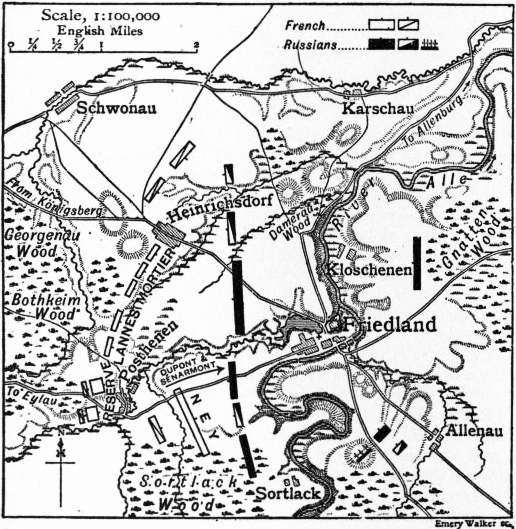
FRIEDLAND, a town of Prussia, on the Alle, 27 m. S.E. of Königsberg (pop. 3000), famous as the scene of the battle fought between the French under Napoleon and the Russians commanded by General Bennigsen, on the 14th of June 1807 (see Napoleonic Campaigns). The Russians had on the 13th driven the French cavalry outposts from Friedland to the westward, and Bennigsen’s main body began to occupy the town in the night. The army of Napoleon was set in motion for Friedland, but it was still dispersed on its various march routes, and the first stage of the engagement was thus, as usual, a pure “encounter-battle.” The corps of Marshal Lannes as “general advanced guard” was first engaged, in the Sortlack Wood and in front of Posthenen (2.30-3 A.M. on the 14th). Both sides now used their cavalry freely to cover the formation of lines of battle, and a race between the rival squadrons for the possession of Heinrichsdorf resulted in favour of the French under Grouchy. Lannes in the meantime was fighting hard to hold Bennigsen, for Napoleon feared that the Russians meant to evade him again. Actually, by 6 A.M. Bennigsen had nearly 50,000 men across the river and forming up west of Friedland. His infantry, in two lines, with artillery, extended between the Heinrichsdorf-Friedland road and the upper bends of the river. Beyond the right of the infantry, cavalry and Cossacks extended the line to the wood N.E. of Heinrichsdorf, and small bodies of Cossacks penetrated even to Schwonau. The left wing also had some cavalry and, beyond the Alle, batteries were brought into action to cover it. A heavy and indecisive fire-fight raged in the Sortlack Wood between the Russian skirmishers and some of Lannes’s troops. The head of Mortier’s (French and Polish) corps appeared at Heinrichsdorf and the Cossacks were driven out of Schwonau. Lannes held his own, and by noon, when Napoleon arrived, 40,000 French troops were on the scene of action. His orders were brief: Ney’s corps was to take the line between Posthenen and the Sortlack Wood, Lannes closing on his left, to form the centre, Mortier at Heinrichsdorf the left wing. Victor and the Guard were placed in reserve behind Posthenen. Cavalry masses were collected at Heinrichsdorf. The main attack was to be delivered against the Russian left, which Napoleon saw at once to be cramped in the narrow tongue of land between the river and the Posthenen mill-stream. Three cavalry divisions were added to the general reserve. The course of the previous operations had been such that both armies had still large detachments out towards Königsberg. The afternoon was spent by the emperor in forming up the newly arrived masses, the deployment being covered by an artillery bombardment. At 5 o’clock all was ready, and Ney, preceded by a heavy artillery fire, rapidly carried the Sortlack Wood. The attack was pushed on toward the Alle. One of Ney’s divisions (Marchand) drove part of the Russian left into the river at Sortlack. A furious charge of cavalry against Marchand’s left was repulsed by the dragoon division of Latour-Maubourg. Soon the Russians were huddled together in the bends of the Alle, an easy target for the guns of Ney and of the reserve. Ney’s attack indeed came eventually to a standstill; Bennigsen’s reserve cavalry charged with great effect and drove him back in disorder. As at Eylau, the approach of night seemed to preclude a decisive success, but in June and on firm ground the old mobility of the French reasserted its value. The infantry division of Dupont advanced rapidly from Posthenen, the cavalry divisions drove back the Russian squadrons into the now congested masses of foot on the river bank, and finally the artillery general Sénarmont advanced a mass of guns to case-shot range. It was the first example of the terrible artillery preparations of modern warfare, and the Russian defence collapsed in a few minutes. Ney’s exhausted infantry were able to pursue the broken regiments of Bennigsen’s left into the streets of Friedland. Lannes and Mortier had all this time held the Russian centre and right on its ground, and their artillery had inflicted severe losses. When Friedland itself was seen to be on fire, the two marshals launched their infantry attack. Fresh French troops approached the battlefield. Dupont distinguished himself for the second time by fording the mill-stream and assailing the left flank of the Russian centre. This offered a stubborn resistance, but the French steadily forced the line backwards, and the battle was soon over. The losses incurred by the Russians in retreating over the river at Friedland were very heavy, many soldiers being drowned. Farther north the still unbroken troops of the right wing drew off by the Allenburg road; the French cavalry of the left wing, though ordered to pursue, remaining, for some reason, inactive. The losses of the victors were reckoned at 12,100 out of 86,000, or 14%, those of the Russians at 10,000 out of 46,000, or 21% (Berndt, Zahl im Kriege).
FRIEDMANN, MEIR (1831-1908), Hungarian Jewish scholar. His editions of the Midrash are the standard texts. His chief editions were the Sifre (1864), the Mekhilta (1870), Pesiqla Rabbathi (1880). At the time of his death he was editing the Sifra. Friedmann, while inspired with regard for tradition, dealt with the Rabbinic texts on modern scientific methods, and rendered conspicuous service to the critical investigation of the Midrash and to the history of early homilies.
(I. A.)
FRIEDRICH, JOHANN (1836- ), German theologian, was born at Poxdorf in Upper Franconia on the 5th of May 1836, and was educated at Bamberg and at Munich, where in 1865 he was appointed professor extraordinary of theology. In 1869 he went to the Vatican Council as secretary to Cardinal Hohenlohe, and took an active part in opposing the dogma of papal infallibility, notably by supplying the opposition bishops with historical and theological material. He left Rome before the council closed. “No German ecclesiastic of his age appears to have won for himself so unusual a repute as a theologian and to have held so important a position, as the trusted counsellor of the leading German cardinal at the Vatican Council. The path was fairly open before him to the highest advancement in the Church of Rome, yet he deliberately sacrificed all such hopes and placed himself in the van of a hard and doubtful struggle” (The Guardian, 1872, p. 1004). Sentence of excommunication was passed on Friedrich in April 1871, but he refused to acknowledge it and was upheld by the Bavarian government. He continued to perform ecclesiastical functions and maintained his academic position, becoming ordinary professor in 1872. In 1882 he was transferred to the philosophical faculty as professor of history. By this time he had to some extent withdrawn from the advanced position which he at first occupied in organizing the Old Catholic Church, for he was not in agreement with its abolition of enforced celibacy.
Friedrich was a prolific writer; among his chief works are: Johann Wessel (1862); Die Lehre des Johann Hus (1862); Kirchengeschichte Deutschlands (1867-1869); Tagebuch während des Vatikan. Concils geführt (1871); Zur Verteidigung meines Tagebuchs (1872); Beiträge zur Kirchengeschichte des 18ten Jahrh. (1876); Geschichte des Vatikan. Konzils (1877-1886); Beiträge zur Gesch. des Jesuitenordens (1881); Das Papsttum (1892); I. v. Döllinger (1899-1901).
FRIEDRICHRODA, a summer resort in the duchy of Saxe-Coburg-Gotha, Germany, at the north foot of the Thuringian Forest, 13 m. by rail S.W. from Gotha. Pop. 4500. It is surrounded by fir-clad hills and possesses numerous handsome villa residences, a Kurhaus, sanatorium, &c. In the immediate neighbourhood is the beautiful ducal hunting seat of Reinhardsbrunn, built out of the ruins of the famous Benedictine monastery founded in 1085.
FRIEDRICHSDORF, a town of Germany, in the Prussian province of Hesse-Nassau, on the southern slope of the Taunus range, 3 m. N.E. from Homburg. Pop. 1300. It has a French Reformed church, a modern school, dyeworks, weaving mills, tanneries and tobacco manufactures. Friedrichsdorf was founded in 1687 by Huguenot refugees and the inhabitants still speak French. There is a monument to Philipp Reis (1834-1874), who in 1860 first constructed the telephone while a science master at the school.
FRIEDRICHSHAFEN, a town of Germany, in the kingdom of Württemberg, on the east shore of the Lake of Constance, at the junction of railways to Bretten and Lindau. Pop. 4600. It consists of the former imperial town of Buchhorn and the monastery and village of Hofen. The principal building is the palace, formerly the residence of the provosts of Hofen, and now the summer residence of the royal family. To the palace is attached the Evangelical parish church. The town has a hydropathic establishment and is a favourite tourist resort. Here are also the natural history and antiquarian collections of the Lake Constance Association. Buchhorn is mentioned (as Buachihorn or Puchihorn) in documents of 837 and was the seat of a powerful countship. The line of counts died out in 1089, and the place fell first to the Welfs and in 1191 to the Hohenstaufen. In 1275 it was made a free imperial city by King Rudolph I. In 1802 it lost this status and was assigned to Bavaria, and in 1810 to Württemberg. The monastery of Hofen was founded in 1050 as a convent of Benedictine nuns, but was changed in 1420 into a provostship of monks. It was suppressed in 1802 and in 1805 came to Württemberg. King Frederick I., who caused the harbour to be made, amalgamated Buchhorn and Hofen under the new name of Friedrichshafen.
FRIEDRICHSRUH, a village in the Prussian province of Schleswig-Holstein, 15 m. S.E. of Hamburg, with a station on the main line of railway to Berlin. It gives its name to the famous country seat of the Bismarck family. The house is a plain unpretentious structure, but the park and estate, forming a portion of the famous Sachsenwald, are attractive. Close by, on a knoll, the Schneckenberg, stands the mausoleum in which the remains of Prince Otto von Bismarck were entombed on the 16th of March 1899.
FRIENDLY1 SOCIETIES. These organizations, according to the comprehensive definition of the Friendly Societies Act 1896, which regulates such societies in Great Britain and Ireland, are “societies for the purpose of providing by voluntary subscriptions of the members thereof, with or without the aid of donations, for the relief or maintenance of the members, their husbands, wives, children, fathers, mothers, brothers or sisters, nephews or nieces, or wards being orphans, during sickness or other infirmity, whether bodily or mental, in old age, or in widowhood, or for the relief or maintenance of the orphan children of members during minority; for insuring money to be paid on the birth of a member’s child, or on the death of a member, or for the funeral expenses of the husband, wife, or child of a member, or of the widow of a deceased member, or, as respects persons of the Jewish persuasion, for the payment of a sum of money during the period of confined mourning; for the relief or maintenance of the members when on travel in search of employment or when in distressed circumstances, or in case of shipwreck, or loss or damage of or to boats or nets; for the endowment of members or nominees of members at any age; for the insurance against fire to any amount not exceeding £15 of the tools or implements of the trade or calling of the members”—and are limited in their contracts for assurance of annuities to £52 (previous to the Friendly Societies Act 1908 the sum was £50), and for insurance of a gross sum to £300 (previous to the act of 1908 the sum was £200). They may be described in a more popular and condensed form of words as the mutual insurance societies of the poorer classes, by which they seek to aid each other in the emergencies arising from sickness and death and other causes of distress. A phrase in the first act for the encouragement and relief of friendly societies, passed in 1793, designating them “societies of good fellowship,” indicates another useful phase of their operations.
The origin of the friendly society is, probably in all countries, the burial club. It has been the policy of every religion, if indeed it is not a common instinct of humanity, to surround the disposal of a dead body with circumstances of pomp and expenditure, often beyond the means of the surviving relatives. The appeal for help to friends and neighbours which necessarily follows is soon organized into a system of mutual aid, that falls in naturally with the religious ceremonies by which honour is done to the dead. Thus in China there are burial societies, termed “long-life loan companies,” in almost all the towns and villages. Among the Greeks the ἔρανοι combined the religious with the provident element (see Charity and Charities). From the Greeks the Romans derived their fraternities of a similar kind. The Teutons in like manner had their gilds. Whether the English friendly society owes its origin in the higher degree to the Roman or the Teutonic influence can hardly be determined. The utility of providing by combination for the ritual expenditure upon burial having been ascertained, the next step—to render mutual assistance in circumstances of distress generally—was an easy one, and we find it taken by the Greek ἔρανοι and by the English gilds. Another modification—that the societies should consist not so much of neighbours as of persons having the same occupation—soon arises; and this is the germ of our trade unions and our city companies in their original constitution. The interest, however, that these inquiries possess is mainly antiquarian. The legal definition of a friendly society quoted above points to an organization more complex than those of the ancient fraternities and gilds, and proceeding upon different principles. It may be that the one has grown out of the other. The common element of a provision for a contingent event by a joint contribution is in both; but the friendly society alone has attempted to define with precision what is the risk against which it intends to provide, and what should be the contributions of the members to meet that risk.
United Kingdom.—It would be curious to endeavour to trace how, after the suppression of the religious gilds in the 16th century, and the substitution of an organized system of relief by the poor law of Elizabeth for the more voluntary and casual means of relief that previously existed, the modern system of friendly societies grew up. The modern friendly society, particularly in rural districts, clings with fondness to its annual feast and procession to church, its procession of all the brethren on the occasion of the funeral of one of them, and other incidents which are almost obviously survivals of the customs of medieval gilds. The last recorded gild was in existence in 1628, and there are records of friendly societies as early as 1634 and 1639. The connecting links, however, cannot be traced. With the exception of a society in the port of Borrowstounness on the Firth of Forth, no existing friendly society is known to be able to trace back its history beyond a date late in the 17th century, and no records remain of any that might have existed in the latter half of the 16th century or the greater part of the 17th. One founded in 1666 was extant in 1850, but it has since ceased to exist. This is not so surprising as it might appear. Documents which exist in manuscript only are much less likely to have been preserved since the invention of printing than they were before; and such would be the simple rules and records of any society that might have existed during this interval—if, indeed, many of them kept records at all. On the whole, it seems probable therefore that the friendly society is a lineal descendant of the ancient gild—the idea never having wholly died out, but having been kept up from generation to generation in a succession of small and scattered societies.
At the same time, it seems probable that the friendly society of the present day owes its revival to a great extent to the Protestant refugees of Spitalfields, one of whose societies was founded in 1703, and has continued among descendants of the same families, whose names proclaim their Norman origin. This society has distinguished itself by the intelligence with which it has adapted its machinery to the successive modifications of the law, and it completely reconstructed its rules under the provisions of the Friendly Societies Acts 1875 and 1876.
Another is the society of Lintot, founded in London in 1708, in which the office of secretary was for more than half a century filled by persons of the name of Levesque, one of whom published a translation of its original rules. No one was to be received into the society who was not a member, or the descendant of a member, of the church of Lintot, of recognized probity, a good Protestant, and well-intentioned towards the queen [Anne] and faithful to the government of the country. No one was to be admitted below the age of eighteen, or who had not been received at holy communion and become member of a church. A member should not have a claim to relief during his first year’s membership, but if he fell sick within the year a collection should be made for him among the members. The foreign names still borne by a large proportion of the members show that the connexion with descendants of the refugees is maintained.
The example of providence given by these societies was so largely followed that Rose’s Act in 1793 recognized the existence of numerous societies, and provided encouragement for them in various ways, as well as relief from taxation to an extent which in those days must have been of great pecuniary value, and exemption from removal under the poor law. The benefits offered by this statute were readily accepted by the societies, and the vast number of societies which speedily became enrolled shows that Rose’s Act met with a real public want. In the county of Middlesex alone nearly a thousand societies were enrolled within a very few years after the passing of the act, and the number in some other counties was almost as great. The societies then formed were nearly all of a like kind—small clubs, in which the feature of good fellowship was in the ascendant, and that of provident assurance for sickness and death merely accessory. This is indicated by one provision which occurs in many of the early enrolled rules, viz. that the number of members shall be limited to 61, 81 or 101, as the case may be. The odd 1 which occurs in these numbers probably stands for the president or secretary, or is a contrivance to ensure a clear majority. Several of these old societies are still in existence, and can point to a prosperous career based rather upon good luck than upon scientific calculation. Founded among small tradesmen or persons in the way to thrive, the claims for sickness were only made in cases where the sickness was accompanied by distress, and even the funeral allowance was not always demanded.
The societies generally not being established upon any scientific principle, those which met with this prosperity were the exception to the rule; and accordingly the cry that friendly societies were failing in all quarters was as great in 1819 as in 1869. A writer of that time speaks of the instability of friendly societies as “universal”; and the general conviction that this was so resulted in the passing of the act of 1819. It recites that “the habitual reliance of poor persons upon parochial relief, rather than upon their own industry, tends to the moral deterioration of the people and to the accumulation of heavy burthens upon parishes; and it is desirable, with a view as well to the reduction of the assessment made for the relief of the poor as to the improvement of the habits of the people, that encouragement should be afforded to persons desirous of making provision for themselves or their families out of the fruits of their own industry. By the contributions of the savings of many persons to one common fund the most effectual provision may be made for the casualties affecting all the contributors; and it is therefore desirable to afford further facilities and additional security to persons who may be willing to unite in appropriating small sums from time to time to a common fund for the purposes aforesaid, and it is desirable to protect such persons from the effects of fraud or miscalculation.” This preamble went on to recite that the provisions of preceding acts had been found insufficient for these purposes, and great abuses had prevailed in many societies established under their authority. By this statute a friendly society was defined as “an institution, whereby it is intended to provide, by contribution, on the principle of mutual insurance, for the maintenance or assistance of the contributors thereto, their wives or children, in sickness, infancy, advanced age, widowhood or any other natural state or contingency, whereof the occurrence is susceptible of calculation by way of average.” It will be seen that this act dealt exclusively with the scientific aspect of the societies, and had nothing to say to the element of good fellowship. Rules and tables were to be submitted by the persons intending to form a society to the justices, who, before confirming them, were to satisfy themselves that the contingencies which the society was to provide against were within the meaning of the act, and that the formation of the society would be useful and beneficial, regard being had to the existence of other societies in the same district. No tables or rules connected with calculation were to be confirmed by the justices until they had been approved by two persons at least, known to be professional actuaries or persons skilled in calculation, as fit and proper, according to the most correct calculation of which the nature of the case would admit. The justices in quarter sessions were also by this act authorized to publish general rules for the formation and government of friendly societies within their county. The practical effect of this statute in requiring that the societies formed under it should be established on sound principles does not appear to have been as great as might have been expected. The justices frequently accepted as “persons skilled in calculation” local schoolmasters and others who had no real knowledge of the technical difficulties of the subject, while the restrictions upon registry served only to increase the number of societies established without becoming registered.
In 1829 the law relating to friendly societies was entirely reconstructed by an act of that year, and a barrister was appointed under that act to examine the rules of societies, and ascertain that they were in conformity to law and to the provisions of the act. The barrister so appointed was John Tidd Pratt (1797-1870); and no account of friendly societies would be complete that did not do justice to the remarkable public service rendered by this gentleman. For forty years, though he had by statute really very slight authority over the societies, his name exercised the widest influence, and the numerous reports and publications by which he endeavoured to impress upon the public mind sound principles of management of friendly societies, and to expose those which were managed upon unsound principles, made him a terror to evil-doers. On the other hand, he lent with readiness the aid of his legal knowledge and great mental activity to assisting well-intentioned societies in coming within the provisions of the acts, and thus gave many excellent schemes a legal organization.
By the act of 1829, in lieu of the discretion as to whether the formation of the proposed society would be useful and beneficial, and the requirement of the actuarial certificate to the tables, it was enacted that the justices were to satisfy themselves that the tables proposed to be used might be adopted with safety to all parties concerned. This provision, of course, became a dead letter and was repealed in 1834. Thenceforth, societies were free to establish themselves upon what conditions and with what rates they chose, provided only they satisfied the barrister that the rules were “calculated to carry into effect the intention of the parties framing them,” and were “in conformity to law.”
By an act of 1846 the barrister certifying the rules was constituted “Registrar of Friendly Societies,” and the rules of all societies were brought together under his custody. An actuarial certificate was to be obtained before any society could be registered “for the purpose of securing any benefit dependent on the laws of sickness and mortality.” In 1850 the acts were again repealed and consolidated with amendments. Societies were divided into two classes, “certified” and “registered.” The certified societies were such as obtained a certificate to their tables by an actuary possessing a given qualification, who was required to set forth the data of sickness and mortality upon which he proceeded, and the rate of interest assumed in the calculations. All other societies were to be simply registered. Very few societies were constituted of the “certified” class. The distinction of classes was repealed and the acts were again consolidated in 1855. Under this act, which admitted of all possible latitude to the framers of rules of societies, 21,875 societies were registered, a large number of them being lodges or courts of affiliated orders, and the act continued in force till the end of 1875.
The Friendly Societies Act 1875 and the several acts amending it are still, in effect, the law by which these societies are regulated, though in form they have been replaced by two consolidating acts, viz. the Friendly Societies Act 1896 and the Collecting Societies and Industrial Assurance Companies Act 1896. This legislation still bears the permissive and elastic character which marked the more successful of the previous acts, but it provides ampler means to members of ascertaining and remedying defects of management and of restraining fraud. The business of registry is under the control of a chief registrar, who has an assistant registrar in each of the three countries, with an actuary. An appeal to the chief registrar in the case of the refusal of an assistant registrar to register a society or an amendment of rules, and in the case of suspension or cancelling of registry, is interposed before appeal is to be made to the High Court. Registry under a particular name may be refused if in the opinion of the registrar the name is likely to deceive the members or the public as to the nature of the society or as to its identity. It is the duty of the chief registrar, among other things, to require from every society a return in proper form each year of its receipts and expenditure, funds and effects; and also once every five years a valuation of its assets and liabilities. Upon the application of a certain proportion of the members, varying according to the magnitude of the society, the chief registrar may appoint an inspector to examine into its affairs, or may call a general meeting of the members to consider and determine any matter affecting its interests. These are powers which have been used with excellent effect. Cases have occurred in which fraud has been detected and punished by this means that could not probably have been otherwise brought to light. In others a system of mismanagement has been exposed and effectually checked. The power of calling special meetings has enabled societies to remedy defects in their rules, to remove officers guilty of misconduct, &c., where the procedure prescribed by the rules was for some reason or other inapplicable. Upon an application of a like proportion of members the chief registrar may, if he finds that the funds of a society are insufficient to meet the existing claims thereon, or that the rates of contribution are insufficient to cover the benefits assured (upon which he consults his actuary), order the society to be dissolved, and direct how its funds are to be applied. Authority is given to the chief registrar to direct the expense (preliminary, incidental, &c.) of an inspection or special meeting to be defrayed by the members or officers, or former members or officers, of a society, if he does not think they should be defrayed either by the applicants or out of the society’s funds. He is also empowered, with the approval of the treasury, to exempt any friendly society from the provisions of the Collecting Societies Act if he considers it to be one to which those provisions ought not to apply. Every society registered after 1895, to which these provisions do apply, is to use the words “Collecting Society” as the last words of its name.
The law as to the membership of infants has been altered three times. The act of 1875 allowed existing societies to continue any rule or practice of admitting children as members that was in force at its passing, and prohibited membership under sixteen years of age in any other case, except the case of a juvenile society composed wholly of members under that age. The treasury made special regulations for the registry of such juvenile societies. In 1887 the maximum age of their members was extended to twenty-one. In 1895 it was enacted that no society should have any members under one year of age, whether authorized by an existing rule or not; and that every society should be entitled to make a rule admitting members at any age over one year, but by the Friendly Societies Act 1908 membership was permitted to minors under the age of one year. The Treasury, upon the enactment of 1895 coming into operation, rescinded its regulations for the registry of juvenile societies; and though it is still the practice to submit for registry societies wholly composed of persons under twenty-one, these societies in no way differ from other societies, except in the circumstances that they are obliged to seek officers and a committee of management from outside, as no member of the committee of any society can be under twenty-one years of age. In order to promote the discontinuance of this anomalous proceeding of creating societies under the Friendly Societies Act, which, by the conditions of their existence, are unable to be self-governing, the act provides an easy method of amalgamating juvenile societies and ordinary societies or branches, or of distributing the members and the funds of a juvenile society among a number of branches. The liability of schoolboys and young working lads to sickness is small, and these societies frequently accumulate funds, which, as their membership is temporary, remain unclaimed and are sometimes misapplied.
The legislation of 1875 and 1876 was the result of the labours of a royal commission of high authority, presided over by Sir Stafford Northcote (afterwards Lord Iddesleigh), which sat from 1870 to 1874, and prosecuted an exhaustive inquiry into the organization and condition of the various classes of friendly societies. Their reports occupy more than a dozen large bluebooks. They divided registered friendly societies into 13 classes.
The first class included the affiliated societies or “orders,” such as the Manchester Unity of Oddfellows, the Ancient Order of Foresters, the Rechabites, Druids, &c. These societies have a central body, either situated in some large town, as in the case of the Manchester Unity, or moving from place to place, as in that of the Foresters. Under this central body, the country is (in most cases) parcelled out into districts, and these districts again consist each of a number of independent branches, called “lodges,” “courts,” “tents,” or “divisions,” having a separate fund administered by themselves, but contributing also to a fund under the control of the central body. Besides these great orders, there were smaller affiliated bodies, each having more than 1000 members; and the affiliated form of society appears to have great attraction. Indeed, in the colony of Victoria, Australia, all the existing friendly societies are of this class. The orders have their “secrets,” but these, it may safely be said, are of a very innocent character, and merely serve the purpose of identifying a member of a distant branch by his knowledge of the “grip,” and of the current password, &c. Indeed they are now so far from being “secret societies” that their meetings are attended by reporters and the debates published in the newspapers, and the Order of Foresters has passed a wise resolution expunging from its publications all affectation of mystery.
Most of the lodges existing before 1875 have converted themselves into registered branches. The requirement that for that purpose a vote of three-fourths should be necessary was altered in 1895 to a bare majority vote. The provisions as to settlement of disputes were extended in 1885 to every description of dispute between branches and the central body, and in 1895 it was provided that the forty days after which a member may apply to the court to settle a dispute where the society fails to do so, shall not begin to run until application has been made in succession to all the tribunals created by the order for the purpose. In 1887 it was enacted that no body which had been a registered branch should be registered as a separate society except upon production of a certificate from the order that it had seceded or been expelled; and in 1895 it was further enacted that no such body should, after secession or expulsion, use any name or number implying that it is still a branch of the order. The orders generally, especially the greater ones, have carefully supervised the valuations of their branches, and have urged and, as far as circumstances have rendered it practicable, have enforced upon the branches measures for diminishing the deficiencies which the valuations have disclosed. They have organized plans by which branches disposed to make an effort to help themselves in this matter may be assisted out of a central fund. The second class was made up of “general societies,” principally existing in London, of which the commissioners enumerated 8 with nearly 60,000 members, and funds amounting to a quarter of a million.
The third class included the “county societies.” These societies have been but feebly supported by those for whose benefit they are instituted, having all exacted high rates of contribution, in order to secure financial soundness.
Class 4, “local town societies,” is a very numerous one. Among some of the larger societies may be mentioned the “Chelmsford Provident,” the “Brighton and Sussex Mutual,” the “Cannon Street, Birmingham,” the “Birmingham General Provident.” In this group might also be included the interesting societies which are established among the Jewish community. They differ from ordinary friendly societies partly in the nature of the benefits granted upon death, which are intended to compensate for loss of employment during the time of ceremonial seclusion enjoined by the Jewish law, which is called “sitting shiva.” They also provide a cab for the mourners and rabbi, and a tombstone for the departed, and the same benefits as an ordinary friendly society during sickness. Some also provide a place of worship. Of these the “Pursuers of Peace” (enrolled in December 1797), the “Bikhur Cholim, or Visitors of the Sick” (April 1798), the “Hozier Holim” (1804), may be mentioned.
Class 5 was “local village and country societies,” including the small public-house clubs which abound in the villages and rural districts, a large proportion of which are unregistered.
Class 6 was formed of “particular trade societies.”
Class 7 was “dividing societies.” These were before 1875 unauthorized by law, though they were very attractive to the members. Their practice is usually to start afresh every January, paying a subscription somewhat in excess of that usually charged by an ordinary friendly society, out of which a sick allowance is granted to any member who may fall sick during the year, and at Christmas the balance not so applied is divided among the members equally, with the exception of a small sum left to begin the new year with. The mischief of the system is that, as there is no accumulation of funds, the society cannot provide for prolonged sickness or old age, and must either break up altogether or exclude its sick and aged members at the very time when they most need its help. This, however, has not impaired the popularity of the societies, and the act of 1875, framed on the sound principle that the protection of the law should not be withheld from any form of association, enables a society to be registered with a rule for dividing its funds, provided only that all existing claims upon the society are to be met before a division takes place.
Class 8, “deposit friendly societies,” combine the characteristics of a savings bank with those of a friendly society. They were devised by the Hon. and Rev. S. Best, on the principle that a certain proportion of the sick allowance is to be raised out of a member’s separate deposit account, which, if not so used, is retained for his benefit. Their advantages are in the encouragement they offer to saving, and in meeting the selfish objection sometimes raised to friendly societies, that the man who is not sick gets nothing for his money; their disadvantage is in their failing to meet cases of sickness so prolonged as to exhaust the whole of the member’s own deposit.
Class 9, “collecting societies,” are so called because their contributions are received through a machinery of house-to-house collection. These were the subject of much laborious investigation and close attention on the part of the commissioners. They deal with a lower class of the community, both with respect to means and to intelligence, than that from which the members of ordinary friendly societies are drawn. The large emoluments gained by the officers and collectors, the high percentage of expenditure (often exceeding half the contributions), and the excessive frequency of lapsing of insurances point to mischiefs in their management. “The radical evil of the whole system (the commissioners remark) appears to us to lie in the employment of collectors, otherwise than under the direct supervision and control of the members, a supervision and control which we fear to be absolutely unattainable in burial societies that are not purely local.” On the other hand, it must be conceded that these societies extend the benefits of life insurance to a class which the other societies cannot reach, namely, the class that will not take the trouble to attend at an office, but must be induced to effect an insurance by a house-to-house canvasser, and be regularly visited by the collector to ensure their paying the contributions. To many such persons these societies, despite all their errors of constitution and management, have been of great benefit. The great source of these errors lies in a tendency on the part of the managers of the societies to forget that they are simply trustees, and to look upon the concern as their own personal property to be managed for their own benefit. These societies are of two kinds, local and general. For the general societies the act of 1875 made certain stringent provisions. Each member was to be furnished with a copy of the rules for one penny, and a signed policy for the same charge. Forfeiture of benefit for non-payment is not to be enforced without fourteen days’ written notice. The transfer of a member from one society to another was not to be made without his written consent and notice to the society affected. No collector is to be a manager, or vote or take part at any meeting. At least one general meeting was to be held every year, of which notice must be given either by advertisement or by letter or post card to each member. The balance-sheet is to be open for inspection seven days before the meeting, and to be certified by a public accountant, not an officer of the society. Disputes could be settled by justices, or county courts, notwithstanding anything in the rules of the society to the contrary. Closely associated with the question of the management of these societies is that of the risk incurred by infant life, through the facilities offered by these societies for making insurances on the death of children. That this is a real risk is certain from the records of the assizes, and from many circumstances of suspicion; but the extent of it cannot be measured, and has probably been exaggerated. It has never been lawful to assure more than £6 on the death of a child under five years of age, or more than £10 on the death of one under ten. Previous to the act of 1875, however, there was no machinery for ascertaining that the law was complied with, or for enforcing it. This is supplied by that act, though still somewhat imperfectly. When the bill went up to the House of Lords, an amendment was made, reducing the limit of assurance on a child under three years of age to £3, but this amendment was unfortunately disagreed with by the House of Commons.
Class 10, annuity societies, prevail in the west of England. These societies are few, and their business is diminishing. Most of them originated at the time when government subsidized friendly societies by allowing them £4 : 11 : 3% per annum interest. Now annuities may be purchased direct from the National Debt commissioners. These societies are more numerous, however, in Ireland.
Class 11, female societies, are numerous. Many of them resemble affiliated orders at least in name, calling themselves Female Foresters, Odd Sisters, Loyal Orangewomen, Comforting Sisters and so forth. In their rules may be found such a provision as that a member shall be fined who does not “behave as becometh an Orangewoman.” Many are unregistered. In the northern counties of England they are sometimes termed “life boxes,” doubtless from the old custom of placing the contributions in a box. The trustees, treasurer, and committee are usually females, but very frequently the secretary is a man, paid a small salary.
Under Class 12 the commissioners included the societies for various purposes which were authorized by the secretary of state to be registered under the Friendly Societies Act of 1855, comprising working-men’s clubs, and certain specially authorized societies, as well as others that are now defined to be friendly societies. Among these purposes are assisting members in search of employment; assisting members during slack seasons of trade; granting temporary relief to members in distressed circumstances; purchase of coals and other necessaries to be supplied to members; relief or maintenance in case of lameness, blindness, insanity, paralysis, or bodily hurt through accidents; also, the assurance against loss by disease or death of cattle employed in trade or agriculture; relief in case of shipwreck or loss or damage to boats or nets; and societies for social intercourse, mutual helpfulness, mental and moral improvement, rational recreation, &c., called working-men’s clubs.
Class 13 was composed of cattle insurance societies.
These are the thirteen classes into which the commissioners divided registered friendly societies. There were 26,034 societies enrolled or certified under the various acts for friendly societies in force between 1793 and 1855; and, as we have seen, 21,875 societies registered under the act of 1855 before the 1st January 1876, when the act of 1875 came into operation. The total therefore of societies to which a legal constitution had been given was 47,909. Of these 26,087 were presumed to be in existence when the registrar called for his annual return, but only 11,282 furnished the return required. These had 3,404,187 members, and £9,336,946 funds. Twenty-two societies returned over 10,000 members each; nine over 30,000. One society (the Royal Liver Friendly Society, Liverpool, the largest of the collecting societies) returned 682,371 members. The next in order was one of the same class, the United Assurance Society, Liverpool, with 159,957 members; but in all societies of this class the membership consists very largely of infants. The average of members in the 11,260 societies with less than 10,000 members each was only 171.
Such were the registered societies; but there remained behind a large body of unregistered societies. With increased knowledge of the advantages of registration,2 and of the true principles upon which friendly societies should be established, the number of unregistered societies, in comparison with those registered, ought to become much less.
On the actuarial side it is in the highest degree essential to the interests of their members that friendly societies should be financially sound,—in other words, that they should throughout their existence be able to meet the engagements into which they have entered with their members. For this purpose it is necessary that the members’ contributions should be so fixed as to prove adequate, with proper management, to provide the benefits promised to the members. These benefits almost entirely depend upon the contingencies of health and life; that is, they take the form of payments to members when sick, of payments to members upon attaining given ages, or of payments upon members’ deaths, and frequently a member is assured for all these benefits, viz. a weekly payment if at any time sick before attaining a certain age, a weekly payment for the remainder of life after attaining that age, and a sum to be paid upon his death. Of course the object of the allowance in sickness is to provide a substitute for the weekly wage lost in consequence of being unable to work, and the object of the weekly payment after attaining a certain age, when the member will probably be too infirm to be able to earn a living by the exercise of his calling or occupation, is to provide him with the necessaries of life, and so enable him to be independent of poor relief. There is every reason to believe that, when a large group of persons of the same age and calling are observed, there will be found to prevail among them, taken one with another, an average number of days’ sickness, as well as an average rate of mortality, in passing through each year of life, which can be very nearly predicted from the results furnished by statistics based upon observations previously made upon similarly circumstanced groups. Assuming, therefore, the necessary statistics to be attainable, the computation of suitable rates of contribution to be paid by the members of a society in return for certain allowances during sickness, or upon attaining a certain age, or upon death, can be readily made by an actuarial expert. Accordingly, to furnish these statistics, the act of 1875, in continuation of an enactment which first appeared in a statute passed in 1829, required every registered society to make quinquennial returns of the sickness and mortality experienced by its members. By the year 1880 ten periods of five years had been completed, and at the end of each of them a number of returns had been received. Some of these had been tabulated by actuaries, the latest tabulation being of those for the five years ending 1855. There remained untabulated five complete sets of returns for the five subsequent quinquennial periods. It was resolved that these should be tabulated once for all, and it was considered that they would afford sufficient material for the construction of tables of sickness and mortality that might be adopted for the future as standard tables for friendly societies; and that it would be inexpedient to impose any longer on the societies the burden of making such returns. This requirement of the act was accordingly repealed in 1882. The result of the tabulation appeared in 1896, in a bluebook of 1367 folio pages, containing tables based upon the experience of nearly four and a half million years of life. These tables showed generally, as compared with previous observations, an increased liability to sickness. This inference has been confirmed by the observations of Mr Alfred W. Watson, actuary to the Independent Order of Oddfellows, Manchester Unity Friendly Society, on his investigation of the sickness and mortality experience of that society during the five years 1893-1897, which extended over 800,000 individuals, more than 3,000,000 years of life and 7,000,000 weeks of sickness.
The establishment of the National Conference of Friendly Societies by the orders and a few other societies has been of great service in obtaining improvements in the law, and in enabling the societies strongly to represent to the government and the legislature any grievance entertained by them. A complaint that membership of a shop club was made by certain employers a condition of employment, and that the rules of the club required the members to withdraw from other societies, led to the appointment of a departmental committee, who recommended that such a condition of employment should be made illegal, except in certain cases, and that in every case it should be illegal to make the withdrawal from a society a condition of employment. In 1902 an act was passed based upon this recommendation.
It is an increasing practice among societies of combining together to obtain medical attendance and medicine for their members by the formation of medical associations. In 1895 trade unions were enabled to join in such associations, and it was provided that a contributing society or union should not withdraw from an association except upon three months’ notice. The working of these associations has been viewed with dissatisfaction by members of the medical profession, and it has been suggested that a board of conciliation should be formed consisting of representatives of the Conference of Friendly Societies and of an equal number of medical men.
The following figures are derived from returns of registered societies and branches of registered societies to the beginning of 1905:
Number of Returns. Number of Members. Amount of Funds.
Ordinary Friendly Societies (classes 2 to 8, 10 and 11) 6,938 3,132,065 £17,042,398
Societies having Branches (class 1) 20,819 2,606,029 23,446,330
Collecting Friendly Societies (class 9) 45 7,448,549 7,862,569
Benevolent Societies (class 12) 75 26,509 317,913
Working Men’s Clubs (class 12) 913 236,298 318,945
Specially Authorized Societies (class 12) 122 75,089 628,759
Specially Authorized Loan Societies (class 12) 517 115,511 771,578
Medical Societies (see last paragraph) 95 324,145 62,049
Cattle Insurance Societies (class 13) 57 3,736 7,746
Shop Clubs (under act of 1902) 7 10,859 773
29,588 13,978,790 £50,459,060
British Empire.—In many of the British colonies legislation on the subject similar to that of the mother-country has been adopted. In those forming the Commonwealth of Australia and in New Zealand the affiliated orders hold the field, there being few, if any, independent friendly societies. The state of Victoria has more than 1000 lodges with more than 100,000 members and nearly 1½ million pounds funds, averaging nearly £14 per member. Besides the registrar there is a government actuary for friendly societies, by whom the liabilities and accounts of all societies are valued every five years, a method which ensures uniformity in the processes of valuation. The friendly societies in the other Australasian states are not so numerous nor so wealthy, but are in each case under the supervision of vigilant public officials. In New Zealand a friendly society was established at New Plymouth in 1841, the first year of that settlement. The formation of a society at Nelson was resolved upon by the emigrants on shipboard on their passage out, and the first meeting was held among the tall fern near the beach a few days after they landed. The societies have now a registrar, an actuary, a revising barrister and two public valuers. Investigations have been made into their sickness experience, with results which compare favourably with those of the Manchester Unity and the registry office in the mother-country until the higher ages, when greater sickness appears to result from lower mortality. The average funds per member are £19, 10s. Nearly four-fifths are invested in the purchase or on mortgage of real estate.
In Cape Colony no society is allowed to register unless it be shown to the satisfaction of the registrar that the contributions which it proposes to charge are adequate to provide for the benefits which it undertakes to grant. The consequence is that little more than one-third of the existing societies are registered.
In the Dominion of Canada, province of Ontario, extensive powers of control are given to the registrar, and societies are not admitted to registry without strict proof of their compliance with the conditions of registry imposed by the law. Very full returns of their transactions are required and published, and registry is cancelled when any of the conditions of registry cease to be observed. These conditions apply not only to societies existing in Ontario, but to foreign societies transacting business there.
In several of the West Indian Islands statutes have been passed on the model of British legislation and registrars have been appointed.
European Countries.—In foreign countries the development of friendly societies has proceeded upon different lines. Belgium has a Commission royale permanente des sociétés de secours mutuel. Under laws passed in 1851 and 1894 societies are divided into two classes, recognized and not recognized. The recognized societies were in 1886 only about half as many as the unrecognized. There were in 1904 nearly 7000 recognized societies with 700,000 members. They enjoy the privileges of incorporation, exemption from stamp duty, gratuitous announcement in the official Moniteur and may have free postage.
In France under the second empire a scheme was prepared for assisting friendly societies by granting them collective insurances under government security. The societies have the privilege of investing their funds in the Caisse des Dépôts et Consignations, corresponding to the English National Debt commission. The dual classification of societies in France is into those “authorized” and those “approved.” By a law of the 1st of April 1898 a friendly society may be established by merely depositing a copy of its rules and list of officers with the sousprefet. Approved societies are entitled to certain state subventions for assisting in the purchase of old-age pensions and otherwise. A higher council has been established to advise on their working.
In Germany a law was passed on the 7th of April 1876 (amended on the 1st of June 1884) which prescribed for registered friendly societies many things which in England are left to the discretion of their founders; and it provided for an amount of official interference in their management that is wholly unknown here. The superintending authority had a right to inspect the books of every society, whether registered or not, and to give formal notice to a society to call in arrears, exclude defaulters, pay benefits or revoke illegal resolutions. A higher authority might, in certain cases, order societies to be dissolved. These provisions related to voluntary societies; but it was competent for communal authorities also to order the formation of a friendly society, and to make a regulation compelling all workmen not already members of a society to join it. Since then the great series of imperial statutes has been passed, commencing in 1883 with that for sickness insurance, followed in 1884 by that for workmen’s accident insurance, extended to sickness insurance in 1885, developed in the laws relating to accident and sickness insurance of persons engaged in agricultural and forestry pursuits in 1886, of persons engaged in the building trade and of seamen and others engaged in seafaring pursuits in 1887, and crowned by the law relating to infirmity and old-age insurance in 1889. Mr H. Unger, a distinguished actuary, remarks that the whole German workman’s insurance and its executive bodies (sickness funds, trade associations, insurance institutions) are constantly endeavouring to improve the position of the workmen in a social and sanitary aspect, to the benefit of internal peace and the welfare of the German empire.
In Holland it is stated that the number of burial clubs and sickness benefit societies appears to be greater in proportion to the population than in any other country; but that the burial clubs do not rest upon a scientific basis, and have an unfavourable influence upon infant mortality. Half the population are insured in some burial club or other. The sick benefit societies are, as in England, some in a good and some in a bad financial condition; and legislation follows the English system of compulsory publicity, combined with freedom of competition.
In Spain friendly societies have grown out of the religious gilds. They are regulated by an act of 1887. Their actuarial condition appears to be backward, but to show indications of improvement.
(E. W. B.)
United States.—Under the title of fraternal societies are included in the United States what are known in England as friendly societies, having some basis of mutual help to members, mutual insurance associations and benefit associations of all kinds. There are various classes and a great variety of forms of fraternal associations. It is therefore difficult to give a concrete historical statement of their origin and growth; but, dealing with those having benefit features for the payment of certain amounts in case of sickness, accident or death, it is found that their history in the United States is practically within the last half of the 19th century. The more important of the older organizations are the Improved Order of Red Men, founded in 1771 and reorganized in 1834; Ancient Order of Foresters, 1836; Ancient Order of Hibernians of America, 1836; United Ancient Order of Druids, 1839; Independent Order of Rechabites, 1842; Independent Order of B’nai B’rith, founded in 1843; Order of the United American Mechanics, 1845; Independent Order of Free Sons of Israel, 1849; Junior Order of United American Mechanics, 1853. A very large proportion, probably more than one-half, of the societies which have secret organizations pay benefits in case of sickness, accident, disability, and funeral expenses in case of death. This class of societies grew out of the English friendly societies and have masonic characteristics. The Freemasons and other secret societies, while not all having benefit features in their distinctive organizations, have auxiliary societies with such features. There is also a class of secret societies, based largely on masonic usages, that have for their principal object the payment of benefits in some form. These are the Oddfellows, the Knights of Pythias, the Knights of Honour, the Royal Arcanum and some others. Many trade unions have now adopted benefit features, especially the Typographical Union, while many subordinate unions and great publishing houses have mutual relief associations purely of a local character, and some of the more important newspapers have such mutual relief or benefit societies. The New York trade unions, taken as a whole, have paid out large sums of money in benefits where members have been out of work, or are sick, or are on strike or have died. The total paid in one year for all these benefits was over $500,000.
It is impossible to give the membership of all the fraternal associations in the United States; but, including Oddfellows, Freemasons, purely benefit associations and all the class of the larger fraternal organizations, the membership is over 6,000,000. Among the more important, so far as membership is concerned, are the Knights of Pythias, the Oddfellows, the Modern Woodmen of America, the Ancient Order of United Workmen, Improved Order of Red Men, Royal Arcanum, Knights of the Maccabees, Junior Order of United American Mechanics, Foresters of America, Independent Order of Foresters, &c. These and other organizations pay out a vast amount of money every year in the various forms.
Since about the year 1870 a new form of benefit organization has come into existence. This is a life insurance based on the assessment plan, assessments being levied whenever a member dies; or, as more recently, regular assessments being made in Assessment insurance. advance of death, as post-mortem assessments have proved a fallacious method of securing the means of paying death benefits. There are about 200 mutual benefit insurance companies or associations in the United States conducted on the “lodge system”; that is to say, they have regular meetings for social purposes and for general improvement, and in their work there is found the mysticism, forms and ceremonies which belong to secret societies generally. These elements have proved a very strong force in keeping this class of associations fairly intact. The “work” of the lodges in the initiation of members and their passing through various degrees is attractive to many people, and in small places, remote from the amusements of the city, these lodges constitute a resort where members can give play to their various talents. In most of them the features of the Masonic ritual are prominent. The amount of insurance which a single member can carry in such associations is small. In the Knights of Honour, one of the first of this class, policies ranging from $500 to $2000 are granted. In the Royal Arcanum the maximum is $3000. This form of insurance may be called co-operative, and has many elements which make the organizations practising it stronger than the ordinary assessment insurance companies having no stated meetings of members. These co-operative insurance societies are organized on the federal plan—as the Knights of Honour, for instance—having local assemblies, where the lodge-room element is in force; state organizations, to which the local bodies send delegates, and the national organization, which conducts all the insurance business through its executive officers. The local societies pay a certain given amount towards the support of the state and national offices, and while originally they paid death assessments, as called for, they now pay regular monthly assessments, in order to avoid the weakness of the post-mortem assessment. The difficulty which these organizations have in conducting the insurance business is in keeping the average age of membership at a low point, for with an increase in the average the assessments increase, and many such organizations have had great trouble to convince younger members that their assessments should be increased to make up for the heavy losses among the older members. The experience of these purely insurance associations has not been sufficient yet to demonstrate their absolute soundness or desirability, but they have enabled a large number of persons of limited means to carry insurance at a very low rate. They have not materially interfered with regular level premium insurance enterprises, for they have stimulated the people to understand the benefits of insurance, and have really been an educational force in this direction.