VOLUME X SLICE III Fenton, Edward to Finistere (continued 8)
Reading edition
Flora.—The vegetation is mostly of a tropical Indo-Malayan character—thick jungle with great trees covered with creepers and epiphytes. The lee sides of the larger islands, however, have grassy plains suitable for grazing, with scattered trees, chiefly Pandanus, and ferns. The flora has also some Australian and New Zealand affinities (resembling in this respect the New Caledonia and New Hebrides groups), shown especially in these western districts by the Pandanus, by certain acacias and others. At an elevation of about 2000 ft. the vegetation assumes a more mountainous type. Among the many valuable timber trees are the vesi (Afzelia bijuga); the dilo (Calophyllum Inophyllum), the oil from its seeds being much used in the islands, as in India, in the treatment of rheumatism; the dakua (Dammara Vitiensis), allied to the New Zealand kauri, and others. The dakua or Fiji pine, however, has become scarce. Most of the fruit trees are also valuable as timber. The native cloth (masi) is beaten out from the bark of the paper mulberry cultivated for the purpose. Of the palms the cocoanut is by far the most important. The yasi or sandal-wood was formerly a valuable product, but is now rarely found. There are various useful drugs, spices and perfumes; and many plants are cultivated for their beauty, to which the natives are keenly alive. Among the plants used as pot-herbs are several ferns, and two or three Solanums, one of which, S. anthropophagorum, was one of certain plants always cooked with human flesh, which was said to be otherwise difficult of digestion. The use of the kava root, here called yanggona, from which the well-known national beverage is made, is said to have been introduced from Tonga. Of fruit trees, besides the cocoanut, there may be mentioned the many varieties of the bread-fruit, of bananas and plantains, of sugar-cane and of lemon; the wi (Spondias dulcis), the kavika (Eugenia malaccensis), the ivi or Tahitian chestnut (Inocarpus edulis), the pine-apple and others introduced in modern times. Edible roots are especially abundant. The chief staple of life is the yam, the names of several months in the calendar having reference to its cultivation and ripening. The natives use no grain or pulse, but make a kind of bread (mandrai) from this, the taro, and other roots, as well as from the banana (which is the best), the bread-fruit, the ivi, the kavika, the arrowroot, and in times of scarcity the mangrove. This bread is made by burying the materials for months, till the mass is thoroughly fermented and homogeneous, when it is dug up and cooked by baking or steaming. This simple process, applicable to such a variety of substances, is a valuable security against famine.
People.—The Fijians are a people of Melanesian (Papuan) stock much crossed with Polynesians (Tongans and Samoans). They occupy the extreme east limits of Papuan territory and are usually classified as Melanesians; but they are physically superior to the pure examples of that race, combining their dark colour, harsh hirsute skin, crisp hair, which is bleached with lime and worn in an elaborately trained mop, and muscular limbs, with the handsome features and well proportioned bodies of the Polynesians. They are tall and well built. The features are strongly marked, but not unpleasant, the eyes deep set, the beard thick and bushy. The chiefs are fairer, much better-looking, and of a less negroid type of face than the people. This negroid type is especially marked on the west coasts, and still more in the interior of Viti Levu. The Fijians have other characteristics of both Pacific races, e.g. the quick intellect of the fairer, and the savagery and suspicion of the dark. They wear a minimum of covering, but, unlike the Melanesians, are strictly decent, while they are more moral than the Polynesians. They are cleanly and particular about their personal appearance, though, unlike other Melanesians, they care little for ornament, and only the women are tattooed. A partial circumcision is practised, which is exceptional with the Melanesians, nor have these usually an elaborate political and social system like that of Fiji. The status of the women is also somewhat better, those of the upper class having considerable freedom and influence. If less readily amenable to civilizing influences than their neighbours to the eastward, the Fijians show greater force of character and ingenuity. Possessing the arts of both races they practise them with greater skill than either. They understand the principle of division of labour and production, and thus of commerce. They are skilful cultivators and good boat-builders, the carpenters being an hereditary caste; there are also tribes of fishermen and sailors; their mats, baskets, nets, cordage and other fabrics are substantial and tasteful; their pottery, made, like many of the above articles, by women, is far superior to any other in the South Seas; but many native manufactures have been supplanted by European goods.
The Fijians were formerly notorious for cannibalism, which may have had its origin in religion, but long before the first contact with Europeans had degenerated into gluttony. The Fijian’s chief table luxury was human flesh, euphemistically called by him “long pig,” and to satisfy his appetite he would sacrifice even friends and relatives. The Fijians combined with this greediness a savage and merciless nature. Human sacrifices were of daily occurrence. On a chief’s death wives and slaves were buried alive with him. When building a chief’s house a slave was buried alive in the hole dug for each foundation post. At the launching of a war-canoe living men were tied hand and foot between two plantain stems making a human ladder over which the vessel was pushed down into the water. The people acquiesced in these brutal customs, and willingly met their deaths. Affection and a firm belief in a future state, in which the exact condition of the dying is continued, are the Fijians’ own explanations of the custom, once universal, of killing sick or aged relatives. Yet in spite of this savagery the Fijians have always been remarkable for their hospitality, open-handedness and courtesy. They are a sensitive, proud, if vindictive, and boastful people, with good conversational and reasoning powers, much sense of humour, tact and perception of character. Their code of social etiquette is minute and elaborate, and the graduations of rank well marked. These are (1) chiefs, greater and lesser; (2) priests; (3) Mata ni Vanua (lit., eyes of the land), employés, messengers or counsellors; (4) distinguished warriors of low birth; (5) common people; (6) slaves.
The family is the unit of political society. The families are grouped in townships or otherwise (qali) under the lesser chiefs, who again owe allegiance to the supreme chief of the matanitu or tribe. The chiefs are a real aristocracy, excelling the people in physique, skill, intellect and acquirements of all sorts; and the reverence felt for them, now gradually diminishing, was very great, and had something of a religious character. All that a man had belonged to his chief. On the other hand, the chief’s property practically belonged to his people, and they were as ready to give as to take. In a time of famine, a chief would declare the contents of the plantations to be common property. A system of feudal service-tenures (lala) is the institution on which their social and political fabric mainly depended. It allowed the chief to call for the labour of any district, and to employ it in planting, house or canoe-building, supplying food on the occasion of another chief’s visit, &c. This power was often used with much discernment; thus an unpopular chief would redeem his character by calling for some customary service and rewarding it liberally, or a district would be called on to supply labour or produce as a punishment. The privilege might, of course, be abused by needy or unscrupulous chiefs, though they generally deferred somewhat to public opinion; it has now, with similar customary exactions of cloth, mats, salt, pottery, &c. been reduced within definite limits. An allied custom, solevu, enabled a district in want of any particular article to call on its neighbours to supply it, giving labour or something else in exchange. Although, then, the chief is lord of the soil, the inferior chiefs and individual families have equally distinct rights in it, subject to payment of certain dues; and the idea of permanent alienation of land by purchase was never perhaps clearly realized. Another curious custom was that of vasu (lit. nephew). The son of a chief by a woman of rank had almost unlimited rights over the property of his mother’s family, or of her people. In time of war the chief claimed absolute control over life and property. Warfare was carried on with many courteous formalities, and considerable skill was shown in the fortifications. There were well-defined degrees of dependence among the different tribes or districts: the first of these, bati, is an alliance between two nearly equal tribes, but implying a sort of inferiority on one side, acknowledged by military service; the second, qali, implies greater subjection, and payment of tribute. Thus A, being bati to B, might hold C in qali, in which case C was also reckoned subject to B, or might be protected by B for political purposes.
The former religion of the Fijians was a sort of ancestor-worship, had much in common with the creeds of Polynesia, and included a belief in a future existence. There were two classes of gods—the first immortal, of whom Ndengei is the greatest, said to exist eternally in the form of a serpent, but troubling himself little with human or other affairs, and the others had usually only a local recognition. The second rank (who, though far above mortals, are subject to their passions, and even to death) comprised the spirits of chiefs, heroes and other ancestors. The gods entered and spoke through their priests, who thus pronounced on the issue of every enterprise, but they were not represented by idols; certain groves and trees were held sacred, and stones which suggest phallic associations. The priesthood usually was hereditary, and their influence great, and they had generally a good understanding with the chief. The institution of Taboo existed in full force. The mburé or temple was also the council chamber and place of assemblage for various purposes.
The weapons of the Fijians are spears, slings, throwing clubs and bows and arrows. Their houses, of which the framework is timber and the rest lattice and thatch, are ingeniously constructed, with great taste in ornamentation, and are well furnished with mats, mosquito-curtains, baskets, fans, nets and cooking and other utensils. Their canoes, sometimes more than 100 ft. long, are well built. Ever excellent agriculturists, their implements were formerly digging sticks and hoes of turtlebone or flat oyster-shells. In irrigation they showed skill, draining their fields with built watercourses and bamboo pipes. Tobacco, maize, sweet potatoes, yams, kava, taro, beans and pumpkins, are the principal crops.
Fijians are fond of amusements. They have various games, and dancing, story-telling and songs are especially popular. Their poetry has well-defined metres, and a sort of rhyme. Their music is rude, and is said to be always in the major key. They are clever cooks, and for their feasts preparations are sometimes made months in advance, and enormous waste results from them. Mourning is expressed by fasting, by shaving the head and face, or by cutting off the little finger. This last is sometimes done at the death of a rich man in the hope that his family will reward the compliment; sometimes it is done vicariously, as when one chief cuts off the little finger of his dependent in regret or in atonement for the death of another.
A steady, if not a very rapid, decrease in the native population set in after 1875. A terrible epidemic of measles in that year swept away 40,000, or about one-third of the Fijians. Subsequent epidemics have not been attended by anything like this mortality, but there has, however, been a steady decrease, principally among young children, owing to whooping-cough, tuberculosis and croup. Every Fijian child seems to contract yaws at some time in its life, a mistaken notion existing on the part of the parents that it strengthens the child’s physique. Elephantiasis, influenza; rheumatism, and a skin disease, thoko, also occur. One per cent of the natives are lepers. A commission appointed in 1891 to inquire into the causes of the native decrease collected much interesting anthropological information regarding native customs, and provincial inspectors and medical officers were specially appointed to compel the natives to carry out the sanitary reforms recommended by the commission. A considerable sum was also spent in laying on good water to the native villages. The Fijians show no disposition to intermarry with the Indian coolies. The European half-castes are not prolific inter se, and they are subject to a scrofulous taint. The most robust cross in the islands is the offspring of the African negro and the Fijian. Miscegenation with the Micronesians, the only race in the Pacific which is rapidly increasing, is regarded as the most hopeful manner of preserving the native Fijian population. There is a large Indian immigrant population.
Trade, Administration, &c.—The principal industries are the cultivation of sugar and fruits and the manufacture of sugar and copra, and these three are the chief articles of export trade, which is carried on almost entirely with Australia and New Zealand. The fruits chiefly exported are bananas and pineapples. There are also exported maize, vanilla and a variety of fruits in small quantities; pearl and other shells and bêche-de-mer. There is a manufacture of soap from coconut oil; a fair quantity of tobacco is grown, and among other industries may be included boat-building and saw-milling. Regular steamship communications are maintained with Sydney, Auckland and Vancouver. Good bridle-tracks exist in all the larger islands, and there are some macadamized roads, principally in Viti Levu. There is an overland mail service by native runners. The export trade is valued at nearly £600,000 annually, and the imports at £500,000. The annual revenue of the colony is about £140,000 and the expenditure about £125,000. The currency and weights and measures are British. Besides the customs and stamp duties, some £18,000 of the annual revenue is raised from native taxation. The seventeen provinces of the colony (at the head of which is either a European or a roko tui or native official) are assessed annually by the legislative council for a fixed tax in kind. The tax on each province is distributed among districts under officials called bulis, and further among villages within these districts. Any surplus of produce over the assessment is sold to contractors, and the money received is returned to the natives.
Under a reconstruction made in 1904 there is an executive council consisting of the governor and four official members. The legislative council consists of the governor, ten official, six elected and two native members. The native chiefs and provincial representatives meet annually under the presidency of the governor, and their recommendations are submitted for sanction to the legislative council. Suva and Levuka have each a municipal government, and there are native district and village councils. There is an armed native constabulary; and a volunteer and cadet corps in Suva and Levuka.
The majority of the natives are Wesleyan Methodists. The Roman Catholic missionaries have about 3000 adherents; the Church of England is confined to the Europeans and kanakas in the towns; the Indian coolies are divided between Mahommedans and Hindus. There are public schools for Europeans and half-castes in the towns, but there is no provision for the education of the children of settlers in the out-districts. By an ordinance of 1890 provision was made for the constitution of school boards, and the principle was first applied in Suva and Levuka. The missions have established schools in every native village, and most natives are able to read and write their own language. The government has established a native technical school for the teaching of useful handicrafts. The natives show themselves very slow in adopting European habits in food, clothing and house-building.
History.—A few islands in the north-east of the group were first seen by Abel Tasman in 1643. The southernmost of the group, Turtle Island, was discovered by Cook in 1773. Lieutenant Bligh, approaching them in the launch of the “Bounty,” 1789, had a hostile encounter with natives. In 1827 Dumont d’Urville in the “Astrolabe” surveyed them much more accurately, but the first thorough survey was that of the United States exploring expedition in 1840. Up to this time, owing to the evil reputation of the islanders, European intercourse was very limited. The labours of the Wesleyan missionaries, however, must always have a prominent place in any history of Fiji. They came from Tonga in 1835 and naturally settled first in the eastern islands, where the Tongan element, already familiar to them, preponderated. They perhaps identified themselves too closely with their Tongan friends, whose dissolute, lawless, tyrannical conduct led to much mischief; but it should not be forgotten that their position was difficult, and it was mainly through their efforts that many terrible heathen practices were stamped out.
About 1804 some escaped convicts from Australia and runaway sailors established themselves around the east part of Viti Levu, and by lending their services to the neighbouring chiefs probably led to their preponderance over the rest of the group. Na Ulivau, chief of the small island of Mbau, established before his death in 1829 a sort of supremacy, which was extended by his brother Tanoa, and by Tanoa’s son Thakombau, a ruler of considerable capacity. In his time, however, difficulties thickened. The Tongans, who had long frequented Fiji (especially for canoe-building, their own islands being deficient in timber), now came in larger numbers, led by an able and ambitious chief, Maafu, who, by adroitly taking part in Fijian quarrels, made himself chief in the Windward group, threatening Thakombau’s supremacy. He was harassed, too, by an arbitrary demand for £9000 from the American government, for alleged injuries to their consul. Several chiefs who disputed his authority were crushed by the aid of King George of Tonga, who (1855) had opportunely arrived on a visit; but he afterwards, taking some offence, demanded £12,000 for his services. At last Thakombau, disappointed in the hope that his acceptance of Christianity (1854) would improve his position, offered the sovereignty to Great Britain (1859) with the fee simple of 100,000 acres, on condition of her paying the American claims. Colonel Smythe, R.A., was sent out to report on the question, and decided against annexation, but advised that the British consul should be invested with full magisterial powers over his countrymen, a step which would have averted much subsequent difficulty.
Meanwhile Dr B. Seemann’s favourable report on the capabilities of the islands, followed by a time of depression in Australia and New Zealand, led to a rapid increase of settlers—from 200 in 1860 to 1800 in 1869. This produced fresh complications, and an increasing desire among the respectable settlers for a competent civil and criminal jurisdiction. Attempts were made at self-government, and the sovereignty was again offered, conditionally, to England, and to the United States. Finally, in 1871, a “constitutional government” was formed by certain Englishmen under King Thakombau; but this, after incurring heavy debt, and promoting the welfare of neither whites nor natives, came after three years to a deadlock, and the British government felt obliged, in the interest of all parties, to accept the unconditional cession now offered (1874). It had besides long been thought desirable to possess a station on the route between Australia and Panama; it was also felt that the Polynesian labour traffic, the abuses in which had caused much indignation, could only be effectually regulated from a point contiguous to the recruiting field, and the locality where that labour was extensively employed. To this end the governor of Fiji was also created “high commissioner for the western Pacific.” Rotumah (q.v.) was annexed in 1881.
At the time of the British annexation the islands were suffering from commercial depression, following a fall in the price of cotton after the American Civil War. Coffee, tea, cinchona and sugar were tried in turn, with limited success. The coffee was attacked by the leaf disease; the tea could not compete with that grown by the cheap labour of the East; the sugar machinery was too antiquated to withstand the fall in prices consequent on the European sugar bounties. In 1878 the first coolies were imported from India and the cultivation of sugar began to pass into the hands of large companies working with modern machinery. With the introduction of coolies the Fijians began to fall behind in the development of their country. Many of the coolies chose to remain in the colony after the termination of their indentures, and began to displace the European country traders. With a regular and plentiful supply of Indian coolies, the recruiting of kanaka labourers practically ceased. The settlement of European land claims, and the measures taken for the protection of native institutions, caused lively dissatisfaction among the colonists, who laid the blame of the commercial depression at the door of the government; but with returning prosperity this feeling began to disappear. In 1900 the government of New Zealand made overtures to absorb Fiji. The Aborigines Society protested to the colonial office, and the imperial government refused to sanction the proposal.
See Smyth, Ten Months in the Fiji Islands (London, 1864); B. Seemann, Flora Vitiensis (London, 1865); and Viti: Account of a Government Mission in the Vitian or Fijian Islands (1860-1861); W.T. Pritchard, Polynesian Reminiscences (London, 1866); H. Forbes, Two Years in Fiji (London, 1875); Commodore Goodenough, Journal (London, 1876); H.N. Moseley, Notes of a Naturalist in the “Challenger” (London, 1879); Sir A.H. Gordon, Story of a Little War (Edinburgh, privately printed, 1879); J.W. Anderson, Fiji and New Caledonia (London, 1880); C.F. Gordon-Cumming, At Home in Fiji (Edinburgh, 1881); John Horne, A Year in Fiji (London, 1881); H.S. Cooper, Our New Colony, Fiji (London, 1882); S.E. Scholes, Fiji and the Friendly Islands (London, 1882); Princes Albert Victor and George of Wales, Cruise of H. M. S. “Bacchante” (London, 1886); A. Agassiz, The Islands and Coral Reefs of Fiji (Cambridge, Mass., U.S., 1899); H.B. Guppy, Observations of a Naturalist in the Pacific (1896-1899), vol. i.; Vanua Levu, Fiji (Phys. Geog. and Geology) (London, 1903); Lorimer Fison, Tales from Old Fiji (folk-lore, &c.) (London, 1904); B. Thomson, The Fijians (London, 1908).
FILANDER, the name by which the Aru Island wallaby (Macropus brunii) was first described. It occurs in a translation of C. de Bruyn’s Travels (ii. 101) published in 1737.
FILANGIERI, CARLO (1784-1867), prince of Satriano, Neapolitan soldier and statesman, was the son of Gaetano Filangieri (1752-1788), a celebrated philosopher and jurist. At the age of fifteen he decided on a military career, and having obtained an introduction to Napoleon Bonaparte, then first consul, was admitted to the Military Academy at Paris. In 1803 he received a commission in an infantry regiment, and took part in the campaign of 1805 under General Davoust, first in the Low Countries, and later at Ulm, Maria Zell and Austerlitz, where he fought with distinction, was wounded several times and promoted. He returned to Naples as captain on Masséna’s staff to fight the Bourbons and the Austrians in 1806, and subsequently went to Spain, where he followed Jerome Bonaparte in his retreat from Madrid. In consequence of a fatal duel he was sent back to Naples; there he served under Joachim Murat with the rank of general, and fought against the Anglo-Sicilian forces in Calabria and at Messina. On the fall of Napoleon he took part in Murat’s campaign against Eugène Beauharnais, and later in that against Austria, and was severely wounded at the battle of the Panaro (1815). On the restoration of the Bourbon king Ferdinand IV. (I.), Filangieri retained his rank and command, but found the army utterly disorganized and impregnated with Carbonarism. In the disturbances of 1820 he adhered to the Constitutionalist party, and fought under General Pepe (q.v.) against the Austrians. On the reestablishment of the autocracy he was dismissed from the service, and retired to Calabria where he had inherited the princely title and estates of Satriano. In 1831 he was recalled by Ferdinand II. and entrusted with various military reforms. On the outbreak of the troubles of 1848 Filangieri advised the king to grant the constitution, which he did in February 1848, but when the Sicilians formally seceded from the Neapolitan kingdom Filangieri was given the command of an armed force with which to reduce the island to obedience. On the 3rd of September he landed near Messina, and after very severe fighting captured the city. He then advanced southwards, besieged and took Catania, where his troops committed many atrocities, and by May 1849 he had conquered the whole of Sicily, though not without much bloodshed. He remained in Sicily as governor until 1855, when he retired into private life, as he could not carry out the reforms he desired owing to the hostility of Giovanni Cassisi, the minister for Sicily. On the death of Ferdinand II. (22nd of May 1859) the new king Francis II. appointed Filangieri premier and minister of war. He promoted good relations with France, then fighting with Piedmont against the Austrians in Lombardy, and strongly urged on the king the necessity of an alliance with Piedmont and a constitution as the only means whereby the dynasty might be saved. These proposals being rejected, Filangieri resigned office. In May 1860, Francis at last promulgated the constitution, but it was too late, for Garibaldi was in Sicily and Naples was seething with rebellion. On the advice of Liborio Romano, the new prefect of police, Filangieri was ordered to leave Naples. He went to Marseilles with his wife and subsequently to Florence, where at the instance of General La Marmora he undertook to write an account of the Italian army. Although he adhered to the new government he refused to accept any dignity at its hands, and died at his villa of San Giorgio a Cremano near Naples on the 9th of October 1867.
Filangieri was a very distinguished soldier, and a man of great ability; although he changed sides several times he became really attached to the Bourbon dynasty, which he hoped to save by freeing it from its reactionary tendencies and infusing a new spirit into it. His conduct in Sicily was severe and harsh, but he was not without feelings of humanity, and he was an honest man and a good administrator.
His biography has been written by his daughter Teresa Filangieri Fieschi-Ravaschieri, Il Generale Carlo Filangieri (Milan, 1902), an interesting, although somewhat too laudatory volume based on the general’s own unpublished memoirs; for the Sicilian expedition see V. Finocchiaro, La Rivoluzione siciliana del 1848-49 (Catania, 1906, with bibliography), in which Filangieri is bitterly attacked; see also under Naples; Ferdinand IV.; Francis I.; Ferdinand II.; Francis II.
(L. V.*)
FILANGIERI, GAETANO (1752-1788), Italian publicist, was born at Naples on the 18th of August 1752. His father, Caesar, prince of Arianiello, intended him for a military career, which he commenced at the early age of seven, but soon abandoned for the study of the law. At the bar his knowledge and eloquence early secured his success, while his defence of a royal decree reforming abuses in the administration of justice gained him the favour of the king, Charles, afterwards Charles III. of Spain, and led to several honourable appointments at court. The first two books of his great work, La Scienza della legislazione, appeared in 1780. The first book contained an exposition of the rules on which legislation in general ought to proceed, while the second was devoted to economic questions. These two books showed him an ardent reformer, and vehement in denouncing the abuses of his time. He insisted on unlimited free trade, and the abolition of the medieval institutions which impeded production and national well-being. Its success was great and immediate not only in Italy, but throughout Europe at large. In 1783 he married, resigned his appointments at court, and retiring to Cava, devoted himself steadily to the completion of his work. In the same year appeared the third book, relating entirely to the principles of criminal jurisprudence. The suggestion which he made in it as to the need for reform in the Roman Catholic church brought upon him the censure of the ecclesiastical authorities, and it was condemned by the congregation of the Index in 1784. In 1785 he published three additional volumes, making the fourth book of the projected work, and dealing with education and morals. In 1787 he was appointed a member of the supreme treasury council by Ferdinand IV., but his health, impaired by close study and over-work in his new office, compelled his withdrawal to the country at Vico Equense. He died somewhat suddenly on the 21st of July 1788, having just completed the first part of the fifth book of his Scienza. He left an outline of the remainder of the work, which was to have been completed in six books.
La Scienza della legislazione has gone through many editions, and has been translated into most of the languages of Europe. The best Italian edition is in 5 vols. 8vo. (1807). The Milan edition (1822) contains the Opusculi scelti and a life by Donato Tommasi. A French translation appeared in Paris in 7 vols. 8vo. (1786-1798); it was republished in 1822-1824, with the addition of the Opuscles and notes by Benjamin Constant. The Science of Legislation was translated into English by Sir R. Clayton (London, 1806).
FILARIASIS, the name of a disease due to the nematode Filaria sanguinis hominis. A milky appearance of the urine, due to the presence of a substance like chyle, which forms a clot, had been observed from time to time, especially in tropical and subtropical countries; and it was proved by Dr Wucherer of Bahia, and by Dr Timothy Lewis, that this peculiar condition is uniformly associated with the presence in the blood of minute eel-like worms, visible only under the microscope, being the embryo forms of a Filaria (see Nematoda). Sometimes the discharge of lymph takes place at one or more points of the surface of the body, and there is in other cases a condition of naevoid elephantiasis of the scrotum, or lymph-scrotum. More or less of blood may occur along with the chylous fluid in the urine. Both the chyluria and the presence of filariae in the blood are curiously intermittent; it may happen that not a single filaria is to be seen during the daytime, while they swarm in the blood at night, and it has been ingeniously shown by Dr S. Mackenzie that they may be made to disappear if the patient sits up all night, reappearing while he sleeps through the day.
Sir P. Manson proved that mosquitoes imbibe the embryo filariae from the blood of man; and that many of these reach full development within the mosquito, acquiring their freedom when the latter resorts to water, where it dies after depositing its eggs. Mosquitoes would thus be the intermediate host of the filariae, and their introduction into the human body would be through the medium of water (see Parasitic Diseases).
FILDES, SIR LUKE (1844- ), English painter, was born at Liverpool, and trained in the South Kensington and Royal Academy schools. At first a highly successful illustrator, he took rank later among the ablest English painters, with “The Casual Ward” (1874), “The Widower” (1876), “The Village Wedding” (1883), “An Al-fresco Toilette” (1889); and “The Doctor” (1891), now in the National Gallery of British Art. He also painted a number of pictures of Venetian life and many notable portraits, among them the coronation portraits of King Edward VII. and Queen Alexandra. He was elected an associate of the Royal Academy in 1879, and academician in 1887; and was knighted in 1906.
See David Croal Thomson, The Life and Work of Luke Fildes, R.A. (1895).
FILE. 1. A bar of steel having sharp teeth on its surface, and used for abrading or smoothing hard surfaces. (The O. Eng. word is féol, and cognate forms appear in Dutch vijl, Ger. Feile, &c.; the ultimate source is usually taken to be an Indo-European root meaning to mark or scratch, and seen in the Lat. pingere, to paint.) Some uncivilized tribes polish their weapons with such things as rough stones, pieces of shark skin or fishes’ teeth. The operation of filing is recorded in 1 Sam. xiii. 21; and, among other facts, the similarity of the name for the filing instrument among various European peoples points to an early practice of the art. A file differs from a rasp (which is chiefly used for working wood, horn and the like) in having its teeth cut with a chisel whose straight edge extends across its surface, while the teeth of the rasp are formed by solitary indentations of a pointed chisel. According to the form of their teeth, files may be single-cut or double-cut; the former have only one set of parallel ridges (either at right angles or at some other angle with the length); the latter (and more common) have a second set cut at an angle with the first. The double-cut file presents sharp angles to the filed surface, and is better suited for hard metals. Files are classed according to the fineness of their teeth (see Tool), and their shapes present almost endless varieties. Common forms are—the flat file, of parallelogram section, with uniform breadth and thickness, or tapering, or “bellied”; the four-square file, of square section, sometimes with one side “safe,” or left smooth; and the so-called three-square file, having its cross section an equilateral triangle, the half-round file, a segment of a circle, the round or rat-tail file, a circle, which are generally tapered. The float file is like the flat, but single-cut. There are many others. Files vary in length from three-quarters of an inch (watchmakers’) to 2 or 3 ft. and upwards (engineers’). The length is reckoned exclusively of the spike or tang which enters the handle. Most files are tapered; the blunt are nearly parallel, with larger section near the middle; a few are parallel. The rifflers of sculptors and a few other files are curvilinear in their central line.
In manufacturing files, steel blanks are forged from bars which have been sheared or rolled as nearly as possible to the sections required, and after being carefully annealed are straightened, if necessary, and then rendered clean and accurate by grinding or filing. The process of cutting them used to be largely performed by hand, but machines are now widely employed. The hand-cutter, holding in his left hand a short chisel (the edge of which is wider than the width of the file), places it on the blank with an inclination from the perpendicular of 12° or 14°, and beginning near the farther end (the blank is placed with the tang or handle end towards him) strikes it sharply with a hammer. An indentation is thus made, and the steel, slightly thrown up on the side next the tang, forms a ridge. The chisel is then transferred to the uncut surface and slid away from the operator till it encounters the ridge just made; the position of the next cut being thus determined, the chisel is again struck, and so on. The workman seeks to strike the blows as uniformly as possible, and he will make 60 or 80 cuts a minute. If the file is to be single-cut, it is now ready to be hardened, but if it is to be double-cut he proceeds to make the second series or course of cuts, which are generally somewhat finer than the first. Thus the surface is covered with teeth inclined towards the point of the file. If the file is flat and is to be cut on the other side, it is turned over, and a thin plate of pewter placed below it to protect the teeth. Triangular and other files are supported in grooves in lead. In cutting round and half-round files, a straight chisel is applied as tangent to the curve. The round face of a half-round file requires eight, ten or more courses to complete it. Numerous attempts were made, even so far back as the 18th century, to invent machinery for cutting files, but little success was attained till the latter part of the 19th century. In most of the machines the idea was to arrange a metal arm and hand to hold the chisel with a hammer to strike the blow, and so to imitate the manual process as closely as possible. The general principle on which the successful forms are constructed is that the blanks, laid on a moving table, are slowly traversed forward under a rapidly reciprocating chisel or knife.
The filing of a flat surface perfectly true is the test of a good filer; and this is no easy matter to the beginner. The piece to be operated upon is generally fixed about the level of the elbow, the operator standing, and, except in the case of small files, grasping the file with both hands, the handle with the right, the farther end with the left. The great point is to be able to move the file forward with pressure in horizontal straight lines; from the tendency of the hands to move in arcs of circles, the heel and point of the file are apt to be alternately raised. This is partially compensated by the bellied form given to many files (which also counteracts the frequent warping effect of the hardening process, by which one side of a flat file may be rendered concave and useless). In bringing back the file for the next thrust it is nearly lifted off the work. Further, much delicacy and skill are required in adapting the pressure and velocity, ascertaining if foreign matters or filings remain interposed between the file and the work, &c. Files can be cleaned with a piece of the so-called cotton-card (used in combing cotton wool) nailed to a piece of wood. In draw-filing, which is sometimes resorted to to give a neat finish, the file is drawn sideways to and fro over the work. New files are generally used for a time on brass or cast-iron, and when partially worn they are still available for filing wrought iron and steel.
2. A string or thread (through the Fr. fil and file, from Lat. filum, a thread); hence used of a device, originally a cord, wire or spike on which letters, receipts, papers, &c., may be strung for convenient reference. The term has been extended to embrace various methods for the preservation of papers in a particular order, such as expanding books, cabinets, and ingenious improvements on the simple wire file which enable any single document to be readily found and withdrawn without removing the whole series. From the devices used for filing the word is transferred to the documents filed, and thus is used of a catalogue, list, or collection of papers, &c. File is also employed to denote a row of persons or objects arranged one behind the other. In military usage a “file” is the opposite of a “rank,” that is, it is composed of a (variable) number of men aligned from front to rear one behind the other, while a rank contains a number of men aligned from right to left abreast. Thus a British infantry company, in line two deep, one hundred strong, has two ranks of fifty men each, and fifty “files” of two men each. Up to about 1600 infantry companies or battalions were often sixteen deep, one front rank man and the fifteen “coverers” forming a file. The number of ranks and, therefore, of men in the file diminished first to ten (1600), then to six (1630), then to three (1700), and finally to two (about 1808 in the British army, 1888 in the German). Denser formations when employed have been formed, not by altering the order of men within the unit, but by placing several units, one closely behind the other (“doubling” and “trebling” the line of battle, as it used to be called). In the 17th century a file formed a small command under the “file leader,” the whole of the front rank consisting therefore of old soldiers or non-commissioned officers. This use of the word to express a unit of command gave rise to the old-fashioned term “file firing,” to imply a species of fire (equivalent to the modern “independent”) in which each man in the file fired in succession after the file leader, and to-day a corporal or sergeant is still ordered to take one or more files under his charge for independent work. In the above it is to be understood that the men are facing to the front or rear. If they are turned to the right or left so that the company now stands two men broad and fifty deep, it is spoken of as being “in file.” From this come such phrases as “single file” or “Indian file” (one man leading and the rest following singly behind him).1 The use of verbs “to file” and “to defile,” implying the passage from fighting to marching formation, is to be derived from this rather than from the resemblance of a marching column to a long flexible thread, for in the days when the word was first used the infantry company whether in battle or on the march was a solid rectangle of men, a file often containing even more men than a rank.
1 This may also be understood as meaning simply “a single file,” but the explanation given above is more probable, as it is essentially a marching and not a fighting formation that is expressed by the phrase.
FILE-FISH, or Trigger-Fish, the names given to fishes of the genus Balistes (and Monacanthus) inhabiting all tropical and subtropical seas. Their body is compressed and not covered with ordinary scales, but with small juxtaposed scutes. Their other principal characteristics consist in the structure of their first dorsal fin (which consists of three spines) and in their peculiar dentition. The first of the three dorsal spines is very strong, roughened in front like a file, and hollowed out behind to receive the second much smaller spine, which, besides, has a projection in front, at its base, fitting into a notch of the first. Thus these two spines can only be raised or depressed simultaneously, in such a manner that the first cannot be forced down unless the second has been previously depressed. The latter has been compared to a trigger, hence the name of Trigger-fish. Also the generic name Balistes and the Italian name of “Pesce balistra” refer to this structure. Both jaws are armed with eight strong incisor-like and sometimes pointed teeth, by which these fishes are enabled, not only to break off pieces of madrepores and other corals on which they feed, but also to chisel a hole into the hard shells of Mollusca, in order to extract the soft parts. In this way they destroy an immense number of molluscs, and become most injurious to the pearl-fisheries. The gradual failure of those fisheries in Ceylon has been ascribed to this cause, although evidently other agencies must have been at work at the same time. The Monacanthi are distinguished from the Balistes in having only one dorsal spine and a velvety covering of the skin. Some 30 different species are known of Balistes and about 50 of Monacanthus. Two species (B. maculatus and capriscus), common in the Atlantic, sometimes wander to the British coasts.
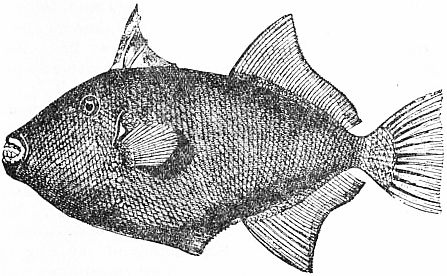
Balistes vidua.
FILELFO, FRANCESCO (1398-1481), Italian humanist, was born in 1398 at Tolentino, in the March of Ancona. When he appeared upon the scene of human life, Petrarch and the students of Florence had already brought the first act in the recovery of classic culture to conclusion. They had created an eager appetite for the antique, had disinterred many important Roman authors, and had freed Latin scholarship to some extent from the barbarism of the middle ages. Filelfo was destined to carry on their work in the field of Latin literature, and to be an important agent in the still unaccomplished recovery of Greek culture. His earliest studies in grammar, rhetoric and the Latin language were conducted at Padua, where he acquired so great a reputation for learning that in 1417 he was invited to teach eloquence and moral philosophy at Venice. According to the custom of that age in Italy, it now became his duty to explain the language, and to illustrate the beauties of the principal Latin authors, Cicero and Virgil being considered the chief masters of moral science and of elegant diction. Filelfo made his mark at once in Venice. He was admitted to the society of the first scholars and the most eminent nobles of that city; and in 1419 he received an appointment from the state, which enabled him to reside as secretary to the consul-general (baylo) of the Venetians in Constantinople. This appointment was not only honourable to Filelfo as a man of trust and general ability, but it also gave him the opportunity of acquiring the most coveted of all possessions at that moment for a scholar—a knowledge of the Greek language. Immediately after his arrival in Constantinople, Filelfo placed himself under the tuition of John Chrysoloras, whose name was already well known in Italy as relative of Manuel, the first Greek to profess the literature of his ancestors in Florence. At the recommendation of Chrysoloras he was employed in several diplomatic missions by the emperor John Palaeologus. Before very long the friendship between Filelfo and his tutor was cemented by the marriage of the former to Theodora, the daughter of John Chrysoloras. He had now acquired a thorough knowledge of the Greek language, and had formed a large collection of Greek manuscripts. There was no reason why he should not return to his native country. Accordingly, in 1427 he accepted an invitation from the republic of Venice, and set sail for Italy, intending to resume his professorial career. From this time forward until the date of his death, Filelfo’s history consists of a record of the various towns in which he lectured, the masters whom he served, the books he wrote, the authors he illustrated, the friendships he contracted, and the wars he waged with rival scholars. He was a man of vast physical energy, of inexhaustible mental activity, of quick passions and violent appetites; vain, restless, greedy of gold and pleasure and fame; unable to stay quiet in one place, and perpetually engaged in quarrels with his compeers.
When Filelfo arrived at Venice with his family in 1427, he found that the city had almost been emptied by the plague, and that his scholars would be few. He therefore removed to Bologna; but here also he was met with drawbacks. The city was too much disturbed with political dissensions to attend to him; so Filelfo crossed the Apennines and settled in Florence. At Florence began one of the most brilliant and eventful periods of his life. During the week he lectured to large audiences of young and old on the principal Greek and Latin authors, and on Sundays he explained Dante to the people in the Duomo. In addition to these labours of the chair, he found time to translate portions of Aristotle, Plutarch, Xenophon and Lysias from the Greek. Nor was he dead to the claims of society. At first he seems to have lived with the Florentine scholars on tolerably good terms; but his temper was so arrogant that Cosimo de’ Medici’s friends were not long able to put up with him. Filelfo hereupon broke out into open and violent animosity; and when Cosimo was exiled by the Albizzi party in 1433, he urged the signoria of Florence to pronounce upon him the sentence of death. On the return of Cosimo to Florence, Filelfo’s position in that city was no longer tenable. His life, he asserted, had been already once attempted by a cut-throat in the pay of the Medici; and now he readily accepted an invitation from the state of Siena. In Siena, however, he was not destined to remain more than four years. His fame as a professor had grown great in Italy, and he daily received tempting offers from princes and republics. The most alluring of these, made him by the duke of Milan, Filippo Maria Visconti, he decided on accepting; and in 1440 he was received with honour by his new master in the capital of Lombardy.
Filelfo’s life at Milan curiously illustrates the multifarious importance of the scholars of that age in Italy. It was his duty to celebrate his princely patrons in panegyrics and epics, to abuse their enemies in libels and invectives, to salute them with encomiastic odes on their birthdays, and to compose poems on their favourite themes. For their courtiers he wrote epithalamial and funeral orations; ambassadors and visitors from foreign states he greeted with the rhetorical lucubrations then so much in vogue. The students of the university he taught in daily lectures, passing in review the weightiest and lightest authors of antiquity, and pouring forth a flood of miscellaneous erudition. Not satisfied with these outlets for his mental energy, Filelfo went on translating from the Greek, and prosecuted a paper warfare with his enemies in Florence. He wrote, moreover, political pamphlets on the great events of Italian history; and when Constantinople was taken by the Turks, he procured the liberation of his wife’s mother by a message addressed in his own name to the sultan. In addition to a fixed stipend of some 700 golden florins yearly, he was continually in receipt of special payments for the orations and poems he produced; so that, had he been a man of frugal habits or of moderate economy, he might have amassed a considerable fortune. As it was, he spent his money as fast as he received it, living in a style of splendour ill befitting a simple scholar, and indulging his taste for pleasure in more than questionable amusements. In consequence of this prodigality, he was always poor. His letters and his poems abound in impudent demands for money from patrons, some of them couched in language of the lowest adulation, and others savouring of literary brigandage.
During the second year of his Milanese residence Filelfo lost his first wife, Theodora. He soon married again; and this time he chose for his bride a young lady of good Lombard family, called Orsina Osnaga. When she died he took in wedlock for the third time a woman of Lombard birth, Laura Magiolini. To all his three wives, in spite of numerous infidelities, he seems to have been warmly attached; and this is perhaps the best trait in a character otherwise more remarkable for arrogance and heat than for any amiable qualities.
On the death of Filippo Maria Visconti, Filelfo, after a short hesitation, transferred his allegiance to Francesco Sforza, the new duke of Milan; and in order to curry favour with this parvenu, he began his ponderous epic, the Sforziad, of which 12,800 lines were written, but which was never published. When Francesco Sforza died, Filelfo turned his thoughts towards Rome. He was now an old man of seventy-seven years, honoured with the friendship of princes, recognized as the most distinguished of Italian humanists, courted by pontiffs, and decorated with the laurel wreath and the order of knighthood by kings. Crossing the Apennines and passing through Florence, he reached Rome in the second week of 1475. The terrible Sixtus IV. now ruled in the Vatican; and from this pope Filelfo had received an invitation to occupy the chair of rhetoric with good emoluments. At first he was vastly pleased with the city and court of Rome; but his satisfaction ere long turned to discontent, and he gave vent to his ill-humour in a venomous satire on the pope’s treasurer, Milliardo Cicala. Sixtus himself soon fell under the ban of his displeasure; and when a year had passed he left Rome never to return. Filelfo reached Milan to find that his wife had died of the plague in his absence, and was already buried. His own death followed speedily. For some time past he had been desirous of displaying his abilities and adding to his fame in Florence. Years had healed the breach between him and the Medicean family; and on the occasion of the Pazzi conspiracy against the life of Lorenzo de’ Medici, he had sent violent letters of abuse to his papal patron Sixtus, denouncing his participation in a plot so dangerous to the security of Italy. Lorenzo now invited him to profess Greek at Florence, and thither Filelfo journeyed in 1481. But two weeks after his arrival he succumbed to dysentery, and was buried at the age of eighty-three in the church of the Annunziata.
Filelfo deserves commemoration among the greatest humanists of the Italian Renaissance, not for the beauty of his style, not for the elevation of his genius, not for the accuracy of his learning, but for his energy, and for his complete adaptation to the times in which he lived. His erudition was large but ill-digested; his knowledge of the ancient authors, if extensive, was superficial; his style was vulgar; he had no brilliancy of imagination, no pungency of epigram, no grandeur of rhetoric. Therefore he has left nothing to posterity which the world would not very willingly let die. But in his own days he did excellent service to learning by his untiring activity, and by the facility with which he used his stores of knowledge. It was an age of accumulation and preparation, when the world was still amassing and cataloguing the fragments rescued from the wrecks of Greece and Rome. Men had to receive the very rudiments of culture before they could appreciate its niceties. And in this work of collection and instruction Filelfo excelled, passing rapidly from place to place, stirring up the zeal for learning by the passion of his own enthusiastic temperament, and acting as a pioneer for men like Poliziano and Erasmus.
All that is worth knowing about Filelfo is contained in Carlo de’ Rosmini’s admirable Vita di Filelfo (Milan, 1808); see also W. Roscoe’s Life of Lorenzo de’ Medici, Vespasiano’s Vite di uomini illustri, and J.A. Symonds’s Renaissance in Italy (1877).
(J. A. S.)
A complete edition of Filelfo’s Greek letters (based on the Codex Trevulzianus) was published for the first time, with French translation, notes and commentaries, by E. Legrand in 1892 at Paris (C. xii. of Publications de l’école des lang. orient.). For further references, especially to monographs, &c., on Filelfo’s life and work, see Ulysse Chevalier, Répertoire des sources hist., bio-bibliographie (Paris, 1905), s.v. Philelphe, François.
FILEY, a seaside resort in the Buckrose parliamentary division of the East Riding of Yorkshire, England, 9-1/2 m. S.E. of Scarborough by a branch of the North Eastern railway. Pop. of urban district (1901) 3003. It stands upon the slope and summit of the cliffs above Filey Bay, which is fringed by a fine sandy beach. The northern horn of the bay is formed by Filey Brigg, a narrow and abrupt promontory, continued seaward by dangerous reefs. The coast-line sweeps hence south-eastward to the finer promontory of Flamborough Head, beyond which is the watering-place of Bridlington. The church of St Oswald at Filey is a fine cruciform building with central tower, Transitional Norman and Early English in date. There are pleasant promenades and good golf links, also a small spa which has fallen into disuse. Filey is in favour with visitors who desire a quiet resort without the accompaniment of entertainment common to the larger watering-places. Roman remains have been discovered on the cliff north of the town; the site was probably important, but nothing is certainly known about it.
FILIBUSTER, a name originally given to the buccaneers (q.v.). The term is derived most probably from the Dutch vry buiter, Ger. Freibeuter, Eng. freebooter, the word changing first into fribustier, and then into Fr. flibustier, Span. filibustero. Flibustier has passed into the French language, and filibustero into the Spanish language, as a general name for a pirate. The term “filibuster” was revived in America to designate those adventurers who, after the termination of the war between Mexico and the United States, organized expeditions within the United States to take part in West Indian and Central American revolutions. From this has sprung the modern use of the word to imply one who engages in private, unauthorized and irregular warfare against any state. In the United States it is colloquially applied to legislators who practise obstruction.
FILICAJA, VINCENZO DA (1642-1707), Italian poet, sprung from an ancient and noble family of Florence, was born in that city on the 30th of December 1642. From an incidental notice in one of his letters, stating the amount of house rent paid during his childhood, his parents must have been in easy circumstances, and the supposition is confirmed by the fact that he enjoyed all the advantages of a liberal education, first under the Jesuits of Florence, and then in the university of Pisa.
At Pisa his mind became stored, not only with the results of patient study in various branches of letters, but with the great historical associations linked with the former glory of the Pisan republic, and with one remarkable institution of which Pisa was the seat. To the tourist who now visits Pisa the banners and emblems of the order of St Stephen are mere matter of curiosity, but they had a serious significance two hundred years ago to the young Tuscan, who knew that these naval crusaders formed the main defence of his country and commerce against the Turkish, Algerine and Tunisian corsairs. After a five years’ residence in Pisa he returned to Florence, where he married Anna, daughter of the senator and marquis Scipione Capponi, and withdrew to a small villa at Figline, not far from the city. Abjuring the thought of writing amatory poetry in consequence of the premature death of a young lady to whom he had been attached, he occupied himself chiefly with literary pursuits, above all the composition of Italian and Latin poetry. His own literary eminence, the opportunities enjoyed by him as a member of the celebrated Academy Della Crusca for making known his critical taste and classical knowledge, and the social relations within the reach of a noble Florentine so closely allied with the great house of Capponi, sufficiently explain the intimate terms on which he stood with such eminent men of letters as Magalotti, Menzini, Gori and Redi. The last-named, the author of Bacchus in Tuscany, was not only one of the most brilliant poets of his time, and a safe literary adviser; he was the court physician, and his court influence was employed with zeal and effect in his friend’s favour. Filicaja’s rural seclusion was owing even more to his straitened means than to his rural tastes. If he ceased at length to pine in obscurity, the change was owing not merely to the fact that his poetical genius, fired by the deliverance of Vienna from the Turks in 1683, poured forth the right strains at the right time, but also to the influence of Redi, who not only laid Filicaja’s verses before his own sovereign, but had them transmitted with the least possible delay to the foreign princes whose noble deeds they sung. The first recompense came, however, not from those princes, but from Christina, the ex-queen of Sweden, who, from her circle of savants and courtiers at Rome, spontaneously and generously announced to Filicaja her wish to bear the expense of educating his two sons, enhancing her kindness by the delicate request that it should remain a secret.
The tide of Filicaja’s fortunes now turned. The grand-duke of Tuscany, Cosmo III., conferred on him an important office, the commissionership of official balloting. He was named governor of Volterra in 1696, where he strenuously exerted himself to raise the tone of public morality. Both there and at Pisa, where he was subsequently governor in 1700, his popularity was so great that on his removal the inhabitants of both cities petitioned for his recall. He passed the close of his life at Florence; the grand-duke raised him to the rank of senator, and he died in that city on the 24th of September 1707. He was buried in the family vault in the church of St Peter, and a monument was erected to his memory by his sole surviving son Scipione Filicaja. In the six celebrated odes inspired by the great victory of Sobieski, Filicaja took a lyrical flight which has placed him at moments on a level with the greatest Italian poets. They are, however, unequal, like all his poetry, reflecting in some passages the native vigour of his genius and purest inspirations of his tastes, whilst in others they are deformed by the affectations of the Seicentisti. When thoroughly natural and spontaneous—as in the two sonnets “Italia, Italia, o tu cui feo la sorte” and “Dov’ è, Italia, il tuo braccio? e a che ti serve;” in the verses “Alla beata Vergine,” “Al divino amore;” in the sonnet “Sulla fede nelle disgrazie”—the truth and beauty of thought and language recall the verse of Petrarch.
Besides the poems published in the complete Venice edition of 1762, several other pieces appeared for the first time in the small Florence edition brought out by Barbera in 1864.
FILIGREE (formerly written filigrain or filigrane; the Ital. filigrana, Fr. filigrane, Span, filigrana, Ger. Drahtgeflecht), jewel work of a delicate kind made with twisted threads usually of gold and silver. The word, which is usually derived from the Lat. filum, thread, and granum, grain, is not found in Ducange, and is indeed of modern origin. According to Prof. Skeat it is derived from the Span. filigrana, from “filar, to spin, and grano, the grain or principal fibre of the material.” Though filigree has become a special branch of jewel work in modern times it was anciently part of the ordinary work of the jeweller. Signor A. Castellani states, in his Memoir on the Jewellery of the Ancients (1861), that all the jewelry of the Etruscans and Greeks (other than that intended for the grave, and therefore of an unsubstantial character) was made by soldering together and so building up the gold rather than by chiselling or engraving the material.
The art may be said to consist in curling, twisting and plaiting fine pliable threads of metal, and uniting them at their points of contact with each other, and with the ground, by means of gold or silver solder and borax, by the help of the blowpipe. Small grains or beads of the same metals are often set in the eyes of volutes, on the junctions, or at intervals at which they will set off the wire-work effectively. The more delicate work is generally protected by framework of stouter wire. Brooches, crosses, earrings and other personal ornaments of modern filigree are generally surrounded and subdivided by bands of square or flat metal, giving consistency to the filling up, which would not otherwise keep its proper shape. Some writers of repute have laid equal stress on the filum and the granum, and have extended the use of the term filigree to include the granulated work of the ancients, even where the twisted wire-work is entirely wanting. Such a wide application of the term is not approved by current usage, according to which the presence of the twisted threads is the predominant fact.
The Egyptian jewellers employed wire, both to lay down on a background and to plait or otherwise arrange à jour. But, with the exception of chains, it cannot be said that filigree work was much practised by them. Their strength lay rather in their cloisonné work and their moulded ornaments. Many examples, however, remain of round plaited gold chains of fine wire, such as are still made by the filigree workers of India, and known as Trichinopoly chains. From some of these are hung smaller chains of finer wire with minute fishes and other pendants fastened to them. In ornaments derived from Phoenician sites, such as Cyprus and Sardinia, patterns of gold wire are laid down with great delicacy on a gold ground, but the art was advanced to its highest perfection in the Greek and Etruscan filigree of the 6th to the 3rd centuries B.C. A number of earrings and other personal ornaments found in central Italy are preserved in the Louvre and in the British Museum. Almost all of them are made of filigree work. Some earrings are in the form of flowers of geometric design, bordered by one or more rims each made up of minute volutes of gold wire, and this kind of ornament is varied by slight differences in the way of disposing the number or arrangement of the volutes. But the feathers and petals of modern Italian filigree are not seen in these ancient designs. Instances occur, but only rarely, in which filigree devices in wire are self-supporting and not applied to metal plates. The museum of the Hermitage at St Petersburg contains an amazingly rich collection of jewelry from the tombs of the Crimea. Many bracelets and necklaces in that collection are made of twisted wire, some in as many as seven rows of plaiting, with clasps in the shape of heads of animals of beaten work. Others are strings of large beads of gold, decorated with volutes, knots and other patterns of wire soldered over the surfaces. (See the Antiquités du Bosphore Cimmérien, by Gille, 1854; reissued by S. Reinach, 1892, in which will be found careful engravings of these objects.) In the British Museum a sceptre, probably that of a Greek priestess, is covered with plaited and netted gold wire, finished with a sort of Corinthian capital and a boss of green glass.
It is probable that in India and various parts of central Asia filigree has been worked from the most remote period without any change in the designs. Whether the Asiatic jewellers were influenced by the Greeks settled on that continent, or merely trained under traditions held in common with them, it is certain that the Indian filigree workers retain the same patterns as those of the ancient Greeks, and work them in the same way, down to the present day. Wandering workmen are given so much gold, coined or rough, which is weighed, heated in a pan of charcoal, beaten into wire, and then worked in the courtyard or verandah of the employer’s house according to the designs of the artist, who weighs the complete work on restoring it and is paid at a specified rate for his labour. Very fine grains or beads and spines of gold, scarcely thicker than coarse hair, projecting from plates of gold are methods of ornamentation still used.
Passing to later times we may notice in many collections of medieval jewel work (such as that in the South Kensington Museum) reliquaries, covers for the gospels, &c., made either in Constantinople from the 6th to the 12th centuries, or in monasteries in Europe, in which Byzantine goldsmiths’ work was studied and imitated. These objects, besides being enriched with precious stones, polished, but not cut into facets, and with enamel, are often decorated with filigree. Large surfaces of gold are sometimes covered with scrolls of filigree soldered on; and corner pieces of the borders of book covers, or the panels of reliquaries, are not unfrequently made up of complicated pieces of plaited work alternating with spaces encrusted with enamel. Byzantine filigree work occasionally has small stones set amongst the curves or knots. Examples of such decoration can be seen in the South Kensington and British Museums.
In the north of Europe the Saxons, Britons and Celts were from an early period skilful in several kinds of goldsmiths’ work. Admirable examples of filigree patterns laid down in wire on gold, from Anglo-Saxon tombs, may be seen in the British Museum—notably a brooch from Dover, and a sword-hilt from Cumberland.
The Irish filigree work is more thoughtful in design and more varied in pattern than that of any period or country that could be named. Its highest perfection must be placed in the 10th and 11th centuries. The Royal Irish Academy in Dublin contains a number of reliquaries and personal jewels, of which filigree is the general and most remarkable ornament. The “Tara” brooch has been copied and imitated, and the shape and decoration of it are well known. Instead of fine curls or volutes of gold thread, the Irish filigree is varied by numerous designs in which one thread can be traced through curious knots and complications, which, disposed over large surfaces, balance one another, but always with special varieties and arrangements difficult to trace with the eye. The long thread appears and disappears without breach of continuity, the two ends generally worked into the head and the tail of a serpent or a monster. The reliquary containing the “Bell of St Patrick” is covered with knotted work in many varieties. A two-handled chalice, called the “Ardagh cup,” found near Limerick in 1868, is ornamented with work of this kind of extraordinary fineness. Twelve plaques on a band round the body of the vase, plaques on each handle and round the foot of the vase have a series of different designs of characteristic patterns, in fine filigree wire work wrought on the front of the repoussé ground. (See a paper by the 3rd earl of Dunraven in Transactions of Royal Irish Academy, xxiv. pt. iii. 1873.)
Much of the medieval jewel work all over Europe down to the 15th century, on reliquaries, crosses, croziers and other ecclesiastical goldsmiths’ work, is set off with bosses and borders of filigree. Filigree work in silver was practised by the Moors of Spain during the middle ages with great skill, and was introduced by them and established all over the Peninsula, whence it was carried to the Spanish colonies in America. The Spanish filigree work of the 17th and 18th centuries is of extraordinary complexity (examples in the Victoria and Albert Museum), and silver filigree jewelry of delicate and artistic design is still made in considerable quantities throughout the country. The manufacture spread over the Balearic Islands, and among the populations that border the Mediterranean. It is still made all over Italy, and in Malta, Albania, the Ionian Islands and many other parts of Greece. That of the Greeks is sometimes on a large scale, with several thicknesses of wires alternating with larger and smaller bosses and beads, sometimes set with turquoises, &c., and mounted on convex plates, making rich ornamental headpieces, belts and breast ornaments. Filigree silver buttons of wire-work and small bosses are worn by the peasants in most of the countries that produce this kind of jewelry. Silver filigree brooches and buttons are also made in Denmark, Norway and Sweden. Little chains and pendants are added to much of this northern work.
Some very curious filigree work was brought from Abyssinia after the capture of Magdala—arm-guards, slippers, cups, &c., some of which are now in the South Kensington Museum. They are made of thin plates of silver, over which the wire-work is soldered. The filigree is subdivided by narrow borders of simple pattern, and the intervening spaces are made up of many patterns, some with grains set at intervals.
A few words must be added as to the granulated work which, as stated above, some writers have classed under the term of filigree, although the twisted wires may be altogether wanting. Such decoration consists of minute globules of gold, soldered to form patterns on a metal surface. Its use is rare in Egypt. (See J. de Morgan, Fouilles à Dahchour, 1894-1895, pl. xii.) It occurs in Cyprus at an early period, as for instance on a gold pendant in the British Museum from Enkomi in Cyprus (10th century B.C.). The pendant is in the form of a pomegranate, and has upon it a pattern of triangles, formed by more than 3000 minute globules separately soldered on. It also occurs on ornaments of the 7th century B.C. from Camirus in Rhodes. But these globules are large, compared with those which are found on Etruscan jewelry. Signor Castellani, who had made the antique jewelry of the Etruscans and Greeks his special study, with the intention of reproducing the ancient models, found it for a long time impossible to revive this particular process of delicate soldering. He overcame the difficulty at last, by the discovery of a traditional school of craftsmen at St Angelo in Vado, by whose help his well-known reproductions were executed.
For examples of antique work the student should examine the gold ornament rooms of the British Museum, the Louvre and the collection in the Victoria and Albert Museum. The last contains a large and very varied assortment of modern Italian, Spanish, Greek and other jewelry made for the peasants of various countries. It also possesses interesting examples of the modern work in granulated gold by Castellani and Giuliano. The Celtic work is well represented in the Royal Irish Academy in Dublin.
FILLAN, SAINT, or Faelan, the name of the two Scottish saints, of Irish origin, whose lives are of a purely legendary character. The St Fillan whose feast is kept on the 20th of June had churches dedicated to his honour at Ballyheyland, Queen’s county, Ireland, and at Loch Earn, Perthshire. The other, who is commemorated on the 9th of January, was specially venerated at Cluain Mavscua, Co. Westmeath, Ireland, and so early as the 8th or 9th century at Strathfillan, Perthshire, Scotland, where there was an ancient monastery dedicated to him, which, like most of the religious houses of early times, was afterwards secularized. The lay-abbot, who was its superior in the reign of William the Lion, held high rank in the Scottish kingdom. This monastery was restored in the reign of Robert Bruce, and became a cell of the abbey of canons regular at Inchaffray. The new foundation received a grant from King Robert, in gratitude for the aid which he was supposed to have obtained from a relic of the saint on the eve of the great victory of Bannockburn. Another relic was the saint’s staff or crozier, which became known as the coygerach or quigrich, and was long in the possession of a family of the name of Jore or Dewar, who were its hereditary guardians. They certainly had it in their custody in the year 1428, and their right was formally recognized by King James III. in 1487. The head of the crozier, which is of silver-gilt with a smaller crozier of bronze inclosed within it, is now deposited in the National Museum of the Society of Antiquaries of Scotland.
The legend of the second of these saints is given in the Bollandist Acta SS. (1643), 9th of January, i. 594-595; A.P. Forbes, Kalendars of Scottish Saints (Edinburgh, 1872), pp. 341-346; D. O’Hanlon’s Lives of Irish Saints (Dublin), n.d. pp. 134-144. See also Historical Notices of St Fillan’s Crozier, by Dr John Stuart (Aberdeen, 1877).
FILLET (through Fr. filet, from the med. Lat. filettum, diminutive of filum, a thread), a band or ribbon used for tying the hair, the Lat. vitta, which was used as a sacrificial emblem, and also worn by vestal virgins, brides and poets. The word is thus applied to anything in the shape of a band or strip, as, in coining, to the metal ribbon from which the blanks are punched. In architecture, a “fillet” is a narrow flat band, sometimes called a “listel,” which is used to separate mouldings one from the other, or to terminate a suite of mouldings as at the top of a cornice. In the fluted column of the Ionic and Corinthian Orders the fillet is employed between the flutes. It is a very important feature in Gothic work, being frequently worked on large mouldings; when placed on the front and sides of the moulding of a rib it has been termed the “keel and wings” of the rib.
In cooking, “fillet” is used of the “undercut” of a sirloin of beef, or of a thick slice of fish or meat; more particularly of a boned and rolled piece of veal or other meat, tied by a “fillet” or string.
FILLMORE, MILLARD (1800-1874), thirteenth president of the United States of America, came of a family of English stock, which had early settled in New England. His father, Nathaniel, in 1795, made a clearing within the limits of what is now the town of Summerhill, Cayuga county, New York, and there Millard Fillmore was born, on the 7th of January 1800. Until he was fifteen he could have acquired only the simplest rudiments of education, and those chiefly from his parents. At that age he was apprenticed to a fuller and clothier, to card wool, and to dye and dress the cloth. Two years before the close of his term, with a promissory note for thirty dollars, he bought the remainder of his time from his master, and at the age of nineteen began to study law. In 1820 he made his way to Buffalo, then only a village, and supported himself by teaching school and aiding the postmaster while continuing his studies.
In 1823 he was admitted to the bar, and began practice at Aurora, New York, to which place his father had removed. Hard study, temperance and integrity gave him a good reputation and moderate success, and in 1827 he was made an attorney and, in 1829, counsellor of the supreme court of the state. Returning to Buffalo in 1830 he formed, in 1832, a partnership with Nathan K. Hall (1810-1874), later a member of Congress and postmaster-general in his cabinet. Solomon G. Haven (1810-1861), member of Congress from 1851 to 1857, joined them in 1836. The firm met with great success. From 1829 to 1832 Fillmore served in the state assembly, and, in the single term of 1833-1835, the national House of Representatives, coming in as anti-Jackson, or in opposition to the administration. From 1837 to 1843, when he declined further service, he again represented his district in the House, this time as a member of the Whig party. In Congress he opposed the annexation of Texas as slave territory, was an advocate of internal improvements and a protective tariff, supported J.Q. Adams in maintaining the right of offering anti-slavery petitions, advocated the prohibition by Congress of the slave trade between the states, and favoured the exclusion of slavery from the District of Columbia. His speech and tone, however, were moderate on these exciting subjects, and he claimed the right to stand free of pledges, and to adjust his opinions and his course by the development of circumstances. The Whigs having the ascendancy in the Twenty-Seventh Congress, he was made chairman of the House Committee of Ways and Means. Against a strong opposition he carried an appropriation of $30,000 to Morse’s telegraph, and reported from his committee the Tariff Bill of 1842. In 1844 he was the Whig candidate for the governorship of New York, but was defeated. In November 1847 he was elected comptroller of the state of New York, and in 1848 he was elected vice-president of the United States on the ticket with Zachary Taylor as president. Fillmore presided over the senate during the exciting debates on the “Compromise Measures of 1850.”
President Taylor died on the 9th of July 1850, and on the next day Fillmore took the oath of office as his successor. The cabinet which he called around him contained Daniel Webster, Thomas Corwin and John J. Crittenden. On the death of Webster in 1852, Edward Everett became secretary of state. Unlike Taylor, Fillmore favoured the “Compromise Measures,” and his signing one of them, the Fugitive Slave Law, in spite of the vigorous protests of anti-slavery men, lost him much of his popularity in the North. Few of his opponents, however, questioned his own full persuasion that the Compromise Measures were vitally necessary to pacify the nation. In 1851 he interposed promptly but ineffectively in thwarting the projects of the “filibusters,” under Narciso Lopez for the invasion of Cuba. Commodore Matthew Calbraith Perry’s expedition, which opened up diplomatic relations with Japan, and the exploration of the valley of the Amazon by Lieutenants William L. Herndon (1813-1857) and Lardner Gibbon also occurred during his term. In the autumn of 1852 he was an unsuccessful candidate for nomination for the presidency by the Whig National Convention, and he went out of office on the 4th of March 1853. In February 1856, while he was travelling abroad, he was nominated for the presidency by the American or Know Nothing party, and later this nomination was also accepted by the Whigs; but in the ensuing presidential election, the last in which the Know Nothings and the Whigs as such took any part, he received the electoral votes of only one state, Maryland. Thereafter he took no public share in political affairs. Fillmore was twice married: in 1826 to Abigail Powers (who died in 1853, leaving him with a son and daughter), and in 1858 to Mrs. Caroline C. Mclntosh. He died at Buffalo on the 8th of March 1874.
In 1907 the Buffalo Historical Society, of which Fillmore was one of the founders and the first president, published the Millard Fillmore Papers (2 vols., vol. x. and xi. of the Society’s publications; edited by F.H. Severance), containing miscellaneous writings and speeches, and official and private correspondence. Most of his correspondence, however, was destroyed in pursuance of a direction in his son’s will.
FILMER, SIR RORERT (d. 1653), English political writer, was the son of Sir Edward Filmer of East Sutton in Kent. He studied at Trinity College, Cambridge, where he matriculated in 1604. Knighted by Charles I. at the beginning of his reign, he was an ardent supporter of the king’s cause, and his house is said to have been plundered by the parliamentarians ten times. He died on the 26th of May 1653.
Filmer was already a middle-aged man when the great controversy between the king and the Commons roused him into literary activity. His writings afford an exceedingly curious example of the doctrines held by the most extreme section of the Divine Right party. Filmer’s theory is founded upon the statement that the government of a family by the father is the true original and model of all government. In the beginning of the world God gave authority to Adam, who had complete control over his descendants, even as to life and death. From Adam this authority was inherited by Noah; and Filmer quotes as not unlikely the tradition that Noah sailed up the Mediterranean and allotted the three continents of the Old World to the rule of his three sons. From Shem, Ham and Japheth the patriarchs inherited the absolute power which they exercised over their families and servants; and from the patriarchs all kings and governors (whether a single monarch or a governing assembly) derive their authority, which is therefore absolute, and founded upon divine right. The difficulty that a man “by the secret will of God may unjustly” attain to power which he has not inherited appeared to Filmer in no way to alter the nature of the power so obtained, for “there is, and always shall be continued to the end of the world, a natural right of a supreme father over every multitude.” The king is perfectly free from all human control. He cannot be bound by the acts of his predecessors, for which he is not responsible; nor by his own, for “impossible it is in nature that a man should give a law unto himself”—a law must be imposed by another than the person bound by it. With regard to the English constitution, he asserted, in his Freeholder’s Grand Inquest touching our Sovereign Lord the King and his Parliament (1648), that the Lords only give counsel to the king, the Commons only “perform and consent to the ordinances of parliament,” and the king alone is the maker of laws, which proceed purely from his will. It is monstrous that the people should judge or depose their king, for they would then be judges in their own cause.
The most complete expression of Filmer’s opinions is given in the Patriarcha, which was published in 1680, many years after his death. His position, however, was sufficiently indicated by the works which he published during his lifetime: the Anarchy of a Limited and Mixed Monarchy (1648), an attack upon a treatise on monarchy by Philip Hunton (1604?-1682), who maintained that the king’s prerogative is not superior to the authority of the houses of parliament; the pamphlet entitled The Power of Kings, and in particular of the King of England (1648), first published in 1680; and his Observations upon Mr Hobbes’s Leviathan, Mr Milton against Salmasius, and H. Grotius De jure belli et pacis, concerning the Originall of Government (1652). Filmer’s theory, owing to the circumstances of the time, obtained a recognition which it is now difficult to understand. Nine years after the publication of the Patriarcha, at the time of the Revolution which banished the Stuarts from the throne, Locke singled out Filmer as the most remarkable of the advocates of Divine Right, and thought it worth while to attack him expressly in the first part of the Treatise on Government, going into all his arguments seriatim, and especially pointing out that even if the first steps of his argument be granted, the rights of the eldest born have been so often set aside that modern kings can claim no such inheritance of authority as he asserted.
FILMY FERNS, a general name for a group of ferns with delicate much-divided leaves and often moss-like growth, belonging to the genera Hymenophyllum, Todea and Trichomanes. They require to be kept in close cases in a cool fernery, and the stones and moss amongst which they are grown must be kept continually moist so that the evaporated water condenses on the very numerous divisions of the leaves.
FILON, PIERRE MARIE AUGUSTIN (1841- ), French man of letters, son of the historian Charles Auguste Désiré Filon (1800-1875), was born in Paris in 1841. His father became professor of history at Douai, and eventually “inspecteur d’académie” in Paris; his principal works were Histoire comparée de France et de l’Angleterre (1832), Histoire de l’Europe au XVIe siècle (1838), La Diplomatie française sous Louis XV (1843), Histoire de l’Italie méridionale (1849), Histoire du sénat romain (1850), Histoire de la démocratie athénienne (1854). Educated at the École normale, Augustin Filon was appointed tutor to the prince imperial and accompanied him to England, where he remained for some years. He is the author of Guy Patin, sa vie, sa correspondance (1862); Nos grands-pères (1887); Prosper Mérimée (1894); Sous la tyrannie (1900). On English subjects he has written chiefly under the pseudonym of Pierre Sandrié, Les Mariages de Londres (1875); Histoire de la littérature anglaise (1883); Le Théâtre anglais (1896), and La Caricature en Angleterre (1902).
FILOSA (A. Lang), one of the two divisions of Rhizopoda, characterized by protoplasm granular at the surface, and fine pseudopodia branching and usually acutely pointed at the tips.
FILTER (a word common in various forms to most European languages, adapted from the medieval Lat. filtrum, felt, a material used as a filtering agent), an arrangement for separating solid matter from liquids. In some cases the operation of filtration is performed for the sake of removing impurities from the filtrate or liquid filtered, as in the purification of water for drinking purposes; in others the aim is to recover and collect the solid matter, as when the chemist filters off a precipitate from the liquid in which it is suspended.
In regard to the purification of water, filtration was long looked upon as merely a mechanical process of straining out the solid particles, whereby a turbid water could be rendered clear. In the course of time it was noticed that certain materials, such as charcoal, had the power to some extent also of softening hard water and of removing organic matter, and at the beginning of the 19th century charcoal, both animal and vegetable, came into use for filtering purposes. Porous carbon blocks, made by strongly heating a mixture of powdered charcoal with oil, resin, &c., were introduced about a generation later, and subsequently various preparations of iron (spongy iron, magnetic oxide) found favour. Innumerable forms of filters made with these and other materials were put on the market, and were extolled as removing impurities of every kind from water, and as affording complete protection against the communication of disease. But whatever merits they had as clarifiers of turbid water, the advent of bacteriology, and the recognition of the fact that the bacteria of certain diseases may be water-borne, introduced a new criterion of effectiveness, and it was perceived that the removal of solid particles, or even of organic impurities (which were realized to be important not so much because they are dangerous to health per se as because their presence affords grounds for suspecting that the water in which they occur has been exposed to circumstances permitting contamination with infective disease), was not sufficient; the filter must also prevent the passage of pathogenic organisms, and so render the water sterile bacteriologically. Examined from this point of view the majority of domestic filters were found to be gravely defective, and even to be worse than useless, since unless they were frequently and thoroughly cleansed, they were liable to become favourable breeding-places for microbes. The first filter which was more or less completely impermeable to bacteria was the Pasteur-Chamberland, which was devised in Pasteur’s laboratory, and is made of dense biscuit porcelain. The filtering medium in this, as in other filters of the same kind, takes the form of a hollow cylinder or “candle,” through the walls of which the water has to pass from the outside to the inside, the candles often being arranged so that they may be directly attached to a tap, whereby the rate of flow, which is apt to be slow, is accelerated by the pressure of the main. But even filters of this type, if they are to be fully relied upon, must be frequently cleaned and sterilized, and great care must be taken that the joints and connexions are watertight, and that the candles are without cracks or flaws. In cases where the water supply is known to be infected, or even where it is merely doubtful, it is wise to have recourse to sterilization by boiling, rather than trust to any filter. Various machines have been constructed to perform this operation, some of them specially designed for the use of troops in the field; those in which economy of fuel is studied have an exchange-heater, by means of which the incoming cold water receives heat from the outgoing hot water, which thus arrives at the point of outflow at a temperature nearly as low as that of the supply. Chemical methods of sterilization have also been suggested, depending on the use of iodine, chlorine, bromine, ozone, potassium permanganate, copper sulphate or chloride and other substances. For the sand-filtration of water on a large scale, in which the presence of a surface film containing zooglaea of bacteria is an essential feature, see Water Supply.
Filtration in the chemical laboratory is commonly effected by the aid of a special kind of unsized paper, which in the more expensive varieties is practically pure cellulose, impurities like ferric oxide, alumina, lime, magnesia and silica having been removed by treatment with hydrochloric and hydrofluoric acids. A circular piece of this paper is folded twice upon itself so as to form a quadrant, one of the folds is pulled out, and the cone thus obtained is supported in a glass or porcelain funnel having an apical angle of 60°. The liquid to be filtered is poured into the cone, preferably down a glass rod upon the sides of the funnel to prevent splashing and to preserve the apex of the filter-paper, and passes through the paper, upon which the solid matter is retained. In the case of liquids containing strong acids or alkalis, which the paper cannot withstand, a plug of carefully purified asbestos or glass-wool (spun glass) is often employed, contained in a bulb blown as an enlargement on a narrow “filter-tube.” To accelerate the rate of filtration various devices are resorted to, such as lengthening the tube below the filtering material, increasing the pressure on the liquid being filtered, or decreasing it in the receiver of the filtrate. R.W. Bunsen may be regarded as the originator of the second method, and it was he who devised the small cone of platinum foil, sometimes replaced by a cone of parchment perforated with pinholes, arranged at the apex of the funnel to serve as a support for the paper, which is apt to burst under the pressure differences. In the so-called “Buchner funnel,” the filtering vessel is cylindrical, and the paper receives support by being laid upon its flat perforated bottom. In filtering into a vacuum the flask receiving the filtrate should be connected to the exhaust through a second flask. The suction may be derived from any form of air-pump; a form often employed where water at fair pressure is available is the jet-pump, which in consequence is known as a filter-pump. Another method of filtering into a vacuum is to immerse a porous jar (“Pukall cell”) in the liquid to be filtered, and attach a suction-pipe to its interior. A filtering arrangement devised by F.C. Gooch, which has come into common use in quantitative analysis where the solid matter has to be submitted to heating or ignition, consists of a crucible having a perforated bottom. By means of a piece of stretched rubber tubing, this crucible is supported in the mouth of an ordinary funnel which is connected with an exhausting apparatus; and water holding in suspension fine scrapings of asbestos, purified by boiling with strong hydrochloric acid and washing with water, is run through it, so that the perforated bottom is covered with a layer of felted asbestos. The crucible is then removed from the rubber support, weighed and replaced; the liquid is filtered through in the ordinary way; and the crucible with its contents is again removed, dried, ignited and weighed. A perforated cone, similarly coated with asbestos and fitted into a conical funnel, is sometimes employed.
In many processes of chemical technology filtration plays an important part. A crude method consists of straining the liquid through cotton or other cloth, either stretched on wooden frames or formed into long narrow bags (“bag-filters”). Occasionally filtration into a vacuum is practised, but more often, as in filter-presses, the liquid is forced under pressure, either hydrostatic or obtained from a force-pump or compressed air, into a series of chambers partitioned off by cloth, which arrests the solids, but permits the passage of the liquid portions. For separating liquids from solids of a fibrous or crystalline character “hydro-extractors” or “centrifugals” are frequently employed. The material is placed in a perforated cage or “basket,” which is enclosed in an outer casing, and when the cage is rapidly rotated by suitable gearing, the liquid portions are forced out into the external casing.
FIMBRIA, GAIUS FLAVIUS (d. 84 B.C.), Roman soldier and a violent partisan of Marius. He was sent to Asia in 86 B.C. as legate to L. Valerius Flaccus, but quarrelled with him and was dismissed. Taking advantage of the absence of Flaccus at Chalcedon and the discontent aroused by his avarice and severity, Fimbria stirred up a revolt and slew Flaccus at Nicomedia. He then assumed the command of the army and obtained several successes against Mithradates, whom he shut up in Pitane on the coast of Aeolis, and would undoubtedly have captured him had Lucullus co-operated with the fleet. Fimbria treated most cruelly all the people of Asia who had revolted from Rome or sided with Sulla. Having gained admission to Ilium by declaring that, as a Roman, he was friendly, he massacred the inhabitants and burnt the place to the ground. But in 84 Sulla crossed over from Greece to Asia, made peace with Mithradates, and turned his arms against Fimbria, who, seeing that there was no chance of escape, committed suicide. His troops were made to serve in Asia till the end of the third Mithradatic War.