VOLUME X SLICE III Fenton, Edward to Finistere (continued 6)
Reading edition
The Critique of Revelation marks the culminating point of Fichte’s Kantian period. The exposition of the conditions under which revealed religion is possible turns upon the absolute requirements of the moral law in human nature. Religion itself is the belief in this moral law as divine, and such belief is a practical postulate, necessary in order to add force to the law. It follows that no revealed religion, so far as matter or substance is concerned, can contain anything beyond this law; nor can any fact in the world of experience be recognized by us as supernatural. The supernatural element in religion can only be the divine character of the moral law. Now, the revelation of this divine character of morality is possible only to a being in whom the lower impulses have been, or are, successful in overcoming reverence for the law. In such a case it is conceivable that a revelation might be given in order to add strength to the moral law. Religion ultimately then rests upon the practical reason, and expresses some demand or want of the pure ego. In this conclusion we can trace the prominence assigned by Fichte to the practical element, and the tendency to make the requirements of the ego the ground for all judgment on reality. It was not possible that having reached this point he should not press forward and leave the Kantian position.
This success was coincident with an improvement in the fortunes of the Rahn family, and the marriage took place at Zürich in October 1793. The remainder of the year he spent at Zürich, slowly perfecting his thoughts on the fundamental problems left for solution in the Kantian philosophy. During this period he published anonymously two remarkable political works, Zurückforderung der Denkfreiheit von den Fürsten Europas and Beiträge zur Berichtigung der Urtheile des Publicums über die französische Revolution. Of these the latter is much the more important. The French Revolution seemed to many earnest thinkers the one great outcry of modern times for the liberty of thought and action which is the eternal heritage of every human being. Unfortunately the political condition of Germany was unfavourable to the formation of an unbiassed opinion on the great movement. The principles involved in it were lost sight of under the mass of spurious maxims on social order which had slowly grown up and stiffened into system. To direct attention to the true nature of revolution, to demonstrate how inextricably the right of liberty is interwoven with the very existence of man as an intelligent agent, to point out the inherent progressiveness of state arrangements, and the consequent necessity of reform or amendment, such are the main objects of the Beiträge; and although, as is often the case with Fichte, the arguments are too formal and the distinctions too wire-drawn, yet the general idea is nobly conceived and carried out. As in the Critique of Revelation so here the rational nature of man and the conditions necessary for its manifestation or realization become the standard for critical judgment.
Towards the close of 1793 Fichte received an invitation to succeed K.L. Reinhold as extraordinary professor of philosophy at Jena. This chair, not in the ordinary faculty, had become, through Reinhold, the most important in the university, and great deliberation was exercised in selecting his successor. It was desired to secure an exponent of Kantianism, and none seemed so highly qualified as the author of the Critique of Revelation. Fichte, while accepting the call, desired to spend a year in preparation; but as this was deemed inexpedient he rapidly drew out for his students an introductory outline of his system, and began his lectures in May 1794. His success was instantaneous and complete. The fame of his predecessor was altogether eclipsed. Much of this success was due to Fichte’s rare power as a lecturer. In oral exposition the vigour of thought and moral intensity of the man were most of all apparent, while his practical earnestness completely captivated his hearers. He lectured not only to his own class, but on general moral subjects to all students of the university. These general addresses, published under the title Bestimmung des Gelehrten (Vocation of the Scholar), were on a subject dear to Fichte’s heart, the supreme importance of the highest intellectual culture and the duties incumbent on those who had received it. Their tone is stimulating and lofty.
The years spent at Jena were unusually productive; indeed, the completed Fichtean philosophy is contained in the writings of this period. A general introduction to the system is given in the tractate Über den Begriff der Wissenschaftslehre (On the Notion of the Theory of Science), 1794, and the theoretical portion is worked out in the Grundlage der gesammten Wissenschaftslehre (Foundation of the whole Theory of Science, 1794) and Grundriss des Eigenthümlichen d. Wissenschaftslehre (Outline of what is peculiar in the Theory of Science, 1794). To these were added in 1797 a First and a Second Introduction to the Theory of Science, and an Essay towards a new Exposition of the Theory of Science. The Introductions are masterly expositions. The practical philosophy was given in the Grundlage des Naturrechts (1796) and System der Sittenlehre (1798). The last is probably the most important of all Fichte’s works; apart from it, his theoretical philosophy is unintelligible.
During this period Fichte’s academic career had been troubled by various storms, the last so violent as to put a close to his professorate at Jena. The first of them, a complaint against the delivery of his general addresses on Sundays, was easily settled. The second, arising from Fichte’s strong desire to suppress the Landsmannschaften (students’ orders), which were productive of much harm, was more serious. Some misunderstanding caused an outburst of ignorant ill-feeling on the part of the students, who proceeded to such lengths that Fichte was compelled to reside out of Jena. The third storm, however, was the most violent. In 1798 Fichte, who, with F.I. Niethammer (1766-1848), had edited the Philosophical Journal since 1795, received from his friend F.K. Forberg (1770-1848) an essay on the “Development of the Idea of Religion.” With much of the essay he entirely agreed, but he thought the exposition in so many ways defective and calculated to create an erroneous impression, that he prefaced it with a short paper On the Grounds of our Belief in a Divine Government of the Universe, in which God is defined as the moral order of the universe, the eternal law of right which is the foundation of all our being. The cry of atheism was raised, and the electoral government of Saxony, followed by all the German states except Prussia, suppressed the Journal and confiscated the copies found in their universities. Pressure was put by the German powers on Charles Augustus, grand-duke of Saxe-Weimar, in whose dominions Jena university was situated, to reprove and dismiss the offenders. Fichte’s defences (Appellation an das Publicum gegen die Anklage des Atheismus, and Gerichtliche Verantwortung der Herausgeber der phil. Zeitschrift, 1799), though masterly, did not make it easier for the liberal-minded grand-duke to pass the matter over, and an unfortunate letter, in which he threatened to resign in case of reprimand, turned the scale against him. The grand-duke accepted his threat as a request to resign, passed censure, and extended to him permission to withdraw from his chair at Jena; nor would he alter his decision, even though Fichte himself endeavoured to explain away the unfortunate letter.
Berlin was the only town in Germany open to him. His residence there from 1799 to 1806 was unbroken save for a course of lectures during the summer of 1805 at Erlangen, where he had been named professor. Surrounded by friends, including Schlegel and Schleiermacher, he continued his literary work, perfecting the Wissenschaftslehre. The most remarkable of the works from this period are—(1) the Bestimmung des Menschen (Vocation of Man, 1800), a book which, for beauty of style, richness of content, and elevation of thought, may be ranked with the Meditations of Descartes; (2) Der geschlossene Handelsstaat, 1800 (The Exclusive or Isolated Commercial State), a very remarkable treatise, intensely socialist in tone, and inculcating organized protection; (3) Sonnenklarer Bericht an das grössere Publicum über die neueste Philosophie, 1801. In 1801 was also written the Darstellung der Wissenschaftslehre, which was not published till after his death. In 1804 a set of lectures on the Wissenschaftslehre was given at Berlin, the notes of which were published in the Nachgelassene Werke, vol. ii. In 1804 were also delivered the noble lectures entitled Grundzüge des gegenwärtigen Zeitalters (Characteristics of the Present Age, 1804), containing a most admirable analysis of the Aufklärung, tracing the position of such a movement of thought in the natural evolution of the general human consciousness, pointing out its inherent defects, and indicating as the ultimate goal of progress the life of reason in its highest aspect as a belief in the divine order of the universe. The philosophy of history sketched in this work has something of value with much that is fantastic. In 1805 and 1806 appeared the Wesen des Gelehrten (Nature of the Scholar) and the Anweisung zum seligen Leben oder Religionslehre (Way to a Blessed Life), the latter the most important work of this Berlin period. In it the union between the finite self-consciousness and the infinite ego or God is handled in an almost mystical manner. The knowledge and love of God is the end of life; by this means only can we attain blessedness (Seligkeit), for in God alone have we a permanent, enduring object of desire. The infinite God is the all; the world of independent objects is the result of reflection or self-consciousness, by which the infinite unity is broken up. God is thus over and above the distinction of subject and object; our knowledge is but a reflex or picture of the infinite essence. Being is not thought.
The disasters of Prussia in 1806 drove Fichte from Berlin. He retired first to Stargard, then to Königsberg (where he lectured for a time), then to Copenhagen, whence he returned to the capital in August 1807. From this time his published writings are practical in character; not till after the appearance of the Nachgelassene Werke was it known in what shape his final speculations had been thrown out. We may here note the order of these posthumous writings as being of importance for tracing the development of Fichte’s thought. From the year 1806 we have the remarkable Bericht über die Wissenschaftslehre (Werke, vol. viii.), with its sharp critique of Schelling; from 1810 we have the Thatsachen des Bewusstseyns, published in 1817, of which another treatment is given in lectures of 1813 (Nachgel. Werke, vol. i.). Of the Wissenschaftslehre we have, in 1812-1813, four separate treatments contained in the Nachgel Werke. As these consist mainly of notes for lectures, couched in uncouth phraseology, they cannot be held to throw much light on Fichte’s views. Perhaps the most interesting are the lectures of 1812 on Transcendental Logic (Nach. Werke, i. 106-400).
From 1812 we have notes of two courses on practical philosophy, Rechtslehre (Nach. Werke, vol. ii.) and Sittenlehre (ib. vol. iii.). A finished work in the same department is the Staatslehre, published in 1820. This gives the Fichtean utopia organized on principles of pure reason; in too many cases the proposals are identical with principles of pure despotism.
During these years, however, Fichte was mainly occupied with public affairs. In 1807 he drew up an elaborate and minute plan for the proposed new university of Berlin. In 1507-1808 he delivered at Berlin, amidst danger and discouragement, his noble addresses to the German people (Reden an die deutsche Nation). Even if we think that in these pure reason is sometimes overshadowed by patriotism, we cannot but recognize the immense practical value of what he recommended as the only true foundation for national prosperity.
In 1810 he was elected rector of the new university founded in the previous year. This post he resigned in 1812, mainly on account of the difficulties he experienced in his endeavour to reform the student life of the university.
In 1813 began the great effort of Germany for national independence. Debarred from taking an active part, Fichte made his contribution by way of lectures. The addresses on the idea of a true war (Über den Begriff eines wahrhaften Kriegs, forming part of the Staatslehre) contain a very subtle contrast between the positions of France and Germany in the war.
In the autumn of 1813 the hospitals of Berlin were filled with sick and wounded from the campaign. Among the most devoted in her exertions was Fichte’s wife, who, in January 1814, was attacked with a virulent hospital fever. On the day after she was pronounced out of danger Fichte was struck down. He lingered for some days in an almost unconscious state, and died on the 27th of January 1814.
The philosophy of Fichte, worked out in a series of writings, and falling chronologically into two distinct periods, that of Jena and that of Berlin, seemed in the course of its development to undergo a change so fundamental that many critics have sharply separated and opposed to one another an earlier and a later phase. The ground of the modification, further, has been sought and apparently found in quite external influences, principally that of Schelling’s Naturphilosophie, to some extent that of Schleiermacher. But as a rule most of those who have adopted this view have done so without the full and patient examination which the matter demands; they have been misled by the difference in tone and style between the earlier and later writings, and have concluded that underlying this was a fundamental difference of philosophic conception. One only, Erdmann, in his Entwicklung d. deut. Spek. seit Kant, § 29, seems to give full references to justify his opinion, and even he, in his later work, Grundriss der Gesch. der Philos. (ed. 3), § 311, admits that the difference is much less than he had at the first imagined. He certainly retains his former opinion, but mainly on the ground, in itself intelligible and legitimate, that, so far as Fichte’s philosophical reputation and influence are concerned, attention may be limited to the earlier doctrines of the Wissenschaftslehre. This may be so, but it can be admitted neither that Fichte’s views underwent radical change, nor that the Wissenschaftslehre was ever regarded as in itself complete, nor that Fichte was unconscious of the apparent difference between his earlier and later utterances. It is demonstrable by various passages in the works and letters that he never looked upon the Wissenschaftslehre as containing the whole system; it is clear from the chronology of his writings that the modifications supposed to be due to other thinkers were from the first implicit in his theory; and if one fairly traces the course of thought in the early writings, one can see how he was inevitably led on to the statement of the later and, at first sight, divergent views. On only one point, the position assigned in the Wissenschaftslehre to the absolute ego, is there any obscurity; but the relative passages are far from decisive, and from the early work, Neue Darstellung der Wissenchaftslehre, unquestionably to be included in the Jena period, one can see that from the outset the doctrine of the absolute ego was held in a form differing only in statement from the later theory.
Fichte’s system cannot be compressed with intelligibility. We shall here note only three points:—(a) the origin in Kant; (b) the fundamental principle and method of the Wissenschaftslehre; (c) the connexion with the later writings. The most important works for (a) are the “Review of Aenesidemus,” and the Second Introduction to the Wissenschaftslehre; for (b) the great treatises of the Jena period; for (c) the Thatsachen des Bewusstseyns of 1810.
(a) The Kantian system had for the first time opened up a truly fruitful line of philosophic speculation, the transcendental consideration of knowledge, or the analysis of the conditions under which cognition is possible. To Kant the fundamental condition was given in the synthetical unity of consciousness. The primitive fact under which might be gathered the special conditions of that synthesis which we call cognition was this unity. But by Kant there was no attempt made to show that the said special conditions were necessary from the very nature of consciousness itself. Their necessity was discovered and proved in a manner which might be called empirical. Moreover, while Kant in a quite similar manner pointed out that intuition had special conditions, space and time, he did not show any link of connexion between these and the primitive conditions of pure cognition. Closely connected with this remarkable defect in the Kantian view—lying, indeed, at the foundation of it—was the doctrine that the matter of cognition is altogether given, or thrown into the form of cognition from without. So strongly was this doctrine emphasized by Kant, that he seemed to refer the matter of knowledge to the action upon us of a non-ego or Ding-an-sich, absolutely beyond consciousness. While these hints towards a completely intelligible account of cognition were given by Kant, they were not reduced to system, and from the way in which the elements of cognition were related, could not be so reduced. Only in the sphere of practical reason, where the intelligible nature prescribed to itself its own laws, was there the possibility of systematic deduction from a single principle.
The peculiar position in which Kant had left the theory of cognition was assailed from many different sides and by many writers, specially by Schultze (Aenesidemus) and Maimon. To the criticisms of the latter, in particular, Fichte owed much, but his own activity went far beyond what they supplied to him. To complete Kant’s work, to demonstrate that all the necessary conditions of knowledge can be deduced from a single principle, and consequently to expound the complete system of reason, that is the business of the Wissenschaftslehre. By it the theoretical and practical reason shall be shown to coincide; for while the categories of cognition and the whole system of pure thought can be expounded from one principle, the ground of this principle is scientifically, or to cognition, inexplicable, and is made conceivable only in the practical philosophy. The ultimate basis for the activity of cognition is given by the will. Even in the practical sphere, however, Fichte found that the contradiction, insoluble to cognition, was not completely suppressed, and he was thus driven to the higher view, which is explicitly stated in the later writings though not, it must be confessed, with the precision and scientific clearness of the Wissenschaftslehre.
(b) What, then, is this single principle, and how does it work itself out into system? To answer this one must bear in mind what Fichte intended by designating all philosophy Wissenschaftslehre, or theory of science. Philosophy is to him the rethinking of actual cognition, the theory of knowledge, the complete, systematic exposition of the principles which lie at the basis of all reasoned cognition. It traces the necessary acts by which the cognitive consciousness comes to be what it is, both in form and in content. Not that it is a natural history, or even a phenomenology of consciousness; only in the later writings did Fichte adopt even the genetic method of exposition; it is the complete statement of the pure principles of the understanding in their rational or necessary order. But if complete, this Wissenschaftslehre must be able to deduce the whole organism of cognition from certain fundamental axioms, themselves unproved and incapable of proof; only thus can we have a system of reason. From these primary axioms the whole body of necessary thoughts must be developed, and, as Socrates would say, the argument itself will indicate the path of the development.
Of such primitive principles, the absolutely necessary conditions of possible cognition, only three are thinkable—one perfectly unconditioned both in form and matter; a second, unconditioned in form but not in matter; a third, unconditioned in matter but not in form. Of these, evidently the first must be the fundamental; to some extent it conditions the other two, though these cannot be deduced from it or proved by it. The statement of these principles forms the introduction to Wissenschaftslehre.
The method which Fichte first adopted for stating these axioms is not calculated to throw full light upon them, and tends to exaggerate the apparent airiness and unsubstantiality of his deduction. They may be explained thus. The primitive condition of all intelligence is that the ego shall posit, affirm or be aware of itself. The ego is the ego; such is the first pure act of conscious intelligence, that by which alone consciousness can come to be what it is. It is what Fichte called a Deed-act (Thathandlung); we cannot be aware of the process,—the ego is not until it has affirmed itself,—but we are aware of the result, and can see the necessity of the act by which it is brought about. The ego then posits itself, as real. What the ego posits is real. But in consciousness there is equally given a primitive act of op-positing, or contra-positing, formally distinct from the act of position, but materially determined, in so far as what is op-posited must be the negative of that which was posited. The non-ego—not, be it noticed, the world as we know it—is op-posed in consciousness to the ego. The ego is not the non-ego. How this act of op-positing is possible and necessary, only becomes clear in the practical philosophy, and even there the inherent difficulty leads to a higher view. But third, we have now an absolute antithesis to our original thesis. Only the ego is real, but the non-ego is posited in the ego. The contradiction is solved in a higher synthesis, which takes up into itself the two opposites. The ego and non-ego limit one another, or determine one another; and, as limitation is negation of part of a divisible quantum, in this third act, the divisible ego is op-posed to a divisible non-ego.
From this point onwards the course proceeds by the method already made clear. We progress by making explicit the oppositions contained in the fundamental synthesis, by uniting these opposites, analysing the new synthesis, and so on, until we reach an ultimate pair. Now, in the synthesis of the third act two principles may be distinguished:—(1) the non-ego determines the ego; (2) the ego determines the non-ego. As determined the ego is theoretical, as determining it is practical; ultimately the opposed principles must be united by showing how the ego is both determining and determined.
It is impossible to enter here on the steps by which the theoretical ego is shown to develop into the complete system of cognitive categories, or to trace the deduction of the processes (productive imagination, intuition, sensation, understanding, judgment, reason) by which the quite indefinite non-ego comes to assume the appearance of definite objects in the forms of time and space. All this evolution is the necessary consequence of the determination of the ego by the non-ego. But it is clear that the non-ego cannot really determine the ego. There is no reality beyond the ego itself. The contradiction can only be suppressed if the ego itself opposes to itself the non-ego, places it as an Anstoss or plane on which its own activity breaks and from which it is reflected. Now, this op-positing of the Anstoss is the necessary condition of the practical ego, of the will. If the ego be a striving power, then of necessity a limit must be set by which its striving is manifest. But how can the infinitely active ego posit a limit to its own activity? Here we come to the crux of Fichte’s system, which is only partly cleared up in the Rechtslehre and Sittenlehre. If the ego be pure activity, free activity, it can only become aware of itself by positing some limit. We cannot possibly have any cognition of how such an act is possible. But as it is a free act, the ego cannot be determined to it by anything beyond itself; it cannot be aware of its own freedom otherwise than as determined by other free egos. Thus in the Rechtslehre and Sittenlehre, the multiplicity of egos is deduced, and with this deduction the first form of the Wissenschaftslehre appeared to end.
(c) But in fact deeper questions remained. We have spoken of the ego as becoming aware of its own freedom, and have shown how the existence of other egos and of a world in which these egos may act are the necessary conditions of consciousness of freedom. But all this is the work of the ego. All that has been expounded follows if the ego comes to consciousness. We have therefore to consider that the absolute ego, from which spring all the individual egos, is not subject to these conditions, but freely determines itself to them. How is this absolute ego to be conceived? As early as 1797 Fichte had begun to see that the ultimate basis of his system was the absolute ego, in which is no difference of subject and object; in 1800 the Bestimmung des Menschen defined this absolute ego as the infinite moral will of the universe, God, in whom are all the individual egos, from whom they have sprung. It lay in the nature of the thing that more precise utterances should be given on this subject, and these we find in the Thatsachen des Bewusstseyns and in all the later lectures. God in them is the absolute Life, the absolute One, who becomes conscious of himself by self-diremption into the individual egos. The individual ego is only possible as opposed to a non-ego, to a world of the senses; thus God, the infinite will, manifests himself in the individual, and the individual has over against him the non-ego or thing. “The individuals do not make part of the being of the one life, but are a pure form of its absolute freedom.” “The individual is not conscious of himself, but the Life is conscious of itself in individual form and as an individual.” In order that the Life may act, though it is not necessary that it should act, individualization is necessary. “Thus,” says Fichte, “we reach a final conclusion. Knowledge is not mere knowledge of itself, but of being, and of the one being that truly is, viz. God.... This one possible object of knowledge is never known in its purity, but ever broken into the various forms of knowledge which are and can be shown to be necessary. The demonstration of the necessity of these forms is philosophy or Wissenschaftslehre” (Thats. des Bewuss. Werke, ii. 685). This ultimate view is expressed throughout the lectures (in the Nachgel. Werke) in uncouth and mystical language.
It will escape no one (1) how the idea and method of the Wissenschaftslehre prepare the way for the later Hegelian dialectic, and (2) how completely the whole philosophy of Schopenhauer is contained in the later writings of Fichte. It is not to the credit of historians that Schopenhauer’s debt should have been allowed to pass with so little notice.
Bibliography.—Fichte’s complete works were published by his son J.H. Fichte, Sämmtliche Werke (8 vols., Berlin, 1845-1846), with Nachgelassene Werke (3 vols., Bonn, 1834-1835); also Leben und Briefwechsel (2 vols., 1830, ed. 1862). Among translations are those of William Smith, Popular Writings of Fichte, with Memoir (2 vols., London, 1848-1849, 4th ed. 1889); A.E. Kroeger, portions of the Wissenschaftslehre (Science of Knowledge, Philadelphia, 1868; ed. London, 1889), the Naturrecht (Science of Rights, 1870; ed. London, 1889); of the Vorlesungen ü. d. Bestimmung d. Gelehrten (The Vocation of the Scholar, by W. Smith, 1847); Destination of Man, by Mrs P. Sinnett; Discours à la nation allemande, French by Léon Philippe (1895), with preface by F. Picavet, and a biographical memoir.
The number of critical works is very large. Besides the histories of post-Kantian philosophy by Erdmann, Fortlage (whose account is remarkably good), Michelet, Biedermann and others, see Wm. Busse, Fichte und seine Beziehung zur Gegenwart des deutschen Volkes (Halle, 1848-1849); J.H. Löwe, Die Philosophic Fichtes (Stuttgart, 1862); Kuno Fischer, Geschichte d. neueren Philosophie (1869, 1884, 1890); Ludwig Noack, Fichte nach seinem Leben, Lehren und Wirken (Leipzig, 1862); R. Adamson, Fichte (1881, in Knight’s “Philosophical Classics”); Oscar Benzow, Zu Fichtes Lekre von Nicht-Ich (Bern, 1898); E.O. Burmann, Die Transcendentalphilosophie Fichtes und Schellings (Upsala, 1890-1892); M. Carrière, Fichtes Geistesentwickelung in die Reden über d. Bestimmung des Gelehrten (1894); C.C. Everett, Fichte’s Science of Knowledge (Chicago, 1884); O. Pfleiderer, J.G. Fichtes Lebensbild eines deutschen Denkers und Patrioten (Stuttgart, 1877); T. Wotschke, Fichte und Erigena (1896); W. Kabitz, Studien zur Entwickelungsgeschichte der Fichtehen Wissenschaftslehre aus der Kantischen Philosophie (1902); E. Lask, Fichtes Idealismus und die Geschichte (1902); X. Léon, La Philos. de Fichte (1902); M. Wiener, J.G. Fichtes Lehre vom Wesen und Inhalt der Geschichte (1906).
On Fichte’s social philosophy see, e.g., F. Schmidt-Warneck, Die Sociologie Fichtes (Berlin, 1884); W. Windelband, Fichtes Idee des deutschen Staates (1890); M. Weber, Fichtes Sozialismus und sein Verhältnis zur Marx’schen Doctrin (1900); S.H. Gutman, J.G. Fichtes Sozialpädogogik (1907); H. Lindau, Johann G. Fichte und der neuere Socialismus (1900).
(R. Ad.; X.)
FICHTELGEBIRGE, a mountain group of Bavaria, forming the centre from which various mountain ranges proceed,—the Elstergebirge, linking it to the Erzgebirge, in a N.E., the Frankenwald in a N.W., and the Böhmerwald in a S.E. direction. The streams to which it gives rise flow towards the four cardinal points,—e.g. the Eger eastward and the Saale northward, both to the Elbe; the Weisser Main westward to the Rhine, and the Naab southward to the Danube. The chief points of the mass are the Schneeberg and the Ochsenkopf, the former having a height of 3448, and the latter of 3356 ft. The whole district is pretty thickly populated, and there is great abundance of wood, as well as of iron, vitriol, sulphur, copper, lead and many kinds of marble. The inhabitants are employed chiefly in the iron mines, at forges and blast furnaces, and in charcoal burning and the manufacture of blacking from firewood. Although surrounded by railways and crossed by the lines Nuremberg-Eger and Regensburg-Oberkotzau, the Fichtelgebirge, owing principally to its raw climate and bleakness, is not much visited by strangers, the only important points of interest being Alexandersbad (a delightfully situated watering-place) and the granite labyrinth of Luisenburg.
See A. Schmidt, Führer durch das Fichtelgebirge (1899); Daniel, Deutschland; and Meyer, Conversations-Lexikon (1904).
FICINO, MARSILIO (1433-1499), Italian philosopher and writer, was born at Figline, in the upper Arno valley, in the year 1433. His father, a physician of some eminence, settled in Florence, and attached himself to the person of Cosimo de’ Medici. Here the young Marsilio received his elementary education in grammar and Latin literature at the high school or studio pubblico. While still a boy, he showed promise of rare literary gifts, and distinguished himself by his facility in the acquisition of knowledge. Not only literature, but the physical sciences, as then taught, had a charm for him; and he is said to have made considerable progress in medicine under the tuition of his father. He was of a tranquil temperament, sensitive to music and poetry, and debarred by weak health from joining in the more active pleasures of his fellow-students. When he had attained the age of eighteen or nineteen years, Cosimo received him into his household, and determined to make use of his rare disposition for scholarship in the development of a long-cherished project. During the session of the council for the union of the Greek and Latin churches at Florence in 1439, Cosimo had made acquaintance with Gemistos Plethon, the Neo-Platonic sage of Mistra, whose discourses upon Plato and the Alexandrian mystics so fascinated the learned society of Florence that they named him the second Plato. It had been the dream of this man’s whole life to supersede both forms of Christianity by a semi-pagan theosophy deduced from the writings of the later Pythagoreans and Platonists. When, therefore, he perceived the impression he had made upon the first citizen of Florence, Gemistos suggested that the capital of modern culture would be a fit place for the resuscitation of the once so famous Academy of Athens. Cosimo took this hint. The second half of the 15th century was destined to be the age of academies in Italy, and the regnant passion for antiquity satisfied itself with any imitation, however grotesque, of Greek or Roman institutions. In order to found his new academy upon a firm basis Cosimo resolved not only to assemble men of letters for the purpose of Platonic disputation at certain regular intervals, but also to appoint a hierophant and official expositor of Platonic doctrine. He hoped by these means to give a certain stability to his projected institution, and to avoid the superficiality of mere enthusiasm. The plan was good; and with the rare instinct for character which distinguished him, he made choice of the right man for his purpose in the young Marsilio.
Before he had begun to learn Greek, Marsilio entered upon the task of studying and elucidating Plato. It is known that at this early period of his life, while he was yet a novice, he wrote voluminous treatises on the great philosopher, which he afterwards, however, gave to the flames. In the year 1459 John Argyropoulos was lecturing on the Greek language and literature at Florence, and Marsilio became his pupil. He was then about twenty-three years of age. Seven years later he felt himself a sufficiently ripe Greek scholar to begin the translation of Plato, by which his name is famous in the history of scholarship, and which is still the best translation of that author Italy can boast. The MSS. on which he worked were supplied by this patron Cosimo de’ Medici and by Amerigo Benci. While the translation was still in progress Ficino from time to time submitted its pages to the scholars, Angelo Poliziano, Cristoforo Landino, Demetrios Chalchondylas and others; and since these men were all members of the Platonic Academy, there can be no doubt that the discussions raised upon the text and Latin version greatly served to promote the purpose of Cosimo’s foundation. At last the book appeared in 1482, the expenses of the press being defrayed by the noble Florentine, Filippo Valori. About the same time Marsilio completed and published his treatise on the Platonic doctrine of immortality (Theologia Platonica de immortalitate animae), the work by which his claims to take rank as a philosopher must be estimated. This was shortly followed by the translation of Plotinus into Latin, and by a voluminous commentary, the former finished in 1486, the latter in 1491, and both published at the cost of Lorenzo de’ Medici just one month after his death. As a supplement to these labours in the field of Platonic and Alexandrian philosophy, Marsilio next devoted his energies to the translation of Dionysius the Areopagite, whose work on the celestial hierarchy, though recognized as spurious by the Neapolitan humanist, Lorenzo Valla, had supreme attraction for the mystic and uncritical intellect of Ficino.
It is not easy to value the services of Marsilio Ficino at their proper worth. As a philosopher, he can advance no claim to originality, his laborious treatise on Platonic theology being little better than a mass of ill-digested erudition. As a scholar, he failed to recognize the distinctions between different periods of antiquity and various schools of thought. As an exponent of Plato he suffered from the fatal error of confounding Plato with the later Platonists. It is true that in this respect he did not differ widely from the mass of his contemporaries. Lorenzo Valla and Angelo Poliziano, almost alone among the scholars of that age, showed a true critical perception. For the rest, it was enough that an author should be ancient to secure their admiration. The whole of antiquity seemed precious in the eyes of its discoverers; and even a thinker so acute as Pico di Mirandola dreamed of the possibility of extracting the essence of philosophical truth by indiscriminate collation of the most divergent doctrines. Ficino was, moreover, a firm believer in planetary influences. He could not separate his philosophical from his astrological studies, and caught eagerly at any fragment of antiquity which seemed to support his cherished delusions. It may here be incidentally mentioned that this superstition brought him into trouble with the Roman Church. In 1489 he was accused of magic before Pope Innocent VIII., and had to secure the good offices of Francesco Soderini, Ermolao Barbaro, and the archbishop Rinaldo Orsini, in order to purge himself of a most perilous imputation. What Ficino achieved of really solid, was his translation. The value of that work cannot be denied; the impulse which it gave to Platonic studies in Italy, and through them to the formation of the new philosophy in Europe, is indisputable. Ficino differed from the majority of his contemporaries in this that, while he felt the influence of antiquity no less strongly than they did, he never lost his faith in Christianity, or contaminated his morals by contact with paganism. For him, as for Petrarch, St Augustine was the model of a Christian student. The cardinal point of his doctrine was the identity of religion and philosophy. He held that philosophy consists in the study of truth and wisdom, and that God alone is truth and wisdom,—so that philosophy is but religion, and true religion is genuine philosophy. Religion, indeed, is common to all men, but its pure form is that revealed through Christ; and the teaching of Christ is sufficient to a man in all circumstances of life. Yet it cannot be expected that every man should accept the faith without reasoning; and here Ficino found a place for Platonism. He maintained that the Platonic doctrine was providentially made to harmonize with Christianity, in order that by its means speculative intellects might be led to Christ. The transition from this point of view to an almost superstitious adoration of Plato was natural; and Ficino, we know, joined in the hymns and celebrations with which the Florentine Academy honoured their great master on the day of his birth and death. Those famous festivals in which Lorenzo de’ Medici delighted had indeed a pagan tone appropriate to the sentiment of the Renaissance; nor were all the worshippers of the Athenian sage so true to Christianity as his devoted student.
Of Ficino’s personal life there is but little to be said. In order that he might have leisure for uninterrupted study, Cosimo de’ Medici gave him a house near S. Maria Nuova in Florence, and a little farm at Montevecchio, not far from the villa of Careggi. Ficino, like nearly all the scholars of that age in Italy, delighted in country life. At Montevecchio he lived contentedly among his books, in the neighbourhood of his two friends, Pico at Querceto, and Poliziano at Fiesole, cheering his solitude by playing on the lute, and corresponding with the most illustrious men of Italy. His letters, extending over the years 1474-1494, have been published, both separately and in his collected works. From these it may be gathered that nearly every living scholar of note was included in the list of his friends, and that the subjects which interested him were by no means confined to his Platonic studies. As instances of his close intimacy with illustrious Florentine families, it may be mentioned that he held the young Francesco Guicciardini at the font, and that he helped to cast the horoscope of the Casa Strozzi in the Via Tornabuoni.
At the age of forty Ficino took orders, and was honoured with a canonry of S. Lorenzo. He was henceforth assiduous in the performance of his duties, preaching in his cure of Novoli, and also in the cathedral and the church of the Angeli at Florence. He used to say that no man was better than a good priest, and none worse than a bad one. His life corresponded in all points to his principles. It was the life of a sincere Christian and a real sage,—of one who found the best fruits of philosophy in the practice of the Christian virtues. A more amiable and a more harmless man never lived; and this was much in that age of discordant passions and lawless licence. In spite of his weak health, he was indefatigably industrious. His tastes were of the simplest; and while scholars like Filelfo were intent on extracting money from their patrons by flattery and threats, he remained so poor that he owed the publication of all his many works to private munificence. For his old patrons of the house of Medici Ficino always cherished sentiments of the liveliest gratitude. Cosimo he called his second father, saying that Ficino had given him life, but Cosimo new birth,—the one had devoted him to Galen, the other to the divine Plato,—the one was physician of the body, the other of the soul. With Lorenzo he lived on terms of familiar, affectionate, almost parental intimacy. He had seen the young prince grow up in the palace of the Via Larga, and had helped in the development of his rare intellect. In later years he did not shrink from uttering a word of warning and advice, when he thought that the master of the Florentine republic was too much inclined to yield to pleasure. A characteristic proof of his attachment to the house of Medici was furnished by a yearly custom which he practised at his farm at Montevecchio. He used to invite the contadini who had served Cosimo to a banquet on the day of Saints Cosimo and Damiano (the patron saints of the Medici), and entertained them with music and singing. This affection was amply returned. Cosimo employed almost the last hours of his life in listening to Ficino’s reading of a treatise on the highest good; while Lorenzo, in a poem on true happiness, described him as the mirror of the world, the nursling of sacred muses, the harmonizer of wisdom and beauty in complete accord. Ficino died at Florence in 1499.
Besides the works already noticed, Ficino composed a treatise on the Christian religion, which was first given to the world in 1476, a translation into Italian of Dante’s De monarchia, a life of Plato, and numerous essays on ethical and semi-philosophical subjects. Vigour of reasoning and originality of view were not his characteristics as a writer; nor will the student who has raked these dust-heaps of miscellaneous learning and old-fashioned mysticism discover more than a few sentences of genuine enthusiasm and simple-hearted aspiration to repay his trouble and reward his patience. Only in familiar letters, prolegomena, and prefaces do we find the man Ficino, and learn to know his thoughts and sentiments unclouded by a mist of citations; these minor compositions have therefore a certain permanent value, and will continually be studied for the light they throw upon the learned circle gathered round Lorenzo in the golden age of humanism.
The student may be referred for further information to the following works:—Marsilii Ficini opera (Basileae, 1576); Marsilii Ficini vita, auctore Corsio (ed. Bandini, Pisa, 1771); Roscoe’s Life of Lorenzo de’ Medici; Pasquale Villari, La Storia di Girolamo Savonarola (Firenze, Le Monnier, 1859); Von Reumont, Lorenzo de’ Medici (Leipzig, 1874).
(J. A. S.)
FICKSBURG, a town of Orange Free State 110 m. by rail E. by N. of Bloemfontein. Pop. (1904) 1954, of whom 1021 were whites. The town is situated near the north bank of the Caledon river and is the capital of one of the finest agricultural and stock-raising regions of the province. It has direct railway communication with Natal and an extensive trade. In the neighbourhood are petroleum wells and a diamond mine. In the fossilized ooze of the Wonderkop, a table mountain of the adjacent Wittebergen, are quantities of petrified fish.
FICTIONS, or legal fictions, in law, the term used for false averments, the truth of which is not permitted to be called in question. English law as well as Roman law abounds in fictions. Sometimes they are merely the condensed expression of a rule of law,—e.g., the fiction of English law that husband and wife were one person, and the fiction of Roman law that the wife was the daughter of the husband. Sometimes they must be regarded as reasons invented in order to justify a rule of law according to an implied ethical standard. Of this sort seems to be the fiction or presumption that every one knows the law, which reconciles the rule that ignorance is no excuse for crime with the moral commonplace that it is unfair to punish a man for violating a law of whose existence he was unaware. Again, some fictions are deliberate falsehoods, adopted as true for the purpose of establishing a remedy not otherwise attainable. Of this sort are the numerous fictions of English law by which the different courts obtained jurisdiction in private business, removed inconvenient restrictions in the law relating to land, &c.
What to the scientific jurist is a stumbling-block is to the older writers on English law a beautiful device for reconciling the strict letter of the law with common sense and justice. Blackstone, in noticing the well-known fiction by which the court of king’s bench established its jurisdiction in common pleas (viz. that the defendant was in custody of the marshal of the court), says, “These fictions of law, though at first they may startle the student, he will find upon further consideration to be highly beneficial and useful; especially as this maxim is ever invariably observed, that no fiction shall extend to work an injury; its proper operation being to prevent a mischief or remedy an inconvenience that might result from the general rule of law. So true it is that in fictione juris semper subsistit aequitas.” Austin, on the other hand, while correctly assigning as the cause of many fictions the desire to combine the necessary reform with some show of respect for the abrogated law, makes the following harsh criticism as to others:—“Why the plain meanings which I have now stated should be obscured by the fictions to which I have just adverted I cannot conjecture. A wish on the part of the authors of the fictions to render the law as uncognoscible as may be is probably the cause which Mr Bentham would assign. I judge not, I confess, so uncharitably; I rather impute such fictions to the sheer imbecility (or, if you will, to the active and sportive fancies) of their grave and venerable authors, than to any deliberate design, good or evil.” Bentham, of course, saw in fictions the instrument by which the great object of his abhorrence, judiciary law, was produced. It was the means by which judges usurped the functions of legislators. “A fiction of law.” he says, “may be defined as a wilful falsehood, having for its object the stealing legislative powers by and for hands which could not or durst not openly claim it, and but for the delusion thus produced could not exercise it.” A partnership, he says, was formed between the kings and the judges against the interests of the people. “Monarchs found force, lawyers fraud; thus was the capital found” (Historical Preface to the second edition of the Fragment on Government).1
Sir H. Maine (Ancient Law) supplies the historical element which is always lacking in the explanations of Austin and Bentham. Fictions form one of the agencies by which, in progressive societies, positive law is brought into harmony with public opinion. The others are equity and statutes. Fictions in this sense include, not merely the obvious falsities of the English and Roman systems, but any assumption which conceals a change of law by retaining the old formula after the change has been made. It thus includes both the case law of the English and the Responsa Prudentum of the Romans. “At a particular stage of social progress they are invaluable expedients for overcoming the rigidity of law; and, indeed, without one of them, the fiction of adoption, which permits the family tie to be artificially created, it is difficult to understand how society would ever have escaped from its swaddling clothes, and taken its first steps towards civilization.”
The bolder remedial fictions of English law have been to a large extent removed by legislation, and one great obstacle to any reconstruction of the legal system has thus been partially removed. Where the real remedy stood in glaring contrast to the nominal rule, it has been openly ratified by statute. In ejectment cases the mysterious sham litigants have disappeared. The bond of entail can be broken without having recourse to the collusive proceedings of fine and recovery. Fictions have been almost entirely banished from the procedure of the courts. The action for damages on account of seduction, which is still nominally an action by the father for loss of his daughter’s services, is perhaps the only fictitious action now remaining.
Fictions which appear in the form of principles are not so easily dealt with by legislation. To expel them formally from the system would require the re-enactment of vast portions of law. A change in legal modes of speech and thought would be more effective. The legal mind instinctively seizes upon concrete aids to abstract reasoning. Many hard and revolting fictions must have begun their career as metaphors. In some cases the history of the change may still almost be traced. The conception that a man-of-war is a floating island, or that an ambassador’s house is beyond the territorial limits of the country in which he resides, was originally a figure of speech designed to set a rule of law in a striking light. It is then gravely accepted as true in fact, and other rules of law are deduced from it. Its beginning is to be compared with such phrases as “an Englishman’s house is his castle,” which have had no legal offshoots and still remain mere figures of speech.
Constitutional law is of course honeycombed with fictions. Here there is hardly ever anything like direct legislative change, and yet real change is incessant. The rules defining the sovereign power and fixing the authority of its various members are in most points the same as they were at the last revolution,—in many points they have been the same since the beginning of parliamentary government. But they have long ceased to be true in fact; and it would hardly be too much to say that the entire series of formal propositions called the constitution is merely a series of fictions. The legal attributes of the king, and even of the House of Lords, are fictions. If we could suppose that the effects of the Reform Acts had been brought about, not by legislation, but by the decisions of law courts and the practice of House of Commons committees—by such assumptions as that freeholder includes lease-holder and that ten means twenty—we should have in the legal constitution of the House of Commons the same kind of fictions that we find in the legal statement of the attributes of the crown and the House of Lords. Here, too, fictions have been largely resorted to for the purpose of supporting particular theories,—popular or monarchical,—and such have flourished even more vigorously than purely legal fictions.
1 In the same essay Bentham notices the comparative rarity of fictions in Scots law. As to fiction in particular, compared with the work done by it in English law, the use made of it by the Scottish lawyers is next to nothing. No need have they had of any such clumsy instrument. They have two others “of their own making, by which things of the same sort have been done with much less trouble. Nobile officium gives them the creative power of legislation; this and the word desuetude together the annihilative.” And he notices aptly enough that, while the English lawyers declared that James II. had abdicated the throne (which everybody knew to be false), the Scottish lawyers boldly said he had forfeited it.
FIDDES, RICHARD (1671-1725), English divine and historian, was born at Hunmanby and educated at Oxford. He took orders, and obtained the living of Halsham in Holderness in 1696. Owing to ill-health he applied for leave to reside at Wickham, and in 1712 he removed to London on the plea of poverty, intending to pursue a literary career. In London he met Swift, who procured him a chaplaincy at Hull. He also became chaplain to the earl of Oxford. After losing the Hull chaplaincy through a change of ministry in 1714, he devoted himself to writing. His best book is a Life of Cardinal Wolsey (London, 1724), containing documents which are still valuable for reference; of his other writings the Prefatory Epistle containing some remarks to be published on Homer’s Iliad (London, 1714), was occasioned by Pope’s proposed translation of the Iliad, and his Theologia speculativa (London, 1718), earned him the degree of D.D. at Oxford. In his own day he had a considerable reputation as an author and man of learning.
FIDDLE (O. Eng. fithele, fidel, &c., Fr. vièle, viole, violon; M. H. Ger. videle, mod. Ger. Fiedel), a popular term for the violin, derived from the names of certain of its ancestors. The word fiddle antedates the appearance of the violin by several centuries, and in England did not always represent an instrument of the same type. The word has first been traced in 1205 in Layamon’s Brut (7002), “of harpe, of salteriun, of fithele and of coriun.” In Chaucer’s time the fiddle was evidently a well-known instrument:
“For him was lever have at his beddes hed A twenty bokes, clothed in black or red. Of Aristotle and his Philosophie, Than robes riche or fidel or sautrie.” (Prologue, v. 298.)
The origin of the fiddle is of the greatest interest; it will be found inseparable from that of the violin both as regards the instruments and the etymology of the words; the remote common ancestor is the ketharah of the Assyrians, the parent of the Greek cithara. The Romans are responsible for the word fiddle, having bestowed upon a kind of cithara—probably then in its first transition—the name of fidiculae (more rarely fidicula), a diminutive form of fides. In Alain de Lille’s De planctu naturae against the word lira stands as equivalent vioel, with the definition “Lira est quoddam genuē citharae vel fitola alioquin de reot. Hoc instrumentum est multum vulgare.” This is a marginal note in writing of the 13th century.1
Some of the transitions from fidicula to fiddle are made evident in the accompanying table:
Latin fidiculae
Medieval Latin vitula, fitola.
French vièle, vielle, viole.
Provencal viula.
Spanish viguela, vihuela, vigolo.
Old High German fidula.
Middle High German videle.
German fiedel, violine.
Italian viola, violino.
Dutch vedel.
Danish fiddel.
Anglo-Saxon fithele.
Old English fithele, fythal, fithel, fythylle,
fidel, fidylle, (south) vithele.
For the descent of the guitar-fiddle, the first bowed ancestor of the violin, through many transitions from the cithara, see Cithara, Guitar and Guitar-Fiddle.
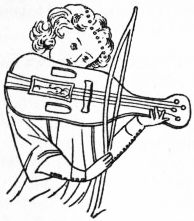
From Julius Rühlmann’s Geschichte der Bogeninstrumente.
Minnesinger Fiddle. Germany, 13th Century, from the Manesse MSS.
In the minnesinger and troubadour fiddles, of which evidences abound during the 12th, 13th and 14th centuries, are to be observed the structural characteristics of the violin and its ancestors in the course of evolution. The principal of these are first of all the shallow sound-chest, composed of belly and back, almost flat, connected by ribs (also present in the cithara), with incurvations more or less pronounced, an arched bridge, a finger-board and strings (varying in number), vibrated by means of a bow. The central rose sound-holes of stringed instruments whose strings are plucked by fingers, or plectrum have given place to smaller lateral sound-holes placed on each side of the strings. It is in Germany,2 where contemporary drawings of fiddles of the 13th and 14th centuries furnish an authoritative clue, and in France, that the development may best be followed. The German minnesinger fiddle with sloping shoulders was the prototype of the viols, whereas the guitar-fiddle produced the violin through the intermediary of the Italian bowed Lyra.
The fiddle of the Carolingian epoch,—such, for instance, as that mentioned by Otfrid of Weissenburg3 in his Harmony of the Gospels (c. 868),
“Sih thar ouch al ruarit This organo fuarit Lira joh fidula,” &c.,—
was in all probability still an instrument whose strings were plucked by the fingers, a cithara in transition.
(K. S.)
1 See C.E.H. de Coussemaker, Mémoire sur Hucbald (Paris, 1841).
2 See the Manesse MSS. reproduced in part by F.H. von der Hagen, Heldenbilder (Leipzig and Berlin, 1855) and Bildersaal. The fiddles are reproduced in J. Rühlmann’s Geschichte der Bogeninstrumente (Brunswick, 1882), plates.
3 See Schiller’s Thesaurus antiq. Teut. vol. i. p. 379.
FIDENAE, an ancient town of Latium, situated about 5 m. N. of Rome on the Via Salaria, which ran between it and the Tiber. It was for some while the frontier of the Roman territory and was often in the hands of Veii. It appears to have fallen under the Roman sway after the capture of this town, and is spoken of by classical authors as a place almost deserted in their time. It seems, however, to have had some importance as a post station. The site of the arx of the ancient town is probably to be sought on the hill on which lies the Villa Spada, though no traces of early buildings or defences are to be seen: pre-Roman tombs are to be found in the cliffs to the north. The later village lay at the foot of the hill on the eastern edge of the high-road, and its curia, with a dedicatory inscription to M. Aurelius by the Senatus Fidenatium, was excavated in 1889. Remains of other buildings may also be seen.
See T. Ashby in Papers of the British School at Rome, iii. 17.
FIDUCIARY (Lat. fiduciaries, one in whom trust, fiducia, is reposed), of or belonging to a position of trust, especially of one who stands in a particular relationship of confidence to another. Such relationships are, in law, those of parent and child, guardian and ward, trustee and cestui que trust, legal adviser and client, spiritual adviser, doctor and patient, &c. In many of these the law has attached special obligations in the case of gifts made to the “fiduciary,” on whom is laid the onus of proving that no “undue influence” has been exercised. (See Contract; Children, Law Relating to; Infant; Trust.)
FIEF, a feudal estate in land, land held from a superior (see Feudalism). The word is the French form, which is represented in Medieval Latin as feudum or feodum, and in English as “fee” or “feu” (see Fee). The A. Fr. feoffer, to invest with a fief or fee, has given the English law terms “feoffee” and “feoffment” (q.v.).
FIELD, CYRUS WEST (1819-1892), American capitalist, projector of the first Atlantic cable, was born at Stockbridge, Massachusetts, on the 30th of November 1819. He was a brother of David Dudley Field. At fifteen he became a clerk in the store of A.T. Stewart & Co., of New York, and stayed there three years; then worked for two years with his brother, Matthew Dickinson Field, in a paper-mill at Lee, Massachusetts; and in 1840 went into the paper business for himself at Westfield, Massachusetts, but almost immediately became a partner in E. Root & Co., wholesale paper dealers in New York City, who failed in the following year. Field soon afterwards formed with a brother-in-law the firm of Cyrus W. Field & Co., and in 1853 had accumulated $250,000, paid off the debts of the Root company and retired from active business, leaving his name and $100,000 with the concern. In the same year he travelled with Frederick E. Church, the artist, through South America. In 1854 he became interested, through his brother Matthew, a civil engineer, in the project of Frederick Newton Gisborne (1824-1892) for a telegraph across Newfoundland; and he was attracted by the idea of a trans-Atlantic telegraphic cable, as to which he consulted S.F.B. Morse and Matthew F. Maury, head of the National Observatory at Washington. With Peter Cooper, Moses Taylor (1806-1882), Marshall Owen Roberts (1814-1880) and Chandler White, he formed the New York, Newfoundland & London Telegraph Company, which procured a more favourable charter than Gisborne’s, and had a capital of $1,500,000. Having secured all the practicable landing rights on the American side of the ocean, he and John W. Brett, who was now his principal colleague, approached Sir Charles Bright (q.v.) in London, and in December 1556 the Atlantic Telegraph Company was organized by them in Great Britain, a government grant being secured of £14,000 annually for government messages, to be reduced to £10,000 annually when the cable should pay a 6% yearly dividend; similar grants were made by the United States government. Unsuccessful attempts to lay the cable were made in August 1857 and in June 1858, but the complete cable was laid between the 7th of July and the 5th of August 1858; for a time messages were transmitted, but in October the cable became useless, owing to the failure of its electrical insulation. Field, however, did not abandon the enterprise, and finally in July 1866, after a futile attempt in the previous year, a cable was laid and brought successfully into use. From the Congress of the United States he received a gold medal and a vote of thanks, and he received many other honours both at home and abroad. In 1877 he bought a controlling interest in the New York Elevated Railroad Company, controlling the Third and Ninth Avenue lines, of which he was president in 1877-1880. He worked with Jay Gould for the completion of the Wabash railway, and at the time of his greatest stock activity bought The New York Evening Express and The Mail and combined them as The Mail and Express, which he controlled for six years. In 1879 Field suffered financially by Samuel J. Tilden’s heavy sales (during Field’s absence in Europe) of “Elevated” stock, which forced the price down from 200 to 164; but Field lost much more in the great “Manhattan squeeze” of the 24th of June 1887, when Jay Gould and Russell Sage, who had been supposed to be his backers in an attempt to bring the Elevated stock to 200, forsook him, and the price fell from 156½ to 114 in half an hour. Field died in New York on the 12th of July 1892.
See the biography by his daughter, Isabella (Field) Judson, Cyrus W. Field, His Life and Work (New York, 1896); H.M. Field, History of the Atlantic Telegraph (New York, 1866); and Charles Bright, The Story of the Atlantic Cable (New York, 1903).
FIELD, DAVID DUDLEY (1805-1894), American lawyer and law reformer, was born in Haddam, Connecticut, on the 13th of February 1805. He was the oldest of the four sons of the Rev. David Dudley Field (1781-1867), a well-known American clergyman and author. He graduated at Williams College in 1825, and settled in New York City, where he studied law, was admitted to the bar in 1828, and rapidly won a high position in his profession. Becoming convinced that the common law in America, and particularly in New York state, needed radical changes in respect to the unification and simplification of its procedure, he visited Europe in 1836 and thoroughly investigated the courts, procedure and codes of England, France and other countries, and then applied himself to the task of bringing about in the United States a codification of the common law procedure. For more than forty years every moment that he could spare from his extensive practice was devoted to this end. He entered upon his great work by a systematic publication of pamphlets and articles in journals and magazines in behalf of his reform, but for some years he met with a discouraging lack of interest. He appeared personally before successive legislative committees, and in 1846 published a pamphlet, “The Reorganization of the Judiciary,” which had its influence in persuading the New York State Constitutional Convention of that year to report in favour of a codification of the laws. Finally in 1847 he was appointed as the head of a state commission to revise the practice and procedure. The first part of the commission’s work, consisting of a code of civil procedure, was reported and enacted in 1848, and by the 1st of January 1850 the complete code of civil and criminal procedure was completed, and was subsequently enacted by the legislature. The basis of the new system, which was almost entirely Field’s work, was the abolition of the existing distinction in forms of procedure between suits in law and equity requiring separate actions, and their unification and simplification in a single action. Eventually the civil code with some changes was adopted in twenty-four states, and the criminal code in eighteen, and the whole formed a basis of the reform in procedure in England and several of her colonies. In 1857 Field became chairman of a state commission for the reduction into a written and systematic code of the whole body of law of the state, excepting those portions already reported upon by the Commissioners of Practice and Pleadings. In this work he personally prepared almost the whole of the political and civil codes. The codification, which was completed in February 1865, was adopted only in small part by the state, but it has served as a model after which most of the law codes of the United States have been constructed. In 1866 he proposed to the British National Association for the Promotion of Social Science a revision and codification of the laws of all nations. For an international commission of lawyers he prepared Draft Outlines of an International Code (1872), the submission of which resulted in the organization of the international Association for the Reform and Codification of the Laws of Nations, of which he became president. In politics Field was originally an anti-slavery Democrat, and he supported Van Buren in the Free Soil campaign of 1848. He gave his support to the Republican party in 1856 and to the Lincoln administration throughout the Civil War. After 1876, however, he returned to the Democratic party, and from January to March 1877 served out in Congress the unexpired term of Smith Ely, elected mayor of New York City. During his brief Congressional career he delivered six speeches, all of which attracted attention, introduced a bill in regard to the presidential succession, and appeared before the Electoral Commission in Tilden’s interest. He died in New York City on the 13th of April 1894.
Part of his numerous pamphlets and addresses were collected in his Speeches, Arguments and Miscellaneous Papers (3 vols., 1884-1890). See also the Life of David Dudley Field (New York, 1898), by Rev. Henry Martyn Field.
FIELD, EUGENE (1850-1895), American poet, was born at St Louis, Missouri, on the 2nd of September 1850. He spent his boyhood in Vermont and Massachusetts; studied for short periods at Williams and Knox Colleges and the University of Missouri, but without taking a degree; and worked as a journalist on various papers, finally becoming connected with the Chicago News. A Little Book of Profitable Tales appeared in Chicago in 1889 and in New York the next year; but Field’s place in later American literature chiefly depends upon his poems of Christmas-time and childhood (of which “Little Boy Blue” and “A Dutch Lullaby” are most widely known), because of their union of obvious sentiment with fluent lyrical form. His principal collections of poems are: A Little Book of Western Verse (1889); A Second Book of Verse (1892); With Trumpet and Drum (1892); and Love Songs of Childhood (1894). Field died at Chicago on the 4th of November 1895.
His works were collected in ten volumes (1896), at New York. His prose Love-affairs of a Bibliomaniac (1896) contains a Memoir by his brother Roswell Martin Field (b. 1851). See also Slason Thompson, Eugene Field: a study in heredity and contradictions (2 vols., New York, 1901).
FIELD, FREDERICK (1801-1885), English divine and biblical scholar, was born in London and educated at Christ’s hospital and Trinity College, Cambridge, where he obtained a fellowship in 1824. He took orders in 1828, and began a close study of patristic theology. Eventually he published an emended and annotated text of Chrysostom’s Homiliae in Matthaeum (Cambridge, 1839), and some years later he contributed to Pusey’s Bibliotheca Patrum (Oxford, 1838-1870), a similarly treated text of Chrysostom’s homilies on Paul’s epistles. The scholarship displayed in both of these critical editions is of a very high order. In 1839 he had accepted the living of Great Saxham, in Suffolk, and in 1842 he was presented by his college to the rectory of Reepham in Norfolk. He resigned in 1863, and settled at Norwich, in order to devote his whole time to study. Twelve years later he completed the Origenis Hexaplorum quae supersunt (Oxford, 1867-1875), now well known as Field’s Hexapla, a text reconstructed from the extant fragments of Origen’s work of that name, together with materials drawn from the Syro-hexaplar version and the Septuagint of Holmes and Parsons (Oxford, 1798-1827). Field was appointed a member of the Old Testament revision company in 1870.
FIELD, HENRY MARTYN (1822-1907), American author and clergyman, brother of Cyrus Field, was born at Stockbridge, Massachusetts, on the 3rd of April 1822; he graduated at Williams College in 1838, and was pastor of a Presbyterian church in St Louis, Missouri, from 1842 to 1847, and of a Congregational church in West Springfield, Massachusetts, from 1850 to 1854. The interval between his two pastorates he spent in Europe. From 1854 to 1898 he was editor and for many years he was also sole proprietor of The Evangelist, a New York periodical devoted to the interests of the Presbyterian church. He spent the last years of his life in retirement at Stockbridge, Mass., where he died on the 26th of January 1907. He was the author of a series of books of travel, which achieved unusual popularity. His two volumes descriptive of a trip round the world in 1875-1876, entitled From the Lakes of Killarney to the Golden Horn (1876) and From Egypt to Japan (1877), are almost classic in their way, and have passed through more than twenty editions. Among his other publications are The Irish Confederates and the Rebellion of 1798 (1850), The History of the Atlantic Telegraph (1866), Faith or Agnosticism? the Field-Ingersoll Discussion (1888), Old Spain and New Spain (1888), and Life of David Dudley Field (1898).
He is not to be confused with another Henry Martyn Field, the gynaecologist, who was born in 1837 at Brighton, Mass., and graduated at Harvard in 1859 and at the College of Physicians and Surgeons in New York City in 1862; he was professor of Materia Medica and therapeutics at Dartmouth from 1871 to 1887 and of therapeutics from 1887 to 1893.
FIELD, JOHN (1782-1837), English musical composer and pianist, was born at Dublin in 1782. He came of a musical family, his father being a violinist, and his grandfather the organist in one of the churches of Dublin. From the latter the boy received his first musical education. When a few years later the family settled in London, Field became the favourite pupil of the celebrated Clementi, whom he accompanied to Paris, and later, in 1802, on his great concert tour through France, Germany and Russia. Under the auspices of his master Field appeared in public in most of the great European capitals, especially in St Petersburg, and in that city he remained when Clementi returned to England. During his stay with the great pianist Field had to suffer many privations owing to Clementi’s all but unexampled parsimony; but when the latter left Russia his splendid connexion amongst the highest circles of the capital became Field’s inheritance. His marriage with a French lady of the name of Charpentier was anything but happy, and had soon to be dissolved. Field made frequent concert tours to the chief cities of Russia, and in 1820 settled permanently in Moscow. In 1831 he came to England for a short time, and for the next four years led a migratory life in France, Germany and Italy, exciting the admiration of amateurs wherever he appeared in public. In Naples he fell seriously ill, and lay several months in the hospital, till a Russian family discovered him and brought him back to Moscow. There he lingered for several years till his death on the 11th of January 1837. Field’s training and the cast of his genius were not of a kind to enable him to excel in the larger forms of instrumental music, and his seven concerti for the pianoforte are now forgotten. Neither do his quartets for strings and pianoforte hold their own by the side of those of the great masters. But his “nocturnes,” a form of music highly developed if not actually created by him, remain all but unrivalled for their tenderness and dreaminess of conception, combined with a continuous flow of beautiful melody. They were indeed Chopin’s models. Field’s execution on the pianoforte was nearly allied to the nature of his compositions, beauty and poetical charm of touch being one of the chief characteristics of his style. Moscheles, who heard Field in 1831, speaks of his “enchanting legato, his tenderness and elegance and his beautiful touch.”
FIELD, MARSHALL (1835-1906), American merchant, was born at Conway, Massachusetts, on the 18th of August 1835. Reared on a farm, he obtained a common school and academy education, and at the age of seventeen became a clerk in a dry goods store at Pittsfield, Mass. In 1856 he removed to Chicago, where he became a clerk in the large mercantile establishment of Cooley, Wadsworth & Company. In 1860 the firm was reorganized as Cooley, Farwell & Company, and he was admitted to a junior partnership. In 1865, with Potter Palmer (1826-1902) and Levi Z. Leiter (1834-1904), he organized the firm of Field, Palmer & Leiter, which subsequently became Field, Leiter & Company, and in 1881 on the retirement of Leiter became Marshall Field & Company. Under Field’s management the annual business of the firm increased from $12,000,000 in 1871 to more than $40,000,000 in 1895, when it ranked as one of the two or three largest mercantile establishments in the world. He died in New York city on the 16th of January 1906. He had married, for the second time, in the previous year. Field’s public benefactions were numerous; notable among them being his gift of land valued at $300,000 and of $100,000 in cash to the University of Chicago, an endowment fund of $1,000,000 to support the Field Columbian Museum at Chicago, and a bequest of $8,000,000 to this museum.
FIELD, NATHAN (1587-1633), English dramatist and actor, was baptized on the 17th of October 1587. His father, the rector of Cripplegate, was a Puritan divine, author of a Godly Exhortation directed against play-acting, and his brother Theophilus became bishop of Hereford. Nat. Field early became one of the children of Queen Elizabeth’s chapel, and in that capacity he played leading parts in Ben Jonson’s Cynthia’s Revels (in 1600), in the Poetaster (in 1601), and in Epicoene (in 1608), and the title rôle in Chapman’s Bussy d’Ambois (in 1606). Ben Jonson was his dramatic model, and may have helped his career. The two plays of which he was author were probably both written before 1611. They are boisterous, but well-constructed comedies of contemporary London life; the earlier one, A Woman is a Weathercock (printed 1612), dealing with the inconstancy of woman, while the second, Amends for Ladies (printed 1618), was written with the intention, as the title indicates, of retracting the charge. From Henslowe’s papers it appears that Field collaborated with Robert Daborne and with Philip Massinger, one letter from all three authors being a joint appeal for money to free them from prison. In 1614 Field received £10 for playing before the king in Bartholomew Fair, a play in which Jonson records his reputation as an actor in the words “which is your Burbadge now?... Your best actor, your Field?” He joined the King’s Players some time before 1619, and his name comes seventeenth on the list prefixed to the Shakespeare folio of 1623 of the “principal actors in all these plays.” He retired from the stage before 1625, and died on the 20th of February 1633. Field was part author with Massinger in the Fatal Dowry (printed 1632), and he prefixed commendatory verses to Fletcher’s Faithful Shepherdess.
His two plays were reprinted in J.P. Collier’s Five Old Plays (1833), in Hazlitt’s edition of Dodsley’s Old Plays, and in Nero and other Plays (Mermaid series, 1888), with an introduction by Mr A.W. Verity.
FIELD, STEPHEN JOHNSON (1816-1899), American jurist, was born at Haddam, Connecticut, on the 4th of November 1816. He was the brother of David Dudley Field, Cyrus W. Field and Henry M. Field. At the age of thirteen he accompanied his sister Emilia and her husband the Rev. Josiah Brewer (the parents of the distinguished judge of the Supreme Court, David J. Brewer) to Smyrna, Turkey, for the purpose of studying Oriental languages, but after three years he returned to the United States, and in 1837 graduated at Williams College at the head of his class. He then studied law in his elder brother’s office, and in 1841 he was admitted to the New York bar. He was associated in practice there with his brother until 1848, and early in 1849 removed to California, settling soon afterward at Marysville, of which place, in 1850, he became the first alcalde or mayor. In the same year he was chosen a member of the first state legislature of California, in which he drew up and secured the enactment of two bodies of law known as the Civil and Criminal Practices Acts, based on the similar codes prepared by his brother David Dudley for New York. In the former act he embodied a provision regulating and giving authority to the peculiar customs, usages, and regulations voluntarily adopted by the miners in various districts of the state for the adjudication of disputed mining claims. This, as Judge Field truly says, “was the foundation of the jurisprudence respecting mines in the country,” having greatly influenced legislation upon this subject in other states and in the Congress of the United States. He was elected, in 1857, a justice of the California Supreme Court, of which he became chief justice in 1859, on the resignation of Judge David S. Terry to fight the duel with the United States senator David C. Broderick which ended fatally for the latter. Field held this position until 1863, when he was appointed by President Lincoln a justice of the United States Supreme Court. In this capacity he was conspicuous for fearless independence of thought and action in his opinion in the test oath case, and in his dissenting opinions in the legal tender, conscription and “slaughter house” cases, which displayed unusual legal learning, and gave powerful expression to his strict constructionist theory of the implied powers of the Federal constitution. Originally a Democrat, and always a believer in states’ rights, his strong Union sentiments caused him nevertheless to accept Lincoln’s doctrine of coercion, and that, together with his anti-slavery sympathies, led him to act with the Republican party during the period of the Civil War. He was a member of the commission which revised the California code in 1873 and of the Electoral Commission in 1877, voting in favour of Tilden. In 1880 he received sixty-five votes on the first ballot for the presidential nomination at the Democratic National Convention at Cincinnati. In August 1889, as a result of a ruling in the course of the Sharon-Hill litigation, a notorious conspiracy case, he was assaulted in a California railway station by Judge David S. Terry, who in turn was shot and killed by a United States deputy marshall appointed to defend Justice Field against the carrying out of Terry’s often-expressed threats. He retired from the Supreme Court on the 1st of December 1897 after a service of thirty-four years and six months, the longest in the court’s history, and died in Washington on the 9th of April 1899.
His Personal Reminiscences of Early Days in California, originally privately printed in 1878, was republished in 1893 with George C. Gorham’s Story of the Attempted Assassination of Justice Field.
FIELD, WILLIAM VENTRIS FIELD, Baron (1813-1907), English judge, second son of Thomas Flint Field, of Fielden, Bedfordshire, was born on the 21st of August 1813. He was educated at King’s school, Bruton, Somersetshire, and entered the legal profession as a solicitor. In 1843, however, he ceased to practise as such, and entered at the Inner Temple, being called to the bar in 1850, after having practised for some time as a special pleader. He joined the Western circuit, but soon exchanged it for the Midland. He obtained a large business as a junior, and became a queen’s counsel and bencher of his inn in 1864. As a Q.C. he had a very extensive common law practice, and had for some time been the leader of the Midland circuit, when in February 1875, on the retirement of Mr Justice Keating, he was raised to the bench as a justice of the queen’s bench. Mr Justice Field was an excellent puisne judge of the type that attracts but little public attention. He was a first-rate lawyer, had a good knowledge of commercial matters, great shrewdness and a quick intellect, while he was also painstaking and scrupulously fair. When the rules of the Supreme Court 1883 came into force in the autumn of that year, Mr Justice Field was so well recognized an authority upon all questions of practice that the lord chancellor selected him to sit continuously at Judges’ Chambers, in order that a consistent practice under the new rules might as far as possible be established. This he did for nearly a year, and his name will always, to a large extent, be associated with the settling of the details of the new procedure, which finally did away with the former elaborate system of “special pleading.” In 1890 he retired from the bench and was raised to the peerage as Baron Field of Bakeham, becoming at the same time a member of the privy council. In the House of Lords he at first took part, not infrequently, in the hearing of appeals, and notably delivered a carefully-reasoned judgment in the case of the Bank of England v. Vagliano Brothers (5th of March 1891), in which, with Lord Bramwell, he differed from the majority of his brother peers. Before long, however, deafness and advancing years rendered his attendances less frequent. Lord Field died at Bognor on the 23rd of January 1907, and as he left no issue the peerage became extinct.
FIELD (a word common to many West German languages, cf. Ger. Feld, Dutch veld, possibly cognate with O.E. folde, the earth, and ultimately with root of the Gr. πλατός, broad), open country as opposed to woodland or to the town, and particularly land for cultivation divided up into separate portions by hedges, banks, stone walls, &c.; also used in combination with words denoting the crop grown on such a portion of land, such as corn-field, turnip-field, &c. The word is similarly applied to a region with particular reference to its products, as oil-field, gold-field, &c. For the “open” or “common field” system of agriculture in village communities see Commons. Generally with a reference to their “wild” as opposed to their “domestic” nature “field” is applied to many animals, such as the “field-mouse.” There are many applications of the word; thus from the use of the term for the place where a battle is fought, and widely of the whole theatre of war, come such phrases as to “take the field” for the opening of a campaign, “in the field” of troops that are engaged in the operations of a campaign. It is frequently used figuratively in this sense, of the subject matter of a controversy, and also appears in military usage, in field-fortification, field-day and the like. A “field-officer” is one who ranks above a captain and below a general (see Officers); a field marshal is the highest rank of general officer in the British and many European armies (see Marshal). “Field” is used in many games, partly with the idea of an enclosed space, partly with the idea of the ground of military operations, for the ground in which such games as cricket, football, baseball and the like are played. Hence it is applied to those players in cricket and baseball who are not “in,” and “to field” is to perform the functions of such a player—to stop or catch the ball played by the “in” side. “The field” is used in hunting, &c., for those taking part in the sport, and in racing for all the horses entered for a race, and, in such expressions as “to back the field,” is confined to all the horses with the exception of the “favourite.” A common application of the word is to a surface, more or less wide, as of the sky or sea, or of such physical phenomena as ice or snow, and particularly of the ground, of a special “tincture,” on which armorial bearings are displayed (see Heraldry); it is thus used also of the “ground” of a flag, thus the white ensign of the British navy has a red St George’s cross on a white “field.” In scientific usage the word is also used of the sphere of observation or of operations, and has come to be almost equivalent to a department of knowledge. In physics, a particular application is that to the area which is influenced by some agent, as in the magnetic or electric field. The field of observation or view is the area within which objects can be seen through any optical instrument at any one position. A “field-glass” is the name given to a binocular glass used in the field (see Binocular Instrument); the older form of field-glass was a small achromatic telescope with joints. This terms is also applied, in an astronomical telescope or compound microscope, to that one of the two lenses of the “eye-piece” which is next to the object-glass; the other is called the “eye-glass.”
FIELDFARE (O.E. fealo-for = fallow-farer), a large species of thrush, the Turdus pilaris of Linnaeus—well known as a regular and common autumnal visitor throughout the British Islands and a great part of Europe, besides western Asia, and even reaching northern Africa. It is the Veldjakker and Veld-lyster of the Dutch, the Wachholderdrossel and Kramtsvogel of Germans, the Litorne of the French, and the Cesena of Italians. This bird is of all thrushes the most gregarious in. habit, not only migrating in large bands and keeping in flocks during the winter, but even commonly breeding in society—200 nests or more having been seen within a very small space. The birch-forests of Norway, Sweden and Russia are its chief resorts in summer, but it is known also to breed sparingly in some districts of Germany. Though its nest has been many times reported to have been found in Scotland, there is perhaps no record of such an incident that is not open to doubt; and unquestionably the missel-thrush (T. viscivorus) has been often mistaken for the fieldfare by indifferent observers. The head, neck, upper part of the back and the rump are grey; the wings, wing-coverts and middle of the back are rich hazel-brown; the throat is ochraceous; and the breast reddish-brown—both being streaked or spotted with black, while the belly and lower wing-coverts are white, and the legs and toes very dark-brown. The nest and eggs resemble those of the blackbird (T. merula), but the former is usually built high up in a tree. The fieldfare’s call-note is harsh and loud, sounding like t’chatt’chat: its song is low, twittering and poor. It usually arrives in Britain about the middle or end of October, but sometimes earlier, and often remains till the middle of May before departing for its northern breeding-places. In hard weather it throngs to the berry-bearing bushes which then afford it sustenance, but in open winters the flocks spread over the fields in search of animal food—worms, slugs and the larvae of insects. In very severe seasons it will altogether leave the country, and then return for a shorter or longer time as spring approaches. From William of Palerne (translated from the French c. 1350) to the writers of our own day the fieldfare has occasionally been noticed by British poets with varying propriety. Thus Chaucer’s association Of its name with frost is as happy as true, while Scott was more than unlucky in his well-known reference to its “lowly nest” in the Highlands.
Structurally very like the fieldfare, but differing greatly in many other respects, is the bird known in North America as the “robin”—its ruddy breast and familiar habits reminding the early British settlers in the New World of the household favourite of their former homes. This bird, the Turdus migratorius of Linnaeus, has a wide geographical range, extending from the Atlantic to the Pacific, and from Greenland to Guatemala, and, except at its extreme limits, is almost everywhere a very abundant species. As its scientific name imports, it is essentially a migrant, and gathers in flocks to pass the winter in the south, though a few remain in New England throughout the year. Yet its social instincts point rather in the direction of man than of its own kind, and it is not known to breed in companies, while it affects the homesteads, villages and even the parks and gardens of the large cities, where its fine song, its attractive plumage, and its great services as a destroyer of noxious insects, combine to make it justly popular.
(A. N.)
FIELDING, ANTHONY VANDYKE COPLEY (1787-1855), commonly called Copley Fielding, English landscape painter (son of a portrait painter), became at an early age a pupil of John Varley. He took to water-colour painting, and to this he confined himself almost exclusively. In 1810 he became an associate exhibitor in the Water-colour Society, in 1813 a full member, and in 1831 president of that body. He also engaged largely in teaching the art, and made ample profits. His death took place at Worthing in March 1855. Copley Fielding was a painter of much elegance, taste and accomplishment, and has always been highly popular with purchasers, without reaching very high in originality of purpose or of style: he painted in vast number all sorts of views (occasionally in oil-colour) including marine subjects in large proportion. Specimens of his work are to be seen in the water-colour gallery of the Victoria and Albert Museum, of dates ranging from 1829 to 1850. Among the engraved specimens of his art is the Annual of British Landscape Scenery, published in 1839.
(W. M. R.)
FIELDING, HENRY (1707-1754), English novelist and playwright, was born at Sharpham Park, near Glastonbury, Somerset, on the 22nd of April 1707. His father was Lieutenant Edmund Fielding, third son of John Fielding, who was canon of Salisbury and fifth son of the earl of Desmond. The earl of Desmond belonged to the younger branch of the Denbigh family, who, until lately, were supposed to be connected with the Habsburgs. To this claim, now discredited by the researches of Mr J. Horace Round (Studies in Peerage, 1901, pp. 216-249), is to be attributed the famous passage in Gibbon’s Autobiography which predicts for Tom Jones—“that exquisite picture of human manners”—a diuturnity exceeding that of the house of Austria. Henry Fielding’s mother was Sarah Gould, daughter of Sir Henry Gould, a judge of the king’s bench. It is probable that the marriage was not approved by her father, since, though she remained at Sharpham Park for some time after that event, his will provided that her husband should have nothing to do with a legacy of £3000 left her in 1710. About this date the Fieldings moved to East Stour in Dorset. Two girls, Catherine and Ursula, had apparently been born at Sharpham Park; and three more, together with a son, Edmund, followed at East Stour. Sarah, the third of the daughters, born November 1710, and afterwards the author of David Simple and other works, survived her brother.
Fielding’s education up to his mother’s death, which took place in April 1718 at East Stour, seems to have been entrusted to a neighbouring clergyman, Mr Oliver of Motcombe, in whom tradition traces the uncouth lineaments of “Parson Trulliber” in Joseph Andrews. But he must have contrived, nevertheless, to prepare his pupil for Eton, to which place Fielding went about this date, probably as an oppidan. Little is known of his schooldays. There is no record of his name in the college lists; but, if we may believe his first biographer, Arthur Murphy, by no means an unimpeachable authority, he left “uncommonly versed in the Greek authors, and an early master of the Latin classics,”—a statement which should perhaps be qualified by his own words to Sir Robert Walpole in 1730:—
“Tuscan and French are in my head; Latin I write, and Greek—I read.”
But he certainly made friends among his class-fellows—some of whom continued friends for life. Winnington and Hanbury-Williams were among these. The chief, however, and the most faithful, was George, afterwards Sir George, and later Baron Lyttelton of Frankley.
When Fielding left Eton is unknown. But in November 1725 we hear of him definitely in what seems like a characteristic escapade. He was staying at Lyme (in company with a trusty retainer, ready to “beat, maim or kill” in his young master’s behalf), and apparently bent on carrying off, if necessary by force, a local heiress, Miss Sarah Andrew, whose fluttered guardians promptly hurried her away, and married her to some one else (Athenaeum, 2nd June 1883). Her baffled admirer consoled himself by translating part of Juvenal’s sixth satire into verse as “all the Revenge taken by an injured Lover.” After this he must have lived the usual life of a young man about town, and probably at this date improved the acquaintance of his second cousin, Lady Mary Wortley Montagu, to whom he inscribed his first comedy, Love in Several Masques, produced at Drury Lane in February 1728. The moment was not particularly favourable, since it succeeded Cibber’s Provok’d Husband, and was contemporary with Gay’s popular Beggar’s Opera. Almost immediately afterwards (March 16th) Fielding entered himself as “Stud. Lit.” at Leiden University. He was still there in February 1729. But he had apparently left before the annual registration of February 1730, when his name is absent from the books (Macmillan’s Magazine, April 1907); and in January 1730 he brought out a second comedy at the newly-opened theatre in Goodman’s Fields. Like its predecessor, the Temple Beau was an essay in the vein of Congreve and Wycherley, though, in a measure, an advance on Love in Several Masques.
With the Temple Beau Fielding’s dramatic career definitely begins. His father had married again; and his Leiden career had been interrupted for lack of funds. Nominally, he was entitled to an allowance of £200 a year; but this (he was accustomed to say) “any body might pay that would.” Young, handsome, ardent and fond of pleasure, he began that career as a hand-to-mouth playwright around which so much legend has gathered—and gathers. Having—in his own words—no choice but to be a hackney coachman or a hackney writer, he chose the pen; and his inclinations, as well as his opportunities, led him to the stage. From 1730 to 1736 he rapidly brought out a large number of pieces, most of which had merit enough to secure their being acted, but not sufficient to earn a lasting reputation for their author. His chief successes, from a critical point of view, the Author’s Farce (1730) and Tom Thumb (1730, 1731), were burlesques; and he also was fortunate in two translations from Molière, the Mock Doctor (1732) and the Miser (1733). Of the rest (with one or two exceptions, to be mentioned presently) the names need only be recorded. They are The Coffee-House Politician, a comedy (1730); The Letter Writers, a farce (1731); The Grub-Street Opera, a burlesque (1731); The Lottery, a farce (1732); The Modern Husband, a comedy (1732); The Covent Garden Tragedy, a burlesque (1732); The Old Debauchees, a comedy (1732); Deborah; or, a Wife for you all, an after-piece (1733); The Intriguing Chambermaid (from Regnard), a two-act comedy (1734); and Don Quixote in England, a comedy, which had been partly sketched at Leiden.