VOLUME X SLICE III Fenton, Edward to Finistere (continued 7)
Reading edition
Don Quixote was produced in 1734, and the list of plays may be here interrupted by an event of which the date has only recently been ascertained, namely, Fielding’s first marriage. This took place on the 28th of November 1734 at St Mary, Charlcornbe, near Bath (Macmillan’s Magazine, April 1907), the lady being a Salisbury beauty, Miss Charlotte Cradock, of whom he had been an admirer, if not a suitor, as far back as 1730. This is a fact which should be taken into consideration in estimating the exact Bohemianism of his London life, for there is no doubt that he was devotedly attached to her. After a fresh farce entitled An Old Man taught Wisdom, and the comparative failure of a new comedy, The Universal Gallant, both produced early in 1735, he seems for a time to have retired with his bride, who came into £1500, to his old home at East Stour. Around this rural seclusion fiction has freely accreted. He is supposed to have lived for three years on the footing of a typical 18th-century country gentleman; to have kept a pack of hounds; to have put his servants into impossible yellow liveries; and generally, by profuse hospitality and reckless expenditure, to have made rapid duck and drake of Mrs Fielding’s modest legacy. Something of this is demonstrably false; much, grossly exaggerated. In any case, he was in London as late as February 1735 (the date of the “Preface” to The Universal Gallant); and early in March 1736 he was back again managing the Haymarket theatre with a so-called “Great Mogul’s Company of English Comedians.”
Upon this new enterprise fortune, at the outset, seemed to smile. The first piece (produced on the 5th of March) was Pasquin, a Dramatick Satire on the Times (a piece akin in its plan to Buckingham’s Rehearsal), which contained, in addition to much admirable burlesque, a good deal of very direct criticism of the shameless political corruption of the Walpole era. Its success was unmistakable; and when, after bringing out the remarkable Fatal Curiosity of George Lillo, its author followed up Pasquin by the Historical Register for the Year 1736, of which the effrontery was even more daring than that of its predecessor, the ministry began to bethink themselves that matters were going too far. How they actually effected their object is obscure: but grounds were speedily concocted for the Licensing Act of 1737, which restricted the number of theatres, rendered the lord chamberlain’s licence an indispensable preliminary to stage representation, and—in a word—effectually put an end to Fielding’s career as a dramatist.
Whether, had that career been prolonged to its maturity, the result would have enriched the theatrical repertoire with a new species of burlesque, or reinforced it with fresh variations on the “wit-traps” of Wycherley and Congreve, is one of those inquiries that are more academic than, profitable. What may be affirmed is, that Fielding’s plays, as we have them, exhibit abundant invention and ingenuity; that they are full of humour and high spirits; that, though they may have been hastily written, they were by no means thoughtlessly constructed; and that, in composing them, their author attentively considered either managerial hints, or the conditions of the market. Against this, one must set the fact that they are often immodest; and that, whatever their intrinsic merit, they have failed to rival in permanent popularity the work of inferior men. Fielding’s own conclusion was, “that he left off writing for the stage, when he ought to have begun”—which can only mean that he himself regarded his plays as the outcome of imitation rather than experience. They probably taught him how to construct Tom Jones; but whether he could ever have written a comedy at the level of that novel, can only be established by a comparison which it is impossible to make, namely, a comparison with Tom Jones of a comedy written at the same age, and in similar circumstances.
Tumble-Down Dick; or, Phaeton in the Suds, Eurydice and Eurydice hissed are the names of three occasional pieces which belong to the last months of Fielding’s career as a Haymarket manager. By this date he was thirty, with a wife and daughter. As a means of support, he reverted to the profession of his maternal grandfather; and, in November 1737, he entered the Middle Temple, being described in the books of the society as “of East Stour in Dorset.” That he set himself strenuously to master his new profession, is admitted; though it is unlikely that he had entirely discarded the irregular habits which had grown upon him in his irresponsible bachelorhood. He also did a good deal of literary work, the best known of which is contained in the Champion, a “News-Journal” of the Spectator type undertaken with James Ralph, whose poem of “Night” is made notorious in the Dunciad. That the Champion was not without merit is undoubted; but the essay-type was for the moment out-worn, and neither Fielding nor his coadjutor could lend it fresh vitality. Fielding contributed papers from the 15th of November 1739 to the 19th of June 1740. On the 20th of June he was called to the bar, and occupied chambers in Pump Court. It is further related that, in the diligent pursuit of his calling, he travelled the Western Circuit, and attended the Wiltshire sessions.
Although, with the Champion, he professed, for the time, to have relinquished periodical literature, he still wrote at intervals, a fact which, taken in connexion with his past reputation as an effective satirist, probably led to his being “unjustly censured” for much that he never produced. But he certainly wrote a poem “Of True Greatness” (1741); a first book of a burlesque epic, the Vernoniad, prompted by Vernon’s expedition of 1739; a vision called the Opposition, and, perhaps, a political sermon entitled the Crisis (1741). Another piece, now known to have been attributed to him by his contemporaries (Hist. MSS. Comm., Rept. 12, App. Pt. ix., p. 204), is the pamphlet entitled An Apology for the Life of Mrs Shamela Andrews, a clever but coarse attack upon the prurient side of Richardson’s Pamela, which had been issued in 1740, and was at the height of its popularity. Shamela followed early in 1741. Richardson, who was well acquainted with Fielding’s four sisters, at that date his neighbours at Hammersmith, confidently attributed it to Fielding (Corr. 1804, iv. 286, and unpublished letter at South Kensington); and there are suggestive points of internal evidence (such as the transformation of Pamela’s “MR B.” into “Mr Booby”) which tend to connect it with the future Joseph Andrews. Fielding, however, never acknowledged it, or referred to it; and a great deal has been laid to his charge that he never deserved (“Preface” to Miscellanies, 1743).
But whatever may be decided in regard to the authorship of Shamela, it is quite possible that it prompted the more memorable Joseph Andrews, which made its appearance in February 1742, and concerning which there is no question. Professing, on his title-page, to imitate Cervantes, Fielding set out to cover Pamela with Homeric ridicule by transferring the heroine’s embarrassments to a hero, supposed to be her brother. Allied to this purpose was a collateral attack upon the slipshod Apology of the playwright Colley Cibber, with whom, for obscure reasons, Fielding had long been at war. But the avowed object of the book fell speedily into the background as its author warmed to his theme. His secondary speedily became his primary characters, and Lady Booby and Joseph Andrews do not interest us now as much as Mrs Slipslop and Parson Adams—the latter an invention that ranges in literature with Sterne’s “Uncle Toby” and Goldsmith’s “Vicar.” Yet more than these and others equally admirable in their round veracity, is the writer’s penetrating outlook upon the frailties and failures of human nature. By the time he had reached his second volume, he had convinced himself that he had inaugurated a new fashion of fiction; and in a “Preface” of exceptional ability, he announced his discovery. Postulating that the epic might be “comic” or “tragic,” prose or verse, he claimed to have achieved what he termed the “Comic Epos in Prose,” of which the action was “ludicrous” rather than “sublime,” and the personages selected from society at large, rather than the restricted ranks of conventional high life. His plan, it will be observed, was happily adapted to his gifts of humour, satire, and above all, irony. That it was matured when it began may perhaps be doubted, but it was certainly matured when it ended. Indeed, except for the plot, which, in his picaresque first idea, had not preceded the conception, Joseph Andrews has all the characteristics of Tom Jones, even (in part) to the initial chapters.
Joseph Andrews had considerable success, and the exact sum paid for it by Andrew Millar, the publisher, according to the assignment now at South Kensington, was £183:11s., one of the witnesses being the author’s friend, William Young, popularly supposed to be the original of Parson Adams. It was with Young that Fielding undertook what, with exception of “a very small share” in the farce of Miss Lucy in Town (1742), constituted his next work, a translation of the Plutus of Aristophanes, which never seems to have justified any similar experiments. Another of his minor works was a Vindication of the Dowager Duchess of Marlborough (1742), then much before the public by reason of the Account of her Life which she had recently put forth. Later in the same year, Garrick applied to Fielding for a play; and a very early effort, The Wedding Day, was hastily patched together, and produced at Drury Lane in February 1743 with no great success. It was, however, included in Fielding’s next important publication, the three volumes of Miscellanies issued by subscription in the succeeding April. These also comprised some early poems, some essays, a Lucianic fragment entitled a Journey from this World to the Next, and, last but not least, occupying the entire final volume, the remarkable performance entitled the History of the Life of the late Mr Jonathan Wild the Great.
It is probable that, in its composition, Jonathan Wild preceded Joseph Andrews. At all events it seems unlikely that Fielding would have followed up a success in a new line by an effort so entirely different in character. Taking for his ostensible hero a well-known thief-taker, who had been hanged in 1725, he proceeds to illustrate, by a mock-heroic account of his progress to Tyburn, the general proposition that greatness without goodness is no better than badness. He will not go so far as to say that all “Human Nature is Newgate with the Mask on”; but he evidently regards the description as fairly applicable to a good many so-called great people. Irony (and especially Irony neat) is not a popular form of rhetoric; and the remorseless pertinacity with which Fielding pursues his demonstration is to many readers discomforting and even distasteful. Yet—in spite of Scott—Jonathan Wild has its softer pages; and as a purely intellectual conception it is not surpassed by any of the author’s works.
His actual biography, both before and after Jonathan Wild, is obscure. There are evidences that he laboured diligently at his profession; there are also evidences of sickness and embarrassment. He had become early a martyr to the malady of his century—gout, and the uncertainties of a precarious livelihood told grievously upon his beautiful wife, who eventually died of fever in his arms, leaving him for the time so stunned and bewildered by grief that his friends feared for his reason. For some years his published productions were unimportant. He wrote “Prefaces” to the David Simple of his sister Sarah in 1744 and 1747; and, in 1745-1746 and 1747-1748, produced two newspapers in the ministerial interest, the True Patriot and the Jacobite’s Journal, both of which are connected with, or derive from, the rebellion of 1745, and were doubtless, when they ceased, the pretext of a pension from the public service money (Journal of a Voyage to Lisbon, “Introduction”). In November 1747 he married his wife’s maid, Mary Daniel, at St Bene’t’s, Paul’s Wharf; and in December 1748, by the interest of his old school-fellow, Lyttelton, he was made a principal justice of peace for Middlesex and Westminster, an office which put him in possession of a house in Bow Street, and £300 per annum “of the dirtiest money upon earth” (ibid.), which might have been more had he condescended to become what was known as a “trading” magistrate.
For some time previously, while at Bath, Salisbury, Twickenham and other temporary resting-places, he had intermittently occupied himself in composing his second great novel, Tom Jones; or, the History of a Foundling. For this, in June 1748, Millar had paid him £600, to which he added £100 more in 1749. In the February of the latter year it was published with a dedication to Lyttelton, to whose pecuniary assistance to the author during the composition it plainly bears witness. In Tom Jones Fielding systematically developed the “new Province of Writing” he had discovered incidentally in Joseph Andrews. He paid closer attention to the construction and evolution of the plot; he elaborated the initial essays to each book which he had partly employed before, and he compressed into his work the flower and fruit of his forty years’ experience of life. He has, indeed, no character quite up to the level of Parson Adams, but his Westerns and Partridges, his Allworthys and Blifils, have the inestimable gift of life. He makes no pretence to produce “models of perfection,” but pictures of ordinary humanity, rather perhaps in the rough than the polished, the natural than the artificial, and his desire is to do this with absolute truthfulness, neither extenuating nor disguising defects and shortcomings. One of the results of this unvarnished naturalism has been to attract more attention to certain of the episodes than their inventor ever intended. But that, in the manners of his time, he had chapter and verse for everything he drew is clear. His sincere purpose was, he declared, “to recommend goodness and innocence,” and his obvious aversions are vanity and hypocrisy. The methods of fiction have grown more sophisticated since his day, and other forms of literary egotism have taken the place of his once famous introductory essays, but the traces of Tom Jones are still discernible in most of our manlier modern fiction.
Meanwhile, its author was showing considerable activity in his magisterial duties. In May 1749, he was chosen chairman of quarter sessions for Westminster; and in June he delivered himself of a weighty charge to the grand jury. Besides other pamphlets, he produced a careful and still readable Enquiry into the Causes of the late Increase of Robbers, &c. (1751), which, among its other merits, was not ineffectual in helping on the famous Gin Act of that year, a practical result to which the “Gin Lane” and “Beer Street” of his friend Hogarth also materially contributed. These duties and preoccupations left their mark on his next fiction, Amelia (1752), which is rather more taken up with social problems and popular grievances than its forerunners. But the leading personage, in whom, as in the Sophia Western of Tom Jones, he reproduced the traits of his first wife, is certainly, as even Johnson admitted, “the most pleasing heroine of all the romances.” The minor characters, too, especially Dr Harrison and Colonel Bath, are equal to any in Tom Jones. The book nevertheless shows signs, not of failure but of fatigue, perhaps of haste—a circumstance heightened by the absence of those “prolegomenous” chapters over which the author had lingered so lovingly in Tom Jones. In 1749 he had been dangerously ill, and his health was visibly breaking. The £1000 which Millar is said to have given for Amelia must have been painfully earned.
Early in 1752 his still indomitable energy prompted him to start a third newspaper, the Covent Garden Journal, which ran from the 4th of January to the 25th of November. It is an interesting contemporary record, and throws a good deal of light on his Bow Street duties. But it has no great literary value, and it unhappily involved him in harassing and undignified hostilities with Smollett, Dr John Hill, Bonnell Thornton and other of his contemporaries. To the following year belong pamphlets on “Provision for the Poor,” and the case of the strange impostor, Elizabeth Canning (1734-1773).1 By 1754 his own case, as regards health, had grown desperate; and he made matters worse by a gallant and successful attempt to break up a “gang of villains and cut-throats,” who had become the terror of the metropolis. This accomplished, he resigned his office to his half-brother John (afterwards Sir John) Fielding. But it was now too late. After fruitless essay both of Dr Ward’s specifics and the tar-water of Bishop Berkeley, it was felt that his sole chance of prolonging life lay in removal to a warmer climate. On the 26th of June 1754 he accordingly left his little country house at Fordhook, Ealing, for Lisbon, in the “Queen of Portugal,” Richard Veal master. The ship, as often, was tediously wind-bound, and the protracted discomforts of the sick man and his family are narrated at length in the touching posthumous tract entitled the Journal of a Voyage to Lisbon, which, with a fragment of a comment on Bolingbroke’s then recently issued essays, was published in February 1755 “for the Benefit of his [Fielding’s] Wife and Children.” Reaching Lisbon at last in August 1754, he died there two months later (8th October), and was buried in the English cemetery, where a monument was erected to him in 1830. Luget Britannia gremio non dari fovere natum is inscribed upon it.
His estate, including the proceeds of a fair library, only covered his just debts (Athenaeum, 25th Nov. 1905); but his family, a daughter by his first, and two boys and a girl by his second wife, were faithfully cared for by his brother John, and by his friend Ralph Allen of Prior Park, Bath, the Squire Allworthy of Tom Jones. His will (undated) was printed in the Athenaeum for the 1st of February 1890. There is but one absolutely authentic portrait of him, a familiar outline by Hogarth, executed from memory for Andrew Millar’s edition of his works in 1762. It is the likeness of a man broken by ill-health, and affords but faint indication of the handsome Harry Fielding who in his salad days “warmed both hands before the fire of life.” Far too much stress, it is now held, has been laid by his first biographers upon the unworshipful side of his early career. That he was always profuse, sanguine and more or less improvident, is as probable as that he was always manly, generous and sympathetic. But it is also plain that, in his later years, he did much, as father, friend and magistrate, to redeem the errors, real and imputed, of a too-youthful youth.
As a playwright and essayist his rank is not elevated. But as a novelist his place is a definite one. If the Spectator is to be credited with foreshadowing the characters of the novel, Defoe with its earliest form, and Richardson with its first experiments in sentimental analysis, it is to Henry Fielding that we owe its first accurate delineation of contemporary manners. Neglecting, or practically neglecting, sentiment as unmanly, and relying chiefly on humour and ridicule, he set out to draw life precisely as he saw it around him, without blanks or dashes. He was, it may be, for a judicial moralist, too indulgent to some of its frailties, but he was merciless to its meaner vices. For reasons which have been already given, his high-water mark is Tom Jones, which has remained, and remains, a model in its way of the kind he inaugurated.
An essay on Fielding’s life and writings is prefixed to Arthur Murphy’s edition of his works (1762), and short biographies have been written by Walter Scott and William Roscoe. There are also lives by Watson (1807), Lawrence (1855), Austin Dobson (“Men of Letters,” 1883, 1907) and G.M. Godden (1909). An annotated edition of the Journal of a Voyage to Lisbon is included in the “World’s Classics” (1907).
(A. D.)
1 For a full account of this celebrated case see Howell, State Trials (1813), vol. xix.
FIELDING, WILLIAM STEVENS (1848- ), Canadian journalist and statesman, was born in Halifax, Nova Scotia, on the 24th of November 1848. From 1864 to 1884 he was one of the staff of the Morning Chronicle, the chief Liberal paper of the province, and worked at all departments of newspaper life. In 1882 he entered the local legislature as Liberal member for Halifax, and from 1884 to 1896 was premier and provincial secretary of the province, but in the latter year became finance minister in the Dominion administration of Sir Wilfrid Laurier, and was elected to the House of Commons for Shelburne and Queen’s county. He opposed Confederation in 1864-1867, and as late as 1886 won a provincial election on the promise to advocate the repeal of the British North America Act. His administration as finance minister of Canada was important, since in 1897 he introduced a new tariff, granting to the manufactures of Great Britain a preference, subsequently increased; and later he imposed a special surtax on German imports owing to unfriendly tariff legislation by that country. In 1902 he represented Canada at the Colonial Conference in London.
FIELD-MOUSE, the popular designation of such mouse-like British rodents as are not true or “house” mice. The term thus includes the long-tailed field mouse, Mus (Micromys) sylvaticus, easily recognized by its white belly, and sometimes called the wood-mouse; and the two species of short-tailed field-mice, Microtus agrestis and Evotomys glareolus, together with their representatives in Skomer island and the Orkneys (see Mouse and Vole).
FIELD OF THE CLOTH OF GOLD, the French Camp du drap d’or, the name given to the place between Guînes and Ardres where Henry VIII. of England met Francis I. of France in June 1520. The most elaborate arrangements were made for the accommodation of the two monarchs and their large retinues; and on Henry’s part especially no efforts were spared to make a great impression in Europe by this meeting. Before the castle of Guînes a temporary palace, covering an area of nearly 12,000 sq. yds., was erected for the reception of the English king. It was decorated in the most sumptuous fashion, and like the chapel, served by thirty-five priests, was furnished with a profusion of golden ornaments. Some idea of the size of Henry’s following may be gathered from the fact that in one month 2200 sheep and other viands in a similar proportion were consumed. In the fields beyond the castle, tents to the number of 2800 were erected for less distinguished visitors, and the whole scene was one of the greatest animation. Ladies gorgeously clad, and knights, showing by their dress and bearing their anxiety to revive the glories and the follies of the age of chivalry, jostled mountebanks, mendicants and vendors of all kinds.
Journeying from Calais Henry reached his headquarters at Guînes on the 4th of June 1520, and Francis took up his residence at Ardres. After Cardinal Wolsey, with a splendid train had visited the French king, the two monarchs met at the Val Doré, a spot midway between the two places, on the 7th. The following days were taken up with tournaments, in which both kings took part, banquets and other entertainments, and after Wolsey had said mass the two sovereigns separated on the 24th. This meeting made a great impression on contemporaries, but its political results were very small.
The Ordonnance for the Field is printed by J.S. Brewer in the Calendar of State Papers, Henry VIII. vol. iii. (1867). See also J.S. Brewer, Reign of Henry VIII. (1884).
FIELDS, JAMES THOMAS (1817-1881), American publisher and author, was born in Portsmouth, New Hampshire, on the 31st of December 1817. At the age of seventeen he went to Boston as clerk in a bookseller’s shop. Afterwards he wrote for the newspapers, and in 1835 he read an anniversary poem entitled “Commerce” before the Boston Mercantile Library Association. In 1839 he became junior partner in the publishing and bookselling firm known after 1846 as Ticknor & Fields, and after 1868 as Fields, Osgood & Company. He was the publisher of the foremost contemporary American writers, with whom he was on terms of close personal friendship, and he was the American publisher of some of the best-known British writers of his time, some of whom, also, he knew intimately. The first collected edition of De Quincey’s works (20 vols., 1850-1855) was published by his firm. As a publisher he was characterized by a somewhat rare combination of keen business acumen and sound, discriminating literary taste, and as a man he was known for his geniality and charm of manner. In 1862-1870, as the successor of James Russell Lowell, he edited the Atlantic Monthly. In 1871 Fields retired from business and from his editorial duties, and devoted himself to lecturing and to writing. Of his books the chief were the collection of sketches and essays entitled Underbrush (1877) and the chapters of reminiscence composing Yesterdays with Authors (1871), in which he recorded his personal friendship with Wordsworth, Thackeray, Dickens, Hawthorne and others. He died in Boston on the 24th of April 1881.
His second wife, Annie Adams Fields (b. 1834), whom he married in 1854, published Under the Olive (1880), a book of verses; James T. Fields: Biographical Notes and Personal Sketches (1882); Authors and Friends (1896); The Life and Letters of Harriet Beecher Stowe (1897); and Orpheus (1900).
FIENNES, NATHANIEL (c. 1608-1669) English politician, second son of William, 1st Viscount Saye and Sele, by Elizabeth, daughter of John Temple, of Stow in Buckinghamshire, was born in 1607 or 1608, and educated at Winchester and at New College, Oxford, where as founder’s kin he was admitted a perpetual fellow in 1624. After about five years’ residence he left without taking a degree, travelled abroad, and in Switzerland imbibed or strengthened those religious principles and that hostility to the Laudian church which were to be the chief motive in his future political career. He returned to Scotland in 1639, and established communications with the Covenanters and the Opposition in England, and as member for Banbury in both the Short and Long Parliaments he took a prominent part in the attacks upon the church. He spoke against the illegal canons on the 14th of December 1640, and again on the 9th of February 1641 on the occasion of the reception of the London petition, when he argued against episcopacy as constituting a political as well as a religious danger and made a great impression on the House, his name being added immediately to the committee appointed to deal with church affairs. He took a leading part in the examination into the army plot; was one of the commissioners appointed to attend the king to Scotland in August 1641; and was nominated one of the committee of safety in July 1642. On the outbreak of hostilities he took arms immediately, commanded a troop of horse in the army of Lord Essex, was present at the relief of Coventry in August, and at the fight at Worcester in September, where he distinguished himself, and subsequently at Edgehill. Of the last two engagements he wrote accounts, viz. True and Exact Relation of both the Battles fought by ... Earl of Essex ... against the Bloudy Cavaliers (1642). (See also A Narrative of the Late Battle before Worcester taken by a Gentleman of the Inns of Court from the mouth of Master Fiennes, 1642). In February 1643 Fiennes was sent down to Bristol, arrested Colonel Essex the governor, executed the two leaders of a plot to deliver up the city, and received a commission himself as governor on the 1st of May 1643. On the arrival, however, of Prince Rupert on the 22nd of July the place was in no condition to resist an attack, and Fiennes capitulated. He addressed to Essex a letter in his defence (Thomason Tracts E. 65, 26), drew up for the parliament a Relation concerning the Surrender ... (1643), answered by Prynne and Clement Walker accusing him of treachery and cowardice, to which he opposed Col. Fiennes his Reply.... He was tried at St Albans by the council of war in December, was pronounced guilty of having surrendered the place improperly, and sentenced to death. He was, however, pardoned, and the facility with which Bristol subsequently capitulated to the parliamentary army induced Cromwell and the generals to exonerate him completely. His military career nevertheless now came to an end. He went abroad, and it was some time before he reappeared on the political scene. In September 1647 he was included in the army committee, and on the 3rd of January 1648 he became a member of the committee of safety. He was, however, in favour of accepting the king’s terms at Newport in December, and in consequence was excluded from the House by Pride’s Purge. An opponent of church government in any form, he was no friend to the rigid and tyrannical Presbyterianism of the day, and inclined to Independency and Cromwell’s party. He was a member of the council of state in 1654, and in June 1655 he received the strange appointment of commissioner for the custody of the great seal, for which he was certainly in no way fitted. In the parliament of 1654 he was returned for Oxford county and in that of 1656 for the university, while in January 1658 he was included in Cromwell’s House of Lords. He was in favour of the Protector’s assumption of the royal title and urged his acceptance of it on several occasions. His public career closes with addresses delivered in his capacity as chief commissioner of the great seal at the beginning of the sessions of January 20, 1658, and January 2, 1659, in which the religious basis of Cromwell’s government is especially insisted upon, the feature to which Fiennes throughout his career had attached most value. On the reassembling of the Long Parliament he was superseded; he took no part in the Restoration, and died at Newton Tony in Wiltshire on the 16th of December 1669. Fiennes married (1), Elizabeth, daughter of the famous parliamentarian Sir John Eliot, by whom he had one son, afterwards 3rd Viscount Saye and Sele; and (2), Frances, daughter of Richard Whitehead of Tuderley, Hants, by whom he had three daughters.
Besides the pamphlets already cited, a number of his speeches and other political tracts were published (see Gen. Catalogue, British Museum). Wood also attributed to him Monarchy Asserted (1666) (reprinted in Somers Tracts, vi. 346 [ed. Scott]), but there seems no reason to ascribe to him with Clement Walker the authorship of Sprigge’s Anglia Rediviva.
FIERI FACIAS, usually abbreviated fi. fa. (Lat. “that you cause to be made”), in English law, a writ of execution after judgment obtained in action of debt or damages. It is addressed to the sheriff, and commands him to make good the amount out of the goods of the person against whom judgment has been obtained. (See Execution.)
FIESCHI, GIUSEPPE MARCO (1790-1836), the chief conspirator in the attempt on the life of Louis Philippe in July 1835, was a native of Murato in Corsica. He served under Murat, then returned to Corsica, where he was condemned to ten years’ imprisonment and perpetual surveillance by the police for theft and forgery. After a period of vagabondage he eluded the police and obtained a small post in Paris by means of forged papers; but losing it on account of his suspicious manner of living, he resolved to revenge himself on society. He took lodgings on the Boulevard du Temple, and there, with two members of the Société des Droits de l’Homme, Morey and Pépin by name, contrived an “infernal machine,” constructed with twenty gun barrels, to be fired simultaneously. On the 28th of July 1835, as Louis Philippe was passing along the boulevard to the Bastille, accompanied by his three sons and a numerous staff, the machine was exploded. A ball grazed the king’s forehead, and his horse, with those of the duke of Nemours and of the prince de Joinville, was shot; Marshal Mortier was killed, with seventeen other persons, and many were wounded; but the king and the princes escaped as if by miracle. Fieschi himself was severely wounded by the discharge of his machine, and vainly attempted to escape. The attentions of the most skilful physicians were lavished upon him, and his life was saved for the stroke of justice. On his trial he named his accomplices, displayed much bravado, and expected or pretended to expect ultimate pardon. He was condemned to death, and was guillotined on the 19th of February 1836. Morey and Pépin were also executed, another accomplice was sentenced to twenty years’ imprisonment and one was acquitted. No less than seven plots against the life of Louis Philippe had been discovered by the police within the year, and apologists were not wanting in the revolutionary press for the crime of Fieschi.
See Procès de Fieschi, precédé de sa vie privée, sa condamnation par la Cour des Pairs et celles de ses complices (2 vols., 1836); also P. Thureau-Dangin, Hist, de la monarchie de Juillet (vol. iv. ch. xii., 1884).
FIESCO (de’ Fieschi), GIOVANNI LUIGI (c. 1523-1547), count of Lavagna, was descended from one of the greatest families of Liguria, first mentioned in the 10th century. Among his ancestors were two popes (Innocent IV. and Adrian V.), many cardinals, a king of Sicily, three saints, and many generals and admirals of Genoa and other states. Sinibaldo Fiesco, his father, had been a close friend of Andrea Doria (q.v.), and had rendered many important services to the Genoese republic. On his death in 1532 Giovanni found himself at the age of nine the head of the family and possessor of immense estates. He grew up to be a handsome, intelligent youth, of attractive manners and very ambitious. He married Eleonora Cibò, marchioness of Massa, in 1540, a woman of great beauty and family influence. There were many reasons which inspired his hatred of the Doria family; the almost absolute power wielded by the aged admiral and the insolence of his nephew and heir Giannettino Doria, the commander of the galleys, were galling to him as to many other Genoese, and it is said that Giannettino was the lover of Fiesco’s wife. Moreover, the Fiesco belonged to the French or popular party, while the Doria were aristocrats and Imperialists. When Fiesco determined to conspire against Doria he found friends in many quarters. Pope Paul III. was the first to encourage him, while both Pier Luigi Farnese, duke of Parma, and Francis I. of France gave him much assistance and promised him many advantages. Among his associates in Genoa were his brothers Girolamo and Ottobuono, Verrina and R. Sacco. A number of armed men from the Fiesco fiefs were secretly brought to Genoa, and it was agreed that on the 2nd of January 1547, during the interregnum before the election of the new doge, the galleys in the port should be seized and the city gates held. The first part of the programme was easily carried out, and Giannettino Doria, aroused by the tumult, rushed down to the port and was killed, but Andrea escaped from the city in time. The conspirators attempted to gain possession of the government, but unfortunately for them Giovanni Luigi, while crossing a plank from the quay to one of the galleys, fell into the water and was drowned. The news spread consternation among the Fiesco faction, and Girolamo Fiesco found few adherents. They came to terms with the senate and were granted a general amnesty. Doria returned to Genoa on the 4th thirsting for revenge, and in spite of the amnesty he confiscated the Fiesco estates; Girolamo had shut himself up, with Verrina and Sacco and other conspirators, in his castle of Montobbia, which the Genoese at Doria’s instigation besieged and captured. Girolamo Fiesco and Verrina were tried, tortured and executed; all their estates were seized, some of which, including Torriglia, Doria obtained for himself. Ottobuono Fiesco, who had escaped, was captured eight years afterwards and put to death by Doria’s orders.
There are many accounts of the conspiracy, of which perhaps the best is contained in E. Petit’s André Doria (Paris, 1887), chs. xi. and xii., where all the chief authorities are quoted; see also Calligari, La Congiura del Fiesco (Venice 1892), and Gavazzo, Nuovi documenti sulla congiura del conte Fiesco (Genoa, 1886); E. Bernabò-Brea, in his Sulla congiura di Giovanni Luigi Fieschi, publishes many important documents, while L. Capelloni’s Congiura del Fiesco, edited by Olivieri, and A. Mascardi’s Congiura del conte Giovanni Luigi de’ Fieschi (Antwerp, 1629) may be commended among the earlier works. The Fiesco conspiracy has been the subject of many poems and dramas, of which the most famous is that by Schiller. See also under Doria, Andrea; Farnese.
(L. V.*)
FIESOLE (anc. Faesulae, q.v.), a town and episcopal see of Tuscany, Italy, in the province of Florence, from which it is 3 m. N.E. by electric tramway. Pop. (1901) town 4951, commune 16,816. It is situated on a hill 970 ft. above sea-level, and commands a fine view. The cathedral of S. Romolo is an early and simple example of the Tuscan Romanesque style; it is a small basilica, begun in 1028 and restored in 1256. The picturesque battlemented campanile belongs to 1213. The tomb of the bishop Leonardo Salutati (d. 1466). with a beautiful portrait bust by the sculptor, Mino da Fiesole (1431-1484), is fine. The 13th-century Palazzo Pretorio contains a small museum of antiquities. The Franciscan monastery commands a fine view. The church of S. Maria Primerana has some works of art, and S. Alessandro, which is attributed to the 6th century, contains fifteen ancient columns of cipollino. The inhabitants of Fiesole are largely engaged in straw-plaiting.
Below Fiesole, between it and Florence, lies San Domenico di Fiesole (485 ft.); in the Dominican monastery the painter, Fra Giovanni Angelico da Fiesole (1387-1455), lived until he went to S. Marco at Florence. Here, too, is the Badia di Fiesole, founded in 1028 and re-erected about 1456-1466 by a follower of Brunelleschi. It is an irregular pile of buildings, in fine and simple early Renaissance style; a small part of the original façade of 1028 in black and white marble is preserved. The interior of the Church is decorated with sculptures by pupils of Desiderio da Settignano. The slopes of the hill on which Fiesole stands are covered with fine villas. To the S.E. of Fiesole lies Monte Ceceri (1453 ft.), with quarries of grey pietra serena, largely used in Florence for building. To the E. of this lies the 14th-century castle of Vincigliata restored and fitted up in the medieval style.
FIFE, an eastern county of Scotland, bounded N. by the Firth of Tay, E. by the North Sea, S. by the Firth of Forth, and W. by the shires of Perth, Kinross and Clackmannan. The Isle of May, Inchkeith, Inchcolm, Inchgarvie and the islet of Oxcar belong to the shire. It has an area of 322,844, acres or 504 sq. m. Its coast-line measure 108 m. The Lomond Hills to the S. and S.W. of Falkland, of which West Lomond is 1713 ft. high and East Lomond 1471 ft., Saline Hill (1178 ft.) to the N.W. of Dunfermline, and Benarty (1131 ft.) on the confines of Kinross are the chief heights. Of the rivers the Eden is the longest; formed on the borders of Kinross-shire by the confluence of Beattie Burn and Carmore Burn, it pursues a wandering course for 25 m. N.E., partly through the Howe, or Hollow of Fife, and empties into the North Sea. There is good trout fishing in its upper waters, but weirs prevent salmon from ascending it. The Leven drains the loch of that name and enters the Forth at the town of Leven after flowing eastward for 15 m. There are numerous factories at various points on its banks. The Ore, rising not far from Roscobie Hills to the north of Dunfermline, follows a mainly north-easterly course for 15 m. till it joins the Leven at Windygates. The old loch of Ore which was an expansion of its water was long ago reclaimed. Motray Water finds its source in the parish of Kilmany, a few miles W. by N. of Cupar, makes a bold sweep towards the north-east, and then, taking a southerly turn, enters the head-waters of St Andrews Bay, after a course of 12 m. The principal lochs are Loch Fitty, Loch Gelly, Loch Glow and Loch Lindores; they are small but afford some sport for trout, perch and pike. “Freshwater mussels” occur in Loch Fitty. There are no glens, and the only large valley is the fertile Stratheden, which supplies part of the title of the combined baronies of Stratheden (created 1836) and Campbell (created 1841).
Geology.—Between Damhead and Tayport on the northern side of the low-lying Howe of Fife the higher ground is formed of Lower Old Red Sandstone volcanic rocks, consisting of red and purple porphyrites and andesites and some coarse agglomerates, which, in the neighbourhood of Auchtermuchty, are rounded and conglomeratic. These rocks have a gentle dip towards the S.S.E. They are overlaid unconformably by the soft red sandstones of the Upper Old Red series which underlie the Howe of Fife from Loch Leven to the coast. The quarries in these rocks in Dura Den are famous for fossil fishes. Following the Old Red rocks conformably are the Carboniferous formations which occupy the remainder of the county, and are well exposed on the coast and in the numerous quarries. The Carboniferous rocks include, at the base, the Calciferous Sandstone series of dark shales with thin limestones, sandstones and coals. They are best developed around Fife Ness, between St Andrews and Elie, and again around Burntisland between Kirkcaldy and Inverkeithing Bay. In the Carboniferous Limestone series, which comes next in upward succession, are the valuable gas-coals and ironstones worked in the coal-fields of Dunfermline, Saline, Oakley, Torryburn, Kirkcaldy and Markinch. The true Coal Measures lie in the district around Dysart and Leven, East Wemyss and Kinglassie, and they are separated from the coal-bearing Carboniferous Limestone series by the sandstones and conglomerates of the Millstone Grit, Fourteen seams of coal are found in the Dysart Coal Measures, associated with sandstones, shales and clay ironstones. Fife is remarkably rich in evidences of former volcanic activity. Besides the Old Red Sandstone volcanic rocks previously mentioned, there are many beds of contemporaneous basaltic lavas and tuffs in the Carboniferous rocks; Saline Hill and Knock Hill were the sites of vents, which at that time threw out ashes; these interbedded rocks are well exposed on the shore between Burntisland and and Seafield Tower. There were also many intrusive sheets of dolerite and basalt forced into the lower Carboniferous rocks, and these now play an important part in the scenery of the county. They form the summits of the Lomond Hills and Benarty, and they may be followed from Cult Hill by the Cleish Hills to Blairadam; and again near Dunfermline, Burntisland, Torryburn, Auchtertool and St Andrews. Later, in Permian times, eastern Fife was the seat of further volcanic action, and great numbers of “necks” or vents pierce the Carboniferous rocks; Largo Law is a striking example. In one of these necks on the shore at Kincraig Point is a fine example of columnar basalt; the “Rock and Spindle” near St Andrews is another. Last of all in Tertiary times, east and west rifts in the Old Red Sandstone were filled by basalt dikes. Glacial deposits, ridges of gravel and sand, boulder clay, &c., brought from the N. W., cover much of the older rocks, and traces of old raised beaches are found round the coast and in the Howe cf Fife. In the 25-ft. beach in the East Neuk of Fife is an island sea-cliff with small caves.
Climate and Agriculture.—Since the higher hills all lie in the west, most of the county is exposed to the full force of the east winds from the North Sea, which often, save in the more sheltered areas, check the progress of vegetation. At an elevation of 500 or 600 ft. above the sea harvests are three or four weeks later than in the valleys and low-lying coast-land. The climate, on the whole, is mild, proximity to the sea qualifying the heat in summer and the cold in winter. The average annual rainfall is 31 in., rather less in the East Neuk district and around St Andrews, somewhat more as the hills are approached, late summer and autumn being the wet season. The average temperature for January is 38° F., for July 59.5°, and for the year 47.6°. Four-fifths of the total area is under cultivation, and though the acreage under grain is smaller than it was, the yield of each crop is still extraordinarily good, oats, barley, wheat being the order of acreage. Of the green crops most attention is given to turnips. Potatoes also do well. The acreage under permanent pasture and wood is very considerable. Cattle are mainly kept for feeding purposes, and dairy farming, though attracting more notice, has never been followed more than to supply local markets. Sheep-farming, however, is on the increase, and the raising of horses, especially farm horses, is an important pursuit. They are strong, active and hardy, with a large admixture, or purely, of Clydesdale blood. The ponies, hunters and carriage horses so bred are highly esteemed. The strain of pigs has been improved by the introduction of Berkshires. North of the Eden the soil, though generally thin, is fertile, but the sandy waste of Tents Moor is beyond redemption. From St Andrews southwards all along the coast the land is very productive. That adjacent to the East Neuk consists chiefly of clay and rich loam. From Leven to Inverkeithing it varies from a light sand to a rich clayey loam. Excepting Stratheden and Strathleven, which are mostly rich, fertile loam, the interior is principally cold and stiff clay or thin loam with strong clayey subsoil. Part of the Howe of Fife is light and shingly and covered with heather. Some small peat mosses still exist, and near Lochgelly there is a tract of waste, partly moss and partly heath. The character of the farm management may be judged by its results. The best methods are pursued, and houses, steadings and cottages are all in good order, commodious and comfortable. Rabbits, hares, pheasants and partridges are common in certain districts; roe deer are occasionally seen; wild geese, ducks and teal haunt the lochs; pigeon-houses are fairly numerous; and grouse and blackcock are plentiful on the Lomond moors. The shire is well suited for fox-hunting, and there are packs in both the eastern and the western division of Fife.
Mining.—Next to Lanarkshire, Fife is the largest coal-producing county in Scotland. The coal-field may roughly be divided into the Dunfermline basin (including Halbeath, Lochgelly and Kelty), where the principal house coals are found, and the Wemyss or Dysart basin (including Methil and the hinterland), where gas-coal of the best quality is obtained. Coal is also extensively worked at Culross, Carnock, Falfield, Donibristle, Ladybank, Kilconquhar and elsewhere. Beds of ironstone, limestone, sandstone and shale lie in many places contiguous to the coal. Blackband ironstone is worked at Lochgelly and Oakley, where there are large smelting furnaces. Oil shale is worked at Burntisland and Airdrie near Crail. Among the principal limestone quarries are those at Charlestown, Burntisland and Cults. Freestone of superior quality is quarried at Strathmiglo, Burntisland and Dunfermline. Whinstone of unusual hardness and durability is obtained in nearly every district. Lead has been worked in the Lomond Hills and copper and zinc have been met with, though not in paying quantities. It is of interest to note that in the trap tufa at Elie there have been found pyropes (a variety of dark-red garnet), which are regarded as the most valuable of Scottish precious stones and are sold under the name of Elie rubies.
Other Industries.—The staple manufacture is linen, ranging from the finest damasks to the coarsest ducks and sackings. Its chief seats are at Kirkcaldy and Dunfermline, but it is carried on at many of the inland towns and villages, especially those situated near the Eden and Leven, on the banks of which rivers, as well as at Kirkcaldy, Dunfermline and Ceres, are found the bleaching-greens. Kirkcaldy is famous for its oil-cloth and linoleum. Most of the leading towns possess breweries and tanneries, and the largest distilleries are at Cameron Bridge and Burntisland. Woollen cloth is made to a small extent in several towns, and fishing-net at Kirkcaldy, Largo and West Wemyss. Paper is manufactured at Guardbridge, Markinch and Leslie; earthenware at Kirkcaldy; tobacco at Dunfermline and Kirkcaldy; engineering works and iron foundries are found at Kirkcaldy and Dunfermline; and shipbuilding is carried on at Kinghorn, Dysart, Burntisland, Inverkeithing and Tayport. From Inverkeithing all the way round the coast to Newburgh there are harbours at different points. They are mostly of moderate dimensions, the principal port being Kirkcaldy. The largest salmon fisheries are conducted at Newburgh and the chief seat of the herring fishery is Anstruther, but most of the coast towns take some part in the fishing either off the shore, or at stations farther north, or in the deep sea.
Communications.—The North British railway possesses a monopoly in the shire. From the Forth Bridge the main line follows the coast as far as Dysart and then turns northwards to Ladybank, where it diverges to the north-east for Cupar and the Tay Bridge. From Thornton Junction a branch runs to Dunfermline and another to Methil, and here begins also the coast line for Leven, Crail and St Andrews which touches the main line again at Leuchars Junction; at Markinch a branch runs to Leslie; at Ladybank there are branches to Mawcarse Junction, and to Newburgh and Perth; and at Leuchars Junction a loop line runs to Tayport and Newport, joining the main at Wormit. From the Forth Bridge the system also connects, via Dunfermline, with Alloa and Stirling in the W. and with Kinross and Perth in the N. From Dunfermline there is a branch to Charlestown, which on that account is sometimes called the port of Dunfermline.
Population and Government.—The population was 190,365 in 1891, and 218,840 in 1901, when 844 persons spoke Gaelic and English and 3 Gaelic only. The chief towns are the Anstruthers (pop. in 1901, 4233), Buckhaven (8828), Burntisland (4846), Cowdenbeath (7908), Cupar (4511), Dunfermline (25,250), Dysart (3562), Kelty (3986), Kirkcaldy (34,079), Leslie (3587), Leven (5577), Lochgelly (5472), Lumphinnans (2071), Newport (2869), St Andrews (7621), Tayport (3325) and Wemyss (2522). For parliamentary purposes Fife is divided into an eastern and a western division, each returning one member. It also includes the Kirkcaldy district of parliamentary burghs (comprising Burntisland, Dysart, Kinghorn and Kirkcaldy), and the St Andrews district (the two Anstruthers, Crail, Cupar, Kilrenny, Pittenweem and St Andrews); while Culross, Dunfermline and Inverkeithing are grouped with the Stirling district. As regards education the county is under school-board jurisdiction, and in respect of higher education its equipment is effective. St Andrews contains several excellent schools; at Cupar there is the Bell-Baxter school; at Dunfermline and Kirkcaldy there are high schools and at Anstruther there is the Waid Academy.
History.—In remote times the term Fife was applied to the peninsula lying between the estuaries of the Tay and Forth and separated from the rest of the mainland by the Ochil Hills. Its earliest inhabitants were Picts of the northern branch and their country was long known as Pictavia. Doubtless it was owing to the fact that the territory was long subject to the rule of an independent king that Fife itself came to be called distinctively The Kingdom, a name of which the natives are still proud. The Romans effected no settlement in the province, though it is probable that they temporarily occupied points here and there. In any case the Romans left no impression on the civilization of the natives. With the arrival of the missionaries—especially St Serf, St Kenneth, St Rule, St Adrian, St Moran and St Fillan—and conversion of the Picts went on apace. Interesting memorials of these devout missionaries exist in the numerous coast caves between Dysart and St Andrews and in the crosses and sculptured stones, some doubtless of pre-Christian origin, to be seen at various places. The word Fife, according to Skene, seems to be identical with the Jutland Fibh (pronounced Fife) meaning “forest,” and was probably first used by the Frisians to describe the country behind the coasts of the Forth and Tay, where Frisian tribes are supposed to have settled at the close of the 4th century. The next immigration was Danish, which left lasting traces in many place-names (such as the frequent use of law for hill). An ancient division of the Kingdom into Fife and Fothrif survived for a period for ecclesiastical purposes. The line of demarcation ran from Leven to the east of Cults, thence to the west of Collessie and thence to the east of Auchtermuchty. To the east of this line lay Fife proper. In 1426 the first shire of Kinross was formed, consisting of Kinross and Orwell, and was enlarged to its present dimensions by the transference from Fife of the parishes of Portmoak, Cleish and Tulliebole. Although the county has lain outside of the main stream of Scottish history, its records are far from dull or unimportant. During the reigns of the earlier Stuarts, Dunfermline, Falkland and St Andrews were often the scene of solemn pageantry and romantic episodes. Out of the seventy royal burghs in Scotland no fewer than eighteen are situated in the shire. However, notwithstanding the marked preference of the Stuarts, the Kingdom did not hesitate to play the leading part in the momentous dramas of the Reformation and the Covenant, and by the 18th century the people had ceased to regard the old royal line with any but sentimental interest, and the Jacobite risings of 1715 and 1745 evoked only the most lukewarm support.
See Sir Robert Sibbald, History of the Sheriffdoms of Fife and Kinross; Rev. J.W. Taylor, Historical Antiquities of Fife (1875); A.H. Millar, Fife, Pictorial and Historical (Cupar, 1895); Sheriff Aeneas Mackay, sketch of the History of Fife (Edinburgh, 1890); History of Fife and Kinross (Scottish County History series) (Edinburgh, 1896); John Geddie, The Fringe of Fife (Edinburgh, 1894).
FIFE (Fr. fifre; Med. Ger. Schweizerpfeiff, Feldpfeiff; Ital. ottavino), originally the small primitive cylindrical transverse flute, now the small B♭ military flute, usually conoidal in bore, used in a drum and fife band. The pitch of the fife lies between that of the concert flute and piccolo. The fife, like the flute, is an open pipe, for although the upper end is stopped by means of a cork, an outlet is provided by the embouchure which is never entirely closed by the lips. The six finger-holes of the primitive flute, with the open end of the tube for a key-note, gave the diatonic scale of the fundamental octave; the second octave was produced by overblowing the notes of the fundamental scale an octave higher; part of a third octave was obtained by means of the higher harmonics produced by using certain of the finger-holes as vent-holes. The modern fife has, in addition to the six finger-holes, 4, 5 or 6 keys. Mersenne describes and figures the fife, which had in his day the compass of a fifteenth.1 The fife, which, he states, differed from the German flute only in having a louder and more brilliant tone and a shorter and narrower bore, was the instrument used by the Swiss with the drum. The sackbut, or serpent, was used as its bass, for, as Mersenne explains, the bass instrument could not be made long enough, nor could the hands reach the holes, although some flutes were actually made with keys and had the tube doubled back as in the bassoon.2
The words fife and the Fr. fifre were undoubtedly derived from the Ger. Pfeiff, the fife being called by Praetorius3 Schweizerpfeiff and Feldpfeiff, while Martin Agricola,4 writing a century earlier (1529), mentions the transverse flute by the names of Querchpfeiff or Schweizerpfeiff, which Sebastian Virdung5 writes Zwerchpfeiff. The Old English spelling was phife, phiphe or ffyffe. The fife was in use in England in the middle of the 16th century, for at a muster of the citizens of London in 1540, droumes and ffyffes are mentioned. At the battle of St Quentin (1557) the list of the English army6 employed states that one trumpet was allowed to each cavalry troop of 100 men, and a drum and fife to each hundred of foot. A drumme and phife were also employed at one shilling per diem for the “Trayne of Artillery.”7 This was the nucleus of the modern military band, and may be regarded as the first step in its formation. In England the adoption of the fife as a military instrument was due to the initiative of Henry VIII., who sent to Vienna for ten good drums and as many fifers.8 Ralph Smith9 gives rules for drummers and fifers who, in addition to the duty of giving signals in peace and war to the company, were expected to be brave, secret and ingenious, and masters of several languages, for they were oft sent to parley with the enemy and were entrusted with honourable but dangerous missions. In 1585 the drum and fife formed part of the furniture for war among the companies of the city of London.10 Queen Elizabeth (according to Michaud, Biogr. universelle, tome xiii. p. 60) had a peculiar taste for noisy music, and during meals had a concert of twelve trumpets, two kettledrums, with fifes and drums. The fife became such a favourite military instrument during the 16th and 17th centuries in England that it displaced the bagpipe; it was, however, in turn superseded early in the 18th century by the hautboy (see Oboe), introduced from France. In the middle of the 18th century the fife was reintroduced into the British army band by the duke of Cumberland11 in the Guards in 1745, commemorated by William Hogarth’s picture of the “March of the Guards towards Scotland in 1745,” in which are seen a drummer and fifer; and by Colonel Bedford into the royal regiment of artillery in 1748, at the end of the war, when a Hanoverian fifer, John Ulrich, was brought over from Flanders as instructor.12 In 1747 the 19th regiment, known as Green Howards, also had the advantage of a Hanoverian fifer as teacher, a youth presented by his colonel to Lieutenant-Colonel Williams commanding the regiment at Bois-le-Duc. Drum and fife bands in a short time became common in all infantry regiments, while among the cavalry the trumpet prevailed.
For the acoustics, construction and origin of the fife see Flute. Illustrations of the fife may be seen in Cowdray’s picture of an encampment at Portsmouth in 1548; in Sandford’s “Coronation Procession of James II.,” and in C.R. Day’s Descriptive Catalogue, pl. i. (F) (description No. 42, p. 27).
(K. S.)
1 Harmonie universelle (Paris, 1636), bk. v. prop. 9, pp. 241-244.
2 For an illustration of one of these bass flutes see article Flute, Fig. 2.
3 Syntagma musicum (Wolfenbüttel, 1618), pp. 40-41 of Reprint.
4 Musica instrumentalis (Wittenberg, 1529).
5 Musica getutscht und auszgezogen (Basel, 1511).
6 See Sir S.D. Scott, The British Army, vol. ii. p. 396.
7 See H.G. Farmer, Memoirs of the Royal Artillery Band (London, 1904).
8 Id.
9 Id.
10 Stowe’s Chronicles, p. 702.
11 Grose, Military Antiquities (London, 1801), vol. ii.
12 See Colonel P. Forbes Macbean, Memoirs of the Royal Regiment of Artillery.
FIFTH MONARCHY MEN, the name of a Puritan sect in England which for a time supported the government of Oliver Cromwell in the belief that it was a preparation for the “fifth monarchy,” that is for the monarchy which should succeed the Assyrian, the Persian, the Greek and the Roman, and during which Christ should reign on earth with His saints for a thousand years. These sectaries aimed at bringing about the entire abolition of the existing laws and institutions, and the substitution of a simpler code based upon the law of Moses. Disappointed at the delay in the fulfilment of their hopes, they soon began to agitate against the government and to vilify Cromwell; but the arrest of their leaders and preachers, Christopher Feake, John Rogers and others, cooled their ardour, and they were, perforce, content to cherish their hopes in secret until after the Restoration. Then, on the 6th of January 1661, a band of fifth monarchy men, headed by a cooper named Thomas Venner, who was one of their preachers, made an attempt to obtain possession of London. Most of them were either killed or taken prisoners, and on the 19th and 21st of January Venner and ten others were executed for high treason. From that time the special doctrines of the sect either died out, or became merged in a milder form of millenarianism, similar to that which exists at the present day.
For the proceedings of the sect see S.R. Gardiner, History of the Commonwealth and Protectorate, passim (London, 1894-1901); and for an account of the rising of 1661 see Sir John Reresby, Memoirs, 1634-1689, edited by J.J. Cartwright (London, 1875).
FIG, the popular name given to plants of the genus Ficus, an extensive group, included in the natural order Moraceae, and characterized by a remarkable development of the pear-shaped receptacle, the edge of which curves inwards, so as to form a nearly closed cavity, bearing the numerous fertile and sterile flowers mingled on its surface. The figs vary greatly in habit,—some being low trailing shrubs, others gigantic trees, among the most striking forms of those tropical forests to which they are chiefly indigenous. They have alternate leaves, and abound in a milky juice, usually acrid, though in a few instances sufficiently mild to be used for allaying thirst. This juice contains caoutchouc in large quantity.
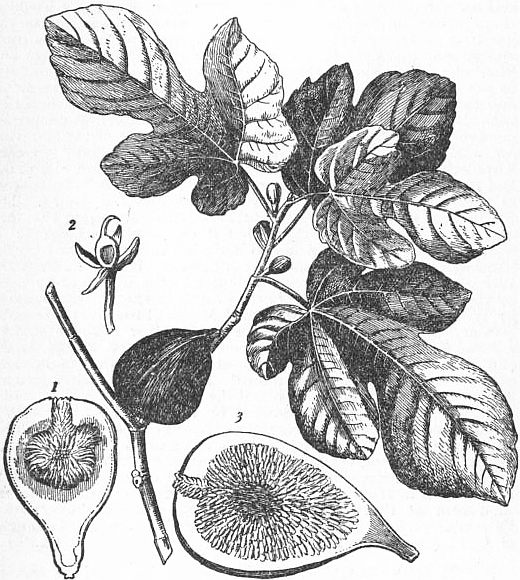
Figure 1.—Fruiting Branch of Fig, Ficus Carica; about 2⁄7 nat. size.
1. Unripe fruit cut lengthwise; about ½ nat. size. 2. Female flower taken from 1; enlarged. 3. Ripe fruit cut lengthwise; about ½ nat. size.
Ficus Carica (figure 1), which yields the well-known figs of commerce, is a bush or small tree—rarely more than 18 or 20 ft. high,—with broad, rough, deciduous leaves, very deeply lobed in the cultivated varieties, but in the wild plant sometimes nearly entire. The green, rough branches bear the solitary, nearly sessile receptacles in the axils of the leaves. The male flowers are placed chiefly in the upper part of the cavity, and in most varieties are few in number. As it ripens, the receptacle enlarges greatly, and the numerous single-seeded pericarps or true fruits become imbedded in it. The fruit of the wild fig never acquires the succulence of the cultivated kinds. The fig seems to be indigenous to Asia Minor and Syria, but now occurs in a wild state in most of the countries around the Mediterranean. From the ease with which the nutritious fruit can be preserved, it was probably one of the earliest objects of cultivation, as may be inferred from the frequent allusions to it in the Hebrew Scriptures.1 From a passage in Herodotus the fig would seem to have been unknown to the Persians in the days of the first Cyrus; but it must have spread in remote ages over all the districts around the Aegean and Levant. The Greeks are said to have received it from Caria (hence the specific name); but the fruit so improved under Hellenic culture that Attic figs became celebrated throughout the East, and special laws were made to regulate their exportation. From the contemptuous name given to informers against the violation of those enactments, συκοφάνται (σῦκον, φαίνω), our word sycophant is usually derived. The fig was one of the principal articles of sustenance among the Greeks; the Spartans especially used it largely at their public tables. From Hellas, at some prehistoric period, it was transplanted to Italy and the adjacent islands. Pliny enumerates many varieties, and alludes to those from Ebusus (the modern Iviza) as most esteemed by Roman epicures; while he describes those of home growth as furnishing a large portion of the food of the slaves, particularly those employed in agriculture, by whom great quantities were eaten in the fresh state at the periods of fig-harvest. In Latin myths the plant plays an important part. Held sacred to Bacchus, it was employed in religious ceremonies; and the fig-tree that overshadowed the twin founders of Rome in the wolf’s cave, as an emblem of the future prosperity of the race, testified to the high value set upon the fruit by the nations of antiquity. The tree is now cultivated in all the Mediterranean countries, but the larger portion of our supply of figs comes from Asia Minor, the Spanish Peninsula and the south of France. Those of Asiatic Turkey are considered the best. The varieties are extremely numerous, and the fruit is of various colours, from deep purple to yellow, or nearly white. The trees usually bear two crops,—one in the early summer from the buds of the last year, the other in the autumn from those on the spring growth; the latter forms the chief harvest. Many of the immature receptacles drop off from imperfect fertilization, which circumstance has led, from very ancient times, to the practice of caprification.2 Branches of the wild fig in flower are placed over the cultivated bushes. Certain hymenopterous insects, of the genera Blastophaga and Sycophaga, which frequent the wild fig, enter the minute orifice of the receptacle, apparently to deposit their eggs; conveying thus the pollen more completely to the stigmas, they ensure the fertilization and consequent ripening of the fruit. By some the nature of the process has been questioned, and the better maturation of the fruit attributed merely to the stimulus given by the puncture of the insect, as in the case of the apple; but the arrangement of the unisexual flowers in the fig renders the first theory the more probable. In some districts a straw or small twig is thrust into the receptacle with a similar object. When ripe the figs are picked, and spread out to dry in the sun,—those of better quality being much pulled and extended by hand during the process. Thus prepared, the fruit is packed closely in barrels, rush baskets, or wooden boxes, for commerce. The best kind, known as elemi, are shipped at Smyrna, where the pulling and packing of figs form one of the most important industries of the people.
This fruit still constitutes a large part of the food of the natives of western Asia and southern Europe, both in the fresh and dried state. A sort of cake made by mashing up the inferior kinds serves in parts of the Archipelago as a substitute for bread. Alcohol is obtained from fermented figs in some southern countries; and a kind of wine, still made from the ripe fruit, was known to the ancients, and mentioned by Pliny under the name of sycites. Medicinally the fig is employed as a gentle laxative, when eaten abundantly often proving useful in chronic constipation; it forms a part of the well-known “confection of senna.” The milky juice of the stems and leaves is very acrid, and has been used in some countries for raising blisters. The wood is porous and of little value; though a piece, saturated with oil and spread with emery, is in France a common substitute for a hone.
The fig is grown for its fresh fruit (eaten as an article of dessert) in all the milder parts of Europe, and in the United States, with protection in winter, succeeds as far north as Pennsylvania. The fig was introduced into England by Cardinal Pole, from Italy, early in the 16th century. It lives to a great age, and along the southern coast of England bears fruit abundantly as a standard; but in Scotland and in many parts of England a south wall is indispensable for its successful cultivation out of doors.
Fig trees are propagated by cuttings, which should be put into pots, and placed in a gentle hotbed. They may be obtained more speedily from layers, which should consist of two or three years old shoots, and these, when rooted, will form plants ready to bear fruit the first or second year after planting. The best soil for a fig border is a friable loam, not too rich, but well drained; a chalky subsoil is congenial to the tree, and, to correct the tendency to over-luxuriance of growth, the roots should be confined within spaces surrounded by a wall enclosing an area of about a square yard. The sandy soil of Argenteuil, near Paris, suits the fig remarkably well; but the best trees are those which grow in old quarries, where their roots are free from stagnant water, and where they are sheltered from cold, while exposed to a very hot sun, which ripens the fruit perfectly. The fig succeeds well planted in a paved court against a building with a south aspect.
The fig tree naturally produces two sets of shoots and two crops of fruit in the season. The first shoots generally show young figs in July and August, but these in the climate of England very seldom ripen, and should therefore be rubbed off. The late or midsummer shoots likewise put forth fruit-buds, which, however, do not develop themselves till the following spring; and these form the only crop of figs on which the British gardener can depend.
The fig tree grown as a standard should get very little pruning, the effect of cutting being to stimulate the buds to push shoots too vigorous for bearing. When grown against a wall, it has been recommended that a single stem should be trained to the height of a foot. Above this a shoot should be trained to the right, and another to the left; from these principals two other subdivisions should be encouraged, and trained 15 in. apart; and along these branches, at distances of about 8 in., shoots for bearing, as nearly as possible of equal vigour, should be encouraged. The bearing shoots produced along the leading branches should be trained in at full length, and in autumn every alternate one should be cut back to one eye. In the following summer the trained shoots should bear and ripen fruit, and then be cut back in autumn to one eye, while shoots from the bases of those cut back the previous autumn should be trained for succession. In this way every leading branch will be furnished alternately with bearing and successional shoots.
When protection is necessary, as it may be in severe winters, though it is too often provided in excess, spruce branches have been found to answer the purpose exceedingly well, owing to the fact that their leaves drop off gradually when the weather becomes milder in spring, and when the trees require less protection and more light and air. The principal part requiring protection is the main stem, which is more tender than the young wood.
In forcing, the fig requires more heat than the vine to bring it into leaf. It may be subjected to a temperature of 50° at night, and from 60° to 65 ° C in the day, and this should afterwards be increased to 60° and 65° by night, and 70° to 75° by day, or even higher by sun heat, giving plenty of air at the same time. In this temperature the evaporation from the leaves is very great, and this must be replaced and the wants of the swelling fruit supplied by daily watering, by syringing the foliage, and by moistening the floor, this atmospheric moisture being also necessary to keep down the red spider. When the crop begins to ripen, a moderately dry atmosphere should be maintained, with abundant ventilation when the weather permits.
The fig tree is easily cultivated in pots, and by introducing the plants into heat in succession the fruiting season may be considerably extended. The plants should be potted in turfy loam mixed with charcoal and old mortar rubbish, and in summer top-dressings of rotten manure, with manure water two or three times a week, will be beneficial. While the fruit is swelling, the pots should be plunged in a bed of fermenting leaves.
The following are a few of the best figs; those marked F, are good forcing sorts, and those marked W. suitable for walls:—
Agen: brownish-green, turbinate.
Brown Ischia, F.: chestnut-coloured, roundish-turbinate.
Brown Turkey (Lee’s Perpetual), F., W.: purplish-brown, turbinate.
Brunswick, W.: brownish-green, pyriform.
Col di Signora Bianca, F.: greenish-yellow, pyriform.
Col di Signora Nero: dark chocolate, pyriform.
Early Violet, F.: brownish-purple, roundish.
Grizzly Bourjassotte: chocolate, round.
Grosse Monstreuse de Lipari: pale chestnut, turbinate.
Negro Largo, F.: black, long pyriform.
White Ischia, F.: greenish-yellow, roundish-obovate.
White Marseilles, F., W.: pale green, roundish-obovate.
The sycamore fig, Ficus Sycomorus, is a tree of large size, with heart-shaped leaves, which, from their fancied resemblance to those of the mulberry, gave origin to the name Συκόμορος. From the deep shade cast by its spreading branches, it is a favourite tree in Egypt and Syria, being often planted along roads and near houses. It bears a sweet edible fruit, somewhat like that of the common fig, but produced in racemes on the older boughs. The apex of the fruit is sometimes removed, or an incision made in it, to induce earlier ripening. The ancients, after soaking it in water, preserved it like the common fig. The porous wood is only fit for fuel.
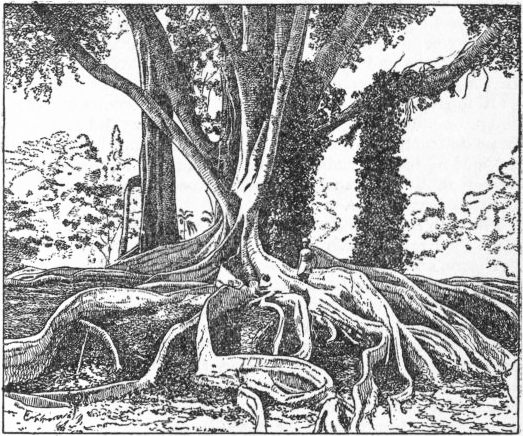
Figure 2.—India-rubber Tree, Ficus elastica, showing spreading woody roots.
The sacred fig, peepul, or bo, Ficus religiosa, a large tree with heart-shaped, long-pointed leaves on slender footstalks, is much grown in southern Asia. The leaves are used for tanning, and afford lac, and a gum resembling caoutchouc is obtained from the juice; but in India it is chiefly planted with a religious object, being regarded as sacred by both Brahmans and Buddhists. The former believe that the last avatar of Vishnu took place beneath its shade. A gigantic bo, described by Sir J. Emerson Tennent as growing near Anarajapoora, in Ceylon, is, if tradition may be trusted, one of the oldest trees in the world. It is said to have been a branch of the tree under which Gautama Buddha became endued with his divine powers, and has always been held in the greatest veneration. The figs, however, hold as important a place in the religious fables of the East as the ash in the myths of Scandinavia.
Ficus elastica, the India-rubber tree (figure 2), the large, oblong, glossy leaves, and pink buds of which are so familiar in our greenhouses, furnishes most of the caoutchouc obtained from the East Indies. It grows to a large size, and is remarkable for the snake-like roots that extend in contorted masses around the base of the trunk. The small fruit is unfit for food.
Ficus bengalensis, or the Banyan, wild in parts of northern India, but generally planted throughout the country, has a woody stem, branching to a height of 70 to 100 ft. and of vast extent with heart-shaped entire leaves terminating in acute points. Every branch from the main body throws out its own roots, at first in small tender fibres, several yards from the ground; but these continually grow thicker until they reach the surface, when they strike in, increase to large trunks, and become parent trees, shooting out new branches from the top, which again in time suspend their roots, and these, swelling into trunks, produce other branches, the growth continuing as long as the earth contributes her sustenance. On the bank’s of the Nerbudda stood a celebrated tree of this kind, which is supposed to be that described by Nearchus, the admiral of Alexander the Great. This tree once covered an area so immense, that it was known to shelter no fewer than 7000 men, and though much reduced in size by the destructive power of the floods, the remainder was described by James Forbes (1749-1819), in his Oriental Memoirs (1813-1815) as nearly 2000 ft. in circumference, while the trunks large and small exceeded 3000 in number. The tree usually grows from seeds dropped by birds on other trees. The leaf-axil of a palm forms a frequent receptacle for their growth, the palm becoming ultimately strangled by the growth of the fig, which by this time has developed numerous daughter stems which continue to expand and cover ultimately a large area. The famous tree in the Royal Botanic Gardens, Calcutta, began its growth at the end of the 18th century on a sacred date-palm. In 1907 it had nearly 250 aerial roots, the parent trunk was 42 ft. in girth, and its leafy crown had a circumference of 857 ft.; and it was still growing vigorously. Both this tree and F. religiosa cause destruction to buildings, especially in Bengal, from seeds dropped by birds germinating on the walls. The tree yields an inferior rubber, and a coarse rope is prepared from the bark and from the aerial roots.
1 Of these the case of the Barren Fig-tree (Mark. xi. 12-14, 20-21: compare Matt. xxi. 18-20), which Jesus cursed and which then withered away, has been much discussed among theologians. The difficulty is in Mark xi. 13: “And seeing a fig-tree afar off having leaves, he came, if haply he might find anything thereon; and when he came to it he found nothing but leaves, for the time of figs was not yet.” These last words obviously raise the question whether the expectation of Jesus of finding figs, and his cursing of the tree on finding none, were not unreasonable. Many ingenious solutions have been propounded, by suggested emendations of the text and otherwise, for which consult M’Clintock and Strong’s Cyclopaedia of Biblical Literature (sub “Fig”) and the Encyclopaedia Biblica (“Fig-tree”); the former demurs to the unreasonableness, and contends that the appearance of the leaves at this season (March) indicated a pretentious precocity in this particular fig-tree, so that Jesus was entitled to expect that it would also have fruit, even though the season had not arrived; the Ency. Biblica, on the other hand, supposes that some “early Christian,” confounding parable with history, has misunderstood the parable in Luke xiii. 6-9, and, forgetting that the season was not one for figs, has transformed it here into the narrative of an act of Jesus. The probability seems to be that the words “for the time of figs was not yet” are an unintelligent gloss by an early reader, which has made its way into the text. For authorities see the works mentioned above.
2 From Lat. caprificus, a wild fig; O. Eng. caprifig.
FIGARO, a famous dramatic character first introduced on the stage by Beaumarchais in the Barbier de Séville, the Mariage de Figaro, and the Folle Journée. The name is said to be an old Spanish and Italian word for a wigmaker, connected with the verb cigarrar, to roll in paper. Many of the traits of the character are to be found in earlier comic types of the Roman and Italian stage, but as a whole the conception was marked by great originality; and Figaro soon, seized the popular imagination, and became the recognized representative of daring, clever and nonchalant roguery and intrigue. Almost immediately after its appearance, Mozart chose the Marriage of Figaro as the subject of an opera, and the Barber of Seville was treated first by Paisiello, and afterwards in 1816 by Rossini. In 1826 the name of the witty rogue was taken by a journal which continued till 1833 to be one of the principal Parisian periodicals, numbering among its contributors such men as Jules Janin, Paul Lacroix, Léon Gozlan, Alphonse Karr, Dr Veron, Jules Sandeau and George Sand. Various abortive attempts were made to restore the Figaro during the next twenty years; and in 1854 the efforts of M. de Villemessant were crowned with success (see Newspapers: France).
See Marc Monnier, Les Aieux de Figaro (1868); H. de Villemessant, Mémoires d’un journaliste (1867).
FIGEAC, a town of south-western France, capital of an arrondissement in the department of Lot, 47 m. E.N.E. of Cahors on the Orléans railway. Pop. (1906) 4330. It is enclosed by an amphitheatre of wooded and vine-clad hills, on the right bank of the Célé, which is here crossed by an old bridge. It is ill-built and the streets are narrow and dirty; on the outskirts shady boulevards have taken the place of the ramparts by which it was surrounded. The town is very rich in old houses of the 13th and 14th centuries; among them may be mentioned the Hôtel de Balène, of the 14th century, used as a prison. Another house, dating from the 15th century, was the birthplace of the Egyptologist J.F. Champollion, in memory of whom the town has erected an obelisk. The principal church is that of St Sauveur, which once belonged to the abbey of Figeac. It was built at the beginning of the 12th century, but restored later; the façade in particular is modern. Notre-Dame du Puy, in the highest part of the town, belongs to the 12th and 13th centuries. It has no transept and its aisles extend completely round the interior. The altar-screen is a fine example of carved woodwork of the end of the 17th century. Of the four obelisks which used to mark the limits of the authority of the abbots of Figeac, those to the south and the west of the town remain. Figeac is the seat of a subprefect and has a tribunal of first instance, and a communal college. Brewing, tanning, printing, cloth-weaving and the manufacture of agricultural implements are among the industries. Trade is in cattle, leather, wool, plums, walnuts and grain, and there are zinc mines in the neighbourhood.
Figeac grew up round an abbey founded by Pippin the Short in the 8th century, and throughout the middle ages it was the property of the monks. At the end of the 16th century the lordship was acquired by King Henry IV.’s minister, the duke of Sully, who sold it to Louis XIII. in 1622.
FIGUEIRA DA FOZ, or Figueira, a seaport of central Portugal, in the district of Coimbra, formerly included in the province of Beira; on the north bank of the river Mondego, at its mouth, and at the terminus of the Lisbon-Figueira and Guarda-Figueira railways. Pop. (1900) 6221. Figueira da Foz is an important fishing-station, and one of the headquarters of the coasting trade in grain, fruit, wine, olive oil, cork and coal; but owing to the bar at the mouth of the Mondego large ships cannot enter. Glass is manufactured, and the city attracts many visitors by its excellent climate and sea-bathing. A residential suburb, the Bairro Novo, exists chiefly for their accommodation, to the north-west of the old town. Figueira is connected by a tramway running 4 m. N. W. with Buarcos (pop. 5033) and with the coal-mines of Cape Mondego. Lavos (pop. 7939), on the south bank of the Mondego, was the principal landing-place of the British troops which came, in 1808, to take part in the Peninsular War. Figueira da Foz received the title and privileges of city by a decree dated the 20th of September 1882.
FIGUERAS, a town of north-eastern Spain, in the province of Gerona, 14 m. S. of the French frontier, on the Barcelona-Perpignan railway. Pop. (1900) 10,714. Figueras is built at the foot of the Pyrenees, and on the northern edge of El Ampurdan, a fertile and well-irrigated plain, which produces wine, olives and rice, and derives its name from the seaport of Ampurias, the ancient Emporiae. The castle of San Fernando, 1 m. N.W., is an irregular pentagonal structure, built by order of Ferdinand VI. (1746-1759), on the site of a Capuchin convent. Owing to its situation, and the rocky nature of the ground over which a besieger must advance, it is still serviceable as the key to the frontier. It affords accommodation for 16,000 men and is well provided with bomb-proof cover. In 1794 Figueras was surrendered to the French, but it was regained in 1795. During the Peninsular War it was taken by the French in 1808, recaptured by the Spaniards in 1811, and retaken by the French in the same year. In 1823, after a long defence, it was once more captured by the French. An annual pilgrimage from Figueras to the chapel of Nuestra Señora de Requesens, 15 m. N., commemorates the deliverance of the town from a severe epidemic of fever in 1612.
FIGULUS, PUBLIUS NIGIDIUS (c. 98-45 B.C.), Roman savant, next to Varro the most learned Roman of the age. He was a friend of Cicero, to whom he gave his support at the time of the Catilinarian conspiracy (Plutarch, Cicero, 20; Cicero, Pro Sulla, xiv. 42). In 58 he was praetor, sided with Pompey in the Civil War, and after his defeat was banished by Caesar, and died in exile. According to Cicero (Timaeus, 1), Figulus endeavoured with some success to revive the doctrines of Pythagoreanism. With this was included mathematics, astronomy and astrology, and even the magic arts. According to Suetonius (Augustus, 94) he foretold the greatness of the future emperor on the day of his birth, and Apuleius (Apologia, 42) records that, by the employment of “magic boys” (magici pueri), he helped to find a sum of money that had been lost. Jerome (the authority for the date of his death) calls him Pythagoricus et magus. The abstruse nature of his studies, the mystical character of his writings, and the general indifference of the Romans to such subjects, caused his works to be soon forgotten. Amongst his scientific, theological and grammatical works mention may be made of De diis, containing an examination of various cults and ceremonials; treatises on divination and the interpretation of dreams; on the sphere, the winds and animals. His Commentarii grammatici in at least 29 books was an ill-arranged collection of linguistic, grammatical and antiquarian notes. In these he expressed the opinion that the meaning of words was natural, not fixed by man. He paid especial attention to orthography, and sought to differentiate the meanings of cases of like ending by distinctive marks (the apex to indicate a long vowel is attributed to him). In etymology he endeavoured to find a Roman explanation of words where possible (according to him frater was = fere alter). Quintilian (Instit. orat. xi, 3. 143) speaks of a rhetorical treatise De gestu by him.
See Cicero, Ad Fam. iv. 13; scholiast on Lucan i. 639; several references in Aulus Gellius; Teuffel, Hist. of Roman Literature, 170; M. Hertz, De N.F. studiis atque operibus (1845); Quaestiones Nigidianae (1890), and edition of the fragments (1889) by A. Swoboda.
FIGURATE NUMBERS, in mathematics. If we take the sum of n terms of the series 1 + 1 + 1 + ..., i.e. n, as the nth term of a new series, we obtain the series 1 + 2 + 3 + ..., the sum of n terms of which is ½n · n + 1. Taking this sum as the nth term, we obtain the series 1 + 3 + 6 + 10 + ..., which has for the sum of n terms n (n + 1) (n + 2) / 3!1 This sum is taken as the nth term of the next series, and proceeding in this way we obtain series having the following nth terms:—
1, n, n(n + 1)/2!, n(n + 1)(n + 2)/3!, ...n(n+1) ...(n + r − 2)/(r − 1)!.
The numbers obtained by giving n any value in these expressions are of the first, second, third, ... or rth order of figurate numbers.
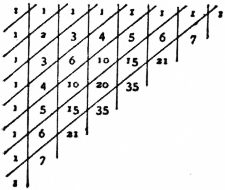
Pascal treated these numbers in his Traité du triangle arithmetique (1665), using them to develop a theory of combinations and to solve problems in probability. His table is here shown in its simplest form. It is to be noticed that each number is the sum of the numbers immediately above and to the left of it; and that the numbers along a line, termed a base, which cuts off an equal number of units along the top row and column are the coefficients in the binomial expansion of (1 + x)r−1, where r represents the number of units cut off.
1 The notation n! denotes the product 1 · 2 · 3 · ... n, and is termed “factorial n.”
FIJI (Viti), a British colony consisting of an archipelago in the Pacific Ocean, the most important in Polynesia, between 15° and 20° S., and on and about the meridian of 180°. The islands number about 250, of which some 80 are inhabited. The total land area is 7435 sq. m. (thus roughly equalling that of Wales), and the population is about 121,000. The principal island is Viti Levu, 98 m. in length (E. to W.) and 67 in extreme breadth, with an area of 4112 sq. m. Forty miles N.E. lies Vanua Levu, measuring 117 m. by 30, with an area of 2432 sq. m. Close off the south-eastern shore of Vanua Levu is Taviuni, 26 m. in length by 10 in breadth; Kandavu or Kadavu, 36 m. long and very narrow, is 41 m. S. of Viti Levu, and the three other main islands, lying east of Viti Levu in the Koro Sea, are Koro, Ngau or Gau, and Ovalau. South-east from Vanua Levu a loop of islets extends nearly to 20° S., enclosing the Koro Sea. North-west of Viti Levu lies another chain, the Yasawa or western group; and, finally, the colony includes the island of Rotumah (q.v.), 300 m. N.W. by N. of Vanua Levu.
The formation of the larger islands is volcanic, their surface rugged, their vegetation luxuriant, and their appearance very beautiful; their hills rise often above 3000, and, in the case of a few summits, above 4000 ft., and they contrast strongly with the low coral formation of the smaller members of the group. There is not much level country, except in the coral islets, and certain rich tracts along the coasts of the two large islands, especially near the mouths of the rivers. The large islands have a considerable extent of undulating country, dry and open on their lee sides. Streams and rivers are abundant, the latter very large in proportion to the size of the islands, affording a waterway to the rich districts along their banks. These and the extensive mud flats and deltas at their mouths are often flooded, by which their fertility is increased, though at a heavy cost to the cultivator. The Rewa, debouching through a wide delta at the south-east of Viti Levu, is navigable for small vessels for 40 m. There are also in this island the Navua and Sigatoka (flowing S.), the Nandi (W.), and the Ba (N.W.). The Dreketi, flowing W., is the chief stream of Vanua Levu. It breaches the mountains in a fine valley; for this island consists practically of one long range, whereas the main valleys and ranges separating them in Viti Levu radiate for the most part from a common centre. With few exceptions the islands are surrounded by barriers of coral, broken by openings opposite the mouths of streams. Viti Levu is the most important island not only from its size, but from its fertility, variety of surface, and population, which is over one-third of that of the whole group. The town of Suva lies on an excellent harbour at the south-east of the island, and has been the capital of the colony since 1882, containing the government buildings and other offices. Vanua Levu is less fertile than Viti Levu; it has good anchorages along its entire southern coast. Of the other islands, Taviuni, remarkable for a lake (presumably a crater-lake) at the top of its lofty central ridge, is fertile, but exceptionally devoid of harbours; whereas the well-timbered island of Kandavu has an excellent one. On the eastern shore of Ovalau, an island which contains in a small area a remarkable series of gorge-like valleys between commanding hills, is the town of Levuka, the capital until 1882. It stands partly upon the narrow shore, and partly climbs the rocky slope behind. The chief islands on the west of the chain enclosing the Koro Sea are Koro, Ngau, Moala and Totoya, all productive, affording good anchorage, elevated and picturesque. The eastern islands of the chain are smaller and more numerous, Vanua Batevu (one of the Exploring Group) being a centre of trade. Among others, Mago is remarkable for a subterranean outlet of the waters of the fertile valley in its midst.
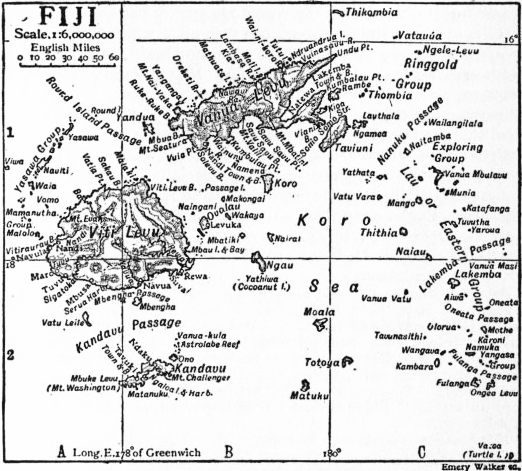
The land is of recent geological formation, the principal ranges being composed of igneous rock, and showing traces of much volcanic disturbance. There are boiling springs in Vanua Levu and Ngau, and slight shocks of earthquake are occasionally felt. The tops of many of the mountains, from Kandavu in the S.W., through Nairai and Koro, to the Ringgold group in the N.E., have distinct craters, but their activity has long ceased. The various decomposing volcanic rocks—tufas, conglomerates and basalts—mingled with decayed vegetable matter, and abundantly watered, form a very fertile soil. Most of the high peaks on the larger islands are basaltic, and the rocks generally are igneous, with occasional upheaved coral found sometimes over 1000 ft. above the sea; but certain sedimentary rocks observed on Viti Levu seem to imply a nucleus of land of considerable age. Volcanic activity in the neighbourhood is further shown by the quantities of pumice-stone drifted on to the south coasts of Kandavu and Viti Levu; malachite, antimony and graphite, gold in small quantities, and specular iron-sand occur.
Climate.—The colony is beyond the limits of the perpetual S.E. trades, while not within the range of the N.W. monsoons. From April to November the winds are steady between S.E. and E.N.E., and the climate is cool and dry, after which the weather becomes uncertain and the winds often northerly, this being the wet warm season. In February and March heavy gales are frequent, and hurricanes sometimes occur, causing scarcity by destroying the crops. The rainfall is much greater on the windward than on the lee sides of the islands (about 110 in. at Suva), but the mean temperature is much the same, viz., about 80° F. In the hills the temperature sometimes falls below 50°. The climate, especially from November to April, is somewhat enervating to the Englishman, but not unhealthy. Fevers are hardly known. Dysentery, which is common, and the most serious disease in the islands, is said to have been unknown before the advent of Europeans.
Fauna.—Besides the dog and the pig, which (with the domestic fowl) must have been introduced in early times, the only land mammals are certain species of rats and bats. Insects are numerous, but the species few. Bees have been introduced. The avifauna is not remarkable. Birds of prey are few; the parrot and pigeon tribes are better represented. Fishes, of an Indo-Malay type, are numerous and varied; Mollusca, especially marine, and Crustaceae are also very numerous. These three form an important element in the food supply.