VOLUME X SLICE III Fenton, Edward to Finistere (continued 5)
Reading edition
During the troubles of 1848-1849 Feuerbach’s attack upon orthodoxy made him something of a hero with the revolutionary party; but he never threw himself into the political movement, and indeed had not the qualities of a popular leader. During the period of the diet of Frankfort he had given public lectures on religion at Heidelberg. When the diet closed he withdrew to Bruckberg and occupied himself partly with scientific study, partly with the composition of his Theogonie (1857). In 1860 he was compelled by the failure of the porcelain factory to leave Bruckberg, and he would have suffered the extremity of want but for the assistance of friends supplemented by a public subscription. His last book, Gottheit, Freiheit und Unsterblichkeit, appeared in 1866 (2nd ed., 1890). After a long period of decay he died on the 13th of September 1872.
Feuerbach’s influence has been greatest upon the anti-Christian theologians such as D.F. Strauss, the author of the Leben Jesu, and Bruno Bauer, who like Feuerbach himself had passed over from Hegelianism to a form of naturalism. But many of his ideas were taken up by those who, like Arnold Ruge, had entered into the struggle between church and state in Germany, and those who, like F. Engels and Karl Marx, were leaders in the revolt of labour against the power of capital. His work was too deliberately unsystematic (“keine Philosophie ist meine Philosophie”) ever to make him a power in philosophy. He expressed in an eager, disjointed, but condensed and laboured fashion, certain deep-lying convictions—that philosophy must come back from unsubstantial metaphysics to the solid facts of human nature and natural science, that the human body was no less important than the human spirit (“Der Mensch ist was er isst”) and that Christianity was utterly out of harmony with the age. His convictions gained weight from the simplicity, uprightness and diligence of his character; but they need a more effective justification than he was able to give them.
His works appeared in 10 vols. (Leipzig, 1846-1866); his correspondence has been edited with an indifferent biography by Karl Grün (1874). See A. Lévy, La Philosophie de Feuerbach (1904); M. Meyer, L. Feuerbach’s Moralphilosophie (Berlin, 1899); E. v. Hartmann, Geschichte d. Metaphysik (Leipzig, 1899-1900), ii. 437-444: F. Engels, L. Feuerbach und d. Ausgang d. class, deutsch. Philos. (2nd ed., 1895).
(H. St.)
FEUERBACH, PAUL JOHANN ANSELM, Ritter von (1775-1833), German jurist and writer on criminal law, was born at Hainichen near Jena on the 14th of November 1775. He received his early education at Frankfort on Main, whither his family had removed soon after his birth. At the age of sixteen, however, he ran away from home, and, going to Jena, was helped by relations there to study at the university. In spite of poor health and the most desperate poverty, he made rapid progress. He attended the lectures of Karl Leonhard Reinhold and Gottlieb Hufeland, and soon published some literary essays of more than ordinary merit. In 1795 he took the degree of doctor in philosophy, and in the same year, though he only possessed 150 thalers (£22 : 10s.), he married. It was this step which led him to success and fame, by forcing him to turn from his favourite studies of philosophy and history to that of law, which was repugnant to him, but which offered a prospect of more rapid advancement. His success in this new and uncongenial sphere was soon assured. In 1796 he published Kritik des natürlichen Rechts als Propädeutik zu einer Wissenschaft der natürlichen Rechte, which was followed, in 1798, by Anti-Hobbes, oder über die Grenzen der bürgerlichen Gewalt, a dissertation on the limits of the civil power and the right of resistance on the part of subjects against their rulers, and by Philosophische, juristische Untersuchungen über das Verbrechen des Hochverraths. In 1799 he obtained the degree of doctor of laws. Feuerbach, as the founder of a new theory of penal law, the so-called “psychological-coercive or intimidation theory,” occupied a prominent place in the history of criminal science. His views, which he first made known in his Revision der Grundsätze und Grundbegriffe des positiven peinlichen Rechts (1799), were further elucidated and expounded in the Bibliothek für die peinliche Rechtswissenschaft (1800-1801), an encyclopaedic work produced in conjunction with Karl L.W.G. Grolmann and Ludwig Harscher von Almendingen, and in his famous Lehrbuch des gemeinen in Deutschland geltenden peinlichen Rechts (1801). These works were a powerful protest against vindictive punishment, and did much towards the reformation of the German criminal law. The Carolina (the penal code of the emperor Charles V.) had long since ceased to be respected. What in 1532 was an inestimable blessing, as a check upon the arbitrariness and violence of the effete German procedure, had in the course of time outlived its usefulness and become a source of evils similar to those it was enacted to combat. It availed nothing that, at the commencement of the 18th century, a freer and more scientific spirit had been breathed into Roman law; it failed to reach the criminal law. The administration of justice was, before Feuerbach’s time, especially distinguished by two characteristics: the superiority of the judge to all law, and the blending of the judicial and executive offices, with the result that the individual was practically at the mercy of his prosecutors. This state of things Feuerbach set himself to reform, and using as his chief weapon the Revision der Grundbegriffe above referred to, was successful in his task. His achievement in the struggle may be summed up as: nullum crimen, nulla poena sine lege (no wrong and no punishment without a remedy). In 1801 Feuerbach was appointed extraordinary professor of law without salary, at the university of Jena, and in the following year accepted a chair at Kiel, where he remained two years. In 1804 he removed to the university of Landshut; but on being commanded by King Maximilian Joseph to draft a penal code for Bavaria (Strafgesetzbuch für das Königreich Bayern), he removed in 1805 to Munich, where he was given a high appointment in the ministry of justice and was ennobled in 1808. Meanwhile the practical reform of penal legislation in Bavaria was begun under his influence in 1806 by the abolition of torture. In 1808 appeared the first volume of his Merkwürdige Criminalfälle, completed in 1811—a work of deep interest for its application of psychological considerations to cases Of crime, and intended to illustrate the inevitable imperfection of human laws in their application to individuals. In his Betrachtungen über das Geschworenengericht (1811) Feuerbach declared against trial by jury, maintaining that the verdict of a jury was not adequate legal proof of a crime. Much controversy was aroused on the subject, and the author’s view was subsequently to some extent modified. The result of his labours was promulgated in 1813 as the Bavarian penal code. The influence of this code, the embodiment of Feuerbach’s enlightened views, was immense. It was at once made the basis for new codes in Württemberg and Saxe-Weimar; it was adopted in its entirety in the grand-duchy of Oldenburg; and it was translated into Swedish by order of the king. Several of the Swiss cantons reformed their codes in conformity with it. Feuerbach had also undertaken to prepare a civil code for Bavaria, to be founded on the Code Napoléon. This was afterwards set aside, and the Codex Maximilianus adopted as a basis. But the project did not become law. During the war of liberation (1813-1814) Feuerbach showed himself an ardent patriot, and published several political brochures which, from the writer’s position, had almost the weight of state manifestoes. One of these is entitled Über deutsche Freiheit und Vertretung deutsche Volker durch Landstände (1514). In 1814 Feuerbach was appointed second president of the court of appeal at Bamberg, and three years later he became first president of the court of appeal at Anspach. In 1821 he was deputed by the government to visit France, Belgium, and the Rhine provinces for the purpose of investigating their juridical institutions. As the fruit of this visit, he published his treatises Betrachtungen über Öffentlichkeit und Mündigkeit der Gerechtigkeitspflege (1821) and Über die Gerichtsverfassung und das gerichtliche Verfahren Frankreichs (1825). In these he pleaded unconditionally for publicity in all legal proceedings. In his later years he took a deep interest in the fate of the strange foundling Kaspar Hauser (q.v.), which had excited so much attention in Europe; and he was the first to publish a critical summary of the ascertained facts, under the title of Kaspar Hauser, ein Beispiel eines Verbrechens am Seelenleben (1832). Shortly before his death appeared a collection of his Kleine Schriften (1833). Feuerbach, still in the full enjoyment of his intellectual powers, died suddenly at Frankfort, while on his way to the baths of Schwalbach, on the 29th of May 1833. In 1853 was published the Leben und Wirken Ans. von Feuerbachs, 2 vols., consisting of a selection of his letters and journals, with occasional notes by his fourth son Ludwig, the distinguished philosopher.
See also, for an estimate of Feuerbach’s life and work, Marquardtsen, in Allgemeine deutsche Biographie, vol. vi.; and an “in memoriam” notice in Die allgemeine Zeitung (Augsburg), 15th Nov. 1875, by Professor Dr Karl Binding of Leipzig University.
FEUILLANTS, CLUB OF THE, a political association which played a prominent part during the French Revolution. It was founded on the 16th of July 1791 by several members of the Jacobin Club, who refused to sign a petition presented by this body, demanding the deposition of Louis XVI. Among the dissident members were B. Barère; and E.J. Sieyès, who were later joined by other politicians, among them being Dupont de Nemours. The name of Feuillants was popularly given to this group of men, because they met in the fine buildings which had been occupied by the religious order bearing this name, in the rue Saint-Honoré, near the Place Vendôme, in Paris. The members of the club preserved the title of Amis de la Constitution, as being a sufficient indication of the line they intended to pursue. This consisted in opposing everything not contained in the Constitution; in their opinion, the latter was in need of no modification, and they hated alike all those who were opposed to it, whether émigrés or Jacobins; they affected to avoid all political discussion, and called themselves merely a “conservative assembly.”
This attitude they maintained after the Constituent Assembly had been succeeded by the Legislative, but not many of the new deputies became members of the club. With the rapid growth of extreme democratic ideas the Feuillants soon began to be looked upon as reactionaries, and to be classed with “aristocrats.” They did, indeed, represent the aristocracy of wealth, for they had to pay a subscription of four louis, a large sum at that time, besides six livres for attendance. Moreover, the luxury with which they surrounded themselves, and the restaurant which they had annexed to their club, seemed to mock the misery of the half-starved proletariat, and added to the suspicion with which they were viewed, especially after the popular triumphs of the 20th of June and the 10th of August 1792 (see French Revolution). A few days after the insurrection of the 10th of August, the papers of the Feuillants were seized, and a list was published containing the names of 841 members proclaimed as suspects. This was the death-blow of the club. It had made an attempt, though a weak one, to oppose the forward march of the Revolution, but, unlike the Jacobins, had never sent out branches into the provinces. The name of Feuillants, as a party designation, survived the club. It was applied to those who advocated a policy of “cowardly moderation,” and feuillantisme was associated with aristocratie in the mouths of the sansculottes.
The act of separation of the Feuillants from the Jacobins was published in a pamphlet dated the 16th of July 1791, beginning with the words, Les Membres de l’assemblée nationale ... (Paris, 1791). The statutes of the club were also published in Paris. See also A. Aulard, Histoire politique de la Révolution française (Paris, 1903), 2nd ed., p. 153.
FEUILLET, OCTAVE (1821-1890), French novelist and dramatist, was born at Saint-Lô, Manche, on the 11th of August 1821. He was the son of a Norman gentleman of learning and distinction, who would have played a great part in politics “sans ses diables de nerfs,” as Guizot said. This nervous excitability was inherited, though not to the same excess, by Octave, whose mother died in his infancy and left him to the care of the hyper-sensitive invalid. The boy was sent to the lycée Louis-le Grand, in Paris, where he achieved high distinction, and was destined for the diplomatic service. In 1840 he appeared before his father at Saint-Lô, and announced that he had determined to adopt the profession of literature. There was a stormy scene, and the elder Feuillet cut off his son, who returned to Paris and lived as best he could by a scanty journalism. In company with Paul Bocage he began to write for the stage, and not without success; at all events, he continued to exist until, three years after the quarrel, his father consented to forgive him. Enjoying a liberal allowance, he now lived in Paris in comfort and independence, and he published his early novels, none of which is quite of sufficient value to retain the modern reader. The health and spirits of the elder M. Feuillet, however, having still further declined, he summoned his son to leave Paris and bury himself as his constant attendant in the melancholy château at Saint-Lô. This was to demand a great sacrifice, but Octave Feuillet cheerfully obeyed the summons. In 1851 he married his cousin, Mlle Valérie Feuillet, who helped him to endure the mournful captivity to which his filial duty bound him. Strangely enough, in this exile—rendered still more irksome by his father’s mania for solitude and by his tyrannical temper—the genius of Octave Feuillet developed. His first definite success was gained in the year 1852, when he published the novel Bellah and produced the comedy La Crise. Both were reprinted from the Revue des deux mondes, where many of his later novels also appeared. He wrote books which have long held their place, La Petite Comtesse (1857), Dalila (1857), and in particular that universal favourite, Le Roman d’un jeune homme pauvre (1858). He himself fell into a nervous state in his “prison,” but he was sustained by the devotion and intelligence of his wife and her mother. In 1857, having been persuaded to make a play of the novel of Dalila, he brought out this piece at the Vaudeville, and enjoyed a brilliant success; on this occasion he positively broke through the consigne and went up to Paris to see his play rehearsed. His father bore the shock of his temporary absence, and the following year Octave ventured to make the same experiment on occasion of the performance of Un Jeune Homme pauvre. To his infinite chagrin, during this brief absence his father died. Octave was now, however, free, and the family immediately moved to Paris, where they took part in the splendid social existence of the Second Empire. The elegant and distinguished young novelist became a favourite at court; his pieces were performed at Compiègne before they were given to the public, and on one occasion the empress Eugénie deigned to play the part of Mme de Pons in Les Portraits de la Marquise. Feuillet did not abandon the novel, and in 1862 he achieved a great success with Sibylle. His health, however, had by this time begun to decline, affected by the sad death of his eldest son. He determined to quit Paris, where the life was far too exciting for his nerves, and to regain the quietude of Normandy. The old château of the family had been sold, but he bought a house called “Les Paillers” in the suburbs of Saint-Lô, and there he lived, buried in his roses, for fifteen years. He was elected to the French Academy in 1862, and in 1868 he was made librarian of Fontainebleau palace, where he had to reside for a month or two in each year. In 1867 he produced his masterpiece of Monsieur de Camors, and in 1872 he wrote Julia de Tréœur, which is hardly less admirable. His last years, after the sale of “Les Paillers,” were passed in a ceaseless wandering, the result of the agitation of his nerves. He was broken by sorrow and by ill-health, and when he passed away in Paris on the 29th of December 1890, his death was a release. His last book was Honneur d’artiste (1890). Among the too-numerous writings of Feuillet, the novels have lasted longer than the dramas; of the former three or four seem destined to retain their charm as classics. He holds a place midway between the romanticists and the realists, with a distinguished and lucid portraiture of life which is entirely his own. He drew the women of the world whom he saw around him with dignity, with indulgence, with extraordinary penetration and clairvoyance. There is little description in his novels, which sometimes seem to move on an almost bare and colourless stage, but, on the other hand, the analysis of motives, of emotions, and of “the fine shades” has rarely been carried further. Few have written French with greater purity than Feuillet, and his style, reserved in form and never excessive in ornament, but full of wit and delicate animation, is in admirable uniformity with his subjects and his treatment. It is probably in Sibylle and in Julia de Trécœur that he can now be studied to most advantage, though Monsieur de Camors gives a greater sense of power, and though Le Roman d’un jeune homme pauvre still preserves its popularity.
See also Sainte-Beuve, Nouveaux Lundis, vol. v.; F. Brunetière, Nouveaux Essais sur la littérature contemporaine (1895).
(E. G.)
FEUILLETON (a diminutive of the Fr. feuillet, the leaf of a book), originally a kind of supplement attached to the political portion of French newspapers. Its inventor was Bertin the elder, editor of the Débats. It was not usually printed on a separate sheet, but merely separated from the political part of the newspaper by a line, and printed in smaller type. In French newspapers it consists chiefly of non-political news and gossip, literature and art criticism, a chronicle of the fashions, and epigrams, charades and other literary trifles; and its general characteristics are lightness, grace and sparkle. The feuilleton in its French sense has never been adopted by English newspapers, though in various modern journals (in the United States especially) the sort of matter represented by it is now included. But the term itself has come into English use to indicate the instalment of a serial story printed in one part of a newspaper.
FEUQUIÈRES, ISAAC MANASSÈS DE PAS, Marquis de (1590-1640), French soldier, came of a distinguished family of which many members held high command in the civil wars of the 16th century. He entered the Royal army at the age of thirty, and soon achieved distinction. In 1626 he served in the Valtelline, and in 1628-1629 at the celebrated siege of La Rochelle, where he was taken prisoner. In 1629 he was made Maréchal de Camp, and served in the fighting on the southern frontiers of France. After occupying various military positions in Lorraine, he was sent as an ambassador into Germany, where he rendered important services in negotiations with Wallenstein. In 1636 he commanded the French corps operating with the duke of Weimar’s forces (afterwards Turenne’s “Army of Weimar”). With these troops he served in the campaigns of 1637 (in which he became lieutenant-general), 1638 and 1639. At the siege of Thionville (Diedenhofen) he received a mortal wound. His lettres inédites appeared (ed. Gallois) in Paris in 1845.
His son Antoine Manassès de Pas, Marquis de Feuquières (1648-1711), was born at Paris in 1648, and entered the army at the age of eighteen. His conduct at the siege of Lille in 1667, where he was wounded, won him promotion to the rank of captain. In the campaigns of 1672 and 1673 he served on the staff of Marshal Luxemburg, and at the siege of Oudenarde in the following year the king gave him command of the Royal Marine regiment, which he held until he obtained a regiment of his own in 1676. In 1688 he served as a brigadier at the siege of Philipsburg, and afterwards led a ravaging expedition into south Germany, where he acquired much booty. Promoted Maréchal de Camp, he served under Catinat against the Waldenses, and in the course of the war won the nickname of the “Wizard.” In 1692 he made a brilliant defence of Speierbach against greatly superior forces, and was rewarded with the rank of lieutenant-general. He bore a distinguished part in Luxemburg’s great victory of Neerwinden or Landen in 1693. Marshal Villeroi impressed him less favourably than his old commander Luxemburg, and the resumption of war in 1701 found him in disfavour in consequence. The rest of his life, embittered by the refusal of the marshal’s baton, he spent in compiling his celebrated memoirs, which, coloured as they were by the personal animosities of the writer, were yet considered by Frederick the Great and the soldiers of the 18th century as the standard work on the art of war as a whole. He died in 1711. The Mémoires sur la guerre appeared in the same year and new editions were frequently published (Paris 1711, 1725, 1735, &c., London 1736, Amsterdam subsequently). An English version appeared in London 1737, under the title Memoirs of the Marquis de Feuquières, and a German translation (Feuquières geheime Nachrichten) at Leipzig 1732, 1738, and Berlin 1786. They deal in detail with every branch of the art of war and of military service.
FÉVAL, PAUL HENRI CORENTIN (1817-1887), French novelist and dramatist, was born on the 27th of September 1817, at Rennes in Brittany, and much of his best work deals with the history of his native province. He was educated for the bar, but after his first brief he went to Paris, where he gained a footing by the publication of his “Club des phoques” (1841) in the Revue de Paris. The Mystères de Londres (1844), in which an Irishman tries to avenge the wrongs of his countrymen by seeking the annihilation of England, was published under the ingenious pseudonym “Sir Francis Trolopp.” Others of his novels are: Le Fils du diable (1846); Les Compagnons du silence (1857); Le Bossu (1858); Le Poisson d’or (1863); Les Habits noirs (1863); Jean le diable (1868), and Les Compagnons du trésor (1872). Some of his novels were dramatized, Le Bossu (1863), in which he had M. Victorien Sardou for a collaborator, being especially successful in dramatic form. His chronicles of crime exercised an evil influence, eventually recognized by the author himself. In his later years he became an ardent Catholic, and occupied himself in revising his earlier works from his new standpoint and in writing religious pamphlets. Reverses of fortune and consequent overwork undermined his mental and bodily health, and he died of paralysis in the monastery of the Brothers of Saint John in Paris on the 8th of March 1887.
His son, Paul Féval (1860- ), became well known as a novelist and dramatist. Among his works are Nouvelles (1890), Maria Laura (1891), and Chantepie (1896).
FEVER (Lat. febris, connected with fervere, to burn), a term generally used to include all conditions in which the normal temperature of the animal body is markedly exceeded for any length of time. When the temperature reaches as high a point as 106° F. the term hyperpyrexia (excessive fever) is applied, and is regarded as indicating a condition of danger; while, if it exceeds 107° or 108° for any length of time, death almost always results. The diseases which are called specific fevers, because of its being a predominant factor in them, are discussed separately under their ordinary names. Occasionally in certain specific fevers and febrile diseases the temperature may attain the elevation of 110°-112° prior to the fatal issue. For the treatment of fever in general, see Therapeutics.
Pathology.—Every rise of temperature is due to a disturbance in the heat-regulating mechanism, the chief variable in which is the action of the skin in eliminating heat (see Animal Heat). Although for all practical purposes this mechanism works satisfactorily, it is not by any means perfect, and many physiological conditions cause a transient rise of temperature; e.g. severe muscular exercise, in which the cutaneous eliminating mechanism is unable at once to dispose of the increased amount of heat produced in the muscles. Pathologically, the heat-regulating mechanism may be disturbed in three different ways: 1st, by mechanical interference with the nervous system; 2nd, by interference with heat elimination; 3rd, by the action of various poisons.
1. In the human subject, fever the result of mechanical interference with the nervous system rarely occurs, but it can readily be produced in the lower animals by stimulating certain parts of the great brain, e.g. the anterior portion of the corpus striatum. This leads to a rise of temperature with increased heat production. The high temperature seems to cause disintegration of cell protoplasm and increased excretion of nitrogen and of carbonic acid. Possibly some of the cases of high temperature recorded after injuries to the nervous system may be caused in this way; but some may also be due to stimulation of vaso-constrictor fibres to the cutaneous vessels diminishing heat elimination. So far the pathology of this condition has not been studied with the same care that has been devoted to the investigation of the third type of fever.
2. Fever may readily be produced by interference with heat elimination. This has been done by submitting dogs to a temperature slightly below that of the rectum, and it is seen in man in Sunstroke. The typical nervous symptoms of fever are thus produced, and the rate of chemical change in the tissues is accelerated, as is shown by the increased excretion of carbonic acid. The protoplasm is also injured and the proteids are broken down, and thus an increased excretion of nitrogen is produced and the cells undergo degenerative changes.
3. The products of various micro-organisms have a toxic action on the protoplasm of a large number of animals, and among the symptoms of this toxic action one of the most frequent is a rise in temperature. While this is by no means a necessary accompaniment, its occurrence is so general that the term Fever has been applied to the general reaction of the organism to the microbial poison. Toxins which cause a marked rise of temperature in men may cause a fall in other animals. It is not the alteration of temperature which is the great index of the severity of the struggle between the host and the parasite, but the death and removal to a greater or lesser extent of the protoplasm of the host. In this respect fever resembles poisoning with phosphorus and arsenic and other similar substances. The true measure of the intensity of a fever is the extent of disintegration of protoplasm, and this may be estimated by the amount of nitrogen excreted in the urine. The increased disintegration of protoplasm is also indicated by the rise in the excretion of sulphur and phosphorus and by the appearance in the urine of acetone, aceto-acetic and β-oxybutyric acids (see Nutrition). Since the temperature is generally proportionate to the intensity of the toxic action, its height is usually proportionate to the excretion of nitrogen. But sometimes the rise of temperature is not marked, while the excretion of nitrogen is very decidedly increased. When the temperature is sufficiently elevated, the heat has of itself an injurious action on the protoplasm, and tends to increase disintegration just as when heat elimination is experimentally retarded. But the increase due to rise of temperature is small compared to that produced by the destructive action of the microbial products. In the beginning of a fever the activity of the metabolism is not increased to any marked extent, and any increase is necessarily largely due to the greater activity of the muscles of the heart and respiratory mechanism, and to the muscular contractions which produce the initial rigors. Thus the excretion of carbon dioxide—the great measure of the activity of metabolism—is not usually increased, and there is no evidence of an increased combustion. In the later stages the increased temperature may bring about an acceleration in the rate of chemical change; but this is comparatively slight, less in fact than the increase observed on taking muscular exercise after rest. The rise of temperature is primarily due to diminished heat elimination. This diminished giving off of heat was demonstrated by means of the calorimeter by I. Rosenthal, while E. Maragliano showed that the cutaneous vessels are contracted. Even in the later stages, until defervescence occurs, heat elimination is inadequate to get rid of the heat produced.
The toxic action is manifested not only by the increased disintegration of protoplasm, but also by disturbances in the functions of the various organs. The activity of the digestive glands is diminished and appetite is lost. Food is therefore not taken, although when taken it appears to be absorbed in undiminished quantities. As a result of this the patient suffers from inanition, and lives largely on his own fats and proteids, and for this reason rapidly emaciates. The functions of the liver are also diminished in activity. Glycogen is not stored in the cells, and the bile secretion is modified, the essential constituents disappearing almost entirely in some cases. The production of urea is also interfered with, and the proportion of nitrogen in the urine not in the urea increases. This is in part due to the increased disintegration of proteids setting free sulphur and phosphorus, which, oxidized into sulphuric and phosphoric acids, combine with the ammonia which would otherwise have been changed to urea. Thus the proportion of ammonia in the urine is increased. Concurrently with these alterations in the functions of the liver-cells, a condition of granular degeneration and probably a state of fatty degeneration makes its appearance. That the functional activity of the kidneys is modified, is shown by the frequent appearance of proteoses or of albumen and globulin in the urine. Frequently the toxin acts very markedly on the protoplasm of the kidney epithelium, and causes a shedding of the cells and sometimes inflammatory reaction. The muscles are weakened, but so far no satisfactory study has been made of the influence of microbial poisons on muscular contraction. A granular and fatty degeneration supervenes, and the fibres waste. The nervous structures, especially the nerve-cells, are acted upon, and not only is their functional activity modified, but they also undergo structural changes of a chromatolytic nature. The blood shows two important changes—first, a fall in the alkalinity due to the products of disintegration of protoplasm; and, secondly, an increase in the number of leucocytes, and chiefly in the polymorpho-nuclear variety. This is best marked in pneumonia, where the normal number is often increased twofold and sometimes more than tenfold, while it is altogether absent in enteric fever.
An interesting general modification in the metabolism is the enormous fall in the excretion of chlorine, a fall far in excess of what could be accounted for by inanition, and out of all proportion to the fall in the sodium and potassium with which the chlorine is usually combined in the urine. The fevered animal in fact stores chlorine in its tissues, though in what manner and for what reason is not at present known.
Authorities.—Von Noorden, Lehrbuch der Pathologie des Stoffwechsels (Berlin, 1893); Metabolism and Practical Medicine, vol. ii., article “Fever” by F. Kraus (1907); Dr A. Rabe, Die modernen Fiebertheorien (Berlin, 1894); Dr G.B. Ughetti, Das Fieber, trans. by Dr R. Teuscher (Jena, 1895); Dr M. Lövit, “Die Lehre von Fieber,” Vorlesungen über allgemeine Pathologie, erstes Heft (Jena, 1897); Louis Guinon, “De la fièvre,” in Bouchard’s Traité de pathologie générale, t. iii. 2nd partie (Paris, 1899); Sir J.B. Sanderson, “The Doctrine of Fever,” in Allbutt’s System of Medicine, vol. i. p. 139 (London, 1896).
(D. N. P.)
FEYDEAU, ERNEST-AIMÉ (1821-1873), French author, was born in Paris, on the 16th of March 1821. He began his literary career in 1844, by the publication of a volume of poetry, Les Nationales. Either the partial failure of this literary effort, or his marriage soon afterwards to a daughter of the economist Blanqui, caused him to devote himself to finance and to archaeology. He gained a great success with his novel Fanny (1858), a success due chiefly to the cleverness with which it depicted and excused the corrupt manners of a certain portion of French society. This was followed in rapid succession by a series of fictions, similar in character, but wanting the attraction of novelty; none of them enjoyed the same vogue as Fanny. Besides his novels Feydeau wrote several plays, and he is also the author of Histoire générale des usages funèbres et des sépultures des peuples anciens (3 vols., 1857-1861); Le Secret du bonheur (sketches of Algerian life) (2 vols., 1864); and L’Allemagne en 1871 (1872), a clever caricature of German life and manners. He died in Paris on the 27th of October 1873.
See Sainte-Beuve, Causeries du lundi, vol. xiv., and Barbey d’Aurevilly, Les Œuvres et les hommes au XIXe siècle.
FEZ (Fās), the chief city of Morocco, into which empire it was incorporated in 1548. It lies in 34° 6′ 3″ N., 4° 38′ 15″ W., about 230 m. N.E. of Marrākesh, 100 m. E. from the Atlantic and 85 m. S. of the Mediterranean. It is beautifully situated in a deep valley on the Wad Fās, an affluent of the Wad Sebu, which divides the town into two parts—the ancient town, Fās el Bali, on the right bank, and the new, Fās el Jadīd, on the left.
Like many other Oriental cities, Fez from a distance appears a very attractive place. It stretches out between low hills, crowned by the ruins of ancient fortresses, and though there is nothing imposing, there is something particularly impressive in the sight of that white-roofed conglomeration of habitations, broken only by occasional mosque towers or, on the outskirts, by luxuriant foliage. Except on the south side the city is surrounded by hills, interspersed with groves of orange, pomegranate and other fruit trees, and large olive gardens.
From its peculiar situation Fez has a drainage superior to that of most Moorish towns. When the town becomes very dirty, the water is allowed to run down the streets by opening lids for the purpose in the conduits and closing the ordinary exits, so that it overflows and cleanses the pavements. The Fasis as a rule prefer to drink the muddy river water rather than that of the pure springs which abound in certain quarters of the town. But the assertion that the supply and drainage system are one is a libel, since the drainage system lies below the level of the fresh river water, and was organized by a French renegade, under Mohammed XVI., about the close of the 18th century. The general dampness of the town renders it unhealthy, however, as the pallid faces of the inhabitants betoken, but this is considered a mark of distinction and is jealously guarded.
Most of the streets are exceedingly narrow, and as the houses are high and built in many cases over the thoroughfares these are often very dark and gloomy, though, since wooden beams, rough stones and mortar are used in building, there is less of that ruined, half-decayed appearance so common in other Moorish towns where mud concrete is the material employed.
As a commercial town Fez is a great depot for the trade of Barbary and wares brought from the east and south by caravans. The manufactures still carried on are those of yellow slippers of the famous Morocco leather, fine white woollen and silk haiks, of which it is justly proud, women’s embroidered sashes, various coarse woollen cloths and blankets, cotton and silk handkerchiefs, silk cords and braids, swords and guns, saddlery, brass trays, Moorish musical instruments, rude painted pottery and coloured tiles. Until recent times the city had a monopoly of the manufacture of Fez caps, for it was supposed that the dye which imparts the dull crimson hue of these caps could not be procured elsewhere; they are now, however, made both in France and Turkey. The dye is obtained from the juice of a berry which grows in large quantities near the town, and is also used in the dyeing of leather. Some gold ornaments are made, the gold being brought from the interior by caravans which trade regularly with Timbuktu.
As in other capitals each trade has a district or street devoted chiefly to its activities. Old Fez is the business portion of the town, new Fez being occupied principally by government quarters and the Jews’ mellah. The tradesman usually sits cross-legged in a corner of his shop with his goods so arranged that he can reach most of them without moving.
In the early days of Mahommedan rule in Morocco, Fez was the seat of learning and the empire’s pride. Its schools of religion, philosophy and astronomy enjoyed a great reputation in Africa and also in southern Europe, and were even attended by Christians. On the expulsion of the Moors from Spain, refugees of all kinds flocked to Fez, and brought with them some knowledge of arts, sciences and manufactures, and thither flocked students to make use of its extensive libraries. But its glories were brief, and though still “the university town” of Morocco, it retains but a shadow of its greatness. Its library, estimated by Gerhard Rohlfs in 1861 to contain 5000 volumes, is open on Fridays, and any Moor of known respectability may borrow volumes on getting an order and signing a receipt for them. There are about 1500 students who read at the Karueein. They pay no rents, but buy the keys of the rooms from the last occupants, selling them again on leaving.
The Karueein is celebrated as the largest mosque in Africa, but it is by no means the most magnificent. On account of the vast area covered, the roof, supported by three hundred and sixty-six pillars of stone, appears very low. The side chapel for services for the dead contains twenty-four pillars. All these columns support horse-shoe arches, on which the roof is built, long vistas of arches being seen from each of the eighteen doors of the mosque. The large lamp is stated to weigh 1763 ℔ and to have 509 lights, but it is very seldom lit. The total number of lights in the Karueein is given as seventeen hundred, and they are said to require 3½ cwt. of oil for one filling. The mosque of Mulai Idris, built by the founder of Fez about the year 810, is considered so sacred that the streets which approach its entrance are forbidden to Jews, Christians or four-footed beasts. The sanctity of the shrine in particular is esteemed very great, and this accounts for the crowds which daily flock to it. The Tumiat door leading to it was once very fine, but is now much faded. Opposite to it is a refuge for friendless sharifas—the female descendants of Mahomet—built by Mohammed XVII.
It is believed that the foundation stone of Fez was laid in 808 by Idris II. Since then its history has been chequered, as it was successfully besieged no fewer than eight times in the first five hundred years of its existence, yet only once knew foreign masters, when in 1554 the Turks took possession of it without a siege and held it for a short time. Fez became the chief residence of the Filali dynasty, who obtained possession of the town in 1649 (see further Morocco: History).
The population has been very varyingly estimated; probably the inhabitants number under one hundred thousand, even when the court is in residence.
See H. Gaillard, Une Ville de l’Islam. Fès (Paris, 1905); C. René-Leclerc, “Le commerce et l’industrie à Fez” in Renseignements col. comité afrique française (1905).
FEZZAN (the ancient Phazania, or country of the Garamantes), a region of the Sahara, forming a “kaimakamlik” of the Ottoman vilayet of Tripoli (q.v.). Its frontiers, ill-defined, run from Bonjem, within 50 m. of the Mediterranean on the north, south-westward to the Akakus range of hills, which separates Fezzan from Ghat, thence eastward for over 400 m., and then turn north and west to Bonjem again, embracing an area of about 156,000 sq. m.
Physical Features.—The general form of the country is determined by the ranges of hills, including the Jebel-es-Suda (highest peak about 4000 ft.), the Haruj-el-Aswad and the Haruj-el-Abiad, which between 14° and 19° E. and 27° and 29° N. form the northern edge of a broad desert plateau, and shut off the northern region draining to the Mediterranean from the depressions in which lie the oases of Fezzan proper in the south. The central depression of Hofra (“ditch”), as it is called, lies in about 26° N. It does not form a continuous fertile tract, but consists of a monotonous sandy expanse somewhat more thickly studded with oases than the surrounding wastes. The Hofra at its lowest part is not more than 600 ft. above the sea-level, and in this hollow is situated the capital Murzuk. It has a general east to west direction. North-west of the Hofra is a long narrow valley, the Wadi-el-Gharbi, which trends north-east and is the most fertile district of Fezzan. It contains several perennial springs and lake-like basins. One of these basins, the saline Bahr-el-Dud (“Sea of Worms”), has an extent of 600 sq. m., and is in places 26 ft. deep. Southwards the Hofra rises to a height of 2000 ft., and in this direction lies the oasis of Gatron, followed by Tejerri on the verge of the desert, which marks the southern limit of the date and the northern of the dum palm. Beyond Tejerri the Saharan plateau rises continuously to the Tibesti highlands. (See further Tripoli.)
Climate.—The average temperature of Murzuk was found by Rohlfs to be 70° F. Frost is not uncommon in the winter months. The climate is a very regular one, and is in general healthy, the dryness of the air in summer making the heat more bearable than on the sea coast. An almost perpetual blue sky overhangs the desert, and the people of Fezzan are so unaccustomed to and so ill-prepared for wet weather that, as in Tuat and Tidikelt, they pray to be spared from rain. Water is found almost everywhere at small depths.
Flora and Fauna.—The date-palm is the characteristic tree of Fezzan, and constitutes the chief wealth of the land. Many different kinds of date-palms are found in the oases: in that of Murzuk alone more than 30 varieties are counted, the most esteemed being named the Tillis, Tuati and Auregh. In all Fezzan the date is the staple food, not only for men, but for camels, horses and dogs. Even the stones of the fruit are softened and given to the cattle. The huts of the poorer classes are entirely made of date-palm leaves, and the more substantial habitations consist chiefly of the same material. The produce of the tree is small, 100 full-grown trees yielding only about 40 cwt. of dates. Besides the date there are numerous olive, fig and almond trees. Various grains are cultivated. Wheat and barley are sown in winter, and in spring, summer and autumn several kinds of durra, especially ksob and gafoli. Cotton flourishes, is perennial for six or seven years, and gives large pods of moderate length of staple.
There are no large carnivora in Fezzan. In the uninhabited oases gazelles and antelopes are occasionally found. The most important animal is the camel, of which there are two varieties, the Tebu or Sudan camel and the Arabian, differing very much in size, form and capabilities. Horses and cattle are not numerous. Among birds are ostriches, falcons, vultures, swallows and ravens; in summer wild pigeons and ducks are numerous, but in winter they seek a warmer climate. There are no remarkable insects or snakes. A species of Artemia or brine shrimp, about a quarter of an inch in length, of a colour resembling the bright hue of the gold fish, is fished for with cotton nets in the “Sea of Worms,” and mixed with dates and kneaded into a paste, which has the taste and smell of salt herring, is considered a luxury by the people of Fezzan.
Inhabitants.—The total population is estimated at between 50,000 and 80,000. The inhabitants are a mixed people, derived from the surrounding Teda and Bornu on the south, Tuareg of the plateaus on the west, Berbers and Arabs from the north. The primitive inhabitants, called by their Arab conquerors Berāuna, are believed to have been of Negro origin. They no longer persist as a distinct people. In colour the present inhabitants vary from black to white, but the prevailing hue of skin is a Malay-like yellow, the features and woolly hair being Negro. The chief languages are the Kanuri or Bornu language and Arabic. Many understand Targish, the Teda and the Hausa tongues. If among such a mixed people there can be said to be any national language, it is that of Bornu, which is most widely understood and spoken. The people of Sokna, north of the Jebel-es-Suda, have a peculiar Berber dialect which Rohlfs found to be very closely allied to that of Ghadames. The men wear a haik or barakan like those of Tripoli, and a fez; short hose, and a large loose shirt called mansarīa, with red or yellow slippers, complete their toilet. Yet one often sees the large blue or white tobe of Bornu, and the litham or shawl-muffler of the Tuareg, wound round the mouth to keep out the blown sand of the desert. The women, who so long as they are young have very plump forms, and who are generally small, are more simply dressed, as a rule, in the barakan, wound round their bodies; they seldom wear shoes, but generally have sandals made of palm leaf. Like the Arab women they load arms and legs with heavy metal rings, which are of silver among the more wealthy. The hair, thickly greased with butter, soon catching the dust which forms a crust over it, is done up in numberless little plaits round the head, in the same fashion as in Bornu and the Hausa countries. Children run about naked until they attain the age of puberty, which comes very early, for mothers of ten or twelve years of age are not uncommon. The Fezzani are of a gay disposition, much given to music and dancing.
Towns and Trade.—Murzuk, the present capital, which is in telegraphic communication with the town of Tripoli, lies in the western corner of the Hofra depression, in 25° 55′ N. and 14° 10′ E. It was founded about 1310, about which time the kasbah or citadel was built. The Turks repaired it, as well as the town-wall, which has, however, again fallen into a ruinous condition. Murzuk, which had in 1906 some 3000 inhabitants, is cut in two by a wide street, the dendal. The citadel and most of the houses are built of salt-saturated dried mud. Sokna, about midway between Tripoli and Murzuk, situated on a great gravel plain north of the Suda range, has a population of about 2500.
Garama (Jerma-el-Kedima), the capital under the Garamantes and the Romans, was in the Wadi-el-Gharbi. It was a flourishing town at the time of the Arab conquest but is now deserted. Among the ruins is a well-preserved stone monument marking the southern limit of the Roman dominions in this part of Africa. The modern Jerma is a small place a little north of the site of Garama. Zuila, the capital under the Arabs, lies in a depression called the Sherguia east of Murzuk on the most direct caravan route to Barca and Egypt. Of Traghen, the capital under the Nesur dynasty, which was on the same caravan route and between Zuila and Murzuk, little besides the ruined kasbah remains.
Placed roughly midway between the countries of the central Sudan and Tripoli, Fezzan serves as a depot for caravans crossing the Sahara; its commerce is unimportant. Its most important export is that of dates. Slave dealing, formerly the most lucrative occupation of the people, is moribund owing to the stoppage of slave raiding by the European governments in their Sudan territories.
History.—The country formed part of the territory of the Garamantes, described by Herodotus as a very powerful people. Attempts have been made to identify the Garamantes with the Berāuna of the Arabs of the 7th century, and to the period of the Garamantes Duveyrier assigns the remains of remarkable hydraulic works, and certain tombs and rock sculptures—indications, it is held, of a Negro civilization of ancient date which existed in the northern Sahara. The Garamantes, whether of Libyan or Negro origin, had certainly a considerable degree of civilization when in the year 19 B.C. they were conquered by the proconsul L. Cornelius Balbus Minor and their country added to the Roman empire. By the Romans it was called Phazania, whence the present name Fezzan. After the Vandal invasion Phazania appears to have regained independence and to have been ruled by a Berāuna dynasty. At this time the people were Christians, but in 666 the Arabs conquered the country and all traces of Christianity seem speedily to have disappeared. Subject at first to the caliphs, an independent Arab dynasty, that of the Beni Khattab, obtained power early in the 10th century. In the 13th century the country came under the rule of the king of Kanem (Bornu), but soon afterwards the Nesur, said to have been a native or Berāuna dynasty, were in power. More probably the Nesur were hereditary governors originally appointed by the rulers of Kanem. In the 14th century the Nesur were conquered and dethroned by an Arab tribe, that of Khorman, who reduced the people of Fezzan to a state of slavery, a position from which they were rescued about the middle of the 16th century by a sherif of Morocco, Montasir-b.-Mahommed, who founded the dynasty of Beni Mahommed. This dynasty, which came into frequent conflict with the Turks, who had about the same time that Montasir secured Fezzan established themselves in Tripoli, gradually extended its borders as far as Sokna in the north. It was the Beni Mahommed who chose Murzuk as their capital. They became intermittently tributary to the pasha of Tripoli, but within Fezzan the power of the sultans was absolute. They maintained a body-guard of mamelukes, mostly Europeans—Greeks, Genoese, or their immediate descendants. The annual tribute was paid to the pasha either in money or in gold, senna or slaves. The last of the Beni Mahommed sultans was killed in the vicinity of Traghen in 1811 by El-Mukkeni, one of the lieutenants of Yusef Pasha, the last sovereign but one of the independent Karamanli dynasty of Tripoli. El-Mukkeni now made himself sultan of Fezzan, and became notorious by his slaving expeditions into the central Sudan, in which he advanced as far as Bagirmi. In 1831, Abd-el-Jelil, a chief of the Walid-Sliman Arabs, usurped the sovereign authority. After a troublous reign of ten years he was slain in battle by a Turkish force under Bakir Bey, and Fezzan was added to the Turkish empire. Towards the end of the 19th century the Turks, alarmed at the increase of French influence in the neighbouring countries, reinforced their garrison in Fezzan. The kaimakamlik is said to yield an annual revenue of £6000 only to the Tripolitan treasury.
Authorities.—The most notable of the European travellers who have visited Fezzan, and to whose works reference should be made for more detailed information regarding it, are, taking them in the order of date, as follows: F. Hornemann, 1798; G.F. Lyon, 1819; D. Denham, H. Clapperton and W. Oudney, 1822; J. Richardson, 1845; H. Barth, 1850-1855; E. Vogel, 1854; H. Duveyrier, 1859-1861; M. von Beurmann, 1862; G. Rohlfs, 1865; G. Nachtigal, 1869; P.L. Monteil, 1892; H. Vischer, 1906. Nachtigal’s Sahara and Sudan, vol. i. (Berlin, 1879), gathers up much of the information in earlier works, and a list of the Beni Mahommed sovereigns is given in A.M.H.J. Stokvis, Manuel d’histoire, vol. i. (Leiden, 1888), p. 471. Miss Tinné (q.v.), who travelled with Nachtigal as far as Murzuk, was shortly afterwards murdered at the Sharaba wells on the road to Ghat.
FIACRE, SAINT (Celt. Fiachra), an anchorite of the 7th century, of noble Irish descent. We have no information concerning his life in his native country. His Acta, which have scarcely any historical value, relate that he left Ireland, and came to France with his companions. He approached St Faro, the bishop of Meaux, to whom he made known his desire to live a life of solitude in the forest. St Faro assigned him a spot called Prodilus (Brodolium), the modern Breuil, in the province of Brie. There St Fiacre built a monastery in honour of the Holy Virgin, and to it added a small house for guests, to which he himself withdrew. Here he received St Chillen (? Killian), who was returning from a pilgrimage to Rome, and here he remained until his death, having acquired a great reputation for miracles. His remains rested for a long time in the place which he had sanctified. In 1568, at the time of the religious troubles, they were transferred to the cathedral of Meaux, where his shrine may still be seen in the sacristy. Various relics of St Fiacre were given to princes and great personages. His festival is celebrated on the 30th of August. He is the patron of Brie, and gardeners invoke him as their protector. French hackney-coaches received the name of fiacre from the Hôtel St Fiacre, in the rue St Martin, Paris, where one Sauvage, who was the first to provide cabs for hire, kept his vehicles.
See Acta Sanctorum, Augusti vi. 598-620; J. O’Hanlon, Lives of the Irish Saints, viii. 421-447 (Dublin, 1875-1904); J.C. O’Meagher, “Saint Fiacre de la Brie,” in Proceedings of the Royal Irish Academy, 3rd series, ii. 173-176.
(H. De.)
FIARS PRICES, in the law of Scotland, the average prices of each of the different sorts of grain grown in each county, as fixed annually by the sheriff, usually after the verdict of a jury; they serve as a rule for ascertaining the value of the grain due to feudal superiors, to the clergy or to lay proprietors of teinds, to landlords as a part or the whole of their rents and in all cases where the price of grain has not been fixed by the parties. It is not known when or how the practice of “striking the fiars,” as it is called, originated. It probably was first used to determine the value of the grain rents and duties payable to the crown. In confirmation of this view it seems that at first the duty of the sheriffs was merely to make a return to the court of exchequer of the prices of grain within their counties, the court itself striking the fiars; and from an old case it appears that the fiars were struck above the true prices, being regarded rather as punishments to force the king’s tenants to pay their rents than as the proper equivalent of the grain they had to pay. Co-existent, however, with these fiars, which were termed sheriffs’ fiars, there was at an early period another class called commissaries’ fiars, by which the values of teinds were regulated. They have been traced back to the Reformation, and were under the management of the commissary or consistorial courts, which then took the place of the bishops and their officials. They have now been long out of use, but they were perhaps of greater antiquity than the sheriffs’ fiars, and the model upon which these were instituted. In 1723 the court of session passed an Act of Sederunt for the purpose of regulating the procedure in fiars courts. Down to that date the practice of striking the fiars was by no means universal over Scotland; and even in those counties into which it had been introduced, there was, as the preamble of the act puts it, “a general complaint that the said fiars are struck and given out by the sheriffs without due care and inquiry into the current and just prices.” The act in consequence provided that all sheriffs should summon annually, between the 4th and the 20th of February, a competent number of persons, living in the shire, of experience in the prices of grain within its bounds, and that from these they should choose a jury of fifteen, of whom at least eight were to be heritors; that witnesses and other evidence as to the price of grain grown in the county, especially since the 1st of November preceding until the day of inquiry, were to be brought before the jury, who might also proceed on “their own proper knowledge”; that the verdict was to be returned and the sentence of the sheriff pronounced by the 1st of March; and further, where custom or expediency recommended it, the sheriff was empowered to fix fiars of different values according to the different qualities of the grain. It cannot be said that this act has remedied all the evils of which it complained. The propriety of some of its provisions has been questioned, and the competency of the court to pass it has been doubted, even by the court itself. Its authority has been entirely disregarded in one county—Haddingtonshire—where the fiars are struck by the sheriff alone, without a jury; and when this practice was called in question the court declined to interfere, observing that the fiars were better struck in Haddingtonshire than anywhere else. The other sheriffs have in the main followed the act, but with much variety of detail, and in many instances on principles the least calculated to reach the true average prices. Thus in some counties the averages are taken on the number of transactions, without regard to the quantities sold. In one case, in 1838, the evidence was so carelessly collected that the second or inferior barley fiars were 2s. 4d. higher than the first. Formerly the price was struck by the boll, commonly the Linlithgowshire boll; now the imperial quarter is always used.
The origin of the plural word fiars (feors, feers, fiers) is uncertain. Jamieson, in his Dictionary, says that it comes from the Icelandic fe, wealth; Paterson derives it from an old French word feur, an average; others connect it with the Latin forum (i.e. market). The New English Dictionary accepts the two latter connexions. On the general subject of fiars prices see Paterson’s Historical Account of the Fiars in Scotland (Edin., 1852); Connell, On Tithes; Hunter’s Landlord and Tenant.
FIBRES (or Fibers, in American spelling; from Lat. fibra, apparently connected either with filum, thread, or findere, to split), the general term for certain structural components of animal and vegetable tissue utilized in manufactures, and in respect of such uses, divided for the sake of classification into textile, papermaking, brush and miscellaneous fibres.
I. Textile Fibres are mostly products of the organic world, elaborated in their elongated form to subserve protective functions in animal life (as wool and epidermal hairs, &c.) or as structural components of vegetable tissues (flax, hemp and wood cells). It may be noted that the inorganic world provides an exception to this general statement in the fibrous mineral asbestos (q.v.), which is spun or twisted into coarse textiles. Other silicates are also transformed by artificial processes into fibrous forms, such as “glass,” which is fused and drawn or spun to a continuous fibre, and various “slags” which, in the fused state, are transformed into “slag wool.” Lastly, we note that a number of metals are drawn down to the finest dimensions, in continuous lengths, and these are woven into cloth or gauze, such metallic cloths finding valuable applications in the arts. Certain metals in the form of fine wire are woven into textile fabrics used as dress materials. Such exceptional applications are of insignificant importance, and will not be further considered in this article.
The common characteristics of the various forms of matter comprised in the widely diversified groups of textile fibres are those of the colloids. Colloidal matter is intrinsically devoid of structure, and in the mass may be regarded as homogeneous; whereas crystalline matter in its proximate forms assumes definite and specific shapes which express a complex of internal stresses. The properties of matter which condition its adaptation to structural functions, first as a constituent of a living individual, and afterwards as a textile fibre, are homogeneous continuity of substance, with a high degree of interior cohesion, and associated with an irreducible minimum of elasticity or extensibility. The colloids show an infinite diversity of variations in these essential properties: certain of them, and notably cellulose (q.v.), maintain these characteristics throughout a cycle of transformations such as permit of their being brought into a soluble plastic form, in which condition they may be drawn into filaments in continuous length. The artificial silks or lustra-celluloses are produced in this way, and have already taken an established position as staple textiles. For a more detailed account of these products see Cellulose.
The animal fibres are composed of nitrogenous colloids of which the typical representatives are the albumens, fibrines and gelatines. They are of highly complex constitution and their characteristics have only been generally investigated. The vegetable fibre substances are celluloses and derivatives of celluloses, also typically colloidal bodies. The broad distinction between the two groups is chiefly evident in their relationship to alkalis. The former group are attacked, resolved and finally dissolved, under conditions of action by no means severe. The celluloses, on the other hand, and therefore the vegetable fibres, are extraordinarily resistant to the action of alkalis.
The animal fibres are relatively few in number but of great industrial importance. They occur as detached units and are of varying dimensions; sheep’s wool having lengths up to 36 in., the fleeces being shorn for textile uses at lengths of 2 to 16 in.; horse hair is used in lengths of 4 to 24 in., whereas the silks may be considered as being produced in continuous length, “reeled silks” having lengths measured in hundreds of yards, but “spun silks” are composed of silk fibres purposely broken up into short lengths.
The vegetable fibres are extremely numerous and of very diversified characteristics. They are individualized units only in the case of seed hairs, of which cotton is by far the most important; with this exception they are elaborated as more or less complex aggregates. The bast tissues of dicotyledonous annuals furnish such staple materials as flax, hemp, rhea or ramie and jute. The bast occurs in a peripheral zone, external to the wood and beneath the cortex, and is mechanically separated from the stem, usually after steeping, followed by drying.
The commercial forms of these fibres are elongated filaments composed of the elementary bast cells (ultimate fibres) aggregated into bundles. The number of these as any part of the filament may vary from 3 to 20 (see figs.). In the processes of refinement preparatory to the spinning (hackling, scutching) and in the spinning process itself, the fibre-bundles are more or less subdivided, and the divisibility of the bundles is an element in the textile value of the raw material. But the value of the material is rather determined by the length of the ultimate fibres (for, although not the spinning unit, the tensile strength of the yarn is ultimately limited by the cohesion of these fibres), qualified by the important factor of uniformity.
Thus, the ultimate fibre of flax has a length of 25 to 35 mm.; jute, on the other hand, 2 to 3 mm.; and this disparity is an essential condition of the difference of values of these fibres. Rhea or ramie, to cite another typical instance, has an ultimate fibre of extraordinary length, but of equally conspicuous variability, viz. from 50 to 200 mm. The variability is a serious impediment in the preparation of the material for spinning and this defect, together with low drawing or spinning quality, limits the applications of this fibre to the lower counts or grades of yarn.
The monocotyledons yield still more complex fibre aggregates, which are the fibro-vascular bundles of leaves and stems. These complex structures as a class do not yield to the mechanical treatment by which the bast fibres are subdivided, nor is there any true spinning quality such as is conditioned by bringing the ultimate fibres into play under the drawing process, which immediately precedes the twisting into yarn. Such materials are therefore only used for the coarsest textiles, such as string or rope. An exception to be noted in passing is to be found in the pine apple (Ananassa Sativa) the fibres of which are worked into yarns and cloth of the finest quality. The more important fibres of this class are manila, sisal, phormium. A heterogeneous mass of still more complex fibre aggregates, in many cases the entire stem (cereal straws, esparto), in addition to being used in plaited form, e.g. in hats, chairs, mats, constitute the staple raw material for paper manufacturers, requiring a severe chemical treatment for the separation of the ultimate fibres.
In this class we must include the woods which furnish wood pulps of various classes and grades. Chemical processes of two types, (a) acid and (b) alkaline, are also employed in resolving the wood, and the resolution not only effects a complete isolation of the wood cells, but, by attacking the hydrolysable constituents of the wood substance (lignocellulose), the cells are obtained in the form of cellulose. These cellulose pulps are known in commerce as “sulphite pulps” and “soda pulps” respectively. In addition to these raw materials or “half stuffs” the paper-maker employs the rejecta of the vegetable and textile industries, scutching, spinning and cloth wastes of all kinds, which are treated by chemical (boiling) and mechanical means (beating) to separate the ultimate fibres and reduce them to the suitable dimensions (0.5-2.0 mm.). These papermaking fibres have also to be reckoned with as textile raw materials, in view of a new and growing industry in “pulp yarns” (Papierstoffgarn), a coarse textile obtained by treating paper as delivered in narrow strips from the paper machine; the strips are reeled, dried to retain 30-40% moisture, and in this condition subjected to the twisting operation, which confers the cylindrical form and adds considerably to the strength of the fibrous strip. The following are the essential characteristics of the economically important fibres.
Animal.—A. Silk. (a) The true silks are produced by the Bombyx Mori, the worm feeding on the leaves of the mulberry. The fibre is extruded as a viscous liquid from the glands of the worm, and solidifies to a cylindrical thread. The cohesion of these threads in pairs gives to raw silk the form of a dual cylinder (Plate I. fig. 2). For textile purposes the thread is reeled from the cocoon, and several units, five and upwards, are brought together and suitably twisted. (b) The “Wild” silks are produced by a large variety of insects, of which the most important are the various species of Antherea, which yield the Tussore silks. These silks differ in form and composition from the true silks. While they consist of a “dual” thread, each unit of these is complex, being made up of a number of fibrillae. This unit thread is quadrangular in section, and of larger diameter than the true silk, the mean breadth being 0.052 mm., as compared with 0.018, the mean diameter of the true silks. The variations in structure as well as in dimensions are, however, very considerable.
B. Epidermal hairs. Of these (a) wool, the epidermal protective covering of sheep, is the most important. The varying species of the animal produce wools of characteristic qualities, varying considerably in fineness, in length of staple, in composition and in spinning quality. Hence the classing of the fleeces or raw wool followed by the elaborate processes of selection, i.e. “sorting” and preparation, which precede the actual spinning or twisting of the yarn. These consist in entirely freeing the fibres and sorting them mechanically (combing, &c.), thereafter forming them into continuous lengths of parallelized units. This is followed by the spinning process which consists in a simultaneous drawing and twisting, and a continuous production of the yarn with the structural characteristics of worsted yarns. The shorter staple—from 5 to 25% of average fleeces—is prepared by the “carding” process for the spinning operation, in which drawing and twisting are simultaneous, the length spun being then wound up, and the process being consequently intermittent. This section of the industry is known as “woollen spinning” in contrast to the former or “worsted spinning.”
(b) An important group of raw material closely allied to the wools are the epidermal hairs of the Angora goat (mohair), the llama, alpaca. Owing to their form and the nature of the substance of which they are composed, they possess more lustre than the wools. They present structural differences from sheep wools which influence the processes by which they are prepared or spun, and the character of the yarns; but the differences are only of subordinate moment.
Plate I.
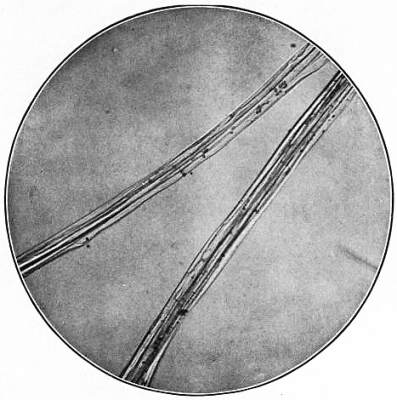
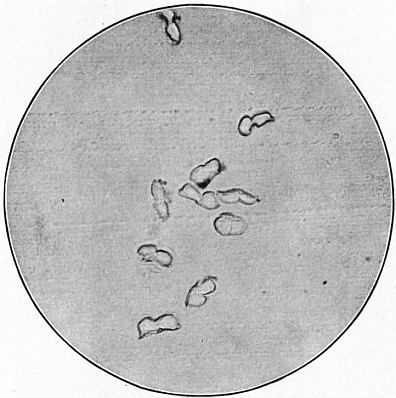
Fig. 1.—RAW SILK. Bombyx mori. Filament of bave, viewed in length. × 110. Fig. 2.—RAW SILK. Bombyx mori. Single fibres in transverse section showing each fibre or “bave” as dual cylinder. × 235.
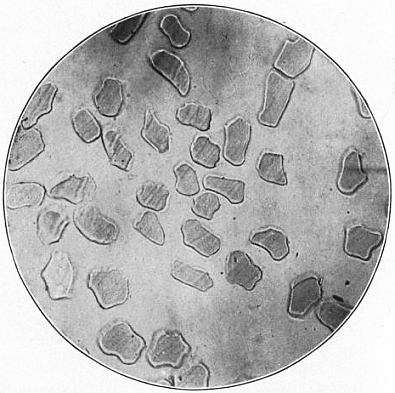
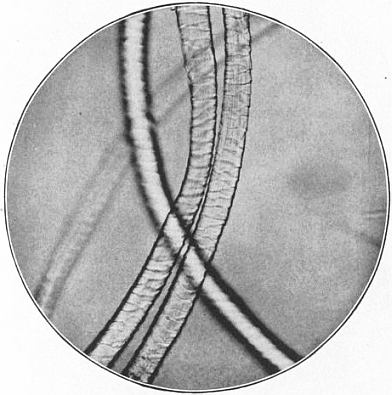
Fig. 3.—ARTIFICIAL “SILK.” Lustra-cellulose viscose process, single fibres in transverse section × 235. Normal type—polygon of 5 sides—with concave sides due to contact of the component units of textile filament. Fig. 4.—WOOL FIBRES. Australian merino viewed in length, × 235. Surface imbrications—the structural cause of true felting properties.
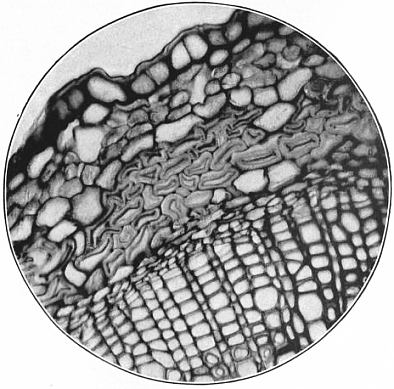
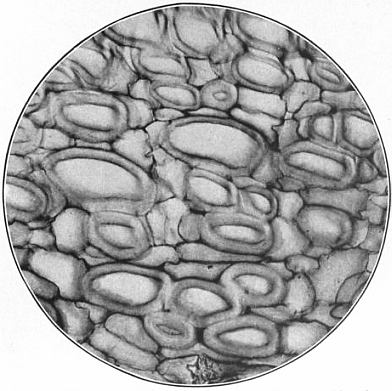
Fig. 5.—FLAX STEM. Linum usitatissimum. Transverse section of stem, × 235, showing bast fibres occupying central zone. Fig. 6.—RAMIE. Section of bast region, × 235. Showing bast fibres bundles but only slightly occurring as individuals.
Plate II.
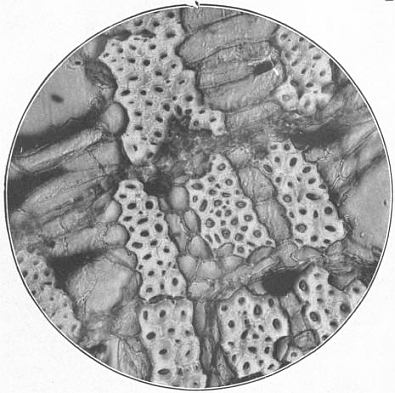
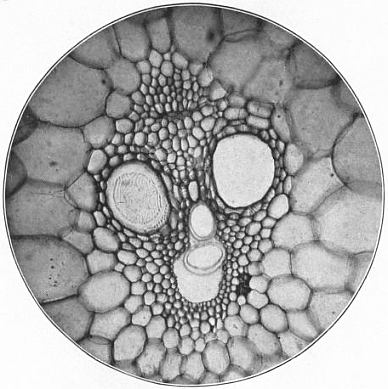
Fig. 7.—JUTE. Bast bundles. Section of bast region, × 235, showing agglomerated bundles of bast fibre, each bundle representing a spinning unit or filament. Fig. 8.—MAIZE STEM. Zea mais. Fibro-vascular bundle in section. × 110, typical of monocotyledonous structure.
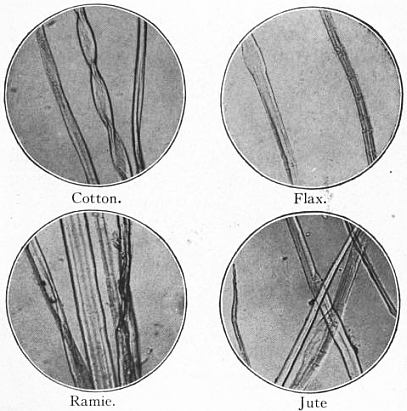
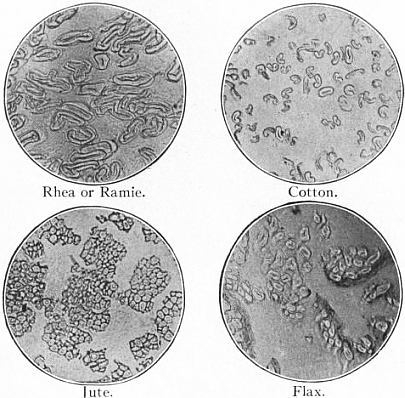
Fig. 9.—COTTON. FLAX. RAMIE. JUTE. Ultimate fibres in the length, × 110. Portions selected to show typical structural characteristics. Fig. 10.—COTTON. FLAX. RAMIE. JUTE. Ultimate fibres—transverse section, × 110. Note similarity of ramie to cotton and jute to flax.
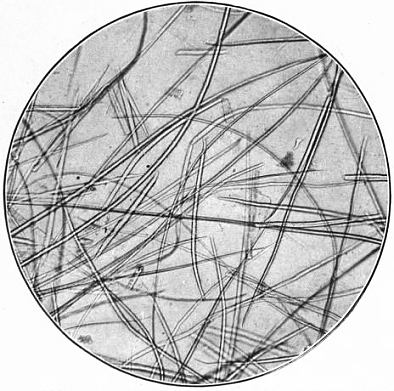
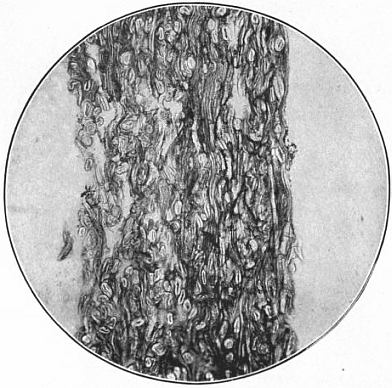
Fig. 11.—ESPARTO. Cellulose. Ultimate fibres of paper making pulp. Typical fusiform bast fibres. × 65. Fig. 12.—SECTION OF HAND-MADE PAPER. × 110. Ultimate component fibres disposed in every plane.
(c) Various animal hairs, such as those of the cow, camel and rabbit, are also employed; the latter is largely worked into the class of fabrics known as felts. In these the hairs are compacted together by taking advantage of the peculiarity of structure which causes the imbrications of the surface.
(d) Horse hair is employed in its natural form as an individual filament or monofil.1
Vegetable Fibres.—The subjoined scheme of classification sets out the morphological structural characteristics of the vegetable fibres:—
Produced from
Dicotyledons. Monocotyledons.
A. Seed hairs. D. Fibro-vascular bundles.
B. Bast fibres. E. Entire leaves and stems.
C. Bast aggregates.
In the list of the more important fibrous raw materials subjoined, the capital letter immediately following the name refers the individual to its position in this classification. In reference to the important question of chemical composition and the actual nature of the fibre substance, it may be premised that the vegetable fibres are composed of cellulose, an important representative of the group of carbohydrates, of which the cotton fibre substance is the chemical prototype, mixed and combined with various derivatives belonging to the subgroups. (a) Carbohydrates. (b) Unsaturated compounds of benzenoid and furfuroid constitutions. (c) “Fat and wax” derivatives, i.e. groups belonging to the fatty series, and of higher molecular dimensions—of such compound celluloses the following are the prototypes:—
(a) Cellulose combined and mixed with “pectic” bodies (i.e. pecto-celluloses), flax, rhea.
(b) Cellulose combined with unsaturated groups or ligno-celluloses, jute and the woods.
(c) Cellulose combined and mixed with higher fatty acids, alcohols, ethers, cuto-celluloses, protective epidermal covering of leaves.
The letters a, b, c in the table below and following the capitals, which have reference to the structural basis of classification, indicate the main characteristics of the fibre substances. (See also Cellulose.)
Miscellaneous.—Various species of the family Palmaceae yield fibrous products of value, of which mention must be made of the following. Raffia, epidermal strips of the leaves of Raphia ruffia (Madagascar), R. taedigera (Japan), largely employed as binder twine in horticulture, replacing the “bast” (linden) formerly employed. Coir, the fibrous envelope of the fruit of the Cocos nucifera, extensively used for matting and other coarse textiles. Carludovica palmata (Central America) yields the raw material for Panama hats, the Corypha australis (Australia) yields a similar product. The leaves of the date palm, Phoenix dactylifera, are employed locally in making baskets and mats, and the fibro-vascular bundles are isolated for working up into coarse twine and rope; similarly, the leaves of the Elaeis guineensis, the fruit of which yields the “palm oil” of commerce, yield a fibre which finds employment locally (Africa) for special purposes. Chamaerops humilis, the dwarf palm, yields the well-known “Crin d’Afrique.” Locally (Algiers) it is twisted into ropes, but its more general use, in Europe, is in upholstery as a stuffing material. The cereal straws are used in the form of plait in the making of hats and mats. Esparto grass is also used in the making of coarse mats.
Botanical Identity. Genus and Order. Country of Origin. Dimensions of Ultimate. Textile Uses.
Cotton, A.a Gossypium Tropical and subtropical 12-40 mm. 0.019-0.025. Universal. Also as a raw material
Malvaceae countries Av. 28 mm. in chemical industries, notably
explosives, celluloid.
Flax, B.a Linum Temperate (and subtropical) 6.60 mm. 0.011-0.025. General. Special effects in lustre
Linaceae countries, chiefly European Av. 28 mm. damasks. In India and America
plants grown for seed (linseed).
Hemp, B.a Cannabis Temperate countries, chiefly 5-55 mm. 0.016-0.050. Coarser textiles, sail-cloth,
Cannabineae Europe Av. 22. mm. Av. 0.022 rope and twine.
Ramie, B.a Boehmeria Tropical countries (some 60-200 mm. 0.03-0.08. Coarse textiles. Cost of preparation
Urticaceae temperate) Av. 120 mm. Av. 0.050 for fine textiles prohibitive.
Jute, B.b Corchorus Tropical countries, chiefly 1.5-5 mm. 0.020-0.025. Coarse textiles, chiefly “Hessians”
Tiliaceae India Av. 2.5 mm. Av. 0.022 and sacking. “Line” spun yarns
used in cretonne and furniture
textiles.
B.b Crotalaria India 4.0-12.0. 0.025-0.050. Twine and rope. Coarse textiles.
Leguminosae Av. 7.5. Av. 0.022
Hibiscus, B.b Hibiscus Tropical, chiefly India 2-6 mm. 0.014-0.033. Coarse textiles. H. Elams has been
Av. 4 mm. Av. 0.021 extensively used in making mats.
Sida, B.b Sida Tropical and subtropical 1.5-4 mm. 0.013-0.02. Coarse textiles. Appears capable of
Malvaceae Av. 2 mm. Av. 0.015 substituting jute.
Lime or Linden, Tilia European countries, chiefly 1.5 mm. 0.014-0.020. Matting and binder twine.
C.b Tiliaceae Russia Av. 2 mm. Av. 0.016
Mulberry, C Broussonetia Far East 5-31 mm. 0.02-0.04. Paper and paper cloths.
Moraceae Av. 15 mm. Av. 0.03
Monocotyledons—
Manila, D Musa Tropical countries, chiefly 3-12 mm. 0.016-0.032. Twine and ropes. Produces papers
Musaceae Philippine Islands Av. 6 mm. Av. 0.024 of special quality.
Sisal, D Agave Tropical countries, chiefly 1.5-4 mm. 0.020-0.032. Twine and ropes.
Amaryllideae Central America Av. 2.5. Av. 0.024
Yucca do. 0.5-6 mm. 0.01-0.02. do.
Liliaceae
Sansevieria East Indies, Ceylon, East 1.5-6 mm. 0.015-0.026. do.
Liliaceae Africa Av. 3 mm. Av. 0.020
Phormium, D Phormium tenax New Zealand 5.0-15 mm. 0.010-0.020. Twine and ropes. Distinguished by
Liliaceae Av. 9 mm. Av. 0.016 high yield of fibre from green
leaf.
Pine-apple, D Ananassa Tropical East and West 3.0-9.0 mm. 0.004-0.008. Textiles of remarkable fineness.
Bromeliaceae Indies Av. 5. Av. 0.006 Exceptional fineness of ultimate
fibre.
The processes by which the fibres are transformed into textile fabrics are in the main determined by their structural features. The following are the distinctive types of treatment.
A. The fibre is in virtually continuous lengths. The textile yarn is produced by assembling together the unit threads, which are wound together and suitably twisted (silk; artificial silk).
B. The fibres in the form of units of variable short dimensions are treated by more or less elaborate processes of scutching, hackling, combing, with the aim of producing a mass of free parallelized units of uniform dimensions; these are then laid together and drawn into continuous bands of sliver and roving, which are finally drawn and twisted into yarns. In this group are comprised the larger number of textile products, such as cotton, wool, flax and jute, and it also includes at the other extreme the production of coarse textiles, such as twine and rope.
C. The fibres of still shorter dimensions are treated in various ways for the production of a fabric in continuous length.
The distinction of type of manufacturing processes in which the relatively short fibres are utilized, either as disintegrated units or comminuted long fibres, follows the lines of division into long and short fibres; the long fibres are worked into yarns by various processes, whereas the shorter fibres are agglomerated by both dry and wet processes to felted tissues or felts. It is obvious, however, that these distinctions do not constitute rigid dividing lines. Thus the principles involved in felting are also applied in the manipulation of long fibre fabrics. For instance, woollen goods are closed or shrunk by milling, the web being subjected to a beating or hammering treatment in an apparatus known as “the Stocks,” or is continuously run through squeezing rollers, in weak alkaline liquids. Flax goods are “closed” by the process of beetling, a long-continued process of hammering, under which the ultimate fibres are more or less subdivided, and at the same time welded or incorporated together. As already indicated, paper, which is a web composed of units of short dimensions produced by deposition from suspension in water and agglomerated by the interlacing of the component fibres in all planes within the mass, is a species of textile. Further, whereas the silks are mostly worked up in the extreme lengths of the cocoon, there are various systems of spinning silk wastes of variable short lengths, which are similar to those required for spinning the fibres which occur naturally in the shorter lengths.
The fibres thus enumerated as commercially and industrially important have established themselves as the result of a struggle for survival, and each embodies typical features of utility. There are innumerable vegetable fibres, many of which are utilized in the locality or region of their production, but are not available for the highly specialized applications of modern competitive industry to qualify for which a very complex range of requirements has to be met. These include primarily the factors of production and transport summed up in cost of production, together with the question of regularity of supply; structural characteristics, form and dimensions, including uniformity of ultimate unit and adaptability to standard methods of preparing and spinning, together with tenacity and elasticity, lustre. Lastly, composition, which determines the degree of resistance to chemical disintegrating influences as well as subsidiary questions of colour and relationship to colouring matters. The quest for new fibres, as well as modified methods of production of those already known, require critical investigation from the point of view of established practice. The present perspective outline of the group will be found to contain the elements of a grammar of the subject. But those who wish to pursue the matter will require to amplify this outlined picture by a study of the special treatises which deal with general principles, as well as the separate articles on the various fibres.
Analysis and Identification.—For the analysis of textile fabrics and the identification of component fibre, a special treatise must be consulted. The following general facts are to be noted as of importance.
All animal fibres are effectively dissolved by 10% solution of caustic potash or soda. The fabric or material is boiled in this solution for 10 minutes and exhaustively washed. Any residue will be vegetable or cellulose fibre. It must not be forgotten that the chemical properties of the fibre substances are modified more or less by association in combination with colouring matters and mordants. These may, in many cases, be removed by treatments which do not seriously modify the fibre substances.
Wool is distinguished from silk by its relative resistance to the action of sulphuric acid. The cold concentrated acid rapidly dissolves silk as well as the vegetable fibres. The attack on wool is slow, and the epidermal scales of wool make their appearance. The true silks are distinguished from the wild silks by the action of concentrated hydrochloric acid in the cold, which reagent dissolves the former, but has only a slight effect on Tussore silk. After preliminary resolution by these group reagents, the fabric is subjected to microscopical analysis for the final identification of its component fibres (see H. Schlichter, Journal Soc. Chem. Ind., 1890, p. 241).
A scheme for the commercial analysis or assay of vegetable fibres, originally proposed by the author,2 and now generally adopted, includes the following operations:—
1. Determination of moisture.
2. Determination of ash left after complete ignition.
3. Hydrolysis:
(a) loss of weight after boiling the raw fibre with a 1% caustic soda solution for five minutes;
(b) loss after boiling for one hour.
4. Determination of cellulose: the white residue after
(a) boiling for five minutes with 1% caustic soda,
(b) exposure to chlorine gas for one hour,
(c) boiling with basic sodium sulphite solution.
5. Mercerizing: the loss of weight after digestion with a 20% solution of sodium hydrate for one hour in the cold.
6. Nitration: the weight of the product obtained after digestion with a mixture of equal volumes of sulphuric and nitric acids for one hour in the cold.
7. Acid purification: treatment of the raw fibre with 20% acetic acid for one minute, the product being washed with water and alcohol, and then dried.
8. Determination of the total carbon by combustion.
II. Papermaking.—The papermaking industry (see Paper) employs as raw materials a large proportion of the vegetable fibre products already enumerated, and, for the reasons incidentally mentioned, they may be, and are, employed in a large variety of forms: in fact any fibrous material containing over 30% “cellulose” and yielding ultimate fibres of a length exceeding 1 mm. can be used in this industry. Most important staples are cotton and flax; these are known to the paper-maker as “rag” fibres, rags, i.e. cuttings of textile fabrics, new and old, being their main source of supply. These are used for writing and drawing papers. In the class of “printings” two of the most important staples are wood pulp, prepared by chemical treatment from both pine and foliage woods, and in England esparto cellulose, the cellulose obtained from esparto grass by alkali treatment; the cereal straws are also used and are resolved into cellulose by alkaline boiling followed by bleaching. In the class of “wrappings” and miscellaneous papers a large number of other materials find use, such as various residues of manufacturing and preparing processes, scutching wastes, ends of rovings and yarns, flax, hemp and manila rope waste, adansonia bast, and jute wastes, raw (cuttings) and manufactured (bagging). Other materials have been experimentally tried, and would no doubt come into use on their papermaking merits, but as a matter of fact the actually suitable raw materials are comprised in the list above enumerated, and are limited in number, through the influence of a number of factors of value or utility.
III. Brush Fibres, &c.—In addition to the textile industries there are manufactures which utilize fibres of both animal and vegetable character. The most important of these is brush-making. The familiar brushes of everyday use are extremely diversified in form and texture. The supplies of animal fibres are mainly drawn from the badger, hog, bear, sable, squirrel and horse. These fibres and bristles cover a large range of effects. Brushes required for cleansing purposes are composed of fibres of a more or less hard and resilient character, such as horse hairs, and other tail hairs and bristles. For painting work brushes of soft quality are employed, graduating for fine work into the extreme softness of the “camel hair” pencil. Of vegetable fibres the following are used in this industry. The Caryota urens furnishes the Kittul fibre, obtained from the base of the leaf stalks. Piassava is obtained from the Attalea funifera, also from the Leopoldina piassaba (Brazil). Palmyra fibre is obtained from the Borassus flabellifer. These are all members of the natural order of the Palmaceae. Mexican fibre, or Istle, is obtained from the agave. The fibre known as Whisk, largely used for dusting brushes, is obtained from various species of the Gramineae; the “Mexican Whisk” from Epicampeas macroura; and “Italian Whisk” from Andropogon. The coir fibre mentioned above in connexion with coarse textiles is also extensively used in brush-making. Aloe and Agave fibres in their softer forms are also used for plasterers’ brushes. Many of the whitewashes and cleansing solutions used in house decoration are alkaline in character, and for such uses advantage is taken of the specially resistant character of the cellulose group of materials.
Stuffing and Upholstery.—Another important use for fibrous materials is for filling or stuffing in connexion with the seats and cushions in upholstery. In the large range of effects required, a corresponding number and variety of products find employment. One of the most important is the floss or seed-hair of the Eriodendron anfractuosum, known as Kapok, the use of which in Europe was created by the Dutch merchants who drew their supplies from Java. The fibre is soft, silky and elastic, and maintains its elasticity in use. Many fibres when used in the mass show, on the other hand, a tendency to become matted and compressed in use, and to restore them to their original state the fibre requires to be removed and subjected to a teasing or carding process. This defect limits the use of other “flosses” or seed hairs in competition with Kapok. Horse hair is extensively used in this industry, as are also wool flocks and other short animal hairs and wastes.
Hats and Matting.—For these manufactures a large range of the fibrous products above described are employed, chiefly in their natural or raw state.
Bibliography.—The list of works appended comprises only a small fraction of the standard literature of the subject, but they are sufficiently representative to enable the specialist, by referring to them, to cover the subject-matter. F.H. Bowman, The Structure of the Wood Fibre (1885), The Structure of Cotton Fibre (1882); Cross, Bevan and King, Indian Fibres and Fibrous Substances (London, 1887); C.F. Cross, Report on Miscellaneous Fibres, Colonial Indian Exhibition, 1886 (London, 1887); Cross and Bevan, Cellulose, Researches on Cellulose, i. and ii. (London, 1895-1905); C.R. Dodge, A Descriptive Catalogue of Useful Fibre Plants of the World (Report No. 9, U.S. Dept. of Agriculture, Washington, 1897); von Höhmel, Die Mikroskopie der technisch verwendeten Faserstoffe (Leipzig, 1905); J.J. Hummel, The Dyeing of Textile Fabrics (London, 1885); J.M. Matthews, The Textile Fibres, their Physical, Microscopical and Chemical Properties (New York, 1904); H. Müller, Die Pflanzenfaser (Braunschweig, 1877); H. Schlichter, “The Examination of Textile Fibres and Fabrics” (Jour. Soc. Chem. Ind., 1890, 241); M. Vetillart, Études sur les fibres végétales textiles (Paris, 1876); Sir T.H. Wardle, Silk and Wild Silks, original memoirs in connexion with Col. Ind. Ex., 1886, Jubilee Ex. Manchester, 1887; Sir G. Watt, Dictionary of Economic Products of India (London, 1891); Wiesner, Die Rohstoffe des Pflanzenreichs (Leipzig, 1873); O.N. Witt, Chemische Technologie der Gespinnstfasern (Braunschweig, 1888); Kew Bulletin; The Journal of the Imperial Institute; The Journal of the Society of Arts; W.I. Hannam, The Textile Fibres of Commerce (London, 1902); J. Jackson, Commercial Botany; J. Zipser, Die Textilen Rohmaterialien (Wien, 1895); F. Zetzsche, Die wichtigsten Faserstoffe der europäischen Industrie (Leipzig, 1895).
(C. F. C.)
1 See also Alpaca, Felt, Mohair, Shoddy and Wool.
2 Col. Ind. Exhibition, 1886, Miscellaneous Reports.
FIBRIN, or Fibrine, a protein formed by the action of the so-called fibrin-ferment on fibrinogen, a constituent of the blood-plasma of all vertebrates. This change takes place when blood leaves the arteries, and the fibrin thus formed occasions the clotting which ensues (see Blood). To obtain pure coagulated fibrin it is best to heat blood-plasma (preferably that of the horse) to 56° C. The usual method of beating a blood-clot with twigs and removing the filamentous fibrin which attaches itself to them yields a very impure product containing haemoglobin and much globulin; moreover, it is very difficult to purify. Fibrin is a very voluminous, tough, strongly elastic, jelly-like substance; when denaturalized by heat, alcohol or salts, it behaves as any other coagulated albumin.
FICHTE, IMMANUEL HERMANN (originally Hartmann) VON (1797-1879), German philosopher, son of J.G. Fichte, was born at Jena on the 18th of July 1797. Having held educational posts at Saarbrücken and Düsseldorf, in 1836 he became extraordinary professor of philosophy at Bonn, and in 1840 full professor. In 1842 he received a call to Tübingen, retired in 1867, and died at Stuttgart on the 8th of August 1879. The most important of his comprehensive writings are: System der Ethik (1850-1853), Anthropologie (1856, 3rd ed. 1876), Psychologie (1864-1873), Die theistische Weltansicht (1873). In 1837 he had founded the Zeitschrift für Philosophie as an organ of his views, more especially on the subject of the philosophy of religion, where he was in alliance with C.H. Weisse; but, whereas Weisse thought that the Hegelian structure was sound in the main, and that its imperfections might be mended, Fichte held it to be incurably defective, and spoke of it as a “masterpiece of erroneous consistency or consistent error.” Fichte’s general views on philosophy seem to have changed considerably as he advanced in years, and his influence has been impaired by certain inconsistencies and an appearance of eclecticism, which is strengthened by his predominantly historical treatment of problems, his desire to include divergent systems within his own, and his conciliatory tone. His philosophy is an attempt to reconcile monism (Hegel) and individualism (Herbart) by means of theism (Leibnitz). He attacks Hegelianism for its pantheism, its lowering of human personality, and imperfect recognition of the demands of the moral consciousness. God, he says, is to be regarded not as an absolute but as an Infinite Person, whose nature it is that he should realize himself in finite persons. These persons are objects of God’s love, and he arranges the world for their good. The direct connecting link between God and man is the “genius,” a higher spiritual individuality existing in man by the side of his lower, earthly individuality. Fichte, in short, advocates an ethical theism, and his arguments might easily be turned to account by the apologist of Christianity. In his conception of finite personality he recurs to something like the monadism of Leibnitz. His insistence on moral experience is connected with his insistence on personality. One of the tests by which Fichte discriminates the value of previous systems is the adequateness with which they interpret moral experience. The same reason that made him depreciate Hegel made him praise Krause (panentheism) and Schleiermacher, and speak respectfully of English philosophy. It is characteristic of Fichte’s almost excessive receptiveness that in his latest published work, Der neuere Spiritualismus (1878), he supports his position by arguments of a somewhat occult or theosophical cast, not unlike those adopted by F.W.H. Myers. He also edited the complete works and literary correspondence of his father, including his life.
See R. Eucken, “Zur Erinnerung I. H. F.,” in Zeitschrift für Philosophie, ex. (1897); C.C. Scherer, Die Gotteslehre von I. H. F. (1902); article by Karl Hartmann in Allegemeine deutsche Biographie xlviii. (1904). Some of his works were translated by J.D. Morell under the title of Contributions to Mental Philosophy (1860).
FICHTE, JOHANN GOTTLIEB (1762-1814), German philosopher, was born at Rammenau in Upper Lusatia on the 19th of May 1762. His father, a ribbon-weaver, was a descendant of a Swedish soldier who (in the service of Gustavus Adolphus) was left wounded at Rammenau and settled there. The family was distinguished for piety, uprightness, and solidity of character. With these qualities Fichte himself combined a certain impetuosity and impatience probably derived from his mother, a woman of a somewhat querulous and jealous disposition.
At a very early age the boy showed remarkable mental vigour and moral independence. A fortunate accident which brought him under the notice of a neighbouring nobleman, Freiherr von Miltitz, was the means of procuring him a more excellent education than his father’s circumstances would have allowed. He was placed under the care of Pastor Krebel at Niederau. After a short stay at Meissen he was entered at the celebrated school at Pforta, near Naumburg. In 1780 he entered the university of Jena as a student of theology. He supported himself mainly by private teaching, and during the years 1784-1787 acted as tutor in various families of Saxony. In 1787, after an unsuccessful application to the consistory for pecuniary assistance, he seems to have been driven to miscellaneous literary work. A tutorship at Zürich was, however, obtained in the spring of 1788, and Fichte spent in Switzerland two of the happiest years of his life. He made several valuable acquaintances, among others Lavater and his brother-in-law Hartmann Rahn, to whose daughter, Johanna Maria, he became engaged.
Settling at Leipzig, still without any fixed means of livelihood, he was again reduced to literary drudgery. In the midst of this work occurred the most important event of his life, his introduction to the philosophy of Kant. At Schulpforta he had read with delight Lessing’s Anti-Goeze, and during his Jena days had studied the relation between philosophy and religion. The outcome of his speculations, Aphorismen über Religion und Deismus (unpublished, date 1790; Werke, i. 1-8), was a species of Spinozistic determinism, regarded, however, as lying altogether outside the boundary of religion. It is remarkable that even for a time fatalism should have been predominant in his reasoning, for in character he was opposed to such a view, and, as he has said, “according to the man, so is the system of philosophy he adopts.”
Fichte’s Letters of this period attest the influence exercised on him by the study of Kant. It effected a revolution in his mode of thinking; so completely did the Kantian doctrine of the inherent moral worth of man harmonize with his own character, that his life becomes one effort to perfect a true philosophy, and to make its principles practical maxims. At first he seems to have thought that the best method for accomplishing his object would be to expound Kantianism in a popular, intelligible form. He rightly felt that the reception of Kant’s doctrines was impeded by their phraseology. An abridgment of the Kritik der Urtheilskraft was begun, but was left unfinished.
Fichte’s circumstances had not improved. It had been arranged that he should return to Zürich and be married to Johanna Rahn, but the plan was overthrown by a commercial disaster which affected the fortunes of the Rahn family. Fichte accepted a post as private tutor in Warsaw, and proceeded on foot to that town. The situation proved unsuitable; the lady, as Kuno Fischer says, “required greater submission and better French” than Fichte could yield, and after a fortnight’s stay Fichte set out for Königsberg to see Kant. His first interview was disappointing; the coldness and formality of the aged philosopher checked the enthusiasm of the young disciple, though it did not diminish his reverence. He resolved to bring himself before Kant’s notice by submitting to him a work in which the principles of the Kantian philosophy should be applied. Such was the origin of the work, written in four weeks, the Versuch einer Kritik aller Offenbarung (Essay towards a Critique of all Revelation). The problem which Fichte dealt with in this essay was one not yet handled by Kant himself, the relations of which to the critical philosophy furnished matter for surmise. Indirectly, indeed, Kant had indicated a very definite opinion on theology: from the Critique of Pure Reason it was clear that for him speculative theology must be purely negative, while the Critique of Practical Reason as clearly indicated the view that the moral law is the absolute content or substance of any religion. A critical investigation of the conditions under which religious belief was possible was still wanting. Fichte sent his essay to Kant, who approved it highly, extended to the author a warm reception, and exerted his influence to procure a publisher. After some delay, consequent on the scruples of the theological censor of Halle, who did not like to see miracles rejected, the book appeared (Easter, 1792). By an oversight Fichte’s name did not appear on the title-page, nor was the preface given, in which the author spoke of himself as a beginner in philosophy. Outsiders, not unnaturally, ascribed the work to Kant. The Allgemeine Literatur-Zeitung went so far as to say that no one who had read a line of Kant’s writings could fail to recognize the eminent author of this new work. Kant himself corrected the mistake, at the same time highly commending the work. Fichte’s reputation was thus secured at a stroke.