VOLUME IX SLICE VIII Ethiopia to Evangelical Association (continued 6)
Reading edition
Fragments in T. Kock, Comicorum Atticorum fragmenta, i. (1880).
EUPOMPUS, the founder of the great school of painting which flourished in the 4th century at Sicyon in Greece. He was eclipsed by his successors, and is chiefly remembered for the advice which he is said to have given to Lysippus to follow nature rather than any master.
EURASIAN, a term originally confined to India, where for upwards of half a century it was used to denote children born of Hindu mothers and European (especially Portuguese) fathers. Following the geographical employment of the word Eurasia to describe the whole of the great land mass which is divided into the continents of Europe and Asia, Eurasian has come to be descriptive of any half-castes born of parents representing the races of the two continents. It has further an ethnological sense, A.H. Keane (Ethnology, 1896) proposing to find in the Eurasian Steppe the true home of the primitive Aryan groups. Joseph Deniker (Anthropology, 1900) makes a Eurasian group to include such peoples (Ugrians, Turko-Tatars, &c.) as are represented in both continents. Giuseppe Sergi, in his Mediterranean Race (London, 1901), uses Eurasiatic to denote that variety of man which “brought with it into Europe (from Asia in the later Neolithic period) flexional languages of Aryan or Indo-European type.”
EURE, a department of north-western France, formed in 1790 from a portion of the old province of Normandy, together with the countship of Évreux and part of Perche. Pop. (1906) 330,140. Area, 2330 sq. m. It is bounded N. by the department of Seine Inférieure, W. by Calvados, S.W. by Orne, S. by Eure-et-Loir, and E. by Seine-et-Oise and Oise. The territory of Eure, which nowhere exceeds 800 ft. in altitude, is broken up by its rivers into well-wooded plateaus with a general inclination from south to north. Forests cover about one-fifth of the department. The Seine flows from S.E. to N.W. through the E. of the department, and after touching the frontier at two or three points forms near its mouth part of the northern boundary. All the rivers of the department flow into the Seine,—on the right bank the Andelle and the Epte, and on the left the Eure with its tributaries the Avre and the Iton, and the Risle with its tributary the Charentonne. The Eure, from which the department takes its name, rises in Orne, and flowing through Eure-et-Loir, falls into the Seine above Pont de l’Arche, after a course of 44 m. in the department. The Risle likewise rises in Orne, and flows generally northward to its mouth in the estuary of the Seine. The climate is mild, but moist and variable. The soil is for the most part clayey, resting on a bed of chalk, and is, in general, fertile and well tilled. The chief cereal cultivated is wheat; oats, colza, flax and beetroot are also grown. There is a wide extent of pasturage, on which are reared a considerable number of cattle and sheep, and especially those horses of pure Norman breed for which the department has long been celebrated. Fruit is very abundant, especially apples and pears, from which much cider and perry are made. The mineral products of Eure include freestone, marl, lime and brick-clay. The chief industries are the spinning of cotton and wool, and the weaving, dyeing and printing of fabrics of different kinds. Brewing, flour-milling, distilling, turnery, cotton-bleaching, cider-making, metal-founding, tanning, and the manufacture of glass, paper, iron ware, nails, pins, wind-instruments, bricks and sugar are also carried on. Coal and raw materials for its industries are the chief imports of Eure; its exports include cattle, poultry, eggs, butter, grain and manufactured goods. The department is served chiefly by the Western railway; the Seine, Eure and Risle provide 87 m. of navigable waterway. Eure is divided into the following arrondissements (containing 36 cantons, 700 communes):—Évreux, Louviers, Les Andelys, Bernay, and Pont-Audemer. Its capital is Évreux, which is the seat of a bishopric of the ecclesiastical province of Rouen. The department belongs to the III. Army Corps and to the académie (educational division) of Caen. Its court of appeal is at Rouen.
Évreux, Les Andelys, Bernay, Louviers, Pont-Audemer, Verneuil, Vernon and Gisors are the principal towns of the department. At Gaillon there are remains of a celebrated château of the archbishops of Rouen (see Louviers). Pont de l’Arche has a fine Gothic church, with stained-glass windows of the 16th and 17th centuries; the church of Tillières-sur-Arvre is a graceful specimen of the Renaissance style. The churches of Conches (15th or 16th century) and of Rugles (13th, 15th and 16th centuries), and the château of Beaumesnil (16th century) are also of architectural interest.
EURE-ET-LOIR, an inland department of north-western France, formed in 1790 of portions of Orléanais and Normandy. Pop. (1906) 273,823. Area, 2293 sq. m. It is bounded N. by the department of Eure, W. by Orne and Sarthe, S. by Loir-et-Cher, S.E. by Loiret, and E. by Seine-et-Oise. The Perche in the south-west and the Thimerais in the north-west are districts of hills and valleys, woods, lakes and streams. The region of the east and south is a level and uniform expanse, consisting for the most part of the riverless but fertile plain of Beauce, sometimes called the “granary of France.” The northern part of Eure-et-Loir is watered by the Eure, with its tributaries the Vègre, Blaise and Avre, a small western portion by the Huisne, and the south by the Loir with its tributaries the Conie and the Ozanne. The air is pure, the climate mild, dry and not subject to sudden changes. The soil consists, for the most part, either of clay intermixed with sand or of calcareous earth, and is on the whole fruitful. Agriculture is better conducted than in most of the departments of France, and the average yield per acre is greater. Cereals occupy half the surface, wheat and oats being chiefly cultivated. Among the other agricultural products are barley, hemp, flax and various vegetables, including good asparagus. Wine is not extensively produced, nor is it of the best quality; but in some parts, especially in the Perche, there is an abundant supply of apples, from which cider is made as the common drink of the inhabitants. The extensive meadows supply pasturage for a large number of cattle and sheep, and the horses raised in the Perche have a wide reputation as draught animals. Bee-farming is commonly prosecuted. The department produces lime, grindstones and brick-clay. The manufactures are not extensive; but there are flour- and saw-mills, tanneries and leather-works, copper and iron foundries, starch-works, dyeworks, distilleries, breweries and potteries; and agricultural implements, cotton and woollen goods, and yarn, hosiery, boots and shoes, sugar, felt hats and paper are made. Eure-et-Loir exports the products of its soil and live-stock; its imports include coal, wine and wearing apparel. It is served by the railways of the Western and the Orléans Companies and by those of the state, but it has no navigable waterways. The department has Chartres for its capital, and is divided into the arrondissements of Chartres, Châteaudun, Dreux and Nogent-le-Rotrou (24 cantons and 426 communes). It forms the diocese of Chartres (province of Paris), and belongs to the académie (educational division) of Paris and the region of the IV. Army Corps. Its court of appeal is at Paris.
Chartres, Dreux, Châteaudun, Nogent-le-Rotrou and Anet are the more noteworthy places in the department (q.v.). At Bonneval the lunatic asylum occupies the 18th-century buildings of a former Benedictine abbey. The abbey church belonged to the 13th century, but only a gateway flanked by two massive towers is left. The chateau of Maintenon dating from the 16th and 17th centuries was presented by Louis XIV. to Madame de Maintenon, by whom additions were made; the aqueduct (17th century) in the park was designed to carry the water of the Eure to Versailles, but was not completed. There is a fine château of the late 15th century, restored in modern tunes, at Montigny-le-Gannelon, and another of the 15th, 16th and 17th centuries, at one time the property of Sully, at Villebon. St Lubin-des-Joncherets has a handsome church of the 11th century, in which there are stained-glass windows dating from the 16th century.
EUREKA, a city, port of entry, and the county seat of Humboldt county, California, U.S.A., on the E. shore of Humboldt Bay. Pop. (1880) 2639; (1890) 4858; (1900) 7327 (2035 foreign-born); (1910) 11,845. It has a good harbour, greatly improved by the National government, and is connected with San Francisco, Portland and other coast ports by steamship lines. In 1909 a railway (the Northwestern Pacific), to connect Eureka with San Francisco, was under construction. The district owes its reputation as a health resort to its equable climate and to the protection afforded by the wide coast timber belt. Eureka is the principal point for the shipment of redwood lumber, and saw-milling is carried on here on an enormous scale. Several short railways run from Eureka and Arcata (pop. in 1900, 952) across the bay, into the forests, and bring lumber to the mills, most of which are in or near Eureka. Humboldt county was organized in 1853. Eureka was then already the centre of an important lumber trade, principally in spars. It was incorporated in 1856, displacing Union (now Arcata) as the county-seat in the same year.
EUREKA SPRINGS, a city and health resort, one of the county-seats—Berryville being the other—of Carroll county, in the extreme north-western part of Arkansas, U.S.A., in the Ozark uplift, 1800 ft. above the sea-level. Pop. (1890) 3706; (1900) 3572 (142 of negro descent); (1910) 3228. There is a transient population of thousands of visitors during the year. The city is built picturesquely on the sides of a gulch, down which runs the Missouri & North Arkansas railway. A creek running through the city empties into the White river, only a few miles distant. The surrounding country varies in character from mountains to rolling prairie. The encircling hills are laden with a covering of pine. The normal mean temperature for the year is about 59° F. (42° F. in winter, 61° F. in spring, 75° F. in summer, and 58° F. in autumn); the average rainfall, about 33 in. The atmosphere is dry and clear. Apart from its share in the agricultural interests of the surrounding region,—devoted mainly to Indian corn, small grains and fruits,—the entire economy of Eureka Springs centres in its medicinal springs, more than forty of which, lying within the corporate limits, are held in trust by the city for the free use of the public. The temperature of the springs varies from about 57° F. to 64° F. Each gallon of their waters contains about 28.5 cub. in. of gaseous matter and from 6 to 9 grains of solids held in solution. The city waterworks are owned by the municipality. The springs have been exploited since 1879, when the first settlement was made. The city was chartered in 1880.
EURIPIDES (480-406 B.C.), the great Greek dramatic poet, was born in 480 B.C., on the very day, according to the legend, of the Greek victory at Salamis, where his Athenian parents had taken refuge; and a whimsical fancy has even suggested that his name—son of Euripus—was meant to commemorate the first check of the Persian fleet at Artemisium. His father Mnesarchus was at least able to give him a liberal education; it was a favourite taunt with the comic poets that his mother Clito had been a herb-seller—a quaint instance of the tone which public satire could then adopt with plausible effect. At first he was intended, we are told, for the profession of an athlete,—a calling of which he has recorded his opinion with something like the courage of Xenophanes. He seems also to have essayed painting; but at five-and-twenty he brought out his first play, the Peliades, and thenceforth he was a tragic poet. At thirty-nine he gained the first prize, and in his career of about fifty years he gained it only five times in all. This fact is perfectly consistent with his unquestionably great and growing popularity in his own day. Throughout life he had to compete with Sophocles, and with other poets who represented tragedy of the type consecrated by tradition. The hostile criticism of Aristophanes was witty; and, moreover, it was true, granting the premise from which Aristophanes starts, that the tragedy of Aeschylus and Sophocles is the only right model. Its unfairness, often extreme, consists in ignoring the changing conditions of public feeling and taste, and the possibilities, changed accordingly, of an art which could exist only by continuing to please large audiences. It has usually been supposed that the unsparing derision of the comic poets contributed not a little to make the life of Euripides at Athens uncomfortable; and there is certainly one passage in a fragment of the Melanippe (Nauck, Frag., 495), which would apply well enough to his persecutors:—
ἀνδρῶν δὲ πολλοὶ τοῦ γέλωτος οὕνεκα ἀσκοῦσι χάριτας κερτόμους ἐγὼ δέ πως μισῶ γελοίους, οἵτινες σοφῶν πέρι ἀχάλιν᾽ ἔχουσι στόματα. (To raise vain laughter, many exercise The arts of satire; but my spirit loathes These mockers whose unbridled mockery Invades grave themes.)
The infidelity of two wives in succession is alleged to explain the poet’s tone in reference to the majority of their sex, and to complete the picture of an uneasy private life. He appears to have been repelled by the Athenian democracy, as it tended to become less the rule of the people than of the mob. Thoroughly the son of his day in intellectual matters, he shrank from the coarser aspects of its political and social life. His best word is for the small farmer (αὐτουργός), who does not often come to town, or soil his rustic honesty by contact with the crowd of the market-place.
About 409 B.C. Euripides left Athens, and after a residence in the Thessalian Magnesia repaired, on the invitation of King Archelaus, to the Macedonian court, where Greeks of distinction were always welcome. In his Archelaus Euripides celebrated that legendary son of Temenus, and head of the Temenid dynasty, who bad founded Aegae; and in one of the meagre fragments he evidently alludes to the beneficent energy of his royal host in opening up the wild land of the North. It was at Pella, too, that Euripides composed or completed, and perhaps produced, the Bacchae. Jealous courtiers, we are told, contrived to have him attacked and killed by savage dogs. It is odd that the fate of Actaeon should be ascribed, by legend, to two distinguished Greek writers, Euripides and Lucian; though in the former case at least the fate has not such appropriateness as the Byzantine biographer discovers in the latter, on the ground that its victim “had waxed rabid against the truth.” The death of Euripides, whatever its manner, occurred in 406 B.C., when he was seventy-four. Sophocles followed him in a few months, but not before he had been able to honour the memory of his younger rival by causing his actors to appear with less than the full costume of the Dionysiac festival. Soon afterwards, in the Frogs, Aristophanes pronounced the epitaph of Attic comedy on Attic tragedy.
The historical interest of such a life as that of Euripides consists in the very fact that its external record is so scanty—that, unlike Aeschylus or Sophocles, he had no place in the public action of his time, but dwelt apart as a student and a thinker. He has made his Medea speak of those who, through following quiet paths, have incurred the reproach of apathy (ῥᾳθυμίαν). Undoubtedly enough of the old feeling for civic life remained to create a prejudice against one who held aloof from the affairs of the city. Quietness (ἀπραγμοσύνη), in this sense, was still regarded as akin to indolence (ἀργία). Yet here we see how truly Euripides was the precursor of that near future which, at Athens, saw the more complete divergence of society from the state.
In an age which is not yet ripe for reflection or for the subtle analysis of character, people are content to express in general types those primary facts of human nature which strike every one. Achilles will stand well enough for the young chivalrous warrior, Odysseus for the man of resource and endurance. In the case of the Greeks, these types had not merely an artistic and a moral interest; they had, further, a religious interest, because the Greeks believed that the epic heroes, sprung from the gods, were their own ancestors. Greek tragedy arose when the choral worship of Dionysus, the god of physical rapture, had engrafted upon it a dialogue between actors who represented some persons of the legends consecrated by this faith. The dramatist was accordingly obliged to refrain from multiplying those minute touches which, by individualizing the characters too highly, would detract from their general value as types in which all Hellenic humanity could recognize its own image glorified and raised a step nearer to the immortal gods. This necessity was further enforced by the existence of the chorus, the original element of the drama, and the very essence of its nature as an act of Dionysiac worship. Those utterances of the chorus, which to the modern sense are so often platitudes, were not so to the Greeks, just because the moral issues of tragedy were felt to have the same typical generality as these comments themselves.
An unerring instinct keeps both Aeschylus and Sophocles within the limits imposed by this law. Euripides was only fifteen years younger than Sophocles. But, when Euripides began to write, it must have been clear to any man of his genius and culture that, though an established prestige might be maintained, a new poet who sought to construct tragedy on the old basis would be building on sand. For, first, the popular religion itself—the very foundation of tragedy—had been undermined. Secondly, scepticism had begun to be busy with the legends which that religion consecrated. Neither gods nor heroes commanded all the old unquestioning faith. Lastly, an increasing number of the audience in the theatre began to be destitute of the training, musical and poetical, which had prepared an earlier generation to enjoy the chaste and placid grandeur of ideal tragedy.
Euripides made a splendid effort to maintain the place of tragedy in the spiritual life of Athens by modifying its interests in the sense which his own generation required. Could not the heroic persons still excite interest if they were made more real,—if, in them, the passions and sorrows of every-day life were portrayed with greater vividness and directness? And might not the less cultivated part of the audience at least enjoy a thrilling plot, especially if taken from the home-legends of Attica? Euripides became the virtual founder of the romantic drama. In so far as his work fails, the failure is one which probably no artistic tact could then have wholly avoided. The frame within which he had to work was one which could not be stretched to his plan. The chorus, the masks, the narrow stage, the conventional costumes, the slender opportunities for change of scenery, were so many fixed obstacles to the free development of tragedy in the new direction. But no man of his time could have broken free from these traditions; in attempting to do so he must have wrecked either his fame or his art. It is not the fault of Euripides if in so much of his work we feel the want of harmony between matter and form. Art abhors compromise; and it was the misfortune of Attic tragedy in his generation that nothing but a compromise could save it. Two devices have become common phrases of reproach against him—the prologue and the deus ex machina. Doubtless the prologue is a slipshod and sometimes ludicrous expedient. But the audiences of his days were far from being so well versed as their fathers in the mythic lore, and, on the other hand, a dramatist who wished to avoid trite themes had now to go into the byways of mythology. A prologue was often perhaps desirable or necessary for the instruction of the audience. As regards the deus ex machina, a distinction should be observed between those cases in which the solution is really mechanical, as in the Andromache and perhaps the Orestes, and those in which it is warranted or required by the plot, as in the Hippolytus and the Bacchae. The choral songs in Euripides, it may be granted, have often nothing to do with the action. But the chorus was the greatest of difficulties for a poet who was seeking to present drama of romantic tendency in the plastic form consecrated by tradition. So far from censuring Euripides on this score, we should be disposed to regard his management of the chorus as a signal proof of his genius, originality and skill.
Euripides is said to have written 92 dramas, including 8 satyr-plays. The best critics of antiquity allowed 75 as genuine. Nauck has collected 1117 Euripidean fragments. Among these, numbers 1092-1117 are doubtful or spurious; numbers Works. 842-1091 are from plays of uncertain title; numbers 1-841 represent fifty-five lost pieces, among which some of the best known are the Andromeda, Antiope,1 Bellerophon, Cresphontes, Erechtheus, Oedipus, Phaëthon, and Telephus.
1. The Alcestis, as the didascaliae tell us, was brought out in Ol. 85. 2, i.e. at the Dionysia in the spring of 438 B.C., as the fourth play of a tetralogy comprising the Cretan Women, the Alcmaeon at Psophis, and the Telephus. The Alcestis is altogether removed from the character, essentially grotesque, of a mere satyric drama. On the other hand, it has features which distinctly separate it from a Greek tragedy of the normal type. First, the subject belongs to none of the great cycles, but to a byway of mythology, and involves such strange elements as the servitude of Apollo in a mortal household, the decree of the fates that Admetus must die on a fixed day, and the restoration of the dead Alcestis to life. Secondly, the treatment of the subject is romantic and even fantastic,—strikingly so in the passage where Apollo is directly confronted with the daemonic figure of Thanatos. Lastly, the boisterous, remorseful, and generous Heracles makes, not, indeed, a satyric drama, but a distinctly satyric scene—a scene which, in the frank original, hardly bears the subtle interpretation which in Balaustion is hinted by the genius of Browning, that Heracles got drunk in order to keep up other people’s spirits. When the happy ending is taken into account, it is not surprising that some should have called the Alcestis a tragi-comedy. But we cannot so regard it. The slight and purely incidental strain of comedy is but a moment of relief between the tragic sorrow and terror of the opening and the joy, no less solemn, of the conclusion. In this respect the Alcestis might more truly be compared to such a drama as the Winter’s Tale; the loss and recovery of Hermione by Leontes do not form a tragi-comedy because we are amused between-whiles by Autolycus and the clown. It does not seem improbable that the Alcestis—the earliest of the extant plays—may represent an attempt to substitute for the old satyric drama an after-piece of a kind which, while preserving a satyric element, should stand nearer to tragedy. The taste and manners of the day were perhaps tiring of the merely grotesque entertainment that old usage appended to the tragedies; just as, in the sphere of comedy, we know from Aristophanes that they were tiring of broad buffoonery. An original dramatist may have seen an opportunity here. However that may be, the Alcestis has a peculiar interest for the history of the drama. It marks in the most signal manner, and perhaps at the earliest moment, that great movement which began with Euripides,—the movement of transition from the purely Hellenic drama to the romantic.
2. The Medea was brought out in 431 B.C. with the Philoctetes, the Dictys, and a lost satyr-play called the Reapers (Theristae). Euripides gained the third prize, the first falling to Euphorion, the son of Aeschylus, and the second to Sophocles. If it is true that Euripides modelled his Medea on the work of an obscure predecessor, Neophron, at least he made the subject thoroughly his own. Hardly any play was more popular in antiquity with readers and spectators, with actors, or with sculptors. Ennius is said to have translated and adopted it. We do not know how far it may have been used by Ovid in his lost tragedy of the same name; but it certainly inspired the rhetorical performance of Seneca, which may be regarded as bridging the interval between Euripides and modern adaptations. We may grant at once that the Medea of Euripides is not a faultless play; that the dialogue between the heroine and Aegeus is not happily conceived; that the murder of the children lacks an adequate dramatic motive; that there is something of a moral anti-climax in the arrangements of Medea, before the deed, for her personal safety. But the Medea remains a tragedy of first-rate power. It is admirable for the splendid force with which the character of the strange and strong-hearted woman, a barbarian friendless among Hellenes, is thrown out against the background of Hellenic life in Corinth.
3. The extant Hippolytus (429 B.C.)—sometimes called Stephanephoros, the “wreath-bearer,” from the garland of flowers which, in the opening scene, the hero offers to Artemis—was not the first drama of Euripides on this theme. In an earlier play of the same name, we are told, he had shocked both the moral and the aesthetic sense of Athens. In this earlier Hippolytus, Phaedra herself had confessed her love to her step-son, and, when repulsed, had falsely accused him to Theseus, who doomed him to death; at the sight of the corpse, she had been moved to confess her crime, and had atoned for it by a voluntary death. This first Hippolytus is cited as Hippolytus the Veiled (καλυπτόμενος), either, as Toup and Welcker thought, from Hippolytus covering his face in horror, or, as Bentley with more likelihood suggested, because the youth’s shrouded corpse was brought upon the scene. It can scarcely be doubted that the chief dramatic defect of our Hippolytus is connected with the unfavourable reception of its predecessor. Euripides had been warned that limits must be observed in the dramatic portrayal of a morally repulsive theme. In the later play, accordingly, the whole action is made to turn on the jealous feud between Aphrodite, the goddess of love, and Artemis, the goddess of chastity. Phaedra not only shrinks from breathing her secret to Hippolytus, but destroys herself when she learns that she is rejected. But the natural agency of human passion is now replaced by a supernatural machinery; the slain son and the bereaved father are no longer the martyrs of sin, the tragic witnesses of an inexorable law; rather they and Phaedra are alike the puppets of a divine caprice, the scapegoats of an Olympian quarrel in which they have no concern. But if the dramatic effect of the whole is thus weakened, the character of Phaedra is a fine psychological study; and, as regards form, the play is one of the most brilliant. Boeckh (De tragoediae Graecae principiis, p. 180 f.) is perhaps too ingenious in finding an allusion to the plague at Athens (430 B.C.) in the ὦ κακὰ θνητῶν στυγεραί τε νόσοι of v. 177, and in v. 209 f.; but it can scarcely be doubted that he is right in suggesting that the closing words of Theseus (v. 1460)
ὦ κλείν᾽ Ἀθηνῶν Παλλάδος θ᾽ ὁρίσματα, οἵου στερήσεσθ᾽ ἀνδρός,
and the reply of the chorus, κοινὁν τόδ᾽ ἄχος, &c., contain a reference to the recent death of Pericles (429 B.C.).
4. The Hecuba may be placed about 425 B.C. Thucydides (iii. 104) notices the purification of Delos by the Athenians, and the restoration of the Panionic festival there, in 426 B.C.—an event to which the choral passage, v. 462 f., probably refers. It appears more hazardous to take v. 650 f. as an allusion to the Spartan mishap at Pylos. The subject of the play is the revenge of Hecuba, the widowed queen of Priam, on Polymestor, king of Thrace, who had murdered her youngest son Polydorus, after her daughter Polyzena had already been sacrificed by the Greeks to the shade of Achilles. The two calamities which befall Hecuba have no direct connexion with each other. In this sense the play lacks unity of design. On the other hand, both events serve the same end—viz. to heighten the tragic pathos with which the poet seeks to surround the central figure of Hecuba. The drama illustrates the skill with which Euripides, while failing to satisfy the requirements of artistic drama, could sustain interest by an ingeniously woven plot. It is a representative Intriguenstück, and well exemplifies the peculiar power which recommended Euripides to the poets of the New Comedy.
5. The Andromache, according to a notice in the scholia Veneta (446), was not acted at Athens, at least in the author’s life-time; though some take the words in the Greek argument (τὸ δρᾶμα τῶν δευτέρων) to mean that it was among those which gained a second prize. The invective on the Spartan character which is put into the mouth of Andromache contains the words, ἀδίκως εὐτυχεῖτ᾽ ἀν᾽ Ἑλλάδα, and this, with other indications, points to the Peloponnesian successes of the years 424-422 B.C. Andromache, the widow of Hector, has become the captive and concubine of Neoptolemus, son of Achilles. During his absence, her son Molossus is taken from her, with the aid of Menelaus, by her jealous rival Hermione. Mother and son are rescued from death by Peleus; but meanwhile Neoptolemus is slain at Delphi through the intrigues of Orestes. The goddess Thetis now appears, ordains that Andromache shall marry Helenus, and declares that Molossus shall found a line of Epirote kings, while Peleus shall become immortal among the gods of the sea. The Andromache is a poor play. The contrasts, though striking, are harsh and coarse, and the compensations dealt out by the deus ex machina leave the moral sense wholly unsatisfied. Technically the piece is noteworthy as bringing on the scene four characters at once—Andromache, Molossus, Peleus and Menelaus (v. 545 f.).
6. The Ion is an admirable drama, the finest of those plays which deal with legends specially illustrating the traditional glories of Attica. It is also the most perfect example of the poet’s skill in the structure of dramatic intrigue. For its place in the chronological order there are no data except those of style and metre. Judging by these, Hermann would place it “neither after Ol. 89, nor much before”—i.e. somewhere between 424 and 421 B.C.; and this may be taken as approximately correct. The scene is laid throughout at the temple of Delphi. The young Ion is a priest in the temple of Delphi when Xuthus and his wife Creusa, daughter of Erechtheus, come to inquire of the god concerning their childlessness; and it is discovered that Ion is the son of Creusa by the god Apollo. Athena herself appears, and commands that Ion shall be placed on the throne of Athens, foretelling that from him shall spring the four Attic tribes, the Teleontes (priests), Hopletes (fighting-men), Argadeis (husbandmen) and Aigikoreis (herdsmen). The play must have been peculiarly effective on the Athenian stage, not only by its situations, but through its appeal to Attic sympathies.
7. The Suppliants who give their name to the play are Argive women, the mothers of Argive warriors slain before the walls of Thebes, who, led by Adrastus, king of Argos, come as suppliants to the altar of Demeter at Eleusis. Creon, king of Thebes, has refused burial to their dead sons. The Athenian king Theseus demands of Creon that he shall grant the funeral rites; the refusal is followed by a battle in which the Thebans are vanquished, and the bodies of the Argive dead are then brought to Eleusis. At the close the goddess Athena appears, and ordains that a close alliance shall be formed between Athens and Argos. Some refer the play to 417 B.C., when the democratic party at Athens rose against the oligarchs. But a more probable date is 420 B.C., when, through the agency of Alcibiades, Athens and Argos concluded a defensive alliance. The play has a strongly marked rhetorical character, and is, in fact, a panegyric, with an immediate political aim, on Athens as the champion of humanity against Thebes.
8. The Heracleidae—a companion piece to the Suppliants, and of the same period—is decidedly inferior in merit. Here, too, there are direct references to contemporary history. The defeat of Argos by the Spartans in 418 B.C. strengthened the Argive party who were in favour of discarding the Athenian for the Spartan alliance (Thuc. v. 76). In the Heracleidae, the sons of the dead Heracles, persecuted by the Argive Eurystheus, are received and sheltered at Athens. Thus, while Athens is glorified, Sparta, whose kings are descendants of the Heracleidae, is reminded how unnatural would be an alliance between herself and Argos.
9. The Heracles Mainomenos2 (Hercules Furens), which, on grounds of style, can scarcely be put later than 420-417 B.C., shares with the two last plays the purpose of exalting Athens in the person of Theseus. Heracles returns from Hades—whither, at the command of Eurystheus, he went to bring back Cerberus—just in time to save his wife Megara and his children from being put to death by Lycus of Thebes, whom he slays. As he is offering lustral sacrifice after the deed, he is suddenly stricken with madness by Lyssa (Fury), the daemonic agent of his enemy the goddess Hera, and in his frenzy he slays his wife and children. Theseus finds him, in his agony of despair, about to kill himself, and persuades him to come to Athens, there to seek grace and pardon from the gods. The unity of the plot may be partly vindicated by observing that the slaughter of Lycus entitled Heracles to the gratitude of Thebes, whereas the slaughter of his own kinsfolk made it unlawful that he should remain there; thus, having found a refuge only to lose it, Heracles has no hope left but in Athens, whose praise is the true theme of the entire drama.
10. Iphigenia among the Tauri, which metre and diction mark as one of the later plays, is also one of the best—excellent both in the management of a romantic plot and in the delineation of character. The scene is laid at the temple of Artemis in the Tauric Chersonese (the Crimea)—on the site of the modern Balaklava. Iphigenia, who had been doomed to die at Aulis for the Greeks, had been snatched from that death by Artemis, and had become priestess of the goddess at the Tauric shrine, where human victims were immolated. Two strangers, who had landed among the Tauri, have been sentenced to die at the altar. She discovers in them her brother Orestes and his friend Pylades. They plan an escape, are recaptured, and are finally delivered by the goddess Athena, who commands Thoas, king of the land, to permit their departure. Iphigenia, Orestes and Pylades return to Greece, and establish the worship of the Tauric Artemis at Brauron and Halae in Attica. The drama of Euripides necessarily suggests a comparison with that of Goethe; and many readers will probably also feel that, while Goethe is certainly not inferior in fineness of ethical portraiture, he has the advantage in his management of the catastrophe. But it is only just to Euripides to remember that, while his competitor had free scope of treatment, he, a Greek dramatist, was bound to the motive of the Greek legend, and was obliged to conclude with the foundation of the Attic worship.
11. The Troades appeared in 415 B.C. along with the Alexander, the Palamedes, and a satyr-play, the Sisyphus. It is a picture of the miseries endured by noble Trojan dames—Hecuba, Andromache, Cassandra—immediately after the capture of Troy. There is hardly a plot in the proper sense—only an accumulation of sorrows on the heads of the passive sufferers. The piece is less a drama than a pathetic spectacle, closing with the crash of the Trojan towers in flame and ruin. The Troades is indeed remarkable among Greek tragedies for its near approach to the character of melodrama. It must be observed that there is no ground for the inference—sometimes made an accusation against the poet—that the choral passage, v. 794 f., was intended to encourage the Sicilian expedition, sent forth in the same year (415 B.C.). The mention of the “land of Aetna over against Carthage” (v. 220) speaks of it as “renowned for the trophies of prowess”—a topic, surely, not of encouragement but of warning.
12. The Helena—produced, as we learn from the Aristophanic scholia, in 412 B.C., the year of the lost Andromeda—is not one of its author’s happier efforts. It is founded on a strange variation of the Trojan myth, first adopted by Stesichorus in his Palinode—that only a wraith of Helen passed to Troy, while the real Helen was detained in Egypt. In this play she is rescued from the Egyptian king, Theoclymenus, by a ruse of her husband Menelaus, who brings her safely back to Greece. The romantic element thus engrafted on the Greek myth is more than fantastic: it is well-nigh grotesque. The comic poets—notably Aristophanes in the Thesmophoriazusae—felt this; nor can we blame them if they ridiculed a piece in which the mode of treatment was so discordant with the spirit of Greek tradition, and so irreconcilable with all that constituted the higher meaning of Greek tragedy.
13. The Phoenissae was brought out, with the Oenomaus and the Chrysippus, in 411 B.C., the year in which the recall of Alcibiades was decreed by the army at Samos, and, after the fall of the Four Hundred, ratified by the Assembly at Athens (Thuc. viii. 81, 97). The dialogue between Iocaste and Polynices on the griefs of banishment (τἰ τὸ στέρεσθαι πατρίδος, v. 388 f.) has a certain emphasis which certainly looks like an allusion to the pardon of the famous exile. The subject of the play is the same as that of the Aeschylean Seven against Thebes—the war of succession in which Argos supported Polynices against his brother Eteocles. The Phoenician maidens who form the chorus are imagined to have been on their way from Tyre to Delphi, where they were destined for service in the temple, when they were detained at Thebes by the outbreak of the war—a device which affords a contrast to the Aeschylean chorus of Theban elders, and which has also a certain fitness in view of the legends connecting Thebes with Phoenicia. But Euripides has hardly been successful in the rivalry—which he has even pointed by direct allusions—with Aeschylus. The Phoenissae is full of brilliant passages, but it is rather a series of effective scenes than an impressive drama.
14. Plutarch (Lys. 15) says that, when Athens had surrendered to Lysander (404 B.C.) and when the fate of the city was doubtful, a Phocian officer happened to sing at a banquet of the leaders the first song of the chorus in the Electra of Euripides—
Ἀγαμέμνονος ὦ κόρα, ἤλυθου, Ἠλέκτρα, ποπὶ σὰν ἀγροτέραν αὐλάν,
and that “when they heard it, all were touched, so that it seemed a cruel deed to destroy for ever the city so famous once, the mother of such men.” The character of the Electra, in metre and in diction, seems to show that it belongs to the poet’s latest years. If Müller were right in referring to the Sicilian expedition the closing passage in which the Dioscuri declare that they haste “to the Sicilian sea, to save ships upon the deep” (v. 1347), then the play could not be later than 413 B.C. But it may with more probability be placed shortly before the Orestes, which in some respects it much resembles: perhaps in or about the year 410 B.C. No play of Euripides has been more severely criticized. The reason is evident. The Choephori of Aeschylus and the Electra of Sophocles appear to invite a direct comparison with this drama. But, as R.C. Jebb suggested,3 such criticism as that of Schlegel should remember that works of art are proper subjects of direct comparison only when the theories of art which they represent have a common basis. It is surely unmeaning to contrast the elaborate homeliness of the Euripidean Electra with the severe grandeur of its rivals. Aeschylus and Sophocles, as different exponents of an artistic conception which is fundamentally the same, may be profitably compared; Euripides interprets another conception, and must be tried by other principles. His Electra is, in truth, a daring experiment—daring, because the theme is one which the elder school had made peculiarly its own.
15. The Orestes, acted in 408, bears the mark of the age in the prominence which Euripides gives to the assembly of Argos—which has to decide the fate of Orestes and Electra—and to rhetorical pleading. The plot proceeds with sufficient clearness to the point at which Orestes and Electra have been condemned to death. But the later portion of the play, containing the intrigues for their rescue and the final achievement of their deliverance, is both too involved and too inconsequent for a really tragic effect. Just as in the Electra, the heroic persons of the drama are reduced to the level of commonplace. There is not a little which borders on the ludicrous, and it can be seen how easy would have been the passage from such tragedy as this to the restrained parody in which the Middle Comedy delighted. It is, however, inconceivable that, as some have supposed, the Orestes can have been a deliberate compromise between tragedy and farce. It cannot have been meant to be played, as a fourth piece, instead of a regular satyric drama. Rather it indicates the level to which the heroic tragedy itself had descended under the treatment of a school which was at least logical. The celebrity of the play in the ancient world—as Paley observes, there are more ancient quotations from the Orestes than from all the extant plays of Aeschylus and Sophocles together—is perhaps partly explained by the unusually frequent combination in this piece of striking sentiment with effective situation.
16. The Iphigenia at Aulis, like the Bacchae, was brought out only after the death of Euripides. It is a very brilliant and beautiful play,—probably left by the author in an unfinished state,—and has suffered from interpolation more largely, perhaps, than any other of his works. As regards its subject, it forms a prelude to the Iphigenia in Tauris. Iphigenia has been doomed by her father Agamemnon to die at Aulis, as Calchas declares that Artemis claims such a sacrifice before the adverse winds can fall.
The genuine play, as we have it, breaks off at v. 1508, when Iphigenia has been led to the sacrificial altar. A spurious epilogue, of wretched workmanship (v. 1509-1628), relates, in the speech of a messenger, how Artemis saved the maiden.
17. The Bacchae, unlike the preceding play, appears to have been finished by its author, although it is said not to have been acted, on the Athenian stage at least, till after his death. It was composed, or completed, during the residence of Euripides with Archelaus, and in all probability was originally designed for representation in Macedonia—a region with whose traditions of orgiastic worship the Dionysus myth was so congenial. The play is sometimes quoted as the Pentheus. It has been justly observed that Euripides seldom named a piece from the chorus, unless the chorus bore an important part in the action or the leading action was divided between several persons. Possibly, however, in this instance he may designedly have chosen a title which would at once interest the Macedonian public. Pentheus would suggest a Greek legend about which they might know or care little. The Bacchae would at once announce a theme connected with rites familiar to the northern land.
It is a magnificent play, alone among extant Greek tragedies in picturesque splendour, and in that sustained glow of Dionysiac enthusiasm to which the keen irony lends the strength of contrast. If Euripides had left nothing else, the Bacchae would place him in the first rank of poets, and would prove his possession of a sense rarely manifested by Greek poets,—perhaps by no one of his own contemporaries in equal measure except Aristophanes,—a feeling for natural beauty lit up by the play of fancy. R.Y. Tyrrell, in his edition of the Bacchae, has given the true answer to the theory that the Bacchae is a recantation. Euripides had never rejected the facts which formed the basis of the popular religion. He had rather sought to interpret them in a manner consistent with belief in a benevolent Providence. The really striking thing in the Bacchae is the spirit of contentment and of composure which it breathes,—as if the poet had ceased to be vexed by the seeming contradictions which had troubled him before. Nor should it be forgotten that, for the Greek mind of his age, the victory of Dionysus in the Bacchae carried a moral even more direct than the victory of Aphrodite in the Hippolytus. The great nature-powers who give refreshment to mortals cannot be robbed of their due tribute without provoking a nemesis. The refusal of such a homage is not, so the Greeks deemed, a virtue in itself: in the sight of the gods it may be only a cold form of ὕβρις, overweening self-reliance—the quality personified in Pentheus.
The Bacchae was always an exceptionally popular play—partly because its opportunities as a spectacle fitted it for gorgeous representation, and so recommended it for performance at courts and on great public occasions. “Demetrius the Cynic” (says Lucian, Adv. Indoctum, 19) “saw an illiterate person at Corinth reading a very beautiful poem—the Bacchae of Euripides, I think it was; he was at the place where the messenger narrates the doom of Pentheus and the deed of Agave. Demetrius snatched the book from him and tore it up, saying, ‘It is better for Pentheus to be torn up at once by me than to be mangled over and over again by you.’”
18. The Cyclops, of uncertain date, is the only extant example of a satyric drama. The plot is taken mainly from the story of Odysseus and Polyphemus in the 9th book of the Odyssey. In order to be really successful in farce of this kind, a poet should have a fresh feeling for the nature of the art parodied. It is because Euripides was not in accord with the spirit of the heroic myths that he is not strong in mythic travesty. His own tragedies—such as the Helen, the Electra, and the Orestes—had, in their several ways, contributed to destroy the meaning of satyric drama. They had done gravely very much what satyric drama aimed at doing grotesquely. They had made the heroic persons act and talk like ordinary men and women. The finer side of such parody had lost its edge; only broad comedy remained.
19. The Rhesus is still held by some to be what the didascaliae and the grammarians call it—a work of Euripides; and Paley has ably supported this view. But the scepticism first declared by Valcknaer has gained ground, and the Rhesus is now almost universally recognized as spurious. The art and the style, still more evidently the feeling and the mind, of Euripides are absent. If it cannot be ascribed to a disciple of his matured school, it is still less like the work of an Alexandrian. The most probable view seems to be that which assigns it to a versifier of small dramatic power in the latest days of Attic tragedy. It has this literary interest, that it is the only extant play of which the subject is directly taken from our Iliad, of which the tenth book—the Δολώνεια—has been followed by the playwright with a closeness which is sometimes mechanical.
When the first protests of the comic poets were over, Euripides was secure of a wide and lasting renown. As the old life of Athens passed away, as the old faiths lost their meaning and the peculiarly Greek instincts in art lost their Literary history of Euripides. truth and freshness, Aeschylus and Sophocles might cease to be fully enjoyed save by a few; but Euripides could still charm by qualities more readily and more universally recognized. The comparative nearness of his diction to the idiom of ordinary life rendered him less attractive to the grammarians of Alexandria than authors whose erudite form, afforded a better scope for the display of learning or the exercise of ingenuity. But there were two aspects in which he engaged their attention. They loved to trace the variations which he had introduced into the standard legends. And they sought to free his text from the numerous interpolations which even then had resulted from his popularity on the stage. Philochorus (about 306-260 B.C.), best known for his Atthis, dealt, in his treatise on Euripides, especially with the mythology of the plays. From 300 B.C. to the age of Augustus a long series of critics busied themselves with this poet. The first systematic arrangement of his reputed works is ascribed to Dicaearchus and Callimachus in the early part of the 3rd century B.C. Among those who furthered the exact study of his text, and of whose work some traces remain in the extant scholia, were Aristophanes of Byzantium, Callistratus, Apollodorus of Tarsus, Timachidas, and pre-eminently Didymus; probably also Crates of Pergamum and Aristarchus. At Rome Euripides was early made known through the translations of Ennius and the freer adaptations of Pacuvius. When Hellenic civilization was spread through the East, the mixed populations of the new settlements welcomed a dramatic poet whose taste and whose sentiment were not too severely or exclusively Attic. The Parthian Orodes and his court were witnessing the Bacchae of Euripides when the Agave of the hour was suddenly enabled to lend a ghastly reality to the terrible scene of frenzied triumph by displaying the gory head of the Roman Crassus. Mommsen has noted the moment as one in which the power of Rome and the genius of Greece were simultaneously abased in the presence of sultanism. So far as Euripides is concerned, the incident may suggest another and a more pleasing reflection; it may remind us how the charm of his humane genius had penetrated the recesses of the barbarian East, and had brought to rude and fierce peoples at least some dim and distant apprehension of that gracious world in which the great spirits of ancient Hellas had moved. A quaintly significant testimony to the popularity of Euripides is afforded by the Byzantine Χριστὸς πάσχων. This drama, narrating the events which preceded and attended the Passion, is a cento of no less than 2610 verses, taken from the plays of Euripides, principally from the Bacchae, the Troades and the Rhesus. The traditional ascription of the authorship to Gregory of Nazianzus is now generally rejected; another conjecture assigns it to Apollinaris of Laodicea, and places the date of composition at about A.D. 330.4 Although the text used by the author of the cento may not have been a good one, the value of the piece for the diplomatic criticism of Euripides is necessarily very considerable; and it was diligently used both by Valcknaer and by Porson.
Dante, who does not mention Aeschylus or Sophocles, places Euripides, with the tragic poets Antiphon and Agathon, and the lyrist Simonides, in the first circle of Purgatory (xxii. 106), among those
“piùe Greci, che già di lauro ornar la fronte.”
Casaubon, in a letter to Scaliger, salutes that scholar as worthy to have lived at Athens with Aristophanes and Euripides—a compliment which certainly implies respect for his correspondent’s powers as a peacemaker. In popular literature, too, where Aeschylus and Sophocles were as yet little known, the 16th and 17th centuries testify to the favour bestowed upon Euripides. G. Gascoigne’s and Francis Kinwelmersh’s Jocasta, played at Gray’s Inn in 1566, is a literal translation of Lodovico Dolce’s Giocasta, which derives from the Phoenissae, probably through the Latin translation of R. Winter (Basel, 1541). Among early French translations from Euripides may be mentioned the version of the Iphigenia in Tauris by Thomas Sibilet in 1549, and that of the Hecuba by Bouchetel in 1550. About a century later Racine gave the world his Andromaque, his Iphigénie and his Phèdre; and many have held that, at least in the last-named of these, “the disciple of Euripides” has excelled his master. Bernhardy notices that the performance of the Hippolytus at Berlin in 1851 seemed to show that, for the modern stage, the Phèdre has the advantage of its Greek original. Racine’s great English contemporary seems to have known and to have liked Euripides better than the other Greek tragedians. In the Reason of Church Government Milton certainly speaks of “those dramatic constitutions in which Sophocles and Euripides reign”; in the preface to his own drama, again, he joins the names of Aeschylus, Sophocles and Euripides,—“the three tragic poets unequalled yet by any.” But the Samson Agonistes itself clearly shows that Milton’s chief model in this kind was the dramatist whom he himself has called—as if to suggest the skill of Euripides in the delineation of pathetic women—“sad Electra’s poet”; and the work bears a special mark of this preference in the use of Euripidean monodies. In the second half of the 18th century such men as J.J. Winckelmann (1717-1768) and G.E. Lessing (1729-1781) gave a new life to the study of the antique. Hitherto the art of the old world had been better known through Roman than through Greek interpreters. The basis of the revived classical taste had been Latin. But now men gained a finer perception of those characteristics which belong to the Greek work of the great time, a fuller sense of the difference between the Greek and the Roman genius where each is at its best, and generally a clearer recognition of the qualities which distinguish ancient art in its highest purity from modern romantic types. Euripides now became the object of criticism from a new point of view. He was compared with Aeschylus and Sophocles as representatives of that ideal Greek tragedy which ranges with the purest type of sculpture. Thus tried, he was found wanting; and he was condemned with all the rigour of a newly illuminated zeal. B.G. Niebuhr (1776-1831) judged him harshly; but no critic approached A.W. Schlegel (1767-1845) in severity of one-sided censure. Schlegel, in fact, will scarcely allow that Euripides is tolerable except by comparison with Racine. L. Tieck (1773-1853) showed truer appreciation for a brother artist when he described the work of Euripides as the dawn of a romantic poetry haunted by dim yearnings and forebodings. Goethe—who, according to Bernhardy, knew Euripides only “at a great distance”—certainly admired him highly, and left an interesting memorial of Euripidean study in his attempted reconstruction of the lost Phaëthon. There are some passages in Goethe’s conversations with Eckermann which form effective quotations against the Greek poet’s real or supposed detractors. “To feel and respect a great personality, one must be something oneself. All those who denied the sublime to Euripides were either poor wretches incapable of comprehending such sublimity or shameless charlatans who, in their presumption, wished to make more of themselves than they were.” “A poet whom Socrates called his friend, whom Aristotle lauded, whom Alexander admired, and for whom Sophocles and the city of Athens put on mourning on hearing of his death, must certainly have been some one. If a modern man like Schlegel must pick out faults in so great an ancient, he ought only to do it upon his knees” (J.A. Symonds, Greek Poets, i. 230). We yield to no one in admiration of Goethe; but we cannot think that these rather bullying utterances are favourable examples of his method in aesthetic discussion; nor have they any logical force except as against those—if there be any such—who deny that Euripides is a great poet. One of the most striking of modern criticisms on Euripides is the sketch by Mommsen in his history of Rome (bk. iii. ch. 14). It is, in our opinion, less than just to Euripides as an artist. But it indicates, with true historical insight, his place in the development of his art, the operation of those external conditions which made him what he was, and the nature of his influence on succeeding ages.
The manuscript tradition of Euripides has a very curious and instructive history. It throws a suggestive light on the capricious nature of the process by which some of the greatest literary treasures have been saved or lost. Nine plays Manuscript tradition of Euripides. of Euripides were selected, probably in early Byzantine times, for popular and educational use. These were—Alcestis, Andromache, Hecuba, Hippolytus, Medea, Orestes, Phoenissae, Rhesus, Troades. This list includes at least two plays, the Andromache and the Troades, which, even in the small number of the extant dramas, are universally allowed to be of very inferior merit—to say nothing of the Rhesus, which is generally allowed to be spurious. On the other hand, the list omits at least three plays of first-rate beauty and excellence, the very flower, indeed, of the extant collection—the Ion, the Iphigenia in Tauris, and the Bacchae—the last certainly, in its own kind, by far the most splendid work of Euripides that we possess. Had these three plays been lost, it is not too much to say that the modern estimate of Euripides must have been decidedly lower. But all the ten plays not included in the select list had a narrow escape of being lost, and, as it is, have come to us in a much less satisfactory condition.
A. Kirchhoff was the first, in his editions, thoroughly to investigate the history and the affinities of the Euripidean manuscripts.5 All our MSS. are, he thinks, derived from a lost archetype of the 9th or 10th century, which contained the nineteen plays (counting the Rhesus) now extant. From this archetype a copy, also lost, was made about A.D. 1100, containing only the nine select plays. This copy became the source of all our best MSS. for those plays. They are—(1) Marcianus 471, in the library of St Mark at Venice (12th century): Andromache, Hecuba, Hippolytus (to v. 1234), Orestes, Phoenissae; (2) Vaticanus 909, 12th century, nine plays; (3) Parisinus 2712, 13th century, 7 plays (all but Troades and Rhesus). Of the same stock, but inferior, are (4) Marcianus 468, 13th century: Hecuba, Orestes, Medea (v. 1-42), Orestes, Phoenissae; (5) Havniensis (from Hafnia, Copenhagen, according to Paley), a late transcript from a MS. resembling Vat. 909, nine plays. A second family of MSS. for the nine plays, sprung from the same copy, but modified by a Byzantine recension of the 13th century, is greatly inferior.
The other ten plays have come to us only through the preservation of two MSS., both of the 14th century, and both ultimately derived, as Kirchhoff thinks, from the archetype of the 9th or 10th century. These are (1) Palatinus 287, Kirchhoff’s B, usually called Rom. C., thirteen plays, viz. six of the select plays (Androm., Med., Rhes., Hipp., Alc., Troad.), and seven others—Bacchae, Cyclops, Heracleidae, Supplices, Ion, Iphigenia in Aulide, Iphigenia in Tauris; and (2) Flor. 2, Elmsley’s C., eighteen plays, viz. all but the Troades. This MS. is thus the only one for the Helena, the Electra, and the Hercules Furens. By far the greatest number of Euripidean MSS. contain only three plays,—the Hecuba, Orestes and Phoenissae,—these having been chosen out of the select nine for school use—probably in the 14th century.
It is to be remembered that, as a selection, the nine chosen plays of Euripides correspond to those seven of Aeschylus and those seven of Sophocles which alone remain to us. If, then, these nine did not include the Iphigenia in Tauris, the Ion or the Bacchae, may we not fairly infer that the lost plays of the other two dramatists comprised works at least equal to any that have been preserved? May we not even reasonably doubt whether we have received those masterpieces by which their highest excellence should have been judged?
The extant scholia on Euripides are for the nine select plays only. The first edition of the scholia on seven of these plays (all but the Troades and Rhesus) was published by Arsenius—a Cretan whom the Venetians had named as bishop of Scholia. Monemvasia, but whom the Greeks had refused to recognize—at Venice in 1534. The scholia on the Troades and Rhesus were first published by L. Dindorf, from Vat. 909, in 1821. The best complete edition is that of W. Dindorf (1863).6 The collection, though loaded with rubbish—including worthless analyses of the lyric metres by Demetrius Triclinius—includes some invaluable comments derived from the Alexandrian critics and their followers.
Editiones Principes.—1496. J. Lascaris (Florence), Medea, Hippolytus, Alcestis, Andromache. 1503. M. Musurus (Aldus, Venice), Eur. Tragg. XVII., to which in vol. ii. the Hercules Furens was added as an 18th; i.e. this edition contained all the extant plays except the Electra, which was first given to the world by P. Victorius from Florentinus C. in 1545. The Aldine edition was reprinted at Basel in 1537.
The complete edition of Joshua Barnes (1694) is no longer of any critical value. The first thorough work done on Euripides was by L.C. Valcknaer in his edition of the Phoenissae (1755), and his Diatribe in Eur. perditorum dramatum relliquias (1767), in which he argued against the authenticity of the Rhesus.
Principal Editions of Selected Plays.—J. Markland (1763-1771), Supplices, Iphigenia A., Iphigenia T.; Ph. Brunck (1779-1780), Andromache, Medea, Orestes, Hecuba; R. Porson (1797-1801), Hecuba, Orestes, Phoenissae, Medea; H. Monk (1811-1818), Hippolytus, Alcestis, Iphigenia A., Iphigenia T.; P. Elmsley (1813-1821), Medea, Bacchae, Heraclidae, Supplices; G. Hermann (1831-1841), Hecuba (animadv. ad R. Porsoni notas, first in 1800), Orestes, Alcestis, Iphigenia A., Iphigenia T., Helena, Ion, Hercules Furens; C. Badham (1851-1853), Iphigenia T., Helena, Ion; H. Weil, Hipp., Medea, Hec., Iph. in T., Iph. in A., Electra, Orestes (2nd ed., 1890). It is impossible to give a list of the English and foreign editions of single plays, but mention may be made of the Bacchae, by J.E. Sandys (4th ed., 1900) and R.Y. Tyrrell (1892); Medea, by A.W. Verrall (1883); Hippolytus, by J.P. Mahaffy (1881); and of the Hercules Furens, by Wilamowitz-Möllendorff (2nd ed., 1895), with a comprehensive introduction on the literature of Euripides. A selected list (up to 1896) will be found in J.B. Mayor’s Guide to the Choice of Classical Books; see also N. Wecklein in C. Bursian’s Jahresbericht, xxviii. (1897), and for the earlier literature W. Engelmann, Scriptores Graeci (1881). The little volumes on Euripides by J.P. Mahaffy (1879) and W.B. Donne in Blackwood’s “Ancient Classics for English Readers” will be found generally useful; see also P. Decharme, Euripide et l’esprit de son théâtre (1893); A.W. Verrall, Euripides the Rationalist (1895), and Essays on Four Plays of Euripides (1905); N.J. Patin, Étude sur Euripide (1872); O. Ribbeck, Euripides und seine Zeit; and (for the life of the poet) Wilamowitz’s ed. of the Hercules Furens (i. 1-42); P. Masqueray, Euripide et ses idées (1908).
Modern Complete Editions.—W. Dindorf (1870, in Poët. Scenici, ed. 5); A. Kirchhoff (1855, ed. min. 1867); F.A. Paley (2nd ed., 1872-1880), with commentary; A. Nauck (1880-1887, Teubner series); G.G. Murray in Oxford Scriptorum Classicorum bibliotheca (1902, foll.).
English Translations.—Among these may be noted the complete verse translation by A.S. Way (1894-1898); that in prose by E.P. Coleridge (1896); and G.G. Murray’s verse translations (1902-1906). A literary interest attaches to Robert Browning’s “Transcript” of the Alcestis in his Balaustion, and to Goethe’s reconstruction of Euripides’ lost Phaëthon in the 1840 edition of his works, vol. xxxiii. pp. 22-43.
(R. C. J.; X.)
1 A considerable fragment of the Antiope was discovered in Egypt in the latter part of the 19th century; ed. J.P. Mahaffy in vol. viii. of the Cunningham Memoirs (Dublin, 1891); and quite recently fragments, probably from the Hypsipyle, the Phaëthon, and the Cretans (see Berliner Klassikertexte, v. 2, 1907).
2 (Originally simply Heracles, the addition Mainomenos being due to the Aldine ed.)
3 Introduction to the Electra of Sophocles, p. xiii., in Catena Classicorum, 2nd ed.
4 (According to Karl Krumbacher, Gesch. der byz. Lit., it is an 11th-century production of unknown authorship.)
5 See also a clear account in the preface to vol. iii. of Paley’s edition.
6 New ed. by E. Schwartz (1887-1891).
EUROCLYDON (Gr. εὖρος, east wind; κλύδων, wave), a stormy wind from the N.E. or N.N.E. in the eastern Mediterranean. Where the Authorized Version of the Bible (Acts xxvii. 14) mentions euroclydon, the Revised Version, taking the reading εὐρακύλων, has euraquilo, or north-easter. The word is sometimes used for the Bora (q.v.).
EUROPA (or rather, Europe), in Greek mythology, according to Homer (Iliad, xiv. 321), the daughter of Phoenix or, in a later story, of Agenor, king of Phoenicia. The beauty of Europa fired the love of Zeus, who approached her in the form of a white bull and carried her away from her native Phoenicia to Crete, where she became the mother of Minos, Rhadamanthys and Sarpedon. She was worshipped under the name of Hellotis in Crete, where the festival Hellotia, at which her bones, wreathed in myrtle, were carried round, was held in her honour (Athenaeus xv. p. 678). Some consider Europa to be a moon-goddess; others explain the story by saying that she was carried off by a king of Crete in a ship decorated with the figure-head of a bull. O. Gruppe (De Cadmi Fabula, 1891) endeavours to show that the myth of Europa is only another version of the myth of Persephone.
See Apollodorus iii. 1; Ovid, Metam. ii. 833; articles by Helbig in Roscher’s Lexikon der Mythologie, and by Hild in Daremberg and Saglio’s Dictionnaire des antiquités. Fig. 26 in the article Greek Art (archaic metope from Palermo) represents the journey of Europa over the sea on the back of the bull.
EUROPE, the smallest of those principal divisions of the land-surface of the globe which are usually distinguished by the conventional name of continents.
1. Geography and Statistics
It has justly become a commonplace of geography to describe Europe as a mere peninsula of Asia, but while it is necessary to bear this in mind in some aspects of the geography of the continent, more particularly in relation to the Individuality of the continent. climate, the individuality of the continent is established in the clearest manner by the course of history and the resultant distribution of population. The earliest mention of Europe is in the Homeric Hymn to Apollo, but there Europe is not the name of a continent, but is opposed to the Peloponnesus and the islands of the Aegean. The distinction between Europe and Asia is found, however, in Aeschylus in the 5th century B.C., but there seems to be little doubt that this opposition was learnt by the Greeks from some Asiatic people. On Assyrian monuments the contrast between asu, “(the land of) the rising sun,” and ereb or irib, “(the land of) darkness” or “the setting sun,” is frequent, and these names were probably passed on by the Phoenicians to the Greeks, and gave rise to the names of Asia and Europe. Where the names originated the geographical distinction was clearly marked by the intervention of the sea, and this intervention marked equally clearly the distinction between Europe and Libya (Africa). As the knowledge of the world extended, the difficulty, which still exists, of fixing the boundary between Europe and Asia where there is land connexion, caused uncertainty in the application of the two names, but never obscured the necessity for recognizing the distinction. Even in the 3rd century B.C. Europe was regarded by Eratosthenes as including all that was then known of northern Asia. But the character of the physical features and climate finally determined the fact that what we know as Europe came to be occupied by more or less populous countries in intimate relation with one another, but separated on the east by unpeopled or very sparsely peopled areas from the countries of Asia, and the boundary between the two continents has long been recognized as running somewhere through this area. Within the limits thus marked out on the east and on other sides by the sea “the climatic conditions are such that inhabitants are capable of and require a civilization of essentially the same type, based upon the cultivation of our European grains.”1 Those inhabitants have had a common history in a greater measure than those of any other continent, and hence are more thoroughly conscious of their dissimilarities from, than of their consanguinity with, the peoples of the east and the south.
On the subject of the boundaries of Europe there is still divergence of opinion. While some authorities take the line of the Caucasus as the boundary in the south-east, others take the line of the Manych depression, between Boundaries. the upper end of the Sea of Azov and the Caspian Sea, nearly parallel to the Caucasus. Various limits are assigned to the continent on the east. Officially the crest of the Caucasus and that of the Urals are regarded in Russia as the boundaries between Europe and Asia on the south-east and east respectively,2 although in neither case does the boundary correspond with the great administrative divisions, and in the Urals it is impossible to mark out any continuous crest. Reclus, without attempting to assign any precise position to the boundary line between the two continents, makes it run through the relatively low and partly depressed area north of the Caucasus and east of the Urals. The Manych depression, marking the lowest line of this area to the north of the Caucasus, has been taken as the boundary of Europe on the south-east by Wagner in his edition of Guthe’s Lehrbuch der Geographie,3 and the same limit is adopted in Kirchhoff’s Länderkunde des Erdteils Europa4 and Stanford’s Compendium of Geography and Travel. In favour of this limit it appears that much weight ought to be given to the consideration put forward by Wagner, that from time immemorial the valleys on both sides of the Caucasus have formed a refuge for Asiatic peoples, especially when it is borne in mind that this contention is reinforced by the circumstance that the steppes to the north of the Caucasus must interpose a belt of almost unpeopled territory between the more condensed populations belonging undoubtedly to Asia and Europe respectively. Continuity of population would be an argument in favour of assigning the whole of the Urals to Europe, but here the absence of any break in such continuity on the east side makes it more difficult to fix any boundary line outside of that system. Hence on this side it is perhaps reasonable to attach greater importance to the fact that the Urals form a boundary not only orographically, but to some extent also in respect of climate and vegetation,5 and on that account to take a line following the crest of the different sections of that system as the eastern limit between the two continents.6 Obviously, however, any eventual agreement among geographers on this head must be more or less arbitrary and conventional. In any case it must be borne in mind that, whatever conventional boundary be adopted, the use of the name Europe as so limited must be confined to statements of extent or implying extent. The facts as to climate, fauna and flora have no relation to any such arbitrary boundary, and all statistical statements referring to the countries of Europe must include the part of Russia beyond the Urals up to the frontier of Siberia. In such statements, however, in the present article the whole of the lieutenancy of the Caucasus will be left out of account. As to extent it is provisionally advisable to give the area of the continent within different limits.
The following calculations in English square miles (round numbers) of the area of Europe, within different limits, are given in Behm and Wagner’s Bevölkerung der Erde, No. viii. (Gotha, Justus Perthes, 1891), p. 53:—Europe, within Extent. the narrowest physical limits (to the crest of the Urals and the Manych depression, and including the Sea of Azov, but excluding the Caspian Steppe, Iceland, Novaya Zemlya, Spitsbergen and Bear Island) 3,570,000 sq. m. The same, with the addition of the Caspian Steppe up to the Ural river and the Caspian Sea, 3,687,750 sq. m. The same, with the addition of the area between the Manych depression and the Caucasus, 3,790,500 sq. m. The same, with the addition of territories east of the Ural Mountains, the portion of the Caspian Steppe east of the Ural river as far as the Emba, and the southern slopes of the Caucasus, 3,988,500 sq. m. The same, with Iceland, Novaya Zemlya, Spitsbergen and Bear Island, 4,093,000 sq. m. In all these calculations the islands in the Sea of Marmora, the Canary Islands, Madeira, and even the Azores, are excluded, but all the Greek islands of the Aegean Sea and the Turkish islands of Thasos, Lemnos, Samothrace, Imbros, Hagiostrati or Bozbaba, and even Tenedos, are included.
The most northern point of the mainland area is Cape Nordkyn in Norway, 71° 6′ N.; its most southern, Cape Tarifa in Spain, in 36° 0′ N.; its most western, Cape da Roca in Portugal, 9° 27′ W.; and its most eastern, a spot near the north Extreme points. end of the Ural Mountains, in 66° 20′ E. A line drawn from Cape St Vincent in Portugal to the Ural Mountains near Ekaterinburg has a length of 3293 m., and finds its centre in the W. of Russian Poland. From the mouth of the Kara to the mouth of the Ural river the direct distance is 1600 m., but the boundary line has a length of 2400 m.
Two of the most striking features in the general conformation of Europe are the great number of its primary and secondary peninsulas, and the consequent exceptional development of its coast-line—an irregularity and development which Coastline. have been one of the most potent of the physical factors of its history. The total length of coast-line was estimated by Reuschle in 1869 at 19,820 m., of which about 3600 were counted as belonging to the Arctic Ocean, 8390 to the Atlantic, and 7830 to the Black Sea and Mediterranean. This estimate, however, does not take into account minor indentations. Reclus’s estimate, including the more important indentations, brings the coast-line up to 26,700 m., and that of Strelbitsky up to 47,790 m. (smaller islands not included), or 1 m. of coast for about 75 sq. m. of area. Rohrbach7 calculated the mean distance of all points in the interior of Europe from the sea at 209 m. as compared with 292 m. in the case of North America, the continent which ranks next in this respect. It must be pointed out, however, that such calculations are apt to be very misleading, inasmuch as the commercial value of the relations thus determined depends not merely on the existence of natural harbours or the presence of facilities for the construction of artificial harbours, but also on the presence of natural facilities for communication between such harbours and a productive interior.
The consideration just mentioned gives great significance to the fact that while the coast-line of Europe is in its general features very much the same as it was at the beginning of the true historic period, it has undergone a number of important Changes of coast-line. local changes, some at least of which are due to causes that are at work over very extensive areas. These changes may be conveniently classified under four heads: the formation of deltas by the alluvium of rivers; the increase of the land-surface due to upheaval; the advance of the sea by reason of its own erosive activity; and the advance of the sea through the subsidence of the land. The actual form of the coast, however, is frequently due to the simultaneous or successive action of several of the causes—sea and river and subterranean forces helping or resisting each other. That changes in the coast-line on the shores of the Gulf of Bothnia have taken place within historical times through elevation of the land seems now to be generally admitted. The commune of Hvittisbofjärd north of Bjorneborg on the Finland side of that gulf gained about 2¼ sq. m. between 1784 and 1894, an amount greater than could be accounted for by the most liberal estimates of alluvial deposit, and the most careful investigation seems to show that on the Swedish coast of that gulf a rise has taken place in recent years on the east coast of Sweden from about 57° 20′ N. increasing in amount towards the north up to 62° 20′ N., where it reaches an average of about two-fifths of an inch annually.8 Our information is naturally most complete in regard to the Mediterranean coasts, as these were the best known to the first book-writing nations. There we find that all the great rivers have been successfully at work—more especially the Rhone, the Ebro and the Po. The activity of the Rhone, indeed, as a maker of new land, is astonishing. The tower of St Louis, erected on the coast in 1737, is now upwards of four miles inland; the city of Arles is said to be nearly twice as far from the sea as it was in the Roman period. The present St Gilles was probably a harbour when the Greeks founded Marseilles, and Aigues Mortes, which took its place in the middle ages, was no longer on the coast in the time of St Louis (13th century), but Narbonne continued to be a seaport till the 14th century. At the mouth of the Hérault, according to Fischer,9 the coast advances at least two metres or about 7 ft. annually; and it requires great labour to keep the harbour of Cette from being silted up. The Po is even more efficient than the Rhone, if the size of its basin be taken into account. Ravenna, which was at one time an insular city like Venice, has now a wide stretch of downs partly covered with pine forest between it and the sea. Aquileia, one of the greatest seaports of the Mediterranean in the early centuries of the Christian era, is now 7 m. from the coast, and Adria, which gives its name to the sea, is 13. The islands on which Venice is built have sunk about 3 ft. since the 16th century: the pavement of the square of St Mark’s has frequently required to be raised, and the boring of a well has shown that a layer of vegetable remains, indicating a flora identical with that observed at present on the neighbouring mainland, exists at a depth of 400 ft. below the alluvial deposits. A little to the south of Rovigno on the Istrian coast on the opposite side of the Adriatic a diver found at the depth of about 85 ft. the remains of a town, which has been identified with the island town of Cissa, of which nothing had been known after the year 679.10 At Zara ancient pavements and mosaics are found below the sea-level, and the district at the mouth of the Narenta has been changed into a swamp by the advance of the sea. A process of elevation, on the other hand, is indicated along nearly all the coasts of Sicily, at the southern end of Sardinia, the east of Corsica, and perhaps in the neighbourhood of Nice, while the west coast of Italy from the latitude of Rome to the southern shores of the Gulf of Salerno has undergone considerable oscillations of level within historical times. About the time of the settlement of the Greeks the coast stood at least 20 ft. above the level of the present day. Depression began in Roman times, though then the land was still 16 ft. higher than now. A more rapid depression began in the middle ages, so that the sea-level rose from 18 to 20 ft. above the present zero, and the coast began gradually to rise again at the close of the 15th century.11 Passing eastward to the Balkan peninsula, we find considerable changes on the coast-line of Greece; but as they are only repetitions on a smaller scale of the phenomena already described, it is sufficient to indicate the Gulf of Arta and the mouth of the Spercheios as two of the more important localities. The latter especially is interesting to the historian as well as to the geologist, as the river has greatly altered the physical features of one of the world’s most famous scenes—the battlefield of Thermopylae.
If we proceed to the Atlantic seaboard we observe, as we might expect, great modifications in the embouchures of the Garonne and the Loire, but by far the most remarkable variations of sea and land have taken place in the region extending from the south of Belgium in the neighbourhood of the Straits of Dover to the mouth of the Elbe and the west coast of Schleswig-Holstein. Here there has been a prolonged struggle between man and nature, in which on the whole nature has hitherto had the best of the battle. While, as is well known, much land below sea-level in the Low Countries has been protected against the sea by dikes and reclaimed, and the coast-line has been, on the whole, advanced between the Elbe and the Eider,12 there has been a great loss of land in the interior of Holland since the beginning of the Christian era, and on the balance a large loss of land north of the Eider since the first half of the 13th century.13 In the 1st century A.D. the Zuider Zee appears to have been represented only by a comparatively small inland lake, the dimensions of which were increased by different inroads of the sea, the last and greatest of which occurred in 1395. Among the local changes of European significance within this area may be mentioned the silting up towards the end of the 15th century of the channel known as the Zwin running north-eastwards from Bruges, which through that cause lost its shipping and in the end all its former renown as a seat of commerce.
The Baltic shores of Germany display the same phenomena of local gain and loss. In the western section inroads of the sea have been extensive: the island of Rügen would no longer serve for the disembarkation of an army like that of Gustavus Adolphus; Wollin and Usedom are growing gradually less; large stretches of the mainland are fringed with submerged forests; and at intervals the sites of well-known villages are occupied by the sea. Towards the east the great rivers are successfully working in the opposite direction. In the Gulf of Danzig the alluvial deposits of the Vistula cover an area of 615 sq. m.; in the 13th century the knights of Marienburg enclosed with dikes about 350 sq. m.; and an area of about 70 sq. m. was added in the course of the 14th. The Memel is silting up the Kurisches Haff, which, like the Frisches Haff, is separated from the open sea by a line of dunes comparable with those of the Landes in France. The so-called strand or coast-lines at various altitudes round the Scandinavian peninsula, though belonging for the most part to glacial times, speak also of relative changes of level in the post-glacial period.
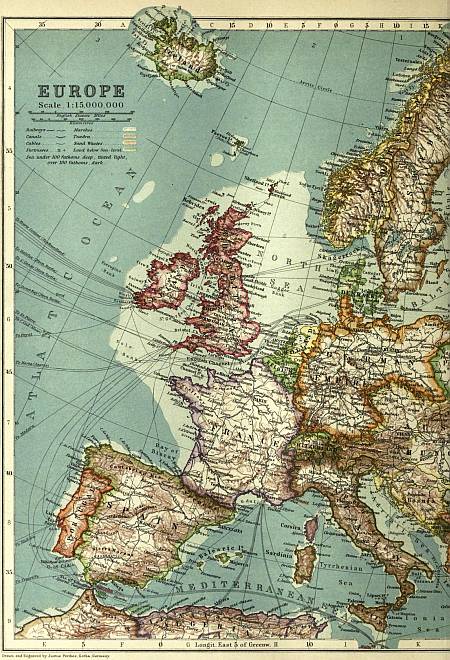
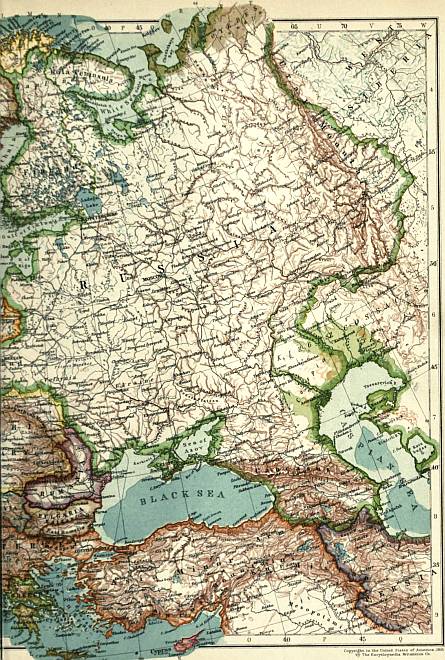
(Click to enlarge left side.)
(Click to enlarge right side.)
The changes briefly indicated above take place so gradually for the most part that it requires careful observation and comparison of data to establish their reality. It is very different with those changes which we usually ascribe to volcanic Volcanoes and earthquakes. agency. Besides the great outlying “hearth” of Iceland, there are four centres of volcanic activity in Europe—all of them, however, situated in the Mediterranean. Vesuvius on the western coast of Italy, Etna in the island of Sicily, and Stromboli in the Lipari group, have been familiarly known from the earliest historic times; but the fourth has only attracted particular attention since the 18th century. It lies in the Archipelago, on the southern edge of the Cyclades, near the little group of islets called Santorin. The region was evidently highly volcanic at an earlier period, for Milo, one of the nearest of the islands, is simply a ruined crater still presenting smoking solfataras and other traces of former activity. The devastations produced by the eruptions of the European volcanoes are usually confined within very narrow limits; and it is only at long intervals that any part of the continent is visited by a really formidable earthquake. The only part of Europe, however, for which there are no recorded earthquakes is central and northern Russia; and the Alps and Carpathians, especially the intra-Carpathian area of depression, Greece, Italy, especially Calabria and the adjoining part of Sicily, the Sierra Nevada and the Pyrenees, the Lisbon district and the rift valley of the upper Rhine (between the Vosges and the Black Forest) are all regions specially liable to earthquake shocks and occasionally to shocks of considerable intensity. One well-marked seismic line extends along the south side of the Alps from Lake Garda by Udine and Görz to Fiume, and another forms a curve convex towards the south-east passing first through Calabria, then through the north-east of Sicily to the south of the Peloritan Mountains.14 Of all European earthquakes in modern times, the most destructive are that of Lisbon in 1755, and that of Calabria in 1783; the devastation produced by the former has become a classical instance of such disasters in popular literature, and by the latter 100,000 people are said to have lost their lives. Calabria again suffered severely in 1865, 1870, 1894, 1905 and 1908.
If the European mountains are arranged according to their greatest elevations, they rank as follows:—(1) the Swiss Alps, with their highest peaks above 15,000 ft.; (2) the Sierra Nevada, the Pyrenees, and Etna, about 11,000 ft.; (3) Relief. the Apennines, the Corsican Mountains, the Carpathians, the Balkans, and the Despoto Dagh, from 8000 to 9000; (4) the Guadarrama, the Scandinavian Alps, the Dinaric Alps, the Greek Mountains, and the Cevennes, between 6000 and 8000; (5) the mountains of Auvergne, the Jura, the Riesengebirge, the mountains of Sardinia, Majorca, Minorca, and the Crimea, the Black Forest, the Vosges, and the Scottish Highlands, from 4000 to 6000.
The following estimates are based on those contained in the fifth edition, by Dr Hermann Wagner, of Guthe’s Lehrbuch der Geographie. In the original the figures are given in German sq. m. and in sq. kilometres in round numbers, and the equivalents here given in English sq. m. are similarly treated:—
Sq. m.
The great European plain in its widest sense 2,660,000
The same exclusive of inland seas 2,300,000
The same exclusive of the Scandinavian and
British lowlands 2,125,000
All other European lowlands 385,000
The Hungarian plain 38,000
The Po plain 21,000
The Scandinavian highlands 190,000
The Ural Mountains 127,000
The Alps 85,000
The Carpathians 72,000
The Apennines 42,500
The Pyrenees 21,500
Several estimates have been made of the average elevation of the continent, but it is enough to give here the main results. In the following list, where a conversion from metres into feet has been necessary, the nearest multiple of 5 ft. has been given:—Humboldt, 675 ft.; Leipoldt,15 975 ft.; De Lapparent,16 960 ft.; Murray,17 939 ft.; Supan,18 950 ft.; von Tillo,19 1040 ft.; Heiderich,20 1230 ft.; Penck,21 1085 ft. The exceptionally high estimate of Heiderich is due to the fact that by him Transcaucasia and the islands of Novaya Zemlya, Spitsbergen and Iceland are reckoned as included in Europe.
Of more geographical significance than these estimates are the facts with regard to the arrangement of the highlands of the continent. It is indeed this arrangement combined with the form of the coast-line which has indirectly given to Europe Arrangement of the highlands. its individuality. Three points have to be noted under this head:—(1) the fact that the highlands of Europe are so distributed as to allow of the penetration of westerly winds far to the east; (2) the fact that the principal series of highlands has a direction from east to west, Europe in this point resembling Asia but differing from North America; and (3) that in Europe the mountain systems belonging to the series of highlands referred to not only have more or less well-marked breaks between them, but are themselves so notched by passes and cut by transverse valleys as to present great facilities for crossing in proportion to their average altitude. The first and second of these points have special importance with reference to the climate and will accordingly be considered more fully under that head. The second is also of importance with reference to the means of communication, to which the third also refers, and detailed consideration of these points in that relation will be reserved for that heading. Here, however, it may be noted that in Europe the distribution of the natural resources for the maintenance of the inhabitants is such that, if we leave out of account Russia, which is almost entirely outside of the series of highlands running east and west, the population north of the mountains is roughly about 50% greater than that south of the mountains, whereas in Asia the population north of the east and west highland barrier is utterly insignificant as compared with that to the south.
Name of River. Length in English Miles. Area of Basin in sq. m.
Strelbitsky. Other Authorities. Strelbitsky.
Volga 197722 210723 563,300
Danube 1644 .. 315,435
Ural 1446 147723 96,350
Dnieper (Dnyepr) 1064 132823 203,460
Kama 984 111523 202,615
Don (Russia) 980 112323 166,125
Pechora 915 102423 127,225
Rhine 709 .. 63,265
Oka 706 91423 93,205
Dniester (Dnyestr) 646 83523 29,675
Elbe 612 .. 55,340
Vistula 596 64623 73,905
Vyatka 596 68023 50,555
Tagus 566 .. 31,86524
Theiss (Tisza) 550 .. 59,350
Loire 543 .. 46,755
Save 535 .. 37,595
Meuse 530 .. 12,740
Mezen 496 50723 30,410
Donets 487 61323 37,890
Douro 485 .. 36,705
Düna (S. Dvina) 470 57623 32,975
Ebro 470 .. 38,58024
Rhone 447 .. 38,180
Desna 438 59023 33,535
Niemen (Nyeman) 437 53723 34,965
Drave 434 .. 15,745
Bug (Southern) 428 47723 26,225
Seine 425 .. 30,030
Oder 424 .. 17,150
Kuban 405 50923 21,490
Khoper 387 56323 23,120
Maros 390 .. 16,975
Pripet 378 40423 46,805
Guadalquivir 374 .. 21,58024
Pruth (Prutŭ 368 50323 10,330
Northern Dvina 358 44723 141,075
Weser-Werra 355 .. 19,925
Po 354 .. 28,92024
Garonne-Gironde 342 .. 32,745
Vetluga 328 46423 14,325
Pinega 328 40723 17,425
Glommen 326 35225 15,930
Bug (Western) 318 45023 22,460
Guadiana 316 .. 25,30024
Aluta (Alt, Oltŭ) 308 .. 9,095
Mosel 300 .. 10,950
Main 300 .. 10,600
Maritsa 272 .. 20,790
Jucar 270 .. 7,62024
Mologa 268 33823 15,005
Tornea 268 .. 13,045
Inn 268 .. 9,825
Saône 268 .. 8,295
Moldau 255 26725 10,860
Moksha 249 37123 19,090
Ljusna 243 .. 7,700
Mur 242 .. 5,200
Morava, Servian 235 .. 15,715
Klar 224 .. 4,520
Voronezh 218 30523 7,760
Berezina 218 28523 9,295
Saale 215 .. 8,970
Onega 212 24523 22,910
Vág (Waag) 212 .. 6,245
Dema 209 27523 4,830
San 203 44423 6,135
Moskva 189 30523 5,910
Western Manych 176 29523 37,820
Klyazma 159 39423 15,200
From the table given on p. 909 (col. 1) it will be seen that the most extensive of the highland areas of Europe is that of Scandinavia, which has a general trend from south-south-west to north-north-east, and is completely detached by seas and plains from the highland area to the south. There are other completely detached highland areas in Iceland, the British Isles, the Ural Mountains, the small Yaila range in the south of the Crimea, and the Mediterranean islands. The connected series of highlands is that which extends from the Iberian peninsula to the Black Sea stretching in the middle of Germany northwards to about 52° N. In the Iberian peninsula we have the most marked example of the tableland form in Europe, and these tablelands are bounded on the north by the Cantabrian Mountains, which descend to the sea, and the Pyrenees, which, except at their extremities, cut off the Iberian peninsula from the adjoining country more extensively than any other chain in the continent. Between the foot-hills of the Pyrenees, however, and those of the central plateau of France the ground sinks in the Passage of Naurouse or Gap of Carcassonne to a well-marked gap establishing easy communication between the valley of the Garonne and the lower part of that of the Rhone. The highlands in the north spread northwards and then north-eastwards till they join the Vosges, but sink in elevation towards the north-east so as to allow of several easy crossings. East of the Vosges the Rhine valley forms an important trough running north and south through the highlands of western Germany. To the south of the Vosges again undulating country of less than 1500 ft. in elevation, the well-known Burgundy Gate or Gap of Belfort, constitutes a well-marked break between those mountains and the Jura, and establishes easy communication between the Rhine and the Saône-Rhone valleys. The latter valley divides in the clearest manner the highlands of central France from both the Alps and the Jura, while between these last two systems there lies the wedge of the Swiss midlands contracting south-westwards to a narrow but important gap at the outlet of the Lake of Geneva. Between the Alps and the mountains of the Italian and Balkan peninsulas the orographical lines of demarcation are less distinct, but on the north the valley of the Danube mostly forms a wide separation between the Alps and the mountains of the Balkan peninsula on the south and the highlands of Bohemia and Moravia, the Carpathians and the Transylvanian Alps on the north. The valleys of the Eger and the Elbe form distinct breaks in the environment of Bohemia, and the Sudetes on the north-east of Bohemia and Moravia are even more clearly divided from the Carpathians by the valley of the upper Oder, the Moravian Gate, as it is called, which forms the natural line of communication between the south-east of Prussia and Vienna.
An estimate has been made by Strelbitsky of the length and of the area of the basins of all the principal rivers of Europe. In the table on p. 909 all the estimates given without any special authority are based on Strelbitsky’s figures, but it should Rivers. be mentioned that the estimates of length made by him evidently do not take into account minor windings, and are therefore generally less than those given by others. The authorities are separately cited for the originals of all other figures given in the table.26
The observations on the temperature of European rivers have been collected and discussed by Dr Adolf E. Forster.27 He finds that the dominant factor in determining that temperature is the temperature of the air above, but that rivers are divisible into four groups with respect to the relation between these temperatures at different seasons of the year. These groups are rivers flowing from glaciers, in which the temperature is warmer than the air in winter, colder in summer; rivers flowing from lakes, characterized by peculiarly high winter temperatures, in consequence of which the mean temperature for the year is always above that of the air; rivers flowing from springs, which, at least near their source, are more rapidly cooled by low than warmed by high air temperatures; and rivers of the plains, which have a higher mean temperature than the air in all months of the year.