VOLUME IX SLICE VIII Ethiopia to Evangelical Association (continued 10)
Reading edition
In order to make a successful aggressive move on Turkey, Russia had first of all to secure her rear and flank by an arrangement with her two allies. In Berlin she encountered no difficulties. Bismarck had no objection to seeing Russia weaken herself in a struggle with Turkey, provided she did not upset the balance of power in south-eastern Europe, and he felt confident that he could prevent by diplomatic means any such catastrophe. He was inclined, therefore, to encourage rather than restrain the bellicose tendencies of St Petersburg. In Vienna the task of coming to a definite arrangement was much more difficult, and it was only after protracted and laborious negotiations that a convention was concluded on the 15th of January 1877, and formally signed three months later. It was a development of the agreement of Reichstadt, modified according to the changes in the situation, but retaining the essential principle that in the event of the territorial status quo being altered, Russia should recover the lost portion of Bessarabia, and Austria should get Bosnia and a part of Herzegovina. Having made these preliminary arrangements, Russia began the campaign simultaneously in Europe and Asia Minor, and after many reverses and enormous sacrifices of blood and treasure, she succeeded in imposing on the Turks the “preliminary peace” of San Stefano (3rd March 1878). That peace was negotiated with very little consideration for the interests of the other powers, and as soon as the terms of it became known in Vienna and London there San Stefano. was an outburst of indignation. In negotiating the treaty General Ignatiev had ignored the wishes of Austria, and had even, according to the contention of Andrássy, infringed the convention signed at the beginning of the war. However this may be, the peace of San Stefano brought to the surface the latent conflict of interests between the two empires. Russia’s aim was to create a big Bulgaria under the influence of St Petersburg, and to emancipate Servia and Montenegro as far as possible from Austrian influence, whereas Austria objected to the creation of any large Slav state in the Balkan Peninsula, and insisted on maintaining her influence at Belgrade and Tsetigne (Cetinje). In vain Prince Gorchakov endeavoured to conciliate Austria and to extract from Count Andrássy a clear statement of the terms he would accept. Count Andrássy was in no hurry to extricate Russia from her difficulties, and suggested that the whole question should be submitted to a European congress. The suggestion was endorsed by Great Britain, which likewise objected to the San Stefano arrangements, and Bismarck declined to bring any pressure to bear on the cabinet of Vienna.
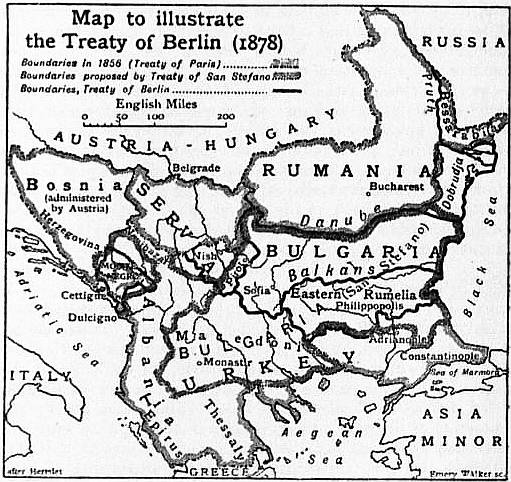
Deceived in her expectations of active support from her two allies, Russia found herself in an awkward position. From a military point of view it was absolutely necessary for her to come to an arrangement either with Austria or with England, because the communications of her army before Constantinople with its base could be cut by these two powers acting in concert—the land route being dominated by Austria, and the Black Sea route by the British fleet, which was at that time anchored in the Sea of Marmora. As soon, therefore, as the efforts to obtain the support of her two allies against the demands of England had failed, negotiations were opened in London, and on the 30th of May a secret convention was signed by Lord Salisbury and Count Schuvalov. By that agreement the obstacles to the assembling of the congress were removed. The Berlin Congress. congress met in Berlin on the 13th of June, and after many prolonged sittings and much secret negotiation the treaty of Berlin was signed on the 13th of July. By that treaty the preliminary peace of San Stefano was considerably modified. The big Bulgaria defined by General Ignatiev was divided into three portions, the part between the Danube and the Balkans being transformed into a vassal principality, the part between the Balkans and the Rhodope being made into an autonomous province, called Eastern Rumelia, under a Christian governor named by the sultan with the assent of the powers, and the remainder being placed again under the direct rule of the Porte. The independence of Montenegro, Servia and Rumania was formally recognized, and each of these principalities received a considerable accession of territory. Rumania, however. in return for the Dobrudja, which it professed not to desire, was obliged to give back to Russia the portion of Bessarabia ceded after the Crimean War. In Asia Minor Russia agreed to confine her annexations to the districts of Kars, Ardahan and Batum, and to restore to Turkey the remainder of the occupied territory. As a set-off against the large acquisitions of the Slav races, the powers recommended that the sultan should cede to the kingdom of Greece the greater part of Thessaly and Epirus, under the form of a rectification of frontiers. At first the sultan refused to act on this recommendation, but in March 1881 a compromise was effected by which Greece obtained Thessaly without Epirus. Bosnia and Herzegovina were to be occupied and administered by Austria-Hungary, and the Austrian authorities were to have the right of making roads and keeping garrisons in the district of Novi-Bazar, which lies between Servia and Montenegro. In all the provinces of European Turkey for which special arrangements were not made in the treaty, the Porte undertook (Art. 23) to introduce organic statutes similar to that of Crete, adapted to the local conditions. This article, like many of the subordinate stipulations of the treaty, remained a dead letter. We may mention specially Art. 61, in which the Sublime Porte undertook to realize without delay the ameliorations and reforms required in the provinces inhabited by Armenians, and to guarantee their safety against the Circassians and Kurds. Equally unreliable proved the scheme of Lord Beaconsfield to secure good administration throughout the whole of Asia Minor by the introduction of reforms under British control, and to prevent the further expansion of Russia Cyprus Convention. in that direction by a defensive alliance with the Porte. A convention to that effect was duly signed at Constantinople a few days before the meeting of the congress (4th June 1878), but the only part of it which was actually realized was the occupation and administration of Cyprus by the British government. The new frontiers stipulated in the treaty of San Stefano, and subsequently rectified by the treaty of Berlin, are shown in the accompanying sketch-map.
The secret schemes of Russia and Austria, in so far as they were defined in the agreement of Reichstadt and the subsequent Austro-Russian treaty of Vienna, had thus been realized. Russia had recovered the lost portion of Bessarabia, and Austria had practically annexed Bosnia and Herzegovina, though the nominal suzerainty of the sultan over the two provinces was maintained. But Russia was far from satisfied with the results, which seemed to her not at all commensurate with the sacrifices imposed on her by the war, and her dissatisfaction led to a new grouping of the powers. Before the opening of the Berlin congress Bismarck had announced publicly that he would refrain from taking sides with any of the contending parties, and would confine himself to playing the part of an honest broker. The announcement was received by the Russians with astonishment and indignation. What they expected was not an impartial arbiter, but a cordial and useful friend in need. In 1871 the emperor William, as we have seen, had spontaneously declared to the tsar that Germany owed to His Majesty the happy issue of the war, and that she would never forget it, and we may add that on that occasion he signed himself “Your ever grateful Friend.” Now, in 1878, when the moment had come for paying at least an instalment of this debt, and when Russia was being compelled to make concessions which she described as incompatible with her dignity, Bismarck had nothing better to offer than honest brokerage. The indignation in all classes Russian resentment against Bismarck. was intense, and the views commonly held regarding Bismarck’s “duplicity” and “treachery” were supposed to receive ample confirmation during the sittings of the congress and the following six months. On the 4th of February 1879 Prince Gorchakov wrote to the ambassador in Vienna: “Needless to say, that in our eyes the Three Emperors’ Alliance is practically torn in pieces by the conduct of our two allies. At present it remains for us merely to terminate the liquidation of the past, and to seek henceforth support in ourselves alone.” The same view of the situation was taken in Berlin and Vienna, though the result was attributed, of course, to different causes, and the danger of serious complications became so great that Bismarck concluded with Andrássy in the following October (1879) a formal defensive alliance, which was avowedly directed against Russia, and which subsequently developed into the Triple Alliance, directed against Russia and France.
The causes of the rupture are variously described by the different parties interested. According to Bismarck the Russian government began a venomous campaign against Germany in the press, and collected, with apparently hostile intentions, enormous masses of troops near the German and Austrian frontiers, whilst the tsar adopted in his correspondence with the emperor William an arrogant and menacing tone which could not be tolerated. On the other hand, the Russians declare that the so-called Press-Campaign was merely the spontaneous public expression of the prevailing disappointment among all classes in Russia, that the military preparations had a purely defensive character, and that the tsar’s remarks, which roused Bismarck’s ire, did not transgress the limits of friendly expostulation such as sovereigns in close friendly relations might naturally employ. Subsequent revelations tend rather to confirm the Russian view. After an exhausting war and without a single powerful ally, Russia was not likely to provoke wantonly a great war with Germany and Austria. The press attacks were not more violent than those which frequently appear in newspapers which draw their inspiration from the German foreign office, and the accusations about the arrogant attitude and menacing tone of Alexander II. are not at all in harmony with his known character, and are refuted by the documents since published by Dr Busch. The truth seems to be that the self-willed chancellor was actuated by nervous irritation and personal feeling more than by considerations of statecraft. His imperial master was not convinced by his arguments, and showed great reluctance to permit the conclusion of a separate treaty with Austria. Finally, with much searching of heart, he yielded to the importunity of his minister; but in thus committing an unfriendly act towards his old ally, he so softened the blow that the personal good relations between the two sovereigns suffered merely a momentary interruption. Bismarck himself soon recognized that the permanent estrangement of Russia would be a grave mistake of policy, and the very next year (1880), negotiations for a treaty of defensive alliance between the two cabinets were begun. Nor did the accession to the throne of Russia of Alexander III., who had long enjoyed the reputation of being systematically hostile to Germans, produce a rupture, as was expected. Six months after his father’s death, the young tsar met the old kaiser at Danzig (September 1881), and some progress was made towards a complete renewal of the traditional friendship. Immediately afterwards a further step was taken towards re-establishing the old state of things with regard also to Austria. On his return to St Petersburg, Alexander III. remembered that he had received some time previously a telegram of congratulation from the emperor Francis Joseph, and he now replied to it very cordially, referring to the meeting at Danzig, and describing the emperor William as “that venerable friend with whom we are united in the common bonds of a profound affection.” The words foreshadowed a revival of the Three Emperors’ League, which actually took place three years later.
The removal of all immediate danger of a Franco-Russian alliance did not prevent Bismarck from strengthening in other ways the diplomatic position of Germany, and the result of his efforts soon became apparent in the alliance Growth of the Triple Alliance. of Italy with the two central powers. Ever since the Franco-German War of 1870-71, and more especially since the congress of Berlin in 1878, the Italian government had shown itself restless and undecided in its foreign policy. As it was to France that Italy owed her emancipation from Austrian rule, it seemed natural that the two countries should remain allies, but anything like cordial co-operation was prevented by conflicting interests and hostile feeling. The French did not consider the acquisition of Savoy and Nice a sufficient compensation for the assistance they had given to the cause of Italian unity, and they did not know, or did not care to remember, that their own government was greatly to blame for the passive attitude of Italy in the hour of their great national misfortunes. On the other hand, a considerable amount of bitterness against France had been gradually accumulating in the hearts of the Italians. As far back as the end of the war of 1859, popular opinion had been freely expressed against Napoleon III., because he had failed to keep his promise of liberating Italy “from the Alps to the Adriatic.” The feeling was revived and intensified when it became known that he was opposing the annexation of central and southern Italy, and that he obtained Savoy and Nice as the price of partly withdrawing his opposition. Subsequently, in the war of 1866, he was supposed to have insulted Italy by making her conclude peace with Austria, on the basis of the cession of Venetia, before she could wipe out the humiliation of her defeats at Custozza and Lissa. Then came the French protection of the pope’s temporal power as a constant source of irritation, producing occasional explosions of violent hostility, as when the new Chassepot rifles were announced to have “worked wonders” among the Garibaldians at Mentana. When the Second Empire was replaced by the Republic, the relations did not improve. French statesmen of the Thiers school had always condemned the imperial policy of permitting and even encouraging the creation of large, powerful states on the French frontiers, and Thiers himself publicly attributed to this policy the misfortunes of his country. With regard to Italy, he said openly that he regretted what had been done, though he had no intention of undoing it. The first part of this statement was carefully noted in Italy, and the latter part was accepted with scepticism. In any case his hand might perhaps be forced, for in the first republican chamber the monarchical and clerical element was very strong, and it persistently attempted to get something done in favour of the temporal power. Even when the party of the Left undertook the direction of affairs in 1876, the government did not become anti-clerical in its foreign policy, and Italian statesmen resigned themselves to a position of political isolation. The position had its advantages. Events in the Balkan Peninsula foreshadowed a great European war, and it seemed that in the event of Europe’s being divided into two hostile camps, Italy might have the honour and the advantage of regulating the balance of power. By maintaining good relations with all her neighbours and carefully avoiding all inconvenient entanglements, she might come forward at the critical moment and dictate her own terms to either of the contending parties, or offer her services to the highest bidder. This Machiavellian policy did not give the expected results. Being friends with everybody in a general way may be the best course for an old, conservative country which desires merely the maintenance of the status quo, but it does not secure the energetic diplomatic support required by a young enterprising state which wishes to increase its territory and influence. At the congress of Berlin, when several of the powers got territorial acquisitions, Italy got nothing. The Italians, who were in the habit of assuming, almost as a matter of principle, that from all European complications they had a right to obtain some tangible advantage, were naturally disappointed, and they attributed their misfortune to their political isolation. The policy of the free hand consequently fell into disrepute, and the desire for a close, efficient alliance revived. But with what power or powers should an alliance be made? The remnants of the old party of action, who still carried the Italia Irredenta banner, had an answer ready. They recommended that alliances should be concluded with a view to wresting from Austria the Trentino and Trieste, with Dalmatia, perhaps, into the bargain. On the other hand, the Conservatives and the Moderates considered that the question of the Trentino and Trieste was much less important than that of political influence in the Mediterranean. A strong Austria was required, it was said, to bar the way of Russia to the Adriatic, and France must not be allowed to pursue unchecked her policy of transforming the Mediterranean into a French lake. Considerations of this kind led naturally to the conclusion that Italy should draw closer to the powers of central Europe. So the question appeared from the standpoint of “la haute politique.” From the less elevated standpoint of immediate political interests, it presented conflicting considerations. A rapprochement with the central powers might prevent the conclusion of a commercial treaty with France, and thereby increase the financial and economic difficulties with which the young kingdom was struggling, whereas a rapprochement with France would certainly excite the hostility of Bismarck, who was retiring from the Kulturkampf and journeying towards Canossa, and who might possibly conciliate the pope by helping him to recover his temporal sovereignty at the expense of Italy. Altogether the problem was a very complicated one. The conflicting currents so nearly balanced each other, that the question as to which way the ship would drift might be decided by a little squall of popular sentiment. A very big squall was brewing.
During the congress of Berlin the French government was very indignant when it discovered that Lord Beaconsfield had recently made a secret convention with the sultan for the British occupation of Cyprus, and in order to calm France and Tunis. its resentment Lord Salisbury gave M. Waddington to understand that, so far as England was concerned, France would be allowed a free hand in the Regency of Tunis, which she had long coveted. Though the conversations on the subject and a subsequent exchange of notes were kept strictly secret, the Italian government soon got wind of the affair, and it was at first much alarmed. It considered, in common with Italians generally, that Tunis, on the ground of historic right and of national interests, should be reserved for Italy, and that an extension of French territory in that direction would destroy, to the detriment of Italy, the balance of power in the Mediterranean. These apprehensions were calmed for a time by assurances given to the Italian ambassador in Paris. M. Gambetta assured General Cialdini that he had no intention of making Italy an irreconcilable enemy of France, and M. Waddington declared, on his word of honour, that so long as he remained minister of foreign affairs nothing of the sort would be done by France without a previous understanding with the cabinet of Rome. M. Waddington honourably kept his word, but his successor did not consider himself bound by the assurance; and when it was found that the Italians were trying systematically to establish their influence in the Regency at the expense of France, the French authorities, on the ground that a Tunisian tribe called the Kroumirs had committed depredations in Algeria, sent an armed force into the Regency, and imposed on the bey the Bardo treaty, which transformed Tunis into a French protectorate.
The establishment of a French protectorate over a country which the Italians had marked out for themselves as necessary for the defence and colonial expansion of the kingdom had the effect which Gambetta had foreseen—it made Italy, for a time at least, the irreconcilable enemy of France. Whilst the French were giving free expression to their patriotic exultation, and even Gambetta himself, in defiance of what he had said to Cialdini, was congratulating Jules Ferry on having restored France to her place among the nations, the Italians were trying to smother their indignation and to discover some means of retrieving what they had lost. The only remedy seemed to be to secure foreign alliances, and there was now no hesitation as to where they should be sought. Simple people in Italy imagined that if an alliance had been concluded sooner with Germany and Austria, these powers would have prevented France from trampling on the sacred interests of Italy. This idea was entirely erroneous, because Austria had little or no interest in the Tunisian Question, and Bismarck was not at all sorry to see France embark on an enterprise which distracted her attention from Alsace-Lorraine and removed all danger of a Franco-Italian alliance. The illusion, however, had a powerful influence on Italian public opinion. The government was now urged to conclude without further delay an alliance with the central powers, and the recommendation was not unwelcome to the king, because most of the Italian Gallophils had anti-dynastic and republican tendencies, and he was naturally disposed to draw nearer to governments which proclaimed themselves the defenders of monarchical institutions and the opponents of revolutionary agitation. After protracted negotiations, in which Italy tried in vain to secure protection for her own separate interests in the Mediterranean, defensive treaties of alliance were concluded with the cabinets of Vienna Triple Alliance signed 1882. and Berlin in May 1882. Though the Italian statesmen did not secure by these treaties all they wanted, they felt that the kingdom was protected against any aggressive designs which might be entertained by France or the Vatican, and when the treaties were renewed in 1887 they succeeded in getting somewhat more favourable conditions.
By the creation of this Triple Alliance, which still subsists, the diplomatic position of Germany was greatly strengthened, but Bismarck was still haunted by the apprehension of a Franco-Russian alliance, and he made repeated attempts to renew the old cordial relations with the court of St Petersburg. He was bold enough to hope that, notwithstanding the Austro-German treaty of October 1879, avowedly directed against Russia, and the new Triple Alliance, by which the Austro-German Alliance was strengthened, he might resuscitate the Three Emperors’ League in such a form as to ensure, even more effectually than he had done on the former occasion, the preponderance of Germany in the arrangement. With this object he threw out a hint to the Russian ambassador, M. Sabourof, in the summer of 1883, that the evil results of the congress of Berlin might be counteracted by a formal agreement between the three emperors. The suggestion was transmitted privately by M. Sabourof to the tsar, and was favourably received. Alexander III. was disquieted by the continuance of the Nihilist agitation, and was not averse from drawing closer to the conservative powers; and as he desired tranquillity for some time in the Balkan Peninsula, he was glad to have security that his rival would do nothing in that part of the world without a previous understanding. M. de Giers, who had now succeeded Prince Gorchakov in the direction of foreign affairs, was accordingly despatched to Friedrichsruh to discuss the subject with Bismarck. The practical result of the meeting was that negotiations between the two governments were begun, and on the 21st of March 1884 a formal document was signed in Berlin. About six months later, in the month of September, the three emperors met at Skiernevice and ratified Dreikaiserbund revived 1884. the agreement. Thus, without any modification of the Triple Alliance, which was directed against Russia, the old Three Emperors’ League, which included Russia, was revived. Germany and Austria, being members of both, were doubly protected, for in the event of being attacked they could count on at least the benevolent neutrality of both Russia and Italy. France was thereby completely isolated.
In drawing up the secret treaty of Skiernevice, which may be regarded as the chef-d’œuvre of Bismarckian diplomacy, the German chancellor’s chief aims evidently were to paralyse Russia by yoking her to Germany and Austria, to isolate France, and to realize his old scheme of holding the balance between Russia and Austria in the Balkan Peninsula. With a view to attaining the first two objects it was stipulated that if any one of the three powers were forced to make war on a fourth power, the two other contracting parties should observe a benevolent neutrality towards their ally. If we may believe a well-informed Russian authority, Bismarck wished it to be understood that in the event of two of the powers being at war with a fourth, the stipulation about benevolent neutrality should still hold good, but Alexander III. objected, on the ground that he could not remain a passive spectator of a duel in which France would be confronted by two antagonists. In his third object Bismarck was successful, for it was expressly laid down that in all cases of a disagreement between two of the parties in the affairs of the Balkan Peninsula, the third power should decide between them. This meant, of course, that in all discussions between Russia and Austria, the two great rivals in the Eastern Question, Bismarck should always have a casting vote. In return for all this, Russia obtained two small concessions: firstly, that Germany and Austria should seek to restrain the sultan from permitting the passage of the Dardanelles to an English fleet, as he had done in 1878, when the Russian army was before Constantinople; and, secondly, that they should not oppose the union of Bulgaria and Eastern Rumelia, if it was accomplished by the force of things and within the limits traced by the congress of Berlin.
This new form of the Three Emperors’ League had all the organic defects of its predecessor, and was destined to be still more short-lived. The claims of Russia and Austria might be reconcilable in theory, but in practice they were sure to conflict; and however much Bismarck might try to play the part of an honest broker, he was certain to be suspected of opposing Russia and favouring Austria. It was therefore only during a period of political stagnation in south-eastern Europe that the arrangement could work smoothly. The political stagnation did not last long. Prince Alexander of Bulgaria had for some time been fretting under the high-handed interference of the Russian agents in the principality, and had begun to oppose systematically what the Russians considered their legitimate influence. Relations between Sofia and St Petersburg had Bulgarian crisis. consequently become strained, when a crisis was suddenly brought about by the revolution of Philippopolis in September 1885. The conspirators arrested and expelled the governor-general, who had been appointed by the sultan with the assent of the powers, and at the same time proclaimed the union of the autonomous province of Eastern Rumelia with the principality of Bulgaria, in defiance of the stipulations of the treaty of Berlin. The revolution had been effected with the connivance and approval of the regularly accredited Russian agents in Philippopolis, but it had not received the sanction of the Russian government, and was resented as a new act of insubordination on the part of Prince Alexander. When he arrived in Philippopolis and accepted the declaration of union, the cabinet of St Petersburg protested against any such infraction of the Berlin treaty, and the Porte prepared to send an army into the province. It was restrained from taking this step by the ambassadors in Constantinople, so that an armed conflict between Turks and Bulgarians was prevented; but no sooner had the Bulgarians been relieved from this danger on their eastern frontier, than they were attacked from the west by the Servians, who were determined to get ample compensation for any advantage which the Bulgarians might obtain. The Bulgarian army defeated the Servians at Slivnitza (November 19-20, 1885), and was marching on Belgrade when its advance was stopped and an armistice arranged by the energetic intervention of the Austrian government. Following the example of the Servians, the Greeks were preparing to exact territorial compensation likewise; but as their mobilization was a slow process, the powers had time to restrain them from entering on active hostilities, first by an ultimatum (April 26, 1886), and afterwards by a blockade of their ports (May 1886). By that time, thanks to the intervention of the powers, a peace between Bulgaria and Servia had been signed at Bucharest (March 3); and with regard to Eastern Rumelia a compromise had been effected by which the formal union with the principality was rejected, and the prince was appointed governor-general of the province for a term of five years. This was in reality union in disguise.
The diplomatic solution of the problem averted the danger of a European war, but it left a great deal of dissatisfaction, which soon produced new troubles. Not only had Prince Alexander escaped punishment for his insubordination to Russia, but he and the anti-Russian party among the Bulgarians had obtained a decided success. This could not well be tolerated. Before six months had passed (August 21, 1886) Prince Alexander was kidnapped by conspirators in his palace at Sofia and conveyed secretly to Russian Bessarabia. As soon as the incident was reported to the tsar, the prince was released, and he at once returned to Sofia, where a counter-revolution had been effected in his favour; but he considered his position untenable, and formally abdicated. A fortnight after his departure General Kaulbars arrived from St Petersburg with instructions from the tsar to restore order in accordance with Russian interests. In St Petersburg it was supposed that the Bulgarian people were still devoted to Russia, and that they were ready to rise against and expel the politicians of the Nationalist party led by Stambolof. General Kaulbars accordingly made a tour in the country and delivered speeches to the assembled multitudes, but Stambolof’s political organization counteracted all his efforts, and on the 20th of November he left Bulgaria and took the Russian consuls with him. Stambolof maintained his position, suppressed energetically several insurrectionary movements, and succeeded in getting Prince Ferdinand of Coburg elected prince (July 7, 1887), in spite of the opposition of Russia, who put forward as candidate a Russian subject, Prince Nicholas of Mingrelia. Prince Ferdinand was not officially recognized by the sultan and the powers, but he continued to reign under the direction of Stambolof, and the Russian government, passively accepting the accomplished facts, awaited patiently a more convenient moment for action.
These events in the Balkan Peninsula necessarily affected the mutual relations of the powers composing the Three Emperors’ League. Austria could not remain a passive and disinterested spectator of the action of Russia in Bulgaria. Her agents had given a certain amount of support to Prince Alexander in his efforts to emancipate himself from Russian domination; and when the prince was kidnapped and induced to abdicate, Count Kalnoky had not concealed his intention of opposing further aggression. Bismarck resisted the pressure brought to bear on him from several quarters in favour of the anti-Russian party in Bulgaria, but he was suspected by the Russians of siding with Russian hostility to Germany. Austria and secretly encouraging the opposition to Russian influence. This revived the hatred against him which had been created by his pro-Austrian leanings after the Russo-Turkish War. The feeling was assiduously fomented by the Russian press, especially by M. Katkoff, the editor of the Moscow Gazette, who exercised great influence on public opinion and had personal relations with Alexander III. On the 31st of July 1886, three weeks before the kidnapping of Prince Alexander, he had begun a regular journalistic campaign against Germany, and advocated strongly a new orientation of Russian policy. M. de Giers, minister of foreign affairs, was openly attacked as a partisan of the German alliance, and his “pilgrimages to Friedrichsruh and Berlin” were compared to the humiliating journeys of the old Russian grand-princes to the Golden Horde in the time of the Tatar domination. The moment had come, it was said, for Russia to emancipate herself from German diplomatic thraldom, and for this purpose a rapprochement with France was suggested. The idea was well received by the public, and it seemed to be not unpalatable to the tsar, for the Moscow Gazette was allowed to continue its attacks on M. de Giers’s policy of maintaining the German alliance. In Berlin such significant facts could not fail to produce uneasiness, because one of the chief aims of Bismarck’s policy had always been to prevent a Russo-French entente cordiale. The German press were instructed to refute the arguments of their Russian colleagues, and to prove that if Russia had really lost her influence in the Balkan Peninsula, the fact was due to the blunders of her own diplomacy. The controversy did not produce at once a serious estrangement between the two cabinets, but it marked the beginning of a period of vacillation on the part of Alexander III. When the treaty of Skiernevice was about to expire in 1887, he positively refused to renew the Three Emperors’ League, but he consented to make, without the cognizance of Austria, a secret treaty of alliance with Germany for three years. Not satisfied with this guarantee against the danger of a Franco-Russian alliance, Bismarck caused attacks to be made in the press on Russian credit, which was rapidly gaining a footing on the Paris bourse, and he imprudently showed his hand by prohibiting the Reichsbank from accepting Russian securities as guarantees. From that moment the tsar’s attitude changed. All his dormant suspicions of German policy revived. When he passed through Berlin in November 1887, Bismarck had a long audience, in which he defended himself with his customary ability, but Alexander remained unmoved in his conviction that the German government had systematically opposed Russian interests, and had paralysed Russian action in the Balkan Peninsula for the benefit of Austria; and he failed to understand the ingenious theory put forward by the German chancellor, that two powers might have a severe economic struggle without affecting their political relations. Bismarck had to recognize that, for the moment at least, the Three Emperors’ League, which had served his purposes so well, could not be resuscitated, but he had still a certain security against the hostility of Russia in the secret treaty. Soon, however, this link was also to be broken. When the treaty expired in 1890 it was not renewed. By that time Bismarck had been dismissed, and he subsequently reproached his successor, Count Caprivi, with not having renewed it, but in reality Count Caprivi was not to blame. Alexander III. was determined not to renew the alliance, and was already gravitating slowly towards an understanding with France.
No treaty or formal defensive engagement of any kind existed between Russia and France, but it was already tolerably certain that in the event of a great war the two nations would be found fighting on the same side, and the military Franco-Russian entente. authorities in both countries felt that if no arrangements were made beforehand for concerted action,—such arrangements having been long ago completed by the powers composing the Triple Alliance—they would begin the campaign at a great disadvantage. This was perfectly understood by both governments; and after some hesitation on both sides. Generals Vannovski and Obruchev, on the one side, and Generals Saussier, Miribel and Boisdeffre on the other, were permitted to discuss plans of co-operation. At the same time a large quantity of Lebel rifles were manufactured in France for the Russian army, and the secret of making smokeless powder was communicated to the Russian military authorities. The French government wished to go further and conclude a defensive alliance, but the tsar was reluctant to bind himself with a government which had so little stability, and which might be induced to provoke a war with Germany by the prospect of Russian support. Even the military convention was not formally ratified until 1894. The enthusiastic partisans of the alliance flattered themselves that the tsar’s reluctance had been overcome, when he received very graciously Admiral Gervais and his officers during the visit of the French fleet to Cronstadt in the summer of 1891, but their joy was premature. The formal rapprochement between the two governments was much slower than the unofficial rapprochement between the two nations. More than two years passed before the Cronstadt visit was returned by the Russian fleet, under Admiral Avelan. The enthusiastic ovations which the admiral and his subordinates received in Toulon and Paris (October 1893) showed how eager and anxious the French people were for an alliance with Russia, but the Russian government was in no hurry to gratify their wishes. Of the official action all we know with certainty is, that immediately after the Cronstadt visit in 1891 a diplomatic protocol about a defensive alliance was signed; that during the special mission of General Boisdeffre to St Petersburg in 1892 negotiations took place about a military convention; that in 1894 the military convention was ratified; that in the summer of 1895 M. Ribot, when prime minister, first spoke publicly of an alliance; and that during the visit of the president of the French Republic to St Petersburg, in August 1897, France and Russia were referred to as allies in the complimentary speeches of the tsar and of M. Félix Faure. Though we are still in the dark as to the precise terms of the arrangement, there is no doubt that close friendly relations were established between the two powers, and that in all important international affairs they sought to act in accord with each other. It is equally certain that for some years Russia was the predominant partner, and that, in accordance with the pacific tendencies of the tsar, she systematically exercised a restraining influence on France.
The great expectations excited among the French people by the entente cordiale were consequently not realized, and there appeared gradually premonitory symptoms of a reaction in public opinion, but the alliance between the The Triple entente and the Triple Alliance. two governments was maintained, and though the Triple Alliance was weakened by the internal troubles of Austria-Hungary and by a tendency on the part of Italy to gravitate towards France, the grouping of the great powers was not radically changed till the Russo-Japanese War of 1904-5. By that war the balance of power in Europe was seriously disturbed. Russia inadvertently provoked a struggle with Japan which made such a drain on her energies and material resources that her political influence in Europe necessarily suffered a partial eclipse. Thus the Triple Alliance outweighed its rival, and there was a danger of the German emperor’s taking advantage of the situation to secure for himself a diplomatic predominance in Europe. France at once perceived that there was a grave danger for herself, and naturally looked about for some diplomatic support to replace that of Russia, which had lost much of its value. From her uncomfortable isolation there were only two possible exits—a rapprochement with Germany or a rapprochement with England. Both of these demanded sacrifices. The former required a formal abandonment of all ideas of recovering Alsace and Lorraine; the latter a formal recognition of British predominance in Egypt. Under the influence of M. Delcassé the French government chose what seemed the lesser of two evils, and concluded with the English foreign office in April 1904 a general agreement, of which the most important stipulation was that France should leave England a free hand in Egypt, and that England in return should allow France, within certain limits, a free hand in Morocco. On that basis was effected a rapprochement between the two governments which soon developed into an entente cordiale between the two nations. The efforts of the German emperor to undermine the entente by insisting on the convocation of a conference to consider the Morocco question caused M. Delcassé to resign, and produced considerable anxiety throughout Europe, but the desired result was not attained. On the contrary, the conference in question, which met at Algeciras in January 1906, ended in strengthening the entente and in accentuating the partial isolation of Germany.
The grouping of the great continental states into two opposite but not necessarily hostile camps helped to preserve the balance of power and the peace of Europe. The result was that the causes of conflict which arose from time to time up to the end of the 19th century were localized. Some of the principal questions involved may be more particularly mentioned.
The Armenian Question was brought prominently before Europe by the Russo-Turkish War of 1877-78. In the treaties of San Stefano and Berlin the Sublime Porte undertook “to carry out without delay the ameliorations and reforms required by local Armenia. needs in the provinces inhabited by the Armenians, and to guarantee their security against the Circassians and the Kurds.” This stipulation remained a dead letter, and the relations between the Armenians and the Mussulmans became worse than before, because the protection of the powers encouraged in the oppressed nationality far-reaching political aspirations, and the sultan regarded the political aspirations and the intervention of the powers as dangerous for the integrity and independence of his empire. For some fifteen years the Armenians continued to hope for the efficacious intervention of their protectors, but when their patience became exhausted and the question seemed in danger of being forgotten, they determined to bring it again to the front. Some of them confined themselves to agitating abroad, especially in England, in favour of the cause, whilst others made preparations for exciting an insurrectionary movement in Constantinople and Asia Minor. These latter knew very well that an insurrection could be suppressed by the Turkish government without much difficulty, but they hoped that the savage measures of repression which the Turks were sure to employ might lead to the active intervention of Europe and ensure their liberation from Turkish rule, as the famous “atrocities” of 1876 had led to the political emancipation of Bulgaria. In due course—1895-1896—the expected atrocities took place, in the form of wholesale massacres in Constantinople and various towns of Asia Minor. The sultan was subjected to diplomatic pressure and threatened with more efficient means of coercion. In the diplomatic campaign England took the lead, and was warmly supported by Italy, but Germany, Austria and France showed themselves lukewarm, not to say indifferent, and Russia, departing from her traditional policy of protecting the Christians of Turkey, vetoed the employment of force for extracting concessions from the sultan. In these circumstances the Porte naturally confined itself to making a few reforms on paper, which were never carried out. Thus the last state of the Armenians was worse than the first, but the so-called European concert was maintained, and the danger of a great European war was averted.
The next attempt to raise the Eastern Question was made by the Greeks. In 1896 a semi-secret society called the Ethniké Hetairia began a Panhellenic agitation, and took advantage of one of the periodical insurrections in Crete. Crete to further its projects. In February 1897 the Cretan revolutionary committee proclaimed the annexation of the island to the Hellenic kingdom, and a contingent of Greek regular troops landed near Canea under the command of Colonel Vassos to take possession of the island in the name of King George. The powers, objecting to this arbitrary proceeding, immediately occupied Canea with a mixed force from the ships of war which were there at the time, and summoned the Greek government to withdraw its troops. The summons was disregarded, and the whole of the Greek army was mobilized on the frontier of Thessaly and Epirus. In consequence of a raid into Turkish territory the Porte declared war on the 17th of April, and the short campaign ended in the defeat of the Greeks. The powers intervened to put an end to the hostilities, and after prolonged negotiations a peace was concluded by which Greece had to consent to a strategical rectification of frontier and to pay a war indemnity of £4,000,000. Thus a second time the European concert acted effectually in the interests of peace, but it did not stand the strain of the subsequent efforts to solve the Cretan Question. Finding the Turks less conciliatory after their military success, and being anxious to remain in cordial relations with the Porte, Germany withdrew from further co-operation with the powers, and Austria followed her example. They did not, however, offer any active opposition, and the question received a temporary solution by the appointment of Prince George, second son of the king of Greece, as high commissioner and governor-general of the island. (See Crete.)
The conflicting desires of several of the powers to obtain colonial possessions in various parts of the world, and to forestall their competitors in the act of taking possession, were bound to introduce complications in which England, as the greatest Africa. of colonial powers, would generally be involved; and as the unappropriated portions of the earth’s surface at the beginning of the period under discussion were to be found chiefly in Africa, it was in the Dark Continent that the conflicts of interests mostly took place. England’s chief competitors were France and Germany. Her traditional policy, except in the south of the continent, where the conditions of soil and climate were favourable to European colonists, had been purely commercial. She had refrained from annexation of territory, as involving too much expenditure and responsibility, and confined her protection to the trading stations on the coast. When France came into the field this policy had to be abandoned. The policy of France was also commercial in a certain sense, but the methods she adopted were very different. She endeavoured to bring under her authority, by annexation or the establishment of protectorates, the largest possible extent of territory, in order to increase her trade by a system of differential tariffs; she encroached on the hinterland of British settlements, and endeavoured to direct artificially the native inland trade towards her own ports. A glance at the map of the African West Coast will suffice to show the success with which this policy was carried out. When the British government awoke to the danger, all that could be done was to prevent further encroachments by likewise annexing territory. The result is shown in the article Africa: § 5. In her dealings with France about the partition of Africa, England was generally conciliatory, but she was always inflexible in guarding carefully the two entrances to the Mediterranean. There was, therefore, a permanent danger of conflict in Egypt and Morocco. When England in 1882 considered it necessary to suppress the Arabi insurrection, she invited France to co-operate, but the French government declined, and left the work to be done by England alone. England had no intention of occupying the country permanently, but she had to take precautions against the danger of French occupation after her withdrawal, and these precautions were embodied in an Anglo-Turkish convention signed at Constantinople in May 1887. France prevented the ratification of the convention by the sultan, with the result that the British occupation has been indefinitely prolonged. She still clung persistently, however, to the hope of obtaining a predominant position in the valley of the Nile, and she tried to effect her purpose by gaining a firm foothold on the upper course of the river. The effort which she made in 1898 to attain this end, by simultaneously despatching the Marchand mission from her Congo possessions and inciting the emperor Menelek of Abyssinia to send a force from the east to join hands with Major Marchand at Fashoda, was defeated by the overthrow of the Khalifa and the British occupation of Khartum. For a few days the two nations seemed on the brink of war, but the French government, receiving no encouragement from St Petersburg, consented to withdraw the Marchand mission, and a convention was signed defining the respective spheres of influence of the two countries.
In Morocco the rivalry between the two powers was less acute but not less persistent and troublesome. France aspired to incorporate the sultanate with her north African possessions, whilst England had commercial interests to defend and was firmly resolved to prevent France from getting unfettered possession of the southern coast of the Straits of Gibraltar. As in Egypt, so in Morocco the dangers of conflict were averted, in 1904, by a general agreement, which enabled France to carry out in Morocco, as far as England was concerned, her policy of pacific penetration, but debarred her from erecting fortifications in the vicinity of the straits. Germany thereafter strongly opposed French claims in Morocco, but after a period of great tension, and the holding of an ineffectual conference at Algeciras in 1906, an understanding was come to in 1909 (see Morocco: History).
With Germany likewise, from 1880 onwards, England had some diplomatic difficulties regarding the partition of Africa, but they never reached a very acute phase, and were ultimately settled by mutual concessions. By the arrangement of 1890, in which several of the outstanding questions were solved, Heligoland was ceded to Germany in return for concessions in East Africa. A conflict of interests in the southern Pacific was amicably arranged by the Anglo-German convention of April 1886, in which a line of demarcation was drawn between the respective spheres of influence in the islands to the north and east of the Australian continent, and by the convention of 1899, in virtue of which Germany gained possession of Samoa and renounced in favour of England all pretensions to the Tonga Archipelago.
In Asia the tendencies of the European powers to territorial expansion, and their desire to secure new markets for their trade and industry, have affected from time to time their mutual relations. More than once England and Russia Asia. have had disputes about the limits of their respective spheres of influence in central Asia, but the causes of friction have steadily diminished as the work of frontier delimitation has advanced. The important agreement of 1872-1873 was supplemented by the protocol of the 22nd of July 1887 and the Pamir delimitation of 1895, so that the Russo-Afghan frontier, which is the dividing line between the Russian and British spheres of influence, has now been carried right up to the frontier of the Chinese empire. The delimitation of the English and French spheres of influence in Asia has also progressed. In 1885 France endeavoured to get a footing on the Upper Irrawaddy, the hinterland of British Burma, and England replied in the following year by annexing the dominions of King Thebaw, including the Shan States as far east as the Mekong. Thereupon France pushed her Indo-Chinese frontier westwards, and in 1893 made an attack on the kingdom of Siam, which very nearly brought about a conflict with England. After prolonged negotiations an arrangement was reached and embodied in a formal treaty (January 1896), which clearly foreshadows a future partition between the two powers, but guarantees the independence of the central portion of the kingdom, the Valley of the Menam, as a buffer-state. Farther north, in eastern China, the aggressive tendencies and mutual rivalries of the European powers have produced a problem of a much more complicated kind. Firstly Germany, then Russia, next England, and finally France took portions of Chinese territory, under the thin disguise of long leases. They thereby excited in the Chinese population and government an intense anti-foreign feeling, which produced the Boxer movement and culminated in the attack on the foreign legations at Pekin in the summer of 1900. (See China: History.)
In 1899-1901 the relations of the European powers were disturbed by the Boer War in South Africa. In nearly every country of Europe popular feeling was much excited against England, and in certain influential quarters the idea was entertained of utilizing this feeling for the formation of a coalition against the British empire; but in view of the decided attitude assumed by the British government, and the loyal enthusiasm displayed by the colonies, no foreign government ventured to take the initiative of intervention, and it came gradually to be recognized that no European state had any tangible interest in prolonging the independence and maladministration of the Boer republics.
One permanent factor in the history of Europe after the war of 1870-71 was the constant increase of armaments by all the great powers, and the proportionate increase of taxation. The fact made such an impression on the young emperor of Russia, Nicholas II., that he invited the powers to consider whether the further increase of the burdens thereby imposed on the nations might not be arrested by mutual agreement; and a conference for this purpose was convened at the Hague (May 18-July 29, 1899), but the desirable object in view was not attained. (See Arbitration, International.)
(D. M. W.)
Though neither the first Hague Conference nor the second, which met in 1907, did much to fulfil the expectations of those who hoped for the establishment of a system which should guarantee the world against the disasters of Progress of the Peace movement. war, they undoubtedly tended to create a strong public opinion in favour of peaceful methods in the solution of international problems which has not been without its effect. Any attempt to organize the concert of the powers must always fail, as it failed in the early part of the 19th century, so long as the spirit of national and racial rivalry is stronger than the consciousness of common interests; and the early years of the 20th century showed no diminution, but rather an accentuation of this rivalry. The court of arbitration established at the Hague early in 1901 may deal effectively with questions as to which both parties desire a modus vivendi, and the pacific efforts of King Edward VII., which did so much to prevent misunderstandings likely to lead to war, resulted from 1903 onwards in a series of arbitration treaties between Great Britain and other powers which guaranteed the Hague court an effective activity in such matters. But more perilous issues, involving deep-seated antagonisms, have continued to be dealt with by the methods of the old diplomacy backed by the armed force of the powers. How far the final solution of such problems has been helped or hindered by the general reluctance to draw the sword must for some time to come remain an open question. Certainly, during the early years of the 20th century, many causes of difference which a hundred years earlier would assuredly have led to war, were settled, or at least shelved, by diplomacy. Of these the questions of Crete, of Armenia, and of contested claims in Africa have already been mentioned. Other questions of general interest which might have led to war, but which found a peaceful solution, were those of the separation of Norway and Sweden, and the rivalry of the powers in the northern seas. In October 1905 Sweden formally recognized the separate existence of Norway (see Norway: History and Sweden: History). On the 23rd of April 1908 were signed the “Declarations”; the one, signed by the four Baltic littoral powers, recognized “in principle” the maintenance of the territorial status quo in that sea; the other—to which Great Britain, France, Germany, Denmark, Sweden and Holland were the parties—sanctioned a similar principle in regard to the North Sea. These were followed, in June of the same year, by two agreements intended to apply the same principles to the southern European waters, signed by France and Spain and Great Britain and Spain respectively. Another agreement, that signed between Russia and Great Britain in 1907 for the delimitation of their spheres of influence in Persia and the northern borders of the Indian empire, though having no direct relation to European affairs, exercised considerable influence upon them by helping to restore the international prestige of Russia, damaged by the disasters of the war with Japan and the internal disturbances that followed. The new cordial understanding between the British and Russian governments was cemented by the meeting of King Edward VII. and the emperor Nicholas II. at Reval in June 1908.
More perilous to European peace, however, than any of these issues was the perennial unrest in Macedonia, which threatened sooner or later to open up the whole Eastern Question once more in its acutest form. The situation was due Revival of the Eastern Question. to the internecine struggle of the rival Balkan races—Greek, Bulgarian, Servian—to secure the right to the reversion of territories not yet derelict. But behind these lesser issues loomed the great secular rivalries of the powers, and beyond these again the vast unknown forces of the Mahommedan world, ominously stirring. The very vastness of the perils involved in any attempt at a definitive settlement compelled the powers to accept a compromise which, it was hoped, would restore tolerable conditions in the wretched country. But the “Mürzsteg programme,” concerted between the Austrian and Russian emperors in 1903, and imposed upon the Porte by the diplomatic pressure of the great powers, did not produce the effects hoped for. The hideous tale of massacres of helpless villagers by organized Greek bands, and of equally hideous, if less wholesale, reprisals by Bulgarian bands, grew rather than diminished, and reached its climax in the early months of 1908. The usefulness of the new gendarmerie, under European officers, which was to have co-operated with the Ottoman authorities in the restoration of order, was from the outset crippled by the passive obstruction of the Turkish government. The sultan, indeed, could hardly be blamed for watching with a certain cynical indifference the mutual slaughter of those “Christians” whose avowed ideal was the overthrow of Mahommedan rule, nor could he be expected to desire the smooth working of a system against which he had protested as a violation of his sovereign rights. In 1908 the powers were still united in bringing pressure to bear on the Porte to make the reforms effective; but the proposal of Great Britain to follow the precedent of the Lebanon and commit the administration of Macedonia to a Mussulman governor appointed by the sultan, but removable only by consent of the powers, met with little favour either at Constantinople or among the powers whose ulterior aims might have been hampered by such an arrangement.
Such was the condition of affairs when in October 1908 the revolution in Turkey altered the whole situation. The easy and apparently complete victory of the Young Turks, and the re-establishment without a struggle of the constitution Young Turkish revolution, 1908. which had been in abeyance since 1876, took the whole world by surprise, and not least those who believed themselves to be most intimately acquainted with the conditions prevailing in the Ottoman empire. The question of the Near East seemed in fair way of settlement by the action of conflicting races themselves, who in the enthusiasm of new-found freedom appeared ready to forget their ancient internecine feuds and to fraternize on the common ground of constitutional liberty (see Turkey: History). By the European powers the proclamation of the constitution was received, at least outwardly, with unanimous approval, general admiration being expressed for the singular moderation and self-restraint shown by the Turkish leaders and people. Whatever views, however, may have been openly expressed, or secretly held, as to the revolution so far as it affected the Ottoman empire itself, there could be no doubt that its effects on the general situation in European results. Europe would be profound. These effects were not slow in revealing themselves. On the 5th of October Prince Ferdinand of Bulgaria proclaimed himself king (tsar) of the Bulgarians; and two days later the emperor Francis Joseph issued a rescript announcing the annexation of Bosnia and Herzegovina to the Habsburg monarchy (see Bulgaria: History and Bosnia and Herzegovina: History). Whatever cogent reasons there may have been for altering the status of these countries in view of the changed conditions in Turkey, there could be no doubt that the method employed was a violation of the public law of Europe. By the declaration of London of 1871, to which Austria-Hungary herself had been a principal party, it had been laid down that “contracting powers could only rid themselves of their treaty engagements by an understanding with their co-signatories.” This solemn reaffirmation of a principle on which the whole imposing structure of international law had, during the 19th century, been laboriously built up was now cynically violated. The other powers, confronted with the fait accompli, protested; but the astute statesman who had staked his reputation as foreign minister of the Dual Monarchy on the success of this coup had well gauged the character and force of the opposition he would have to meet. European crisis provoked by Austria. Baron von Aehrenthal, himself more Slav than German, in spite of his name, had served a long apprenticeship in diplomacy at Belgrade and St Petersburg; he knew how fully he could rely upon the weakness of Russia, and that if Russian Pan-Slav sentiment could be cowed, he need fear nothing from the resentment of the Servians. He was strong, too, in the moral and—in case of need—the material support of Germany. With Germany behind her, Austria-Hungary had little to fear from the opposition of the powers of the triple entente, Great Britain, France and Russia. This diagnosis of the situation was justified by the event. For months, indeed, Europe seemed on the verge of a general war. During the autumn the nationalist excitement in Servia and Montenegro rose to fever-heat, and Austria responded by mobilizing her forces on the frontiers and arming the Catholic Bosnians as a precaution against a rising of their Orthodox countrymen. Only the winter seemed to stand between Europe and a war bound to become general, and men looked forward with apprehension to the melting of the snows. It is too early as yet to write the history of the diplomatic activities by which this disaster was avoided. Their general outline, however, is clear enough. The protests of Turkey at a violation of treaty rights, doubly resented as likely to damage the prestige of the new constitutional régime, were sympathetically received by the powers of the triple entente. An international conference was at once suggested as the only proper authority for carrying out any modifications of the treaty of Berlin necessitated by the new conditions in Turkey; the right of Austria-Hungary to act on her own initiative was strenuously denied; Bulgarian independence and Prince Ferdinand’s title of king were meantime refused recognition. In the assertion of these principles Great Britain, Russia and France were united. Germany, on the other hand, maintained an attitude of reserve, though diplomatically “correct”; she accepted the principle of a conference, but made her consent to its convocation conditional on that of her ally Austria-Hungary. But the latter refused to agree to any conference in which the questions at issue should be reopened; the most that she would accept was a conference summoned merely to register the fait accompli and to arrange “compensations” not territorial but financial.
For a while it seemed as though Baron Aehrenthal’s ambition had o’erleaped itself. The reluctance of the Russian government, conscious of its military and political weakness, to take extreme measures seemed likely to be overborne The German-Austrian victory. by the Pan-Slav enthusiasm of the Russian people, and the Austrian statesman’s policy to have placed him in an impasse from which it would be difficult to extricate himself, save at an expense greater than that on which he had calculated. At this point Germany, conscious throughout of holding the key to the situation, intervened with effect. Towards the end of March 1909 the German ambassador at St Petersburg, armed with an autograph letter from the emperor William II., had an interview with the tsar. What were the arguments he used is not known; but the most powerful are supposed to have been the German forces which had been mobilized on the Polish frontier. In any case, the result was immediate and startling. Russia, without previous discussion with her allies, dissociated herself from the views she had hitherto held in common with them, and accepted the German-Austrian standpoint. All question of a conference was now at an end; and all that the powers most friendly to Turkey could do was to persuade her to make the best of a bad bargain. The Ottoman government, preoccupied with the internal questions which were to issue in the abortive attempt at counter-revolution in April, was in no condition to resist friendly or unfriendly pressure. The principle of a money payment in compensation for the shadowy rights of the sultan over the lost provinces was accepted,79 and Bulgarian independence under King Ferdinand was recognized on the very eve of the new victory of the Young Turks which led to the deposition of Abd-ul-Hamid II. and the proclamation of Sultan Mahommed V. (see Turkey: History).
The change made by these events in the territorial system of Europe was of little moment. A subject principality, long practically independent, became a sovereign state; the Almanach de Gotha was enriched with a new royal Its moral. title; the sentiment of the Bulgarian people was gratified by the restoration of their historic tsardom. Two provinces long annexed to the Habsburg monarchy de facto became so de jure, and the vision of a Serb empire with a free outlet to the sea, never very practicable, was finally dissolved. Of vastly greater importance were the moral and international issues involved. The whole conception of an effective concert of Europe, or of the World, based on the supposed sacred obligation of treaties and the validity of international law, was revealed, suddenly and brutally, as the baseless fabric of a dream. The most momentous outcome of the international debates caused by Austria’s high-handed action was the complete triumph of Bismarck’s principle that treaties cease to be valid “when the private interest of those who lie under them no longer reinforces the text.” Henceforth, it was felt, no reaffirmation of a principle of international comity and law, so successfully violated, could serve to disguise the brutal truth that in questions between nations, in the long-run, might is right—that there is no middle term between the naked submission preached by Tolstoy and his disciples and Napoleon’s dictum that “Providence is with the big battalions.” In Great Britain, especially, public opinion was quick to grasp this truth. It was realized that it was the immense armed power of Germany that had made her the arbiter in a question vitally affecting the interests of all Europe. Germany alone emerged from the crisis with prestige enormously enhanced; for without her intervention Austria could not have resisted the pressure of the powers. The cry for disarmament, encouraged by the action of Sir Henry Campbell-Bannerman’s government, suddenly died down in England; and the agitation in favour of an increased ship-building programme, that followed the revelation by the first lord of the admiralty (April 1909) of Germany’s accelerated activity in naval construction, showed that public opinion had been thoroughly awakened to the necessity of maintaining for Great Britain her maritime supremacy, on which not only her position in Europe but the existence of her over-sea empire depended.
Bibliographical Note.—(1) Bibliographies.—Lists of the principal works on the history of the various European countries, and of their main sources, are given in the bibliographies attached to the separate articles (see also those appended to the articles Papacy; Church History; Diplomacy; Crusades; Feudalism, &c.). For the sources of the medieval history of Europe see Ulysse Chevalier’s monumental Repertoire des sources historiques du moyen âge; Bio-Bibliography (Paris, 1877, &c.), which with certain limitations (notably as regards the Slav, Hungarian and Scandinavian countries) gives references to published documents for all names of people, however obscure, occurring in medieval history. In 1894 M. Chevalier began the publication of a second series of his Répertoire, under the somewhat misleading title of Topo-Bibliographie, intended as a compendious guide to the places, institutions, &c., of the middle ages; though very useful, this is by no means so complete as the Bio-Bibliographie. August Potthast’s Bibliotheca historica medii aevi (2nd ed., Berlin, 1895-1896) gives a complete catalogue of all the annals, chronicles and other historical works which appeared in Europe between the years 375 and 1500 and have since been printed, with short notes on their value and significance, and references to critical works upon them. See also the article Record. For authorities on the history of Europe from the end of the 15th to the 19th centuries inclusive the excellent bibliographies appended to the volumes of the Cambridge Modern History are invaluable.
(2) Works.—Of general works the most important are the Histoire générale du IVme siècle à nos jours, published under the direction of E. Lavisse and A. Rambaud (Paris, 1894, &c.), in 12 vols., covering the period from the 4th to the end of the 19th century: Leopold von Ranke’s Weltgeschichte (Leipzig, 1881, &c.), in 9 vols., covering (i.) the oldest group of nations and the Greeks; (ii.) the Roman Republic; (iii.) the ancient Roman Empire; (iv.) the East Roman empire and the origin of the Romano-German kingdoms; (v.) the Arab world-power and the empire of Charlemagne; (vi.) dissolution of the Carolingian and foundation of the German empire; (vii.) zenith and decay of the German empire; the hierarchy under Gregory VII.; (viii.) crusades and papal world-power (12th and 13th centuries); (ix.) period of transition to the modern world (14th and 15th centuries). To this may be added Ranke’s works on special periods: e.g. Die Fürsten und Völker von Süd-Europa im 16ten und 17ten Jahrhundert (2nd ed., Leipzig, 1837-1839); Geschichten der romanischen und germanischen Völker, 1494-1514 (2nd ed., Leipzig, 1874, Eng. trans. 1887). In English the most important general work is the Cambridge Modern History (1903, &c.), produced by the collaboration of English and foreign scholars, and covering the ground from the end of the 15th to the 19th century inclusive. The Historians’ History of the World, edited by Dr H. Smith Williams (1908), is a compilation from the works of eminent historians of all ages, and the value of its various parts is therefore that of the historians responsible for them. Its chief merit is that it makes accessible to English readers many foreign or obscure sources which would otherwise have remained closed to the general reader. It also contains essays by notable modern scholars on the principal epochs and tendencies of the world’s history, the texts of a certain number of treaties, &c., not included as yet in other collections, and comprehensive bibliographies. On a less ambitious scale are the volumes of the “Periods of European History” series (London, 1893, &c.): Per. I. The Dark Ages, 476-918, by C.W.C. Oman (1893); Per. II. The Empire and the Papacy, 918-1273, by T.F. Tout (1898); Per. III. The Close of the Middle Ages, 1273-1494, by R. Lodge (1901); Europe in the 16th Century, 1494-1598, by A.H. Johnson (1897); The Ascendancy of France, by H.O. Wakeman (1894); The Balance of Power, by A. Hassal (1896); Revolutionary Europe, by H. Morse Stephens (1893); Modern Europe, by W. Alison Phillips (1901, 5th ed., 1908). See also T.H. Dyer, History of Modern Europe from the fall of Constantinople, revised and continued to the end of the 19th century by A. Hassal (6 vols., London, 1901). Besides the above may be mentioned, for European history since the outbreak of the French Revolution, A. Sorel, l’Europe et la Révolution Française (7 vols., Paris, 1885, &c.), a work of first-class importance; A. Stern, Geschichte Europas seit den Wiener Verträgen von 1815 (Stuttgart and Berlin, 1894, &c.), based on the study of much new material, still in progress (1908); C. Seignobos, Histoire politique de l’Europe contemporaine (Paris, 1897), a valuable text-book with copious bibliography (Eng. trans., London, 1901); C.M. Andrews, Historical development of Europe, 2 vols. (New York, 1896-1898).
(3) Published Documents.—For the vast mass of published sources reference must be made to the bibliographies mentioned above. It must be borne in mind, however, that these represent but a fraction of the unpublished material, and that the great development of original research is constantly revealing fresh sources, throwing new light on old problems, and not seldom upsetting conclusions long established as final. For these latest developments of scholarship the numerous historical and archaeological reviews published in various countries should be consulted: e.g. The English Historical Review (London); The Scottish Hist. Rev. (Glasgow); The American Hist. Rev. (London and New York); the Revue historique (Paris); the Historische Zeitschrift (Munich). The most notable collections of treaties are J. Dumont’s Corps diplomatique, covering the period from A.D. 800 to 1731 (Amsterdam and the Hague, 1726-1731); F.G. de Martens and his continuators, Recueil des traités, &c. (1791, &c.), covering with its supplements the period from 1494 to 1874; F. (T.T.) de Martens, Recueil des traités conclus par la Russie, &c. (14 vols., St Petersburg, 1874, &c.); A. and J. de Clercq, Recueil des traités de la France (Paris, 1864; new ed., 1880, &c.); L. Neumann, Recueil des traités conclus par l’Autriche (from 1763), (6 vols., Leipzig, 1855); new series, by. L. Neumann and A. de Plason (16 vols., Vienna, 1877-1903); Österreichische Staatsverträge (vol. i. England, 1526-1748), published by the Commission for the modern history of Austria (Innsbruck, 1907), with valuable introductory notes; British and Foreign State Papers (from the termination of the war in 1814), compiled at the Foreign Office by the Librarian and Keeper of the Papers (London, 1819, &c.); Sir E. Hertslet, The Map of Europe by Treaty (from 1814), (4 vols., London, 1875-1891). See the article Treaties.
(W. A. P.)
1 H. Wagner’s edition of Guthe’s Lehrbuch der Geographie (5th ed., Hanover 1882).
2 At the summit of each of the Trans-Ural railways (Perm-Tyumen and Ufa-Chelyabinsk) and that of the road across the Caucasus from Vladikavkaz to Tiflis, sign-posts, with the name Europe on one side, Asia on the other, mark this boundary.
3 Fifth edition, vol. ii. pp. 24-25.
4 Pt. i. pp. 11-12.
5 Griesbach, on the strength of Middendorff’s observations, remarks that, in addition to European fruit trees, oak, maples, elms, ashes and the black alder do not cross the Urals, while the lime tree is reduced to the size of a shrub (La Végétation du globe, translated by Tchihatchef, i. p. 181).
6 On the history of the boundary between Asia and Europe see F.G. Hahn in the Mitteilungen des Vereins für Erdkunde zu Leipzig (1881), pp. 83-104. Hahn, on the ground that true mountain systems must be regarded as forming geographical units, pronounces against the practice of making “natural boundaries” run along mountain crests, and assigns the whole of the Caucasus region to Europe as all belonging to such a system, but orographically quite different from the Armenian plateau (p. 103). But surely it is no less different from the European plain.
7 Petermanns Mitteilungen (1890), p. 91.
8 See Supan’s Physische Erdkunde, 4th ed., pp. 376-377, and the authorities there quoted.
9 “Kustenveranderungen im Mittelmeergebiet,” in Ztschr. der Ges. für Erdkunde zu Berlin (1878).
10 See Mitteil der Wiener Geog. Gesellschaft (1890), p. 333.
11 See R.T. Gunther, Contributions to the Study of Earth-Movements in the Bay of Naples (Oxford, 1903), and “Earth-Movements in the Bay of Naples,” in the Geog. Journ. vol. xxii. pp. 121-149, 269-285.
12 See Petermanns Mitteil. (1891), Pl. 8.
13 Ib. (1893), Pl. 12.
14 See Ed. Suess, The Face of the Earth, translated by H.B.C. Sollas, vol. i. (Oxford, 1904); J. Milne, Seismology (London, 1886); R. Hörnes, Erdbebenkunde (Leipzig, 1893).
15 Die mittlere Höhe Europas (Plauen, 1874).
16 Traité de géologie (Paris, 1883).
17 Scot. Geog. Mag. (1888), p. 23.
18 Petermanns Mitteilungen (1889), p. 17.
19 Trans. (Izvestiya) Imp. Rus. Geog. Soc. (1889), p. 113.
20 Die mittleren Erhebungsverhaltnisse der Erdoberfläche, pt. i., in Penck’s Geographische Abhandlungen, vol. v. (Vienna, 1891).
21 Morphologie der Erdoberfläche, vol. i.
22 The equivalent of the figures given in Superficie de l’Europe. A later measurement by Strelbitsky yielded a result equal to 2215 English miles.
23 General von Tillo, in Transactions (Izvestiya) Imp. Rus. Geog. Soc. vol. xix. (1883), pp. 160-161.
24 Dr Al. Bludau in Petermanns Mitteilungen (1898), pp. 185-187, has given new calculations of the areas of the basins of certain European rivers, namely, the Tagus, 31,250 sq. m.; Ebro, 32,810 sq. m.; Guadalquivir, 21,620 sq. m.; Po, 28,800 sq. m.; Guadiana, 25,810 sq. m.; and Jucar, 8245 sq. m.
25 St Martin, Dict. de géog. univ.
26 In other parts of this work areas of river-basins and lakes, and other measurements, may be observed to conflict in some degree with those given here. Various authorities naturally differ, both in methods of estimating and in standards of precision.
27 Penck’s Geographische Abhandlungen, vol. v. pt. iv. (Vienna, 1894); noticed in Geog. Journ. vol. vi. p. 264.
28 Including L. Pskov as well as the connecting arm known as Teploye.
29 Sweden, its People and its Industry (Stockholm, 1904).
30 See Ascherson, “Die Austrocknung des Neusiedler Sees,” in Z. der Ges. für Erdkunde zu Berlin (1865).
31 See Suess, The Face of the Earth; M. Bertrand, “Sur la distribution géographique des roches éruptives en Europe,” Bull. Soc. Géol. France, ser. 3, vol. xvi. (1887-1888), pp. 573-617. A translation of a lecture by Suess, giving a short summary of his views on the structure of Europe, will be found in the Canadian Record of Science, vol. vii. pp. 235-246.
32 Vesselovski, as quoted by Voeikov, Die atmosphärische Circulation.
33 Plate 1 in Petermanns Mitteilungen (1903).
34 See a paper on “Das regenreichste Gebiet Europas,” by Prof. Kassner, Berlin, in Petermanns Mitteilungen (1904), p. 281.
35 London, 1901 (one of the publications of the Royal Geog. Society).
36 Plate 21 in Petermanns Mitteilungen (1900).
37 Nova Acta Leop. Karol. d. deutschen Akad. d. Naturforscher, vol. lxvii. No. 3 (Halle, 1896).
38 Petermanns Mitteilungen (1890), pl. 11 (text pp. 137-145).
39 Ib. (1887), pl. 10 (text pp. 165-172).
40 Berlin, 3 vols. (one made up of maps), 1898-1899.
41 By this term (Getreidefläche) Engelbrecht designates the area occupied by wheat and other varieties of triticum, rye, oats and barley.
42 Based on Scherzer, Das wirtschaftliche Leben der Völker, p. 12.
43 From the Fifth Report of the United States Department of Agriculture, Division of Statistics, Miscellaneous Series, p. 13.
44 Based on the Corn Trade Year-book (1904), p. 284.
45 Exclusive of Bosnia and Herzegovina, in which the average production in 1894-1903 was about 2½ million bushels.
46 The estimates for Bulgaria, Rumania, Servia and Turkey in Europe for 1872-1876 are not comparable with those of the two later periods on account of the territorial changes since that date. Those for Bulgaria in the period 1881-1890 include Eastern Rumelia.
47 Including Poland.
48 Spanish statistics very imperfect.
49 Based on the same authorities as the wheat table. In the original, however, the figures for 1894-1903 are given in “quarters of 480 ℔,” while the figures given above are calculated on an average quarter of 462 ℔.
50 Including Poland, but not Finland, in which the average production of rye is estimated at about 11,000,000 bushels.
51 Mainly from or based on the Agricultural Returns for Great Britain, 1905.
52 Single years.
53 Period 1883-1887.
54 Based on Mines and Quarries: General Report and Statistics for 1906, pt. iv. (Cd. 4145), 1908.
55 Production in the Ural districts only.
56 See note 11.
57 A considerable quantity of quicksilver is produced in the government of Ekaterinoslav.
58 Dressed.
59 Cupreous pyrites and cupreous iron pyrites, besides which a considerable quantity of copper precipitate is produced.
60 A small quantity of copper ore is produced in Finland, but the bulk of the Russian production is in the Asiatic provinces.
61 Mainly cupreous iron pyrites.
62 Argentiferous.
63 In 1906 Greece produced 12,308 m.t. of argentiferous pig lead.
64 Of which 158,424 m.t. argentiferous.
65 A considerable quantity of manganese ore is produced in the government of Ekaterinoslav, but the main seat of Russian production is the Caucasus.
66 Zinc and lead ore.
67 In addition to 28,891 m.t. of calcined zinc ore.
68 Probably the most complete synopsis of the evidence on this point is to be found in Prince Kropotkin’s Fields, Factories and Workshops (London, 1899).
69 The total horse-power used in mechanical industries is obtained by adding 650,000, the estimated total of horse-power in hydraulic installations given in an article in the Annales de géographie for January 1904, to the total steam-power in fixed engines officially given for 1903, and accordingly excludes gas and other engines not driven by steam- or water-power.
70 The proportion estimated in the official publication entitled Sweden: its People and its Industry, edited by G. Sundbärg (Stockholm, 1904).
71 Including the installations returned in the Swiss industrial censuses as electric, most if not all of which are probably driven by water-power.
72 See bibliography at the end of the article.
73 See on the whole subject Hovelacque’s Science of Language, Latham’s Nationalities of Europe, and the same author’s Philology.
74 Taken from a paper by Professor Voeikov on “Verteilung der Bevölkerung auf der Erde unter dem Einfluss der Naturverhältnisse und der menschlichen Tatigkeit,” in Petermanns Mitteil. (1906), p. 249, where corresponding figures are given for other parts of the world.
75 Kaluga, Smolensk, Tver, Moscow, Yaroslav, Kostromer and Vladimir.
76 Kursk, Orel, Tula, Ryazan, Tambov, Voronezh and Penza.
77 Nizhniy Novgorod, Kazan, Simbirsk, Samara, Saratov and Astrakhan.
78 Bessarabia, Kherson, Taurida, Ekaterinoslav and Don Province.
79 The Austro-Turkish protocol had been signed at Constantinople on the 5th of March; it was now ratified by the Turkish parliament on the 5th of April.
EUROPIUM, a metallic chemical element, symbol Eu, atomic weight 152.0 (O = 16). The oxide Eu2O3 occurs in very small quantity in the minerals of the rare earths, and was first obtained in 1896 by E, A. Demarçay from Lecoq de Boisbaudran’s samarium; G. Urbain and H. Lacombe in 1904 obtained the pure salts by fractional crystallization of the nitric acid solution with magnesium nitrate in the presence of bismuth nitrate. The salts have a faint pink colour, and show a faint absorption spectrum; the spark spectrum is brilliant and well characterized.
EURYDICE (Εὐρυδίκη), in Greek mythology, the wife of Orpheus (q.v.). She was the daughter of Nereus and Doris, and died from the bite of a serpent when fleeing from Aristaeus, who wished to offer her violence (Virgil, Georgics, iv. 454-527; Ovid, Metam. x. 1 ff.).
EURYMEDON, one of the Athenian generals during the Peloponnesian War. In 428 B.C. he was sent by the Athenians to intercept the Peloponnesian fleet which was on the way to attack Corcyra. On his arrival, finding that Nicostratus with a small squadron from Naupactus had already placed the island in security, he took the command of the combined fleet, which, owing to the absence of the enemy, had no chance of distinguishing itself. In the following summer, in joint command of the land forces, he ravaged the district of Tanagra; and in 425 he was appointed, with Sophocles, the son of Sostratides, to the command of an expedition destined for Sicily. Having touched at Corcyra on the way, in order to assist the democratic party against the oligarchical exiles, but without taking any steps to prevent the massacre of the latter, Eurymedon proceeded to Sicily. Immediately after his arrival a pacification was concluded by Hermocrates, to which Eurymedon and Sophocles were induced to agree. The terms of the pacification did not, however, satisfy the Athenians, who attributed its conclusion to bribery; two of the chief agents in the negotiations were banished, while Eurymedon was sentenced to pay a heavy fine. In 414 Eurymedon, who had been sent with Demosthenes to reinforce the Athenians at the siege of Syracuse, was defeated and slain before reaching land (Thucydides iii., iv., vii.; Diod. Sic. xiii. 8, 11, 13).
EUSDEN, LAURENCE (1688-1730), English poet, son of the Rev. Laurence Eusden, rector of Spofforth, Yorkshire, was baptized on the 6th of September 1688. He was educated at St Peter’s school, York, and at Trinity College, Cambridge. He became a minor fellow of his college in 1711, and in the next year was admitted to a full fellowship. He was made poet laureate in 1718 by the lord chancellor, the duke of Newcastle, as a reward for a flattering poem on his marriage. He was rector of Coningsby, Lincolnshire, where he died on the 27th of September 1730. His name is less remembered by his translations and gratulatory poems than by the numerous satirical allusions of Pope, e.g.
“Know, Eusden thirsts no more for sack or praise; He sleeps among the dull of ancient days.” Dunciad, bk. i. 11. 293-294.
EUSEBIUS (Gr. Εὐσέβιος, from εὐσεβής, pious, cf. the Latin name Pius), a name borne by a large number of bishops and others in the early ages of the Christian Church. Of these the most important are separately noticed below. No less than 25 saints of this name (sometimes corrupted into Eusoge, Euruge, Usoge, Usuge, Uruge and St Sebis) are venerated in the Roman Catholic Church, of whom 23 are included in the Bollandist Acta Sanctorum; many are obscure martyrs, monks or anchorites, but two deserve at least a passing notice.
Eusebius, bishop of Vercelli (d. 371), is notable not only as a stout opponent of Arianism, but also as having been, with St Augustine, the first Western bishop to unite with his clergy in adopting a strict monastic life after the Eastern model (see Ambrose, Ep. 63 ad Vercellenses, § 66). The legend that he was stoned to death by the Arians was probably invented for the edification of the Orthodox.
Eusebius, bishop of Samosata (d. 380), played a considerable part in the later stages of the Arian controversy in the East. He is first mentioned among the Homoean and Homoeusian bishops who in 363 accepted the Homousian formula at the synod of Antioch presided over by Meletius, with whose views he seems to have identified himself (see Meletius of Antioch). According to Theodoret (5, 4, 8) he was killed at Doliche in Syria, where he had gone to consecrate a bishop, by a stone cast by an Arian woman. He thus became a martyr, and found a place in the Catholic calendar (see the article by Loofs in Herzog-Hauck, Realencykl., ed. 1898, v. p. 620).
Eusebius of Laodicea, though not included among the saints, was noted for his saintly life. He was an Alexandrian by birth, and gained so great a reputation for his self-denial and charity that when in 262 the city was besieged by the troops of the emperor Gallienus he obtained permission, together with Anatolius, from their commander Theodotus, to lead out the non-combatants, whom he tended “like a father and physician.” He went with Anatolius to Syria, and took part in the controversy against Paul of Samosata, bishop of Antioch. He became bishop of Laodicea, probably in the following year (263), and died some time before 268. His friend Anatolius succeeded him as bishop in the latter year (see the article by E. Hennecke in Herzog-Hauck, v. 619).
EUSEBIUS, bishop of Rome for four months under the emperor Maxentius, in 309 or 310. The Christians in Rome, divided on the question of the reconciliation of apostates, on which Eusebius held the milder view, brought forward a competitor, Heraclius. Both competitors were expelled by the emperor, Eusebius dying in exile in Sicily. He was buried in the cemetery of St Calixtus at Rome; and the extant epitaph, in eight hexameter lines, set up here by his successor Damasus, contains all the information there is about his life.
EUSEBIUS [of Caesarea] (c. 260-c. 340), ecclesiastical historian, who called himself Eusebius Pamphili, because of his devotion to his friend and teacher Pamphilus, was born probably in Palestine between A.D. 260 and 265, and died as bishop of Caesarea in the year 339 or 340. We know little of his youth beyond the fact that he became associated at an early day with Pamphilus, presbyter of the Church of Caesarea, and founder of a theological school there (see Hist. Eccl. vii. 32). Pamphilus gathered about him a circle of earnest students who devoted themselves especially to the study of the Bible and the transcription of Biblical codices, and also to the defence and spread of the writings of Origen, whom they regarded as their master. Pamphilus had a magnificent library, which Eusebius made diligent use of, and a catalogue of which he published in his lost Life of Pamphilus (Hist. Eccl. vi. 32). In the course of the Diocletian persecution, which broke out in 303, Pamphilus was imprisoned for two years, and finally suffered martyrdom. During the time of his imprisonment (307-309) Eusebius distinguished himself by assiduous devotion to his friend, and assisted him in the preparation of an apology for Origen’s teaching (Hist. Eccl. vi. 33), the first book of which survives in the Latin of Rufinus (printed in Routh’s Reliquiae sacrae, iv. 339 sq., and in Lommatzsch’s edition of Origen’s Works, xxiv. p. 293 sq.). After the death of Pamphilus Eusebius withdrew to Tyre, and later, while the Diocletian persecution was still raging, went to Egypt, where he seems to have been imprisoned, but soon released. He became bishop of Caesarea between 313 and 315, and remained such until his death. The patriarchate of Antioch was offered him in 331, but declined (Vita Constantini, iii. 59 sq.).
Eusebius was a very important figure in the church of his day. He was not a great theologian nor a profound thinker, but he was the most learned man of his age, and stood high in favour with the emperor Constantine. At the council of Nicaea in 325 he took a prominent part, occupying a seat at the emperor’s right hand, and being appointed to deliver the panegyrical oration in his honour. He was the leader of the large middle party of Moderates at the council, and submitted the first draft of the creed which was afterwards adopted with important changes and additions. In the beginning he was the most influential man present, but was finally forced to yield to the Alexandrian party, and to vote for a creed which completely repudiated the position of the Arians, with whom he had himself been hitherto more in sympathy than with the Alexandrians. He was placed in a difficult predicament by the action of the council, and his letter to the Caesarean church explaining his conduct is exceedingly interesting and instructive (see Socrates, Hist. Eccl. i. 8, and cf. McGiffert’s translation of Eusebius’ Church History, p. 15 sq.). To understand his conduct, it is necessary to look briefly at his theological position. By many he has been called an Arian, by many his orthodoxy has been defended. The truth is, three stages are to be distinguished in his theological development. The first preceded the outbreak of the Arian controversy, when, as might be expected in a follower of Origen, his interest was anti-Sabellian and his emphasis chiefly upon the subordination of the Son of God. In his works written during this period (for instance, the Praeparatio evangelica and Demonstratio evangelica), as in the works of Origen himself and other ante-Nicene fathers, expressions occur looking in the direction of Arianism, and others looking in the opposite direction. The second stage began with the outbreak of the controversy in 318, and continued until the Nicene Council. During this period he took the side of Arius in the dispute with Alexander of Alexandria, and accepted what he understood to be the position of Arius and his supporters, who, as he supposed, taught both the divinity and subordination of the Son. It was natural that he should take this side, for in his traditional fear of Sabellianism, in which he was one with the followers of Origen in general, he found it difficult to approve the position of Alexander, who seemed to be doing away altogether with the subordination of the Son. And, moreover, he believed that Alexander was misrepresenting the teaching of Arius and doing him great injustice (cf. his letters to Alexander and Euphration preserved in the proceedings of the second council of Nicaea, Act. vi. tom. 5: see Mansi’s Concilia, xiii. 316 sq.; English translation in McGiffert, op. cit. p. 70). Meanwhile at the council of Nicaea he seems to have discovered that the Alexandrians were right in claiming that Arius was carrying his subordinationism so far as to deny all real divinity to Christ. To this length Eusebius himself was unwilling to go, and so, convinced that he had misunderstood Arius, and that the teaching of the latter was imperilling the historic belief in the divinity of Christ, he gave his support to the opposition, and voted for the Nicene Creed, in which the teachings of the Arians were repudiated. From this time on he was a supporter of Nicene orthodoxy over against Arianism (cf., e.g., his Contra Marcellum, De ecclesiastica theologia, and Theophania). But he never felt in sympathy with the extreme views of the Athanasian party, for they seemed to him to savour of Sabellianism, which always remained his chief dread (cf. his two works against Marcellus of Ancyra). His personal friends, moreover, were principally among the Arians, and he was more closely identified with them than with the supporters of Athanasius. But he was always a man of peace, and while commonly counted one of the opponents of Athanasius, he did not take a place of leadership among them as his position and standing would have justified him in doing, and Athanasius never spoke of him with bitterness as he did of other prominent men in the party. (For a fuller description of the development of Eusebius’ Christology and of his attitude throughout the Arian controversy, see McGiffert, op. cit. p. 11 sq.)
Eusebius was one of the most voluminous writers of antiquity, and his labours covered almost every field of theological learning. If we look in his works for brilliancy and originality we shall be disappointed. He was not a creative genius like Origen or Augustine. His claim to greatness rests upon his vast erudition and his sound judgment. Nearly all his works possess genuine and solid merits which raise them above the commonplace, and many of them still remain valuable. His exegesis is superior to that of most of his contemporaries, and his apologetic is marked by fairness of statement, breadth of treatment, and an instinctive appreciation of the difference between important and unimportant points. His style, it is true, is involved and obscure, often rambling and incoherent. This quality is due in large part to the desultory character of his thinking. He did not always clearly define his theme before beginning to write, and he failed to subject what he produced to a careful revision. Ideas of all sorts poured in upon him while he was writing, and he was not always able to resist the temptation to insert them whether pertinent or not. His great learning is evident everywhere, but he is often its slave rather than its master. It is as an historian that he is best known, and to his History of the Christian Church he owes his fame and his familiar title “The Father of Church History.” This work, which was published in its final form in ten books in 324 or early in 325, is the most important ecclesiastical history produced in ancient times. The reasons leading to the great undertaking, in which Eusebius had no predecessors, were in part historical, in part apologetic. He believed that he was living at the beginning of a new age, and he felt that it was a fitting time, when the old order of things was passing away, to put on record for the benefit of posterity the great events which had occurred during the generations that were past. He thus wrote, as any historian might, for the information and instruction of his readers, and yet he had all the time an apologetic purpose, to exhibit to the world the history of Christianity as a proof of its divine origin and efficacy. His plan is stated at the very beginning of the work:—