VOLUME IX SLICE VIII Ethiopia to Evangelical Association (continued 5)
Reading edition
Euler’s genius was great and his industry still greater. His works, if printed in their completeness, would occupy from 60 to 80 quarto volumes. He was simple and upright in his character, and had a strong religious faith. He was twice married, his second wife being a half-sister of his first, and he had a numerous family, several of whom attained to distinction. His éloge was written for the French Academy by the marquis de Condorcet, and an account of his life, with a list of his works, was written by Von Fuss, the secretary to the Imperial Academy of St Petersburg.
The works which Euler published separately are: Dissertatio physica de sono (Basel, 1727, in 4to); Mechanica, sive motus scientia analytice exposita (St Petersburg, 1736, in 2 vols. 4to); Einleitung in die Arithmetik (ibid., 1738, in 2 vols. 8vo), in German and Russian; Tentamen novae theoriae musicae (ibid. 1739, in 4to); Methodus inveniendi lineas curvas, maximi minimive proprietate gaudentes (Lausanne, 1744, in 4to); Theoria motuum planetarum et cometarum (Berlin, 1744, in 4to); Beantwortung, &c., or Answers to Different Questions respecting Comets (ibid., 1744, in 8vo); Neue Grundsatze, &c., or New Principles of Artillery, translated from the English of Benjamin Robins, with notes and illustrations (ibid., 1745, in 8vo); Opuscula varii argumenti (ibid., 1746-1751, in 3 vols. 4to); Novae et correctae tabulae ad loca lunae computanda (ibid., 1746, in 4to); Tabulae astronomicae solis et lunae (ibid., 4to); Gedanken, &c., or Thoughts on the Elements of Bodies (ibid. 4to); Rettung der gottlichen Offenbarung, &c., Defence of Divine Revelation against Free-thinkers (ibid., 1747, in 4to); Introductio in analysin infinitorum (Lausanne, 1748, in 2 vols. 4to); Scientia navalis, seu tractatus de construendis ac dirigendis navibus (St Petersburg, 1749, in 2 vols. 4to); Theoria motus lunae (Berlin, 1753, in 4to); Dissertatio de principio minimae actionis, una cum examine objectionum cl. prof. Koenigii (ibid., 1753, in 8vo); Institutiones calculi differentialis, cum ejus usu in analysi Infinitorum ac doctrina serierum (ibid., 1755, in 4to); Constructio lentium objectivarum, &c. (St Petersburg, 1762, in 4to); Theoria motus corporum solidorum seu rigidorum (Rostock, 1765, in 4to); Institutiones calculi integralis (St Petersburg, 1768-1770, in 3 vols. 4to); Lettres à une Princesse d’Allemagne sur quelques sujets de physique et de philosophie (St Petersburg, 1768-1772, in 3 vols. 8vo); Anleitung zur Algebra, or Introduction to Algebra (ibid., 1770, in 8vo); Dioptrica (ibid., 1767-1771, in 3 vols. 4to); Theoria motuum lunae nova methodo pertractata (ibid., 1772, in 4to); Novae tabulae lunares (ibid., in 8vo); Théorie complète de la construction et de la manœuvre des vaisseaux (ibid., 1773, in 8vo); Éclaircissements sur établissements en faveur tant des veuves que des morts, without a date; Opuscula analytica (St Petersburg, 1783-1785, in 2 vols. 4to).
See Rudio, Leonhard Euler (Basel, 1884); M. Cantor, Geschichte der Mathematik.
EUMENES, the name of two rulers of Pergamum.
1. Eumenes I. succeeded his uncle Philetaerus in 263 B.C. The only important event in his reign was his victory near Sardis over Antiochus Soter, which enabled him to secure possession of the districts round his capital. (See Pergamum.)
2. Eumenes II., son of Attalus I., was king of Pergamum from 197-159 B.C. During the greater part of his reign he was a loyal ally of the Romans, who bestowed upon him signal marks of favour. He materially contributed to the defeat of Antiochus of Syria at the battle of Magnesia (190), and as a reward for his services the Thracian Chersonese and all Antiochus’s possessions as far as the Taurus were bestowed upon him, including a protectorate of such Greek cities as had not been declared free. In his quarrels with his neighbours the Romans intervened on his behalf, and on the occasion of his visit to Rome to complain of the conduct of Perseus, king of Macedonia, he was received with the greatest distinction. On his return journey he narrowly escaped assassination by the emissaries of Perseus. Although he supported the Romans in the war against Macedonia, he displayed so little energy and interest (even recalling his auxiliaries) that he was suspected of intriguing with the enemy. According to Polybius there was some foundation for the suspicion, but Eumenes declared that he had merely been negotiating for an exchange of prisoners. Nothing, however, came of these negotiations, whatever may have been their real object; and Eumenes, in order to avert suspicion, sent his congratulations to Rome by his brother Attalus after the defeat of Perseus (168). Attalus was received courteously but coldly; and Eumenes in alarm set out to visit Rome in person, but on his arrival at Brundusium was ordered to leave Italy at once. Eumenes never regained the good graces of the Romans, who showed especial favour to Attalus on his second visit to Rome, probably with the object of setting him against Eumenes; but the ties of kinship proved too strong. The last years of his reign were disturbed by renewed hostilities against Prusias of Bithynia and the Celts of Galatia, and probably only his death prevented a war with Rome. Eumenes, although physically weak, was a shrewd and vigorous ruler and politician, who raised his little state from insignificance to a powerful monarchy. During his reign Pergamum became a flourishing city, where men of learning were always welcome, among them Crates of Mallus, the founder of the Pergamene school of criticism. Eumenes adorned the city with splendid buildings, amongst them the great altar with the frieze representing the Battle of the Giants; but the greatest monument of his liberality was the foundation of the library, which was second only to that of Alexandria.
See Livy xxxix. 51, xlii. 11-16; Polybius xxi.-xxxii.; Appian, Syriaca; Livy, Epit. 46; Cornelius Nepos, Hannibal, 10; A.G. van Cappelle, Commentatio de regibus et antiquitatibus Pergamenis (Amsterdam, 1841). For the altar of Zeus, see Pergamum; for treaty with Cretan cities (183 B.C.) see Monumenti antichi, xviii. 177.
EUMENES (c. 360-316 B.C.), Macedonian general, was a native of Cardia in the Thracian Chersonesus. At a very early age he was employed as private secretary by Philip II. of Macedon, and on the death of that prince, by Alexander, whom he accompanied into Asia. In the division of the empire on Alexander’s death, Cappadocia and Paphlagonia were assigned to Eumenes; but as they were not yet subdued, Leonnatus and Antigonus were charged by Perdiccas to put him in possession. Antigonus, however, disregarded the order, and Leonnatus in vain attempted to induce Eumenes to accompany him to Europe and share in his far-reaching designs. Eumenes joined Perdiccas, who installed him in Cappadocia. When Craterus and Antipater, having reduced Greece, determined to pass into Asia and overthrow the power of Perdiccas, their first blow was aimed at Cappadocia. Craterus and Neoptolemus, satrap of Armenia, were completely defeated by Eumenes (321); Neoptolemus was killed, and Craterus died of his wounds. After the murder of Perdiccas in Egypt by his own soldiers, the Macedonian generals condemned Eumenes to death, and charged Antipater and Antigonus with the execution of their order. Eumenes, being defeated through the treachery of one of his officers, fled to Nora, a strong fortress on the confines of Cappadocia and Lycaonia, where he defended himself for more than a year. The death of Antipater (319) produced complications. He left the regency to his friend Polyperchon over the head of his son Cassander, who entered into an alliance with Antigonus and Ptolemy against Polyperchon, supported by Eumenes, who, having escaped from Nora, was threatening Syria and Phoenicia. In 318 Antigonus marched against him, and Eumenes withdrew east to join the satraps of the provinces beyond the Tigris. After two indecisive battles in Iran, Eumenes was betrayed by his own soldiers to Antigonus and put to death. He was an able soldier, who did his utmost to maintain the unity of Alexander’s empire in Asia; but his efforts were frustrated by the generals and satraps, who hated and despised the “secretary” and “foreigner.”
See Plutarch, Eumenes; Cornelius Nepos, Eumenes; Diod. Sic. xviii., xix.; Arrian, Anabasis, vii.; Quintus Curtius x. 4. 10; Justin xiii. 8; A. Vezin, Eumenes von Kardia. Ein Beitrag zur Geschichte der Diadochenzeit (Münster i. W., 1907). Also Macedonian Empire.
EUMENIDES (from Gr. εὐμενής, kindly; εὖ, well, and μένος, disposition), the “kindly ones,” a euphemism for the Furies or Erinyes (q.v.). They give their name to a famous play by Aeschylus (q.v.), written in glorification of the old religion and aristocratic government of Athens, in opposition to the new democracy of the Periclean period.
EUMENIUS (c. A.D. 260-311), one of the Roman panegyrists, was born at Augustodunum (Autun) in Gallia Lugdunensis. He was of Greek descent; his grandfather, who had migrated from Athens to Rome, finally settled at Autun as a teacher of rhetoric. Eumenius probably took his place, for it was from Autun that he went to be magister memoriae (private secretary) to Constantius Chlorus, whom he accompanied on several of his campaigns. In 296 Chlorus determined to restore the famous schools (scholae Maenianae) of Autun, which had been greatly damaged by the inroads of the Bagaudae (peasant banditti), and appointed Eumenius to the management of them, allowing him to retain his offices at court and doubling his salary. Eumenius generously gave up a considerable portion of his emoluments to the improvement of the schools. There is no doubt that Eumenius was a heathen, not even a nominal follower of Christianity, like Ausonius and other writers from Gaul. Nothing is known of his later years; but he must have lived at least till 311, if the Gratiarum Actio to Constantine is by him. Of the twelve discourses included in the collection of Panegyrici Latini (ed. E. Bährens, 1874), the following are probably by Eumenius. (1) Pro restaurandis (or instaurandis) scholis, delivered (297) in the forum at Autun before the governor of the province. Its chief object is to set forth the steps necessary to restore the schools to their former state of efficiency, and the author lays stress upon the fact that he intends to assist the good work out of his own pocket. (2) An address (297) to the Caesar Constantius Chlorus, congratulating him on his victories over Allectus and Carausius in Britain, and containing information of some value as to the British methods of fighting. (3) A panegyric on Constantine (310). (4) An address of thanks (311) from the inhabitants of Autun (whose name had been changed from Augustodunum to Flavia) to Constantine for the remission of taxes and other benefits. (5) A festal address (307) on the marriage of Constantine and Fausta, the daughter of Maximian. All these speeches, with the exception of (1), were delivered at Augusta Trevirorum (Trèves), whose birthday is celebrated in (3). Eumenius is far the best of the orators of his time, and superior to the majority of the writers of imperial panegyrics. He shows greater self-restraint and moderation in his language, which is simple and pure, and on the whole is free from the gross flattery which characterizes such productions. This fault is most conspicuous in (3), which led Heyne (Opuscula, vi. 80) to deny the authorship of Eumenius on the ground that it was unworthy of him.
There are treatises on Eumenius by B. Kilian (Würzburg, 1869), S. Brandt (Freiburg im Breisgau, 1882), and H. Sachs (Halle, 1885); see also Gaston Boissier, “Les Rhéteurs gaulois du IVe siècle,” in Journal des savants (1884).
EUMOLPUS (“sweet singer”), in Greek mythology, son of Poseidon and Chione, the daughter of Boreas, legendary priest, poet and warrior. He finally settled in Thrace, where he became king. During a war between the Eleusinians and Athenians under Erechtheus, he went to the assistance of the former, who on a previous occasion had shown him hospitality, but was slain with his two sons, Phorbas and Immaradus. According to another tradition, Erechtheus and Immaradus lost their lives; the Eleusinians then submitted to Athens on condition that they alone should celebrate the mysteries, and that Eumolpus and the daughters of Celeus should perform the sacrifices. It is asserted by others that Eumolpus with a colony of Thracians laid claim to Attica as having belonged to his father Poseidon (Isocrates, Panath. 193). The Eleusinian mysteries were generally considered to have been founded by Eumolpus, the first priest of Demeter, but, according to some, by Eumolpus the son of Musaeus, Eumolpus the Thracian being the father of Keryx, the ancestor of the priestly family of the Kerykes. As priest, Eumolpus purifies Heracles from the murder of the Centaurs; as musician, he instructs him (as well as Linus and Orpheus) in playing the lyre, and is the reputed inventor of vocal accompaniments to the flute. Suidas reckons him one of the early poets and a writer of hymns of consecration, and Diodorus Siculus quotes a line from a Dionysiac hymn attributed to Eumolpus. He is also said to have been the first priest of Dionysus, and to have introduced the cultivation of the vine and fruit trees (Pliny, Nat. Hist. vii. 199). His grave was shown at Athens and Eleusis. His descendants, called Eumolpidae, together with the Kerykes, were the hereditary guardians of the mysteries (q.v.).
See Apollodorus ii. 5, iii. 15; Pausanias i. 38. 2; Hyginus, Fab. 273; Homeric Hymn to Demeter, 476; Strabo vii. p. 321; Diod. Sic. i. 11; article “Eumolpidai,” by J.A. Hild in Daremberg and Saglio’s Dictionnaire des antiquités.
EUNAPIUS, Greek sophist and historian, was born at Sardis, A.D. 347. In his native city he studied under his relative the sophist Chrysanthius, and while still a youth went to Athens, where he became a favourite pupil of Proaeresius the rhetorician. He possessed a considerable knowledge of medicine. In his later years he seems to have resided at Athens, teaching rhetoric. Initiated into the Eleusinian mysteries, he was admitted into the college of the Eumolpidae and became hierophant. There is evidence that he was still living in the reign of the younger Theodosius (408-450). Eunapius was the author of two works, one entitled Lives of the Sophists (Βίοι φιλοσόφων καὶ σοφιστῶν), and the other consisting of a continuation of the history of Dexippus (q.v.). The former work is still extant; of the latter only excerpts remain, but the facts are largely incorporated in the work of Zosimus. It embraced the history of events from A.D. 270-404. The Lives of the Sophists, which deals chiefly with the contemporaries of the author, is valuable as the only source for the history of the neo-Platonism of that period. The style of both works is bad, and they are marked by a spirit of bitter hostility to Christianity. Photius (cod. 77) had before him a “new edition” of the history in which the passages most offensive to the Christians were omitted.
Edition of the Lives by J.F. Boissonade (1822), with notes by D. Wyttenbach; history fragments in C.W. Müller, Fragmenta Hist. Graecorum, iv.; V. Cousin, Fragments philosophiques (1865).
EUNOMIUS (d. c. 393), one of the leaders of the extreme or “anomoean” Arians, who are sometimes accordingly called Eunomians, was born at Dacora in Cappadocia early in the 4th century. He studied theology at Alexandria under Aetius, and afterwards came under the influence of Eudoxius of Antioch, where he was ordained deacon. On the recommendation of Eudoxius he was appointed bishop of Cyzicus in 360. Here his free utterance of extreme Arian views led to popular complaints, and Eudoxius was compelled, by command of the emperor, Constantius II., to depose him from the bishopric within a year of his elevation to it. During the reigns of Julian and Jovian, Eunomius resided in Constantinople in close intercourse with Aetius, consolidating an heretical party and consecrating schismatical bishops. He then went to live at Chalcedon, whence in 367 he was banished to Mauretania for harbouring the rebel Procopius. He was recalled, however, before he reached his destination. In 383 the emperor Theodosius, who had demanded a declaration of faith from all party leaders, punished Eunomius for continuing to teach his distinctive doctrines, by banishing him to Halmyris in Moesia. He afterwards resided at Chalcedon and at Caesarea in Cappadocia, from which he was expelled by the inhabitants for writing against their bishop Basil. His last days were spent at Dacora his birthplace, where he died about 393. His writings were held in high reputation by his party, and their influence was so much dreaded by the orthodox, that more than one imperial edict was issued for their destruction (Cod. Theod. xvi. 34). Consequently his commentary on the epistle to the Romans, mentioned by the historian Socrates, and his epistles, mentioned by Philostorgius and Photius, are no longer extant. His first apologetical work (Ἀπολογητικός), written probably about 360 or 365, has been entirely recovered from the celebrated refutation of it by Basil, and may be found in J.A. Fabricius, Bibl. Gr. viii. pp. 262-305. A second apology, written before 379 (Ὑπὲρ ἀπολογίας ἀπολογία), exists only in the quotations given from it in a refutation by Gregory of Nyssa. The exposition of faith (Ἔκθεσις τῆς πίστεως), called forth by the demand of Theodosius, is still extant, and has been edited by Valesius in his notes to Socrates, and by Ch. H.G. Rettberg in his Marcelliana.
The teaching of the Anomoean school, led by Aetius and Eunomius, starting from the conception of God as ὁ ἀγέννητος, argued that between the ἀγέννητος and γέννητος there could be no essential, but at best only a moral, resemblance. “As the Unbegotten, God is an absolutely simple being; an act of generation would involve a contradiction of His essence by introducing duality into the Godhead.” According to Socrates (v. 24), Eunomius carried his views to a practical issue by altering the baptismal formula. Instead of baptizing in the name of the Trinity, he baptized in the name of the Creator and into the death of Christ. This alteration was regarded by the orthodox as so serious that Eunomians on returning to the church were rebaptized, though the Arians were not. The Eunomian heresy was formally condemned by the council of Constantinople in 381. The sect maintained a separate existence for some time, but gradually fell away owing to internal divisions.
See C.R.W. Klose, Geschichte und Lehre des Eumonius (Kiel, 1833); F. Loofs in Hauck-Herzog, Realencyk. für prot. Theol.; Whiston’s Eunomianismus redivivus contains an English translation of the first apology. See also Arius.
EUNUCH (Gr.εὐνοῦχος), an emasculated male. From remote antiquity among the Orientals, as also at a later period in Greece, eunuchs were employed to take charge of the women, or generally as chamberlains—whence the name οἱ τὴν εὐνὴν ἔχοντες, i.e. those who have charge of the bed-chamber. Their confidential position in the harems of princes frequently enabled them to exercise an important influence over their royal masters, and even to raise themselves to stations of great trust and power (see Harem). Hence the term eunuch came to be applied in Egypt to any court officer, whether a castratus or not. The common idea that eunuchs are necessarily deficient in courage and in intellectual vigour is amply refuted by history. We are told, for example, by Herodotus that in Persia they were especially prized for their fidelity; and they were frequently promoted to the highest offices. Narses, the famous general under Justinian, was a eunuch, as was also Hermias, governor of Atarnea in Mysia, to whose manes the great Aristotle offered sacrifices, besides celebrating the praises of his patron and friend in a poem (still extant) addressed to Virtue (see Lucian’s dialogue entitled Eunuchus). The capacity of eunuchs for public affairs is strikingly illustrated by the histories of Persia, India and China; and considerable power was exercised by the eunuchs under the later Roman emperors. The hideous trade of castrating boys to be sold as eunuchs for Moslem harems has continued to modern times, the principal district whence they are taken being north-central Africa (Bagirmi, &c.). As the larger proportion of children die after the operation (generally total removal) owing to unskilful surgery, such as recover fetch at least three or four times the ordinary price of slaves. Even more vile, as being practised by a civilized European nation, was the Italian practice of castrating boys to prevent the natural development of the voice, in order to train them as adult soprano singers, such as might formerly be heard in the Sistine chapel. Though such mutilation is a crime punishable with severity, the supply of “soprani” never failed so long as their musical powers were in demand in high quarters. Driven long ago from the Italian stage by public opinion, they remained the musical glory and moral shame of the papal choir till the accession of Pope Leo XIII., one of whose first acts was to get rid of them. Mention must here also be made of the class of voluntary eunuchs, who have emasculated themselves, or caused the operation to be performed on them, for the avoidance of sexual sin or temptation. This unnatural development of asceticism appears in early Christian ages, its votaries acting on the texts Matt. xix. 12, v. 28-30. Origen’s case is the most celebrated example, and by the 3rd century there had arisen a sect of eunuchs, of whom Augustine says (De haeres. c. 37), “Valesii et seipsos castrant et hospites suos, hoc modo existimantes Deo se debere servire” (see Neander, History of Chr. Church, vol. ii. p. 462; Bingham, Antiq. Chr. Church, book iv. chap. 3.) Such practices have been always opposed by the general body of the Christian churches, but have not even now ceased. A secret sect of the kind exists in Russia, whose practice of castration is expressed in their name of Skopzi.
(E. B. T.)
EUNUCH FLUTE, or Onion Flute (Fr. flûte eunuque, flûte à l’onion, mirliton; Ger. Zwiebelflöte), a wind instrument in use during the 16th and 17th centuries, producing music akin to the comb-music of the nursery, and still manufactured as a toy (mirliton). The onion flute consists of a wooden tube widening out slightly to form a bell. The upper end of the tube is closed by means of a very fine membrane similar to an onion skin stretched across the aperture like the vellum of a drum. The mouthpiece, a simple round hole, is pierced a couple of inches below the membrane; into this hole the performer sings, his voice setting up vibrations in the membrane, which thus intensifies the sound and changes its timbre to a bleating quality. A movable cap fits over the membrane to protect it. Mersenne1 has given a drawing of the eunuch flute together with a description; he states that the vibrations of the membrane improve the sound of the voice, and by reflecting it, give it an added charm. There were concerts of these flutes in four or five parts in France, adds Mersenne, and they had the advantage over other kinds of reproducing more nearly the sound of the voice.
1 L’Harmonie universelle (Paris, 1636), livre v. prop. iv. pp. 228-229.
EUONYMUS, in botany, a genus of deciduous or evergreen shrubs or small trees, widely distributed in the north temperate zone, and represented in Britain by E. europaeus, the spindle tree, so called from its hard tough wood being formerly used for spindles. It is a shrub or small tree growing in copses or hedges, with a grey smooth bark, four-angled green twigs, opposite leaves and loose clusters of small greenish-white flowers. The ripe fruit is a pale crimson colour and splits into four lobes exposing the bright orange-coloured seed. E. japonicus is a hardy evergreen shrub, often variegated and well known in gardens. The Greek name εὐώνυμος, of good name, lucky, is probably a euphemism; the flowering was said to foretell plague.
EUPALINUS, of Megara, a Greek architect, who constructed for the tyrant Polycrates of Samos a remarkable tunnel to bring water to the city, passing under a hill. This aqueduct still exists, and is one of the most remarkable constructions in Greece (see Aqueduct: Greek).
EUPATORIA (Russ. Evpatoria; also known as Kozlov and to the Turks as Gezlev), a seaport of Russia, in the government of Taurida, on the W. coast of the Crimea, 20 m. N.W. of Simferopol, on a sandy promontory on the north of Kalamita Bay, in 45° 12′ N. and 33° 40′ E. Pop. (1871) 8294; (1897) 17,915. This number includes many Jews, the Karaite sect having here their principal synagogue. Here too resides the spiritual head (gakhan) of the sect. Of its numerous ecclesiastical buildings three are of interest—the synagogue of the Karaite Jews; one of the mosques, which has fourteen cupolas and is built (1552) after the plan of St Sophia in Constantinople; and the Greek Catholic cathedral (1898). The port or rather roadstead has a sandy bottom, and is exposed to violent storms from the N.E. The trade is principally in cereals, skins, cow-hair, felt, tallow and salt. Eupatoria has some repute as a sea-bathing resort.
According to some authorities it was near this spot that a military post, Eupatorium, was established in the 1st century A.D. by Diophantus, the general of Mithradates the Great, king of Pontus. Towards the end of the 15th century the Turks built the fortress of Gezleveh on the present site, and it became the capital of a khanate. It was occupied by the Russians under Marshal Münnich in 1736, and in 1771 by Prince Dolgorukov. Its annexation to Russia took place in 1783. In 1854 the Anglo-French troops were landed in the neighbourhood of Eupatoria, and in February 1855 the town was occupied by the Turkish forces.
EUPATRIDAE (Gr. εὖ, well; πατήρ, father, i.e. “Sons of noble fathers”), the ancient nobility of Attica. Tradition ascribes to Theseus, whom it also regards as the author of the union (synoecism) of Attica round Athens as a political centre, the division of the Attic population into three classes, Eupatridae, Geomori and Demiurgi. The lexicographers mention as characteristics of the Eupatridae that they are the autochthonous population, the dwellers in the city, the descendants of the royal stock. It is probable that after the time of the synoecism the nobles who had hitherto governed the various independent communities were obliged to reside in Athens, now the seat of government; and at the beginning of Athenian history the noble clans form a class which has the monopoly of political privilege. It is possible that in very early times the Eupatridae were the only full citizens of Athens; for the evidence suggests that they alone belonged to the phratries, and the division into phratries must have covered the whole citizen body. It is indeed just possible that the term may originally have signified “true member of a clan,” since membership of a phratry was a characteristic of each clan (γένος). It is not probable that the Eupatrid families were all autochthonous, even in the loose sense of that term. Some had no doubt immigrated to Attica when the rest had long been settled there. Traces of this union of immigrants with older inhabitants have been detected in the combination of Zeus Herkeios with Apollo Patroös as the ancient gods of the phratry.
The exact relation of the Eupatridae to the other two classes has been a matter of dispute. It seems probable that the Eupatridae were the governing class, the only recognized nobility, the Geomori the country inhabitants of all ranks, and the Demiurgi the commercial and artisan population. The division attributed to Theseus is always spoken of by ancient authorities as a division of the entire population; but Busolt has recently maintained the view that the three classes represent three elements in the Attic nobility, namely, the city nobility, the landed nobility and the commercial nobility, and exclude altogether the mass of the population. At any rate it seems certain from the little we know of the early constitutional history of Athens, that the Eupatridae represent the only nobility that had any political recognition in early times. The political history of the Eupatridae is that of a gradual curtailment of privilege. They were at the height of their power in the period during the limitation of the monarchy. They alone held the two offices, those of polemarch and archon, which were instituted during the 8th century B.C. to restrict the powers of the kings. In 712 B.C. the office of king (βασιλεύς) was itself thrown open to all Eupatrids (see Archon). They thus had the entire control of the administration, and were the sole dispensers of justice in the state. At this latter privilege, which perhaps formed the strongest bulwark of the authority of the Eupatridae, a severe blow was struck (c. 621 B.C.) by the publication of a criminal code by Draco (q.v.), which was followed by the more detailed and permanent code of Solon (c. 594 B.C.), who further threw open the highest offices to any citizen possessed of a certain amount of landed property (see Solon), thus putting the claims of the Eupatridae to political influence on a level with those of the wealthier citizens of all classes. The most highly coveted office at this time was not that of Βασιλεύς, which, like that of the rex sacrorum in Rome, had been stripped of all save its religious authority, but that of the Archon; soon after the legislation of Solon repeated struggles for this office between the Eupatridae and leading members of the other two classes resulted in a temporary change. Ten archons1 were appointed, five of whom were to be Eupatridae, three Agroeci (i.e. Geomori), and two Demiurgi (Arist. Ath. Pol. xiii. 2). This arrangement, though short-lived, is significant of the decay of the political influence of the Eupatridae, and it is not likely that they recovered, even in practice, any real control of the government. By the middle of the 6th century the political influence of birth was at an end.
The name Eupatridae survived in historical times, but the Eupatridae were then excluded from the cult of the “Semnae” at Athens, and also held the hereditary office of “expounder of the law” (ἐξηγητής) in connexion with purification from the guilt of murder. The combination of these two characteristics suggests some connexion with the legend of Orestes. Again, Isocrates (xvi. 25) says of Alcibiades that his grandfather was a Eupatrid and his grandmother an Alcmaeonid, which suggests that in the 5th century the Eupatrids were a single clan, like the Alcmaeonids, and that the name had acquired a new signification. A pursuit of these two suggestions has established the probability that this “Eupatrid” clan traced its origin to Orestes, and derived its name from the hero, who was above all a benefactor of his father. The word will well bear this sense in the two passages in which Sophocles (Electra, 162, 859) applies it to Orestes; and it is likely enough that after the disappearance of the old Eupatridae as a political corporation, the name was adopted in a different sense, but not without a claim to the distinction inherent in the older sense, by one of the oldest of the clans.
Bibliography.—G. Busolt, Die griechischen Staats- und Rechts-altertümer (Müller, Handbuch der klassischen Altertumswissenschaft, iv. I), pp. 127 et seq., 155 et seq., 248 (Munich, 1892); G. Gilbert, Greek Constitutional Antiquities, p. 101 et seq. (Eng. trans., London, 1895); for Eupatridae in historical times, J. Töpffer, Attische Genealogie, p. 175 et seq. (Berlin, 1889). See also the articles Areopagus, Archon.
(A. M. Cl.)
1 For a discussion of this see Archon.
EUPEN (Fr. Néau), a town of Germany, in the Prussian Rhine province, in a beautiful valley at the confluence of the Helle and Vesdre, 9 m. S. of Aix-la-Chapelle by rail. Pop. (1905) 14,297. It is a flourishing commercial place, and besides cloth and buckskin mills it has net and glove manufactories, soapworks, dyeworks, tanneries and breweries, and also carries on a considerable trade in cattle and dairy produce. It has a Protestant and four Roman Catholic churches, a Franciscan monastery, a progymnasium, an orphanage, a hospital, and a chamber of commerce. As part of the duchy of Limburg, Eupen was under the government of Austria until the peace of Lunéville in 1801, when it passed to France. In 1814 it came into the possession of Prussia.
EUPHEMISM (from Gr. εὔφημος, having a sound of good omen; εὖ, well, and φήμη, sound or voice), a figure of speech in which an unpleasant or coarse phrase is replaced by a softer or less offensive expression. A euphemism has sometimes a metaphorical sense, as in the substitution of the word “sleep” for “death.”
EUPHONIUM (Fr. baryton; Ger. Tenor Tube), a modern brass wind instrument, known in military bands as euphonium and in the orchestra as tuba. The euphonium consists of a brass tube with a conical bore of wide calibre ending in a wide-mouthed bell; it is played by means of a cup-shaped mouthpiece. The sound is produced as in the bombardon, which is the bass of the euphonium, by the varied tension of the lips across the mouthpiece, whereby the natural open notes or harmonics, consisting of the series here shown, are obtained.
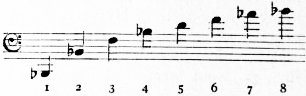
The intervening notes of the chromatic scale are obtained by means of valves or pistons usually four in number, which by opening a passage into additional lengths of tubing lower the pitch one, half, one-and-a-half, two-and-a-half tones (see Bombardon; Tuba; Valves). The euphonium gives out the fundamental, or first note of the harmonic series, readily, but no harmonic above the eighth. Euphoniums are made in C and in B♭, the latter being more generally used. By means of all the valves used at once, the B♭, an octave below the fundamental, can be reached, giving a compass of four octaves, with chromatic intervals. The bass clef is used in notation. The euphonium is treated by French and German composers as a transposing instrument; in England the real notes are usually written, except when the treble clef is used. The quality of tone is rich and full, harmonizing well with that of the trombone. The euphonium speaks readily in the lower register, but slowly, of course, owing to the long dip of the pistons. Messrs Rudall Carte have removed this difficulty by their patent short action pistons, which have but half the dip of the old pistons. On these instruments it is easy to execute rapid passages.
The euphonium is frequently said to be a saxhorn, corresponding to the baryton member of that family, but the statement is misleading. The bombardon and euphonium, like the saxhorns, are the outcome of the application of valves to the bugle family, but there is a radical difference in construction; the tubas (bombardon and euphonium) have a conical bore of sufficiently wide calibre to allow of the production of the fundamental harmonic, which is absent in the saxhorns. The Germans classify brass wind instruments as whole and half1 according to whether, having the wide bore of the bugle, the whole length of the tube is available and gives the fundamental proper to an organ pipe of the same length or whether by reason of the narrow bore in proportion to the length, only half the length of the instrument is of practical utility, the harmonic series beginning with the second harmonic. (See Bombardon.)
(K. S.)
1 See Dr Schafhäutl’s article on “Musical Instruments” in sect. iv. of Bericht der Beurtheilungs- Commission bei der Allg. deutschen Industrie Ausstellung (Munich, 1854), pp. 169-170; also Fried. Zamminer, Die Musik und die Musikinstrumente in ihrer Beziehung zu den Gesetzen der Akustik (Giessen, 1855).
EUPHORBIA, in botany, a large genus of plants from which the order Euphorbiaceae takes its name. It includes more than 600 species and is of almost world-wide distribution. It is represented in Britain by the spurges—small, generally smooth, herbaceous plants with simple leaves and inconspicuous flowers arranged in small cup-like heads (cyathia). The cyathium is a characteristic feature of the genus, and consists of a number of male flowers, each reduced to a single stamen, surrounding a central female flower which consists only of a stalked pistil; the group of flowers is enveloped in a cup formed by the union of four or five bracts, the upper part of which bears thick, conspicuous, gland-like structures, which in exotic species are often brilliantly coloured, giving the cyathium the appearance of a single flower. Another characteristic is the presence of a milky juice, or latex, in the tissues of the plant. In one section of the genus the plants resemble cacti, having a thick succulent stem and branches with the leaves either very small or completely reduced to a small wart-like excrescence, with which is generally associated a tuft of spines (a reduced shoot). These occur in the warmer parts of the world as a type of dry country or desert vegetation. The only species of note are E. fulgens and E. jacquiniaeflora, for the warm greenhouse; E. Cyparissias (the Cypress spurge), E. Wulfeni, E. Lathyris and E. Myrsinites, for the open air.
EUPHORBIACEAE, in botany, a large natural order of flowering plants, containing more than 220 genera with about 4000 species, chiefly tropical, but spreading over the whole earth with the exception of the arctic and cold alpine zones. They are represented in Britain by the spurges (Euphorbia, q.v.) (fig. 1) and dog’s mercury (Mercurialis) (fig. 2), which are herbaceous plants, but the greater number are woody plants and often trees. The large genus Euphorbia shows great variety in habit; many species, like the English spurges, are annual herbs, others form bushes, while in the desert regions of tropical Africa and the Canary Islands species occur resembling cacti, having thick fleshy stems and leaves reduced to spines. Another large genus, Phyllanthus, contains small annual herbs as well as trees, while in some species the leaves are reduced to scales, and the branches are flattened, forming phylloclades. The leaves also show great variety in form and arrangement, being simple and entire as in the English spurges, or deeply cut as in Ricinus (castor-oil) (fig. 3), and Manihot or sometimes palmately compound (Hevea). The majority contain a milky juice or latex in their tissues which exudes on cutting or bruising. In Hevea, Manihot and others the latex yields caoutchouc. The flowers are unisexual; male and female flowers are borne on the same, as in the spurges (fig. 1), or on different plants, as in dog’s mercury (fig. 2). Their arrangement shows considerable variation, but the flowers are generally grouped in crowded definite partial inflorescences, which are themselves arranged in spikes or stand in the axils of the upper leaves. These partial inflorescences are generally unisexual, the male often containing numerous flowers while the female flowers are solitary. The partial inflorescence (cyathium) of Euphorbia (fig. 1) resembles superficially a hermaphrodite flower. It contains a central terminal flower, consisting of a naked pistil; below this are borne four or five bracts which unite to form a cup-shaped involucre resembling a calyx; each of these bracts subtends a small cyme of male flowers each consisting only of one stamen. Between the segments of the cup are large oval or crescent-shaped glands which are often brightly coloured, forming petal-like structures.
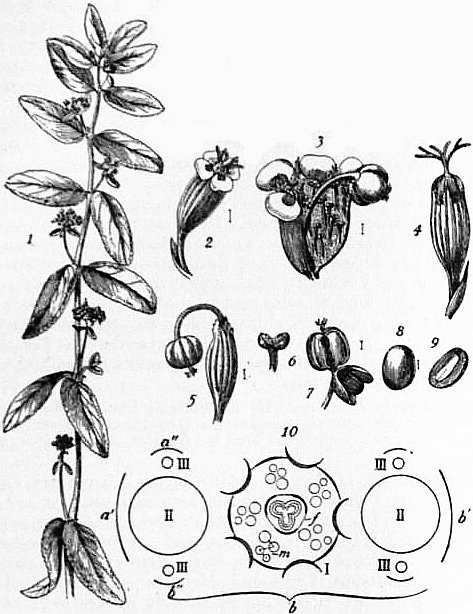
Fig. 1.
1. Shoot of Euphorbia hypericifolia, about ½ nat. size. 2. A partial inflorescence, cyathium, bearing the petaloid glands. 3. A similar one at a later stage, cut open to show the single-stamened (monandrous) male flowers and the central long-stalked female flower. 4. A cyathium without petaloid glandular appendages. 5. A similar one at a later stage with nearly ripe fruit. 6. An anther dehiscing. 7. Fruit dehiscing and exposing one of the three seeds. 8. Seed. 9. Seed cut lengthwise exposing the embryo. 10. Diagram of the inflorescence of Euphorbia, illustrating the dichasial cymose arrangement of the ultimate branches. b, Bract subtending the central terminal cyathium I. a′b′, Bracteoles of the first order subtending the secondary cyathia II. a″b″, Bracteoles of the second order subtending the tertiary cyathia III.
In the central cyathium I. are shown the details of the arrangement of the male flowers in monochasial cymes, m, and the central female flower, f.
The form of the flower shows great variety. The most complete type occurs in Wielandia, a shrub from the Seychelles Islands, in which the flowers have their parts in fives, a calyx and corolla being succeeded in the male flower by 5 stamens, in the female by 5 carpels. Generally, however, only 3 carpels are present, as in Euphorbia; Mercurialis (fig. 2) has minute apetalous flowers with 3 sepals, followed in the male by 8 to 20 stamens, in the female by a bicarpellary pistil. In the large tropical genus Croton a pentamerous calyx and corolla are generally present, the stamens are often very numerous, and the female flower has three carpels. In Manihot, a large tropical American genus to which belongs the manioc or cassava (M. utilissima), the calyx is often large and petaloid. In a great many genera the corolla is absent. The most reduced type of flower is that described in Euphorbia, where the male consists of one stamen separated from its pedicel by a joint, and the female of a naked tricarpellary pistil. The stamens are sometimes more or less united (monadelphous), and in castor-oil (Ricinus) (fig. 3) are much branched. The ovary generally contains three chambers, and bears three simple or more often bipartite styles; each chamber contains one or two pendulous ovules, which generally bear a cap-like outgrowth or caruncle, which persists in the seed (well shown in castor oil, fig. 3).
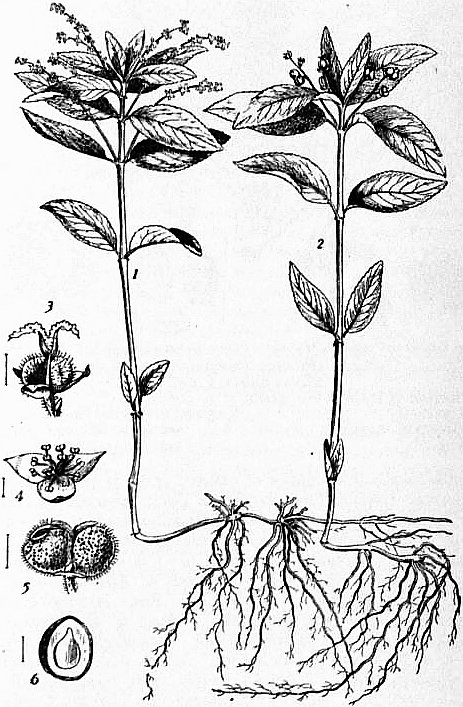
Fig. 2.—Dog’s Mercury (Mercurialis perennis).
1. Male plant. 2. Female plant; 1⁄3 nat. size. 3. Female flower. 4. Male flower. 5. Fruit beginning to split open. 6. Seed cut lengthwise showing the embryo.
As the stamens and pistil are borne by different flowers, cross-fertilization is necessary. In Mercurialis and others with inconspicuous flowers pollination is effected by the wind, but in many cases insects are attracted to the flower by the highly-coloured bracts, as in many Euphorbias and Dalechampia, or by the coloured calyx as in Manihot; the presence of honey is also frequently an attraction, as in the honey-glands on the bracts of the cyathium of Euphorbia. The fruit is generally a capsule which splits into three divisions (cocci), separating from the central column, and splitting lengthwise into two valves. In the mancinil (Hippomane mancinella) of Central America the fruit is a drupe like a plum, and in some genera berries occur. In the sandbox tree (Hura crepitans) of tropical America the ovary consists of numerous carpels, and forms when mature a capsule which splits with great violence and a loud report into a number of woody cocci. The seeds contain abundant endosperm and a large straight or bent embryo.
From Bentley and Trimen’s Medicinal Plants, by permission of J. & A. Churchill.
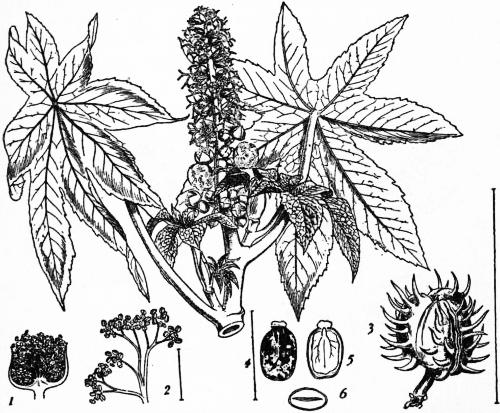
Fig. 3.—Castor Oil (Ricinus communis). End of shoot with flower-spike; about 1⁄3 nat. size.
1. Section of male flower, about nat. size. 2. Group of stamens. 3. Fruit. 4. Seed. 5 and 6. Vertical and transverse sections of seed showing embryo in position.
Several members of the order are of economic importance. Manihot utilissima, manioc or cassava (q.v.), is one of the most important tropical food-plants, its thick tuberous root being rich in starch; it is the source of Brazilian arrowroot. Caoutchouc or india-rubber is obtained from species of Hevea, Mabea, Manihot and Sapium. Castor oil (q.v.) is obtained from the seeds of Ricinus communis. The seeds of Aleurites moluccana and Sapium sebiferum also yield oil. Resin is obtained from species of Croton and Euphorbia. Many of the species are poisonous; e.g. the South African Toxicodendron is one of the most poisonous plants known. Many, such as Euphorbia, Mercurialis, Croton, Jatropha, Tragia, have been, or still are, used as medicines. Species of Codiaeum (q.v.), Croton, Euphorbia, Phyllanthus, Jatropha and others are used as ornamental plants in gardens.
The box (Buxus) and a few allied genera which were formerly included in Euphorbiaceae are now generally regarded as forming a distinct order—Buxaceae, differing from Euphorbiaceae in the position of the ovule in the ovary-chamber and in the manner of splitting of the fruit.
EUPHORBIUM, an acrid dull-yellow or brown resin, consisting of the concreted milky juice of several species of Euphorbia, cactus-like perennial plants indigenous to Morocco. It dissolves in alcohol, ether and turpentine; in water it is only slightly soluble. It consists of two or more resins and a substance euphorbone, C20H36O or C15H24O. Pliny states that the name of the drug was given to it in honour of Euphorbus, the physician of Juba II., king of Mauretania. In former times euphorbium was valued in medicine for its drastic, purgative and emetic properties.
EUPHORBUS, son of Panthoüs, one of the bravest of the Trojan heroes, slain by Menelaus (Iliad, xvii. 1-60). Pythagoras, in support of his doctrine of the transmigration of souls, declared that he had once been this Euphorbus, whose shield, hung up in the temple of Argos by Menelaus, he claimed as his own (Horace, Odes, i. 28. 11; Diog. Laërt. viii. 1).
EUPHORION, Greek poet and grammarian, born at Chalcis in Euboea about 275 B.C. He spent much of his life in Athens, where he amassed great wealth. About 221 he was invited by Antiochus the Great to the court of Syria. He assisted in the formation of the royal library at Antioch, of which he held the post of librarian till his death. He wrote mythological epics, amatory elegies, epigrams and a satirical poem (Ἀραί, “curses”) after the manner of the Ibis of Callimachus. Prose works on antiquities and history are also attributed to him. Like Lycophron, he was fond of using archaic and obsolete expressions, and the erudite character of his allusions rendered his language very obscure. His elegies were highly esteemed by the Romans; they were imitated or translated by Cornelius Gallus and also by the emperor Tiberius.
Fragments in Meineke, “De Euphorionis Chalcidensis vita et scriptis,” in his Analecta Alexandrina (1843); for a recently discovered fragment of about 30 lines see Berliner Klassikertexte, v. 1 (1907).
EUPHRANOR, of Corinth (middle of the 4th century B.C.), the only Greek artist who excelled both as a sculptor and as a painter. In Pliny we have lists of his works; among the paintings, a cavalry battle, a Theseus, and the feigned madness of Odysseus; among the statues, Paris, Leto with her children Apollo and Artemis, Philip and Alexander in chariots. Unfortunately we are unable among existing statues to identify any which are copies from works of Euphranor (but see a series of attributions by Six in Jahrbuch, 1909, 7 foll.). He appears to have resembled his contemporary Lysippus, notably in the attention he paid to symmetry, in his preference for bodily forms slighter than those usual in earlier art, and in his love of heroic subjects. He wrote a treatise on proportions.
EUPHRATES (Babylon. Purattu, Heb. Perath, Arab. Frāt or Furāt, Old Pers. Ufratu, Gr. Εὐφράτης), the largest river of western Asia. It may be divided into three divisions, upper, lower and middle, each of which is distinguished by special physical features, and has played a conspicuous part in the world’s history, retaining to the present day monumental evidence of the races who have lined its banks.
Upper Division.—The upper Euphrates consists of two arms, which, rising on the Armenian plateau, and flowing west in long shallow valleys parallel to Mount Taurus, eventually unite and force their way southward through that range to the level of Mesopotamia. The northern or western and shorter arm, called by the Turks Kara Su, “black water,” or Frāt Su (Armenian, Ephrāt or Yephrāt; Arab. Nahr el-Furāt or Frāt), well known to occidentalists as the Euphrates, from its having been the boundary of the Roman empire, is regarded also by Orientals as the main stream. It rises in the Dumlu Dagh, N.N.W. of Erzerum, in a large circular pool (altitude, 8625 ft.), which is venerated by Armenians and Moslems, and flows south-east to the plain of Erzerum (5750 ft.). Thence it continues through a narrow valley W.S.W. to Erzingan (3900 ft.), receiving on its way the Ovajik Su (right), the Tuzla Su (left), and the Merjan and Chanduklu (right). Below Erzingan the Frāt flows south-west through a rocky gorge to Kemakh (Kamacha; Armenian, Gamukh), where it is crossed by a bridge and receives the Kumur Su (right). At Avshin it enters a cañon, with walls over 1000 ft. high, which extends to the bridge at Pingan, and lower down it is joined from the west by the Chalta Irmak (Lycus; Arab. Lūkīya), on which stands Divrik (Tephrike). Then, entering a deep gorge with lofty rock walls and magnificent scenery, it runs south-east to its junction with the Murad Su. The Frāt, separated by the easy pass of Deve-boyūn from the valley of the Araxes (Aras), marks the natural line of communication between northern Persia and the West—a route followed by the nomad Turks, Mongols and Tatars on their way to the rich lands of Asia Minor. It is a rapid river of considerable volume, and below Erzingan is navigable, down stream, for rafts. The southern or eastern and longer arm, called by the Turks Murad Su (Arsanias Fl.; Armenian, Aradzani; Arab. Nahr Arsanas), rises south-west of Diadin, in the northern flank of the Ala Dagh (11,500 ft.), and flows west to the Alashgerd plain. Here it is joined by the Sharian Su from the west, and the two valleys form a great trough through which the caravan road from Erzerum to Persia runs. The united stream breaks through the mountains to the south, and, receiving on its way the Patnotz Su (left) and the Khinis Su (right), flows south-west, west and south, through the rich plain of Bulanik to the plain of Mūsh. Here it is joined by the Kara Su (Teleboas), which, rising near Lake Van, runs past Mūsh and waters the plain. The river now runs W.S.W. through a deep rocky gorge, in which it receives the Gunig Su (right), to Palu (where there are cuneiform inscriptions); and continues through more open country to its junction with the Frāt Su. About 10 m. E.N.E. of Kharpūt the Murad is joined by its principal tributary, the Peri Su, which drains the wild mountain district, Dersim, that lies in the loop between the two arms. The Murad Su is of greater volume than the Frāt, but its valley below Mūsh is contracted and followed by no great road. Below the junction of the two arms the Euphrates flows south-west past the lead mines of Keban Maden, where it is 120 yds. wide, and is crossed by a ferry (altitude, 2425 ft.), on the Sivas-Kharpūt road. It then runs west, south and east round the rock-mass of Musher Dagh, and receives (right) the Kuru Chai, down which the Sivas-Malatia road runs, and the Tokhma Su, from Gorun (Gauraina) and Darende. At the ferry on the Malatia-Kharpūt road (cuneiform inscription) it flows eastwards in a valley about a quarter of a mile wide, but soon afterwards enters a remarkable gorge, and forces its way through Mount Taurus in a succession of rapids and cataracts. After running south-east through the grandest scenery, and closely approaching the source of the western Tigris, it turns south-west and leaves the mountains a few miles above Samsāt (Samosata; altitude, 1500 ft.). The general direction of the great gorges of the Euphrates, Pyramus (Jihun) and Sarus (Sihun) seems to indicate that their formation was primarily due to the same terrestrial movements that produced the Jordan-’Araba depression to the south. The length of the Frāt is about 275 m.; of the Murad, 415 m.; and of the Euphrates from the junction to Samsāt, 115 m.
Middle Division.—The middle division, which extends from Samsāt to Hit, is about 720 m. long. In this part of its course the Euphrates runs through an open, treeless and sparsely peopled country, in a valley a few miles wide, which it has eroded in the rocky surface. The valley bed is more or less covered with alluvial soil, and cultivated in places by artificial irrigation. The method of this irrigation is peculiar. Three or four piers or sometimes bridges of masonry are run out into the bed of the river, frequently from both sides at once, raising the level of the stream and thus giving a water power sufficient to turn the gigantic wheel or wheels, sometimes almost 40 ft. in diameter, which lift the water to a trough at the top of the dam, whence it is distributed among the gardens and melon patches, rice, cotton, tobacco, liquorice and durra fields, between the immediate bed of the river and the rocky banks which shut it out from the desert. The wheels, called naoura, are of the most primitive construction, made of rough branches of trees, with palm leaf paddles, rude clay vessels being slung on the outer edge to catch the water, of which they raise a prodigious amount, only a comparatively small part of which, however, is poured into the aqueducts on top of the dams. These latter are exceedingly picturesque, often consisting of a series of well-built Gothic arches, and give a peculiar character to the scenery; but they are also great impediments to navigation. In some parts of the river 300 naouras have been counted within a space of 130 m., but of late years many have fallen into decay. By far the larger part of the valley is quite uncultivated, and much of it is occupied by tamarisk jungles, the home of countless wild pigs. Where the valley is still cultivated, the jerd, a skin raised by oxen, is gradually being substituted for the naoura, no more of the latter being constructed to take the place of those which fall into decay.
In this part of its course the rocky sides of the valley, which sometimes closely approach the river, are composed of marls and gypsum, with occasional selenite, overlaid with sandstone, with a topping of breccia or conglomerate, and rise at places to a height of 200 ft. or more. At one point, however, 26 m. above Deir, where lie the ruins of Halebiya, the river breaks through a basaltic dike, el-Ḥamme, some 300 to 500 ft. high. On either side of the river valley a steppe-like desert, covered in the spring with verdure, the rest of the year barren and brown, stretches away as far as the eye can see. Anciently the country on both sides of the Euphrates was habitable as far as the river Khabur; at the present time it is all desert from Birejik downward, the camping ground of Bedouin Arabs, the great tribe of Anazeh occupying esh-Shām, the right bank, and the Shammar the left bank, Mesopotamia of the Romans, now called el-Jezīreh or the island. To these the semi-sedentary Arabs who sparsely cultivate the river valley, dwelling sometimes in huts, sometimes in caves, pay a tribute, called kubbe, or brotherhood, as do also the riverain towns and villages, except perhaps the very largest. The Turkish government also levies taxes on the inhabitants of the river valley, and for this purpose, and to maintain a caravan route from the Mediterranean coast to Bagdad, maintains stations of a few zaptiehs or gens d’armes, at intervals of about 8 hours (caravan time), occupying in general the stations of the old Persian post road. The only riverain towns of any importance on this stretch of the river to-day are Samsāt, Birejik, Deir, ‘Ana and Hit.
In early times the Euphrates was important as a boundary. It was the theoretical eastern limit of the Jewish kingdom; for a long time it separated Assyria from the Khita or Hittites; it divided the eastern from the western satrapies of Persia (Ezra iv. 17; Neh. ii. 7); and it was at several periods the boundary of the Roman empire. Until the advent of the nomads from central Asia, and the devastation of Mesopotamia and the opposite Syrian shore of the river, there were many flourishing cities along its course, the ruins of which, representing all periods, still dot its banks. Samsāt itself represents the ancient Samosata, the capital of the Seleucid kings of Commagene (Kumukh of the Assyrian inscriptions), and here the Persian Royal Road from Sardis to Susa is supposed to have crossed the river. Below Samsāt the river runs S.W. to Rum-Kaleh, or “castle of the Romans” (Armenian, Hrhomgla). At this point was another passage of the river, defended by the castle which gives its name to the spot, and which stands on a high hill overhanging the right bank, its base washed by an abundant stream, the Sanjeh (Gr. Σίγγας), which enters the Euphrates on the west. From this point the river runs rather east of south for about 25 m. past Khalfat (ferry) to Birejik or Bir, the ancient Birtha, where it is only 110 m. from the Mediterranean, the bed of the river being 628½ ft. above that sea. This was the Apamea-Zeugma, where the high road from east to west crossed the river, and it is still one of the most frequented of all the passages into Mesopotamia, being the regular caravan route from Iskanderun and Aleppo to Urfa, Diarbekr and Mosul. From Birejik the river runs sluggishly, first a little to the east, then a little to the west of south, over a sandy or pebbly bed, past Jerablus (? Europus, Carchemish, the ancient Hittite capital), near which the Sajur (Sagura; Sangar of the Assyrian inscriptions) enters from the west, to Meskene, 2 m. southward of which are the ruins of Barbalissus (Arab. Balis), the former port of Aleppo, now, owing to changes in the bed, some distance from the water. Six miles below this the ruins of Kal’at Dibse mark the site of the ancient Thapsacus (Tiphsah of 1 Kings iv. 24), the most important passage of the middle Euphrates, where both Cyrus, on his expedition against his brother, and Alexander the Great crossed that river, and the ancient port of Syria. Here the river turns quite sharply eastward. A day’s journey beyond Meskene are the remains of Siffin (Roman Sephe), where Moawiya defeated the caliph Ali in 657 (see Caliphate), and opposite this, on the west bank, a picturesque ruin called Kal‘at Ja‘ber (Dausara). A day’s journey beyond this, on the Syrian side, stand the remains of ancient Sura, a frontier fortress of the Romans against the Parthians; 20 m. S. of which, inland, lie the well-preserved ruins of Reseph (Assyrian, Resafa or Rosafa). Half a day’s journey beyond Sura, on the Mesopotamian side of the river, are the extensive ruins of Haragla (Heraclea) and Rakka, once the capital of Harun al-Rashid (Nicephorium of Alexander; Callinicus of the Seleucids and Romans). Here the Belikh (Bilechas) joins the Euphrates, flowing southward through the biblical Aram Naharaim from Urfa (Edessa) and Harran (Carrhae); and from this point to el-Ḳaim four days’ below Deir, the course of the river is south-easterly. Two days’ journey beyond Rakka, where the Euphrates breaks through the basalt dike of el-Ḥamme, are two admirably preserved ruins, built of gypsum and basalt, that on the Mesopotamian side called Zelebiya (Chanuga), and that on the Syrian, much the finer of the two, Halebiya or Zenobiya, the ancient Zenobia. Twenty-six miles farther down lies the town of Deir (q.v.), where the river divides into two channels and the river valley opens out into quite extensive plains. Here the roads from Damascus, by way of Palmyra, and from Mosul, by way of the Khabur, reach the Euphrates, and here there must always have been a town of considerable commercial and strategic importance. The region is to-day covered with ruins and ruin mounds. A little below Deir the river is joined by the Khabur (Khaboras, Biblical Khabor), the frontier of the Roman empire from Diocletian’s time, which rises in the Karaja Dagh, and, with its tributary, the Jaghijagh (Mygdonius; Arab. Hirmas) flows south through the land of Gozan in which Sargon settled the deported Israelites in 721 B.C. At the mouth of the Khabur stood the Roman frontier fortress of Circesium (Assyrian, Sirki; Arab. Kirkessie) now el-Buseira. The corresponding border town on the Syrian side is represented by the picturesque and finely preserved ruins called Salahiya, the Ad-dalie or Dalie (Adalia) of Arabic times, two days below Deir, whose more ancient name is as yet unknown. Between Salahiya and Deir, on an old canal, known in Arabic times as Said, leaving the Euphrates a little below Deir and rejoining it above Salahiya, stand the almost more picturesque ruins of the once important Arabic fortress of Raḥba.
As far as the Khabur Mesopotamia seems to have been a well-inhabited country from at least the 15th century B.C., when it constituted the Hittite kingdom of Mitanni, down to about the 12th century A.D., and the same is true of the country on the Syrian side of the Euphrates as far as the eastern limit of the Palmyrene. Below this point the back country on the Syrian side has always been a complete desert. On the Mesopotamian side there would seem, from the accounts of Xenophon and Ptolemy, to have been an affluent which joined the Euphrates between Deir and ‘Ana, called Araxes by the former, Saocoras by the latter; but no trace of such a stream has been found by modern explorers and the country in general has always been uninhabited. Below Salahiya the river-bed narrows and becomes more rocky. A day’s journey beyond Salahiya, on a bluff on the Mesopotamian side of the river, are the conspicuous ruins Of el-‘Irsi (Corsote?). Half a day’s journey beyond, at a point where two great wadis enter the Euphrates, on the Syrian side, stands Jabriya, an unidentified ruined town of Babylonian type, with walls of unbaked brick, instead of the stone heretofore encountered. At this point the river turns sharply a little north of east, continuing on that course somewhat over 40 m. to ‘Ana, where it bends again to the south-east. Just above ‘Ana are rapids, and from this point to Hit the river is full of islands, while the bed is for the most part narrow, leaving little cultivable land between it and the bluffs. ‘Ana itself, a very ancient town, of Babylonian origin, once sacred probably to the goddess of the same name, lay originally on several islands in the stream, where ruins, principally of the Arabic and late Persian period, are visible. Here palm trees, which had begun to appear singly at Deir, grow in large groves, the olive disappears entirely, and we have definitely passed over from the Syrian to the Babylonian flora and climate. Between ‘Ana and Hit there were anciently at least four island cities or fortresses, and at the present time three such towns, insignificant relics of former greatness, Haditha, Alus or el-‘Uzz and Jibba still occupy the old sites. Of these Alus is evidently the ancient Auzara or Uzzanesopolis, the city of the old Arabic goddess ‘Uzza; Haditha, an important town under the Abbasids, was earlier known as Baia Malcha; while Jibba has not been identified. The fourth city, Thilutha or Olabus, once occupied the present deserted island of Telbeis, half a day’s journey below ‘Ana. About half-way between ‘Ana and Hit, in the neighbourhood of Haditha, the river has a breadth of 300 yds., with a depth of 18 ft., and a flood speed of 4 knots. At this point we begin to encounter sulphur springs and bitter streams redolent with bitumen, a formation which reaches its climax at Hit (q.v.), where a small stream (the “river of Ahava” of Ezra viii. 21) enters the Euphrates from the Syrian side, on which, about 8 m. from its mouth, stands the small town of Kubeitha.
The middle Euphrates, from Samsāt to Hit, is to-day an avenue of ruins, of which only the more conspicuous or important have been indicated here. It was from a remote period, antedating certainly 3000 B.C., the highway of empire and of commerce between east and west, more specifically between Babylonia or Irak and Syria, and numerous empires, peoples and civilizations have left their records on its shores. Its time of greatest prosperity and importance was the period of the Abbasid caliphate, and Arabic geographers as late as A.D. 1200 mention an astonishingly large number of important cities situated on its shores or islands. The Mongol invasion, in the latter part of that century, wrought their ruin, however, and from that time to the present there has been a steady decline in the commercial importance of the Euphrates route, and consequently also of the towns along its course, until at the present time it is only an avenue of ruins.
Lower Division.—Hit stands almost at the head of the alluvial deposit, about 550 m. from the Persian Gulf, separated from it by a couple of small spurs of the Syrian plateau, and may be said to mark the beginning of the lower Euphrates. Thence the river flows S.E. and S.S.E. to its junction with the Tigris below Korna, through an unbroken plain, with no natural hills, except a few sand (or sandstone?) hills in the neighbourhood of Warka, and no trace of rock, except at el-Haswa, above Hillah. At Hit the river is from 30 to 35 ft. in depth, with a breadth of 250 yds., and a current of 4 m. an hour, but from this point it diminishes in volume, receiving no new affluents but dissipating itself in canals and lagoons. At Feluja, in the latitude of Bagdad, the Euphrates and Tigris closely approach each other, and then, widening out, enclose the plain of Babylonia (Arab. Sawād). Through this part of its course the current of the river, except where restricted by floating bridges—at Feluja, Mussaib, Hillah, Diwanieh and Samawa—does not normally exceed a mile an hour, and both on the main stream and on its canals the jerd or ox-bucket takes the place of the naoura or water-wheel for purposes of irrigation.
In early times irrigating canals distributed the waters over the plain, and made it one of the richest countries of the East, so that historians report three crops of wheat to have been raised in Babylonia annually. As main arteries for this circulation of water through its system great canals, constituting in reality so many branches of the river, connected all parts of Babylonia, and formed a natural means both of defence and also of transportation from one part of the country to another. The first of these canals, taken off on the right bank of the river a little below Hit, followed the extreme skirt of the alluvium the whole way to the Persian Gulf near Basra, and thus formed an outer barrier, strengthened at intervals with watch-towers and fortified posts, to protect the cultivated land of the Sawād against the incursions of the desert Arabs. This gigantic work, the line of which may still be traced throughout its course, was formerly called the Khandak Sabūr or “Sapor’s trench,” being ascribed to the Sassanian king, Shapur I. Dholahtaf, but is now known as the Cherra-Saadeh, and is in the popular tradition said to have been excavated by a man from Basra at the behest of a woman of Hit whom he desired to make his wife. How early this work was begun is not clear, but it would appear to have been at least largely reconstructed in the time of the great Nebuchadrezzar. The next important canal, the Dujayl (Dojail), left the Euphrates on the left, about a league above Ramadiya (Ar-Rabb), and flowed into the Tigris between Ukbara and Bagdad. The ‘Isa, which is largely identical with the modern Sakhlawiya, left the Euphrates a little below Anbar (Perisabora) and joined the Tigris at Bagdad. This canal still carries water and was navigable for steamboats until about 1875. Sarsar, the modern Abu-Ghurayb, leaves the Euphrates three leagues lower down and enters the Tigris between Bagdad and Ctesiphon. The Nahr Malk or royal river, modern Radhwaniya, leaves the Euphrates five leagues below this and joins the Tigris three leagues below Ctesiphon; while the Kutha, modern Habl-Ibrahim, leaving the Euphrates three leagues below the Malk joins the Tigris ten leagues below Ctesiphon. In the time of the Arabs these were the chief canals, and the cuts from the main channels of the Nahr ‘Isa, Nahr Sarsar, Nahr Malk (or Nahr Malcha), and Nahr Kutha, reticulating the entire country between the rivers, converted it into a continuous and luxuriant garden.
Just below Mussaib there has been for all ages a great bifurcation of the river. The right arm was the original bed, and the left arm, on which Babylon was built, the artificial deviation, as is clear from the cuneiform inscriptions. In the time of Alexander the nomenclature was reversed, the right arm being known as Pallacopas. Under the Arabs the old designation again prevailed and the Euphrates is always described by the Arabian geographers as the river which flows direct to Kufa, while the present stream, passing along the ruins of Babylon to Hillah and Diwanieh, has been universally known as the Nahr Sura. Occidental geographers, however, have followed the Greek use, and so to-day we call the river of Babylon or Nahr Sura the Euphrates and the older westerly channel the Hindieh canal. At the present time the preservation of the embankments about the point of bifurcation demands the constant care of the Bagdad government. The object is to allow sufficient water to drain off to the westward for the due irrigation of the land, while the Hillah bed still retains the main volume of the stream, and is navigable to the sea. But it frequently happens that the dam at the head of the Hindieh is carried away, and, a free channel being thus opened for the waters of the river to the westward, the Hillah bed shoals to 2 or 3 ft., or even dries up altogether, while the country to the west of the river is turned into lakes and swamps. Below the bifurcation the river of Babylon was again divided into several streams, and indeed the most famous of all the ancient canals was the Arakhat (Archous of the Greeks and Serrāt and Nil of the Arabs), which left that river just above Babylon and ran due east to the Tigris, irrigating all the central part of the Jezīreh, and sending down a branch through Nippur and Erech to rejoin the Euphrates a little above the modern Nasrieh. The Narss, also, the modern Daghara, which is still navigable to Nippur and beyond, left the Sura a little below Hillah; and at the present day another large canal, the Kehr, branches off near Diwanieh. It is easy to distinguish the great primitive watercourses from the lateral ducts which they fed, the latter being almost without banks and merely traceable by the winding curves of the layers of alluvium in the bed, while the former are hedged in by high banks of mud, heaped up during centuries of dredging.
Not a hundredth part of the old irrigation system is now in working order. A few of the mouths of the smaller canals are kept open so as to receive a limited supply of water at the rise of the river in May, which then distributes itself over the lower lying lands in the interior, almost without labour on the part of the cultivators, giving birth in such localities to the most abundant crops, but by far the larger portion of the region between the rivers is at present an arid howling wilderness dotted with tels or ruin-heaps, strewn in the most part with broken pottery, the evidence of former habitation, and bearing nothing but the camel-thorn, the wild caper, the colocynth-apple, wormwood and other weeds of the desert. The swamps are full of huge reeds, bordered with tamarisk jungles, and in its lower reaches, where the water stretches out into great marshes, the river is clogged with a growth of agrostis. To obtain a correct idea of this region it must be borne in mind also that the course of the river and the features of the country on both banks are subject to constant fluctuation. The Hindieh canal and the main stream, the ancient Sura, rejoin one another at Samawa. Down to this point, the bed of the Euphrates being higher than that of the Tigris, the canals run from the former to the latter, but below this the situation is reversed. At Nasrieh the Shatt-el-Haï, at one time the bed of the Tigris, and still navigable during the greater part of the year, joins the Euphrates. From this point downward, and to some extent above this as far as Samawa, the river forms a succession of reedy lagoons of the most hopeless character, the Paludes Chaldaici of antiquity, el Batihāt of the Arabs. Along this part of its course the river is apt to be choked with reeds and, except where bordered by lines of palm trees, the channel loses itself in lakes and swamps. The inhabitants of this region are wild and inhospitable and utterly beyond the control of the Turkish authorities, and navigation of the river between Korna and Suk-esh-Sheiukh is unsafe owing to the attacks of armed pirates. From Garmat Ali, where the Tigris and Euphrates at present unite,1 under the title of Shatt-el-Arab, the river sweeps on to Basra, 1000 yds. in width and from 3 to 5 fathoms deep, navigable for steamers of good size. From Korna to Basra the banks of the river are well cultivated and the date groves almost continuous; indeed this is the greatest date-producing region of the world. Twenty-five miles below Basra the river Karun from Shushter and Dizful throws off an arm, which seems to be artificial, into the Euphrates. This arm is named the Haffār, and at the confluence is situated the Persian town of Muhamrah, a place most conveniently located for trade. In this vicinity was situated, at the time of the Christian era, the Parthian city of Spasini-Charax, which was succeeded by Bahman Ardashir (Bamishir) under the Sassanians, and by Moharzi under the Arabs. The left bank of the river from this point belongs to Persia. It consists of an island named Abbadan, about 45 m. long, formed by alluvial deposits during the last fifteen centuries. (For the character of this alluvium and its rate of deposit see Irak.)
Even more than the upper and middle Euphrates the lower Euphrates, from Hit downward, abounds in ruins of ancient towns and cities, from the earliest prehistoric period onward to the close of the Caliphate (see Irak). The fact also that many of the most ancient of these ruins, like Ur, Lagash (Sirpurla), Larsa, Erech, Nippur, Sippara and Babylon, were situated on the banks of the great canals would indicate that the control of the waters of the rivers by a system of canalization and irrigation was one of the first achievements of civilization. This ancient system of canalization was inherited from the Persians (who, in turn, inherited it from their predecessors), by the Arabs, who long maintained it in working order, and the astonishing fertility and consequent prosperity of the country watered by the Euphrates, its tributaries and its canals, is noticed by all ancient writers. The land itself, an alluvial deposit, is very fruitful. Wheat and the date palm seem to have been indigenous, and the latter is still one of the chief productions of the country, but in later years rice has taken the place of wheat as the staff of life. The decline of the country dates from the appearance of Turkish nomads in the 11th century; its ruin was completed by the Shammar Arabs in the 17th century; but, if the ancient system of irrigation were restored, sufficient grain could be grown to alter the conditions of the wheat supply of the world. At the present time, instead of the innumerable cities of former days, there is a succession of small towns along the course of the river—Ramadiya, Feluja, Mussaïb, Hillah, Diwanieh, Samawa, el-Khudr (an ancient daphne or sacred grove, 31° 11′ 58″ N., 76° 6′ 9″ E., the only one anywhere which preserves to this day its ancient charter of the inviolability of all life within its precincts), Nasrieh and Suk-esh-Sheiukh—by means of which the Turkish government controls the river and levies taxes on a small part of the adjacent territory. At such settlements the river is lined with gardens and plantations of palms. The greater part of the region, however, even along the river shores, is inhabited only by roaming Bedouin or half-savage Ma‘dan Arabs (see Irak).
Navigation.—The length of the Euphrates from its source at Diadin to the sea is about 1800 m., and its fall during the last 1200 m. about 10 ins. per mile. The river begins to rise in the end of March and attains its greatest height between the 21st and the 28th of May. It is lowest in November, and rocks, shallows, and the remains of old dams then render it almost unnavigable. In antiquity, however, it was evidently in use for the transportation of merchandise and even of armies. Boats built in Syrian ports were placed on the Euphrates by Sennacherib and Alexander, and Herodotus states (i. 185) that in his day the river was a frequented route followed by merchants on their way from the Mediterranean to Babylon. As the most direct line of transit between the Mediterranean and the Persian Gulf, offering an alternative means of communication with India not greatly inferior to the Egyptian route, the Euphrates route early attracted the attention of the British government. During the Napoleonic wars, indeed, and up to the time when the introduction of steam navigation rendered the Red Sea accessible at all seasons of the year, the political correspondence of the home and Indian governments usually passed by the Euphrates route. Various plans were suggested for the development of this route as a means of goods as well as postal conveyance, and in 1835 Colonel F.R. Chesney was sent out at the head of an expedition with instructions to transport two steamers from the Mediterranean to the Euphrates, and, after putting them together at Birejik, to attempt the descent of the river to the sea. One of these steamers was lost in a squall during the passage down the river near el-’Irsi, but the other performed the voyage in safety and thus demonstrated the practicability of the downward navigation. Following on this first experiment, the East India Company, in 1841, proposed to maintain a permanent flotilla on the Tigris and Euphrates, and set two vessels, the “Nitocris” and the “Nimrod,” under the command of Captain Campbell of the Indian navy, to attempt the ascent of the latter river. The experiment was so far successful that, with incredible difficulty, the two vessels did actually reach Meskene, but the result of the expedition was to show that practically the river could not be used as a high-road of commerce, the continuous rapids and falls during the low season, caused mainly by the artificial obstructions of the irrigating dams, being insurmountable by ordinary steam power, and the aid of hundreds of hands being thus required to drag the vessels up the stream at those points by main force. Under Midhat Pasha, governor-general of Bagdad from 1866 to 1871, an attempt was made by the Turkish authorities to establish regular steam navigation on the Euphrates. Midhat caused many of the dams to be destroyed and for some years occasional steamers were run between Meskene and Hillah in flood time, from April to August. But with the transfer of Midhat this feeble attempt at navigation was abandoned. At the present time the river is navigated by sailing craft of some size from Hit downward. Above that point there is no navigation except by the native rafts (kellek), which descend the river and are broken up on arrival at their point of destination. There is, however, little travel of this sort on the Euphrates in comparison with the amount on the Tigris.
When it became evident that, under present conditions at least, the navigation of the middle Euphrates was impracticable, attention was turned, owing to the peculiarly advantageous geographical position of its valley, to schemes for connecting the Mediterranean and Persian Gulf by railway as an alternative means of communication with India, and various surveys were made for this purpose and various routes laid out. All these schemes, however, fell through either on the financial question, or on the unwillingness of the Turkish government to sanction any line not connected directly with Constantinople. With the acquisition of the Suez Canal, moreover, the value of this route from the British standpoint was so greatly diminished that the scheme, so far as England was concerned, was quite abandoned. (For further notice of the railway question see Bagdad.)
Bibliography.—Gen. F.R. Chesney, Euphrates Expedition (1850); W.F. Ainsworth, Researches in Assyria and Babylonia (1838), and Personal Narrative of the Euphrates Expedition (1888); A.H. Layard, Nineveh and Babylon (1853); W.K. Loftus, Chaldaea and Susiana (1857); Geo. Rawlinson, Herodotus, bk. 1, essay ix. (1862); A. Blunt, Bedouin Tribes of the Euphrates (1873); Josef Černik, Studien-Expedition (1873); H. Kiepert, Ruinenfelder Babyloniens (1883); Ed. Sachau, Reise in Syrien u. Mesopotamien (1883), and Am Euphrat u. Tigris (1900); Guy Le Strange, “Description of Mesopotamia,” in Journal of the Royal Asiatic Society (1895), and Baghdad under the Abbasid Caliphate (1901); J.P. Peters, Nippur (1897); M. v. Oppenheim, Vom Mittelmeer zum Persischen Golf (1900); H.V. Geere, By Nile and Euphrates (1904); Baedeker, Palestine and Syria (1906); Murray, Handbook to Asia Minor, &c., section iii.
(H. C. R.; C. W. W.; J. P. Pe.)
1 The confluence for about 500 years was at Korna, over 30 m. higher up. Sir W. Willcocks discovered (1909) that from Suk-esh-Sheiukh the Euphrates had formed a new channel through the marshes. (See Geog. Journal, Jan. 1910).
EUPHRONIUS, the most noted of the group of great vase-painters, who lived in Athens in the time of the Persian wars, and worked upon red-figured vases (see Greek Art and Ceramics). There is a monograph by W. Klein dealing with the artist. As all the great paintings of Greece have disappeared, we are obliged to trust to the designs on vases for our knowledge of Greek drawing and composition. Euphronius is stiff and archaic in style, but his subjects are varied, his groupings original and striking, and his mastery of the line decided. In their way, the vases which he painted will hold their own in comparison with those of any nation; for simplicity, truthfulness and charm they can scarcely be matched.
EUPHROSYNE, the name of two Byzantine empresses.
1. Euphrosyne, a daughter of Constantine VI. Although she had taken a monastic vow she became the second wife of Michael II. (q.v.), a marriage which was practically forced upon her by Michael, who was anxious to strengthen his claims to the throne by an alliance with the last representative of the Isaurian dynasty, and secured the compliance of senate and patriarch with his desire. No issue was born of this union, and after the death of her husband and accession of her stepson Theophilus Euphrosyne again retired into a convent.
2. Euphrosyne, the wife of Alexius III. (q.v.). After securing the election of her husband to the throne by wholesale bribery she virtually took the government into her hands and restored the waning influence of the monarchy over the nobles. In spite of her talent for government she went far to hasten the empire’s downfall by her unbounded extravagance, and made the dynasty unpopular by her open profligacy, which went unpunished but for one short term of banishment. She followed her husband into exile in 1203 and died seven years later in Epirus.
EUPHUISM, the peculiar mode of speaking and writing brought into fashion in England towards the end of the reign of Elizabeth by the vogue of the fashionable romance of Euphues, published in 1578 by John Lyly. As early as 1570 Ascham in his Schoolmaster had said that “Euphues” (that is, a man well-endowed by nature, from the Gr. εὖ, φυή, well, growth) is “he that is apt by goodness of wit, and appliable by readiness of will, to learning, having all other qualities of the mind and parts of the body that must another day serve learning.” Lyly adopted this word as the name of the hero of his romance, and it is with him that the vogue of Euphuism began. John Lyly, “always averse to the crabbed studies of logic and philosophy, and his genie being naturally bent to the pleasant paths of poetry,” devoted himself exclusively to the service of the ladies, a thing absolutely unprecedented in English literature. He addressed himself to “the gentlewomen of England,” and he had the audacity, in that grave age, to say that he would rather see his books “lie shut in a lady’s casket than open in a scholar’s study.” In order to attain this object, he set himself to create a superfine style in writing, and to illustrate this in his compositions. He undertook to produce a pleasurable literature for the boudoir and the bower. Lyly was twenty-six when he published in 1579 the first part of Euphues: the Anatomy of Wit; a second part, entitled Euphues and his England, appeared in 1580. His object was diametrically opposed to that of writers who had striven to instruct, reprove or edify their contemporaries. Lyly, assuming that women only will read his book, says:—“After dinner, you may overlook it to keep you from sleep, or if you be heavy to bring you asleep, for to work upon a full stomach is against physic, and therefore better were it to hold Euphues in your hands, though you let him fall when you be willing to wink, than to sew in a closet and prick your fingers when you begin to read.”
For a comprehension of the nature of Euphuism it is necessary to remember that the object of its invention was to attract and to disarm the ladies by means of an ingenious and playful style, of high artificiality, which should give them the idea that they were being entertained by an enthusiastic adorer, not instructed by a solemn pedagogue, For fifty years the romance of Euphues retained its astonishing popularity. As late as 1632 the publisher Edward Blount (1560?-1632), recalling the earliest enthusiasm of the public, wrote of John Lyly, “Oblivion shall not so trample on a son of the Muses, and such a son as they called their darling. Our nation are in his debt for a new English which he taught them. Euphues and his England began first that language. All our ladies were then his scholars, and that beauty in Court, which could not parley Euphuism, was as little regarded, as she which, now there, speaks not French.” Among those who applied themselves to this “new English,” one of the most ardent was Queen Elizabeth herself, who has been styled by J.R. Green “the most affected and destestable of euphuists.” At the height of the popularity of this strange dialect, it was said by William Webbe, in his Discourse of English Poetry (1586), to consist in a combination of “singular eloquence and brave composition of apt words and sentences, in fit phrases, in pithy sentences, in gallant tropes, in flowing speech,” while a French poet of the same age calls Lyly a “raffineur” of the English speech; another panegyrist describes him as “alter Tullius,” meaning that, in inventing Euphuism, he had introduced into English the refinements of a Ciceronian style.
When we put aside these excessive compliments, and no less the attacks from which the style suffered as soon as it began to go out of fashion, we are able to observe merits as well as faults in this very curious experiment. Euphuism did not attempt to render the simplicity of nature. On the contrary, in order to secure refinement, it sought to be as affected, as artificial, as high-pitched as possible. Its most prominent feature was an incessant balancing of phrases in chains of antitheses, thus:—“Though the tears of the hart be salt, yet the tears of the boar be sweet, and though the tears of some women be counterfeit to deceive, yet the tears of many be current to try their love”; or this:—“Reject it not because it proceedeth from one which hath been lewd, no more than ye would neglect the gold because it lieth in the dirty earth, or the pure wine for that it cometh out of a homely presse, or the precious stone aetites which is found in the filthy nests of the eagle, or the precious gem draconites, that is ever taken out of the poisoned dragon.” This second excerpt, moreover, suggests another of the main characteristics of Euphuism, the incessant use, for purposes of ornament, of similes taken from fabulous records of zoology, or relating to mythical birds, fishes or minerals. This was a feature of the “new English” which was excessively admired, and copied with a senseless extravagance. Instances of it are found on every page of Lyly’s books, thus:—“Although the worm entereth almost into every wood, yet he eateth not the cedar-tree; though the stone cylindrus at every thunder-clap roll from the hill, yet the pure sleek stone mounteth at the noise; though the rust fret the hardest steel, yet doth it not eat into the emerald; though polypus change his hue, yet the salamander keepeth his colour”; and so on, ad infinitum. That lady was considered most proficient in euphuism who could keep up longest these chains of similes taken out of fabulous natural history. Alliteration was also a particular ornament of the euphuistic style, as: “The bavin, though it burn bright, is but a blaze,” but the use of this artifice by Lyly himself was rarely exaggerated; for instances of its excess we have rather to turn to his imitators. In the following passage the typical forms of Euphuism, in its pure and original conditions, are so combined and illustrated as to require no further commentary: “Do we not commonly see that in painted pots is hidden the deadliest poison? that in the greenest grass is the greatest serpent? in the clearest water the ugliest toad? Doth not experience teach us that in the most curious sepulchre are enclosed rotten bones? that the cypress tree beareth a fair leaf, but no fruit? that the ostrich carrieth fair feathers, but rank flesh?”—and so forth. It will be noticed that these characteristics differ in many respects from the specimens of euphuism which are most familiar to a modern reader, namely the extravagant speech placed in the mouth of Sir Piercie Shafton in Sir Walter Scott’s romance of The Monastery. Scott modelled this character on what he called that “forgotten and obsolete model of folly, once fashionable,” Lyly’s novel of Euphues, but he had not studied the original to sufficient purpose, and the bombastic ravings of Sir Piercie, who simply talks like a lunatic, have deceived many readers as to the real characteristics of Euphuism. Scott betrays his own error when he says that “the extravagance of Euphuism ... predominates in the romances of Calprenède and Scuderi,” in which it is true that a tone of preposterous gallantry finds a language of its own, but that is not the language of Euphues. What Sir Piercie Shafton talks is a mixture of the style of these French romances, with the ostentation of Sir Fopling Flutter and the extravagances of the Scotch translator of Rabelais. But these various sorts of pretentious eloquence have little or nothing in common with the balanced and conceited style of Euphues.
We find that the genuine sort of this kind of superfine conversation was originally called “Euphues,” simply, as Overbury speaks of a man “who speaks Euphues, not so gracefully as heartily.” The earliest instance of the word “Euphuism” which has been traced occurs in a letter, written by Gabriel Harvey in 1592, when he speaks of a man, who would be smart, as talking “a little Euphuism.” Dekker, in the Gull’s Hornbook of 1609, uses the word as an adjective, and denounces “Euphuised gentlewomen.” When the practice was going out of fashion we find it thus severely stigmatized by Michael Drayton, a poet who had little sympathy with the artificial refinement of Lyly. In an elegy, printed in 1627, Drayton refers to the merit of Sir Philip Sidney, who recalled English prose to sanity, and
“did first reduce Our tongue from Lyly’s writings then in use, Talking of stones, stars, plants, of fishes, flies, Playing with words and idle similes, As th’ English apes and very zanies be Of everything that they do hear and see, So imitating his ridiculous tricks They spake and writ, all like mere lunatics.”
This severe censure of Euphuism may serve to remind us that hasty critics have committed an error in supposing the Arcadia. of Sidney to be composed in the fashionable jargon. That was certainly not the intention of the author, and in fact the publication of the Arcadia, eleven years after that of Euphues, marks the beginning of the downfall of the popularity of the latter. Sidney’s prose, it is true, was extremely ornamented, but it was instinct with romantic fancy, and it affected a chivalrous and florid fulness which was artificial enough, but wholly distinct from the more homely elegance of Euphuism as we have defined it. The publication of the Arcadia was a severe blow to the Euphuists. Immediately the ladies began to desert their former favourite, and the object at court became, as Ben Jonson noted, to “observe as pure a phrase and use as choice figures in ordinary conference as any be in the Arcadia.” But, in the meantime, Lyly had found in Greene, Lodge, Dickenson, Nicholas Breton and others enthusiastic disciples who had learned all the formulas of Euphuism, and could bring them forth as fluently and elegantly as he could himself. Nevertheless the trick wore out, with the taste that it had created, and by the close of the reign of James I. Euphuism had become a dead language.
Critics have not failed to insist, on the other hand, that a species of Euphuism existed before Euphues was thought of. It has been supposed that a translation of the familiar epistles, or, as they were called, the “Golden Letters,” of a Spanish monk, Antonio de Guevara, led Lyly to conceive the extraordinary style which bears the name of his hero. Between 1574 and 1578 Edward Hellowes (fl. 1550-1600) translated into a very extravagant English prose three of the works of Guevara. Earlier than this, in 1557, Sir Thomas North had published a version of the same Spanish writer’s Reloj de Principes (The Dial of Princes), a moral and philosophical romance which is not without a certain likeness in plan and language to Euphues. It is extremely difficult to know to what extent these translations, which were not strikingly unlike many other specimens of the ornamented English prose of their period, can be said to be responsible for the production of Euphuism. At all events no one can doubt that it was Lyly who concentrated the peculiarities of mannerism, and who gave to it the stamp of his own remarkable talent.
See Landmann, Der Euphuismus (1881); Arber’s edition of Euphues (1869); R.W. Bond’s Complete Works of Lyly (1902); Hallam, Jusserand, S. Lee, passim.
(E. G.)
EUPION (Gr. εὖ, well, πίων, fat), a hydrocarbon of the paraffin series, probably a pentane, C5H12, discovered by K. Reichenbach in wood-tar. It is also formed in the destructive distillation of many substances, as wood, coal, caoutchouc, bones, resin and the fixed oils. It is a colourless highly volatile and inflammable liquid, having at 20° C. a specific gravity of 0.65.
EUPOLIS (c. 446-411 B.C.), Athenian poet of the Old Comedy, flourished in the time of the Peloponnesian War. Nothing whatever is known of his personal history. With regard to his death, he is said to have been thrown into the sea by Alcibiades, whom he had attacked in one of his plays, but it is more likely that he died fighting for his country. He is ranked by Horace (Sat. i. 4, 1), along with Cratinus and Aristophanes, as the greatest writer of his school. With a lively and fertile fancy Eupolis combined a sound practical judgment; he was reputed to equal Aristophanes in the elegance and purity of his diction, and Cratinus in his command of irony and sarcasm. Although he was at first on good terms with Aristophanes, their relations subsequently became strained, and they accused each other, in most virulent terms, of imitation and plagiarism. Of the 17 plays attributed to Eupolis, with which he obtained the first prize seven times, only fragments remain. Of these the best known were: the Kolakes, in which he pilloried the spendthrift Callias, who wasted his substance on sophists and parasites; Maricas, an attack on Hyperbolus, the successor of Cleon, under a fictitious name; the Baptae, against Alcibiades and his clubs, at which profligate foreign rites were practised. Other objects of his attack were Socrates and Cimon. The Demoi and Poleis were political, dealing with the desperate condition of the state and with the allied (or tributary) cities.