VOLUME VII SLICE IX Dagupan to David (continued 5)
Reading edition
In England at the Reformation the dalmatic ultimately shared the fate of the chasuble and other mass vestments. It was, however, certainly one of the “ornaments of the minister” in the second year of Edward VI., the rubric in the office for Holy Communion directing the priest’s “helpers” to wear “albes with tunacles.” In many Anglican churches it has therefore been restored, as a result of the ritual revival of the 19th century, it being claimed that its use is obligatory under the “ornaments rubric” of the Book of Common Prayer (see Vestments).
In the Eastern churches the only vestment that has any true analogy with the dalmatic or liturgical upper tunic is the sakkos, the tunic worn by deacons and subdeacons over their everyday clothes being the equivalent of the Western alb (q.v.). The sakkos, which, as a liturgical vestment, first appears in the 12th century as peculiar to patriarchs, is now a scapular-like robe very similar to the modern dalmatic (see fig. 5). Its origin is almost certainly the richly embroidered dalmatic that formed part of the consular insignia, which under the name of sakkos became a robe of state special to the emperors. It is clear, then, that this vestment can only have been assumed with the emperor’s permission; and Braun suggests (p. 305) that its use was granted to the patriarchs, after the completion of the schism of East and West, in order “in some sort to give them the character, in outward appearance as well, of popes of the East.” Its use is confined to the Greek rite. In the Greek and Greek-Melchite churches it is confined to the patriarchs and metropolitans; in the Russian, Ruthenian and Bulgarian churches it is worn by all bishops. Unlike the practice of the Latin church, it is not worn under, but has replaced the phelonion (chasuble).
Plate I.
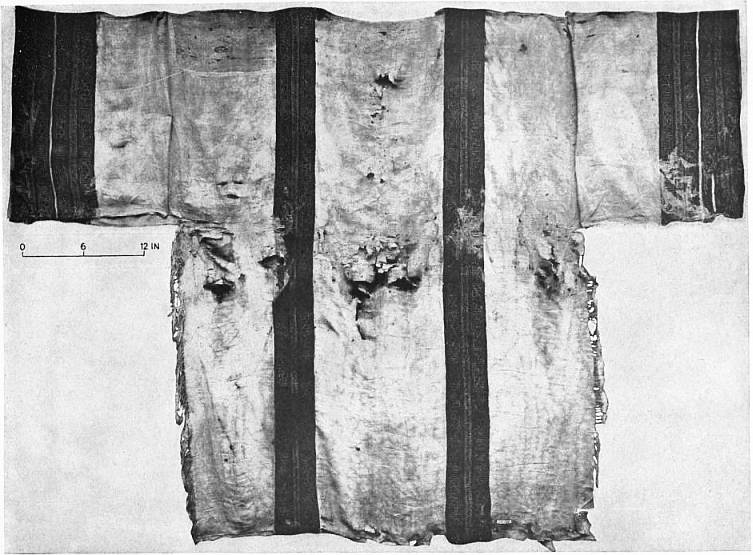
Fig. 2.—TUNIC OF LINEN, WOVEN WITH BANDS OF PURPLE WOOL EMBROIDERED WITH WHITE FLAX.
From the tombs at Akhmim. Egypto-Roman; 1st to 4th century. (In the Victoria and Albert Museum.)
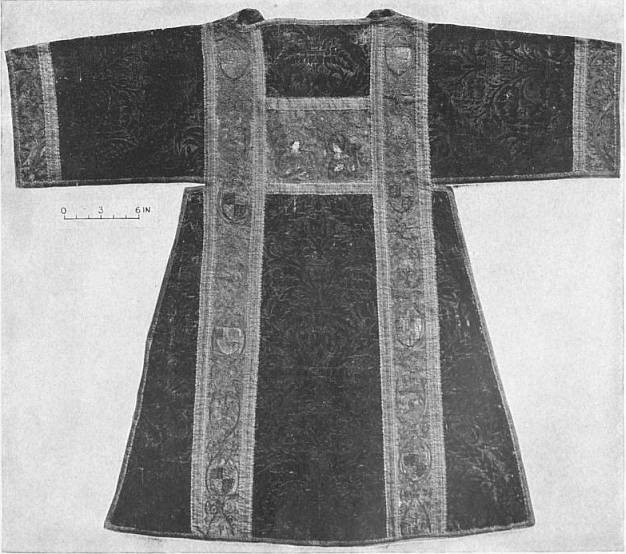
Fig. 3.—BACK OF A DALMATIC OF STAMPED GREEN WOOLLEN VELVET: THE ORPHREYS AND APPARELS ARE OF EMBROIDERED SILK VELVET.
The two figures on the cross-band or apparel represent St. Gregory the Great and St. Augustine. The shields of arms are for the dukes of Jülich and Berg, counts of Ravensberg, and for the electors of Bavaria. Said to have come from the church of St. Severin, Cologne. German (Cologne); second half of 15th century. (In the Victoria and Albert Museum.)
Plate II.
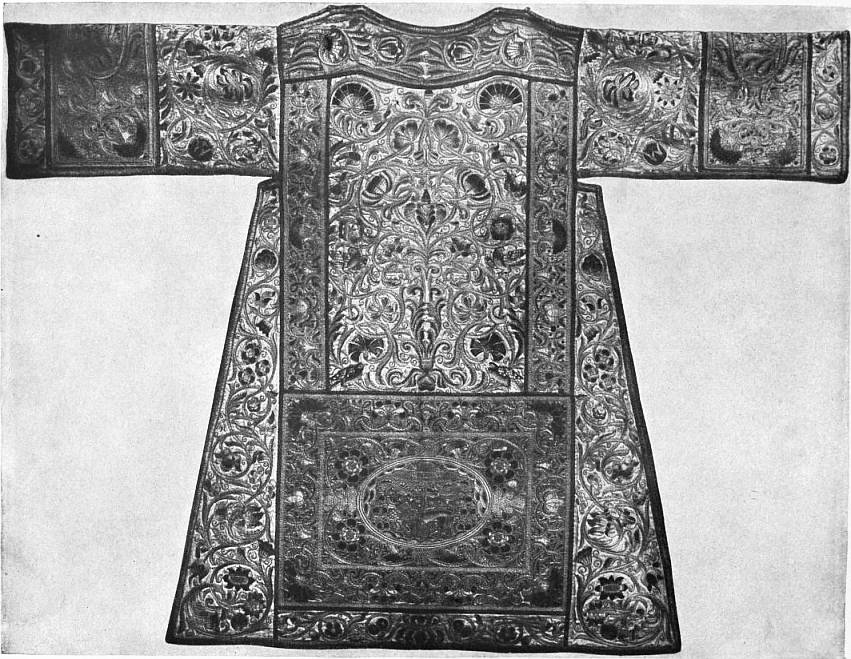
Fig. 4.—DALMATIC OF WHITE SATIN EMRROIDERED WITH COLOURED SILKS AND SILVER-GILT AND SILVER THREAD.
Spanish; early 17th century. (In the Victoria and Albert Museum.)
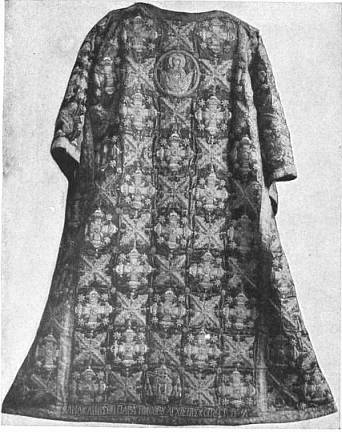
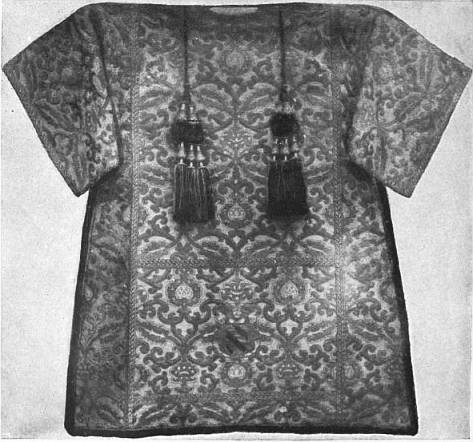
Fig. 5.—GREEK SAKKOS, OF RED SATIN EMBROIDERED WITH SILVER-GILT AND SILVER THREAD WITH SILK. Fig. 6.—DALMATIC OF POPE PIUS V.
It has the names and arms of two archbishops. 18th century. (In the Victoria and Albert Museum.) An early example of the modern Roman type. Roman; 16th century. Preserved at Santa Maria Maggiore, Rome. From a photograph taken by Father J. Braun (in Die liturgische Gewandung), by permission of B. Herder.
A silk dalmatic forms one (the undermost) of the English coronation robes. Its use would seem to have been borrowed, not from the robes of the Eastern emperors, but from the church, and to symbolize with the other robes the quasi-sacerdotal character of the kingship (see Coronation). The magnificent so-called dalmatic of Charlemagne, preserved at Rome (see Embroidery), is really a Greek sakkos.
See Joseph Braun, S.J., Die liturgische Gewandung (Freiburg im Breisgau, 1907), pp. 247-305. For further references and illustrations see the article Vestments.
(W. A. P.)
DALMELLINGTON, a village of Ayrshire, Scotland, 15 m. S.E. of Ayr by a branch line, of which it is the terminus, of the Glasgow & South-Western railway. Pop. (1901) 1448. The district is rich in minerals—coal, ironstone, sandstone and limestone. Though the place is of great antiquity, the Roman road running near it, few remains of any interest exist. It was, however, a centre of activity in the Covenanting times.
DALOU, JULES (1838-1902), French sculptor, was the pupil of Carpeaux and Duret, and combined the vivacity and richness of the one with the academic purity and scholarship of the other. He is one of the most brilliant virtuosos of the French school, admirable alike in taste, execution and arrangement. He first exhibited at the Salon in 1867, but when in 1871 the troubles of the Commune broke out in Paris, he took refuge in England, where he rapidly made a name through his appointment at South Kensington. Here he laid the foundation of that great improvement which resulted in the development of the modern British school of sculpture, and at the same time executed a remarkable series of terra-cotta statuettes and groups, such as “A French Peasant Woman” (of which a bronze version under the title of “Maternity” is erected outside the Royal Exchange), the group of two Boulogne women called “The Reader” and “A Woman of Boulogne telling her Beads.” He returned to France in 1879 and produced a number of masterpieces. His great relief of “Mirabeau replying to M. de Dreux-Brézé,” exhibited in 1883 and now at the Palais Bourbon, and the highly decorative panel, “Triumph of the Republic,” were followed in 1885 by “The Procession of Silenus.” For the city of Paris he executed his most elaborate and splendid achievement, the vast monument, “The Triumph of the Republic,” erected, after twenty years’ work, in the Place de la Nation, showing a symbolical figure of the Republic, aloft on her car, drawn by lions led by Liberty, attended by Labour and Justice, and followed by Peace. It is somewhat in the taste of the Louis XIV. period, ornate, but exquisite in every detail. Within a few days there was also inaugurated his great “Monument to Alphand” (1899), which almost equalled in the success achieved the monument to Delacroix in the Luxembourg Gardens. Dalou, who gained the Grand Prix of the International exhibition of 1889, and was an officer of the Legion of Honour, was one of the founders of the New Salon (Société Nationale des Beaux-Arts), and was the first president of the sculpture section. In portraiture, whether statues or busts, his work is not less remarkable.
DALRADIAN, in geology, a series of metamorphic rocks, typically developed in the high ground which lies E. and S. of the Great Glen of Scotland. This was the old Celtic region of Dalradia, and in 1891 Sir A. Geikie proposed the name Dalradian as a convenient provisional designation for the complicated set of rocks to which it is difficult to assign a definite position in the stratigraphical sequence (Q.J.G.S. 47, p. 75). In Sir A. Geikie’s words, “they consist in large proportion of altered sedimentary strata, now found in the form of mica-schist, graphite-schist, andalusite-schist, phyllite, schistose grit, greywacke and conglomerate, quartzite, limestone and other rocks, together with epidiorites, chlorite-schists, hornblende schists and other allied varieties, which probably mark sills, lava-sheets or beds of tuff, intercalated among the sediments. The total thickness of this assemblage of rocks must be many thousand feet.” The Dalradian series includes the “Eastern or Younger schists” of eastern Sutherland, Ross-shire and Inverness-shire—the Moine gneiss, &c.—as well as the metamorphosed sedimentary and eruptive rocks of the central, eastern and south-western Highlands. The series has been traced into the north-western counties of Ireland. The whole of the Dalradian complex has suffered intense crushing and thrusting.
See Pre-Cambrian; also J. B. Hill, Q.J.G.S., 1899, 55, and G. Barrow, loc. cit., 1901, 57, and the Annual Reports and Summaries of Progress of the Geological Survey of the United Kingdom from 1893 onwards.
DALRIADA, the name of two ancient Gaelic kingdoms, one in Ireland and the other in Scotland. The name means the home of the descendants of Riada. Irish Dalriada was the district which now forms the northern part of county Antrim, and from which about A.D. 500 some emigrants crossed over to Scotland, and founded in Argyllshire the Scottish kingdom of Dalriada. For a time Scottish Dalriada appears to have been dependent upon Irish Dalriada, but about 575 King Aidan secured its independence. One of Aidan’s successors, Kenneth, became king of the Picts about 843, and gradually the name Dalriada both in Ireland and Scotland fell into disuse.
See W. F. Skene, Celtic Scotland (Edinburgh, 1876-1880).
DALRY (Gaelic, “the field of the king”), a mining and manufacturing town of Ayrshire, Scotland, on the Garnock, 23¼ m. S.W. of Glasgow, by the Glasgow & South-Western railway. Pop. (1901) 5316. The public buildings include the library and reading-room, the assembly rooms, Davidshill hospital, Temperance hall and night asylum. There is a public park. The industries consist of woollen factories, worsted spinning, box-, cabinet-, coke- and brick-making, machine-knitting, currying and the manufacture of aerated waters. Coal and iron are found, but mining is not extensively pursued. In the vicinity are the iron works of Blair and Glengarnock, and a curious stalactite cave, known as Elf House, 30 ft. high and about 200 ft. long, offering some resemblance to a pointed aisle. Rye Water flows into the Garnock close to the town. Captain Thomas Crawford of Jordanhill (1530-1603), the captor of Dumbarton Castle, spent the closing years of his life at Dalry, where a considerable estate had been granted to him.
DALTON, JOHN (1766-1844), English chemist and physicist, was born about the 6th of September 1766 at Eaglesfield, near Cockermouth in Cumberland. His father, Joseph Dalton, was a weaver in poor circumstances, who, with his wife (Deborah Greenup), belonged to the Society of Friends; they had three children—Jonathan, John and Mary. John received his early education from his father and from John Fletcher, teacher of the Quakers’ school at Eaglesfield, on whose retirement in 1778 he himself started teaching. This youthful venture was not successful, the amount he received in fees being only about five shillings a week, and after two years he took to farm work. But he had received some instruction in mathematics from a distant relative, Elihu Robinson, and in 1781 he left his native village to become assistant to his cousin George Bewley who kept a school at Kendal. There he passed the next twelve years, becoming in 1785, through the retirement of his cousin, joint manager of the school with his elder brother Jonathan. About 1790 he seems to have thought of taking up law or medicine, but his projects met with no encouragement from his relatives and he remained at Kendal till, in the spring of 1793, he moved to Manchester, where he spent the rest of his life. Mainly through John Gough (1757-1825), a blind philosopher to whose aid he owed much of his scientific knowledge, he was appointed teacher of mathematics and natural philosophy at the New College in Moseley Street (in 1880 transferred to Manchester College, Oxford), and that position he retained until the removal of the college to York in 1799, when he became a “public and private teacher of mathematics and chemistry.”
During his residence in Kendal, Dalton had contributed solutions of problems and questions on various subjects to the Gentlemen’s and Ladies’ Diaries, and in 1787 he began to keep a meteorological diary in which during the succeeding fifty-seven years he entered more than 200,000 observations. His first separate publication was Meteorological Observations and Essays (1793), which contained the germs of several of his later discoveries; but in spite of the originality of its matter, the book met with only a limited sale. Another work by him, Elements of English Grammar, was published in 1801. In 1794 he was elected a member of the Manchester Literary and Philosophical Society, and a few weeks after election he communicated his first paper on “Extraordinary facts relating to the vision of colours,” in which he gave the earliest account of the optical peculiarity known as Daltonism or colour-blindness, and summed up its characteristics as observed in himself and others. Besides the blue and purple of the spectrum he was able to recognize only one colour, yellow, or, as he says in his paper, “that part of the image which others call red appears to me little more than a shade or defect of light; after that the orange, yellow and green seem one colour which descends pretty uniformly from an intense to a rare yellow, making what I should call different shades of yellow.” This paper was followed by many others on diverse topics—on rain and dew and the origin of springs, on heat, the colour of the sky, steam, the auxiliary verbs and participles of the English language and the reflection and refraction of light. In 1800 he became a secretary of the society, and in the following year he presented the important paper or series of papers, entitled “Experimental Essays on the constitution of mixed gases; on the force of steam or vapour of water and other liquids in different temperatures, both in Torricellian vacuum and in air; on evaporation; and on the expansion of gases by heat.” The second of these essays opens with the striking remark, “There can scarcely be a doubt entertained respecting the reducibility of all elastic fluids of whatever kind, into liquids; and we ought not to despair of effecting it in low temperatures and by strong pressures exerted upon the unmixed gases”; further, after describing experiments to ascertain the tension of aqueous vapour at different points between 32° and 212° F., he concludes, from observations on the vapour of six different liquids, “that the variation of the force of vapour from all liquids is the same for the same variation of temperature, reckoning from vapour of any given force.” In the fourth essay he remarks, “I see no sufficient reason why we may not conclude that all elastic fluids under the same pressure expand equally by heat and that for any given expansion of mercury, the corresponding expansion of air is proportionally something less, the higher the temperature.... It seems, therefore, that general laws respecting the absolute quantity and the nature of heat are more likely to be derived from elastic fluids than from other substances.” He thus enunciated the law of the expansion of gases, stated some months later by Gay-Lussac. In the two or three years following the reading of these essays, he published several papers on similar topics, that on the “Absorption of gases by water and other liquids” (1803), containing his “Law of partial pressures.”
But the most important of all Dalton’s investigations are those concerned with the Atomic Theory in chemistry, with which his name is inseparably associated. It has been supposed that this theory was suggested to him either by researches on olefiant gas and carburetted hydrogen or by analysis of “protoxide and deutoxide of azote,” both views resting on the authority of Dr Thomas Thomson (1773-1852), professor of chemistry in Glasgow university. But from a study of Dalton’s own MS. laboratory notebooks, discovered in the rooms of the Manchester society, Roscoe and Harden (A New View of the Origin of Dalton’s Atomic Theory, 1896) conclude that so far from Dalton being led to the idea that chemical combination consists in the approximation of atoms of definite and characteristic weight by his search for an explanation of the law of combination in multiple proportions, the idea of atomic structure arose in his mind as a purely physical conception, forced upon him by study of the physical properties of the atmosphere and other gases. The first published indications of this idea are to be found at the end of his paper on the “Absorption of gases” already mentioned, which was read on the 21st of October 1803 though not published till 1805. Here he says: “Why does not water admit its bulk of every kind of gas alike? This question I have duly considered, and though I am not able to satisfy myself completely I am nearly persuaded that the circumstance depends on the weight and number of the ultimate particles of the several gases.” He proceeds to give what has been quoted as his first table of atomic weights, but on p. 248 of his laboratory notebooks for 1802-1804, under the date 6th of September 1803, there is an earlier one in which he sets forth the relative weights of the ultimate atoms of a number of substances, derived from analysis of water, ammonia, carbon-dioxide, &c. by chemists of the time. It appears, then, that, confronted with the “problem of ascertaining the relative diameter of the particles of which, he was convinced, all gases were made up, he had recourse to the results of chemical analysis. Assisted by the assumption that combination always takes place in the simplest possible way, he thus arrived at the idea that chemical combination takes place between particles of different weights, and this it was which differentiated his theory from the historic speculations of the Greeks. The extension of this idea to substances in general necessarily led him to the law of combination in multiple proportions, and the comparison with experiment brilliantly confirmed the truth of his deduction” (A New View, &c., pp. 50, 51). It may be noted that in a paper on the “Proportion of the gases or elastic fluids constituting the atmosphere,” read by him in November 1802, the law of multiple proportions appears to be anticipated in the words—“The elements of oxygen may combine with a certain portion of nitrous gas or with twice that portion, but with no intermediate quantity,” but there is reason to suspect that this sentence was added some time after the reading of the paper, which was not published till 1805.
Dalton communicated his atomic theory to Dr Thomson, who by consent included an outline of it in the third edition of his System of Chemistry (1807), and Dalton gave a further account of it in the first part of the first volume of his New System of Chemical Philosophy (1808). The second part of this volume appeared in 1810, but the first part of the second volume was not issued till 1827, though the printing of it began in 1817. This delay is not explained by any excess of care in preparation, for much of the matter was out of date and the appendix giving the author’s latest views is the only portion of special interest. The second part of vol. ii. never appeared.
Altogether Dalton contributed 116 memoirs to the Manchester Literary and Philosophical Society, of which from 1817 till his death he was the president. Of these the earlier are the most important. In one of them, read in 1814, he explains the principles of volumetric analysis, in which he was one of the earliest workers. In 1840 a paper on the phosphates and arsenates, which was clearly unworthy of him, was refused by the Royal Society, and he was so incensed that he published it himself. He took the same course soon afterwards with four other papers, two of which—“On the quantity of acids, bases and salts in different varieties of salts” and “On a new and easy method of analysing sugar,” contain his discovery, regarded by him as second in importance only to the atomic theory, that certain anhydrous salts when dissolved in water cause no increase in its volume, his inference being that the “salt enters into the pores of the water.”
As an investigator, Dalton was content with rough and inaccurate instruments, though better ones were readily attainable. Sir Humphry Davy described him as a “very coarse experimenter,” who “almost always found the results he required, trusting to his head rather than his hands.” In the preface to the second part of vol. i. of his New System he says he had so often been misled by taking for granted the results of others that he “determined to write as little as possible but what I can attest by my own experience,” but this independence he carried so far that it sometimes resembled lack of receptivity. Thus he distrusted, and probably never fully accepted, Gay-Lussac’s conclusions as to the combining volumes of gases; he held peculiar and quite unfounded views about chlorine, even after its elementary character had been settled by Davy; he persisted in using the atomic weights he himself had adopted, even when they had been superseded by the more accurate determinations of other chemists; and he always objected to the chemical notation devised by J. J. Berzelius, although by common consent it was much simpler and more convenient than his cumbersome system of circular symbols. His library, he was once heard to declare, he could carry on his back, yet he had not read half the books it contained.
Before he had propounded the atomic theory he had already attained a considerable scientific reputation. In 1804 he was chosen to give a course of lectures on natural philosophy at the Royal Institution in London, where he delivered another course in 1809-1810. But he was deficient, it would seem, in the qualities that make an attractive lecturer, being harsh and indistinct in voice, ineffective in the treatment of his subject, and “singularly wanting in the language and power of illustration.” In 1810 he was asked by Davy to offer himself as a candidate for the fellowship of the Royal Society, but declined, possibly for pecuniary reasons; but in 1822 he was proposed without his knowledge, and on election paid the usual fee. Six years previously he had been made a corresponding member of the French Academy of Sciences, and in 1830 he was elected as one of its eight foreign associates in place of Davy. In 1833 Lord Grey’s government conferred on him a pension of £150, raised in 1836 to £300. Never married, though there is evidence that he delighted in the society of women of education and refinement, he lived for more than a quarter of a century with his friend the Rev. W. Johns (1771-1845), in George Street, Manchester, where his daily round of laboratory work and tuition was broken only by annual excursions to the Lake district and occasional visits to London, “a surprising place and well worth one’s while to see once, but the most disagreeable place on earth for one of a contemplative turn to reside in constantly.” In 1822 he paid a short visit to Paris, where he met many of the distinguished men of science then living in the French capital, and he attended several of the earlier meetings of the British Association at York, Oxford, Dublin and Bristol. Into society he rarely went, and his only amusement was a game of bowls on Thursday afternoons. He died in Manchester in 1844 of paralysis. The first attack he suffered in 1837, and a second in 1838 left him much enfeebled, both physically and mentally, though he remained able to make experiments. In May 1844 he had another stroke; on the 26th of July he recorded with trembling hand his last meteorological observation, and on the 27th he fell from his bed and was found lifeless by his attendant. A bust of him, by Chantrey, was publicly subscribed for in 1833 and placed in the entrance hall of the Manchester Royal Institution.
See Henry, Life of Dalton, Cavendish Society (1854); Angus Smith, Memoir of John Dalton and History of the Atomic Theory (1856), which on pp. 253-263 gives a list of Dalton’s publications; and Roscoe and Harden, A New View of the Origin of Dalton’s Atomic Theory (1896); also Atom.
DALTON, a city and the county-seat of Whitfield county, Georgia, U.S.A., in the N.W. part of the state, 100 m. N.N.W. of Atlanta. Pop. (1890) 3046; (1900) 4315 (957 negroes); (1910) 5324. Dalton is served by the Southern, the Nashville, Chattanooga & St Louis, and the Western & Atlanta (operated by the Nashville, Chattanooga & St Louis) railways. The city is in a rich agricultural region; ships cotton, grain, fruit and ore; and has various manufactures, including canned fruit and vegetables, flour and foundry and machine shop products. It is the seat of Dalton Female College. Dalton was founded by Duff Green and others in 1848, and was incorporated in 1874. Hither General Braxton Bragg retreated after his defeat at Chattanooga in the last week of November 1863. Three weeks afterwards Bragg, in command of the army in northern Georgia in winter quarters here, was replaced by General Joseph E. Johnston, who, with his force of 54,400, adopted defensive tactics to meet Sherman’s invasion of Georgia, with his 99,000 or 100,000 men in the Army of the Cumberland (60,000) under General G. H. Thomas, the Army of the Tennessee (25,000) under General J. B. M‘Pherson, and the Army of the Ohio (14,000) under General J. M. Schofield. The Federal forces stretched for 20 m. in a position south of Ringgold and between Ringgold and Dalton. Johnston’s line of defences included Rocky Face Ridge, a wall of rock through which the railway passes about 5 m. north-west of the city, Mill Creek (1 m. north-north-west of Dalton), which he dammed so that it could not be forded, and earthworks north and east of the city. On the 7th of May General M’Pherson started for Resaca, 18 m. south of Dalton, to occupy the railway there in Johnston’s rear, but he did not attack Resaca, thinking it too strongly protected; Thomas, with Schofield on his left, on the 7th forced the Confederates through Buzzard’s Roost Gap (the pass at Mill Creek) north-west of Dalton; at Dug Gap, 4 m. south-west of Dalton, on the 8th a fierce Federal assault under Brigadier-General John W. Geary failed to dislodge the Confederates from a quite impregnable position. On the 11th the main body of Sherman’s army followed M’Pherson toward Resaca, and Johnston, having evacuated Dalton on the night of the 12th, was thus forced, after five days’ manœuvring and skirmishing, to march to Resaca and to meet Sherman there.
See J. D. Cox, The Atlanta Campaign (New York, 1882); Johnson and Buel, Battles and Leaders of the Civil War (4 vols., New York, 1887); and Official Records of the War of the Rebellion, series 1, vols. 32, 38, 39, 45, 49; series ii., vol. 8.
DALTON-IN-FURNESS, a market town in the North Lonsdale parliamentary division of Lancashire, England, 4 m. N.E. by N. of Barrow-in-Furness by the Furness railway. Pop. of urban district (1901) 13,020. The church of St Mary is in the main a modern reconstruction, but retains ancient fragments and a font believed to have belonged to Furness Abbey. This fine ruin lies 3 m. south of Dalton (see Furness). St Mary’s churchyard contains the tomb of the painter George Romney, a native of the town. Of Dalton Castle there remains a square tower, showing decorated windows. Here was held the manorial court of Furness Abbey. There are numerous iron-ore mines in the parish, and ironworks at Askam-in-Furness, in the northern part of the district.
DALY, AUGUSTIN (1838-1899), American theatrical manager and playwright, was born in Plymouth, North Carolina, on the 20th of July 1838. He was dramatic critic for several New York papers from 1859, and he adapted or wrote a number of plays, Under the Gaslight (1867) being his first success. In 1869 he was the manager of the Fifth Avenue theatre, and in 1879 he built and opened Daly’s theatre in New York, and, in 1893, Daly’s theatre in London. At the former he gathered a company of players, headed by Miss Ada Rehan, which made for it a high reputation, and for them he adapted plays from foreign sources, and revived Shakespearean comedies in a manner before unknown in America. He took his entire company on tour, visiting England, Germany and France, and some of the best actors on the American stage have owed their training and first successes to him. Among these were Clara Morris, Sara Jewett, John Drew, Fanny Davenport, Maude Adams, Mrs Gilbert and many others. Daly was a great book-lover, and his valuable library was dispersed by auction after his death, which occurred in Paris on the 7th of June 1899. Besides plays, original and adapted, he wrote Woffington: a Tribute to the Actress and the Woman (1888).
DALYELL (or Dalziell or Dalzell), THOMAS (d. 1685), British soldier, was the son of Thomas Dalyell of Binns, Linlithgowshire, a cadet of the family of the earls of Carnwath, and of Janet, daughter of the 1st Lord Bruce of Kinloss, master of the rolls in England. He appears to have accompanied the Rochelle expedition in 1628, and afterwards, becoming colonel, served under Robert Munro, the general in Ireland. He was taken prisoner at the capitulation of Carrickfergus in August 1650, but was given a free pass, and having been banished from Scotland remained in Ireland. He was present at the battle of Worcester (3rd of September 1651), where his men surrendered, and he himself was captured and imprisoned in the Tower. In May he escaped abroad, and in 1654 took part in the Highland rebellion and was excepted from Cromwell’s act of grace, a reward of £200 being offered for his capture, dead or alive. The king’s cause being now for the time hopeless, Dalyell entered the service of the tsar of Russia, and distinguished himself as general in the wars against the Turks and Tatars. He returned to Charles in 1665, and on the 19th of July 1666 he was appointed commander-in-chief in Scotland to subdue the Covenanters. He defeated them at Rullion Green and exercised his powers with great cruelty, his name becoming a terror to the peasants. He obtained several of the forfeited estates. On the 3rd of January 1667 he was made a privy councillor, and from 1678 till his death represented Linlithgow in the Scottish parliament. He was incensed by the choice of the duke of Monmouth as commander-in-chief in June 1679, and was confirmed in his original appointment by Charles, but in consequence did not appear at Bothwell Bridge till after the close of the engagement. On the 25th of November 1681, a commission was issued authorizing him to enrol the regiment afterwards known as the Scots Greys. He was continued in his appointment by James II., but died soon after the latter’s accession in August 1685. He married Agnes, daughter of John Ker of Cavers, by whom he had a son, Thomas, created a baronet in 1685, whose only son and heir, Thomas, died unmarried. The baronetage apparently became extinct, but it was assumed about 1726 by James Menteith, a son of the sister of the last baronet, who took the name of Dalyell; his last male descendant, Sir Robert Dalyell, died unmarried in 1886.
DAM. (1) (A common Teutonic word, cf. Swed. and Ger. damm, and the Gothic verb faurdammjan, to block up), a barrier of earth or masonry erected to restrain, divert or contain a body of water, particularly in order to form a reservoir. (2) (Fr. dame, dame; Lat. domina, feminine of dominus, lord, master), the mother of an animal, now chiefly used of the larger quadrupeds, and particularly of a mare, the mother of a foal.
DAMAGES (through O. Fr. damage, mod. Fr. dommage, from Lat. damnum, loss), the compensation which a person who has suffered a legal wrong is by law entitled to recover from the person responsible for the wrong. Loss caused by an act which is not a legal wrong (damnum sine injuria) is not recoverable, e.g. where a father loses a young child by the negligence of a third party.
The principle of compensation in law makes its first appearance as a substitute for personal retaliation. In primitive law something of the nature of the Anglo-Saxon wer-gild, or the ποινή of the Iliad, appears to be universal. It marks out with great minuteness the measure of the compensation appropriate to each particular case of personal injury. And there is a resemblance between the legal compensation, as it may be called, and the compensation which an injured person, seeking his own remedy, would be likely to exact for himself. In such a system the two entirely different objects of personal satisfaction and criminal punishment are not clearly separated, and in fact, criminal and civil remedies were administered in the same proceeding.
Under modern systems of law, the object of legal compensation is to place the injured person as nearly as possible in the situation in which he would have been but for the injury; and the controlling principle is that compensation should be determined so far as possible by the actual amount of the loss sustained. In England, civil proceedings for reparation and criminal proceedings for punishment are with few exceptions carefully kept separate. In Scotland, pursuit of the two kinds of remedies in the same proceeding is possible but very rare; but in France and other European states it is lawful and usual in the case of those delicts which are also punishable criminally.
In the law of England the two historical systems of common law and equity viewed compensation or reparation from two different points of view. The principle of the common law was that the amount of every injury might be estimated by pecuniary valuation. The idea was no doubt derived from the old tariffs of were, bot and wite, in which the valuations were elaborate. Until 1858 (Cairns’ Act) courts of equity had no direct jurisdiction to award damages, and their business was to place the injured party in the actual position to which he was entitled (restitutio ad integrum). This difference comes out most clearly in cases of breach of contract. The common law, with a few partial exceptions, could do no more than compel the defaulter to make good the loss of the other party, by paying him an ascertained sum of money as damages. Equity, recognizing the fact that complete satisfaction was not in all cases to be obtained by mere money payment, compelled those who broke certain classes of contracts specifically to perform them, and in the case of acts or defaults not amounting to breach of contract, on satisfactory proof that a wrong was contemplated, would interfere to prevent it by injunction; while at common law no action could be brought until the injury was accomplished, and then only pecuniary damages could be obtained. Since the Judicature Acts this distinction has ceased and the appropriate remedy may be awarded in any division of the High Court of Justice.
Under the common law damages were always assessed by a jury. Under the existing procedure in England they may be assessed (1) by a jury under the directions of a judge; (2) by a judge alone or sitting with assessors; (3) by a referee, official or special, or officer of the courts with or without the assistance of mercantile or other assessors; (4) by a consensual tribunal such as an arbitrator or valuer selected by the parties. Whatever the mode of assessment, it is subject to review if the assessors have clearly mistaken the proper measure of damage.
In the case of assessment by a jury, the verdict may be set aside because the damages are clearly excessive or palpably insufficient, or arrived at by some irregular conduct, e.g. by setting down the sum which each juryman would give and dividing the result by twelve. The appellate court, however, cannot, without the consent of the parties, itself fix the amount of damages in a case which has been submitted to a jury (Watt v. Watt, 1905, Appeal Cases 115).
The courts have gradually evolved certain rules or principles for the proper assessment of damages, although extreme difficulty is found in their application to concrete cases. A distinction is drawn between general and special Measure of damages. damages. (1) General damage is that implied by law as necessarily flowing from the breach of right, and requiring no proof. (2) Special damage is that in fact caused by the wrong. Under existing practice this form of damage cannot be recovered unless it has been specifically claimed and proved, or unless the best available particulars or details have been before trial communicated to the party against whom it is claimed.
Contracts.—“The law imposes or implies a term that upon breach of contract damages must be paid.” The general tendency of legal decisions in cases of contract is (i.) to make the amount of damages which may be awarded a matter of legal certainty, (ii.) to leave to a jury or like tribunal little more to do than find the facts, (iii.) and to revise the assessment if it is clear that it has been made in disregard of the terms of the contract or of the natural and direct consequences of the breach. The measure of damage, general speaking, is the sum necessary to place the aggrieved party in the same position so far as money will do it as if the contract had been performed. If the breach is proved, but the person complaining has suffered no real damage, he is entitled to have his legal right recognized by an award of what are called nominal damages, i.e. a sum just sufficient to carry a judgment in his favour on the infraction of his rights. Nominal damages, it will therefore be seen, are not the same as “small damages.” He is, however, also entitled to prove and recover the special or particular damage lawfully attributable to the breach. Where the contract is to pay a fixed sum of money or liquidated amount, the measure of damages for non-payment is the sum agreed to be paid and interest thereon at the rate stipulated in the contract or recognized by law.
The law is the same in Scotland and in France (Civil Code, art. 1153). In some contracts the parties themselves fix the sum to be paid as damages if the contract is not fulfilled. These damages are described as liquidated, in Scots law stipulated or estimated. It would be supposed that the sum thus fixed would be the proper damages to be awarded. And under the French Civil Code (arts. 1152, 1153, 1780) the stipulation of the parties as to the damages to be paid for breach of a stipulation other than for paying a sum of money is binding on the courts. But in England, Scotland and the United States, courts disregard the words used, and inquire into the real nature of the transaction in order to see whether the sum fixed is to be treated as ascertained damage or as a penalty to be held in terrorem over the defaulter, and in the latter case, notwithstanding the stipulation, will require proof of the actual loss. In Kemble v. Farren (1829, 6 Bingham, 141), a contract between a manager and an actor provided that for a breach of any of the stipulations therein, the sum of £1000 should be payable by the defaulter, not as a penalty, but as liquidated and ascertained damages. Yet, the court, observing that under the stipulations of the contract the sum of £1000, if it were taken to be liquidated damages, might become payable for mere non-payment of a trifling sum, held that it was not fixed as damages, but as a penalty only. The case in which an agreed sum is most usually treated as a penalty is a bond to pay a fixed sum containing a condition that it shall be void if certain acts are done or a certain smaller sum paid. Another case is where a single lump sum is fixed as the liquidated amount of damage to be paid for doing or failing to do a number of different things of very varying degrees of importance (Elphinstone v. Monkland Iron Co., 1887, 11 A.C. 333). But the courts have accepted as creating a contractual measure of damage a stipulation to finish sewerage works by a given day (Law v. Redditch Local Board, 1892, 1 Q.B. 127); or to complete torpedo boats within a limited time for a foreign government (Clydebank Engineering Co. v. Yzquierda, 1905, A.C. 6). In this last case the law lords indicated that the provision of an agreed sum was peculiarly appropriate in view of the difficulty of showing the exact damage which a state sustains by non-delivery of a warship. Where the damage is not liquidated or agreed it is assessed to upon evidence as to the actual loss naturally and directly flowing from the breach of contract.
In contracts for the sale of goods the measure of damages is fixed by statute. Where the buyer wrongfully refuses or neglects to accept and pay for, or the seller wrongfully neglects or refuses to deliver the goods, the measure is the estimated loss directly and naturally resulting in the ordinary course of events from the buyer’s or seller’s breach of contract. Where there is an available market for the goods in question, the measure of damages is prima facie to be ascertained by the difference between the contract price and the market or current price at the time or times when the goods ought to have been accepted or delivered, or if no such time was fixed for acceptance or delivery, then at the time of refusal to accept or deliver (Sale of Goods Act 1893, §§ 50, 51).
Where there is no market, the value is fixed by the price of the nearest available substitute. Where the sufferer, at the request of the person in default, postpones purchase or sale, any increased loss thereby caused falls on the defaulter. If the buyer, before the time fixed for delivery, has resold the goods to a sub-vendor, he cannot claim against his own vendor any damages which the sub-vendor may recover against him for breach of contract, because he ought to have gone into the market and purchased other goods. But this is subject to modification in cases falling within the rule in Hadley v. Baxendale (1854, 9 Exchequer, 341). But trouble and expense incurred by the seller of finding a new purchaser or other goods may be taken account of in assessing the damages.
Where the goods delivered are not as contracted the buyer may as a rule sue the seller for a breach of warranty, or set it up as reduction of price. Where the warranty is of quality the loss is prima facie the difference between the value of the goods delivered when delivered and the value which they would have then had if they had answered to the warranty (Sale of Goods Act 1893, § 53). In an American case, where a person had agreed with a boarding-house keeper for a year, and quitted the house within the time, it was held that the measure of damages was not the price stipulated to be paid, but only the loss caused by the breach of contract. In contracts to marry, a special class of considerations is recognized, and the jury in assessing damages will take notice of the conduct of the parties. The social position and means of the defendant may be given in evidence to show what the plaintiff has lost by the breach of contract.
On a breach of contract to replace stock lent, the measure of damages is the price of the stock on the day when it ought to have been delivered, or on the day of trial, at the plaintiff’s option.
In contracts for the sale of realty, the measure of damage for breach by the vendor is the amount of any deposit paid by the would-be purchaser and of the expenses thrown away. But the purchaser may, in a proper case, obtain specific performance, and if he has been cheated may obtain damages in an action for deceit.
Breaches of trust are in a sense distinct from breaches of contract, as they fell under the jurisdiction of courts of equity and not of the common law courts. The rule applied was to require a defaulting trustee to make good to the beneficiaries any loss flowing from a breach of trust and not to allow him to set off against this liability any gain to the trust fund resulting from a different breach of trust or from good management (Lewin on Trusts, ed. 1904, 1146).
In estimating the proper amount to be assessed as damages for a breach of contract, it is not permissible to include every loss caused by the act or default upon which the claim for damages is based. The damage to be awarded must be that fairly and naturally arising from the breach under ordinary circumstances or the special circumstances of the particular contract, or in other words, which may reasonably be supposed to have been in the contemplation of the parties at the time of making the contract. The chief authority for this rule is the case of Hadley v. Baxendale (1854, 9 Exch. 341), which has been accepted in Scotland and the United States and throughout the British empire, and often differs little, if at all, from the rule adopted in the French civil code (art. 1150). In that case damages were sought for the loss of profits caused by a steam mill being kept idle, on account of the delay of the defendants in sending a new shaft which they had contracted to make. The court held the damage to be too remote, and stated the proper rule as follows:—
“Where two parties have made a contract which one of them has broken, the damages which the other party ought to receive in respect of such breach of contract should be such as may fairly and reasonably be considered either arising naturally, i.e. according to the usual course of things, from such breach of contract itself, or such as may reasonably be supposed to have been in the contemplation of both parties at the time they made the contract as the probable result of the breach of it. Now if the special circumstances under which the contract was actually made were communicated by the plaintiffs to the defendants, and thus known to both parties, the damages resulting from such contract which they would reasonably contemplate would be the amount of injury which would ordinarily flow from a breach of contract under these special circumstances so known and communicated. But on the other hand, if those special circumstances were wholly unknown to the party breaking the contract, he at the most could only be supposed to have had in his mind the amount of injury which would arise generally, and in the great multitude of cases not affected by any special circumstances, from such breach of contract.”1
The rule is, however, only a general guide, and does not obviate the necessity of inquiring in each case what are the natural or contemplated damages. In an action by the proprietor of a theatre, it was alleged that the defendant had written a libel on one of the plaintiff’s singers, whereby she was deterred from appearing on the stage, and the plaintiff lost his profits; such loss was held to be too remote to be the ground of an action for damages. In Smeed v. Foord (1 Ellis and Ellis, 602), the defendant contracted to deliver a threshing-machine to the plaintiff, a farmer, knowing that it was needed to thresh the wheat in the field. Damages were sought for injury done to the wheat by rain in consequence of the machine not having been delivered in time, and also for a fall in the market before the grain could be got ready. It was held that the first claim was good, as the injury might have been anticipated, but that the second was bad. When, through the negligence of a railway company in delivering bales of cotton, the plaintiffs, having no cotton to work with, were obliged to keep their workmen unemployed, it was held that the wages paid and the profits lost were too remote for damages. On the other hand, where the defendant failed to keep funds on hand to meet the drafts of the plaintiff, so that a draft was returned dishonoured, and his business in consequence was for a time suspended and injured, the plaintiff was held entitled to recover damage for such loss.
The rule that the contract furnishes the measure of the damages does not prevail in the case of unconscionable, i.e. unreasonable, absurd or impossible contracts. The old school-book juggle in geometrical progression has more than once been before the courts as the ground of an action. Thus, when a man agreed to pay for a horse a barley-corn per nail, doubling it every nail, and the amount calculated as 32 nails was 500 quarters of barley, the judge directed the jury to disregard the contract, and give as damages the value of the horse. And when a defendant had agreed for £5 to give the plaintiff two grains of rye on Monday, four on the next Monday,2 and so on doubling it every Monday, it was contended that the contract was impossible, as all the rye in the world would not suffice for it; but one of the judges said that, though foolish, it would hold in law, and the defendant ought to pay something for his folly. And when a man had promised £1000 to the plaintiff if he should find his owl, the jury were directed to mitigate the damages.
Interest is recoverable as damages at common law only upon mercantile securities, such as bills of exchange and promissory notes or where a promise to pay interest has been made in express terms or may be implied from the usage of trade or other circumstances [Mayne, Damages (7th ed.) 166]. Under the Civil Procedure Act 1833, the jury is allowed to give interest by way of damages on debts or sums payable at a certain time, or if not so payable, from the date of demand in writing, and in actions on policies of insurance, and in actions of tort arising out of conversion or seizure of goods.
In the United States, interest is in the discretion of the court, and is made to depend on the equity of the case. In both England and America compound interest, or interest on interest, appears to have been regarded with the horror that formerly attached to usury. Lord Eldon would not recognize as valid an agreement to pay compound interest. And Chancellor Kent held that compound interest could not be taken except upon a special agreement made after the simple interest became due.
In Scotland compound interest is not allowed by way of damages.
Torts.—In actions arising otherwise than from breach of contract (i.e. of tort, delict or quasi-delict), the principles applied to the assessment of damage in cases arising ex contractu are generally applicable (The Notting Hill, 1884, 9 P.D. 105); but from the nature of the case less precision in assessment is attainable. The remoteness of the damage claimed is a ground for excluding it from the assessment. In some actions of tort the damages can be calculated with exactness just as in cases of contract, e.g. in most cases of interference with rights of property or injury to property. Thus, for wrongful dispossession from a plantation (in Samoa) it was held that the measure of damage was the annual value of the produce of the lands when wrongfully seized, less the cost of management, and that the wilful character of the seizure did not justify the infliction of a penalty over and above the loss to the plaintiff (McArthur v. Cornwall, 1892, A.C. 75). Where minerals are wrongfully severed and carried away, the damage is assessed by calculating the value of the mineral as a chattel and deducting the reasonable expense of getting it. But where the interference with property, whether real or personal, is attended by circumstances of aggravation such as crime or fraud or wanton insult, it is well established that additional damages may be awarded which in effect are penal or vindictive. In actions for injuries to the person or to reputation, it is difficult to make the damages a matter for exact calculation, and it has been found impossible or inexpedient by the courts to prevent juries from awarding amounts which operate as a punishment of the delinquent rather than as a true assessment of the reparation due to the sufferer. And while a bad motive (malice) is seldom enough to give a cause of action, proof of its existence is a potent inducement to a jury to swell the assessment of damages, as evidence of bad character may induce them to reduce the damages to a derisory amount. In the case of injuries to the person caused by negligence, the tribunal considers, as part of the general damage, the actual pain and suffering, including nervous shock (but not wounded feelings) and the permanent or temporary character of the injury, and as special damage the loss of time and employment during recovery and the cost of cure. It is difficult by any arithmetical calculation to value pain and suffering; nor is it easy to value the effect of a permanent injury; and in the Workmen’s Compensation Act and Employers’ Liability Act, an attempt has been made in the case of workmen to assess by reference to the earnings of the injured person.
In the case of such wrongs as assault, arrest or prosecution, the motives of the defendant naturally affect the amount of general damage awarded, even when not essential elements in the case, and the damages are “at large.” Any other rule would enable a man to distribute blows as he can utter curses at a statutory tariff of so much a curse, according to his rank. This position was strongly asserted in the cases arising out of the celebrated “General Warrants” (1763) in the time of Lord Camden, who is reported in one case to have said, “damages are designed not only as a satisfaction to the injured person, but as a punishment to the guilty, and as a proof of the detestation in which the wrongful act is held by the jury.” In another case he mentioned the importance of the question at issue, the attempt to exercise arbitrary power, as a reason why the jury might give exemplary damages. Another judge, in another case, said “I remember a case when the jury gave £500 damages for knocking a man’s hat off; and the court refused a new trial.” And he urged that exemplary damages for personal insult would tend to prevent the practice of duelling.
The right to give exemplary or punitive or (as they are sometimes called) vindictive damages is fully recognized both in England and in the United States, and especially in the following cases. (1) Against the co-respondent in a divorce suit. This right is the same as that recognized at common law in the abolished action of criminal conversation, but the damages awarded may by the court be applied for the maintenance and education of the children of the marriage or the maintenance of the offending wife. (2) In actions of trespass to land where the conduct of the defendant has been outrageous. (3) In actions of defamation spoken or written, attended by circumstances of aggravation, and the analogous action of malicious prosecution. (4) In the anomalous actions of seduction and breach of promise of marriage.
In actions for wrongs, as in those ex contractu, the damages may be general or special. In a few cases of tort, the action fails wholly if special damage is not proved, e.g. slander by imputing to a man vicious, unchaste or immoral conduct, slander of title to land or goods or nuisance.
In theory, English law does not recognize “moral or intellectual” damage, such as was claimed by the South African Republic after the Jameson Raid. The law of Scotland allows a solatium for wounded feelings, as does French law under the name of dommage moral, éprouvé par la partie lésée dans sa liberté, sa sûreté, son honneur, sa considération, ses affections légitimes ou dans la jouissance de son patrimoine. Under this head compensation is awarded to widow, child or sister, for the loss of husband, parent or brother, in addition to the actual pecuniary loss (Dalloz, Nouveau Code civil, art. 1382). Claims of damage for negligence are defeated by proof of what is known as contributory negligence (faute commune). In other claims of tort, as already stated, the conduct of the claimant may materially reduce the amount of his damages.
In cases of damages to ships or cargo by collision at sea, the rule of the old court of admiralty (derived from the civil law and preserved by the Judicature Acts) is that when both or all vessels are to blame, the whole amount of the loss is divided between them. The rule appears not to apply to cases where death or personal injury results from the collision (“Vera Cruz,” 1884, 14 A.C. 59. “Bernina,” 1888, 13 A.C. 1).
Costs.—The costs of a legal proceeding are no longer treated as damages to be assessed by the jury, nor do they depend on any act of the jury. The right to receive them depends on the court, and they are taxed or assessed by its officers (see Costs). In a few cases where costs cannot be given, e.g. on compulsory acquisition of land in London, the assessing tribunal is invited to add to the compensation price the owner’s expense in the compensation proceedings.
Death.—In English law a right to recover damages for a tort as a general rule was lost on the death of the sufferer or of the delinquent. The cause of action was considered not to survive. This rule differs from that of Scots law (under which the claim for damages arises at the moment of injury and is not affected by the death of either party). The English rule has been criticized as barbarous, and has been considerably broken in upon by legislation, in cases of taking the goods of another (4 Edw. III., c. 7, 1330), and injuries to real or personal property (3 & 4 Will. IV., c. 42, 1833), but continues in force as to such matters as defamation, malicious prosecution and trespass to the person. By the Fatal Accidents Act 1846 (commonly called Lord Campbell’s Act), it is enacted that wherever a wrongful act would have entitled the injured person to recover damages (if death had not ensued), the person who in such case would have been liable “shall be liable to an action for damages for the pecuniary loss which the death has caused to certain persons, and although the death shall have been caused under such circumstances as amount in law to felony.” The only persons by whom or for whose benefit such an action may be brought are the husband, wife, parent and child (including grandchild and stepchild, but not illegitimate child) of the deceased. The right of action and the measure of damages are statutory and distinct from the right which the deceased had till he died. It was held in Osborne v. Gillett, 1873, L.R. 8 Ex. 88, and has since been approved (Clark v. London General Omnibus Co., 1906, 2 K.B. 648), that no person can recover damages for the death of another wrongfully killed by the act of a third person, unless he claims through or represents the person killed, and unless that person in case of an injury short of death would have had a good claim to recover damages.
In Scotland the law of compensation for breach of contract is substantially the same as in England. In cases of delict or quasi-delict, the measure of reparation is a fair and reasonable compensation for the advantage which the sufferer would, but for the wrong, have enjoyed and has lost as a natural and proximate result of the wrong, coupled with a solatium for wounded feelings. The claim for reparation vests as a debt when it arises and survives to the representatives of the sufferer, and against the representatives of the delinquent. In other words, the maxim actio personalis moritur cum persona does not apply in Scots law; and even in cases of murder there has always been recognized a right to “assythement.”
See also Mayne on Damages, 7th ed.; Sedgwick on Damage; Bell, Principles of Law of Scotland.
(W. F. C.)
1 In the Indian Contracts Code (Act xii. of 1872), the rule is thus summarized:—
“When a contract has been broken, the party who suffers by such breach is entitled to receive from the party who has broken the contract, compensation for any loss or damage caused to him thereby, which naturally arose in the usual course of things from such breach, or which the parties knew when they made the contract to be likely to result from the breach of it. Such compensation is not to be given for any remote or indirect loss or damage sustained by reason of the breach.... In estimating the loss or damage arising from a breach of contract, the means of remedying the inconvenience caused by the non-performance must be taken into account” (§ 73).
2 Quolibet alio die lunae, which was translated by some every Monday, and by others every other Monday. The amount in the latter case would have been 125 quarters, in the former 524,288,000 quarters.
DAMANHŪR, a town of Lower Egypt, 38 m. E.S.E. of Alexandria by rail, capital of the richly-cultivated province of Behera. It is the ancient Timenhōr, “town of Horus,” which in Ptolemaic times was capital of a nome and lay on the Canopic branch of the Nile. Its name and other circumstances imply that Horus (= Apollo) was worshipped there in the same form as at Edfu (Brugsch, Dictionnaire géographique, p. 521), but its Greek name, Hermopolis Parva, should indicate Thoth as the local god. This apparent contradiction is perhaps due to some early misunderstanding that held its ground after the Greeks knew Egypt better. A much frequented fair is held at Damanhūr three times a year, and there are several cotton manufactories. Population (1907) 38,752.
DAMARALAND, a region of south-western Africa, bounded W. by the Atlantic, E. by the Kalahari, N. by Ovampoland, and S. by Great Namaqualand. It forms the central portion of German South-West Africa. Damaraland is alternatively known as Hereroland, both names being derived from the tribes inhabiting the region. The so-called Damara consist of two probably distinct peoples. They are known respectively as “the Hill Damara” and “the Cattle Damara,” i.e. those who breed cattle in the plains. The Hill Damara are Negroes with much Hottentot blood, and have adopted the Hottentot tongue, while the Cattle Damara are of distinct Bantu-Negro descent and speak a Bantu language. The term Damara (“Two Dama Women”) is of Hottentot origin, and is not used by the people, who call themselves Ova-herero, “the Merry People” (see Hottentots and Herero).
DAMASCENING, or Damaskeening, a term sometimes applied to the production of damask steel, but properly the art of in-crusting wire of gold (and sometimes of silver or copper) on the surface of iron, steel or bronze. The surface upon which the pattern is to be traced is finely undercut with a sharp instrument, and the gold thread by hammering is forced into and securely held by the minute furrows of the cut surface. This system of ornamentation is peculiarly Oriental, having been much practised by the early goldsmiths of Damascus, and it is still eminently characteristic of Persian metal work.
DAMASCIUS, the last of the Neoplatonists, was born in Damascus about A.D. 480. In his early youth he went to Alexandria, where he spent twelve years partly as a pupil of Theon, a rhetorician, and partly as a professor of rhetoric. He then turned to philosophy and science, and studied under Hermeias and his sons, Ammonius and Heliodorus. Later on in life he migrated to Athens and continued his studies under Marinus, the mathematician, Zenodotus, and Isidore, the dialectician. He became a close friend of Isidore, succeeded him as head of the school in Athens, and wrote his biography, part of which is preserved in the Bibliotheca of Photius (see appendix to the Didot edition of Diogenes Laërtius). In 529 Justinian closed the school, and Damascius with six of his colleagues sought an asylum, probably in 532, at the court of Chosroes I., king of Persia. They found the conditions intolerable, and in 533, in a treaty between Justinian and Chosroes, it was provided that they should be allowed to return. It is believed that Damascius settled in Alexandria and there devoted himself to the writing of his works. The date of his death is not known.
His chief treatise is entitled Difficulties and Solutions of First Principles (Ἀπορίαι καὶ χύσεις περὶ τῶν πρώτων ἀρχῶν). It examines into the nature and attributes of God and the human soul. This examination is, in two respects, in striking contrast to that of certain other Neoplatonist writers. It is conspicuously free from that Oriental mysticism which stultifies so much of the later pagan philosophy of Europe. Secondly, it contains no polemic against Christianity, to the doctrines of which, in fact, there is no allusion. Hence the charge of impiety which Photius brings against him. His main result is that God is infinite, and as such, incomprehensible; that his attributes of goodness, knowledge and power are credited to him only by inference from their effects; that this inference is logically valid and sufficient for human thought. He insists throughout on the unity and the indivisibility of God, whereas Plotinus and Porphyry had admitted not only a Trinity, but even an Ennead (nine-fold personality).
Interesting as Damascius is in himself, he is still more interesting as the last in the long succession of Greek philosophers. (See Neoplatonism.)
Bibliography.—The Ἀπορίαι was partly edited by J. Kopp (1826), and in full by C. E. Ruelle (Paris, 1889). French trans. by Chaignet (1898). See T. Whittaker, The Neo-platonists (Cambridge, 1901); E. Zeller, History of Greek Philosophy; C. E. Ruelle, Le Philosophe Damascius (1861); Ch. Levêque, “Damascius” (Journal des savants, February 1891). See also works quoted under Neoplatonism and Alexandrian School.
DAMASCUS, the chief town of Syria, and the capital of a government province of the same name, 57 m. from Beirut, situated in 33° 30′ N., and 36° 18′ E.
History.—The origin of the city is unknown, and the popular belief that it is the oldest city in the world still inhabited has much to recommend it. It has been suggested that the ideogram by which it is indicated in Babylonian monuments literally means “fortress of the Amorites”; could this be proved it would be valuable testimony to its antiquity if not its origin. The city is mentioned in the document that describes the battle of the four kings against five, inserted in the book of Genesis (ch. xiv.): Abram (Abraham) is reported to have pursued the routed kings to Hobah north of Damascus (v. 15). The name of the steward of Abram’s establishment is given in Genesis xv. 2, as Dammesek Eliezer, which is explained in the Aramaic and Syriac versions as “Eliezer of Damascus.” This reading is adopted by the authorized version, but the Hebrew, as it stands, will not support it. There is probably here some textual corruption.
In the period of the Egyptian suzerainty over Palestine in the eighteenth dynasty Damascus (whose name frequently appears in the Tell el-Amarna tablets) was capital of the small province of Ubi. The name of the city in the Tell el-Amarna correspondence is Dimashḳa. Towards the end of that period the overrunning of Palestine and Syria by the Khabiri and Suti, the forerunners of the Aramaean immigration, changed the conditions, language and government of the country. One of the first indications of this change that has been traced is the appearance of the Aramaean Darmesek for Damascus in an inscription of Rameses III.
The growth of an independent kingdom with Damascus as centre must date from very early in the Aramaean occupation. It had reached such strength that though Tiglath-Pileser I. reduced the whole of northern Syria, and by the fame of his victories induced the king of Egypt to send him presents, yet he did not venture to attack Kadesh and Damascus, so that this kingdom acted as a “buffer” between the king of Assyria and the rising kingdom of Saul.
David, however, after his accession made an expedition against Damascus as a reprisal for the assistance the city had given his enemy Hadadezer, king of Zobah. The expedition was successful; David smote of the Syrians 22,000 men, and took and garrisoned the city; “and the Syrians became servants to David, and brought gifts” (2 Sam. viii. 5, 6; 1 Chron. xviii. 5). This statement, it should be noticed, has been questioned by some modern historical and textual critics, who believe that “Syria” (Hebrew Aram) is here a corruption for “Edom.” There is no other evidence—save the corrupt passage, 2 Sam. xxiv. 6, where “Tahtim-hodshi” is explained as meaning “the land of the Hittites to Kadesh”—that David’s kingdom was so far extended northward. However this may be, it is evident that the Israelite possession of Syria did not last long. A subordinate of Hadadezer named Rezon (Rasun) succeeded in establishing himself in Damascus and in founding there a royal dynasty. Throughout the reign of Solomon (1 Kings xi. 23, 24) this Rezon seems to have been a constant enemy to the kingdom of Israel.
It is inferred from 1 Kings xv. 19 that Abijah, son of Rehoboam, king of Judah, made a league with Tab-Rimmon of Damascus to assist him in his wars against Israel, and that afterwards Tab-Rimmon’s son Ben-Hadad came to terms with the second successor of Jeroboam, Baasha. Asa, son of Abijah, followed his father’s policy, and bought the aid of Syria, whereby he was enabled to destroy the border fort that Baasha had erected (1 Kings xv. 22).
Hostilities between Israel and Syria lasted to the days of Ahab. From Omri the king of Syria took cities and the right to establish a quarter for his merchants in Samaria (1 Kings xx. 34). His son Ben-Hadad made an unsuccessful attack on Israel at Aphek, and was allowed by Ahab to depart on a reversal of these terms (loc. cit.). This was the cause of a prophetic denunciation (1 Kings xx. 42). According to the Assyrian records Ahab fought as Ben-Hadad’s ally at the battle of Karkar against Shalmaneser in 854. This seems to indicate an intermediate defeat and vassalage of Ahab, of which no direct record remains; and it was probably in the attempt to throw off this vassalage in 853, the year after the battle of Karkar, that Ahab met his death in battle with the Syrians (1 Kings xxii. 34-40). In the reign of Jehoram, Naaman, the Syrian general, came and was cleansed by the prophet Elisha of leprosy (2 Kings v.).
In 843 Hazael assassinated Ben-Hadad and made himself king of Damascus. The states which Ben-Hadad had brought together into a coalition against the advancing power of Assyria all revolted; and Shalmaneser, king of Assyria, took advantage of this in 842 and attacked Syria. He wasted the country, but could not take the capital. Jehu, king of Israel, paid tribute to Assyria, for which Hazael afterwards revenged himself, during the time when Shalmaneser was distracted by his Armenian wars, by attacking the borders of Israel (2 Kings x. 32).
Adad-nirari IV. invaded Syria and besieged Damascus in 806. Taking advantage of this and similar succeeding events, Jehoash, king of Israel, recovered the cities that his father had lost to Hazael.
In 734 Ahaz became king of Judah, and Rezon (Raṣun, Rezin), the king of Damascus at the time, came up against him; at the same time the Edomites and the Philistines revolted. Ahaz appealed to Tiglath-Pileser III., king of Assyria, sent him gifts, and besought his protection. Tiglath-Pileser invaded Syria, and in 732 succeeded in reducing Damascus (see also Babylonia and Assyria, Chronology, § 5, and Jews, §§ 10 sqq.).
Except for the abortive rising under Sargon in 720, we hear nothing more of Damascus for a long period. In 333 B.C., after the battle of Issus, it was delivered over by treachery to Parmenio, the general of Alexander the Great; the harem and treasures of Darius had here been lodged. It had a chequered history during the wars of the successors of Alexander, being occasionally in Egyptian hands. In 112 B.C. the empire of Syria was divided by Antiochus Grypus and Antiochus Cyzicenus; the city of Damascus fell to the share of the latter. Hyrcanus took advantage of the disputes of these rulers to advance his own kingdom. Demetrius Eucaerus, successor of Cyzicenus, invaded Palestine in 88 B.C., and defeated Alexander Jannaeus at Shechem. On his dethronement and captivity by the Parthians, Antiochus Dionysus, his brother, succeeded him, but was slain in battle by Hāritha (Aretas) the Arab—the first instance of Arab interference with Damascene politics. Hāritha yielded to Tigranes, king of Armenia, who in his turn was driven out by Q. Caecilius Metellus (son of Scipio Nasica), the Roman general. In 63 Syria was made a Roman province.
In the New Testament Damascus appears only in connexion with the miraculous conversion of St Paul (Acts ix., xxii., xxvi.), his escape from Aretas the governor by being lowered in a basket over the wall (Acts ix. 25; 2 Cor. xi. 32, 33), and his return thither after his retirement in Arabia (Gal. i. 17).
In 150, under Trajan, Damascus became a Roman provincial city.
On the establishment of Christianity Damascus became the seat of a bishop who ranked next to the patriarch of Antioch. The great temple of Damascus was turned by Arcadius into a Christian church.
In 635 Damascus was captured for Islam by Khālid ibn Walīd, the great general of the new religion, being the first city to yield after the battle of the Yarmuk (Hieromax). After the murder of Ali, the fourth caliph, his successor Moawiya transferred the seat of the Caliphate (q.v.) from Mecca to Damascus and thus commenced the great dynasty of the Omayyads, whose rule extended from the Atlantic to India. This dynasty lasted about ninety years; it was supplanted by that of the Abbasids, who removed the seat of empire to Mesopotamia; and Damascus passed through a period of unrest in which it was captured and ravaged by Egyptians, Carmathians and Seljuks in turn. The crusaders attacked Damascus in 1126, but never succeeded in keeping a firm hold of it, even during their brief domination of the country. It was the headquarters of Saladin in the wars with the Franks. Of its later history we need only mention the Mongolian capture in 1260; its Egyptian recapture by the Mameluke Kotuz; the ferocious raid of Timur (Tamerlane) in 1399; and the conquest by the Turkish sultan Selim, whereby it became a city of the Ottoman empire (1516). In its more recent history the only incidents that need be mentioned are its capture by Ibrahim Pasha, the Egyptian general, in 1832, when the city was first opened to the representatives of foreign powers; its revolt against Ibrahim’s tyranny in 1834, which he crushed with the aid of the Druses; the return of the city to Turkish domination, when the Egyptians were driven out of Syria in 1840 by the allied powers; and the massacre of July 1860, when the Moslem population rose against the Christians, burnt their quarter, and slaughtered about 3000 adult males.
Modern City.—Damascus is a city with a population estimated at from 154,000 (35,000 Christians and Jews) to 225,000 (55,000 Christians and Jews), situated near the northern edge of a plain called the Ghutah, at the foot of Anti-Lebanon, 2250 ft. above the sea. The river Barada (the Abanah of 2 Kings v. 12) rises in the Anti-Lebanon, runs for about 10 m. in a narrow channel, and then spreads itself fan-wise over the plain. About 18 m. east of the city it loses itself in the marshlands known as the Meadow Lakes. A second river, the ’Awaj (possibly the Pharpar of 2 Kings), pursues a similar course. The plain is thus exceptionally well irrigated, and its consequent fertility is proverbial over the East. Damascus is situated on both banks of the Barada, about 2 m. from the exit of the river from the gorge. On the right bank is all the older part of the city, and a long suburb called El-Meidān extending about a mile along the Hajj Road. On the left bank are the suburbs El ‘Amāara and El-Salihia. The waters of the river are carried by channels and conduits to all the houses of the city. The orchards, gardens, vineyards and fields of Damascus are said to extend over a circuit of at least 60 m. In the surrounding plain are one hundred and forty villages, occupied in all by about 50,000 persons (1000 Christians, 2000 Druses).
The rough mud walls in the private houses give poor promise of splendour within. The entrance is usually by a low door, and through a narrow winding passage which leads to the outer court, where the master has his reception room. From this another winding passage leads to the harem, which is the principal part of the house. The plan of all is the same—an open court, with a tesselated pavement, and one or two marble fountains; orange and lemon trees, flowering shrubs, and climbing plants give freshness and fragrance. All the apartments open into the court; and on the south side is an open alcove, with a marble floor, and raised dais round three sides, covered with cushions; the front wall is supported by an ornamented Saracenic arch. The decoration of some of the rooms is gorgeous, the walls being covered in part with mosaics and in part with carved work, while the ceilings are rich in arabesque ornaments, elaborately gilt. A few of the modern Jewish houses have been embellished at an enormous cost, but they are wanting in taste.
Antiquities.—Considering the great age of Damascus, its comparative poverty in antiquities is remarkable. The walls of the city seem to be Seleucid in origin; some of the Roman gateways being still in good order. The Derb el-Mistakīim, or “Straight Street,” still runs through the city from the eastern to the western gate. At the north-west corner is a large castle built in A.D. 1219, by El-Malik el-Ashraf, on the site of an earlier palace. It is quadrangular, surrounded by a moat filled by the Barada. The outer walls are in good preservation, but the interior is ruined.
The church of St John the Baptist constructed by Arcadius on the site of the temple was turned by Caliph Walid I. (705-717) to a mosque which was the most important building of Damascus. It was a structure 431 ft. by 125 ft. interior dimensions, extending along the south side of a quadrangle 163 yds. by 108 yds. Except the famous inscription over the door—“Thy kingdom, O Christ, is an everlasting kingdom, and thy dominion endureth throughout all generations”—every trace of Christianity was effaced from the church at its conversion. It was destroyed by fire on the 14th of October 1893, and though it was subsequently rebuilt, much that was of archaeological and historical interest perished. It is estimated that there are over two hundred mosques in Damascus.
Products, Manufactures, &c.—Damascus occupies an important commercial position, being the market for the whole of the desert; it also is of great importance religiously, as being the starting-point for the Hajj pilgrimage from Syria to Mecca, which leaves on the 15th of the lunar month of Shawwal each year. This of course brings much trade to the city. Its chief manufactures are silk work, cloths and cloaks, gold and silver ornaments, &c., brass and copper work, furniture and ornamental woodwork. The bazaars of Damascus are among the most famous of their kind. It is connected with Beirut and Mezerib by railway, and at the end of the past century the great undertaking of running a line to Mecca was commenced. In the surrounding gardens and fields walnuts, apricots, wheat, barley, maize, &c. are grown. Its commercial importance is referred to by Ezekiel (xxvii. 18), who mentions its trade in wines and wool. The climate is good; in winter there is often hard frost and much snow, and even in summer, with a day temperature of 100° F., the nights are always cool. Fever, dysentery and ophthalmia, chiefly due to exposure to heavy dews and cold nights, are prevalent. Though still the market of the nomads, the surer and cheaper sea route has almost destroyed the transit trade to which it once owed its wealth, and has even diminished the importance of the annual pilgrim caravan to Mecca. The Damascene, however, still retains his skill as a craftsman and tiller of the soil. The chief imports are cloths, prints, muslins, raw silk, sugar, rice, &c.
The value of exports and imports in certain specified years is shown in the following table:—
1890. 1894. 1898. 1905.
Exports £325,660 £400,830 £302,050 £386,000
Imports 525,710 614,490 675,080 872,400
Most of the Christians belong to the Orthodox and Roman Catholic (United) Greek Churches; and there are also communities of Melchites, Jacobites, Maronites, Nestorians, Armenians and Protestants. There are Protestant missions, founded 1843, and a British hospital.
Authorities.—Lortet, La Syrie d’aujourd’hui, p. 567 f. (Paris, 1884); Von Oppenheim, Vom Mittelmeer zum Persischen Golf, i. 49 f. (Berlin, 1899); G. A. Smith, Historical Geography of the Holy Land; Encyclopaedia Biblica, art. “Damascus”; Consular Reports; Baedeker-Socin, Handbook to Syria and Palestine. For the Great Mosque see Dickie, Phené Spiers, and Sir C. W. Wilson in Palestine Exploration Fund Quarterly Statement, Oct. 1897.
(R. A. S. M.)
DAMASK, the technical term applied to certain distinct types of fabric. The term owes its origin to the ornamental silk fabrics of Damascus, fabrics which were elaborately woven in colours, sometimes with the addition of gold and other metallic threads. At the present day it denotes a linen texture richly figured in the weaving with flowers, fruit, forms of animal life, and other types of ornament. “China, no doubt,” says Dr Rock (Catalogue of Textile Fabrics, Victoria and Albert Museum), “was the first country to ornament its silken webs with a pattern. India, Persia, and Syria, then Byzantine Greece followed, but at long intervals between, in China’s footsteps. Stuffs so figured brought with them to the West the name ‘diaspron’ or diaper, bestowed upon them at Constantinople. But about the 12th century the city of Damascus, even then long celebrated for its looms, so far outstripped all other places for beauty of design, that her silken textiles were in demand everywhere; and thus, as often happens, traders fastened the name of damascen or damask upon every silken fabric richly wrought and curiously designed, no matter whether it came or not from Damascus.” The term is perhaps now best known in reference to damask table-cloths, a species of figured cloth usually of flax or tow yarns, but sometimes made partly of cotton. The finer qualities are made of the best linen yarn, and, although the latter is of a brownish colour during the weaving processes, the ultimate fabric is pure white. The high lights in these cloths are obtained by long floats of warp and weft, and, as these are set at right angles, they reflect the light differently according to the angle of the rays of light; the effect changes also with the position of the observer. Subdued effects are produced by shorter floats of yarn, and sometimes by special weaves. Any subject, however intricate, can be copied by this method of weaving, provided that expense is no object. The finest results are obtained when the so-called double damask weaves are used. These weaves are shown under Die, and it will be seen that each weave gives a maximum float of seven threads. (In some special cases a weave is used which gives a float of nine.) The small figure here shown to illustrate a small section of a damask design is composed of the two single damask weaves; these give a maximum float of four threads or picks. No shading is shown in the design, and this for two reasons—(1) the single damask weaves do not permit of elaborate shading, although some very good effects are obtainable; (2) the available space is not sufficiently large to show the method to advantage. The different single damask weaves used in the shading of these cloths appear, however, at the bottom of the figure, while between these and the design proper there is an illustration of the thirty-first pick interweaving with all the forty-eight threads.
The principal British centres for fine damasks are Belfast and Dunfermline, while the medium qualities are made in several places in Ireland, in a few places in England, and in the counties of Fife, Forfar and Perth in Scotland. Cotton damasks, which are made in Paisley, Glasgow, and several places in Lancashire, are used for toilet covers, table-cloths, and similar purposes. They are often ornamented with colours and sent to the Indian and West Indian markets. Silk damasks for curtains and upholstery decoration are made in the silk-weaving centres.
DAMASK STEEL, or Damascus Steel, a steel with a peculiar watered or streaked appearance, as seen in the blades of fine swords and other weapons of Oriental manufacture. One way of producing this appearance is to twist together strips of iron and steel of different quality and then weld them into a solid mass. A similar but inferior result may be obtained by etching with acid the surface of a metal; parts of which are protected by some greasy substance in such a way as to give the watered pattern desired. The art of producing damask steel has been generally practised in Oriental countries from a remote period, the most famous blades having come from Isfahan, Khorasan, and Shiraz in Persia.
DAMASUS, the name of two popes.
Damasus I. was pope from 366 to 384. At the time of the banishment of Pope Liberius (355), the deacon Damasus, like all the Roman clergy, made energetic protest. When, however, the emperor Constantius sent to Rome an anti-pope in the person of Felix II., Damasus, with the other clergy, rallied to his cause. When Liberius returned from exile and Felix was expelled from Rome, Damasus again took his place among the adherents of Liberius. On the death of Liberius (366) a considerable party nominated Damasus successor; but the irreconcilables of the party of Liberius refused to pardon his trimming, and set up against him another deacon, Ursinus. A serious conflict ensued between the rival factions, which quickly led to rioting and hand-to-hand fighting. In one of these encounters the then new basilica, called the Liberian Basilica (S. Maria Maggiore), was partially destroyed, and 137 dead bodies were left in the building. On several occasions the secular arm had to intervene, although the government of the emperor Valentinian was averse from involving itself in ecclesiastical affairs. From the outset the prefect of Rome recognized the claims of Damasus, and exerted himself to support him. Ursinus and the leading men of his faction were expelled from Rome, and afterwards from central Italy, or even interned in Gaul. They, however, persisted obstinately in their opposition to Damasus, combating him at first by riots, and then by calumnious law-suits, such as that instituted by one Isaac, a converted and relapsed Jew.
To the official support, which never failed him, Damasus endeavoured to join the popular sympathy. From before his election he had been in high favour with the Roman aristocracy, and especially with the great ladies. At that period the urban masses, but recently converted to Christianity, sought in the worship of the martyrs a sort of substitute for polytheism. Damasus showed great zeal in discovering the tombs of martyrs, adorning them with precious marbles and monumental inscriptions. The inscriptions he composed himself, in mediocre verse, full of Virgilian reminiscences. Several have come down to us on the original marbles, entire or in fragments; others are known from old copies. In the interior of Rome he erected or embellished the church which still bears his name (S. Lorenzo in Damaso), near which his father’s house appears to have stood.
The West was recovering gradually from the troubles caused by the Arian crisis. Damasus took part, more or less effectually, in the efforts to eliminate from Italy and Illyria the last champions of the council of Rimini. In spite of his declaration at the council convened by him in 372, he did not succeed in evicting Auxentius from Milan. But Auxentius died soon afterwards, and his successor, Ambrose, undertook to bring these hitherto abortive efforts to a successful conclusion, and to complete the return of Illyria to the confessions of Nicaea. The bishops of the East, however, under the direction of St Basil, were involved in a struggle with the emperor Valens, whose policy was favourable to the council of Rimini. Damasus, to whom they appealed for help, was unable to be of much service to them, the more so because that episcopal group, viewed askance by St Athanasius and his successor Peter, was incessantly combated at the papal court by the inveterate hatred of Alexandria. The Eastern bishops triumphed in the end under Theodosius, at the council of Constantinople (381), in which the pope and the Western church took no part. They were invited to a council of wider convocation, held at Rome in 382, but very few attended.
This council had brought to Rome the learned monk Jerome, for whom Damasus showed great esteem. To him Damasus entrusted the revision of the Latin text of the Bible and other works of religious erudition. A short time before, the pope had received a visit from the Priscillianists after their condemnation in Spain, and had dismissed them. Damasus died in 384, on the 11th of December, the day on which his memory is still celebrated.
Damasus II., pope from the 17th of July to the 9th of August 1048, was the ephemeral successor of Clement II. His original name was Poppo, and he was bishop of Brixen when the emperor Henry III. raised him to the papacy.
(L. D.*)
DAMAUN or Daman, a town of Portuguese India, capital of the settlement of Damaun, situated on the east side of the entrance of the Gulf of Cambay within the Bombay Presidency. The area of the settlement is 82 sq. m. Pop. (1900) 41,671. The settlement is divided into two parts, Damaun proper, and the larger pargana of Nagar Havili, the two being separated by a narrow strip of British territory. The soil is fertile, and rice, wheat and tobacco are the chief crops. The teak forests are valuable. Weaving is an industry less important than formerly; mats and baskets are manufactured, and deep-sea fishing is an important industry. The shipbuilding business at the town of Damaun is important. Early in the 19th century a large transit trade in opium between Karachi and China was carried on at Damaun, but it ceased in 1837, when the British prohibited it after their conquest of Sind. The settlement is administered as a unit, and has a municipal chamber.
Damaun town was sacked and burnt by the Portuguese in 1531. It was subsequently rebuilt, and in 1558 was again taken by the Portuguese, who made a permanent settlement and converted the mosque into a Christian church. From that time it has remained in their hands. The territory of Damaun proper was conquered by the Portuguese in 1559; that of Nagar Havili was ceded to them by the Mahrattas in 1780 in indemnification for piracy.
DAME (through the Fr. from Lat. domina, mistress, lady, the feminine of dominus, master, lord), properly a name of respect or a title equivalent to “lady,” now surviving in English as the legal designation of the wife or widow of a baronet or knight and prefixed to the Christian name and surname. It has also been used in modern times by certain societies or orders, e.g. the Primrose League, as the name of a certain rank among the lady members, answering to the male rank of knight. The ordinary use of the word by itself is for an old woman. As meaning “mistress,” i.e. teacher, “dame” was used of the female keepers of schools for young children, which have become obsolete since the advance of public elementary education. At Eton College boarding-houses kept by persons other than members of the teaching staff of the school were known as “Dames’ Houses,” though the head might not necessarily be a lady. As a term of address to ladies of all ranks, from the sovereign down, “madam,” shortened to “ma’am,” represents the French madame, my lady.
“Damsel,” a young girl or maiden, now only used as a literary word, is taken from the Old French dameisele, formed from dame, and parallel with the popular dansele or doncele from the medieval Latin domicella or dominicella, diminutive of domina. The French damoiselle and demoiselle are later formations. The English literary form “damosel” was another importation from France in the 15th century. In the early middle ages damoiseau, medieval Latin domicellus, dameicele, damoiselle, domicella, were used as titles of honour for the unmarried sons and daughters of royal persons and lords (seigneurs). Later the damoiseau (in the south donzel, in Béarn domengar) was specifically a young man of gentle birth who aspired to knighthood, equivalent to écuyer, esquire, or valet (q.v.). The damoiseau performed certain functions and received training in knightly accomplishments in the domestic service of his lord. Later again the name was also used of nobles who had not been knighted. In certain seigneuries in France, notably in that of Commercy, in Lorraine, damoiseau became the permanent title of the holder. In England the title, when used by the French-speaking nobility and members of the court, was only applied to the son or grandson of the king; thus in the Laws of Edward the Confessor, quoted in Du Cange (Glossarium, s.v. Domicellus), we find “Rex vero Edgarum ... pro filio nutrivit et quia cogitavit ipsum heredem facere, nominavit Ethelinge, quod nos Domicellum, id, Damisell; sed nos indiscrete de pluribus dicimus, quia Baronum filios vocamus domicellos, Angli vero nullos nisi natos regum.” Froissart calls Richard II. during the lifetime of his father the Black Prince, le jeune Demoisel. The use of damoiselle followed much the same development; it was first applied to the unmarried daughters of royal persons and seigneurs, then to the wife of a damoiseau, and also to the young ladies of gentle birth who performed for the wives of the seigneurs the same domestic services as the damoiseaus for their husbands. Hence the later form demoiselle became merely the title of address of a young unmarried lady, the mademoiselle of modern usage, the English “miss.” At the court of France, after the 17th century, Mademoiselle, without the name of the lady, was a courtesy title given to the eldest daughter of the eldest brother of the king, who was known as Monsieur. To distinguish the daughter of Gaston d’Orléans, brother of Louis XIII., from the daughter of Philippe d’Orléans, brother of Louis XIV., the former, Anne Marie Louise, duchesse de Montpensier, was called La Grande Mademoiselle, by which title she is known to history (see Montpensier, A. M. L., Duchesse de).
DAME’S VIOLET, the English name for Hesperis matronalis, a herbaceous plant belonging to the natural order Cruciferae, and closely allied to the wallflower and stock. It has an erect stout leafy stem 2 to 3 ft. high, with irregularly toothed short-stalked leaves and white or lilac flowers, ¾ in. across, which are scented in the evening (hence the name of the genus, from the Gr. ἕσπερος, evening). The slender pods are constricted between the seeds. The plant is a native of Europe and temperate Asia, and is found in Britain as an escape from gardens, in meadows and plantations.